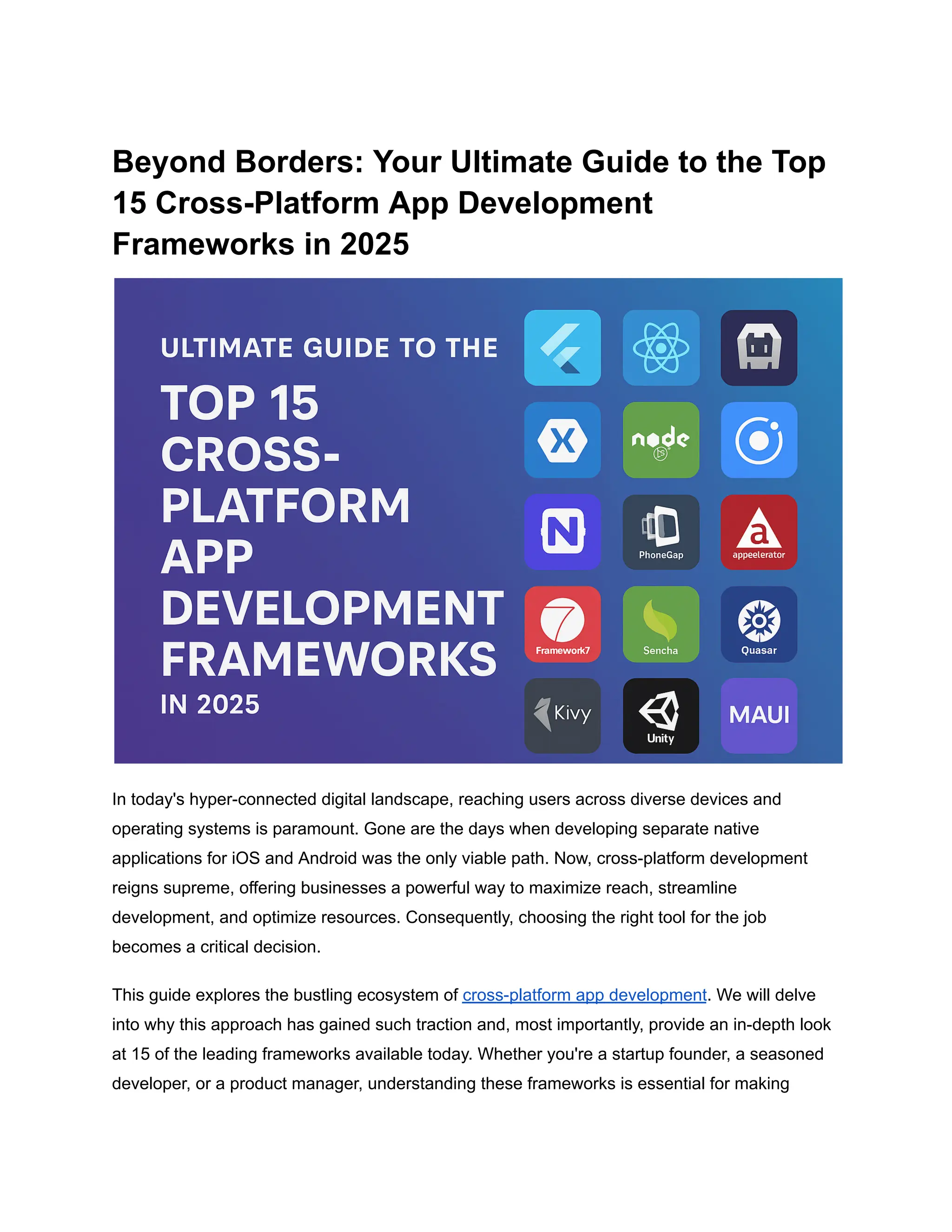
Beyond Borders: Your Ultimate Guide to the Top
15 Cross-Platform App Development
Frameworks in 2025
In today's hyper-connected digital landscape, reaching users across diverse devices and
operating systems is paramount. Gone are the days when developing separate native
applications for iOS and Android was the only viable path. Now, cross-platform development
reigns supreme, offering businesses a powerful way to maximize reach, streamline
development, and optimize resources. Consequently, choosing the right tool for the job
becomes a critical decision.
This guide explores the bustling ecosystem of cross-platform app development. We will delve
into why this approach has gained such traction and, most importantly, provide an in-depth look
at 15 of the leading frameworks available today. Whether you're a startup founder, a seasoned
developer, or a product manager, understanding these frameworks is essential for making
informed decisions that drive mobile success. Let's embark on this journey to discover the tools
shaping the future of app development.
1. The Cross-Platform Paradigm Shift
Cross-platform app development refers to the practice of writing code once and deploying it
across multiple operating systems, primarily iOS and Android, using a single codebase. This
contrasts sharply with native development, which requires separate teams, languages
(Swift/Objective-C for iOS, Kotlin/Java for Android), and development cycles for each platform.
The fundamental appeal lies in efficiency – reducing redundancy while aiming to deliver a
near-native user experience.
Furthermore, this approach addresses the fragmentation inherent in the mobile market.
Businesses no longer need to choose between targeting the massive Android user base or the
lucrative iOS market first; they can target both simultaneously. This accelerated market entry
can be a significant competitive advantage, allowing companies to capture wider audiences
faster and gather feedback from diverse user segments concurrently. Consequently,
cross-platform development has evolved from a niche alternative to a mainstream strategy for
many organizations worldwide.
2. The Compelling Case for Cross-Platform
The benefits of adopting a cross-platform strategy extend far beyond just code reuse. Firstly,
cost-effectiveness is a major driver. By maintaining a single codebase and often requiring
smaller, unified development teams, businesses significantly cut down on development, testing,
and maintenance expenses compared to building two or more native apps. This financial saving
frees up resources that can be reinvested into marketing, feature enhancement, or other
strategic initiatives.
Secondly, speed to market is dramatically reduced. Developing one application instead of two
(or more) inherently shortens the development timeline. Updates and new features can also be
rolled out simultaneously across all platforms, ensuring consistency and reducing user
frustration. Moreover, the unified codebase simplifies the maintenance process. Bug fixes and
updates need only be implemented once, propagating across all supported platforms, which
streamlines long-term management and reduces the likelihood of platform-specific issues
lingering unresolved. Finally, it ensures brand consistency by providing a largely uniform look,
feel, and user experience across different devices, reinforcing brand identity.
3. Acknowledging the Nuances
While the advantages are compelling, it's crucial to approach cross-platform development with a
balanced perspective. No solution is perfect, and potential trade-offs exist. One primary concern
often revolves around performance. Although modern frameworks have made enormous
strides, applications built using certain cross-platform approaches (especially those relying on
web views or bridges) might occasionally lag behind their native counterparts in terms of speed,
responsiveness, and resource consumption, particularly for graphically intensive or
computationally heavy tasks.
Another consideration involves achieving a truly native look and feel. While frameworks strive
to mimic native UI components and interactions, subtle differences can sometimes remain,
potentially impacting user experience for those accustomed to platform-specific conventions.
Additionally, access to the latest platform-specific features and APIs can sometimes be
delayed. Native SDKs release new capabilities first, and it may take time for the cross-platform
framework developers to incorporate support for these innovations. Therefore, projects
demanding cutting-edge native features or absolute peak performance might still necessitate
native development or careful framework selection.
4. The Titans of Transformation
Now, let's dive into the specific frameworks making waves in the cross-platform arena. These
initial contenders are arguably the most popular and widely adopted solutions currently
available.
a) React Native: Developed and open-sourced by Facebook (Meta), React Native allows
developers to build mobile apps using JavaScript and React. It doesn't render web components
in a WebView; instead, it uses native UI components, providing a genuinely native look and feel.
Developers leverage their existing web development skills, particularly in React, making the
transition smoother. Its large, active community ensures ample resources, libraries, and support.
React Native's "learn once, write anywhere" philosophy is powerful. While significant code
sharing (often 70-90%) is achievable, platform-specific adjustments are sometimes necessary to
optimize the UI or access certain native modules. Hot-reloading significantly speeds up
development by allowing developers to see changes instantly without recompiling. However,
reliance on native bridges can occasionally introduce performance bottlenecks, and managing
native dependencies can sometimes be complex.
b) Flutter: Google's contribution to the cross-platform world, Flutter, has rapidly gained
immense popularity. It uses the Dart programming language and compiles directly to native
ARM code, bypassing the need for JavaScript bridges, which often results in excellent
performance. Flutter provides its own rich set of customizable widgets drawn using its
high-performance Skia graphics engine, ensuring pixel-perfect UI consistency across platforms.
Flutter's key advantages include its expressive UI capabilities, fast development cycles thanks
to stateful hot reload, and outstanding performance often indistinguishable from native apps.
The framework is well-documented, backed strongly by Google, and boasts a rapidly growing
community. On the downside, Dart is less common than JavaScript, potentially requiring a
learning curve for some teams. Also, Flutter apps tend to have a larger initial bundle size
compared to some other frameworks, though optimization techniques exist.
c) .NET MAUI (Evolving from Xamarin): Xamarin, acquired by Microsoft, has long been a
staple for C# and .NET developers wanting to build cross-platform apps. It compiles C# code
into native applications for iOS, Android, and Windows. Microsoft has evolved Xamarin.Forms
into .NET Multi-platform App UI (.NET MAUI), integrating it fully into the .NET ecosystem (.NET
6 and later). .NET MAUI allows for extensive code sharing across business logic, data access,
and UI layers using XAML or C#.
.NET MAUI offers deep access to native APIs and allows developers to leverage the robust
.NET platform and its vast ecosystem of libraries. Performance is generally very good,
approaching native levels. It's an excellent choice for enterprises already invested in the
Microsoft stack. The learning curve can be steeper for those unfamiliar with C# or .NET, and
while UI customization is powerful, achieving highly platform-specific nuances might require
extra effort compared to native development.
5. Versatile Contenders & Web Hybrids
Beyond the top three, several other robust frameworks cater to different needs and developer
preferences, often leveraging web technologies.
d) Ionic: Ionic is a popular open-source framework primarily focused on using web technologies
(HTML, CSS, JavaScript/TypeScript) with frameworks like Angular, React, or Vue.js to build
cross-platform apps. It traditionally packages the web application within a native wrapper (using
tools like Capacitor or Cordova) that provides access to native device features through plugins.
This approach enables rapid development, especially for teams with strong web development
backgrounds.
Ionic excels at creating visually appealing UIs quickly using its pre-designed components that
adapt to platform conventions. Development is fast, and leveraging existing web skills is a huge
plus. However, because it often relies on a WebView, performance for highly demanding tasks
might not match that of compiled native solutions like Flutter or React Native. Nevertheless, for
many content-driven apps, business applications, and PWAs (Progressive Web Apps), Ionic
offers an excellent balance of speed, ease of use, and capability.
e) NativeScript: NativeScript is another open-source framework that allows developers to build
native applications using JavaScript, TypeScript, Angular, or Vue.js. Unlike Ionic's typical
WebView approach, NativeScript provides direct access to 100% of native platform APIs via
JavaScript, without needing plugins for core functionalities. This often results in better
performance and a more native feel compared to WebView-based solutions.
The key differentiator for NativeScript is its direct API access, offering greater power and
flexibility in interacting with device hardware and platform features. It compiles UI views into
native UI components. The framework enjoys good community support and backing from
Progress Telerik. The learning curve might be slightly steeper than Ionic for pure web
developers, and managing the build process can occasionally present challenges, but its
performance potential makes it a strong contender.
f) Kotlin Multiplatform Mobile (KMM): KMM is an SDK provided by JetBrains (the creators of
Kotlin and IntelliJ IDEA) designed specifically for sharing business logic code between iOS and
Android apps while keeping the UI layer fully native. Developers write shared logic (like data
handling, networking, validation) in Kotlin, which compiles to JVM bytecode for Android and
native binaries for iOS. The UI is then built using standard native tools (SwiftUI/UIKit for iOS,
Jetpack Compose/XML for Android).
This approach offers the best of both worlds: shared logic reduces redundancy and ensures
consistency, while native UIs provide the absolute best performance and platform fidelity. It's
ideal for teams who prioritize native UX but want to streamline backend logic development. The
main "drawback" is that it requires native UI development skills for both platforms, meaning it
doesn't eliminate the need for platform-specific UI code, unlike frameworks like Flutter or React
Native. It's more about logic sharing than full UI cross-platform development.
6. Niche Specialists & Established Options
The landscape also includes frameworks targeting specific use cases or built upon
long-standing technologies.
g) Qt Framework: Qt is a mature and comprehensive C++ framework widely used for
developing cross-platform applications not just for mobile (iOS, Android) but also for desktop
(Windows, macOS, Linux) and embedded systems. It offers a rich set of modules for everything
from GUI development (Qt Widgets, Qt Quick/QML) to networking, databases, and sensors. Qt
applications are compiled to native code, generally resulting in high performance.
Qt's strengths lie in its true cross-platform capabilities across mobile, desktop, and embedded,
its performance, and its extensive feature set. QML provides a declarative language for creating
fluid, animated UIs. However, Qt development typically requires C++ expertise, which might be
less common than JavaScript or Dart in mobile teams. Licensing costs for commercial use can
also be a factor, although open-source options are available. It's often favored for complex,
performance-critical applications that need to run on diverse hardware.
h) Apache Cordova (Formerly PhoneGap): Cordova is one of the pioneers in the hybrid app
space. It allows developers to build mobile apps using HTML, CSS, and JavaScript, essentially
wrapping a web application inside a native container equipped with plugins to access device
features like the camera, GPS, and contacts. Ionic originally built upon Cordova (though it now
favors Capacitor).
Cordova's main advantage is its simplicity and reliance on standard web technologies, making it
accessible to web developers. Its extensive plugin ecosystem provides access to a wide range
of native functionalities. However, performance can be a significant limitation, especially
compared to natively compiled frameworks, as it runs within a WebView. While still used, many
developers have migrated to more modern alternatives like Ionic (with Capacitor), React Native,
or Flutter for better performance and user experience.
i) Uno Platform: The Uno Platform enables building native mobile, desktop, and WebAssembly
applications using C# and XAML, drawing heavily from Microsoft's UWP/WinUI standards. It
aims to provide pixel-perfect UI consistency by rendering native controls on mobile or using
WebAssembly/HTML5 on the web. It's a strong alternative for .NET developers seeking broader
platform reach than .NET MAUI initially targeted (especially strong WebAssembly support).
Uno Platform's strength is its commitment to using standard C# and XAML, leveraging the
WinUI 3/UWP control set, and its excellent WebAssembly support via SkiaSharp or HTML5.
This allows for significant code reuse across Windows, iOS, Android, macOS, Linux, and Web.
Performance is generally good. Similar to .NET MAUI, it requires C#/.NET knowledge. It
competes closely with .NET MAUI, offering a different approach to rendering and broader
platform targets, particularly for web deployment.
7. Expanding the Horizon
Rounding out our list are frameworks with specific strengths and the increasingly important
Progressive Web App strategy.
j) Sencha Ext JS: Sencha Ext JS is a comprehensive JavaScript framework primarily aimed at
building data-intensive, cross-platform web and mobile applications for enterprises. It provides a
vast library of pre-built and tested UI components (grids, charts, forms, etc.), designed for
complex application interfaces. When targeting mobile, it typically uses Cordova or similar
wrappers.
Ext JS excels in creating sophisticated desktop-like application interfaces with rich data handling
capabilities. Its component library is extensive, potentially speeding up the development of
complex UIs. It's a good fit for enterprise applications requiring intricate data visualization and
management. The framework itself can have a steeper learning curve and comes with
commercial licensing costs. Performance considerations similar to other WebView-based
approaches apply for mobile deployments.
k) Kivy: Kivy is an open-source Python library for developing multi-touch applications. It
supports deployment on Windows, macOS, Linux, Android, and iOS. Kivy uses its own graphics
engine built over OpenGL ES 2, allowing for creative and non-standard UIs. It's particularly
popular in prototyping, interactive art installations, and specific types of mobile apps where a
unique UI is desired.
Kivy's main appeal is using Python, a widely known language, for mobile development and its
flexibility in UI design. It's great for projects where standard native UI conventions are less
important than custom interaction and visuals. However, achieving a standard platform-specific
look and feel can be challenging, and the community and ecosystem are smaller compared to
giants like React Native or Flutter. Performance is generally good but depends heavily on the
application's complexity.
l) Progressive Web Apps (PWAs): While not a framework in the same sense, PWAs represent
a crucial strategy for cross-platform delivery. PWAs are web applications built using standard
web technologies (HTML, CSS, JavaScript) but enhanced with modern web APIs (like service
workers for offline access and web app manifests for installation) to provide an app-like
experience. They run directly in the browser but can be "installed" on the user's home screen,
offer push notifications, and work offline.
PWAs offer incredible reach – they work on any device with a compliant web browser.
Development uses standard web skills, and there's no app store submission process. They are
inherently linkable and shareable via URLs. The primary limitation is access to native device
features, which, while improving, is still more restricted compared to native or hybrid apps built
with frameworks like React Native or Flutter. Also, support and integration levels can vary
slightly between platforms (iOS historically lagged behind Android in PWA feature support,
though it's improving).
m) Tauri: Tauri is a framework for building desktop applications using web technologies (HTML,
CSS, JS) for the frontend but with a Rust backend. While primarily focused on desktop
(Windows, macOS, Linux), its architectural principles and potential for mobile extensions via
projects like tauri-mobile make it an interesting technology to watch in the broader
cross-platform space. It emphasizes security, small bundle sizes, and performance by using the
OS's native web renderer (unlike Electron which bundles Chromium).
Tauri's key strengths are its security focus, minimal resource footprint, and performance
advantage over Electron-based apps. Using Rust for the backend provides memory safety and
speed. While mobile support is still evolving, its core philosophy of leveraging native web
renderers and a performant backend makes it a promising approach for future cross-platform
development beyond just desktop.
n) Framework7: Framework7 is another open-source framework for building mobile, desktop,
and web apps with a native look and feel using HTML, CSS, and JavaScript. It's known for its
high fidelity in mimicking iOS and Android Material Design UI elements and animations purely
with web technologies. It can be used with Cordova/Capacitor for native deployment or function
as a PWA.
Framework7 prides itself on its UI accuracy and smooth animations, aiming to provide a
near-native user experience using only web tech. It's relatively easy to get started for web
developers and offers components for Vue.js, React, and Svelte integration. Similar to other
WebView-dependent frameworks, performance for very intensive tasks might be a limitation, but
it excels at creating visually polished, app-like interfaces quickly.
o) NodeGui / React NodeGui: NodeGui is an open-source framework for building native
cross-platform desktop applications using JavaScript and Node.js. It uses Qt for rendering
native widgets, resulting in apps with native look, feel, and lower CPU/memory consumption
compared to Electron apps. React NodeGui provides a React renderer for NodeGui. While
desktop-focused, its use of Qt and native widgets makes it relevant in discussions about
efficient cross-platform UI development beyond the web view paradigm.
The main advantage of NodeGui/React NodeGui is creating truly native desktop experiences
with significantly better performance and resource usage than Electron, while still leveraging
JavaScript/React skills. Its relevance here is as an example of using native widget toolkits (like
Qt) from JavaScript, an approach distinct from web views or frameworks like Flutter that draw
their own widgets.
8. Peering into the Future
The cross-platform landscape is constantly evolving. We anticipate several key trends
continuing to shape its future. Firstly, the quest for near-native performance remains
paramount. Frameworks like Flutter and React Native (with its evolving architecture) will
continue optimizing their engines and bridging mechanisms. Technologies like Kotlin
Multiplatform Mobile emphasize sharing logic while retaining fully native UIs, offering another
path to peak performance.
Secondly, WebAssembly (Wasm) is poised to play a larger role. Frameworks like Uno Platform
heavily leverage Wasm for web deployment, offering near-native performance in the browser.
We may see more frameworks adopting Wasm to run complex code efficiently across web and
potentially mobile platforms. Furthermore, the lines between web and mobile apps will continue
to blur, driven by the increasing capabilities of Progressive Web Apps (PWAs) and improved
framework support for targeting the web as a platform. Finally, expect tighter integration with
AI/ML capabilities directly within frameworks, simplifying the development of intelligent
applications.
9. Selecting Your Ideal Framework
Choosing the right cross-platform framework is not a one-size-fits-all decision. It requires careful
consideration of several factors specific to your project and team. Firstly, evaluate your project
requirements: Does the app need high graphical performance, intensive background
processing, or frequent access to bleeding-edge native APIs? Complex, performance-critical
apps might lean towards Flutter, KMM, or .NET MAUI, while content-focused or utility apps
could be well-served by React Native, Ionic, or even PWAs.
Next, consider your team's existing skill set. Do you have strong JavaScript/React
developers? React Native or Ionic might be a natural fit. Is your team proficient in C#/.NET?
Then .NET MAUI or Uno Platform makes sense. Does Dart appeal to your team, or do you have
Python experts? Flutter or Kivy become viable options. Factor in the desired user experience
– how crucial is mimicking the exact native look and feel versus maintaining perfect UI
consistency across platforms? Lastly, assess the long-term maintenance implications,
community support, available libraries, and the framework's overall maturity and roadmap.
10. Partnering for Cross-Platform Success
Selecting a framework is just one piece of the puzzle. Successfully designing, developing,
deploying, and maintaining a high-quality cross-platform application requires expertise and
experience. This is where partnering with specialized agencies offering cross-platform app
development services becomes invaluable. Such partners bring deep knowledge of the
nuances between frameworks, understand platform-specific guidelines, and possess the skills
to optimize performance and user experience.
A proficient development partner does more than just write code. They contribute strategic
insights, help navigate the complexities of API integration, ensure robust testing across diverse
devices, and manage deployment processes. Engaging expert cross-platform app
development services can significantly accelerate your project timeline, mitigate risks
associated with framework intricacies, and ultimately lead to a more polished, reliable, and
successful application in the market. They understand how to leverage the chosen framework's
strengths while mitigating its potential weaknesses, ensuring your app meets both business
goals and user expectations.
11. The Gauntlet of Quality
Developing a cross-platform application efficiently is only half the battle; ensuring its quality
across diverse devices, screen sizes, and operating system versions presents unique testing
challenges. While code reuse reduces the amount of logic to test, the breadth of testing required
often increases. Testers must validate functionality, UI consistency, performance, and native
integrations on both iOS and Android platforms, paying close attention to platform-specific
behaviours and potential rendering differences introduced by the framework.
Consequently, a robust testing strategy is crucial. This typically involves a combination of
automated and manual testing. Automated tests (unit, integration, end-to-end) are vital for
verifying shared business logic and core functionalities quickly and repeatedly. However, manual
testing remains essential for evaluating the user experience, visual fidelity, and platform-specific
nuances on a wide range of real devices or high-fidelity emulators/simulators. Utilizing cloud
device farms can provide access to numerous physical devices, helping uncover issues specific
to certain hardware or OS versions that might be missed otherwise. Performance testing under
various network conditions and device loads is also paramount.
12. Fortifying Your App
Security is a non-negotiable aspect of any application development, and cross-platform apps
are no exception. While the core security principles remain the same – secure data storage,
protected network communication, proper authentication and authorization – the specific
implementation details can be influenced by the chosen framework and the underlying native
platforms. Developers must be vigilant about securing not only the shared codebase but also
any native modules or plugins used to access device features, as these can sometimes
introduce platform-specific vulnerabilities.
Furthermore, developers should diligently follow security best practices recommended by both
the framework creators and the native platform providers (Apple and Google). This includes
using secure coding practices to prevent common vulnerabilities like injection attacks or
insecure data handling, employing encryption for sensitive data both at rest and in transit (using
HTTPS/TLS), securely managing API keys and credentials, and implementing measures against
reverse engineering or tampering. Regularly updating the framework, libraries, and plugins is
also critical to patch known security holes. Partnering with cross-platform app development
services that prioritize security can provide invaluable expertise in navigating these complex
requirements.
13. Building for Everyone
Creating applications that are usable by people with disabilities – encompassing visual, auditory,
motor, and cognitive impairments – is not just an ethical imperative but also expands your
potential user base. Accessibility (often abbreviated as a11y) should be a core consideration
throughout the cross-platform development lifecycle. Modern cross-platform frameworks
increasingly provide tools and APIs to support accessibility features like screen reader
compatibility (e.g., VoiceOver on iOS, TalkBack on Android), dynamic font sizing, sufficient color
contrast, and navigable controls for users relying on assistive technologies.
Implementing accessibility effectively often involves leveraging both the framework's built-in
capabilities and accessing native accessibility APIs when necessary. Developers need to ensure
UI elements have proper labels and hints for screen readers, touch targets are adequately
sized, and navigation flows are logical for keyboard or switch control users. Testing with actual
assistive technologies and involving users with disabilities in the testing process provides
invaluable feedback. Prioritizing accessibility from the start is far more efficient than attempting
to retrofit it later and demonstrates a commitment to inclusive design.
14. Real-World Impact
The theoretical benefits of cross-platform development are validated by numerous high-profile
success stories in the real world. Many popular applications that millions use daily were built
using these frameworks, showcasing their power and viability for even large-scale, complex
projects. For instance, major parts of the Facebook and Instagram apps leverage React Native,
demonstrating its capability for handling sophisticated UIs and large user bases. Similarly, the
main BMW app and the Google Ads app were built using Flutter, highlighting its performance
and UI fidelity for demanding brand experiences.
Other examples abound: Alibaba, the e-commerce giant, utilizes Flutter extensively. Reflectly, a
popular journaling app, found success with React Native. While Pinterest used React Native
initially for certain features. These examples illustrate that cross-platform solutions are not
limited to simple apps; they are robust enough for global brands and complex functionalities.
Examining these case studies can provide insights into how different frameworks perform under
real-world conditions and the types of applications where they truly excel, further informing your
own framework selection process.
15. The Takeaway
Cross-platform app development has undeniably revolutionized how businesses approach the
mobile landscape. The ability to reach wider audiences faster, reduce development costs, and
streamline maintenance offers a powerful value proposition that's hard to ignore. From the
native performance of Flutter and .NET MAUI to the web-powered flexibility of Ionic and React
Native, and the logic-sharing prowess of KMM, the array of available frameworks provides
solutions for nearly every need. While the specific list of top frameworks evolves, the core
principle of writing code once and deploying it broadly remains a compelling strategy.
While understanding potential trade-offs and considering aspects like testing, security, and
accessibility is essential, the advancements in these frameworks mean that achieving
near-native performance and excellent user experiences is more attainable than ever. By
carefully evaluating your project goals, team skills, and potentially partnering with expert
cross-platform app development services, you can harness the power of these tools to build
compelling applications that thrive across the diverse mobile ecosystem. The future is
increasingly cross-platform, and the tools are ready – it's time to build efficiently and effectively.
The Final Word
Cross-platform app development has undeniably revolutionized how businesses approach the
mobile landscape. The ability to reach wider audiences faster, reduce development costs, and
streamline maintenance offers a powerful value proposition that's hard to ignore. From the
native performance of Flutter and .NET MAUI to the web-powered flexibility of Ionic and React
Native, and the logic-sharing prowess of KMM, the array of available frameworks provides
solutions for nearly every need.
While understanding potential trade-offs is essential, the advancements in these frameworks
mean that achieving near-native performance and excellent user experiences is more attainable
than ever. By carefully evaluating your project goals, team skills, and partnering strategically,
potentially leveraging expert cross-platform app development services, you can harness the
power of these tools to build compelling applications that thrive across the diverse mobile
ecosystem. The future is cross-platform, and the tools are ready – it's time to build.

Top 15 Cross-Platform App Development Frameworks in 2025.pdf

  • 1.
    Beyond Borders: YourUltimate Guide to the Top 15 Cross-Platform App Development Frameworks in 2025 In today's hyper-connected digital landscape, reaching users across diverse devices and operating systems is paramount. Gone are the days when developing separate native applications for iOS and Android was the only viable path. Now, cross-platform development reigns supreme, offering businesses a powerful way to maximize reach, streamline development, and optimize resources. Consequently, choosing the right tool for the job becomes a critical decision. This guide explores the bustling ecosystem of cross-platform app development. We will delve into why this approach has gained such traction and, most importantly, provide an in-depth look at 15 of the leading frameworks available today. Whether you're a startup founder, a seasoned developer, or a product manager, understanding these frameworks is essential for making
  • 2.
    informed decisions thatdrive mobile success. Let's embark on this journey to discover the tools shaping the future of app development. 1. The Cross-Platform Paradigm Shift Cross-platform app development refers to the practice of writing code once and deploying it across multiple operating systems, primarily iOS and Android, using a single codebase. This contrasts sharply with native development, which requires separate teams, languages (Swift/Objective-C for iOS, Kotlin/Java for Android), and development cycles for each platform. The fundamental appeal lies in efficiency – reducing redundancy while aiming to deliver a near-native user experience. Furthermore, this approach addresses the fragmentation inherent in the mobile market. Businesses no longer need to choose between targeting the massive Android user base or the lucrative iOS market first; they can target both simultaneously. This accelerated market entry can be a significant competitive advantage, allowing companies to capture wider audiences faster and gather feedback from diverse user segments concurrently. Consequently, cross-platform development has evolved from a niche alternative to a mainstream strategy for many organizations worldwide. 2. The Compelling Case for Cross-Platform The benefits of adopting a cross-platform strategy extend far beyond just code reuse. Firstly, cost-effectiveness is a major driver. By maintaining a single codebase and often requiring smaller, unified development teams, businesses significantly cut down on development, testing, and maintenance expenses compared to building two or more native apps. This financial saving frees up resources that can be reinvested into marketing, feature enhancement, or other strategic initiatives. Secondly, speed to market is dramatically reduced. Developing one application instead of two (or more) inherently shortens the development timeline. Updates and new features can also be rolled out simultaneously across all platforms, ensuring consistency and reducing user frustration. Moreover, the unified codebase simplifies the maintenance process. Bug fixes and updates need only be implemented once, propagating across all supported platforms, which
  • 3.
    streamlines long-term managementand reduces the likelihood of platform-specific issues lingering unresolved. Finally, it ensures brand consistency by providing a largely uniform look, feel, and user experience across different devices, reinforcing brand identity. 3. Acknowledging the Nuances While the advantages are compelling, it's crucial to approach cross-platform development with a balanced perspective. No solution is perfect, and potential trade-offs exist. One primary concern often revolves around performance. Although modern frameworks have made enormous strides, applications built using certain cross-platform approaches (especially those relying on web views or bridges) might occasionally lag behind their native counterparts in terms of speed, responsiveness, and resource consumption, particularly for graphically intensive or computationally heavy tasks. Another consideration involves achieving a truly native look and feel. While frameworks strive to mimic native UI components and interactions, subtle differences can sometimes remain, potentially impacting user experience for those accustomed to platform-specific conventions. Additionally, access to the latest platform-specific features and APIs can sometimes be delayed. Native SDKs release new capabilities first, and it may take time for the cross-platform framework developers to incorporate support for these innovations. Therefore, projects demanding cutting-edge native features or absolute peak performance might still necessitate native development or careful framework selection. 4. The Titans of Transformation Now, let's dive into the specific frameworks making waves in the cross-platform arena. These initial contenders are arguably the most popular and widely adopted solutions currently available. a) React Native: Developed and open-sourced by Facebook (Meta), React Native allows developers to build mobile apps using JavaScript and React. It doesn't render web components in a WebView; instead, it uses native UI components, providing a genuinely native look and feel. Developers leverage their existing web development skills, particularly in React, making the transition smoother. Its large, active community ensures ample resources, libraries, and support.
  • 4.
    React Native's "learnonce, write anywhere" philosophy is powerful. While significant code sharing (often 70-90%) is achievable, platform-specific adjustments are sometimes necessary to optimize the UI or access certain native modules. Hot-reloading significantly speeds up development by allowing developers to see changes instantly without recompiling. However, reliance on native bridges can occasionally introduce performance bottlenecks, and managing native dependencies can sometimes be complex. b) Flutter: Google's contribution to the cross-platform world, Flutter, has rapidly gained immense popularity. It uses the Dart programming language and compiles directly to native ARM code, bypassing the need for JavaScript bridges, which often results in excellent performance. Flutter provides its own rich set of customizable widgets drawn using its high-performance Skia graphics engine, ensuring pixel-perfect UI consistency across platforms. Flutter's key advantages include its expressive UI capabilities, fast development cycles thanks to stateful hot reload, and outstanding performance often indistinguishable from native apps. The framework is well-documented, backed strongly by Google, and boasts a rapidly growing community. On the downside, Dart is less common than JavaScript, potentially requiring a learning curve for some teams. Also, Flutter apps tend to have a larger initial bundle size compared to some other frameworks, though optimization techniques exist. c) .NET MAUI (Evolving from Xamarin): Xamarin, acquired by Microsoft, has long been a staple for C# and .NET developers wanting to build cross-platform apps. It compiles C# code into native applications for iOS, Android, and Windows. Microsoft has evolved Xamarin.Forms into .NET Multi-platform App UI (.NET MAUI), integrating it fully into the .NET ecosystem (.NET 6 and later). .NET MAUI allows for extensive code sharing across business logic, data access, and UI layers using XAML or C#. .NET MAUI offers deep access to native APIs and allows developers to leverage the robust .NET platform and its vast ecosystem of libraries. Performance is generally very good, approaching native levels. It's an excellent choice for enterprises already invested in the Microsoft stack. The learning curve can be steeper for those unfamiliar with C# or .NET, and while UI customization is powerful, achieving highly platform-specific nuances might require extra effort compared to native development. 5. Versatile Contenders & Web Hybrids
  • 5.
    Beyond the topthree, several other robust frameworks cater to different needs and developer preferences, often leveraging web technologies. d) Ionic: Ionic is a popular open-source framework primarily focused on using web technologies (HTML, CSS, JavaScript/TypeScript) with frameworks like Angular, React, or Vue.js to build cross-platform apps. It traditionally packages the web application within a native wrapper (using tools like Capacitor or Cordova) that provides access to native device features through plugins. This approach enables rapid development, especially for teams with strong web development backgrounds. Ionic excels at creating visually appealing UIs quickly using its pre-designed components that adapt to platform conventions. Development is fast, and leveraging existing web skills is a huge plus. However, because it often relies on a WebView, performance for highly demanding tasks might not match that of compiled native solutions like Flutter or React Native. Nevertheless, for many content-driven apps, business applications, and PWAs (Progressive Web Apps), Ionic offers an excellent balance of speed, ease of use, and capability. e) NativeScript: NativeScript is another open-source framework that allows developers to build native applications using JavaScript, TypeScript, Angular, or Vue.js. Unlike Ionic's typical WebView approach, NativeScript provides direct access to 100% of native platform APIs via JavaScript, without needing plugins for core functionalities. This often results in better performance and a more native feel compared to WebView-based solutions. The key differentiator for NativeScript is its direct API access, offering greater power and flexibility in interacting with device hardware and platform features. It compiles UI views into native UI components. The framework enjoys good community support and backing from Progress Telerik. The learning curve might be slightly steeper than Ionic for pure web developers, and managing the build process can occasionally present challenges, but its performance potential makes it a strong contender. f) Kotlin Multiplatform Mobile (KMM): KMM is an SDK provided by JetBrains (the creators of Kotlin and IntelliJ IDEA) designed specifically for sharing business logic code between iOS and Android apps while keeping the UI layer fully native. Developers write shared logic (like data handling, networking, validation) in Kotlin, which compiles to JVM bytecode for Android and native binaries for iOS. The UI is then built using standard native tools (SwiftUI/UIKit for iOS, Jetpack Compose/XML for Android).
  • 6.
    This approach offersthe best of both worlds: shared logic reduces redundancy and ensures consistency, while native UIs provide the absolute best performance and platform fidelity. It's ideal for teams who prioritize native UX but want to streamline backend logic development. The main "drawback" is that it requires native UI development skills for both platforms, meaning it doesn't eliminate the need for platform-specific UI code, unlike frameworks like Flutter or React Native. It's more about logic sharing than full UI cross-platform development. 6. Niche Specialists & Established Options The landscape also includes frameworks targeting specific use cases or built upon long-standing technologies. g) Qt Framework: Qt is a mature and comprehensive C++ framework widely used for developing cross-platform applications not just for mobile (iOS, Android) but also for desktop (Windows, macOS, Linux) and embedded systems. It offers a rich set of modules for everything from GUI development (Qt Widgets, Qt Quick/QML) to networking, databases, and sensors. Qt applications are compiled to native code, generally resulting in high performance. Qt's strengths lie in its true cross-platform capabilities across mobile, desktop, and embedded, its performance, and its extensive feature set. QML provides a declarative language for creating fluid, animated UIs. However, Qt development typically requires C++ expertise, which might be less common than JavaScript or Dart in mobile teams. Licensing costs for commercial use can also be a factor, although open-source options are available. It's often favored for complex, performance-critical applications that need to run on diverse hardware. h) Apache Cordova (Formerly PhoneGap): Cordova is one of the pioneers in the hybrid app space. It allows developers to build mobile apps using HTML, CSS, and JavaScript, essentially wrapping a web application inside a native container equipped with plugins to access device features like the camera, GPS, and contacts. Ionic originally built upon Cordova (though it now favors Capacitor). Cordova's main advantage is its simplicity and reliance on standard web technologies, making it accessible to web developers. Its extensive plugin ecosystem provides access to a wide range of native functionalities. However, performance can be a significant limitation, especially compared to natively compiled frameworks, as it runs within a WebView. While still used, many
  • 7.
    developers have migratedto more modern alternatives like Ionic (with Capacitor), React Native, or Flutter for better performance and user experience. i) Uno Platform: The Uno Platform enables building native mobile, desktop, and WebAssembly applications using C# and XAML, drawing heavily from Microsoft's UWP/WinUI standards. It aims to provide pixel-perfect UI consistency by rendering native controls on mobile or using WebAssembly/HTML5 on the web. It's a strong alternative for .NET developers seeking broader platform reach than .NET MAUI initially targeted (especially strong WebAssembly support). Uno Platform's strength is its commitment to using standard C# and XAML, leveraging the WinUI 3/UWP control set, and its excellent WebAssembly support via SkiaSharp or HTML5. This allows for significant code reuse across Windows, iOS, Android, macOS, Linux, and Web. Performance is generally good. Similar to .NET MAUI, it requires C#/.NET knowledge. It competes closely with .NET MAUI, offering a different approach to rendering and broader platform targets, particularly for web deployment. 7. Expanding the Horizon Rounding out our list are frameworks with specific strengths and the increasingly important Progressive Web App strategy. j) Sencha Ext JS: Sencha Ext JS is a comprehensive JavaScript framework primarily aimed at building data-intensive, cross-platform web and mobile applications for enterprises. It provides a vast library of pre-built and tested UI components (grids, charts, forms, etc.), designed for complex application interfaces. When targeting mobile, it typically uses Cordova or similar wrappers. Ext JS excels in creating sophisticated desktop-like application interfaces with rich data handling capabilities. Its component library is extensive, potentially speeding up the development of complex UIs. It's a good fit for enterprise applications requiring intricate data visualization and management. The framework itself can have a steeper learning curve and comes with commercial licensing costs. Performance considerations similar to other WebView-based approaches apply for mobile deployments. k) Kivy: Kivy is an open-source Python library for developing multi-touch applications. It supports deployment on Windows, macOS, Linux, Android, and iOS. Kivy uses its own graphics
  • 8.
    engine built overOpenGL ES 2, allowing for creative and non-standard UIs. It's particularly popular in prototyping, interactive art installations, and specific types of mobile apps where a unique UI is desired. Kivy's main appeal is using Python, a widely known language, for mobile development and its flexibility in UI design. It's great for projects where standard native UI conventions are less important than custom interaction and visuals. However, achieving a standard platform-specific look and feel can be challenging, and the community and ecosystem are smaller compared to giants like React Native or Flutter. Performance is generally good but depends heavily on the application's complexity. l) Progressive Web Apps (PWAs): While not a framework in the same sense, PWAs represent a crucial strategy for cross-platform delivery. PWAs are web applications built using standard web technologies (HTML, CSS, JavaScript) but enhanced with modern web APIs (like service workers for offline access and web app manifests for installation) to provide an app-like experience. They run directly in the browser but can be "installed" on the user's home screen, offer push notifications, and work offline. PWAs offer incredible reach – they work on any device with a compliant web browser. Development uses standard web skills, and there's no app store submission process. They are inherently linkable and shareable via URLs. The primary limitation is access to native device features, which, while improving, is still more restricted compared to native or hybrid apps built with frameworks like React Native or Flutter. Also, support and integration levels can vary slightly between platforms (iOS historically lagged behind Android in PWA feature support, though it's improving). m) Tauri: Tauri is a framework for building desktop applications using web technologies (HTML, CSS, JS) for the frontend but with a Rust backend. While primarily focused on desktop (Windows, macOS, Linux), its architectural principles and potential for mobile extensions via projects like tauri-mobile make it an interesting technology to watch in the broader cross-platform space. It emphasizes security, small bundle sizes, and performance by using the OS's native web renderer (unlike Electron which bundles Chromium). Tauri's key strengths are its security focus, minimal resource footprint, and performance advantage over Electron-based apps. Using Rust for the backend provides memory safety and speed. While mobile support is still evolving, its core philosophy of leveraging native web
  • 9.
    renderers and aperformant backend makes it a promising approach for future cross-platform development beyond just desktop. n) Framework7: Framework7 is another open-source framework for building mobile, desktop, and web apps with a native look and feel using HTML, CSS, and JavaScript. It's known for its high fidelity in mimicking iOS and Android Material Design UI elements and animations purely with web technologies. It can be used with Cordova/Capacitor for native deployment or function as a PWA. Framework7 prides itself on its UI accuracy and smooth animations, aiming to provide a near-native user experience using only web tech. It's relatively easy to get started for web developers and offers components for Vue.js, React, and Svelte integration. Similar to other WebView-dependent frameworks, performance for very intensive tasks might be a limitation, but it excels at creating visually polished, app-like interfaces quickly. o) NodeGui / React NodeGui: NodeGui is an open-source framework for building native cross-platform desktop applications using JavaScript and Node.js. It uses Qt for rendering native widgets, resulting in apps with native look, feel, and lower CPU/memory consumption compared to Electron apps. React NodeGui provides a React renderer for NodeGui. While desktop-focused, its use of Qt and native widgets makes it relevant in discussions about efficient cross-platform UI development beyond the web view paradigm. The main advantage of NodeGui/React NodeGui is creating truly native desktop experiences with significantly better performance and resource usage than Electron, while still leveraging JavaScript/React skills. Its relevance here is as an example of using native widget toolkits (like Qt) from JavaScript, an approach distinct from web views or frameworks like Flutter that draw their own widgets. 8. Peering into the Future The cross-platform landscape is constantly evolving. We anticipate several key trends continuing to shape its future. Firstly, the quest for near-native performance remains paramount. Frameworks like Flutter and React Native (with its evolving architecture) will continue optimizing their engines and bridging mechanisms. Technologies like Kotlin
  • 10.
    Multiplatform Mobile emphasizesharing logic while retaining fully native UIs, offering another path to peak performance. Secondly, WebAssembly (Wasm) is poised to play a larger role. Frameworks like Uno Platform heavily leverage Wasm for web deployment, offering near-native performance in the browser. We may see more frameworks adopting Wasm to run complex code efficiently across web and potentially mobile platforms. Furthermore, the lines between web and mobile apps will continue to blur, driven by the increasing capabilities of Progressive Web Apps (PWAs) and improved framework support for targeting the web as a platform. Finally, expect tighter integration with AI/ML capabilities directly within frameworks, simplifying the development of intelligent applications. 9. Selecting Your Ideal Framework Choosing the right cross-platform framework is not a one-size-fits-all decision. It requires careful consideration of several factors specific to your project and team. Firstly, evaluate your project requirements: Does the app need high graphical performance, intensive background processing, or frequent access to bleeding-edge native APIs? Complex, performance-critical apps might lean towards Flutter, KMM, or .NET MAUI, while content-focused or utility apps could be well-served by React Native, Ionic, or even PWAs. Next, consider your team's existing skill set. Do you have strong JavaScript/React developers? React Native or Ionic might be a natural fit. Is your team proficient in C#/.NET? Then .NET MAUI or Uno Platform makes sense. Does Dart appeal to your team, or do you have Python experts? Flutter or Kivy become viable options. Factor in the desired user experience – how crucial is mimicking the exact native look and feel versus maintaining perfect UI consistency across platforms? Lastly, assess the long-term maintenance implications, community support, available libraries, and the framework's overall maturity and roadmap. 10. Partnering for Cross-Platform Success Selecting a framework is just one piece of the puzzle. Successfully designing, developing, deploying, and maintaining a high-quality cross-platform application requires expertise and experience. This is where partnering with specialized agencies offering cross-platform app
  • 11.
    development services becomesinvaluable. Such partners bring deep knowledge of the nuances between frameworks, understand platform-specific guidelines, and possess the skills to optimize performance and user experience. A proficient development partner does more than just write code. They contribute strategic insights, help navigate the complexities of API integration, ensure robust testing across diverse devices, and manage deployment processes. Engaging expert cross-platform app development services can significantly accelerate your project timeline, mitigate risks associated with framework intricacies, and ultimately lead to a more polished, reliable, and successful application in the market. They understand how to leverage the chosen framework's strengths while mitigating its potential weaknesses, ensuring your app meets both business goals and user expectations. 11. The Gauntlet of Quality Developing a cross-platform application efficiently is only half the battle; ensuring its quality across diverse devices, screen sizes, and operating system versions presents unique testing challenges. While code reuse reduces the amount of logic to test, the breadth of testing required often increases. Testers must validate functionality, UI consistency, performance, and native integrations on both iOS and Android platforms, paying close attention to platform-specific behaviours and potential rendering differences introduced by the framework. Consequently, a robust testing strategy is crucial. This typically involves a combination of automated and manual testing. Automated tests (unit, integration, end-to-end) are vital for verifying shared business logic and core functionalities quickly and repeatedly. However, manual testing remains essential for evaluating the user experience, visual fidelity, and platform-specific nuances on a wide range of real devices or high-fidelity emulators/simulators. Utilizing cloud device farms can provide access to numerous physical devices, helping uncover issues specific to certain hardware or OS versions that might be missed otherwise. Performance testing under various network conditions and device loads is also paramount. 12. Fortifying Your App
  • 12.
    Security is anon-negotiable aspect of any application development, and cross-platform apps are no exception. While the core security principles remain the same – secure data storage, protected network communication, proper authentication and authorization – the specific implementation details can be influenced by the chosen framework and the underlying native platforms. Developers must be vigilant about securing not only the shared codebase but also any native modules or plugins used to access device features, as these can sometimes introduce platform-specific vulnerabilities. Furthermore, developers should diligently follow security best practices recommended by both the framework creators and the native platform providers (Apple and Google). This includes using secure coding practices to prevent common vulnerabilities like injection attacks or insecure data handling, employing encryption for sensitive data both at rest and in transit (using HTTPS/TLS), securely managing API keys and credentials, and implementing measures against reverse engineering or tampering. Regularly updating the framework, libraries, and plugins is also critical to patch known security holes. Partnering with cross-platform app development services that prioritize security can provide invaluable expertise in navigating these complex requirements. 13. Building for Everyone Creating applications that are usable by people with disabilities – encompassing visual, auditory, motor, and cognitive impairments – is not just an ethical imperative but also expands your potential user base. Accessibility (often abbreviated as a11y) should be a core consideration throughout the cross-platform development lifecycle. Modern cross-platform frameworks increasingly provide tools and APIs to support accessibility features like screen reader compatibility (e.g., VoiceOver on iOS, TalkBack on Android), dynamic font sizing, sufficient color contrast, and navigable controls for users relying on assistive technologies. Implementing accessibility effectively often involves leveraging both the framework's built-in capabilities and accessing native accessibility APIs when necessary. Developers need to ensure UI elements have proper labels and hints for screen readers, touch targets are adequately sized, and navigation flows are logical for keyboard or switch control users. Testing with actual assistive technologies and involving users with disabilities in the testing process provides invaluable feedback. Prioritizing accessibility from the start is far more efficient than attempting to retrofit it later and demonstrates a commitment to inclusive design.
  • 13.
    14. Real-World Impact Thetheoretical benefits of cross-platform development are validated by numerous high-profile success stories in the real world. Many popular applications that millions use daily were built using these frameworks, showcasing their power and viability for even large-scale, complex projects. For instance, major parts of the Facebook and Instagram apps leverage React Native, demonstrating its capability for handling sophisticated UIs and large user bases. Similarly, the main BMW app and the Google Ads app were built using Flutter, highlighting its performance and UI fidelity for demanding brand experiences. Other examples abound: Alibaba, the e-commerce giant, utilizes Flutter extensively. Reflectly, a popular journaling app, found success with React Native. While Pinterest used React Native initially for certain features. These examples illustrate that cross-platform solutions are not limited to simple apps; they are robust enough for global brands and complex functionalities. Examining these case studies can provide insights into how different frameworks perform under real-world conditions and the types of applications where they truly excel, further informing your own framework selection process. 15. The Takeaway Cross-platform app development has undeniably revolutionized how businesses approach the mobile landscape. The ability to reach wider audiences faster, reduce development costs, and streamline maintenance offers a powerful value proposition that's hard to ignore. From the native performance of Flutter and .NET MAUI to the web-powered flexibility of Ionic and React Native, and the logic-sharing prowess of KMM, the array of available frameworks provides solutions for nearly every need. While the specific list of top frameworks evolves, the core principle of writing code once and deploying it broadly remains a compelling strategy. While understanding potential trade-offs and considering aspects like testing, security, and accessibility is essential, the advancements in these frameworks mean that achieving near-native performance and excellent user experiences is more attainable than ever. By carefully evaluating your project goals, team skills, and potentially partnering with expert cross-platform app development services, you can harness the power of these tools to build
  • 14.
    compelling applications thatthrive across the diverse mobile ecosystem. The future is increasingly cross-platform, and the tools are ready – it's time to build efficiently and effectively. The Final Word Cross-platform app development has undeniably revolutionized how businesses approach the mobile landscape. The ability to reach wider audiences faster, reduce development costs, and streamline maintenance offers a powerful value proposition that's hard to ignore. From the native performance of Flutter and .NET MAUI to the web-powered flexibility of Ionic and React Native, and the logic-sharing prowess of KMM, the array of available frameworks provides solutions for nearly every need. While understanding potential trade-offs is essential, the advancements in these frameworks mean that achieving near-native performance and excellent user experiences is more attainable than ever. By carefully evaluating your project goals, team skills, and partnering strategically, potentially leveraging expert cross-platform app development services, you can harness the power of these tools to build compelling applications that thrive across the diverse mobile ecosystem. The future is cross-platform, and the tools are ready – it's time to build.