
The Proven Path to Home Ownership
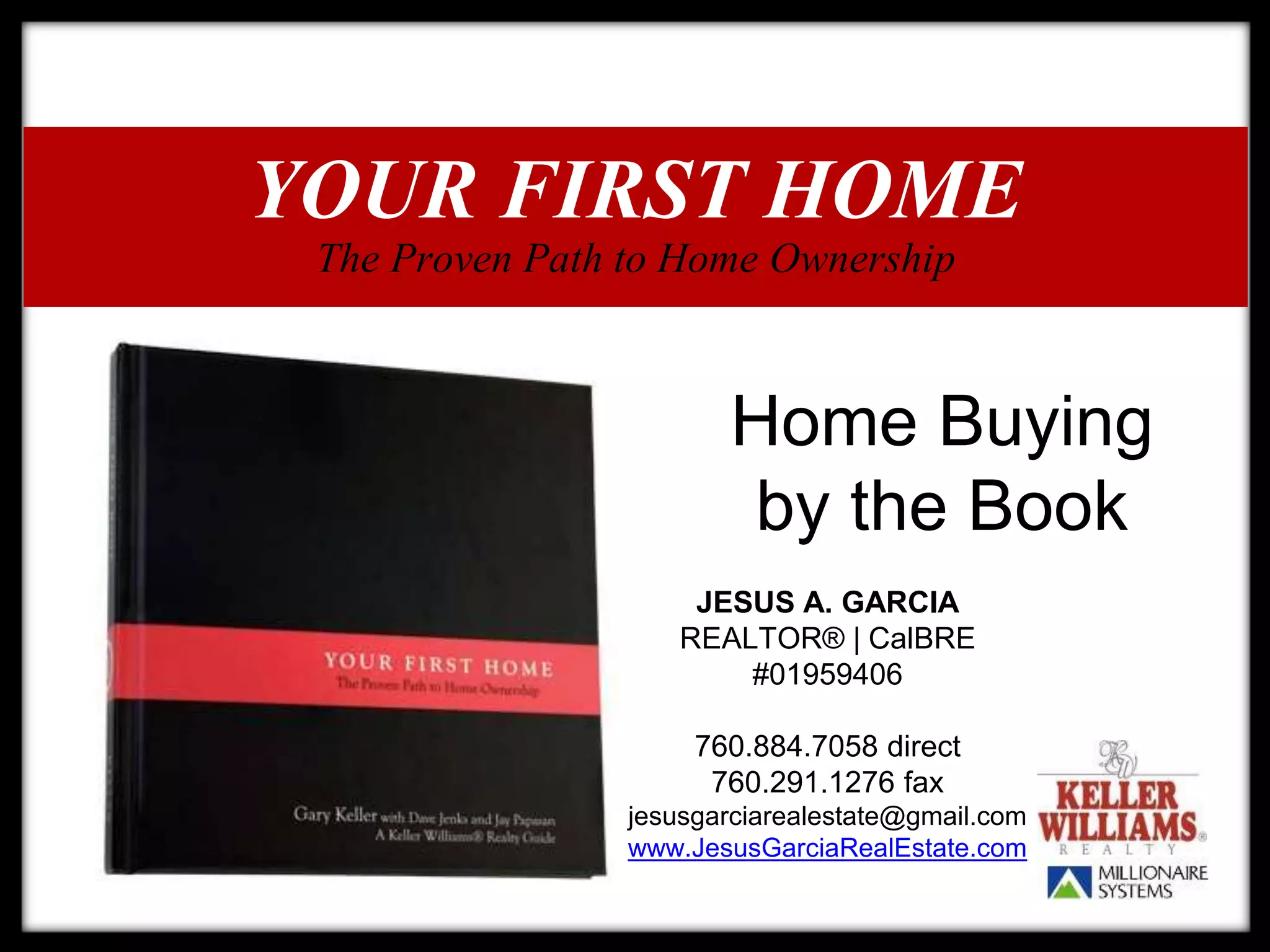
YOUR FIRST HOME
Home Buying
by the Book
JESUS A. GARCIA
REALTOR® | CalBRE
#01959406
760.884.7058 direct
760.291.1276 fax
jesusgarciarealestate@gmail.com
www.JesusGarciaRealEstate.com
Your First Home: Home Buying by the Book
Introduction
After Hurricane Katrina destroyed their
beloved New Orleans, many former residents
were asked the following question:
Besides “L-O-V-E” what do you identify as the
most important four-letter word?
The unanimous answer was simply …
“H-O-M-E”
Your First Home: Home Buying by the Book
Introduction
Think of a few words to describe what
having a home of your own means to you.
Let’s take a few moments to share our
thoughts aloud.
Your First Home: Home Buying by the Book
Overview
Today we’ll talk about some common fears
and helpful facts about buying a home.
We’ll also discuss eight simple steps to
successful home ownership.
Your First Home: Home Buying by the Book
Fears and Facts About Buying a
Home
Fear: I can’t afford to buy a home right now.
Fact: Actually, you can’t afford not to buy a
home right now.
Appears on Page
6
Your First Home: Home Buying by the Book
Fears and Facts About Buying a
Home
Fear: I should wait until the real estate market
gets better.
Fact: There is never a wrong time to buy the
right home.
Appears on Page
7
Your First Home: Home Buying by the Book
Fears and Facts About Buying a
Home
Fear: I don’t have the money for the down
payment.
Fact: There are a variety of down payment
options available to you.
Appears on Page
7
Your First Home: Home Buying by the Book
Fears and Facts About Buying a
Home
Fear: I can’t afford to buy my dream home.
Fact: The best way to get closer to buying your
dream home is to buy your first home.
Appears on Page
8
Your First Home: Home Buying by the Book
Eight Steps to Home Ownership
1. Decide to buy.
2. Hire your agent.
3. Secure financing.
4. Find your home.
5. Make an offer.
6. Perform due diligence.
7. Close.
8. Protect your investment. Appears on Page
19
Your First Home: Home Buying by the Book
Decide to Buy
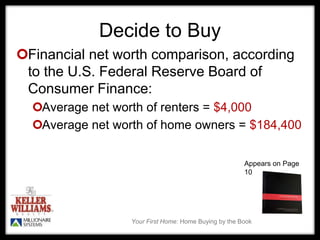
Financial net worth comparison, according
to the U.S. Federal Reserve Board of
Consumer Finance:
Average net worth of renters = $4,000
Average net worth of home owners = $184,400
Appears on Page
10
Your First Home: Home Buying by the Book
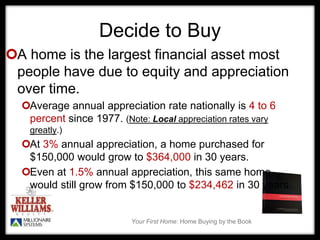
A home is the largest financial asset most
people have due to equity and appreciation
over time.
Average annual appreciation rate nationally is 4 to 6
percent since 1977. (Note: Local appreciation rates vary
greatly.)
At 3% annual appreciation, a home purchased for
$150,000 would grow to $364,000 in 30 years.
Even at 1.5% annual appreciation, this same home
would still grow from $150,000 to $234,462 in 30 years.
Decide to Buy
Your First Home: Home Buying by the Book
Decide to Buy
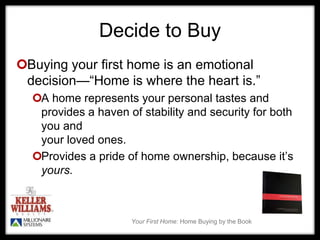
Buying your first home is an emotional
decision—“Home is where the heart is.”
A home represents your personal tastes and
provides a haven of stability and security for both
you and
your loved ones.
Provides a pride of home ownership, because it’s
yours.
Your First Home: Home Buying by the Book
Decide to Buy
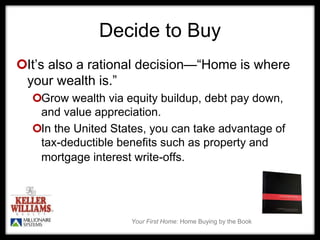
It’s also a rational decision—“Home is where
your wealth is.”
Grow wealth via equity buildup, debt pay down,
and value appreciation.
In the United States, you can take advantage of
tax-deductible benefits such as property and
mortgage interest write-offs.
Your First Home: Home Buying by the Book
Decide to Buy
“Home is where your wealth is.” (continued)
A home is an “accidental” investment that creates
leverage opportunities.
Examples:
In a few years, you can use your equity to
trade up to a better home.
Or, you might consider using some of your home
equity to invest in a rental property or a second
home.
Your First Home: Home Buying by the Book
Decide to Buy
Why pay rent when you can own?
If you took out a 30-year fixed-rate mortgage for
$150,000 and made monthly mortgage payments
of $900…
You’d pay $324,000 in mortgage and interest
payments over the life of the loan.
And after 30 years you’d own a home with an
appreciated value potential of $364,000 (at 3%
annual appreciation).
Keep in mind: Appreciation rates vary greatly based
on local conditions.
Appears on Page
14
Your First Home: Home Buying by the Book
Decide to Buy
Compare that to paying $800 per month in rent
over 30 years…
Even if your landlord improbably never raised
rent,
you would still spend $288,000 and own
nothing!
Appears on Page
14
Your First Home: Home Buying by the Book
Hire Your Agent
 Real estate agents perform 7 main roles:
1. Educate you about the market
2. Analyze your wants and needs
3. Steer you to homes that fit your criteria
4. Coordinate the work of other needed professionals
5. Negotiate on your behalf
6. Review paperwork and deadlines
7. Solve any problems that may arise
Appears on Page
27
Your First Home: Home Buying by the Book
Hire Your Agent
Advantages of a buyer’s representation
agreement:
Sets mutual expectations in writing between
you and your agent.
Commits your agent to getting you into the
home you want, while you commit to working
exclusively with your agent.
Appears on Page
32
Your First Home: Home Buying by the Book
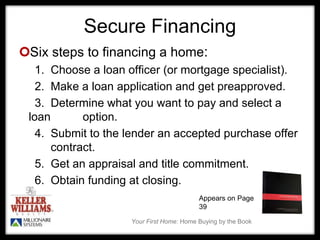
Secure Financing
Six steps to financing a home:
1. Choose a loan officer (or mortgage specialist).
2. Make a loan application and get preapproved.
3. Determine what you want to pay and select a
loan option.
4. Submit to the lender an accepted purchase offer
contract.
5. Get an appraisal and title commitment.
6. Obtain funding at closing.
Appears on Page
39
Your First Home: Home Buying by the Book
Secure Financing
 Know your mortgage options.
 Three basic factors:
1. Down payment
2. Interest rate
3. Term
Appears on Page
48
Your First Home: Home Buying by the Book
Secure Financing
Understanding your monthly payment:
Principal
Interest
Taxes
Insurance
Together, these four elements are commonly
referred to as PITI.
Appears on Page
58
Your First Home: Home Buying by the Book
Secure Financing
Prequalification vs. preapproval
Prequalification is simply a rough estimate of
how much you can borrow.
Preapproval involves a formal application
process and provides you with a formal
commitment from a lender stating how much
you can borrow and at what rate.
Appears on Page
60
Your First Home: Home Buying by the Book
Secure Financing
Deciding among your mortgage options:
If you want…
A low monthly payment – put more money down or
purchase a more affordable home.
A low down payment – secure a second mortgage or
an “80-15-5” piggyback.
To build equity quickly – make voluntary prepayments.
To minimize risk – take a 30-year fixed-rate program
with 20 percent down.
Appears on Page
60
Your First Home: Home Buying by the Book
Secure Financing
The suitcase principle
Your lender decides what you can borrow, but you
decide what you can afford.
In your preapproval letter, make sure the monthly
payment is an amount you’re comfortable paying each
month.
It’s best to spend no more than a third of your gross
monthly income on your home payment.
Appears on page 64
Your First Home: Home Buying by the Book
Find Your Home
Define your home criteria—analyze your values,
needs, and wants.
Consult with your agent to understand the rules of
your market.
Appears in Chapter 4
Your First Home: Home Buying by the Book
Find Your Home
When viewing a home, what you consider and
what your agent considers are different.
You’ll want to look for…
Layout, space, a sense of value, convenience of
location to work and schools, and features and
amenities.
Your agent will look for…
How the home compares in terms of size, layout, and
value to other homes in the area, as well as
maintenance
and structural concerns. Appears on Page 85
Your First Home: Home Buying by the Book
Make an Offer
Three components of an offer
Price—offer must reflect true market value of
the home.
Terms—six basic categories address timing
and financial considerations.
Contingencies—often referred to as
“conditions” that allow you to opt out of a deal if
the home has a problem.
Appears on Page 91
Your First Home: Home Buying by the Book
Make an Offer
Appears on Page
93
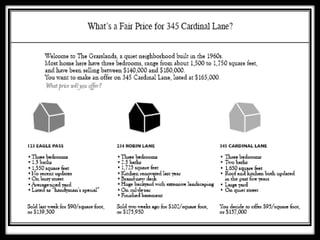
What’s a fair price?
Let’s take a look at a pricing scenario on the
next slide.
Your First Home: Home Buying by the Book
Perform Due Diligence
Property inspection—exposes any structural or
hidden issues.
Home owner’s insurance policy—protects
against loss or damage.
Your First Home: Home Buying by the Book
Perform Due Diligence
In your inspection, it’s the big stuff that really
matters.
Cracks or crumbling in the foundation
Cracks inside the house over windows
Water stains in ceilings, floors, or walls
Faded or worn shingles
Mold issues
Appears on Page 111
Your First Home: Home Buying by the Book
Close
Preclosing responsibilities include:
Appraisal, survey, title search, and title
insurance.
Keeping yourself mortgage worthy!
Doing a final walk-through of home.
Countdown to closing includes:
Getting your settlement statement, certified
funds, evidence of insurance, and transfer
of clear title.
Appears in Chapter 7
Your First Home: Home Buying by the Book
Protect Your Investment
Two keys to good home habits:
1. Keep it clean.
Perform routine maintenance on your home’s
systems, depending on their age and style.
2. Keep an eye on it.
Watch for signs of leaks, damage, and wear.
Fixing small problems early can save you big
money later.
Tip: Keep a file of receipts for your repairs.
Appears on Page 133
Your First Home: Home Buying by the Book
Thank you
Thank you for your time and good luck with your
home search.
Keller Williams associate contact info
Name: Jesus A. Garcia
Email: jesusgarciarealestate@gmail.com
Phone Number: 760-884-7058

Your First Home by the Book

  • 1.
    The Proven Pathto Home Ownership YOUR FIRST HOME Home Buying by the Book JESUS A. GARCIA REALTOR® | CalBRE #01959406 760.884.7058 direct 760.291.1276 fax jesusgarciarealestate@gmail.com www.JesusGarciaRealEstate.com
  • 2.
    Your First Home:Home Buying by the Book Introduction After Hurricane Katrina destroyed their beloved New Orleans, many former residents were asked the following question: Besides “L-O-V-E” what do you identify as the most important four-letter word? The unanimous answer was simply … “H-O-M-E”
  • 3.
    Your First Home:Home Buying by the Book Introduction Think of a few words to describe what having a home of your own means to you. Let’s take a few moments to share our thoughts aloud.
  • 4.
    Your First Home:Home Buying by the Book Overview Today we’ll talk about some common fears and helpful facts about buying a home. We’ll also discuss eight simple steps to successful home ownership.
  • 5.
    Your First Home:Home Buying by the Book Fears and Facts About Buying a Home Fear: I can’t afford to buy a home right now. Fact: Actually, you can’t afford not to buy a home right now. Appears on Page 6
  • 6.
    Your First Home:Home Buying by the Book Fears and Facts About Buying a Home Fear: I should wait until the real estate market gets better. Fact: There is never a wrong time to buy the right home. Appears on Page 7
  • 7.
    Your First Home:Home Buying by the Book Fears and Facts About Buying a Home Fear: I don’t have the money for the down payment. Fact: There are a variety of down payment options available to you. Appears on Page 7
  • 8.
    Your First Home:Home Buying by the Book Fears and Facts About Buying a Home Fear: I can’t afford to buy my dream home. Fact: The best way to get closer to buying your dream home is to buy your first home. Appears on Page 8
  • 9.
    Your First Home:Home Buying by the Book Eight Steps to Home Ownership 1. Decide to buy. 2. Hire your agent. 3. Secure financing. 4. Find your home. 5. Make an offer. 6. Perform due diligence. 7. Close. 8. Protect your investment. Appears on Page 19
  • 10.
    Your First Home:Home Buying by the Book Decide to Buy Financial net worth comparison, according to the U.S. Federal Reserve Board of Consumer Finance: Average net worth of renters = $4,000 Average net worth of home owners = $184,400 Appears on Page 10
  • 11.
    Your First Home:Home Buying by the Book A home is the largest financial asset most people have due to equity and appreciation over time. Average annual appreciation rate nationally is 4 to 6 percent since 1977. (Note: Local appreciation rates vary greatly.) At 3% annual appreciation, a home purchased for $150,000 would grow to $364,000 in 30 years. Even at 1.5% annual appreciation, this same home would still grow from $150,000 to $234,462 in 30 years. Decide to Buy
  • 12.
    Your First Home:Home Buying by the Book Decide to Buy Buying your first home is an emotional decision—“Home is where the heart is.” A home represents your personal tastes and provides a haven of stability and security for both you and your loved ones. Provides a pride of home ownership, because it’s yours.
  • 13.
    Your First Home:Home Buying by the Book Decide to Buy It’s also a rational decision—“Home is where your wealth is.” Grow wealth via equity buildup, debt pay down, and value appreciation. In the United States, you can take advantage of tax-deductible benefits such as property and mortgage interest write-offs.
  • 14.
    Your First Home:Home Buying by the Book Decide to Buy “Home is where your wealth is.” (continued) A home is an “accidental” investment that creates leverage opportunities. Examples: In a few years, you can use your equity to trade up to a better home. Or, you might consider using some of your home equity to invest in a rental property or a second home.
  • 15.
    Your First Home:Home Buying by the Book Decide to Buy Why pay rent when you can own? If you took out a 30-year fixed-rate mortgage for $150,000 and made monthly mortgage payments of $900… You’d pay $324,000 in mortgage and interest payments over the life of the loan. And after 30 years you’d own a home with an appreciated value potential of $364,000 (at 3% annual appreciation). Keep in mind: Appreciation rates vary greatly based on local conditions. Appears on Page 14
  • 16.
    Your First Home:Home Buying by the Book Decide to Buy Compare that to paying $800 per month in rent over 30 years… Even if your landlord improbably never raised rent, you would still spend $288,000 and own nothing! Appears on Page 14
  • 17.
    Your First Home:Home Buying by the Book Hire Your Agent  Real estate agents perform 7 main roles: 1. Educate you about the market 2. Analyze your wants and needs 3. Steer you to homes that fit your criteria 4. Coordinate the work of other needed professionals 5. Negotiate on your behalf 6. Review paperwork and deadlines 7. Solve any problems that may arise Appears on Page 27
  • 18.
    Your First Home:Home Buying by the Book Hire Your Agent Advantages of a buyer’s representation agreement: Sets mutual expectations in writing between you and your agent. Commits your agent to getting you into the home you want, while you commit to working exclusively with your agent. Appears on Page 32
  • 19.
    Your First Home:Home Buying by the Book Secure Financing Six steps to financing a home: 1. Choose a loan officer (or mortgage specialist). 2. Make a loan application and get preapproved. 3. Determine what you want to pay and select a loan option. 4. Submit to the lender an accepted purchase offer contract. 5. Get an appraisal and title commitment. 6. Obtain funding at closing. Appears on Page 39
  • 20.
    Your First Home:Home Buying by the Book Secure Financing  Know your mortgage options.  Three basic factors: 1. Down payment 2. Interest rate 3. Term Appears on Page 48
  • 21.
    Your First Home:Home Buying by the Book Secure Financing Understanding your monthly payment: Principal Interest Taxes Insurance Together, these four elements are commonly referred to as PITI. Appears on Page 58
  • 22.
    Your First Home:Home Buying by the Book Secure Financing Prequalification vs. preapproval Prequalification is simply a rough estimate of how much you can borrow. Preapproval involves a formal application process and provides you with a formal commitment from a lender stating how much you can borrow and at what rate. Appears on Page 60
  • 23.
    Your First Home:Home Buying by the Book Secure Financing Deciding among your mortgage options: If you want… A low monthly payment – put more money down or purchase a more affordable home. A low down payment – secure a second mortgage or an “80-15-5” piggyback. To build equity quickly – make voluntary prepayments. To minimize risk – take a 30-year fixed-rate program with 20 percent down. Appears on Page 60
  • 24.
    Your First Home:Home Buying by the Book Secure Financing The suitcase principle Your lender decides what you can borrow, but you decide what you can afford. In your preapproval letter, make sure the monthly payment is an amount you’re comfortable paying each month. It’s best to spend no more than a third of your gross monthly income on your home payment. Appears on page 64
  • 25.
    Your First Home:Home Buying by the Book Find Your Home Define your home criteria—analyze your values, needs, and wants. Consult with your agent to understand the rules of your market. Appears in Chapter 4
  • 26.
    Your First Home:Home Buying by the Book Find Your Home When viewing a home, what you consider and what your agent considers are different. You’ll want to look for… Layout, space, a sense of value, convenience of location to work and schools, and features and amenities. Your agent will look for… How the home compares in terms of size, layout, and value to other homes in the area, as well as maintenance and structural concerns. Appears on Page 85
  • 27.
    Your First Home:Home Buying by the Book Make an Offer Three components of an offer Price—offer must reflect true market value of the home. Terms—six basic categories address timing and financial considerations. Contingencies—often referred to as “conditions” that allow you to opt out of a deal if the home has a problem. Appears on Page 91
  • 28.
    Your First Home:Home Buying by the Book Make an Offer Appears on Page 93 What’s a fair price? Let’s take a look at a pricing scenario on the next slide.
  • 29.
    Your First Home:Home Buying by the Book
  • 30.
    Your First Home:Home Buying by the Book Perform Due Diligence Property inspection—exposes any structural or hidden issues. Home owner’s insurance policy—protects against loss or damage.
  • 31.
    Your First Home:Home Buying by the Book Perform Due Diligence In your inspection, it’s the big stuff that really matters. Cracks or crumbling in the foundation Cracks inside the house over windows Water stains in ceilings, floors, or walls Faded or worn shingles Mold issues Appears on Page 111
  • 32.
    Your First Home:Home Buying by the Book Close Preclosing responsibilities include: Appraisal, survey, title search, and title insurance. Keeping yourself mortgage worthy! Doing a final walk-through of home. Countdown to closing includes: Getting your settlement statement, certified funds, evidence of insurance, and transfer of clear title. Appears in Chapter 7
  • 33.
    Your First Home:Home Buying by the Book Protect Your Investment Two keys to good home habits: 1. Keep it clean. Perform routine maintenance on your home’s systems, depending on their age and style. 2. Keep an eye on it. Watch for signs of leaks, damage, and wear. Fixing small problems early can save you big money later. Tip: Keep a file of receipts for your repairs. Appears on Page 133
  • 34.
    Your First Home:Home Buying by the Book Thank you Thank you for your time and good luck with your home search. Keller Williams associate contact info Name: Jesus A. Garcia Email: jesusgarciarealestate@gmail.com Phone Number: 760-884-7058