
You probably didn’t know that…
(small hidden features in Alfresco)
David Ciamberlano
Learn. Connect. Collaborate.
Are you a curious person?
Alfresco hides many small less known features that maybe you’ll never need to
use… but that might prove useful on more than one occasion. So…
you probably didn’t know that…
Learn. Connect. Collaborate.
You can change the unchangeable
In Alfresco there are a few properties that cannot be changed
(… for a good reason!):
• creator of a node (cm:creator)
• creation date (cm:created)
• modifier (cm:modifier)
• modification date (cm:modified)
• […]
Learn. Connect. Collaborate.
these properties belongs to the cm:auditable aspect (in contentModel.xml).
In a ideal world we wouldn’t need to change them…
… but unfortunately we don’t live in a ideal world.
The "good news" is that there is a way to change these values…
And it’s (relatively) simple!
You can change the unchangeable
Learn. Connect. Collaborate.
1
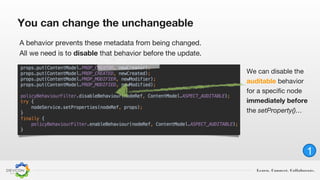
A behavior prevents these metadata from being changed.
All we need is to disable that behavior before the update.
We can disable the
auditable behavior
for a specific node
immediately before
the setProperty()…
You can change the unchangeable
Learn. Connect. Collaborate.
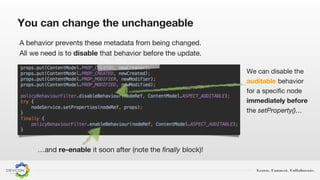
…and re-enable it soon after (note the finally block)!
A behavior prevents these metadata from being changed.
All we need is to disable that behavior before the update.
We can disable the
auditable behavior
for a specific node
immediately before
the setProperty()…
You can change the unchangeable
Learn. Connect. Collaborate.
Import an acp preserving the uuid of the nodes
To rely on the uuid to retrieve a document from an external application is not
a best-practice…
but it happens often!
There’s a way to preserve the original uuid when we need to import an acp.
Learn. Connect. Collaborate.
Import an acp preserving the uuid of the nodes
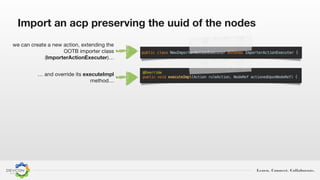
we can create a new action, extending the
OOTB importer class
(ImporterActionExecuter)…
… and override its executeImpl
method…
Learn. Connect. Collaborate.
2
Import an acp preserving the uuid of the nodes
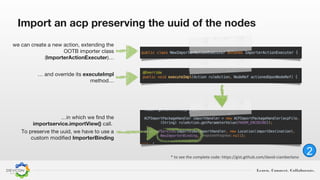
we can create a new action, extending the
OOTB importer class
(ImporterActionExecuter)…
…in which we find the
importservice.importView() call.
To preserve the uuid, we have to use a
custom modified ImporterBinding
… and override its executeImpl
method…
* to see the complete code: https://gist.github.com/david-ciamberlano
Learn. Connect. Collaborate.
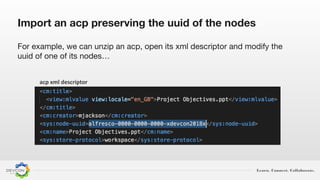
For example, we can unzip an acp, open its xml descriptor and modify the
uuid of one of its nodes…
Import an acp preserving the uuid of the nodes
acp xml descriptor
Learn. Connect. Collaborate.
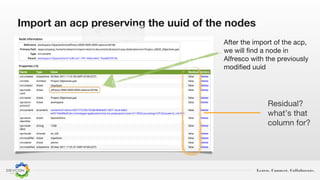
After the import of the acp,
we will find a node in
Alfresco with the previously
modified uuid
Import an acp preserving the uuid of the nodes
Residual?
what’s that
column for?
Learn. Connect. Collaborate.
Residual properties
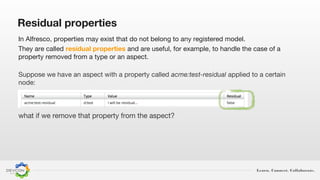
In Alfresco, properties may exist that do not belong to any registered model.
They are called residual properties and are useful, for example, to handle the case of a
property removed from a type or an aspect.
Suppose we have an aspect with a property called acme:test-residual applied to a certain
node:
what if we remove that property from the aspect?
Learn. Connect. Collaborate.
3
Residual properties
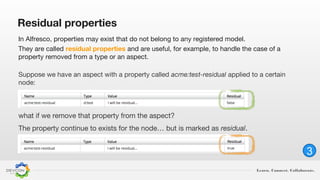
The property continue to exists for the node… but is marked as residual.
what if we remove that property from the aspect?
In Alfresco, properties may exist that do not belong to any registered model.
They are called residual properties and are useful, for example, to handle the case of a
property removed from a type or an aspect.
Suppose we have an aspect with a property called acme:test-residual applied to a certain
node:
Learn. Connect. Collaborate.
Residual properties
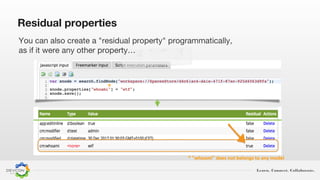
You can also create a "residual property" programmatically,
as if it were any other property…
*
* "whoami" does not belongs to any model
Learn. Connect. Collaborate.
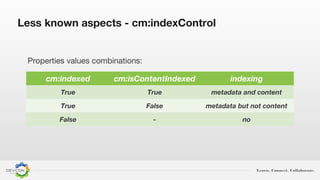
Less known aspects - cm:indexControl
You can control the indexing of contents in Alfresco applying the aspect
cm:indexControl to a node.
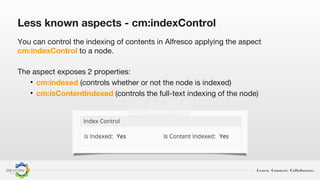
The aspect exposes 2 properties:
• cm:indexed (controls whether or not the node is indexed)
• cm:isContentIndexed (controls the full-text indexing of the node)
Learn. Connect. Collaborate.
Less known aspects - cm:indexControl
cm:indexed cm:isContentIndexed indexing
True True metadata and content
True False metadata but not content
False - no
Properties values combinations:
Learn. Connect. Collaborate.
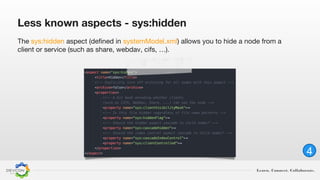
Less known aspects - sys:hidden
The sys:hidden aspect (defined in systemModel.xml) allows you to hide a node from a
client or service (such as share, webdav, cifs, …).
4
Learn. Connect. Collaborate.
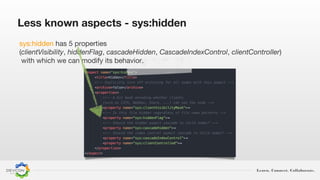
Less known aspects - sys:hidden
sys:hidden has 5 properties
(clientVisibility, hiddenFlag, cascadeHidden, CascadeIndexControl, clientController)
with which we can modify its behavior.
Learn. Connect. Collaborate.
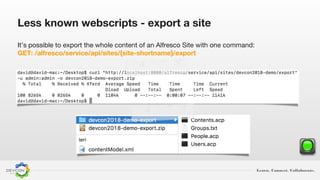
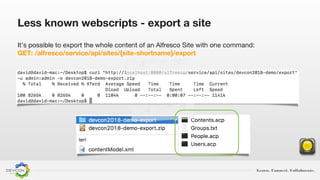
Less known webscripts - export a site
It’s possible to export the whole content of an Alfresco Site with one command:
GET: /alfresco/service/api/sites/{site-shortname}/export
Learn. Connect. Collaborate.
Less known webscripts - export a site
It’s possible to export the whole content of an Alfresco Site with one command:
GET: /alfresco/service/api/sites/{site-shortname}/export
Learn. Connect. Collaborate.
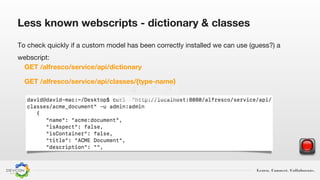
To check quickly if a custom model has been correctly installed we can use (guess?) a
webscript:
GET /alfresco/service/api/dictionary
GET /alfresco/service/api/classes/{type-name}
Less known webscripts - dictionary & classes
You probably didn’t know that…
(small hidden features in Alfresco)
David Ciamberlano
Thank you!

Alfresco - You probably didn't know that

  • 1.
    You probably didn’tknow that… (small hidden features in Alfresco) David Ciamberlano
  • 2.
    Learn. Connect. Collaborate. Areyou a curious person? Alfresco hides many small less known features that maybe you’ll never need to use… but that might prove useful on more than one occasion. So… you probably didn’t know that…
  • 3.
    Learn. Connect. Collaborate. Youcan change the unchangeable In Alfresco there are a few properties that cannot be changed (… for a good reason!): • creator of a node (cm:creator) • creation date (cm:created) • modifier (cm:modifier) • modification date (cm:modified) • […]
  • 4.
    Learn. Connect. Collaborate. theseproperties belongs to the cm:auditable aspect (in contentModel.xml). In a ideal world we wouldn’t need to change them… … but unfortunately we don’t live in a ideal world. The "good news" is that there is a way to change these values… And it’s (relatively) simple! You can change the unchangeable
  • 5.
    Learn. Connect. Collaborate. 1 Abehavior prevents these metadata from being changed. All we need is to disable that behavior before the update. We can disable the auditable behavior for a specific node immediately before the setProperty()… You can change the unchangeable
  • 6.
    Learn. Connect. Collaborate. …andre-enable it soon after (note the finally block)! A behavior prevents these metadata from being changed. All we need is to disable that behavior before the update. We can disable the auditable behavior for a specific node immediately before the setProperty()… You can change the unchangeable
  • 7.
    Learn. Connect. Collaborate. Importan acp preserving the uuid of the nodes To rely on the uuid to retrieve a document from an external application is not a best-practice… but it happens often! There’s a way to preserve the original uuid when we need to import an acp.
  • 8.
    Learn. Connect. Collaborate. Importan acp preserving the uuid of the nodes we can create a new action, extending the OOTB importer class (ImporterActionExecuter)… … and override its executeImpl method…
  • 9.
    Learn. Connect. Collaborate. 2 Importan acp preserving the uuid of the nodes we can create a new action, extending the OOTB importer class (ImporterActionExecuter)… …in which we find the importservice.importView() call. To preserve the uuid, we have to use a custom modified ImporterBinding … and override its executeImpl method… * to see the complete code: https://gist.github.com/david-ciamberlano
  • 10.
    Learn. Connect. Collaborate. Forexample, we can unzip an acp, open its xml descriptor and modify the uuid of one of its nodes… Import an acp preserving the uuid of the nodes acp xml descriptor
  • 11.
    Learn. Connect. Collaborate. Afterthe import of the acp, we will find a node in Alfresco with the previously modified uuid Import an acp preserving the uuid of the nodes Residual? what’s that column for?
  • 12.
    Learn. Connect. Collaborate. Residualproperties In Alfresco, properties may exist that do not belong to any registered model. They are called residual properties and are useful, for example, to handle the case of a property removed from a type or an aspect. Suppose we have an aspect with a property called acme:test-residual applied to a certain node: what if we remove that property from the aspect?
  • 13.
    Learn. Connect. Collaborate. 3 Residualproperties The property continue to exists for the node… but is marked as residual. what if we remove that property from the aspect? In Alfresco, properties may exist that do not belong to any registered model. They are called residual properties and are useful, for example, to handle the case of a property removed from a type or an aspect. Suppose we have an aspect with a property called acme:test-residual applied to a certain node:
  • 14.
    Learn. Connect. Collaborate. Residualproperties You can also create a "residual property" programmatically, as if it were any other property… * * "whoami" does not belongs to any model
  • 15.
    Learn. Connect. Collaborate. Lessknown aspects - cm:indexControl You can control the indexing of contents in Alfresco applying the aspect cm:indexControl to a node. The aspect exposes 2 properties: • cm:indexed (controls whether or not the node is indexed) • cm:isContentIndexed (controls the full-text indexing of the node)
  • 16.
    Learn. Connect. Collaborate. Lessknown aspects - cm:indexControl cm:indexed cm:isContentIndexed indexing True True metadata and content True False metadata but not content False - no Properties values combinations:
  • 17.
    Learn. Connect. Collaborate. Lessknown aspects - sys:hidden The sys:hidden aspect (defined in systemModel.xml) allows you to hide a node from a client or service (such as share, webdav, cifs, …). 4
  • 18.
    Learn. Connect. Collaborate. Lessknown aspects - sys:hidden sys:hidden has 5 properties (clientVisibility, hiddenFlag, cascadeHidden, CascadeIndexControl, clientController) with which we can modify its behavior.
  • 19.
    Learn. Connect. Collaborate. Lessknown webscripts - export a site It’s possible to export the whole content of an Alfresco Site with one command: GET: /alfresco/service/api/sites/{site-shortname}/export
  • 20.
    Learn. Connect. Collaborate. Lessknown webscripts - export a site It’s possible to export the whole content of an Alfresco Site with one command: GET: /alfresco/service/api/sites/{site-shortname}/export
  • 21.
    Learn. Connect. Collaborate. Tocheck quickly if a custom model has been correctly installed we can use (guess?) a webscript: GET /alfresco/service/api/dictionary GET /alfresco/service/api/classes/{type-name} Less known webscripts - dictionary & classes
  • 22.
    You probably didn’tknow that… (small hidden features in Alfresco) David Ciamberlano Thank you!