ITM 125 C1 – Management Information Systems
Fall 2016
Kelvin Yip
Adjunct Professor
Ageno School of Business
Golden Gate University
Contact Information
Email: kyip@ggu.edu
www.linkedin.com/in/kelvinwyip
Mobile: 415-481-7643
Office Hours: By appointment.
Important Dates:
First Day of Class: 8/28/2016
Last Day of Class: 10/22/2016
l. Course Description
ITM 125 introduces you to management issues surrounding contemporary, technology-mediated, global business
environments. Course discussions and activities are framed by integrating programmatic themes common to information
technology issues in the world of business:
● Information Technology in Business
● Management
● Leadership
● Ethics
● Global issues
The course will assist you in developing management skills from basic through strategic planning, while interacting with
current and evolving technologies that lift the contemporary digital enterprise. You will become acquainted with
information architecture and infrastructure, converged network and application tools and concepts, enterprise technology
tools, databases, distributed computing, storage and information distribution systems, information security, customer and
sales force management, as well as evolving and new tools such as “cloud computing.”
Through the creation of a problem-centered case analysis, you’ll demonstrate your understanding of the tools and
processes involved in undertaking and supporting information systems projects in business environments where return on
investment and value are primary considerations.
Prerequisite: none
2. Course Objectives
Students will articulate the following topics by a variety of methods:
● Contemporary information technologies in networked environments
● Applications of information technologies in business
● Management issues of IT systems: integration, return on investment, value, contributions of IT to business goals
and strategies
● Ethical and global issues associated with the use of IT in business
3. Instructor Information
Kelvin currently works at Slalom, LLC as a consultant focused on technology infrastructure projects. Prior to Slalom,
Kelvin was at EMC Corp. (NYSE: EMC) for eight years, initially as a Technical Sales Engineer for the first year and half,
and the remaining years as a Project Management Lead. He did his graduate degree in MS in IT Management at Golden
Gate University and his undergraduate in Computer Science from San Francisco State University.
In his spare time, Kelvin likes to stay active by playing tennis and hiking. Kelvin and his wife live in San Francisco and
have a never-ending travel bucket list. Last year they visited Greece, Holland, Turkey and Peru. This year they have been
to Sweden, Norway and Denmark. Next year they hope to visit Vietnam and Cambodia!
4. Required Materials / University Library / Research Information
Text: Essentials of Management Information Systems; 12th edition. Laudon and Laudon; Prentice Hall.
ISBN-10: 0134238249 | ISBN-13: 978-0134238241.
BookStore: The course textbook can be purchased from Golden Gate University’s official online
bookstore, at http://www.ggu.bkstr.com
Other Required Reading: Students will be required to read the Seminole case study, which is published on our Cyber
campus portal.
University Library: The University Library houses one of California's largest collections of materials in
professional fields. The Law Library contains more than 250,000 volumes, including a comprehensive
collection of case law from all jurisdictions.
Find the GGU Library Home Page at http://www.ggu.edu/libraries/university-library/.
There are several databases available through the Golden Gate University Library for students to conduct
research on various topics. Remote (off campus) access to the databases requires your last name and
student ID# (located on the front of your ID card). Be sure to type in ALL 7 digits, including the starting 0.
Example: 0123456.
Contact Information:
Librarians are available to help you with research assistance. You are welcome to contact via:
https://www.ggu.edu/libraries/university-library/contact
Research Information:
1. The University Library’s website http://www.ggu.edu/libraries/university-library offers a
wealth of information to guide you through the research process, including research
guides.
2. The following link has detailed information useful for searching on ITM related subjects.
http://ggu.libguides.com/ITM.
3. For detailed information on using and citing sources using APA, visit the University Library’s APA Research
Guide: http://ggu.libguides.com/apa. I also recommend the Purdue OWL: APA Formatting and Style Guide, which
can be found at https://owl.english.purdue.edu/owl/resource/560/01/.
4. The University Library’s web site offers a wealth of information to guide you through the research
process. Resources include a sample research paper and detailed information on evaluating and
citing sources. Available at http://ggu.libguides.com/.
5. At the Writing Center, located in Room P-25 at the San Francisco campus, you work one-on-one
with experienced writing tutors (most of them GGU instructors) who are familiar with the types of
writing assignments common in GGU courses.
5. Course Requirements / Student Responsibilities
Course Requirements:
i. Online discussions: Class participation is an essential component of this course and will help you
understand and apply the course material.
ii. Weekly homework: As part of each week's reading assignment and web activities, you will be assigned a
set of questions to be answered and submitted each week.
iii. Term paper
iv. Final exam
● No late assignments will be accepted after the first week of class (Sept 3 @ 11:59pm PT). For delays due
to special circumstances, please contact the instructor to discuss as soon as possible.
● No plagiarism or acts of cheating will be tolerated. Students who commit such actions will fail the course.
Student responsibilities:
i. Time Management
1. Log in frequently. Log in and participate in class activities.
1. Make quality postings. Quality participation involves more than just making an isolated posting; postings should
build on previous submissions and expand the depth of the discussion.
2. Read all materials thoroughly. You are responsible for reading all content items in the course.
3. Stay current. You are expected to keep current with all the readings, assignments, homework, and classroom
participation. It is important to note that falling behind in class makes it very difficult to catch up.
ii. Communications
1. Have reasonable expectations of email responses. When communicating with professors, anticipate a reply
within two business days. In case of an emergency, try to contact the instructor by phone.
2. Avoid value judgments.
3. Be professional when communicating.
6. Course Procedures
YOU WILL NOT RECEIVE AN A GRADE IN THE COURSE IF YOU DO NOT DO ALL OF THE COURSEWORK!
Sometimes students reason that they can get an acceptable grade, even if they don’t complete selected parts of the
course requirements. You have to participate in the course, and doing the required work is part of that participation. If
you can’t participate in the course, drop it prior to penalty dates. If you have a legitimate problem and HAVE DONE
MOST COURSEWORK, you can discuss an Incomplete with the instructor. Incompletes are NOT for people who simply
get behind and want to complete the course later.
7. Instructor Feedback
Providing Anonymous Feedback
If you are having problems of any sort with the course, your program, or your instructor, you should begin by talking to me.
If you want to provide anonymous feedback, you can do so by way of this link:
http://www.ggu.edu/forms/studentfeedbackform.jsp
8. Grading Policy
Score Grade
93 – 100 A
90 – 92.9 A-
87 - 89.9 B+
83 – 86.9 B
80 – 82.9 B-
77 – 79.9 C+
73 – 76.9 C
70 – 72.9 C-
67 – 69.9 D+
63 – 66.9 D
60 – 62.9 D-
0 – 59.9 F
Graded Items
Percentage %
Online Discussions (8) 30
Weekly Homework (8) 30
Term Paper: Seminole Case Study 25
Final Exam 15
EXTRA CREDIT: GGU Online Writing Lab 5
Total 105
Extra Credit (up to 5 points):
GGU Online Writing Lab (OWL): To receive up to 5 additional points, students must submit their final paper to OWL and
incorporate OWL’s feedback in their final drafts. This means students must plan sufficient time for this process BEFORE
the paper’s final due date. Submission to OWL WITHOUT incorporating their comments in your paper invalidates the
extra credit points.
What is OWL?
The Online Writing Lab (OWL) offers free writing tutoring to all GGU students in all subjects, via e-mail. Professional,
experienced writing tutors work with students online,24 hours/day, 7 days/week, including weekends and holidays:
students can expect a response from an OWL tutor within 24-48 hours. Submit your papers to
http://www.ggu.edu/forms/owl_submission.jsp
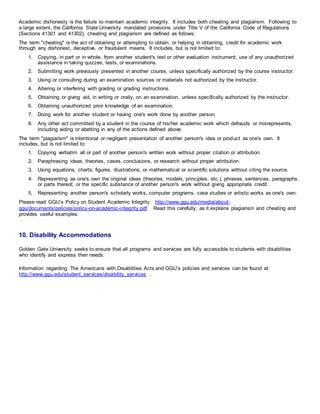
9. University and Instructor Policy on Cheating and Academic Integrity
Golden Gate University requires that students be honest in their academic work. Academic dishonesty is viewed as an
ethical issue and the violation of the principles expressed in the University's Statement of Educational Mission. Academic
dishonesty defrauds all those who depend upon the integrity of the University, its courses, and its degrees.
Academic dishonesty is the failure to maintain academic integrity. It includes both cheating and plagiarism. Following to
a large extent, the California State University mandated provisions under Title V of the California Code of Regulations
(Sections 41301 and 41302), cheating and plagiarism are defined as follows:
The term "cheating" is the act of obtaining or attempting to obtain, or helping in obtaining, credit for academic work
through any dishonest, deceptive, or fraudulent means. It includes, but is not limited to:
1. Copying, in part or in whole, from another student's test or other evaluation instrument; use of any unauthorized
assistance in taking quizzes, tests, or examinations.
2. Submitting work previously presented in another course, unless specifically authorized by the course instructor.
3. Using or consulting during an examination sources or materials not authorized by the instructor.
4. Altering or interfering with grading or grading instructions.
5. Obtaining or giving aid, in writing or orally, on an examination, unless specifically authorized by the instructor.
6. Obtaining unauthorized prior knowledge of an examination.
7. Doing work for another student or having one's work done by another person.
8. Any other act committed by a student in the course of his/her academic work which defrauds or misrepresents,
including aiding or abetting in any of the actions defined above.
The term "plagiarism" is intentional or negligent presentation of another person's idea or product as one's own. It
includes, but is not limited to:
1. Copying verbatim all or part of another person's written work without proper citation or attribution.
2. Paraphrasing ideas, theories, cases, conclusions, or research without proper attribution.
3. Using equations, charts, figures, illustrations, or mathematical or scientific solutions without citing the source.
4. Representing as one's own the original ideas (theories, models, principles, etc.), phrases, sentences, paragraphs,
or parts thereof, or the specific substance of another person's work without giving appropriate credit.
5. Representing another person's scholarly works, computer programs, case studies or artistic works as one's own.
Please read GGU’s Policy on Student Academic Integrity: http://www.ggu.edu/media/about-
ggu/documents/policies/policy-on-academic-integrity.pdf. Read this carefully, as it explains plagiarism and cheating and
provides useful examples.
10. Disability Accommodations
Golden Gate University seeks to ensure that all programs and services are fully accessible to students with disabilities
who identify and express their needs.
Information regarding The Americans with Disabilities Acts and GGU’s policies and services can be found at:
http://www.ggu.edu/student_services/disability_services .
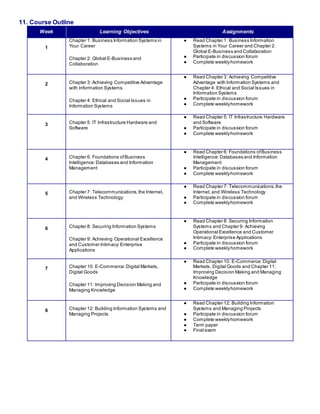
11. Course Outline
Week Learning Objectives Assignments
1
Chapter 1: Business Information Systems in
Your Career
Chapter 2: Global E-Business and
Collaboration
● Read Chapter 1: Business Information
Systems in Your Career and Chapter 2:
Global E-Business and Collaboration
● Participate in discussion forum
● Complete weeklyhomework
2 Chapter 3: Achieving Competitive Advantage
with Information Systems
Chapter 4: Ethical and Social Issues in
Information Systems
● Read Chapter 3: Achieving Competitive
Advantage with Information Systems and
Chapter 4: Ethical and Social Issues in
Information Systems
● Participate in discussion forum
● Complete weeklyhomework
3 Chapter 5: IT Infrastructure Hardware and
Software
● Read Chapter 5: IT Infrastructure Hardware
and Software
● Participate in discussion forum
● Complete weeklyhomework
4 Chapter 6: Foundations ofBusiness
Intelligence:Databases and Information
Management
● Read Chapter 6: Foundations ofBusiness
Intelligence:Databases and Information
Management
● Participate in discussion forum
● Complete weeklyhomework
5 Chapter 7: Telecommunications,the Internet,
and Wireless Technology
● Read Chapter 7: Telecommunications,the
Internet, and Wireless Technology
● Participate in discussion forum
● Complete weeklyhomework
6 Chapter 8: Securing Information Systems
Chapter 9: Achieving Operational Excellence
and Customer Intimacy:Enterprise
Applications
● Read Chapter 8: Securing Information
Systems and Chapter 9: Achieving
Operational Excellence and Customer
Intimacy: Enterprise Applications
● Participate in discussion forum
● Complete weeklyhomework
7 Chapter 10: E-Commerce:Digital Markets,
Digital Goods
Chapter 11: Improving Decision Making and
Managing Knowledge
● Read Chapter 10: E-Commerce:Digital
Markets, Digital Goods and Chapter 11:
Improving Decision Making and Managing
Knowledge
● Participate in discussion forum
● Complete weeklyhomework
8 Chapter 12: Building Information Systems and
Managing Projects
● Read Chapter 12: Building Information
Systems and Managing Projects
● Participate in discussion forum
● Complete weeklyhomework
● Term paper
● Final exam

YipITM125Syllabus-Fall2016 v2

  • 1.
    ITM 125 C1– Management Information Systems Fall 2016 Kelvin Yip Adjunct Professor Ageno School of Business Golden Gate University Contact Information Email: kyip@ggu.edu www.linkedin.com/in/kelvinwyip Mobile: 415-481-7643 Office Hours: By appointment. Important Dates: First Day of Class: 8/28/2016 Last Day of Class: 10/22/2016 l. Course Description ITM 125 introduces you to management issues surrounding contemporary, technology-mediated, global business environments. Course discussions and activities are framed by integrating programmatic themes common to information technology issues in the world of business: ● Information Technology in Business ● Management ● Leadership ● Ethics ● Global issues The course will assist you in developing management skills from basic through strategic planning, while interacting with current and evolving technologies that lift the contemporary digital enterprise. You will become acquainted with information architecture and infrastructure, converged network and application tools and concepts, enterprise technology tools, databases, distributed computing, storage and information distribution systems, information security, customer and sales force management, as well as evolving and new tools such as “cloud computing.” Through the creation of a problem-centered case analysis, you’ll demonstrate your understanding of the tools and processes involved in undertaking and supporting information systems projects in business environments where return on investment and value are primary considerations. Prerequisite: none
  • 2.
    2. Course Objectives Studentswill articulate the following topics by a variety of methods: ● Contemporary information technologies in networked environments ● Applications of information technologies in business ● Management issues of IT systems: integration, return on investment, value, contributions of IT to business goals and strategies ● Ethical and global issues associated with the use of IT in business 3. Instructor Information Kelvin currently works at Slalom, LLC as a consultant focused on technology infrastructure projects. Prior to Slalom, Kelvin was at EMC Corp. (NYSE: EMC) for eight years, initially as a Technical Sales Engineer for the first year and half, and the remaining years as a Project Management Lead. He did his graduate degree in MS in IT Management at Golden Gate University and his undergraduate in Computer Science from San Francisco State University. In his spare time, Kelvin likes to stay active by playing tennis and hiking. Kelvin and his wife live in San Francisco and have a never-ending travel bucket list. Last year they visited Greece, Holland, Turkey and Peru. This year they have been to Sweden, Norway and Denmark. Next year they hope to visit Vietnam and Cambodia! 4. Required Materials / University Library / Research Information Text: Essentials of Management Information Systems; 12th edition. Laudon and Laudon; Prentice Hall. ISBN-10: 0134238249 | ISBN-13: 978-0134238241. BookStore: The course textbook can be purchased from Golden Gate University’s official online bookstore, at http://www.ggu.bkstr.com Other Required Reading: Students will be required to read the Seminole case study, which is published on our Cyber campus portal. University Library: The University Library houses one of California's largest collections of materials in professional fields. The Law Library contains more than 250,000 volumes, including a comprehensive collection of case law from all jurisdictions. Find the GGU Library Home Page at http://www.ggu.edu/libraries/university-library/. There are several databases available through the Golden Gate University Library for students to conduct research on various topics. Remote (off campus) access to the databases requires your last name and student ID# (located on the front of your ID card). Be sure to type in ALL 7 digits, including the starting 0. Example: 0123456. Contact Information: Librarians are available to help you with research assistance. You are welcome to contact via: https://www.ggu.edu/libraries/university-library/contact
  • 3.
    Research Information: 1. TheUniversity Library’s website http://www.ggu.edu/libraries/university-library offers a wealth of information to guide you through the research process, including research guides. 2. The following link has detailed information useful for searching on ITM related subjects. http://ggu.libguides.com/ITM. 3. For detailed information on using and citing sources using APA, visit the University Library’s APA Research Guide: http://ggu.libguides.com/apa. I also recommend the Purdue OWL: APA Formatting and Style Guide, which can be found at https://owl.english.purdue.edu/owl/resource/560/01/. 4. The University Library’s web site offers a wealth of information to guide you through the research process. Resources include a sample research paper and detailed information on evaluating and citing sources. Available at http://ggu.libguides.com/. 5. At the Writing Center, located in Room P-25 at the San Francisco campus, you work one-on-one with experienced writing tutors (most of them GGU instructors) who are familiar with the types of writing assignments common in GGU courses. 5. Course Requirements / Student Responsibilities Course Requirements: i. Online discussions: Class participation is an essential component of this course and will help you understand and apply the course material. ii. Weekly homework: As part of each week's reading assignment and web activities, you will be assigned a set of questions to be answered and submitted each week. iii. Term paper iv. Final exam ● No late assignments will be accepted after the first week of class (Sept 3 @ 11:59pm PT). For delays due to special circumstances, please contact the instructor to discuss as soon as possible. ● No plagiarism or acts of cheating will be tolerated. Students who commit such actions will fail the course. Student responsibilities: i. Time Management 1. Log in frequently. Log in and participate in class activities. 1. Make quality postings. Quality participation involves more than just making an isolated posting; postings should build on previous submissions and expand the depth of the discussion. 2. Read all materials thoroughly. You are responsible for reading all content items in the course. 3. Stay current. You are expected to keep current with all the readings, assignments, homework, and classroom participation. It is important to note that falling behind in class makes it very difficult to catch up. ii. Communications 1. Have reasonable expectations of email responses. When communicating with professors, anticipate a reply within two business days. In case of an emergency, try to contact the instructor by phone. 2. Avoid value judgments. 3. Be professional when communicating. 6. Course Procedures YOU WILL NOT RECEIVE AN A GRADE IN THE COURSE IF YOU DO NOT DO ALL OF THE COURSEWORK! Sometimes students reason that they can get an acceptable grade, even if they don’t complete selected parts of the course requirements. You have to participate in the course, and doing the required work is part of that participation. If you can’t participate in the course, drop it prior to penalty dates. If you have a legitimate problem and HAVE DONE
  • 4.
    MOST COURSEWORK, youcan discuss an Incomplete with the instructor. Incompletes are NOT for people who simply get behind and want to complete the course later. 7. Instructor Feedback Providing Anonymous Feedback If you are having problems of any sort with the course, your program, or your instructor, you should begin by talking to me. If you want to provide anonymous feedback, you can do so by way of this link: http://www.ggu.edu/forms/studentfeedbackform.jsp 8. Grading Policy Score Grade 93 – 100 A 90 – 92.9 A- 87 - 89.9 B+ 83 – 86.9 B 80 – 82.9 B- 77 – 79.9 C+ 73 – 76.9 C 70 – 72.9 C- 67 – 69.9 D+ 63 – 66.9 D 60 – 62.9 D- 0 – 59.9 F Graded Items Percentage % Online Discussions (8) 30 Weekly Homework (8) 30 Term Paper: Seminole Case Study 25 Final Exam 15 EXTRA CREDIT: GGU Online Writing Lab 5 Total 105 Extra Credit (up to 5 points): GGU Online Writing Lab (OWL): To receive up to 5 additional points, students must submit their final paper to OWL and incorporate OWL’s feedback in their final drafts. This means students must plan sufficient time for this process BEFORE the paper’s final due date. Submission to OWL WITHOUT incorporating their comments in your paper invalidates the extra credit points. What is OWL? The Online Writing Lab (OWL) offers free writing tutoring to all GGU students in all subjects, via e-mail. Professional, experienced writing tutors work with students online,24 hours/day, 7 days/week, including weekends and holidays: students can expect a response from an OWL tutor within 24-48 hours. Submit your papers to http://www.ggu.edu/forms/owl_submission.jsp 9. University and Instructor Policy on Cheating and Academic Integrity Golden Gate University requires that students be honest in their academic work. Academic dishonesty is viewed as an ethical issue and the violation of the principles expressed in the University's Statement of Educational Mission. Academic dishonesty defrauds all those who depend upon the integrity of the University, its courses, and its degrees.
  • 5.
    Academic dishonesty isthe failure to maintain academic integrity. It includes both cheating and plagiarism. Following to a large extent, the California State University mandated provisions under Title V of the California Code of Regulations (Sections 41301 and 41302), cheating and plagiarism are defined as follows: The term "cheating" is the act of obtaining or attempting to obtain, or helping in obtaining, credit for academic work through any dishonest, deceptive, or fraudulent means. It includes, but is not limited to: 1. Copying, in part or in whole, from another student's test or other evaluation instrument; use of any unauthorized assistance in taking quizzes, tests, or examinations. 2. Submitting work previously presented in another course, unless specifically authorized by the course instructor. 3. Using or consulting during an examination sources or materials not authorized by the instructor. 4. Altering or interfering with grading or grading instructions. 5. Obtaining or giving aid, in writing or orally, on an examination, unless specifically authorized by the instructor. 6. Obtaining unauthorized prior knowledge of an examination. 7. Doing work for another student or having one's work done by another person. 8. Any other act committed by a student in the course of his/her academic work which defrauds or misrepresents, including aiding or abetting in any of the actions defined above. The term "plagiarism" is intentional or negligent presentation of another person's idea or product as one's own. It includes, but is not limited to: 1. Copying verbatim all or part of another person's written work without proper citation or attribution. 2. Paraphrasing ideas, theories, cases, conclusions, or research without proper attribution. 3. Using equations, charts, figures, illustrations, or mathematical or scientific solutions without citing the source. 4. Representing as one's own the original ideas (theories, models, principles, etc.), phrases, sentences, paragraphs, or parts thereof, or the specific substance of another person's work without giving appropriate credit. 5. Representing another person's scholarly works, computer programs, case studies or artistic works as one's own. Please read GGU’s Policy on Student Academic Integrity: http://www.ggu.edu/media/about- ggu/documents/policies/policy-on-academic-integrity.pdf. Read this carefully, as it explains plagiarism and cheating and provides useful examples. 10. Disability Accommodations Golden Gate University seeks to ensure that all programs and services are fully accessible to students with disabilities who identify and express their needs. Information regarding The Americans with Disabilities Acts and GGU’s policies and services can be found at: http://www.ggu.edu/student_services/disability_services .
  • 6.
    11. Course Outline WeekLearning Objectives Assignments 1 Chapter 1: Business Information Systems in Your Career Chapter 2: Global E-Business and Collaboration ● Read Chapter 1: Business Information Systems in Your Career and Chapter 2: Global E-Business and Collaboration ● Participate in discussion forum ● Complete weeklyhomework 2 Chapter 3: Achieving Competitive Advantage with Information Systems Chapter 4: Ethical and Social Issues in Information Systems ● Read Chapter 3: Achieving Competitive Advantage with Information Systems and Chapter 4: Ethical and Social Issues in Information Systems ● Participate in discussion forum ● Complete weeklyhomework 3 Chapter 5: IT Infrastructure Hardware and Software ● Read Chapter 5: IT Infrastructure Hardware and Software ● Participate in discussion forum ● Complete weeklyhomework 4 Chapter 6: Foundations ofBusiness Intelligence:Databases and Information Management ● Read Chapter 6: Foundations ofBusiness Intelligence:Databases and Information Management ● Participate in discussion forum ● Complete weeklyhomework 5 Chapter 7: Telecommunications,the Internet, and Wireless Technology ● Read Chapter 7: Telecommunications,the Internet, and Wireless Technology ● Participate in discussion forum ● Complete weeklyhomework 6 Chapter 8: Securing Information Systems Chapter 9: Achieving Operational Excellence and Customer Intimacy:Enterprise Applications ● Read Chapter 8: Securing Information Systems and Chapter 9: Achieving Operational Excellence and Customer Intimacy: Enterprise Applications ● Participate in discussion forum ● Complete weeklyhomework 7 Chapter 10: E-Commerce:Digital Markets, Digital Goods Chapter 11: Improving Decision Making and Managing Knowledge ● Read Chapter 10: E-Commerce:Digital Markets, Digital Goods and Chapter 11: Improving Decision Making and Managing Knowledge ● Participate in discussion forum ● Complete weeklyhomework 8 Chapter 12: Building Information Systems and Managing Projects ● Read Chapter 12: Building Information Systems and Managing Projects ● Participate in discussion forum ● Complete weeklyhomework ● Term paper ● Final exam