Soil Pets 
Grade Level: Grade 2 
Description 
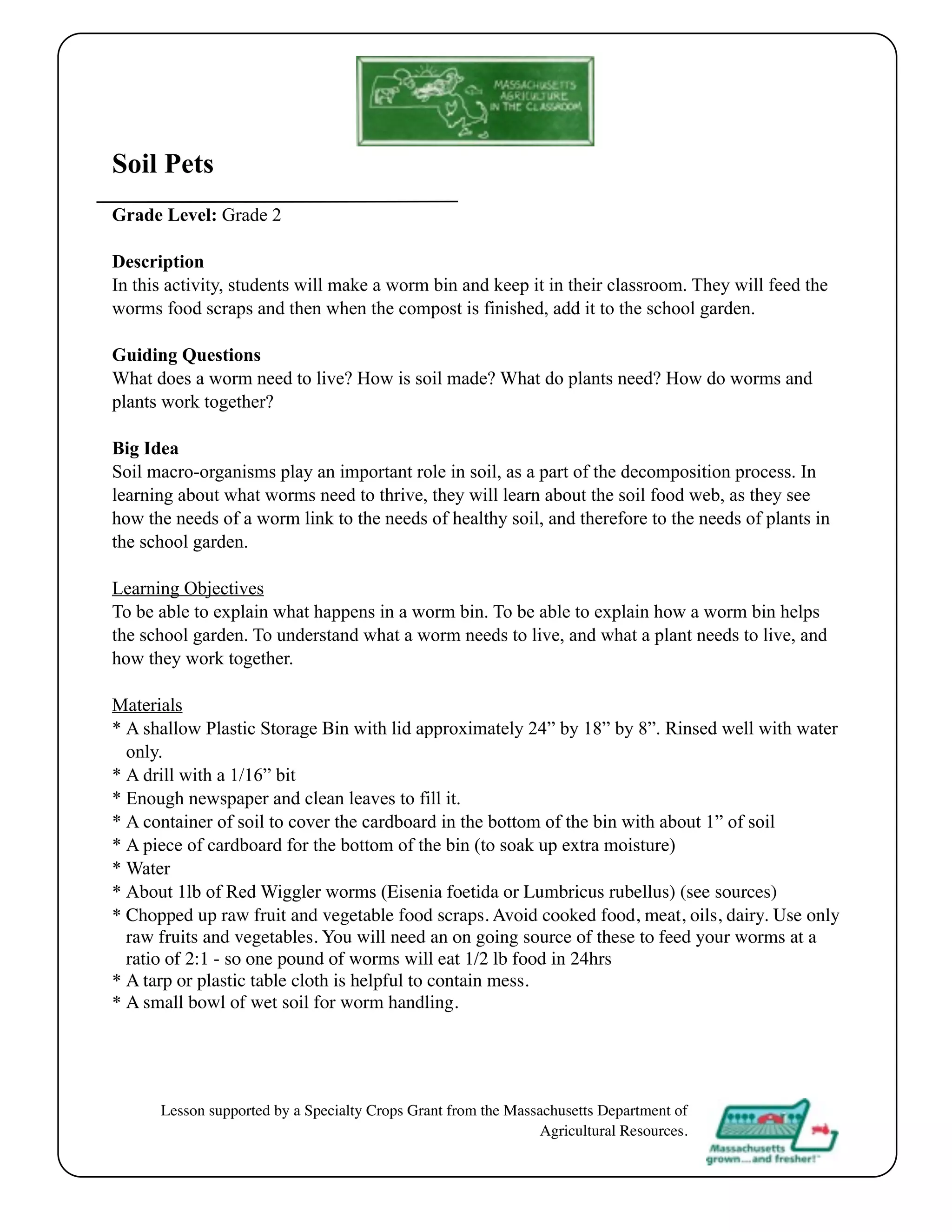
In this activity, students will make a worm bin and keep it in their classroom. They will feed the 
worms food scraps and then when the compost is finished, add it to the school garden. 
Guiding Questions 
What does a worm need to live? How is soil made? What do plants need? How do worms and 
plants work together? 
Big Idea 
Soil macro-organisms play an important role in soil, as a part of the decomposition process. In 
learning about what worms need to thrive, they will learn about the soil food web, as they see 
how the needs of a worm link to the needs of healthy soil, and therefore to the needs of plants in 
the school garden. 
Learning Objectives 
To be able to explain what happens in a worm bin. To be able to explain how a worm bin helps 
the school garden. To understand what a worm needs to live, and what a plant needs to live, and 
how they work together. 
Materials 
* A shallow Plastic Storage Bin with lid approximately 24” by 18” by 8”. Rinsed well with water 
only. 
* A drill with a 1/16” bit 
* Enough newspaper and clean leaves to fill it. 
* A container of soil to cover the cardboard in the bottom of the bin with about 1” of soil 
* A piece of cardboard for the bottom of the bin (to soak up extra moisture) 
* Water 
* About 1lb of Red Wiggler worms (Eisenia foetida or Lumbricus rubellus) (see sources) 
* Chopped up raw fruit and vegetable food scraps. Avoid cooked food, meat, oils, dairy. Use only 
raw fruits and vegetables. You will need an on going source of these to feed your worms at a 
ratio of 2:1 - so one pound of worms will eat 1/2 lb food in 24hrs 
* A tarp or plastic table cloth is helpful to contain mess. 
* A small bowl of wet soil for worm handling. 
Lesson supported by a Specialty Crops Grant from the Massachusetts Department of 
Agricultural Resources.
Part 1: Assemble the Worm Bin 
Preparation 
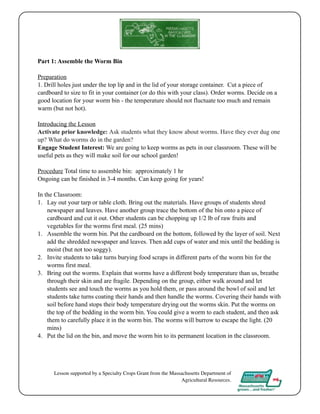
1. Drill holes just under the top lip and in the lid of your storage container. Cut a piece of 
cardboard to size to fit in your container (or do this with your class). Order worms. Decide on a 
good location for your worm bin - the temperature should not fluctuate too much and remain 
warm (but not hot). 
Introducing the Lesson 
Activate prior knowledge: Ask students what they know about worms. Have they ever dug one 
up? What do worms do in the garden? 
Engage Student Interest: We are going to keep worms as pets in our classroom. These will be 
useful pets as they will make soil for our school garden! 
Procedure Total time to assemble bin: approximately 1 hr 
Ongoing can be finished in 3-4 months. Can keep going for years! 
In the Classroom: 
1. Lay out your tarp or table cloth. Bring out the materials. Have groups of students shred 
newspaper and leaves. Have another group trace the bottom of the bin onto a piece of 
cardboard and cut it out. Other students can be chopping up 1/2 lb of raw fruits and 
vegetables for the worms first meal. (25 mins) 
1. Assemble the worm bin. Put the cardboard on the bottom, followed by the layer of soil. Next 
add the shredded newspaper and leaves. Then add cups of water and mix until the bedding is 
moist (but not too soggy). 
2. Invite students to take turns burying food scraps in different parts of the worm bin for the 
worms first meal. 
3. Bring out the worms. Explain that worms have a different body temperature than us, breathe 
through their skin and are fragile. Depending on the group, either walk around and let 
students see and touch the worms as you hold them, or pass around the bowl of soil and let 
students take turns coating their hands and then handle the worms. Covering their hands with 
soil before hand stops their body temperature drying out the worms skin. Put the worms on 
the top of the bedding in the worm bin. You could give a worm to each student, and then ask 
them to carefully place it in the worm bin. The worms will burrow to escape the light. (20 
mins) 
4. Put the lid on the bin, and move the worm bin to its permanent location in the classroom. 
Lesson supported by a Specialty Crops Grant from the Massachusetts Department of 
Agricultural Resources.
Wrap up 
Have students make signs about the worm bin: A name for 
it (e.g. 2nd Grade Worm Hotel) what kinds of food can be 
put in it, what can not. (20 mins) 
Maintenance 
Continue to add chopped up raw fruits and vegetables to 
your worm bin weekly. Do not add more than your worms 
can eat. To assess this, dig around in your worm bin and 
see how many un-decomposed scraps you have, and do 
not add more until there is room. 
Assessing Student Knowledge 
Ask your students what worms need to live (warmth, 
water, air, food etc) and how they make soil. 
Extensions 
Have students create a worm bin presentation to show 
other classrooms their worms. Have students weigh the 
worm bin to determine the 2:1 ratio for food as the worms 
multiply. 
Maintenance 
Continue to feed your worms and adjust what you are 
feeding them depending on what they seem to like to eat, 
and how quickly they eat it. Add water or new bedding if 
you need to adjust the moisture level and keep the bin 
damp. Adding a few handfuls of bedding every few weeks 
can also help prevent problems. 
Part 2: Harvesting Your Garden Soil 
Materials 
* A bright directional lamp 
* A tarp 
* A plastic tub or bin to put the finished worm castings in. 
* Gloves for kids who do not want to handle the castings. 
* New bedding for starting the bin again. 
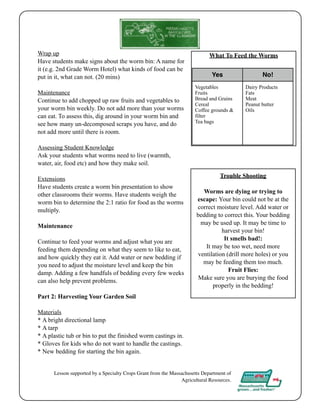
What To Feed the Worms 
Yes No! 
Vegetables 
Fruits 
Bread and Grains 
Cereal 
Coffee grounds & 
filter 
Tea bags 
Lesson supported by a Specialty Crops Grant from the Massachusetts Department of 
Agricultural Resources. 
Dairy Products 
Fats 
Meat 
Peanut butter 
Oils 
Trouble Shooting 
Worms are dying or trying to 
escape: Your bin could not be at the 
correct moisture level. Add water or 
bedding to correct this. Your bedding 
may be used up. It may be time to 
harvest your bin! 
It smells bad!: 
It may be too wet, need more 
ventilation (drill more holes) or you 
may be feeding them too much. 
Fruit Flies: 
Make sure you are burying the food 
properly in the bedding!
In The Classroom: 
1. Lay out the tarp. Turn your worm bin out onto the tarp. Shine the lamp directly down onto this 
pile. The worms will burrow down to escape the light. 
2. Have students take handfuls off the top layer of soil and put it in the plastic tub. Make sure 
other students are scouting for missed worms in the bin. Once they have removed the top 
layer, wait a few minuets for the worms to burrow down again. During this time, you can be 
filling the worm bin with new bedding and food. Then remove another layer. You should be 
left with a pile of worms at the end in a small amount of castings. Add these worms to the new 
bedding (follow the procedure for setting up your worm bin). 
Outside: 
1. Take your worm castings outside and add to your garden soil or compost pile. Thank the 
worms! 
Extension 
Weigh your worms during harvesting to determine how much they multiplied (based upon 1lb of 
worms to start with.) Make a simple bar graph to represent population growth (Represent and 
interpret data MA State standard 10.) 
* MA Department of Ed. Standards in this lesson* 
Life Science 1. Recognize that animals and plants are living things that grow, reproduce, and 
need food, air and water. 8. Identify the ways in which an organism’s habitat provides for its 
basic needs. 
Lesson supported by a Specialty Crops Grant from the Massachusetts Department of 
Agricultural Resources.
Books and Resources Resources used for writing this guide included here. 
Washington State University Extension 
http://whatcom.wsu.edu/ag/compost/Redwormsedit.htm 
USDA Natural Resources Cons. Service 
State Office 451 West Street 
Amherst, MA 01002 
(413) 253-4350 
Web Site: www.nrcs.usda.gov 
Soil & Water Cons. Society of America 
7515 Northwest Ankeny Road 
Ankeny, IA 50021-9764 
(800) THE Soil Fax: (515) 289-1227 
Web Site: www.swcs.org 
Book: Soil! The Inside Scoop 
Soil Society of America 
www.soils.org 
Cornell Composting Website: 
http://compost.css.cornell.edu/worms/basics.html 
USDA Agricultural Research Service 
Kids Science Projects 
www.ars.usda.gov/is/kids/fair/story.htm 
Book: Project Seasons, Shelburne Farms. http://store.shelburnefarms.org 
Book: GrowLab®: Activities for Growing Minds. National Gardening Association. http:// 
Lesson supported by a Specialty Crops Grant from the Massachusetts Department of 
Agricultural Resources.
www.gardeningwithkids.org 
Project Soil 
http://projectsoil.org/project_soil 
Soils and Conservation Website 
with Soil Zoo : www.waite.adelaide.edu.au/school/Soil/index.html 
Lesson supported by a Specialty Crops Grant from the Massachusetts Department of 
Agricultural Resources.

Grade 2 School Garden Lesson Plan - Seeds Lesson; Soil Pets ~ Massachusetts

  • 1.
    Soil Pets GradeLevel: Grade 2 Description In this activity, students will make a worm bin and keep it in their classroom. They will feed the worms food scraps and then when the compost is finished, add it to the school garden. Guiding Questions What does a worm need to live? How is soil made? What do plants need? How do worms and plants work together? Big Idea Soil macro-organisms play an important role in soil, as a part of the decomposition process. In learning about what worms need to thrive, they will learn about the soil food web, as they see how the needs of a worm link to the needs of healthy soil, and therefore to the needs of plants in the school garden. Learning Objectives To be able to explain what happens in a worm bin. To be able to explain how a worm bin helps the school garden. To understand what a worm needs to live, and what a plant needs to live, and how they work together. Materials * A shallow Plastic Storage Bin with lid approximately 24” by 18” by 8”. Rinsed well with water only. * A drill with a 1/16” bit * Enough newspaper and clean leaves to fill it. * A container of soil to cover the cardboard in the bottom of the bin with about 1” of soil * A piece of cardboard for the bottom of the bin (to soak up extra moisture) * Water * About 1lb of Red Wiggler worms (Eisenia foetida or Lumbricus rubellus) (see sources) * Chopped up raw fruit and vegetable food scraps. Avoid cooked food, meat, oils, dairy. Use only raw fruits and vegetables. You will need an on going source of these to feed your worms at a ratio of 2:1 - so one pound of worms will eat 1/2 lb food in 24hrs * A tarp or plastic table cloth is helpful to contain mess. * A small bowl of wet soil for worm handling. Lesson supported by a Specialty Crops Grant from the Massachusetts Department of Agricultural Resources.
  • 2.
    Part 1: Assemblethe Worm Bin Preparation 1. Drill holes just under the top lip and in the lid of your storage container. Cut a piece of cardboard to size to fit in your container (or do this with your class). Order worms. Decide on a good location for your worm bin - the temperature should not fluctuate too much and remain warm (but not hot). Introducing the Lesson Activate prior knowledge: Ask students what they know about worms. Have they ever dug one up? What do worms do in the garden? Engage Student Interest: We are going to keep worms as pets in our classroom. These will be useful pets as they will make soil for our school garden! Procedure Total time to assemble bin: approximately 1 hr Ongoing can be finished in 3-4 months. Can keep going for years! In the Classroom: 1. Lay out your tarp or table cloth. Bring out the materials. Have groups of students shred newspaper and leaves. Have another group trace the bottom of the bin onto a piece of cardboard and cut it out. Other students can be chopping up 1/2 lb of raw fruits and vegetables for the worms first meal. (25 mins) 1. Assemble the worm bin. Put the cardboard on the bottom, followed by the layer of soil. Next add the shredded newspaper and leaves. Then add cups of water and mix until the bedding is moist (but not too soggy). 2. Invite students to take turns burying food scraps in different parts of the worm bin for the worms first meal. 3. Bring out the worms. Explain that worms have a different body temperature than us, breathe through their skin and are fragile. Depending on the group, either walk around and let students see and touch the worms as you hold them, or pass around the bowl of soil and let students take turns coating their hands and then handle the worms. Covering their hands with soil before hand stops their body temperature drying out the worms skin. Put the worms on the top of the bedding in the worm bin. You could give a worm to each student, and then ask them to carefully place it in the worm bin. The worms will burrow to escape the light. (20 mins) 4. Put the lid on the bin, and move the worm bin to its permanent location in the classroom. Lesson supported by a Specialty Crops Grant from the Massachusetts Department of Agricultural Resources.
  • 3.
    Wrap up Havestudents make signs about the worm bin: A name for it (e.g. 2nd Grade Worm Hotel) what kinds of food can be put in it, what can not. (20 mins) Maintenance Continue to add chopped up raw fruits and vegetables to your worm bin weekly. Do not add more than your worms can eat. To assess this, dig around in your worm bin and see how many un-decomposed scraps you have, and do not add more until there is room. Assessing Student Knowledge Ask your students what worms need to live (warmth, water, air, food etc) and how they make soil. Extensions Have students create a worm bin presentation to show other classrooms their worms. Have students weigh the worm bin to determine the 2:1 ratio for food as the worms multiply. Maintenance Continue to feed your worms and adjust what you are feeding them depending on what they seem to like to eat, and how quickly they eat it. Add water or new bedding if you need to adjust the moisture level and keep the bin damp. Adding a few handfuls of bedding every few weeks can also help prevent problems. Part 2: Harvesting Your Garden Soil Materials * A bright directional lamp * A tarp * A plastic tub or bin to put the finished worm castings in. * Gloves for kids who do not want to handle the castings. * New bedding for starting the bin again. What To Feed the Worms Yes No! Vegetables Fruits Bread and Grains Cereal Coffee grounds & filter Tea bags Lesson supported by a Specialty Crops Grant from the Massachusetts Department of Agricultural Resources. Dairy Products Fats Meat Peanut butter Oils Trouble Shooting Worms are dying or trying to escape: Your bin could not be at the correct moisture level. Add water or bedding to correct this. Your bedding may be used up. It may be time to harvest your bin! It smells bad!: It may be too wet, need more ventilation (drill more holes) or you may be feeding them too much. Fruit Flies: Make sure you are burying the food properly in the bedding!
  • 4.
    In The Classroom: 1. Lay out the tarp. Turn your worm bin out onto the tarp. Shine the lamp directly down onto this pile. The worms will burrow down to escape the light. 2. Have students take handfuls off the top layer of soil and put it in the plastic tub. Make sure other students are scouting for missed worms in the bin. Once they have removed the top layer, wait a few minuets for the worms to burrow down again. During this time, you can be filling the worm bin with new bedding and food. Then remove another layer. You should be left with a pile of worms at the end in a small amount of castings. Add these worms to the new bedding (follow the procedure for setting up your worm bin). Outside: 1. Take your worm castings outside and add to your garden soil or compost pile. Thank the worms! Extension Weigh your worms during harvesting to determine how much they multiplied (based upon 1lb of worms to start with.) Make a simple bar graph to represent population growth (Represent and interpret data MA State standard 10.) * MA Department of Ed. Standards in this lesson* Life Science 1. Recognize that animals and plants are living things that grow, reproduce, and need food, air and water. 8. Identify the ways in which an organism’s habitat provides for its basic needs. Lesson supported by a Specialty Crops Grant from the Massachusetts Department of Agricultural Resources.
  • 5.
    Books and ResourcesResources used for writing this guide included here. Washington State University Extension http://whatcom.wsu.edu/ag/compost/Redwormsedit.htm USDA Natural Resources Cons. Service State Office 451 West Street Amherst, MA 01002 (413) 253-4350 Web Site: www.nrcs.usda.gov Soil & Water Cons. Society of America 7515 Northwest Ankeny Road Ankeny, IA 50021-9764 (800) THE Soil Fax: (515) 289-1227 Web Site: www.swcs.org Book: Soil! The Inside Scoop Soil Society of America www.soils.org Cornell Composting Website: http://compost.css.cornell.edu/worms/basics.html USDA Agricultural Research Service Kids Science Projects www.ars.usda.gov/is/kids/fair/story.htm Book: Project Seasons, Shelburne Farms. http://store.shelburnefarms.org Book: GrowLab®: Activities for Growing Minds. National Gardening Association. http:// Lesson supported by a Specialty Crops Grant from the Massachusetts Department of Agricultural Resources.
  • 6.
    www.gardeningwithkids.org Project Soil http://projectsoil.org/project_soil Soils and Conservation Website with Soil Zoo : www.waite.adelaide.edu.au/school/Soil/index.html Lesson supported by a Specialty Crops Grant from the Massachusetts Department of Agricultural Resources.