


![Notation and assumptions
Semi-altruistic hospital U (R, B) = V (R) + B
net revenues: V (·), V ′ (·) > 0, V ′′ (·) < 0
patients’ benefits (B )
Population of individuals: q ∗
Uncertain number of patients treated q; F (q), f (q) ∈ [0, q ∗ ]
Hospital 2 tech: new, old
new tech
capacity q patients
¯
cost per unit of capacity p
marginal cost per patient treated θ
old tech
treats remaining q − q (when positive)
¯
marginal cost per patient treated c
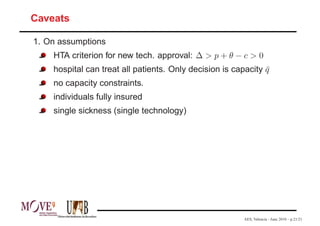
p + θ > c [new tech not cost saver; driver of cost inflation]
AES, Valencia - June 2010 – p.6/21](https://image.slidesharecdn.com/martinez-100629065505-phpapp02/85/Xavier-Martinez-Giralt-6-320.jpg)
![Notation and assumptions (2)
Hospital reimbursement R: prospective, retrospective, mixed
2 payment systems
total cost reimb; partial cost reimb; fixed fee/capitation
DRG
patients’ benefits
new tech: b
old tech: ˆ
b
b > ˆ b > p + θ; ˆ > c
b; b
new tech approval [HTA]: b − ˆ > p + θ − c > 0
b
AES, Valencia - June 2010 – p.7/21](https://image.slidesharecdn.com/martinez-100629065505-phpapp02/85/Xavier-Martinez-Giralt-7-320.jpg)

![Tech Adoption under cost reimbursement
Cost reimbursement system
R = α + βT C
T C ≡ total cost
α > 0 fixed component
β ∈ [0, 1] cost sharing component
β = 0 means capitation
Total cost
p¯ + θq
q if q ≤ q
¯
TC =
p¯ + θq + c(q − q )
q ¯ ¯ if q > q
¯
AES, Valencia - June 2010 – p.9/21](https://image.slidesharecdn.com/martinez-100629065505-phpapp02/85/Xavier-Martinez-Giralt-9-320.jpg)


![Comparative statics w.r.t α and β
Concavity of V and assumption p + θ − c > 0 yield:
d¯
q ∂2W
sign dβ= sign ∂ q∂β
¯ >0
increasing cost-sharing leads to more adoption.
d¯
q ∂2W
sign dα= sign ∂ q∂α
¯ >0
Higher α means lower mg cost of investing more (in utility
terms). For the same benefit, more investment will result.
Remark 4
Under risk neutrality, adoption insensitive to α. Then, cost-sharing
only instrument of payment system to affect technology adoption.
Summarizing
Higher transfers lead to higher levels of adoption by hospital
because ↑ patients’ benefits (∆) are assumed to offset ↑ mg cost
(p + θ − c), [HTA]
AES, Valencia - June 2010 – p.13/21](https://image.slidesharecdn.com/martinez-100629065505-phpapp02/85/Xavier-Martinez-Giralt-13-320.jpg)
![Comparative statics w.r.t dR = 0
⋆ Trade-off between α and β with risk aversion
Computing dR = 0, and totally differentiating f.o.c. yield ambiguous
result. Solution is:
d¯
q d¯
q
dβ = Υ−ΛΦ and dα = − ΛΨ+ΓΥ
Ψ+ΓΦ
Υ−ΛΦ
If properties of V (·) are s.t. Υ/Φ > Λ, then d¯/dβ > 0, d¯/dα < 0.
q q
BUT = hospitals, = properties of V (·). Issue behind difficulties to
interpret empirical work on tech adoption.
⋆ Trade-off between α and β with risk neutrality
Computing dR = 0, and totally differentiating f.o.c.
dα + Γd¯ + Λdβ = 0 ⇒ α adjusts
q
′
−Ψ d¯ + Υ′ dβ = 0 ⇒ d¯/dβ > 0.
q q
⋆ Impact on welfare: dW = ∂W dR + ∂W d¯ = 0
∂R ∂q q
¯
⋆ Summary: [1.] ↑ β, ↑ q because ↑ patients’ benefits.
¯
[2.] Given dR = 0, ↑ β requires ↓ α , and
[3.] given dW = 0, ↑ patient’s benefits, ↓ hosp. surplus.
AES, Valencia - June 2010 – p.14/21](https://image.slidesharecdn.com/martinez-100629065505-phpapp02/85/Xavier-Martinez-Giralt-14-320.jpg)



This document summarizes a theoretical model that examines the role of reimbursement systems on the rate of technology adoption by healthcare providers. The model considers an uncertain demand for healthcare services and a technological shift that provides increased benefits to patients. It analyzes how different reimbursement schemes, including cost reimbursement and DRG payment systems, impact a hospital's decision to adopt a new technology. The conclusions indicate that cost reimbursement can lead to higher adoption rates if reimbursement levels are high relative to the costs of the new technology. Discriminatory DRG payments that reimburse the new technology differently can also encourage adoption.


