BACHELOR OF SCIENCE (HONOURS) IN ARCHITECTURE
THEORIES OF ARCHITECTURE AND URBANISM (ARC61303
SYNOPSIS: REACTION PAPER (August 2017)
Name: Yen Wei Zheng ID No.: 0320266
Lecturer: Nicholas Tutorial Time: 12pm
Reader/Text Title: “Urbanism as a way of life” Synopsis No: 1
Author: Louis Wirth
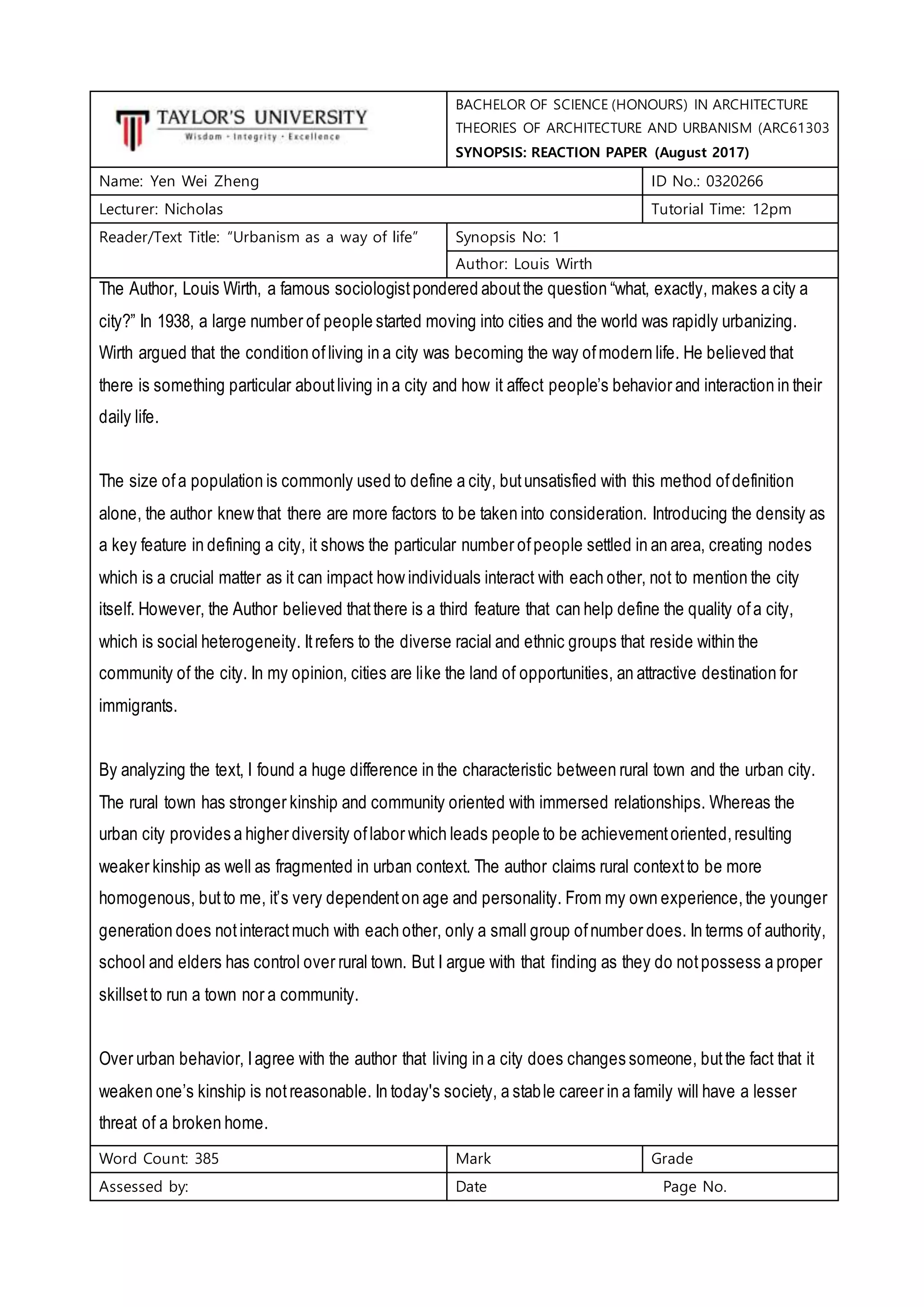
The Author, Louis Wirth, a famous sociologistpondered aboutthe question “what, exactly, makes a city a
city?” In 1938, a large number of people started moving into cities and the world was rapidly urbanizing.
Wirth argued that the condition ofliving in a city was becoming the way ofmodern life. He believed that
there is something particular aboutliving in a city and how it affect people’s behavior and interaction in their
daily life.
The size ofa population is commonly used to define a city, butunsatisfied with this method ofdefinition
alone, the author knew that there are more factors to be taken into consideration. Introducing the density as
a key feature in defining a city, it shows the particular number ofpeople settled in an area, creating nodes
which is a crucial matter as it can impact how individuals interact with each other, not to mention the city
itself. However, the Author believed thatthere is a third feature that can help define the quality ofa city,
which is social heterogeneity. Itrefers to the diverse racial and ethnic groups that reside within the
community of the city. In my opinion, cities are like the land of opportunities, an attractive destination for
immigrants.
By analyzing the text, I found a huge difference in the characteristic between rural town and the urban city.
The rural town has stronger kinship and community oriented with immersed relationships. Whereas the
urban city provides a higher diversity oflabor which leads people to be achievementoriented,resulting
weaker kinship as well as fragmented in urban context. The author claims rural contextto be more
homogenous, butto me, it’s very dependenton age and personality. From my own experience,the younger
generation does notinteractmuch with each other, only a small group ofnumber does. In terms of authority,
school and elders has control over rural town. But I argue with that finding as they do notpossess a proper
skillsetto run a town nor a community.
Over urban behavior, Iagree with the author that living in a city does changes someone, butthe fact that it
weaken one’s kinship is notreasonable. In today's society, a stable career in a family will have a lesser
threat of a broken home.
Word Count: 385 Mark Grade
Assessed by: Date Page No.
BACHELOR OF SCIENCE (HONOURS) IN ARCHITECTURE
THEORIES OF ARCHITECTURE AND URBANISM (ARC61303
SYNOPSIS: REACTION PAPER (August 2017)
Name: Yen Wei Zheng ID No.: 0320266
Lecturer: Nicholas Tutorial Time: 12pm
Reader/Text Title:
“Body, Memory, and Architecture”
Synopsis No: 2
Author: Charles Moore and Kent Bloomer
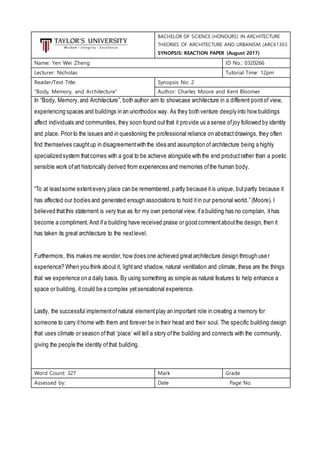
In “Body, Memory,and Architecture”, both author aim to showcase architecture in a different pointof view,
experiencing spaces and buildings in an unorthodox way. As they both venture deeply into how buildings
affect individuals and communities, they soon found outthat it provide us a sense ofjoy followed by identity
and place. Prior to the issues and in questioning the professional reliance on abstractdrawings, they often
find themselves caughtup in disagreementwith the idea and assumption of architecture being a highly
specialized system thatcomes with a goal to be achieve alongside with the end productrather than a poetic
sensible work ofart historically derived from experiences and memories ofthe human body.
“To at leastsome extentevery place can be remembered,partly because itis unique, butpartly because it
has affected our bodies and generated enough associations to hold itin our personal world.” (Moore). I
believed thatthis statement is very true as for my own personal view, ifa building has no complain, ithas
become a compliment. And ifa building have received praise or good commentaboutthe design, then it
has taken its great architecture to the nextlevel.
Furthermore, this makes me wonder, how does one achieved greatarchitecture design through user
experience? When you think about it, lightand shadow, natural ventilation and climate, these are the things
that we experience on a daily basis. By using something as simple as natural features to help enhance a
space or building, itcould be a complex yetsensational experience.
Lastly, the successful implementofnatural elementplay an important role in creating a memory for
someone to carry ithome with them and forever be in their head and their soul. The specific building design
that uses climate or season ofthat ‘place’ will tell a story ofthe building and connects with the community,
giving the people the identity ofthat building.
Word Count: 327 Mark Grade
Assessed by: Date Page No.
BACHELOR OF SCIENCE (HONOURS) IN ARCHITECTURE
THEORIES OF ARCHITECTURE AND URBANISM (ARC61303
SYNOPSIS: REACTION PAPER (August 2017)
Name: Yen Wei Zheng ID No.: 0320266
Lecturer: Nicholas Tutorial Time: 12pm
Reader/Text Title:
“Space, Place, Memory and Imagination: The
Temporal Dimension of Existential Space
Synopsis No: 3
Author: Juhani Pallasma
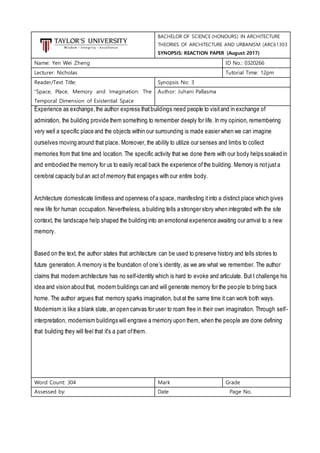
Experience as exchange,the author express thatbuildings need people to visitand in exchange of
admiration, the building provide them something to remember deeply for life. In my opinion, remembering
very well a specific place and the objects within our surrounding is made easier when we can imagine
ourselves moving around that place. Moreover, the ability to utilize our senses and limbs to collect
memories from that time and location. The specific activity that we done there with our body helps soaked in
and embodied the memory for us to easily recall back the experience ofthe building. Memory is notjusta
cerebral capacity butan act of memory that engages with our entire body.
Architecture domesticate limitless and openness ofa space, manifesting itinto a distinct place which gives
new life for human occupation. Nevertheless, a building tells a stronger story when integrated with the site
context, the landscape help shaped the building into an emotional experience awaiting our arrival to a new
memory.
Based on the text, the author states that architecture can be used to preserve history and tells stories to
future generation. A memory is the foundation of one’s identity, as we are what we remember. The author
claims that modern architecture has no self-identity which is hard to evoke and articulate. But I challenge his
idea and vision aboutthat, modern buildings can and will generate memory for the people to bring back
home. The author argues that memory sparks imagination, butat the same time it can work both ways.
Modernism is like a blank slate, an open canvas for user to roam free in their own imagination. Through self-
interpretation, modernism buildings will engrave a memory upon them, when the people are done defining
that building they will feel that it's a part ofthem.
Word Count: 304 Mark Grade
Assessed by: Date Page No.
BACHELOR OF SCIENCE (HONOURS) IN ARCHITECTURE
THEORIES OF ARCHITECTURE AND URBANISM (ARC61303
SYNOPSIS: REACTION PAPER (August 2017)
Name: Yen Wei Zheng ID No.: 0320266
Lecturer: Nicholas Tutorial Time: 12pm
Reader/Text Title: ‘Towards Critical Regionalism:
Six Points for an Architecture of Resistance
Synopsis No: 4
Author: Kenneth Frampton
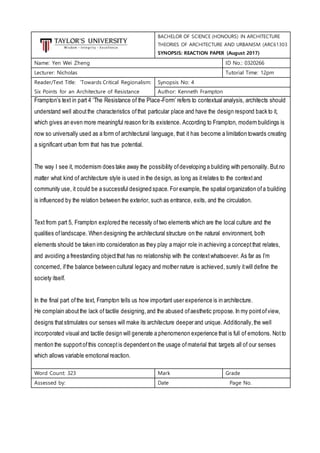
Frampton’s text in part 4 ‘The Resistance of the Place-Form’ refers to contextual analysis, architects should
understand well aboutthe characteristics ofthat particular place and have the design respond back to it,
which gives an even more meaningful reason for its existence. According to Frampton, modern buildings is
now so universally used as a form of architectural language, that it has become a limitation towards creating
a significant urban form that has true potential.
The way I see it, modernism does take away the possibility ofdeveloping a building with personality. Butno
matter what kind of architecture style is used in the design, as long as itrelates to the contextand
community use, it could be a successful designed space. For example, the spatial organization ofa building
is influenced by the relation between the exterior, such as entrance, exits, and the circulation.
Text from part 5, Frampton explored the necessity oftwo elements which are the local culture and the
qualities oflandscape. When designing the architectural structure on the natural environment, both
elements should be taken into consideration as they play a major role in achieving a conceptthat relates,
and avoiding a freestanding objectthat has no relationship with the contextwhatsoever. As far as I’m
concerned, ifthe balance between cultural legacy and mother nature is achieved, surely itwill define the
society itself.
In the final part ofthe text, Frampton tells us how important user experience is in architecture.
He complain aboutthe lack of tactile designing,and the abused ofaesthetic propose. In my pointofview,
designs thatstimulates our senses will make its architecture deeper and unique. Additionally,the well
incorporated visual and tactile design will generate a phenomenon experience that is full of emotions. Notto
mention the supportofthis conceptis dependenton the usage ofmaterial that targets all of our senses
which allows variable emotional reaction.
Word Count: 323 Mark Grade
Assessed by: Date Page No.

Wz synopsis

  • 1.
    BACHELOR OF SCIENCE(HONOURS) IN ARCHITECTURE THEORIES OF ARCHITECTURE AND URBANISM (ARC61303 SYNOPSIS: REACTION PAPER (August 2017) Name: Yen Wei Zheng ID No.: 0320266 Lecturer: Nicholas Tutorial Time: 12pm Reader/Text Title: “Urbanism as a way of life” Synopsis No: 1 Author: Louis Wirth The Author, Louis Wirth, a famous sociologistpondered aboutthe question “what, exactly, makes a city a city?” In 1938, a large number of people started moving into cities and the world was rapidly urbanizing. Wirth argued that the condition ofliving in a city was becoming the way ofmodern life. He believed that there is something particular aboutliving in a city and how it affect people’s behavior and interaction in their daily life. The size ofa population is commonly used to define a city, butunsatisfied with this method ofdefinition alone, the author knew that there are more factors to be taken into consideration. Introducing the density as a key feature in defining a city, it shows the particular number ofpeople settled in an area, creating nodes which is a crucial matter as it can impact how individuals interact with each other, not to mention the city itself. However, the Author believed thatthere is a third feature that can help define the quality ofa city, which is social heterogeneity. Itrefers to the diverse racial and ethnic groups that reside within the community of the city. In my opinion, cities are like the land of opportunities, an attractive destination for immigrants. By analyzing the text, I found a huge difference in the characteristic between rural town and the urban city. The rural town has stronger kinship and community oriented with immersed relationships. Whereas the urban city provides a higher diversity oflabor which leads people to be achievementoriented,resulting weaker kinship as well as fragmented in urban context. The author claims rural contextto be more homogenous, butto me, it’s very dependenton age and personality. From my own experience,the younger generation does notinteractmuch with each other, only a small group ofnumber does. In terms of authority, school and elders has control over rural town. But I argue with that finding as they do notpossess a proper skillsetto run a town nor a community. Over urban behavior, Iagree with the author that living in a city does changes someone, butthe fact that it weaken one’s kinship is notreasonable. In today's society, a stable career in a family will have a lesser threat of a broken home. Word Count: 385 Mark Grade Assessed by: Date Page No.
  • 2.
    BACHELOR OF SCIENCE(HONOURS) IN ARCHITECTURE THEORIES OF ARCHITECTURE AND URBANISM (ARC61303 SYNOPSIS: REACTION PAPER (August 2017) Name: Yen Wei Zheng ID No.: 0320266 Lecturer: Nicholas Tutorial Time: 12pm Reader/Text Title: “Body, Memory, and Architecture” Synopsis No: 2 Author: Charles Moore and Kent Bloomer In “Body, Memory,and Architecture”, both author aim to showcase architecture in a different pointof view, experiencing spaces and buildings in an unorthodox way. As they both venture deeply into how buildings affect individuals and communities, they soon found outthat it provide us a sense ofjoy followed by identity and place. Prior to the issues and in questioning the professional reliance on abstractdrawings, they often find themselves caughtup in disagreementwith the idea and assumption of architecture being a highly specialized system thatcomes with a goal to be achieve alongside with the end productrather than a poetic sensible work ofart historically derived from experiences and memories ofthe human body. “To at leastsome extentevery place can be remembered,partly because itis unique, butpartly because it has affected our bodies and generated enough associations to hold itin our personal world.” (Moore). I believed thatthis statement is very true as for my own personal view, ifa building has no complain, ithas become a compliment. And ifa building have received praise or good commentaboutthe design, then it has taken its great architecture to the nextlevel. Furthermore, this makes me wonder, how does one achieved greatarchitecture design through user experience? When you think about it, lightand shadow, natural ventilation and climate, these are the things that we experience on a daily basis. By using something as simple as natural features to help enhance a space or building, itcould be a complex yetsensational experience. Lastly, the successful implementofnatural elementplay an important role in creating a memory for someone to carry ithome with them and forever be in their head and their soul. The specific building design that uses climate or season ofthat ‘place’ will tell a story ofthe building and connects with the community, giving the people the identity ofthat building. Word Count: 327 Mark Grade Assessed by: Date Page No.
  • 3.
    BACHELOR OF SCIENCE(HONOURS) IN ARCHITECTURE THEORIES OF ARCHITECTURE AND URBANISM (ARC61303 SYNOPSIS: REACTION PAPER (August 2017) Name: Yen Wei Zheng ID No.: 0320266 Lecturer: Nicholas Tutorial Time: 12pm Reader/Text Title: “Space, Place, Memory and Imagination: The Temporal Dimension of Existential Space Synopsis No: 3 Author: Juhani Pallasma Experience as exchange,the author express thatbuildings need people to visitand in exchange of admiration, the building provide them something to remember deeply for life. In my opinion, remembering very well a specific place and the objects within our surrounding is made easier when we can imagine ourselves moving around that place. Moreover, the ability to utilize our senses and limbs to collect memories from that time and location. The specific activity that we done there with our body helps soaked in and embodied the memory for us to easily recall back the experience ofthe building. Memory is notjusta cerebral capacity butan act of memory that engages with our entire body. Architecture domesticate limitless and openness ofa space, manifesting itinto a distinct place which gives new life for human occupation. Nevertheless, a building tells a stronger story when integrated with the site context, the landscape help shaped the building into an emotional experience awaiting our arrival to a new memory. Based on the text, the author states that architecture can be used to preserve history and tells stories to future generation. A memory is the foundation of one’s identity, as we are what we remember. The author claims that modern architecture has no self-identity which is hard to evoke and articulate. But I challenge his idea and vision aboutthat, modern buildings can and will generate memory for the people to bring back home. The author argues that memory sparks imagination, butat the same time it can work both ways. Modernism is like a blank slate, an open canvas for user to roam free in their own imagination. Through self- interpretation, modernism buildings will engrave a memory upon them, when the people are done defining that building they will feel that it's a part ofthem. Word Count: 304 Mark Grade Assessed by: Date Page No.
  • 4.
    BACHELOR OF SCIENCE(HONOURS) IN ARCHITECTURE THEORIES OF ARCHITECTURE AND URBANISM (ARC61303 SYNOPSIS: REACTION PAPER (August 2017) Name: Yen Wei Zheng ID No.: 0320266 Lecturer: Nicholas Tutorial Time: 12pm Reader/Text Title: ‘Towards Critical Regionalism: Six Points for an Architecture of Resistance Synopsis No: 4 Author: Kenneth Frampton Frampton’s text in part 4 ‘The Resistance of the Place-Form’ refers to contextual analysis, architects should understand well aboutthe characteristics ofthat particular place and have the design respond back to it, which gives an even more meaningful reason for its existence. According to Frampton, modern buildings is now so universally used as a form of architectural language, that it has become a limitation towards creating a significant urban form that has true potential. The way I see it, modernism does take away the possibility ofdeveloping a building with personality. Butno matter what kind of architecture style is used in the design, as long as itrelates to the contextand community use, it could be a successful designed space. For example, the spatial organization ofa building is influenced by the relation between the exterior, such as entrance, exits, and the circulation. Text from part 5, Frampton explored the necessity oftwo elements which are the local culture and the qualities oflandscape. When designing the architectural structure on the natural environment, both elements should be taken into consideration as they play a major role in achieving a conceptthat relates, and avoiding a freestanding objectthat has no relationship with the contextwhatsoever. As far as I’m concerned, ifthe balance between cultural legacy and mother nature is achieved, surely itwill define the society itself. In the final part ofthe text, Frampton tells us how important user experience is in architecture. He complain aboutthe lack of tactile designing,and the abused ofaesthetic propose. In my pointofview, designs thatstimulates our senses will make its architecture deeper and unique. Additionally,the well incorporated visual and tactile design will generate a phenomenon experience that is full of emotions. Notto mention the supportofthis conceptis dependenton the usage ofmaterial that targets all of our senses which allows variable emotional reaction. Word Count: 323 Mark Grade Assessed by: Date Page No.