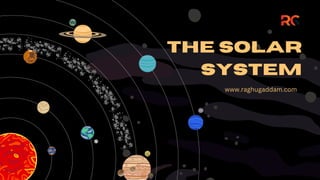
The Solar
System
www.raghugaddam.com
01
INTRODUCTION
An introduction of the efforts and
discovery of our solar system and
its history
02
THE SUN
A discussion on the characteristics
and importance of the sun in the
solar system
TERRESTRIALS
03 A discussion on the characteristics
and importance of the terrestrial
planets in the solar system
GAS GIANTS
04 A discussion on the characteristics
and importance of the gas giants in
the solar system
Lesson Agenda
www.raghugaddam.com
Many astronomers have attempted to discover the truth about our
world and beyond; with the collective knowledge gained from
these efforts, we have come to understand and continue to
discover worlds beyond our own.
Introduction
In this lesson, we will learn the fundamentals of our solar system's
heavenly bodies and discover some of the most fascinating facts
about stars, moons, and planets.
www.raghugaddam.com
Terrestrials
Gas Giants
www.raghugaddam.com
The Sun
Our Sun is a 4.5 billion-year-old star at
the center of our solar system, a hot,
glowing ball of hydrogen and helium. The
Sun is also the solar system's largest
object. The Sun is around 93 million miles
from Earth, and life as we know it would
not be possible without its energy.
The Sun is approximately 100 times
larger than Earth and approximately 10
times larger than Jupiter. The Sun's core
temperature is approximately 15 million
degrees Celsius. Everything in our solar
system revolves around it, including
planets, asteroids, and comets.
www.raghugaddam.com
Mercury
Venus
Mercury, the smallest planet in our solar system and the closest to the Sun, is
only slightly larger than Earth's Moon. The Sun would appear more than three
times as large from the surface of Mercury as it does from Earth, and the sunlight
would be up to seven times brighter.
Venus is Earth's closest planetary neighbor and the second planet from the Sun.
It is sometimes referred to as Earth's twin due to its size and density. Even
though Mercury is closest to the Sun, Venus is the hottest planet in our solar
system; its surface temperature is approximately 475 degrees Celsius.
www.raghugaddam.com
Earth
Earth is our home planet; the third planet from the
Sun, is the only place we know of that can sustain and
support life. Earth is the largest of the four closest
planets to the Sun, which are all made of rock and
metal.
Moon
The Moon is the only natural satellite of Earth. Its
distance is approximately 385,000 kilometers from
Earth. The Moon, the brightest and biggest object in
our night sky, makes Earth more livable by regulating
our planet's axis, resulting in a generally constant
climate.
www.raghugaddam.com
Mars
Asteroid
Belt
Mars, a cold, dry, dusty planet with a thin
atmosphere, is the fourth planet from the Sun. Along
with having seasons, polar ice caps, canyons, and
extinct volcanoes. Mars is a dynamic planet.
The majority of the asteroids in our Solar System can
be found orbiting the Sun in the asteroid belt, which is
a region of space located between Mars and Jupiter's
orbits.
www.raghugaddam.com
sATURN
The second-largest planet in our solar system, Saturn, is
located at a distance of six planets from the Sun. Saturn is a
gas giant primarily composed of hydrogen and helium. Titan
is one of Saturn's 83 moons. Saturn is also famous for its
rings.
Jupiter
The largest planet in the solar system and the first gas giant
from the Sun is Jupiter. All of the other planets in the solar
system could fit inside Jupiter due to its enormous size.
Callisto and Io are two of Jupiter's 80 moons.
www.raghugaddam.com
Uranus Neptune
The seventh planet from the Sun is
Uranus. Like Jupiter and Saturn, Uranus
has an atmosphere composed primarily
of hydrogen and helium, but it also
contains methane. Methane causes
Uranus to turn blue. Similar to Saturn,
Uranus has rings.
The fourth largest and eighth planet
from the sun, Neptune is also a gas
giant. The methane in Neptune's upper
atmosphere absorbs the sun's red light
while returning its blue light to space.
Neptune appears blue as a result.
www.raghugaddam.com
Thank
you for
listening!
www.raghugaddam.com
Resources Page
www.raghugaddam.com

www.raghugaddam.com (6).pdf

  • 1.
  • 2.
    01 INTRODUCTION An introduction ofthe efforts and discovery of our solar system and its history 02 THE SUN A discussion on the characteristics and importance of the sun in the solar system TERRESTRIALS 03 A discussion on the characteristics and importance of the terrestrial planets in the solar system GAS GIANTS 04 A discussion on the characteristics and importance of the gas giants in the solar system Lesson Agenda www.raghugaddam.com
  • 3.
    Many astronomers haveattempted to discover the truth about our world and beyond; with the collective knowledge gained from these efforts, we have come to understand and continue to discover worlds beyond our own. Introduction In this lesson, we will learn the fundamentals of our solar system's heavenly bodies and discover some of the most fascinating facts about stars, moons, and planets. www.raghugaddam.com
  • 4.
  • 5.
    The Sun Our Sunis a 4.5 billion-year-old star at the center of our solar system, a hot, glowing ball of hydrogen and helium. The Sun is also the solar system's largest object. The Sun is around 93 million miles from Earth, and life as we know it would not be possible without its energy. The Sun is approximately 100 times larger than Earth and approximately 10 times larger than Jupiter. The Sun's core temperature is approximately 15 million degrees Celsius. Everything in our solar system revolves around it, including planets, asteroids, and comets. www.raghugaddam.com
  • 6.
    Mercury Venus Mercury, the smallestplanet in our solar system and the closest to the Sun, is only slightly larger than Earth's Moon. The Sun would appear more than three times as large from the surface of Mercury as it does from Earth, and the sunlight would be up to seven times brighter. Venus is Earth's closest planetary neighbor and the second planet from the Sun. It is sometimes referred to as Earth's twin due to its size and density. Even though Mercury is closest to the Sun, Venus is the hottest planet in our solar system; its surface temperature is approximately 475 degrees Celsius. www.raghugaddam.com
  • 7.
    Earth Earth is ourhome planet; the third planet from the Sun, is the only place we know of that can sustain and support life. Earth is the largest of the four closest planets to the Sun, which are all made of rock and metal. Moon The Moon is the only natural satellite of Earth. Its distance is approximately 385,000 kilometers from Earth. The Moon, the brightest and biggest object in our night sky, makes Earth more livable by regulating our planet's axis, resulting in a generally constant climate. www.raghugaddam.com
  • 8.
    Mars Asteroid Belt Mars, a cold,dry, dusty planet with a thin atmosphere, is the fourth planet from the Sun. Along with having seasons, polar ice caps, canyons, and extinct volcanoes. Mars is a dynamic planet. The majority of the asteroids in our Solar System can be found orbiting the Sun in the asteroid belt, which is a region of space located between Mars and Jupiter's orbits. www.raghugaddam.com
  • 9.
    sATURN The second-largest planetin our solar system, Saturn, is located at a distance of six planets from the Sun. Saturn is a gas giant primarily composed of hydrogen and helium. Titan is one of Saturn's 83 moons. Saturn is also famous for its rings. Jupiter The largest planet in the solar system and the first gas giant from the Sun is Jupiter. All of the other planets in the solar system could fit inside Jupiter due to its enormous size. Callisto and Io are two of Jupiter's 80 moons. www.raghugaddam.com
  • 10.
    Uranus Neptune The seventhplanet from the Sun is Uranus. Like Jupiter and Saturn, Uranus has an atmosphere composed primarily of hydrogen and helium, but it also contains methane. Methane causes Uranus to turn blue. Similar to Saturn, Uranus has rings. The fourth largest and eighth planet from the sun, Neptune is also a gas giant. The methane in Neptune's upper atmosphere absorbs the sun's red light while returning its blue light to space. Neptune appears blue as a result. www.raghugaddam.com
  • 11.
  • 12.