WRITING SMART
GOALS: CBS THERAPY
www.cbstherapy.com
Tracking student progress is one of the most crucial components
of a child’s journey in special education. Data collection allows us
to provide children with the best possible interventions and
actively impact their education. Special educators, occupational,
physical, speech-language, and behavior therapists all use SMART
goals as an efficient way to support intervention planning and
data collection.
THE PROVEN PATH TO REAL PROGRESS
The SMART template provides a consistent
structure for goal-writing. They are widely
recognized in education and help
professionals ensure that the goal includes
all necessary components.
SMART Goals?
Attainable
Relevant
Specific
Measurable
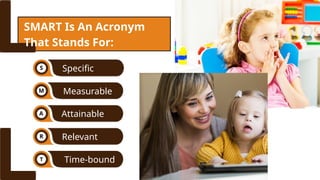
SMART Is An Acronym
That Stands For:
Time-bound
S
M
A
R
T
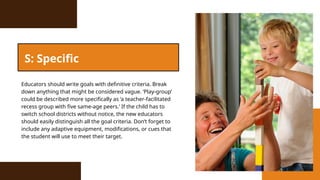
Educators should write goals with definitive criteria. Break
down anything that might be considered vague. ‘Play-group’
could be described more specifically as ‘a teacher-facilitated
recess group with five same-age peers.’ If the child has to
switch school districts without notice, the new educators
should easily distinguish all the goal criteria. Don’t forget to
include any adaptive equipment, modifications, or cues that
the student will use to meet their target.
S: Specific
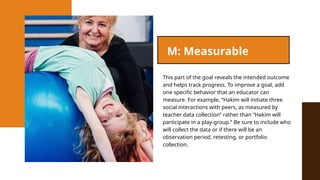
This part of the goal reveals the intended outcome
and helps track progress. To improve a goal, add
one specific behavior that an educator can
measure. For example, “Hakim will initiate three
social interactions with peers, as measured by
teacher data collection” rather than “Hakim will
participate in a play-group.” Be sure to include who
will collect the data or if there will be an
observation period, retesting, or portfolio
collection.
M: Measurable
A: Attainable
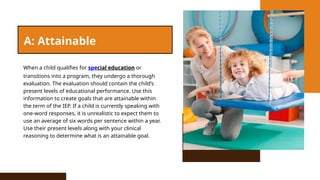
When a child qualifies for special education or
transitions into a program, they undergo a thorough
evaluation. The evaluation should contain the child’s
present levels of educational performance. Use this
information to create goals that are attainable within
the term of the IEP. If a child is currently speaking with
one-word responses, it is unrealistic to expect them to
use an average of six words per sentence within a year.
Use their present levels along with your clinical
reasoning to determine what is an attainable goal.
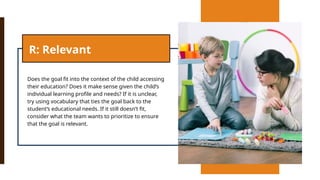
Does the goal fit into the context of the child accessing
their education? Does it make sense given the child’s
individual learning profile and needs? If it is unclear,
try using vocabulary that ties the goal back to the
student’s educational needs. If it still doesn’t fit,
consider what the team wants to prioritize to ensure
that the goal is relevant.
R: Relevant
The goal should be attainable within the timeframe of the
IEP. An IEP is typically valid for one year. However, if a
related service gets added to the plan mid-year, the
specialist will create goals for a shorter time. To ensure
that you are using the correct timeframe, look for the
next annual IEP date and write it into the goals. Refer
back to this part of the goal to check that the target is
attainable.
T: Time-bound
Contact US
+1 401-270-9991
Phone
office@cbstherapy.com
Email
www.cbstherapy.com
Website
845 North Main Street, Providence, RI, 02904
Location

Writing SMART Goals | Track Progress With CBS Therapy

  • 1.
    WRITING SMART GOALS: CBSTHERAPY www.cbstherapy.com Tracking student progress is one of the most crucial components of a child’s journey in special education. Data collection allows us to provide children with the best possible interventions and actively impact their education. Special educators, occupational, physical, speech-language, and behavior therapists all use SMART goals as an efficient way to support intervention planning and data collection. THE PROVEN PATH TO REAL PROGRESS
  • 2.
    The SMART templateprovides a consistent structure for goal-writing. They are widely recognized in education and help professionals ensure that the goal includes all necessary components. SMART Goals?
  • 3.
    Attainable Relevant Specific Measurable SMART Is AnAcronym That Stands For: Time-bound S M A R T
  • 4.
    Educators should writegoals with definitive criteria. Break down anything that might be considered vague. ‘Play-group’ could be described more specifically as ‘a teacher-facilitated recess group with five same-age peers.’ If the child has to switch school districts without notice, the new educators should easily distinguish all the goal criteria. Don’t forget to include any adaptive equipment, modifications, or cues that the student will use to meet their target. S: Specific
  • 5.
    This part ofthe goal reveals the intended outcome and helps track progress. To improve a goal, add one specific behavior that an educator can measure. For example, “Hakim will initiate three social interactions with peers, as measured by teacher data collection” rather than “Hakim will participate in a play-group.” Be sure to include who will collect the data or if there will be an observation period, retesting, or portfolio collection. M: Measurable
  • 6.
    A: Attainable When achild qualifies for special education or transitions into a program, they undergo a thorough evaluation. The evaluation should contain the child’s present levels of educational performance. Use this information to create goals that are attainable within the term of the IEP. If a child is currently speaking with one-word responses, it is unrealistic to expect them to use an average of six words per sentence within a year. Use their present levels along with your clinical reasoning to determine what is an attainable goal.
  • 7.
    Does the goalfit into the context of the child accessing their education? Does it make sense given the child’s individual learning profile and needs? If it is unclear, try using vocabulary that ties the goal back to the student’s educational needs. If it still doesn’t fit, consider what the team wants to prioritize to ensure that the goal is relevant. R: Relevant
  • 8.
    The goal shouldbe attainable within the timeframe of the IEP. An IEP is typically valid for one year. However, if a related service gets added to the plan mid-year, the specialist will create goals for a shorter time. To ensure that you are using the correct timeframe, look for the next annual IEP date and write it into the goals. Refer back to this part of the goal to check that the target is attainable. T: Time-bound
  • 9.