How to write a high-quality scientific
Paper: Pearls & Pitfalls
Mohamed Aly, MD, Ph D
Neurosurgery consultant
Prince Mohamed Ben Abdelaziz Hospital, Riyadh, KSA
Associate Member of AOSpine Knowledge forum trauma
Outline
Introduction
General tips pf writing
How to write each section
Writing Toolbox
Final remarks
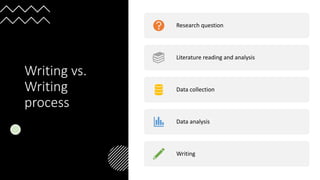
Writing vs.
Writing
process
Research question
Literature reading and analysis
Data collection
Data analysis
Writing
Understand the context
Review aricle
Research article
More
2500-3500
Word limit
Less expert
Expert
Audience
More detilaed
Concise
Style of writing
Background
Research question > back ground
Main focus
Message Logical flow Brevity
GENERAL TIPS: How to tell your story?
Answer
Research Question
More
details
Literature
review
Focus on Take-Home Message
Why People lose the track?
Do not tell people ALL what you
know, tell them what they need
to know
More is not always
More?
Outline
Manuscript
Take home
message
Logical flow
of ideas
Logical flow: different levels
Literature
Research Q
Proposal
Topic
sentence
Literature
Explanation
Manuscript Each section Paragraph
Brevity: Less is More
More room
for more ideas
Easy
reading
Reader Author
A possible explanation is that we used different
criteria to define Ligamentous injury in CT and MRI.
This rate of fracture classifcation in this study is lower
than previously reported
In this study, we reported that MRI can change the
fracture classifcation in only 12% of cases
Winklhofer showed that MRI Can change fracture
classifcation in 25% of cases.
Pizones on the other hand showed that MRI would
change fracture classifcation in 30%.
The relatively lower rate of
change in fracture classifcation
reported herein (12% Vs. 25-30%
previously) may be attributed to
the use of…(Winkhofler et al,
Pizones at al)
Literature
Findings
Compare
Why?
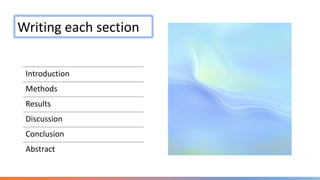
Writing each section
Introduction
Methods
Results
Discussion
Conclusion
Abstract
Introduction
=Research Question
Topic
Research Q
Proposal
1st Paragraph
2nd Paragraph
3rd Paragraph
General
Specific
Targeted literature reviews
Technique
Targeted
Importance of topic
Focused
Content
Lay background for future
discussion
Relevant
Cite recent reviews/
Systematic reviews
Limited
Educate audience about
topic
Cone-shaped
Move Quickly from general
to specific
Brevity
Synthesis of literature
Brief
1st paragraph /literature review
Lumbar disc disease is a major health problem(Reference)
There is ample evidence that Discectomy is effective for
medically intractable cases(References).
Open discectomy has been the standard procedure, but
Microdiscectomy has been introduced in 1980s as less invasive
procedure.
Specific
General
General
Specific
Lay
background
2nd paragraph=Research gap=Surgical dissection
Despite theoretical advantages of
microdiscectomy, its superiority over
open discectomy has not been
established (References).
Most studies comparing open vs
discectomy are retrospective
nonrandomized controlled studies
in small number of patients.
This may be attributed to the
challenges of conducting RCT in
surgical patients.
General
Explanation
Methodology
Hypothesis Hypothesis
3rd paragraph=Proposal: Are you filling the gap?
KNOWLEDGE GAP
Most studies comparing open vs
discectomy are retrospective
nonrandomized controlled studies
PROPOSAL
to compare the efficacy and
complications of open vs
microdiscectomy using a
randomized controlled design
What we know?
What do we not
know?
Methods=
Know How?
Methods
General
Structure
Study design/Setting/Ethical statement
Patients( inclusion/Exclusion criteria)
Procedures
Outcome measures
Statistical analysis
Flow=Chronological
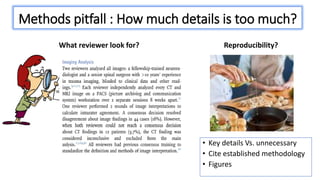
Methods pitfall : How much details is too much?
• Key details Vs. unnecessary
• Cite established methodology
• Figures
What reviewer look for? Reproducibility?
Methods: Figure and Flow chart
reviewer look for?
Results
Results structure
Demographic data
Result 1 (Clinical outcome open Vs. Microdis)
Results 2 (Complications open Vs. Microdis
Result 3 ( Cost open Vs. Microdis)
More important
Less important
Results: Brevity vs. Comprehensiveness?
Results
/ConciseText
• Microdiscectomy was associated with a
statistically significant rate of favorable
outcome compared to open ( 87% vs. 78%,
P<.001).
Focus on 1ry Q
• Most of the complications did not show a
significant difference between
microdiscectomy and open disectomy ( See
Table 1) except wound infection ( 2% Micro vs.
5% open, P<0.001)
Trend
• Microdiscectomy was more effective compared
to open ( 87% vs. 78%, P<.001).
Do not interpret
Discussion……Metasynthesis
of your findings ….not blind
literature review
Last paragraph
Strength& Limitations
Implications
Clinical Impact/future prespective
Literature review
Study context
First paragraph
Key findings/interpretation/Novelty
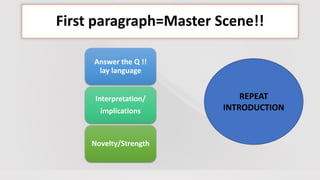
First paragraph=Master Scene!!
Answer the Q !!
lay language
Interpretation/
implications
Novelty/Strength
REPEAT
INTRODUCTION
First
paragraph/Example
Key findings interpretations
The main findings of this study is that Microdiscectomy is
more effective ( favorable outcome 87% vs 78%) , safer, and
more cost effective than open discectomy.
Novelty
To our knowledge, this the largest RCT to date that
compares Microdiscectomy to open discectomy
Why your results
are better than
previous studies?
How can your results
be used in clinical
practice?
Are your results
generalizable to
different settings?
2nd paragraph= literature review answer
Qs
• First Study? Why no other studies
• Largest study? What was the
sample size
• Better results? Why? Better
methods? Larger sample
Questions
Answer relevant questions
2nd Paragraph
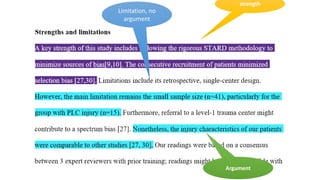
Why to acknowledge Limitations? Why not?
Increase chance of acceptance
Address limitations
Mix up strengths & limitations
Use arguments & counter-arguments
strength
Limitation, no
argument
Argument
• Key findings
• Implications
• Limitations
• Future prespective
ABSTRACT=Version of story
Last but not least
Manuscript
Graphical abstract
Abstract
Flow Chart
Writing tool-box
• Paraphrasing software
• Grammar/spelling check
• Reference management
• Flow chart/ figures
Final remarks
Take away today
Use
appropriate
structure
01
Make A road
road map!!
02
Use
paraphrasing
tool
03
Use
figures/tables
04
Read to write
05
For young researcher
Practice
01
Mentorship
02
Thank you

Writing a Manuscript_ESJ_PDF.pdf