WRITING A CRAFT ESSAY
DEMONSTRATING AWARENESS
AND SENSITIVITY TO THE DIFFERENT
LITERARY SOCIO-POLITICAL
CONTEXTS
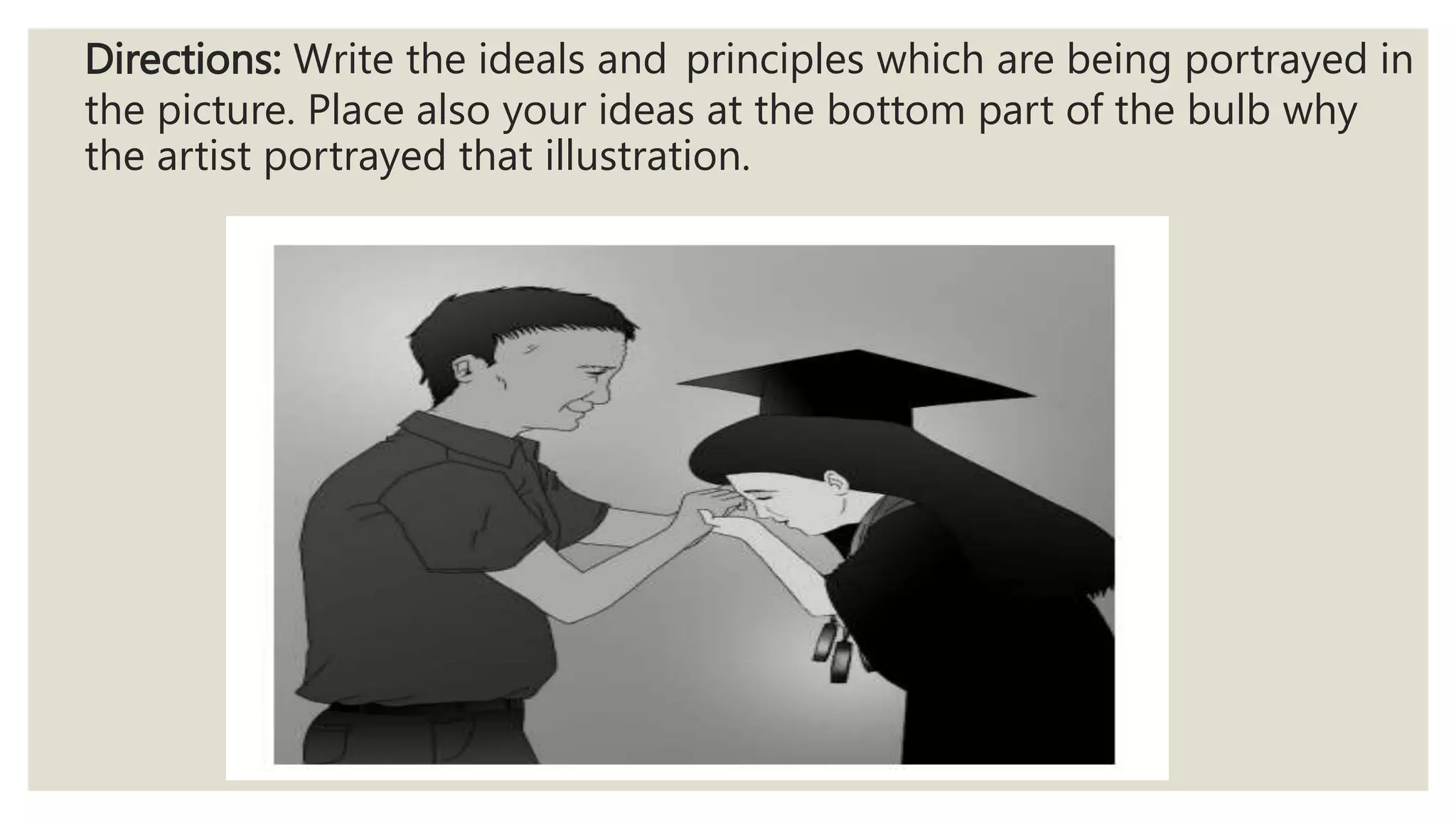
Directions: Write the ideals and principles which are being portrayed in
the picture. Place also your ideas at the bottom part of the bulb why
the artist portrayed that illustration.
What is a context?
The word “context” means the
circumstances forming the set up of an
event, statement, or idea to make it
understandable and easy to assess.
Literary context
Literary context means understanding the literary genre.
Determining the literary genre helps in understanding the context of
the passage. The author and the reader agree through the genre.
Examples of genre for fiction are: drama, fable, fairy tale, folklore,
humor, horror, legend, poetry, short story, and science fiction while the
literary genres for non-fiction are: biography, essay, speech,
autobiography, and narrative non-fiction.
1. Social context
It is the way in which the surroundings, the people,
the situation influence on how people react and interpret
things. How people react may be credited to their previous
experiences. Read the sample poem and see how the social
social context dominated in the overall understanding of
the piece.
Furthermore, there are several literary contexts which can help the
readers in giving interpretation of the text. These are social context,
historical context, ideological context, and cultural context
Going back to the poem “My Neighbor”, the
situation is about the rich neighbor who built high walls
around their residence. The rich neighbor had a tall gate
that the poor families could not see the things inside. The
daughter of the well to do family also wished to see the
world outside their house as stated in the line “looks
longingly beyond the gate.” This circumstance depicts the
gap between the rich and the poor families. The social
standing created a disparity that the two kids cannot be
friends with each other.
2. Historical context
This kind of context is being hooked with the social
context when the literary work or era it was produced. There is
no literary piece that can be fully appreciated without knowing
the historical context.
For example, the poem written by Telesforo Sungkit Jr.
entitled “I Higaonon”, social and historical contexts can be
derived from the poem. This poem is about Higaonon tribe,
one of the lumads or indigenous peoples in Bukidnon
Province, Northern Mindanao. The poem portrays a sort of
social discrimination on the part of the Higaonons stated in
the 6th stanza below
I you called savage
you say savage is bad people.
You say you is civilized
and civilized is good people.
Below are the 9th and 10th stanzas that divulged the resentful experience
as part of their tribe’s history. For decades, the Higaonons were struggling of their
independence, their cultural integrity, and rights to self-determination. They
fought for the protection of their forested mountains against the loggers and the
security of their ancestral domain for more than sixty years already. More so, some
of them were being killed and suppressed if they disagree with those who tried to
stop the superiors as described in the poem.
I angry you kill my datus,
I angry you burn my house,
I angry you get my honey,
I angry you get my sakop,
but you say I should know democracy.
You say know democracy
but you commanding all
you telling I not speak
you forcing I live near plantations
You making all us sakop
you killing my brothers not liking you.
3. Ideological contexts
Ideology is described as the systems of beliefs and
ideas being found in our attitudes and behavior. This kind
of context is invisible as it is being normalized as people act
according to their assumptions and social norms.
For instance, in the epic of Maranao entitled “Darangan”, there
were two sons of the king: Prince Madali and Prince Bantugan.
Between the two princes, the younger one, Prince Bantugan was
better in strength and intelligence. When their father died, the elder
brother, Prince Madali was promoted to the throne. Implicitly, the
story valued the role of the elder brother who was next to his father
even though the younger brother was more capable to rule. This kind
of norm called seniority rule is still applied in some organizations and
group of people nowadays.
4. Cultural contexts
Culture means the way of life including religion, race,
nationality, food, dress code, manner, art, music, and literature. It is
also linked with social, historical, and ideological context. This kind
of context is dominant especially when the author is commenting
about an aspect of culture, or conflict of culture. Through literature,
rich cultures are being manifested in the text.
Take a look at the short story written by Amador Daguio entitled
“Wedding Dance”. The characters Awiyao and Lumnay most probably
belonged to the Igorot people who inhabit the large areas of Luzon.
Since Filipinos were being colonized by Spaniards in 1500s, Americans in
1898, and Japanese in 1940s, there were mixed cultures being practiced
by our ancestors. Thus the writer, Amador Daguio being born in Ilocos
Province dwelt in the culture of his ancestors to explore the Filipino
traditions. In the
short story, after being married for seven years Awiyao was forced to
marry another girl because Lumnay could not bear a child. The culture
suggested that a measurement of being a family man is to have a child.
In that case, the love of the couple was in a big trouble leading their true
love to unhappy ending. This literary piece also depicts that culture has a
great factor in the decision of a person.
There are three areas that involved in the socio-political
contexts. These are social issues, politics, and religion.
◦ 1. Social issues-These are related to the issues concerning the
national aspect of human life. In the Philippines, examples of social
problems are: corruption, poverty, lack of education, teenage
pregnancy, oppression to the poor, prostitution, suppression of
freedom of the press, dishonesty, and others.
◦ 2. Politics-This is one of the prolific themes in literature that has
something to do with the governance of a country or an area.
◦ 3. Religion-This refers to the belief of humanity that there is far
greater entity who made the greatness of nature.
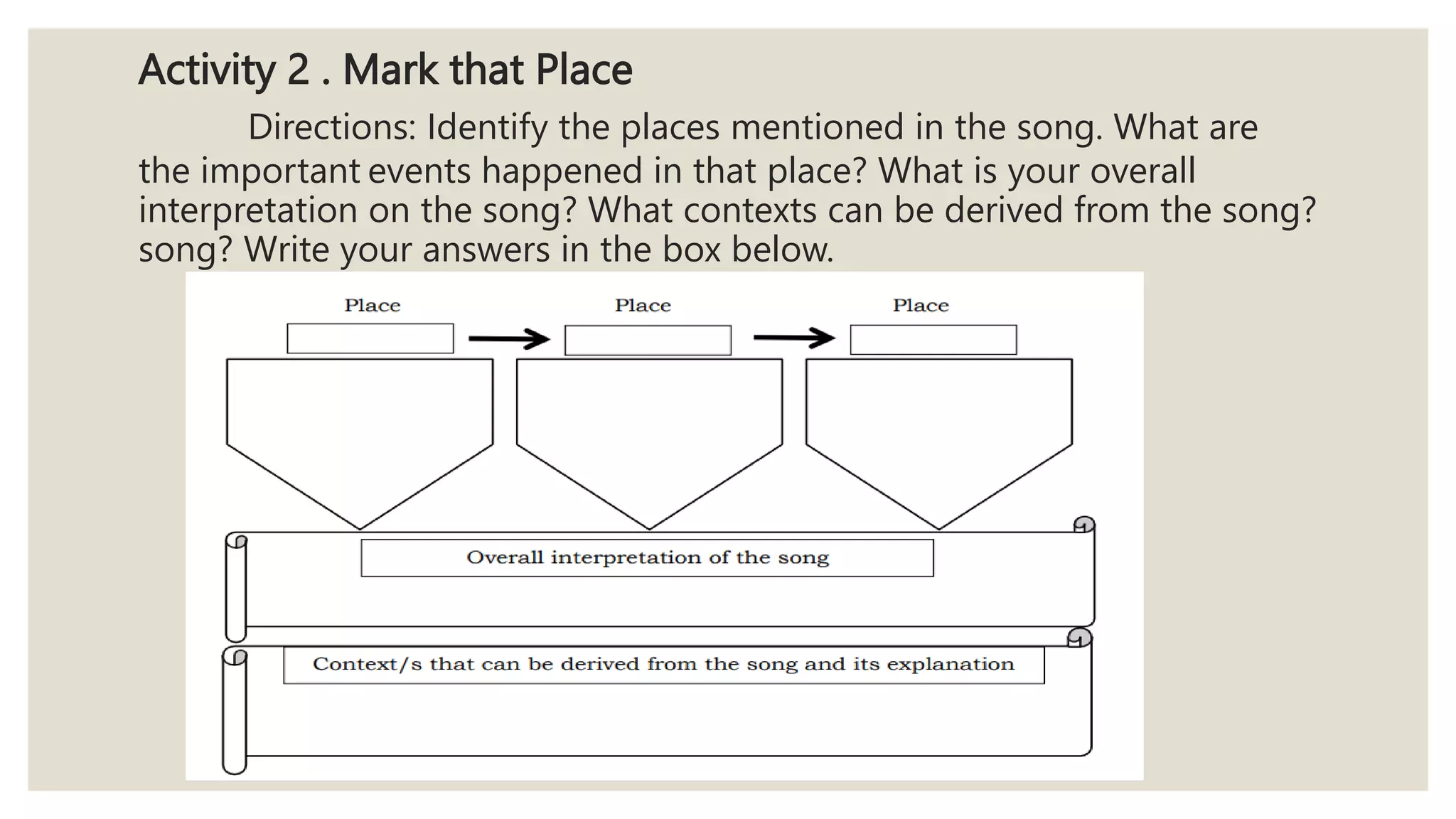
Activity 2 . Mark that Place
Directions: Identify the places mentioned in the song. What are
the important events happened in that place? What is your overall
interpretation on the song? What contexts can be derived from the song?
song? Write your answers in the box below.
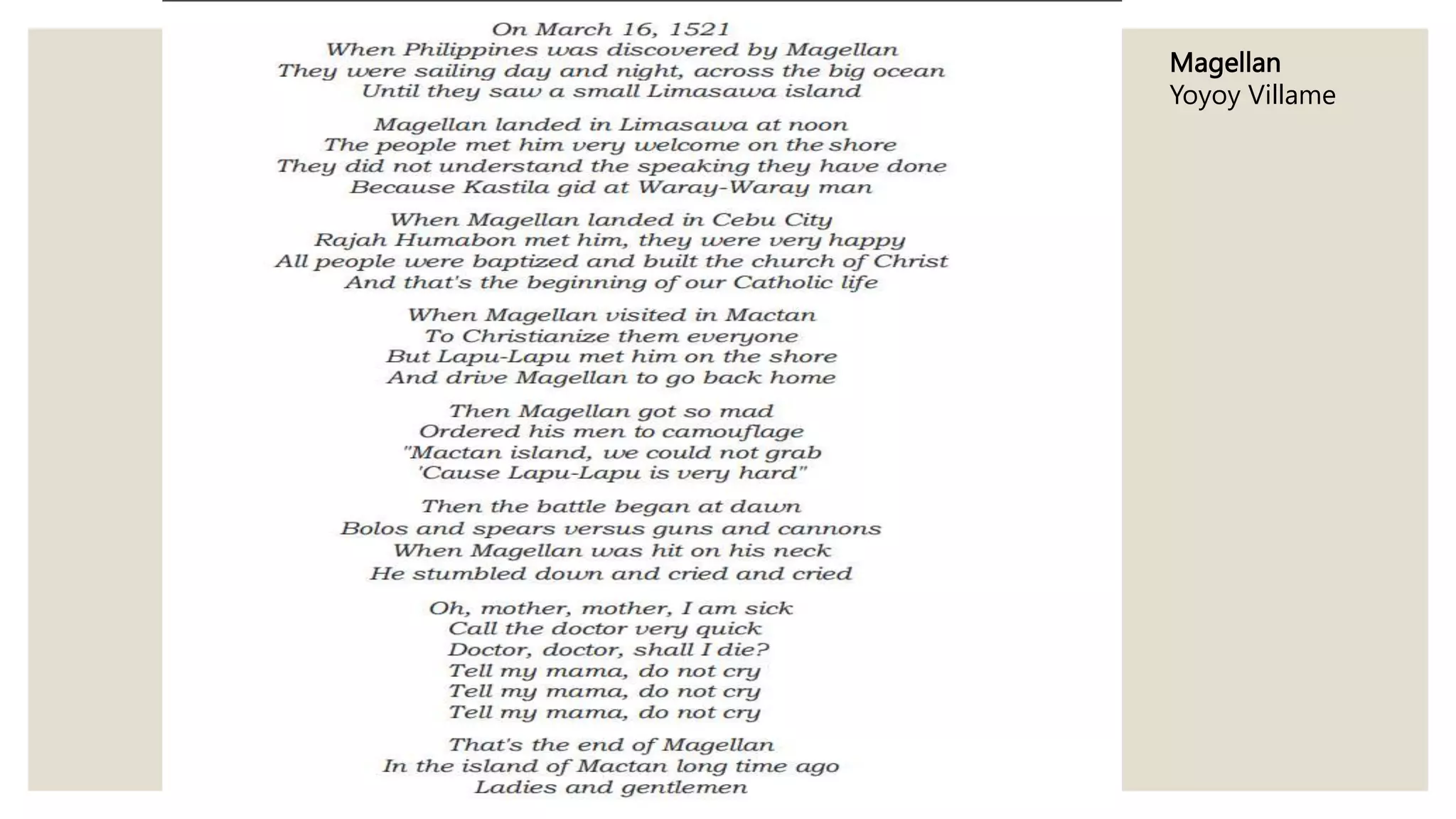
Magellan
Yoyoy Villame
THANK YOU FOR
LISTENING

Writing a Craft Essay.pptx

  • 1.
    WRITING A CRAFTESSAY DEMONSTRATING AWARENESS AND SENSITIVITY TO THE DIFFERENT LITERARY SOCIO-POLITICAL CONTEXTS
  • 2.
    Directions: Write theideals and principles which are being portrayed in the picture. Place also your ideas at the bottom part of the bulb why the artist portrayed that illustration.
  • 4.
    What is acontext? The word “context” means the circumstances forming the set up of an event, statement, or idea to make it understandable and easy to assess.
  • 5.
    Literary context Literary contextmeans understanding the literary genre. Determining the literary genre helps in understanding the context of the passage. The author and the reader agree through the genre. Examples of genre for fiction are: drama, fable, fairy tale, folklore, humor, horror, legend, poetry, short story, and science fiction while the literary genres for non-fiction are: biography, essay, speech, autobiography, and narrative non-fiction.
  • 6.
    1. Social context Itis the way in which the surroundings, the people, the situation influence on how people react and interpret things. How people react may be credited to their previous experiences. Read the sample poem and see how the social social context dominated in the overall understanding of the piece. Furthermore, there are several literary contexts which can help the readers in giving interpretation of the text. These are social context, historical context, ideological context, and cultural context
  • 7.
    Going back tothe poem “My Neighbor”, the situation is about the rich neighbor who built high walls around their residence. The rich neighbor had a tall gate that the poor families could not see the things inside. The daughter of the well to do family also wished to see the world outside their house as stated in the line “looks longingly beyond the gate.” This circumstance depicts the gap between the rich and the poor families. The social standing created a disparity that the two kids cannot be friends with each other.
  • 8.
    2. Historical context Thiskind of context is being hooked with the social context when the literary work or era it was produced. There is no literary piece that can be fully appreciated without knowing the historical context.
  • 9.
    For example, thepoem written by Telesforo Sungkit Jr. entitled “I Higaonon”, social and historical contexts can be derived from the poem. This poem is about Higaonon tribe, one of the lumads or indigenous peoples in Bukidnon Province, Northern Mindanao. The poem portrays a sort of social discrimination on the part of the Higaonons stated in the 6th stanza below I you called savage you say savage is bad people. You say you is civilized and civilized is good people.
  • 10.
    Below are the9th and 10th stanzas that divulged the resentful experience as part of their tribe’s history. For decades, the Higaonons were struggling of their independence, their cultural integrity, and rights to self-determination. They fought for the protection of their forested mountains against the loggers and the security of their ancestral domain for more than sixty years already. More so, some of them were being killed and suppressed if they disagree with those who tried to stop the superiors as described in the poem. I angry you kill my datus, I angry you burn my house, I angry you get my honey, I angry you get my sakop, but you say I should know democracy. You say know democracy but you commanding all you telling I not speak you forcing I live near plantations You making all us sakop you killing my brothers not liking you.
  • 11.
    3. Ideological contexts Ideologyis described as the systems of beliefs and ideas being found in our attitudes and behavior. This kind of context is invisible as it is being normalized as people act according to their assumptions and social norms.
  • 12.
    For instance, inthe epic of Maranao entitled “Darangan”, there were two sons of the king: Prince Madali and Prince Bantugan. Between the two princes, the younger one, Prince Bantugan was better in strength and intelligence. When their father died, the elder brother, Prince Madali was promoted to the throne. Implicitly, the story valued the role of the elder brother who was next to his father even though the younger brother was more capable to rule. This kind of norm called seniority rule is still applied in some organizations and group of people nowadays.
  • 13.
    4. Cultural contexts Culturemeans the way of life including religion, race, nationality, food, dress code, manner, art, music, and literature. It is also linked with social, historical, and ideological context. This kind of context is dominant especially when the author is commenting about an aspect of culture, or conflict of culture. Through literature, rich cultures are being manifested in the text.
  • 14.
    Take a lookat the short story written by Amador Daguio entitled “Wedding Dance”. The characters Awiyao and Lumnay most probably belonged to the Igorot people who inhabit the large areas of Luzon. Since Filipinos were being colonized by Spaniards in 1500s, Americans in 1898, and Japanese in 1940s, there were mixed cultures being practiced by our ancestors. Thus the writer, Amador Daguio being born in Ilocos Province dwelt in the culture of his ancestors to explore the Filipino traditions. In the short story, after being married for seven years Awiyao was forced to marry another girl because Lumnay could not bear a child. The culture suggested that a measurement of being a family man is to have a child. In that case, the love of the couple was in a big trouble leading their true love to unhappy ending. This literary piece also depicts that culture has a great factor in the decision of a person.
  • 15.
    There are threeareas that involved in the socio-political contexts. These are social issues, politics, and religion. ◦ 1. Social issues-These are related to the issues concerning the national aspect of human life. In the Philippines, examples of social problems are: corruption, poverty, lack of education, teenage pregnancy, oppression to the poor, prostitution, suppression of freedom of the press, dishonesty, and others. ◦ 2. Politics-This is one of the prolific themes in literature that has something to do with the governance of a country or an area. ◦ 3. Religion-This refers to the belief of humanity that there is far greater entity who made the greatness of nature.
  • 16.
    Activity 2 .Mark that Place Directions: Identify the places mentioned in the song. What are the important events happened in that place? What is your overall interpretation on the song? What contexts can be derived from the song? song? Write your answers in the box below.
  • 17.
  • 18.