Future ofTextile and Garments
Industry in Bangladesh
Group-8
1.Name:Sharaf Uddin--Id:2019200400017--Batch:42
2.Name:Nahid Hasan--Id:2022000400011--Batch:49
3.Name:Morsalin Sarkar--Id:2022000400013--Batch:49
4.Name:Erina Bashar--Id:2021200400012--Batch-48
5.Name:Abu Bakar siddik shovon--Id:20222000400044--Batch-49
Our respected teacher,
Dr. Mainul Morshed
Assistant Professor
PhD in chemical Engineering (TJU, China)
M.Sc. in TE (WTU, China), B. Sc. In TE (DIU, BD)
Department of Textile Engineering.
Content
Innovation and Technology
some industry drivers
Future Outlook
Opportunities
Conclusion
Introduction
Challenges
Sustainability efforts
Introduction
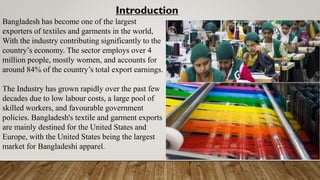
Bangladesh has become one of the largest
exporters of textiles and garments in the world,
With the industry contributing significantly to the
country’s economy. The sector employs over 4
million people, mostly women, and accounts for
around 84% of the country’s total export earnings.
The Industry has grown rapidly over the past few
decades due to low labour costs, a large pool of
skilled workers, and favourable government
policies. Bangladesh's textile and garment exports
are mainly destined for the United States and
Europe, with the United States being the largest
market for Bangladeshi apparel.
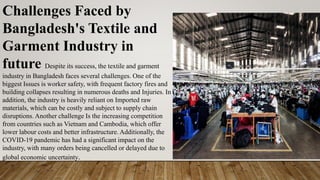
Challenges Faced by
Bangladesh's Textile and
Garment Industry in
future Despite its success, the textile and garment
industry in Bangladesh faces several challenges. One of the
biggest Issues is worker safety, with frequent factory fires and
building collapses resulting in numerous deaths and Injuries. In
addition, the industry is heavily reliant on Imported raw
materials, which can be costly and subject to supply chain
disruptions. Another challenge Is the increasing competition
from countries such as Vietnam and Cambodia, which offer
lower labour costs and better infrastructure. Additionally, the
COVID-19 pandemic has had a significant impact on the
industry, with many orders being cancelled or delayed due to
global economic uncertainty.
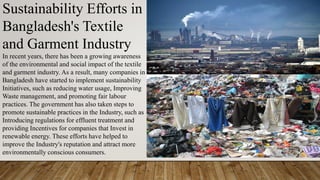
Sustainability Efforts in
Bangladesh's Textile
and Garment Industry
In recent years, there has been a growing awareness
of the environmental and social impact of the textile
and garment industry. As a result, many companies in
Bangladesh have started to implement sustainability
Initiatives, such as reducing water usage, Improving
Waste management, and promoting fair labour
practices. The government has also taken steps to
promote sustainable practices in the Industry, such as
Introducing regulations for effluent treatment and
providing Incentives for companies that Invest in
renewable energy. These efforts have helped to
improve the Industry's reputation and attract more
environmentally conscious consumers.
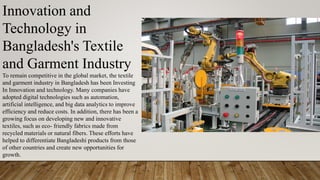
Innovation and
Technology in
Bangladesh's Textile
and Garment Industry
To remain competitive in the global market, the textile
and garment industry in Bangladesh has been Investing
In Innovation and technology. Many companies have
adopted digital technologies such as automation,
artificial intelligence, and big data analytics to improve
efficiency and reduce costs. In addition, there has been a
growing focus on developing new and innovative
textiles, such as eco- friendly fabrics made from
recycled materials or natural fibers. These efforts have
helped to differentiate Bangladeshi products from those
of other countries and create new opportunities for
growth.
SOME INDUSTRY DRIVER
Geographically Bangladesh has easy access with seaport, airport and
land port. It makes transportation much easier.
Since 2005 Bangladesh introduced quota free textile rule . Because of
quota free access in EU Bangladesh get a high advantage in term of
export its product. Bangladesh holds around 21% market share of
denim export in EU
China is currently moving to high end manufacturing industry. It
creates golden opportunities for Bangladesh to capture low end
manufacturing industry. Bangladesh has already captured two third of
low-end manufacturing company which was previously captured by
china.
Natural resource is very much plenty in Bangladesh. Natural gas and
energy are cheap here.
Govt policy is very helpful. For example-In financial year 2018-
2019 govt has decreased corporate tax from 15% to 12% for apparel
makers.
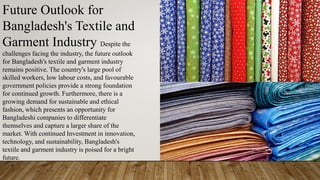
Future Outlook for
Bangladesh's Textile and
Garment Industry Despite the
challenges facing the industry, the future outlook
for Bangladesh's textile and garment industry
remains positive. The country's large pool of
skilled workers, low labour costs, and favourable
government policies provide a strong foundation
for continued growth. Furthermore, there is a
growing demand for sustainable and ethical
fashion, which presents an opportunity for
Bangladeshi companies to differentiate
themselves and capture a larger share of the
market. With continued Investment in innovation,
technology, and sustainability, Bangladesh's
textile and garment industry is poised for a bright
future.
Opportunities:
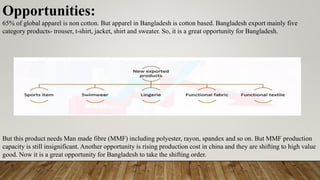
65% of global apparel is non cotton. But apparel in Bangladesh is cotton based. Bangladesh export mainly five
category products- trouser, t-shirt, jacket, shirt and sweater. So, it is a great opportunity for Bangladesh.
But this product needs Man made fibre (MMF) including polyester, rayon, spandex and so on. But MMF production
capacity is still insignificant. Another opportunity is rising production cost in china and they are shifting to high value
good. Now it is a great opportunity for Bangladesh to take the shifting order.
Conclusion:
In conclusion, Bangladesh's textile and garment
industry has come a long way since its
inception. Despite facing numerous challenges,
the Industry has continued to grow and evolve,
thanks to the hard work and dedication of
millions of workers and entrepreneurs. With a
focus on sustainability, Innovation, and
technology, the Industry is well-positioned to
take advantage of new opportunities and
continue to contribute to the country's economic
development for future.
THANKYOU

WPT presentation.pdf

  • 1.
    Future ofTextile andGarments Industry in Bangladesh Group-8 1.Name:Sharaf Uddin--Id:2019200400017--Batch:42 2.Name:Nahid Hasan--Id:2022000400011--Batch:49 3.Name:Morsalin Sarkar--Id:2022000400013--Batch:49 4.Name:Erina Bashar--Id:2021200400012--Batch-48 5.Name:Abu Bakar siddik shovon--Id:20222000400044--Batch-49 Our respected teacher, Dr. Mainul Morshed Assistant Professor PhD in chemical Engineering (TJU, China) M.Sc. in TE (WTU, China), B. Sc. In TE (DIU, BD) Department of Textile Engineering.
  • 2.
    Content Innovation and Technology someindustry drivers Future Outlook Opportunities Conclusion Introduction Challenges Sustainability efforts
  • 3.
    Introduction Bangladesh has becomeone of the largest exporters of textiles and garments in the world, With the industry contributing significantly to the country’s economy. The sector employs over 4 million people, mostly women, and accounts for around 84% of the country’s total export earnings. The Industry has grown rapidly over the past few decades due to low labour costs, a large pool of skilled workers, and favourable government policies. Bangladesh's textile and garment exports are mainly destined for the United States and Europe, with the United States being the largest market for Bangladeshi apparel.
  • 4.
    Challenges Faced by Bangladesh'sTextile and Garment Industry in future Despite its success, the textile and garment industry in Bangladesh faces several challenges. One of the biggest Issues is worker safety, with frequent factory fires and building collapses resulting in numerous deaths and Injuries. In addition, the industry is heavily reliant on Imported raw materials, which can be costly and subject to supply chain disruptions. Another challenge Is the increasing competition from countries such as Vietnam and Cambodia, which offer lower labour costs and better infrastructure. Additionally, the COVID-19 pandemic has had a significant impact on the industry, with many orders being cancelled or delayed due to global economic uncertainty.
  • 5.
    Sustainability Efforts in Bangladesh'sTextile and Garment Industry In recent years, there has been a growing awareness of the environmental and social impact of the textile and garment industry. As a result, many companies in Bangladesh have started to implement sustainability Initiatives, such as reducing water usage, Improving Waste management, and promoting fair labour practices. The government has also taken steps to promote sustainable practices in the Industry, such as Introducing regulations for effluent treatment and providing Incentives for companies that Invest in renewable energy. These efforts have helped to improve the Industry's reputation and attract more environmentally conscious consumers.
  • 6.
    Innovation and Technology in Bangladesh'sTextile and Garment Industry To remain competitive in the global market, the textile and garment industry in Bangladesh has been Investing In Innovation and technology. Many companies have adopted digital technologies such as automation, artificial intelligence, and big data analytics to improve efficiency and reduce costs. In addition, there has been a growing focus on developing new and innovative textiles, such as eco- friendly fabrics made from recycled materials or natural fibers. These efforts have helped to differentiate Bangladeshi products from those of other countries and create new opportunities for growth.
  • 7.
    SOME INDUSTRY DRIVER GeographicallyBangladesh has easy access with seaport, airport and land port. It makes transportation much easier. Since 2005 Bangladesh introduced quota free textile rule . Because of quota free access in EU Bangladesh get a high advantage in term of export its product. Bangladesh holds around 21% market share of denim export in EU China is currently moving to high end manufacturing industry. It creates golden opportunities for Bangladesh to capture low end manufacturing industry. Bangladesh has already captured two third of low-end manufacturing company which was previously captured by china. Natural resource is very much plenty in Bangladesh. Natural gas and energy are cheap here. Govt policy is very helpful. For example-In financial year 2018- 2019 govt has decreased corporate tax from 15% to 12% for apparel makers.
  • 8.
    Future Outlook for Bangladesh'sTextile and Garment Industry Despite the challenges facing the industry, the future outlook for Bangladesh's textile and garment industry remains positive. The country's large pool of skilled workers, low labour costs, and favourable government policies provide a strong foundation for continued growth. Furthermore, there is a growing demand for sustainable and ethical fashion, which presents an opportunity for Bangladeshi companies to differentiate themselves and capture a larger share of the market. With continued Investment in innovation, technology, and sustainability, Bangladesh's textile and garment industry is poised for a bright future.
  • 9.
    Opportunities: 65% of globalapparel is non cotton. But apparel in Bangladesh is cotton based. Bangladesh export mainly five category products- trouser, t-shirt, jacket, shirt and sweater. So, it is a great opportunity for Bangladesh. But this product needs Man made fibre (MMF) including polyester, rayon, spandex and so on. But MMF production capacity is still insignificant. Another opportunity is rising production cost in china and they are shifting to high value good. Now it is a great opportunity for Bangladesh to take the shifting order.
  • 10.
    Conclusion: In conclusion, Bangladesh'stextile and garment industry has come a long way since its inception. Despite facing numerous challenges, the Industry has continued to grow and evolve, thanks to the hard work and dedication of millions of workers and entrepreneurs. With a focus on sustainability, Innovation, and technology, the Industry is well-positioned to take advantage of new opportunities and continue to contribute to the country's economic development for future.
  • 11.