How to flourish in an uncertain future
Open banking
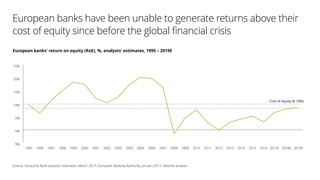
European banks have been unable to generate returns above their
cost of equity since before the global financial crisis
European banks' return on equity (RoE), %, analysts' estimates, 1995 – 2019E
Source: Deutsche Bank analysts' estimates, March 2017; European Banking Authority, January 2017; Deloitte analysis
-5%
0%
5%
10%
15%
20%
25%
2019E2018E2017E2016201520142013201220112010200920082007200620052004200320022001200019991998199719961995
Cost of equity (8-10%)
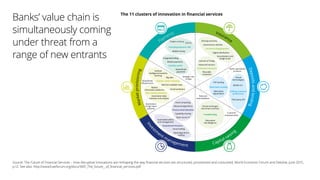
Banks’ value chain is
simultaneously coming
under threat from a
range of new entrants
The 11 clusters of innovation in financial services
Source: The Future of Financial Services – How disruptive innovations are reshaping the way financial services are structured, provision
June 2015, p.12. See also: http://www3.weforum.org/docs/WEF_The_future__of_financial_services.pdf
Inves
tm
ent management Capital raising
Depositsandlending
InsurancePayments
Marketprovisioning
Emerging payment rails
Mobile money
Cashless world
Strategic role
of data
Crypto currency
P2P FX
Integrated billing
Mobile payments
Streamlined
payments
Insurance disaggregation
Connected insurance
Sharing economy
Autonomous vehicles
Digital distribution
Securitization and
hedge funds
Internet of Things
Advanced sensors
Wearable
computers
Alternative lending
Shifting customer
preferences
Niche, specialised
products
P2P lending
Alternative
adjudication
Virtual
technologies
Mobile 3.0
Third party API
Crowdfunding
Reduced
intermediation
Customer
empowerment
Virtual exchanges
and smart contracts
Alternative
due dilligence
Empowered investors
Process externalisation
Advanced algorithms
Open source IT
Capability sharing
Cloud computing
Automated advice
and management
Social trading
Retail algorithmic
trading
Automation
of high value
activities
Streamlined
infrastructure
Smarter, faster machines
New market platforms
Artificial
intelligence/machine
learning
Big data
Machine readable news
Social sentiment
Market
information platforms
Automation data
collection and analysis
The 11 clusters of innovation in financial services
Source: The Future of Financial Services – How disruptive innovations are reshaping the way financial services are structured, provisioned and consumed, World Ec
June 2015, p.12. See also: http://www3.weforum.org/docs/WEF_The_future__of_financial_services.pdf
Inves
tm
ent management Capital raising
Depositsandlending
InsurancePayments
Marketprovisioning
Emerging payment rails
Mobile money
Cashless world
Strategic role
of data
Crypto currency
P2P FX
Integrated billing
Mobile payments
Streamlined
payments
Insurance disaggregation
Connected insurance
Sharing economy
Autonomous vehicles
Digital distribution
Securitization and
hedge funds
Internet of Things
Advanced sensors
Wearable
computers
Alternative lending
Shifting customer
preferences
Niche, specialised
products
P2P lending
Alternative
adjudication
Virtual
technologies
Mobile 3.0
Third party API
Crowdfunding
Reduced
intermediation
Customer
empowerment
Virtual exchanges
and smart contracts
Alternative
due dilligence
Empowered investors
Process externalisation
Advanced algorithms
Open source IT
Capability sharing
Cloud computing
Automated advice
and management
Social trading
Retail algorithmic
trading
Automation
of high value
activities
Streamlined
infrastructure
Smarter, faster machines
New market platforms
Artificial
intelligence/machine
learning
Big data
Machine readable news
Social sentiment
Market
information platforms
Automation data
collection and analysis
Source: The Future of Financial Services – How disruptive innovations are reshaping the way financial services are structured, provisioned and consumed, World Economic Forum and Deloitte, June 2015,
p.12. See also: http://www3.weforum.org/docs/WEF_The_future__of_financial_services.pdf
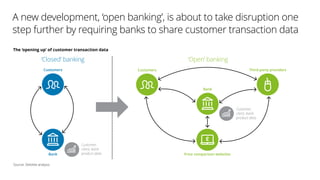
A new development, ‘open banking’, is about to take disruption one
step further by requiring banks to share customer transaction data
The ‘opening up’ of customer transaction data
Source: Deloitte analysis
‘Closed’ banking ‘Open’ banking
Customer,
client, bank
product data
Bank
Price comparison websites
Customers Third-party providersCustomers
Bank
Customer,
client, bank
product data
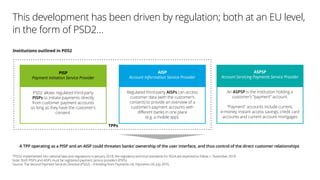
This development has been driven by regulation; both at an EU level,
in the form of PSD2…
Institutions outlined in PDS2
*PSD2 implemented into national laws and regulations in January 2018; the regulatory technical standards for XS2A are expected to follow, c. November 2018
Note: Both PISPs and AISPs must be registered payment service providers (PSPs)
Source: The Second Payment Services Directive (PSD2) – A briefing from Payments UK, Payments UK, July 2016.
A TPP operating as a PISP and an AISP could threaten banks’ ownership of the user interface, and thus control of the direct customer relationships
PISP
Payment Initiation Service Provider
PSD2 allows regulated third-party
PISPs to initiate payments directly
from customer payment accounts
so long as they have the customer’s
consent.
AISP
Account Information Service Provider
Regulated third-party AISPs can access
customer data (with the customer’s
consent) to provide an overview of a
customer’s payment accounts with
different banks in one place
(e.g. a mobile app).
ASPSP
Account Servicing Payments Service Provider
An ASPSP is the institution holding a
customer’s “payment” account.
“Payment” accounts include current,
e-money, instant access savings, credit card
accounts and current account mortgages
TPPs
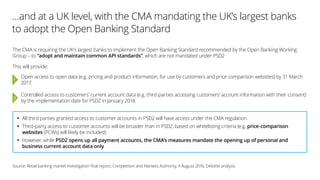
The CMA is requiring the UK’s largest banks to implement the Open Banking Standard recommended by the Open Banking Working
Group – to “adopt and maintain common API standards”, which are not mandated under PSD2
This will provide:
		 Open access to open data (e.g. pricing and product information, for use by customers and price comparison websites) by 31 March 		
		 2017.
		 Controlled access to customers’ current account data (e.g. third-parties accessing customers’ account information with their consent) 	
		 by the implementation date for PSD2 in January 2018.
…and at a UK level, with the CMA mandating the UK’s largest banks
to adopt the Open Banking Standard
1
2
Source: Retail banking market investigation final report, Competition and Markets Authority, 9 August 2016; Deloitte analysis
•• All third parties granted access to customer accounts in PSD2 will have access under the CMA regulation
•• Third-party access to customer accounts will be broader than in PSD2, based on whitelisting criteria (e.g. price-comparison
websites (PCWs) will likely be included)
•• However, while PSD2 opens up all payment accounts, the CMA’s measures mandate the opening up of personal and
business current account data only
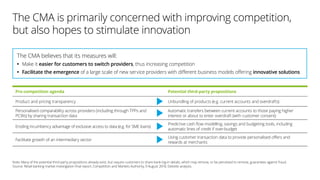
The CMA is primarily concerned with improving competition,
but also hopes to stimulate innovation
Pro-competition agenda Potential third-party propositions
Product and pricing transparency Unbundling of products (e.g. current accounts and overdrafts)
Personalised comparability across providers (including through TPPs and
PCWs) by sharing transaction data
Automatic transfers between current accounts to those paying higher
interest or about to enter overdraft (with customer consent)
Eroding incumbency advantage of exclusive access to data (e.g. for SME loans)
Predictive cash flow modelling, savings and budgeting tools, including
automatic lines of credit if over-budget
Facilitate growth of an intermediary sector
Using customer transaction data to provide personalised offers and
rewards at merchants
The CMA believes that its measures will:
•• Make it easier for customers to switch providers, thus increasing competition
•• Facilitate the emergence of a large scale of new service providers with different business models offering innovative solutions
Note: Many of the potential third-party propositions already exist, but require customers to share bank log-in details, which may remove, or be perceived to remove, guarantees against fraud.
Source: Retail banking market investigation final report, Competition and Markets Authority, 9 August 2016; Deloitte analysis.
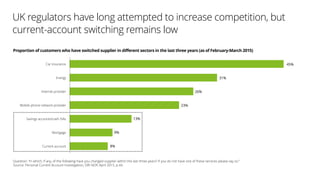
UK regulators have long attempted to increase competition, but
current-account switching remains low
Proportion of customers who have switched supplier in different sectors in the last three years (as of February-March 2015)
Question: “In which, if any, of the following have you changed supplier within the last three years? If you do not have one of these services please say so.”
Source: Personal Current Account Investigation, GfK NOP, April 2015, p.44.
Current account
Mortgage
Savings accounts/cash ISAs
Mobile phone network provider
Internet provider
Energy
Car insurance
8%
9%
13%
23%
26%
31%
45%
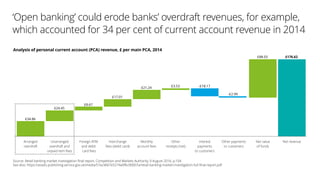
‘Open banking’ could erode banks’ overdraft revenues, for example,
which accounted for 34 per cent of current account revenue in 2014
Analysis of personal current account (PCA) revenue, £ per main PCA, 2014
Source: Retail banking market investigation final report, Competition and Markets Authority, 9 August 2016, p.104.
See also: https://assets.publishing.service.gov.uk/media/57ac9667e5274a0f6c00007a/retail-banking-market-investigation-full-final-report.pdf
£34.86
Net revenueNet value
of funds
Other payments
to customers
Interest
payments
to customers
Other
receipts (net)
Monthly
account fees
Interchange
fees (debit card)
Foreign ATM
and debit
card fees
Unarranged
overdraft and
unpaid item fees
Arranged
overdraft
£24.45
£8.67
£17.01
£21.24 £3.53 -£18.17
-£2.99
£88.03 £176.62
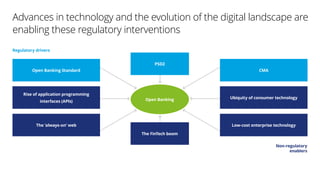
Advances in technology and the evolution of the digital landscape are
enabling these regulatory interventions
Regulatory drivers
Non-regulatory
enablers
PSD2
Open Banking Standard CMA
Open Banking
Rise of application programming
interfaces (APIs)
Ubiquity of consumer technology
The FinTech boom
The ‘always-on’ web Low-cost enterprise technology
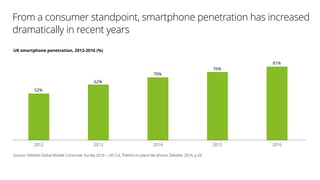
From a consumer standpoint, smartphone penetration has increased
dramatically in recent years
UK smartphone penetration, 2012-2016 (%)
Source: Deloitte Global Mobile Consumer Survey 2016 – UK Cut, There’s no place like phone, Deloitte, 2016, p.26
20162015201420132012
52%
62%
70%
76%
81%
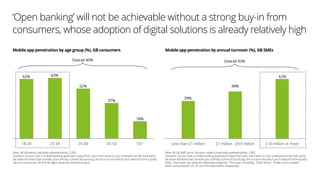
‘Open banking’ will not be achievable without a strong buy-in from
consumers, whose adoption of digital solutions is already relatively high
Mobile app penetration by age group (%), GB consumers
Base: All GB adults (nationally representative), 2,050
Question: Do you have a mobile banking application ('app') from your main bank on your smartphone? By main bank,
we mean the bank that provides your primary current account (e.g. the account into which your salary/income is paid).
Source: YouGov plc 2016 © All rights reserved, Deloitte analysis
55+45-5435-4425-3418-24
62% 63%
52%
37%
18%
Overall 40%
Mobile app penetration by annual turnover (%), GB SMEs
Base: All GB SME senior decision makers (nationally representative), 1,003
Question: Do you have a mobile banking application ('app') from your main bank on your smartphone? By main bank,
we mean the bank that provides your primary current account (e.g. the account into which your salary/income is paid).
Note: Chart does not show the following categories: "First year of trading", "Don't know", "Prefer not to answer",
which accounted for 20, 37 and 79 respondents respectively.
£10 million or more£1 million - £9.9 millionLess than £1 million
39%
49%
62%
Overall 45%
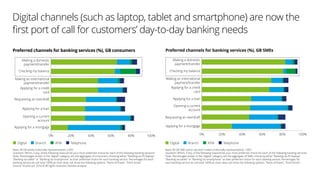
Digital channels (such as laptop, tablet and smartphone) are now the
first port of call for customers’ day-to-day banking needs
Preferred channels for banking services (%), GB consumers
Base: All GB adults (nationally representative), 2,050
Question: Which, if any, of the following is/would be your most preferred choice for each of the following banking services?
Note: Percentages shown in the "digital" category are the aggregate of consumers choosing either "Banking via PC/laptop",
"Banking via tablet" or "Banking via smartphone" as their preferred choice for each banking service. Percentages for each
banking service do not total 100% as chart does not show the following options: "None of these", "Don't know".
Source: YouGov plc 2016 © All rights reserved, Deloitte analysis
Base: All GB SME senior decision makers (nationally representative), 1,003
Question: Which, if any, of the following is/would be your most preferred choice for each of the following banking services?
Note: Percentages shown in the "digital" category are the aggregate of SMEs choosing either "Banking via PC/laptop",
"Banking via tablet" or "Banking via smartphone" as their preferred choice for each banking service. Percentages for
each banking service do not total 100% as chart does not show the following options: "None of these", "Don't know".
Digital Branch ATM Telephone Digital Branch ATM Telephone
0% 20% 40% 60% 80% 100%
Applying for a mortgage
Opening a current
account
Applying for a loan
Requesting an overdraft
Applying for a credit
card
Making an international
payment/transfer
Checking my balance
Making a domestic
payment/transfer
Preferred channels for banking services (%), GB SMEs
0% 20% 40% 60% 80% 100%
Applying for a mortgage
Requesting an overdraft
Opening a current
account
Applying for a loan
Applying for a credit
card
Making an international
payment/transfer
Checking my balance
Making a domestic
payment/transfer
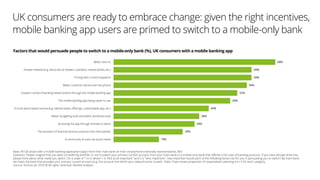
UK consumers are ready to embrace change: given the right incentives,
mobile banking app users are primed to switch to a mobile-only bank
Factors that would persuade people to switch to a mobile-only bank (%), UK consumers with a mobile banking app
Base: All GB adults with a mobile banking application ('app') from their main bank on their smartphone (nationally representative), 805
Question: Please imagine that you were considering whether or not to switch your primary current account, from your main bank to a mobile-only bank that offered a full suite of banking products. If you have already done this,
please think about what made you switch. On a scale of 1 to 5, where 1 is "Not at all important" and 5 is "Very important", how important would each of the following factors be for you in persuading you to switch? By main bank,
we mean the bank that provides your primary current account (e.g. the account into which your salary/income is paid). Note: Chart shows proportion of respondents selecting 4 or 5 for each category.
Source: YouGov plc 2016 © All rights reserved; Deloitte analysis
A community of users via social media
The provision of financial services products from third parties
Accessing the app through biometrics alone
Better budgeting tools and better predictive tools
A more personalised service (e.g. tailored deals, offerings, customisable app, etc.)
The mobile banking app being easier to use
Greater numbe of banking related actions through the mobile banking app
Better customer service over the phone
Pricing that is more trasparent
Greater rewards (e.g. discounts at retailers, cashback, reward points, etc.)
Better returns 68%
58%
58%
56%
52%
49%
40%
36%
34%
29%
19%
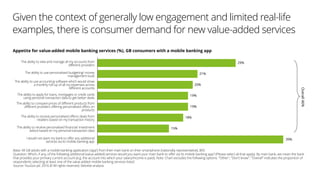
Given the context of generally low engagement and limited real-life
examples, there is consumer demand for new value-added services
Appetite for value-added mobile banking services (%), GB consumers with a mobile banking app
Base: All GB adults with a mobile banking application ('app') from their main bank on their smartphone (nationally representative), 805
Question: Which, if any, of the following additional (value-added) services would you want your main bank to offer via its mobile banking app? (Please select all that apply). By main bank, we mean the bank
that provides your primary current account (e.g. the account into which your salary/income is paid). Note: Chart excludes the following options: "Other", "Don't know". "Overall" indicates the proportion of
respondents selecting at least one of the value-added mobile banking services listed.
Source: YouGov plc 2016 © All rights reserved; Deloitte analysis
I would not want my bank to offer any additional
services via its mobile banking app
The ability to receive personalised financial/ investment
advice based on my personal transaction data
The ability to receive personalised offers/ deals from
retailers based on my transaction history
The ability to compare prices of different products from
different providers offering personalised offers on
products
The ability to apply for loans, mortgages or credit cards
using personal transaction data to get better deals
The ability to use accounting software which would show
a monthly roll-up of all my expenses across
different accounts
The ability to use personalised budgeting/ money
management tools
The ability to view and manage all my accounts from
different providers
Overall46%
29%
21%
20%
19%
19%
18%
15%
39%
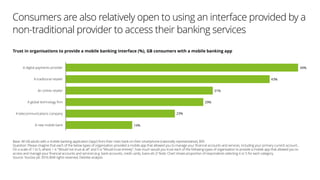
Consumers are also relatively open to using an interface provided by a
non-traditional provider to access their banking services
Trust in organisations to provide a mobile banking interface (%), GB consumers with a mobile banking app
Base: All GB adults with a mobile banking application ('app') from their main bank on their smartphone (nationally representative), 805
Question: Please imagine that each of the below types of organisation provided a mobile app that allowed you to manage your financial accounts and services, including your primary current account…
On a scale of 1 to 5, where 1 is "Would not trust at all" and 5 is "Would trust entirely", how much would you trust each of the following types of organisation to provide a mobile app that allowed you to
access and manage your financial accounts and services (e.g. bank accounts, credit cards, loans etc.)? Note: Chart shows proportion of respondents selecting 4 or 5 for each category.
Source: YouGov plc 2016 ©All rights reserved, Deloitte analysis
A new mobile bank
A telecommunications company
A global technology firm
An online retailer
A traditional retailer
A digital payments provider
14%
23%
29%
31%
43%
49%
Other FS and
Retailers
Insurers
Fund
FinTechs
C
hallenger
Incumbent
non-FS firms
managers
banks
banks
Marketplace
interface
Open APIs
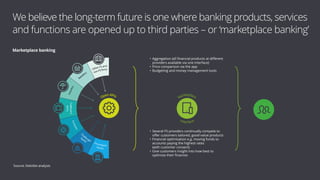
• Aggregation (all financial products at different
providers available via one interface)
• Price comparison via the app
• Budgeting and money management tools
• Several FS providers continually compete to
offer customers tailored, good-value products
• Financial optimisation e.g. moving funds to
accounts paying the highest rates
(with customer consent)
• Give customers insight into how best to
optimise their finances
We believe the long-term future is one where banking products, services
and functions are opened up to third parties – or ‘marketplace banking’
Marketplace banking
Source: Deloitte analysis
Third-party distribution
Third-party
distribution
Incumbent
as supplier
Banking asa
m
arketplace
Incumbent bank distribution
Incumbentbankproducts
Third-partyproducts
Incumbent
as utility
Incumbent as
full-service provider
Incumbent
as interface
Incumbent bank
products
Incumbent bank
distribution
Incumbent bank
products
Third-party
distribution
Third-party
products
Incumbent bank
distribution
Third-party
products
Incumbent
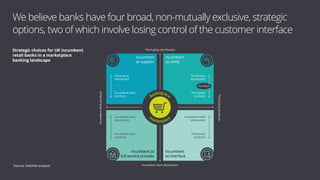
We believe banks have four broad, non-mutually exclusive, strategic
options, two of which involve losing control of the customer interface
Strategic choices for UK incumbent
retail banks in a marketplace
banking landscape
Source: Deloitte analysis
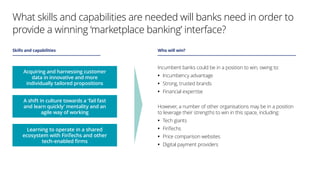
What skills and capabilities are needed will banks need in order to
provide a winning ‘marketplace banking’ interface?
Skills and capabilities Who will win?
Acquiring and harnessing customer
data in innovative and more
individually tailored propositions
Incumbent banks could be in a position to win, owing to:
•• Incumbency advantage
•• Strong, trusted brands
•• Financial expertise
However, a number of other organisations may be in a position
to leverage their strengths to win in this space, including:
•• Tech giants
•• FinTechs
•• Price comparison websites
•• Digital payment providers
A shift in culture towards a ‘fail fast
and learn quickly’ mentality and an
agile way of working
Learning to operate in a shared
ecosystem with FinTechs and other
tech-enabled firms
To access the full Open banking: How to flourish in an uncertain future report, please visit Deloitte.co.uk/Flourish
You can also access further insight and analysis regarding the future of banking at Deloitte.co.uk/FutureBank
and join the debate on social media at #FutureBank
This publication has been written in general terms and we recommend that you obtain professional advice before acting or
refraining from action on any of the contents of this publication. Deloitte LLP accepts no liability for any loss occasioned to
any person acting or refraining from action as a result of any material in this publication.
Deloitte LLP is a limited liability partnership registered in England and Wales with registered number OC303675 and its
registered office at 2 New Street Square, London EC4A 3BZ, United Kingdom.
Deloitte LLP is the United Kingdom affiliate of Deloitte NWE LLP, a member firm of Deloitte Touche Tohmatsu Limited, a UK
private company limited by guarantee (“DTTL”). DTTL and each of its member firms are legally separate and independent
entities. DTTL and Deloitte NWE LLP do not provide services to clients. Please see www.deloitte.com/about to learn more
about our global network of member firms.
© 2017 Deloitte LLP. All rights reserved.
Designed and produced by The Creative Studio at Deloitte, London. J10385

How to flourish in an uncertain future

  • 1.
    How to flourishin an uncertain future Open banking
  • 2.
    European banks havebeen unable to generate returns above their cost of equity since before the global financial crisis European banks' return on equity (RoE), %, analysts' estimates, 1995 – 2019E Source: Deutsche Bank analysts' estimates, March 2017; European Banking Authority, January 2017; Deloitte analysis -5% 0% 5% 10% 15% 20% 25% 2019E2018E2017E2016201520142013201220112010200920082007200620052004200320022001200019991998199719961995 Cost of equity (8-10%)
  • 3.
    Banks’ value chainis simultaneously coming under threat from a range of new entrants The 11 clusters of innovation in financial services Source: The Future of Financial Services – How disruptive innovations are reshaping the way financial services are structured, provision June 2015, p.12. See also: http://www3.weforum.org/docs/WEF_The_future__of_financial_services.pdf Inves tm ent management Capital raising Depositsandlending InsurancePayments Marketprovisioning Emerging payment rails Mobile money Cashless world Strategic role of data Crypto currency P2P FX Integrated billing Mobile payments Streamlined payments Insurance disaggregation Connected insurance Sharing economy Autonomous vehicles Digital distribution Securitization and hedge funds Internet of Things Advanced sensors Wearable computers Alternative lending Shifting customer preferences Niche, specialised products P2P lending Alternative adjudication Virtual technologies Mobile 3.0 Third party API Crowdfunding Reduced intermediation Customer empowerment Virtual exchanges and smart contracts Alternative due dilligence Empowered investors Process externalisation Advanced algorithms Open source IT Capability sharing Cloud computing Automated advice and management Social trading Retail algorithmic trading Automation of high value activities Streamlined infrastructure Smarter, faster machines New market platforms Artificial intelligence/machine learning Big data Machine readable news Social sentiment Market information platforms Automation data collection and analysis The 11 clusters of innovation in financial services Source: The Future of Financial Services – How disruptive innovations are reshaping the way financial services are structured, provisioned and consumed, World Ec June 2015, p.12. See also: http://www3.weforum.org/docs/WEF_The_future__of_financial_services.pdf Inves tm ent management Capital raising Depositsandlending InsurancePayments Marketprovisioning Emerging payment rails Mobile money Cashless world Strategic role of data Crypto currency P2P FX Integrated billing Mobile payments Streamlined payments Insurance disaggregation Connected insurance Sharing economy Autonomous vehicles Digital distribution Securitization and hedge funds Internet of Things Advanced sensors Wearable computers Alternative lending Shifting customer preferences Niche, specialised products P2P lending Alternative adjudication Virtual technologies Mobile 3.0 Third party API Crowdfunding Reduced intermediation Customer empowerment Virtual exchanges and smart contracts Alternative due dilligence Empowered investors Process externalisation Advanced algorithms Open source IT Capability sharing Cloud computing Automated advice and management Social trading Retail algorithmic trading Automation of high value activities Streamlined infrastructure Smarter, faster machines New market platforms Artificial intelligence/machine learning Big data Machine readable news Social sentiment Market information platforms Automation data collection and analysis Source: The Future of Financial Services – How disruptive innovations are reshaping the way financial services are structured, provisioned and consumed, World Economic Forum and Deloitte, June 2015, p.12. See also: http://www3.weforum.org/docs/WEF_The_future__of_financial_services.pdf
  • 4.
    A new development,‘open banking’, is about to take disruption one step further by requiring banks to share customer transaction data The ‘opening up’ of customer transaction data Source: Deloitte analysis ‘Closed’ banking ‘Open’ banking Customer, client, bank product data Bank Price comparison websites Customers Third-party providersCustomers Bank Customer, client, bank product data
  • 5.
    This development hasbeen driven by regulation; both at an EU level, in the form of PSD2… Institutions outlined in PDS2 *PSD2 implemented into national laws and regulations in January 2018; the regulatory technical standards for XS2A are expected to follow, c. November 2018 Note: Both PISPs and AISPs must be registered payment service providers (PSPs) Source: The Second Payment Services Directive (PSD2) – A briefing from Payments UK, Payments UK, July 2016. A TPP operating as a PISP and an AISP could threaten banks’ ownership of the user interface, and thus control of the direct customer relationships PISP Payment Initiation Service Provider PSD2 allows regulated third-party PISPs to initiate payments directly from customer payment accounts so long as they have the customer’s consent. AISP Account Information Service Provider Regulated third-party AISPs can access customer data (with the customer’s consent) to provide an overview of a customer’s payment accounts with different banks in one place (e.g. a mobile app). ASPSP Account Servicing Payments Service Provider An ASPSP is the institution holding a customer’s “payment” account. “Payment” accounts include current, e-money, instant access savings, credit card accounts and current account mortgages TPPs
  • 6.
    The CMA isrequiring the UK’s largest banks to implement the Open Banking Standard recommended by the Open Banking Working Group – to “adopt and maintain common API standards”, which are not mandated under PSD2 This will provide: Open access to open data (e.g. pricing and product information, for use by customers and price comparison websites) by 31 March 2017. Controlled access to customers’ current account data (e.g. third-parties accessing customers’ account information with their consent) by the implementation date for PSD2 in January 2018. …and at a UK level, with the CMA mandating the UK’s largest banks to adopt the Open Banking Standard 1 2 Source: Retail banking market investigation final report, Competition and Markets Authority, 9 August 2016; Deloitte analysis •• All third parties granted access to customer accounts in PSD2 will have access under the CMA regulation •• Third-party access to customer accounts will be broader than in PSD2, based on whitelisting criteria (e.g. price-comparison websites (PCWs) will likely be included) •• However, while PSD2 opens up all payment accounts, the CMA’s measures mandate the opening up of personal and business current account data only
  • 7.
    The CMA isprimarily concerned with improving competition, but also hopes to stimulate innovation Pro-competition agenda Potential third-party propositions Product and pricing transparency Unbundling of products (e.g. current accounts and overdrafts) Personalised comparability across providers (including through TPPs and PCWs) by sharing transaction data Automatic transfers between current accounts to those paying higher interest or about to enter overdraft (with customer consent) Eroding incumbency advantage of exclusive access to data (e.g. for SME loans) Predictive cash flow modelling, savings and budgeting tools, including automatic lines of credit if over-budget Facilitate growth of an intermediary sector Using customer transaction data to provide personalised offers and rewards at merchants The CMA believes that its measures will: •• Make it easier for customers to switch providers, thus increasing competition •• Facilitate the emergence of a large scale of new service providers with different business models offering innovative solutions Note: Many of the potential third-party propositions already exist, but require customers to share bank log-in details, which may remove, or be perceived to remove, guarantees against fraud. Source: Retail banking market investigation final report, Competition and Markets Authority, 9 August 2016; Deloitte analysis.
  • 8.
    UK regulators havelong attempted to increase competition, but current-account switching remains low Proportion of customers who have switched supplier in different sectors in the last three years (as of February-March 2015) Question: “In which, if any, of the following have you changed supplier within the last three years? If you do not have one of these services please say so.” Source: Personal Current Account Investigation, GfK NOP, April 2015, p.44. Current account Mortgage Savings accounts/cash ISAs Mobile phone network provider Internet provider Energy Car insurance 8% 9% 13% 23% 26% 31% 45%
  • 9.
    ‘Open banking’ coulderode banks’ overdraft revenues, for example, which accounted for 34 per cent of current account revenue in 2014 Analysis of personal current account (PCA) revenue, £ per main PCA, 2014 Source: Retail banking market investigation final report, Competition and Markets Authority, 9 August 2016, p.104. See also: https://assets.publishing.service.gov.uk/media/57ac9667e5274a0f6c00007a/retail-banking-market-investigation-full-final-report.pdf £34.86 Net revenueNet value of funds Other payments to customers Interest payments to customers Other receipts (net) Monthly account fees Interchange fees (debit card) Foreign ATM and debit card fees Unarranged overdraft and unpaid item fees Arranged overdraft £24.45 £8.67 £17.01 £21.24 £3.53 -£18.17 -£2.99 £88.03 £176.62
  • 10.
    Advances in technologyand the evolution of the digital landscape are enabling these regulatory interventions Regulatory drivers Non-regulatory enablers PSD2 Open Banking Standard CMA Open Banking Rise of application programming interfaces (APIs) Ubiquity of consumer technology The FinTech boom The ‘always-on’ web Low-cost enterprise technology
  • 11.
    From a consumerstandpoint, smartphone penetration has increased dramatically in recent years UK smartphone penetration, 2012-2016 (%) Source: Deloitte Global Mobile Consumer Survey 2016 – UK Cut, There’s no place like phone, Deloitte, 2016, p.26 20162015201420132012 52% 62% 70% 76% 81%
  • 12.
    ‘Open banking’ willnot be achievable without a strong buy-in from consumers, whose adoption of digital solutions is already relatively high Mobile app penetration by age group (%), GB consumers Base: All GB adults (nationally representative), 2,050 Question: Do you have a mobile banking application ('app') from your main bank on your smartphone? By main bank, we mean the bank that provides your primary current account (e.g. the account into which your salary/income is paid). Source: YouGov plc 2016 © All rights reserved, Deloitte analysis 55+45-5435-4425-3418-24 62% 63% 52% 37% 18% Overall 40% Mobile app penetration by annual turnover (%), GB SMEs Base: All GB SME senior decision makers (nationally representative), 1,003 Question: Do you have a mobile banking application ('app') from your main bank on your smartphone? By main bank, we mean the bank that provides your primary current account (e.g. the account into which your salary/income is paid). Note: Chart does not show the following categories: "First year of trading", "Don't know", "Prefer not to answer", which accounted for 20, 37 and 79 respondents respectively. £10 million or more£1 million - £9.9 millionLess than £1 million 39% 49% 62% Overall 45%
  • 13.
    Digital channels (suchas laptop, tablet and smartphone) are now the first port of call for customers’ day-to-day banking needs Preferred channels for banking services (%), GB consumers Base: All GB adults (nationally representative), 2,050 Question: Which, if any, of the following is/would be your most preferred choice for each of the following banking services? Note: Percentages shown in the "digital" category are the aggregate of consumers choosing either "Banking via PC/laptop", "Banking via tablet" or "Banking via smartphone" as their preferred choice for each banking service. Percentages for each banking service do not total 100% as chart does not show the following options: "None of these", "Don't know". Source: YouGov plc 2016 © All rights reserved, Deloitte analysis Base: All GB SME senior decision makers (nationally representative), 1,003 Question: Which, if any, of the following is/would be your most preferred choice for each of the following banking services? Note: Percentages shown in the "digital" category are the aggregate of SMEs choosing either "Banking via PC/laptop", "Banking via tablet" or "Banking via smartphone" as their preferred choice for each banking service. Percentages for each banking service do not total 100% as chart does not show the following options: "None of these", "Don't know". Digital Branch ATM Telephone Digital Branch ATM Telephone 0% 20% 40% 60% 80% 100% Applying for a mortgage Opening a current account Applying for a loan Requesting an overdraft Applying for a credit card Making an international payment/transfer Checking my balance Making a domestic payment/transfer Preferred channels for banking services (%), GB SMEs 0% 20% 40% 60% 80% 100% Applying for a mortgage Requesting an overdraft Opening a current account Applying for a loan Applying for a credit card Making an international payment/transfer Checking my balance Making a domestic payment/transfer
  • 14.
    UK consumers areready to embrace change: given the right incentives, mobile banking app users are primed to switch to a mobile-only bank Factors that would persuade people to switch to a mobile-only bank (%), UK consumers with a mobile banking app Base: All GB adults with a mobile banking application ('app') from their main bank on their smartphone (nationally representative), 805 Question: Please imagine that you were considering whether or not to switch your primary current account, from your main bank to a mobile-only bank that offered a full suite of banking products. If you have already done this, please think about what made you switch. On a scale of 1 to 5, where 1 is "Not at all important" and 5 is "Very important", how important would each of the following factors be for you in persuading you to switch? By main bank, we mean the bank that provides your primary current account (e.g. the account into which your salary/income is paid). Note: Chart shows proportion of respondents selecting 4 or 5 for each category. Source: YouGov plc 2016 © All rights reserved; Deloitte analysis A community of users via social media The provision of financial services products from third parties Accessing the app through biometrics alone Better budgeting tools and better predictive tools A more personalised service (e.g. tailored deals, offerings, customisable app, etc.) The mobile banking app being easier to use Greater numbe of banking related actions through the mobile banking app Better customer service over the phone Pricing that is more trasparent Greater rewards (e.g. discounts at retailers, cashback, reward points, etc.) Better returns 68% 58% 58% 56% 52% 49% 40% 36% 34% 29% 19%
  • 15.
    Given the contextof generally low engagement and limited real-life examples, there is consumer demand for new value-added services Appetite for value-added mobile banking services (%), GB consumers with a mobile banking app Base: All GB adults with a mobile banking application ('app') from their main bank on their smartphone (nationally representative), 805 Question: Which, if any, of the following additional (value-added) services would you want your main bank to offer via its mobile banking app? (Please select all that apply). By main bank, we mean the bank that provides your primary current account (e.g. the account into which your salary/income is paid). Note: Chart excludes the following options: "Other", "Don't know". "Overall" indicates the proportion of respondents selecting at least one of the value-added mobile banking services listed. Source: YouGov plc 2016 © All rights reserved; Deloitte analysis I would not want my bank to offer any additional services via its mobile banking app The ability to receive personalised financial/ investment advice based on my personal transaction data The ability to receive personalised offers/ deals from retailers based on my transaction history The ability to compare prices of different products from different providers offering personalised offers on products The ability to apply for loans, mortgages or credit cards using personal transaction data to get better deals The ability to use accounting software which would show a monthly roll-up of all my expenses across different accounts The ability to use personalised budgeting/ money management tools The ability to view and manage all my accounts from different providers Overall46% 29% 21% 20% 19% 19% 18% 15% 39%
  • 16.
    Consumers are alsorelatively open to using an interface provided by a non-traditional provider to access their banking services Trust in organisations to provide a mobile banking interface (%), GB consumers with a mobile banking app Base: All GB adults with a mobile banking application ('app') from their main bank on their smartphone (nationally representative), 805 Question: Please imagine that each of the below types of organisation provided a mobile app that allowed you to manage your financial accounts and services, including your primary current account… On a scale of 1 to 5, where 1 is "Would not trust at all" and 5 is "Would trust entirely", how much would you trust each of the following types of organisation to provide a mobile app that allowed you to access and manage your financial accounts and services (e.g. bank accounts, credit cards, loans etc.)? Note: Chart shows proportion of respondents selecting 4 or 5 for each category. Source: YouGov plc 2016 ©All rights reserved, Deloitte analysis A new mobile bank A telecommunications company A global technology firm An online retailer A traditional retailer A digital payments provider 14% 23% 29% 31% 43% 49%
  • 17.
    Other FS and Retailers Insurers Fund FinTechs C hallenger Incumbent non-FSfirms managers banks banks Marketplace interface Open APIs • Aggregation (all financial products at different providers available via one interface) • Price comparison via the app • Budgeting and money management tools • Several FS providers continually compete to offer customers tailored, good-value products • Financial optimisation e.g. moving funds to accounts paying the highest rates (with customer consent) • Give customers insight into how best to optimise their finances We believe the long-term future is one where banking products, services and functions are opened up to third parties – or ‘marketplace banking’ Marketplace banking Source: Deloitte analysis
  • 18.
    Third-party distribution Third-party distribution Incumbent as supplier Bankingasa m arketplace Incumbent bank distribution Incumbentbankproducts Third-partyproducts Incumbent as utility Incumbent as full-service provider Incumbent as interface Incumbent bank products Incumbent bank distribution Incumbent bank products Third-party distribution Third-party products Incumbent bank distribution Third-party products Incumbent We believe banks have four broad, non-mutually exclusive, strategic options, two of which involve losing control of the customer interface Strategic choices for UK incumbent retail banks in a marketplace banking landscape Source: Deloitte analysis
  • 19.
    What skills andcapabilities are needed will banks need in order to provide a winning ‘marketplace banking’ interface? Skills and capabilities Who will win? Acquiring and harnessing customer data in innovative and more individually tailored propositions Incumbent banks could be in a position to win, owing to: •• Incumbency advantage •• Strong, trusted brands •• Financial expertise However, a number of other organisations may be in a position to leverage their strengths to win in this space, including: •• Tech giants •• FinTechs •• Price comparison websites •• Digital payment providers A shift in culture towards a ‘fail fast and learn quickly’ mentality and an agile way of working Learning to operate in a shared ecosystem with FinTechs and other tech-enabled firms
  • 20.
    To access thefull Open banking: How to flourish in an uncertain future report, please visit Deloitte.co.uk/Flourish You can also access further insight and analysis regarding the future of banking at Deloitte.co.uk/FutureBank and join the debate on social media at #FutureBank
  • 21.
    This publication hasbeen written in general terms and we recommend that you obtain professional advice before acting or refraining from action on any of the contents of this publication. Deloitte LLP accepts no liability for any loss occasioned to any person acting or refraining from action as a result of any material in this publication. Deloitte LLP is a limited liability partnership registered in England and Wales with registered number OC303675 and its registered office at 2 New Street Square, London EC4A 3BZ, United Kingdom. Deloitte LLP is the United Kingdom affiliate of Deloitte NWE LLP, a member firm of Deloitte Touche Tohmatsu Limited, a UK private company limited by guarantee (“DTTL”). DTTL and each of its member firms are legally separate and independent entities. DTTL and Deloitte NWE LLP do not provide services to clients. Please see www.deloitte.com/about to learn more about our global network of member firms. © 2017 Deloitte LLP. All rights reserved. Designed and produced by The Creative Studio at Deloitte, London. J10385