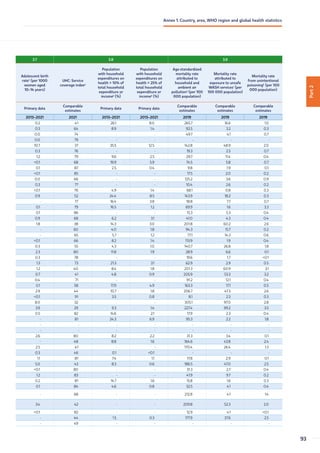
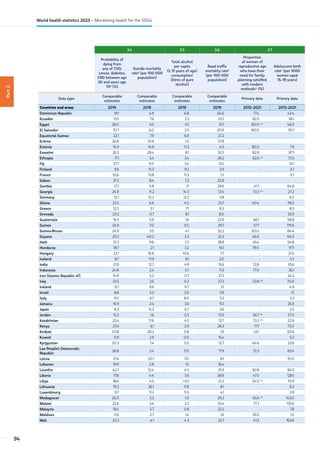
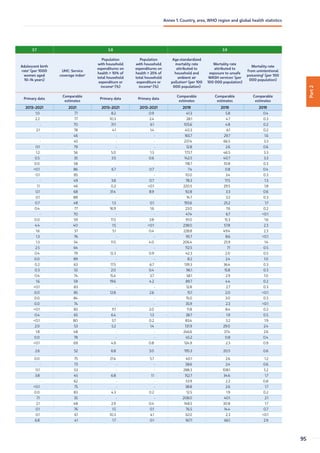
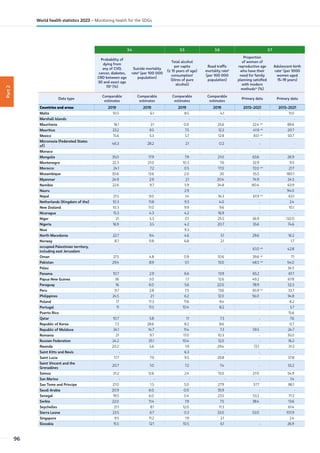
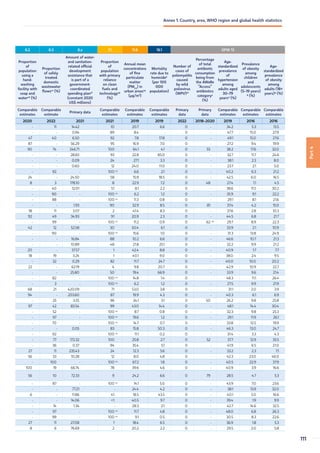
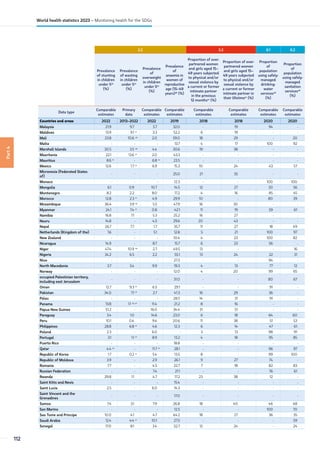
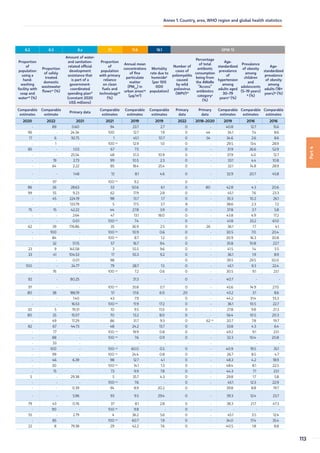
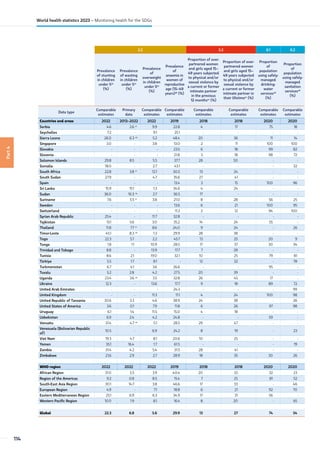
HEALTH
FORALL
World
Health
Statistics
2023
Monitoring
health for the
SDGs
Sustainable Development Goals
World
Health
Statistics
2023
Monitoring
health for the
SDGs
Sustainable Development Goals
HEALTH
FORALL
World health statistics 2023: monitoring health for the SDGs,
Sustainable Development Goals
ISBN 978-92-4-007432-3 (electronic version)
ISBN 978-92-4-007433-0 (print version)
© World Health Organization 2023
Some rights reserved. This work is available under the Creative Commons Attribution-NonCommercial-
ShareAlike 3.0 IGO licence (CC BY-NC-SA 3.0 IGO; https://creativecommons.org/licenses/by-nc-sa/3.0/igo).
Under the terms of this licence, you may copy, redistribute and adapt the work for non-commercial
purposes, provided the work is appropriately cited, as indicated below. In any use of this work, there
should be no suggestion that WHO endorses any specific organization, products or services. The use of
the WHO logo is not permitted. If you adapt the work, then you must license your work under the same or
equivalent Creative Commons licence. If you create a translation of this work, you should add the following
disclaimer along with the suggested citation: “This translation was not created by the World Health
Organization (WHO). WHO is not responsible for the content or accuracy of this translation. The original
English edition shall be the binding and authentic edition”.
Any mediation relating to disputes arising under the licence shall be conducted in accordance with the
mediation rules of the World Intellectual Property Organization (http://www.wipo.int/amc/en/mediation/
rules/).
Suggested citation. World health statistics 2023: monitoring health for the SDGs, Sustainable
Development Goals. Geneva: World Health Organization; 2023. Licence: CC BY-NC-SA 3.0 IGO.
Cataloguing-in-Publication (CIP) data. CIP data are available at http://apps.who.int/iris.
Sales, rights and licensing. To purchase WHO publications, see https://www.who.int/publications/book-
orders. To submit requests for commercial use and queries on rights and licensing, see https://www.who.int/
copyright.
Third-party materials. If you wish to reuse material from this work that is attributed to a third party, such
as tables, figures or images, it is your responsibility to determine whether permission is needed for that
reuse and to obtain permission from the copyright holder. The risk of claims resulting from infringement
of any third-party-owned component in the work rests solely with the user.
General disclaimers. The designations employed and the presentation of the material in this publication do
not imply the expression of any opinion whatsoever on the part of WHO concerning the legal status of any
country, territory, city or area or of its authorities, or concerning the delimitation of its frontiers or
boundaries. Dotted and dashed lines on maps represent approximate border lines for which there may not
yet be full agreement.
The mention of specific companies or of certain manufacturers’ products does not imply that they are
endorsed or recommended by WHO in preference to others of a similar nature that are not mentioned.
Errors and omissions excepted, the names of proprietary products are distinguished by initial capital letters.
All reasonable precautions have been taken by WHO to verify the information contained in this
publication. However, the published material is being distributed without warranty of any kind, either
expressed or implied. The responsibility for the interpretation and use of the material lies with the reader.
In no event shall WHO be liable for damages arising from its use.
Design and layout: Agence Gardeners (Annecy)
Photo credits: Page 1 - WHO / Michael Duff; Page 33 - WHO / Karen Reidy; Page 71 - WHO / Alasdair Bell
•Contents
Foreword����������������������������������������������������������������������������������������������������������������������������������������������������������������� iv
Abbreviations and acronyms������������������������������������������������������������������������������������������������������������������������������� v
Introduction ���������������������������������������������������������������������������������������������������������������������������������������������vi
Key messages�������������������������������������������������������������������������������������������������������������������������������������������������������� vii
01. Key issues and trends in global health������������������������������������������������������������������������������������������������������1
1.1 Trends in maternal and child mortality������������������������������������������������������������������������������������������������������������������2
1.2. Noncommunicable diseases and major risk factors������������������������������������������������������������������������������������� 10
1.3 Assessing the impact of the COVID-19 pandemic, 2020–2021����������������������������������������������������������������� 17
1.4 Climate change and health��������������������������������������������������������������������������������������������������������������������������������������24
02. Summary status of the health-related SDGs and GPW 13 indicators����������������������������������������������33
2.1 Infectious diseases�������������������������������������������������������������������������������������������������������������������������������������������������������34
2.2 Child malnutrition and anaemia among women��������������������������������������������������������������������������������������������45
2.3 Injuries and violence��������������������������������������������������������������������������������������������������������������������������������������������������50
2.4 Environmental risks��������������������������������������������������������������������������������������������������������������������������������������������������� 53
2.5 Universal health coverage and health systems����������������������������������������������������������������������������������������������59
03. Building on past achievements to prepare for the next stage of global health�����������������������������71
3.1 Improvements in overall population health over the last seven decades������������������������������������������� 72
3.2 Rapid epidemiological transitions shifting disease burdens in recent decades������������������������������ 74
3.3 Driving factors for the transition and WHO’s contribution���������������������������������������������������������������������� 75
3.4 Implications for the next stage of global health�������������������������������������������������������������������������������������������78
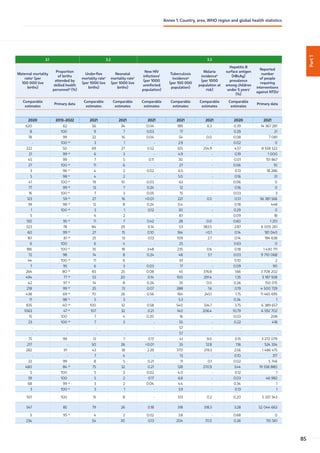
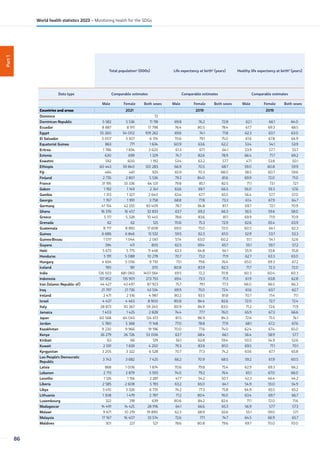
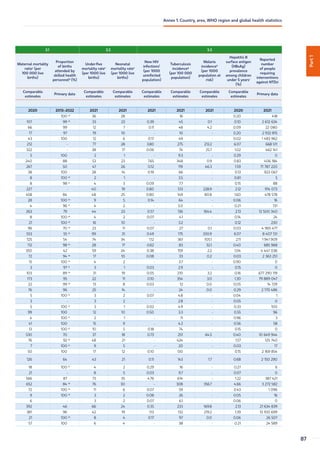
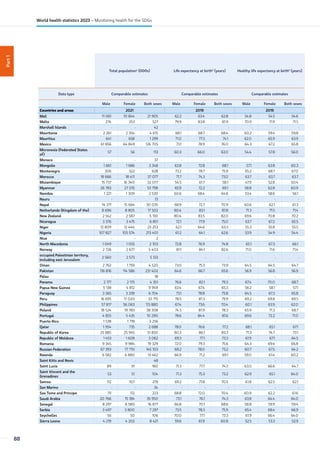
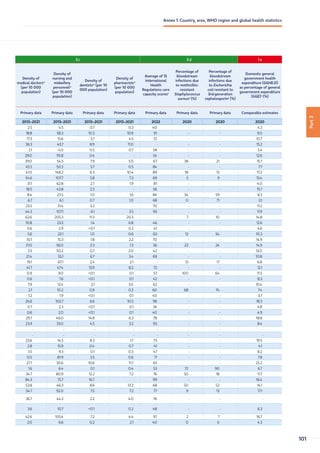
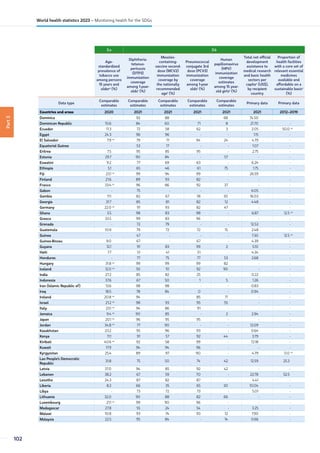
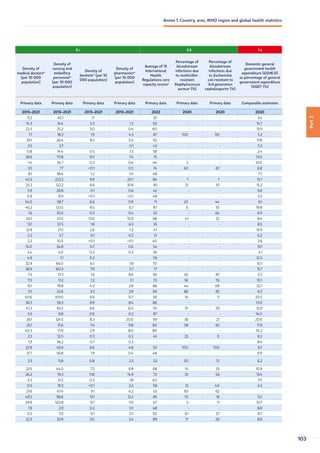
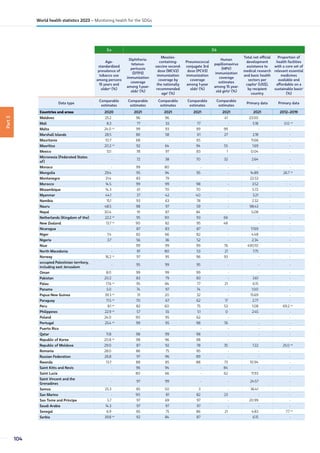
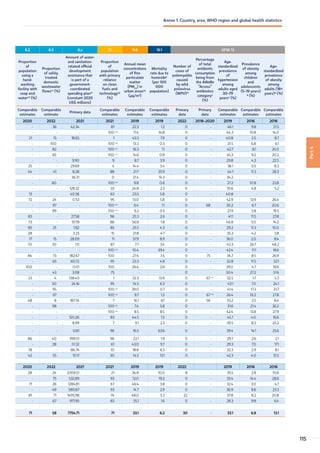
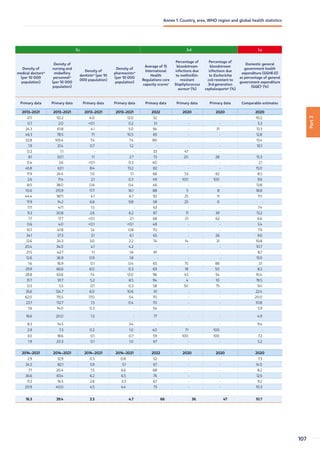
Annex 1. Country, area, WHO region and global health statistics�������������������������������������������������������������83
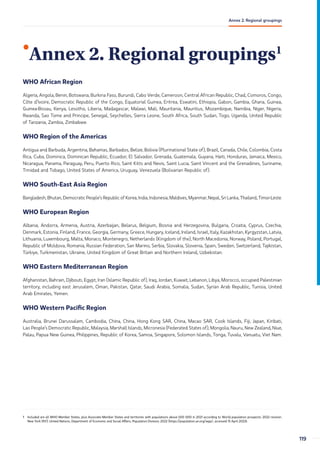
Annex 2. Regional groupings����������������������������������������������������������������������������������������������������������������������������119
iii
Contents
•Foreword
In the two decades prior to the COVID-19 pandemic,
the world achieved remarkable advances in health.
From 2000 to 2019, global life expectancy increased
from 67 years to 73 years, due primarily to the fall
in child and maternal mortality and the decline
in incidence and mortality from many infectious
diseases. Expansions in access to health and related
services, including improvements in prevention and
treatment for non-communicable diseases, was also
a significant factor.
However, even before the COVID-19 pandemic,
beginning in 2015, progress against many global health
indicators had slowed or stagnated. The pandemic
set things back even further, overwhelming health
systems and badly disrupting essential health services.
The pandemic is estimated to have resulted in nearly
15 million excess deaths in 2020 and 2021. Inequalities
both within and between countries persist, as the
most vulnerable populations face elevated risks
of illness and death from preventable conditions.
The unfolding climate crisis also presents significant
risks to health, particularly for the most vulnerable
populations. For the world to attain the targets of
the Sustainable Development Goals (SDGs) by 2030,
a substantial increase in focus and investment – of
both financial and political capital – is essential.
The World health statistics 2023 documents
successes and challenges in public health, with a
focus on the SDG indicators and trends. To meet the
SDG targets by 2030, it is imperative to accelerate
progress. As evident from the country success stories
highlighted in this report, acceleration is possible
with concerted efforts from local communities,
governments and international organizations,
including WHO.
With many people still lacking access to essential
health services, it is imperative to address inequality,
along with the environmental, commercial and other
determinants of health, to progress towards our
shared goal of Health for All and achieving the
SDG targets. Countries must take urgent action
to anticipate and respond to health challenges –
especially to protect vulnerable population groups
and those living in areas with high disease burdens.
Timely, reliable, and disaggregated data and forecasts
are of paramount importance to guide effective public
health policy setting and programme implementation.
The world must heed the lessons of the last two
decades, including the tragedy of these pandemic
years. One of the most important of those is
the knowledge that we have it in our power to
avoid unnecessary deaths and illness, and create
stronger, more equitable and resilient health systems
and societies.
Dr Tedros Adhanom Ghebreyesus
Director-General
World Health Organization
iv
World health statistics 2023 – Monitoring health for the SDGs
•Abbreviations and acronyms
ABR Adolescent birth rates
AIDS Acquired immunodeficiency syndrome
AMC Antimicrobial consumption
AMR Antimicrobial resistance
ANC Antenatal care
ARI Acute respiratory infection
ARR Average annual rate of reduction
AST Antimicrobial susceptibility test results
ATACH Alliance for Transformative Action on
Climate Change and Health
BSI Bloodstream infection
COVID-19 Coronavirus disease 2019
cVDPV2 Circulating vaccine-derived poliovirus
type 2
DALY Disability-adjusted life-year
DTP3 Diphtheria, tetanus toxoid and
pertussis-containing vaccine (3 doses)
EENC Early essential newborn care
GLASS Global Antimicrobial Resistance and
Use Surveillance System
GPW 13 Thirteenth General Programme of
Work (WHO)
GTS Global technical strategy for malaria
HIV Human immunodeficiency virus
HPV Human papillomavirus
IHR International Health Regulations
IQR Interquartile range
KMC Kangaroo mother care
MCV2 Measles-containing vaccine (2 doses)
MDG Millennium Development Goal
MRSA Methicillin-resistant
Staphylococcus aureus
NAP National Adaptation Plan
NCD Noncommunicable disease
NDC Nationally Determined Contribution
NHWA National health workforce accounts
NICU Neonatal intensive care unit
NMR Neonatal mortality rate
NTD Neglected tropical disease
ODA Official Development Assistance
OOP Out of pocket (expenditure)
PCV3 Pneumococcal conjugate vaccine
(3 doses)
PM Particulate matter
RMNCH Reproductive, maternal, newborn and
child health
SAE Small area estimation
SDG Sustainable Development Goal
TB Tuberculosis
U5MR Under-five mortality rate
UHC Universal health coverage
UI Uncertainty interval
UNDESA United Nations Department of
Economic and Social Affairs
UNFCCC United Nations Framework Convention
on Climate Change
UNICEF United Nations Children’s Fund
WASH Water, sanitation and hygiene
WHO World Health Organization
WPV Wild poliovirus
YLL Years of life lost
v
Abbreviations and acronyms
•Introduction
The World health statistics report is the annual compilation of health and health-related indicators which has
been published by the World Health Organization (WHO) since 2005. WHO’s Division of Data, Analytics and
Delivery for Impact produces this report in collaboration with WHO technical departments, and regional and
country offices.
The 2023 edition reviews more than 50 health-related indicators from the Sustainable Development Goals
(SDGs) and WHO’s Thirteenth General Programme of Work (GPW 13). The report consists of three chapters,
complemented by an annex table presenting the latest available data.
Chapter 1 discusses key issues and trends in global health, including the latest trends in maternal and child
mortality; major noncommunicable diseases (NCDs) and the related risk factors; the COVID-19 pandemic;
and climate change and health. Chapter 2 summarizes global and regional trends in the health-related SDGs in
areas of infectious diseases; child malnutrition and anaemia among women; injuries and violence; environmental
risks; and universal health coverage (UHC) and health systems. In chapters 1 and 2, country-focused stories are
presented to highlight efforts undertaken to address various health issues. Chapter 3 then looks to the future
through the lens of global life expectancy and NCDs.
The information presented in World health statistics 2023 is based on data available from global monitoring
as of late April 2023. These data have been compiled primarily from databases managed by WHO or United
Nations partner entities and supplemented with data and analyses from peer-reviewed publications.
vi
World health statistics 2023 – Monitoring health for the SDGs
•Key messages
Since the beginning of the millennium, the world has seen notable improvements in population health globally.
As child mortality halved, maternal mortality fell by a third, the incidence of many infectious diseases – including
HIV, tuberculosis and malaria – dropped, and the risks from dying prematurely from noncommunicable diseases
(NCDs) and injuries declined, global life expectancy at birth rose from 67 years in 2000 to 73 years in 2019.
These achievements are consistent with the progress made in areas that influence health – from improved access
to essential health services to reduced exposure to health risks, including tobacco use, alcohol consumption
and child undernutrition.
However, the rapid progress commonly observed for many of these indicators in the era of the Millennium
Development Goals has markedly stalled since 2015, challenging the timely attainment of the Sustainable
Development Goal (SDG) targets by 2030. This is evidenced by the falling annual rate of reduction in indicators
such as the maternal mortality ratio, under-five and neonatal mortality rates, premature mortality from major
NCDs, and suicide and road traffic mortality rates. Almost halfway through the SDG era, some of these
indicators are far from reaching the midpoint of the required trajectories to reach their respective SDG targets.
In addition, despite reduction in exposure to many health risks – such as tobacco use, unsafe water and
sanitation, and child stunting – progress is inadequate. Risk exposure remains high, especially for factors such
as alcohol consumption and hypertension where declines began only in recent years. Alarmingly, the entire
global population (99%) breathes unhealthy levels of fine particulate matter, and the prevalence of obesity is
moving in the wrong direction with no immediate sign of reversion.
Expansion of access to essential health services has slowed compared to pre-2015 gains, and there has been no
significant progress in reducing financial hardship due to health-care costs. Inequalities persist, with disadvantaged
populations having lower levels of access to health and related services but higher levels of exposure to health
risks and higher levels of associated mortality. People living in less-resourced settings continue to have less
access to a wide range of services, from the assistance of skilled health personnel during childbirth to clean
cooking fuels and technology. Inequalities impede progress in responding to global crises, as has been shown
during the COVID-19 pandemic.
The COVID-19 pandemic has led to 14.9 million excess deaths and cost 336.8 million years of life lost globally
in 2020 and 2021. This means that, on average, each death directly or indirectly attributed to the COVID-19
pandemic by the end of 2021 led to a loss of more than 22 years of life – equivalent to over 5 years of life loss
every second. The pandemic has also put many health-related indicators further off-track. As a result of service
disruptions, the increasing trend in immunization coverage (including against measles, human papillomavirus,
and diphtheria, tetanus and pertussis) and the declining trend in incidence of malaria and tuberculosis were
both reversed, and fewer people were treated for neglected tropical diseases. The COVID-19 pandemic has
exposed inequalities both between countries and within them, including inequalities in access to COVID-19
vaccines, with populations with lower educational levels and in low- and middle-income countries less likely
to have received a COVID-19 vaccine.
The COVID-19 pandemic is a stark reminder that infectious diseases can emerge or re-emerge to cause harm
– potentially to everyone. Infectious diseases that were previously under control may surge as a result of
antimicrobial resistance, setting back progress. Meanwhile, climate change continues to degrade the environmental
and social determinants of physical and mental health, posing enormous risks to us all.
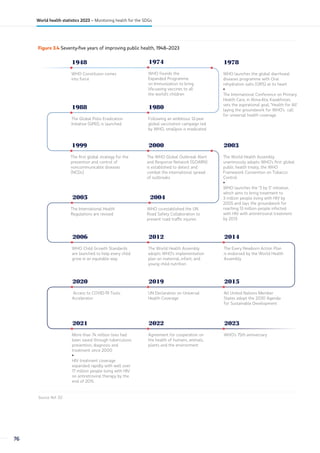
The world has witnessed rapid demographic and epidemiological transitions throughout WHO’s 75 years of
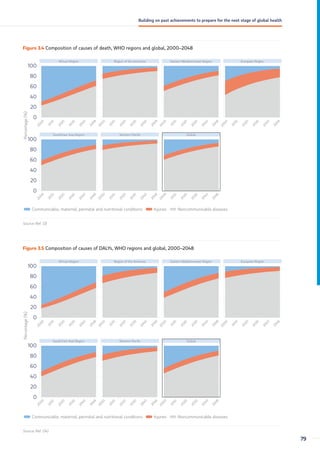
history. The share of deaths caused annually by NCDs has grown to nearly three quarters of all deaths and, if the
trend continues, is projected to reach about 86% globally by WHO’s 100th anniversary in 2048. The United
Nations projects that total annual deaths will reach nearly 90 million globally in 2048; consequently, 77 million
of these will be NCD deaths – a nearly 90% increase in absolute numbers over 2019.
vii
Key messages
To respond to these challenges, and to meet the SDG targets by 2030, it is crucial to scale up efforts and
accelerate progress. Global, regional and national priorities should be set and interventions targeted to end
deaths from preventable injuries and deaths of mothers and children, to further postpone NCD deaths by
lowering their underlying risk factors, and to increase equitable access to essential health services while
containing the risks of facing catastrophic costs. It is critical to have timely, reliable and disaggregated data,
estimates and forecasts to inform policy and guide actions at all levels in order to maximize health gains and
eliminate inequalities.
viii
World health statistics 2023 – Monitoring health for the SDGs
Key issues and
trends in global
health
01.
The world’s population experienced increased survival in recent
times, with global life expectancy increasing since the 1950s
up until 2019 (see Chapter 3 on Building on past achievements
to face future challenges in health). This trend reflected the
epidemiological transition from an era characterized by high
mortality in childhood and a high burden associated with infectious
diseases and maternal, perinatal and nutritional conditions, to an
era with a high burden from noncommunicable diseases (NCDs).
This chapter looks at the most recent trends in maternal and child
mortality, as well as in NCDs and the major risk factors. It also
discusses the striking changes in the global mortality pattern
brought about by the COVID-19 pandemic. Lastly, it presents a
section on climate change and how it relates to population health.
•
1.1 Trends in maternal and
child mortality
Improvement of maternal and child health has been high on the global development agenda since the turn of the millennium.
Reductions in both maternal and child mortality were among the targets of the Millennium Development Goals (MDGs), declared
in 2000, that the world strived to achieve by 2015. They continue to be among the global targets in the SDG era that spans
from 2015 to 2030.
Maternal mortality
1 Maternal mortality statistics are presented here with 80% uncertainty intervals.
Pregnancy, childbirth and the postnatal period should bring
positive experiences, ensuring that women and their babies reach
their full potential for health and well-being. Unfortunately,
these stages of life still carry considerable risks to women
and their families, as women in many parts of the world
lose their lives due to related complications and inadequate
health care. The SDG target calls for a reduction of the global
maternal mortality ratio to less than 70 maternal deaths per
100 000 live births by 2030.
Levels and trends in maternal mortality
Much progress was achieved in the MDG era, as the global
maternal mortality ratio dropped by a third between 2000 and
2015, from 339 (UI: 319–360)1
deaths per 100 000 live births to
227 (UI: 211–246) deaths per 100 000 live births, representing
a 2.7% (UI: 2.0–3.2%) average annual rate of reduction (ARR).
The number of maternal deaths globally fell by 30% during the
period, from an estimated 447 000 (UI: 426 000–481 000)
deaths in 2000 to 313 000 (UI: 300 000–350 000) deaths
in 2015 (1).
2
World health statistics 2023 – Monitoring health for the SDGs
Such progress, however, has so far not been sustained in
the SDG era as the ARR of the global maternal mortality
ratio plummeted to -0.04% (UI: -1.6–1.1%) between 2016
and 2020, indicating stagnation. An estimated 287 000
(UI: 273 000–343 000) women lost their lives due to largely
preventable causes related to pregnancy and childbirth in
2020 – approximately 800 women every day – equivalent to
223 (UI: 202–255) deaths per 100 000 live births that year.
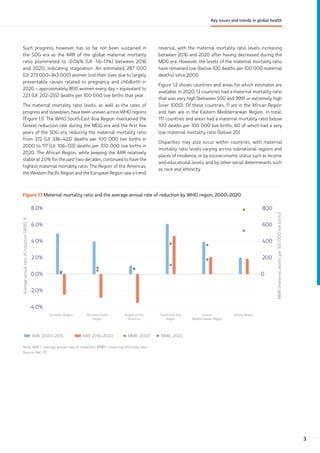
The maternal mortality ratio levels, as well as the rates of
progress and slowdown, have been uneven across WHO regions
(Figure 1.1). The WHO South-East Asia Region maintained the
fastest reduction rate during the MDG era and the first five
years of the SDG era, reducing the maternal mortality ratio
from 372 (UI: 336–423) deaths per 100 000 live births in
2000 to 117 (UI: 106–133) deaths per 100 000 live births in
2020. The African Region, while keeping the ARR relatively
stable at 2.0% for the past two decades, continued to have the
highest maternal mortality ratio. The Region of the Americas,
the Western Pacific Region and the European Region saw a trend
reversal, with the maternal mortality ratio levels increasing
between 2016 and 2020 after having decreased during the
MDG era. However, the levels of the maternal mortality ratio
have remained low (below 100 deaths per 100 000 maternal
deaths) since 2000.
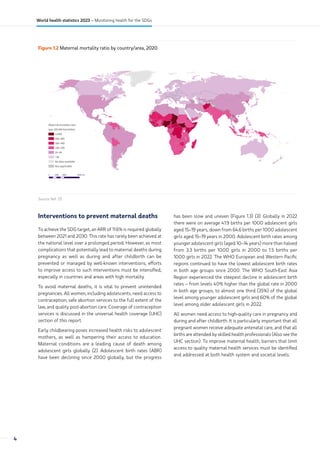
Figure 1.2 shows countries and areas for which estimates are
available. In 2020, 13 countries had a maternal mortality ratio
that was very high (between 500 and 999) or extremely high
(over 1000). Of these countries, 11 are in the African Region
and two are in the Eastern Mediterranean Region. In total,
117 countries and areas had a maternal mortality ratio below
100 deaths per 100 000 live births, 60 of which had a very
low maternal mortality ratio (below 20).
Disparities may also occur within countries, with maternal
mortality ratio levels varying across subnational regions and
places of residence, or by socioeconomic status such as income
and educational levels, and by other social determinants such
as race and ethnicity.
Figure 1.1 Maternal mortality ratio and the average annual rate of reduction by WHO region, 2000–2020
European Region Western Pacific
Region
Region of the
Americas
South-East Asia
Region
Eastern
Mediterranean Region
African Region
-4.0%
0.0%
-2.0%
2.0%
4.0%
6.0%
8.0%
0
200
400
600
800
Average
annual
rate
of
reduction
(ARR),
%
MMR
(maternal
deaths
per
100
000
live
births)
ARR, 2000–2015 ARR 2016–2020 MMR, 2000 MMR, 2020
Note: ARR = average annual rate of reduction; MMR = maternal mortality ratio.
Source: Ref. (1).
3
Key issues and trends in global health
Figure 1.2 Maternal mortality ratio by country/area, 2020
Not applicable
No data available
20
20–99
100–299
300–499
500–999
‫۽‬эььь
(per 100 000 live births)
Maternal mortality ratio
0 2000 4000
1000 km
Source: Ref. (1).
Interventions to prevent maternal deaths
To achieve the SDG target, an ARR of 11.6% is required globally
between 2021 and 2030. This rate has rarely been achieved at
the national level over a prolonged period. However, as most
complications that potentially lead to maternal deaths during
pregnancy as well as during and after childbirth can be
prevented or managed by well-known interventions, efforts
to improve access to such interventions must be intensified,
especially in countries and areas with high mortality.
To avoid maternal deaths, it is vital to prevent unintended
pregnancies. All women, including adolescents, need access to
contraception, safe abortion services to the full extent of the
law, and quality post-abortion care. Coverage of contraception
services is discussed in the universal health coverage (UHC)
section of this report.
Early childbearing poses increased health risks to adolescent
mothers, as well as hampering their access to education.
Maternal conditions are a leading cause of death among
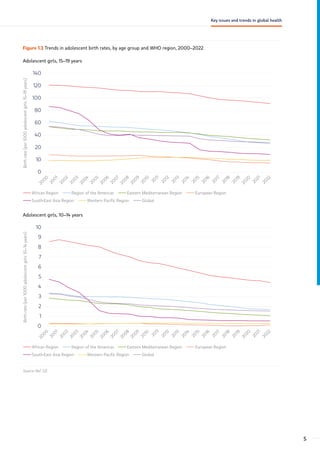
adolescent girls globally (2). Adolescent birth rates (ABR)
have been declining since 2000 globally, but the progress
has been slow and uneven (Figure 1.3) (3). Globally in 2022
there were on average 41.9 births per 1000 adolescent girls
aged 15–19 years, down from 64.6 births per 1000 adolescent
girls aged 15–19 years in 2000. Adolescent birth rates among
younger adolescent girls (aged 10–14 years) more than halved
from 3.3 births per 1000 girls in 2000 to 1.5 births per
1000 girls in 2022. The WHO European and Western Pacific
regions continued to have the lowest adolescent birth rates
in both age groups since 2000. The WHO South-East Asia
Region experienced the steepest decline in adolescent birth
rates – from levels 40% higher than the global rate in 2000
in both age groups, to almost one third (35%) of the global
level among younger adolescent girls and 60% of the global
level among older adolescent girls in 2022.
All women need access to high-quality care in pregnancy and
during and after childbirth. It is particularly important that all
pregnant women receive adequate antenatal care, and that all
births are attended by skilled health professionals (Also see the
UHC section). To improve maternal health, barriers that limit
access to quality maternal health services must be identified
and addressed at both health system and societal levels.
4
World health statistics 2023 – Monitoring health for the SDGs
Figure 1.3 Trends in adolescent birth rates, by age group and WHO region, 2000–2022
Adolescent girls, 15–19 years
0
20
10
60
40
100
80
140
120
Birth
rate
(per
1000
adolescent
girls
15–19
years)
2
0
0
0
2
0
0
1
2
0
0
2
2
0
0
3
2
0
0
4
2
0
0
5
2
0
0
6
2
0
0
7
2
0
0
8
2
0
0
9
2
0
1
0
2
0
1
1
2
0
1
2
2
0
1
3
2
0
1
4
2
0
1
5
2
0
1
6
2
0
1
7
2
0
1
9
2
0
2
0
2
0
1
8
2
0
2
2
2
0
2
1
African Region Region of the Americas Eastern Mediterranean Region European Region
South-East Asia Region Western Pacific Region Global
Adolescent girls, 10–14 years
0
2
1
4
3
6
5
8
7
10
9
Birth
rate
(per
1000
adolescent
girls
10–14
years)
2
0
0
0
2
0
0
1
2
0
0
2
2
0
0
3
2
0
0
4
2
0
0
5
2
0
0
6
2
0
0
7
2
0
0
8
2
0
0
9
2
0
1
0
2
0
1
1
2
0
1
2
2
0
1
3
2
0
1
4
2
0
1
5
2
0
1
6
2
0
1
7
2
0
1
9
2
0
2
0
2
0
1
8
2
0
2
2
2
0
2
1
African Region Region of the Americas Eastern Mediterranean Region European Region
South-East Asia Region Western Pacific Region Global
Source: Ref. (3).
5
Key issues and trends in global health
Child mortality
2 Child mortality statistics are presented here with 90% uncertainty intervals.
Child survival is an important marker of human development
– it has been one of the main drivers of increasing global
life expectancy over the past 75 years. The international
community committed to reducing mortality among the
youngest children, setting the SDG target to reduce neonatal
mortality (i.e. mortality among newborn babies during the first
month of life) by 2030 to at least as low as 12 per 1000 live
births, and setting the under-five mortality target (i.e. mortality
among children under 5 years of age) for the same period to
at least as low as 25 per 1000 live births.
Levels and trends in mortality among
children under five years of age
Substantial global progress has been made in reducing child
mortality since 2000. Approximately 10 million (9.9 million,
UI: 9.8–10.1 million)2
children under 5 years of age died globally
in 2000, corresponding to an under-five mortality rate (U5MR)
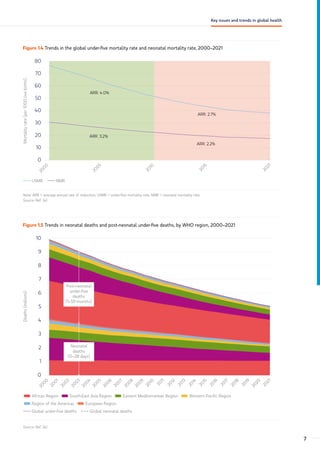
of 76 (UI: 75–78) deaths per 1000 live births. Both the global
number of deaths and the U5MR halved by 2021 (Figure 1.4).
However, 5.0 million (UI: 4.8–5.6 million) children in 2021
tragically died before reaching their fifth birthday. Just under
half (47%) of these deaths – about 2.3 million (UI: 2.2–2.6 million)
– occurred during the first month of life. The global neonatal
mortality rate (NMR) stood at 18 (UI: 17–19) deaths per 1000 live
births in 2021, a 43% drop from 31 (UI: 30–32) deaths per
1000 live births in 2000. The global U5MR in 2021 was 38
(UI: 36–42) deaths per 1000 live births (4).
Globally, NMR declined at a slower rate compared to U5MR,
and both declined more slowly during the second decade
(2010–2021) compared to the first decade (2000–2009).
The ARR of the NMR dropped from 3.2% during 2000–2009
to 2.2% during 2010–2021, while the ARR of U5MR fell from
4.0% during the first period to 2.7% during the second period
(Figure 1.4). This slowdown has been particularly pronounced
since the start of the SDG era in 2015.
Children around the world face vastly different chances of
survival depending on where they are born. While U5MR
in the African Region fell by 52% between 2000 and 2021,
it remained the highest at 72 (UI: 65–84) deaths per 1000 live
births – almost twice the global U5MR and about nine times
higher that of the European Region which was eight (UI: 7–8)
deaths per 1000 live births. Despite a 34% drop in NMR from
40 (UI: 39–42) deaths per 1000 live births in 2000 to 27
(UI: 24–31) deaths per 1000 live births in 2021, the number
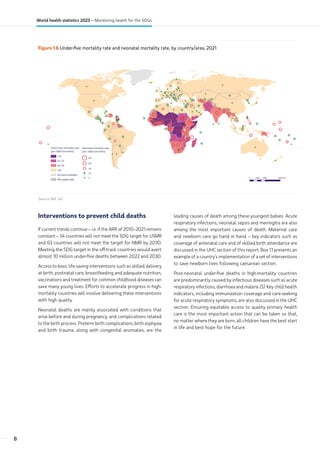
of neonatal deaths in the African Region remained stubbornly
high at about 1.1 million annually since 2000 (Figure 1.5), owing
to the increasing number of live births. The South-East Asia
Region saw a big decline in deaths as the number of neonatal
and post-neonatal under-five deaths dropped by 65% and 78%,
respectively, between 2000 and 2021.
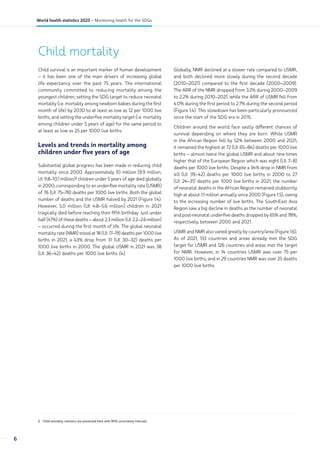
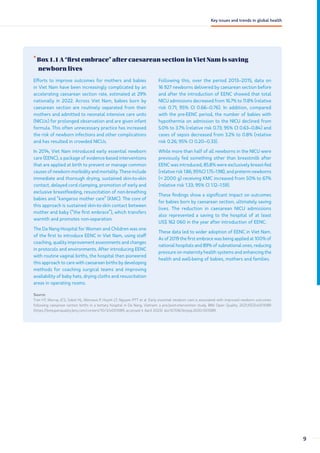
U5MR and NMR also varied greatly by country/area (Figure 1.6).
As of 2021, 133 countries and areas already met the SDG
target for U5MR and 126 countries and areas met the target
for NMR. However, in 14 countries U5MR was over 75 per
1000 live births, and in 29 countries NMR was over 25 deaths
per 1000 live births.
6
World health statistics 2023 – Monitoring health for the SDGs
Figure 1.4 Trends in the global under-five mortality rate and neonatal mortality rate, 2000–2021
0
20
10
40
30
50
60
80
70
2
0
0
0
2
0
0
5
2
0
1
0
2
0
1
5
2
0
2
1
Mortality
rate
(per
1000
live
births)
U5MR NMR
ARR: 4.0%
ARR: 3.2%
ARR: 2.7%
ARR: 2.2%
Note: ARR = average annual rate of reduction; U5MR = under-five mortality rate; NMR = neonatal mortality rate.
Source: Ref. (4).
Figure 1.5 Trends in neonatal deaths and post-neonatal under-five deaths, by WHO region, 2000–2021
0
4
3
2
1
6
5
7
8
10
9
2
0
0
0
2
0
0
1
2
0
0
2
2
0
0
3
2
0
0
4
2
0
0
5
2
0
0
6
2
0
0
7
2
0
0
8
2
0
0
9
2
0
1
0
2
0
1
1
2
0
1
2
2
0
1
3
2
0
1
4
2
0
1
5
2
0
1
6
2
0
1
7
2
0
1
8
2
0
2
1
2
0
2
0
2
0
1
9
Deaths
(millions)
Eastern Mediterranean Region
Region of the Americas European Region
South-East Asia Region Western Pacific Region
Global under-five deaths Global neonatal deaths
African Region
Post-neonatal
under-five
deaths
(1–59 months)
Neonatal
deaths
(0–28 days)
Source: Ref. (4).
7
Key issues and trends in global health
Figure 1.6 Under-five mortality rate and neonatal mortality rate, by country/area, 2021
Not applicable
No data available
1
12
18
29
40
Neonatal mortality rate
(per 1000 live births)
‫ۼ‬юё
юђҘёь
ёэҘѓё
‫ۻ‬ѓё
Under-five mortality rate
(per 1000 live births)
0 2000 4000
1000 km
Source: Ref. (4).
Interventions to prevent child deaths
If current trends continue – i.e. if the ARR of 2010–2021 remains
constant – 54 countries will not meet the SDG target for U5MR
and 63 countries will not meet the target for NMR by 2030.
Meeting the SDG target in the off-track countries would avert
almost 10 million under-five deaths between 2022 and 2030.
Access to basic life-saving interventions such as skilled delivery
at birth, postnatal care, breastfeeding and adequate nutrition,
vaccinations and treatment for common childhood diseases can
save many young lives. Efforts to accelerate progress in high-
mortality countries will involve delivering these interventions
with high quality.
Neonatal deaths are mainly associated with conditions that
arise before and during pregnancy, and complications related
to the birth process. Preterm birth complications, birth asphyxia
and birth trauma, along with congenital anomalies, are the
leading causes of death among these youngest babies. Acute
respiratory infections, neonatal sepsis and meningitis are also
among the most important causes of death. Maternal care
and newborn care go hand in hand – key indicators such as
coverage of antenatal care and of skilled birth attendance are
discussed in the UHC section of this report. Box 1.1 presents an
example of a country’s implementation of a set of interventions
to save newborn lives following caesarean section.
Post-neonatal under-five deaths in high-mortality countries
are predominantly caused by infectious diseases such as acute
respiratory infections, diarrhoea and malaria (5). Key child health
indicators, including immunization coverage and care-seeking
for acute respiratory symptoms, are also discussed in the UHC
section. Ensuring equitable access to quality primary health
care is the most important action that can be taken so that,
no matter where they are born, all children have the best start
in life and best hope for the future.
8
World health statistics 2023 – Monitoring health for the SDGs
•
Box 1.1 A “first embrace” after caesarean section in Viet Nam is saving
newborn lives
Efforts to improve outcomes for mothers and babies
in Viet Nam have been increasingly complicated by an
accelerating caesarean section rate, estimated at 29%
nationally in 2022. Across Viet Nam, babies born by
caesarean section are routinely separated from their
mothers and admitted to neonatal intensive care units
(NICUs) for prolonged observation and are given infant
formula. This often unnecessary practice has increased
the risk of newborn infections and other complications
and has resulted in crowded NICUs.
In 2014, Viet Nam introduced early essential newborn
care (EENC), a package of evidence-based interventions
that are applied at birth to prevent or manage common
causes of newborn morbidity and mortality. These include
immediate and thorough drying, sustained skin-to-skin
contact, delayed cord clamping, promotion of early and
exclusive breastfeeding, resuscitation of non-breathing
babies and “kangaroo mother care” (KMC). The core of
this approach is sustained skin-to-skin contact between
mother and baby (“the first embrace”), which transfers
warmth and promotes non-separation.
The Da Nang Hospital for Women and Children was one
of the first to introduce EENC in Viet Nam, using staff
coaching, quality improvement assessments and changes
in protocols and environments. After introducing EENC
with routine vaginal births, the hospital then pioneered
this approach to care with caesarean births by developing
methods for coaching surgical teams and improving
availability of baby hats, drying cloths and resuscitation
areas in operating rooms.
Following this, over the period 2013–2015, data on
16 927 newborns delivered by caesarean section before
and after the introduction of EENC showed that total
NICU admissions decreased from 16.7% to 11.8% (relative
risk 0.71; 95% CI 0.66–0.76). In addition, compared
with the pre-EENC period, the number of babies with
hypothermia on admission to the NICU declined from
5.0% to 3.7% (relative risk 0.73; 95% CI 0.63–0.84) and
cases of sepsis decreased from 3.2% to 0.8% (relative
risk 0.26; 95% CI 0.20–0.33).
While more than half of all newborns in the NICU were
previously fed something other than breastmilk after
EENC was introduced, 85.8% were exclusively breast-fed
(relative risk 1.86; 95%CI 1.75–1.98), and preterm newborns
( 2000 g) receiving KMC increased from 50% to 67%
(relative risk 1.33; 95% CI 1.12–1.59).
These findings show a significant impact on outcomes
for babies born by caesarean section, ultimately saving
lives. The reduction in caesarean NICU admissions
also represented a saving to the hospital of at least
US$ 162 060 in the year after introduction of EENC.
These data led to wider adoption of EENC in Viet Nam.
As of 2019 the first embrace was being applied at 100% of
national hospitals and 89% of subnational ones, reducing
pressure on maternity health systems and enhancing the
health and well-being of babies, mothers and families.
Source:
Tran HT, Murray JCS, Sobel HL, Mannava P, Huynh LT, Nguyen PTT et al. Early essential newborn care is associated with improved newborn outcomes
following caesarean section births in a tertiary hospital in Da Nang, Vietnam: a pre/post-intervention study. BMJ Open Quality. 2021;10(3):e001089
(https://bmjopenquality.bmj.com/content/10/3/e001089, accessed 4 April 2023). doi:10.1136/bmjoq-2020-001089.
9
Key issues and trends in global health
•
1.2. Noncommunicable
diseases and major
risk factors
3 Unless otherwise noted, uncertainty intervals presented in this report represent 95% uncertainty intervals.
4 A DALY is a measure of the total burden of disease, taking into account both mortality and morbidity. DALYs for a disease or health condition are the sum of years of life lost (YLLs) due
to premature mortality and years of healthy life lost due to disability (YLDs) as the result of prevalent cases of the disease or health condition in a population.
Noncommunicable diseases (NCDs) affect people from all walks
of life, and in all parts of the world. The epidemic of NCDs
poses devastating health consequences for individuals, families
and communities. Prevention and control of these diseases are
a major development imperative for the 21st century.
NCDs continued to cause the highest disease burden worldwide.
The impact of NCDs grew from causing 61% of global deaths
(equivalent to 31 million, UI: 24–40 million)3
in 2000 to causing
74% (or 41 million, UI: 29–57 million) in 2019, and from causing
47% (or 1.3 billion, UI: 0.8–1.7 billion) of global disability-adjusted
life-years (DALYs)4
in 2000 to causing 63% (or 1.6 billion,
UI: 1.0–2.2 billion) of DALYs in 2019 (2,6).
Four major NCDs collectively killed about 33.3 million (UI: 24.5–
43.3 million) people in 2019, a 28% increase compared to 2000.
These major NCDs are cardiovascular disease (17.9 million,
UI: 13.4–22.9 million), cancer (9.3 million, UI: 6.9–12.2 million),
chronic respiratory disease (4.1 million, UI: 2.9–5.6 million) and
diabetes (2.0 million, UI: 1.4–2.7 million).
The increase in absolute numbers of deaths and DALYs due
to NCDs was mainly driven by population growth and ageing.
At individual level, however, the overall risk of dying from
NCDs has been declining worldwide, showing progress over
the last two decades.
Globally, the greatest decline in deaths from major NCDs
between 2000 and 2019 were from chronic respiratory disease
(a 37% drop in age-standardized rates for all ages combined),
followed by cardiovascular disease (27%) and cancer (16%).
Deaths due to diabetes, however, increased slightly, by 3%
over the same period.
NCD premature mortality
Globally, a person aged 30 years in 2019 has a 17.8%
(UI: 13.3–23.1%) chance of dying from one of the four major NCDs
before the age of 70 years. The probability is highest in the WHO
Eastern Mediterranean Region at 24.5% (UI: 16.7–34.0), followed
by the South-East Asia Region at 21.6% (UI: 15.8–28.2%) and the
African Region at 20.8% (UI: 13.3–30.3%). The probability was
lower in the WHO European Region at 16.3% (UI: 12.7–20.4%),
in the Western Pacific Region at 15.6% (UI: 11.9–19.7%) and the
Region of the Americas at 14.0% (UI: 11.7–16.9%) (2).
This represents progress from all regions since 2000 and
a 22.2% decline globally. At regional levels the decline
ranged from roughly 13% in the South-East Asia and Eastern
Mediterranean regions to a decline of more than 25% in the
Western Pacific (26.8%) and European (31.2%) regions.
Men have a higher probability of premature death from NCDs
than women in all WHO regions and globally. The absolute gap
between sexes had been closing during the last two decades
globally and in all WHO regions. However, the relative gap –
as measured by the male-to-female ratio – increased by 11%
in the Western Pacific Region, while it declined or remained
roughly constant in the other five regions.
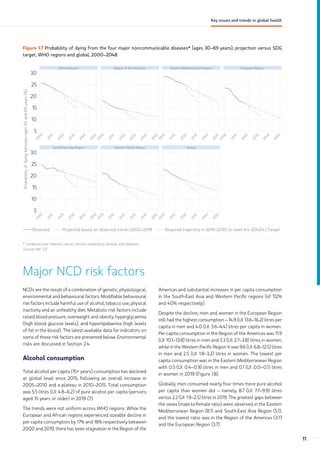
However, progress has slowed since the beginning of the SDG
era in 2015. If the average annual rate of reduction (ARR) in
premature mortality of the major NCDs continues, none of
the WHO regions will achieve the SDG target of one third
reduction. By the 100th
anniversary of WHO in 2048, only the
African, Eastern Mediterranean and European regions will have
achieved the SDG 2030 target, while the target will be missed
in other regions and also globally (Figure 1.7).
10
World health statistics 2023 – Monitoring health for the SDGs
Figure 1.7 Probability of dying from the four major noncommunicable diseases* (ages 30–69 years), projection versus SDG
target, WHO regions and global, 2000–2048
Probability
of
dying
between
ages
30
and
69
years
(%)
5
20
15
10
25
30
2
0
0
0
2
0
1
0
2
0
2
0
2
0
3
0
2
0
4
0
2
0
5
0
African Region
2
0
0
0
2
0
1
0
2
0
2
0
2
0
3
0
2
0
4
0
2
0
5
0
Region of the Americas
2
0
0
0
2
0
1
0
2
0
2
0
2
0
3
0
2
0
4
0
2
0
5
0
Eastern Mediterranean Region
2
0
0
0
2
0
1
0
2
0
2
0
2
0
3
0
2
0
4
0
2
0
5
0
European Region
5
20
15
10
25
30
2
0
0
0
2
0
1
0
2
0
2
0
2
0
3
0
2
0
4
0
2
0
5
0
South-East Asia Region
2
0
0
0
2
0
1
0
2
0
2
0
2
0
3
0
2
0
4
0
2
0
5
0
Western Pacific Region
2
0
0
0
2
0
1
0
2
0
2
0
2
0
3
0
2
0
4
0
2
0
5
0
Global
Observed Projected based on observed trends 2000–2019 Required trajectory in 2019–2030 to meet the SDG3.4.1 Target
* Cardiovascular disease, cancer, chronic respiratory disease and diabetes.
Source: Ref. (2).
Major NCD risk factors
NCDs are the result of a combination of genetic, physiological,
environmental and behavioural factors. Modifiable behavioural
risk factors include harmful use of alcohol, tobacco use, physical
inactivity and an unhealthy diet. Metabolic risk factors include
raised blood pressure, overweight and obesity, hyperglycaemia
(high blood glucose levels), and hyperlipidaemia (high levels
of fat in the blood). The latest available data for indicators on
some of these risk factors are presented below. Environmental
risks are discussed in Section 2.4.
Alcohol consumption
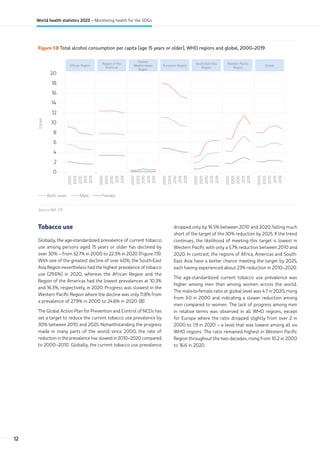
Total alcohol per capita (15+ years) consumption has declined
at global level since 2015, following an overall increase in
2005–2010 and a plateau in 2010–2015. Total consumption
was 5.5 litres (UI: 4.8–6.2) of pure alcohol per capita (persons
aged 15 years or older) in 2019 (7).
The trends were not uniform across WHO regions. While the
European and African regions experienced sizeable decline in
per capita consumption by 17% and 18% respectively between
2000 and 2019, there has been stagnation in the Region of the
Americas and substantial increases in per capita consumption
in the South-East Asia and Western Pacific regions (of 112%
and 40% respectively).
Despite the decline, men and women in the European Region
still had the highest consumption – 14.9 (UI: 13.6–16.2) litres per
capita in men and 4.0 (UI: 3.6–4.4) litres per capita in women.
Per capita consumption in the Region of the Americas was 11.9
(UI: 10.1–13.8) litres in men and 3.3 (UI: 2.7–3.8) litres in women,
while in the Western Pacific Region it was 9.6 (UI: 6.8–12.5) litres
in men and 2.5 (UI: 1.8–3.2) litres in women. The lowest per
capita consumption was in the Eastern Mediterranean Region
with 0.5 (UI: 0.4–0.9) litres in men and 0.1 (UI :0.0–0.1) litres
in women in 2019 (Figure 1.8).
Globally, men consumed nearly four times more pure alcohol
per capita than women did – namely, 8.7 (UI: 7.7–9.9) litres
versus 2.2 (UI: 1.9–2.5) litres in 2019. The greatest gaps between
the sexes (male-to-female ratio) were observed in the Eastern
Mediterranean Region (8.1) and South-East Asia Region (5.1),
and the lowest ratio was in the Region of the Americas (3.7)
and the European Region (3.7).
11
Key issues and trends in global health
Figure 1.8 Total alcohol consumption per capita (age 15 years or older), WHO regions and global, 2000–2019
2000
2005
2010
2015
2019
2000
2005
2010
2015
2019
2000
2005
2010
2015
2019
2000
2005
2010
2015
2019
2000
2005
2010
2015
2019
2000
2005
2010
2015
2019
2000
2005
2010
2015
2019
African Region
Region of the
Americas
Eastern
Mediterranean
Region
European Region
South-East Asia
Region
Western Pacific
Region
Global
0
4
2
10
8
6
16
14
12
18
20
Litres
Both sexes Male Female
Source: Ref. (7).
Tobacco use
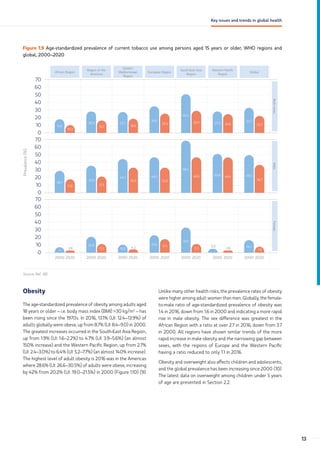
Globally, the age-standardized prevalence of current tobacco
use among persons aged 15 years or older has declined by
over 30% – from 32.7% in 2000 to 22.3% in 2020 (Figure 1.9).
With one of the greatest decline of over 40%, the South-East
Asia Region nevertheless had the highest prevalence of tobacco
use (29.6%) in 2020, whereas the African Region and the
Region of the Americas had the lowest prevalences at 10.3%
and 16.3%, respectively, in 2020. Progress was slowest in the
Western Pacific Region where the decline was only 11.8% from
a prevalence of 27.9% in 2000 to 24.6% in 2020 (8).
The Global Action Plan for Prevention and Control of NCDs has
set a target to reduce the current tobacco use prevalence by
30% between 2010 and 2025. Notwithstanding the progress
made in many parts of the world since 2000, the rate of
reduction in the prevalence has slowed in 2010–2020 compared
to 2000–2010. Globally, the current tobacco use prevalence
dropped only by 16.5% between 2010 and 2020, falling much
short of the target of the 30% reduction by 2025. If the trend
continues, the likelihood of meeting this target is lowest in
Western Pacific with only a 5.7% reduction between 2010 and
2020. In contrast, the regions of Africa, Americas and South-
East Asia have a better chance meeting the target by 2025,
each having experienced about 23% reduction in 2010–2020.
The age-standardized current tobacco use prevalence was
higher among men than among women across the world.
The male-to-female ratio at global level was 4.7 in 2020, rising
from 3.0 in 2000 and indicating a slower reduction among
men compared to women. The lack of progress among men
in relative terms was observed in all WHO regions, except
for Europe where the ratio dropped slightly from over 2 in
2000 to 1.9 in 2020 – a level that was lowest among all six
WHO regions. The ratio remained highest in Western Pacific
Region throughout the two decades, rising from 10.2 in 2000
to 16.6 in 2020.
12
World health statistics 2023 – Monitoring health for the SDGs
Figure 1.9 Age-standardized prevalence of current tobacco use among persons aged 15 years or older, WHO regions and
global, 2000–2020
2000 2020
African Region
Region of the
Americas
Eastern
Mediterranean
Region
European Region
South-East Asia
Region
Western Pacific
Region
Global
Female
0
20
10
50
40
30
60
70
Male
0
20
10
50
40
30
60
70
Both
sexes
0
20
10
50
40
30
60
70
Prevalence
(%)
7.1
2.8
20.6
11.3 10.2 4.2
22.6 17.4
32.5
11.3
5.0
2.8
16.2
7.8
2000 2020 2000 2020 2000 2020 2000 2020 2000 2020 2000 2020
17.9
10.3
28.0
16.3
27.2
18.6
34.6
25.3
50.4
29.0 27.9 24.6
32.7
22.3
28.7
17.8
35.5
21.3
44.1
33.0
46.5
32.9
68.2
46.6 50.8 46.4 49.3
36.7
Source: Ref. (8).
Obesity
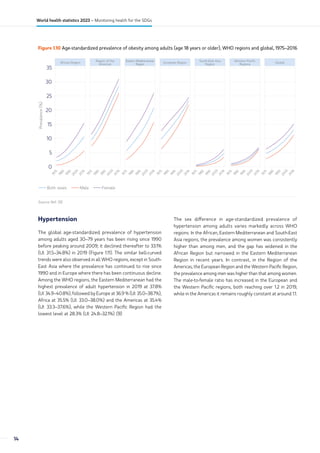
The age-standardized prevalence of obesity among adults aged
18 years or older – i.e. body mass index (BMI) 30 kg/m2
– has
been rising since the 1970s. In 2016, 13.1% (UI: 12.4–13.9%) of
adults globally were obese, up from 8.7% (UI: 8.4–9.0) in 2000.
The greatest increases occurred in the South-East Asia Region,
up from 1.9% (UI: 1.6–2.2%) to 4.7% (UI: 3.9–5.6%) (an almost
150% increase) and the Western Pacific Region, up from 2.7%
(UI: 2.4–3.0%) to 6.4% (UI: 5.2–7.7%) (an almost 140% increase).
The highest level of adult obesity is 2016 was in the Americas
where 28.6% (UI: 26.6–30.5%) of adults were obese, increasing
by 42% from 20.2% (UI: 19.0–21.5%) in 2000 (Figure 1.10) (9).
Unlike many other health risks, the prevalence rates of obesity
were higher among adult women than men. Globally, the female-
to-male ratio of age-standardized prevalence of obesity was
1.4 in 2016, down from 1.6 in 2000 and indicating a more rapid
rise in male obesity. The sex difference was greatest in the
African Region with a ratio at over 2.7 in 2016, down from 3.7
in 2000. All regions have shown similar trends of the more
rapid increase in male obesity and the narrowing gap between
sexes, with the regions of Europe and the Western Pacific
having a ratio reduced to only 1.1 in 2016.
Obesity and overweight also affects children and adolescents,
and the global prevalence has been increasing since 2000 (10).
The latest data on overweight among children under 5 years
of age are presented in Section 2.2.
13
Key issues and trends in global health
Figure 1.10 Age-standardized prevalence of obesity among adults (age 18 years or older), WHO regions and global, 1975–2016
Both sexes Male Female
0
15
10
5
20
25
35
30
1
9
7
5
1
9
8
5
1
9
9
5
2
0
0
5
2
0
1
6
African Region
1
9
7
5
1
9
8
5
1
9
9
5
2
0
0
5
2
0
1
6
Region of the
Americas
1
9
7
5
1
9
8
5
1
9
9
5
2
0
0
5
2
0
1
6
Eastern Mediterranean
Region
1
9
7
5
1
9
8
5
1
9
9
5
2
0
0
5
2
0
1
6
European Region
1
9
7
5
1
9
8
5
1
9
9
5
2
0
0
5
2
0
1
6
South-East Asia
Region
1
9
7
5
1
9
8
5
1
9
9
5
2
0
0
5
2
0
1
6
Western Pacific
Regiona
1
9
7
5
1
9
8
5
1
9
9
5
2
0
0
5
2
0
1
6
Global
Prevalence
(%)
Source: Ref. (9).
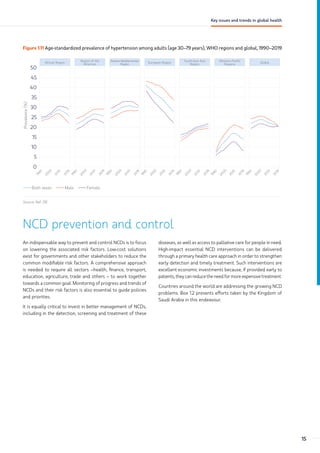
Hypertension
The global age-standardized prevalence of hypertension
among adults aged 30–79 years has been rising since 1990
before peaking around 2009; it declined thereafter to 33.1%
(UI: 31.5–34.8%) in 2019 (Figure 1.11). The similar bell-curved
trends were also observed in all WHO regions, except in South-
East Asia where the prevalence has continued to rise since
1990 and in Europe where there has been continuous decline.
Among the WHO regions, the Eastern Mediterranean had the
highest prevalence of adult hypertension in 2019 at 37.8%
(UI: 34.9–40.8%), followed by Europe at 36.9 % (UI: 35.0–38.7%),
Africa at 35.5% (UI: 33.0–38.0%) and the Americas at 35.4%
(UI: 33.3–37.6%), while the Western Pacific Region had the
lowest level at 28.3% (UI: 24.8–32.1%) (9).
The sex difference in age-standardized prevalence of
hypertension among adults varies markedly across WHO
regions. In the African, Eastern Mediterranean and South-East
Asia regions, the prevalence among women was consistently
higher than among men, and the gap has widened in the
African Region but narrowed in the Eastern Mediterranean
Region in recent years. In contrast, in the Region of the
Americas, the European Region and the Western Pacific Region,
the prevalence among men was higher than that among women.
The male-to-female ratio has increased in the European and
the Western Pacific regions, both reaching over 1.2 in 2019,
while in the Americas it remains roughly constant at around 1.1.
14
World health statistics 2023 – Monitoring health for the SDGs
Figure 1.11 Age-standardized prevalence of hypertension among adults (age 30–79 years), WHO regions and global, 1990–2019
Prevalence
(%)
0
20
15
10
5
30
25
40
35
50
45
1
9
9
0
2
0
0
0
2
0
1
0
2
0
1
9
1
9
9
0
2
0
0
0
2
0
1
0
2
0
1
9
1
9
9
0
2
0
0
0
2
0
1
0
2
0
1
9
1
9
9
0
2
0
0
0
2
0
1
0
2
0
1
9
1
9
9
0
2
0
0
0
2
0
1
0
2
0
1
9
1
9
9
0
2
0
0
0
2
0
1
0
2
0
1
9
1
9
9
0
2
0
0
0
2
0
1
0
2
0
1
9
Both sexes Male Female
African Region
Region of the
Americas
Eastern Mediterranean
Region
European Region
South-East Asia
Region
Western Pacific
Regiona
Global
Source: Ref. (9).
NCD prevention and control
An indispensable way to prevent and control NCDs is to focus
on lowering the associated risk factors. Low-cost solutions
exist for governments and other stakeholders to reduce the
common modifiable risk factors. A comprehensive approach
is needed to require all sectors –health, finance, transport,
education, agriculture, trade and others – to work together
towards a common goal. Monitoring of progress and trends of
NCDs and their risk factors is also essential to guide policies
and priorities.
It is equally critical to invest in better management of NCDs,
including in the detection, screening and treatment of these
diseases, as well as access to palliative care for people in need.
High-impact essential NCD interventions can be delivered
through a primary health care approach in order to strengthen
early detection and timely treatment. Such interventions are
excellent economic investments because, if provided early to
patients, they can reduce the need for more expensive treatment.
Countries around the world are addressing the growing NCD
problems. Box 1.2 presents efforts taken by the Kingdom of
Saudi Arabia in this endeavour.
15
Key issues and trends in global health
•
Box 1.2 Countering noncommunicable diseases in Saudi Arabia
1 Global health estimates 2019: deaths by cause, age, sex, by country and by region, 2000–2019. Geneva: World Health Organization; 2020 (https://www.who.int/data/gho/
data/themes/mortality-and-global-health-estimates, accessed 15 April 2023).
2 Global health estimates 2019: disease burden by cause, age, sex, by country and by region, 2000–2019. Geneva: World Health Organization; 2020 (https://www.who.int/
data/gho/data/themes/mortality-and-global-health-estimates/global-health-estimates-leading-causes-of-dalys, accessed 15 April 2023)
3 Vision 2030. Kingdom of Saudi Arabia (https://www.vision2030.gov.sa/v2030/overview/vibrant-society/, accessed 15 April 2023).
4 WHO Framework Convention on Tobacco Control. Geneva: World Health Organization; 2005 (https://fctc.who.int/who-fctc/overview, accessed 14 April 2023).
5 Alghamdi A, Fallatah A, Okal F, Felemban T, Eldigire M, Almodaimegh H. Smoking behaviour after enforcement of a 100% tax on tobacco products in Saudi Arabia: a cross-
sectional study. East Mediterr Heal J. 2020;26(1):39–46. doi:10.26719/2020.26.1.39.
6 Tobacco control laws. Legislation by country – Saudi Arabia (www.tobaccocontrollaws.org/legislation/country/saudi-arabia/summary, accessed 14 April 2023).
7 Kingdom of Saudi Arabia: inclusion of sugar sweetened beverages and other tobacco products in the Excise Tax System. PwC Middle East; 2019 (https://www.pwc.com/
m1/en/tax/documents/2019/ksa-inclusion-of-sugar-beverages-and-tobacco-products-in-the-ets.pdf, accessed 14 April 2023).
8 WHO global report on sodium intake reduction. Geneva: World Health Organization; 2023.
9 WHO announces certification programme for trans-fat elimination. Press release. Geneva: World Health Organization; 2020 (https://www.who.int/news/item/17-11-2020-
who-announces-certification-programme-for-trans-fat-elimination, accessed 14 April 2023).
10 ‫حلمل‬ ‫يف‬ ‫زبخلا‬ ‫اقبط‬ ‫ةحئالل‬ ‫ةينفلا‬ ‫ةيدوعسلا‬ ‫ليلد‬ ‫يداشرا‬ ‫يعنصمل‬ ‫يدروتسمو‬ ‫زبخلا‬ ‫صوصخب‬ ‫مازلإلا‬ ‫ليلقتب‬
SFDAFD 2018/2362 [Guidelines for salt reduction in bread]. Riyadh: Government of the Kingdom of Saudi Arabia; 2018 (https://extranet.who.int/nutrition/gina/en/
node/41573, accessed 28 April 2023).
11 Itumalla R, Aldhmadi B. Combating tobacco use in Saudi Arabia: a review of recent initiatives. East Mediterr Heal J. 2020;26(7):858–63. doi:10.26719/emhj.20.019.
12 Gosadi IM, Alshehri MA, Alawad SH. Do healthier foods cost more in Saudi Arabia than less healthier options? Saudi Med J. 2016;37(9):1015–21. doi:10.15537/smj.2016.9.14077.
13 Saudi Arabia is actively engaged with WHO for data exchange and estimation of various health-related indicators. This commitment will be reflected in forthcoming estimates.
Like most countries in the world, Saudi Arabia has seen
rising incidence and prevalence of NCDs. Consequently,
NCDs have become the leading causes of mortality
and disability in the country,1,2
challenging not only
population health but also the country’s health care and
sustainable development.
To counter the rising burden of NCDs, Saudi Arabia has
made tremendous progress in its health-care system and
in advancing the prevention and control of NCDs over
the past few years. There is strong political commitment
towards tackling NCDs through multisectoral
collaboration and coordination as an integral part of the
country’s Vision 2030 agenda to increase life expectancy
to 80 years by 2030.3
With the aim of reducing both
mortality and morbidity by 5% in 10 years, more specific
goals were set in the National Executive Plan for NCDs
(2010– 2020) and its updated version for 2014–2025.
The goals include scaling up monitoring and prevention
of NCDs, providing quality health services for NCD
treatment, promoting sports activities, substantially
reducing air pollution, and expanding NCD research.
Along with the aim to improve NCD treatment through
primary health care and universal health coverage, Saudi
Arabia also has initiated several strategic interventions
and programmes to promote the prevention of health
risks. For instance, the country has had a tobacco control
programme since 2002, was one of the first countries
to ratify the WHO Framework Convention on Tobacco
Control (FCTC) in 2005 and was awarded the WHO
Tobacco Control Medal in 2019.4
Currently, Saudi Arabia
is a best-practice country in three out of six MPOWER
policies, including offering help to quit tobacco use,
warning about the dangers of tobacco, and enforcing
bans on advertising, promotion and sponsorship.
In addition, Saudi Arabia has made remarkable progress
in monitoring tobacco use through implementation of
Global Adult Tobacco Survey as well as Global Youth
Tobacco Survey in recent years. It is the first country in
the Eastern Mediterranean Region to implement plain
packaging of tobacco products. In December 2022,
the Saudi Food  Drug Authority was accredited as a
WHO Collaborating Centre. The country’s tobacco control
regulations include an anti-smoking law, a 100% excise
taxation, and prohibition of smoking in public areas and
advertising and promotion of tobacco.5,6
Furthermore, the National Diet and Physical Activity
Strategy (2014–2025) was implemented – together with
several campaigns within and beyond the Vision 2030
framework – in order to lower the rate of overweight
and obesity to 40%, to increase the rate of vegetable
and fruit consumption to 20% and to stabilize the
prevalence of diabetes. For instance, educational lectures
were held, training manuals were published on physical
activity, and awareness campaigns focused on mass media
outlets to improve physical activity, particularly among
the young. Furthermore, Saudi Arabia requires calorie
levels to be displayed on restaurant and café menus
and has imposed a 50% excise tax on sugar-sweetened
beverages and a 100% tax on energy drinks since 2019.7
Saudi Arabia is also a best-practice country for sodium
reduction and trans-fat elimination policies to tackle
NCDs. It is one of nine countries to have reached the
highest level of implementation of sodium reduction
policies and one of 14 countries to qualify for WHO’s
certification programme for trans-fat elimination.8,9
The
country has mandatory policies to enforce a limit of
sodium content in food items, implementing all WHO
sodium-related best-buys, limiting trans-fat content in
foods and oils, and requiring the labelling of sodium and
trans-fat content on pre-packaged foods.8,10
Through these policies, the country has created
incentives for healthier lifestyles and has seen promising
improvements. There was a 213% increase in demand
from people seeking help to give up smoking and a 43.1%
decrease in tobacco imports into the country.11
Healthy
foods are now more affordable than unhealthy foods.12
These are just some highlights of the numerous actions
that Saudi Arabia is undertaking, and needs to take,
in order to accelerate progress towards full achievement
of the Vision 2030 agenda.13
16
World health statistics 2023 – Monitoring health for the SDGs
•
1.3 Assessing the impact of
the COVID-19 pandemic,
2020–2021
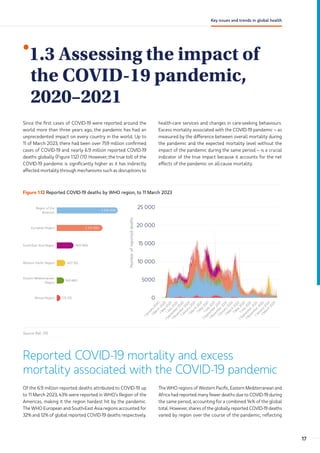
Since the first cases of COVID-19 were reported around the
world more than three years ago, the pandemic has had an
unprecedented impact on every country in the world. Up to
11 of March 2023, there had been over 759 million confirmed
cases of COVID-19 and nearly 6.9 million reported COVID-19
deaths globally (Figure 1.12) (11). However, the true toll of the
COVID-19 pandemic is significantly higher as it has indirectly
affected mortality through mechanisms such as disruptions to
health-care services and changes in care-seeking behaviours.
Excess mortality associated with the COVID-19 pandemic – as
measured by the difference between overall mortality during
the pandemic and the expected mortality level without the
impact of the pandemic during the same period – is a crucial
indicator of the true impact because it accounts for the net
effects of the pandemic on all-cause mortality.
Figure 1.12 Reported COVID-19 deaths by WHO region, to 11 March 2023
Eastern Mediterranean
Region
349 680
Western Pacific Region 407 355
South-East Asia Region 803 904
European Region 2 201 892
Region of the
Americas
2 936 906
African Region 175 315
1
M
a
y
2
0
2
2
0
5000
10 000
15 000
20 000
25 000
Number
of
reported
deaths
1
J
a
n
u
a
r
y
2
0
2
0
1
M
a
r
c
h
2
0
2
0
1
M
a
y
2
0
2
0
1
J
u
l
y
2
0
2
0
1
S
e
p
t
e
m
b
e
r
2
0
2
0
1
N
o
v
e
m
b
e
r
2
0
2
0
1
J
a
n
u
a
r
y
2
0
2
1
1
M
a
r
c
h
2
0
2
1
1
M
a
y
2
0
2
1
1
J
u
l
y
2
0
2
1
1
S
e
p
t
e
m
b
e
r
2
0
2
1
1
N
o
v
e
m
b
e
r
2
0
2
1
1
J
a
n
u
a
r
y
2
0
2
2
1
M
a
r
c
h
2
0
2
2
1
J
u
l
y
2
0
2
2
1
S
e
p
t
e
m
b
e
r
2
0
2
2
1
N
o
v
e
m
b
e
r
2
0
2
2
1
J
a
n
u
a
r
y
2
0
2
3
1
M
a
r
c
h
2
0
2
3
Source: Ref. (11).
Reported COVID-19 mortality and excess
mortality associated with the COVID-19 pandemic
Of the 6.9 million reported deaths attributed to COVID-19 up
to 11 March 2023, 43% were reported in WHO’s Region of the
Americas, making it the region hardest hit by the pandemic.
The WHO European and South-East Asia regions accounted for
32% and 12% of global reported COVID-19 deaths respectively.
The WHO regions of Western Pacific, Eastern Mediterranean and
Africa had reported many fewer deaths due to COVID-19 during
the same period, accounting for a combined 14% of the global
total. However, shares of the globally reported COVID-19 deaths
varied by region over the course of the pandemic, reflecting
17
Key issues and trends in global health
the spread of the disease, the various approaches the regions
and the countries took to curb the pandemic, the availability
of vaccines and disparities between countries, differences and
changes in testing regimes and policies, the evolving practices
in assignment of underlying causes of deaths, and the changing
nature of the COVID-19 virus.
Nevertheless, reported deaths due to COVID-19 generally
underestimate the true toll of the impact of COVID-19 on
human mortality. Over the past two years, WHO has undertaken
a monumental effort to collate all available information on
reported all-cause mortality by week and month both during
and before the pandemic. The Organization also collated data
and other relevant information on the COVID-19 pandemic itself
as well as the relevant epidemiological situation of populations
around the world to produce for its Member States the most
comprehensive assessment of the impact of the COVID-19
pandemic on mortality by sex and age for 2020 and 2021 (12,13).
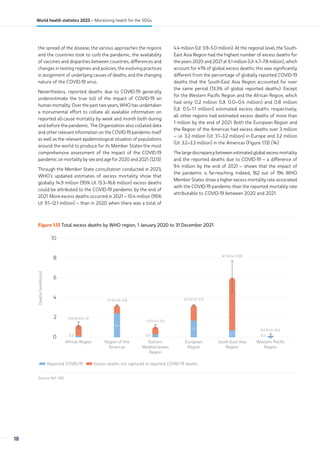
Through the Member State consultation conducted in 2023,
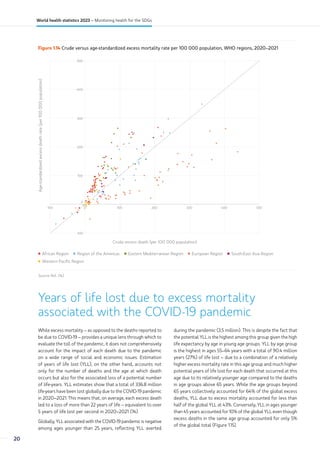
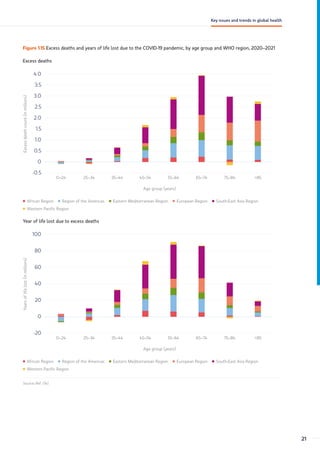
WHO’s updated estimates of excess mortality show that
globally 14.9 million (95% UI: 13.3–16.6 million) excess deaths
could be attributed to the COVID-19 pandemic by the end of
2021. More excess deaths occurred in 2021 – 10.4 million (95%
UI: 9.1–12.1 million) – than in 2020 when there was a total of
4.4 million (UI: 3.9–5.0 million). At the regional level, the South-
East Asia Region had the highest number of excess deaths for
the years 2020 and 2021 at 6.1 million (UI: 4.7–7.8 million), which
account for 41% of global excess deaths; this was significantly
different from the percentage of globally reported COVID-19
deaths that the South-East Asia Region accounted for over
the same period (13.3% of global reported deaths). Except
for the Western Pacific Region and the African Region, which
had only 0.2 million (UI: 0.0–0.4 million) and 0.8 million
(UI: 0.5–1.1 million) estimated excess deaths respectively,
all other regions had estimated excess deaths of more than
1 million by the end of 2021. Both the European Region and
the Region of the Americas had excess deaths over 3 million
– i.e. 3.2 million (UI: 3.1–3.2 million) in Europe and 3.2 million
(UI: 3.2–3.3 million) in the Americas (Figure 1.13) (14).
The large discrepancy between estimated global excess mortality
and the reported deaths due to COVID-19 – a difference of
9.4 million by the end of 2021 – shows that the impact of
the pandemic is far-reaching. Indeed, 162 out of 194 WHO
Member States show a higher excess mortality rate associated
with the COVID-19 pandemic than the reported mortality rate
attributable to COVID-19 between 2020 and 2021.
Figure 1.13 Total excess deaths by WHO region, 1 January 2020 to 31 December 2021
0
2
4
6
8
10
Deaths
(inmillions)
Reported COVID-19 Excess deaths not captured in reported COVID-19 deaths
African Region Region of the
Americas
Eastern
Mediterranean
Region
European
Region
South-East Asia
Region
Western Pacific
Region
0.8 (UI 0.5–1.1)
0.2
2,4
3.2 (UI 3.2–3.3)
0.3
1.3 (UI 1.1–1.5)
1.7
3.2 (UI 3.1–3.2)
0.7
6.1 (UI 4.7–7.8)
0.2
0.2 (UI 0–0.4)
Source: Ref. (14).
18
World health statistics 2023 – Monitoring health for the SDGs
Age and sex distributions in the excess
mortality associated with the COVID-19
pandemic
While a total of 14.9 million estimated excess deaths was
associated with the COVID-19 pandemic between 2020 and
2021, the age distribution of the COVID-19-related excess
mortality shows that the pandemic disproportionally affected
the age group of 45 years and above (14.2 million or 95% of
the global excess deaths). While 0.7 million excess deaths
were observed in the age group of 25–44 years (5% of the
global excess deaths), fewer deaths than expected (about
37 000 fewer deaths) were estimated to have occurred
among people under the age of 25 years. An estimated 31%
of the global excess deaths occurred in ages between 45 and
64 years (i.e. 4.6 million). Similarly, 46% of global excess deaths
(i.e. 6.8 million) occurred between 65 and 84 years. The oldest
age group, 85 years and above, accounted for 18% of excess
deaths globally (i.e. 2.7 million) (14).
Partly influenced by differences in population structure, there
was a visible heterogeneity in the percentage of excess deaths
by age group in the six WHO regions. The percentage of
excess deaths that occurred in ages 65 years and above was
above 50% of all excess deaths in the African Region (54%),
the Region of the Americas (63%), the Eastern Mediterranean
Region (59%), the South-East Region (61%), and 80% in the
European Region. In the Western Pacific Region, excess deaths
were concentrated in the age group 45–64 and above 85 years.
For the age group below 45 years, the African Region and
the Western Pacific Region had fewer deaths than expected,
compared to the other four regions where the percentage of
excess deaths ranged between 3% and 7%.
Globally, excess deaths among women accounted for about
44% of the global excess deaths for 2020 and 2021 combined.
In terms of crude excess mortality rate, men had a slightly
higher rate at 209.6 per 100 000, while women’s excess
mortality rate was at 170.1 per 100 000. However, much of
the difference between men and women lies in the age-specific
excess mortality rates. Globally, age-specific excess mortality
rates among the male population are consistently higher than
among the female population in all age groups. Above the
age of 25 years, the ratio of the age-specific excess mortality
rate between men and women ranges between 1.5 in ages
65–74 years to 2.0 in the age group 25–34 years. However,
ages below 25 years, the excess mortality rate is -0.9 per
100 000 for boys and young men, while the excess mortality
rate for girls and young women in the same age group is 1.4
per 100 000.
Across WHO regions, there is a much higher level of
heterogeneity in the ratios of age-specific excess mortality
between male and female populations. These range from -45.4
in age group 0–24 years in the African Region – where the
excess mortality rate was -0.1 per 100 000 among girls and
young women and 4.3 per 100 000 among boys and young
men – to 62.8 in the age group 35–44 years in the Western
Pacific Region where the excess mortality rate was 0.2 per
100 000 among women and 11.2 per 100 000 among men.
In 40 out of the 48 WHO region and age group combinations,
excess mortality rates among the male population were higher
than those of the female population.
While the crude excess mortality rate, as calculated by dividing
the total number of excess deaths by the total person-years
of exposure between 2020 and 2021, provides an informative
summary measure of the magnitude of mortality brought about
by the COVID-19 pandemic. This calculation masks the impact
that the population structure has on the overall mortality
rate – for instance, countries with older population structures
might have a higher excess mortality rate because COVID-19
disproportionately affects the populations that are frailer
and in older age groups. Seventy-five of WHO’s 194 Member
States have a crude excess mortality rate higher than the age-
standardized excess mortality rate, indicating a much older
population structure. These countries come predominantly
from the Region of Americas and the European Region. Forty-
six of the 53 Member States in the European Region have an
age-standardized excess mortality rate lower than the crude
excess mortality rate. In the Region of the Americas, 15 of
the 35 Member States have seen an age-standardized excess
mortality rate lower than the crude excess mortality rate.
On the other hand, few countries in the African Region and
the Eastern Mediterranean Region (only 1 and 2 respectively)
have seen crude excess mortality rates higher than the age-
standardized values (Figure 1.14).
19
Key issues and trends in global health
Figure 1.14 Crude versus age-standardized excess mortality rate per 100 000 population, WHO regions, 2020–2021
-100
0
100
200
300
400
500
-100 0 100 200 300 400 500
African Region Region of the Americas Eastern Mediterranean Region European Region South-East Asia Region
Western Pacific Region
Age-standardized
excess
death
rate
(per
100
000
population)
Crude excess death (per 100 000 population)
Source: Ref. (14).
Years of life lost due to excess mortality
associated with the COVID-19 pandemic
While excess mortality – as opposed to the deaths reported to
be due to COVID-19 – provides a unique lens through which to
evaluate the toll of the pandemic, it does not comprehensively
account for the impact of each death due to the pandemic
on a wide range of social and economic issues. Estimation
of years of life lost (YLL), on the other hand, accounts not
only for the number of deaths and the age at which death
occurs but also for the associated loss of a potential number
of life‑years. YLL estimates show that a total of 336.8 million
life‑years have been lost globally due to the COVID-19 pandemic
in 2020–2021. This means that, on average, each excess death
led to a loss of more than 22 years of life – equivalent to over
5 years of life lost per second in 2020–2021 (14).
Globally, YLL associated with the COVID-19 pandemic is negative
among ages younger than 25 years, reflecting YLL averted
during the pandemic (3.5 million). This is despite the fact that
the potential YLL is the highest among this group given the high
life expectancy by age in young age groups. YLL by age group
is the highest in ages 55–64 years with a total of 90.4 million
years (27%) of life lost – due to a combination of a relatively
higher excess mortality rate in this age group and much higher
potential years of life lost for each death that occurred at this
age due to its relatively younger age compared to the deaths
in age groups above 65 years. While the age groups beyond
65 years collectively accounted for 64% of the global excess
deaths, YLL due to excess mortality accounted for less than
half of the global YLL at 43%. Conversely, YLL in ages younger
than 45 years accounted for 10% of the global YLL even though
excess deaths in the same age group accounted for only 5%
of the global total (Figure 1.15).
20
World health statistics 2023 – Monitoring health for the SDGs
Figure 1.15 Excess deaths and years of life lost due to the COVID-19 pandemic, by age group and WHO region, 2020–2021
Excess deaths
-0.5
0
1.0
0.5
2.0
3.0
4.0
1.5
2.5
3.5
Excess
death
count
(in
millions)
0–24 25–34 35–44 45–54 55–64 85
75–84
65–74
Age group (years)
African Region Region of the Americas Eastern Mediterranean Region European Region South-East Asia Region
Western Pacific Region
Year of life lost due to excess deaths
-20
0
20
60
100
40
80
Years
of
life
lost
(in
millions)
0–24 25–34 35–44 45–54 55–64 85
75–84
65–74
African Region Region of the Americas Eastern Mediterranean Region European Region South-East Asia Region
Western Pacific Region
Age group (years)
Source: Ref. (14).
21
Key issues and trends in global health
Globally, men have lost a total of 196.9 million life-years – 42%
more than women who lost 140.0 million life-years. The age
distribution of YLL is similar among men and women at the
global level where YLL in age groups between 45 and 74 years
account for around 70% of total YLL for both men and women.
YLL in the oldest ages above 75 years among women are
proportionally much higher at 21%, compared to just 15% for
men, reflecting a higher probability of survival to ages beyond
75 years and a lower level of mortality – both excess mortality
and background mortality due to other causes – among women.
The Region of the Americas, European Region and South-East
Asia Region each accounted for over 15% of the global YLL due
to excess mortality at 21%, 17% and 44%, respectively. Thus,
278.8 million life-years have been lost due to the pandemic in
these three regions alone. More YLL due to excess mortality
occurred among men in all WHO regions. However, the ratio
of YLL among men relative to women was more than 1.5 in the
Western Pacific Region, in the Region of Americas and in the
Eastern Mediterranean Region, while it is less than 1.3 in the
other regions. The age distribution of YLL by sex is remarkably
similar between the regions, as we observe at the global level,
except in the Western Pacific Region where men and women
in the age groups between 75 and 84 years saw negative YLL.
Nonfatal impacts of COVID-19
This report, in addition to many similar studies at national,
regional and global levels, aims to provide a detailed portrayal
of the impact of the COVID-19 pandemic on human mortality
in various dimensions. However, much less comprehensive
research and analysis have been done to disentangle the
long-lasting impact of nonfatal outcomes among people who
have been infected by the COVID-19 virus. Commonly known as
long COVID, the post-COVID-19 condition refers to the various
mid- and long-term symptoms that approximately 10–20% of
people experience after recovering from their initial COVID-19
illness (15). Such symptoms, including cognitive dysfunction
and fatigue, can have a significant, and in some cases severe,
impact on one’s daily life and productivity.
Given the emergent nature of the post-COVID-19 condition
and the complexity of its symptoms, no specific treatment
regimen is yet available. More research needs to be done in
the coming years to assess the underlying mechanisms of such
symptoms and the true disease burden associated with the
nonfatal outcome of long COVID. Until then, it is important to
stress the importance of public health interventions to prevent
COVID-19 infections and its associated post-acute sequalae.
COVID-19 vaccines and associated inequality
The COVID-19 pandemic has exposed inequalities both between
and within countries, including inequalities in access to COVID-19
vaccines. As of March 2023, about 13 billion doses of COVID-19
vaccines had been administered globally. However, vaccination
coverage vary greatly by country (11).
The Global COVID-19 Trends and Impact Survey conducted
by the University of Maryland Social Data Science Center
in partnership with Facebook, collected data on COVID-19
vaccination indicators as well as educational status (16).
This survey is subject to several limitations, including inability
to reach people who are not Facebook users, sampling and
weighting issues, response bias and missing data. The estimates
shown here are not official WHO estimates and are not directly
comparable with official estimates.
Across all countries, self-reported receipt of COVID-19 vaccine
was higher among those with more education. As of December
2021, still in the early stages in terms of the availability of
COVID-19 vaccines, the median level of vaccination across
90 countries among population groups with educational levels
above secondary education was 79.1% (UI: 75.6–82.4%). This was
higher than the median level of vaccination among groups
with secondary education which was 71.4% (UI: 67.4–76.1%) or
groups with no or primary education at 67.7% (UI: 60.0–73.0%).
This stepwise pattern was also evident across high-income
countries (HICs) where median vaccination levels across the
most-to-least educated groups were 87.4% (UI: 83.4–89.0%),
83.8% (UI: 78.8–86.0%) and 81.0% (UI: 78.3–87.1%), respectively,
and across upper-middle-income countries (UMICs) where
median vaccination levels across the most-to-least educated
groups were 75.5% (UI: 68.1–82.1%), 66.7% (UI: 58.8–73.9%) and
57.6% (UI: 52.5–72.3%), respectively. In low-income countries
(LICs) and lower-middle-income countries (LMICs), the median
self-reported receipt of a COVID-19 vaccine was higher among
the most educated group at 63.9% (UI: 53.0–75.6%) and equally
low in the two less educated groups (51%) (17).
Populations in LICs and LMICs were more likely to report
experiencing a structural barrier to vaccination [median across
28 countries: 34.6% (UI: 29.3–38.9)] – such as not meeting
eligibility requirements, availability or accessibility issues or
lack of information – than populations in UMICs [median
across 29 countries: 24.0% (UI: 21.5–29.9)] or populations in
HICs [median across 33 countries: 15.0% (UI: 14.1–17.1)].
Among unvaccinated populations, vaccine hesitancy was lower
in HICs than in UMICs, LMICs and LICs. However, vaccine
22
World health statistics 2023 – Monitoring health for the SDGs
refusal was highest in HICs. Within HICs, vaccine refusal was
higher among those with more than secondary education at
50.7% (UI: 40.5–60.7%) compared to those with no or primary
education at 42.8% (UI: 31.2–49.0%). Vaccine hesitancy in HICs,
however, was more prevalent among those with no or primary
education at 38.8% (UI: 35.5–41.4%) compared to those with
more than secondary education at 33.1% (UI: 31.4–36.2%).
COVID-19 and global health in the coming
decades
With millions of excess deaths attributed to the pandemic
globally thus far, COVID-19 stands out as one of the most
devasting pandemics in history, and certainly in recent memory.
This pandemic highlights the critical importance of early
detection and swift response at the global level to contain
the rapid spread of the virus. To improve a country’s ability in
detection and response, sustained investment in public health
infrastructure and preparedness in every country in the world
is required in order to protect global health. The pandemic also
demonstrated the importance of a strong health-care system
and universal health-care coverage among countries. For most
regions, the level of essential service coverage is negatively
associated with lower age-standardized excess mortality rates
associated with the COVID-19 pandemic, as was particularly
evident among countries of the European and Western Pacific
regions. This is evidence that countries that are better equipped
and better staffed are well positioned to weather the pandemic
and to minimize the mortality toll.
The COVID-19 pandemic also shows how critical close
collaboration between countries – with international
coordination led by key institutions such as (and particularly)
WHO – is in addressing significant global health threats
within countries and across national borders. Furthermore,
well-coordinated cooperation among regions and countries,
and between private and public sectors, helps to ensure
equitable distribution of vaccines, sharing of critical information,
and distribution of medicines and medical equipment among
countries for those in critical need.
The COVID-19 pandemic has highlighted the inequality of
access to health-care systems, especially among vulnerable
populations and in developing nations. In addition, the pandemic
exposed inequality in health emergency preparedness around
the world. Much needs to be done, and urgently, by countries
and the international community to make sure that more
people around the globe have access to health-care services
and are protected from health emergencies so that they may
enjoy healthier lives.
23
Key issues and trends in global health
•
1.4 Climate change
and health
Climate change is one of the greatest health challenges
of the 21st century. As climatic conditions change, we are
witnessing more frequent and intensifying weather and climate
events, such as storms, extreme heat, floods, droughts and
wildfires. These weather and climate hazards affect health
both directly and indirectly, increasing the risk of deaths, NCDs,
the emergence and spread of infectious diseases, and health
emergencies. Climate change is also having an impact on our
health workforce and infrastructure, reducing capacity to
provide UHC. More fundamentally, climate shocks and growing
stresses such as changing temperature and precipitation
patterns, drought, floods and rising sea levels degrade the
environmental and social determinants of physical and mental
health. All aspects of health are affected by climate change –
from clean air, water and soil to food systems and livelihoods.
Further delay in tackling climate change will increase health
risks, undermine decades of improvements in global health,
and contravene our collective commitments to ensure the
human right to health for all.
Current and future health risks of
climate change
The Sixth Assessment Report of the Intergovernmental Panel
on Climate Change estimates that up to 3.6 billion people
around the globe live in contexts that are highly vulnerable
to the impacts of climate change (18). Low-income and lower-
middle-income countries and small island developing states face
the greatest health consequences of climate change, despite
contributing the least to historical global emissions (18,19). It is
estimated that, over the past decade, floods, droughts and
storms were 15 times more lethal in highly vulnerable regions
than in regions with low vulnerability (18).
Within countries there can also be large disparities in those
most vulnerable to the impacts of climate change. Populations
living in poverty, the elderly, women, children, indigenous
peoples, outdoor workers, the socially isolated and persons
with pre-existing medical conditions are typically at highest risk.
Approximately 2 billion people lack access to safe drinking-water
(see section 2.4 on Environmental risks) (20). Furthermore,
there are some 600 million cases of foodborne illness globally.
Children under 5 years of age carry 40% of the burden of
foodborne diseases, resulting in 125 000 child deaths every year
(21). Extreme weather events and climate-related environmental
stressors degrade water and soil safety, increasing the risks
of waterborne and foodborne illnesses.
It is estimated that in 2020, between 720 and 811 million
people faced hunger, primarily in Africa and Asia (21). Higher
temperatures, rising sea levels and flooding affect all aspects
of food and nutrition security. Climate-related reductions in
agricultural and marine productivity, biodiversity loss, volatility
in food prices and disruptions in food imports further affect
the quality, quantity and diversity of food consumed, leading
to further food and nutrition crises.
Changing temperature and precipitation patterns are also
increasing the suitability of conditions for the transmission
of mosquito-borne, tick-borne and rodent-borne diseases in
many regions. If prevention methods are not strengthened,
this could lead to an increase in the over 700 000 deaths
from vector-borne diseases each year (22).
Acute mental health conditions such as anxiety, depression and
post-traumatic stress can be experienced following extreme
weather events. The cumulative effect of loss of livelihood,
displacement, disrupted social cohesion and uncertainty from
climate change can also result in longer-term mental health
disorders (23), adding to the already large global challenges
in mental health.
Estimating the full health burden of climate change is
challenging. In 2014, WHO together with leading researchers
conducted a quantitative risk assessment of the effects of
climate change on selected causes of death. Under a medium-
high emissions scenario, it was estimated that by 2030 climate
change would cause around 250 000 additional deaths per
year (24). This conservative estimate included only climate-
attributable deaths from malaria, heat exposure in older
persons, undernutrition and diarrhoeal disease in children,
and coastal flood mortality. This assessment recognized that
a main limitation of the findings was the inability of existing
models to account for major causal pathways that influence
a range of health outcomes. By looking at a small subset of
causal pathways, however, the assessment clearly established
24
World health statistics 2023 – Monitoring health for the SDGs
that climate change was projected to have a substantial adverse
impact on future mortality.
Since 2015, WHO, the United Nations Framework Convention
on Climate Change (UNFCCC) Health and Climate Change
Country Profile project has worked with national governments
to produce evidence-based summaries of country-specific
climate hazards and climate-sensitive health risks and to
track policy responses (25). This supports countries in their
efforts to develop locally relevant and actionable information.
Some 80 countries have participated in this project to date.
An increasing number of studies aim to quantify specific health
effects of climate change. Advancements in the application of
detection and attribution studies to health outcomes are also
providing greater insight and confidence into the magnitude
of climate change-related health impacts of extreme weather
events (26).
In terms of estimating the future impact of climate change on
health, Working Group II of the Sixth Assessment Report of the
Intergovernmental Panel on Climate Change, comprehensively
reviewed current evidence and concluded that under a high
emissions scenario there could be over 9 million climate-related
deaths each year by the end of the century (27).
Health response
In 2021, the global mean temperature was 1.11 ± 0.13˚C higher
than pre-industrial levels, with each of the past four decades
warmer than the preceding decade (28,29). Under the 2015
Paris Agreement, countries committed to reduce greenhouse
gas emissions rapidly to limit the global temperature rise to
well below 2.0˚C and preferably to 1.5˚C (30). However, recent
analysis indicates that the world remains off track to achieve
this goal and avert irreversible and catastrophic changes to
our natural and human systems (31).
WHO has identified three objectives for the health response to
this escalating climate crisis. The objectives are described below.
Promote actions that both reduce carbon
emissions and improve health
In order to stay within the 1.5˚C global warming limit set
out in the 2015 Paris climate agreement, the world will
need to drastically reduce emissions through large-scale
transformation across social and economic systems. Several
of the sectors driving greenhouse gas emissions – including
energy, transport, industry, agriculture and waste – are also
sources of harmful air pollutants. In 2019, air pollution caused
approximately 6.7 million deaths globally due to cardiovascular
disease, respiratory illnesses and cancer (see section 2.4
on Environmental risks) (20). Solutions exist to cut carbon
emissions across all the main emitting sectors, but some bring
much larger health gains than others. Health advocacy can
help accelerate those that bring the greatest health benefits,
including a just and inclusive transition to renewable energy,
phasing out coal combustion and fossil fuel subsidy reform.
The associated air quality improvements of this transition could
avoid millions of premature deaths from air pollution (32,33).
Road transport is estimated to account for almost one fifth
of global CO2
emissions in 2019, while the global food system
also contributes 21–37% of greenhouse gas emissions (34).
Sustainable urban planning which promotes a modal shift
towards safe walking and cycling and access to public transport
can lead to health benefits from increased physical activity,
reduced ambient air pollution and lower noise exposure.
In high-income countries, a transition towards plant-based
diets, lower red meat consumption and less food waste offers
an opportunity to mitigate climate change while lowering the
health burden of diet-related noncommunicable diseases.
Sustainable agriculture and food production in low- and
middle-income countries can protect local environments, lower
emissions and promote food and nutrition security.
Health benefits from climate change mitigation save lives,
provide cost-savings for health systems and improved
productivity from a healthier workforce. These economic gains
have been shown to be of the same magnitude as mitigation
costs and in some cases even double the costs of mitigation
(33,35), providing a strong motivation for climate action.
The UNFCCC Paris Agreement and the 2030 Agenda for
Sustainable Development lay out coherent and complementary
goals to reduce global emissions, achieve health for all people
and preserve our natural systems.
Under the Paris Agreement, countries set out their mitigation
commitments and adaptation priorities through their Nationally
Determined Contributions (NDCs) and National Adaptation
Plans (NAPs). The 2023 WHO Review of Health in the NDC
report found that over 90% of countries reflect health priorities
in their NDCs but only 30% identify the health co-benefits of
mitigation action and even fewer (10%) quantify them (36).
Health considerations are an integral part of national and
international climate policies and processes. As such, health
can be a powerful argument to galvanize political and financial
support for accelerated climate action.
25
Key issues and trends in global health
Build better, more climate-resilient and
environmentally sustainable health
systems
Building climate-resilient and sustainable health systems
involves a systematic and comprehensive approach to
strengthening all core functions of a health system so that it
can respond and adapt to the health risks of climate change.
The 2021 WHO Health and Climate Change Global Survey found
that approximately half of countries (48 out of 95) reported
having conducted a climate change and health vulnerability
and adaptation assessment. Fifty-two per cent (49 out of 95)
of countries reported having a national climate change and
health strategy or plan in place (Figure 1.16). However, only a
quarter of those countries (11 out of 46) have reached a “high”
or “very high” level of implementation. Insufficient finance was
a main barrier to implementation of national strategies and
plans (Figure 1.17) (37).
The health sector is responsible for approximately 4–5% of
global greenhouse gas emissions (38). Health systems can
decarbonize through measures such as sustainable procurement
practices, more efficient or renewable energy sources, waste
reduction, and optimization of the use of resources, which
will contribute to a higher quality of care, greater accessibility,
more reliable services, reduced occupational hazards from air
pollution and waste, and reduced costs (38,39).
The WHO-led Alliance for Transformative Action on Climate
Change and Health (ATACH) was formed in 2022 to support
countries in implementing their UNFCCC 26th
Conference
of Parties (COP26) health programme commitments
to build climate-resilient and sustainable health systems.
Over 60 countries have committed to this initiative with more
countries expected to join (40).
Figure 1.16 Countries and areas with a national health and climate change plan or strategy in place, 2021
0 2000 4000
1000 km
Not applicable
Not a participant
Unknown
No
Under development
Yes
Source: Ref. (37).
26
World health statistics 2023 – Monitoring health for the SDGs
Figure 1.17 Main barriers to implementation of national health and climate change plans or strategies, 2021
Insufficient finance/budget 70
0 10 20 30 40 50 60 70 80
Percentage of countries (%)
Insufficient human resource capacity 54
Constraints related to COVID-19 52
Insufficient research and evidence 46
Insufficient technologies, tools and methods 43
Insufficient prioritization or competing
priorities
39
Insufficient multisectorall collaboration 35
Incomplete or lack of comprehensive plan or
strategy
9
Lack of endorsement by Ministry of Health 7
Other 7
Source: Ref. (37).
Protect health from the wide range of
impacts of climate change
Countries are facing increasing threats to public health and health
systems from climate change. A number of factors, including
geography and socioeconomic conditions influence these risks.
Countries can assess their individual health vulnerabilities and
capacities and develop evidence-based national adaptation
plans and interventions. Climate-informed health surveillance
and early warning systems and climate-informed health policies
and programmes are critical in strengthening the resilience of
health systems to growing climate risks (41).
Given the interconnectedness of natural, economic, social
and human systems, action in the health sector alone is not
enough to protect human health. As climate change intensifies,
a mobilized health community and strong multisectoral
coordination will play critical roles in strengthening evidence,
advocacy, policy, and actions to protect the health and well-
being of all populations. Ensuring adequate funding through
international climate finance and domestic funding will allow
health priorities to be mainstreamed into climate change
programming and climate considerations to be accounted for
in health programming.
Effectivelytackling climate change and protecting health requires
us to monitor, learn and improve. The interaction between
climate change, other determinants, health interventions and
health effects is constantly evolving. This calls for integrated
monitoring systems across these dimensions, that can be
used to improve understanding, track progress and guide
health actions.
27
Key issues and trends in global health
•
Box 1.3 Facing the consequences of climate change in the Caribbean1
1 Health and climate change: country profile 2020: Saint Lucia (Online). Geneva: World Health Organization (https://www.who.int/publications/i/item/WHO-HEP-ECH-
CCH-20.01.01, accessed 26 April 2023). See country profile for full description of all data sources.
Saint Lucia, a small island developing state in the
Caribbean, is highly vulnerable to the health risks posed
by climate change. With much of the country’s population
and economic activity located along the coast, Saint
Lucia is particularly vulnerable to extreme weather
events and climate stresses. Climate-related health risks
to the island’s population include injuries and deaths
from extreme weather events, vector-borne diseases,
waterborne illnesses, food insecurity, heat stress,
respiratory illnesses and mental health stresses.
Under a “business as usual” high emissions scenario,
the mean annual temperature in Saint Lucia is projected
to rise by about 2.9 ˚C by the end of the century with
“‘hot days”’ increasing from 23% of all observed days on
average in 1981–2010 to over 90% of all days on average
in 2071–2100 (Figure 1.18). Increasing mean annual
temperature and extreme heat result in a greater number
of people at risk of heat-related medical conditions,
including heat rash, heat cramps, dehydration, heat stroke
and in some cases death.
Figure 1.18 Percentage of hot days (“heat stress”),
Saint Lucia, 1900–2100*
1900 1950 2000 2050 2100
0
20
40
60
80
100
120
Percentage
of
hot
days
(%)
Year
Note: * The figure presents climate model projections for the percentage
of “hot days”. A “hot day” is a day when the maximum temperature
exceeds the 90th percentile threshold for the time of the year. The blue
lines represent annual and smoothed observed record. The orange lines
represent a high-emission scenario (Representative Concentration Pathway
8.5, RCP8.5) and the green lines represent a low-emission scenario (RCP2.6).
The scenarios are presented across some 20 global climate models.
The figure shows each model individually, as well as their average and
the 90% model range (shaded).
Source: Health and climate change: country profile 2020: Saint Lucia
(Online). Geneva: World Health Organization (https://www.who.int/
publications/i/item/WHO-HEP-ECH-CCH-20.01.01, accessed 26 April 2023).
Sea level is expected to rise by 0.5–0.6 metres by the
end of the century in the Caribbean region. Impacts of
the rise in sea level include coastal erosion, ecosystem
disruption, higher storm surges, population displacement,
and water contamination and disruption.
It is anticipated that tropical cyclones will become more
intense due to climate change. Between 1980 and 2010,
six major tropical cyclones and three other climate-related
natural hazards crossed or had effects on Saint Lucia’s
Exclusive Economic Zone. In 2010, Hurricane Tomas
affected 172 370 people and resulted in damages and
losses worth 28.4% of GDP. Damages include disruptions
to the functioning of health-care facilities and emergency
health services.
Climate change is likely to exacerbate the triple burden
of malnutrition as well as the metabolic and lifestyle risk
factors for diet-related NCDs. It is expected to reduce
short- and long-term food and nutrition security both
directly, through its effects on agriculture and fisheries,
and indirectly, by contributing to underlying risk factors
such as water insecurity, dependency on imported foods,
urbanization, migration and health-service disruption.
The Government of Saint Lucia recognizes the threats
posed by climate change to health and is committed to
building a climate-resilient and sustainable health system.
Saint Lucia has conducted a vulnerability and adaptation
assessment of the health sector as part of its National
Communication to the UNFCCC. The findings of this
assessment can inform policy and planning.
In 2022, Saint Lucia developed a Health National
Adaptation Plan which outlines its adaptation priorities.
Saint Lucia also includes health considerations in its
national climate policies. The NDC of Saint Lucia
highlights the importance of human health as a key
priority for adaptation implementation.
Using the SMART hospitals toolkit, Saint Lucia has
assessed 34 health facilities for their structural and
operational safety and low-carbon environmental
sustainability. As of 2020, three health facilities in Saint
Lucia had been designated as SMART health facilities.
Expansion of the project to include facilities across
the island are planned and will aim to ensure that the
majority of the population (including women, children
and persons with disabilities) can access quality health
care in both pre- and post-disaster periods. It is planned
that the remaining health facilities will be upgraded to
improve safety in service delivery and to ensure they can
structurally, non-structurally and functionally withstand
climate-related events.
Saint Lucia has also identified the importance of
strengthening climate-informed health surveillance and
early warning systems to protect populations and to
address barriers to accessing finance in order to support
health adaptation and mitigation objectives.
28
World health statistics 2023 – Monitoring health for the SDGs
References
1. Trends in maternal mortality 2000 to 2020: estimates by WHO, UNICEF, UNFPA, World Bank Group and UNDESA/Population
Division. Geneva: World Health Organization; 2023 (https://www.who.int/publications/i/item/9789240068759, accessed
21 April 2023).
2. Global health estimates 2019: deaths by cause, age, sex, by country and by region, 2000–2019. Geneva: World Health
Organization; 2020 (https://www.who.int/data/gho/data/themes/mortality-and-global-health-estimates/, accessed 1 April 2023).
3. World Population Prospects 2022. New York (NY): United Nations, Department of Economic and Social Affairs; 2022 (https://
population.un.org/wpp/, accessed 1 April 2023).
4. Levels and trends in child mortality. Report 2022. Estimates developed by the UN Inter-agency Group for Child Mortality
Estimation. United Nations Children’s Fund, World Health Organization, World Bank Group and United Nations Population
Division. New York: United Nations Children’s Fund; 2023 (https://data.unicef.org/resources/levels-and-trends-in-child-
mortality/, accessed 14 April 2023).
5. Perin J, Mulick A, Yeung D, Villavicencio F, Lopez G, Strong KL et al. Global, regional, and national causes of under-5 mortality
in 2000–19: an updated systematic analysis with implications for the Sustainable Development Goals. Lancet Child Adolesc
Health. 2022;6:106–15. doi:10.1016/S2352-4642(21)00311-4.
6. Global health estimates 2019: disease burden by cause, age, sex, by country and by region, 2000–2019. Global Health
Observatory data. Geneva: World Health Organization; 2020 (https://www.who.int/data/gho/data/themes/mortality-and-
global-health-estimates/, accessed 24 March 2023).
7. WHO global information system on alcohol and health (GISAH) [online database]. Global Health Observatory data. Geneva: World
Health Organization; 2022 (https://www.who.int/data/gho/data/themes/topics/topic-details/GHO/levels-of-consumption/,
accessed 11 April 2023).
8. WHO global report on trends in prevalence of tobacco use 2000–2025, fourth edition. Geneva: World Health Organization;
2021 (https://www.who.int/publications/i/item/9789240039322, accessed 4 April 2023).
9. Noncommunicable diseases: risk factors. Global Health Observatory data. Geneva: World Health Organization; 2022 (https://
www.who.int/data/gho/data/themes/topics/topic-details/GHO/ncd-risk-factors, accessed 12 April 2023).
10. UNICEF/WHO/World Bank joint child malnutrition estimates, 2023. Geneva: World Health Organization (in preparation).
11. WHO Coronavirus (COVID-19) dashboard. Geneva: World Health Organization (https://covid19.who.int/data, accessed
14 April 2023).
12. Msemburi W, Karlinsky A, Knutson V, Aleshin-Guendel S, Chatterji S, Wakefield J. The WHO estimates of excess mortality
associated with the COVID-19 pandemic. Nature. 2023;613:130–7. doi.org/10.1038/s41586-022-05522-2.
13. Knutson V, Aleshin-Guendel S, Karlinsky A, Msemburi W, Wakefield J. Estimating global and country-specific excess mortality
during the COVID-19 pandemic. arXiv preprint. 2022. doi.org/10.48550/arXiv.2205.09081.
14. Global excess deaths associated with COVID-19 (modelled estimates) (Database). Geneva: World Health Organization (https://
www.who.int/data/sets/global-excess-deaths-associated-with-covid-19-modelled-estimates, accessed 14 April 2023). Methods
were developed in collaboration with the Technical Advisory Group on COVID-19 Mortality Assessment in which as part of
the terms of reference, conflicts of interest were declared determining that member’s participation would not give rise to
a real, potential or apparent conflict of interest. (https://www.who.int/data/technical-advisory-group/covid-19--mortality-
assessment/terms-of-reference).
15. Coronavirus disease (COVID-19): post COVID-19 condition. Questions and answers (Online). Geneva: World Health Organization
(https://www.who.int/news-room/questions-and-answers/item/coronavirus-disease-(covid-19)-post-covid-19-condition, accessed
14 April 2023).
16. University of Maryland Social Data Science Center Global COVID-19 Trends and Impact Survey, in partnership with Facebook.
College Park (MD): University of Maryland (https://covidmap.umd.edu/, accessed 21 April 2023.
17. Bergen N, Kirkby K, Fuertes CV, Schlotheuber A, Menning L, Mac Feely S et al. Global state of education-related inequality
in COVID-19 vaccine coverage, structural barriers, vaccine hesitancy, and vaccine refusal: findings from the Global COVID-19
Trends and Impact Survey. Lancet Glob Health. 2023;11(2):e207–17.
29
Key issues and trends in global health
18. Pörtner H-O, Roberts DC, Poloczanska ES, Mintenbeck K, Tignor M, Alegría A et al., editors. IPCC, 2022: Summary for
policymakers. In: Pörtner H-O, Roberts DC, Tignor M, Poloczanska ES, Mintenbeck K, Alegría A et al. Climate change 2022:
impacts, adaptation, and vulnerability. Contribution of Working Group II to the Sixth Assessment Report of the Intergovernmental
Panel on Climate Change. Cambridge and New York (NY): Cambridge University Press (https://www.ipcc.ch/report/ar6/wg2/
downloads/report/IPCC_AR6_WGII_SummaryForPolicymakers.pdf, accessed 11 May 2023).
19. COP24 special report: health and climate change. Geneva: World Health Organization; 2018 (https://www.who.int/publications/i/
item/9789241514972, accessed 19 April 2023).
20. Public health and environment [online database]. Global Health Observatory data. Geneva: World Health Organization (https://
www.who.int/data/gho/data/themes/public-health-and-environment, accessed 9 April 2023).
21. Food and Agriculture Organization, International Fund for Agricultural Development, United Nations Children’s Fund, World
Food Programme, World Health Organization; 2021. The State of Food Security and Nutrition in the World 2021. Transforming
food systems for food security, improved nutrition and affordable healthy diets for all. Rome: Food and Agriculture Organization
of the United Nations; 2021. doi.org/10.4060/cb4474en.
22. Vector-borne diseases. Fact sheet. Geneva: World Health Organization; 2020 (https://www.who.int/news-room/fact-sheets/
detail/vector-borne-diseases, accessed 20 June 2022).
23. Mental health and climate change. Policy brief. Geneva: World Health Organization; 2022 (https://www.who.int/publications/i/
item/9789240045125, accessed 19 April 2023).
24. Quantitative risk assessment of the effects of climate change on selected causes of death, 2030s and 2050s. Geneva: World
Health Organization; 2014 (https://www.who.int/publications/i/item/9789241507691, accessed 17 April 2023).
25. WHO UNFCCC Health and Climate Change Country Profiles 2015–2023. (online)[Website]:. Geneva: World Health Organization
(https://www.who.int/teams/environment-climate-change-and-health/climate-change-and-health/evidence-monitoring/
country-profiles, accessed 19 April 2023).
26. Ebi K, Åström C, Boyer C, Harrington L, Hess J, Honda Y et al. Using detection and attribution to quantify how climate change
is affecting health. Health Aff. 2020;39(12):2168–74. doi:10.1377/hlthaff.2020.01004.
27. Pörtner HO, Roberts DC, Adams H, Adelekan I, Adler C, Adrian R et al., editors. IPCC, 2022: Technical summary. In: Pörtner
H-O, Roberts DC, Tignor M, Poloczanska ES, Mintenbeck K, Alegría A et al. Climate change 2022: impacts, adaptation,
and vulnerability. Contribution of Working Group II to the Sixth Assessment Report of the Intergovernmental Panel on Climate
Change. Cambridge and New York (NY): Cambridge University Press (https://www.ipcc.ch/report/ar6/wg2/downloads/report/
IPCC_AR6_WGII_TechnicalSummary.pdf, accessed 11 May 2023).
28. Masson-Delmotte V, Zhai P, Pirani A, Connors SL, Péan C, Berger S et al., editors. IPCC, 2021: Summary for policymakers. In:
Climate change 2021: the physical science basis. Contribution of Working Group I to the Sixth Assessment Report of the
Intergovernmental Panel on Climate Change. Cambridge University Press, Cambridge, United Kingdom and New York (NY).;
2021. doi:10.1017/9781009157896.001.
29. State of the Global Climate 2021. Geneva: World Meteorological Organization; 2022 (https://public.wmo.int/en/our-mandate/
climate/wmo-statement-state-of-global-climate, accessed 19 April 2023).
30. Paris Agreement. Bonn: United Nations Framework Convention on Climate Change; 2015 (https://unfccc.int/sites/default/
files/english_paris_agreement.pdf, accessed 19 April 2023).
31. Emissions Gap Report 2022: The closing window: climate crisis calls for rapid transformation of societies. Nairobi: United
Nations Environment Programme; 2022 (https://www.unep.org/resources/emissions-gap-report-2022, accessed 17 April 2023).
32. Hamilton I, Kennard H, McGushin A, Höglund-Isaksson L, Kiesewetter G, Lott M et al. The public health implications of the
Paris Agreement: a modelling study. Lancet Planet Health. 2021;5(2):e74–83. doi.org/10.1016/S2542-5196(20)30249-7.
33. Markandya A, Sampedro J, Smith SJ, Van Dingenen R, Pizarro-Irizar C, Arto I et al. Health co-benefits from air pollution and
mitigation costs of the Paris Agreement: a modelling study. Lancet Planet Health. 2018;2:e126–33.
34. Romanello M, McGushin A, Napoli C, Drummond P, Hughes N, Jamart L et al. The 2021 report of the Lancet Countdown
on health and climate change: code red for a healthy future. Lancet 2021;398:1619–62. Published online 20 October 2021.
doi:10.1016/ S0140-6736(21)01787-6.
30
World health statistics 2023 – Monitoring health for the SDGs
35. Lee H, Calvin K, Dasgupta D, Krinner G, Mukherji A, Thorne P et al. IPCC, 2023: Summary for policymakers. In: Sixth Assessment
Report of the Intergovernmental Panel on Climate Change. Synthesis report. (https://www.ipcc.ch/report/ar6/syr/downloads/
report/IPCC_AR6_SYR_SPM.pdf, accessed 17 April 2023).
36. Review of health in the nationally determined contributions (NDCs). Geneva: World Health Organization (in press).
37. WHO health and climate change global survey report. Geneva: World Health Organization; 2021 (https://www.who.int/
publications/i/item/9789240038509, accessed 19 April 2023).
38. Global road map for health care decarbonization: a navigational tool for achieving zero emissions with climate resilience and
health equity (website). Health Care Without Harm. (https://healthcareclimateaction.org/roadmap, accessed 19 April 2023).
39. WHO guidance for climate-resilient and environmentally sustainable health care facilities. Geneva: World Health Organization;
2020 (https://www.who.int/publications/i/item/9789240012226, accessed 19 April 2023).
40. Alliance for Transformative Action on Health and Climate Change (ATACH) (website). Geneva: World Health Organization
(https://www.who.int/initiatives/alliance-for-transformative-action-on-climate-and-health, accessed 19 April 2023).
41. Supporting countries to protect human health from climate change: package of technical support (website). Geneva: World
Health Organization (https://www.who.int/teams/environment-climate-change-and-health/climate-change-and-health/country-
support#cms, accessed 19 April 2023).
31
Key issues and trends in global health
Summary status
of the health-
related SDGs
and GPW 13
indicators
02.
Arange of thematic areas in health are addressed in the
SDGs and GPW 13. This chapter presents a summary
status of indicators included in both frameworks, organized
around the areas of infectious diseases, nutrition, injury and
violence, environmental risks, and UHC and health systems.
•
2.1 Infectious diseases
Infectious diseases are primarily reflected in SDG target 3.3 which includes the indicators for HIV, tuberculosis (TB), malaria, viral
hepatitis and neglected tropical diseases (NTDs). This section summarizes the current status of these indicators as well as the
GPW 13 indicators on antimicrobial resistance and poliomyelitis caused by wild poliovirus (WPV).
HIV
In June 2021, the UN General Assembly adopted the Political
Declaration on HIV and AIDS: Ending Inequalities and Getting
on Track to End AIDS by 2030. The core targets require a
decrease in annual global new HIV infections to less than
370 000 and HIV-related deaths to fewer than 250 000 by
2025. Latest data available show that despite service disruptions
caused by the global COVID-19 pandemic, new HIV infections
and HIV-related deaths continued to decline – though not for
everyone and not everywhere (1).
In 2021, there were 1.5 (UI: 1.1–2.0) million new HIV infections
globally. This represents a decline of 32% in new HIV infections
compared to 2010. The incidence rate (new infections per
1000 uninfected population) declined from 0.32 (UI: 0.24–0.43)
in 2010 to 0.19 (UI: 0.15–0.26) in 2021. Across all WHO regions,
progress has been strongest in the region with the largest HIV
burden, the African Region, with a reduction in the incidence
rate of 58% between 2010 and 2021. In western and central
Africa, there was a remarkable drop of incidence rates within
just one year, from 0.38 (UI: 0.27–0.54) in 2020 to 0.31
(UI: 0.22–0.45) in 2021. In the South-East Asia Region and the
Region of the Americas, the incidence rates have decreased
since 2010, whereas in the Eastern Mediterranean Region and
European Region, the incidence rate has increased since 2010
(Figure 2.1) (2,3).
Certain subpopulations are at a higher risk of HIV infections.
Progress is slower in regions where most new infections occur
in key populations that are subject to criminalization, violence
and social exclusion. Multiple vulnerabilities – including harmful
social norms, and social, economic and gender inequalities –
continue to put women and adolescent girls in the African
Region at heightened risk of HIV infection.
The increasing availability of subnational data is enabling
countries and subnational jurisdictions to implement locally
differentiated approaches that direct limited resources towards
places and populations in greatest need of HIV services. Box 2.1
illustrates the use of subnational estimates to support targeted
efforts in strengthening HIV services in Africa.
Scale-up of HIV testing and access to antiretroviral therapy,
especially for adults, has transformed the global AIDS response
(see UHC section). However, children are markedly less likely
than adults to be diagnosed with HIV, to receive antiretroviral
therapy and to achieve viral suppression. In 2021, children
(aged 0–14 years) accounted for 4% of all people living with
HIV but for 15% of all HIV-related deaths.
34
World health statistics 2023 – Monitoring health for the SDGs
Figure 2.1 New HIV infections (per 1000 uninfected population), by WHO region and global, 2000–2021
a. WHO regions (excluding Africa) and global
0
0.1
0.2
0.3
0.4
0.5
New
HIV
infections
(per
1000
uninfected
population)
Region of the Americas Eastern Mediterranean Region European Region South-East Asia Region
Western Pacific Region Global
2
0
0
0
2
0
0
1
2
0
0
2
2
0
0
3
2
0
0
4
2
0
0
5
2
0
0
6
2
0
0
7
2
0
0
8
2
0
0
9
2
0
1
0
2
0
1
1
2
0
1
2
2
0
1
3
2
0
1
4
2
0
1
5
2
0
1
6
2
0
1
7
2
0
1
9
2
0
2
0
2
0
1
8
2
0
2
1
b. WHO African Region, eastern and southern Africa, western and central Africa and global
0
1.0
2.0
3.0
4.0
6.0
5.0
2
0
0
0
2
0
0
1
2
0
0
2
2
0
0
3
2
0
0
4
2
0
0
5
2
0
0
6
2
0
0
7
2
0
0
8
2
0
0
9
2
0
1
0
2
0
1
1
2
0
1
2
2
0
1
3
2
0
1
4
2
0
1
5
2
0
1
6
2
0
1
7
2
0
1
9
2
0
2
0
2
0
1
8
2
0
2
1
New
HIV
infections
(per
1000
uninfected
population)
African Region Eastern and southern Africa Western and central Africa Global
Source: Refs. (2) and (3).
35
Summary status of the health-related SDGs and GPW 13 indicators
•
Box 2.1. Use of subnational estimates to support targeted efforts in
strengthening HIV services in Africa
1 In danger: UNAIDS Global AIDS Update 2022. Geneva: Joint United Nations Programme on HIV/AIDS; 2022 ((https://www.unaids.org/en/resources/documents/2022/
in-danger-global-aids-update, accessed 8 April 2023).
2 HIV sub-national estimates viewer. Geneva: Joint United Nations Programme on HIV/AIDS (https://naomi-spectrum.unaids.org/, accessed 8 April 2023).
3 Data for impact. Geneva: Joint United Nations Programme on HIV/AIDS (https://www.unaids.org/sites/default/files/media_asset/how-UNAIDS-data-is-guiding-the-world-
to-end-AIDS_en.pdf, accessed 21 April 2023).
In 2021, adolescent girls and young women (aged
15–24 years) were three times more likely to acquire
HIV than adolescent boys and young men of the same
age group in sub-Saharan Africa.1
The UNAIDS-supported
Naomi model2
provides local and district-level decision-
makers with the subnational HIV estimates they need
to craft locally focused responses. In Mozambique,
Zambia and Zimbabwe, subnational estimates of HIV
incidence among adolescent girls and young women are
assisting in the development of locally focused efforts
to strengthen HIV services for this heavily affected
population. Figure 2.2 displays an example of subnational-
level estimates of HIV incidence among adolescent girls
and young women in Zimbabwe, which helps to identify
where intensified support is needed.3
The WHO Regional Office for Africa provides support
to Member States by characterizing the current
epidemiology of HIV, reviewing surveillance approaches
and methods, and disseminating strategic information
guidelines. With the evolution of the disease and for
more targeted interventions, the regional office supports
countries in the implementation of person-centred HIV
patient monitoring. The aim is to ensure the quality and
continuity of HIV care, as well as treatment for adults,
pregnant and breastfeeding women, and infants and
children. This generates data that enable programmes to
monitor the treatment and health status of patients over
time, and to measure programme performance across
health facilities and geographical settings.
Figure 2.2 Subnational estimates of HIV incidence among adolescent girls and young women (aged 15–24 years),
Zimbabwe, December 2021
ZAMBIA
BOTSWANA
MOZAMBIQUE
SOUTH AFRICA
BULAWAYO
HARARE
MANICALAND
MASHONALAND
CENTRAL
MASHONALAND
EAST
MASHONALAND
WEST
MASVINGO
MATABELELAND
NORTH
MATABELELAND
SOUTH
MIDLANDS
UMP
Chitungwiza
Buhera
Chimanimani
Chipinge
Makoni
Mutare
Mutasa
Nyanga
Bindura
Centenary
Guruve
Mazowe
Mbire
Mount
Darwin
Rushinga
Shamva
Chikomba
Goromonzi
Hwedza
Marondera
Mudzi
Murehwa
Mutoko
Seke
Chegutu
Hurungwe
Kariba
Makonde
Mhondoro
Ngezi
Sanya
Zvimba
Bikita
Chiredzi
Chivi
Gutu
Masvingo
Mwenezi
Zaka
Binga
Bubi
Hwange Lupane
Nkayi
Tsholotsho
Umguza
Beitbridge
Bulilima
Gwanda
Insiza
Mangwe
Matobo
Umzingwane
Chirumhanzu
Gokwe
North
Gokwe
South
Gweru
Kwekwe
Mberengwa
Shurugwi
Zvishavane
Not applicable
Province (level 1)
District (level 2)
Zimbabwe
administrative boundaries
0
11
(per 1000 uninfected population)
New HIV infections
0 110 220
55 km
Source: Data for impact. Geneva: Joint United Nations Programme on HIV/AIDS (https://www.unaids.org/sites/default/files/media_asset/how-UNAIDS-
data-is-guiding-the-world-to-end-AIDS_en.pdf )
36
World health statistics 2023 – Monitoring health for the SDGs
Antimicrobial resistance
Antimicrobial resistance (AMR) represents a serious global
public health threat with significant global economic and
security implications. One of the main drivers of drug resistance
is the excessive or inappropriate use of antimicrobials in people,
but also in animals and plants, especially those used for food
production. Antimicrobial resistant organisms are also found
in the environment (in water, soil and air).
Launched by WHO in 2015, the Global Antimicrobial Resistance
and Use Surveillance System (GLASS) is the first system that
enables harmonized global reporting of official national AMR and
antimicrobial consumption (AMC) data (4). GLASS also informs
the AMR indicator reported to the SDG monitoring framework
(3.d.2), which monitors the proportion of bloodstream infections
(BSIs) among patients seeking care due to methicillin-resistant
Staphylococcus aureus (MRSA) and Escherichia coli resistant
to third-generation cephalosporins (5).
Considering settings reporting at least 10 BSIs with antimicrobial
susceptibility test results (AST) in 2020 (6), the median
proportion of BSIs due to E. coli resistant to third-generation
cephalosporins and the median proportion of BSIs due to
MRSA in 76 countries were 48.1% (IQR: 18.1–64.3) and 34.7%
(IQR: 12.4–50.4), respectively. These rates were much lower
– 10.6% (IQR: 8.6–14.9) and 6.8% (IQR: 2.7–17.4) respectively
– in 19 countries with better testing coverage (i.e. where the
number of BSIs with AST per million population was above
the 75th percentile).
To provide global evidence on how antimicrobials are used
over time, facilitate comparisons among countries and inform
strategies to improve access to – and optimize the use of
– antimicrobials, GLASS collects national annual data to
measure the countries’ antimicrobial consumption. GLASS also
informs the GPW 13 Target 4b indicator “Pattern of antibiotic
consumption at national level”. In this indicator, the consumption
of antibiotics is expressed by AWaRe categories (7) with the
aim of increasing the use of Access group antibiotics, which
include antibiotics recommended as first- and second-line
therapy for common infectious disease. The GPW 13 4b target
is that ≥60% of total antibiotic consumption will be “Access”
group antibiotics. In 2020, this target was met in 15 out of 19
reporting countries (Figure 2.3) (8).
Figure 2.3 Pattern of antibiotic consumption at national level (relative consumption by AWaRe classification), by country, 2020
Benin
Côte
d’Ivoire
Gabon
Uganda
Colombia
Peru
Egypt
Iran
(Islamic
Republic
of)
Jordan
Belgium
Cyprus
Germany
Denmark
United
Kingdom
of
Great
Britain
and
Northern
Ireland
Sweden
Bhutan
Brunei
Darussalam
Lao
People's
Democratic
Republic
Mongolia
0
20
40
60
80
100
Percentage
(%)
Access Watch Reserve Not classified
African Region
Region of the
Americas
Eastern Mediterranean
Region
European Region
South-East
Asia Region
Western Pacific Region
Note: The dotted line represents the target of at least 60% of total antibiotic consumption being Access group antibiotics (GPW 13 target 4b).
Source: Ref. (8).
37
Summary status of the health-related SDGs and GPW 13 indicators
Tuberculosis
Before the COVID-19 pandemic hit, tuberculosis (TB) was the
top cause of death from a single infectious agent worldwide.
It is also the leading killer of people with HIV and a major cause
of deaths related to antimicrobial resistance (9). The COVID-19
pandemic has had a negative impact on access to TB diagnosis
and treatment in many countries, in turn resulting in global
increases in the burden of TB disease. The 2025 milestones
of WHO’s End TB Strategy are a 50% reduction in the TB
incidence rate (2015–2025) and a 75% reduction in the number
of TB deaths (2015–2025). These global targets are currently
not on track.
The most obvious and immediate impact of disruptions caused
by the COVID-19 pandemic globally was a large fall in the
number of people newly diagnosed with TB and reported (i.e.
officially notified), due to reduced provision of TB services.
Between 2019 and 2020 the number diagnosed fell by 18%,
(from 7.1 million to 5.8 million), reversing a steady increase
between 2017 and 2019. There was a partial recovery in 2021
– to 6.4 million (returning to the level of 2016–2017) (10).
In 2021, an estimated 10.6 million people (UI: 9.9–11.0 million)
fell ill with TB, representing an increase of 4.5% from 10.1 million
(UI: 9.5–10.7 million) in 2020. The global TB incidence rate
rose by 3.6% between 2020 and 2021, reversing declines of
about 2% per year for most of the previous two decades.
The net reduction from 2015 to 2021 was 10%, only one fifth
of the way to the 2025 milestone of WHO’s End TB Strategy.
At regional level (Figure 2.4), the TB incidence rate increased
between 2020 and 2021 in all WHO regions except for the
African Region. In 2021, there were an estimated 1.4 million
(UI: 1.3–1.5 million) deaths among HIV-negative people and
187 000 (UI: 158 000–218 000) among HIV-positive people,
for a combined total of 1.6 million. The estimated number of
deaths from TB increased in 2020 and 2021, reversing years
of decline between 2005 and 2019. The net reduction in the
number of people dying from TB between 2015 and 2021
was only 5.9%, less than one tenth of the way to the 2025
milestone of the End TB Strategy.
Enhanced efforts are urgently needed to mitigate and reverse
the negative impacts of the COVID-19 pandemic on TB (Box 2.2
describes efforts to achieve this in Zambia). The need for action
has become even more pressing in the context of war in Ukraine,
ongoing conflicts in other parts of the world, a global energy
crisis and associated risks to food security, which are likely to
worsen some of the broader determinants of TB.
38
World health statistics 2023 – Monitoring health for the SDGs
Figure 2.4 Trends in TB incidence rates by WHO region, 2000–2021
Incidence
rate
per
100
000
population
per
year
(log
scale)
Incidence 2020 milestone New and relapse case notifications
10
40
20
80
160
640
320
2
0
0
0
2
0
0
5
2
0
1
0
2
0
1
5
2
0
2
1
African Region
Incidence
rate
per
100
000
population
per
year
(log
scale)
Incidence
rate
per
100
000
population
per
year
(log
scale)
Incidence
rate
per
100
000
population
per
year
(log
scale)
Incidence
rate
per
100
000
population
per
year
(log
scale)
Incidence
rate
per
100
000
population
per
year
(log
scale)
10
40
80
160
640
320
2
0
0
0
2
0
0
5
2
0
1
0
2
0
1
5
2
0
2
1
Region of the Americas
10
40
80
160
640
320
2
0
0
0
2
0
0
5
2
0
1
0
2
0
1
5
2
0
2
1
Eastern Mediterranean Region
10
40
80
160
640
320
2
0
0
0
2
0
0
5
2
0
1
0
2
0
1
5
2
0
2
1
European Region
10
40
80
160
640
320
2
0
0
0
2
0
0
5
2
0
1
0
2
0
1
5
2
0
2
1
South-East Asia Region
10
40
20
20 20
20 20
80
160
640
320
2
0
0
0
2
0
0
5
2
0
1
0
2
0
1
5
2
0
2
1
Western Pacific Region
Note: Shaded areas represent 95% uncertainty intervals.
Source: Ref. (10).
39
Summary status of the health-related SDGs and GPW 13 indicators
•
Box 2.2 Leveraging timely surveillance to support tuberculosis service
recovery during the COVID-19 pandemic in Zambia1
1 WHO delivering results and making an impact: stories from the ground. Geneva: World Health Organization; 2022 (https://www.who.int/publications/i/item/9789240064652,
accessed 24 March 2023).
2 Quick brief – Lessons from Zambia’s TB situation room. Lusaka and Washington (DC): Ministry of Health of Zambia and The World Bank; 2023 (https://thedocs.worldbank.
org/en/doc/5db53831f10738b0724eb33­a20d8a449-0290062023/original/Zambia-TB-situation-room-lessons-quick-brief.pdf, accessed 22 April 2023).
3 Low funding, COVID-19 curtail tuberculosis fight in Africa [News release]. Brazzaville: WHO Regional Office for Africa; 24 March 2022 (https://www.afro.who.int/news/
low-funding-covid-19-curtail-tuberculosis-fight-africa, accessed 18 August 2022).
4 Global tuberculosis report 2022. Geneva: World Health Organization, 2022 (https://www.who.int/publications/i/item/9789240061729, accessed 9 May 2023).
TB is one of the leading causes of morbidity and mortality
in Zambia, especially for people living with HIV. Timely
detection, linkage to care and adherence to the TB
treatment regimen are critical to achieving successful
treatment outcomes, controlling the spread of disease
and preventing the development of drug resistance in TB.
Disruptions to the provision of, and access to, TB services
caused by the response to the coronavirus disease
(COVID-19) pandemic had a major negative impact on
people with TB in Zambia.
When Zambia reported its first case of COVID-19 on
18 March 2020, it was not surprising that TB services were
rapidly affected. TB case notifications, which averaged
3288 during the first quarter of 2020, fell to an average
of 2643 (a 19.6% reduction) in the second quarter of 2020,
as the number of confirmed COVID-19 cases began to
rise in the country and disease containment measures
were put into place.2
The Ministry of Health, with technical support from WHO,
responded by establishing closer monitoring through
the following actions:
• Weekly performance targets for TB services were
established, including notifications of both drug-
susceptible and drug-resistant TB at the national,
provincial and district levels.
• Key performance indicators were summarized for
weekly performance targets and were shared with all
districts before virtual discussions for validation and
analysis and to prompt further action and response.
The weekly virtual meetings tracked progress against
set targets, and both identified and addressed
emerging challenges to the TB response.
• Where data revealed gaps, district and provincial
officers were encouraged to discuss challenges and
identify solutions. High-performing districts and
provinces were given the opportunity to share best
practices through webinars and in-person workshops,
and low-performing districts shared their challenges
and identified the support they needed. All districts
implemented best practices in case-finding.
Notifications of TB increased consistently afterwards,
resulting in the notification of more cases in 2020
(a 7.5–10.8% increase) than in 2019, 2018 and 2017.
Using real-time surveillance, Zambia demonstrated
that it was possible to adapt to the challenges of the
pandemic and to improve essential health services to
levels exceeding pre-pandemic ones. It is worth noting
that Zambia has increased domestic funding to fight TB
sevenfold since 2015.3
WHO promoted the use of real-time data and indicators
to monitor the impact of the COVID-19 pandemic on both
TB services and the country’s response. As of August
2021, 130 countries and territories reported having in
place a digital, case-based TB surveillance system.
In the WHO African Region, the COVID-19 pandemic
has had some impact on the provision of and access to
essential TB services, the number of people diagnosed
with TB and notified as TB cases through national
disease surveillance systems, and the TB disease burden
(incidence and mortality). One of the most widely
available indicators that can be used to assess the
impact of COVID-19 related disruptions on essential TB
services at regional and country levels is the number of
notifications of people diagnosed with TB. This indicator
reflects impacts on access to diagnosis and treatment on
both the supply side (e.g. capacity to continue to provide
services) and the demand side (e.g. ability to seek care
in the context of restrictions on movement, concerns
about the risks of going to health care facilities during
a pandemic, and stigma associated with similarities in
symptoms related to TB and COVID-19). The African
Region is home to 17 of the 30 countries globally that
have the highest burden of TB.4
The WHO Regional
Office for Africa has supported countries to adapt to
the COVID-19 context, with all countries having the
continuity of essential health services as a key pillar of
the response to the COVID-19 pandemic in their strategy.
40
World health statistics 2023 – Monitoring health for the SDGs
Malaria
The Global technical strategy for malaria 2016–2030 (GTS)
calls for a reduction in malaria case incidence and mortality
rates of at least 40% by 2020, 75% by 2025 and 90% by
2030, from a 2015 baseline (11). Globally in 2021, there were
an estimated 247 million (UI: 224– 276 million) malaria cases
in 84 malaria-endemic countries – an increase of 2 million
cases compared with 2020. This is a lower increase compared
to the jump from 232 million (UI: 213–255 million) cases in
2019 to 245 (UI: 222–273 million) million in 2020, which
revealed the massive impact of the first year of the COVID-19
pandemic on global malaria control efforts. Global malaria
deaths also rose from 568 000 (UI: 532 000–654 000) in
2019 to 625 000 (UI: 583 000–747 000) in 2020 but fell to
619 000 (UI: 577 000–754 000) in 2021. The WHO African
Region continued to bear the highest burden, accounting for
some 95% of global cases and 96% of global deaths in 2021.
Figure 2.5 shows the distribution of malaria cases and deaths
by country (12).
In the WHO African Region, the malaria incidence rate (cases
per 1000 population at risk) fell from 373 (UI: 344–405) to
225 (UI: 206–248) between 2000 and 2019 but then increased
to 234 (UI: 210–262) in 2020, mainly as a result of COVID-19
related disruption to services. In 2021, the incidence rate
declined to 229 (UI: 206–257) per 1000 population at risk.
The global malaria incidence rate dropped from 82 (UI: 77–89)
in 2000 to 57 (UI: 52–63) in 2019, before increasing to 59
(UI: 54–66) in 2020. There was no change in incidence rates
between 2020 and 2021.
Rates of both global malaria incidence and mortality in 2021
were off track by 48% compared to the GTS targets. However,
malaria-endemic countries avoided further pandemic-associated
setbacks in 2021, bringing hope for continued and accelerated
efforts to strengthen malaria control.
Figure 2.5 Distribution of (a) malaria cases and (b) deaths, by country, 2021
a. Cases
Others, 4.4%
Nigeria, 26.6%
Democratic Republic of the Congo, 12.3%
Uganda, 5.1%
Mozambique, 4.1%
Angola, 3.4%
Burkina Faso, 3.3%
Niger, 3.2%
United Republic of Tanzania, 3.1%
Mali, 3.1%
Côte d'Ivoire, 3.0%
Cameroon, 2.7%
Ghana, 2.2%
Benin, 2.0%
Guinea, 1.8%
Malawi, 1.7%
Ethiopia, 1.7%
India, 1.7%
Madagascar, 1.6%
Burundi, 1.5%
Zambia, 1.4%
Chad, 1.4%
Kenya, 1.3%
Sudan, 1.3%
South Sudan, 1.2%
Rwanda, 1.2%
Sierra Leone, 1.1%
Togo, 0.8%
Liberia, 0.8%
Central African Republic, 0.7%
41
Summary status of the health-related SDGs and GPW 13 indicators
b. Deaths
Others, 3.7%
Nigeria, 31.3%
Democratic Republic of the Congo, 12.6%
United Republic of Tanzania, 4.1%
Niger, 3.9%
Mozambique, 3.8%
Burkina Faso, 3.4%
Mali, 3.3%
Uganda, 3.2%
Côte d'Ivoire, 2.4%
Angola, 2.4%
Cameroon, 2.3%
Ghana, 2.0%
Chad, 2.0%
Kenya, 1.9%
Benin, 1.7%
Madagascar, 1.6%
Guinea, 1.6%
Ethiopia, 1.5%
Sierra Leone, 1.4%
Zambia, 1.4%
Sudan, 1.2%
Malawi, 1.2%
India, 1.2%
South Sudan, 1.2%
Burundi, 0.9%
Central African Republic, 0.8%
Senegal, 0.7%
Liberia, 0.6%
Togo, 0.6%
Source: Ref. (12).
Hepatitis B
In 2016, the World Health Assembly endorsed the Global
Health Sector Strategy on viral hepatitis which calls for the
elimination of viral hepatitis as a public health threat by
2030 (13). In 2022, the Seventy-fifth World Health Assembly
noted a new set of integrated global health sector strategies
on HIV, viral hepatitis and sexually transmitted infections for
the period 2022–2030 that would aim to achieve this goal.
Progress is measured by a set of global targets and milestones
for 2025 and 2030. Figure 2.6 shows the projected impact
of the strategies in reducing the incidence and mortality of
hepatitis B (14).
Globally in 2019, 296 million people were living with chronic
hepatitis B (defined as hepatitis B surface antigen positive)
– which included 1.5 million new infections – and resulted in
approximately 820 000 deaths, mainly from cirrhosis and
primary liver cancer (15).
In addition to the goal of reducing the number of annual new
hepatitis B infections to 170 000 new cases and mortality
to 310 000 deaths by 2030, another important target is to
reduce the prevalence of hepatitis B surface antigen (HBsAg)
to below 0.1% in children aged 5 years.
The latest available data show that the HBsAg prevalence
among children under 5 years was 0.94% (UI: 0.82–1.06)
globally in 2020. Prevalence is lowest in the Region of the
Americas at 0.07% (UI: 0.05–0.13) and highest in the WHO
African Region at 2.53% (UI: 2.10–3.07) (16).
Efforts to achieve the 2030 target include early diagnosis and
treatment of persons living with hepatitis B, a timely birth
dose of hepatitis vaccine to prevent vertical transmission
from mother to child, and hepatitis B vaccine coverage among
children (third dose).
42
World health statistics 2023 – Monitoring health for the SDGs
Figure 2.6 Hepatitis B incidence and mortality trends from new actions implemented under global health sector strategies
versus no new actions, 2020–2030
0
200
400
600
800
1000
1200
1400
1800
1600
2
0
1
5
2
0
1
9
2
0
2
0
2
0
2
1
2
0
2
2
2
0
2
3
2
0
2
4
2
0
2
5
2
0
2
6
2
0
2
8
2
0
2
9
2
0
2
7
2
0
3
0
Number
of
new
infections
or
deaths
(thousands)
Number of new infections under the strategy Number new of infections without new actions
Number of deaths under the strategy Number of deaths without new actions
Progress in 2020
1.5 million infections
Progress in 2020
820 000 deaths
Target in 2025
850 000 infections
Target in 2025
530 000 deaths
Target in 2030
170 000 infections
Target in 2030
310 000 deaths
Source: Ref. (14).
Neglected tropical diseases
1 NTDs include: Buruli ulcer; Chagas disease; dengue and chikungunya; dracunculiasis; echinococcosis; foodborne trematodiases; human African trypanosomiasis; leishmaniasis; leprosy;
lymphatic filariasis; mycetoma, chromoblastomycosis and other deep mycoses; onchocerciasis; rabies; scabies and other ectoparasitoses; schistosomiasis; soil-transmitted helminthiases;
snakebite envenoming; taeniasis and cysticercosis; trachoma and yaws.
Neglected tropical diseases (NTDs) are a diverse group of
20 conditions1
that are mainly prevalent in tropical areas, thrive
among impoverished communities and disproportionately
affect women and children. These diseases are caused by a
variety of pathogens – including viruses, bacteria, parasites,
fungi and toxins – and are responsible for devastating health,
social and economic consequences.
A new roadmap sets out global targets for 2030 to prevent,
control, eliminate and eradicate NTDs (17). At the end of
2022, 47 countries had eliminated at least one NTD. Globally,
the population requiring NTD treatment and care decreased
by 25% between 2010 and 2021, from 2.19 billion to 1.65 billion.
In least-developed countries, 505 million people required
treatment and care for NTDs in 2021, representing 46% of those
countries’ populations, down from 79% in 2010. More than
1 billion people were treated for at least one NTD each year
from 2016 to 2019. However, as a result of disruptions to
services due to the COVID-19 pandemic, fewer people were
treated in 2020 (798 million) and 2021 (888 million) (18).
Although disruptions caused by COVID-19 were severe,
the upward trend registered in 2021 is likely to be continued in
2022. Maintaining this progress will require further investments
to compensate for the setbacks during the pandemic and to
ensure attainment of the 2030 targets.
43
Summary status of the health-related SDGs and GPW 13 indicators
Poliomyelitis caused by wild poliovirus
Poliomyelitis is a highly infectious viral disease that primarily
affects children under 5 years of age. Wild poliovirus (WPV)
cases have decreased by over 99% since the launch of the
Global Polio Eradication Initiative in 1988 – from an estimated
350 000 cases in more than 125 endemic countries to six
reported cases in 2021 (19).
Of the three strains of WPV (types 1, 2 and 3), type 2 was
declared eradicated in 2015 and type 3 was declared eradicated
in 2019. Only type 1 WPV remains. In 2022, 20 WPV type 1
cases were reported in Pakistan, two cases in Afghanistan and
eight cases in Mozambique (20).
Interrupting transmission of WPV1 and circulating vaccine-
derived poliovirus type 2 (cVDPV2) is the primary goal on the
path to global polio eradication (21).
44
World health statistics 2023 – Monitoring health for the SDGs
•
2.2 Child malnutrition and
anaemia among women
Malnutrition refers to deficiencies or excesses in nutrient intake, the imbalance of essential nutrients or impaired nutrient utilization.
All countries are affected by one or more forms of malnutrition. This section discusses the SDG indicators on malnutrition among
children under 5 years of age and anaemia among women aged 15–19 years.
Child malnutrition
Adequate nutrition is fundamental to child development,
especially in early life. When feeding practices are not optimal,
children may suffer from stunting (low height for age), wasting
(low weight for height) or overweight (high weight for height).
Global efforts to address child malnutrition are having an effect
and there have been remarkable reductions in the prevalence
and number of children affected by stunting in the past two
decades (Figure 2.7) (22).
Figure 2.7 Global percentage and number of children under 5 years of age affected by stunting, wasting and overweight, 2000–2022
Prevalence
(%)
0
20
15
10
5
25
30
40
35
2
0
0
0
2
0
0
5
2
0
1
0
2
0
1
5
2
0
2
2
Number
(millions)
0
50
100
150
250
200
2
0
0
0
2
0
0
5
2
0
1
0
2
0
1
5
2
0
2
2
Stunting Overweight Wasting
Prevalence of children under 5 years affected by
stunting, wasting and overweight, global,
2000–2022
Number (millions) of children under 5 years affected
by stunting, wasting and overweight, global,
2000–2022
95% confidence interval
33.0
22.3
5.6
6.8
5.3
204.2
148.1
37.0
45.0
33.0
197.1
35.5
184.8
36.2
169.1
38.0
Source: Ref. (22).
45
Summary status of the health-related SDGs and GPW 13 indicators
Stunting
Stunting is the result of chronic and recurrent malnutrition
in mothers and in children who do not grow to their
maximum potential.
The global prevalence of stunting in children under 5 years
of age fell from 33.0% (UI: 32.4–33.5) in 2000 to 22.3%
(UI: 21.8–22.9) in 2022. The decline occurred more rapidly
during the MDG era, with an ARR of 2.0% between 2000 and
2015 – spurred by the rapid decline during the second half of
the period – compared to the decline since the start of the
SDG era in 2015, with an ARR of 1.4%.
Stunting prevalence also declined in all WHO regions, albeit
at different paces (Figure 2.8). In both the European and the
Western Pacific regions, prevalence fell by more than half
between 2000 and 2022, but the progress slowed in the
Western Pacific Region in the more recent period. In contrast,
prevalence reduction has gathered speed in the South-East
Asia and Eastern Mediterranean regions in the second half of
the MDG era.
Still, in 2022, there were 49.8 million children under 5 years
of age affected by stunting in the South-East Asia Region
[30.1% (UI: 28.3–32.0)], 56.2 million in the African Region [31.0%
(UI: 30.2–31.8)] and 22.9 million in the Eastern Mediterranean
Region [25.1% (UI: 23.4–26.8)].
Globally, an estimated 148.1 million children under 5 years of
age were affected by stunting in 2022. These numbers may
become substantially higher as the global food and nutrition
crisis continues to unfold – fueled by conflict, climate change
and the enduring effects of the COVID-19 pandemic. The full
impact of the crisis on stunting may take years to manifest (22).
Figure 2.8 Trends in prevalence of stunting and overweight in children under 5 years of age, globally and by WHO region, 2000–2022
Stunting
0
20
10
40
30
60
50
Prevalence
(%)
2
0
0
0
2
0
0
1
2
0
0
2
2
0
0
3
2
0
0
4
2
0
0
5
2
0
0
6
2
0
0
7
2
0
0
8
2
0
0
9
2
0
1
0
2
0
1
1
2
0
1
2
2
0
1
3
2
0
1
4
2
0
1
5
2
0
1
6
2
0
1
7
2
0
1
9
2
0
2
0
2
0
1
8
2
0
2
2
2
0
2
1
African Region Region of the Americas Eastern Mediterranean Region European Region
South-East Asia Region Western Pacific Region Global
46
World health statistics 2023 – Monitoring health for the SDGs
Oveweight
0
4
2
8
6
12
10
Prevalence
(%)
2
0
0
0
2
0
0
1
2
0
0
2
2
0
0
3
2
0
0
4
2
0
0
5
2
0
0
6
2
0
0
7
2
0
0
8
2
0
0
9
2
0
1
0
2
0
1
1
2
0
1
2
2
0
1
3
2
0
1
4
2
0
1
5
2
0
1
6
2
0
1
7
2
0
1
9
2
0
2
0
2
0
1
8
2
0
2
2
2
0
2
1
African Region Region of the Americas Eastern Mediterranean Region European Region
South-East Asia Region Western Pacific Region Global
Source: Ref. (22).
Overweight
Childhood overweight and obesity increase the risk of obesity,
NCDs, premature death and disability in adulthood. Globally
in 2000, 33.0 million children under 5 years of age [5.3%
(UI: 5.1–5.5)] were overweight. In 2022 this number had risen
to 37.0 million [5.6% (UI: 5.1–6.1)] (22).
While the global prevalence of overweight in children under
5 years of age virtually stagnated, the Western Pacific Region,
the Region of the Americas and the South-East Asian Region saw
the prevalence increasing since 2000 (Figure 2.8). Prevalence
in the other regions increased in the early 2000s but declined
in the more recent periods. The regions with the highest
prevalence in 2022 are the Region of the Americas [8.5%
(UI: 7.4–9.7)], the Western Pacific Region [8.1% (UI: 5.9–11.0)],
the European Region [7.1% (UI: 5.6–8.8)] and the Eastern
Mediterranean Region [6.3% (UI: 5.2–7.7)].
Wasting
Children suffering from wasting have weakened immunity,
are susceptible to long-term developmental delays and face an
increased risk of death, particularly when the wasting is severe.
In 2022, the prevalence of wasting in children under 5 years
of age was 6.8% (UI: 5.5–8.1), representing 45 million children.
Some 2.1% (UI: 1.5–2.6) suffered from severe wasting – the most
lethal form of undernutrition – which means that 13.7 million
children were in critical situations, with 8.1 million of them in
the South-East Asia Region (22).
The region with the highest prevalence of wasting was the
South-East Asian Region where 14.7% (UI: 11.0–19.3) of children
under 5 years of age (i.e. 24.2 million) suffered from wasting,
followed by the Eastern Mediterranean Region where the
prevalence was 6.9% (UI: 5.4–8.7) of children (i.e. 6.3 million).
47
Summary status of the health-related SDGs and GPW 13 indicators
Anaemia in women aged 15–49 years
Anaemia is an indicator of both poor nutrition and poor health,
having significant adverse health consequences for women
and their children. Severe anaemia during pregnancy increases
the risk of maternal and perinatal mortality, low birth weight,
and poor growth and development in babies. Anaemia can also
affect social and economic development as it causes fatigue
and lowered productivity.
Although the global prevalence of anaemia in women aged
15–49 years decreased slightly from 2000 [31.2% (UI: 28.7–34.1)]
to 2019 [29.9% (UI: 27.0–32.8)], the total number affected
increased considerably due to population growth – from
492.9 million in 2000 to 570.8 million in 2019. Prevalence
was higher among pregnant women [36.5% (UI: 34.0–39.1)]
than non-pregnant women [29.6% UI: 26.6–32.5)]. Globally,
the prevalence of mild anaemia increased slightly from 15.5%
(UI: 14.2–17.3) in 2000 to 16.2% (UI: 14.9–17.6) in 2019, while
moderate anaemia declined slightly from 14.1% (UI: 12.4–16.1)
in 2000 to 12.7% (UI: 10.6–14.8) in 2019, as did severe anaemia
from 1.7% (UI: 1.4–2.0) in 2000 to 1% (UI: 0.8–1.4) in 2019,
indicating a shift towards mild anaemia (Figure 2.9) (23).
Across WHO regions, there were declines in the prevalence
of total anaemia during the MDG era, but these either slowed
or halted after 2015. Between 2000 and 2019, in the WHO
Western Pacific Region, anaemia prevalence fell from 22.6%
(UI: 16.3–30.4) to 16.4% (UI: 11.4–23.5), in the African Region
it fell from 46.3% (UI: 42.5–50) to 40.4% (UI: 36.7–44.2) and
in the Region of the Americas from 19.2% (UI: 16.1–22.5) to
15.4% (UI: 12.1–19.5). The prevalence of anaemia continued to
be highest in the South-East Asia Region, 46.6% (UI: 39.4–53.1)
in 2019. Mild anaemia prevalence slightly increased in the
South-East Asia Region from 21% (UI: 19.1–22.8) in 2000 to
23.5% (UI: 20.6–26.0) in 2019 and in the Eastern Mediterranean
Region from 18.4 (UI: 16.3–20.7) to 19.6 (UI: 16.5–22.6). In the
same period, moderate and severe anaemia declined in all
WHO regions.
Figure 2.9 Global prevalence of anaemia by severity levels* in women aged 15–49 years, 2000–2019
0
20
15
10
5
30
25
35
40
50
45
2
0
0
0
2
0
0
1
2
0
0
2
2
0
0
3
2
0
0
4
2
0
0
5
2
0
0
6
2
0
0
7
2
0
0
8
2
0
0
9
2
0
1
0
2
0
1
1
2
0
1
2
2
0
1
3
2
0
1
4
2
0
1
5
2
0
1
6
2
0
1
7
2
0
1
8
2
0
1
9
Anaemia
prevalence
(%)
Severe anaemia Mild anaemia
Moderate anaemia
1.7 1.1
14.1
12.2 12.7
1.0
15.5
15.5
16.2
Note: *Mild anaemia is defined as haemoglobin concentrations of 110–119 g/L in non-pregnant women, and concentrations of 100–109 g/L in pregnant women;
moderate anaemia is defined as haemoglobin concentrations of 80–109 g/L in non-pregnant women and 70–99 g/L in pregnant women; and severe anaemia is
defined as haemoglobin concentration below 80 g/L in non-pregnant women and below 70 g/L in pregnant women.
Source: Ref. (23).
48
World health statistics 2023 – Monitoring health for the SDGs
Burden of multiple forms of malnutrition
In many countries, several factors influence the nutritional
status in children under 5 years of age; extremes of malnutrition
may coexist with high prevalence of stunting, overweight
and obesity at the same time. In addition, high prevalence of
anaemia may also be present.
Nutrition interventions should be comprehensive in order to
reach the multiple burdens of malnutrition. Figure 2.10 is based
on an analysis of countries with published estimates for all four
SDG indicators: wasting, stunting and overweight in children
under 5 years of age, and anaemia in women aged 15– 49 years.
Figure 2.10 Number of countries affected by high prevalence of multiple forms of malnutrition* in 2022
17 countries crossed stunting
and anaemia thresholds
6 countries crossed stunting,
wasting and anaemia thresholds
1 countries crossed stunting,
overweight and anaemia thresholds
3 countries crossed stunting and
overweight thresholds
2 countries crossed stunting,
overweight and wasting thresholds
1 countries crossed stunting
and wasting threshold
16 countries only crossed
overweight threshold
3 countries only crossed
wasting threshold
17
1 6
21
2
1
3 7
3 16
7 countries only crossed
anaemia threshold
Anaemia
Overweight
21 countries only crossed
stunting threshold
Stunting
Wasting
Note: *For wasting, only countries with data from 2012 onwards were considered. The thresholds used were ≥ 10% for wasting, ≥ 20% for stunting, ≥ 10% for
overweight in children under 5 years of age and ≥ 40% for anaemia in women aged 15– 49 years.
Source: Refs. (22) and (23).
49
Summary status of the health-related SDGs and GPW 13 indicators
•
2.3 Injuries and violence
Global death rates due to injuries declined by 20% during
the period 2000–2019 – from 71.7 (UI: 53.8–93.8) deaths per
100 000 population to 57.4 (UI: 38.7–81.4) deaths per 100 000
population. Over this period, injuries caused about 8% of all
deaths. In 2019, deaths due to road traffic injuries made up
29% of all injury deaths, followed by suicide and falls (each
causing 16% of all injury deaths), and homicide (11% of all
injury deaths) (24).
The suicide rate fell by 29% globally between 2000 and
2019, from 13.0 (UI: 10.4–16.0) to 9.2 (UI: 9.7–12.6) deaths per
100 000 population (Figure 2.11). In all WHO regions, suicide
rates have been on the decline, except in the Region of the
Americas where the rate rose by 28%. The greatest decline
(42%) was seen in the European Region, although the suicide
rate in 2019 remained the highest at 12.8 (UI 10.1–16.4) deaths
per 100 000 population.
The global death rate due to homicides declined by 22% over
the same period. However, progress varied greatly across
WHO regions, with the homicide rate in the European Region
declining by 63% while that in the Region of the Americas
stayed roughly the same. In 2019, the homicide rate of 19.2
(UI: 15.6–23.7) deaths per 100 000 population in the Region
of the Americas was over three times the global average of
6.2 (UI: 4.0–8.7) deaths per 100 000 population).
Globally, the death rate due to road traffic injuries has seen
a slower decline of 13%, from 19.1 (UI: 16.1–22.3) deaths per
100 000 population to 16.7 (UI: 13.1–20.2) per 100 000
population. There was even an increase in the number of
deaths – from 11.7 million (UI: 9.9–13.6 million) in 2000 to
12.8 million (UI: 10.1–15.5 million) in 2019 – due to an increase
in total population. Much of the drop in the global death rate
was driven by a 51% decline in the European Region. The drop
in the death rates in most of the rest of the WHO regions was
under 10% with the exception of the Western Pacific Region
(19%). Prioritizing and creating laws in road safety is key to
accelerating their declines (see Box 2.3).
Globally, men are about twice as likely to die from injury than
women are. The death rates due to all injuries in 2019 were 77.6
(UI: 52.7–109.1) deaths per 100 000 male population and 36.9
(UI: 24.4–53.2) deaths per 100 000 female population. Across
WHO regions and among the three injury causes discussed in
this section, the male-to-female ratio of death rates in 2019
was highest for homicide in the Region of the Americas, where
the death rate among men and boys was over seven times
that among women and girls.
Men and boys accounted for 80%, 75% and 69% of deaths
due to homicide, road traffic injuries and suicide respectively
in 2019. Injury deaths also disproportionately affect younger
men. Road traffic injury was the leading cause of death among
boys and young men aged 15–29 years in 2019, and the second
leading cause of death among men aged 30–49 years. Homicide
was the second leading cause among boys and young men
aged 15–29 years. Suicide was the third leading cause of death
among girls and young women aged 15–29 years, and fourth
among boys and young men in the same age group (Figure 2.12).
Although more men than women are affected by homicide,
in 2019 some 93 000 (UI: 61 000–142 000) women died at
the hands of others. A study suggests that approximately 39%
of deaths among women have been committed by intimate
partners (25). An estimated 30% of women aged 15 years
and older worldwide in 2018 had been subjected to physical
and/or sexual violence from either intimate partners or non-
partners sexual violence during their lifetime (26). Violence
can negatively affect women’s physical, mental, sexual and
reproductive health. WHO’s 2013 study found that women
who had been physically or sexually abused were 1.5 times
more likely to have a sexually transmitted infection compared
to women who had not experienced partner violence. They are
also twice as likely to have an abortion and 41% more likely
to have a preterm birth (27).
50
World health statistics 2023 – Monitoring health for the SDGs
Figure 2.11 Mortality rates due to suicide, homicide and road traffic injury, by WHO region and globally, 2000–2019
African
Region
Region
of
the
Americas*
Eastern
Mediterranean
Region
European
Region
South-East
Asia
Region
Western
Pacific
Region
Global
African
Region
Region
of
the
Americas
Eastern
Mediterranean
Region
European
Region
South-East
Asia
Region
Western
Pacific
Region
Global
African
Region
Region
of
the
Americas
Eastern
Mediterranean
Region
European
Region
South-East
Asia
Region
Western
Pacific
Region
Global
Suicide Homicide Road traffic injury
0
15
10
5
20
25
30
35
0%
30%
20%
10%
40%
50%
60%
70%
Mortality
rate
(per
100
000
population)
Percentage
decline
Mortality rate, 2000 Mortality rate, 2019 Percentage decline, 2000–2019
Note: *The percentage decline is not shown because it is negative (meaning the death rate increased during the period).
Source: Ref: (24).
Figure 2.12 Rank of deaths due to road traffic injury, suicide and homicide, by age group and sex*, 2019
Road traffic Suicide Homicide
Age group (years) Male Female Male Female Male Female
0–15 7 9 30 30 22 25
15–29 1 5 4 3 2 7
30–49 2 8 7 10 8 17
50–59 5 13 13 19 21 30
60–69 12 18 20 27 30 30
70+ 22 28 27 30 30 50–59
Crude death rate (per 100 000 population) - range of 0.4 to 51.1
Note: * The colour gradient shows the range of the crude death rate per 100 000 population from low (light) to high (dark). The number in the cell shows the rank
of the cause of death in the given age group and sex.
Source: Ref. (24).
51
Summary status of the health-related SDGs and GPW 13 indicators
•
Box 2.3. Ratifying Mexico’s National Law of Mobility and Road Safety1
1 WHO delivering results and making an impact: stories from the ground. Geneva: World Health Organization; 2022 (https://www.who.int/publications/i/item/9789240064652,
accessed 24 March 2023).
2 The burden of road injuries [website]. Washington (DC): Pan American Health Organization; 2021 (https://www.paho.org/en/enlace/burden-road-injuries, accessed 20 July 2022)
3 National Law of Mobility and Road Safety. Government of Mexico, Chamber of Deputies (https://www.diputados.gob.mx/LeyesBiblio/pdf/LGMSV.pdf, accessed 3 April 2023).
4 Global Plan for the Decade of Action for Road Safety 2021–2030. Geneva: World Health Organization; 2021 (https://www.who.int/publications/m/item/global-plan-for-
the-decade-of-action-for-road-safety-2021-2030, accessed 22 April 2023).
The number of road traffic fatalities in Mexico, a country
of nearly 130 million people, has remained consistently
high in recent years, despite extensive efforts at national
and subnational levels. More than 16 000 deaths were
recorded in 2019 alone.2
Road traffic injuries were
estimated to be the tenth leading cause of death.3
There was a lack of accountability in different sectors
and institutions of the federal government, which was
challenging for intersectoral coordination and progress in
road safety to prevent fatal and non-fatal traffic injuries.
Laws related to speeding, alcohol limits and licensing
were created subnationally, with levels of government
responsible for planning, designing and operating
transport systems mostly working independently.
A crucial constitutional amendment was introduced in
2020 that recognized “mobility under the conditions
of safety, accessibility, efficiency, sustainability, quality,
inclusion and equality” as a universal right. The stage
was set for a new national law to harmonize all actions
and to enshrine an integrated “safe system” approach
that recognized road safety as key to saving lives and
achieving the SDGs.
The National Law of Mobility and Road Safety calls for the
establishment of the proven and life-saving “safe system”
approach, which is fully aligned with the Global Plan for
the Decade of Action for Road Safety 2021–2030.4
The
Law of Mobility and Road Safety prioritizes the safety
of the most vulnerable road users (i.e. pedestrians,
cyclists and people with disabilities) and promotes
sustainable and equitable mobility for all. It clarifies roles
and responsibilities within the Mexican government and
calls for the creation of a unified database for licences,
number plates and fines. Moreover, it incorporates the
majority of WHO’s recommendations to promote the
safe use of equipment (e.g. helmets, seatbelts and child
restraints) and to reduce road users’ exposure to key risk
factors (e.g. speeding, use of mobile telephones while
driving, and driving under the influence of alcohol). After
approval by the Senate and the Chamber of Deputies,
the Law was published on 17 May 2022. This momentous
safe mobility law should be viewed as an integrated
component of many important policy areas, including
child health, climate action, gender, poverty and equity.
Having the country’s mobility systems firmly rooted in
safety will bring a range of benefits to human health
and the environment, reducing the social and economic
toll of road tragedies and addressing gender equity on
access to safe mobility.
Mexico’s National Law of Mobility and Road Safety
marks a major step forward in the country’s efforts
to reduce the persistently high number of road traffic
deaths and boost equitable and sustainable access to
transport services for all. The Law is expected to lead
to a significant reduction in deaths due to road traffic
injuries in Mexico.
52
World health statistics 2023 – Monitoring health for the SDGs
•
2.4 Environmental risks
2 Constant (2021) US$.
Healthy environments – including adequate water, sanitation
and hygiene, clean air, safe use of chemicals, healthy and safe
workplaces, sound agricultural practices, health-supportive
cities and built environments, protection from radiation, a stable
climate and preserved nature – are all prerequisites for good
health. An estimated 24% of deaths globally were due to
modifiable environmental factors in 2016 and are therefore
preventable (28). The interlinkages between climate change
and health are discussed in Section 1.1. The section below
summarizes the current status of selected environmental
risks to health, as reflected by the SDG and GPW 13 indicators
related to water, sanitation and hygiene (WASH), air pollution
and unintentional poisoning.
Water, sanitation and hygiene
Despite progress, WASH services are still not universally
available. Safely managed drinking-water services – i.e. located
on premises, available when needed and free from contamination
– were accessible by 74% of the global population in 2020,
leaving 2 billion people with only basic or limited services
or having to rely on unprotected drinking-water sources.
Only slightly over half (54%) of the global population were
using safely managed sanitation services, with excreta safely
disposed on-site or treated off-site. Around 3 in 10 (29%)
people worldwide lacked a basic handwashing facility with
water and soap at home (29). The coverage of WASH services
varies across WHO regions (Figure 2.13), as well as across and
within countries.
Beyond the household, safely managed WASH services in
institutional settings such as schools, workplaces and health-
care facilities are also of critical importance in view of the
time spent in these settings by various population groups,
including those vulnerable to further health issues. Box 2.4
illustrates efforts that can be taken by countries to improve
WASH services in health-care facilities.
SDG Indicator 6.3.1 tracks the proportion of total, industrial and
domestic wastewater flows that are safely treated. Wastewater
statistics, however, are in an early stage of development in
many countries and there is a lack of reporting, especially
from industrial sources. According to data from 42 reporting
countries in 2015, only 32% of total wastewater flows received
at least some treatment (30). On the basis of data from
140 countries and territories, an estimated 58% of wastewater
generated by households was safely treated in 2022 (31).
Globally in 2019, an estimated 1.4 million deaths – equivalent
to 2.5% of all deaths that year – could have been prevented
with safe WASH. These include deaths due to diarrhoea,
acute respiratory infections, soil-transmitted helminthiases and
undernutrition. Almost all (97%) of these deaths were in low-
and middle-income countries, with 79% in the African and South-
East Asia regions (Figure 2.14). The African Region suffered the
highest mortality rate at 46.7 deaths per 100 000 population
– over 10 times the rates in the Western Pacific and European
regions. At 29.6 deaths per 100 000, the mortality rate in the
South-East Asia Region was 62% higher than the global average
of 18.3 deaths per 100 000 population (32).
The SDG framework includes the tracking of overseas
development assistance (ODA) for the water and sanitation
sector, as well as the participation of local communities in
improvingwaterandsanitationmanagement.ODAdisbursements
to the water sector decreased between 2015 and 2021 from
US$ 9.2 billion2
to US$ 7.8 billion – a decrease of 15% – with
ODA commitments showing a similar decrease (33). In 2022,
87% of countries had the procedures for local community
participation defined in law or policy for rural drinking-
water. However, only 31% of countries reported high levels
of community participation. Similar results were found for
community participation in water resources management (34).
53
Summary status of the health-related SDGs and GPW 13 indicators
Figure 2.13 Proportion of population using WASH services, globally and by WHO region, 2020
0
20
40
60
80
100
Proportion
of
the
population
(%)
Safely-managed drinking-water services Safely-managed sanitation services Hand-washing facility with soap and water
81
52
92
70
65
32
23
28
56
81
46
71
74
54
71
African Region Region of the
Americas
Eastern
Mediterranean
Region
European
Region
South-East Asia
Region
Western Pacific
Region
Global
Note: Absence of bar means no aggregate statistics are available for the region.
Source: Ref. (29).
Figure 2.14 Mortality rate and cumulative share of deaths attributed to exposure to unsafe WASH services, by WHO region, 2019
0
10
20
30
40
50
Mortality
rate
(per
100
000
population)
0
20
40
60
80
100
Cumulative
share
of
number
of
deaths
(%)
Mortality rate Cumulative share of number of deaths
African Region South-East Asia
Region
Eastern
Mediterranean
Region
Region of the
Americas
Western Pacific
Region
European
Region
Source: Ref. (32).
54
World health statistics 2023 – Monitoring health for the SDGs
•
Box 2.4 New data for assessing water, sanitation and hygiene services in
Montenegrin health-care facilities1
1 WHO delivering results and making an impact: stories from the ground. Geneva: World Health Organization; 2022 (https://www.who.int/publications/i/item/9789240064652,
accessed 24 March 2023).
2 Resolution WHA72.7. Water, sanitation and hygiene in health care facilities. In: Seventy-second World Health Assembly, 20–28 May 2019. Resolutions and decisions, annexes.
Geneva: World Health Organization; 2019 (https://apps.who.int/gb/ebwha/pdf_files/WHA72/A72_R7-en.pdf, accessed 2 March 2023).
3 Joint Monitoring Programme for Water Supply, Sanitation and Hygiene – global database [website]. Geneva: World Health Organization/United Nations Children’s Fund;
2023 (https://washdata.org/monitoring/health-care-facilities, accessed 2 March 2023).
4 National situation assessment of water, sanitation and hygiene (WASH) in health care facilities in Montenegro. Podgorica: Ministry of Health of Montenegro and Institute
of Public Health of Montenegro (in preparation).
In 2019, the World Health Assembly adopted resolution
WHA72.7 on water, sanitation and hygiene (WASH)
in health-care facilities,2
calling for adequate WASH
services for providing safe, people-centred health care
and achieving UHC. Integration of WASH in health-care
services can catalyse improvements in quality of care,
staff morale and performance, health-care costs, disaster/
outbreak resilience, infection prevention and control,
and reductions in antimicrobial resistance. A key action
is to conduct assessments of WASH conditions, on the
basis of which follow-up interventions at the policy
and practical levels should be identified and prioritized.
In 2021, the Institute of Public Health of Montenegro
undertook – in partnership with the WHO European
Centre for Environment and Health and the Organization’s
Country Office in Montenegro – an analysis of existing
policies and the broader enabling environment,
as well as a baseline survey of the actual situation
in facilities. Internationally recognized indicators for
basic and expanded WASH services established by the
WHO/UNICEF Joint Monitoring Programme for Water
Supply, Sanitation and Hygiene were used to track
progress with WASH-related SDG targets.3
Data were
collected from all public and selected private health-
care facilities in the country at all levels of care (151
in total). The findings indicated that there was good
basic provision of various WASH components in many
health-care facilities, especially with respect to water
(88%) and hand hygiene (78%), and medium coverage of
waste management provision (62%). However, the basic
provision of environmental cleaning (13%) and sanitation
(16%) remained a challenge in many health-care facilities
across the country.4
Challenges in WASH service provision
were observed more often in facilities providing primary
care services and those located in rural areas, as well as
in private facilities for waste management.
The outcomes of the survey highlighted strengths and
gaps and will help in developing and implementing
targeted interventions, both at the governance level and
in practice at the facility level (e.g. by strengthening the
national surveillance system and developing the capacity
of medical and nonmedical staff. The outcomes also
supported national reporting for global monitoring of
progress towards achieving SDG3 (Ensure healthy lives
and promote well-being for all at all ages) and SDG6
(Ensure availability and sustainable management of
water and sanitation for all).
Following the assessment, since 2022 water quality
control in all public health care facilities was included in
the regular surveillance programme. Also planned was
the integration of provisions related to WASH operation
and maintenance in legislation, and the development of
a programme dedicated to private health-care facilities
in order to enhance capacity-building in health-care
waste management.
55
Summary status of the health-related SDGs and GPW 13 indicators
Air pollution
3 Particulate matter with diameters equal to or smaller than 2.5 μm (PM2.5
).
Both indoor and outdoor air pollution cause respiratory,
cardiovascular and other diseases, leading to significant burdens
of morbidity and mortality worldwide.
Inefficient and polluting fuels and technologies in and around
the home are the main source of household air pollution. In 2021,
it is estimated that 5.6 billion people – or 71% (UI: 67–75%) of
the global population – were primarily using clean fuels and
technologies for cooking. In 40% of countries, this practice
was almost universal (covering at least 95% of the population).
By contrast, in around 10% of countries, at least 95% of the
population had to rely on polluting fuels and technologies (32).
Urban populations continue to have greater access to clean
cooking fuels and technology than rural populations, but the
divide is narrowing. Globally in 2021, the access was 86% in
urban areas (UI: 83–89%) and 51% (UI: 46–56%) in rural areas,
representing a gap of 35 percentage points. The WHO Eastern
Mediterranean Region had the largest gap (38 percentage
points) and the European Region had the smallest gap
(7 percentage points). The African Region, however, has seen the
gap widening in the past two decades, and remained the region
with the lowest access for both urban and rural populations
in 2021, at 41% (UI: 37–45%) and 7% (UI: 6–8%) respectively.
Almost the entire global population (99%) breathes unhealthy
levels of fine particulate matter. Despite improvement since
2015, the global average population-weighted exposure to fine
particulate matter3
in cities in 2019 – 33 μg/m3
(UI: 32–34) – was
still much higher than the recommended air quality guideline for
protecting public health (5 μg/m3
). While cities have traditionally
been the focus of air pollution reduction policies, air pollution is
not only an urban problem. In 34 countries in 2019, rural areas
had higher air pollution levels than cities, and in 29 countries
the air pollution levels in rural areas exceeded those in towns
(Figure 2.15). The levels of fine particulate matter in cities,
towns and rural areas in many countries in the African, Eastern
Mediterranean and South-East Asia regions exceeded the WHO
interim target 4 of 35 μg/m3
(32,35).
In 2019, an estimated 6.7 million deaths globally were
attributed to the joint effects of ambient and household air
pollution. The vast majority (85%) of these deaths were due
to NCDs (including stroke, ischaemic heart disease, chronic
obstructive pulmonary disease, and trachea, bronchus and
lung cancers) among adults, and the remainder were due
to lower respiratory infections in both adults and children,
with children under five years of age having the highest
mortality rate (Figure 2.16) (32).
56
World health statistics 2023 – Monitoring health for the SDGs
Figure 2.15 Annual mean concentrations of fine particulate matter (PM2.5
) at national level, and in rural areas as compared to
towns and cities, by country/territory, 2019
‫ۼ‬ё
6–10
ээҘэё
эђҘюё
юђҘяё
‫ۻ‬яё
Annual mean concentration of
!$) +-/$0'/ (// -ңю҂ёҤ
Higher than cities
Higher than towns
Annual mean concentration
of fine particulate matter
ңю҂ёҤ$)-0-'- .
Not applicable
No data available 0 2000 4000
1000 km
Source: Ref. (32).
Figure 2.16 Global crude mortality rate attributed to the joint effects of ambient and household air pollution, by disease and
age group, 2019
0.01
0.1
1
10
100
Mortality
rate
(per
100
000
population),
log
scale
Chronic obstructive pulmonary disease Ischaemic heart disease Lower respiratory infections Stroke
Trachea, bronchus, lung cancers
Age group (year)
0
–
4
5
–
9
1
0
–
1
4
1
5
–
1
9
2
0
–
2
4
2
5
–
2
9
3
0
–
3
4
3
5
–
3
9
4
0
–
4
4
4
5
–
4
9
5
0
–
5
4
5
5
–
5
9
6
0
–
6
4
6
5
–
6
9
7
0
–
7
4
7
5
–
7
9
8
0
+
Source: Ref. (32).
57
Summary status of the health-related SDGs and GPW 13 indicators
Unintentional poisoning
Unintentional poisoning can be caused by household chemicals,
pesticides, kerosene, carbon monoxide and medicines or may
be the result of environmental contamination or occupational
chemical exposure. Unintentional poisonings were responsible
for about 84 000 (UI: 48 000–137 000) deaths in 2019 – of
which 73% are thought to be preventable through sound
chemical management (24,36). Because of occupational
exposures, death rates due to unintentional poisonings are
higher among men than women, although the gap has narrowed
slightly in recent years (Figure 2.17).
Figure 2.17 Global trends in mortality rates due to unintentional poisoning, by sex, 2000–2019
0
0.5
1.0
1.5
2.0
2.5
Mortality
rate
(per
100
000
population)
2
0
0
0
2
0
0
1
2
0
0
2
2
0
0
3
2
0
0
4
2
0
0
5
2
0
0
6
2
0
0
7
2
0
0
8
2
0
0
9
2
0
1
0
2
0
1
1
2
0
1
2
2
0
1
3
2
0
1
4
2
0
1
5
2
0
1
6
2
0
1
7
2
0
1
8
2
0
1
9
Male Female
Source: Ref. (24).
58
World health statistics 2023 – Monitoring health for the SDGs
•
2.5 Universal health
coverage and health systems
Universal health coverage (UHC) means that all people can get
the health services they need, of good quality, and without
facing financial hardship from the need to pay for those services.
SDG target 3.8 specifically aims to achieve UHC – including
financial risk protection, access to quality essential health-care
services and access to safe, effective, quality and affordable
essential medicines and vaccines for all – by 2030. Advances
towards this target are tracked through indicators on the
coverage of essential health services (SDG 3.8.1), which is a
composite index of health-service tracer indicators, and one
indicator for the lack of financial protection (SDG 3.8.2), which
is defined as the proportion of a country’s population with
large household expenditures on health relative to their total
household expenditure. While assessed separately, both UHC
indicators provide vital information about the coverage and cost
of health services in countries and need to be tracked together.
The expansion of service coverage (SDG indicator 3.8.1)
slowed during the first half of the SDG era compared to pre-
2015 gains, rising only three index points to 68 by 2021 (37).
There has been no significant progress in reducing financial
hardship. The proportion of the population spending more
than 10% of their household budget on health out of pocket
(OOP) (SDG 3.8.2) has worsened since 2015 at an average of
0.2 percentage points per year to reach 13.5% in 2019 (about
1 billion people). This indicator is focused on relatively large
out-of-pocket health spending, but for people living in or near
poverty any amount spent on health out-of-pocket might be
a source of financial hardship. In 2019, 4.9% of the global
population (381 million people) were pushed or further pushed
into extreme poverty due to OOP payments for health (38).
While the COVID-19 pandemic is likely to have exacerbated
the financial hardship experienced by those paying OOP for
health, the degree of impact on health service coverage globally
remains unclear. However, decreases in service coverage during
the COVID-19 pandemic have been observed at both subregional
and country levels.
Monitoring the coverage of essential services presents unique
challenges due to the inclusionary nature of UHC and its
emphasis on providing health services (promotive, preventive,
curative, rehabilitative and palliative) of sufficient quality to be
effective to persons in need. No index can fully summarize all
the health services required across the life course to achieve
UHC. Given this fact, the current UHC Service Coverage Index
(UHC SCI) uses a selection of key indicators to track overall
coverage of essential health services. The UHC SCI comprises
four subindices related to areas of key health concern,
namely: reproductive, maternal, newborn and child health
(RMNCH); infectious diseases; noncommunicable diseases
(NCDs); and health service capacity and access. The following
paragraphs describe the tracer indicators and related metrics
which are used to monitor progress on the pathway to UHC.
Reproductive, maternal, newborn and child
health (RMNCH)
Globally, the percentage of women whose contraceptive needs
satisfied by modern methods increased by approximately 5%
since 2000, reaching 77.5% in 2022. Regional variations in
improved contraceptive coverage depended mainly on the
respective starting points in 2000. The largest relative gains
were made in the Eastern Mediterranean Region (an increase
of under 20% since 2000, up to 62.3% in 2022) and the
African Region (an increase of over 50% since 2000, up to
57.5% in 2022) (39).
Antenatal care (ANC) visits are opportunities to reach
pregnant women with a series of interventions that are vital
for their health and the health of their newborns and infants.
WHO recommends a minimum of eight contacts with a health
provider that include blood and urine testing, as well as weight/
height and blood pressure measurements (40). Globally,
between 2015 and 2021, 66% of women are estimated to have
attended four or more ANC visits during their pregnancies (41).
Importantly, however, this estimate does not capture effective
coverage, especially whether the recommended interventions
were received during the visits or if the women saw a skilled
health provider such as a doctor or nurse. The data used to
calculate this latter indicator primarily come from household
surveys which do capture the type of provider seen on the
first ANC visit. From these data, it is estimated that 88% of
pregnant women attended at least one ANC visit with a skilled
provider between 2015 and 2021. This does not directly indicate
the degree to which respectful, quality pregnancy care was
received but rather shows an increased likelihood that quality
59
Summary status of the health-related SDGs and GPW 13 indicators
care – which included the recommended interventions for
pregnant women – was received from a skilled health provider
(versus from a non-skilled provider).
The assistance of skilled health personnel during childbirth
is crucial for the lives of women, their newborns and families.
The global coverage of this service increased from 81% in
2015 to an estimated 86% in 2022 (42). The WHO African
Region continues to have the lowest coverage of skilled birth
attendance across all WHO regions. To accelerate progress,
it is essential to ensure that there are enough skilled health
personnel available to meet the needs of pregnant women
and newborns, particularly in underserved areas.
Immunization uptake is a critical component of primary health
care and a key measurement of progress on the path to UHC.
Over the past 30 years, increasing and sustained levels of
immunizations among children have contributed to improved
rates of childhood survival and well-being. Unfortunately,
the proportion of one-year-old children vaccinated with three
doses of diphtheria, tetanus toxoid and pertussis vaccine
(DTP3) fell nearly 6% (five percentage points) to 81% between
2019 and 2021, leading to an estimated 25 million children
missing at least one dose of DTP in 2021. Similar trends
were observed in the population coverage of other vital
immunizations (Figure 2.18). Globally, the coverage of the three
doses of pneumococcal conjugate vaccines (PCV3) increased
5-fold between 2010 (10%) and 2020 (51%) and stagnated at
this level through 2021. Similarly, coverage of the two doses of
measles vaccine (MCV2) expanded from 42% in 2010 to 71% in
2019 and remained at approximately the same level through
to 2021. Coverage of the human papillomavirus (HPV) vaccine,
which has important health implications for women and girls,
has remained relatively low since its first introduction, making
the more than 10% decrease in coverage between 2019 and
2021 (to 12% in 2021) particularly concerning (43).
Acute respiratory infection (ARI) is the leading cause of child
mortality among all infectious diseases; in 2019, it was estimated
that one in every seven deaths among children under 5 years
of age was due to ARI (44). Seeking timely care from a health
practitioner for a child suffering from ARI has been shown to
reduce mortality. However, population-based survey data show
that there has been slow progress in improving care-seeking for
ARI symptoms – down from 68% in the period 2008–2014 to
56% in the period 2015–2021 – among countries with available
survey data (45).
Statistics presented at the global, regional and national levels
often obscure disparities in health-service coverage. Subnational
analyses, at the first (state or province) and second (district or
county) administrative levels, provide additional information
regarding progress on the pathway to UHC as well as insights
for improving the design and implementation of health policies
and programmes. Box 2.5 demonstrates an estimation of a UHC
service coverage RMNCH index at district level in Rwanda.
Figure 2.18 Global immunization rates against diphtheria, tetanus toxoid and pertussis (DTP3), measles (MCV2), pneumococcal
infections (PCV3) and human papillomavirus (HPV), 2000–2021
0
20
40
60
80
100
Percentage
(%)
2
0
0
0
2
0
0
1
2
0
0
2
2
0
0
3
2
0
0
4
2
0
0
5
2
0
0
6
2
0
0
7
2
0
0
8
2
0
0
9
2
0
1
0
2
0
1
1
2
0
1
2
2
0
1
3
2
0
1
4
2
0
1
5
2
0
1
6
2
0
1
7
2
0
1
9
2
0
2
0
2
0
1
8
2
0
2
1
DTP3 HPV MCV2 PCV3
Note: DTP = diphtheria, tetanus toxoid and pertussis vaccine; HPV = human papillomavirus vaccine; MCV = measles vaccine; PCV = pneumococcal conjugate vaccine.
Source: Ref. (43).
60
World health statistics 2023 – Monitoring health for the SDGs
•
Box 2.5 Analysis of a reproductive, maternal, newborn and child health
(RMNCH) service coverage index at subnational level in Rwanda
1 Tracking Universal Health Coverage: 2021 global monitoring report. Geneva: World Health Organization and The World Bank; 2021 (https://www.who.int/publications/i/
item/9789240040618, accessed 6 April 2023).
2 Analysis of Rwanda Demographic and Health Survey (DHS) 2019–2020.
3 Tracking universal health coverage in the WHO African Region, 2022. Brazzaville: World Health Organization Regional Office for Africa; 2022 (https://www.afro.who.int/
publications/tracking-universal-health-coverage-who-african-region-2022, accessed 6 May 2023).
Advances in small area estimation (SAE) methods can be
used with household survey data to produce estimates for
smaller subgroups by using spatial correlation between
data points, whereas previously it was not possible
to calculate reliable direct estimates for second-level
administrative units due to the absence or lack of data.
In this analysis, data from the Rwanda Demographic and
Health Survey (DHS) 2019–2020 were used to estimate
a RMNCH service coverage index, one of the components
of the composite UHC Service Coverage Index, and its four
tracer indicators at the second administrative (district)
level with SAE methods. In 2019, while the RMNCH
service coverage sub-index was estimated as 65 for
Rwanda, the district-level variation ranged from 58 to 70
(Figure 2.19.a).1,2
While Rwanda was classified as having
high service coverage for RMNCH, 10% of districts (n = 3)
had only medium service coverage for RMNCH.
Variation was also observed between the tracer indicators
which comprise the RMNCH sub-index. At national level,
47% of women aged 15–49 years in Rwanda had attended
at least four antenatal care (ANC) visits with any health
provider during their last pregnancy. However, this varied
substantially at the district level from 34% to 65%. Within
the Western Province there was a difference of 29%
between the minimum and maximum of ANC 4+ district-
level coverage (Figure 2.19.b). Similar disparities were
identified for family planning needs satisfied with modern
methods and care-seeking for children with symptoms
of acute respiratory infection. The percentage of infants
receiving three doses of DTP3 vaccine persisted at high
levels through the subnational analyses, with over 97%
of infants covered in all districts and at national level in
the 2019–2020 survey data (2017 cohort).
Subnational analyses, including continued advances in
SAE methods, provide vital insights that are needed to
identify areas where expanded service coverage may be
most needed on the pathway to UHC. The SAE estimates
are produced with considerable uncertainty so continued
investment in reliable routine national data systems is
needed to allow for more granular and accurate direct
measurements of inequalities.
A major challenge to measuring inequalities in the UHC
SCI within countries is the lack of disaggregated data
for many indicators. Using a proxy RMNCH coverage
index derived from household surveys allows for an
assessment of the extent of inequalities within countries.
In the WHO African Region, there was progress in the
RMNCH subindex, which increased from 42 in 2000 to
57 in 2019.3
Assessments of composite RMNCH indexes
across countries in the region shows that coverage
of essential health interventions varies substantially,
both within and between countries. Within countries,
coverage tends to be higher among more advantaged
groups such as the richest, most educated and those
living in urban areas.
With the support of the WHO Regional Office for Africa,
many countries have deployed the frontline readiness
assessment, spanning a total of 282 hospitals and 1255
primary care facilities to support real-time tracking and
monitoring of essential health services. This provided
refined data on the use of RMNCH services at district level.
In relation to the other dimensions of UHC, the differential
progress between services for infectious diseases, which
have seen substantial increases since 2000, and services
for RMNCH and NCDs will ultimately limit overall
progress on UHC. Therefore, integrated service delivery
remains a crucial need in the region. Moving forward, it is
necessary to put in place a comprehensive monitoring
of subnational system functioning as an early warning
system to monitor UHC trends and distribution.3
Continued on next page ↓
61
Summary status of the health-related SDGs and GPW 13 indicators
•
Box 2.5 Analysis of a reproductive, maternal, newborn and child health
(RMNCH) service coverage index at subnational level in Rwanda
Figure 2.19 Reproductive, maternal, newborn and child health (RMNCH) service coverage at subnational level in Rwanda
a. Service coverage index for reproductive, maternal,
newborn and child health, Rwanda, 2019–2020
BURUNDI
UNITED
REPUBLIC OF
TANZANIA
UGANDA
DEMOCRATIC
REPUBLIC OF
THE CONGO
E S T
M V K
N O R
O U E
S U D
Bugesera
Gatsibo
Kayonza
Kirehe
Ngoma
Nyagatare
Rwamagana
Gasabo
Kicukiro
Nyarugenge
Burera
Gakenke
Gicumbi
Musanze
Rulindo
Karongi
Ngororero
Nyabihu
Nyamasheke
Rubavu
Rusizi
Rutsiro
Gisagara
Huye
Kamonyi
Muhanga
Nyamagabe
Nyanza
Nyaruguru
Ruhango
58
70
RMNCH SCI Index
Not applicable
District (administrative level 2)
Province (administrative level 1)
Rwanda administrative areas
0 25 50
13 km
a. Antenatal care coverage (four or more visits) during
last pregnancy, Rwanda, 2019–2020
BURUNDI
UNITED
REPUBLIC OF
TANZANIA
UGANDA
DEMOCRATIC
REPUBLIC OF
THE CONGO
Bugesera
Gatsibo
Kayonza
Kirehe
Ngoma
Nyagatare
Rwamagana
Gasabo
Kicukiro
Nyarugenge
Burera
Gakenke
Gicumbi
Musanze
Rulindo
Karongi
Ngororero
Nyabihu
Nyamasheke
Rubavu
Rusizi
Rutsiro
Gisagara
Huye
Kamonyi
Muhanga
Nyamagabe
Nyanza
Nyaruguru
Ruhango
E S T
M V K
N O R
O U E
S U D
34%
66%
Antenatal care
at least four visits (%)
Not applicable
District (administrative level 2)
Province (administrative level 1)
Rwanda administrative areas
0 25 50
13 km
Source: Analysis of Rwanda Demographic and Health Survey (DHS) 2019–2020
Communicable diseases
4 The 2025 testing, treatment and viral suppression targets are: 95% of people within the subpopulation who are living with HIV know their HIV status; 95% of people within the subpopulation
who are living with HIV and who know their HIV status are on antiretroviral therapy (ART); and 95% of people within the subpopulation who are on ART have suppressed viral loads. These
targets are to be achieved within all demographics and groups and geographical settings.
Improvements in the coverage of essential services on the
pathway to UHC have largely been driven by substantial gains
in the prevention and control of communicable diseases.
Treatment for TB and HIV, as well as use of insecticide-
treated nets for malaria, are among the most pronounced
interventions of expanded coverage. However, as discussed with
other services in this section, worrying reversals in population
coverage or stalling of progress were observed for some
communicable disease prevention and control activities.
The number of newly-diagnosed TB cases dropped by 18%
between 2019 and 2020, followed by a partial recovery to
6.4 million cases in 2021 (a 10% decrease from the 2019 value)
(see section 2.1 on tuberculosis). The reductions in reported
cases suggest an increase in the numbers of undiagnosed and
untreated TB cases, likely caused by service disruptions due
to the COVID-19 pandemic. Estimated treatment coverage
decreased from 69% (UI: 62–77%) in 2019 to 61% (UI: 57–
65%) in 2021. Worryingly, treatment coverage of persons
diagnosed with rifampicin-resistant or multidrug-resistant TB
also followed the trends of declining rates in 2020 and 2021.
While treatment coverage declined, the success rate for people
treated with first-line regimens remained relatively steady at
86% during the same period, indicating that the quality of
care was maintained (10).
The burden of malaria remains high in many places (see
section 2.1 on malaria). Service disruptions due to COVID-19
during 2020 and 2021 led to an estimated 13 million more
malaria cases and 63 000 more malaria deaths. Malaria
prevention strategies and tools consist of vector control,
preventative chemotherapies and malaria vaccine, where
applicable. Vector control, and the use of insecticide-treated
nets in particular, has been a key driver of the decrease in the
burden of malaria over the past 20 years. The percentage
of the population sleeping under an insecticide-treated net
increased substantially from 2% to 47% between 2000 and
2021, with increased use seen among the target groups of
children under 5 years of age and pregnant women (12).
Continued improvements were made towards the treatment
targets for HIV,4
despite the COVID-19 pandemic. The HIV
testing and treatment cascade (Figure 2.20) shows that in 2021,
an estimated 85% (UI: 75–97%) of the 38.4 (UI: 33.9–43.8) million
people living with HIV (PLHIV) globally knew their HIV status,
75% (UI: 66 – 85%) of PLHIV were on HIV treatment, and 68%
(UI: 60–78%) of PLHIV were virally suppressed, a marked
improvement since 2015. The highest testing and treatment
62
World health statistics 2023 – Monitoring health for the SDGs
coverage was found in the WHO African and Western Pacific
regions, whereas the Eastern Mediterranean Region had the
lowest coverage in 2021. The roll-out of effective HIV treatment
has reduced global HIV-related deaths by 52% since 2010 –
from 1.4 (UI: 1.1–1.8) million to 650 000 (UI: 510 000–860
000) in 2021 (2,3).
Figure 2.20 HIV testing and treatment cascade
a. Global, 2015 and 2021
0
20
40
60
80
100
Percentage
(%)
People living with HIV who know their status People living with HIV who are on treatment
People living with HIV who are virally suppressed
2015 2021
69
50
40
85
75
68
b. By WHO region, 2021
0
20
40
60
80
100
Percentage
(%)
People living with HIV who know their status People living with HIV who are on treatment
People living with HIV who are virally suppressed
African Region Region of the
Americas
Eastern
Mediterranean
Region
European
Region
South-East Asia
Region
Western Pacific
Region
88
78
72
85
74
66
41
27
24
73
63
60
74
63
55
88
79
76
Source: Ref. (2) and (3).
63
Summary status of the health-related SDGs and GPW 13 indicators
Noncommunicable diseases and mental health
Globally, noncommunicable diseases (NCDs) are responsible for
the highest proportion of the disease burden (see section 1.3
on Major noncommunicable diseases and related risk factors).
NCDs result from a combination of genetic, physiological,
environmental and behavioural factors; consequently, prevention
and control efforts tend to focus on reducing relevant risk
factors for these diseases. In terms of service coverage on the
pathway to UHC, preventive, diagnostic and treatment services
for NCDs require multisectoral approaches, underpinned by
policy and fiscal decisions to reduce risk factors.
At the global level, hypertension diagnostic, treatment and
control rates have increased substantially since 2000. However,
nearly one half of people with hypertension were not diagnosed
in 2019 and only around one fifth of those with hypertension
were receiving effective treatment (46). The availability of early
detection programmes strengthens the ability to detect cancers
at an early stage, increasing the potential for survival. Globally,
20% of countries were reported to have early detection
programmes for childhood cancers at the primary health care
level, while 38% had programmes for colon cancer, 59% for
breast cancer and 62% for cervical cancer (47).
Mental, neurological and substance use disorders accounted
for 10% of the global burden of disease (DALYs) and 25% of
years lived with disability in 2019 (48). More than 1 in 100
(1.3%) deaths in 2019 were due to suicide (see section 2.4 on
Injuries and violence) (24). The gap between people needing
care for mental conditions and those with access to care remains
substantial. For example, only 29% of people with psychosis
and only one third of people with depression receive formal
mental health care (49,50). Depression, anxiety, and conduct
disorders are among the leading causes of illness and disability
among adolescents (48). Intervening to prevent and treat these
mental disorders during adolescence can have lifelong health
and economic benefits. It is estimated that every US$ 1 invested
in interventions to prevent and treat mental disorders among
adolescents could return around US$ 24 in health, education
and employment benefits over the course of 80 years (51).
Although effective treatments exist for substance use disorders,
treatment coverage is very low. Fewer than 1 in 5 people receive
treatment for alcohol use disorders – less than 1 in 10 in in
low- and lower-middle-income countries (52) – and about 1 in
8 of those with drug use disorders (53). Even fewer people
with substance use disorders receive minimally adequate
treatment: only about 7% globally and 1% in low- and lower-
middle income countries (54).
Approximately 70% of people with neurological disorders
live in low- and middle-income countries (55), where health
systems are ill-equipped to deal with this challenge, resulting
in a large treatment gap. Treatment gaps for epilepsy exceed
75% in most low-income countries and 50% in most middle-
income countries (56). Access to dementia diagnostic services
is unequally distributed within and across countries, with rural
or remote areas covered with dementia diagnostic services
only in 1 in 4 low- and middle-income countries, compared to
2 in 3 high-income countries (57).
Health service capacity and access
Progress toward UHC depends on the availability, accessibility,
acceptability and quality of the health workforce. Current
challenges include maldistribution, inefficiencies, lack of support
and protection, and shortages at national and subnational
levels (58). A recent assessment shows that the global shortage
reduced from 20 million in 2013 to 15 million health workers
in 2020, with a projected decrease to 10 million by 2030 (59).
Although there has been a tremendous increase in the health
workforce globally, regions with the highest burden of disease
continue to have the lowest proportion of health workforce to
deliver the health services (Figure 2.21). Data from 2014–2021
show that the highest health worker densities for medical
doctors, nursing and midwifery personnel and dentists are in
the WHO European Region at 36.6, 83.4 and 6.2 per 10 000
population respectively, and for pharmacists in the WHO South-
East Asia Region and European Region at 6.6 and 6.5 per 10 000
population respectively. The lowest health worker density,
however, remains in the WHO African Region with 2.9 medical
doctors and 12.9 nursing and midwifery personnel per 10 000
population, and less than 1 per 10 000 population for both
dentists and pharmacists (60). As with other indicators, health
workforce statistics at national level often mask disparities
within countries. Rural and remote areas particularly often
suffer from these challenges. Box 2.5 provides an example of
recent steps taken in Nepal to identify and address some of
these challenges.
64
World health statistics 2023 – Monitoring health for the SDGs
Figure 2.21 Density of select health professionals per 10 000 population, 2014–2021
Per
10
000
population
0
50
60
70
90
80
Medical doctors
African
Region
Region of the
Americas
Eastern
Mediterranean
Region
European
Region
South-East
Asia Region
Western
Pacific Region
Nursing and midwifery personnel
African
Region
Region of the
Americas
Eastern
Mediterranean
Region
European
Region
South-East
Asia Region
Western
Pacific Region
Per
10
000
population
0
2
1
3
4
5
7
6
Dentists
African
Region
Region of the
Americas
Eastern
Mediterranean
Region
European
Region
South-East
Asia Region
Western
Pacific Region
Pharmacists
40
30
20
10
African
Region
Region of the
Americas
Eastern
Mediterranean
Region
European
Region
South-East
Asia Region
Western
Pacific Region
12.9
20.4
16.5
40.0
82.1 83.4
0.8
6.6
3.3
4.4
5.1
6.5
2.9
7.7
11.2
20.9
24.5
36.6
0.3
1.5
2.6
4.5
5.9
6.2
Source: Ref. (60).
Access to essential medicines – a multidimensional concept
which combines both the affordability and availability of
medicines – is another key component for achieving UHC.
Since 2016, the proportion of health facilities that have a core
set of relevant essential medicines available and affordable
on a sustainable basis has been estimated for 17 countries
across WHO’s African, Americas and European regions, with a
median value across all 17 countries of 15% (IQR: 0–28%)
(61). The sparsity of data and lack of mechanisms for tracking
progress make the interpretation of this particular metric
difficult. During the COVID-19 pandemic, people suffering from
NCDs, such as cancer, heart diseases and diabetes, reported
disruptions or sustained challenges in accessing their routine
medications for these diseases (62).
The International Health Regulations (IHR) are a set of legal
instruments which oblige all 196 States Parties of WHO to
develop and maintain a minimum set of core capacities for
surveillance and response to public health events of international
concern. The implementation status of the core capacities can
be monitored through an average of 35 indicators that are
used to measure the 15 capacities. The average implementation
status of capacities for all WHO regions increased from 64%
in 2021 to 66% in 2022 (63).
65
Summary status of the health-related SDGs and GPW 13 indicators
•
Box 2.6 An evidence-based approach to ensuring retention and effective
deployment of health workers in support of UHC Nepal1
1 WHO delivering results and making an impact: stories from the ground. Geneva: World Health Organization; 2022 (https://www.who.int/publications/i/
item/9789240064652, accessed 24 March 2023).
2 Workload Indicators of Staffing Need (WISN). Geneva: World Health Organization; 2010 (https://www.who.int/publications/i/item/9789241500197,
accessed 7 April 2023).
3 Using Workload Indicators of Staffing Need (WISN) in selected primary health care facilities in Nepal. Final report. Kathmandu: Ministry of Health
and Population and Office of the WHO Representative; 2021.
Having the right number of health workers in the right
places and at the right times is crucial to meeting
population health needs and achieving universal health
coverage. In Nepal, challenges in human resources
for health include the over- and under-production of
different cadres of health workers, unequal distribution of
workloads and geographical disparities in health-worker
density. Staff turnover is particularly high in primary
health-care facilities in remote and rural areas.
To address the drivers of poor retention of health
workers in remote and rural areas of Nepal, the Ministry
of Health and Population, with support from WHO,
conducted a study on the perspectives of health workers
on posting and retention in these areas. Starting in April
2021, 21 case studies were developed through personal
interviews and focus group discussions with frontline
health workers – including medical officers, staff nurses,
health assistants and auxiliary nurse midwives – in remote
health-care facilities in 14 districts representative of
different geographical areas of Nepal. The study was
done in coordination with the provinces concerned.
The study aimed to explore which approaches would
be most appropriate for, and have most impact on,
the retention and deployment of qualified professionals
in rural and remote areas in accordance with government
strategies. A review of the case studies was carried
out between April and December 2021. The factors
identified as influencing health worker decision-making
included remuneration and incentives, opportunities
for career development, social considerations, cultural
values, health governance and the work environment,
and national laws and regulations. It is crucial to address
these factors to manage and retain health workers in
remote areas in order to ensure that health services
provided by a qualified health professional are available
and easily accessible to every citizen.
WHO’s Workload Indicators of Staffing Need (WISN)2
was implemented to determine optimal staffing with
training in 2019 and a pilot programme involving nine
primary health facilities across three provinces in 2021.
Analysis of the WISN results identified duplication of
responsibilities of health workers in primary health-care
settings and the need to improve number, skills and
distribution of health workers on the basis of workload
and geographical distribution. The findings called for
improved task allocation, teamwork and skill mix within
the health teams in the primary health-care facilities.
The findings from the pilot study3
were disseminated
in November 2021 along with the National Human
Resources for Health Strategy. The Ministry of Health
and Population, with WHO and partners, continues to
roll out the WISN methodology for different health
occupations and health facilities in order to support
policy and actions.
66
World health statistics 2023 – Monitoring health for the SDGs
References
1. In Danger: UNAIDS Global AIDS Update 2022. Geneva: Joint United Nations Programme on HIV/AIDS; 2022 (https://www.
unaids.org/en/resources/documents/2022/in-danger-global-aids-update, accessed 8 April 2023).
2. AIDSinfo (online database) Geneva: Joint United Nations Programme on HIV/AIDS (UNAIDS (https://aidsinfo.unaids.org/,
accessed 27 February 2023).
3. HIV/AIDS (Global Health Observatory online database). Geneva: World Health Organization; 2023 (https://www.who.int/
data/gho/data/themes/hiv-aids, accessed 27 February 2023).
4. Global Antimicrobial Resistance and Use Surveillance System (GLASS). (Online). Geneva: World Health Organization (https://
www.who.int/initiatives/glass, accessed 13 March 2023).
5. United Nations. IAEG-SDGs 2020 Comprehensive Review Proposals Submitted to the 51st session of the United Nations
Statistical Commission for its consideration. 2020 (https://unstats.un.org/sdgs/iaeg-sdgs/2020-comprev/UNSC-proposal/,
accessed 14 March 2023).
6. Global antimicrobial resistance and use surveillance system (GLASS) report: 2022. Geneva: World Health Organization;
2022 (https://www.who.int/publications/i/item/9789240062702, accessed 8 April 2023).
7. The WHO Essential Medicines List Antibiotic Book: improving antibiotic AWaReness (Draft for consultation). Geneva: World
Health Organization; 2021 (https://www.who.int/publications/m/item/the-who-essential-medicines-list-antibiotic-book-
improving-antibiotic-awareness, accessed 8 April 2023).
8. Global Antimicrobial Resistance and Use Surveillance System (GLASS). Global Health Observatory. Geneva: World Health
Organization (https://www.who.int/data/gho/data/themes/topics/global-antimicrobial-resistance-surveillance-system-glass,
accessed 13 March 2023).
9. Global tuberculosis report 2022. Fact sheet. Geneva: World Health Organization; 2022 (https://cdn.who.int/
media/docs/default-source/hq-tuberculosis/global-tuberculosis-report-2022/global-tb-report-2022-factsheet.
pdf?sfvrsn=88f8d76_8download=true, accessed 1 March 2023)
10. Global tuberculosis report 2022. Geneva: World Health Organization, 2022 (https://www.who.int/publications/i/
item/9789240061729, accessed 1 March 2023).
11. Global technical strategy for malaria 2016–2030, 2021 update. Geneva: World Health Organization; 2021 (https://www.who.
int/publications/i/item/9789240031357, accessed 26 March 2013.
12. World malaria report 2022. Geneva: World Health Organization, 2022 (https://www.who.int/publications/i/item/9789240064898,
accessed 6 March 2023)
13. Global health sector strategy on viral hepatitis 2016–2021. Towards ending viral hepatitis. Geneva: World Health Organization;
2016 (https://apps.who.int/iris/bitstream/handle/10665/246177/WHO-HIV-2016.06-eng.pdf, accessed 7 March 2023)
14. Global health sector strategies on, respectively, HIV, viral hepatitis and sexually transmitted infections for the period 2022-
2030. Geneva: World Health Organization; 2022 (https://apps.who.int/iris/rest/bitstreams/1451670/retrieve, accessed 7
March 2023)
15. Global progress report on HIV, viral hepatitis and sexually transmitted infections, 2021. Accountability for the global health
sector strategies 2016–2021: actions for impact. Geneva: World Health Organization; June 2021 (https://www.who.int/
publications/i/item/9789240027077, accessed 7 March 2023
16. Hepatitis B surface antigen (HBsAg) prevalence among children under 5 years. Global Health Observatory data. Geneva:
World Health Organization (https://www.who.int/data/gho/data/indicators/indicator-details/GHO/hepatitis-b-surface-antigen-
(hbsag)-prevalence-among-children-under-5-years, accessed 7 March 2023).
17. Ending the neglect to attain the sustainable development goals: a road map for neglected tropical diseases 2021–2030.
Geneva: World Health Organization; 2020 (https://apps.who.int/iris/handle/10665/338565, accessed 8 March 2023).
18. Global report on neglected tropical diseases 2023. Geneva: World Health Organization; 2023 (https://apps.who.int/iris/rest/
bitstreams/1489232/retrieve, accessed 8 March 2023).
67
Summary status of the health-related SDGs and GPW 13 indicators
19. Poliomyelitis (website). Geneva: World Health Organization; 2022 (https://www.who.int/news-room/fact-sheets/detail/
poliomyelitis, accessed 8 March2023).
20. Global Polio Eradication Initiative (website). Geneva: World Health Organization (https://polioeradication.org/polio-today/
polio-now/wild-poliovirus-list/, accessed 8 March2023)
21. Polio Eradication Strategy 2022–2026. Delivering on a promise. Geneva: World Health Organization on behalf of the Global
Polio Eradication Initiative; 2021 (https://apps.who.int/iris/bitstream/handle/10665/345967/9789240031937-eng.pdf, accessed
26 March 2023).
22. Levels and trends in child malnutrition. UNICEF/WHO/World Bank Group Joint Child Malnutrition Estimates. New York (NY),
Geneva and Washington (DC): United Nations Children’s Fund, World Health Organization and the World Bank Group; 2023.
23. Global anaemia estimates, 2021 edition. Geneva: World Health Organization, 2021 (https://www.who.int/data/gho/data/
themes/topics/anaemia_in_women_and_children, accessed 5 April 2023).
24. Global health estimates 2019: deaths by cause, age, sex, by country and by region, 2000–2019. Global Health Observatory
data. Geneva: World Health Organization; 2020 (https://www.who.int/data/global-health-estimates, accessed 3 April 2023).
25. Stöckl H, Devries K, Rotstein A, Abrahams N, Campbell J, Watts C et al. The global prevalence of intimate partner homicide:
a systematic review. Lancet. 2013;382(9895):859–65.
26. Violence against women prevalence estimates, 2018. Geneva: World Health Organization; 2021 (https://www.who.int/
publications/i/item/9789240022256, accessed 3 April 2023).
27. Global and regional estimates of violence against women: prevalence and health impacts of intimate partner violence and non-
partner sexual violence. Geneva: World Health Organization; 2013 (https://www.who.int/publications/i/item/9789241564625,
accessed 3 April 2023).
28. Preventing disease through healthy environments: a global assessment of the burden of disease from environmental risks.
Geneva: World Health Organization; 2018 (https://www.who.int/publications/i/item/9789241565196, accessed 24 March
2023). The updated 2016 data tables for the WHO publication Preventing disease through healthy environments. Geneva:
World Health Organization; 2019 are also available via the same link.
29. Progress on household drinking water, sanitation and hygiene 2000–2020: five years into the SDGs. Geneva: World Health
Organization and the United Nations Children’s Fund; 2021 (https://washdata.org/sites/default/files/2022-01/jmp-2021-
wash-households-highlights.pdf, accessed 7 February 2023).
30. Progress on wastewater treatment – Global status and acceleration needs for SDG indicator 6.3.1. New York (NY) and Geneva:
United Nations Human Settlements Programme and World Health Organization; 2021 (https://www.unwater.org/publications/
progress-wastewater-treatment-2021-update, accessed 16 May 2023).
31. SDG indicators database. New York (NY): United Nations Department of Economic and Social Affairs (https://unstats.un.org/
sdgs/dataportal/database, accessed 22 April 2023).
32. Public health and environment [online database]. Global Health Observatory data. Geneva: World Health Organization (https://
www.who.int/data/gho/data/themes/public-health-and-environment, accessed 9 April 2023).
33. Official development assistance for the water sector (water supply and sanitation, agricultural water resources, and hydro-
electric power plants), 2023. Creditor reporting system (CRS). Paris: Organization for Economic Co-operation and Development
(https://stats.oecd.org/Index.aspx?DataSetCode=crs1, accessed 22 April 2023).
34. Strong systems and sound investments: evidence on and key insights into accelerating progress on sanitation, drinking-water
and hygiene. The UN-Water global analysis and assessment of sanitation and drinking-water (GLAAS) 2022 report. Geneva:
World Health Organization; 2022 (https://glaas.who.int/glaas/un-water-global-analysis-and-assessment-of-sanitation-and-
drinking-water-(glaas)-2022-report, accessed 22 April 2023).
35. WHO global air quality guidelines: particulate matter (PM2.5
and PM10
), ozone, nitrogen dioxide, sulfur dioxide and carbon monoxide.
Geneva, World Health Organization; 2021 (https://apps.who.int/iris/bitstream/handle/10665/345329/9789240034228-eng.
pdf, accessed 24 March 2023).
36. The public health impacts of chemicals: knowns and unknowns – 2021 data addendum. Geneva: World Health Organization;
2021 (https://www.who.int/publications/i/item/WHO-HEP-ECH-EHD-21.01, accessed 22 April 2023).
68
World health statistics 2023 – Monitoring health for the SDGs
37. Coverage of essential health services (SDG 3.8.1) [online database]. Global Health Observatory. Geneva: World Health
Organization; 2023. (https://www.who.int/data/gho/data/themes/topics/service-coverage).
38. SDG 3.8.2 Catastrophic health spending (and related indicators) [online database]. Global Health Observatory. Geneva: World
Health Organization; 2023. (https://www.who.int/data/gho/data/themes/topics/financial-protection).
39. Estimates and projections of family planning indicators 2022. New York (NY): United Nations Department of Economic
and Social Affairs, Population Division; 2022 (https://www.un.org/development/desa/pd/data/family-planning-indicators,
accessed 6 April 2013).
40. WHO recommendations on antenatal care for a positive pregnancy experience. Geneva: World Health Organization; 2016 (https://
www.who.int/publications/i/item/9789241549912, accessed 7 April 2023).
41. Maternal and reproductive health. Global Health Observatory data. Geneva: World Health Organization (https://www.who.
int/data/gho/data/themes/maternal-and-reproductive-health, accessed 7 April 2023).
42. UNICEF/WHO joint database on births attended by skilled health personnel (https://data.unicef.org/topic/maternal-health/
delivery-care/, accessed 7 April 2023).
43. WHO/UNICEF Joint Estimates of National Immunization Coverage (WUENIC), 2021 revision (https://immunizationdata.who.
int, accessed 7 April 2023).
44. Perin J, Mulick A, Yeung D, Villavicencio F, Lopez G, Strong KL et al. Global, regional, and national causes of under-5 mortality
in 2000–19: an updated systematic analysis with implications for the Sustainable Development Goals. Lancet Child 
Adolescent Health. 2021;6(2):106-15 (https://www.thelancet.com/journals/lanchi/article/PIIS2352-4642(21)00311-4/fulltext,
accessed 7 April 2023).
45. Children aged  5 years with pneumonia symptoms taken to a healthcare provider (%). Global Health Observatory data.
Geneva: World Health Organization (https://www.who.int/data/gho/data/indicators/indicator-details/GHO/children-aged-
5-years-with-pneumonia-symptoms-taken-to-a-healthcare-provider-(-), access 7 April 2023).
46. NCD Risk Factor Collaboration (NCD-RisC). Worldwide trends in hypertension prevalence and progress in treatment and
control from 1990 to 2019: a pooled analysis of 1201 population-representative studies with 104 million participants.
Lancet. 2021;398(10304):957–80.
47. Assessing national capacity for the prevention and control of noncommunicable diseases: report of the 2019 global survey.
Geneva: World Health Organization; 2020 (https://www.who.int/publications/i/item/9789240002319, accessed 7 April 2023).
48. Global health estimates 2019: disease burden by cause, age, sex, by country and by region, 2000–2019. Geneva, World
Health Organization; 2020 (https://www.who.int/data/gho/data/themes/mortality-and-global-health-estimates, accessed
22 April 2023).
49. Mental health atlas 2020. Geneva: World Health Organization; 2021 (https://www.who.int/publications/i/item/9789240036703,
accessed 22 April 2023).
50. Moitra M, Santomauro D, Collins PY, Vos T, Whiteford H, Saxena S et al. The global gap in treatment coverage for major
depressive disorder in 84 countries from 2000–2019: a systematic review and Bayesian meta-regression analysis. PLoS Med.
2022;19(2):e1003901. doi:10.1371/journal.pmed.1003901.
51. Stelmach R, Kocher EL, Kataria I, Jackson-Morris AM, Saxena S, Nugent R. The global return on investment from preventing
and treating adolescent mental disorders and suicide: a modelling study. BMJ Glob Health. 2022;7e007759. doi:10.1136/
bmjgh-2021-007759.
52. Mekonen T, Chan GCK, Connor J, Hall W, Hides L, Leung J. Treatment rates for alcohol use disorders: a systematic review
and meta-analysis. Addiction. 2021;116(10):2617–34. doi:10.1111/add.15357.
53. World Drug Report 2021. Vienna: United Nations Office on Drugs and Crime; 2021 (https://www.unodc.org/unodc/en/data-
and-analysis/wdr2021.html, accessed 22 April 2023).
54. Degenhardt L, Glantz M, Evans-Lacko S, Sadikova E, Sampson N, Thornicroft G et al. Estimating treatment coverage for people
with substance use disorders: an analysis of data from the World Mental Health Surveys. World Psychiatry. 2017;16(3):299–307.
doi: 10.1002/wps.20457.
55. Feigin VL, Vos T, Nichols E, Owolabi MO, Carroll WM, Dichgans M, et al. The global burden of neurological disorders: translating
evidence into policy. Lancet Neurol. 2020 Mar;19(3):255-265. doi: 10.1016/S1474-4422(19)30411-9.
69
Summary status of the health-related SDGs and GPW 13 indicators
56. Epilepsy: a public health imperative. Geneva: World Health Organization; 2019 (https://www.who.int/publications/i/item/
epilepsy-a-public-health-imperative, accessed 27 April 2023).
57. Global status report on the public health response to dementia. Geneva, World Health Organization; 2021. (https://www.
who.int/publications/i/item/9789240033245, accessed 25 April 2023)
58. Health and care workers: Protect. Invest. Together. Technical brief. Geneva: World Health Organization; 2023 (https://www.
who.int/publications/m/item/health-and-care-workers--protect-invest-together, accessed 7 April 2023).
59. Boniol M, Kunjumen T, Savasian Nair T, Siyam A, Campbell J, Diallo K. The global health workforce stock and distribution in
2020 and 2030: a threat to equity and ‘universal’ health coverage? BMJ Glob Health. 2022;7(6):e009316 (https://pubmed.
ncbi.nlm.nih.gov/35760437/, accessed 22 April 2023).
60. National health workforce accounts (NHWA) data portal, December 2022 update. Geneva: World Health Organization (https://
apps.who.int/nhwaportal/, accessed 23 March 2023).
61. Data collected with a) the Essential Medicines and Health Products Price and Availability Monitoring mobile application (WHO
EMP MedMon). Geneva: World Health Organization (https://www.who.int/medicines/areas/policy/monitoring/empmedmon/
en/, accessed 7 April 2023) and b) Medicine prices, availability, affordability  price components database. Amsterdam: Health
Action International/WHO (https://haiweb.org/what-we-do/price-availability-affordability/price-availability-data/, accessed 7
April 2023).
62. Access to NCD medicines: emergent issues during the COVID-19 pandemic and key structural factors; Geneva: World Health
Organization; 2023 (https://www.who.int/publications/i/item/9789240069442, accessed 7 April 2023).
63. Electronic State Parties Self-Assessment Annual Reporting Tool (e-SPAR). Geneva: World Health Organization; 2023 (https://
extranet.who.int/e-spar, accessed 7 April 2023).
70
World health statistics 2023 – Monitoring health for the SDGs
Building on past
achievements
to prepare for
the next stage of
global health
03.
•
3.1 Improvements in overall
population health over the
last seven decades
1 Unless otherwise noted, data on life expectancy, causes of death and burden of disease in this section are derived from the Global Health Estimates 2000–2019 (GHE2019) and World
population prospects: 2022 revision (WPP2022). Given the overall good comparability of the two datasets at global and regional levels, the estimates from GHE2019 are used where
possible and those from WPP2022 are used in supplement to enable trend analysis for historical (1950–1999) and future years (2020–2048) that are not covered in GHE2019.
Since the foundation of the World Health Organization in
1948, the world has experienced countless public health
challenges that threatened our health and well-being. However,
numerous obstacles have been dismantled and remarkable
advancements made in medical science, health care and overall
population health.
Notably, global life expectancy at birth increased from 46.5 years
in 1950 to approximately 73.0 years in 2019 and, despite the
setback caused by the COVID-19 pandemic, it is projected to
reach 77.0 years by WHO’s 100th
anniversary in 2048 (1,2).1
WHO regions such as Eastern Mediterranean, South-East
Asia and Western Pacific – where resources were scarcer and
life expectancy was relatively lower in 1950 – have observed
the greatest gains, seeing increases in life expectancy of over
30 years between 1950 and 2019. However, progress was
slower in WHO’s African Region, which had the second lowest
life expectancy at 37.6 years in 1950 but became the region
with the lowest life expectancy in 2019 at under 65 years.
Nonetheless, the absolute gain in Africa was still greater than
that in the Americas where life expectancy increased from
56.0 years in 1950 by about 21 years to 77.2 years in 2019.
In contrast, Europe had the highest life expectancy at birth
(61.3 years) in 1950 and made the most modest gain of about
17 years by 2019.
Notwithstanding the diverse progress across regions over the
past seven decades, projected increases in life expectancy by
2048 are of similar magnitude with all regions expected to gain
4-6 years. The Western Pacific Region is projected to attain the
highest life expectancy (82.7 years) at birth by WHO’s 100th
anniversary, whereas Africa is projected to remains the most
disadvantaged region where the newborns in 2048 are expected
to live 15 fewer years on average than their counterparts in
Western Pacific (Figure 3.1).
The observed and anticipated improvements in life expectancy
at birth are in parallel with improvements in survival to older
ages. Globally, a newborn in 1950 had only a 46% chance
of surviving to 60 years. The inequality across regions was
markedly pronounced (Figure 3.2): while the probability of a
newborn surviving to 60 years of age in Europe in 1950 was
nearly 70%, the probability in the African, Eastern Mediterranean
and South-East Asia regions was only half of that in Europe.
Since then, however, tremendous progress has been observed
in almost all regions. The probability of survival to 60 years
has doubled or nearly doubled – except in the Americas and
Europe – where the probability was already at nearly 60% and
70% respectively in 1950 and reached 87% and 89% respectively
in 2019. In particular, with only a 41% probability of surviving
to 60 years in 1950, the Western Pacific Region reached the
highest survival probability (90%) of all regions by 2019.
In the African Region, which has continued to have the lowest
survival rate, the probability of dying before reaching 60 years
of age was still more than one-third in 2019 and is projected
to remain slightly above one quarter by 2048. In contrast,
over 90% of the newborns in 2048 in the Americas, European
and Western Pacific regions will have the chance to celebrate
their 60th
birthday, while in the Eastern Mediterranean and
South-East Asia regions the probability is only slightly lower
(both over 85%).
72
World health statistics 2023 – Monitoring health for the SDGs
Figure 3.1 Life expectancy at birth, WHO regions and global, 1950–2048
Life
expectancy
at
birth
(years)
20
60
50
40
30
70
90
80
1
9
5
0
2
0
0
0
2
0
1
9
2
0
2
0
2
0
4
8
African Region
1
9
5
0
2
0
0
0
2
0
1
9
2
0
2
0
2
0
4
8
Region of the Americas
1
9
5
0
2
0
0
0
2
0
1
9
2
0
2
0
2
0
4
8
Eastern Mediterranean Region
1
9
5
0
2
0
0
0
2
0
1
9
2
0
2
0
2
0
4
8
European Region
20
60
50
40
30
70
90
80
1
9
5
0
2
0
0
0
2
0
1
9
2
0
2
0
2
0
4
8
South-East Asia Region
1
9
5
0
2
0
0
0
2
0
1
9
2
0
2
0
2
0
4
8
Western Pacific
1
9
5
0
2
0
0
0
2
0
1
9
2
0
2
0
2
0
4
8
Global
37.6
52.7
64.5
60.9
67.0
56.0
74.1
77.2
74.9
81.3
36.4
65.0
69.7 69.1
74.4
61.3
72.5
78.2 76.9
82.3
39.4
63.4
71.4 70.5
77.3
44.6
72.4
77.7 78.2
82.4
46.5
66.8
73.3 72.0
77.0
Sources: Ref. (1) and (2)
Figure 3.2 Probability of survival to 60 years of age, WHO regions and global, 1950–2048
Probability
of
survival
to
60
years
(%)
0
60
40
20
80
100
1
9
5
0
2
0
0
0
2
0
1
9
2
0
2
0
2
0
4
8
African Region
1
9
5
0
2
0
0
0
2
0
1
9
2
0
2
0
2
0
4
8
Americas
1
9
5
0
2
0
0
0
2
0
1
9
2
0
2
0
2
0
4
8
Eastern Mediterranean Region
1
9
5
0
2
0
0
0
2
0
1
9
2
0
2
0
2
0
4
8
European Region
0
80
60
40
20
100
1
9
5
0
2
0
0
0
2
0
1
9
2
0
2
0
2
0
4
8
South-East Asia Region
1
9
5
0
2
0
0
0
2
0
1
9
2
0
2
0
2
0
4
8
Western Pacific
1
9
5
0
2
0
0
0
2
0
1
9
2
0
2
0
2
0
4
8
Global
34.1
51.0
70.4
65.0
74.1
59.9
84.0
87.0
84.4
91.4
33.9
72.5
79.6 80.0
85.4
68.4
81.7
88.8 87.8
92.9
35.9
70.8
81.3 80.0
88.3
40.6
83.7
89.7 90.2
93.6
46.0
74.8
83.1 81.4
86.2
Sources: Ref. (1) and (2)
73
Building on past achievements to prepare for the next stage of global health
•
3.2 Rapid epidemiological
transitions shifting disease
burdens in recent decades
Progress in survival reflects well the rapid epidemiological
transition that has taken place in the last century across the
world. The transition is characterized by the shifting burden of
diseases, from high child mortality and deaths due to infectious
diseases to high prevalence of chronic NCDs. As shown by
WHO’s Global health estimates 2019, a marked shift has
occurred in the two decades since 2000 alone. In 2000,
61% of the global deaths were from NCDs while another 31%
were from communicable, maternal, perinatal and nutritional
conditions (i.e. the communicable group). The corresponding
proportions changed to 18% and 74%, respectively, in 2019,
with the percentage gains in NCD deaths nearly equal to
the loss in the communicable group while the proportions
of death attributed to injuries remained roughly constant at
approximately 8% (3).
Similar shifting trends were observed in all regions, although
the compositions at baseline in 2000 and at the level in 2019
vary across the world. The Americas, Western Pacific and
European regions had already achieved a low percentage of
deaths from the communicable group in 2000 (at 13%, 12%
and 6%, respectively) and a high percentage of NCD deaths (at
77%, 79% and 87% respectively). There were relatively small
changes in the proportion of deaths from injuries, and declining
proportions of deaths in the communicable group resulted
in most of the increase in the proportion of NCD deaths.
By 2019, the proportion of deaths due to NCDs reached,
respectively, 81%, 87%, and 90% in the Americas, Western Pacific
and European regions. However, in 2000, deaths from the
communicable group causes were still responsible for majority
(68%) of all deaths in Africa, and a considerably large portion
of death in the Eastern Mediterranean (40%) and South-East
Asia (44%) regions. On the other hand, only 24%, 52% and 47%
of all deaths were due to NCDs, respectively, in these regions.
South-East Asia has experienced the fasted transition in 2000-
2019, with proportion of deaths from the communicable group
falling by half (or 22%), consequently NCDs accounted for
69% of all deaths in 2019. Eastern Mediterranean and Africa
regions are the only regions where increase in the share of
deaths due to injuries (1% and 2%, respectively) were observed.
Accordingly, the over 15% drop in the proportions of deaths
from communicable group in both regions only translated to,
14% and 13% increases in the share of NCD deaths, reaching
66% and 38%, respectively.
74
World health statistics 2023 – Monitoring health for the SDGs
•
3.3 Driving factors for the
transition and WHO’s
contribution
The epidemiological transition is multifaceted and was driven by
many interrelated factors. The shifting in burden of diseases is
partly due to demographic changes. Improved survival together
with declining fertility rates resulted in a population with a
higher proportion of older adults who have an elevated risk
of developing NCDs.
Changes in health determinants, including risk factors,
also played a major role. Thanks to improved hygiene and
sanitation in many parts of the world, the prevalence and
virulence of many pathogenic organisms have been reduced and
the pathogens are consequently less likely to result in infectious,
especially severe, outcomes. In addition, due to economic, social
and cultural factors, there have been significant changes in the
profiles of risk factors – including behaviour-related factors
such as smoking, harmful alcohol use, physical activities and
diet, metabolic-related factors such as obesity and hypertension,
and environment-related factors such as air pollution, water
and sanitation. These are discussed at length in other chapters
of this report and, along with demographic changes, have led
to the diverse patterns of changes in NCD outcomes.
Also important are advancements in medical science and
developments in cost-effective policy interventions. For example,
the discovery of antibiotics and WHO’s advice to countries on
their responsive use since the 1950s have saved hundreds of
millions of lives. Similarly, the emergence of many vaccines
and mass global vaccination campaigns have led to some of
the greatest public health successes, including eradication of
smallpox and near eradication of polio, as well as avoiding
3.5–5 million deaths from diseases such as diphtheria, tetanus,
whooping cough, influenza and measles (4).
Since its establishment, WHO has spearheaded many
programmes and global action plans that have contributed
greatly to improved population health. (Figure 3.3) (5).
75
Building on past achievements to prepare for the next stage of global health
Figure 3.4 Seventy-five years of improving public health, 1948–2023
1948
WHO Constituion comes
into force
1974
WHO founds the
Expanded Programme
on Immunization to bring
life-saving vaccines to all
the world's children
1978
WHO launches the global diarrhoeal
diseases programme with Oral
rehydration salts (ORS) at its heart
•
The International Conference on Primary
Health Care, in Alma-Ata, Kazakhstan,
sets the aspirational goal, Health for All,
laying the groundwork for WHO's call
for universal health coverage
1988
The Global Polio Eradication
Initiative (GPEI), is launched
1980
Following an ambitious 12-year
global vaccination campaign led
by WHO, smallpox is eradicated
1999
The first global strategy for the
prevention and control of
noncommunicable diseases
(NCDs)
2000
The WHO Global Outbreak Alert
and Response Network (GOARN)
is established to detect and
combat the international spread
of outbreaks
2003
The World Health Assembly
unanimously adopts WHO's first global
public health treaty, the WHO
Framework Convention on Tobacco
Control
•
WHO launches the 3 by 5 initiative,
which aims to bring treatment to
3 million people living with HIV by
2005 and lays the groundwork for
reaching 13 million people infected
with HIV with antiretroviral treatment
by 2013
2005
The International Health
Regulations are revised
2004
WHO co-established the UN
Road Safety Collaboration to
prevent road traffic injuries
2006
WHO Child Growth Standards
are launched to help every child
grow in an equitable way
2012
The World Health Assembly
adopts WHO's implementation
plan on maternal, infant, and
young child nutrition
2014
The Every Newborn Action Plan
is endorsed by the World Health
Assembly
2015
All United Nations Member
States adopt the 2030 Agenda
for Sustainable Development
2019
UN Declaration on Universal
Health Coverage
2020
Access to COVID-19 Tools
Accelerator
2022
Agreement for cooperation on
the health of humans, animals,
plants and the environment
2021
More than 74 million lives had
been saved through tuberculosis
prevention, diagnosis and
treatment since 2000
•
HIV treatment coverage
expanded rapidly with well over
17 million people living with HIV
on antiretroviral therapy by the
end of 2015
2023
WHO's 75th anniversary
Source: Ref. (5)
76
World health statistics 2023 – Monitoring health for the SDGs
As the world moves towards achieving the SDG targets by 2030,
WHO has redoubled its commitment to the “Health for All”
goal adopted in Alma-Ata in 1978 and the Political Declaration
of the High-level Meeting on Universal Health Coverage (UHC).
The Organization is working closely with countries to orient
their health systems towards people-centred, resilient and
sustainable primary health care. Acceleration towards UHC is an
integral pillar of the Triple Billion strategic priorities outlined in
WHO’s 13th
General Programme of Work 2018–2025 (GPW 13):
1 billion more people benefitting from universal health coverage;
1 billion more people better protected from health emergencies;
1 billion more people enjoying better health and well-being.
These form a comprehensive framework to uphold the right
to health, promote social justice, empower individuals and
communities and address the determinants of human health.
In 2022 WHO co-signed a ground-breaking agreement with
several international agencies to strengthen cooperation in
order to balance and optimize the health of humans, animals,
plants and the ecosystem using a sustainable, integrated and
coordinated approach. The framework reinforces national and
regional health systems and services and contributes to global
health security (5).
Working closely with Member States and other partners,
WHO has seen many remarkable milestones achieved during
its 75 years of existence. Smallpox was eradicated in 1980 after
an ambitious 12-year global vaccination campaign led by WHO.
By 2023, five of the six WHO Regions were certified free of
wild poliovirus and two of the three wild poliovirus strains
have been globally eradicated (6). HIV treatment coverage
has expanded rapidly with over 28.7 million people living with
HIV on antiretroviral treatment by the end of 2021 – up from
7.8 million in 2010 (7). More than 74 million lives have been
saved through tuberculosis prevention, diagnosis and treatment
since 2000 (8), 42 countries have eliminated malaria (9) and
47 countries have eliminated at least one neglected tropical
disease (10). Moreover, in the past two decades, tobacco use
has dropped by a third (11), maternal mortality has fallen by
a third and child mortality has halved (12,13).
77
Building on past achievements to prepare for the next stage of global health
•
3.4 Implications for the next
stage of global health
If past trends continue to WHO’s 100th anniversary, by 2048
about 86% of global deaths will be attributed to NCDs,
and the communicable group and injuries will each account
for about 6% of all deaths. In particular, the Region of the
Americas and the Western Pacific and European regions are
each expected to see NCDs accounting for over 90% of all
deaths by 2048, while causes from the communicable group
will be responsible for below 3% of all deaths. As deaths due
to communicable causes fall to below 10%, NCDs are expected
to cause over 80% of all deaths in the South-East Asia and
Eastern Mediterranean regions. The African Region is foreseen
to be still falling behind with causes from the communicable
group expected to account for 28% of all deaths in in that
region in 2048, while only 61% of all deaths are expected to
be caused by NCDs (Figure 3.4) (3).
As a result of population growth and population ageing,
the total number of annual deaths will grow dramatically in
the decades ahead. According to United Nations projections,
total annual global deaths will reach nearly 90 million in
2048 (2). WHO projects that 77 million of these will be NCD
deaths, representing a nearly 90% increase in absolute numbers
over 2019. The relative size of increase in the number of NCD
deaths between 2019 and 2048 will range from under 30%
in Europe to over 210% in Africa. The projected total number
of NCD deaths will be highest in the Western Pacific Region,
causing nearly 21 million deaths annually by 2048 (3).
In spite of the expected decline in NCD mortality rates in many
parts of the world, both the projected percentage increase
and the absolute mortality burden of NCDs are daunting. It is
imperative that we are prepared for the consequences of the
epidemiological transition and demographic changes that
will manifest in the next few decades. The world needs to
double down on efforts to go beyond traditional public health
measures and to address NCDs, their underlying risk factors
and their treatment through a multisectoral approach in order
to prevent and control the diseases that will become more
prominent causes of death worldwide in the years to come.
Mortality is only part of the picture of population health.
As survival continue to improve across nearly all causes of
deaths, non-fatal outcomes become more prevalent. People
whose deaths have been averted are prone to spend part of
their surviving years in less than full-health. Accordingly, it is
critical to consider the impact of both mortality and morbidity.
Looking at disability-adjusted life-years (DALYs) – a summary
measure that accounts for the total number of years lost due
to premature deaths and disability – the temporal trends
and geographical patterns are similar to those for mortality.
However, given that causes in the communicable group continue
to contribute to life-year loss through disability despite their
declining contribution to premature deaths, the shares of
DALYs due to NCDs are lower than the share of all deaths
due to NCDs (Figure 3.5) (14).
It is also noteworthy that disability is indeed responsible for
a considerable number of years lost. Some primarily non-fatal
causes, such as back and neck pains, are already among the
highest ranked causes of DALYs (e.g. fifth ranking cause in the
European Region). Also, while some communicable diseases
such as HIV have fallen out of the top 10 contributors to
DALYs, some NCDs and injuries – including diabetes – have
remained or rapidly moved up in ranking to take a place in the
top 10. In the Region of the Americas in particular, diabetes has
surpassed stroke to become the second ranked contributor
to DALYs while interpersonal violence has continued to be
among the top five contributors since 2000 (14). Thus, it is
critical to have a comprehensive view of current and future
disease burdens in order to have better targeted and more
effective policy formulation.
78
World health statistics 2023 – Monitoring health for the SDGs
Figure 3.4 Composition of causes of death, WHO regions and global, 2000–2048
Percentage
(%)
0
60
40
20
80
100
African Region Region of the Americas Eastern Mediterranean Region European Region
0
80
60
40
20
100
2
0
0
0
2
0
1
0
2
0
2
0
2
0
3
0
2
0
4
0
2
0
4
8
2
0
0
0
2
0
1
0
2
0
2
0
2
0
3
0
2
0
4
0
2
0
4
8
2
0
0
0
2
0
1
0
2
0
2
0
2
0
3
0
2
0
4
0
2
0
4
8
2
0
0
0
2
0
1
0
2
0
2
0
2
0
3
0
2
0
4
0
2
0
4
8
2
0
0
0
2
0
1
0
2
0
2
0
2
0
3
0
2
0
4
0
2
0
4
8
2
0
0
0
2
0
1
0
2
0
2
0
2
0
3
0
2
0
4
0
2
0
4
8
2
0
0
0
2
0
1
0
2
0
2
0
2
0
3
0
2
0
4
0
2
0
4
8
South-East Asia Region Western Pacific Global
Communicable, maternal, perinatal and nutritional conditions Injuries Noncommunicable diseases
Source: Ref. (3)
Figure 3.5 Composition of causes of DALYs, WHO regions and global, 2000–2048
Percentage
(%)
0
60
40
20
80
100
African Region Region of the Americas Eastern Mediterranean Region European Region
0
80
60
40
20
100
2
0
0
0
2
0
1
0
2
0
2
0
2
0
3
0
2
0
4
0
2
0
4
8
2
0
0
0
2
0
1
0
2
0
2
0
2
0
3
0
2
0
4
0
2
0
4
8
2
0
0
0
2
0
1
0
2
0
2
0
2
0
3
0
2
0
4
0
2
0
4
8
2
0
0
0
2
0
1
0
2
0
2
0
2
0
3
0
2
0
4
0
2
0
4
8
2
0
0
0
2
0
1
0
2
0
2
0
2
0
3
0
2
0
4
0
2
0
4
8
2
0
0
0
2
0
1
0
2
0
2
0
2
0
3
0
2
0
4
0
2
0
4
8
2
0
0
0
2
0
1
0
2
0
2
0
2
0
3
0
2
0
4
0
2
0
4
8
South-East Asia Region Western Pacific Global
Communicable, maternal, perinatal and nutritional conditions Injuries Noncommunicable diseases
Source: Ref. (14)
79
Building on past achievements to prepare for the next stage of global health
Despite the progress and achievements in public health,
inequalities persist. The most vulnerable populations continue to
face an elevated risk of dying and disablement from avoidable
communicable, maternal, perinatal and malnutrition conditions,
as well as injuries that are well prevented and controlled in
higher-resourced settings. Along with these existing challenges,
the emerging NCD pandemic associated with unhealthy
lifestyles, environmental hazards and an ageing population
creates a double burden of diseases in these populations.
Additionally, progress in combating some major causes of
illness and premature deaths have stalled in recent years.
For example, the declining trends in maternal and child mortality,
premature mortality from NCDs, preventable deaths from injury,
and prevalence of major risk factors, have markedly slowed
since 2015. Similarly, the expansion in access to essential health
services has slowed compared to pre-2015 gains, and there
has been no significant progress in reducing financial hardship.
(See chapters 1 and 2).
The COVID-19 pandemic is a reality check, reminding us
that infectious diseases can emerge or re-emerge to cause
harm potentially to everyone regardless their location, age,
sex, ethnicity and socioeconomic status. There are other
emerging pathogens, including Ebola and Zika, and infections
that were previously under control may surge as a result
of antimicrobial resistance, setting back medical progress
made in last century. Furthermore, climate change continues
to degrade the environmental and social determinants of
physical and mental health, posing enormous risks to health.
These very real threats at global level show the pressing need
for continued monitoring, enhanced awareness, cost-effective
prevention and treatment strategies, and further development
in medical sciences. Only with these can we secure the hard-won
progress we have collaboratively made since the establishment
of WHO 75 years ago.
This report documents successes and challenges in various
aspects of public health, with a focus on the SDG indicators and
the trends observed over the last few decades. The data and
statistics presented in the annexes are fundamental elements
for laying out a strategic roadmap to sustain and accelerate
progress to meeting the SDG targets and to further fulfilling
WHO’s commitment to promoting the highest standard of
health for all in the years to come.
If we are to track – accurately and continuously – population
health (including burden of disease and risk factors), health
system resources and outcomes, and the impact of global health
events (both past and present), we must have timely and reliable
data. The COVID-19 pandemic has highlighted the crucial need
for robust and flexible health information systems. Yet despite
progress in recent years, such systems are still insufficiently
resourced in many countries and critical data are still lacking.
In addition, the unfolding climate change crisis necessitates
a strong and integrated monitoring system across different
sectors. We must take urgent action to anticipate and respond
to health challenges at global, regional, national and local
levels – especially in order to protect vulnerable population
groups. It is critical to have timely, reliable, and disaggregated
data, estimates and forecasts to inform policy and actions at
all levels to maximize health gains and eliminate inequalities.
Concerted efforts championed by countries, WHO and partners
to promote, provide and protect health for all in the years
leading up to the end of the SDG era in 2030 will build a
solid foundation for healthier populations around the globe
in the decades to come.
80
World health statistics 2023 – Monitoring health for the SDGs
References
1. Global health estimates 2019: Life expectancy, 2000–2019. Geneva: World Health Organization; 2020 (https://www.who.
int/data/gho/data/themes/mortality-and-global-health-estimates/, accessed 2 May 2022). WHO Member States with a
population of less than 90 000 in 2019 were not included in the analysis.
2. World population prospects: 2022 revision. New York (NY): United Nations, Department of Economic and Social Affairs,
Population Division; 2022 (https://population.un.org/wpp/, accessed 22 April 2023).
3. Estimates and projections based on Global health estimates 2019: deaths by cause, age, sex, by country and by region, 2000–
2019. Geneva: World Health Organization; 2020 (https://www.who.int/data/global-health-estimates, accessed 3 April 2023).
4. Vaccines and immunization. (Online). Geneva: World Health Organization (https://www.who.int/health-topics/vaccines-and-
immunization, accessed 22 April 2023).
5. Public health milestones through the years. (Online). Geneva: World Health Organization (https://www.who.int/campaigns/75-
years-of-improving-public-health/milestones#year-1945, accessed 22 April 2023).
6. Polio Global Eradication Initiative. (Online) (https://polioeradication.org/, accessed 22 April 2023).
7. Global HIV  AIDS statistics – Fact sheet. Geneva: Joint United Nations Programme on HIV/AIDS (UNAIDS) (https://www.
unaids.org/en/resources/fact-sheet, accessed 22 April 2023).
8. Global tuberculosis report 2022. Geneva: World Health Organization; 2022 (https://www.who.int/publications/i/
item/9789240061729, accessed 22 April 2023).
9. World malaria report 2022. Geneva: World Health Organization; 2022 (https://www.who.int/publications/i/item/9789240064898,
accessed 22 April 2023).
10. Global report on neglected tropical diseases 2023. Geneva: World Health Organization; 2023 (https://www.who.int/
publications/i/item/9789240067295, accessed 22 April 2023).
11. WHO global report on trends in prevalence of tobacco use 2000–2025, fourth edition. Geneva: World Health Organization;
2021 (https://www.who.int/publications/i/item/9789240039322, accessed 22 April 2023).
12. Levels and trends in child mortality. New York (NY): United Nations Children’s Fund; 2021 (https://www.who.int/publications/m/
item/levels-and-trends-in-child-mortality-report-2021, accessed 22 April 2023).
13. Trends in maternal mortality 2000 to 2020: estimates by WHO, UNICEF, UNFPA, World Bank Group and UNDESA/Population
Division. Geneva: World Health Organization; 2023 (https://www.who.int/publications/i/item/9789240068759, accessed 22
April 2023).
14. Estimates and projections based on Global Health Estimates 2019: disease burden by cause, age, sex, by country and by
region, 2000–2019. Geneva, World Health Organization; 2020 (https://www.who.int/data/gho/data/themes/mortality-and-
global-health-estimates, accessed 22 April 2023).
81
Building on past achievements to prepare for the next stage of global health
•
Annex 1. Country, area,
WHO region and global
health statistics
Explanatory notes
1 For more information, see: World health statistics 2018: monitoring health for the SDGs. Geneva: World Health Organization; 2018 (https://apps.who.int/iris/bitstream/hand
le/10665/272596/9789241565585-eng.pdf, accessed 6 May 2022).
2 The Global Health Observatory (GHO) is a WHO online portal that provides access to data and analyses for monitoring the global health situation (https://www.who.int/data/gho, accessed
13 May 2022).
The statistics shown below are official WHO statistics for
selected health-related SDG indicators and selected Thirteenth
General Programme of Work indicators, based on data
available in early 2023. In addition, summary measures of
health, such as (healthy) life expectancy and total population,
are included. These statistics have been compiled primarily
from publications and databases produced and maintained
by WHO, United Nations bodies of which WHO is a member,
or other international organizations. In each instance, the source
of the data series is provided.
The type of data used for each data series (comparable estimate
or primary data) is also provided. Primary data are typically
compiled from routine reporting or from publicly available
sources such as Demographic and Health Surveys. Statistics
are presented as they are reported or with minimal adjustment.
Comparable estimates are achieved by adjusting or modelling
country data to allow comparisons across countries and over
time. Comparable estimates for the same reference years are
produced for countries with underlying primary data and,
in some cases, also for those without.1
Comparable estimates
are subject to considerable uncertainty, especially for countries
where the availability and quality of the underlying primary
data are limited. Uncertainty intervals and other details on the
indicators and statistics presented here can be found online
at the WHO Global Health Observatory.2
Although every effort has been made to maximize the
comparability of statistics across countries and over time,
data series based on primary data may differ in terms of the
definitions, data collection methods, population coverage and
estimation methods used. For indicators with a reference period
expressed as a range, country values refer to the latest available
year in the range unless otherwise noted; the accompanying
footnotes provide more details. In some cases, in the absence of
a recent set of data for a specific SDG or General Programme
of Work indicator, a proxy indicator is presented in this annex;
where this is the case, proxy indicators have been clearly
indicated as such in accompanying footnotes.
Unless otherwise stated, the WHO regional and global
aggregates for rates and ratios are presented as weighted
averages when relevant, whereas they are the sums for absolute
numbers. Aggregates are shown only if data are available for at
least 50% of the population (or other denominator) within an
indicated group, unless otherwise noted. For indicators with a
reference period expressed as a range, aggregates are for the
reference period shown in the heading of the corresponding
table column above the WHO regional values. Some WHO
regional and global aggregates may include country estimates
that are not individually reported.
Changes in the values shown for indicators reported in previous
editions of WHO’s World health statistics series should not
be assumed to be accurate reflections of underlying trends.
This applies to all data types (comparable estimates and primary
data) and all reporting levels (country, regional and global).
The data presented here may also differ from, and should
not be regarded as, the official national statistics of individual
countries or areas.
The notation “–“ indicates that data are not applicable or
not available.
83
Annex 1. Country, area, WHO region and global health statistics
Part
1
Table 1. Annex 1-1
Total populationa
(000s) Life expectancy at birthb
(years) Healthy life expectancy at birthb
(years)
Data type Comparable estimates Comparable estimates Comparable estimates
Male Female Both sexes Male Female Both sexes Male Female Both sexes
Countries and areas 2021 2019 2019
Afghanistan 20 255 19 845 40 099 63.3 63.2 63.2 54.7 53.2 53.9
Albania 1 426 1 429 2 855 76.3 79.9 78.0 68.0 70.3 69.1
Algeria 22 497 21 681 44 178 76.2 78.1 77.1 66.7 66.1 66.4
Andorra - - 79 - - - - - -
Angola 17 051 17 452 34 504 60.7 65.5 63.1 53.6 56.2 54.8
Antigua and Barbuda 45 49 93 74.9 78.0 76.5 66.2 67.7 67.0
Argentina 22 415 22 862 45 277 73.5 79.5 76.6 65.4 68.8 67.1
Armenia 1 256 1 534 2 791 72.5 79.2 76.0 64.9 69.1 67.1
Australia 12 868 13 053 25 921 81.3 84.8 83.0 70.2 71.7 70.9
Austria 4 391 4 531 8 922 79.4 83.8 81.6 69.9 71.9 70.9
Azerbaijan 5 089 5 224 10 313 68.8 74.1 71.4 62.1 65.2 63.6
Bahamas 195 213 408 69.9 76.6 73.2 62.3 66.5 64.4
Bahrain 909 555 1 463 75.0 77.0 75.8 66.0 65.5 65.9
Bangladesh 83 998 85 358 169 356 73.0 75.6 74.3 64.2 64.4 64.3
Barbados 135 146 281 74.3 77.7 76.0 66.2 67.7 67.0
Belarus 4 415 5 163 9 578 69.7 79.6 74.8 62.3 69.4 66.0
Belgium 5 735 5 877 11 611 79.3 83.5 81.4 69.8 71.3 70.6
Belize 201 199 400 71.4 77.8 74.4 63.5 67.3 65.3
Benin 6 510 6 487 12 997 61.2 65.7 63.4 54.5 56.6 55.5
Bhutan 412 366 777 72.0 74.4 73.1 63.2 63.5 63.4
Bolivia (Plurinational State of) 6 059 6 021 12 079 71.1 73.1 72.1 63.2 63.3 63.3
Bosnia and Herzegovina 1 610 1 661 3 271 74.4 79.1 76.8 65.7 68.7 67.2
Botswana 1 278 1 311 2 588 58.9 65.5 62.2 51.9 55.8 53.9
Brazil 105 291 109 035 214 326 72.4 79.4 75.9 63.4 67.4 65.4
Brunei Darussalam 230 215 445 73.4 75.4 74.3 65.2 66.1 65.6
Bulgaria 3 339 3 547 6 886 71.6 78.6 75.1 63.9 68.7 66.3
Burkina Faso 11 011 11 090 22 101 60.1 65.2 62.7 53.4 56.3 54.9
Burundi 6 232 6 319 12 551 61.5 66.1 63.8 54.0 57.2 55.6
Cabo Verde 292 296 588 69.9 77.9 74.0 62.2 67.2 64.8
Cambodia 8 212 8 377 16 589 67.2 72.7 70.1 59.8 63.0 61.5
Cameroon 13 564 13 634 27 199 60.3 64.5 62.4 53.5 55.6 54.5
Canada 18 960 19 195 38 155 80.4 84.1 82.2 70.5 72.0 71.3
Central African Republic 2 728 2 729 5 457 50.2 56.3 53.1 44.5 48.4 46.4
Chad 8 624 8 556 17 180 58.0 61.3 59.6 51.3 52.8 52.0
Chile 9 675 9 818 19 493 78.1 83.2 80.7 69.0 71.1 70.0
China 728 050 697 843 1425 894 74.7 80.5 77.4 67.2 70.0 68.5
China, Hong Kong SAR 3 457 4 038 7 495 - - - - - -
China, Macao SAR 322 364 687 - - - - - -
Colombia 25 415 26 101 51 517 76.7 81.9 79.3 67.4 70.5 69.0
Comoros 413 409 822 65.9 68.9 67.4 58.3 59.6 58.9
Congo 2 914 2 921 5 836 63.8 65.6 64.7 56.4 56.1 56.2
Cook Islands - - 17 - - - - - -
Costa Rica 2 579 2 575 5 154 78.3 83.4 80.8 68.6 71.3 70.0
Côte d'Ivoire 13 878 13 601 27 478 60.5 65.8 62.9 53.4 56.5 54.8
Croatia 1 977 2 083 4 060 75.5 81.6 78.6 66.7 70.5 68.6
Cuba 5 589 5 667 11 256 75.4 80.3 77.8 66.6 69.2 67.8
Cyprus 623 621 1 244 81.1 85.1 83.1 71.8 73.0 72.4
Czechia 5 176 5 334 10 511 76.3 81.9 79.1 67.0 70.6 68.8
Democratic People's Republic
of Korea
12 844 13 128 25 972 69.3 75.7 72.6 63.3 66.6 65.0
Democratic Republic of the
Congo
47 575 48 319 95 894 60.0 64.8 62.4 52.8 55.4 54.1
Denmark 2 912 2 942 5 854 79.6 83.0 81.3 70.7 71.4 71.0
Djibouti 549 557 1 106 64.1 67.8 65.8 57.2 58.9 58.0
84
World health statistics 2023 – Monitoring health for the SDGs
Part
1
3.1 3.2 3.3
Maternal mortality
ratioc
(per
100 000 live
births)
Proportion
of births
attended by
skilled health
personneld
(%)
Under-five
mortality ratee
(per 1000 live
births)
Neonatal
mortality ratee
(per 1000 live
births)
New HIV
infectionsf
(per 1000
uninfected
population)
Tuberculosis
incidenceg
(per 100 000
population)
Malaria
incidenceh
(per 1000
population at
risk)
Hepatitis B
surface antigen
(HBsAg)
prevalence
among children
under 5 yearsi
(%)
Reported
number
of people
requiring
interventions
against NTDsj
Comparable
estimates
Primary data
Comparable
estimates
Comparable
estimates
Comparable
estimates
Comparable
estimates
Comparable
estimates
Comparable
estimates
Primary data
2020 2013–2022 2021 2021 2021 2021 2021 2020 2021
620 62 56 34 0.04 189 6.3 0.39 14 367 281
8 100 9 7 0.03 17 - 0.29 21
78 99 22 16 0.04 54 0.0 0.08 7 081
- 100 ak
3 1 - 2.9 - 0.02 0
222 50 69 27 0.52 325 254.9 4.57 8 558 522
21 99 ak
6 3 - 4.9 - 0.19 1 000
45 99 7 5 0.11 30 - 0.01 151 847
27 100 ak
11 6 - 27 - 0.06 10
3 96 al
4 2 0.02 6.5 - 0.13 18 286
5 98 al
4 2 - 5.0 - 0.16 31
41 100 ak
19 10 0.03 63 - 0.06 0
77 99 ak
13 7 0.24 12 - 0.16 0
16 100 al
7 3 0.05 15 - 0.03 3
123 59 ak
27 16 0.01 221 0.5 0.51 56 381 566
39 98 ak
12 8 0.24 0.4 - 0.18 448
1 100 ak
3 1 0.12 30 - 0.29 0
5 - 4 2 - 8.1 - 0.09 18
130 95 ak
11 7 0.42 28 0.0 0.60 1 251
523 78 84 29 0.14 53 383.5 2.87 6 005 261
60 99 ak
27 15 0.10 164 0.1 0.14 181 040
161 81 ak
25 13 0.13 109 2.7 0.14 194 638
6 100 6 4 - 25 - 0.63 0
186 100 al
35 18 3.48 235 0.6 0.18 1 430 711
72 98 14 8 0.24 48 3.7 0.03 9 710 068
44 100 ak
11 6 - 61 - 0.10 2
7 95 6 3 0.03 17 - 0.09 90
264 80 ak
83 25 0.08 45 376.8 1.66 3 708 202
494 77 ak
53 20 0.14 100 291.4 1.35 3 187 928
42 97 ak
14 8 0.24 35 0.0 0.26 150 015
218 99 ak
25 13 0.07 288 1.6 0.19 4 500 729
438 69 ak
70 26 0.56 164 245.1 1.75 11 465 695
11 98 al
5 3 - 5.3 - 0.34 1
835 40 ak
100 32 0.58 540 334.7 3.75 6 389 657
1063 47 ak
107 32 0.21 140 206.4 10.79 6 592 702
15 100 7 4 0.20 16 - 0.03 208
23 100 ak
7 3 - 55 - 0.22 418
- - - - - 57 - - -
- - - - - 57 - - -
75 99 13 7 0.17 41 9.0 0.15 3 272 079
217 - 50 26 0.01 35 12.8 1.16 524 334
282 91 43 18 2.39 370 219.3 2.56 1 486 475
- - 7 4 - 13 - 0.10 317
22 99 8 5 0.21 11 0.1 0.02 5 746
480 84 ak
75 32 0.21 128 270.9 3.44 19 558 880
5 100 5 3 0.02 4.0 - 0.12 1
39 100 5 2 0.17 6.8 - 0.03 46 982
68 99 al
3 2 0.04 4.4 - 0.34 1
3 100 al
3 1 - 3.9 - 0.13 1
107 100 15 8 - 513 0.2 0.20 5 337 343
547 85 79 26 0.18 318 318.3 3.28 52 044 663
5 95 al
4 2 0.02 3.8 - 0.68 0
234 - 54 30 0.13 204 70.5 0.26 110 561
85
Annex 1. Country, area, WHO region and global health statistics
Part
1
Total populationa
(000s) Life expectancy at birthb
(years) Healthy life expectancy at birthb
(years)
Data type Comparable estimates Comparable estimates Comparable estimates
Male Female Both sexes Male Female Both sexes Male Female Both sexes
Countries and areas 2021 2019 2019
Dominica - - 72 - - - - - -
Dominican Republic 5 582 5 536 11 118 69.8 76.2 72.8 62.1 66.1 64.0
Ecuador 8 887 8 911 17 798 76.4 80.5 78.4 67.7 69.3 68.5
Egypt 55 260 54 002 109 262 69.6 74.1 71.8 62.3 63.7 63.0
El Salvador 3 007 3 307 6 314 70.6 79.1 75.0 61.6 67.8 64.9
Equatorial Guinea 863 771 1 634 60.9 63.6 62.2 53.4 54.1 53.9
Eritrea 1 786 1 834 3 620 61.3 67.1 64.1 53.9 57.7 55.7
Estonia 630 699 1 329 74.7 82.6 78.9 66.4 71.7 69.2
Eswatini 592 600 1 192 53.4 63.2 57.7 47.1 53.8 50.1
Ethiopia 60 443 59 840 120 283 66.9 70.5 68.7 59.0 60.8 59.9
Fiji 464 461 925 65.9 70.3 68.0 58.5 60.7 59.6
Finland 2 735 2 801 5 536 79.2 84.0 81.6 69.9 72.0 71.0
France 31 195 33 336 64 531 79.8 85.1 82.5 71.1 73.1 72.1
Gabon 1 192 1 149 2 341 63.6 69.7 66.5 56.0 59.3 57.6
Gambia 1 313 1 327 2 640 63.4 67.7 65.5 56.4 57.7 57.0
Georgia 1 767 1 991 3 758 68.8 77.8 73.3 61.4 67.9 64.7
Germany 41 154 42 255 83 409 78.7 84.8 81.7 69.7 72.1 70.9
Ghana 16 376 16 457 32 833 63.7 69.2 66.3 56.5 59.6 58.0
Greece 5 117 5 328 10 445 78.6 83.6 81.1 69.9 71.9 70.9
Grenada 62 62 125 70.6 75.3 72.9 62.6 65.4 63.9
Guatemala 8 717 8 892 17 608 69.0 75.0 72.0 60.5 64.1 62.3
Guinea 6 686 6 846 13 532 59.5 62.3 61.0 52.9 53.7 53.3
Guinea-Bissau 1 017 1 044 2 061 57.4 63.0 60.2 51.1 54.1 52.6
Guyana 394 411 805 62.5 69.4 65.7 55.1 59.7 57.2
Haiti 5 673 5 775 11 448 63.3 64.8 64.1 55.9 55.8 55.8
Honduras 5 191 5 088 10 278 70.7 73.2 71.9 62.7 63.3 63.0
Hungary 4 654 5 056 9 710 73.1 79.6 76.4 65.0 69.3 67.2
Iceland 190 181 370 80.8 83.9 82.3 71.7 72.3 72.0
India 726 503 681 060 1407 564 69.5 72.2 70.8 60.3 60.4 60.3
Indonesia 137 852 135 901 273 753 69.4 73.3 71.3 61.9 63.8 62.8
Iran (Islamic Republic of) 44 427 43 497 87 923 75.7 79.1 77.3 66.0 66.5 66.3
Iraq 21 797 21 736 43 534 69.9 75.0 72.4 61.6 63.7 62.7
Ireland 2 471 2 516 4 987 80.2 83.5 81.8 70.7 71.4 71.1
Israel 4 437 4 463 8 900 80.8 84.4 82.6 72.0 72.7 72.4
Italy 28 873 30 367 59 240 80.9 84.9 83.0 71.2 72.6 71.9
Jamaica 1 403 1 425 2 828 74.4 77.7 76.0 65.9 67.3 66.6
Japan 60 568 64 045 124 613 81.5 86.9 84.3 72.6 75.5 74.1
Jordan 5 780 5 368 11 148 77.0 78.8 77.9 68.1 67.2 67.6
Kazakhstan 9 230 9 966 19 196 70.0 77.6 74.0 62.4 67.4 65.0
Kenya 26 279 26 726 53 006 63.7 68.4 66.1 56.4 58.9 57.7
Kiribati 63 66 129 56.1 62.8 59.4 50.5 54.9 52.6
Kuwait 2 591 1 659 4 250 79.3 83.9 81.0 69.5 71.1 70.1
Kyrgyzstan 3 205 3 322 6 528 70.7 77.3 74.2 63.6 67.7 65.8
Lao People's Democratic
Republic
3 743 3 682 7 425 66.2 70.9 68.5 59.2 61.9 60.5
Latvia 868 1 006 1 874 70.6 79.8 75.4 62.9 69.3 66.2
Lebanon 2 713 2 879 5 593 74.0 79.2 76.4 65.1 67.0 66.0
Lesotho 1 126 1 156 2 281 47.7 54.2 50.7 42.3 46.4 44.2
Liberia 2 585 2 608 5 193 63.2 65.0 64.1 54.9 55.0 54.9
Libya 3 410 3 326 6 735 74.2 77.3 75.8 64.9 65.5 65.2
Lithuania 1 308 1 479 2 787 71.2 80.4 76.0 63.4 69.7 66.7
Luxembourg 322 318 639 80.6 84.2 82.4 71.1 72.0 71.6
Madagascar 14 491 14 425 28 916 64.1 66.6 65.3 56.9 57.7 57.3
Malawi 9 671 10 219 19 890 62.3 68.9 65.6 55.1 59.0 57.1
Malaysia 17 167 16 407 33 574 72.6 77.1 74.7 64.5 66.9 65.7
Maldives 301 221 521 78.6 80.8 79.6 69.7 70.0 70.0
86
World health statistics 2023 – Monitoring health for the SDGs
Part
1
3.1 3.2 3.3
Maternal mortality
ratioc
(per
100 000 live
births)
Proportion
of births
attended by
skilled health
personneld
(%)
Under-five
mortality ratee
(per 1000 live
births)
Neonatal
mortality ratee
(per 1000 live
births)
New HIV
infectionsf
(per 1000
uninfected
population)
Tuberculosis
incidenceg
(per 100 000
population)
Malaria
incidenceh
(per 1000
population at
risk)
Hepatitis B
surface antigen
(HBsAg)
prevalence
among children
under 5 yearsi
(%)
Reported
number
of people
requiring
interventions
against NTDsj
Comparable
estimates
Primary data
Comparable
estimates
Comparable
estimates
Comparable
estimates
Comparable
estimates
Comparable
estimates
Comparable
estimates
Primary data
2020 2013–2022 2021 2021 2021 2021 2021 2020 2021
- 100 ak
36 28 - 16 - 0.20 418
107 99 ak
33 23 0.39 45 0.1 0.10 2 612 634
66 99 12 7 0.11 48 4.2 0.09 22 080
17 97 19 10 - 10 - 0.20 2 932 815
43 100 12 6 0.17 49 - 0.02 1 483 962
212 - 77 28 3.80 275 213.2 6.07 668 511
322 - 38 17 0.06 74 25.7 1.02 462 141
5 100 2 1 - 9.3 - 0.29 0
240 88 53 23 7.65 348 0.9 0.83 406 184
267 50 47 26 0.12 119 46.3 1.59 71 787 220
38 100 28 14 0.19 66 - 0.13 923 067
8 100 ak
2 1 - 3.5 - 0.81 5
8 98 al
4 3 0.09 7.7 - 0.15 88
227 - 40 19 0.80 513 228.9 2.12 914 073
458 84 48 25 0.80 149 80.8 1.60 478 578
28 100 ak
9 5 0.14 64 - 0.06 16
4 96 al
4 2 - 5.0 - 0.21 131
263 79 44 23 0.57 136 164.4 2.13 12 500 340
8 100 ak
4 2 0.07 4.1 - 0.14 24
21 100 ak
16 10 - 3.2 - 0.12 230
96 70 ak
23 11 0.07 27 0.1 0.03 4 965 477
553 55 ak
99 31 0.49 175 330.9 6.07 8 407 131
725 54 74 34 1.12 361 105.1 2.11 1 941 909
112 98 ak
28 17 0.62 83 32.1 0.40 685 968
350 42 59 24 0.38 159 2.2 1.04 4 447 036
72 94 ak
17 10 0.08 33 0.2 0.03 2 363 251
15 100 ak
4 2 - 3.7 - 0.90 0
3 97 al
3 1 0.03 2.9 - 0.15 0
103 89 ak
31 19 0.05 210 3.2 0.16 677 290 119
173 95 22 11 0.10 354 3.0 1.30 79 889 047
22 99 ak
13 8 0.03 12 0.0 0.05 14 729
76 96 25 14 - 24 0.0 0.29 2 170 486
5 100 al
3 2 0.07 4.8 - 0.04 1
3 - 3 2 - 2.8 - 0.05 0
5 100 al
3 1 0.02 4.9 - 0.33 100
99 100 12 10 0.50 3.3 - 0.55 96
4 100 al
2 1 - 11 - 0.96 3
41 100 15 9 - 4.2 - 0.56 58
13 100 al
10 5 0.18 74 - 0.15 0
530 70 37 18 0.73 251 64.5 0.40 10 649 944
76 92 ak
48 21 - 424 - 1.57 125 740
7 100 al
9 5 - 20 - 0.03 17
50 100 17 12 0.10 130 - 0.15 2 169 854
126 64 43 21 0.11 143 1.7 0.68 2 150 290
18 100 al
4 2 0.29 16 - 0.27 6
21 - 8 5 0.03 9.7 - 0.07 0
566 87 73 35 4.76 614 - 1.22 387 421
652 84 ak
76 30 - 308 356.7 4.66 3 272 582
72 100 ak
11 6 0.07 59 - 0.43 1 096
9 100 ak
3 2 0.08 26 - 0.05 16
6 - 3 2 0.07 6.1 - 0.06 0
392 46 66 24 0.35 233 169.8 2.13 21 634 839
381 96 42 19 1.13 132 219.2 1.39 13 100 699
21 100 ak
8 4 0.17 97 0.0 0.06 26 507
57 100 6 4 - 38 - 0.21 24 589
87
Annex 1. Country, area, WHO region and global health statistics
Part
1
Total populationa
(000s) Life expectancy at birthb
(years) Healthy life expectancy at birthb
(years)
Data type Comparable estimates Comparable estimates Comparable estimates
Male Female Both sexes Male Female Both sexes Male Female Both sexes
Countries and areas 2021 2019 2019
Mali 11 061 10 844 21 905 62.2 63.4 62.8 54.8 54.5 54.6
Malta 274 253 527 79.9 83.8 81.9 70.9 71.9 71.5
Marshall Islands - - 42 - - - - - -
Mauritania 2 261 2 354 4 615 68.1 68.7 68.4 60.2 59.4 59.8
Mauritius 641 658 1 299 71.0 77.3 74.1 62.0 65.9 63.9
Mexico 61 856 64 849 126 705 73.1 78.9 76.0 64.3 67.2 65.8
Micronesia (Federated States
of)
57 56 113 60.3 66.0 63.0 54.4 57.8 56.0
Monaco - - 37 - - - - - -
Mongolia 1 661 1 686 3 348 63.8 72.8 68.1 57.1 63.8 60.3
Montenegro 306 322 628 73.2 78.7 75.9 65.2 68.7 67.0
Morocco 18 666 18 411 37 077 71.7 74.3 73.0 63.7 63.7 63.7
Mozambique 15 737 16 340 32 077 54.5 61.7 58.1 47.9 52.8 50.4
Myanmar 26 783 27 015 53 798 65.9 72.2 69.1 58.8 62.8 60.9
Namibia 1 221 1 309 2 530 60.6 68.4 64.6 53.4 58.6 56.1
Nauru - - 13 - - - - - -
Nepal 14 371 15 664 30 035 68.9 72.7 70.9 60.6 62.1 61.3
Netherlands (Kingdom of the) 8 696 8 805 17 502 80.4 83.1 81.8 71.3 71.5 71.4
New Zealand 2 542 2 587 5 130 80.4 83.5 82.0 69.6 70.8 70.2
Nicaragua 3 376 3 475 6 851 72.1 77.9 75.0 63.7 67.2 65.5
Niger 12 809 12 444 25 253 62.1 64.6 63.3 55.3 55.8 55.5
Nigeria 107 827 105 574 213 401 61.2 64.1 62.6 53.9 54.9 54.4
Niue - - 2 - - - - - -
North Macedonia 1 049 1 055 2 103 72.8 76.9 74.8 65.1 67.3 66.1
Norway 2 726 2 677 5 403 81.1 84.1 82.6 71.0 71.6 71.4
occupied Palestinian territory,
including east Jerusalem
2 560 2 573 5 133 - - - - - -
Oman 2 762 1 759 4 520 73.0 75.3 73.9 64.5 64.5 64.7
Pakistan 116 816 114 586 231 402 64.6 66.7 65.6 56.9 56.8 56.9
Palau - - 18 - - - - - -
Panama 2 177 2 175 4 351 76.6 82.1 79.3 67.4 70.0 68.7
Papua New Guinea 5 138 4 812 9 949 63.4 67.4 65.3 56.2 58.1 57.1
Paraguay 3 365 3 339 6 704 73.1 78.8 75.8 64.5 67.3 65.8
Peru 16 695 17 020 33 715 78.5 81.3 79.9 69.2 69.8 69.5
Philippines 57 817 56 063 113 880 67.4 73.6 70.4 60.1 63.9 62.0
Poland 18 524 19 783 38 308 74.5 81.9 78.3 65.9 71.3 68.7
Portugal 4 855 5 435 10 290 78.6 84.4 81.6 69.6 72.2 71.0
Puerto Rico 1 538 1 718 3 256 - - - - - -
Qatar 1 954 735 2 688 78.0 76.6 77.2 68.1 65.1 67.1
Republic of Korea 25 885 25 945 51 830 80.3 86.1 83.3 71.3 74.7 73.1
Republic of Moldova 1 453 1 608 3 062 69.3 77.1 73.3 61.9 67.1 64.5
Romania 9 345 9 984 19 329 72.0 79.3 75.6 64.3 69.4 66.8
Russian Federation 67 393 77 710 145 103 68.2 78.0 73.2 60.7 67.5 64.2
Rwanda 6 582 6 880 13 462 66.9 71.2 69.1 59.0 61.4 60.2
Saint Kitts and Nevis - - 48 - - - - - -
Saint Lucia 89 91 180 71.3 77.7 74.3 63.0 66.6 64.7
Saint Vincent and the
Grenadines
53 51 104 71.3 75.3 73.2 62.9 65.1 64.0
Samoa 112 107 219 69.2 71.8 70.5 61.8 62.5 62.1
San Marino - - 34 - - - - - -
Sao Tome and Principe 111 112 223 68.8 72.0 70.4 60.9 62.2 61.6
Saudi Arabia 20 766 15 184 35 950 73.1 76.1 74.3 63.8 64.4 64.0
Senegal 8 297 8 580 16 877 66.8 70.1 68.6 58.8 59.9 59.4
Serbia 3 497 3 800 7 297 73.5 78.3 75.9 65.4 68.4 66.9
Seychelles 56 50 106 70.0 77.1 73.3 61.9 66.4 64.0
Sierra Leone 4 219 4 202 8 421 59.6 61.9 60.8 52.5 53.3 52.9
88
World health statistics 2023 – Monitoring health for the SDGs
Part
1
3.1 3.2 3.3
Maternal mortality
ratioc
(per
100 000 live
births)
Proportion
of births
attended by
skilled health
personneld
(%)
Under-five
mortality ratee
(per 1000 live
births)
Neonatal
mortality ratee
(per 1000 live
births)
New HIV
infectionsf
(per 1000
uninfected
population)
Tuberculosis
incidenceg
(per 100 000
population)
Malaria
incidenceh
(per 1000
population at
risk)
Hepatitis B
surface antigen
(HBsAg)
prevalence
among children
under 5 yearsi
(%)
Reported
number
of people
requiring
interventions
against NTDsj
Comparable
estimates
Primary data
Comparable
estimates
Comparable
estimates
Comparable
estimates
Comparable
estimates
Comparable
estimates
Comparable
estimates
Primary data
2020 2013–2022 2021 2021 2021 2021 2021 2020 2021
440 67 97 33 0.26 50 353.6 4.62 10 144 929
3 100 ak
6 4 - 12 - 0.20 0
- 92 30 14 - 483 - 0.35 19 594
464 70 ak
40 23 0.13 81 18.4 3.35 931 435
84 100 17 11 0.54 12 - 0.41 0
59 97 13 8 0.13 25 0.1 0.03 19 825 655
74 - 25 13 - 80 - 0.40 70 736
- - 3 2 - 0.0 - 0.15 0
39 99 ak
15 8 0.01 428 - 0.47 0
6 99 2 1 0.03 16 - 0.67 0
72 87 18 11 0.02 94 0.0 0.16 3 209
127 73 70 28 - 361 320.6 0.59 23 902 902
179 60 ak
42 22 0.20 360 9.1 1.11 24 075 083
215 88 39 19 2.91 457 10.6 0.36 387 147
- - 28 18 - 193 - 0.52 12 300
174 77 ak
27 16 - 229 0.1 0.16 13 163 981
4 - 4 3 0.01 4.4 - 0.08 0
7 97 al
5 3 0.02 6.8 - 0.77 5
78 94 ak
13 7 0.08 45 9.9 0.09 1 335 721
441 44 ak
115 34 0.04 79 323.4 3.44 11 426 103
1047 51 ak
111 35 0.34 219 306.5 2.94 139 910 337
- - 24 13 - 48 - 0.37 0
3 100 5 3 - 11 - 0.08 0
2 99 al
2 1 0.01 2.9 - 0.02 5
20 100 15 9 - 0.6 - - -
17 100 ak
10 5 0.05 5.9 0.0 0.13 259
154 68 ak
63 39 - 264 2.2 0.91 25 234 450
- 97 16 9 - 51 - 0.03 0
50 95 ak
14 8 - 42 1.1 0.07 62 635
192 56 ak
43 21 0.43 424 124.3 1.36 7 021 695
71 92 ak
18 10 0.13 48 0.0 0.42 2 085 302
69 95 14 7 0.17 130 1.8 0.06 384 895
78 84 26 12 0.19 650 0.2 0.38 47 533 799
2 100 4 3 - 10 - 0.01 23
12 99 3 2 0.07 16 - 0.02 5
34 - - - - 0.6 - - -
8 100 5 3 0.07 42 - 0.05 23
8 100 al
3 1 - 44 0.1 0.09 5
12 100 al
14 11 0.30 84 - 0.20 0
10 93 6 3 0.04 45 - 0.29 0
14 100 ak
5 2 - 47 - 0.55 0
259 94 ak
39 18 0.34 56 126.3 0.49 6 184 262
- 100 ak
15 10 - 0.0 - 0.06 0
73 100 ak
25 13 - 1.5 - 0.22 48
62 99 ak
14 8 - 8.7 - 0.15 654
59 89 17 7 - 6.8 - 0.34 191 219
- - 2 1 - 0.0 - 0.13 0
146 97 15 8 0.05 114 12.2 1.31 98 337
16 95 7 3 - 8.2 0.0 0.00 625
261 75 39 21 0.10 113 59.0 0.93 5 764 573
10 100 5 4 0.02 15 - 0.04 0
3 100 al
14 9 - 12 - 0.09 1
443 87 105 31 0.50 289 329.8 1.98 7 315 339
89
Annex 1. Country, area, WHO region and global health statistics
Part
1
Total populationa
(000s) Life expectancy at birthb
(years) Healthy life expectancy at birthb
(years)
Data type Comparable estimates Comparable estimates Comparable estimates
Male Female Both sexes Male Female Both sexes Male Female Both sexes
Countries and areas 2021 2019 2019
Singapore 3 107 2 834 5 941 81.0 85.5 83.2 72.4 74.7 73.6
Slovakia 2 660 2 788 5 448 74.8 81.4 78.2 66.2 70.8 68.5
Slovenia 1 065 1 054 2 119 78.6 84.1 81.3 69.0 72.5 70.7
Solomon Islands 362 346 708 62.9 67.9 65.2 56.5 59.1 57.8
Somalia 8 556 8 510 17 066 54.0 59.2 56.5 48.3 51.3 49.7
South Africa 28 895 30 498 59 392 62.2 68.3 65.3 54.6 57.7 56.2
South Sudan 5 321 5 428 10 748 60.8 64.8 62.8 52.9 54.5 53.7
Spain 23 272 24 215 47 487 80.7 85.7 83.2 71.3 72.9 72.1
Sri Lanka 10 490 11 283 21 773 73.8 79.8 76.9 65.1 69.0 67.0
Sudan 22 815 22 842 45 657 67.6 70.8 69.1 59.6 60.3 59.9
Suriname 305 308 613 68.5 74.6 71.5 60.7 64.2 62.4
Sweden 5 273 5 195 10 467 80.8 84.0 82.4 71.7 72.1 71.9
Switzerland 4 314 4 377 8 691 81.8 85.1 83.4 72.2 72.8 72.5
Syrian Arab Republic 10 681 10 643 21 324 71.2 74.3 72.7 62.5 63.3 62.9
Tajikistan 4 906 4 844 9 750 67.6 71.5 69.5 60.9 63.2 62.0
Thailand 34 794 36 807 71 601 74.4 81.0 77.7 65.9 70.6 68.3
Timor-Leste 674 647 1 321 67.9 71.4 69.6 59.8 62.0 60.9
Togo 4 345 4 300 8 645 61.5 67.2 64.3 54.7 57.8 56.2
Tonga 52 54 106 69.8 75.6 72.6 62.7 65.5 64.0
Trinidad and Tobago 753 773 1 526 72.5 79.9 76.1 64.0 68.6 66.2
Tunisia 6 057 6 206 12 263 74.9 79.2 77.0 66.1 67.7 66.9
Türkiye 42 490 42 286 84 775 76.4 80.7 78.6 67.8 69.0 68.4
Turkmenistan 3 142 3 200 6 342 66.5 73.0 69.7 59.9 64.3 62.1
Tuvalu - - 11 - - - - - -
Uganda 22 701 23 153 45 854 63.2 70.1 66.7 56.0 60.4 58.2
Ukraine 20 147 23 384 43 531 68.0 77.8 73.0 60.6 67.8 64.3
United Arab Emirates 6 512 2 853 9 365 75.1 78.4 76.1 65.8 66.2 66.0
United Kingdom 33 239 34 042 67 281 79.8 83.0 81.4 69.6 70.6 70.1
United Republic of Tanzania 31 418 32 171 63 588 65.4 69.3 67.3 57.6 59.3 58.5
United States of America 166 942 170 056 336 998 76.3 80.7 78.5 65.2 67.0 66.1
Uruguay 1 659 1 767 3 426 73.5 80.6 77.1 65.4 69.5 67.5
Uzbekistan 17 052 17 030 34 081 70.8 75.2 73.0 63.5 65.8 64.7
Vanuatu 161 159 319 62.7 68.3 65.3 56.4 59.4 57.8
Venezuela (Bolivarian Republic
of)
13 957 14 243 28 200 69.9 78.2 73.9 61.9 67.1 64.4
Viet Nam 48 136 49 332 97 468 69.6 78.1 73.7 62.4 68.3 65.3
Yemen 16 668 16 313 32 982 64.4 68.9 66.6 56.9 58.2 57.5
Zambia 9 609 9 864 19 473 59.5 65.4 62.5 52.5 56.3 54.4
Zimbabwe 7 544 8 450 15 994 57.5 63.6 60.7 51.2 54.8 53.1
WHO region 2021 2019 2019
African Region 579 641 583 017 1 162 658 62.4 66.6 64.5 55.0 57.1 56.0
Region of the Americas 508 298 521 212 1 029 510 74.5 79.8 77.2 64.8 67.5 66.2
South-East Asia Region 1 049 022 1 007 451 2 056 473 69.9 73.1 71.4 61.1 61.9 61.5
European Region 451 859 478 950 930 809 75.1 81.3 78.2 66.6 70.0 68.3
Eastern Mediterranean Region 392 503 374 038 766 542 68.3 71.3 69.7 60.2 60.7 60.4
Western Pacific Region 980 226 952 584 1 932 809 74.8 80.8 77.7 67.0 70.2 68.6
Global 3 973 370 3 929 291 7 902 660 70.8 75.9 73.3 62.5 64.9 63.7
90
World health statistics 2023 – Monitoring health for the SDGs
Part
1
3.1 3.2 3.3
Maternal mortality
ratioc
(per
100 000 live
births)
Proportion
of births
attended by
skilled health
personneld
(%)
Under-five
mortality ratee
(per 1000 live
births)
Neonatal
mortality ratee
(per 1000 live
births)
New HIV
infectionsf
(per 1000
uninfected
population)
Tuberculosis
incidenceg
(per 100 000
population)
Malaria
incidenceh
(per 1000
population at
risk)
Hepatitis B
surface antigen
(HBsAg)
prevalence
among children
under 5 yearsi
(%)
Reported
number
of people
requiring
interventions
against NTDsj
Comparable
estimates
Primary data
Comparable
estimates
Comparable
estimates
Comparable
estimates
Comparable
estimates
Comparable
estimates
Comparable
estimates
Primary data
2020 2013–2022 2021 2021 2021 2021 2021 2020 2021
7 100 ak
2 1 0.01 48 - 0.13 5 268
5 98 6 3 0.02 2.8 - 0.31 2
5 - 2 1 0.01 4.3 - 1.12 4
122 86 ak
19 8 - 65 216.1 0.87 598 343
621 32 ak
112 36 - 250 66.3 6.32 3 698 691
127 97 33 11 4.19 513 0.5 3.10 16 502 598
1223 40 99 40 1.27 227 274.8 13.03 8 758 494
3 100 ak
3 2 0.08 8.2 - 0.13 96
29 100 7 4 0.01 63 0.0 0.34 26 092
270 78 ak
55 27 0.07 58 72.8 1.66 12 728 564
96 98 ak
17 11 0.71 29 0.2 0.07 165
5 - 2 1 - 3.8 - 0.13 12
7 - 4 3 - 4.7 - 0.16 0
30 - 22 11 - 18 0.0 0.69 2 971 666
17 95 31 14 0.10 88 - 0.18 3 375 143
29 99 ak
8 5 0.09 143 0.2 0.27 7 244
204 57 ak
51 22 0.10 486 0.0 0.72 464 413
399 69 ak
63 24 0.38 33 237.5 3.27 5 128 595
126 98 ak
11 5 - 7.6 - 0.89 37 131
27 100 ak
16 10 - 13 - 0.19 38
37 100 16 12 0.04 36 - 0.12 2 746
17 97 al
9 5 - 18 - 0.11 0
5 100 ak
41 23 - 47 - 0.07 97
- 100 ak
21 10 - 296 - 0.24 11 500
284 74 42 19 1.30 199 284.0 0.96 25 961 432
17 100 ak
8 5 0.15 71 - 0.25 0
9 99 al
6 3 - 0.8 0.0 0.02 41
10 - 4 3 - 6.3 - 0.41 0
238 64 ak
47 20 0.96 208 125.8 0.99 32 876 354
21 99 6 3 - 2.6 - 0.01 119
19 100 ak
6 4 0.27 32 - 0.15 52
30 99 14 8 0.11 62 - 0.16 405 951
94 89 ak
23 10 - 34 1.8 2.25 305 040
259 99 ak
24 15 - 47 14.5 0.15 7 995 796
46 96 ak
21 11 0.06 173 0.1 0.64 8 820 515
183 45 ak
62 28 0.04 48 46.1 1.76 7 883 460
135 80 ak
58 25 2.17 307 187.7 1.32 13 185 586
357 86 50 25 1.51 190 27.2 2.74 8 147 168
2020 2022 2021 2021 2021 2021 2021 2020 2021
531 71 72 27 0.78 212 229.4 2.53 584 347 290
68 97 13 7 0.16 30 4.2 0.07 61 656 500
117 91 29 17 0.06 234 3.2 0.38 856 840 517
13 99 8 4 0.20 25 - 0.26 5 951 752
179 85 45 25 0.06 112 11.6 0.84 72 120 780
44 97 12 6 0.06 98 1.9 0.30 72 372 509
223 86 38 18 0.19 134 59.2 0.94 1 653 289 348
91
Annex 1. Country, area, WHO region and global health statistics
Part
2
Table 2. Annex 1-2
3.4 3.5 3.6 3.7
Probability of
dying from
any of CVD,
cancer, diabetes,
CRD between age
30 and exact age
70k
(%)
Suicide mortality
ratek
(per 100 000
population)
Total alcohol
per capita
(≥ 15 years of age)
consumptionl
(litres of pure
alcohol)
Road traffic
mortality ratek
(per 100 000
population)
Proportion
of women of
reproductive age
who have their
need for family
planning satisfied
with modern
methodsm
(%)
Adolescent birth
raten
(per 1000
women aged
15–19 years)
Data type
Comparable
estimates
Comparable
estimates
Comparable
estimates
Comparable
estimates
Primary data Primary data
Countries and areas 2019 2019 2019 2019 2013–2021 2013–2021
Afghanistan 35.3 4.1 0.1 15.9 42.1 am
62.1
Albania 11.4 4.3 5.1 11.7 6.3 13.2
Algeria 13.9 2.5 0.6 20.9 66.3 am
12.0
Andorra - - 11.1 - - 0.5
Angola 22.2 6.1 6.2 26.1 29.8 162.7
Antigua and Barbuda 17.5 0.4 8.5 0.0 - 32.5
Argentina 15.7 8.4 8.0 14.1 80.3 41.8
Armenia 19.9 3.3 5.0 20.0 40.2 am
13.9
Australia 8.6 12.5 10.1 4.9 - 7.8
Austria 10.4 14.6 12.0 4.9 - 5.0
Azerbaijan 27.2 4.1 2.0 6.7 - 41.6
Bahamas 19.9 3.5 4.4 7.7 - 26.4
Bahrain 16.1 8.9 1.6 5.2 - 8.6
Bangladesh 18.9 3.7 0.1 15.3 77.4 am
74.0
Barbados 16.0 0.6 9.5 8.2 - -
Belarus 23.8 21.2 10.9 7.6 66.0 11.6
Belgium 10.6 18.3 10.3 5.8 - 4.9
Belize 16.5 7.1 5.7 22.6 64.9 51.2
Benin 22.6 7.8 8.3 26.8 28.0 108.4
Bhutan 18.5 4.6 0.2 16.2 - 8.1
Bolivia (Plurinational State of) 17.9 6.2 4.1 21.1 50.3 am
71.0
Bosnia and Herzegovina 18.7 10.9 6.4 13.5 - 9.7
Botswana 27.0 16.1 8.2 26.4 - 50.2
Brazil 15.5 6.9 7.7 16.0 - 43.1
Brunei Darussalam 18.5 2.7 0.4 7.5 - 7.9
Bulgaria 24.2 9.7 11.9 9.2 - 37.9
Burkina Faso 23.9 7.5 9.8 31.0 58.2 127.3
Burundi 25.0 6.2 4.1 35.5 39.6 58.2
Cabo Verde 17.4 12.9 6.3 26.8 - 40.0
Cambodia 22.5 4.8 8.5 19.6 56.5 57.4
Cameroon 23.9 9.0 10.1 30.2 44.9 122.2
Canada 9.6 11.8 9.9 5.3 - 5.6
Central African Republic 36.0 12.3 2.0 37.7 27.6 184.4
Chad 22.7 6.4 3.7 32.4 17.5 am
138.7
Chile 10.0 9.0 6.7 14.9 - 18.9
China 15.9 8.1 5.7 17.4 - 6.1
China, Hong Kong SAR - - - - - -
China, Macao SAR - - - - - -
Colombia 9.7 3.9 4.9 15.4 86.6 52.8
Comoros 20.6 5.4 0.3 26.6 - 38.0
Congo 22.6 6.5 6.4 29.7 43.2 72.0
Cook Islands - - 10.6 - - 32.5
Costa Rica 9.5 8.1 3.5 14.8 80.8 26.9
Côte d'Ivoire 21.7 8.9 2.8 24.1 46.1 118.8
Croatia 16.1 16.4 8.5 7.9 - 7.6
Cuba 16.6 14.5 6.0 8.9 86.9 47.6
Cyprus 8.2 3.6 8.1 5.8 - 7.7
Czechia 14.3 12.2 13.3 5.9 - 8.8
Democratic People's Republic
of Korea
23.9 9.4 4.3 24.2 89.6 am
-
Democratic Republic of the
Congo
24.0 6.7 2.1 34.9 33.0 109.0
Denmark 10.8 10.7 9.4 3.7 - 1.3
Djibouti 22.0 9.6 0.4 23.5 - -
Dominica - - 6.1 - - -
92
World health statistics 2023 – Monitoring health for the SDGs
3.7 3.8 3.9
Adolescent birth
raten
(per 1000
women aged
10–14 years)
UHC: Service
coverage indexo
Population
with household
expenditures on
health  10% of
total household
expenditure or
incomep
(%)
Population
with household
expenditures on
health  25% of
total household
expenditure or
incomep
(%)
Age-standardized
mortality rate
attributed to
household and
ambient air
pollutionq
(per 100
000 population)
Mortality rate
attributed to
exposure to unsafe
WASH servicesr
(per
100 000 population)
Mortality rate
from unintentional
poisoningk
(per 100
000 population)
Primary data
Comparable
estimates
Primary data Primary data
Comparable
estimates
Comparable
estimates
Comparable
estimates
2013–2021 2021 2013–2021 2013–2021 2019 2019 2019
0.2 41 26.1 8.0 265.7 16.6 1.0
0.3 64 8.9 1.4 92.5 3.2 0.3
0.0 74 - - 49.7 4.1 0.7
0.0 79 - - - - -
10.7 37 35.5 12.5 142.8 48.9 2.0
0.3 76 - - 19.3 2.5 0.7
1.2 79 9.6 2.5 29.7 11.4 0.4
0.1 68 19.9 5.9 74.5 5.8 0.7
0.1 87 2.5 0.4 9.8 1.9 0.1
0.1 85 - - 17.5 2.0 0.2
0.0 66 - - 125.2 3.6 0.9
0.3 77 - - 10.4 2.6 0.2
0.1 76 4.9 1.4 68.1 0.8 0.3
0.9 52 24.4 8.5 143.9 18.2 0.3
- 77 16.4 3.8 18.8 7.7 0.7
0.1 79 16.5 1.2 69.9 1.6 3.3
0.1 86 - - 15.3 5.3 0.4
0.9 68 6.2 3.1 41.0 4.3 0.4
1.8 38 14.3 3.0 201.8 60.2 2.6
- 60 4.0 1.8 94.3 15.7 0.2
- 65 5.7 1.2 77.1 14.3 0.6
0.1 66 8.2 1.4 113.9 1.9 0.4
0.3 55 4.3 1.0 140.7 26.8 1.8
2.3 80 11.8 1.9 28.9 6.6 0.1
0.3 78 - - 19.6 1.7 0.1
1.3 73 21.3 3.1 62.9 2.9 0.5
1.2 40 8.4 1.8 201.3 60.9 3.1
0.7 41 4.8 0.9 205.9 53.3 3.2
0.4 71 - - 91.2 12.1 0.4
0.1 58 17.9 4.9 163.3 17.1 0.5
2.9 44 10.7 1.8 206.7 47.3 2.6
0.1 91 3.5 0.8 8.1 2.3 0.3
8.0 32 - - 305.1 97.0 2.8
3.9 29 9.3 1.4 227.4 99.2 3.5
0.5 82 14.6 2.1 17.9 2.3 0.4
- 81 24.3 6.9 95.3 2.2 1.8
- - - - - - -
- - - - - - -
2.6 80 8.2 2.2 31.3 3.4 0.1
- 48 8.8 1.6 164.6 43.8 2.4
2.5 41 - - 170.4 26.4 1.3
0.3 46 0.1 0.1 - - -
1.1 81 7.4 1.1 17.8 2.9 0.1
5.0 43 8.3 0.6 186.5 47.0 2.5
0.1 80 - - 31.3 2.7 0.4
1.2 83 - - 41.9 9.7 0.2
0.2 81 14.7 1.6 15.8 1.6 0.3
0.1 84 4.6 0.8 32.5 4.1 0.4
- 68 - - 212.8 4.1 1.4
3.4 42 - - 209.8 52.3 2.0
0.1 82 - - 12.9 4.1 0.1
- 44 1.5 0.3 177.9 37.6 2.5
- 49 - - - - -
Part
2
93
Annex 1. Country, area, WHO region and global health statistics
Part
2
3.4 3.5 3.6 3.7
Probability of
dying from
any of CVD,
cancer, diabetes,
CRD between age
30 and exact age
70k
(%)
Suicide mortality
ratek
(per 100 000
population)
Total alcohol
per capita
(≥ 15 years of age)
consumptionl
(litres of pure
alcohol)
Road traffic
mortality ratek
(per 100 000
population)
Proportion
of women of
reproductive age
who have their
need for family
planning satisfied
with modern
methodsm
(%)
Adolescent birth
raten
(per 1000
women aged
15–19 years)
Data type
Comparable
estimates
Comparable
estimates
Comparable
estimates
Comparable
estimates
Primary data Primary data
Countries and areas 2019 2019 2019 2019 2013–2021 2013–2021
Dominican Republic 19.1 4.9 6.8 64.6 77.4 42.4
Ecuador 11.0 7.6 3.3 20.1 82.5 58.1
Egypt 28.0 3.0 0.1 10.1 80.0 am
46.9
El Salvador 10.7 6.0 3.3 20.9 80.0 50.1
Equatorial Guinea 22.1 7.9 6.9 27.2 - -
Eritrea 26.8 10.9 1.2 37.9 - -
Estonia 14.9 14.9 11.3 4.5 80.2 7.9
Eswatini 35.2 29.4 8.1 33.5 82.9 87.1
Ethiopia 17.1 5.4 3.4 28.2 62.6 am
73.5
Fiji 37.7 9.0 3.4 13.5 - 31.1
Finland 9.6 15.3 9.2 3.9 - 3.7
France 10.6 13.8 11.3 5.1 - 5.7
Gabon 21.3 8.4 7.3 23.9 - -
Gambia 21.1 4.8 1.1 29.6 41.1 64.8
Georgia 24.9 9.2 14.3 12.4 51.3 am
27.2
Germany 12.1 12.3 12.2 3.8 - 6.5
Ghana 22.5 6.6 4.5 25.7 40.4 78.0
Greece 12.5 5.1 7.1 8.3 - 8.5
Grenada 23.3 0.7 8.1 8.0 - 35.9
Guatemala 16.5 5.9 1.6 22.9 66.1 58.8
Guinea 24.9 7.0 0.5 29.7 37.7 119.6
Guinea-Bissau 24.9 7.0 4.1 32.2 60.0 84.4
Guyana 29.2 40.3 5.3 22.3 46.6 64.9
Haiti 31.3 9.6 3.5 18.8 45.4 54.8
Honduras 18.7 2.1 3.2 16.1 79.0 97.1
Hungary 22.1 16.6 10.6 7.7 - 21.4
Iceland 8.7 11.9 8.1 2.0 - 3.3
India 21.9 12.7 4.9 15.6 72.8 10.6
Indonesia 24.8 2.4 0.1 11.3 77.0 36.1
Iran (Islamic Republic of) 14.8 5.2 0.7 21.5 - 24.5
Iraq 23.5 3.6 0.2 27.3 53.8 am
70.0
Ireland 9.7 9.6 11.7 3.1 - 4.9
Israel 8.8 5.3 3.0 3.9 - 7.1
Italy 9.0 6.7 8.0 5.3 - 3.3
Jamaica 16.9 2.4 3.6 15.1 - 35.9
Japan 8.3 15.3 6.7 3.6 - 2.5
Jordan 15.3 1.6 0.3 17.0 56.7 am
27.0
Kazakhstan 22.4 17.6 4.5 12.7 73.2 am
22.9
Kenya 21.0 6.1 2.9 28.3 77.1 73.0
Kiribati 50.8 28.3 0.8 1.9 53.1 50.6
Kuwait 11.9 2.9 0.0 15.4 - 5.2
Kyrgyzstan 20.3 7.4 5.0 12.7 64.6 32.6
Lao People's Democratic
Republic
26.8 5.4 11.5 17.9 72.3 83.4
Latvia 21.6 20.1 13.1 8.1 - 10.0
Lebanon 19.9 2.8 1.5 16.4 - -
Lesotho 42.7 72.4 4.5 31.9 82.8 84.5
Liberia 17.8 4.4 3.6 38.9 47.5 128.1
Libya 18.6 4.5 0.1 21.3 24.0 am
10.9
Lithuania 19.3 26.1 11.8 8.1 - 8.2
Luxembourg 9.7 11.3 11.5 4.1 - 3.9
Madagascar 26.0 5.5 1.0 29.2 65.6 am
143.0
Malawi 22.6 5.4 3.2 33.4 77.3 135.6
Malaysia 18.4 5.7 0.8 22.5 - 7.8
Maldives 11.6 2.7 1.4 1.6 29.2 5.1
Mali 22.3 4.1 4.3 22.7 41.2 163.6
94
World health statistics 2023 – Monitoring health for the SDGs
3.7 3.8 3.9
Adolescent birth
raten
(per 1000
women aged
10–14 years)
UHC: Service
coverage indexo
Population
with household
expenditures on
health  10% of
total household
expenditure or
incomep
(%)
Population
with household
expenditures on
health  25% of
total household
expenditure or
incomep
(%)
Age-standardized
mortality rate
attributed to
household and
ambient air
pollutionq
(per 100
000 population)
Mortality rate
attributed to
exposure to unsafe
WASH servicesr
(per
100 000 population)
Mortality rate
from unintentional
poisoningk
(per 100
000 population)
Primary data
Comparable
estimates
Primary data Primary data
Comparable
estimates
Comparable
estimates
Comparable
estimates
2013–2021 2021 2013–2021 2013–2021 2019 2019 2019
1.0 77 8.2 0.9 41.3 5.8 0.4
2.2 77 10.3 2.4 28.1 4.7 0.3
- 70 31.1 6.1 105.6 4.8 0.2
2.1 78 4.1 1.4 40.3 6.1 0.2
- 46 - - 165.7 29.7 1.6
- 45 - - 237.4 66.5 3.3
0.1 79 - - 12.8 2.6 0.6
1.2 56 5.0 1.3 173.7 46.5 3.3
0.5 35 3.5 0.6 142.5 40.7 3.3
0.0 58 - - 118.7 10.8 0.3
0.1 86 6.7 0.7 7.4 0.8 0.4
0.1 85 - - 10.0 3.4 0.3
- 49 3.8 0.7 78.3 17.5 1.3
1.1 46 0.2 0.1 220.5 29.5 1.8
0.1 68 31.4 8.9 92.8 3.3 0.6
0.1 88 - - 14.7 3.2 0.3
0.7 48 1.3 0.1 193.6 25.2 1.7
0.4 77 16.9 1.6 23.0 7.6 0.2
- 70 - - 47.4 6.7 0.1
0.0 59 11.5 3.8 91.0 15.3 1.6
4.4 40 1.5 0.1 238.0 57.8 2.3
1.6 37 5.1 0.4 228.8 49.4 2.3
1.3 76 - - 95.7 8.6 0.1
1.3 54 11.5 4.0 206.4 25.9 1.4
2.5 64 - - 112.5 7.1 0.5
0.4 79 12.3 0.9 42.3 2.0 0.5
0.0 89 - - 8.2 2.4 1.0
0.2 63 17.5 6.7 139.3 36.4 0.3
0.3 55 2.0 0.4 96.1 15.8 0.3
0.4 74 15.4 3.7 58.1 2.9 1.0
1.6 59 19.6 4.2 89.7 4.4 0.2
0.1 83 - - 12.8 2.7 0.3
0.0 85 12.8 2.6 15.1 2.0 0.1
0.0 84 - - 15.0 3.0 0.3
0.0 74 - - 35.9 2.3 0.1
0.1 83 11.1 2.0 11.8 8.4 0.2
0.4 65 6.4 1.3 38.7 1.9 0.5
0.1 80 3.7 0.2 83.4 3.2 1.9
2.0 53 5.2 1.4 131.9 29.0 2.4
1.8 48 - - 246.6 37.4 2.6
0.0 78 - - 45.2 0.8 0.4
0.1 69 4.9 0.8 124.9 2.3 0.9
2.6 52 6.8 3.0 195.3 20.5 0.6
0.0 75 21.4 5.7 40.1 2.6 1.2
- 73 - - 58.6 2.4 0.6
0.1 53 - - 288.3 108.1 5.2
3.8 45 6.8 1.1 152.7 34.6 1.7
- 62 - - 53.9 2.2 0.8
0.1 75 - - 38.8 2.6 1.7
0.0 83 4.3 0.2 12.5 1.9 0.2
7.1 35 - - 208.0 40.1 2.1
2.1 48 2.9 0.4 148.5 30.8 1.7
0.1 76 1.5 0.1 76.5 14.4 0.7
0.1 61 10.3 4.1 32.0 2.3 0.1
6.8 41 1.7 0.1 167.1 66.1 2.9
Part
2
95
Annex 1. Country, area, WHO region and global health statistics
Part
2
3.4 3.5 3.6 3.7
Probability of
dying from
any of CVD,
cancer, diabetes,
CRD between age
30 and exact age
70k
(%)
Suicide mortality
ratek
(per 100 000
population)
Total alcohol
per capita
(≥ 15 years of age)
consumptionl
(litres of pure
alcohol)
Road traffic
mortality ratek
(per 100 000
population)
Proportion
of women of
reproductive age
who have their
need for family
planning satisfied
with modern
methodsm
(%)
Adolescent birth
raten
(per 1000
women aged
15–19 years)
Data type
Comparable
estimates
Comparable
estimates
Comparable
estimates
Comparable
estimates
Primary data Primary data
Countries and areas 2019 2019 2019 2019 2013–2021 2013–2021
Malta 10.5 6.1 8.5 4.1 - 11.0
Marshall Islands - - - - - -
Mauritania 16.1 3.1 0.0 25.6 22.4 am
89.6
Mauritius 23.2 9.5 7.5 12.2 41.9 am
20.7
Mexico 15.6 5.3 5.7 12.8 83.1 am
50.7
Micronesia (Federated States
of)
46.3 28.2 2.1 0.2 - -
Monaco - - - - - -
Mongolia 35.0 17.9 7.9 21.0 63.6 26.9
Montenegro 22.3 21.0 10.3 7.6 32.9 9.5
Morocco 24.1 7.2 0.5 17.0 72.0 am
21.7
Mozambique 30.6 13.6 2.0 30 55.5 180.1
Myanmar 24.9 2.9 2.1 20.4 74.9 24.5
Namibia 22.6 9.7 5.9 34.8 80.4 63.9
Nauru - - 2.9 - - 94.0
Nepal 21.5 9.0 1.4 16.3 61.9 am
63.1
Netherlands (Kingdom of the) 10.3 11.8 9.3 4.0 - 2.4
New Zealand 10.3 11.0 9.9 9.6 - 10.1
Nicaragua 15.3 4.3 4.2 16.9 - -
Niger 21 5.3 0.1 25.5 36.9 132.0
Nigeria 16.9 3.5 4.2 20.7 35.6 74.6
Niue - - 9.3 - - -
North Macedonia 22.7 9.4 4.6 5.1 29.6 16.2
Norway 8.7 11.8 6.8 2.1 - 1.7
occupied Palestinian territory,
including east Jerusalem
- - - - 61.0 am
42.8
Oman 21.5 4.8 0.9 10.6 39.6 am
7.1
Pakistan 29.4 8.9 0.1 13.0 48.5 am
54.0
Palau - - - - - 34.5
Panama 10.7 2.9 6.6 13.9 65.2 61.7
Papua New Guinea 36 3.0 1.7 12.6 49.2 67.8
Paraguay 16 6.0 5.6 22.0 78.9 52.3
Peru 9.7 2.8 7.5 13.6 65.9 am
33.7
Philippines 24.5 2.1 6.2 12.0 56.0 34.8
Poland 17 11.3 11.6 9.4 - 8.2
Portugal 11 11.5 10.4 8.2 - 5.7
Puerto Rico - - - - - 15.6
Qatar 10.7 5.8 1.1 7.3 - 7.6
Republic of Korea 7.3 28.6 8.2 8.6 - 0.7
Republic of Moldova 24.1 14.7 11.4 7.3 59.5 24.7
Romania 21 9.7 17.0 10.3 - 35.0
Russian Federation 24.2 25.1 10.4 12.0 - 16.2
Rwanda 20.2 5.6 1.9 29.4 72.1 31.3
Saint Kitts and Nevis - - 6.3 - - -
Saint Lucia 17.7 7.9 9.5 29.8 - 37.8
Saint Vincent and the
Grenadines
20.7 1.0 7.2 7.4 - 55.2
Samoa 31.2 12.6 2.4 13.0 27.0 54.9
San Marino - - - - - 1.4
Sao Tome and Principe 21.0 1.5 5.0 27.9 57.7 86.1
Saudi Arabia 20.9 6.0 0.0 35.9 - -
Senegal 19.5 6.0 0.4 23.5 53.2 71.3
Serbia 22.0 11.4 7.9 7.5 38.4 13.6
Seychelles 21.1 8.1 12.0 11.3 - 61.4
Sierra Leone 23.5 6.7 0.3 33.0 53.0 101.9
Singapore 9.5 11.2 1.9 2.1 - 2.4
Slovakia 15.5 12.1 10.5 6.1 - 26.9
96
World health statistics 2023 – Monitoring health for the SDGs
3.7 3.8 3.9
Adolescent birth
raten
(per 1000
women aged
10–14 years)
UHC: Service
coverage indexo
Population
with household
expenditures on
health  10% of
total household
expenditure or
incomep
(%)
Population
with household
expenditures on
health  25% of
total household
expenditure or
incomep
(%)
Age-standardized
mortality rate
attributed to
household and
ambient air
pollutionq
(per 100
000 population)
Mortality rate
attributed to
exposure to unsafe
WASH servicesr
(per
100 000 population)
Mortality rate
from unintentional
poisoningk
(per 100
000 population)
Primary data
Comparable
estimates
Primary data Primary data
Comparable
estimates
Comparable
estimates
Comparable
estimates
2013–2021 2021 2013–2021 2013–2021 2019 2019 2019
0.1 85 15.9 2.8 20.9 4.6 0.1
- 59 - - - - -
6.3 40 11.7 3.0 128.4 37.8 1.5
0.4 66 8.2 1.9 34.7 5.5 0.8
1.0 75 4.4 1.2 44.7 3.5 0.4
- 48 - - 254.0 14.0 0.9
- 86 - - - - -
0.1 65 14.0 3.5 214.7 3.2 2.8
0.1 72 10.3 0.8 115.2 1.8 0.6
0.1 69 8.2 0.9 66.6 4.6 0.7
4.4 44 3.6 1.0 228.4 45.6 3.7
0.1 52 12.7 3.5 184.1 12.9 1.3
- 63 1.5 0.3 142.5 28.8 1.9
- 60 - - - - -
0.4 54 10.7 2.1 177.9 17.8 1.7
0.0 85 - - 13.1 3.4 0.1
0.0 85 - - 12.2 2.1 0.2
- 70 24.7 9.1 84.4 3.5 0.3
4.0 35 6.5 0.9 213.3 70.3 3.3
1.9 38 15.8 4.1 165.2 71.7 3.3
- 44 - - - - -
0.4 74 9.7 1.5 95.6 1.0 0.5
0.0 87 - - 7.9 3.6 0.3
0.0 - 9.0 1.5 - - -
0.1 70 - - 104.0 1.6 0.9
0.4 45 5.4 1.0 192.1 38.8 1.6
0.0 65 - - - - -
2.2 78 6.2 0.7 27.3 4.2 0.1
1.1 30 - - 189.6 24.9 1.4
0.8 72 - - 55.6 4.6 0.2
1.0 71 12.6 2.0 37.9 7.6 0.4
0.5 58 6.3 1.4 202.8 16.9 0.2
0.1 82 16.1 2.0 40.9 5.4 0.5
0.1 88 - - 10.0 6.8 0.3
0.1 - - - - - -
0.0 76 1.3 0.1 90.8 0.4 0.3
0.1 89 12.0 2.9 18.9 5.2 0.2
0.1 71 14.2 2.5 68.9 3.6 5.5
1.4 78 13.4 2.2 67.8 7.2 1.9
0.1 79 7.7 0.9 67.1 3.2 3.8
0.2 49 1.2 0.1 165.8 25.0 1.7
- 79 - - - - -
0.9 77 6.2 1.8 27.7 5.8 0.1
0.8 69 - - 34.4 5.3 0.1
0.5 55 - - 145.5 8.2 0.4
0.0 77 - - - - -
0.4 59 4.8 1.2 225.4 16.7 0.7
- 74 1.3 0.6 91.1 1.9 0.8
0.9 50 6.9 1.3 146.4 31.7 1.9
0.2 72 8.5 0.6 71.5 3.9 0.3
1.3 75 2.6 1.3 43.1 8.4 0.5
3.9 41 16.4 3.0 239.0 69.5 2.8
0.1 89 9.0 1.5 23.4 8.5 0.1
0.3 82 2.7 0.1 30.3 3.6 0.5
Part
2
97
Annex 1. Country, area, WHO region and global health statistics
Part
2
3.4 3.5 3.6 3.7
Probability of
dying from
any of CVD,
cancer, diabetes,
CRD between age
30 and exact age
70k
(%)
Suicide mortality
ratek
(per 100 000
population)
Total alcohol
per capita
(≥ 15 years of age)
consumptionl
(litres of pure
alcohol)
Road traffic
mortality ratek
(per 100 000
population)
Proportion
of women of
reproductive age
who have their
need for family
planning satisfied
with modern
methodsm
(%)
Adolescent birth
raten
(per 1000
women aged
15–19 years)
Data type
Comparable
estimates
Comparable
estimates
Comparable
estimates
Comparable
estimates
Primary data Primary data
Countries and areas 2019 2019 2019 2019 2013–2021 2013–2021
Slovenia 11.4 19.8 11.0 5.1 - 4.2
Solomon Islands 39.2 14.7 1.6 16.5 38.0 am
77.9
Somalia 30.4 7.9 0.0 27.4 2.1 am
115.9
South Africa 24.1 23.5 8.8 22.2 79.7 40.7
South Sudan 16.8 3.9 - 36.7 - -
Spain 9.6 7.7 10.9 3.9 - 5.3
Sri Lanka 13.2 14.0 2.8 19.7 74.3 am
16.5
Sudan 22.8 3.8 0.1 26.8 30.2 am
86.8
Suriname 22.7 25.4 6.6 15.3 57.5 49.1
Sweden 8.4 14.7 9.3 3.1 86.7 2.4
Switzerland 7.9 14.5 10.4 2.2 - 1.3
Syrian Arab Republic 22.1 2.0 0.2 14.9 - -
Tajikistan 28.3 4.3 0.9 15.7 52.1 am
41.7
Thailand 13.7 8.8 7.8 32.2 88.2 27.4
Timor-Leste 19.9 3.7 0.4 11.9 45.9 41.9
Togo 23.9 8.8 1.4 28.7 39.6 78.9
Tonga 24.8 3.8 0.4 33.0 49.9 -
Trinidad and Tobago 17.1 8.7 6.1 9.3 - -
Tunisia 15.7 3.3 2.0 16.5 62.7 am
4.0
Türkiye 15.6 2.4 1.8 6.7 60.2 am
15.2
Turkmenistan 27.7 5.7 2.9 13.5 79.6 am
27.5
Tuvalu - - 1.2 - 46.2 40.3
Uganda 21.2 4.6 12.2 29.4 65.5 am
127.9
Ukraine 25.5 21.6 8.7 10.2 - 14.5
United Arab Emirates 18.5 6.4 2.4 8.9 - 4.9
United Kingdom 10.3 7.9 10.8 3.2 - 10.0
United Republic of Tanzania 17.4 4.3 10.4 31.1 55.1 138.9
United States of America 13.6 16.1 9.6 12.7 78.4 15.1
Uruguay 16.5 21.2 5.5 14.8 - 29.1
Uzbekistan 25.3 8.0 2.6 11.7 - 34.3
Vanuatu 39.7 18 1.9 14.9 50.7 am
-
Venezuela (Bolivarian Republic
of)
14.8 2.0 3.0 39.0 - 81.1
Viet Nam 21.2 7.5 9.3 30.6 72.1 am
29.0
Yemen 27.6 5.8 0.1 29.4 40.5 am
-
Zambia 24.6 7.3 3.9 20.5 65.9 134.6
Zimbabwe 28.4 14.1 3.6 41.2 84.8 107.9
WHO region 2019 2019 2019 2019 2022 2022
African Region 20.8 6.9 4.5 27.2 57.5 97.0
Region of the Americas 14.0 9.6 7.5 15.3 82.6 40.3
South-East Asia Region 21.6 10.1 3.8 15.8 77.7 25.2
European Region 16.3 12.8 9.2 7.4 76.8 13.1
Eastern Mediterranean Region 24.5 5.8 0.3 17.8 62.3 45.8
Western Pacific Region 15.6 8.7 6.1 16.4 87.3 16.9
Global 17.8 9.2 5.5 16.7 77.5 41.9
98
World health statistics 2023 – Monitoring health for the SDGs
3.7 3.8 3.9
Adolescent birth
raten
(per 1000
women aged
10–14 years)
UHC: Service
coverage indexo
Population
with household
expenditures on
health  10% of
total household
expenditure or
incomep
(%)
Population
with household
expenditures on
health  25% of
total household
expenditure or
incomep
(%)
Age-standardized
mortality rate
attributed to
household and
ambient air
pollutionq
(per 100
000 population)
Mortality rate
attributed to
exposure to unsafe
WASH servicesr
(per
100 000 population)
Mortality rate
from unintentional
poisoningk
(per 100
000 population)
Primary data
Comparable
estimates
Primary data Primary data
Comparable
estimates
Comparable
estimates
Comparable
estimates
2013–2021 2021 2013–2021 2013–2021 2019 2019 2019
0.1 84 3.7 0.3 18.8 1.9 0.2
- 47 - - 281.2 32.7 2.3
1.2 27 0.1 0.0 237.9 99.2 4.9
1.0 71 1.0 0.1 74.9 27.6 1.7
- 34 11.7 2.7 134.5 68.1 2.3
0.1 85 7.9 1.1 10.1 3.2 0.4
0.1 67 5.4 0.9 91.6 4.8 0.4
2.3 44 12.5 1.8 145.3 15.8 1.7
2.0 63 4.9 1.4 51.0 7.1 0.3
0.1 85 - - 8.1 3.0 0.2
0.1 86 7.9 0.3 10.4 2.5 0.2
- 64 - - 94.5 9.1 0.6
0.0 67 9.8 1.4 203.8 9.0 0.4
0.0 82 2.1 0.3 46.5 11.8 0.2
0.4 52 2.6 0.6 185.6 20.4 0.4
1.5 44 13.7 3.0 223.1 42.4 1.9
0.0 57 - - 52.3 7.1 1.1
- 75 3.9 1.9 19.8 1.6 0.1
0.0 67 16.7 2.4 55.9 3.1 0.7
0.1 76 4.2 0.7 45.5 2.5 0.4
0.0 75 - - 87.9 5.7 0.6
0.0 52 - - - - -
1.1 49 15.3 3.8 163.0 28.1 1.7
0.1 76 8.3 1.2 78.9 2.3 2.5
0.0 82 0.4 0.1 70.0 0.8 0.4
0.1 88 2.4 0.6 13.4 6.1 0.3
1.5 43 4.3 0.8 128.3 30.2 2.0
0.3 86 4.6 0.9 14.2 2.3 0.5
0.5 82 2.1 0.2 16.2 4.4 0.5
0.1 75 - - 151.7 2.9 0.8
- 47 - - 259.9 25.0 0.7
3.1 75 - - 37.9 5.2 0.2
0.2 68 8.5 1.7 102.8 6.9 0.9
- 42 15.8 4.2 186.3 15.6 1.8
2.9 56 0.3 0.1 174.0 35.8 2.6
1.2 55 11.8 7.0 189.6 36.2 3.5
2022 2021 2019 2019 2019 2019 2019
4.4 44 8.6 2.6 163.4 46.7 2.5
1.7 80 7.8 1.5 31.1 5.0 0.4
0.5 62 16.1 5.9 132.8 29.6 0.3
0.1 81 7.9 1.3 44.5 3.6 1.1
1.1 57 12.1 2.2 136.0 18.4 1.1
0.3 79 19.8 5.3 94.0 4.3 1.4
1.5 68 13.5 3.8 103.6 18.3 1.1
Part
2
99
Annex 1. Country, area, WHO region and global health statistics
Part
3
Table 3. Annex 1-3
3.a 3.b
Age-
standardized
prevalence of
tobacco use
among persons
15 years and
olders
(%)
Diphtheria-
tetanus-
pertussis
(DTP3)
immunization
coverage
among 1-year-
oldst
(%)
Measles-
containing-
vaccine second-
dose (MCV2)
immunization
coverage by
the nationally
recommended
aget
(%)
Pneumococcal
conjugate 3rd
dose (PCV3)
immunization
coverage
among 1-year
oldst
(%)
Human
papillomavirus
(HPV)
immunization
coverage
estimates
among 15 year-
old girlst
(%)
Total net official
development
assistance to
medical research
and basic health
sectors per
capitau
(US$),
by recipient
country
Proportion of
health facilities
with a core set of
relevant essential
medicines
available and
affordable on a
sustainable basisv
(%)
Data type
Comparable
estimates
Comparable
estimates
Comparable
estimates
Comparable
estimates
Comparable
estimates
Primary data Primary data
Countries and areas 2020 2021 2021 2021 2021 2021 2012–2019
Afghanistan 23.3 66 44 65 - 3.50 -
Albania 22.4 an
98 92 89 - 9.43 -
Algeria 21.0 91 77 91 - 0.53 -
Andorra 31.8 an
99 97 95 83 - -
Angola - 45 32 34 - 2.26 -
Antigua and Barbuda - 92 76 - 2 1.55 -
Argentina 24.5 76 79 74 53 1.02 -
Armenia 25.5 93 94 93 8 4.03 -
Australia 13.6 an
95 94 96 66 - -
Austria 26.4 an
85 88 - - - -
Azerbaijan 24.0 89 90 90 - 0.34 -
Bahamas 10.6 75 82 82 - - -
Bahrain 14.9 an
98 99 99 - - -
Bangladesh 34.7 98 93 99 - 4.89 -
Barbados 8.5 82 70 83 28 - -
Belarus 30.5 an
98 98 - - 2.26 -
Belgium 23.4 98 85 94 70 - -
Belize 8.5 an
83 77 - 4 12.01 -
Benin 6.9 76 - 73 - 5.64 -
Bhutan - 98 91 95 88 14.38 -
Bolivia (Plurinational State of) 12.7 70 56 70 36 12.80 23.1 ao
Bosnia and Herzegovina 35.0 an
73 76 - - 17.40 -
Botswana 19.4 95 70 90 22 3.41 -
Brazil 12.8 68 46 69 67 0.83 -
Brunei Darussalam 16.2 an
99 99 - 89 - -
Bulgaria 39.0 an
89 86 86 3 - -
Burkina Faso 14.3 91 71 66 - 7.68 0.0 ao
Burundi 11.8 94 85 94 - 8.86 0.0 ao
Cabo Verde 11.4 93 86 - - 10.68 -
Cambodia 21.1 92 71 90 - 5.21 -
Cameroon 7.3 69 35 67 5 3.00 -
Canada 13.0 92 83 84 87 - -
Central African Republic - 42 - 40 - 9.07 -
Chad 8.3 58 - - - 3.60 -
Chile 29.2 an
95 58 92 57 - 36.4 ao
China 25.6 an
99 99 - - 0.08 -
China, Hong Kong SAR - - - - - - -
China, Macao SAR - - - - - - -
Colombia 8.5 86 86 84 11 3.34 8.3 ao
Comoros 20.3 85 19 - - 49.05 -
Congo 14.5 77 31 75 - 2.97 0.0 ao
Cook Islands 24.0 an
98 98 - - - -
Costa Rica 8.8 99 69 92 59 2.85 -
Côte d'Ivoire 9.4 76 1 57 41 5.77 -
Croatia 36.9 an
92 90 75 - - -
Cuba 17.9 99 99 - - 1.36 -
Cyprus 35.1 an
96 88 81 - - -
Czechia 30.7 an
94 90 - - - -
Democratic People's Republic
of Korea
17.4 an
41 41 - - 0.03 -
Democratic Republic of the
Congo
12.8 65 - 63 - 3.95 -
Denmark 17.5 an
97 94 96 80 - -
Djibouti - 59 48 59 - 8.04 -
100
World health statistics 2023 – Monitoring health for the SDGs
3.c 3.d 1.a
Density of
medical doctorsw
(per 10 000
population)
Density of
nursing and
midwifery
personnelw
(per 10 000
population)
Density of
dentistsw
(per 10
000 population)
Density of
pharmacistsw
(per 10 000
population)
Average of 15
International
Health
Regulations core
capacity scoresx
Percentage of
bloodstream
infections due
to methicillin-
resistant
Staphylococcus
aureusy
(%)
Percentage of
bloodstream
infections due
to Escherichia
coli resistant to
3rd-generation
cephalosporiny
(%)
Domestic general
government health
expenditure (GGHE-D)
as percentage of general
government expenditure
(GGE)z
(%)
Primary data Primary data Primary data Primary data Primary data Primary data Primary data Comparable estimates
2013–2021 2013–2021 2013–2021 2013–2021 2022 2020 2020 2020
2.5 4.5 0.7 0.3 40 - - 4.3
18.8 58.3 10.3 10.9 91 - - 9.0
17.3 15.6 3.7 4.5 72 - - 10.7
36.3 43.7 8.9 11.0 - - - 15.2
2.1 4.0 0.5 0.7 58 - - 5.4
29.0 95.8 0.4 - 54 - - 12.6
39.0 54.5 7.9 5.0 67 38 21 15.7
45.5 50.3 5.7 0.5 84 - - 7.7
41.0 148.2 6.3 10.4 89 18 13 17.2
54.6 107.7 5.8 7.3 69 5 9 15.4
31.1 62.8 2.7 1.9 81 - - 4.0
18.5 43.8 2.5 - 56 - - 15.7
8.4 23.5 1.0 1.6 84 34 59 8.3
6.7 6.1 0.7 1.0 68 0 71 3.1
25.5 31.4 3.2 - 70 - - 11.2
44.3 107.1 6.1 3.5 95 - - 11.9
62.6 205.3 11.3 20.3 - 7 10 14.8
10.8 23.5 1.4 6.8 46 - - 12.6
0.6 2.9 0.1 0.3 41 - - 4.6
5.6 22.1 1.0 0.6 63 12 54 10.3
10.1 15.3 1.8 2.2 70 - - 14.9
21.0 56.0 2.3 1.3 36 23 24 14.9
3.5 50.2 0.7 2.0 42 - - 12.0
21.4 55.1 6.7 3.4 69 - - 10.8
19.1 67.1 2.4 2.1 - 13 17 6.8
41.7 47.4 13.9 8.2 72 - - 12.1
0.9 9.0 0.1 0.1 57 100 64 11.5
0.6 7.6 0.1 0.1 42 - - 8.3
7.9 12.4 2.1 3.0 62 - - 10.4
2.1 10.2 0.9 0.3 60 68 74 7.4
1.2 1.9 0.1 0.1 40 - - 3.7
24.6 102.7 6.6 10.5 96 - - 18.3
0.7 2.3 0.1 0.1 34 - - 4.8
0.6 2.0 0.1 0.1 40 - - 4.9
29.7 46.0 14.8 6.3 78 - - 18.8
23.9 33.0 4.5 3.2 93 - - 8.4
- - - - - - - -
- - - - - - - -
23.6 14.5 8.3 1.7 73 - - 19.5
2.8 15.9 0.4 0.7 41 - - 4.1
1.0 9.3 0.1 0.3 47 - - 8.2
13.5 81.9 3.5 0.6 71 - - 7.8
27.7 30.6 10.6 11.7 65 - - 25.2
1.6 6.4 0.1 0.4 53 72 90 6.7
34.7 80.9 12.2 7.2 76 50 18 11.7
84.3 75.7 16.7 - 99 - - 16.4
53.8 46.3 8.6 13.3 68 50 52 14.1
54.7 92.0 7.5 7.2 77 9 13 17.1
36.7 44.3 2.2 4.0 76 - - -
3.6 10.7 0.1 0.2 48 - - 6.3
42.6 105.4 7.2 4.4 97 2 7 16.7
2.0 6.6 0.2 2.1 40 0 0 4.3
Part
3
101
Annex 1. Country, area, WHO region and global health statistics
Part
3
3.a 3.b
Age-
standardized
prevalence of
tobacco use
among persons
15 years and
olders
(%)
Diphtheria-
tetanus-
pertussis
(DTP3)
immunization
coverage
among 1-year-
oldst
(%)
Measles-
containing-
vaccine second-
dose (MCV2)
immunization
coverage by
the nationally
recommended
aget
(%)
Pneumococcal
conjugate 3rd
dose (PCV3)
immunization
coverage
among 1-year
oldst
(%)
Human
papillomavirus
(HPV)
immunization
coverage
estimates
among 15 year-
old girlst
(%)
Total net official
development
assistance to
medical research
and basic health
sectors per
capitau
(US$),
by recipient
country
Proportion of
health facilities
with a core set of
relevant essential
medicines
available and
affordable on a
sustainable basisv
(%)
Data type
Comparable
estimates
Comparable
estimates
Comparable
estimates
Comparable
estimates
Comparable
estimates
Primary data Primary data
Countries and areas 2020 2021 2021 2021 2021 2021 2012–2019
Dominica - 92 88 - 68 74.50 -
Dominican Republic 10.6 84 60 71 8 21.70 -
Ecuador 11.3 72 58 62 3 2.05 50.0 ao
Egypt 24.3 96 96 - - 1.15 -
El Salvador 7.9 an
79 71 94 24 4.79 -
Equatorial Guinea - 53 17 - - 1.07 -
Eritrea 7.5 95 85 95 - 2.75 -
Estonia 29.7 90 84 - 57 - -
Eswatini 9.2 77 69 63 - 6.24 -
Ethiopia 5.1 65 46 61 75 1.75 -
Fiji 23.1 an
99 94 99 - 26.59 -
Finland 21.6 89 93 82 - - -
France 33.4 an
96 86 92 37 - -
Gabon - 75 - - - 6.05 -
Gambia 11.1 82 67 78 30 16.03 -
Georgia 31.7 85 81 82 12 4.48 -
Germany 22.0 an
91 93 82 47 - -
Ghana 3.5 98 83 98 - 6.87 12.5 ao
Greece 33.5 99 83 96 - - -
Grenada - 72 79 - - 12.53 -
Guatemala 10.9 79 72 72 15 2.48 -
Guinea - 47 - - - 7.30 12.5 ao
Guinea-Bissau 9.0 67 - 67 - 4.39 -
Guyana 12.1 91 83 99 2 5.10 -
Haiti 7.7 51 41 51 - 4.34 -
Honduras - 77 75 77 53 2.68 -
Hungary 31.8 an
99 99 99 82 - -
Iceland 12.0 an
92 10 92 90 - -
India 27.2 85 82 25 - 0.22 -
Indonesia 37.6 67 50 1 5 1.26 -
Iran (Islamic Republic of) 13.6 98 98 - - 0.83 -
Iraq 18.5 78 84 0 - 0.94 -
Ireland 20.8 an
94 - 85 71 - -
Israel 21.2 an
98 93 95 55 - -
Italy 23.1 an
94 86 91 - - -
Jamaica 9.4 an
90 85 - 2 2.94 -
Japan 20.1 an
96 95 95 - - -
Jordan 34.8 an
77 90 - - 12.09 -
Kazakhstan 23.2 95 96 93 - 0.64 -
Kenya 11.1 91 57 92 44 3.79 -
Kiribati 40.6 an
92 58 99 - 72.18 -
Kuwait 17.9 94 94 96 - - -
Kyrgyzstan 25.4 89 97 90 - 4.79 0.0 ao
Lao People's Democratic
Republic
31.8 75 50 74 42 12.59 25.3
Latvia 37.0 94 85 92 42 - -
Lebanon 38.2 67 59 70 - 22.78 52.5
Lesotho 24.3 87 82 87 - 4.41 -
Liberia 8.2 66 35 65 30 10.04 -
Libya - 73 72 73 - 5.01 -
Lithuania 32.0 90 88 82 66 - -
Luxembourg 21.1 an
99 90 96 - - -
Madagascar 27.8 55 24 54 - 3.25 -
Malawi 10.8 93 74 93 12 7.90 -
Malaysia 22.5 95 84 - 14 0.66 -
102
World health statistics 2023 – Monitoring health for the SDGs
3.c 3.d 1.a
Density of
medical doctorsw
(per 10 000
population)
Density of
nursing and
midwifery
personnelw
(per 10 000
population)
Density of
dentistsw
(per 10
000 population)
Density of
pharmacistsw
(per 10 000
population)
Average of 15
International
Health
Regulations core
capacity scoresx
Percentage of
bloodstream
infections due
to methicillin-
resistant
Staphylococcus
aureusy
(%)
Percentage of
bloodstream
infections due
to Escherichia
coli resistant to
3rd-generation
cephalosporiny
(%)
Domestic general
government health
expenditure (GGHE-D)
as percentage of general
government expenditure
(GGE)z
(%)
Primary data Primary data Primary data Primary data Primary data Primary data Primary data Comparable estimates
2013–2021 2013–2021 2013–2021 2013–2021 2022 2020 2020 2020
11.2 65.1 1.1 - 61 - - 5.4
14.3 14.4 2.3 1.2 62 - - 14.7
22.3 25.2 3.0 0.4 60 - - 13.9
7.1 18.3 1.9 4.3 87 100 90 5.2
29.1 26.4 8.5 5.4 92 - - 17.8
3.5 2.7 - 0.1 43 - - 5.3
0.8 14.4 0.5 1.3 58 - - 2.4
38.6 111.8 10.1 7.4 75 - - 13.0
1.4 24.7 0.2 0.4 44 2 - 10.0
1.0 7.7 0.1 0.5 74 60 67 6.8
8.1 38.4 1.2 1.0 48 - - 7.7
43.3 223.2 9.8 20.1 84 1 7 13.7
33.2 122.2 6.6 10.6 81 12 10 15.2
5.9 26.8 0.1 0.6 42 - - 9.6
0.8 8.9 0.1 0.1 48 - - 5.5
54.0 58.7 6.6 0.9 71 20 44 8.1
45.2 123.5 8.5 6.7 87 6 10 19.8
1.6 35.0 0.2 0.4 52 - 64 6.9
63.1 37.0 13.0 10.9 68 41 25 8.4
13.1 57.5 1.8 6.3 35 - - 8.5
12.8 23.1 2.6 1.2 41 - - 15.9
2.2 5.7 0.1 0.2 51 - - 6.2
2.2 10.5 0.1 0.1 40 - - 2.8
14.0 34.8 0.7 0.6 54 - - 13.1
2.4 4.0 0.2 0.3 56 - - 4.1
4.9 7.1 0.3 - 59 - - 12.3
32.9 66.0 6.7 7.8 70 - - 10.1
38.9 163.3 7.9 5.7 77 - - 15.7
7.3 17.3 1.6 8.6 85 65 87 3.3
7.0 11.2 1.2 3.1 72 36 76 10.1
15.1 19.8 4.3 2.8 86 44 69 22.1
9.1 22.6 3.3 3.9 66 86 95 6.3
40.6 149.0 6.6 13.7 56 14 11 20.5
36.5 56.3 8.9 8.4 86 - - 13.0
41.3 65.5 8.6 12.4 70 37 29 12.9
5.5 9.8 0.9 0.2 87 - - 14.0
26.1 124.5 8.3 20.0 99 36 21 20.6
25.1 31.6 7.4 9.8 60 58 65 11.9
40.3 71.9 2.9 8.0 80 - - 10.2
2.3 12.0 0.3 0.2 45 25 0 8.2
1.9 36.2 0.7 0.3 - - - 8.4
22.9 45.9 6.6 4.8 92 100 100 8.7
21.7 56.8 1.9 0.4 48 - - 6.9
3.3 11.8 0.8 2.3 53 50 51 6.2
33.5 44.0 7.2 8.8 68 14 33 10.9
26.2 19.3 11.8 14.9 72 35 56 13.4
4.5 31.2 0.2 1.8 40 - - 11.1
0.5 19.3 0.1 2.2 58 13 40 4.5
21.6 67.4 9.1 6.2 53 83 62 -
49.5 96.6 13.1 12.2 85 10 16 12.1
29.9 120.8 9.7 7.0 67 3 11 10.7
1.9 2.9 0.2 0.1 48 - - 8.8
0.5 7.0 0.1 0.1 50 61 57 8.7
22.3 33.9 3.0 3.4 89 17 26 8.6
Part
3
103
Annex 1. Country, area, WHO region and global health statistics
Part
3
3.a 3.b
Age-
standardized
prevalence of
tobacco use
among persons
15 years and
olders
(%)
Diphtheria-
tetanus-
pertussis
(DTP3)
immunization
coverage
among 1-year-
oldst
(%)
Measles-
containing-
vaccine second-
dose (MCV2)
immunization
coverage by
the nationally
recommended
aget
(%)
Pneumococcal
conjugate 3rd
dose (PCV3)
immunization
coverage
among 1-year
oldst
(%)
Human
papillomavirus
(HPV)
immunization
coverage
estimates
among 15 year-
old girlst
(%)
Total net official
development
assistance to
medical research
and basic health
sectors per
capitau
(US$),
by recipient
country
Proportion of
health facilities
with a core set of
relevant essential
medicines
available and
affordable on a
sustainable basisv
(%)
Data type
Comparable
estimates
Comparable
estimates
Comparable
estimates
Comparable
estimates
Comparable
estimates
Primary data Primary data
Countries and areas 2020 2021 2021 2021 2021 2021 2012–2019
Maldives 25.2 96 96 - 41 23.00 -
Mali 8.3 77 33 77 - 5.18 0.0 ao
Malta 24.0 an
99 93 99 99 - -
Marshall Islands 28.5 86 58 61 27 2.18 -
Mauritania 10.7 68 - 65 - 11.66 -
Mauritius 20.2 an
92 64 94 55 1.69 -
Mexico 13.1 78 97 83 1 0.04 -
Micronesia (Federated States
of)
- 72 38 70 32 2.64 -
Monaco - 99 80 - - - -
Mongolia 29.4 95 94 95 - 14.89 26.7 ao
Montenegro 31.4 83 79 - - 22.53 -
Morocco 14.5 99 99 98 - 3.52 -
Mozambique 14.3 61 70 70 - 5.72 -
Myanmar 44.1 37 42 40 - 3.21 -
Namibia 15.1 93 63 78 - 2.32 -
Nauru 48.5 98 97 59 - 98.43 -
Nepal 30.4 91 87 84 - 5.08 -
Netherlands (Kingdom of the) 22.2 an
95 90 93 66 - -
New Zealand 13.7 an
90 82 95 48 - -
Nicaragua - 87 83 87 - 17.69 -
Niger 7.4 82 66 82 - 4.48 -
Nigeria 3.7 56 36 52 - 2.34 -
Niue - 99 99 99 76 490.10 -
North Macedonia - 81 80 53 21 7.75 -
Norway 16.2 an
97 95 96 93 - -
occupied Palestinian territory,
including east Jerusalem
- 95 99 95 - - -
Oman 8.0 99 99 99 - - -
Pakistan 20.2 83 79 83 - 3.61 -
Palau 17.6 an
95 84 77 21 6.15 -
Panama 5.0 74 97 74 - 1.00 -
Papua New Guinea 39.3 an
31 20 32 - 15.69 -
Paraguay 11.5 an
70 67 62 17 2.77 -
Peru 8.1 an
82 60 75 53 1.08 69.2 ao
Philippines 22.9 an
57 55 51 0 2.45 -
Poland 24.0 90 95 62 - - -
Portugal 25.4 an
99 95 98 76 - -
Puerto Rico - - - - - - -
Qatar 11.8 98 99 98 - - -
Republic of Korea 20.8 an
98 96 98 - - -
Republic of Moldova 29.0 87 92 78 35 7.22 25.0 ao
Romania 28.0 86 75 85 - - -
Russian Federation 26.8 97 96 89 - - -
Rwanda 13.7 88 85 88 73 10.94 -
Saint Kitts and Nevis - 96 94 - 84 - -
Saint Lucia - 80 66 - 62 11.93 -
Saint Vincent and the
Grenadines
- 97 99 - - 24.57 -
Samoa 25.3 85 50 3 - 36.41 -
San Marino - 90 81 82 23 - -
Sao Tome and Principe 5.7 97 69 97 - 20.99 -
Saudi Arabia 14.3 97 97 97 - - -
Senegal 6.9 85 75 86 21 4.83 7.7 ao
Serbia 39.8 an
92 84 87 - 6.15 -
104
World health statistics 2023 – Monitoring health for the SDGs
3.c 3.d 1.a
Density of
medical doctorsw
(per 10 000
population)
Density of
nursing and
midwifery
personnelw
(per 10 000
population)
Density of
dentistsw
(per 10
000 population)
Density of
pharmacistsw
(per 10 000
population)
Average of 15
International
Health
Regulations core
capacity scoresx
Percentage of
bloodstream
infections due
to methicillin-
resistant
Staphylococcus
aureusy
(%)
Percentage of
bloodstream
infections due
to Escherichia
coli resistant to
3rd-generation
cephalosporiny
(%)
Domestic general
government health
expenditure (GGHE-D)
as percentage of general
government expenditure
(GGE)z
(%)
Primary data Primary data Primary data Primary data Primary data Primary data Primary data Comparable estimates
2013–2021 2013–2021 2013–2021 2013–2021 2022 2020 2020 2020
21.6 49.0 1.0 6.8 56 - - 18.2
1.2 4.2 0.1 0.1 44 80 61 5.7
54.9 144.0 6.6 25.5 73 20 12 15.6
- 42.4 1.6 - - - - 9.7
1.9 9.5 0.5 0.2 41 - - 7.0
26.6 38.5 2.7 5.8 46 40 50 10.2
24.4 29.6 1.2 - 75 - - 11.5
9.6 22.0 - - 51 - - 4.1
77.6 208.3 10.5 27.1 77 - - 4.8
38.6 42.2 4.1 6.8 72 - - 8.5
27.7 56.8 0.6 2.3 53 - - 13.1
7.3 13.9 1.4 2.6 73 - - 7.2
0.8 5.7 0.1 0.1 81 25 32 7.3
7.5 11.0 0.7 0.8 61 51 81 3.4
6.0 19.9 0.7 2.5 65 - - 10.7
12.5 70.6 3.3 1.8 - - - 6.7
8.7 34.9 1.4 1.7 47 79 73 5.7
38.4 113.3 5.7 2.2 82 2 7 16.1
35.2 114.3 5.2 7.2 85 - - 18.7
6.6 15.3 0.4 1.8 85 - - 18.4
0.3 2.2 0.1 0.1 57 - - 10.2
3.9 15.6 0.2 0.8 56 75 81 4.2
- 105.3 - - 69 - - 5.0
28.3 37.4 8.7 4.4 66 100 86 12.8
51.7 188.9 9.3 9.1 95 2 5 16.7
21.7 19.5 7.2 11.3 - - 47 -
19.9 44.3 3.3 6.4 80 32 79 10.2
10.8 4.7 1.2 1.5 50 70 82 5.1
17.8 65.0 3.3 2.8 - - - 23.2
16.3 35.4 2.8 2.4 75 - - 20.4
0.6 5.1 0.1 0.1 - - - 7.6
32.4 90.3 12.8 5.5 62 - - 15.9
16.5 26.1 2.1 1.5 45 47 72 16.3
7.9 47.5 2.5 4.7 67 46 36 8.7
37.1 67.6 10.1 9.5 83 15 18 9.7
56.2 75.6 11.3 9.5 85 - - 13.8
- - - - - - - -
25.0 72.4 6.2 8.9 94 32 40 9.5
25.1 85.3 5.2 7.7 99 48 38 13.6
40.6 61.2 5.4 3.9 62 56 89 12.4
29.7 73.7 7.9 9.1 64 - - 12.0
38.3 62.4 3.5 0.4 100 29 73 13.6
1.2 9.3 0.2 0.7 65 - - 8.9
30.3 45.2 2.5 - 71 - - 8.0
6.5 32.2 1.7 4.5 60 - - 8.7
- 73.4 - - 59 - - 9.7
5.5 30.2 0.9 0.2 55 - - 11.7
60.2 80.8 17.5 6.6 - - - 13.1
4.9 21.5 0.3 1.7 38 - - 10.8
27.9 56.0 6.3 8.6 93 100 58 -
0.8 3.6 0.1 0.1 52 - - 6.5
36.8 71.9 3.0 9.6 68 - - 11.0
Part
3
105
Annex 1. Country, area, WHO region and global health statistics
Part
3
3.a 3.b
Age-
standardized
prevalence of
tobacco use
among persons
15 years and
olders
(%)
Diphtheria-
tetanus-
pertussis
(DTP3)
immunization
coverage
among 1-year-
oldst
(%)
Measles-
containing-
vaccine second-
dose (MCV2)
immunization
coverage by
the nationally
recommended
aget
(%)
Pneumococcal
conjugate 3rd
dose (PCV3)
immunization
coverage
among 1-year
oldst
(%)
Human
papillomavirus
(HPV)
immunization
coverage
estimates
among 15 year-
old girlst
(%)
Total net official
development
assistance to
medical research
and basic health
sectors per
capitau
(US$),
by recipient
country
Proportion of
health facilities
with a core set of
relevant essential
medicines
available and
affordable on a
sustainable basisv
(%)
Data type
Comparable
estimates
Comparable
estimates
Comparable
estimates
Comparable
estimates
Comparable
estimates
Primary data Primary data
Countries and areas 2020 2021 2021 2021 2021 2021 2012–2019
Seychelles 20.2 94 86 95 39 - -
Sierra Leone 13.5 92 67 90 - 5.93 -
Singapore 16.5 an
96 84 82 - - -
Slovakia 31.5 an
97 96 97 - - -
Slovenia 22.0 an
86 91 58 50 - -
Solomon Islands 36.5 an
87 40 86 - 17.87 -
Somalia - 42 4 - - 5.91 -
South Africa 20.3 an
86 82 87 34 1.35 -
South Sudan - 49 - - - 15.68 -
Spain 27.7 an
92 91 92 77 - -
Sri Lanka 22.0 96 97 - 46 1.70 68.3 ap
Sudan - 84 63 85 - 3.60 41.0
Suriname - 72 43 - 2 15.48 -
Sweden 24.0 98 91 97 83 - -
Switzerland 25.5 an
96 94 88 71 - -
Syrian Arab Republic - 48 53 - - 5.27 -
Tajikistan - 97 96 - - 8.56 15.0
Thailand 22.1 97 87 - - 0.55 -
Timor-Leste 39.2 86 78 - - 31.54 -
Togo 6.8 83 50 83 - 5.25 -
Tonga 31.0 an
99 99 67 - 50.65 -
Trinidad and Tobago - 94 88 95 8 - 0.0 ao
Tunisia 24.6 97 98 96 - 7.18 -
Türkiye 30.7 95 93 96 - 0.31 -
Turkmenistan 5.5 97 98 97 99 1.69 -
Tuvalu 35.6 an
94 84 - 27 197.78 -
Uganda 8.4 91 - 91 44 5.94 -
Ukraine 25.8 78 86 - - 1.17 19.8
United Arab Emirates - 96 96 95 - - -
United Kingdom 15.4 an
93 87 91 59 - -
United Republic of Tanzania 8.7 81 62 80 57 3.82 0.0 ao
United States of America 23.0 93 95 82 48 - -
Uruguay 21.5 89 84 94 17 - -
Uzbekistan 17.6 98 99 98 87 1.72 -
Vanuatu 17.8 an
62 - 2 - 54.23 -
Venezuela (Bolivarian Republic
of)
- 56 37 0 - 1.01 -
Viet Nam 24.8 83 85 - - 2.16 -
Yemen 20.3 72 52 72 - - -
Zambia 14.4 91 81 89 33 6.92 16.7 ao
Zimbabwe 11.7 86 74 86 40 9.65 -
WHO region 2020 2021 2021 2021 2021 2021
African Region 10.3 71 41 66 21 4.08 -
Region of the Americas 16.3 80 75 74 38 2.02 -
South-East Asia Region 29.0 82 78 29 1 0.95 -
European Region 25.3 94 91 82 27 2.04 -
Eastern Mediterranean Region 18.6 82 77 54 - 3.16 -
Western Pacific Region 24.6 90 91 19 2 0.64 -
Global 22.3 81 71 51 12 - -
106
World health statistics 2023 – Monitoring health for the SDGs
3.c 3.d 1.a
Density of
medical doctorsw
(per 10 000
population)
Density of
nursing and
midwifery
personnelw
(per 10 000
population)
Density of
dentistsw
(per 10
000 population)
Density of
pharmacistsw
(per 10 000
population)
Average of 15
International
Health
Regulations core
capacity scoresx
Percentage of
bloodstream
infections due
to methicillin-
resistant
Staphylococcus
aureusy
(%)
Percentage of
bloodstream
infections due
to Escherichia
coli resistant to
3rd-generation
cephalosporiny
(%)
Domestic general
government health
expenditure (GGHE-D)
as percentage of general
government expenditure
(GGE)z
(%)
Primary data Primary data Primary data Primary data Primary data Primary data Primary data Comparable estimates
2013–2021 2013–2021 2013–2021 2013–2021 2022 2020 2020 2020
21.1 92.2 4.0 12.0 52 - - 10.2
0.7 2.0 0.1 0.2 51 - - 5.3
24.3 61.8 4.1 5.0 94 - 31 13.3
46.3 78.5 7.1 10.5 65 - - 12.8
32.8 105.4 7.4 7.4 80 - - 13.4
1.9 21.4 0.7 1.2 - - - 10.1
0.2 1.1 - - 33 47 - -
8.1 50.1 1.1 2.7 73 20 28 15.3
0.4 3.6 0.1 0.3 40 - - 2.1
45.8 63.1 8.4 13.2 82 - - 15.0
11.9 24.4 1.0 1.1 66 53 62 8.5
2.6 11.4 2.1 0.3 49 100 100 9.6
8.0 38.0 0.6 0.4 46 - - 13.8
70.6 215.9 17.7 16.1 88 5 8 18.8
44.4 187.1 4.1 6.7 92 25 11 11.1
11.9 14.2 6.6 9.8 58 25 0 -
17.1 47.1 1.5 - 63 - - 7.4
9.3 30.8 2.6 6.2 87 11 39 13.2
7.7 17.7 0.1 2.1 68 21 62 6.6
0.6 4.0 0.1 0.1 49 - - 5.4
10.1 41.8 1.4 0.8 70 - - 7.9
34.1 37.3 3.1 6.1 65 - 26 9.6
12.6 24.3 3.0 2.2 74 14 31 10.8
20.4 34.0 4.1 4.2 - - - 10.7
21.5 42.7 1.1 1.6 81 - - 8.7
12.6 36.9 0.9 1.8 - - - 15.9
1.6 16.9 0.1 0.4 65 75 88 3.1
29.9 66.6 6.0 0.3 69 18 50 8.2
28.8 63.6 7.4 12.0 96 43 54 10.4
31.7 91.7 5.2 8.5 94 4 10 19.5
0.5 5.5 0.1 0.3 58 50 75 9.4
35.6 124.7 6.0 10.6 91 - - 22.4
62.0 115.5 17.0 5.4 70 - - 20.0
23.7 112.7 1.5 0.4 70 - - 10.8
1.6 14.0 0.3 - 54 - - 5.9
16.6 20.0 1.3 - 77 - - 4.9
8.3 14.5 - 3.4 - - - 9.4
2.9 7.3 0.2 1.0 40 71 100 -
3.0 18.6 0.1 0.7 59 100 100 7.2
1.9 20.3 0.1 1.0 67 - - 5.2
2014–2021 2014–2021 2014–2021 2014–2021 2022 2020 2020 2020
2.9 12.9 0.3 0.8 52 - - 7.3
24.5 82.1 5.9 5.1 67 - - 14.0
7.7 20.4 1.5 6.6 68 - - 8.2
36.6 83.4 6.2 6.5 76 - - 12.6
11.2 16.5 2.6 3.3 67 - - 9.2
20.9 40.0 4.5 4.4 73 - - 10.3
16.3 39.4 3.3 4.7 66 36 47 10.7
Part
3
107
Annex 1. Country, area, WHO region and global health statistics
Part
4
Table 4. Annex 2-4
2.2 5.2 6.1 6.2
Prevalence
of stunting
in children
under 5aa
(%)
Prevalence
of wasting
in children
under 5aa
(%)
Prevalence
of
overweight
in children
under 5aa
(%)
Prevalence
of
anaemia in
women of
reproductive
age (15–49
years)ab
(%)
Proportion of ever-
partnered women
and girls aged 15–
49 years subjected
to physical and/or
sexual violence by
a current or former
intimate partner
in the previous
12 monthsac
(%)
Proportion of ever-
partnered women
and girls aged 15–
49 years subjected
to physical and/or
sexual violence by
a current or former
intimate partner in
their lifetimeac
(%)
Proportion
of
population
using safely-
managed
drinking-
water
servicesad
(%)
Proportion
of
population
using safely-
managed
sanitation
servicesad
(%)
Data type
Comparable
estimates
Primary
data
Comparable
estimates
Comparable
estimates
Comparable
estimates
Comparable
estimates
Comparable
estimates
Comparable
estimates
Countries and areas 2022 2013–2022 2022 2019 2018 2018 2020 2020
Afghanistan 33.1 5.1 aq, ar
3.7 42.6 35 46 28 -
Albania 8.3 1.6 13.4 24.8 6 13 71 48
Algeria 8.6 2.7 11.9 33.3 - - 72 18
Andorra - - - 12.1 - - 91 100
Angola 43.6 4.9 3.9 44.5 25 38 - -
Antigua and Barbuda - - - 17.2 - - - -
Argentina 9.5 1.7 ar
12.6 11.9 5 27 - -
Armenia 7.2 4.4 11.5 17.3 5 10 87 69
Australia 3.4 - 21.8 8.5 3 23 - 74
Austria - - - 13.0 4 15 99 100
Azerbaijan 13.3 3.2 ar
10.1 35.1 5 14 88 -
Bahamas - - - 14.5 - - - -
Bahrain 5.0 as
- - 35.4 - - 99 91
Bangladesh 26.4 9.8 2.1 36.7 23 50 59 39
Barbados 6.0 - 12.5 17.0 - - - -
Belarus 3.6 - 5.3 20.6 6 21 95 74
Belgium 2.4 0.4 ar
4.0 13.6 5 22 100 89
Belize 12.0 1.8 5.9 20.5 8 24 - -
Benin 30.4 5.0 2.2 55.2 15 26 - -
Bhutan 22.7 - 6.5 38.6 9 22 37 65
Bolivia (Plurinational State of) 11.1 2.0 9.0 24.4 18 42 - 53
Bosnia and Herzegovina 8.0 - 9.4 24.4 3 12 89 -
Botswana 21.6 - 10.1 32.5 17 34 - -
Brazil 7.2 3.1 ar
10.3 16.1 6 23 86 49
Brunei Darussalam 10.9 - 9.1 16.7 - - - -
Bulgaria 5.6 5.9 ar
3.8 23.6 6 19 98 72
Burkina Faso 21.8 10.6 2.0 52.5 11 19 - -
Burundi 56.5 4.9 ar
3.6 38.5 22 40 - -
Cabo Verde 9.4 as
- - 24.3 11 19 - -
Cambodia 22.3 9.6 3.8 47.1 9 19 28 -
Cameroon 26.9 4.3 10.5 40.6 22 39 - -
Canada - - 11.1 10.4 3 - 99 84
Central African Republic 39.8 5.4 2.6 46.8 21 29 6 14
Chad 32.3 8.3 ar
3.2 45.4 16 29 6 10
Chile 1.6 0.3 8.8 8.7 6 21 99 79
China 4.6 1.9 8.9 15.5 8 19 - 70
China, Hong Kong SAR - - - - - - - -
China, Macao SAR - - - - - - - -
Colombia 11.2 1.6 aq
6.2 21.2 12 30 73 18
Comoros 18.8 - 7.7 33.8 8 16 - -
Congo 16.5 8.2 4.5 48.8 - - 46 -
Cook Islands - - - 27.1 14 33 - -
Costa Rica 9.5 1.8 7.6 13.7 7 27 81 30
Côte d'Ivoire 20.2 8.4 2.6 50.9 16 27 35 -
Croatia - - - 21.0 4 13 - 68
Cuba 7.0 2.0 10.2 19.3 5 14 - 37
Cyprus - - - 13.6 3 16 100 77
Czechia 2.5 - 6.1 21.1 4 22 98 85
Democratic People's Republic
of Korea
16.8 2.5 2.8 33.9 - - 66 -
Democratic Republic of the
Congo
40.3 6.4 3.7 42.4 36 47 19 13
Denmark - - - 12.2 3 23 97 92
108
World health statistics 2023 – Monitoring health for the SDGs
6.2 6.3 6.a 7.1 11.6 16.1 GPW 13
Proportion
of
population
using a
hand-
washing
facility with
soap and
waterad
(%)
Proportion
of safely
treated
domestic
wastewater
flowsae
(%)
Amount of water-
and sanitation-
related official
development
assistance that
is part of a
government-
coordinated
spending planaf
(constant 2020
US$ millions)
Proportion
of
population
with primary
reliance
on clean
fuels and
technologyag
(%)
Annual mean
concentrations
of fine
particulate
matter
(PM2.5
) in
urban areasag
(µg/m3
)
Mortality
rate due to
homicidek
(per 100
000
population)
Number of
cases of
poliomyelitis
caused
by wild
poliovirus
(WPV)ah
Percentage
of total
antibiotic
consumption
being from
the AWaRe
“Access”
antibiotics
categoryy
(%)
Age-
standardized
prevalence
of
hypertension
among
adults aged
30–79
yearsai
(%)
Prevalence
of obesity
among
children
and
adolescents
(5–19 years)
aj
(%)
Age-
standardized
prevalence
of obesity
among
adults (18+
years)aj
(%)
Comparable
estimates
Comparable
estimate
Primary data
Comparable
estimates
Comparable
estimates
Comparable
estimates
Primary
data
Primary
data
Comparable
estimates
Comparable
estimates
Comparable
estimates
2020 2022 2021 2021 2019 2019 2022 2018–2020 2019 2016 2016
38 - 74.65 35 75.2 8.5 2 - 40.2 3.1 5.5
- 19 44.62 84 16.6 3.6 0 - 41.8 7.6 21.7
85 76 1.21 100 22.9 1.7 0 - 36.2 13.5 27.4
- 100 - 100 au
8.9 - 0 - 31.0 12.8 25.6
27 - 11.19 50 32.3 9.2 0 - 38.7 2.4 8.2
- - 1.00 100 au
8.4 2.4 0 - 42.6 11.5 18.9
- 36 60.46 100 11.2 6.1 0 - 47.5 16.9 28.3
95 1 21.29 98 36.2 3.8 0 - 47.3 4.8 20.2
- 96 - 100 au
9.1 1.0 0 - 29.3 12.4 29.0
- 98 - 100 au
12.4 0.5 0 - 33.8 8.6 20.1
- 41 6.43 98 26.2 2.5 0 - 41.0 4.9 19.9
- - - 100 au
5.2 38.1 0 - 44.5 17.3 31.6
- 93 - 100 au
51.8 0.3 0 - 38.7 17.2 29.8
58 18 273.19 27 46.8 2.8 0 - 28.8 2.6 3.6
- - - 100 au
9.8 11.3 0 - 41.8 12.3 23.1
- 80 1.18 100 17.2 2.7 0 - 49.2 7.6 24.5
- 85 - 100 au
11.6 1.3 0 65 30.0 7.0 22.1
90 - 0.07 83 10.4 37.3 0 - 38.0 12.2 24.1
12 1 43.43 5 31.8 6.2 0 74 31.2 2.6 9.6
92 40 10.76 87 16.9 2.4 0 88 av
43.4 3.3 6.4
27 - 83.58 88 26.9 9.5 0 - 28.3 9.1 20.2
- 65 20.26 42 29.7 1.5 0 - 44.2 5.4 17.9
- - 0.04 66 14.4 16.9 0 - 44.1 6.3 18.9
- 43 37.87 97 11.3 32.6 0 - 45.0 10.8 22.1
- - - 100 au
6.8 0.7 0 71 46.4 14.1 14.1
- 72 - - 18.6 1.2 0 - 45.2 10.8 25.0
9 3 102.39 12 46.0 9.6 0 84 30.5 1.0 5.6
6 - 39.62 1 28.4 6.6 0 - 34.2 1.9 5.4
- - 16.14 82 32.6 13.4 0 - 44.1 3.1 11.8
74 47 297.65 45 18.3 2.1 0 - 25.7 3.2 3.9
36 - 117.95 23 61.6 6.4 0 - 36.8 2.8 11.4
- 69 - 100 au
6.7 1.6 0 - 22.1 12.3 29.4
22 - 5.43 1 32.2 21.3 0 - 41.3 2.2 7.5
25 2 24.23 8 54.0 9.0 0 - 37.9 1.5 6.1
- 89 - 100 au
22.2 3.9 0 - 36.1 15.2 28.0
- 62 59.15 83 40.2 0.8 0 - 27.3 11.7 6.2
- 91 - - - - 0 - - - -
- 65 - - - - 0 - - - -
68 19 20.24 93 15.1 38.3 0 68 31.0 7.0 22.3
- - 1.15 11 14.5 7.4 0 - 33.2 2.8 7.8
- - 23.13 36 37.8 10.0 0 - 39.8 2.0 9.6
- - - 79 7.9 - 0 - 42.6 32.2 55.9
86 25 0.26 96 15.1 12.6 0 - 37.8 12.3 25.7
22 - 10.58 32 46.6 11.5 0 72 37.3 3.4 10.3
- 34 - 100 au
15.5 1.1 0 - 48.4 10.9 24.4
92 34 10.83 94 15.9 5.1 0 - 39.9 11.4 24.6
- 73 - 100 au
15.5 1.3 0 43 30.8 12.2 21.8
- 91 - 100 au
14.9 0.6 0 - 41.6 9.7 26.0
- - 0.37 13 43.9 4.2 0 - 26.5 8.5 6.8
19 16 112.79 4 37.4 12.8 0 - 34.3 2.2 6.7
- 99 - 100 au
10.1 1.1 0 80 35.9 7.2 19.7
Part
4
109
Annex 1. Country, area, WHO region and global health statistics
Part
4
2.2 5.2 6.1 6.2
Prevalence
of stunting
in children
under 5aa
(%)
Prevalence
of wasting
in children
under 5aa
(%)
Prevalence
of
overweight
in children
under 5aa
(%)
Prevalence
of
anaemia in
women of
reproductive
age (15–49
years)ab
(%)
Proportion of ever-
partnered women
and girls aged 15–
49 years subjected
to physical and/or
sexual violence by
a current or former
intimate partner
in the previous
12 monthsac
(%)
Proportion of ever-
partnered women
and girls aged 15–
49 years subjected
to physical and/or
sexual violence by
a current or former
intimate partner in
their lifetimeac
(%)
Proportion
of
population
using safely-
managed
drinking-
water
servicesad
(%)
Proportion
of
population
using safely-
managed
sanitation
servicesad
(%)
Data type
Comparable
estimates
Primary
data
Comparable
estimates
Comparable
estimates
Comparable
estimates
Comparable
estimates
Comparable
estimates
Comparable
estimates
Countries and areas 2022 2013–2022 2022 2019 2018 2018 2020 2020
Djibouti 18.7 10.6 ar
3.2 32.3 - - - 37
Dominica - - - 20.8 - - - -
Dominican Republic 5.6 2.2 7.6 26.4 10 19 - -
Ecuador 22.7 3.7 11.9 17.2 8 33 67 42
Egypt 20.4 9.5 18.8 28.3 15 30 - 67
El Salvador 10.0 2.1 6.8 10.6 6 21 - -
Equatorial Guinea 16.1 - 8.2 44.5 29 46 - -
Eritrea 50.2 - 3.0 37.0 - - - -
Estonia 1.2 1.5 5.1 21.7 4 21 96 93
Eswatini 21.2 2.0 7.9 30.7 18 - - -
Ethiopia 34.4 6.8 2.7 23.9 27 37 13 7
Fiji 7.1 4.6 7.4 32.0 23 52 - -
Finland - - - 10.9 8 23 100 84
France - - - 10.6 5 22 99 79
Gabon 13.4 3.4 5.4 52.4 22 41 - -
Gambia 13.6 5.1 1.8 49.5 10 25 45 29
Georgia 4.8 0.6 5.0 27.5 3 10 66 34
Germany 2.1 0.4 ar
3.1 11.7 5 21 100 97
Ghana 12.7 6.8 1.9 35.4 10 24 41 13
Greece 2.2 - 14.6 15.1 5 18 100 92
Grenada - - - 19.2 8 28 - -
Guatemala 43.5 0.8 4.8 7.4 7 21 56 -
Guinea 27.9 9.2 5.6 48.0 21 37 - -
Guinea-Bissau 27.7 5.1 3.3 48.1 - - 24 12
Guyana 7.6 6.5 5.7 31.7 10 31 - -
Haiti 19.5 3.7 3.7 47.7 12 23 - -
Honduras 17.5 1.9 4.7 18.0 7 17 - 50
Hungary - - - 19.7 6 19 93 88
Iceland - - - 10.3 3 21 100 84
India 31.7 18.7 2.8 53.0 18 35 - 46
Indonesia 31.0 10.2 10.6 31.2 9 22 - -
Iran (Islamic Republic of) 4.7 4.3 3.8 24.1 18 31 94 -
Iraq 9.9 3.0 6.4 28.6 - 26 60 43
Ireland - - - 12.1 3 16 97 83
Israel - - - 12.9 6 - 99 95
Italy - - - 13.6 4 16 96 96
Jamaica 6.5 3.2 5.7 19.9 7 24 - -
Japan 5.0 - 2.1 19.0 4 20 99 81
Jordan 6.6 0.6 aq, at
9.5 37.7 13 24 86 82
Kazakhstan 4.9 3.1 7.7 28.7 6 16 89 -
Kenya 18.4 4.9 3.8 28.7 23 38 - -
Kiribati 14.2 3.5 2.0 32.6 25 53 15 27
Kuwait 6.9 2.3 ar,at
11.7 23.7 - - 100 100
Kyrgyzstan 10.3 2.0 6.4 35.8 13 23 70 92
Lao People's Democratic
Republic
27.7 9.0 4.0 39.5 8 19 18 61
Latvia 1.8 1.6 ar
6.4 21.6 6 25 96 83
Lebanon 7.4 1.4 aq
8.3 28.3 - - 48 16
Lesotho 31.8 2.1 6.9 27.9 16 40 29 48
Liberia 26.6 3.4 5.3 42.6 27 43 - -
Libya 52.2 10.2 28.7 29.9 - - - 22
Lithuania 4.5 4.8 ar
4.7 19.9 5 22 95 94
Luxembourg - - - 10.2 4 20 99 97
Madagascar 38.6 7.2 1.5 37.8 - - 21 10
Malawi 34.0 2.6 3.9 31.4 17 30 - 24
110
World health statistics 2023 – Monitoring health for the SDGs
6.2 6.3 6.a 7.1 11.6 16.1 GPW 13
Proportion
of
population
using a
hand-
washing
facility with
soap and
waterad
(%)
Proportion
of safely
treated
domestic
wastewater
flowsae
(%)
Amount of water-
and sanitation-
related official
development
assistance that
is part of a
government-
coordinated
spending planaf
(constant 2020
US$ millions)
Proportion
of
population
with primary
reliance
on clean
fuels and
technologyag
(%)
Annual mean
concentrations
of fine
particulate
matter
(PM2.5
) in
urban areasag
(µg/m3
)
Mortality
rate due to
homicidek
(per 100
000
population)
Number of
cases of
poliomyelitis
caused
by wild
poliovirus
(WPV)ah
Percentage
of total
antibiotic
consumption
being from
the AWaRe
“Access”
antibiotics
categoryy
(%)
Age-
standardized
prevalence
of
hypertension
among
adults aged
30–79
yearsai
(%)
Prevalence
of obesity
among
children
and
adolescents
(5–19 years)
aj
(%)
Age-
standardized
prevalence
of obesity
among
adults (18+
years)aj
(%)
Comparable
estimates
Comparable
estimate
Primary data
Comparable
estimates
Comparable
estimates
Comparable
estimates
Primary
data
Primary
data
Comparable
estimates
Comparable
estimates
Comparable
estimates
2020 2022 2021 2021 2019 2019 2022 2018–2020 2019 2016 2016
- 11 14.42 10 20.7 6.6 0 - 34.2 5.3 13.5
- - 0.94 89 8.4 - 0 - 47.7 15.0 27.9
47 40 6.50 92 7.8 17.8 0 - 49.1 15.0 27.6
87 - 56.29 95 16.9 7.0 0 - 27.2 9.4 19.9
90 74 246.71 100 64.1 4.1 0 55 38.2 17.6 32.0
- - 28.83 93 22.8 85.0 0 - 32.7 11.7 24.6
- - 0.09 24 27.1 3.3 0 - 38.1 2.3 8.0
- - 0.60 12 24.0 11.0 0 - 23.7 2.1 5.0
- 92 - 100 au
6.6 2.1 0 - 40.2 6.3 21.2
24 - 24.50 58 15.9 18.5 0 - 42.5 6.0 16.5
8 3 178.10 8 22.9 7.2 0 48 27.4 1.1 4.5
- 40 12.01 51 8.1 2.2 0 - 38.6 11.5 30.2
- 90 - 100 au
6.2 1.2 0 - 35.9 9.1 22.2
- 88 - 100 au
11.3 0.8 0 - 29.1 8.1 21.6
- - 1.93 90 32.9 8.5 0 81 37.4 4.2 15.0
18 11 3.07 2 41.4 8.3 0 - 37.6 2.8 10.3
92 49 34.93 91 20.9 2.3 0 - 44.5 6.8 21.7
- 99 - 100 au
11.2 0.9 0 62 aw
29.7 8.9 22.3
42 12 52.58 30 50.4 6.1 0 - 33.9 2.1 10.9
- 90 - 100 au
15.6 1.0 0 - 31.3 13.8 24.9
- - 16.84 88 10.2 6.6 0 - 46.6 10.7 21.3
- - 10.89 48 21.8 25.1 0 - 32.2 9.9 21.2
20 - 37.57 1 42.4 8.8 0 - 40.9 1.7 7.7
18 19 3.24 1 40.1 9.0 0 - 38.0 2.4 9.5
- 32 0.29 82 11.7 24.7 0 - 40.0 10.0 20.2
22 - 62.19 4 9.8 20.7 0 - 42.9 10.9 22.7
- - 25.80 50 19.4 66.9 0 - 33.9 9.6 21.4
- 82 - 100 au
14.8 1.4 0 - 48.3 11.1 26.4
- 3 - 100 au
6.2 1.2 0 - 27.5 9.9 21.9
68 21 420.09 71 53.0 3.8 0 - 31.1 2.0 3.9
94 - 203.60 87 19.9 4.3 0 - 40.3 6.1 6.9
- 25 3.55 96 34.1 3.1 0 50 26.2 9.8 25.8
97 42 83.54 99 43.0 14.4 0 - 48.1 14.4 30.4
- 52 - 100 au
8.7 0.8 0 - 32.3 9.8 25.3
- 97 - 100 au
19.6 1.2 0 - 29.1 11.9 26.1
- 70 - 100 au
14.7 0.7 0 - 33.8 12.5 19.9
- - 0.05 83 15.8 50.3 0 - 46.3 13.0 24.7
- 92 - 100 au
11.1 0.2 0 - 31.4 3.3 4.3
- 77 172.32 100 25.8 2.7 0 52 37.7 12.9 35.5
- 36 0.37 94 35.4 5.1 0 - 41.9 6.5 21.0
27 11 235.43 24 12.3 5.6 0 - 33.2 2.3 7.1
56 33 10.28 12 8.0 4.8 0 - 42.3 23.0 46.0
- 100 - 100 au
67.2 1.8 0 - 40.5 22.9 37.9
100 19 66.74 78 39.6 4.6 0 - 40.9 3.9 16.6
56 10 72.33 9 24.2 6.6 0 79 28.5 4.7 5.3
- 87 - 100 au
14.1 5.0 0 - 43.9 7.0 23.6
- - 77.21 - 24.4 4.2 0 - 38.1 13.9 32.0
6 - 11.86 41 18.5 43.5 0 - 40.1 5.0 16.6
- - 14.06 1 40.5 9.7 0 - 39.4 1.9 9.9
- 14 1.34 - 28.3 2.1 0 - 42.7 14.6 32.5
- 97 - 100 au
11.7 4.8 0 - 48.0 6.8 26.3
- 99 - 100 au
9.1 0.5 0 - 30.5 8.3 22.6
27 11 27.08 1 18.4 6.5 0 - 36.9 1.8 5.3
8 6 76.69 2 20.2 2.2 0 - 29.5 2.0 5.8
Part
4
111
Annex 1. Country, area, WHO region and global health statistics
Part
4
2.2 5.2 6.1 6.2
Prevalence
of stunting
in children
under 5aa
(%)
Prevalence
of wasting
in children
under 5aa
(%)
Prevalence
of
overweight
in children
under 5aa
(%)
Prevalence
of
anaemia in
women of
reproductive
age (15–49
years)ab
(%)
Proportion of ever-
partnered women
and girls aged 15–
49 years subjected
to physical and/or
sexual violence by
a current or former
intimate partner
in the previous
12 monthsac
(%)
Proportion of ever-
partnered women
and girls aged 15–
49 years subjected
to physical and/or
sexual violence by
a current or former
intimate partner in
their lifetimeac
(%)
Proportion
of
population
using safely-
managed
drinking-
water
servicesad
(%)
Proportion
of
population
using safely-
managed
sanitation
servicesad
(%)
Data type
Comparable
estimates
Primary
data
Comparable
estimates
Comparable
estimates
Comparable
estimates
Comparable
estimates
Comparable
estimates
Comparable
estimates
Countries and areas 2022 2013–2022 2022 2019 2018 2018 2020 2020
Malaysia 21.9 9.7 5.7 32.0 - 19 94 -
Maldives 13.9 9.1 ar
3.3 52.2 6 19 - -
Mali 23.8 10.6 aq
2.0 59.0 18 29 - 20
Malta - - - 13.7 4 17 100 92
Marshall Islands 30.5 3.5 aq
4.4 30.6 19 38 - -
Mauritania 22.1 13.6 ar
2.0 43.3 - - - -
Mauritius 8.6 as
- 6.8 as
23.5 - - - -
Mexico 12.6 1.7 ar
6.9 15.3 10 24 43 57
Micronesia (Federated States
of)
- - - 25.0 21 35 - -
Monaco - - - 12.3 - - 100 100
Mongolia 6.1 0.9 10.7 14.5 12 27 30 56
Montenegro 8.2 2.2 8.0 17.2 4 16 85 45
Morocco 12.8 2.3 ar
4.9 29.9 10 - 80 39
Mozambique 36.4 3.9 aq
5.5 47.9 16 30 - -
Myanmar 24.1 7.4 ar
0.8 42.1 11 19 59 61
Namibia 16.8 7.1 5.3 25.2 16 27 - -
Nauru 14.8 - 4.5 29.6 20 43 - -
Nepal 26.7 7.7 1.7 35.7 11 27 18 49
Netherlands (Kingdom of the) 1.6 - 5.1 12.8 5 21 100 97
New Zealand - - - 10.4 4 23 100 82
Nicaragua 14.9 - 8.7 15.7 6 23 56 -
Niger 47.4 10.9 aq
2.7 49.5 13 - - 16
Nigeria 34.2 6.5 2.2 55.1 13 24 22 31
Niue - - - 27.3 - - 94 -
North Macedonia 3.7 3.4 9.9 19.3 4 13 77 12
Norway - - - 12.0 4 20 99 65
occupied Palestinian territory,
including east Jerusalem
- - - 31.0 - - 80 67
Oman 12.7 9.3 at
6.5 29.1 - - 91 -
Pakistan 34.0 7.1 at
2.7 41.3 16 29 36 -
Palau - - - 28.5 14 31 91 -
Panama 13.8 1.1 aq, ar
11.4 21.2 8 16 - -
Papua New Guinea 51.2 - 16.0 34.4 31 51 - -
Paraguay 3.4 1.0 14.6 23.0 6 18 64 60
Peru 10.1 0.4 9.4 20.6 11 38 51 53
Philippines 28.8 6.8 ar
4.6 12.3 6 14 47 61
Poland 2.3 - 6.0 - 3 13 98 91
Portugal 3.1 1.1 ar
8.9 13.2 4 18 95 85
Puerto Rico - - - 18.8 - - - -
Qatar 4.4 as
- 11.7 as
28.1 - - 96 97
Republic of Korea 1.7 0.2 ar
5.4 13.5 8 - 99 100
Republic of Moldova 3.9 - 2.9 26.1 9 27 74 -
Romania 7.7 - 4.5 22.7 7 18 82 83
Russian Federation - - 7.4 21.1 - - 76 61
Rwanda 29.8 1.1 4.7 17.2 23 38 12 -
Saint Kitts and Nevis - - - 15.4 - - - -
Saint Lucia 2.5 - 6.0 14.3 - - - -
Saint Vincent and the
Grenadines
- - - 17.0 - - - -
Samoa 7.4 3.1 7.9 26.8 18 40 46 48
San Marino - - - 12.5 - - 100 70
Sao Tome and Principe 10.0 4.1 4.7 44.2 18 27 36 35
Saudi Arabia 12.4 4.4 ar
10.1 27.5 - - - 59
Senegal 17.0 8.1 3.4 52.7 12 24 - 24
112
World health statistics 2023 – Monitoring health for the SDGs
6.2 6.3 6.a 7.1 11.6 16.1 GPW 13
Proportion
of
population
using a
hand-
washing
facility with
soap and
waterad
(%)
Proportion
of safely
treated
domestic
wastewater
flowsae
(%)
Amount of water-
and sanitation-
related official
development
assistance that
is part of a
government-
coordinated
spending planaf
(constant 2020
US$ millions)
Proportion
of
population
with primary
reliance
on clean
fuels and
technologyag
(%)
Annual mean
concentrations
of fine
particulate
matter
(PM2.5
) in
urban areasag
(µg/m3
)
Mortality
rate due to
homicidek
(per 100
000
population)
Number of
cases of
poliomyelitis
caused
by wild
poliovirus
(WPV)ah
Percentage
of total
antibiotic
consumption
being from
the AWaRe
“Access”
antibiotics
categoryy
(%)
Age-
standardized
prevalence
of
hypertension
among
adults aged
30–79
yearsai
(%)
Prevalence
of obesity
among
children
and
adolescents
(5–19 years)
aj
(%)
Age-
standardized
prevalence
of obesity
among
adults (18+
years)aj
(%)
Comparable
estimates
Comparable
estimate
Primary data
Comparable
estimates
Comparable
estimates
Comparable
estimates
Primary
data
Primary
data
Comparable
estimates
Comparable
estimates
Comparable
estimates
2020 2022 2021 2021 2019 2019 2022 2018–2020 2019 2016 2016
- 89 0.60 94 23.7 2.7 0 - 40.8 12.7 15.6
96 - 24.34 100 12.7 1.9 0 44 34.1 7.4 8.6
17 6 92.75 1 45.1 10.7 0 54 34.6 2.6 8.6
- 1 - 100 au
12.9 1.0 0 - 29.5 13.4 28.9
85 - 1.03 67 7.5 - 0 - 31.9 26.6 52.9
- - 25.54 48 51.3 10.9 0 - 37.9 4.0 12.7
- 19 2.73 99 10.5 2.3 0 - 33.1 4.4 10.8
- 64 2.22 85 18.4 25.4 0 - 32.1 14.8 28.9
- - 1.48 13 8.1 4.6 0 - 32.9 20.7 45.8
- 97 - 100 au
9.2 - 0 - - - -
86 26 28.63 53 50.6 6.1 0 80 42.8 4.3 20.6
99 55 9.23 62 17.9 2.8 0 - 45.1 7.6 23.3
- 45 224.19 98 13.7 1.7 0 - 35.3 10.2 26.1
- - 133.79 5 17.5 3.7 8 - 38.6 2.3 7.2
75 15 42.22 44 27.8 3.9 0 - 37.8 3.7 5.8
- - 2.64 47 13.1 18.0 0 - 43.8 4.9 17.2
- - 0.01 100 au
7.4 - 0 - 41.8 33.2 61.0
62 39 176.86 35 36.9 2.5 0 26 36.1 1.7 4.1
- 100 - 100 au
10.9 0.6 0 - 30.5 7.0 20.4
- 84 - 100 au
8.7 1.2 0 - 30.9 16.3 30.8
- 32 51.15 57 16.7 9.4 0 - 35.8 10.8 23.7
23 9 145.58 3 55.5 9.6 0 - 41.5 1.4 5.5
33 41 104.53 17 55.3 9.2 0 - 36.1 1.9 8.9
- - 0.01 98 - - 0 - 39.5 29.5 50.0
100 - 24.77 79 28.7 1.5 0 - 45.1 9.3 22.4
- 76 - 100 au
7.2 0.6 0 - 30.5 9.1 23.1
92 - 80.25 - 31.3 - 0 - 40.7 - -
97 - - 100 au
35.8 0.7 0 - 45.6 14.9 27.0
80 38 186.19 51 51.6 6.0 20 - 43.2 3.1 8.6
- - 1.40 43 7.9 - 0 - 44.2 31.4 55.3
- - 16.53 100 au
11.9 17.2 0 - 36.1 10.5 22.7
30 5 19.31 10 9.5 11.0 0 - 27.8 9.8 21.3
80 25 15.07 70 13.2 8.0 0 - 56.4 10.5 20.3
- 49 17.29 86 31.7 9.3 0 62 ax
20.7 7.8 19.7
82 67 44.73 48 24.2 13.7 0 - 33.8 4.3 6.4
- 77 - 100 au
19.9 0.8 0 - 49.2 9.1 23.1
- 88 - 100 au
7.6 0.9 0 - 32.3 10.4 20.8
- 33 - - - - - - - - -
- 100 - 100 au
60.0 0.5 0 - 40.9 19.5 35.1
- 99 - 100 au
24.4 0.8 0 - 26.7 8.5 4.7
- 46 6.39 98 12.7 4.1 0 - 48.3 4.2 18.9
- 30 - 100 au
14.1 1.3 0 - 48.4 8.1 22.5
- 15 - 73 9.9 7.8 0 - 44.3 7.1 23.1
5 - 29.38 5 35.7 4.3 0 - 29.8 1.7 5.8
- - - 100 au
7.6 - 0 - 45.1 12.3 22.9
- - 0.39 94 8.9 20.2 0 - 39.8 8.8 19.7
- - 5.96 93 9.5 29.4 0 - 39.3 12.4 23.7
79 43 0.76 37 8.1 2.8 0 - 38.3 21.7 47.3
- 90 - 100 au
9.8 - 0 - - - -
55 - 2.79 4 36.2 5.6 0 - 45.1 3.5 12.4
- 85 - 100 au
60.7 1.9 0 - 34.0 17.4 35.4
22 8 79.38 29 42.2 7.6 0 - 40.5 1.8 8.8
Part
4
113
Annex 1. Country, area, WHO region and global health statistics
Part
4
2.2 5.2 6.1 6.2
Prevalence
of stunting
in children
under 5aa
(%)
Prevalence
of wasting
in children
under 5aa
(%)
Prevalence
of
overweight
in children
under 5aa
(%)
Prevalence
of
anaemia in
women of
reproductive
age (15–49
years)ab
(%)
Proportion of ever-
partnered women
and girls aged 15–
49 years subjected
to physical and/or
sexual violence by
a current or former
intimate partner
in the previous
12 monthsac
(%)
Proportion of ever-
partnered women
and girls aged 15–
49 years subjected
to physical and/or
sexual violence by
a current or former
intimate partner in
their lifetimeac
(%)
Proportion
of
population
using safely-
managed
drinking-
water
servicesad
(%)
Proportion
of
population
using safely-
managed
sanitation
servicesad
(%)
Data type
Comparable
estimates
Primary
data
Comparable
estimates
Comparable
estimates
Comparable
estimates
Comparable
estimates
Comparable
estimates
Comparable
estimates
Countries and areas 2022 2013–2022 2022 2019 2018 2018 2020 2020
Serbia 4.6 2.6 ar
9.9 22.8 4 17 75 18
Seychelles 7.2 - 9.1 25.1 - - - -
Sierra Leone 26.0 6.3 aq
5.2 48.4 20 36 11 14
Singapore 3.0 - 3.8 13.0 2 11 100 100
Slovakia - - - 23.5 6 18 99 82
Slovenia - - - 21.8 3 18 98 72
Solomon Islands 29.8 8.5 5.5 37.7 28 50 - -
Somalia 18.0 - 2.7 43.1 - - - 32
South Africa 22.8 3.8 ar
12.1 30.5 13 24 - -
South Sudan 27.9 - 4.7 35.6 27 41 - -
Spain - - - 13.4 3 15 100 96
Sri Lanka 15.9 15.1 1.3 34.6 4 24 - -
Sudan 36.0 16.3 aq
2.7 36.5 17 - - -
Suriname 7.6 5.5 ar
3.8 21.0 8 28 56 25
Sweden - - - 13.6 6 21 100 95
Switzerland - - - 11.3 2 12 94 100
Syrian Arab Republic 25.4 - 11.7 32.8 - - - -
Tajikistan 13.1 5.6 3.0 35.2 14 24 55 -
Thailand 11.8 7.7 ar
8.6 24.0 9 24 - 26
Timor-Leste 45.1 8.3 aq
1.3 29.9 28 38 - -
Togo 22.3 5.7 2.2 45.7 13 25 20 9
Tonga 1.8 1.1 10.9 28.5 17 37 30 34
Trinidad and Tobago 8.8 - 13.9 17.7 7 28 - -
Tunisia 8.6 2.1 19.0 32.1 10 25 79 81
Türkiye 5.5 1.7 8.1 - 12 32 - 78
Turkmenistan 6.7 4.1 3.6 26.6 - - 95 -
Tuvalu 5.2 2.8 4.2 27.5 20 39 - -
Uganda 23.4 3.6 aq
3.5 32.8 26 45 17 -
Ukraine 12.3 - 13.6 17.7 9 18 89 72
United Arab Emirates - - - 24.3 - - - 99
United Kingdom - - 11.3 11.1 4 24 100 98
United Republic of Tanzania 30.6 3.3 4.6 38.9 24 38 - 26
United States of America 3.6 0.1 7.9 11.8 6 26 97 98
Uruguay 6.1 1.4 11.5 15.0 4 18 - -
Uzbekistan 6.9 2.4 4.2 24.8 - - 59 -
Vanuatu 31.4 4.7 aq
5.1 28.5 29 47 - -
Venezuela (Bolivarian Republic
of)
10.5 - 6.9 24.2 8 19 - 23
Viet Nam 19.3 4.7 8.1 20.6 10 25 - -
Yemen 35.1 16.4 1.7 61.5 - - - 19
Zambia 31.4 4.2 5.4 31.5 28 41 - -
Zimbabwe 21.6 2.9 2.7 28.9 18 35 30 26
WHO region 2022 2022 2022 2019 2018 2018 2020 2020
African Region 31.0 5.5 3.9 40.4 20 33 32 23
Region of the Americas 9.2 0.8 8.5 15.4 7 25 81 52
South-East Asia Region 30.1 14.7 3.8 46.6 17 33 - 46
European Region 4.9 - 7.1 18.8 6 21 92 70
Eastern Mediterranean Region 25.1 6.9 6.3 34.9 17 31 56 -
Western Pacific Region 10.0 1.9 8.1 16.4 8 20 - 65
Global 22.3 6.8 5.6 29.9 13 27 74 54
114
World health statistics 2023 – Monitoring health for the SDGs
6.2 6.3 6.a 7.1 11.6 16.1 GPW 13
Proportion
of
population
using a
hand-
washing
facility with
soap and
waterad
(%)
Proportion
of safely
treated
domestic
wastewater
flowsae
(%)
Amount of water-
and sanitation-
related official
development
assistance that
is part of a
government-
coordinated
spending planaf
(constant 2020
US$ millions)
Proportion
of
population
with primary
reliance
on clean
fuels and
technologyag
(%)
Annual mean
concentrations
of fine
particulate
matter
(PM2.5
) in
urban areasag
(µg/m3
)
Mortality
rate due to
homicidek
(per 100
000
population)
Number of
cases of
poliomyelitis
caused
by wild
poliovirus
(WPV)ah
Percentage
of total
antibiotic
consumption
being from
the AWaRe
“Access”
antibiotics
categoryy
(%)
Age-
standardized
prevalence
of
hypertension
among
adults aged
30–79
yearsai
(%)
Prevalence
of obesity
among
children
and
adolescents
(5–19 years)
aj
(%)
Age-
standardized
prevalence
of obesity
among
adults (18+
years)aj
(%)
Comparable
estimates
Comparable
estimate
Primary data
Comparable
estimates
Comparable
estimates
Comparable
estimates
Primary
data
Primary
data
Comparable
estimates
Comparable
estimates
Comparable
estimates
2020 2022 2021 2021 2019 2019 2022 2018–2020 2019 2016 2016
- 36 42.34 81 22.3 1.2 0 - 46.1 9.8 21.5
- - - 100 au
17.4 14.8 0 - 44.3 10.8 14.0
21 15 18.65 1 43.3 7.9 0 - 40.8 2.5 8.7
- 100 - 100 au
13.3 0.3 0 - 31.5 6.8 6.1
- 82 - 100 au
16.3 1.1 0 - 42.7 8.1 20.5
- 65 - 100 au
14.6 0.9 0 - 45.3 9.2 20.2
- - 9.90 9 8.7 3.9 0 - 29.8 4.3 22.5
25 - 29.69 4 14.4 5.4 0 - 36.1 3.0 8.3
44 41 8.28 88 21.7 35.9 0 - 44.1 11.3 28.3
- - 36.31 0 21.4 14.3 0 - 34.2 - -
- 80 - 100 au
9.8 0.6 0 - 27.2 10.8 23.8
- - 128.32 33 24.8 2.3 0 - 35.6 4.8 5.2
13 - 40.36 63 23.5 5.8 0 - 40.8 - -
72 24 0.53 95 13.0 5.8 0 - 42.9 13.9 26.4
- 97 - 100 au
6.4 1.1 0 68 30.2 6.7 20.6
- 99 - 100 au
9.2 0.5 0 - 21.9 5.8 19.5
83 - 27.58 96 25.3 2.6 0 - 41.1 11.5 27.8
73 - 97.19 86 56.8 1.8 0 - 46.8 3.0 14.2
85 25 1.82 85 25.5 4.3 0 - 29.2 11.3 10.0
28 - 3.25 15 21.8 4.7 0 - 35.3 4.2 3.8
17 15 28.09 11 37.9 8.9 0 - 36.0 2.0 8.4
70 30 1.11 87 7.7 3.4 0 - 43.3 26.7 48.2
- - - 100 au
10.4 39.4 0 - 42.4 11.1 18.6
84 73 182.67 100 27.4 3.5 0 75 34.7 8.5 26.9
- 65 60.72 95 23.3 4.8 0 - 32.8 11.5 32.1
100 - 0.01 100 26.4 2.8 0 - 39.0 4.7 18.6
- 43 3.08 75 - - 0 - 50.4 27.2 51.6
23 4 138.40 1 32.3 13.9 0 67 ax
32.5 1.7 5.3
- 50 24.16 95 14.5 6.3 0 - 43.1 7.0 24.1
- 95 - 100 au
39.0 0.7 0 - 41.4 17.3 31.7
- 97 - 100 au
9.7 1.3 0 67 ax
26.4 10.2 27.8
48 8 187.74 7 16.1 8.1 0 56 33.2 2.5 8.4
- 98 - 100 au
7.4 5.8 0 - 31.6 21.4 36.2
- - - 100 au
8.5 8.5 0 - 42.4 13.8 27.9
- - 120.26 83 44.5 1.5 0 - 45.7 4.0 16.6
- - 8.99 7 9.1 2.3 0 - 39.5 8.3 25.2
- - 0.81 96 16.5 63.6 0 - 39.4 14.1 25.6
86 40 399.51 96 22.1 1.9 0 - 29.7 2.6 2.1
- 28 51.32 61 43.0 9.7 0 - 29.3 7.0 17.1
18 - 86.74 10 18.8 6.5 0 - 32.3 2.9 8.1
42 55 10.11 30 14.5 13.1 0 - 42.3 4.0 15.5
2020 2022 2021 2021 2019 2019 2022 2019 2016 2016
28 24 2309.51 21 34.8 10.0 8 - 35.5 2.8 10.6
- 75 532.89 93 12.0 19.2 0 - 35.4 14.4 28.6
71 26 1284.81 67 46.4 3.8 0 - 32.4 3.0 4.7
- 49 580.87 93 14.7 2.9 0 - 36.9 8.6 23.3
81 71 1495.98 74 48.0 5.3 22 - 37.8 8.2 20.8
- 67 971.95 83 35.1 1.6 0 - 28.3 9.8 6.4
71 58 7754.71 71 33.1 6.2 30 - 33.1 6.8 13.1
Part
4
115
Annex 1. Country, area, WHO region and global health statistics
Footnotes
a World population prospects: 2022 revision. New York (NY): United Nations, Department of Economic and Social Affairs,
Population Division; 2022 (https://population.un.org/wpp/, accessed 30 April 2023). For Member States with a total population
less than 90 000, the male, female values are not shown but are included in the regional and global sums. Male and female
may not sum to both sexes due to rounding.
b Global health estimates 2019: Life expectancy, 2000–2019. Geneva: World Health Organization; 2020 (https://www.who.
int/data/gho/data/themes/mortality-and-global-health-estimates/, accessed 30 April 2023). WHO Member States with a
population of less than 90 000 in 2019 were not included in the analysis.
c Trends in maternal mortality 2000 to 2020: estimates by WHO, UNICEF, UNFPA, World Bank Group and UNDESA/Population
Division. Geneva: World Health Organization; 2023 (https://www.who.int/publications/i/item/9789240068759, accessed
30 April 2023). WHO Member States excluded due to small populations: Andorra, Cook Islands, Dominica, Marshall Islands,
Monaco, Nauru, Niue, Palau, Saint Kitts and Nevis, San Marino and Tuvalu.
d UNICEF/WHO joint database on births attended by skilled health personnel, 2023 (https://data.unicef.org/topic/maternal-
health/delivery-care/, accessed 30 April 2023); Global Health Observatory (GHO) data (https://www.who.int/data/gho/data/
indicators/indicator-details/GHO/births-attended-by-skilled-health-personnel-(-), accessed 30 April 2023).
e Levels and trends in child mortality. Report 2022. Estimates developed by the UN Inter-agency Group for Child Mortality
Estimation. United Nations Children’s Fund, World Health Organization, World Bank Group and United Nations Population
Division. New York: United Nations Children’s Fund; 2023 (https://data.unicef.org/resources/levels-and-trends-in-child-mortality/,
accessed 30 April 2023).
f AIDSinfo [online database]. Geneva: Joint United Nations Programme on HIV/AIDS (UNAIDS) (http://aidsinfo.unaids.org);
and HIV/AIDS [online database], Global Health Observatory (GHO) data. Geneva: World Health Organization (https://www.
who.int/data/gho/data/indicators/indicator-details/GHO/new-hiv-infections-(per-1000-uninfected-population), accessed
30 April 2023).
g Global tuberculosis report 2022. Geneva: World Health Organization; 2022 (https://www.who.int/publications/i/
item/9789240061729, accessed 30 April 2023).
h World malaria report 2022. Geneva: World Health Organization; 2022 (https://www.who.int/publications/i/item/9789240064898,
accessed 30 April 2023). “-” indicates countries or regions that are malaria-free.
i Global and country estimates of immunization coverage and chronic HBV infection. Geneva: World Health Organization (http://
situatedlaboratories.net/who-hepB-dashboard/src/#global-strategies, accessed 30 April 2023).
j Neglected tropical diseases [online database]. Global Health Observatory (GHO) data. Geneva: World Health Organization
(https://www.who.int/data/gho/data/themes/topics/topic-details/GHO/neglected-tropical-diseases, accessed 30 April
2023). Global and regional aggregates include imputation of incomplete reports.
k Global health estimates 2019: deaths by cause, age, sex, by country and by region, 2000–2019. Geneva: World Health
Organization; 2020 (https://www.who.int/data/gho/data/themes/mortality-and-global-health-estimates/, accessed 2 May
2022). WHO Member States with a population of less than 90 000 in 2019 were not included in the analysis.
l WHO Global Information System on Alcohol and Health (GISAH) [online database]. Global Health Observatory (GHO) data.
Geneva: World Health Organization (https://www.who.int/data/gho/data/themes/topics/topic-details/GHO/levels-of-
consumption/, accessed 30 April 2023).
m World Contraceptive Use 2022. New York (NY): United Nations, Department of Economic and Social Affairs, Population
Division (https://www.un.org/development/desa/pd/data/world-contraceptive-use, accessed 30 April 2023). Global and
regional aggregates are from the Estimates and Projections of Family Planning Indicators 2022. New York (NY): United Nations,
Department of Economic and Social Affairs, Population Division.
n Most recent updates provided by the Population Division, of the UN Department of Economic and Social Affairs to the SDG
Indicators, Global SDG Database (https://unstats.un.org/sdgs/indicators/database, accessed 30 April 2023). Global and
regional aggregates are from the World population prospects: the 2022 revision. New York: United Nations, Department of
Economic and Social Affairs, Population Division.
o Coverage of essential health services (SDG 3.8.1) [online database]. Global Health Observatory. Geneva: World Health
Organization; 2023. (https://www.who.int/data/gho/data/themes/topics/service-coverage). These values were part of the
May 2023 update and may have since changed due to updated tracer indicated values.
p SDG 3.8.2 Catastrophic health spending (and related indicators) [online database]. Global Health Observatory. Geneva: World
Health Organization; 2023. (https://www.who.int/data/gho/data/themes/topics/financial-protection).
q Public health and environment [online database]. Global Health Observatory (GHO) data. Geneva: World Health Organization
(https://www.who.int/data/gho/data/themes/public-health-and-environment/GHO/public-health-and-environment, accessed
30 April 2023). WHO Member States with a population of less than 90 000 in 2019 were not included in the analysis.
r Public health and environment [online database]. Global Health Observatory (GHO) data. Geneva: World Health Organization
(https://www.who.int/data/gho/data/themes/public-health-and-environment/GHO/public-health-and-environment, accessed
30 April 2023). WHO Member States with a population of less than 90 000 in 2019 were not included in the analysis.
s WHO global report on trends in prevalence of tobacco use 2000–2025, fourth edition. Geneva: World Health Organization;
2021 (https://www.who.int/publications/i/item/9789240039322, accessed 2 May 2022).
t WHO/UNICEF Joint Estimates of National Immunization Coverage (WUENIC), 2022 revision. (https://immunizationdata.who.
int/listing.html?topic=coveragelocation=, accessed 30 April 2023).
u Official development assistance for the health sectors, 2021. Creditor reporting system (CRS) of the Organization for Economic
Co-operation and Development (OECD) (https://stats.oecd.org/Index.aspx?DataSetCode=crs1, accessed 30 April 2023).
Per capita figures were calculated by WHO using population estimates from: World population prospects: 2022 revision,
United Nations, Department of Economic and Social Affairs, Population Division. Includes CRS purpose codes for medical
research (12182) and basic health (122:I.2.b).
v Data collected with the WHO Essential Medicines and Health Products Price and Availability Monitoring Mobile Application
(WHO EMP MedMon): (https://www.who.int/news/item/18-02-2018-medmon-mobile-application, accessed 30 April 2023) and
Health Action International’s Medicine Prices, Availability, Affordability  Price Components database (HAI/WHO): (https://
haiweb.org/what-we-do/price-availability-affordability/price-availability-data/, accessed 30 April 2023).
w Global Health Workforce Statistics [online database]. Global Health Observatory data. Geneva: World Health Organization
(https://www.who.int/data/gho/data/themes/topics/topic-details/GHO/health-workforce, accessed 30 April 2023). Country
comparisons are affected by differences in the occupations included. Refer to the source for country-specific definitions and
other descriptive metadata. Global and regional aggregates were calculated using country data between 2014 and 2021.
x International Health Regulations (2005) – States Parties Annual Self-Assessment Reports – Monitoring Framework [online
database]. Global Health Observatory data. Geneva: World Health Organization (https://extranet.who.int/e-spar/, accessed
30 April 2023). Responses received for SPAR 2022 annual report as of 31 March 2023. Regional and global averages may
include two IHR States Parties not shown in the table (Liechtenstein and Holy See). Data for Afghanistan was provided by
the WHO Country Office in Afghanistan.
y Global Antimicrobial Resistance and Use Surveillance System (GLASS). Geneva: World Health Organization; 2022. Global
values shown are median of country figures and are not population weighted averages.
z Global Health Expenditure Database. Geneva: World Health Organization (https://apps.who.int/nha/database, accessed 30 April
3023). The WHO regional and global averages are unweighted. This indicator is presented here because it could constitute
the health-related portion of the SDG Indicator 1.a.2.
aa Levels and trends in child malnutrition. UNICEF/WHO/World Bank Group Joint Child Malnutrition Estimates. New York (NY),
Geneva and Washington (DC): United Nations Children’s Fund, World Health Organization and the World Bank Group; 2023.
(https://www.who.int/teams/nutrition-and-food-safety/monitoring-nutritional-status-and-food-safety-and-events/joint-child-
malnutrition-estimates, accessed 30 April 2023).
ab Global anaemia estimates, 2021 edition. Geneva: World Health Organization, 2021 (https://www.who.int/data/gho/data/
themes/topics/anaemia_in_women_and_children, accessed 30 April 2023).
ac Violence against women prevalence estimates, 2018. Global, regional and national prevalence estimates for intimate partner
violence against women and global and regional prevalence estimates for non-partner sexual violence against women. Geneva:
World Health Organization; 2021 (https://www.who.int/publications/i/item/9789240022256, accessed 2 May 2022). Given
the lack of consensus on the definition and standardized measurement of psychological intimate partner violence, the current
estimates include only physical and/or sexual partner violence. As the majority of the available survey data on intimate partner
violence are for women aged 15–49 years, with sparse data for women aged 15 years and older, the estimates are presented
for the 15–49 years age group.
ad Progress on household drinking water, sanitation and hygiene 2000-2020: five years into the SDGs. Geneva: World Health
Organization and the United Nations Children’s Fund; 2021 (https://washdata.org/sites/default/files/2022-01/jmp-2021-wash-
households_3.pdf, accessed 30 April 2023). Comparable estimates are only shown for countries with recent primary data.
Global and regional aggregates are calculated to include country data not shown in the table.
ae United Nations Global SDG Indicators Data Platform (https://unstats.un.org/sdgs/dataportal, accessed 25 April 2023).
af Official development assistance for the water sector (water supply and sanitation, agricultural water resources, and hydro‑electric
power plants), 2023 as of 23 March 2023. Creditor reporting system (CRS) of the Organization for Economic Co-operation and
Development (OECD) (https://stats.oecd.org/Index.aspx?DataSetCode=crs1, accessed 30 April 2023). Includes CRS purpose
codes for water supply and sanitation (CRS 140XX), agricultural water resources (CRS 31140), and hydro-electric power plants
(CRS 23220). Global aggregate includes country and regional data not shown in the table.
ag Public health and environment [online database]. Global Health Observatory data. Geneva: World Health Organization
(https://www.who.int/data/gho/data/themes/public-health-and-environment/GHO/public-health-and-environment, accessed
30 April 2023).
ah Data from Global Polio Eradication Initiative as of 12 April 2023 (https://polioeradication.org/polio-today/polio-now/wild-
poliovirus-list/, accessed 12 April 2023).
ai Risk factors in noncommunicable diseases [online database]. Global Health Observatory data. Geneva: World Health Organization
(https://www.who.int/data/gho/data/themes/topics/topic-details/GHO/noncommunicable-diseases---risk-factors, accessed
30 April 2023). This indicator is presented here as a proxy for the GPW 13 indicator “age-standardized prevalence of raised
blood pressure among persons aged 18+ years”, as the estimates are more recent.
aj Risk factors in noncommunicable diseases [online database]. Global Health Observatory data. Geneva: World Health Organization
(https://www.who.int/data/gho/data/themes/topics/topic-details/GHO/noncommunicable-diseases---risk-factors, accessed
30 April 2023).
ak Non-standard definition. For more details see: UNICEF/WHO joint database on births attended by skilled health personnel
(footnote “d”).
al Proportion of institutional births (%) used as proxy for the SDG indicator.
am Non-standard definition. For more details see: World Contraceptive Use 2021 (footnote “m”).
an Estimate refers to smoking only, but is expected to be similar to all tobacco use.
ao Data for capital city only.
ap Data from private sector only.
aq Oedema data was not considered in the analysis.
ar Non-standard definition. For more details, see respective survey(s) comments available at: https://www.who.int/data/gho/
data/indicators/indicator-details/GHO/gho-jme-country-children-aged-5-years-wasted-br-(-weight-for-height--2-sd) (accessed
30 April 2023).
as Most recent input data is before 2000, interpret with caution.
at Data collection excluded some regions or populations. For more details, see respective survey(s) comments available at: https://
www.who.int/data/gho/data/indicators/indicator-details/GHO/gho-jme-country-children-aged-5-years-wasted-br-(-weight-for-
height--2-sd) (accessed 30 April 2023).
au For high-income countries classified as high-income in the 2021 fiscal year with no information on clean fuel use, usage is
assumed to be 100%.
av Only hospital consumption is reported.
aw Only community consumption is reported.
ax Only public sector reported.
•
Annex 2. Regional groupings1
WHO African Region
Algeria, Angola, Benin, Botswana, Burkina Faso, Burundi, Cabo Verde, Cameroon, Central African Republic, Chad, Comoros, Congo,
Côte d’Ivoire, Democratic Republic of the Congo, Equatorial Guinea, Eritrea, Eswatini, Ethiopia, Gabon, Gambia, Ghana, Guinea,
Guinea-Bissau, Kenya, Lesotho, Liberia, Madagascar, Malawi, Mali, Mauritania, Mauritius, Mozambique, Namibia, Niger, Nigeria,
Rwanda, Sao Tome and Principe, Senegal, Seychelles, Sierra Leone, South Africa, South Sudan, Togo, Uganda, United Republic
of Tanzania, Zambia, Zimbabwe.
WHO Region of the Americas
Antigua and Barbuda, Argentina, Bahamas, Barbados, Belize, Bolivia (Plurinational State of), Brazil, Canada, Chile, Colombia, Costa
Rica, Cuba, Dominica, Dominican Republic, Ecuador, El Salvador, Grenada, Guatemala, Guyana, Haiti, Honduras, Jamaica, Mexico,
Nicaragua, Panama, Paraguay, Peru, Puerto Rico, Saint Kitts and Nevis, Saint Lucia, Saint Vincent and the Grenadines, Suriname,
Trinidad and Tobago, United States of America, Uruguay, Venezuela (Bolivarian Republic of).
1 Included are all WHO Member States, plus Associate Member States and territories with populations above 500 000 in 2021 according to World population prospects: 2022 revision.
New York (NY): United Nations, Department of Economic and Social Affairs, Population Division; 2022 (https://population.un.org/wpp/, accessed 15 April 2023).
WHO South-East Asia Region
Bangladesh, Bhutan, Democratic People’s Republic of Korea, India, Indonesia, Maldives, Myanmar, Nepal, Sri Lanka, Thailand, Timor‑Leste.
WHO European Region
Albania, Andorra, Armenia, Austria, Azerbaijan, Belarus, Belgium, Bosnia and Herzegovina, Bulgaria, Croatia, Cyprus, Czechia,
Denmark, Estonia, Finland, France, Georgia, Germany, Greece, Hungary, Iceland, Ireland, Israel, Italy, Kazakhstan, Kyrgyzstan, Latvia,
Lithuania, Luxembourg, Malta, Monaco, Montenegro, Netherlands (Kingdom of the), North Macedonia, Norway, Poland, Portugal,
Republic of Moldova, Romania, Russian Federation, San Marino, Serbia, Slovakia, Slovenia, Spain, Sweden, Switzerland, Tajikistan,
Türkiye, Turkmenistan, Ukraine, United Kingdom of Great Britain and Northern Ireland, Uzbekistan.
WHO Eastern Mediterranean Region
Afghanistan, Bahrain, Djibouti, Egypt, Iran (Islamic Republic of), Iraq, Jordan, Kuwait, Lebanon, Libya, Morocco, occupied Palestinian
territory, including east Jerusalem, Oman, Pakistan, Qatar, Saudi Arabia, Somalia, Sudan, Syrian Arab Republic, Tunisia, United
Arab Emirates, Yemen.
WHO Western Pacific Region
Australia, Brunei Darussalam, Cambodia, China, China, Hong Kong SAR, China, Macao SAR, Cook Islands, Fiji, Japan, Kiribati,
Lao People’s Democratic Republic, Malaysia, Marshall Islands, Micronesia (Federated States of), Mongolia, Nauru, New Zealand, Niue,
Palau, Papua New Guinea, Philippines, Republic of Korea, Samoa, Singapore, Solomon Islands, Tonga, Tuvalu, Vanuatu, Viet Nam.
119
Annex 2. Regional groupings
HEALTH
FORALL

World Health Statistics Report 2023

  • 1.
  • 3.
  • 4.
    World health statistics2023: monitoring health for the SDGs, Sustainable Development Goals ISBN 978-92-4-007432-3 (electronic version) ISBN 978-92-4-007433-0 (print version) © World Health Organization 2023 Some rights reserved. This work is available under the Creative Commons Attribution-NonCommercial- ShareAlike 3.0 IGO licence (CC BY-NC-SA 3.0 IGO; https://creativecommons.org/licenses/by-nc-sa/3.0/igo). Under the terms of this licence, you may copy, redistribute and adapt the work for non-commercial purposes, provided the work is appropriately cited, as indicated below. In any use of this work, there should be no suggestion that WHO endorses any specific organization, products or services. The use of the WHO logo is not permitted. If you adapt the work, then you must license your work under the same or equivalent Creative Commons licence. If you create a translation of this work, you should add the following disclaimer along with the suggested citation: “This translation was not created by the World Health Organization (WHO). WHO is not responsible for the content or accuracy of this translation. The original English edition shall be the binding and authentic edition”. Any mediation relating to disputes arising under the licence shall be conducted in accordance with the mediation rules of the World Intellectual Property Organization (http://www.wipo.int/amc/en/mediation/ rules/). Suggested citation. World health statistics 2023: monitoring health for the SDGs, Sustainable Development Goals. Geneva: World Health Organization; 2023. Licence: CC BY-NC-SA 3.0 IGO. Cataloguing-in-Publication (CIP) data. CIP data are available at http://apps.who.int/iris. Sales, rights and licensing. To purchase WHO publications, see https://www.who.int/publications/book- orders. To submit requests for commercial use and queries on rights and licensing, see https://www.who.int/ copyright. Third-party materials. If you wish to reuse material from this work that is attributed to a third party, such as tables, figures or images, it is your responsibility to determine whether permission is needed for that reuse and to obtain permission from the copyright holder. The risk of claims resulting from infringement of any third-party-owned component in the work rests solely with the user. General disclaimers. The designations employed and the presentation of the material in this publication do not imply the expression of any opinion whatsoever on the part of WHO concerning the legal status of any country, territory, city or area or of its authorities, or concerning the delimitation of its frontiers or boundaries. Dotted and dashed lines on maps represent approximate border lines for which there may not yet be full agreement. The mention of specific companies or of certain manufacturers’ products does not imply that they are endorsed or recommended by WHO in preference to others of a similar nature that are not mentioned. Errors and omissions excepted, the names of proprietary products are distinguished by initial capital letters. All reasonable precautions have been taken by WHO to verify the information contained in this publication. However, the published material is being distributed without warranty of any kind, either expressed or implied. The responsibility for the interpretation and use of the material lies with the reader. In no event shall WHO be liable for damages arising from its use. Design and layout: Agence Gardeners (Annecy) Photo credits: Page 1 - WHO / Michael Duff; Page 33 - WHO / Karen Reidy; Page 71 - WHO / Alasdair Bell
  • 5.
    •Contents Foreword����������������������������������������������������������������������������������������������������������������������������������������������������������������� iv Abbreviations andacronyms������������������������������������������������������������������������������������������������������������������������������� v Introduction ���������������������������������������������������������������������������������������������������������������������������������������������vi Key messages�������������������������������������������������������������������������������������������������������������������������������������������������������� vii 01. Key issues and trends in global health������������������������������������������������������������������������������������������������������1 1.1 Trends in maternal and child mortality������������������������������������������������������������������������������������������������������������������2 1.2. Noncommunicable diseases and major risk factors������������������������������������������������������������������������������������� 10 1.3 Assessing the impact of the COVID-19 pandemic, 2020–2021����������������������������������������������������������������� 17 1.4 Climate change and health��������������������������������������������������������������������������������������������������������������������������������������24 02. Summary status of the health-related SDGs and GPW 13 indicators����������������������������������������������33 2.1 Infectious diseases�������������������������������������������������������������������������������������������������������������������������������������������������������34 2.2 Child malnutrition and anaemia among women��������������������������������������������������������������������������������������������45 2.3 Injuries and violence��������������������������������������������������������������������������������������������������������������������������������������������������50 2.4 Environmental risks��������������������������������������������������������������������������������������������������������������������������������������������������� 53 2.5 Universal health coverage and health systems����������������������������������������������������������������������������������������������59 03. Building on past achievements to prepare for the next stage of global health�����������������������������71 3.1 Improvements in overall population health over the last seven decades������������������������������������������� 72 3.2 Rapid epidemiological transitions shifting disease burdens in recent decades������������������������������ 74 3.3 Driving factors for the transition and WHO’s contribution���������������������������������������������������������������������� 75 3.4 Implications for the next stage of global health�������������������������������������������������������������������������������������������78 Annex 1. Country, area, WHO region and global health statistics�������������������������������������������������������������83 Annex 2. Regional groupings����������������������������������������������������������������������������������������������������������������������������119 iii Contents
  • 6.
    •Foreword In the twodecades prior to the COVID-19 pandemic, the world achieved remarkable advances in health. From 2000 to 2019, global life expectancy increased from 67 years to 73 years, due primarily to the fall in child and maternal mortality and the decline in incidence and mortality from many infectious diseases. Expansions in access to health and related services, including improvements in prevention and treatment for non-communicable diseases, was also a significant factor. However, even before the COVID-19 pandemic, beginning in 2015, progress against many global health indicators had slowed or stagnated. The pandemic set things back even further, overwhelming health systems and badly disrupting essential health services. The pandemic is estimated to have resulted in nearly 15 million excess deaths in 2020 and 2021. Inequalities both within and between countries persist, as the most vulnerable populations face elevated risks of illness and death from preventable conditions. The unfolding climate crisis also presents significant risks to health, particularly for the most vulnerable populations. For the world to attain the targets of the Sustainable Development Goals (SDGs) by 2030, a substantial increase in focus and investment – of both financial and political capital – is essential. The World health statistics 2023 documents successes and challenges in public health, with a focus on the SDG indicators and trends. To meet the SDG targets by 2030, it is imperative to accelerate progress. As evident from the country success stories highlighted in this report, acceleration is possible with concerted efforts from local communities, governments and international organizations, including WHO. With many people still lacking access to essential health services, it is imperative to address inequality, along with the environmental, commercial and other determinants of health, to progress towards our shared goal of Health for All and achieving the SDG targets. Countries must take urgent action to anticipate and respond to health challenges – especially to protect vulnerable population groups and those living in areas with high disease burdens. Timely, reliable, and disaggregated data and forecasts are of paramount importance to guide effective public health policy setting and programme implementation. The world must heed the lessons of the last two decades, including the tragedy of these pandemic years. One of the most important of those is the knowledge that we have it in our power to avoid unnecessary deaths and illness, and create stronger, more equitable and resilient health systems and societies. Dr Tedros Adhanom Ghebreyesus Director-General World Health Organization iv World health statistics 2023 – Monitoring health for the SDGs
  • 7.
    •Abbreviations and acronyms ABRAdolescent birth rates AIDS Acquired immunodeficiency syndrome AMC Antimicrobial consumption AMR Antimicrobial resistance ANC Antenatal care ARI Acute respiratory infection ARR Average annual rate of reduction AST Antimicrobial susceptibility test results ATACH Alliance for Transformative Action on Climate Change and Health BSI Bloodstream infection COVID-19 Coronavirus disease 2019 cVDPV2 Circulating vaccine-derived poliovirus type 2 DALY Disability-adjusted life-year DTP3 Diphtheria, tetanus toxoid and pertussis-containing vaccine (3 doses) EENC Early essential newborn care GLASS Global Antimicrobial Resistance and Use Surveillance System GPW 13 Thirteenth General Programme of Work (WHO) GTS Global technical strategy for malaria HIV Human immunodeficiency virus HPV Human papillomavirus IHR International Health Regulations IQR Interquartile range KMC Kangaroo mother care MCV2 Measles-containing vaccine (2 doses) MDG Millennium Development Goal MRSA Methicillin-resistant Staphylococcus aureus NAP National Adaptation Plan NCD Noncommunicable disease NDC Nationally Determined Contribution NHWA National health workforce accounts NICU Neonatal intensive care unit NMR Neonatal mortality rate NTD Neglected tropical disease ODA Official Development Assistance OOP Out of pocket (expenditure) PCV3 Pneumococcal conjugate vaccine (3 doses) PM Particulate matter RMNCH Reproductive, maternal, newborn and child health SAE Small area estimation SDG Sustainable Development Goal TB Tuberculosis U5MR Under-five mortality rate UHC Universal health coverage UI Uncertainty interval UNDESA United Nations Department of Economic and Social Affairs UNFCCC United Nations Framework Convention on Climate Change UNICEF United Nations Children’s Fund WASH Water, sanitation and hygiene WHO World Health Organization WPV Wild poliovirus YLL Years of life lost v Abbreviations and acronyms
  • 8.
    •Introduction The World healthstatistics report is the annual compilation of health and health-related indicators which has been published by the World Health Organization (WHO) since 2005. WHO’s Division of Data, Analytics and Delivery for Impact produces this report in collaboration with WHO technical departments, and regional and country offices. The 2023 edition reviews more than 50 health-related indicators from the Sustainable Development Goals (SDGs) and WHO’s Thirteenth General Programme of Work (GPW 13). The report consists of three chapters, complemented by an annex table presenting the latest available data. Chapter 1 discusses key issues and trends in global health, including the latest trends in maternal and child mortality; major noncommunicable diseases (NCDs) and the related risk factors; the COVID-19 pandemic; and climate change and health. Chapter 2 summarizes global and regional trends in the health-related SDGs in areas of infectious diseases; child malnutrition and anaemia among women; injuries and violence; environmental risks; and universal health coverage (UHC) and health systems. In chapters 1 and 2, country-focused stories are presented to highlight efforts undertaken to address various health issues. Chapter 3 then looks to the future through the lens of global life expectancy and NCDs. The information presented in World health statistics 2023 is based on data available from global monitoring as of late April 2023. These data have been compiled primarily from databases managed by WHO or United Nations partner entities and supplemented with data and analyses from peer-reviewed publications. vi World health statistics 2023 – Monitoring health for the SDGs
  • 9.
    •Key messages Since thebeginning of the millennium, the world has seen notable improvements in population health globally. As child mortality halved, maternal mortality fell by a third, the incidence of many infectious diseases – including HIV, tuberculosis and malaria – dropped, and the risks from dying prematurely from noncommunicable diseases (NCDs) and injuries declined, global life expectancy at birth rose from 67 years in 2000 to 73 years in 2019. These achievements are consistent with the progress made in areas that influence health – from improved access to essential health services to reduced exposure to health risks, including tobacco use, alcohol consumption and child undernutrition. However, the rapid progress commonly observed for many of these indicators in the era of the Millennium Development Goals has markedly stalled since 2015, challenging the timely attainment of the Sustainable Development Goal (SDG) targets by 2030. This is evidenced by the falling annual rate of reduction in indicators such as the maternal mortality ratio, under-five and neonatal mortality rates, premature mortality from major NCDs, and suicide and road traffic mortality rates. Almost halfway through the SDG era, some of these indicators are far from reaching the midpoint of the required trajectories to reach their respective SDG targets. In addition, despite reduction in exposure to many health risks – such as tobacco use, unsafe water and sanitation, and child stunting – progress is inadequate. Risk exposure remains high, especially for factors such as alcohol consumption and hypertension where declines began only in recent years. Alarmingly, the entire global population (99%) breathes unhealthy levels of fine particulate matter, and the prevalence of obesity is moving in the wrong direction with no immediate sign of reversion. Expansion of access to essential health services has slowed compared to pre-2015 gains, and there has been no significant progress in reducing financial hardship due to health-care costs. Inequalities persist, with disadvantaged populations having lower levels of access to health and related services but higher levels of exposure to health risks and higher levels of associated mortality. People living in less-resourced settings continue to have less access to a wide range of services, from the assistance of skilled health personnel during childbirth to clean cooking fuels and technology. Inequalities impede progress in responding to global crises, as has been shown during the COVID-19 pandemic. The COVID-19 pandemic has led to 14.9 million excess deaths and cost 336.8 million years of life lost globally in 2020 and 2021. This means that, on average, each death directly or indirectly attributed to the COVID-19 pandemic by the end of 2021 led to a loss of more than 22 years of life – equivalent to over 5 years of life loss every second. The pandemic has also put many health-related indicators further off-track. As a result of service disruptions, the increasing trend in immunization coverage (including against measles, human papillomavirus, and diphtheria, tetanus and pertussis) and the declining trend in incidence of malaria and tuberculosis were both reversed, and fewer people were treated for neglected tropical diseases. The COVID-19 pandemic has exposed inequalities both between countries and within them, including inequalities in access to COVID-19 vaccines, with populations with lower educational levels and in low- and middle-income countries less likely to have received a COVID-19 vaccine. The COVID-19 pandemic is a stark reminder that infectious diseases can emerge or re-emerge to cause harm – potentially to everyone. Infectious diseases that were previously under control may surge as a result of antimicrobial resistance, setting back progress. Meanwhile, climate change continues to degrade the environmental and social determinants of physical and mental health, posing enormous risks to us all. The world has witnessed rapid demographic and epidemiological transitions throughout WHO’s 75 years of history. The share of deaths caused annually by NCDs has grown to nearly three quarters of all deaths and, if the trend continues, is projected to reach about 86% globally by WHO’s 100th anniversary in 2048. The United Nations projects that total annual deaths will reach nearly 90 million globally in 2048; consequently, 77 million of these will be NCD deaths – a nearly 90% increase in absolute numbers over 2019. vii Key messages
  • 10.
    To respond tothese challenges, and to meet the SDG targets by 2030, it is crucial to scale up efforts and accelerate progress. Global, regional and national priorities should be set and interventions targeted to end deaths from preventable injuries and deaths of mothers and children, to further postpone NCD deaths by lowering their underlying risk factors, and to increase equitable access to essential health services while containing the risks of facing catastrophic costs. It is critical to have timely, reliable and disaggregated data, estimates and forecasts to inform policy and guide actions at all levels in order to maximize health gains and eliminate inequalities. viii World health statistics 2023 – Monitoring health for the SDGs
  • 11.
    Key issues and trendsin global health 01.
  • 12.
    The world’s populationexperienced increased survival in recent times, with global life expectancy increasing since the 1950s up until 2019 (see Chapter 3 on Building on past achievements to face future challenges in health). This trend reflected the epidemiological transition from an era characterized by high mortality in childhood and a high burden associated with infectious diseases and maternal, perinatal and nutritional conditions, to an era with a high burden from noncommunicable diseases (NCDs). This chapter looks at the most recent trends in maternal and child mortality, as well as in NCDs and the major risk factors. It also discusses the striking changes in the global mortality pattern brought about by the COVID-19 pandemic. Lastly, it presents a section on climate change and how it relates to population health. • 1.1 Trends in maternal and child mortality Improvement of maternal and child health has been high on the global development agenda since the turn of the millennium. Reductions in both maternal and child mortality were among the targets of the Millennium Development Goals (MDGs), declared in 2000, that the world strived to achieve by 2015. They continue to be among the global targets in the SDG era that spans from 2015 to 2030. Maternal mortality 1 Maternal mortality statistics are presented here with 80% uncertainty intervals. Pregnancy, childbirth and the postnatal period should bring positive experiences, ensuring that women and their babies reach their full potential for health and well-being. Unfortunately, these stages of life still carry considerable risks to women and their families, as women in many parts of the world lose their lives due to related complications and inadequate health care. The SDG target calls for a reduction of the global maternal mortality ratio to less than 70 maternal deaths per 100 000 live births by 2030. Levels and trends in maternal mortality Much progress was achieved in the MDG era, as the global maternal mortality ratio dropped by a third between 2000 and 2015, from 339 (UI: 319–360)1 deaths per 100 000 live births to 227 (UI: 211–246) deaths per 100 000 live births, representing a 2.7% (UI: 2.0–3.2%) average annual rate of reduction (ARR). The number of maternal deaths globally fell by 30% during the period, from an estimated 447 000 (UI: 426 000–481 000) deaths in 2000 to 313 000 (UI: 300 000–350 000) deaths in 2015 (1). 2 World health statistics 2023 – Monitoring health for the SDGs
  • 13.
    Such progress, however,has so far not been sustained in the SDG era as the ARR of the global maternal mortality ratio plummeted to -0.04% (UI: -1.6–1.1%) between 2016 and 2020, indicating stagnation. An estimated 287 000 (UI: 273 000–343 000) women lost their lives due to largely preventable causes related to pregnancy and childbirth in 2020 – approximately 800 women every day – equivalent to 223 (UI: 202–255) deaths per 100 000 live births that year. The maternal mortality ratio levels, as well as the rates of progress and slowdown, have been uneven across WHO regions (Figure 1.1). The WHO South-East Asia Region maintained the fastest reduction rate during the MDG era and the first five years of the SDG era, reducing the maternal mortality ratio from 372 (UI: 336–423) deaths per 100 000 live births in 2000 to 117 (UI: 106–133) deaths per 100 000 live births in 2020. The African Region, while keeping the ARR relatively stable at 2.0% for the past two decades, continued to have the highest maternal mortality ratio. The Region of the Americas, the Western Pacific Region and the European Region saw a trend reversal, with the maternal mortality ratio levels increasing between 2016 and 2020 after having decreased during the MDG era. However, the levels of the maternal mortality ratio have remained low (below 100 deaths per 100 000 maternal deaths) since 2000. Figure 1.2 shows countries and areas for which estimates are available. In 2020, 13 countries had a maternal mortality ratio that was very high (between 500 and 999) or extremely high (over 1000). Of these countries, 11 are in the African Region and two are in the Eastern Mediterranean Region. In total, 117 countries and areas had a maternal mortality ratio below 100 deaths per 100 000 live births, 60 of which had a very low maternal mortality ratio (below 20). Disparities may also occur within countries, with maternal mortality ratio levels varying across subnational regions and places of residence, or by socioeconomic status such as income and educational levels, and by other social determinants such as race and ethnicity. Figure 1.1 Maternal mortality ratio and the average annual rate of reduction by WHO region, 2000–2020 European Region Western Pacific Region Region of the Americas South-East Asia Region Eastern Mediterranean Region African Region -4.0% 0.0% -2.0% 2.0% 4.0% 6.0% 8.0% 0 200 400 600 800 Average annual rate of reduction (ARR), % MMR (maternal deaths per 100 000 live births) ARR, 2000–2015 ARR 2016–2020 MMR, 2000 MMR, 2020 Note: ARR = average annual rate of reduction; MMR = maternal mortality ratio. Source: Ref. (1). 3 Key issues and trends in global health
  • 14.
    Figure 1.2 Maternalmortality ratio by country/area, 2020 Not applicable No data available 20 20–99 100–299 300–499 500–999 ‫۽‬эььь (per 100 000 live births) Maternal mortality ratio 0 2000 4000 1000 km Source: Ref. (1). Interventions to prevent maternal deaths To achieve the SDG target, an ARR of 11.6% is required globally between 2021 and 2030. This rate has rarely been achieved at the national level over a prolonged period. However, as most complications that potentially lead to maternal deaths during pregnancy as well as during and after childbirth can be prevented or managed by well-known interventions, efforts to improve access to such interventions must be intensified, especially in countries and areas with high mortality. To avoid maternal deaths, it is vital to prevent unintended pregnancies. All women, including adolescents, need access to contraception, safe abortion services to the full extent of the law, and quality post-abortion care. Coverage of contraception services is discussed in the universal health coverage (UHC) section of this report. Early childbearing poses increased health risks to adolescent mothers, as well as hampering their access to education. Maternal conditions are a leading cause of death among adolescent girls globally (2). Adolescent birth rates (ABR) have been declining since 2000 globally, but the progress has been slow and uneven (Figure 1.3) (3). Globally in 2022 there were on average 41.9 births per 1000 adolescent girls aged 15–19 years, down from 64.6 births per 1000 adolescent girls aged 15–19 years in 2000. Adolescent birth rates among younger adolescent girls (aged 10–14 years) more than halved from 3.3 births per 1000 girls in 2000 to 1.5 births per 1000 girls in 2022. The WHO European and Western Pacific regions continued to have the lowest adolescent birth rates in both age groups since 2000. The WHO South-East Asia Region experienced the steepest decline in adolescent birth rates – from levels 40% higher than the global rate in 2000 in both age groups, to almost one third (35%) of the global level among younger adolescent girls and 60% of the global level among older adolescent girls in 2022. All women need access to high-quality care in pregnancy and during and after childbirth. It is particularly important that all pregnant women receive adequate antenatal care, and that all births are attended by skilled health professionals (Also see the UHC section). To improve maternal health, barriers that limit access to quality maternal health services must be identified and addressed at both health system and societal levels. 4 World health statistics 2023 – Monitoring health for the SDGs
  • 15.
    Figure 1.3 Trendsin adolescent birth rates, by age group and WHO region, 2000–2022 Adolescent girls, 15–19 years 0 20 10 60 40 100 80 140 120 Birth rate (per 1000 adolescent girls 15–19 years) 2 0 0 0 2 0 0 1 2 0 0 2 2 0 0 3 2 0 0 4 2 0 0 5 2 0 0 6 2 0 0 7 2 0 0 8 2 0 0 9 2 0 1 0 2 0 1 1 2 0 1 2 2 0 1 3 2 0 1 4 2 0 1 5 2 0 1 6 2 0 1 7 2 0 1 9 2 0 2 0 2 0 1 8 2 0 2 2 2 0 2 1 African Region Region of the Americas Eastern Mediterranean Region European Region South-East Asia Region Western Pacific Region Global Adolescent girls, 10–14 years 0 2 1 4 3 6 5 8 7 10 9 Birth rate (per 1000 adolescent girls 10–14 years) 2 0 0 0 2 0 0 1 2 0 0 2 2 0 0 3 2 0 0 4 2 0 0 5 2 0 0 6 2 0 0 7 2 0 0 8 2 0 0 9 2 0 1 0 2 0 1 1 2 0 1 2 2 0 1 3 2 0 1 4 2 0 1 5 2 0 1 6 2 0 1 7 2 0 1 9 2 0 2 0 2 0 1 8 2 0 2 2 2 0 2 1 African Region Region of the Americas Eastern Mediterranean Region European Region South-East Asia Region Western Pacific Region Global Source: Ref. (3). 5 Key issues and trends in global health
  • 16.
    Child mortality 2 Childmortality statistics are presented here with 90% uncertainty intervals. Child survival is an important marker of human development – it has been one of the main drivers of increasing global life expectancy over the past 75 years. The international community committed to reducing mortality among the youngest children, setting the SDG target to reduce neonatal mortality (i.e. mortality among newborn babies during the first month of life) by 2030 to at least as low as 12 per 1000 live births, and setting the under-five mortality target (i.e. mortality among children under 5 years of age) for the same period to at least as low as 25 per 1000 live births. Levels and trends in mortality among children under five years of age Substantial global progress has been made in reducing child mortality since 2000. Approximately 10 million (9.9 million, UI: 9.8–10.1 million)2 children under 5 years of age died globally in 2000, corresponding to an under-five mortality rate (U5MR) of 76 (UI: 75–78) deaths per 1000 live births. Both the global number of deaths and the U5MR halved by 2021 (Figure 1.4). However, 5.0 million (UI: 4.8–5.6 million) children in 2021 tragically died before reaching their fifth birthday. Just under half (47%) of these deaths – about 2.3 million (UI: 2.2–2.6 million) – occurred during the first month of life. The global neonatal mortality rate (NMR) stood at 18 (UI: 17–19) deaths per 1000 live births in 2021, a 43% drop from 31 (UI: 30–32) deaths per 1000 live births in 2000. The global U5MR in 2021 was 38 (UI: 36–42) deaths per 1000 live births (4). Globally, NMR declined at a slower rate compared to U5MR, and both declined more slowly during the second decade (2010–2021) compared to the first decade (2000–2009). The ARR of the NMR dropped from 3.2% during 2000–2009 to 2.2% during 2010–2021, while the ARR of U5MR fell from 4.0% during the first period to 2.7% during the second period (Figure 1.4). This slowdown has been particularly pronounced since the start of the SDG era in 2015. Children around the world face vastly different chances of survival depending on where they are born. While U5MR in the African Region fell by 52% between 2000 and 2021, it remained the highest at 72 (UI: 65–84) deaths per 1000 live births – almost twice the global U5MR and about nine times higher that of the European Region which was eight (UI: 7–8) deaths per 1000 live births. Despite a 34% drop in NMR from 40 (UI: 39–42) deaths per 1000 live births in 2000 to 27 (UI: 24–31) deaths per 1000 live births in 2021, the number of neonatal deaths in the African Region remained stubbornly high at about 1.1 million annually since 2000 (Figure 1.5), owing to the increasing number of live births. The South-East Asia Region saw a big decline in deaths as the number of neonatal and post-neonatal under-five deaths dropped by 65% and 78%, respectively, between 2000 and 2021. U5MR and NMR also varied greatly by country/area (Figure 1.6). As of 2021, 133 countries and areas already met the SDG target for U5MR and 126 countries and areas met the target for NMR. However, in 14 countries U5MR was over 75 per 1000 live births, and in 29 countries NMR was over 25 deaths per 1000 live births. 6 World health statistics 2023 – Monitoring health for the SDGs
  • 17.
    Figure 1.4 Trendsin the global under-five mortality rate and neonatal mortality rate, 2000–2021 0 20 10 40 30 50 60 80 70 2 0 0 0 2 0 0 5 2 0 1 0 2 0 1 5 2 0 2 1 Mortality rate (per 1000 live births) U5MR NMR ARR: 4.0% ARR: 3.2% ARR: 2.7% ARR: 2.2% Note: ARR = average annual rate of reduction; U5MR = under-five mortality rate; NMR = neonatal mortality rate. Source: Ref. (4). Figure 1.5 Trends in neonatal deaths and post-neonatal under-five deaths, by WHO region, 2000–2021 0 4 3 2 1 6 5 7 8 10 9 2 0 0 0 2 0 0 1 2 0 0 2 2 0 0 3 2 0 0 4 2 0 0 5 2 0 0 6 2 0 0 7 2 0 0 8 2 0 0 9 2 0 1 0 2 0 1 1 2 0 1 2 2 0 1 3 2 0 1 4 2 0 1 5 2 0 1 6 2 0 1 7 2 0 1 8 2 0 2 1 2 0 2 0 2 0 1 9 Deaths (millions) Eastern Mediterranean Region Region of the Americas European Region South-East Asia Region Western Pacific Region Global under-five deaths Global neonatal deaths African Region Post-neonatal under-five deaths (1–59 months) Neonatal deaths (0–28 days) Source: Ref. (4). 7 Key issues and trends in global health
  • 18.
    Figure 1.6 Under-fivemortality rate and neonatal mortality rate, by country/area, 2021 Not applicable No data available 1 12 18 29 40 Neonatal mortality rate (per 1000 live births) ‫ۼ‬юё юђҘёь ёэҘѓё ‫ۻ‬ѓё Under-five mortality rate (per 1000 live births) 0 2000 4000 1000 km Source: Ref. (4). Interventions to prevent child deaths If current trends continue – i.e. if the ARR of 2010–2021 remains constant – 54 countries will not meet the SDG target for U5MR and 63 countries will not meet the target for NMR by 2030. Meeting the SDG target in the off-track countries would avert almost 10 million under-five deaths between 2022 and 2030. Access to basic life-saving interventions such as skilled delivery at birth, postnatal care, breastfeeding and adequate nutrition, vaccinations and treatment for common childhood diseases can save many young lives. Efforts to accelerate progress in high- mortality countries will involve delivering these interventions with high quality. Neonatal deaths are mainly associated with conditions that arise before and during pregnancy, and complications related to the birth process. Preterm birth complications, birth asphyxia and birth trauma, along with congenital anomalies, are the leading causes of death among these youngest babies. Acute respiratory infections, neonatal sepsis and meningitis are also among the most important causes of death. Maternal care and newborn care go hand in hand – key indicators such as coverage of antenatal care and of skilled birth attendance are discussed in the UHC section of this report. Box 1.1 presents an example of a country’s implementation of a set of interventions to save newborn lives following caesarean section. Post-neonatal under-five deaths in high-mortality countries are predominantly caused by infectious diseases such as acute respiratory infections, diarrhoea and malaria (5). Key child health indicators, including immunization coverage and care-seeking for acute respiratory symptoms, are also discussed in the UHC section. Ensuring equitable access to quality primary health care is the most important action that can be taken so that, no matter where they are born, all children have the best start in life and best hope for the future. 8 World health statistics 2023 – Monitoring health for the SDGs
  • 19.
    • Box 1.1 A“first embrace” after caesarean section in Viet Nam is saving newborn lives Efforts to improve outcomes for mothers and babies in Viet Nam have been increasingly complicated by an accelerating caesarean section rate, estimated at 29% nationally in 2022. Across Viet Nam, babies born by caesarean section are routinely separated from their mothers and admitted to neonatal intensive care units (NICUs) for prolonged observation and are given infant formula. This often unnecessary practice has increased the risk of newborn infections and other complications and has resulted in crowded NICUs. In 2014, Viet Nam introduced early essential newborn care (EENC), a package of evidence-based interventions that are applied at birth to prevent or manage common causes of newborn morbidity and mortality. These include immediate and thorough drying, sustained skin-to-skin contact, delayed cord clamping, promotion of early and exclusive breastfeeding, resuscitation of non-breathing babies and “kangaroo mother care” (KMC). The core of this approach is sustained skin-to-skin contact between mother and baby (“the first embrace”), which transfers warmth and promotes non-separation. The Da Nang Hospital for Women and Children was one of the first to introduce EENC in Viet Nam, using staff coaching, quality improvement assessments and changes in protocols and environments. After introducing EENC with routine vaginal births, the hospital then pioneered this approach to care with caesarean births by developing methods for coaching surgical teams and improving availability of baby hats, drying cloths and resuscitation areas in operating rooms. Following this, over the period 2013–2015, data on 16 927 newborns delivered by caesarean section before and after the introduction of EENC showed that total NICU admissions decreased from 16.7% to 11.8% (relative risk 0.71; 95% CI 0.66–0.76). In addition, compared with the pre-EENC period, the number of babies with hypothermia on admission to the NICU declined from 5.0% to 3.7% (relative risk 0.73; 95% CI 0.63–0.84) and cases of sepsis decreased from 3.2% to 0.8% (relative risk 0.26; 95% CI 0.20–0.33). While more than half of all newborns in the NICU were previously fed something other than breastmilk after EENC was introduced, 85.8% were exclusively breast-fed (relative risk 1.86; 95%CI 1.75–1.98), and preterm newborns ( 2000 g) receiving KMC increased from 50% to 67% (relative risk 1.33; 95% CI 1.12–1.59). These findings show a significant impact on outcomes for babies born by caesarean section, ultimately saving lives. The reduction in caesarean NICU admissions also represented a saving to the hospital of at least US$ 162 060 in the year after introduction of EENC. These data led to wider adoption of EENC in Viet Nam. As of 2019 the first embrace was being applied at 100% of national hospitals and 89% of subnational ones, reducing pressure on maternity health systems and enhancing the health and well-being of babies, mothers and families. Source: Tran HT, Murray JCS, Sobel HL, Mannava P, Huynh LT, Nguyen PTT et al. Early essential newborn care is associated with improved newborn outcomes following caesarean section births in a tertiary hospital in Da Nang, Vietnam: a pre/post-intervention study. BMJ Open Quality. 2021;10(3):e001089 (https://bmjopenquality.bmj.com/content/10/3/e001089, accessed 4 April 2023). doi:10.1136/bmjoq-2020-001089. 9 Key issues and trends in global health
  • 20.
    • 1.2. Noncommunicable diseases andmajor risk factors 3 Unless otherwise noted, uncertainty intervals presented in this report represent 95% uncertainty intervals. 4 A DALY is a measure of the total burden of disease, taking into account both mortality and morbidity. DALYs for a disease or health condition are the sum of years of life lost (YLLs) due to premature mortality and years of healthy life lost due to disability (YLDs) as the result of prevalent cases of the disease or health condition in a population. Noncommunicable diseases (NCDs) affect people from all walks of life, and in all parts of the world. The epidemic of NCDs poses devastating health consequences for individuals, families and communities. Prevention and control of these diseases are a major development imperative for the 21st century. NCDs continued to cause the highest disease burden worldwide. The impact of NCDs grew from causing 61% of global deaths (equivalent to 31 million, UI: 24–40 million)3 in 2000 to causing 74% (or 41 million, UI: 29–57 million) in 2019, and from causing 47% (or 1.3 billion, UI: 0.8–1.7 billion) of global disability-adjusted life-years (DALYs)4 in 2000 to causing 63% (or 1.6 billion, UI: 1.0–2.2 billion) of DALYs in 2019 (2,6). Four major NCDs collectively killed about 33.3 million (UI: 24.5– 43.3 million) people in 2019, a 28% increase compared to 2000. These major NCDs are cardiovascular disease (17.9 million, UI: 13.4–22.9 million), cancer (9.3 million, UI: 6.9–12.2 million), chronic respiratory disease (4.1 million, UI: 2.9–5.6 million) and diabetes (2.0 million, UI: 1.4–2.7 million). The increase in absolute numbers of deaths and DALYs due to NCDs was mainly driven by population growth and ageing. At individual level, however, the overall risk of dying from NCDs has been declining worldwide, showing progress over the last two decades. Globally, the greatest decline in deaths from major NCDs between 2000 and 2019 were from chronic respiratory disease (a 37% drop in age-standardized rates for all ages combined), followed by cardiovascular disease (27%) and cancer (16%). Deaths due to diabetes, however, increased slightly, by 3% over the same period. NCD premature mortality Globally, a person aged 30 years in 2019 has a 17.8% (UI: 13.3–23.1%) chance of dying from one of the four major NCDs before the age of 70 years. The probability is highest in the WHO Eastern Mediterranean Region at 24.5% (UI: 16.7–34.0), followed by the South-East Asia Region at 21.6% (UI: 15.8–28.2%) and the African Region at 20.8% (UI: 13.3–30.3%). The probability was lower in the WHO European Region at 16.3% (UI: 12.7–20.4%), in the Western Pacific Region at 15.6% (UI: 11.9–19.7%) and the Region of the Americas at 14.0% (UI: 11.7–16.9%) (2). This represents progress from all regions since 2000 and a 22.2% decline globally. At regional levels the decline ranged from roughly 13% in the South-East Asia and Eastern Mediterranean regions to a decline of more than 25% in the Western Pacific (26.8%) and European (31.2%) regions. Men have a higher probability of premature death from NCDs than women in all WHO regions and globally. The absolute gap between sexes had been closing during the last two decades globally and in all WHO regions. However, the relative gap – as measured by the male-to-female ratio – increased by 11% in the Western Pacific Region, while it declined or remained roughly constant in the other five regions. However, progress has slowed since the beginning of the SDG era in 2015. If the average annual rate of reduction (ARR) in premature mortality of the major NCDs continues, none of the WHO regions will achieve the SDG target of one third reduction. By the 100th anniversary of WHO in 2048, only the African, Eastern Mediterranean and European regions will have achieved the SDG 2030 target, while the target will be missed in other regions and also globally (Figure 1.7). 10 World health statistics 2023 – Monitoring health for the SDGs
  • 21.
    Figure 1.7 Probabilityof dying from the four major noncommunicable diseases* (ages 30–69 years), projection versus SDG target, WHO regions and global, 2000–2048 Probability of dying between ages 30 and 69 years (%) 5 20 15 10 25 30 2 0 0 0 2 0 1 0 2 0 2 0 2 0 3 0 2 0 4 0 2 0 5 0 African Region 2 0 0 0 2 0 1 0 2 0 2 0 2 0 3 0 2 0 4 0 2 0 5 0 Region of the Americas 2 0 0 0 2 0 1 0 2 0 2 0 2 0 3 0 2 0 4 0 2 0 5 0 Eastern Mediterranean Region 2 0 0 0 2 0 1 0 2 0 2 0 2 0 3 0 2 0 4 0 2 0 5 0 European Region 5 20 15 10 25 30 2 0 0 0 2 0 1 0 2 0 2 0 2 0 3 0 2 0 4 0 2 0 5 0 South-East Asia Region 2 0 0 0 2 0 1 0 2 0 2 0 2 0 3 0 2 0 4 0 2 0 5 0 Western Pacific Region 2 0 0 0 2 0 1 0 2 0 2 0 2 0 3 0 2 0 4 0 2 0 5 0 Global Observed Projected based on observed trends 2000–2019 Required trajectory in 2019–2030 to meet the SDG3.4.1 Target * Cardiovascular disease, cancer, chronic respiratory disease and diabetes. Source: Ref. (2). Major NCD risk factors NCDs are the result of a combination of genetic, physiological, environmental and behavioural factors. Modifiable behavioural risk factors include harmful use of alcohol, tobacco use, physical inactivity and an unhealthy diet. Metabolic risk factors include raised blood pressure, overweight and obesity, hyperglycaemia (high blood glucose levels), and hyperlipidaemia (high levels of fat in the blood). The latest available data for indicators on some of these risk factors are presented below. Environmental risks are discussed in Section 2.4. Alcohol consumption Total alcohol per capita (15+ years) consumption has declined at global level since 2015, following an overall increase in 2005–2010 and a plateau in 2010–2015. Total consumption was 5.5 litres (UI: 4.8–6.2) of pure alcohol per capita (persons aged 15 years or older) in 2019 (7). The trends were not uniform across WHO regions. While the European and African regions experienced sizeable decline in per capita consumption by 17% and 18% respectively between 2000 and 2019, there has been stagnation in the Region of the Americas and substantial increases in per capita consumption in the South-East Asia and Western Pacific regions (of 112% and 40% respectively). Despite the decline, men and women in the European Region still had the highest consumption – 14.9 (UI: 13.6–16.2) litres per capita in men and 4.0 (UI: 3.6–4.4) litres per capita in women. Per capita consumption in the Region of the Americas was 11.9 (UI: 10.1–13.8) litres in men and 3.3 (UI: 2.7–3.8) litres in women, while in the Western Pacific Region it was 9.6 (UI: 6.8–12.5) litres in men and 2.5 (UI: 1.8–3.2) litres in women. The lowest per capita consumption was in the Eastern Mediterranean Region with 0.5 (UI: 0.4–0.9) litres in men and 0.1 (UI :0.0–0.1) litres in women in 2019 (Figure 1.8). Globally, men consumed nearly four times more pure alcohol per capita than women did – namely, 8.7 (UI: 7.7–9.9) litres versus 2.2 (UI: 1.9–2.5) litres in 2019. The greatest gaps between the sexes (male-to-female ratio) were observed in the Eastern Mediterranean Region (8.1) and South-East Asia Region (5.1), and the lowest ratio was in the Region of the Americas (3.7) and the European Region (3.7). 11 Key issues and trends in global health
  • 22.
    Figure 1.8 Totalalcohol consumption per capita (age 15 years or older), WHO regions and global, 2000–2019 2000 2005 2010 2015 2019 2000 2005 2010 2015 2019 2000 2005 2010 2015 2019 2000 2005 2010 2015 2019 2000 2005 2010 2015 2019 2000 2005 2010 2015 2019 2000 2005 2010 2015 2019 African Region Region of the Americas Eastern Mediterranean Region European Region South-East Asia Region Western Pacific Region Global 0 4 2 10 8 6 16 14 12 18 20 Litres Both sexes Male Female Source: Ref. (7). Tobacco use Globally, the age-standardized prevalence of current tobacco use among persons aged 15 years or older has declined by over 30% – from 32.7% in 2000 to 22.3% in 2020 (Figure 1.9). With one of the greatest decline of over 40%, the South-East Asia Region nevertheless had the highest prevalence of tobacco use (29.6%) in 2020, whereas the African Region and the Region of the Americas had the lowest prevalences at 10.3% and 16.3%, respectively, in 2020. Progress was slowest in the Western Pacific Region where the decline was only 11.8% from a prevalence of 27.9% in 2000 to 24.6% in 2020 (8). The Global Action Plan for Prevention and Control of NCDs has set a target to reduce the current tobacco use prevalence by 30% between 2010 and 2025. Notwithstanding the progress made in many parts of the world since 2000, the rate of reduction in the prevalence has slowed in 2010–2020 compared to 2000–2010. Globally, the current tobacco use prevalence dropped only by 16.5% between 2010 and 2020, falling much short of the target of the 30% reduction by 2025. If the trend continues, the likelihood of meeting this target is lowest in Western Pacific with only a 5.7% reduction between 2010 and 2020. In contrast, the regions of Africa, Americas and South- East Asia have a better chance meeting the target by 2025, each having experienced about 23% reduction in 2010–2020. The age-standardized current tobacco use prevalence was higher among men than among women across the world. The male-to-female ratio at global level was 4.7 in 2020, rising from 3.0 in 2000 and indicating a slower reduction among men compared to women. The lack of progress among men in relative terms was observed in all WHO regions, except for Europe where the ratio dropped slightly from over 2 in 2000 to 1.9 in 2020 – a level that was lowest among all six WHO regions. The ratio remained highest in Western Pacific Region throughout the two decades, rising from 10.2 in 2000 to 16.6 in 2020. 12 World health statistics 2023 – Monitoring health for the SDGs
  • 23.
    Figure 1.9 Age-standardizedprevalence of current tobacco use among persons aged 15 years or older, WHO regions and global, 2000–2020 2000 2020 African Region Region of the Americas Eastern Mediterranean Region European Region South-East Asia Region Western Pacific Region Global Female 0 20 10 50 40 30 60 70 Male 0 20 10 50 40 30 60 70 Both sexes 0 20 10 50 40 30 60 70 Prevalence (%) 7.1 2.8 20.6 11.3 10.2 4.2 22.6 17.4 32.5 11.3 5.0 2.8 16.2 7.8 2000 2020 2000 2020 2000 2020 2000 2020 2000 2020 2000 2020 17.9 10.3 28.0 16.3 27.2 18.6 34.6 25.3 50.4 29.0 27.9 24.6 32.7 22.3 28.7 17.8 35.5 21.3 44.1 33.0 46.5 32.9 68.2 46.6 50.8 46.4 49.3 36.7 Source: Ref. (8). Obesity The age-standardized prevalence of obesity among adults aged 18 years or older – i.e. body mass index (BMI) 30 kg/m2 – has been rising since the 1970s. In 2016, 13.1% (UI: 12.4–13.9%) of adults globally were obese, up from 8.7% (UI: 8.4–9.0) in 2000. The greatest increases occurred in the South-East Asia Region, up from 1.9% (UI: 1.6–2.2%) to 4.7% (UI: 3.9–5.6%) (an almost 150% increase) and the Western Pacific Region, up from 2.7% (UI: 2.4–3.0%) to 6.4% (UI: 5.2–7.7%) (an almost 140% increase). The highest level of adult obesity is 2016 was in the Americas where 28.6% (UI: 26.6–30.5%) of adults were obese, increasing by 42% from 20.2% (UI: 19.0–21.5%) in 2000 (Figure 1.10) (9). Unlike many other health risks, the prevalence rates of obesity were higher among adult women than men. Globally, the female- to-male ratio of age-standardized prevalence of obesity was 1.4 in 2016, down from 1.6 in 2000 and indicating a more rapid rise in male obesity. The sex difference was greatest in the African Region with a ratio at over 2.7 in 2016, down from 3.7 in 2000. All regions have shown similar trends of the more rapid increase in male obesity and the narrowing gap between sexes, with the regions of Europe and the Western Pacific having a ratio reduced to only 1.1 in 2016. Obesity and overweight also affects children and adolescents, and the global prevalence has been increasing since 2000 (10). The latest data on overweight among children under 5 years of age are presented in Section 2.2. 13 Key issues and trends in global health
  • 24.
    Figure 1.10 Age-standardizedprevalence of obesity among adults (age 18 years or older), WHO regions and global, 1975–2016 Both sexes Male Female 0 15 10 5 20 25 35 30 1 9 7 5 1 9 8 5 1 9 9 5 2 0 0 5 2 0 1 6 African Region 1 9 7 5 1 9 8 5 1 9 9 5 2 0 0 5 2 0 1 6 Region of the Americas 1 9 7 5 1 9 8 5 1 9 9 5 2 0 0 5 2 0 1 6 Eastern Mediterranean Region 1 9 7 5 1 9 8 5 1 9 9 5 2 0 0 5 2 0 1 6 European Region 1 9 7 5 1 9 8 5 1 9 9 5 2 0 0 5 2 0 1 6 South-East Asia Region 1 9 7 5 1 9 8 5 1 9 9 5 2 0 0 5 2 0 1 6 Western Pacific Regiona 1 9 7 5 1 9 8 5 1 9 9 5 2 0 0 5 2 0 1 6 Global Prevalence (%) Source: Ref. (9). Hypertension The global age-standardized prevalence of hypertension among adults aged 30–79 years has been rising since 1990 before peaking around 2009; it declined thereafter to 33.1% (UI: 31.5–34.8%) in 2019 (Figure 1.11). The similar bell-curved trends were also observed in all WHO regions, except in South- East Asia where the prevalence has continued to rise since 1990 and in Europe where there has been continuous decline. Among the WHO regions, the Eastern Mediterranean had the highest prevalence of adult hypertension in 2019 at 37.8% (UI: 34.9–40.8%), followed by Europe at 36.9 % (UI: 35.0–38.7%), Africa at 35.5% (UI: 33.0–38.0%) and the Americas at 35.4% (UI: 33.3–37.6%), while the Western Pacific Region had the lowest level at 28.3% (UI: 24.8–32.1%) (9). The sex difference in age-standardized prevalence of hypertension among adults varies markedly across WHO regions. In the African, Eastern Mediterranean and South-East Asia regions, the prevalence among women was consistently higher than among men, and the gap has widened in the African Region but narrowed in the Eastern Mediterranean Region in recent years. In contrast, in the Region of the Americas, the European Region and the Western Pacific Region, the prevalence among men was higher than that among women. The male-to-female ratio has increased in the European and the Western Pacific regions, both reaching over 1.2 in 2019, while in the Americas it remains roughly constant at around 1.1. 14 World health statistics 2023 – Monitoring health for the SDGs
  • 25.
    Figure 1.11 Age-standardizedprevalence of hypertension among adults (age 30–79 years), WHO regions and global, 1990–2019 Prevalence (%) 0 20 15 10 5 30 25 40 35 50 45 1 9 9 0 2 0 0 0 2 0 1 0 2 0 1 9 1 9 9 0 2 0 0 0 2 0 1 0 2 0 1 9 1 9 9 0 2 0 0 0 2 0 1 0 2 0 1 9 1 9 9 0 2 0 0 0 2 0 1 0 2 0 1 9 1 9 9 0 2 0 0 0 2 0 1 0 2 0 1 9 1 9 9 0 2 0 0 0 2 0 1 0 2 0 1 9 1 9 9 0 2 0 0 0 2 0 1 0 2 0 1 9 Both sexes Male Female African Region Region of the Americas Eastern Mediterranean Region European Region South-East Asia Region Western Pacific Regiona Global Source: Ref. (9). NCD prevention and control An indispensable way to prevent and control NCDs is to focus on lowering the associated risk factors. Low-cost solutions exist for governments and other stakeholders to reduce the common modifiable risk factors. A comprehensive approach is needed to require all sectors –health, finance, transport, education, agriculture, trade and others – to work together towards a common goal. Monitoring of progress and trends of NCDs and their risk factors is also essential to guide policies and priorities. It is equally critical to invest in better management of NCDs, including in the detection, screening and treatment of these diseases, as well as access to palliative care for people in need. High-impact essential NCD interventions can be delivered through a primary health care approach in order to strengthen early detection and timely treatment. Such interventions are excellent economic investments because, if provided early to patients, they can reduce the need for more expensive treatment. Countries around the world are addressing the growing NCD problems. Box 1.2 presents efforts taken by the Kingdom of Saudi Arabia in this endeavour. 15 Key issues and trends in global health
  • 26.
    • Box 1.2 Counteringnoncommunicable diseases in Saudi Arabia 1 Global health estimates 2019: deaths by cause, age, sex, by country and by region, 2000–2019. Geneva: World Health Organization; 2020 (https://www.who.int/data/gho/ data/themes/mortality-and-global-health-estimates, accessed 15 April 2023). 2 Global health estimates 2019: disease burden by cause, age, sex, by country and by region, 2000–2019. Geneva: World Health Organization; 2020 (https://www.who.int/ data/gho/data/themes/mortality-and-global-health-estimates/global-health-estimates-leading-causes-of-dalys, accessed 15 April 2023) 3 Vision 2030. Kingdom of Saudi Arabia (https://www.vision2030.gov.sa/v2030/overview/vibrant-society/, accessed 15 April 2023). 4 WHO Framework Convention on Tobacco Control. Geneva: World Health Organization; 2005 (https://fctc.who.int/who-fctc/overview, accessed 14 April 2023). 5 Alghamdi A, Fallatah A, Okal F, Felemban T, Eldigire M, Almodaimegh H. Smoking behaviour after enforcement of a 100% tax on tobacco products in Saudi Arabia: a cross- sectional study. East Mediterr Heal J. 2020;26(1):39–46. doi:10.26719/2020.26.1.39. 6 Tobacco control laws. Legislation by country – Saudi Arabia (www.tobaccocontrollaws.org/legislation/country/saudi-arabia/summary, accessed 14 April 2023). 7 Kingdom of Saudi Arabia: inclusion of sugar sweetened beverages and other tobacco products in the Excise Tax System. PwC Middle East; 2019 (https://www.pwc.com/ m1/en/tax/documents/2019/ksa-inclusion-of-sugar-beverages-and-tobacco-products-in-the-ets.pdf, accessed 14 April 2023). 8 WHO global report on sodium intake reduction. Geneva: World Health Organization; 2023. 9 WHO announces certification programme for trans-fat elimination. Press release. Geneva: World Health Organization; 2020 (https://www.who.int/news/item/17-11-2020- who-announces-certification-programme-for-trans-fat-elimination, accessed 14 April 2023). 10 ‫حلمل‬ ‫يف‬ ‫زبخلا‬ ‫اقبط‬ ‫ةحئالل‬ ‫ةينفلا‬ ‫ةيدوعسلا‬ ‫ليلد‬ ‫يداشرا‬ ‫يعنصمل‬ ‫يدروتسمو‬ ‫زبخلا‬ ‫صوصخب‬ ‫مازلإلا‬ ‫ليلقتب‬ SFDAFD 2018/2362 [Guidelines for salt reduction in bread]. Riyadh: Government of the Kingdom of Saudi Arabia; 2018 (https://extranet.who.int/nutrition/gina/en/ node/41573, accessed 28 April 2023). 11 Itumalla R, Aldhmadi B. Combating tobacco use in Saudi Arabia: a review of recent initiatives. East Mediterr Heal J. 2020;26(7):858–63. doi:10.26719/emhj.20.019. 12 Gosadi IM, Alshehri MA, Alawad SH. Do healthier foods cost more in Saudi Arabia than less healthier options? Saudi Med J. 2016;37(9):1015–21. doi:10.15537/smj.2016.9.14077. 13 Saudi Arabia is actively engaged with WHO for data exchange and estimation of various health-related indicators. This commitment will be reflected in forthcoming estimates. Like most countries in the world, Saudi Arabia has seen rising incidence and prevalence of NCDs. Consequently, NCDs have become the leading causes of mortality and disability in the country,1,2 challenging not only population health but also the country’s health care and sustainable development. To counter the rising burden of NCDs, Saudi Arabia has made tremendous progress in its health-care system and in advancing the prevention and control of NCDs over the past few years. There is strong political commitment towards tackling NCDs through multisectoral collaboration and coordination as an integral part of the country’s Vision 2030 agenda to increase life expectancy to 80 years by 2030.3 With the aim of reducing both mortality and morbidity by 5% in 10 years, more specific goals were set in the National Executive Plan for NCDs (2010– 2020) and its updated version for 2014–2025. The goals include scaling up monitoring and prevention of NCDs, providing quality health services for NCD treatment, promoting sports activities, substantially reducing air pollution, and expanding NCD research. Along with the aim to improve NCD treatment through primary health care and universal health coverage, Saudi Arabia also has initiated several strategic interventions and programmes to promote the prevention of health risks. For instance, the country has had a tobacco control programme since 2002, was one of the first countries to ratify the WHO Framework Convention on Tobacco Control (FCTC) in 2005 and was awarded the WHO Tobacco Control Medal in 2019.4 Currently, Saudi Arabia is a best-practice country in three out of six MPOWER policies, including offering help to quit tobacco use, warning about the dangers of tobacco, and enforcing bans on advertising, promotion and sponsorship. In addition, Saudi Arabia has made remarkable progress in monitoring tobacco use through implementation of Global Adult Tobacco Survey as well as Global Youth Tobacco Survey in recent years. It is the first country in the Eastern Mediterranean Region to implement plain packaging of tobacco products. In December 2022, the Saudi Food Drug Authority was accredited as a WHO Collaborating Centre. The country’s tobacco control regulations include an anti-smoking law, a 100% excise taxation, and prohibition of smoking in public areas and advertising and promotion of tobacco.5,6 Furthermore, the National Diet and Physical Activity Strategy (2014–2025) was implemented – together with several campaigns within and beyond the Vision 2030 framework – in order to lower the rate of overweight and obesity to 40%, to increase the rate of vegetable and fruit consumption to 20% and to stabilize the prevalence of diabetes. For instance, educational lectures were held, training manuals were published on physical activity, and awareness campaigns focused on mass media outlets to improve physical activity, particularly among the young. Furthermore, Saudi Arabia requires calorie levels to be displayed on restaurant and café menus and has imposed a 50% excise tax on sugar-sweetened beverages and a 100% tax on energy drinks since 2019.7 Saudi Arabia is also a best-practice country for sodium reduction and trans-fat elimination policies to tackle NCDs. It is one of nine countries to have reached the highest level of implementation of sodium reduction policies and one of 14 countries to qualify for WHO’s certification programme for trans-fat elimination.8,9 The country has mandatory policies to enforce a limit of sodium content in food items, implementing all WHO sodium-related best-buys, limiting trans-fat content in foods and oils, and requiring the labelling of sodium and trans-fat content on pre-packaged foods.8,10 Through these policies, the country has created incentives for healthier lifestyles and has seen promising improvements. There was a 213% increase in demand from people seeking help to give up smoking and a 43.1% decrease in tobacco imports into the country.11 Healthy foods are now more affordable than unhealthy foods.12 These are just some highlights of the numerous actions that Saudi Arabia is undertaking, and needs to take, in order to accelerate progress towards full achievement of the Vision 2030 agenda.13 16 World health statistics 2023 – Monitoring health for the SDGs
  • 27.
    • 1.3 Assessing theimpact of the COVID-19 pandemic, 2020–2021 Since the first cases of COVID-19 were reported around the world more than three years ago, the pandemic has had an unprecedented impact on every country in the world. Up to 11 of March 2023, there had been over 759 million confirmed cases of COVID-19 and nearly 6.9 million reported COVID-19 deaths globally (Figure 1.12) (11). However, the true toll of the COVID-19 pandemic is significantly higher as it has indirectly affected mortality through mechanisms such as disruptions to health-care services and changes in care-seeking behaviours. Excess mortality associated with the COVID-19 pandemic – as measured by the difference between overall mortality during the pandemic and the expected mortality level without the impact of the pandemic during the same period – is a crucial indicator of the true impact because it accounts for the net effects of the pandemic on all-cause mortality. Figure 1.12 Reported COVID-19 deaths by WHO region, to 11 March 2023 Eastern Mediterranean Region 349 680 Western Pacific Region 407 355 South-East Asia Region 803 904 European Region 2 201 892 Region of the Americas 2 936 906 African Region 175 315 1 M a y 2 0 2 2 0 5000 10 000 15 000 20 000 25 000 Number of reported deaths 1 J a n u a r y 2 0 2 0 1 M a r c h 2 0 2 0 1 M a y 2 0 2 0 1 J u l y 2 0 2 0 1 S e p t e m b e r 2 0 2 0 1 N o v e m b e r 2 0 2 0 1 J a n u a r y 2 0 2 1 1 M a r c h 2 0 2 1 1 M a y 2 0 2 1 1 J u l y 2 0 2 1 1 S e p t e m b e r 2 0 2 1 1 N o v e m b e r 2 0 2 1 1 J a n u a r y 2 0 2 2 1 M a r c h 2 0 2 2 1 J u l y 2 0 2 2 1 S e p t e m b e r 2 0 2 2 1 N o v e m b e r 2 0 2 2 1 J a n u a r y 2 0 2 3 1 M a r c h 2 0 2 3 Source: Ref. (11). Reported COVID-19 mortality and excess mortality associated with the COVID-19 pandemic Of the 6.9 million reported deaths attributed to COVID-19 up to 11 March 2023, 43% were reported in WHO’s Region of the Americas, making it the region hardest hit by the pandemic. The WHO European and South-East Asia regions accounted for 32% and 12% of global reported COVID-19 deaths respectively. The WHO regions of Western Pacific, Eastern Mediterranean and Africa had reported many fewer deaths due to COVID-19 during the same period, accounting for a combined 14% of the global total. However, shares of the globally reported COVID-19 deaths varied by region over the course of the pandemic, reflecting 17 Key issues and trends in global health
  • 28.
    the spread ofthe disease, the various approaches the regions and the countries took to curb the pandemic, the availability of vaccines and disparities between countries, differences and changes in testing regimes and policies, the evolving practices in assignment of underlying causes of deaths, and the changing nature of the COVID-19 virus. Nevertheless, reported deaths due to COVID-19 generally underestimate the true toll of the impact of COVID-19 on human mortality. Over the past two years, WHO has undertaken a monumental effort to collate all available information on reported all-cause mortality by week and month both during and before the pandemic. The Organization also collated data and other relevant information on the COVID-19 pandemic itself as well as the relevant epidemiological situation of populations around the world to produce for its Member States the most comprehensive assessment of the impact of the COVID-19 pandemic on mortality by sex and age for 2020 and 2021 (12,13). Through the Member State consultation conducted in 2023, WHO’s updated estimates of excess mortality show that globally 14.9 million (95% UI: 13.3–16.6 million) excess deaths could be attributed to the COVID-19 pandemic by the end of 2021. More excess deaths occurred in 2021 – 10.4 million (95% UI: 9.1–12.1 million) – than in 2020 when there was a total of 4.4 million (UI: 3.9–5.0 million). At the regional level, the South- East Asia Region had the highest number of excess deaths for the years 2020 and 2021 at 6.1 million (UI: 4.7–7.8 million), which account for 41% of global excess deaths; this was significantly different from the percentage of globally reported COVID-19 deaths that the South-East Asia Region accounted for over the same period (13.3% of global reported deaths). Except for the Western Pacific Region and the African Region, which had only 0.2 million (UI: 0.0–0.4 million) and 0.8 million (UI: 0.5–1.1 million) estimated excess deaths respectively, all other regions had estimated excess deaths of more than 1 million by the end of 2021. Both the European Region and the Region of the Americas had excess deaths over 3 million – i.e. 3.2 million (UI: 3.1–3.2 million) in Europe and 3.2 million (UI: 3.2–3.3 million) in the Americas (Figure 1.13) (14). The large discrepancy between estimated global excess mortality and the reported deaths due to COVID-19 – a difference of 9.4 million by the end of 2021 – shows that the impact of the pandemic is far-reaching. Indeed, 162 out of 194 WHO Member States show a higher excess mortality rate associated with the COVID-19 pandemic than the reported mortality rate attributable to COVID-19 between 2020 and 2021. Figure 1.13 Total excess deaths by WHO region, 1 January 2020 to 31 December 2021 0 2 4 6 8 10 Deaths (inmillions) Reported COVID-19 Excess deaths not captured in reported COVID-19 deaths African Region Region of the Americas Eastern Mediterranean Region European Region South-East Asia Region Western Pacific Region 0.8 (UI 0.5–1.1) 0.2 2,4 3.2 (UI 3.2–3.3) 0.3 1.3 (UI 1.1–1.5) 1.7 3.2 (UI 3.1–3.2) 0.7 6.1 (UI 4.7–7.8) 0.2 0.2 (UI 0–0.4) Source: Ref. (14). 18 World health statistics 2023 – Monitoring health for the SDGs
  • 29.
    Age and sexdistributions in the excess mortality associated with the COVID-19 pandemic While a total of 14.9 million estimated excess deaths was associated with the COVID-19 pandemic between 2020 and 2021, the age distribution of the COVID-19-related excess mortality shows that the pandemic disproportionally affected the age group of 45 years and above (14.2 million or 95% of the global excess deaths). While 0.7 million excess deaths were observed in the age group of 25–44 years (5% of the global excess deaths), fewer deaths than expected (about 37 000 fewer deaths) were estimated to have occurred among people under the age of 25 years. An estimated 31% of the global excess deaths occurred in ages between 45 and 64 years (i.e. 4.6 million). Similarly, 46% of global excess deaths (i.e. 6.8 million) occurred between 65 and 84 years. The oldest age group, 85 years and above, accounted for 18% of excess deaths globally (i.e. 2.7 million) (14). Partly influenced by differences in population structure, there was a visible heterogeneity in the percentage of excess deaths by age group in the six WHO regions. The percentage of excess deaths that occurred in ages 65 years and above was above 50% of all excess deaths in the African Region (54%), the Region of the Americas (63%), the Eastern Mediterranean Region (59%), the South-East Region (61%), and 80% in the European Region. In the Western Pacific Region, excess deaths were concentrated in the age group 45–64 and above 85 years. For the age group below 45 years, the African Region and the Western Pacific Region had fewer deaths than expected, compared to the other four regions where the percentage of excess deaths ranged between 3% and 7%. Globally, excess deaths among women accounted for about 44% of the global excess deaths for 2020 and 2021 combined. In terms of crude excess mortality rate, men had a slightly higher rate at 209.6 per 100 000, while women’s excess mortality rate was at 170.1 per 100 000. However, much of the difference between men and women lies in the age-specific excess mortality rates. Globally, age-specific excess mortality rates among the male population are consistently higher than among the female population in all age groups. Above the age of 25 years, the ratio of the age-specific excess mortality rate between men and women ranges between 1.5 in ages 65–74 years to 2.0 in the age group 25–34 years. However, ages below 25 years, the excess mortality rate is -0.9 per 100 000 for boys and young men, while the excess mortality rate for girls and young women in the same age group is 1.4 per 100 000. Across WHO regions, there is a much higher level of heterogeneity in the ratios of age-specific excess mortality between male and female populations. These range from -45.4 in age group 0–24 years in the African Region – where the excess mortality rate was -0.1 per 100 000 among girls and young women and 4.3 per 100 000 among boys and young men – to 62.8 in the age group 35–44 years in the Western Pacific Region where the excess mortality rate was 0.2 per 100 000 among women and 11.2 per 100 000 among men. In 40 out of the 48 WHO region and age group combinations, excess mortality rates among the male population were higher than those of the female population. While the crude excess mortality rate, as calculated by dividing the total number of excess deaths by the total person-years of exposure between 2020 and 2021, provides an informative summary measure of the magnitude of mortality brought about by the COVID-19 pandemic. This calculation masks the impact that the population structure has on the overall mortality rate – for instance, countries with older population structures might have a higher excess mortality rate because COVID-19 disproportionately affects the populations that are frailer and in older age groups. Seventy-five of WHO’s 194 Member States have a crude excess mortality rate higher than the age- standardized excess mortality rate, indicating a much older population structure. These countries come predominantly from the Region of Americas and the European Region. Forty- six of the 53 Member States in the European Region have an age-standardized excess mortality rate lower than the crude excess mortality rate. In the Region of the Americas, 15 of the 35 Member States have seen an age-standardized excess mortality rate lower than the crude excess mortality rate. On the other hand, few countries in the African Region and the Eastern Mediterranean Region (only 1 and 2 respectively) have seen crude excess mortality rates higher than the age- standardized values (Figure 1.14). 19 Key issues and trends in global health
  • 30.
    Figure 1.14 Crudeversus age-standardized excess mortality rate per 100 000 population, WHO regions, 2020–2021 -100 0 100 200 300 400 500 -100 0 100 200 300 400 500 African Region Region of the Americas Eastern Mediterranean Region European Region South-East Asia Region Western Pacific Region Age-standardized excess death rate (per 100 000 population) Crude excess death (per 100 000 population) Source: Ref. (14). Years of life lost due to excess mortality associated with the COVID-19 pandemic While excess mortality – as opposed to the deaths reported to be due to COVID-19 – provides a unique lens through which to evaluate the toll of the pandemic, it does not comprehensively account for the impact of each death due to the pandemic on a wide range of social and economic issues. Estimation of years of life lost (YLL), on the other hand, accounts not only for the number of deaths and the age at which death occurs but also for the associated loss of a potential number of life‑years. YLL estimates show that a total of 336.8 million life‑years have been lost globally due to the COVID-19 pandemic in 2020–2021. This means that, on average, each excess death led to a loss of more than 22 years of life – equivalent to over 5 years of life lost per second in 2020–2021 (14). Globally, YLL associated with the COVID-19 pandemic is negative among ages younger than 25 years, reflecting YLL averted during the pandemic (3.5 million). This is despite the fact that the potential YLL is the highest among this group given the high life expectancy by age in young age groups. YLL by age group is the highest in ages 55–64 years with a total of 90.4 million years (27%) of life lost – due to a combination of a relatively higher excess mortality rate in this age group and much higher potential years of life lost for each death that occurred at this age due to its relatively younger age compared to the deaths in age groups above 65 years. While the age groups beyond 65 years collectively accounted for 64% of the global excess deaths, YLL due to excess mortality accounted for less than half of the global YLL at 43%. Conversely, YLL in ages younger than 45 years accounted for 10% of the global YLL even though excess deaths in the same age group accounted for only 5% of the global total (Figure 1.15). 20 World health statistics 2023 – Monitoring health for the SDGs
  • 31.
    Figure 1.15 Excessdeaths and years of life lost due to the COVID-19 pandemic, by age group and WHO region, 2020–2021 Excess deaths -0.5 0 1.0 0.5 2.0 3.0 4.0 1.5 2.5 3.5 Excess death count (in millions) 0–24 25–34 35–44 45–54 55–64 85 75–84 65–74 Age group (years) African Region Region of the Americas Eastern Mediterranean Region European Region South-East Asia Region Western Pacific Region Year of life lost due to excess deaths -20 0 20 60 100 40 80 Years of life lost (in millions) 0–24 25–34 35–44 45–54 55–64 85 75–84 65–74 African Region Region of the Americas Eastern Mediterranean Region European Region South-East Asia Region Western Pacific Region Age group (years) Source: Ref. (14). 21 Key issues and trends in global health
  • 32.
    Globally, men havelost a total of 196.9 million life-years – 42% more than women who lost 140.0 million life-years. The age distribution of YLL is similar among men and women at the global level where YLL in age groups between 45 and 74 years account for around 70% of total YLL for both men and women. YLL in the oldest ages above 75 years among women are proportionally much higher at 21%, compared to just 15% for men, reflecting a higher probability of survival to ages beyond 75 years and a lower level of mortality – both excess mortality and background mortality due to other causes – among women. The Region of the Americas, European Region and South-East Asia Region each accounted for over 15% of the global YLL due to excess mortality at 21%, 17% and 44%, respectively. Thus, 278.8 million life-years have been lost due to the pandemic in these three regions alone. More YLL due to excess mortality occurred among men in all WHO regions. However, the ratio of YLL among men relative to women was more than 1.5 in the Western Pacific Region, in the Region of Americas and in the Eastern Mediterranean Region, while it is less than 1.3 in the other regions. The age distribution of YLL by sex is remarkably similar between the regions, as we observe at the global level, except in the Western Pacific Region where men and women in the age groups between 75 and 84 years saw negative YLL. Nonfatal impacts of COVID-19 This report, in addition to many similar studies at national, regional and global levels, aims to provide a detailed portrayal of the impact of the COVID-19 pandemic on human mortality in various dimensions. However, much less comprehensive research and analysis have been done to disentangle the long-lasting impact of nonfatal outcomes among people who have been infected by the COVID-19 virus. Commonly known as long COVID, the post-COVID-19 condition refers to the various mid- and long-term symptoms that approximately 10–20% of people experience after recovering from their initial COVID-19 illness (15). Such symptoms, including cognitive dysfunction and fatigue, can have a significant, and in some cases severe, impact on one’s daily life and productivity. Given the emergent nature of the post-COVID-19 condition and the complexity of its symptoms, no specific treatment regimen is yet available. More research needs to be done in the coming years to assess the underlying mechanisms of such symptoms and the true disease burden associated with the nonfatal outcome of long COVID. Until then, it is important to stress the importance of public health interventions to prevent COVID-19 infections and its associated post-acute sequalae. COVID-19 vaccines and associated inequality The COVID-19 pandemic has exposed inequalities both between and within countries, including inequalities in access to COVID-19 vaccines. As of March 2023, about 13 billion doses of COVID-19 vaccines had been administered globally. However, vaccination coverage vary greatly by country (11). The Global COVID-19 Trends and Impact Survey conducted by the University of Maryland Social Data Science Center in partnership with Facebook, collected data on COVID-19 vaccination indicators as well as educational status (16). This survey is subject to several limitations, including inability to reach people who are not Facebook users, sampling and weighting issues, response bias and missing data. The estimates shown here are not official WHO estimates and are not directly comparable with official estimates. Across all countries, self-reported receipt of COVID-19 vaccine was higher among those with more education. As of December 2021, still in the early stages in terms of the availability of COVID-19 vaccines, the median level of vaccination across 90 countries among population groups with educational levels above secondary education was 79.1% (UI: 75.6–82.4%). This was higher than the median level of vaccination among groups with secondary education which was 71.4% (UI: 67.4–76.1%) or groups with no or primary education at 67.7% (UI: 60.0–73.0%). This stepwise pattern was also evident across high-income countries (HICs) where median vaccination levels across the most-to-least educated groups were 87.4% (UI: 83.4–89.0%), 83.8% (UI: 78.8–86.0%) and 81.0% (UI: 78.3–87.1%), respectively, and across upper-middle-income countries (UMICs) where median vaccination levels across the most-to-least educated groups were 75.5% (UI: 68.1–82.1%), 66.7% (UI: 58.8–73.9%) and 57.6% (UI: 52.5–72.3%), respectively. In low-income countries (LICs) and lower-middle-income countries (LMICs), the median self-reported receipt of a COVID-19 vaccine was higher among the most educated group at 63.9% (UI: 53.0–75.6%) and equally low in the two less educated groups (51%) (17). Populations in LICs and LMICs were more likely to report experiencing a structural barrier to vaccination [median across 28 countries: 34.6% (UI: 29.3–38.9)] – such as not meeting eligibility requirements, availability or accessibility issues or lack of information – than populations in UMICs [median across 29 countries: 24.0% (UI: 21.5–29.9)] or populations in HICs [median across 33 countries: 15.0% (UI: 14.1–17.1)]. Among unvaccinated populations, vaccine hesitancy was lower in HICs than in UMICs, LMICs and LICs. However, vaccine 22 World health statistics 2023 – Monitoring health for the SDGs
  • 33.
    refusal was highestin HICs. Within HICs, vaccine refusal was higher among those with more than secondary education at 50.7% (UI: 40.5–60.7%) compared to those with no or primary education at 42.8% (UI: 31.2–49.0%). Vaccine hesitancy in HICs, however, was more prevalent among those with no or primary education at 38.8% (UI: 35.5–41.4%) compared to those with more than secondary education at 33.1% (UI: 31.4–36.2%). COVID-19 and global health in the coming decades With millions of excess deaths attributed to the pandemic globally thus far, COVID-19 stands out as one of the most devasting pandemics in history, and certainly in recent memory. This pandemic highlights the critical importance of early detection and swift response at the global level to contain the rapid spread of the virus. To improve a country’s ability in detection and response, sustained investment in public health infrastructure and preparedness in every country in the world is required in order to protect global health. The pandemic also demonstrated the importance of a strong health-care system and universal health-care coverage among countries. For most regions, the level of essential service coverage is negatively associated with lower age-standardized excess mortality rates associated with the COVID-19 pandemic, as was particularly evident among countries of the European and Western Pacific regions. This is evidence that countries that are better equipped and better staffed are well positioned to weather the pandemic and to minimize the mortality toll. The COVID-19 pandemic also shows how critical close collaboration between countries – with international coordination led by key institutions such as (and particularly) WHO – is in addressing significant global health threats within countries and across national borders. Furthermore, well-coordinated cooperation among regions and countries, and between private and public sectors, helps to ensure equitable distribution of vaccines, sharing of critical information, and distribution of medicines and medical equipment among countries for those in critical need. The COVID-19 pandemic has highlighted the inequality of access to health-care systems, especially among vulnerable populations and in developing nations. In addition, the pandemic exposed inequality in health emergency preparedness around the world. Much needs to be done, and urgently, by countries and the international community to make sure that more people around the globe have access to health-care services and are protected from health emergencies so that they may enjoy healthier lives. 23 Key issues and trends in global health
  • 34.
    • 1.4 Climate change andhealth Climate change is one of the greatest health challenges of the 21st century. As climatic conditions change, we are witnessing more frequent and intensifying weather and climate events, such as storms, extreme heat, floods, droughts and wildfires. These weather and climate hazards affect health both directly and indirectly, increasing the risk of deaths, NCDs, the emergence and spread of infectious diseases, and health emergencies. Climate change is also having an impact on our health workforce and infrastructure, reducing capacity to provide UHC. More fundamentally, climate shocks and growing stresses such as changing temperature and precipitation patterns, drought, floods and rising sea levels degrade the environmental and social determinants of physical and mental health. All aspects of health are affected by climate change – from clean air, water and soil to food systems and livelihoods. Further delay in tackling climate change will increase health risks, undermine decades of improvements in global health, and contravene our collective commitments to ensure the human right to health for all. Current and future health risks of climate change The Sixth Assessment Report of the Intergovernmental Panel on Climate Change estimates that up to 3.6 billion people around the globe live in contexts that are highly vulnerable to the impacts of climate change (18). Low-income and lower- middle-income countries and small island developing states face the greatest health consequences of climate change, despite contributing the least to historical global emissions (18,19). It is estimated that, over the past decade, floods, droughts and storms were 15 times more lethal in highly vulnerable regions than in regions with low vulnerability (18). Within countries there can also be large disparities in those most vulnerable to the impacts of climate change. Populations living in poverty, the elderly, women, children, indigenous peoples, outdoor workers, the socially isolated and persons with pre-existing medical conditions are typically at highest risk. Approximately 2 billion people lack access to safe drinking-water (see section 2.4 on Environmental risks) (20). Furthermore, there are some 600 million cases of foodborne illness globally. Children under 5 years of age carry 40% of the burden of foodborne diseases, resulting in 125 000 child deaths every year (21). Extreme weather events and climate-related environmental stressors degrade water and soil safety, increasing the risks of waterborne and foodborne illnesses. It is estimated that in 2020, between 720 and 811 million people faced hunger, primarily in Africa and Asia (21). Higher temperatures, rising sea levels and flooding affect all aspects of food and nutrition security. Climate-related reductions in agricultural and marine productivity, biodiversity loss, volatility in food prices and disruptions in food imports further affect the quality, quantity and diversity of food consumed, leading to further food and nutrition crises. Changing temperature and precipitation patterns are also increasing the suitability of conditions for the transmission of mosquito-borne, tick-borne and rodent-borne diseases in many regions. If prevention methods are not strengthened, this could lead to an increase in the over 700 000 deaths from vector-borne diseases each year (22). Acute mental health conditions such as anxiety, depression and post-traumatic stress can be experienced following extreme weather events. The cumulative effect of loss of livelihood, displacement, disrupted social cohesion and uncertainty from climate change can also result in longer-term mental health disorders (23), adding to the already large global challenges in mental health. Estimating the full health burden of climate change is challenging. In 2014, WHO together with leading researchers conducted a quantitative risk assessment of the effects of climate change on selected causes of death. Under a medium- high emissions scenario, it was estimated that by 2030 climate change would cause around 250 000 additional deaths per year (24). This conservative estimate included only climate- attributable deaths from malaria, heat exposure in older persons, undernutrition and diarrhoeal disease in children, and coastal flood mortality. This assessment recognized that a main limitation of the findings was the inability of existing models to account for major causal pathways that influence a range of health outcomes. By looking at a small subset of causal pathways, however, the assessment clearly established 24 World health statistics 2023 – Monitoring health for the SDGs
  • 35.
    that climate changewas projected to have a substantial adverse impact on future mortality. Since 2015, WHO, the United Nations Framework Convention on Climate Change (UNFCCC) Health and Climate Change Country Profile project has worked with national governments to produce evidence-based summaries of country-specific climate hazards and climate-sensitive health risks and to track policy responses (25). This supports countries in their efforts to develop locally relevant and actionable information. Some 80 countries have participated in this project to date. An increasing number of studies aim to quantify specific health effects of climate change. Advancements in the application of detection and attribution studies to health outcomes are also providing greater insight and confidence into the magnitude of climate change-related health impacts of extreme weather events (26). In terms of estimating the future impact of climate change on health, Working Group II of the Sixth Assessment Report of the Intergovernmental Panel on Climate Change, comprehensively reviewed current evidence and concluded that under a high emissions scenario there could be over 9 million climate-related deaths each year by the end of the century (27). Health response In 2021, the global mean temperature was 1.11 ± 0.13˚C higher than pre-industrial levels, with each of the past four decades warmer than the preceding decade (28,29). Under the 2015 Paris Agreement, countries committed to reduce greenhouse gas emissions rapidly to limit the global temperature rise to well below 2.0˚C and preferably to 1.5˚C (30). However, recent analysis indicates that the world remains off track to achieve this goal and avert irreversible and catastrophic changes to our natural and human systems (31). WHO has identified three objectives for the health response to this escalating climate crisis. The objectives are described below. Promote actions that both reduce carbon emissions and improve health In order to stay within the 1.5˚C global warming limit set out in the 2015 Paris climate agreement, the world will need to drastically reduce emissions through large-scale transformation across social and economic systems. Several of the sectors driving greenhouse gas emissions – including energy, transport, industry, agriculture and waste – are also sources of harmful air pollutants. In 2019, air pollution caused approximately 6.7 million deaths globally due to cardiovascular disease, respiratory illnesses and cancer (see section 2.4 on Environmental risks) (20). Solutions exist to cut carbon emissions across all the main emitting sectors, but some bring much larger health gains than others. Health advocacy can help accelerate those that bring the greatest health benefits, including a just and inclusive transition to renewable energy, phasing out coal combustion and fossil fuel subsidy reform. The associated air quality improvements of this transition could avoid millions of premature deaths from air pollution (32,33). Road transport is estimated to account for almost one fifth of global CO2 emissions in 2019, while the global food system also contributes 21–37% of greenhouse gas emissions (34). Sustainable urban planning which promotes a modal shift towards safe walking and cycling and access to public transport can lead to health benefits from increased physical activity, reduced ambient air pollution and lower noise exposure. In high-income countries, a transition towards plant-based diets, lower red meat consumption and less food waste offers an opportunity to mitigate climate change while lowering the health burden of diet-related noncommunicable diseases. Sustainable agriculture and food production in low- and middle-income countries can protect local environments, lower emissions and promote food and nutrition security. Health benefits from climate change mitigation save lives, provide cost-savings for health systems and improved productivity from a healthier workforce. These economic gains have been shown to be of the same magnitude as mitigation costs and in some cases even double the costs of mitigation (33,35), providing a strong motivation for climate action. The UNFCCC Paris Agreement and the 2030 Agenda for Sustainable Development lay out coherent and complementary goals to reduce global emissions, achieve health for all people and preserve our natural systems. Under the Paris Agreement, countries set out their mitigation commitments and adaptation priorities through their Nationally Determined Contributions (NDCs) and National Adaptation Plans (NAPs). The 2023 WHO Review of Health in the NDC report found that over 90% of countries reflect health priorities in their NDCs but only 30% identify the health co-benefits of mitigation action and even fewer (10%) quantify them (36). Health considerations are an integral part of national and international climate policies and processes. As such, health can be a powerful argument to galvanize political and financial support for accelerated climate action. 25 Key issues and trends in global health
  • 36.
    Build better, moreclimate-resilient and environmentally sustainable health systems Building climate-resilient and sustainable health systems involves a systematic and comprehensive approach to strengthening all core functions of a health system so that it can respond and adapt to the health risks of climate change. The 2021 WHO Health and Climate Change Global Survey found that approximately half of countries (48 out of 95) reported having conducted a climate change and health vulnerability and adaptation assessment. Fifty-two per cent (49 out of 95) of countries reported having a national climate change and health strategy or plan in place (Figure 1.16). However, only a quarter of those countries (11 out of 46) have reached a “high” or “very high” level of implementation. Insufficient finance was a main barrier to implementation of national strategies and plans (Figure 1.17) (37). The health sector is responsible for approximately 4–5% of global greenhouse gas emissions (38). Health systems can decarbonize through measures such as sustainable procurement practices, more efficient or renewable energy sources, waste reduction, and optimization of the use of resources, which will contribute to a higher quality of care, greater accessibility, more reliable services, reduced occupational hazards from air pollution and waste, and reduced costs (38,39). The WHO-led Alliance for Transformative Action on Climate Change and Health (ATACH) was formed in 2022 to support countries in implementing their UNFCCC 26th Conference of Parties (COP26) health programme commitments to build climate-resilient and sustainable health systems. Over 60 countries have committed to this initiative with more countries expected to join (40). Figure 1.16 Countries and areas with a national health and climate change plan or strategy in place, 2021 0 2000 4000 1000 km Not applicable Not a participant Unknown No Under development Yes Source: Ref. (37). 26 World health statistics 2023 – Monitoring health for the SDGs
  • 37.
    Figure 1.17 Mainbarriers to implementation of national health and climate change plans or strategies, 2021 Insufficient finance/budget 70 0 10 20 30 40 50 60 70 80 Percentage of countries (%) Insufficient human resource capacity 54 Constraints related to COVID-19 52 Insufficient research and evidence 46 Insufficient technologies, tools and methods 43 Insufficient prioritization or competing priorities 39 Insufficient multisectorall collaboration 35 Incomplete or lack of comprehensive plan or strategy 9 Lack of endorsement by Ministry of Health 7 Other 7 Source: Ref. (37). Protect health from the wide range of impacts of climate change Countries are facing increasing threats to public health and health systems from climate change. A number of factors, including geography and socioeconomic conditions influence these risks. Countries can assess their individual health vulnerabilities and capacities and develop evidence-based national adaptation plans and interventions. Climate-informed health surveillance and early warning systems and climate-informed health policies and programmes are critical in strengthening the resilience of health systems to growing climate risks (41). Given the interconnectedness of natural, economic, social and human systems, action in the health sector alone is not enough to protect human health. As climate change intensifies, a mobilized health community and strong multisectoral coordination will play critical roles in strengthening evidence, advocacy, policy, and actions to protect the health and well- being of all populations. Ensuring adequate funding through international climate finance and domestic funding will allow health priorities to be mainstreamed into climate change programming and climate considerations to be accounted for in health programming. Effectivelytackling climate change and protecting health requires us to monitor, learn and improve. The interaction between climate change, other determinants, health interventions and health effects is constantly evolving. This calls for integrated monitoring systems across these dimensions, that can be used to improve understanding, track progress and guide health actions. 27 Key issues and trends in global health
  • 38.
    • Box 1.3 Facingthe consequences of climate change in the Caribbean1 1 Health and climate change: country profile 2020: Saint Lucia (Online). Geneva: World Health Organization (https://www.who.int/publications/i/item/WHO-HEP-ECH- CCH-20.01.01, accessed 26 April 2023). See country profile for full description of all data sources. Saint Lucia, a small island developing state in the Caribbean, is highly vulnerable to the health risks posed by climate change. With much of the country’s population and economic activity located along the coast, Saint Lucia is particularly vulnerable to extreme weather events and climate stresses. Climate-related health risks to the island’s population include injuries and deaths from extreme weather events, vector-borne diseases, waterborne illnesses, food insecurity, heat stress, respiratory illnesses and mental health stresses. Under a “business as usual” high emissions scenario, the mean annual temperature in Saint Lucia is projected to rise by about 2.9 ˚C by the end of the century with “‘hot days”’ increasing from 23% of all observed days on average in 1981–2010 to over 90% of all days on average in 2071–2100 (Figure 1.18). Increasing mean annual temperature and extreme heat result in a greater number of people at risk of heat-related medical conditions, including heat rash, heat cramps, dehydration, heat stroke and in some cases death. Figure 1.18 Percentage of hot days (“heat stress”), Saint Lucia, 1900–2100* 1900 1950 2000 2050 2100 0 20 40 60 80 100 120 Percentage of hot days (%) Year Note: * The figure presents climate model projections for the percentage of “hot days”. A “hot day” is a day when the maximum temperature exceeds the 90th percentile threshold for the time of the year. The blue lines represent annual and smoothed observed record. The orange lines represent a high-emission scenario (Representative Concentration Pathway 8.5, RCP8.5) and the green lines represent a low-emission scenario (RCP2.6). The scenarios are presented across some 20 global climate models. The figure shows each model individually, as well as their average and the 90% model range (shaded). Source: Health and climate change: country profile 2020: Saint Lucia (Online). Geneva: World Health Organization (https://www.who.int/ publications/i/item/WHO-HEP-ECH-CCH-20.01.01, accessed 26 April 2023). Sea level is expected to rise by 0.5–0.6 metres by the end of the century in the Caribbean region. Impacts of the rise in sea level include coastal erosion, ecosystem disruption, higher storm surges, population displacement, and water contamination and disruption. It is anticipated that tropical cyclones will become more intense due to climate change. Between 1980 and 2010, six major tropical cyclones and three other climate-related natural hazards crossed or had effects on Saint Lucia’s Exclusive Economic Zone. In 2010, Hurricane Tomas affected 172 370 people and resulted in damages and losses worth 28.4% of GDP. Damages include disruptions to the functioning of health-care facilities and emergency health services. Climate change is likely to exacerbate the triple burden of malnutrition as well as the metabolic and lifestyle risk factors for diet-related NCDs. It is expected to reduce short- and long-term food and nutrition security both directly, through its effects on agriculture and fisheries, and indirectly, by contributing to underlying risk factors such as water insecurity, dependency on imported foods, urbanization, migration and health-service disruption. The Government of Saint Lucia recognizes the threats posed by climate change to health and is committed to building a climate-resilient and sustainable health system. Saint Lucia has conducted a vulnerability and adaptation assessment of the health sector as part of its National Communication to the UNFCCC. The findings of this assessment can inform policy and planning. In 2022, Saint Lucia developed a Health National Adaptation Plan which outlines its adaptation priorities. Saint Lucia also includes health considerations in its national climate policies. The NDC of Saint Lucia highlights the importance of human health as a key priority for adaptation implementation. Using the SMART hospitals toolkit, Saint Lucia has assessed 34 health facilities for their structural and operational safety and low-carbon environmental sustainability. As of 2020, three health facilities in Saint Lucia had been designated as SMART health facilities. Expansion of the project to include facilities across the island are planned and will aim to ensure that the majority of the population (including women, children and persons with disabilities) can access quality health care in both pre- and post-disaster periods. It is planned that the remaining health facilities will be upgraded to improve safety in service delivery and to ensure they can structurally, non-structurally and functionally withstand climate-related events. Saint Lucia has also identified the importance of strengthening climate-informed health surveillance and early warning systems to protect populations and to address barriers to accessing finance in order to support health adaptation and mitigation objectives. 28 World health statistics 2023 – Monitoring health for the SDGs
  • 39.
    References 1. Trends inmaternal mortality 2000 to 2020: estimates by WHO, UNICEF, UNFPA, World Bank Group and UNDESA/Population Division. Geneva: World Health Organization; 2023 (https://www.who.int/publications/i/item/9789240068759, accessed 21 April 2023). 2. Global health estimates 2019: deaths by cause, age, sex, by country and by region, 2000–2019. Geneva: World Health Organization; 2020 (https://www.who.int/data/gho/data/themes/mortality-and-global-health-estimates/, accessed 1 April 2023). 3. World Population Prospects 2022. New York (NY): United Nations, Department of Economic and Social Affairs; 2022 (https:// population.un.org/wpp/, accessed 1 April 2023). 4. Levels and trends in child mortality. Report 2022. Estimates developed by the UN Inter-agency Group for Child Mortality Estimation. United Nations Children’s Fund, World Health Organization, World Bank Group and United Nations Population Division. New York: United Nations Children’s Fund; 2023 (https://data.unicef.org/resources/levels-and-trends-in-child- mortality/, accessed 14 April 2023). 5. Perin J, Mulick A, Yeung D, Villavicencio F, Lopez G, Strong KL et al. Global, regional, and national causes of under-5 mortality in 2000–19: an updated systematic analysis with implications for the Sustainable Development Goals. Lancet Child Adolesc Health. 2022;6:106–15. doi:10.1016/S2352-4642(21)00311-4. 6. Global health estimates 2019: disease burden by cause, age, sex, by country and by region, 2000–2019. Global Health Observatory data. Geneva: World Health Organization; 2020 (https://www.who.int/data/gho/data/themes/mortality-and- global-health-estimates/, accessed 24 March 2023). 7. WHO global information system on alcohol and health (GISAH) [online database]. Global Health Observatory data. Geneva: World Health Organization; 2022 (https://www.who.int/data/gho/data/themes/topics/topic-details/GHO/levels-of-consumption/, accessed 11 April 2023). 8. WHO global report on trends in prevalence of tobacco use 2000–2025, fourth edition. Geneva: World Health Organization; 2021 (https://www.who.int/publications/i/item/9789240039322, accessed 4 April 2023). 9. Noncommunicable diseases: risk factors. Global Health Observatory data. Geneva: World Health Organization; 2022 (https:// www.who.int/data/gho/data/themes/topics/topic-details/GHO/ncd-risk-factors, accessed 12 April 2023). 10. UNICEF/WHO/World Bank joint child malnutrition estimates, 2023. Geneva: World Health Organization (in preparation). 11. WHO Coronavirus (COVID-19) dashboard. Geneva: World Health Organization (https://covid19.who.int/data, accessed 14 April 2023). 12. Msemburi W, Karlinsky A, Knutson V, Aleshin-Guendel S, Chatterji S, Wakefield J. The WHO estimates of excess mortality associated with the COVID-19 pandemic. Nature. 2023;613:130–7. doi.org/10.1038/s41586-022-05522-2. 13. Knutson V, Aleshin-Guendel S, Karlinsky A, Msemburi W, Wakefield J. Estimating global and country-specific excess mortality during the COVID-19 pandemic. arXiv preprint. 2022. doi.org/10.48550/arXiv.2205.09081. 14. Global excess deaths associated with COVID-19 (modelled estimates) (Database). Geneva: World Health Organization (https:// www.who.int/data/sets/global-excess-deaths-associated-with-covid-19-modelled-estimates, accessed 14 April 2023). Methods were developed in collaboration with the Technical Advisory Group on COVID-19 Mortality Assessment in which as part of the terms of reference, conflicts of interest were declared determining that member’s participation would not give rise to a real, potential or apparent conflict of interest. (https://www.who.int/data/technical-advisory-group/covid-19--mortality- assessment/terms-of-reference). 15. Coronavirus disease (COVID-19): post COVID-19 condition. Questions and answers (Online). Geneva: World Health Organization (https://www.who.int/news-room/questions-and-answers/item/coronavirus-disease-(covid-19)-post-covid-19-condition, accessed 14 April 2023). 16. University of Maryland Social Data Science Center Global COVID-19 Trends and Impact Survey, in partnership with Facebook. College Park (MD): University of Maryland (https://covidmap.umd.edu/, accessed 21 April 2023. 17. Bergen N, Kirkby K, Fuertes CV, Schlotheuber A, Menning L, Mac Feely S et al. Global state of education-related inequality in COVID-19 vaccine coverage, structural barriers, vaccine hesitancy, and vaccine refusal: findings from the Global COVID-19 Trends and Impact Survey. Lancet Glob Health. 2023;11(2):e207–17. 29 Key issues and trends in global health
  • 40.
    18. Pörtner H-O,Roberts DC, Poloczanska ES, Mintenbeck K, Tignor M, Alegría A et al., editors. IPCC, 2022: Summary for policymakers. In: Pörtner H-O, Roberts DC, Tignor M, Poloczanska ES, Mintenbeck K, Alegría A et al. Climate change 2022: impacts, adaptation, and vulnerability. Contribution of Working Group II to the Sixth Assessment Report of the Intergovernmental Panel on Climate Change. Cambridge and New York (NY): Cambridge University Press (https://www.ipcc.ch/report/ar6/wg2/ downloads/report/IPCC_AR6_WGII_SummaryForPolicymakers.pdf, accessed 11 May 2023). 19. COP24 special report: health and climate change. Geneva: World Health Organization; 2018 (https://www.who.int/publications/i/ item/9789241514972, accessed 19 April 2023). 20. Public health and environment [online database]. Global Health Observatory data. Geneva: World Health Organization (https:// www.who.int/data/gho/data/themes/public-health-and-environment, accessed 9 April 2023). 21. Food and Agriculture Organization, International Fund for Agricultural Development, United Nations Children’s Fund, World Food Programme, World Health Organization; 2021. The State of Food Security and Nutrition in the World 2021. Transforming food systems for food security, improved nutrition and affordable healthy diets for all. Rome: Food and Agriculture Organization of the United Nations; 2021. doi.org/10.4060/cb4474en. 22. Vector-borne diseases. Fact sheet. Geneva: World Health Organization; 2020 (https://www.who.int/news-room/fact-sheets/ detail/vector-borne-diseases, accessed 20 June 2022). 23. Mental health and climate change. Policy brief. Geneva: World Health Organization; 2022 (https://www.who.int/publications/i/ item/9789240045125, accessed 19 April 2023). 24. Quantitative risk assessment of the effects of climate change on selected causes of death, 2030s and 2050s. Geneva: World Health Organization; 2014 (https://www.who.int/publications/i/item/9789241507691, accessed 17 April 2023). 25. WHO UNFCCC Health and Climate Change Country Profiles 2015–2023. (online)[Website]:. Geneva: World Health Organization (https://www.who.int/teams/environment-climate-change-and-health/climate-change-and-health/evidence-monitoring/ country-profiles, accessed 19 April 2023). 26. Ebi K, Åström C, Boyer C, Harrington L, Hess J, Honda Y et al. Using detection and attribution to quantify how climate change is affecting health. Health Aff. 2020;39(12):2168–74. doi:10.1377/hlthaff.2020.01004. 27. Pörtner HO, Roberts DC, Adams H, Adelekan I, Adler C, Adrian R et al., editors. IPCC, 2022: Technical summary. In: Pörtner H-O, Roberts DC, Tignor M, Poloczanska ES, Mintenbeck K, Alegría A et al. Climate change 2022: impacts, adaptation, and vulnerability. Contribution of Working Group II to the Sixth Assessment Report of the Intergovernmental Panel on Climate Change. Cambridge and New York (NY): Cambridge University Press (https://www.ipcc.ch/report/ar6/wg2/downloads/report/ IPCC_AR6_WGII_TechnicalSummary.pdf, accessed 11 May 2023). 28. Masson-Delmotte V, Zhai P, Pirani A, Connors SL, Péan C, Berger S et al., editors. IPCC, 2021: Summary for policymakers. In: Climate change 2021: the physical science basis. Contribution of Working Group I to the Sixth Assessment Report of the Intergovernmental Panel on Climate Change. Cambridge University Press, Cambridge, United Kingdom and New York (NY).; 2021. doi:10.1017/9781009157896.001. 29. State of the Global Climate 2021. Geneva: World Meteorological Organization; 2022 (https://public.wmo.int/en/our-mandate/ climate/wmo-statement-state-of-global-climate, accessed 19 April 2023). 30. Paris Agreement. Bonn: United Nations Framework Convention on Climate Change; 2015 (https://unfccc.int/sites/default/ files/english_paris_agreement.pdf, accessed 19 April 2023). 31. Emissions Gap Report 2022: The closing window: climate crisis calls for rapid transformation of societies. Nairobi: United Nations Environment Programme; 2022 (https://www.unep.org/resources/emissions-gap-report-2022, accessed 17 April 2023). 32. Hamilton I, Kennard H, McGushin A, Höglund-Isaksson L, Kiesewetter G, Lott M et al. The public health implications of the Paris Agreement: a modelling study. Lancet Planet Health. 2021;5(2):e74–83. doi.org/10.1016/S2542-5196(20)30249-7. 33. Markandya A, Sampedro J, Smith SJ, Van Dingenen R, Pizarro-Irizar C, Arto I et al. Health co-benefits from air pollution and mitigation costs of the Paris Agreement: a modelling study. Lancet Planet Health. 2018;2:e126–33. 34. Romanello M, McGushin A, Napoli C, Drummond P, Hughes N, Jamart L et al. The 2021 report of the Lancet Countdown on health and climate change: code red for a healthy future. Lancet 2021;398:1619–62. Published online 20 October 2021. doi:10.1016/ S0140-6736(21)01787-6. 30 World health statistics 2023 – Monitoring health for the SDGs
  • 41.
    35. Lee H,Calvin K, Dasgupta D, Krinner G, Mukherji A, Thorne P et al. IPCC, 2023: Summary for policymakers. In: Sixth Assessment Report of the Intergovernmental Panel on Climate Change. Synthesis report. (https://www.ipcc.ch/report/ar6/syr/downloads/ report/IPCC_AR6_SYR_SPM.pdf, accessed 17 April 2023). 36. Review of health in the nationally determined contributions (NDCs). Geneva: World Health Organization (in press). 37. WHO health and climate change global survey report. Geneva: World Health Organization; 2021 (https://www.who.int/ publications/i/item/9789240038509, accessed 19 April 2023). 38. Global road map for health care decarbonization: a navigational tool for achieving zero emissions with climate resilience and health equity (website). Health Care Without Harm. (https://healthcareclimateaction.org/roadmap, accessed 19 April 2023). 39. WHO guidance for climate-resilient and environmentally sustainable health care facilities. Geneva: World Health Organization; 2020 (https://www.who.int/publications/i/item/9789240012226, accessed 19 April 2023). 40. Alliance for Transformative Action on Health and Climate Change (ATACH) (website). Geneva: World Health Organization (https://www.who.int/initiatives/alliance-for-transformative-action-on-climate-and-health, accessed 19 April 2023). 41. Supporting countries to protect human health from climate change: package of technical support (website). Geneva: World Health Organization (https://www.who.int/teams/environment-climate-change-and-health/climate-change-and-health/country- support#cms, accessed 19 April 2023). 31 Key issues and trends in global health
  • 43.
    Summary status of thehealth- related SDGs and GPW 13 indicators 02.
  • 44.
    Arange of thematicareas in health are addressed in the SDGs and GPW 13. This chapter presents a summary status of indicators included in both frameworks, organized around the areas of infectious diseases, nutrition, injury and violence, environmental risks, and UHC and health systems. • 2.1 Infectious diseases Infectious diseases are primarily reflected in SDG target 3.3 which includes the indicators for HIV, tuberculosis (TB), malaria, viral hepatitis and neglected tropical diseases (NTDs). This section summarizes the current status of these indicators as well as the GPW 13 indicators on antimicrobial resistance and poliomyelitis caused by wild poliovirus (WPV). HIV In June 2021, the UN General Assembly adopted the Political Declaration on HIV and AIDS: Ending Inequalities and Getting on Track to End AIDS by 2030. The core targets require a decrease in annual global new HIV infections to less than 370 000 and HIV-related deaths to fewer than 250 000 by 2025. Latest data available show that despite service disruptions caused by the global COVID-19 pandemic, new HIV infections and HIV-related deaths continued to decline – though not for everyone and not everywhere (1). In 2021, there were 1.5 (UI: 1.1–2.0) million new HIV infections globally. This represents a decline of 32% in new HIV infections compared to 2010. The incidence rate (new infections per 1000 uninfected population) declined from 0.32 (UI: 0.24–0.43) in 2010 to 0.19 (UI: 0.15–0.26) in 2021. Across all WHO regions, progress has been strongest in the region with the largest HIV burden, the African Region, with a reduction in the incidence rate of 58% between 2010 and 2021. In western and central Africa, there was a remarkable drop of incidence rates within just one year, from 0.38 (UI: 0.27–0.54) in 2020 to 0.31 (UI: 0.22–0.45) in 2021. In the South-East Asia Region and the Region of the Americas, the incidence rates have decreased since 2010, whereas in the Eastern Mediterranean Region and European Region, the incidence rate has increased since 2010 (Figure 2.1) (2,3). Certain subpopulations are at a higher risk of HIV infections. Progress is slower in regions where most new infections occur in key populations that are subject to criminalization, violence and social exclusion. Multiple vulnerabilities – including harmful social norms, and social, economic and gender inequalities – continue to put women and adolescent girls in the African Region at heightened risk of HIV infection. The increasing availability of subnational data is enabling countries and subnational jurisdictions to implement locally differentiated approaches that direct limited resources towards places and populations in greatest need of HIV services. Box 2.1 illustrates the use of subnational estimates to support targeted efforts in strengthening HIV services in Africa. Scale-up of HIV testing and access to antiretroviral therapy, especially for adults, has transformed the global AIDS response (see UHC section). However, children are markedly less likely than adults to be diagnosed with HIV, to receive antiretroviral therapy and to achieve viral suppression. In 2021, children (aged 0–14 years) accounted for 4% of all people living with HIV but for 15% of all HIV-related deaths. 34 World health statistics 2023 – Monitoring health for the SDGs
  • 45.
    Figure 2.1 NewHIV infections (per 1000 uninfected population), by WHO region and global, 2000–2021 a. WHO regions (excluding Africa) and global 0 0.1 0.2 0.3 0.4 0.5 New HIV infections (per 1000 uninfected population) Region of the Americas Eastern Mediterranean Region European Region South-East Asia Region Western Pacific Region Global 2 0 0 0 2 0 0 1 2 0 0 2 2 0 0 3 2 0 0 4 2 0 0 5 2 0 0 6 2 0 0 7 2 0 0 8 2 0 0 9 2 0 1 0 2 0 1 1 2 0 1 2 2 0 1 3 2 0 1 4 2 0 1 5 2 0 1 6 2 0 1 7 2 0 1 9 2 0 2 0 2 0 1 8 2 0 2 1 b. WHO African Region, eastern and southern Africa, western and central Africa and global 0 1.0 2.0 3.0 4.0 6.0 5.0 2 0 0 0 2 0 0 1 2 0 0 2 2 0 0 3 2 0 0 4 2 0 0 5 2 0 0 6 2 0 0 7 2 0 0 8 2 0 0 9 2 0 1 0 2 0 1 1 2 0 1 2 2 0 1 3 2 0 1 4 2 0 1 5 2 0 1 6 2 0 1 7 2 0 1 9 2 0 2 0 2 0 1 8 2 0 2 1 New HIV infections (per 1000 uninfected population) African Region Eastern and southern Africa Western and central Africa Global Source: Refs. (2) and (3). 35 Summary status of the health-related SDGs and GPW 13 indicators
  • 46.
    • Box 2.1. Useof subnational estimates to support targeted efforts in strengthening HIV services in Africa 1 In danger: UNAIDS Global AIDS Update 2022. Geneva: Joint United Nations Programme on HIV/AIDS; 2022 ((https://www.unaids.org/en/resources/documents/2022/ in-danger-global-aids-update, accessed 8 April 2023). 2 HIV sub-national estimates viewer. Geneva: Joint United Nations Programme on HIV/AIDS (https://naomi-spectrum.unaids.org/, accessed 8 April 2023). 3 Data for impact. Geneva: Joint United Nations Programme on HIV/AIDS (https://www.unaids.org/sites/default/files/media_asset/how-UNAIDS-data-is-guiding-the-world- to-end-AIDS_en.pdf, accessed 21 April 2023). In 2021, adolescent girls and young women (aged 15–24 years) were three times more likely to acquire HIV than adolescent boys and young men of the same age group in sub-Saharan Africa.1 The UNAIDS-supported Naomi model2 provides local and district-level decision- makers with the subnational HIV estimates they need to craft locally focused responses. In Mozambique, Zambia and Zimbabwe, subnational estimates of HIV incidence among adolescent girls and young women are assisting in the development of locally focused efforts to strengthen HIV services for this heavily affected population. Figure 2.2 displays an example of subnational- level estimates of HIV incidence among adolescent girls and young women in Zimbabwe, which helps to identify where intensified support is needed.3 The WHO Regional Office for Africa provides support to Member States by characterizing the current epidemiology of HIV, reviewing surveillance approaches and methods, and disseminating strategic information guidelines. With the evolution of the disease and for more targeted interventions, the regional office supports countries in the implementation of person-centred HIV patient monitoring. The aim is to ensure the quality and continuity of HIV care, as well as treatment for adults, pregnant and breastfeeding women, and infants and children. This generates data that enable programmes to monitor the treatment and health status of patients over time, and to measure programme performance across health facilities and geographical settings. Figure 2.2 Subnational estimates of HIV incidence among adolescent girls and young women (aged 15–24 years), Zimbabwe, December 2021 ZAMBIA BOTSWANA MOZAMBIQUE SOUTH AFRICA BULAWAYO HARARE MANICALAND MASHONALAND CENTRAL MASHONALAND EAST MASHONALAND WEST MASVINGO MATABELELAND NORTH MATABELELAND SOUTH MIDLANDS UMP Chitungwiza Buhera Chimanimani Chipinge Makoni Mutare Mutasa Nyanga Bindura Centenary Guruve Mazowe Mbire Mount Darwin Rushinga Shamva Chikomba Goromonzi Hwedza Marondera Mudzi Murehwa Mutoko Seke Chegutu Hurungwe Kariba Makonde Mhondoro Ngezi Sanya Zvimba Bikita Chiredzi Chivi Gutu Masvingo Mwenezi Zaka Binga Bubi Hwange Lupane Nkayi Tsholotsho Umguza Beitbridge Bulilima Gwanda Insiza Mangwe Matobo Umzingwane Chirumhanzu Gokwe North Gokwe South Gweru Kwekwe Mberengwa Shurugwi Zvishavane Not applicable Province (level 1) District (level 2) Zimbabwe administrative boundaries 0 11 (per 1000 uninfected population) New HIV infections 0 110 220 55 km Source: Data for impact. Geneva: Joint United Nations Programme on HIV/AIDS (https://www.unaids.org/sites/default/files/media_asset/how-UNAIDS- data-is-guiding-the-world-to-end-AIDS_en.pdf ) 36 World health statistics 2023 – Monitoring health for the SDGs
  • 47.
    Antimicrobial resistance Antimicrobial resistance(AMR) represents a serious global public health threat with significant global economic and security implications. One of the main drivers of drug resistance is the excessive or inappropriate use of antimicrobials in people, but also in animals and plants, especially those used for food production. Antimicrobial resistant organisms are also found in the environment (in water, soil and air). Launched by WHO in 2015, the Global Antimicrobial Resistance and Use Surveillance System (GLASS) is the first system that enables harmonized global reporting of official national AMR and antimicrobial consumption (AMC) data (4). GLASS also informs the AMR indicator reported to the SDG monitoring framework (3.d.2), which monitors the proportion of bloodstream infections (BSIs) among patients seeking care due to methicillin-resistant Staphylococcus aureus (MRSA) and Escherichia coli resistant to third-generation cephalosporins (5). Considering settings reporting at least 10 BSIs with antimicrobial susceptibility test results (AST) in 2020 (6), the median proportion of BSIs due to E. coli resistant to third-generation cephalosporins and the median proportion of BSIs due to MRSA in 76 countries were 48.1% (IQR: 18.1–64.3) and 34.7% (IQR: 12.4–50.4), respectively. These rates were much lower – 10.6% (IQR: 8.6–14.9) and 6.8% (IQR: 2.7–17.4) respectively – in 19 countries with better testing coverage (i.e. where the number of BSIs with AST per million population was above the 75th percentile). To provide global evidence on how antimicrobials are used over time, facilitate comparisons among countries and inform strategies to improve access to – and optimize the use of – antimicrobials, GLASS collects national annual data to measure the countries’ antimicrobial consumption. GLASS also informs the GPW 13 Target 4b indicator “Pattern of antibiotic consumption at national level”. In this indicator, the consumption of antibiotics is expressed by AWaRe categories (7) with the aim of increasing the use of Access group antibiotics, which include antibiotics recommended as first- and second-line therapy for common infectious disease. The GPW 13 4b target is that ≥60% of total antibiotic consumption will be “Access” group antibiotics. In 2020, this target was met in 15 out of 19 reporting countries (Figure 2.3) (8). Figure 2.3 Pattern of antibiotic consumption at national level (relative consumption by AWaRe classification), by country, 2020 Benin Côte d’Ivoire Gabon Uganda Colombia Peru Egypt Iran (Islamic Republic of) Jordan Belgium Cyprus Germany Denmark United Kingdom of Great Britain and Northern Ireland Sweden Bhutan Brunei Darussalam Lao People's Democratic Republic Mongolia 0 20 40 60 80 100 Percentage (%) Access Watch Reserve Not classified African Region Region of the Americas Eastern Mediterranean Region European Region South-East Asia Region Western Pacific Region Note: The dotted line represents the target of at least 60% of total antibiotic consumption being Access group antibiotics (GPW 13 target 4b). Source: Ref. (8). 37 Summary status of the health-related SDGs and GPW 13 indicators
  • 48.
    Tuberculosis Before the COVID-19pandemic hit, tuberculosis (TB) was the top cause of death from a single infectious agent worldwide. It is also the leading killer of people with HIV and a major cause of deaths related to antimicrobial resistance (9). The COVID-19 pandemic has had a negative impact on access to TB diagnosis and treatment in many countries, in turn resulting in global increases in the burden of TB disease. The 2025 milestones of WHO’s End TB Strategy are a 50% reduction in the TB incidence rate (2015–2025) and a 75% reduction in the number of TB deaths (2015–2025). These global targets are currently not on track. The most obvious and immediate impact of disruptions caused by the COVID-19 pandemic globally was a large fall in the number of people newly diagnosed with TB and reported (i.e. officially notified), due to reduced provision of TB services. Between 2019 and 2020 the number diagnosed fell by 18%, (from 7.1 million to 5.8 million), reversing a steady increase between 2017 and 2019. There was a partial recovery in 2021 – to 6.4 million (returning to the level of 2016–2017) (10). In 2021, an estimated 10.6 million people (UI: 9.9–11.0 million) fell ill with TB, representing an increase of 4.5% from 10.1 million (UI: 9.5–10.7 million) in 2020. The global TB incidence rate rose by 3.6% between 2020 and 2021, reversing declines of about 2% per year for most of the previous two decades. The net reduction from 2015 to 2021 was 10%, only one fifth of the way to the 2025 milestone of WHO’s End TB Strategy. At regional level (Figure 2.4), the TB incidence rate increased between 2020 and 2021 in all WHO regions except for the African Region. In 2021, there were an estimated 1.4 million (UI: 1.3–1.5 million) deaths among HIV-negative people and 187 000 (UI: 158 000–218 000) among HIV-positive people, for a combined total of 1.6 million. The estimated number of deaths from TB increased in 2020 and 2021, reversing years of decline between 2005 and 2019. The net reduction in the number of people dying from TB between 2015 and 2021 was only 5.9%, less than one tenth of the way to the 2025 milestone of the End TB Strategy. Enhanced efforts are urgently needed to mitigate and reverse the negative impacts of the COVID-19 pandemic on TB (Box 2.2 describes efforts to achieve this in Zambia). The need for action has become even more pressing in the context of war in Ukraine, ongoing conflicts in other parts of the world, a global energy crisis and associated risks to food security, which are likely to worsen some of the broader determinants of TB. 38 World health statistics 2023 – Monitoring health for the SDGs
  • 49.
    Figure 2.4 Trendsin TB incidence rates by WHO region, 2000–2021 Incidence rate per 100 000 population per year (log scale) Incidence 2020 milestone New and relapse case notifications 10 40 20 80 160 640 320 2 0 0 0 2 0 0 5 2 0 1 0 2 0 1 5 2 0 2 1 African Region Incidence rate per 100 000 population per year (log scale) Incidence rate per 100 000 population per year (log scale) Incidence rate per 100 000 population per year (log scale) Incidence rate per 100 000 population per year (log scale) Incidence rate per 100 000 population per year (log scale) 10 40 80 160 640 320 2 0 0 0 2 0 0 5 2 0 1 0 2 0 1 5 2 0 2 1 Region of the Americas 10 40 80 160 640 320 2 0 0 0 2 0 0 5 2 0 1 0 2 0 1 5 2 0 2 1 Eastern Mediterranean Region 10 40 80 160 640 320 2 0 0 0 2 0 0 5 2 0 1 0 2 0 1 5 2 0 2 1 European Region 10 40 80 160 640 320 2 0 0 0 2 0 0 5 2 0 1 0 2 0 1 5 2 0 2 1 South-East Asia Region 10 40 20 20 20 20 20 80 160 640 320 2 0 0 0 2 0 0 5 2 0 1 0 2 0 1 5 2 0 2 1 Western Pacific Region Note: Shaded areas represent 95% uncertainty intervals. Source: Ref. (10). 39 Summary status of the health-related SDGs and GPW 13 indicators
  • 50.
    • Box 2.2 Leveragingtimely surveillance to support tuberculosis service recovery during the COVID-19 pandemic in Zambia1 1 WHO delivering results and making an impact: stories from the ground. Geneva: World Health Organization; 2022 (https://www.who.int/publications/i/item/9789240064652, accessed 24 March 2023). 2 Quick brief – Lessons from Zambia’s TB situation room. Lusaka and Washington (DC): Ministry of Health of Zambia and The World Bank; 2023 (https://thedocs.worldbank. org/en/doc/5db53831f10738b0724eb33­a20d8a449-0290062023/original/Zambia-TB-situation-room-lessons-quick-brief.pdf, accessed 22 April 2023). 3 Low funding, COVID-19 curtail tuberculosis fight in Africa [News release]. Brazzaville: WHO Regional Office for Africa; 24 March 2022 (https://www.afro.who.int/news/ low-funding-covid-19-curtail-tuberculosis-fight-africa, accessed 18 August 2022). 4 Global tuberculosis report 2022. Geneva: World Health Organization, 2022 (https://www.who.int/publications/i/item/9789240061729, accessed 9 May 2023). TB is one of the leading causes of morbidity and mortality in Zambia, especially for people living with HIV. Timely detection, linkage to care and adherence to the TB treatment regimen are critical to achieving successful treatment outcomes, controlling the spread of disease and preventing the development of drug resistance in TB. Disruptions to the provision of, and access to, TB services caused by the response to the coronavirus disease (COVID-19) pandemic had a major negative impact on people with TB in Zambia. When Zambia reported its first case of COVID-19 on 18 March 2020, it was not surprising that TB services were rapidly affected. TB case notifications, which averaged 3288 during the first quarter of 2020, fell to an average of 2643 (a 19.6% reduction) in the second quarter of 2020, as the number of confirmed COVID-19 cases began to rise in the country and disease containment measures were put into place.2 The Ministry of Health, with technical support from WHO, responded by establishing closer monitoring through the following actions: • Weekly performance targets for TB services were established, including notifications of both drug- susceptible and drug-resistant TB at the national, provincial and district levels. • Key performance indicators were summarized for weekly performance targets and were shared with all districts before virtual discussions for validation and analysis and to prompt further action and response. The weekly virtual meetings tracked progress against set targets, and both identified and addressed emerging challenges to the TB response. • Where data revealed gaps, district and provincial officers were encouraged to discuss challenges and identify solutions. High-performing districts and provinces were given the opportunity to share best practices through webinars and in-person workshops, and low-performing districts shared their challenges and identified the support they needed. All districts implemented best practices in case-finding. Notifications of TB increased consistently afterwards, resulting in the notification of more cases in 2020 (a 7.5–10.8% increase) than in 2019, 2018 and 2017. Using real-time surveillance, Zambia demonstrated that it was possible to adapt to the challenges of the pandemic and to improve essential health services to levels exceeding pre-pandemic ones. It is worth noting that Zambia has increased domestic funding to fight TB sevenfold since 2015.3 WHO promoted the use of real-time data and indicators to monitor the impact of the COVID-19 pandemic on both TB services and the country’s response. As of August 2021, 130 countries and territories reported having in place a digital, case-based TB surveillance system. In the WHO African Region, the COVID-19 pandemic has had some impact on the provision of and access to essential TB services, the number of people diagnosed with TB and notified as TB cases through national disease surveillance systems, and the TB disease burden (incidence and mortality). One of the most widely available indicators that can be used to assess the impact of COVID-19 related disruptions on essential TB services at regional and country levels is the number of notifications of people diagnosed with TB. This indicator reflects impacts on access to diagnosis and treatment on both the supply side (e.g. capacity to continue to provide services) and the demand side (e.g. ability to seek care in the context of restrictions on movement, concerns about the risks of going to health care facilities during a pandemic, and stigma associated with similarities in symptoms related to TB and COVID-19). The African Region is home to 17 of the 30 countries globally that have the highest burden of TB.4 The WHO Regional Office for Africa has supported countries to adapt to the COVID-19 context, with all countries having the continuity of essential health services as a key pillar of the response to the COVID-19 pandemic in their strategy. 40 World health statistics 2023 – Monitoring health for the SDGs
  • 51.
    Malaria The Global technicalstrategy for malaria 2016–2030 (GTS) calls for a reduction in malaria case incidence and mortality rates of at least 40% by 2020, 75% by 2025 and 90% by 2030, from a 2015 baseline (11). Globally in 2021, there were an estimated 247 million (UI: 224– 276 million) malaria cases in 84 malaria-endemic countries – an increase of 2 million cases compared with 2020. This is a lower increase compared to the jump from 232 million (UI: 213–255 million) cases in 2019 to 245 (UI: 222–273 million) million in 2020, which revealed the massive impact of the first year of the COVID-19 pandemic on global malaria control efforts. Global malaria deaths also rose from 568 000 (UI: 532 000–654 000) in 2019 to 625 000 (UI: 583 000–747 000) in 2020 but fell to 619 000 (UI: 577 000–754 000) in 2021. The WHO African Region continued to bear the highest burden, accounting for some 95% of global cases and 96% of global deaths in 2021. Figure 2.5 shows the distribution of malaria cases and deaths by country (12). In the WHO African Region, the malaria incidence rate (cases per 1000 population at risk) fell from 373 (UI: 344–405) to 225 (UI: 206–248) between 2000 and 2019 but then increased to 234 (UI: 210–262) in 2020, mainly as a result of COVID-19 related disruption to services. In 2021, the incidence rate declined to 229 (UI: 206–257) per 1000 population at risk. The global malaria incidence rate dropped from 82 (UI: 77–89) in 2000 to 57 (UI: 52–63) in 2019, before increasing to 59 (UI: 54–66) in 2020. There was no change in incidence rates between 2020 and 2021. Rates of both global malaria incidence and mortality in 2021 were off track by 48% compared to the GTS targets. However, malaria-endemic countries avoided further pandemic-associated setbacks in 2021, bringing hope for continued and accelerated efforts to strengthen malaria control. Figure 2.5 Distribution of (a) malaria cases and (b) deaths, by country, 2021 a. Cases Others, 4.4% Nigeria, 26.6% Democratic Republic of the Congo, 12.3% Uganda, 5.1% Mozambique, 4.1% Angola, 3.4% Burkina Faso, 3.3% Niger, 3.2% United Republic of Tanzania, 3.1% Mali, 3.1% Côte d'Ivoire, 3.0% Cameroon, 2.7% Ghana, 2.2% Benin, 2.0% Guinea, 1.8% Malawi, 1.7% Ethiopia, 1.7% India, 1.7% Madagascar, 1.6% Burundi, 1.5% Zambia, 1.4% Chad, 1.4% Kenya, 1.3% Sudan, 1.3% South Sudan, 1.2% Rwanda, 1.2% Sierra Leone, 1.1% Togo, 0.8% Liberia, 0.8% Central African Republic, 0.7% 41 Summary status of the health-related SDGs and GPW 13 indicators
  • 52.
    b. Deaths Others, 3.7% Nigeria,31.3% Democratic Republic of the Congo, 12.6% United Republic of Tanzania, 4.1% Niger, 3.9% Mozambique, 3.8% Burkina Faso, 3.4% Mali, 3.3% Uganda, 3.2% Côte d'Ivoire, 2.4% Angola, 2.4% Cameroon, 2.3% Ghana, 2.0% Chad, 2.0% Kenya, 1.9% Benin, 1.7% Madagascar, 1.6% Guinea, 1.6% Ethiopia, 1.5% Sierra Leone, 1.4% Zambia, 1.4% Sudan, 1.2% Malawi, 1.2% India, 1.2% South Sudan, 1.2% Burundi, 0.9% Central African Republic, 0.8% Senegal, 0.7% Liberia, 0.6% Togo, 0.6% Source: Ref. (12). Hepatitis B In 2016, the World Health Assembly endorsed the Global Health Sector Strategy on viral hepatitis which calls for the elimination of viral hepatitis as a public health threat by 2030 (13). In 2022, the Seventy-fifth World Health Assembly noted a new set of integrated global health sector strategies on HIV, viral hepatitis and sexually transmitted infections for the period 2022–2030 that would aim to achieve this goal. Progress is measured by a set of global targets and milestones for 2025 and 2030. Figure 2.6 shows the projected impact of the strategies in reducing the incidence and mortality of hepatitis B (14). Globally in 2019, 296 million people were living with chronic hepatitis B (defined as hepatitis B surface antigen positive) – which included 1.5 million new infections – and resulted in approximately 820 000 deaths, mainly from cirrhosis and primary liver cancer (15). In addition to the goal of reducing the number of annual new hepatitis B infections to 170 000 new cases and mortality to 310 000 deaths by 2030, another important target is to reduce the prevalence of hepatitis B surface antigen (HBsAg) to below 0.1% in children aged 5 years. The latest available data show that the HBsAg prevalence among children under 5 years was 0.94% (UI: 0.82–1.06) globally in 2020. Prevalence is lowest in the Region of the Americas at 0.07% (UI: 0.05–0.13) and highest in the WHO African Region at 2.53% (UI: 2.10–3.07) (16). Efforts to achieve the 2030 target include early diagnosis and treatment of persons living with hepatitis B, a timely birth dose of hepatitis vaccine to prevent vertical transmission from mother to child, and hepatitis B vaccine coverage among children (third dose). 42 World health statistics 2023 – Monitoring health for the SDGs
  • 53.
    Figure 2.6 HepatitisB incidence and mortality trends from new actions implemented under global health sector strategies versus no new actions, 2020–2030 0 200 400 600 800 1000 1200 1400 1800 1600 2 0 1 5 2 0 1 9 2 0 2 0 2 0 2 1 2 0 2 2 2 0 2 3 2 0 2 4 2 0 2 5 2 0 2 6 2 0 2 8 2 0 2 9 2 0 2 7 2 0 3 0 Number of new infections or deaths (thousands) Number of new infections under the strategy Number new of infections without new actions Number of deaths under the strategy Number of deaths without new actions Progress in 2020 1.5 million infections Progress in 2020 820 000 deaths Target in 2025 850 000 infections Target in 2025 530 000 deaths Target in 2030 170 000 infections Target in 2030 310 000 deaths Source: Ref. (14). Neglected tropical diseases 1 NTDs include: Buruli ulcer; Chagas disease; dengue and chikungunya; dracunculiasis; echinococcosis; foodborne trematodiases; human African trypanosomiasis; leishmaniasis; leprosy; lymphatic filariasis; mycetoma, chromoblastomycosis and other deep mycoses; onchocerciasis; rabies; scabies and other ectoparasitoses; schistosomiasis; soil-transmitted helminthiases; snakebite envenoming; taeniasis and cysticercosis; trachoma and yaws. Neglected tropical diseases (NTDs) are a diverse group of 20 conditions1 that are mainly prevalent in tropical areas, thrive among impoverished communities and disproportionately affect women and children. These diseases are caused by a variety of pathogens – including viruses, bacteria, parasites, fungi and toxins – and are responsible for devastating health, social and economic consequences. A new roadmap sets out global targets for 2030 to prevent, control, eliminate and eradicate NTDs (17). At the end of 2022, 47 countries had eliminated at least one NTD. Globally, the population requiring NTD treatment and care decreased by 25% between 2010 and 2021, from 2.19 billion to 1.65 billion. In least-developed countries, 505 million people required treatment and care for NTDs in 2021, representing 46% of those countries’ populations, down from 79% in 2010. More than 1 billion people were treated for at least one NTD each year from 2016 to 2019. However, as a result of disruptions to services due to the COVID-19 pandemic, fewer people were treated in 2020 (798 million) and 2021 (888 million) (18). Although disruptions caused by COVID-19 were severe, the upward trend registered in 2021 is likely to be continued in 2022. Maintaining this progress will require further investments to compensate for the setbacks during the pandemic and to ensure attainment of the 2030 targets. 43 Summary status of the health-related SDGs and GPW 13 indicators
  • 54.
    Poliomyelitis caused bywild poliovirus Poliomyelitis is a highly infectious viral disease that primarily affects children under 5 years of age. Wild poliovirus (WPV) cases have decreased by over 99% since the launch of the Global Polio Eradication Initiative in 1988 – from an estimated 350 000 cases in more than 125 endemic countries to six reported cases in 2021 (19). Of the three strains of WPV (types 1, 2 and 3), type 2 was declared eradicated in 2015 and type 3 was declared eradicated in 2019. Only type 1 WPV remains. In 2022, 20 WPV type 1 cases were reported in Pakistan, two cases in Afghanistan and eight cases in Mozambique (20). Interrupting transmission of WPV1 and circulating vaccine- derived poliovirus type 2 (cVDPV2) is the primary goal on the path to global polio eradication (21). 44 World health statistics 2023 – Monitoring health for the SDGs
  • 55.
    • 2.2 Child malnutritionand anaemia among women Malnutrition refers to deficiencies or excesses in nutrient intake, the imbalance of essential nutrients or impaired nutrient utilization. All countries are affected by one or more forms of malnutrition. This section discusses the SDG indicators on malnutrition among children under 5 years of age and anaemia among women aged 15–19 years. Child malnutrition Adequate nutrition is fundamental to child development, especially in early life. When feeding practices are not optimal, children may suffer from stunting (low height for age), wasting (low weight for height) or overweight (high weight for height). Global efforts to address child malnutrition are having an effect and there have been remarkable reductions in the prevalence and number of children affected by stunting in the past two decades (Figure 2.7) (22). Figure 2.7 Global percentage and number of children under 5 years of age affected by stunting, wasting and overweight, 2000–2022 Prevalence (%) 0 20 15 10 5 25 30 40 35 2 0 0 0 2 0 0 5 2 0 1 0 2 0 1 5 2 0 2 2 Number (millions) 0 50 100 150 250 200 2 0 0 0 2 0 0 5 2 0 1 0 2 0 1 5 2 0 2 2 Stunting Overweight Wasting Prevalence of children under 5 years affected by stunting, wasting and overweight, global, 2000–2022 Number (millions) of children under 5 years affected by stunting, wasting and overweight, global, 2000–2022 95% confidence interval 33.0 22.3 5.6 6.8 5.3 204.2 148.1 37.0 45.0 33.0 197.1 35.5 184.8 36.2 169.1 38.0 Source: Ref. (22). 45 Summary status of the health-related SDGs and GPW 13 indicators
  • 56.
    Stunting Stunting is theresult of chronic and recurrent malnutrition in mothers and in children who do not grow to their maximum potential. The global prevalence of stunting in children under 5 years of age fell from 33.0% (UI: 32.4–33.5) in 2000 to 22.3% (UI: 21.8–22.9) in 2022. The decline occurred more rapidly during the MDG era, with an ARR of 2.0% between 2000 and 2015 – spurred by the rapid decline during the second half of the period – compared to the decline since the start of the SDG era in 2015, with an ARR of 1.4%. Stunting prevalence also declined in all WHO regions, albeit at different paces (Figure 2.8). In both the European and the Western Pacific regions, prevalence fell by more than half between 2000 and 2022, but the progress slowed in the Western Pacific Region in the more recent period. In contrast, prevalence reduction has gathered speed in the South-East Asia and Eastern Mediterranean regions in the second half of the MDG era. Still, in 2022, there were 49.8 million children under 5 years of age affected by stunting in the South-East Asia Region [30.1% (UI: 28.3–32.0)], 56.2 million in the African Region [31.0% (UI: 30.2–31.8)] and 22.9 million in the Eastern Mediterranean Region [25.1% (UI: 23.4–26.8)]. Globally, an estimated 148.1 million children under 5 years of age were affected by stunting in 2022. These numbers may become substantially higher as the global food and nutrition crisis continues to unfold – fueled by conflict, climate change and the enduring effects of the COVID-19 pandemic. The full impact of the crisis on stunting may take years to manifest (22). Figure 2.8 Trends in prevalence of stunting and overweight in children under 5 years of age, globally and by WHO region, 2000–2022 Stunting 0 20 10 40 30 60 50 Prevalence (%) 2 0 0 0 2 0 0 1 2 0 0 2 2 0 0 3 2 0 0 4 2 0 0 5 2 0 0 6 2 0 0 7 2 0 0 8 2 0 0 9 2 0 1 0 2 0 1 1 2 0 1 2 2 0 1 3 2 0 1 4 2 0 1 5 2 0 1 6 2 0 1 7 2 0 1 9 2 0 2 0 2 0 1 8 2 0 2 2 2 0 2 1 African Region Region of the Americas Eastern Mediterranean Region European Region South-East Asia Region Western Pacific Region Global 46 World health statistics 2023 – Monitoring health for the SDGs
  • 57.
    Oveweight 0 4 2 8 6 12 10 Prevalence (%) 2 0 0 0 2 0 0 1 2 0 0 2 2 0 0 3 2 0 0 4 2 0 0 5 2 0 0 6 2 0 0 7 2 0 0 8 2 0 0 9 2 0 1 0 2 0 1 1 2 0 1 2 2 0 1 3 2 0 1 4 2 0 1 5 2 0 1 6 2 0 1 7 2 0 1 9 2 0 2 0 2 0 1 8 2 0 2 2 2 0 2 1 African Region Regionof the Americas Eastern Mediterranean Region European Region South-East Asia Region Western Pacific Region Global Source: Ref. (22). Overweight Childhood overweight and obesity increase the risk of obesity, NCDs, premature death and disability in adulthood. Globally in 2000, 33.0 million children under 5 years of age [5.3% (UI: 5.1–5.5)] were overweight. In 2022 this number had risen to 37.0 million [5.6% (UI: 5.1–6.1)] (22). While the global prevalence of overweight in children under 5 years of age virtually stagnated, the Western Pacific Region, the Region of the Americas and the South-East Asian Region saw the prevalence increasing since 2000 (Figure 2.8). Prevalence in the other regions increased in the early 2000s but declined in the more recent periods. The regions with the highest prevalence in 2022 are the Region of the Americas [8.5% (UI: 7.4–9.7)], the Western Pacific Region [8.1% (UI: 5.9–11.0)], the European Region [7.1% (UI: 5.6–8.8)] and the Eastern Mediterranean Region [6.3% (UI: 5.2–7.7)]. Wasting Children suffering from wasting have weakened immunity, are susceptible to long-term developmental delays and face an increased risk of death, particularly when the wasting is severe. In 2022, the prevalence of wasting in children under 5 years of age was 6.8% (UI: 5.5–8.1), representing 45 million children. Some 2.1% (UI: 1.5–2.6) suffered from severe wasting – the most lethal form of undernutrition – which means that 13.7 million children were in critical situations, with 8.1 million of them in the South-East Asia Region (22). The region with the highest prevalence of wasting was the South-East Asian Region where 14.7% (UI: 11.0–19.3) of children under 5 years of age (i.e. 24.2 million) suffered from wasting, followed by the Eastern Mediterranean Region where the prevalence was 6.9% (UI: 5.4–8.7) of children (i.e. 6.3 million). 47 Summary status of the health-related SDGs and GPW 13 indicators
  • 58.
    Anaemia in womenaged 15–49 years Anaemia is an indicator of both poor nutrition and poor health, having significant adverse health consequences for women and their children. Severe anaemia during pregnancy increases the risk of maternal and perinatal mortality, low birth weight, and poor growth and development in babies. Anaemia can also affect social and economic development as it causes fatigue and lowered productivity. Although the global prevalence of anaemia in women aged 15–49 years decreased slightly from 2000 [31.2% (UI: 28.7–34.1)] to 2019 [29.9% (UI: 27.0–32.8)], the total number affected increased considerably due to population growth – from 492.9 million in 2000 to 570.8 million in 2019. Prevalence was higher among pregnant women [36.5% (UI: 34.0–39.1)] than non-pregnant women [29.6% UI: 26.6–32.5)]. Globally, the prevalence of mild anaemia increased slightly from 15.5% (UI: 14.2–17.3) in 2000 to 16.2% (UI: 14.9–17.6) in 2019, while moderate anaemia declined slightly from 14.1% (UI: 12.4–16.1) in 2000 to 12.7% (UI: 10.6–14.8) in 2019, as did severe anaemia from 1.7% (UI: 1.4–2.0) in 2000 to 1% (UI: 0.8–1.4) in 2019, indicating a shift towards mild anaemia (Figure 2.9) (23). Across WHO regions, there were declines in the prevalence of total anaemia during the MDG era, but these either slowed or halted after 2015. Between 2000 and 2019, in the WHO Western Pacific Region, anaemia prevalence fell from 22.6% (UI: 16.3–30.4) to 16.4% (UI: 11.4–23.5), in the African Region it fell from 46.3% (UI: 42.5–50) to 40.4% (UI: 36.7–44.2) and in the Region of the Americas from 19.2% (UI: 16.1–22.5) to 15.4% (UI: 12.1–19.5). The prevalence of anaemia continued to be highest in the South-East Asia Region, 46.6% (UI: 39.4–53.1) in 2019. Mild anaemia prevalence slightly increased in the South-East Asia Region from 21% (UI: 19.1–22.8) in 2000 to 23.5% (UI: 20.6–26.0) in 2019 and in the Eastern Mediterranean Region from 18.4 (UI: 16.3–20.7) to 19.6 (UI: 16.5–22.6). In the same period, moderate and severe anaemia declined in all WHO regions. Figure 2.9 Global prevalence of anaemia by severity levels* in women aged 15–49 years, 2000–2019 0 20 15 10 5 30 25 35 40 50 45 2 0 0 0 2 0 0 1 2 0 0 2 2 0 0 3 2 0 0 4 2 0 0 5 2 0 0 6 2 0 0 7 2 0 0 8 2 0 0 9 2 0 1 0 2 0 1 1 2 0 1 2 2 0 1 3 2 0 1 4 2 0 1 5 2 0 1 6 2 0 1 7 2 0 1 8 2 0 1 9 Anaemia prevalence (%) Severe anaemia Mild anaemia Moderate anaemia 1.7 1.1 14.1 12.2 12.7 1.0 15.5 15.5 16.2 Note: *Mild anaemia is defined as haemoglobin concentrations of 110–119 g/L in non-pregnant women, and concentrations of 100–109 g/L in pregnant women; moderate anaemia is defined as haemoglobin concentrations of 80–109 g/L in non-pregnant women and 70–99 g/L in pregnant women; and severe anaemia is defined as haemoglobin concentration below 80 g/L in non-pregnant women and below 70 g/L in pregnant women. Source: Ref. (23). 48 World health statistics 2023 – Monitoring health for the SDGs
  • 59.
    Burden of multipleforms of malnutrition In many countries, several factors influence the nutritional status in children under 5 years of age; extremes of malnutrition may coexist with high prevalence of stunting, overweight and obesity at the same time. In addition, high prevalence of anaemia may also be present. Nutrition interventions should be comprehensive in order to reach the multiple burdens of malnutrition. Figure 2.10 is based on an analysis of countries with published estimates for all four SDG indicators: wasting, stunting and overweight in children under 5 years of age, and anaemia in women aged 15– 49 years. Figure 2.10 Number of countries affected by high prevalence of multiple forms of malnutrition* in 2022 17 countries crossed stunting and anaemia thresholds 6 countries crossed stunting, wasting and anaemia thresholds 1 countries crossed stunting, overweight and anaemia thresholds 3 countries crossed stunting and overweight thresholds 2 countries crossed stunting, overweight and wasting thresholds 1 countries crossed stunting and wasting threshold 16 countries only crossed overweight threshold 3 countries only crossed wasting threshold 17 1 6 21 2 1 3 7 3 16 7 countries only crossed anaemia threshold Anaemia Overweight 21 countries only crossed stunting threshold Stunting Wasting Note: *For wasting, only countries with data from 2012 onwards were considered. The thresholds used were ≥ 10% for wasting, ≥ 20% for stunting, ≥ 10% for overweight in children under 5 years of age and ≥ 40% for anaemia in women aged 15– 49 years. Source: Refs. (22) and (23). 49 Summary status of the health-related SDGs and GPW 13 indicators
  • 60.
    • 2.3 Injuries andviolence Global death rates due to injuries declined by 20% during the period 2000–2019 – from 71.7 (UI: 53.8–93.8) deaths per 100 000 population to 57.4 (UI: 38.7–81.4) deaths per 100 000 population. Over this period, injuries caused about 8% of all deaths. In 2019, deaths due to road traffic injuries made up 29% of all injury deaths, followed by suicide and falls (each causing 16% of all injury deaths), and homicide (11% of all injury deaths) (24). The suicide rate fell by 29% globally between 2000 and 2019, from 13.0 (UI: 10.4–16.0) to 9.2 (UI: 9.7–12.6) deaths per 100 000 population (Figure 2.11). In all WHO regions, suicide rates have been on the decline, except in the Region of the Americas where the rate rose by 28%. The greatest decline (42%) was seen in the European Region, although the suicide rate in 2019 remained the highest at 12.8 (UI 10.1–16.4) deaths per 100 000 population. The global death rate due to homicides declined by 22% over the same period. However, progress varied greatly across WHO regions, with the homicide rate in the European Region declining by 63% while that in the Region of the Americas stayed roughly the same. In 2019, the homicide rate of 19.2 (UI: 15.6–23.7) deaths per 100 000 population in the Region of the Americas was over three times the global average of 6.2 (UI: 4.0–8.7) deaths per 100 000 population). Globally, the death rate due to road traffic injuries has seen a slower decline of 13%, from 19.1 (UI: 16.1–22.3) deaths per 100 000 population to 16.7 (UI: 13.1–20.2) per 100 000 population. There was even an increase in the number of deaths – from 11.7 million (UI: 9.9–13.6 million) in 2000 to 12.8 million (UI: 10.1–15.5 million) in 2019 – due to an increase in total population. Much of the drop in the global death rate was driven by a 51% decline in the European Region. The drop in the death rates in most of the rest of the WHO regions was under 10% with the exception of the Western Pacific Region (19%). Prioritizing and creating laws in road safety is key to accelerating their declines (see Box 2.3). Globally, men are about twice as likely to die from injury than women are. The death rates due to all injuries in 2019 were 77.6 (UI: 52.7–109.1) deaths per 100 000 male population and 36.9 (UI: 24.4–53.2) deaths per 100 000 female population. Across WHO regions and among the three injury causes discussed in this section, the male-to-female ratio of death rates in 2019 was highest for homicide in the Region of the Americas, where the death rate among men and boys was over seven times that among women and girls. Men and boys accounted for 80%, 75% and 69% of deaths due to homicide, road traffic injuries and suicide respectively in 2019. Injury deaths also disproportionately affect younger men. Road traffic injury was the leading cause of death among boys and young men aged 15–29 years in 2019, and the second leading cause of death among men aged 30–49 years. Homicide was the second leading cause among boys and young men aged 15–29 years. Suicide was the third leading cause of death among girls and young women aged 15–29 years, and fourth among boys and young men in the same age group (Figure 2.12). Although more men than women are affected by homicide, in 2019 some 93 000 (UI: 61 000–142 000) women died at the hands of others. A study suggests that approximately 39% of deaths among women have been committed by intimate partners (25). An estimated 30% of women aged 15 years and older worldwide in 2018 had been subjected to physical and/or sexual violence from either intimate partners or non- partners sexual violence during their lifetime (26). Violence can negatively affect women’s physical, mental, sexual and reproductive health. WHO’s 2013 study found that women who had been physically or sexually abused were 1.5 times more likely to have a sexually transmitted infection compared to women who had not experienced partner violence. They are also twice as likely to have an abortion and 41% more likely to have a preterm birth (27). 50 World health statistics 2023 – Monitoring health for the SDGs
  • 61.
    Figure 2.11 Mortalityrates due to suicide, homicide and road traffic injury, by WHO region and globally, 2000–2019 African Region Region of the Americas* Eastern Mediterranean Region European Region South-East Asia Region Western Pacific Region Global African Region Region of the Americas Eastern Mediterranean Region European Region South-East Asia Region Western Pacific Region Global African Region Region of the Americas Eastern Mediterranean Region European Region South-East Asia Region Western Pacific Region Global Suicide Homicide Road traffic injury 0 15 10 5 20 25 30 35 0% 30% 20% 10% 40% 50% 60% 70% Mortality rate (per 100 000 population) Percentage decline Mortality rate, 2000 Mortality rate, 2019 Percentage decline, 2000–2019 Note: *The percentage decline is not shown because it is negative (meaning the death rate increased during the period). Source: Ref: (24). Figure 2.12 Rank of deaths due to road traffic injury, suicide and homicide, by age group and sex*, 2019 Road traffic Suicide Homicide Age group (years) Male Female Male Female Male Female 0–15 7 9 30 30 22 25 15–29 1 5 4 3 2 7 30–49 2 8 7 10 8 17 50–59 5 13 13 19 21 30 60–69 12 18 20 27 30 30 70+ 22 28 27 30 30 50–59 Crude death rate (per 100 000 population) - range of 0.4 to 51.1 Note: * The colour gradient shows the range of the crude death rate per 100 000 population from low (light) to high (dark). The number in the cell shows the rank of the cause of death in the given age group and sex. Source: Ref. (24). 51 Summary status of the health-related SDGs and GPW 13 indicators
  • 62.
    • Box 2.3. RatifyingMexico’s National Law of Mobility and Road Safety1 1 WHO delivering results and making an impact: stories from the ground. Geneva: World Health Organization; 2022 (https://www.who.int/publications/i/item/9789240064652, accessed 24 March 2023). 2 The burden of road injuries [website]. Washington (DC): Pan American Health Organization; 2021 (https://www.paho.org/en/enlace/burden-road-injuries, accessed 20 July 2022) 3 National Law of Mobility and Road Safety. Government of Mexico, Chamber of Deputies (https://www.diputados.gob.mx/LeyesBiblio/pdf/LGMSV.pdf, accessed 3 April 2023). 4 Global Plan for the Decade of Action for Road Safety 2021–2030. Geneva: World Health Organization; 2021 (https://www.who.int/publications/m/item/global-plan-for- the-decade-of-action-for-road-safety-2021-2030, accessed 22 April 2023). The number of road traffic fatalities in Mexico, a country of nearly 130 million people, has remained consistently high in recent years, despite extensive efforts at national and subnational levels. More than 16 000 deaths were recorded in 2019 alone.2 Road traffic injuries were estimated to be the tenth leading cause of death.3 There was a lack of accountability in different sectors and institutions of the federal government, which was challenging for intersectoral coordination and progress in road safety to prevent fatal and non-fatal traffic injuries. Laws related to speeding, alcohol limits and licensing were created subnationally, with levels of government responsible for planning, designing and operating transport systems mostly working independently. A crucial constitutional amendment was introduced in 2020 that recognized “mobility under the conditions of safety, accessibility, efficiency, sustainability, quality, inclusion and equality” as a universal right. The stage was set for a new national law to harmonize all actions and to enshrine an integrated “safe system” approach that recognized road safety as key to saving lives and achieving the SDGs. The National Law of Mobility and Road Safety calls for the establishment of the proven and life-saving “safe system” approach, which is fully aligned with the Global Plan for the Decade of Action for Road Safety 2021–2030.4 The Law of Mobility and Road Safety prioritizes the safety of the most vulnerable road users (i.e. pedestrians, cyclists and people with disabilities) and promotes sustainable and equitable mobility for all. It clarifies roles and responsibilities within the Mexican government and calls for the creation of a unified database for licences, number plates and fines. Moreover, it incorporates the majority of WHO’s recommendations to promote the safe use of equipment (e.g. helmets, seatbelts and child restraints) and to reduce road users’ exposure to key risk factors (e.g. speeding, use of mobile telephones while driving, and driving under the influence of alcohol). After approval by the Senate and the Chamber of Deputies, the Law was published on 17 May 2022. This momentous safe mobility law should be viewed as an integrated component of many important policy areas, including child health, climate action, gender, poverty and equity. Having the country’s mobility systems firmly rooted in safety will bring a range of benefits to human health and the environment, reducing the social and economic toll of road tragedies and addressing gender equity on access to safe mobility. Mexico’s National Law of Mobility and Road Safety marks a major step forward in the country’s efforts to reduce the persistently high number of road traffic deaths and boost equitable and sustainable access to transport services for all. The Law is expected to lead to a significant reduction in deaths due to road traffic injuries in Mexico. 52 World health statistics 2023 – Monitoring health for the SDGs
  • 63.
    • 2.4 Environmental risks 2Constant (2021) US$. Healthy environments – including adequate water, sanitation and hygiene, clean air, safe use of chemicals, healthy and safe workplaces, sound agricultural practices, health-supportive cities and built environments, protection from radiation, a stable climate and preserved nature – are all prerequisites for good health. An estimated 24% of deaths globally were due to modifiable environmental factors in 2016 and are therefore preventable (28). The interlinkages between climate change and health are discussed in Section 1.1. The section below summarizes the current status of selected environmental risks to health, as reflected by the SDG and GPW 13 indicators related to water, sanitation and hygiene (WASH), air pollution and unintentional poisoning. Water, sanitation and hygiene Despite progress, WASH services are still not universally available. Safely managed drinking-water services – i.e. located on premises, available when needed and free from contamination – were accessible by 74% of the global population in 2020, leaving 2 billion people with only basic or limited services or having to rely on unprotected drinking-water sources. Only slightly over half (54%) of the global population were using safely managed sanitation services, with excreta safely disposed on-site or treated off-site. Around 3 in 10 (29%) people worldwide lacked a basic handwashing facility with water and soap at home (29). The coverage of WASH services varies across WHO regions (Figure 2.13), as well as across and within countries. Beyond the household, safely managed WASH services in institutional settings such as schools, workplaces and health- care facilities are also of critical importance in view of the time spent in these settings by various population groups, including those vulnerable to further health issues. Box 2.4 illustrates efforts that can be taken by countries to improve WASH services in health-care facilities. SDG Indicator 6.3.1 tracks the proportion of total, industrial and domestic wastewater flows that are safely treated. Wastewater statistics, however, are in an early stage of development in many countries and there is a lack of reporting, especially from industrial sources. According to data from 42 reporting countries in 2015, only 32% of total wastewater flows received at least some treatment (30). On the basis of data from 140 countries and territories, an estimated 58% of wastewater generated by households was safely treated in 2022 (31). Globally in 2019, an estimated 1.4 million deaths – equivalent to 2.5% of all deaths that year – could have been prevented with safe WASH. These include deaths due to diarrhoea, acute respiratory infections, soil-transmitted helminthiases and undernutrition. Almost all (97%) of these deaths were in low- and middle-income countries, with 79% in the African and South- East Asia regions (Figure 2.14). The African Region suffered the highest mortality rate at 46.7 deaths per 100 000 population – over 10 times the rates in the Western Pacific and European regions. At 29.6 deaths per 100 000, the mortality rate in the South-East Asia Region was 62% higher than the global average of 18.3 deaths per 100 000 population (32). The SDG framework includes the tracking of overseas development assistance (ODA) for the water and sanitation sector, as well as the participation of local communities in improvingwaterandsanitationmanagement.ODAdisbursements to the water sector decreased between 2015 and 2021 from US$ 9.2 billion2 to US$ 7.8 billion – a decrease of 15% – with ODA commitments showing a similar decrease (33). In 2022, 87% of countries had the procedures for local community participation defined in law or policy for rural drinking- water. However, only 31% of countries reported high levels of community participation. Similar results were found for community participation in water resources management (34). 53 Summary status of the health-related SDGs and GPW 13 indicators
  • 64.
    Figure 2.13 Proportionof population using WASH services, globally and by WHO region, 2020 0 20 40 60 80 100 Proportion of the population (%) Safely-managed drinking-water services Safely-managed sanitation services Hand-washing facility with soap and water 81 52 92 70 65 32 23 28 56 81 46 71 74 54 71 African Region Region of the Americas Eastern Mediterranean Region European Region South-East Asia Region Western Pacific Region Global Note: Absence of bar means no aggregate statistics are available for the region. Source: Ref. (29). Figure 2.14 Mortality rate and cumulative share of deaths attributed to exposure to unsafe WASH services, by WHO region, 2019 0 10 20 30 40 50 Mortality rate (per 100 000 population) 0 20 40 60 80 100 Cumulative share of number of deaths (%) Mortality rate Cumulative share of number of deaths African Region South-East Asia Region Eastern Mediterranean Region Region of the Americas Western Pacific Region European Region Source: Ref. (32). 54 World health statistics 2023 – Monitoring health for the SDGs
  • 65.
    • Box 2.4 Newdata for assessing water, sanitation and hygiene services in Montenegrin health-care facilities1 1 WHO delivering results and making an impact: stories from the ground. Geneva: World Health Organization; 2022 (https://www.who.int/publications/i/item/9789240064652, accessed 24 March 2023). 2 Resolution WHA72.7. Water, sanitation and hygiene in health care facilities. In: Seventy-second World Health Assembly, 20–28 May 2019. Resolutions and decisions, annexes. Geneva: World Health Organization; 2019 (https://apps.who.int/gb/ebwha/pdf_files/WHA72/A72_R7-en.pdf, accessed 2 March 2023). 3 Joint Monitoring Programme for Water Supply, Sanitation and Hygiene – global database [website]. Geneva: World Health Organization/United Nations Children’s Fund; 2023 (https://washdata.org/monitoring/health-care-facilities, accessed 2 March 2023). 4 National situation assessment of water, sanitation and hygiene (WASH) in health care facilities in Montenegro. Podgorica: Ministry of Health of Montenegro and Institute of Public Health of Montenegro (in preparation). In 2019, the World Health Assembly adopted resolution WHA72.7 on water, sanitation and hygiene (WASH) in health-care facilities,2 calling for adequate WASH services for providing safe, people-centred health care and achieving UHC. Integration of WASH in health-care services can catalyse improvements in quality of care, staff morale and performance, health-care costs, disaster/ outbreak resilience, infection prevention and control, and reductions in antimicrobial resistance. A key action is to conduct assessments of WASH conditions, on the basis of which follow-up interventions at the policy and practical levels should be identified and prioritized. In 2021, the Institute of Public Health of Montenegro undertook – in partnership with the WHO European Centre for Environment and Health and the Organization’s Country Office in Montenegro – an analysis of existing policies and the broader enabling environment, as well as a baseline survey of the actual situation in facilities. Internationally recognized indicators for basic and expanded WASH services established by the WHO/UNICEF Joint Monitoring Programme for Water Supply, Sanitation and Hygiene were used to track progress with WASH-related SDG targets.3 Data were collected from all public and selected private health- care facilities in the country at all levels of care (151 in total). The findings indicated that there was good basic provision of various WASH components in many health-care facilities, especially with respect to water (88%) and hand hygiene (78%), and medium coverage of waste management provision (62%). However, the basic provision of environmental cleaning (13%) and sanitation (16%) remained a challenge in many health-care facilities across the country.4 Challenges in WASH service provision were observed more often in facilities providing primary care services and those located in rural areas, as well as in private facilities for waste management. The outcomes of the survey highlighted strengths and gaps and will help in developing and implementing targeted interventions, both at the governance level and in practice at the facility level (e.g. by strengthening the national surveillance system and developing the capacity of medical and nonmedical staff. The outcomes also supported national reporting for global monitoring of progress towards achieving SDG3 (Ensure healthy lives and promote well-being for all at all ages) and SDG6 (Ensure availability and sustainable management of water and sanitation for all). Following the assessment, since 2022 water quality control in all public health care facilities was included in the regular surveillance programme. Also planned was the integration of provisions related to WASH operation and maintenance in legislation, and the development of a programme dedicated to private health-care facilities in order to enhance capacity-building in health-care waste management. 55 Summary status of the health-related SDGs and GPW 13 indicators
  • 66.
    Air pollution 3 Particulatematter with diameters equal to or smaller than 2.5 μm (PM2.5 ). Both indoor and outdoor air pollution cause respiratory, cardiovascular and other diseases, leading to significant burdens of morbidity and mortality worldwide. Inefficient and polluting fuels and technologies in and around the home are the main source of household air pollution. In 2021, it is estimated that 5.6 billion people – or 71% (UI: 67–75%) of the global population – were primarily using clean fuels and technologies for cooking. In 40% of countries, this practice was almost universal (covering at least 95% of the population). By contrast, in around 10% of countries, at least 95% of the population had to rely on polluting fuels and technologies (32). Urban populations continue to have greater access to clean cooking fuels and technology than rural populations, but the divide is narrowing. Globally in 2021, the access was 86% in urban areas (UI: 83–89%) and 51% (UI: 46–56%) in rural areas, representing a gap of 35 percentage points. The WHO Eastern Mediterranean Region had the largest gap (38 percentage points) and the European Region had the smallest gap (7 percentage points). The African Region, however, has seen the gap widening in the past two decades, and remained the region with the lowest access for both urban and rural populations in 2021, at 41% (UI: 37–45%) and 7% (UI: 6–8%) respectively. Almost the entire global population (99%) breathes unhealthy levels of fine particulate matter. Despite improvement since 2015, the global average population-weighted exposure to fine particulate matter3 in cities in 2019 – 33 μg/m3 (UI: 32–34) – was still much higher than the recommended air quality guideline for protecting public health (5 μg/m3 ). While cities have traditionally been the focus of air pollution reduction policies, air pollution is not only an urban problem. In 34 countries in 2019, rural areas had higher air pollution levels than cities, and in 29 countries the air pollution levels in rural areas exceeded those in towns (Figure 2.15). The levels of fine particulate matter in cities, towns and rural areas in many countries in the African, Eastern Mediterranean and South-East Asia regions exceeded the WHO interim target 4 of 35 μg/m3 (32,35). In 2019, an estimated 6.7 million deaths globally were attributed to the joint effects of ambient and household air pollution. The vast majority (85%) of these deaths were due to NCDs (including stroke, ischaemic heart disease, chronic obstructive pulmonary disease, and trachea, bronchus and lung cancers) among adults, and the remainder were due to lower respiratory infections in both adults and children, with children under five years of age having the highest mortality rate (Figure 2.16) (32). 56 World health statistics 2023 – Monitoring health for the SDGs
  • 67.
    Figure 2.15 Annualmean concentrations of fine particulate matter (PM2.5 ) at national level, and in rural areas as compared to towns and cities, by country/territory, 2019 ‫ۼ‬ё 6–10 ээҘэё эђҘюё юђҘяё ‫ۻ‬яё Annual mean concentration of !$) +-/$0'/ (// -ңю҂ёҤ Higher than cities Higher than towns Annual mean concentration of fine particulate matter ңю҂ёҤ$)-0-'- . Not applicable No data available 0 2000 4000 1000 km Source: Ref. (32). Figure 2.16 Global crude mortality rate attributed to the joint effects of ambient and household air pollution, by disease and age group, 2019 0.01 0.1 1 10 100 Mortality rate (per 100 000 population), log scale Chronic obstructive pulmonary disease Ischaemic heart disease Lower respiratory infections Stroke Trachea, bronchus, lung cancers Age group (year) 0 – 4 5 – 9 1 0 – 1 4 1 5 – 1 9 2 0 – 2 4 2 5 – 2 9 3 0 – 3 4 3 5 – 3 9 4 0 – 4 4 4 5 – 4 9 5 0 – 5 4 5 5 – 5 9 6 0 – 6 4 6 5 – 6 9 7 0 – 7 4 7 5 – 7 9 8 0 + Source: Ref. (32). 57 Summary status of the health-related SDGs and GPW 13 indicators
  • 68.
    Unintentional poisoning Unintentional poisoningcan be caused by household chemicals, pesticides, kerosene, carbon monoxide and medicines or may be the result of environmental contamination or occupational chemical exposure. Unintentional poisonings were responsible for about 84 000 (UI: 48 000–137 000) deaths in 2019 – of which 73% are thought to be preventable through sound chemical management (24,36). Because of occupational exposures, death rates due to unintentional poisonings are higher among men than women, although the gap has narrowed slightly in recent years (Figure 2.17). Figure 2.17 Global trends in mortality rates due to unintentional poisoning, by sex, 2000–2019 0 0.5 1.0 1.5 2.0 2.5 Mortality rate (per 100 000 population) 2 0 0 0 2 0 0 1 2 0 0 2 2 0 0 3 2 0 0 4 2 0 0 5 2 0 0 6 2 0 0 7 2 0 0 8 2 0 0 9 2 0 1 0 2 0 1 1 2 0 1 2 2 0 1 3 2 0 1 4 2 0 1 5 2 0 1 6 2 0 1 7 2 0 1 8 2 0 1 9 Male Female Source: Ref. (24). 58 World health statistics 2023 – Monitoring health for the SDGs
  • 69.
    • 2.5 Universal health coverageand health systems Universal health coverage (UHC) means that all people can get the health services they need, of good quality, and without facing financial hardship from the need to pay for those services. SDG target 3.8 specifically aims to achieve UHC – including financial risk protection, access to quality essential health-care services and access to safe, effective, quality and affordable essential medicines and vaccines for all – by 2030. Advances towards this target are tracked through indicators on the coverage of essential health services (SDG 3.8.1), which is a composite index of health-service tracer indicators, and one indicator for the lack of financial protection (SDG 3.8.2), which is defined as the proportion of a country’s population with large household expenditures on health relative to their total household expenditure. While assessed separately, both UHC indicators provide vital information about the coverage and cost of health services in countries and need to be tracked together. The expansion of service coverage (SDG indicator 3.8.1) slowed during the first half of the SDG era compared to pre- 2015 gains, rising only three index points to 68 by 2021 (37). There has been no significant progress in reducing financial hardship. The proportion of the population spending more than 10% of their household budget on health out of pocket (OOP) (SDG 3.8.2) has worsened since 2015 at an average of 0.2 percentage points per year to reach 13.5% in 2019 (about 1 billion people). This indicator is focused on relatively large out-of-pocket health spending, but for people living in or near poverty any amount spent on health out-of-pocket might be a source of financial hardship. In 2019, 4.9% of the global population (381 million people) were pushed or further pushed into extreme poverty due to OOP payments for health (38). While the COVID-19 pandemic is likely to have exacerbated the financial hardship experienced by those paying OOP for health, the degree of impact on health service coverage globally remains unclear. However, decreases in service coverage during the COVID-19 pandemic have been observed at both subregional and country levels. Monitoring the coverage of essential services presents unique challenges due to the inclusionary nature of UHC and its emphasis on providing health services (promotive, preventive, curative, rehabilitative and palliative) of sufficient quality to be effective to persons in need. No index can fully summarize all the health services required across the life course to achieve UHC. Given this fact, the current UHC Service Coverage Index (UHC SCI) uses a selection of key indicators to track overall coverage of essential health services. The UHC SCI comprises four subindices related to areas of key health concern, namely: reproductive, maternal, newborn and child health (RMNCH); infectious diseases; noncommunicable diseases (NCDs); and health service capacity and access. The following paragraphs describe the tracer indicators and related metrics which are used to monitor progress on the pathway to UHC. Reproductive, maternal, newborn and child health (RMNCH) Globally, the percentage of women whose contraceptive needs satisfied by modern methods increased by approximately 5% since 2000, reaching 77.5% in 2022. Regional variations in improved contraceptive coverage depended mainly on the respective starting points in 2000. The largest relative gains were made in the Eastern Mediterranean Region (an increase of under 20% since 2000, up to 62.3% in 2022) and the African Region (an increase of over 50% since 2000, up to 57.5% in 2022) (39). Antenatal care (ANC) visits are opportunities to reach pregnant women with a series of interventions that are vital for their health and the health of their newborns and infants. WHO recommends a minimum of eight contacts with a health provider that include blood and urine testing, as well as weight/ height and blood pressure measurements (40). Globally, between 2015 and 2021, 66% of women are estimated to have attended four or more ANC visits during their pregnancies (41). Importantly, however, this estimate does not capture effective coverage, especially whether the recommended interventions were received during the visits or if the women saw a skilled health provider such as a doctor or nurse. The data used to calculate this latter indicator primarily come from household surveys which do capture the type of provider seen on the first ANC visit. From these data, it is estimated that 88% of pregnant women attended at least one ANC visit with a skilled provider between 2015 and 2021. This does not directly indicate the degree to which respectful, quality pregnancy care was received but rather shows an increased likelihood that quality 59 Summary status of the health-related SDGs and GPW 13 indicators
  • 70.
    care – whichincluded the recommended interventions for pregnant women – was received from a skilled health provider (versus from a non-skilled provider). The assistance of skilled health personnel during childbirth is crucial for the lives of women, their newborns and families. The global coverage of this service increased from 81% in 2015 to an estimated 86% in 2022 (42). The WHO African Region continues to have the lowest coverage of skilled birth attendance across all WHO regions. To accelerate progress, it is essential to ensure that there are enough skilled health personnel available to meet the needs of pregnant women and newborns, particularly in underserved areas. Immunization uptake is a critical component of primary health care and a key measurement of progress on the path to UHC. Over the past 30 years, increasing and sustained levels of immunizations among children have contributed to improved rates of childhood survival and well-being. Unfortunately, the proportion of one-year-old children vaccinated with three doses of diphtheria, tetanus toxoid and pertussis vaccine (DTP3) fell nearly 6% (five percentage points) to 81% between 2019 and 2021, leading to an estimated 25 million children missing at least one dose of DTP in 2021. Similar trends were observed in the population coverage of other vital immunizations (Figure 2.18). Globally, the coverage of the three doses of pneumococcal conjugate vaccines (PCV3) increased 5-fold between 2010 (10%) and 2020 (51%) and stagnated at this level through 2021. Similarly, coverage of the two doses of measles vaccine (MCV2) expanded from 42% in 2010 to 71% in 2019 and remained at approximately the same level through to 2021. Coverage of the human papillomavirus (HPV) vaccine, which has important health implications for women and girls, has remained relatively low since its first introduction, making the more than 10% decrease in coverage between 2019 and 2021 (to 12% in 2021) particularly concerning (43). Acute respiratory infection (ARI) is the leading cause of child mortality among all infectious diseases; in 2019, it was estimated that one in every seven deaths among children under 5 years of age was due to ARI (44). Seeking timely care from a health practitioner for a child suffering from ARI has been shown to reduce mortality. However, population-based survey data show that there has been slow progress in improving care-seeking for ARI symptoms – down from 68% in the period 2008–2014 to 56% in the period 2015–2021 – among countries with available survey data (45). Statistics presented at the global, regional and national levels often obscure disparities in health-service coverage. Subnational analyses, at the first (state or province) and second (district or county) administrative levels, provide additional information regarding progress on the pathway to UHC as well as insights for improving the design and implementation of health policies and programmes. Box 2.5 demonstrates an estimation of a UHC service coverage RMNCH index at district level in Rwanda. Figure 2.18 Global immunization rates against diphtheria, tetanus toxoid and pertussis (DTP3), measles (MCV2), pneumococcal infections (PCV3) and human papillomavirus (HPV), 2000–2021 0 20 40 60 80 100 Percentage (%) 2 0 0 0 2 0 0 1 2 0 0 2 2 0 0 3 2 0 0 4 2 0 0 5 2 0 0 6 2 0 0 7 2 0 0 8 2 0 0 9 2 0 1 0 2 0 1 1 2 0 1 2 2 0 1 3 2 0 1 4 2 0 1 5 2 0 1 6 2 0 1 7 2 0 1 9 2 0 2 0 2 0 1 8 2 0 2 1 DTP3 HPV MCV2 PCV3 Note: DTP = diphtheria, tetanus toxoid and pertussis vaccine; HPV = human papillomavirus vaccine; MCV = measles vaccine; PCV = pneumococcal conjugate vaccine. Source: Ref. (43). 60 World health statistics 2023 – Monitoring health for the SDGs
  • 71.
    • Box 2.5 Analysisof a reproductive, maternal, newborn and child health (RMNCH) service coverage index at subnational level in Rwanda 1 Tracking Universal Health Coverage: 2021 global monitoring report. Geneva: World Health Organization and The World Bank; 2021 (https://www.who.int/publications/i/ item/9789240040618, accessed 6 April 2023). 2 Analysis of Rwanda Demographic and Health Survey (DHS) 2019–2020. 3 Tracking universal health coverage in the WHO African Region, 2022. Brazzaville: World Health Organization Regional Office for Africa; 2022 (https://www.afro.who.int/ publications/tracking-universal-health-coverage-who-african-region-2022, accessed 6 May 2023). Advances in small area estimation (SAE) methods can be used with household survey data to produce estimates for smaller subgroups by using spatial correlation between data points, whereas previously it was not possible to calculate reliable direct estimates for second-level administrative units due to the absence or lack of data. In this analysis, data from the Rwanda Demographic and Health Survey (DHS) 2019–2020 were used to estimate a RMNCH service coverage index, one of the components of the composite UHC Service Coverage Index, and its four tracer indicators at the second administrative (district) level with SAE methods. In 2019, while the RMNCH service coverage sub-index was estimated as 65 for Rwanda, the district-level variation ranged from 58 to 70 (Figure 2.19.a).1,2 While Rwanda was classified as having high service coverage for RMNCH, 10% of districts (n = 3) had only medium service coverage for RMNCH. Variation was also observed between the tracer indicators which comprise the RMNCH sub-index. At national level, 47% of women aged 15–49 years in Rwanda had attended at least four antenatal care (ANC) visits with any health provider during their last pregnancy. However, this varied substantially at the district level from 34% to 65%. Within the Western Province there was a difference of 29% between the minimum and maximum of ANC 4+ district- level coverage (Figure 2.19.b). Similar disparities were identified for family planning needs satisfied with modern methods and care-seeking for children with symptoms of acute respiratory infection. The percentage of infants receiving three doses of DTP3 vaccine persisted at high levels through the subnational analyses, with over 97% of infants covered in all districts and at national level in the 2019–2020 survey data (2017 cohort). Subnational analyses, including continued advances in SAE methods, provide vital insights that are needed to identify areas where expanded service coverage may be most needed on the pathway to UHC. The SAE estimates are produced with considerable uncertainty so continued investment in reliable routine national data systems is needed to allow for more granular and accurate direct measurements of inequalities. A major challenge to measuring inequalities in the UHC SCI within countries is the lack of disaggregated data for many indicators. Using a proxy RMNCH coverage index derived from household surveys allows for an assessment of the extent of inequalities within countries. In the WHO African Region, there was progress in the RMNCH subindex, which increased from 42 in 2000 to 57 in 2019.3 Assessments of composite RMNCH indexes across countries in the region shows that coverage of essential health interventions varies substantially, both within and between countries. Within countries, coverage tends to be higher among more advantaged groups such as the richest, most educated and those living in urban areas. With the support of the WHO Regional Office for Africa, many countries have deployed the frontline readiness assessment, spanning a total of 282 hospitals and 1255 primary care facilities to support real-time tracking and monitoring of essential health services. This provided refined data on the use of RMNCH services at district level. In relation to the other dimensions of UHC, the differential progress between services for infectious diseases, which have seen substantial increases since 2000, and services for RMNCH and NCDs will ultimately limit overall progress on UHC. Therefore, integrated service delivery remains a crucial need in the region. Moving forward, it is necessary to put in place a comprehensive monitoring of subnational system functioning as an early warning system to monitor UHC trends and distribution.3 Continued on next page ↓ 61 Summary status of the health-related SDGs and GPW 13 indicators
  • 72.
    • Box 2.5 Analysisof a reproductive, maternal, newborn and child health (RMNCH) service coverage index at subnational level in Rwanda Figure 2.19 Reproductive, maternal, newborn and child health (RMNCH) service coverage at subnational level in Rwanda a. Service coverage index for reproductive, maternal, newborn and child health, Rwanda, 2019–2020 BURUNDI UNITED REPUBLIC OF TANZANIA UGANDA DEMOCRATIC REPUBLIC OF THE CONGO E S T M V K N O R O U E S U D Bugesera Gatsibo Kayonza Kirehe Ngoma Nyagatare Rwamagana Gasabo Kicukiro Nyarugenge Burera Gakenke Gicumbi Musanze Rulindo Karongi Ngororero Nyabihu Nyamasheke Rubavu Rusizi Rutsiro Gisagara Huye Kamonyi Muhanga Nyamagabe Nyanza Nyaruguru Ruhango 58 70 RMNCH SCI Index Not applicable District (administrative level 2) Province (administrative level 1) Rwanda administrative areas 0 25 50 13 km a. Antenatal care coverage (four or more visits) during last pregnancy, Rwanda, 2019–2020 BURUNDI UNITED REPUBLIC OF TANZANIA UGANDA DEMOCRATIC REPUBLIC OF THE CONGO Bugesera Gatsibo Kayonza Kirehe Ngoma Nyagatare Rwamagana Gasabo Kicukiro Nyarugenge Burera Gakenke Gicumbi Musanze Rulindo Karongi Ngororero Nyabihu Nyamasheke Rubavu Rusizi Rutsiro Gisagara Huye Kamonyi Muhanga Nyamagabe Nyanza Nyaruguru Ruhango E S T M V K N O R O U E S U D 34% 66% Antenatal care at least four visits (%) Not applicable District (administrative level 2) Province (administrative level 1) Rwanda administrative areas 0 25 50 13 km Source: Analysis of Rwanda Demographic and Health Survey (DHS) 2019–2020 Communicable diseases 4 The 2025 testing, treatment and viral suppression targets are: 95% of people within the subpopulation who are living with HIV know their HIV status; 95% of people within the subpopulation who are living with HIV and who know their HIV status are on antiretroviral therapy (ART); and 95% of people within the subpopulation who are on ART have suppressed viral loads. These targets are to be achieved within all demographics and groups and geographical settings. Improvements in the coverage of essential services on the pathway to UHC have largely been driven by substantial gains in the prevention and control of communicable diseases. Treatment for TB and HIV, as well as use of insecticide- treated nets for malaria, are among the most pronounced interventions of expanded coverage. However, as discussed with other services in this section, worrying reversals in population coverage or stalling of progress were observed for some communicable disease prevention and control activities. The number of newly-diagnosed TB cases dropped by 18% between 2019 and 2020, followed by a partial recovery to 6.4 million cases in 2021 (a 10% decrease from the 2019 value) (see section 2.1 on tuberculosis). The reductions in reported cases suggest an increase in the numbers of undiagnosed and untreated TB cases, likely caused by service disruptions due to the COVID-19 pandemic. Estimated treatment coverage decreased from 69% (UI: 62–77%) in 2019 to 61% (UI: 57– 65%) in 2021. Worryingly, treatment coverage of persons diagnosed with rifampicin-resistant or multidrug-resistant TB also followed the trends of declining rates in 2020 and 2021. While treatment coverage declined, the success rate for people treated with first-line regimens remained relatively steady at 86% during the same period, indicating that the quality of care was maintained (10). The burden of malaria remains high in many places (see section 2.1 on malaria). Service disruptions due to COVID-19 during 2020 and 2021 led to an estimated 13 million more malaria cases and 63 000 more malaria deaths. Malaria prevention strategies and tools consist of vector control, preventative chemotherapies and malaria vaccine, where applicable. Vector control, and the use of insecticide-treated nets in particular, has been a key driver of the decrease in the burden of malaria over the past 20 years. The percentage of the population sleeping under an insecticide-treated net increased substantially from 2% to 47% between 2000 and 2021, with increased use seen among the target groups of children under 5 years of age and pregnant women (12). Continued improvements were made towards the treatment targets for HIV,4 despite the COVID-19 pandemic. The HIV testing and treatment cascade (Figure 2.20) shows that in 2021, an estimated 85% (UI: 75–97%) of the 38.4 (UI: 33.9–43.8) million people living with HIV (PLHIV) globally knew their HIV status, 75% (UI: 66 – 85%) of PLHIV were on HIV treatment, and 68% (UI: 60–78%) of PLHIV were virally suppressed, a marked improvement since 2015. The highest testing and treatment 62 World health statistics 2023 – Monitoring health for the SDGs
  • 73.
    coverage was foundin the WHO African and Western Pacific regions, whereas the Eastern Mediterranean Region had the lowest coverage in 2021. The roll-out of effective HIV treatment has reduced global HIV-related deaths by 52% since 2010 – from 1.4 (UI: 1.1–1.8) million to 650 000 (UI: 510 000–860 000) in 2021 (2,3). Figure 2.20 HIV testing and treatment cascade a. Global, 2015 and 2021 0 20 40 60 80 100 Percentage (%) People living with HIV who know their status People living with HIV who are on treatment People living with HIV who are virally suppressed 2015 2021 69 50 40 85 75 68 b. By WHO region, 2021 0 20 40 60 80 100 Percentage (%) People living with HIV who know their status People living with HIV who are on treatment People living with HIV who are virally suppressed African Region Region of the Americas Eastern Mediterranean Region European Region South-East Asia Region Western Pacific Region 88 78 72 85 74 66 41 27 24 73 63 60 74 63 55 88 79 76 Source: Ref. (2) and (3). 63 Summary status of the health-related SDGs and GPW 13 indicators
  • 74.
    Noncommunicable diseases andmental health Globally, noncommunicable diseases (NCDs) are responsible for the highest proportion of the disease burden (see section 1.3 on Major noncommunicable diseases and related risk factors). NCDs result from a combination of genetic, physiological, environmental and behavioural factors; consequently, prevention and control efforts tend to focus on reducing relevant risk factors for these diseases. In terms of service coverage on the pathway to UHC, preventive, diagnostic and treatment services for NCDs require multisectoral approaches, underpinned by policy and fiscal decisions to reduce risk factors. At the global level, hypertension diagnostic, treatment and control rates have increased substantially since 2000. However, nearly one half of people with hypertension were not diagnosed in 2019 and only around one fifth of those with hypertension were receiving effective treatment (46). The availability of early detection programmes strengthens the ability to detect cancers at an early stage, increasing the potential for survival. Globally, 20% of countries were reported to have early detection programmes for childhood cancers at the primary health care level, while 38% had programmes for colon cancer, 59% for breast cancer and 62% for cervical cancer (47). Mental, neurological and substance use disorders accounted for 10% of the global burden of disease (DALYs) and 25% of years lived with disability in 2019 (48). More than 1 in 100 (1.3%) deaths in 2019 were due to suicide (see section 2.4 on Injuries and violence) (24). The gap between people needing care for mental conditions and those with access to care remains substantial. For example, only 29% of people with psychosis and only one third of people with depression receive formal mental health care (49,50). Depression, anxiety, and conduct disorders are among the leading causes of illness and disability among adolescents (48). Intervening to prevent and treat these mental disorders during adolescence can have lifelong health and economic benefits. It is estimated that every US$ 1 invested in interventions to prevent and treat mental disorders among adolescents could return around US$ 24 in health, education and employment benefits over the course of 80 years (51). Although effective treatments exist for substance use disorders, treatment coverage is very low. Fewer than 1 in 5 people receive treatment for alcohol use disorders – less than 1 in 10 in in low- and lower-middle-income countries (52) – and about 1 in 8 of those with drug use disorders (53). Even fewer people with substance use disorders receive minimally adequate treatment: only about 7% globally and 1% in low- and lower- middle income countries (54). Approximately 70% of people with neurological disorders live in low- and middle-income countries (55), where health systems are ill-equipped to deal with this challenge, resulting in a large treatment gap. Treatment gaps for epilepsy exceed 75% in most low-income countries and 50% in most middle- income countries (56). Access to dementia diagnostic services is unequally distributed within and across countries, with rural or remote areas covered with dementia diagnostic services only in 1 in 4 low- and middle-income countries, compared to 2 in 3 high-income countries (57). Health service capacity and access Progress toward UHC depends on the availability, accessibility, acceptability and quality of the health workforce. Current challenges include maldistribution, inefficiencies, lack of support and protection, and shortages at national and subnational levels (58). A recent assessment shows that the global shortage reduced from 20 million in 2013 to 15 million health workers in 2020, with a projected decrease to 10 million by 2030 (59). Although there has been a tremendous increase in the health workforce globally, regions with the highest burden of disease continue to have the lowest proportion of health workforce to deliver the health services (Figure 2.21). Data from 2014–2021 show that the highest health worker densities for medical doctors, nursing and midwifery personnel and dentists are in the WHO European Region at 36.6, 83.4 and 6.2 per 10 000 population respectively, and for pharmacists in the WHO South- East Asia Region and European Region at 6.6 and 6.5 per 10 000 population respectively. The lowest health worker density, however, remains in the WHO African Region with 2.9 medical doctors and 12.9 nursing and midwifery personnel per 10 000 population, and less than 1 per 10 000 population for both dentists and pharmacists (60). As with other indicators, health workforce statistics at national level often mask disparities within countries. Rural and remote areas particularly often suffer from these challenges. Box 2.5 provides an example of recent steps taken in Nepal to identify and address some of these challenges. 64 World health statistics 2023 – Monitoring health for the SDGs
  • 75.
    Figure 2.21 Densityof select health professionals per 10 000 population, 2014–2021 Per 10 000 population 0 50 60 70 90 80 Medical doctors African Region Region of the Americas Eastern Mediterranean Region European Region South-East Asia Region Western Pacific Region Nursing and midwifery personnel African Region Region of the Americas Eastern Mediterranean Region European Region South-East Asia Region Western Pacific Region Per 10 000 population 0 2 1 3 4 5 7 6 Dentists African Region Region of the Americas Eastern Mediterranean Region European Region South-East Asia Region Western Pacific Region Pharmacists 40 30 20 10 African Region Region of the Americas Eastern Mediterranean Region European Region South-East Asia Region Western Pacific Region 12.9 20.4 16.5 40.0 82.1 83.4 0.8 6.6 3.3 4.4 5.1 6.5 2.9 7.7 11.2 20.9 24.5 36.6 0.3 1.5 2.6 4.5 5.9 6.2 Source: Ref. (60). Access to essential medicines – a multidimensional concept which combines both the affordability and availability of medicines – is another key component for achieving UHC. Since 2016, the proportion of health facilities that have a core set of relevant essential medicines available and affordable on a sustainable basis has been estimated for 17 countries across WHO’s African, Americas and European regions, with a median value across all 17 countries of 15% (IQR: 0–28%) (61). The sparsity of data and lack of mechanisms for tracking progress make the interpretation of this particular metric difficult. During the COVID-19 pandemic, people suffering from NCDs, such as cancer, heart diseases and diabetes, reported disruptions or sustained challenges in accessing their routine medications for these diseases (62). The International Health Regulations (IHR) are a set of legal instruments which oblige all 196 States Parties of WHO to develop and maintain a minimum set of core capacities for surveillance and response to public health events of international concern. The implementation status of the core capacities can be monitored through an average of 35 indicators that are used to measure the 15 capacities. The average implementation status of capacities for all WHO regions increased from 64% in 2021 to 66% in 2022 (63). 65 Summary status of the health-related SDGs and GPW 13 indicators
  • 76.
    • Box 2.6 Anevidence-based approach to ensuring retention and effective deployment of health workers in support of UHC Nepal1 1 WHO delivering results and making an impact: stories from the ground. Geneva: World Health Organization; 2022 (https://www.who.int/publications/i/ item/9789240064652, accessed 24 March 2023). 2 Workload Indicators of Staffing Need (WISN). Geneva: World Health Organization; 2010 (https://www.who.int/publications/i/item/9789241500197, accessed 7 April 2023). 3 Using Workload Indicators of Staffing Need (WISN) in selected primary health care facilities in Nepal. Final report. Kathmandu: Ministry of Health and Population and Office of the WHO Representative; 2021. Having the right number of health workers in the right places and at the right times is crucial to meeting population health needs and achieving universal health coverage. In Nepal, challenges in human resources for health include the over- and under-production of different cadres of health workers, unequal distribution of workloads and geographical disparities in health-worker density. Staff turnover is particularly high in primary health-care facilities in remote and rural areas. To address the drivers of poor retention of health workers in remote and rural areas of Nepal, the Ministry of Health and Population, with support from WHO, conducted a study on the perspectives of health workers on posting and retention in these areas. Starting in April 2021, 21 case studies were developed through personal interviews and focus group discussions with frontline health workers – including medical officers, staff nurses, health assistants and auxiliary nurse midwives – in remote health-care facilities in 14 districts representative of different geographical areas of Nepal. The study was done in coordination with the provinces concerned. The study aimed to explore which approaches would be most appropriate for, and have most impact on, the retention and deployment of qualified professionals in rural and remote areas in accordance with government strategies. A review of the case studies was carried out between April and December 2021. The factors identified as influencing health worker decision-making included remuneration and incentives, opportunities for career development, social considerations, cultural values, health governance and the work environment, and national laws and regulations. It is crucial to address these factors to manage and retain health workers in remote areas in order to ensure that health services provided by a qualified health professional are available and easily accessible to every citizen. WHO’s Workload Indicators of Staffing Need (WISN)2 was implemented to determine optimal staffing with training in 2019 and a pilot programme involving nine primary health facilities across three provinces in 2021. Analysis of the WISN results identified duplication of responsibilities of health workers in primary health-care settings and the need to improve number, skills and distribution of health workers on the basis of workload and geographical distribution. The findings called for improved task allocation, teamwork and skill mix within the health teams in the primary health-care facilities. The findings from the pilot study3 were disseminated in November 2021 along with the National Human Resources for Health Strategy. The Ministry of Health and Population, with WHO and partners, continues to roll out the WISN methodology for different health occupations and health facilities in order to support policy and actions. 66 World health statistics 2023 – Monitoring health for the SDGs
  • 77.
    References 1. In Danger:UNAIDS Global AIDS Update 2022. Geneva: Joint United Nations Programme on HIV/AIDS; 2022 (https://www. unaids.org/en/resources/documents/2022/in-danger-global-aids-update, accessed 8 April 2023). 2. AIDSinfo (online database) Geneva: Joint United Nations Programme on HIV/AIDS (UNAIDS (https://aidsinfo.unaids.org/, accessed 27 February 2023). 3. HIV/AIDS (Global Health Observatory online database). Geneva: World Health Organization; 2023 (https://www.who.int/ data/gho/data/themes/hiv-aids, accessed 27 February 2023). 4. Global Antimicrobial Resistance and Use Surveillance System (GLASS). (Online). Geneva: World Health Organization (https:// www.who.int/initiatives/glass, accessed 13 March 2023). 5. United Nations. IAEG-SDGs 2020 Comprehensive Review Proposals Submitted to the 51st session of the United Nations Statistical Commission for its consideration. 2020 (https://unstats.un.org/sdgs/iaeg-sdgs/2020-comprev/UNSC-proposal/, accessed 14 March 2023). 6. Global antimicrobial resistance and use surveillance system (GLASS) report: 2022. Geneva: World Health Organization; 2022 (https://www.who.int/publications/i/item/9789240062702, accessed 8 April 2023). 7. The WHO Essential Medicines List Antibiotic Book: improving antibiotic AWaReness (Draft for consultation). Geneva: World Health Organization; 2021 (https://www.who.int/publications/m/item/the-who-essential-medicines-list-antibiotic-book- improving-antibiotic-awareness, accessed 8 April 2023). 8. Global Antimicrobial Resistance and Use Surveillance System (GLASS). Global Health Observatory. Geneva: World Health Organization (https://www.who.int/data/gho/data/themes/topics/global-antimicrobial-resistance-surveillance-system-glass, accessed 13 March 2023). 9. Global tuberculosis report 2022. Fact sheet. Geneva: World Health Organization; 2022 (https://cdn.who.int/ media/docs/default-source/hq-tuberculosis/global-tuberculosis-report-2022/global-tb-report-2022-factsheet. pdf?sfvrsn=88f8d76_8download=true, accessed 1 March 2023) 10. Global tuberculosis report 2022. Geneva: World Health Organization, 2022 (https://www.who.int/publications/i/ item/9789240061729, accessed 1 March 2023). 11. Global technical strategy for malaria 2016–2030, 2021 update. Geneva: World Health Organization; 2021 (https://www.who. int/publications/i/item/9789240031357, accessed 26 March 2013. 12. World malaria report 2022. Geneva: World Health Organization, 2022 (https://www.who.int/publications/i/item/9789240064898, accessed 6 March 2023) 13. Global health sector strategy on viral hepatitis 2016–2021. Towards ending viral hepatitis. Geneva: World Health Organization; 2016 (https://apps.who.int/iris/bitstream/handle/10665/246177/WHO-HIV-2016.06-eng.pdf, accessed 7 March 2023) 14. Global health sector strategies on, respectively, HIV, viral hepatitis and sexually transmitted infections for the period 2022- 2030. Geneva: World Health Organization; 2022 (https://apps.who.int/iris/rest/bitstreams/1451670/retrieve, accessed 7 March 2023) 15. Global progress report on HIV, viral hepatitis and sexually transmitted infections, 2021. Accountability for the global health sector strategies 2016–2021: actions for impact. Geneva: World Health Organization; June 2021 (https://www.who.int/ publications/i/item/9789240027077, accessed 7 March 2023 16. Hepatitis B surface antigen (HBsAg) prevalence among children under 5 years. Global Health Observatory data. Geneva: World Health Organization (https://www.who.int/data/gho/data/indicators/indicator-details/GHO/hepatitis-b-surface-antigen- (hbsag)-prevalence-among-children-under-5-years, accessed 7 March 2023). 17. Ending the neglect to attain the sustainable development goals: a road map for neglected tropical diseases 2021–2030. Geneva: World Health Organization; 2020 (https://apps.who.int/iris/handle/10665/338565, accessed 8 March 2023). 18. Global report on neglected tropical diseases 2023. Geneva: World Health Organization; 2023 (https://apps.who.int/iris/rest/ bitstreams/1489232/retrieve, accessed 8 March 2023). 67 Summary status of the health-related SDGs and GPW 13 indicators
  • 78.
    19. Poliomyelitis (website).Geneva: World Health Organization; 2022 (https://www.who.int/news-room/fact-sheets/detail/ poliomyelitis, accessed 8 March2023). 20. Global Polio Eradication Initiative (website). Geneva: World Health Organization (https://polioeradication.org/polio-today/ polio-now/wild-poliovirus-list/, accessed 8 March2023) 21. Polio Eradication Strategy 2022–2026. Delivering on a promise. Geneva: World Health Organization on behalf of the Global Polio Eradication Initiative; 2021 (https://apps.who.int/iris/bitstream/handle/10665/345967/9789240031937-eng.pdf, accessed 26 March 2023). 22. Levels and trends in child malnutrition. UNICEF/WHO/World Bank Group Joint Child Malnutrition Estimates. New York (NY), Geneva and Washington (DC): United Nations Children’s Fund, World Health Organization and the World Bank Group; 2023. 23. Global anaemia estimates, 2021 edition. Geneva: World Health Organization, 2021 (https://www.who.int/data/gho/data/ themes/topics/anaemia_in_women_and_children, accessed 5 April 2023). 24. Global health estimates 2019: deaths by cause, age, sex, by country and by region, 2000–2019. Global Health Observatory data. Geneva: World Health Organization; 2020 (https://www.who.int/data/global-health-estimates, accessed 3 April 2023). 25. Stöckl H, Devries K, Rotstein A, Abrahams N, Campbell J, Watts C et al. The global prevalence of intimate partner homicide: a systematic review. Lancet. 2013;382(9895):859–65. 26. Violence against women prevalence estimates, 2018. Geneva: World Health Organization; 2021 (https://www.who.int/ publications/i/item/9789240022256, accessed 3 April 2023). 27. Global and regional estimates of violence against women: prevalence and health impacts of intimate partner violence and non- partner sexual violence. Geneva: World Health Organization; 2013 (https://www.who.int/publications/i/item/9789241564625, accessed 3 April 2023). 28. Preventing disease through healthy environments: a global assessment of the burden of disease from environmental risks. Geneva: World Health Organization; 2018 (https://www.who.int/publications/i/item/9789241565196, accessed 24 March 2023). The updated 2016 data tables for the WHO publication Preventing disease through healthy environments. Geneva: World Health Organization; 2019 are also available via the same link. 29. Progress on household drinking water, sanitation and hygiene 2000–2020: five years into the SDGs. Geneva: World Health Organization and the United Nations Children’s Fund; 2021 (https://washdata.org/sites/default/files/2022-01/jmp-2021- wash-households-highlights.pdf, accessed 7 February 2023). 30. Progress on wastewater treatment – Global status and acceleration needs for SDG indicator 6.3.1. New York (NY) and Geneva: United Nations Human Settlements Programme and World Health Organization; 2021 (https://www.unwater.org/publications/ progress-wastewater-treatment-2021-update, accessed 16 May 2023). 31. SDG indicators database. New York (NY): United Nations Department of Economic and Social Affairs (https://unstats.un.org/ sdgs/dataportal/database, accessed 22 April 2023). 32. Public health and environment [online database]. Global Health Observatory data. Geneva: World Health Organization (https:// www.who.int/data/gho/data/themes/public-health-and-environment, accessed 9 April 2023). 33. Official development assistance for the water sector (water supply and sanitation, agricultural water resources, and hydro- electric power plants), 2023. Creditor reporting system (CRS). Paris: Organization for Economic Co-operation and Development (https://stats.oecd.org/Index.aspx?DataSetCode=crs1, accessed 22 April 2023). 34. Strong systems and sound investments: evidence on and key insights into accelerating progress on sanitation, drinking-water and hygiene. The UN-Water global analysis and assessment of sanitation and drinking-water (GLAAS) 2022 report. Geneva: World Health Organization; 2022 (https://glaas.who.int/glaas/un-water-global-analysis-and-assessment-of-sanitation-and- drinking-water-(glaas)-2022-report, accessed 22 April 2023). 35. WHO global air quality guidelines: particulate matter (PM2.5 and PM10 ), ozone, nitrogen dioxide, sulfur dioxide and carbon monoxide. Geneva, World Health Organization; 2021 (https://apps.who.int/iris/bitstream/handle/10665/345329/9789240034228-eng. pdf, accessed 24 March 2023). 36. The public health impacts of chemicals: knowns and unknowns – 2021 data addendum. Geneva: World Health Organization; 2021 (https://www.who.int/publications/i/item/WHO-HEP-ECH-EHD-21.01, accessed 22 April 2023). 68 World health statistics 2023 – Monitoring health for the SDGs
  • 79.
    37. Coverage ofessential health services (SDG 3.8.1) [online database]. Global Health Observatory. Geneva: World Health Organization; 2023. (https://www.who.int/data/gho/data/themes/topics/service-coverage). 38. SDG 3.8.2 Catastrophic health spending (and related indicators) [online database]. Global Health Observatory. Geneva: World Health Organization; 2023. (https://www.who.int/data/gho/data/themes/topics/financial-protection). 39. Estimates and projections of family planning indicators 2022. New York (NY): United Nations Department of Economic and Social Affairs, Population Division; 2022 (https://www.un.org/development/desa/pd/data/family-planning-indicators, accessed 6 April 2013). 40. WHO recommendations on antenatal care for a positive pregnancy experience. Geneva: World Health Organization; 2016 (https:// www.who.int/publications/i/item/9789241549912, accessed 7 April 2023). 41. Maternal and reproductive health. Global Health Observatory data. Geneva: World Health Organization (https://www.who. int/data/gho/data/themes/maternal-and-reproductive-health, accessed 7 April 2023). 42. UNICEF/WHO joint database on births attended by skilled health personnel (https://data.unicef.org/topic/maternal-health/ delivery-care/, accessed 7 April 2023). 43. WHO/UNICEF Joint Estimates of National Immunization Coverage (WUENIC), 2021 revision (https://immunizationdata.who. int, accessed 7 April 2023). 44. Perin J, Mulick A, Yeung D, Villavicencio F, Lopez G, Strong KL et al. Global, regional, and national causes of under-5 mortality in 2000–19: an updated systematic analysis with implications for the Sustainable Development Goals. Lancet Child Adolescent Health. 2021;6(2):106-15 (https://www.thelancet.com/journals/lanchi/article/PIIS2352-4642(21)00311-4/fulltext, accessed 7 April 2023). 45. Children aged 5 years with pneumonia symptoms taken to a healthcare provider (%). Global Health Observatory data. Geneva: World Health Organization (https://www.who.int/data/gho/data/indicators/indicator-details/GHO/children-aged- 5-years-with-pneumonia-symptoms-taken-to-a-healthcare-provider-(-), access 7 April 2023). 46. NCD Risk Factor Collaboration (NCD-RisC). Worldwide trends in hypertension prevalence and progress in treatment and control from 1990 to 2019: a pooled analysis of 1201 population-representative studies with 104 million participants. Lancet. 2021;398(10304):957–80. 47. Assessing national capacity for the prevention and control of noncommunicable diseases: report of the 2019 global survey. Geneva: World Health Organization; 2020 (https://www.who.int/publications/i/item/9789240002319, accessed 7 April 2023). 48. Global health estimates 2019: disease burden by cause, age, sex, by country and by region, 2000–2019. Geneva, World Health Organization; 2020 (https://www.who.int/data/gho/data/themes/mortality-and-global-health-estimates, accessed 22 April 2023). 49. Mental health atlas 2020. Geneva: World Health Organization; 2021 (https://www.who.int/publications/i/item/9789240036703, accessed 22 April 2023). 50. Moitra M, Santomauro D, Collins PY, Vos T, Whiteford H, Saxena S et al. The global gap in treatment coverage for major depressive disorder in 84 countries from 2000–2019: a systematic review and Bayesian meta-regression analysis. PLoS Med. 2022;19(2):e1003901. doi:10.1371/journal.pmed.1003901. 51. Stelmach R, Kocher EL, Kataria I, Jackson-Morris AM, Saxena S, Nugent R. The global return on investment from preventing and treating adolescent mental disorders and suicide: a modelling study. BMJ Glob Health. 2022;7e007759. doi:10.1136/ bmjgh-2021-007759. 52. Mekonen T, Chan GCK, Connor J, Hall W, Hides L, Leung J. Treatment rates for alcohol use disorders: a systematic review and meta-analysis. Addiction. 2021;116(10):2617–34. doi:10.1111/add.15357. 53. World Drug Report 2021. Vienna: United Nations Office on Drugs and Crime; 2021 (https://www.unodc.org/unodc/en/data- and-analysis/wdr2021.html, accessed 22 April 2023). 54. Degenhardt L, Glantz M, Evans-Lacko S, Sadikova E, Sampson N, Thornicroft G et al. Estimating treatment coverage for people with substance use disorders: an analysis of data from the World Mental Health Surveys. World Psychiatry. 2017;16(3):299–307. doi: 10.1002/wps.20457. 55. Feigin VL, Vos T, Nichols E, Owolabi MO, Carroll WM, Dichgans M, et al. The global burden of neurological disorders: translating evidence into policy. Lancet Neurol. 2020 Mar;19(3):255-265. doi: 10.1016/S1474-4422(19)30411-9. 69 Summary status of the health-related SDGs and GPW 13 indicators
  • 80.
    56. Epilepsy: apublic health imperative. Geneva: World Health Organization; 2019 (https://www.who.int/publications/i/item/ epilepsy-a-public-health-imperative, accessed 27 April 2023). 57. Global status report on the public health response to dementia. Geneva, World Health Organization; 2021. (https://www. who.int/publications/i/item/9789240033245, accessed 25 April 2023) 58. Health and care workers: Protect. Invest. Together. Technical brief. Geneva: World Health Organization; 2023 (https://www. who.int/publications/m/item/health-and-care-workers--protect-invest-together, accessed 7 April 2023). 59. Boniol M, Kunjumen T, Savasian Nair T, Siyam A, Campbell J, Diallo K. The global health workforce stock and distribution in 2020 and 2030: a threat to equity and ‘universal’ health coverage? BMJ Glob Health. 2022;7(6):e009316 (https://pubmed. ncbi.nlm.nih.gov/35760437/, accessed 22 April 2023). 60. National health workforce accounts (NHWA) data portal, December 2022 update. Geneva: World Health Organization (https:// apps.who.int/nhwaportal/, accessed 23 March 2023). 61. Data collected with a) the Essential Medicines and Health Products Price and Availability Monitoring mobile application (WHO EMP MedMon). Geneva: World Health Organization (https://www.who.int/medicines/areas/policy/monitoring/empmedmon/ en/, accessed 7 April 2023) and b) Medicine prices, availability, affordability price components database. Amsterdam: Health Action International/WHO (https://haiweb.org/what-we-do/price-availability-affordability/price-availability-data/, accessed 7 April 2023). 62. Access to NCD medicines: emergent issues during the COVID-19 pandemic and key structural factors; Geneva: World Health Organization; 2023 (https://www.who.int/publications/i/item/9789240069442, accessed 7 April 2023). 63. Electronic State Parties Self-Assessment Annual Reporting Tool (e-SPAR). Geneva: World Health Organization; 2023 (https:// extranet.who.int/e-spar, accessed 7 April 2023). 70 World health statistics 2023 – Monitoring health for the SDGs
  • 81.
    Building on past achievements toprepare for the next stage of global health 03.
  • 82.
    • 3.1 Improvements inoverall population health over the last seven decades 1 Unless otherwise noted, data on life expectancy, causes of death and burden of disease in this section are derived from the Global Health Estimates 2000–2019 (GHE2019) and World population prospects: 2022 revision (WPP2022). Given the overall good comparability of the two datasets at global and regional levels, the estimates from GHE2019 are used where possible and those from WPP2022 are used in supplement to enable trend analysis for historical (1950–1999) and future years (2020–2048) that are not covered in GHE2019. Since the foundation of the World Health Organization in 1948, the world has experienced countless public health challenges that threatened our health and well-being. However, numerous obstacles have been dismantled and remarkable advancements made in medical science, health care and overall population health. Notably, global life expectancy at birth increased from 46.5 years in 1950 to approximately 73.0 years in 2019 and, despite the setback caused by the COVID-19 pandemic, it is projected to reach 77.0 years by WHO’s 100th anniversary in 2048 (1,2).1 WHO regions such as Eastern Mediterranean, South-East Asia and Western Pacific – where resources were scarcer and life expectancy was relatively lower in 1950 – have observed the greatest gains, seeing increases in life expectancy of over 30 years between 1950 and 2019. However, progress was slower in WHO’s African Region, which had the second lowest life expectancy at 37.6 years in 1950 but became the region with the lowest life expectancy in 2019 at under 65 years. Nonetheless, the absolute gain in Africa was still greater than that in the Americas where life expectancy increased from 56.0 years in 1950 by about 21 years to 77.2 years in 2019. In contrast, Europe had the highest life expectancy at birth (61.3 years) in 1950 and made the most modest gain of about 17 years by 2019. Notwithstanding the diverse progress across regions over the past seven decades, projected increases in life expectancy by 2048 are of similar magnitude with all regions expected to gain 4-6 years. The Western Pacific Region is projected to attain the highest life expectancy (82.7 years) at birth by WHO’s 100th anniversary, whereas Africa is projected to remains the most disadvantaged region where the newborns in 2048 are expected to live 15 fewer years on average than their counterparts in Western Pacific (Figure 3.1). The observed and anticipated improvements in life expectancy at birth are in parallel with improvements in survival to older ages. Globally, a newborn in 1950 had only a 46% chance of surviving to 60 years. The inequality across regions was markedly pronounced (Figure 3.2): while the probability of a newborn surviving to 60 years of age in Europe in 1950 was nearly 70%, the probability in the African, Eastern Mediterranean and South-East Asia regions was only half of that in Europe. Since then, however, tremendous progress has been observed in almost all regions. The probability of survival to 60 years has doubled or nearly doubled – except in the Americas and Europe – where the probability was already at nearly 60% and 70% respectively in 1950 and reached 87% and 89% respectively in 2019. In particular, with only a 41% probability of surviving to 60 years in 1950, the Western Pacific Region reached the highest survival probability (90%) of all regions by 2019. In the African Region, which has continued to have the lowest survival rate, the probability of dying before reaching 60 years of age was still more than one-third in 2019 and is projected to remain slightly above one quarter by 2048. In contrast, over 90% of the newborns in 2048 in the Americas, European and Western Pacific regions will have the chance to celebrate their 60th birthday, while in the Eastern Mediterranean and South-East Asia regions the probability is only slightly lower (both over 85%). 72 World health statistics 2023 – Monitoring health for the SDGs
  • 83.
    Figure 3.1 Lifeexpectancy at birth, WHO regions and global, 1950–2048 Life expectancy at birth (years) 20 60 50 40 30 70 90 80 1 9 5 0 2 0 0 0 2 0 1 9 2 0 2 0 2 0 4 8 African Region 1 9 5 0 2 0 0 0 2 0 1 9 2 0 2 0 2 0 4 8 Region of the Americas 1 9 5 0 2 0 0 0 2 0 1 9 2 0 2 0 2 0 4 8 Eastern Mediterranean Region 1 9 5 0 2 0 0 0 2 0 1 9 2 0 2 0 2 0 4 8 European Region 20 60 50 40 30 70 90 80 1 9 5 0 2 0 0 0 2 0 1 9 2 0 2 0 2 0 4 8 South-East Asia Region 1 9 5 0 2 0 0 0 2 0 1 9 2 0 2 0 2 0 4 8 Western Pacific 1 9 5 0 2 0 0 0 2 0 1 9 2 0 2 0 2 0 4 8 Global 37.6 52.7 64.5 60.9 67.0 56.0 74.1 77.2 74.9 81.3 36.4 65.0 69.7 69.1 74.4 61.3 72.5 78.2 76.9 82.3 39.4 63.4 71.4 70.5 77.3 44.6 72.4 77.7 78.2 82.4 46.5 66.8 73.3 72.0 77.0 Sources: Ref. (1) and (2) Figure 3.2 Probability of survival to 60 years of age, WHO regions and global, 1950–2048 Probability of survival to 60 years (%) 0 60 40 20 80 100 1 9 5 0 2 0 0 0 2 0 1 9 2 0 2 0 2 0 4 8 African Region 1 9 5 0 2 0 0 0 2 0 1 9 2 0 2 0 2 0 4 8 Americas 1 9 5 0 2 0 0 0 2 0 1 9 2 0 2 0 2 0 4 8 Eastern Mediterranean Region 1 9 5 0 2 0 0 0 2 0 1 9 2 0 2 0 2 0 4 8 European Region 0 80 60 40 20 100 1 9 5 0 2 0 0 0 2 0 1 9 2 0 2 0 2 0 4 8 South-East Asia Region 1 9 5 0 2 0 0 0 2 0 1 9 2 0 2 0 2 0 4 8 Western Pacific 1 9 5 0 2 0 0 0 2 0 1 9 2 0 2 0 2 0 4 8 Global 34.1 51.0 70.4 65.0 74.1 59.9 84.0 87.0 84.4 91.4 33.9 72.5 79.6 80.0 85.4 68.4 81.7 88.8 87.8 92.9 35.9 70.8 81.3 80.0 88.3 40.6 83.7 89.7 90.2 93.6 46.0 74.8 83.1 81.4 86.2 Sources: Ref. (1) and (2) 73 Building on past achievements to prepare for the next stage of global health
  • 84.
    • 3.2 Rapid epidemiological transitionsshifting disease burdens in recent decades Progress in survival reflects well the rapid epidemiological transition that has taken place in the last century across the world. The transition is characterized by the shifting burden of diseases, from high child mortality and deaths due to infectious diseases to high prevalence of chronic NCDs. As shown by WHO’s Global health estimates 2019, a marked shift has occurred in the two decades since 2000 alone. In 2000, 61% of the global deaths were from NCDs while another 31% were from communicable, maternal, perinatal and nutritional conditions (i.e. the communicable group). The corresponding proportions changed to 18% and 74%, respectively, in 2019, with the percentage gains in NCD deaths nearly equal to the loss in the communicable group while the proportions of death attributed to injuries remained roughly constant at approximately 8% (3). Similar shifting trends were observed in all regions, although the compositions at baseline in 2000 and at the level in 2019 vary across the world. The Americas, Western Pacific and European regions had already achieved a low percentage of deaths from the communicable group in 2000 (at 13%, 12% and 6%, respectively) and a high percentage of NCD deaths (at 77%, 79% and 87% respectively). There were relatively small changes in the proportion of deaths from injuries, and declining proportions of deaths in the communicable group resulted in most of the increase in the proportion of NCD deaths. By 2019, the proportion of deaths due to NCDs reached, respectively, 81%, 87%, and 90% in the Americas, Western Pacific and European regions. However, in 2000, deaths from the communicable group causes were still responsible for majority (68%) of all deaths in Africa, and a considerably large portion of death in the Eastern Mediterranean (40%) and South-East Asia (44%) regions. On the other hand, only 24%, 52% and 47% of all deaths were due to NCDs, respectively, in these regions. South-East Asia has experienced the fasted transition in 2000- 2019, with proportion of deaths from the communicable group falling by half (or 22%), consequently NCDs accounted for 69% of all deaths in 2019. Eastern Mediterranean and Africa regions are the only regions where increase in the share of deaths due to injuries (1% and 2%, respectively) were observed. Accordingly, the over 15% drop in the proportions of deaths from communicable group in both regions only translated to, 14% and 13% increases in the share of NCD deaths, reaching 66% and 38%, respectively. 74 World health statistics 2023 – Monitoring health for the SDGs
  • 85.
    • 3.3 Driving factorsfor the transition and WHO’s contribution The epidemiological transition is multifaceted and was driven by many interrelated factors. The shifting in burden of diseases is partly due to demographic changes. Improved survival together with declining fertility rates resulted in a population with a higher proportion of older adults who have an elevated risk of developing NCDs. Changes in health determinants, including risk factors, also played a major role. Thanks to improved hygiene and sanitation in many parts of the world, the prevalence and virulence of many pathogenic organisms have been reduced and the pathogens are consequently less likely to result in infectious, especially severe, outcomes. In addition, due to economic, social and cultural factors, there have been significant changes in the profiles of risk factors – including behaviour-related factors such as smoking, harmful alcohol use, physical activities and diet, metabolic-related factors such as obesity and hypertension, and environment-related factors such as air pollution, water and sanitation. These are discussed at length in other chapters of this report and, along with demographic changes, have led to the diverse patterns of changes in NCD outcomes. Also important are advancements in medical science and developments in cost-effective policy interventions. For example, the discovery of antibiotics and WHO’s advice to countries on their responsive use since the 1950s have saved hundreds of millions of lives. Similarly, the emergence of many vaccines and mass global vaccination campaigns have led to some of the greatest public health successes, including eradication of smallpox and near eradication of polio, as well as avoiding 3.5–5 million deaths from diseases such as diphtheria, tetanus, whooping cough, influenza and measles (4). Since its establishment, WHO has spearheaded many programmes and global action plans that have contributed greatly to improved population health. (Figure 3.3) (5). 75 Building on past achievements to prepare for the next stage of global health
  • 86.
    Figure 3.4 Seventy-fiveyears of improving public health, 1948–2023 1948 WHO Constituion comes into force 1974 WHO founds the Expanded Programme on Immunization to bring life-saving vaccines to all the world's children 1978 WHO launches the global diarrhoeal diseases programme with Oral rehydration salts (ORS) at its heart • The International Conference on Primary Health Care, in Alma-Ata, Kazakhstan, sets the aspirational goal, Health for All, laying the groundwork for WHO's call for universal health coverage 1988 The Global Polio Eradication Initiative (GPEI), is launched 1980 Following an ambitious 12-year global vaccination campaign led by WHO, smallpox is eradicated 1999 The first global strategy for the prevention and control of noncommunicable diseases (NCDs) 2000 The WHO Global Outbreak Alert and Response Network (GOARN) is established to detect and combat the international spread of outbreaks 2003 The World Health Assembly unanimously adopts WHO's first global public health treaty, the WHO Framework Convention on Tobacco Control • WHO launches the 3 by 5 initiative, which aims to bring treatment to 3 million people living with HIV by 2005 and lays the groundwork for reaching 13 million people infected with HIV with antiretroviral treatment by 2013 2005 The International Health Regulations are revised 2004 WHO co-established the UN Road Safety Collaboration to prevent road traffic injuries 2006 WHO Child Growth Standards are launched to help every child grow in an equitable way 2012 The World Health Assembly adopts WHO's implementation plan on maternal, infant, and young child nutrition 2014 The Every Newborn Action Plan is endorsed by the World Health Assembly 2015 All United Nations Member States adopt the 2030 Agenda for Sustainable Development 2019 UN Declaration on Universal Health Coverage 2020 Access to COVID-19 Tools Accelerator 2022 Agreement for cooperation on the health of humans, animals, plants and the environment 2021 More than 74 million lives had been saved through tuberculosis prevention, diagnosis and treatment since 2000 • HIV treatment coverage expanded rapidly with well over 17 million people living with HIV on antiretroviral therapy by the end of 2015 2023 WHO's 75th anniversary Source: Ref. (5) 76 World health statistics 2023 – Monitoring health for the SDGs
  • 87.
    As the worldmoves towards achieving the SDG targets by 2030, WHO has redoubled its commitment to the “Health for All” goal adopted in Alma-Ata in 1978 and the Political Declaration of the High-level Meeting on Universal Health Coverage (UHC). The Organization is working closely with countries to orient their health systems towards people-centred, resilient and sustainable primary health care. Acceleration towards UHC is an integral pillar of the Triple Billion strategic priorities outlined in WHO’s 13th General Programme of Work 2018–2025 (GPW 13): 1 billion more people benefitting from universal health coverage; 1 billion more people better protected from health emergencies; 1 billion more people enjoying better health and well-being. These form a comprehensive framework to uphold the right to health, promote social justice, empower individuals and communities and address the determinants of human health. In 2022 WHO co-signed a ground-breaking agreement with several international agencies to strengthen cooperation in order to balance and optimize the health of humans, animals, plants and the ecosystem using a sustainable, integrated and coordinated approach. The framework reinforces national and regional health systems and services and contributes to global health security (5). Working closely with Member States and other partners, WHO has seen many remarkable milestones achieved during its 75 years of existence. Smallpox was eradicated in 1980 after an ambitious 12-year global vaccination campaign led by WHO. By 2023, five of the six WHO Regions were certified free of wild poliovirus and two of the three wild poliovirus strains have been globally eradicated (6). HIV treatment coverage has expanded rapidly with over 28.7 million people living with HIV on antiretroviral treatment by the end of 2021 – up from 7.8 million in 2010 (7). More than 74 million lives have been saved through tuberculosis prevention, diagnosis and treatment since 2000 (8), 42 countries have eliminated malaria (9) and 47 countries have eliminated at least one neglected tropical disease (10). Moreover, in the past two decades, tobacco use has dropped by a third (11), maternal mortality has fallen by a third and child mortality has halved (12,13). 77 Building on past achievements to prepare for the next stage of global health
  • 88.
    • 3.4 Implications forthe next stage of global health If past trends continue to WHO’s 100th anniversary, by 2048 about 86% of global deaths will be attributed to NCDs, and the communicable group and injuries will each account for about 6% of all deaths. In particular, the Region of the Americas and the Western Pacific and European regions are each expected to see NCDs accounting for over 90% of all deaths by 2048, while causes from the communicable group will be responsible for below 3% of all deaths. As deaths due to communicable causes fall to below 10%, NCDs are expected to cause over 80% of all deaths in the South-East Asia and Eastern Mediterranean regions. The African Region is foreseen to be still falling behind with causes from the communicable group expected to account for 28% of all deaths in in that region in 2048, while only 61% of all deaths are expected to be caused by NCDs (Figure 3.4) (3). As a result of population growth and population ageing, the total number of annual deaths will grow dramatically in the decades ahead. According to United Nations projections, total annual global deaths will reach nearly 90 million in 2048 (2). WHO projects that 77 million of these will be NCD deaths, representing a nearly 90% increase in absolute numbers over 2019. The relative size of increase in the number of NCD deaths between 2019 and 2048 will range from under 30% in Europe to over 210% in Africa. The projected total number of NCD deaths will be highest in the Western Pacific Region, causing nearly 21 million deaths annually by 2048 (3). In spite of the expected decline in NCD mortality rates in many parts of the world, both the projected percentage increase and the absolute mortality burden of NCDs are daunting. It is imperative that we are prepared for the consequences of the epidemiological transition and demographic changes that will manifest in the next few decades. The world needs to double down on efforts to go beyond traditional public health measures and to address NCDs, their underlying risk factors and their treatment through a multisectoral approach in order to prevent and control the diseases that will become more prominent causes of death worldwide in the years to come. Mortality is only part of the picture of population health. As survival continue to improve across nearly all causes of deaths, non-fatal outcomes become more prevalent. People whose deaths have been averted are prone to spend part of their surviving years in less than full-health. Accordingly, it is critical to consider the impact of both mortality and morbidity. Looking at disability-adjusted life-years (DALYs) – a summary measure that accounts for the total number of years lost due to premature deaths and disability – the temporal trends and geographical patterns are similar to those for mortality. However, given that causes in the communicable group continue to contribute to life-year loss through disability despite their declining contribution to premature deaths, the shares of DALYs due to NCDs are lower than the share of all deaths due to NCDs (Figure 3.5) (14). It is also noteworthy that disability is indeed responsible for a considerable number of years lost. Some primarily non-fatal causes, such as back and neck pains, are already among the highest ranked causes of DALYs (e.g. fifth ranking cause in the European Region). Also, while some communicable diseases such as HIV have fallen out of the top 10 contributors to DALYs, some NCDs and injuries – including diabetes – have remained or rapidly moved up in ranking to take a place in the top 10. In the Region of the Americas in particular, diabetes has surpassed stroke to become the second ranked contributor to DALYs while interpersonal violence has continued to be among the top five contributors since 2000 (14). Thus, it is critical to have a comprehensive view of current and future disease burdens in order to have better targeted and more effective policy formulation. 78 World health statistics 2023 – Monitoring health for the SDGs
  • 89.
    Figure 3.4 Compositionof causes of death, WHO regions and global, 2000–2048 Percentage (%) 0 60 40 20 80 100 African Region Region of the Americas Eastern Mediterranean Region European Region 0 80 60 40 20 100 2 0 0 0 2 0 1 0 2 0 2 0 2 0 3 0 2 0 4 0 2 0 4 8 2 0 0 0 2 0 1 0 2 0 2 0 2 0 3 0 2 0 4 0 2 0 4 8 2 0 0 0 2 0 1 0 2 0 2 0 2 0 3 0 2 0 4 0 2 0 4 8 2 0 0 0 2 0 1 0 2 0 2 0 2 0 3 0 2 0 4 0 2 0 4 8 2 0 0 0 2 0 1 0 2 0 2 0 2 0 3 0 2 0 4 0 2 0 4 8 2 0 0 0 2 0 1 0 2 0 2 0 2 0 3 0 2 0 4 0 2 0 4 8 2 0 0 0 2 0 1 0 2 0 2 0 2 0 3 0 2 0 4 0 2 0 4 8 South-East Asia Region Western Pacific Global Communicable, maternal, perinatal and nutritional conditions Injuries Noncommunicable diseases Source: Ref. (3) Figure 3.5 Composition of causes of DALYs, WHO regions and global, 2000–2048 Percentage (%) 0 60 40 20 80 100 African Region Region of the Americas Eastern Mediterranean Region European Region 0 80 60 40 20 100 2 0 0 0 2 0 1 0 2 0 2 0 2 0 3 0 2 0 4 0 2 0 4 8 2 0 0 0 2 0 1 0 2 0 2 0 2 0 3 0 2 0 4 0 2 0 4 8 2 0 0 0 2 0 1 0 2 0 2 0 2 0 3 0 2 0 4 0 2 0 4 8 2 0 0 0 2 0 1 0 2 0 2 0 2 0 3 0 2 0 4 0 2 0 4 8 2 0 0 0 2 0 1 0 2 0 2 0 2 0 3 0 2 0 4 0 2 0 4 8 2 0 0 0 2 0 1 0 2 0 2 0 2 0 3 0 2 0 4 0 2 0 4 8 2 0 0 0 2 0 1 0 2 0 2 0 2 0 3 0 2 0 4 0 2 0 4 8 South-East Asia Region Western Pacific Global Communicable, maternal, perinatal and nutritional conditions Injuries Noncommunicable diseases Source: Ref. (14) 79 Building on past achievements to prepare for the next stage of global health
  • 90.
    Despite the progressand achievements in public health, inequalities persist. The most vulnerable populations continue to face an elevated risk of dying and disablement from avoidable communicable, maternal, perinatal and malnutrition conditions, as well as injuries that are well prevented and controlled in higher-resourced settings. Along with these existing challenges, the emerging NCD pandemic associated with unhealthy lifestyles, environmental hazards and an ageing population creates a double burden of diseases in these populations. Additionally, progress in combating some major causes of illness and premature deaths have stalled in recent years. For example, the declining trends in maternal and child mortality, premature mortality from NCDs, preventable deaths from injury, and prevalence of major risk factors, have markedly slowed since 2015. Similarly, the expansion in access to essential health services has slowed compared to pre-2015 gains, and there has been no significant progress in reducing financial hardship. (See chapters 1 and 2). The COVID-19 pandemic is a reality check, reminding us that infectious diseases can emerge or re-emerge to cause harm potentially to everyone regardless their location, age, sex, ethnicity and socioeconomic status. There are other emerging pathogens, including Ebola and Zika, and infections that were previously under control may surge as a result of antimicrobial resistance, setting back medical progress made in last century. Furthermore, climate change continues to degrade the environmental and social determinants of physical and mental health, posing enormous risks to health. These very real threats at global level show the pressing need for continued monitoring, enhanced awareness, cost-effective prevention and treatment strategies, and further development in medical sciences. Only with these can we secure the hard-won progress we have collaboratively made since the establishment of WHO 75 years ago. This report documents successes and challenges in various aspects of public health, with a focus on the SDG indicators and the trends observed over the last few decades. The data and statistics presented in the annexes are fundamental elements for laying out a strategic roadmap to sustain and accelerate progress to meeting the SDG targets and to further fulfilling WHO’s commitment to promoting the highest standard of health for all in the years to come. If we are to track – accurately and continuously – population health (including burden of disease and risk factors), health system resources and outcomes, and the impact of global health events (both past and present), we must have timely and reliable data. The COVID-19 pandemic has highlighted the crucial need for robust and flexible health information systems. Yet despite progress in recent years, such systems are still insufficiently resourced in many countries and critical data are still lacking. In addition, the unfolding climate change crisis necessitates a strong and integrated monitoring system across different sectors. We must take urgent action to anticipate and respond to health challenges at global, regional, national and local levels – especially in order to protect vulnerable population groups. It is critical to have timely, reliable, and disaggregated data, estimates and forecasts to inform policy and actions at all levels to maximize health gains and eliminate inequalities. Concerted efforts championed by countries, WHO and partners to promote, provide and protect health for all in the years leading up to the end of the SDG era in 2030 will build a solid foundation for healthier populations around the globe in the decades to come. 80 World health statistics 2023 – Monitoring health for the SDGs
  • 91.
    References 1. Global healthestimates 2019: Life expectancy, 2000–2019. Geneva: World Health Organization; 2020 (https://www.who. int/data/gho/data/themes/mortality-and-global-health-estimates/, accessed 2 May 2022). WHO Member States with a population of less than 90 000 in 2019 were not included in the analysis. 2. World population prospects: 2022 revision. New York (NY): United Nations, Department of Economic and Social Affairs, Population Division; 2022 (https://population.un.org/wpp/, accessed 22 April 2023). 3. Estimates and projections based on Global health estimates 2019: deaths by cause, age, sex, by country and by region, 2000– 2019. Geneva: World Health Organization; 2020 (https://www.who.int/data/global-health-estimates, accessed 3 April 2023). 4. Vaccines and immunization. (Online). Geneva: World Health Organization (https://www.who.int/health-topics/vaccines-and- immunization, accessed 22 April 2023). 5. Public health milestones through the years. (Online). Geneva: World Health Organization (https://www.who.int/campaigns/75- years-of-improving-public-health/milestones#year-1945, accessed 22 April 2023). 6. Polio Global Eradication Initiative. (Online) (https://polioeradication.org/, accessed 22 April 2023). 7. Global HIV AIDS statistics – Fact sheet. Geneva: Joint United Nations Programme on HIV/AIDS (UNAIDS) (https://www. unaids.org/en/resources/fact-sheet, accessed 22 April 2023). 8. Global tuberculosis report 2022. Geneva: World Health Organization; 2022 (https://www.who.int/publications/i/ item/9789240061729, accessed 22 April 2023). 9. World malaria report 2022. Geneva: World Health Organization; 2022 (https://www.who.int/publications/i/item/9789240064898, accessed 22 April 2023). 10. Global report on neglected tropical diseases 2023. Geneva: World Health Organization; 2023 (https://www.who.int/ publications/i/item/9789240067295, accessed 22 April 2023). 11. WHO global report on trends in prevalence of tobacco use 2000–2025, fourth edition. Geneva: World Health Organization; 2021 (https://www.who.int/publications/i/item/9789240039322, accessed 22 April 2023). 12. Levels and trends in child mortality. New York (NY): United Nations Children’s Fund; 2021 (https://www.who.int/publications/m/ item/levels-and-trends-in-child-mortality-report-2021, accessed 22 April 2023). 13. Trends in maternal mortality 2000 to 2020: estimates by WHO, UNICEF, UNFPA, World Bank Group and UNDESA/Population Division. Geneva: World Health Organization; 2023 (https://www.who.int/publications/i/item/9789240068759, accessed 22 April 2023). 14. Estimates and projections based on Global Health Estimates 2019: disease burden by cause, age, sex, by country and by region, 2000–2019. Geneva, World Health Organization; 2020 (https://www.who.int/data/gho/data/themes/mortality-and- global-health-estimates, accessed 22 April 2023). 81 Building on past achievements to prepare for the next stage of global health
  • 93.
    • Annex 1. Country,area, WHO region and global health statistics Explanatory notes 1 For more information, see: World health statistics 2018: monitoring health for the SDGs. Geneva: World Health Organization; 2018 (https://apps.who.int/iris/bitstream/hand le/10665/272596/9789241565585-eng.pdf, accessed 6 May 2022). 2 The Global Health Observatory (GHO) is a WHO online portal that provides access to data and analyses for monitoring the global health situation (https://www.who.int/data/gho, accessed 13 May 2022). The statistics shown below are official WHO statistics for selected health-related SDG indicators and selected Thirteenth General Programme of Work indicators, based on data available in early 2023. In addition, summary measures of health, such as (healthy) life expectancy and total population, are included. These statistics have been compiled primarily from publications and databases produced and maintained by WHO, United Nations bodies of which WHO is a member, or other international organizations. In each instance, the source of the data series is provided. The type of data used for each data series (comparable estimate or primary data) is also provided. Primary data are typically compiled from routine reporting or from publicly available sources such as Demographic and Health Surveys. Statistics are presented as they are reported or with minimal adjustment. Comparable estimates are achieved by adjusting or modelling country data to allow comparisons across countries and over time. Comparable estimates for the same reference years are produced for countries with underlying primary data and, in some cases, also for those without.1 Comparable estimates are subject to considerable uncertainty, especially for countries where the availability and quality of the underlying primary data are limited. Uncertainty intervals and other details on the indicators and statistics presented here can be found online at the WHO Global Health Observatory.2 Although every effort has been made to maximize the comparability of statistics across countries and over time, data series based on primary data may differ in terms of the definitions, data collection methods, population coverage and estimation methods used. For indicators with a reference period expressed as a range, country values refer to the latest available year in the range unless otherwise noted; the accompanying footnotes provide more details. In some cases, in the absence of a recent set of data for a specific SDG or General Programme of Work indicator, a proxy indicator is presented in this annex; where this is the case, proxy indicators have been clearly indicated as such in accompanying footnotes. Unless otherwise stated, the WHO regional and global aggregates for rates and ratios are presented as weighted averages when relevant, whereas they are the sums for absolute numbers. Aggregates are shown only if data are available for at least 50% of the population (or other denominator) within an indicated group, unless otherwise noted. For indicators with a reference period expressed as a range, aggregates are for the reference period shown in the heading of the corresponding table column above the WHO regional values. Some WHO regional and global aggregates may include country estimates that are not individually reported. Changes in the values shown for indicators reported in previous editions of WHO’s World health statistics series should not be assumed to be accurate reflections of underlying trends. This applies to all data types (comparable estimates and primary data) and all reporting levels (country, regional and global). The data presented here may also differ from, and should not be regarded as, the official national statistics of individual countries or areas. The notation “–“ indicates that data are not applicable or not available. 83 Annex 1. Country, area, WHO region and global health statistics
  • 94.
    Part 1 Table 1. Annex1-1 Total populationa (000s) Life expectancy at birthb (years) Healthy life expectancy at birthb (years) Data type Comparable estimates Comparable estimates Comparable estimates Male Female Both sexes Male Female Both sexes Male Female Both sexes Countries and areas 2021 2019 2019 Afghanistan 20 255 19 845 40 099 63.3 63.2 63.2 54.7 53.2 53.9 Albania 1 426 1 429 2 855 76.3 79.9 78.0 68.0 70.3 69.1 Algeria 22 497 21 681 44 178 76.2 78.1 77.1 66.7 66.1 66.4 Andorra - - 79 - - - - - - Angola 17 051 17 452 34 504 60.7 65.5 63.1 53.6 56.2 54.8 Antigua and Barbuda 45 49 93 74.9 78.0 76.5 66.2 67.7 67.0 Argentina 22 415 22 862 45 277 73.5 79.5 76.6 65.4 68.8 67.1 Armenia 1 256 1 534 2 791 72.5 79.2 76.0 64.9 69.1 67.1 Australia 12 868 13 053 25 921 81.3 84.8 83.0 70.2 71.7 70.9 Austria 4 391 4 531 8 922 79.4 83.8 81.6 69.9 71.9 70.9 Azerbaijan 5 089 5 224 10 313 68.8 74.1 71.4 62.1 65.2 63.6 Bahamas 195 213 408 69.9 76.6 73.2 62.3 66.5 64.4 Bahrain 909 555 1 463 75.0 77.0 75.8 66.0 65.5 65.9 Bangladesh 83 998 85 358 169 356 73.0 75.6 74.3 64.2 64.4 64.3 Barbados 135 146 281 74.3 77.7 76.0 66.2 67.7 67.0 Belarus 4 415 5 163 9 578 69.7 79.6 74.8 62.3 69.4 66.0 Belgium 5 735 5 877 11 611 79.3 83.5 81.4 69.8 71.3 70.6 Belize 201 199 400 71.4 77.8 74.4 63.5 67.3 65.3 Benin 6 510 6 487 12 997 61.2 65.7 63.4 54.5 56.6 55.5 Bhutan 412 366 777 72.0 74.4 73.1 63.2 63.5 63.4 Bolivia (Plurinational State of) 6 059 6 021 12 079 71.1 73.1 72.1 63.2 63.3 63.3 Bosnia and Herzegovina 1 610 1 661 3 271 74.4 79.1 76.8 65.7 68.7 67.2 Botswana 1 278 1 311 2 588 58.9 65.5 62.2 51.9 55.8 53.9 Brazil 105 291 109 035 214 326 72.4 79.4 75.9 63.4 67.4 65.4 Brunei Darussalam 230 215 445 73.4 75.4 74.3 65.2 66.1 65.6 Bulgaria 3 339 3 547 6 886 71.6 78.6 75.1 63.9 68.7 66.3 Burkina Faso 11 011 11 090 22 101 60.1 65.2 62.7 53.4 56.3 54.9 Burundi 6 232 6 319 12 551 61.5 66.1 63.8 54.0 57.2 55.6 Cabo Verde 292 296 588 69.9 77.9 74.0 62.2 67.2 64.8 Cambodia 8 212 8 377 16 589 67.2 72.7 70.1 59.8 63.0 61.5 Cameroon 13 564 13 634 27 199 60.3 64.5 62.4 53.5 55.6 54.5 Canada 18 960 19 195 38 155 80.4 84.1 82.2 70.5 72.0 71.3 Central African Republic 2 728 2 729 5 457 50.2 56.3 53.1 44.5 48.4 46.4 Chad 8 624 8 556 17 180 58.0 61.3 59.6 51.3 52.8 52.0 Chile 9 675 9 818 19 493 78.1 83.2 80.7 69.0 71.1 70.0 China 728 050 697 843 1425 894 74.7 80.5 77.4 67.2 70.0 68.5 China, Hong Kong SAR 3 457 4 038 7 495 - - - - - - China, Macao SAR 322 364 687 - - - - - - Colombia 25 415 26 101 51 517 76.7 81.9 79.3 67.4 70.5 69.0 Comoros 413 409 822 65.9 68.9 67.4 58.3 59.6 58.9 Congo 2 914 2 921 5 836 63.8 65.6 64.7 56.4 56.1 56.2 Cook Islands - - 17 - - - - - - Costa Rica 2 579 2 575 5 154 78.3 83.4 80.8 68.6 71.3 70.0 Côte d'Ivoire 13 878 13 601 27 478 60.5 65.8 62.9 53.4 56.5 54.8 Croatia 1 977 2 083 4 060 75.5 81.6 78.6 66.7 70.5 68.6 Cuba 5 589 5 667 11 256 75.4 80.3 77.8 66.6 69.2 67.8 Cyprus 623 621 1 244 81.1 85.1 83.1 71.8 73.0 72.4 Czechia 5 176 5 334 10 511 76.3 81.9 79.1 67.0 70.6 68.8 Democratic People's Republic of Korea 12 844 13 128 25 972 69.3 75.7 72.6 63.3 66.6 65.0 Democratic Republic of the Congo 47 575 48 319 95 894 60.0 64.8 62.4 52.8 55.4 54.1 Denmark 2 912 2 942 5 854 79.6 83.0 81.3 70.7 71.4 71.0 Djibouti 549 557 1 106 64.1 67.8 65.8 57.2 58.9 58.0 84 World health statistics 2023 – Monitoring health for the SDGs
  • 95.
    Part 1 3.1 3.2 3.3 Maternalmortality ratioc (per 100 000 live births) Proportion of births attended by skilled health personneld (%) Under-five mortality ratee (per 1000 live births) Neonatal mortality ratee (per 1000 live births) New HIV infectionsf (per 1000 uninfected population) Tuberculosis incidenceg (per 100 000 population) Malaria incidenceh (per 1000 population at risk) Hepatitis B surface antigen (HBsAg) prevalence among children under 5 yearsi (%) Reported number of people requiring interventions against NTDsj Comparable estimates Primary data Comparable estimates Comparable estimates Comparable estimates Comparable estimates Comparable estimates Comparable estimates Primary data 2020 2013–2022 2021 2021 2021 2021 2021 2020 2021 620 62 56 34 0.04 189 6.3 0.39 14 367 281 8 100 9 7 0.03 17 - 0.29 21 78 99 22 16 0.04 54 0.0 0.08 7 081 - 100 ak 3 1 - 2.9 - 0.02 0 222 50 69 27 0.52 325 254.9 4.57 8 558 522 21 99 ak 6 3 - 4.9 - 0.19 1 000 45 99 7 5 0.11 30 - 0.01 151 847 27 100 ak 11 6 - 27 - 0.06 10 3 96 al 4 2 0.02 6.5 - 0.13 18 286 5 98 al 4 2 - 5.0 - 0.16 31 41 100 ak 19 10 0.03 63 - 0.06 0 77 99 ak 13 7 0.24 12 - 0.16 0 16 100 al 7 3 0.05 15 - 0.03 3 123 59 ak 27 16 0.01 221 0.5 0.51 56 381 566 39 98 ak 12 8 0.24 0.4 - 0.18 448 1 100 ak 3 1 0.12 30 - 0.29 0 5 - 4 2 - 8.1 - 0.09 18 130 95 ak 11 7 0.42 28 0.0 0.60 1 251 523 78 84 29 0.14 53 383.5 2.87 6 005 261 60 99 ak 27 15 0.10 164 0.1 0.14 181 040 161 81 ak 25 13 0.13 109 2.7 0.14 194 638 6 100 6 4 - 25 - 0.63 0 186 100 al 35 18 3.48 235 0.6 0.18 1 430 711 72 98 14 8 0.24 48 3.7 0.03 9 710 068 44 100 ak 11 6 - 61 - 0.10 2 7 95 6 3 0.03 17 - 0.09 90 264 80 ak 83 25 0.08 45 376.8 1.66 3 708 202 494 77 ak 53 20 0.14 100 291.4 1.35 3 187 928 42 97 ak 14 8 0.24 35 0.0 0.26 150 015 218 99 ak 25 13 0.07 288 1.6 0.19 4 500 729 438 69 ak 70 26 0.56 164 245.1 1.75 11 465 695 11 98 al 5 3 - 5.3 - 0.34 1 835 40 ak 100 32 0.58 540 334.7 3.75 6 389 657 1063 47 ak 107 32 0.21 140 206.4 10.79 6 592 702 15 100 7 4 0.20 16 - 0.03 208 23 100 ak 7 3 - 55 - 0.22 418 - - - - - 57 - - - - - - - - 57 - - - 75 99 13 7 0.17 41 9.0 0.15 3 272 079 217 - 50 26 0.01 35 12.8 1.16 524 334 282 91 43 18 2.39 370 219.3 2.56 1 486 475 - - 7 4 - 13 - 0.10 317 22 99 8 5 0.21 11 0.1 0.02 5 746 480 84 ak 75 32 0.21 128 270.9 3.44 19 558 880 5 100 5 3 0.02 4.0 - 0.12 1 39 100 5 2 0.17 6.8 - 0.03 46 982 68 99 al 3 2 0.04 4.4 - 0.34 1 3 100 al 3 1 - 3.9 - 0.13 1 107 100 15 8 - 513 0.2 0.20 5 337 343 547 85 79 26 0.18 318 318.3 3.28 52 044 663 5 95 al 4 2 0.02 3.8 - 0.68 0 234 - 54 30 0.13 204 70.5 0.26 110 561 85 Annex 1. Country, area, WHO region and global health statistics
  • 96.
    Part 1 Total populationa (000s) Lifeexpectancy at birthb (years) Healthy life expectancy at birthb (years) Data type Comparable estimates Comparable estimates Comparable estimates Male Female Both sexes Male Female Both sexes Male Female Both sexes Countries and areas 2021 2019 2019 Dominica - - 72 - - - - - - Dominican Republic 5 582 5 536 11 118 69.8 76.2 72.8 62.1 66.1 64.0 Ecuador 8 887 8 911 17 798 76.4 80.5 78.4 67.7 69.3 68.5 Egypt 55 260 54 002 109 262 69.6 74.1 71.8 62.3 63.7 63.0 El Salvador 3 007 3 307 6 314 70.6 79.1 75.0 61.6 67.8 64.9 Equatorial Guinea 863 771 1 634 60.9 63.6 62.2 53.4 54.1 53.9 Eritrea 1 786 1 834 3 620 61.3 67.1 64.1 53.9 57.7 55.7 Estonia 630 699 1 329 74.7 82.6 78.9 66.4 71.7 69.2 Eswatini 592 600 1 192 53.4 63.2 57.7 47.1 53.8 50.1 Ethiopia 60 443 59 840 120 283 66.9 70.5 68.7 59.0 60.8 59.9 Fiji 464 461 925 65.9 70.3 68.0 58.5 60.7 59.6 Finland 2 735 2 801 5 536 79.2 84.0 81.6 69.9 72.0 71.0 France 31 195 33 336 64 531 79.8 85.1 82.5 71.1 73.1 72.1 Gabon 1 192 1 149 2 341 63.6 69.7 66.5 56.0 59.3 57.6 Gambia 1 313 1 327 2 640 63.4 67.7 65.5 56.4 57.7 57.0 Georgia 1 767 1 991 3 758 68.8 77.8 73.3 61.4 67.9 64.7 Germany 41 154 42 255 83 409 78.7 84.8 81.7 69.7 72.1 70.9 Ghana 16 376 16 457 32 833 63.7 69.2 66.3 56.5 59.6 58.0 Greece 5 117 5 328 10 445 78.6 83.6 81.1 69.9 71.9 70.9 Grenada 62 62 125 70.6 75.3 72.9 62.6 65.4 63.9 Guatemala 8 717 8 892 17 608 69.0 75.0 72.0 60.5 64.1 62.3 Guinea 6 686 6 846 13 532 59.5 62.3 61.0 52.9 53.7 53.3 Guinea-Bissau 1 017 1 044 2 061 57.4 63.0 60.2 51.1 54.1 52.6 Guyana 394 411 805 62.5 69.4 65.7 55.1 59.7 57.2 Haiti 5 673 5 775 11 448 63.3 64.8 64.1 55.9 55.8 55.8 Honduras 5 191 5 088 10 278 70.7 73.2 71.9 62.7 63.3 63.0 Hungary 4 654 5 056 9 710 73.1 79.6 76.4 65.0 69.3 67.2 Iceland 190 181 370 80.8 83.9 82.3 71.7 72.3 72.0 India 726 503 681 060 1407 564 69.5 72.2 70.8 60.3 60.4 60.3 Indonesia 137 852 135 901 273 753 69.4 73.3 71.3 61.9 63.8 62.8 Iran (Islamic Republic of) 44 427 43 497 87 923 75.7 79.1 77.3 66.0 66.5 66.3 Iraq 21 797 21 736 43 534 69.9 75.0 72.4 61.6 63.7 62.7 Ireland 2 471 2 516 4 987 80.2 83.5 81.8 70.7 71.4 71.1 Israel 4 437 4 463 8 900 80.8 84.4 82.6 72.0 72.7 72.4 Italy 28 873 30 367 59 240 80.9 84.9 83.0 71.2 72.6 71.9 Jamaica 1 403 1 425 2 828 74.4 77.7 76.0 65.9 67.3 66.6 Japan 60 568 64 045 124 613 81.5 86.9 84.3 72.6 75.5 74.1 Jordan 5 780 5 368 11 148 77.0 78.8 77.9 68.1 67.2 67.6 Kazakhstan 9 230 9 966 19 196 70.0 77.6 74.0 62.4 67.4 65.0 Kenya 26 279 26 726 53 006 63.7 68.4 66.1 56.4 58.9 57.7 Kiribati 63 66 129 56.1 62.8 59.4 50.5 54.9 52.6 Kuwait 2 591 1 659 4 250 79.3 83.9 81.0 69.5 71.1 70.1 Kyrgyzstan 3 205 3 322 6 528 70.7 77.3 74.2 63.6 67.7 65.8 Lao People's Democratic Republic 3 743 3 682 7 425 66.2 70.9 68.5 59.2 61.9 60.5 Latvia 868 1 006 1 874 70.6 79.8 75.4 62.9 69.3 66.2 Lebanon 2 713 2 879 5 593 74.0 79.2 76.4 65.1 67.0 66.0 Lesotho 1 126 1 156 2 281 47.7 54.2 50.7 42.3 46.4 44.2 Liberia 2 585 2 608 5 193 63.2 65.0 64.1 54.9 55.0 54.9 Libya 3 410 3 326 6 735 74.2 77.3 75.8 64.9 65.5 65.2 Lithuania 1 308 1 479 2 787 71.2 80.4 76.0 63.4 69.7 66.7 Luxembourg 322 318 639 80.6 84.2 82.4 71.1 72.0 71.6 Madagascar 14 491 14 425 28 916 64.1 66.6 65.3 56.9 57.7 57.3 Malawi 9 671 10 219 19 890 62.3 68.9 65.6 55.1 59.0 57.1 Malaysia 17 167 16 407 33 574 72.6 77.1 74.7 64.5 66.9 65.7 Maldives 301 221 521 78.6 80.8 79.6 69.7 70.0 70.0 86 World health statistics 2023 – Monitoring health for the SDGs
  • 97.
    Part 1 3.1 3.2 3.3 Maternalmortality ratioc (per 100 000 live births) Proportion of births attended by skilled health personneld (%) Under-five mortality ratee (per 1000 live births) Neonatal mortality ratee (per 1000 live births) New HIV infectionsf (per 1000 uninfected population) Tuberculosis incidenceg (per 100 000 population) Malaria incidenceh (per 1000 population at risk) Hepatitis B surface antigen (HBsAg) prevalence among children under 5 yearsi (%) Reported number of people requiring interventions against NTDsj Comparable estimates Primary data Comparable estimates Comparable estimates Comparable estimates Comparable estimates Comparable estimates Comparable estimates Primary data 2020 2013–2022 2021 2021 2021 2021 2021 2020 2021 - 100 ak 36 28 - 16 - 0.20 418 107 99 ak 33 23 0.39 45 0.1 0.10 2 612 634 66 99 12 7 0.11 48 4.2 0.09 22 080 17 97 19 10 - 10 - 0.20 2 932 815 43 100 12 6 0.17 49 - 0.02 1 483 962 212 - 77 28 3.80 275 213.2 6.07 668 511 322 - 38 17 0.06 74 25.7 1.02 462 141 5 100 2 1 - 9.3 - 0.29 0 240 88 53 23 7.65 348 0.9 0.83 406 184 267 50 47 26 0.12 119 46.3 1.59 71 787 220 38 100 28 14 0.19 66 - 0.13 923 067 8 100 ak 2 1 - 3.5 - 0.81 5 8 98 al 4 3 0.09 7.7 - 0.15 88 227 - 40 19 0.80 513 228.9 2.12 914 073 458 84 48 25 0.80 149 80.8 1.60 478 578 28 100 ak 9 5 0.14 64 - 0.06 16 4 96 al 4 2 - 5.0 - 0.21 131 263 79 44 23 0.57 136 164.4 2.13 12 500 340 8 100 ak 4 2 0.07 4.1 - 0.14 24 21 100 ak 16 10 - 3.2 - 0.12 230 96 70 ak 23 11 0.07 27 0.1 0.03 4 965 477 553 55 ak 99 31 0.49 175 330.9 6.07 8 407 131 725 54 74 34 1.12 361 105.1 2.11 1 941 909 112 98 ak 28 17 0.62 83 32.1 0.40 685 968 350 42 59 24 0.38 159 2.2 1.04 4 447 036 72 94 ak 17 10 0.08 33 0.2 0.03 2 363 251 15 100 ak 4 2 - 3.7 - 0.90 0 3 97 al 3 1 0.03 2.9 - 0.15 0 103 89 ak 31 19 0.05 210 3.2 0.16 677 290 119 173 95 22 11 0.10 354 3.0 1.30 79 889 047 22 99 ak 13 8 0.03 12 0.0 0.05 14 729 76 96 25 14 - 24 0.0 0.29 2 170 486 5 100 al 3 2 0.07 4.8 - 0.04 1 3 - 3 2 - 2.8 - 0.05 0 5 100 al 3 1 0.02 4.9 - 0.33 100 99 100 12 10 0.50 3.3 - 0.55 96 4 100 al 2 1 - 11 - 0.96 3 41 100 15 9 - 4.2 - 0.56 58 13 100 al 10 5 0.18 74 - 0.15 0 530 70 37 18 0.73 251 64.5 0.40 10 649 944 76 92 ak 48 21 - 424 - 1.57 125 740 7 100 al 9 5 - 20 - 0.03 17 50 100 17 12 0.10 130 - 0.15 2 169 854 126 64 43 21 0.11 143 1.7 0.68 2 150 290 18 100 al 4 2 0.29 16 - 0.27 6 21 - 8 5 0.03 9.7 - 0.07 0 566 87 73 35 4.76 614 - 1.22 387 421 652 84 ak 76 30 - 308 356.7 4.66 3 272 582 72 100 ak 11 6 0.07 59 - 0.43 1 096 9 100 ak 3 2 0.08 26 - 0.05 16 6 - 3 2 0.07 6.1 - 0.06 0 392 46 66 24 0.35 233 169.8 2.13 21 634 839 381 96 42 19 1.13 132 219.2 1.39 13 100 699 21 100 ak 8 4 0.17 97 0.0 0.06 26 507 57 100 6 4 - 38 - 0.21 24 589 87 Annex 1. Country, area, WHO region and global health statistics
  • 98.
    Part 1 Total populationa (000s) Lifeexpectancy at birthb (years) Healthy life expectancy at birthb (years) Data type Comparable estimates Comparable estimates Comparable estimates Male Female Both sexes Male Female Both sexes Male Female Both sexes Countries and areas 2021 2019 2019 Mali 11 061 10 844 21 905 62.2 63.4 62.8 54.8 54.5 54.6 Malta 274 253 527 79.9 83.8 81.9 70.9 71.9 71.5 Marshall Islands - - 42 - - - - - - Mauritania 2 261 2 354 4 615 68.1 68.7 68.4 60.2 59.4 59.8 Mauritius 641 658 1 299 71.0 77.3 74.1 62.0 65.9 63.9 Mexico 61 856 64 849 126 705 73.1 78.9 76.0 64.3 67.2 65.8 Micronesia (Federated States of) 57 56 113 60.3 66.0 63.0 54.4 57.8 56.0 Monaco - - 37 - - - - - - Mongolia 1 661 1 686 3 348 63.8 72.8 68.1 57.1 63.8 60.3 Montenegro 306 322 628 73.2 78.7 75.9 65.2 68.7 67.0 Morocco 18 666 18 411 37 077 71.7 74.3 73.0 63.7 63.7 63.7 Mozambique 15 737 16 340 32 077 54.5 61.7 58.1 47.9 52.8 50.4 Myanmar 26 783 27 015 53 798 65.9 72.2 69.1 58.8 62.8 60.9 Namibia 1 221 1 309 2 530 60.6 68.4 64.6 53.4 58.6 56.1 Nauru - - 13 - - - - - - Nepal 14 371 15 664 30 035 68.9 72.7 70.9 60.6 62.1 61.3 Netherlands (Kingdom of the) 8 696 8 805 17 502 80.4 83.1 81.8 71.3 71.5 71.4 New Zealand 2 542 2 587 5 130 80.4 83.5 82.0 69.6 70.8 70.2 Nicaragua 3 376 3 475 6 851 72.1 77.9 75.0 63.7 67.2 65.5 Niger 12 809 12 444 25 253 62.1 64.6 63.3 55.3 55.8 55.5 Nigeria 107 827 105 574 213 401 61.2 64.1 62.6 53.9 54.9 54.4 Niue - - 2 - - - - - - North Macedonia 1 049 1 055 2 103 72.8 76.9 74.8 65.1 67.3 66.1 Norway 2 726 2 677 5 403 81.1 84.1 82.6 71.0 71.6 71.4 occupied Palestinian territory, including east Jerusalem 2 560 2 573 5 133 - - - - - - Oman 2 762 1 759 4 520 73.0 75.3 73.9 64.5 64.5 64.7 Pakistan 116 816 114 586 231 402 64.6 66.7 65.6 56.9 56.8 56.9 Palau - - 18 - - - - - - Panama 2 177 2 175 4 351 76.6 82.1 79.3 67.4 70.0 68.7 Papua New Guinea 5 138 4 812 9 949 63.4 67.4 65.3 56.2 58.1 57.1 Paraguay 3 365 3 339 6 704 73.1 78.8 75.8 64.5 67.3 65.8 Peru 16 695 17 020 33 715 78.5 81.3 79.9 69.2 69.8 69.5 Philippines 57 817 56 063 113 880 67.4 73.6 70.4 60.1 63.9 62.0 Poland 18 524 19 783 38 308 74.5 81.9 78.3 65.9 71.3 68.7 Portugal 4 855 5 435 10 290 78.6 84.4 81.6 69.6 72.2 71.0 Puerto Rico 1 538 1 718 3 256 - - - - - - Qatar 1 954 735 2 688 78.0 76.6 77.2 68.1 65.1 67.1 Republic of Korea 25 885 25 945 51 830 80.3 86.1 83.3 71.3 74.7 73.1 Republic of Moldova 1 453 1 608 3 062 69.3 77.1 73.3 61.9 67.1 64.5 Romania 9 345 9 984 19 329 72.0 79.3 75.6 64.3 69.4 66.8 Russian Federation 67 393 77 710 145 103 68.2 78.0 73.2 60.7 67.5 64.2 Rwanda 6 582 6 880 13 462 66.9 71.2 69.1 59.0 61.4 60.2 Saint Kitts and Nevis - - 48 - - - - - - Saint Lucia 89 91 180 71.3 77.7 74.3 63.0 66.6 64.7 Saint Vincent and the Grenadines 53 51 104 71.3 75.3 73.2 62.9 65.1 64.0 Samoa 112 107 219 69.2 71.8 70.5 61.8 62.5 62.1 San Marino - - 34 - - - - - - Sao Tome and Principe 111 112 223 68.8 72.0 70.4 60.9 62.2 61.6 Saudi Arabia 20 766 15 184 35 950 73.1 76.1 74.3 63.8 64.4 64.0 Senegal 8 297 8 580 16 877 66.8 70.1 68.6 58.8 59.9 59.4 Serbia 3 497 3 800 7 297 73.5 78.3 75.9 65.4 68.4 66.9 Seychelles 56 50 106 70.0 77.1 73.3 61.9 66.4 64.0 Sierra Leone 4 219 4 202 8 421 59.6 61.9 60.8 52.5 53.3 52.9 88 World health statistics 2023 – Monitoring health for the SDGs
  • 99.
    Part 1 3.1 3.2 3.3 Maternalmortality ratioc (per 100 000 live births) Proportion of births attended by skilled health personneld (%) Under-five mortality ratee (per 1000 live births) Neonatal mortality ratee (per 1000 live births) New HIV infectionsf (per 1000 uninfected population) Tuberculosis incidenceg (per 100 000 population) Malaria incidenceh (per 1000 population at risk) Hepatitis B surface antigen (HBsAg) prevalence among children under 5 yearsi (%) Reported number of people requiring interventions against NTDsj Comparable estimates Primary data Comparable estimates Comparable estimates Comparable estimates Comparable estimates Comparable estimates Comparable estimates Primary data 2020 2013–2022 2021 2021 2021 2021 2021 2020 2021 440 67 97 33 0.26 50 353.6 4.62 10 144 929 3 100 ak 6 4 - 12 - 0.20 0 - 92 30 14 - 483 - 0.35 19 594 464 70 ak 40 23 0.13 81 18.4 3.35 931 435 84 100 17 11 0.54 12 - 0.41 0 59 97 13 8 0.13 25 0.1 0.03 19 825 655 74 - 25 13 - 80 - 0.40 70 736 - - 3 2 - 0.0 - 0.15 0 39 99 ak 15 8 0.01 428 - 0.47 0 6 99 2 1 0.03 16 - 0.67 0 72 87 18 11 0.02 94 0.0 0.16 3 209 127 73 70 28 - 361 320.6 0.59 23 902 902 179 60 ak 42 22 0.20 360 9.1 1.11 24 075 083 215 88 39 19 2.91 457 10.6 0.36 387 147 - - 28 18 - 193 - 0.52 12 300 174 77 ak 27 16 - 229 0.1 0.16 13 163 981 4 - 4 3 0.01 4.4 - 0.08 0 7 97 al 5 3 0.02 6.8 - 0.77 5 78 94 ak 13 7 0.08 45 9.9 0.09 1 335 721 441 44 ak 115 34 0.04 79 323.4 3.44 11 426 103 1047 51 ak 111 35 0.34 219 306.5 2.94 139 910 337 - - 24 13 - 48 - 0.37 0 3 100 5 3 - 11 - 0.08 0 2 99 al 2 1 0.01 2.9 - 0.02 5 20 100 15 9 - 0.6 - - - 17 100 ak 10 5 0.05 5.9 0.0 0.13 259 154 68 ak 63 39 - 264 2.2 0.91 25 234 450 - 97 16 9 - 51 - 0.03 0 50 95 ak 14 8 - 42 1.1 0.07 62 635 192 56 ak 43 21 0.43 424 124.3 1.36 7 021 695 71 92 ak 18 10 0.13 48 0.0 0.42 2 085 302 69 95 14 7 0.17 130 1.8 0.06 384 895 78 84 26 12 0.19 650 0.2 0.38 47 533 799 2 100 4 3 - 10 - 0.01 23 12 99 3 2 0.07 16 - 0.02 5 34 - - - - 0.6 - - - 8 100 5 3 0.07 42 - 0.05 23 8 100 al 3 1 - 44 0.1 0.09 5 12 100 al 14 11 0.30 84 - 0.20 0 10 93 6 3 0.04 45 - 0.29 0 14 100 ak 5 2 - 47 - 0.55 0 259 94 ak 39 18 0.34 56 126.3 0.49 6 184 262 - 100 ak 15 10 - 0.0 - 0.06 0 73 100 ak 25 13 - 1.5 - 0.22 48 62 99 ak 14 8 - 8.7 - 0.15 654 59 89 17 7 - 6.8 - 0.34 191 219 - - 2 1 - 0.0 - 0.13 0 146 97 15 8 0.05 114 12.2 1.31 98 337 16 95 7 3 - 8.2 0.0 0.00 625 261 75 39 21 0.10 113 59.0 0.93 5 764 573 10 100 5 4 0.02 15 - 0.04 0 3 100 al 14 9 - 12 - 0.09 1 443 87 105 31 0.50 289 329.8 1.98 7 315 339 89 Annex 1. Country, area, WHO region and global health statistics
  • 100.
    Part 1 Total populationa (000s) Lifeexpectancy at birthb (years) Healthy life expectancy at birthb (years) Data type Comparable estimates Comparable estimates Comparable estimates Male Female Both sexes Male Female Both sexes Male Female Both sexes Countries and areas 2021 2019 2019 Singapore 3 107 2 834 5 941 81.0 85.5 83.2 72.4 74.7 73.6 Slovakia 2 660 2 788 5 448 74.8 81.4 78.2 66.2 70.8 68.5 Slovenia 1 065 1 054 2 119 78.6 84.1 81.3 69.0 72.5 70.7 Solomon Islands 362 346 708 62.9 67.9 65.2 56.5 59.1 57.8 Somalia 8 556 8 510 17 066 54.0 59.2 56.5 48.3 51.3 49.7 South Africa 28 895 30 498 59 392 62.2 68.3 65.3 54.6 57.7 56.2 South Sudan 5 321 5 428 10 748 60.8 64.8 62.8 52.9 54.5 53.7 Spain 23 272 24 215 47 487 80.7 85.7 83.2 71.3 72.9 72.1 Sri Lanka 10 490 11 283 21 773 73.8 79.8 76.9 65.1 69.0 67.0 Sudan 22 815 22 842 45 657 67.6 70.8 69.1 59.6 60.3 59.9 Suriname 305 308 613 68.5 74.6 71.5 60.7 64.2 62.4 Sweden 5 273 5 195 10 467 80.8 84.0 82.4 71.7 72.1 71.9 Switzerland 4 314 4 377 8 691 81.8 85.1 83.4 72.2 72.8 72.5 Syrian Arab Republic 10 681 10 643 21 324 71.2 74.3 72.7 62.5 63.3 62.9 Tajikistan 4 906 4 844 9 750 67.6 71.5 69.5 60.9 63.2 62.0 Thailand 34 794 36 807 71 601 74.4 81.0 77.7 65.9 70.6 68.3 Timor-Leste 674 647 1 321 67.9 71.4 69.6 59.8 62.0 60.9 Togo 4 345 4 300 8 645 61.5 67.2 64.3 54.7 57.8 56.2 Tonga 52 54 106 69.8 75.6 72.6 62.7 65.5 64.0 Trinidad and Tobago 753 773 1 526 72.5 79.9 76.1 64.0 68.6 66.2 Tunisia 6 057 6 206 12 263 74.9 79.2 77.0 66.1 67.7 66.9 Türkiye 42 490 42 286 84 775 76.4 80.7 78.6 67.8 69.0 68.4 Turkmenistan 3 142 3 200 6 342 66.5 73.0 69.7 59.9 64.3 62.1 Tuvalu - - 11 - - - - - - Uganda 22 701 23 153 45 854 63.2 70.1 66.7 56.0 60.4 58.2 Ukraine 20 147 23 384 43 531 68.0 77.8 73.0 60.6 67.8 64.3 United Arab Emirates 6 512 2 853 9 365 75.1 78.4 76.1 65.8 66.2 66.0 United Kingdom 33 239 34 042 67 281 79.8 83.0 81.4 69.6 70.6 70.1 United Republic of Tanzania 31 418 32 171 63 588 65.4 69.3 67.3 57.6 59.3 58.5 United States of America 166 942 170 056 336 998 76.3 80.7 78.5 65.2 67.0 66.1 Uruguay 1 659 1 767 3 426 73.5 80.6 77.1 65.4 69.5 67.5 Uzbekistan 17 052 17 030 34 081 70.8 75.2 73.0 63.5 65.8 64.7 Vanuatu 161 159 319 62.7 68.3 65.3 56.4 59.4 57.8 Venezuela (Bolivarian Republic of) 13 957 14 243 28 200 69.9 78.2 73.9 61.9 67.1 64.4 Viet Nam 48 136 49 332 97 468 69.6 78.1 73.7 62.4 68.3 65.3 Yemen 16 668 16 313 32 982 64.4 68.9 66.6 56.9 58.2 57.5 Zambia 9 609 9 864 19 473 59.5 65.4 62.5 52.5 56.3 54.4 Zimbabwe 7 544 8 450 15 994 57.5 63.6 60.7 51.2 54.8 53.1 WHO region 2021 2019 2019 African Region 579 641 583 017 1 162 658 62.4 66.6 64.5 55.0 57.1 56.0 Region of the Americas 508 298 521 212 1 029 510 74.5 79.8 77.2 64.8 67.5 66.2 South-East Asia Region 1 049 022 1 007 451 2 056 473 69.9 73.1 71.4 61.1 61.9 61.5 European Region 451 859 478 950 930 809 75.1 81.3 78.2 66.6 70.0 68.3 Eastern Mediterranean Region 392 503 374 038 766 542 68.3 71.3 69.7 60.2 60.7 60.4 Western Pacific Region 980 226 952 584 1 932 809 74.8 80.8 77.7 67.0 70.2 68.6 Global 3 973 370 3 929 291 7 902 660 70.8 75.9 73.3 62.5 64.9 63.7 90 World health statistics 2023 – Monitoring health for the SDGs
  • 101.
    Part 1 3.1 3.2 3.3 Maternalmortality ratioc (per 100 000 live births) Proportion of births attended by skilled health personneld (%) Under-five mortality ratee (per 1000 live births) Neonatal mortality ratee (per 1000 live births) New HIV infectionsf (per 1000 uninfected population) Tuberculosis incidenceg (per 100 000 population) Malaria incidenceh (per 1000 population at risk) Hepatitis B surface antigen (HBsAg) prevalence among children under 5 yearsi (%) Reported number of people requiring interventions against NTDsj Comparable estimates Primary data Comparable estimates Comparable estimates Comparable estimates Comparable estimates Comparable estimates Comparable estimates Primary data 2020 2013–2022 2021 2021 2021 2021 2021 2020 2021 7 100 ak 2 1 0.01 48 - 0.13 5 268 5 98 6 3 0.02 2.8 - 0.31 2 5 - 2 1 0.01 4.3 - 1.12 4 122 86 ak 19 8 - 65 216.1 0.87 598 343 621 32 ak 112 36 - 250 66.3 6.32 3 698 691 127 97 33 11 4.19 513 0.5 3.10 16 502 598 1223 40 99 40 1.27 227 274.8 13.03 8 758 494 3 100 ak 3 2 0.08 8.2 - 0.13 96 29 100 7 4 0.01 63 0.0 0.34 26 092 270 78 ak 55 27 0.07 58 72.8 1.66 12 728 564 96 98 ak 17 11 0.71 29 0.2 0.07 165 5 - 2 1 - 3.8 - 0.13 12 7 - 4 3 - 4.7 - 0.16 0 30 - 22 11 - 18 0.0 0.69 2 971 666 17 95 31 14 0.10 88 - 0.18 3 375 143 29 99 ak 8 5 0.09 143 0.2 0.27 7 244 204 57 ak 51 22 0.10 486 0.0 0.72 464 413 399 69 ak 63 24 0.38 33 237.5 3.27 5 128 595 126 98 ak 11 5 - 7.6 - 0.89 37 131 27 100 ak 16 10 - 13 - 0.19 38 37 100 16 12 0.04 36 - 0.12 2 746 17 97 al 9 5 - 18 - 0.11 0 5 100 ak 41 23 - 47 - 0.07 97 - 100 ak 21 10 - 296 - 0.24 11 500 284 74 42 19 1.30 199 284.0 0.96 25 961 432 17 100 ak 8 5 0.15 71 - 0.25 0 9 99 al 6 3 - 0.8 0.0 0.02 41 10 - 4 3 - 6.3 - 0.41 0 238 64 ak 47 20 0.96 208 125.8 0.99 32 876 354 21 99 6 3 - 2.6 - 0.01 119 19 100 ak 6 4 0.27 32 - 0.15 52 30 99 14 8 0.11 62 - 0.16 405 951 94 89 ak 23 10 - 34 1.8 2.25 305 040 259 99 ak 24 15 - 47 14.5 0.15 7 995 796 46 96 ak 21 11 0.06 173 0.1 0.64 8 820 515 183 45 ak 62 28 0.04 48 46.1 1.76 7 883 460 135 80 ak 58 25 2.17 307 187.7 1.32 13 185 586 357 86 50 25 1.51 190 27.2 2.74 8 147 168 2020 2022 2021 2021 2021 2021 2021 2020 2021 531 71 72 27 0.78 212 229.4 2.53 584 347 290 68 97 13 7 0.16 30 4.2 0.07 61 656 500 117 91 29 17 0.06 234 3.2 0.38 856 840 517 13 99 8 4 0.20 25 - 0.26 5 951 752 179 85 45 25 0.06 112 11.6 0.84 72 120 780 44 97 12 6 0.06 98 1.9 0.30 72 372 509 223 86 38 18 0.19 134 59.2 0.94 1 653 289 348 91 Annex 1. Country, area, WHO region and global health statistics
  • 102.
    Part 2 Table 2. Annex1-2 3.4 3.5 3.6 3.7 Probability of dying from any of CVD, cancer, diabetes, CRD between age 30 and exact age 70k (%) Suicide mortality ratek (per 100 000 population) Total alcohol per capita (≥ 15 years of age) consumptionl (litres of pure alcohol) Road traffic mortality ratek (per 100 000 population) Proportion of women of reproductive age who have their need for family planning satisfied with modern methodsm (%) Adolescent birth raten (per 1000 women aged 15–19 years) Data type Comparable estimates Comparable estimates Comparable estimates Comparable estimates Primary data Primary data Countries and areas 2019 2019 2019 2019 2013–2021 2013–2021 Afghanistan 35.3 4.1 0.1 15.9 42.1 am 62.1 Albania 11.4 4.3 5.1 11.7 6.3 13.2 Algeria 13.9 2.5 0.6 20.9 66.3 am 12.0 Andorra - - 11.1 - - 0.5 Angola 22.2 6.1 6.2 26.1 29.8 162.7 Antigua and Barbuda 17.5 0.4 8.5 0.0 - 32.5 Argentina 15.7 8.4 8.0 14.1 80.3 41.8 Armenia 19.9 3.3 5.0 20.0 40.2 am 13.9 Australia 8.6 12.5 10.1 4.9 - 7.8 Austria 10.4 14.6 12.0 4.9 - 5.0 Azerbaijan 27.2 4.1 2.0 6.7 - 41.6 Bahamas 19.9 3.5 4.4 7.7 - 26.4 Bahrain 16.1 8.9 1.6 5.2 - 8.6 Bangladesh 18.9 3.7 0.1 15.3 77.4 am 74.0 Barbados 16.0 0.6 9.5 8.2 - - Belarus 23.8 21.2 10.9 7.6 66.0 11.6 Belgium 10.6 18.3 10.3 5.8 - 4.9 Belize 16.5 7.1 5.7 22.6 64.9 51.2 Benin 22.6 7.8 8.3 26.8 28.0 108.4 Bhutan 18.5 4.6 0.2 16.2 - 8.1 Bolivia (Plurinational State of) 17.9 6.2 4.1 21.1 50.3 am 71.0 Bosnia and Herzegovina 18.7 10.9 6.4 13.5 - 9.7 Botswana 27.0 16.1 8.2 26.4 - 50.2 Brazil 15.5 6.9 7.7 16.0 - 43.1 Brunei Darussalam 18.5 2.7 0.4 7.5 - 7.9 Bulgaria 24.2 9.7 11.9 9.2 - 37.9 Burkina Faso 23.9 7.5 9.8 31.0 58.2 127.3 Burundi 25.0 6.2 4.1 35.5 39.6 58.2 Cabo Verde 17.4 12.9 6.3 26.8 - 40.0 Cambodia 22.5 4.8 8.5 19.6 56.5 57.4 Cameroon 23.9 9.0 10.1 30.2 44.9 122.2 Canada 9.6 11.8 9.9 5.3 - 5.6 Central African Republic 36.0 12.3 2.0 37.7 27.6 184.4 Chad 22.7 6.4 3.7 32.4 17.5 am 138.7 Chile 10.0 9.0 6.7 14.9 - 18.9 China 15.9 8.1 5.7 17.4 - 6.1 China, Hong Kong SAR - - - - - - China, Macao SAR - - - - - - Colombia 9.7 3.9 4.9 15.4 86.6 52.8 Comoros 20.6 5.4 0.3 26.6 - 38.0 Congo 22.6 6.5 6.4 29.7 43.2 72.0 Cook Islands - - 10.6 - - 32.5 Costa Rica 9.5 8.1 3.5 14.8 80.8 26.9 Côte d'Ivoire 21.7 8.9 2.8 24.1 46.1 118.8 Croatia 16.1 16.4 8.5 7.9 - 7.6 Cuba 16.6 14.5 6.0 8.9 86.9 47.6 Cyprus 8.2 3.6 8.1 5.8 - 7.7 Czechia 14.3 12.2 13.3 5.9 - 8.8 Democratic People's Republic of Korea 23.9 9.4 4.3 24.2 89.6 am - Democratic Republic of the Congo 24.0 6.7 2.1 34.9 33.0 109.0 Denmark 10.8 10.7 9.4 3.7 - 1.3 Djibouti 22.0 9.6 0.4 23.5 - - Dominica - - 6.1 - - - 92 World health statistics 2023 – Monitoring health for the SDGs
  • 103.
    3.7 3.8 3.9 Adolescentbirth raten (per 1000 women aged 10–14 years) UHC: Service coverage indexo Population with household expenditures on health 10% of total household expenditure or incomep (%) Population with household expenditures on health 25% of total household expenditure or incomep (%) Age-standardized mortality rate attributed to household and ambient air pollutionq (per 100 000 population) Mortality rate attributed to exposure to unsafe WASH servicesr (per 100 000 population) Mortality rate from unintentional poisoningk (per 100 000 population) Primary data Comparable estimates Primary data Primary data Comparable estimates Comparable estimates Comparable estimates 2013–2021 2021 2013–2021 2013–2021 2019 2019 2019 0.2 41 26.1 8.0 265.7 16.6 1.0 0.3 64 8.9 1.4 92.5 3.2 0.3 0.0 74 - - 49.7 4.1 0.7 0.0 79 - - - - - 10.7 37 35.5 12.5 142.8 48.9 2.0 0.3 76 - - 19.3 2.5 0.7 1.2 79 9.6 2.5 29.7 11.4 0.4 0.1 68 19.9 5.9 74.5 5.8 0.7 0.1 87 2.5 0.4 9.8 1.9 0.1 0.1 85 - - 17.5 2.0 0.2 0.0 66 - - 125.2 3.6 0.9 0.3 77 - - 10.4 2.6 0.2 0.1 76 4.9 1.4 68.1 0.8 0.3 0.9 52 24.4 8.5 143.9 18.2 0.3 - 77 16.4 3.8 18.8 7.7 0.7 0.1 79 16.5 1.2 69.9 1.6 3.3 0.1 86 - - 15.3 5.3 0.4 0.9 68 6.2 3.1 41.0 4.3 0.4 1.8 38 14.3 3.0 201.8 60.2 2.6 - 60 4.0 1.8 94.3 15.7 0.2 - 65 5.7 1.2 77.1 14.3 0.6 0.1 66 8.2 1.4 113.9 1.9 0.4 0.3 55 4.3 1.0 140.7 26.8 1.8 2.3 80 11.8 1.9 28.9 6.6 0.1 0.3 78 - - 19.6 1.7 0.1 1.3 73 21.3 3.1 62.9 2.9 0.5 1.2 40 8.4 1.8 201.3 60.9 3.1 0.7 41 4.8 0.9 205.9 53.3 3.2 0.4 71 - - 91.2 12.1 0.4 0.1 58 17.9 4.9 163.3 17.1 0.5 2.9 44 10.7 1.8 206.7 47.3 2.6 0.1 91 3.5 0.8 8.1 2.3 0.3 8.0 32 - - 305.1 97.0 2.8 3.9 29 9.3 1.4 227.4 99.2 3.5 0.5 82 14.6 2.1 17.9 2.3 0.4 - 81 24.3 6.9 95.3 2.2 1.8 - - - - - - - - - - - - - - 2.6 80 8.2 2.2 31.3 3.4 0.1 - 48 8.8 1.6 164.6 43.8 2.4 2.5 41 - - 170.4 26.4 1.3 0.3 46 0.1 0.1 - - - 1.1 81 7.4 1.1 17.8 2.9 0.1 5.0 43 8.3 0.6 186.5 47.0 2.5 0.1 80 - - 31.3 2.7 0.4 1.2 83 - - 41.9 9.7 0.2 0.2 81 14.7 1.6 15.8 1.6 0.3 0.1 84 4.6 0.8 32.5 4.1 0.4 - 68 - - 212.8 4.1 1.4 3.4 42 - - 209.8 52.3 2.0 0.1 82 - - 12.9 4.1 0.1 - 44 1.5 0.3 177.9 37.6 2.5 - 49 - - - - - Part 2 93 Annex 1. Country, area, WHO region and global health statistics
  • 104.
    Part 2 3.4 3.5 3.63.7 Probability of dying from any of CVD, cancer, diabetes, CRD between age 30 and exact age 70k (%) Suicide mortality ratek (per 100 000 population) Total alcohol per capita (≥ 15 years of age) consumptionl (litres of pure alcohol) Road traffic mortality ratek (per 100 000 population) Proportion of women of reproductive age who have their need for family planning satisfied with modern methodsm (%) Adolescent birth raten (per 1000 women aged 15–19 years) Data type Comparable estimates Comparable estimates Comparable estimates Comparable estimates Primary data Primary data Countries and areas 2019 2019 2019 2019 2013–2021 2013–2021 Dominican Republic 19.1 4.9 6.8 64.6 77.4 42.4 Ecuador 11.0 7.6 3.3 20.1 82.5 58.1 Egypt 28.0 3.0 0.1 10.1 80.0 am 46.9 El Salvador 10.7 6.0 3.3 20.9 80.0 50.1 Equatorial Guinea 22.1 7.9 6.9 27.2 - - Eritrea 26.8 10.9 1.2 37.9 - - Estonia 14.9 14.9 11.3 4.5 80.2 7.9 Eswatini 35.2 29.4 8.1 33.5 82.9 87.1 Ethiopia 17.1 5.4 3.4 28.2 62.6 am 73.5 Fiji 37.7 9.0 3.4 13.5 - 31.1 Finland 9.6 15.3 9.2 3.9 - 3.7 France 10.6 13.8 11.3 5.1 - 5.7 Gabon 21.3 8.4 7.3 23.9 - - Gambia 21.1 4.8 1.1 29.6 41.1 64.8 Georgia 24.9 9.2 14.3 12.4 51.3 am 27.2 Germany 12.1 12.3 12.2 3.8 - 6.5 Ghana 22.5 6.6 4.5 25.7 40.4 78.0 Greece 12.5 5.1 7.1 8.3 - 8.5 Grenada 23.3 0.7 8.1 8.0 - 35.9 Guatemala 16.5 5.9 1.6 22.9 66.1 58.8 Guinea 24.9 7.0 0.5 29.7 37.7 119.6 Guinea-Bissau 24.9 7.0 4.1 32.2 60.0 84.4 Guyana 29.2 40.3 5.3 22.3 46.6 64.9 Haiti 31.3 9.6 3.5 18.8 45.4 54.8 Honduras 18.7 2.1 3.2 16.1 79.0 97.1 Hungary 22.1 16.6 10.6 7.7 - 21.4 Iceland 8.7 11.9 8.1 2.0 - 3.3 India 21.9 12.7 4.9 15.6 72.8 10.6 Indonesia 24.8 2.4 0.1 11.3 77.0 36.1 Iran (Islamic Republic of) 14.8 5.2 0.7 21.5 - 24.5 Iraq 23.5 3.6 0.2 27.3 53.8 am 70.0 Ireland 9.7 9.6 11.7 3.1 - 4.9 Israel 8.8 5.3 3.0 3.9 - 7.1 Italy 9.0 6.7 8.0 5.3 - 3.3 Jamaica 16.9 2.4 3.6 15.1 - 35.9 Japan 8.3 15.3 6.7 3.6 - 2.5 Jordan 15.3 1.6 0.3 17.0 56.7 am 27.0 Kazakhstan 22.4 17.6 4.5 12.7 73.2 am 22.9 Kenya 21.0 6.1 2.9 28.3 77.1 73.0 Kiribati 50.8 28.3 0.8 1.9 53.1 50.6 Kuwait 11.9 2.9 0.0 15.4 - 5.2 Kyrgyzstan 20.3 7.4 5.0 12.7 64.6 32.6 Lao People's Democratic Republic 26.8 5.4 11.5 17.9 72.3 83.4 Latvia 21.6 20.1 13.1 8.1 - 10.0 Lebanon 19.9 2.8 1.5 16.4 - - Lesotho 42.7 72.4 4.5 31.9 82.8 84.5 Liberia 17.8 4.4 3.6 38.9 47.5 128.1 Libya 18.6 4.5 0.1 21.3 24.0 am 10.9 Lithuania 19.3 26.1 11.8 8.1 - 8.2 Luxembourg 9.7 11.3 11.5 4.1 - 3.9 Madagascar 26.0 5.5 1.0 29.2 65.6 am 143.0 Malawi 22.6 5.4 3.2 33.4 77.3 135.6 Malaysia 18.4 5.7 0.8 22.5 - 7.8 Maldives 11.6 2.7 1.4 1.6 29.2 5.1 Mali 22.3 4.1 4.3 22.7 41.2 163.6 94 World health statistics 2023 – Monitoring health for the SDGs
  • 105.
    3.7 3.8 3.9 Adolescentbirth raten (per 1000 women aged 10–14 years) UHC: Service coverage indexo Population with household expenditures on health 10% of total household expenditure or incomep (%) Population with household expenditures on health 25% of total household expenditure or incomep (%) Age-standardized mortality rate attributed to household and ambient air pollutionq (per 100 000 population) Mortality rate attributed to exposure to unsafe WASH servicesr (per 100 000 population) Mortality rate from unintentional poisoningk (per 100 000 population) Primary data Comparable estimates Primary data Primary data Comparable estimates Comparable estimates Comparable estimates 2013–2021 2021 2013–2021 2013–2021 2019 2019 2019 1.0 77 8.2 0.9 41.3 5.8 0.4 2.2 77 10.3 2.4 28.1 4.7 0.3 - 70 31.1 6.1 105.6 4.8 0.2 2.1 78 4.1 1.4 40.3 6.1 0.2 - 46 - - 165.7 29.7 1.6 - 45 - - 237.4 66.5 3.3 0.1 79 - - 12.8 2.6 0.6 1.2 56 5.0 1.3 173.7 46.5 3.3 0.5 35 3.5 0.6 142.5 40.7 3.3 0.0 58 - - 118.7 10.8 0.3 0.1 86 6.7 0.7 7.4 0.8 0.4 0.1 85 - - 10.0 3.4 0.3 - 49 3.8 0.7 78.3 17.5 1.3 1.1 46 0.2 0.1 220.5 29.5 1.8 0.1 68 31.4 8.9 92.8 3.3 0.6 0.1 88 - - 14.7 3.2 0.3 0.7 48 1.3 0.1 193.6 25.2 1.7 0.4 77 16.9 1.6 23.0 7.6 0.2 - 70 - - 47.4 6.7 0.1 0.0 59 11.5 3.8 91.0 15.3 1.6 4.4 40 1.5 0.1 238.0 57.8 2.3 1.6 37 5.1 0.4 228.8 49.4 2.3 1.3 76 - - 95.7 8.6 0.1 1.3 54 11.5 4.0 206.4 25.9 1.4 2.5 64 - - 112.5 7.1 0.5 0.4 79 12.3 0.9 42.3 2.0 0.5 0.0 89 - - 8.2 2.4 1.0 0.2 63 17.5 6.7 139.3 36.4 0.3 0.3 55 2.0 0.4 96.1 15.8 0.3 0.4 74 15.4 3.7 58.1 2.9 1.0 1.6 59 19.6 4.2 89.7 4.4 0.2 0.1 83 - - 12.8 2.7 0.3 0.0 85 12.8 2.6 15.1 2.0 0.1 0.0 84 - - 15.0 3.0 0.3 0.0 74 - - 35.9 2.3 0.1 0.1 83 11.1 2.0 11.8 8.4 0.2 0.4 65 6.4 1.3 38.7 1.9 0.5 0.1 80 3.7 0.2 83.4 3.2 1.9 2.0 53 5.2 1.4 131.9 29.0 2.4 1.8 48 - - 246.6 37.4 2.6 0.0 78 - - 45.2 0.8 0.4 0.1 69 4.9 0.8 124.9 2.3 0.9 2.6 52 6.8 3.0 195.3 20.5 0.6 0.0 75 21.4 5.7 40.1 2.6 1.2 - 73 - - 58.6 2.4 0.6 0.1 53 - - 288.3 108.1 5.2 3.8 45 6.8 1.1 152.7 34.6 1.7 - 62 - - 53.9 2.2 0.8 0.1 75 - - 38.8 2.6 1.7 0.0 83 4.3 0.2 12.5 1.9 0.2 7.1 35 - - 208.0 40.1 2.1 2.1 48 2.9 0.4 148.5 30.8 1.7 0.1 76 1.5 0.1 76.5 14.4 0.7 0.1 61 10.3 4.1 32.0 2.3 0.1 6.8 41 1.7 0.1 167.1 66.1 2.9 Part 2 95 Annex 1. Country, area, WHO region and global health statistics
  • 106.
    Part 2 3.4 3.5 3.63.7 Probability of dying from any of CVD, cancer, diabetes, CRD between age 30 and exact age 70k (%) Suicide mortality ratek (per 100 000 population) Total alcohol per capita (≥ 15 years of age) consumptionl (litres of pure alcohol) Road traffic mortality ratek (per 100 000 population) Proportion of women of reproductive age who have their need for family planning satisfied with modern methodsm (%) Adolescent birth raten (per 1000 women aged 15–19 years) Data type Comparable estimates Comparable estimates Comparable estimates Comparable estimates Primary data Primary data Countries and areas 2019 2019 2019 2019 2013–2021 2013–2021 Malta 10.5 6.1 8.5 4.1 - 11.0 Marshall Islands - - - - - - Mauritania 16.1 3.1 0.0 25.6 22.4 am 89.6 Mauritius 23.2 9.5 7.5 12.2 41.9 am 20.7 Mexico 15.6 5.3 5.7 12.8 83.1 am 50.7 Micronesia (Federated States of) 46.3 28.2 2.1 0.2 - - Monaco - - - - - - Mongolia 35.0 17.9 7.9 21.0 63.6 26.9 Montenegro 22.3 21.0 10.3 7.6 32.9 9.5 Morocco 24.1 7.2 0.5 17.0 72.0 am 21.7 Mozambique 30.6 13.6 2.0 30 55.5 180.1 Myanmar 24.9 2.9 2.1 20.4 74.9 24.5 Namibia 22.6 9.7 5.9 34.8 80.4 63.9 Nauru - - 2.9 - - 94.0 Nepal 21.5 9.0 1.4 16.3 61.9 am 63.1 Netherlands (Kingdom of the) 10.3 11.8 9.3 4.0 - 2.4 New Zealand 10.3 11.0 9.9 9.6 - 10.1 Nicaragua 15.3 4.3 4.2 16.9 - - Niger 21 5.3 0.1 25.5 36.9 132.0 Nigeria 16.9 3.5 4.2 20.7 35.6 74.6 Niue - - 9.3 - - - North Macedonia 22.7 9.4 4.6 5.1 29.6 16.2 Norway 8.7 11.8 6.8 2.1 - 1.7 occupied Palestinian territory, including east Jerusalem - - - - 61.0 am 42.8 Oman 21.5 4.8 0.9 10.6 39.6 am 7.1 Pakistan 29.4 8.9 0.1 13.0 48.5 am 54.0 Palau - - - - - 34.5 Panama 10.7 2.9 6.6 13.9 65.2 61.7 Papua New Guinea 36 3.0 1.7 12.6 49.2 67.8 Paraguay 16 6.0 5.6 22.0 78.9 52.3 Peru 9.7 2.8 7.5 13.6 65.9 am 33.7 Philippines 24.5 2.1 6.2 12.0 56.0 34.8 Poland 17 11.3 11.6 9.4 - 8.2 Portugal 11 11.5 10.4 8.2 - 5.7 Puerto Rico - - - - - 15.6 Qatar 10.7 5.8 1.1 7.3 - 7.6 Republic of Korea 7.3 28.6 8.2 8.6 - 0.7 Republic of Moldova 24.1 14.7 11.4 7.3 59.5 24.7 Romania 21 9.7 17.0 10.3 - 35.0 Russian Federation 24.2 25.1 10.4 12.0 - 16.2 Rwanda 20.2 5.6 1.9 29.4 72.1 31.3 Saint Kitts and Nevis - - 6.3 - - - Saint Lucia 17.7 7.9 9.5 29.8 - 37.8 Saint Vincent and the Grenadines 20.7 1.0 7.2 7.4 - 55.2 Samoa 31.2 12.6 2.4 13.0 27.0 54.9 San Marino - - - - - 1.4 Sao Tome and Principe 21.0 1.5 5.0 27.9 57.7 86.1 Saudi Arabia 20.9 6.0 0.0 35.9 - - Senegal 19.5 6.0 0.4 23.5 53.2 71.3 Serbia 22.0 11.4 7.9 7.5 38.4 13.6 Seychelles 21.1 8.1 12.0 11.3 - 61.4 Sierra Leone 23.5 6.7 0.3 33.0 53.0 101.9 Singapore 9.5 11.2 1.9 2.1 - 2.4 Slovakia 15.5 12.1 10.5 6.1 - 26.9 96 World health statistics 2023 – Monitoring health for the SDGs
  • 107.
    3.7 3.8 3.9 Adolescentbirth raten (per 1000 women aged 10–14 years) UHC: Service coverage indexo Population with household expenditures on health 10% of total household expenditure or incomep (%) Population with household expenditures on health 25% of total household expenditure or incomep (%) Age-standardized mortality rate attributed to household and ambient air pollutionq (per 100 000 population) Mortality rate attributed to exposure to unsafe WASH servicesr (per 100 000 population) Mortality rate from unintentional poisoningk (per 100 000 population) Primary data Comparable estimates Primary data Primary data Comparable estimates Comparable estimates Comparable estimates 2013–2021 2021 2013–2021 2013–2021 2019 2019 2019 0.1 85 15.9 2.8 20.9 4.6 0.1 - 59 - - - - - 6.3 40 11.7 3.0 128.4 37.8 1.5 0.4 66 8.2 1.9 34.7 5.5 0.8 1.0 75 4.4 1.2 44.7 3.5 0.4 - 48 - - 254.0 14.0 0.9 - 86 - - - - - 0.1 65 14.0 3.5 214.7 3.2 2.8 0.1 72 10.3 0.8 115.2 1.8 0.6 0.1 69 8.2 0.9 66.6 4.6 0.7 4.4 44 3.6 1.0 228.4 45.6 3.7 0.1 52 12.7 3.5 184.1 12.9 1.3 - 63 1.5 0.3 142.5 28.8 1.9 - 60 - - - - - 0.4 54 10.7 2.1 177.9 17.8 1.7 0.0 85 - - 13.1 3.4 0.1 0.0 85 - - 12.2 2.1 0.2 - 70 24.7 9.1 84.4 3.5 0.3 4.0 35 6.5 0.9 213.3 70.3 3.3 1.9 38 15.8 4.1 165.2 71.7 3.3 - 44 - - - - - 0.4 74 9.7 1.5 95.6 1.0 0.5 0.0 87 - - 7.9 3.6 0.3 0.0 - 9.0 1.5 - - - 0.1 70 - - 104.0 1.6 0.9 0.4 45 5.4 1.0 192.1 38.8 1.6 0.0 65 - - - - - 2.2 78 6.2 0.7 27.3 4.2 0.1 1.1 30 - - 189.6 24.9 1.4 0.8 72 - - 55.6 4.6 0.2 1.0 71 12.6 2.0 37.9 7.6 0.4 0.5 58 6.3 1.4 202.8 16.9 0.2 0.1 82 16.1 2.0 40.9 5.4 0.5 0.1 88 - - 10.0 6.8 0.3 0.1 - - - - - - 0.0 76 1.3 0.1 90.8 0.4 0.3 0.1 89 12.0 2.9 18.9 5.2 0.2 0.1 71 14.2 2.5 68.9 3.6 5.5 1.4 78 13.4 2.2 67.8 7.2 1.9 0.1 79 7.7 0.9 67.1 3.2 3.8 0.2 49 1.2 0.1 165.8 25.0 1.7 - 79 - - - - - 0.9 77 6.2 1.8 27.7 5.8 0.1 0.8 69 - - 34.4 5.3 0.1 0.5 55 - - 145.5 8.2 0.4 0.0 77 - - - - - 0.4 59 4.8 1.2 225.4 16.7 0.7 - 74 1.3 0.6 91.1 1.9 0.8 0.9 50 6.9 1.3 146.4 31.7 1.9 0.2 72 8.5 0.6 71.5 3.9 0.3 1.3 75 2.6 1.3 43.1 8.4 0.5 3.9 41 16.4 3.0 239.0 69.5 2.8 0.1 89 9.0 1.5 23.4 8.5 0.1 0.3 82 2.7 0.1 30.3 3.6 0.5 Part 2 97 Annex 1. Country, area, WHO region and global health statistics
  • 108.
    Part 2 3.4 3.5 3.63.7 Probability of dying from any of CVD, cancer, diabetes, CRD between age 30 and exact age 70k (%) Suicide mortality ratek (per 100 000 population) Total alcohol per capita (≥ 15 years of age) consumptionl (litres of pure alcohol) Road traffic mortality ratek (per 100 000 population) Proportion of women of reproductive age who have their need for family planning satisfied with modern methodsm (%) Adolescent birth raten (per 1000 women aged 15–19 years) Data type Comparable estimates Comparable estimates Comparable estimates Comparable estimates Primary data Primary data Countries and areas 2019 2019 2019 2019 2013–2021 2013–2021 Slovenia 11.4 19.8 11.0 5.1 - 4.2 Solomon Islands 39.2 14.7 1.6 16.5 38.0 am 77.9 Somalia 30.4 7.9 0.0 27.4 2.1 am 115.9 South Africa 24.1 23.5 8.8 22.2 79.7 40.7 South Sudan 16.8 3.9 - 36.7 - - Spain 9.6 7.7 10.9 3.9 - 5.3 Sri Lanka 13.2 14.0 2.8 19.7 74.3 am 16.5 Sudan 22.8 3.8 0.1 26.8 30.2 am 86.8 Suriname 22.7 25.4 6.6 15.3 57.5 49.1 Sweden 8.4 14.7 9.3 3.1 86.7 2.4 Switzerland 7.9 14.5 10.4 2.2 - 1.3 Syrian Arab Republic 22.1 2.0 0.2 14.9 - - Tajikistan 28.3 4.3 0.9 15.7 52.1 am 41.7 Thailand 13.7 8.8 7.8 32.2 88.2 27.4 Timor-Leste 19.9 3.7 0.4 11.9 45.9 41.9 Togo 23.9 8.8 1.4 28.7 39.6 78.9 Tonga 24.8 3.8 0.4 33.0 49.9 - Trinidad and Tobago 17.1 8.7 6.1 9.3 - - Tunisia 15.7 3.3 2.0 16.5 62.7 am 4.0 Türkiye 15.6 2.4 1.8 6.7 60.2 am 15.2 Turkmenistan 27.7 5.7 2.9 13.5 79.6 am 27.5 Tuvalu - - 1.2 - 46.2 40.3 Uganda 21.2 4.6 12.2 29.4 65.5 am 127.9 Ukraine 25.5 21.6 8.7 10.2 - 14.5 United Arab Emirates 18.5 6.4 2.4 8.9 - 4.9 United Kingdom 10.3 7.9 10.8 3.2 - 10.0 United Republic of Tanzania 17.4 4.3 10.4 31.1 55.1 138.9 United States of America 13.6 16.1 9.6 12.7 78.4 15.1 Uruguay 16.5 21.2 5.5 14.8 - 29.1 Uzbekistan 25.3 8.0 2.6 11.7 - 34.3 Vanuatu 39.7 18 1.9 14.9 50.7 am - Venezuela (Bolivarian Republic of) 14.8 2.0 3.0 39.0 - 81.1 Viet Nam 21.2 7.5 9.3 30.6 72.1 am 29.0 Yemen 27.6 5.8 0.1 29.4 40.5 am - Zambia 24.6 7.3 3.9 20.5 65.9 134.6 Zimbabwe 28.4 14.1 3.6 41.2 84.8 107.9 WHO region 2019 2019 2019 2019 2022 2022 African Region 20.8 6.9 4.5 27.2 57.5 97.0 Region of the Americas 14.0 9.6 7.5 15.3 82.6 40.3 South-East Asia Region 21.6 10.1 3.8 15.8 77.7 25.2 European Region 16.3 12.8 9.2 7.4 76.8 13.1 Eastern Mediterranean Region 24.5 5.8 0.3 17.8 62.3 45.8 Western Pacific Region 15.6 8.7 6.1 16.4 87.3 16.9 Global 17.8 9.2 5.5 16.7 77.5 41.9 98 World health statistics 2023 – Monitoring health for the SDGs
  • 109.
    3.7 3.8 3.9 Adolescentbirth raten (per 1000 women aged 10–14 years) UHC: Service coverage indexo Population with household expenditures on health 10% of total household expenditure or incomep (%) Population with household expenditures on health 25% of total household expenditure or incomep (%) Age-standardized mortality rate attributed to household and ambient air pollutionq (per 100 000 population) Mortality rate attributed to exposure to unsafe WASH servicesr (per 100 000 population) Mortality rate from unintentional poisoningk (per 100 000 population) Primary data Comparable estimates Primary data Primary data Comparable estimates Comparable estimates Comparable estimates 2013–2021 2021 2013–2021 2013–2021 2019 2019 2019 0.1 84 3.7 0.3 18.8 1.9 0.2 - 47 - - 281.2 32.7 2.3 1.2 27 0.1 0.0 237.9 99.2 4.9 1.0 71 1.0 0.1 74.9 27.6 1.7 - 34 11.7 2.7 134.5 68.1 2.3 0.1 85 7.9 1.1 10.1 3.2 0.4 0.1 67 5.4 0.9 91.6 4.8 0.4 2.3 44 12.5 1.8 145.3 15.8 1.7 2.0 63 4.9 1.4 51.0 7.1 0.3 0.1 85 - - 8.1 3.0 0.2 0.1 86 7.9 0.3 10.4 2.5 0.2 - 64 - - 94.5 9.1 0.6 0.0 67 9.8 1.4 203.8 9.0 0.4 0.0 82 2.1 0.3 46.5 11.8 0.2 0.4 52 2.6 0.6 185.6 20.4 0.4 1.5 44 13.7 3.0 223.1 42.4 1.9 0.0 57 - - 52.3 7.1 1.1 - 75 3.9 1.9 19.8 1.6 0.1 0.0 67 16.7 2.4 55.9 3.1 0.7 0.1 76 4.2 0.7 45.5 2.5 0.4 0.0 75 - - 87.9 5.7 0.6 0.0 52 - - - - - 1.1 49 15.3 3.8 163.0 28.1 1.7 0.1 76 8.3 1.2 78.9 2.3 2.5 0.0 82 0.4 0.1 70.0 0.8 0.4 0.1 88 2.4 0.6 13.4 6.1 0.3 1.5 43 4.3 0.8 128.3 30.2 2.0 0.3 86 4.6 0.9 14.2 2.3 0.5 0.5 82 2.1 0.2 16.2 4.4 0.5 0.1 75 - - 151.7 2.9 0.8 - 47 - - 259.9 25.0 0.7 3.1 75 - - 37.9 5.2 0.2 0.2 68 8.5 1.7 102.8 6.9 0.9 - 42 15.8 4.2 186.3 15.6 1.8 2.9 56 0.3 0.1 174.0 35.8 2.6 1.2 55 11.8 7.0 189.6 36.2 3.5 2022 2021 2019 2019 2019 2019 2019 4.4 44 8.6 2.6 163.4 46.7 2.5 1.7 80 7.8 1.5 31.1 5.0 0.4 0.5 62 16.1 5.9 132.8 29.6 0.3 0.1 81 7.9 1.3 44.5 3.6 1.1 1.1 57 12.1 2.2 136.0 18.4 1.1 0.3 79 19.8 5.3 94.0 4.3 1.4 1.5 68 13.5 3.8 103.6 18.3 1.1 Part 2 99 Annex 1. Country, area, WHO region and global health statistics
  • 110.
    Part 3 Table 3. Annex1-3 3.a 3.b Age- standardized prevalence of tobacco use among persons 15 years and olders (%) Diphtheria- tetanus- pertussis (DTP3) immunization coverage among 1-year- oldst (%) Measles- containing- vaccine second- dose (MCV2) immunization coverage by the nationally recommended aget (%) Pneumococcal conjugate 3rd dose (PCV3) immunization coverage among 1-year oldst (%) Human papillomavirus (HPV) immunization coverage estimates among 15 year- old girlst (%) Total net official development assistance to medical research and basic health sectors per capitau (US$), by recipient country Proportion of health facilities with a core set of relevant essential medicines available and affordable on a sustainable basisv (%) Data type Comparable estimates Comparable estimates Comparable estimates Comparable estimates Comparable estimates Primary data Primary data Countries and areas 2020 2021 2021 2021 2021 2021 2012–2019 Afghanistan 23.3 66 44 65 - 3.50 - Albania 22.4 an 98 92 89 - 9.43 - Algeria 21.0 91 77 91 - 0.53 - Andorra 31.8 an 99 97 95 83 - - Angola - 45 32 34 - 2.26 - Antigua and Barbuda - 92 76 - 2 1.55 - Argentina 24.5 76 79 74 53 1.02 - Armenia 25.5 93 94 93 8 4.03 - Australia 13.6 an 95 94 96 66 - - Austria 26.4 an 85 88 - - - - Azerbaijan 24.0 89 90 90 - 0.34 - Bahamas 10.6 75 82 82 - - - Bahrain 14.9 an 98 99 99 - - - Bangladesh 34.7 98 93 99 - 4.89 - Barbados 8.5 82 70 83 28 - - Belarus 30.5 an 98 98 - - 2.26 - Belgium 23.4 98 85 94 70 - - Belize 8.5 an 83 77 - 4 12.01 - Benin 6.9 76 - 73 - 5.64 - Bhutan - 98 91 95 88 14.38 - Bolivia (Plurinational State of) 12.7 70 56 70 36 12.80 23.1 ao Bosnia and Herzegovina 35.0 an 73 76 - - 17.40 - Botswana 19.4 95 70 90 22 3.41 - Brazil 12.8 68 46 69 67 0.83 - Brunei Darussalam 16.2 an 99 99 - 89 - - Bulgaria 39.0 an 89 86 86 3 - - Burkina Faso 14.3 91 71 66 - 7.68 0.0 ao Burundi 11.8 94 85 94 - 8.86 0.0 ao Cabo Verde 11.4 93 86 - - 10.68 - Cambodia 21.1 92 71 90 - 5.21 - Cameroon 7.3 69 35 67 5 3.00 - Canada 13.0 92 83 84 87 - - Central African Republic - 42 - 40 - 9.07 - Chad 8.3 58 - - - 3.60 - Chile 29.2 an 95 58 92 57 - 36.4 ao China 25.6 an 99 99 - - 0.08 - China, Hong Kong SAR - - - - - - - China, Macao SAR - - - - - - - Colombia 8.5 86 86 84 11 3.34 8.3 ao Comoros 20.3 85 19 - - 49.05 - Congo 14.5 77 31 75 - 2.97 0.0 ao Cook Islands 24.0 an 98 98 - - - - Costa Rica 8.8 99 69 92 59 2.85 - Côte d'Ivoire 9.4 76 1 57 41 5.77 - Croatia 36.9 an 92 90 75 - - - Cuba 17.9 99 99 - - 1.36 - Cyprus 35.1 an 96 88 81 - - - Czechia 30.7 an 94 90 - - - - Democratic People's Republic of Korea 17.4 an 41 41 - - 0.03 - Democratic Republic of the Congo 12.8 65 - 63 - 3.95 - Denmark 17.5 an 97 94 96 80 - - Djibouti - 59 48 59 - 8.04 - 100 World health statistics 2023 – Monitoring health for the SDGs
  • 111.
    3.c 3.d 1.a Densityof medical doctorsw (per 10 000 population) Density of nursing and midwifery personnelw (per 10 000 population) Density of dentistsw (per 10 000 population) Density of pharmacistsw (per 10 000 population) Average of 15 International Health Regulations core capacity scoresx Percentage of bloodstream infections due to methicillin- resistant Staphylococcus aureusy (%) Percentage of bloodstream infections due to Escherichia coli resistant to 3rd-generation cephalosporiny (%) Domestic general government health expenditure (GGHE-D) as percentage of general government expenditure (GGE)z (%) Primary data Primary data Primary data Primary data Primary data Primary data Primary data Comparable estimates 2013–2021 2013–2021 2013–2021 2013–2021 2022 2020 2020 2020 2.5 4.5 0.7 0.3 40 - - 4.3 18.8 58.3 10.3 10.9 91 - - 9.0 17.3 15.6 3.7 4.5 72 - - 10.7 36.3 43.7 8.9 11.0 - - - 15.2 2.1 4.0 0.5 0.7 58 - - 5.4 29.0 95.8 0.4 - 54 - - 12.6 39.0 54.5 7.9 5.0 67 38 21 15.7 45.5 50.3 5.7 0.5 84 - - 7.7 41.0 148.2 6.3 10.4 89 18 13 17.2 54.6 107.7 5.8 7.3 69 5 9 15.4 31.1 62.8 2.7 1.9 81 - - 4.0 18.5 43.8 2.5 - 56 - - 15.7 8.4 23.5 1.0 1.6 84 34 59 8.3 6.7 6.1 0.7 1.0 68 0 71 3.1 25.5 31.4 3.2 - 70 - - 11.2 44.3 107.1 6.1 3.5 95 - - 11.9 62.6 205.3 11.3 20.3 - 7 10 14.8 10.8 23.5 1.4 6.8 46 - - 12.6 0.6 2.9 0.1 0.3 41 - - 4.6 5.6 22.1 1.0 0.6 63 12 54 10.3 10.1 15.3 1.8 2.2 70 - - 14.9 21.0 56.0 2.3 1.3 36 23 24 14.9 3.5 50.2 0.7 2.0 42 - - 12.0 21.4 55.1 6.7 3.4 69 - - 10.8 19.1 67.1 2.4 2.1 - 13 17 6.8 41.7 47.4 13.9 8.2 72 - - 12.1 0.9 9.0 0.1 0.1 57 100 64 11.5 0.6 7.6 0.1 0.1 42 - - 8.3 7.9 12.4 2.1 3.0 62 - - 10.4 2.1 10.2 0.9 0.3 60 68 74 7.4 1.2 1.9 0.1 0.1 40 - - 3.7 24.6 102.7 6.6 10.5 96 - - 18.3 0.7 2.3 0.1 0.1 34 - - 4.8 0.6 2.0 0.1 0.1 40 - - 4.9 29.7 46.0 14.8 6.3 78 - - 18.8 23.9 33.0 4.5 3.2 93 - - 8.4 - - - - - - - - - - - - - - - - 23.6 14.5 8.3 1.7 73 - - 19.5 2.8 15.9 0.4 0.7 41 - - 4.1 1.0 9.3 0.1 0.3 47 - - 8.2 13.5 81.9 3.5 0.6 71 - - 7.8 27.7 30.6 10.6 11.7 65 - - 25.2 1.6 6.4 0.1 0.4 53 72 90 6.7 34.7 80.9 12.2 7.2 76 50 18 11.7 84.3 75.7 16.7 - 99 - - 16.4 53.8 46.3 8.6 13.3 68 50 52 14.1 54.7 92.0 7.5 7.2 77 9 13 17.1 36.7 44.3 2.2 4.0 76 - - - 3.6 10.7 0.1 0.2 48 - - 6.3 42.6 105.4 7.2 4.4 97 2 7 16.7 2.0 6.6 0.2 2.1 40 0 0 4.3 Part 3 101 Annex 1. Country, area, WHO region and global health statistics
  • 112.
    Part 3 3.a 3.b Age- standardized prevalence of tobaccouse among persons 15 years and olders (%) Diphtheria- tetanus- pertussis (DTP3) immunization coverage among 1-year- oldst (%) Measles- containing- vaccine second- dose (MCV2) immunization coverage by the nationally recommended aget (%) Pneumococcal conjugate 3rd dose (PCV3) immunization coverage among 1-year oldst (%) Human papillomavirus (HPV) immunization coverage estimates among 15 year- old girlst (%) Total net official development assistance to medical research and basic health sectors per capitau (US$), by recipient country Proportion of health facilities with a core set of relevant essential medicines available and affordable on a sustainable basisv (%) Data type Comparable estimates Comparable estimates Comparable estimates Comparable estimates Comparable estimates Primary data Primary data Countries and areas 2020 2021 2021 2021 2021 2021 2012–2019 Dominica - 92 88 - 68 74.50 - Dominican Republic 10.6 84 60 71 8 21.70 - Ecuador 11.3 72 58 62 3 2.05 50.0 ao Egypt 24.3 96 96 - - 1.15 - El Salvador 7.9 an 79 71 94 24 4.79 - Equatorial Guinea - 53 17 - - 1.07 - Eritrea 7.5 95 85 95 - 2.75 - Estonia 29.7 90 84 - 57 - - Eswatini 9.2 77 69 63 - 6.24 - Ethiopia 5.1 65 46 61 75 1.75 - Fiji 23.1 an 99 94 99 - 26.59 - Finland 21.6 89 93 82 - - - France 33.4 an 96 86 92 37 - - Gabon - 75 - - - 6.05 - Gambia 11.1 82 67 78 30 16.03 - Georgia 31.7 85 81 82 12 4.48 - Germany 22.0 an 91 93 82 47 - - Ghana 3.5 98 83 98 - 6.87 12.5 ao Greece 33.5 99 83 96 - - - Grenada - 72 79 - - 12.53 - Guatemala 10.9 79 72 72 15 2.48 - Guinea - 47 - - - 7.30 12.5 ao Guinea-Bissau 9.0 67 - 67 - 4.39 - Guyana 12.1 91 83 99 2 5.10 - Haiti 7.7 51 41 51 - 4.34 - Honduras - 77 75 77 53 2.68 - Hungary 31.8 an 99 99 99 82 - - Iceland 12.0 an 92 10 92 90 - - India 27.2 85 82 25 - 0.22 - Indonesia 37.6 67 50 1 5 1.26 - Iran (Islamic Republic of) 13.6 98 98 - - 0.83 - Iraq 18.5 78 84 0 - 0.94 - Ireland 20.8 an 94 - 85 71 - - Israel 21.2 an 98 93 95 55 - - Italy 23.1 an 94 86 91 - - - Jamaica 9.4 an 90 85 - 2 2.94 - Japan 20.1 an 96 95 95 - - - Jordan 34.8 an 77 90 - - 12.09 - Kazakhstan 23.2 95 96 93 - 0.64 - Kenya 11.1 91 57 92 44 3.79 - Kiribati 40.6 an 92 58 99 - 72.18 - Kuwait 17.9 94 94 96 - - - Kyrgyzstan 25.4 89 97 90 - 4.79 0.0 ao Lao People's Democratic Republic 31.8 75 50 74 42 12.59 25.3 Latvia 37.0 94 85 92 42 - - Lebanon 38.2 67 59 70 - 22.78 52.5 Lesotho 24.3 87 82 87 - 4.41 - Liberia 8.2 66 35 65 30 10.04 - Libya - 73 72 73 - 5.01 - Lithuania 32.0 90 88 82 66 - - Luxembourg 21.1 an 99 90 96 - - - Madagascar 27.8 55 24 54 - 3.25 - Malawi 10.8 93 74 93 12 7.90 - Malaysia 22.5 95 84 - 14 0.66 - 102 World health statistics 2023 – Monitoring health for the SDGs
  • 113.
    3.c 3.d 1.a Densityof medical doctorsw (per 10 000 population) Density of nursing and midwifery personnelw (per 10 000 population) Density of dentistsw (per 10 000 population) Density of pharmacistsw (per 10 000 population) Average of 15 International Health Regulations core capacity scoresx Percentage of bloodstream infections due to methicillin- resistant Staphylococcus aureusy (%) Percentage of bloodstream infections due to Escherichia coli resistant to 3rd-generation cephalosporiny (%) Domestic general government health expenditure (GGHE-D) as percentage of general government expenditure (GGE)z (%) Primary data Primary data Primary data Primary data Primary data Primary data Primary data Comparable estimates 2013–2021 2013–2021 2013–2021 2013–2021 2022 2020 2020 2020 11.2 65.1 1.1 - 61 - - 5.4 14.3 14.4 2.3 1.2 62 - - 14.7 22.3 25.2 3.0 0.4 60 - - 13.9 7.1 18.3 1.9 4.3 87 100 90 5.2 29.1 26.4 8.5 5.4 92 - - 17.8 3.5 2.7 - 0.1 43 - - 5.3 0.8 14.4 0.5 1.3 58 - - 2.4 38.6 111.8 10.1 7.4 75 - - 13.0 1.4 24.7 0.2 0.4 44 2 - 10.0 1.0 7.7 0.1 0.5 74 60 67 6.8 8.1 38.4 1.2 1.0 48 - - 7.7 43.3 223.2 9.8 20.1 84 1 7 13.7 33.2 122.2 6.6 10.6 81 12 10 15.2 5.9 26.8 0.1 0.6 42 - - 9.6 0.8 8.9 0.1 0.1 48 - - 5.5 54.0 58.7 6.6 0.9 71 20 44 8.1 45.2 123.5 8.5 6.7 87 6 10 19.8 1.6 35.0 0.2 0.4 52 - 64 6.9 63.1 37.0 13.0 10.9 68 41 25 8.4 13.1 57.5 1.8 6.3 35 - - 8.5 12.8 23.1 2.6 1.2 41 - - 15.9 2.2 5.7 0.1 0.2 51 - - 6.2 2.2 10.5 0.1 0.1 40 - - 2.8 14.0 34.8 0.7 0.6 54 - - 13.1 2.4 4.0 0.2 0.3 56 - - 4.1 4.9 7.1 0.3 - 59 - - 12.3 32.9 66.0 6.7 7.8 70 - - 10.1 38.9 163.3 7.9 5.7 77 - - 15.7 7.3 17.3 1.6 8.6 85 65 87 3.3 7.0 11.2 1.2 3.1 72 36 76 10.1 15.1 19.8 4.3 2.8 86 44 69 22.1 9.1 22.6 3.3 3.9 66 86 95 6.3 40.6 149.0 6.6 13.7 56 14 11 20.5 36.5 56.3 8.9 8.4 86 - - 13.0 41.3 65.5 8.6 12.4 70 37 29 12.9 5.5 9.8 0.9 0.2 87 - - 14.0 26.1 124.5 8.3 20.0 99 36 21 20.6 25.1 31.6 7.4 9.8 60 58 65 11.9 40.3 71.9 2.9 8.0 80 - - 10.2 2.3 12.0 0.3 0.2 45 25 0 8.2 1.9 36.2 0.7 0.3 - - - 8.4 22.9 45.9 6.6 4.8 92 100 100 8.7 21.7 56.8 1.9 0.4 48 - - 6.9 3.3 11.8 0.8 2.3 53 50 51 6.2 33.5 44.0 7.2 8.8 68 14 33 10.9 26.2 19.3 11.8 14.9 72 35 56 13.4 4.5 31.2 0.2 1.8 40 - - 11.1 0.5 19.3 0.1 2.2 58 13 40 4.5 21.6 67.4 9.1 6.2 53 83 62 - 49.5 96.6 13.1 12.2 85 10 16 12.1 29.9 120.8 9.7 7.0 67 3 11 10.7 1.9 2.9 0.2 0.1 48 - - 8.8 0.5 7.0 0.1 0.1 50 61 57 8.7 22.3 33.9 3.0 3.4 89 17 26 8.6 Part 3 103 Annex 1. Country, area, WHO region and global health statistics
  • 114.
    Part 3 3.a 3.b Age- standardized prevalence of tobaccouse among persons 15 years and olders (%) Diphtheria- tetanus- pertussis (DTP3) immunization coverage among 1-year- oldst (%) Measles- containing- vaccine second- dose (MCV2) immunization coverage by the nationally recommended aget (%) Pneumococcal conjugate 3rd dose (PCV3) immunization coverage among 1-year oldst (%) Human papillomavirus (HPV) immunization coverage estimates among 15 year- old girlst (%) Total net official development assistance to medical research and basic health sectors per capitau (US$), by recipient country Proportion of health facilities with a core set of relevant essential medicines available and affordable on a sustainable basisv (%) Data type Comparable estimates Comparable estimates Comparable estimates Comparable estimates Comparable estimates Primary data Primary data Countries and areas 2020 2021 2021 2021 2021 2021 2012–2019 Maldives 25.2 96 96 - 41 23.00 - Mali 8.3 77 33 77 - 5.18 0.0 ao Malta 24.0 an 99 93 99 99 - - Marshall Islands 28.5 86 58 61 27 2.18 - Mauritania 10.7 68 - 65 - 11.66 - Mauritius 20.2 an 92 64 94 55 1.69 - Mexico 13.1 78 97 83 1 0.04 - Micronesia (Federated States of) - 72 38 70 32 2.64 - Monaco - 99 80 - - - - Mongolia 29.4 95 94 95 - 14.89 26.7 ao Montenegro 31.4 83 79 - - 22.53 - Morocco 14.5 99 99 98 - 3.52 - Mozambique 14.3 61 70 70 - 5.72 - Myanmar 44.1 37 42 40 - 3.21 - Namibia 15.1 93 63 78 - 2.32 - Nauru 48.5 98 97 59 - 98.43 - Nepal 30.4 91 87 84 - 5.08 - Netherlands (Kingdom of the) 22.2 an 95 90 93 66 - - New Zealand 13.7 an 90 82 95 48 - - Nicaragua - 87 83 87 - 17.69 - Niger 7.4 82 66 82 - 4.48 - Nigeria 3.7 56 36 52 - 2.34 - Niue - 99 99 99 76 490.10 - North Macedonia - 81 80 53 21 7.75 - Norway 16.2 an 97 95 96 93 - - occupied Palestinian territory, including east Jerusalem - 95 99 95 - - - Oman 8.0 99 99 99 - - - Pakistan 20.2 83 79 83 - 3.61 - Palau 17.6 an 95 84 77 21 6.15 - Panama 5.0 74 97 74 - 1.00 - Papua New Guinea 39.3 an 31 20 32 - 15.69 - Paraguay 11.5 an 70 67 62 17 2.77 - Peru 8.1 an 82 60 75 53 1.08 69.2 ao Philippines 22.9 an 57 55 51 0 2.45 - Poland 24.0 90 95 62 - - - Portugal 25.4 an 99 95 98 76 - - Puerto Rico - - - - - - - Qatar 11.8 98 99 98 - - - Republic of Korea 20.8 an 98 96 98 - - - Republic of Moldova 29.0 87 92 78 35 7.22 25.0 ao Romania 28.0 86 75 85 - - - Russian Federation 26.8 97 96 89 - - - Rwanda 13.7 88 85 88 73 10.94 - Saint Kitts and Nevis - 96 94 - 84 - - Saint Lucia - 80 66 - 62 11.93 - Saint Vincent and the Grenadines - 97 99 - - 24.57 - Samoa 25.3 85 50 3 - 36.41 - San Marino - 90 81 82 23 - - Sao Tome and Principe 5.7 97 69 97 - 20.99 - Saudi Arabia 14.3 97 97 97 - - - Senegal 6.9 85 75 86 21 4.83 7.7 ao Serbia 39.8 an 92 84 87 - 6.15 - 104 World health statistics 2023 – Monitoring health for the SDGs
  • 115.
    3.c 3.d 1.a Densityof medical doctorsw (per 10 000 population) Density of nursing and midwifery personnelw (per 10 000 population) Density of dentistsw (per 10 000 population) Density of pharmacistsw (per 10 000 population) Average of 15 International Health Regulations core capacity scoresx Percentage of bloodstream infections due to methicillin- resistant Staphylococcus aureusy (%) Percentage of bloodstream infections due to Escherichia coli resistant to 3rd-generation cephalosporiny (%) Domestic general government health expenditure (GGHE-D) as percentage of general government expenditure (GGE)z (%) Primary data Primary data Primary data Primary data Primary data Primary data Primary data Comparable estimates 2013–2021 2013–2021 2013–2021 2013–2021 2022 2020 2020 2020 21.6 49.0 1.0 6.8 56 - - 18.2 1.2 4.2 0.1 0.1 44 80 61 5.7 54.9 144.0 6.6 25.5 73 20 12 15.6 - 42.4 1.6 - - - - 9.7 1.9 9.5 0.5 0.2 41 - - 7.0 26.6 38.5 2.7 5.8 46 40 50 10.2 24.4 29.6 1.2 - 75 - - 11.5 9.6 22.0 - - 51 - - 4.1 77.6 208.3 10.5 27.1 77 - - 4.8 38.6 42.2 4.1 6.8 72 - - 8.5 27.7 56.8 0.6 2.3 53 - - 13.1 7.3 13.9 1.4 2.6 73 - - 7.2 0.8 5.7 0.1 0.1 81 25 32 7.3 7.5 11.0 0.7 0.8 61 51 81 3.4 6.0 19.9 0.7 2.5 65 - - 10.7 12.5 70.6 3.3 1.8 - - - 6.7 8.7 34.9 1.4 1.7 47 79 73 5.7 38.4 113.3 5.7 2.2 82 2 7 16.1 35.2 114.3 5.2 7.2 85 - - 18.7 6.6 15.3 0.4 1.8 85 - - 18.4 0.3 2.2 0.1 0.1 57 - - 10.2 3.9 15.6 0.2 0.8 56 75 81 4.2 - 105.3 - - 69 - - 5.0 28.3 37.4 8.7 4.4 66 100 86 12.8 51.7 188.9 9.3 9.1 95 2 5 16.7 21.7 19.5 7.2 11.3 - - 47 - 19.9 44.3 3.3 6.4 80 32 79 10.2 10.8 4.7 1.2 1.5 50 70 82 5.1 17.8 65.0 3.3 2.8 - - - 23.2 16.3 35.4 2.8 2.4 75 - - 20.4 0.6 5.1 0.1 0.1 - - - 7.6 32.4 90.3 12.8 5.5 62 - - 15.9 16.5 26.1 2.1 1.5 45 47 72 16.3 7.9 47.5 2.5 4.7 67 46 36 8.7 37.1 67.6 10.1 9.5 83 15 18 9.7 56.2 75.6 11.3 9.5 85 - - 13.8 - - - - - - - - 25.0 72.4 6.2 8.9 94 32 40 9.5 25.1 85.3 5.2 7.7 99 48 38 13.6 40.6 61.2 5.4 3.9 62 56 89 12.4 29.7 73.7 7.9 9.1 64 - - 12.0 38.3 62.4 3.5 0.4 100 29 73 13.6 1.2 9.3 0.2 0.7 65 - - 8.9 30.3 45.2 2.5 - 71 - - 8.0 6.5 32.2 1.7 4.5 60 - - 8.7 - 73.4 - - 59 - - 9.7 5.5 30.2 0.9 0.2 55 - - 11.7 60.2 80.8 17.5 6.6 - - - 13.1 4.9 21.5 0.3 1.7 38 - - 10.8 27.9 56.0 6.3 8.6 93 100 58 - 0.8 3.6 0.1 0.1 52 - - 6.5 36.8 71.9 3.0 9.6 68 - - 11.0 Part 3 105 Annex 1. Country, area, WHO region and global health statistics
  • 116.
    Part 3 3.a 3.b Age- standardized prevalence of tobaccouse among persons 15 years and olders (%) Diphtheria- tetanus- pertussis (DTP3) immunization coverage among 1-year- oldst (%) Measles- containing- vaccine second- dose (MCV2) immunization coverage by the nationally recommended aget (%) Pneumococcal conjugate 3rd dose (PCV3) immunization coverage among 1-year oldst (%) Human papillomavirus (HPV) immunization coverage estimates among 15 year- old girlst (%) Total net official development assistance to medical research and basic health sectors per capitau (US$), by recipient country Proportion of health facilities with a core set of relevant essential medicines available and affordable on a sustainable basisv (%) Data type Comparable estimates Comparable estimates Comparable estimates Comparable estimates Comparable estimates Primary data Primary data Countries and areas 2020 2021 2021 2021 2021 2021 2012–2019 Seychelles 20.2 94 86 95 39 - - Sierra Leone 13.5 92 67 90 - 5.93 - Singapore 16.5 an 96 84 82 - - - Slovakia 31.5 an 97 96 97 - - - Slovenia 22.0 an 86 91 58 50 - - Solomon Islands 36.5 an 87 40 86 - 17.87 - Somalia - 42 4 - - 5.91 - South Africa 20.3 an 86 82 87 34 1.35 - South Sudan - 49 - - - 15.68 - Spain 27.7 an 92 91 92 77 - - Sri Lanka 22.0 96 97 - 46 1.70 68.3 ap Sudan - 84 63 85 - 3.60 41.0 Suriname - 72 43 - 2 15.48 - Sweden 24.0 98 91 97 83 - - Switzerland 25.5 an 96 94 88 71 - - Syrian Arab Republic - 48 53 - - 5.27 - Tajikistan - 97 96 - - 8.56 15.0 Thailand 22.1 97 87 - - 0.55 - Timor-Leste 39.2 86 78 - - 31.54 - Togo 6.8 83 50 83 - 5.25 - Tonga 31.0 an 99 99 67 - 50.65 - Trinidad and Tobago - 94 88 95 8 - 0.0 ao Tunisia 24.6 97 98 96 - 7.18 - Türkiye 30.7 95 93 96 - 0.31 - Turkmenistan 5.5 97 98 97 99 1.69 - Tuvalu 35.6 an 94 84 - 27 197.78 - Uganda 8.4 91 - 91 44 5.94 - Ukraine 25.8 78 86 - - 1.17 19.8 United Arab Emirates - 96 96 95 - - - United Kingdom 15.4 an 93 87 91 59 - - United Republic of Tanzania 8.7 81 62 80 57 3.82 0.0 ao United States of America 23.0 93 95 82 48 - - Uruguay 21.5 89 84 94 17 - - Uzbekistan 17.6 98 99 98 87 1.72 - Vanuatu 17.8 an 62 - 2 - 54.23 - Venezuela (Bolivarian Republic of) - 56 37 0 - 1.01 - Viet Nam 24.8 83 85 - - 2.16 - Yemen 20.3 72 52 72 - - - Zambia 14.4 91 81 89 33 6.92 16.7 ao Zimbabwe 11.7 86 74 86 40 9.65 - WHO region 2020 2021 2021 2021 2021 2021 African Region 10.3 71 41 66 21 4.08 - Region of the Americas 16.3 80 75 74 38 2.02 - South-East Asia Region 29.0 82 78 29 1 0.95 - European Region 25.3 94 91 82 27 2.04 - Eastern Mediterranean Region 18.6 82 77 54 - 3.16 - Western Pacific Region 24.6 90 91 19 2 0.64 - Global 22.3 81 71 51 12 - - 106 World health statistics 2023 – Monitoring health for the SDGs
  • 117.
    3.c 3.d 1.a Densityof medical doctorsw (per 10 000 population) Density of nursing and midwifery personnelw (per 10 000 population) Density of dentistsw (per 10 000 population) Density of pharmacistsw (per 10 000 population) Average of 15 International Health Regulations core capacity scoresx Percentage of bloodstream infections due to methicillin- resistant Staphylococcus aureusy (%) Percentage of bloodstream infections due to Escherichia coli resistant to 3rd-generation cephalosporiny (%) Domestic general government health expenditure (GGHE-D) as percentage of general government expenditure (GGE)z (%) Primary data Primary data Primary data Primary data Primary data Primary data Primary data Comparable estimates 2013–2021 2013–2021 2013–2021 2013–2021 2022 2020 2020 2020 21.1 92.2 4.0 12.0 52 - - 10.2 0.7 2.0 0.1 0.2 51 - - 5.3 24.3 61.8 4.1 5.0 94 - 31 13.3 46.3 78.5 7.1 10.5 65 - - 12.8 32.8 105.4 7.4 7.4 80 - - 13.4 1.9 21.4 0.7 1.2 - - - 10.1 0.2 1.1 - - 33 47 - - 8.1 50.1 1.1 2.7 73 20 28 15.3 0.4 3.6 0.1 0.3 40 - - 2.1 45.8 63.1 8.4 13.2 82 - - 15.0 11.9 24.4 1.0 1.1 66 53 62 8.5 2.6 11.4 2.1 0.3 49 100 100 9.6 8.0 38.0 0.6 0.4 46 - - 13.8 70.6 215.9 17.7 16.1 88 5 8 18.8 44.4 187.1 4.1 6.7 92 25 11 11.1 11.9 14.2 6.6 9.8 58 25 0 - 17.1 47.1 1.5 - 63 - - 7.4 9.3 30.8 2.6 6.2 87 11 39 13.2 7.7 17.7 0.1 2.1 68 21 62 6.6 0.6 4.0 0.1 0.1 49 - - 5.4 10.1 41.8 1.4 0.8 70 - - 7.9 34.1 37.3 3.1 6.1 65 - 26 9.6 12.6 24.3 3.0 2.2 74 14 31 10.8 20.4 34.0 4.1 4.2 - - - 10.7 21.5 42.7 1.1 1.6 81 - - 8.7 12.6 36.9 0.9 1.8 - - - 15.9 1.6 16.9 0.1 0.4 65 75 88 3.1 29.9 66.6 6.0 0.3 69 18 50 8.2 28.8 63.6 7.4 12.0 96 43 54 10.4 31.7 91.7 5.2 8.5 94 4 10 19.5 0.5 5.5 0.1 0.3 58 50 75 9.4 35.6 124.7 6.0 10.6 91 - - 22.4 62.0 115.5 17.0 5.4 70 - - 20.0 23.7 112.7 1.5 0.4 70 - - 10.8 1.6 14.0 0.3 - 54 - - 5.9 16.6 20.0 1.3 - 77 - - 4.9 8.3 14.5 - 3.4 - - - 9.4 2.9 7.3 0.2 1.0 40 71 100 - 3.0 18.6 0.1 0.7 59 100 100 7.2 1.9 20.3 0.1 1.0 67 - - 5.2 2014–2021 2014–2021 2014–2021 2014–2021 2022 2020 2020 2020 2.9 12.9 0.3 0.8 52 - - 7.3 24.5 82.1 5.9 5.1 67 - - 14.0 7.7 20.4 1.5 6.6 68 - - 8.2 36.6 83.4 6.2 6.5 76 - - 12.6 11.2 16.5 2.6 3.3 67 - - 9.2 20.9 40.0 4.5 4.4 73 - - 10.3 16.3 39.4 3.3 4.7 66 36 47 10.7 Part 3 107 Annex 1. Country, area, WHO region and global health statistics
  • 118.
    Part 4 Table 4. Annex2-4 2.2 5.2 6.1 6.2 Prevalence of stunting in children under 5aa (%) Prevalence of wasting in children under 5aa (%) Prevalence of overweight in children under 5aa (%) Prevalence of anaemia in women of reproductive age (15–49 years)ab (%) Proportion of ever- partnered women and girls aged 15– 49 years subjected to physical and/or sexual violence by a current or former intimate partner in the previous 12 monthsac (%) Proportion of ever- partnered women and girls aged 15– 49 years subjected to physical and/or sexual violence by a current or former intimate partner in their lifetimeac (%) Proportion of population using safely- managed drinking- water servicesad (%) Proportion of population using safely- managed sanitation servicesad (%) Data type Comparable estimates Primary data Comparable estimates Comparable estimates Comparable estimates Comparable estimates Comparable estimates Comparable estimates Countries and areas 2022 2013–2022 2022 2019 2018 2018 2020 2020 Afghanistan 33.1 5.1 aq, ar 3.7 42.6 35 46 28 - Albania 8.3 1.6 13.4 24.8 6 13 71 48 Algeria 8.6 2.7 11.9 33.3 - - 72 18 Andorra - - - 12.1 - - 91 100 Angola 43.6 4.9 3.9 44.5 25 38 - - Antigua and Barbuda - - - 17.2 - - - - Argentina 9.5 1.7 ar 12.6 11.9 5 27 - - Armenia 7.2 4.4 11.5 17.3 5 10 87 69 Australia 3.4 - 21.8 8.5 3 23 - 74 Austria - - - 13.0 4 15 99 100 Azerbaijan 13.3 3.2 ar 10.1 35.1 5 14 88 - Bahamas - - - 14.5 - - - - Bahrain 5.0 as - - 35.4 - - 99 91 Bangladesh 26.4 9.8 2.1 36.7 23 50 59 39 Barbados 6.0 - 12.5 17.0 - - - - Belarus 3.6 - 5.3 20.6 6 21 95 74 Belgium 2.4 0.4 ar 4.0 13.6 5 22 100 89 Belize 12.0 1.8 5.9 20.5 8 24 - - Benin 30.4 5.0 2.2 55.2 15 26 - - Bhutan 22.7 - 6.5 38.6 9 22 37 65 Bolivia (Plurinational State of) 11.1 2.0 9.0 24.4 18 42 - 53 Bosnia and Herzegovina 8.0 - 9.4 24.4 3 12 89 - Botswana 21.6 - 10.1 32.5 17 34 - - Brazil 7.2 3.1 ar 10.3 16.1 6 23 86 49 Brunei Darussalam 10.9 - 9.1 16.7 - - - - Bulgaria 5.6 5.9 ar 3.8 23.6 6 19 98 72 Burkina Faso 21.8 10.6 2.0 52.5 11 19 - - Burundi 56.5 4.9 ar 3.6 38.5 22 40 - - Cabo Verde 9.4 as - - 24.3 11 19 - - Cambodia 22.3 9.6 3.8 47.1 9 19 28 - Cameroon 26.9 4.3 10.5 40.6 22 39 - - Canada - - 11.1 10.4 3 - 99 84 Central African Republic 39.8 5.4 2.6 46.8 21 29 6 14 Chad 32.3 8.3 ar 3.2 45.4 16 29 6 10 Chile 1.6 0.3 8.8 8.7 6 21 99 79 China 4.6 1.9 8.9 15.5 8 19 - 70 China, Hong Kong SAR - - - - - - - - China, Macao SAR - - - - - - - - Colombia 11.2 1.6 aq 6.2 21.2 12 30 73 18 Comoros 18.8 - 7.7 33.8 8 16 - - Congo 16.5 8.2 4.5 48.8 - - 46 - Cook Islands - - - 27.1 14 33 - - Costa Rica 9.5 1.8 7.6 13.7 7 27 81 30 Côte d'Ivoire 20.2 8.4 2.6 50.9 16 27 35 - Croatia - - - 21.0 4 13 - 68 Cuba 7.0 2.0 10.2 19.3 5 14 - 37 Cyprus - - - 13.6 3 16 100 77 Czechia 2.5 - 6.1 21.1 4 22 98 85 Democratic People's Republic of Korea 16.8 2.5 2.8 33.9 - - 66 - Democratic Republic of the Congo 40.3 6.4 3.7 42.4 36 47 19 13 Denmark - - - 12.2 3 23 97 92 108 World health statistics 2023 – Monitoring health for the SDGs
  • 119.
    6.2 6.3 6.a7.1 11.6 16.1 GPW 13 Proportion of population using a hand- washing facility with soap and waterad (%) Proportion of safely treated domestic wastewater flowsae (%) Amount of water- and sanitation- related official development assistance that is part of a government- coordinated spending planaf (constant 2020 US$ millions) Proportion of population with primary reliance on clean fuels and technologyag (%) Annual mean concentrations of fine particulate matter (PM2.5 ) in urban areasag (µg/m3 ) Mortality rate due to homicidek (per 100 000 population) Number of cases of poliomyelitis caused by wild poliovirus (WPV)ah Percentage of total antibiotic consumption being from the AWaRe “Access” antibiotics categoryy (%) Age- standardized prevalence of hypertension among adults aged 30–79 yearsai (%) Prevalence of obesity among children and adolescents (5–19 years) aj (%) Age- standardized prevalence of obesity among adults (18+ years)aj (%) Comparable estimates Comparable estimate Primary data Comparable estimates Comparable estimates Comparable estimates Primary data Primary data Comparable estimates Comparable estimates Comparable estimates 2020 2022 2021 2021 2019 2019 2022 2018–2020 2019 2016 2016 38 - 74.65 35 75.2 8.5 2 - 40.2 3.1 5.5 - 19 44.62 84 16.6 3.6 0 - 41.8 7.6 21.7 85 76 1.21 100 22.9 1.7 0 - 36.2 13.5 27.4 - 100 - 100 au 8.9 - 0 - 31.0 12.8 25.6 27 - 11.19 50 32.3 9.2 0 - 38.7 2.4 8.2 - - 1.00 100 au 8.4 2.4 0 - 42.6 11.5 18.9 - 36 60.46 100 11.2 6.1 0 - 47.5 16.9 28.3 95 1 21.29 98 36.2 3.8 0 - 47.3 4.8 20.2 - 96 - 100 au 9.1 1.0 0 - 29.3 12.4 29.0 - 98 - 100 au 12.4 0.5 0 - 33.8 8.6 20.1 - 41 6.43 98 26.2 2.5 0 - 41.0 4.9 19.9 - - - 100 au 5.2 38.1 0 - 44.5 17.3 31.6 - 93 - 100 au 51.8 0.3 0 - 38.7 17.2 29.8 58 18 273.19 27 46.8 2.8 0 - 28.8 2.6 3.6 - - - 100 au 9.8 11.3 0 - 41.8 12.3 23.1 - 80 1.18 100 17.2 2.7 0 - 49.2 7.6 24.5 - 85 - 100 au 11.6 1.3 0 65 30.0 7.0 22.1 90 - 0.07 83 10.4 37.3 0 - 38.0 12.2 24.1 12 1 43.43 5 31.8 6.2 0 74 31.2 2.6 9.6 92 40 10.76 87 16.9 2.4 0 88 av 43.4 3.3 6.4 27 - 83.58 88 26.9 9.5 0 - 28.3 9.1 20.2 - 65 20.26 42 29.7 1.5 0 - 44.2 5.4 17.9 - - 0.04 66 14.4 16.9 0 - 44.1 6.3 18.9 - 43 37.87 97 11.3 32.6 0 - 45.0 10.8 22.1 - - - 100 au 6.8 0.7 0 71 46.4 14.1 14.1 - 72 - - 18.6 1.2 0 - 45.2 10.8 25.0 9 3 102.39 12 46.0 9.6 0 84 30.5 1.0 5.6 6 - 39.62 1 28.4 6.6 0 - 34.2 1.9 5.4 - - 16.14 82 32.6 13.4 0 - 44.1 3.1 11.8 74 47 297.65 45 18.3 2.1 0 - 25.7 3.2 3.9 36 - 117.95 23 61.6 6.4 0 - 36.8 2.8 11.4 - 69 - 100 au 6.7 1.6 0 - 22.1 12.3 29.4 22 - 5.43 1 32.2 21.3 0 - 41.3 2.2 7.5 25 2 24.23 8 54.0 9.0 0 - 37.9 1.5 6.1 - 89 - 100 au 22.2 3.9 0 - 36.1 15.2 28.0 - 62 59.15 83 40.2 0.8 0 - 27.3 11.7 6.2 - 91 - - - - 0 - - - - - 65 - - - - 0 - - - - 68 19 20.24 93 15.1 38.3 0 68 31.0 7.0 22.3 - - 1.15 11 14.5 7.4 0 - 33.2 2.8 7.8 - - 23.13 36 37.8 10.0 0 - 39.8 2.0 9.6 - - - 79 7.9 - 0 - 42.6 32.2 55.9 86 25 0.26 96 15.1 12.6 0 - 37.8 12.3 25.7 22 - 10.58 32 46.6 11.5 0 72 37.3 3.4 10.3 - 34 - 100 au 15.5 1.1 0 - 48.4 10.9 24.4 92 34 10.83 94 15.9 5.1 0 - 39.9 11.4 24.6 - 73 - 100 au 15.5 1.3 0 43 30.8 12.2 21.8 - 91 - 100 au 14.9 0.6 0 - 41.6 9.7 26.0 - - 0.37 13 43.9 4.2 0 - 26.5 8.5 6.8 19 16 112.79 4 37.4 12.8 0 - 34.3 2.2 6.7 - 99 - 100 au 10.1 1.1 0 80 35.9 7.2 19.7 Part 4 109 Annex 1. Country, area, WHO region and global health statistics
  • 120.
    Part 4 2.2 5.2 6.16.2 Prevalence of stunting in children under 5aa (%) Prevalence of wasting in children under 5aa (%) Prevalence of overweight in children under 5aa (%) Prevalence of anaemia in women of reproductive age (15–49 years)ab (%) Proportion of ever- partnered women and girls aged 15– 49 years subjected to physical and/or sexual violence by a current or former intimate partner in the previous 12 monthsac (%) Proportion of ever- partnered women and girls aged 15– 49 years subjected to physical and/or sexual violence by a current or former intimate partner in their lifetimeac (%) Proportion of population using safely- managed drinking- water servicesad (%) Proportion of population using safely- managed sanitation servicesad (%) Data type Comparable estimates Primary data Comparable estimates Comparable estimates Comparable estimates Comparable estimates Comparable estimates Comparable estimates Countries and areas 2022 2013–2022 2022 2019 2018 2018 2020 2020 Djibouti 18.7 10.6 ar 3.2 32.3 - - - 37 Dominica - - - 20.8 - - - - Dominican Republic 5.6 2.2 7.6 26.4 10 19 - - Ecuador 22.7 3.7 11.9 17.2 8 33 67 42 Egypt 20.4 9.5 18.8 28.3 15 30 - 67 El Salvador 10.0 2.1 6.8 10.6 6 21 - - Equatorial Guinea 16.1 - 8.2 44.5 29 46 - - Eritrea 50.2 - 3.0 37.0 - - - - Estonia 1.2 1.5 5.1 21.7 4 21 96 93 Eswatini 21.2 2.0 7.9 30.7 18 - - - Ethiopia 34.4 6.8 2.7 23.9 27 37 13 7 Fiji 7.1 4.6 7.4 32.0 23 52 - - Finland - - - 10.9 8 23 100 84 France - - - 10.6 5 22 99 79 Gabon 13.4 3.4 5.4 52.4 22 41 - - Gambia 13.6 5.1 1.8 49.5 10 25 45 29 Georgia 4.8 0.6 5.0 27.5 3 10 66 34 Germany 2.1 0.4 ar 3.1 11.7 5 21 100 97 Ghana 12.7 6.8 1.9 35.4 10 24 41 13 Greece 2.2 - 14.6 15.1 5 18 100 92 Grenada - - - 19.2 8 28 - - Guatemala 43.5 0.8 4.8 7.4 7 21 56 - Guinea 27.9 9.2 5.6 48.0 21 37 - - Guinea-Bissau 27.7 5.1 3.3 48.1 - - 24 12 Guyana 7.6 6.5 5.7 31.7 10 31 - - Haiti 19.5 3.7 3.7 47.7 12 23 - - Honduras 17.5 1.9 4.7 18.0 7 17 - 50 Hungary - - - 19.7 6 19 93 88 Iceland - - - 10.3 3 21 100 84 India 31.7 18.7 2.8 53.0 18 35 - 46 Indonesia 31.0 10.2 10.6 31.2 9 22 - - Iran (Islamic Republic of) 4.7 4.3 3.8 24.1 18 31 94 - Iraq 9.9 3.0 6.4 28.6 - 26 60 43 Ireland - - - 12.1 3 16 97 83 Israel - - - 12.9 6 - 99 95 Italy - - - 13.6 4 16 96 96 Jamaica 6.5 3.2 5.7 19.9 7 24 - - Japan 5.0 - 2.1 19.0 4 20 99 81 Jordan 6.6 0.6 aq, at 9.5 37.7 13 24 86 82 Kazakhstan 4.9 3.1 7.7 28.7 6 16 89 - Kenya 18.4 4.9 3.8 28.7 23 38 - - Kiribati 14.2 3.5 2.0 32.6 25 53 15 27 Kuwait 6.9 2.3 ar,at 11.7 23.7 - - 100 100 Kyrgyzstan 10.3 2.0 6.4 35.8 13 23 70 92 Lao People's Democratic Republic 27.7 9.0 4.0 39.5 8 19 18 61 Latvia 1.8 1.6 ar 6.4 21.6 6 25 96 83 Lebanon 7.4 1.4 aq 8.3 28.3 - - 48 16 Lesotho 31.8 2.1 6.9 27.9 16 40 29 48 Liberia 26.6 3.4 5.3 42.6 27 43 - - Libya 52.2 10.2 28.7 29.9 - - - 22 Lithuania 4.5 4.8 ar 4.7 19.9 5 22 95 94 Luxembourg - - - 10.2 4 20 99 97 Madagascar 38.6 7.2 1.5 37.8 - - 21 10 Malawi 34.0 2.6 3.9 31.4 17 30 - 24 110 World health statistics 2023 – Monitoring health for the SDGs
  • 121.
    6.2 6.3 6.a7.1 11.6 16.1 GPW 13 Proportion of population using a hand- washing facility with soap and waterad (%) Proportion of safely treated domestic wastewater flowsae (%) Amount of water- and sanitation- related official development assistance that is part of a government- coordinated spending planaf (constant 2020 US$ millions) Proportion of population with primary reliance on clean fuels and technologyag (%) Annual mean concentrations of fine particulate matter (PM2.5 ) in urban areasag (µg/m3 ) Mortality rate due to homicidek (per 100 000 population) Number of cases of poliomyelitis caused by wild poliovirus (WPV)ah Percentage of total antibiotic consumption being from the AWaRe “Access” antibiotics categoryy (%) Age- standardized prevalence of hypertension among adults aged 30–79 yearsai (%) Prevalence of obesity among children and adolescents (5–19 years) aj (%) Age- standardized prevalence of obesity among adults (18+ years)aj (%) Comparable estimates Comparable estimate Primary data Comparable estimates Comparable estimates Comparable estimates Primary data Primary data Comparable estimates Comparable estimates Comparable estimates 2020 2022 2021 2021 2019 2019 2022 2018–2020 2019 2016 2016 - 11 14.42 10 20.7 6.6 0 - 34.2 5.3 13.5 - - 0.94 89 8.4 - 0 - 47.7 15.0 27.9 47 40 6.50 92 7.8 17.8 0 - 49.1 15.0 27.6 87 - 56.29 95 16.9 7.0 0 - 27.2 9.4 19.9 90 74 246.71 100 64.1 4.1 0 55 38.2 17.6 32.0 - - 28.83 93 22.8 85.0 0 - 32.7 11.7 24.6 - - 0.09 24 27.1 3.3 0 - 38.1 2.3 8.0 - - 0.60 12 24.0 11.0 0 - 23.7 2.1 5.0 - 92 - 100 au 6.6 2.1 0 - 40.2 6.3 21.2 24 - 24.50 58 15.9 18.5 0 - 42.5 6.0 16.5 8 3 178.10 8 22.9 7.2 0 48 27.4 1.1 4.5 - 40 12.01 51 8.1 2.2 0 - 38.6 11.5 30.2 - 90 - 100 au 6.2 1.2 0 - 35.9 9.1 22.2 - 88 - 100 au 11.3 0.8 0 - 29.1 8.1 21.6 - - 1.93 90 32.9 8.5 0 81 37.4 4.2 15.0 18 11 3.07 2 41.4 8.3 0 - 37.6 2.8 10.3 92 49 34.93 91 20.9 2.3 0 - 44.5 6.8 21.7 - 99 - 100 au 11.2 0.9 0 62 aw 29.7 8.9 22.3 42 12 52.58 30 50.4 6.1 0 - 33.9 2.1 10.9 - 90 - 100 au 15.6 1.0 0 - 31.3 13.8 24.9 - - 16.84 88 10.2 6.6 0 - 46.6 10.7 21.3 - - 10.89 48 21.8 25.1 0 - 32.2 9.9 21.2 20 - 37.57 1 42.4 8.8 0 - 40.9 1.7 7.7 18 19 3.24 1 40.1 9.0 0 - 38.0 2.4 9.5 - 32 0.29 82 11.7 24.7 0 - 40.0 10.0 20.2 22 - 62.19 4 9.8 20.7 0 - 42.9 10.9 22.7 - - 25.80 50 19.4 66.9 0 - 33.9 9.6 21.4 - 82 - 100 au 14.8 1.4 0 - 48.3 11.1 26.4 - 3 - 100 au 6.2 1.2 0 - 27.5 9.9 21.9 68 21 420.09 71 53.0 3.8 0 - 31.1 2.0 3.9 94 - 203.60 87 19.9 4.3 0 - 40.3 6.1 6.9 - 25 3.55 96 34.1 3.1 0 50 26.2 9.8 25.8 97 42 83.54 99 43.0 14.4 0 - 48.1 14.4 30.4 - 52 - 100 au 8.7 0.8 0 - 32.3 9.8 25.3 - 97 - 100 au 19.6 1.2 0 - 29.1 11.9 26.1 - 70 - 100 au 14.7 0.7 0 - 33.8 12.5 19.9 - - 0.05 83 15.8 50.3 0 - 46.3 13.0 24.7 - 92 - 100 au 11.1 0.2 0 - 31.4 3.3 4.3 - 77 172.32 100 25.8 2.7 0 52 37.7 12.9 35.5 - 36 0.37 94 35.4 5.1 0 - 41.9 6.5 21.0 27 11 235.43 24 12.3 5.6 0 - 33.2 2.3 7.1 56 33 10.28 12 8.0 4.8 0 - 42.3 23.0 46.0 - 100 - 100 au 67.2 1.8 0 - 40.5 22.9 37.9 100 19 66.74 78 39.6 4.6 0 - 40.9 3.9 16.6 56 10 72.33 9 24.2 6.6 0 79 28.5 4.7 5.3 - 87 - 100 au 14.1 5.0 0 - 43.9 7.0 23.6 - - 77.21 - 24.4 4.2 0 - 38.1 13.9 32.0 6 - 11.86 41 18.5 43.5 0 - 40.1 5.0 16.6 - - 14.06 1 40.5 9.7 0 - 39.4 1.9 9.9 - 14 1.34 - 28.3 2.1 0 - 42.7 14.6 32.5 - 97 - 100 au 11.7 4.8 0 - 48.0 6.8 26.3 - 99 - 100 au 9.1 0.5 0 - 30.5 8.3 22.6 27 11 27.08 1 18.4 6.5 0 - 36.9 1.8 5.3 8 6 76.69 2 20.2 2.2 0 - 29.5 2.0 5.8 Part 4 111 Annex 1. Country, area, WHO region and global health statistics
  • 122.
    Part 4 2.2 5.2 6.16.2 Prevalence of stunting in children under 5aa (%) Prevalence of wasting in children under 5aa (%) Prevalence of overweight in children under 5aa (%) Prevalence of anaemia in women of reproductive age (15–49 years)ab (%) Proportion of ever- partnered women and girls aged 15– 49 years subjected to physical and/or sexual violence by a current or former intimate partner in the previous 12 monthsac (%) Proportion of ever- partnered women and girls aged 15– 49 years subjected to physical and/or sexual violence by a current or former intimate partner in their lifetimeac (%) Proportion of population using safely- managed drinking- water servicesad (%) Proportion of population using safely- managed sanitation servicesad (%) Data type Comparable estimates Primary data Comparable estimates Comparable estimates Comparable estimates Comparable estimates Comparable estimates Comparable estimates Countries and areas 2022 2013–2022 2022 2019 2018 2018 2020 2020 Malaysia 21.9 9.7 5.7 32.0 - 19 94 - Maldives 13.9 9.1 ar 3.3 52.2 6 19 - - Mali 23.8 10.6 aq 2.0 59.0 18 29 - 20 Malta - - - 13.7 4 17 100 92 Marshall Islands 30.5 3.5 aq 4.4 30.6 19 38 - - Mauritania 22.1 13.6 ar 2.0 43.3 - - - - Mauritius 8.6 as - 6.8 as 23.5 - - - - Mexico 12.6 1.7 ar 6.9 15.3 10 24 43 57 Micronesia (Federated States of) - - - 25.0 21 35 - - Monaco - - - 12.3 - - 100 100 Mongolia 6.1 0.9 10.7 14.5 12 27 30 56 Montenegro 8.2 2.2 8.0 17.2 4 16 85 45 Morocco 12.8 2.3 ar 4.9 29.9 10 - 80 39 Mozambique 36.4 3.9 aq 5.5 47.9 16 30 - - Myanmar 24.1 7.4 ar 0.8 42.1 11 19 59 61 Namibia 16.8 7.1 5.3 25.2 16 27 - - Nauru 14.8 - 4.5 29.6 20 43 - - Nepal 26.7 7.7 1.7 35.7 11 27 18 49 Netherlands (Kingdom of the) 1.6 - 5.1 12.8 5 21 100 97 New Zealand - - - 10.4 4 23 100 82 Nicaragua 14.9 - 8.7 15.7 6 23 56 - Niger 47.4 10.9 aq 2.7 49.5 13 - - 16 Nigeria 34.2 6.5 2.2 55.1 13 24 22 31 Niue - - - 27.3 - - 94 - North Macedonia 3.7 3.4 9.9 19.3 4 13 77 12 Norway - - - 12.0 4 20 99 65 occupied Palestinian territory, including east Jerusalem - - - 31.0 - - 80 67 Oman 12.7 9.3 at 6.5 29.1 - - 91 - Pakistan 34.0 7.1 at 2.7 41.3 16 29 36 - Palau - - - 28.5 14 31 91 - Panama 13.8 1.1 aq, ar 11.4 21.2 8 16 - - Papua New Guinea 51.2 - 16.0 34.4 31 51 - - Paraguay 3.4 1.0 14.6 23.0 6 18 64 60 Peru 10.1 0.4 9.4 20.6 11 38 51 53 Philippines 28.8 6.8 ar 4.6 12.3 6 14 47 61 Poland 2.3 - 6.0 - 3 13 98 91 Portugal 3.1 1.1 ar 8.9 13.2 4 18 95 85 Puerto Rico - - - 18.8 - - - - Qatar 4.4 as - 11.7 as 28.1 - - 96 97 Republic of Korea 1.7 0.2 ar 5.4 13.5 8 - 99 100 Republic of Moldova 3.9 - 2.9 26.1 9 27 74 - Romania 7.7 - 4.5 22.7 7 18 82 83 Russian Federation - - 7.4 21.1 - - 76 61 Rwanda 29.8 1.1 4.7 17.2 23 38 12 - Saint Kitts and Nevis - - - 15.4 - - - - Saint Lucia 2.5 - 6.0 14.3 - - - - Saint Vincent and the Grenadines - - - 17.0 - - - - Samoa 7.4 3.1 7.9 26.8 18 40 46 48 San Marino - - - 12.5 - - 100 70 Sao Tome and Principe 10.0 4.1 4.7 44.2 18 27 36 35 Saudi Arabia 12.4 4.4 ar 10.1 27.5 - - - 59 Senegal 17.0 8.1 3.4 52.7 12 24 - 24 112 World health statistics 2023 – Monitoring health for the SDGs
  • 123.
    6.2 6.3 6.a7.1 11.6 16.1 GPW 13 Proportion of population using a hand- washing facility with soap and waterad (%) Proportion of safely treated domestic wastewater flowsae (%) Amount of water- and sanitation- related official development assistance that is part of a government- coordinated spending planaf (constant 2020 US$ millions) Proportion of population with primary reliance on clean fuels and technologyag (%) Annual mean concentrations of fine particulate matter (PM2.5 ) in urban areasag (µg/m3 ) Mortality rate due to homicidek (per 100 000 population) Number of cases of poliomyelitis caused by wild poliovirus (WPV)ah Percentage of total antibiotic consumption being from the AWaRe “Access” antibiotics categoryy (%) Age- standardized prevalence of hypertension among adults aged 30–79 yearsai (%) Prevalence of obesity among children and adolescents (5–19 years) aj (%) Age- standardized prevalence of obesity among adults (18+ years)aj (%) Comparable estimates Comparable estimate Primary data Comparable estimates Comparable estimates Comparable estimates Primary data Primary data Comparable estimates Comparable estimates Comparable estimates 2020 2022 2021 2021 2019 2019 2022 2018–2020 2019 2016 2016 - 89 0.60 94 23.7 2.7 0 - 40.8 12.7 15.6 96 - 24.34 100 12.7 1.9 0 44 34.1 7.4 8.6 17 6 92.75 1 45.1 10.7 0 54 34.6 2.6 8.6 - 1 - 100 au 12.9 1.0 0 - 29.5 13.4 28.9 85 - 1.03 67 7.5 - 0 - 31.9 26.6 52.9 - - 25.54 48 51.3 10.9 0 - 37.9 4.0 12.7 - 19 2.73 99 10.5 2.3 0 - 33.1 4.4 10.8 - 64 2.22 85 18.4 25.4 0 - 32.1 14.8 28.9 - - 1.48 13 8.1 4.6 0 - 32.9 20.7 45.8 - 97 - 100 au 9.2 - 0 - - - - 86 26 28.63 53 50.6 6.1 0 80 42.8 4.3 20.6 99 55 9.23 62 17.9 2.8 0 - 45.1 7.6 23.3 - 45 224.19 98 13.7 1.7 0 - 35.3 10.2 26.1 - - 133.79 5 17.5 3.7 8 - 38.6 2.3 7.2 75 15 42.22 44 27.8 3.9 0 - 37.8 3.7 5.8 - - 2.64 47 13.1 18.0 0 - 43.8 4.9 17.2 - - 0.01 100 au 7.4 - 0 - 41.8 33.2 61.0 62 39 176.86 35 36.9 2.5 0 26 36.1 1.7 4.1 - 100 - 100 au 10.9 0.6 0 - 30.5 7.0 20.4 - 84 - 100 au 8.7 1.2 0 - 30.9 16.3 30.8 - 32 51.15 57 16.7 9.4 0 - 35.8 10.8 23.7 23 9 145.58 3 55.5 9.6 0 - 41.5 1.4 5.5 33 41 104.53 17 55.3 9.2 0 - 36.1 1.9 8.9 - - 0.01 98 - - 0 - 39.5 29.5 50.0 100 - 24.77 79 28.7 1.5 0 - 45.1 9.3 22.4 - 76 - 100 au 7.2 0.6 0 - 30.5 9.1 23.1 92 - 80.25 - 31.3 - 0 - 40.7 - - 97 - - 100 au 35.8 0.7 0 - 45.6 14.9 27.0 80 38 186.19 51 51.6 6.0 20 - 43.2 3.1 8.6 - - 1.40 43 7.9 - 0 - 44.2 31.4 55.3 - - 16.53 100 au 11.9 17.2 0 - 36.1 10.5 22.7 30 5 19.31 10 9.5 11.0 0 - 27.8 9.8 21.3 80 25 15.07 70 13.2 8.0 0 - 56.4 10.5 20.3 - 49 17.29 86 31.7 9.3 0 62 ax 20.7 7.8 19.7 82 67 44.73 48 24.2 13.7 0 - 33.8 4.3 6.4 - 77 - 100 au 19.9 0.8 0 - 49.2 9.1 23.1 - 88 - 100 au 7.6 0.9 0 - 32.3 10.4 20.8 - 33 - - - - - - - - - - 100 - 100 au 60.0 0.5 0 - 40.9 19.5 35.1 - 99 - 100 au 24.4 0.8 0 - 26.7 8.5 4.7 - 46 6.39 98 12.7 4.1 0 - 48.3 4.2 18.9 - 30 - 100 au 14.1 1.3 0 - 48.4 8.1 22.5 - 15 - 73 9.9 7.8 0 - 44.3 7.1 23.1 5 - 29.38 5 35.7 4.3 0 - 29.8 1.7 5.8 - - - 100 au 7.6 - 0 - 45.1 12.3 22.9 - - 0.39 94 8.9 20.2 0 - 39.8 8.8 19.7 - - 5.96 93 9.5 29.4 0 - 39.3 12.4 23.7 79 43 0.76 37 8.1 2.8 0 - 38.3 21.7 47.3 - 90 - 100 au 9.8 - 0 - - - - 55 - 2.79 4 36.2 5.6 0 - 45.1 3.5 12.4 - 85 - 100 au 60.7 1.9 0 - 34.0 17.4 35.4 22 8 79.38 29 42.2 7.6 0 - 40.5 1.8 8.8 Part 4 113 Annex 1. Country, area, WHO region and global health statistics
  • 124.
    Part 4 2.2 5.2 6.16.2 Prevalence of stunting in children under 5aa (%) Prevalence of wasting in children under 5aa (%) Prevalence of overweight in children under 5aa (%) Prevalence of anaemia in women of reproductive age (15–49 years)ab (%) Proportion of ever- partnered women and girls aged 15– 49 years subjected to physical and/or sexual violence by a current or former intimate partner in the previous 12 monthsac (%) Proportion of ever- partnered women and girls aged 15– 49 years subjected to physical and/or sexual violence by a current or former intimate partner in their lifetimeac (%) Proportion of population using safely- managed drinking- water servicesad (%) Proportion of population using safely- managed sanitation servicesad (%) Data type Comparable estimates Primary data Comparable estimates Comparable estimates Comparable estimates Comparable estimates Comparable estimates Comparable estimates Countries and areas 2022 2013–2022 2022 2019 2018 2018 2020 2020 Serbia 4.6 2.6 ar 9.9 22.8 4 17 75 18 Seychelles 7.2 - 9.1 25.1 - - - - Sierra Leone 26.0 6.3 aq 5.2 48.4 20 36 11 14 Singapore 3.0 - 3.8 13.0 2 11 100 100 Slovakia - - - 23.5 6 18 99 82 Slovenia - - - 21.8 3 18 98 72 Solomon Islands 29.8 8.5 5.5 37.7 28 50 - - Somalia 18.0 - 2.7 43.1 - - - 32 South Africa 22.8 3.8 ar 12.1 30.5 13 24 - - South Sudan 27.9 - 4.7 35.6 27 41 - - Spain - - - 13.4 3 15 100 96 Sri Lanka 15.9 15.1 1.3 34.6 4 24 - - Sudan 36.0 16.3 aq 2.7 36.5 17 - - - Suriname 7.6 5.5 ar 3.8 21.0 8 28 56 25 Sweden - - - 13.6 6 21 100 95 Switzerland - - - 11.3 2 12 94 100 Syrian Arab Republic 25.4 - 11.7 32.8 - - - - Tajikistan 13.1 5.6 3.0 35.2 14 24 55 - Thailand 11.8 7.7 ar 8.6 24.0 9 24 - 26 Timor-Leste 45.1 8.3 aq 1.3 29.9 28 38 - - Togo 22.3 5.7 2.2 45.7 13 25 20 9 Tonga 1.8 1.1 10.9 28.5 17 37 30 34 Trinidad and Tobago 8.8 - 13.9 17.7 7 28 - - Tunisia 8.6 2.1 19.0 32.1 10 25 79 81 Türkiye 5.5 1.7 8.1 - 12 32 - 78 Turkmenistan 6.7 4.1 3.6 26.6 - - 95 - Tuvalu 5.2 2.8 4.2 27.5 20 39 - - Uganda 23.4 3.6 aq 3.5 32.8 26 45 17 - Ukraine 12.3 - 13.6 17.7 9 18 89 72 United Arab Emirates - - - 24.3 - - - 99 United Kingdom - - 11.3 11.1 4 24 100 98 United Republic of Tanzania 30.6 3.3 4.6 38.9 24 38 - 26 United States of America 3.6 0.1 7.9 11.8 6 26 97 98 Uruguay 6.1 1.4 11.5 15.0 4 18 - - Uzbekistan 6.9 2.4 4.2 24.8 - - 59 - Vanuatu 31.4 4.7 aq 5.1 28.5 29 47 - - Venezuela (Bolivarian Republic of) 10.5 - 6.9 24.2 8 19 - 23 Viet Nam 19.3 4.7 8.1 20.6 10 25 - - Yemen 35.1 16.4 1.7 61.5 - - - 19 Zambia 31.4 4.2 5.4 31.5 28 41 - - Zimbabwe 21.6 2.9 2.7 28.9 18 35 30 26 WHO region 2022 2022 2022 2019 2018 2018 2020 2020 African Region 31.0 5.5 3.9 40.4 20 33 32 23 Region of the Americas 9.2 0.8 8.5 15.4 7 25 81 52 South-East Asia Region 30.1 14.7 3.8 46.6 17 33 - 46 European Region 4.9 - 7.1 18.8 6 21 92 70 Eastern Mediterranean Region 25.1 6.9 6.3 34.9 17 31 56 - Western Pacific Region 10.0 1.9 8.1 16.4 8 20 - 65 Global 22.3 6.8 5.6 29.9 13 27 74 54 114 World health statistics 2023 – Monitoring health for the SDGs
  • 125.
    6.2 6.3 6.a7.1 11.6 16.1 GPW 13 Proportion of population using a hand- washing facility with soap and waterad (%) Proportion of safely treated domestic wastewater flowsae (%) Amount of water- and sanitation- related official development assistance that is part of a government- coordinated spending planaf (constant 2020 US$ millions) Proportion of population with primary reliance on clean fuels and technologyag (%) Annual mean concentrations of fine particulate matter (PM2.5 ) in urban areasag (µg/m3 ) Mortality rate due to homicidek (per 100 000 population) Number of cases of poliomyelitis caused by wild poliovirus (WPV)ah Percentage of total antibiotic consumption being from the AWaRe “Access” antibiotics categoryy (%) Age- standardized prevalence of hypertension among adults aged 30–79 yearsai (%) Prevalence of obesity among children and adolescents (5–19 years) aj (%) Age- standardized prevalence of obesity among adults (18+ years)aj (%) Comparable estimates Comparable estimate Primary data Comparable estimates Comparable estimates Comparable estimates Primary data Primary data Comparable estimates Comparable estimates Comparable estimates 2020 2022 2021 2021 2019 2019 2022 2018–2020 2019 2016 2016 - 36 42.34 81 22.3 1.2 0 - 46.1 9.8 21.5 - - - 100 au 17.4 14.8 0 - 44.3 10.8 14.0 21 15 18.65 1 43.3 7.9 0 - 40.8 2.5 8.7 - 100 - 100 au 13.3 0.3 0 - 31.5 6.8 6.1 - 82 - 100 au 16.3 1.1 0 - 42.7 8.1 20.5 - 65 - 100 au 14.6 0.9 0 - 45.3 9.2 20.2 - - 9.90 9 8.7 3.9 0 - 29.8 4.3 22.5 25 - 29.69 4 14.4 5.4 0 - 36.1 3.0 8.3 44 41 8.28 88 21.7 35.9 0 - 44.1 11.3 28.3 - - 36.31 0 21.4 14.3 0 - 34.2 - - - 80 - 100 au 9.8 0.6 0 - 27.2 10.8 23.8 - - 128.32 33 24.8 2.3 0 - 35.6 4.8 5.2 13 - 40.36 63 23.5 5.8 0 - 40.8 - - 72 24 0.53 95 13.0 5.8 0 - 42.9 13.9 26.4 - 97 - 100 au 6.4 1.1 0 68 30.2 6.7 20.6 - 99 - 100 au 9.2 0.5 0 - 21.9 5.8 19.5 83 - 27.58 96 25.3 2.6 0 - 41.1 11.5 27.8 73 - 97.19 86 56.8 1.8 0 - 46.8 3.0 14.2 85 25 1.82 85 25.5 4.3 0 - 29.2 11.3 10.0 28 - 3.25 15 21.8 4.7 0 - 35.3 4.2 3.8 17 15 28.09 11 37.9 8.9 0 - 36.0 2.0 8.4 70 30 1.11 87 7.7 3.4 0 - 43.3 26.7 48.2 - - - 100 au 10.4 39.4 0 - 42.4 11.1 18.6 84 73 182.67 100 27.4 3.5 0 75 34.7 8.5 26.9 - 65 60.72 95 23.3 4.8 0 - 32.8 11.5 32.1 100 - 0.01 100 26.4 2.8 0 - 39.0 4.7 18.6 - 43 3.08 75 - - 0 - 50.4 27.2 51.6 23 4 138.40 1 32.3 13.9 0 67 ax 32.5 1.7 5.3 - 50 24.16 95 14.5 6.3 0 - 43.1 7.0 24.1 - 95 - 100 au 39.0 0.7 0 - 41.4 17.3 31.7 - 97 - 100 au 9.7 1.3 0 67 ax 26.4 10.2 27.8 48 8 187.74 7 16.1 8.1 0 56 33.2 2.5 8.4 - 98 - 100 au 7.4 5.8 0 - 31.6 21.4 36.2 - - - 100 au 8.5 8.5 0 - 42.4 13.8 27.9 - - 120.26 83 44.5 1.5 0 - 45.7 4.0 16.6 - - 8.99 7 9.1 2.3 0 - 39.5 8.3 25.2 - - 0.81 96 16.5 63.6 0 - 39.4 14.1 25.6 86 40 399.51 96 22.1 1.9 0 - 29.7 2.6 2.1 - 28 51.32 61 43.0 9.7 0 - 29.3 7.0 17.1 18 - 86.74 10 18.8 6.5 0 - 32.3 2.9 8.1 42 55 10.11 30 14.5 13.1 0 - 42.3 4.0 15.5 2020 2022 2021 2021 2019 2019 2022 2019 2016 2016 28 24 2309.51 21 34.8 10.0 8 - 35.5 2.8 10.6 - 75 532.89 93 12.0 19.2 0 - 35.4 14.4 28.6 71 26 1284.81 67 46.4 3.8 0 - 32.4 3.0 4.7 - 49 580.87 93 14.7 2.9 0 - 36.9 8.6 23.3 81 71 1495.98 74 48.0 5.3 22 - 37.8 8.2 20.8 - 67 971.95 83 35.1 1.6 0 - 28.3 9.8 6.4 71 58 7754.71 71 33.1 6.2 30 - 33.1 6.8 13.1 Part 4 115 Annex 1. Country, area, WHO region and global health statistics
  • 126.
    Footnotes a World populationprospects: 2022 revision. New York (NY): United Nations, Department of Economic and Social Affairs, Population Division; 2022 (https://population.un.org/wpp/, accessed 30 April 2023). For Member States with a total population less than 90 000, the male, female values are not shown but are included in the regional and global sums. Male and female may not sum to both sexes due to rounding. b Global health estimates 2019: Life expectancy, 2000–2019. Geneva: World Health Organization; 2020 (https://www.who. int/data/gho/data/themes/mortality-and-global-health-estimates/, accessed 30 April 2023). WHO Member States with a population of less than 90 000 in 2019 were not included in the analysis. c Trends in maternal mortality 2000 to 2020: estimates by WHO, UNICEF, UNFPA, World Bank Group and UNDESA/Population Division. Geneva: World Health Organization; 2023 (https://www.who.int/publications/i/item/9789240068759, accessed 30 April 2023). WHO Member States excluded due to small populations: Andorra, Cook Islands, Dominica, Marshall Islands, Monaco, Nauru, Niue, Palau, Saint Kitts and Nevis, San Marino and Tuvalu. d UNICEF/WHO joint database on births attended by skilled health personnel, 2023 (https://data.unicef.org/topic/maternal- health/delivery-care/, accessed 30 April 2023); Global Health Observatory (GHO) data (https://www.who.int/data/gho/data/ indicators/indicator-details/GHO/births-attended-by-skilled-health-personnel-(-), accessed 30 April 2023). e Levels and trends in child mortality. Report 2022. Estimates developed by the UN Inter-agency Group for Child Mortality Estimation. United Nations Children’s Fund, World Health Organization, World Bank Group and United Nations Population Division. New York: United Nations Children’s Fund; 2023 (https://data.unicef.org/resources/levels-and-trends-in-child-mortality/, accessed 30 April 2023). f AIDSinfo [online database]. Geneva: Joint United Nations Programme on HIV/AIDS (UNAIDS) (http://aidsinfo.unaids.org); and HIV/AIDS [online database], Global Health Observatory (GHO) data. Geneva: World Health Organization (https://www. who.int/data/gho/data/indicators/indicator-details/GHO/new-hiv-infections-(per-1000-uninfected-population), accessed 30 April 2023). g Global tuberculosis report 2022. Geneva: World Health Organization; 2022 (https://www.who.int/publications/i/ item/9789240061729, accessed 30 April 2023). h World malaria report 2022. Geneva: World Health Organization; 2022 (https://www.who.int/publications/i/item/9789240064898, accessed 30 April 2023). “-” indicates countries or regions that are malaria-free. i Global and country estimates of immunization coverage and chronic HBV infection. Geneva: World Health Organization (http:// situatedlaboratories.net/who-hepB-dashboard/src/#global-strategies, accessed 30 April 2023). j Neglected tropical diseases [online database]. Global Health Observatory (GHO) data. Geneva: World Health Organization (https://www.who.int/data/gho/data/themes/topics/topic-details/GHO/neglected-tropical-diseases, accessed 30 April 2023). Global and regional aggregates include imputation of incomplete reports. k Global health estimates 2019: deaths by cause, age, sex, by country and by region, 2000–2019. Geneva: World Health Organization; 2020 (https://www.who.int/data/gho/data/themes/mortality-and-global-health-estimates/, accessed 2 May 2022). WHO Member States with a population of less than 90 000 in 2019 were not included in the analysis. l WHO Global Information System on Alcohol and Health (GISAH) [online database]. Global Health Observatory (GHO) data. Geneva: World Health Organization (https://www.who.int/data/gho/data/themes/topics/topic-details/GHO/levels-of- consumption/, accessed 30 April 2023). m World Contraceptive Use 2022. New York (NY): United Nations, Department of Economic and Social Affairs, Population Division (https://www.un.org/development/desa/pd/data/world-contraceptive-use, accessed 30 April 2023). Global and regional aggregates are from the Estimates and Projections of Family Planning Indicators 2022. New York (NY): United Nations, Department of Economic and Social Affairs, Population Division. n Most recent updates provided by the Population Division, of the UN Department of Economic and Social Affairs to the SDG Indicators, Global SDG Database (https://unstats.un.org/sdgs/indicators/database, accessed 30 April 2023). Global and regional aggregates are from the World population prospects: the 2022 revision. New York: United Nations, Department of Economic and Social Affairs, Population Division.
  • 127.
    o Coverage ofessential health services (SDG 3.8.1) [online database]. Global Health Observatory. Geneva: World Health Organization; 2023. (https://www.who.int/data/gho/data/themes/topics/service-coverage). These values were part of the May 2023 update and may have since changed due to updated tracer indicated values. p SDG 3.8.2 Catastrophic health spending (and related indicators) [online database]. Global Health Observatory. Geneva: World Health Organization; 2023. (https://www.who.int/data/gho/data/themes/topics/financial-protection). q Public health and environment [online database]. Global Health Observatory (GHO) data. Geneva: World Health Organization (https://www.who.int/data/gho/data/themes/public-health-and-environment/GHO/public-health-and-environment, accessed 30 April 2023). WHO Member States with a population of less than 90 000 in 2019 were not included in the analysis. r Public health and environment [online database]. Global Health Observatory (GHO) data. Geneva: World Health Organization (https://www.who.int/data/gho/data/themes/public-health-and-environment/GHO/public-health-and-environment, accessed 30 April 2023). WHO Member States with a population of less than 90 000 in 2019 were not included in the analysis. s WHO global report on trends in prevalence of tobacco use 2000–2025, fourth edition. Geneva: World Health Organization; 2021 (https://www.who.int/publications/i/item/9789240039322, accessed 2 May 2022). t WHO/UNICEF Joint Estimates of National Immunization Coverage (WUENIC), 2022 revision. (https://immunizationdata.who. int/listing.html?topic=coveragelocation=, accessed 30 April 2023). u Official development assistance for the health sectors, 2021. Creditor reporting system (CRS) of the Organization for Economic Co-operation and Development (OECD) (https://stats.oecd.org/Index.aspx?DataSetCode=crs1, accessed 30 April 2023). Per capita figures were calculated by WHO using population estimates from: World population prospects: 2022 revision, United Nations, Department of Economic and Social Affairs, Population Division. Includes CRS purpose codes for medical research (12182) and basic health (122:I.2.b). v Data collected with the WHO Essential Medicines and Health Products Price and Availability Monitoring Mobile Application (WHO EMP MedMon): (https://www.who.int/news/item/18-02-2018-medmon-mobile-application, accessed 30 April 2023) and Health Action International’s Medicine Prices, Availability, Affordability Price Components database (HAI/WHO): (https:// haiweb.org/what-we-do/price-availability-affordability/price-availability-data/, accessed 30 April 2023). w Global Health Workforce Statistics [online database]. Global Health Observatory data. Geneva: World Health Organization (https://www.who.int/data/gho/data/themes/topics/topic-details/GHO/health-workforce, accessed 30 April 2023). Country comparisons are affected by differences in the occupations included. Refer to the source for country-specific definitions and other descriptive metadata. Global and regional aggregates were calculated using country data between 2014 and 2021. x International Health Regulations (2005) – States Parties Annual Self-Assessment Reports – Monitoring Framework [online database]. Global Health Observatory data. Geneva: World Health Organization (https://extranet.who.int/e-spar/, accessed 30 April 2023). Responses received for SPAR 2022 annual report as of 31 March 2023. Regional and global averages may include two IHR States Parties not shown in the table (Liechtenstein and Holy See). Data for Afghanistan was provided by the WHO Country Office in Afghanistan. y Global Antimicrobial Resistance and Use Surveillance System (GLASS). Geneva: World Health Organization; 2022. Global values shown are median of country figures and are not population weighted averages. z Global Health Expenditure Database. Geneva: World Health Organization (https://apps.who.int/nha/database, accessed 30 April 3023). The WHO regional and global averages are unweighted. This indicator is presented here because it could constitute the health-related portion of the SDG Indicator 1.a.2. aa Levels and trends in child malnutrition. UNICEF/WHO/World Bank Group Joint Child Malnutrition Estimates. New York (NY), Geneva and Washington (DC): United Nations Children’s Fund, World Health Organization and the World Bank Group; 2023. (https://www.who.int/teams/nutrition-and-food-safety/monitoring-nutritional-status-and-food-safety-and-events/joint-child- malnutrition-estimates, accessed 30 April 2023). ab Global anaemia estimates, 2021 edition. Geneva: World Health Organization, 2021 (https://www.who.int/data/gho/data/ themes/topics/anaemia_in_women_and_children, accessed 30 April 2023). ac Violence against women prevalence estimates, 2018. Global, regional and national prevalence estimates for intimate partner violence against women and global and regional prevalence estimates for non-partner sexual violence against women. Geneva: World Health Organization; 2021 (https://www.who.int/publications/i/item/9789240022256, accessed 2 May 2022). Given
  • 128.
    the lack ofconsensus on the definition and standardized measurement of psychological intimate partner violence, the current estimates include only physical and/or sexual partner violence. As the majority of the available survey data on intimate partner violence are for women aged 15–49 years, with sparse data for women aged 15 years and older, the estimates are presented for the 15–49 years age group. ad Progress on household drinking water, sanitation and hygiene 2000-2020: five years into the SDGs. Geneva: World Health Organization and the United Nations Children’s Fund; 2021 (https://washdata.org/sites/default/files/2022-01/jmp-2021-wash- households_3.pdf, accessed 30 April 2023). Comparable estimates are only shown for countries with recent primary data. Global and regional aggregates are calculated to include country data not shown in the table. ae United Nations Global SDG Indicators Data Platform (https://unstats.un.org/sdgs/dataportal, accessed 25 April 2023). af Official development assistance for the water sector (water supply and sanitation, agricultural water resources, and hydro‑electric power plants), 2023 as of 23 March 2023. Creditor reporting system (CRS) of the Organization for Economic Co-operation and Development (OECD) (https://stats.oecd.org/Index.aspx?DataSetCode=crs1, accessed 30 April 2023). Includes CRS purpose codes for water supply and sanitation (CRS 140XX), agricultural water resources (CRS 31140), and hydro-electric power plants (CRS 23220). Global aggregate includes country and regional data not shown in the table. ag Public health and environment [online database]. Global Health Observatory data. Geneva: World Health Organization (https://www.who.int/data/gho/data/themes/public-health-and-environment/GHO/public-health-and-environment, accessed 30 April 2023). ah Data from Global Polio Eradication Initiative as of 12 April 2023 (https://polioeradication.org/polio-today/polio-now/wild- poliovirus-list/, accessed 12 April 2023). ai Risk factors in noncommunicable diseases [online database]. Global Health Observatory data. Geneva: World Health Organization (https://www.who.int/data/gho/data/themes/topics/topic-details/GHO/noncommunicable-diseases---risk-factors, accessed 30 April 2023). This indicator is presented here as a proxy for the GPW 13 indicator “age-standardized prevalence of raised blood pressure among persons aged 18+ years”, as the estimates are more recent. aj Risk factors in noncommunicable diseases [online database]. Global Health Observatory data. Geneva: World Health Organization (https://www.who.int/data/gho/data/themes/topics/topic-details/GHO/noncommunicable-diseases---risk-factors, accessed 30 April 2023). ak Non-standard definition. For more details see: UNICEF/WHO joint database on births attended by skilled health personnel (footnote “d”). al Proportion of institutional births (%) used as proxy for the SDG indicator. am Non-standard definition. For more details see: World Contraceptive Use 2021 (footnote “m”). an Estimate refers to smoking only, but is expected to be similar to all tobacco use. ao Data for capital city only. ap Data from private sector only. aq Oedema data was not considered in the analysis. ar Non-standard definition. For more details, see respective survey(s) comments available at: https://www.who.int/data/gho/ data/indicators/indicator-details/GHO/gho-jme-country-children-aged-5-years-wasted-br-(-weight-for-height--2-sd) (accessed 30 April 2023). as Most recent input data is before 2000, interpret with caution. at Data collection excluded some regions or populations. For more details, see respective survey(s) comments available at: https:// www.who.int/data/gho/data/indicators/indicator-details/GHO/gho-jme-country-children-aged-5-years-wasted-br-(-weight-for- height--2-sd) (accessed 30 April 2023). au For high-income countries classified as high-income in the 2021 fiscal year with no information on clean fuel use, usage is assumed to be 100%. av Only hospital consumption is reported. aw Only community consumption is reported. ax Only public sector reported.
  • 129.
    • Annex 2. Regionalgroupings1 WHO African Region Algeria, Angola, Benin, Botswana, Burkina Faso, Burundi, Cabo Verde, Cameroon, Central African Republic, Chad, Comoros, Congo, Côte d’Ivoire, Democratic Republic of the Congo, Equatorial Guinea, Eritrea, Eswatini, Ethiopia, Gabon, Gambia, Ghana, Guinea, Guinea-Bissau, Kenya, Lesotho, Liberia, Madagascar, Malawi, Mali, Mauritania, Mauritius, Mozambique, Namibia, Niger, Nigeria, Rwanda, Sao Tome and Principe, Senegal, Seychelles, Sierra Leone, South Africa, South Sudan, Togo, Uganda, United Republic of Tanzania, Zambia, Zimbabwe. WHO Region of the Americas Antigua and Barbuda, Argentina, Bahamas, Barbados, Belize, Bolivia (Plurinational State of), Brazil, Canada, Chile, Colombia, Costa Rica, Cuba, Dominica, Dominican Republic, Ecuador, El Salvador, Grenada, Guatemala, Guyana, Haiti, Honduras, Jamaica, Mexico, Nicaragua, Panama, Paraguay, Peru, Puerto Rico, Saint Kitts and Nevis, Saint Lucia, Saint Vincent and the Grenadines, Suriname, Trinidad and Tobago, United States of America, Uruguay, Venezuela (Bolivarian Republic of). 1 Included are all WHO Member States, plus Associate Member States and territories with populations above 500 000 in 2021 according to World population prospects: 2022 revision. New York (NY): United Nations, Department of Economic and Social Affairs, Population Division; 2022 (https://population.un.org/wpp/, accessed 15 April 2023). WHO South-East Asia Region Bangladesh, Bhutan, Democratic People’s Republic of Korea, India, Indonesia, Maldives, Myanmar, Nepal, Sri Lanka, Thailand, Timor‑Leste. WHO European Region Albania, Andorra, Armenia, Austria, Azerbaijan, Belarus, Belgium, Bosnia and Herzegovina, Bulgaria, Croatia, Cyprus, Czechia, Denmark, Estonia, Finland, France, Georgia, Germany, Greece, Hungary, Iceland, Ireland, Israel, Italy, Kazakhstan, Kyrgyzstan, Latvia, Lithuania, Luxembourg, Malta, Monaco, Montenegro, Netherlands (Kingdom of the), North Macedonia, Norway, Poland, Portugal, Republic of Moldova, Romania, Russian Federation, San Marino, Serbia, Slovakia, Slovenia, Spain, Sweden, Switzerland, Tajikistan, Türkiye, Turkmenistan, Ukraine, United Kingdom of Great Britain and Northern Ireland, Uzbekistan. WHO Eastern Mediterranean Region Afghanistan, Bahrain, Djibouti, Egypt, Iran (Islamic Republic of), Iraq, Jordan, Kuwait, Lebanon, Libya, Morocco, occupied Palestinian territory, including east Jerusalem, Oman, Pakistan, Qatar, Saudi Arabia, Somalia, Sudan, Syrian Arab Republic, Tunisia, United Arab Emirates, Yemen. WHO Western Pacific Region Australia, Brunei Darussalam, Cambodia, China, China, Hong Kong SAR, China, Macao SAR, Cook Islands, Fiji, Japan, Kiribati, Lao People’s Democratic Republic, Malaysia, Marshall Islands, Micronesia (Federated States of), Mongolia, Nauru, New Zealand, Niue, Palau, Papua New Guinea, Philippines, Republic of Korea, Samoa, Singapore, Solomon Islands, Tonga, Tuvalu, Vanuatu, Viet Nam. 119 Annex 2. Regional groupings
  • 130.