A World Bank Group Flagship Report
WORLD DEVELOPMENT REPORT
The
Middle Income
Trap
Trap
Middle
The
Income
A World Bank Group Flagship Report
Trap
Middle
The
Income
WORLD DEVELOPMENT REPORT
© 2024 International Bank for Reconstruction and Development / The World Bank
1818 H Street NW, Washington, DC 20433
Telephone: 202-473-1000; Internet: www.worldbank.org
Some rights reserved
1 2 3 4 27 26 25 24
This work is a product of the staff of The World Bank with external contributions. The findings, interpretations, and
conclusions expressed in this work do not necessarily reflect the views of The World Bank, its Board of Executive
Directors, or the governments they represent.
The World Bank does not guarantee the accuracy, completeness, or currency of the data included in this work and
does not assume responsibility for any errors, omissions, or discrepancies in the information, or liability with respect
to the use of or failure to use the information, methods, processes, or conclusions set forth. The boundaries, colors,
denominations, links/footnotes, and other information shown in this work do not imply any judgment on the part of
The World Bank concerning the legal status of any territory or the endorsement or acceptance of such boundaries.
The citation of works authored by others does not mean The World Bank endorses the views expressed by those authors
or the content of their works.
Nothing herein shall constitute or be construed or considered to be a limitation upon or waiver of the privileges and
immunities of The World Bank, all of which are specifically reserved.
Rights and Permissions
This work is available under the Creative Commons Attribution 3.0 IGO license (CC BY 3.0 IGO) http://
creativecommons.org/licenses/by/3.0/igo. Under the Creative Commons Attribution license, you are free to copy,
distribute, transmit, and adapt this work, including for commercial purposes, under the following conditions:
Attribution—Please cite the work as follows: World Bank. 2024. World Development Report 2024: The Middle-Income
Trap. Washington, DC: World Bank. doi:10.1596/978-1-4648-2078-6. License: Creative Commons Attribution CC BY
3.0 IGO
Translations—If you create a translation of this work, please add the following disclaimer along with the attribution:
This translation was not created by The World Bank and should not be considered an official World Bank translation.
The World Bank shall not be liable for any content or error in this translation.
Adaptations—If you create an adaptation of this work, please add the following disclaimer along with the attribution:
This is an adaptation of an original work by The World Bank. Views and opinions expressed in the adaptation are the sole
responsibility of the author or authors of the adaptation and are not endorsed by The World Bank.
Third-party content—The World Bank does not necessarily own each component of the content contained within
the work. The World Bank therefore does not warrant that the use of any third-party-owned individual component
or part contained in the work will not infringe on the rights of those third parties. The risk of claims resulting from
such infringement rests solely with you. If you wish to reuse a component of the work, it is your responsibility to
determine whether permission is needed for that reuse and to obtain permission from the copyright owner. Examples of
components can include, but are not limited to, tables, figures, or images.
All queries on rights and licenses should be addressed to World Bank Publications, The World Bank, 1818 H Street NW,
Washington, DC 20433, USA; e-mail: pubrights@worldbank.org.
ISSN, ISBN, e-ISBN, and DOI:
Softcover
ISSN: 0163-5085
ISBN: 978-1-4648-2078-6
e-ISBN: 978-1-4648-2096-0
DOI: 10.1596/978-1-4648-2078-6
Hardcover
ISSN: 0163-5085
ISBN: 978-1-4648-2097-7
DOI: 10.1596/978-1-4648-2097-7
Cover and interior design: Creative Services, Global Corporate Solutions, World Bank.
Library of Congress Control Number: 2024941787
v
Contents
xv Foreword
xvii Acknowledgments
xxi Summary
xxv Glossary
xxix Abbreviations
1 Overview: Making a Miracle
1 In brief
2 ‘To get rich is glorious’
4 One trap or two?
5 Investment, infusion, and innovation—additively and progressively
10 The economics of creative destruction
17 Striking the right balance
26 The road ahead
28 Notes
28 References
31 Part 1: Middle-Income Transitions
33 Chapter 1: Slowing Growth
33 Key messages
33 Introduction
34 Growth in middle-income countries
37 Measuring progress through the middle stages of development
40 Growth in middle-income countries is slower
45 Notes
45 References
47 Spotlight
53 Chapter 2: Structural Stasis
53 Key messages
53 Introduction
55 Economic development = structural change
56 Infuse first, then innovate
67 Notes
67 References
vi | Contents
69 Chapter 3: Shrinking Spaces
69 Key messages
69 Introduction
72 Fragmenting international trade
73 Elevated debt
75 Climate action
78 Notes
78 References
81 Part 2: Creative Destruction
85 Chapter 4: Creation
85 Key messages
85 Creation: The protagonist of economic growth, where incumbents create
value alongside entrants
88 Creative destruction: Three decades of increasingly refined analysis
91 In middle-income countries, too few small entrants disrupt, and too few
large incumbents innovate or infuse global technologies
96 How governments stifle firms’ incentives to grow, infuse global
technologies, and innovate
104 Modernizing data and diagnostic tools to understand and regulate creative
destruction—from X-rays to MRIs
106 Notes
106 References
109 Chapter 5: Preservation
109 Key messages
109 Preservation is an antagonist of creation because it is also an antagonist
of destruction
111 Talent drives economic progress, but social immobility holds back the
development of talent
115 Elite pacts perpetuate social immobility and preserve the status quo
123 Patriarchal gender norms hold back a large proportion of the population
127 The cost of social immobility and preservation: Holding back the energies
that drive creation
129 Notes
130 References
135 Chapter 6: Destruction
135 Key messages
135 Destruction: To be expected, managed, and mitigated
137 The climate and energy crises could trigger restructuring and reallocation
151 Destruction without creation: The risks of becoming stranded nations
155 Notes
156 References
Contents | vii
159 Part 3: Making Miracles
161 Chapter 7: Disciplining Incumbency
161 Key messages
161 Balancing incumbents’ innovation and abuse of dominance
163 Updating institutions to weaken the forces of preservation
172 Incentives for incumbents to strengthen creation
179 Interventions to correct errant behavior by incumbents
183 Notes
184 References
189 Chapter 8: Rewarding Merit
189 Key messages
189 Moving forward by promoting merit activities
190 The economic and social mobility of people
198 The value added by firms
207 Reducing an economy’s greenhouse gas emissions
213 Notes
214 References
221 Chapter 9: Capitalizing on Crises
221 Key messages
221 Using crises to destroy outdated arrangements
222 Globalizing decarbonization
228 Expanding low-carbon infrastructure
232 Decoupling economic growth and emissions
239 Notes
240 References
Boxes
12 O.1 Who and what are
incumbents? Leading firms,
technologies, nations, elites—
and men
37 1.1 Misunderstanding through
misclassification
41 1.2 A growth superstar: How the
Republic of Korea leveraged
foreign ideas and innovation
42 1.3 Identifying growth slowdowns
60 2.1 The Meiji Restoration
reconnected Japan with global
knowledge
61 2.2 Three ways to evade the
middle-income trap: Swiftly
(Estonia), steadily (Poland), or
slowly (Bulgaria)
65 2.3 The magic of investment
accelerations
70 3.1 Graying growth
82 P2.1 Joseph Schumpeter and
creative destruction
93 4.1 Vibrant corporate R&D,
connected places, mobile
people, and ­
successful markets
for patents: How the United
States nurtured an ­
innovation
ecosystem
97 4.2 Examples of size-dependent
policies
100 4.3 The productivity effects of
credit misallocation and
capital market
underdevelopment
viii | Contents
113 5.1 Firms with better-educated
managers adopt more
technology
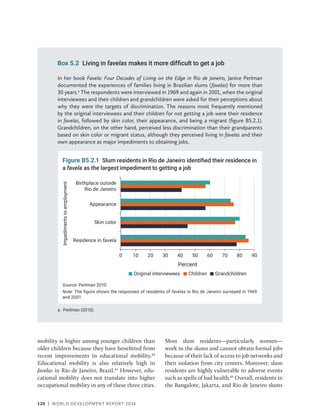
120 5.2 Living in favelas makes it more
difficult to get a job
128 5.3 Global Gender Distortions
Index: Measuring economic
growth lost to gendered
barriers
138 6.1 The diffusion of low-carbon
technologies as defined and
measured in this chapter
172 7.1 A digital tool helps female
entrepreneurs obtain capital
and training in rural Mexico
174 7.2 Technology for market access
175 7.3 Supplier development
programs to connect small
firms with large firms
177 7.4 Turning brain drain into
brain gain
179 7.5 Tackling anticompetitive
practices increases
incumbents’ innovation
incentives
192 8.1 Developing foundational skills:
Learning from Finland and
Chile
195 8.2 Promoting better student
choices with digital tools
196 8.3 Improving students’ test scores
by using online studying
assistance from the Khan
Academy
203 8.4 Catching up by opening up
and modernizing firms: The
Spanish growth miracle
207 8.5 Productivity growth can slow
deforestation in Brazil
212 8.6 Correcting abuses of
dominance in electricity
markets
237 9.1 Technologies that can act as
“stabilizers” of energy supply
Figures
3 O.1 Income per capita of middle-
income countries relative to
that of the United States has
been stagnant for decades
5 O.2 If capital accumulation were
enough, work in middle-
income countries would be
nearly three-quarters as
rewarding as in the United
States, not just one-fifth
6 O.3 Economies become more
sophisticated as they
transition from middle-
income to high-income
status
7 O.4 Middle-income countries
must engineer two successive
transitions to move to
high-income status
8 O.5 In the Republic of Korea,
Poland, and Chile, the rapid
growth from middle- to
high-income status has been
interspersed with economic
crises
9 O.6 From infusion to innovation
in the Republic of Korea
11 O.7 Over the last four decades, as
the Republic of Korea’s labor
productivity relative to that
of the United States
continued to climb, Brazil’s
peaked—and then sagged
12 O.8 Three views of creative
destruction
14 O.9 Creation is a weak force in
middle-income countries,
where it is characterized by a
rampant misallocation of
resources
17 O.10 Middle-income countries
have to strike a balance
among creation,
preservation, and
destruction
21 O.11 In emerging market and
developing economies, few
companies are funded by
venture capital or private
equity
Contents | ix
23 O.12 Countries with large,
successful diasporas have the
highest potential for
knowledge transfers
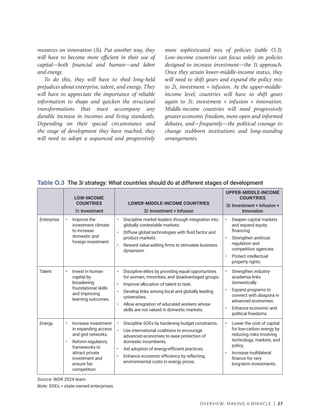
26 O.13 In low- and middle-income
countries, the cost of capital
for renewables is high
35 1.1 A handful of economies have
transitioned from middle-
income to high-income
status over the last three
decades
36 1.2 Income per capita of middle-
income countries relative to
that of the United States has
been stagnant for decades
40 1.3 Sustained growth periods
are short-lived, even in
rapidly growing economies
43 1.4 Growth slowdowns are most
frequent when countries’
GDP per capita is less than
one-fourth of the United
States’
44 1.5 Growth is expected to slow
down as countries approach
the economic frontier
(United States)
44 1.6 Weak institutions hasten
and worsen growth
slowdowns
55 2.1 As economies develop,
capital accumulation brings
diminishing returns
56 2.2 A middle-income country
will need to engineer two
successive transitions to
achieve high-income status:
Infusion, followed by
innovation
58 2.3 The demand for highly
skilled workers increases in
middle-income countries
59 2.4 STEM graduates are
increasingly concentrated in
middle-income countries,
thereby increasing
opportunities for technology
infusion
60 2.5 Calibrating policies to a
country’s stage of
development: From imitation
to innovation in the Republic
of Korea
64 2.6 The innovation gap between
high-income countries and
others is substantial
64 2.7 Middle-income countries
significantly lag behind
high-income countries in
research capacity
66 B2.3.1 Investment growth
accelerations: Colombia,
Republic of Korea, and
Türkiye
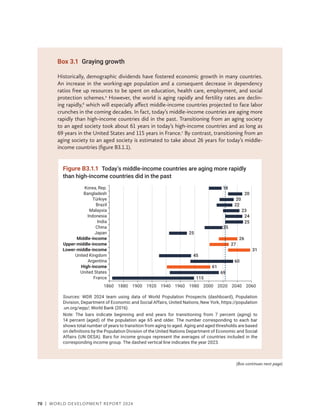
70 B3.1.1 Today’s middle-income
countries are aging more
rapidly than high-income
countries did in the past
72 3.1 Globally, harmful trade
policies outnumber helpful
trade policies
73 3.2 Harmful interventions in the
global semiconductor trade
have skyrocketed since 2019
74 3.3 Most developing economies
are more severely indebted
than ever
75 3.4 Debt service payments in
emerging markets and
middle-income countries
may skyrocket as the cost of
borrowing soars
76 3.5 In middle-income countries,
the energy intensity and
carbon intensity of energy
consumption are quite high
77 3.6 In middle-income countries,
the weighted average cost of
capital for utility-scale solar
power projects is
substantially higher than the
cost in high-income countries
78 3.7 Low- and middle-income
countries are exposed to
similar levels of risk from
climate change, and they
have less adaptive capacity
x | Contents
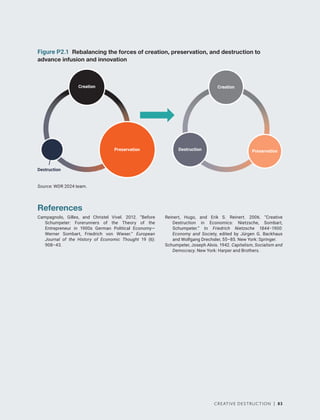
83 P2.1 Rebalancing the forces of
creation, preservation, and
destruction to advance
infusion and innovation
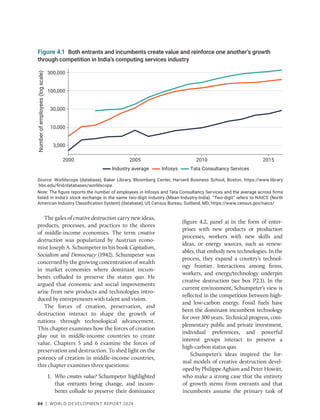
86 4.1 Both entrants and
incumbents create value and
reinforce one another’s
growth through competition
in India’s computing services
industry
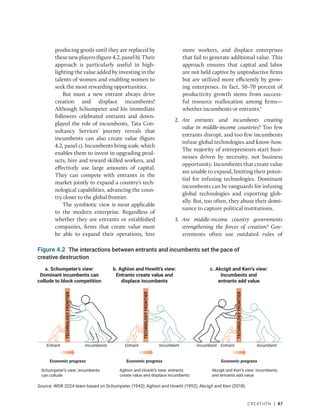
87 4.2 The interactions between
entrants and incumbents set
the pace of creative
destruction
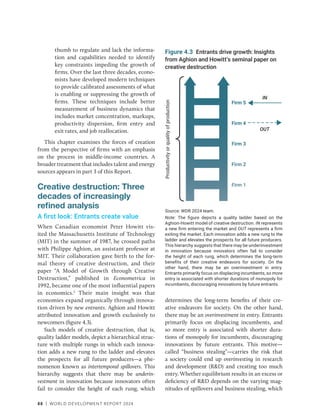
88 4.3 Entrants drive growth:
Insights from Aghion and
Howitt’s seminal paper on
creative destruction
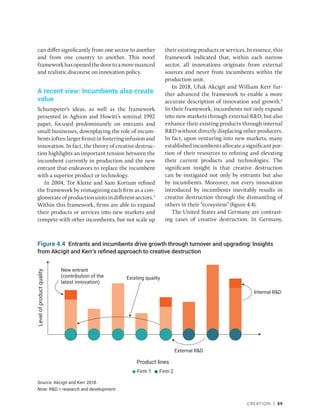
89 4.4 Entrants and incumbents
drive growth through
turnover and upgrading:
Insights from Akcigit and
Kerr’s refined approach to
creative destruction
90 4.5 Contrasting examples of
innovation: Growth is driven
by entrants in the United
States and by incumbents in
Germany
91 4.6 Entrants and incumbents
can reinforce one another’s
growth: The case of the US
business services industry
92 4.7 A cartelized industry
suppresses innovation and
dynamism: Evidence from
the Japanese auto parts
sector
93 B4.1.1 The number of patents filed
by corporations with the US
Patent and Trademark
Office has skyrocketed
since 1880
95 4.8 In middle-income countries,
the growth rate of firms
across their life cycles is
much lower than in the
United States
96 4.9 Microenterprises dominate
firm size distributions in
India, Mexico, and Peru
97 4.10 Young firms—not small
firms—create the most jobs
(net) in the United States
100 B4.3.1 Productivity-dependent
financial distortions, by GDP
per capita
101 4.11 Productivity-dependent
distortions are more severe
in low- and middle-
income countries
102 4.12 Management practices are
worse in economies with
more policy distortions
112 5.1 The share of skilled workers
in large firms increases with
GDP per capita
113 B5.1.1 Better-educated managers
are more likely to adopt
technology in middle-
income countries
114 5.2 Higher inequality is
associated with higher
intergenerational immobility
115 5.3 Intergenerational mobility of
skilled workers matters more
for middle-income countries
than for low-income
countries
118 5.4 High inequality within cities
is associated with low social
mobility from one generation
to the next
120 B5.2.1 Slum residents in Rio de
Janeiro identified their
residence in a favela as the
largest impediment to
getting a job
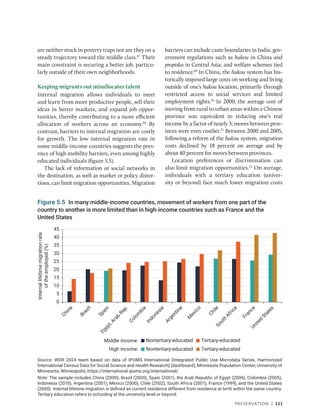
121 5.5 In many middle-income
countries, movement of
workers from one part of the
country to another is more
limited than in high-income
countries such as France and
the United States
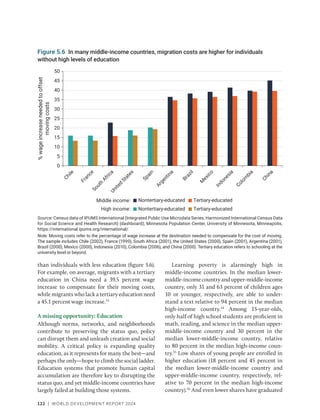
122 5.6 In many middle-income
countries, migration costs
are higher for individuals
without high levels of
education
Contents | xi
124 5.7 There is a substantial gap
between low- and high-
income countries in female
educational attainment
124 5.8 Female labor force
participation is low in the
Middle East and North
Africa and in South Asia
125 5.9 Female labor force
participation has evolved
differently across countries
125 5.10 The share of female
professionals has risen in
some countries but not
others
126 5.11 Globally, women own a
smaller share of firms than
men
127 5.12 Women lag behind men in
having financial accounts
139 6.1 Learning by doing in the
manufacture of key low-
carbon technologies has
resulted in rapid cost
declines
140 6.2 The diffusion of low-carbon
technologies is rapidly
accelerating
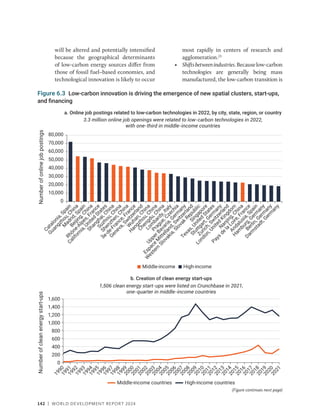
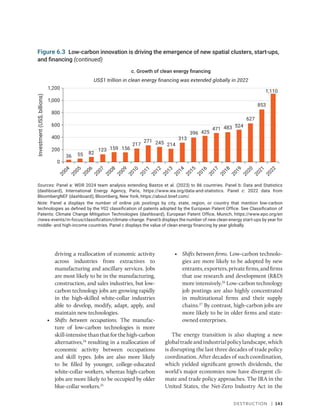
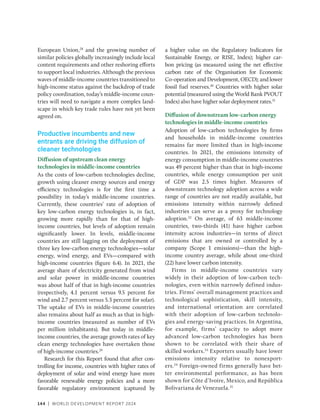
142 6.3 Low-carbon innovation is
driving the emergence of
new spatial clusters, start-
ups, and financing
145 6.4 The rate of adoption of clean
energy technologies is
growing more rapidly in
middle-income countries
than in high-income
countries, but the level of
adoption is lower
147 6.5 Clean energy technology
value chains are still
dominated by high-income
countries and China
148 6.6 Costa Rica and China are
the global front-runners in
jobs related to low-carbon
technologies
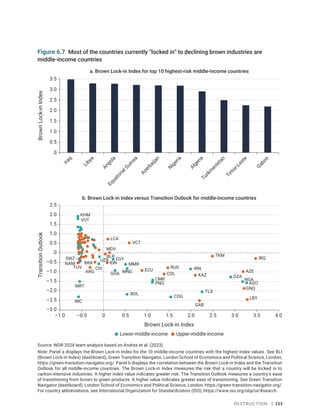
153 6.7 Most of the countries
currently “locked in” to
declining brown industries
are middle-income countries
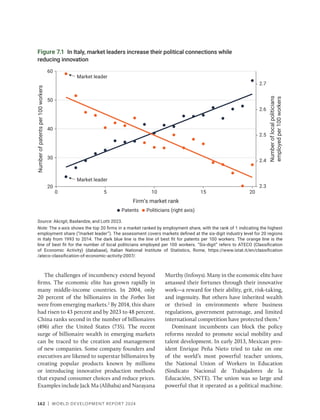
162 7.1 In Italy, market leaders
increase their political
connections while
reducing innovation
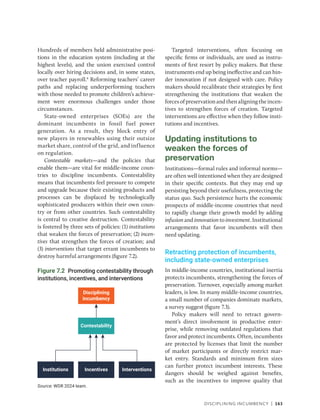
163 7.2 Promoting contestability
through institutions,
incentives, and interventions
164 7.3 In many middle-income
countries, markets are
dominated by a few
business groups, as a survey
suggests
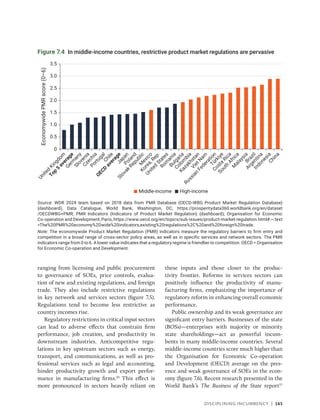
165 7.4 In middle-income countries,
restrictive product market
regulations are pervasive
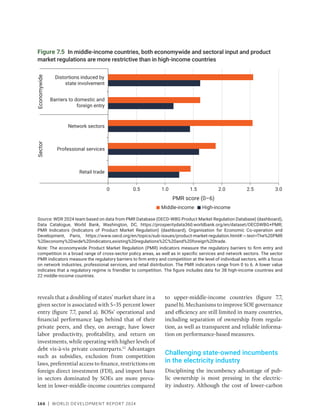
166 7.5 In middle-income countries,
both economywide and
sectoral input and product
market regulations are more
restrictive than in high-
income countries
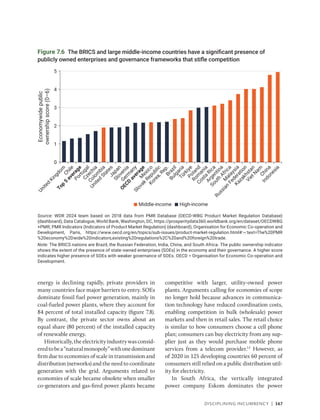
167 7.6 The BRICS and large
middle-income countries
have a significant presence of
publicly owned enterprises
and governance
frameworks that stifle
competition
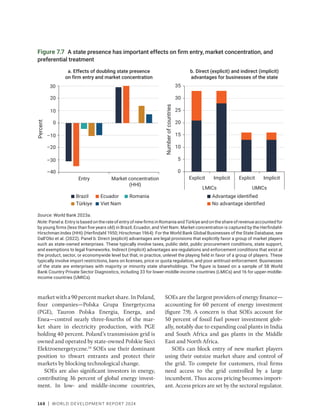
168 7.7 A state presence has
important effects on firm
entry, market
concentration, and
preferential treatment
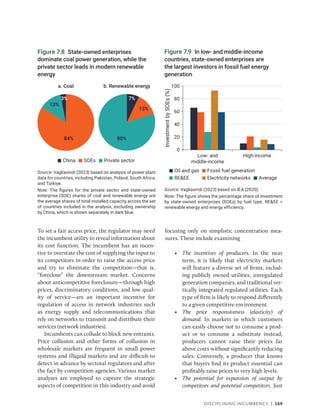
169 7.8 State-owned enterprises
dominate coal power
generation, while the private
sector leads in modern
renewable energy
169 7.9 In low- and middle-income
countries, state-owned
enterprises are the largest
investors in fossil fuel energy
generation
173 7.10 Foreign technology licensing
is limited among middle-
income country firms
178 B7.4.1 Some countries are strongly
positioned to benefit from
knowledge spillovers from
their diaspora
xii | Contents
180 B7.5.1 In Colombia, after a cartel is
sanctioned, market
outcomes improve
through the entry and
growth of previously lagging
firms
180 B7.5.2 In Colombia, after an abuse
of dominance case, positive
market outcomes are driven
by improvements in leading
firms
181 7.11 Competition authorities in
middle-income countries
need more capacity to deal
with sophisticated policy
problems
191 8.1 Middle-income countries
that transitioned to high-
income status first focused
on foundational skills
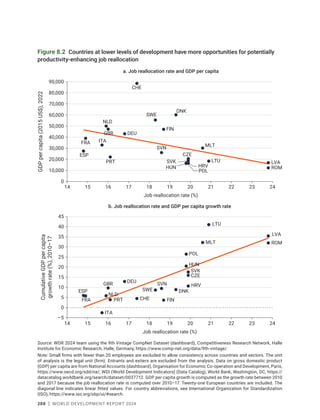
200 8.2 Countries at lower levels of
development have more
opportunities for potentially
productivity-enhancing job
reallocation
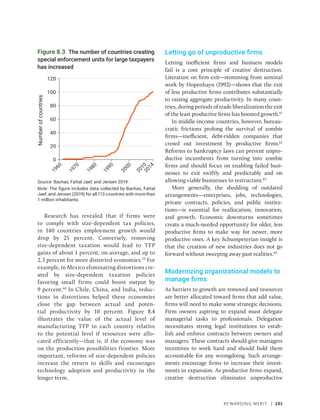
201 8.3 The number of countries
creating special enforcement
units for large taxpayers has
increased
202 8.4 Improvements in allocative
efficiency in Chile, China,
and India have been
driven by reducing
productivity-dependent
distortions
206 8.5 In emerging market and
developing economies, few
companies are funded
through venture capital or
private equity
208 B8.5.1 Amazon deforestation falls
when Brazilian productivity
rises
209 8.6 Indirect carbon pricing such
as energy taxes is the
strongest price signal
211 8.7 In some middle-income
countries, the prices of
renewable energy through
competitive auctions have
reached record lows
223 9.1 Use of globalized value
chains for solar panels
results in faster learning and
lower global prices
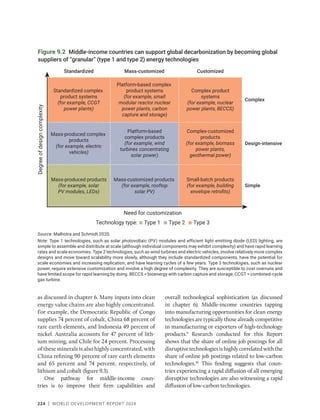
224 9.2 Middle-income countries
can support global
decarbonization by
becoming global suppliers of
“granular” (type 1 and type 2)
energy technologies
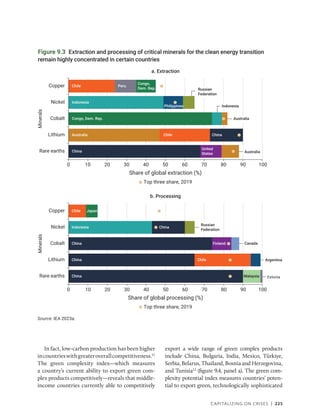
225 9.3 Extraction and processing of
critical minerals for the clean
energy transition remain
highly concentrated in
certain countries
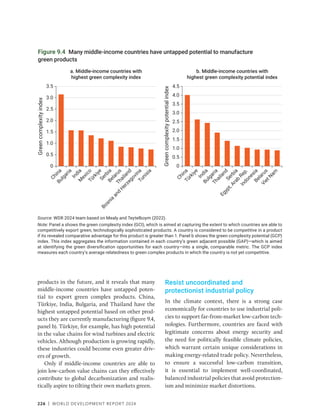
226 9.4 Many middle-income
countries have untapped
potential to manufacture
green products
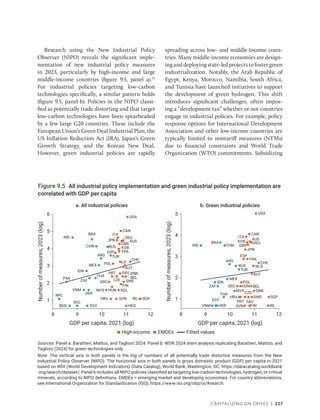
227 9.5 All industrial policy
implementation and green
industrial policy
implementation are correlated
with GDP per capita
229 9.6 Countries must clear hurdles
for both efficient domestic
investment and foreign
investment in renewable
energy
230 9.7 In many middle-income
countries, it is economically
efficient to expand renewable
energy
231 9.8 In low- and middle-income
countries, the cost of capital
for renewables is high
232 9.9 Today’s upper-middle-
income countries are more
energy efficient than upper-
middle-income countries in
the past
233 9.10 Carbon emissions per unit of
GDP have been declining
worldwide
234 9.11 High-income countries have
succeeded in reducing overall
emissions by curbing energy
intensity
235 9.12 The world is slowly
transitioning away from
fossil fuels
Contents | xiii
Maps
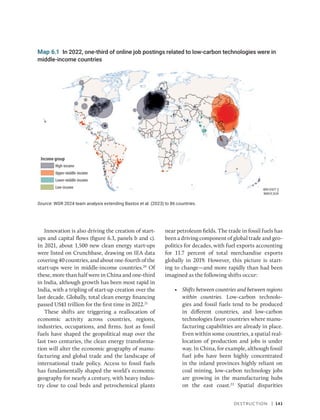
141 6.1 In 2022, one-third of online
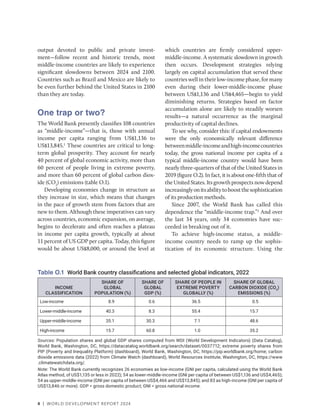
job postings related to
low-carbon technologies
were in middle-income
countries
150 6.2 Limited or outdated
electricity transmission
networks serve as barriers to
the entry of renewable
sources
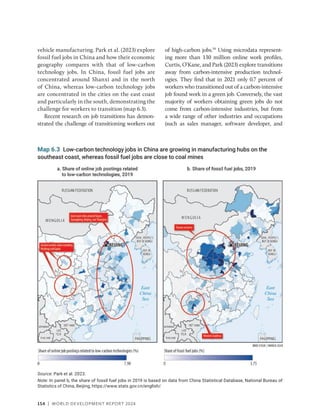
154 6.3 Low-carbon technology jobs
in China are growing in
manufacturing hubs on the
southeast coast, whereas
fossil fuel jobs are close to
coal mines
Tables
4 O.1 World Bank country
classifications and selected
global indicators, 2022
7 O.2 To achieve high-income
status, countries will need to
recalibrate their mix of
investment, infusion, and
innovation
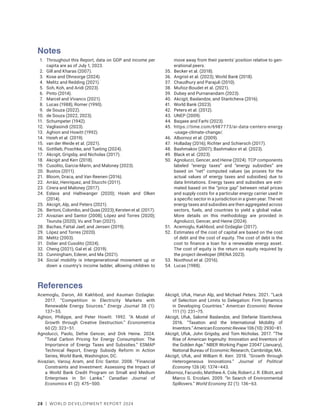
27 O.3 The 3i strategy: What
countries should do at
different stages of
development
31 P1.1 World Bank country
classifications and selected
global indicators, 2022
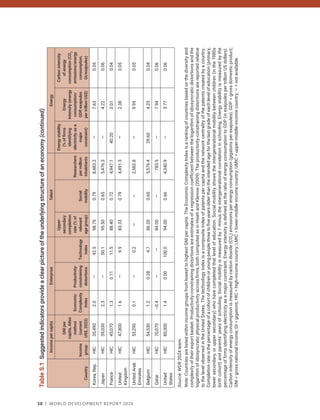
49 S.1 Suggested indicators
provide a clear picture of the
underlying structure of an
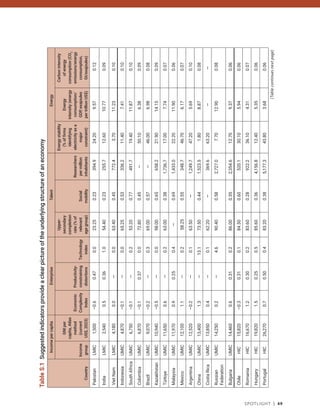
economy
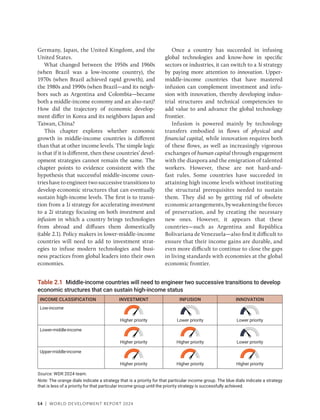
54 2.1 Middle-income countries will
need to engineer two
successive transitions to
develop economic structures
that can sustain high-income
status
103 4.1 Examples of possible effects of
market power on development
outcomes
xv
Foreword
In 2007 the World Bank published An East Asian Renaissance: Ideas for Economic Growth—
the report that coined the phrase “middle-income trap.” This was during a decade of boom-
ing growth and poverty reduction in developing countries. Yet it was clear by then that
many economies—particularly in Latin America and the Middle East—had remained stuck
for decades, despite their efforts to rise to high-income status. “Middle-income trap” is now
a popular phrase: it results in tens of thousands of Google search references. And it is fre-
quently on the tongues of academics and politicians from developing countries—in Latin
America and South Asia and just about every place in between.
A decade ago, in “The Middle-Income Trap Turns Ten,” Brookings Institution econo-
mist Homi Kharas and I reviewed the burgeoning literature that An East Asian Renaissance
had inspired. We found that economists had yet to provide a reliable theory of growth
to help policy makers navigate the transition from middle- to high-income status. Some
had attempted to develop models, but they were poor substitutes for a well-constructed
growth framework on which policy makers could build effective development strategies.
Meanwhile, the ranks of middle-income countries continued to grow. Five years later, in
“Growth Strategies to Avoid the Middle-Income Trap,” we proposed that Schumpeterian
growth models emphasizing creative destruction and institutional change had the poten-
tial to provide the analytical foundations for a fuller understanding of middle-income
economies. But to be useful they had to be made a lot more accessible to policy makers.
This is what World Development Report 2024 sets out to do: provide a simple but reliable
growth framework for avoiding or escaping the trap. It identifies lessons from more than
50 years of successes and failures among developing countries while they were climbing the
income ladder. Based on these ideas and evidence, it proposes a sequenced, three-pronged
approach for today’s 100-odd middle-income countries: first investment, then infusion of
new technology from around the world, and then innovation. Each shift requires a new mix
of policies that, if implemented reasonably well, result in increasingly dynamic enterprises,
an increasingly productive workforce, and an increasingly energy-efficient economy.
It is an approach that can benefit all countries—low-, middle-, and high-income—seeking
high-quality growth.
We are not naive enough to think this will be easy. Middle-income countries will have to
work miracles—not only to lift themselves up to high-income status but also to shift away
from carbon-intensive growth paths that will lead to environmental ruin. Income levels in
Sub-Saharan Africa, where more than half the population lives in middle-income coun-
tries, are the same as they were a decade ago. Economic growth rates in middle-income
countries have been falling and are expected to average just 4 percent in the 2020s, down
from 5 percent in the 2010s and more than 6 percent in the 2000s.
xvi | Foreword
This has implications for the whole world. Middle-income countries are home to three
out of every four people—and nearly two-thirds of those who struggle in extreme poverty.
They are responsible for 40 percent of the world’s total economic output—and nearly two-
thirds of global carbon emissions. In short, the global effort to end extreme poverty and
spread prosperity and livability will largely be won or lost in these countries.
The road ahead has even stiffer challenges than those seen in the past: rapidly aging
populations and burgeoning debt, fierce geopolitical and trade frictions, and the growing
difficulty of speeding up economic progress without fouling the environment. Yet many
middle-income countries still use a playbook from the last century, relying mainly on pol-
icies designed to expand investment. That is like driving a car just in first gear and trying
to make it go faster. If they stick with the old playbook, most developing countries will lose
the race to create reasonably prosperous societies by the middle of this century. At current
trends, it will take China more than 10 years just to reach one-quarter of US income per
capita, Indonesia nearly 70 years, and India 75 years.
The team that has written this report hopes to radically alter this arithmetic. Our hope
is that World Development Report 2024 will, in short order, make the expression “middle-
income trap” completely obsolete.
Indermit Gill
Chief Economist of the World Bank Group and
Senior Vice President for Development Economics
xvii
Acknowledgments
World Development Report 2024 was prepared by a World Bank team led by Somik V. Lall.
Ufuk Akcigit served as the Academic Lead, and Joyce Antone Ibrahim was the Report
­
Manager. Overall guidance was provided by Indermit Gill, Senior Vice President and Chief
Economist. The Report was sponsored by the Development Economics Vice Presidency.
The core team comprised Roberto Fattal Jaef, Maria Marta Ferreyra, Kenan Karakülah,
Tatjana Kleineberg, Mathilde Lebrand, Martha Martinez Licetti, Dino Merotto, Forhad
Shilpi, Katherine Stapleton, Maria Vagliasindi, and Ekaterina Vostroknutova.
Victor Ajayi, Deniz Aycan, Narcisse Cha’ngom, Dong Phuong Dao, Matteo Gasparini,
Juan Holguín Posada, Karry Jiao, Yonatan Litwin, Theodore Naff, Juan Porras Lopez,
Mariana Santi, Zeki Berkay Saygin, Karthik Sridhar, Gabriel Suárez Obando, Adesola
Sunmoni, Facundo Ulivarri, and Natalia Valdebenito Contreras were research analysts.
Selome Missael Paulos provided the team with administrative support through
May 2023, and Sandi Soe Lwin provided administrative support to the team beginning in
May 2023.
Pia Andres, Oya Pinar Ardic Alper, Sina Ates, Christopher Bataille, Tania Begazo Gomez,
Bhavna Bhatia, Tanuj Bhojwani, Julia Bird, Craig Chikis, Xavier Cirera, Fernando Dancausa
Diaz, Yuheng Ding, Maciej Drozd, Alice Evans, Nisan Gorgulu, Soulange Gramegna Mesa,
Rogelio Granguillhome Ochoa, Michael Grubb, Federico Haslop, Sheirin Iravantchi,
Gautam Jain, Aidara Janulaityte, Noah Kaufman, Joohyun Lee, Munseob Lee, Ming Lu,
Antonio Martins Neto, Penelope Mealy, Nandan Nilekani, Stefanie Onder, Paul Phumpiu
Chang, Denisse Pierola Castro, Brian Pinto, Laurent Porte, Gaël Raballand, Ana Belen
Ruival, Sagatom Saha, Yongseok Shin, Hassan Soumya, Sowjanya, Yana R. Ukhaneva,
Harald Walkate, Diane Zovighian, and María Pluvia Zúñiga Lara provided inputs to the
report at various stages.
Nicolas Moschovakis, Bruce Ross-Larson, and Timothy Taylor provided developmental
guidance in drafting the Report. Anthony Venables was a member of the extended team.
Anwar Aridi and Hoon Sahib Soh contributed to box 1.2 on the Republic of Korea.
Karsten Staehr and Sebastian Stolorz authored box 2.2 on Bulgaria, Estonia, and Poland.
Tristan Reed and Kersten Stamm authored box 2.3 on investment accelerations. Pinelopi
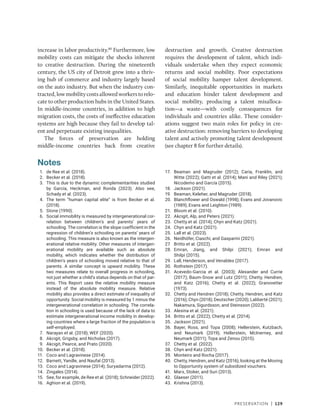
Goldberg, Michael Peters, and Aishwarya Ratan authored box 5.3 on the gendered barriers
to growth. Oscar Calvo-González authored box 8.4 on the Spanish growth miracle. Marek
Hanusch authored box 8.5 on Brazil.
Nurana Ahmadova, Narcisse Cha’ngom, Karry Jiao, Gabriel Suárez Obando, and Renato
Schwambach Vieira assisted with the reviews of translations.
xviii | Acknowledgments
The communications and engagement strategy was led by a team comprising Chisako
Fukuda, Kristen Milhollin, Karolina Ordon, Joseph Rebello, Mikael (Kelly) Reventar, Shane
Romig, and Mariana Teixeira. Roula Yazigi provided web and online services.
Special thanks are extended to Mark McClure, who coordinated and oversaw formal
production of the Report, and to the World Bank’s Formal Publishing Program, including
Cindy Fisher and Patricia Katayama. Mary C. Fisk facilitated the multiple translations of
the overview and main messages by the Translations and Interpretation team, coordinated
by Bouchra Belfqih. Yaneisy Martinez and Orlando Mota managed the printing and elec-
tronic conversions of the Report and the many ancillary products.
The Report was edited by Sabra Ledent and Nancy Morrison and proofread by Gwenda
Larsen and Catherine Farley. Robert Zimmermann verified the Report’s extensive citations
and assisted with the copyediting. The design team of the World Bank’s Global Corporate
Solutions unit designed the cover and the interior layout. Bill Pragluski of Critical Stages
designed some of the Report’s figures and infographics. Datapage supplied typesetting
services.
Dayana Leguizamon provided the team with resource management support. The team
would also like to thank colleagues at various World Bank country offices who assisted
with logistics and stakeholder engagements. Special thanks to Marcelo Buitron, Gabriela
Calderon Motta, and Grace Soko for their help with coordination and high-level engage-
ment strategies.
The team is grateful for the guidance, comments, and inputs provided by other
World Bank Group colleagues, particularly those with the Development Economics Vice
Presidency; East Asia and Pacific Region; Eastern and Southern Africa Region; Economics
and Private Sector Development Vice Presidency (International Finance Corporation);
Education Global Practice; Environment, Natural Resources, and Blue Economy Global
Practice; Equitable Growth, Finance, and Institutions Vice Presidency; Europe and Central
Asia Region; External and Corporate Relations; Gender Group; Human Development Vice
Presidency; Independent Evaluation Group; Infrastructure Vice Presidency; Latin America
andtheCaribbeanRegion;MiddleEastandNorthAfricaRegion;PovertyandEquityGlobal
Practice; South Asia Region; Sustainable Development Vice Presidency; and Western and
Central Africa Region. The team thanks the many World Bank colleagues who offered
written comments during the formal Bankwide review process. These comments provided
invaluable guidance at a crucial stage in the production of the Report.
The team gratefully received suggestions and guidance from a High-Level Advisory
Panel: Masood Ahmed, President, Center for Global Development; Ann Bernstein,
Executive Director, Centre for Development and Enterprise (South Africa); Poonam
Gupta, Director General, National Council of Applied Economic Research, and mem-
ber of the Economic Advisory Council to the Prime Minister of India; Homi Kharas,
Senior Fellow–Global Economy and Development, Center for Sustainable Development,
Brookings Institution; Mario Marcel Cullell, Minister of Finance, Chile; Mustapha Kamel
Nabli, former Minister of Economic Development and Minister of Planning and Regional
Development and former Central Bank Governor, Tunisia; Njuguna Ndung’u, Minister of
Finance, Kenya; José Antonio Ocampo, former Minister of Finance, Colombia; Normunds
Popens, Acting Director General, Directorate-General for Regional and Urban Policy
(DG REGIO), European Commission (through January 2024); and Omar Razzaz, former
Minister of Education and former Prime Minister, Jordan.
Acknowledgments | xix
The team received suggestions and inputs from an Academic Advisory Committee:
Daron Acemoglu (Massachusetts Institute of Technology), Philippe Aghion (Collège de
France, INSEAD, London School of Economics and Political Science), Gerardo Esquivel
(El Colegio de México), Ricardo Hausmann (Harvard Kennedy School), Robert Pindyck
(Sloan School of Management, Massachusetts Institute of Technology), Danny Quah
(Lee Kuan Yew School of Public Policy, National University of Singapore), Jahen F. Rezki
(Universitas Indonesia), Qiyuan Xu (Institute of World Economy and Politics, Chinese
Academy of Social Sciences), and Fabrizio Zilibotti (Yale University). The team consulted
other academics, including Manuel Agosin (Universidad de Chile), Belinda Archibong
(Barnard College, Columbia University), Iwan Azis (Cornell University and Universitas
Indonesia), Nicolas Bottan (Cornell University), Andrea Bubula (Columbia University),
John Carruthers (Cornell University), Julieta Caunedo (Cornell University), Nancy Chau
(Cornell University), Abigayle Davidson (Aspen Institute), Jan Eeckhout (Pompeu Fabra
University), Gary Fields (Cornell University), Caroline Flammer (Columbia University),
Rodrigo Fuentes (Pontificia Universidad Católica de Chile), Alvaro Garcia-Marin
(Universidad de los Andes), Ravi Kanbur (Cornell University), David Kohn (Central Bank of
Chile and Pontificia Universidad Católica de Chile), Saurabh Lall (University of Glasgow),
Patricia Mosser (Columbia University), Cristian Pop-Eleches (Columbia University), Jan
Svejnar (Columbia University), and Eric Verhoogen (Columbia University).
Thanks are due to the following academics who participated with presentations during
a series of seminars hosted by the World Development Report 2024 team: Craig Chikis
(University of Chicago), Sebastián Gallegos (Business School, Universidad Adolfo Ibáñez,
Santiago, Chile), Pulak Ghosh (Indian Institute of Management, Bangalore), Munseob
Lee (University of California, San Diego), Ming Li (Chinese University of Hong Kong,
Shenzhen), Javier Miranda (Halle Institute for Economic Research, Halle, Germany),
Ricardo Paredes (former President of Duoc and current Minister, Free Trade Special Court,
Santiago, Chile), Marta Prato (Bocconi University, Milan), Younghun Shim (International
Monetary Fund), and María Pluvia Zúñiga Lara (United Nations University–Maastricht
Economic and Social Research Institute on Innovation and Technology, Maastricht, the
Netherlands).
The team thanks the Chinese Academy of Social Sciences (China), Columbia University
(United States), Cornell University (United States), Fudan University (China), the National
Council of Applied Economic Research (India), Políticas Públicas (Colombia), Shanghai
Institute for International Studies (China), and Shenzhen Finance Institute (Chinese
University of Hong Kong) (China) for organizing and hosting a roundtable discussion with
academics.
The team conducted a series of bilateral consultations and field visits with several gov-
ernments, including Brazil, Chile, China, Colombia, the European Commission, India,
Italy, Kenya, Mexico, Morocco, and the United Kingdom.
The team benefited from the inputs of several think tanks, research institutes, academic
institutions, civil society organizations, private sector organizations, and other organiza-
tions,includingAccenture,AfricanCentreforEconomicTransformation,AfricanEconomic
Research Consortium, ANT Group, Banco de Crédito e Inversiones S.A., Betterfly, Boston
ConsultingGroup,CelulosaAraucoyConstitución,CenterforAdvancedEconomicStudies,
Center for International Knowledge on Development, Centre for Social and Economic
Progress, China Academy of Information and Communications Technology, China Center
xx | Acknowledgments
for International Economic Exchanges, China Center for Macroeconomic Research, China
International Capital Corporation, China Pacific Insurance Company, Chinese Academy
of Social Sciences, Chinese University of Hong Kong, Economic Commission for Latin
America and the Caribbean, Einaudi Institute for Economics and Finance, Empresas
Copec, Enel, Essence Securities Company, Fudan University, Fundación Chile, Haitong
International Securities Group Limited, Harvard Growth Lab, Huatai Securities, Inria,
Institute for World Economy Studies Shanghai, Institute of Comparative Politics and
Public Policy of Shanghai University, Institute of Economy Pontificia Universidad Católica
de Chile, Institute of Quantitative and Technical Economics, Institute of Statistics and
Applied Economics, International Centre for China Development Studies, Inversiones SB,
Lal Bahadur Shastri National Academy of Administration, National Council of Applied
Economic Research, National Evaluation and Productivity Commission, NTT Data Chile,
Pan American Association of Student Loan Institutions, Peking University, Renmin
University of China, Shanghai Artificial Intelligence Laboratory, Shanghai Institutes for
International Studies, Shanghai Jiao Tong University, Sky Airlines, Sonda S.A., Songhe
ChuangzhiVentureCapitalInvestmentPartnershipEnterprise,TencentResearchInstitute,
Thomas B. Fordham Institute, Tsinghua University, UBS Wealth Management, United
Nations (Morocco), Universidad Andrés Bello, Universidad de Chile School of Economic
Sciences and Business, Universidad de los Andes, Universidad del Desarrollo, and VIDA
Security.
The team apologizes to any individuals or organizations inadvertently omitted from
this list. It is grateful for the help received from all who contributed to this Report, includ-
ing those whose names may not appear here. Team members would also like to thank their
families for their support throughout the preparation of this Report.
xxi
Summary
Part 1: Middle-Income
Transitions
Chapter 1: Slowing Growth
Is growth in middle-income countries
slower than that in countries at other
income levels?
• Yes. Growth slowdowns occur more
frequently in middle-income countries
than in low- or high-income countries.
• Development strategies that served
countries well in their low-income
phase—capital investment, in
­
particular—yield diminishing returns.
• Countries with weaker institutions—
and especially those with lower levels
of economic and political freedom—are
susceptible to slowdowns at even lower
levels of income.
Chapter 2: Structural Stasis
Is growth in middle-income countries
different from that in countries at other
income levels?
• Yes. Successful middle-income coun-
tries will have to engineer two succes-
sive transitions to develop economic
structures that can eventually sustain
high-income levels.
• The first transition is from a 1i strat-
egy for accelerating investment to a 2i
strategy focusing on both investment
and infusion in which a country brings
technologies from abroad and diffuses
them domestically—a process broadly
applicable to lower-middle-income
countries.
• The second transition is to switch to a
3i strategy, which entails paying more
attention to innovation—a process more
applicable to upper-middle-income
countries.
Chapter 3: Shrinking Spaces
Is growth in middle-income countries
now harder to achieve?
• Yes. Foreign trade and investment are
in danger of becoming constricted by
geopolitical tensions, and populism is
shrinking the room for governments to
act.
• Rising debt and adverse demographics
are crowding out private investors and
reducing public investment.
• Accelerating climate action will require
large investments in infrastructure
and regulatory reforms that may stall
productivity.
Part 2: Creative
Destruction
Chapter 4: Creation
Who creates value?
• Both incumbents and entrants can
create value. Incumbents bring scale.
They can compete with entrants
in the market to jointly expand a
country’s technological capabilities,
thereby moving the country closer
xxii | Summary
to the global frontier. Entrants bring
change—enterprises with new products
or production processes, workers with
new skills and ideas, or energy sources
such as renewables that embody new
technologies. By doing so, they expand
a country’s technology frontier.
What is the implication of having both
incumbents and entrants as value
creators?
• Policy makers will have to stop relying
on superficial measures of structural
efficiency such as firm size, income
inequality, and energy sources. The
imperative for today’s middle-income
economies is “efficiency”—in the use of
capital, labor, and energy. Policy mak-
ers will need to heed the value added
of firms, social mobility, and emissions
intensity. They are more reliable and
more realistic metrics for policy mak-
ing, but they also require collecting
more information.
Chapter 5: Preservation
How do incumbents preserve the status
quo?
• Incumbents’ dominance can buy
economic, social, and political power.
By capturing political and social
institutions, incumbents have an
outsize say in who learns where and
what, who gets a sought-after job and
what they are paid, and who gets to
start a business.
How do discrimination and patriarchal
gender norms hold back the potential of
women?
• Patriarchal norms and systems of
belief that give men greater status
and authority and define strict gender
roles and responsibilities hold back
women from benefiting from attractive
educational and job opportunities.
Discrimination can be pervasive,
affecting the businesses women own,
the jobs they get, the pay they receive,
what their families spend on educating
them, and their ability to manage
financial accounts.
Chapter 6: Destruction
Why is destruction important for
­structural change?
• The destruction of outdated arrange-
ments—enterprises, jobs, technologies,
private contracts, policies, and public
institutions—is essential to creating
value through infusion and innovation.
Who are the antagonists blocking creative
destruction in response to today’s energy
crisis?
• Incumbents, usually state-owned
enterprises, have the strongest incen-
tive to maintain the status quo and
limit competition from low-carbon
energy providers.
• Many G20 economies are introducing
incentives for producing and deploying
low-carbon technologies. Some mea-
sures may unintentionally preserve
enterprises in advanced economies
and destroy them in middle-income
countries.
Part 3: Making Miracles
Chapter 7: Disciplining
Incumbency
How can middle-income countries
weaken the forces of preservation
that protect incumbents from healthy
competition?
• By promoting contestable markets,
middle-income countries can strike a
balance between supporting incum-
bents and ensuring that they do not
abuse their market power.
Summary | xxiii
• Institutional arrangements that pro-
mote contestability include retract-
ing protection of incumbents such as
market leaders and state-owned enter-
prises and norms that work against
women.
• Openness to foreign trade, investment,
and talent helps with technological
upgrading.
• Interventions that target errant incum-
bents to destroy harmful arrangements
include adopting competition laws and
ensuring the effectiveness of competi-
tion authorities, as well as using fiscal
policy to make elites contestable.
Chapter 8: Rewarding Merit
How can middle-income countries
strengthen the forces of creation by
rewarding merit—that is, those forces
that aid in the efficient use of talent, capi-
tal, and energy?
• To reward merit, middle-income coun-
tries can upgrade their talent pools,
select efficient learners, and tap the pro-
ductive power of women.
• To efficiently use capital, middle-­
income countries can move away from
coddling small firms or vilifying large
firms, let go of unproductive firms,
modernize the management of firms,
and connect entrepreneurs with men-
tors and markets.
• To decouple carbon emissions from
a growing economy, middle-income
countries can effectively price carbon
emissions and scale up deployment of
low-carbon energy by respecting the
merit order—the sequence followed
by grid operators selling power to the
market.
Chapter 9: Capitalizing on Crises
How can middle-income countries
­
capitalize on crises to destroy outdated
arrangements and make way for creation?
• Because middle-income countries need
to recalibrate their mix of investment,
infusion, and innovation, crises can
become a necessary evil because they
provide the momentum to weaken the
status quo.
• To capitalize on today’s climate and
energy crises, middle-income countries
can support global decarbonization by
infusing global technologies domesti-
cally to join low-carbon value chains for
global markets. They can also invest in
deploying low-carbon energy if it reaps
economic returns.
• Middle-income countries face critical
needs: growth, decarbonization, and
energy security. Solutions will require
decoupling emissions from a growing
economy while extending affordable,
secure energy to all firms and families.
xxv
Glossary
The following general descriptions of the terms and phrases commonly used in this Report reflect
their context in the Report.
brain drain The movement of educated
or professional people from one place or
profession to another to gain better pay or
living conditions.
brain gain An increase in the number of
highly trained foreign-born professionals
entering a country to live and work and
benefit from the greater opportunities
offered.
business of the state (BOS) An enter-
prise with majority or minority state
shareholdings.
capital accumulation An increase in
assets from investments or profits.
capitalizing on crises The process of
using a crisis as an opportunity to imple-
ment major reforms that otherwise would
have been blocked.
carbon capture and storage (CCS) A pro-
cess in which a relatively pure stream of
carbon dioxide from industrial sources is
separated, treated, and transported to a
long-term storage location.
carbon capture, utilization, and ­
storage
(CCUS) An advanced iteration of the tra-
ditional carbon capture and storage (CCS)
technology. CCS focuses mainly on the
capture and sequestration of carbon diox-
ide to mitigate emissions, and CCUS takes
it one step further by finding practical
applications for the captured carbon.
carbon intensity A measure of carbon
dioxide and other greenhouse gases emit-
ted per unit of activity.
contestability An environment in which
incumbents feel pressure to compete and
upgrade because their products and pro-
cesses could be displaced by technologi-
cally sophisticated producers in their own
country or from other countries.
creative destruction A concept intro-
duced by economist Joseph Schumpeter
that refers to the process of innovation
and technological change that leads to the
destruction of existing economic struc-
tures such as industries, firms, and jobs.
This destruction paves the way for new
structures to emerge, thereby creating
long-term economic growth and progress.
decouplinggrowthfromemissions A pro-
cess that culminates in economic growth
no longer strongly associated with carbon
emissions.
disciplining incumbents A process in
which policies or actions are aimed at lim-
iting the power of incumbents to capture
institutions or block competitors.
Economic Complexity Index (ECI) A rank-
ing of countries based on the diversity and
complexity of their export basket. High-­
complexity countries are home to a range
of sophisticated, specialized capabilities and
xxvi | Glossary
are therefore able to produce a highly diver-
sified set of complex products.
energy intensity A measure of the energy
use of an economy, calculated as units of
energy per unit of gross domestic product
(GDP) or another measure of economic
output.
entrant An entity that enters an industry
with a capacity to produce goods or ser-
vices that can compete with those of exist-
ing entities in order to earn profits.
feed-in tariff A policy designed to ­
support
thedevelopmentofrenewableenergysources
by providing a guaranteed, above-market
price for producers.
incumbent An established entity in soci-
ety, public office, or the market. This term
is often used to describe the existing firms
in the market, typically the leading firms,
as well as the prevailing technology, social
elites, or technologically advanced nations
with an established presence in the pro-
duction of certain goods or services.
industrial policy A policy that directs
state support toward specific technologies,
sectors, industries, or firms.
infusion A process in which countries
focus on imitating and diffusing modern
technologies and business models from
more advanced economies and applying
this knowledge at scale in their domestic
economy, thereby enabling home indus-
tries to become global suppliers of goods
and services.
innovation A process in which countries
focus on building home country capabil-
ities to add value to global technologies
so that domestic firms can become global
knowledge creators.
investment A process in which countries
focus on increasing physical capital, such
as machinery, equipment, and infrastruc-
ture, as well as improving human capital,
such as education, training, and better
health.
leapfrogging The process by which econ-
omies attempt to become “knowledge
economies” before putting in place the
institutional infrastructure and develop-
ing requisite capabilities.
Long Term Growth Model (LTGM) A
spreadsheet-based tool to analyze future
long-term growth scenarios in develop-
ing countries, building on the celebrated
Solow-Swan growth model. The LTGM
aggregates assumptions about growth
fundamentals—such as investment, edu-
cation, and productivity—to produce a
trajectory for future growth. The drivers
of growth are savings, investment, and
productivity, but the model also ana-
lyzes human capital, demographics, the
external sector (external debt, foreign
direct investment, and current account
balance), and labor force participation by
gender.
low-carbon technologies Technologies
or applications intended to counter the
effects of climate change.
merit A person’s possession of required
skills or qualifications.
merit order The sequence followed by grid
operators selling power to the market. The
starting point is the cheapest offer, made
by the power station with the lowest oper-
ating costs, which determines the whole-
sale market prices. Any provider that can
offer renewable energy at zero marginal
cost—that is, with insignificant operating
costs—should have priority in meeting
demand.
middle-income trap A situation in which
a middle-income country experiences sys-
tematic growth slowdowns as it is unable
to take on the new economic structures
needed to sustain high-income levels.
Glossary | xxvii
Successful middle-income countries will
have to engineer two successive transi-
tions to develop such economic structures.
The first transition is from a 1i strategy
for accelerating investment to a 2i strategy
focusing on both investment and infusion.
In the latter, a country brings technologies
from abroad and diffuses them domesti-
cally. Once a country has succeeded in the
first transition, the second transition con-
sists of switching to a 3i strategy, which
entails paying more attention to innovation.
net zero The balance between the amount
of greenhouse gas produced and the
amount removed from the atmosphere.
It can be achieved through a combina-
tion of emissions reduction and emissions
removal measures.
power purchase agreement (PPA) A long-
term agreement to purchase energy from
a specific asset at a predetermined price
between an electricity generator and a con-
sumer—generally a utility—or between a
developer and a supplier, which then resells
the energy.
productivity-dependent distortion A pol-
icy distortion related to firm size that can
discourage growth, innovation, and tech-
nology adoption.
proximity to the frontier A measure used
in this Report to clarify the distribution
of growth slowdowns along the national
income spectrum around the world,
defined as the ratio of a country’s GDP
per capita to that of the frontier country
each year (not adjusted for differences in
purchasing power parity). The frontier
represents the growth leader—the coun-
try with the most advanced combination
of economic production, innovation, and
workforce—which is proxied by the United
States in this Report.
resource curse The phenomenon of coun-
tries with an abundance of natural resources
(such as fossil fuels and certain minerals)
having lower economic growth, less democ-
racy, or worse development outcomes than
countries with fewer natural resources.
rewarding merit The act of policies, insti-
tutions, and other government structures
aiding in the efficient utilization of talent,
capital, and energy.
size-dependent policies Policies that, by
design, stipulate different treatment of
firms of different sizes.
social immobility A feature of a society
with fixed social norms or a rigid class
system so that movement from one social
class, social or economic status, or social
role to another is constrained.
social mobility A change in a person’s
socioeconomic situation either in relation
to their parents (intergenerational mobil-
ity) or throughout their lifetime (intragen-
erational mobility).
state-owned enterprise (SOE) A legal
entity created by a government to par-
take in commercial activities on the
­government’s behalf.
stranded assets Assets that lose value or
turn into liabilities before the end of their
expected economic life. In the context of
fossil fuels, this term refers to those fuels
that will not be burned and thus remain in
the ground.
total factor productivity (TFP) A ­measure
of the efficiency with which all inputs
(labor, capital, and so forth) are used in the
production process. It represents the por-
tion of output not explained by the amount
of inputs used in production.
xxix
Abbreviations
AA Account Aggregator
BECCS bioenergy with carbon capture and storage
BOS business of the state
CCAS centralized choice and admission system
CCS carbon capture and storage
CCUS carbon capture, utilization, and storage
CO2
carbon dioxide
COVID-19 coronavirus disease 2019
DACCS direct air capture with carbon storage
ECI Economic Complexity Index
EMDEs emerging market and developing economies
ETS emissions trading system
EU European Union
EV electric vehicle
FAT Firm-level Adoption of Technology
FDI foreign direct investment
FiT feed-in tariff
G20 Group of Twenty
GATT General Agreement on Tariffs and Trade
GDP gross domestic product
GHG greenhouse gas
GNI gross national income
IBRD International Bank for Reconstruction and Development
ICE internal combus­
tion engine
ICT information and communication technology
IDA International Development Association
IEA International Energy Agency
IITs Indian Institutes of Technology
IRA Inflation Reduction Act
IRENA International Renewable Energy Agency
LEED Leadership in Energy and Environmental Design
LTGM Long Term Growth Model
MIT Massachusetts Institute of Technology
MNC multinational corporation
NIPO New Industrial Policy Observer
NTM nontariff measure
xxx | Abbreviations
OECD Organisation for Economic Co-operation and Development
PMR product market regulation
PPA power purchase agreement
PPI Private Participation in Infrastructure
PPP purchasing power parity
PV photovoltaic
R&D research and development
RISE Regulatory Indicators for Sustainable Energy
SAR special administrative region
SDGs Sustainable Development Goals
SMEs small and medium enterprises
SOE state-owned enterprise
STEM science, technology, engineering, and mathematics
TCP total car­
bon price
TCS Tata Consultancy Services
TFP total factor productivity
TVET technical and vocational education and training
UNESCO United Nations Educational, Scientific, and Cultural Organization
UPI Unified Payments Interface
WDR World Development Report
WTO World Trade Organization
Overview:
Making a Miracle
1
In brief
Middle-income countries are in a race against time.
Since the 1990s, many of them have done well
enough to escape low-income levels and eradicate
extreme poverty, leading to the general perception
that the last three decades have been great for devel-
opment. But this is because of abysmally low expec-
tations—remnants from a period when more than
two-thirds of the world lived on less than a dollar a
day. The ambition of the 108 middle-income coun-
tries with incomes per capita of between US$1,136
and US$13,845 is to reach high-​
income status within
the next two or three decades. When assessed against
this goal, the record is dismal: the total population
of the 34 middle-income economies that transi-
tioned to high-income status since 1990 is less than
250 ­
million, the population of Pakistan.
During the last decade their prospects have
­
worsened. With rising debt and aging populations
at home, growing protectionism in advanced econo-
mies, and escalating pressures to speed up the energy
transition, today’s middle-income economies are
growing into ever-tighter spaces. The odds that the
6 billion people in today’s middle-income countries
will see their countries grow to high-income status
within a generation or two were never that good.
Now they are decidedly daunting.
Drawing upon the development experience since
the 1950s and advances in economic analysis by
Schumpeterian economists, World Development
Report 2024 (WDR 2024) identifies pathways for
emergingmarketeconomiestoavoidwhathasbecome
known and feared as the “middle-income trap.” The
Report points to the need for not one but two tran-
sitions during middle-income. The first is to transi-
tion from a 1i strategy for accelerating investment to
a 2i strategy that emphasizes both investment and
infusion in which a country brings technologies from
abroad and diffuses them domestically. Governments
in lower-middle-income countries must add to
investment-​
driven strategies measures to infuse mod-
ern technologies and successful business processes
from around the world into their national economies.
This requires reshaping large swaths of domestic
industry as global suppliers of goods and services.
Once a country has succeeded in doing this, it can
switch to a 3i strategy where it increases attention
to innovation. Upper-middle-income countries that
have mastered infusion can complement investment
and infusion with innovation—beginning not just
to borrow ideas from the global frontiers of tech-
nology but also to push the frontiers outward. This
requires restructuring enterprise, work, and energy
use once again, with an even greater emphasis on
economic freedom, social mobility, and political
contestability.
Transitions across growth strategies are not auto-
matic. Success depends on how well societies juggle
the forces of creation, preservation, and destruction.
They can do this by disciplining incumbency, reward-
ing merit, and capitalizing on crises. Incumbents—
large corporations, state-owned enterprises, and
powerful citizens—can add immense value, but they
can just as easily reduce it. Governments must devise
mechanisms to discipline incumbents through com-
petition regimes that encourage new entrants without
either coddling small and medium-size enterprises or
vilifying big corporations. Middle-income countries
have smaller reservoirs of skilled talent than advanced
economies and are less efficient in utilizing them, so
they will have to become better at both accumulating
and allocating talent. Cheap and reliable energy has
been a cornerstone of rapid economic development,
but prospering while keeping the planet livable will
now require much more attention to energy efficiency
and emissions intensity. Exigencies such as the rise of
populism and climate change provide opportunities
2 | WORLD DEVELOPMENT REPORT 2024
to dismantle outdated arrangements and make room
for new ones; crises are painful, but in democracies
they can help forge the consensus needed for tough
policy reforms.
The handful of economies that have made speedy
transitions from middle- to high-income have encour-
aged enterprise by disciplining powerful incumbents,
developed talent by rewarding merit, and capital-
ized on crises to alter policies and institutions that
no longer suit the purposes they were designed to
serve. Today’s middle-income countries will have to
do the same. The question is how. Given the com-
plex problems they will have to deal with to prosper,
the imperative for today’s middle-income econo-
mies is surprisingly simple: they will have to become
­efficient—in the use of capital, labor, and energy. This
is easier said than done, but advances in economic
analysis during the last three decades provide useful
pointers.
Readers might immediately recognize the prob-
lem with equating a country’s development with its
income per capita. In fact, development practitioners
have been using a raft of similarly superficial indica-
tors to assess the structural strength of an economy
and its disaggregates such as industry, society, and
ecology. We have become accustomed to using the
size distribution of firms in an industry to measure
its productive efficiency, household income distribu-
tions to assess social durability, and the distribution
of energy sources to approximate ecological sustain-
ability. But as economic structures become more
complex, these measures have become increasingly
inaccurate and progressively poorer guides for mak-
ing policy.
WDR 2024 is premised on the conjecture that,
relative to the complexity of their economic struc-
tures, middle-income countries have more serious
information deficits than either low-income coun-
tries or advanced economies. As a result, they suffer
more than the others the consequences of policies
predicated on superficial measures of economic effi-
ciency, making them especially prone to premature
slowdowns in development. This pathology was
nicknamed the “middle-income trap” by World Bank
economists, and strategies to avoid it are the subject
of this Report.
In implementing these strategies, the Report rec-
ommends against using relatively superficial mea-
sures like firm size, income inequality, and energy
sources to make policy, relying instead on uncon-
ditionally reliable measures such as value added,
socioeconomic mobility, and emissions intensity. The
latter are more realistic metrics for policy making,
but they are also more demanding. Policy makers
will have to be more willing to make public sensitive
data, to openly debate policy, and take any opportu-
nity to destroy outdated arrangements. This requires
information that is harder to get, but it is essential.
Without it, middle-income countries will be sailing
blind into ever-stormier seas.
Since the 1970s, income per capita in the median
middle-income country has stayed below a tenth of
the US level. Growing geopolitical, demographic,
and environmental complications will make eco-
nomic growth harder in the years ahead. To become
advanced economies despite these headwinds, middle-​
income countries will have to make miracles.
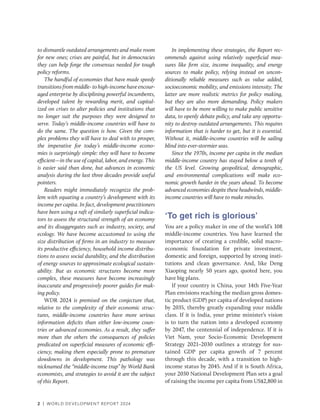
‘To get rich is glorious’
You are a policy maker in one of the world’s 108
middle-income countries. You have learned the
importance of creating a credible, solid macro-
economic foundation for private investment,
domestic and foreign, supported by strong insti-
tutions and clean governance. And, like Deng
Xiaoping nearly 50 years ago, quoted here, you
have big plans.
If your country is China, your 14th Five-Year
Plan envisions reaching the median gross domes-
tic product (GDP) per capita of developed nations
by 2035, thereby greatly expanding your middle
class. If it is India, your prime minister’s vision
is to turn the nation into a developed economy
by 2047, the centennial of independence. If it is
Viet Nam, your Socio-Economic Development
Strategy 2021–2030 outlines a strategy for sus-
tained GDP per capita growth of 7 percent
through this decade, with a transition to high-­
income status by 2045. And if it is South Africa,
your 2030 National Development Plan sets a goal
of raising the income per capita from US$2,800 in
OVERVIEW: MAKING A MIRACLE | 3
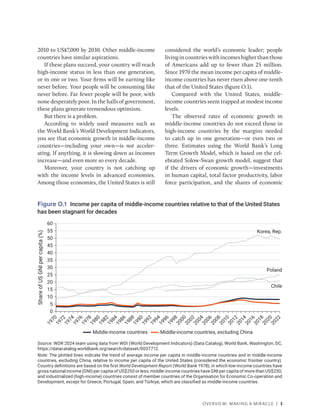
Figure O.1 Income per capita of middle-income countries relative to that of the United States
has been stagnant for decades
Source: WDR 2024 team using data from WDI (World Development Indicators) (Data Catalog), World Bank, Washington, DC,
https://datacatalog.worldbank.org/search/dataset/0037712.
Note: The plotted lines indicate the trend of average income per capita in middle-income countries and in middle-income
countries, excluding China, relative to income per capita of the United States (considered the economic frontier country).
Country definitions are based on the first World Development Report (World Bank 1978), in which low-income countries have
gross national income (GNI) per capita of US$250 or less; middle-income countries have GNI per capita of more than US$250;
and industrialized (high-income) countries consist of member countries of the Organisation for Economic Co-operation and
Development, except for Greece, Portugal, Spain, and Türkiye, which are classified as middle-income countries.
0
5
10
15
20
25
30
35
40
50
45
60
55
1
9
7
0
1
9
7
2
1
9
7
4
1
9
7
6
1
9
7
8
1
9
8
0
1
9
8
2
1
9
8
4
1
9
8
6
1
9
8
8
1
9
9
0
1
9
9
2
1
9
9
4
1
9
9
6
1
9
9
8
2
0
0
0
2
0
0
2
2
0
0
4
2
0
0
6
2
0
0
8
2
0
1
0
2
0
1
2
2
0
1
4
2
0
1
6
2
0
1
8
2
0
2
0
2
0
2
2
Share
of
US
GNI
per
capita
(%)
Middle-income countries Middle-income countries, excluding China
Korea, Rep.
Chile
Poland
2010 to US$7,000 by 2030. Other middle-income
countries have similar aspirations.
If these plans succeed, your country will reach
high-income status in less than one generation,
or in one or two. Your firms will be earning like
never before. Your people will be consuming like
never before. Far fewer people will be poor, with
none desperately poor. In the halls of government,
these plans generate tremendous optimism.
But there is a problem.
According to widely used measures such as
the World Bank’s World Development Indicators,
you see that economic growth in middle-income
countries—including your own—is not acceler-
ating. If anything, it is slowing down as incomes
increase—and even more so every decade.
Moreover, your country is not catching up
with the income levels in advanced economies.
Among those economies, the United States is still
considered the world’s economic leader; people
livingincountrieswithincomeshigherthanthose
of Americans add up to fewer than 25 million.
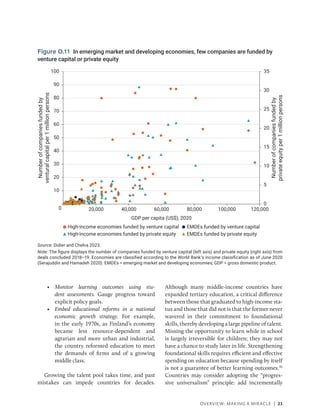
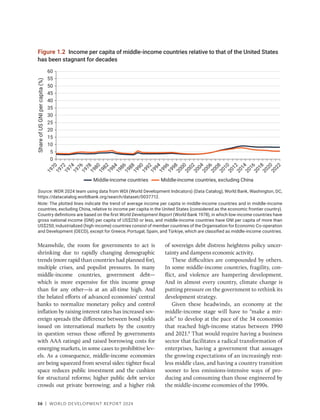
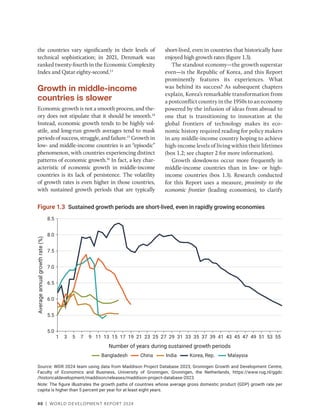
Since 1970 the mean income per capita of middle-
income countries has never risen above one-tenth
that of the United States (figure O.1).
Compared with the United States, middle-­
income countries seem trapped at modest income
levels.
The observed rates of economic growth in
middle-income countries do not exceed those in
high-income countries by the margins needed
to catch up in one generation—or even two or
three. Estimates using the World Bank’s Long
Term Growth Model, which is based on the cel-
ebrated Solow-Swan growth model, suggest that
if the drivers of economic growth—investments
in human capital, total factor productivity, labor
force participation, and the shares of economic
4 | WORLD DEVELOPMENT REPORT 2024
output devoted to public and private invest-
ment—follow recent and historic trends, most
middle-income countries are likely to experience
signifi­
cant slowdowns between 2024 and 2100.
Countries such as Brazil and Mexico are likely to
be even further behind the United States in 2100
than they are today.
One trap or two?
The World Bank presently classifies 108 countries
as “middle-income”—that is, those with annual
income per capita ranging from US$1,136 to
US$13,845.1
These countries are critical to long-
term global prosperity. They account for nearly
40 percent of global economic activity, more than
60 percent of people living in extreme poverty,
and more than 60 percent of global carbon diox-
ide (CO2
) emissions (table O.1).
Developing economies change in structure as
they increase in size, which means that changes
in the pace of growth stem from factors that are
new to them. Although these imperatives can vary
across countries, economic expansion, on average,
begins to decelerate and often reaches a plateau
in income per capita growth, typically at about
11 percent of US GDP per capita. Today, this figure
would be about US$8,000, or around the level at
which countries are firmly considered upper-
middle-income. A systematic slowdown in growth
then occurs. Development strategies relying
largely on capital accumulation that served these
countries well in their low-income phase, for many
even during their lower-middle-income phase
between US$1,136 and US$4,465—begin to yield
diminishing returns. Strategies based on factor
accumulation alone are likely to steadily worsen
results—a natural occurrence as the marginal
productivity of capital declines.
To see why, consider this: if capital endowments
were the only economically relevant difference
between­middle-incomeandhigh-incomecountries
today, the gross national income per capita of a
typical middle-income country would have been
nearly three-quarters of that of the United States in
2019 (figure O.2). In fact, it is about one-fifth that of
the United States. Its growth prospects now depend
increasinglyonitsabilitytoboostthesophistication
of its production methods.
Since 2007, the World Bank has called this
dependence the “middle-income trap.”2
And over
the last 34 years, only 34 economies have suc-
ceeded in breaking out of it.
To achieve high-income status, a middle-​
income country needs to ramp up the sophis-
tication of its economic structure. Using the
Table O.1 World Bank country classifications and selected global indicators, 2022
INCOME
CLASSIFICATION
SHARE OF
GLOBAL
POPULATION (%)
SHARE OF
GLOBAL
GDP (%)
SHARE OF PEOPLE IN
EXTREME POVERTY
GLOBALLY (%)
SHARE OF GLOBAL
CARBON DIOXIDE (CO2
)
EMISSIONS (%)
Low-income 8.9 0.6 36.5 0.5
Lower-middle-income 40.3 8.3 55.4 15.7
Upper-middle-income 35.1 30.3 7.1 48.6
High-income 15.7 60.8 1.0 35.2
Sources: Population shares and global GDP shares computed from WDI (World Development Indicators) (Data Catalog),
World Bank, Washington, DC, https://datacatalog.worldbank.org/search/dataset/0037712; extreme poverty shares from
PIP (Poverty and Inequality Platform) (dashboard), World Bank, Washington, DC, https://pip.worldbank.org/home; carbon
dioxide emissions data (2022) from Climate Watch (dashboard), World Resources Institute, Washington, DC, https://www​
.climatewatchdata.org/.
Note: The World Bank currently recognizes 26 economies as low-income (GNI per capita, calculated using the World Bank
Atlas method, of US$1,135 or less in 2022); 54 as lower-middle-income (GNI per capita of between US$1,136 and US$4,465);
54 as upper-middle-income (GNI per capita of between US$4,466 and US$13,845); and 83 as high-income (GNI per capita of
US$13,846 or more). GDP = gross domestic product; GNI = gross national income.
OVERVIEW: MAKING A MIRACLE | 5
economic complexity of a country’s export
basket—a measure of sophistication—there is a
rising relationship between sophistication and
income for all economies that transitioned from
a GDP per capita of less than US$13,000 to more
than US$31,000, regardless of whether their
export baskets became more or less diversified
(figure O.3).
However, the pace of progress in middle-­
income countries is slowing. Average annual
income growth in these countries slipped by
nearly one-third in the first two decades of this
century—from 5 percent in the 2000s to 3.5 per-
cent in the 2010s.3
A turnaround is not likely
soon because middle-income countries are facing
ever-stronger headwinds. They are contending
with rising geopolitical tensions and protection-
ism that can slow the diffusion of knowledge to
middle-income countries,4
difficulties in servic-
ing debt obligations, and the additional economic
and financial costs of climate change and climate
action.
Investment, infusion, and
innovation—additively and
progressively
To achieve more sophisticated economies,
middle-income countries need two successive
transitions, not one. In the first, investment is
complemented with infusion, so that countries
(primarily lower-middle-income countries) focus
on imitating and diffusing modern technologies.
In the second, innovation is added to the
investment and infusion mix, so that countries
(primarily upper-middle-income countries) focus
on building domestic capabilities to add value
to global technologies, ultimately becoming
innovatorsthemselves.Ingeneral,middle-income
countries need to recalibrate the mix of the three
drivers of economic growth—investment, infusion,
and innovation—as they move through middle-
income status (table O.2).
What makes the move from middle-income
status to high-income status so difficult? One
reason is that as they move through middle-
income status, countries cannot leap all at once
from investment-driven growth to innovation-
driven growth. Infusion of technology comes
first and then innovation.
Infusion first
Economic success in lower-income countries
stems largely from accelerating investment. As
these economies move to middle-income status,
continued progress requires complementing a
good investment climate with measures delib-
erately designed to bring new ideas from abroad
and diffuse them across the economy—so-called
infusion.
Figure O.2 If capital accumulation were
enough, work in middle-income countries
would be nearly three-quarters as rewarding
as in the United States, not just one-fifth
Source: WDR 2024 team using data from PWT (Penn World
Table) (database version 10.1), Groningen Growth and
Development Centre, Faculty of Economics and Business,
University of Groningen, Groningen, the Netherlands,
https://www.rug.nl/ggdc/productivity/pwt/.
Note: The bars show the simple average for middle-income
countries in 2019. The data are calculated using the
methodology outlined in Jones (2016). Following Jones
(2016), the figure is based on Hicks-neutral and a constant
labor share of two-thirds. GDP = gross domestic product.
0
10
20
30
40
50
60
70
80
21
71
Middle-income countries
Percent
GDP per worker relative to US GDP per worker
Physical capital and human capital relative
to that in the United States
6 | WORLD DEVELOPMENT REPORT 2024
Figure O.3 Economies become more sophisticated as they transition from middle-income to
high-income status
Source: Bahar, Bustos, and Yıldırım (2024) using PWT (Penn World Table) (database version 10.1), Groningen Growth and
Development Centre, Faculty of Economics and Business, University of Groningen, Groningen, the Netherlands, https://
www.rug.nl/ggdc/productivity/pwt/.
Note: The figure plots for each economy that transitioned from GDP per capita of less than US$13,000 to more than
US$31,000 (50th and 75th percentile, respectively, in 2019) the relationship between GDP per capita and sophistication of
its exports. Sophistication is measured as the weighted average of the Economic Complexity Index. The figure shows the
sample of economies that diversified (orange solid line)—that is, an economy’s final trend is more diversified than its starting
point—and those whose production became more concentrated (dark blue dashed line). For country abbreviations, see
International Organization for Standardization (ISO), https://www.iso.org/obp/ui/#search. GDP = gross domestic product;
PPP = purchasing power parity.
AUT
BEL
CYP
DEU
ESP
EST
FIN
FRA
GRC
HKG
HUN
ISR
ITA
JPN
KOR
LTU
LVA
POL
PRT
−1.00
−0.50
0
0.50
1.00
Economic
Complexity
Index
0 5,000 10,000 15,000 20,000 25,000 30,000 35,000 40,000 45,000 50,000 55,000 60,000
GDP per capita (PWT chained PPP 2017 US$)
Nonparametric trend
Diversified economies Concentrated economies
To intentionally import state-of-the-art
technology, knowledge of market potential,
and business practices from abroad, as well as
expedite their diffusion at home (figure O.4),
newly minted middle-income economies have to
change tack. Policy makers must support firms
that are ready and able to incorporate global
technologies into production. For firms to make
the most of new technologies, they need tech-
nically skilled workers in large numbers and a
sufficient supply of engineers, scientists, man-
agers, and other highly skilled professionals.
Countries that are relatively open to economic
ideas from abroad and have instituted strong
secondary education and vocational training
programs at home tend to perform better than
those that have not.
The experiences of three economies that have
grown quickly from the lower-middle-income
to high-income levels in recent decades—Chile,
OVERVIEW: MAKING A MIRACLE | 7
the Republic of Korea, and Poland—illustrate
these ideas (figure O.5).
Korea’s success may be the best support for the
argument that sustaining high growth requires
adding infusion to accelerations of investment,
and then again augmenting the 2i mix with
innovation policies. Korea was among the least
developed countries globally in the early 1960s,
with income per capita of less than US$1,200 in
1960. By 2023, after an unparalleled five-decade
run of high output growth, Korea’s income per
capita had risen to about US$33,000.
Table O.2 To achieve high-income status, countries will need to recalibrate their mix of
­
investment, infusion, and innovation
INCOME CLASSIFICATION INVESTMENT INFUSION INNOVATION
Low-income
Higher priority Lower priority Lower priority
Lower-middle-income
Higher priority Higher priority Lower priority
Upper-middle-income
Higher priority Higher priority Higher priority
Source: WDR 2024 team.
Note: The orange dials indicate a strategy that is a priority for that particular income group. The blue dials indicate a strategy
that is less of a priority for that particular income group until the priority strategy is successfully achieved.
Source: WDR 2024 team.
Note: The curves illustrate the relative contributions of capital and productivity to economic growth (y-axis), according to
countries’ proximity to the frontier (represented by the leading economies). Countries farther out on the x-axis are closer to
the frontier.
Figure O.4 Middle-income countries must engineer two successive transitions to move to
high-income status
2i
Investment + Infusion
1i
Investment
3i
Investment + Infusion + Innovation
Capital Productivity
Relative
contribution
to
growth
Proximity to the frontier
8 | WORLD DEVELOPMENT REPORT 2024
In the 1960s, a combination of measures to
increase public investment and encourage pri-
vate investment kick-started growth.5
In the
1970s and 1980s, Korea’s growth was powered
by a potent mix of high investment rates and
infusion, aided by an industrial policy that
encouraged firms to adopt foreign technolo-
gies (figure O.6). Firms received tax credits for
royalty payments, and family-owned conglom-
erates, or chaebols, took the lead in copying
technologies from abroad—primarily Japan. As
Korean conglomerates caught up with foreign
firms and encountered resistance from their
erstwhile benefactors, industrial policy shifted
toward a 3i strategy supporting innovation.
Then, as Korean firms became more sophis-
ticated in what they produced, they needed
workers with specialized engineering and man-
agement skills. The Ministry of Education,
through public universities and the regulation
of private institutions, did its part, setting tar-
gets, increasing budgets, and monitoring the
development of these skills. These firms also
required more specialized capital: for a growing
middle-income economy, investment remained
important.
Poland’s case is different because of both its
socialist past and its membership in the European
Union (EU), the most powerful association of
economies ever assembled. But its rapid increase
in income is well known, and a Korea-like 1i to 2i
to 3i transition is still discernible.
In the early 1990s, Poland underwent a
transition from a planned economy to a market
economy. It has since boosted its income per capita
from 20 percent of the average for the European
Union to 50 percent. What is Poland’s winning
strategy? It began by disciplining the large state-
owned enterprises (SOEs). It hardened their
budgetconstraintsbycuttingsubsidies,tightening
Source: WDR 2024 team using WDI (World Development Indicators) (Data Catalog), World Bank, Washington, DC, https://
datacatalog.worldbank.org/search/dataset/0037712.
Note: GNI = gross national income; HIC = high-income country; LMIC = lower-middle-income country; UMIC = upper-middle-
income country.
Figure O.5 In the Republic of Korea, Poland, and Chile, the rapid growth from middle- to
high-income status has been interspersed with economic crises
0
5,000
10,000
15,000
20,000
25,000
30,000
35,000
1
9
6
0
1
9
6
2
1
9
6
4
1
9
6
6
1
9
6
8
1
9
7
0
1
9
7
2
1
9
7
4
1
9
7
6
1
9
7
8
1
9
8
0
1
9
8
2
1
9
8
4
1
9
8
6
1
9
8
8
1
9
9
0
1
9
9
2
1
9
9
4
1
9
9
6
1
9
9
8
2
0
0
0
2
0
0
2
2
0
0
4
2
0
0
6
2
0
0
8
2
0
1
0
2
0
1
2
2
0
1
4
2
0
1
6
2
0
1
8
2
0
2
0
2
0
2
2
GNI
per
capita
(constant
2015
US$)
HIC threshold
UMIC threshold
LMIC threshold
Korea, Rep.
Poland
Chile
OVERVIEW: MAKING A MIRACLE | 9
bank loans, and liberalizing import competition—
including at the iconic Stocznia Gdańsk shipyard,
where the Solidarność (Solidarity) movement
began. This discipline paved the way for
comprehensive reform. In Polish SOEs, managers
shifted their focus from production targets to
profitability and market share, and they upgraded
firms’ capabilities to prepare for privatization.6
Poland then built on this foundation to attract
investment, focus on infusion next, and turn to
innovation last. It followed this sequence largely
by raising productivity with technologies infused
from Western Europe—a process accelerated
in the 2000s by its entry into the EU common
market, which spurred foreign direct investment.
Poland also increased tertiary education rates
from 15 percent in 2000 to 42 percent in 2012.
Educated Poles put their skills to work across
the European Union, opening another channel
to infusing global knowledge into the Polish
economy.
Chile’s success has similar features. In 2012,
Chile became the first Latin American country
to reach high-income status, just two years
after ­
joining the Organisation for Economic
Co-operation and Development (OECD). Chile
has grown and diversified its exports since the
1960s, when mining made up about four-fifths
of its exports. This share is now about half.
Knowledge transfers from advanced economies
have been supported by both public and private
institutions. The public Chilean Agency for
Exports Promotion (ProChile) has bolstered
small and medium enterprises (SMEs), which over
2013–16 contributed one-third of export value
added—theothertwo-thirdsbeingcontributedby
large domestic exporters.7
And Fundación Chile,
a private nonprofit created in 1976, promotes
technology transfer for domestic ventures. One
example is the adaptation of Norwegian salmon
farming technologies to local conditions, making
Chile a leading world exporter of salmon.
Sources: Panel a: National Archives of Korea, https://www.archives.go.kr/english/index.jsp. Panel b: Choi and Shim 2024.
Note: Panel b shows the adoption subsidy rate alongside the innovation (R&D) subsidy rate, calculated using the tax credit
rate and the corporate tax rate. For example, a 30 percent subsidy rate indicates that firms can receive a reimbursement
equivalent to 30 percent of their expenditures on adoption fees or R&D. R&D = research and development.
Figure O.6 From infusion to innovation in the Republic of Korea
as programs and rolntod documentation within the scope
a. An agreement between companies
to collaborate on technology
0
10
20
30
40
1970 1980 1990 2000 2010 2020
b. Government incentives
(subsidies)
Innovation subsidy
Adoption subsidy
Subsidy
rate
(%)
Figure A.1: Example of Adoption Contract
TECHNICAL COLLABORATION AGREEMENT
BY AND BETWEEN
NIPPON ELECTROIC
SAMSUNG ELECTRON DEVICES CO., LTD.
Section 4 Supply of written Technical Information
During the term of this Agreement NEC will upon reasoable
request furnish SED with one transparent copy of each
as programs and related documentation within the scope
other details of furnishing such written NEC Technical
Information shall be separately determined by the parties
upon mutual consultation.
specified in Section 1 (d) hereof. The time, manner and
drawing, specification and other technical document as well
(a)
CO., LTD.
AND
Figure A.1: Example of Adoption Contract
TECHNICAL COLLABORATION AGREEMENT
BY AND BETWEEN
NIPPON ELECTROIC
SAMSUNG ELECTRON DEVICES CO., LTD.
Section 4 Supply of written Technical Information
During the term of this Agreement NEC will upon reasoable
request furnish SED with one transparent copy of each
other details of furnishing such written NEC Technical
Information shall be separately determined by the parties
upon mutual consultation.
specified in Section 1 (d) hereof. The time, manner and
drawing, specification and other technical document as well
(a)
CO., LTD.
AND
10 | WORLD DEVELOPMENT REPORT 2024
Innovation next
Once a middle-income country has begun to
exhaust the potential of infusion in the most
promising parts of its economy—running out of
technologies to learn and adopt—it should expand
its efforts to become an innovation economy. But
this transition is as or more daunting than the
preceding one.8
Infusion is powered mainly by the
technology transfers embodied in flows of physi-
cal and financial capital.
Although innovation requires both of these
flows, it also needs increasingly vigorous
exchanges of human capital—often triggered
by a reengagement with the emigrant diaspora,
but also creating the conditions cherished by
innovators such as freer economies, human
rights, and livable cities. Moreover, to enable
firms to innovate, governments must have done
a lot during the infusion phase to reform and
strengthen institutions. Weak institutions are
as debilitating as premature attempts to leapfrog
from investment to innovation. In some cases,
ignoring the imperative of infusion to quicken
innovation can even worsen the investment
climate, setting middle-income economies back
years if not decades. Latin America, ground
zero for the middle-income trap, provides a
cautionary example.
After reaching middle-income status in the
1970s, Brazil veered in the wrong direction. Its
policy makers attempted to encourage firms to
innovate by bypassing the infusion of foreign
technologies. In 2001, the government imple-
mented an innovation-driven economic growth
strategy, driven in part by fears that foreign tech-
nology would exacerbate domestic inequality and
lead to dependence on the more advanced econ-
omies in the North Atlantic. Notably, it imposed
a 10 percent marginal tax rate on payments for
international intellectual property. These tax rev-
enues were used to subsidize innovation in tar-
geted sectors, including biotechnology, aviation,
health, and agriculture.9
One study found that the subsidies stimulated
a rapid rise in applications at the Brazilian
patent office, but the patents turned out to
be of low quality and lacked any relevance to
global markets. Moreover, as the share of firms
that applied for patents within the economy
increased, the wage premium for skilled workers
declined, as did the value added.10
While Brazil was stumbling at home, Korea
was racing around the world, making the infusion
of foreign technology the cornerstone of domes-
tic innovation. In 1980, the average productivity
of a worker in Korea was just 20 percent that of
the average US worker. By 2019, it had tripled to
more than 60 percent (figure O.7). By contrast,
Brazilian workers, who had been 40 percent as
productive as their US counterparts in 1980, were
just 25 percent as productive by 2018.
There are no shortcuts to innovation. It
is unlikely that industrial policy will enable
countries to leapfrog from an investment- and
manufacturing export–driven model to an
innovation-oriented model or services-led model
of economic growth. The development literature
is littered with reports recommending a leap from
investment to innovation, skipping the stage of
painful reforms to attract foreign investment
and ideas. However, middle-income governments
that have tried to spare their citizenry the pains
associated with reforms and openness have
also kept from them the gains that come from
sustained growth.
The economics of
creative destruction
The shifts from 1i to 2i to 3i strategies are nei-
ther smooth nor linear. They require a mix of
economic, social, and political change that Karl
Marx and other philosophers considered impossi-
ble under capitalism. They reasoned instead that
market-based economies would be riddled with
a growing concentration of wealth and wracked
by crises until capitalism was replaced by com-
munism. Joseph Schumpeter changed this debate
with his 1942 treatise Capitalism, Socialism and
Democracy and the phenomenon of “creative
OVERVIEW: MAKING A MIRACLE | 11
destruction.”11
For Schumpeter, the crises in capi-
talist economies could be simultaneously painful
and restorative.
Nearly a century later, many of Schumpeter’s
insights appear to have been confirmed. Indeed,
his admonitions and insights have been used by
modern Schumpeterian theorists—most notably,
Aghion and Howitt (1992) and Akcigit and Kerr
(2018)—to construct formal frameworks. These
advances in growth theory are useful in helping
solve the hardest problem facing the global econ-
omy today: how should the 108 middle-income
countries with 75 percent of the world’s people,
60 percent of global emissions, but just 40 ­
percent
of global output correct these imbalances while
converging toward the living standards of
advanced economies?
Schumpeterian ideas provide helpful clues.
Success seems to come most quickly to societ-
ies that balance the economic forces of creation,
preservation, and destruction.
Energy: Incumbents can collude
(Schumpeter’s view)
Joseph Schumpeter (1942) wrote that society
benefits when entrepreneurs with talent and
vision introduce new products and technologies,
displacing old products and business models and
generating ever-higher productivity and growth.
Often, however, incumbents collude to preserve
the status quo (figure O.8, panel a). In today’s
environment, Schumpeter’s view is perhaps
best reflected in the contest between high- and
low-carbon energy. High-carbon energy, particu-
larly coal, has been an incumbent technology for
over 300 years (box O.1). Technical progress has
followed a path over which the efficiency with
which fossil fuels are extracted and burned has
increased, urban infrastructure has been built
around the private motor vehicle, social atti-
tudes and personal preferences are supportive
of high carbon consumption, and political pres-
sure groups represent carbon-intensive interests.
Source:WDR2024teamusingdatafromPWT(PennWorldTable)(databaseversion10.1),GroningenGrowthandDevelopment
Centre, Faculty of Economics and Business, University of Groningen, Groningen, the Netherlands, https://www.rug.nl/ggdc​
/productivity/pwt/.
Note: GDP = gross domestic product.
Figure O.7 Over the last four decades, as the Republic of Korea’s labor productivity relative to
that of the United States continued to climb, Brazil’s peaked—and then sagged
0
10
20
30
40
60
50
70
Labor
productivity
(GDP
per
person
employed
relative
to
a
US
worker,
%)
1
9
8
0
1
9
8
2
1
9
8
4
1
9
8
6
1
9
8
8
1
9
9
0
1
9
9
2
1
9
9
4
1
9
9
6
1
9
9
8
2
0
0
0
2
0
0
2
2
0
0
4
2
0
0
6
2
0
0
8
2
0
1
0
2
0
1
2
2
0
1
4
2
0
1
6
2
0
2
0
2
0
1
8
Korea, Rep.
Brazil
12 | WORLD DEVELOPMENT REPORT 2024
Source: WDR 2024 team based on Schumpeter (1942); Aghion and Howitt (1992); Akcigit and Kerr (2018).
Figure O.8 Three views of creative destruction
TECHNOLOGY
FRONTIER
Incumbent
Entrant
TECHNOLOGY
FRONTIER
Incumbents
Entrant
TECHNOLOGY
FRONTIER
Incumbent Incumbent
Entrant
Economic progress
Aghion and Howitt’s view: entrants
create value and displace incumbents
Economic progress
Schumpeter’s view: incumbents
can collude
Economic progress
Akcigit and Kerr’s view: incumbents
and entrants add value
a. Energy
(Schumpeter)
b. Talent
(Aghion and Howitt)
c. Enterprise
(Akcigit and Kerr)
Box O.1 Who and what are incumbents? Leading firms, technologies,
nations, elites—and men
Incumbents are firms that usually have well-established brand names recognized and
trusted by consumers. They often have better access to financial resources, such as capi-
tal for investment and technological infusion, and human resources, such as experienced
employees. They also may have established relationships with suppliers and distributors,
which can be leveraged to maintain a competitive edge. And they have resources to invest
in research and development and to invent products and processes they can protect with
patents.
Incumbents are well-established energy sources such as fossil fuels. Since 1709 when
Abraham Darby, a British ironmaster, first smelted iron ore with coke, coal has been the
fuel of choice around the world. In the more than 300 years since Darby’s innovation, coal
has become the largest source of electricity generation worldwide, producing more than
one-third of global electricity in 2022.a
Cities and economies have been built on cheap
coal-powered energy, fueling their prosperity. However, the widespread use of coal gen-
erates the highest energy-related carbon dioxide emissions—15.5 gigatons—representing
42 percent of total emissions in 2022.
Incumbents are technologically advanced nations. They can share technologies with
emerging economies through investing in, licensing, training, and hosting foreign stu-
dents. For decades, they were instrumental in supporting the growth of emerging econo-
mies. But today, they are erecting walls to subsidize their domestic firms, blocking others
from joining their value chains.
(Box continues next page)
OVERVIEW: MAKING A MIRACLE | 13
Finally, incumbents are elites in society. They are always powerful, generally wealthy,
and—in middle-income economies—mostly men. But they are not all against prog-
ress. Elites can have the education and resources to accelerate growth by infusing their
­
economies with global technologies. For a middle-income country seeking to infuse and
innovate, elites may serve as the go-to pool of trained professionals, managers, entrepre-
neurs, and innovators. Men are also incumbents, for centuries enjoying better education
and job opportunities than women and defining laws and institutions, often to buy social,
economic, and political power. Such power has given them an outsize say in deciding
who studies where and what, who gets a well-paid job, and who gets to start a business.
Meanwhile, misogyny may keep women out of the market or at least the most desired
jobs and business opportunities.
Large firms, social elites, powerful men, and advanced economies have, however, also
helped new entrants. The size and ownership of enterprises and the socioeconomic status
and gender of individuals are not reliable attributes on which to base policy.
a. IEA (2023).
The result is that the returns to investing in high-­
carbon activities are large because of all the com-
plementary high-carbon investments that have
been made.
In many middle-income countries, power
markets are still a monopoly: an SOE operating
under a vertically integrated utility remains in
charge of generation, transmission, distribution,
and the retail supply. This arrangement hinders
competition and results in the inefficient use of
resources. In addition, in many middle-income
countries the first generators dispatched are
often not those with the lower marginal prices
(that is, power dispatch often does not follow
merit order), serving as a barrier to the expan-
sion of renewables with rapidly declining costs.
In countries that include Pakistan, Poland, South
Africa, and Türkiye, SOEs account for 84 percent
of total installed capacity. By contrast, the private
sector owns about an equal share (80 percent) of
the installed capacity of renewable energy.12
Although advances in low-carbon energy
can help to decouple economic growth from
carbon emissions, the diffusion of low-carbon
technologies in middle-income countries is
patchy, reflecting a landscape of legacy policies
that preserve a high-carbon economy. Middle-
income countries have a greenhouse gas (GHG)
intensity of GDP that is 3.5 times higher than that
of high-income countries. This difference reflects
both the misallocation in the use of energy (with
the energy intensity of GDP also 2.5 times higher
than in high-income countries) and the lower
diffusion of low-carbon energy technologies
(figure O.9, panel a).
Talent: Entrants create value and
displace incumbents (Aghion and
Howitt’s view)
Schumpeter’s ideas on creative destruction served
as the inspiration for one of the most influen-
tial papers in economics that emerged from a
fortuitous collaboration between two econo-
mists. In the summer of 1987, Philippe Aghion, a
new professor at the Massachusetts Institute of
Technology (MIT), and Peter Howitt, a Canadian
economist, formalized a theory of creative
Box O.1 Who and what are incumbents? Leading firms, technologies,
nations, elites—and men (continued)
14 | WORLD DEVELOPMENT REPORT 2024
Figure O.9 Creation is a weak force in middle-income countries, where it is characterized by a
rampant misallocation of resources
a. In middle-income countries, economic growth is more carbon-intensive than in high-income countries, and
middle-income countries lag in energy efficiency and adoption of low-carbon technologies
0
0.5
1.0
1.5
2.0
2.5
3.0
3.5
GHG emissions
intensity
(as share of GDP)
Energy intensity
(as share of GDP)
Solar electricity
generation (as share
of total electricity
generation)
Wind electricity
generation (as share
of total electricity
generation)
Electric vehicle
deployment
(per million population)
3.5 times
higher
2.5 times
higher
HIC = 1
40% lower 42% lower 53% lower
Proximity
to
the
frontier
(Figure continues next page)
destruction in which economies expand mainly
through innovation by entrants.13
Entrants chal-
lenge incumbents and become the protagonists
of economic growth (figure O.8, panel b).
Thisformulation ofcreativedestruction empha-
sizes the importance of both creating ever-larger
reservoirs of talent and improving the allocation
of talent to tasks. Not investing in the talents of
women and minorities, keeping them out of the
most rewarding activities, and adopting unfair
compensation practices are surely the most self-­
defeating attributes of middle-income economies,
where skills are already scarce. When these prac-
tices are discouraged, the payoff can be immense.
In the United States between 1960 and 2010, the
decline in gender and racial discrimination in edu-
cation and work explains up to 40 ­
percent of the
observed growth during that period.14
As they grow, middle-income countries will
needskilledworkerssuchasengineers,technicians,
and managers, but they have smaller reservoirs
of skilled talent than advanced economies. And
yet preservation forces discourage the acquisition
of talent. Talent is wasted wherever that acquired
through education, training, and work experience
is allocated not by merit, but according to other
factors outside the control of individuals. Gender,
family background, ethnic and cultural identity—
none of these factors should matter for school
enrollment or career prospects in a country aspir-
ing to grow rapidly through infusion and innova-
tion. But for the average child in a middle-­
income
country today, they matter all too much.
Economically and socially mobile societies are
better at developing skills and utilizing talent,
but social mobility in middle-income countries
is about 40 percent lower than that in advanced
economies.15
Middle-income countries will need
to ensure that more individuals, regardless of
their parents’ circumstances, have better oppor-
tunities to become skilled workers. And social
mobility matters much more in middle-income
countries than in low-income countries simply
because the former need more skilled workers
to invest, infuse, innovate, and grow (figure O.9,
panel b).
OVERVIEW: MAKING A MIRACLE | 15
Why do preservation forces persist in con-
straining the opportunities for so many people?
Part of the answer is that preservation insu-
lates members of social elites from the forces of
destruction that, in a more open society with
meritocratic institutions, might dissipate their
advantages in wealth and privilege. The same
forces ensure that, beyond elites, few children
will get the chance to climb to a higher rung on
a country’s income ladder than that occupied by
their parents. So, income inequality remains high
and social mobility remains low, transmitting
inequality across generations, exacerbating the
inequality of opportunity.
Three kinds of preservation forces perpetuate
social immobility in middle-income countries,
shutting out talent from economic creation. The
first force is norms—biases that foreclose or limit
opportunity for women and other members of
marginalized groups. Next are networks—above
all, family connections. And the last force is
neighborhoods—regional and local disparities
in access to education and jobs. Although all
three factors can have positive impacts on talent
Sources: Panel a: Chepeliev and Corong 2022; Energy Institute 2023; Statistics Data (portal), International Renewable
Energy Agency, Abu Dhabi, United Arab Emirates, https://www.irena.org/Data; WDI (World Development Indicators) (Data
Catalog), World Bank, Washington, DC, https://datacatalog.worldbank.org/search/dataset/0037712. Panel b: WDR 2024
team estimates based on GDIM (Global Database on Intergenerational Mobility) (dashboard), Data Catalog, World Bank,
Washington, DC, https://datacatalog.worldbank.org/search/dataset/0050771/global-database-on-intergenerational​
-mobility. Panel c: India, Mexico, and the United States: Hsieh and Klenow 2014; Peru: World Bank 2015.
Note: Panel a displays for middle-income countries compared with an index of 1, representing the high-income country (HIC)
frontier, the greenhouse gas (GHG) emissions intensity of the gross domestic product (GDP), the energy intensity of GDP, the
share of solar and wind energy in total electricity generation, as well as the battery electric vehicles per million population.
Panel b plots regression coefficients of intergenerational mobility (which is equal to 1 minus the intergenerational relative
mobility) for different country groups at the 95 percent confidence interval. The dependent variable in the regression is the
share of skilled workers (“Legislators, sr. officials, managers”; “Professionals”; “Technicians and associate professionals”).
The regression controls for the log of GDP per capita when the 1980s birth cohort was growing up. Intergenerational mobility
estimates are for educational mobility of the 1980s cohort from the World Bank’s GDIM. HICs = high-income countries;
LICs = low-income countries; LMICs = lower-middle-income countries; UMICs = upper-middle-income countries. Panel c
illustrates the average employment across a cohort of firms of different ages in the cross-section of firms. The number of
employees serves as a proxy for firm size. The y-axis axis reports the average employment of each cohort relative to the
average employment across firms under five years of age.
Figure O.9 Creation is a weak force in middle-income countries, where it is characterized by a
rampant misallocation of resources (continued)
Employment
relative
to
firms
<5
years
of
age
United States
India Mexico Peru
0
1
2
3
4
5
6
8
7
<5 20−24
10−14 ≥40
30−34
Age of firms (years)
c. “Flat and stay” versus “up or out”: Efficient
firms do not expand, and inefficient firms do
not exit the market in India, Mexico, and Peru
b. Intergenerational mobility matters more for skill
development in middle-income countries than in
low-income countries
HICs
UMICs
LMICs
LICs
−0.2 0.2
0 0.4 0.6
Regression coefficient of skilled workers’
intergenerational mobility
16 | WORLD DEVELOPMENT REPORT 2024
­
creation—filling voids left by missing markets
and services—they become forces of preservation
whentheyblockthedisadvantagedfromaccessing
opportunity.
Enterprise: Incumbents and
entrants add value (Akcigit
and Kerr’s view)
The original Schumpeterian premise that new
entrants drive change and create new economic
potential while incumbents are inert runs counter
to the latest empirical evidence on enterprises.
Globally, larger and more established firms are
infusing new knowledge into their businesses at a
higher rate than smaller firms. In middle-income
countries, it is the large firms that are employ-
ing the majority of highly skilled workers.16
Throughout the twentieth century, the United
States effectively transitioned its innovation
focus from individuals working in their garages
to established firms, leveraging advantages such
as risk management, market access, brand reputa-
tion, and collaboration. These firms now account
for over 75 percent of patents filed at the United
States Patent and Trademark Office.17
A third generation of Schumpeterian econo-
mists have formalized the idea that both incum-
bent enterprises and entrants can create value
(figure O.8, panel c).18
Market leaders—successful
incumbents—can bring scale and advance domes-
tic industry by investing in upgraded products
and business practices, as well as technology for
new markets. Scale allows for adopting modern
management practices, for hiring and rewarding
skilled workers, and for making the most produc-
tiveuseoflargeamountsofcapital.Inotherwords,
scale gives incumbents the power to boost their
efficiency, whether in the expectation of compe-
tition from other incumbents or from entrants
or in response to it. Scale also allows incumbents
to specialize in multiple product lines, changing
course to parry the new offerings of competitors.
However, the forces of creation are weak in
middle-income countries. In India, Mexico, and
Peru, for example, if a firm operates for 40 years,
it will roughly double in size. In the United States,
the average firm that survives that long will
grow sevenfold (figure O.9, panel c). For firms in
middle-income countries, this implies a “flat and
stay” dynamic: firms that fail to grow substan-
tially can still survive for decades. By contrast,
for US firms the dynamic is “up or out”: facing
intense competitive pressure, a few entrepreneurs
will expand their businesses rapidly, while most
others will exit quickly. Among the majority who
exit the market, many will become wage earners
at the most flourishing firms.
In keeping with the flat and stay dynamics,
firms in India, Mexico, and Peru tend to remain
microenterprises: nearly nine-tenths of firms have
fewer than five employees, and only a tiny minority
have 10 or more. The longevity of undersize
firms—many of them informal—points to market
distortions that keep enterprises small while
keeping too many in business. For example, a high
regulatory cost attached to formal business growth
may inhibit an efficient firm from gaining market
share and driving out inefficient competitors.
Such policy-induced distortions in middle-
income countries result in misallocated resources,
hampering creation and infusion at scale.
Balancing the three forces
Looked at it this way, middle-income countries
face common challenges in balancing the three
forces:
• Creation—the primary protagonist of eco-
nomic growth—is a weak force in many
middle-income countries. Large incum-
bents are slow to develop new products
and processes, and, although small firms
are continually entering various markets,
most of them do not create or disrupt.
Periods of growth are also times of cre-
ation, and thus of structural change.
• Preservation—the arch antagonist of
­
creation—is the strongest force in middle-­
income countries. The same market leaders
who could enable middle-income coun-
tries to speed up the infusion of global
OVERVIEW: MAKING A MIRACLE | 17
knowledge are too often slowing down
the process. Incumbent firms and elites
are often successful in keeping things as
they are whether through market power
and collusion, through capture of poli-
cies and regulations, or through educa-
tion systems and labor markets that place
more importance on socioeconomic sta-
tus than on talent or merit.
• Destruction—a necessary evil that clears the
way for creation by freeing up misallocated
resources and sweeping away outdated
institutions—is kept weak in middle-income
countries by opposition from those with
market power or government influence.
A growing economy that requires new
arrangements in capital, labor, and energy
markets needs to release itself from less
efficient ones. To the extent that weak
institutions and policies preserve outdated
arrangements, creative destruction is
stifled. However, this opposition tends to
weaken during crises—whether economic,
political, or ecological. When crises place
intense pressure on governments to act,
a window opens for reforms.
Striking the right balance
Middle-income countries are hampered by an
imbalance among the forces of creation, preser-
vation, and destruction. The forces of creation
are weak, the forces of preservation are strong,
and destruction is held back by the forces of
preservation. Middle-income countries must
therefore balance these forces (figure O.10).
That means
• Disciplining incumbency to weaken the
forces of preservation
• Rewarding merit activities—those with
positive effects on general well-being
and that aid in the efficient use of talent,
capital, and energy—to strengthen the
forces of creation
• Capitalizing on crises to aid the destruction
of outdated policies and institutions that
are difficult to dislodge during boom times.
These principles can help middle-income
countries calibrate the mix of their three i’s—
investment, infusion, and innovation—as they plan
to accelerate economic growth. Because both
incumbent firms and entrants can add value,
Source: WDR 2024 team.
Figure O.10 Middle-income countries have to strike a balance among creation, preservation,
and destruction
Creation
Destruction
Preservation Destruction Preservation
Creation
18 | WORLD DEVELOPMENT REPORT 2024
industrial policies will need to focus on disciplining
incumbency. And because the talent of women and
disadvantaged groups is grossly underutilized,
social policies will need to focus more on rewarding
their merit and advancing social and economic
mobility. And finally, because economic growth
over the last three centuries has been emissions-
intensive, middle-income countries will need to
capitalize on today’s energy crisis to cut emissions
while balancing energy access and security.
Enterprise, openness, and reforms
Countries growing out of low-income status into
middle-income status tend to have a 1i strategy for
accelerating investment. Stronger institutions are
needed to control inflation, ensure financial and
macroeconomic stability, expand economic and
political freedoms, and enforce the rule of law to
encourage both domestic and foreign investment.
Even if all middle-income countries enjoyed such
enabling conditions, a 1i strategy would not be
enough to support sustained growth and move
these countries out of the middle-income level.
Why? The returns from capital investment alone
decline steadily. Growth in middle-income coun-
tries is boosted when economies take on new
structures, enabled by a 2i strategy focusing on
both investment and infusion. Institutions will
need to create an environment conducive to inte-
grating global technologies into the domestic
economy.
Make markets globally contestable
Contestable markets—and the institutions that
enable them—are vital for middle-income coun-
tries that aim to become a global supplier and
sustain rapid economic growth through sophisti-
cation and scale.
Contestability is not chaos: it does not mean
that firms in middle-income countries cannot
earn comfortable market positions, becoming
established and relatively difficult to displace.
However, contestability does mean that firms
feel pressure to compete because their cur-
rent products and processes can be displaced by
technologically sophisticated producers from
other countries. Such contestability is central to
creative destruction.
A key part of contestability is openness to for-
eign investors and global value chains that give
domestic firms access to larger markets, technol-
ogy, and know-how and allows them to add value
and grow. And they are encouraged to make use
of that access, thereby exposing domestic firms
to competition, but also inspiration, from inter-
national firms that operate at or near the global
technology frontier. Firms at home can seize the
opportunity to infuse technology, increase the
sophistication of their operations, and scale up,
or they can keep doing business as usual and be
eased out.
For example, in Chile imports of Chinese prod-
ucts rose at an average pace of 27 percent a year
from 2001 to 2007, and large Chilean incumbent
firms, or market leaders, boosted their product
innovation by 15 percent and their product quality
by 22 percent.19
In Argentina, after MERCOSUR
(Southern Common Market) was established,
domesticfirmsinsectorsfacingexporttariffreduc-
tions began to invest more in computing tech-
nology and in technology transfers and patents.20
Again, in 12 European countries over 2000–2007
more than 15 percent of the increase in patent-
ing, information technology intensity, and pro-
ductivity was driven by import competition from
China—and successful European firms boosted
management quality while increasing research and
development (R&D) and adding new skills.21
Connect local firms with market leaders
Because local firms often do not have informa-
tion on specific technologies and the know-how
to adopt them, consultants and advisory firms
founded by experts can provide expertise and
advice on technology adoption and implementa-
tion. Market leaders—especially multinationals—
are often vanguards in technology and technical
capabilities and can be some of the best partners
for local firms, working together to deploy new
technologies. The government can help make
the relevant connections. For example, in Chile
the Supplier Development Program, which offers
OVERVIEW: MAKING A MIRACLE | 19
large domestic buying firms an incentive to con-
nect with suppliers that are SMEs, increased the
suppliers’ sales by 16 percent and their employ-
ment by 8 percent. It also boosted the sales of large
sponsor firms by 19 percent.22
Governments can
also provide firms with information on market
opportunities, enabling them to access finance
and strengthen their capabilities, as well as to rec-
ognize opportunity and mobilize themselves to
take advantage of it.23
Reduce factor and product market regulations
Reforms that roll back protection for specific
activities, enterprises, families, or industries rein-
force the gains from openness. However, today
middle-income countries are slow to combine
investment with infusion and innovation, sty-
mied by the powerful institutional and regula-
tory forces of preservation. Especially binding are
product market regulations. Besides imposing
constraints on international trade and invest-
ment, these regulations prop up state control of
business and impose legal and administrative
barriers to entrepreneurship, thereby hobbling
investment and infusion at scale.
Move away from coddling small firms or
­
vilifying large firms
Small and medium-size enterprises are wide-
spread in middle-income countries. Ideally, sub-
sidies would help SMEs grow into larger, more
productive companies that pay higher wages
and adapt knowledge. But the same support also
strengthens the forces of preservation by reduc-
ing incentives for a productive firm to expand,
deterring it from scaling up production. Many
firms in middle-income countries remain small
even when long established; they simply do not
aspire to grow.24
The abundance of small firms
in middle-income countries does not solely mir-
ror the challenges they face. Instead, it indicates a
deficiency in competition, originating from larger
firms that would have displaced them in the mar-
ket if they had expanded.25
Blanket support for
small firms can curtail the exit of unproductive
small businesses, perpetuate smallness, crowd out
other firms, and misallocate resources.26
In coun-
tries that include Japan, Mexico, and Viet Nam,
public support for small firms—not necessarily
young firms—reduced productivity and increased
resource misallocation.27
Even where tax codes do not create explicit pro-
visions based on firm size, middle-income coun-
tries may be creating a practical subsidy to SMEs
through size-dependent tax enforcement—that
is, governments with weak tax collection capacity
may concentrate enforcement on larger firms.28
In Mexico, eliminating distortions created by
size-dependent taxation policies favoring small
firms could boost output by 9 percent.29
In Chile,
China, and India, reductions in distortions helped
these economies close the gap between actual and
potential productivity by 10 percent.
Let go of unproductive firms
Letting inefficient firms and business models fail
is a core principle of creative destruction. Studies
of firm exit—stemming from seminal work by
Hopenhayn (1992)—have revealed that the exit of
less productive firms contributes substantially to
raising aggregate productivity. In many countries,
during periods of trade liberalization the exit of
the least productive firms has boosted growth.30
In
middle-income countries, however, bureaucratic
frictions prolong the survival of zombie firms—
inefficient, debt-ridden companies that crowd
out investment by productive firms.31
Reforms of
bankruptcy laws should focus on enabling failed
businesses to exit swiftly and predictably and on
allowing viable businesses to restructure.
Strengthen competition agencies
As segments of an economy master infusion,
they will need to adopt a 3i strategy. Institutions
can foster the development of new technologies
and ensure that entrants—new entrepreneurs—
are not blocked by established incumbents,
regulatory barriers, and entrenched industry
practices. Antitrust laws can help prevent abuse
of dominance by established incumbents. As
economies (or sectors) move closer to the tech-
nology frontier, competition agencies will need
20 | WORLD DEVELOPMENT REPORT 2024
to consider a possible trade-off between inno-
vation incentives and market power.32
Although
market power enables investment in R&D to
bring new ideas to market, firms may resort to
anticompetitive behavior. Thus, competition
and innovation policies need coordination,
alongside developing independent, capable com-
petition authorities.
For upper-middle-income countries shifting
to a 3i strategy, a special concern is the con-
tainment of killer acquisitions—that is, when
incumbents acquire innovative firms specifically
to kill future competing products and technolo-
gies.33
But not all acquisitions are deadly: many
young entrepreneurs make a deliberate effort to
be acquired by an incumbent, producing com-
plementary innovations that an incumbent can
scale up.
Deepen capital markets
Switching from a 2i to a 3i strategy also has
implications for how firms access finance. Equity
markets can be instrumental in supporting inno-
vative activities, especially in private firms, which
typically face larger financing gaps than publicly
listed firms. However, private markets for equity
financing lack depth and access in emerging
economies (figure O.11). Start-up incubators and
accelerators can be particularly helpful, providing
mentorship, resources, networking opportunities,
and sometimes funding to help start-ups grow
and compete.
Education, social mobility, and
entrepreneurship
As more parts of an economy shift from 1i
to 2i and 3i strategies, demand increases for
highly skilled workers—technicians, managers,
scientists, and other professionals. This demand
can increase income inequality. But, if it is
accompanied by policies that expand access to
higher education and reduce barriers for women
and other disadvantaged groups so that they
are now rewarded for their skills and able to
create new businesses, it also generates greater
social mobility.34
Such conditions can provide
both social stability and economic dynamism,
which are equally necessary for middle-income
countries to grow to high-income status. In fact,
barriers to social mobility can derail a country’s
plans for moving beyond a 1i strategy.
Discipline, not vilify, elites
Social and economic elites can be either creative
or inimical to creation. For a middle-income
country seeking rapidly to enrich its talent
pool, it would be self-defeating to lower elites’
ambitions. Elites are most able to invest in their
children’s education—and larger investments,
and better investment choices, yield increasing
returns to parental background.35
Elites are also
best connected for job searches and placements.
And elite women can most readily become role
models for other women through education
and professional work. However, elites—like
large incumbent firms—need to be disciplined
because of their power to capture institutions. If
elites hog education, jobs, capital, and assets for
themselves, thereby limiting access to outsiders,
a middle-income country is suffering from elite
capture: by preserving privilege, it is stymying
creation.
Invest in talent and reward merit
People who are not only talented, but also—
crucially—educated and have access to labor
markets, enterprise opportunities, and business
financing are key to the 2i and 3i strategies. Policy
makers should especially consider initiatives to
educate women, along with other excluded and
marginalized groups, and to let families become
more socially and economically mobile with each
succeeding generation.
From the successes of former middle-income
countries that have attained high income, three
simple lessons emerge for education reform:
• Broaden access to foundational skills.
Graduate more students from high
school, broadening and deepening the
talent pool.
OVERVIEW: MAKING A MIRACLE | 21
• Monitor learning outcomes using stu-
dent assessments. Gauge progress toward
explicit policy goals.
• Embed educational reforms in a national
economic growth strategy. For example,
in the early 1970s, as Finland’s economy
became less resource-dependent and
agrarian and more urban and industrial,
the country reformed education to meet
the demands of firms and of a growing
middle class.
Growing the talent pool takes time, and past
mistakes can impede countries for decades.
Although many middle-income countries have
expanded tertiary education, a critical difference
between those that graduated to high-income sta-
tus and those that did not is that the former never
wavered in their commitment to foundational
skills, thereby developing a large pipeline of talent.
Missing the opportunity to learn while in school
is largely irreversible for children; they may not
have a chance to study later in life. Strengthening
foundational skills requires efficient and effective
spending on education because spending by itself
is not a guarantee of better learning outcomes.36
Countries may consider adopting the “progres-
sive universalism” principle: add incrementally
Source: Didier and Chelva 2023.
Note: The figure displays the number of companies funded by venture capital (left axis) and private equity (right axis) from
deals concluded 2018–19. Economies are classified according to the World Bank’s income classification as of June 2020
(Serajuddin and Hamadeh 2020). EMDEs = emerging market and developing economies; GDP = gross domestic product.
Figure O.11 In emerging market and developing economies, few companies are funded by
venture capital or private equity
0
5
10
15
20
25
30
35
0
10
20
30
40
50
60
70
80
90
100
20,000 40,000 60,000 80,000 100,000 120,000
Number
of
companies
funded
by
private
equity
per
1
million
persons
Number
of
companies
funded
by
ventural
capital
per
1
million
persons
GDP per capita (US$), 2020
High-income economies funded by venture capital
High-income economies funded by private equity
EMDEs funded by venture capital
EMDEs funded by private equity
22 | WORLD DEVELOPMENT REPORT 2024
to higher education investments as the quality
at lower schooling levels rises to include more
students.
Meanwhile, middle-income countries are
not only talent-scarce relative to advanced
economies, but also not nearly as effective
in allocating the existing talent to tasks. For
example, these countries do not fully reward the
talents of women and people from less privileged
families, while simultaneously protecting
less able people from privileged families from
competition in education.
Policies to ensure equal opportunities for
women, minorities, and other disadvantaged
groups whose talents have been undeveloped
or unrewarded are likely to increase both eco-
nomic efficiency and equity. However, in many
countries patriarchal gender norms are part
of a deeply entrenched system of preservation,
limiting women’s earning power and social
and economic mobility across occupations and
generations. Where economic and social rights
favor men, ­
middle-income countries that aspire
to grow quickly must work hard to grant the
same opportunities to women. Institutions and
policies are needed to counter the exclusion
of women—among others—from education,
employment, enterprise financing, and con-
tracting and to provide policies such as child-
care support or flexible work for both men and
women.
In education, policies that support girls
who stay in school longer by offering them
scholarships or conditional cash transfers
can improve outcomes for women.37
To boost
female students’ interest in science, technol-
ogy, engineering, and mathematics (STEM),
mentoring and information interventions have
proven to be among the most effective meth-
ods.38
However, because women face social,
family, and logistical constraints—including
household and childcare responsibilities—
educating women is most effective when com-
plemented by other interventions to address
these constraints.
Leverage digital technologies
Digital technologies—such as the internet,
mobile phones, social media, and web-based
information systems—can promote both social
mobility and talent development. When Nandan
Nilekani, one of India’s leading technology
entrepreneurs, was tasked with developing
Aadhar (the country’s digital identification
system) in 2009, he paved the way for Indians
to accumulate digital capital (digital footprints
of online activity and digital payments). Digital
footprints become digital capital, which
individuals own and can choose to make
available to lenders when getting access to credit.
Digital data on payments, receipts, taxes, and
loan repayments all make it possible to assess
financial credibility. According to a recent study,
digital capital has increased entrepreneurship
and business income in India and has favored
small-scale vendors and economically lagging
districts.39
By delivering instructional material,
digital technologies also provide students from
disadvantaged backgrounds with opportunities
to learn.
Reward innovators and scientists to match
brain drain with brain gain
Investing in advanced skills is costly. Individuals
invest in these skills with the expectation that
theirtalentandacquiredabilitywillberewarded.40
However,theserewardsareoftenfoundonforeign
shores. World Development Report 2023 reported
that in middle-income countries, 10 percent of
highly skilled workers emigrate, with high-level
skills in greater demand in Western Europe and
North America.41
To counter the brain drain, the
reportrecommendedthatorigincountriesexpand
their capacity for training highly skilled workers
because greater capacity increases the likelihood
that a sufficient number of highly skilled workers
will stay even when others migrate.
As countries adopt a 3i strategy, they will
need to tap into the knowledge and know-how
of a country’s diaspora. The emigration of highly
skilled individuals can serve as an opportunity
OVERVIEW: MAKING A MIRACLE | 23
for the origin country if emigrants remain
connected to the origin country—or even return.
This is particularly relevant in conflict-affected
countries such as Ukraine that have experienced
a large outflow of highly skilled individuals.
When the demand for advanced skills increases,
the diaspora becomes an important talent pool to
germinate innovation at home.
As migrants acquire skills abroad, migration
may drive a brain gain in the sending ­
country.
Whether the sending country experiences
brain drain or brain gain varies across coun-
tries, depending largely on how the sending
country’s policies address emigration. The most
likely migrant to be exposed to modern pro-
duction processes and technologies and to
transmit valuable knowledge back to the origin
country is highly skilled, moves to an advanced
economy, and works there in a leading occupa-
tion as a manager, professional, or technician
­(figure O.12).
Building and expanding high-quality
universities—institutions that can train top
talent and contribute to innovation—require an
efficient system of public funding for research,
along with fluid university-industry connections
Source: WDR 2024 team.
Note: Data on migration flows by skill and current occupation are from OECD DIOC 2010–11, which covers migration flows
from 200 origins to 34 OECD (Organisation for Economic Co-operation and Development) country destinations. Each scatter
point represents an origin (or birth) country. For each birth country, the x-axis shows the number of migrants over 15 years of
age who had completed tertiary education and were living in destination countries in Western Europe or North America (AUT,
BEL, FRA, DEU, NLD, CHE, USA, GBR, IRL, CAN, ESP, ITA, DNK, NOR, SWE; in logs), and the y-axis the share of these tertiary-
educated migrants working as managers, professionals, or technicians (“good” occupations) in the destination country. For
country abbreviations, see International Organization for Standardization (ISO), https://www.iso.org/obp/ui/#search.
Figure O.12 Countries with large, successful diasporas have the highest potential for
knowledge transfers
AFG
BDI
BFA
CAF
COD
ERI
ETH
GIN
GMB
GNB
LBR
MDG
MLI
MOZ
MWI
NER RWA
SDN
SLE
SOM
SYR
TCD
TGO
UGA
YEM
ZMB
AGO
ALB
ARG
ARM
AZE
BEN
BGD
BGR
BIH
BLR
BLZ
BOL
BRA
BTN
BWA
CIV
CMR
COG
COL
COM
CPV
CRI
CUB
DJI
DOM
DZA
ECU
EGY
FJI
FSM
GAB
GEO
GHA
GNQ
GTM
GUY
HND
HTI
IDN
IRN
IRQ
JAM
JOR
KAZ
KEN
KGZ
KHM
LAO
LBN
LBY
LCA
LKA
LSO
MAR
MDA
MDV
MEX
MKD
MMR
MNG
MRT
MUS
MYS
NAM
NGA
NIC
NPL PAK
PER
PHL
PNG
PRY
PSE
RUS
SEN
SLB
SLV
STP
SUR
SWZ
THA
TJK
TKM
TMP
TON
TUN TUR
TZA
UKR
UZB
VCT VEN
VNM
VUT
WSM
ZAF
ZWE
ARE
AUS
AUT
BEL
BHR
BHS
BRB
BRN
CAN
CHE
CHL
CYP
CZE
DEU
DNK
ESP
EST
FIN
FRA
GBR
GRC
HRV
HUN
IRL
ISL
ISR
ITA
JPN
KWT
LTU
LUX
LVA
MLT
NLD
NOR
NZL
OMN
PAN
POL
PRT
QAT
ROM
SAU
SGP
SVK
SVN
SWE
TTO
URY
USA
CHN
IND
0
20
40
60
10
30
50
70
Share
of
highly
skilled
migrants
in
“good”
occupations
(%)
5 10 15
Number of migrants to Western Europe and North America (log scale)
Low-income Middle-income High-income China and India
24 | WORLD DEVELOPMENT REPORT 2024
to promote exchange of knowledge. Most efficient
for middle-income countries is to focus public
funding on a few strategic research areas, such as
STEM, health, and energy transition, with funds
allocatedcompetitivelyandbasedonperformance.
Partnerships with world-class universities can be
a strategy for developing a research base.
To encourage knowledge exchanges between
universities and industries, countries could
grant R&D funding for such partnerships.
Governments could also offer firms tax incentives
for collaborating with universities. Establishing
a regulatory framework for knowledge exchange
is key—especially to define the government’s
intellectual property rights to knowledge
produced by universities with public resources.
One desirable outcome of university-industry
collaboration is venture creation by university
faculty, staff, students, and postdoctoral fellows,
with private investors serving as venture
capitalists.Universitiescanalsoformpartnerships
to provide services to local companies.
Energy, emissions, and crisis
management
The destruction of outdated arrangements—
enterprises, jobs, technologies, private contracts,
policies, and public institutions—is essential for
an economy to ensure that it has the appropriate
balance of investment, infusion, and innovation.
But in many countries the forces of destruction
are weak during boom times, whereas crises
often play an outsize role in weakening the forces
of preservation, making way for the forces of
creation.
In the context of energy, the oil price shocks
in the 1980s increased the relative cost of fos-
sil fuels and played a major role in accelerating
investments in energy efficiency and the develop-
ment of cleaner energy technologies.42
The global
financial crisis of 2007–09 coincided with a sig-
nificant increase in the uptake of renewables.43
Renewable energy use grew rapidly in the United
States, China, and Germany in part because of
the stimulus programs governments enacted to
address the crisis. Today, two crises—the climate
crisis and the global energy crisis—are combining
to drive rapid progress in low-carbon technolo-
gies, defined as technologies or applications that
counter the effects of climate change.
Discipline advanced economies to reduce the
cost of global decarbonization
As middle-income countries move to a 2i strategy,
they will have opportunities to join globalized
supply chains for low-carbon products and reduce
the cost of decarbonization worldwide. However,
their success will depend on advanced econo-
mies easing up on protectionism in trade policy.
Protectionist measures in advanced economies
could prove to be the bane of the global energy
transition.
Previous waves of middle-income countries
have transitioned to high-income status with the
help of coordinated trade policies in a globally
integrated economy. By contrast, today’s ­
middle-
income countries are navigating a hazier trade
landscape. Countries have not yet agreed on the
key rules for low-carbon energy product supply
chains. And “make local” subsidies will likely
do a lot to relocate production—to the United
States, to the European Union, and to a growing
number of other economies that are embracing
“reshoring” efforts and enacting local content
requirements. For example, initial modeling
suggests that the US Inflation Reduction Act will
substantially attract industry toward the United
States, Mexico, and Canada and away from other
major producers.44
In effect, these subsidies and
protectionist measures in high-income countries
threaten to lock middle-income countries out of
low-carbon value chains.
To be clear, subsidies have a role to play in a
global transition to low-carbon energy sources
in view of the positive externalities of such a
transition and the extent of today’s market
failures. But they should not distinguish between
domestic and foreign suppliers. Each segment of
the value chain should be located where a product
can be made at the lowest cost, averting a risk of
protectionist retaliation and a race to the bottom
OVERVIEW: MAKING A MIRACLE | 25
(the most distorted and least efficient market
structure). But such globally rational thinking is
rarely favored by leaders with domestic politics on
their minds. They are unlikely to enact subsidies
consistent with a globally integrated economy
because such subsidies would allow gains from
supply chain reallocation to accrue to firms based
in other countries.
Faced with this conundrum, policy makers
in advanced economies should consider that the
energy transition to low-carbon energy sources
has many benefits, not just through its effects
on the climate, but also through its implications
for the economic development of middle-income
countries. To lock middle-income countries out of
global value chains with protectionist measures is
to deny firms and industries in those countries
the benefits of learning-by-doing spillovers.
To accommodate middle-income countries
and support a global transition to low-carbon
energy, policy makers in advanced economies
will need to update trade policy rules by limit-
ing green subsidies, export controls, and import
controls and using clear language to define their
appropriate use. One option is to modify existing
agreements with supplementary clauses, much
in the same way that Articles 20 and 21 of the
General Agreement on Tariffs and Trade (GATT)
were used to carve out exceptions. Such clauses
can transparently acknowledge that all countries
need to nurture emerging domestic industries if
they are to achieve a just transition with energy
security. But the use of subsidies should also be
restricted to specific circumstances, such as the
need for public support to develop and commer-
cialize innovative low-carbon technologies.
Decouple emissions from economic growth
Rising incomes increase the demand for energy—
even as they tend to intensify public concern
about the environment and awareness that carbon
emissions drive climate change. Furthermore,
as middle-income countries ramp up the
sophistication of their economies by switching
to 2i and 3i strategies and expand their use of
artificial intelligence and machine learning, their
demand for energy will rise dramatically. In
fact, the International Energy Agency (IEA) has
predicted that the electricity demand by global
data centers will more than double from 2022 to
2026, with artificial intelligence playing a major
role in that increase.45
Middle-income countries will need to decide
how best to reduce the carbon emissions of their
growing economies—a combination of energy
intensity (energy consumed per US dollar of
GDP) and carbon intensity (carbon emissions
per unit of energy). Today, emissions from a
growing economy outweigh the reductions in
emissions from lowering energy intensity and
carbon intensity. To decouple emissions from
economic growth, governments will need to
discipline incumbency, reward merit, and derisk
investments in low-carbon energy:
• Disciplining incumbency. Disciplining
the incumbency advantage is especially
important for increasing energy efficiency
and decoupling emissions from economic
growth. Market contestability, as well as
opportunities for value-adding firms to
grow, spurs the adoption of energy-saving
technologies. In Georgia, for example,
markets with a higher concentration have
lower energy efficiency. In Argentina,
firms with a higher share of skilled
workers are better able to adopt advanced
green technologies.46
Exporters also
tend to have lower emissions intensity
than nonexporters.47
If incumbents are
disciplined, energy price increases hold
considerable potential for firms to reduce
energy intensity. In the longer term,
increases in energy prices tend to be fully
compensated for by higher efficiency.48
A major challenge is that energy prices do
not reflect costs—economic or ecological.
Estimates suggest that middle-income
countries account for 93 percent of
explicit fossil fuel subsidies.49
A promising
approach is to consider the concept of
total carbon price (TCP) to assess the
26 | WORLD DEVELOPMENT REPORT 2024
price signal from a combination of direct
and indirect carbon pricing instruments,
including energy excise taxes and fuel
subsidies.50
The incumbency advantage also should
be disciplined in the electricity industry,
where incumbent SOEs dominate fossil
fuel power generation and block the entry
of new players.
• Rewarding merit. The most efficient way
to scale up the efficient provision of low-
carbon energy is to respect the merit order:
the sequence followed by grid operators
selling power to the market. The starting
point is set by the cheapest offer, made by
the power station with the lowest running
costs, which determines wholesale
market prices. Any provider who can
offer renewable energy at zero marginal
cost—that is, with insignificant operating
costs—should have priority in meeting
demand. When the merit order functions
as designed, it shifts prices along the
supply curve, which energy economics
calls the “merit order curve.”51
• Derisking investment. The cost of capital
for low-carbon energy such as solar
photovoltaic and wind in middle-income
countries is twice that in high-income
countries, averaging 3.8 percent in high-
income countries, but 7.2 percent in
upper-middle-income countries and more
than 8.5 percent in lower-middle-income
countries (figure O.13).52
Addressing
technology risk, development risk, and
pricingriskcanhelpincentivizeinvestors—
utilities, banks, or other institutions—to
invest in low-carbon energy. Derisking
requires a whole-of-economy approach. It
depends on licensing, policy stability, and
social acceptance, along with reducing
technical, market, and regulatory risks.53
Derisking will make renewable energy
projects less expensive, as well as reduce
the public finance needed to support these
projects.
The road ahead
Three decades ago, Professor Robert Lucas, Jr., likened
the development strategies that led to spectacular
economic growth in Korea to the making of a
“miracle.”54
Given the changes in the global economy
since the time that Korea was a middle-income
economy, it would be fair to conclude that it would
be a miracle if today’s middle-income economies
manage to do in 50 years what Korea did in just 25.
It might even be miraculous if they replicated the
impressive achievements of other successful countries
such as Chile and Poland. But that is exactly what
governments in Bangladesh, Brazil, China, India,
Indonesia, Mexico, Morocco, South Africa, Türkiye,
Viet Nam, among others, hope to accomplish.
To do this, these countries will have to become
more disciplined. They will have to time the shift
from simpler investment-led growth strategies (1i)
that worked well in the early stages of development
to augmenting investment accelerations with
intentional policies that aid the infusion of know-
how from abroad (2i), and only then expend sizable
Figure O.13 In low- and middle-income
countries, the cost of capital for renewables
is high
Source: IRENA 2023.
Note: Data are for 2021 and 2022.
0
1
2
3
4
5
6
7
8
9
H
i
g
h
-
i
n
c
o
m
e
U
p
p
e
r
-
m
i
d
d
l
e
-
i
n
c
o
m
e
L
o
w
e
r
-
m
i
d
d
l
e
-
i
n
c
o
m
e
L
o
w
-
i
n
c
o
m
e
Cost
of
capital
(%)
OVERVIEW: MAKING A MIRACLE | 27
resources on innovation (3i). Put another way, they
will have to become more efficient in their use of
capital—both financial and human—and labor
and energy.
To do this, they will have to shed long-held
prejudices about enterprise, talent, and energy. They
will have to appreciate the importance of reliable
information to shape and quicken the structural
transformations that must accompany any
durable increase in incomes and living standards.
Depending on their special circumstance and
the stage of development they have reached, they
will need to adopt a sequenced and progressively
more sophisticated mix of policies (table O.3).
Low-income countries can focus solely on policies
designed to increase investment—the 1i approach.
Once they attain lower-middle-income status, they
will need to shift gears and expand the policy mix
to 2i, investment + infusion. At the upper-middle-
income level, countries will have to shift gears
again to 3i: investment + infusion + innovation.
Middle-income countries will need progressively
greater economic freedom, more open and informed
debates, and—frequently—the political courage to
change stubborn institutions and long-standing
arrangements.
Table O.3 The 3i strategy: What countries should do at different stages of development
LOW-INCOME
COUNTRIES
1i: Investment
LOWER-MIDDLE-INCOME COUNTRIES
2i: Investment + Infusion
UPPER-MIDDLE-INCOME
COUNTRIES
3i: Investment + Infusion +
Innovation
Enterprise • Improve the
investment climate
to increase
domestic and
foreign investment.
• Discipline market leaders through integration into
globally contestable markets.
• Diffuse global technologies with fluid factor and
product markets.
• Reward value-adding firms to stimulate business
dynamism.
• Deepen capital markets
and expand equity
financing.
• Strengthen antitrust
regulation and
competition agencies.
• Protect intellectual
property rights.
Talent • Invest in human
capital by
broadening
foundational skills
and improving
learning outcomes.
• Discipline elites by providing equal opportunities
for women, minorities, and disadvantaged groups.
• Improve allocation of talent to task.
• Develop links among local and globally leading
universities.
• Allow emigration of educated workers whose
skills are not valued in domestic markets.
• Strengthen industry-
academia links
domestically.
• Expand programs to
connect with diaspora in
advanced economies.
• Enhance economic and
political freedoms.
Energy • Increase investment
in expanding access
and grid networks.
• Reform regulatory
frameworks to
attract private
investment and
ensure fair
competition.
• Discipline SOEs by hardening budget constraints.
• Use international coalitions to encourage
advanced economies to ease protection of
domestic incumbents.
• Aid adoption of energy-efficient practices.
• Enhance economic efficiency by reflecting
environmental costs in energy prices.
• Lower the cost of capital
for low-carbon energy by
reducing risks involving
technology, markets, and
policy.
• Increase multilateral
finance for very
long-term investments.
Source: WDR 2024 team.
Note: SOEs = state-owned enterprises.
28 | WORLD DEVELOPMENT REPORT 2024
Notes
1. Throughout this Report, data on GDP and income per
capita are as of July 1, 2023.
2. Gill and Kharas (2007).
3. Kose and Ohnsorge (2024).
4. Melitz and Redding (2021).
5. Soh, Koh, and Aridi (2023).
6. Pinto (2014).
7. Marcel and Vivanco (2021).
8. Lucas (1988); Romer (1990).
9. de Souza (2022).
10. de Souza (2022, 2023).
11. Schumpeter (1942).
12. Vagliasindi (2023).
13. Aghion and Howitt (1992).
14. Hsieh et al. (2019).
15. van der Weide et al. (2021).
16. Gottlieb, Poschke, and Tueting (2024).
17. Akcigit, Grigsby, and Nicholas (2017).
18. Akcigit and Kerr (2018).
19. Cusolito, Garcia-Marin, and Maloney (2023).
20. Bustos (2011).
21. Bloom, Draca, and Van Reenen (2016).
22. Arráiz, Henríquez, and Stucchi (2011).
23. Cirera and Maloney (2017).
24. Eslava and Haltiwanger (2020); Hsieh and Olken
(2014).
25. Akcigit, Alp, and Peters (2021).
26. Bertoni, Colombo, and Quas (2023); Kersten et al. (2017).
27. Aivazian and Santor (2008); López and Torres (2020);
Tsuruta (2020); Vu and Tran (2021).
28. Bachas, Fattal Jaef, and Jensen (2019).
29. López and Torres (2020).
30. Melitz (2003).
31. Didier and Cusolito (2024).
32. Cheng (2021); Gal et al. (2019).
33. Cunningham, Ederer, and Ma (2021).
34. Social mobility is intergenerational movement up or
down a country’s income ladder, allowing children to
move away from their parents’ position relative to gen-
erational peers.
35. Becker et al. (2018).
36. Angrist et al. (2023); World Bank (2018).
37. Chaudhury and Parajuli (2010).
38. Muñoz-Boudet et al. (2021).
39. Dubey and Purnanandam (2023).
40. Akcigit, Baslandze, and Stantcheva (2016).
41. World Bank (2023).
42. Peters et al. (2012).
43. UNEP (2009).
44. Baqaee and Farhi (2023).
45. https://time.com/6987773/ai-data-centers-energy​
-usage-climate-change/.
46. Albornoz et al. (2009).
47. Holladay (2016); Richter and Schiersch (2017).
48. Bashmakov (2007); Bashmakov et al. (2023).
49. Black et al. (2023).
50. Agnolucci, Gencer, and Heine (2024). TCP components
labeled “energy taxes” and “energy subsidies” are
based on “net” computed values (as proxies for the
actual values of energy taxes and subsidies) due to
data limitations. Energy taxes and subsidies are esti-
mated based on the “price gap” between retail prices
and supply costs for a particular energy carrier used in
a specific sector in a jurisdiction in a given year. The net
energy taxes and subsidies are then aggregated across
sectors, fuels, and countries to yield a global value.
More details on this methodology are provided in
Agnolucci, Gencer, and Heine (2024).
51. Acemoglu, Kakhbod, and Ozdaglar (2017).
52. Estimates of the cost of capital are based on the cost
of debt and the cost of equity. The cost of debt is the
cost to finance a loan for a renewable energy asset.
The cost of equity is the return on equity required by
the project developer (IRENA 2023).
53. Noothout et al. (2016).
54. Lucas (1988).
References
Acemoglu, Daron, Ali Kakhbod, and Asuman Ozdaglar.
2017. “Competition in Electricity Markets with
Renewable Energy Sources.” Energy Journal 38 (1):
137–55.
Aghion, Philippe, and Peter Howitt. 1992. “A Model of
Growth through Creative Destruction.” Econometrica
60 (2): 323–51.
Agnolucci, Paolo, Defne Gencer, and Dirk Heine. 2024.
“Total Carbon Pricing for Energy Consumption: The
Importance of Energy Taxes and Subsidies.” ESMAP
Technical Report, Energy Subsidy Reform in Action
Series, World Bank, Washington, DC.
Aivazian, Varouj Aram, and Eric Santor. 2008. “Financial
Constraints and Investment: Assessing the Impact of
a World Bank Credit Program on Small and Medium
Enterprises in Sri Lanka.” Canadian Journal of
Economics 41 (2): 475–500.
Akcigit, Ufuk, Harun Alp, and Michael Peters. 2021. “Lack
of Selection and Limits to Delegation: Firm Dynamics
in Developing Countries.” American Economic Review
111 (1): 231–75.
Akcigit, Ufuk, Salomé Baslandze, and Stefanie Stantcheva.
2016. “Taxation and the International Mobility of
Inventors.”AmericanEconomicReview106(10):2930–81.
Akcigit, Ufuk, John Grigsby, and Tom Nicholas. 2017. “The
Rise of American Ingenuity: Innovation and Inventors of
the Golden Age.” NBER Working Paper 23047 (January),
National Bureau of Economic Research, Cambridge, MA.
Akcigit, Ufuk, and William R. Kerr. 2018. “Growth through
Heterogeneous Innovations.” Journal of Political
Economy 126 (4): 1374–443.
Albornoz, Facundo, Matthew A. Cole, Robert J. R. Elliott, and
Marco G. Ercolani. 2009. “In Search of Environmental
Spillovers.” World Economy 32 (1): 136–63.
OVERVIEW: MAKING A MIRACLE | 29
Angrist, Noam, Elisabetta Aurino, Harry A. Patrinos, George
Psacharopoulos, Emiliana Vegas, Ralph Nordjo, and
Brad Wong. 2023. “Improving Learning in Low- and
Lower-Middle-Income Countries.” Journal of Benefit-
Cost Analysis 14 (S1): 55–80.
Arráiz, Irani, Francisca Henríquez, and Rodolfo Stucchi.
2011. “Impact of the Chilean Supplier Development
Program on the Performance of SMEs and Their Large
Firm Customers.” OVE Working Paper OVE/WP–04/11
(May), Office of Evaluation and Oversight, Inter-
American Development Bank, Washington, DC.
Bachas, Pierre, Roberto N. Fattal Jaef, and Anders
Jensen. 2019. “Size-Dependent Tax Enforcement
and Compliance: Global Evidence and Aggregate
Implications.” Journal of Development Economics 140
(September): 203–22.
Bahar, Dany, Sebastian Bustos, and Muhammed A. Yıldırım.
2024. “Stages of Diversification Revisited.” Background
paper prepared for World Development Report 2024,
World Bank, Washington, DC.
Baqaee, David Rezza, and Emmanuel Farhi. 2023.
“Networks, Barriers, and Trade.” NBER Working Paper
26108 rev. (February), National Bureau of Economic
Research, Cambridge, MA.
Bashmakov, Igor. 2007. “Three Laws of Energy Transitions.”
Energy Policy 35 (7): 3583–94.
Bashmakov, Igor, Michael Grubb, Paul Drummond,
Robert Lowe, Anna Myshak, and Ben Hinder. 2023.
“‘Minus 1’ and Energy Costs Constants: Empirical
Evidence, Theory, and Policy Implications.” SSRN
Preprint (March 30), Social Science Research Network,
Rochester, NY. https://papers.ssrn.com/sol3/papers​
.cfm?abstract_id=4401851.
Becker, Gary Stanley, Scott Duke Kominers, Kevin M.
Murphy, and Jörg L. Spenkuch. 2018. “A Theory of
Intergenerational Mobility.” Journal of Political Economy
126 (S1): S7–S25.
Bertoni, Fabio, Massimo G. Colombo, and Anita Quas. 2023.
“The Long-Term Effects of Loan Guarantees on SME
Performance.” Journal of Corporate Finance 80 (June):
102408.
Black, Simon, Antung A. Liu, Ian W. H. Parry, and Nate
Vernon. 2023. “IMF Fossil Fuel Subsidies Data: 2023
Update.” IMF Working Paper WP/23/169 (August),
International Monetary Fund, Washington, DC.
Bloom, Nicholas, Mirko Draca, and John Van Reenen.
2016. “Trade Induced Technical Change? The Impact
of Chinese Imports on Innovation, IT and Productivity.”
Review of Economic Studies 83 (January): 87–117.
Bustos, Paula. 2011. “Trade Liberalization, Exports, and
Technology Upgrading: Evidence on the Impact of
MERCOSUR on Argentinian Firms.” American Economic
Review 101 (1): 304–40.
Chaudhury, Nazmul, and Dilip Parajuli. 2010. “Conditional
Cash Transfers and Female Schooling: The Impact
of the Female School Stipend Programme on Public
School Enrolments in Punjab, Pakistan.” Applied
Economics 42 (28): 3565–83.
Cheng, Thomas K. 2021. The Patent-Competition Interface
in Developing Countries. Oxford, UK: Oxford University
Press.
Chepeliev, Maksym, and Erwin Corong. 2022. “Revisiting
the Environmental Bias of Trade Policies Based on an
Environmentally Extended GTAP MRIO Data Base.”
Paper presented at the virtual 25th Annual Conference,
Global Economic Analysis, Center for Global Trade
Analysis, Department of Agricultural Economics,
Purdue University, West Lafayette, IN, June 8–10, 2022.
https://www.gtap.agecon.purdue.edu/resources/res​
_display.asp?RecordID=6548.
Choi, Jaedo, and Younghun Shim. 2024. “From Adoption
to Innovation: State-Dependent Technology Policy in
Developing Countries.” STEG Working Paper WP091
(March), Structural Transformation and Economic
Growth, Centre for Economic Policy Research,
London.
Cirera, Xavier, and William F. Maloney. 2017. The Innovation
Paradox: Developing-Country Capabilities and the
Unrealized Promise of Technological Catch-Up.
Washington, DC: World Bank.
Cunningham, Colleen, Florian Ederer, and Song Ma. 2021.
“Killer Acquisitions.” Journal of Political Economy
129 (3): 649–702.
Cusolito, Ana Paula, Alvaro Garcia-Marin, and William F.
Maloney. 2023. “Proximity to the Frontier, Markups, and
the Response of Innovation to Foreign Competition:
Evidence from Matched Production-Innovation Surveys
in Chile.” American Economic Review: Insights 5 (1):
35–54.
de Souza, Gustavo. 2022. “The Labor Market Consequences
of Appropriate Technology.” Working Paper WP 2022-
53 (September 6), Federal Reserve Bank of Chicago,
Chicago.
de Souza, Gustavo. 2023. “R&D Subsidy and Import
Substitution: Growing in the Shadow of Protection.”
Working Paper WP 2023-37 rev. (October 5), Federal
Reserve Bank of Chicago, Chicago.
Didier, Tatiana, and Beulah Chelva. 2023. “Private Equity
Markets in EMDEs.” World Bank, Washington, DC.
Didier, Tatiana, and Ana Paula Cusolito. 2024. Unleashing
Productivity through Firm Financing. Washington, DC:
World Bank.
Dubey, Tamanna Singh, and Amiyatosh Purnanandam.
2023. “Can Cashless Payments Spur Economic
Growth?” Presentation at the National Bureau of
Economic Research’s Summer Institute 2023, “Macro,
Money, and Financial Frictions.” Cambridge, MA, July
12–13, 2023.
Energy Institute. 2023. “Statistical Review of World Energy
2023.” June, Energy Institute, London.
Eslava, Marcela, and John C. Haltiwanger. 2020. “The
Life-Cycle Growth of Plants: The Role of Productivity,
Demand and Wedges.” NBER Working Paper 27184
(May), National Bureau of Economic Research,
Cambridge, MA.
Gal, Peter, Giuseppe Nicoletti, Theodore Renault, Stéphane
Sorbe, and Christina Timilioti. 2019. “Digitalisation
and Productivity: In Search of the Holy Grail; Firm-
Level Empirical Evidence from EU Countries.”
OECD Economics Department Working Paper 1533
(February 6), Organisation for Economic Co-operation
and Development, Paris.
30 | WORLD DEVELOPMENT REPORT 2024
Gill, Indermit Singh, and Homi Kharas. 2007. An East
Asian Renaissance: Ideas for Economic Growth. With
Deepak Bhattasali, Milan Brahmbhatt, Gaurav Datt,
Mona Haddad, Edward Mountfield, Radu Tatucu, and
Ekaterina Vostroknutova. Washington, DC: World Bank.
Gottlieb, Charles, Markus Poschke, and Michael Tueting.
2024. “Skill Supply, Firm Size, and Economic
Development.” Background paper prepared for World
Development Report 2024, World Bank, Washington, DC.
Holladay, J. Scott. 2016. “Exporters and the Environment.”
Canadian Journal of Economics 49 (1): 147–72.
Hopenhayn, Hugo A. 1992. “Entry, Exit, and Firm Dynamics
in Long-Run Equilibrium.” Econometrica 60 (5): 1127–50.
Hsieh, Chang-Tai, Erik Hurst, Charles I. Jones, and Peter
J. Klenow. 2019. “The Allocation of Talent and U.S.
Economic Growth.” Econometrica 87 (5): 1439–74.
Hsieh, Chang-Tai, and Peter J. Klenow. 2014. “The Life
Cycle of Plants in India and Mexico.” Quarterly Journal
of Economics 129 (3): 1035–84.
Hsieh, Chang-Tai, and Benjamin A. Olken. 2014. “The
Missing ‘Missing Middle’.” Journal of Economic
Perspectives 28 (3): 89–108.
IEA (International Energy Agency). 2023. World Energy
Outlook 2023. Paris: IEA.
IRENA (International Renewable Energy Agency). 2023.
“The Cost of Financing for Renewable Power.” IRENA,
Abu Dhabi, United Arab Emirates.
Jones, Charles I. 2016. “The Facts of Economic Growth.” In
TheHandbookofMacroeconomics,vol.2A,editedbyJohn
B. Taylor and Harald Uhlig, 3–69. Amsterdam: Elsevier.
Kersten, Renate, Job Harms, Kellie Liket, and Karen Maas.
2017. “Small Firms, Large Impact? A Systematic Review
of the SME Finance Literature.” World Development 97
(September): 330–48.
Kose, M. Ayhan, and Franziska Ohnsorge, eds. 2024. Falling
Long-Term Growth Prospects: Trends, Expectations, and
Policies. Washington, DC: World Bank.
López, José Joaquín, and Jesica Torres. 2020. “Size-
Dependent Policies, Talent Misallocation, and the
Return to Skill.” Review of Economic Dynamics 38
(October): 59–93.
Lucas, Robert B., Jr. 1988. “On the Mechanics of Economic
Development.” Journal of Monetary Economics 22 (1):
3–42.
Marcel, Mario, and Diego Vivanco. 2021. “Measuring Small
and Medium-Size Enterprises’ Contribution to Trade in
Value Added: The Case of Chile 2013–2016.” Working
Paper of the Central Bank of Chile 914 (April), Central
Bank of Chile, Santiago.
Melitz, Marc J. 2003. “The Impact of Trade on Intra-Industry
Reallocations and Aggregate Industry Productivity.”
Econometrica 71 (6): 1695–725.
Melitz, Marc J., and Stephen J. Redding. 2021. “Trade
and Innovation.” NBER Working Paper 28945 (June),
National Bureau of Economic Research, Cambridge, MA.
Muñoz-Boudet, Ana María, Lourdes Rodríguez-Chamussy,
Cristina Chiarella, and Isil Oral Savonitto. 2021.
“Women and STEM in Europe and Central Asia.” Report
AUS0002179, World Bank, Washington, DC.
Noothout, Paul, David de Jager, Lucie Tesnière, Sascha van
Rooijen, Nikolaos Karypidis, Robert Brückmann, Filip
Jirouš, et al. 2016. The Impact of Risks in Renewable
Energy Investments and the Role of Smart Policies: Final
Report. Karlsruhe, Germany: Fraunhofer Institute for
Systems and Innovation Research.
Peters, Glen P., Gregg Marland, Corinne Le Quéré, Thomas
Boden, Josep G. Canadell, and Michael R. Raupach.
2012. “Rapid Growth in CO2
Emissions after the 2008–
2009 Global Financial Crisis.” Nature Climate Change
2: 2–4.
Pinto, Brian. 2014. “Why Poland Beat the Odds.” Chapter 4 in
How Does My Country Grow? Economic Advice through
Story-Telling, 55–76. New York: Oxford University Press.
Richter, Philipp M., and Alexander Schiersch. 2017. “CO2
Emission Intensity and Exporting: Evidence from Firm-
Level Data.” European Economic Review 98 (September):
373–91.
Romer, Paul Michael. 1990. “Endogenous Technological
Change.” Journal of Political Economy 98 (5, Part 2):
S71–S102.
Schumpeter, Joseph Alois. 1942. Capitalism, Socialism and
Democracy. New York: Harper and Brothers.
Serajuddin, Umar, and Nada Hamadeh. 2020. “New World
Bank Country Classifications by Income Level: 2020–
2021.” Data Blog (blog), July 1, 2020. https://blogs​
.worldbank.org/opendata/new-world-bank-­country​
-classifications-income-level-2020-2021.
Soh, Hoon Sahib, Youngsun Koh, and Anwar Aridi, eds. 2023.
Innovative Korea: Leveraging Innovation and Technology
for Development. Washington, DC: World Bank.
Tsuruta, Daisuke. 2020. “SME Policies as a Barrier to Growth
of SMEs.” Small Business Economics 54 (4): 1067–106.
UNEP (United Nations Environment Programme). 2009.
“The Global Financial Crisis and Its Impact on
Renewable Energy Finance.” Division of Technology,
Industry, and Economics, UNEP, Nairobi, Kenya.
Vagliasindi, Maria. 2023. “The Role of SOEs in Climate
Change.” Background paper prepared for The Business
of the State, World Bank, Washington, DC.
van der Weide, Roy, Christoph Lakner, Daniel Gerszon
Mahler, Ambar Narayan, and Rakesh Ramasubbaiah.
2021. “Intergenerational Mobility around the World.”
Policy Research Working Paper 9707, World Bank,
Washington, DC.
Vu, Quang, and Tuyen Quang Tran. 2021. “Government
Financial Support and Firm Productivity in Vietnam.”
Finance Research Letters 40 (May): 101667.
World Bank. 1978. World Development Report 1978.
Washington, DC: World Bank.
World Bank. 2015. Peru: Building on Success: Boosting
Productivity for Faster Growth. Washington, DC:
World Bank.
World Bank. 2018. World Development Report 2018:
Learning to Realize Education’s Promise. Washington,
DC: World Bank.
World Bank. 2023. World Development Report 2023:
Migrants, Refugees, and Societies. Washington, DC:
World Bank.
 | 31
Part 1
Middle-Income Transitions
T
he share of middle-income countries in
the global economy is increasing—over
half of countries today are middle-income.
As classified by the World Bank, 108 coun-
tries qualify as middle-income. With about
three-fourths of the world’s population, these
108 middle-income countries account for nearly
40 percent of global economic activity. Of every
five people in extreme poverty globally, more than
three live in middle-income countries. And they
generate well over 60 percent of all carbon dioxide
emissions (table P1.1). Not surprisingly, they will
play a central role in global development, and the
difficulties they face should be of global concern.
So where are these economies headed?
Notably, the progress of the middle-income
countries has slowed in recent decades. The
median middle-income economy has income per
capitathatislessthanone-tenththatoftheUnited
States. More surprising, this figure has remained
almost unchanged for 50 years. Meanwhile, the
prospects for middle-income countries are not
improving in view of the direction the global
economy is going, from healthy to wobbling.
Against these headwinds, today’s middle-income
countries need to make miracles to develop at
the pace of the 34 economies that reached high-​
income status between 1990 and 2021. And even
if these headwinds were not getting stronger,
middle-​
income countries would still face long
Table P1.1 World Bank country classifications and selected global indicators, 2022
INCOME
CLASSIFICATION
SHARE OF GLOBAL
POPULATION (%)
SHARE OF
GLOBAL GDP (%)
SHARE OF PEOPLE IN
EXTREME POVERTY
GLOBALLY (%)
SHARE OF GLOBAL
CARBON DIOXIDE
(CO2
) EMISSIONS (%)
Low-income 8.9 0.6 36.5 0.5
Lower-middle-income 40.3 8.3 55.4 15.7
Upper-middle-income 35.1 30.3 7.1 48.6
High-income 15.7 60.8 1.0 35.2
Sources: Population shares and global GDP shares computed from WDI (World Development Indicators) (Data Catalog),
World Bank, Washington, DC, https://datacatalog.worldbank.org/search/dataset/0037712; extreme poverty shares from
PIP (Poverty and Inequality Platform) (dashboard), World Bank, Washington, DC, https://pip.worldbank.org/home; carbon
dioxide emissions data (2022) from Climate Watch (dashboard), World Resources Institute, Washington, DC, https://www​
.climatewatchdata.org/.
Note: The World Bank currently recognizes 26 economies as low-income (GNI per capita, calculated using the World Bank
Atlas method, of US$1,135 or less in 2022); 54 as lower-middle-income (GNI per capita of between US$1,136 and US$4,465);
54 as upper-middle-income (GNI per capita of between US$4,466 and US$13,845); and 83 as high-income (GNI per capita of
US$13,846 or more). GDP = gross domestic product; GNI = gross national income.
 31
32 | WORLD DEVELOPMENT REPORT 2024
odds of achieving high-income ­
status because
of growth trajectories suggestive of a “middle-​
income trap.”
Part 1 of this Report examines the evidence for
the middle-income trap and asks three questions.
First, is growth in middle-income countries slower,
with investment-led growth running out of steam
(chapter 1, Slowing Growth)? Second, is growth
in middle-income countries different, requiring a
­
significant change in growth ­
strategies (­
chapter 2,
Structural Stasis)? And, third, is growth in
middle-​
income countries now harder (­
chapter 3,
Shrinking Spaces)?
Chapter 1 summarizes the evidence on growth
slowdowns and highlights that in middle-​
income
countries a majority of growth slowdowns take
place as the returns from capital investment
diminish sharply. The median growth slowdown
episode occurs when a country reaches a little
more than 11 percent of the gross domestic prod-
uct (GDP) per capita level of the United States.
Policy and institutional deficiencies exacerbate
growth slowdowns; countries with weaker polit-
ical institutions experience a growth slowdown
much earlier, and at lower incomes, than coun-
tries with stronger institutions.
Chapter 2 identifies the two successive
transitions that middle-income countries
must undergo to achieve high-income status.
Specifically, countries need to recalibrate their
mix of investment, infusion, and innovation as
they move through the middle-income status.
Pathways to high-income status can differ among
countries sectorally and spatially. But they gen-
erally involve transitioning first from relying
largely on investment in physical and human
capital—the mainstay of successful growth at
low-income levels of development—to combin-
ing investment with the infusion of global tech-
nologies and know-how, which applies largely
to lower-middle-income countries. This tran-
sition is necessary, but it is not enough to move
to the high-income level. The second transition
involves adding an emphasis on innovation to the
mix, which is more applicable to upper-middle-​
income countries. This mapping of transitions
to income levels should be considered indicative.
Strictly speaking, it is the structure of an econ-
omy that determines the timing of the shift, not
its gross national income per capita.
Chapter 3 examines the forces that today are
making growth harder to achieve. Foreign trade
and investment channels are in danger of becom-
ing constricted by geopolitical tensions. The
room for governments to act has shrunk because
of multiple crises and populist pressures. And
in many middle-income countries, government
debt—which is more expensive for this income
group than for any other—is at an all-time high.
Further complicating matters, fragility, con-
flict, and violence hamper development in some
middle-​
income countries. And in every country,
climate change is putting pressure on the govern-
ment to rethink its growth strategies.
32 | WORLD DEVELOPMENT REPORT 2024
33
1
Slowing Growth
Key messages
• Today’s 108 middle-income countries represent about 40 percent of the global economy, are
home to about 75 percent of the world’s population and more than 60 percent of the world’s
poor, and contribute nearly two-thirds of global carbon dioxide emissions.
• Middle-income countries are prone to systematic growth slowdowns—a concept termed
the “middle-income trap.” The median growth slowdown episode occurs when a country
reaches about 11 percent of the gross domestic product per capita of the United States.
• Although income per capita is the metric most commonly used to measure the pace of
economic development, measures of average income can differ greatly, depending on the
measure.
• Countries with weaker institutions—and especially those with lower levels of economic and
political freedom—are more susceptible to slowdowns at even lower levels of income.
Introduction
Theproblemofeconomicgrowthinmiddle-­income
economies has been a concern of development pol-
icy practitioners for at least five decades. In the
first World Development Report, published in 1978,
“middle-income” was an omnibus term applied to
countries with diverse economic characteristics
at various stages of development.1
Middle-income
countries were defined as those with annual
income per capita of over US$250.2
By that defini-
tion, 58 countries, home to about 900 million peo-
ple, were designated middle-income. Despite the
­diversity, World Development Report 1978 identified
two characteristics that distinguished middle-­
income from low-­
income countries:
• Their growth prospects were more sen-
sitive to economic conditions in the
industrialized (high-income) countries,
particularly the environment for trade and
commercial capital flows.
• They had more resources available to raise
the living standards of the poor.
The 1978 Report emphasized the central role of
cultivating engineering talent to design products
that change continually and rapidly, alongside
better organizing workshops and other produc-
tion facilities so they are made efficiently.3
Interest in the economic growth of middle-­
income countries rose over the last two decades,
especially after a 2007 World Bank regional report
on East Asia introduced the term “­
middle-income
trap.”4
The term encapsulated the concern that
middle-income countries are prone to systematic
slowdowns in growth demonstrated, for example,
by the economic stagnation in Latin America and
the Middle East since the mid-1970s. This chapter
assesses whether the experience of the developing
world is consistent with this concern. It finds that
the majority of growth slowdowns do take place
in middle-income countries. The median growth
slowdown episode occurs when a country reaches
34 | WORLD DEVELOPMENT REPORT 2024
about 11 percent of the gross domestic product
(GDP) per capita of the United States. This chapter
also documents that countries with weaker insti-
tutions—and especially those with lower levels of
economic and political ­
freedom—are susceptible
to slowdowns at even lower levels of income.
Chapter 2 explores a related but relatively
qualitative question: Is economic growth during
the middle-income stage systematically different
from growth in low- and high-income countries?
Chapter3examinesthegrowingconcernthatrap-
idly changing economic conditions and policies
in the advanced economies of the North Atlantic
will make development in middle-­
income coun-
tries even more difficult.
Growth in middle-income
countries
The share of middle-income countries in the
global economy has increased rapidly since
the 1990s, suggesting that it is easier to enter the
­
middle-income stage than to exit it. According
to the World Bank’s 2023 income classifications,
the 108 current middle-income countries are
split evenly between lower- and upper-middle-­
income countries. Representing about 40 percent
of the global economy, middle-income countries
are home to about 75 percent of the world’s pop-
ulation and more than 60 percent of the world’s
poor. In other words, more than 400 million of
the extreme poor globally live in middle-income
countries, a statistic that should concern wealth-
ier countries. They also contribute nearly two-
thirds of global carbon dioxide (CO2
) emissions
(see table P1.1), a statistic that is of global concern.
Over the last three decades, the world’s two
most populous countries, China and India, joined
the club of middle-income countries, in 1997 and
2007, respectively. It is not surprising, then, that
growth in middle-income countries will play a
pivotal role in international development.
Since 1990, 34 middle-income economies have
transitioned to high-income status (figure 1.1).5
Thirteen benefited from deep integration with
the European Union (EU)—whose economic
model features vigorous trade and capital flows,
freer enterprise, free worker mobility, stronger
institutions, and social inclusion—at a time of
­
relatively rapid economic growth in Western
Europe. They benefited greatly from institutional
and regulatory reforms that enabled transitions
to a market economy, incentivized emerging
economies to attract foreign direct investment
and infuse new technologies into their produc-
tion structures while pushing advanced econo-
mies to innovate, and fostered an environment
for developing a skilled workforce.
Among the other newcomers to high-income
status, resource-rich economies such as Chile and
Saudi Arabia benefited when they timed policy
reforms to coincide with high commodity prices.
East Asian economies such as the Republic of
Korea and Taiwan, China,6
stand out for following
a path of high savings and investment, enlight-
ened education policies, expansion of trade with
export-oriented policies and technology adoption
from more advanced economies, and a transition
to local innovation well after closing the gaps
with the global technology frontier.
For countries that are not fortunate enough
to be in the European Union, are not endowed
with ­
abundant resources, or are not fiercely
focused, progress through the ­
middle-income
stage has been slower. The average middle-​
income economy still has an income per capita
less than one-tenth that of the United States
(figure 1.2).
It is understandable why middle-income
countries are not satisfied with the status quo
and why most have plans for faster growth in
living standards. China’s 14th Five-Year Plan
outlines a vision of achieving the median GDP
per capita of developed nations by 2035, with
a large increase in the middle class. The vision
document also highlights that China’s growth
will be driven by major breakthroughs in key
technologies, making it one of the most inno-
vative nations in the world, buttressed by a
modern economic system with digitalization,
thriving cities, and modern agriculture. In
India, the prime minister’s vision is to transform
Slowing Growth | 35
the nation into a developed economy by 2047—
the hundredth year of independence. In Viet
Nam, its Socio-Economic Development Strategy
2021–2030 outlines a plan to sustain GDP per
capita growth of 7 percent through this decade,
with a transition to high-income status by 2045.
In South Africa, the 2030 National Development
Plan has prioritized raising its income per cap-
ita from US$2,800 in 2010 to US$7,000 by 2030.
Other middle-income countries have similar
aspirations.
But the growth prospects of middle-income
countries are not improving. Over the last decade,
the global economy has gone from healthy to
­
hobbling and from largely integrated to increas-
ingly fragmented.7
Foreign trade and investment
channels are also becoming more constricted—or
at least encumbered—by geopolitical tensions.
Figure 1.1 A handful of economies have transitioned from middle-income to high-income
status over the last three decades
Source: WDR 2024 team using WDI (World Development Indicators) (Data Catalog), World Bank, Washington, DC, https://
datacatalog.worldbank.org/search/dataset/0037712.
Note: Each scatter point indicates an economy’s 1990 and 2022 gross national income (GNI) per capita in current US dollar
terms (using the World Bank Atlas method). The blue vertical lines show thresholds to transition to lower-middle-income
status, upper-middle-income status, and high-income status in 1990 (US$610, US$2,465, and US$7,620, respectively), while
the blue horizontal lines show these thresholds in 2022 (US$1,135, US$4,465, and US$13,845, respectively) based on the
World Bank income classifications (https://datahelpdesk.worldbank.org/knowledgebase/articles/906519-world-bank-country​
-and-lending-groups). The figure includes only economies at middle-income levels in 1990. For legibility, only economies that
have transitioned to high-income status since 1990 are labeled (1990 data were unavailable for six economies). For country
abbreviations, see International Organization for Standardization (ISO), https://www.iso.org/obp/ui/#search.
GUY
CHL
PAN
POL
ROM
HRV
CZE
SVK
ATG
BHR
BRB
GRC
HUN
KOR
MAC
MLT
OMN
PRT
PRI
SAU
SYC
KNA
TTO
URY
EST
LVA
LTU
SVN
0
5,000
10,000
15,000
20,000
25,000
30,000
35,000
40,000
45,000
1
,
0
0
0
2
,
0
0
0
3
,
0
0
0
4
,
0
0
0
5
,
0
0
0
6
,
0
0
0
7
,
0
0
0
8
,
0
0
0
9
,
0
0
0
1
0
,
0
0
0
GNI
per
capita
(US$),
2022
GNI per capita (US$), 1990
Low-
income
Lower-
middle-
income
Upper-middle-
income High-income
High-income
Upper-
middle-
income
Lower-
middle-
income
6
1
0
2
,
4
6
5
7
,
6
2
0
1,135
4,465
13,845
36 | WORLD DEVELOPMENT REPORT 2024
Meanwhile, the room for governments to act is
shrinking due to rapidly changing demographic
trends (more rapid than countries had planned for),
multiple crises, and populist pressures. In many
­
middle-income ­
countries, government debt—
which is more ­
expensive for this income group
than for any other—is at an all-time high. And
the belated efforts of advanced economies’ central
banks to normalize monetary policy and control
inflation by raising interest rates has increased sov-
ereign spreads (the difference between bond yields
issued on international markets by the country
in question versus those offered by governments
with AAA ratings) and raised borrowing costs for
emerging markets, in some cases to prohibitive lev-
els. As a consequence, middle-­
income economies
are being squeezed from several sides: tighter fiscal
space reduces public investment and the cushion
for structural reforms; higher public debt service
crowds out private borrowing; and a higher risk
of sovereign debt distress heightens policy uncer-
tainty and dampens economic activity.
These difficulties are compounded by others.
In some middle-income countries, fragility, con-
flict, and violence are hampering development.
And in almost every country, climate change is
putting pressure on the government to rethink its
development strategy.
Given these headwinds, an economy at the
middle-income stage will have to “make a mir-
acle” to develop at the pace of the 34 economies
that reached high-income status between 1990
and 2021.8
That would require having a business
sector that facilitates a radical transformation of
enterprises, having a government that assuages
the growing expectations of an increasingly rest-
less middle class, and having a country transition
sooner to less emissions-intensive ways of pro-
ducing and consuming than those engineered by
the middle-income economies of the 1990s.
Figure 1.2 Income per capita of middle-income countries relative to that of the United States
has been stagnant for decades
Source: WDR 2024 team using data from WDI (World Development Indicators) (Data Catalog), World Bank, Washington, DC,
https://datacatalog.worldbank.org/search/dataset/0037712.
Note: The plotted lines indicate the trend of average income per capita in middle-income countries and in middle-income
countries, excluding China, relative to income per capita in the United States (considered as the economic frontier country).
Country definitions are based on the first World Development Report (World Bank 1978), in which low-income countries have
gross national income (GNI) per capita of US$250 or less, and middle-income countries have GNI per capita of more than
US$250; industrialized (high-income) countries consist of member countries of the Organisation for Economic Co-operation
and Development (OECD), except for Greece, Portugal, Spain, and Türkiye, which are classified as middle-income countries.
0
5
10
15
20
25
30
35
40
50
45
60
55
1
9
7
0
1
9
7
2
1
9
7
4
1
9
7
6
1
9
7
8
1
9
8
0
1
9
8
2
1
9
8
4
1
9
8
6
1
9
8
8
1
9
9
0
1
9
9
2
1
9
9
4
1
9
9
6
1
9
9
8
2
0
0
0
2
0
0
2
2
0
0
4
2
0
0
6
2
0
0
8
2
0
1
0
2
0
1
2
2
0
1
4
2
0
1
6
2
0
1
8
2
0
2
0
2
0
2
2
Share
of
US
GNI
per
capita
(%)
Middle-income countries Middle-income countries, excluding China
Slowing Growth | 37
Even without these headwinds, today’s ­
middle-
income countries would still face long odds of
achieving high-income status because of what the
World Bank has called—since 2007—a “­
middle-​
income trap.”9
Although the term connotes inevi-
tability, the original proposition was that getting
mired in the middle stages of development is a
possibility, not an inevitability. It would be inevi-
table only if countries did not adapt their policies
and institutions to changing economic and struc-
tural needs. The three priorities for middle-income
countries to evade the trap and maintain a growth
momentum10
could be summarized as:
• Increasing the sophistication of processes
and products through integration into
world markets, generally accompanied by
the growing specialization of production
• Keeping up with changing education
system priorities to help workers acquire
skills that enable them to adjust to new
technologies and shape new products and
processes
• Quickening the pace of innovation by
both fostering entrepreneurial activity
and keeping markets open to competition.
These tasks have proved to be surprisingly dif-
ficult, and they are likely to become even harder.
Measuring progress through
the middle stages of
development
What indicates that an economy is developing?
Income per capita is the most commonly used
metric to measure the pace of economic develop-
ment. But measures of average income can differ
greatly, depending on the measure. For exam-
ple, the World Bank, other international organi-
zations, and bilateral aid agencies use GDP per
capita at market exchange rates for analysis and
lending (box 1.1). On the other hand, the use of
GDP per capita based on adjustments for purchas-
ing power parity (PPP, which reflects the purchas-
ing power of a consumer for goods and services)
can yield different results.11
A comparison of these two sets of mea-
sures for Türkiye and Chile illustrates the
problem. According to World Bank estimates
that use market exchange rates, Türkiye
is a middle-­
income country, and Chile is a
Box 1.1 Misunderstanding through misclassification
The World Bank’s income classification method for grouping countries was first
presented in the 1978 World Development Report.a
It introduced groupings of “low-​
income” and “middle-income” countries using a threshold of US$250 gross national
income (GNI) per capita between the groups. The low-income threshold was set in
keeping with the guidelines for procurement of goods and services for civil works
projects for countries eligible for assistance from the International Development
Association (IDA), the organization in the World Bank Group that supports the world’s
least developed countries. Specifically, the threshold was based on the “civil works
preference” operational guideline for IDA countries.
The process of setting thresholds for income per capita began with finding a “stable
relationship” between a summary measure of well-being such as poverty incidence and
infant mortality, on the one hand, and economic variables, including GNI per capita esti-
mated using the World Bank’s Atlas method, on the other.b
Based on such a relationship
and the annual availability of the World Bank’s resources, the original income per capita
thresholds were established.c
They were last updated in 1989, using GNI per capita valued
(Box continues next page)
38 | WORLD DEVELOPMENT REPORT 2024
annually in US dollars based on a three-year average exchange rate and were expanded to
four categories:
• Low-income. The low-income threshold was officially set in 1988, still based on the
value of the IDA’s “civil works preference” and updated for inflation.d
• Lower-middle-income. The lower-middle-income threshold is based on the oper-
ational guidelines cutoff for determining access to 17-year repayment terms for
loans through the World Bank Group’s International Bank for Reconstruction and
Development (IBRD), although these terms are no longer available. It appears to
have first been introduced in the 1983 edition of the World Development Report.e
• Upper-middle-income. The upper-middle-income threshold is the range between
lower-​
middle-income and high-income.
• High-income. The high-income threshold does not relate to a cutoff derived from
the operational guidelines, but was set at GNI per capita of US$6,000 in 1987 prices
in a paper presented to the World Bank’s Board of Executive Directors in January
1989, which also reconfirmed the low- and lower-­
middle-income threshold levels.f
The US$6,000 level has been updated over time for what is called “international infla-
tion,” defined as the average inflation rates of Japan, the United Kingdom, the United
States, and the euro area. The choice of the high-income threshold was made to
address anomalies in the classification of high-income and industrialized economies
used in the World Bank’s World Development Indicators prior to that point.
Under this current classification method, Zambia (with income per capita of US$1,170)
and Bulgaria (with income per capita of US$13,250) are both middle-income economies.
But few people would disagree with the observation that these countries have had vastly
different development experiences and face vastly different growth challenges and tra-
jectories. Yet these income classifications continue to be used widely in the development
discourseg
and in analyses of economic growth.h
Moreover, although the World Bank may
not use the income classifications for operational or lending purposes,i
other international
organizations and bilateral aid agencies do. Given its widespread use, many economists
have called for a revision of the current income classification system.j
The proposals
include:
• Reclassifying levels based on fiscal capacity. Ravallion (2009) argues that levels of devel-
opment should be assessed based on countries’ internal capacities for redistribution
(through taxes) in favor of their poorest citizens. Similarly, Ceriani and Verme (2014)
propose a measure of a country’s capacity to reduce its own poverty levels and show
how these tools can be used to guide budget or aid allocations.
• Reflecting the multidimensional nature of development. Sumner and Vázquez (2012)
use a set of indicators covering definitions of development from four conceptual
frameworks (development as structural transformation; development as human
development; development as democratic participation and good governance; and
development as sustainability) to identify five types of developing countries. Similarly,
Box 1.1 Misunderstanding through misclassification (continued)
(Box continues next page)
Slowing Growth | 39
high-income country. Yet when adjusted for
purchasing power, Türkiye’s GDP per capita
is higher than Chile’s. The country for which
both measures are defined as identical is the
United States because purchasing power in any
country is measured relative to what a dollar
can buy in the United States. Türkiye’s GDP
per capita relative to that of the United States
is nearly 50 percent when adjusted for PPP but
less than 15 percent using market exchange
rates. For Chile, the numbers are, respectively,
40 percent and 20 percent.
PPP adjustments have been criticized for their
inability to reflect the complexity and diversity
of economic production and capabilities in indi-
vidual economies.12
The adjustments do not con-
sider quality or productivity differences among
countries in the production of tradable as well as
nontradable goods and services, including infra-
structure, health care, and education.
However, recent assessments of PPPs appear
to be highly correlated with economic activity.
A ­
comparison of countries using PPP adjust-
ments could produce a better understanding of
the distance to the technology frontier than gross
national income. However, income or GDP per
capita does not reflect the wide array of growth
­
challenges that countries face. Two high-income
countries provide an example. In 2022, Qatar’s
GDP per capita was US$88,046, driven mostly by
exports of hydrocarbons from its abundant reserves
of oil and natural gas. The same year, Denmark’s
GDP per capita was US$66,983, and its services sec-
tor employs about 80 percent of labor. Meanwhile,
Nielsen (2011) suggests the need to introduce a development taxonomy to classify
countries based on a variety of existing development proxies (the Human Develop-
ment Index, lifetime income measure, and so on) rather than income levels. Even the
World Bank Group Strategy adopted in 2013 recognizes the need for an approach
that pays more attention to the multiple facets and fragility across the development
spectrum.k
a. World Bank (1978).
b.	
For more on the Atlas method, see World Bank Atlas Method: Detailed Methodology (Data Help Desk),
Data, World Bank, Washington, DC, https://datahelpdesk.worldbank.org/knowledgebase​/­articles/378
832-what-is-the-world-bank-atlas-method.
c. Ravallion (2013).
d. Ravallion (2012).
e. World Bank (1983).
f. World Bank (1989).
g. Dolan (2016).
h. Summers and Pritchett (2014).
i.	
Operationally, borrower countries are distinguished by their lending category within the World Bank:
IDA-only; blend (both IDA and IBRD); and IBRD-only. IDA provides countries with the most difficulty
borrowing externally with grants and concessional loans. IBRD offers nonconcessional loans to coun-
tries that it finds creditworthy. Because IBRD terms are “harder” (more market-based) than those of
IDA, IBRD borrowers tend to be perceived as more developed than IDA borrowers. But graduating from
low-income status is not the same as graduating from IDA. Eligibility for IDA benchmarks a country’s
income against different thresholds, while graduation from IDA takes into account factors other than
income. See Dolan (2016) for more information.
j. Fantom and Serajuddin (2016).
k. World Bank (2015).
Box 1.1 Misunderstanding through misclassification (continued)
40 | WORLD DEVELOPMENT REPORT 2024
Source: WDR 2024 team using data from Maddison Project Database 2023, Groningen Growth and Development Centre,
Faculty of Economics and Business, University of Groningen, Groningen, the Netherlands, https://www.rug.nl/ggdc​
/­historicaldevelopment/maddison/releases/maddison-project-database-2023.
Note: The figure illustrates the growth paths of countries whose average gross domestic product (GDP) growth rate per
capita is higher than 5 percent per year for at least eight years.
Figure 1.3 Sustained growth periods are short-lived, even in rapidly growing economies
5.0
5.5
6.0
6.5
7.0
7.5
8.0
8.5
1 3 5 7 9 11 13 15 17 19 21 23 25 27 29 31 33 35 37 39 41 43 45 47 49 51 53 55
Average
annual
growth
rate
(%)
Number of years during sustained growth periods
Korea, Rep.
China India
Bangladesh Malaysia
the ­
countries vary ­
significantly in their levels of
technical sophistication; in 2021, Denmark was
ranked twenty-fourth in the Economic Complexity
Index and Qatar eighty-second.13
Growth in middle-income
countries is slower
Economic growth is not a smooth process, and the-
ory does not stipulate that it should be smooth.14
Instead, economic growth tends to be highly vol-
atile, and long-run growth averages tend to mask
periodsofsuccess,struggle,andfailure.15
Growthin
low- and middle-income countries is an “episodic”
phenomenon, with countries experiencing distinct
patterns of economic growth.16
In fact, a key char-
acteristic of economic growth in middle-income
countries is its lack of persistence. The volatility
of growth rates is even higher in those countries,
with sustained growth ­
periods that are typically
short-lived, even in countries that historically have
enjoyed high growth rates (figure 1.3).
The standout economy—the growth superstar
even—is the Republic of Korea, and this Report
prominently features its experiences. What
was behind its success? As subsequent chapters
explain, Korea’s remarkable transformation from
a postconflict country in the 1950s to an economy
powered by the infusion of ideas from abroad to
one that is transitioning to innovation at the
global frontiers of technology makes its eco-
nomic history required reading for policy makers
in any middle-income country hoping to achieve
high-income levels of living within their lifetimes
(box 1.2; see chapter 2 for more information).
Growth slowdowns occur more frequently in
middle-income countries than in low- or high-­
income countries (box 1.3). Research conducted
for this Report uses a measure, proximity to the
economic frontier (leading economies), to clarify
Slowing Growth | 41
Box 1.2 A growth superstar: How the Republic of Korea leveraged foreign
ideas and innovation
Over the last seven decades, Korea has engineered the most remarkable transformation in
recorded economic history. It went from a war-torn, desperately poor country in the 1950s
to one of the most prosperous, healthiest, and best-educated countries in the world today.
With fewer than 50 million people, it is a global leader in innovation and technology and
the tenth-largest economy. What was behind Korea’s success?
First, Korea prioritized openness through export promotion and leveraged the interna-
tional markets to expose domestic firms to competition. Over time, it reduced tariff barri-
ers and loosened restrictions on foreign investors to open the domestic market to foreign
competition. It also promoted private enterprises through policies that first favored the
growth and expansion of large conglomerates (efficiency-driven) and then shifted to favor
smaller firms and entrepreneurs (equity-driven). Investments in infrastructure helped its
rapid economic growth, with physical capital accounting for about 60 percent of growth
in the gross domestic product (GDP) between 1990 and 1997. Early investments in infor-
mation and communication technology infrastructure, amounting to US$32.5 billion
between 1995 and 2005 and an additional US$2.6 billion between 2005 and 2014, enabled
Korea to leverage new sources of growth driven by digital and technology adoption.
Second, Korea devised public policies to ensure contestability. The government
rewarded firms for investments in research and development (RD) and exports through
RD; it promoted science, technology, and innovation policies; it offered tax incentives;
and it adopted export facilitation measures. Korea’s spending on RD jumped from
0.5 percent of GDP in 1980 to 1.6 percent in 1990 when Korea was still an upper-middle-
income country. Private RD expenditures increased by an unprecedented 26 times
from 1980 to 1990 and exceeded 80 percent of total RD spending by the end of the
1990s. In parallel, Korea invested heavily in human capital and ensured that job creation
was matched with the needed supply of skills at the different stages of development—
vocational and technical secondary, STEM (science, technology, engineering, and
mathematics) education, and RD accelerators—which was carried out more effectively
than by much richer countries.
Third, Korea got better at regulating the relationships among large, medium, and small
firms. Initially, large firms were favored as the instrument for infusing new technologies
into the economy. But by the mid-1990s the limits of this approach had become obvious,
and yet powerful incumbents stymied the efforts of policy makers to change course. The
1997 Asian financial crisis changed the balance of power, and Korea established a new
state–market relationship by adopting reforms to strengthen (1) financial market institu-
tions with greater oversight and rules that diminished distortions; (2) competition policies
that ended tacit government support for market collusion and concentration of market
power; and (3) a pro-entrepreneurship policy regime with improved financing mechanisms
for domestic technology ventures. The effectiveness of all of these policies was enhanced
by stronger bureaucratic capacities, anticorruption initiatives, more transparent legal
frameworks, better coordination mechanisms, and monitoring and evaluation systems.
Sources: Kim 2006; Soh, Koh, and Aridi 2023.
42 | WORLD DEVELOPMENT REPORT 2024
Box 1.3 Identifying growth slowdowns
Several studies have examined the reasons for growth slowdowns. Eichengreen, Park,
and Shin (2011) identify frequent slowdowns in middle-income countries. They define a
slowdown as a decline in the seven-year average growth rate of gross domestic product
(GDP) per capita by at least 2 percentage points, with growth being higher than 3.5 per-
cent in the preceding years. In addition, they limit slowdowns to cases in which GDP per
capita is greater than US$10,000 in 2005 constant international prices adjusted for pur-
chasing power parity (PPP). They discover slowdowns when GDP per capita reaches about
US$16,540 (in 2005 constant international PPP prices). Extensions of the analysis indicate
that growth in middle-income countries slows even at points early in the middle-income
stage: specifically, in the range of US$10,000–US$11,000 GDP per capita (in 2005 con-
stant prices) and in the range of US$15,000–US$16,000 (in 2005 constant prices).
Eichengreen, Park, and Shin (2011) find that slowdowns are driven largely by low pro-
ductivity growth. They also find that the probability of middle-income traps is higher in
countries with high investment rates, high old-age dependency ratios,a
and undervalued
real exchange rates that translate into a barrier to move up the technology ladder. In addi-
tion, they find that the level and structure of human capital, the level and structure of
exports (specifically, the relative importance of low- and high-tech exports), financial and
political stability, and external shocks are among the significant correlates of slowdowns.
Aiyar et al. (2013) define the middle-income trap as a special case of growth slowdowns.
They distinguish between natural slowdowns in growth and unusually severe slowdowns.
Although economies in all income groups experience growth slowdowns, based on their
analysis covering 1960–2005 middle-income countries are especially vulnerable to growth
slowdowns. They point to steep drops in the growth of total factor productivity (TFP)b
as
a key driver of such slowdowns. Spence (2011) also finds slowdowns clustering in a narrow
band of countries with income per capita of between US$5,000 and US$10,000.
Im and Rosenblatt (2013) focus on the probability of a country transitioning to the next
income category. They find that the transition from upper-middle- to high-income status
is just as likely as the transition from lower-middle- to upper-middle-income status. They
argue that income per capita relative to the frontier stagnates after reaching middle-­
income status (for both lower-middle- and upper-middle-income countries). Their analysis
suggests that it will take a century or more for middle-income countries to catch up to
high-income countries if middle-income economies grow by 3–4 percent in per capita
terms, assuming that the growth rate of high-income countries proceeds at the world
average, which is 1.8 percent.
Robertson and Ye (2013) identify the middle-income trap as an ailment in which a
country’s GDP per capita is time-invariantc
and stays in the middle-income range, defined
as between 8 percent and 36 ­
percent of GDP per capita of the United States.
a.	
The old-age dependency ratio is the ratio of older dependents (age 65 and over) to the working-age
population (ages 15–64).
b.	
Total factor productivity, a concept created by Robert Solow, is an equation used in economics to
measure the impact of technological advancements and changes in worker knowledge. It attempts to
measure the effects that these changes have on the long-term output of an economic system.
c. A time-invariant variable refers to a variable whose value does not change across time.
Slowing Growth | 43
the distribution of growth slowdowns along the
national income spectrum around the world. The
frontier represents the growth leader: the country
with the most advanced combination of economic
production, innovation, and workforce. For this
analysis, the United States is used as a proxy for
the frontier. Technically, a growth slowdown is
defined as a break in the time series of the growth
rate of GDP per capita, whereby the growth follow-
ing the break is distinctly lower than the growth
preceding it.17
Proximity to the frontier is the ratio
of a country’s GDP per capita to that of the frontier
country (the United States) each year (not adjusted
for differences in PPP).
Measured by their proximity to the frontier, the
types of countries that experience growth slow-
downs vary widely. When they enter a slowdown,
their proximity to the frontier can range anywhere
from just above 0 percent all the way to 150 percent.
The median growth slowdown episode occurs in a
country-year with just 11 percent proximity to the
frontier, and the mean episode occurs at 21 per-
cent proximity to the frontier—approximately the
75th percentile in the distribution. Together, these
median and mean measures imply that a majority
of growth slowdowns take place in middle-income
countries(figure1.4).Infact,amiddle-incomecoun-
try is three times as likely to experience a growth
slowdown compared with a high-income country.
Using the World Bank’s Long Term Growth
Model (LTGM),18
figure 1.5 sheds more light on
growth slowdowns in low- and middle-income
countries. Assuming a “business as usual” base-
line, where the growth drivers (ratios of public
investmenttoGDPandprivateinvestmenttoGDP,
total factor productivity, human capital, and labor
force participation rates) follow their historical
or recent trends,19
most low- and ­
middle-income
countries are forecasted to experience significant
slowdowns as they approach the economic fron-
tier country (the United States) over 2023–2100.
In addition, middle-income countries whose
growth has already significantly slowed, such as
Argentina, Bulgaria, and Mexico, are expected to
diverge from the economic frontier over the next
70 years. This is an unfortunate outcome because
the key drivers of growth—savings, investment,
productivity, human capital, and demographics—
are already running out of steam.
Although researchers continue to debate the
existence of a middle-income trap along the lines
of that first flagged by the World Bank in the mid-
2000s, policy makers in middle-income econo-
mies generally consider it a serious possibility.
Their concerns are the motivation for this Report.
Developing countries should also seriously
consider the close correlation between the qual-
ity of institutions and the probability of falling
into the trap. Economists have conjectured that
poor institutional quality discourages invest-
ment and innovation, distorts allocation, and
lowers returns to entrepreneurship.20
And policy
and institutional deficiencies can put the brakes
on and even derail development.21
Research con-
ducted for this Report reveals that countries with
weaker political institutions—measured in many
ways—experience growth slowdowns at lower
levels of development than countries with stron-
ger ones (figure 1.6). Panel a of figure 1.6 suggests
that civil liberties may influence the overall con-
ditions for investment, innovation, and growth.
Figure 1.4 Growth slowdowns are most
frequent when countries’ GDP per capita is
less than one-fourth of the United States’
Source: WDR 2024 team.
Note: GDP = gross domestic product.
Likelihood
of
growth
slowdowns
(%) 0
5
10
15
20
25
30
35
40
45
0–5 5–25 25–50 50–100
GDP per capita relative to the
frontier (United States) (%)
44 | WORLD DEVELOPMENT REPORT 2024
Figure 1.5 Growth is expected to slow down as countries approach the economic frontier
(United States)
Source: WDR 2024 team.
Note: The dashed lines represent countries that will experience a divergence from the frontier over 2023–2100, although they were
closer to the frontier in 2022. The solid lines indicate a convergence to the frontier over 2023–2100. These projections are based
on extrapolation of recent historical trends using the World Bank’s Long Term Growth Model. GDP = gross domestic product.
0
1
2
3
4
5
6
7
10 20 30 40 50 60 70 80 90 100
Annual
growth
in
GDP
per
capita
(%)
GDP per capita relative to the frontier (United States) (%)
Türkiye
China
Bangladesh
Indonesia Poland
Chile
India
Argentina Bulgaria
Mexico
Source: Chikis 2024.
Note: The empirical distribution function for growth decelerations is as defined in Kar et al. (2013). Gross domestic product
(GDP) is measured using market exchange rates. Proximity to the frontier indicates a country’s GDP per capita relative to US
GDP per capita. In panel a, political institutions are based on scores for “civil liberties” and “political rights” from Freedom
House. In panel b, the plots of economic freedom use data from the Heritage Foundation Index of Economic Freedom.
Countries with scores above the median are freer. That methodology identifies slowdowns in 69 countries between 1972
and 2010. See Countries and Territories (dashboard), Freedom House, Washington, DC, https://freedomhouse.org/countries​
/freedom-world/scores; Index of Economic Freedom, 30th Edition (dashboard), Heritage Foundation, Washington, DC, https://
www.heritage.org/index/.
Figure 1.6 Weak institutions hasten and worsen growth slowdowns
Less free More free
25
50
75
100
0 50 100 150
Proximity to the frontier (%)
b. Economic freedom
Cumulative
probability
of
slowdown
(%)
25
50
75
100
0 50 100 150
Proximity to the frontier (%)
Cumulative
probability
of
slowdown
(%)
Not free Free
a. Civil liberties and political rights
Slowing Growth | 45
Countries with weaker economic freedoms also
experience growth slowdowns while remaining
far from the global frontier (figure 1.6, panel b).
In other words, policy makers in middle-income
countries should be mindful of the possibility
that tighter economic restrictions may mean
forgoing opportunities to close the gaps in liv-
ing standards between their own economies and
the more advanced economies in North America,
Northeast Asia, Western Europe, and Oceania.
Notes
1. World Bank (1978).
2. Four member countries of the Organisation for
Economic Co-operation and Development (OECD)—
Greece, Portugal, Spain, and Türkiye—were included
among the middle-income countries. The other OECD
member countries were placed in the industrialized
(high-income) group.
3. Engineering talent and organizational structure are cen-
tral themes of this Report, which underpins an expansive
economics literature on creative destruction (Aghion and
Howitt 1992; Aghion et al. 2019; Grossman and Helpman
1991; Segerstrom, Anant, and Dinopoulos 1990). The cen-
tral feature of the Industrial Revolution and its aftermath
was the gradual shift from tacit knowledge (as embodied
in craftsmanship and simple production techniques) to
more formal knowledge created by mathematicians,
physicists, chemists, medical doctors, and people
schooled in engineering science (Mokyr 2023).
4. Gill and Kharas (2007).
5. The 34 economies that transitioned to high-income
status since 1990 are American Samoa (United States);
Antigua and Barbuda; Bahrain; Barbados; Chile; Croatia;
Czechia; Estonia; Gibraltar; Greece; Guam; Guyana;
Hungary; Isle of Man; the Republic of Korea; Latvia;
Lithuania; Macao SAR, China; Malta; New Caledonia;
Northern Mariana Islands; Oman; Panama; Poland;
Portugal; Puerto Rico (United States); Romania; Saudi
Arabia; the Seychelles; the Slovak Republic; Slovenia;
St. Kitts and Nevis; Trinidad and Tobago; and Uruguay.
6. Taiwan, China, transitioned to high-income status
before 1990.
7. Kose and Ohnsorge (2024).
8. Lucas (1993).
9. Gill and Kharas (2007).
10. Gill and Kharas (2007, 2015); Kharas and Gill (2020).
11. Hamadeh et al. (2022); World Bank (2020).
12. Almås (2012).
13. The Economic Complexity Index is a measure of a
country’s productive capabilities. It is defined as “the
composition of a country’s productive output, reflect-
ing the structures able to hold and combine knowl-
edge” (Hausmann et al. 2013, 18; see also Balland et al.
2022; Hidalgo and Hausmann 2009).
14. See, for example, Solow (1956); Mankiw, Romer, and
Weil (1992).
15. Easterly et al. (1993); Jones and Olken (2008).
16. Pritchett et al. (2016).
17. Kar et al. (2013).
18. The Long Term Growth Model (LTGM) is a spread-
sheet-based tool used to analyze future long-term
growth scenarios in developing countries building on
the celebrated Solow-Swan growth model. The LTGM
aggregates assumptions about growth fundamen-
tals—such as investment, education, and productivity—
to produce a trajectory for future growth. The drivers of
growth are savings, investment, and productivity, but
the model also analyzes human capital, demographics,
the external sector (external debt, foreign direct invest-
ment, current account balance), and labor force partic-
ipation by gender.
19. The recent trend spans 2000–2019.
20. Aiyar et al. (2013).
21. Kharas and Gill (2020).
References
Aghion, Philippe, Ufuk Akcigit, Antonin Bergeaud, Richard
Blundell, and David Hémous. 2019. “Innovation and Top
Income Inequality.” Review of Economic Studies 86 (1):
1–45.
Aghion, Philippe, and Peter Howitt. 1992. “A Model of
Growth through Creative Destruction.” Econometrica
60 (2): 323–51.
Aiyar, Shekhar S., Romain A. Duval, Damien Puy, Yiqun
Wu, and Longmei Zhang. 2013. “Growth Slowdowns
and the Middle-Income Trap.” IMF Working Paper
WP/13/71 (March), International Monetary Fund,
Washington, DC.
Almås, Ingvild. 2012. “International Income Inequality:
Measuring PPP Bias by Estimating Engel Curves
for Food.” American Economic Review 102 (2): 1093–117.
Balland, Pierre-Alexandre, Tom Broekel, Dario Diodato,
Elisa Giuliani, Ricardo Hausmann, Neave O’Clery, and
David Rigby. 2022. “The New Paradigm of Economic
Complexity.” Research Policy 51 (3): 104450.
Ceriani, Lidia, and Paolo Verme. 2014. “The Income Lever
and the Allocation of Aid.” Journal of Development
Studies 50 (11): 1510–22.
Chikis, Craig. 2024. “The Developmental Trinity: Institutions,
Infrastructure, and Technology.” Background paper pre-
pared for World Development Report 2024, World Bank,
Washington, DC.
Dolan, Lindsay. 2016. “What’s in a World Bank Income
Classification?” CGD Blog Post (blog), July 11, 2016.
https://www.cgdev.org/blog/whats-world-bank-income​
-classification.
Easterly, William Russell, Michael R. Kremer, Lant H. Pritchett,
and Lawrence H. Summers. 1993. “Good Policy or Good
Luck? Country Growth Performance and Temporary
Shocks.” Journal of Monetary Economics 32 (3): 459–83.
46 | WORLD DEVELOPMENT REPORT 2024
Eichengreen, Barry Julian, Donghyun Park, and Kwanho
Shin. 2011. “When Fast Growing Economies Slow Down:
International Evidence and Implications for China.”
NBER Working Paper 16919 (March), National Bureau of
Economic Research, Cambridge, MA.
Fantom, Neil James, and Umar Serajuddin. 2016. “The World
Bank’s Classification of Countries by Income.”
Policy Research Working Paper 7528, World Bank,
Washington, DC.
Gill, Indermit Singh, and Homi Kharas. 2007. An East
Asian Renaissance: Ideas for Economic Growth. With
Deepak Bhattasali, Milan Brahmbhatt, Gaurav Datt,
Mona Haddad, Edward Mountfield, Radu Tatucu,
and Ekaterina Vostroknutova. Washington, DC:
World Bank.
Gill, Indermit Singh, and Homi Kharas. 2015. “The Middle-
Income Trap Turns Ten.” Policy Research Working
Paper 7403, World Bank, Washington, DC.
Grossman, Gene M., and Elhanan Helpman. 1991. Innovation
and Growth in the Global Economy. Cambridge, MA: MIT
Press.
Hamadeh, Nada, Aart C. Kraay, Eric Metreau, Marko
Rissanen, Giovanni Tonutti, Catherine Van Rompaey,
Mizuku Yamanaka, and Kathryn Young. 2022. “Using
Purchasing Power Parities in the World Bank’s
Classifications of Countries by Income Level.”
World Bank, Washington, DC.
Hausmann, Ricardo, César A. Hidalgo, Sebastián Bustos,
Michele Coscia, Alexander James Gaspar Simoes, and
Muhammed A. Yildirim. 2013. The Atlas of Economic
Complexity: Mapping Paths to Prosperity. Cambridge,
MA: MIT Press.
Hidalgo, César A., and Ricardo Hausmann. 2009. “The
Building Blocks of Economic Complexity.” Proceedings
of the National Academy of Sciences 106 (26):
10570–75.
Im, Fernando Gabriel, and David Rosenblatt. 2013. “Middle-
Income Traps: A Conceptual and Empirical Survey.”
Policy Research Working Paper 6594, World Bank,
Washington, DC.
Jones, Benjamin F., and Benjamin A. Olken. 2008. “The
Anatomy of Start-Stop Growth.” Review of Economics
and Statistics 90 (3): 582–87.
Kar, Sabyasachi, Lant H. Pritchett, Selim Raihan, and Kunal
Sen. 2013. “Looking for a Break: Identifying Transitions
in Growth Regimes.” Journal of Macroeconomics 38
(Part B): 151–66.
Kharas, Homi, and Indermit Singh Gill. 2020. “Growth
Strategies to Avoid the Middle-Income Trap.” In
Trapped in the Middle? Developmental Challenges
for Middle-Income Countries, edited by José Antonio
Alonso and José Antonio Ocampo, 24–47. Oxford, UK:
Oxford University Press.
Kim, Kihwan. 2006. “The 1997–98 Korean Financial
Crisis: Causes, Policy Response, and Lessons.” Paper
presented at the International Monetary Fund and
Singapore government’s High-Level Seminar on Crisis
Prevention in Emerging Markets, Singapore, July 10–11,
2006. https://www.imf.org/external/np/seminars/eng​
/2006/cpem/pdf/kihwan.pdf.
Kose, M. Ayhan, and Franziska Ohnsorge, eds. 2024. Falling
Long-Term Growth Prospects: Trends, Expectations, and
Policies. Washington, DC: World Bank.
Lucas, Robert E. B., Jr. 1993. “Making a Miracle.”
Econometrica 61 (2): 251–72.
Mankiw, N. Gregory, David Romer, and David N. Weil. 1992.
“A Contribution to the Empirics of Economic Growth.”
Quarterly Journal of Economics 107 (2): 407–37.
Mokyr, Joel. 2023. “The Industrial Revolution and the
Origins of Modern Economic Growth: A New Look.”
Presentation at Tel Aviv University, Tel Aviv, Israel, May 1,
2023. https://en-social-sciences.tau.ac.il/sites/­socsci​
-english.tau.ac.il/files/media_server/social/2023/Tel​
-Aviv-May’23.pdf.
Nielsen, Lynge. 2011. “Classifications of Countries Based on
Their Level of Development: How It Is Done and How It
CouldBeDone.”IMFWorkingPaperWP/11/31(February),
International Monetary Fund, Washington, DC.
Pritchett, Lant H., Kunal Sen, Sabyasachi Kar, and Selim
Raihan. 2016. “Trillions Gained and Lost: Estimating the
Magnitude of Growth Episodes.” Economic Modelling
55 (June): 279–91.
Ravallion, Martin. 2009. “Do Poorer Countries Have Less
Capacity for Redistribution?” Policy Research Working
Paper 5046, World Bank, Washington, DC.
Ravallion, Martin. 2012. “Should We Care Equally about
Poor People Wherever They May Live?” Let’s Talk
Development (blog), November 8, 2012. https://blogs​
.worldbank.org/en/developmenttalk/should-we-care​
-equally-about-poor-people-wherever-they-may-live.
Ravallion,Martin.2013.“Why$12,616?”CGDBlogPost(blog),
July 8, 2013. https://www.cgdev.org/blog/why-12616.
Robertson,PeterE.,andLongfengYe.2013.“OntheExistence
of a Middle Income Trap.” Economics Discussion Paper
13-12 (February), Department of Economics, University
of Western Australia, Perth.
Segerstrom, Paul S., T. C. A. Anant, and Elias Dinopoulos.
1990. “A Schumpeterian Model of the Product Life
Cycle.” American Economic Review 80 (5): 1077–91.
Soh, Hoon Sahib, Youngsun Koh, and Anwar Aridi, eds. 2023.
Innovative Korea: Leveraging Innovation and Technology
for Development. Washington, DC: World Bank.
Solow, Robert M. 1956. “A Contribution to the Theory of
Economic Growth.” Quarterly Journal of Economics
70 (1): 65–94.
Spence, Michael. 2011. The Next Convergence: The Future
of Economic Growth in a Multispeed World. New York:
Farrar, Straus and Giroux.
Summers, Lawrence H., and Lant H. Pritchett. 2014. “Growth
Slowdowns: Middle-Income Trap vs. Regression to the
Mean.” VoxEU Column: Development, December 11,
2014. https://cepr.org/voxeu/columns/growth-­slow​
downs-middle-income-trap-vs-regression-mean#/.
Sumner, Andy, and Sergio Tezanos Vázquez. 2012.
“Beyond Low- and Middle-Income Countries: What If
There Were Five Clusters of Developing Countries?”
IDS Working Paper 404, Institute of Development
Studies, Brighton, UK.
World Bank. 1978. World Development Report 1978.
Washington, DC: World Bank.
World Bank. 1983. World Development Report 1983.
Washington, DC: World Bank; New York: Oxford
University Press.
World Bank. 1989. “Per Capita Income.” Board document
SecM89-73 (January 17), World Bank, Washington, DC.
World Bank. 2015. The World Bank Group: A to Z, 2015.
Washington, DC: World Bank.
World Bank. 2020. Purchasing Power Parities and the Size
of World Economies: Results from the 2017 International
Comparison Program. Washington, DC: World Bank.
47
Spotlight
From X-rays to MRIs: The
need for a clear picture of
economic structure
What indicates that a middle-income economy
is advancing in its efforts to catch up with high-
income economies?
The World Bank’s income classification
aims to reflect a country’s level of development,
drawing on Atlas gross national income (GNI)
per capita as a broadly available indicator of
economic capacity.1
GNI per capita is a useful
indicator that is often closely correlated with
other, nonmonetary measures of quality of
life. However, it does not directly measure a
country’s level of development or the welfare of
its residents.2
Moreover, measures of income per
capita can reflect high levels of investment and
consumption expenditure by governments—
as well as good fortune in the area of natural
resources.3
Because of these limitations, better indicators
are needed to provide a clear picture of the
underlying structure of an economy, much like
an MRI provides three-dimensional images of
the human body, going beyond the less-detailed
view provided by an X-ray. To that end, the first
step is to examine the dynamism of a country’s
enterprises, its talent, and its changing carbon
emissions profile. The second step is to examine
specific factors that drive progress and identify
those that hold it back.
Enterprise
Middle-income growth requires a shift from
investment in physical capital to infusion of tech-
nology and innovation. At this stage, countries
need to improve their capabilities to produce a
range of sophisticated products. The Economic
Complexity Index (ECI) provides a measure of a
country’s productive capabilities based on the
diversity and complexity of its export basket.
At this stage of growth, countries also need
to improve the allocation of resources to their
most productive firms. In fact, efficient allocation
of the factors of production accounts for about
25 percent of productivity growth in developing
countries.4
Efficiency in allocating resources
boosts job and output growth as well as creates
positive spillovers for other businesses along the
value chain.5
By reducing productivity-constraining
distortions—defined as policy measures that curb
the expansion and growth of productive firms—
countries can encourage productive firms to
infuse new technologies and grow. Finally, when
countries focus on innovation, there is a rise in
the number of their patents and the importance
of these patents in the global production of
knowledge.
Talent
Countries need a more skilled workforce as their
production processes become more complex with
48 | WORLD DEVELOPMENT REPORT 2024
infusion and innovation. Although low-skilled
workerscanfueldemandfromfirmsatearlystages,
infusion and innovation require a shift toward
workers with technical and professional skills.
Enrollment in formal schooling can signal a
country’s commitment to education—even if it
may not reflect the actual skills and ­competencies
being developed. The first step for countries,
therefore, is to provide primary and secondary
education to their youth.
The second step requires countries to improve
social mobility—that is, to create better incen-
tives for individuals to invest in their own skills
development. With improved social mobility, they
enjoy better opportunities to take advantage of
their potential.
As countries improve their talent pools,
innovation and infusion require countries to
invest in their researchers, who contribute to the
expansion of knowledge in various fields.
Energy
A reliable energy supply is vital for a country’s
­
economic prosperity and security. Unreliable
supply disrupts production and creates additional
pressures on firms to invest in alternate backup
sources.
Further, growing energy use often exacer-
bates emissions. The ultimate impact of rising
energy demand on carbon emissions will depend
on the carbon intensity of production, reflecting
both the energy mix and the energy intensity of
production. Middle-income countries will need
to enhance energy access and reliability while
“decoupling” from their economic growth and
carbon emissions.
The indicators suggested in table S.1
complement the use of GNI per capita to
understand a country’s economic structure.
The selected countries in table S.1 account for
62 percent of the global population and 72 percent
of global GDP. The proposed indicators can help
policy makers gain a clearer and more complete
picture of their countries’ economic health.
In the twenty-first century, business dynamism,
the talent pool, and energy and carbon intensity
are much more reliable indicators of the progress
an economy is making toward reaching high-
income status.
Spotlight | 49
Table
S.1
Suggested
indicators
provide
a
clear
picture
of
the
underlying
structure
of
an
economy
Country
Income
per
capita
Enterprise
Talent
Energy
Income
group
GNI
per
capita,
Atlas
method
(current
US$,
2023)
Economic
Complexity
Index
Productivity-
constraining
distortions
Technology
index
Upper-
secondary
completion
rate
(%
of
relevant
age
group)
Social
mobility
Researchers
per
million
inhabitants
Energy
stability
(%
of
firms
identifying
electricity
as
a
major
constraint)
Energy
intensity
(energy
consumption/
GDP
,
exajoules
per
trillion
US$)
Carbon
intensity
of
energy
consumption
(CO
2
emissions/energy
consumption,
Gt/exajoules)
Pakistan
LMIC
1,500
–0.6
0.47
0.0
23.25
0.23
394.9
24.20
9.57
0.12
India
LMIC
2,540
0.5
0.36
1.0
54.40
0.23
255.7
12.60
10.77
0.09
Viet
Nam
LMIC
4,180
0.0
—
0.0
63.40
0.45
772.4
3.70
11.23
0.10
Indonesia
UMIC
4,870
–0.1
—
0.0
65.25
0.53
336.2
11.40
7.41
0.10
South
Africa
UMIC
6,750
–0.1
—
0.2
53.20
0.77
491.7
19.40
11.87
0.10
Colombia
UMIC
6,870
–0.1
0.37
0.0
72.80
0.45
—
50.10
6.38
0.09
Brazil
UMIC
9,070
–0.2
—
0.3
69.00
0.57
—
46.00
6.98
0.08
Kazakhstan
UMIC
10,940
–0.5
—
0.0
98.00
0.65
658.2
21.90
14.15
0.09
Türkiye
UMIC
11,650
0.6
—
0.2
63.00
0.38
1,736.7
17.00
7.74
0.07
Malaysia
UMIC
11,970
0.9
0.25
0.4
—
0.69
1,433.0
22.20
11.90
0.06
Mexico
UMIC
12,100
1.1
—
0.2
58.25
0.55
348.7
46.70
6.17
0.07
Argentina
UMIC
12,520
–0.2
—
0.1
63.50
—
1,249.7
47.20
5.69
0.10
China
UMIC
13,400
1.3
—
13.1
73.50
0.44
1,523.5
1.80
8.87
0.08
Costa
Rica
UMIC
13,850
0.4
—
0.1
62.20
—
369.6
63.20
—
—
Russian
Federation
UMIC
14,250
0.2
—
4.6
90.40
0.58
2,727.0
7.70
12.90
0.08
Bulgaria
UMIC
14,460
0.6
0.31
0.2
86.00
0.35
2,354.6
12.70
9.37
0.06
Chile
HIC
15,820
–0.3
0.31
0.1
84.50
0.60
520.1
30.10
5.94
0.06
Romania
HIC
16,670
1.2
0.30
0.2
83.60
0.28
922.2
36.10
4.31
0.07
Hungary
HIC
19,820
1.5
0.25
0.5
85.60
0.36
4,156.8
12.40
5.35
0.06
Portugal
HIC
26,270
0.7
0.50
0.4
83.20
0.38
5,177.3
43.80
3.68
0.06
(Table
continues
next
page)
50 | WORLD DEVELOPMENT REPORT 2024
Table
S.1
Suggested
indicators
provide
a
clear
picture
of
the
underlying
structure
of
an
economy
(continued)
Country
Income
per
capita
Enterprise
Talent
Energy
Income
group
GNI
per
capita,
Atlas
method
(current
US$,
2023)
Economic
Complexity
Index
Productivity-
constraining
distortions
Technology
index
Upper-
secondary
completion
rate
(%
of
relevant
age
group)
Social
mobility
Researchers
per
million
inhabitants
Energy
stability
(%
of
firms
identifying
electricity
as
a
major
constraint)
Energy
intensity
(energy
consumption/
GDP
,
exajoules
per
trillion
US$)
Carbon
intensity
of
energy
consumption
(CO
2
emissions/energy
consumption,
Gt/exajoules)
Korea,
Rep.
HIC
35,490
2.0
—
92.5
98.75
0.79
8,483.2
—
7.63
0.05
Japan
HIC
39,030
2.3
—
50.1
95.50
0.65
5,476.3
—
4.22
0.06
France
HIC
45,070
1.3
0.11
11.5
88.40
0.72
4,947.1
40.20
3.01
0.04
United
Kingdom
HIC
47,800
1.6
—
9.9
83.33
0.79
4,491.3
—
2.38
0.05
United
Arab
Emirates
HIC
53,290
0.1
—
0.2
—
—
2,582.8
—
9.95
0.05
Belgium
HIC
54,530
1.2
0.28
4.7
86.20
0.65
5,576.4
29.60
4.23
0.04
Qatar
HIC
70,070
–0.4
—
—
84.00
—
783.5
—
7.94
0.06
United
States
HIC
80,300
1.4
0.00
100.0
94.00
0.66
4,340.9
—
3.77
0.06
Source:
WDR
2024
team.
Note:
Countries
are
listed
within
income
groups
from
lowest
to
highest
GNI
per
capita.
The
Economic
Complexity
Index
is
a
ranking
of
countries
based
on
the
diversity
and
complexity
of
their
export
basket.
Productivity-constraining
distortions
are
estimates
of
a
regression
coefficient
between
the
logarithm
of
idiosyncratic
distortions
and
the
logarithm
of
idiosyncratic
physical
productivity
across
firms,
both
computed
as
in
Hsieh
and
Klenow
(2009).
The
productivity-constraining
distortions
are
reported
relative
to
the
level
observed
in
the
United
States.
The
technology
index
is
a
composite
index
of
patents
per
capita
and
the
network
centrality
of
the
patents
created
by
a
country.
Completion
rate
is
the
percentage
of
a
cohort
of
children
or
young
people
three
to
five
years
older
than
the
intended
age
for
the
last
grade
of
each
level
of
education
(primary,
lower
secondary,
or
upper
secondary)
who
have
completed
that
level
of
education.
Social
mobility
shows
the
intergenerational
mobility
between
children
(in
the
1980s
birth
cohort)
and
parents’
years
of
schooling.
Social
mobility
is
measured
by
1
minus
the
intergenerational
correlation
in
schooling.
Energy
stability
is
measured
by
the
percentage
of
firms
identifying
electricity
as
a
major
constraint.
Energy
intensity
is
defined
as
the
ratio
of
energy
consumption
to
GDP
(in
exajoules
per
trillion
US
dollars).
Carbon
intensity
of
energy
consumption
is
measured
by
carbon
dioxide
(CO
2
)
emissions
per
energy
consumption
(gigatons
per
exajoules).
GDP
=
gross
domestic
product;
GNI
=
gross
national
income;
Gt
=
gigatons;
HIC
=
high-income
country;
LMIC
=
lower-middle-income
country;
UMIC
=
upper-middle-income
country;
—
=
not
available.
Spotlight | 51
Notes
1. Hamadeh, Van Rompaey, and Metreau (2023).
2. Fantom and Serajuddin (2016).
3. World Bank (2020).
4. Cusolito and Maloney (2018).
5. Grover Goswami, Medvedev, and Olafsen (2019).
References
Cusolito, Ana Paula, and William F. Maloney. 2018.
Productivity Revisited: Shifting Paradigms in Analysis
and Policy. Washington, DC: World Bank.
Fantom, Neil James, and Umar Serajuddin. 2016. “The
World Bank’s Classification of Countries by Income.”
Policy Research Working Paper 7528, World Bank,
Washington, DC.
Grover Goswami, Arti, Denis Medvedev, and Ellen Olafsen.
2019. High-Growth Firms: Facts, Fiction, and Policy
Options for Emerging Economies. Washington, DC:
World Bank.
Hamadeh, Nada, Catherine Van Rompaey, and Eric
Metreau. 2023. “World Bank Group Country
Classifications by Income Level for FY24 (July 1,
2023–June 30, 2024).” Data Blog (blog), June 30, 2023.
https://blogs.worldbank.org/en/opendata/new-world​
-bank-group-country-classifications-income-level-fy24.
Hsieh, Chang-Tai, and Peter J. Klenow. 2009. “Misallocation
and Manufacturing TFP in China and India.” Quarterly
Journal of Economics 124 (November): 1403–48.
World Bank. 2020. Purchasing Power Parities and the Size
of World Economies: Results from the 2017 International
Comparison Program. Washington, DC: World Bank.
53
2
Structural Stasis
Key messages
• Economic growth in middle-income countries is different than that for countries at
other income levels. Capital returns diminish at later development stages, and therefore
countries, to achieve sustained growth, need to also focus on technological progress
and improved efficiency in converting capital and labor into goods and services.
• Successful middle-income countries will have to engineer two successive transitions to
develop economic structures that can eventually sustain high-income levels.
• The first transition is from a 1i strategy for accelerating investment to a 2i strategy focus-
ing on both investment and infusion in which a country brings technologies from abroad
and diffuses them domestically. Policy makers in lower-middle-income countries will
need to add to investment strategies to infuse modern technologies and business prac-
tices from global leaders into their own economies.
• Once a country has succeeded in the first transition, the second transition is to switch to
a 3i strategy, which entails paying more attention to innovation. Upper-middle-​income
countries that have mastered infusion can complement investment and infusion with
innovation, thereby developing industrial structures and technical competencies to add
value to and advance the global technology frontier.
Introduction
In Brazil in the early 1970s, after several
decades of impressive output growth, the aver-
age worker in the manufacturing sector was
more than 40 ­
percent as productive as his
American ­
counterpart. By 2008, this ratio had
fallen to 17 percent. Up until about 1980, Brazil
­
implemented protectionist policies from for-
eign competition and provided incentives to
substitute imports by domestic manufacturers.
Although all these policies were intended to make
Brazil more competitive, they led to a decline in
the productivity of Brazilian workers, and enter-
prises became less competitive than those in the
United States.1
Meanwhile, in Northeast Asia something
­
completely different was happening in the
Republic of Korea and Taiwan, China. In the
1970s, the productivity of Korea’s manufactur-
ing workers was less than one-tenth of their
American counterparts. By 2008, their produc-
tivity was greater than 70 percent that of the
­
average American worker in the same sector.2
Their enterprises became well known globally
because their economies reinvented themselves
after they had reached middle-income status—
not once, but twice. Both economies grew rap-
idly to the upper-middle-income level, followed
by the high-income level, and subsequently to
levels of income and standards of living simi-
lar to those of advanced economies such as
54 | WORLD DEVELOPMENT REPORT 2024
Germany, Japan, the United Kingdom, and the
United States.
What changed between the 1950s and 1960s
(when Brazil was a low-income country), the
1970s (when Brazil achieved rapid growth), and
the 1980s and 1990s (when Brazil—and its neigh-
bors such as Argentina and Colombia—became
both a middle-income economy and an also-ran)?
How did the trajectory of economic develop-
ment differ in Korea and its neighbors Japan and
Taiwan, China?
This chapter explores whether economic
growth in middle-income countries is different
than that at other income levels. The simple logic
is that if it is different, then these countries’ devel-
opment strategies cannot remain the same. The
chapter points to evidence consistent with the
hypothesis that successful middle-­
income coun-
trieshavetoengineertwosuccessivetransitionsto
develop economic structures that can eventually
sustain high-income levels. The first is to transi-
tion from a 1i strategy for accelerating investment
to a 2i strategy focusing on both investment and
infusion in which a country brings technologies
from abroad and diffuses them domestically
(table 2.1). Policy makers in ­
lower-middle-income
countries will need to add to investment strat-
egies to infuse modern technologies and busi-
ness practices from global leaders into their own
economies.
Once a country has succeeded in infusing
global technologies and know-how in specific
sectors or industries, it can switch to a 3i strategy
by paying more attention to innovation. Upper-
middle-income countries that have mastered
infusion can complement investment and infu-
sion with innovation, thereby developing indus-
trial structures and technical competencies to
add value to and advance the global technology
frontier.
Infusion is powered mainly by technology
transfers embodied in flows of physical and
financial capital, while innovation requires both
of these flows, as well as increasingly vigorous
exchanges of human capital through engagement
with the diaspora and the emigration of talented
workers. However, these are not hard-and-
fast rules. Some countries have succeeded in
attaining high income levels without instituting
the structural prerequisites needed to sustain
them. They did so by getting rid of obsolete
economicarrangements,byweakeningtheforces
of preservation, and by creating the necessary
new ones. However, it appears that these
countries—such as Argentina and República
Bolivariana de Venezuela—also find it difficult to
ensure that their income gains are durable, and
even more difficult to continue to close the gaps
in living standards with economies at the global
economic frontier.
Table 2.1 Middle-income countries will need to engineer two successive transitions to develop
economic structures that can sustain high-income status
INCOME CLASSIFICATION INVESTMENT INFUSION INNOVATION
Low-income
Higher priority Lower priority Lower priority
Lower-middle-income
Higher priority Higher priority Lower priority
Upper-middle-income
Higher priority Higher priority Higher priority
Source: WDR 2024 team.
Note: The orange dials indicate a strategy that is a priority for that particular income group. The blue dials indicate a strategy
that is less of a priority for that particular income group until the priority strategy is successfully achieved.
Structural Stasis | 55
Economic development =
structural change
As described in chapter 1, the term “middle-­
income
trap” refers to the risk of an economic slowdown
or stagnation if a country fails to adapt its policies
and institutions to changing economic and struc-
tural needs.3
Strategies based on factor accumula-
tion alone are likely to steadily worsen results—a
natural occurrence as the marginal productivity of
capitaldeclines.Evenifall­middle-incomecountries
enjoyed the enabling conditions of peace, freedom,
factor mobility, and rule of law, the returns from
capital investment alone would decline too sharply
to support the countries’ sustained and ongoing
economic growth.4
If capital endowments were the only economi-
cally relevant difference between middle-­
income
and high-income countries today, the gross
national income (GNI) of a typical middle-income
country would be about 75 percent that of the
United States. In China, for example, its invest-
ment to gross domestic product (GDP) ratios
have been stratospherically high for decades, but
its GNI is less than 25 percent that of the United
States. Another way to understand the problem is
that, although there has been considerable con-
vergence in capital to output ratios between low-
and middle-income countries and high-income
countries, income levels have not converged.
And so other factors are clearly at work. A simple
decomposition of factor endowments and total
factor productivity (TFP) reveals that the contri-
bution of physical capital per worker diminishes
at later development stages (figure 2.1). What
really matters for growth is TFP growth, which is
clumsy longhand for the effects of technological
progress and improved efficiency in converting
capital and labor into goods and services. In fact,
much of the growth in the United States between
1909 and 1949—when it was a middle-income
country—stemmed from technical change, not
an increase in capital per worker.5
If much of growth everywhere is the result of
technical change, then conventional thinking
would follow that every middle-income coun-
try needs to figure out how to quickly institute
arrangements that foster technical progress,
not only (or primarily) the accumulation of cap-
ital. But this interpretation is not helpful for
policy making because of the ongoing impor-
tance of capital deepening across all categories
Source: WDR 2024 team using data from Lange, Wodon, and Carey (2018); PWT (Penn World Table) (database version 10.1),
Groningen Growth and Development Centre, Faculty of Economics and Business, University of Groningen, Groningen, the
Netherlands, https://www.rug.nl/ggdc/productivity/pwt/.
Note: GDP = gross domestic product.
Figure 2.1 As economies develop, capital accumulation brings diminishing returns
Low-income Lower-middle-income Upper-middle-income High-income
0
20
40
50
10
30
60
Contribution
to
growth
(%
of
GDP
per
capita
growth)
Physical capital per worker Total factor productivity
56 | WORLD DEVELOPMENT REPORT 2024
of countries, but especially in middle-income
economies.
In fact, the growth of middle-income countries
depends on both capital accumulation and tech-
nical change, making the growth challenge twice
as complex as it is for either low-income countries
that primarily must focus on accumulation or
high-income countries that must rely largely on
technical change, even if a large part of it is in the
form of new investment.
Infuse first, then innovate
How have the most successful middle-income
countries engineered progress? Modern economic
history provides one valuable lesson. Countries
that have made technological advances and
achieved high-income status did so through two
successive transitions.
The first set of changes, described as infusion
in this Report, dominates development strat-
egies in rapidly growing lower-middle-income
countries. Policy makers in these countries have
emphasized importing modern technologies and
business models from more advanced economies
and diffusing this knowledge at scale in their
domestic economy. These technologies and mod-
els have, often in short order, enabled enterprises
to become regional and global suppliers of goods
and services.
The second phase of structural change, com-
monly called innovation, occurs mainly in suc-
cessful upper-middle-income economies. This
transition involves a deliberate shift from imitat-
ing and adapting technologies used in advanced
economies to building home country capabilities
to change leading global technologies and prod-
ucts. An increasing number of domestic firms
can become global knowledge creators and—
eventually—leading innovators themselves.
The term infusion has been carefully chosen to
connote both deliberately imitating technology
and business practices from abroad and expedit-
ing their diffusion at home (figure 2.2). Not sur-
prisingly, countries that have been relatively open
to economic developments abroad and have been
successful at instituting general secondary edu-
cation and technical and vocational training pro-
grams at home have done better than those that
failed to do one or both.
Source: WDR 2024 team.
Note:The curvesillustratethe relativecontributionsofcapitalandproductivitytoeconomic growth(y-axis)accordingtocountries’
proximity to the frontier (represented by leading economies). Countries farther out on the x-axis are closer to the frontier.
Figure 2.2 A middle-income country will need to engineer two successive transitions to
achieve high-income status: Infusion, followed by innovation
2i
Investment + Infusion
1i
Investment
3i
Investment + Infusion + Innovation
Capital Productivity
Relative
contribution
to
growth
Proximity to the frontier
Structural Stasis | 57
The mechanics of the innovation stage of eco-
nomic development are more difficult, and so this
stage has received much attention.6
Like others,
this Report warns developing countries against
attempts to “leapfrog” (that is, to prematurely
attempt to transition) to the innovation stage
(generally through the use of industrial policy
interventions). What is more novel in this Report
is its emphasis on the changing nature of knowl-
edge exchanges and the successful impact of such
exchanges on fostering development by benefit-
ing from the international mobility, not only of
capital and know-how but also of highly skilled
­
people. The prerequisites needed to capitalize
on the global nature of human capital—such as
policies to attract entrepreneurs from the dias-
pora and ensure greater freedom of expression—
are more difficult to institute and can stymie
progress.
Successful infusion efforts have marked rever-
sals of fortune in several parts of the world marred
by war and violence:
• Postwar Europe. The onset of the European
Golden Age was powered by infusion. The
twoworldwarsinthefirsthalfofthetwen-
tieth century destroyed much of Europe’s
capital stock and skills. And the exodus
of talent in the interwar years meant that
Europe lagged behind the United States
in technology.7
The Marshall Plan was
developed to transfer technologies from
the United States to Europe. European
managers were sent to the United States
to acquire skills, and businesses could
obtain loans to purchase technologically
advanced American capital goods under
the US Productivity Program. As a result,
Europe rapidly adopted modern technol-
ogies and best practices, allowing West-
ern European countries to accomplish in
30 years what might otherwise have taken
twice as long.8
• Korea. An important component of indus-
trial policy in Korea was incentives for
technological investment. In particular,
Korea subsidized the adoption of foreign
technologies and innovation through tax
credits. Specifically, firms received tax
credits for royalty payments or research
and development (RD) expenditures. The
policy first subsidized technology adop-
tion when the technology gap with foreign
firms was large. But as Korean conglom-
erates caught up with foreign firms, the
approach gradually shifted toward sup-
porting innovation. Korean policy makers
ensured that public support was moni-
tored and evaluated, and data on innova-
tion grants were made publicly available.
• Malaysia. Malaysia became a success-
ful industrialized country through
­
infusion-centered and export-oriented
growth that replaced import substitution
policies in the mid-1980s. Technology
embodied in foreign direct investment
(FDI) was important for developing and
structuring the country’s industrial base.
Malaysia offered a spectrum of tax incen-
tives to attract FDI through the Promo-
tion of Investment Act in 1986.9
Malaysia’s
growth in the 1980s was marked by large
productivity gains from adopting and dif-
fusing technology. But Malaysia did not
perform as well as Singapore in attracting
entrepreneurs of Malaysian origin living
abroad.
As these examples show, infusion, tapping
into global knowledge, and a country’s institu-
tional structure play a key role in supporting
the economic growth of middle-income coun-
tries beyond just increasing a country’s income
per capita. And the key to infusion at scale is
openness and exchange—through paths such as
trade, FDI, pro-­
competition regulation, licensing,
migration, and knowledge exchanges. A combi-
nation of investment and infusion can engineer
high growth through investments in physical
capital (infrastructure), structural change that
improves the allocation of productive resources
across firms and sectors, and technological con-
vergence through the adoption and infusion of
foreign technologies.10
58 | WORLD DEVELOPMENT REPORT 2024
To undertake infusion at scale, however, coun-
tries need both globally competitive firms and spe-
cialized talent. As firms adopt newer technologies,
their need for engineers, scientists, managers, and
other highly skilled professionals increases. The
variety and skill content of work also increase
in middle-income countries (figure 2.3). In fact,
the central feature of the Industrial Revolution
and its aftermath was the slow shift from tacit
knowledge that is not codified or easily expressed
(as embodied in craftsmanship and simple pro-
duction techniques) to more formal knowledge
created by mathematicians, physicists, chem-
ists, medical doctors, and people schooled in
“engineering science.”11
Today, graduates from
the science, technology, engineering, and math-
ematics (STEM) fields play a central role in gen-
erating and spreading ideas and technologies.
Encouragingly, three-quarters of STEM graduates
are now in middle-income countries, and Chinese
and Indian STEM graduates make up about half of
global STEM graduates (figure 2.4).
The example of Korea, the only country ever
to sustain economic growth that averaged more
than 5 percent for more than 50 years, is espe-
cially illustrative. How did Korean industry do
it? Domestic firms such as Samsung embarked
on a journey that began with infusion. By licens-
ing technologies from Sanyo and NEC in Japan,
Samsung transitioned from making noodles
Source: WDR 2024 team using DataBank: Jobs, World Bank, Washington, DC, https://databank.worldbank.org/source​
/­jobs; WDI (World Development Indicators) (Data Catalog), World Bank, Washington, DC, https://datacatalog.worldbank.org​
/­search/dataset/0037712.
Note: Skilled workers consist of the top three International Standard Classification of Occupations (ISCO) codes (“Legislators,
sr. officials, managers”; “Professionals”; “Technicians and associate professionals”). See ISCO (International Standard
Classification of Occupations), International Labour Organization, Geneva, https://ilostat.ilo.org/methods/concepts-and​
-definitions/classification-occupation/. GDP = gross domestic product; PPP = purchasing power parity.
Figure 2.3 The demand for highly skilled workers increases in middle-income countries
0
20
40
50
10
30
60
Share
of
highly
skilled
workers
in
labor
force
(%)
20 40 60 80
GDP per capita (constant PPP 2017 US$1,000, log scale)
Low-income High-income
Middle-income
Structural Stasis | 59
to manufacturing televisions for domestic and
regional markets (figure 2.5, panel a).12
This tran-
sition created a higher demand for engineers,
managers, and skilled professionals that was
monitored, and the targets were met by the
Ministry of Education through both providing
the needed education in public universities and
regulating private institutions. Korea also gen-
erated a demand for more specialized capital:
for economies at the infusion stage, investment
remains important.
The first World Development Report (1978)
highlighted the need to differentiate between
strategies of imitation and innovation in driv-
ing growth in middle-income countries.13
A large
part of middle-income country growth happens
through a combination of investment and imita-
tion (see box 2.1 for a description of how Japan
connected with global knowledge). But eventu-
ally the gains from imitation begin to subside.
As an economy approaches the global technology
frontier, policies that supported growth even-
tually become a burden for sustaining further
development.14
When Samsung reached that
point, it moved toward innovation—nudged by
support from the Korean government, which
had calibrated its incentives to encourage imi-
tation first and support innovation much later
(figure 2.5, panel b). To nurture innovation, insti-
tutions must give inventors and entrepreneurs
incentives and ensure that they can acquire the
technical and financial resources to carry out
their designs.15
Once a middle-income country has infused its
economy with technology from global innova-
tors and is sustaining rapid growth, it can aspire
to converge to the global technology frontier by
preparing to join those innovators—that is, to
become an innovation economy. To reach this
point, however, governments must have done
everything possible in the infusion phase to not
just prepare the economic structure for the dif-
ferent next stage, but also reform and strengthen
supporting institutions. Those who falter in infu-
sion or try to leapfrog will find it much more chal-
lenging to transition toward innovation.
A comparison of Estonia, Poland, and Bulgaria
is illustrative. Transitioning from central plan-
ning, Estonia reached 80 percent of Western
European income by 2021, Poland 75 percent, and
Bulgaria 50 percent (box 2.2). Estonian indepen-
dence in 1991 catalyzed a swift transition to high
levels of innovation. By contrast, Bulgaria pro-
tected many incumbent state-owned enterprises
(SOEs) from competition and stymied efficient
resource allocation, preventing the contrac-
tion of low-­
productivity sectors. As for Poland,
it privatized many of its SOEs and ­
championed
competition.
Middle-income countries lag noticeably behind
high-income countries in terms of the “novelty”
of their knowledge, as well as in producing new
Source: WDR 2024 team.
Note: The primary data for the calculation of the
percentage share of science, technology, engineering, and
mathematics (STEM) graduates in tertiary education are
from UIS.Stat (dashboard), Institute for Statistics, United
Nations Educational, Scientific, and Cultural Organization,
Montreal, http://data.uis.unesco.org/. The STEM data set
covers 144 countries.
Figure 2.4 STEM graduates are increasingly
concentrated in middle-income countries,
thereby increasing opportunities for
technology infusion
2.5
30.2
43.8
23.5
0
10
20
30
40
50
L
o
w
-
i
n
c
o
m
e
L
o
w
e
r
-
m
i
d
d
l
e
-
i
n
c
o
m
e
U
p
p
e
r
-
m
i
d
d
l
e
-
i
n
c
o
m
e
H
i
g
h
-
i
n
c
o
m
e
Share
of
global
STEM
graduates
(%)
60 | WORLD DEVELOPMENT REPORT 2024
Box 2.1 The Meiji Restoration reconnected Japan with global knowledge
The turning point for Japan’s rapid industrialization was the Meiji Restoration in the late
1800s. The ­
government embarked on a project, Shokusan Kogyo (industrial development
and promotion of industries).a
Under it, Japan began investing in modernizing infrastruc-
ture (such as telegraph, rail, and electricity) and deploying demonstration factories to
facilitate private sector learning and technological diffusion and to assume the first-mover
risks of deploying technology. Trade flows were a critical factor in launching Japan toward
the technological frontier.
Government-sponsored trips to the United States and Europe were also instrumental
in acquiring technical expertise from frontier countries. The 1871–73 Iwakura Mission to
both areas proved critical to facilitating the knowledge transfers needed to push Japan to
the technology frontier. The statesmen and students who participated set out to study
Western institutions, economic structures, educational systems, and industrial capabil-
ities. Although German and English industry impressed senior diplomats,b
Mission staff
took an interest in US applications of new technologies and the productivity gains reaped
from such innovations.c
a. An agreement between companies
to collaborate on technology
0
10
20
30
40
1970 1980 1990 2000 2010 2020
b. Government incentives
(subsidies)
Innovation subsidy
Adoption subsidy
Subsidy
rate
(%)
Figure A.1: Example of Adoption Contract
TECHNICAL COLLABORATION AGREEMENT
BY AND BETWEEN
NIPPON ELECTROIC
SAMSUNG ELECTRON DEVICES CO., LTD.
Section 4 Supply of written Technical Information
During the term of this Agreement NEC will upon reasoable
request furnish SED with one transparent copy of each
as programs and related documentation within the scope
other details of furnishing such written NEC Technical
Information shall be separately determined by the parties
upon mutual consultation.
specified in Section 1 (d) hereof. The time, manner and
drawing, specification and other technical document as well
(a)
CO., LTD.
AND
Figure A.1: Example of Adoption Contract
TECHNICAL COLLABORATION AGREEMENT
BY AND BETWEEN
NIPPON ELECTROIC
SAMSUNG ELECTRON DEVICES CO., LTD.
Section 4 Supply of written Technical Information
During the term of this Agreement NEC will upon reasoable
request furnish SED with one transparent copy of each
other details of furnishing such written NEC Technical
Information shall be separately determined by the parties
upon mutual consultation.
specified in Section 1 (d) hereof. The time, manner and
drawing, specification and other technical document as well
(a)
CO., LTD.
AND
Sources: Panel a: National Archives of Korea, https://www.archives.go.kr/english/index.jsp. Panel b: Choi and Shim 2024.
Note: Panel b shows the adoption subsidy rate alongside the innovation (RD) subsidy rate, calculated using the tax credit
rate and the corporate tax rate. For example, a 30 percent subsidy rate indicates that firms can receive a reimbursement
equivalent to 30 percent of their expenditures on adoption fees or RD. RD = research and development.
Figure 2.5 Calibrating policies to a country’s stage of development: From imitation to
innovation in the Republic of Korea
(Box continues next page)
Structural Stasis | 61
In 1888, engineers in the newly formed Ministry of Communications were dispatched
to the United States, among other Western countries, to collect information on the state-
of-the-art technology needed to construct the country’s telecommunications network.d
The ministry officials who attended this trip visited US telecommunications firms such as
Western Electric, brought back equipment such as switchboards, and urged the Japanese
government to implement Western Electric’s systems for the country’s network.e
Foreign
expertise was transmitted to Japanese students through foreign practitioners who taught
in domestic technical schools (usually in English, indicating that some of the professors
must have been American).f
The government also sent engineering students to Western
countries. By the end of the 1880s, one-quarter of the students who had traveled abroad
had visited the United States.
a. Genther (2020); Odagiri and Goto (1996).
b. Beasley (1972).
c. Swale (2008).
d. Ohno (2019).
e. Mason (1992).
f. Ohno (2019).
Box 2.1 The Meiji Restoration reconnected Japan with global knowledge
(continued)
Box 2.2 Three ways to evade the middle-income trap: Swiftly (Estonia),
steadily (Poland), or slowly (Bulgaria)
Over the last three decades, Bulgaria, Estonia, and Poland have transitioned simultane-
ously from ­
central planning to market economies, and Estonia and Poland have moved
from middle-income to high-income status.a
By 2021, Estonia had reached 80 percent of
Western European income, Poland 75 percent, and Bulgaria 50 percent.b
This remarkable
leap from income per capita of between 20 and 30 percent of Western European levels
in the early 1990s occurred at different speeds, which provides valuable policy insights.
Policy insight 1: Comprehensive reforms unlock productivity and prosperity
Structural reforms, specifically privatization and market liberalization, have played a
crucial role in speeding up income convergence among Central and Eastern European
economies,asdocumentedinanextensivecross-countrystudybyMatkowski,Prochniak,
and Rapacki (2016). They find that the rate of convergence has significantly bene-
fited from enhancements of institutions, economic freedom, and governance quality.
(Box continues next page)
62 | WORLD DEVELOPMENT REPORT 2024
Higher investment rates, a skilled labor force, low budget deficits, and lower tax burdens
have been associated with accelerated economic growth.
Estonian independence in 1991 catalyzed a swift transition to high levels of productiv-
ity growth driven by a strategic divestment of public sector assets, trade liberalization, and
a flat tax system. These policies opened up the market for new entrants, attracted a surge
in foreign direct investment (FDI), and boosted private sector productivity. The magni-
tude of FDI inflows to Estonia during the 1990s was seven times that to Bulgaria and three
times that to Poland.c
Estonia maintained its status as a leading innovator in the region,
with the highest research and development (RD) intensity—1.75 percent of its gross
domestic product (GDP) in 2021—and a high ranking in the Global Innovation Index (GII).d
As for Poland, early “big bang” reforms, trade competition, and hard budget constraints
for state-owned enterprises (SOEs) systematically activated a cycle of creative destruc-
tion, closing the gap with advanced countries, as evidenced by an increase in RD expen-
diture to 1.3 percent of GDP in 2021, as well as higher GII scores.
Policy insight 2: Incentives for incumbents to drive innovation are crucial
Productivity growth is a dominant driver of income convergence. Between 1996 and 2021,
Estonia displayed robust annual productivity growth of 3.8 percent, followed by Poland
at 2.6 percent and Bulgaria at 1.4 percent. Lowering barriers to entry and streamlining
regulation—enhanced by accession to the European Union (EU)—have initiated a virtuous
cycle that has sustained productivity growth. In this cycle, competition spurs innovation,
which then fuels further competition, ultimately raising societal well-being.
During Bulgaria’s initial phase of its transition, many incumbent SOEs were shielded
by regulatory safeguards and anticompetitive practices. This environment hampered
productivity growth by delaying the shift of resources toward more productive sectors.
Throughout much of the period preceding EU accession, growth among Bulgaria’s
high-productivity industries was limited. At the same time, low-productivity sectors that
relied on low-skilled labor—such as construction, retail, and ground transportation—­
continued to expand. Unlike Estonia and Poland, Bulgaria took nearly a decade longer
to free up resources for more productive uses. Even now, some industries benefit from
regulation that inhibits healthy competition.
Poland’s mass privatization program is a compelling example of how to catalyze a virtu-
ous cycle of competition and innovation, despite some challenges. By redistributing equity
from more than 500 SOEs—which constituted up to 5 percent of the nation’s wealth—to
27 million citizens, Poland created incentives for both new and established companies
to champion competition. In Poland’s early transition, the implementation of hard bud-
get constraints, established so that SOEs would avoid reliance on unlimited government
support, led to a monumental shift in attitude toward market competition. Even iconic
SOEs such as the Stocznia Gdańsk shipyard, where Lech Walesa’s Solidarność (Solidarity)
movement began, triggering the collapse of communism in Central and Eastern Europe,
Box 2.2 Three ways to evade the middle-income trap: Swiftly (Estonia),
steadily (Poland), or slowly (Bulgaria) (continued)
(Box continues next page)
Structural Stasis | 63
were not bailed out. The alignment of managerial incentives—both explicit and implicit—
propelled creative destruction. Managers at Polish SOEs shifted their attention from pro-
duction targets to profitability and market share.e
These managers became the primary
agents of restructuring and innovation, facing both financial constraints and competition.
Policy insight 3: Skilled labor is essential for moving from infusion to innovation
As economies mature, the returns from capital become dependent on a supply of sophis-
ticated workers. Continual enhancements in firm efficiency and workforce skills are vital
to staying competitive in the rapidly changing productivity landscape.
The success stories of Estonia and Poland illustrate strategic ways to close the tech-
nology gap—­
initially by adopting existing technology and subsequently by developing
innovative capacity. Poland narrowed its productivity gap primarily by adopting older
technologies from more advanced economies rather than through the transfer of new,
cutting-edge technologies.f
Domestic investments in innovation further accelerated
Poland’s move toward the technology frontier, enhancing firms’ ability to contribute to
global technological progress. Labor also played a critical role in the transformation in
Poland, according to a breakdown of the growth in total factor productivity.g
A notable
20 percent of the contribution came from labor alone, a figure driven not by a reduction
in workforce numbers but by the enhanced quality and diversity of the labor force. A sig-
nificant rise in the proportion of individuals between the ages of 25 and 34 with a tertiary
education, which increased from 15 percent to 42 percent between 2000 and 2012, had a
significant impact on output growth.h
Bulgaria’s experience illustrates how shortages of skilled labor can impede new invest-
ment and the growth of high-productivity ventures. The educational landscape in Bulgaria
has lagged in quality, participation, equity, and intergenerational mobility. Certain seg-
ments of the population still struggle with the acquisition of basic skills, undermining
their potential contribution to productivity. Prioritizing human capital development to
take advantage of adoption and innovation is essential, especially in view of the demo-
graphic changes in many middle-income countries, which are at risk of “growing old before
becoming rich,” as the saying goes.
a.	
Gross national income (GNI) per capita and gross domestic product (GDP) per capita data in this
report are as of July 2023. As of July 2023, Bulgaria was classified by the World Bank as an upper-
middle-income country, with a GNI per capita (Atlas method, current US dollars) of US$13,350, short of
crossing the high-income country threshold of US$13,846.
b. These figures are measured using purchasing power parity for the four largest EU economies.
c. These figures capture net FDI per capita accumulated by the end of 1999.
d.	
See GII (Global Innovation Index) (dashboard), World Intellectual Property Organization, Geneva,
https://www.wipo.int​/­global_innovation_index/en/.
e. Pinto, Belka, and Krajewski (1993).
f. Kolasa (2008).
g. Gradzewicz et al. (2018).
h. Bukowski et al. (2006).
Box 2.2 Three ways to evade the middle-income trap: Swiftly (Estonia),
steadily (Poland), or slowly (Bulgaria) (continued)
64 | WORLD DEVELOPMENT REPORT 2024
Source: WDR 2024 team.
Note: The technology index is constructed using the number
of granted patents per capita and network centrality.
Network centrality is calculated to measure a country’s
“frontierness” in technology and is defined by the citations
in a country’s patents of other countries’ patents in a given
period. Therefore, the technology index embeds both patent
importance and scale.
Figure 2.6 The innovation gap between
high-income countries and others is
substantial
0.0 0.0
0.6
8.4
0
1
2
3
4
5
6
7
8
9
10
L
o
w
-
i
n
c
o
m
e
L
o
w
e
r
-
m
i
d
d
l
e
-
i
n
c
o
m
e
U
p
p
e
r
-
m
i
d
d
l
e
-
i
n
c
o
m
e
H
i
g
h
-
i
n
c
o
m
e
Technology
index
Source: WDR 2024 team.
Note: The primary data for number of researchers per
million inhabitants are from UIS.Stat (dashboard), Institute
for Statistics, United Nations Educational, Scientific, and
Cultural Organization, Montreal, http://data.uis.unesco.org.
Figure 2.7 Middle-income countries
significantly lag behind high-income
countries in research capacity
48
490
994
4,149
0
500
1,000
1,500
2,000
2,500
3,000
3,500
4,000
4,500
Researchers
per
million
inhabitants
L
o
w
-
i
n
c
o
m
e
L
o
w
e
r
-
m
i
d
d
l
e
-
i
n
c
o
m
e
U
p
p
e
r
-
m
i
d
d
l
e
-
i
n
c
o
m
e
H
i
g
h
-
i
n
c
o
m
e
knowledge (figure 2.6). Innovation is concen-
trated in a handful of high-income economies:
Germany; Japan; the Republic of Korea; Taiwan,
China; and the United States. The magnitude and
impact of new research in other countries is quite
limited (figure 2.7).
To support innovation, countries will have to
find ways to make existing firms (incumbents)—
both industrial conglomerates and economic
elites—innovative and more productive and to
make way for newcomers. To be sure, the emerg-
ing markets are already hotbeds of entrepre-
neurial activity. Novel products are being used
by millions, and new production methods are
increasing consumer choices and lowering prices.
Jack Ma, cofounder of China-based Alibaba, and
Narayana Murthy, cofounder of India-based
Infosys, have grown their enterprises to scale
and created thousands of jobs by successfully
competing in global markets and even pushing
the technology frontier outward. Still, too many
markets are hobbled by excessive business regula-
tions, government patronage, and limited inter-
national competition. In such an environment,
powerful owners and unproductive large firms
can stifle growth, lobbying to protect their pref-
erential access and monopoly rents when they
could instead be investing in productivity-­
enhancing technology.
As policy makers shift their emphasis toward
innovation, they should first combine a lot
of investment with a lot of infusion (box 2.3).
Structural Stasis | 65
Box 2.3 The magic of investment accelerations
Investment is a fundamental pillar of economic progress. Not only does investment growth
allow countries to enhance their stocks of physical capital such as factories, offices, roads,
bridges, schools, and clinics, but it is also a necessary condition for infusing global technol-
ogies in domestic production possibilities. Because technology is embodied in capital, a
country will find it challenging to advance technologically without scaling up investment.
Investors look for macroeconomic stability and ease of doing business in deciding
where, in what, and how much to invest. The experiences of Colombia, Türkiye, and
the Republic of Korea are examples. In 2001, Colombia implemented a comprehensive
reform package to stabilize its economy by restraining public spending, increasing cen-
tral bank independence, and introducing a floating exchange rate. Similarly, in the early
2000s Türkiye implemented a primary surplus target, the central bank became indepen-
dent, and reforms to improve the business climate and liberalize the banking sector were
adopted. Earlier, Korea implemented two rounds of reform packages. In the mid-1980s,
Korea adopted a balanced budget, improved the business climate by promoting compe-
tition, and liberalized trade. A second round of reforms in the late 1990s improved the
independence of the central bank, consolidated government finances, strengthened the
financial sector, and liberalized the capital account.
Following these reform efforts, all three countries experienced investment accelera-
tions: Colombia from 2001 to 2007, Türkiye from 2003 to 2008, and Korea in 1985–96
and from 1999 to 2007. Investment accelerations are periods with a sustained increase
in investment growth. During these periods, investment as well as productivity grew
much faster than in nonacceleration years (figure B2.3.1). More broadly, across a sample
of 104 economies, including 69 emerging market and developing economies (EMDEs) and
35 advanced economies covering the years 1950 to 2022, 192 episodes of investment
acceleration occurred in which per capita investment growth averaged at least 4 percent
per year over at least six years.a
On average, an EMDE has experienced about 1.7 invest-
ment accelerations. During these accelerations, investment growth more than tripled to
10 percent a year over that of nonacceleration years; output growth increased by 2 per-
centage points; and productivity growth quadrupled to 1.7 percent per year.
In the sample of 104 economies, 82 percent of the transitions from middle-income
status to high-income status that occurred over the last three decades happened during
or shortly after investment accelerations. Sectoral shifts gained momentum during invest-
ment accelerations because output grew substantially faster in the manufacturing and
services sectors than before the acceleration. Accelerations were also often periods during
which more progress was made in reducing poverty, living standards improved, and the
pace of convergence to advanced economy income per capita levels increased.
(Box continues next page)
66 | WORLD DEVELOPMENT REPORT 2024
a. World Bank 2024.
Box 2.3 The magic of investment accelerations (continued)
And they should not bet the farm—or even a
field—on leapfrogging. Infusion is imperative. A
review of the literature on middle-income traps
highlights that countries often try to make pre-
mature leaps from investment to innovation.
According to Gill and Kharas (2015, 28–29),

[Some countries tried] to leapfrog
prematurely into “knowledge economies,”
with none of the institutional
infrastructure in place to accomplish this.
Poor quality universities, low levels of
human capital, limited venture capital,
­
regulatory ­
barriers and incomplete rule
of law present significant barriers to
becoming an innovation-driven economy.
Middle-income countries that invest
heavily and prematurely in trying to
become “knowledge economies” can find
low returns to such investments. The
combination of wasted fiscal spending
and a faulty growth diagnostic can lead
to substandard performance—another
example of the middle-income trap.
Figure B2.3.1 Investment growth accelerations: Colombia, Republic of
Korea, and Türkiye
Sources: Dieppe 2021; Feenstra, Inklaar, and Timmer 2015; World Bank 2024; Database Profiles
(dashboard), Our Data, Haver Analytics, New York, https://www.haver.com/our-data; WDI (World
Development Indicators) (Data Catalog), World Bank, Washington, DC, https://datacatalog​
.worldbank​.org/search/dataset/0037712.
Note: Investment refers to gross fixed capital formation. The sample period is 1980–2022.
Bars are simple averages of growth in investment and total factor productivity (TFP).
Acceleration years cover the full duration of the episodes. Nonacceleration years exclude
acceleration years that are not included in this box (see World Bank 2024, box 3.1).
–1
0
1
2
3
4
–4
0
4
8
12
16
Investment TFP
(right axis)
Investment TFP
(right axis)
Investment TFP
(right axis)
Colombia Korea, Rep. Türkiye
Acceleration years Nonacceleration years
Investment
growth
(%)
TFP
growth
(%)
Structural Stasis | 67
Notes
1. Nassif, Feijó, and Araújo (2015).
2. Branstetter and Kwon (2018).
3. Gill and Kharas (2007).
4. Mokyr (2018).
5. Solow (1957). Technical change is an economic term
meaning a change in the amount of output produced
from the same amount of inputs.
6. Lucas (1988); Romer (1990).
7. Toniolo (1998).
8. Fernández-Villaverde and Ohanian (2018). In the 1950s,
for example, Italian firms benefited from sponsored
training trips for their managers, enabling them to
acquire modern management practices from firms in
the United States. Some firms also received loans to
procure modern machinery from the United States
(technology transfer). Specifically, firms that engaged
in both management and technology transfers wit-
nessed the most substantial long-term productivity
growth, highlighting the important role of infusion
(Giorcelli 2019).
9. Chuah, Loayza, and Nguyen (2018).
10. Acemoglu, Aghion, and Zilibotti (2006); Gerschenkron
(1962); König et al. (2022); Zilibotti (2017).
11. Mokyr (2023).
12. Choi and Shim (2023).
13. World Bank (1978).
14. Zilibotti (2017).
15. Mokyr (2023).
References
Acemoglu, Daron, Philippe Aghion, and Fabrizio Zilibotti.
2006. “Distance to Frontier, Selection, and Economic
Growth.” Journal of the European Economic Association
4 (1): 37–74.
Beasley, William G. 1972. The Meiji Restoration. Stanford,
CA: Stanford University Press.
Branstetter, Lee G., and Namho Kwon. 2018. “South Korea’s
Transition from Imitator to Innovator: The Role of
External Demand Shocks.” Journal of the Japanese and
International Economies 49 (September): 28–42.
Bukowski, Maciej, Iga Magda, Łukasz Marć, and Julian
Zawistowski. 2006. “Źródła i perspektyw wzrostu pro-
duktywności pracy w Polsce” [Sources and prospects
of productivity growth in Poland]. December, Instytut
Badań Strukturalnych, Warsaw.
Choi, Jaedo, and Younghun Shim. 2023. “Technology
Adoption and Late Industrialization.” STEG
Working Paper WP033 rev. (September), Structural
Transformation and Economic Growth, Centre for
Economic Policy Research, London.
Choi, Jaedo, and Younghun Shim. 2024. “From Adoption
to Innovation: State-Dependent Technology Policy in
Developing Countries.” STEG Working Paper WP091
(March), Structural Transformation and Economic
Growth, Centre for Economic Policy Research,
London.
Chuah, Lay Lian, Norman V. Loayza, and Ha Nguyen.
2018. “Resource Misallocation and Productivity Gaps
in Malaysia.” Policy Research Working Paper 8368,
World Bank, Washington, DC.
Dieppe, Alistair, ed. 2021. Global Productivity: Trends,
Drivers, and Policies. Washington, DC: World Bank.
Feenstra, Robert C., Robert Inklaar, and Marcel Peter
Timmer. 2015. “The Next Generation of the Penn
World Table.” American Economic Review 105 (10):
3150–82.
Fernández-Villaverde,Jesús,andLeeEdwardOhanian.2018.
“The Lack of European Productivity Growth: Causes
and Lessons for the U.S.” PIER Working Paper 18-024,
Penn Institute for Economic Research, Department of
Economics, University of Pennsylvania, Philadelphia.
Genther, Phyllis A. 2020. A History of Japan’s Government-
Business Relationship: The Passenger Car Industry.
Michigan Papers in Japanese Studies Series. Ann
Arbor: University of Michigan Press.
Gerschenkron, Alexander. 1962. Economic Backwardness in
Historical Perspective. Cambridge, MA: Belknap Press.
Gill, Indermit Singh, and Homi Kharas. 2007. An East
Asian Renaissance: Ideas for Economic Growth. With
Deepak Bhattasali, Milan Brahmbhatt, Gaurav Datt,
Mona Haddad, Edward Mountfield, Radu Tatucu,
and Ekaterina Vostroknutova. Washington, DC:
World Bank.
Gill, Indermit Singh, and Homi Kharas. 2015. “The Middle-
Income Trap Turns Ten.” Policy Research Working
Paper 7403, World Bank, Washington, DC.
Giorcelli, Michela. 2019. “The Long-Term Effects of
Management and Technology Transfers.” American
Economic Review 109 (1): 121–52.
Gradzewicz, Michał, Jakub Growiec, Marcin Kolasa,
Łukasz Postek, and Paweł Strzelecki. 2018. “Poland’s
Uninterrupted Growth Performance: New Growth
Accounting Evidence.” Post-Communist Economies
30 (2): 238–72.
Kolasa, Marcin. 2008. “How Does FDI Inflow Affect
Productivity of Domestic Firms? The Role of Horizontal
and Vertical Spillovers, Absorptive Capacity and
Competition.” Journal of International Trade and
Economic Development 17 (1): 155–73.
König, Michael, Kjetil Storesletten, Zheng Song, and
Fabrizio Zilibotti. 2022. “From Imitation to Innovation:
Where Is All That Chinese RD Going?” Econometrica
90 (4): 1615–54.
Lange, Glenn-Marie, QuentinT. Wodon, andKevinCarey, eds.
2018. The Changing Wealth of Nations 2018: Building a
Sustainable Future. Washington, DC: World Bank.
Lucas, Robert E., Jr. 1988. “On the Mechanics of Economic
Development.” Journal of Monetary Economics 22 (1):
3–42.
Mason, Mark. 1992. American Multinationals and Japan:
The Political Economy of Japanese Capital Controls,
1899–1980. Harvard East Asian Monographs Series,
68 | WORLD DEVELOPMENT REPORT 2024
vol. 154. Cambridge, MA: Asia Center, Harvard
University.
Matkowski, Zbigniew, Mariusz Prochniak, and Ryszard
Rapacki. 2016. “Real Income Convergence between
Central Eastern and Western Europe: Past, Present,
and Prospects.” Paper presented at the 33rd Centre for
International Research on Economic Tendency Surveys’
Conference on Economic Tendency Surveys and
Economic Policy, Copenhagen, September 14–17, 2016.
https://www.econstor.eu/handle/10419/146992.
Mokyr, Joel. 2018. “The Past and the Future of Innovation:
Some Lessons from Economic History.” Explorations in
Economic History 69 (July): 13–26.
Mokyr, Joel. 2023. “Creative Destruction or Destructive
Creation? A Prelude to the Industrial Revolution.” In The
Economics of Creative Destruction: New Research on
Themes from Aghion and Howitt, edited by Ufuk Akcigit
and John Michael Van Reenen, 714–35. Cambridge,
MA: Harvard University Press.
Nassif, André, Carmem Feijó, and Eliane Araújo. 2015.
“Structural Change and Economic Development: Is
Brazil Catching Up or Falling Behind?” Cambridge
Journal of Economics 39 (5): 1307–32.
Odagiri, Hiroyuki, and Akira Goto. 1996. Technology and
Industrial Development in Japan: Building Capabilities
by Learning, Innovation, and Public Policy. New York:
Oxford University Press.
Ohno, Kenichi. 2019. “Meiji Japan: Progressive Learning
of Western Technology.” In How Nations Learn:
Technological Learning, Industrial Policy, and Catch-Up,
edited by Arkebe Oqubay and Kenichi Ohno, 85–106.
New York: Oxford University Press.
Pinto, Brian, Marek Belka, and Stefan Krajewski.
1993. “Transforming State Enterprises in Poland:
Evidence on Adjustment by Manufacturing Firms.”
Brookings Papers on Economic Activity BPEA 1993 (1):
213–70.
Romer, Paul Michael. 1990. “Endogenous Technological
Change.” Journal of Political Economy 98 (5, Part 2):
S71–S102.
Solow, Robert M. 1957. “Technical Change and the
Aggregate Production Function.” Review of Economics
and Statistics 39 (3): 312–20.
Swale, Alistair. 2008 “America, 15 January to 6 August
1872: The First Stage in the Quest for Enlightenment.”
In The Iwakura Mission to America and Europe: A New
Assessment, edited by Ian Nish, 7–23. Meiji Japan
Series, vol. 6. London: Routledge.
Toniolo, Gianni. 1998. “Europe’s Golden Age, 1950–1973:
Speculations from a Long-Run Perspective.” Economic
History Review 51 (2): 252–67.
World Bank. 1978. World Development Report 1978.
Washington, DC: World Bank.
World Bank. 2024. Global Economic Prospects, January
2024. Washington, DC: World Bank.
Zilibotti, Fabrizio. 2017. “Growing and Slowing Down Like
China.” Journal of the European Economic Association
15 (5): 943–88.
69
3
Shrinking
Spaces
Key messages
• The growth prospects of middle-income countries are becoming more problematic
because of an increasingly fragmented global economy, rapidly changing demographic
trends, multiple crises, populist pressures, rising government debt, and climate change
pressures.
• Previous episodes of growth acceleration have been accompanied by trade integration,
but rising geopolitical tensions have affected trade policy, and further protectionism can
potentially worsen the diffusion of knowledge to low- and middle-income countries.
• Many middle-income countries are severely indebted in the aftermath of the
COVID-19 pandemic, and monetary tightening in high-income countries risks
­
compounding the burden of high debt.
• Middle-income countries will need significant resources to scale up reliable low-­carbon
energy. But many face the rising cost of borrowing, high up-front infrastructure
requirements, and high capital costs, all of which could increase the cost of low-carbon
technologies and delay the diffusion of low-carbon energy.
Introduction
Growing past middle-income status has never
been easy—slowing growth (chapter 1) and
structural stasis (chapter 2) dampen growth
prospects. This chapter asks whether growth in
middle-income countries is becoming harder.
The answer: it is.
Two decades into the twenty-first century, the
world is at a historic crossroads. Foreign trade
and investment are in danger of becoming con-
stricted by geopolitical tensions, and the room for
governments to act is shrinking because of rising
populism and public debt. As a result, economic
growth in the remainder of this decade will likely
be weaker than it was in the last two.1
For middle-income countries, this prospect
means they are growing into shrinking spaces
with the retrenchment of globalization (a force
that has spurred infusion and innovation), dif-
ficulties in servicing debt obligations, and the
additional economic and financial costs of cli-
mate change and climate action. On the lat-
ter, ­
middle-income countries will need to build
resilience to the shocks arising from a changing
climate, as well as accelerate their energy transi-
tions. Such challenges will have to be confronted
against the backdrop of a rapidly aging world
population and therefore waning demographic
dividends (box 3.1). At the same time, middle-­
income countries need to ensure macroeconomic
stability since it is essential for high and sustain-
able rates of growth. Macroeconomic instability
will increase the cost of borrowing and keep both
domestic and foreign investors away.
70 | WORLD DEVELOPMENT REPORT 2024
Box 3.1 Graying growth
Historically, demographic dividends have fostered economic growth in many countries.
An increase in the working-age population and a consequent decrease in dependency
ratios free up resources to be spent on education, health care, employment, and social
protection schemes.a
However, the world is aging rapidly and fertility rates are declin-
ing rapidly,b
which will especially affect middle-income countries projected to face labor
crunches in the coming decades. In fact, today’s middle-income countries are aging more
rapidly than high-income countries did in the past. Transitioning from an aging society
to an aged society took about 61 years in today’s high-income countries and as long as
69 years in the United States and 115 years in France.c
By contrast, transitioning from an
aging society to an aged society is estimated to take about 26 years for today’s middle-­
income countries (figure B3.1.1).
Figure B3.1.1 Today’s middle-income countries are aging more rapidly
than high-income countries did in the past
Sources: WDR 2024 team using data of World Population Prospects (dashboard), Population
Division, Department of Economic and Social Affairs, United Nations, New York, https://population​
.un.org/wpp/; World Bank (2016).
Note: The bars indicate beginning and end years for transitioning from 7 percent (aging) to
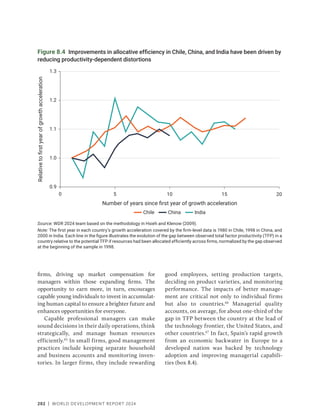
14 percent (aged) of the population age 65 and older. The number corresponding to each bar
shows total number of years to transition from aging to aged. Aging and aged thresholds are based
on definitions by the Population Division of the United Nations Department of Economic and Social
Affairs (UN DESA). Bars for income groups represent the averages of countries included in the
corresponding income group. The dashed vertical line indicates the year 2023.
115
69
61
60
45
31
27
26
25
25
25
24
23
22
20
20
18
1860 1880 1900 1920 1940 1960 1980 2000 2020 2040 2060
France
United States
High-income
Argentina
United Kingdom
Lower-middle-income
Upper-middle-income
Middle-income
Japan
China
India
Indonesia
Malaysia
Brazil
Türkiye
Bangladesh
Korea, Rep.
(Box continues next page)
Shrinking Spaces | 71
Working-age populations are already declining in middle-income countries in East Asia.d
Latin America will retain a large workforce until the early 2040s, while the Middle East and
North Africa and South and Central Asia regions will begin to lose working-age persons by
2045. As a result, middle-income countries can no longer rely on increasing employment
as a primary source of output growth. This prospect of “growing old before becoming
rich” makes escaping the middle-income trap more challenging and more urgent, includ-
ing among the largest middle-income countries such as Brazil, China, Mexico, and Türkiye.
The demographic challenge has implications for public policy. Investments will be
needed in infrastructure and technologies to support the elderly, in addition to expanding
fiscal transfers for older persons. These measures will, in turn, necessitate policies that
support savings among the working-age population. Meanwhile, countries will need to
invest in upgrading skills of their workforce and ensuring that everyone’s talent is used
appropriately and efficiently. Furthermore, automation and other productivity-enhancing
technologies to compensate for a shrinking workforce will have to be deployed and have
been prioritized by aging countries such as Japan.e
The path from imitative to innova-
tive growth is the key for middle-income countries to address the needs of their aging
populations.
Finally, the booming populations in low-income countries and lower-middle-income
countries in Sub-Saharan Africa and elsewhere will need to be integrated into graying
societies’ labor markets (especially those in middle-income countries).f
Canada has suc-
cessfully relied on immigration as a strategy to manage its low fertility rates and labor
shortages.g
World Development Report 2023: Migrants, Refugees, and Societies argues that
if managed effectively, migration could unlock further growth for destination countries.h
And this migration need not be a brain drain imposed on lower-income countries with
high population growth rates. For example, professional links established between expat
scientists and those they leave behind may generate knowledge spillovers in their coun-
tries of origin.i
a.	
UN DESA (2022). Dependency ratios refer to the number of children (ages 0–14) and older persons (age
65 and over) to the working-age population (ages 15–64).
b. Lee and Mason (2006); UN DESA (2022).
c.	
Aging society and aged society thresholds are based on the definition of the Population Division of the
United Nations Department of Economic and Social Affairs (UN DESA). According to the definition, the
share of people age 65 and older exceeds 7 percent of the population in an aging society, and a country
qualifies as an aged society if this share exceeds 14 percent.
d. UN DESA (2022).
e. Moss (2017).
f. Wakeman-Linn et al. (2015).
g. Green (2023).
h. World Bank (2023b).
i. Prato (2023).
Box 3.1 Graying growth (continued)
72 | WORLD DEVELOPMENT REPORT 2024
Fragmenting
international trade
Episodes of growth acceleration have been accom-
panied by trade integration.2
The Republic of
Korea’s economic metamorphosis was under-
pinned by a licensing regime to import frontier
technologies, followed by a shift toward promo-
tion of research and development.3
The Korean
story suggests that catching up and eventually
leading the pack requires trade liberalization to
buy foreign technology and to sell a country’s
own inventions. More broadly, globalization has
increased incentives to adopt foreign technologies
by enhancing international competition.4
But the international trade architecture that
allowed countries such as Korea to ascend is
­
facing challenges. First, declining potential
global output threatens trade flows, compound-
ing the blows dealt by the global financial crisis
and the COVID-19 pandemic.5
Second, rising
geopolitical tensions have affected trade pol-
icy,6
and further protectionism could worsen
the ­
diffusion of knowledge to low- and ­
middle-​
income countries.7
Although there is limited
evidence of widespread “friend-shoring” or
realignment of trade along geopolitical lines
beyond the United States–China decoupling,
this situation could change in the near future if
trade tensions continue to rise.8
Many industries
that use technology and innovation intensively
will face extensive costs and risks if critical
global links are reduced because these links are
at the heart of technology-intensive industries
such as information and communication tech-
nology (ICT) and smartphones.9
Globally, since
2019 the number of harmful trade policies has
exceeded the number of helpful trade policies,
and the pace of their enactment is increasing:
the number of new harmful trade measures
enacted per year doubled over the last decade
(figure 3.1).
Source: WDR 2024 team using the GTA (Global Trade Alert) database, St. Gallen Endowment for Prosperity through Trade,
University of St. Gallen, St. Gallen, Switzerland, https://www.globaltradealert.org/data_extraction.
Note: Measuring trade policies is fraught with challenges, and the GTA database may overrepresent countries that issue a
relatively high quantity of legislative documents or those with greater regulatory transparency. The plotted lines indicate
global trade policies that were introduced in the corresponding year. Helpful trade policies include interventions that liberalize
on a nondiscriminatory basis or improve the transparency of a relevant policy. Harmful trade policies include interventions
that discriminate against foreign commercial interests. See Harmonized System (dashboard), World Customs Organization,
Brussels, https://www.wcotradetools.org/en/harmonized-system.
Figure 3.1 Globally, harmful trade policies outnumber helpful trade policies
0
10,000
20,000
30,000
40,000
50,000
60,000
70,000
80,000
90,000
100,000
2010 2011 2012 2013 2014 2015 2016 2017 2018 2019 2020 2021 2022
Number
of
new
global
trade
policies
Helpful trade policies Harmful trade policies
Shrinking Spaces | 73
Moreover, most high-income and large ­middle-​
income countries are now increasingly resorting
to industrial policy and trade-related measures
that may result in restrictions to trade flows.10
For
example, some of the largest trading nations have
adopted a “friend-shoring” approach that concen-
trates their supply chain network among allies
and friendly countries in response to rising ten-
sions with the Russian Federation and China.11
In addition, the costs associated with technolog-
ical fragmentation are estimated to be as high as
5 percent of the gross domestic product (GDP)
for many economies.12
Compounding that are
the high risks associated with disrupting critical
industries and global supply chains. In a deglo-
balized scenario, some critical industries may be
unable to function, or it would take decades for
those industries to catch up their current levels of
functionality because of their massively modular
industrial organization.13
Unfortunately, harm-
ful interventions to block the trade of critical
technologies have more than tripled since 2019
(figure 3.2).
Elevated debt
Global debt relative to GDP has remained stub-
bornly high in the aftermath of the COVID-19
pandemic (figure 3.3). Indeed, many middle-­
income countries are more severely indebted
than ever before.14
Postpandemic fiscal deficits
in response to spikes in food and energy costs
Source: WDR 2024 team using the GTA (Global Trade Alert) database, St. Gallen Endowment for Prosperity through Trade,
University of St. Gallen, St. Gallen, Switzerland, https://www.globaltradealert.org/data_extraction.
Note: Measuring trade policies is fraught with challenges, and the GTA database may overrepresent countries that
issue a relatively high quantity of legislative documents or those with greater regulatory transparency. The bars indicate
global trade policies introduced in the corresponding year. Helpful trade policies include interventions that liberalize on a
nondiscriminatory basis or improve the transparency of a relevant policy. Harmful trade policies include interventions that
discriminate against foreign commercial interests. “8541” and “8542” refer to the four-digit Harmonized System codes for
semiconductors. See Harmonized System (dashboard), World Customs Organization, Brussels, https://www.wcotradetools​
.org/en/harmonized-system.
Figure 3.2 Harmful interventions in the global semiconductor trade have
skyrocketed since 2019
8541 semiconductors 8542 semiconductors
0
50
100
Number
of
new
interventions
Number
of
new
interventions
150
200
250
300
350
2
0
1
0
2
0
1
1
2
0
1
2
2
0
1
3
2
0
1
4
2
0
1
5
2
0
1
6
2
0
1
7
2
0
1
8
2
0
1
9
2
0
2
0
2
0
2
1
2
0
2
2
2
0
2
3
a. New helpful trade interventions
in critical technologies per year
0
50
100
150
200
250
300
350
2
0
1
0
2
0
1
1
2
0
1
2
2
0
1
3
2
0
1
4
2
0
1
5
2
0
1
6
2
0
1
7
2
0
1
8
2
0
1
9
2
0
2
0
2
0
2
1
2
0
2
2
2
0
2
3
b. New harmful trade interventions
in critical technologies per year
74 | WORLD DEVELOPMENT REPORT 2024
Figure 3.3 Most developing economies are more severely indebted than ever
Source: WDR 2024 team based on IMF (2023b); Kose and Ohnsorge (2024).
Note: The figure shows the total debt of emerging market economies (EMEs) in terms of weighted averages broken down into
public debt and private debt. GDP = gross domestic product.
0
25
50
75
100
125
150
175
200
EMEs’ public debt EMEs’ private debt
1950 1960 1970 1980 1990 2000 2010 2019 2020 2021 2022
Debt
as
share
of
GDP
(%)
COVID-19
onset
have kept public debt levels ­
elevated. Meanwhile,
monetary tightening in high-​
income countries
risks compounding the burden of high debt-to-
GDP ratios for middle-income countries. About
three-quarters of countries tightened both fiscal
and monetary policy in 2022.15
As interest rates
have surged, government budgets have been
squeezed. This squeeze has increased sovereign
spreads and borrowing costs for many emerging
and frontier markets. The resulting loss of mar-
ket access for some of these countries and the
lack of access to these avenues of relief are likely
to result in a wave of uncoordinated defaults
in middle-income countries over the medium
term. Unfortunately, there is no sign of relief
because high-income countries are likely to sus-
tain high interest rates for the foreseeable future
(figure 3.4). Many low- and middle-income coun-
tries now spend more on debt service payments
than they do on health, education, and infra-
structure. Because fiscal space is eroding due to
costlier borrowing in low- and middle-income
countries, new investment needs—including in
the green transition, education, the capacity to
innovate, and infrastructure—are likely to be put
on hold.
Encouraging growth in low- and middle-­income
countries under the current circumstances will
not be easy. Reducing debt vulnerabilities and
reversing long-term debt trends should be at the
core of these countries’ agendas. In particular,
the governments of middle-income countries
urgently need to take steps to alleviate debt dis-
tress in the medium term. More broadly, reforms
to improve debt transparency and strengthen
debt management policies and frameworks are
key to reducing the risks of debt distress. These
reforms could also foster economic growth if
they are coupled with reforms in labor markets
and product markets. In addition, reducing debt
burdens is crucial to creating the fiscal space for
investments in health, education, and infrastruc-
ture. Middle-income countries can make quick
progress in transitioning to higher-income status
only if they achieve strong and sustained invest-
ment growth.
Shrinking Spaces | 75
Figure 3.4 Debt service payments in emerging markets and middle-income countries may
skyrocket as the cost of borrowing soars
Source: WDR 2024 team using data from Fiscal Monitor (dashboard), International Monetary Fund, Washington, DC, https://
data.imf.org/?sk=4be0c9cb-272a-4667-8892-34b582b21ba6.
Note: GDP = gross domestic product.
1.8 1.7 1.7 1.8 1.7 1.6 1.6 1.6
Projected
1.7 1.7 1.8 1.8 1.8 1.8 1.8 1.8
2.2 2.4 2.5 2.5 2.6 2.6
6.5
5.7
6.3 6.5
5.9
5.4 5.5 5.6
6.2 6.1
6.5 6.4 6.5
7.0
6.6 6.9
8.3
8.9
9.1 9.4 9.6 9.7
0
1
2
Percent
3
4
5
6
7
8
9
10
2
0
0
7
2
0
0
8
2
0
0
9
2
0
1
0
2
0
1
1
2
0
1
2
2
0
1
3
2
0
1
4
2
0
1
5
2
0
1
6
2
0
1
7
2
0
1
8
2
0
1
9
2
0
2
0
2
0
2
1
2
0
2
2
2
0
2
3
2
0
2
4
2
0
2
5
2
0
2
6
2
0
2
7
2
0
2
8
Interest expense (% of GDP) Interest expense (% of general government revenues)
Climate action
Fossil fuels—coal, oil, and natural gas—are the
major contributors to global climate change,
accounting for over three-fourths of total green-
house gas emissions and about 90 percent of car-
bon dioxide (CO2
) emissions.16
The International
Energy Agency has announced that achieving
net zero emissions by 2050 will require reduc-
ing between 2020 and 2050 the global demand
for coal by 90 percent, oil by 75 percent, and
natural gas by 55 percent.17
Therefore, climate
action—measures to mitigate climate change—
requires changing the way energy is produced
and consumed.
Because middle-income countries pres-
ently account for about two-thirds of global
CO2
emissions, their decarbonization is mate-
rial to the world’s ability to meet its climate
goals. Today, both energy intensity and car-
bon intensity are quite high in middle-income
countries (figure 3.5). Energy intensity (panel a)
in middle-income countries is about double that
in high-income countries, and the carbon inten-
sity of their energy consumption (panel b) is also
­relatively inefficient.
At the same time, reliable cheap energy is
­
critical to supporting industrial activities and
powering businesses. It is also correlated with
higher living standards. But over 300 million
­
people in middle-income countries still lack
access to ­
electricity. Moreover, blackouts and
brownouts are common in middle-­
income
countries. As energy demand rises with income,
expanding access to reliable energy will be
as critical as ­
transitioning to lower-carbon
energy.18
Today, energy transition technologies con-
stitute the largest investment gap. Significant
resources are needed to scale up reliable, low-­
carbon energy. Low-carbon energy technologies
76 | WORLD DEVELOPMENT REPORT 2024
Figure 3.5 In middle-income countries, the energy intensity and carbon intensity of energy
consumption are quite high
Source: WDR 2024 team using data from Energy Institute (2023); WDI (World Development Indicators) (Data Catalog),
World Bank, Washington, DC, https://datacatalog.worldbank.org/search/dataset/0037712.
Note: Data for low-income countries are not available. GtCO2
= gigatons of carbon dioxide; HICs = high-income countries;
LMICs = lower-middle-income countries; UMICs = upper-middle-income countries.
a. Energy intensity b. Carbon intensity
of energy consumption
0
5
10
15
12.1
LMICs
9.0
UMICs
5.1
HICs
Energy
intensity
(exajoules/trillion
US$)
0
0.020
0.040
0.060
0.080
0.100
0.120
0.098
LMICs
0.086
UMICs
0.056
HICs
Carbon
intensity
of
energy
consumption
(GtCO
2
equivalent/exajoule)
require considerable up-front capital despite lower
operating expenses.19
Thus middle-income coun-
tries need access to low-cost capital to increase
the affordability of low-carbon energy transitions
because considerable improvement of capital-­
intensive clean energy assets—such as wind
power, solar photovoltaic (PV), electric vehicles,
and hydrogen electrolyzers—is required. The cost
of capital is key because the weighted average
cost of capital can account for 20–50 percent of
the levelized cost of electricity from utility-scale
solar PV projects.20
And yet the cost of capital
for utility-scale solar power projects in middle-​
income countries is significantly higher than that
in the United States and Europe (figure 3.6).21
High up-front infrastructure requirements and
capital costs could potentially increase the cost
of low-carbon technologies.
High borrowing costs make it more chal-
lenging for middle-income countries to finance
green energy investments and to diffuse
low-carbon energy. In addition, ­
developing
­
countries are currently spending more on ­
interest
payments than on climate ­
investments even
though they need to more than triple ­
climate
investments to meet the Paris Agreement
targets.22
Meanwhile, middle-income countries are
more exposed to risks from climate change than
high-income countries and have less capacity to
adapt to such risks (figure 3.7). They also face
overwhelmingly high costs to finance climate
adaptation. In 2030, annual adaptation costs
are estimated to exceed 1 percent of GDP per
year for some middle-income countries, while
annual global adaptation needs will reach about
0.25 ­
percent of global GDP.23
The room for governments to act in middle-­
income countries is shrinking because of rising
debt and interest rates, and their feeble growth
prospects stem from a weakening foreign trade
andinvestmentoutlook.Inaddition,international
Shrinking Spaces | 77
Figure 3.6 In middle-income countries, the weighted average cost of capital for utility-scale
solar power projects is substantially higher than the cost in high-income countries
Source: WDR 2024 team using IRENA (2023); WDI (World Development Indicators) (Data Catalog), World Bank, Washington,
DC, https://datacatalog.worldbank.org/search/dataset/0037712.
Note: GDP = gross domestic product; WACC = weighted average cost of capital.
GDP per capita
Upper-middle-income WACC average
Low-income WACC average Lower-middle-income WACC average
Weighted average cost of capital (right axis)
High-income WACC average
0
3
6
9
12
15
18
21
0
10,000
20,000
30,000
40,000
50,000
60,000
70,000
B
u
r
k
i
n
a
F
a
s
o
E
t
h
i
o
p
i
a
U
g
a
n
d
a
R
w
a
n
d
a
Y
e
m
e
n
,
R
e
p
.
S
e
n
e
g
a
l
P
a
k
i
s
t
a
n
K
e
n
y
a
B
a
n
g
l
a
d
e
s
h
G
h
a
n
a
I
n
d
i
a
V
i
e
t
N
a
m
S
r
i
L
a
n
k
a
A
l
g
e
r
i
a
E
g
y
p
t
,
A
r
a
b
R
e
p
.
I
r
a
n
,
I
s
l
a
m
i
c
R
e
p
.
I
n
d
o
n
e
s
i
a
S
o
u
t
h
A
f
r
i
c
a
C
o
l
o
m
b
i
a
B
r
a
z
i
l
B
u
l
g
a
r
i
a
R
u
s
s
i
a
n
F
e
d
e
r
a
t
i
o
n
M
e
x
i
c
o
K
a
z
a
k
h
s
t
a
n
M
a
l
a
y
s
i
a
C
h
i
n
a
A
r
g
e
n
t
i
n
a
T
ü
r
k
i
y
e
C
h
i
l
e
H
u
n
g
a
r
y
P
o
l
a
n
d
S
l
o
v
a
k
R
e
p
u
b
l
i
c
C
z
e
c
h
i
a
S
p
a
i
n
I
t
a
l
y
J
a
p
a
n
F
r
a
n
c
e
G
e
r
m
a
n
y
U
n
i
t
e
d
K
i
n
g
d
o
m
A
u
s
t
r
a
l
i
a
U
n
i
t
e
d
S
t
a
t
e
s
Low-
income Lower-middle-income Upper-middle-income High-income
Weighted
average
cost
of
capital
(%)
GDP
per
capita
(constant
2015
US$)
pressures and domestic pledges for climate action
will require these countries to allocate ­substantial
investment to adaptation and mitigation. With
many middle-income economies facing high debt
and higher borrowing costs, a policy dilemma
arises between achieving ambitious ­
climate
actions that pay off in the longer term and avert-
ing short-term macroeconomic imbalances.
The constraints facing middle-income coun-
tries and the extensive and frenetic pace of change
required for them to transition to high-income
status make policy making more challenging
than at the low- or high-income stage. The chap-
ters that follow focus on feasible steps that could
aid this transition.
78 | WORLD DEVELOPMENT REPORT 2024
Figure 3.7 Low- and middle-income countries are exposed to similar levels of risk from
climate change, and they have less adaptive capacity
Source: WDR 2024 team using data from ND-GAIN Country Index (University of Notre Dame Global Adaptation Index)
(dashboard), University of Notre Dame, Notre Dame, IN, https://gain.nd.edu/our-work/country-index/.
Note: The solid lines show the linear relationship for each country group.
0
0.1
0.2
0.3
0.4
0.5
0.6
0.7
0.8
0.9
1.0
0.1 0.2 0.3 0.4 0.5 0.6 0.7 0.8
Exposure index (higher scores indicate greater risk)
Adaptive
capacity
index
(higher
scores
indicate
lower
capacity)
Low-income Middle-income High-income
Notes
1. World Bank (2023a).
2. Hausmann, Pritchett, and Rodrik (2005).
3. Choi and Shim (2024).
4. IMF (2018).
5. Goldberg and Reed (2023); Kose and Ohnsorge (2024).
6. Góes and Bekkers (2022); Goldberg and Reed (2023).
7. Melitz and Redding (2021).
8. Pierce and Yu (2023).
9. Thun et al. (2022).
10. Barattieri, Mattoo, and Taglioni (2024).
11. Gill (2023).
12. Cerdeiro et al. (2021).
13. Thun et al. (2022).
14. Kose and Ohnsorge (2024).
15. IMF (2023a).
16. UNEP (2023).
17. IEA (2021b).
18. Kahn and Lall (2022).
19. Erdogan and Arboleya Sarazola (2023).
20. IEA (2021a).
21. Steffen (2020); UNEP (2023).
22. UNCTAD (2024).
23. Aligishiev, Bellon, and Massetti (2022).
References
Aligishiev, Zamid, Matthieu Bellon, and Emanuele Massetti.
2022. “Macro-Fiscal Implications of Adaptation to
Climate Change.” IMF Staff Climate Note 2022/002
(March), International Monetary Fund, Washington, DC.
Barattieri, Alessandro Eugenio Maria, Aaditya Mattoo,
and Daria Taglioni. 2024. “Trade Effects of Industrial
Policies: Are Preferential Agreements a Shield?”
Policy Research Working Paper 10806, World Bank,
Washington, DC.
Cerdeiro, Diego A., Johannes Eugster, Rui C. Mano, Dirk
Muir, and Shanaka J. Peiris. 2021. “Sizing Up the
Effects of Technological Decoupling.” IMF Working
Paper WP/21/69 (March), International Monetary Fund,
Washington, DC.
Shrinking Spaces | 79
Choi, Jaedo, and Younghun Shim. 2024. “From Adoption
to Innovation: State-Dependent Technology Policy in
Developing Countries.” STEG Working Paper WP091
(March), Structural Transformation and Economic
Growth, Centre for Economic Policy Research, London.
Energy Institute. 2023. “Statistical Review of World Energy
2023.” June, Energy Institute, London.
Erdogan, Musa, and Lucila Arboleya Sarazola. 2023. “Cost
of Capital Survey Shows Investments in Solar PV Can Be
Less Risky than Gas Power in Emerging and Developing
Economies, though Values Remain High.” Commentary,
November 30, 2023. https://www.iea.org​/commentaries​
/cost-of-capital-survey-shows​-investments​-in-solar​
-pv-can-be-less-risky-than​-gas-power​-in-emerging-and​
-developing-economies​-though​-values-remain-high.
Gill, Indermit Singh. 2023. “The New Threat to
Prosperity Everywhere.” Paradigm Shifts (blog),
March 13, 2023. https://www.project-syndicate.org​
/magazine​/deglobalization-new-fiscal-monetary​
-policy​-norms-bad-for​­-economic-development-by​
-indermit-gill-2023-03.
Góes, Carlos, and Eddy Bekkers. 2022. “The Impact
of Geopolitical Conflicts on Trade, Growth, and
Innovation.” WTO Staff Working Paper ERSD-2022-09
(July 4), Economic Research and Statistics Division,
World Trade Organization, Geneva.
Goldberg, Pinelopi Koujianou, and Tristan Reed. 2023. “Is
the Global Economy Deglobalizing? And If So, Why? And
What Is Next?” Brookings Papers on Economic Activity
BPEA 2023 (Spring): 347–96.
Green, Mark A. 2023. “Canada: Ageing Workforce, Boosting
Immigration.” Stubborn Things (blog), April 18, 2023.
https://www.wilsoncenter.org/blog-post/canada​
-ageing-workforce-boosting-immigration.
Hausmann, Ricardo, Lant H. Pritchett, and Dani Rodrik.
2005. “Growth Accelerations.” Journal of Economic
Growth 10 (4): 303–29.
IEA (International Energy Agency). 2021a. “The Cost of
Capital in Clean Energy Transitions.” Report, December
17, IEA, Paris.
IEA (International Energy Agency). 2021b. Net Zero by
2050: A Roadmap for the Global Energy Sector. 4th rev.
(October). Paris: IEA.
IMF (International Monetary Fund). 2018. World Economic
Outlook, April 2018: Cyclical Upswing, Structural Change.
Washington, DC: IMF.
IMF (International Monetary Fund). 2023a. Fiscal Monitor: On
the Path to Policy Normalization. April. Washington, DC: IMF.
IMF (International Monetary Fund). 2023b. “2023 Global
Debt Monitor.” September, Fiscal Affairs Department,
IMF, Washington, DC.
IRENA (International Renewable Energy Agency). 2023.
Renewable Power Generation Costs in 2022. Abu Dhabi,
United Arab Emirates: IRENA.
Kahn, Matthew E., and Somik Vinay Lall. 2022. “Will the
Developing World’s Growing Middle Class Support Low
Carbon Policies?” NBER Working Paper 30238 (July),
National Bureau of Economic Research, Cambridge, MA.
Kose, M. Ayhan, and Franziska Ohnsorge, eds. 2024. Falling
Long-Term Growth Prospects: Trends, Expectations, and
Policies. Washington, DC: World Bank.
Lee, Ronald Demos, and Andrew Mason. 2006. “What Is
the Demographic Dividend?” Finance and Development
43 (3): 16–17.
Melitz, Marc J., and Stephen J. Redding. 2021. “Trade
and Innovation.” NBER Working Paper 28945 (June),
National Bureau of Economic Research, Cambridge,
MA.
Moss, Daniel. 2017. “Aging Japan Wants Automation, Not
Immigration.” Bloomberg: Opinion, August 22, 2017.
https://www.bloomberg​.com​/view/articles/2017​-08​
-22​/aging-japan​-wants-automation​-not​-immigration.
Pierce,JustinR.,andDavidYu.2023.“AssessingtheExtentof
Trade Fragmentation.” FEDS Notes. Board of Governors
of the Federal Reserve System, Washington, DC.
https://www.federalreserve.gov/econres/notes/feds​
-notes/assessing-the-extent-of-trade-fragmentation​
-20231103.html.
Prato, Marta. 2023. “The Global Race for Talent: Brain Drain,
Knowledge Transfer, and Economic Growth.” Working
Paper, Ettore Bocconi Department of Economics,
Bocconi University, Milan.
Steffen, Bjarne. 2020. “Estimating the Cost of Capital for
Renewable Energy Projects.” Energy Economics 88
(May): 104783.
Thun, Eric, Daria Taglioni, Timothy J. Sturgeon, and Mark
P. Dallas. 2022. “Massive Modularity: Understanding
Industry Organization in the Digital Age: The Case of
Mobile Phone Handsets.” Policy Research Working
Paper 10164, World Bank, Washington, DC.
UN DESA (United Nations Department of Economic and
Social Affairs). 2022. “World Population Prospects
2022: Summary of Results.” Document UN DESA/
POP/2021/TR/NO. 3, United Nations, New York. https://
www.un.org/development/desa/pd/sites/www.un.org​
.development.desa.pd/files/wpp2022_summary_of​
_results.pdf.
UNCTAD (UN Trade and Development). 2024. A World of
Debt: A Growing Burden to Global Prosperity. New York:
United Nations.
UNEP (United Nations Environment Programme). 2023.
Broken Record: Temperatures Hit New Highs, Yet World
Fails to Cut Emissions (Again). Emissions Gap Report
2023. Nairobi, Kenya: UNEP.
Wakeman-Linn, John, Rahul Anand, Paulo Drummond,
Richard Erlebach, Francisco Roch, Vimal Thakoor,
and Juan Treviño. 2015. “How Can Africa Harness
the Demographic Dividend?” In Sub-Saharan Africa:
Navigating Headwinds, 25–45. With research assis-
tance of Idan Elmelech, Cleary Haines, and George
Rooney. Regional Economic Outlook, April. World
Economic and Financial Surveys Series. Washington,
DC: International Monetary Fund.
World Bank. 2016. Live Long and Prosper: Aging in East Asia
and Pacific. World Bank East Asia and Pacific Regional
Report. Washington, DC: World Bank.
World Bank. 2023a. Global Economic Prospects, January
2023. Washington, DC: World Bank.
World Bank. 2023b. World Development Report 2023:
Migrants, Refugees, and Societies. Washington, DC:
World Bank.
 | 81
Part 2
Creative Destruction
P
art 1 of this Report highlights the need
for middle-income countries to undergo
not one but two transitions. In the first,
these countries transition from a “1i” strategy for
accelerating investment to a “2i” strategy focus-
ing on both investment and infusion in which a
country brings technologies from abroad and
diffuses them domestically. Once a country has
successfully undertaken this effort, it can switch
to a “3i” strategy in which it pays greater atten-
tion to innovation—beginning to not just borrow
ideas from the global frontiers of technology but
also to push the frontiers outward. Part 2 of this
Report provides a diagnostic framework based on
advances in Schumpeterian economic theory to
examine what hinders and what helps countries
engineer shifts in growth strategies (box P2.1).
Economic analysis using a Schumpeterian cre-
ative destruction framework provides more
reliable diagnoses because it draws on the micro-
economic foundations of growth. But like most
new technologies, it requires greater expertise
in assessing the evidence, higher-quality data for
informing the analysis, and greater care in inter-
preting the results.
Underpinning the Schumpeterian frame-
work are three sets of forces: creation, preserva-
tion, and destruction (figure P2.1). These unruly
forces have to be domesticated. To advance
technological progress, the forces of creation
need to be amplified, the forces of preservation
weakened, and the forces of destruction man-
aged. Policy makers thus need to understand
and account for
• Creation. Incumbents and entrants com-
pete by creating economic value (see
chapter 4). The forces of creation are
strengthened by fostering openness in
the exchange of goods, services, and ideas.
The same forces are weakened by excessive
government regulation and macroeco-
nomic uncertainty.
• Preservation. Economic, social, and polit-
ical structures are susceptible to being
captured by powerful incumbents (see
chapter 5). The forces of preservation must
be reined in and prevented from smoth-
ering creation. Where institutions are
weak, incumbents often capture them to
preserve the status quo.
• Destruction. The forces of preservation are
weakened only when crises arise (see chap-
ter 6). The vital forces of destruction place
tremendous pressure on governments to
act because a growing economy needs to
shed outdated arrangements (in capital,
labor, and energy markets) as much as
it needs to invent new ones. Where the
forces of destruction are constrained by
misguided policies, creation struggles and
advances slowly.
 81
82 | WORLD DEVELOPMENT REPORT 2024
Box P2.1 Joseph Schumpeter and creative destruction
The concept of creative destruction was featured in the early writings of many influen-
tial political economists such as Werner Sombart (1863–1941) and Friedrich von Wieser
(1851–1926).a
However, it became the trademark of Joseph A. Schumpeter (1883–1950),
an Austrian economist, who widely popularized the term and made it accessible through
his book Capitalism, Socialism and Democracy. Schumpeter’s view was that creative talents
with vision would create new products and technologies to change the way we live.
According to Schumpeter, “Railroads did not emerge because some consumers took the
initiative in displaying an effective demand for their service in preference to the services
of mail coaches. Nor did consumers exhibit the wish to have electric lamps or rayon stock-
ings, or to travel by motorcar or airplane, or to listen to radios, or to chew gum.”b
What
leads to economic growth is the “change” that is ultimately generated by an entrepre-
neur’s desire and leadership. Without change, a society is doomed.
Schumpeterian growth theory provides sharper instruments for diagnosing the eco-
nomic health of economies because it features
• Heterogeneous agents. The theory is premised on differentiation among firms (such
as small and large; new and old) and workers (such as unskilled and skilled; rural and
urban). It can usefully be extended to distinguish between energy sources (such as
renewable and carbon-intensive; reliable and risky).
• Continuous dynamics. The theory recognizes the importance of both creation (start-
ups, investment, new skills, and innovation) and destruction (firm closures, skill obso-
lescence, and stranded assets) in the process of structural change and economic
development.
• Institutional inertia. The theory provides insights into the forces of preservation of
societal arrangements and status quo biases in industrial organization and public
policy.
• Constructive crises. Related to inertia, the theory recognizes that economic and envi-
ronmental crises present opportunities for improvements; with the right policies,
creation can emerge from destruction.
a. Campagnolo and Vivel (2012); Reinert and Reinert (2006).
b. Schumpeter (1942, 73).
The forces of creation, preservation, and
destruction appear in each transition of middle-​
income economic growth—first, in adding infusion
to investment, and, second, in adding innovation to
the mix.
Chapter 4 focuses on enterprise dynamics to
illustrate the forces of creation, chapter 5 on talent
to illustrate the forces of preservation, and chap-
ter 6 on energy to highlight how new technolo-
gies and climate crises generate both the need and
the potential to destroy current arrangements in
energy markets. Firms, talent, and energy are
closely connected, and their interactions shape
the forces of creative destruction.
 | 83
References
Campagnolo, Gilles, and Christel Vivel. 2012. “Before
Schumpeter: Forerunners of the Theory of the
Entrepreneur in 1900s German Political Economy—
Werner Sombart, Friedrich von Wieser.” European
Journal of the History of Economic Thought 19 (6):
908–43.
Reinert, Hugo, and Erik S. Reinert. 2006. “Creative
Destruction in Economics: Nietzsche, Sombart,
Schumpeter.” In Friedrich Nietzsche 1844–1900:
Economy and Society, edited by Jürgen G. Backhaus
and Wolfgang Drechsler, 55–85. New York: Springer.
Schumpeter, Joseph Alois. 1942. Capitalism, Socialism and
Democracy. New York: Harper and Brothers.
Figure P2.1 Rebalancing the forces of creation, preservation, and destruction to
advance infusion and innovation
Source: WDR 2024 team.
Creation
Destruction
Preservation Destruction Preservation
Creation
CREATIVE DESTRUCTION | 83
| 85
4
Creation
Key messages
• In an economy, both entrants and incumbents can add value. Entrants bring change in the
form of enterprises with new products or production processes, workers with new skills and
ideas, or energy sources such as renewables that embody new technologies. Incumbents
bring scale—and can compete with entrants in the market to jointly expand a country’s
technological capabilities—moving the country closer to the global technology frontier.
• In most middle-income countries, too few entrants disrupt because the majority of
­
entrepreneurs start businesses driven by necessity, not business opportunity. And too few
incumbents infuse global technologies and know-how. Instead, they abuse their dominance
to block entry, resist innovation, and capture political institutions.
• Government policies in middle-income countries are often based on the size of firms rather
than their ability to create value. As a result, policies tend to favor small firms and reduce
the incentives of firms to grow.
• Governments will need more reliable diagnostics to implement effective policies, ­
including
microlevel data on firms, a more comprehensive approach to examining business ­dynamism,
and greater analytical expertise.
Creation: The protagonist
of economic growth, where
incumbents create value
alongside entrants
In the 1960s, the Tata Business Group, a major
conglomerate based in India, needed computers
for its various businesses, but they were difficult to
purchase and import because the government had
enactedimportrestrictionstoprotectstate-owned
enterprises (SOEs). To allow foreign hardware
to be imported, the government required Indian
companies to commit to exporting products or
services. This challenge inspired the conglomerate
to create a new business, Tata Consultancy
Services (TCS). Tapping into talent from its
various businesses and India’s elite technical
institutions, TCS became the first Indian exporter
of computing services to the United States. As part
of a large conglomerate, TCS could have stifled
creativity and misused its import allowance. In
practice, however, TCS opened the world’s eyes
to the high-quality, ­
lower-cost talent that India’s
software development had to offer. Many entrants
took advantage of this opportunity. Among
them, Infosys, a company founded by former IBM
engineers and financed by their own savings,
dramatically increasing the value it created, has
become a global leader in information technology
consulting (figure 4.1).
86 | WORLD DEVELOPMENT REPORT 2024
The gales of creative destruction carry new ideas,
products, processes, and practices to the shores
of middle-income economies. The term creative
destruction was popularized by Austrian econo-
mist Joseph A. Schumpeter in his book Capitalism,
Socialism and Democracy (1942). Schumpeter was
concerned by the growing concentration of wealth
in market economies where dominant incum-
bents colluded to preserve the status quo. He
argued that economic and social improvements
arise from new products and technologies intro-
duced by entrepreneurs with talent and vision.
The forces of creation, preservation, and
destruction interact to shape the growth of
nations through technological advancement.
This chapter examines how the forces of creation
play out in middle-income countries to create
value. Chapters 5 and 6 examine the forces of
preservation and destruction. To shed light on the
potency of creation in middle-income countries,
this chapter examines three questions:
1. Who creates value? Schumpeter highlighted
that entrants bring change, and incum-
bents collude to preserve their ­
dominance
(­
figure 4.2, panel a) in the form of enter-
prises with new products or production
processes, workers with new skills and
ideas, or energy sources, such as renew-
ables, that embody new technologies. In the
process, they expand a country’s technol-
ogy frontier. Interactions among firms,
workers, and energy/technology underpin
creative destruction (see box P2.1). In the
current environment, Schumpeter’s view is
reflected in the competition between high-
and low-carbon energy. Fossil fuels have
been the dominant incumbent ­
technology
for over 300 years. Technical progress, com-
plementary public and private ­
investment,
individual preferences, and powerful
­
interest groups interact to preserve a
high-carbon status quo.
Schumpeter’s ideas inspired the for-
mal models of creative destruction devel-
oped by Philippe Aghion and Peter Howitt,
who make a strong case that the entirety
of growth stems from entrants and that
incumbents assume the primary task of
Figure 4.1 Both entrants and incumbents create value and reinforce one another’s growth
through competition in India’s computing services industry
Source: Worldscope (database), Baker Library, Bloomberg Center, Harvard Business School, Boston, https://www.library​
.hbs.edu/find/databases/worldscope.
Note: The figure reports the number of employees in Infosys and Tata Consultancy Services and the average across firms
listed in India’s stock exchange in the same two-digit industry (Mean-Industry-India). “Two-digit” refers to NAICS (North
American Industry Classification System) (database), US Census Bureau, Suitland, MD, https://www.census.gov/naics/.
Number
of
employees
(log
scale)
2000 2005 2010 2015
Industry average Infosys Tata Consultancy Services
3,000
10,000
30,000
100,000
300,000
Creation | 87
producing goods until they are replaced by
thesenewplayers(figure4.2,panelb).Their
approach is particularly useful in high-
lighting the value added by investing in the
talents of women and enabling women to
seek the most rewarding opportunities.
But must a new entrant always drive
­
creation and displace incumbents?
Although Schumpeter and his immediate
followers celebrated entrants and down-
played the role of incumbents, Tata Con-
sultancy Services’ journey reveals that
incumbents can also create value (figure
4.2, panel c). Incumbents bring scale, which
enables them to invest in upgrading prod-
ucts, hire and reward skilled workers, and
effectively use large amounts of capital.
They can compete with entrants in the
market jointly to expand a country’s tech-
nological capabilities, advancing the coun-
try closer to the global frontier.
The symbiotic view is most applicable
to the modern enterprise. Regardless of
whether they are entrants or established
companies, firms that create value must
be able to expand their operations, hire
more workers, and displace enterprises
that fail to generate additional value. This
approach ensures that capital and labor
are not held captive by unproductive firms
but are utilized more efficiently by grow-
ing enterprises. In fact, 50–70 percent of
productivity growth stems from success-
ful resource reallocation among firms—
whether incumbents or entrants.1
2. Are entrants and incumbents creating
value in middle-income countries? Too few
entrants disrupt, and too few incumbents
infuse global technologies and know-how.
The majority of entrepreneurs start busi-
nesses driven by necessity, not business
opportunity. Incumbents that create value
are unable to expand, limiting their poten-
tial for infusing technologies. Dominant
incumbents can be vanguards for infusing
global technologies and exporting glob-
ally. But, too often, they abuse their domi-
nance to capture political institutions.
3. Are middle-income country governments
strengthening the forces of creation? Gov-
ernments often use outdated rules of
Figure 4.2 The interactions between entrants and incumbents set the pace of
creative destruction
Source: WDR 2024 team based on Schumpeter (1942); Aghion and Howitt (1992); Akcigit and Kerr (2018).
TECHNOLOGY
FRONTIER
Incumbent
Entrant
TECHNOLOGY
FRONTIER
Incumbents
Entrant
TECHNOLOGY
FRONTIER
Incumbent Incumbent
Entrant
a. Schumpeter’s view:
Dominant incumbents can
collude to block competition
b. Aghion and Howitt’s view:
Entrants create value and
displace incumbents
c. Akcigit and Kerr’s view:
Incumbents and
entrants add value
Economic progress
Aghion and Howitt’s view: entrants
create value and displace incumbents
Economic progress
Schumpeter’s view: incumbents
can collude
Economic progress
Akcigit and Kerr’s view: incumbents
and entrants add value
88 | WORLD DEVELOPMENT REPORT 2024
thumb to regulate and lack the informa-
tion and capabilities needed to identify
key constraints impeding the growth of
firms. Over the last three decades, econo-
mists have developed modern techniques
to provide calibrated assessments of what
is enabling or suppressing the growth of
firms. These techniques include better
measurement of business dynamics that
includes market concentration, markups,
productivity dispersion, firm entry and
exit rates, and job reallocation.
This chapter examines the forces of creation
from the perspective of firms with an emphasis
on the process in middle-income countries. A
broader treatment that includes talent and energy
sources appears in part 3 of this Report.
Creative destruction: Three
decades of increasingly
refined analysis
A first look: Entrants create value
When Canadian economist Peter Howitt vis-
ited the Massachusetts Institute of Technology
(MIT) in the summer of 1987, he crossed paths
with Philippe Aghion, an assistant professor at
MIT. Their collaboration gave birth to the for-
mal theory of creative destruction, and their
paper “A Model of Growth through Creative
Destruction,” published in Econometrica in
1992, became one of the most influential papers
in economics.2
Their main insight was that
economies expand organically through innova-
tion driven by new entrants. Aghion and Howitt
attributed innovation and growth exclusively to
newcomers (figure 4.3).
Such models of creative destruction, that is,
quality ladder models, depict a hierarchical struc-
ture with multiple rungs in which each innova-
tion adds a new rung to the ladder and elevates
the prospects for all future producers—a phe-
nomenon known as intertemporal spillovers. This
hierarchy suggests that there may be underin-
vestment in innovation because innovators often
fail to consider the height of each rung, which
determines the long-term benefits of their cre-
ative endeavors for society. On the other hand,
there may be an overinvestment in entry. Entrants
primarily focus on displacing incumbents, and
so more entry is associated with shorter dura-
tions of monopoly for incumbents, discouraging
innovations by future entrants. This motive—
called “business ­
stealing”—­
carries the risk that
a society could end up overinvesting in research
and development (RD) and creating too much
entry. Whether equilibrium results in an excess or
deficiency of RD depends on the varying mag-
nitudes of spillovers and business stealing, which
Figure 4.3 Entrants drive growth: Insights
from Aghion and Howitt’s seminal paper on
creative destruction
Source: WDR 2024 team.
Note: The figure depicts a quality ladder based on the
Aghion-Howitt model of creative destruction. IN represents
a new firm entering the market and OUT represents a firm
exiting the market. Each innovation adds a new rung to the
ladder and elevates the prospects for all future producers.
This hierarchy suggests that there may be underinvestment
in innovation because innovators often fail to consider
the height of each rung, which determines the long-term
benefits of their creative endeavors for society. On the
other hand, there may be an overinvestment in entry.
Entrants primarily focus on displacing incumbents, so more
entry is associated with shorter durations of monopoly for
incumbents, discouraging innovations by future entrants.
Firm 5
Firm 4
Firm 3
Firm 2
Firm 1
IN
OUT
Productivity
or
quality
of
production
Creation | 89
can differ significantly from one sector to another
and from one country to another. This novel
frameworkhasopenedthedoortoamorenuanced
and realistic discourse on innovation policy.
A recent view: Incumbents also create
value
Schumpeter’s ideas, as well as the framework
presented in Aghion and Howitt’s seminal 1992
paper, focused predominantly on entrants and
small businesses, downplaying the role of incum-
bents (often larger firms) in fostering infusion and
innovation. In fact, the theory of creative destruc-
tion highlights an important tension between the
incumbent currently in production and the new
entrant that endeavors to replace the incumbent
with a superior product or technology.
In 2004, Tor Klette and Sam Kortum refined
the framework by reimagining each firm as a con-
glomerateofproductionunitsindifferentsectors.3
Within this framework, firms are able to expand
their products or services into new markets and
compete with other incumbents, but not scale up
their existing products or services. In essence, this
framework indicated that, within each narrow
sector, all innovations originate from external
sources and never from incumbents within the
production unit.
In 2018, Ufuk Akcigit and William Kerr fur-
ther advanced the framework to enable a more
accurate description of innovation and growth.4
In their framework, incumbents not only expand
into new markets through external RD, but also
enhance their existing products through internal
RD without directly displacing other producers.
In fact, upon venturing into new markets, many
established incumbents allocate a significant por-
tion of their resources to refining and elevating
their current products and technologies. The
significant insight is that creative destruction
can be instigated not only by entrants but also
by incumbents. Moreover, not every innovation
introduced by incumbents inevitably results in
creative destruction through the dismantling of
others in their ­
“ecosystem” (figure 4.4).
The United States and Germany are contrast-
ing cases of creative destruction. In Germany,
Figure 4.4 Entrants and incumbents drive growth through turnover and upgrading: Insights
from Akcigit and Kerr’s refined approach to creative destruction
Source: Akcigit and Kerr 2018.
Note: RD = research and development.
Firm 1 Firm 2
Internal RD
Product lines
External RD
Existing quality
New entrant
(contribution of the
latest innovation)
Level
of
product
quality
90 | WORLD DEVELOPMENT REPORT 2024
companies established before 1950 constitute a
substantial 70 percent of publicly traded compa-
nies—a figure that diverges markedly from that
for the United States, where the equivalent pro-
portionisapproximately50percent.Furthermore,
although the annual rate of new firm creation
is about 8 percent in the United States, it is
­
3 percent in Germany. Despite these pronounced
disparities in terms of incumbent longevity and
the pace of firm entry, there is a striking symme-
try in the number of patents per capita between
the two economies. This convergence in patent
output underscores a noteworthy distinction:
innovation in Germany is primarily championed
by long-standing incumbents, whereas in the
United States it is shouldered to a greater extent
by emerging young entrants (figure 4.5).
A more nuanced view of incumbents:
Incumbents’ power can drive or
suppress creation
The turn of the twentieth century wit-
nessed a rapid transformation in the typical
manufacturing enterprise in the United States.
Characterized until the early 1900s by
­
single-unit firms with one or a small number
of owners, the modern multiunit enterprise,
administered by salaried middle and top man-
agers overseeing complex layers of production,
became the typical business model by World
War I. Recordkeeping, accounting, and inven-
tory control were all tasks required by the
­
“visible hand” managing a firm.5
This transformation of business proved to be
fertile ground for the emergence of what became
a powerhouse of corporate innovation, the
Computing-Tabulating-Recording-Company,
later IBM. In 1939, when William Hewlett
and David Packard created their company in a
rented garage in Palo Alto, California, IBM was
already a well-established company with more
than 10,000 employees. Herman Hollerith,
founder of one of the companies consolidated
into IBM in 1911, could not anticipate that his
invention, the electromechanical tabulation of
punched card data, would become the backbone
of a computer hardware and software company.
Figure 4.5 Contrasting examples of innovation: Growth is driven by entrants in the United
States and by incumbents in Germany
Source: Akcigit et al. 2024.
2
0
0
0
2
0
1
0
2
0
0
5
2
0
1
5
0
2
4
6
8
10
12
Firm
entry
rate
(%)
a. Firm entry rate b. Patents per capita
0
10
20
30
40
50
60
1
9
8
0
1
9
8
5
1
9
9
0
1
9
9
5
2
0
0
0
2
0
0
5
2
0
1
0
Patents
per
100,000
inhabitants
United States
Germany
Creation | 91
Similarly, Hewlett and Packard did not envi-
sion that their frequency oscillator would pave
the way for their small firm to become a leading
manufacturer of personal computers that would
compete with a giant like IBM. Yet both compa-
nies found themselves competing against each
other for decades. It was only later that many
others, such as Dell and Microsoft, entered the
market to compete.
On the surface, the forces of creation are
more apparent than the forces of destruction in
the Schumpeterian view of forces of innovation.
In the US business services industry, as HP, Dell,
Microsoft, and Oracle entered various branches of
the hardware, software, and computing ­
services
markets, the pace of growth of IBM (as the
­
incumbent) slowed—but not to the level of shut-
ting down the company (figure 4.6). Destruction
still occurs within firms as they replace older
products and tap into newer markets.
But dominant firms can also use their
incumbency advantage to block entry and resist
innovation. They can collude, with the most
significant players coordinating price-setting
to outbid smaller competitors, while avoiding
price wars against one another. For example, in
2013 the US Department of Justice uncovered a
decade-long cartel of Japanese auto part makers
conspiring against the United States car indus-
try (figure 4.7). Mitsuba Corporation, a promi-
nent cartel member, increased its sales relative
to the average performance of publicly listed
companies in the same industry. However, this
growth was not fueled by innovation but rather
by suppressing competition, partly reflected in
the decline in the number of public firms in the
same industry.
When incumbents respond to competition by
upgrading technologies and business practices
either to defend existing market positions or to
tap into newer ones, they drive progress, as in the
United States (box 4.1). When incumbents resist
competition by enacting barriers to entry, it not
only stalls infusion and innovation but also can
entirely prevent them.
In middle-income countries,
too few small entrants
disrupt, and too few large
incumbents innovate or
infuse global technologies
Although large incumbent firms can spur as well
as block the forces of creation, large incumbents
do not capture the broader economic landscape
in middle-income countries. Most establishments
are microenterprises that neither grow nor exit,
and therefore they do not contribute to growth
in productivity. Furthermore, many medium and
large firms that have the potential to leverage the
incumbency advantage to lead infusion and inno-
vation often achieve scale by benefiting from dis-
tortions rather than from merit (see next section
for that discussion).
“Flat and stay” and “up or out” describe
entrepreneurial dynamics. One reason for the
Figure 4.6 Entrants and incumbents can
reinforce one another’s growth: The case of
the US business services industry
Source: Luttmer 2011.
Note: The figure reports the number of employees for a
selected group of US business services firms: Dell, Hewlett
Packard (HP), IBM, Microsoft, and Oracle.
10
0
100
1,000
10,000
100,000
400,000
1910 1930 1950 1970 1990 2010
Dell HP
Microsoft
IBM
Oracle
Number
of
employees
(log
scale)
92 | WORLD DEVELOPMENT REPORT 2024
Source: WDR 2024 team based on Worldscope (database), Baker Library, Bloomberg Center, Harvard Business School,
Boston, https://www.library.hbs.edu/find/databases/worldscope.
Note: The figure reports a series of sales (panel a) and shares of research and development (RD) expenditures relative to
total investment (panel b) for Mitsuba Corporation and the average across listed firms in Japan’s stock exchange within
the same two-digit industry. Panel c shows the number of listed companies in Japan’s stock exchange in the same two-
digit industry. Sales are presented in logarithms and reported as a difference from their value in 1990, the first year in the
sample. The share of RD expenditures to total investment, RD intensity, is also reported as a difference from the share in
1990. “Two-digit” refers to NAICS (North American Industry Classification System) (database), US Census Bureau, Suitland,
MD, https://www.census.gov/naics/.
Figure 4.7 A cartelized industry suppresses innovation and dynamism: Evidence from the
Japanese auto parts sector
1
9
9
0
2
0
1
0
1
9
9
5
2
0
1
5
–0.5
0
0.5
1.0
Absolute
difference
from
1990
a. Log sales
2
0
0
0
2
0
0
5
b. RD intensity
–15
–5
5
0
15
25
35
45
1
9
9
0
1
9
9
5
2
0
0
0
2
0
0
5
2
0
1
0
2
0
1
5
Absolute
difference
from
1990
(%)
c. Number of public firms in industry
450
500
550
600
650
700
1
9
9
0
1
9
9
5
2
0
0
0
2
0
0
5
2
0
1
0
2
0
1
5
Number
of
firms
Mitsuba Industry mean
Creation | 93
Box 4.1 Vibrant corporate RD, connected places, mobile people, and
­
successful markets for patents: How the United States nurtured an
­innovation ecosystem
The US economy has fostered innovation for centuries, inspiring numerous inventors to
generate brilliant ideas that have, subsequently, been harnessed by businesses to create
consumer products or production technologies that have had a widespread impact. Four
dimensions have been important:
• Who “creates” has shifted from small, independent inventors to corporate research and
development (RD) and innovation. Over the last 150 years, there has been a remark-
able transition from the realm of “garage inventors” to the corporate RD facilities
of modern corporations (figure B4.1.1). The transition has coincided with the growing
sophistication of the US economy.
• Connected places are more inventive. Connectivity enhances the market size for inno-
vation and the flow of knowledge. Inventive activity in the early nineteenth century
accelerated in US locations that were near navigable waterways and had developed
railroads.a
• The migration of people is critical to innovation. Technology sectors in the United
States with a higher concentration of immigrant inventors between 1880 and 1940
experienced accelerated growth from 1940 to 2000.b
Furthermore, immigrant inven-
tors exhibited greater productivity throughout their careers than their native-born
counterparts. Unfortunately, despite their heightened productivity, immigrant inno-
vators found that their earnings were much lower.
(Box continues next page)
Figure B4.1.1 The number of patents filed by corporations with the
US Patent and Trademark Office has skyrocketed since 1880
Source: Akcigit, Grigsby, and Nicholas 2017b.
2
0
0
0
1
8
8
0
1
8
9
0
1
9
0
0
1
9
1
0
1
9
2
0
1
9
3
0
1
9
4
0
1
9
5
0
1
9
6
0
1
9
7
0
1
9
8
0
1
9
9
0
Share
of
patents
filed
by
corporations
(%)
10
0
20
30
80
40
50
60
70
94 | WORLD DEVELOPMENT REPORT 2024
• The secondary market for innovations (such as patent resale or licensing) is as important
as innovation itself. This secondary market has played an outsize role in the United
States. Between 1870 and 1910, inventors increasingly sought the services of the
more than 500 specialized registered patent agents nationwide to navigate the intri-
cacies of patent-related transactions. For example, Edward Van Winkle, a mechanical
engineer who pursued a law degree via correspondence courses, ­
possessed the ideal
skill set to provide clients on both sides of the market with expert advice on the legal
and technical aspects of inventions. He established a network of businessmen, inven-
tors, and fellow lawyers to broker patent deals between buyers and sellers.c
a.	
For waterways, see Sokoloff (1988); for railroads, see Donaldson and Hornbeck (2016) and Perlman
(2015).
b. Akcigit, Grigsby, and Nicholas (2017a).
c.	
For historical markets for technologies, see Lamoreaux and Sokoloff (2002). For more contemporary
markets, see Akcigit, Celik, and Greenwood (2016).
Box 4.1 Vibrant corporate RD, connected places, mobile people, and
­
successful markets for patents: How the United States nurtured an
­innovation ecosystem (continued)
lack of business dynamism in the economies of
­
middle-income countries can be traced to the
typical life cycle of a firm’s growth (figure 4.8,
panel a). In the United States, a celebrated feature
of the economy is the selectivity of its markets.
Start-ups and young businesses are confronted
by pressure to move up or out. The average
young US firm grows by a factor of 7 by age 40,
assuming it is still in business. Failing entrepre-
neurs either move up to newer ventures, or out
to find wage-earning opportunities by means of
the rising labor demand in flourishing firms. By
contrast, in middle-­
income countries flat and
stay is a more accurate description of entrepre-
neurial dynamics. The growth rates of firms in
India, Mexico, and Peru are far lower than those
of firms in the United States, with firms expand-
ing by less than a factor of 3 ­
(figure 4.8, panel a).
Conversely, when firms with growth potential
lack dynamism, they fall short of displacing
unproductive small firms from the market. This
absence of creative destruction results in a stark
contrast: although the share of small firms with
at most four workers declines by 60 percent by
the age of 25 in the United States, the decrease is
only about 10 percent in India (figure 4.8, panel b).
Consequently, the Indian economy lacks the
mechanism for effective selection among firms,
hindering the reallocation of resources to more
productive users.
The life cycle dynamics of firms exhibits a
similar flatness when expanding the sample to
include a few East European and East Asian econ-
omies (figure 4.8, panel a). Serbia and Malaysia
seem to have stabilized at a notably lower level
of life cycle growth than the United States, com-
parable with the dynamics of the other middle-­
income economies in the figure. Viet Nam seems
to be at a critical point at which it either contin-
ues its promising trend and accompanies a simi-
lar degree of dynamism as observed in the United
States, or it succumbs to the lackluster perfor-
mance characteristic of the middle-income trap.
The weakness of firm dynamics in middle-­
income countries translates into stark differences
in the distribution of firms across sizes (figure 4.9).
Creation | 95
Sources: Panel a: India, Mexico, and the United States: Hsieh and Klenow 2014; Peru: World Bank 2015; Malaysia: de Nicola
and Timmis, forthcoming; Serbia and Viet Nam: World Bank 2024b. Panel b: Akcigit, Alp, and Peters 2021.
Note: Panel a illustrates the average employment across a cohort of firms of different ages in the cross-section of firms.
The number of employees serves as a proxy for firm size. The vertical axis reports the average employment of each cohort
relative to the average employment across firms under five years of age.
Figure 4.8 In middle-income countries, the growth rate of firms across their life cycles is
much lower than in the United States
Employment
relative
to
firms
5
years
of
age
a. Firm size over time b. Share of small firms over time,
India and the United States
0
10
20
30
40
60
80
100
0–5 6–10 11–15 16–20 21–25 26+
Share
of
small
firms
(%)
United States
India
1
0
2
3
4
5
6
8
7
5 20−24
10−14 ≥40
30−34
50
70
90
Age of firms (years) Age of firms (years)
Peru
Mexico
Viet Nam
India
Serbia United States
Malaysia
In the United States, microenterprises are the
dominant form of production in terms of share
of firms, but firms are distributed more uniformly
across the size spectrum. Start-ups enter small and
proceed to grow up or get out, which explains the
prominence of medium and large firms. In India,
Mexico, and Peru, the flat and stay behavior trans-
lates into a market in which more than 80 percent
of firms employ fewer than five workers each.
Informal establishments account for most of
the microenterprises in the firm size distribu-
tion in India, Mexico, and many other countries.6
Although informal entrepreneurs may have had
greater success at growing and becoming formal
if the costs of business entry were lower, attempts
to reduce the costs of business entry for firms in
developing countries have had modest results at
best.7
Instead, the large informal sectors in many
middle-income countries reflect a misallocation
in jobs whereby distortions in firm growth reduce
wages and wage-earning opportunities in the for-
mal sector. Such distortions misallocate resources
from their best use and discourage incentives to
adopt and innovate technologies. This vicious
cycle, in turn, reduces higher-paying formal wage
jobs and further fuels informality.
Middle-income countries are not benefiting
from technological disruption by their smaller
firms. This outcome challenges the commonly
perceived notion that micro- and small enterprises
are the drivers of job creation and economic dyna-
mism. That misconception is compounded by the
fact that start-ups are primarily small. However,
age, not size, should be the measure used to assess
dynamism.Infact,intheUnitedStatessmallfirms
are the net destroyers of jobs, except for start-ups
96 | WORLD DEVELOPMENT REPORT 2024
younger than a year—they are not the net creators
(figure 4.10).
How governments stifle
firms’ incentives to grow,
infuse global technologies,
and innovate
Most firms in middle-income countries are small,
do not grow, and do not exit the economy. This
lackluster performance is due, in large part, to
government policies that interfere with the forces
of creative destruction. Governments often use
outdated rules of thumb to identify who creates
value, and they lack the information and capa-
bilities to identify key constraints to the growth
of productive firms. When size is used to target
largerfirmstoadvancesocialobjectives,theincen-
tives to grow are dampened. As a consequence, an
economy produces far below its potential.
Adopting and developing technologies are
costly endeavors, and so entrepreneurs will incur
these costs only if rewarded with a sufficient rate
of return. When governments effectively lower
the rate of return to adopting and developing
technologies, they undermine the whole econo-
my’s production possibilities relative to the poten-
tial frontier, locally and globally.
Screening firms by size—not by their ability
to create value—often ends up being misguided.
Talented entrepreneurs are not able to attract
more capital and labor, jobs shift from high-­
productivity firms to low-productivity ones, and
value creation declines. Compounding this effect
is the more consequential one of reduced upgrad-
ing, which lowers the number of firms that have
the ability to grow.
Outdated rules of thumb stifle
progress
The goals of protecting small businesses and pre-
venting the concentration of economic power
have motivated many countries to implement pol-
icies based on firm size (size-dependent policies).
By using size to screen which firms should be pro-
tected and which firms should be penalized, pol-
icy makers end up taxing firms that create value
(box 4.2). A firm that creates value attracts capital
and workers—it grows in size. Thus a policy that
screens by size is effectively a policy that curtails
productivity and value creation. Such policies
keep productive firms smaller and less productive
firms larger than they should be based on their
technical capabilities.
AnexampleistheSmall-ScaleReservationLaws
implemented in India between the 1960s and early
2000s. The laws stipulated that most manufac-
tured goods could be produced only by small-scale
Sources: India: Sixth Economic Census 2013–14
(dashboard), National Data Archive, Ministry of Statistics
and Programme Implementation, New Delhi, https://
microdata.gov.in/nada43/index.php/catalog/47; Mexico:
Iacovone et al. (2022), based on tabulations from
Economic Censuses 2019 (dashboard), Instituto Nacional
de Estadistica y Geografia (National Institute of Statistics
and Geography Mexico), Aguascalientes, Mexico, https://
en.www.inegi.org.mx/programas/ce/2019/; Peru: IV Censo
Nacional Económico 2008 (dashboard), Instituto Nacional
de Estadística e Informática, Lima, Peru, http://censos1​
.inei.gob.pe/cenec2008/redatam_inei/; United States: 2019
data from BDS (Business Dynamics Statistics) (dashboard),
US Census Bureau, Suitland, MD, https://www.census.gov​
/programs-surveys/bds.html.
Note: The figure reports the share of establishments of
various size classes. Shares for India and the United States
are for the manufacturing sector only.
Figure 4.9 Microenterprises dominate firm
size distributions in India, Mexico, and Peru
0
15
25
50
Share
of
establishments
(%)
Number of employees
80

5
5
−
9
1
0
−
1
9
2
0
−
9
9
1
0
0
−
4
9
9
5
0
0
+
India United States
Mexico Peru
Creation | 97
Figure 4.10 Young firms—not small firms—create the most jobs (net) in the United States
Source: 2019 data from Business Employment Dynamics (dashboard), Bureau of Labor Statistics, United States Department
of Labor, Washington, DC, https://www.bls.gov/bdm/business-employment-dynamics-data-by-age-and-size.htm.
Note: The figure reports the net number of jobs created by firms of different sizes and ages in the United States.
1–4 5–9 10–19 20–49
Number of employees
50–99 100–499 500+
–250,000
250,000
0
500,000
750,000
Age of firms (years): ≥10
1–4
1 5–9
Number
of
jobs
lost
or
created
Box 4.2 Examples of size-dependent policies
In some countries, smaller firms below a specific size are exempt from regulations or tax-
ation. In other countries, once the firm exceeds a specified size threshold, it faces higher
taxes and more regulations. In extreme versions, such policies restrict the production of
certain items to firms of a given size.
Many other policies and market frictions may also result in a size-dependent distortion
based on the abilities of firms of different sizes, productivity levels, and internal wealth to
circumvent such policies. For example, stringent collateral requirements for business loans
disproportionately affect young, productive firms with strong borrowing needs but little
history of retaining enough earnings to accumulate internal wealth.
Some examples of explicit size-dependent policies in various middle- and high-income
countries follow. Although individual policies like these, in isolation, may have only a
minor effect on the full extent of misallocation and lack of innovation in middle-income
economies, explicit size-dependent policies may interact with implicit size-dependent
distortions and reinforce one another. For example, a regulation that increases the fixed
and variable costs of labor for firms with 50 or more workers (an explicit size-dependent
distortion) may coexist with a financial market that imposes tighter credit standards on
young businesses and for loans aimed at financing intangible capital investments such
as research and development (an implicit size-dependent distortion). The overall degree
(Box continues next page)
98 | WORLD DEVELOPMENT REPORT 2024
of resource misallocation and underinvestment in innovation is the outcome of multiple
distortions interacting and reinforcing one another.
Mexico. Mexico’s income tax law created REPECO (Régimen de Pequeños
Contribuyentes), a special provision for small businesses based on their level of sales. For
ordinary firms whose sales exceed the threshold, the tax on capital income amounts to
38 percent (28 percent for the government and 10 percent for profit-sharing with employ-
ees). Firms with annual sales below US$163,000 (Mex$2 million) do not have to pay the
capital tax, but instead pay a 2 percent sales tax, with 7.5 percent of the 2 percent sales
tax directed to the profit-sharing scheme. Once the sales of a REPECO firm exceed the
threshold, it cannot become a REPECO firm again.a
Türkiye. Türkiye’s labor and safety laws impose several regulations that apply to firms
above certain size thresholds. Firms employing more than 50 workers must establish a
health and safety board; set up a health unit and hire physicians and other health staff; and
employ disabled workers and formerly convicted workers.b
India. Small-Scale Reservation Laws in India are the poster child of a size-dependent
policy that fosters misallocation and discourages innovation.c
Since 1960, the govern-
ment of India has “reserved” the production of many manufactured goods for small-scale
industries only. The definition of a small-scale industry is based on an industry’s cumulative
investment in plant and machinery. Effectively, all establishments with plant and machin-
ery below a specific limit have been considered small and allowed to produce the reserved
goods. Although the number of products falling into the reserved category increased
steadily between 1960 and 2002, the policy has been progressively dismantled, with only
20 products remaining under the reservation law in 2010.
Peru. Various labor laws in Peru are size-dependent. For example, a profit-sharing
­
agreement applies to firms with more than 21 salaried workers. The fraction of profits
to be distributed ranges from 10 percent in manufacturing to 8 percent in mining, retail,
wholesale, and restaurants. Workers can join a firm-specific union of at least 20 members,
exposing firms beyond this size to the unionization of their workforce. And firms exceed-
ing 20 employees must set up a health and safety committee.d
Portugal. The average size of firms in Portugal fell sharply between the mid-1980s
and mid-2000s. Size-dependent policies may have contributed to such a dramatic shift
in the production structure.e
Notably, firms with less than 50 workers are allowed to pay
up to 50 percent less than the minimum wage, are subsidized in hiring young workers,
and receive support for worker hiring. Firms with more than 50 workers must maintain a
worker health protection system.
Italy. Italy’s Employment Protection Legislation imposes a disproportionately higher
cost on firms employing more than 15 workers to fire workers. Firms with fewer than
15 workers must pay a dismissal cost equivalent to between 2.5 and 6 months of salary
in cases of unjustified firing. Firms with more than 15 workers must compensate workers
for forgone wages between the time of dismissal and the court’s sentence. Dismissal trials
can last up to five years, and there is no upper limit on the amount of forgone wages.f
Box 4.2 Examples of size-dependent policies (continued)
(Box continues next page)
Creation | 99
France. Labor laws in France apply special provisions to firms with more than 10, 11,
20, or 50 employees.g
In particular, as a firm reaches 50 employees, a committee for
hygiene, safety, and work conditions must be formed and trained; a works council must
be formed and meet at least every other month; and a higher payroll tax rate, which goes
from 0.9 percent to 1.5 percent, subsidizes worker training. In addition, if a firm fires more
than nine workers for “economic reasons,” it must follow a special legal process, which
increases dismissal costs and creates legal uncertainty for the firm.
Republic of Korea. When a firm is classified as a small or medium enterprise (SME), it
can receive about 160 benefits from the SME support policy. Benefits include differential
corporate tax rates, tax relief benefits, and government-guaranteed loans for SMEs.h
a. Sánchez-Vela and Valero-Gil (2011).
b. Akcigit et al. (2023).
c. García-Santana and Pijoan-Mas (2014).
d. Dabla-Norris et al. (2018).
e. Braguinsky, Branstetter, and Regateiro (2011).
f. Schivardi and Torrini (2004).
g. Gourio and Roys (2014).
h. Jung and Jung (2022).
Box 4.2 Examples of size-dependent policies (continued)
plants, defined as those whose capital stock did
not exceed a government-set threshold.8
This pol-
icy was complemented by several additional bene-
fits for small-scale enterprises, such as the Private
Sector Lending Program, in effect until the 1990s,
which stipulated that commercial banks had to
allocate up to 40 percent of their private credit at
subsidized rates to small firms. In Peru, the con-
stitution and legislation require firms with more
than 21 workers to distribute a portion of their
before-tax profits to their formal labor force.9
And,
in France, firms with more than 50 workers pay
a higher payroll tax rate and must comply with
additional regulations.10
Such programs create
perverse incentives in terms of resource allocation
and innovation. They also contribute to increased
informality in developing countries.11
Turnover taxes that tax intermediate and
capital goods and corporate taxes, even when
set at uniform rates, are also examples of size-­
dependent policies in the way in which they are
enforced. Larger firms are more likely to face tax
enforcement in low- and middle-income coun-
tries, whereas this practice is almost absent in
advanced economies.12
In terms of credit, when contract enforce-
ment is weak and secured transactions and
bankruptcy laws are poorly designed and
enforced, banks may demand higher interest
rates, impose more stringent lending stan-
dards, and tighten their collateral require-
ments.13
Some firms may have more collateral
to pledge and thus may not be affected by the
financial requirements. Others may have accu-
mulated enough internal liquid funds to cope
with the pressing needs of working and phys-
ical capital without financial intermediation.
However, for many other firms credit is nec-
essary. Tighter collateral constraints hamper
these firms’ abilities to scale up to the level
merited by their capabilities. It is usually young
entrepreneurs with innovative business ideas
but without collateral they can pledge who are
most negatively affected (box 4.3).14
100 | WORLD DEVELOPMENT REPORT 2024
Box 4.3 The productivity effects of credit misallocation and capital
market underdevelopment
A concerning feature of credit markets is the misallocation of credit away from the
most productive businesses in middle-income economies. More productive firms in
these countries receive lower amounts of debt and equity financing than merited by
their technical efficiency, a property that is less prevalent in high-income countries
(figure B4.3.1). In Mexico, for example, access to finance across firms favors the least
productive over the most productive firms.a
Another feature of developing economies is the underdevelopment of capital markets.
Unlike bank-provided credit, debt and equity financing are associated with productive
investments by firms, leading to expansions in infusion, innovation, and physical capital.b
By excessively relying on banks for financial intermediation, middle-income countries are
limiting their capable firms to access finance.
Figure B4.3.1 Productivity-dependent financial distortions, by GDP per capita
Source: Cusolito et al., forthcoming.
Note: The figure reports the estimate of a regression coefficient between the logarithm of idiosyncratic
financial distortions and the logarithm of idiosyncratic physical productivity across firms, both
computed as in Whited and Zhao (2021). A high value of the coefficient means that more productive
firms face higher distortions in financial markets than less productive ones. Thus, there is a weaker
relationship between a firm’s productivity and its debt and equity financing compared with efficient
allocation. GDP = gross domestic product.
Austria
Belgium
Bosnia and Herzegovina
Bulgaria
Croatia
Czechia
Estonia
Finland
France
Germany
Hungary
Italy
Latvia
Luxembourg
Montenegro
North Macedonia
Norway
Poland
Portugal
Romania
Serbia
Slovak Republic
Slovenia
Spain
Ukraine
0.10
0
0.15
0.20
0.25
0.30
0.35
8
7 9 10 11 12
GDP per capita (log scale)
Productivity-dependent
financial
distortions
(Box continues next page)
Creation | 101
Episodes of capital account liberalization, opening middle-income countries’ econo-
mies to foreign capital financing, can reduce the misallocation of capital.c
For example,
India’s capital market liberalization contributed to a more efficient allocation of resources
across firms over the last 20 years.
a. Iacovone et al. (2022).
b. Didier et al. (2020).
c. Bau and Matray (2023).
Box 4.3 The productivity effects of credit misallocation and capital
market underdevelopment (continued)
More broadly, these rules of thumb impose a
hefty tax on productive firms, a practice known
as “taxing the good” (figure 4.11). By discouraging
the expansion and growth of firms, these policies
also discourage the adoption of modern manage-
ment practices, a necessary condition for improv-
ing efficiency and adopting technologies.15
Alfred
D. Chandler, Jr., a renowned economic historian,
Sources: Productivity-dependent distortions: WDR 2024 team calculations and Fattal Jaef (2022). Gross domestic product
(GDP) per capita: PWT (Penn World Table) (database version 9.0), Groningen Growth and Development Centre, Faculty of
Economics and Business, University of Groningen, Groningen, the Netherlands, https://www.rug.nl/ggdc/productivity/pwt​
/­pwt-releases/pwt9.0?lang=en.
Note: The figure reports the estimates of a regression coefficient between the logarithm of idiosyncratic distortions and
the logarithm of idiosyncratic physical productivity across firms, both computed as in Hsieh and Klenow (2009). The
corresponding estimate for the United States is subtracted from each country’s estimate so that productivity-dependent
distortions are reported relative to the level observed in the United States. A high value for this elasticity means that a
productive firm confronts higher distortions than less productive ones, and thus there is a weaker relationship between firm
productivity and firm size than the output-maximizing allocation would require.
Figure 4.11 Productivity-dependent distortions are more severe in low- and
middle-income countries
GDP per capita (log scale)
6 7 8 9 10 11
Productivity-dependent
distortions
Bangladesh
Belgium
Bulgaria
Chile
Colombia
Ethiopia
Finland
France
Ghana
Hungary
India
Italy
Kenya
Latvia
Malaysia
Pakistan
Peru
Portugal
Romania
El Salvador
Spain
China
0
–1.0
0.1
0.2
0.3
0.4
Low-income Middle-income High-income
102 | WORLD DEVELOPMENT REPORT 2024
Sources: Productivity-dependent distortions: Fattal Jaef 2022; management indicator: WMS (World Management Survey)
(dashboard), London School of Economics, London, https://worldmanagementsurvey.org (see Bloom and Van Reenen 2007).
Note: Productivity-dependent distortions refer to policy distortions related to firm size that can discourage innovation and
technology adoption. The figure reports, on the y-axis, the estimates of a regression coefficient between the logarithm
of idiosyncratic distortions and the logarithm of idiosyncratic productivity of the firms. The idiosyncratic distortion and
the physical productivity are computed as in Hsieh and Klenow (2009). On the x-axis, the figure reports the management
indicator across firms, as provided in the World Management Survey.
Figure 4.12 Management practices are worse in economies with more policy distortions
2.0 2.2 2.4 2.6 2.8 3.0 3.2
Management indicator
Productivity-dependent
distortions
Chile
Colombia
Ethiopia
France
Ghana
India
Italy
Kenya
Portugal
Spain
China
−0.1
0
0.1
0.2
0.3
0.4
suggested that one of the critical transforma-
tions in the US economy between the mid-1880s
and World War I was the replacement of the
­
traditional family enterprise with the modern
multiunit enterprise managed by a complex layer
of top- and middle-management structures.16
Countries with a higher quality of man-
agement practices—as measured by the World
Management Surveys—have lower ­
productivity-​
dependent distortions (figure 4.12).17
In the
United States, a firm’s managerial capabilities
are central to its ability to grow and innovate.
However, in most middle-income countries,
­
managerial ­
capabilities of firms are underdevel-
oped.18
The exceptions are a handful of countries
that have enjoyed sustained growth accelerations.
Benefits extended to state-owned
enterprises hurt private enterprise
When countries are early in their development
journey, the state favors its SOEs for undertaking
ventures in the market. However, these prefer-
ences hurt private enterprise. Although SOEs
benefit from lower costs of labor and capital, this
benefit increases the cost of production for their
private counterparts, which are often more pro-
ductive. Benefits extended to SOEs not only mis-
allocate resources away from more productive
firms but also discourage the private sector from
investing in costly initiatives (such as RD) to
become more innovative or produce more inno-
vative goods or services.19
SOEs in manufacturing
and contestable service industries have become a
source of resource misallocation.20
In the critical area of energy supply, electricity
continues to be delivered primarily by SOEs. In
2020, 60 percent of 125 low- and middle-income
countriesstillreliedonapublicdistributionutility.21
The role of SOEs in fossil fuel power investment
increased from 43 percent to 50 percent from 2015
to 2019, notably due to the expansion of coal plants
in India and South Africa and gas plants in the
Middle East and North Africa.
Creation | 103
Preferences for incumbents block
progress
Large enterprises are important drivers of inno-
vation and are able to imitate at scale. However,
weak institutions may encourage these firms to
protect their profitability by deterring competi-
tion rather than innovating their way out of com-
petition. A firm’s market power and incentives to
abuse its dominance are shaped by features of the
market, government interventions, and its strate-
gic behavior.
The problem is not the market power of
some firms per se, but the exercise of domi-
nance that undermines effective competition,
dampening innovation, harming consumers,
and driving equally efficient competitors out
of the market (table 4.1). Market leaders can
also acquire smaller competitors to wind down
the operations of potential competitors, such
as in the pharmaceutical industry.22
Market
power becomes problematic under the follow-
ing conditions:23
• Market power is not the result of innovation.
For example, politically connected firms in
Italy’s local markets changed their behav-
ior as they grew. Rather than innovating
and competing with other firms, they
brought local politicians onto their pay-
roll.24
At the same time, their innovation
(measured in terms of numbers of patents)
began to decline.
• Market power is sustained over time by
­
government interventions that protect a firm
or provide it with specific advantages. In
­
Mexico, for example, although the tele-
communications sector was open to com-
petition in 1995 after 20 years of public
monopoly, followed by five years of private
monopoly,25
it was not until 2014 that the
government imposed the first obligations
on Telmex and Telcel as operators with
significant market power.26
The inability
of the sector regulator and the competi-
tion authority to impose such conditions
in previous years made its owner, Carlos
Slim, the richest man in the world between
2011 and 2013, according to Forbes mag-
azine. Similarly, overly long concession
contracts for limestone and restrictive
standards for cement helped Aliko Dan-
gote become the richest man in Africa.27
• Market power is sustained over time by illegal
strategic behavior, such as when dominant
firms exclude their rivals from the market
or when a few firms agree to collude. Anti-
competitive practices that close entry and
place competitors at a disadvantage are
common in digital platform markets.28
If large incumbent firms are not disciplined by
means of regulations that promote competition
or antitrust rules, firms with market power are
more prone to abusive practices—such as preda-
tory pricing, price squeezing, or denial to supply
Table 4.1 Examples of possible effects of market power on development outcomes
DEVELOPMENT OUTCOMES PROS CONS
Productivity Mergers and acquisitions can lead to
more efficiency.
Conglomerates can cross-subsidize unproductive
firms, crowding out more productive competitors.
Consumer welfare More efficient structures can lead to
lower costs and therefore lower prices.
It is easier to form cartels when fewer players are
in the market.
Innovation Some firms acquire market power
because they innovate and push the
frontier.
There are fewer incentives to innovate, and firm
entry is low.
Jobs The demand for highly skilled workers
grows.
Wages for lower-skilled workers are depressed,
while the most talented workers are captured.
Source: World Bank 2024a.
104 | WORLD DEVELOPMENT REPORT 2024
other competitors—contributing to a decrease in
competition. Although many competition author-
ities have the mandate to sanction anticompeti-
tive practices, prevent anticompetitive mergers,
and provide policy advice to eliminate regulatory
restrictions to competition, not all competition
authorities in middle-income countries have the
resources needed to enforce their mandate. For
example, although Brazil, China, India, Mexico,
and South Africa have a wide range of resources
such as enforcement tools, budget, and staff,
authorities in Bangladesh, Malaysia, Morocco,
and Nigeria have limited resources.29
Modernizing data and
diagnostic tools to
understand and regulate
creative destruction—from
X-rays to MRIs
Modern Schumpeterian thinking on creative
destruction has the potential to provide much
more reliable diagnostics than what analysts,
researchers, and regulators have been using so
far. No longer is it enough to decompose aggre-
gate output growth into the growth of measur-
able production factors—physical and human
capital and the residual, total factor productivity.
Nor is it enough to rely solely on measures such as
firm employment and size distribution to gauge
an industry’s health. These diagnostics are much
like using two-dimensional images from X-ray
machines to analyze economic structures. They
are necessary but not sufficient.
A nuanced understanding of the process of
creative destruction emphasizes the tensions
that arise between entrants and incumbents, as
well as among incumbents competing for mar-
ket leadership. Diagnostics that examine these
links need the latest instruments—akin to three-­
dimensional images from MRIs. As with MRIs,
using these instruments also requires more
skilled practitioners, more data, and more care.
New questions to answer. Moving beyond
firm employment size, diagnostics will need
to examine the following questions: Do firms
grow from “within” by enhancing their existing
product portfolio, or do they expand “across”
the market by challenging other incumbents
in different markets? If growth is from within,
are gatekeepers hindering firms from develop-
ing new products for new markets? Examining
the health of an economy and measuring its
vital signs require a comprehensive approach
to weighing its business dynamism, including
responsiveness to productivity shocks, job cre-
ation and destruction rates, turnover among
market leadership, entry and exit rates, life
cycle (age and size) dynamics, RD investment,
and spending on technology licensing, among
other things.
New sources of data and new opportunities for
data-driven policy analysis. The creative destruc-
tion framework offers a distinctive advantage in
understanding aggregate economies by address-
ing microlevel intricacies and frictions that
combine to form the macroeconomy. Although
certain underperforming countries may exhibit
analogous macroeconomic trends in terms of
investment dynamics and sluggish productivity
growth, their microlevel challenges can vary sig-
nificantly. For example, one economy may grap-
ple with financial frictions affecting the “cost” of
investment for firms, while another may contend
with high market concentration hindering invest-
ment incentives by lowering “returns.” Similarly,
entrants may face obstacles in one economy, while
incumbent firms encounter distinct challenges in
others. A microlevel investigation, informed by
reliable data on firms and individuals, is needed.
The recent digital revolution facilitates not only
the collection and organization of extensive firm-
level data sets but also their processing through
innovative techniques for data-driven policy
analysis.
Several “must-have” data sets exist. One note-
worthy example is the census of firms, a thor-
ough and complete collection of information
about all businesses or firms within a specific
geographic area or industry. Many countries now
grant experts access to their census of firms for
research purposes. Unlike a sample survey, which
gathers data from a subset of the population,
Creation | 105
a census aims to encompass every entity within
the defined scope. Typically, census of firms data
include details such as the number of firms, their
size, location, ownership structure, industry,
number of employees, revenue, and other perti-
nent information. This data collection method
provides a detailed, accurate representation of
the entire population of firms, enabling a com-
prehensive analysis of many measures of business
dynamism.
The World Bank’s Enterprise Surveys are
the go-to resource for cross-country analysis
of firm-level information about the business
environment. More recently, the surveys have
been expanded to include the informal sector.
The World Bank also conducts the Firm-level
Adoption of Technology (FAT) survey, collect-
ing information on the adoption of general
business functions and sector-specific technol-
ogies in 11 developing economies. Some com-
mercial databases have also been widely used
in the ­
literature. Salient examples are the Orbis
database, produced by Bureau van Dijk, and
Worldscope, accessible via online platform.30
Social Security records are also widely utilized.
These records often contain employment-related
information, including earnings, work history,
and contributions to social security programs.
Experts can scrutinize labor market dynamics,
employment patterns, and strategic hiring, even
investigating “killer acquisitions” by examining
which firms hire workers from their rivals to stifle
competition. Emerging online platforms present
invaluable opportunities for real-time tracking of
businesses.31
In middle-income countries, espe-
cially among small firms with limited internal
resources, susceptibility to macroeconomic con-
ditions has increased, underscoring the need for
frequent real-time monitoring of the health of the
small business sector. Meeting this need was pre-
viously challenging because of a lack of the appro-
priate data. However, the emergence of online
cloud-based accounting software has bridged
this gap. Many businesses now leverage these
platforms for improved efficiency, accessibility,
security, and flexibility in managing their finan-
cial processes. As a result, platform data can pro-
vide information, even on the smallest businesses,
almost in real time, even when government statis-
tics are unavailable.
Several additional “good-to-have” data sources
are available for conducting in-depth firm-level
investigations, including Orbis Europe,32
Orbis
MA,33
PitchBook,34
and PATSTAT.35
These data
sets offer valuable insights into firm performance
at the micro level.
Greater analytical expertise. As the sources
and volume of data soar, avoiding misdirection
and framing the appropriate questions become
challenging. A starting point is to carefully
investigate whether promising new firms can
easily enter the economy or they face obstacles,
be it from direct means such as licensing or
indirectly from a significant presence of SOEs.
Furthermore, a better understanding of the
productivity dynamics among incumbent firms
is needed. As firms expand, there is typically
an upsurge in the concentration of economic
activities. Market concentration can either
signify “productive behavior” or be linked to rent-
seeking and “strategic behavior.” The challenge
lies in distinguishing between the two. Analysts
must therefore scrutinize whether growing firms
are expanding due to enhanced productivity
or are exhibiting strategic behavior without an
actual improvement in productivity. Improving
the analytic capabilities of analysis is just as
important as improving the quality of data.
In conclusion, the forces of creation will need
strengthening in middle-income countries. Both
entrants and incumbents can create value—by
infusing global technologies and by innovating.
Outdated rules of thumb, a preference for SOEs,
and political capture by large incumbents stymie
the forces of creation. By modernizing data and
diagnostics, governments can help in the mod-
ernization of productive firms, leading to better
managers, better professionals, and better tech-
nologies. Governments can also discipline dom-
inant incumbents.
106 | WORLD DEVELOPMENT REPORT 2024
Notes
1. Foster, Haltiwanger, and Krizan (2001); Lentz and
Mortensen (2016).
2. Aghion and Howitt (1992).
3. Klette and Kortum (2004).
4. Akcigit and Kerr (2018).
5. Chandler (1977).
6. See, for example, Abreha et al. (2022) for a discussion
of informality and the firm size distribution in Sub-
Saharan Africa.
7. Bruhn and McKenzie (2014); Ulyssea (2020).
8. García-Santana and Pijoan-Mas (2014).
9. Dabla-Norris et al. (2018).
10. Gourio and Roys (2014).
11. Akcigit et al. (2023).
12. Bachas, Fattal Jaef, and Jensen (2019).
13. Rodano, Serrano-Velarde, and Tarantino (2016).
14. Buera, Kaboski, and Shin (2011); Midrigan and Xu
(2014).
15. Cirera and Maloney (2017).
16. Chandler (1977, 123–26).
17. Bloom and Van Reenen (2007).
18. Bloom and Van Reenen (2010).
19. Akcigit and Cilasun (2023).
20. Brandt, Kambourov, and Storesletten (2020); Hsieh and
Klenow (2009); Whited and Zhao (2021); World Bank
(2023).
21. Küfeoğlu, Pollitt, and Anaya (2018).
22. Cunningham, Ederer, and Ma (2021).
23. World Bank (2024a).
24. Akcigit, Baslandze, and Lotti (2023).
25. OECD (2012).
26. OECD (2017).
27. Economist (2014).
28. World Bank (2021).
29. World Bank (2024a).
30. See Orbis (database), Baker Library, Bloomberg Center,
Harvard Business School, Boston, https://www.library​
.hbs.edu/find/databases/orbis#:~:text=ORBIS%2C%20
a%20global%20company%20database,company%20
data%20including%20subsidiary%20locations;
Worldscope (database), Baker Library, Bloomberg
Center, Harvard Business School, Boston, https://
www.library.hbs.edu/find/databases/worldscope.
31. Akcigit et al. (2024).
32. See https://www.eui.eu/Research/Library/Research​
Guides/Economics/Statistics/DataPortal/Orbis​
Europe.
33. See https://libguides.eur.nl/az.php?q=ZEPHYR.
34. PitchBook (portal), PitchBook, Seattle, https://­
pitchbook.com/.
35. PATSTAT (Patent Statistical Database), European
Patent Office, Munich, https://www.epo.org/en​
/searching-for-patents/business/patstat#:~:text​
=PATSTAT%20contains%20bibliographical%20
and%20legal,or%20can%20be%20consulted%20
online.
References
Abreha, Kaleb Girma, Xavier Cirera, Elwyn Adriaan Robin
Davies, Roberto N. Fattal Jaef, and Hibret Belete
Maemir. 2022. “Deconstructing the Missing Middle:
Informality and Growth of Firms in Sub-Saharan Africa.”
Policy Research Working Paper 10233, World Bank,
Washington, DC.
Aghion, Philippe, and Peter Howitt. 1992. “A Model of
Growth through Creative Destruction.” Econometrica
60 (2): 323–51.
Akcigit, Ufuk, Yusuf Emre Akgündüz, Harun Alp, Seyit
Mumin Cilasun, and Jose M. Quintero. 2023. “Good
Firms, Bad Policies: The Dynamics of Informality
and Industry Policy in Shaping Economic Growth.”
University of Chicago Working Paper, University of
Chicago, Chicago.
Akcigit, Ufuk, Harun Alp, and Michael Peters. 2021. “Lack
of Selection and Limits to Delegation: Firm Dynamics
in Developing Countries.” American Economic Review
111 (1): 231–75.
Akcigit, Ufuk, Sina T. Ates, André Diegmann, Furkan Kilic,
and Steffen Müller. 2024. “Steadfast Germany, Dynamic
USA: Incumbents and Entrants Shaping Economic
Growth.” Working paper, University of Chicago, Chicago;
Halle Institute for Economic Research, Halle, Germany.
Akcigit, Ufuk, Salomé Baslandze, and Francesca Lotti. 2023.
“Connecting to Power: Political Connections, Innovation,
and Firm Dynamics.” Econometrica 91 (2): 529–64.
Akcigit, Ufuk, Murat Alp Celik, and Jeremy Greenwood.
2016. “Buy, Keep or Sell: Economic Growth and the
Market for Ideas.” Econometrica 84 (3): 943–84.
Akcigit, Ufuk, and Seyit Mumin Cilasun. 2023. “A Brief
Overview of State-Owned Enterprises in Türkiye.”
Background paper prepared for The Business of the
State report, World Bank, Washington, DC.
Akcigit, Ufuk, John Grigsby, and Tom Nicholas. 2017a.
“Immigration and the Rise of American Ingenuity:
Innovation and Inventors of the Golden Age.” American
Economic Review 107 (5): 327–31.
Akcigit, Ufuk, John Grigsby, and Tom Nicholas. 2017b. “The
Rise of American Ingenuity: Innovation and Inventors
of the Golden Age.” NBER Working Paper 23047
(January), National Bureau of Economic Research,
Cambridge, MA.
Akcigit, Ufuk, and William R. Kerr. 2018. “Growth through
Heterogeneous Innovations.” Journal of Political
Economy 126 (4): 1374–443.
Bachas, Pierre, Roberto N. Fattal Jaef, and Anders
Jensen. 2019. “Size-Dependent Tax Enforcement
and Compliance: Global Evidence and Aggregate
Implications.” Journal of Development Economics 140
(September): 203–22.
Bau, Natalie, and Adrien Matray. 2023. “Misallocation
and Capital Market Integration: Evidence from India.”
Econometrica 91 (1): 67–106.
Creation | 107
Bloom, Nicholas, and John Van Reenen. 2007. “Measuring
and Explaining Management Practices across Firms
and Countries.” Quarterly Journal of Economics 122 (4):
1351–408.
Bloom, Nicholas, and John Van Reenen. 2010. “Why
Do Management Practices Differ across Firms and
Countries?” Journal of Economic Perspectives 24 (1):
203–24.
Braguinsky, Serguey, Lee G. Branstetter, and Andre
Regateiro. 2011. “The Incredible Shrinking Portuguese
Firm.” NBER Working Paper 17265 (July), National
Bureau of Economic Research, Cambridge, MA.
Brandt, Loren, Gueorgui Kambourov, and Kjetil
Storesletten. 2020. “Barriers to Entry and Regional
Economic Growth in China.” Working Paper 652
(January 5), Department of Economics, University of
Toronto, Toronto.
Bruhn, Miriam, and David J. McKenzie. 2014. “Entry
Regulation and the Formalization of Microenterprises in
Developing Countries.” World Bank Research Observer
29 (2): 186–201.
Buera, Francisco Javier, Joseph P. Kaboski, and Yongseok
Shin. 2011. “Finance and Development: A Tale of Two
Sectors.” American Economic Review 101 (5): 1964–2002.
Chandler, Alfred D., Jr. 1977. The Visible Hand: The
Managerial Revolution in American Business.
Cambridge, MA: Harvard University Press.
Cirera, Xavier, and William F. Maloney. 2017. The Innovation
Paradox: Developing-Country Capabilities and the
Unrealized Promise of Technological Catch-Up.
Washington, DC: World Bank.
Cunningham, Colleen, Florian Ederer, and Song Ma. 2021.
“Killer Acquisitions.” Journal of Political Economy
129 (3): 649–702.
Cusolito, Ana Paula, Roberto Fattal Jaef, Davide Salvatore
Mare, and Akshat Singh. Forthcoming. “From Financial
to Real Misallocation: Evidence from a Global
Sample.” Policy Research Working Paper, World Bank,
Washington, DC.
Dabla-Norris, Era, Laura Jaramillo Mayor, Frederico Lima,
and Alexandre Sollaci. 2018. “Size-Dependent Policies,
Informality, and Misallocation.” IMF Working Paper
WP/18/179 (August), International Monetary Fund,
Washington, DC.
de Nicola, Francesca, and Jonathan D. Timmis.
Forthcoming. “Firm Foundations: Digital Technologies
and Productivity Growth in East Asia and Pacific.”
World Bank, Washington, DC.
Didier, Tatiana, Ross Eric Levine, Ruth Llovet Montanes, and
Sergio Schmukler. 2020. “Capital Market Financing and
Firm Growth.” Policy Research Working Paper 9337,
World Bank, Washington, DC. http://dx.doi.org/10.2139​
/ssrn.3666203.
Donaldson, Dave, and Richard Hornbeck. 2016. “Railroads
and American Economic Growth: A ‘Market Access’
Approach.” Quarterly Journal of Economics 131 (2):
799–858.
Economist. 2014. “Building on Concrete Foundations.”
Business, April 12, 2014. https://www.economist.com​
/­business/2014/04/12/building-on-concrete-foundations.
Fattal Jaef, Roberto N. 2022. “Entry Barriers, Idiosyncratic
Distortions, and the Firm Size Distribution.” American
Economic Journal: Macroeconomics 14 (2): 416–68.
Foster, Lucia, John C. Haltiwanger, and C. J. Krizan.
2001. “Aggregate Productivity Growth: Lessons from
Microeconomic Evidence.” In New Developments in
Productivity Analysis, edited by Charles R. Hulten, Edwin
R. Dean, and Michael J. Harper, 303–72. National Bureau
of Economic Research Studies in Income and Wealth
Series, vol. 63. Cambridge, MA: National Bureau of
Economic Research; Chicago: University of Chicago Press.
García-Santana, Manuel, and Josep Pijoan-Mas. 2014.
“The Reservation Laws in India and the Misallocation
of Production Factors.” Journal of Monetary Economics
66 (September): 193–209.
Gourio, François, and Nicholas A. Roys. 2014. “Size-
Dependent Regulations, Firm Size Distribution, and
Reallocation.” Quantitative Economics 5 (2): 377–416.
Hsieh, Chang-Tai, and Peter J. Klenow. 2009. “Misallocation
and Manufacturing TFP in China and India.” Quarterly
Journal of Economics 124 (4): 1403–48.
Hsieh, Chang-Tai, and Peter J. Klenow. 2014. “The Life
Cycle of Plants in India and Mexico.” Quarterly Journal
of Economics 129 (3): 1035–84.
Iacovone, Leonardo, Rafael Muñoz Moreno, Eduardo
Olaberria, and Mariana De La Paz Pereira López. 2022.
Productivity Growth in Mexico: Understanding Main
Dynamics and Key Drivers. Washington, DC: World Bank.
Jung, A‐Reum, and Do‐Jin Jung. 2022. “The Effects of Size‐
Dependent Policy on the Sales Distortion Reporting:
Focusing on the Discretionary Sales Management of
Korean SMEs.” Managerial and Decision Economics
43 (2): 301–20.
Klette, Tor Jakob, and Samuel Kortum. 2004. “Innovating
Firms and Aggregate Innovation.” Journal of Political
Economy 112 (5): 986–1018.
Küfeoğlu, Sinan, Michael Gerald Pollitt, and Karim L.
Anaya. 2018. “Electric Power Distribution in the World:
Today and Tomorrow.” Cambridge Working Paper in
Economics 1846 (August 16), University of Cambridge,
Cambridge, UK.
Lamoreaux, Naomi R., and Kenneth L. Sokoloff. 2002.
“Intermediaries in the U.S. Market for Technology,
1870–1920.” NBER Working Paper 9017 (June), National
Bureau of Economic Research, Cambridge, MA.
Lentz, Rasmus, and Dale T. Mortensen. 2016. “Optimal
Growth through Product Innovation.” Review of
Economic Dynamics 19 (January): 4–19.
Luttmer, Erzo G. J. 2011. “On the Mechanics of Firm Growth.”
Review of Economic Studies 78 (3): 1042–68.
Midrigan, Virgiliu, and Daniel Yi Xu. 2014. “Finance and
Misallocation: Evidence from Plant-Level Data.”
American Economic Review 104 (2): 422–58.
OECD (Organisation for Economic Co-operation
and Development). 2012. OECD Review of
Telecommunication Policy and Regulation in Mexico.
Paris: OECD.
OECD (Organisation for Economic Co-operation and
Development). 2017. OECD Telecommunication and
Broadcasting Review of Mexico 2017. Paris: OECD.
108 | WORLD DEVELOPMENT REPORT 2024
Perlman, Elisabeth Ruth. 2015. “Dense Enough to Be
Brilliant: Patents, Urbanization, and Transportation
in Nineteenth Century America.” CEH Discussion
Paper 2015–06 (March), Centre for Economic History,
Research School of Economics, Australian National
University, Canberra.
Rodano, Giacomo, Nicolas Serrano-Velarde, and Emanuele
Tarantino. 2016. “Bankruptcy Law and Bank Financing.”
Journal of Financial Economics 120 (2): 363–82.
Sánchez-Vela, Claudia, and Jorge N. Valero-Gil. 2011.
“The Effect of Firm-Size Dependent Policies on the
Economy: The Case of the Repecos Law in Mexico.” IDB
Working Paper IDB-WP-216 (February), Inter-American
Development Bank, Washington, DC.
Schivardi, Fabiano, and Roberto Torrini. 2004. “Firm Size
Distribution and Employment Protection Legislation in
Italy.” Temi di discussione (Economic Working Paper)
504, Economic Research and International Relations
Area, Bank of Italy, Rome.
Schumpeter, Joseph Alois. 1942. Capitalism, Socialism and
Democracy. New York: Harper and Brothers.
Sokoloff, Kenneth L. 1988. “Inventive Activity in
Early Industrial America: Evidence from Patent
Records, 1790–1846.” NBER Working Paper 2707
(September), National Bureau of Economic Research,
Cambridge, MA.
Ulyssea, Gabriel. 2020. “Informality: Causes and
Consequences for Development.” Annual Review of
Economics 12 (1): 525–46.
Whited, Toni M., and Jake Zhao. 2021. “The Misallocation of
Finance.” Journal of Finance 76 (5): 2359–407.
World Bank. 2015. Peru: Building on Success, Boosting
Productivity for Faster Growth. Washington, DC: World
Bank.
World Bank. 2021. “Antitrust and Digital Platforms: An
Analysis of Global Patterns and Approaches by
Competition Authorities.” Equitable Growth, Finance,
and Institutions Insight. Trade, Investment, and
Competitiveness, Levelling Up Series, World Bank,
Washington, DC.
World Bank. 2023. The Business of the State. Washington,
DC: World Bank.
World Bank. 2024a. From Market Power to Powering
Markets for Development. Washington, DC: World Bank.
World Bank. 2024b. Investment Climate Assessment 2.0
Diagnostic Manual. Washington, DC: World Bank.
| 109
5
Preservation
Key messages
• Many middle-income countries have a shortage of talent, a key ingredient for bolstering the
forces of creation. Yet the forces of preservation prevent talent from developing as well as
waste the existing talent.
• Talent matters more in middle-income countries than in low-income countries because in
middle-income countries skilled workers have become increasingly key to their economic,
structural, and technological transformation.
• The opportunities for social mobility in middle-income countries are few due to three main
forces of preservation: networks, neighborhoods, and norms.
• Networks, such as elite pacts, facilitate the formation of groups that can determine access
to jobs, services, and policy making. As a result, they tend to keep in-groups in and out-
groups out, devalue talent and merit, perpetuate inequities of opportunity, and depress
expectations for upward mobility in middle-income countries.
• Neighborhoods shape the access of those who were born, grew up, and lived there to oppor-
tunities and aspirations. In many middle-income countries, neighborhoods keep people
stuck in place, impede migration, hinder productive agglomeration, slow knowledge diffu-
sion, and block the pathways to scale that efficient small enterprises need to become large
productive and innovative firms.
• Norms—particularly patriarchal social norms—can hold back women and other marginal-
ized communities from entering the labor force, as well as from benefiting from educational
opportunities. In this way, norms prevent the development and growth of talent among half
the population of middle-income countries.
Preservation is an antagonist
of creation because it is also
an antagonist of destruction
In 2005, the government of Indonesia attempted
to implement reforms that would heighten
­
students’ achievement in elementary and lower
secondary schools. One such reform included
a rigorous teacher certification requirement
in exchange for doubling teachers’ salaries.
Although the certification process was supposed
to include high-quality external assessments of
teachers’ subject knowledge and pedagogical
practice, the issue became highly politicized.
110 | WORLD DEVELOPMENT REPORT 2024
Consequently the intended competency tests
were replaced with weak certification require-
ments, and the reform amounted to a 100 percent
salary hike for all teachers. Despite its very high
fiscal price tag, the reform yielded no improve-
ment in student achievement,1
although such a
systemic improvement of teacher requirement
may take a longer time to have a systemwide
impact on learning.
As enterprises in middle-income countries
infuse global technologies, they will need tech-
nical workers and specialized professionals to
adopt and use technology as well as managers
to run modern firms. Middle-income countries
have a shortage of such talent, which is a key
ingredient of efforts to bolster the forces of cre-
ation (see chapter 4). Yet the forces of preserva-
tion keep talent from developing as well as waste
the existing talent, therefore reducing the incen-
tives for many individuals to invest in developing
their human capital. In many ­
middle-income
countries, access to opportunities is not based on
merit, resulting in high income inequality and
few opportunities for social mobility, thereby
perpetuating “social immobility.” The roots of
social immobility can be traced to ­
networks,
neighborhoods, and norms:
• Networks keep in-groups in and out-
groups out, devalue talent and merit,
perpetuate inequities of opportunity,
and depress expectations for upward
mobility, all for the sake of preserving
social elites—and, with them, inefficient
incumbent firms.
• Neighborhoods keep people stuck in place,
impeding migration, hindering produc-
tive agglomeration, slowing knowledge
diffusion, and blocking the pathways to
scale that efficient small enterprises need
to become large productive firms—and to
become the innovative incumbents of the
future.
• Norms keep women and marginalized
communities out of the labor force, out
of education, out of skills, out of luck, and
out of hope.
The first two forces of preservation emerge
from elite pacts, keeping out-groups out. The
third is a consequence of patriarchal social
norms and a system of attitudes and beliefs.
The result is that women have unequal access
to resources and power, thereby holding back a
large proportion of the population. To be sure,
all three factors can be helpful in filling the
gaps left by missing markets and missing ser-
vices, but they also become sources of preserva-
tion when they restrict and ration access based
on social status.
This chapter highlights how social immobil-
ity preserves the status quo, exacerbating the
stunting and waste of talent in middle-income
countries. Although the forces of preservation
discussed here focus on talent for a growing
middle-income economy, the principles broadly
apply to enterprise and energy as well. For
example, obstructions posed by incumbents,
including state-owned enterprises, hobble
the drive for a quick lower-carbon transition,
mainly led by young firms in the private ­
sector.
Incumbents can cause significant delays by
refusing network connection on shared assets
(“deep connection”). Incumbents can also
“curtail” the distribution of power generated
by wind and solar energy—a persistent prob-
lem for renewable energy developers in several
middle-income countries, despite a “must-run”
assurance in regulations to deliver reliable
energy supplies.
This chapter examines three questions:
• How harmful are the forces of preservation in
middle-income countries? As countries tran-
sition from low-income to middle-income
status, the demand for skilled workers such
as technicians, professionals, and man-
agers increases substantially. As income
per capita increases, the share of workers
employed in small firms declines, and the
share of those employed in medium and
Preservation | 111
large firms steadily increases. ­
Countries
with greater social mobility have more
skills to draw on in the workforce. The
forces of preservation, holding back
social mobility, are much more harmful
in ­
middle-income countries than in low-­
income countries.
• How do the economic and social “elite” pre-
serve the status quo? Although economic
and social elites have the resources and
the education to help accelerate growth
through the infusion of global technol-
ogies, their dominance can also buy
economic, social, and political power.
By capturing political and social insti-
tutions, they have an outsize say in who
studies where and what, who gets a
sought-after job and what they are paid,
and who gets to start a business. They
also influence housing markets to deter-
mine who lives where and whether new-
comers to a city or country are welcome.
The status quo is preserved by keeping
“others” out.
• How does gender inequality hold back the
potential of women? In many middle-­
income countries, patriarchal gender
norms hold back women from taking
advantage of attractive opportunities in
the labor market and for entrepreneur-
ship.Discrimination,sexism,andmisog-
yny occur in all walks of life, including
the businesses women own, the jobs
they get and the pay they receive; how
much their families spend on educating
them and for how long; and their abil-
ity to operate bank accounts. Unequal
social norms and beliefs and the institu-
tions that reinforce men’s status advan-
tage and access to more resources and
power hold back nearly half a country’s
people, curtailing an economy’s growth.
It is of particular concern in graying
middle-income countries projected to
face labor crunches.
Talent drives economic
progress, but social
immobility holds back the
development of talent
Fostering talent is a priority for
middle-income countries
As economies grow, their production processes
become more complex; they rely on a growing
division of labor, and the need for new talents
emerges. Agrarian societies need few skills, whereas
high-­
income countries need many more for their
high-end, sophisticated services. The share of
skilled workers among the workforce is very low
in low-­
income countries, but it increases steadily
as countries move from lower-middle-income to
upper-­
middle-income to high-income status (see
chapter2,figure2.3).Pakistanwouldneedtodouble
itsshareofskilledworkerstoreachthelevelofChile,
andChinawouldalsoneedtoincreaseitssharesub-
stantially. In general, as middle-income countries
grow—particularly as they approach high-income
status and must innovate rather than simply adopt
technologies—they require increasingly sophisti-
cated talent. Such transformations in the economy
make the development and efficient allocation of
talent particularly important for ­
middle-income
countries and place social mobility and equitable
access to opportunities at the forefront of policies to
promote growth and social welfare.
Skilled workers are key to economic,
structural, and technological
transformation
Firms grow as skilled workers, such as manag-
ers and professionals, become more abundant.
In lower-income countries with gross domestic
product (GDP) per capita under US$3,000, most
workers are unskilled and employed in small
firms with fewer than 10 employees (figure 5.1).
As GDP per capita increases, the share of work-
ers employed in small firms declines, and the
share of those employed in medium and large
112 | WORLD DEVELOPMENT REPORT 2024
firms increases steadily. As economies transition
to higher-income status, the demand for skilled
workers such as technicians, professionals, and
managers increases substantially. In turn, more
educated managers are more likely to adopt tech-
nology for general and sector-specific business
functions, thereby raising not only the produc-
tivity of their firm but also contributing to cre-
ation and economic progress for the economy as
a whole (box 5.1).
Improving social mobility is a priority
for middle-income countries
How do societies select who has access to educa-
tion, employment, and finance? What prevents
talent from being nurtured? A better-educated
and wealthier parent has a greater capacity to
finance investments and make better investment
decisions, has better connections for job searches
and placements, and can serve as a role model in
terms of education and professional work. In a self-­
reinforcing cycle, greater investments—and better
investment choices—yield increasing benefits to
parental background: that is, they create increas-
ing returns.2
In particular, greater investments by
parents in early childhood increase the returns on
laterinvestments.3
Thisapproachcanleadtohigher
inequalityandthedevelopmentofa“humancapital
elite,” where there is considerable mobility within a
class boundary but not across classes.4
A striking
example is the intergenerational persistence among
political elites (where the social and economic sta-
tus of family members between generations stays
the same). In many low-income and middle-income
countries, the descendants of political elites also
tend to be involved in and consolidate power and
resources through politics.5
Countries characterized by higher income
inequality are often those in which a significant
portion of economic advantage is transmitted
from parents to their children. The association
between income inequality and intergenerational
immobility—often referred to as the “Great Gatsby
Curve”—is positive as more unequal countries are
more socially immobile (figure 5.2).6
This associ-
ation is much stronger for middle-income coun-
tries than for high-income countries.
At one end of the income equality scale is
Finland, where schooling is largely free at all lev-
els and is of very high quality by international
standards. There, 80 percent of children attain
a level of social mobility that is not dependent
on their parents’ social status.7
By contrast, in
­
middle-income countries on average, intergener-
ational persistence is much higher (40 percent).
Specifically, the share of individuals whose social
and economic status is the same as that of the
previous generation is more than twice as large
as in Finland. Closing even a fraction of this gap
means a great boost to acquisition and allocation
of talent and to growth.
Figure 5.1 The share of skilled workers in
large firms increases with GDP per capita
Source: Gottlieb, Poschke, and Tueting 2024.
Note: The figure shows the share of low-skilled and highly
skilled workers who are employed in small, medium, and
large firms across four country income categories, which
correspond to gross domestic product (GDP) per capita
levels of US$0–US$3,000 (group 1), US$3,000–US$10,000
(group 2), US$10,000–US$30,000 (group 3), and more than
US$30,000 (group 4). Shares are computed from nationally
representative labor force surveys from 76 countries
covering 805 country-years. Small firms have fewer than
10 employees. Medium firms have 10–50 employees. Large
firms have more than 50 employees. Workers are classified
as low-skilled if they have less than nine years of formal
education, and as highly skilled otherwise. For countries in
each income group, the bars add up to 100 percent.
0
20
40
60
80
100
Share
of
workers
(%)
Country
income
group 1
Country
income
group 2
Country
income
group 3
Country
income
group 4
Small firms, low skills Small firms, high skills
Medium firms, low skills Medium firms, high skills
Large firms, low skills Large firms, high skills
Preservation | 113
Box 5.1 Firms with better-educated managers adopt more technology
If technology is available, why don’t more firms adopt it? Data from the World Bank’s
Firm-level Adoption of Technology (FAT) survey of 12,000 firms in 11 developing coun-
tries reveal that the average firm has adopted an intermediate level of technology, scoring
2.4 on the technology adoption index out of a possible 5.a
The education level of managers
is an important factor in the adoption of technology because better-educated managers
are more likely to adopt technology (figure B5.1.1). A manager’s education is particularly
important to the adoption of advanced technologies such as enterprise resource planning
for business administration, software-based statistical control or automated systems for
quality control, and robots or additive manufacturing for advanced manufacturing.
The process may also work two ways: firms that adopt more technology hire more
educated managers. But a considerable share of firms (more than 30 percent in Georgia,
Ghana, India, Kenya, and Senegal) view the lack of capabilities—including managers’ and
workers’ skills—as an important barrier to technology adoption, suggesting that having
better-educated managers may be a prerequisite for greater technology adoption.
a. The World Bank–administered FAT survey provides firm-level data on the adoption of more than 300
technologies across approximately 50 business functions. These include general business functions
that are common to all firms and sectors, such as business administration, operations planning, sales,
and quality control. They also include sector-specific business functions that vary across sectors. For
food processing, for example, functions include input testing; mixing, blending, and cooking; antibacterial
procedures; packaging; and storage. For further information, see Cirera, Comin, and Cruz (2022).
Figure B5.1.1 Better-educated managers are more likely to adopt
technology in middle-income countries
Source: WDR 2024 team based on data from the Firm-level Adoption of Technology (FAT) survey.
Note:Thefigureshowscoefficientsfromregressingatechnologyadoptionindex(extensiveindex,1–5)
on the independent variables shown in the figure, controlling for fixed effects by country, sector, and
firm size (small/medium/large). The figure covers the following middle-income countries: Bangladesh,
Brazil, Cambodia, Georgia, Ghana, India, Kenya, Senegal, and Viet Nam. BA = bachelor’s degree.
0
0.1
0.2
0.3
0.4
0.5
Top manager
with BA+
Regression
coefficient
of
technology
adoption
Top manager
studied abroad
General business function
Sector-specific business function
114 | WORLD DEVELOPMENT REPORT 2024
Social mobility is key to enabling growth,
particularly more equitable and inclusive
growth. Countries with greater social mobil-
ity have more skilled workforces. Data reveal
that if two countries have the same income
per capita but one has more social mobility
than the other from one generation to the next
­
(intergenerational mobility), the country with
greater intergenerational mobility has a higher
share of skilled workers. This positive associa-
tion between the share of skilled workers and
social mobility arises because a country with
higher mobility is able not only to produce more
talent but also to generate more skilled jobs.
More advanced economies are also better able
to ensure that more individuals, regardless of
their parents’ circumstances, have better oppor-
tunities to become skilled workers. And social
mobility matters much more in middle-income
countries than in low-income countries simply
because the former need more skilled workers
to invest, infuse, innovate, and grow (figure 5.3).
Figure 5.2 Higher inequality is associated with higher intergenerational immobility
Source: WDR 204 team based on 2018 data from GDIM (Global Database on Intergenerational Mobility) (dashboard), Data
Catalog, World Bank, Washington, DC, https://datacatalog.worldbank.org/search/dataset/0050771/global​-database​
-on-intergenerational-mobility.
Note: The y-axis depicts the intergenerational relative immobility, which is the slope estimate from a regression of children’s
schooling on parents’ schooling. The estimate shows the extent to which children can pull away from the shadow of their
parents. The x-axis measures the Gini coefficient of years of schooling for the parents’ generation.
0.2
0.4
0.6
0.8
1.0
Intergenerational
relative
immobility
in
schooling
0 0.2 0.4 0.6 0.8 1.0
Schooling inequality in parents’ generation (Gini coefficient)
High-income countries
Low-income countries Middle-income countries
Preservation | 115
Elite pacts perpetuate social
immobility and preserve the
status quo
Creative destruction requires talent; individuals,
in turn, need opportunities to develop their tal-
ents and an expectation that investing in such
talent will improve their lives. In the early twen-
tieth century, a high school or college degree
held the greatest potential for fostering inven-
tions.8
However, in today’s world marked by ever-­
advancing and complex technologies, the focus
on innovation has moved toward even more spe-
cialized education, exemplified by the pursuit of
advanced degrees such as PhDs.9
When deciding
how much to invest in their own human ­
capital—
or that of their children—individuals weigh the
expected returns of those investments against
their costs, largely based on societal norms and
rules that determine an individual’s access to the
relevant markets and services.
When these norms and rules are biased—for
example, in favor of the wealthy and the elite—
they restrict access to opportunity. Inequitable
access to opportunity exacerbates social immobil-
ity, which preserves the existing social hierarchy,
perpetuating inequality. Social immobility, in the
aggregate, holds back the energies that drive the
forces of creation.
Elite pacts hinder learning,
employment, and entrepreneurship
Networks facilitate the formation of groups
that can determine access to jobs, services, and
policy making. Better-educated and wealthier
parents have broader social networks to assist
in their child’s job search.10
Networks also
matter for entrepreneurship. Because better-­
educated and wealthier entrepreneurs have
access to wider and better social networks than
others, they have greater access to opportuni-
ties and credit.
Networks keep outsiders out
Networks and group memberships based on
parental and family ties can secure access to jobs,
public services, and political power for individu-
als from wealthy and close-knit groups. Such tight
social groups are common in many countries.
Although these social relationships are often
instrumental in building trust and facilitating
business transactions, they also create unequal
playing fields, limiting opportunities for those
outside the network. And they keep outsiders out.
In fact, the majority of people in many countries
believe that social connections, mostly through
family, are a key to success, as opposed to personal
effort, grit, or talent.11
Figure 5.3 Intergenerational mobility of
skilled workers matters more for middle-
income countries than for low-income
countries
Source: WDR 2024 team estimates based on GDIM (Global
Database on Intergenerational Mobility) (dashboard), Data
Catalog, World Bank, Washington, DC, https://datacatalog​
.worldbank.org/search/dataset/0050771/global-database-on​
-intergenerational-mobility; WDI (World Development Indicators)
(DataBank), World Bank, Washington, DC, https://databank​
.worldbank.org​/­source/world-development-indicators.
Note: The figure plots regression coefficients of
intergenerational mobility (which is equal to 1 minus the
intergenerational relative mobility) for different country
groups at the 95 percent confidence interval. The dependent
variable in the regression is the share of skilled workers
(“Legislators, sr. officials, managers”; “Professionals”;
“Technicians and associate professionals”). The regression
controls for the log of gross domestic product (GDP) per
capita when the 1980s birth cohort was growing up.
Intergenerational mobility estimates are for educational
mobility of the 1980s cohort from the World Bank GDIM.
HICs = high-income countries; LICs = low-income countries;
LMICs = lower-middle-income countries; UMICs = upper-
middle-income countries.
HICs
UMICs
LMICs
LICs
−0.2 0.2
0 0.4 0.6
Regression coefficient of skilled workers’
intergenerational mobility
116 | WORLD DEVELOPMENT REPORT 2024
In the Middle East, an implicit social con-
tract known as wasta obliges those within the
group—typically a tribal group—to aid others
from the group. The use of wasta is common when
searching for a job, procuring a driver’s license or
­
business license, gaining admission to a university,
and performing many other day-to-day transac-
tions. Compared with other individuals, those
who have access to a wasta obtain more favorable
rulings from agencies and courts, are more likely
to obtain government contracts, and benefit more
from government rules that limit competition.12
Other examples of such social contracts include
guanxixue in China, blat in the Russian Federation,
compadrazgo in Latin America, and the “old boys
network” in Western countries.
A situation in which only well-connected indi-
viduals obtain rewarding jobs, irrespective of skills
andtalent,canhaveprofoundnegativeeffectsonthe
incentives for outsiders to attend school and even to
perform well in school. Cronyism and corruption in
education lead to lower academic achievement for a
given level of public spending on education, thereby
lowering the efficacy of such expenditures.13
Networks also facilitate the formation of inter-
estgroups,whichblocktheentryofnewactors.For
example, in public school systems there is often a
symbiotic relationship between teachers’ unions
and political leaders, which can hamper children’s
achievement. When in office, political leaders pro-
vide teachers with benefits such as higher salaries.
Teachers then pay union fees from their salaries,
and unions contribute a portion of this revenue
to politicians’ campaigns. Although replacing the
lowest-performing teachers with more effective
ones would improve children’s achievement, the
often politically powerful teachers’ unions typi-
cally block efforts aimed at improving education
quality.14
This occurs in many middle-income
countries, including Indonesia and Mexico.15
Connections in job recruitment and starting a
business can worsen existing inequalities
Job-seekers and firms alike rely on social networks
for recruitment. Social networks provide job-­
seekers with information about job opportuni-
ties, access to hiring managers, and other support.
When official credentials (such as degrees) convey
little information about a job candidate’s skills
and personal traits, recruitment through social
networks helps employers lower the risk of choos-
ing unqualified candidates. But because social
networks are mostly defined by a person’s socio-
economic background and where they grew up,
they can worsen existing inequalities. Research
shows that new technologies, particularly when
introduced by entrants, can foster social mobil-
ity, although this effect diminishes in economies
where incumbents spend more time and money
on lobbying activities.16
In lower- and middle-income countries,
between 40 and 80 percent of workers find jobs
through social networks.17
Hiring through social
networks can lead to discrimination against indi-
viduals without access to high-quality networks.
One reason is people’s tendency to associate with
others of similar backgrounds or characteristics.18
In Malawi, for example, men systematically refer
fewer women than men to jobs.19
Social connections matter to entrepreneurial
success—and the connections that matter most
are often parents and extended families. Social
and ethnic networks help the next generation of
entrepreneurs by facilitating access to credit.20
They also help with enforcing contracts, provid-
ing operational support, and developing further
connections. Because many entrepreneurs in
developing countries lack a legal and institutional
framework within which to operate, they rely
instead on their kinship networks.
Developing social networks from scratch is
costlyforentrantstoanycircle,whichstrengthens
the status quo—the forces of preservation—and
leads to persistent social inequality. Furthermore,
the persistence of social networks is resistant to
shocks.
An inability to trust people and institutions
beyond one’s own family and social network can
limit firm growth and productivity. In develop-
ing countries, firm owners generally make major
management decisions themselves because they
fear the consequences of delegating to their
managers. But because their time and talent are
limited, owners are compelled to manage firms
Preservation | 117
through their children. Consequently, the num-
ber of male children emerges as one of the best
predictors of firm size, thereby impeding the
growth and profitability of their firm.21
In India,
for example, this factor underlies firms’ inabil-
ity to grow. Its effect is sizable; poor delegation
of managerial responsibilities could account for
11 percent of the difference in income per capita
between India and the United States.22
Insiders keep outsiders out of
sight in distant and disadvantaged
neighborhoods
Where a person is born, grows up, and lives shapes
that person’s access to opportunities and aspira-
tions. In the United States, children of similar
family incomes raised in nearby neighborhoods
with different postal codes may have vastly dif-
ferent chances of succeeding as adults.23
This is
equally true in middle-income countries, where
social mobility is typically limited to only some
geographic areas. Individuals who live in areas
with high levels of poverty fare much worse than
others on a wide range of economic, health, and
educational outcomes.24
In middle-income countries, income inequal-
ity is typically higher in urban areas than in rural
areas because cities attract both highly skilled
and unskilled workers. But cities also have higher
social mobility because they offer more oppor-
tunities to develop talent than rural areas.25
For
example, since 1950 social mobility in Latin
American cities has been higher for larger cities,26
although not for all cities. In Brazil, dynamic cit-
ies such as São Paulo and Rio de Janeiro offer scant
opportunities to poor children.27
In India, social
mobility has improved greatly in urban areas in
recent decades,28
and has delivered larger gains for
the disadvantaged than in rural areas during the
period following India’s economic liberalization.
Cities can be formidable engines of social
mobility, but cities in middle-income countries
are less socially mobile than cities in high-income
countries. Further, they have greater inequal-
ity (figure 5.4). For example, inequality between
urban neighborhoods is high in Cape Town, and
overall in South Africa, and mobility between
generations is quite low. Cities where consump-
tion is more unequal across neighborhoods—due,
for example, to income differences across neigh-
borhoods—are located in countries with fewer
opportunities for social mobility.
By shaping the laws, regulations, and rules
determining who lives where, the social elite
keep outsiders out—relegated to rural areas
or ­
disadvantaged neighborhoods. A dominant
mechanism is setting urban planning standards
that are unaffordable for outsiders.29
When the
US city of Philadelphia was settled, for exam-
ple, city authorities set a minimum lot size of
about 30 square meters. By contrast, minimum
lot sizes in Ethiopia range from 75 to 300 square
meters.
Even in accessing finance for housing, there
is a long history of discrimination. In the United
States, the Home Owners Loan Corporation
(HOLC) drew maps in the 1930s for more than
200 cities as part of its City Survey Program to
document the relative riskiness of lending in
neighborhoods. Risk factors included race, eth-
nicity, and immigration status. The lowest-rated
neighborhoods, most of whose residents were
African American, were drawn in red. Borrowers
from these “redlined” neighborhoods were
denied access to credit due to the demographic
composition of their neighborhoods. For more
than two decades, the redlining in effect barred
African Americans from buying homes in attrac-
tive neighborhoods, even when they could afford
them, and kept their home values low.
Although this discriminatory practice was
banned by the Fair Housing Act in 1968, the
effects still linger today. Neighborhoods that were
formerly redlined fare worse in terms of housing
value, homeownership rates, racial composition,
and exposure to pollutants. The inability to own
a home prevented those discriminated against
from generating home equity, the main source
of wealth for most American households and
the major source of inherited (intergenerational)
wealth.30
118 | WORLD DEVELOPMENT REPORT 2024
Distant and disadvantaged neighborhoods
restrict upward social mobility
Living in a disadvantaged neighborhood affects
adults’ outcomes and children’s trajectories
because residential segregation impairs school-
ing, health outcomes, intergenerational mobility,
and the formation of social capital.31
Children who grow up in better neighborhoods
have improved outcomes in their education and in
the labor market.32
These outcomes could result
from being born into a family that would choose
to live in these better neighborhoods (sorting) or
could be attributable to the neighborhood itself.
In developing countries, about one-third of these
outcomes stem from the neighborhood itself (that
is, living in certain neighborhoods).33
The bene-
fits of moving to a better neighborhood are larger
for younger children because they are exposed to
beneficial effects for a longer period.
Neighborhoods matter for children’s life
outcomes. First, richer neighborhoods tend to
have higher school quality, a major determi-
nant of upward social mobility.34
Differences in
­
neighborhood-level school quality can arise when
schools are financed locally, which is more common
in higher-income countries. In ­
middle-income
countries, central governments are responsible
for the large part of the public expenditure on
Figure 5.4 High inequality within cities is associated with low social mobility from one
generation to the next
Sources: GDIM (Global Database on Intergenerational Mobility) (dashboard), Development Research Group, World Bank,
Washington, DC, https://www.worldbank.org/en/topic/poverty/brief/what-is-the-global-database-on-intergenerational​
-mobility-gdim; Park et al. 2022.
Note: The mobility index is defined as 1 minus the correlation between parents’ and children’s years of schooling. The
intraurban inequality index is defined as the Gini coefficient based on consumption data from the Global Monitor Database
(GMD) surveys, matched with administrative area and GHS-Urban Center Database (GHS-UCDB) data. See Aron et al. 2023;
GHSL (Global Human Settlement Layer) (dashboard), Joint Research Center, European Commission, Ispra, Italy, https://
ghsl.jrc.ec.europa.eu/index.php.
Almaty
Bangkok
Madrid
Tehran
Dar es Salaam
Santiago
Mexico City
Bogotá
Rio de Janeiro
Cape Town
0.2
0.3
0.4
0.5
0.6
0.7
0.8
0.9
0.2
Country-level
mobility
index
0.3
Intraurban inequality index
0.4 0.5 0.6
Preservation | 119
education, although in many countries provin-
cial governments also contribute. In South Africa,
for example, more school funding is allocated to
poorer neighborhoods. Yet the quality of schools
is lower in poorer neighborhoods in cities and in
more remote rural areas, where schools struggle
to attract and retain high-quality teachers, doc-
tors, and other service providers because of poorer
infrastructure, services, and amenities. Having
high-quality teachers not only improves test
scores but also can influence important noncog-
nitive and behavioral attributes in positive ways.
The absence of high-quality teachers contributes
to the poor performance of schools in disadvan-
taged neighborhoods.35
Second, children find their peers and role mod-
els in their neighborhoods and form the social
networks that can help them in their future job
search. Better neighborhoods help in all these
aspects.36
For example, the probability of drop-
ping out of school or committing crimes is similar
among children who attend the same school or
grow up in the same neighborhood (and are pre-
sumably peers). Similarly, children in poor neigh-
borhoods may have strong ties with friends and
neighbors, but these are of little use in searching
for a job because they do not include contacts
with people outside the community.37
Third, poor neighborhoods typically have poor
infrastructure and services. Lack of sanitation
and greater exposure to pollution are common in
urban slums. As a result, children growing up in
slums are more susceptible to diseases. All these
factors have negative impacts on early-life health,
human capital, and labor market outcomes.38
Fourth, poorer neighborhoods tend to have a
high incidence of crime and violence. For example,
young children growing up in one of the numer-
ous slums (favelas) in Rio de Janeiro affected by
conflicts between drug gangs perform signifi-
cantly worse at school.39
Between 2003 and 2009,
at least one favela was in a drug-related conflict
in Rio de Janeiro during four of those six years.
Living in such poor neighborhoods in middle-­
income countries can carry a social stigma that
affects life outcomes for the residents (box 5.2).
In addition, violence may disrupt school routines,
increase teacher and student absenteeism, and
cause major psychological distress that can lower
test scores for students exposed to violence. In
the United States, children who move to a county
with lower crime rates, lower concentration of
poverty, less income inequality, stronger schools,
and a greater share of two-parent households
experience better outcomes. For example, moving
a child out of public housing in the United States
to an area with a low poverty level when the child
is young using a subsidized voucher has been esti-
mated to increase the child’s total lifetime earn-
ings by about US$302,000.40
In disadvantaged neighborhoods, occupational
choices are limited
Nearly one in six people around the world lives
in urban slums, areas characterized by inade-
quate infrastructure and property status. The
largest slums—Khayelitsha in Cape Town, Kibera
in Nairobi, Dharavi in Mumbai, Ciudad Neza in
Mexico City, and Orangi Town in Pakistan—are
located in some of the largest cities in middle-­
income countries and form their own towns.
Many migrants settle in slums in search of better
economic opportunities and intend to stay there
temporarily, yet often remain there for decades.41
For some individuals, slums are a “social eleva-
tor”—a temporary stop before finding regular
housing.42
For others, slums are a poverty trap
they cannot escape. Slum dwellers face risks from
criminal gangs, contagious diseases, and pollu-
tion, and often struggle with long commutes and
relatively high housing costs.
In urban slums in middle-income countries,
children can often access education opportuni-
ties, but still have limited job opportunities. In the
slums in Bangalore, India, parents’ top priority has
been investing in their children’s education, which
has led the children to have higher education lev-
els than their parents.43
Although most families
experience gains in income and assets over time,
longer-term residents (extending to a fourth gen-
eration) have not been able to move out. In the
slums in Jakarta, Indonesia, intergenerational
120 | WORLD DEVELOPMENT REPORT 2024
Box 5.2 Living in favelas makes it more difficult to get a job
In her book Favela: Four Decades of Living on the Edge in Rio de Janeiro, Janice Perlman
documented the experiences of families living in Brazilian slums (favelas) for more than
30 years.a
The respondents were interviewed in 1969 and again in 2001, when the original
interviewees and their children and grandchildren were asked for their perceptions about
why they were the targets of discrimination. The reasons most frequently mentioned
by the original interviewees and their children for not getting a job were their residence
in favelas, followed by skin color, their appearance, and being a migrant (figure B5.2.1).
Grandchildren, on the other hand, perceived less discrimination than their grandparents
based on skin color or migrant status, although they perceived living in favelas and their
own appearance as major impediments to obtaining jobs.
a. Perlman (2010).
mobility is higher among younger children than
older children because they have benefitted from
recent improvements in educational mobility.44
Educational mobility is also relatively high in
favelas in Rio de Janeiro, Brazil.45
However, edu-
cational mobility does not translate into higher
occupational mobility in any of these three ­
cities.
Most slum residents—particularly women—
work in the slums and cannot obtain formal jobs
because of their lack of access to job networks and
their isolation from city centers. Moreover, slum
residents are highly vulnerable to adverse events
such as spells of bad health.46
Overall, residents in
the Bangalore, Jakarta, and Rio de Janeiro slums
Figure B5.2.1 Slum residents in Rio de Janeiro identified their residence in
a favela as the largest impediment to getting a job
Source: Perlman 2010.
Note: The figure shows the responses of residents of favelas in Rio de Janeiro surveyed in 1969
and 2001.
0 20 40 60
10 30 50 70 80 90
Residence in favela
Skin color
Appearance
Birthplace outside
Rio de Janeiro
Impediments
to
employment
Percent
Grandchildren
Children
Original interviewees
Preservation | 121
are neither stuck in poverty traps nor are they on a
steady trajectory toward the middle class.47
Their
main constraint is securing a better job, particu-
larly outside of their own neighborhoods.
Keeping migrants out misallocates talent
Internal migration allows individuals to meet
and learn from more productive people, sell their
ideas in better markets, and expand job oppor-
tunities, thereby contributing to a more efficient
allocation of workers across an economy.48
By
contrast, barriers to internal migration are costly
for growth. The low internal migration rate in
some middle-income countries suggests the pres-
ence of high mobility barriers, even among highly
educated individuals (figure 5.5).
The lack of information or social networks in
the destination, as well as market or policy distor-
tions, can limit migration opportunities. Migration
­
barriers can include caste boundaries in India; gov-
ernment regulations such as hukou in China and
propiska in Central Asia; and welfare schemes tied
to residence.49
In China, the hukou system has his-
torically imposed large costs on working and living
outside of one’s hukou location, primarily through
restricted access to social services and limited
employment rights.50
In 2000, the average cost of
moving from rural to urban areas within a Chinese
province was equivalent to reducing one’s real
income by a factor of nearly 3; moves between prov-
inces were even costlier.51
Between 2000 and 2005,
following a reform of the hukou system, migration
costs declined by 18 percent on average and by
about 40 percent for moves between provinces.
Location preferences or discrimination can
also limit migration opportunities.52
On average,
individuals with a tertiary education (univer-
sity or beyond) face much lower migration costs
Source: WDR 2024 team based on data of IPUMS International (Integrated Public Use Microdata Series, Harmonized
International Census Data for Social Science and Health Research) (dashboard), Minnesota Population Center, University of
Minnesota, Minneapolis, https://international.ipums.org/international/.
Note: The sample includes China (2000), Brazil (2000), Spain (2001), the Arab Republic of Egypt (2006), Colombia (2005),
Indonesia (2010), Argentina (2001), Mexico (2000), Chile (2002), South Africa (2001), France (1999), and the United States
(2000). Internal lifetime migration is defined as current residence different from residence at birth within the same country.
Tertiary education refers to schooling at the university level or beyond.
Figure 5.5 In many middle-income countries, movement of workers from one part of the
country to another is more limited than in high-income countries such as France and the
United States
0
5
10
15
20
25
30
35
40
45
I
n
d
o
n
e
s
i
a
C
h
i
n
a
E
g
y
p
t
,
A
r
a
b
R
e
p
.
B
r
a
z
i
l
C
o
l
o
m
b
i
a
S
o
u
t
h
A
f
r
i
c
a
M
e
x
i
c
o
A
r
g
e
n
t
i
n
a
C
h
i
l
e
S
p
a
i
n
F
r
a
n
c
e
U
n
i
t
e
d
S
t
a
t
e
s
Internal
lifetime
migration
rate
of
the
employed
(%)
Middle income:
High income:
Nontertiary-educated Tertiary-educated
122 | WORLD DEVELOPMENT REPORT 2024
than individuals with less education (figure 5.6).
For example, on average, migrants with a tertiary
education in China need a 39.5 percent wage
increase to compensate for their moving costs,
while migrants who lack a tertiary education need
a 45.1 percent wage increase.53
A missing opportunity: Education
Although norms, networks, and neighborhoods
contribute to preserving the status quo, policy
can disrupt them and unleash creation and social
mobility. A critical policy is expanding quality
education, as it represents for many the best—and
perhaps the only—hope to climb the social ladder.
Education systems that promote human capital
accumulation are therefore key to disrupting the
status quo, and yet middle-income countries have
largely failed at building those systems.
Learning poverty is alarmingly high in
middle-income countries. In the median lower-­
middle-incomecountryandupper-middle-income
country, only 31 and 63 percent of children ages
10 or younger, respectively, are able to under-
stand a text relative to 94 percent in the median
high-­income country.54
Among 15-year-olds,
only half of high school students are proficient in
math, reading, and science in the median upper-­
middle-income country and 30 percent in the
median lower-­
middle-income country, relative
to 80 percent in the median high-income coun-
try.55
Low shares of young people are enrolled in
higher education (18 percent and 45 percent in
the median lower-middle-­
income country and
upper-middle-income country, respectively, rel-
ative to 70 percent in the median high-income
country).56
And even lower shares have graduated
Figure 5.6 In many middle-income countries, migration costs are higher for individuals
without high levels of education
Source: Census data of IPUMS International (Integrated Public Use Microdata Series, Harmonized International Census Data
for Social Science and Health Research) (dashboard), Minnesota Population Center, University of Minnesota, Minneapolis,
https://international.ipums.org/international/.
Note: Moving costs refer to the percentage of wage increase at the destination needed to compensate for the cost of moving.
The sample includes Chile (2002), France (1999), South Africa (2001), the United States (2000), Spain (2001), Argentina (2001),
Brazil (2000), Mexico (2000), Indonesia (2010), Colombia (2006), and China (2000). Tertiary education refers to schooling at the
university level or beyond.
0
5
10
15
20
25
30
35
40
45
50
I
n
d
o
n
e
s
i
a
C
h
i
n
a
B
r
a
z
i
l
C
o
l
o
m
b
i
a
S
o
u
t
h
A
f
r
i
c
a
M
e
x
i
c
o
A
r
g
e
n
t
i
n
a
C
h
i
l
e
S
p
a
i
n
F
r
a
n
c
e
U
n
i
t
e
d
S
t
a
t
e
s
%
wage
increase
needed
to
offset
moving
costs
Middle income:
High income:
Nontertiary-educated Tertiary-educated
Preservation | 123
from higher education: 12 percent in the median
lower-middle-income country, 28 percent in
the median upper-­
middle-income country, and
43 percent in the median high-income country.57
The education system failures are particularly
acute for disadvantaged students. Gender, location,
and wealth create large and worrisome access and
completion gaps in elementary and secondary edu-
cation.58
In higher education, the poorest students
and those in rural areas are much less likely than
others to complete at least two years of higher edu-
cation.59
These gaps are so large that the percentage
ofindividualswhohavecompletedatleasttwoyears
would rise by about 30–40 percent if location gaps
were eliminated and would double if wealth-related
gaps were eliminated.60
Furthermore, higher education contributes
to social mobility only if it provides skills that
are effectively rewarded in the labor market.
Educational institutions can identify and fulfill
the skill needs of the economy by connecting with
enterprises and the labor market, and yet this link
is often broken in middle-income countries. In a
World Economic Forum executive survey, when
companies are asked to rank the skills of higher
education graduates relative to their needs (on
a scale of 1–7), the average score is 4.13 in the
median middle-income country, well below 5.03
in the median high-income country. Moreover,
higher education in middle-income countries pro-
duces relatively few graduates in fields typically
supportive of infusion and innovation—engineer-
ing, information and communication technology,
science, and health. Similarly, a low share of higher
education students (15 percent in the median
­
middle-income country) are enrolled in short-­
cycle programs (two or three years long), which
provide the technical skills needed to engage in
midlevel knowledge-­
intensive occupations.61
Patriarchal gender norms
hold back a large proportion
of the population
Norms are the unwritten rules and shared
expectations that govern human behavior
within societies. Patriarchal social norms per-
petuate gender inequality. They hold back
women—out of the labor force, out of education,
out of skills, out of luck, and out of hope. Men,
who benefit from more access to resources and
opportunities, have the most incentives to protect
the status quo. Other norms keep marginalized
groups down—and are shaped by the social elite.
These unequal norms and beliefs can be
deeply ingrained in a nation’s social fabric and
exert a powerful influence on individual actions.
Norms can strongly influence the behaviors and
choices of caregivers and parents—often not
treating their daughters on a par with their sons.
These norms define a child’s access to educa-
tion, liberty, employment, and entrepreneurship.
Furthermore, parents pass on cultural norms
to their children, perpetuating and reinforcing
inequality, whether based on gender, race, ethnic-
ity, or religion. These norms hold back a country’s
growth and development.
Girls: Starting to show up in school
Improving women’s educational attainment
ensures that economies can expand their tal-
ent pool. Therefore, expanding the middle class
requires providing the needed skills and compe-
tencies to all members of society.
In the area of ensuring access to basic
education, remarkable progress across the
world during the past two decades has reduced
(and in some countries, even eliminated)
gender gaps in enrollment and educational
attainment. In some countries, the higher
educational attainment of women has resulted
in an improvement in mobility from one
generation to the next (intergenerational
mobility)—that is, daughters can move up
the educational ladder even if their mothers
or parents were lower down that ladder.62
Despite this improvement, in many countries
higher educational attainment for successive
generations is still lower for women and
disadvantaged groups (figure 5.7),63
although
not in Sub-Saharan Africa and Latin America
and the Caribbean.64
124 | WORLD DEVELOPMENT REPORT 2024
Women: Missing at work
Female labor force participation is low in sev-
eral middle-income countries, particularly in the
Middle East and North Africa and in South Asia
(­
figure 5.8). By contrast, female labor force par-
ticipation has increased in many countries over
the last decades (figure 5.9). In 1990, the Republic
of Korea had the same level of GDP per capita (in
terms of purchasing power parity, PPP) as India
in 2020. However, the female labor force par-
ticipation rate in Korea was about 51 percent in
1990, while India’s was 30 percent in 2020 but has
improved in recent years.65
In the Arab Republic of
Egypt, India, and Türkiye, female labor force par-
ticipation is well below what would be expected
given their levels of income per capita, whereas the
rates are much higher in Indonesia and Malaysia.
Even when women are employed, they
are more likely to work in lower-paid jobs or
be self-employed (and thus have unpredict-
able incomes) than men in these types of jobs.
They are much less likely than men to work in
­
higher-paid jobs such as professional, manage-
rial, and technical positions, which have high
returns to talent, education, and experience.
Compounding the problem, fewer higher-skilled
jobs are available in middle-income countries—
for men and for women—than in high-income
countries, and women in middle-income coun-
tries have relatively less access to them than
women in high-income countries. However, in
some middle-income countries such as Indonesia,
the share of women in professional occupations
has grown rapidly in recent decades (figure 5.10).
In some lower-­
middle-income countries, such as
Egypt, the share has grown as well but remains
low, indicating a large talent misallocation.
In high-income countries and middle-income
countries alike, women are less likely than men
to enroll in science, technology, engineering, and
mathematics (STEM) fields.66
The share of women
among STEM graduates is on average higher in
India compared with even developed countries,
and yet women’s representation in prestigious
colleges lags behind. In 2016, for example, only
Figure 5.7 There is a substantial gap
between low- and high-income countries in
female educational attainment
Source: WDR 2024 team.
Note: The figure illustrates educational attainment of
women 25+ years of age for at least upper-secondary
education. The data cover 141 countries. HICs = high-
income countries; LICs = low-income countries; LMICs =
lower-middle-income countries; UMICs = upper-middle-
income countries.
6.4
27.0
52.5
69.3
0
10
20
30
40
50
60
70
80
LICs LMICs UMICs HICs
Share
of
women
age
25+
with
at
least
upper-secondary
education
(%)
Figure 5.8 Female labor force participation
is low in the Middle East and North Africa and
in South Asia
Source: WDI (World Development Indicators) (DataBank),
World Bank, Washington, DC, https://databank.worldbank​
.org/source/world-development-indicators.
Note: Data are averages of national estimates for middle-
income countries in each region.
Female
labor
participation,
ages
15−64
(%)
0
20
40
60
10
30
50
1960 1980 2000 2020
East Asia and Pacific
Europe and Central Asia
Latin America and the Caribbean
Middle East and North Africa
Sub-Saharan Africa
South Asia
Preservation | 125
about 8 percent of students admitted to India’s
prestigious Indian Institutes of Technology (IITs)
were women, compared to 46 percent admitted to
the Massachusetts Institute of Technology (MIT)
in the United States. The IITs went on to establish
a female enrollment target of 20 percent, which
was achieved in the 2023 cohort.
Some middle-income countries educate rel-
atively more females in STEM fields than high-­
income countries, and yet they employ relatively
fewer.67
Why would women pursue STEM fields
but not work in them? Recent evidence suggests a
possible driver: higher returns to a STEM educa-
tion in the marriage market. In Pakistan, female
physicians are considered “trophy brides” in the
marriage market. More than 70 percent of gradu-
ates of medical school are women in Pakistan, and
yet only 23 percent of them practice their pro-
fession after they graduate.68
Similarly, in Egypt
returns to higher education—not just in STEM
fields—are much higher in marriage markets than
in labor markets.69
Women: Missing independence in owning
property, opening financial accounts, and
running businesses
The gender gap extends to formal entrepreneur-
ship. Women are more likely than men to work
as subsistence microentrepreneurs and earn
lower profits than male microentrepreneurs.
Furthermore, women are less likely than men to
work in formal firms. Globally, only 23 percent of
businesses are female-owned, with large variation
across sectors (figure 5.11). Female-owned busi-
nesses are more egalitarian employers: although
male-owned firms employ few female employ-
ees (25 percent) and even fewer female managers
(6 percent), female-owned firms tend to employ
males and females equally.
Figure 5.9 Female labor force
participation has evolved differently
across countries
Source: WDI (World Development Indicators) (DataBank),
World Bank, Washington, DC, https://databank.worldbank​
.org/source/world-development-indicators.
20
0
40
60
80
Female
labor
force
participation,
ages
15−64
(%)
1990 2000 2010 2019
Japan
China
Malaysia
India
Korea, Rep.
Indonesia
Türkiye
Egypt, Arab Rep.
10
30
50
70
Figure 5.10 The share of female
professionals has risen in some countries but
not others
Source: WDR 2024 team based on census data of IPUMS
International (Integrated Public Use Microdata Series,
Harmonized International Census Data for Social Science
and Health Research) (dashboard), Minnesota Population
Center, University of Minnesota, Minneapolis, https://
international.ipums.org/international/.
Note: Professional occupations combine the top three
1-digit International Standard Classification of Occupations
(ISCO) occupation codes (“Legislators, sr. officials,
managers”; “Professionals”; “Technicians and associate
professionals”). GDP = gross domestic product.
10
20
30
40
50
60
Share
of
females
in
highly
skilled
occupations
(%)
1 5 10 20 40 60
GDP per capita (US$1,000, log scale)
Egypt, Arab Rep., 1986–2006 India, 1983–2009
Brazil, 1970–2010
Indonesia, 1971–2005
Chile, 1960–2002
Mexico, 1960–2015
South Africa, 1996–2007 United States, 1960–2015
126 | WORLD DEVELOPMENT REPORT 2024
The gender gap in access to financial accounts
(such as formal and mobile banking) is also still
very large (figure 5.12). Even in countries such as
Bangladesh and Nigeria, where mobile phone and
mobile banking penetration have been impres-
sive, there are still large gender gaps in finan-
cial inclusion. In Morocco, the gap is more than
25 percentage points, whereas the gap does not
exist in Sweden.
Indeed, a 10 percent or higher gender gap in
account ownership persists in 41 countries, and
women are 37 percent less likely than men to have
an account in fragile and conflict-affected situa-
tion countries.70
Women are also less likely than
men to own a debit or credit card, have borrowed
from a formal financial institution, or have bor-
rowed to support a farm or business.71
It is thus
not surprising that women-led businesses are
more likely to identify access to finance as a major
obstacle, and that there is an estimated US$1.7
trillion global financing gap.72
One barrier to women gaining expanded access
to finance is the continued restrictions they face in
asset ownership. The property rights of women and
disadvantaged groups—manifested, for example,
through property and inheritance laws—also vary.
Across the world, 40 percent of economies still con-
strain women’s property rights, denying them equal
access to essential resources for financial security
and economic independence.73
Among middle-­
income economies, 14 percent do not grant women
equal ownership of immovable property such as
real estate or land; 24 percent have unequal inheri-
tance rights that favor sons over daughters; 25 per-
cent do not grant equal inheritance rights to male
and female surviving spouses, further marginaliz-
ingwomen’sandgirls’economicempowermentand
autonomy; and 34 percent still do not recognize
Figure 5.11 Globally, women own a smaller share of firms than men
Sources: Chiplunkar and Goldberg 2021; WBES (World Bank Enterprise Surveys) (dashboard), World Bank, Washington, DC,
https://www.enterprisesurveys.org/en/enterprisesurveys.
Note: The figure shows the share of female-owned firms across 25 sectors, as well as the confidence intervals for the
95th percentile. The WBES sample covers 141 countries across 13 years (2006–18). IT = information technology.
0
10
20
30
40
Share
of
firms
that
are
female-owned
(%)
P
e
t
r
o
l
e
u
m
L
e
a
t
h
e
r
p
r
o
d
u
c
t
s
W
o
o
d
p
r
o
d
u
c
t
s
H
o
s
p
i
t
a
l
i
t
y
a
n
d
t
o
u
r
i
s
m
T
r
a
n
s
p
o
r
t
P
r
i
n
t
i
n
g
a
n
d
p
u
b
l
i
s
h
i
n
g
H
o
t
e
l
s
a
n
d
r
e
s
t
a
u
r
a
n
t
s
O
t
h
e
r
C
o
n
s
t
r
u
c
t
i
o
n
M
i
n
i
n
g
O
t
h
e
r
s
e
r
v
i
c
e
s
O
t
h
e
r
m
a
n
u
f
a
c
t
u
r
i
n
g
M
a
n
u
f
a
c
t
u
r
i
n
g
M
e
t
a
l
p
r
o
d
u
c
t
s
I
T
a
n
d
I
T
s
e
r
v
i
c
e
s
N
o
n
m
e
t
a
l
l
i
c
p
r
o
d
u
c
t
s
F
o
o
d
R
e
t
a
i
l
P
l
a
s
t
i
c
s
a
n
d
r
u
b
b
e
r
M
a
c
h
i
n
e
r
y
a
n
d
e
l
e
c
t
r
o
n
i
c
s
W
h
o
l
e
s
a
l
e
C
h
e
m
i
c
a
l
s
G
a
r
m
e
n
t
s
S
e
r
v
i
c
e
s
T
e
x
t
i
l
e
s
Preservation | 127
nonmonetary contributions, including caring for
minor children or taking care of the family home,
undermining women’s crucial roles in caregiving
and domestic responsibilities.74
Gender inequality is a major barrier to socio-
economic mobility and a growing middle class.
Box 5.3 outlines a program of research to examine
the economic growth lost to gendered barriers.
The cost of social immobility
and preservation: Holding
back the energies that drive
creation
Elitepactsandpatriarchalgendernormsmaintain
the status quo, stunting and misallocating talent.
These are costly missteps. In the United States,
for example, the reduction of gender and racial
barriers in educational and occupational choices
between 1960 and 2010 explains 20–40 percent of
the observed economic growth over that period.75
However, there is still room for progress: if the
chance of becoming an innovator in the United
States today were as high for women, minorities,
and children from low-income families as for men
from high-income families, innovation in the US
economy would increase fourfold.76
The forgone growth in some middle-income
countries is likely much larger than in the United
States. For example, removing barriers to entrepre-
neurship for women in India would double female
labor force participation and raise real income by
40 percent.77
And globally, closing the gender gap in
employment and entrepreneurship could raise the
global GDP by more than 20 percent.78
Eliminating
thegendergapoverthenextdecadewouldessentially
double the current global economic growth rate.
High migration costs prevent workers from
locating where they are most productive. In
Indonesia, reducing migration costs to levels sim-
ilar to those in the United States would lead to a
7.1 percent boost in productivity.79
The reform of
theChinesehukousystemin2003ledtoa5percent
Figure 5.12 Women lag behind men in having financial accounts
Sources: Global Findex (Global Financial Inclusion Database), World Bank, Washington, DC, https://globalfindex.worldbank​
.org/#data_sec_focus; WDI (World Development Indicators) (DataBank), World Bank, Washington, DC, https://databank​
.worldbank.org/source/world-development-indicators.
Note: The figure shows the absolute difference (in percentage points) in 157 countries between the share of men with a
financial account and the share of women with a financial account. Accounts include those in financial institutions and
mobile accounts. GDP = gross domestic product; PPP = purchasing power parity.
Bangladesh
China Chile
Colombia
Sweden
Morocco
Nigeria
–10
0
10
20
30
40
Account
ownership
gap
(percentage
points)
50 100
GDP per capita (constant PPP 2017 US$1,000, log scale)
128 | WORLD DEVELOPMENT REPORT 2024
Box 5.3 Global Gender Distortions Index: Measuring economic growth
lost to gendered barriers
In the United States, policies that reduced labor market barriers and other forms of dis-
crimination against women and African Americans contributed up to 30 percent of post–
World War II economic growth. How can today’s middle-income countries evaluate the
economic dividends of progress toward equal opportunity and improved talent allocation?
How can policy makers identify specific barriers within their labor markets that need to be
addressed and given priority?
Researchers at Yale University’s Economic Growth Center, working under the Gender
and Growth Gaps project, are developing a Global Gender Distortions Index (GGDI)
to measure the losses in global economic growth stemming from gender gaps in the
labor market. The GGDI links changes in gender gaps in the labor market to produc-
tivity growth through improvements in the allocation of women’s talent. Specifically,
this index measures by how much the gross domestic product (GDP) of a country (or
subnational unit) has grown, or could grow, from improvements in women’s labor market
opportunities.
The index highlights that women often do not choose the occupation in which
they have a comparative advantage because of (1) labor demand distortions that lead
to a wedge between wages and marginal products and (2) differences in occupational
preferences that capture factors such as social norms and other labor supply distor-
tions. The GGDI is computed by using observed differences in women’s wages, labor
supply, and employment across job type (formal versus informal) to derive an estimate
of economywide productivity losses or gains. By quantifying growth losses stemming
from gender inequality and distilling them into a single measure, the GGDI allows
comparisons across time and locations that can inform policy decisions. It can also
complement the World Bank’s Women, Business and the Law (WBL) index by measur-
ing the aggregate consequences of de facto labor market barriers, whereas the WBL
measures de jure barriers.a
In a proof-of-concept exercise, the GGDI team uses a cross-sectional analysis across
Indian states for 2018 and finds that labor demand distortions are negatively related to
state-level economic development.b
Poorer states such as Bihar gain 10 percent in state
GDP from removal of labor demand distortions, whereas richer states such as Kerala
gain 4 percent in GDP. By contrast, labor supply distortions are not related to state-level
GDP.
The GGDI, which will be computed for 30 countries over the next 24 months, can
act as a dynamic barometer for countries and regions, providing researchers and policy
makers with a valuable new resource.
a. World Bank (2024).
b. Goldberg et al. (2024).
Preservation | 129
increase in labor productivity.80
Furthermore, low
mobility costs can mitigate the shocks inherent
to creative destruction. During the nineteenth
century, the US city of Detroit grew into a thriv-
ing hub of commerce and industry largely based
on the auto industry. But when the industry con-
tracted,lowmobilitycostsallowedworkerstorelo-
cate to other production hubs in the United States.
In middle-income countries, in addition to high
migration costs, the costs of ineffective education
systems are high because they fail to develop tal-
ent and perpetuate existing inequalities.
The forces of preservation are holding
­
middle-income countries back from creative
destruction and growth. Creative destruction
requires the development of talent, which indi-
viduals undertake when they expect economic
returns and social mobility. Poor expectations
of social mobility hamper talent development.
Similarly, inequitable opportunities in markets
and education hinder talent development and
social mobility, producing a talent misalloca-
tion—a waste—with costly consequences for
individuals and countries alike. These consider-
ations suggest two main roles for policy in cre-
ative destruction: removing barriers to developing
talent and actively promoting talent development
(see chapter 8 for further details).
Notes
1. de Ree et al. (2018).
2. Becker et al. (2018).
3. This is due to the dynamic complementarities studied
by García, Heckman, and Ronda (2023). Also see,
Schady et al. (2023).
4. The term “human capital elite” is from Becker et al.
(2018).
5. Stone (1990).
6. Social immobility is measured by intergenerational cor-
relation between children’s and parents’ years of
schooling. The correlation is the slope coefficient in the
regression of children’s schooling on parents’ years of
schooling. This measure is also known as the intergen-
erational relative mobility. Other measures of intergen-
erational mobility are available such as absolute
mobility, which indicates whether the distribution of
children’s years of schooling moved relative to that of
parents. A similar concept is upward mobility. These
two measures relate to overall progress in schooling,
not just whether a child’s status depends on that of par-
ents. This Report uses the relative mobility measure
instead of the absolute mobility measure. Relative
mobility also provides a direct estimate of inequality of
opportunity. Social mobility is measured by 1 minus the
intergenerational correlation in schooling. The correla-
tion in schooling is used because of the lack of data to
estimate intergenerational income mobility in develop-
ing countries where a large fraction of the population is
self-employed.
7. Narayan et al. (2018); WEF (2020).
8. Akcigit, Grigsby, and Nicholas (2017).
9. Akcigit, Pearce, and Prato (2020).
10. Becker et al. (2018).
11. Coco and Lagravinese (2014).
12. Barnett, Yandle, and Naufal (2013).
13. Coco and Lagravinese (2014); Suryadarma (2012).
14. Zingales (2014).
15. See, for example, de Ree et al. (2018); Schneider (2022).
16. Aghion et al. (2019).
17. Beaman and Magruder (2012); Caria, Franklin, and
Witte (2022); Gatti et al. (2014); Mani and Riley (2021);
Nicodemo and García (2015).
18. Jackson (2021).
19. Beaman, Keleher, and Magruder (2018).
20. Blanchflower and Oswald (1998); Evans and Jovanovic
(1989); Evans and Leighton (1989).
21. Bloom et al. (2010).
22. Akcigit, Alp, and Peters (2021).
23. Chetty et al. (2014); Chyn and Katz (2021).
24. Chyn and Katz (2021).
25. Lall et al. (2023).
26. Neidhöfer, Ciaschi, and Gasparini (2021).
27. Britto et al. (2022).
28. Emran, Jiang, and Shilpi (2021); Emran and
Shilpi (2015).
29. Lall, Henderson, and Venables (2017).
30. Rothstein (2017).
31. Acevedo-Garcia et al. (2003); Alexander and Currie
(2017); Baum-Snow and Lutz (2011); Chetty, Hendren,
and Katz (2016); Chetty et al. (2022); Granovetter
(1973).
32. Chetty and Hendren (2018); Chetty, Hendren, and Katz
(2016); Chyn (2018); Deutscher (2020); Laliberté (2021);
Nakamura, Sigurdsson, and Steinsson (2022).
33. Alesina et al. (2021).
34. Britto et al. (2022); Chetty et al. (2014).
35. Jackson (2021).
36. Bayer, Ross, and Topa (2008); Hellerstein, Kutzbach,
and Neumark (2019); Hellerstein, McInerney, and
Neumark (2011); Topa and Zenou (2015).
37. Chetty et al. (2022).
38. Chyn and Katz (2021).
39. Monteiro and Rocha (2017).
40. Chetty, Hendren, and Katz (2016), looking at the Moving
to Opportunity system of subsidized vouchers.
41. Marx, Stoker, and Suri (2013).
42. Glaeser (2011).
43. Krishna (2013).
130 | WORLD DEVELOPMENT REPORT 2024
44. Bryan and Morten (2019).
45. Perlman (2010).
46. See Perlman (2006) for Brazil; Turok and Borel-Saladin
(2018) for South Africa; Ziraba, Kyobutungi, and Zulu
(2011) for Kenya.
47. Rains and Krishna (2020).
48. Akcigit et al. (2018, 2022); Lucas (2009); Lucas and
Moll (2014); Perla and Tonetti (2014).
49. Grover, Lall, and Maloney (2022); Selod and Shilpi
(2021).
50. Hukou is a system of household registration used in
China. Under the system, each citizen is required to
register in only one place of permanent residence. An
individual’s hukou status defines his or her rights and
eligibility for social welfare and various services,
including public education and housing, within a spe-
cific administrative unit.
51. Tombe and Zhu (2019).
52. D’Aoust, Galdo, and Ianchovichina (2023).
53. Wong (2019).
54. Based on the Learning Poverty Index, calculated by
World Bank and UNESCO.
55. Based on the 2018 Programme for International
Student Assessment (PISA), a study administered by
the Organisation for Economic Co-operation and
Development (OECD), and the 2019 Trends in
International Mathematic and Science Study (TIMSS)
administered by the International Association for the
Evaluation of Educational Achievement (IEA).
56. UIS.Stat (dashboard), Institute for Statistics, United
Nations Educational, Scientific, and Cultural
Organization, Montreal, http://data.uis.unesco.org/.
These figures correspond to the higher education
gross enrollment ratio, defined as the number of indi-
viduals enrolled in higher education relative to all
age-relevant individuals (18–24 years of age).
57. UIS.Stat (dashboard), Institute for Statistics, United
Nations Educational, Scientific, and Cultural
Organization, Montreal, http://data.uis.unesco.org/.
These figures correspond to the gross graduation ratio,
defined as the ratio between the number of graduates
from bachelor’s or graduate degree programs by the
population of the theoretical graduation age of the
most common bachelor’s program.
58. World Bank (2018).
59. WDR 2024 team analysis using UNESCO Education
Inequalities Database based on household surveys.
60. WDR 2024 team calculations based on UNESCO data.
61. Bianchi and Giorcelli (2020) show that greater
access to science, technology, engineering, and math-
ematics (STEM) and vocational and technical pro-
grams in Italy in the 1960s led to an increase in
patenting. For Finland, Toivanen and Väänänen (2016)
find large effects of greater access to engineering
master’s programs on patenting.
62. Asher, Novosad, and Rafkin (2024); Emran and Shilpi
(2015).
63. Asher, Novosad, and Rafkin (2024); Emran and Shilpi
(2015).
64. Alesina et al. (2021); Neidhöfer, Ciaschi, and Gasparini
(2021).
65. Estimates on India’s female labor force participation
rate vary. See, for example, India’s Economic
Survey for 2022–23, https://www.indiabudget.gov​
.in​/economicsurvey​/doc/eschapter/echap06.pdf.
66. Hammond et al. (2020).
67. Hammond et al. (2020).
68. Hammond et al. (2020).
69. In Egypt, it is common for the groom to transfer signifi-
cant resources to the new household at the time of
marriage. This is a direct and informative measure of
the monetary gains women may obtain through the
marriage market. Exploiting the staggered rollout of a
school reform in Egypt that reduced the number of
years required to complete primary education from six
to five, Deng et al. (2023) find that the return to a bride’s
compulsory education is about 100 percent for the
marital transfer, about 14 percent for the husband’s
wage at the time of marriage, and about 16 percent for
a measure of the husband’s permanent income. These
returns to education in the marriage market are much
higher than the returns to education that Egyptian
women experience in the labor market.
70. Demirgüç-Kunt et al. (2022).
71. Demirgüç-Kunt et al. (2022).
72. IFC (2017).
73. World Bank (2024).
74. World Bank (2024).
75. Hsieh et al. (2019).
76. Bell et al. (2019).
77. Chiplunkar and Goldberg (2021).
78. Pennings (2022).
79. Bryan and Morten (2019).
80. Tombe and Zhu (2019).
References
Acevedo-Garcia, Dolores, Kimberly A. Lochner, Theresa
L. Osypuk, and S. V. Subramanian. 2003. “Future
Directions in Residential Segregation and Health
Research: A Multilevel Approach.” American Journal of
Public Health 93 (2): 215–21.
Aghion, Philippe, Ufuk Akcigit, Antonin Bergeaud, Richard
Blundell, and David Hemous. 2019. “Innovation and Top
Income Inequality.” Review of Economic Studies 86 (1):
1–45.
Akcigit, Ufuk, Harun Alp, and Michael Peters. 2021. “Lack
of Selection and Limits to Delegation: Firm Dynamics
in Developing Countries.” American Economic Review
111 (1): 231–75.
Akcigit, Ufuk, Santiago Caicedo, Ernest Miguelez, Stefanie
Stantcheva, and Valerio Sterzi. 2018. “Dancing with the
Stars: Innovation through Interactions.” NBER Working
Paper 24466 (March), National Bureau of Economic
Research, Cambridge, MA.
Akcigit, Ufuk, John Grigsby, and Tom Nicholas. 2017. “The
Rise of American Ingenuity: Innovation and Inventors of
the Golden Age.” NBER Working Paper 23047 (January),
National Bureau of Economic Research, Cambridge, MA.
Preservation | 131
Akcigit, Ufuk, John Grigsby, Tom Nicholas, and Stefanie
Stantcheva. 2022. “Taxation and Innovation in the
Twentieth Century.” Quarterly Journal of Economics
137 (1): 329–85.
Akcigit, Ufuk, Jeremy G. Pearce, and Marta Prato. 2020.
“Tapping into Talent: Coupling Education and Innovation
Policies for Economic Growth.” NBER Working Paper
27862 (September), National Bureau of Economic
Research, Cambridge, MA.
Alesina, Alberto Francesco, Sebastian Hohmann, Stelios
Michalopoulos, and Elias Papaioannou. 2021.
“Intergenerational Mobility in Africa.” Econometrica
89 (1): 1–35.
Alexander, Diane, and Janet Currie. 2017. “Is It Who You
Are or Where You Live? Residential Segregation and
Racial Gaps in Childhood Asthma.” Journal of Health
Economics 55 (September): 186–200.
Aron, Danielle Victoria, R. Andres Castaneda Aguilar,
Carolina Diaz-Bonilla, Maria Gabriela Farfan Betran,
Elizabeth Mary Foster, Tony Henri Mathias Jany Fujs,
Dean Mitchell Jolliffe, et al. 2023. “September 2023
Update to the Poverty and Inequality Platform (PIP):
What’s New.” Global Poverty Monitoring Technical Note
32 (September), World Bank, Washington, DC.
Asher, Sam, Paul Novosad, and Charlie Rafkin. 2024.
“Intergenerational Mobility in India: New Measures and
Estimates across Time and Social Groups.” American
Economic Journal: Applied Economics 16 (2): 66–98.
Barnett, Andy, Bruce Yandle, and George Naufal. 2013.
“Regulation, Trust, and Cronyism in Middle Eastern
Societies: The Simple Economics of ‘Wasta.’” Journal
of Socio-Economics 44 (June): 41–46.
Baum-Snow, Nathaniel, and Byron F. Lutz. 2011. “School
Desegregation, School Choice, and Changes in
Residential Location Patterns by Race.” American
Economic Review 101 (7): 3019–46.
Bayer, Patrick, Stephen L. Ross, and Giorgio Topa. 2008.
“Place of Work and Place of Residence: Informal Hiring
Networks and Labor Market Outcomes.” Journal of
Political Economy 116 (6): 1150–96.
Beaman, Lori A., Niall Keleher, and Jeremy Magruder. 2018.
“Do Job Networks Disadvantage Women? Evidence
from a Recruitment Experiment in Malawi.” Journal of
Labor Economics 36 (1): 121–57.
Beaman, Lori A., and Jeremy Magruder. 2012. “Who Gets
the Job Referral? Evidence from a Social Networks
Experiment.” American Economic Review 102 (7):
3574–93.
Becker, Gary Stanley, Scott Duke Kominers, Kevin M.
Murphy, and Jörg L. Spenkuch. 2018. “A Theory of
Intergenerational Mobility.” Journal of Political Economy
126 (S1): S7–S25.
Bell, Alexander M., Raj Chetty, Xavier Jaravel, Neviana
Petkova, and John Van Reenen. 2019. “Who Becomes
an Inventor in America? The Importance of Exposure
to Innovation.” Quarterly Journal of Economics 134 (2):
647–713.
Bianchi, Nicola, and Michela Giorcelli. 2020. “Scientific
Education and Innovation: From Technical Diplomas
to University Stem Degrees.” Journal of the European
Economic Association 18 (5): 2608–46.
Blanchflower, David G., and Andrew J. Oswald. 1998. “What
Makes an Entrepreneur?” Journal of Labor Economics
16 (1): 26–60.
Bloom, Nicholas, Aprajit Mahajan, David J. McKenzie, and
John Roberts. 2010. “Why Do Firms in Developing
Countries Have Low Productivity?” American Economic
Review 100 (2): 619–23.
Britto, Diogo G. C., Alexandre de Andrade Fonseca, Paolo
Pinotti, Breno Sampaio, and Lucas Warwar. 2022.
“Intergenerational Mobility in the Land of Inequality.”
CESifo Working Paper 10004, Munich Society for the
Promotion of Economic Research, Center for Economic
Studies, Ludwig Maximilian University and Ifo Institute
for Economic Research, Munich.
Bryan, Gharad T., and Melanie Morten. 2019. “The Aggregate
Productivity Effects of Internal Migration: Evidence
from Indonesia.” Journal of Political Economy 127 (5):
2229–68.
Caria, Stefano, Simon Franklin, and Marc Josef Witte. 2022.
“Searching with Friends.” Journal of Labor Economics
41 (4): 887–922.
Chetty, Raj, and Nathaniel Hendren. 2018. “The Impacts
of Neighborhoods on Intergenerational Mobility I:
Childhood Exposure Effects.” Quarterly Journal of
Economics 133 (3): 1107–62.
Chetty, Raj, Nathaniel Hendren, and Lawrence F. Katz. 2016.
“The Effects of Exposure to Better Neighborhoods on
Children: New Evidence from the Moving to Opportunity
Experiment.” American Economic Review 106 (4):
855–902.
Chetty, Raj, Nathaniel Hendren, Patrick Kline, and Emmanuel
Saez. 2014. “Where Is the Land of Opportunity? The
Geography of Intergenerational Mobility in the United
States.” Quarterly Journal of Economics 129 (4):
1553–623.
Chetty,Raj,MatthewO.Jackson,TheresaKuchler,Johannes
Stroebel, Nathaniel Hendren, Robert B. Fluegge, Sara
Gong, et al. 2022. “Social Capital I: Measurement and
Associations with Economic Mobility.” Nature 608
(7921): 108–21.
Chiplunkar, Gaurav, and Pinelopi Koujianou Goldberg.
2021. “Aggregate Implications of Barriers to Female
Entrepreneurship.” NBER Working Paper 28486
(February), National Bureau of Economic Research,
Cambridge, MA.
Chyn, Eric. 2018. “Moved to Opportunity: The Long-Run
Effects of Public Housing Demolition on Children.”
American Economic Review 108 (10): 3028–56.
Chyn, Eric, and Lawrence F. Katz. 2021. “Neighborhoods
Matter: Assessing the Evidence for Place
Effects.” Journal of Economic Perspectives 35 (4):
197–222.
Cirera, Xavier, Diego Comin, and Marcio Cruz. 2022.
Bridging the Technological Divide: Technology Adoption
by Firms in Developing Countries. Washington, DC:
World Bank.
Coco, Giuseppe, and Raffaele Lagravinese. 2014. “Cronyism
and Education Performance.” Economic Modelling
38 (February): 443–50.
D’Aoust, Olivia Severine, Virgilio Galdo, and Elena
Ivanova Ianchovichina. 2023. “Territorial Productivity
132 | WORLD DEVELOPMENT REPORT 2024
Differences and Dynamics within Latin American
Countries.” Policy Research Working Paper 10480,
World Bank, Washington, DC.
Demirgüç-Kunt, Asli, Leora Klapper, Dorothe Singer, and
Saniya Ansar. 2022. The Global Findex Database 2021:
Financial Inclusion, Digital Payments, and Resilience in
the Age of COVID-19. Washington, DC: World Bank.
Deng, Jingyuan, Nelly Youssef Elmallakh, Luca Flabbi,
and Roberta V. Gatti. 2023. “Returns to Education in
the Marriage Market: Bride Price and School Reform
in Egypt.” Policy Research Working Paper 10288,
World Bank, Washington, DC.
de Ree, Joppe, Karthik Muralidharan, Menno Prassad
Pradhan, and F. Halsey Rogers. 2018. “Double for
Nothing? Experimental Evidence on an Unconditional
Teacher Salary Increase in Indonesia.” Quarterly Journal
of Economics 133 (2): 993–1039.
Deutscher, Nathan. 2020. “Place, Peers, and the Teenage
Years: Long-Run Neighborhood Effects in Australia.”
American Economic Journal: Applied Economics 12 (2):
220–49.
Emran, M. Shahe, Hanchen Jiang, and Forhad J. Shilpi.
2021. “Gender Bias and Intergenerational Educational
Mobility: Theory and Evidence from China and India.”
Policy Research Working Paper 9250, World Bank,
Washington, DC.
Emran, M. Shahe, and Forhad J. Shilpi. 2015. “Gender,
Geography, and Generations: Intergenerational
Educational Mobility in Post-Reform India.” World
Development 72 (August): 362–80.
Evans, David S., and Boyan Jovanovic. 1989. “An Estimated
Model of Entrepreneurial Choice under Liquidity
Constraints.” Journal of Political Economy 97 (4): 808–27.
Evans, David S., and Linda S. Leighton. 1989. “Some
Empirical Aspects of Entrepreneurship.” American
Economic Review 79 (3): 519–35.
García, Jorge Luis, James J. Heckman, and Victor
Ronda. 2023. “The Lasting Effects of Early-Childhood
Education on Promoting the Skills and Social
Mobility of Disadvantaged African Americans and
Their Children.” Journal of Political Economy 131 (6):
1477–506.
Gatti, Roberta V., Diego F. Angel-Urdinola, Joana Silva,
and András Bodor. 2014. Striving for Better Jobs: The
Challenge of Informality in the Middle East and North
Africa.DirectionsinDevelopment:HumanDevelopment.
Washington, DC: World Bank.
Glaeser, Edward L. 2011. “Cities, Productivity, and Quality of
Life.” Science 333 (6042): 592–94.
Goldberg, Pinelope, Somik Lall, Meet Mehta, Michael
Peters, and Aishwarya Ratan. 2024. “Gender
Growth Gaps across Indian States.” EGC Discussion
Paper 1108, EliScholar, Economic Growth Center, Yale
University, New Haven, CT.
Gottlieb, Charles, Markus Poschke, and Michael
Tueting. 2024. “Skill Supply, Firm Size and Economic
Development.” Background paper prepared for World
Development Report 2024, World Bank, Washington, DC.
Granovetter, Mark S. 1973. “The Strength of Weak Ties.”
American Journal of Sociology 78 (6): 1360–80.
Grover, Arti, Somik Vinay Lall, and William F. Maloney.
2022. Place, Productivity, and Prosperity: Revisiting
Spatially Targeted Policies for Regional Development.
Washington, DC: World Bank.
Hammond, Alicia, Eliana Rubiano Matulevich, Kathleen
Beegle, and Sai Krishna Kumaraswamy. 2020. The
Equality Equation: Advancing the Participation of Women
and Girls in STEM. Washington, DC: World Bank.
Hellerstein, Judith K., Mark J. Kutzbach, and David Neumark.
2019. “Labor Market Networks and Recovery from Mass
Layoffs: Evidence from the Great Recession Period.”
Journal of Urban Economics 113 (September): 103192.
Hellerstein, Judith K., Melissa McInerney, and David
Neumark. 2011. “Neighbors and Coworkers: The
Importance of Residential Labor Market Networks.”
Journal of Labor Economics 29 (4): 659–95.
Hsieh, Chang-Tai, Erik Hurst, Charles I. Jones, and Peter
J. Klenow. 2019. “The Allocation of Talent and U.S.
Economic Growth.” Econometrica 87 (5): 1439–74.
IFC (International Finance Corporation). 2017. “MSME
Finance Gap: Assessment of the Shortfalls and
Opportunities in Financing Micro, Small and Medium
Enterprises in Emerging Markets.” IFC, Washington, DC.
Jackson,MatthewO.2021.“Inequality’sEconomicandSocial
Roots: The Role of Social Networks and Homophily.”
SSRN Electronic Journal, vol. 25. https://papers.ssrn​
.com/sol3/papers.cfm?abstract​_id=3795626.
Krishna, Anirudh. 2013. “Stuck in Place: Investigating Social
Mobility in 14 Bangalore Slums.” Journal of Development
Studies 49 (7): 1010–28.
Laliberté, Jean-William. 2021. “Long-Term Contextual Effects
in Education: Schools and Neighborhoods.” American
Economic Journal: Economic Policy 13 (2): 336–77.
Lall, Somik Vinay, J. Vernon Henderson, and Anthony J.
Venables. 2017. Africa’s Cities: Opening Doors to the
World. With Juliana Aguilar, Ana Aguilera, Sarah Antos,
Paolo Avner, Olivia Severine D’Aoust, Chyi-Yun Huang,
Patricia Jones, Nancy Lozano Gracia, and Shohei
Nakamura. Washington, DC: World Bank.
Lall,SomikVinay,JonKherKaw,ForhadJ.Shilpi,andSallyBeth
Murray. 2023. Vibrant Cities: On the Bedrock of Stability,
Prosperity,andSustainability.Washington,DC:WorldBank.
Lucas, Robert E. B., Jr. 2009. “Ideas and Growth.” Economica
76 (301): 1–19.
Lucas,RobertE.B.,Jr.,andBenjaminMoll.2014.“Knowledge
Growth and the Allocation of Time.” Journal of Political
Economy 122 (1): 1–51.
Mani, Anandi, and Emma Riley. 2021. “Social Networks
as Levers of Mobility.” In Social Mobility in Developing
Countries: Concepts, Methods, and Determinants,
edited by Vegard Iversen, Anirudh Krishna, and Kunal
Sen, 424–47. UNU-WIDER Studies in Development
Economics. Helsinki: United Nations University–
World Institute for Development Economics Research;
New York: Oxford University Press.
Marx, Benjamin, Thomas Stoker, and Tavneet Suri. 2013.
“The Economics of Slums in the Developing World.”
Journal of Economic Perspectives 27 (4): 187–210.
Monteiro, Joana, and Rudi Rocha. 2017. “Drug Battles and
School Achievement: Evidence from Rio de Janeiro’s
Preservation | 133
Favelas.” Review of Economics and Statistics 99 (2):
213–28.
Nakamura,Emi,JósefSigurdsson,andJónSteinsson.2022.
“The Gift of Moving: Intergenerational Consequences of
a Mobility Shock.” Review of Economic Studies 89 (3):
1557–92.
Narayan, Ambar, Roy van der Weide, Alexandru Cojocaru,
Christoph Lakner, Silvia Redaelli, Daniel Gerszon
Mahler, Rakesh Gupta N. Ramasubbaiah, and Stefan
Thewissen. 2018. Fair Progress? Economic Mobility
across Generations around the World. Equity and
Development Series. Washington, DC: World Bank.
Neidhöfer, Guido, Matías Ciaschi, and Leonardo Gasparini.
2021. “Intergenerational Mobility in Education in Latin
America.” CAF Working Paper 2021/14 (December 14),
Corporación Andina de Fomento (Development Bank
of Latin America), Caracas, República Bolivariana de
Venezuela.
Nicodemo, Catia, and Gustavo Adolfo García. 2015. “Job
Search Channels, Neighborhood Effects, and Wages
Inequality in Developing Countries: The Colombian
Case.” Developing Economies 53 (2): 75–99.
Park, Hogeun, Nancy Lozano Gracia, Giuseppe Rossitti,
and Olivia Severine D’Aoust. 2022. “A Global Review
of Intra-Urban Spatial Inequality.” World Bank,
Washington, DC.
Pennings, Steven Michael. 2022. “A Gender Employment
Gap Index (GEGI): A Simple Measure of the Economic
Gains from Closing Gender Employment Gaps, with
an Application to the Pacific Islands.” Policy Research
Working Paper 9942, World Bank, Washington, DC.
Perla, Jesse, and Christopher Tonetti. 2014. “Equilibrium
Imitation and Growth.” Journal of Political Economy
122 (1): 52–76.
Perlman, Janice E. 2006. “The Metamorphosis of
Marginality: Four Generations in the Favelas of Rio de
Janeiro.” Annals of the American Academy of Political
and Social Science 606 (July): 154–77.
Perlman, Janice E. 2010. Favela: Four Decades of Living on the
Edge in Rio de Janeiro. New York: Oxford University Press.
Rains, Emily, and Anirudh Krishna. 2020. “Precarious Gains:
Social Mobility and Volatility in Urban Slums.” World
Development 132 (August): 105001.
Rothstein, Richard. 2017. The Color of Law: A Forgotten
History of How Our Government Segregated America.
New York: Liveright.
Schady, Norbert R., Alaka Holla, Shwetlena Sabarwal,
Joana Silva, and Andres Yi Chang. 2023. Collapse and
Recovery: How the COVID-19 Pandemic Eroded Human
Capital and What to Do about It. Washington, DC: World
Bank.
Schneider, Ben Ross. 2022. “Teacher Unions, Political
Machines, and the Thorny Politics of Education Reform
in Latin America.” Politics and Society 50 (1): 84–116.
Selod, Harris, and Forhad J. Shilpi. 2021. “Rural-Urban
Migration in Developing Countries: Lessons from the
Literature.” Regional Science and Urban Economics
91 (November): 103713.
Stone, Samuel Z. 1990. The Heritage of the Conquistadors:
Ruling Classes in Central America from the Conquest
to the Sandinistas. Foreword by Richard E. Greenleaf.
Lincoln: University of Nebraska Press.
Suryadarma, Daniel. 2012. “How Corruption Diminishes
the Effectiveness of Public Spending on Education in
Indonesia.” Bulletin of Indonesian Economic Studies
48 (1): 85–100.
Toivanen, Otto, and Lotta Väänänen. 2016. “Education
and Invention.” Review of Economics and Statistics
98 (2): 382–96.
Tombe, Trevor, and Xiaodong Zhu. 2019. “Trade, Migration,
and Productivity: A Quantitative Analysis of China.”
American Economic Review 109 (5): 1843–72.
Topa, Giorgio, and Yves Zenou. 2015. “Neighborhood and
Network Effects.” In Handbook of Regional and Urban
Economics, vol. 5, edited by Gilles Duranton, J. Vernon
Henderson, and William C. Strange, 561–624. Oxford,
UK: Elsevier.
Turok, Ivan, and Jackie Borel-Saladin. 2018. “The Theory
and Reality of Urban Slums: Pathways-Out-of-Poverty
or Cul-de-Sacs?” Urban Studies 55 (4): 767–89.
WEF (World Economic Forum). 2020. The Global Social
Mobility Report 2020: Equality, Opportunity and a New
Economic Imperative. Insight Report (January). Geneva:
WEF.
Wong, Mark Tsun On. 2019. “Intergenerational Family
Support for ‘Generation Rent’: The Family Home for
Socially Disengaged Young People.” Housing Studies
34 (1): 1–23.
World Bank. 2018. World Development Report 2018:
Learning to Realize Education’s Promise. Washington,
DC: World Bank.
World Bank. 2024. Women, Business and the Law 2024.
Washington, DC: World Bank.
Zingales, Luigi. 2014. A Capitalism for the People:
Recapturing the Lost Genius of American Prosperity.
New York: Basic Books.
Ziraba, Abdhalah Kasiira, Catherine Kyobutungi, and Eliya
Msiyaphazi Zulu. 2011. “Fatal Injuries in the Slums of
Nairobi and Their Risk Factors: Results from a Matched
Case-Control Study.” Journal of Urban Health 88
(Supplement 2): 256–65.
| 135
6
Destruction
Key messages
• When a crisis strikes, such as that surrounding global energy, middle-income countries
should seize the opportunity to instigate the needed restructuring and reallocation. For
example, the global energy and climate crises have spurred rapid progress in the develop-
ment and deployment of low-carbon technologies.
• In middle-income countries, the rate of adoption of key clean energy technologies is
growing more rapidly than in high-income countries, but levels of adoption by firms and
households remain significantly lower, particularly for solar energy, wind energy, and
electric vehicles.
• Incumbents in high-carbon industries, which tend to be state-owned enterprises in
middle-income countries, erect barriers to the entry of low-carbon technology because
they have the strongest incentive to maintain the status quo and limit competition from
low-carbon energy providers.
• Middle-income countries run the risk of becoming stranded nations—not because of
anything inherent in the scaling up of low-carbon technologies and the winding down of
fossil fuels, but because of (1) outdated policies and rules of thumb that limit the growth
of value-creating enterprises and the exit of unproductive ones; (2) limited improvements
in human capital and the mobility of workers; and (3) a refusal to let go of state control of
productive assets that are being decommissioned ahead of time.
Destruction: To be expected,
managed, and mitigated
The Republic of Korea’s financial crisis in 1997–98
had paradoxical economic impacts on innovation,
restructuring, and growth. Before the crisis, large
family-owned industrial conglomerates, chaebols,
enjoyed almost unrestrained market power and
expansion thanks to excessive debt financing.
They were then able to drive rival firms and small
industries out of business by adopting predatory
tactics, suppressing technological improvements,
and persuading government to restrict new entry
or open market policies. Therefore, the crisis,
although triggered by external events, was largely
a product of internal problems related to a weak
system of corporate governance, a dysfunctional
financial system, and poor labor relations.1
The crisis triggered major reforms and a com-
prehensive restructuring of the financial sector
and the chaebols. Nearly 500 nonviable finan-
cial institutions closed, including two-thirds of
136 | WORLD DEVELOPMENT REPORT 2024
commercial banks, and 15 of the 30 top conglom-
erates went bankrupt. The collapse of many chae-
bols made room for venture capital–backed firms,
which led to the rapid growth of the information
and communication technology (ICT) sector. The
ICT boom—spurred by new technologies such as
mobile phones, thin film transistor liquid crys-
tal displays, and broadband and wireless inter-
net—kick-started an unusually swift recovery in
1999, with economic growth of 10.3 percent. The
reforms and restructuring led to long-term inno-
vation-led growth and contributed to Korea’s tran-
sition to high-income status. Overall, then, it took
a crisis to lay bare the need for economic reforms
and drive the reallocation of economic activity
toward more productive, more innovative firms.
The destruction of outdated arrangements—
enterprises, jobs, technologies, private contracts,
policies, and public institutions—is essential to
create value through investment and reallocation,
infusion, and innovation. But in many countries
these destructive forces are weak during boom
times, with crises playing a disproportionate role
in driving the process of resource reallocation.2,3
In some cases, downturns can serve as times of
cleansing in which older, less-productive firms
die, making way for newer, more productive firms.
As Joseph A. Schumpeter (1942, 113), writing in
the aftermath of the Great Depression, argued
about crises:
They are but temporary. They are the
means to reconstruct each time the eco-
nomic system on a more efficient plan.
But they inflict losses while they last, drive
firms into the bankruptcy court, throw
people out of employment, before the
ground is clear and the way paved for new
achievement of the kind which has created
modern civilization and made the great-
ness of this country.
One of Schumpeter’s key observations is that
the process of creating new industries does not
go forward without sweeping away the existing
order. For example, over the last 30 years in the
United States, on average nearly 16 percent of jobs
in the private sector have been destroyed each
year.4
Literature on firm exit—stemming from
seminal work by Hopenhayn (1992)—reveals that
the exit of low-productivity firms contributes sub-
stantially to raising aggregate productivity. For
example, the Great Depression (1929–39) ushered
in a permanent structural change toward mass
production and automation in the motor vehicle
industry through the exit of smaller, less produc-
tive plants and the need for surviving plants to
innovate—a process that likely would have taken
much longer without the crisis.5
Financial crises also spur readjustments of
new technologies. For example, the financial cri-
sis of 2007 accelerated skill-biased technological
change.6
More recently, during the COVID-19
crisis economic activity was reallocated toward
more productive firms, with reallocation effects
higher than before the pandemic.7
In the context of energy, the oil price shocks
in the 1980s played a major role in accelerating
investments in energy efficiency and the develop-
ment of cleaner energy technologies.8
One impact
of the oil price shocks was an increase in the rel-
ative cost of fossil fuels. Another was new policy
support for less energy-intensive activities. More
recently, the global financial crisis of 2007–09
coincided with a significant increase in the uptake
of renewables.9
Renewable energy use grew rap-
idly in the United States, China, and Germany in
part because of the stimulus programs govern-
ments enacted to address the crisis.
This chapter focuses on the process of cre-
ative destruction being accelerated today by two
crises—the climate crisis and the 2022–23 global
energy crisis triggered by the Russian Federation’s
invasion of Ukraine. In this context, this chapter
explores three questions:
• How is the energy crisis building momentum
for change? The global energy crisis spurred
rapid progress in the development and
deployment of low-carbon technologies.
It also triggered reshaping of the climate
policy landscape in 2022 and 2023. Devel-
oped nations such as the United States
Destruction | 137
and European Union (EU) member states
introduced a wide variety of incentives for
producing and deploying low-carbon tech-
nologies. In September 2023, the leaders
of the Group of Twenty (G20) agreed to
triple renewable energy capacity by 2030.
Although fossil fuels have shaped the
world’s economy and economic geography
for over a century, low-carbon technologies
favor new trends: urban agglomerations
and new spatial clusters; the use of highly
skilled workers to develop, modify, adapt,
apply, and maintain new technologies; and
the entry of younger firms in the private
sector. Entrants are instigators of change.
• Who are the antagonists blocking creative
destruction in energy markets? Incumbents
may resist change. Many incumbents
in the energy market have the strongest
incentive to maintain the status quo and
limit competition from low-carbon energy
providers. High-carbon firms tend to lobby
against pro-environmental regulations.10
Power purchase agreements (PPAs) with
long time horizons and inflexible terms
that create “lock-ins” impede change.
These agreements often lock in polluting
assets, resulting in significant inertia in
energy systems.
• Do middle-income countries run the risk of
becoming stranded nations? Yes, they do.
But stranding is not driven by anything
inherent in the scaling up of low-­
carbon
technologies and the winding down of
fossil fuels. It is the result of outdated
policies and rules of thumb that limit
the growth of value-creating enterprises
and the exit of unproductive ones; lim-
ited improvements in human capital and
mobility of workers; and not relinquish-
ing state control of productive assets now
being decommissioned ahead of time. To
be sure, workers displaced from the tran-
sition will need targeted and time-bound
support, but it is not a panacea for avoid-
ing difficult reforms.
The climate and energy crises
could trigger restructuring
and reallocation
Disruptions are accelerating the
diffusion of innovative lower-carbon
technologies
Today, two crises—the climate crisis and the
global energy crisis—are combining to drive rapid
progress in low-carbon technologies (box 6.1).
Four technologies—solar panels, wind turbines,
lithium-ion batteries, and electrolyzers used
for green hydrogen—have been shown to fol-
low “learning curves,” as formalized by Wright’s
Law: costs fall as a power function of cumulative
deployment due to the positive effects of learn-
ing by doing or increasing returns to scale in the
unit’s production.11
Since the first commercial
use of solar panels in 1958, their costs have fallen
by more than three orders of magnitude. This
technology is therefore in a category that has
been characterized by exponential rather than
linear growth, along with computer processing
power, Ford’s Model T cars in the 1900s, and DNA
sequencing. Figure 6.1 compares the cost trajec-
tories of solar and wind power with other tech-
nologies that have undergone rapid cost declines.
Critically, this pattern is in sharp contrast to that
of fossil fuels, whose prices have stayed broadly
constant when adjusted for inflation over the last
century.
Diffusion of these technologies, although slow
for many decades, recently accelerated. Analysis of
700 million online job postings from 35 predomi-
nantly advanced economies reveals that after very
modest growth beginning in 2014, the share of jobs
related to low-carbon technologies increased by
more than 50 percent from 2021 to 2022 (figure 6.2,
panel a).12
Growth was rapid in three-quarters of
the countries studied in Asia, Europe, and North
America, but stronger in Europe. Driving this
growth were electric vehicles (EVs), solar energy,
insulation, EV charging, heat pumps, and wind
energy. In 2022, openings related to low-carbon
technologies grew rapidly in almost every industry,
138 | WORLD DEVELOPMENT REPORT 2024
Box 6.1 The diffusion of low-carbon technologies as defined and
measured in this chapter
This chapter defines low-carbon technologies in line with the Y02 classification of patents
related to “climate change mitigation technologies” adopted by the European Patent
Office. Low-carbon technologies are defined as “technologies or applications which can
be considered as countering the effects of climate change.” This classification has seven
main categories: energy, greenhouse gas capture, buildings, industry (including agricul-
ture), transport, waste management, and wastewater management. Some examples of
the technologies included under these categories are:
• Upstream energy supply technologies: renewable energy, combustion technologies
with the potential to mitigate carbon emissions, energy storage technologies, decen-
tralized energy, efficient electrical power generation technologies, and smart grids.
• Downstream end-user technologies: energy-efficient lighting, energy-efficient heating,
energy-efficient appliances, heat pumps, electric vehicles, electric vehicle charging,
hybrid vehicles; technologies related to processing of metals and minerals and low-
ering emissions in agriculture (such as solar water pumping and greenhouses); and
technologies related to solid waste management, biopackaging, and bioplastics.
Detailed microdata on the adoption of these granular technologies across a wide range
of countries, regions, industries, and firms are not yet readily available. In the absence of
such data, this chapter relies on a growing literature that takes advantage of real-time
data sources and uses text analysis to infer the spread of new technologies through their
footprint in the demand for new technology-related tasks or skills in online job post-
ings.a
Where possible, the chapter also complements these measures with country-level
measures of specific technologies and data on energy intensity and carbon intensity at
the country and industry levels. Finally, it also incorporates recent granular firm-level data
on green technology adoption from the World Bank’s Firm-level Adoption of Technology
(FAT) survey.b
a. See, for example, Acemoglu et al. (2022); Goldfarb, Taska, and Teodoridis (2023).
b. Cirera, Comin, and Cruz (2022).
but were particularly pronounced in manufac-
turing, electricity, heat supply, and construction.
Mentions of low-carbon technologies in the share-
holder meetings of the world’s largest firms also
doubled in 2022 (figure 6.2, panel b).
Countries have responded to high energy
prices and energy security stemming from the
invasion of Ukraine with energy conservation
measures, fuel switching, and accelerated deploy-
ment of cleaner energy technologies. The energy
intensity of the gross domestic product (GDP) is
now 3.5 percent below levels before the pandemic
in 2019—a rate of decline considerably higher
than the 2 percent decline three years after the
onset of the 2008 financial crisis. Emissions
from ­
natural gas also fell by 1.6 percent in 2022.
Destruction | 139
In light of policy changes, the International
Energy Agency (IEA) revised its forecast for
renewable capacity additions for 2023 and 2024,
raising it by 38 percent from its expectations
before the war, in December 2021. Countries
more dependent on imports of natural gas before
the war were more exposed to the price shock and
increased hiring for jobs related to low-carbon
technologies.13
The global energy crisis also spurred a
reshaping of the climate policy landscape in 2022
and 2023. The United States saw a historic shift
in climate policy with passage of the Inflation
Reduction Act (IRA) in late 2022, which intro-
duced a wide variety of incentives for producing
and deploying low-carbon technologies.14
The
IRA could have large impacts on power sector
investments and electricity prices, lowering retail
electricity rates and resulting in negative prices
in some wholesale markets.15
It could also signifi-
cantly hasten the adoption of renewable energy
in the United States, increasing renewable pene-
tration by about 13 percent by 2030, and it could
spur adoption in other countries as the higher
US investment drives capital prices lower.16
The
European Union also made substantial shifts
in climate policy in 2022 and early 2023. These
included the REPowerEU strategy to end the
bloc’s reliance on Russian fossil fuels through
lower fossil fuel use; the Green Deal Industrial
Plan, which aims to boost low-carbon manufac-
turing and industry in Europe; and an increase in
the bloc’s binding renewable energy target from
32 percent to 43 percent. China has also pushed
its scale-up of renewables and is now on track to
meet its 2030 renewable energy generation target
five years ahead of time, by 2025.17
This acceleration of the clean energy transition
is driving the emergence of new spatial clusters
and jobs (map 6.1). Evidence extending the work
of Bastos et al. (2023) to analyze 1 billion online
job postings across 86 countries over the last
decade reveals that in 2022 alone 3.3 million new
job openings were related to low-carbon technol-
ogies—just under 2 percent of jobs posted online
in 2022.18
In absolute terms, new openings have
been highest in the United States, Europe, and
China (figure 6.3, panel a). The new spatial clus-
ters emerging in terms of low-carbon technology
jobs are Catalonia and Madrid in Spain, home
to major solar industries; Guangzhou, Beijing,
Shanghai, Suzhou, and Shenzhen in China, home
to China’s largest EV and clean energy manu-
facturing hubs; Rhône-Alpes and Île-de-France
(the Paris region), home to France’s largest clean
energy clusters; and California, the clean energy
pioneer in the United States.19
Figure 6.1 Learning by doing in the
manufacture of key low-carbon technologies
has resulted in rapid cost declines
Sources: WDR 2024 team elaboration from Arkolakis
and Walsh (2023); FRED: Software (Federal Reserve
Economic Data: Software) (database), Federal Reserve
Bank of St. Louis, St. Louis, https://fred.stlouisfed​.org​
/tags/series?t=software; IRENA (2023); Prices and
Output for Information and Communication Technologies
(dashboard), Bureau of Economic Analysis, Suitland, MD,
https://www.bea.gov/prices-and-output-information-and​
-communication-technologies; Solar (photovoltaic) panel
prices (grapher), Our World in Data, Global Change Data
Lab and Oxford Martin Program on Global Development,
University of Oxford, Oxford, UK, https://ourworldindata​
.org/grapher/solar-pv-prices.
Note: The figure compares the price of investment for the
three sectors with the fastest declines according to data from
the Bureau of Economic Analysis with that for onshore wind
and solar photovoltaics, with 1985 normalized to 1.
2
0
2
0
1
9
8
5
1
9
9
0
1
9
9
5
2
0
0
0
2
0
0
5
2
0
1
0
2
0
1
5
Investment
price
index
relative
to
price
in
1985
(log
scale)
10
0
100
Onshore wind
Computers and peripheral equipment
Software
Solar photovoltaics
Communication equipment
140 | WORLD DEVELOPMENT REPORT 2024
Figure 6.2 The diffusion of low-carbon technologies is rapidly accelerating
Source: Bastos et al. 2023.
Note: Panel a displays the share of online job postings in 35 countries that mention low-carbon technologies (LCTs) as
defined by the Y02 classification of patents adopted by the European Patent Office. See Classification of Patents: Climate
Change Mitigation Technologies (dashboard), European Patent Office, Munich, https://www.epo.org/en/news-events​
/­­
in-focus​
/classification/climate-change. Panel b displays the share of shareholder meeting transcripts from publicly listed
firms that mention these technologies.
Share
of
job
postings
related
to
LCTs
(%)
a. Share of jobs related to low-carbon technologies in 35 countries
0.5
0
1.0
1.5
2.0
2.5
2015 2016
2014 2017 2018 2019 2020 2021 2022
Share
of
publicly
listed
firms
mentioning
LCTs
in
meetings
(%)
b. Share of publicly listed firms mentioning low-carbon technologies in shareholder meetings
0
10
5
20
15
25
30
35
2015 2016
2014
2013
2012 2017 2018 2019 2020 2021 2022
Destruction | 141
Innovation is also driving the creation of start-
ups and capital flows (figure 6.3, panels b and c).
In 2021, about 1,500 new clean energy start-ups
were listed on Crunchbase, drawing on IEA data
covering 40 countries, and about one-fourth of the
start-ups were in middle-income countries.20
Of
these, more than half were in China and one-third
in India, although growth has been most rapid in
India, with a tripling of start-up creation over the
last decade. Globally, total clean energy financing
passed US$1 trillion for the first time in 2022.21
These shifts are triggering a reallocation of
economic activity across countries, regions,
industries, occupations, and firms. Just as fossil
fuels have shaped the geopolitical map over the
last two centuries, the clean energy transforma-
tion will alter the economic geography of manu-
facturing and global trade and the landscape of
international trade policy. Access to fossil fuels
has fundamentally shaped the world’s economic
geography for nearly a century, with heavy indus-
try close to coal beds and petrochemical plants
near petroleum fields. The trade in fossil fuels has
been a driving component of global trade and geo-
politics for decades, with fuel exports accounting
for 11.7 percent of total merchandise exports
globally in 2019. However, this picture is start-
ing to change—and more rapidly than had been
imagined as the following shifts occur:
• Shifts between countries and between regions
within countries. Low-carbon technolo-
gies and fossil fuels tend to be produced
in different countries, and low-carbon
technologies favor countries where manu-
facturing capabilities are already in place.
Even within some countries, a spatial real-
location of production and jobs is under
way. In China, for example, although fossil
fuel jobs have been highly concentrated
in the inland provinces highly reliant on
coal mining, low-carbon technology jobs
are growing in the manufacturing hubs
on the east coast.22
Spatial disparities
Map 6.1 In 2022, one-third of online job postings related to low-carbon technologies were in
middle-income countries
Source: WDR 2024 team analysis extending Bastos et al. (2023) to 86 countries.
142 | WORLD DEVELOPMENT REPORT 2024
Figure 6.3 Low-carbon innovation is driving the emergence of new spatial clusters, start-ups,
and financing
0
10,000
20,000
30,000
40,000
50,000
60,000
70,000
80,000
C
a
t
a
l
o
n
i
a
,
S
p
a
i
n
G
u
a
n
g
z
h
o
u
,
C
h
i
n
a
M
a
d
r
i
d
,
S
p
a
i
n
B
e
i
j
i
n
g
,
C
h
i
n
a
R
h
ô
n
e
-
A
l
p
e
s
,
F
r
a
n
c
e
C
a
l
i
f
o
r
n
i
a
,
U
n
i
t
e
d
S
t
a
t
e
s
S
h
a
n
g
h
a
i
,
C
h
i
n
a
S
u
z
h
o
u
,
C
h
i
n
a
S
h
e
n
z
h
e
n
,
C
h
i
n
a
Î
l
e
-
d
e
-
F
r
a
n
c
e
,
F
r
a
n
c
e
G
e
n
e
v
a
,
S
w
i
t
z
e
r
l
a
n
d
W
u
h
a
n
,
C
h
i
n
a
H
a
n
g
z
h
o
u
,
C
h
i
n
a
C
h
e
n
g
d
u
,
C
h
i
n
a
L
o
m
b
a
r
d
y
,
I
t
a
l
y
P
r
a
g
u
e
,
C
z
e
c
h
i
a
U
p
p
e
r
B
a
v
a
r
i
a
,
G
e
r
m
a
n
y
E
s
p
a
c
e
M
i
t
t
e
l
l
a
n
d
,
S
w
i
t
z
e
r
l
a
n
d
W
e
s
t
e
r
n
S
l
o
v
a
k
i
a
,
S
l
o
v
a
k
R
e
p
u
b
l
i
c
S
i
n
g
a
p
o
r
e
T
e
x
a
s
,
U
n
i
t
e
d
S
t
a
t
e
s
S
t
u
t
t
g
a
r
t
,
G
e
r
m
a
n
y
Z
u
r
i
c
h
,
S
w
i
t
z
e
r
l
a
n
d
L
o
n
d
o
n
,
U
n
i
t
e
d
K
i
n
g
d
o
m
N
a
n
j
i
n
g
,
C
h
i
n
a
P
a
y
s
d
e
l
a
L
o
i
r
e
,
F
r
a
n
c
e
A
n
d
a
l
u
s
i
a
,
S
p
a
i
n
H
a
m
b
u
r
g
,
G
e
r
m
a
n
y
B
e
r
l
i
n
,
G
e
r
m
a
n
y
D
a
r
m
s
t
a
d
t
,
G
e
r
m
a
n
y
Number
of
online
job
postings
a. Online job postings related to low-carbon technologies in 2022, by city, state, region, or country
3.3 million online job openings were related to low-carbon technologies in 2022,
with one-third in middle-income countries
0
200
400
600
800
1,000
1,200
1,400
1,600
b. Creation of clean energy start-ups
1,506 clean energy start-ups were listed on Crunchbase in 2021,
one-quarter in middle-income countries
1
9
9
0
1
9
9
1
1
9
9
2
1
9
9
3
1
9
9
4
1
9
9
5
1
9
9
6
1
9
9
7
1
9
9
8
1
9
9
9
2
0
0
0
2
0
0
1
2
0
0
2
2
0
0
3
2
0
0
4
2
0
0
5
2
0
0
6
2
0
0
7
2
0
0
8
2
0
0
9
2
0
1
0
2
0
1
1
2
0
1
2
2
0
1
3
2
0
1
4
2
0
1
5
2
0
1
6
2
0
1
7
2
0
1
8
2
0
1
9
2
0
2
0
2
0
2
1
Number
of
clean
energy
start-ups
High-income countries
Middle-income countries
High-income
Middle-income
(Figure continues next page)
will be altered and potentially intensified
because the geographical determinants
of low-carbon energy sources differ from
those of fossil fuel–based economies, and
technological innovation is likely to occur
most rapidly in centers of research and
agglomeration.23
• Shiftsbetweenindustries.Becauselow-­carbon
technologies are generally being mass
manufactured, the low-carbon transition is
Destruction | 143
Figure 6.3 Low-carbon innovation is driving the emergence of new spatial clusters, start-ups,
and financing (continued)
Sources: Panel a: WDR 2024 team analysis extending Bastos et al. (2023) to 86 countries. Panel b: Data and Statistics
(dashboard), International Energy Agency, Paris, https://www.iea.org/data-and-statistics. Panel c: 2022 data from
BloombergNEF (dashboard), Bloomberg, New York, https://about.bnef.com/.
Note: Panel a displays the number of online job postings by city, state, region, or country that mention low-carbon
technologies as defined by the Y02 classification of patents adopted by the European Patent Office. See Classification of
Patents: Climate Change Mitigation Technologies (dashboard), European Patent Office, Munich, https://www.epo.org/en​
/news-events/in-focus/classification/climate-change. Panel b displays the number of new clean energy start-ups by year for
middle- and high-income countries. Panel c displays the value of clean energy financing by year globally.
US$1 trillion in clean energy financing was extended globally in 2022
c. Growth of clean energy financing
0
200
400
600
800
1,000
1,200
1,110
853
627
524
483
471
425
396
313
214
245
217
156
159
123
82
55
36
271
2
0
0
4
2
0
0
5
2
0
0
6
2
0
0
7
2
0
0
8
2
0
0
9
2
0
1
0
2
0
1
1
2
0
1
2
2
0
1
3
2
0
1
4
2
0
1
5
2
0
1
6
2
0
1
7
2
0
1
8
2
0
1
9
2
0
2
0
2
0
2
1
2
0
2
2
Investment
(US$,
billions)
driving a reallocation of economic activity
across industries from extractives to
manufacturing and ancillary services. Jobs
are most likely to be in the manufacturing,
construction, and sales industries, but low-
carbon technology jobs are growing rapidly
in the high-skilled white-collar industries
able to develop, modify, adapt, apply, and
maintain new technologies.
• Shifts between occupations. The manufac-
ture of low-carbon technologies is more
skill-intensivethanthat forthehigh-­carbon
alternatives,24
resulting in a reallocation of
economic activity between occupations
and skill types. Jobs are also more likely
to be filled by younger, college-educated
white-collar workers, whereas high-carbon
jobs are more likely to be occupied by older
blue-collar workers.25
• Shifts between firms. Low-carbon technolo-
gies are more likely to be adopted by new
entrants,exporters,privatefirms,andfirms
that use research and development (RD)
more intensively.26
Low-carbon technology
job postings are also highly concentrated
in multinational firms and their supply
chains.27
By contrast, high-­
carbon jobs are
more likely to be in older firms and state-
owned enterprises.
The energy transition is also shaping a new
globaltradeandindustrialpolicylandscape,which
is disrupting the last three decades of trade policy
coordination. After decades of such coordination,
which yielded significant growth dividends, the
world’s major economies now have divergent cli-
mate and trade policy approaches. The IRA in the
United States, the Net-Zero Industry Act in the
144 | WORLD DEVELOPMENT REPORT 2024
European Union,28
and the growing number of
similar policies globally increasingly include local
content requirements and other reshoring efforts
to support local industries. Although the previous
waves of middle-income countries transitioned to
high-income status against the backdrop of trade
policy coordination, today’s middle-income coun-
tries will need to navigate a more complex land-
scape in which key trade rules have not yet been
agreed on.
Productive incumbents and new
entrants are driving the diffusion of
cleaner technologies
Diffusion of upstream clean energy
­
technologies in middle-income countries
As the costs of low-carbon technologies decline,
growth using cleaner energy sources and energy
efficiency technologies is for the first time a
possibility in today’s middle-income countries.
Currently, these countries’ rate of adoption of
key low-carbon energy technologies is, in fact,
growing more rapidly than for that of high-­
income countries, but levels of adoption remain
significantly lower. In levels, middle-income
countries are still lagging on the deployment of
three key low-carbon energy technologies—solar
energy, wind energy, and EVs—compared with
high-­
income countries (figure 6.4). In 2021, the
average share of electricity generated from wind
and solar power in middle-income countries
was about half of that in high-income countries
(respectively, 4.1 percent versus 9.5 percent for
wind and 2.7 ­
percent versus 5.3 percent for solar).
The uptake of EVs in middle-income countries
also remains about half as much as that in high-­
income countries (measured as number of EVs
per million inhabitants). But today in middle-­
income countries, the average growth rates of key
clean energy technologies have overtaken those
of high-income countries.29
Research for this Report found that after con-
trolling for income, countries with higher rates of
deployment of solar and wind energy have more
favorable renewable energy policies and a more
favorable regulatory environment (captured by
a higher value on the Regulatory Indicators for
Sustainable Energy, or RISE, Index); higher car-
bon pricing (as measured using the net effective
carbon rate of the Organisation for Economic
Co-operation and Development, OECD); and lower
fossil fuel reserves.30
Countries with higher solar
potential (measured using the World Bank PVOUT
Index) also have higher solar deployment rates.31
Diffusion of downstream low-carbon energy
technologies in middle-income countries
Adoption of low-carbon technologies by firms
and households in middle-income countries
remains far more limited than in high-income
countries. In 2021, the emissions intensity of
energy consumption in middle-income countries
was 49 percent higher than that in high-­
income
countries, while energy consumption per unit
of GDP was 2.5 times higher. Measures of
downstream technology adoption across a wide
range of countries are not readily available, but
emissions intensity within narrowly defined
industries can serve as a proxy for technology
adoption.32
On average, of 63 middle-income
countries, two-thirds (41) have higher carbon
intensity across industries—in terms of direct
emissions that are owned or controlled by a
company (Scope 1 emissions)—than the high-
income country average, while about one-third
(22) have lower carbon intensity.
Firms in middle-income countries vary
widely in their adoption of low-carbon tech-
nologies, even within narrowly defined indus-
tries. Firms’ overall management practices and
technological sophistication, skill intensity,
and international orientation are correlated
with their adoption of low-carbon technolo-
gies and energy-saving practices. In Argentina,
for example, firms’ capacity to adopt more
advanced low-carbon technologies has been
shown to be correlated with their share of
skilled workers.33
Exporters usually have lower
emissions intensity relative to nonexport-
ers.34
Foreign-owned firms generally have bet-
ter environmental performance, as has been
shown for Côte d’Ivoire, Mexico, and República
Bolivariana de Venezuela.35
Destruction | 145
Figure 6.4 The rate of adoption of clean energy technologies is growing more rapidly in
middle-income countries than in high-income countries, but the level of adoption is lower
Source: WDR 2024 team analysis using data from Statistics Data (portal), International Renewable Energy Agency, Abu Dhabi,
United Arab Emirates, https://www.irena.org/Data.
Note: Comparing middle- and high-income countries, panels a and b display the shares and growth rates of wind energy and
solar energy, respectively, in electricity generation, and panel c the number of battery electric vehicles per million inhabitants.
HICs = high-income countries; MICs = middle-income countries.
Growth rate, HICs (right axis)
Growth rate, MICs (right axis)
Share from solar energy generation, HICs
Share from solar energy generation, MICs
Growth rate, HICs (right axis)
Growth rate, MICs (right axis)
Number of electric vehicles, HICs
Number of electric vehicles, MICs
1
9
9
0
1
9
9
2
1
9
9
4
1
9
9
6
1
9
9
8
2
0
0
0
2
0
0
2
2
0
0
4
2
0
0
6
2
0
0
8
2
0
1
0
2
0
1
2
2
0
1
4
2
0
1
6
2
0
1
8
2
0
2
0
Share
of
power
from
solar
energy
generation
(%)
0
4
3
2
1
5
6
b. Solar energy generation
Growth
rate
(%)
–40
–20
0
20
40
60
80
100
120
140
160
180
2
0
1
0
2
0
1
2
2
0
1
4
2
0
1
6
2
0
1
5
2
0
1
3
2
0
1
1
2
0
1
8
2
0
1
7
2
0
2
0
2
0
2
1
2
0
1
9
c. Electric vehicles
Growth
rate
(%)
Number
of
electric
vehicles
(per
million
inhabitants)
0
50
100
150
200
250
0.0000
0.0004
0.0008
0.0012
0.0016
0.0020
Growth rate, HICs (right axis)
Growth rate, MICs (right axis)
Share from wind energy generation, HICs
Share from wind energy generation, MICs
0
4
3
2
1
5
6
7
9
10
1
9
9
0
1
9
9
2
1
9
9
4
1
9
9
6
1
9
9
8
2
0
0
0
2
0
0
2
2
0
0
4
2
0
0
6
2
0
0
8
2
0
1
0
2
0
1
2
2
0
1
4
2
0
1
6
2
0
1
8
2
0
2
0
a. Wind energy generation
8
–20
0
20
40
60
80
100
Growth
rate
(%)
Share
of
power
from
wind
energy
generation
(%)
146 | WORLD DEVELOPMENT REPORT 2024
Production of low-carbon technologies is
­
concentrated in a few middle-income countries
Substantial manufacturing or innovation in
low-carbon energy technologies is occurring in
only a handful of middle-income countries with
competitive manufacturing sectors. In terms of
production, only one middle-income ­
country—
China—is competitive in all three key low-­
carbon
technologies in terms of breadth (across the full
value chain from raw materials, processed materi-
als, subcomponents, to the end product of the sup-
ply chain) and depth (a high average market share)
(figure 6.5). By contrast, other ­
middle-income
countries have either depth or breadth and typi-
cally only in one product. For example, countries
with well-established manufacturing sectors such
as India and Türkiye show a high breadth of export
competitiveness in the production of wind tur-
bines. Middle-income countries with large min-
eral deposits (such as Brazil and Russia) have high
depth in the export of critical minerals for EVs.
Patenting for low-­
carbon technologies is also
highly concentrated in just a handful of coun-
tries, with China in the lead, according to data
from the International Renewable Energy Agency
(IRENA). Over the last two decades, China has
filed the largest number of such patents, fol-
lowed by the United States, Japan, Korea, and
Germany. Such patenting has been very limited in
other ­
middle-income countries, with the second-­
highest middle-income country, Brazil, filing only
2 percent as many patents as China over the last
20 years.
Costa Rica and China are global front-­
runners
in terms of job creation related to low-carbon
technologies. In 2022, Costa Rica accounted
for about 8 percent of all online job postings
related to low-carbon technologies and China
for 5 ­
percent—just below the global maximum
of 8 percent for Denmark (figure 6.6). Five other
countries have exceeded the high-income country
average: Brazil, Georgia, Senegal, South Africa,
and the Dominican Republic. In terms of emerg-
ing spatial clusters in 2022, 28 of the 30 cities
with the largest number of new online job post-
ings related to low-carbon technologies were in
China. Only Bangalore and São Paolo were the
other ­
middle-income country cities in the top 30.
These sectors and jobs are clustered both within
and across countries. For middle-income coun-
tries to successfully seize the opportunities of the
green economy, the right policy mix, financing,
regulatory environment, and infrastructure need
to be in place.
Incumbent state-owned enterprises,
legacy policies, and path
dependence—all block creative
destruction
Incumbents in high-carbon industries erect
barriers to entry of low-carbon technologies
The low-carbon transition will create winners
and losers—and the losses are more concentrated
than the gains, resulting in a political economy
prone to inertia. Although 80 percent of the
global population lives in a country that imports
fossil fuel, fossil fuel revenues are highly con-
centrated. In 18 countries, fuel exports account
for more than 50 percent of total merchandise
exports; seven countries generate 90 percent or
more of their export earnings from fossil fuel
exports.36
Fossil fuel resources are more concen-
trated than renewable resources.37
Within coun-
tries, the losses to fossil fuel companies are also
highly concentrated. Studies have shown that the
concentrated nature of the losses from the low-­
carbon transition, compared with the distrib-
uted nature of the gains, makes the clean energy
transition particularly prone to obstructionism
by entrenched interests.38
Moreover, the incen-
tives for lobbying are asymmetric. Incumbents,
as a tightly defined group of actors, have a greater
incentive to mobilize, and they face lower coor-
dination costs. Smaller firms and individuals, by
contrast, are more dispersed and face higher coor-
dination costs. This results in political inertia, as
has been evident from the persistent difficulty in
phasing out fossil fuel subsidies globally.39
Incentives, both explicit and implicit, that
favor higher-carbon industries and production
processes over lower-carbon ones are higher in
Destruction | 147
Figure 6.5 Clean energy technology value chains are still dominated by high-income countries
and China
Source: Rosenow and Mealy 2024.
Note: Each panel measures countries’ competitive dominance across traded products in a given supply chain in terms of
two key measures. Breadth represents a country’s export competitiveness across the raw materials, processed materials,
subcomponents, and end products of the supply chain. Depth measures a country’s export competitiveness in terms of
its average market share across supply chain products. The sample includes countries whose total number of value chain
products with a revealed comparative advantage exceeds 1.
High-income
Lower-middle-income
Low-income Upper-middle-income
China
Depth (average market share, %)
Breadth
(number
of
value
chain
products)
a. Solar photovoltaics
0
20
40
50
10
30 France
Germany
Japan
Korea, Rep.
Austria
Spain United States
United Kingdom
Congo, Dem. Rep.
Indonesia
Mexico
Türkiye
0 5 10 15 20
Italy
Malaysia
Depth (average market share, %)
0
5
Breadth
(number
of
value
chain
products)
10
20
15
c. Electric vehicles
0 5 10 15 20
Japan
Germany
United States
Congo, Dem. Rep.
China
Russian Federation
South Africa
Australia
Austria
Belgium
Norway
Spain
India
Brazil
United Kingdom
Depth (average market share, %)
Breadth
(number
of
value
chain
products)
0
20
40
60
10
30
50
b. Wind turbines
0 5 10 15 20
China
Germany
United States
Italy
Japan
India
Romania
Türkiye
Korea, Rep.
France
United Kingdom
Russian Federation
Mexico
Thailand
Malaysia
Tunisia
Bulgaria
Czechia
Congo, Dem. Rep.
148 | WORLD DEVELOPMENT REPORT 2024
middle-income countries than in high-income
countries. Middle-income countries, ­
particularly
energy exporters, have significantly lower carbon
prices.40
Consumer fossil fuel subsidies in ­
middle-
income countries totaled over US$800 ­
billion
in 2022, of a global total of US$900 billion.41
Estimates of explicit consumer and producer
­fossil fuel subsidies in 2022 from the International
Monetary Fund (IMF) also show that middle-­
income countries account for 65 percent of the
total.42
Fossil fuel subsidies have a sizable fiscal
cost and exacerbate air pollution, contributing
directly to premature deaths.43
Middle-income countries also score lower on
the RISE Index, particularly on the components
of providing incentives and regulatory support for
renewable energy and planning for the expansion
of renewable energy. In addition, middle-­
income
countries generally provide highly polluting
industries with higher corporate tax incentives.
SuchincentivesareparticularlyhighintheMiddle
East and North Africa, as measured by the World
Bank’s Global Corporate Income Tax Incentives
Database.
Incentives that support incumbent firms
and energy sources, as well as major barriers to
entry in power markets, also severely limit pri-
vate innovation in middle-income countries.
Over the last 35 years, many countries have
introduced competitive markets in parts of the
Figure 6.6 Costa Rica and China are the global front-runners in jobs related to low-carbon
technologies
Source: WDR 2024 team analysis extending Bastos et al. (2023).
Note: The figure displays the share of online job postings of middle-income countries in 2022 that mention low-carbon
technologies (LCTs) as defined by the classification of patents related to “climate change mitigation technologies” adopted
by the European Patent Office. It also displays the total number of low-carbon technology postings in 2022. See Classification
of Patents: Climate Change Mitigation Technologies (dashboard), European Patent Office, Munich, https://www.epo.org/en​
/news-events/in-focus/classification/climate-change.
Number
of
online
LCT
job
postings
0
100,000
200,000
300,000
400,000
500,000
600,000
700,000
800,000
Job creation laggards
Lower demand than
high-income country average
Higher demand
than high-income
country average
Job creation leaders
0
1
2
3
High-income country average (1.7%)
4
5
6
7
8
G
u
a
t
e
m
a
l
a
B
u
l
g
a
r
i
a
E
c
u
a
d
o
r
J
o
r
d
a
n
T
h
a
i
l
a
n
d
S
e
r
b
i
a
M
a
u
r
i
t
i
u
s
S
r
i
L
a
n
k
a
C
o
l
o
m
b
i
a
R
u
s
s
i
a
n
F
e
d
e
r
a
t
i
o
n
P
h
i
l
i
p
p
i
n
e
s
I
n
d
i
a
P
e
r
u
M
e
x
i
c
o
A
r
g
e
n
t
i
n
a
M
a
l
a
y
s
i
a
J
a
m
a
i
c
a
L
e
b
a
n
o
n
N
a
m
i
b
i
a
D
o
m
i
n
i
c
a
n
R
e
p
u
b
l
i
c
S
o
u
t
h
A
f
r
i
c
a
S
e
n
e
g
a
l
G
e
o
r
g
i
a
B
r
a
z
i
l
C
h
i
n
a
C
o
s
t
a
R
i
c
a
Share
of
online
job
postings
related
to
LCTs
(%)
LCT share of job postings Number of LCT job postings (right axis)
Destruction | 149
electricity system to reduce costs and improve
reliability. In many middle-income countries,
however, power markets remain a monopoly: a
state-owned entity operating under a vertically
integrated utility. This state-owned entity carries
out all functions in the electricity sector, includ-
ing generation, transmission, distribution, and
retail supply. Such an arrangement has generally
hindered competition, and in many countries it
has resulted in the inefficient use of resources. In
addition, in many middle-income countries the
first generators dispatched are often not those
with the lower marginal prices (that is, power
dispatch often does not follow merit order), serv-
ing as a barrier to the penetration of renewables
with rapidly declining costs. Generally, the shift
to more competitive market structures has low-
ered costs and enabled more innovation and pen-
etration of renewables.44
In addition, the fact that
energy supply technologies tend to be big, com-
plex, expensive, and slow to develop and that new
entrants must sell into entrenched markets dom-
inated by incumbents severely limits incentives
for private innovation.45
Power purchase agreements with long time
horizons and inflexible terms that create “lock-
ins” also impede change in energy systems. PPAs
are widely used to procure power by establish-
ing a contract between a seller of power and a
buyer, often a utility. If well-structured, PPAs
offer certainty for buyers as well as sellers, pro-
tecting them from volatility in energy prices by
locking in the price buyers pay for electricity for
decades to come. This kind of long-term cer-
tainty offers sellers a steady source of revenue
and improves the chances of securing low-cost
financing. However, by their very nature, when
used to generate power in emissions-intensive
ways, such as coal-fired power, these agreements
lock in polluting assets, often for decades at a
time, resulting in significant inertia in energy
systems. Against the backdrop of the rapidly
declining costs of clean energy technologies,
inflexible PPAs with “take or pay” clauses are
also resulting in economically—and environ-
mentally—suboptimal energy systems choices.
High-carbon inertia curtails
innovation, slows planning, and locks
in behavior
A wide body of literature has now demonstrated
that patents for low-carbon technologies “build
on the shoulders” of earlier developments. Thus
patenting is path-dependent, meaning that inno-
vations are more likely to follow existing inno-
vations, which can impede innovations in new
technologies at an early stage.46
This literature has
generally pointed out the need for initial subsidies
to jump-start the innovation process and correct
for the positive externalities that result in under-
investment in RD on low-carbon technologies,
as well as the need for carbon pricing to correct
for the negative externality of carbon emissions.
Inertia in keeping up with, and planning for,
exponential progress in low-carbon technologies
has also slowed the changes needed in energy sys-
tems. The rapid technical progress in a range of
low-carbontechnologiesdescribedearlierhasgen-
erally outpaced the expectations of leading agen-
cies and energy-economy models. For example,
for many years the IEA forecasted linear growth
in the supplies of solar under its business-as-usual
scenarios, even as supplies continued to rise expo-
nentially. Not only the IEA but historically most
energy-economy models have underestimated the
deployment rates for renewable energy technolo-
gies and overestimated their costs, as outlined by
Grubb et al. (2021) and Way et al. (2022). The rea-
son is that most national energy-economy models
and large-scale global integrated assessment mod-
els label energy technology cost developments as
exogenous. However, energy systems investments
are often large and indivisible (lumpy)—that is,
they are not easily divided or sold in parts—and
they are made over long time horizons, often
spanning multiple decades. Thus such downside
forecast inaccuracy has deterred investments in
low-carbon technologies and resulted in inertia
in planning.
Studies have found that peer effects and
social learning are important factors in decision-­
making related to climate change.47
Preferences
150 | WORLD DEVELOPMENT REPORT 2024
on technology adoption or social change are not
cast in stone, but they change in response to deci-
sions made by peers. The result is inertia in adop-
tion initially and then rapid adoption later once
a critical mass of peers adopts the technology.
Similarly, the production of low-carbon technol-
ogies is subject to external economies of scale,
which lead to lower production and operating
costs for all companies in the industry. These, in
turn, can increase profitability and competitive-
ness. However, these cost reductions do not occur
until a sufficient number of industry players or
scale is reached—meaning costs are higher for
first movers.
Legacy transmission networks built
to serve large fossil fuel plants slow
diffusion of low-carbon energy
Because of the market structure of electricity gen-
eration and transmission, the deployment of clean
energy technologies is more challenging and more
complex than that for other technologies. Variable
renewable energy sources provide energy only
at certain times of the day or in certain seasons.
Such intermittency poses challenges for their inte-
gration into power systems, particularly before
electricity storage is fully developed. Integration
also requires new approaches to demand-side
management. The scale-up of the electrification
of transport and buildings, which will increase
the demand for electricity, also depends on the
reliability of the power system. Scale-up requires
accurate forecasting and forward planning. All
these aspects of the energy transition create bar-
riers and necessitate strong systemwide coordina-
tion and institutional capacity.
Legacy transmission networks built to serve
large fossil fuel plants, along with outdated
regulations, also create barriers to entry in
­
middle-income countries. Typically, legacy net-
works have been designed for traditional energy
sources for which generation can be located close
to the source of demand (map 6.2). However, the
renewable generation capacity for wind and solar
must be built at the decentralized sites where
these natural resources are found. Thus networks
to transmit power are critical for the scale-up of
Map 6.2 Limited or outdated electricity transmission networks serve as barriers to the entry
of renewable sources
Source: Arkolakis and Walsh 2023.
Note: The map displays electricity transmission networks in 2023. The two insets focus on areas of particular interest due
to the geographic disparities in coverage of transmission networks in these regions.
Destruction | 151
variable renewable energy. Because electricity
transmission has elements of a public good that
often result in its underprovision, transmission
networks in many countries are not keeping pace
with the ambitions of governments or the plans
of firms. This inertia in transmission networks
serves as a major barrier to the energy transi-
tion in many middle-income countries. In addi-
tion, outdated regulations related to the siting of
renewables or permitting for rooftop solar also
create inertia, hindering diffusion.
Destruction without creation:
The risks of becoming
stranded nations
Preservation worsens obsolescence;
dynamic firms and mobile people are
needed
The low-carbon transition poses a major risk of
accelerating the obsolescence of capital, skills,
and industries. It is a form of directed technical
change away from carbon-intensive production
processes.48
In perfectly competitive markets,
the associated reallocation of labor and capital
would have minimal transition costs because
workers and capital would smoothly and quickly
adjust by switching jobs, moving to areas with
growing demand, and supporting expansion of
greener firms. In practice, however, search com-
plications, costs to acquire human capital, or ties
to particular geographic areas may give rise to
significant transition costs.49
Higher social, occu-
pational, and geographic mobility facilitates the
rapid movement of people out of declining indus-
tries and into expanding ones, which in many
countries requires a move to another geographic
location. Likewise, dynamic enterprises and low
barriers to entry can lower transition costs within
countries.
Meanwhile, fossil fuel resources that cannot
be burned and fossil fuel infrastructure no lon-
ger used risk becoming “stranded assets.” Stocks
of unburnable carbon (such as coal reserves)
could become stranded resources if their future
value becomes lower than their current expected
value.50
This disconnect could lead to overly high
investment in and maintenance of infrastructure
that supports, and is supported by, the burn-
ing of fossil fuels, which later becomes stranded
capital. In middle-income countries, coal-fired
power plants are the most exposed to the risk of
becoming stranded and may have to be retired
10–30 years earlier than they did in the past.51
Several ­
expectations influence whether assets
become stranded. They include expectations
about the implementation of climate policies,
about technological progress, and about legal
action against high emitters. Stranding could
occur based on today’s projections of fossil fuel
production solely due to the current rate of tech-
nological change, which is faster than expected.52
The extent of stranding will depend on how pol-
icy choices today shape expectations about the
future, along with efforts today to facilitate the
reallocation of resources from sunsetting indus-
tries to growing ones. Efforts by countries, indus-
tries, or firms to preserve sunsetting industries
longer than is economically viable rather than
reallocating resources to expanding ones risk
increasing transition risks and obsolescence.
Overvalued assets also pose the risk of a car-
bon bubble in financial markets. The scale of the
fossil fuel industry is large enough to potentially
trigger broader financial crises. The exposure to
correlated risks within and across portfolios, with
many potentially stranded assets at risk of being
devalued simultaneously, alongside the under­
exposure to assets in low-carbon technologies
with potentially higher returns, also pose sys-
temic risks that could affect the financial system
as a whole.53
If undermanaged, this instability
could result in policy swinging away from tran-
sition to protecting the financial system more
broadly. Ensuring an orderly transition and clar-
ity in direction is necessary to limit the potential
of this crisis.54
These financial risks are heightened in coun-
tries with more vulnerable financial systems.
Countries more dependent on resource revenues
would be particularly exposed, limiting their
152 | WORLD DEVELOPMENT REPORT 2024
capacity to respond to the shock. The degree to
which sectors are linked within the economy is
also associated with the exposure of the financial
system, with greater links acting to potentially
multiply the effects of an initial shock, creating
ripples through the wider economy, and exposing
financial systems to further pressures.55
Countries with rich reserves of critical green
minerals will also need to ensure they avoid
repeating the mistakes of past natural resource
booms and contracting “Dutch disease” or a green
“resource curse.”56
The transition is also expected
to significantly increase the demand for minerals
that are critical inputs in low-carbon technologies
such as lithium, cobalt, copper, and rare essential
earths. This demand could present countries with
large reserves of such minerals, such as Chile, the
Democratic Republic of Congo, and Namibia,
with a potential economic opportunity. However,
critical minerals are often located in regions
characterized by poor labor and environmen-
tal standards and considerable political fragility
and corruption. Thus these increases in demand
could contribute to a proliferation of problematic
mining practices and conflict. The failure of many
hydrocarbon exporters to use export revenue to
diversify their economies, which now renders
them vulnerable to the transition, should serve as
a cautionary tale to mineral exporters. To avoid
another resource curse, revenue from a higher
demand for minerals could be used to support
investment in education, infrastructure, and the
development of economic sectors that are higher
in value added.
Infusion of global technologies and
diversification will be crucial for
middle-income countries
Andres et al. (2023) have compiled a list of traded
“brown products,” whose use is likely to decline
if the world is to mitigate climate change.57
They
then explore which countries are most at risk of
seeing their productive capabilities “stranded.”
They find that, on average, brown products tend
to be less complex than green products. Although
countries that export technologically sophisticated
brown products, such as internal combustion
engine vehicles, could find it relatively easy to
transition, those with exports highly concentrated
in a few low-complexity brown products (such
as commodities) have fewer opportunities for
diversification. Of the top 10 countries facing the
greatest risk of such “brown lock-ins,” as measured
by an index constructed by these authors, six are
middle-income countries. Panel a of f
igure 6.7
displays the 10 middle-income countries most
exposed: Iraq, Libya, Angola, Equatorial Guinea,
Azerbaijan, Nigeria, Algeria, Turkmenistan,
Timor-Leste, and Gabon.
Middle-income countries with a high degree
of specialization of physical, institutional, and
human capital in declining sectors that cannot
be easily transitioned to new opportunities face
the highest risks. The production of some carbon-­
intensive products is similar to the production of
green ones—for example, there is a high degree of
overlap in the manufacture of internal combus-
tion engine (ICE) vehicles and electric vehicles. In
general, the risk of brown lock-ins is negatively
and significantly associated with the ease of tran-
sitioning to green or overall non-brown prod-
ucts. This risk is displayed in panel b of f
igure 6.7,
which shows the correlation between the Brown
Lock-in Index and the Transition Outlook, also
constructed by Andres et al. (2023) to measure
a country’s ease of transitioning from brown to
green products.
Workers with obsolete occupations
and skills will need support to avoid
stranding
The energy transition will lower the demand for
workers who extract and refine coal, natural gas,
and oil. Employment in these activities tends
to be disproportionately occupied by workers
without a college education.58
Workers at legacy
suppliers of electricity, such as the coal-fired
power plants that are now being retired, will also
be affected. At risk as well are those employed
in energy-intensive manufacturing industries
such as basic chemicals, nonmetallic minerals,
and primary metals, and in industries like ICE
Destruction | 153
Figure 6.7 Most of the countries currently “locked in” to declining brown industries are
middle-income countries
a. Brown Lock-in Index for top 10 highest-risk middle-income countries
b. Brown Lock-in Index versus Transition Outlook for middle-income countries
0
0.5
1.0
1.5
2.0
2.5
3.0
3.5
I
r
a
q
L
i
b
y
a
A
n
g
o
l
a
E
q
u
a
t
o
r
i
a
l
G
u
i
n
e
a
A
z
e
r
b
a
i
j
a
n
N
i
g
e
r
i
a
A
l
g
e
r
i
a
T
u
r
k
m
e
n
i
s
t
a
n
T
i
m
o
r
-
L
e
s
t
e
G
a
b
o
n
Brown
Lock-in
Index
Transition
Outlook
Brown Lock-in Index
AGO
BOL
CIV
CMR
COG
DZA
EGY
GHA
IDN
IRN
KHM
MMR
MNG
MRT
NGA
NIC
PNG
SWZ
TLS
UZB
VUT
ARG AZE
BLR
BRA
COL
ECU
GAB
GNQ
IRQ
KAZ
LBY
LCA
MDV
NAM
RUS
TKM
TUV
VCT
–3.0
–2.5
–2.0
–1.5
–1.0
–0.5
0
0.5
1.0
1.5
2.0
2.5
–1.0 –0.5 0 0.5 1.0 1.5 2.0 2.5 3.0 3.5 4.0
Upper-middle-income
Lower-middle-income
Source: WDR 2024 team analysis based on Andres et al. (2023).
Note: Panel a displays the Brown Lock-in Index for the 10 middle-income countries with the highest index values. See BLI
(Brown Lock-in Index) (dashboard), Green Transition Navigator, London School of Economics and Political Science, London,
https://green-transition-navigator.org/. Panel b displays the correlation between the Brown Lock-in Index and the Transition
Outlook for all middle-income countries. The Brown Lock-in Index measures the risk that a country will be locked in to
carbon-intensive industries. A higher index value indicates greater risk. The Transition Outlook measures a country’s ease
of transitioning from brown to green products. A higher value indicates greater ease of transitioning. See Green Transition
Navigator (dashboard), London School of Economics and Political Science, London, https://green-transition-navigator.org/.
For country abbreviations, see International Organization for Standardization (ISO), https://www.iso.org/obp/ui/#search.
154 | WORLD DEVELOPMENT REPORT 2024
vehicle manufacturing. Park et al. (2023) explore
fossil fuel jobs in China and how their economic
geography compares with that of low-carbon
technology jobs. In China, fossil fuel jobs are
concentrated around Shanxi and in the north
of China, whereas low-carbon technology jobs
are concentrated in the cities on the east coast
and particularly in the south, demonstrating the
challenge for workers to transition (map 6.3).
Recent research on job transitions has demon-
strated the challenge of transitioning workers out
of high-carbon jobs.59
Using microdata represent-
ing more than 130 million online work profiles,
Curtis, O’Kane, and Park (2023) explore transitions
away from carbon-intensive production technol-
ogies. They find that in 2021 only 0.7 percent of
workers who transitioned out of a carbon-­
intensive
job found work in a green job. Conversely, the vast
majority of workers obtaining green jobs do not
come from carbon-intensive industries, but from
a wide range of other industries and occupations
(such as sales manager, software developer, and
Map 6.3 Low-carbon technology jobs in China are growing in manufacturing hubs on the
southeast coast, whereas fossil fuel jobs are close to coal mines
Source: Park et al. 2023.
Note: In panel b, the share of fossil fuel jobs in 2019 is based on data from China Statistical Database, National Bureau of
Statistics of China, Beijing, https://www.stats.gov.cn/english/.
Destruction | 155
marketingmanager).Onaverage,20percentoftran-
sitions out of carbon-intensive jobs are into other
carbon-intensive jobs, whereas transitions into
manufacturing are the most common, accounting
for more than 25 percent of all transitions out of
carbon-intensive jobs. Although in some US states,
such as California, the rates of transition from dirty
to green jobs are relatively high, in others, such as
West Virginia, the rates of green transitions are
low even though these states have a high density of
existing carbon-intensive jobs.
In conclusion, middle-income countries will
need to amplify the forces of creation, weaken
the forces of preservation, and manage the forces
of destruction to advance technological prog-
ress. The chapters that follow focus on policies
that these countries can implement to help them
achieve these goals.
Notes
1. Krueger and Yoo (2002).
2. Davis and Haltiwanger (1990).
3. Crises do not always benefit reallocation and have
also been shown to have “sullying” effects, leading to
the exit of otherwise productive firms or high-quality
jobs, with long-lasting scarring effects (Haltiwanger
et al. 2021).
4. Haltiwanger et al. (2021).
5. Bresnahan and Raff (1991).
6. Hershbein and Kahn (2018).
7. Bruhn, Demirgüç-Kunt, and Singer (2021).
8. Peters et al. (2012).
9. UNEP (2009).
10. Kwon, Lowry, and Verardo (2023).
11. Way et al. (2022).
12. Bastos et al. (2023).
13. Bastos et al. (2023).
14. Climate and low-carbon competitiveness are
also now covered in a wide number of new
US ­
policies, including the CHIPS and Science Act
of 2022 and Infrastructure Investment and Jobs Act
of 2021.
15. Bistline et al. (2023).
16. Arkolakis and Walsh (2023).
17. Jones (2023); Xue (2024).
18. This is similar to the IEA’s finding that clean energy jobs
now account for about 2 percent of all jobs globally
(IEA and IFC 2023).
19. Several smaller cities and those in middle-income
countries are experiencing sizable job creation from
low-carbon technologies. For example, 5 percent of
online job postings in 2022 in Rio de Janeiro were by
low-carbon technologies, while in small provincial cit-
ies in China, such as Ningde, home to one of China’s
largest battery manufacturing clusters, 8 percent of all
online job postings were related to low-carbon
technologies.
20. Crunchbase is a US-based company that provides
information about start-ups using data sourced from
investors and community contributors, such as start-
ups themselves. Although it includes companies in
more than 200 countries, it may underrepresent start-
ups in emerging markets that are funded only domesti-
cally and do not have a global presence. Thus they do
not choose to list themselves and are not disclosed by
investors. For more information, see Dalle, den Besten,
and Menon (2017).
21. See BloombergNEF (dashboard), Bloomberg, New York,
https://about.bnef.com/.
22. Park et al. (2023).
23. Bridge et al. (2013).
24. See, for example, Saussay et al. (2023).
25. Curtis, O’Kane, and Park (2023).
26. Cirera, Comin, and Cruz (2024).
27. Bastos et al. (2023).
28. “Net zero” refers to the balance between the amount of
greenhouse gas produced and the amount removed
from the atmosphere. It can be achieved through a
combination of emissions reduction and removal.
29. In the five years before the COVID-19 pandemic (2015–
19), the growth rates in the share of electricity gener-
ated from solar and wind energy were higher in
middle-income countries than in high-income coun-
tries. The average growth rate in middle-income coun-
tries was about 13 percent for wind and 44 percent for
solar, compared with 11 percent and 16 percent,
respectively, for high-income countries. The average
growth rate of EVs per capita in middle-income coun-
tries over the five years preceding the COVID-19 pan-
demic was in line with that of high-income countries,
but in 2021 it was more than twice as high in middle-­
income countries than in high-income countries.
30. See OECD (2023); RISE (Regulatory Indicators for
Sustainable Energy), Data Catalogue, World Bank,
Washington, DC, https://datacatalog.worldbank.org​
/search/dataset/0040447/World- - -Regulatory​
-Indicators-for-Sustainable-Energy.
31. PVOUT (Photovoltaic Power Potential) (dashboard),
Data Catalogue, World Bank, Washington, DC, https://
datacatalog.worldbank.org/search/dataset/0038641.
32. This emissions intensity could also reflect the compo-
sition of products produced within these industries, so
it is an imperfect proxy.
33. Albornoz et al. (2009).
34. See, for example, Holladay (2016); Richter and
Schiersch (2017).
35. Eskeland and Harrison (2003).
36. Volz et al. (2021).
37. Overland, Juraev, and Vakulchuk (2022).
38. See, for example, Kwon, Lowry, and Verardo (2023);
Srivastav and Rafaty 2022; Stokes (2020).
39. Skovgaard and van Asselt (2018).
40. Agnolucci et al. (2023); Agnolucci, Gencer, and Heine
(2024).
156 | WORLD DEVELOPMENT REPORT 2024
41. IEA (2023).
42. Black et al. (2023). It is much more difficult to define the
tax benchmark. As a result, individual country data
should not be compared or aggregated, and caution
should be applied when comparing producer subsidies
across countries.
43. Damania et al. (2023).
44. See IFC (2023); Welch-Phillips and Goldenberg (2022).
45. Grubb et al. (2021).
46. See, for example, Acemoglu et al. (2012, 2016); Aghion
et al. (2016); Grubb et al. (2021).
47. See, for example, Dechezlepretre et al. (2022); Talevi
et al. (2022).
48. Curtis, O’Kane, and Park (2023). Directed technical
change refers to technological progress steered by pol-
icy choices or other factors in a certain direction and
so affects factors of production differently, as first
defined in Acemoglu et al. (2012).
49. See, for example, Manning (2021).
50. Caldecott et al. (2021).
51. Fofrich et al. (2020).
52. Mercure et al. (2019).
53. Caldecott et al. (2021).
54. Daumas (2024).
55. Hiebert and Monin (2023).
56. The “resource curse” is the phenomenon in which
countries with an abundance of natural resources (such
as fossil fuels and certain minerals) have less eco-
nomic growth, less democracy, or worse develop-
ment outcomes than countries with fewer natural
resources.
57. Brown products are based on traditional convention
production styles, whereas green products are sensi-
tive to the environment, emphasizing zero waste and
net zero carbon.
58. Jacobsen and Parker (2016); Raimi (2021).
59. Curtis, O’Kane, and Park (2023).
References
Acemoglu, Daron, Philippe Aghion, Leonardo Bursztyn, and
David Hémous. 2012. “The Environment and Directed
Technical Change.” American Economic Review 102 (1):
131–66.
Acemoglu, Daron, Ufuk Akcigit, Douglas Hanley, and William
Kerr. 2016. “Transition to Clean Technology.” Journal of
Political Economy 124 (1): 52–104.
Acemoglu, Daron, David H. Autor, Jonathon Hazell, and
Pascual Restrepo. 2022. “Artificial Intelligence and
Jobs: Evidence from Online Vacancies.” Journal of
Labor Economics 40 (S1): S293–S340.
Aghion, Philippe, Antoine Dechezleprêtre, David Hémous,
Ralf Martin, and John Van Reenen. 2016. “Carbon Taxes,
Path Dependency, and Directed Technical Change:
Evidence from the Auto Industry.” Journal of Political
Economy 124 (1): 1–51.
Agnolucci, Paolo, Carolyn Fischer, Dirk Heine, Mariza
Montes de Oca Leon, Joseph Pryor, Kathleen Patroni,
and Stéphane Hallegatte. 2023. “Measuring Total
Carbon Pricing.” World Bank Research Observer. https://
doi.org/10.1093/wbro/lkad009.
Agnolucci, Paolo, Defne Gencer, and Dirk Heine. 2024.
“Total Carbon Pricing for Energy Consumption: The
Importance of Energy Taxes and Subsidies. Energy
Subsidy Reform in Action Series.” ESMAP Technical
Report. Washington, DC: World Bank.
Albornoz, Facundo, Matthew A. Cole, Robert J. R. Elliott, and
Marco G. Ercolani. 2009. “In Search of Environmental
Spillovers.” World Economy 32 (1): 136–63.
Andres, Pia, Penny Mealy, Nils Handler, and Samuel
Fankhauser. 2023. “Stranded Nations? Transition
Risks and Opportunities towards a Clean Economy.”
Environmental Research Letters 18 (4): 045004.
Arkolakis, Costas, and Conor Walsh. 2023. “Clean Growth.”
NBER Working Paper 31615 (August), National Bureau
of Economic Research, Cambridge, MA.
Bastos, Paulo, Jacob Greenspon, Katherine Stapleton, and
Daria Taglioni. 2023. “Did the 2022 Global Energy Crisis
Accelerate the Diffusion of Low-Carbon Technologies?”
Working paper, Development Research Group, World
Bank, Washington, DC.
Bistline, John, Geoffrey Blanford, Maxwell Brown, Dallas
Burtraw, Maya Domeshek, Jamil Farbes, Allen Fawcett,
et al. 2023. “Emissions and Energy Impacts of the
Inflation Reduction Act.” Science 380 (6652): 1324–27.
Black, Simon, Antung A. Liu, Ian Parry, and Nate Vernon.
2023. “IMF Fossil Fuel Subsidies Data: 2023 Update.”
IMF Working Paper 169, International Monetary Fund,
Washington, DC.
Bresnahan, Timothy F., and Daniel M. G. Raff. 1991. “Intra-
Industry Heterogeneity and the Great Depression: The
American Motor Vehicles Industry, 1929–1935.” Journal
of Economic History 51 (2): 317–31.
Bridge, Gavin, Stefan Bouzarovski, Michael Bradshaw, and
Nick Eyre. 2013. “Geographies of Energy Transition:
Space, Place and the Low-Carbon Economy.” Energy
Policy 53 (February): 331–40.
Bruhn, Miriam, Asli Demirgüç-Kunt, and Dorothe Singer.
2021. “Competition and Firm Recovery Post-COVID-19.”
Policy Research Working Paper 9851, World Bank,
Washington, DC.
Caldecott, Ben, Alex Clark, Krister Koskelo, Ellie Mulholland,
andConorHickey.2021.“StrandedAssets:Environmental
Drivers, Societal Challenges, and Supervisory Responses.”
Annual Review of Environment and Resources 46
(October): 417–47.
Cirera,Xavier,DiegoA.Comin,andMarcioCruz.2022.Bridging
the Technological Divide: Technology Adoption by Firms in
Developing Countries. Washington, DC: World Bank.
Cirera, Xavier, Diego A. Comin, and Marcio Cruz. 2024.
“AnatomyofTechnologyandTasksintheEstablishment.”
NBER Working Paper 32281 (March), National Bureau of
Economic Research, Cambridge, MA.
Curtis, E. Mark, Layla O’Kane, and R. Jisung Park. 2023.
“Workers and the Green-Energy Transition: Evidence
from 300 Million Job Transitions.” NBER Working Paper
31539 (August), National Bureau of Economic Research,
Cambridge, MA.
Destruction | 157
Dalle, Jean-Michel, Matthijs den Besten, and Carlo Menon.
2017. “Using Crunchbase for Economic and Managerial
Research.” OECD Science, Technology, and Industry
Working Paper 2017/08, Organisation for Economic
Co-operation and Development, Paris.
Damania, Richard, Esteban Balseca, Charlotte de
Fontaubert, Joshua Gill, Kichan Kim, Jun Rentschler,
Jason Russ, and Esha Zaveri. 2023. Detox Development:
Repurposing Environmentally Harmful Subsidies.
Washington, DC: World Bank.
Daumas, Louis. 2024. “Financial Stability, Stranded Assets
and the Low-Carbon Transition—A Critical Review of the
Theoretical and Applied Literatures.” Journal of Economic
Surveys 38 (3): 601–716.
Davis, Steven J., and John C. Haltiwanger. 1990. “Gross
Job Creation and Destruction: Microeconomic
Evidence and Macroeconomic Implications.” In
NBER Macroeconomics Annual 1990, vol. 5, edited by
Olivier Jean Blanchard and Stanley Fischer, 123–86.
Cambridge, MA: National Bureau of Economic Research;
Cambridge, MA: MIT Press.
Dechezleprêtre, Antoine, Adrien Fabre, Tobias Kruse,
Bluebery Planterose, Ana Sanchez Chico, and
Stefanie Stantcheva. 2022. “Fighting Climate Change:
International Attitudes toward Climate Policies.”
NBER Working Paper 30265 (July), National Bureau of
Economic Research, Cambridge, MA.
Eskeland, Gunnar S., and Ann E. Harrison. 2003. “Moving
to Greener Pastures? Multinationals and the Pollution
Haven Hypothesis.” Journal of Development Economics
70 (1): 1–23.
Fofrich, Robert, Dan Tong, Katherine Calvin, Harmen Sytze
De Boer, Johannes Emmerling, Oliver Fricko, Shinichiro
Fujimori, Gunnar Luderer, Joeri Rogelj, and Steven
J. Davis. 2020. “Early Retirement of Power Plants in
Climate Mitigation Scenarios.” Environmental Research
Letters 15 (9): 094064.
Goldfarb, Avi, Bledi Taska, and Florenta Teodoridis. 2023.
“Could Machine Learning Be a General Purpose
Technology? A Comparison of Emerging Technologies
Using Data from Online Job Postings.” Research Policy
52 (1): 104653.
Grubb, Michael, Paul Drummond, Alexandra Poncia,
Will McDowall, David Popp, Sascha Samadi, Cristina
Penasco, et al. 2021. “Induced Innovation in Energy
Technologies and Systems: A Review of Evidence and
PotentialImplicationsforCO2
Mitigation.”Environmental
Research Letters 16 (4): 043007.
Haltiwanger, John C., Henry R. Hyatt, Erika McEntarfer,
and Matthew Staiger. 2021. “Cyclical Worker Flows:
Cleansing vs. Sullying.” NBER Working Paper 28802
(May), National Bureau of Economic Research,
Cambridge, MA.
Hershbein, Brad, and Lisa B. Kahn. 2018. “Do Recessions
Accelerate Routine-Biased Technological Change?
Evidence from Vacancy Postings.” American Economic
Review 108 (7): 1737–72.
Hiebert, Paul, and Pierre Monin. 2023. “Climate-Related
Systemic Risks and Macroprudential Policy.” INSPIRE
Policy Briefing Paper 14 (August), London School of
Economics and Political Science, London.
Holladay, J. Scott. 2016. “Exporters and the Environment.”
Canadian Journal of Economics 49 (1): 147–72.
Hopenhayn, Hugo A. 1992. “Entry, Exit, and Firm Dynamics
in Long-Run Equilibrium.” Econometrica 60 (5): 1127–50.
IEA (International Energy Agency). 2023. Fossil Fuels
Consumption Subsidies 2022. Paris: IEA.
IEA (International Energy Agency) and IFC (International
Finance Corporation). 2023. Scaling Up Private Finance
for Clean Energy in Emerging and Developing Economies.
Paris: IEA.
IFC (International Finance Corporation). 2023. “Power
Markets for Development.” IFC, Washington, DC.
IRENA (International Renewable Energy Agency). 2023.
Renewable Power Generation Costs in 2022. Abu Dhabi,
United Arab Emirates: IRENA.
Jacobsen, Grant D., and Dominic P. Parker. 2016. “The
Economic Aftermath of Resource Booms: Evidence
from Boomtowns in the American West.” Economic
Journal 126 (593): 1092–128.
Jones, Florence. 2023. “China to ‘Shatter’ Renewable
Installation Targets by 2030.” https://www.power​
-technology.com/news/china-shatter-renewable​
-installation-target/.
Krueger, Anne O., and Junghoo Yoo. 2002. “Chaebol
Capitalism and the Currency-Financial Crisis in Korea.”
In Preventing Currency Crises in Emerging Markets,
edited by Sebastian Edwards and Jeffrey A. Frankel,
601–62. National Bureau of Economic Research
Conference Report. Cambridge, MA: National Bureau
of Economic Research; Chicago: University of Chicago
Press.
Kwon, Sungjoung, Michelle Lowry, and Michela Verardo.
2023. “Firms’ Transition to Green: Innovation versus
Lobbying.” ECGI Finance Working Paper 921/2023,
European Corporate Governance Institute, Brussels.
Manning, Alan. 2021. “Monopsony in Labor Markets:
A Review.” ILR Review 74 (1): 3–26.
Mercure, Jean-François, Florian Knobloch, Hector Pollitt,
Leonidas L. Paroussos, Silviu Serban Scrieciu, and
Richard Lewney. 2019. “Modelling Innovation and the
Macroeconomics of Low-Carbon Transitions: Theory,
Perspectives and Practical Use.” Climate Policy 19 (8):
1019–37.
OECD (Organisation for Economic Co-operation and
Development). 2023. “Effective Carbon Rates 2023:
Pricing Greenhouse Gas Emissions through Taxes and
Emissions Trading.” OECD Series on Carbon Pricing and
Energy Taxation. OECD, Paris.
Overland, Indra, Javlon Juraev, and Roman Vakulchuk.
2022. “Are Renewable Energy Sources More Evenly
Distributed than Fossil Fuels?” Renewable Energy 200
(November): 379–86.
Park, Geunyong, Ande Shen, Katherine Stapleton, and
Zhenxuan Wang. 2023. “The Economic Geography of
Low-Carbon Technology Jobs in China.” Policy Report
(August), World Bank, Washington, DC.
Peters, Glen P., Gregg Marland, Corinne Le Quéré, Thomas
Boden, Josep G. Canadell, and Michael R. Raupach.
2012. “Rapid Growth in CO2
Emissions after the
2008–2009 Global Financial Crisis.” Nature Climate
Change 2: 2–4.
158 | WORLD DEVELOPMENT REPORT 2024
Raimi, Daniel. 2021. “Mapping County-Level Exposure and
Vulnerability to the US Energy Transition.” RFF Working
Paper 21-36 (December), Resources for the Future,
Washington, DC.
Richter, Philipp M., and Alexander Schiersch. 2017. “CO2
Emission Intensity and Exporting: Evidence from Firm-
Level Data.” European Economic Review 98 (September):
373–91.
Rosenow, Samuel, and Penny Mealy. 2024. “Turning Risks
into Reward: Diversifying the Global Value Chains
of Decarbonization Technologies.” Policy Research
Working Paper 10696, World Bank, Washington, DC.
Saussay, Aurélien, Misato Sato, Francesco Vona, and
Layla O’Kane. 2023. “Who’s Fit for the Low-Carbon
Transition? Emerging Skills and Wage Gaps in Job Ad
Data.” Centre for Climate Change Economics and Policy
Working Paper 406, Grantham Research Institute on
Climate Change and the Environment Working Paper
381, London School of Economics and Political Science,
London.
Schumpeter, Joseph Alois. 1942. Capitalism, Socialism and
Democracy. New York: Harper and Brothers.
Skovgaard, Jakob, and Harro van Asselt, eds. 2018. The
Politics of Fossil Fuel Subsidies and Their Reform.
New York: Cambridge University Press.
Srivastav, Sugandha, and Ryan Rafaty. 2022. “Political
Strategies to Overcome Climate Policy Obstructionism.”
Perspectives on Politics 21 (2): 640–50.
Stokes, Leah Cardamore. 2020. Short Circuiting Policy:
Interest Groups and the Battle over Clean Energy and
Climate Policy in the American States. Studies in
Postwar American Political Development. New York:
Oxford University Press.
Talevi, Marta, Subhrendu K. Pattanayak, Ipsita Das, Jessica
J. Lewis, and Ashok K. Singha. 2022. “Speaking from
Experience: Preferences for Cooking with Biogas in
Rural India.” Energy Economics 107 (March): 105796.
UNEP (United Nations Environment Programme). 2009.
“The Global Financial Crisis and Its Impact on
Renewable Energy Finance.” Division of Technology,
Industry, and Economics, UNEP, Nairobi, Kenya.
Volz, Ulrich, Emanuele Campiglio, Etienne Espagne,
Jean-François Mercure, William Oman, Hector Pollitt,
Gregor Semieniuk, and Romain Svartzman. 2021.
“Transboundary Climate-Related Risks: Analysing
the Impacts of a Decarbonisation of the Global
Economy on International Trade, Finance, and Money.”
Paper prepared for the 9th IMF Statistical Forum,
“Measuring Climate Change: The Economic and
Financial Dimensions,” Washington, DC, November
17–18, 2021.
Way, Rupert, Matthew C. Ives, Penny Mealy, and J. Doyne
Farmer. 2022. “Empirically Grounded Technology
Forecasts and the Energy Transition.” Joule 6 (9):
2057–82.
Welch-Phillips, Ian, and Cara Goldenberg. 2022. “Market
Structures: Global Energy Transformation Guide,
Electricity.” RMI Innovation Center, Rocky Mountain
Institute, Basalt, CO.
Xue, Yujie. 2024. “China to Meet Its 2030 Renewable Energy
Target by End of This Year: State-Owned Researcher.”
South China Morning Post, July 1, 2024. https://www​
.scmp.com/business/china-business/article/3268707​
/china-meet-its-2030-renewable-energy-target-end​
-year-state-owned-researcher?campaign=3268707m
odule=perpetual_scroll_0pgtype=article.
 | 159
Part 3
Making Miracles
P
art 2 of this Report describes how the
forces of creation—the protagonist of eco-
nomic growth—areweakinmiddle-income
countries.Manylargeincumbentsdonotinnovate
or infuse global technologies, and many entrants
do not disrupt. By contrast, the forces of preser-
vation—the antagonist to creation—are strong in
middle-income countries. Incumbent firms and
social elites often preserve the status quo. Mean-
while, the forces of destruction—which are often
needed to remove the obstacles to creation—are
held back by the forces of preservation. Together,
the forces of creation, preservation, and destruc-
tion are unbalanced in middle-income countries
struggling with slower growth.
Part 3 of this Report examines how
middle-income countries can accelerate growth
by balancing these three forces, which entails
the following:
• Disciplining incumbency (chapter 7).
Middle-income countries will need to
weaken the forces of preservation that
protect incumbents from healthy com-
petition. Contestable markets—and the
policies that enable them—give incum-
bent firms the incentives to compete and
upgrade their capabilities because their
products and processes could be replaced
by producers from other countries. This
effort also entails opening access to
energy markets and other sectors now
dominated by favored entities, especially
state-owned enterprises. In addition,
middle-income countries will need to
strengthen the capacity of competition
agencies to identify and rein in firms that
abuse their incumbency advantage. Insti-
tuting progressive tax policies to discipline
incumbent elites while still incentivizing
innovation will be needed as well.
• Rewarding merit (chapter 8). To strengthen
the forces of creation, middle-income
countries should reward merit activities—
those with positive externalities; that
is, those with positive effects on general
well-being. This entails redesigning poli-
cies to focus on assessing the value added
of firms in jobs, exports, technology infu-
sion, and innovation instead of designing
policies that simply focus on the size of
firms. Middle-income countries will also
need to design social policies that avoid
targeting the distribution of incomes
and instead focus on allocating talent and
human capital more efficiently by ensur-
ing that all those who have talent and
display acquired ability have access to edu-
cation, employment, and business oppor-
tunities. Furthermore, energy policies
will need to shift from targeting the dis-
tribution of energy sources to supporting
 159
160 | WORLD DEVELOPMENT REPORT 2024
activities that reduce emissions and local
air pollution.
• Capitalizing on crises (chapter 9). The
destructions of outdated arrangements—
essential for creation—are often weak
during boom times. Crises play an
important role in reallocating resources
and making room for new arrangements—
in enterprises, jobs, technologies, policies,
and public institutions. For example, the
energy crisis and the climate crisis are
driving rapid technological progress and
the deployment of low-carbon technol-
ogies. Middle-income countries have an
opportunity to infuse global technologies
andproducegreenintermediatesforglobal
markets. Crises can also foreshadow social
change. In the Republic of Korea, the gov-
ernment adopted comprehensive welfare
reforms following the 1997–98 financial
crisis, guaranteeing free access to pub-
lic health care, an old-age pension, and
expanded unemployment insurance for all
citizens—particularly women, who bear a
disproportionate burden of caregiving.
The development strategies outlined in chap-
ters 7, 8, and 9 must be tailored to the transi-
tions needed for a middle-income country to
achieve high-income status. For each transition,
middle-income countries must, to escape being
trapped in slower growth, adapt their institu-
tions to balance the forces of creation, preserva-
tion, and destruction—the key dynamic for any
country aspiring to combine investment with
infusion and innovation. Balancing these forces
will require policy makers to make miracles. But
only a handful of countries have succeeded. It will
require implementing difficult and painstaking
reforms, but the payoff will be significant.
161
7
Disciplining
Incumbency
Key messages
• By promoting contestable markets, middle-income countries can strike a balance
between supporting incumbents and ensuring that they do not abuse their market
power.
• Middle-income countries will need to update their institutional arrangements that
favor ­
incumbents, including by retracting the government’s direct involvement
in ­
productive enterprises, challenging state-owned incumbents in the electricity
industry, and ­
weakening the norms that discriminate against women and other
marginalized groups.
• Middle-income countries can encourage incumbents to strengthen creation through
policies that enhance trade openness, support upgrading firm capabilities, and incentiv-
ize the free movement of ideas and people, including highly skilled talent.
• Middle-income countries can ensure the effectiveness of competition authorities to rein
in errant incumbents and use fiscal policy to make elites contestable.
Balancing incumbents’
innovation and abuse of
dominance
Part 2 of this Report highlighted that incumbent
firms, especially market leaders, can be the van-
guards of technical progress. But they can also
use their incumbency advantage to block other
firms from entering the market and competing,
thereby resisting progress. In designing policies
to facilitate investment alongside infusion and
innovation, middle-income countries will need to
strike a balance between supporting the growth
of market leaders and ensuring that these firms
do not abuse the market power that comes with
their larger scale in their market. For example, in
Italy labor productivity has stagnated for more
than two decades. Recent research has high-
lighted how incumbents use their dominance to
hold back progress.1
Market leaders tend to bol-
ster political connections by hiring more local
politicians as they gain larger market shares; at
the same time, they reduce their efforts to inno-
vate (figure 7.1).
162 | WORLD DEVELOPMENT REPORT 2024
The challenges of incumbency extend beyond
firms. The economic elite has grown rapidly in
many middle-income countries. In 2004, only
20 percent of the billionaires in the Forbes list
were from emerging markets.2
By 2014, this share
had risen to 43 percent and by 2023 to 48 percent.
China ranks second in the number of billionaires
(496) after the United States (735). The recent
surge of billionaire wealth in emerging markets
can be traced to the creation and management
of new companies. Some company founders and
executives are likened to superstar billionaires by
creating popular products known by millions
or introducing innovative production methods
that expand consumer choices and reduce prices.
Examples include Jack Ma (Alibaba) and Narayana
Murthy (Infosys). Many in the economic elite have
amassed their fortunes through their innovative
work—a reward for their ability, grit, risk-taking,
and ingenuity. But others have inherited wealth
or thrived in environments where business
­
regulations, government patronage, and limited
international competition have protected them.3
Dominant incumbents can block the policy
reforms needed to promote social mobility and
talent development. In early 2013, Mexican pres-
ident Enrique Peña Nieto tried to take on one
of the world’s most powerful teacher unions,
the National Union of Workers in Education
(Sindicato Nacional de Trabajadores de la
Educación, SNTE). The union was so large and
powerful that it operated as a political machine.
Figure 7.1 In Italy, market leaders increase their political connections while
reducing innovation
Source: Akcigit, Baslandze, and Lotti 2023.
Note: The x-axis shows the top 20 firms in a market ranked by employment share, with the rank of 1 indicating the highest
employment share (“market leader”). The assessment covers markets defined at the six-digit industry level for 20 regions
in Italy from 1993 to 2014. The dark blue line is the line of best fit for patents per 100 workers. The orange line is the
line of best fit for the number of local politicians employed per 100 workers. “Six-digit” refers to ATECO (Classification
of Economic Activity) (database), Italian National Institute of Statistics, Rome, https://www.istat.it/en/classification​
/­
ateco-classification-of-economic-activity-2007/.
2.3
2.4
2.5
2.6
2.7
20
30
40
50
60
0 5
Market leader
10 15 20
Number
of
local
politicians
employed
per
100
workers
Number
of
patents
per
100
workers
Firm’s market rank
Patents Politicians (right axis)
Market leader
Disciplining Incumbency | 163
Hundreds of members held administrative posi-
tions in the education system (including at the
highest levels), and the union exercised control
locally over hiring decisions and, in some states,
over teacher payroll.4
Reforming teachers’ career
paths and replacing underperforming teachers
with those needed to promote children’s achieve-
ment were enormous challenges under those
circumstances.
State-owned enterprises (SOEs) are the
dominant incumbents in fossil fuel power
generation. As a result, they block entry of
new players in renewables using their outsize
market share, control of the grid, and influence
on regulation.
Contestable markets—and the policies that
enable them—are vital for middle-income coun-
tries to discipline incumbents. Contestability
means that incumbents feel pressure to compete
and upgrade because their existing products and
processes can be displaced by technologically
sophisticated producers within their own coun-
try or from other countries. Such contestability
is central to creative destruction. Contestability
is fostered by three sets of policies: (1) institutions
that weaken the forces of preservation; (2) incen-
tives that strengthen the forces of creation; and
(3) interventions that target errant incumbents to
destroy harmful arrangements (figure 7.2).
Targeted interventions, often focusing on
specific firms or individuals, are used as instru-
ments of first resort by policy makers. But these
instruments end up being ineffective and can hin-
der innovation if not designed with care. Policy
makers should recalibrate their strategies by first
strengthening the institutions that weaken the
forces of preservation and then aligning the incen-
tives to strengthen forces of creation. Targeted
interventions are effective when they follow insti-
tutions and incentives.
Updating institutions to
weaken the forces of
preservation
Institutions—formal rules and informal norms—
are often well intentioned when they are designed
in their specific contexts. But they may end up
persisting beyond their usefulness, protecting the
status quo. Such persistence hurts the economic
prospects of middle-income countries that need
to rapidly change their growth model by adding
infusion and innovation to investment. Institutional
arrangements that favor incumbents will then
need updating.
Retracting protection of incumbents,
including state-owned enterprises
In middle-income countries, institutional inertia
protects incumbents, strengthening the forces of
preservation. Turnover, especially among market
leaders, is low. In many middle-income countries,
a small number of companies dominate markets,
a survey suggest (figure 7.3).
Policy makers will need to retract govern-
ment’s direct involvement in productive enter-
prise, while removing outdated regulations that
favor and protect incumbents. Often, incumbents
are protected by licenses that limit the number
of market participants or directly restrict mar-
ket entry. Standards and minimum firm sizes
can further protect incumbent interests. These
dangers should be weighed against benefits,
such as the incentives to improve quality that
Figure 7.2 Promoting contestability through
institutions, incentives, and interventions
Source: WDR 2024 team.
Contestability
Disciplining
incumbency
Institutions Incentives Interventions
164 | WORLD DEVELOPMENT REPORT 2024
standards provide.5
For example, the standard
connector (SC), a fiber-optic connector devel-
oped by Tyco Electronics (now known as TE
Connectivity Ltd) used in data networking and
telecommunications, has become the dominant
international standard. How? By joining national
standardization organizations in many countries,
the company influenced the standard-making
process, with the result that European and inter-
national standards refer to the SC connector.
Tyco thus gained a significant global market
share, earning an additional US$50–$100 million
in profits between 1995 and 2004.6
India’s License Raj—a system of central con-
trols introduced in 1951 regulating entry and pro-
duction activity in the registered manufacturing
sector—is another example. The system favored
incumbents and stifled Indian entrepreneurs
for more than four decades. Its dismantlement
during the 1980s and 1990s amplified entry and
business dynamism, and the effects were most
prominent in states with labor market institu-
tions that favored employers.7
Often, dominant incumbents in local markets
lobby local authorities to erect ad hoc entry bar-
riers. In Italy, such local entry regulations in the
retail market increased price margins by 8 per-
cent and reduced the productivity of incumbent
firms by 3 percent in the early 2000s.8
In Peru,
when the national competition agency (Indecopi)
strengthened its powers to dismantle local and
sector-specific regulatory and administrative
entry barriers in 2013, productivity increased sig-
nificantly, including for firms operating in down-
stream sectors or in the same municipality.9
Product market regulations (PMRs), inten-
tionally or inadvertently, protect incumbents and
constrain competition (figure 7.4). These regula-
tions include regulatory barriers to firm entry and
competition in a broad range of key policy areas,
Figure 7.3 In many middle-income countries, markets are dominated by a few business
groups, as a survey suggests
Source: WDR 2024 team based on Schwab (2019).
Note: The survey question: “In your country, how do you characterize corporate activity?” [1 = dominated by a few business
groups; 7 = spread among many firms]. OECD = Organisation for Economic Co-operation and Development.
0
1
2
3
4
5
6
7
J
a
p
a
n
T
o
p
5
a
v
e
r
a
g
e
U
n
i
t
e
d
S
t
a
t
e
s
G
e
r
m
a
n
y
M
a
l
a
y
s
i
a
U
n
i
t
e
d
K
i
n
g
d
o
m
P
o
l
a
n
d
I
n
d
i
a
C
h
i
n
a
O
E
C
D
a
v
e
r
a
g
e
C
z
e
c
h
i
a
S
l
o
v
e
n
i
a
P
o
r
t
u
g
a
l
I
n
d
o
n
e
s
i
a
C
o
s
t
a
R
i
c
a
S
o
u
t
h
A
f
r
i
c
a
B
r
a
z
i
l
R
u
s
s
i
a
n
F
e
d
e
r
a
t
i
o
n
B
u
l
g
a
r
i
a
V
i
e
t
N
a
m
S
l
o
v
a
k
R
e
p
u
b
l
i
c
K
a
z
a
k
h
s
t
a
n
T
ü
r
k
i
y
e
C
h
i
l
e
C
o
l
o
m
b
i
a
M
e
x
i
c
o
K
o
r
e
a
,
R
e
p
.
R
o
m
a
n
i
a
A
r
g
e
n
t
i
n
a
Extent
of
market
dominance
(0–7)
(survey
responses)
High-income
Middle-income
Disciplining Incumbency | 165
Figure 7.4 In middle-income countries, restrictive product market regulations are pervasive
Source: WDR 2024 team based on 2018 data from PMR Database (OECD-WBG Product Market Regulation Database)
(dashboard), Data Catalogue, World Bank, Washington, DC, https://prosperitydata360.worldbank.org/en/dataset​
/­OECDWBG+PMR; PMR Indicators (Indicators of Product Market Regulation) (dashboard), Organisation for Economic
Co-operation and Development, Paris, https://www.oecd.org/en/topics/sub-issues/product-market-regulation.html#:~:text​
=The%20PMR%20economy%2Dwide%20indicators,existing%20regulations%2C%20and%20foreign%20trade.
Note: The economywide Product Market Regulation (PMR) indicators measure the regulatory barriers to firm entry and
competition in a broad range of cross-sector policy areas, as well as in specific services and network sectors. The PMR
indicators range from 0 to 6. A lower value indicates that a regulatory regime is friendlier to competition. OECD = Organisation
for Economic Co-operation and Development.
0
0.5
1.0
1.5
2.0
2.5
3.0
3.5
U
n
i
t
e
d
K
i
n
g
d
o
m
T
o
p
5
a
v
e
r
a
g
e
G
e
r
m
a
n
y
S
l
o
v
e
n
i
a
C
z
e
c
h
i
a
P
o
r
t
u
g
a
l
C
h
i
l
e
O
E
C
D
a
v
e
r
a
g
e
J
a
p
a
n
P
o
l
a
n
d
S
l
o
v
a
k
R
e
p
u
b
l
i
c
M
e
x
i
c
o
K
o
r
e
a
,
R
e
p
.
U
n
i
t
e
d
S
t
a
t
e
s
R
o
m
a
n
i
a
B
u
l
g
a
r
i
a
C
o
l
o
m
b
i
a
K
a
z
a
k
h
s
t
a
n
V
i
e
t
N
a
m
R
u
s
s
i
a
n
F
e
d
e
r
a
t
i
o
n
T
ü
r
k
i
y
e
C
o
s
t
a
R
i
c
a
S
o
u
t
h
A
f
r
i
c
a
M
a
l
a
y
s
i
a
B
r
a
z
i
l
A
r
g
e
n
t
i
n
a
I
n
d
o
n
e
s
i
a
C
h
i
n
a
Economywide
PMR
score
(0–6)
High-income
Middle-income
ranging from licensing and public procurement
to governance of SOEs, price controls, evalua-
tion of new and existing regulations, and foreign
trade. They also include restrictive regulations
in key network and services sectors (figure 7.5).
Regulations tend to become less restrictive as
country incomes rise.
Regulatory restrictions in critical input sectors
can lead to adverse effects that constrain firm
­
performance, job creation, and productivity in
downstream industries. Anticompetitive regu-
lations in key upstream sectors such as energy,
transport, and communications, as well as pro-
fessional services such as legal and accounting,
­
hinder productivity growth and export perfor-
mance in manufacturing firms.10
This effect is
more pronounced in sectors heavily reliant on
these inputs and those closer to the produc-
tivity frontier. Reforms in services sectors can
positively influence the productivity of manu-
facturing firms, emphasizing the importance of
regulatory reform in enhancing overall economic
performance.
Public ownership and its weak governance are
significant entry barriers. Businesses of the state
(BOSs)—enterprises with majority or minority
state shareholdings—act as powerful incum-
bents in many middle-income countries. Several
­
middle-income countries score much higher than
the Organisation for Economic Co-operation
and Development (OECD) average on the pres-
ence and weak governance of SOEs in the econ-
omy (figure 7.6). Recent research presented in the
World Bank’s The Business of the State report11
166 | WORLD DEVELOPMENT REPORT 2024
reveals that a doubling of states’ market share in a
given sector is associated with 5–35 percent lower
entry (figure 7.7, panel a). BOSs’ operational and
financial performance lags behind that of their
private peers, and they, on average, have lower
labor productivity, profitability, and return on
investments, while operating with higher levels of
debt vis-à-vis private counterparts.12
Advantages
such as subsidies, exclusion from competition
laws, preferential access to finance, restrictions on
foreign direct investment (FDI), and import bans
in sectors dominated by SOEs are more preva-
lent in lower-middle-income countries compared
to upper-middle-income countries (figure 7.7,
panel b). Mechanisms to improve SOE governance
and efficiency are still limited in many countries,
including separation of ownership from regula-
tion, as well as transparent and reliable informa-
tion on performance-based measures.
Challenging state-owned incumbents
in the electricity industry
Disciplining the incumbency advantage of pub-
lic ownership is most pressing in the electric-
ity industry. Although the cost of lower-carbon
Figure 7.5 In middle-income countries, both economywide and sectoral input and product
market regulations are more restrictive than in high-income countries
Source: WDR 2024 team based on data from PMR Database (OECD-WBG Product Market Regulation Database) (dashboard),
Data Catalogue, World Bank, Washington, DC, https://prosperitydata360.worldbank.org/en/dataset/OECDWBG+PMR;
PMR Indicators (Indicators of Product Market Regulation) (dashboard), Organisation for Economic Co-operation and
Development, Paris, https://www.oecd.org/en/topics/sub-issues/product-market-regulation.html#:~:text=The%20PMR​
%20economy%2Dwide%20indicators,existing%20regulations%2C%20and%20foreign%20trade.
Note: The economywide Product Market Regulation (PMR) indicators measure the regulatory barriers to firm entry and
competition in a broad range of cross-sector policy areas, as well as in specific services and network sectors. The sector
PMR indicators measure the regulatory barriers to firm entry and competition at the level of individual sectors, with a focus
on network industries, professional services, and retail distribution. The PMR indicators range from 0 to 6. A lower value
indicates that a regulatory regime is friendlier to competition. The figure includes data for 38 high-income countries and
22 middle-income countries.
0 0.5 1.0
PMR score (0–6)
1.5 2.0 2.5 3.0
Retail trade
Professional services
Network sectors
Barriers to domestic and
foreign entry
Sector
Economywide
Distortions induced by
state involvement
High-income
Middle-income
Disciplining Incumbency | 167
energy is declining rapidly, private providers in
many countries face major barriers to entry. SOEs
dominate fossil fuel power generation, mainly in
coal-fueled power plants, where they account for
84 percent of total installed capacity (figure 7.8).
By contrast, the private sector owns about an
equal share (80 percent) of the installed capacity
of renewable energy.
Historically,theelectricityindustrywasconsid-
eredtobea“naturalmonopoly”withonedominant
firm due to economies of scale in transmission and
distribution (networks) and the need to coordinate
generation with the grid. Arguments related to
economies of scale became obsolete when smaller
co-generators and gas-fired power plants became
competitive with larger, utility-owned power
plants. Arguments calling for economies of scope
no longer hold because advances in communica-
tion technology have reduced coordination costs,
enabling competition in bulk (wholesale) power
markets and then in retail sales. The retail choice
is similar to how consumers choose a cell phone
plan; consumers can buy electricity from any sup-
plier just as they would purchase mobile phone
services from a telecom provider.13
However, as
of 2020 in 125 developing countries 60 percent of
consumers still relied on a public distribution util-
ity for electricity.
In South Africa, the vertically integrated
power company Eskom dominates the power
Figure 7.6 The BRICS and large middle-income countries have a significant presence of
publicly owned enterprises and governance frameworks that stifle competition
Source: WDR 2024 team based on 2018 data from PMR Database (OECD-WBG Product Market Regulation Database)
(dashboard), Data Catalogue, World Bank, Washington, DC, https://prosperitydata360.worldbank.org/en/dataset/OECDWBG​
+PMR; PMR Indicators (Indicators of Product Market Regulation) (dashboard), Organisation for Economic Co-operation and
Development, Paris, https://www.oecd.org/en/topics/sub-issues/product-market-regulation.html#:~:text=The%20PMR​
%20economy%2Dwide%20indicators,existing%20regulations%2C%20and%20foreign%20trade.
Note: The BRICS nations are Brazil, the Russian Federation, India, China, and South Africa. The public ownership indicator
shows the extent of the presence of state-owned enterprises (SOEs) in the economy and their governance. A higher score
indicates higher presence of SOEs with weaker governance of SOEs. OECD = Organisation for Economic Co-operation and
Development.
1
2
3
4
5
0
U
n
i
t
e
d
K
i
n
g
d
o
m
C
h
i
l
e
T
o
p
5
a
v
e
r
a
g
e
P
o
r
t
u
g
a
l
C
z
e
c
h
i
a
C
o
l
o
m
b
i
a
U
n
i
t
e
d
S
t
a
t
e
s
J
a
p
a
n
S
l
o
v
e
n
i
a
G
e
r
m
a
n
y
O
E
C
D
a
v
e
r
a
g
e
M
e
x
i
c
o
S
l
o
v
a
k
R
e
p
u
b
l
i
c
K
o
r
e
a
,
R
e
p
.
B
r
a
z
i
l
B
u
l
g
a
r
i
a
T
ü
r
k
i
y
e
P
o
l
a
n
d
R
o
m
a
n
i
a
C
o
s
t
a
R
i
c
a
A
r
g
e
n
t
i
n
a
S
o
u
t
h
A
f
r
i
c
a
M
a
l
a
y
s
i
a
R
u
s
s
i
a
n
F
e
d
e
r
a
t
i
o
n
K
a
z
a
k
h
s
t
a
n
V
i
e
t
N
a
m
C
h
i
n
a
I
n
d
o
n
e
s
i
a
Economywide
public
ownership
score
(0–6)
High-income
Middle-income
168 | WORLD DEVELOPMENT REPORT 2024
market with a 90 percent market share. In Poland,
four companies—Polska Grupa Energetyczna
(PGE), Tauron Polska Energia, Energa, and
Enea—­
control nearly three-fourths of the mar-
ket share in electricity production, with PGE
­
holding 40 percent. Poland’s transmission grid is
owned and operated by state-owned Polskie Sieci
Elektroenergetyczne.14
SOEs use their dominant
position to thwart entrants and protect their
markets by blocking technological change.
SOEs are also significant investors in energy,
contributing 36 percent of global energy invest-
ment. In low- and middle-income countries,
SOEs are the largest providers of energy finance—
accounting for 60 percent of energy investment
(figure 7.9). A concern is that SOEs account for
50 percent of fossil fuel power investment glob-
ally, notably due to expanding coal plants in India
and South Africa and gas plants in the Middle
East and North Africa.
SOEs can block entry of new market players
using their outsize market share and control of
the grid. To compete for customers, rival firms
need access to the grid controlled by a large
incumbent. Thus access pricing becomes import-
ant. Access prices are set by the sectoral regulator.
Figure 7.7 A state presence has important effects on firm entry, market concentration, and
preferential treatment
Source: World Bank 2023a.
Note: Panel a: Entry is based on the rate of entry of new firms in Romania and Türkiye and on the share of revenue accounted for
by young firms (less than five years old) in Brazil, Ecuador, and Viet Nam. Market concentration is captured by the Herfindahl-
Hirschman Index (HHI) (Herfindahl 1950; Hirschman 1964). For the World Bank Global Businesses of the State Database, see
Dall’Olio et al. (2022). Panel b: Direct (explicit) advantages are legal provisions that explicitly favor a group of market players
such as state-owned enterprises. These typically involve taxes, public debt, public procurement conditions, state support,
and exemptions to legal frameworks. Indirect (implicit) advantages are regulations and enforcement conditions that exist at
the product, sector, or economywide level but that, in practice, unlevel the playing field in favor of a group of players. These
typically involve import restrictions, bans on licenses, price or quota regulation, and poor antitrust enforcement. Businesses
of the state are enterprises with majority or minority state shareholdings. The figure is based on a sample of 58 World
Bank Country Private Sector Diagnostics, including 33 for lower-middle-income countries (LMICs) and 16 for upper-middle-
income countries (UMICs).
–40
–20
0
20
–30
–10
10
30
Entry Market concentration
(HHI)
Romania
Brazil
Türkiye
Ecuador
Viet Nam
0
5
10
15
20
25
30
35
Explicit Implicit
UMICs
Number
of
countries
Percent
Explicit Implicit
LMICs
Advantage identified
No advantage identified
a. Effects of doubling state presence
on firm entry and market concentration
b. Direct (explicit) and indirect (implicit)
advantages for businesses of the state
Disciplining Incumbency | 169
To set a fair access price, the regulator may need
the incumbent utility to reveal information about
its cost function. The incumbent has an incen-
tive to overstate the cost of supplying the input to
its competitors in order to raise the access price
and try to eliminate the competition—that is,
“foreclose” the downstream market. Concerns
about anticompetitive foreclosure—through high
prices, discriminatory conditions, and low qual-
ity of service—are an important incentive for
regulation of access in network industries such
as energy supply and telecommunications that
rely on networks to transmit and distribute their
services (network industries).
Incumbents can collude to block new entrants.
Price collusion and other forms of collusion in
wholesale markets are frequent in small power
systems and illiquid markets and are difficult to
detect in advance by sectoral regulators and after
the fact by competition agencies. Various market
analyses are employed to capture the strategic
aspects of competition in this industry and avoid
focusing only on simplistic concentration mea-
sures. These include examining
• The incentives of producers. In the near
term, it is likely that electricity markets
will feature a diverse set of firms, includ-
ing publicly owned utilities, unregulated
generation companies, and traditional ver-
tically integrated regulated utilities. Each
type of firm is likely to respond differently
to a given competitive environment.
• The price responsiveness (elasticity) of
demand. In markets in which customers
can easily choose not to consume a prod-
uct or to consume a substitute instead,
producers cannot raise their prices far
above costs without significantly reducing
sales. Conversely, a producer that knows
that buyers find its product essential can
profitably raise prices to very high levels.
• The potential for expansion of output by
competitors and potential competitors. Just
Figure 7.8 State-owned enterprises
dominate coal power generation, while the
private sector leads in modern renewable
energy
Source: Vagliasindi (2023) based on analysis of power plant
data for countries, including Pakistan, Poland, South Africa,
and Türkiye.
Note: The figures for the private sector and state-owned
enterprise (SOE) shares of coal and renewable energy are
the average shares of total installed capacity across the set
of countries included in the analysis, excluding ownership
by China, which is shown separately in dark blue.
a. Coal b. Renewable energy
China Private sector
SOEs
3% 7%
13%
80%
13%
84%
Figure 7.9 In low- and middle-income
countries, state-owned enterprises are
the largest investors in fossil fuel energy
generation
Source: Vagliasindi (2023) based on IEA (2020).
Note: The figure shows the percentage share of investment
by state-owned enterprises (SOEs) by fuel type. REEE =
renewable energy and energy efficiency.
0
20
40
60
80
100
High-income
Low- and
middle-income
Investment
by
SOEs
(%)
Oil and gas Fossil fuel generation
REEE Electricity networks Average
170 | WORLD DEVELOPMENT REPORT 2024
as a producer with very price-responsive
customers cannot exercise much mar-
ket power, neither can a producer faced
with many price-responsive competitors.
Transmission capacity in a region and
available competitive generation capac-
ity are the main factors determining the
potential for short-term competitive entry
or output expansion.
Incumbents can be disciplined using less restric-
tive PMRs. Ex ante rules on access to essential
infrastructure and open wholesale and retail elec-
tricity markets can enable entry by private pro-
viders, avoiding cases of “curtailment,” respecting
the merit order (chapter 8), and encouraging entry
through global competition.
Weakening patriarchal gender norms
Norms that discriminate against women per-
petuate the hold of men (the incumbents) in the
workplace. In the labor market, women remain
an underused resource, particularly in the Middle
East and North Africa and in South Asia, where
female labor force participation is only half the
level expected given these regions’ income levels.
However, some factors have contributed to an
ongoing rise in female labor force participation:
an increase in the kinds of jobs requiring brains
rather than brawn (such as professional posi-
tions); the increase in part-time jobs; the adoption
of labor-saving household technologies; the grow-
ing number of educated women; the availabil-
ity of contraceptives; the elimination of policies
that punished married women; and the decline
in social stigma against women working outside
the home.15
In the United States, for example, the
gender gap in labor force participation has nearly
been eliminated. Countries with strong prefer-
ences for male children, such as China, Japan, and
the Republic of Korea, have experienced similar
increases in female labor force participation as
their economies have grown.
Equal treatment of women in the law is asso-
ciated with higher female labor force partic-
ipation, smaller gender wage gaps, and more
successful careers for women as employees and
entrepreneurs.16
However, women still lack basic
legal rights in many countries related to running
a business, such as to sign a contract, register a
business, and open a bank account. In Papua New
Guinea, social norms that hinder female labor
force participation and productivity are esti-
mated to cost the economy about 0.5 percent of
the gross domestic product (GDP) a year.17
Legal
reforms that grant better property and inher-
itance rights also improve women’s social and
economic outcomes. For example, in India the
2005 Hindu Succession (Amendment) Act, which
increased a daughter’s share of land inheritance
from 8 percent to 16 percent,18
led to an increase
in women’s education rates, labor force partici-
pation, entrepreneurship, and autonomy within
their marriages.19
The starting point to bringing
more women into the labor force is implementing
institutional reforms that grant women rights to
property ownership, inheritance, and other basic
rights to access economic opportunities.
Social norms shape personal attitudes toward
women’s participation in the labor force. The like-
lihood of a wife being employed increases if her
husband’s mother worked during his childhood.20
Parents also have a major impact on their chil-
dren’s attitudes toward gender (even more than
their peers), with mothers exerting more influ-
ence than fathers.21
But personal attitudes tend to
be more progressive than collective social expec-
tations, leading to misconceptions about social
norms themselves.22
Broad-based education and information inter-
ventions can help address both personal attitudes
and misperceptions about social attitudes. For
example, a study in India found that two years of
classroom discussions about gender equality led to
improved attitudes toward gender equality among
teenage boys and girls.23
An intervention that
encouraged teenage girls to question restrictive
social norms in India combined with connecting
girls to changemakers in the wider community
reduced school dropout rates and early marriage
andimprovedmentalhealth.24
InChina,theSpring
Bud Project, initiated in 1989, promotes equitable,
Disciplining Incumbency | 171
inclusive, and quality education (primary to the
higher education level) for girls by means of sub-
sidies for those from low-income ­
families, large-
scale advocacy and awareness-­
raising, and skills
building for adolescent girls, including digital
competencies for income ­
generation and employ-
ment.25
In Viet Nam, early exposure to female
classmates led to more egalitarian gender atti-
tudes in adulthood—even more so for men who
grew up in conservative households.26
The misperception about support for gen-
der norms is widespread across the world: many
people think social support for working women
is much lower than it is.27
For example, in Saudi
Arabia misperceptions about gender norms
restrictwomen’sbasicrightstoworkoutsideofthe
home, and yet most Saudi men privately support
women working but underestimate the extent
to which others share this view. Correcting this
misperception can lead to a significant increase
in female labor force participation.28
Saudi Arabia
hasexperiencedanunprecedentedsurgeinfemale
labor force participation since 2017 as a result of
changing regulations and shifting social norms,
the implementation of sound structural reforms,
and effective government communications. Saudi
Arabia’s success in increasing female labor force
participation from 17.4 percent in 2017 to 36 per-
cent in 2023 may contain important lessons for
other countries and regions.
In Bangladesh, the robust growth of the gar-
ment manufacturing industry has generated
more than 5 million jobs, amounting to 60 per-
cent of female employment, one-quarter of
industrial employment, and three-quarters of
the country’s export earnings in recent years.
Employment in the garment industry has enabled
migrant women from rural areas to earn cash for
their families back home and has had far-reaching
positive effects on the welfare and empowerment
of women in rural and urban areas.
Role models, including women who challenge
traditional behavior, can change the behavior and
aspirationsofotherwomen.Theiractionshaveled
to an increase in female participation in political
positions in local village councils (panchayats) and
assemblies in India, which, in turn, has increased
female labor force participation.29
The rise in the
number of female entrepreneurs has also boosted
female labor force participation and the number
of women in higher management positions.30
In
addition, educating the public about the costs and
benefits of working is an important way in which
female labor force participation and other mod-
ern practices can spread through society.31
Bringing women into labor markets will mean
providing them with support services such as child
and elderly care, safety in the workplace, and trans-
port. Both men and women in Indonesia also cite
harassment in public transport and commuting,
as well as in the workplace, as important factors in
womennotwantingtowork.32
Forwomen,difficulty
in finding childcare is the primary reason given for
not working. A review of 22 studies across low- and
middle-income countries reveals that increasing
access to and reducing the cost of childcare can
improve maternal labor market outcomes, includ-
ing employment, hours worked, income, produc-
tivity, and job type.33
Governments can use various
options that range from free state-provided care to
offering providers and parents financial subsidies,
tax incentives, or other forms of support. The chal-
lenge of accessing affordable childcare dispropor-
tionately affects poor families. Childcare subsidies
in low-income countries can help make childcare
more affordable. However, such targeted policies
are not very common in lower-middle-income and
upper-­
middle-income countries, where only 9 per-
centand41percentofcountries,respectively,havea
law that establishes some form of financial ­
support
for families for childcare services, compared with
80 percent of high-income countries.34
In countries where women lack equal eco-
nomic and social rights, support for them will
increase their chances of contributing to the labor
market, including through gender-based affirma-
tive action policies in education or employment
(box 7.1). Upskilling and training programs are
more effective when complemented with other
interventions that address social, family, and
logistical constraints that women can face, such
as household and childcare responsibilities.
172 | WORLD DEVELOPMENT REPORT 2024
Incentives for incumbents to
strengthen creation
Openness in goods and product markets is criti-
cal for firms in middle-income countries seeking
to absorb and infuse global knowledge. And yet
openness to trade and foreign investment works
two ways. Although openness provides firms
with access to larger markets, international value
chains, technology, and know-how, it also exposes
domestic firms to competition with international
firms closer to the technology frontier. Firms can
either scale up or be eased out.
Upgrading by trading
A key part of contestability is trade openness.
Because the firms in middle-income countries
most able to adopt global technologies are often
large incumbents (see chapter 4), these incum-
bents will be more likely to compete by enhancing
products and processes to the extent that markets
are globally connected.35
Knowledge acquired from the global econ-
omy holds the key to the economic catch-up of
middle-income countries. Countries that have
experienced sustained high growth have rapidly
absorbed know-how (knowledge that is not easily
transmittable), technology, and, more generally,
knowledge from the rest of the world.36
Middle-
income countries far from the knowledge fron-
tier should act quickly and furiously to infuse
knowledge. The World Bank Productivity Project
highlights that roughly half of overall productiv-
ity growth is driven by incumbent firms adopt-
ing new technologies, products, and processes.37
Yet middle-income countries face an “innovation
paradox”—returns on infusion are believed to be
high in middle-income countries, and yet firms in
these countries appear to invest little.38
The incentives for and ability of middle-­
income country firms to absorb knowledge can
be enhanced by government policies that sup-
port upgrading the capabilities of firms. For this,
industrial policy will need to connect global
and local firms and support adoption of modern
Box 7.1 A digital tool helps female entrepreneurs obtain capital and
training in rural Mexico
To improve opportunities for indigenous rural women in some of Mexico’s southeastern
states, a local nongovernmental organization, Pro Mujer, partnered with Google to help
women access capital and entrepreneurship training. In February 2023, they launched a
joint initiative, “Women: Force of the Southeast,” which includes an online platform to
provide female entrepreneurs with free, customized online training. By means of hybrid
sessions, participating entrepreneurs learn how to use social media to sell their products,
prepare a budget, handle their finances, and communicate effectively. The platform also
offers small loans with minimum requirements and no collateral requirements, as well as
other financial services. In this region of Mexico, where about 80 percent of women live
in poverty, digital technologies offer the promise of boosting skills, entrepreneurship, and
incomes. The program is expected to benefit 6,000 women through small loans and about
2,000 women through entrepreneurship and financial literacy training.
Sources: Google 2023; Pro Mujer 2023.
Disciplining Incumbency | 173
organizational models. Because knowledge is
often embodied in machinery and equipment,
for many countries purchasing equipment from
a foreign-owned company is an important way
to acquire knowledge. In fact, 45 percent of firms
in Asia and 29 percent in Africa, on average, are
doing so.39
Technology licensing is also import-
ant for infusion, as seen in Korea (see chapter 2).
However, licensing increases with proximity to
the technology frontier, with most firms unable
to license foreign technologies, possibly reflecting
weak human capabilities in using these technolo-
gies (chapter 8), as well as weak institutions pro-
tecting intellectual property. Less than 10 percent
of firms in middle-income countries such as the
Arab Republic of Egypt, India, and Tunisia use
licensed technology. And even in other coun-
tries that are more economically advanced, such
as Croatia and Türkiye, only 20 percent of firms
engage in licensing (figure 7.10). Of considerable
concern is that rising geopolitical tensions and
protectionism can potentially worsen the diffu-
sion of knowledge to middle-income countries.40
In view of the positive effects associated with
deploying advanced technologies, a govern-
ment can help firms by using industrial policy to
make it easier for them to license technologies.
Countries can use infusion incentives, such as
Korea’s temporary subsidies for the adoption of
foreign technology,41
while pursuing more general
policies such as investing in upgrading domestic
skills (chapter 8) and protecting intellectual prop-
erty. Market contestability also promotes faster
foreign technology adoption at a lower cost to
consumers.42
Government policies to open markets and facil-
itate economic integration can also help domestic
firms connect with multinational corporations
Figure 7.10 Foreign technology licensing is limited among middle-income country firms
Source: Cirera and Maloney (2017) based on data from WBES (World Bank Enterprise Surveys) (dashboard), World Bank,
Washington, DC, https://www.enterprisesurveys.org/en/enterprisesurveys.
Note: For country abbreviations (except KSV, here representing Kosovo), see International Organization for Standardization
(ISO), https://www.iso.org/obp/ui/#search. GDP = gross domestic product.
COD
GHA
KEN
NAM
NGA
SSD
SDN
TZA
UGA ZMB
BGD
IND
NPL
PAK ALB
ARM
AZE
BLR
BIH
BGR
HRV
CZE
EST
GEO
HUN
KAZ
KSV
KGZ
LVA
LTU
MKD
MDA
MNG
MNE
POL
ROM
RUS
SRB
SVK
SVN
TJK
TUR
UKR
UZB EGY
ISR
JOR LBN
MAR
TUN
YEM
0
10
20
30
Share
of
firms
using
foreign
technology
licensing
(%)
6 7 8 9 10 11
GDP per capita (log scale)
Low-income Middle-income High-income
174 | WORLD DEVELOPMENT REPORT 2024
(MNCs), thereby introducing a country’s firms to
foreign production techniques, overseas markets,
and international supply chains. The gains from
such connections are evident in Poland. After
Poland joined the European Union, the benefits
to direct suppliers in sectors that use research and
development (RD) more intensively spread to the
broader economy through positive vertical spill-
overs, while positive horizontal spillovers were
boosted as domestic firms accumulated intangible
assets such as licenses and patents.43
In Costa Rica,
domestic firms increased productivity by 4 per-
cent and expanded their workforce by 26 percent
within four years of joining an MNC supply chain.
Supplying MNCs also led to improvements in
domestic firms’ production processes, supported
by capacity building from the MNCs.44
Domestic rules can encourage sharing tech-
nology with MNCs, such as licensing agree-
ments and the ability of local suppliers to acquire
competitive or licensed technologies (box 7.2).
Local conditions and institutions also matter,
such as national innovation systems and train-
ing programs, access to financing, and contest-
able domestic markets. For example, the success
of Norwegian FDI for salmon farming in Chile
stemmed in large part from the favorable local
business conditions.45
Increased participation in global value chains
also promotes diversification and sophistica-
tion and magnifies the gains of traditional trade.
Exporting transmits knowledge back to the
domestic economy through value chain links and
learning by exporting.46
And long-term supply
relationships between exporters and foreign buy-
ers can promote upgrading in product quality and
management practices.47
However, mixed results
have emerged from promoting specific industries
or sectors through tax breaks, direct subsidies,
import tariff exemptions, cheap credit, dedicated
infrastructure, or the bundling of all of these in
export zones.48
Box 7.2 Technology for market access
Quid pro quo policies mandate that multinational firms entering the domestic market
establish direct partnerships with local firms through joint ventures. The objective is to
amplify the positive spillovers from multinational firms to domestic ones, solidify their
connections, and facilitate knowledge transfers. Despite the potential, little is known
about the impacts of such policies.
Two recent studies have examined a policy implemented in 1978 in China that required
international automakers wishing to enter the Chinese market to establish joint ventures
with domestic firms for production facilities.a
The policy facilitated the transmission of
knowledge between foreign and domestic firms through workers. The research indicates
that the likelihood of workers transitioning from a joint venture to a domestic firm was
18 percentage points higher than a benchmark in which worker movements were random.
Domestic firms affiliated with multinationals through a joint venture shared, on average,
12 common suppliers, or nearly seven more than the suppliers shared between unaffiliated
domestic firms and multinationals. The enhanced network explains about 65 percent of
knowledge spillover via joint venturing. Finally, this policy contributed to an enhancement
in product quality, measured as a 3.8 percent reduction in defects per car model for affil-
iated domestic firms.
a. Bai et al. (2022); Zuniga (2024).
Disciplining Incumbency | 175
Improving firms’ capabilities—including
through exporter training, country promotion,
and market research—has been shown to increase
exports by reducing fixed costs and enabling
firms to initiate exports, explore new interna-
tional markets, or introduce new products.49
Openness to trade also matters. For example, in
Pakistan increases in upstream markets’ tariff
duties reduced the productivity of firms in the
downstream markets.50
In Peru, firms that were
helped to enhance their capabilities in the early
2000s experienced a 17 percent higher export
growth rate than firms that did not participate.
The higher rate was driven primarily by expan-
sion in the number of countries served and the
variety of products traded.51
Direct support pro-
grams to encourage the integration of small firms
with large ones have been shown to increase the
export capabilities of small firms (box 7.3). But to
ensure that the benefits are durable, complemen-
tary measures to facilitate technology absorption
are also needed.52
The integration of economic principles in
industrial policy design and implementation is
essential for infusion for three reasons. First,
assessing the need for industrial policy to address
identified market failures, as well as the opportu-
nity costs of state support, is important. Second,
ensuring that design and implementation foster
contestability and merit will mitigate the risks
Box 7.3 Supplier development programs to connect small firms with
large firms
Chile’s Supplier Development Program establishes two-way connections between poten-
tial suppliers that are small and medium enterprises (SMEs) and their large firm custom-
ers. In such connections, SMEs benefit from higher sales and employment, resulting in a
lower likelihood of exit, while large buying firms enjoy higher sales and bolster their export
capabilities. The program provides the government with a subsidy to execute projects
sponsored by large firms, on the condition that SMEs act as suppliers for these larger
companies. The program also subsidizes activities to enhance SMEs’ technical capabilities,
such as providing professional advice and facilitating technology transfers. In the agribusi-
ness sector, supplier firms saw a 16 percent increase in sales and an 8 percent increase
in employment within one year after the program was approved. And the large firm cus-
tomers enjoyed a 19 percent increase in sales and a 3 percent gain in the probability of
becoming an exporter.a
In the early 2000s, Costa Rica’s new PROPYME program began promoting innovation
among Costa Rican SMEs by facilitating their connections with research units. These
units were associated with local or foreign universities or private research centers with
no university affiliation. Together, they collaborate on projects geared toward technol-
ogy development, innovation, growth of human capital, or technology transfer. In addi-
tion to fostering these partnerships, the government is financing up to 80 percent of the
projects’ total cost. PROPYME resulted in a substantial 19 percentage point increase in
labor demand and a 9.6 percentage point boost in the probability of SMEs engaging in
exporting.b
Source: Zuniga 2024.
a. Arráiz, Henríquez, and Stucchi (2011).
b. Monge-González, Hewitt, and Torres-Carballo (2015).
176 | WORLD DEVELOPMENT REPORT 2024
of market distortions and favoritism. And, third,
monitoring and evaluating the direct intended
impact, as well as market and spillover effects,
will maximize effectiveness. The European
Union uses these principles in its state aid con-
trol framework, and they are now being used and
implemented in different ways in various coun-
tries, including Chile, Colombia, Moldova, and
the Philippines.
Upgrading to ward off foreign
competitors
Trade openness improves access to larger mar-
kets, international value chains, technology, and
know-how. But it also exposes domestic firms to
competition from international firms closer to
the technology frontier. Such competition forces
domestic leaders to upgrade to “escape” competi-
tion and puts pressure on laggards to quit, espe-
cially when domestic markets are threatened by
imports. Such competition can induce a reallo-
cation of resources toward firms that are more
productive.53
It can also incentivize innovation by
well-positioned incumbents54
and upgrading of
product quality, including by introducing greater
variety.55
China’s accession to the World Trade
Organization (WTO) is a clear and compelling
example of how market leaders in different coun-
tries have responded to competition in domes-
tic markets. China’s overall exports grew from
US$62 billion in 1990 to US$1.2 trillion in 2007,
a staggering average increase of about 20 percent
a year. China entered the WTO in 2001. By 2009,
it had become the world’s largest exporter and by
2010 the second-largest economy in the world.
How have firms responded to rising competition?
In 12 European countries, imports from China
increased the innovative activity of European
firms that survived the competition, while reduc-
ing employment and lowering overall chances of
firm survival.56
In heavily exposed sectors, low-tech
firms suffered declines in jobs and survival rates,
while high-tech ones remained relatively safe. In
Argentina,therewasapositiveassociationbetween
competition and technology upgrading.57
In Peru,
higher exposure to foreign competition translated
into higher value, quantity, and product shares of
high-quality exports.58
Evidence from Chile and Mexico highlight the
following:
• In Chile, as imports of Chinese products
rose at an average pace of 27 percent each
year from 2001 to 2007, Chilean firms
that were market leaders increased their
product innovation by 15 percent and
product quality by 22 percent. The lag-
gards scaled back their process innovation
by 11 percent and product innovation by
13 percent.59
• In Mexico, firms making a “peripheral”
product (one of small importance in the
firm’s total sales) were more likely to pull
it off the market if it faced strong competi-
tion. However, products that were core to
a firm’s business (those with large shares of
total output) were less vulnerable.60
Larger
plants and “core” products benefited from
expanded access to cheaper imported
intermediates, helping firms improve the
competitiveness of core products. Further-
more, Mexican firms that faced competi-
tion from Chinese imports used existing
information technologies to increase pro-
ductivity, while firms that did not face
competition as intense did not, even if
they acquired the same technology.61
Learning by moving
Connecting with the world by means of trade
is a basic requirement for incentivizing incum-
bents to upgrade, thereby sustaining growth at
the middle-income level. But so is the free move-
ment of ideas and people. Together, the move-
ment of ideas, along with goods, services, capital,
and people, are critical for advancing technology
diffusion.62
Middle-income countries should not restrict
the movement of their highly skilled individuals.
Their emigration can be an opportunity for the
origin country rather than a loss. The extent to
Disciplining Incumbency | 177
which this can happen depends on how strongly
emigrants remain connected to the origin
­
countries—or even return—and on emigrants’
ability to accumulate knowledge about modern
production processes and technologies in their
destination countries (box 7.4). This is particu-
larly relevant in conflict-affected countries such
as Ukraine that have experienced a large out-
flow of highly skilled individuals. Origin coun-
tries can also create a conducive environment
for knowledge transfer involving the diaspora
by creating conditions such as political stability,
institutional quality, and a favorable investment
climate.63
In addition, origin countries can lever-
age immigrants’ earnings for economic growth
by enabling a safe, efficient flow of remittances.
Some countries have adopted measures to
facilitate engagement with their diaspora and
foster collaboration on RD. For example, in
2019 the Academy of Sciences of Albania created
NanoAlb, a virtual center to coordinate nano-
science and nanotechnology research in institu-
tions located in Albania as well as Israel, Italy,
Kosovo, Montenegro, North Macedonia, Spain,
the United Kingdom, and the United States.64
By engaging the Albanian diaspora in those
countries, NanoAlb is able to deliver a variety
of products, engage in RD activities, and offer
classes in applications of nanotechnology. The
center also disseminates knowledge to society
at large and provides educational activities for
young students.
Convincing highly skilled emigrants to return
home has been a priority for countries such as
China, where the Thousand Talents program
brings back researchers for permanent employ-
ment or short-term visits.65
However, policies to
bring such migrants back can have mixed results.
RD workers are highly mobile and respond to
monetary incentives as well as research support
andtheproximityofotherresearchers.66
Reducing
the tax rates for returning RD workers may lead
to an increase in the number of inventors through
both the retention of domestic inventors and the
immigration of foreign inventors, although it may
also reduce knowledge spillovers and productivity
in the countries from which they are returning.67
Regardless of the specific policies used, turning
brain drain into brain gain remains an imperative
in countries’ talent agendas.
Box 7.4 Turning brain drain into brain gain
A highly skilled migrant who moves to a high-income country but cannot find a job—or
must work as a cab driver—cannot gain new skills, whereas one who works using his or
her skills (as a manager, professional, or technician) is more likely to do so. Figure B7.4.1
measures the potential of origin countries to realize gains from knowledge spillovers from
their diaspora. To quantify this potential for each origin country, the figure measures the
extent to which tertiary-educated workers migrate to high-income countries and the
share of tertiary-educated migrants who succeed by working in “good” occupations in the
destination country. Countries in the upper right of the figure have the greatest poten-
tial because their diaspora is large and successful. To leverage this potential, they should
promote knowledge exchange and connections between the diaspora and local industry
leaders and investors. Other countries send fewer highly skilled emigrants to advanced
countries (lower values on the x-axis), or their migrants are less successful (lower values on
the y-axis). Although these features can complicate knowledge transfers, a small number
of skilled and successful emigrants may nevertheless be sufficient to transmit ideas or
knowledge back to their sending communities.
(Box continues next page)
178 | WORLD DEVELOPMENT REPORT 2024
Box 7.4 Turning brain drain into brain gain (continued)
Figure B7.4.1 Some countries are strongly positioned to benefit from
knowledge spillovers from their diaspora
Sources: WDR 2024 team calculations; DIOC (Database on Immigrants in OECD and Non-OECD
Countries), reference years 2010/11, Organisation for Economic Co-operation and Development,
Paris, https://www.oecd.org/els/mig/dioc.htm.
Note: DIOC 2010/11 provides data on migration flows by skill and current occupation and covers
migration flows from 200 origins to 34 OECD country destinations. Each scatter point in the
figure represents an origin (or birth) country. For each birth country, the x-axis shows the number
of tertiary-educated migrants who now live in destination countries in Western Europe or North
America (log scale). The y-axis shows the share of these tertiary-educated migrants who work as
a manager, professional, or technician in their destination country. These occupations are labeled
“good.” They represent the top three one-digit International Standard Classification of Occupations
(ISCO) codes. The sample is restricted to persons at least 15 years old. Tertiary education is
defined as a completed tertiary education. The analysis includes the following 15 high-income
Western European and North American countries as destination countries: AUT (Austria), BEL
(Belgium), CAN (Canada), DNK (Denmark), FRA (France), DEU (Germany), IRL (Ireland), ITA (Italy),
NLD (Netherlands), NOR (Norway), ESP (Spain), SWE (Sweden), CHE (Switzerland), GBR (United
Kingdom), and USA (United States). For country abbreviations, see International Organization for
Standardization (ISO), https://www.iso.org/obp/ui/#search. OECD = Organisation for Economic
Co-operation and Development.
AFG
BDI
BFA
CAF
COD
ERI
ETH
GIN
GMB
GNB
LBR
MDG
MLI
MOZ
MWI
NER RWA
SDN
SLE
SOM
SYR
TCD
TGO
UGA
YEM
ZMB
AGO
ALB
ARG
ARM
AZE
BEN
BGD
BGR
BIH
BLR
BLZ
BOL
BRA
BTN
BWA
CIV
CMR
COG
COL
COM
CPV
CRI
CUB
DJI
DOM
DZA
ECU
EGY
FJI
FSM
GAB
GEO
GHA
GNQ
GTM
GUY
HND
HTI
IDN
IRN
IRQ
JAM
JOR
KAZ
KEN
KGZ
KHM
LAO
LBN
LBY
LCA
LKA
LSO
MAR
MDA
MDV
MEX
MKD
MMR
MNG
MRT
MUS
MYS
NAM
NGA
NIC
NPL PAK
PER
PHL
PNG
PRY
PSE
RUS
SEN
SLB
SLV
STP
SUR
SWZ
THA
TJK
TKM
TMP
TON
TUN TUR
TZA
UKR
UZB
VCT VEN
VNM
VUT
WSM
ZAF
ZWE
ARE
AUS
AUT
BEL
BHR
BHS
BRB
BRN
CAN
CHE
CHL
CYP
CZE
DEU
DNK
ESP
EST
FIN
FRA
GBR
GRC
HRV
HUN
IRL
ISL
ISR
ITA
JPN
KWT
LTU
LUX
LVA
MLT
NLD
NOR
NZL
OMN
PAN
POL
PRT
QAT
ROM
SAU
SGP
SVK
SVN
SWE
TTO
URY
USA
CHN
IND
0
20
40
60
10
30
50
70
Share
of
highly
skilled
migrants
in
“good”
occupations
(%)
5 10 15
Number of migrants to Western Europe and North America (log scale)
Low-income Middle-income High-income China and India
Disciplining Incumbency | 179
Interventions to correct errant
behavior by incumbents
Governments can also discipline incumbents
through targeted interventions. In countries
where competition laws are in place (typically
rules against abuse of dominance and anticom-
petitive agreements, as well as merger controls),
competition authorities monitor, discourage, and
punish anticompetitive behavior by firms and
prevent mergers that could harm competition.
According to the World Bank Anti-Cartel
Enforcement Database, competition authorities
in 34 middle-income countries sanctioned 406
cartels from 2017 to 2022.68
These cartels cover
a diverse set of markets, including manufactur-
ing, construction, wholesale and retail trade, and
transportation and storage. In middle-income
countries in Latin America, elimination of anti-
competitive practices has increased innovation
and productivity (box 7.5).
For competition rules to be effective, threats
of enforcement must be credible. A few middle-­
income countries (such as Brazil, Egypt, Mexico,
and South Africa) have successfully decided cases
about cartels and abuse of dominance involv-
ing digital platforms, as per the Global Digital
Antitrust Database.69
And yet the staffing and
budget limits of competition authorities in many
middle-income countries reduce their capacity
Box 7.5 Tackling anticompetitive practices increases incumbents’
innovation incentives
Economic cartels are prevalent across various economies affecting many markets. Unlike
other forms of anticompetitive practices, such as abuses of dominance in which efficien-
cies could counterbalance some of the negative effects, cartels in middle-income countries
constitute the most harmful anticompetitive practices. Failure to address cartel activity
limits productivity growth.a
Anticompetitive agreements weaken efficiency incentives,
and the presence of cartels can cut the growth of labor productivity by as much as 20–30
percentage points when compared with that for industries without cartels.b
Evidence
from a 40-year-old cartel in the United States suggests that sectoral output declined by
22 percent over the counterfactual.
Cartels also harm export competitiveness by raising the cost of inputs, with negative
implications for the development of both domestic and international value chains, thereby
diminishing the benefits of trade liberalization. Among countries in the Pacific Alliance
(which have the lowest trade barriers in Latin America), at least 67 cartels operate in trad-
able sectors, and one-third of them have been in place for more than five years.c
Cartels and abuse of dominance have been associated with lower wages in Mexico and
lower incumbent productivity or innovation efforts in Chile, Colombia, and Uruguay. In
Mexico, after antitrust sanctions were put in place wages grew by 1.4 percentage points
a year and productivity rose by 2.4 percentage points a year.d
In Colombia, following
sanctions on a sugar cartel and a separate intervention to sanction abuse of dominance,
sales and value added in the affected market increased, while markups fell (figure B7.5.1).
Furthermore, the leading firms increased efforts to raise productivity as they dealt with
growing competition in the market after price-fixing behavior was curtailed (figure B7.5.2).e
(Box continues next page)
180 | WORLD DEVELOPMENT REPORT 2024
Sources: Bridgman, Qi, and Schmitz 2009; OECD 2014; Petit, Kemp, and van Sinderen 2015; Reed et al.
2022; Sampi, Urrutia Arreita, and Vostroknutova 2022; Vostroknutova et al. 2024; World Bank 2021.
a. Petit, Kemp, and van Sinderen (2015).
b. OECD (2014).
c. World Bank (2021).
d. Reed et al. (2022).
e. Sampi, Urrutia Arrieta, and Vostroknutova (2022).
Box 7.5 Tackling anticompetitive practices increases incumbents’
innovation incentives (continued)
Figure B7.5.1 In Colombia, after a
cartel is sanctioned, market outcomes
improve through the entry and growth
of previously lagging firms
Source: Sampi, Urrutia Arrieta, and Vostroknutova
2022.
Note: The figure shows the changes in various
market outcome variables after a cartel is
sanctioned for previously lagging firms and leading
firms in the unaffected market. TFPR = total factor
productivity ratio.
Percent
–0.8
–0.6
–0.4
–0.2
0
0.2
0.4
Laggards Leaders
Sales Value added
TFPR Markups
Figure B7.5.2 In Colombia, after an
abuse of dominance case, positive
market outcomes are driven by
improvements in leading firms
Source: Sampi, Urrutia Arrieta, and Vostroknutova
2022.
Note: The figure shows the changes in various
market outcome variables after an abuse of
dominance case for previously lagging firms and
leading firms in affected markets. TFPR = total
factor productivity ratio.
Percent
–0.4
–0.2
0
0.2
0.4
0.6
0.8
1.0
1.2
1.4
1.6
Sales Value added
TFPR Markups
Laggards Leaders
Disciplining Incumbency | 181
to act (figure 7.11). According to another sample,
in those countries more than two-thirds of com-
petition authorities have annual budgets of less
than US$5 million, while the average number
of staff per million inhabitants in high-income
countries is more than 70 percent higher than
in middle-income countries.70
Upper-middle-
income countries, in particular, should invest in
building independent and accountable competi-
tion authorities that are adequately funded and
staffed.
Competition authorities should also have the
power to advocate the elimination of regulatory
restrictions of competition that can ultimately
facilitate anticompetitive practices. Competition
laws that do not exclude certain firms (such as
businesses of the state) or specific sectors71
are
also essential.
The challenges with competition are even
more pronounced in partially contestable mar-
kets and natural monopolies. For example, to
ensure efficient pricing, controls are needed for
Figure 7.11 Competition authorities in middle-income countries need more capacity to deal
with sophisticated policy problems
Source: OECD Competition Statistics Survey data (OECD 2024).
Note: OECD Competition Trends cover 77 OECD and non-OECD jurisdictions. For a list of countries included in each region
shown in the figure, see OECD Competition Statistics (OECD CompStats) Survey 2024 (web page), Organisation for Economic
Co-operation and Development, Paris, https://survey.oecd.org/index.php?r=survey/indexsid=371986lang=en; OECD
Competition Trends (portal), Organisation for Economic Co-operation and Development, Paris, https://www.oecd.org/fr​
/­corruption/oecd-competition-trends.htm.
Number of competition staff per competition authority
Average budget of competition authority (right axis)
Average
budget
of
competition
authority
(real
euros,
millions)
Number
of
competition
staff
per
competition
authority,
2022
0
5
10
15
20
25
0
50
100
150
200
250
Americas Asia-Pacific Europe Middle East and
Africa
182 | WORLD DEVELOPMENT REPORT 2024
final services and products in the case of natural
monopolies and only for essential inputs in the
case of partially contestable markets. By contrast,
price controls can completely undermine market
signals in competitive markets.
As economies (or sectors) move closer to the
technology frontier, competition agencies will
need to consider a possible trade-off between
innovation incentives and market power.72
When
market power reduces the incentive to innovate,
firms may resort to anticompetitive behavior,
necessitating the intervention of antitrust poli-
cies. Here, competition and innovation policies
will have to be coordinated to achieve the optimal
outcomes for innovation.73
Again, for the sake of
coordination, competition authorities must have
adequate independence, budget, capacity, and
technical sophistication.
For upper-middle-income countries shifting
to innovation, a special concern should be the
containment of killer acquisitions—that is, when
incumbents acquire innovative firms specifically
to kill future competing products and technolo-
gies.74
Not all acquisitions are deadly: many young
entrepreneurs try deliberately to be acquired by
an incumbent, producing complementary inno-
vations that an incumbent can scale up. Antitrust
agencies must use a risk-based approach to care-
fully examine the effects of risky acquisitions on
corporate innovation and future competition.
Even if competition authorities use counter-
factuals to anticipate the potential effects of a
deal, building such scenarios in rapidly evolv-
ing markets such as digital ones may result in
errors. Thus distinguishing good concentration
from bad is hard.75
In these instances, a dynamic,
­
forward-looking perspective is essential, building
on credible data. Authorities should consider the
future potential of the acquired firms, recogniz-
ing the possibility that these start-ups will grow
rapidly and become tomorrow’s superstar firms.
While strengthening competition authorities
and regulatory institutions to discipline incum-
bent firms, a government should also use fiscal
policy and support coalition building to make
elites contestable. A society’s wealthiest members
often use their social and political power to slow
creation and preserve the systems that benefit
them. Meanwhile, wealth is frequently inherited
or acquired through rent-seeking, which does not
create and add value to the economy. Instead, it
manipulates the social and political conditions of
economic activity to distribute wealth upward.
By adopting a progressive income taxation
system, countries can compress the after-tax
income distribution, reduce inequality, and pro-
mote social mobility.76
Tax rates that are too high,
however, can dampen incentives to undertake
high-­
return, high-risk innovation activities. For
example, in response to higher income taxes,
innovators or entrepreneurs can reduce their
efforts, evade taxes, or migrate to lower-tax local-
ities. Inventors prefer to locate in the same places
as other inventors in their specific domain.77
Countries can use inheritance or estate taxes
to reduce wealth inequality while financing
social protection programs. Progressive inher-
itance taxes can motivate charitable giving by
allowing tax deductions for donations by wealthy
­
individuals—and others—just as progressive
income taxes often do. Charitable giving has
gained momentum in some middle-income
countries, including the BRICs (Brazil, Russia,
India, China). And yet in terms of gifts per donor,
Asia and Latin America rank the lowest (about
US$200,000).
Overall, policy makers in middle-income coun-
tries, like those in advanced economies, must
strikeafinebalanceindiscipliningeconomicelites
without getting rid of the geese that could lay the
golden eggs. What is critical is finding the optimal
tax rate that will balance disincentive effects with
steps to lower inequality. Governments can also
offset some of the disincentive effects of progres-
sive taxation by supporting an enabling innova-
tion environment, with universities, high-quality
infrastructure, urban amenities, and direct incen-
tives for innovation (RD subsidies).
Disciplining Incumbency | 183
Notes
1. Akcigit, Baslandze, and Lotti (2023).
2. Emerging markets are defined here as countries or
territories that have a billionaire but are not one of the
high-income member countries of the Organisation for
Economic Co-operation and Development (OECD). They
are mostly middle-income countries. The data for 2004
and 2014 are from Freund (2016).
3. A study indicates that as of 2014 a substantial share
of the extremely wealthy individuals in developing
nations had amassed their wealth through inheritance
­
(29 ­
percent), resource exploitation, or preferential
government ties and monopolies (16 percent), rather
than through genuine productive investments (Freund
2016). More recent data are not available.
4. Schneider (2022).
5. Arayavechkit, Jooste, and Urrutia Arrieta (2022).
6. de Vries 2006; Dixit and Gill (2024).
7. Aghion et al. (2008).
8. Schivardi and Viviano (2011).
9. Schiffbauer, Sampi, and Coronado (2022).
10. Dauda and Drozd (2020).
11. World Bank (2023a).
12. Sanchez Navarro (2024). On average, BOSs are less
productive in terms of revenue per worker, have lower
profit margins, and for every dollar in assets in a BOS
firm, the return is lower than the median private peer in
the same industry.
13. Ellig (2020).
14. For details, see Vagliasindi (2023) and World Bank
(2023a).
15. Goldin (2006, 2014, 2021); Goldin and Katz (2002).
16. Hyland et al. (2021).
17. Piontkivsky and Nikijuluw (2023).
18. Deininger, Goyal, and Nagarajan (2013).
19. Deininger et al. (2019); Heath and Tan (2020);
Naaraayanan (2022); Roy (2008).
20. Fernández, Fogli, and Olivetti (2004). See also World
Bank (2011, 2018, 2024).
21. Dhar, Jain, and Jayachandran (2019).
22. World Bank (2022a, 2022b).
23. Dhar, Jain, and Jayachandran (2022).
24. Andrew et al. (2022).
25. For more information, see https://www.unesco.org/en​/
articles/unesco-laureate-china-children-and-­teenagers​
-fund-helps-disadvantaged-girls-thrive-through​
-education.
26. Garcia-Brazales (2021).
27. Bursztyn et al. (2023).
28. Bursztyn, González, and Yanagizawa-Drott (2020).
29. Beaman et al. (2012); Priyanka (2020).
30. Chiplunkar and Goldberg (2021).
31. Fernández (2013).
32. Cameron, Contreras Suarez, and Tseng (2023).
33. Halim, Perova, and Reynolds (2021).
34. World Bank (2024).
35. Aghion et al. (2001, 2005); Akcigit, Alp, and Peters
(2021).
36. Commission on Growth and Development (2008).
37. For more information on the World Bank Productivity
Project, see https://www​.world​bank​.org​/en/topic​
/­competitiveness/brief​/the​-world​-bank​-productivity​
-project.
38. Cirera and Maloney (2017).
39. Cirera and Maloney (2017).
40. Melitz and Redding (2021); World Bank (2023b); and dis-
cussion in chapter 3.
41. Choi and Shim (2023).
42. Phumpiu Chang and Castillo (2024).
43. Kolasa (2008).
44. Jordaan, Douw, and Qiang (2020).
45. Fløysand and Barton (2014).
46. Akcigit and Melitz (2022); World Bank (2020).
47. Verhoogen (2023).
48. Commission on Growth and Development (2008);
Defever, Riaño, and Varela (2020); Defever et al. (2020);
Lovo and Varela (2023).
49. Lederman, Olarreaga, and Payton (2006).
50. Varela et al. (2022).
51. Volpe Martincus and Carballo (2008).
52. Cadot et al. (2015).
53. Melitz and Redding (2021).
54. Aghion et al. (2022).
55. Verhoogen (2023).
56. Bloom, Draca, and Van Reenen (2016).
57. Bustos (2011).
58. Medina (2022).
59. Cusolito, Garcia-Marin, and Maloney (2023).
60. Iacovone, Rauch, and Winters (2013).
61. Iacovone, Pereira López, and Schiffbauer (2023).
62. Buera and Oberfield (2020); Coe and Helpman (1995);
Coe, Helpman, and Hoffmaister (1997); Eaton and
Kortum (2001); Hsieh et al. (2019); Rachapalli (2021).
63. World Bank (2023c).
64. See García-Sanchez and Crawley (2024).
65. See Shi, Liu, and Wang (2023) and references therein.
66. Akcigit, Baslandze, and Stantcheva (2016).
67. Prato (2023).
68. Although the Anti-Cartel Enforcement Database covers
a much broader time period and 75 countries, complete
data for middle-income countries are available only for
34 countries between 2017 and 2022. For more infor-
mation on the database, see World Bank (2021).
69. World Bank (2021).
70. These data are based on a sample of 43 high-income
countries and 52 middle-income countries and on
public information for 2021 or the latest year available
(Begazo and Licetti 2024). Statistics on budget exclude
Cambodia, Kuwait, and Nigeria, which only publish staff
information.
71. Begazo and Licetti (2024).
72. Cheng (2021); Gal et al. (2019).
73. Aghion et al. (2001, 2009).
74. Cunningham, Ederer, and Ma (2021).
75. Syverson (2019).
76. Diamond and Saez (2011).
77. Akcigit et al. (2022).
184 | WORLD DEVELOPMENT REPORT 2024
References
Aghion, Philippe, Antonin Bergeaud, Matthieu Lequien,
Marc Melitz, and Thomas Zuber. 2022. “Opposing
Firm-Level Responses to the China Shock: Horizontal
Competition versus Vertical Relationships?” NBER
Working Paper 29196, National Bureau of Economic
Research, Cambridge, MA.
Aghion, Philippe, Nick Bloom, Richard Blundell, Rachel
Griffith, and Peter Howitt. 2005. “Competition and
Innovation: An Inverted-U Relationship.” Quarterly
Journal of Economics 120 (2): 701–28.
Aghion, Philippe, Richard Blundell, Rachel Griffith, Peter
Howitt, and Susanne Prantl. 2009. “The Effects of Entry
on Incumbent Innovation and Productivity.” Review of
Economics and Statistics 91 (1): 20–32.
Aghion, Philippe, Robin Burgess, Stephen J. Redding,
and Fabrizio Zilibotti. 2008. “The Unequal Effects of
Liberalization: Evidence from Dismantling the License
Raj in India.” American Economic Review 98 (4):
1397–412.
Aghion, Philippe, Christopher Harris, Peter Howitt, and John
Vickers. 2001. “Competition, Imitation and Growth with
Step-by-Step Innovation.” Review of Economic Studies
68 (3): 467–92.
Akcigit, Ufuk, Harun Alp, and Michael Peters. 2021. “Lack
of Selection and Limits to Delegation: Firm Dynamics
in Developing Countries.” American Economic Review
111 (1): 231–75.
Akcigit, Ufuk, Salomé Baslandze, and Francesca Lotti.
2023. “Connecting to Power: Political Connections,
Innovation, and Firm Dynamics.” Econometrica 91 (2):
529–64.
Akcigit, Ufuk, Salomé Baslandze, and Stefanie Stantcheva.
2016. “Taxation and the International Mobility of
Inventors.” American Economic Review 106 (10):
2930–81.
Akcigit, Ufuk, John Grigsby, Tom Nicholas, and Stefanie
Stantcheva. 2022. “Taxation and Innovation in the
20th Century.” Quarterly Journal of Economics 137 (1):
329–85.
Akcigit, Ufuk, and Marc J. Melitz. 2022. “International
Trade and Innovation.” In Handbook of International
Economics: International Trade, vol. 5, edited by Gina
Gopinath, Elhanan Helpman, and Kenneth Rogoff,
377–404.HandbooksinEconomicsSeries.Amsterdam:
North-Holland, Elsevier.
Andrew, Alison, Sonya Krutikova, Gabriela Smarrelli, and
Hemlata Verma. 2022. “Gender Norms, Violence and
Adolescent Girls’ Trajectories: Evidence from a Field
Experiment in India.” IFS Working Paper W22/41,
Institute for Fiscal Studies, London.
Arayavechkit, Tanida, Charl Jooste, and Ana Urrutia
Arrieta. 2022. “How Regulation and Enforcement of
Competition Affects ICT Productivity: Evidence from
Matched Regulatory-Production Surveys in Peru’s
ICT Sector.” Policy Research Working Paper 10151,
World Bank, Washington, DC.
Arráiz, Irani, Francisca Henríquez, and Rodolfo Stucchi.
2011. “Impact of the Chilean Supplier Development
Program on the Performance of SMEs and Their Large
Firm Customers.” OVE Working Paper OVE/WP–04/11
(May), Office of Evaluation and Oversight, Inter-
American Development Bank, Washington, DC.
Bai, Jie, Panle Jia Barwick, Shengmao Cao, and Shanjun Li.
2022. “Quid Pro Quo, Knowledge Spillover, and Industrial
Quality Upgrading: Evidence from the Chinese Auto
Industry.” NBER Working Paper 27644 rev. (November),
National Bureau of Economic Research, Cambridge,
MA.
Beaman, Lori A., Esther Duflo, Rohini Pande, and Petia
Topalova. 2012. “Female Leadership Raises Aspirations
and Educational Attainment for Girls: A Policy
Experiment in India.” Science 335 (6068): 582–86.
Begazo, Tania Priscilla, and Martha Martínez Licetti. 2024.
Market Institutions: Beyond Competition Authorities
and the Need for a Broader Institutional Ecosystem.
Washington, DC: World Bank.
Bloom, Nicholas, Mirko Draca, and John Van Reenen.
2016. “Trade Induced Technical Change? The Impact
of Chinese Imports on Innovation, IT and Productivity.”
Review of Economic Studies 83 (1): 87–117.
Bridgman, Benjamin, Shi Qi, and James A. Schmitz, Jr.
2009. “The Economic Performance of Cartels: Evidence
from the New Deal U.S. Sugar Manufacturing Cartel
1934–74.” Research Department Staff Report 437
(November), Federal Reserve Bank of Minneapolis,
Minneapolis.
Buera, Francisco Javier, and Ezra Oberfield. 2020. “The
Global Diffusion of Ideas.” Econometrica 88 (1): 83–114.
Bursztyn, Leonardo, Alexander W. Cappelen, Bertil
Tungodden, Alessandra Voena, and David H.
Yanagizawa-Drott. 2023. “How Are Gender Norms
Perceived?” NBER Working Paper 31049 (March),
National Bureau of Economic Research, Cambridge,
MA.
Bursztyn, Leonardo, Alessandra L. González, and David
Yanagizawa-Drott. 2020. “Misperceived Social Norms:
Women Working Outside the Home in Saudi Arabia.”
American Economic Review 110 (10): 2997–3029.
Bustos, Paula. 2011. “Trade Liberalization, Exports, and
Technology Upgrading: Evidence on the Impact of
MERCOSUR on Argentinian Firms.” American Economic
Review 101 (1): 304–40.
Cadot, Olivier, Alan Asprilla, Julien Gourdon, Christian
Knebel, and Ralf Peters. 2015. “Deep Regional
Integration and Non-Tariff Measures: A Methodology
for Data Analysis.” Policy Issues in International Trade
and Commodities Research Studies Series 69, United
Nations Conference on Trade and Development,
Geneva.
Cameron, Lisa, Diana Contreras Suarez, and Yi-Ping Tseng.
2023. “Women’s Transitions in the Labour Market as
a Result of Childbearing: The Challenges of Formal
Sector Employment in Indonesia.” IZA Discussion
Paper Series 16136, Institute of Labor Economics (IZA),
Bonn, Germany.
Cheng, Thomas K. 2021. The Patent-Competition Interface
in Developing Countries. Oxford, UK: Oxford University
Press.
Disciplining Incumbency | 185
Chiplunkar, Gaurav, and Pinelopi Koujianou Goldberg.
2021. “Aggregate Implications of Barriers to Female
Entrepreneurship.” NBER Working Paper 28486
(February), National Bureau of Economic Research,
Cambridge, MA.
Choi, Jaedo, and Younghun Shim. 2023. “Technology
Adoption and Late Industrialization.” STEG
Working Paper WP033 rev. (September), Structural
Transformation and Economic Growth, Centre for
Economic Policy Research, London.
Cirera, Xavier, and William F. Maloney. 2017. The Innovation
Paradox: Developing-Country Capabilities and the
Unrealized Promise of Technological Catch-Up.
Washington, DC: World Bank.
Coe, David T., and Elhanan Helpman. 1995. “International
RD Spillovers.” European Economic Review 39 (5):
859–87.
Coe, David T., Elhanan Helpman, and Alexander W.
Hoffmaister. 1997. “North-South RD Spillovers.”
Economic Journal 107 (440): 134–49.
CommissiononGrowthandDevelopment.2008.TheGrowth
Report: Strategies for Sustained Growth and Inclusive
Development. Washington, DC: World Bank. https://
openknowledge.worldbank.org/handle/10986/6507.
Cunningham, Colleen, Florian Ederer, and Song Ma. 2021.
“Killer Acquisitions.” Journal of Political Economy
129 (3): 649–702.
Cusolito, Ana Paula, Alvaro Garcia-Marin, and William F.
Maloney. 2023. “Proximity to the Frontier, Markups, and
the Response of Innovation to Foreign Competition:
Evidence from Matched Production-Innovation Surveys in
Chile.” American Economic Review: Insights 5 (1): 35–54.
Dall’Olio, Andrea, Tanja Goodwin, Martha Martinez Licetti,
Ana Cristina Alonso Soria, Maciej Drozd, Jan Orlowski,
Fausto Patiño Peña, and Dennis Sanchez-Navarro.
2022. “Are All State-Owned Enterprises Equal? A
Taxonomy of Economic Activities to Assess SOE
Presence in the Economy.” Policy Research Working
Paper 10262, World Bank, Washington, DC.
Dauda, Seidu, and Maciej Drozd. 2020. Barriers to
Competition in Product Market Regulation: New Insights
on Emerging Market and Developing Economies.
Washington, DC: World Bank.
Defever, Fabrice, José-Daniel Reyes, Alejandro Riaño, and
Gonzalo J. Varela. 2020. “All These Worlds Are Yours,
Except India: The Effectiveness of Cash Subsidies
to Export in Nepal.” European Economic Review 128
(September): 103494.
Defever, Fabrice, Alejandro Riaño, and Gonzalo J. Varela.
2020. “Evaluating the Impact of Export Finance Support
on Firm-Level Export Performance: Evidence from
Pakistan.” CESifo Working Paper 8519 (August), Munich
Society for the Promotion of Economic Research, Center
for Economic Studies, Ludwig Maximilian University
and Ifo Institute for Economic Research, Munich.
Deininger, Klaus W., Aparajita Goyal, and Hari K.
Nagarajan. 2013. “Women’s Inheritance Rights and
Intergenerational Transmission of Resources in India.”
Journal of Human Resources 48 (1): 114–41.
Deininger, Klaus W., Songqing Jin, Hari K. Nagarajan, and
FangXia.2019.“InheritanceLawReform,Empowerment,
and Human Capital Accumulation: Second-Generation
Effects from India.” Journal of Development Studies
55 (12): 2549–71.
de Vries, Henk J. 2006. “Standards for Business: How
Companies Benefit from Participation in International
Standards Setting.” In International Standardization
as a Strategic Tool: Commended Papers from the
IEC Centenary Challenge 2006, 130–41. Geneva:
International Electrotechnical Commission.
Dhar, Diva, Tarun Jain, and Seema Jayachandran. 2019.
“Intergenerational Transmission of Gender Attitudes:
Evidence from India.” Journal of Development Studies
55 (12): 2572–92.
Dhar, Diva, Tarun Jain, and Seema Jayachandran. 2022.
“Reshaping Adolescents’ Gender Attitudes: Evidence
from a School-Based Experiment in India.” American
Economic Review 112 (3): 899–927.
Diamond, Peter, and Emmanuel Saez. 2011. “The Case
for a Progressive Tax: From Basic Research to Policy
Recommendations.” Journal of Economic Perspectives
25 (4): 165–90.
Dixit, Siddharth, and Indermit S. Gill. 2024. “AI, the
New Wingman of Development.” Background paper
­prepared for World Development Report 2024, World
Bank, Washington, DC.
Eaton, Jonathan, and Samuel Kortum. 2001. “Technology,
Trade, and Growth: A Unified Framework.” European
Economic Review 45 (4–6): 742–55.
Ellig, Jerry. 2020. “Retail Electric Competition and Natural
Monopoly: The Shocking Truth.” In Regulation and
Economic Opportunity: Blueprints for Reform, edited
by Adam Hoffer and Todd Nesbit, 277–302. Logan,
UT: Center for Growth and Opportunity, Utah State
University.
Fernández, Raquel. 2013. “Cultural Change as Learning: The
Evolution of Female Labor Force Participation over a
Century.” American Economic Review 103 (1): 472–500.
Fernández, Raquel, Alessandra Fogli, and Claudia Olivetti.
2004. “Mothers and Sons: Preference Formation and
Female Labor Force Dynamics.” Quarterly Journal of
Economics 119 (4): 1249–99.
Fløysand, Arnt, and Jonathan R. Barton. 2014. “Foreign
Direct Investment, Local Development, and Poverty
Reduction: The Sustainability of the Salmon Industry in
Southern Chile.” In Alternative Development: Unravelling
Marginalization, Voicing Change, edited by Cathrine
Brun, Piers Blaikie, and Michael Jones, 55–71. Farnham,
UK: Ashgate Publishing.
Freund, Caroline L. 2016. Rich People Poor Countries: The
Rise of Emerging-Market Tycoons and Their Mega Firms.
Assisted by Sarah Oliver. Washington, DC: Peterson
Institute for International Economics.
Gal, Peter, Giuseppe Nicoletti, Theodore Renault, Stéphane
Sorbe, and Christina Timilioti. 2019. “Digitalisation
and Productivity: In Search of the Holy Grail; Firm-
Level Empirical Evidence from EU Countries.”
OECD Economics Department Working Paper 1533
(February 6), Organisation for Economic Co-operation
and Development, Paris.
Garcia-Brazales, Javier. 2021. “Changing Gender Attitudes:
The Long-Run Effects of Early Exposure to Female
Classmates.” Paper presented at the virtual 33rd
Annual Conference of the European Association of
186 | WORLD DEVELOPMENT REPORT 2024
Labour Economists, Department of Economics and
Management Marco Fanno, University of Padua, Padua,
Italy, September 16–18, 2021.
García-Sanchez, Cristobal, and Edward Crawley. 2024.
“Accelerating Innovation for Development: How
Universities Leverage Knowledge Exchange to Boost
Economic Growth in Middle-Income Countries.”
Background paper prepared for World Development
Report 2024, World Bank, Washington, DC.
Goldin, Claudia. 2006. “The Quiet Revolution that
Transformed Women’s Employment, Education, and
Family.” American Economic Review 96 (2): 1–21.
Goldin, Claudia. 2014. “A Grand Gender Convergence: Its Last
Chapter.” American Economic Review 104 (4): 1091–119.
Goldin, Claudia. 2021. Career and Family: Women’s Century-
Long Journey toward Equity. Princeton, NJ: Princeton
University Press.
Goldin, Claudia, and Lawrence F. Katz. 2002. “The Power
of the Pill: Oral Contraceptives and Women’s Career
and Marriage Decisions.” Journal of Political Economy
110 (4): 730–70.
Google. 2023. “Unidos por el Bienestar Económico de las
Mujeres del Sureste Mexicano.” February 21, 2023,
blog. https://blog.google/intl/es-419/unidos-por-el​
-bienestar-economico-de-las-mujeres-del-sureste​
-mexicano/.
Halim, Daniel, Elizaveta Perova, and Sarah Reynolds. 2021.
“Childcare and Mothers’ Labor Market Outcomes in
Lower- and Middle-Income Countries.” Policy Research
Working Paper 9828, World Bank, Washington, DC.
Heath, Rachel, and Xu Tan. 2020. “Intrahousehold
Bargaining, Female Autonomy, and Labor Supply:
Theory and Evidence from India.” Journal of the
European Economic Association 18 (4): 1928–68.
Herfindahl, Orris C. 1950. “Concentration in the U.S.
Steel Industry.” PhD dissertation, Columbia University,
New York.
Hirschman, Albert O. 1964. “The Paternity of an Index.”
American Economic Review 54 (5): 761–62.
Hsieh, Chang-Tai, Erik Hurst, Charles I. Jones, and Peter
J. Klenow. 2019. “The Allocation of Talent and U.S.
Economic Growth.” Econometrica 87 (5): 1439–74.
Hyland, Marie Caitriona, Nona Karalashvili, Silvia Muzi,
and Domenico Viganola. 2021. “Female-Owned Firms
during the COVID-19 Crisis.” Global Indicators Brief
2 (July 29), World Bank, Washington, DC.
Iacovone, Leonardo, Mariana De La Paz Pereira López,
and Marc Tobias Schiffbauer. 2023. “Competition
Makes IT Better: Evidence on When Firms Use IT More
Effectively.” Research Policy 52 (8): 104786.
Iacovone, Leonardo, Ferdinand Rauch, and L. Alan Winters.
2013. “Trade as an Engine of Creative Destruction:
Mexican Experience with Chinese Competition.” Journal
of International Economics 89 (2): 379–92.
IEA (International Energy Agency). 2020. World Energy
Investment 2020. July. Paris: IEA.
Jordaan, Jacob Arie, Willem Douw, and Christine Zhenwei
Qiang. 2020. “Multinational Corporation Affiliates,
Backward Linkages, and Productivity Spillovers in
Developing and Emerging Economies: Evidence and
Policy Making.” Policy Research Working Paper 9364,
World Bank, Washington, DC.
Kolasa, Marcin. 2008. “How Does FDI Inflow Affect
Productivity of Domestic Firms? The Role of Horizontal
and Vertical Spillovers, Absorptive Capacity and
Competition.” Journal of International Trade and
Economic Development 17 (1): 155–73.
Lederman, Daniel, Marcelo Olarreaga, and Lucy Payton.
2006. “Export Promotion Agencies: What Works and
What Doesn’t.” Policy Research Working Paper 4044,
World Bank, Washington, DC.
Lovo, Stefania, and Gonzalo J. Varela. 2023. “Internationally
Linked Firms, Integration Reforms and Productivity:
Evidence from Pakistan.” Policy Research Working
Paper 9349, World Bank, Washington, DC.
Medina, Pamela. 2022. “Import Competition, Quality
Upgrading, and Exporting: Evidence from the Peruvian
Apparel Industry.” Review of Economics and Statistics.
Published ahead of print, July 26, 2022. https://​
doi.­org/10.1162/rest_a_01221.
Melitz, Marc J., and Stephen J. Redding. 2021. “Trade and
Innovation.” NBER Working Paper 28945 (June), National
Bureau of Economic Research, Cambridge, MA.
Monge-González, Ricardo, John Hewitt, and Federico
Torres-Carballo. 2015. “Do Multinationals Help or
Hinder Local Firms? Evidence from the Costa Rican ICT
Sector.” CAATEC Working Paper, Comisión Asesora en
Alta Tecnología, San José, Costa Rica.
Naaraayanan, Sankararama Lakshmi. 2022. “Women’s
Inheritance Rights and Entrepreneurship Gender Gap.”
Paper presented at the Indian School of Business–
National Bureau of Economic Research conference,
“Economic Policy and the Indian Economy,” Indian School
of Business, Hyderabad, India, December 17–18, 2022.
OECD (Organisation for Economic Co-operation and
Development). 2014. “Factsheet on How Competition
Policy Affects Macro-Economic Outcomes.” October,
OECD, Paris.
OECD (Organisation for Economic Co-operation and
Development). 2024. OECD Competition Trends 2024.
Paris: OECD Publishing. https://doi.org/10.1787​
/e69018f9-en.
Petit, Lilian T. D., Ron G. M. Kemp, and Jarig van Sinderen.
2015. “Cartels and Productivity Growth: An Empirical
Investigation of the Impact of Cartels on Productivity
in the Netherlands.” Journal of Competition Law and
Economics 11 (2): 501–25.
Phumpiu Chang, Paul, and Jose Castillo. 2024. “Shaping
Market Dynamics: The Role of Competition Policy in
Fostering Contestability and Technological Adoption
in the Mobile Telecommunications Sector in Middle-
Income Countries.” Background paper prepared
for World Development Report 2024, World Bank,
Washington, DC.
Piontkivsky, Ruslan, and Ruth Nikijuluw. 2023. “Papua New
Guinea Country Economic Memorandum: Pathways
to Faster and More Inclusive Growth.” World Bank,
Washington, DC.
Disciplining Incumbency | 187
Prato, Marta. 2023. “The Global Race for Talent: Brain Drain,
Knowledge Transfer, and Economic Growth.” Working
Paper, Ettore Bocconi Department of Economics,
Bocconi University, Milan.
Priyanka, Sadia. 2020. “Do Female Politicians Matter for
Female Labor Market Outcomes? Evidence from State
Legislative Elections in India.” Labour Economics 64
(June): 101822.
Pro Mujer. 2023. “Pro Mujer and Google Join Forces to
Impact the Lives of Thousands of Indigenous Women
in Southeast Mexico.” Pro Mujer (blog), February 23,
2023. https://promujer.org/en/blog/with-support-from​
-the-ministry-of-economy-pro-mujer-and-google​
-join-forces-to-impact-the-lives-of-thousands-of​
-indigenous-women-in-southeast-mexico/.
Rachapalli, Swapnika. 2021. “Learning between Buyers and
Sellers along the Global Value Chain.” Paper presented
at the Cowles Foundation for Research in Economics
virtual 2021 Conference on International Trade, Yale
University, New Haven, CT, June 7, 2021.
Reed, Tristan, Mariana De La Paz Pereira López, Ana
Francisca Urrutia Arrieta, and Leonardo Iacovone.
2022. “Cartels, Antitrust Enforcement, and Industry
Performance: Evidence from Mexico.” Policy Research
Working Paper 10269, World Bank, Washington, DC.
Roy, Sanchari. 2008. “Female Empowerment through
Inheritance Rights: Evidence from India.” Paper
presented at the Second Riccardo Faini Doctoral
Conference on Development Economics, University
of Milan, Milan, September 7–9, 2008. https://www​
.dagliano.unimi.it/media/roy.pdf.
Sampi, James, Ana Francisca Urrutia Arrieta, and Ekaterina
Vostroknutova. 2022. “Antitrust Enforcement, Markups,
and Productivity in South America.” World Bank,
Washington, DC.
Sanchez Navarro, Dennis. 2024. “What Happens When
the State Is Bossing around Markets? An Analysis of the
Performance Differentials between Businesses of the
State (BOS) and Private-Owned Enterprises (POEs).”
Policy Research Working Paper 10820, World Bank,
Washington, DC.
Schiffbauer, Marc Tobias, James Sampi, and Javier
Coronado. 2022. “Competition and Productivity:
Evidence from Peruvian Municipalities.” Review of
Economics and Statistics. Published ahead of print,
November 15, 2022. https://doi.org/10.1162/rest​
_a_01257.
Schivardi, Fabiano, and Eliana Viviano. 2011. “Entry Barriers
in Retail Trade.” Economic Journal 121 (551): 145–70.
Schneider, Ben Ross. 2022. “Teacher Unions, Political
Machines, and the Thorny Politics of Education Reform
in Latin America.” Politics and Society 50 (1): 84–116.
Schwab, Klaus, ed. 2019. Insight Report: The Global
Competitiveness Report 2019. Geneva: World
Economic Forum. http://www3.weforum.org/docs​
/­WEF_TheGlobalCompetitivenessReport2019.pdf.
Shi, Dongbo, Weichen Liu, and Yanbo Wang. 2023. “Has
China’s Young Thousand Talents Program Been
Successful in Recruiting and Nurturing Top-Caliber
Scientists?” Science 379 (6627): 62–65.
Syverson, Chad. 2019. “Macroeconomics and Market
Power: Context, Implications, and Open Questions.”
Journal of Economic Perspectives 33 (3): 23–43.
Vagliasindi, Maria. 2023. “The Role of SOEs in Climate
Change.” Background paper prepared for The Business
of the State, World Bank, Washington, DC.
Varela, Gonzalo, Zehra Aslam, Andreas Eberhard,
Aroub Farooq, Veronica Michel Gutierrez, Alen
Mulabdic, Rafay Khan, et al. 2022. “From Swimming
in Sand to High and Sustainable Growth: Pakistan’s
Country Economic Memorandum.” World Bank,
Washington, DC. https://documents1.worldbank​
.o r g /c u r a te d /e n /0 9 9 8 20 410112 267 35 4 /p df​
/P1749040fc80a70ca0b6f70f7860c4a1034.pdf.
Verhoogen, Eric A. 2023. “Firm-Level Upgrading in
Developing Countries.” Journal of Economic Literature
61 (4): 1410–64.
Volpe Martincus, Christian, and Jerónimo Carballo. 2008.
“Is Export Promotion Effective in Developing Countries?
Firm-Level Evidence on the Intensive and the Extensive
Margins of Exports.” Journal of International Economics
76 (1): 89–106.
Vostroknutova, Ekaterina, James Sampi, Charl Jooste,
and Jorge Thompson Araujo. 2024. Competition
and Productivity in Latin America and the Caribbean.
Washington, DC: World Bank.
World Bank. 2011. World Development Report 2012:
Gender Equality and Development. Washington, DC:
World Bank.
World Bank. 2018. Women Economic Empowerment Study.
May. Washington, DC: World Bank.
World Bank. 2020. World Development Report 2020: Trading
for Development in the Age of Global Value Chains.
Washington, DC: World Bank.
World Bank. 2021. “Fixing Markets, Not Prices: Policy
Options to Tackle Economic Cartels in Latin America
and the Caribbean.” World Bank, Washington, DC.
World Bank. 2022a. Poverty and Shared Prosperity 2022:
Correcting Course. Washington, DC: World Bank.
World Bank. 2022b. Reshaping Norms: A New Way Forward.
South Asia Economic Focus (April). Washington, DC:
World Bank.
World Bank. 2023a. The Business of the State. Washington,
DC: World Bank.
World Bank. 2023b. “Protectionism Is Failing to Achieve Its
Goals and Threatens the Future of Critical Industries.”
Feature Story, August 29, 2023. https://www.worldbank​
.org/en/news/feature/2023/08/29/protectionism-is​
-failing-to-achieve-its-goals-and-threatens-the-future​
-of-critical-industries.
World Bank. 2023c. World Development Report 2023:
Migrants, Refugees, and Societies. Washington, DC:
World Bank.
World Bank. 2024. Women, Business and the Law 2024.
Washington, DC: World Bank.
Zuniga, Maria Pluvia. 2024. “The Impact and
Effectiveness of Innovation Policy: Evidence from
Middle-Income Countries.” Background paper
prepared for World Development Report 2024,
World Bank, Washington, DC.
| 189
8
Rewarding Merit
Key messages
• Middle-income countries can allocate talent and human capital more efficiently by
­
opening up education, employment, and business opportunities to all who have talent and
­
display acquired ability. Economic development policies should not target an ideal income
­
distribution but pay attention to enhancing mobility.
• Middle-income countries should avoid solely targeting firms for support by size. Instead,
they could also assess the value that firms add to the economy through jobs, exports,
technology infusion, and innovation. Countries’ policies should target support to those
firms that display the most potential for growth, while letting go of unproductive firms,
modernizing organizational models to manage firms, and connecting entrepreneurs with
money (financing opportunities), mentors, and markets.
• Middle-income countries will need to adopt policies that support the diffusion of
lower-carbon energy technologies, incentivize the efficient use of energy, and consider the
social and ecological costs of greenhouse gas emissions. They should consider all options for
decoupling their growing economies from the growth of these emissions.
Moving forward by
promoting merit activities
To strengthen the forces of creation,
middle-income countries will need to shift their
policies and institutions toward promoting merit
activities—that is, those with positive effects on
general well-being and that aid in the efficient use
of talent, capital, and energy.
Specifically, middle-income countries should
put three considerations at the center of economic
policy making: the economic and social mobility of
people; the value added by firms; and the greenhouse
gases (GHGs) emitted by the economy.
• The economic and social mobility of peo-
ple. Governments should adopt policies
that will enable an economy to allocate
talent and human capital more effi-
ciently—in particular, by opening up
education, employment, and business
opportunities to all those who have tal-
ent and display acquired ability. Because
advancing the sophistication of an econ-
omy can increase income inequality,
economic development policies should
not target an ideal income distribution.
Instead, by rewarding talent and effort,
policies can generate both higher social
190 | WORLD DEVELOPMENT REPORT 2024
and economic mobility, which leads to
faster growth.1
However, perceptions of
mobility matter. When perceptions of
the opportunities for future mobility are
high, social tolerance of inequality is also
high, and vice versa.2
• The value added by firms. A similar princi-
ple applies to firms. Dynamic, productive
young firms should be able to expand,
and less productive firms should be able
to contract and exit, thereby enhancing
value added across the economy through
efficient resource utilization. Policies
should not target firms for support by
size, but instead should assess the value
that firms add to the economy through
jobs, exports, technology infusion, and
innovation.
• The GHG emissions of an economy. A
similar principle also applies to energy.
Government policies should aid in the dif-
fusion of lower-carbon energy technolo-
gies, encourage the efficient use of energy,
and consider the social and ecological
costs of GHG emissions. Because today’s
middle-income countries account for
two-thirds of global GHG emissions and
all new emissions growth, they will need
to consider all options to decouple their
growing economies from higher GHG
emissions.
The economic and social
mobility of people
The introduction of global technologies must
go hand in hand with a search for the technical
workers and specialized professionals needed
for firms to adopt technologies, along with com-
petent managers to run firms. Meanwhile, more
engineers are needed to build and maintain
infrastructure, teachers to educate students,
doctors to treat patients, and highly qualified
men and women to run governments. Chapter 5
highlighted that middle-income countries face
two related challenges. First, talent is scarce
in those countries because they do not accu-
mulate human capital. Second, middle-income
countries are not as effective as high-income
countries in allocating talent to tasks. Middle-
income countries must then focus on improving
social mobility—going beyond narrowly focus-
ing on inequality. In doing so, these countries
will need to revise how they reward talent by
upgrading their talent pool, selecting efficient
learners, expanding occupation choices and
rewards, and nurturing scientific inquiry and
enhancing research capabilities, and installing
a socially responsible safety net to protect those
who may lose their livelihoods in the creative
destruction process.
Upgrading the talent pool
Support high-quality secondary and higher
education
Countries that transitioned from middle- to
high-income status in recent decades sought
to accumulate human capital, which begins
with developing foundational skills. As a result,
their upper-secondary enrollment and gradu-
ation rates, as well as their tertiary education
enrollment rates, steadily increased (figure 8.1).
Countries that did not transition to high-income
status have attained levels of tertiary education
that are close to the levels achieved by countries
at the time of their transition, but enrollment in
and completion of upper-secondary education
have lagged for a wider swath of the population.3
For significant shares of the population in coun-
tries that have not transitioned to high-income
status, education stops in the early teen years,
or earlier, especially for girls and members of
minorities. Unless these countries secure foun-
dational skills, their talent pipeline will remain
weak.
How should countries allocate education
spending between foundational and advanced
skills? In setting priorities, countries may
want to consider the principle of progressive
Rewarding Merit | 191
universalism, which advocates investing pro-
gressively in higher education as quality for
all is reached at lower educational levels.4
The
“universal” component advocates high-quality
education for all. The “progressive” component
recognizes that efforts and resources are limited
and prioritizes the early years of a child’s life, as
well as outreach to disadvantaged students who
face the greatest learning hurdles. The Republic
of Korea adopted this approach. In the 1950s,
it enforced compulsory education and devoted
nearly 80 percent of its education budget to
primary education, thereby increasing enroll-
ment rates from about 40 percent to 90 percent
in 10 years. Korea then shifted its efforts and
spending to secondary education and attained
equally rapid success. Only later did it invest
substantially in tertiary education. Throughout
this period, Korea focused not only on enroll-
ment but also on learning—for all.5
Because
its efforts to improve foundational skills were
focused and deliberate, Korea was able to pivot
to advanced skills in a relatively short period of
time. An emphasis on foundational skills for all
was key to the success of school reforms in other
countries as well (box 8.1).
Strengthening foundational skills does not
always require more money, but it does require effi-
cient spending. In fact, ­
countries that spend more
do not necessarily have better learning outcomes.6
Figure 8.1 Middle-income countries that transitioned to high-income status first focused on
foundational skills
Source: WDR 2024 team calculations based on data of UIS.Stat (dashboard), Institute for Statistics, United Nations
Educational, Scientific, and Cultural Organization, Montreal, http://data.uis.unesco.org/.
Note: Solid lines show averages for countries that were middle-income countries in the early 1990s and transitioned to
high-income status any time before 2019 (23 countries for enrollment rates and 15 countries for completion rates). Dashed
lines indicate the current average for middle-income countries that have not yet transitioned. Gross enrollment rate is the
ratio of total enrollment, regardless of age, to the population of the official age group for the education level. Completion
rate is the percentage of individuals three to five years older than the theoretical age of completion of the level’s last grade
who have completed the level’s last grade. For countries that have transitioned, data are for 1981–2022 for enrollment
rates and 1990–2021 for completion rates. The number of years since graduation is computed as the calendar year minus
transition year. For countries not yet transitioned, data are for the most recent year available. HICs = high-income countries;
MICs = middle-income countries.
Higher education, MICs to HICs
Higher education, MICs’ current average
Upper-secondary, MICs to HICs
Upper-secondary, MICs’ current average
a. Enrollment rate
0
20
40
60
80
100
–15
Share
of
population
(%)
–10 –5 0 5
Years since transition
b. Completion rate
0
20
40
60
80
100
–15
Share
of
population
(%)
–10 –5 0 5
Years since transition
192 | WORLD DEVELOPMENT REPORT 2024
Box 8.1 Developing foundational skills: Learning from Finland and Chile
The successful reforms implemented by countries that graduated from middle- to
high-income status have shared three elements.a
First, they broadened access to foun-
dational skills to create a large, deep talent pool of high school graduates. Second, they
relied on student assessments to collect information on learning and evaluate progress
toward achieving policy goals. Third, education reforms were part of a deliberate long-
term growth strategy.
Finland. In the early 1970s, Finland replaced its two-track school system (students
were divided into two tracks, general secondary and vocational, after the first four years
of education) with a nine-year comprehensive school system (all students followed the
same national curriculum until age 16 and then chose a track). In addition, teacher training
became more selective and rigorous. Finally, curricula setting went from highly central-
ized to more decentralized.b
These reforms broadened the talent pool, which may have
helped weaken the relationship between parental income and, for example, the likelihood
of becoming an inventor.c
Reforms also targeted higher education, making access more
equitable and holding institutions accountable for their contributions to the economy.
Chile. Since the 1980s, students in Chile have had access to universal vouchers to
attend private schools. In 2008, a reform was enacted to raise the voucher amount for
disadvantaged students, provide additional funding to schools with large shares of such
students, and create an accountability system for schools receiving vouchers. Critically, a
test-based assessment system was created in the 1980s and is still being used to gauge
results. The opening of private universities was encouraged, new sources of student fund-
ing became available through scholarships and loans, and the supply of short-cycle higher
education programs grew rapidly.d
Against the backdrop of these reforms, the share of
high school students scoring above minimum proficiency levels in the worldwide assess-
ment, the Programme for International Student Assessment (PISA), rose from 53 percent
to 68 percent between 2000 and 2018, and net enrollment rates in higher education have
grown from less than 5 percent to about 45 percent since 1970. Furthermore, college
access has become more equitable for men and women and for students from differ-
ent socioeconomic backgrounds.e
However, the share of disadvantaged students among
top performers in the high school math exit exam has barely changed over the past five
decades, suggesting that, although many disadvantaged students have gained access to
college, their elementary and high schools are not yet preparing them for admission to
Chile’s top universities.
a. 
See, for example, Aghion et al. (2023) and Pekkarinen, Uusitalo, and Pekkala Kerr (2009) for Finland;
World Bank (2021) for Ireland; Lee, Jeong, and Hong (2014) for the Republic of Korea; Guyon, Maurin,
and McNally (2012) for Northern Ireland; and Jakubowski et al. (2016) for Poland.
b. 
Pekkarinen, Uusitalo, and Pekkala Kerr (2009); Saavedra-Chanduví, Alasuutari, and Gutiérrez Bernal
(2018).
c. 
Aghion et al. (2023).
d. 
Aguirre (2021); Fontaine and Urzúa (2018); Murnane et al. (2017); Solis (2017); Vegas (2018).
e. 
Gallegos, Barrios-Fernández, and Neilson (2024).
Rewarding Merit | 193
A comparison across 46 ­
countries of 150
­interventions in early childhood and ­primary and
secondaryeducationrevealsthatsomeofthemost
cost-effective programs deliver the equivalent of
three additional years of high-quality schooling
(comparable with that of the highest-performing
education systems) for just US$100 per child.7
The three most cost-­
effective interventions are
targeted information campaigns about the ben-
efits, costs, and quality of schooling; interven-
tions to target teaching instruction by learning
level rather than grade; and improved pedagogy
through structured lesson plans providing stu-
dent materials, teacher professional develop-
ment, and monitoring.8
Other policies—such as
early childhood development and merit-based
scholarships—are costlier and yet are still highly
effective.
Develop advanced skills
To build a pool of talent with advanced skills,
middle-income countries must substantially
upgrade their higher education systems.
These systems need to be aware of the skills
in demand or they run the risk of producing
unemployable graduates whose skills are not
relevant to the labor market. In Latin America
and the Caribbean, shorter-term higher edu-
cation programs that interact more with
employers and help students in their job search
contribute more to students’ labor market out-
comes than other such “short-cycle” programs.9
Although short-cycle programs pursue such
connections more often than bachelor’s pro-
grams,10
the ­connections are equally important
for both.
Lack of experience often holds back univer-
sity graduates from finding jobs. Education
­
models that incorporate work experience
attempt to break this cycle and facilitate
the school-to-work transition. Examples
include dual training programs, apprentice-
ships, co-operative education, and integrated
curricula. In Ecuador, Corporación Formados
provides students with dual training based
on the German model to produce not only
technical workers in manufacturing but also
middle managers (who, according to firms, are
undertrained), as well as sales and banking spe-
cialists.11
The co-op model alternates between
terms of classroom-based instruction and
terms of paid work, and it relies on partnerships
between institutions and employers. Institutions
in middle-income countries offering co-ops
include the Universidade de São Paulo in Brazil,
Nelson Mandela University in South Africa, and
TOBB University of Economics and Technology
in Türkiye.12
The integrated curriculum model
is exemplified by Indonesia’s Merdeka Belajar
(Emancipated Learning) initiative. Educational
authorities oversee large-scale curriculum coor-
dination among universities, firms, and other
institutions, which allows students to spend up
to a third of their time in work settings inside or
outside the country. Universities also train prac-
titioners who are interested in learning how to
teach and pair them with mentors.13
Countries can use public funding for higher
education to pursue country-level strategic goals
and promote equitable access to higher education.
Expanding the base of science, technology, engi-
neering, and mathematics (STEM) graduates may
be one such strategic goal. China, for example,
has dramatically expanded its tertiary-educated
­
population over the last few decades by means of
­policiesathomeandtrainingoverseas,aswellasits
base of STEM graduates.14
Targeted scholarships
can increase student interest in STEM careers,
including the life sciences, physical sciences, engi-
neering, mathematics, computer science, and the
health sciences. When coupled with information
and mentoring interventions, they are particularly
effective at attracting females to STEM fields.15
To promote equitable access to higher education,
some countries provide need-based financial
aid—such as Brazil’s ProUni and South Africa’s
National Student Financial Aid Scheme (NSFAS);
unsubsidized student loans—such as those pro-
vided by Tanzania’s Higher Education Students’
Loan Board (HESLB); and subsidized student
loans—such as Malaysia’s Student Loan Fund
Corporation (PTPTN).
194 | WORLD DEVELOPMENT REPORT 2024
Countries can provide incentives to align the
attainment and use of actual skills in the work-
place and entrepreneurship. For example, short-
term technical and vocational education and
training (TVET) programs depend for their suc-
cess on connecting to employers,16
and offering
incentives to industry can help.17
In Finland,
institutions sign student performance contracts
with the government and are held accountable
for their outcomes. The government of Denmark
also signs performance contracts with universi-
ties. The country relies on local advisory coun-
cils formed by representatives of governments,
institutions, and enterprises for short-term pro-
grams and training. Councils periodically discuss
local skill needs and decide how many programs
are needed to address them, closing programs as
needed. Denmark also has a well-developed sys-
tem to forecast skills, as well as an information
system that provides data on job opportunities for
hundreds of occupations by region.18
Selecting efficient learners
Some institutions and programs—particularly
those teaching highly advanced material—may
require advanced academic readiness and estab-
lish selective, merit-based admission crite-
ria. Countries need an effective mechanism to
identify, select, and promote talent and ability.
Efficient learners with “merit” can be identified
using the test scores of higher education entrance
exams (or high school exit exams), sometimes in
combination with other criteria.
Entrance exams are a standardized, compa-
rable way to evaluate students from different
backgrounds, especially when used nationally.
On the one hand, exams are a transparent and
simple way to sort students across institutions
and programs. In 2005, for example, the coun-
try of Georgia established a university entrance
exam because its previous admission system—
inherited from the Soviet era—was obscure,
prone to corruption, and widely perceived as
inequitable.19
Entrance exams also establish
clear rules for the selection of students across
institutions and majors, and they are the back-
bone of the increasingly popular centralized
admission systems used in many countries
(box 8.2). On the other hand, entrance exams
can perpetuate the very inequities they seek to
eliminate. Because students with more educated
parents and from higher-income households
enjoy access to higher-quality basic education,20
they score higher on university entrance exams
and therefore appear to have more “merit” than
others. Students are more likely to confuse an
actual “aristocracy of privilege” with an imag-
ined “aristocracy of talent.”21
Unless all students develop foundational skills
and receive excellent basic education, merit-based
schemes can detract from—rather than pro-
mote—social mobility. Furthermore, entrance
exams are not perfect measures of student prepa-
ration or the potential for advanced training. As
a result, institutions may reject applicants who
would perform well if they were admitted.
A more holistic approach to selection may be
needed. In principle, “merit” could be defined in
broader terms than just exam scores. For exam-
ple, institutions could reserve a share of their
classroom seats for students from disadvantaged
minorities, who would also be chosen based on
merit—as in Brazil. They may also choose to
admit the top share of students from every high
school—as in the Top Ten Percent Program in
the US state of Texas and similar programs in
California and Florida. All these variants, how-
ever, have their own trade-offs. More important,
capacity at highly selective institutions is limited.
The challenge is to build tertiary education sys-
tems that provide high-quality opportunities at
all institutions, not only the most selective ones.
In the United States, many institutions—not
only top-ranked universities where merit-based
admission is most prevalent—promote social
mobility.22
Although countries may want to adopt
merit-based admission to some higher education
institutions, the emphasis should be on ensur-
ing high-quality education at all institutions and
educational levels in order to build a broad, deep
talent pool.
Rewarding Merit | 195
Leverage digital technologies
Digital technologies—such as the internet, mobile
phones, social media, and web-based informa-
tion systems—have a large capacity to promote
both social mobility and talent development.
The internet, for example, allows individuals to
find information, which makes them more pro-
ductive; email allows for the exchange of ideas,
which leads to knowledge diffusion; smartphones
can be used for mobile banking, which promotes
entrepreneurship; and data systems provide gov-
ernment with a wealth of information that can be
used to efficiently target interventions.
In selecting students for higher education
programs, merit-based selection requires stan-
dardized measures of merit such as test scores.
Higher-income parents typically have the
means to invest in tutoring services for their
children, ensuring a critical advantage for them
to improve their test scores. To level the play-
ing field and give students from more disadvan-
taged backgrounds opportunities, countries can
leverage digital technologies to deliver instruc-
tional materials to many more students online
(box 8.3).
Expanding occupation choice and
rewards
Climbing the economic and social ladder may not
be possible when individuals cannot gain access
to jobs or realize their entrepreneurial potential
on the basis of merit. In many countries, attend-
ing an elite school is not sufficient to secure a top
job because connections—not merit—determine
recruitment (see chapter 5). Although combating
Box 8.2 Promoting better student choices with digital tools
Countries have increasingly adopted centralized choice and admission systems (CCAS) for
primary, secondary, and higher education. CCAS can enhance students’ decision-making
by providing information about the available choices and helping students use it. Currently,
57 developing countries rely on such mechanisms. Chatbots powered by artificial intelli-
gence have helped students gain admission to higher-quality colleges than they would
have attended otherwise in cities such as Bogotá and Palmira (Colombia), Recife (Brazil),
Tacna (Peru), and various cities across Chile.a
Digital tools are particularly powerful when combined with administrative data. For
example, trackers can use administrative data on graduates to follow them through higher
education and beyond. In Chile, an online portal reports the average labor market out-
comes for every higher education program in the country,b
allowing prospective students
to identify programs with high returns.
Although necessary for good decision-making, information alone is not sufficient
because disadvantaged students often need help to interpret or utilize information.
Advice and counseling—including through chatbots—can further enhance student
decision-making.c
Source: Neilson 2024.
a. 
Arteaga et al. (2022).
b. 
See Subsecretaría de Educación Superior (Subsecretariat of Higher Education) (portal), Ministry of
Education, Santiago, Chile, https://www.mifuturo.cl/.
c. 
For more on information-related interventions for higher education, see Ferreyra et al. (2021).
196 | WORLD DEVELOPMENT REPORT 2024
such discriminatory practices is a necessary first
step, it is not sufficient because it does not address
the inherent information asymmetry between job
candidates and employers. Job candidates rely on
social networks to learn about job openings and
employers’ characteristics. Meanwhile, employers
rely on these networks to ascertain workers’ skills
and trustworthiness. This is particularly true in
countries with a high degree of informality and
limited information about labor markets.
To address these issues, countries need insti-
tutions that can serve as reliable, timely conduits
of information. Online job portals—proliferating
quickly across middle-income countries—are a
cost-effective mechanism to communicate job
openings to job-seekers. But information on job
opportunities needs to be combined with credi-
ble certifications of skills. In South Africa, a job
matching program provided candidates with
information about job openings and a credible
assessment of their own skills. Giving job-­
seekers
this assessment to share with firms increased
employment and earnings and enabled them to
better align their beliefs about their job perfor-
mance and their search strategies.23
Although lack of information creates unreal-
istic expectations for many job-seekers about the
type of work and wages they can find, some inter-
ventions can help.24
In Ethiopia, a job fair experi-
ment that brought firms and job-seekers together
allowed firms to advertise openings more widely
and job-seekers to apply for more positions. It also
improvedemploymentoutcomesforless-educated
job-seekers.25
In South Africa, young job-seekers
who live far from the city centers where jobs are
located overestimated their employment pros-
pects and underestimated actual commuting
costs. By increasing their access and exposure to
the broader labor market job-seekers were able
to adjust their expectations and accept jobs closer
to home.26
Givingjob-seekersaccessto“better”networks—
those of more influential individuals—can also
boost their opportunities.27
Mentoring improves
outcomes mostly by teaching mentees about
entry-level jobs and labor market dynamics.28
Box 8.3 Improving students’ test scores by using online studying
assistance from the Khan Academy
In 2004, Sal Khan, a Bangladeshi American, began tutoring his cousin Nadia in mathemat-
ics using a phone and Yahoo Doodle. As Nadia improved her performance in mathematics,
word of Khan’s service spread, and he began tutoring a handful of his cousins and family
members. In 2006, lacking the time for one-on-one tutoring, he began recording videos
and posting them on YouTube, offering them to everyone to watch at their own pace. In
2008, this initiative turned into the Khan Academy. It has since produced more than 8,000
video lessons on a wide range of academic subjects, including mathematics, sciences, lit-
erature, and computer science, as well as supplementary practice exercises and materials
for educators. The learning materials, all provided free of charge, are available in many dif-
ferent languages. Today, they are a supplement to in-class learning, giving teachers more
time to focus on individual students’ needs.
In July 2017, the Khan Academy became the official practice partner for the College
Board’s Advanced Placement courses. Students who study for the college entrance exam,
the SAT, for at least 20 hours via the Khan Academy increase their scores, on average, by
115 points (of a possible 1,600).
Source: Khan Academy (website), Mountain View, CA, https://www.khanacademy.org/.
Rewarding Merit | 197
A mentoring program in Uganda that assisted
vocational students during their school-to-work
transitions increased their employment prospects
three months after graduation, and their earnings
were higher one year later.
Nurturing scientific inquiry and
enhancing research capabilities
The process of nurturing innovation can start
early. Identifying high-potential, high-perform-
ing students—advanced learners—in the early
school grades and inculcating in them a mind-
set for scientific inquiry is crucial. In India, Atal
Tinkering Labs, with the sponsorship of the
government, sets up in schools physical labora-
tories that are equipped with scientific kits and
­
apparatuses for use by students between the sixth
and twelfth grades. The opportunity to “tinker”
and learn by doing is intended to sow the seeds of
a scientific mindset and an entrepreneurial spirit
from an early age.29
Between 2016 and mid-2022,
the program funded 9,600 spaces in 34 states and
Union Territories.
Mechanisms to identify advanced learners are
also important. Testing plays an important role.
Instead of using a single absolute measure such
as the student’s place in the national distribu-
tion of test scores, teachers can identify students
with the greatest potential or the best perform-
ers in every classroom or school. In fact, they can
do so repeatedly and not just in one high-stakes
test, which leads to a larger, more equitable talent
pool.30
Advanced learners can be offered opportu-
nities—such as participating in advanced classes
or attending selective schools—that match their
interests and abilities without necessarily hurting
other students’ outcomes.31
Developed countries such as Finland, France,
Japan, the Netherlands, Spain, the United
Kingdom, and the United States provide special
publicly backed programs for advanced learn-
ers. Developing countries such as Colombia
and Mexico have followed suit.32
Programs vary
in format. In the United States, many schools
and school districts run a broad array of pro-
grams for advanced learners,33
whereas in Israel,
the National Mentoring Program matches
advanced learners in 10th and 11th grades with
top ­
professionals in students’ areas of interest to
collaborate on a project of mutual interest.34
In a
similar vein, exposing young children—particu-
larly those from disadvantaged backgrounds—to
inventors and scientists can widen this pipeline.
In the United States, several private initiatives
bring children together with inventors; in Spain,
workshop initiatives bring children and scientists
together.35
Building and expanding high-quality universi-
tiesthatcantraintoptalentandcontributetoinno-
vationrequiresanefficientsystemofpublicfunding
forresearch,aswellasfluid­university-industrycon-
nections to promote the exchange of knowledge.
Publicspendingonresearchanddevelopment(RD)
is lower in middle-income countries—0.3 percent
of the gross domestic product (GDP) of the median
middle-income country—than in high-­
income
countries—1.4 percent of GDP in the median
high-income country.36
Thus it is more efficient
for middle-income countries to focus their public
funding on a few strategic areas of research such as
STEM,health,andtheenergytransition,withfunds
allocated in a competitive fashion. For example, the
Pakistan Science Foundation gives competitive
research grants to scientists, engineers, technol-
ogists, innovators, academics, and entrepreneurs
who need support to build on their initial research
findings and develop new products, prototypes, and
pilot-scale production in nanotechnology, material
science, and artificial intelligence.37
There are many examples of partnerships
aimed at expanding countries’ research and edu-
cational capacities. In Argentina, the Instituto
Balseiro is a highly selective public institution
that trains undergraduate and graduate students
in physics, nuclear engineering, and other STEM
fields by means of a partnership between Cuyo
National University and the National Atomic
Energy Commission.38
Admitted students receive
full scholarships and have access to state-of-the-
art labs and highly personalized training, which
allows them to pursue highly successful careers,
both domestically and abroad. In Israel, sev-
eral higher education institutions—such as the
198 | WORLD DEVELOPMENT REPORT 2024
Technion and the Weizmann Institute—have had
a strong STEM orientation since their inception.
In 2013, Israel’s eight universities produced more
patentsthanthecountry’sfirms,militarylabs,and
private labs combined.39
Partnerships with world-
class universities can serve as a strategy to develop
a research base. The Egypt-Japan University of
Science and Technology (E-JUST) offers gradu-
ate courses on electronics and communications,
mechatronics and robotics, energy and envi-
ronment, computer science, industrial science
and manufacturing, chemicals and petrochem-
icals, and materials science.40
The Indonesian
Biodiversity Research Center (IBRC) was cre-
ated in 2010 by Udayana University, Diponegoro
University, the State University of Papua, the
University of California at Los Angeles, and the
Smithsonian Institution to promote biodiver-
sity research and build educational and ­
scientific
capacity in Indonesia.41
Governments can also provide tax incentives
to companies that collaborate with universi-
ties, such as a generous tax deduction, as in Sri
Lanka.42
Establishing a regulatory framework
for knowledge exchange is key, particularly in
relation to the intellectual property produced by
universities with public resources.43
Universities,
in turn, typically establish technology trans-
fer offices (TTOs) to promote university-based
innovation and entrepreneurship. In 2003, the
State University of Campinas (Unicamp) estab-
lished Brazil’s first TTO, Inova; four years later,
Unicamp was the second most frequent patent
applicant in Brazil.44
Governments can also pro-
vide land and infrastructure close to universities
to attract firms, usually in science and technology
parks and incubators. The significant additional
advantages of government support through uni-
versities include funding projects that are near
the knowledge frontier, promoting the design of
more industry-relevant education, fostering the
development of an entrepreneurship ecosystem,
facilitating workforce development, aiding in
technology commercialization, and mitigating
the risks of corruption through mechanisms such
as peer review, whistleblower protection, and
public disclosure of information. Furthermore,
universities can enhance oversight and monitor-
ing processes, adding robustness to the gover-
nance framework.
One outcome of university-industry collabora-
tion is venture creation by university faculty, staff,
students, and postdoctoral students, with pri-
vate investors serving as venture capitalists. For
example, the Tshimologong Digital Innovation
Project in Johannesburg, South Africa, is a prod-
uct of collaboration between the University of
the Witwatersrand, the province of Gauteng,
and firms such as IBM, Cisco, Microsoft, and
Telkom.45
Tshimologong (“place of new begin-
nings”), located in an inner-city neighborhood of
Johannesburg, is close to a major research uni-
versity and urban infrastructure and is accessible
not only to students from the university but also
to disadvantaged youth who enjoy free training
in computer programming, cybersecurity, and
digital animation through the program’s Digital
Skills Academy. The project has created more
than 105 start-ups and seeks to inspire additional
university-based incubators in Africa.
Universities can also partner with local
companies to provide services. In Manizales,
Colombia, for example, the Universidad Nacional
de Colombia and Universidad Autónoma de
Manizales are participating in a partnership,
Innvestiga, to encourage innovation and produc-
tivity enhancement among local firms. It gathers
scientists and engineers from these institutions
and supports the needs of small and medium
enterprises (SMEs) by generating solutions in
materials science and processes and providing
services such as research, prototyping, and lab
tests.46
The value added by firms
An economy that is functioning well allocates
factors of production to the most productive
firms. In developing countries, the reallocation
of factors of production has been an important
driver of productivity growth, accounting for
about 25 percent of the growth in efficiency.47
The
ability of middle-income countries to catch up
will depend on how well they attract and adopt
Rewarding Merit | 199
leading technologies and facilitate reallocation
of resources toward growing, productive firms
and industries. Countries at lower levels of devel-
opment have more opportunities for potentially
productivity-enhancing reallocation as workers
move from less valuable and less productive activ-
ities toward more productive ones (figure 8.2).
Evidence from 21 European countries reveals that
countries that experience the highest growth in
terms of increases in GDP per capita are those
with the highest job reallocation rates.
Business dynamism is characterized by an
up-or-out dynamic; entrants exit at disproportion-
ally high rates, but those that survive grow quickly,
on average. The most successful firms mature
and grow larger, displacing less productive firms.
Potentially high-productivity firms must decide
whether to invest in the managerial and technical
capabilities or the RD required to raise efficiency
and product quality. Distortions in the operating
environment have a substantial impact on firms’
decisions.48
The benefits of reallocating resources
through potentially high-productivity firms not
only helps the firms themselves, but also boosts job
and output growth and creates positive spillovers
for other businesses along the value chain.49
Policies in many middle-income countries,
however, are not compatible with rewarding merit
activities. Such policies thus need to be revisited
and upgraded.
Moving away from coddling small
firms or vilifying large firms
Subsidies to SMEs are widespread in middle-income
countries. Governments may enact such subsi-
dies hoping small firms will grow, creating more
jobs and growth. Many subsidies seek to reduce
small producers’ operating costs through special
credit terms and tax exemptions. But the same
distortions also reduce the incentives for a produc-
tive firm to expand, deterring it from scaling up
production.
Manyfirmsinmiddle-incomecountriesremain
small even when long-established; they simply do
not aspire to grow.50
The abundance of small firms
in middle-income countries does not solely mir-
ror the challenges they face. Instead, it indicates a
deficiency in competition, originating from larger
firms that would have displaced them in the mar-
ket if they had expanded.51
Blanket support for
small firms can curtail the exit of unproductive
small businesses, perpetuate smallness, crowd
out other firms, and misallocate resources.52
In
Sri Lanka and Viet Nam, the provision of targeted
subsidized loans and financial assistance reduced
total factor productivity (TFP)—a measure of the
efficient allocation of resources.53
In Mexico, pol-
icies to support SMEs have been associated with
talent misallocation and reduced labor productiv-
ity.54
A long-running program in Japan documents
that SME support programs reduce incentives for
SME growth, thereby reducing job creation.55
Ideally, government support would help SMEs
grow into larger, more productive companies that
pay higher wages and adapt knowledge instead of
perpetually supporting small firms. To help SMEs
grow, support programs must identify firms with
genuine constraints to expansion and produc-
tivity growth and alleviate specific constraints.
Improved data and information, along with
­
analytic capability, are necessary to identify firm-­
specific constraints.
And yet enforcement of tax codes often tends
to lump firms together by size. Even where tax
codes do not create explicit provisions based on
firm size, middle-income countries may be cre-
ating a practical subsidy to SMEs through size-­
dependent tax enforcement: governments with
weak tax collection capacity may concentrate
enforcement on larger firms.56
In Türkiye, enter-
prises with 50 or more workers must comply with
labor and safety laws that include establishing a
health and safety board and hiring physicians and
other health staff and setting up a health unit.57
In
fact, between 1994 and 2014 more than 70 coun-
tries created special enforcement units for large
taxpayers, in addition to the 18 countries that
already had such units in 1994 (­
figure 8.3).58
This
development is part of a growing trend of taxpayer
segmentation, recommended by ­
international
institutions.
200 | WORLD DEVELOPMENT REPORT 2024
Figure 8.2 Countries at lower levels of development have more opportunities for potentially
productivity-enhancing job reallocation
Source: WDR 2024 team using the 9th Vintage CompNet Dataset (dashboard), Competitiveness Research Network, Halle
Institute for Economic Research, Halle, Germany, https://www.comp-net.org/data/9th-vintage/.
Note: Small firms with fewer than 20 employees are excluded to allow consistency across countries and sectors. The unit
of analysis is the legal unit (firm). Entrants and exiters are excluded from the analysis. Data on gross domestic product
(GDP) per capita are from National Accounts (dashboard), Organisation for Economic Co-operation and Development, Paris,
https://www.oecd.org/sdd/na/; WDI (World Development Indicators) (Data Catalog), World Bank, Washington, DC, https://
datacatalog.worldbank.org/search/dataset/0037712. GDP per capita growth is computed as the growth rate between 2010
and 2017 because the job reallocation rate is computed over 2010–17. Twenty-one European countries are included. The
diagonal line indicates linear fitted values. For country abbreviations, see International Organization for Standardization
(ISO), https://www.iso.org/obp/ui/#search.
HRV
CZE
DNK
FIN
FRA
DEU
HUN
ITA
LVA
LTU
MLT
NLD
POL
PRT
ROM
SVK
SVN
ESP SWE
CHE
GBR
–5
0
5
10
15
20
25
30
35
40
45
14 16 18 20 22
15 17 19 21 23 24
Cumulative
GDP
per
capita
growth
rate
(%),
2010–17
Job reallocation rate (%)
HRV
CZE
DNK
FIN
FRA
DEU
HUN
ITA
LVA
LTU
MLT
NLD
POL
PRT
ROM
SVK
SVN
ESP
SWE
CHE
GBR
0
10,000
20,000
30,000
40,000
50,000
60,000
70,000
80,000
90,000
14 16 18 20 22
15 17 19 21 23 24
GDP
per
capita
(2015
US$),
2022
Job reallocation rate (%)
b. Job reallocation rate and GDP per capita growth rate
a. Job reallocation rate and GDP per capita
Rewarding Merit | 201
Research has revealed that if firms were
to comply with size-dependent tax policies,
in 140 countries employment growth would
drop by 25 percent. Conversely, removing
size-­
dependent taxation would lead to TFP
gains of about ­
1 ­
percent, on average, and up to
2.3 ­
percent for more distorted economies.59
For
example, in Mexico eliminating distortions cre-
ated by size-dependent ­
taxation ­
policies
favoring small firms could boost output by
9 ­percent.60
In Chile, China, and India, reduc-
tions in distortions helped these ­
economies
close the gap between actual and poten-
tial productivity by 10 percent. Figure 8.4
­
illustrates the value of the actual level of
manufacturing TFP in each country relative
to the potential level if resources were allo-
cated efficiently—that is, if the economy was
on the production ­
possibilities frontier. More
important, reforms of size-­
dependent policies
increase the return to skills and encourages
technology adoption and productivity in the
longer term.
Letting go of unproductive firms
Letting inefficient firms and business models
fail is a core principle of creative destruction.
Literature on firm exit—stemming from seminal
work by Hopenhayn (1992)—shows that the exit
of less productive firms contributes substantially
to raising aggregate productivity. In many coun-
tries, during periods of trade liberalization the exit
of the least productive firms has boosted growth.61
In middle-income countries, however, bureau-
cratic frictions prolong the survival of zombie
firms—inefficient, debt-ridden companies that
crowd out investment by productive firms.62
Reforms to bankruptcy laws can prevent unpro-
ductive incumbents from turning into zombie
firms and should focus on enabling failed busi-
nesses to exit swiftly and predict­
ably and on
allowing viable businesses to restructure.63
More generally, the shedding of outdated
arrangements—enterprises, jobs, technologies,
private contracts, policies, and public institu-
tions—is essential for reallocation, innovation,
and growth. Economic downturns sometimes
create a much-needed opportunity for older, less
productive firms to make way for newer, more
productive ones. A key Schumpeterian insight is
that the creation of new industries does not go
forward without sweeping away past realities.64
Modernizing organizational models to
manage firms
As barriers to growth are removed and resources
are better allocated toward firms that add value,
firms will need to make some strategic decisions.
Firm owners aspiring to expand must delegate
managerial tasks to professionals. Delegation
necessitates strong legal institutions to estab-
lish and enforce contracts between owners and
managers. These contracts should give managers
incentives to work hard and should hold them
accountable for any wrongdoing. Such arrange-
ments encourage firms to increase their invest-
ments in expansion. As productive firms expand,
creative destruction eliminates unproductive
Figure 8.3 The number of countries creating
special enforcement units for large taxpayers
has increased
Source: Bachas, Fattal Jaef, and Jensen 2019.
Note: The figure includes data collected by Bachas, Fattal
Jaef, and Jensen (2019) for all 113 countries with more than
1 million inhabitants.
0
20
40
60
80
100
120
1
9
6
0
1
9
7
0
1
9
8
0
1
9
9
0
2
0
0
0
2
0
1
0
2
0
1
4
Number
of
countries
202 | WORLD DEVELOPMENT REPORT 2024
firms, driving up market compensation for
managers within those expanding firms. The
opportunity to earn more, in turn, encourages
capable young individuals to invest in accumulat-
ing human capital to ensure a brighter future and
enhances opportunities for everyone.
Capable professional managers can make
sound decisions in their daily operations, think
strategically, and manage human resources
efficiently.65
In small firms, good management
practices include keeping separate household
and business accounts and monitoring inven-
tories. In larger firms, they include rewarding
good employees, setting production targets,
deciding on product varieties, and monitoring
performance. The impacts of better manage-
ment are critical not only to individual firms
but also to countries.66
Managerial quality
accounts, on average, for about one-third of the
gap in TFP between the country at the lead of
the technology frontier, the United States, and
other countries.67
In fact, Spain’s rapid growth
from an economic backwater in Europe to a
developed nation was backed by technology
adoption and improving managerial capabili-
ties (box 8.4).
Figure 8.4 Improvements in allocative efficiency in Chile, China, and India have been driven by
reducing productivity-dependent distortions
Source: WDR 2024 team based on the methodology in Hsieh and Klenow (2009).
Note: The first year in each country’s growth acceleration covered by the firm-level data is 1980 in Chile, 1998 in China, and
2000 in India. Each line in the figure illustrates the evolution of the gap between observed total factor productivity (TFP) in a
country relative to the potential TFP if resources had been allocated efficiently across firms, normalized by the gap observed
at the beginning of the sample in 1998.
1.3
1.2
1.1
1.0
0.9
0 5 10
Number of years since first year of growth acceleration
Relative
to
first
year
of
growth
acceleration
15 20
Chile China India
Rewarding Merit | 203
Improving general education is the first step
toward promoting managerial skills, as discussed
earlier in this chapter. In emerging economies,
firms with more educated owners tend to have
better business practices,68
and more educated
entrepreneurs start firms that are larger and grow
faster.69
A second step—which can provide benefits
sooner—involves training and information inter-
ventions. Training can be provided in a formal
classroom or by means of in-firm consulting.
Classroom-based training is the most popular
method among small firms.70
In-firm consulting
yields high benefits to larger firms, such as in
Colombia, India, and several other countries.71
Consultants diagnose management practices and
provide recommendations accordingly. Positive
effects can emerge within one year and tend to
last for several years—although they sometimes
disappear when the manager who adopted them
leaves the firm. These interventions are highly
effective, but they are also relatively costly. The
costs can be reduced by providing group-based
consulting.72
Entrepreneurs in middle-income countries
often rely on family and social networks to
Box 8.4 Catching up by opening up and modernizing firms: The Spanish
growth miracle
Spain grew rapidly between 1950 and 1980, becoming a high-income economy in the
late 1970s. Over those three decades, its output per capita increased from 27 percent to
57 percent of that of the United States. How did Spain achieve rapid catch-up? Political
stability, a necessary condition, helped. But economic policies remained unreformed,
state-owned enterprises remained a significant part of the economy, and rent-seeking by
incumbents remained rampant. Spain’s auto industry—which is one of the world’s largest
car exporters, the country’s largest export sector, and one of the country’s largest employ-
ers—offers three notable lessons.
First, although the domestic market for cars remained protected, Spain opened up to
foreign direct investment to attract large investment in a new plant by Ford. The author-
ities reduced the local content requirement but set a minimum size of production, estab-
lished an export ratio, and capped the number of cars that Ford could sell domestically.
Overall, incentives were aligned to learn from global technology and organizational struc-
tures. The venture was disciplined by the need to export in global markets.a
Second, addressing complementary bottlenecks also helped.b
Ford was able to export
its large production of cars because the port of Valencia operated smoothly. The port was
capitalized enough to respond to the demands placed on it.
Third, technology adoption and a greater focus on management techniques proceeded
rapidly, and efficiency gains quickly materialized, supported by a well-trained cadre of local
professionals and entrepreneurs who were ready to adopt and adapt the new technology
to the realities of Spain.
Eventually, the opening up of Spain’s economy helped speed up the “creative destruc-
tion” that is central to structural transformation.
Source: Based on Calvo-González (2021).
a. There are significant parallels with the operation of Korean chaebols as conduits for technology diffusion.
b. See Cusolito and Maloney (2018).
204 | WORLD DEVELOPMENT REPORT 2024
maintain business relationships and run their
enterprises, but this practice hampers their ability
to grow. Even for large publicly traded firms, how
a firm is controlled can be traced back to the coun-
try’s legal origins.73
The share of family-controlled
firms is highest in countries that have adhered to
the French civil law system, followed by countries
that have adopted the German civil law system and
civil law countries in Scandinavia.74
Shareholder
protection rights—provisions of corporate law
that allow shareholders to take legal action against
managers who abuse their position—are system-
atically linked to dispersed patterns of owner-
ship, which can lead to better management. In the
absence of solid shareholder protection, family
control and management of a firm offer protection
against abuse by management.75
However, in fam-
ily firms with lower-quality governance, manage-
ment quality is substantially lower.76
Even among publicly listed corporations,
family control is more likely in countries where
organized labor is more powerful and collective
dispute-resolution mechanisms are stronger.
After all, it is easier to collude when corporate
control is concentrated in the hands of families
and organized labor.77
Management quality also
varies with labor regulations and organization.
In the United States, stronger union power weak-
ens the ability of managers to use desirable per-
formance incentives.78
Across countries, people
management practices are weaker in those with
more restrictive labor regulations. Revising laws
and regulations related to corporate governance
may be necessary to support entrepreneurship
and good management.
Connecting entrepreneurs with money,
mentors, and markets
Entrepreneurs in middle-income countries are
the main protagonists of Schumpeterian growth
through creative destruction, but these entre-
preneurs are often disconnected from finance, as
well as from networks of other entrepreneurs who
can mentor them and help them access markets.
Information asymmetries and lack of collateral
hobble their potential. For this and other reasons,
there is a paradox of low entrepreneurship amid
great opportunity in emerging economies:
Like any investor, an entrepreneur is fun-
damentally placing a bet, comparing an
entrepreneurial project with an expected
range of returns and risks against other
alternatives, such as “safe” salaried work,
which is the opportunity cost of entre-
preneurship. This implies both a process
of managing risk and a process of learn-
ing—about the investment, about run-
ning a firm, and about evaluating and
managing risk.79
Approaches aimed at supporting entrepre-
neurship in developing countries are hampered
by a “missing middle.” On the one hand, there has
been a drive in development policy to focus on
informal businesses or microentrepreneurs ori-
ented toward survival.80
On the other hand, there
has been a fascination with high-tech entrepre-
neurs in a handful of hot spots.81
What is missing
is a clear-eyed assessment of the barriers facing
growth-oriented entrepreneurs in middle-income
countries—the protagonists of Schumpeterian
growth. Three barriers are paramount: money,
mentors, and markets.
Money. Lack of targeted finance is a fun-
damental reason why many opportunities in
middle-income countries do not lead to more
growth-oriented entrepreneurship. Improving
access to finance is not only about extending
credit; it is also about backing a money-making
idea implemented by capable founders and man-
agers. But it is difficult to gauge these dimensions.
For example, a study of a large business plan com-
petition in Nigeria found that even after an ini-
tial screening, expert judges, machine learning
models, and economic models had very low abil-
ities to predict which firms would grow the fast-
est over the next three years.82
Female founders
of firms face particular biases and obstacles. In
general, project evaluators place a lower value on
the competence or leadership potential of women
Rewarding Merit | 205
than of men, and investors inquire more about
risks when dealing with female founders than
with men.83
Information asymmetries and lack of collat-
eral are especially constraining for entrepreneurs
with new ideas, regardless of whether those ideas
are imitative or innovative. Equity markets can be
instrumental in supporting innovative activities,
especially in private firms, which typically face
larger financing gaps than publicly listed firms.84
However, private markets for equity financing
lack depth and access in emerging economies
(­
figure 8.5). Private equity markets also make it
easier for entrepreneurs to cash in on their invest-
ments and move on to a new project, should they
choose to do so. Often, entrepreneurial ventures
do not perform as planned, but the costs of exit-
ing are very high, and the entrepreneur is held
responsible for the entire downside risk of a failed
endeavor, leading to reputational and finan-
cial downfalls.85
This is a great disincentive to
risk-taking.
Mentors. Although money is important, entre-
preneurial success is not all about the money.
Most entrepreneurs need to be connected with
networks of entrepreneurs—those at their
stage as well as successful ones—to fully assess
whether they and their ideas are fit for entre-
preneurship. Data reveal that start-ups collab-
orating with seasoned venture capitalists tend
to exhibit superior performance.86
Accelerator
programs are a relatively recent addition to
the variety of programs that direct knowledge,
social, and financial capital to promising people
and ideas.87
They provide training and techni-
cal assistance, along with mentorship and net-
working support, and offer certification, thereby
reducing information asymmetries between
entrepreneurs and investors.88
Y Combinator, launched in 2005, is widely
regarded as the first accelerator program.89
Its
website stated: “You can’t make people something
they’re not, but the right conditions can bring out
the best in them. And since most people have way
more potential than they realize, they’re often
surprised by what they’re capable of.”90
A highly
competitive process allows founders to join a
three-month program of capability assessment
and upgrading in which their ideas are pitched
to investors. After the program’s inception, 5,000
US-based start-ups accelerated between 2005
and 2015 raised nearly US$20 billion in venture
capital.91
Accelerators have made their way into emerg-
ing markets, helping entrepreneurs access
early-stage investment. But beyond invest-
ments, accelerators are “schools for entre-
preneurs” that give competitively selected
participants opportunities to build their capa-
bilities—including through business training,
networking, and mentoring—and sometimes
supply funding.92
Researchers associated with the Global
Accelerator Learning Initiative (GALI) com-
piled information on 2,455 ventures that
applied to 43 accelerator programs between
2013 and 2015, about half in high-income
countries and half in emerging markets.93
After one year, participating ventures report
higher revenue and employee growth, as well
as higher equity and debt investment growth,
compared with ventures rejected from the
application pool. Surprisingly, the major gains
for accelerated ventures in emerging markets
are in leveraging debt, not equity. Furthermore,
emerging market entrepreneurs rarely indicate
that connections made during a program help
grow their networks. They also tend to place
more emphasis on business skill development.
However, program managers in emerging mar-
kets report difficulties in recruiting mentors
and advisers.94
Markets. In middle-income countries, creative
destruction is amplified by better connections
between opportunity and entrepreneurship.
Governments can help create and sustain con-
testable markets by weakening the forces of pres-
ervation, and they can work with investors and
growth-oriented entrepreneurs to nurture infu-
sion and innovation.
206 | WORLD DEVELOPMENT REPORT 2024
Figure 8.5 In emerging market and developing economies, few companies are funded through
venture capital or private equity
Source: Didier and Chelva 2023.
Note: The figure displays the number of companies funded through venture capital (panel a) and private equity (panel b)
investments from deals concluded during 2018–19. Economies are classified according to the World Bank’s income
classification as of June 2020 (Serajuddin and Hamadeh 2020). For country abbreviations, see International Organization
for Standardization (ISO), https://www.iso.org/obp/ui/#search. EMDEs = emerging market and developing economies;
GDP = gross domestic product.
ARE
AUS
AUT
BEL
BHS
BMU
CAN
CHE
CYP
CZE
DEU
DNK
ESP
EST
FIN
FRA
GBR
HKG
HUN
IRL
ISL
ISR
ITA JPN
KOR
KWT
LTU
LUX
LVA
MLT
NLD
NOR
NZL
PRT
QAT
SAU
SGP
SVN
SWE
USA
ASM
LBN
0
10
20
30
40
50
60
70
80
90
Number
of
companies
funded
per
1
million
persons
a. Venture capital
AND
ARE
AUS
AUT
BEL
BHR
BRB
CAN
CHE
CYM
CYP
CZE
DEU
DNK
ESP
EST
FIN
FRA
FRO
GBR
HKG
IRL
ISL
ISR
ITA
JPN
KOR
LUX
MLT
MUS
NLD
NOR
NZL
PRT
QAT
SAU
SGP
SVN
SWE
USA
LCA
0
5
10
15
20
25
30
35
20,000 40,000 60,000 80,000 100,000 120,000
Number
of
companies
funded
per
1
million
persons
GDP per capita (US$), 2020
20,000 40,000 60,000 80,000 100,000 120,000
GDP per capita (US$), 2020
b. Private equity
High-income economies
EMDEs
Rewarding Merit | 207
Reducing an economy’s
greenhouse gas emissions
In middle-income countries, emissions drive the
impact of development on global climate change.
Policy debates in middle- and high-income coun-
tries should be concerned primarily with decou-
pling GDP growth from emissions growth in all
ways feasible. One important consideration is
arrangements that lock middle-income countries
into particular types of production, such as long-
term investments in coal and other fossil fuels. To
the extent that so-called lock-in effects are pre-
venting progress toward actually meeting global
environmental goals, all efforts should be directed
toward reducing the path dependence from the
specific energy source, while better protecting
natural resources, including forests (box 8.5).
Policies and technologies to mitigate carbon
emissions will vary among middle- and high-­
income countries, depending on their economic
structures, resource endowments, and institu-
tional and technical capabilities. A good starting
point is fiscal policies. These can be surgically
sharp if designed with care. The discussion that
followsfirstexamineseconomywide­fiscal­policies,
then turns to sectoral policies, and finally explores
the options for scaling up renewable technologies.
Economywide fiscal policies
Regarding energy, the ultimate impact of growth
on global greenhouse gas emissions will depend
on the carbon intensity of GDP, reflecting both
GDP’s energy mix and energy intensity. Fiscal
policies can influence both dimensions.
Carbon pricing is an essential policy for mit-
igating emissions,95
while helping to raise public
revenue in an efficient and less distortive way
than the alternatives. It signals to markets the
social cost of emitting GHGs, creating financial
incentives to abate emissions, reduce fossil fuel
consumption, and innovate low-carbon products
and processes. Some economists believe that car-
bon taxation is the most efficient instrument for
reducing emissions in a growth-friendly way. On
January 16, 2019, 43 of the world’s most promi-
nent economists, including 27 Nobel Laureates,
issued a statement published in the Wall Street
Journal (2019) arguing that a carbon tax in the
Box 8.5 Productivity growth can slow deforestation in Brazil
Brazil’s Amazon region provides the world with immense ecosystem services. Estimates
peg the services to be worth, at a minimum, US$317 billion a year, US$210 billion of which
is accounted for by carbon dioxide (storage) alone.a
Deforestation is among Brazil’s lead-
ing sources of greenhouse gas emissions and a major threat to biodiversity.b
In fact, eco-
system collapse in the Amazon stemming from deforestation and climate change ranks
among the most catastrophic tipping points for the planet.c
In response, Brazil has made
much progress in protecting the Amazon, improving forest and land governance by means
of, for example, the Action Plan for the Prevention and Control of Deforestation in the
Legal Amazon, first launched in 2004 and most recently reinvigorated in 2023.
And yet Brazil’s growth model also matters for the Amazon. The fact that it remains
anchored in factor accumulation and land accumulation is synonymous with agricultural
frontier expansion and deforestation. To overcome the middle-income trap Brazil will have
to raise productivity—and growing through productivity rather than factor expansion
would also slow deforestation.d
Indeed, there is a strong relationship between Brazilian
productivity and the change in forest cover in the country’s Amazon (figure B8.5.1).
(Box continues next page)
208 | WORLD DEVELOPMENT REPORT 2024
a. Hanusch (2023).
b. World Bank (2023a).
c. Lenton et al. (2023).
d. Ferreira Filho, De Souza, and Hanusch (2022); Hanusch (2023).
Box 8.5 Productivity growth can slow deforestation in Brazil (continued)
Source: WDR 2024 team extending Ferreira Filho, De Souza, and Hanusch (2022).
Note: Legal Amazon is the largest sociogeographic division in Brazil, containing all nine states in
the Amazon basin. km2
= square kilometer; TFP = total factor productivity.
Figure B8.5.1 Amazon deforestation falls when Brazilian productivity rises
–30
–25
–20
–15
–10
–5
0
80
85
90
95
100
105
110
115
120
125
130
1
9
9
6
1
9
9
7
1
9
9
8
1
9
9
9
2
0
0
0
2
0
0
1
2
0
0
2
2
0
0
3
2
0
0
4
2
0
0
5
2
0
0
6
2
0
0
7
2
0
0
8
2
0
0
9
2
0
1
0
2
0
1
1
2
0
1
2
2
0
1
3
2
0
1
4
2
0
1
5
2
0
1
6
2
0
1
7
2
0
1
8
2
0
1
9
2
0
2
0
2
0
2
1
2
0
2
2
Total factor productivity Net change in forest cover, Legal Amazon (right axis)
TFP
index
(1996
=
100)
Net
change
in
forest
cover
(thousands
of
km
2
)
United States “offers the most cost-effective
lever to reduce carbon emissions at the scale and
speed that [are] necessary.” Others have proposed
a strategic combination of temporary research
subsidies and carbon taxes that could steer tech-
nological advancements toward more environ-
mentally sustainable solutions.96
Direct carbon pricing instruments include car-
bon pricing signals sent through carbon taxes and
emissions trading systems (ETSs). According to
the World Bank’s State and Trends of Carbon Pricing
2023 report, these schemes currently cover a rela-
tively limited portion of global carbon emissions,
butthegreateraprogram’sscope,themoreeffective
it can be.97
The report points out that the number
of countries that have adopted direct carbon pric-
ing schemes through ETSs or carbon taxes is lim-
ited.98
Perhaps more important, so is the coverage
of such programs. With the introduction of the ETS
in China in 2021, the share of global carbon dioxide
(CO2
) emissions from fossil fuels covered by direct
carbon pricing schemes rose to about 31 percent
(amounting to about one-quarter of global GHG
emissions). Along with their coverage, average car-
bon prices have been rising over the last few years.
The carbon price in the European Union (EU)
Rewarding Merit | 209
through the EU ETS rose sharply from 2019 to
2021. Nevertheless, the carbon prices prevailing in
most jurisdictions and their estimated global aver-
age remain quite modest.
Because the overall carbon price signal is not
confined to direct carbon pricing, the concept
of the total carbon price (TCP) has been intro-
duced—a metric intended to assess the price signal
resulting from a combination of direct and indi-
rect carbon pricing instruments, including energy
excise taxes and fuel subsidies.99
Illustrative
TCP calculations carried out using the best avail-
able global data sets relying on annual data for
142 countries covering the last 30 years find that
indirect carbon pricing instruments play a much
more prominent role in sending price signals on
carbon emissions. Among indirect carbon pricing
instruments, an analysis of illustrative TCP calcu-
lations finds that energy taxes, in particular, send
the strongest price signal. These taxes cover a sig-
nificant share of global emissions and send much
higher carbon price signals than their direct coun-
terparts. By contrast, energy subsidies send strong
signals in the opposite direction, undermining
the positive signals sent from direct and indirect
instruments, as illustrated in figure 8.6.100
Removing inefficient fossil fuel subsidies is an
integral part of the policy mix to reduce carbon
emissions. This market distortion discourages
the adoption of clean energy because regulated
prices or taxes favor fossil fuels. After a notice-
able dip in 2020 stemming from the COVID-19
pandemic, global fossil fuel subsidies for 2022
doubled from the previous year to an all-time
high of US$1 trillion, as indicated by preliminary
estimates.101
According to a global tracking effort,
at least 60 countries increased (or even reintro-
duced) general fuel price subsidies (as opposed to
targeted compensation), and at least 98 countries
announced energy-related measures, including
subsidies for fuel, electricity, transport, and elec-
tric vehicles, as well as price controls for fuel.102
Figure 8.6 Indirect carbon pricing such as energy taxes is the strongest price signal
Source: Agnolucci, Gencer, and Heine 2024.
Note: The figure presents illustrative calculations for the global aggregate total carbon price using the best available global
data. The figure covers 142 countries. ETSs = emissions trading systems; tCO2
= metric tons of carbon dioxide; VAT = value
added tax.
–20
–10
0
10
20
30
40
50
1
9
9
1
1
9
9
3
1
9
9
5
1
9
9
7
1
9
9
9
2
0
0
1
2
0
0
3
2
0
0
5
2
0
0
7
2
0
0
9
2
0
1
1
2
0
1
3
2
0
1
5
2
0
1
7
2
0
1
9
2
0
2
1
US$/tCO
2
ETSs Carbon taxes Energy taxes VAT deviations
Energy subsidies
210 | WORLD DEVELOPMENT REPORT 2024
Well-designed taxes can be a starting point
to incentivize citizens and businesses to make
cleaner choices, thereby reducing climate damage
and air pollution. Taxes also raise much-needed
revenue, which can be used to fund vital govern-
ment services and support vulnerable groups in
adjusting to higher energy prices, including by
introducing or strengthening social safety nets.
Policy makers, however, face strong resistance
from industrial and residential consumers to
removing subsidies and raising the social cost of
carbon. Often, resistance comes from interest
groups representing specific sectors concerned
about bearing the brunt of the economic and
job losses associated with the loss of those rents.
Indeed, the literature simulating the impact of
removing subsidies finds that reductions in GDP
and welfare will occur in countries in the short
term. In China, models indicate the GDP could
decline by up to 3.8 percent.103
In the Islamic
Republic of Iran, GDP could decrease by 2.2 per-
cent and welfare by 5.2 percent, and the non‑​
energy price index could increase by 26 percent.104
However, those short-term effects are reversed in
the long term, leading to a substantial increase
in GDP and welfare, particularly when subsidy
reforms are accompanied by complementary pol-
icies such as cash transfers and other productive
activities (including electrification, public trans-
port, and investment in education and health).
Complementary sectoral policies
Countries such as Germany and Spain have used
feed-in tariffs (FiTs) to support the deployment
of new clean energy technologies, but as tech-
nologies mature, competitive bidding through
auctions in middle-income countries (including
Brazil, India, and South Africa) have been more
cost-efficient in procuring renewable capacity
(for example, by achieving lower prices per unit
of electricity, as assigned in the power purchase
agreements).105
FiTs guarantee a fixed price for the
electricity produced by renewable energy sources.
However, they may result in overpayment to pro-
ducers if the cost of renewable energy technolo-
gies falls over time. Auctions create a competitive
market for renewable energy and allow policy
makers to manage the quantity and the quality of
renewable energy projects by setting the volume,
technology, and the criteria for the bids. Auctions
can also foster innovation and diversification of
renewable energy sources by creating different
categories or segments for the bids. Auctions have
led to low utility-scale prices for solar photovol-
taics (PV) in middle-income countries (figure 8.7).
Technologyadoptionanddeploymentareaided
by scale. In Europe, the companies most diver-
sified in renewables are the largest firms—they
have a lower risk because of their size advantage.
Those companies able to obtain the cheapest cap-
ital to replace energy from the Russian Federation
by means of additional renewable generation are
those already most invested in renewables.
Raw materials are a significant element of the
cost structure of many technologies, and any dis-
ruption in supply can increase the cost of capital.
For lithium-ion batteries, technology advance-
ment and economies of scale have reduced overall
costs by 90 percent over the last decade. However,
if both lithium and nickel prices were to double at
the same time, it would offset all the anticipated
cost reductions associated with a doubling of bat-
tery production capacity. For electricity networks,
copper and aluminum currently represent about
20 percent of total grid investment costs. Higher
prices arising from a tight supply could constrain
the level of grid investment.
The most efficient way to scale up the deploy-
ment of low-carbon energy is to respect merit
order: the sequence followed by grid operators
selling power to the market. The starting point is
set by the cheapest offer (made by the power sta-
tion with the lowest running costs), which deter-
mines the wholesale market prices. Any provider
that can offer renewable energy at zero marginal
cost—that is, with insignificant operating costs—
should have priority in meeting demand. When
the merit order functions as designed, it shifts
prices along the supply curve, which energy econ-
omists accordingly call the “merit order curve.”106
The design and enforcement of effective reg-
ulations are vital in ensuring that the merit
order is respected. Clear, transparent rules on
Rewarding Merit | 211
interconnection will be needed to ensure entry
by low-carbon energy providers and respect of
the merit order. Allegations of abuse of domi-
nance are common in wholesale electricity mar-
kets, which are more susceptible to the exercise
of market power. This abuse includes both phys-
ical withholding (not offering available capacity
to the market that could be profitably produced
at the market price) and economic withholding
(offering available capacity at a price that does not
reflect its marginal cost—including the opportu-
nity cost). Both cases of withholding make the
merit order curve steeper and shifts its intersec-
tion with the demand curve, resulting in a higher
price. Customers are then worse off while produc-
ers benefit.
Worldwide, promising regulatory initiatives
are under way. In the European Union, regula-
tors began investigating 109 cases of abuse of
wholesale energy market integrity and transpar-
ency in 2021. Box 8.6 describes successful cases
in detecting abuse of dominance in the Bulgarian
and German wholesale markets. In Mexico, the
Federal Economic Competition Commission
(COFECE) issued a public report in 2021 about
improving the regulation of Clean Energy
Certificates, an instrument that provides incen-
tives for generating electricity using clean tech-
nologies under the framework of the Electricity
Industry Law and the Energy Transition Law.
In Colombia, the Superintendence of Industry
and Commerce (SIC) developed an advocacy ini-
tiative in the energy sector in 2019 encouraging
competitive bidding through renewable energy
auctions. For example, SIC recommended
arranging subsequent rounds of auctions (ten-
ders), instead of a single tender, to enable the
participation of companies that were still pre-
paring to enter the market and would only be
able to provide renewable energy sources after
the initial date indicated in the first auction
model.
Figure 8.7 In some middle-income countries, the prices of renewable energy through
competitive auctions have reached record lows
Source: WDR 2024 team based on results of auctions reported in PV magazine, http://www.pv-magazine.com.
Note: The emirates of Abu Dhabi and Dubai are shown separately. kWh = kilowatt-hour; PPA = power purchase agreement.
Latin America
Middle East and North Africa
Asia (South and East)
Sub-Saharan Africa
Europe and Central Asia
0
1
2
3
4
5
6
7
8
9
2018 2019 2020 2021 2022 2023
PPA
tariff
estimates
based
on
auctions
(US$0.01
per
kWh)
Philippines, 4.5
Zambia, 3.9
Uzbekistan, 2.7
Ethiopia, 2.6
Dubai, 1.7
Tunisia, 2.4
Colombia, 1.8
Chile, 3.7
India, 2.7
India, 2.8
India, 3.0
Poland, 5.2
Poland, 5.2
Kazakhstan, 4.0
Serbia, 8.2
Qatar, 1.6
Qatar, 1.6
Saudi Arabia, 1.0
Abu Dhabi, 1.4
212 | WORLD DEVELOPMENT REPORT 2024
Box 8.6 Correcting abuses of dominance in electricity markets
Liberalizing and opening up a sector that historically has been governed by the state and
state-controlled actors are challenges that go far beyond updating the regulatory frame-
work, as witnessed in Germany and Bulgaria.
Bulgaria. In 2019, the Bulgarian Commission for Protection of Competition (BCPC)
fined the National Electricity Company EAD (NEK) for abuse of dominance. NEK is part
of Bulgarian Energy Holding, which owns 80 percent of all hydropower plants in Bulgaria.
It is historically the last-resort supplier and the coordinator of special balancing energy
groups.a
BCPC found that NEK abused its dominant position in the balancing market of
electricity producers from renewable energy sources at preferential prices in two ways.b
First, it unilaterally altered the forecasted hourly electricity production schedules submit-
ted by renewable energy producers. NEK submitted a different schedule, usually unilat-
erally providing for less production (that is, without informing the respective producer).
These changes made it practically impossible for the renewable producers to meet the
amounts set by NEK. Second, the BCPC found that unilaterally the renewable energy
supply producers were financially burdened by the artificially increased imbalances.c
Germany. In May 2021, the German Federal Network Agency (Bundesnetzagentur)
imposed fines of €200,000 on Energi Danmark A/S and €175,000 on Optimax Energy
GmbH for manipulation of the wholesale electricity market. The penalties were the out-
comes of investigations opened in September 2020 after significant imbalances were
observed in the system in June 2019. The Bundesnetzagentur’s analysis of trading activ-
ities indicated market manipulation involved sales of electricity that was not available.
The companies placed offers to sell electricity on the intraday market shortly before the
electricity was due to be supplied without intending to supply it. Their incentive to do so
stemmed from the difference between the unusually high intraday price and the lower
expected imbalance price in the balancing market.d
The practice distorted market signals
at a time when transmission system operators had to make full use of balancing energy
and take other measures to ensure the stability of the German system. The practice
not only allowed the companies to realize unjustified profits but also threatened system
stability.e
Source: Mateina and Grunova 2020.
a.	
A balancing group is a group of participants on the free market, both consumers and producers which
optimize their electricity costs by netting their counter hourly deviations (imbalances) and reducing
the overall deviation between the projected and reported electricity consumption. A special balancing
group includes only participants of the regulated market.
b. See Decision No. 833/18.07.2019.
c. Mateina and Grunova (2020).
d.	
Balancing services are reactive short-term means of leveling out frequency deviations in the power
grid. These services (sometimes also called control reserve) are one of many ancillary services that
system operators must provide for a secure power supply.
e. See Bundesnetzagentur (2021).
Rewarding Merit | 213
In many middle-income countries, policies
need to be revisited and upgraded to reward
merit activities. But this will require a change in
mindset. Policy makers should think in terms of
adding value (merit): economic, social, and envi-
ronmental. That requires changes in policies
to enhance value added across the ­
economy
through the efficient resource utilization of
talent, capital, and energy. All these efforts
will help middle-income countries escape the
­middle-income trap.
Notes
1. World Bank (2018).
2. Graham (2013).
3. China is an exception. By 1990, China and India were
similar in terms of their gross domestic product (GDP)
per capita, upper-secondary completion rate, and ter-
tiary enrollment rate. Today, China surpasses India in all
three indicators. A comprehensive study of educational
upgrading in Brazil, China, India, and Indonesia starting
with the 1950 cohorts finds that, although China fol-
lowed a strategy of progressive universalism, India did
not (Schady, Isaacs, and Parra 2024).
4. Education Commission (2016).
5. As the focus on basic education declined, so did its
budget share. But because the country was growing,
the absolute amount of resources spent on basic edu-
cation did not decline.
6. Angrist et al. (2023); World Bank (2018).
7. Angrist et al. (2020). This comparison includes only
those reforms that have been rigorously evaluated.
8. These findings are also consistent with the “Smart
Buys” recommendations of the GEEAP (2023). In addi-
tion, Angrist et al. (2023) conduct a cost-benefit analy-
sis for two interventions—structured pedagogy and
teaching at the right level—and find that, if applied to 90
percent of the nearly 470 million students in low-in-
come and lower-middle-income countries, they would
cost on average US$18 per student and yield US$65 in
benefits for every dollar spent. Overall, they would
increase spending by a mere 6 percent and yet raise
learning by 120 percent. See also Dixit and Gill (2024).
9. Dinarte-Díaz et al. (2023); Ferreyra et al. (2021).
10. Paredes (2024).
11. La Hora (2022).
12. In the United States, the co-op model was first imple-
mented at the University of Cincinnati and Northeastern
University. Today, additional institutions include
Georgia Tech, Purdue, and Drexel.
13. Garcia and Crawley (2024).
14. China’s number of science and engineering (SE) grad-
uates grew from 225 per million population in 2000 to
1,057 in 2014, and the number of PhD SE graduates
increased from 5.6 per million population in 2000 to 23
in 2014. The source of these figures is WDR 2024 team
calculations based on World Bank (2020).
15. For example, Kitchen, Sonnert, and Sadler (2018) find
that in the United States the National Science
Foundation’s STEM Talent Expansion Program
increased high school students’ interest in a STEM
career. In addition, Kitchen, Sonnert, and Sadler (2020)
show that campus visits, including meetings with
STEM professors, significantly increased the likelihood
of college students expressing STEM career aspira-
tions. Mentoring and information interventions are
among the most effective ways to boost the interest of
female students in STEM (Muñoz-Boudet et al. 2017).
16. World Bank, UNESCO, and ILO (2023).
17. In their review of job training programs, Carranza and
McKenzie (2023) note the importance of design
issues, given that the returns to most TVET programs
are modest. They highlight the success of Colombia’s
Jóvenes en Acción program and of others led by non-
governmental organizations. The scalability and gen-
eral equilibrium effects of these programs remain to
be seen.
18. Material on Finland is drawn from Nieminen and
Kaukonen (2001). Information on Denmark is from
Cedefop (2023), Peters et al. (2010), and the sources
cited therein.
19. See, for example, Gorgodze and Chakhaia (2021).
20. World Bank (2018).
21. Khanna and Szonyi (2022).
22. Chetty et al. (2020).
23. Carranza et al. (2022).
24. Abebe et al. (2021); Alfonsi, Namubiru, and Spaziani
(2022); Bandiera et al. (2022); Groh et al. (2015); Kelley,
Ksoll, and Magruder (2023).
25. Abebe et al. (2021).
26. Banerjee and Sequeira (2023).
27. Chetty et al. (2022a, 2022b).
28. Alfonsi, Namubiru, and Spaziani (2022).
29. Khanna (2023).
30. Thomas B. Fordham Institute (2023).
31. Card and Giuliano (2016) documented large achieve-
ment gains for students who are tracked in separate
“gifted/high achiever” classrooms. Benefits were over-
whelmingly concentrated among minority participants
without negative spillovers to the students who were
left behind. Van Reenen (2021) reviews other evidence
for the United States.
32. Rutigliano and Quarshie (2021); Tirri and Kuusisto (2013).
33. For a full discussion on advanced learners in the United
States, see Thomas B. Fordham Institute (2023).
34. Zorman, Rachmel, and Bashan (2016).
35. See Baeza (2020) for Spain and Invention Programs
(portal), Kid Museum, Bethesda, MD, https://kid​
-­museum.org/invention-programs/ and NIHF (2022)
for the United States.
36. WDR 2024 team calculations based on OECD (2021).
Data are available for eight middle-income countries
and 30 high-income countries.
214 | WORLD DEVELOPMENT REPORT 2024
37. For a description of Pakistan’s Competitive Research
Program, see https://psf.gov.pk/crp.aspx.
38. See About Us, Instituto Balseiro, San Carlos de
Bariloche, Argentina, https://www.ib.edu.ar/english​
_­version/about_us.php.
39. Drori and Netivi (2013).
40. Bond et al. (2012).
41. Shetty et al. (2014).
42. The deduction is 300 percent. The company reduces
taxable income by three times the amount of RD
expenditure (Mendes 2015).
43. Brazil, China, Malaysia, the Philippines, and
South Africa, as well as other member countries of the
Organisation for Economic Co-operation and
Development (OECD), have followed the United States
in allowing a university, research institute, small firm, or
nonprofit institution to claim ownership of an invention
funded with public resources. For evidence on the
effectiveness of providing scientists with greater own-
ership of innovations, see Hvide and Jones (2018) for
Norway and Lach and Schankerman (2008) for the
United States following the Bayh-Dole Act.
44. For example, see Bueno (2009).
45. Garcia and Crawley (2024).
46. Garcia and Crawley (2024).
47. Cusolito and Maloney (2018).
48. Cusolito and Maloney (2018).
49. Grover, Medvedev, and Olafsen (2019).
50. Eslava and Haltiwanger (2020); Hsieh and Olken (2014).
51. Akcigit, Alp, and Peters (2021).
52. Bertoni, Colombo, and Quas (2023); Kersten et al.
(2017).
53. Aivazian and Santor (2008); Vu and Tran (2021).
54. López and Torres (2020).
55. Tsuruta (2020).
56. Bachas, Fattal Jaef, and Jensen (2019); see discussion
in chapter 4.
57. Akcigit et al. (2023).
58. Bachas, Fattal Jaef, and Jensen (2019).
59. Bachas, Fattal Jaef, and Jensen (2019).
60. López and Torres (2020).
61. Melitz (2003).
62. Didier and Cusolito (2024).
63. McGowan and Andrews (2016).
64. Schumpeter (1942).
65. McKenzie et al. (2023); Scur et al. (2021).
66. Bloom and Van Reenen (2010); McKenzie and
Woodruff (2017).
67. Bloom, Sadun, and Van Reenen (2016).
68. McKenzie and Woodruff (2017).
69. Queiró (2022).
70. McKenzie et al. (2023).
71. Back, Parboteeah, and Nam (2014); Bloom et al. (2013,
2020); Bruhn, Karlan, and Schoar (2018); Giorcelli
(2019); Higuchi, Nam, and Sonobe (2015); Karlan,
Knight, and Udry (2015).
72. Iacovone, Maloney, and McKenzie (2022).
73. Glaeser and Shleifer (2002); La Porta et al. (1998).
74. Aminadav and Papaioannou (2020); La Porta et al.
(1999).
75. La Porta et al. (1997, 1999).
76. Scur et al. (2021).
77. Pagano and Volpin (2005).
78. Bloom et al. (2019).
79. Cusolito and Maloney (2018, 79).
80. Naudé (2011).
81. Aldrich and Ruef (2018).
82. McKenzie and Sansone (2019).
83. Miller et al. (2023).
84. Didier and Cusolito (2024).
85. Cusolito and Maloney (2018).
86. Akcigit et al. (2022).
87. Lall, Chen, and Roberts (2020).
88. Kim and Wagman (2014); Plummer, Allison, and
Connelly (2016). For more on the highly successful
accelerator program of Y Combinator, widely regarded
as the first, see Hathaway (2016).
89. Hathaway (2016).
90. See https://www.ycombinator.com/about.
91. Hathaway (2016).
92. Gonzalez-Uribe and Hmaddi (2022).
93. Roberts et al. (2017).
94. Roberts et al. (2017).
95. Stern (2022).
96. See Acemoglu et al. (2012, 2016).
97. World Bank (2023b).
98. World Bank (2023b).
99. Agnolucci et al. (2023); Agnolucci, Gencer, and Heine
(2024). TCP components labeled as “energy taxes” and
“energy subsidies” are based on “net” computed val-
ues, as proxies for actual values of energy taxes and
subsidies, due to data limitations. Energy taxes and
subsidies are estimated based on the “price gap”
between retail prices and supply costs for a particular
energy carrier, used in a specific sector in a jurisdiction
in a given year. The net energy taxes and subsidies are
then aggregated across sectors, fuels, and countries to
yield a global value, as illustrated in figure 8.6. More
details on this methodology are discussed in Agnolucci,
Gencer, and Heine (2024).
100.Agnolucci, Gencer, and Heine (2024).
101.IEA (2023).
102.Gentilini et al. (2022).
103.Lin and Li (2012).
104.Shahmoradi, Haqiqi, and Zahedi (2011).
105.Becker and Fischer (2013); Cozzi (2012); Eberhard and
Kåberger (2016).
106.Acemoglu, Kakhbod, and Ozdaglar (2017).
References
Abebe, Girum, Stefano Caria, Marcel Fafchamps, Paolo
Falco, Simon Franklin, Simon Quinn, and Forhad
Shilpi. 2021. “Matching Frictions and Distorted
Beliefs: Evidence from a Job Fair Experiment.”
G²LM|LIC Working Paper 49 (March), Gender, Growth,
and Labour Markets in Low-Income Countries
Programme, Institute of Labor Economics, Bonn,
Germany.
Rewarding Merit | 215
Acemoglu, Daron, Philippe Aghion, Leonardo Bursztyn, and
David Hémous. 2012. “The Environment and Directed
Technical Change.” American Economic Review 102 (1):
131–66.
Acemoglu, Daron, Ufuk Akcigit, Douglas Hanley, and William
Kerr. 2016. “Transition to Clean Technology.” Journal of
Political Economy 124 (1): 52–104.
Acemoglu, Daron, Ali Kakhbod, and Asuman Ozdaglar. 2017.
“Competition in Electricity Markets with Renewable
Energy Sources.” Energy Journal 38 (1): 137–55.
Aghion, Philippe, Ufuk Akcigit, Ari Hyytinen, and Otto
Toivanen. 2023. “2022 Klein Lecture: Parental Education
and Invention: The Finnish Enigma.” International
Economic Review 64 (2): 453–90.
Agnolucci, Paolo, Carolyn Fischer, Dirk Heine, Mariza
Montes de Oca Leon, Joseph Dixon Callisto Pryor,
Kathleen Patroni, and Stéphane Hallegatte. 2023.
“Measuring Total Carbon Pricing.” Policy Research
Working Paper 10486, World Bank, Washington, DC.
Agnolucci, Paolo, Defne Gencer, and Dirk Heine. 2024.
“Total Carbon Pricing for Energy Consumption: The
Importance of Energy Taxes and Subsidies.” ESMAP
Technical Report, Energy Subsidy Reform in Action
Series, World Bank, Washington, DC.
Aguirre, Josefa. 2021. “Long-Term Effects of Grants and
Loans for Vocational Education.” Journal of Public
Economics 204 (December): 104539.
Aivazian, Varouj Aram, and Eric Santor. 2008. “Financial
Constraints and Investment: Assessing the Impact of
a World Bank Credit Program on Small and Medium
Enterprises in Sri Lanka.” Canadian Journal of
Economics 41 (2): 475–500.
Akcigit, Ufuk, Yusuf Emre Akgündüz, Harun Alp, Seyit Mumin
Cilasun, and Jose M. Quintero. 2023. “Good Firms, Bad
Policies: The Dynamics of Informality and Industry
Policy in Shaping Economic Growth.” University of
Chicago Working Paper, University of Chicago, Chicago.
Akcigit, Ufuk, Harun Alp, and Michael Peters. 2021. “Lack
of Selection and Limits to Delegation: Firm Dynamics
in Developing Countries.” American Economic Review
111 (1): 231–75.
Akcigit, Ufuk, Emin Dinlersoz, Jeremy Greenwood,
and Veronika Penciakova. 2022. “Synergizing
Ventures.” Journal of Economic Dynamics and Control
143 (October): 104427.
Aldrich, Howard E., and Martin Ruef. 2018. “Unicorns,
Gazelles, and Other Distractions on the Way to
Understanding Real Entrepreneurship in America.”
Academy of Management Perspectives 32 (4): 458–72.
Alfonsi, Livia, Mary Namubiru, and Sara Spaziani. 2022.
“Meet Your Future: Experimental Evidence on the
Labor Market Effects of Mentors.” Paper presented
at the virtual 17th Institute of Labor Economics and
4th Institute of Labor Economics/Center for Research
in Economics and Statistics Conference, Labor
Market Policy Evaluation, October 6–7, 2022. https://
conference.iza​
.org/conference_files/EVAL_2022​
/alfonsi​_l24410.pdf.
Aminadav, Gur, and Elias Papaioannou. 2020. “Corporate
Control around the World.” Journal of Finance 75 (3):
1191–246.
Angrist, Noam, Elisabetta Aurino, Harry A. Patrinos, George
Psacharopoulos, Emiliana Vegas, Ralph Nordjo, and
Brad Wong. 2023. “Improving Learning in Low- and
Lower-Middle-Income Countries.” Journal of Benefit-
Cost Analysis 14 (S1): 55–80.
Angrist, Noam, David K. Evans, Deon Filmer, Rachel
Glennerster, F. Halsey Rogers, and Shwetlena Sabarwal.
2020. “How to Improve Education Outcomes Most
Efficiently? A Comparison of 150 Interventions Using
the New Learning-Adjusted Years of Schooling Metric.”
Policy Research Working Paper 9450, World Bank,
Washington, DC.
Arteaga, Felipe, Adam J. Kapor, Christopher A. Neilson,
and Seth D. Zimmerman. 2022. “Smart Matching
Platforms and Heterogeneous Beliefs in Centralized
School Choice.” Quarterly Journal of Economics
137 (3): 1791–848.
Bachas, Pierre, Roberto N. Fattal Jaef, and Anders
Jensen. 2019. “Size-Dependent Tax Enforcement
and Compliance: Global Evidence and Aggregate
Implications.” Journal of Development Economics 140
(September): 203–22.
Back, Yujin, K. Praveen Parboteeah, and Dae-il Nam.
2014. “Innovation in Emerging Markets: The Role of
Management Consulting Firms.” Journal of International
Management 20 (4): 390–405.
Baeza, Cristóbal. 2020. “Female Role Models for the
Scientists of the Future.” Gender Equality (blog), January
27, 2020. https://www.bbva.com/en/sustainability​
/­female-role-models-for-the-scientists-of-the-future/.
Bandiera, Oriana, Ahmed Elsayed, Anton Heil, and
Andrea Smurra. 2022. “Presidential Address 2022:
Economic Development and the Organisation of
Labour, Evidence from the Jobs of the World Project.”
Journal of the European Economic Association 20 (6):
2226–70.
Banerjee, Abhijit Vinayak, and Sandra Sequeira. 2023.
“Learning by Searching: Spatial Mismatches and
Imperfect Information in Southern Labor Markets.”
Journal of Development Economics 164 (September):
103111.
Becker, Bastian, and Doris Fischer. 2013. “Promoting
Renewable Electricity Generation in Emerging
Economies.” Energy Policy 56 (May): 446–55.
Bertoni, Fabio, Massimo G. Colombo, and Anita Quas. 2023.
“The Long-Term Effects of Loan Guarantees on SME
Performance.” Journal of Corporate Finance 80 (June):
102408.
Bloom, Nicholas, Erik Brynjolfsson, Lucia Foster, Ron
Jarmin, Megha Patnaik, Itay Saporta-Eksten, and John
Michael Van Reenen. 2019. “What Drives Differences in
Management Practices?” American Economic Review
109 (5): 1648–83.
Bloom, Nicholas, Benn Eifert, Aprajit Mahajan, David J.
McKenzie, and John Roberts. 2013. “Does Management
Matter? Evidence from India.” Quarterly Journal of
Economics 128 (1): 1–51.
Bloom, Nicholas, Aprajit Mahajan, David McKenzie, and
John Roberts. 2020. “Do Management Interventions
Last? Evidence from India.” American Economic
Journal: Applied Economics 12 (2): 198–219.
216 | WORLD DEVELOPMENT REPORT 2024
Bloom, Nicholas, Raffaella Sadun, and John Michael Van
Reenen. 2016. “Management as a Technology?” NBER
Working Paper 22327 (June), National Bureau of
Economic Research, Cambridge, MA.
Bloom, Nicholas, and John Michael Van Reenen. 2010.
“Why Do Management Practices Differ across Firms and
Countries?” Journal of Economic Perspectives 24 (1):
203–24.
Bond, Michael, Heba Maram, Asmaa Soliman, and Riham
Khattab. 2012. Science and Innovation in Egypt. London:
Royal Society. https://royalsociety.org/~/media/policy​
/­projects/atlas-islamic-world/atlas-egypt-report.pdf.
Bruhn, Miriam, Dean S. Karlan, and Antoinette Schoar.
2018. “The Impact of Consulting Services on Small and
Medium Enterprises: Evidence from a Randomized Trial
in Mexico.” Journal of Political Economy 126 (2): 635–87.
Bueno, Rachel. 2009. “The Inova Success Story: Technology
Transfer in Brazil.” WIPO Magazine 6 (December): 24–25.
Bundesnetzagentur. 2021. “Fines for Manipulation of
Wholesale Energy Market.” Press Release, October
5 , 2021. ht tps://w w w.bundesnetzagentur.de​
/­SharedDocs​/Pressemitteilungen/EN/2021/20211005​
_­BussgeldMarktmanipulation.html.
Calvo-González, Oscar. 2021. Unexpected Prosperity: How
Spain Escaped the Middle Income Trap. Oxford, UK:
Oxford University Press.
Card, David E., and Laura Giuliano. 2016. “Can Tracking Raise
the Test Scores of High-Ability Minority Students?”
American Economic Review 106 (10): 2783–816.
Carranza, Eliana, Robert Garlick, Kate Orkin, and Neil Rankin.
2022. “Job Search and Hiring with Limited Information
about Workseekers’ Skills.” American Economic Review
112 (11): 3547–83.
Carranza, Eliana, and David J. McKenzie. 2023. “Job Training
and Job Search Assistance Policies in Developing
Countries.” Policy Research Working Paper 10576,
World Bank, Washington, DC.
Cedefop (European Centre for the Development of
Vocational Training). 2023. “Skills Anticipation in
Denmark (2022 Update).” Data Insights (March 21),
Skills Anticipation in Countries Series, Cedefop,
Thessaloniki, Greece. https://www.cedefop.europa.eu​
/en/data-insights/skills-anticipation-denmark.
Chetty, Raj, John N. Friedman, Emmanuel Saez, Nicholas
Turner, and Danny Yagan. 2020. “Income Segregation
and Intergenerational Mobility across Colleges in the
United States.” Quarterly Journal of Economics 135 (3):
1567–633.
Chetty,Raj,MatthewO.Jackson,TheresaKuchler,Johannes
Stroebel, Nathaniel Hendren, Robert B. Fluegge, Sara
Gong, et al. 2022a. “Social Capital I: Measurement
and Associations with Economic Mobility.” Nature 608
(7921): 108–21.
Chetty,Raj,MatthewO.Jackson,TheresaKuchler,Johannes
Stroebel, Nathaniel Hendren, Robert B. Fluegge, Sara
Gong, et al. 2022b. “Social Capital II: Determinants of
Economic Connectedness.” Nature 608 (7921): 122–34.
Cozzi, Paolo. 2012. “Assessing Reverse Auctions as a
Policy Tool for Renewable Energy Deployment.” Report
007 (May), Energy, Climate, and Innovation Program,
Center for International Environment and Resource
Policy, Tufts University, Medford, MA.
Cusolito, Ana Paula, and William F. Maloney. 2018.
Productivity Revisited: Shifting Paradigms in Analysis
and Policy. Washington, DC: World Bank.
Didier, Tatiana, and Beulah Chelva. 2023. “Private Equity
Markets in EMDEs.” World Bank, Washington, DC.
Didier, Tatiana, and Ana Paula Cusolito. 2024. Unleashing
Productivity through Firm Financing. Washington, DC:
World Bank.
Dinarte-Díaz, Lelys, María Marta Ferreyra, Sergio Urzúa, and
Marina Bassi. 2023. “What Makes a Program Good?
Evidence from Short-Cycle Higher Education Programs
in Five Developing Countries.” World Development
169 (September): 106294.
Dixit, Siddharth, and Indermit S. Gill. 2024. “AI, the New
Wingman of Development.” Background paper pre-
pared for World Development Report 2024, World Bank,
Washington, DC.
Drori, Gili S., and Avida Netivi. 2013. “STEM in Israel: The
Educational Foundation of ‘Start-Up Nation.’” Securing
Australia’s Future Series, Australian Council of Learned
Academies, Melbourne.
Eberhard, Anton, and Tomas Kåberger. 2016. “Renewable
Energy Auctions in South Africa Outshine Feed-In
Tariffs.” Energy Science and Engineering 4 (3):
190–93.
Education Commission. 2016. The Learning Generation:
Investing in Education for a Changing World. New
York: International Commission on Financing Global
Education Opportunity.
Eslava, Marcela, and John C. Haltiwanger. 2020.
“The ­
Life-Cycle Growth of Plants: The Role of
Productivity, Demand and Wedges.” NBER Working
Paper 27184 (May), National Bureau of Economic
Research, Cambridge, MA.
Ferreira Filho, Joaquim Bento De Souza, and Marek
Hanusch. 2022. “A Macroeconomic Perspective of
Structural Deforestation in Brazil’s Legal Amazon.”
Policy Research Working Paper 10162, World Bank,
Washington, DC.
Ferreyra, María Marta, Lelys Dinarte Díaz, Sergio Urzúa,
and Marina Bassi. 2021. The Fast Track to New
Skills: Short-Cycle Higher Education Programs in
Latin America and the Caribbean. Washington, DC:
World Bank.
Fontaine, Arturo, and Sergio Urzúa. 2018. Educación con
patines. Santiago, Chile: Ediciones El Mercurio.
Gallegos, Sebastian, Andres Barrios-Fernández, and
Christopher A. Neilson. 2024. “Closing Gaps in Higher
EducationOpportunitiesforUnderrepresentedStudents
over the Past Five Decades in Chile.” Background paper
prepared for World Development Report 2024, World
Bank, Washington, DC.
Garcia, Cristobal, and Edward Crawley. 2024. “Accelerating
Innovation for Development: How Universities Leverage
Knowledge Exchange to Boost Economic Growth in
Middle-Income Countries.” Background paper ­
prepared
for World Development Report 2024, World Bank,
Washington, DC.
Rewarding Merit | 217
GEEAP (Global Education Evidence Advisory Panel).
2023. “Cost-Effective Approaches to Improve Global
Learning: What Does Recent Evidence Tell Us Are
‘Smart Buys’ for Improving Learning in Low- and
Middle-Income Countries?” May, GEEAP, World Bank,
Washington, DC. https://documents1.­worldbank​.org​
/­curated/en/099420106132331608/pdf​/­IDU0977f73d7
022b1047770980c0c5a14598eef8.pdf.
Gentilini, Ugo, Mohamed Almenfi, Hrishikesh T. M. M.
Iyengar, Yuko Okamura, John Austin Downes, Pamela
Dale, Michael Weber, et al. 2022. Social Protection and
Jobs Responses to COVID-19: A Real-Time Review of
Country Measures. Living Paper Version 16 (February 2,
2022). Washington, DC: World Bank. http://hdl.handle​
.net/10986/37186.
Giorcelli, Michela. 2019. “The Long-Term Effects of
Management and Technology Transfers.” American
Economic Review 109 (1): 121–52.
Glaeser,EdwardL.,andAndreiShleifer.2002.“LegalOrigins.”
Quarterly Journal of Economics 117 (4): 1193–229.
Gonzalez-Uribe, Juanita, and Ouafaa Hmaddi. 2022. “The
Multi-Dimensional Impacts of Business Accelerators:
What Does the Research Tell Us?” June, London School
of Economics and Political Science, London.
Gorgodze, Sophia, and Lela Chakhaia. 2021. “The Uses
and Misuses of Centralised High Stakes Examinations:
Assessment Policy and Practice in Georgia.”
Assessment in Education: Principles, Policy, and
Practice 28 (3): 322–42.
Graham, Carol L. 2013. “Pursuing Happiness: Social
Mobility and Well-Being.” Commentary (blog), October
24, 2013. https://www.brookings.edu/articles/­pursuing​
-happiness-social-mobility-and-well-being/.
Groh, Matthew, David J. McKenzie, Nour Shammout, and
Tara Vishwanath. 2015. “Testing the Importance of
Search Frictions and Matching through a Randomized
Experiment in Jordan.” IZA Journal of Labor Economics
4 (1): 7.
Grover, Arti, Denis Medvedev, and Ellen Olafsen. 2019.
High-Growth Firms: Facts, Fiction, and Policy Options for
Emerging Economies. Washington, DC: World Bank.
Guyon, Nina, Eric Maurin, and Sandra McNally. 2012.
“The Effect of Tracking Students by Ability into Different
Schools.” Journal of Human Resources 47 (3): 684–721.
Hanusch, Marek. 2023. A Balancing Act for Brazil’s
Amazonian States: An Economic Memorandum.
Washington, DC: World Bank.
Hathaway, Ian. 2016. “What Startup Accelerators Really
Do.” Entrepreneurship (blog), March 1, 2016. https://hbr​
.org/2016/03/what-startup-accelerators-really-do.
Higuchi, Yuki, Vu Hoang Nam, and Tetsushi Sonobe. 2015.
“Sustained Impacts of Kaizen Training.” Journal of
Economic Behavior and Organization 120 (December):
189–206.
Hopenhayn, Hugo A. 1992. “Entry, Exit, and Firm
Dynamics in Long-Run Equilibrium.” Econometrica 60
(5): 1127–50.
Hsieh, Chang-Tai, and Peter J. Klenow. 2009. “Misallocation
and Manufacturing TFP in China and India.” Quarterly
Journal of Economics 124 (November): 1403–48.
Hsieh, Chang-Tai, and Benjamin A. Olken. 2014. “The
Missing ‘Missing Middle’.” Journal of Economic
Perspectives 28 (3): 89–108.
Hvide, Hans K., and Benjamin F. Jones. 2018. “University
Innovation and the Professor’s Privilege.” American
Economic Review 108 (7): 1860–98.
Iacovone, Leonardo, William F. Maloney, and David J.
McKenzie. 2022. “Improving Management with
Individual and Group-Based Consulting: Results from
a Randomized Experiment in Colombia.” Review of
Economic Studies 89 (1): 346–71.
IEA (International Energy Agency). 2023. “Fossil Fuels
Consumption Subsidies 2022.” February, IEA, Paris.
https://www.iea.org/reports/fossil-fuels​-consumption​
-subsidies-2022.
Jakubowski, Maciej, Harry Anthony Patrinos, Emilio Ernesto
Porta, and Jerzy Wiśniewski. 2016. “The Effects of
Delaying Tracking in Secondary School: Evidence
from the 1999 Education Reform in Poland.” Education
Economics 24 (6): 557–72.
Karlan, Dean S., Ryan Knight, and Christopher R. Udry.
2015. “Consulting and Capital Experiments with
Microenterprise Tailors in Ghana.” Journal of Economic
Behavior and Organization 118 (October): 281–302.
Kelley, Erin Munro, Christopher Ksoll, and Jeremy Magruder.
2023. “How Do Online Job Portals Affect Employment
and Job Search? Evidence from India.” Working paper,
Department of Economics, University of California–
Berkeley, Berkeley, CA.
Kersten, Renate, Job Harms, Kellie Liket, and Karen Maas.
2017. “Small Firms, Large Impact? A Systematic Review
of the SME Finance Literature.” World Development 97
(September): 330–48.
Khanna, Tarun. 2023. “Science-Based Entrepreneurship in
India: A Policy Glass (as Yet) Quarter-Full.” India Policy
Forum 2022, vol. 19, edited by Poonam Gupta, Pravin
Krishna, and Karthik Muralidharan, 1–53. New Delhi:
Academic Foundation.
Khanna, Tarun, and Michael Szonyi, eds. 2022. Making
Meritocracy: Lessons from China and India, from Antiquity
to the Present. New York: Oxford University Press.
Kim, Jin-Hyuk, and Liad Wagman. 2014. “Portfolio Size
and Information Disclosure: An Analysis of Startup
Accelerators.” Journal of Corporate Finance 29
(December): 520–34.
Kitchen, Joseph A., Gerhard Sonnert, and Philip M. Sadler.
2018. “The Impact of College- and University-Run
High School Summer Programs on Students’ End
of High School STEM Career Aspirations.” Science
Education 102 (3): 529–47.
Kitchen, Joseph Allen, Gerhard Sonnert, and Philip
Sadler. 2020. “Campus Visits: Impact of a College
Outreach Strategy on Student STEM Aspirations.”
Journal of Student Affairs Research and Practice
57 (3): 266–81.
Lach, Saul, and Mark Schankerman. 2008. “Incentives and
Invention in Universities.” RAND Journal of Economics
39 (2): 403–33.
La Hora. 2022. “Hay una desconexión entre lo que las
empresas necesitan y lo que se está formando en el
218 | WORLD DEVELOPMENT REPORT 2024
sistema educativo” [There’s a disconnect between what
enterprises need and what the education system pro-
vides]. País, November 29, 2022. https://www.lahora​
.com.ec/pais/hay-una-desconexion-entre-lo-que-las​
-empresas-necesitan-y-lo-que-se-esta-formando-en​
-el-sistema-educativo/.
Lall, Saurabh A., Li-Wei Chen, and Peter W. Roberts. 2020.
“Are We Accelerating Equity Investment into Impact-
Oriented Ventures?” World Development 131 (July):
104952.
LaPorta,Rafael,FlorencioLópez‐de‐Silanes,AndreiShleifer,
and Robert W. Vishny. 1997. “Legal Determinants of
External Finance.” Journal of Finance 52 (3): 1131–50.
La Porta, Rafael, Florencio López‐de‐Silanes, Andrei
Shleifer, and Robert W. Vishny. 1998. “Law and Finance.”
Journal of Political Economy 106 (6): 1113–55.
La Porta, Rafael, Florencio López-de-Silanes, Andrei
Shleifer, and Robert W. Vishny. 1999. “Investor
Protection: Origins, Consequences, and Reform.” NBER
Working Paper 7428 (December), National Bureau of
Economic Research, Cambridge, MA.
Lee, Ju-Ho, Hyeok Jeong, and Song-Chang Hong. 2014. “Is
Korea Number One in Human Capital Accumulation?
Education Bubble Formation and Its Labor Market
Evidence.” KDI School Working Paper 14-03 (August),
KDI School of Public Policy and Management, Seoul,
Republic of Korea.
Lenton, Timothy M., David I. Armstrong McKay, Sina
Loriani, Jesse F. Abrams, Steven J. Lade, Jonathan
F. Donges, Manjana Milkoreit, et al. 2023. The Global
Tipping Points Report 2023. Exeter, UK: University of
Exeter.
Lin, Boqiang, and Aijun Li. 2012. “Impacts of Removing
Fossil Fuel Subsidies on China: How Large and How to
Mitigate?” Energy 44 (1): 741–49.
López, José Joaquín, and Jesica Torres. 2020.
“Size-Dependent Policies, Talent Misallocation, and
the Return to Skill.” Review of Economic Dynamics 38
(October): 59–93.
Mateina, Eleonora, and Anastasiya Grunova. 2020. “The
Bulgarian National Electricity Company Sanctioned for
Abuse of Dominance on the Market of Balancing Energy
of Renewables.” Kluwer Competition Law Blog (blog),
January 7, 2020. https://competitionlawblog.kluwer​
competitionlaw.com/2020/01/07/.
McGowan,MügeAdalet,andDanAndrews.2016.“Insolvency
Regimes and Productivity Growth: A Framework for
Analysis.” OECD Economics Department Working Paper
1309, Organisation for Economic Co-operation and
Development, Paris.
McKenzie, David J., and Dario Sansone. 2019.
“Predicting Entrepreneurial Success Is Hard:
Evidence from a Business Plan Competition in Nigeria.”
Journal of Development Economics 141 (November):
102369.
McKenzie, David J., and Christopher M. Woodruff. 2017.
“Business Practices in Small Firms in Developing
Countries.” Management Science 63 (9): 2967–81.
McKenzie, David J., Christopher M. Woodruff, Kjetil Bjorvatn,
Miriam Bruhn, Jing Cai, Juanita Gonzalez Uribe, Simon
Quinn, Tetsushi Sonobe, and Martin Valdivia, eds. 2023.
“Training Entrepreneurs.” VoxDevLit 1 (3). https://
voxdev.org/sites/default/files/2023-11​/­Training​
_­Entrepreneurs_Issue_3.pdf.
Melitz, Marc J. 2003. “The Impact of Trade on Intra-Industry
Reallocations and Aggregate Industry Productivity.”
Econometrica 71 (6): 1695–725.
Mendes, Philip. 2015. “Integrating Intellectual Property
into Innovation Policy Formulation in Sri Lanka.”
January, World Intellectual Property Organization,
Geneva.
Miller, Amisha, Saurabh A. Lall, Markus P. Goldstein, and
Joao H. C. Montalvao. 2023. “Asking Better Questions:
The Effect of Changing Investment Organizations’
Evaluation Practices on Gender Disparities in
Funding Innovation.” Policy Research Working Paper
10625, World Bank, Washington, DC.
Muñoz-Boudet, Ana María, Lourdes Rodríguez-Chamussy,
Cristina Chiarella, and Isil Oral Savonitto. 2017. “Women
and STEM in Europe and Central Asia.” World Bank,
Washington, DC.
Murnane, Richard J., Marcus R. Waldman, John
B. Willett, Maria Soledad Bos, and Emiliana
Vegas. 2017. “The Consequences of Educational
Voucher Reform in Chile.” NBER Working Paper
23550 (June), National Bureau of Economic Research,
Cambridge, MA.
Naudé, Wim. 2011. “Entrepreneurship Is Not a Binding
Constraint on Growth and Development in the Poorest
Countries.” World Development 39 (1): 33–44.
Neilson, Christopher A. 2024. “The Rise of Coordinated
Choice and Assignment Systems in Education
Markets around the World.” Background paper pre-
pared for World Development Report 2024, World Bank,
Washington, DC.
Nieminen, Mika, and Erkki Kaukonen. 2001. Universities
and RD Networking in a Knowledge-Based Economy:
A Glance at Finnish Developments. Sitra Report 11.
Helsinki: Sitra.
NIHF (National Inventors Hall of Fame). 2022. “Behind the
NIHF Scenes: Camp Invention Is for Every Kind of Kid!”
NIHF, North Canton, OH. https://www.invent.org/blog​
/­behind-nihf-scenes/camp-invention-2022-all-kids.
OECD (Organisation for Economic Co-operation and
Development). 2021. “Man Enough? Measuring
Masculine Norms to Promote Women’s Empowerment.”
Social Institutions and Gender Index Series, OECD
Development Centre, Paris.
Pagano, Marco, and Paolo F. Volpin. 2005. “Managers,
Workers, and Corporate Control.” Journal of Finance
60 (2): 841–68.
Paredes, Ricardo. 2024. “Duoc and the Higher Vocational
Technical Education in Chile.” Background paper pre-
pared for World Development Report 2024, World Bank,
Washington, DC.
Pekkarinen, Tuomas, Roope Uusitalo, and Sari Pekkala Kerr.
2009. “School Tracking and Intergenerational Income
Mobility: Evidence from the Finnish Comprehensive
School Reform.” Journal of Public Economics 93 (7–8):
965–73.
Peters, Marjolein, Kees Meijer, Etienne van Nuland,
Thijs Viertelhauzen, and Ekim Sincer. 2010.
Rewarding Merit | 219
Sector Councils on Employment and Skills at EU
Level: Country Reports. March. Rotterdam: ECORYS
Nederland BV.
Plummer, Lawrence A., Thomas H. Allison, and Brian L.
Connelly. 2016. “Better Together? Signaling Interactions
in New Venture Pursuit of Initial External Capital.”
Academy of Management Journal 59 (5): 1585–604.
Queiró, Francisco. 2022. “Entrepreneurial Human Capital
and Firm Dynamics.” Review of Economic Studies 89 (4):
2061–100.
Roberts, Peter W., Genevieve Edens, Abigayle Davidson,
Edward Thomas, Cindy Chao, Kerri Heidkamp, and
Jo-Hannah Yeo. 2017. “Accelerating Startups in Emerging
Markets: Insights from 43 Programs.” May, Aspen
Network of Development Entrepreneurs, Washington, DC;
Social Enterprise at Goizueta, Goizueta Business School,
Emory University, Atlanta; Deloitte, London.
Rutigliano, Alexandre, and Nikita Quarshie. 2021. “Policy
Approaches and Initiatives for the Inclusion of Gifted
Students in OECD Countries.” OECD Education Working
Paper 262 (December 17), Organisation for Economic
Co-operation and Development, Paris.
Saavedra-Chanduví, Jaime, Hanna Alasuutari, and
Marcela Gutiérrez Bernal. 2018. “Finland’s Education
System: The Journey to Success.” Education
for Global Development (blog), August 14, 2018.
https://blogs.worldbank.org/en/education/finland​
-s-education-system-journey-success.
Schady, Norbert R., Margarita Isaacs, and Diego
Parra. 2024. “50 Years of Educational Upgrading
in the Largest Developing Countries.” World Bank,
Washington, DC.
Schumpeter, Joseph Alois. 1942. Capitalism, Socialism and
Democracy. New York: Harper and Brothers.
Scur, Daniela, Raffaella Sadun, John Michael Van Reenen,
Renata Lemos, and Nicholas Bloom. 2021. “The World
ManagementSurveyat18:LessonsandtheWayForward.”
Oxford Review of Economic Policy 37 (2): 231–58.
Serajuddin, Umar, and Nada Hamadeh. 2020. “New World
Bank Country Classifications by Income Level: 2020–
2021.” Data Blog (blog), July 1, 2020. https://blogs​
.worldbank.org/opendata/new-world-bank-­country​
-classifications-income-level-2020-2021.
Shahmoradi, Asghar, Iman Haqiqi, and Raziyeh Zahedi.
2011. “Impact Analysis of Energy Price Reform and
Cash Subsidy Payment in Iran: CGE Approach.”
Quarterly Journal of Economic Research and Policies
19 (57): 5–30.
Shetty, Priya, Husein Akil, Trina Fizzanty, and Grace
Simamora. 2014. Indonesia: The Atlas of Islamic World
Science and Innovation, Country Case Study. London:
Royal Society.
Solis, Alex. 2017. “Credit Access and College Enrollment.”
Journal of Political Economy 125 (2): 562–622.
Stern, Nicholas. 2022. “A Time for Action on Climate Change
and a Time for Change in Economics.” Economic Journal
132 (644): 1259–89.
Thomas B. Fordham Institute. 2023. “Building a Wider, More
Diverse Pipeline of Advanced Learners: Final Report of
the National Working Group on Advanced Education.”
June, Thomas B. Fordham Institute, Washington, DC.
Tirri, Kirsi, and Elina Kuusisto. 2013. “How Finland Serves
Gifted and Talented Pupils.” Journal for the Education of
the Gifted 36 (1): 84–96.
Tsuruta, Daisuke. 2020. “SME Policies as a Barrier to Growth
of SMEs.” Small Business Economics 54 (4): 1067–106.
Van Reenen, John Michael. 2021. “Innovation and Human
Capital Policy.” NBER Working Paper 28713 (April),
National Bureau of Economic Research, Cambridge, MA.
Vegas, Emiliana. 2018. “5 Lessons from Recent Educational
Reforms in Chile.” Brookings Research (blog), March 20,
2018. https://www.brookings.edu/articles/5-lessons​
-from-recent-educational-reforms-in-chile/.
Vu, Quang, and Tuyen Quang Tran. 2021. “Government
Financial Support and Firm Productivity in
Vietnam.” Finance Research Letters 40 (May): 101667.
Wall Street Journal. 2019. “Economists’ Statement on
Carbon Dividends: Bipartisan Agreement on How to
Combat Climate Change.” Opinion (blog), January
16, 2019. https://www.wsj.com/articles/economists​
-­statement​-on-carbon-dividends-11547682910.
World Bank. 2018. World Development Report 2018:
Learning to Realize Education’s Promise. Washington,
DC: World Bank.
World Bank. 2020. “Promoting Innovation in China :
Lessons from International Good Practice.” Finance,
Competitiveness, and Innovation Insight: Firms,
Entrepreneurship, and Innovation, World Bank,
Washington, DC.
World Bank. 2021. “Ireland’s Human Capital: The
Contribution of Education and Skills Development to
Economic Transformation.” August, Building Human
Capital: Lessons from Country Experiences Series,
World Bank, Washington, DC.
World Bank. 2023a. Country Climate and Development
Report: Brazil. Washington, DC: World Bank.
World Bank. 2023b. State and Trends of Carbon Pricing
2023. Washington, DC: World Bank.
World Bank, UNESCO (United Nations Educational,
Scientific, and Cultural Organization), and ILO
(International Labour Organization). 2023. Building
Better Formal TVET Systems: Principles and Practice
in Low- and Middle-Income Countries. Washington, DC:
World Bank; Paris: UNESCO; Geneva: ILO.
Zorman, Rachel, Shlomit Rachmel, and Zipi Bashan. 2016.
“The National Mentoring Program in Israel: Challenges
and Achievements.” Gifted Education International
32 (2): 173–84.
221
9
Capitalizing on
Crises
Key messages
• The climate and energy crises are providing an opportunity for middle-income countries to
infuse global technologies domestically and become producers of green intermediates for
global markets. By doing so, they will help reduce the cost of decarbonization worldwide.
• To accelerate the diffusion of technologies, middle-income countries will need to improve
their investment climate so that contestable markets will give domestic incumbents an
incentive to upgrade their technology. Alongside these efforts, high-income countries will
need to reduce the scope of industrial policies that protect domestic incumbents and prevent
middle-income countries from accessing technologies and markets.
• Middle-income countries should assess viable investment opportunities for renewable
energy technologies and the cost of capital.
• To reduce emissions intensity, middle-income countries will need to create a market for
renewable technologies, take into account their own natural resource endowment, and
­
optimize the choice of technologies.
Using crises to destroy
outdated arrangements
To ensure it has the appropriate balance of
investment, infusion, and innovation, a coun-
try must pursue the destruction of outdated
arrangements—enterprises, jobs, technologies,
private contracts, policies, and public institu-
tions. In many countries, however, the forces of
destruction are weak during boom times.
Because middle-income countries will need to
recalibrate their mix of investment, infusion, and
innovation, crises are, in a sense, a necessary evil
because they weaken the forces of preservation
that maintain the status quo. Today, the climate
crisis is one of the most pressing challenges facing
not only the global economy, but also humanity
at large.
To effectively tackle the climate crisis,
middle-income countries will need to direct
222 | WORLD DEVELOPMENT REPORT 2024
investment, infusion, and innovation toward
reducing greenhouse gas emissions, bringing
them to net zero.1
In support of climate action,
more than 140 countries have set a net zero tar-
get, covering about 88 percent of global emis-
sions.2
This chapter explores what it will take
for ­
middle-income countries to capitalize on the
climate crisis to overcome structural stasis and
advancedecarbonizationbothlocallyandglobally.
Low-carbon sources of energy such as wind
and solar are technologically sophisticated and
benefit from increasing returns to scale in pro-
duction and deployment. Thus middle-income
countries have an opportunity to infuse global
technologies domestically and become producers
of green intermediates for global markets, thereby
reducing the cost of decarbonization worldwide.
To accelerate diffusion of such technologies, these
countries will need to improve their investment
climate so that contestable markets give domestic
incumbents the incentive to upgrade. Alongside
these efforts, major Group of Twenty (G20) and
Organisation for Economic Co-operation and
Development (OECD) countries will need to
reduce the scope of industrial policies that protect
domestic incumbents and prevent middle-income
countries from accessing technologies and mar-
kets. Indeed, the globalization of protectionist
industrial policy poses the risk of slowing down
the globalization of decarbonization. Global
coordination of the use of green industrial policy
will ensure that industrial policy does not ­
hinder
the climate transition of or penalize low- and
­middle-income countries.
Middle-income countries could also diffuse
low-carbon technologies at home by build-
ing green to meet their significant demand for
infrastructure systems. For example, one-third
of projected urban growth will occur in large
­
middle-income countries such as China, India,
and Nigeria by 2050, and three-quarters of the
world’s urban infrastructure that will exist in
30 years has not yet been built.3
By building
green, investments in middle-income coun-
tries can help reduce emissions at a lower cost
than in high-­
income countries that would have
to retrofit green.4
But there is a challenge—despite
the falling cost of green infrastructure and poten-
tial for high economic returns in middle-income
countries, capital does not flow from high-income
to low- and middle-income countries to under-
take these infrastructure investments.
Finally, where capital costs are high, low-­
carbon energy may be unaffordable. Moreover,
the intermittency of variable renewables and
high storage costs pose risks to energy security if
not managed well. Middle-income countries will
need flexibility in choosing emissions-reducing
strategies.
Globalizing decarbonization
Upgrade and compete through global
low-carbon value chains
Izmir, Türkiye, a vibrant city of nearly 4.5 million
people on the Aegean Sea, has been historically
significant for more than 5,000 years. Its settle-
ment goes back to the third millennium BCE.
Now it is poised to become a significant producer
and exporter of intermediate products in Europe’s
wind energy value chain. Thirteen factories pro-
duce towers, blades, gearboxes, and generators,
and 80 percent of the production from this value
chain is exported—primarily to Europe. Türkiye
is increasing its competence and competitive-
ness in the wind turbine value chains, as well as
developing capabilities in a broader range of tech-
nically sophisticated green products (so-called
green complex products).
As this example suggests, middle-income
countries could join global low-carbon energy
value chains by supplying intermediate prod-
ucts, thereby reducing the cost of green energy
faster than would be possible through national
efforts alone. Moreover, through their participa-
tion, middle-income countries can infuse global
knowledge into their own industries and subse-
quently increase their “economic complexity.”5
An example is the solar photovoltaic (PV)
industry (figure 9.1). From 2008 to 2020, the glo-
balized market for PV modules saved PV installers
in China US$36 billion, those in the United States
Capitalizing on Crises | 223
US$24 billion, and those in Germany US$7 billion
when compared with the cost of having domes-
tic manufacturers supply an increasing share of
installed capacity over a 10-year period.6
China
produced about 80 percent of solar PV cells and
modules globally in 2023. From 2020 to 2023,
China’s PV module prices plummeted to US$0.15
per watt, or to more than 60 percent lower than
the US price of US$0.40 cents per watt. It suc-
ceeded by infusing global technologies through
start-ups backed by foreign finance, international
collaboration among researchers, and licensing
and the mass production of technologies devel-
oped in foreign labs.7
As highlighted in chapter 6, four technologies—
solar panels, wind turbines, lithium-ion batteries,
and electrolyzers used for green hydrogen—follow
Wright’s Law (learning curves): costs fall as a
power function of cumulative deployment due
to the positive effects of learning by doing or
increasing returns to scale in the production of
technologies.8
By contrast, more complex tech-
nologies and those that require a greater level of
customization to local environments (type 3 tech-
nologies in figure 9.2) tend to “learn” more slowly.
Small “granular” technologies (type 1 and type 2
technologies in figure 9.2) can diffuse much more
rapidly. Middle-income countries can create value
by becoming suppliers in global value chains of
type 1 and type 2 technologies.
To date, however, participation by most
­
middle-income countries in value chains produc-
ing low-carbon energy technologies has been lim-
ited. These value chains are highly concentrated,
Figure 9.1 Use of globalized value chains for solar panels results in faster learning and lower
global prices
Source: Helveston, He, and Davidson 2022.
Note: The figure displays the estimated module prices for global versus national market scenarios for 2006–20. The dots
represent historical module prices, and the two solid lines reflect the modeled prices using global (blue) versus national
(orange) market scenarios. In each modeled curve, the learning rates are held constant by country, and the prices of silicon
follow historical global trends. The global market scenario uses global capacities, and the national market scenario uses
a weighted sum of national and global capacities that reflects a gradual transition to fully domestically supplied markets
over a 10-year period. The shaded uncertainty bands represent 95 percent confidence intervals from the estimated learning
models, which were computed using a simulation. kW = kilowatt.
Learning rate: 32.3% Learning rate: 20.2% Learning rate: 26.4%
0
1,000
2,000
3,000
4,000
5,000
6,000
0
1,000
2,000
3,000
4,000
5,000
6,000
0
1,000
2,000
3,000
4,000
5,000
6,000
2
0
0
6
2
0
0
8
2
0
1
0
2
0
1
2
2
0
1
4
2
0
1
6
2
0
1
8
2
0
2
0
2
0
0
6
2
0
0
8
2
0
1
0
2
0
1
2
2
0
1
4
2
0
1
6
2
0
1
8
2
0
2
0
2
0
0
6
2
0
0
8
2
0
1
0
2
0
1
2
2
0
1
4
2
0
1
6
2
0
1
8
2
0
2
0
a. China b. Germany c. United States
Price
per
kW
(2020
US$)
Price
per
kW
(2020
US$)
Price
per
kW
(2020
US$)
Modeled price, global market scenario Modeled price, national market scenario Historical module price
224 | WORLD DEVELOPMENT REPORT 2024
Figure 9.2 Middle-income countries can support global decarbonization by becoming global
suppliers of “granular” (type 1 and type 2) energy technologies
Source: Malhotra and Schmidt 2020.
Note: Type 1 technologies, such as solar photovoltaic (PV) modules and efficient light emitting diode (LED) lighting, are
simple to assemble and distribute at scale (although individual components may exhibit complexity) and have rapid learning
rates and scale economies. Type 2 technologies, such as wind turbines and electric vehicles, involve relatively more complex
designs and move toward scalability more slowly, although they include standardized components, have the potential for
scale economies and increasing replication, and have learning cycles of a few years. Type 3 technologies, such as nuclear
power, require extensive customization and involve a high degree of complexity. They are susceptible to cost overruns and
have limited scope for rapid learning by doing. BECCS = bioenergy with carbon capture and storage; CCGT = combined-cycle
gas turbine.
Standardized complex
product systems
(for example, CCGT
power plants)
Platform-based complex
product systems
(for example, small
modular reactor nuclear
power plants, carbon
capture and storage)
Complex product
systems
(for example, nuclear
power plants, BECCS)
Standardized
Degree
of
design
complexity
Need for customization
Mass-customized Customized
Mass-produced complex
products
(for example, electric
vehicles)
Platform-based
complex products
(for example, wind
turbines concentrating
solar power)
Complex-customized
products
(for example, biomass
power plants,
geothermal power)
Mass-produced products
(for example, solar
PV modules, LEDs)
Mass-customized products
(for example, rooftop
solar PV)
Small-batch products
(for example, building
envelope retrofits)
Complex
Design-intensive
Simple
Technology type: Type 1 Type 2 Type 3
as discussed in chapter 6. Many inputs into clean
energy value chains are also highly concentrated.
For example, the Democratic Republic of Congo
supplies 74 percent of cobalt, China 68 percent of
rare earth elements, and Indonesia 49 percent of
nickel. Australia accounts for 47 percent of lith-
ium mining, and Chile for 24 percent. Processing
of these minerals is also highly concentrated, with
China refining 90 percent of rare earth elements
and 65 percent and 74 percent, respectively, of
lithium and cobalt (figure 9.3).
One pathway for middle-income coun-
tries is to improve their firm capabilities and
overall technological sophistication (as discussed
in ­
chapter 6). Middle-income countries tapping
into manufacturing opportunities for clean energy
technologies are typically those already competitive
in manufacturing or exporters of high-­
technology
products.9
Research conducted for this Report
shows that the share of online job postings for all
disruptivetechnologiesishighlycorrelatedwiththe
share of online job postings related to low-­
carbon
technologies.10
This finding suggests that coun-
tries experiencing a rapid diffusion of all emerging
­
disruptive technologies are also witnessing a rapid
diffusion of low-carbon technologies.
Capitalizing on Crises | 225
Figure 9.3 Extraction and processing of critical minerals for the clean energy transition
remain highly concentrated in certain countries
Source: IEA 2023a.
0 10 20 30 40 50 60 70 80 90 100
Rare earths
Lithium
Cobalt
Nickel
Minerals
a. Extraction
Share of global extraction (%)
Copper
Chile
United
States
Philippines
Top three share, 2019
China
China
Australia
Congo, Dem. Rep.
Indonesia
Chile Peru
Congo,
Dem. Rep.
0 10 20 30 40 50 60 70 80 90 100
Rare earths
Lithium
Cobalt
Nickel
Minerals
Share of global processing (%)
Copper
b. Processing
Argentina
China
Japan
Malaysia
Chile
Finland
Estonia
Top three share, 2019
China
China
China
Indonesia
Chile
Russian
Federation
Russian
Federation
Australia
Australia
Canada
Indonesia
In fact, low-carbon production has been higher
incountrieswithgreateroverallcompetitiveness.11
The green complexity index—which measures
a country’s current ability to export green com-
plex products competitively—reveals that middle-­
income countries currently able to competitively
export a wide range of green complex products
include China, Bulgaria, India, Mexico, Türkiye,
Serbia, Belarus, Thailand, Bosnia and Herzegovina,
and Tunisia12
(figure 9.4, panel a). The green com-
plexity potential index measures countries’ poten-
tial to export green, technologically sophisticated
226 | WORLD DEVELOPMENT REPORT 2024
products in the future, and it reveals that many
middle-income countries have untapped poten-
tial to export green complex products. China,
Türkiye, India, Bulgaria, and Thailand have the
highest untapped potential based on other prod-
ucts they are currently manufacturing (figure 9.4,
panel b). Türkiye, for example, has high potential
in the value chains for wind turbines and electric
vehicles. Although production is growing rapidly,
these industries could become even greater driv-
ers of growth.
Only if middle-income countries are able to
join low-carbon value chains can they effectively
contribute to global decarbonization and realis-
tically aspire to tilting their own markets green.
Resist uncoordinated and
protectionist industrial policy
In the climate context, there is a strong case
economically for countries to use industrial poli-
cies to support far-from-market low-carbon tech-
nologies. Furthermore, countries are faced with
legitimate concerns about energy security and
the need for politically feasible climate policies,
which warrant certain unique considerations in
making energy-related trade policy. Nevertheless,
to ensure a successful low-carbon transition,
it is essential to implement well-coordinated,
­balanced industrial policies that avoid protection-
ism and minimize market distortions.
Figure 9.4 Many middle-income countries have untapped potential to manufacture
green products
Source: WDR 2024 team based on Mealy and Teytelboym (2022).
Note: Panel a shows the green complexity index (GCI), which is aimed at capturing the extent to which countries are able to
competitively export green, technologically sophisticated products. A country is considered to be competitive in a product
if its revealed comparative advantage for this product is greater than 1. Panel b shows the green complexity potential (GCP)
index. This index aggregates the information contained in each country’s green adjacent possible (GAP)—which is aimed
at identifying the green diversification opportunities for each country—into a single, comparable metric. The GCP index
measures each country’s average relatedness to green complex products in which the country is not yet competitive.
0
0.5
1.0
1.5
2.0
2.5
3.0
3.5
C
h
i
n
a
B
u
l
g
a
r
i
a
I
n
d
i
a
M
e
x
i
c
o
T
ü
r
k
i
y
e
S
e
r
b
i
a
B
e
l
a
r
u
s
T
h
a
i
l
a
n
d
B
o
s
n
i
a
a
n
d
H
e
r
z
e
g
o
v
i
n
a
T
u
n
i
s
i
a
Green
complexity
index
0
0.5
1.0
1.5
2.0
2.5
3.0
3.5
4.0
4.5
C
h
i
n
a
T
ü
r
k
i
y
e
I
n
d
i
a
B
u
l
g
a
r
i
a
T
h
a
i
l
a
n
d
S
e
r
b
i
a
E
g
y
p
t
,
A
r
a
b
R
e
p
.
I
n
d
o
n
e
s
i
a
B
e
l
a
r
u
s
V
i
e
t
N
a
m
Green
complexity
potential
index
a. Middle-income countries with
highest green complexity index
b. Middle-income countries with
highest green complexity potential index
Capitalizing on Crises | 227
Figure 9.5 All industrial policy implementation and green industrial policy implementation are
correlated with GDP per capita
Sources: Panel a: Barattieri, Mattoo, and Taglioni 2024. Panel b: WDR 2024 team analysis replicating Barattieri, Mattoo, and
Taglioni (2024) for green technologies only.
Note: The vertical axis in both panels is the log of numbers of all potentially trade distortive measures from the New
Industrial Policy Observer (NIPO). The horizontal axis in both panels is gross domestic product (GDP) per capita in 2021
based on WDI (World Development Indicators) (Data Catalog), World Bank, Washington, DC, https://datacatalog.worldbank​
.org/search​/­dataset/. Panel b includes all NIPO policies classified as targeting low-carbon technologies, hydrogen, or critical
minerals, according to NIPO definitions. EMDEs = emerging market and developing economies. For country abbreviations,
see International Organization for Standardization (ISO), https://www.iso.org/obp/ui/#search.
AUS
AUT
BEL
CAN
CHE
CZE
DEU
DNK
ESP
FIN
FRA
GBR
GRC
HKG
HRV
HUN
IRL
ITA
JPN
KOR
NLD
NZL
POL
PRT SAU
SGP
SVN
SWE
USA
ARG
BGD
BOL
BRA
CHN
EGY
IDN
IND
MEX
MYS
NPL
PAK
RUS
THA
TUR
UKR
VNM
ZAF
1
2
3
4
5
6
Number
of
measures,
2023
(log)
8 9 10 11 12
GDP per capita, 2021 (log)
High-income EMDEs Fitted values
a. All industrial policies
AUS
AUT
BEL
CAN
CHE
CZE
DEU
DNK
ESP
FIN
FRA
GBR
GRC
HRV
HUN
IRL
ITA
JPN
KOR
NLD
POL
PRT SAU
SGP
SVN
SWE
USA
ARG
BRA
CHN
EGY
IDN
IND
MEX
MYS
RUS
THA
TUR
UKR
VNM
ZAF
1
2
3
4
5
Number
of
measures,
2023
(log)
8 9 10 11 12
GDP per capita, 2021 (log)
b. Green industrial policies
Research using the New Industrial Policy
Observer (NIPO) reveals the significant imple-
mentation of new industrial policy measures
in 2023, particularly by high-income and large
middle-income countries (figure 9.5, panel a).13
For industrial policies targeting low-carbon
technologies specifically, a similar pattern holds
(figure 9.5, panel b). Policies in the NIPO classi-
fied as potentially trade distorting and that target
low-carbon technologies have been spearheaded
by a few large G20 countries. These include the
European Union’s Green Deal Industrial Plan, the
US Inflation Reduction Act (IRA), Japan’s Green
Growth Strategy, and the Korean New Deal.
However, green industrial policies are rapidly
spreading across low- and middle-income coun-
tries. Many middle-income economies are design-
inganddeployingstate-ledprojectstofostergreen
industrialization. Notably, the Arab Republic of
Egypt, Kenya, Morocco, Namibia, South Africa,
and Tunisia have launched initiatives to support
the development of green hydrogen. This shift
introduces significant challenges, often impos-
ing a “development tax” whether or not countries
engage in industrial policies. For example, policy
response options for International Development
Association and other low-income countries are
typically limited to nontariff measures (NTMs)
due to financial constraints and World Trade
Organization (WTO) commitments. Subsidizing
228 | WORLD DEVELOPMENT REPORT 2024
their own industries can divert funds from essen-
tial public services, and NTMs can strain econo-
mies, potentially leading to impoverishing growth
and a global race to the bottom.
Such policies may also risk slowing down
knowledge transfer and the diffusion of low-­
carbon technologies. Policy makers in the world’s
major economies must therefore coordinate on
the appropriate use of green industrial policies.
Indeed, they should consider that the energy
transition has outcomes that extend beyond its
effects on climate, but also on technology diffu-
sion and the economic development of middle-­
income countries.
To support middle-income countries as they
move toward global decarbonization, policy mak-
ers will need to update global trade policy rules
to clearly define the appropriate use of green sub-
sidies, export controls, and import controls. Such
reforms are already being discussed and designed
at the WTO level. The Villars Framework 2.0
has also detailed various potential reforms of
the WTO to bring the international trading sys-
tem into harmony with a global “commitment
to a sustainable future.” These reforms include,
among others, carefully distinguishing between
subsidies that benefit sustainability and subsi-
dies that impair it. Other possibilities include
modifying existing agreements with supplemen-
tary clauses in much the same way that Articles
20 and 21 of the General Agreement on Tariffs
and Trade (GATT) were used to carve out excep-
tions.14
Such clauses could acknowledge that
countries may need to nurture emerging domestic
industries if they are to achieve a transition with
energy security, but the use of subsidies should
also be restricted to specific circumstances, such
as the commercialization of far-from-market
low-carbon technologies.
Expanding low-carbon
infrastructure
To achieve the United Nations’ Sustainable
Development Goals (SDGs) related to infrastruc-
ture and stay on track to limit climate change
to 2 degrees Celsius, low- and middle-income
countries will have to undertake investments of
4.5 percent of their gross domestic product (GDP)
each year.15
Additional investments will be needed
to provide safe water and sanitation, as well as
reliable electricity and transport to meet the ris-
ing demand based on growing incomes.
Many of these investments can provide dou-
ble dividends by enhancing living standards and
mitigating greenhouse gas (GHG) emissions.
For example, city developers that integrate land
use and transport plans can enhance economic
productivity while reducing GHG emissions.16
Designing buildings with emissions and energy
savings in mind is likely to be more cost-­
efficient
than retrofitting, the dominant practice in
high-income countries.17
Similarly, scaling up
investment in energy production and distribu-
tion, as well as transportation systems in low- and
middle-income countries, can provide important
benefits in structural transformation and eco-
nomic productivity.18
Considering the development and decarbon-
ization potential of these investments, invest-
ment opportunities in middle-income countries
appear to be untapped. By leveraging multilateral
resources, private capital in high-income coun-
tries could alleviate the shortage of infrastructure
in low- and middle-income countries, help achieve
the SDGs, and contribute to economic growth, as
suggested by the World Bank and International
Monetary Fund, along with regional development
banks.19
Research conducted for this Report provides
the first set of estimates on “investment
potential” in renewable energy in middle-
income countries by examining the expected
rates of return and cost of capital.20
Capital
costs constitute the largest part of life cycle
costs in renewable energy projects. In middle-
income countries such as Brazil and India, the
cost of capital can even account for 50 percent
of the levelized cost of energy for solar PV.21
For
fossil fuel–based power generation, fuel costs
and other operational costs make up the largest
proportion of costs.
Capitalizing on Crises | 229
To assess whether investing in a renewable
energy technology in a middle-income country
would be an efficient use of domestic and foreign
savings, this study compares a middle-income
country’s social rate of return on infrastructure
with its social rate of return22
on private capital
and the social rate of return on foreign capital:
• If a middle-income country’s infrastruc-
ture is scarce, its social rate of return on
infrastructure will exceed its social rate
of return on private capital—that is, its
ratio is greater than 1. The vertical axis in
figure 9.6 clears such a domestic hurdle,
so that to the right of the axis it is eco-
nomically efficient to invest in low-carbon
energy infrastructure.
• If a middle-income country’s infrastruc-
ture is scarce relative to that of a wealth-
ier ­
country, it becomes economically
efficient for capital to move toward
the ­
middle-income country. Above the
horizontal axis, the hurdle for foreign
­investment is cleared.
Figure 9.6 Countries must clear hurdles for both efficient domestic investment and foreign
investment in renewable energy
Source: Gardner and Henry 2023.
Note: For a middle-income country, the dual-hurdle framework sorts each country-infrastructure observation into one of
four quadrants according to whether it clears the hurdle for both efficient domestic investment and foreign investment. The
framework allows to evaluate whether investing in the infrastructure of a given developing country would be an efficient use
of developing country (domestic) and developed country (foreign) savings.
• There may be a
need for
concessional
finance.
• Governments should
stop expropriating
savings and let
foreign savings
finance
infrastructure.
• Either
infrastructure
is already over-
provided or
• The investment
climate is too poor.
• It is economically
efficient for foreign
capital to move to
middle-income
countries.
Quadrant IV
Fails domestic
hurdles.
Clears foreign
hurdles.
Quadrant I
Clears both
domestic and
foreign hurdles.
Quadrant II
Clears domestic
hurdles.
Fails foreign
hurdles.
Quadrant III
Fails both
domestic and
foreign hurdles.
230 | WORLD DEVELOPMENT REPORT 2024
Figure 9.7 In many middle-income
countries, it is economically efficient to
expand renewable energy
Source: Lall and Vagliasindi 2024.
Note: The sample includes 31 middle-income countries.
In quadrant I countries, the return on infrastructure clears
both the domestic and the foreign hurdles. In quadrant II
countries, the economic rate of return on infrastructure
clears the domestic hurdle but falls below the foreign
hurdle. In quadrant III countries, the economic rate of return
on renewable energy clears neither the domestic nor the
foreign hurdle.
0
5
10
15
20
25
30
35
40
45
50
Quadrant I
(5 of 31
countries)
Quadrant II
(12 of 31
countries)
Quadrant III
(14 of 31
countries)
Share
of
middle-income
countries
in
each
quadrant
(as
%
of
total
middle-income
countries
in
data
set)
The unit cost of installing renewable energy
and country-specific rates of return to capital
are calculated using evidence from a new meta-­
analysis to derive the output elasticity of renew-
able energy together with data from the World
Bank Private Participation in Infrastructure
(PPI) database23
as well as country estimates
from the International Energy Agency (IEA), the
International Renewable Energy Agency (IRENA),
the World Bank Electricity Planning Model
(EPM), and renewable energy auctions.24
The fol-
lowing insights then emerge from the framework
(figure 9.7):
• Quadrant I in figure 9.6 comprises coun-
tries in which the return on infrastruc-
ture clears both the domestic and foreign
hurdles—that is, the minimum rate of
return that an investor needs to proceed
with a project. Five of 31 middle-income
countries in the study pass both hurdles,
including Ecuador, Jordan, and Malaysia.
• Quadrant II comprises countries in which
the social rate of return on infrastructure
clears the domestic hurdle but falls
below the foreign hurdle. Although these
countries would benefit from additional
investment in renewable energy, it is not
efficient for foreign savings to finance it.
These countries can tap into domestic
savings, and there may be a role for
concessional foreign financing due to the
global co-benefits in GHG reductions. This
category includes 12 of 31 middle-income
countries, including Brazil, Cambodia,
China, Colombia, and India.
• Quadrant III comprises countries in
which the social rate of return on renew-
able energy clears neither the domestic
nor the foreign hurdle. Additional inves-
tigation is warranted for these coun-
tries. On the one hand, a country with a
vibrant private investment climate (and
therefore a high social rate of return on
renewable energy) may be well endowed
with capital in renewable energy. Thus
the marginal benefit of installing another
unit is not an efficient use of either local
or foreign savings. On the other hand,
a country may have a poor investment
climate that leads to low social rates of
return on private investment, even as it
remains relatively undercapitalized in
renewable energy.
Assess financial returns and cost of
capital for renewable energy
For investments that add value in economic
terms, investors—domestic or foreign—will
want to know whether they can cover their cost
of capital and secure sufficient revenue over an
extended period to access finance on reason-
able terms. Investors use the cost of capital to
assess project risk. Costs vary among countries,
with the spread often determining the compet-
itiveness of renewable energy.25
Investment risk
Capitalizing on Crises | 231
also varies according to type of renewable tech-
nology.26
Rotating equipment such as a wind
turbine is prone to more wear and tear than a
photoelectric system such as solar PV, thereby
raising operating costs and increasing uncer-
tainty about the costs of repairing the compo-
nents of wind turbines.27
Country-specific and
technology-specific investment risks can vary
over time28
due to specific policy or cost changes
in a technology or economywide variations in
interest rates.29
Before entering long-term commitments,
investors consider the level of risk in a country,
such as macroeconomic stability and political
uncertainties.30
Where cash flow depends on pay-
ments from a state-owned enterprise, the credi-
bility of the specific policy framework matters.31
The cost of capital for low-carbon technologies
affects the investment decisions of both finan-
cial institutions and private corporations. Data
on the cost of capital in 45 countries using solar
PV or wind technologies reveal that the cost of
capital in middle-income countries is twice that
in high-income countries, averaging 3.8 ­
percent
in high-income countries, but 7.2 percent in
upper-middle-income countries and more than
8.5 percent in lower-middle-income countries32
(figure 9.8).33
The high cost of capital has material
implications for affordable energy. For example,
for a representative solar PV project or onshore
wind project, the total cost of electricity increases
by 80 percent if the cost of capital is 10 percent
rather than 2 percent.34
The high cost of capital in many low- and
­
middle-income countries could increase the cost
of renewables by 50 percent or more. The Energy
Transition Risk and Cost of Capital Program of the
Oxford Sustainable Finance Group tracks the cost
of capital across equities, syndicated loans, corpo-
ratebonds,andaccountingdata,andithasrevealed
a significant variation in trends across regions.35
In European countries, the cost of capital for low-­
carbon electric utilities is significantly lower than
the cost for high-carbon ones. In North America,
the cost of debt and equity for low-carbon electric
utilities is comparable to that for high-carbon ones.
The trends in middle-income countries such as
Chinaaretheopposite:low-carbonelectricutilities
have a higher cost of debt than high-carbon ones.
In other emerging markets, such as Latin America
and Asia, utilities focused on renewables are sub-
ject to a higher cost of capital. And there is a clear
divide in the cost of capital between OECD and
non-OECD countries, with average cost of debt in
2021 of 3.9 percent for OECD countries compared
with 4.7 percent for non-OECD countries.
Accelerating reductions in carbon emissions
will require reducing the cost of capital for
low-carbon technologies. Addressing technology
risk, development risk, and pricing risk can help
incentivize investors—utilities, banks, or other
institutions—to invest in renewable projects.
Derisking requires a whole-of-economy approach.
It depends on licensing, policy stability, and social
acceptance, along with technical, market, and
regulatory risks.36
Derisking not only makes
renewable energy projects less expensive, but also
reduces the amount of public finance needed to
support these projects.
Figure 9.8 In low- and middle-income
countries, the cost of capital for renewables
is high
Source: IRENA 2023.
Note: Data are for 2021 and 2022.
0
1
2
3
4
5
6
7
8
9
H
i
g
h
-
i
n
c
o
m
e
U
p
p
e
r
-
m
i
d
d
l
e
-
i
n
c
o
m
e
L
o
w
e
r
-
m
i
d
d
l
e
-
i
n
c
o
m
e
L
o
w
-
i
n
c
o
m
e
Cost
of
capital
(%)
232 | WORLD DEVELOPMENT REPORT 2024
Figure 9.9 Today’s upper-middle-income
countries are more energy efficient than
upper-middle-income countries in the past
Source: WDR 2024 team calculations based on data from
Fetter (2022).
Note: Elasticity of energy intensity refers to the energy
used per unit of gross domestic product (GDP). Estimates
of the elasticity of energy intensity in the long run are
based on a fixed effect dynamic response lag model
covering 136 countries over the period 1960–2017 (34,800
observations), including log price index, two lags of end-
user energy consumption, dummies for structural breaks
in data series, and country-sector fixed effects. Values
of the elasticity of energy intensity can be interpreted as
follows: if GDP increases by 1 percent, energy consumption
increases only by 0.75 percent in upper-middle-income
countries that achieved upper-middle-income status as of
2017, compared with 1.1 percent in upper-middle-income
countries that achieved upper-middle-income status
within the period 1960–2016.
L
o
w
-
i
n
c
o
m
e
L
o
w
e
r
-
m
i
d
d
l
e
-
i
n
c
o
m
e
U
p
p
e
r
-
m
i
d
d
l
e
-
i
n
c
o
m
e
U
p
p
e
r
-
m
i
d
d
l
e
-
i
n
c
o
m
e
(
1
9
6
0
–
2
0
1
6
)
Elasticity
of
energy
intensity
0
0.2
0.4
0.6
0.8
1.0
1.2
Decoupling economic growth
and emissions
Middle-income countries aspire to grow their
economies and achieve living standards closer to
those of high-income countries. But economic
expansion in middle-income countries could lead
to a significant surge in the demand for energy if
efficiency is not improved.37
A country does not,
however, need to grow at the expense of steps
to reduce emissions if it can reduce both the
amount of energy required to fuel its economy
and the carbon emissions per unit of energy used
by the economy. Growth has become less energy-
intensive (figure 9.9). Most notably, the amount
of energy needed to fuel the economy (per unit
of GDP) is much lower for today’s upper-middle-
income countries than for upper-middle-income
countries in the past. In other words, there is
evidence that leapfrogging is advancing over time
as middle-income countries move closer to the
technology frontier.
Economic growth is also accompanied by
structural and spatial transformations that help
reduce the carbon emissions of an economy. The
carbon emissions of the global economy—a com-
bination of energy intensity (energy consumed
per dollar of GDP) and carbon intensity (carbon
emissions per unit of energy)—have declined
globally from about 0.69 million tons of car-
bon dioxide (CO2
) per billion dollars of GDP in
1980 to 0.46 million tons in 2018 (figure 9.10).38
In particular, China’s drop in carbon intensity
is globally material because China is the world’s
largest emitter.39
More broadly, the carbon emis-
sions per unit of GDP over time of upper-​
middle-​
income and lower-middle-income countries have
declined, even when supply chain emissions
are taken into account. A recent study cover-
ing 137 countries also finds that countries with
higher GDP per capita have lower energy inten-
sity. Furthermore, countries with a high level of
energy intensity experience a stronger reduction
in energy intensity.40
Past oil crises motivated high-income coun-
tries to lower energy intensity and to accelerate
innovation and research into renewables. Those
measures substantially compensated for the
increase in these countries’ emissions arising
from a growing economy (figure 9.11). Today, a
combination of reductions in carbon emissions
and improvements in carbon efficiency are off-
setting the increase in emissions stemming from
economic and population growth. By contrast,
Capitalizing on Crises | 233
economic growth is the key driver of emissions
in middle-income countries, and those emis-
sions more than outweigh the reductions in
emissions from lowering energy intensity and
improving energy efficiency. The effect of eco-
nomic growth on emissions is especially strong
in upper-­
middle-income countries. According to
projections from the Network for Greening the
FinancialSystem,ifmiddle-incomecountriescon-
tinue their current policies, there is an 83 ­
percent
chance that even if today’s high-income countries
achieve their 2050 net zero goals, global emissions
will exceed the remaining carbon budget required
for limiting the change in global warming to less
than 2 degrees Celsius by 2050.41
In deciding how to “decouple” emissions from
a growing economy, middle-income countries
will need to consider their country’s concerns
with energy security and access to reliable energy.
Although low-carbon and renewable energy
can improve energy security by reducing price
volatility through lower exposure to fuel price
shocks during supply disruptions, energy from
these sources cannot be produced consistently
throughout the day. Because electricity systems
must always be balanced—that is, ensure that the
supply of electricity is meeting the demand at all
times—countries will have to consider a balanced
mix of energy sources in which low-carbon and
renewable sources cannot provide 100 percent
of the supply and to incentivize energy-intensive
users to adopt energy-conserving technologies.
What can these countries do to reduce energy
intensity and accelerate energy efficiency?
How middle-income countries can
reduce energy intensity
In 2022, middle-income countries were expe-
riencing energy intensity (energy consump-
tion per unit of GDP) 2.5 times higher than
that in high-­
income countries. The first set of
insights on middle-income countries’ adoption
of energy-saving technologies is now available
through the World Bank’s Firm-level Adoption
of Technology (FAT) survey of seven countries—
Bangladesh, Brazil, Cambodia, Chile, Ethiopia,
Georgia, and India.
Adoption of energy-saving technologies var-
ies significantly across the countries sampled for
the FAT survey. For example, the primary green
building certification, Leadership in Energy and
Environmental Design (LEED), reflects the level
of technologies used in buildings.42
Research
suggests that firms operating in green-certified
buildings use 8 percent less energy than those
in noncertified buildings.43
The adoption of the
LEED certification varies significantly. The high-
est adoption rates are in Brazil and Chile, where
more than 20 percent of firms are LEED-certified.
In Bangladesh, 7 percent of firms are certified,
whereas less than 3 percent of firms in Georgia
and 1 percent in India are LEED-certified.44
Scale economies matter in the adoption of
energy-saving technologies. Technologies such
Figure 9.10 Carbon emissions per unit of
GDP have been declining worldwide
Source: WDR 2024 team analysis based on adapting from
and updating Pindyck (2021). Carbon emissions data
are from Energy Institute (2023). GDP data are from WDI
(World Development Indicators) (Data Catalog), World
Bank, Washington, DC, https://datacatalog.worldbank.org​
/­search/dataset/0037712.
Note: Carbon emissions, the product of energy intensity and
energy efficiency, are measured in million metric tons of
carbon dioxide (CO2
) emissions per billion 2015 US dollars
of GDP. GDP = gross domestic product.
0
0.5
1.0
1.5
2.0
2.5
3.0
3.5
1
9
8
0
1
9
8
6
1
9
9
2
1
9
9
8
2
0
0
4
2
0
1
0
2
0
1
6
2
0
2
2
Carbon
emissions
(million
tons
of
CO
2
per
billion
2015
US$
of
GDP)
United States
China Europe India
World
234 | WORLD DEVELOPMENT REPORT 2024
Figure 9.11 High-income countries have succeeded in reducing overall emissions by curbing
energy intensity
Source: WDR 2024 team analysis based on data from GCB (Global Carbon Budget) (data hub), Future Earth, Fort Collins, CO;
University of Exeter, Exeter, UK, https://globalcarbonbudgetdata.org/#.
Note: Decomposition according to the Kaya identity, which states that the overall change in emissions (blue line) is the sum
of four factors: population; gross domestic product (GDP) per capita (economic growth); energy intensity (energy used per
unit of GDP); and carbon intensity (emissions per unit of energy consumed). The analysis is based on a global sample of 182
middle- and high-income countries and a time horizon since 1965, which allows the analysis to incorporate major crises,
including the oil price shocks in the 1970s. MtCO2
= million tonnes of carbon dioxide. One tonne is equal to 1,000 kilograms.
Population effect Economic growth effect Energy intensity effect
Carbon intensity effect Overall change in emissions
–15
–10
–5
0
5
10
15
b. High-income countries
Change
in
emissions
(MtCO
2
)
–15
–10
–5
0
5
10
15
1
9
6
5
–
7
5
1
9
7
6
–
8
5
1
9
8
6
–
9
5
1
9
9
6
–
0
5
2
0
0
6
–
1
5
2
0
1
6
–
2
1
1
9
6
5
–
7
5
1
9
7
6
–
8
5
1
9
8
6
–
9
5
1
9
9
6
–
0
5
2
0
0
6
–
1
5
2
0
1
6
–
2
1
a. Middle-income countries
Change
in
emissions
(MtCO
2
)
as advanced end-of-pipe treatment entail large
installation costs, making adoption more likely
among larger firms. Competition also matters.
In Georgia, markets with a higher concentration
have lower energy efficiency (concentration mea-
sured as the average price markups of the top
25 percent of firms in the markup distribution
within their sector-size group and municipality).
In addition, of firms with similar capital intensity,
entrants are more energy-efficient than incum-
bents. In Argentina, for example, firms with a
higher share of skilled workers are better able to
adopt advanced green technologies.45
Exporters
also tend to have lower emissions intensity than
nonexporters.46
And foreign-owned firms gener-
ally perform better on environmental standards,
such as in Côte d’Ivoire, Mexico, and República
Bolivariana de Venezuela.47
Such evidence indicates that market
contestability, as well as opportunities for
value-adding firms to grow, is compatible with
adopting energy-­
saving technologies. As for
renewable energy, firms’ adoption of energy
efficiency technologies has been hampered by the
high up-front costs of acquiring the technology,
lack of access to accurate information about
the technology and its costs and benefits, and
low returns from early adoption of technologies
that require a large network of users.48
Policies
that improve the efficient allocation of resources
by subsidizing technology adoption, to the
extent that environmental benefits are not fully
captured by adopters, or ease the financing
constraints that prevent technology adoption
are important in decoupling emissions from
economic growth.
Capitalizing on Crises | 235
There is reason to be optimistic that ongoing
energy price increases will encourage firms and
other users to reduce energy intensity. In the
long term, countries spend 5–9 percent of GDP
on energy, and increases in energy prices tend to
be fully compensated by higher efficiency.49
In the
short term, however, price shocks may pose a cost
to an economy, so complementary policies may be
needed to compensate for economic and welfare
impacts. Governments can help provide firms
that use energy intensively with access to energy-
conserving technologies and finance for adoption
as part of a reform program. Proactive programs
that offer a mix of information, finance, and
support can encourage changes in production
technology and investment in ­
energy-saving
equipment.
How middle-income countries can
reduce emissions intensity
Access to reliable, affordable energy is an import-
ant consideration for growing middle-income
countries, which must choose the appropriate
mix of energy sources that reduce emissions
while ensuring stable energy supplies. Moving
across energy sources is a slow process. Despite
commitments by high-income and low- and
middle-income countries, fossil fuels continue
to account for more than 75 percent of global
energy consumption (figure 9.12). Although
there has been significant growth in renewable
energy in recent years—particularly wind, solar,
and hydroelectric power—the relative contribu-
tions are still small.
Figure 9.12 The world is slowly transitioning away from fossil fuels
Source: WDR 2024 team analysis of data from Our World in Data (dashboard), Global Change Data Lab and Oxford Martin
Program on Global Development, University of Oxford, Oxford, UK, https://ourworldindata.org/; Statistical Review of World
Energy (dashboard), BP, London, https://www.bp.com/en/global/corporate/energy-economics/statistical-review-of-world-
energy.html.
Note: TWh = terawatt-hour. One terawatt-hour is equal to 1 trillion watt-hours, or the amount of power generated by a
1-terawatt generator running for one hour.
Traditional biomass
Coal
Oil
Natural gas
Nuclear
Hydropower
Wind
Solar
Modern biofuels
Other renewables
0
20,000
40,000
60,000
80,000
100,000
120,000
140,000
160,000
180,000
Global
primary
energy
consumption,
by
source
(TWh)
1800 1850 1900 1950 2000 2022
236 | WORLD DEVELOPMENT REPORT 2024
Create a market for technologies
To hasten the expansion of today’s low-
carbon technologies and support research and
development (RD) to create new technologies
in the future, should government policies in
­middle-income countries subsidize development
of specific technologies? This Report has
highlighted that most middle-income countries
would benefit from infusing global technologies,
not innovating prematurely, before the
necessary complements are in place. To promote
energy efficiency, middle-income countries
need a cluster of technologies that affect energy
production, storage, and consumption.
Policy should be directed at creating markets
for low-carbon technologies. This would include
removing subsidies for fossil fuel–related technol-
ogy(seechapter8)sothatlow-carbontechnologies
can compete on a level playing field. Furthermore,
middle-income countries need complementary
investments in transmission infrastructure, as
well as interoperability standards. As in China,
demand-side “pull” may be needed to create a
market for these technologies. Sectoral policies
such as government feed-in tariff programs50
were
particularly significant in creating a market for
renewable energy, first in Germany in the 1990s,
followed by Italy, Spain, the United States, China,
and India by the 2010s. Notably, as technologies
have matured, feed-in tariffs have been replaced
by more cost-efficient procurement methods,
such as auctions (for example, in Brazil, India,
South Africa, and, more recently, the Middle
East and North Africa and Sub-Saharan Africa).
Auctions have achieved record lowest prices per
unit of electricity.
Consider resource endowment
A country’s likelihood of switching from energy
sources related to fossil fuels depends heavily on
its resource endowment. For example, if solar
radiation is not sufficiently powerful, the mar-
ket value of producing such renewable energy
would be low and would not justify the switch
for an incumbent firm or energy company. But
irradiance is not the full story in measuring the
solar potential of a region—it is also influenced
by temperature (the higher the temperature, the
less efficient is the solar potential), the type of ter-
rain, the extent and type of mountains and hills,
and so on. Taking these factors into account, the
solar potential of each location within a coun-
try can be computed—the so-called PVOUT, the
ratio between energy obtained (in kilowatt-hours,
kWh) and installed power (in terms of kilowatt
peak, kWp). This ratio serves as an assessment of
the efficiency and productivity of solar plants in
each region.
To switch to a renewable energy source, a coun-
try must have the potential to create an abundant
supply of that energy. Meanwhile, countries with
a rich endowment of fossil fuels may find it more
difficult to embrace an energy transition due to
the forces of inertia and the uneven playing field
from fossil fuel subsidies.
Optimize the choice of technologies
Multiple sources of low-carbon technologies
offer a myriad of possibilities for alleviating the
heavy reliance on fossil fuels. Among the options
are emerging and next-generation technologies,
including, on the supply side, carbon capture,
utilization, and storage (CCUS), carbon capture
and storage (CCS), green hydrogen, blue hydro-
gen, and carbon removal technologies (DACCS
and BECCS),51
and, on the demand side, hydro-
gen technologies in transport (hydrogen fuel
cell trucks, aircraft) and industry (green steel).
According to a comprehensive modeling exer-
cise focusing on Europe and Central Asia, these
new technologies have a critical role to play in
the energy transition.52
Their growth rates will
need to replicate the rapid rates of solar and wind
energy to stay in line with climate targets,53
as
most net zero modeling of these new technologies
indicates. But they are not on such a trajectory
now.
Although the multiple sources of low-carbon
technologies offer countries options for weaning
off carbon and other fossil fuels, infrastructure
constraints related to generation, transmission,
and storage, as well as limits on the availability
Capitalizing on Crises | 237
Box 9.1 Technologies that can act as “stabilizers” of energy supply
Different technologies can play different roles as stabilizers of energy supply.
Hydropower. In addition to being a low-carbon source of energy, hydropower is a dis-
patchable and flexible technology. Hydropower with storage is currently one of the most
cost-effective low-carbon solutions for integrating large-scale variable renewable energy
capacity. For example, 1 megawatt of hydropower in Bhutan and Nepal can help inte-
grate 5–6 megawatts of variable renewable energy in India and Bangladesh. There is an
urgent need to scale up investment in rehabilitating and upgrading the existing hydro-
power installed capacity as well as restoring the current reservoir storage capacity. By
2030, more than 20 percent of the global hydropower infrastructure is expected to be
more than 55 years old, the age at which major electromechanical equipment needs to
be rehabilitated and upgraded. The risk-return profile and long gestation period of large
hydropower projects has resulted in the limited participation of private financing in hydro-
power projects. Only 27 percent of the added hydropower installed capacity from 2011 to
2020 was privately owned—a rate that is even lower for large hydropower projects.
Geothermal. Geothermal power is one of the cleanest energy resources. It is also
associated with some of the lowest land use of any energy technology, including other
(Box continues next page)
of renewable resources, present challenges.
Renewable energy sources depend on geographic
location, climate, and weather. Thus regions have
different needs for and availability of specific
renewable sources. Moreover, connecting renew-
able sources to the electricity grid is a major issue
in terms of cost and efficiency. Currently, there
is a bottleneck in transmission lines because the
existing transmission grids are supporting con-
ventional energy resources. Legacy power grids
that have been in place for several decades occupy
the routes and land needed to set up additional
power lines supporting renewable sources.
Middle-income countries may be able to par-
tially leapfrog legacy grids located near large fos-
sil fuel power plants in urban areas. But it may be
difficult to leapfrog to a grid that is entirely pow-
ered by wind and solar plus energy storage—at
least not while also expanding electricity access
and driving economic growth. Even in advanced
countries such as the United States, transmis-
sion lines need to increase by at least 25 percent
over the next decade. Expanding distribution for
power through renewable sources requires not
only investments in new transmission lines, but
also in renovating legacy lines to integrate them
smoothly in new frameworks. As long as energy
storage options remain both economically and
technically limited, the appetite may increase for
other technologies to maintain baseload energy
supplies. Examples are natural gas and hydro
technologies, as well as other technologies at dif-
ferent levels of maturity (ranging from geother-
mal to green hydrogen), along with fuels such as
nuclear power. Box 9.1 discusses the role of alter-
nate technologies as system stabilizers.
In view of the high cost of capital, the risk of
intermittency, and the high storage cost for low
carbon energy, middle-income countries will need
flexibility in managing how they go about reduc-
ing their own emissions, while expanding energy
access and maintaining security. Furthermore, to
support global decarbonization, they will need to
ensure coordination on the use of green industrial
policy so that it does not limit their participation
in low-carbon value chains.
238 | WORLD DEVELOPMENT REPORT 2024
renewable sources. Although traditionally a baseload source of electricity, geothermal
power can offer flexibility because plants can run continuously or adjust quickly to match
demand and supply. Adopting appropriate pricing structures that recognize geothermal
power’s up-front costs can increase the flexibility in generating and dispatching geother-
mal power. Geothermal energy and heat pumps can also play a key role in enhancing the
stability and flexibility of the grid, particularly with the rise of renewable energy sources.
Hydrogen. Hydrogen has a role to play in storing energy and providing grid flexibility,
as well as serving as a fuel in sectors in which carbon emissions are hard to abate. The
cost of renewable hydrogen production depends on the cost of renewable power and the
capital cost of equipment—notably, electrolyzersa
—as well as on the financing cost repre-
sented by the cost of capital. In today’s best locations and under optimistic assumptions,
the production cost can be as low as US$3 per kilogram, although this level cannot serve
as a benchmark for low- and middle-income countries due to lower-quality renewable
resources and high capital costs of equipment. For example, the cost of an electrolyzer
system varies significantly, from less than US$500 per kilowatt in China to as much as
US$2,000 per kilowatt elsewhere.b
Electrolyzer costs are expected to fall rapidly in the
coming years, and so future projects will benefit from large-scale electrolyzers that will
be cheaper. Although the current investment in hydrogen is significantly less than that in
mature renewable energy technologies such as wind and solar, hydrogen technology has
seen strong inflows of early stage capital as well as high levels of national funding in recent
years in Europe and the United States. Regions with abundant solar and wind endow-
ments, especially in Africa, can provide cheap green hydrogen for both domestic use and
export. Demand for green hydrogen can also reciprocally boost investments in renewables
and provide a salient business case for investment in renewables while facilitating electri-
fication in some middle-income countries.
Natural gas. The use of natural gas reduces emissions if it displaces coal and if fugitive
emissions are sufficiently low. Natural gas can empower industrial development as a chemi-
cal feedstock, fertilizer component, direct energy source, and electricity provider. However,
switching from coal to natural gas does not help to shift or avoid path-dependency. It can
lead to a carbon lock-in—that is, a long-term reliance on the built fossil fuel infrastructure.c
Wealth losses from stranded gas reserves could be significant. Estimates range from US$1.7
trillion to US$3.8 trillion based on climate targets that are aligned with the Paris Agreement
on climate change.d
This force for preservation is further exacerbated by the large share
of government ownership of natural gas reserves—approximately 80 percent. As a result,
governments may be reluctant to abandon these assets due to windfall profits and rents.
Sources: ESMAP et al. 2023; Hansen 2022.
a.	An electrolyzer is a device that uses electricity to split water or other components into their con-
stituent elements. It is a critical technology for producing low-emission hydrogen from renewable
electricity.
b. ESMAP et al. (2023).
c. Melekh, Grubb, and Dixon (2024).
d. Hansen (2022).
Box 9.1 Technologies that can act as “stabilizers” of energy supply
(continued)
Capitalizing on Crises | 239
Notes
1. Stern (2023). Pursuit of net zero is important for stabi-
lizing global temperatures and keeping global surface
temperature increases below 2 degrees Celsius.
2. See For a Livable Climate: Net-Zero Commitments
Must Be Backed by Credible Action (dashboard), United
Nations, New York, https://www.un.org/en/climat-
echange/net-zero-coalition.
3. Dasgupta (2018).
4. Glennerster and Jayachandran (2023).
5. Introduced by Hausmann et al. (2014), “economic com-
plexity” refers to a measure of a society’s productive
knowledge. Prosperous societies have the knowledge
to make a larger variety of more complex products.
Hausmann et al. (2014) attempt to measure the amount
of productive knowledge countries hold and how they
can move to accumulate more of it by making more
complex products.
6. Helveston, He, and Davidson (2022).
7. Green (2019).
8. Way et al. (2022).
9. Mealy and Teytelboym (2022).
10. Bloom et al. (2023).
11. Bettarelli et al. (2023).
12. Mealy and Teytelboym (2022).
13. Barattieri, Mattoo, and Taglioni (2024). Any attempt to
measure industrial policies is fraught with challenges,
and this database reflects only one measure of indus-
trial policies, which may overrepresent countries that
issue a relatively large quantity of legislative docu-
ments or those with greater regulatory transparency.
14. Jain et al. (2024).
15. As research conducted by Rozenberg and Fay (2019)
suggests.
16. Lall et al. (2023).
17. Glennerster and Jayachandran (2023).
18. Foster et al. (2023).
19. Gardner and Henry 2023; World Bank (2015).
20. Lall and Vagliasindi (2024).
21. Schmidt, Cancella, and Pereira (2016).
22. The social rate of return refers to the extrafinancial
value of an investment (such as the value of environ-
mental or social outcomes).
23. See PPI (Private Participation in Infrastructure
Database), World Bank, Washington, DC, http://ppi​
.worldbank.org/.
24. Using parameters from Lowe, Papageorgiou, and
Pérez-Sebastián (2019).
25. Egli (2020); Mazzucato and Semieniuk (2018); Steffen
and Waidelich (2022).
26. Polzin et al. (2019); Salm (2018).
27. Steffen et al. (2020).
28. Egli 2020; Mazzucato and Semieniuk (2018).
29. Egli, Steffen, and Schmidt (2018); Kirkpatrick and
Bennear (2014).
30. Waissbein et al. (2013); WEF (2014).
31. Egli, Steffen, and Schmidt 2018; Estache and Steichen
2015; Lüthi and Wüstenhagen (2012).
32. IRENA (2023).
33. Estimates of the cost of capital are based on the cost
of debt and the cost of equity. The cost of debt is the
cost to finance a loan for a renewable energy asset.
The cost of equity is the return on equity required by
the project developer (IRENA 2023).
34. Iyer et al. (2015); Schmidt, Cancella, and Pereira (2016).
35. Zhou et al. (2023).
36. Noothout et al. (2016).
37. Kahn and Lall (2022). This surge in demand reflects a
combination of relatively high-income elasticities and
modest price elasticities—see the meta-analysis in
Labandeira, Labeaga, and López-Otero (2017). This
combination implies that energy demand is likely to
continue growing, particularly for middle-income coun-
tries, notwithstanding efforts to enhance energy
efficiency.
38. Pindyck (2021).
39. IEA (2021).
40. Deichmann et al. (2019).
41. See Scenarios Portal, Network for Greening the
Financial System, Paris, https://www.ngfs.net/ngfs​
-scenarios-portal/.
42. The LEED certification is based on a scored rating
mechanism that evaluates the environmental perfor-
mance of buildings, including location, sustainable
sites, water efficiency, energy efficiency and atmo-
sphere, material selection and resources used, indoor
air quality, and integrative process.
43. Qiu and Kahn (2019).
44. Cirera, Lee, and Ding (2024).
45. Albornoz et al. (2009).
46. Holladay (2016); Richter and Schiersch (2017).
47. Eskeland and Harrison (2003).
48. Bryan and Williams (2021).
49. Bashmakov (2007); Bashmakov et al. (2023).
50. A feed-in tariff is a policy tool that encourages the use
of renewable energy technologies by guaranteeing
customers a set price for the electricity they generate.
51. Carbon capture, utilization, and storage (CCUS) is an
advanced iteration of the traditional carbon capture
and storage (CCS) technology. CCS focuses mainly on
the capture and sequestration of carbon dioxide to mit-
igate emissions, whereas CCUS takes a step further by
finding practical applications for the captured carbon.
DACCS is direct air capture with carbon storage.
BECCS is bioenergy with carbon capture and storage.
52. World Bank and ESMAP (2024).
53. IEA (2023b).
240 | WORLD DEVELOPMENT REPORT 2024
References
Albornoz, Facundo, Matthew A. Cole, Robert J. R. Elliott, and
Marco G. Ercolani. 2009. “In Search of Environmental
Spillovers.” World Economy 32 (1): 136–63.
Barattieri, Alessandro, Aaditya Mattoo, and Daria
Taglioni. 2024. “Trade Effects of Industrial Policies:
Are Preferential Agreements a Shield?” World Bank,
Washington, DC.
Bashmakov, Igor. 2007. “Three Laws of Energy Transitions.”
Energy Policy 35 (7): 3583–94.
Bashmakov, Igor, Michael Grubb, Paul Drummond, Robert
Lowe, Anna Myshak, and Ben Hinder. 2023. “‘Minus 1’ and
Energy Costs Constants: Empirical Evidence, Theory and
Policy Implications.” SSRN Preprint (March 30), Social
Science Research Network, Rochester, NY. https://papers​
.ssrn.com/sol3/papers.cfm?abstract_id=4401851.
Bettarelli, Luca, Davide Furceri, Pietro Pizzuto, and
Nadia Shakoor. 2023. “Environmental Policies and
Innovation in Renewable Energy.” IMF Working Paper
WP/23/180 (September), International Monetary Fund,
Washington, DC.
Bloom, Nicholas, Tarek Alexander Hassan, Aakash Kalyani,
Josh Lerner, and Ahmed Tahoun. 2023. “The Diffusion
of New Technologies.” NBER Working Paper 28999 rev.
(November), National Bureau of Economic Research,
Cambridge, MA.
Bryan, Kevin A., and Heidi L. Williams. 2021. “Innovation:
Market Failures and Public Policies.” Chapter 13 in
Handbook of Industrial Organization, vol. 5, edited by
Kate Ho, Ali Hortaçsu, and Alessandro Lizzeri, 281–388.
Amsterdam: North-Holland.
Cirera, Xavier, Kyung Min Lee, and Yuheng Ding. 2024.
“Green Technology Adoption, Energy Efficiency, and
Carbon Emissions in India: A Firm Perspective.” World
Bank, Washington, DC.
Dasgupta, Ani. 2018. “IPCC 1.5° Report: We Need to Build
and Live Differently in Cities.” Commentary, Topic: Cities
(blog), October 31, 2018. https://www.wri.org/insights​
/ipcc-15deg-report-we-need-build-and-live-differently​
-cities.
Deichmann, Uwe, Anna Reuter, Sebastian Vollmer, and
Fan Zhang. 2019. “The Relationship between Energy
Intensity and Economic Growth: New Evidence from
a Multi-Country Multi-Sectorial Dataset.” World
Development 124 (December): 104664.
Egli, Florian. 2020. “Renewable Energy Investment Risk: An
Investigation of Changes over Time and the Underlying
Drivers.” Energy Policy 140 (May): 111428.
Egli, Florian, Bjarne Steffen, and Tobias S. Schmidt. 2018.
“A Dynamic Analysis of Financing Conditions for
Renewable Energy Technologies.” Nature Energy 3
(November): 1084–92.
Energy Institute. 2023. “Statistical Review of World Energy
2023.” June, Energy Institute, London.
Eskeland, Gunnar S., and Ann E. Harrison. 2003. “Moving
to Greener Pastures? Multinationals and the Pollution
Haven Hypothesis.” Journal of Development Economics
70 (1): 1–23.
ESMAP (Energy Sector Management Assistance Program),
OECD (Organisation for Economic Co-operation and
Development), GIF (Global Infrastructure Facility),
and Hydrogen Council. 2023. “Scaling Hydrogen
Financing for Development.” ESMAP Paper, World Bank,
Washington, DC.
Estache, Antonio, and Anne-Sophie Steichen. 2015. “Is
Belgium Overshooting in Its Policy Support to Cut the
Cost of Capital of Renewable Sources of Energy?”
Reflets et Perspectives de la Vie Économique 54 (1–45):
33–45.
Fetter, T. Robert. 2022. “Energy Transitions and Technology
Change: ‘Leapfrogging’ Reconsidered.” Resource and
Energy Economics 70: 101327.
Foster, Vivien, Nisan Gorgulu, Dhruv Jain, Stéphane
Straub, and Maria Vagliasindi. 2023. “The Impact of
Infrastructure on Development Outcomes: A Meta-
Analysis.” Policy Research Working Paper 10350, World
Bank, Washington, DC.
Gardner, Camille, and Peter Blair Henry. 2023. “The Global
Infrastructure Gap: Potential, Perils, and a Framework
for Distinction.” Journal of Economic Literature 61 (4):
1318–58.
Glennerster, Rachel, and Seema Jayachandran. 2023.
“Think Globally, Act Globally: Opportunities to Mitigate
Greenhouse Gas Emissions in Low- and Middle-Income
Countries.” Journal of Economic Perspectives 37 (3):
111–36.
Green, Martin A. 2019. “How Did Solar Cells Get So Cheap?”
Joule 3 (3): 631–33.
Hansen, Tyler A. 2022. “Stranded Assets and Reduced
Profits: Analyzing the Economic Underpinnings of
the Fossil Fuel Industry’s Resistance to Climate
Stabilization.” Renewable and Sustainable Energy
Reviews 158 (April): 112144.
Hausmann, Ricardo, César A. Hidalgo, Sebastián Bustos,
Michele Coscia, Alexander James Gaspar Simoes, and
Muhammed A. Yildirim. 2014. The Atlas of Economic
Complexity: Mapping Paths to Prosperity. Cambridge,
MA: MIT Press.
Helveston, John Paul, Gang He, and Michael R. Davidson.
2022. “Quantifying the Cost Savings of Global Solar
Photovoltaic Supply Chains.” Nature 612 (7938):
83–87.
Holladay, J. Scott. 2016. “Exporters and the Environment.”
Canadian Journal of Economics 49 (1): 147–72.
IEA (International Energy Agency). 2021. “An Energy Sector
Roadmap to Carbon Neutrality in China.” IEA, Paris.
IEA (International Energy Agency). 2023a. “Critical Minerals
Market Review 2023.” IEA, Paris.
IEA (International Energy Agency). 2023b. World Energy
Outlook 2023. Paris: IEA.
IRENA (International Renewable Energy Agency). 2023.
“The Cost of Financing for Renewable Power.” IRENA,
Abu Dhabi, United Arab Emirates.
Iyer, Gokul C., Leon E. Clarke, James A. Edmonds, Brian
P. Flannery, Nathan E. Hultman, Haewon C. McJeon,
and David G. Victor. 2015. “Improved Representation
of Investment Decisions in Assessments of CO2
Mitigation.” Nature Climate Change 5 (March): 436–40.
Capitalizing on Crises | 241
Jain, Gautam, Chris Bataille, Noah Kaufman, and Sagatom
Saha. 2024. “Resuscitating WTO for the Energy
Transition: Why, How, and Who.” Background paper pre-
pared for World Development Report 2024, World Bank,
Washington, DC.
Kahn, Matthew E., and Somik Vinay Lall. 2022. “Will the
Developing World’s Growing Middle Class Support Low-
Carbon Policies?” NBER Working Paper 30238 (July),
National Bureau of Economic Research, Cambridge, MA.
Kirkpatrick, A. Justin, and Lori S. Bennear. 2014.
“Promoting Clean Energy Investment: An Empirical
Analysis of Property Assessed Clean Energy.” Journal
of Environmental Economics and Management 68 (2):
357–75.
Labandeira, Xavier, José M. Labeaga, and Xiral López-
Otero. 2017. “A Meta-Analysis on the Price Elasticity of
Energy Demand.” Energy Policy 102 (March): 549–68.
Lall, Somik Vinay, Jon Kher Kaw, Forhad J. Shilpi, and Sally
Beth Murray. 2023. Vibrant Cities: On the Bedrock of
Stability, Prosperity, and Sustainability. Washington, DC:
World Bank.
Lall, Somik Vinay, and Maria Vagliasindi. 2024. “The Green
Lucas Paradox: Are There Renewable Energy Bargains
in Developing Countries?” Background paper prepared
for World Development Report 2024, World Bank,
Washington, DC.
Lowe, Matt, Chris Papageorgiou, and Fidel Pérez-Sebastián.
2019. “The Public and Private Marginal Product of
Capital.” Economica 86 (342): 336–61.
Lüthi, Sonja, and Rolf Wüstenhagen. 2012. “The Price of
Policy Risk: Empirical Insights from Choice Experiments
with European Photovoltaic Project Developers.” Energy
Economics 34 (4): 1001–11.
Malhotra, Abhishek, and Tobias S. Schmidt. 2020.
“Accelerating Low-Carbon Innovation.” Joule 4 (11):
2259–67.
Mazzucato, Mariana, and Gregor Semieniuk. 2018.
“Financing Renewable Energy: Who Is Financing What
and Why It Matters.” Technological Forecasting and
Social Change 127 (February): 8–22.
Mealy, Penny, and Alexander Teytelboym. 2022. “Economic
Complexity and the Green Economy.” Research Policy
51 (8): 103948.
Melekh, Yaroslav, Michael Grubb, and James Dixon. 2024.
“Energy Technologies for Low-Carbon Development
in Middle-Income Countries: Assessment and
Implications.” Background paper prepared for World
Development Report 2024, World Bank, Washington, DC.
Noothout, Paul, David de Jager, Lucie Tesnière, Sascha van
Rooijen, Nikolaos Karypidis, Robert Brückmann, Filip
Jirouš, et al. 2016. The Impact of Risks in Renewable
Energy Investments and the Role of Smart Policies: Final
Report. Karlsruhe, Germany: Fraunhofer Institute for
Systems and Innovation Research.
Pindyck, Robert S. 2021. “What We Know and Don’t Know
about Climate Change, and Implications for Policy.”
Environmental and Energy Policy and the Economy 2 (1):
4–43.
Polzin, Friedemann, Florian Egli, Bjarne Steffen, and Tobias
S. Schmidt. 2019. “How Do Policies Mobilize Private
Finance for Renewable Energy? A Systematic Review
with an Investor Perspective.” Applied Energy 236
(February 15): 1249–68.
Qiu, Yueming, and Matthew E. Kahn. 2019. “Impact of
Voluntary Green Certification on Building Energy
Performance.” Energy Economics 80 (May): 461–75.
Richter, Philipp M., and Alexander Schiersch. 2017. “CO2
Emission Intensity and Exporting: Evidence from
Firm-Level Data.” European Economic Review 98
(September): 373–91.
Rozenberg, Julie, and Marianne Fay, eds. 2019. Beyond
the Gap: How Countries Can Afford the Infrastructure
They Need while Protecting the Planet. Sustainable
Infrastructure Series. Washington, DC: World Bank.
Salm, Sarah. 2018. “The Investor-Specific Price of
Renewable Energy Project Risk: A Choice Experiment
with Incumbent Utilities and Institutional Investors.”
Renewable and Sustainable Energy Reviews 82 (Part 1):
1364–75.
Schmidt, Johannes, Rafael Cancella, and Amaro O. Pereira,
Jr. 2016. “An Optimal Mix of Solar PV, Wind and
Hydro Power for a Low-Carbon Electricity Supply in
Brazil.” Renewable Energy 85 (January): 137–47.
Steffen, Bjarne, Martin Beuse, Paul Tautorat, and Tobias S.
Schmidt. 2020. “Experience Curves for Operations and
MaintenanceCostsofRenewableEnergyTechnologies.”
Joule 4 (2): 359–75.
Steffen, Bjarne, and Paul Waidelich. 2022. “Determinants
of Cost of Capital in the Electricity Sector.” Progress in
Energy 4 (3): 033001.
Stern, Nicholas. 2023. “Harnessing Creative Destruction
to the Tackling of Climate Change: Purpose, Pace,
Policy.” In The Economics of Creative Destruction: New
Research on Themes from Aghion and Howitt, edited by
Ufuk Akcigit and John Michael Van Reenan, 365–97.
Cambridge, MA: Harvard University Press.
Waissbein, Oliver, Yannick Glemarec, Hande Bayraktar, and
Tobias S. Schmidt. 2013. Derisking Renewable Energy
Investment: A Framework to Support Policymakers in
Selecting Public Instruments to Promote Renewable
Energy Investment in Developing Countries. March. New
York: United Nations Development Programme.
Way, Rupert, Matthew C. Ives, Penny Mealy, and J. Doyne
Farmer. 2022. “Empirically Grounded Technology
Forecasts and the Energy Transition.” Joule 6 (9): 2057–82.
WEF (World Economic Forum). 2014. “Mitigation of
Political and Regulatory Risk in Infrastructure Projects:
Introduction and Landscape of Risk.” WEF, Geneva.
World Bank. 2015. “From Billions to Trillions: MDB
Contributions to Financing for Development.” July,
World Bank, Washington, DC.
World Bank and ESMAP (Energy Sector Management
Assistance Program). 2024. “Net Zero Energy by
2060: Charting Europe and Central Asia’s Journey
toward Sustainable Energy Futures.” World Bank,
Washington, DC.
Zhou, Xiaoyan, Christian Wilson, Anthony Limburg, Gireesh
Shrimali, and Ben Caldecott. 2023. “Energy Transition
and the Changing Cost of Capital: 2023 Review.” March,
Oxford Sustainable Finance Group, Smith School of
Enterprise and the Environment, University of Oxford,
Oxford, UK.
Middle-income countries are in a race against time. Many of them have
done well since the 1990s to escape low-income levels and eradicate
extreme poverty, leading to the perception that the last three decades
have been great for development. But the ambition of the more than 100
economies with incomes per capita between US$1,100 and US$14,000 is
to reach high-income status within the next generation. When assessed
against this goal, their record is discouraging. Since the 1970s, income per
capita in the median middle-income country has stagnated at less than
a tenth of the US level. With aging populations, growing protectionism,
and escalating pressures to speed up the energy transition, today’s
middle-income economies face ever more daunting odds. To become
advanced economies despite the growing headwinds, they will have to
make miracles.
Drawing on the development experience and advances in economic
analysis since the 1950s, World Development Report 2024 identifies
pathways for developing economies to avoid the “middle-income
trap.” It points to the need for not one but two transitions for those
at the middle-income level: the first from investment to infusion and
the second from infusion to innovation. Governments in lower-middle-
income countries must drop the habit of repeating the same investment-
driven strategies and work instead to infuse modern technologies
and successful business processes from around the world into their
economies. This requires reshaping large swaths of those economies
into globally competitive suppliers of goods and services. Upper-middle-
income countries that have mastered infusion can accelerate the
shift to innovation—not just borrowing ideas from the global frontiers
of technology but also beginning to push the frontiers outward. This
requires restructuring enterprise, work, and energy use once again, with
an even greater emphasis on economic freedom, social mobility, and
political contestability.
Neither transition is automatic. The handful of economies that made
speedy transitions from middle- to high-income status have encouraged
enterprise by disciplining powerful incumbents, developed talent by
rewarding merit, and capitalized on crises to alter policies and institutions
that no longer suit the purposes they were once designed to serve.
Today’s middle-income countries will have to do the same.
ISBN 978-1-4648-2078-6
SKU 212078

World Bank World Development Report 2024

  • 1.
    A World BankGroup Flagship Report WORLD DEVELOPMENT REPORT The Middle Income Trap
  • 3.
  • 5.
    A World BankGroup Flagship Report Trap Middle The Income WORLD DEVELOPMENT REPORT
  • 6.
    © 2024 InternationalBank for Reconstruction and Development / The World Bank 1818 H Street NW, Washington, DC 20433 Telephone: 202-473-1000; Internet: www.worldbank.org Some rights reserved 1 2 3 4 27 26 25 24 This work is a product of the staff of The World Bank with external contributions. The findings, interpretations, and conclusions expressed in this work do not necessarily reflect the views of The World Bank, its Board of Executive Directors, or the governments they represent. The World Bank does not guarantee the accuracy, completeness, or currency of the data included in this work and does not assume responsibility for any errors, omissions, or discrepancies in the information, or liability with respect to the use of or failure to use the information, methods, processes, or conclusions set forth. The boundaries, colors, denominations, links/footnotes, and other information shown in this work do not imply any judgment on the part of The World Bank concerning the legal status of any territory or the endorsement or acceptance of such boundaries. The citation of works authored by others does not mean The World Bank endorses the views expressed by those authors or the content of their works. Nothing herein shall constitute or be construed or considered to be a limitation upon or waiver of the privileges and immunities of The World Bank, all of which are specifically reserved. Rights and Permissions This work is available under the Creative Commons Attribution 3.0 IGO license (CC BY 3.0 IGO) http:// creativecommons.org/licenses/by/3.0/igo. Under the Creative Commons Attribution license, you are free to copy, distribute, transmit, and adapt this work, including for commercial purposes, under the following conditions: Attribution—Please cite the work as follows: World Bank. 2024. World Development Report 2024: The Middle-Income Trap. Washington, DC: World Bank. doi:10.1596/978-1-4648-2078-6. License: Creative Commons Attribution CC BY 3.0 IGO Translations—If you create a translation of this work, please add the following disclaimer along with the attribution: This translation was not created by The World Bank and should not be considered an official World Bank translation. The World Bank shall not be liable for any content or error in this translation. Adaptations—If you create an adaptation of this work, please add the following disclaimer along with the attribution: This is an adaptation of an original work by The World Bank. Views and opinions expressed in the adaptation are the sole responsibility of the author or authors of the adaptation and are not endorsed by The World Bank. Third-party content—The World Bank does not necessarily own each component of the content contained within the work. The World Bank therefore does not warrant that the use of any third-party-owned individual component or part contained in the work will not infringe on the rights of those third parties. The risk of claims resulting from such infringement rests solely with you. If you wish to reuse a component of the work, it is your responsibility to determine whether permission is needed for that reuse and to obtain permission from the copyright owner. Examples of components can include, but are not limited to, tables, figures, or images. All queries on rights and licenses should be addressed to World Bank Publications, The World Bank, 1818 H Street NW, Washington, DC 20433, USA; e-mail: pubrights@worldbank.org. ISSN, ISBN, e-ISBN, and DOI: Softcover ISSN: 0163-5085 ISBN: 978-1-4648-2078-6 e-ISBN: 978-1-4648-2096-0 DOI: 10.1596/978-1-4648-2078-6 Hardcover ISSN: 0163-5085 ISBN: 978-1-4648-2097-7 DOI: 10.1596/978-1-4648-2097-7 Cover and interior design: Creative Services, Global Corporate Solutions, World Bank. Library of Congress Control Number: 2024941787
  • 7.
    v Contents xv Foreword xvii Acknowledgments xxiSummary xxv Glossary xxix Abbreviations 1 Overview: Making a Miracle 1 In brief 2 ‘To get rich is glorious’ 4 One trap or two? 5 Investment, infusion, and innovation—additively and progressively 10 The economics of creative destruction 17 Striking the right balance 26 The road ahead 28 Notes 28 References 31 Part 1: Middle-Income Transitions 33 Chapter 1: Slowing Growth 33 Key messages 33 Introduction 34 Growth in middle-income countries 37 Measuring progress through the middle stages of development 40 Growth in middle-income countries is slower 45 Notes 45 References 47 Spotlight 53 Chapter 2: Structural Stasis 53 Key messages 53 Introduction 55 Economic development = structural change 56 Infuse first, then innovate 67 Notes 67 References
  • 8.
    vi | Contents 69Chapter 3: Shrinking Spaces 69 Key messages 69 Introduction 72 Fragmenting international trade 73 Elevated debt 75 Climate action 78 Notes 78 References 81 Part 2: Creative Destruction 85 Chapter 4: Creation 85 Key messages 85 Creation: The protagonist of economic growth, where incumbents create value alongside entrants 88 Creative destruction: Three decades of increasingly refined analysis 91 In middle-income countries, too few small entrants disrupt, and too few large incumbents innovate or infuse global technologies 96 How governments stifle firms’ incentives to grow, infuse global technologies, and innovate 104 Modernizing data and diagnostic tools to understand and regulate creative destruction—from X-rays to MRIs 106 Notes 106 References 109 Chapter 5: Preservation 109 Key messages 109 Preservation is an antagonist of creation because it is also an antagonist of destruction 111 Talent drives economic progress, but social immobility holds back the development of talent 115 Elite pacts perpetuate social immobility and preserve the status quo 123 Patriarchal gender norms hold back a large proportion of the population 127 The cost of social immobility and preservation: Holding back the energies that drive creation 129 Notes 130 References 135 Chapter 6: Destruction 135 Key messages 135 Destruction: To be expected, managed, and mitigated 137 The climate and energy crises could trigger restructuring and reallocation 151 Destruction without creation: The risks of becoming stranded nations 155 Notes 156 References
  • 9.
    Contents | vii 159Part 3: Making Miracles 161 Chapter 7: Disciplining Incumbency 161 Key messages 161 Balancing incumbents’ innovation and abuse of dominance 163 Updating institutions to weaken the forces of preservation 172 Incentives for incumbents to strengthen creation 179 Interventions to correct errant behavior by incumbents 183 Notes 184 References 189 Chapter 8: Rewarding Merit 189 Key messages 189 Moving forward by promoting merit activities 190 The economic and social mobility of people 198 The value added by firms 207 Reducing an economy’s greenhouse gas emissions 213 Notes 214 References 221 Chapter 9: Capitalizing on Crises 221 Key messages 221 Using crises to destroy outdated arrangements 222 Globalizing decarbonization 228 Expanding low-carbon infrastructure 232 Decoupling economic growth and emissions 239 Notes 240 References Boxes 12 O.1 Who and what are incumbents? Leading firms, technologies, nations, elites— and men 37 1.1 Misunderstanding through misclassification 41 1.2 A growth superstar: How the Republic of Korea leveraged foreign ideas and innovation 42 1.3 Identifying growth slowdowns 60 2.1 The Meiji Restoration reconnected Japan with global knowledge 61 2.2 Three ways to evade the middle-income trap: Swiftly (Estonia), steadily (Poland), or slowly (Bulgaria) 65 2.3 The magic of investment accelerations 70 3.1 Graying growth 82 P2.1 Joseph Schumpeter and creative destruction 93 4.1 Vibrant corporate R&D, connected places, mobile people, and ­ successful markets for patents: How the United States nurtured an ­ innovation ecosystem 97 4.2 Examples of size-dependent policies 100 4.3 The productivity effects of credit misallocation and capital market underdevelopment
  • 10.
    viii | Contents 1135.1 Firms with better-educated managers adopt more technology 120 5.2 Living in favelas makes it more difficult to get a job 128 5.3 Global Gender Distortions Index: Measuring economic growth lost to gendered barriers 138 6.1 The diffusion of low-carbon technologies as defined and measured in this chapter 172 7.1 A digital tool helps female entrepreneurs obtain capital and training in rural Mexico 174 7.2 Technology for market access 175 7.3 Supplier development programs to connect small firms with large firms 177 7.4 Turning brain drain into brain gain 179 7.5 Tackling anticompetitive practices increases incumbents’ innovation incentives 192 8.1 Developing foundational skills: Learning from Finland and Chile 195 8.2 Promoting better student choices with digital tools 196 8.3 Improving students’ test scores by using online studying assistance from the Khan Academy 203 8.4 Catching up by opening up and modernizing firms: The Spanish growth miracle 207 8.5 Productivity growth can slow deforestation in Brazil 212 8.6 Correcting abuses of dominance in electricity markets 237 9.1 Technologies that can act as “stabilizers” of energy supply Figures 3 O.1 Income per capita of middle- income countries relative to that of the United States has been stagnant for decades 5 O.2 If capital accumulation were enough, work in middle- income countries would be nearly three-quarters as rewarding as in the United States, not just one-fifth 6 O.3 Economies become more sophisticated as they transition from middle- income to high-income status 7 O.4 Middle-income countries must engineer two successive transitions to move to high-income status 8 O.5 In the Republic of Korea, Poland, and Chile, the rapid growth from middle- to high-income status has been interspersed with economic crises 9 O.6 From infusion to innovation in the Republic of Korea 11 O.7 Over the last four decades, as the Republic of Korea’s labor productivity relative to that of the United States continued to climb, Brazil’s peaked—and then sagged 12 O.8 Three views of creative destruction 14 O.9 Creation is a weak force in middle-income countries, where it is characterized by a rampant misallocation of resources 17 O.10 Middle-income countries have to strike a balance among creation, preservation, and destruction 21 O.11 In emerging market and developing economies, few companies are funded by venture capital or private equity
  • 11.
    Contents | ix 23O.12 Countries with large, successful diasporas have the highest potential for knowledge transfers 26 O.13 In low- and middle-income countries, the cost of capital for renewables is high 35 1.1 A handful of economies have transitioned from middle- income to high-income status over the last three decades 36 1.2 Income per capita of middle- income countries relative to that of the United States has been stagnant for decades 40 1.3 Sustained growth periods are short-lived, even in rapidly growing economies 43 1.4 Growth slowdowns are most frequent when countries’ GDP per capita is less than one-fourth of the United States’ 44 1.5 Growth is expected to slow down as countries approach the economic frontier (United States) 44 1.6 Weak institutions hasten and worsen growth slowdowns 55 2.1 As economies develop, capital accumulation brings diminishing returns 56 2.2 A middle-income country will need to engineer two successive transitions to achieve high-income status: Infusion, followed by innovation 58 2.3 The demand for highly skilled workers increases in middle-income countries 59 2.4 STEM graduates are increasingly concentrated in middle-income countries, thereby increasing opportunities for technology infusion 60 2.5 Calibrating policies to a country’s stage of development: From imitation to innovation in the Republic of Korea 64 2.6 The innovation gap between high-income countries and others is substantial 64 2.7 Middle-income countries significantly lag behind high-income countries in research capacity 66 B2.3.1 Investment growth accelerations: Colombia, Republic of Korea, and Türkiye 70 B3.1.1 Today’s middle-income countries are aging more rapidly than high-income countries did in the past 72 3.1 Globally, harmful trade policies outnumber helpful trade policies 73 3.2 Harmful interventions in the global semiconductor trade have skyrocketed since 2019 74 3.3 Most developing economies are more severely indebted than ever 75 3.4 Debt service payments in emerging markets and middle-income countries may skyrocket as the cost of borrowing soars 76 3.5 In middle-income countries, the energy intensity and carbon intensity of energy consumption are quite high 77 3.6 In middle-income countries, the weighted average cost of capital for utility-scale solar power projects is substantially higher than the cost in high-income countries 78 3.7 Low- and middle-income countries are exposed to similar levels of risk from climate change, and they have less adaptive capacity
  • 12.
    x | Contents 83P2.1 Rebalancing the forces of creation, preservation, and destruction to advance infusion and innovation 86 4.1 Both entrants and incumbents create value and reinforce one another’s growth through competition in India’s computing services industry 87 4.2 The interactions between entrants and incumbents set the pace of creative destruction 88 4.3 Entrants drive growth: Insights from Aghion and Howitt’s seminal paper on creative destruction 89 4.4 Entrants and incumbents drive growth through turnover and upgrading: Insights from Akcigit and Kerr’s refined approach to creative destruction 90 4.5 Contrasting examples of innovation: Growth is driven by entrants in the United States and by incumbents in Germany 91 4.6 Entrants and incumbents can reinforce one another’s growth: The case of the US business services industry 92 4.7 A cartelized industry suppresses innovation and dynamism: Evidence from the Japanese auto parts sector 93 B4.1.1 The number of patents filed by corporations with the US Patent and Trademark Office has skyrocketed since 1880 95 4.8 In middle-income countries, the growth rate of firms across their life cycles is much lower than in the United States 96 4.9 Microenterprises dominate firm size distributions in India, Mexico, and Peru 97 4.10 Young firms—not small firms—create the most jobs (net) in the United States 100 B4.3.1 Productivity-dependent financial distortions, by GDP per capita 101 4.11 Productivity-dependent distortions are more severe in low- and middle- income countries 102 4.12 Management practices are worse in economies with more policy distortions 112 5.1 The share of skilled workers in large firms increases with GDP per capita 113 B5.1.1 Better-educated managers are more likely to adopt technology in middle- income countries 114 5.2 Higher inequality is associated with higher intergenerational immobility 115 5.3 Intergenerational mobility of skilled workers matters more for middle-income countries than for low-income countries 118 5.4 High inequality within cities is associated with low social mobility from one generation to the next 120 B5.2.1 Slum residents in Rio de Janeiro identified their residence in a favela as the largest impediment to getting a job 121 5.5 In many middle-income countries, movement of workers from one part of the country to another is more limited than in high-income countries such as France and the United States 122 5.6 In many middle-income countries, migration costs are higher for individuals without high levels of education
  • 13.
    Contents | xi 1245.7 There is a substantial gap between low- and high- income countries in female educational attainment 124 5.8 Female labor force participation is low in the Middle East and North Africa and in South Asia 125 5.9 Female labor force participation has evolved differently across countries 125 5.10 The share of female professionals has risen in some countries but not others 126 5.11 Globally, women own a smaller share of firms than men 127 5.12 Women lag behind men in having financial accounts 139 6.1 Learning by doing in the manufacture of key low- carbon technologies has resulted in rapid cost declines 140 6.2 The diffusion of low-carbon technologies is rapidly accelerating 142 6.3 Low-carbon innovation is driving the emergence of new spatial clusters, start- ups, and financing 145 6.4 The rate of adoption of clean energy technologies is growing more rapidly in middle-income countries than in high-income countries, but the level of adoption is lower 147 6.5 Clean energy technology value chains are still dominated by high-income countries and China 148 6.6 Costa Rica and China are the global front-runners in jobs related to low-carbon technologies 153 6.7 Most of the countries currently “locked in” to declining brown industries are middle-income countries 162 7.1 In Italy, market leaders increase their political connections while reducing innovation 163 7.2 Promoting contestability through institutions, incentives, and interventions 164 7.3 In many middle-income countries, markets are dominated by a few business groups, as a survey suggests 165 7.4 In middle-income countries, restrictive product market regulations are pervasive 166 7.5 In middle-income countries, both economywide and sectoral input and product market regulations are more restrictive than in high- income countries 167 7.6 The BRICS and large middle-income countries have a significant presence of publicly owned enterprises and governance frameworks that stifle competition 168 7.7 A state presence has important effects on firm entry, market concentration, and preferential treatment 169 7.8 State-owned enterprises dominate coal power generation, while the private sector leads in modern renewable energy 169 7.9 In low- and middle-income countries, state-owned enterprises are the largest investors in fossil fuel energy generation 173 7.10 Foreign technology licensing is limited among middle- income country firms 178 B7.4.1 Some countries are strongly positioned to benefit from knowledge spillovers from their diaspora
  • 14.
    xii | Contents 180B7.5.1 In Colombia, after a cartel is sanctioned, market outcomes improve through the entry and growth of previously lagging firms 180 B7.5.2 In Colombia, after an abuse of dominance case, positive market outcomes are driven by improvements in leading firms 181 7.11 Competition authorities in middle-income countries need more capacity to deal with sophisticated policy problems 191 8.1 Middle-income countries that transitioned to high- income status first focused on foundational skills 200 8.2 Countries at lower levels of development have more opportunities for potentially productivity-enhancing job reallocation 201 8.3 The number of countries creating special enforcement units for large taxpayers has increased 202 8.4 Improvements in allocative efficiency in Chile, China, and India have been driven by reducing productivity-dependent distortions 206 8.5 In emerging market and developing economies, few companies are funded through venture capital or private equity 208 B8.5.1 Amazon deforestation falls when Brazilian productivity rises 209 8.6 Indirect carbon pricing such as energy taxes is the strongest price signal 211 8.7 In some middle-income countries, the prices of renewable energy through competitive auctions have reached record lows 223 9.1 Use of globalized value chains for solar panels results in faster learning and lower global prices 224 9.2 Middle-income countries can support global decarbonization by becoming global suppliers of “granular” (type 1 and type 2) energy technologies 225 9.3 Extraction and processing of critical minerals for the clean energy transition remain highly concentrated in certain countries 226 9.4 Many middle-income countries have untapped potential to manufacture green products 227 9.5 All industrial policy implementation and green industrial policy implementation are correlated with GDP per capita 229 9.6 Countries must clear hurdles for both efficient domestic investment and foreign investment in renewable energy 230 9.7 In many middle-income countries, it is economically efficient to expand renewable energy 231 9.8 In low- and middle-income countries, the cost of capital for renewables is high 232 9.9 Today’s upper-middle- income countries are more energy efficient than upper- middle-income countries in the past 233 9.10 Carbon emissions per unit of GDP have been declining worldwide 234 9.11 High-income countries have succeeded in reducing overall emissions by curbing energy intensity 235 9.12 The world is slowly transitioning away from fossil fuels
  • 15.
    Contents | xiii Maps 1416.1 In 2022, one-third of online job postings related to low-carbon technologies were in middle-income countries 150 6.2 Limited or outdated electricity transmission networks serve as barriers to the entry of renewable sources 154 6.3 Low-carbon technology jobs in China are growing in manufacturing hubs on the southeast coast, whereas fossil fuel jobs are close to coal mines Tables 4 O.1 World Bank country classifications and selected global indicators, 2022 7 O.2 To achieve high-income status, countries will need to recalibrate their mix of investment, infusion, and innovation 27 O.3 The 3i strategy: What countries should do at different stages of development 31 P1.1 World Bank country classifications and selected global indicators, 2022 49 S.1 Suggested indicators provide a clear picture of the underlying structure of an economy 54 2.1 Middle-income countries will need to engineer two successive transitions to develop economic structures that can sustain high-income status 103 4.1 Examples of possible effects of market power on development outcomes
  • 17.
    xv Foreword In 2007 theWorld Bank published An East Asian Renaissance: Ideas for Economic Growth— the report that coined the phrase “middle-income trap.” This was during a decade of boom- ing growth and poverty reduction in developing countries. Yet it was clear by then that many economies—particularly in Latin America and the Middle East—had remained stuck for decades, despite their efforts to rise to high-income status. “Middle-income trap” is now a popular phrase: it results in tens of thousands of Google search references. And it is fre- quently on the tongues of academics and politicians from developing countries—in Latin America and South Asia and just about every place in between. A decade ago, in “The Middle-Income Trap Turns Ten,” Brookings Institution econo- mist Homi Kharas and I reviewed the burgeoning literature that An East Asian Renaissance had inspired. We found that economists had yet to provide a reliable theory of growth to help policy makers navigate the transition from middle- to high-income status. Some had attempted to develop models, but they were poor substitutes for a well-constructed growth framework on which policy makers could build effective development strategies. Meanwhile, the ranks of middle-income countries continued to grow. Five years later, in “Growth Strategies to Avoid the Middle-Income Trap,” we proposed that Schumpeterian growth models emphasizing creative destruction and institutional change had the poten- tial to provide the analytical foundations for a fuller understanding of middle-income economies. But to be useful they had to be made a lot more accessible to policy makers. This is what World Development Report 2024 sets out to do: provide a simple but reliable growth framework for avoiding or escaping the trap. It identifies lessons from more than 50 years of successes and failures among developing countries while they were climbing the income ladder. Based on these ideas and evidence, it proposes a sequenced, three-pronged approach for today’s 100-odd middle-income countries: first investment, then infusion of new technology from around the world, and then innovation. Each shift requires a new mix of policies that, if implemented reasonably well, result in increasingly dynamic enterprises, an increasingly productive workforce, and an increasingly energy-efficient economy. It is an approach that can benefit all countries—low-, middle-, and high-income—seeking high-quality growth. We are not naive enough to think this will be easy. Middle-income countries will have to work miracles—not only to lift themselves up to high-income status but also to shift away from carbon-intensive growth paths that will lead to environmental ruin. Income levels in Sub-Saharan Africa, where more than half the population lives in middle-income coun- tries, are the same as they were a decade ago. Economic growth rates in middle-income countries have been falling and are expected to average just 4 percent in the 2020s, down from 5 percent in the 2010s and more than 6 percent in the 2000s.
  • 18.
    xvi | Foreword Thishas implications for the whole world. Middle-income countries are home to three out of every four people—and nearly two-thirds of those who struggle in extreme poverty. They are responsible for 40 percent of the world’s total economic output—and nearly two- thirds of global carbon emissions. In short, the global effort to end extreme poverty and spread prosperity and livability will largely be won or lost in these countries. The road ahead has even stiffer challenges than those seen in the past: rapidly aging populations and burgeoning debt, fierce geopolitical and trade frictions, and the growing difficulty of speeding up economic progress without fouling the environment. Yet many middle-income countries still use a playbook from the last century, relying mainly on pol- icies designed to expand investment. That is like driving a car just in first gear and trying to make it go faster. If they stick with the old playbook, most developing countries will lose the race to create reasonably prosperous societies by the middle of this century. At current trends, it will take China more than 10 years just to reach one-quarter of US income per capita, Indonesia nearly 70 years, and India 75 years. The team that has written this report hopes to radically alter this arithmetic. Our hope is that World Development Report 2024 will, in short order, make the expression “middle- income trap” completely obsolete. Indermit Gill Chief Economist of the World Bank Group and Senior Vice President for Development Economics
  • 19.
    xvii Acknowledgments World Development Report2024 was prepared by a World Bank team led by Somik V. Lall. Ufuk Akcigit served as the Academic Lead, and Joyce Antone Ibrahim was the Report ­ Manager. Overall guidance was provided by Indermit Gill, Senior Vice President and Chief Economist. The Report was sponsored by the Development Economics Vice Presidency. The core team comprised Roberto Fattal Jaef, Maria Marta Ferreyra, Kenan Karakülah, Tatjana Kleineberg, Mathilde Lebrand, Martha Martinez Licetti, Dino Merotto, Forhad Shilpi, Katherine Stapleton, Maria Vagliasindi, and Ekaterina Vostroknutova. Victor Ajayi, Deniz Aycan, Narcisse Cha’ngom, Dong Phuong Dao, Matteo Gasparini, Juan Holguín Posada, Karry Jiao, Yonatan Litwin, Theodore Naff, Juan Porras Lopez, Mariana Santi, Zeki Berkay Saygin, Karthik Sridhar, Gabriel Suárez Obando, Adesola Sunmoni, Facundo Ulivarri, and Natalia Valdebenito Contreras were research analysts. Selome Missael Paulos provided the team with administrative support through May 2023, and Sandi Soe Lwin provided administrative support to the team beginning in May 2023. Pia Andres, Oya Pinar Ardic Alper, Sina Ates, Christopher Bataille, Tania Begazo Gomez, Bhavna Bhatia, Tanuj Bhojwani, Julia Bird, Craig Chikis, Xavier Cirera, Fernando Dancausa Diaz, Yuheng Ding, Maciej Drozd, Alice Evans, Nisan Gorgulu, Soulange Gramegna Mesa, Rogelio Granguillhome Ochoa, Michael Grubb, Federico Haslop, Sheirin Iravantchi, Gautam Jain, Aidara Janulaityte, Noah Kaufman, Joohyun Lee, Munseob Lee, Ming Lu, Antonio Martins Neto, Penelope Mealy, Nandan Nilekani, Stefanie Onder, Paul Phumpiu Chang, Denisse Pierola Castro, Brian Pinto, Laurent Porte, Gaël Raballand, Ana Belen Ruival, Sagatom Saha, Yongseok Shin, Hassan Soumya, Sowjanya, Yana R. Ukhaneva, Harald Walkate, Diane Zovighian, and María Pluvia Zúñiga Lara provided inputs to the report at various stages. Nicolas Moschovakis, Bruce Ross-Larson, and Timothy Taylor provided developmental guidance in drafting the Report. Anthony Venables was a member of the extended team. Anwar Aridi and Hoon Sahib Soh contributed to box 1.2 on the Republic of Korea. Karsten Staehr and Sebastian Stolorz authored box 2.2 on Bulgaria, Estonia, and Poland. Tristan Reed and Kersten Stamm authored box 2.3 on investment accelerations. Pinelopi Goldberg, Michael Peters, and Aishwarya Ratan authored box 5.3 on the gendered barriers to growth. Oscar Calvo-González authored box 8.4 on the Spanish growth miracle. Marek Hanusch authored box 8.5 on Brazil. Nurana Ahmadova, Narcisse Cha’ngom, Karry Jiao, Gabriel Suárez Obando, and Renato Schwambach Vieira assisted with the reviews of translations.
  • 20.
    xviii | Acknowledgments Thecommunications and engagement strategy was led by a team comprising Chisako Fukuda, Kristen Milhollin, Karolina Ordon, Joseph Rebello, Mikael (Kelly) Reventar, Shane Romig, and Mariana Teixeira. Roula Yazigi provided web and online services. Special thanks are extended to Mark McClure, who coordinated and oversaw formal production of the Report, and to the World Bank’s Formal Publishing Program, including Cindy Fisher and Patricia Katayama. Mary C. Fisk facilitated the multiple translations of the overview and main messages by the Translations and Interpretation team, coordinated by Bouchra Belfqih. Yaneisy Martinez and Orlando Mota managed the printing and elec- tronic conversions of the Report and the many ancillary products. The Report was edited by Sabra Ledent and Nancy Morrison and proofread by Gwenda Larsen and Catherine Farley. Robert Zimmermann verified the Report’s extensive citations and assisted with the copyediting. The design team of the World Bank’s Global Corporate Solutions unit designed the cover and the interior layout. Bill Pragluski of Critical Stages designed some of the Report’s figures and infographics. Datapage supplied typesetting services. Dayana Leguizamon provided the team with resource management support. The team would also like to thank colleagues at various World Bank country offices who assisted with logistics and stakeholder engagements. Special thanks to Marcelo Buitron, Gabriela Calderon Motta, and Grace Soko for their help with coordination and high-level engage- ment strategies. The team is grateful for the guidance, comments, and inputs provided by other World Bank Group colleagues, particularly those with the Development Economics Vice Presidency; East Asia and Pacific Region; Eastern and Southern Africa Region; Economics and Private Sector Development Vice Presidency (International Finance Corporation); Education Global Practice; Environment, Natural Resources, and Blue Economy Global Practice; Equitable Growth, Finance, and Institutions Vice Presidency; Europe and Central Asia Region; External and Corporate Relations; Gender Group; Human Development Vice Presidency; Independent Evaluation Group; Infrastructure Vice Presidency; Latin America andtheCaribbeanRegion;MiddleEastandNorthAfricaRegion;PovertyandEquityGlobal Practice; South Asia Region; Sustainable Development Vice Presidency; and Western and Central Africa Region. The team thanks the many World Bank colleagues who offered written comments during the formal Bankwide review process. These comments provided invaluable guidance at a crucial stage in the production of the Report. The team gratefully received suggestions and guidance from a High-Level Advisory Panel: Masood Ahmed, President, Center for Global Development; Ann Bernstein, Executive Director, Centre for Development and Enterprise (South Africa); Poonam Gupta, Director General, National Council of Applied Economic Research, and mem- ber of the Economic Advisory Council to the Prime Minister of India; Homi Kharas, Senior Fellow–Global Economy and Development, Center for Sustainable Development, Brookings Institution; Mario Marcel Cullell, Minister of Finance, Chile; Mustapha Kamel Nabli, former Minister of Economic Development and Minister of Planning and Regional Development and former Central Bank Governor, Tunisia; Njuguna Ndung’u, Minister of Finance, Kenya; José Antonio Ocampo, former Minister of Finance, Colombia; Normunds Popens, Acting Director General, Directorate-General for Regional and Urban Policy (DG REGIO), European Commission (through January 2024); and Omar Razzaz, former Minister of Education and former Prime Minister, Jordan.
  • 21.
    Acknowledgments | xix Theteam received suggestions and inputs from an Academic Advisory Committee: Daron Acemoglu (Massachusetts Institute of Technology), Philippe Aghion (Collège de France, INSEAD, London School of Economics and Political Science), Gerardo Esquivel (El Colegio de México), Ricardo Hausmann (Harvard Kennedy School), Robert Pindyck (Sloan School of Management, Massachusetts Institute of Technology), Danny Quah (Lee Kuan Yew School of Public Policy, National University of Singapore), Jahen F. Rezki (Universitas Indonesia), Qiyuan Xu (Institute of World Economy and Politics, Chinese Academy of Social Sciences), and Fabrizio Zilibotti (Yale University). The team consulted other academics, including Manuel Agosin (Universidad de Chile), Belinda Archibong (Barnard College, Columbia University), Iwan Azis (Cornell University and Universitas Indonesia), Nicolas Bottan (Cornell University), Andrea Bubula (Columbia University), John Carruthers (Cornell University), Julieta Caunedo (Cornell University), Nancy Chau (Cornell University), Abigayle Davidson (Aspen Institute), Jan Eeckhout (Pompeu Fabra University), Gary Fields (Cornell University), Caroline Flammer (Columbia University), Rodrigo Fuentes (Pontificia Universidad Católica de Chile), Alvaro Garcia-Marin (Universidad de los Andes), Ravi Kanbur (Cornell University), David Kohn (Central Bank of Chile and Pontificia Universidad Católica de Chile), Saurabh Lall (University of Glasgow), Patricia Mosser (Columbia University), Cristian Pop-Eleches (Columbia University), Jan Svejnar (Columbia University), and Eric Verhoogen (Columbia University). Thanks are due to the following academics who participated with presentations during a series of seminars hosted by the World Development Report 2024 team: Craig Chikis (University of Chicago), Sebastián Gallegos (Business School, Universidad Adolfo Ibáñez, Santiago, Chile), Pulak Ghosh (Indian Institute of Management, Bangalore), Munseob Lee (University of California, San Diego), Ming Li (Chinese University of Hong Kong, Shenzhen), Javier Miranda (Halle Institute for Economic Research, Halle, Germany), Ricardo Paredes (former President of Duoc and current Minister, Free Trade Special Court, Santiago, Chile), Marta Prato (Bocconi University, Milan), Younghun Shim (International Monetary Fund), and María Pluvia Zúñiga Lara (United Nations University–Maastricht Economic and Social Research Institute on Innovation and Technology, Maastricht, the Netherlands). The team thanks the Chinese Academy of Social Sciences (China), Columbia University (United States), Cornell University (United States), Fudan University (China), the National Council of Applied Economic Research (India), Políticas Públicas (Colombia), Shanghai Institute for International Studies (China), and Shenzhen Finance Institute (Chinese University of Hong Kong) (China) for organizing and hosting a roundtable discussion with academics. The team conducted a series of bilateral consultations and field visits with several gov- ernments, including Brazil, Chile, China, Colombia, the European Commission, India, Italy, Kenya, Mexico, Morocco, and the United Kingdom. The team benefited from the inputs of several think tanks, research institutes, academic institutions, civil society organizations, private sector organizations, and other organiza- tions,includingAccenture,AfricanCentreforEconomicTransformation,AfricanEconomic Research Consortium, ANT Group, Banco de Crédito e Inversiones S.A., Betterfly, Boston ConsultingGroup,CelulosaAraucoyConstitución,CenterforAdvancedEconomicStudies, Center for International Knowledge on Development, Centre for Social and Economic Progress, China Academy of Information and Communications Technology, China Center
  • 22.
    xx | Acknowledgments forInternational Economic Exchanges, China Center for Macroeconomic Research, China International Capital Corporation, China Pacific Insurance Company, Chinese Academy of Social Sciences, Chinese University of Hong Kong, Economic Commission for Latin America and the Caribbean, Einaudi Institute for Economics and Finance, Empresas Copec, Enel, Essence Securities Company, Fudan University, Fundación Chile, Haitong International Securities Group Limited, Harvard Growth Lab, Huatai Securities, Inria, Institute for World Economy Studies Shanghai, Institute of Comparative Politics and Public Policy of Shanghai University, Institute of Economy Pontificia Universidad Católica de Chile, Institute of Quantitative and Technical Economics, Institute of Statistics and Applied Economics, International Centre for China Development Studies, Inversiones SB, Lal Bahadur Shastri National Academy of Administration, National Council of Applied Economic Research, National Evaluation and Productivity Commission, NTT Data Chile, Pan American Association of Student Loan Institutions, Peking University, Renmin University of China, Shanghai Artificial Intelligence Laboratory, Shanghai Institutes for International Studies, Shanghai Jiao Tong University, Sky Airlines, Sonda S.A., Songhe ChuangzhiVentureCapitalInvestmentPartnershipEnterprise,TencentResearchInstitute, Thomas B. Fordham Institute, Tsinghua University, UBS Wealth Management, United Nations (Morocco), Universidad Andrés Bello, Universidad de Chile School of Economic Sciences and Business, Universidad de los Andes, Universidad del Desarrollo, and VIDA Security. The team apologizes to any individuals or organizations inadvertently omitted from this list. It is grateful for the help received from all who contributed to this Report, includ- ing those whose names may not appear here. Team members would also like to thank their families for their support throughout the preparation of this Report.
  • 23.
    xxi Summary Part 1: Middle-Income Transitions Chapter1: Slowing Growth Is growth in middle-income countries slower than that in countries at other income levels? • Yes. Growth slowdowns occur more frequently in middle-income countries than in low- or high-income countries. • Development strategies that served countries well in their low-income phase—capital investment, in ­ particular—yield diminishing returns. • Countries with weaker institutions— and especially those with lower levels of economic and political freedom—are susceptible to slowdowns at even lower levels of income. Chapter 2: Structural Stasis Is growth in middle-income countries different from that in countries at other income levels? • Yes. Successful middle-income coun- tries will have to engineer two succes- sive transitions to develop economic structures that can eventually sustain high-income levels. • The first transition is from a 1i strat- egy for accelerating investment to a 2i strategy focusing on both investment and infusion in which a country brings technologies from abroad and diffuses them domestically—a process broadly applicable to lower-middle-income countries. • The second transition is to switch to a 3i strategy, which entails paying more attention to innovation—a process more applicable to upper-middle-income countries. Chapter 3: Shrinking Spaces Is growth in middle-income countries now harder to achieve? • Yes. Foreign trade and investment are in danger of becoming constricted by geopolitical tensions, and populism is shrinking the room for governments to act. • Rising debt and adverse demographics are crowding out private investors and reducing public investment. • Accelerating climate action will require large investments in infrastructure and regulatory reforms that may stall productivity. Part 2: Creative Destruction Chapter 4: Creation Who creates value? • Both incumbents and entrants can create value. Incumbents bring scale. They can compete with entrants in the market to jointly expand a country’s technological capabilities, thereby moving the country closer
  • 24.
    xxii | Summary tothe global frontier. Entrants bring change—enterprises with new products or production processes, workers with new skills and ideas, or energy sources such as renewables that embody new technologies. By doing so, they expand a country’s technology frontier. What is the implication of having both incumbents and entrants as value creators? • Policy makers will have to stop relying on superficial measures of structural efficiency such as firm size, income inequality, and energy sources. The imperative for today’s middle-income economies is “efficiency”—in the use of capital, labor, and energy. Policy mak- ers will need to heed the value added of firms, social mobility, and emissions intensity. They are more reliable and more realistic metrics for policy mak- ing, but they also require collecting more information. Chapter 5: Preservation How do incumbents preserve the status quo? • Incumbents’ dominance can buy economic, social, and political power. By capturing political and social institutions, incumbents have an outsize say in who learns where and what, who gets a sought-after job and what they are paid, and who gets to start a business. How do discrimination and patriarchal gender norms hold back the potential of women? • Patriarchal norms and systems of belief that give men greater status and authority and define strict gender roles and responsibilities hold back women from benefiting from attractive educational and job opportunities. Discrimination can be pervasive, affecting the businesses women own, the jobs they get, the pay they receive, what their families spend on educating them, and their ability to manage financial accounts. Chapter 6: Destruction Why is destruction important for ­structural change? • The destruction of outdated arrange- ments—enterprises, jobs, technologies, private contracts, policies, and public institutions—is essential to creating value through infusion and innovation. Who are the antagonists blocking creative destruction in response to today’s energy crisis? • Incumbents, usually state-owned enterprises, have the strongest incen- tive to maintain the status quo and limit competition from low-carbon energy providers. • Many G20 economies are introducing incentives for producing and deploying low-carbon technologies. Some mea- sures may unintentionally preserve enterprises in advanced economies and destroy them in middle-income countries. Part 3: Making Miracles Chapter 7: Disciplining Incumbency How can middle-income countries weaken the forces of preservation that protect incumbents from healthy competition? • By promoting contestable markets, middle-income countries can strike a balance between supporting incum- bents and ensuring that they do not abuse their market power.
  • 25.
    Summary | xxiii •Institutional arrangements that pro- mote contestability include retract- ing protection of incumbents such as market leaders and state-owned enter- prises and norms that work against women. • Openness to foreign trade, investment, and talent helps with technological upgrading. • Interventions that target errant incum- bents to destroy harmful arrangements include adopting competition laws and ensuring the effectiveness of competi- tion authorities, as well as using fiscal policy to make elites contestable. Chapter 8: Rewarding Merit How can middle-income countries strengthen the forces of creation by rewarding merit—that is, those forces that aid in the efficient use of talent, capi- tal, and energy? • To reward merit, middle-income coun- tries can upgrade their talent pools, select efficient learners, and tap the pro- ductive power of women. • To efficiently use capital, middle-­ income countries can move away from coddling small firms or vilifying large firms, let go of unproductive firms, modernize the management of firms, and connect entrepreneurs with men- tors and markets. • To decouple carbon emissions from a growing economy, middle-income countries can effectively price carbon emissions and scale up deployment of low-carbon energy by respecting the merit order—the sequence followed by grid operators selling power to the market. Chapter 9: Capitalizing on Crises How can middle-income countries ­ capitalize on crises to destroy outdated arrangements and make way for creation? • Because middle-income countries need to recalibrate their mix of investment, infusion, and innovation, crises can become a necessary evil because they provide the momentum to weaken the status quo. • To capitalize on today’s climate and energy crises, middle-income countries can support global decarbonization by infusing global technologies domesti- cally to join low-carbon value chains for global markets. They can also invest in deploying low-carbon energy if it reaps economic returns. • Middle-income countries face critical needs: growth, decarbonization, and energy security. Solutions will require decoupling emissions from a growing economy while extending affordable, secure energy to all firms and families.
  • 27.
    xxv Glossary The following generaldescriptions of the terms and phrases commonly used in this Report reflect their context in the Report. brain drain The movement of educated or professional people from one place or profession to another to gain better pay or living conditions. brain gain An increase in the number of highly trained foreign-born professionals entering a country to live and work and benefit from the greater opportunities offered. business of the state (BOS) An enter- prise with majority or minority state shareholdings. capital accumulation An increase in assets from investments or profits. capitalizing on crises The process of using a crisis as an opportunity to imple- ment major reforms that otherwise would have been blocked. carbon capture and storage (CCS) A pro- cess in which a relatively pure stream of carbon dioxide from industrial sources is separated, treated, and transported to a long-term storage location. carbon capture, utilization, and ­ storage (CCUS) An advanced iteration of the tra- ditional carbon capture and storage (CCS) technology. CCS focuses mainly on the capture and sequestration of carbon diox- ide to mitigate emissions, and CCUS takes it one step further by finding practical applications for the captured carbon. carbon intensity A measure of carbon dioxide and other greenhouse gases emit- ted per unit of activity. contestability An environment in which incumbents feel pressure to compete and upgrade because their products and pro- cesses could be displaced by technologi- cally sophisticated producers in their own country or from other countries. creative destruction A concept intro- duced by economist Joseph Schumpeter that refers to the process of innovation and technological change that leads to the destruction of existing economic struc- tures such as industries, firms, and jobs. This destruction paves the way for new structures to emerge, thereby creating long-term economic growth and progress. decouplinggrowthfromemissions A pro- cess that culminates in economic growth no longer strongly associated with carbon emissions. disciplining incumbents A process in which policies or actions are aimed at lim- iting the power of incumbents to capture institutions or block competitors. Economic Complexity Index (ECI) A rank- ing of countries based on the diversity and complexity of their export basket. High-­ complexity countries are home to a range of sophisticated, specialized capabilities and
  • 28.
    xxvi | Glossary aretherefore able to produce a highly diver- sified set of complex products. energy intensity A measure of the energy use of an economy, calculated as units of energy per unit of gross domestic product (GDP) or another measure of economic output. entrant An entity that enters an industry with a capacity to produce goods or ser- vices that can compete with those of exist- ing entities in order to earn profits. feed-in tariff A policy designed to ­ support thedevelopmentofrenewableenergysources by providing a guaranteed, above-market price for producers. incumbent An established entity in soci- ety, public office, or the market. This term is often used to describe the existing firms in the market, typically the leading firms, as well as the prevailing technology, social elites, or technologically advanced nations with an established presence in the pro- duction of certain goods or services. industrial policy A policy that directs state support toward specific technologies, sectors, industries, or firms. infusion A process in which countries focus on imitating and diffusing modern technologies and business models from more advanced economies and applying this knowledge at scale in their domestic economy, thereby enabling home indus- tries to become global suppliers of goods and services. innovation A process in which countries focus on building home country capabil- ities to add value to global technologies so that domestic firms can become global knowledge creators. investment A process in which countries focus on increasing physical capital, such as machinery, equipment, and infrastruc- ture, as well as improving human capital, such as education, training, and better health. leapfrogging The process by which econ- omies attempt to become “knowledge economies” before putting in place the institutional infrastructure and develop- ing requisite capabilities. Long Term Growth Model (LTGM) A spreadsheet-based tool to analyze future long-term growth scenarios in develop- ing countries, building on the celebrated Solow-Swan growth model. The LTGM aggregates assumptions about growth fundamentals—such as investment, edu- cation, and productivity—to produce a trajectory for future growth. The drivers of growth are savings, investment, and productivity, but the model also ana- lyzes human capital, demographics, the external sector (external debt, foreign direct investment, and current account balance), and labor force participation by gender. low-carbon technologies Technologies or applications intended to counter the effects of climate change. merit A person’s possession of required skills or qualifications. merit order The sequence followed by grid operators selling power to the market. The starting point is the cheapest offer, made by the power station with the lowest oper- ating costs, which determines the whole- sale market prices. Any provider that can offer renewable energy at zero marginal cost—that is, with insignificant operating costs—should have priority in meeting demand. middle-income trap A situation in which a middle-income country experiences sys- tematic growth slowdowns as it is unable to take on the new economic structures needed to sustain high-income levels.
  • 29.
    Glossary | xxvii Successfulmiddle-income countries will have to engineer two successive transi- tions to develop such economic structures. The first transition is from a 1i strategy for accelerating investment to a 2i strategy focusing on both investment and infusion. In the latter, a country brings technologies from abroad and diffuses them domesti- cally. Once a country has succeeded in the first transition, the second transition con- sists of switching to a 3i strategy, which entails paying more attention to innovation. net zero The balance between the amount of greenhouse gas produced and the amount removed from the atmosphere. It can be achieved through a combina- tion of emissions reduction and emissions removal measures. power purchase agreement (PPA) A long- term agreement to purchase energy from a specific asset at a predetermined price between an electricity generator and a con- sumer—generally a utility—or between a developer and a supplier, which then resells the energy. productivity-dependent distortion A pol- icy distortion related to firm size that can discourage growth, innovation, and tech- nology adoption. proximity to the frontier A measure used in this Report to clarify the distribution of growth slowdowns along the national income spectrum around the world, defined as the ratio of a country’s GDP per capita to that of the frontier country each year (not adjusted for differences in purchasing power parity). The frontier represents the growth leader—the coun- try with the most advanced combination of economic production, innovation, and workforce—which is proxied by the United States in this Report. resource curse The phenomenon of coun- tries with an abundance of natural resources (such as fossil fuels and certain minerals) having lower economic growth, less democ- racy, or worse development outcomes than countries with fewer natural resources. rewarding merit The act of policies, insti- tutions, and other government structures aiding in the efficient utilization of talent, capital, and energy. size-dependent policies Policies that, by design, stipulate different treatment of firms of different sizes. social immobility A feature of a society with fixed social norms or a rigid class system so that movement from one social class, social or economic status, or social role to another is constrained. social mobility A change in a person’s socioeconomic situation either in relation to their parents (intergenerational mobil- ity) or throughout their lifetime (intragen- erational mobility). state-owned enterprise (SOE) A legal entity created by a government to par- take in commercial activities on the ­government’s behalf. stranded assets Assets that lose value or turn into liabilities before the end of their expected economic life. In the context of fossil fuels, this term refers to those fuels that will not be burned and thus remain in the ground. total factor productivity (TFP) A ­measure of the efficiency with which all inputs (labor, capital, and so forth) are used in the production process. It represents the por- tion of output not explained by the amount of inputs used in production.
  • 31.
    xxix Abbreviations AA Account Aggregator BECCSbioenergy with carbon capture and storage BOS business of the state CCAS centralized choice and admission system CCS carbon capture and storage CCUS carbon capture, utilization, and storage CO2 carbon dioxide COVID-19 coronavirus disease 2019 DACCS direct air capture with carbon storage ECI Economic Complexity Index EMDEs emerging market and developing economies ETS emissions trading system EU European Union EV electric vehicle FAT Firm-level Adoption of Technology FDI foreign direct investment FiT feed-in tariff G20 Group of Twenty GATT General Agreement on Tariffs and Trade GDP gross domestic product GHG greenhouse gas GNI gross national income IBRD International Bank for Reconstruction and Development ICE internal combus­ tion engine ICT information and communication technology IDA International Development Association IEA International Energy Agency IITs Indian Institutes of Technology IRA Inflation Reduction Act IRENA International Renewable Energy Agency LEED Leadership in Energy and Environmental Design LTGM Long Term Growth Model MIT Massachusetts Institute of Technology MNC multinational corporation NIPO New Industrial Policy Observer NTM nontariff measure
  • 32.
    xxx | Abbreviations OECDOrganisation for Economic Co-operation and Development PMR product market regulation PPA power purchase agreement PPI Private Participation in Infrastructure PPP purchasing power parity PV photovoltaic R&D research and development RISE Regulatory Indicators for Sustainable Energy SAR special administrative region SDGs Sustainable Development Goals SMEs small and medium enterprises SOE state-owned enterprise STEM science, technology, engineering, and mathematics TCP total car­ bon price TCS Tata Consultancy Services TFP total factor productivity TVET technical and vocational education and training UNESCO United Nations Educational, Scientific, and Cultural Organization UPI Unified Payments Interface WDR World Development Report WTO World Trade Organization
  • 33.
    Overview: Making a Miracle 1 Inbrief Middle-income countries are in a race against time. Since the 1990s, many of them have done well enough to escape low-income levels and eradicate extreme poverty, leading to the general perception that the last three decades have been great for devel- opment. But this is because of abysmally low expec- tations—remnants from a period when more than two-thirds of the world lived on less than a dollar a day. The ambition of the 108 middle-income coun- tries with incomes per capita of between US$1,136 and US$13,845 is to reach high-​ income status within the next two or three decades. When assessed against this goal, the record is dismal: the total population of the 34 middle-income economies that transi- tioned to high-income status since 1990 is less than 250 ­ million, the population of Pakistan. During the last decade their prospects have ­ worsened. With rising debt and aging populations at home, growing protectionism in advanced econo- mies, and escalating pressures to speed up the energy transition, today’s middle-income economies are growing into ever-tighter spaces. The odds that the 6 billion people in today’s middle-income countries will see their countries grow to high-income status within a generation or two were never that good. Now they are decidedly daunting. Drawing upon the development experience since the 1950s and advances in economic analysis by Schumpeterian economists, World Development Report 2024 (WDR 2024) identifies pathways for emergingmarketeconomiestoavoidwhathasbecome known and feared as the “middle-income trap.” The Report points to the need for not one but two tran- sitions during middle-income. The first is to transi- tion from a 1i strategy for accelerating investment to a 2i strategy that emphasizes both investment and infusion in which a country brings technologies from abroad and diffuses them domestically. Governments in lower-middle-income countries must add to investment-​ driven strategies measures to infuse mod- ern technologies and successful business processes from around the world into their national economies. This requires reshaping large swaths of domestic industry as global suppliers of goods and services. Once a country has succeeded in doing this, it can switch to a 3i strategy where it increases attention to innovation. Upper-middle-income countries that have mastered infusion can complement investment and infusion with innovation—beginning not just to borrow ideas from the global frontiers of tech- nology but also to push the frontiers outward. This requires restructuring enterprise, work, and energy use once again, with an even greater emphasis on economic freedom, social mobility, and political contestability. Transitions across growth strategies are not auto- matic. Success depends on how well societies juggle the forces of creation, preservation, and destruction. They can do this by disciplining incumbency, reward- ing merit, and capitalizing on crises. Incumbents— large corporations, state-owned enterprises, and powerful citizens—can add immense value, but they can just as easily reduce it. Governments must devise mechanisms to discipline incumbents through com- petition regimes that encourage new entrants without either coddling small and medium-size enterprises or vilifying big corporations. Middle-income countries have smaller reservoirs of skilled talent than advanced economies and are less efficient in utilizing them, so they will have to become better at both accumulating and allocating talent. Cheap and reliable energy has been a cornerstone of rapid economic development, but prospering while keeping the planet livable will now require much more attention to energy efficiency and emissions intensity. Exigencies such as the rise of populism and climate change provide opportunities
  • 34.
    2 | WORLDDEVELOPMENT REPORT 2024 to dismantle outdated arrangements and make room for new ones; crises are painful, but in democracies they can help forge the consensus needed for tough policy reforms. The handful of economies that have made speedy transitions from middle- to high-income have encour- aged enterprise by disciplining powerful incumbents, developed talent by rewarding merit, and capital- ized on crises to alter policies and institutions that no longer suit the purposes they were designed to serve. Today’s middle-income countries will have to do the same. The question is how. Given the com- plex problems they will have to deal with to prosper, the imperative for today’s middle-income econo- mies is surprisingly simple: they will have to become ­efficient—in the use of capital, labor, and energy. This is easier said than done, but advances in economic analysis during the last three decades provide useful pointers. Readers might immediately recognize the prob- lem with equating a country’s development with its income per capita. In fact, development practitioners have been using a raft of similarly superficial indica- tors to assess the structural strength of an economy and its disaggregates such as industry, society, and ecology. We have become accustomed to using the size distribution of firms in an industry to measure its productive efficiency, household income distribu- tions to assess social durability, and the distribution of energy sources to approximate ecological sustain- ability. But as economic structures become more complex, these measures have become increasingly inaccurate and progressively poorer guides for mak- ing policy. WDR 2024 is premised on the conjecture that, relative to the complexity of their economic struc- tures, middle-income countries have more serious information deficits than either low-income coun- tries or advanced economies. As a result, they suffer more than the others the consequences of policies predicated on superficial measures of economic effi- ciency, making them especially prone to premature slowdowns in development. This pathology was nicknamed the “middle-income trap” by World Bank economists, and strategies to avoid it are the subject of this Report. In implementing these strategies, the Report rec- ommends against using relatively superficial mea- sures like firm size, income inequality, and energy sources to make policy, relying instead on uncon- ditionally reliable measures such as value added, socioeconomic mobility, and emissions intensity. The latter are more realistic metrics for policy making, but they are also more demanding. Policy makers will have to be more willing to make public sensitive data, to openly debate policy, and take any opportu- nity to destroy outdated arrangements. This requires information that is harder to get, but it is essential. Without it, middle-income countries will be sailing blind into ever-stormier seas. Since the 1970s, income per capita in the median middle-income country has stayed below a tenth of the US level. Growing geopolitical, demographic, and environmental complications will make eco- nomic growth harder in the years ahead. To become advanced economies despite these headwinds, middle-​ income countries will have to make miracles. ‘To get rich is glorious’ You are a policy maker in one of the world’s 108 middle-income countries. You have learned the importance of creating a credible, solid macro- economic foundation for private investment, domestic and foreign, supported by strong insti- tutions and clean governance. And, like Deng Xiaoping nearly 50 years ago, quoted here, you have big plans. If your country is China, your 14th Five-Year Plan envisions reaching the median gross domes- tic product (GDP) per capita of developed nations by 2035, thereby greatly expanding your middle class. If it is India, your prime minister’s vision is to turn the nation into a developed economy by 2047, the centennial of independence. If it is Viet Nam, your Socio-Economic Development Strategy 2021–2030 outlines a strategy for sus- tained GDP per capita growth of 7 percent through this decade, with a transition to high-­ income status by 2045. And if it is South Africa, your 2030 National Development Plan sets a goal of raising the income per capita from US$2,800 in
  • 35.
    OVERVIEW: MAKING AMIRACLE | 3 Figure O.1 Income per capita of middle-income countries relative to that of the United States has been stagnant for decades Source: WDR 2024 team using data from WDI (World Development Indicators) (Data Catalog), World Bank, Washington, DC, https://datacatalog.worldbank.org/search/dataset/0037712. Note: The plotted lines indicate the trend of average income per capita in middle-income countries and in middle-income countries, excluding China, relative to income per capita of the United States (considered the economic frontier country). Country definitions are based on the first World Development Report (World Bank 1978), in which low-income countries have gross national income (GNI) per capita of US$250 or less; middle-income countries have GNI per capita of more than US$250; and industrialized (high-income) countries consist of member countries of the Organisation for Economic Co-operation and Development, except for Greece, Portugal, Spain, and Türkiye, which are classified as middle-income countries. 0 5 10 15 20 25 30 35 40 50 45 60 55 1 9 7 0 1 9 7 2 1 9 7 4 1 9 7 6 1 9 7 8 1 9 8 0 1 9 8 2 1 9 8 4 1 9 8 6 1 9 8 8 1 9 9 0 1 9 9 2 1 9 9 4 1 9 9 6 1 9 9 8 2 0 0 0 2 0 0 2 2 0 0 4 2 0 0 6 2 0 0 8 2 0 1 0 2 0 1 2 2 0 1 4 2 0 1 6 2 0 1 8 2 0 2 0 2 0 2 2 Share of US GNI per capita (%) Middle-income countries Middle-income countries, excluding China Korea, Rep. Chile Poland 2010 to US$7,000 by 2030. Other middle-income countries have similar aspirations. If these plans succeed, your country will reach high-income status in less than one generation, or in one or two. Your firms will be earning like never before. Your people will be consuming like never before. Far fewer people will be poor, with none desperately poor. In the halls of government, these plans generate tremendous optimism. But there is a problem. According to widely used measures such as the World Bank’s World Development Indicators, you see that economic growth in middle-income countries—including your own—is not acceler- ating. If anything, it is slowing down as incomes increase—and even more so every decade. Moreover, your country is not catching up with the income levels in advanced economies. Among those economies, the United States is still considered the world’s economic leader; people livingincountrieswithincomeshigherthanthose of Americans add up to fewer than 25 million. Since 1970 the mean income per capita of middle- income countries has never risen above one-tenth that of the United States (figure O.1). Compared with the United States, middle-­ income countries seem trapped at modest income levels. The observed rates of economic growth in middle-income countries do not exceed those in high-income countries by the margins needed to catch up in one generation—or even two or three. Estimates using the World Bank’s Long Term Growth Model, which is based on the cel- ebrated Solow-Swan growth model, suggest that if the drivers of economic growth—investments in human capital, total factor productivity, labor force participation, and the shares of economic
  • 36.
    4 | WORLDDEVELOPMENT REPORT 2024 output devoted to public and private invest- ment—follow recent and historic trends, most middle-income countries are likely to experience signifi­ cant slowdowns between 2024 and 2100. Countries such as Brazil and Mexico are likely to be even further behind the United States in 2100 than they are today. One trap or two? The World Bank presently classifies 108 countries as “middle-income”—that is, those with annual income per capita ranging from US$1,136 to US$13,845.1 These countries are critical to long- term global prosperity. They account for nearly 40 percent of global economic activity, more than 60 percent of people living in extreme poverty, and more than 60 percent of global carbon diox- ide (CO2 ) emissions (table O.1). Developing economies change in structure as they increase in size, which means that changes in the pace of growth stem from factors that are new to them. Although these imperatives can vary across countries, economic expansion, on average, begins to decelerate and often reaches a plateau in income per capita growth, typically at about 11 percent of US GDP per capita. Today, this figure would be about US$8,000, or around the level at which countries are firmly considered upper- middle-income. A systematic slowdown in growth then occurs. Development strategies relying largely on capital accumulation that served these countries well in their low-income phase, for many even during their lower-middle-income phase between US$1,136 and US$4,465—begin to yield diminishing returns. Strategies based on factor accumulation alone are likely to steadily worsen results—a natural occurrence as the marginal productivity of capital declines. To see why, consider this: if capital endowments were the only economically relevant difference between­middle-incomeandhigh-incomecountries today, the gross national income per capita of a typical middle-income country would have been nearly three-quarters of that of the United States in 2019 (figure O.2). In fact, it is about one-fifth that of the United States. Its growth prospects now depend increasinglyonitsabilitytoboostthesophistication of its production methods. Since 2007, the World Bank has called this dependence the “middle-income trap.”2 And over the last 34 years, only 34 economies have suc- ceeded in breaking out of it. To achieve high-income status, a middle-​ income country needs to ramp up the sophis- tication of its economic structure. Using the Table O.1 World Bank country classifications and selected global indicators, 2022 INCOME CLASSIFICATION SHARE OF GLOBAL POPULATION (%) SHARE OF GLOBAL GDP (%) SHARE OF PEOPLE IN EXTREME POVERTY GLOBALLY (%) SHARE OF GLOBAL CARBON DIOXIDE (CO2 ) EMISSIONS (%) Low-income 8.9 0.6 36.5 0.5 Lower-middle-income 40.3 8.3 55.4 15.7 Upper-middle-income 35.1 30.3 7.1 48.6 High-income 15.7 60.8 1.0 35.2 Sources: Population shares and global GDP shares computed from WDI (World Development Indicators) (Data Catalog), World Bank, Washington, DC, https://datacatalog.worldbank.org/search/dataset/0037712; extreme poverty shares from PIP (Poverty and Inequality Platform) (dashboard), World Bank, Washington, DC, https://pip.worldbank.org/home; carbon dioxide emissions data (2022) from Climate Watch (dashboard), World Resources Institute, Washington, DC, https://www​ .climatewatchdata.org/. Note: The World Bank currently recognizes 26 economies as low-income (GNI per capita, calculated using the World Bank Atlas method, of US$1,135 or less in 2022); 54 as lower-middle-income (GNI per capita of between US$1,136 and US$4,465); 54 as upper-middle-income (GNI per capita of between US$4,466 and US$13,845); and 83 as high-income (GNI per capita of US$13,846 or more). GDP = gross domestic product; GNI = gross national income.
  • 37.
    OVERVIEW: MAKING AMIRACLE | 5 economic complexity of a country’s export basket—a measure of sophistication—there is a rising relationship between sophistication and income for all economies that transitioned from a GDP per capita of less than US$13,000 to more than US$31,000, regardless of whether their export baskets became more or less diversified (figure O.3). However, the pace of progress in middle-­ income countries is slowing. Average annual income growth in these countries slipped by nearly one-third in the first two decades of this century—from 5 percent in the 2000s to 3.5 per- cent in the 2010s.3 A turnaround is not likely soon because middle-income countries are facing ever-stronger headwinds. They are contending with rising geopolitical tensions and protection- ism that can slow the diffusion of knowledge to middle-income countries,4 difficulties in servic- ing debt obligations, and the additional economic and financial costs of climate change and climate action. Investment, infusion, and innovation—additively and progressively To achieve more sophisticated economies, middle-income countries need two successive transitions, not one. In the first, investment is complemented with infusion, so that countries (primarily lower-middle-income countries) focus on imitating and diffusing modern technologies. In the second, innovation is added to the investment and infusion mix, so that countries (primarily upper-middle-income countries) focus on building domestic capabilities to add value to global technologies, ultimately becoming innovatorsthemselves.Ingeneral,middle-income countries need to recalibrate the mix of the three drivers of economic growth—investment, infusion, and innovation—as they move through middle- income status (table O.2). What makes the move from middle-income status to high-income status so difficult? One reason is that as they move through middle- income status, countries cannot leap all at once from investment-driven growth to innovation- driven growth. Infusion of technology comes first and then innovation. Infusion first Economic success in lower-income countries stems largely from accelerating investment. As these economies move to middle-income status, continued progress requires complementing a good investment climate with measures delib- erately designed to bring new ideas from abroad and diffuse them across the economy—so-called infusion. Figure O.2 If capital accumulation were enough, work in middle-income countries would be nearly three-quarters as rewarding as in the United States, not just one-fifth Source: WDR 2024 team using data from PWT (Penn World Table) (database version 10.1), Groningen Growth and Development Centre, Faculty of Economics and Business, University of Groningen, Groningen, the Netherlands, https://www.rug.nl/ggdc/productivity/pwt/. Note: The bars show the simple average for middle-income countries in 2019. The data are calculated using the methodology outlined in Jones (2016). Following Jones (2016), the figure is based on Hicks-neutral and a constant labor share of two-thirds. GDP = gross domestic product. 0 10 20 30 40 50 60 70 80 21 71 Middle-income countries Percent GDP per worker relative to US GDP per worker Physical capital and human capital relative to that in the United States
  • 38.
    6 | WORLDDEVELOPMENT REPORT 2024 Figure O.3 Economies become more sophisticated as they transition from middle-income to high-income status Source: Bahar, Bustos, and Yıldırım (2024) using PWT (Penn World Table) (database version 10.1), Groningen Growth and Development Centre, Faculty of Economics and Business, University of Groningen, Groningen, the Netherlands, https:// www.rug.nl/ggdc/productivity/pwt/. Note: The figure plots for each economy that transitioned from GDP per capita of less than US$13,000 to more than US$31,000 (50th and 75th percentile, respectively, in 2019) the relationship between GDP per capita and sophistication of its exports. Sophistication is measured as the weighted average of the Economic Complexity Index. The figure shows the sample of economies that diversified (orange solid line)—that is, an economy’s final trend is more diversified than its starting point—and those whose production became more concentrated (dark blue dashed line). For country abbreviations, see International Organization for Standardization (ISO), https://www.iso.org/obp/ui/#search. GDP = gross domestic product; PPP = purchasing power parity. AUT BEL CYP DEU ESP EST FIN FRA GRC HKG HUN ISR ITA JPN KOR LTU LVA POL PRT −1.00 −0.50 0 0.50 1.00 Economic Complexity Index 0 5,000 10,000 15,000 20,000 25,000 30,000 35,000 40,000 45,000 50,000 55,000 60,000 GDP per capita (PWT chained PPP 2017 US$) Nonparametric trend Diversified economies Concentrated economies To intentionally import state-of-the-art technology, knowledge of market potential, and business practices from abroad, as well as expedite their diffusion at home (figure O.4), newly minted middle-income economies have to change tack. Policy makers must support firms that are ready and able to incorporate global technologies into production. For firms to make the most of new technologies, they need tech- nically skilled workers in large numbers and a sufficient supply of engineers, scientists, man- agers, and other highly skilled professionals. Countries that are relatively open to economic ideas from abroad and have instituted strong secondary education and vocational training programs at home tend to perform better than those that have not. The experiences of three economies that have grown quickly from the lower-middle-income to high-income levels in recent decades—Chile,
  • 39.
    OVERVIEW: MAKING AMIRACLE | 7 the Republic of Korea, and Poland—illustrate these ideas (figure O.5). Korea’s success may be the best support for the argument that sustaining high growth requires adding infusion to accelerations of investment, and then again augmenting the 2i mix with innovation policies. Korea was among the least developed countries globally in the early 1960s, with income per capita of less than US$1,200 in 1960. By 2023, after an unparalleled five-decade run of high output growth, Korea’s income per capita had risen to about US$33,000. Table O.2 To achieve high-income status, countries will need to recalibrate their mix of ­ investment, infusion, and innovation INCOME CLASSIFICATION INVESTMENT INFUSION INNOVATION Low-income Higher priority Lower priority Lower priority Lower-middle-income Higher priority Higher priority Lower priority Upper-middle-income Higher priority Higher priority Higher priority Source: WDR 2024 team. Note: The orange dials indicate a strategy that is a priority for that particular income group. The blue dials indicate a strategy that is less of a priority for that particular income group until the priority strategy is successfully achieved. Source: WDR 2024 team. Note: The curves illustrate the relative contributions of capital and productivity to economic growth (y-axis), according to countries’ proximity to the frontier (represented by the leading economies). Countries farther out on the x-axis are closer to the frontier. Figure O.4 Middle-income countries must engineer two successive transitions to move to high-income status 2i Investment + Infusion 1i Investment 3i Investment + Infusion + Innovation Capital Productivity Relative contribution to growth Proximity to the frontier
  • 40.
    8 | WORLDDEVELOPMENT REPORT 2024 In the 1960s, a combination of measures to increase public investment and encourage pri- vate investment kick-started growth.5 In the 1970s and 1980s, Korea’s growth was powered by a potent mix of high investment rates and infusion, aided by an industrial policy that encouraged firms to adopt foreign technolo- gies (figure O.6). Firms received tax credits for royalty payments, and family-owned conglom- erates, or chaebols, took the lead in copying technologies from abroad—primarily Japan. As Korean conglomerates caught up with foreign firms and encountered resistance from their erstwhile benefactors, industrial policy shifted toward a 3i strategy supporting innovation. Then, as Korean firms became more sophis- ticated in what they produced, they needed workers with specialized engineering and man- agement skills. The Ministry of Education, through public universities and the regulation of private institutions, did its part, setting tar- gets, increasing budgets, and monitoring the development of these skills. These firms also required more specialized capital: for a growing middle-income economy, investment remained important. Poland’s case is different because of both its socialist past and its membership in the European Union (EU), the most powerful association of economies ever assembled. But its rapid increase in income is well known, and a Korea-like 1i to 2i to 3i transition is still discernible. In the early 1990s, Poland underwent a transition from a planned economy to a market economy. It has since boosted its income per capita from 20 percent of the average for the European Union to 50 percent. What is Poland’s winning strategy? It began by disciplining the large state- owned enterprises (SOEs). It hardened their budgetconstraintsbycuttingsubsidies,tightening Source: WDR 2024 team using WDI (World Development Indicators) (Data Catalog), World Bank, Washington, DC, https:// datacatalog.worldbank.org/search/dataset/0037712. Note: GNI = gross national income; HIC = high-income country; LMIC = lower-middle-income country; UMIC = upper-middle- income country. Figure O.5 In the Republic of Korea, Poland, and Chile, the rapid growth from middle- to high-income status has been interspersed with economic crises 0 5,000 10,000 15,000 20,000 25,000 30,000 35,000 1 9 6 0 1 9 6 2 1 9 6 4 1 9 6 6 1 9 6 8 1 9 7 0 1 9 7 2 1 9 7 4 1 9 7 6 1 9 7 8 1 9 8 0 1 9 8 2 1 9 8 4 1 9 8 6 1 9 8 8 1 9 9 0 1 9 9 2 1 9 9 4 1 9 9 6 1 9 9 8 2 0 0 0 2 0 0 2 2 0 0 4 2 0 0 6 2 0 0 8 2 0 1 0 2 0 1 2 2 0 1 4 2 0 1 6 2 0 1 8 2 0 2 0 2 0 2 2 GNI per capita (constant 2015 US$) HIC threshold UMIC threshold LMIC threshold Korea, Rep. Poland Chile
  • 41.
    OVERVIEW: MAKING AMIRACLE | 9 bank loans, and liberalizing import competition— including at the iconic Stocznia Gdańsk shipyard, where the Solidarność (Solidarity) movement began. This discipline paved the way for comprehensive reform. In Polish SOEs, managers shifted their focus from production targets to profitability and market share, and they upgraded firms’ capabilities to prepare for privatization.6 Poland then built on this foundation to attract investment, focus on infusion next, and turn to innovation last. It followed this sequence largely by raising productivity with technologies infused from Western Europe—a process accelerated in the 2000s by its entry into the EU common market, which spurred foreign direct investment. Poland also increased tertiary education rates from 15 percent in 2000 to 42 percent in 2012. Educated Poles put their skills to work across the European Union, opening another channel to infusing global knowledge into the Polish economy. Chile’s success has similar features. In 2012, Chile became the first Latin American country to reach high-income status, just two years after ­ joining the Organisation for Economic Co-operation and Development (OECD). Chile has grown and diversified its exports since the 1960s, when mining made up about four-fifths of its exports. This share is now about half. Knowledge transfers from advanced economies have been supported by both public and private institutions. The public Chilean Agency for Exports Promotion (ProChile) has bolstered small and medium enterprises (SMEs), which over 2013–16 contributed one-third of export value added—theothertwo-thirdsbeingcontributedby large domestic exporters.7 And Fundación Chile, a private nonprofit created in 1976, promotes technology transfer for domestic ventures. One example is the adaptation of Norwegian salmon farming technologies to local conditions, making Chile a leading world exporter of salmon. Sources: Panel a: National Archives of Korea, https://www.archives.go.kr/english/index.jsp. Panel b: Choi and Shim 2024. Note: Panel b shows the adoption subsidy rate alongside the innovation (R&D) subsidy rate, calculated using the tax credit rate and the corporate tax rate. For example, a 30 percent subsidy rate indicates that firms can receive a reimbursement equivalent to 30 percent of their expenditures on adoption fees or R&D. R&D = research and development. Figure O.6 From infusion to innovation in the Republic of Korea as programs and rolntod documentation within the scope a. An agreement between companies to collaborate on technology 0 10 20 30 40 1970 1980 1990 2000 2010 2020 b. Government incentives (subsidies) Innovation subsidy Adoption subsidy Subsidy rate (%) Figure A.1: Example of Adoption Contract TECHNICAL COLLABORATION AGREEMENT BY AND BETWEEN NIPPON ELECTROIC SAMSUNG ELECTRON DEVICES CO., LTD. Section 4 Supply of written Technical Information During the term of this Agreement NEC will upon reasoable request furnish SED with one transparent copy of each as programs and related documentation within the scope other details of furnishing such written NEC Technical Information shall be separately determined by the parties upon mutual consultation. specified in Section 1 (d) hereof. The time, manner and drawing, specification and other technical document as well (a) CO., LTD. AND Figure A.1: Example of Adoption Contract TECHNICAL COLLABORATION AGREEMENT BY AND BETWEEN NIPPON ELECTROIC SAMSUNG ELECTRON DEVICES CO., LTD. Section 4 Supply of written Technical Information During the term of this Agreement NEC will upon reasoable request furnish SED with one transparent copy of each other details of furnishing such written NEC Technical Information shall be separately determined by the parties upon mutual consultation. specified in Section 1 (d) hereof. The time, manner and drawing, specification and other technical document as well (a) CO., LTD. AND
  • 42.
    10 | WORLDDEVELOPMENT REPORT 2024 Innovation next Once a middle-income country has begun to exhaust the potential of infusion in the most promising parts of its economy—running out of technologies to learn and adopt—it should expand its efforts to become an innovation economy. But this transition is as or more daunting than the preceding one.8 Infusion is powered mainly by the technology transfers embodied in flows of physi- cal and financial capital. Although innovation requires both of these flows, it also needs increasingly vigorous exchanges of human capital—often triggered by a reengagement with the emigrant diaspora, but also creating the conditions cherished by innovators such as freer economies, human rights, and livable cities. Moreover, to enable firms to innovate, governments must have done a lot during the infusion phase to reform and strengthen institutions. Weak institutions are as debilitating as premature attempts to leapfrog from investment to innovation. In some cases, ignoring the imperative of infusion to quicken innovation can even worsen the investment climate, setting middle-income economies back years if not decades. Latin America, ground zero for the middle-income trap, provides a cautionary example. After reaching middle-income status in the 1970s, Brazil veered in the wrong direction. Its policy makers attempted to encourage firms to innovate by bypassing the infusion of foreign technologies. In 2001, the government imple- mented an innovation-driven economic growth strategy, driven in part by fears that foreign tech- nology would exacerbate domestic inequality and lead to dependence on the more advanced econ- omies in the North Atlantic. Notably, it imposed a 10 percent marginal tax rate on payments for international intellectual property. These tax rev- enues were used to subsidize innovation in tar- geted sectors, including biotechnology, aviation, health, and agriculture.9 One study found that the subsidies stimulated a rapid rise in applications at the Brazilian patent office, but the patents turned out to be of low quality and lacked any relevance to global markets. Moreover, as the share of firms that applied for patents within the economy increased, the wage premium for skilled workers declined, as did the value added.10 While Brazil was stumbling at home, Korea was racing around the world, making the infusion of foreign technology the cornerstone of domes- tic innovation. In 1980, the average productivity of a worker in Korea was just 20 percent that of the average US worker. By 2019, it had tripled to more than 60 percent (figure O.7). By contrast, Brazilian workers, who had been 40 percent as productive as their US counterparts in 1980, were just 25 percent as productive by 2018. There are no shortcuts to innovation. It is unlikely that industrial policy will enable countries to leapfrog from an investment- and manufacturing export–driven model to an innovation-oriented model or services-led model of economic growth. The development literature is littered with reports recommending a leap from investment to innovation, skipping the stage of painful reforms to attract foreign investment and ideas. However, middle-income governments that have tried to spare their citizenry the pains associated with reforms and openness have also kept from them the gains that come from sustained growth. The economics of creative destruction The shifts from 1i to 2i to 3i strategies are nei- ther smooth nor linear. They require a mix of economic, social, and political change that Karl Marx and other philosophers considered impossi- ble under capitalism. They reasoned instead that market-based economies would be riddled with a growing concentration of wealth and wracked by crises until capitalism was replaced by com- munism. Joseph Schumpeter changed this debate with his 1942 treatise Capitalism, Socialism and Democracy and the phenomenon of “creative
  • 43.
    OVERVIEW: MAKING AMIRACLE | 11 destruction.”11 For Schumpeter, the crises in capi- talist economies could be simultaneously painful and restorative. Nearly a century later, many of Schumpeter’s insights appear to have been confirmed. Indeed, his admonitions and insights have been used by modern Schumpeterian theorists—most notably, Aghion and Howitt (1992) and Akcigit and Kerr (2018)—to construct formal frameworks. These advances in growth theory are useful in helping solve the hardest problem facing the global econ- omy today: how should the 108 middle-income countries with 75 percent of the world’s people, 60 percent of global emissions, but just 40 ­ percent of global output correct these imbalances while converging toward the living standards of advanced economies? Schumpeterian ideas provide helpful clues. Success seems to come most quickly to societ- ies that balance the economic forces of creation, preservation, and destruction. Energy: Incumbents can collude (Schumpeter’s view) Joseph Schumpeter (1942) wrote that society benefits when entrepreneurs with talent and vision introduce new products and technologies, displacing old products and business models and generating ever-higher productivity and growth. Often, however, incumbents collude to preserve the status quo (figure O.8, panel a). In today’s environment, Schumpeter’s view is perhaps best reflected in the contest between high- and low-carbon energy. High-carbon energy, particu- larly coal, has been an incumbent technology for over 300 years (box O.1). Technical progress has followed a path over which the efficiency with which fossil fuels are extracted and burned has increased, urban infrastructure has been built around the private motor vehicle, social atti- tudes and personal preferences are supportive of high carbon consumption, and political pres- sure groups represent carbon-intensive interests. Source:WDR2024teamusingdatafromPWT(PennWorldTable)(databaseversion10.1),GroningenGrowthandDevelopment Centre, Faculty of Economics and Business, University of Groningen, Groningen, the Netherlands, https://www.rug.nl/ggdc​ /productivity/pwt/. Note: GDP = gross domestic product. Figure O.7 Over the last four decades, as the Republic of Korea’s labor productivity relative to that of the United States continued to climb, Brazil’s peaked—and then sagged 0 10 20 30 40 60 50 70 Labor productivity (GDP per person employed relative to a US worker, %) 1 9 8 0 1 9 8 2 1 9 8 4 1 9 8 6 1 9 8 8 1 9 9 0 1 9 9 2 1 9 9 4 1 9 9 6 1 9 9 8 2 0 0 0 2 0 0 2 2 0 0 4 2 0 0 6 2 0 0 8 2 0 1 0 2 0 1 2 2 0 1 4 2 0 1 6 2 0 2 0 2 0 1 8 Korea, Rep. Brazil
  • 44.
    12 | WORLDDEVELOPMENT REPORT 2024 Source: WDR 2024 team based on Schumpeter (1942); Aghion and Howitt (1992); Akcigit and Kerr (2018). Figure O.8 Three views of creative destruction TECHNOLOGY FRONTIER Incumbent Entrant TECHNOLOGY FRONTIER Incumbents Entrant TECHNOLOGY FRONTIER Incumbent Incumbent Entrant Economic progress Aghion and Howitt’s view: entrants create value and displace incumbents Economic progress Schumpeter’s view: incumbents can collude Economic progress Akcigit and Kerr’s view: incumbents and entrants add value a. Energy (Schumpeter) b. Talent (Aghion and Howitt) c. Enterprise (Akcigit and Kerr) Box O.1 Who and what are incumbents? Leading firms, technologies, nations, elites—and men Incumbents are firms that usually have well-established brand names recognized and trusted by consumers. They often have better access to financial resources, such as capi- tal for investment and technological infusion, and human resources, such as experienced employees. They also may have established relationships with suppliers and distributors, which can be leveraged to maintain a competitive edge. And they have resources to invest in research and development and to invent products and processes they can protect with patents. Incumbents are well-established energy sources such as fossil fuels. Since 1709 when Abraham Darby, a British ironmaster, first smelted iron ore with coke, coal has been the fuel of choice around the world. In the more than 300 years since Darby’s innovation, coal has become the largest source of electricity generation worldwide, producing more than one-third of global electricity in 2022.a Cities and economies have been built on cheap coal-powered energy, fueling their prosperity. However, the widespread use of coal gen- erates the highest energy-related carbon dioxide emissions—15.5 gigatons—representing 42 percent of total emissions in 2022. Incumbents are technologically advanced nations. They can share technologies with emerging economies through investing in, licensing, training, and hosting foreign stu- dents. For decades, they were instrumental in supporting the growth of emerging econo- mies. But today, they are erecting walls to subsidize their domestic firms, blocking others from joining their value chains. (Box continues next page)
  • 45.
    OVERVIEW: MAKING AMIRACLE | 13 Finally, incumbents are elites in society. They are always powerful, generally wealthy, and—in middle-income economies—mostly men. But they are not all against prog- ress. Elites can have the education and resources to accelerate growth by infusing their ­ economies with global technologies. For a middle-income country seeking to infuse and innovate, elites may serve as the go-to pool of trained professionals, managers, entrepre- neurs, and innovators. Men are also incumbents, for centuries enjoying better education and job opportunities than women and defining laws and institutions, often to buy social, economic, and political power. Such power has given them an outsize say in deciding who studies where and what, who gets a well-paid job, and who gets to start a business. Meanwhile, misogyny may keep women out of the market or at least the most desired jobs and business opportunities. Large firms, social elites, powerful men, and advanced economies have, however, also helped new entrants. The size and ownership of enterprises and the socioeconomic status and gender of individuals are not reliable attributes on which to base policy. a. IEA (2023). The result is that the returns to investing in high-­ carbon activities are large because of all the com- plementary high-carbon investments that have been made. In many middle-income countries, power markets are still a monopoly: an SOE operating under a vertically integrated utility remains in charge of generation, transmission, distribution, and the retail supply. This arrangement hinders competition and results in the inefficient use of resources. In addition, in many middle-income countries the first generators dispatched are often not those with the lower marginal prices (that is, power dispatch often does not follow merit order), serving as a barrier to the expan- sion of renewables with rapidly declining costs. In countries that include Pakistan, Poland, South Africa, and Türkiye, SOEs account for 84 percent of total installed capacity. By contrast, the private sector owns about an equal share (80 percent) of the installed capacity of renewable energy.12 Although advances in low-carbon energy can help to decouple economic growth from carbon emissions, the diffusion of low-carbon technologies in middle-income countries is patchy, reflecting a landscape of legacy policies that preserve a high-carbon economy. Middle- income countries have a greenhouse gas (GHG) intensity of GDP that is 3.5 times higher than that of high-income countries. This difference reflects both the misallocation in the use of energy (with the energy intensity of GDP also 2.5 times higher than in high-income countries) and the lower diffusion of low-carbon energy technologies (figure O.9, panel a). Talent: Entrants create value and displace incumbents (Aghion and Howitt’s view) Schumpeter’s ideas on creative destruction served as the inspiration for one of the most influen- tial papers in economics that emerged from a fortuitous collaboration between two econo- mists. In the summer of 1987, Philippe Aghion, a new professor at the Massachusetts Institute of Technology (MIT), and Peter Howitt, a Canadian economist, formalized a theory of creative Box O.1 Who and what are incumbents? Leading firms, technologies, nations, elites—and men (continued)
  • 46.
    14 | WORLDDEVELOPMENT REPORT 2024 Figure O.9 Creation is a weak force in middle-income countries, where it is characterized by a rampant misallocation of resources a. In middle-income countries, economic growth is more carbon-intensive than in high-income countries, and middle-income countries lag in energy efficiency and adoption of low-carbon technologies 0 0.5 1.0 1.5 2.0 2.5 3.0 3.5 GHG emissions intensity (as share of GDP) Energy intensity (as share of GDP) Solar electricity generation (as share of total electricity generation) Wind electricity generation (as share of total electricity generation) Electric vehicle deployment (per million population) 3.5 times higher 2.5 times higher HIC = 1 40% lower 42% lower 53% lower Proximity to the frontier (Figure continues next page) destruction in which economies expand mainly through innovation by entrants.13 Entrants chal- lenge incumbents and become the protagonists of economic growth (figure O.8, panel b). Thisformulation ofcreativedestruction empha- sizes the importance of both creating ever-larger reservoirs of talent and improving the allocation of talent to tasks. Not investing in the talents of women and minorities, keeping them out of the most rewarding activities, and adopting unfair compensation practices are surely the most self-­ defeating attributes of middle-income economies, where skills are already scarce. When these prac- tices are discouraged, the payoff can be immense. In the United States between 1960 and 2010, the decline in gender and racial discrimination in edu- cation and work explains up to 40 ­ percent of the observed growth during that period.14 As they grow, middle-income countries will needskilledworkerssuchasengineers,technicians, and managers, but they have smaller reservoirs of skilled talent than advanced economies. And yet preservation forces discourage the acquisition of talent. Talent is wasted wherever that acquired through education, training, and work experience is allocated not by merit, but according to other factors outside the control of individuals. Gender, family background, ethnic and cultural identity— none of these factors should matter for school enrollment or career prospects in a country aspir- ing to grow rapidly through infusion and innova- tion. But for the average child in a middle-­ income country today, they matter all too much. Economically and socially mobile societies are better at developing skills and utilizing talent, but social mobility in middle-income countries is about 40 percent lower than that in advanced economies.15 Middle-income countries will need to ensure that more individuals, regardless of their parents’ circumstances, have better oppor- tunities to become skilled workers. And social mobility matters much more in middle-income countries than in low-income countries simply because the former need more skilled workers to invest, infuse, innovate, and grow (figure O.9, panel b).
  • 47.
    OVERVIEW: MAKING AMIRACLE | 15 Why do preservation forces persist in con- straining the opportunities for so many people? Part of the answer is that preservation insu- lates members of social elites from the forces of destruction that, in a more open society with meritocratic institutions, might dissipate their advantages in wealth and privilege. The same forces ensure that, beyond elites, few children will get the chance to climb to a higher rung on a country’s income ladder than that occupied by their parents. So, income inequality remains high and social mobility remains low, transmitting inequality across generations, exacerbating the inequality of opportunity. Three kinds of preservation forces perpetuate social immobility in middle-income countries, shutting out talent from economic creation. The first force is norms—biases that foreclose or limit opportunity for women and other members of marginalized groups. Next are networks—above all, family connections. And the last force is neighborhoods—regional and local disparities in access to education and jobs. Although all three factors can have positive impacts on talent Sources: Panel a: Chepeliev and Corong 2022; Energy Institute 2023; Statistics Data (portal), International Renewable Energy Agency, Abu Dhabi, United Arab Emirates, https://www.irena.org/Data; WDI (World Development Indicators) (Data Catalog), World Bank, Washington, DC, https://datacatalog.worldbank.org/search/dataset/0037712. Panel b: WDR 2024 team estimates based on GDIM (Global Database on Intergenerational Mobility) (dashboard), Data Catalog, World Bank, Washington, DC, https://datacatalog.worldbank.org/search/dataset/0050771/global-database-on-intergenerational​ -mobility. Panel c: India, Mexico, and the United States: Hsieh and Klenow 2014; Peru: World Bank 2015. Note: Panel a displays for middle-income countries compared with an index of 1, representing the high-income country (HIC) frontier, the greenhouse gas (GHG) emissions intensity of the gross domestic product (GDP), the energy intensity of GDP, the share of solar and wind energy in total electricity generation, as well as the battery electric vehicles per million population. Panel b plots regression coefficients of intergenerational mobility (which is equal to 1 minus the intergenerational relative mobility) for different country groups at the 95 percent confidence interval. The dependent variable in the regression is the share of skilled workers (“Legislators, sr. officials, managers”; “Professionals”; “Technicians and associate professionals”). The regression controls for the log of GDP per capita when the 1980s birth cohort was growing up. Intergenerational mobility estimates are for educational mobility of the 1980s cohort from the World Bank’s GDIM. HICs = high-income countries; LICs = low-income countries; LMICs = lower-middle-income countries; UMICs = upper-middle-income countries. Panel c illustrates the average employment across a cohort of firms of different ages in the cross-section of firms. The number of employees serves as a proxy for firm size. The y-axis axis reports the average employment of each cohort relative to the average employment across firms under five years of age. Figure O.9 Creation is a weak force in middle-income countries, where it is characterized by a rampant misallocation of resources (continued) Employment relative to firms <5 years of age United States India Mexico Peru 0 1 2 3 4 5 6 8 7 <5 20−24 10−14 ≥40 30−34 Age of firms (years) c. “Flat and stay” versus “up or out”: Efficient firms do not expand, and inefficient firms do not exit the market in India, Mexico, and Peru b. Intergenerational mobility matters more for skill development in middle-income countries than in low-income countries HICs UMICs LMICs LICs −0.2 0.2 0 0.4 0.6 Regression coefficient of skilled workers’ intergenerational mobility
  • 48.
    16 | WORLDDEVELOPMENT REPORT 2024 ­ creation—filling voids left by missing markets and services—they become forces of preservation whentheyblockthedisadvantagedfromaccessing opportunity. Enterprise: Incumbents and entrants add value (Akcigit and Kerr’s view) The original Schumpeterian premise that new entrants drive change and create new economic potential while incumbents are inert runs counter to the latest empirical evidence on enterprises. Globally, larger and more established firms are infusing new knowledge into their businesses at a higher rate than smaller firms. In middle-income countries, it is the large firms that are employ- ing the majority of highly skilled workers.16 Throughout the twentieth century, the United States effectively transitioned its innovation focus from individuals working in their garages to established firms, leveraging advantages such as risk management, market access, brand reputa- tion, and collaboration. These firms now account for over 75 percent of patents filed at the United States Patent and Trademark Office.17 A third generation of Schumpeterian econo- mists have formalized the idea that both incum- bent enterprises and entrants can create value (figure O.8, panel c).18 Market leaders—successful incumbents—can bring scale and advance domes- tic industry by investing in upgraded products and business practices, as well as technology for new markets. Scale allows for adopting modern management practices, for hiring and rewarding skilled workers, and for making the most produc- tiveuseoflargeamountsofcapital.Inotherwords, scale gives incumbents the power to boost their efficiency, whether in the expectation of compe- tition from other incumbents or from entrants or in response to it. Scale also allows incumbents to specialize in multiple product lines, changing course to parry the new offerings of competitors. However, the forces of creation are weak in middle-income countries. In India, Mexico, and Peru, for example, if a firm operates for 40 years, it will roughly double in size. In the United States, the average firm that survives that long will grow sevenfold (figure O.9, panel c). For firms in middle-income countries, this implies a “flat and stay” dynamic: firms that fail to grow substan- tially can still survive for decades. By contrast, for US firms the dynamic is “up or out”: facing intense competitive pressure, a few entrepreneurs will expand their businesses rapidly, while most others will exit quickly. Among the majority who exit the market, many will become wage earners at the most flourishing firms. In keeping with the flat and stay dynamics, firms in India, Mexico, and Peru tend to remain microenterprises: nearly nine-tenths of firms have fewer than five employees, and only a tiny minority have 10 or more. The longevity of undersize firms—many of them informal—points to market distortions that keep enterprises small while keeping too many in business. For example, a high regulatory cost attached to formal business growth may inhibit an efficient firm from gaining market share and driving out inefficient competitors. Such policy-induced distortions in middle- income countries result in misallocated resources, hampering creation and infusion at scale. Balancing the three forces Looked at it this way, middle-income countries face common challenges in balancing the three forces: • Creation—the primary protagonist of eco- nomic growth—is a weak force in many middle-income countries. Large incum- bents are slow to develop new products and processes, and, although small firms are continually entering various markets, most of them do not create or disrupt. Periods of growth are also times of cre- ation, and thus of structural change. • Preservation—the arch antagonist of ­ creation—is the strongest force in middle-­ income countries. The same market leaders who could enable middle-income coun- tries to speed up the infusion of global
  • 49.
    OVERVIEW: MAKING AMIRACLE | 17 knowledge are too often slowing down the process. Incumbent firms and elites are often successful in keeping things as they are whether through market power and collusion, through capture of poli- cies and regulations, or through educa- tion systems and labor markets that place more importance on socioeconomic sta- tus than on talent or merit. • Destruction—a necessary evil that clears the way for creation by freeing up misallocated resources and sweeping away outdated institutions—is kept weak in middle-income countries by opposition from those with market power or government influence. A growing economy that requires new arrangements in capital, labor, and energy markets needs to release itself from less efficient ones. To the extent that weak institutions and policies preserve outdated arrangements, creative destruction is stifled. However, this opposition tends to weaken during crises—whether economic, political, or ecological. When crises place intense pressure on governments to act, a window opens for reforms. Striking the right balance Middle-income countries are hampered by an imbalance among the forces of creation, preser- vation, and destruction. The forces of creation are weak, the forces of preservation are strong, and destruction is held back by the forces of preservation. Middle-income countries must therefore balance these forces (figure O.10). That means • Disciplining incumbency to weaken the forces of preservation • Rewarding merit activities—those with positive effects on general well-being and that aid in the efficient use of talent, capital, and energy—to strengthen the forces of creation • Capitalizing on crises to aid the destruction of outdated policies and institutions that are difficult to dislodge during boom times. These principles can help middle-income countries calibrate the mix of their three i’s— investment, infusion, and innovation—as they plan to accelerate economic growth. Because both incumbent firms and entrants can add value, Source: WDR 2024 team. Figure O.10 Middle-income countries have to strike a balance among creation, preservation, and destruction Creation Destruction Preservation Destruction Preservation Creation
  • 50.
    18 | WORLDDEVELOPMENT REPORT 2024 industrial policies will need to focus on disciplining incumbency. And because the talent of women and disadvantaged groups is grossly underutilized, social policies will need to focus more on rewarding their merit and advancing social and economic mobility. And finally, because economic growth over the last three centuries has been emissions- intensive, middle-income countries will need to capitalize on today’s energy crisis to cut emissions while balancing energy access and security. Enterprise, openness, and reforms Countries growing out of low-income status into middle-income status tend to have a 1i strategy for accelerating investment. Stronger institutions are needed to control inflation, ensure financial and macroeconomic stability, expand economic and political freedoms, and enforce the rule of law to encourage both domestic and foreign investment. Even if all middle-income countries enjoyed such enabling conditions, a 1i strategy would not be enough to support sustained growth and move these countries out of the middle-income level. Why? The returns from capital investment alone decline steadily. Growth in middle-income coun- tries is boosted when economies take on new structures, enabled by a 2i strategy focusing on both investment and infusion. Institutions will need to create an environment conducive to inte- grating global technologies into the domestic economy. Make markets globally contestable Contestable markets—and the institutions that enable them—are vital for middle-income coun- tries that aim to become a global supplier and sustain rapid economic growth through sophisti- cation and scale. Contestability is not chaos: it does not mean that firms in middle-income countries cannot earn comfortable market positions, becoming established and relatively difficult to displace. However, contestability does mean that firms feel pressure to compete because their cur- rent products and processes can be displaced by technologically sophisticated producers from other countries. Such contestability is central to creative destruction. A key part of contestability is openness to for- eign investors and global value chains that give domestic firms access to larger markets, technol- ogy, and know-how and allows them to add value and grow. And they are encouraged to make use of that access, thereby exposing domestic firms to competition, but also inspiration, from inter- national firms that operate at or near the global technology frontier. Firms at home can seize the opportunity to infuse technology, increase the sophistication of their operations, and scale up, or they can keep doing business as usual and be eased out. For example, in Chile imports of Chinese prod- ucts rose at an average pace of 27 percent a year from 2001 to 2007, and large Chilean incumbent firms, or market leaders, boosted their product innovation by 15 percent and their product quality by 22 percent.19 In Argentina, after MERCOSUR (Southern Common Market) was established, domesticfirmsinsectorsfacingexporttariffreduc- tions began to invest more in computing tech- nology and in technology transfers and patents.20 Again, in 12 European countries over 2000–2007 more than 15 percent of the increase in patent- ing, information technology intensity, and pro- ductivity was driven by import competition from China—and successful European firms boosted management quality while increasing research and development (R&D) and adding new skills.21 Connect local firms with market leaders Because local firms often do not have informa- tion on specific technologies and the know-how to adopt them, consultants and advisory firms founded by experts can provide expertise and advice on technology adoption and implementa- tion. Market leaders—especially multinationals— are often vanguards in technology and technical capabilities and can be some of the best partners for local firms, working together to deploy new technologies. The government can help make the relevant connections. For example, in Chile the Supplier Development Program, which offers
  • 51.
    OVERVIEW: MAKING AMIRACLE | 19 large domestic buying firms an incentive to con- nect with suppliers that are SMEs, increased the suppliers’ sales by 16 percent and their employ- ment by 8 percent. It also boosted the sales of large sponsor firms by 19 percent.22 Governments can also provide firms with information on market opportunities, enabling them to access finance and strengthen their capabilities, as well as to rec- ognize opportunity and mobilize themselves to take advantage of it.23 Reduce factor and product market regulations Reforms that roll back protection for specific activities, enterprises, families, or industries rein- force the gains from openness. However, today middle-income countries are slow to combine investment with infusion and innovation, sty- mied by the powerful institutional and regula- tory forces of preservation. Especially binding are product market regulations. Besides imposing constraints on international trade and invest- ment, these regulations prop up state control of business and impose legal and administrative barriers to entrepreneurship, thereby hobbling investment and infusion at scale. Move away from coddling small firms or ­ vilifying large firms Small and medium-size enterprises are wide- spread in middle-income countries. Ideally, sub- sidies would help SMEs grow into larger, more productive companies that pay higher wages and adapt knowledge. But the same support also strengthens the forces of preservation by reduc- ing incentives for a productive firm to expand, deterring it from scaling up production. Many firms in middle-income countries remain small even when long established; they simply do not aspire to grow.24 The abundance of small firms in middle-income countries does not solely mir- ror the challenges they face. Instead, it indicates a deficiency in competition, originating from larger firms that would have displaced them in the mar- ket if they had expanded.25 Blanket support for small firms can curtail the exit of unproductive small businesses, perpetuate smallness, crowd out other firms, and misallocate resources.26 In coun- tries that include Japan, Mexico, and Viet Nam, public support for small firms—not necessarily young firms—reduced productivity and increased resource misallocation.27 Even where tax codes do not create explicit pro- visions based on firm size, middle-income coun- tries may be creating a practical subsidy to SMEs through size-dependent tax enforcement—that is, governments with weak tax collection capacity may concentrate enforcement on larger firms.28 In Mexico, eliminating distortions created by size-dependent taxation policies favoring small firms could boost output by 9 percent.29 In Chile, China, and India, reductions in distortions helped these economies close the gap between actual and potential productivity by 10 percent. Let go of unproductive firms Letting inefficient firms and business models fail is a core principle of creative destruction. Studies of firm exit—stemming from seminal work by Hopenhayn (1992)—have revealed that the exit of less productive firms contributes substantially to raising aggregate productivity. In many countries, during periods of trade liberalization the exit of the least productive firms has boosted growth.30 In middle-income countries, however, bureaucratic frictions prolong the survival of zombie firms— inefficient, debt-ridden companies that crowd out investment by productive firms.31 Reforms of bankruptcy laws should focus on enabling failed businesses to exit swiftly and predictably and on allowing viable businesses to restructure. Strengthen competition agencies As segments of an economy master infusion, they will need to adopt a 3i strategy. Institutions can foster the development of new technologies and ensure that entrants—new entrepreneurs— are not blocked by established incumbents, regulatory barriers, and entrenched industry practices. Antitrust laws can help prevent abuse of dominance by established incumbents. As economies (or sectors) move closer to the tech- nology frontier, competition agencies will need
  • 52.
    20 | WORLDDEVELOPMENT REPORT 2024 to consider a possible trade-off between inno- vation incentives and market power.32 Although market power enables investment in R&D to bring new ideas to market, firms may resort to anticompetitive behavior. Thus, competition and innovation policies need coordination, alongside developing independent, capable com- petition authorities. For upper-middle-income countries shifting to a 3i strategy, a special concern is the con- tainment of killer acquisitions—that is, when incumbents acquire innovative firms specifically to kill future competing products and technolo- gies.33 But not all acquisitions are deadly: many young entrepreneurs make a deliberate effort to be acquired by an incumbent, producing com- plementary innovations that an incumbent can scale up. Deepen capital markets Switching from a 2i to a 3i strategy also has implications for how firms access finance. Equity markets can be instrumental in supporting inno- vative activities, especially in private firms, which typically face larger financing gaps than publicly listed firms. However, private markets for equity financing lack depth and access in emerging economies (figure O.11). Start-up incubators and accelerators can be particularly helpful, providing mentorship, resources, networking opportunities, and sometimes funding to help start-ups grow and compete. Education, social mobility, and entrepreneurship As more parts of an economy shift from 1i to 2i and 3i strategies, demand increases for highly skilled workers—technicians, managers, scientists, and other professionals. This demand can increase income inequality. But, if it is accompanied by policies that expand access to higher education and reduce barriers for women and other disadvantaged groups so that they are now rewarded for their skills and able to create new businesses, it also generates greater social mobility.34 Such conditions can provide both social stability and economic dynamism, which are equally necessary for middle-income countries to grow to high-income status. In fact, barriers to social mobility can derail a country’s plans for moving beyond a 1i strategy. Discipline, not vilify, elites Social and economic elites can be either creative or inimical to creation. For a middle-income country seeking rapidly to enrich its talent pool, it would be self-defeating to lower elites’ ambitions. Elites are most able to invest in their children’s education—and larger investments, and better investment choices, yield increasing returns to parental background.35 Elites are also best connected for job searches and placements. And elite women can most readily become role models for other women through education and professional work. However, elites—like large incumbent firms—need to be disciplined because of their power to capture institutions. If elites hog education, jobs, capital, and assets for themselves, thereby limiting access to outsiders, a middle-income country is suffering from elite capture: by preserving privilege, it is stymying creation. Invest in talent and reward merit People who are not only talented, but also— crucially—educated and have access to labor markets, enterprise opportunities, and business financing are key to the 2i and 3i strategies. Policy makers should especially consider initiatives to educate women, along with other excluded and marginalized groups, and to let families become more socially and economically mobile with each succeeding generation. From the successes of former middle-income countries that have attained high income, three simple lessons emerge for education reform: • Broaden access to foundational skills. Graduate more students from high school, broadening and deepening the talent pool.
  • 53.
    OVERVIEW: MAKING AMIRACLE | 21 • Monitor learning outcomes using stu- dent assessments. Gauge progress toward explicit policy goals. • Embed educational reforms in a national economic growth strategy. For example, in the early 1970s, as Finland’s economy became less resource-dependent and agrarian and more urban and industrial, the country reformed education to meet the demands of firms and of a growing middle class. Growing the talent pool takes time, and past mistakes can impede countries for decades. Although many middle-income countries have expanded tertiary education, a critical difference between those that graduated to high-income sta- tus and those that did not is that the former never wavered in their commitment to foundational skills, thereby developing a large pipeline of talent. Missing the opportunity to learn while in school is largely irreversible for children; they may not have a chance to study later in life. Strengthening foundational skills requires efficient and effective spending on education because spending by itself is not a guarantee of better learning outcomes.36 Countries may consider adopting the “progres- sive universalism” principle: add incrementally Source: Didier and Chelva 2023. Note: The figure displays the number of companies funded by venture capital (left axis) and private equity (right axis) from deals concluded 2018–19. Economies are classified according to the World Bank’s income classification as of June 2020 (Serajuddin and Hamadeh 2020). EMDEs = emerging market and developing economies; GDP = gross domestic product. Figure O.11 In emerging market and developing economies, few companies are funded by venture capital or private equity 0 5 10 15 20 25 30 35 0 10 20 30 40 50 60 70 80 90 100 20,000 40,000 60,000 80,000 100,000 120,000 Number of companies funded by private equity per 1 million persons Number of companies funded by ventural capital per 1 million persons GDP per capita (US$), 2020 High-income economies funded by venture capital High-income economies funded by private equity EMDEs funded by venture capital EMDEs funded by private equity
  • 54.
    22 | WORLDDEVELOPMENT REPORT 2024 to higher education investments as the quality at lower schooling levels rises to include more students. Meanwhile, middle-income countries are not only talent-scarce relative to advanced economies, but also not nearly as effective in allocating the existing talent to tasks. For example, these countries do not fully reward the talents of women and people from less privileged families, while simultaneously protecting less able people from privileged families from competition in education. Policies to ensure equal opportunities for women, minorities, and other disadvantaged groups whose talents have been undeveloped or unrewarded are likely to increase both eco- nomic efficiency and equity. However, in many countries patriarchal gender norms are part of a deeply entrenched system of preservation, limiting women’s earning power and social and economic mobility across occupations and generations. Where economic and social rights favor men, ­ middle-income countries that aspire to grow quickly must work hard to grant the same opportunities to women. Institutions and policies are needed to counter the exclusion of women—among others—from education, employment, enterprise financing, and con- tracting and to provide policies such as child- care support or flexible work for both men and women. In education, policies that support girls who stay in school longer by offering them scholarships or conditional cash transfers can improve outcomes for women.37 To boost female students’ interest in science, technol- ogy, engineering, and mathematics (STEM), mentoring and information interventions have proven to be among the most effective meth- ods.38 However, because women face social, family, and logistical constraints—including household and childcare responsibilities— educating women is most effective when com- plemented by other interventions to address these constraints. Leverage digital technologies Digital technologies—such as the internet, mobile phones, social media, and web-based information systems—can promote both social mobility and talent development. When Nandan Nilekani, one of India’s leading technology entrepreneurs, was tasked with developing Aadhar (the country’s digital identification system) in 2009, he paved the way for Indians to accumulate digital capital (digital footprints of online activity and digital payments). Digital footprints become digital capital, which individuals own and can choose to make available to lenders when getting access to credit. Digital data on payments, receipts, taxes, and loan repayments all make it possible to assess financial credibility. According to a recent study, digital capital has increased entrepreneurship and business income in India and has favored small-scale vendors and economically lagging districts.39 By delivering instructional material, digital technologies also provide students from disadvantaged backgrounds with opportunities to learn. Reward innovators and scientists to match brain drain with brain gain Investing in advanced skills is costly. Individuals invest in these skills with the expectation that theirtalentandacquiredabilitywillberewarded.40 However,theserewardsareoftenfoundonforeign shores. World Development Report 2023 reported that in middle-income countries, 10 percent of highly skilled workers emigrate, with high-level skills in greater demand in Western Europe and North America.41 To counter the brain drain, the reportrecommendedthatorigincountriesexpand their capacity for training highly skilled workers because greater capacity increases the likelihood that a sufficient number of highly skilled workers will stay even when others migrate. As countries adopt a 3i strategy, they will need to tap into the knowledge and know-how of a country’s diaspora. The emigration of highly skilled individuals can serve as an opportunity
  • 55.
    OVERVIEW: MAKING AMIRACLE | 23 for the origin country if emigrants remain connected to the origin country—or even return. This is particularly relevant in conflict-affected countries such as Ukraine that have experienced a large outflow of highly skilled individuals. When the demand for advanced skills increases, the diaspora becomes an important talent pool to germinate innovation at home. As migrants acquire skills abroad, migration may drive a brain gain in the sending ­ country. Whether the sending country experiences brain drain or brain gain varies across coun- tries, depending largely on how the sending country’s policies address emigration. The most likely migrant to be exposed to modern pro- duction processes and technologies and to transmit valuable knowledge back to the origin country is highly skilled, moves to an advanced economy, and works there in a leading occupa- tion as a manager, professional, or technician ­(figure O.12). Building and expanding high-quality universities—institutions that can train top talent and contribute to innovation—require an efficient system of public funding for research, along with fluid university-industry connections Source: WDR 2024 team. Note: Data on migration flows by skill and current occupation are from OECD DIOC 2010–11, which covers migration flows from 200 origins to 34 OECD (Organisation for Economic Co-operation and Development) country destinations. Each scatter point represents an origin (or birth) country. For each birth country, the x-axis shows the number of migrants over 15 years of age who had completed tertiary education and were living in destination countries in Western Europe or North America (AUT, BEL, FRA, DEU, NLD, CHE, USA, GBR, IRL, CAN, ESP, ITA, DNK, NOR, SWE; in logs), and the y-axis the share of these tertiary- educated migrants working as managers, professionals, or technicians (“good” occupations) in the destination country. For country abbreviations, see International Organization for Standardization (ISO), https://www.iso.org/obp/ui/#search. Figure O.12 Countries with large, successful diasporas have the highest potential for knowledge transfers AFG BDI BFA CAF COD ERI ETH GIN GMB GNB LBR MDG MLI MOZ MWI NER RWA SDN SLE SOM SYR TCD TGO UGA YEM ZMB AGO ALB ARG ARM AZE BEN BGD BGR BIH BLR BLZ BOL BRA BTN BWA CIV CMR COG COL COM CPV CRI CUB DJI DOM DZA ECU EGY FJI FSM GAB GEO GHA GNQ GTM GUY HND HTI IDN IRN IRQ JAM JOR KAZ KEN KGZ KHM LAO LBN LBY LCA LKA LSO MAR MDA MDV MEX MKD MMR MNG MRT MUS MYS NAM NGA NIC NPL PAK PER PHL PNG PRY PSE RUS SEN SLB SLV STP SUR SWZ THA TJK TKM TMP TON TUN TUR TZA UKR UZB VCT VEN VNM VUT WSM ZAF ZWE ARE AUS AUT BEL BHR BHS BRB BRN CAN CHE CHL CYP CZE DEU DNK ESP EST FIN FRA GBR GRC HRV HUN IRL ISL ISR ITA JPN KWT LTU LUX LVA MLT NLD NOR NZL OMN PAN POL PRT QAT ROM SAU SGP SVK SVN SWE TTO URY USA CHN IND 0 20 40 60 10 30 50 70 Share of highly skilled migrants in “good” occupations (%) 5 10 15 Number of migrants to Western Europe and North America (log scale) Low-income Middle-income High-income China and India
  • 56.
    24 | WORLDDEVELOPMENT REPORT 2024 to promote exchange of knowledge. Most efficient for middle-income countries is to focus public funding on a few strategic research areas, such as STEM, health, and energy transition, with funds allocatedcompetitivelyandbasedonperformance. Partnerships with world-class universities can be a strategy for developing a research base. To encourage knowledge exchanges between universities and industries, countries could grant R&D funding for such partnerships. Governments could also offer firms tax incentives for collaborating with universities. Establishing a regulatory framework for knowledge exchange is key—especially to define the government’s intellectual property rights to knowledge produced by universities with public resources. One desirable outcome of university-industry collaboration is venture creation by university faculty, staff, students, and postdoctoral fellows, with private investors serving as venture capitalists.Universitiescanalsoformpartnerships to provide services to local companies. Energy, emissions, and crisis management The destruction of outdated arrangements— enterprises, jobs, technologies, private contracts, policies, and public institutions—is essential for an economy to ensure that it has the appropriate balance of investment, infusion, and innovation. But in many countries the forces of destruction are weak during boom times, whereas crises often play an outsize role in weakening the forces of preservation, making way for the forces of creation. In the context of energy, the oil price shocks in the 1980s increased the relative cost of fos- sil fuels and played a major role in accelerating investments in energy efficiency and the develop- ment of cleaner energy technologies.42 The global financial crisis of 2007–09 coincided with a sig- nificant increase in the uptake of renewables.43 Renewable energy use grew rapidly in the United States, China, and Germany in part because of the stimulus programs governments enacted to address the crisis. Today, two crises—the climate crisis and the global energy crisis—are combining to drive rapid progress in low-carbon technolo- gies, defined as technologies or applications that counter the effects of climate change. Discipline advanced economies to reduce the cost of global decarbonization As middle-income countries move to a 2i strategy, they will have opportunities to join globalized supply chains for low-carbon products and reduce the cost of decarbonization worldwide. However, their success will depend on advanced econo- mies easing up on protectionism in trade policy. Protectionist measures in advanced economies could prove to be the bane of the global energy transition. Previous waves of middle-income countries have transitioned to high-income status with the help of coordinated trade policies in a globally integrated economy. By contrast, today’s ­ middle- income countries are navigating a hazier trade landscape. Countries have not yet agreed on the key rules for low-carbon energy product supply chains. And “make local” subsidies will likely do a lot to relocate production—to the United States, to the European Union, and to a growing number of other economies that are embracing “reshoring” efforts and enacting local content requirements. For example, initial modeling suggests that the US Inflation Reduction Act will substantially attract industry toward the United States, Mexico, and Canada and away from other major producers.44 In effect, these subsidies and protectionist measures in high-income countries threaten to lock middle-income countries out of low-carbon value chains. To be clear, subsidies have a role to play in a global transition to low-carbon energy sources in view of the positive externalities of such a transition and the extent of today’s market failures. But they should not distinguish between domestic and foreign suppliers. Each segment of the value chain should be located where a product can be made at the lowest cost, averting a risk of protectionist retaliation and a race to the bottom
  • 57.
    OVERVIEW: MAKING AMIRACLE | 25 (the most distorted and least efficient market structure). But such globally rational thinking is rarely favored by leaders with domestic politics on their minds. They are unlikely to enact subsidies consistent with a globally integrated economy because such subsidies would allow gains from supply chain reallocation to accrue to firms based in other countries. Faced with this conundrum, policy makers in advanced economies should consider that the energy transition to low-carbon energy sources has many benefits, not just through its effects on the climate, but also through its implications for the economic development of middle-income countries. To lock middle-income countries out of global value chains with protectionist measures is to deny firms and industries in those countries the benefits of learning-by-doing spillovers. To accommodate middle-income countries and support a global transition to low-carbon energy, policy makers in advanced economies will need to update trade policy rules by limit- ing green subsidies, export controls, and import controls and using clear language to define their appropriate use. One option is to modify existing agreements with supplementary clauses, much in the same way that Articles 20 and 21 of the General Agreement on Tariffs and Trade (GATT) were used to carve out exceptions. Such clauses can transparently acknowledge that all countries need to nurture emerging domestic industries if they are to achieve a just transition with energy security. But the use of subsidies should also be restricted to specific circumstances, such as the need for public support to develop and commer- cialize innovative low-carbon technologies. Decouple emissions from economic growth Rising incomes increase the demand for energy— even as they tend to intensify public concern about the environment and awareness that carbon emissions drive climate change. Furthermore, as middle-income countries ramp up the sophistication of their economies by switching to 2i and 3i strategies and expand their use of artificial intelligence and machine learning, their demand for energy will rise dramatically. In fact, the International Energy Agency (IEA) has predicted that the electricity demand by global data centers will more than double from 2022 to 2026, with artificial intelligence playing a major role in that increase.45 Middle-income countries will need to decide how best to reduce the carbon emissions of their growing economies—a combination of energy intensity (energy consumed per US dollar of GDP) and carbon intensity (carbon emissions per unit of energy). Today, emissions from a growing economy outweigh the reductions in emissions from lowering energy intensity and carbon intensity. To decouple emissions from economic growth, governments will need to discipline incumbency, reward merit, and derisk investments in low-carbon energy: • Disciplining incumbency. Disciplining the incumbency advantage is especially important for increasing energy efficiency and decoupling emissions from economic growth. Market contestability, as well as opportunities for value-adding firms to grow, spurs the adoption of energy-saving technologies. In Georgia, for example, markets with a higher concentration have lower energy efficiency. In Argentina, firms with a higher share of skilled workers are better able to adopt advanced green technologies.46 Exporters also tend to have lower emissions intensity than nonexporters.47 If incumbents are disciplined, energy price increases hold considerable potential for firms to reduce energy intensity. In the longer term, increases in energy prices tend to be fully compensated for by higher efficiency.48 A major challenge is that energy prices do not reflect costs—economic or ecological. Estimates suggest that middle-income countries account for 93 percent of explicit fossil fuel subsidies.49 A promising approach is to consider the concept of total carbon price (TCP) to assess the
  • 58.
    26 | WORLDDEVELOPMENT REPORT 2024 price signal from a combination of direct and indirect carbon pricing instruments, including energy excise taxes and fuel subsidies.50 The incumbency advantage also should be disciplined in the electricity industry, where incumbent SOEs dominate fossil fuel power generation and block the entry of new players. • Rewarding merit. The most efficient way to scale up the efficient provision of low- carbon energy is to respect the merit order: the sequence followed by grid operators selling power to the market. The starting point is set by the cheapest offer, made by the power station with the lowest running costs, which determines wholesale market prices. Any provider who can offer renewable energy at zero marginal cost—that is, with insignificant operating costs—should have priority in meeting demand. When the merit order functions as designed, it shifts prices along the supply curve, which energy economics calls the “merit order curve.”51 • Derisking investment. The cost of capital for low-carbon energy such as solar photovoltaic and wind in middle-income countries is twice that in high-income countries, averaging 3.8 percent in high- income countries, but 7.2 percent in upper-middle-income countries and more than 8.5 percent in lower-middle-income countries (figure O.13).52 Addressing technology risk, development risk, and pricingriskcanhelpincentivizeinvestors— utilities, banks, or other institutions—to invest in low-carbon energy. Derisking requires a whole-of-economy approach. It depends on licensing, policy stability, and social acceptance, along with reducing technical, market, and regulatory risks.53 Derisking will make renewable energy projects less expensive, as well as reduce the public finance needed to support these projects. The road ahead Three decades ago, Professor Robert Lucas, Jr., likened the development strategies that led to spectacular economic growth in Korea to the making of a “miracle.”54 Given the changes in the global economy since the time that Korea was a middle-income economy, it would be fair to conclude that it would be a miracle if today’s middle-income economies manage to do in 50 years what Korea did in just 25. It might even be miraculous if they replicated the impressive achievements of other successful countries such as Chile and Poland. But that is exactly what governments in Bangladesh, Brazil, China, India, Indonesia, Mexico, Morocco, South Africa, Türkiye, Viet Nam, among others, hope to accomplish. To do this, these countries will have to become more disciplined. They will have to time the shift from simpler investment-led growth strategies (1i) that worked well in the early stages of development to augmenting investment accelerations with intentional policies that aid the infusion of know- how from abroad (2i), and only then expend sizable Figure O.13 In low- and middle-income countries, the cost of capital for renewables is high Source: IRENA 2023. Note: Data are for 2021 and 2022. 0 1 2 3 4 5 6 7 8 9 H i g h - i n c o m e U p p e r - m i d d l e - i n c o m e L o w e r - m i d d l e - i n c o m e L o w - i n c o m e Cost of capital (%)
  • 59.
    OVERVIEW: MAKING AMIRACLE | 27 resources on innovation (3i). Put another way, they will have to become more efficient in their use of capital—both financial and human—and labor and energy. To do this, they will have to shed long-held prejudices about enterprise, talent, and energy. They will have to appreciate the importance of reliable information to shape and quicken the structural transformations that must accompany any durable increase in incomes and living standards. Depending on their special circumstance and the stage of development they have reached, they will need to adopt a sequenced and progressively more sophisticated mix of policies (table O.3). Low-income countries can focus solely on policies designed to increase investment—the 1i approach. Once they attain lower-middle-income status, they will need to shift gears and expand the policy mix to 2i, investment + infusion. At the upper-middle- income level, countries will have to shift gears again to 3i: investment + infusion + innovation. Middle-income countries will need progressively greater economic freedom, more open and informed debates, and—frequently—the political courage to change stubborn institutions and long-standing arrangements. Table O.3 The 3i strategy: What countries should do at different stages of development LOW-INCOME COUNTRIES 1i: Investment LOWER-MIDDLE-INCOME COUNTRIES 2i: Investment + Infusion UPPER-MIDDLE-INCOME COUNTRIES 3i: Investment + Infusion + Innovation Enterprise • Improve the investment climate to increase domestic and foreign investment. • Discipline market leaders through integration into globally contestable markets. • Diffuse global technologies with fluid factor and product markets. • Reward value-adding firms to stimulate business dynamism. • Deepen capital markets and expand equity financing. • Strengthen antitrust regulation and competition agencies. • Protect intellectual property rights. Talent • Invest in human capital by broadening foundational skills and improving learning outcomes. • Discipline elites by providing equal opportunities for women, minorities, and disadvantaged groups. • Improve allocation of talent to task. • Develop links among local and globally leading universities. • Allow emigration of educated workers whose skills are not valued in domestic markets. • Strengthen industry- academia links domestically. • Expand programs to connect with diaspora in advanced economies. • Enhance economic and political freedoms. Energy • Increase investment in expanding access and grid networks. • Reform regulatory frameworks to attract private investment and ensure fair competition. • Discipline SOEs by hardening budget constraints. • Use international coalitions to encourage advanced economies to ease protection of domestic incumbents. • Aid adoption of energy-efficient practices. • Enhance economic efficiency by reflecting environmental costs in energy prices. • Lower the cost of capital for low-carbon energy by reducing risks involving technology, markets, and policy. • Increase multilateral finance for very long-term investments. Source: WDR 2024 team. Note: SOEs = state-owned enterprises.
  • 60.
    28 | WORLDDEVELOPMENT REPORT 2024 Notes 1. Throughout this Report, data on GDP and income per capita are as of July 1, 2023. 2. Gill and Kharas (2007). 3. Kose and Ohnsorge (2024). 4. Melitz and Redding (2021). 5. Soh, Koh, and Aridi (2023). 6. Pinto (2014). 7. Marcel and Vivanco (2021). 8. Lucas (1988); Romer (1990). 9. de Souza (2022). 10. de Souza (2022, 2023). 11. Schumpeter (1942). 12. Vagliasindi (2023). 13. Aghion and Howitt (1992). 14. Hsieh et al. (2019). 15. van der Weide et al. (2021). 16. Gottlieb, Poschke, and Tueting (2024). 17. Akcigit, Grigsby, and Nicholas (2017). 18. Akcigit and Kerr (2018). 19. Cusolito, Garcia-Marin, and Maloney (2023). 20. Bustos (2011). 21. Bloom, Draca, and Van Reenen (2016). 22. Arráiz, Henríquez, and Stucchi (2011). 23. Cirera and Maloney (2017). 24. Eslava and Haltiwanger (2020); Hsieh and Olken (2014). 25. Akcigit, Alp, and Peters (2021). 26. Bertoni, Colombo, and Quas (2023); Kersten et al. (2017). 27. Aivazian and Santor (2008); López and Torres (2020); Tsuruta (2020); Vu and Tran (2021). 28. Bachas, Fattal Jaef, and Jensen (2019). 29. López and Torres (2020). 30. Melitz (2003). 31. Didier and Cusolito (2024). 32. Cheng (2021); Gal et al. (2019). 33. Cunningham, Ederer, and Ma (2021). 34. Social mobility is intergenerational movement up or down a country’s income ladder, allowing children to move away from their parents’ position relative to gen- erational peers. 35. Becker et al. (2018). 36. Angrist et al. (2023); World Bank (2018). 37. Chaudhury and Parajuli (2010). 38. Muñoz-Boudet et al. (2021). 39. Dubey and Purnanandam (2023). 40. Akcigit, Baslandze, and Stantcheva (2016). 41. World Bank (2023). 42. Peters et al. (2012). 43. UNEP (2009). 44. Baqaee and Farhi (2023). 45. https://time.com/6987773/ai-data-centers-energy​ -usage-climate-change/. 46. Albornoz et al. (2009). 47. Holladay (2016); Richter and Schiersch (2017). 48. Bashmakov (2007); Bashmakov et al. (2023). 49. Black et al. (2023). 50. Agnolucci, Gencer, and Heine (2024). TCP components labeled “energy taxes” and “energy subsidies” are based on “net” computed values (as proxies for the actual values of energy taxes and subsidies) due to data limitations. Energy taxes and subsidies are esti- mated based on the “price gap” between retail prices and supply costs for a particular energy carrier used in a specific sector in a jurisdiction in a given year. The net energy taxes and subsidies are then aggregated across sectors, fuels, and countries to yield a global value. More details on this methodology are provided in Agnolucci, Gencer, and Heine (2024). 51. Acemoglu, Kakhbod, and Ozdaglar (2017). 52. Estimates of the cost of capital are based on the cost of debt and the cost of equity. The cost of debt is the cost to finance a loan for a renewable energy asset. The cost of equity is the return on equity required by the project developer (IRENA 2023). 53. Noothout et al. (2016). 54. Lucas (1988). References Acemoglu, Daron, Ali Kakhbod, and Asuman Ozdaglar. 2017. “Competition in Electricity Markets with Renewable Energy Sources.” Energy Journal 38 (1): 137–55. Aghion, Philippe, and Peter Howitt. 1992. “A Model of Growth through Creative Destruction.” Econometrica 60 (2): 323–51. Agnolucci, Paolo, Defne Gencer, and Dirk Heine. 2024. “Total Carbon Pricing for Energy Consumption: The Importance of Energy Taxes and Subsidies.” ESMAP Technical Report, Energy Subsidy Reform in Action Series, World Bank, Washington, DC. Aivazian, Varouj Aram, and Eric Santor. 2008. “Financial Constraints and Investment: Assessing the Impact of a World Bank Credit Program on Small and Medium Enterprises in Sri Lanka.” Canadian Journal of Economics 41 (2): 475–500. Akcigit, Ufuk, Harun Alp, and Michael Peters. 2021. “Lack of Selection and Limits to Delegation: Firm Dynamics in Developing Countries.” American Economic Review 111 (1): 231–75. Akcigit, Ufuk, Salomé Baslandze, and Stefanie Stantcheva. 2016. “Taxation and the International Mobility of Inventors.”AmericanEconomicReview106(10):2930–81. Akcigit, Ufuk, John Grigsby, and Tom Nicholas. 2017. “The Rise of American Ingenuity: Innovation and Inventors of the Golden Age.” NBER Working Paper 23047 (January), National Bureau of Economic Research, Cambridge, MA. Akcigit, Ufuk, and William R. Kerr. 2018. “Growth through Heterogeneous Innovations.” Journal of Political Economy 126 (4): 1374–443. Albornoz, Facundo, Matthew A. Cole, Robert J. R. Elliott, and Marco G. Ercolani. 2009. “In Search of Environmental Spillovers.” World Economy 32 (1): 136–63.
  • 61.
    OVERVIEW: MAKING AMIRACLE | 29 Angrist, Noam, Elisabetta Aurino, Harry A. Patrinos, George Psacharopoulos, Emiliana Vegas, Ralph Nordjo, and Brad Wong. 2023. “Improving Learning in Low- and Lower-Middle-Income Countries.” Journal of Benefit- Cost Analysis 14 (S1): 55–80. Arráiz, Irani, Francisca Henríquez, and Rodolfo Stucchi. 2011. “Impact of the Chilean Supplier Development Program on the Performance of SMEs and Their Large Firm Customers.” OVE Working Paper OVE/WP–04/11 (May), Office of Evaluation and Oversight, Inter- American Development Bank, Washington, DC. Bachas, Pierre, Roberto N. Fattal Jaef, and Anders Jensen. 2019. “Size-Dependent Tax Enforcement and Compliance: Global Evidence and Aggregate Implications.” Journal of Development Economics 140 (September): 203–22. Bahar, Dany, Sebastian Bustos, and Muhammed A. Yıldırım. 2024. “Stages of Diversification Revisited.” Background paper prepared for World Development Report 2024, World Bank, Washington, DC. Baqaee, David Rezza, and Emmanuel Farhi. 2023. “Networks, Barriers, and Trade.” NBER Working Paper 26108 rev. (February), National Bureau of Economic Research, Cambridge, MA. Bashmakov, Igor. 2007. “Three Laws of Energy Transitions.” Energy Policy 35 (7): 3583–94. Bashmakov, Igor, Michael Grubb, Paul Drummond, Robert Lowe, Anna Myshak, and Ben Hinder. 2023. “‘Minus 1’ and Energy Costs Constants: Empirical Evidence, Theory, and Policy Implications.” SSRN Preprint (March 30), Social Science Research Network, Rochester, NY. https://papers.ssrn.com/sol3/papers​ .cfm?abstract_id=4401851. Becker, Gary Stanley, Scott Duke Kominers, Kevin M. Murphy, and Jörg L. Spenkuch. 2018. “A Theory of Intergenerational Mobility.” Journal of Political Economy 126 (S1): S7–S25. Bertoni, Fabio, Massimo G. Colombo, and Anita Quas. 2023. “The Long-Term Effects of Loan Guarantees on SME Performance.” Journal of Corporate Finance 80 (June): 102408. Black, Simon, Antung A. Liu, Ian W. H. Parry, and Nate Vernon. 2023. “IMF Fossil Fuel Subsidies Data: 2023 Update.” IMF Working Paper WP/23/169 (August), International Monetary Fund, Washington, DC. Bloom, Nicholas, Mirko Draca, and John Van Reenen. 2016. “Trade Induced Technical Change? The Impact of Chinese Imports on Innovation, IT and Productivity.” Review of Economic Studies 83 (January): 87–117. Bustos, Paula. 2011. “Trade Liberalization, Exports, and Technology Upgrading: Evidence on the Impact of MERCOSUR on Argentinian Firms.” American Economic Review 101 (1): 304–40. Chaudhury, Nazmul, and Dilip Parajuli. 2010. “Conditional Cash Transfers and Female Schooling: The Impact of the Female School Stipend Programme on Public School Enrolments in Punjab, Pakistan.” Applied Economics 42 (28): 3565–83. Cheng, Thomas K. 2021. The Patent-Competition Interface in Developing Countries. Oxford, UK: Oxford University Press. Chepeliev, Maksym, and Erwin Corong. 2022. “Revisiting the Environmental Bias of Trade Policies Based on an Environmentally Extended GTAP MRIO Data Base.” Paper presented at the virtual 25th Annual Conference, Global Economic Analysis, Center for Global Trade Analysis, Department of Agricultural Economics, Purdue University, West Lafayette, IN, June 8–10, 2022. https://www.gtap.agecon.purdue.edu/resources/res​ _display.asp?RecordID=6548. Choi, Jaedo, and Younghun Shim. 2024. “From Adoption to Innovation: State-Dependent Technology Policy in Developing Countries.” STEG Working Paper WP091 (March), Structural Transformation and Economic Growth, Centre for Economic Policy Research, London. Cirera, Xavier, and William F. Maloney. 2017. The Innovation Paradox: Developing-Country Capabilities and the Unrealized Promise of Technological Catch-Up. Washington, DC: World Bank. Cunningham, Colleen, Florian Ederer, and Song Ma. 2021. “Killer Acquisitions.” Journal of Political Economy 129 (3): 649–702. Cusolito, Ana Paula, Alvaro Garcia-Marin, and William F. Maloney. 2023. “Proximity to the Frontier, Markups, and the Response of Innovation to Foreign Competition: Evidence from Matched Production-Innovation Surveys in Chile.” American Economic Review: Insights 5 (1): 35–54. de Souza, Gustavo. 2022. “The Labor Market Consequences of Appropriate Technology.” Working Paper WP 2022- 53 (September 6), Federal Reserve Bank of Chicago, Chicago. de Souza, Gustavo. 2023. “R&D Subsidy and Import Substitution: Growing in the Shadow of Protection.” Working Paper WP 2023-37 rev. (October 5), Federal Reserve Bank of Chicago, Chicago. Didier, Tatiana, and Beulah Chelva. 2023. “Private Equity Markets in EMDEs.” World Bank, Washington, DC. Didier, Tatiana, and Ana Paula Cusolito. 2024. Unleashing Productivity through Firm Financing. Washington, DC: World Bank. Dubey, Tamanna Singh, and Amiyatosh Purnanandam. 2023. “Can Cashless Payments Spur Economic Growth?” Presentation at the National Bureau of Economic Research’s Summer Institute 2023, “Macro, Money, and Financial Frictions.” Cambridge, MA, July 12–13, 2023. Energy Institute. 2023. “Statistical Review of World Energy 2023.” June, Energy Institute, London. Eslava, Marcela, and John C. Haltiwanger. 2020. “The Life-Cycle Growth of Plants: The Role of Productivity, Demand and Wedges.” NBER Working Paper 27184 (May), National Bureau of Economic Research, Cambridge, MA. Gal, Peter, Giuseppe Nicoletti, Theodore Renault, Stéphane Sorbe, and Christina Timilioti. 2019. “Digitalisation and Productivity: In Search of the Holy Grail; Firm- Level Empirical Evidence from EU Countries.” OECD Economics Department Working Paper 1533 (February 6), Organisation for Economic Co-operation and Development, Paris.
  • 62.
    30 | WORLDDEVELOPMENT REPORT 2024 Gill, Indermit Singh, and Homi Kharas. 2007. An East Asian Renaissance: Ideas for Economic Growth. With Deepak Bhattasali, Milan Brahmbhatt, Gaurav Datt, Mona Haddad, Edward Mountfield, Radu Tatucu, and Ekaterina Vostroknutova. Washington, DC: World Bank. Gottlieb, Charles, Markus Poschke, and Michael Tueting. 2024. “Skill Supply, Firm Size, and Economic Development.” Background paper prepared for World Development Report 2024, World Bank, Washington, DC. Holladay, J. Scott. 2016. “Exporters and the Environment.” Canadian Journal of Economics 49 (1): 147–72. Hopenhayn, Hugo A. 1992. “Entry, Exit, and Firm Dynamics in Long-Run Equilibrium.” Econometrica 60 (5): 1127–50. Hsieh, Chang-Tai, Erik Hurst, Charles I. Jones, and Peter J. Klenow. 2019. “The Allocation of Talent and U.S. Economic Growth.” Econometrica 87 (5): 1439–74. Hsieh, Chang-Tai, and Peter J. Klenow. 2014. “The Life Cycle of Plants in India and Mexico.” Quarterly Journal of Economics 129 (3): 1035–84. Hsieh, Chang-Tai, and Benjamin A. Olken. 2014. “The Missing ‘Missing Middle’.” Journal of Economic Perspectives 28 (3): 89–108. IEA (International Energy Agency). 2023. World Energy Outlook 2023. Paris: IEA. IRENA (International Renewable Energy Agency). 2023. “The Cost of Financing for Renewable Power.” IRENA, Abu Dhabi, United Arab Emirates. Jones, Charles I. 2016. “The Facts of Economic Growth.” In TheHandbookofMacroeconomics,vol.2A,editedbyJohn B. Taylor and Harald Uhlig, 3–69. Amsterdam: Elsevier. Kersten, Renate, Job Harms, Kellie Liket, and Karen Maas. 2017. “Small Firms, Large Impact? A Systematic Review of the SME Finance Literature.” World Development 97 (September): 330–48. Kose, M. Ayhan, and Franziska Ohnsorge, eds. 2024. Falling Long-Term Growth Prospects: Trends, Expectations, and Policies. Washington, DC: World Bank. López, José Joaquín, and Jesica Torres. 2020. “Size- Dependent Policies, Talent Misallocation, and the Return to Skill.” Review of Economic Dynamics 38 (October): 59–93. Lucas, Robert B., Jr. 1988. “On the Mechanics of Economic Development.” Journal of Monetary Economics 22 (1): 3–42. Marcel, Mario, and Diego Vivanco. 2021. “Measuring Small and Medium-Size Enterprises’ Contribution to Trade in Value Added: The Case of Chile 2013–2016.” Working Paper of the Central Bank of Chile 914 (April), Central Bank of Chile, Santiago. Melitz, Marc J. 2003. “The Impact of Trade on Intra-Industry Reallocations and Aggregate Industry Productivity.” Econometrica 71 (6): 1695–725. Melitz, Marc J., and Stephen J. Redding. 2021. “Trade and Innovation.” NBER Working Paper 28945 (June), National Bureau of Economic Research, Cambridge, MA. Muñoz-Boudet, Ana María, Lourdes Rodríguez-Chamussy, Cristina Chiarella, and Isil Oral Savonitto. 2021. “Women and STEM in Europe and Central Asia.” Report AUS0002179, World Bank, Washington, DC. Noothout, Paul, David de Jager, Lucie Tesnière, Sascha van Rooijen, Nikolaos Karypidis, Robert Brückmann, Filip Jirouš, et al. 2016. The Impact of Risks in Renewable Energy Investments and the Role of Smart Policies: Final Report. Karlsruhe, Germany: Fraunhofer Institute for Systems and Innovation Research. Peters, Glen P., Gregg Marland, Corinne Le Quéré, Thomas Boden, Josep G. Canadell, and Michael R. Raupach. 2012. “Rapid Growth in CO2 Emissions after the 2008– 2009 Global Financial Crisis.” Nature Climate Change 2: 2–4. Pinto, Brian. 2014. “Why Poland Beat the Odds.” Chapter 4 in How Does My Country Grow? Economic Advice through Story-Telling, 55–76. New York: Oxford University Press. Richter, Philipp M., and Alexander Schiersch. 2017. “CO2 Emission Intensity and Exporting: Evidence from Firm- Level Data.” European Economic Review 98 (September): 373–91. Romer, Paul Michael. 1990. “Endogenous Technological Change.” Journal of Political Economy 98 (5, Part 2): S71–S102. Schumpeter, Joseph Alois. 1942. Capitalism, Socialism and Democracy. New York: Harper and Brothers. Serajuddin, Umar, and Nada Hamadeh. 2020. “New World Bank Country Classifications by Income Level: 2020– 2021.” Data Blog (blog), July 1, 2020. https://blogs​ .worldbank.org/opendata/new-world-bank-­country​ -classifications-income-level-2020-2021. Soh, Hoon Sahib, Youngsun Koh, and Anwar Aridi, eds. 2023. Innovative Korea: Leveraging Innovation and Technology for Development. Washington, DC: World Bank. Tsuruta, Daisuke. 2020. “SME Policies as a Barrier to Growth of SMEs.” Small Business Economics 54 (4): 1067–106. UNEP (United Nations Environment Programme). 2009. “The Global Financial Crisis and Its Impact on Renewable Energy Finance.” Division of Technology, Industry, and Economics, UNEP, Nairobi, Kenya. Vagliasindi, Maria. 2023. “The Role of SOEs in Climate Change.” Background paper prepared for The Business of the State, World Bank, Washington, DC. van der Weide, Roy, Christoph Lakner, Daniel Gerszon Mahler, Ambar Narayan, and Rakesh Ramasubbaiah. 2021. “Intergenerational Mobility around the World.” Policy Research Working Paper 9707, World Bank, Washington, DC. Vu, Quang, and Tuyen Quang Tran. 2021. “Government Financial Support and Firm Productivity in Vietnam.” Finance Research Letters 40 (May): 101667. World Bank. 1978. World Development Report 1978. Washington, DC: World Bank. World Bank. 2015. Peru: Building on Success: Boosting Productivity for Faster Growth. Washington, DC: World Bank. World Bank. 2018. World Development Report 2018: Learning to Realize Education’s Promise. Washington, DC: World Bank. World Bank. 2023. World Development Report 2023: Migrants, Refugees, and Societies. Washington, DC: World Bank.
  • 63.
     | 31 Part1 Middle-Income Transitions T he share of middle-income countries in the global economy is increasing—over half of countries today are middle-income. As classified by the World Bank, 108 coun- tries qualify as middle-income. With about three-fourths of the world’s population, these 108 middle-income countries account for nearly 40 percent of global economic activity. Of every five people in extreme poverty globally, more than three live in middle-income countries. And they generate well over 60 percent of all carbon dioxide emissions (table P1.1). Not surprisingly, they will play a central role in global development, and the difficulties they face should be of global concern. So where are these economies headed? Notably, the progress of the middle-income countries has slowed in recent decades. The median middle-income economy has income per capitathatislessthanone-tenththatoftheUnited States. More surprising, this figure has remained almost unchanged for 50 years. Meanwhile, the prospects for middle-income countries are not improving in view of the direction the global economy is going, from healthy to wobbling. Against these headwinds, today’s middle-income countries need to make miracles to develop at the pace of the 34 economies that reached high-​ income status between 1990 and 2021. And even if these headwinds were not getting stronger, middle-​ income countries would still face long Table P1.1 World Bank country classifications and selected global indicators, 2022 INCOME CLASSIFICATION SHARE OF GLOBAL POPULATION (%) SHARE OF GLOBAL GDP (%) SHARE OF PEOPLE IN EXTREME POVERTY GLOBALLY (%) SHARE OF GLOBAL CARBON DIOXIDE (CO2 ) EMISSIONS (%) Low-income 8.9 0.6 36.5 0.5 Lower-middle-income 40.3 8.3 55.4 15.7 Upper-middle-income 35.1 30.3 7.1 48.6 High-income 15.7 60.8 1.0 35.2 Sources: Population shares and global GDP shares computed from WDI (World Development Indicators) (Data Catalog), World Bank, Washington, DC, https://datacatalog.worldbank.org/search/dataset/0037712; extreme poverty shares from PIP (Poverty and Inequality Platform) (dashboard), World Bank, Washington, DC, https://pip.worldbank.org/home; carbon dioxide emissions data (2022) from Climate Watch (dashboard), World Resources Institute, Washington, DC, https://www​ .climatewatchdata.org/. Note: The World Bank currently recognizes 26 economies as low-income (GNI per capita, calculated using the World Bank Atlas method, of US$1,135 or less in 2022); 54 as lower-middle-income (GNI per capita of between US$1,136 and US$4,465); 54 as upper-middle-income (GNI per capita of between US$4,466 and US$13,845); and 83 as high-income (GNI per capita of US$13,846 or more). GDP = gross domestic product; GNI = gross national income.  31
  • 64.
    32 | WORLDDEVELOPMENT REPORT 2024 odds of achieving high-income ­ status because of growth trajectories suggestive of a “middle-​ income trap.” Part 1 of this Report examines the evidence for the middle-income trap and asks three questions. First, is growth in middle-income countries slower, with investment-led growth running out of steam (chapter 1, Slowing Growth)? Second, is growth in middle-income countries different, requiring a ­ significant change in growth ­ strategies (­ chapter 2, Structural Stasis)? And, third, is growth in middle-​ income countries now harder (­ chapter 3, Shrinking Spaces)? Chapter 1 summarizes the evidence on growth slowdowns and highlights that in middle-​ income countries a majority of growth slowdowns take place as the returns from capital investment diminish sharply. The median growth slowdown episode occurs when a country reaches a little more than 11 percent of the gross domestic prod- uct (GDP) per capita level of the United States. Policy and institutional deficiencies exacerbate growth slowdowns; countries with weaker polit- ical institutions experience a growth slowdown much earlier, and at lower incomes, than coun- tries with stronger institutions. Chapter 2 identifies the two successive transitions that middle-income countries must undergo to achieve high-income status. Specifically, countries need to recalibrate their mix of investment, infusion, and innovation as they move through the middle-income status. Pathways to high-income status can differ among countries sectorally and spatially. But they gen- erally involve transitioning first from relying largely on investment in physical and human capital—the mainstay of successful growth at low-income levels of development—to combin- ing investment with the infusion of global tech- nologies and know-how, which applies largely to lower-middle-income countries. This tran- sition is necessary, but it is not enough to move to the high-income level. The second transition involves adding an emphasis on innovation to the mix, which is more applicable to upper-middle-​ income countries. This mapping of transitions to income levels should be considered indicative. Strictly speaking, it is the structure of an econ- omy that determines the timing of the shift, not its gross national income per capita. Chapter 3 examines the forces that today are making growth harder to achieve. Foreign trade and investment channels are in danger of becom- ing constricted by geopolitical tensions. The room for governments to act has shrunk because of multiple crises and populist pressures. And in many middle-income countries, government debt—which is more expensive for this income group than for any other—is at an all-time high. Further complicating matters, fragility, con- flict, and violence hamper development in some middle-​ income countries. And in every country, climate change is putting pressure on the govern- ment to rethink its growth strategies. 32 | WORLD DEVELOPMENT REPORT 2024
  • 65.
    33 1 Slowing Growth Key messages •Today’s 108 middle-income countries represent about 40 percent of the global economy, are home to about 75 percent of the world’s population and more than 60 percent of the world’s poor, and contribute nearly two-thirds of global carbon dioxide emissions. • Middle-income countries are prone to systematic growth slowdowns—a concept termed the “middle-income trap.” The median growth slowdown episode occurs when a country reaches about 11 percent of the gross domestic product per capita of the United States. • Although income per capita is the metric most commonly used to measure the pace of economic development, measures of average income can differ greatly, depending on the measure. • Countries with weaker institutions—and especially those with lower levels of economic and political freedom—are more susceptible to slowdowns at even lower levels of income. Introduction Theproblemofeconomicgrowthinmiddle-­income economies has been a concern of development pol- icy practitioners for at least five decades. In the first World Development Report, published in 1978, “middle-income” was an omnibus term applied to countries with diverse economic characteristics at various stages of development.1 Middle-income countries were defined as those with annual income per capita of over US$250.2 By that defini- tion, 58 countries, home to about 900 million peo- ple, were designated middle-income. Despite the ­diversity, World Development Report 1978 identified two characteristics that distinguished middle-­ income from low-­ income countries: • Their growth prospects were more sen- sitive to economic conditions in the industrialized (high-income) countries, particularly the environment for trade and commercial capital flows. • They had more resources available to raise the living standards of the poor. The 1978 Report emphasized the central role of cultivating engineering talent to design products that change continually and rapidly, alongside better organizing workshops and other produc- tion facilities so they are made efficiently.3 Interest in the economic growth of middle-­ income countries rose over the last two decades, especially after a 2007 World Bank regional report on East Asia introduced the term “­ middle-income trap.”4 The term encapsulated the concern that middle-income countries are prone to systematic slowdowns in growth demonstrated, for example, by the economic stagnation in Latin America and the Middle East since the mid-1970s. This chapter assesses whether the experience of the developing world is consistent with this concern. It finds that the majority of growth slowdowns do take place in middle-income countries. The median growth slowdown episode occurs when a country reaches
  • 66.
    34 | WORLDDEVELOPMENT REPORT 2024 about 11 percent of the gross domestic product (GDP) per capita of the United States. This chapter also documents that countries with weaker insti- tutions—and especially those with lower levels of economic and political ­ freedom—are susceptible to slowdowns at even lower levels of income. Chapter 2 explores a related but relatively qualitative question: Is economic growth during the middle-income stage systematically different from growth in low- and high-income countries? Chapter3examinesthegrowingconcernthatrap- idly changing economic conditions and policies in the advanced economies of the North Atlantic will make development in middle-­ income coun- tries even more difficult. Growth in middle-income countries The share of middle-income countries in the global economy has increased rapidly since the 1990s, suggesting that it is easier to enter the ­ middle-income stage than to exit it. According to the World Bank’s 2023 income classifications, the 108 current middle-income countries are split evenly between lower- and upper-middle-­ income countries. Representing about 40 percent of the global economy, middle-income countries are home to about 75 percent of the world’s pop- ulation and more than 60 percent of the world’s poor. In other words, more than 400 million of the extreme poor globally live in middle-income countries, a statistic that should concern wealth- ier countries. They also contribute nearly two- thirds of global carbon dioxide (CO2 ) emissions (see table P1.1), a statistic that is of global concern. Over the last three decades, the world’s two most populous countries, China and India, joined the club of middle-income countries, in 1997 and 2007, respectively. It is not surprising, then, that growth in middle-income countries will play a pivotal role in international development. Since 1990, 34 middle-income economies have transitioned to high-income status (figure 1.1).5 Thirteen benefited from deep integration with the European Union (EU)—whose economic model features vigorous trade and capital flows, freer enterprise, free worker mobility, stronger institutions, and social inclusion—at a time of ­ relatively rapid economic growth in Western Europe. They benefited greatly from institutional and regulatory reforms that enabled transitions to a market economy, incentivized emerging economies to attract foreign direct investment and infuse new technologies into their produc- tion structures while pushing advanced econo- mies to innovate, and fostered an environment for developing a skilled workforce. Among the other newcomers to high-income status, resource-rich economies such as Chile and Saudi Arabia benefited when they timed policy reforms to coincide with high commodity prices. East Asian economies such as the Republic of Korea and Taiwan, China,6 stand out for following a path of high savings and investment, enlight- ened education policies, expansion of trade with export-oriented policies and technology adoption from more advanced economies, and a transition to local innovation well after closing the gaps with the global technology frontier. For countries that are not fortunate enough to be in the European Union, are not endowed with ­ abundant resources, or are not fiercely focused, progress through the ­ middle-income stage has been slower. The average middle-​ income economy still has an income per capita less than one-tenth that of the United States (figure 1.2). It is understandable why middle-income countries are not satisfied with the status quo and why most have plans for faster growth in living standards. China’s 14th Five-Year Plan outlines a vision of achieving the median GDP per capita of developed nations by 2035, with a large increase in the middle class. The vision document also highlights that China’s growth will be driven by major breakthroughs in key technologies, making it one of the most inno- vative nations in the world, buttressed by a modern economic system with digitalization, thriving cities, and modern agriculture. In India, the prime minister’s vision is to transform
  • 67.
    Slowing Growth |35 the nation into a developed economy by 2047— the hundredth year of independence. In Viet Nam, its Socio-Economic Development Strategy 2021–2030 outlines a plan to sustain GDP per capita growth of 7 percent through this decade, with a transition to high-income status by 2045. In South Africa, the 2030 National Development Plan has prioritized raising its income per cap- ita from US$2,800 in 2010 to US$7,000 by 2030. Other middle-income countries have similar aspirations. But the growth prospects of middle-income countries are not improving. Over the last decade, the global economy has gone from healthy to ­ hobbling and from largely integrated to increas- ingly fragmented.7 Foreign trade and investment channels are also becoming more constricted—or at least encumbered—by geopolitical tensions. Figure 1.1 A handful of economies have transitioned from middle-income to high-income status over the last three decades Source: WDR 2024 team using WDI (World Development Indicators) (Data Catalog), World Bank, Washington, DC, https:// datacatalog.worldbank.org/search/dataset/0037712. Note: Each scatter point indicates an economy’s 1990 and 2022 gross national income (GNI) per capita in current US dollar terms (using the World Bank Atlas method). The blue vertical lines show thresholds to transition to lower-middle-income status, upper-middle-income status, and high-income status in 1990 (US$610, US$2,465, and US$7,620, respectively), while the blue horizontal lines show these thresholds in 2022 (US$1,135, US$4,465, and US$13,845, respectively) based on the World Bank income classifications (https://datahelpdesk.worldbank.org/knowledgebase/articles/906519-world-bank-country​ -and-lending-groups). The figure includes only economies at middle-income levels in 1990. For legibility, only economies that have transitioned to high-income status since 1990 are labeled (1990 data were unavailable for six economies). For country abbreviations, see International Organization for Standardization (ISO), https://www.iso.org/obp/ui/#search. GUY CHL PAN POL ROM HRV CZE SVK ATG BHR BRB GRC HUN KOR MAC MLT OMN PRT PRI SAU SYC KNA TTO URY EST LVA LTU SVN 0 5,000 10,000 15,000 20,000 25,000 30,000 35,000 40,000 45,000 1 , 0 0 0 2 , 0 0 0 3 , 0 0 0 4 , 0 0 0 5 , 0 0 0 6 , 0 0 0 7 , 0 0 0 8 , 0 0 0 9 , 0 0 0 1 0 , 0 0 0 GNI per capita (US$), 2022 GNI per capita (US$), 1990 Low- income Lower- middle- income Upper-middle- income High-income High-income Upper- middle- income Lower- middle- income 6 1 0 2 , 4 6 5 7 , 6 2 0 1,135 4,465 13,845
  • 68.
    36 | WORLDDEVELOPMENT REPORT 2024 Meanwhile, the room for governments to act is shrinking due to rapidly changing demographic trends (more rapid than countries had planned for), multiple crises, and populist pressures. In many ­ middle-income ­ countries, government debt— which is more ­ expensive for this income group than for any other—is at an all-time high. And the belated efforts of advanced economies’ central banks to normalize monetary policy and control inflation by raising interest rates has increased sov- ereign spreads (the difference between bond yields issued on international markets by the country in question versus those offered by governments with AAA ratings) and raised borrowing costs for emerging markets, in some cases to prohibitive lev- els. As a consequence, middle-­ income economies are being squeezed from several sides: tighter fiscal space reduces public investment and the cushion for structural reforms; higher public debt service crowds out private borrowing; and a higher risk of sovereign debt distress heightens policy uncer- tainty and dampens economic activity. These difficulties are compounded by others. In some middle-income countries, fragility, con- flict, and violence are hampering development. And in almost every country, climate change is putting pressure on the government to rethink its development strategy. Given these headwinds, an economy at the middle-income stage will have to “make a mir- acle” to develop at the pace of the 34 economies that reached high-income status between 1990 and 2021.8 That would require having a business sector that facilitates a radical transformation of enterprises, having a government that assuages the growing expectations of an increasingly rest- less middle class, and having a country transition sooner to less emissions-intensive ways of pro- ducing and consuming than those engineered by the middle-income economies of the 1990s. Figure 1.2 Income per capita of middle-income countries relative to that of the United States has been stagnant for decades Source: WDR 2024 team using data from WDI (World Development Indicators) (Data Catalog), World Bank, Washington, DC, https://datacatalog.worldbank.org/search/dataset/0037712. Note: The plotted lines indicate the trend of average income per capita in middle-income countries and in middle-income countries, excluding China, relative to income per capita in the United States (considered as the economic frontier country). Country definitions are based on the first World Development Report (World Bank 1978), in which low-income countries have gross national income (GNI) per capita of US$250 or less, and middle-income countries have GNI per capita of more than US$250; industrialized (high-income) countries consist of member countries of the Organisation for Economic Co-operation and Development (OECD), except for Greece, Portugal, Spain, and Türkiye, which are classified as middle-income countries. 0 5 10 15 20 25 30 35 40 50 45 60 55 1 9 7 0 1 9 7 2 1 9 7 4 1 9 7 6 1 9 7 8 1 9 8 0 1 9 8 2 1 9 8 4 1 9 8 6 1 9 8 8 1 9 9 0 1 9 9 2 1 9 9 4 1 9 9 6 1 9 9 8 2 0 0 0 2 0 0 2 2 0 0 4 2 0 0 6 2 0 0 8 2 0 1 0 2 0 1 2 2 0 1 4 2 0 1 6 2 0 1 8 2 0 2 0 2 0 2 2 Share of US GNI per capita (%) Middle-income countries Middle-income countries, excluding China
  • 69.
    Slowing Growth |37 Even without these headwinds, today’s ­ middle- income countries would still face long odds of achieving high-income status because of what the World Bank has called—since 2007—a “­ middle-​ income trap.”9 Although the term connotes inevi- tability, the original proposition was that getting mired in the middle stages of development is a possibility, not an inevitability. It would be inevi- table only if countries did not adapt their policies and institutions to changing economic and struc- tural needs. The three priorities for middle-income countries to evade the trap and maintain a growth momentum10 could be summarized as: • Increasing the sophistication of processes and products through integration into world markets, generally accompanied by the growing specialization of production • Keeping up with changing education system priorities to help workers acquire skills that enable them to adjust to new technologies and shape new products and processes • Quickening the pace of innovation by both fostering entrepreneurial activity and keeping markets open to competition. These tasks have proved to be surprisingly dif- ficult, and they are likely to become even harder. Measuring progress through the middle stages of development What indicates that an economy is developing? Income per capita is the most commonly used metric to measure the pace of economic develop- ment. But measures of average income can differ greatly, depending on the measure. For exam- ple, the World Bank, other international organi- zations, and bilateral aid agencies use GDP per capita at market exchange rates for analysis and lending (box 1.1). On the other hand, the use of GDP per capita based on adjustments for purchas- ing power parity (PPP, which reflects the purchas- ing power of a consumer for goods and services) can yield different results.11 A comparison of these two sets of mea- sures for Türkiye and Chile illustrates the problem. According to World Bank estimates that use market exchange rates, Türkiye is a middle-­ income country, and Chile is a Box 1.1 Misunderstanding through misclassification The World Bank’s income classification method for grouping countries was first presented in the 1978 World Development Report.a It introduced groupings of “low-​ income” and “middle-income” countries using a threshold of US$250 gross national income (GNI) per capita between the groups. The low-income threshold was set in keeping with the guidelines for procurement of goods and services for civil works projects for countries eligible for assistance from the International Development Association (IDA), the organization in the World Bank Group that supports the world’s least developed countries. Specifically, the threshold was based on the “civil works preference” operational guideline for IDA countries. The process of setting thresholds for income per capita began with finding a “stable relationship” between a summary measure of well-being such as poverty incidence and infant mortality, on the one hand, and economic variables, including GNI per capita esti- mated using the World Bank’s Atlas method, on the other.b Based on such a relationship and the annual availability of the World Bank’s resources, the original income per capita thresholds were established.c They were last updated in 1989, using GNI per capita valued (Box continues next page)
  • 70.
    38 | WORLDDEVELOPMENT REPORT 2024 annually in US dollars based on a three-year average exchange rate and were expanded to four categories: • Low-income. The low-income threshold was officially set in 1988, still based on the value of the IDA’s “civil works preference” and updated for inflation.d • Lower-middle-income. The lower-middle-income threshold is based on the oper- ational guidelines cutoff for determining access to 17-year repayment terms for loans through the World Bank Group’s International Bank for Reconstruction and Development (IBRD), although these terms are no longer available. It appears to have first been introduced in the 1983 edition of the World Development Report.e • Upper-middle-income. The upper-middle-income threshold is the range between lower-​ middle-income and high-income. • High-income. The high-income threshold does not relate to a cutoff derived from the operational guidelines, but was set at GNI per capita of US$6,000 in 1987 prices in a paper presented to the World Bank’s Board of Executive Directors in January 1989, which also reconfirmed the low- and lower-­ middle-income threshold levels.f The US$6,000 level has been updated over time for what is called “international infla- tion,” defined as the average inflation rates of Japan, the United Kingdom, the United States, and the euro area. The choice of the high-income threshold was made to address anomalies in the classification of high-income and industrialized economies used in the World Bank’s World Development Indicators prior to that point. Under this current classification method, Zambia (with income per capita of US$1,170) and Bulgaria (with income per capita of US$13,250) are both middle-income economies. But few people would disagree with the observation that these countries have had vastly different development experiences and face vastly different growth challenges and tra- jectories. Yet these income classifications continue to be used widely in the development discourseg and in analyses of economic growth.h Moreover, although the World Bank may not use the income classifications for operational or lending purposes,i other international organizations and bilateral aid agencies do. Given its widespread use, many economists have called for a revision of the current income classification system.j The proposals include: • Reclassifying levels based on fiscal capacity. Ravallion (2009) argues that levels of devel- opment should be assessed based on countries’ internal capacities for redistribution (through taxes) in favor of their poorest citizens. Similarly, Ceriani and Verme (2014) propose a measure of a country’s capacity to reduce its own poverty levels and show how these tools can be used to guide budget or aid allocations. • Reflecting the multidimensional nature of development. Sumner and Vázquez (2012) use a set of indicators covering definitions of development from four conceptual frameworks (development as structural transformation; development as human development; development as democratic participation and good governance; and development as sustainability) to identify five types of developing countries. Similarly, Box 1.1 Misunderstanding through misclassification (continued) (Box continues next page)
  • 71.
    Slowing Growth |39 high-income country. Yet when adjusted for purchasing power, Türkiye’s GDP per capita is higher than Chile’s. The country for which both measures are defined as identical is the United States because purchasing power in any country is measured relative to what a dollar can buy in the United States. Türkiye’s GDP per capita relative to that of the United States is nearly 50 percent when adjusted for PPP but less than 15 percent using market exchange rates. For Chile, the numbers are, respectively, 40 percent and 20 percent. PPP adjustments have been criticized for their inability to reflect the complexity and diversity of economic production and capabilities in indi- vidual economies.12 The adjustments do not con- sider quality or productivity differences among countries in the production of tradable as well as nontradable goods and services, including infra- structure, health care, and education. However, recent assessments of PPPs appear to be highly correlated with economic activity. A ­ comparison of countries using PPP adjust- ments could produce a better understanding of the distance to the technology frontier than gross national income. However, income or GDP per capita does not reflect the wide array of growth ­ challenges that countries face. Two high-income countries provide an example. In 2022, Qatar’s GDP per capita was US$88,046, driven mostly by exports of hydrocarbons from its abundant reserves of oil and natural gas. The same year, Denmark’s GDP per capita was US$66,983, and its services sec- tor employs about 80 percent of labor. Meanwhile, Nielsen (2011) suggests the need to introduce a development taxonomy to classify countries based on a variety of existing development proxies (the Human Develop- ment Index, lifetime income measure, and so on) rather than income levels. Even the World Bank Group Strategy adopted in 2013 recognizes the need for an approach that pays more attention to the multiple facets and fragility across the development spectrum.k a. World Bank (1978). b. For more on the Atlas method, see World Bank Atlas Method: Detailed Methodology (Data Help Desk), Data, World Bank, Washington, DC, https://datahelpdesk.worldbank.org/knowledgebase​/­articles/378 832-what-is-the-world-bank-atlas-method. c. Ravallion (2013). d. Ravallion (2012). e. World Bank (1983). f. World Bank (1989). g. Dolan (2016). h. Summers and Pritchett (2014). i. Operationally, borrower countries are distinguished by their lending category within the World Bank: IDA-only; blend (both IDA and IBRD); and IBRD-only. IDA provides countries with the most difficulty borrowing externally with grants and concessional loans. IBRD offers nonconcessional loans to coun- tries that it finds creditworthy. Because IBRD terms are “harder” (more market-based) than those of IDA, IBRD borrowers tend to be perceived as more developed than IDA borrowers. But graduating from low-income status is not the same as graduating from IDA. Eligibility for IDA benchmarks a country’s income against different thresholds, while graduation from IDA takes into account factors other than income. See Dolan (2016) for more information. j. Fantom and Serajuddin (2016). k. World Bank (2015). Box 1.1 Misunderstanding through misclassification (continued)
  • 72.
    40 | WORLDDEVELOPMENT REPORT 2024 Source: WDR 2024 team using data from Maddison Project Database 2023, Groningen Growth and Development Centre, Faculty of Economics and Business, University of Groningen, Groningen, the Netherlands, https://www.rug.nl/ggdc​ /­historicaldevelopment/maddison/releases/maddison-project-database-2023. Note: The figure illustrates the growth paths of countries whose average gross domestic product (GDP) growth rate per capita is higher than 5 percent per year for at least eight years. Figure 1.3 Sustained growth periods are short-lived, even in rapidly growing economies 5.0 5.5 6.0 6.5 7.0 7.5 8.0 8.5 1 3 5 7 9 11 13 15 17 19 21 23 25 27 29 31 33 35 37 39 41 43 45 47 49 51 53 55 Average annual growth rate (%) Number of years during sustained growth periods Korea, Rep. China India Bangladesh Malaysia the ­ countries vary ­ significantly in their levels of technical sophistication; in 2021, Denmark was ranked twenty-fourth in the Economic Complexity Index and Qatar eighty-second.13 Growth in middle-income countries is slower Economic growth is not a smooth process, and the- ory does not stipulate that it should be smooth.14 Instead, economic growth tends to be highly vol- atile, and long-run growth averages tend to mask periodsofsuccess,struggle,andfailure.15 Growthin low- and middle-income countries is an “episodic” phenomenon, with countries experiencing distinct patterns of economic growth.16 In fact, a key char- acteristic of economic growth in middle-income countries is its lack of persistence. The volatility of growth rates is even higher in those countries, with sustained growth ­ periods that are typically short-lived, even in countries that historically have enjoyed high growth rates (figure 1.3). The standout economy—the growth superstar even—is the Republic of Korea, and this Report prominently features its experiences. What was behind its success? As subsequent chapters explain, Korea’s remarkable transformation from a postconflict country in the 1950s to an economy powered by the infusion of ideas from abroad to one that is transitioning to innovation at the global frontiers of technology makes its eco- nomic history required reading for policy makers in any middle-income country hoping to achieve high-income levels of living within their lifetimes (box 1.2; see chapter 2 for more information). Growth slowdowns occur more frequently in middle-income countries than in low- or high-­ income countries (box 1.3). Research conducted for this Report uses a measure, proximity to the economic frontier (leading economies), to clarify
  • 73.
    Slowing Growth |41 Box 1.2 A growth superstar: How the Republic of Korea leveraged foreign ideas and innovation Over the last seven decades, Korea has engineered the most remarkable transformation in recorded economic history. It went from a war-torn, desperately poor country in the 1950s to one of the most prosperous, healthiest, and best-educated countries in the world today. With fewer than 50 million people, it is a global leader in innovation and technology and the tenth-largest economy. What was behind Korea’s success? First, Korea prioritized openness through export promotion and leveraged the interna- tional markets to expose domestic firms to competition. Over time, it reduced tariff barri- ers and loosened restrictions on foreign investors to open the domestic market to foreign competition. It also promoted private enterprises through policies that first favored the growth and expansion of large conglomerates (efficiency-driven) and then shifted to favor smaller firms and entrepreneurs (equity-driven). Investments in infrastructure helped its rapid economic growth, with physical capital accounting for about 60 percent of growth in the gross domestic product (GDP) between 1990 and 1997. Early investments in infor- mation and communication technology infrastructure, amounting to US$32.5 billion between 1995 and 2005 and an additional US$2.6 billion between 2005 and 2014, enabled Korea to leverage new sources of growth driven by digital and technology adoption. Second, Korea devised public policies to ensure contestability. The government rewarded firms for investments in research and development (RD) and exports through RD; it promoted science, technology, and innovation policies; it offered tax incentives; and it adopted export facilitation measures. Korea’s spending on RD jumped from 0.5 percent of GDP in 1980 to 1.6 percent in 1990 when Korea was still an upper-middle- income country. Private RD expenditures increased by an unprecedented 26 times from 1980 to 1990 and exceeded 80 percent of total RD spending by the end of the 1990s. In parallel, Korea invested heavily in human capital and ensured that job creation was matched with the needed supply of skills at the different stages of development— vocational and technical secondary, STEM (science, technology, engineering, and mathematics) education, and RD accelerators—which was carried out more effectively than by much richer countries. Third, Korea got better at regulating the relationships among large, medium, and small firms. Initially, large firms were favored as the instrument for infusing new technologies into the economy. But by the mid-1990s the limits of this approach had become obvious, and yet powerful incumbents stymied the efforts of policy makers to change course. The 1997 Asian financial crisis changed the balance of power, and Korea established a new state–market relationship by adopting reforms to strengthen (1) financial market institu- tions with greater oversight and rules that diminished distortions; (2) competition policies that ended tacit government support for market collusion and concentration of market power; and (3) a pro-entrepreneurship policy regime with improved financing mechanisms for domestic technology ventures. The effectiveness of all of these policies was enhanced by stronger bureaucratic capacities, anticorruption initiatives, more transparent legal frameworks, better coordination mechanisms, and monitoring and evaluation systems. Sources: Kim 2006; Soh, Koh, and Aridi 2023.
  • 74.
    42 | WORLDDEVELOPMENT REPORT 2024 Box 1.3 Identifying growth slowdowns Several studies have examined the reasons for growth slowdowns. Eichengreen, Park, and Shin (2011) identify frequent slowdowns in middle-income countries. They define a slowdown as a decline in the seven-year average growth rate of gross domestic product (GDP) per capita by at least 2 percentage points, with growth being higher than 3.5 per- cent in the preceding years. In addition, they limit slowdowns to cases in which GDP per capita is greater than US$10,000 in 2005 constant international prices adjusted for pur- chasing power parity (PPP). They discover slowdowns when GDP per capita reaches about US$16,540 (in 2005 constant international PPP prices). Extensions of the analysis indicate that growth in middle-income countries slows even at points early in the middle-income stage: specifically, in the range of US$10,000–US$11,000 GDP per capita (in 2005 con- stant prices) and in the range of US$15,000–US$16,000 (in 2005 constant prices). Eichengreen, Park, and Shin (2011) find that slowdowns are driven largely by low pro- ductivity growth. They also find that the probability of middle-income traps is higher in countries with high investment rates, high old-age dependency ratios,a and undervalued real exchange rates that translate into a barrier to move up the technology ladder. In addi- tion, they find that the level and structure of human capital, the level and structure of exports (specifically, the relative importance of low- and high-tech exports), financial and political stability, and external shocks are among the significant correlates of slowdowns. Aiyar et al. (2013) define the middle-income trap as a special case of growth slowdowns. They distinguish between natural slowdowns in growth and unusually severe slowdowns. Although economies in all income groups experience growth slowdowns, based on their analysis covering 1960–2005 middle-income countries are especially vulnerable to growth slowdowns. They point to steep drops in the growth of total factor productivity (TFP)b as a key driver of such slowdowns. Spence (2011) also finds slowdowns clustering in a narrow band of countries with income per capita of between US$5,000 and US$10,000. Im and Rosenblatt (2013) focus on the probability of a country transitioning to the next income category. They find that the transition from upper-middle- to high-income status is just as likely as the transition from lower-middle- to upper-middle-income status. They argue that income per capita relative to the frontier stagnates after reaching middle-­ income status (for both lower-middle- and upper-middle-income countries). Their analysis suggests that it will take a century or more for middle-income countries to catch up to high-income countries if middle-income economies grow by 3–4 percent in per capita terms, assuming that the growth rate of high-income countries proceeds at the world average, which is 1.8 percent. Robertson and Ye (2013) identify the middle-income trap as an ailment in which a country’s GDP per capita is time-invariantc and stays in the middle-income range, defined as between 8 percent and 36 ­ percent of GDP per capita of the United States. a. The old-age dependency ratio is the ratio of older dependents (age 65 and over) to the working-age population (ages 15–64). b. Total factor productivity, a concept created by Robert Solow, is an equation used in economics to measure the impact of technological advancements and changes in worker knowledge. It attempts to measure the effects that these changes have on the long-term output of an economic system. c. A time-invariant variable refers to a variable whose value does not change across time.
  • 75.
    Slowing Growth |43 the distribution of growth slowdowns along the national income spectrum around the world. The frontier represents the growth leader: the country with the most advanced combination of economic production, innovation, and workforce. For this analysis, the United States is used as a proxy for the frontier. Technically, a growth slowdown is defined as a break in the time series of the growth rate of GDP per capita, whereby the growth follow- ing the break is distinctly lower than the growth preceding it.17 Proximity to the frontier is the ratio of a country’s GDP per capita to that of the frontier country (the United States) each year (not adjusted for differences in PPP). Measured by their proximity to the frontier, the types of countries that experience growth slow- downs vary widely. When they enter a slowdown, their proximity to the frontier can range anywhere from just above 0 percent all the way to 150 percent. The median growth slowdown episode occurs in a country-year with just 11 percent proximity to the frontier, and the mean episode occurs at 21 per- cent proximity to the frontier—approximately the 75th percentile in the distribution. Together, these median and mean measures imply that a majority of growth slowdowns take place in middle-income countries(figure1.4).Infact,amiddle-incomecoun- try is three times as likely to experience a growth slowdown compared with a high-income country. Using the World Bank’s Long Term Growth Model (LTGM),18 figure 1.5 sheds more light on growth slowdowns in low- and middle-income countries. Assuming a “business as usual” base- line, where the growth drivers (ratios of public investmenttoGDPandprivateinvestmenttoGDP, total factor productivity, human capital, and labor force participation rates) follow their historical or recent trends,19 most low- and ­ middle-income countries are forecasted to experience significant slowdowns as they approach the economic fron- tier country (the United States) over 2023–2100. In addition, middle-income countries whose growth has already significantly slowed, such as Argentina, Bulgaria, and Mexico, are expected to diverge from the economic frontier over the next 70 years. This is an unfortunate outcome because the key drivers of growth—savings, investment, productivity, human capital, and demographics— are already running out of steam. Although researchers continue to debate the existence of a middle-income trap along the lines of that first flagged by the World Bank in the mid- 2000s, policy makers in middle-income econo- mies generally consider it a serious possibility. Their concerns are the motivation for this Report. Developing countries should also seriously consider the close correlation between the qual- ity of institutions and the probability of falling into the trap. Economists have conjectured that poor institutional quality discourages invest- ment and innovation, distorts allocation, and lowers returns to entrepreneurship.20 And policy and institutional deficiencies can put the brakes on and even derail development.21 Research con- ducted for this Report reveals that countries with weaker political institutions—measured in many ways—experience growth slowdowns at lower levels of development than countries with stron- ger ones (figure 1.6). Panel a of figure 1.6 suggests that civil liberties may influence the overall con- ditions for investment, innovation, and growth. Figure 1.4 Growth slowdowns are most frequent when countries’ GDP per capita is less than one-fourth of the United States’ Source: WDR 2024 team. Note: GDP = gross domestic product. Likelihood of growth slowdowns (%) 0 5 10 15 20 25 30 35 40 45 0–5 5–25 25–50 50–100 GDP per capita relative to the frontier (United States) (%)
  • 76.
    44 | WORLDDEVELOPMENT REPORT 2024 Figure 1.5 Growth is expected to slow down as countries approach the economic frontier (United States) Source: WDR 2024 team. Note: The dashed lines represent countries that will experience a divergence from the frontier over 2023–2100, although they were closer to the frontier in 2022. The solid lines indicate a convergence to the frontier over 2023–2100. These projections are based on extrapolation of recent historical trends using the World Bank’s Long Term Growth Model. GDP = gross domestic product. 0 1 2 3 4 5 6 7 10 20 30 40 50 60 70 80 90 100 Annual growth in GDP per capita (%) GDP per capita relative to the frontier (United States) (%) Türkiye China Bangladesh Indonesia Poland Chile India Argentina Bulgaria Mexico Source: Chikis 2024. Note: The empirical distribution function for growth decelerations is as defined in Kar et al. (2013). Gross domestic product (GDP) is measured using market exchange rates. Proximity to the frontier indicates a country’s GDP per capita relative to US GDP per capita. In panel a, political institutions are based on scores for “civil liberties” and “political rights” from Freedom House. In panel b, the plots of economic freedom use data from the Heritage Foundation Index of Economic Freedom. Countries with scores above the median are freer. That methodology identifies slowdowns in 69 countries between 1972 and 2010. See Countries and Territories (dashboard), Freedom House, Washington, DC, https://freedomhouse.org/countries​ /freedom-world/scores; Index of Economic Freedom, 30th Edition (dashboard), Heritage Foundation, Washington, DC, https:// www.heritage.org/index/. Figure 1.6 Weak institutions hasten and worsen growth slowdowns Less free More free 25 50 75 100 0 50 100 150 Proximity to the frontier (%) b. Economic freedom Cumulative probability of slowdown (%) 25 50 75 100 0 50 100 150 Proximity to the frontier (%) Cumulative probability of slowdown (%) Not free Free a. Civil liberties and political rights
  • 77.
    Slowing Growth |45 Countries with weaker economic freedoms also experience growth slowdowns while remaining far from the global frontier (figure 1.6, panel b). In other words, policy makers in middle-income countries should be mindful of the possibility that tighter economic restrictions may mean forgoing opportunities to close the gaps in liv- ing standards between their own economies and the more advanced economies in North America, Northeast Asia, Western Europe, and Oceania. Notes 1. World Bank (1978). 2. Four member countries of the Organisation for Economic Co-operation and Development (OECD)— Greece, Portugal, Spain, and Türkiye—were included among the middle-income countries. The other OECD member countries were placed in the industrialized (high-income) group. 3. Engineering talent and organizational structure are cen- tral themes of this Report, which underpins an expansive economics literature on creative destruction (Aghion and Howitt 1992; Aghion et al. 2019; Grossman and Helpman 1991; Segerstrom, Anant, and Dinopoulos 1990). The cen- tral feature of the Industrial Revolution and its aftermath was the gradual shift from tacit knowledge (as embodied in craftsmanship and simple production techniques) to more formal knowledge created by mathematicians, physicists, chemists, medical doctors, and people schooled in engineering science (Mokyr 2023). 4. Gill and Kharas (2007). 5. The 34 economies that transitioned to high-income status since 1990 are American Samoa (United States); Antigua and Barbuda; Bahrain; Barbados; Chile; Croatia; Czechia; Estonia; Gibraltar; Greece; Guam; Guyana; Hungary; Isle of Man; the Republic of Korea; Latvia; Lithuania; Macao SAR, China; Malta; New Caledonia; Northern Mariana Islands; Oman; Panama; Poland; Portugal; Puerto Rico (United States); Romania; Saudi Arabia; the Seychelles; the Slovak Republic; Slovenia; St. Kitts and Nevis; Trinidad and Tobago; and Uruguay. 6. Taiwan, China, transitioned to high-income status before 1990. 7. Kose and Ohnsorge (2024). 8. Lucas (1993). 9. Gill and Kharas (2007). 10. Gill and Kharas (2007, 2015); Kharas and Gill (2020). 11. Hamadeh et al. (2022); World Bank (2020). 12. Almås (2012). 13. The Economic Complexity Index is a measure of a country’s productive capabilities. It is defined as “the composition of a country’s productive output, reflect- ing the structures able to hold and combine knowl- edge” (Hausmann et al. 2013, 18; see also Balland et al. 2022; Hidalgo and Hausmann 2009). 14. See, for example, Solow (1956); Mankiw, Romer, and Weil (1992). 15. Easterly et al. (1993); Jones and Olken (2008). 16. Pritchett et al. (2016). 17. Kar et al. (2013). 18. The Long Term Growth Model (LTGM) is a spread- sheet-based tool used to analyze future long-term growth scenarios in developing countries building on the celebrated Solow-Swan growth model. The LTGM aggregates assumptions about growth fundamen- tals—such as investment, education, and productivity— to produce a trajectory for future growth. The drivers of growth are savings, investment, and productivity, but the model also analyzes human capital, demographics, the external sector (external debt, foreign direct invest- ment, current account balance), and labor force partic- ipation by gender. 19. The recent trend spans 2000–2019. 20. Aiyar et al. (2013). 21. Kharas and Gill (2020). References Aghion, Philippe, Ufuk Akcigit, Antonin Bergeaud, Richard Blundell, and David Hémous. 2019. “Innovation and Top Income Inequality.” Review of Economic Studies 86 (1): 1–45. Aghion, Philippe, and Peter Howitt. 1992. “A Model of Growth through Creative Destruction.” Econometrica 60 (2): 323–51. Aiyar, Shekhar S., Romain A. Duval, Damien Puy, Yiqun Wu, and Longmei Zhang. 2013. “Growth Slowdowns and the Middle-Income Trap.” IMF Working Paper WP/13/71 (March), International Monetary Fund, Washington, DC. Almås, Ingvild. 2012. “International Income Inequality: Measuring PPP Bias by Estimating Engel Curves for Food.” American Economic Review 102 (2): 1093–117. Balland, Pierre-Alexandre, Tom Broekel, Dario Diodato, Elisa Giuliani, Ricardo Hausmann, Neave O’Clery, and David Rigby. 2022. “The New Paradigm of Economic Complexity.” Research Policy 51 (3): 104450. Ceriani, Lidia, and Paolo Verme. 2014. “The Income Lever and the Allocation of Aid.” Journal of Development Studies 50 (11): 1510–22. Chikis, Craig. 2024. “The Developmental Trinity: Institutions, Infrastructure, and Technology.” Background paper pre- pared for World Development Report 2024, World Bank, Washington, DC. Dolan, Lindsay. 2016. “What’s in a World Bank Income Classification?” CGD Blog Post (blog), July 11, 2016. https://www.cgdev.org/blog/whats-world-bank-income​ -classification. Easterly, William Russell, Michael R. Kremer, Lant H. Pritchett, and Lawrence H. Summers. 1993. “Good Policy or Good Luck? Country Growth Performance and Temporary Shocks.” Journal of Monetary Economics 32 (3): 459–83.
  • 78.
    46 | WORLDDEVELOPMENT REPORT 2024 Eichengreen, Barry Julian, Donghyun Park, and Kwanho Shin. 2011. “When Fast Growing Economies Slow Down: International Evidence and Implications for China.” NBER Working Paper 16919 (March), National Bureau of Economic Research, Cambridge, MA. Fantom, Neil James, and Umar Serajuddin. 2016. “The World Bank’s Classification of Countries by Income.” Policy Research Working Paper 7528, World Bank, Washington, DC. Gill, Indermit Singh, and Homi Kharas. 2007. An East Asian Renaissance: Ideas for Economic Growth. With Deepak Bhattasali, Milan Brahmbhatt, Gaurav Datt, Mona Haddad, Edward Mountfield, Radu Tatucu, and Ekaterina Vostroknutova. Washington, DC: World Bank. Gill, Indermit Singh, and Homi Kharas. 2015. “The Middle- Income Trap Turns Ten.” Policy Research Working Paper 7403, World Bank, Washington, DC. Grossman, Gene M., and Elhanan Helpman. 1991. Innovation and Growth in the Global Economy. Cambridge, MA: MIT Press. Hamadeh, Nada, Aart C. Kraay, Eric Metreau, Marko Rissanen, Giovanni Tonutti, Catherine Van Rompaey, Mizuku Yamanaka, and Kathryn Young. 2022. “Using Purchasing Power Parities in the World Bank’s Classifications of Countries by Income Level.” World Bank, Washington, DC. Hausmann, Ricardo, César A. Hidalgo, Sebastián Bustos, Michele Coscia, Alexander James Gaspar Simoes, and Muhammed A. Yildirim. 2013. The Atlas of Economic Complexity: Mapping Paths to Prosperity. Cambridge, MA: MIT Press. Hidalgo, César A., and Ricardo Hausmann. 2009. “The Building Blocks of Economic Complexity.” Proceedings of the National Academy of Sciences 106 (26): 10570–75. Im, Fernando Gabriel, and David Rosenblatt. 2013. “Middle- Income Traps: A Conceptual and Empirical Survey.” Policy Research Working Paper 6594, World Bank, Washington, DC. Jones, Benjamin F., and Benjamin A. Olken. 2008. “The Anatomy of Start-Stop Growth.” Review of Economics and Statistics 90 (3): 582–87. Kar, Sabyasachi, Lant H. Pritchett, Selim Raihan, and Kunal Sen. 2013. “Looking for a Break: Identifying Transitions in Growth Regimes.” Journal of Macroeconomics 38 (Part B): 151–66. Kharas, Homi, and Indermit Singh Gill. 2020. “Growth Strategies to Avoid the Middle-Income Trap.” In Trapped in the Middle? Developmental Challenges for Middle-Income Countries, edited by José Antonio Alonso and José Antonio Ocampo, 24–47. Oxford, UK: Oxford University Press. Kim, Kihwan. 2006. “The 1997–98 Korean Financial Crisis: Causes, Policy Response, and Lessons.” Paper presented at the International Monetary Fund and Singapore government’s High-Level Seminar on Crisis Prevention in Emerging Markets, Singapore, July 10–11, 2006. https://www.imf.org/external/np/seminars/eng​ /2006/cpem/pdf/kihwan.pdf. Kose, M. Ayhan, and Franziska Ohnsorge, eds. 2024. Falling Long-Term Growth Prospects: Trends, Expectations, and Policies. Washington, DC: World Bank. Lucas, Robert E. B., Jr. 1993. “Making a Miracle.” Econometrica 61 (2): 251–72. Mankiw, N. Gregory, David Romer, and David N. Weil. 1992. “A Contribution to the Empirics of Economic Growth.” Quarterly Journal of Economics 107 (2): 407–37. Mokyr, Joel. 2023. “The Industrial Revolution and the Origins of Modern Economic Growth: A New Look.” Presentation at Tel Aviv University, Tel Aviv, Israel, May 1, 2023. https://en-social-sciences.tau.ac.il/sites/­socsci​ -english.tau.ac.il/files/media_server/social/2023/Tel​ -Aviv-May’23.pdf. Nielsen, Lynge. 2011. “Classifications of Countries Based on Their Level of Development: How It Is Done and How It CouldBeDone.”IMFWorkingPaperWP/11/31(February), International Monetary Fund, Washington, DC. Pritchett, Lant H., Kunal Sen, Sabyasachi Kar, and Selim Raihan. 2016. “Trillions Gained and Lost: Estimating the Magnitude of Growth Episodes.” Economic Modelling 55 (June): 279–91. Ravallion, Martin. 2009. “Do Poorer Countries Have Less Capacity for Redistribution?” Policy Research Working Paper 5046, World Bank, Washington, DC. Ravallion, Martin. 2012. “Should We Care Equally about Poor People Wherever They May Live?” Let’s Talk Development (blog), November 8, 2012. https://blogs​ .worldbank.org/en/developmenttalk/should-we-care​ -equally-about-poor-people-wherever-they-may-live. Ravallion,Martin.2013.“Why$12,616?”CGDBlogPost(blog), July 8, 2013. https://www.cgdev.org/blog/why-12616. Robertson,PeterE.,andLongfengYe.2013.“OntheExistence of a Middle Income Trap.” Economics Discussion Paper 13-12 (February), Department of Economics, University of Western Australia, Perth. Segerstrom, Paul S., T. C. A. Anant, and Elias Dinopoulos. 1990. “A Schumpeterian Model of the Product Life Cycle.” American Economic Review 80 (5): 1077–91. Soh, Hoon Sahib, Youngsun Koh, and Anwar Aridi, eds. 2023. Innovative Korea: Leveraging Innovation and Technology for Development. Washington, DC: World Bank. Solow, Robert M. 1956. “A Contribution to the Theory of Economic Growth.” Quarterly Journal of Economics 70 (1): 65–94. Spence, Michael. 2011. The Next Convergence: The Future of Economic Growth in a Multispeed World. New York: Farrar, Straus and Giroux. Summers, Lawrence H., and Lant H. Pritchett. 2014. “Growth Slowdowns: Middle-Income Trap vs. Regression to the Mean.” VoxEU Column: Development, December 11, 2014. https://cepr.org/voxeu/columns/growth-­slow​ downs-middle-income-trap-vs-regression-mean#/. Sumner, Andy, and Sergio Tezanos Vázquez. 2012. “Beyond Low- and Middle-Income Countries: What If There Were Five Clusters of Developing Countries?” IDS Working Paper 404, Institute of Development Studies, Brighton, UK. World Bank. 1978. World Development Report 1978. Washington, DC: World Bank. World Bank. 1983. World Development Report 1983. Washington, DC: World Bank; New York: Oxford University Press. World Bank. 1989. “Per Capita Income.” Board document SecM89-73 (January 17), World Bank, Washington, DC. World Bank. 2015. The World Bank Group: A to Z, 2015. Washington, DC: World Bank. World Bank. 2020. Purchasing Power Parities and the Size of World Economies: Results from the 2017 International Comparison Program. Washington, DC: World Bank.
  • 79.
    47 Spotlight From X-rays toMRIs: The need for a clear picture of economic structure What indicates that a middle-income economy is advancing in its efforts to catch up with high- income economies? The World Bank’s income classification aims to reflect a country’s level of development, drawing on Atlas gross national income (GNI) per capita as a broadly available indicator of economic capacity.1 GNI per capita is a useful indicator that is often closely correlated with other, nonmonetary measures of quality of life. However, it does not directly measure a country’s level of development or the welfare of its residents.2 Moreover, measures of income per capita can reflect high levels of investment and consumption expenditure by governments— as well as good fortune in the area of natural resources.3 Because of these limitations, better indicators are needed to provide a clear picture of the underlying structure of an economy, much like an MRI provides three-dimensional images of the human body, going beyond the less-detailed view provided by an X-ray. To that end, the first step is to examine the dynamism of a country’s enterprises, its talent, and its changing carbon emissions profile. The second step is to examine specific factors that drive progress and identify those that hold it back. Enterprise Middle-income growth requires a shift from investment in physical capital to infusion of tech- nology and innovation. At this stage, countries need to improve their capabilities to produce a range of sophisticated products. The Economic Complexity Index (ECI) provides a measure of a country’s productive capabilities based on the diversity and complexity of its export basket. At this stage of growth, countries also need to improve the allocation of resources to their most productive firms. In fact, efficient allocation of the factors of production accounts for about 25 percent of productivity growth in developing countries.4 Efficiency in allocating resources boosts job and output growth as well as creates positive spillovers for other businesses along the value chain.5 By reducing productivity-constraining distortions—defined as policy measures that curb the expansion and growth of productive firms— countries can encourage productive firms to infuse new technologies and grow. Finally, when countries focus on innovation, there is a rise in the number of their patents and the importance of these patents in the global production of knowledge. Talent Countries need a more skilled workforce as their production processes become more complex with
  • 80.
    48 | WORLDDEVELOPMENT REPORT 2024 infusion and innovation. Although low-skilled workerscanfueldemandfromfirmsatearlystages, infusion and innovation require a shift toward workers with technical and professional skills. Enrollment in formal schooling can signal a country’s commitment to education—even if it may not reflect the actual skills and ­competencies being developed. The first step for countries, therefore, is to provide primary and secondary education to their youth. The second step requires countries to improve social mobility—that is, to create better incen- tives for individuals to invest in their own skills development. With improved social mobility, they enjoy better opportunities to take advantage of their potential. As countries improve their talent pools, innovation and infusion require countries to invest in their researchers, who contribute to the expansion of knowledge in various fields. Energy A reliable energy supply is vital for a country’s ­ economic prosperity and security. Unreliable supply disrupts production and creates additional pressures on firms to invest in alternate backup sources. Further, growing energy use often exacer- bates emissions. The ultimate impact of rising energy demand on carbon emissions will depend on the carbon intensity of production, reflecting both the energy mix and the energy intensity of production. Middle-income countries will need to enhance energy access and reliability while “decoupling” from their economic growth and carbon emissions. The indicators suggested in table S.1 complement the use of GNI per capita to understand a country’s economic structure. The selected countries in table S.1 account for 62 percent of the global population and 72 percent of global GDP. The proposed indicators can help policy makers gain a clearer and more complete picture of their countries’ economic health. In the twenty-first century, business dynamism, the talent pool, and energy and carbon intensity are much more reliable indicators of the progress an economy is making toward reaching high- income status.
  • 81.
    Spotlight | 49 Table S.1 Suggested indicators provide a clear picture of the underlying structure of an economy Country Income per capita Enterprise Talent Energy Income group GNI per capita, Atlas method (current US$, 2023) Economic Complexity Index Productivity- constraining distortions Technology index Upper- secondary completion rate (% of relevant age group) Social mobility Researchers per million inhabitants Energy stability (% of firms identifying electricity as a major constraint) Energy intensity (energy consumption/ GDP , exajoules per trillion US$) Carbon intensity of energy consumption (CO 2 emissions/energy consumption, Gt/exajoules) Pakistan LMIC 1,500 –0.6 0.47 0.0 23.25 0.23 394.9 24.20 9.57 0.12 India LMIC 2,540 0.5 0.36 1.0 54.40 0.23 255.7 12.60 10.77 0.09 Viet Nam LMIC 4,180 0.0 — 0.0 63.40 0.45 772.4 3.70 11.23 0.10 Indonesia UMIC 4,870 –0.1 — 0.0 65.25 0.53 336.2 11.40 7.41 0.10 South Africa UMIC 6,750 –0.1 — 0.2 53.20 0.77 491.7 19.40 11.87 0.10 Colombia UMIC 6,870 –0.1 0.37 0.0 72.80 0.45 — 50.10 6.38 0.09 Brazil UMIC 9,070 –0.2 — 0.3 69.00 0.57 — 46.00 6.98 0.08 Kazakhstan UMIC 10,940 –0.5 — 0.0 98.00 0.65 658.2 21.90 14.15 0.09 Türkiye UMIC 11,650 0.6 — 0.2 63.00 0.38 1,736.7 17.00 7.74 0.07 Malaysia UMIC 11,970 0.9 0.25 0.4 — 0.69 1,433.0 22.20 11.90 0.06 Mexico UMIC 12,100 1.1 — 0.2 58.25 0.55 348.7 46.70 6.17 0.07 Argentina UMIC 12,520 –0.2 — 0.1 63.50 — 1,249.7 47.20 5.69 0.10 China UMIC 13,400 1.3 — 13.1 73.50 0.44 1,523.5 1.80 8.87 0.08 Costa Rica UMIC 13,850 0.4 — 0.1 62.20 — 369.6 63.20 — — Russian Federation UMIC 14,250 0.2 — 4.6 90.40 0.58 2,727.0 7.70 12.90 0.08 Bulgaria UMIC 14,460 0.6 0.31 0.2 86.00 0.35 2,354.6 12.70 9.37 0.06 Chile HIC 15,820 –0.3 0.31 0.1 84.50 0.60 520.1 30.10 5.94 0.06 Romania HIC 16,670 1.2 0.30 0.2 83.60 0.28 922.2 36.10 4.31 0.07 Hungary HIC 19,820 1.5 0.25 0.5 85.60 0.36 4,156.8 12.40 5.35 0.06 Portugal HIC 26,270 0.7 0.50 0.4 83.20 0.38 5,177.3 43.80 3.68 0.06 (Table continues next page)
  • 82.
    50 | WORLDDEVELOPMENT REPORT 2024 Table S.1 Suggested indicators provide a clear picture of the underlying structure of an economy (continued) Country Income per capita Enterprise Talent Energy Income group GNI per capita, Atlas method (current US$, 2023) Economic Complexity Index Productivity- constraining distortions Technology index Upper- secondary completion rate (% of relevant age group) Social mobility Researchers per million inhabitants Energy stability (% of firms identifying electricity as a major constraint) Energy intensity (energy consumption/ GDP , exajoules per trillion US$) Carbon intensity of energy consumption (CO 2 emissions/energy consumption, Gt/exajoules) Korea, Rep. HIC 35,490 2.0 — 92.5 98.75 0.79 8,483.2 — 7.63 0.05 Japan HIC 39,030 2.3 — 50.1 95.50 0.65 5,476.3 — 4.22 0.06 France HIC 45,070 1.3 0.11 11.5 88.40 0.72 4,947.1 40.20 3.01 0.04 United Kingdom HIC 47,800 1.6 — 9.9 83.33 0.79 4,491.3 — 2.38 0.05 United Arab Emirates HIC 53,290 0.1 — 0.2 — — 2,582.8 — 9.95 0.05 Belgium HIC 54,530 1.2 0.28 4.7 86.20 0.65 5,576.4 29.60 4.23 0.04 Qatar HIC 70,070 –0.4 — — 84.00 — 783.5 — 7.94 0.06 United States HIC 80,300 1.4 0.00 100.0 94.00 0.66 4,340.9 — 3.77 0.06 Source: WDR 2024 team. Note: Countries are listed within income groups from lowest to highest GNI per capita. The Economic Complexity Index is a ranking of countries based on the diversity and complexity of their export basket. Productivity-constraining distortions are estimates of a regression coefficient between the logarithm of idiosyncratic distortions and the logarithm of idiosyncratic physical productivity across firms, both computed as in Hsieh and Klenow (2009). The productivity-constraining distortions are reported relative to the level observed in the United States. The technology index is a composite index of patents per capita and the network centrality of the patents created by a country. Completion rate is the percentage of a cohort of children or young people three to five years older than the intended age for the last grade of each level of education (primary, lower secondary, or upper secondary) who have completed that level of education. Social mobility shows the intergenerational mobility between children (in the 1980s birth cohort) and parents’ years of schooling. Social mobility is measured by 1 minus the intergenerational correlation in schooling. Energy stability is measured by the percentage of firms identifying electricity as a major constraint. Energy intensity is defined as the ratio of energy consumption to GDP (in exajoules per trillion US dollars). Carbon intensity of energy consumption is measured by carbon dioxide (CO 2 ) emissions per energy consumption (gigatons per exajoules). GDP = gross domestic product; GNI = gross national income; Gt = gigatons; HIC = high-income country; LMIC = lower-middle-income country; UMIC = upper-middle-income country; — = not available.
  • 83.
    Spotlight | 51 Notes 1.Hamadeh, Van Rompaey, and Metreau (2023). 2. Fantom and Serajuddin (2016). 3. World Bank (2020). 4. Cusolito and Maloney (2018). 5. Grover Goswami, Medvedev, and Olafsen (2019). References Cusolito, Ana Paula, and William F. Maloney. 2018. Productivity Revisited: Shifting Paradigms in Analysis and Policy. Washington, DC: World Bank. Fantom, Neil James, and Umar Serajuddin. 2016. “The World Bank’s Classification of Countries by Income.” Policy Research Working Paper 7528, World Bank, Washington, DC. Grover Goswami, Arti, Denis Medvedev, and Ellen Olafsen. 2019. High-Growth Firms: Facts, Fiction, and Policy Options for Emerging Economies. Washington, DC: World Bank. Hamadeh, Nada, Catherine Van Rompaey, and Eric Metreau. 2023. “World Bank Group Country Classifications by Income Level for FY24 (July 1, 2023–June 30, 2024).” Data Blog (blog), June 30, 2023. https://blogs.worldbank.org/en/opendata/new-world​ -bank-group-country-classifications-income-level-fy24. Hsieh, Chang-Tai, and Peter J. Klenow. 2009. “Misallocation and Manufacturing TFP in China and India.” Quarterly Journal of Economics 124 (November): 1403–48. World Bank. 2020. Purchasing Power Parities and the Size of World Economies: Results from the 2017 International Comparison Program. Washington, DC: World Bank.
  • 85.
    53 2 Structural Stasis Key messages •Economic growth in middle-income countries is different than that for countries at other income levels. Capital returns diminish at later development stages, and therefore countries, to achieve sustained growth, need to also focus on technological progress and improved efficiency in converting capital and labor into goods and services. • Successful middle-income countries will have to engineer two successive transitions to develop economic structures that can eventually sustain high-income levels. • The first transition is from a 1i strategy for accelerating investment to a 2i strategy focus- ing on both investment and infusion in which a country brings technologies from abroad and diffuses them domestically. Policy makers in lower-middle-income countries will need to add to investment strategies to infuse modern technologies and business prac- tices from global leaders into their own economies. • Once a country has succeeded in the first transition, the second transition is to switch to a 3i strategy, which entails paying more attention to innovation. Upper-middle-​income countries that have mastered infusion can complement investment and infusion with innovation, thereby developing industrial structures and technical competencies to add value to and advance the global technology frontier. Introduction In Brazil in the early 1970s, after several decades of impressive output growth, the aver- age worker in the manufacturing sector was more than 40 ­ percent as productive as his American ­ counterpart. By 2008, this ratio had fallen to 17 percent. Up until about 1980, Brazil ­ implemented protectionist policies from for- eign competition and provided incentives to substitute imports by domestic manufacturers. Although all these policies were intended to make Brazil more competitive, they led to a decline in the productivity of Brazilian workers, and enter- prises became less competitive than those in the United States.1 Meanwhile, in Northeast Asia something ­ completely different was happening in the Republic of Korea and Taiwan, China. In the 1970s, the productivity of Korea’s manufactur- ing workers was less than one-tenth of their American counterparts. By 2008, their produc- tivity was greater than 70 percent that of the ­ average American worker in the same sector.2 Their enterprises became well known globally because their economies reinvented themselves after they had reached middle-income status— not once, but twice. Both economies grew rap- idly to the upper-middle-income level, followed by the high-income level, and subsequently to levels of income and standards of living simi- lar to those of advanced economies such as
  • 86.
    54 | WORLDDEVELOPMENT REPORT 2024 Germany, Japan, the United Kingdom, and the United States. What changed between the 1950s and 1960s (when Brazil was a low-income country), the 1970s (when Brazil achieved rapid growth), and the 1980s and 1990s (when Brazil—and its neigh- bors such as Argentina and Colombia—became both a middle-income economy and an also-ran)? How did the trajectory of economic develop- ment differ in Korea and its neighbors Japan and Taiwan, China? This chapter explores whether economic growth in middle-income countries is different than that at other income levels. The simple logic is that if it is different, then these countries’ devel- opment strategies cannot remain the same. The chapter points to evidence consistent with the hypothesis that successful middle-­ income coun- trieshavetoengineertwosuccessivetransitionsto develop economic structures that can eventually sustain high-income levels. The first is to transi- tion from a 1i strategy for accelerating investment to a 2i strategy focusing on both investment and infusion in which a country brings technologies from abroad and diffuses them domestically (table 2.1). Policy makers in ­ lower-middle-income countries will need to add to investment strat- egies to infuse modern technologies and busi- ness practices from global leaders into their own economies. Once a country has succeeded in infusing global technologies and know-how in specific sectors or industries, it can switch to a 3i strategy by paying more attention to innovation. Upper- middle-income countries that have mastered infusion can complement investment and infu- sion with innovation, thereby developing indus- trial structures and technical competencies to add value to and advance the global technology frontier. Infusion is powered mainly by technology transfers embodied in flows of physical and financial capital, while innovation requires both of these flows, as well as increasingly vigorous exchanges of human capital through engagement with the diaspora and the emigration of talented workers. However, these are not hard-and- fast rules. Some countries have succeeded in attaining high income levels without instituting the structural prerequisites needed to sustain them. They did so by getting rid of obsolete economicarrangements,byweakeningtheforces of preservation, and by creating the necessary new ones. However, it appears that these countries—such as Argentina and República Bolivariana de Venezuela—also find it difficult to ensure that their income gains are durable, and even more difficult to continue to close the gaps in living standards with economies at the global economic frontier. Table 2.1 Middle-income countries will need to engineer two successive transitions to develop economic structures that can sustain high-income status INCOME CLASSIFICATION INVESTMENT INFUSION INNOVATION Low-income Higher priority Lower priority Lower priority Lower-middle-income Higher priority Higher priority Lower priority Upper-middle-income Higher priority Higher priority Higher priority Source: WDR 2024 team. Note: The orange dials indicate a strategy that is a priority for that particular income group. The blue dials indicate a strategy that is less of a priority for that particular income group until the priority strategy is successfully achieved.
  • 87.
    Structural Stasis |55 Economic development = structural change As described in chapter 1, the term “middle-­ income trap” refers to the risk of an economic slowdown or stagnation if a country fails to adapt its policies and institutions to changing economic and struc- tural needs.3 Strategies based on factor accumula- tion alone are likely to steadily worsen results—a natural occurrence as the marginal productivity of capitaldeclines.Evenifall­middle-incomecountries enjoyed the enabling conditions of peace, freedom, factor mobility, and rule of law, the returns from capital investment alone would decline too sharply to support the countries’ sustained and ongoing economic growth.4 If capital endowments were the only economi- cally relevant difference between middle-­ income and high-income countries today, the gross national income (GNI) of a typical middle-income country would be about 75 percent that of the United States. In China, for example, its invest- ment to gross domestic product (GDP) ratios have been stratospherically high for decades, but its GNI is less than 25 percent that of the United States. Another way to understand the problem is that, although there has been considerable con- vergence in capital to output ratios between low- and middle-income countries and high-income countries, income levels have not converged. And so other factors are clearly at work. A simple decomposition of factor endowments and total factor productivity (TFP) reveals that the contri- bution of physical capital per worker diminishes at later development stages (figure 2.1). What really matters for growth is TFP growth, which is clumsy longhand for the effects of technological progress and improved efficiency in converting capital and labor into goods and services. In fact, much of the growth in the United States between 1909 and 1949—when it was a middle-income country—stemmed from technical change, not an increase in capital per worker.5 If much of growth everywhere is the result of technical change, then conventional thinking would follow that every middle-income coun- try needs to figure out how to quickly institute arrangements that foster technical progress, not only (or primarily) the accumulation of cap- ital. But this interpretation is not helpful for policy making because of the ongoing impor- tance of capital deepening across all categories Source: WDR 2024 team using data from Lange, Wodon, and Carey (2018); PWT (Penn World Table) (database version 10.1), Groningen Growth and Development Centre, Faculty of Economics and Business, University of Groningen, Groningen, the Netherlands, https://www.rug.nl/ggdc/productivity/pwt/. Note: GDP = gross domestic product. Figure 2.1 As economies develop, capital accumulation brings diminishing returns Low-income Lower-middle-income Upper-middle-income High-income 0 20 40 50 10 30 60 Contribution to growth (% of GDP per capita growth) Physical capital per worker Total factor productivity
  • 88.
    56 | WORLDDEVELOPMENT REPORT 2024 of countries, but especially in middle-income economies. In fact, the growth of middle-income countries depends on both capital accumulation and tech- nical change, making the growth challenge twice as complex as it is for either low-income countries that primarily must focus on accumulation or high-income countries that must rely largely on technical change, even if a large part of it is in the form of new investment. Infuse first, then innovate How have the most successful middle-income countries engineered progress? Modern economic history provides one valuable lesson. Countries that have made technological advances and achieved high-income status did so through two successive transitions. The first set of changes, described as infusion in this Report, dominates development strat- egies in rapidly growing lower-middle-income countries. Policy makers in these countries have emphasized importing modern technologies and business models from more advanced economies and diffusing this knowledge at scale in their domestic economy. These technologies and mod- els have, often in short order, enabled enterprises to become regional and global suppliers of goods and services. The second phase of structural change, com- monly called innovation, occurs mainly in suc- cessful upper-middle-income economies. This transition involves a deliberate shift from imitat- ing and adapting technologies used in advanced economies to building home country capabilities to change leading global technologies and prod- ucts. An increasing number of domestic firms can become global knowledge creators and— eventually—leading innovators themselves. The term infusion has been carefully chosen to connote both deliberately imitating technology and business practices from abroad and expedit- ing their diffusion at home (figure 2.2). Not sur- prisingly, countries that have been relatively open to economic developments abroad and have been successful at instituting general secondary edu- cation and technical and vocational training pro- grams at home have done better than those that failed to do one or both. Source: WDR 2024 team. Note:The curvesillustratethe relativecontributionsofcapitalandproductivitytoeconomic growth(y-axis)accordingtocountries’ proximity to the frontier (represented by leading economies). Countries farther out on the x-axis are closer to the frontier. Figure 2.2 A middle-income country will need to engineer two successive transitions to achieve high-income status: Infusion, followed by innovation 2i Investment + Infusion 1i Investment 3i Investment + Infusion + Innovation Capital Productivity Relative contribution to growth Proximity to the frontier
  • 89.
    Structural Stasis |57 The mechanics of the innovation stage of eco- nomic development are more difficult, and so this stage has received much attention.6 Like others, this Report warns developing countries against attempts to “leapfrog” (that is, to prematurely attempt to transition) to the innovation stage (generally through the use of industrial policy interventions). What is more novel in this Report is its emphasis on the changing nature of knowl- edge exchanges and the successful impact of such exchanges on fostering development by benefit- ing from the international mobility, not only of capital and know-how but also of highly skilled ­ people. The prerequisites needed to capitalize on the global nature of human capital—such as policies to attract entrepreneurs from the dias- pora and ensure greater freedom of expression— are more difficult to institute and can stymie progress. Successful infusion efforts have marked rever- sals of fortune in several parts of the world marred by war and violence: • Postwar Europe. The onset of the European Golden Age was powered by infusion. The twoworldwarsinthefirsthalfofthetwen- tieth century destroyed much of Europe’s capital stock and skills. And the exodus of talent in the interwar years meant that Europe lagged behind the United States in technology.7 The Marshall Plan was developed to transfer technologies from the United States to Europe. European managers were sent to the United States to acquire skills, and businesses could obtain loans to purchase technologically advanced American capital goods under the US Productivity Program. As a result, Europe rapidly adopted modern technol- ogies and best practices, allowing West- ern European countries to accomplish in 30 years what might otherwise have taken twice as long.8 • Korea. An important component of indus- trial policy in Korea was incentives for technological investment. In particular, Korea subsidized the adoption of foreign technologies and innovation through tax credits. Specifically, firms received tax credits for royalty payments or research and development (RD) expenditures. The policy first subsidized technology adop- tion when the technology gap with foreign firms was large. But as Korean conglom- erates caught up with foreign firms, the approach gradually shifted toward sup- porting innovation. Korean policy makers ensured that public support was moni- tored and evaluated, and data on innova- tion grants were made publicly available. • Malaysia. Malaysia became a success- ful industrialized country through ­ infusion-centered and export-oriented growth that replaced import substitution policies in the mid-1980s. Technology embodied in foreign direct investment (FDI) was important for developing and structuring the country’s industrial base. Malaysia offered a spectrum of tax incen- tives to attract FDI through the Promo- tion of Investment Act in 1986.9 Malaysia’s growth in the 1980s was marked by large productivity gains from adopting and dif- fusing technology. But Malaysia did not perform as well as Singapore in attracting entrepreneurs of Malaysian origin living abroad. As these examples show, infusion, tapping into global knowledge, and a country’s institu- tional structure play a key role in supporting the economic growth of middle-income coun- tries beyond just increasing a country’s income per capita. And the key to infusion at scale is openness and exchange—through paths such as trade, FDI, pro-­ competition regulation, licensing, migration, and knowledge exchanges. A combi- nation of investment and infusion can engineer high growth through investments in physical capital (infrastructure), structural change that improves the allocation of productive resources across firms and sectors, and technological con- vergence through the adoption and infusion of foreign technologies.10
  • 90.
    58 | WORLDDEVELOPMENT REPORT 2024 To undertake infusion at scale, however, coun- tries need both globally competitive firms and spe- cialized talent. As firms adopt newer technologies, their need for engineers, scientists, managers, and other highly skilled professionals increases. The variety and skill content of work also increase in middle-income countries (figure 2.3). In fact, the central feature of the Industrial Revolution and its aftermath was the slow shift from tacit knowledge that is not codified or easily expressed (as embodied in craftsmanship and simple pro- duction techniques) to more formal knowledge created by mathematicians, physicists, chem- ists, medical doctors, and people schooled in “engineering science.”11 Today, graduates from the science, technology, engineering, and math- ematics (STEM) fields play a central role in gen- erating and spreading ideas and technologies. Encouragingly, three-quarters of STEM graduates are now in middle-income countries, and Chinese and Indian STEM graduates make up about half of global STEM graduates (figure 2.4). The example of Korea, the only country ever to sustain economic growth that averaged more than 5 percent for more than 50 years, is espe- cially illustrative. How did Korean industry do it? Domestic firms such as Samsung embarked on a journey that began with infusion. By licens- ing technologies from Sanyo and NEC in Japan, Samsung transitioned from making noodles Source: WDR 2024 team using DataBank: Jobs, World Bank, Washington, DC, https://databank.worldbank.org/source​ /­jobs; WDI (World Development Indicators) (Data Catalog), World Bank, Washington, DC, https://datacatalog.worldbank.org​ /­search/dataset/0037712. Note: Skilled workers consist of the top three International Standard Classification of Occupations (ISCO) codes (“Legislators, sr. officials, managers”; “Professionals”; “Technicians and associate professionals”). See ISCO (International Standard Classification of Occupations), International Labour Organization, Geneva, https://ilostat.ilo.org/methods/concepts-and​ -definitions/classification-occupation/. GDP = gross domestic product; PPP = purchasing power parity. Figure 2.3 The demand for highly skilled workers increases in middle-income countries 0 20 40 50 10 30 60 Share of highly skilled workers in labor force (%) 20 40 60 80 GDP per capita (constant PPP 2017 US$1,000, log scale) Low-income High-income Middle-income
  • 91.
    Structural Stasis |59 to manufacturing televisions for domestic and regional markets (figure 2.5, panel a).12 This tran- sition created a higher demand for engineers, managers, and skilled professionals that was monitored, and the targets were met by the Ministry of Education through both providing the needed education in public universities and regulating private institutions. Korea also gen- erated a demand for more specialized capital: for economies at the infusion stage, investment remains important. The first World Development Report (1978) highlighted the need to differentiate between strategies of imitation and innovation in driv- ing growth in middle-income countries.13 A large part of middle-income country growth happens through a combination of investment and imita- tion (see box 2.1 for a description of how Japan connected with global knowledge). But eventu- ally the gains from imitation begin to subside. As an economy approaches the global technology frontier, policies that supported growth even- tually become a burden for sustaining further development.14 When Samsung reached that point, it moved toward innovation—nudged by support from the Korean government, which had calibrated its incentives to encourage imi- tation first and support innovation much later (figure 2.5, panel b). To nurture innovation, insti- tutions must give inventors and entrepreneurs incentives and ensure that they can acquire the technical and financial resources to carry out their designs.15 Once a middle-income country has infused its economy with technology from global innova- tors and is sustaining rapid growth, it can aspire to converge to the global technology frontier by preparing to join those innovators—that is, to become an innovation economy. To reach this point, however, governments must have done everything possible in the infusion phase to not just prepare the economic structure for the dif- ferent next stage, but also reform and strengthen supporting institutions. Those who falter in infu- sion or try to leapfrog will find it much more chal- lenging to transition toward innovation. A comparison of Estonia, Poland, and Bulgaria is illustrative. Transitioning from central plan- ning, Estonia reached 80 percent of Western European income by 2021, Poland 75 percent, and Bulgaria 50 percent (box 2.2). Estonian indepen- dence in 1991 catalyzed a swift transition to high levels of innovation. By contrast, Bulgaria pro- tected many incumbent state-owned enterprises (SOEs) from competition and stymied efficient resource allocation, preventing the contrac- tion of low-­ productivity sectors. As for Poland, it privatized many of its SOEs and ­ championed competition. Middle-income countries lag noticeably behind high-income countries in terms of the “novelty” of their knowledge, as well as in producing new Source: WDR 2024 team. Note: The primary data for the calculation of the percentage share of science, technology, engineering, and mathematics (STEM) graduates in tertiary education are from UIS.Stat (dashboard), Institute for Statistics, United Nations Educational, Scientific, and Cultural Organization, Montreal, http://data.uis.unesco.org/. The STEM data set covers 144 countries. Figure 2.4 STEM graduates are increasingly concentrated in middle-income countries, thereby increasing opportunities for technology infusion 2.5 30.2 43.8 23.5 0 10 20 30 40 50 L o w - i n c o m e L o w e r - m i d d l e - i n c o m e U p p e r - m i d d l e - i n c o m e H i g h - i n c o m e Share of global STEM graduates (%)
  • 92.
    60 | WORLDDEVELOPMENT REPORT 2024 Box 2.1 The Meiji Restoration reconnected Japan with global knowledge The turning point for Japan’s rapid industrialization was the Meiji Restoration in the late 1800s. The ­ government embarked on a project, Shokusan Kogyo (industrial development and promotion of industries).a Under it, Japan began investing in modernizing infrastruc- ture (such as telegraph, rail, and electricity) and deploying demonstration factories to facilitate private sector learning and technological diffusion and to assume the first-mover risks of deploying technology. Trade flows were a critical factor in launching Japan toward the technological frontier. Government-sponsored trips to the United States and Europe were also instrumental in acquiring technical expertise from frontier countries. The 1871–73 Iwakura Mission to both areas proved critical to facilitating the knowledge transfers needed to push Japan to the technology frontier. The statesmen and students who participated set out to study Western institutions, economic structures, educational systems, and industrial capabil- ities. Although German and English industry impressed senior diplomats,b Mission staff took an interest in US applications of new technologies and the productivity gains reaped from such innovations.c a. An agreement between companies to collaborate on technology 0 10 20 30 40 1970 1980 1990 2000 2010 2020 b. Government incentives (subsidies) Innovation subsidy Adoption subsidy Subsidy rate (%) Figure A.1: Example of Adoption Contract TECHNICAL COLLABORATION AGREEMENT BY AND BETWEEN NIPPON ELECTROIC SAMSUNG ELECTRON DEVICES CO., LTD. Section 4 Supply of written Technical Information During the term of this Agreement NEC will upon reasoable request furnish SED with one transparent copy of each as programs and related documentation within the scope other details of furnishing such written NEC Technical Information shall be separately determined by the parties upon mutual consultation. specified in Section 1 (d) hereof. The time, manner and drawing, specification and other technical document as well (a) CO., LTD. AND Figure A.1: Example of Adoption Contract TECHNICAL COLLABORATION AGREEMENT BY AND BETWEEN NIPPON ELECTROIC SAMSUNG ELECTRON DEVICES CO., LTD. Section 4 Supply of written Technical Information During the term of this Agreement NEC will upon reasoable request furnish SED with one transparent copy of each other details of furnishing such written NEC Technical Information shall be separately determined by the parties upon mutual consultation. specified in Section 1 (d) hereof. The time, manner and drawing, specification and other technical document as well (a) CO., LTD. AND Sources: Panel a: National Archives of Korea, https://www.archives.go.kr/english/index.jsp. Panel b: Choi and Shim 2024. Note: Panel b shows the adoption subsidy rate alongside the innovation (RD) subsidy rate, calculated using the tax credit rate and the corporate tax rate. For example, a 30 percent subsidy rate indicates that firms can receive a reimbursement equivalent to 30 percent of their expenditures on adoption fees or RD. RD = research and development. Figure 2.5 Calibrating policies to a country’s stage of development: From imitation to innovation in the Republic of Korea (Box continues next page)
  • 93.
    Structural Stasis |61 In 1888, engineers in the newly formed Ministry of Communications were dispatched to the United States, among other Western countries, to collect information on the state- of-the-art technology needed to construct the country’s telecommunications network.d The ministry officials who attended this trip visited US telecommunications firms such as Western Electric, brought back equipment such as switchboards, and urged the Japanese government to implement Western Electric’s systems for the country’s network.e Foreign expertise was transmitted to Japanese students through foreign practitioners who taught in domestic technical schools (usually in English, indicating that some of the professors must have been American).f The government also sent engineering students to Western countries. By the end of the 1880s, one-quarter of the students who had traveled abroad had visited the United States. a. Genther (2020); Odagiri and Goto (1996). b. Beasley (1972). c. Swale (2008). d. Ohno (2019). e. Mason (1992). f. Ohno (2019). Box 2.1 The Meiji Restoration reconnected Japan with global knowledge (continued) Box 2.2 Three ways to evade the middle-income trap: Swiftly (Estonia), steadily (Poland), or slowly (Bulgaria) Over the last three decades, Bulgaria, Estonia, and Poland have transitioned simultane- ously from ­ central planning to market economies, and Estonia and Poland have moved from middle-income to high-income status.a By 2021, Estonia had reached 80 percent of Western European income, Poland 75 percent, and Bulgaria 50 percent.b This remarkable leap from income per capita of between 20 and 30 percent of Western European levels in the early 1990s occurred at different speeds, which provides valuable policy insights. Policy insight 1: Comprehensive reforms unlock productivity and prosperity Structural reforms, specifically privatization and market liberalization, have played a crucial role in speeding up income convergence among Central and Eastern European economies,asdocumentedinanextensivecross-countrystudybyMatkowski,Prochniak, and Rapacki (2016). They find that the rate of convergence has significantly bene- fited from enhancements of institutions, economic freedom, and governance quality. (Box continues next page)
  • 94.
    62 | WORLDDEVELOPMENT REPORT 2024 Higher investment rates, a skilled labor force, low budget deficits, and lower tax burdens have been associated with accelerated economic growth. Estonian independence in 1991 catalyzed a swift transition to high levels of productiv- ity growth driven by a strategic divestment of public sector assets, trade liberalization, and a flat tax system. These policies opened up the market for new entrants, attracted a surge in foreign direct investment (FDI), and boosted private sector productivity. The magni- tude of FDI inflows to Estonia during the 1990s was seven times that to Bulgaria and three times that to Poland.c Estonia maintained its status as a leading innovator in the region, with the highest research and development (RD) intensity—1.75 percent of its gross domestic product (GDP) in 2021—and a high ranking in the Global Innovation Index (GII).d As for Poland, early “big bang” reforms, trade competition, and hard budget constraints for state-owned enterprises (SOEs) systematically activated a cycle of creative destruc- tion, closing the gap with advanced countries, as evidenced by an increase in RD expen- diture to 1.3 percent of GDP in 2021, as well as higher GII scores. Policy insight 2: Incentives for incumbents to drive innovation are crucial Productivity growth is a dominant driver of income convergence. Between 1996 and 2021, Estonia displayed robust annual productivity growth of 3.8 percent, followed by Poland at 2.6 percent and Bulgaria at 1.4 percent. Lowering barriers to entry and streamlining regulation—enhanced by accession to the European Union (EU)—have initiated a virtuous cycle that has sustained productivity growth. In this cycle, competition spurs innovation, which then fuels further competition, ultimately raising societal well-being. During Bulgaria’s initial phase of its transition, many incumbent SOEs were shielded by regulatory safeguards and anticompetitive practices. This environment hampered productivity growth by delaying the shift of resources toward more productive sectors. Throughout much of the period preceding EU accession, growth among Bulgaria’s high-productivity industries was limited. At the same time, low-productivity sectors that relied on low-skilled labor—such as construction, retail, and ground transportation—­ continued to expand. Unlike Estonia and Poland, Bulgaria took nearly a decade longer to free up resources for more productive uses. Even now, some industries benefit from regulation that inhibits healthy competition. Poland’s mass privatization program is a compelling example of how to catalyze a virtu- ous cycle of competition and innovation, despite some challenges. By redistributing equity from more than 500 SOEs—which constituted up to 5 percent of the nation’s wealth—to 27 million citizens, Poland created incentives for both new and established companies to champion competition. In Poland’s early transition, the implementation of hard bud- get constraints, established so that SOEs would avoid reliance on unlimited government support, led to a monumental shift in attitude toward market competition. Even iconic SOEs such as the Stocznia Gdańsk shipyard, where Lech Walesa’s Solidarność (Solidarity) movement began, triggering the collapse of communism in Central and Eastern Europe, Box 2.2 Three ways to evade the middle-income trap: Swiftly (Estonia), steadily (Poland), or slowly (Bulgaria) (continued) (Box continues next page)
  • 95.
    Structural Stasis |63 were not bailed out. The alignment of managerial incentives—both explicit and implicit— propelled creative destruction. Managers at Polish SOEs shifted their attention from pro- duction targets to profitability and market share.e These managers became the primary agents of restructuring and innovation, facing both financial constraints and competition. Policy insight 3: Skilled labor is essential for moving from infusion to innovation As economies mature, the returns from capital become dependent on a supply of sophis- ticated workers. Continual enhancements in firm efficiency and workforce skills are vital to staying competitive in the rapidly changing productivity landscape. The success stories of Estonia and Poland illustrate strategic ways to close the tech- nology gap—­ initially by adopting existing technology and subsequently by developing innovative capacity. Poland narrowed its productivity gap primarily by adopting older technologies from more advanced economies rather than through the transfer of new, cutting-edge technologies.f Domestic investments in innovation further accelerated Poland’s move toward the technology frontier, enhancing firms’ ability to contribute to global technological progress. Labor also played a critical role in the transformation in Poland, according to a breakdown of the growth in total factor productivity.g A notable 20 percent of the contribution came from labor alone, a figure driven not by a reduction in workforce numbers but by the enhanced quality and diversity of the labor force. A sig- nificant rise in the proportion of individuals between the ages of 25 and 34 with a tertiary education, which increased from 15 percent to 42 percent between 2000 and 2012, had a significant impact on output growth.h Bulgaria’s experience illustrates how shortages of skilled labor can impede new invest- ment and the growth of high-productivity ventures. The educational landscape in Bulgaria has lagged in quality, participation, equity, and intergenerational mobility. Certain seg- ments of the population still struggle with the acquisition of basic skills, undermining their potential contribution to productivity. Prioritizing human capital development to take advantage of adoption and innovation is essential, especially in view of the demo- graphic changes in many middle-income countries, which are at risk of “growing old before becoming rich,” as the saying goes. a. Gross national income (GNI) per capita and gross domestic product (GDP) per capita data in this report are as of July 2023. As of July 2023, Bulgaria was classified by the World Bank as an upper- middle-income country, with a GNI per capita (Atlas method, current US dollars) of US$13,350, short of crossing the high-income country threshold of US$13,846. b. These figures are measured using purchasing power parity for the four largest EU economies. c. These figures capture net FDI per capita accumulated by the end of 1999. d. See GII (Global Innovation Index) (dashboard), World Intellectual Property Organization, Geneva, https://www.wipo.int​/­global_innovation_index/en/. e. Pinto, Belka, and Krajewski (1993). f. Kolasa (2008). g. Gradzewicz et al. (2018). h. Bukowski et al. (2006). Box 2.2 Three ways to evade the middle-income trap: Swiftly (Estonia), steadily (Poland), or slowly (Bulgaria) (continued)
  • 96.
    64 | WORLDDEVELOPMENT REPORT 2024 Source: WDR 2024 team. Note: The technology index is constructed using the number of granted patents per capita and network centrality. Network centrality is calculated to measure a country’s “frontierness” in technology and is defined by the citations in a country’s patents of other countries’ patents in a given period. Therefore, the technology index embeds both patent importance and scale. Figure 2.6 The innovation gap between high-income countries and others is substantial 0.0 0.0 0.6 8.4 0 1 2 3 4 5 6 7 8 9 10 L o w - i n c o m e L o w e r - m i d d l e - i n c o m e U p p e r - m i d d l e - i n c o m e H i g h - i n c o m e Technology index Source: WDR 2024 team. Note: The primary data for number of researchers per million inhabitants are from UIS.Stat (dashboard), Institute for Statistics, United Nations Educational, Scientific, and Cultural Organization, Montreal, http://data.uis.unesco.org. Figure 2.7 Middle-income countries significantly lag behind high-income countries in research capacity 48 490 994 4,149 0 500 1,000 1,500 2,000 2,500 3,000 3,500 4,000 4,500 Researchers per million inhabitants L o w - i n c o m e L o w e r - m i d d l e - i n c o m e U p p e r - m i d d l e - i n c o m e H i g h - i n c o m e knowledge (figure 2.6). Innovation is concen- trated in a handful of high-income economies: Germany; Japan; the Republic of Korea; Taiwan, China; and the United States. The magnitude and impact of new research in other countries is quite limited (figure 2.7). To support innovation, countries will have to find ways to make existing firms (incumbents)— both industrial conglomerates and economic elites—innovative and more productive and to make way for newcomers. To be sure, the emerg- ing markets are already hotbeds of entrepre- neurial activity. Novel products are being used by millions, and new production methods are increasing consumer choices and lowering prices. Jack Ma, cofounder of China-based Alibaba, and Narayana Murthy, cofounder of India-based Infosys, have grown their enterprises to scale and created thousands of jobs by successfully competing in global markets and even pushing the technology frontier outward. Still, too many markets are hobbled by excessive business regula- tions, government patronage, and limited inter- national competition. In such an environment, powerful owners and unproductive large firms can stifle growth, lobbying to protect their pref- erential access and monopoly rents when they could instead be investing in productivity-­ enhancing technology. As policy makers shift their emphasis toward innovation, they should first combine a lot of investment with a lot of infusion (box 2.3).
  • 97.
    Structural Stasis |65 Box 2.3 The magic of investment accelerations Investment is a fundamental pillar of economic progress. Not only does investment growth allow countries to enhance their stocks of physical capital such as factories, offices, roads, bridges, schools, and clinics, but it is also a necessary condition for infusing global technol- ogies in domestic production possibilities. Because technology is embodied in capital, a country will find it challenging to advance technologically without scaling up investment. Investors look for macroeconomic stability and ease of doing business in deciding where, in what, and how much to invest. The experiences of Colombia, Türkiye, and the Republic of Korea are examples. In 2001, Colombia implemented a comprehensive reform package to stabilize its economy by restraining public spending, increasing cen- tral bank independence, and introducing a floating exchange rate. Similarly, in the early 2000s Türkiye implemented a primary surplus target, the central bank became indepen- dent, and reforms to improve the business climate and liberalize the banking sector were adopted. Earlier, Korea implemented two rounds of reform packages. In the mid-1980s, Korea adopted a balanced budget, improved the business climate by promoting compe- tition, and liberalized trade. A second round of reforms in the late 1990s improved the independence of the central bank, consolidated government finances, strengthened the financial sector, and liberalized the capital account. Following these reform efforts, all three countries experienced investment accelera- tions: Colombia from 2001 to 2007, Türkiye from 2003 to 2008, and Korea in 1985–96 and from 1999 to 2007. Investment accelerations are periods with a sustained increase in investment growth. During these periods, investment as well as productivity grew much faster than in nonacceleration years (figure B2.3.1). More broadly, across a sample of 104 economies, including 69 emerging market and developing economies (EMDEs) and 35 advanced economies covering the years 1950 to 2022, 192 episodes of investment acceleration occurred in which per capita investment growth averaged at least 4 percent per year over at least six years.a On average, an EMDE has experienced about 1.7 invest- ment accelerations. During these accelerations, investment growth more than tripled to 10 percent a year over that of nonacceleration years; output growth increased by 2 per- centage points; and productivity growth quadrupled to 1.7 percent per year. In the sample of 104 economies, 82 percent of the transitions from middle-income status to high-income status that occurred over the last three decades happened during or shortly after investment accelerations. Sectoral shifts gained momentum during invest- ment accelerations because output grew substantially faster in the manufacturing and services sectors than before the acceleration. Accelerations were also often periods during which more progress was made in reducing poverty, living standards improved, and the pace of convergence to advanced economy income per capita levels increased. (Box continues next page)
  • 98.
    66 | WORLDDEVELOPMENT REPORT 2024 a. World Bank 2024. Box 2.3 The magic of investment accelerations (continued) And they should not bet the farm—or even a field—on leapfrogging. Infusion is imperative. A review of the literature on middle-income traps highlights that countries often try to make pre- mature leaps from investment to innovation. According to Gill and Kharas (2015, 28–29), [Some countries tried] to leapfrog prematurely into “knowledge economies,” with none of the institutional infrastructure in place to accomplish this. Poor quality universities, low levels of human capital, limited venture capital, ­ regulatory ­ barriers and incomplete rule of law present significant barriers to becoming an innovation-driven economy. Middle-income countries that invest heavily and prematurely in trying to become “knowledge economies” can find low returns to such investments. The combination of wasted fiscal spending and a faulty growth diagnostic can lead to substandard performance—another example of the middle-income trap. Figure B2.3.1 Investment growth accelerations: Colombia, Republic of Korea, and Türkiye Sources: Dieppe 2021; Feenstra, Inklaar, and Timmer 2015; World Bank 2024; Database Profiles (dashboard), Our Data, Haver Analytics, New York, https://www.haver.com/our-data; WDI (World Development Indicators) (Data Catalog), World Bank, Washington, DC, https://datacatalog​ .worldbank​.org/search/dataset/0037712. Note: Investment refers to gross fixed capital formation. The sample period is 1980–2022. Bars are simple averages of growth in investment and total factor productivity (TFP). Acceleration years cover the full duration of the episodes. Nonacceleration years exclude acceleration years that are not included in this box (see World Bank 2024, box 3.1). –1 0 1 2 3 4 –4 0 4 8 12 16 Investment TFP (right axis) Investment TFP (right axis) Investment TFP (right axis) Colombia Korea, Rep. Türkiye Acceleration years Nonacceleration years Investment growth (%) TFP growth (%)
  • 99.
    Structural Stasis |67 Notes 1. Nassif, Feijó, and Araújo (2015). 2. Branstetter and Kwon (2018). 3. Gill and Kharas (2007). 4. Mokyr (2018). 5. Solow (1957). Technical change is an economic term meaning a change in the amount of output produced from the same amount of inputs. 6. Lucas (1988); Romer (1990). 7. Toniolo (1998). 8. Fernández-Villaverde and Ohanian (2018). In the 1950s, for example, Italian firms benefited from sponsored training trips for their managers, enabling them to acquire modern management practices from firms in the United States. Some firms also received loans to procure modern machinery from the United States (technology transfer). Specifically, firms that engaged in both management and technology transfers wit- nessed the most substantial long-term productivity growth, highlighting the important role of infusion (Giorcelli 2019). 9. Chuah, Loayza, and Nguyen (2018). 10. Acemoglu, Aghion, and Zilibotti (2006); Gerschenkron (1962); König et al. (2022); Zilibotti (2017). 11. Mokyr (2023). 12. Choi and Shim (2023). 13. World Bank (1978). 14. Zilibotti (2017). 15. Mokyr (2023). References Acemoglu, Daron, Philippe Aghion, and Fabrizio Zilibotti. 2006. “Distance to Frontier, Selection, and Economic Growth.” Journal of the European Economic Association 4 (1): 37–74. Beasley, William G. 1972. The Meiji Restoration. Stanford, CA: Stanford University Press. Branstetter, Lee G., and Namho Kwon. 2018. “South Korea’s Transition from Imitator to Innovator: The Role of External Demand Shocks.” Journal of the Japanese and International Economies 49 (September): 28–42. Bukowski, Maciej, Iga Magda, Łukasz Marć, and Julian Zawistowski. 2006. “Źródła i perspektyw wzrostu pro- duktywności pracy w Polsce” [Sources and prospects of productivity growth in Poland]. December, Instytut Badań Strukturalnych, Warsaw. Choi, Jaedo, and Younghun Shim. 2023. “Technology Adoption and Late Industrialization.” STEG Working Paper WP033 rev. (September), Structural Transformation and Economic Growth, Centre for Economic Policy Research, London. Choi, Jaedo, and Younghun Shim. 2024. “From Adoption to Innovation: State-Dependent Technology Policy in Developing Countries.” STEG Working Paper WP091 (March), Structural Transformation and Economic Growth, Centre for Economic Policy Research, London. Chuah, Lay Lian, Norman V. Loayza, and Ha Nguyen. 2018. “Resource Misallocation and Productivity Gaps in Malaysia.” Policy Research Working Paper 8368, World Bank, Washington, DC. Dieppe, Alistair, ed. 2021. Global Productivity: Trends, Drivers, and Policies. Washington, DC: World Bank. Feenstra, Robert C., Robert Inklaar, and Marcel Peter Timmer. 2015. “The Next Generation of the Penn World Table.” American Economic Review 105 (10): 3150–82. Fernández-Villaverde,Jesús,andLeeEdwardOhanian.2018. “The Lack of European Productivity Growth: Causes and Lessons for the U.S.” PIER Working Paper 18-024, Penn Institute for Economic Research, Department of Economics, University of Pennsylvania, Philadelphia. Genther, Phyllis A. 2020. A History of Japan’s Government- Business Relationship: The Passenger Car Industry. Michigan Papers in Japanese Studies Series. Ann Arbor: University of Michigan Press. Gerschenkron, Alexander. 1962. Economic Backwardness in Historical Perspective. Cambridge, MA: Belknap Press. Gill, Indermit Singh, and Homi Kharas. 2007. An East Asian Renaissance: Ideas for Economic Growth. With Deepak Bhattasali, Milan Brahmbhatt, Gaurav Datt, Mona Haddad, Edward Mountfield, Radu Tatucu, and Ekaterina Vostroknutova. Washington, DC: World Bank. Gill, Indermit Singh, and Homi Kharas. 2015. “The Middle- Income Trap Turns Ten.” Policy Research Working Paper 7403, World Bank, Washington, DC. Giorcelli, Michela. 2019. “The Long-Term Effects of Management and Technology Transfers.” American Economic Review 109 (1): 121–52. Gradzewicz, Michał, Jakub Growiec, Marcin Kolasa, Łukasz Postek, and Paweł Strzelecki. 2018. “Poland’s Uninterrupted Growth Performance: New Growth Accounting Evidence.” Post-Communist Economies 30 (2): 238–72. Kolasa, Marcin. 2008. “How Does FDI Inflow Affect Productivity of Domestic Firms? The Role of Horizontal and Vertical Spillovers, Absorptive Capacity and Competition.” Journal of International Trade and Economic Development 17 (1): 155–73. König, Michael, Kjetil Storesletten, Zheng Song, and Fabrizio Zilibotti. 2022. “From Imitation to Innovation: Where Is All That Chinese RD Going?” Econometrica 90 (4): 1615–54. Lange, Glenn-Marie, QuentinT. Wodon, andKevinCarey, eds. 2018. The Changing Wealth of Nations 2018: Building a Sustainable Future. Washington, DC: World Bank. Lucas, Robert E., Jr. 1988. “On the Mechanics of Economic Development.” Journal of Monetary Economics 22 (1): 3–42. Mason, Mark. 1992. American Multinationals and Japan: The Political Economy of Japanese Capital Controls, 1899–1980. Harvard East Asian Monographs Series,
  • 100.
    68 | WORLDDEVELOPMENT REPORT 2024 vol. 154. Cambridge, MA: Asia Center, Harvard University. Matkowski, Zbigniew, Mariusz Prochniak, and Ryszard Rapacki. 2016. “Real Income Convergence between Central Eastern and Western Europe: Past, Present, and Prospects.” Paper presented at the 33rd Centre for International Research on Economic Tendency Surveys’ Conference on Economic Tendency Surveys and Economic Policy, Copenhagen, September 14–17, 2016. https://www.econstor.eu/handle/10419/146992. Mokyr, Joel. 2018. “The Past and the Future of Innovation: Some Lessons from Economic History.” Explorations in Economic History 69 (July): 13–26. Mokyr, Joel. 2023. “Creative Destruction or Destructive Creation? A Prelude to the Industrial Revolution.” In The Economics of Creative Destruction: New Research on Themes from Aghion and Howitt, edited by Ufuk Akcigit and John Michael Van Reenen, 714–35. Cambridge, MA: Harvard University Press. Nassif, André, Carmem Feijó, and Eliane Araújo. 2015. “Structural Change and Economic Development: Is Brazil Catching Up or Falling Behind?” Cambridge Journal of Economics 39 (5): 1307–32. Odagiri, Hiroyuki, and Akira Goto. 1996. Technology and Industrial Development in Japan: Building Capabilities by Learning, Innovation, and Public Policy. New York: Oxford University Press. Ohno, Kenichi. 2019. “Meiji Japan: Progressive Learning of Western Technology.” In How Nations Learn: Technological Learning, Industrial Policy, and Catch-Up, edited by Arkebe Oqubay and Kenichi Ohno, 85–106. New York: Oxford University Press. Pinto, Brian, Marek Belka, and Stefan Krajewski. 1993. “Transforming State Enterprises in Poland: Evidence on Adjustment by Manufacturing Firms.” Brookings Papers on Economic Activity BPEA 1993 (1): 213–70. Romer, Paul Michael. 1990. “Endogenous Technological Change.” Journal of Political Economy 98 (5, Part 2): S71–S102. Solow, Robert M. 1957. “Technical Change and the Aggregate Production Function.” Review of Economics and Statistics 39 (3): 312–20. Swale, Alistair. 2008 “America, 15 January to 6 August 1872: The First Stage in the Quest for Enlightenment.” In The Iwakura Mission to America and Europe: A New Assessment, edited by Ian Nish, 7–23. Meiji Japan Series, vol. 6. London: Routledge. Toniolo, Gianni. 1998. “Europe’s Golden Age, 1950–1973: Speculations from a Long-Run Perspective.” Economic History Review 51 (2): 252–67. World Bank. 1978. World Development Report 1978. Washington, DC: World Bank. World Bank. 2024. Global Economic Prospects, January 2024. Washington, DC: World Bank. Zilibotti, Fabrizio. 2017. “Growing and Slowing Down Like China.” Journal of the European Economic Association 15 (5): 943–88.
  • 101.
    69 3 Shrinking Spaces Key messages • Thegrowth prospects of middle-income countries are becoming more problematic because of an increasingly fragmented global economy, rapidly changing demographic trends, multiple crises, populist pressures, rising government debt, and climate change pressures. • Previous episodes of growth acceleration have been accompanied by trade integration, but rising geopolitical tensions have affected trade policy, and further protectionism can potentially worsen the diffusion of knowledge to low- and middle-income countries. • Many middle-income countries are severely indebted in the aftermath of the COVID-19 pandemic, and monetary tightening in high-income countries risks ­ compounding the burden of high debt. • Middle-income countries will need significant resources to scale up reliable low-­carbon energy. But many face the rising cost of borrowing, high up-front infrastructure requirements, and high capital costs, all of which could increase the cost of low-carbon technologies and delay the diffusion of low-carbon energy. Introduction Growing past middle-income status has never been easy—slowing growth (chapter 1) and structural stasis (chapter 2) dampen growth prospects. This chapter asks whether growth in middle-income countries is becoming harder. The answer: it is. Two decades into the twenty-first century, the world is at a historic crossroads. Foreign trade and investment are in danger of becoming con- stricted by geopolitical tensions, and the room for governments to act is shrinking because of rising populism and public debt. As a result, economic growth in the remainder of this decade will likely be weaker than it was in the last two.1 For middle-income countries, this prospect means they are growing into shrinking spaces with the retrenchment of globalization (a force that has spurred infusion and innovation), dif- ficulties in servicing debt obligations, and the additional economic and financial costs of cli- mate change and climate action. On the lat- ter, ­ middle-income countries will need to build resilience to the shocks arising from a changing climate, as well as accelerate their energy transi- tions. Such challenges will have to be confronted against the backdrop of a rapidly aging world population and therefore waning demographic dividends (box 3.1). At the same time, middle-­ income countries need to ensure macroeconomic stability since it is essential for high and sustain- able rates of growth. Macroeconomic instability will increase the cost of borrowing and keep both domestic and foreign investors away.
  • 102.
    70 | WORLDDEVELOPMENT REPORT 2024 Box 3.1 Graying growth Historically, demographic dividends have fostered economic growth in many countries. An increase in the working-age population and a consequent decrease in dependency ratios free up resources to be spent on education, health care, employment, and social protection schemes.a However, the world is aging rapidly and fertility rates are declin- ing rapidly,b which will especially affect middle-income countries projected to face labor crunches in the coming decades. In fact, today’s middle-income countries are aging more rapidly than high-income countries did in the past. Transitioning from an aging society to an aged society took about 61 years in today’s high-income countries and as long as 69 years in the United States and 115 years in France.c By contrast, transitioning from an aging society to an aged society is estimated to take about 26 years for today’s middle-­ income countries (figure B3.1.1). Figure B3.1.1 Today’s middle-income countries are aging more rapidly than high-income countries did in the past Sources: WDR 2024 team using data of World Population Prospects (dashboard), Population Division, Department of Economic and Social Affairs, United Nations, New York, https://population​ .un.org/wpp/; World Bank (2016). Note: The bars indicate beginning and end years for transitioning from 7 percent (aging) to 14 percent (aged) of the population age 65 and older. The number corresponding to each bar shows total number of years to transition from aging to aged. Aging and aged thresholds are based on definitions by the Population Division of the United Nations Department of Economic and Social Affairs (UN DESA). Bars for income groups represent the averages of countries included in the corresponding income group. The dashed vertical line indicates the year 2023. 115 69 61 60 45 31 27 26 25 25 25 24 23 22 20 20 18 1860 1880 1900 1920 1940 1960 1980 2000 2020 2040 2060 France United States High-income Argentina United Kingdom Lower-middle-income Upper-middle-income Middle-income Japan China India Indonesia Malaysia Brazil Türkiye Bangladesh Korea, Rep. (Box continues next page)
  • 103.
    Shrinking Spaces |71 Working-age populations are already declining in middle-income countries in East Asia.d Latin America will retain a large workforce until the early 2040s, while the Middle East and North Africa and South and Central Asia regions will begin to lose working-age persons by 2045. As a result, middle-income countries can no longer rely on increasing employment as a primary source of output growth. This prospect of “growing old before becoming rich” makes escaping the middle-income trap more challenging and more urgent, includ- ing among the largest middle-income countries such as Brazil, China, Mexico, and Türkiye. The demographic challenge has implications for public policy. Investments will be needed in infrastructure and technologies to support the elderly, in addition to expanding fiscal transfers for older persons. These measures will, in turn, necessitate policies that support savings among the working-age population. Meanwhile, countries will need to invest in upgrading skills of their workforce and ensuring that everyone’s talent is used appropriately and efficiently. Furthermore, automation and other productivity-enhancing technologies to compensate for a shrinking workforce will have to be deployed and have been prioritized by aging countries such as Japan.e The path from imitative to innova- tive growth is the key for middle-income countries to address the needs of their aging populations. Finally, the booming populations in low-income countries and lower-middle-income countries in Sub-Saharan Africa and elsewhere will need to be integrated into graying societies’ labor markets (especially those in middle-income countries).f Canada has suc- cessfully relied on immigration as a strategy to manage its low fertility rates and labor shortages.g World Development Report 2023: Migrants, Refugees, and Societies argues that if managed effectively, migration could unlock further growth for destination countries.h And this migration need not be a brain drain imposed on lower-income countries with high population growth rates. For example, professional links established between expat scientists and those they leave behind may generate knowledge spillovers in their coun- tries of origin.i a. UN DESA (2022). Dependency ratios refer to the number of children (ages 0–14) and older persons (age 65 and over) to the working-age population (ages 15–64). b. Lee and Mason (2006); UN DESA (2022). c. Aging society and aged society thresholds are based on the definition of the Population Division of the United Nations Department of Economic and Social Affairs (UN DESA). According to the definition, the share of people age 65 and older exceeds 7 percent of the population in an aging society, and a country qualifies as an aged society if this share exceeds 14 percent. d. UN DESA (2022). e. Moss (2017). f. Wakeman-Linn et al. (2015). g. Green (2023). h. World Bank (2023b). i. Prato (2023). Box 3.1 Graying growth (continued)
  • 104.
    72 | WORLDDEVELOPMENT REPORT 2024 Fragmenting international trade Episodes of growth acceleration have been accom- panied by trade integration.2 The Republic of Korea’s economic metamorphosis was under- pinned by a licensing regime to import frontier technologies, followed by a shift toward promo- tion of research and development.3 The Korean story suggests that catching up and eventually leading the pack requires trade liberalization to buy foreign technology and to sell a country’s own inventions. More broadly, globalization has increased incentives to adopt foreign technologies by enhancing international competition.4 But the international trade architecture that allowed countries such as Korea to ascend is ­ facing challenges. First, declining potential global output threatens trade flows, compound- ing the blows dealt by the global financial crisis and the COVID-19 pandemic.5 Second, rising geopolitical tensions have affected trade pol- icy,6 and further protectionism could worsen the ­ diffusion of knowledge to low- and ­ middle-​ income countries.7 Although there is limited evidence of widespread “friend-shoring” or realignment of trade along geopolitical lines beyond the United States–China decoupling, this situation could change in the near future if trade tensions continue to rise.8 Many industries that use technology and innovation intensively will face extensive costs and risks if critical global links are reduced because these links are at the heart of technology-intensive industries such as information and communication tech- nology (ICT) and smartphones.9 Globally, since 2019 the number of harmful trade policies has exceeded the number of helpful trade policies, and the pace of their enactment is increasing: the number of new harmful trade measures enacted per year doubled over the last decade (figure 3.1). Source: WDR 2024 team using the GTA (Global Trade Alert) database, St. Gallen Endowment for Prosperity through Trade, University of St. Gallen, St. Gallen, Switzerland, https://www.globaltradealert.org/data_extraction. Note: Measuring trade policies is fraught with challenges, and the GTA database may overrepresent countries that issue a relatively high quantity of legislative documents or those with greater regulatory transparency. The plotted lines indicate global trade policies that were introduced in the corresponding year. Helpful trade policies include interventions that liberalize on a nondiscriminatory basis or improve the transparency of a relevant policy. Harmful trade policies include interventions that discriminate against foreign commercial interests. See Harmonized System (dashboard), World Customs Organization, Brussels, https://www.wcotradetools.org/en/harmonized-system. Figure 3.1 Globally, harmful trade policies outnumber helpful trade policies 0 10,000 20,000 30,000 40,000 50,000 60,000 70,000 80,000 90,000 100,000 2010 2011 2012 2013 2014 2015 2016 2017 2018 2019 2020 2021 2022 Number of new global trade policies Helpful trade policies Harmful trade policies
  • 105.
    Shrinking Spaces |73 Moreover, most high-income and large ­middle-​ income countries are now increasingly resorting to industrial policy and trade-related measures that may result in restrictions to trade flows.10 For example, some of the largest trading nations have adopted a “friend-shoring” approach that concen- trates their supply chain network among allies and friendly countries in response to rising ten- sions with the Russian Federation and China.11 In addition, the costs associated with technolog- ical fragmentation are estimated to be as high as 5 percent of the gross domestic product (GDP) for many economies.12 Compounding that are the high risks associated with disrupting critical industries and global supply chains. In a deglo- balized scenario, some critical industries may be unable to function, or it would take decades for those industries to catch up their current levels of functionality because of their massively modular industrial organization.13 Unfortunately, harm- ful interventions to block the trade of critical technologies have more than tripled since 2019 (figure 3.2). Elevated debt Global debt relative to GDP has remained stub- bornly high in the aftermath of the COVID-19 pandemic (figure 3.3). Indeed, many middle-­ income countries are more severely indebted than ever before.14 Postpandemic fiscal deficits in response to spikes in food and energy costs Source: WDR 2024 team using the GTA (Global Trade Alert) database, St. Gallen Endowment for Prosperity through Trade, University of St. Gallen, St. Gallen, Switzerland, https://www.globaltradealert.org/data_extraction. Note: Measuring trade policies is fraught with challenges, and the GTA database may overrepresent countries that issue a relatively high quantity of legislative documents or those with greater regulatory transparency. The bars indicate global trade policies introduced in the corresponding year. Helpful trade policies include interventions that liberalize on a nondiscriminatory basis or improve the transparency of a relevant policy. Harmful trade policies include interventions that discriminate against foreign commercial interests. “8541” and “8542” refer to the four-digit Harmonized System codes for semiconductors. See Harmonized System (dashboard), World Customs Organization, Brussels, https://www.wcotradetools​ .org/en/harmonized-system. Figure 3.2 Harmful interventions in the global semiconductor trade have skyrocketed since 2019 8541 semiconductors 8542 semiconductors 0 50 100 Number of new interventions Number of new interventions 150 200 250 300 350 2 0 1 0 2 0 1 1 2 0 1 2 2 0 1 3 2 0 1 4 2 0 1 5 2 0 1 6 2 0 1 7 2 0 1 8 2 0 1 9 2 0 2 0 2 0 2 1 2 0 2 2 2 0 2 3 a. New helpful trade interventions in critical technologies per year 0 50 100 150 200 250 300 350 2 0 1 0 2 0 1 1 2 0 1 2 2 0 1 3 2 0 1 4 2 0 1 5 2 0 1 6 2 0 1 7 2 0 1 8 2 0 1 9 2 0 2 0 2 0 2 1 2 0 2 2 2 0 2 3 b. New harmful trade interventions in critical technologies per year
  • 106.
    74 | WORLDDEVELOPMENT REPORT 2024 Figure 3.3 Most developing economies are more severely indebted than ever Source: WDR 2024 team based on IMF (2023b); Kose and Ohnsorge (2024). Note: The figure shows the total debt of emerging market economies (EMEs) in terms of weighted averages broken down into public debt and private debt. GDP = gross domestic product. 0 25 50 75 100 125 150 175 200 EMEs’ public debt EMEs’ private debt 1950 1960 1970 1980 1990 2000 2010 2019 2020 2021 2022 Debt as share of GDP (%) COVID-19 onset have kept public debt levels ­ elevated. Meanwhile, monetary tightening in high-​ income countries risks compounding the burden of high debt-to- GDP ratios for middle-income countries. About three-quarters of countries tightened both fiscal and monetary policy in 2022.15 As interest rates have surged, government budgets have been squeezed. This squeeze has increased sovereign spreads and borrowing costs for many emerging and frontier markets. The resulting loss of mar- ket access for some of these countries and the lack of access to these avenues of relief are likely to result in a wave of uncoordinated defaults in middle-income countries over the medium term. Unfortunately, there is no sign of relief because high-income countries are likely to sus- tain high interest rates for the foreseeable future (figure 3.4). Many low- and middle-income coun- tries now spend more on debt service payments than they do on health, education, and infra- structure. Because fiscal space is eroding due to costlier borrowing in low- and middle-income countries, new investment needs—including in the green transition, education, the capacity to innovate, and infrastructure—are likely to be put on hold. Encouraging growth in low- and middle-­income countries under the current circumstances will not be easy. Reducing debt vulnerabilities and reversing long-term debt trends should be at the core of these countries’ agendas. In particular, the governments of middle-income countries urgently need to take steps to alleviate debt dis- tress in the medium term. More broadly, reforms to improve debt transparency and strengthen debt management policies and frameworks are key to reducing the risks of debt distress. These reforms could also foster economic growth if they are coupled with reforms in labor markets and product markets. In addition, reducing debt burdens is crucial to creating the fiscal space for investments in health, education, and infrastruc- ture. Middle-income countries can make quick progress in transitioning to higher-income status only if they achieve strong and sustained invest- ment growth.
  • 107.
    Shrinking Spaces |75 Figure 3.4 Debt service payments in emerging markets and middle-income countries may skyrocket as the cost of borrowing soars Source: WDR 2024 team using data from Fiscal Monitor (dashboard), International Monetary Fund, Washington, DC, https:// data.imf.org/?sk=4be0c9cb-272a-4667-8892-34b582b21ba6. Note: GDP = gross domestic product. 1.8 1.7 1.7 1.8 1.7 1.6 1.6 1.6 Projected 1.7 1.7 1.8 1.8 1.8 1.8 1.8 1.8 2.2 2.4 2.5 2.5 2.6 2.6 6.5 5.7 6.3 6.5 5.9 5.4 5.5 5.6 6.2 6.1 6.5 6.4 6.5 7.0 6.6 6.9 8.3 8.9 9.1 9.4 9.6 9.7 0 1 2 Percent 3 4 5 6 7 8 9 10 2 0 0 7 2 0 0 8 2 0 0 9 2 0 1 0 2 0 1 1 2 0 1 2 2 0 1 3 2 0 1 4 2 0 1 5 2 0 1 6 2 0 1 7 2 0 1 8 2 0 1 9 2 0 2 0 2 0 2 1 2 0 2 2 2 0 2 3 2 0 2 4 2 0 2 5 2 0 2 6 2 0 2 7 2 0 2 8 Interest expense (% of GDP) Interest expense (% of general government revenues) Climate action Fossil fuels—coal, oil, and natural gas—are the major contributors to global climate change, accounting for over three-fourths of total green- house gas emissions and about 90 percent of car- bon dioxide (CO2 ) emissions.16 The International Energy Agency has announced that achieving net zero emissions by 2050 will require reduc- ing between 2020 and 2050 the global demand for coal by 90 percent, oil by 75 percent, and natural gas by 55 percent.17 Therefore, climate action—measures to mitigate climate change— requires changing the way energy is produced and consumed. Because middle-income countries pres- ently account for about two-thirds of global CO2 emissions, their decarbonization is mate- rial to the world’s ability to meet its climate goals. Today, both energy intensity and car- bon intensity are quite high in middle-income countries (figure 3.5). Energy intensity (panel a) in middle-income countries is about double that in high-income countries, and the carbon inten- sity of their energy consumption (panel b) is also ­relatively inefficient. At the same time, reliable cheap energy is ­ critical to supporting industrial activities and powering businesses. It is also correlated with higher living standards. But over 300 million ­ people in middle-income countries still lack access to ­ electricity. Moreover, blackouts and brownouts are common in middle-­ income countries. As energy demand rises with income, expanding access to reliable energy will be as critical as ­ transitioning to lower-carbon energy.18 Today, energy transition technologies con- stitute the largest investment gap. Significant resources are needed to scale up reliable, low-­ carbon energy. Low-carbon energy technologies
  • 108.
    76 | WORLDDEVELOPMENT REPORT 2024 Figure 3.5 In middle-income countries, the energy intensity and carbon intensity of energy consumption are quite high Source: WDR 2024 team using data from Energy Institute (2023); WDI (World Development Indicators) (Data Catalog), World Bank, Washington, DC, https://datacatalog.worldbank.org/search/dataset/0037712. Note: Data for low-income countries are not available. GtCO2 = gigatons of carbon dioxide; HICs = high-income countries; LMICs = lower-middle-income countries; UMICs = upper-middle-income countries. a. Energy intensity b. Carbon intensity of energy consumption 0 5 10 15 12.1 LMICs 9.0 UMICs 5.1 HICs Energy intensity (exajoules/trillion US$) 0 0.020 0.040 0.060 0.080 0.100 0.120 0.098 LMICs 0.086 UMICs 0.056 HICs Carbon intensity of energy consumption (GtCO 2 equivalent/exajoule) require considerable up-front capital despite lower operating expenses.19 Thus middle-income coun- tries need access to low-cost capital to increase the affordability of low-carbon energy transitions because considerable improvement of capital-­ intensive clean energy assets—such as wind power, solar photovoltaic (PV), electric vehicles, and hydrogen electrolyzers—is required. The cost of capital is key because the weighted average cost of capital can account for 20–50 percent of the levelized cost of electricity from utility-scale solar PV projects.20 And yet the cost of capital for utility-scale solar power projects in middle-​ income countries is significantly higher than that in the United States and Europe (figure 3.6).21 High up-front infrastructure requirements and capital costs could potentially increase the cost of low-carbon technologies. High borrowing costs make it more chal- lenging for middle-income countries to finance green energy investments and to diffuse low-carbon energy. In addition, ­ developing ­ countries are currently spending more on ­ interest payments than on climate ­ investments even though they need to more than triple ­ climate investments to meet the Paris Agreement targets.22 Meanwhile, middle-income countries are more exposed to risks from climate change than high-income countries and have less capacity to adapt to such risks (figure 3.7). They also face overwhelmingly high costs to finance climate adaptation. In 2030, annual adaptation costs are estimated to exceed 1 percent of GDP per year for some middle-income countries, while annual global adaptation needs will reach about 0.25 ­ percent of global GDP.23 The room for governments to act in middle-­ income countries is shrinking because of rising debt and interest rates, and their feeble growth prospects stem from a weakening foreign trade andinvestmentoutlook.Inaddition,international
  • 109.
    Shrinking Spaces |77 Figure 3.6 In middle-income countries, the weighted average cost of capital for utility-scale solar power projects is substantially higher than the cost in high-income countries Source: WDR 2024 team using IRENA (2023); WDI (World Development Indicators) (Data Catalog), World Bank, Washington, DC, https://datacatalog.worldbank.org/search/dataset/0037712. Note: GDP = gross domestic product; WACC = weighted average cost of capital. GDP per capita Upper-middle-income WACC average Low-income WACC average Lower-middle-income WACC average Weighted average cost of capital (right axis) High-income WACC average 0 3 6 9 12 15 18 21 0 10,000 20,000 30,000 40,000 50,000 60,000 70,000 B u r k i n a F a s o E t h i o p i a U g a n d a R w a n d a Y e m e n , R e p . S e n e g a l P a k i s t a n K e n y a B a n g l a d e s h G h a n a I n d i a V i e t N a m S r i L a n k a A l g e r i a E g y p t , A r a b R e p . I r a n , I s l a m i c R e p . I n d o n e s i a S o u t h A f r i c a C o l o m b i a B r a z i l B u l g a r i a R u s s i a n F e d e r a t i o n M e x i c o K a z a k h s t a n M a l a y s i a C h i n a A r g e n t i n a T ü r k i y e C h i l e H u n g a r y P o l a n d S l o v a k R e p u b l i c C z e c h i a S p a i n I t a l y J a p a n F r a n c e G e r m a n y U n i t e d K i n g d o m A u s t r a l i a U n i t e d S t a t e s Low- income Lower-middle-income Upper-middle-income High-income Weighted average cost of capital (%) GDP per capita (constant 2015 US$) pressures and domestic pledges for climate action will require these countries to allocate ­substantial investment to adaptation and mitigation. With many middle-income economies facing high debt and higher borrowing costs, a policy dilemma arises between achieving ambitious ­ climate actions that pay off in the longer term and avert- ing short-term macroeconomic imbalances. The constraints facing middle-income coun- tries and the extensive and frenetic pace of change required for them to transition to high-income status make policy making more challenging than at the low- or high-income stage. The chap- ters that follow focus on feasible steps that could aid this transition.
  • 110.
    78 | WORLDDEVELOPMENT REPORT 2024 Figure 3.7 Low- and middle-income countries are exposed to similar levels of risk from climate change, and they have less adaptive capacity Source: WDR 2024 team using data from ND-GAIN Country Index (University of Notre Dame Global Adaptation Index) (dashboard), University of Notre Dame, Notre Dame, IN, https://gain.nd.edu/our-work/country-index/. Note: The solid lines show the linear relationship for each country group. 0 0.1 0.2 0.3 0.4 0.5 0.6 0.7 0.8 0.9 1.0 0.1 0.2 0.3 0.4 0.5 0.6 0.7 0.8 Exposure index (higher scores indicate greater risk) Adaptive capacity index (higher scores indicate lower capacity) Low-income Middle-income High-income Notes 1. World Bank (2023a). 2. Hausmann, Pritchett, and Rodrik (2005). 3. Choi and Shim (2024). 4. IMF (2018). 5. Goldberg and Reed (2023); Kose and Ohnsorge (2024). 6. Góes and Bekkers (2022); Goldberg and Reed (2023). 7. Melitz and Redding (2021). 8. Pierce and Yu (2023). 9. Thun et al. (2022). 10. Barattieri, Mattoo, and Taglioni (2024). 11. Gill (2023). 12. Cerdeiro et al. (2021). 13. Thun et al. (2022). 14. Kose and Ohnsorge (2024). 15. IMF (2023a). 16. UNEP (2023). 17. IEA (2021b). 18. Kahn and Lall (2022). 19. Erdogan and Arboleya Sarazola (2023). 20. IEA (2021a). 21. Steffen (2020); UNEP (2023). 22. UNCTAD (2024). 23. Aligishiev, Bellon, and Massetti (2022). References Aligishiev, Zamid, Matthieu Bellon, and Emanuele Massetti. 2022. “Macro-Fiscal Implications of Adaptation to Climate Change.” IMF Staff Climate Note 2022/002 (March), International Monetary Fund, Washington, DC. Barattieri, Alessandro Eugenio Maria, Aaditya Mattoo, and Daria Taglioni. 2024. “Trade Effects of Industrial Policies: Are Preferential Agreements a Shield?” Policy Research Working Paper 10806, World Bank, Washington, DC. Cerdeiro, Diego A., Johannes Eugster, Rui C. Mano, Dirk Muir, and Shanaka J. Peiris. 2021. “Sizing Up the Effects of Technological Decoupling.” IMF Working Paper WP/21/69 (March), International Monetary Fund, Washington, DC.
  • 111.
    Shrinking Spaces |79 Choi, Jaedo, and Younghun Shim. 2024. “From Adoption to Innovation: State-Dependent Technology Policy in Developing Countries.” STEG Working Paper WP091 (March), Structural Transformation and Economic Growth, Centre for Economic Policy Research, London. Energy Institute. 2023. “Statistical Review of World Energy 2023.” June, Energy Institute, London. Erdogan, Musa, and Lucila Arboleya Sarazola. 2023. “Cost of Capital Survey Shows Investments in Solar PV Can Be Less Risky than Gas Power in Emerging and Developing Economies, though Values Remain High.” Commentary, November 30, 2023. https://www.iea.org​/commentaries​ /cost-of-capital-survey-shows​-investments​-in-solar​ -pv-can-be-less-risky-than​-gas-power​-in-emerging-and​ -developing-economies​-though​-values-remain-high. Gill, Indermit Singh. 2023. “The New Threat to Prosperity Everywhere.” Paradigm Shifts (blog), March 13, 2023. https://www.project-syndicate.org​ /magazine​/deglobalization-new-fiscal-monetary​ -policy​-norms-bad-for​­-economic-development-by​ -indermit-gill-2023-03. Góes, Carlos, and Eddy Bekkers. 2022. “The Impact of Geopolitical Conflicts on Trade, Growth, and Innovation.” WTO Staff Working Paper ERSD-2022-09 (July 4), Economic Research and Statistics Division, World Trade Organization, Geneva. Goldberg, Pinelopi Koujianou, and Tristan Reed. 2023. “Is the Global Economy Deglobalizing? And If So, Why? And What Is Next?” Brookings Papers on Economic Activity BPEA 2023 (Spring): 347–96. Green, Mark A. 2023. “Canada: Ageing Workforce, Boosting Immigration.” Stubborn Things (blog), April 18, 2023. https://www.wilsoncenter.org/blog-post/canada​ -ageing-workforce-boosting-immigration. Hausmann, Ricardo, Lant H. Pritchett, and Dani Rodrik. 2005. “Growth Accelerations.” Journal of Economic Growth 10 (4): 303–29. IEA (International Energy Agency). 2021a. “The Cost of Capital in Clean Energy Transitions.” Report, December 17, IEA, Paris. IEA (International Energy Agency). 2021b. Net Zero by 2050: A Roadmap for the Global Energy Sector. 4th rev. (October). Paris: IEA. IMF (International Monetary Fund). 2018. World Economic Outlook, April 2018: Cyclical Upswing, Structural Change. Washington, DC: IMF. IMF (International Monetary Fund). 2023a. Fiscal Monitor: On the Path to Policy Normalization. April. Washington, DC: IMF. IMF (International Monetary Fund). 2023b. “2023 Global Debt Monitor.” September, Fiscal Affairs Department, IMF, Washington, DC. IRENA (International Renewable Energy Agency). 2023. Renewable Power Generation Costs in 2022. Abu Dhabi, United Arab Emirates: IRENA. Kahn, Matthew E., and Somik Vinay Lall. 2022. “Will the Developing World’s Growing Middle Class Support Low Carbon Policies?” NBER Working Paper 30238 (July), National Bureau of Economic Research, Cambridge, MA. Kose, M. Ayhan, and Franziska Ohnsorge, eds. 2024. Falling Long-Term Growth Prospects: Trends, Expectations, and Policies. Washington, DC: World Bank. Lee, Ronald Demos, and Andrew Mason. 2006. “What Is the Demographic Dividend?” Finance and Development 43 (3): 16–17. Melitz, Marc J., and Stephen J. Redding. 2021. “Trade and Innovation.” NBER Working Paper 28945 (June), National Bureau of Economic Research, Cambridge, MA. Moss, Daniel. 2017. “Aging Japan Wants Automation, Not Immigration.” Bloomberg: Opinion, August 22, 2017. https://www.bloomberg​.com​/view/articles/2017​-08​ -22​/aging-japan​-wants-automation​-not​-immigration. Pierce,JustinR.,andDavidYu.2023.“AssessingtheExtentof Trade Fragmentation.” FEDS Notes. Board of Governors of the Federal Reserve System, Washington, DC. https://www.federalreserve.gov/econres/notes/feds​ -notes/assessing-the-extent-of-trade-fragmentation​ -20231103.html. Prato, Marta. 2023. “The Global Race for Talent: Brain Drain, Knowledge Transfer, and Economic Growth.” Working Paper, Ettore Bocconi Department of Economics, Bocconi University, Milan. Steffen, Bjarne. 2020. “Estimating the Cost of Capital for Renewable Energy Projects.” Energy Economics 88 (May): 104783. Thun, Eric, Daria Taglioni, Timothy J. Sturgeon, and Mark P. Dallas. 2022. “Massive Modularity: Understanding Industry Organization in the Digital Age: The Case of Mobile Phone Handsets.” Policy Research Working Paper 10164, World Bank, Washington, DC. UN DESA (United Nations Department of Economic and Social Affairs). 2022. “World Population Prospects 2022: Summary of Results.” Document UN DESA/ POP/2021/TR/NO. 3, United Nations, New York. https:// www.un.org/development/desa/pd/sites/www.un.org​ .development.desa.pd/files/wpp2022_summary_of​ _results.pdf. UNCTAD (UN Trade and Development). 2024. A World of Debt: A Growing Burden to Global Prosperity. New York: United Nations. UNEP (United Nations Environment Programme). 2023. Broken Record: Temperatures Hit New Highs, Yet World Fails to Cut Emissions (Again). Emissions Gap Report 2023. Nairobi, Kenya: UNEP. Wakeman-Linn, John, Rahul Anand, Paulo Drummond, Richard Erlebach, Francisco Roch, Vimal Thakoor, and Juan Treviño. 2015. “How Can Africa Harness the Demographic Dividend?” In Sub-Saharan Africa: Navigating Headwinds, 25–45. With research assis- tance of Idan Elmelech, Cleary Haines, and George Rooney. Regional Economic Outlook, April. World Economic and Financial Surveys Series. Washington, DC: International Monetary Fund. World Bank. 2016. Live Long and Prosper: Aging in East Asia and Pacific. World Bank East Asia and Pacific Regional Report. Washington, DC: World Bank. World Bank. 2023a. Global Economic Prospects, January 2023. Washington, DC: World Bank. World Bank. 2023b. World Development Report 2023: Migrants, Refugees, and Societies. Washington, DC: World Bank.
  • 113.
     | 81 Part2 Creative Destruction P art 1 of this Report highlights the need for middle-income countries to undergo not one but two transitions. In the first, these countries transition from a “1i” strategy for accelerating investment to a “2i” strategy focus- ing on both investment and infusion in which a country brings technologies from abroad and diffuses them domestically. Once a country has successfully undertaken this effort, it can switch to a “3i” strategy in which it pays greater atten- tion to innovation—beginning to not just borrow ideas from the global frontiers of technology but also to push the frontiers outward. Part 2 of this Report provides a diagnostic framework based on advances in Schumpeterian economic theory to examine what hinders and what helps countries engineer shifts in growth strategies (box P2.1). Economic analysis using a Schumpeterian cre- ative destruction framework provides more reliable diagnoses because it draws on the micro- economic foundations of growth. But like most new technologies, it requires greater expertise in assessing the evidence, higher-quality data for informing the analysis, and greater care in inter- preting the results. Underpinning the Schumpeterian frame- work are three sets of forces: creation, preserva- tion, and destruction (figure P2.1). These unruly forces have to be domesticated. To advance technological progress, the forces of creation need to be amplified, the forces of preservation weakened, and the forces of destruction man- aged. Policy makers thus need to understand and account for • Creation. Incumbents and entrants com- pete by creating economic value (see chapter 4). The forces of creation are strengthened by fostering openness in the exchange of goods, services, and ideas. The same forces are weakened by excessive government regulation and macroeco- nomic uncertainty. • Preservation. Economic, social, and polit- ical structures are susceptible to being captured by powerful incumbents (see chapter 5). The forces of preservation must be reined in and prevented from smoth- ering creation. Where institutions are weak, incumbents often capture them to preserve the status quo. • Destruction. The forces of preservation are weakened only when crises arise (see chap- ter 6). The vital forces of destruction place tremendous pressure on governments to act because a growing economy needs to shed outdated arrangements (in capital, labor, and energy markets) as much as it needs to invent new ones. Where the forces of destruction are constrained by misguided policies, creation struggles and advances slowly.  81
  • 114.
    82 | WORLDDEVELOPMENT REPORT 2024 82 | WORLD DEVELOPMENT REPORT 2024 82 | WORLD DEVELOPMENT REPORT 2024 Box P2.1 Joseph Schumpeter and creative destruction The concept of creative destruction was featured in the early writings of many influen- tial political economists such as Werner Sombart (1863–1941) and Friedrich von Wieser (1851–1926).a However, it became the trademark of Joseph A. Schumpeter (1883–1950), an Austrian economist, who widely popularized the term and made it accessible through his book Capitalism, Socialism and Democracy. Schumpeter’s view was that creative talents with vision would create new products and technologies to change the way we live. According to Schumpeter, “Railroads did not emerge because some consumers took the initiative in displaying an effective demand for their service in preference to the services of mail coaches. Nor did consumers exhibit the wish to have electric lamps or rayon stock- ings, or to travel by motorcar or airplane, or to listen to radios, or to chew gum.”b What leads to economic growth is the “change” that is ultimately generated by an entrepre- neur’s desire and leadership. Without change, a society is doomed. Schumpeterian growth theory provides sharper instruments for diagnosing the eco- nomic health of economies because it features • Heterogeneous agents. The theory is premised on differentiation among firms (such as small and large; new and old) and workers (such as unskilled and skilled; rural and urban). It can usefully be extended to distinguish between energy sources (such as renewable and carbon-intensive; reliable and risky). • Continuous dynamics. The theory recognizes the importance of both creation (start- ups, investment, new skills, and innovation) and destruction (firm closures, skill obso- lescence, and stranded assets) in the process of structural change and economic development. • Institutional inertia. The theory provides insights into the forces of preservation of societal arrangements and status quo biases in industrial organization and public policy. • Constructive crises. Related to inertia, the theory recognizes that economic and envi- ronmental crises present opportunities for improvements; with the right policies, creation can emerge from destruction. a. Campagnolo and Vivel (2012); Reinert and Reinert (2006). b. Schumpeter (1942, 73). The forces of creation, preservation, and destruction appear in each transition of middle-​ income economic growth—first, in adding infusion to investment, and, second, in adding innovation to the mix. Chapter 4 focuses on enterprise dynamics to illustrate the forces of creation, chapter 5 on talent to illustrate the forces of preservation, and chap- ter 6 on energy to highlight how new technolo- gies and climate crises generate both the need and the potential to destroy current arrangements in energy markets. Firms, talent, and energy are closely connected, and their interactions shape the forces of creative destruction.
  • 115.
     | 83 References Campagnolo,Gilles, and Christel Vivel. 2012. “Before Schumpeter: Forerunners of the Theory of the Entrepreneur in 1900s German Political Economy— Werner Sombart, Friedrich von Wieser.” European Journal of the History of Economic Thought 19 (6): 908–43. Reinert, Hugo, and Erik S. Reinert. 2006. “Creative Destruction in Economics: Nietzsche, Sombart, Schumpeter.” In Friedrich Nietzsche 1844–1900: Economy and Society, edited by Jürgen G. Backhaus and Wolfgang Drechsler, 55–85. New York: Springer. Schumpeter, Joseph Alois. 1942. Capitalism, Socialism and Democracy. New York: Harper and Brothers. Figure P2.1 Rebalancing the forces of creation, preservation, and destruction to advance infusion and innovation Source: WDR 2024 team. Creation Destruction Preservation Destruction Preservation Creation CREATIVE DESTRUCTION | 83
  • 117.
    | 85 4 Creation Key messages •In an economy, both entrants and incumbents can add value. Entrants bring change in the form of enterprises with new products or production processes, workers with new skills and ideas, or energy sources such as renewables that embody new technologies. Incumbents bring scale—and can compete with entrants in the market to jointly expand a country’s technological capabilities—moving the country closer to the global technology frontier. • In most middle-income countries, too few entrants disrupt because the majority of ­ entrepreneurs start businesses driven by necessity, not business opportunity. And too few incumbents infuse global technologies and know-how. Instead, they abuse their dominance to block entry, resist innovation, and capture political institutions. • Government policies in middle-income countries are often based on the size of firms rather than their ability to create value. As a result, policies tend to favor small firms and reduce the incentives of firms to grow. • Governments will need more reliable diagnostics to implement effective policies, ­ including microlevel data on firms, a more comprehensive approach to examining business ­dynamism, and greater analytical expertise. Creation: The protagonist of economic growth, where incumbents create value alongside entrants In the 1960s, the Tata Business Group, a major conglomerate based in India, needed computers for its various businesses, but they were difficult to purchase and import because the government had enactedimportrestrictionstoprotectstate-owned enterprises (SOEs). To allow foreign hardware to be imported, the government required Indian companies to commit to exporting products or services. This challenge inspired the conglomerate to create a new business, Tata Consultancy Services (TCS). Tapping into talent from its various businesses and India’s elite technical institutions, TCS became the first Indian exporter of computing services to the United States. As part of a large conglomerate, TCS could have stifled creativity and misused its import allowance. In practice, however, TCS opened the world’s eyes to the high-quality, ­ lower-cost talent that India’s software development had to offer. Many entrants took advantage of this opportunity. Among them, Infosys, a company founded by former IBM engineers and financed by their own savings, dramatically increasing the value it created, has become a global leader in information technology consulting (figure 4.1).
  • 118.
    86 | WORLDDEVELOPMENT REPORT 2024 86 | WORLD DEVELOPMENT REPORT 2024 The gales of creative destruction carry new ideas, products, processes, and practices to the shores of middle-income economies. The term creative destruction was popularized by Austrian econo- mist Joseph A. Schumpeter in his book Capitalism, Socialism and Democracy (1942). Schumpeter was concerned by the growing concentration of wealth in market economies where dominant incum- bents colluded to preserve the status quo. He argued that economic and social improvements arise from new products and technologies intro- duced by entrepreneurs with talent and vision. The forces of creation, preservation, and destruction interact to shape the growth of nations through technological advancement. This chapter examines how the forces of creation play out in middle-income countries to create value. Chapters 5 and 6 examine the forces of preservation and destruction. To shed light on the potency of creation in middle-income countries, this chapter examines three questions: 1. Who creates value? Schumpeter highlighted that entrants bring change, and incum- bents collude to preserve their ­ dominance (­ figure 4.2, panel a) in the form of enter- prises with new products or production processes, workers with new skills and ideas, or energy sources, such as renew- ables, that embody new technologies. In the process, they expand a country’s technol- ogy frontier. Interactions among firms, workers, and energy/technology underpin creative destruction (see box P2.1). In the current environment, Schumpeter’s view is reflected in the competition between high- and low-carbon energy. Fossil fuels have been the dominant incumbent ­ technology for over 300 years. Technical progress, com- plementary public and private ­ investment, individual preferences, and powerful ­ interest groups interact to preserve a high-carbon status quo. Schumpeter’s ideas inspired the for- mal models of creative destruction devel- oped by Philippe Aghion and Peter Howitt, who make a strong case that the entirety of growth stems from entrants and that incumbents assume the primary task of Figure 4.1 Both entrants and incumbents create value and reinforce one another’s growth through competition in India’s computing services industry Source: Worldscope (database), Baker Library, Bloomberg Center, Harvard Business School, Boston, https://www.library​ .hbs.edu/find/databases/worldscope. Note: The figure reports the number of employees in Infosys and Tata Consultancy Services and the average across firms listed in India’s stock exchange in the same two-digit industry (Mean-Industry-India). “Two-digit” refers to NAICS (North American Industry Classification System) (database), US Census Bureau, Suitland, MD, https://www.census.gov/naics/. Number of employees (log scale) 2000 2005 2010 2015 Industry average Infosys Tata Consultancy Services 3,000 10,000 30,000 100,000 300,000
  • 119.
    Creation | 87 producinggoods until they are replaced by thesenewplayers(figure4.2,panelb).Their approach is particularly useful in high- lighting the value added by investing in the talents of women and enabling women to seek the most rewarding opportunities. But must a new entrant always drive ­ creation and displace incumbents? Although Schumpeter and his immediate followers celebrated entrants and down- played the role of incumbents, Tata Con- sultancy Services’ journey reveals that incumbents can also create value (figure 4.2, panel c). Incumbents bring scale, which enables them to invest in upgrading prod- ucts, hire and reward skilled workers, and effectively use large amounts of capital. They can compete with entrants in the market jointly to expand a country’s tech- nological capabilities, advancing the coun- try closer to the global frontier. The symbiotic view is most applicable to the modern enterprise. Regardless of whether they are entrants or established companies, firms that create value must be able to expand their operations, hire more workers, and displace enterprises that fail to generate additional value. This approach ensures that capital and labor are not held captive by unproductive firms but are utilized more efficiently by grow- ing enterprises. In fact, 50–70 percent of productivity growth stems from success- ful resource reallocation among firms— whether incumbents or entrants.1 2. Are entrants and incumbents creating value in middle-income countries? Too few entrants disrupt, and too few incumbents infuse global technologies and know-how. The majority of entrepreneurs start busi- nesses driven by necessity, not business opportunity. Incumbents that create value are unable to expand, limiting their poten- tial for infusing technologies. Dominant incumbents can be vanguards for infusing global technologies and exporting glob- ally. But, too often, they abuse their domi- nance to capture political institutions. 3. Are middle-income country governments strengthening the forces of creation? Gov- ernments often use outdated rules of Figure 4.2 The interactions between entrants and incumbents set the pace of creative destruction Source: WDR 2024 team based on Schumpeter (1942); Aghion and Howitt (1992); Akcigit and Kerr (2018). TECHNOLOGY FRONTIER Incumbent Entrant TECHNOLOGY FRONTIER Incumbents Entrant TECHNOLOGY FRONTIER Incumbent Incumbent Entrant a. Schumpeter’s view: Dominant incumbents can collude to block competition b. Aghion and Howitt’s view: Entrants create value and displace incumbents c. Akcigit and Kerr’s view: Incumbents and entrants add value Economic progress Aghion and Howitt’s view: entrants create value and displace incumbents Economic progress Schumpeter’s view: incumbents can collude Economic progress Akcigit and Kerr’s view: incumbents and entrants add value
  • 120.
    88 | WORLDDEVELOPMENT REPORT 2024 thumb to regulate and lack the informa- tion and capabilities needed to identify key constraints impeding the growth of firms. Over the last three decades, econo- mists have developed modern techniques to provide calibrated assessments of what is enabling or suppressing the growth of firms. These techniques include better measurement of business dynamics that includes market concentration, markups, productivity dispersion, firm entry and exit rates, and job reallocation. This chapter examines the forces of creation from the perspective of firms with an emphasis on the process in middle-income countries. A broader treatment that includes talent and energy sources appears in part 3 of this Report. Creative destruction: Three decades of increasingly refined analysis A first look: Entrants create value When Canadian economist Peter Howitt vis- ited the Massachusetts Institute of Technology (MIT) in the summer of 1987, he crossed paths with Philippe Aghion, an assistant professor at MIT. Their collaboration gave birth to the for- mal theory of creative destruction, and their paper “A Model of Growth through Creative Destruction,” published in Econometrica in 1992, became one of the most influential papers in economics.2 Their main insight was that economies expand organically through innova- tion driven by new entrants. Aghion and Howitt attributed innovation and growth exclusively to newcomers (figure 4.3). Such models of creative destruction, that is, quality ladder models, depict a hierarchical struc- ture with multiple rungs in which each innova- tion adds a new rung to the ladder and elevates the prospects for all future producers—a phe- nomenon known as intertemporal spillovers. This hierarchy suggests that there may be underin- vestment in innovation because innovators often fail to consider the height of each rung, which determines the long-term benefits of their cre- ative endeavors for society. On the other hand, there may be an overinvestment in entry. Entrants primarily focus on displacing incumbents, and so more entry is associated with shorter dura- tions of monopoly for incumbents, discouraging innovations by future entrants. This motive— called “business ­ stealing”—­ carries the risk that a society could end up overinvesting in research and development (RD) and creating too much entry. Whether equilibrium results in an excess or deficiency of RD depends on the varying mag- nitudes of spillovers and business stealing, which Figure 4.3 Entrants drive growth: Insights from Aghion and Howitt’s seminal paper on creative destruction Source: WDR 2024 team. Note: The figure depicts a quality ladder based on the Aghion-Howitt model of creative destruction. IN represents a new firm entering the market and OUT represents a firm exiting the market. Each innovation adds a new rung to the ladder and elevates the prospects for all future producers. This hierarchy suggests that there may be underinvestment in innovation because innovators often fail to consider the height of each rung, which determines the long-term benefits of their creative endeavors for society. On the other hand, there may be an overinvestment in entry. Entrants primarily focus on displacing incumbents, so more entry is associated with shorter durations of monopoly for incumbents, discouraging innovations by future entrants. Firm 5 Firm 4 Firm 3 Firm 2 Firm 1 IN OUT Productivity or quality of production
  • 121.
    Creation | 89 candiffer significantly from one sector to another and from one country to another. This novel frameworkhasopenedthedoortoamorenuanced and realistic discourse on innovation policy. A recent view: Incumbents also create value Schumpeter’s ideas, as well as the framework presented in Aghion and Howitt’s seminal 1992 paper, focused predominantly on entrants and small businesses, downplaying the role of incum- bents (often larger firms) in fostering infusion and innovation. In fact, the theory of creative destruc- tion highlights an important tension between the incumbent currently in production and the new entrant that endeavors to replace the incumbent with a superior product or technology. In 2004, Tor Klette and Sam Kortum refined the framework by reimagining each firm as a con- glomerateofproductionunitsindifferentsectors.3 Within this framework, firms are able to expand their products or services into new markets and compete with other incumbents, but not scale up their existing products or services. In essence, this framework indicated that, within each narrow sector, all innovations originate from external sources and never from incumbents within the production unit. In 2018, Ufuk Akcigit and William Kerr fur- ther advanced the framework to enable a more accurate description of innovation and growth.4 In their framework, incumbents not only expand into new markets through external RD, but also enhance their existing products through internal RD without directly displacing other producers. In fact, upon venturing into new markets, many established incumbents allocate a significant por- tion of their resources to refining and elevating their current products and technologies. The significant insight is that creative destruction can be instigated not only by entrants but also by incumbents. Moreover, not every innovation introduced by incumbents inevitably results in creative destruction through the dismantling of others in their ­ “ecosystem” (figure 4.4). The United States and Germany are contrast- ing cases of creative destruction. In Germany, Figure 4.4 Entrants and incumbents drive growth through turnover and upgrading: Insights from Akcigit and Kerr’s refined approach to creative destruction Source: Akcigit and Kerr 2018. Note: RD = research and development. Firm 1 Firm 2 Internal RD Product lines External RD Existing quality New entrant (contribution of the latest innovation) Level of product quality
  • 122.
    90 | WORLDDEVELOPMENT REPORT 2024 companies established before 1950 constitute a substantial 70 percent of publicly traded compa- nies—a figure that diverges markedly from that for the United States, where the equivalent pro- portionisapproximately50percent.Furthermore, although the annual rate of new firm creation is about 8 percent in the United States, it is ­ 3 percent in Germany. Despite these pronounced disparities in terms of incumbent longevity and the pace of firm entry, there is a striking symme- try in the number of patents per capita between the two economies. This convergence in patent output underscores a noteworthy distinction: innovation in Germany is primarily championed by long-standing incumbents, whereas in the United States it is shouldered to a greater extent by emerging young entrants (figure 4.5). A more nuanced view of incumbents: Incumbents’ power can drive or suppress creation The turn of the twentieth century wit- nessed a rapid transformation in the typical manufacturing enterprise in the United States. Characterized until the early 1900s by ­ single-unit firms with one or a small number of owners, the modern multiunit enterprise, administered by salaried middle and top man- agers overseeing complex layers of production, became the typical business model by World War I. Recordkeeping, accounting, and inven- tory control were all tasks required by the ­ “visible hand” managing a firm.5 This transformation of business proved to be fertile ground for the emergence of what became a powerhouse of corporate innovation, the Computing-Tabulating-Recording-Company, later IBM. In 1939, when William Hewlett and David Packard created their company in a rented garage in Palo Alto, California, IBM was already a well-established company with more than 10,000 employees. Herman Hollerith, founder of one of the companies consolidated into IBM in 1911, could not anticipate that his invention, the electromechanical tabulation of punched card data, would become the backbone of a computer hardware and software company. Figure 4.5 Contrasting examples of innovation: Growth is driven by entrants in the United States and by incumbents in Germany Source: Akcigit et al. 2024. 2 0 0 0 2 0 1 0 2 0 0 5 2 0 1 5 0 2 4 6 8 10 12 Firm entry rate (%) a. Firm entry rate b. Patents per capita 0 10 20 30 40 50 60 1 9 8 0 1 9 8 5 1 9 9 0 1 9 9 5 2 0 0 0 2 0 0 5 2 0 1 0 Patents per 100,000 inhabitants United States Germany
  • 123.
    Creation | 91 Similarly,Hewlett and Packard did not envi- sion that their frequency oscillator would pave the way for their small firm to become a leading manufacturer of personal computers that would compete with a giant like IBM. Yet both compa- nies found themselves competing against each other for decades. It was only later that many others, such as Dell and Microsoft, entered the market to compete. On the surface, the forces of creation are more apparent than the forces of destruction in the Schumpeterian view of forces of innovation. In the US business services industry, as HP, Dell, Microsoft, and Oracle entered various branches of the hardware, software, and computing ­ services markets, the pace of growth of IBM (as the ­ incumbent) slowed—but not to the level of shut- ting down the company (figure 4.6). Destruction still occurs within firms as they replace older products and tap into newer markets. But dominant firms can also use their incumbency advantage to block entry and resist innovation. They can collude, with the most significant players coordinating price-setting to outbid smaller competitors, while avoiding price wars against one another. For example, in 2013 the US Department of Justice uncovered a decade-long cartel of Japanese auto part makers conspiring against the United States car indus- try (figure 4.7). Mitsuba Corporation, a promi- nent cartel member, increased its sales relative to the average performance of publicly listed companies in the same industry. However, this growth was not fueled by innovation but rather by suppressing competition, partly reflected in the decline in the number of public firms in the same industry. When incumbents respond to competition by upgrading technologies and business practices either to defend existing market positions or to tap into newer ones, they drive progress, as in the United States (box 4.1). When incumbents resist competition by enacting barriers to entry, it not only stalls infusion and innovation but also can entirely prevent them. In middle-income countries, too few small entrants disrupt, and too few large incumbents innovate or infuse global technologies Although large incumbent firms can spur as well as block the forces of creation, large incumbents do not capture the broader economic landscape in middle-income countries. Most establishments are microenterprises that neither grow nor exit, and therefore they do not contribute to growth in productivity. Furthermore, many medium and large firms that have the potential to leverage the incumbency advantage to lead infusion and inno- vation often achieve scale by benefiting from dis- tortions rather than from merit (see next section for that discussion). “Flat and stay” and “up or out” describe entrepreneurial dynamics. One reason for the Figure 4.6 Entrants and incumbents can reinforce one another’s growth: The case of the US business services industry Source: Luttmer 2011. Note: The figure reports the number of employees for a selected group of US business services firms: Dell, Hewlett Packard (HP), IBM, Microsoft, and Oracle. 10 0 100 1,000 10,000 100,000 400,000 1910 1930 1950 1970 1990 2010 Dell HP Microsoft IBM Oracle Number of employees (log scale)
  • 124.
    92 | WORLDDEVELOPMENT REPORT 2024 Source: WDR 2024 team based on Worldscope (database), Baker Library, Bloomberg Center, Harvard Business School, Boston, https://www.library.hbs.edu/find/databases/worldscope. Note: The figure reports a series of sales (panel a) and shares of research and development (RD) expenditures relative to total investment (panel b) for Mitsuba Corporation and the average across listed firms in Japan’s stock exchange within the same two-digit industry. Panel c shows the number of listed companies in Japan’s stock exchange in the same two- digit industry. Sales are presented in logarithms and reported as a difference from their value in 1990, the first year in the sample. The share of RD expenditures to total investment, RD intensity, is also reported as a difference from the share in 1990. “Two-digit” refers to NAICS (North American Industry Classification System) (database), US Census Bureau, Suitland, MD, https://www.census.gov/naics/. Figure 4.7 A cartelized industry suppresses innovation and dynamism: Evidence from the Japanese auto parts sector 1 9 9 0 2 0 1 0 1 9 9 5 2 0 1 5 –0.5 0 0.5 1.0 Absolute difference from 1990 a. Log sales 2 0 0 0 2 0 0 5 b. RD intensity –15 –5 5 0 15 25 35 45 1 9 9 0 1 9 9 5 2 0 0 0 2 0 0 5 2 0 1 0 2 0 1 5 Absolute difference from 1990 (%) c. Number of public firms in industry 450 500 550 600 650 700 1 9 9 0 1 9 9 5 2 0 0 0 2 0 0 5 2 0 1 0 2 0 1 5 Number of firms Mitsuba Industry mean
  • 125.
    Creation | 93 Box4.1 Vibrant corporate RD, connected places, mobile people, and ­ successful markets for patents: How the United States nurtured an ­innovation ecosystem The US economy has fostered innovation for centuries, inspiring numerous inventors to generate brilliant ideas that have, subsequently, been harnessed by businesses to create consumer products or production technologies that have had a widespread impact. Four dimensions have been important: • Who “creates” has shifted from small, independent inventors to corporate research and development (RD) and innovation. Over the last 150 years, there has been a remark- able transition from the realm of “garage inventors” to the corporate RD facilities of modern corporations (figure B4.1.1). The transition has coincided with the growing sophistication of the US economy. • Connected places are more inventive. Connectivity enhances the market size for inno- vation and the flow of knowledge. Inventive activity in the early nineteenth century accelerated in US locations that were near navigable waterways and had developed railroads.a • The migration of people is critical to innovation. Technology sectors in the United States with a higher concentration of immigrant inventors between 1880 and 1940 experienced accelerated growth from 1940 to 2000.b Furthermore, immigrant inven- tors exhibited greater productivity throughout their careers than their native-born counterparts. Unfortunately, despite their heightened productivity, immigrant inno- vators found that their earnings were much lower. (Box continues next page) Figure B4.1.1 The number of patents filed by corporations with the US Patent and Trademark Office has skyrocketed since 1880 Source: Akcigit, Grigsby, and Nicholas 2017b. 2 0 0 0 1 8 8 0 1 8 9 0 1 9 0 0 1 9 1 0 1 9 2 0 1 9 3 0 1 9 4 0 1 9 5 0 1 9 6 0 1 9 7 0 1 9 8 0 1 9 9 0 Share of patents filed by corporations (%) 10 0 20 30 80 40 50 60 70
  • 126.
    94 | WORLDDEVELOPMENT REPORT 2024 • The secondary market for innovations (such as patent resale or licensing) is as important as innovation itself. This secondary market has played an outsize role in the United States. Between 1870 and 1910, inventors increasingly sought the services of the more than 500 specialized registered patent agents nationwide to navigate the intri- cacies of patent-related transactions. For example, Edward Van Winkle, a mechanical engineer who pursued a law degree via correspondence courses, ­ possessed the ideal skill set to provide clients on both sides of the market with expert advice on the legal and technical aspects of inventions. He established a network of businessmen, inven- tors, and fellow lawyers to broker patent deals between buyers and sellers.c a. For waterways, see Sokoloff (1988); for railroads, see Donaldson and Hornbeck (2016) and Perlman (2015). b. Akcigit, Grigsby, and Nicholas (2017a). c. For historical markets for technologies, see Lamoreaux and Sokoloff (2002). For more contemporary markets, see Akcigit, Celik, and Greenwood (2016). Box 4.1 Vibrant corporate RD, connected places, mobile people, and ­ successful markets for patents: How the United States nurtured an ­innovation ecosystem (continued) lack of business dynamism in the economies of ­ middle-income countries can be traced to the typical life cycle of a firm’s growth (figure 4.8, panel a). In the United States, a celebrated feature of the economy is the selectivity of its markets. Start-ups and young businesses are confronted by pressure to move up or out. The average young US firm grows by a factor of 7 by age 40, assuming it is still in business. Failing entrepre- neurs either move up to newer ventures, or out to find wage-earning opportunities by means of the rising labor demand in flourishing firms. By contrast, in middle-­ income countries flat and stay is a more accurate description of entrepre- neurial dynamics. The growth rates of firms in India, Mexico, and Peru are far lower than those of firms in the United States, with firms expand- ing by less than a factor of 3 ­ (figure 4.8, panel a). Conversely, when firms with growth potential lack dynamism, they fall short of displacing unproductive small firms from the market. This absence of creative destruction results in a stark contrast: although the share of small firms with at most four workers declines by 60 percent by the age of 25 in the United States, the decrease is only about 10 percent in India (figure 4.8, panel b). Consequently, the Indian economy lacks the mechanism for effective selection among firms, hindering the reallocation of resources to more productive users. The life cycle dynamics of firms exhibits a similar flatness when expanding the sample to include a few East European and East Asian econ- omies (figure 4.8, panel a). Serbia and Malaysia seem to have stabilized at a notably lower level of life cycle growth than the United States, com- parable with the dynamics of the other middle-­ income economies in the figure. Viet Nam seems to be at a critical point at which it either contin- ues its promising trend and accompanies a simi- lar degree of dynamism as observed in the United States, or it succumbs to the lackluster perfor- mance characteristic of the middle-income trap. The weakness of firm dynamics in middle-­ income countries translates into stark differences in the distribution of firms across sizes (figure 4.9).
  • 127.
    Creation | 95 Sources:Panel a: India, Mexico, and the United States: Hsieh and Klenow 2014; Peru: World Bank 2015; Malaysia: de Nicola and Timmis, forthcoming; Serbia and Viet Nam: World Bank 2024b. Panel b: Akcigit, Alp, and Peters 2021. Note: Panel a illustrates the average employment across a cohort of firms of different ages in the cross-section of firms. The number of employees serves as a proxy for firm size. The vertical axis reports the average employment of each cohort relative to the average employment across firms under five years of age. Figure 4.8 In middle-income countries, the growth rate of firms across their life cycles is much lower than in the United States Employment relative to firms 5 years of age a. Firm size over time b. Share of small firms over time, India and the United States 0 10 20 30 40 60 80 100 0–5 6–10 11–15 16–20 21–25 26+ Share of small firms (%) United States India 1 0 2 3 4 5 6 8 7 5 20−24 10−14 ≥40 30−34 50 70 90 Age of firms (years) Age of firms (years) Peru Mexico Viet Nam India Serbia United States Malaysia In the United States, microenterprises are the dominant form of production in terms of share of firms, but firms are distributed more uniformly across the size spectrum. Start-ups enter small and proceed to grow up or get out, which explains the prominence of medium and large firms. In India, Mexico, and Peru, the flat and stay behavior trans- lates into a market in which more than 80 percent of firms employ fewer than five workers each. Informal establishments account for most of the microenterprises in the firm size distribu- tion in India, Mexico, and many other countries.6 Although informal entrepreneurs may have had greater success at growing and becoming formal if the costs of business entry were lower, attempts to reduce the costs of business entry for firms in developing countries have had modest results at best.7 Instead, the large informal sectors in many middle-income countries reflect a misallocation in jobs whereby distortions in firm growth reduce wages and wage-earning opportunities in the for- mal sector. Such distortions misallocate resources from their best use and discourage incentives to adopt and innovate technologies. This vicious cycle, in turn, reduces higher-paying formal wage jobs and further fuels informality. Middle-income countries are not benefiting from technological disruption by their smaller firms. This outcome challenges the commonly perceived notion that micro- and small enterprises are the drivers of job creation and economic dyna- mism. That misconception is compounded by the fact that start-ups are primarily small. However, age, not size, should be the measure used to assess dynamism.Infact,intheUnitedStatessmallfirms are the net destroyers of jobs, except for start-ups
  • 128.
    96 | WORLDDEVELOPMENT REPORT 2024 younger than a year—they are not the net creators (figure 4.10). How governments stifle firms’ incentives to grow, infuse global technologies, and innovate Most firms in middle-income countries are small, do not grow, and do not exit the economy. This lackluster performance is due, in large part, to government policies that interfere with the forces of creative destruction. Governments often use outdated rules of thumb to identify who creates value, and they lack the information and capa- bilities to identify key constraints to the growth of productive firms. When size is used to target largerfirmstoadvancesocialobjectives,theincen- tives to grow are dampened. As a consequence, an economy produces far below its potential. Adopting and developing technologies are costly endeavors, and so entrepreneurs will incur these costs only if rewarded with a sufficient rate of return. When governments effectively lower the rate of return to adopting and developing technologies, they undermine the whole econo- my’s production possibilities relative to the poten- tial frontier, locally and globally. Screening firms by size—not by their ability to create value—often ends up being misguided. Talented entrepreneurs are not able to attract more capital and labor, jobs shift from high-­ productivity firms to low-productivity ones, and value creation declines. Compounding this effect is the more consequential one of reduced upgrad- ing, which lowers the number of firms that have the ability to grow. Outdated rules of thumb stifle progress The goals of protecting small businesses and pre- venting the concentration of economic power have motivated many countries to implement pol- icies based on firm size (size-dependent policies). By using size to screen which firms should be pro- tected and which firms should be penalized, pol- icy makers end up taxing firms that create value (box 4.2). A firm that creates value attracts capital and workers—it grows in size. Thus a policy that screens by size is effectively a policy that curtails productivity and value creation. Such policies keep productive firms smaller and less productive firms larger than they should be based on their technical capabilities. AnexampleistheSmall-ScaleReservationLaws implemented in India between the 1960s and early 2000s. The laws stipulated that most manufac- tured goods could be produced only by small-scale Sources: India: Sixth Economic Census 2013–14 (dashboard), National Data Archive, Ministry of Statistics and Programme Implementation, New Delhi, https:// microdata.gov.in/nada43/index.php/catalog/47; Mexico: Iacovone et al. (2022), based on tabulations from Economic Censuses 2019 (dashboard), Instituto Nacional de Estadistica y Geografia (National Institute of Statistics and Geography Mexico), Aguascalientes, Mexico, https:// en.www.inegi.org.mx/programas/ce/2019/; Peru: IV Censo Nacional Económico 2008 (dashboard), Instituto Nacional de Estadística e Informática, Lima, Peru, http://censos1​ .inei.gob.pe/cenec2008/redatam_inei/; United States: 2019 data from BDS (Business Dynamics Statistics) (dashboard), US Census Bureau, Suitland, MD, https://www.census.gov​ /programs-surveys/bds.html. Note: The figure reports the share of establishments of various size classes. Shares for India and the United States are for the manufacturing sector only. Figure 4.9 Microenterprises dominate firm size distributions in India, Mexico, and Peru 0 15 25 50 Share of establishments (%) Number of employees 80 5 5 − 9 1 0 − 1 9 2 0 − 9 9 1 0 0 − 4 9 9 5 0 0 + India United States Mexico Peru
  • 129.
    Creation | 97 Figure4.10 Young firms—not small firms—create the most jobs (net) in the United States Source: 2019 data from Business Employment Dynamics (dashboard), Bureau of Labor Statistics, United States Department of Labor, Washington, DC, https://www.bls.gov/bdm/business-employment-dynamics-data-by-age-and-size.htm. Note: The figure reports the net number of jobs created by firms of different sizes and ages in the United States. 1–4 5–9 10–19 20–49 Number of employees 50–99 100–499 500+ –250,000 250,000 0 500,000 750,000 Age of firms (years): ≥10 1–4 1 5–9 Number of jobs lost or created Box 4.2 Examples of size-dependent policies In some countries, smaller firms below a specific size are exempt from regulations or tax- ation. In other countries, once the firm exceeds a specified size threshold, it faces higher taxes and more regulations. In extreme versions, such policies restrict the production of certain items to firms of a given size. Many other policies and market frictions may also result in a size-dependent distortion based on the abilities of firms of different sizes, productivity levels, and internal wealth to circumvent such policies. For example, stringent collateral requirements for business loans disproportionately affect young, productive firms with strong borrowing needs but little history of retaining enough earnings to accumulate internal wealth. Some examples of explicit size-dependent policies in various middle- and high-income countries follow. Although individual policies like these, in isolation, may have only a minor effect on the full extent of misallocation and lack of innovation in middle-income economies, explicit size-dependent policies may interact with implicit size-dependent distortions and reinforce one another. For example, a regulation that increases the fixed and variable costs of labor for firms with 50 or more workers (an explicit size-dependent distortion) may coexist with a financial market that imposes tighter credit standards on young businesses and for loans aimed at financing intangible capital investments such as research and development (an implicit size-dependent distortion). The overall degree (Box continues next page)
  • 130.
    98 | WORLDDEVELOPMENT REPORT 2024 of resource misallocation and underinvestment in innovation is the outcome of multiple distortions interacting and reinforcing one another. Mexico. Mexico’s income tax law created REPECO (Régimen de Pequeños Contribuyentes), a special provision for small businesses based on their level of sales. For ordinary firms whose sales exceed the threshold, the tax on capital income amounts to 38 percent (28 percent for the government and 10 percent for profit-sharing with employ- ees). Firms with annual sales below US$163,000 (Mex$2 million) do not have to pay the capital tax, but instead pay a 2 percent sales tax, with 7.5 percent of the 2 percent sales tax directed to the profit-sharing scheme. Once the sales of a REPECO firm exceed the threshold, it cannot become a REPECO firm again.a Türkiye. Türkiye’s labor and safety laws impose several regulations that apply to firms above certain size thresholds. Firms employing more than 50 workers must establish a health and safety board; set up a health unit and hire physicians and other health staff; and employ disabled workers and formerly convicted workers.b India. Small-Scale Reservation Laws in India are the poster child of a size-dependent policy that fosters misallocation and discourages innovation.c Since 1960, the govern- ment of India has “reserved” the production of many manufactured goods for small-scale industries only. The definition of a small-scale industry is based on an industry’s cumulative investment in plant and machinery. Effectively, all establishments with plant and machin- ery below a specific limit have been considered small and allowed to produce the reserved goods. Although the number of products falling into the reserved category increased steadily between 1960 and 2002, the policy has been progressively dismantled, with only 20 products remaining under the reservation law in 2010. Peru. Various labor laws in Peru are size-dependent. For example, a profit-sharing ­ agreement applies to firms with more than 21 salaried workers. The fraction of profits to be distributed ranges from 10 percent in manufacturing to 8 percent in mining, retail, wholesale, and restaurants. Workers can join a firm-specific union of at least 20 members, exposing firms beyond this size to the unionization of their workforce. And firms exceed- ing 20 employees must set up a health and safety committee.d Portugal. The average size of firms in Portugal fell sharply between the mid-1980s and mid-2000s. Size-dependent policies may have contributed to such a dramatic shift in the production structure.e Notably, firms with less than 50 workers are allowed to pay up to 50 percent less than the minimum wage, are subsidized in hiring young workers, and receive support for worker hiring. Firms with more than 50 workers must maintain a worker health protection system. Italy. Italy’s Employment Protection Legislation imposes a disproportionately higher cost on firms employing more than 15 workers to fire workers. Firms with fewer than 15 workers must pay a dismissal cost equivalent to between 2.5 and 6 months of salary in cases of unjustified firing. Firms with more than 15 workers must compensate workers for forgone wages between the time of dismissal and the court’s sentence. Dismissal trials can last up to five years, and there is no upper limit on the amount of forgone wages.f Box 4.2 Examples of size-dependent policies (continued) (Box continues next page)
  • 131.
    Creation | 99 France.Labor laws in France apply special provisions to firms with more than 10, 11, 20, or 50 employees.g In particular, as a firm reaches 50 employees, a committee for hygiene, safety, and work conditions must be formed and trained; a works council must be formed and meet at least every other month; and a higher payroll tax rate, which goes from 0.9 percent to 1.5 percent, subsidizes worker training. In addition, if a firm fires more than nine workers for “economic reasons,” it must follow a special legal process, which increases dismissal costs and creates legal uncertainty for the firm. Republic of Korea. When a firm is classified as a small or medium enterprise (SME), it can receive about 160 benefits from the SME support policy. Benefits include differential corporate tax rates, tax relief benefits, and government-guaranteed loans for SMEs.h a. Sánchez-Vela and Valero-Gil (2011). b. Akcigit et al. (2023). c. García-Santana and Pijoan-Mas (2014). d. Dabla-Norris et al. (2018). e. Braguinsky, Branstetter, and Regateiro (2011). f. Schivardi and Torrini (2004). g. Gourio and Roys (2014). h. Jung and Jung (2022). Box 4.2 Examples of size-dependent policies (continued) plants, defined as those whose capital stock did not exceed a government-set threshold.8 This pol- icy was complemented by several additional bene- fits for small-scale enterprises, such as the Private Sector Lending Program, in effect until the 1990s, which stipulated that commercial banks had to allocate up to 40 percent of their private credit at subsidized rates to small firms. In Peru, the con- stitution and legislation require firms with more than 21 workers to distribute a portion of their before-tax profits to their formal labor force.9 And, in France, firms with more than 50 workers pay a higher payroll tax rate and must comply with additional regulations.10 Such programs create perverse incentives in terms of resource allocation and innovation. They also contribute to increased informality in developing countries.11 Turnover taxes that tax intermediate and capital goods and corporate taxes, even when set at uniform rates, are also examples of size-­ dependent policies in the way in which they are enforced. Larger firms are more likely to face tax enforcement in low- and middle-income coun- tries, whereas this practice is almost absent in advanced economies.12 In terms of credit, when contract enforce- ment is weak and secured transactions and bankruptcy laws are poorly designed and enforced, banks may demand higher interest rates, impose more stringent lending stan- dards, and tighten their collateral require- ments.13 Some firms may have more collateral to pledge and thus may not be affected by the financial requirements. Others may have accu- mulated enough internal liquid funds to cope with the pressing needs of working and phys- ical capital without financial intermediation. However, for many other firms credit is nec- essary. Tighter collateral constraints hamper these firms’ abilities to scale up to the level merited by their capabilities. It is usually young entrepreneurs with innovative business ideas but without collateral they can pledge who are most negatively affected (box 4.3).14
  • 132.
    100 | WORLDDEVELOPMENT REPORT 2024 Box 4.3 The productivity effects of credit misallocation and capital market underdevelopment A concerning feature of credit markets is the misallocation of credit away from the most productive businesses in middle-income economies. More productive firms in these countries receive lower amounts of debt and equity financing than merited by their technical efficiency, a property that is less prevalent in high-income countries (figure B4.3.1). In Mexico, for example, access to finance across firms favors the least productive over the most productive firms.a Another feature of developing economies is the underdevelopment of capital markets. Unlike bank-provided credit, debt and equity financing are associated with productive investments by firms, leading to expansions in infusion, innovation, and physical capital.b By excessively relying on banks for financial intermediation, middle-income countries are limiting their capable firms to access finance. Figure B4.3.1 Productivity-dependent financial distortions, by GDP per capita Source: Cusolito et al., forthcoming. Note: The figure reports the estimate of a regression coefficient between the logarithm of idiosyncratic financial distortions and the logarithm of idiosyncratic physical productivity across firms, both computed as in Whited and Zhao (2021). A high value of the coefficient means that more productive firms face higher distortions in financial markets than less productive ones. Thus, there is a weaker relationship between a firm’s productivity and its debt and equity financing compared with efficient allocation. GDP = gross domestic product. Austria Belgium Bosnia and Herzegovina Bulgaria Croatia Czechia Estonia Finland France Germany Hungary Italy Latvia Luxembourg Montenegro North Macedonia Norway Poland Portugal Romania Serbia Slovak Republic Slovenia Spain Ukraine 0.10 0 0.15 0.20 0.25 0.30 0.35 8 7 9 10 11 12 GDP per capita (log scale) Productivity-dependent financial distortions (Box continues next page)
  • 133.
    Creation | 101 Episodesof capital account liberalization, opening middle-income countries’ econo- mies to foreign capital financing, can reduce the misallocation of capital.c For example, India’s capital market liberalization contributed to a more efficient allocation of resources across firms over the last 20 years. a. Iacovone et al. (2022). b. Didier et al. (2020). c. Bau and Matray (2023). Box 4.3 The productivity effects of credit misallocation and capital market underdevelopment (continued) More broadly, these rules of thumb impose a hefty tax on productive firms, a practice known as “taxing the good” (figure 4.11). By discouraging the expansion and growth of firms, these policies also discourage the adoption of modern manage- ment practices, a necessary condition for improv- ing efficiency and adopting technologies.15 Alfred D. Chandler, Jr., a renowned economic historian, Sources: Productivity-dependent distortions: WDR 2024 team calculations and Fattal Jaef (2022). Gross domestic product (GDP) per capita: PWT (Penn World Table) (database version 9.0), Groningen Growth and Development Centre, Faculty of Economics and Business, University of Groningen, Groningen, the Netherlands, https://www.rug.nl/ggdc/productivity/pwt​ /­pwt-releases/pwt9.0?lang=en. Note: The figure reports the estimates of a regression coefficient between the logarithm of idiosyncratic distortions and the logarithm of idiosyncratic physical productivity across firms, both computed as in Hsieh and Klenow (2009). The corresponding estimate for the United States is subtracted from each country’s estimate so that productivity-dependent distortions are reported relative to the level observed in the United States. A high value for this elasticity means that a productive firm confronts higher distortions than less productive ones, and thus there is a weaker relationship between firm productivity and firm size than the output-maximizing allocation would require. Figure 4.11 Productivity-dependent distortions are more severe in low- and middle-income countries GDP per capita (log scale) 6 7 8 9 10 11 Productivity-dependent distortions Bangladesh Belgium Bulgaria Chile Colombia Ethiopia Finland France Ghana Hungary India Italy Kenya Latvia Malaysia Pakistan Peru Portugal Romania El Salvador Spain China 0 –1.0 0.1 0.2 0.3 0.4 Low-income Middle-income High-income
  • 134.
    102 | WORLDDEVELOPMENT REPORT 2024 Sources: Productivity-dependent distortions: Fattal Jaef 2022; management indicator: WMS (World Management Survey) (dashboard), London School of Economics, London, https://worldmanagementsurvey.org (see Bloom and Van Reenen 2007). Note: Productivity-dependent distortions refer to policy distortions related to firm size that can discourage innovation and technology adoption. The figure reports, on the y-axis, the estimates of a regression coefficient between the logarithm of idiosyncratic distortions and the logarithm of idiosyncratic productivity of the firms. The idiosyncratic distortion and the physical productivity are computed as in Hsieh and Klenow (2009). On the x-axis, the figure reports the management indicator across firms, as provided in the World Management Survey. Figure 4.12 Management practices are worse in economies with more policy distortions 2.0 2.2 2.4 2.6 2.8 3.0 3.2 Management indicator Productivity-dependent distortions Chile Colombia Ethiopia France Ghana India Italy Kenya Portugal Spain China −0.1 0 0.1 0.2 0.3 0.4 suggested that one of the critical transforma- tions in the US economy between the mid-1880s and World War I was the replacement of the ­ traditional family enterprise with the modern multiunit enterprise managed by a complex layer of top- and middle-management structures.16 Countries with a higher quality of man- agement practices—as measured by the World Management Surveys—have lower ­ productivity-​ dependent distortions (figure 4.12).17 In the United States, a firm’s managerial capabilities are central to its ability to grow and innovate. However, in most middle-income countries, ­ managerial ­ capabilities of firms are underdevel- oped.18 The exceptions are a handful of countries that have enjoyed sustained growth accelerations. Benefits extended to state-owned enterprises hurt private enterprise When countries are early in their development journey, the state favors its SOEs for undertaking ventures in the market. However, these prefer- ences hurt private enterprise. Although SOEs benefit from lower costs of labor and capital, this benefit increases the cost of production for their private counterparts, which are often more pro- ductive. Benefits extended to SOEs not only mis- allocate resources away from more productive firms but also discourage the private sector from investing in costly initiatives (such as RD) to become more innovative or produce more inno- vative goods or services.19 SOEs in manufacturing and contestable service industries have become a source of resource misallocation.20 In the critical area of energy supply, electricity continues to be delivered primarily by SOEs. In 2020, 60 percent of 125 low- and middle-income countriesstillreliedonapublicdistributionutility.21 The role of SOEs in fossil fuel power investment increased from 43 percent to 50 percent from 2015 to 2019, notably due to the expansion of coal plants in India and South Africa and gas plants in the Middle East and North Africa.
  • 135.
    Creation | 103 Preferencesfor incumbents block progress Large enterprises are important drivers of inno- vation and are able to imitate at scale. However, weak institutions may encourage these firms to protect their profitability by deterring competi- tion rather than innovating their way out of com- petition. A firm’s market power and incentives to abuse its dominance are shaped by features of the market, government interventions, and its strate- gic behavior. The problem is not the market power of some firms per se, but the exercise of domi- nance that undermines effective competition, dampening innovation, harming consumers, and driving equally efficient competitors out of the market (table 4.1). Market leaders can also acquire smaller competitors to wind down the operations of potential competitors, such as in the pharmaceutical industry.22 Market power becomes problematic under the follow- ing conditions:23 • Market power is not the result of innovation. For example, politically connected firms in Italy’s local markets changed their behav- ior as they grew. Rather than innovating and competing with other firms, they brought local politicians onto their pay- roll.24 At the same time, their innovation (measured in terms of numbers of patents) began to decline. • Market power is sustained over time by ­ government interventions that protect a firm or provide it with specific advantages. In ­ Mexico, for example, although the tele- communications sector was open to com- petition in 1995 after 20 years of public monopoly, followed by five years of private monopoly,25 it was not until 2014 that the government imposed the first obligations on Telmex and Telcel as operators with significant market power.26 The inability of the sector regulator and the competi- tion authority to impose such conditions in previous years made its owner, Carlos Slim, the richest man in the world between 2011 and 2013, according to Forbes mag- azine. Similarly, overly long concession contracts for limestone and restrictive standards for cement helped Aliko Dan- gote become the richest man in Africa.27 • Market power is sustained over time by illegal strategic behavior, such as when dominant firms exclude their rivals from the market or when a few firms agree to collude. Anti- competitive practices that close entry and place competitors at a disadvantage are common in digital platform markets.28 If large incumbent firms are not disciplined by means of regulations that promote competition or antitrust rules, firms with market power are more prone to abusive practices—such as preda- tory pricing, price squeezing, or denial to supply Table 4.1 Examples of possible effects of market power on development outcomes DEVELOPMENT OUTCOMES PROS CONS Productivity Mergers and acquisitions can lead to more efficiency. Conglomerates can cross-subsidize unproductive firms, crowding out more productive competitors. Consumer welfare More efficient structures can lead to lower costs and therefore lower prices. It is easier to form cartels when fewer players are in the market. Innovation Some firms acquire market power because they innovate and push the frontier. There are fewer incentives to innovate, and firm entry is low. Jobs The demand for highly skilled workers grows. Wages for lower-skilled workers are depressed, while the most talented workers are captured. Source: World Bank 2024a.
  • 136.
    104 | WORLDDEVELOPMENT REPORT 2024 other competitors—contributing to a decrease in competition. Although many competition author- ities have the mandate to sanction anticompeti- tive practices, prevent anticompetitive mergers, and provide policy advice to eliminate regulatory restrictions to competition, not all competition authorities in middle-income countries have the resources needed to enforce their mandate. For example, although Brazil, China, India, Mexico, and South Africa have a wide range of resources such as enforcement tools, budget, and staff, authorities in Bangladesh, Malaysia, Morocco, and Nigeria have limited resources.29 Modernizing data and diagnostic tools to understand and regulate creative destruction—from X-rays to MRIs Modern Schumpeterian thinking on creative destruction has the potential to provide much more reliable diagnostics than what analysts, researchers, and regulators have been using so far. No longer is it enough to decompose aggre- gate output growth into the growth of measur- able production factors—physical and human capital and the residual, total factor productivity. Nor is it enough to rely solely on measures such as firm employment and size distribution to gauge an industry’s health. These diagnostics are much like using two-dimensional images from X-ray machines to analyze economic structures. They are necessary but not sufficient. A nuanced understanding of the process of creative destruction emphasizes the tensions that arise between entrants and incumbents, as well as among incumbents competing for mar- ket leadership. Diagnostics that examine these links need the latest instruments—akin to three-­ dimensional images from MRIs. As with MRIs, using these instruments also requires more skilled practitioners, more data, and more care. New questions to answer. Moving beyond firm employment size, diagnostics will need to examine the following questions: Do firms grow from “within” by enhancing their existing product portfolio, or do they expand “across” the market by challenging other incumbents in different markets? If growth is from within, are gatekeepers hindering firms from develop- ing new products for new markets? Examining the health of an economy and measuring its vital signs require a comprehensive approach to weighing its business dynamism, including responsiveness to productivity shocks, job cre- ation and destruction rates, turnover among market leadership, entry and exit rates, life cycle (age and size) dynamics, RD investment, and spending on technology licensing, among other things. New sources of data and new opportunities for data-driven policy analysis. The creative destruc- tion framework offers a distinctive advantage in understanding aggregate economies by address- ing microlevel intricacies and frictions that combine to form the macroeconomy. Although certain underperforming countries may exhibit analogous macroeconomic trends in terms of investment dynamics and sluggish productivity growth, their microlevel challenges can vary sig- nificantly. For example, one economy may grap- ple with financial frictions affecting the “cost” of investment for firms, while another may contend with high market concentration hindering invest- ment incentives by lowering “returns.” Similarly, entrants may face obstacles in one economy, while incumbent firms encounter distinct challenges in others. A microlevel investigation, informed by reliable data on firms and individuals, is needed. The recent digital revolution facilitates not only the collection and organization of extensive firm- level data sets but also their processing through innovative techniques for data-driven policy analysis. Several “must-have” data sets exist. One note- worthy example is the census of firms, a thor- ough and complete collection of information about all businesses or firms within a specific geographic area or industry. Many countries now grant experts access to their census of firms for research purposes. Unlike a sample survey, which gathers data from a subset of the population,
  • 137.
    Creation | 105 acensus aims to encompass every entity within the defined scope. Typically, census of firms data include details such as the number of firms, their size, location, ownership structure, industry, number of employees, revenue, and other perti- nent information. This data collection method provides a detailed, accurate representation of the entire population of firms, enabling a com- prehensive analysis of many measures of business dynamism. The World Bank’s Enterprise Surveys are the go-to resource for cross-country analysis of firm-level information about the business environment. More recently, the surveys have been expanded to include the informal sector. The World Bank also conducts the Firm-level Adoption of Technology (FAT) survey, collect- ing information on the adoption of general business functions and sector-specific technol- ogies in 11 developing economies. Some com- mercial databases have also been widely used in the ­ literature. Salient examples are the Orbis database, produced by Bureau van Dijk, and Worldscope, accessible via online platform.30 Social Security records are also widely utilized. These records often contain employment-related information, including earnings, work history, and contributions to social security programs. Experts can scrutinize labor market dynamics, employment patterns, and strategic hiring, even investigating “killer acquisitions” by examining which firms hire workers from their rivals to stifle competition. Emerging online platforms present invaluable opportunities for real-time tracking of businesses.31 In middle-income countries, espe- cially among small firms with limited internal resources, susceptibility to macroeconomic con- ditions has increased, underscoring the need for frequent real-time monitoring of the health of the small business sector. Meeting this need was pre- viously challenging because of a lack of the appro- priate data. However, the emergence of online cloud-based accounting software has bridged this gap. Many businesses now leverage these platforms for improved efficiency, accessibility, security, and flexibility in managing their finan- cial processes. As a result, platform data can pro- vide information, even on the smallest businesses, almost in real time, even when government statis- tics are unavailable. Several additional “good-to-have” data sources are available for conducting in-depth firm-level investigations, including Orbis Europe,32 Orbis MA,33 PitchBook,34 and PATSTAT.35 These data sets offer valuable insights into firm performance at the micro level. Greater analytical expertise. As the sources and volume of data soar, avoiding misdirection and framing the appropriate questions become challenging. A starting point is to carefully investigate whether promising new firms can easily enter the economy or they face obstacles, be it from direct means such as licensing or indirectly from a significant presence of SOEs. Furthermore, a better understanding of the productivity dynamics among incumbent firms is needed. As firms expand, there is typically an upsurge in the concentration of economic activities. Market concentration can either signify “productive behavior” or be linked to rent- seeking and “strategic behavior.” The challenge lies in distinguishing between the two. Analysts must therefore scrutinize whether growing firms are expanding due to enhanced productivity or are exhibiting strategic behavior without an actual improvement in productivity. Improving the analytic capabilities of analysis is just as important as improving the quality of data. In conclusion, the forces of creation will need strengthening in middle-income countries. Both entrants and incumbents can create value—by infusing global technologies and by innovating. Outdated rules of thumb, a preference for SOEs, and political capture by large incumbents stymie the forces of creation. By modernizing data and diagnostics, governments can help in the mod- ernization of productive firms, leading to better managers, better professionals, and better tech- nologies. Governments can also discipline dom- inant incumbents.
  • 138.
    106 | WORLDDEVELOPMENT REPORT 2024 Notes 1. Foster, Haltiwanger, and Krizan (2001); Lentz and Mortensen (2016). 2. Aghion and Howitt (1992). 3. Klette and Kortum (2004). 4. Akcigit and Kerr (2018). 5. Chandler (1977). 6. See, for example, Abreha et al. (2022) for a discussion of informality and the firm size distribution in Sub- Saharan Africa. 7. Bruhn and McKenzie (2014); Ulyssea (2020). 8. García-Santana and Pijoan-Mas (2014). 9. Dabla-Norris et al. (2018). 10. Gourio and Roys (2014). 11. Akcigit et al. (2023). 12. Bachas, Fattal Jaef, and Jensen (2019). 13. Rodano, Serrano-Velarde, and Tarantino (2016). 14. Buera, Kaboski, and Shin (2011); Midrigan and Xu (2014). 15. Cirera and Maloney (2017). 16. Chandler (1977, 123–26). 17. Bloom and Van Reenen (2007). 18. Bloom and Van Reenen (2010). 19. Akcigit and Cilasun (2023). 20. Brandt, Kambourov, and Storesletten (2020); Hsieh and Klenow (2009); Whited and Zhao (2021); World Bank (2023). 21. Küfeoğlu, Pollitt, and Anaya (2018). 22. Cunningham, Ederer, and Ma (2021). 23. World Bank (2024a). 24. Akcigit, Baslandze, and Lotti (2023). 25. OECD (2012). 26. OECD (2017). 27. Economist (2014). 28. World Bank (2021). 29. World Bank (2024a). 30. See Orbis (database), Baker Library, Bloomberg Center, Harvard Business School, Boston, https://www.library​ .hbs.edu/find/databases/orbis#:~:text=ORBIS%2C%20 a%20global%20company%20database,company%20 data%20including%20subsidiary%20locations; Worldscope (database), Baker Library, Bloomberg Center, Harvard Business School, Boston, https:// www.library.hbs.edu/find/databases/worldscope. 31. Akcigit et al. (2024). 32. See https://www.eui.eu/Research/Library/Research​ Guides/Economics/Statistics/DataPortal/Orbis​ Europe. 33. See https://libguides.eur.nl/az.php?q=ZEPHYR. 34. PitchBook (portal), PitchBook, Seattle, https://­ pitchbook.com/. 35. PATSTAT (Patent Statistical Database), European Patent Office, Munich, https://www.epo.org/en​ /searching-for-patents/business/patstat#:~:text​ =PATSTAT%20contains%20bibliographical%20 and%20legal,or%20can%20be%20consulted%20 online. References Abreha, Kaleb Girma, Xavier Cirera, Elwyn Adriaan Robin Davies, Roberto N. Fattal Jaef, and Hibret Belete Maemir. 2022. “Deconstructing the Missing Middle: Informality and Growth of Firms in Sub-Saharan Africa.” Policy Research Working Paper 10233, World Bank, Washington, DC. Aghion, Philippe, and Peter Howitt. 1992. “A Model of Growth through Creative Destruction.” Econometrica 60 (2): 323–51. Akcigit, Ufuk, Yusuf Emre Akgündüz, Harun Alp, Seyit Mumin Cilasun, and Jose M. Quintero. 2023. “Good Firms, Bad Policies: The Dynamics of Informality and Industry Policy in Shaping Economic Growth.” University of Chicago Working Paper, University of Chicago, Chicago. Akcigit, Ufuk, Harun Alp, and Michael Peters. 2021. “Lack of Selection and Limits to Delegation: Firm Dynamics in Developing Countries.” American Economic Review 111 (1): 231–75. Akcigit, Ufuk, Sina T. Ates, André Diegmann, Furkan Kilic, and Steffen Müller. 2024. “Steadfast Germany, Dynamic USA: Incumbents and Entrants Shaping Economic Growth.” Working paper, University of Chicago, Chicago; Halle Institute for Economic Research, Halle, Germany. Akcigit, Ufuk, Salomé Baslandze, and Francesca Lotti. 2023. “Connecting to Power: Political Connections, Innovation, and Firm Dynamics.” Econometrica 91 (2): 529–64. Akcigit, Ufuk, Murat Alp Celik, and Jeremy Greenwood. 2016. “Buy, Keep or Sell: Economic Growth and the Market for Ideas.” Econometrica 84 (3): 943–84. Akcigit, Ufuk, and Seyit Mumin Cilasun. 2023. “A Brief Overview of State-Owned Enterprises in Türkiye.” Background paper prepared for The Business of the State report, World Bank, Washington, DC. Akcigit, Ufuk, John Grigsby, and Tom Nicholas. 2017a. “Immigration and the Rise of American Ingenuity: Innovation and Inventors of the Golden Age.” American Economic Review 107 (5): 327–31. Akcigit, Ufuk, John Grigsby, and Tom Nicholas. 2017b. “The Rise of American Ingenuity: Innovation and Inventors of the Golden Age.” NBER Working Paper 23047 (January), National Bureau of Economic Research, Cambridge, MA. Akcigit, Ufuk, and William R. Kerr. 2018. “Growth through Heterogeneous Innovations.” Journal of Political Economy 126 (4): 1374–443. Bachas, Pierre, Roberto N. Fattal Jaef, and Anders Jensen. 2019. “Size-Dependent Tax Enforcement and Compliance: Global Evidence and Aggregate Implications.” Journal of Development Economics 140 (September): 203–22. Bau, Natalie, and Adrien Matray. 2023. “Misallocation and Capital Market Integration: Evidence from India.” Econometrica 91 (1): 67–106.
  • 139.
    Creation | 107 Bloom,Nicholas, and John Van Reenen. 2007. “Measuring and Explaining Management Practices across Firms and Countries.” Quarterly Journal of Economics 122 (4): 1351–408. Bloom, Nicholas, and John Van Reenen. 2010. “Why Do Management Practices Differ across Firms and Countries?” Journal of Economic Perspectives 24 (1): 203–24. Braguinsky, Serguey, Lee G. Branstetter, and Andre Regateiro. 2011. “The Incredible Shrinking Portuguese Firm.” NBER Working Paper 17265 (July), National Bureau of Economic Research, Cambridge, MA. Brandt, Loren, Gueorgui Kambourov, and Kjetil Storesletten. 2020. “Barriers to Entry and Regional Economic Growth in China.” Working Paper 652 (January 5), Department of Economics, University of Toronto, Toronto. Bruhn, Miriam, and David J. McKenzie. 2014. “Entry Regulation and the Formalization of Microenterprises in Developing Countries.” World Bank Research Observer 29 (2): 186–201. Buera, Francisco Javier, Joseph P. Kaboski, and Yongseok Shin. 2011. “Finance and Development: A Tale of Two Sectors.” American Economic Review 101 (5): 1964–2002. Chandler, Alfred D., Jr. 1977. The Visible Hand: The Managerial Revolution in American Business. Cambridge, MA: Harvard University Press. Cirera, Xavier, and William F. Maloney. 2017. The Innovation Paradox: Developing-Country Capabilities and the Unrealized Promise of Technological Catch-Up. Washington, DC: World Bank. Cunningham, Colleen, Florian Ederer, and Song Ma. 2021. “Killer Acquisitions.” Journal of Political Economy 129 (3): 649–702. Cusolito, Ana Paula, Roberto Fattal Jaef, Davide Salvatore Mare, and Akshat Singh. Forthcoming. “From Financial to Real Misallocation: Evidence from a Global Sample.” Policy Research Working Paper, World Bank, Washington, DC. Dabla-Norris, Era, Laura Jaramillo Mayor, Frederico Lima, and Alexandre Sollaci. 2018. “Size-Dependent Policies, Informality, and Misallocation.” IMF Working Paper WP/18/179 (August), International Monetary Fund, Washington, DC. de Nicola, Francesca, and Jonathan D. Timmis. Forthcoming. “Firm Foundations: Digital Technologies and Productivity Growth in East Asia and Pacific.” World Bank, Washington, DC. Didier, Tatiana, Ross Eric Levine, Ruth Llovet Montanes, and Sergio Schmukler. 2020. “Capital Market Financing and Firm Growth.” Policy Research Working Paper 9337, World Bank, Washington, DC. http://dx.doi.org/10.2139​ /ssrn.3666203. Donaldson, Dave, and Richard Hornbeck. 2016. “Railroads and American Economic Growth: A ‘Market Access’ Approach.” Quarterly Journal of Economics 131 (2): 799–858. Economist. 2014. “Building on Concrete Foundations.” Business, April 12, 2014. https://www.economist.com​ /­business/2014/04/12/building-on-concrete-foundations. Fattal Jaef, Roberto N. 2022. “Entry Barriers, Idiosyncratic Distortions, and the Firm Size Distribution.” American Economic Journal: Macroeconomics 14 (2): 416–68. Foster, Lucia, John C. Haltiwanger, and C. J. Krizan. 2001. “Aggregate Productivity Growth: Lessons from Microeconomic Evidence.” In New Developments in Productivity Analysis, edited by Charles R. Hulten, Edwin R. Dean, and Michael J. Harper, 303–72. National Bureau of Economic Research Studies in Income and Wealth Series, vol. 63. Cambridge, MA: National Bureau of Economic Research; Chicago: University of Chicago Press. García-Santana, Manuel, and Josep Pijoan-Mas. 2014. “The Reservation Laws in India and the Misallocation of Production Factors.” Journal of Monetary Economics 66 (September): 193–209. Gourio, François, and Nicholas A. Roys. 2014. “Size- Dependent Regulations, Firm Size Distribution, and Reallocation.” Quantitative Economics 5 (2): 377–416. Hsieh, Chang-Tai, and Peter J. Klenow. 2009. “Misallocation and Manufacturing TFP in China and India.” Quarterly Journal of Economics 124 (4): 1403–48. Hsieh, Chang-Tai, and Peter J. Klenow. 2014. “The Life Cycle of Plants in India and Mexico.” Quarterly Journal of Economics 129 (3): 1035–84. Iacovone, Leonardo, Rafael Muñoz Moreno, Eduardo Olaberria, and Mariana De La Paz Pereira López. 2022. Productivity Growth in Mexico: Understanding Main Dynamics and Key Drivers. Washington, DC: World Bank. Jung, A‐Reum, and Do‐Jin Jung. 2022. “The Effects of Size‐ Dependent Policy on the Sales Distortion Reporting: Focusing on the Discretionary Sales Management of Korean SMEs.” Managerial and Decision Economics 43 (2): 301–20. Klette, Tor Jakob, and Samuel Kortum. 2004. “Innovating Firms and Aggregate Innovation.” Journal of Political Economy 112 (5): 986–1018. Küfeoğlu, Sinan, Michael Gerald Pollitt, and Karim L. Anaya. 2018. “Electric Power Distribution in the World: Today and Tomorrow.” Cambridge Working Paper in Economics 1846 (August 16), University of Cambridge, Cambridge, UK. Lamoreaux, Naomi R., and Kenneth L. Sokoloff. 2002. “Intermediaries in the U.S. Market for Technology, 1870–1920.” NBER Working Paper 9017 (June), National Bureau of Economic Research, Cambridge, MA. Lentz, Rasmus, and Dale T. Mortensen. 2016. “Optimal Growth through Product Innovation.” Review of Economic Dynamics 19 (January): 4–19. Luttmer, Erzo G. J. 2011. “On the Mechanics of Firm Growth.” Review of Economic Studies 78 (3): 1042–68. Midrigan, Virgiliu, and Daniel Yi Xu. 2014. “Finance and Misallocation: Evidence from Plant-Level Data.” American Economic Review 104 (2): 422–58. OECD (Organisation for Economic Co-operation and Development). 2012. OECD Review of Telecommunication Policy and Regulation in Mexico. Paris: OECD. OECD (Organisation for Economic Co-operation and Development). 2017. OECD Telecommunication and Broadcasting Review of Mexico 2017. Paris: OECD.
  • 140.
    108 | WORLDDEVELOPMENT REPORT 2024 Perlman, Elisabeth Ruth. 2015. “Dense Enough to Be Brilliant: Patents, Urbanization, and Transportation in Nineteenth Century America.” CEH Discussion Paper 2015–06 (March), Centre for Economic History, Research School of Economics, Australian National University, Canberra. Rodano, Giacomo, Nicolas Serrano-Velarde, and Emanuele Tarantino. 2016. “Bankruptcy Law and Bank Financing.” Journal of Financial Economics 120 (2): 363–82. Sánchez-Vela, Claudia, and Jorge N. Valero-Gil. 2011. “The Effect of Firm-Size Dependent Policies on the Economy: The Case of the Repecos Law in Mexico.” IDB Working Paper IDB-WP-216 (February), Inter-American Development Bank, Washington, DC. Schivardi, Fabiano, and Roberto Torrini. 2004. “Firm Size Distribution and Employment Protection Legislation in Italy.” Temi di discussione (Economic Working Paper) 504, Economic Research and International Relations Area, Bank of Italy, Rome. Schumpeter, Joseph Alois. 1942. Capitalism, Socialism and Democracy. New York: Harper and Brothers. Sokoloff, Kenneth L. 1988. “Inventive Activity in Early Industrial America: Evidence from Patent Records, 1790–1846.” NBER Working Paper 2707 (September), National Bureau of Economic Research, Cambridge, MA. Ulyssea, Gabriel. 2020. “Informality: Causes and Consequences for Development.” Annual Review of Economics 12 (1): 525–46. Whited, Toni M., and Jake Zhao. 2021. “The Misallocation of Finance.” Journal of Finance 76 (5): 2359–407. World Bank. 2015. Peru: Building on Success, Boosting Productivity for Faster Growth. Washington, DC: World Bank. World Bank. 2021. “Antitrust and Digital Platforms: An Analysis of Global Patterns and Approaches by Competition Authorities.” Equitable Growth, Finance, and Institutions Insight. Trade, Investment, and Competitiveness, Levelling Up Series, World Bank, Washington, DC. World Bank. 2023. The Business of the State. Washington, DC: World Bank. World Bank. 2024a. From Market Power to Powering Markets for Development. Washington, DC: World Bank. World Bank. 2024b. Investment Climate Assessment 2.0 Diagnostic Manual. Washington, DC: World Bank.
  • 141.
    | 109 5 Preservation Key messages •Many middle-income countries have a shortage of talent, a key ingredient for bolstering the forces of creation. Yet the forces of preservation prevent talent from developing as well as waste the existing talent. • Talent matters more in middle-income countries than in low-income countries because in middle-income countries skilled workers have become increasingly key to their economic, structural, and technological transformation. • The opportunities for social mobility in middle-income countries are few due to three main forces of preservation: networks, neighborhoods, and norms. • Networks, such as elite pacts, facilitate the formation of groups that can determine access to jobs, services, and policy making. As a result, they tend to keep in-groups in and out- groups out, devalue talent and merit, perpetuate inequities of opportunity, and depress expectations for upward mobility in middle-income countries. • Neighborhoods shape the access of those who were born, grew up, and lived there to oppor- tunities and aspirations. In many middle-income countries, neighborhoods keep people stuck in place, impede migration, hinder productive agglomeration, slow knowledge diffu- sion, and block the pathways to scale that efficient small enterprises need to become large productive and innovative firms. • Norms—particularly patriarchal social norms—can hold back women and other marginal- ized communities from entering the labor force, as well as from benefiting from educational opportunities. In this way, norms prevent the development and growth of talent among half the population of middle-income countries. Preservation is an antagonist of creation because it is also an antagonist of destruction In 2005, the government of Indonesia attempted to implement reforms that would heighten ­ students’ achievement in elementary and lower secondary schools. One such reform included a rigorous teacher certification requirement in exchange for doubling teachers’ salaries. Although the certification process was supposed to include high-quality external assessments of teachers’ subject knowledge and pedagogical practice, the issue became highly politicized.
  • 142.
    110 | WORLDDEVELOPMENT REPORT 2024 110 | WORLD DEVELOPMENT REPORT 2024 Consequently the intended competency tests were replaced with weak certification require- ments, and the reform amounted to a 100 percent salary hike for all teachers. Despite its very high fiscal price tag, the reform yielded no improve- ment in student achievement,1 although such a systemic improvement of teacher requirement may take a longer time to have a systemwide impact on learning. As enterprises in middle-income countries infuse global technologies, they will need tech- nical workers and specialized professionals to adopt and use technology as well as managers to run modern firms. Middle-income countries have a shortage of such talent, which is a key ingredient of efforts to bolster the forces of cre- ation (see chapter 4). Yet the forces of preserva- tion keep talent from developing as well as waste the existing talent, therefore reducing the incen- tives for many individuals to invest in developing their human capital. In many ­ middle-income countries, access to opportunities is not based on merit, resulting in high income inequality and few opportunities for social mobility, thereby perpetuating “social immobility.” The roots of social immobility can be traced to ­ networks, neighborhoods, and norms: • Networks keep in-groups in and out- groups out, devalue talent and merit, perpetuate inequities of opportunity, and depress expectations for upward mobility, all for the sake of preserving social elites—and, with them, inefficient incumbent firms. • Neighborhoods keep people stuck in place, impeding migration, hindering produc- tive agglomeration, slowing knowledge diffusion, and blocking the pathways to scale that efficient small enterprises need to become large productive firms—and to become the innovative incumbents of the future. • Norms keep women and marginalized communities out of the labor force, out of education, out of skills, out of luck, and out of hope. The first two forces of preservation emerge from elite pacts, keeping out-groups out. The third is a consequence of patriarchal social norms and a system of attitudes and beliefs. The result is that women have unequal access to resources and power, thereby holding back a large proportion of the population. To be sure, all three factors can be helpful in filling the gaps left by missing markets and missing ser- vices, but they also become sources of preserva- tion when they restrict and ration access based on social status. This chapter highlights how social immobil- ity preserves the status quo, exacerbating the stunting and waste of talent in middle-income countries. Although the forces of preservation discussed here focus on talent for a growing middle-income economy, the principles broadly apply to enterprise and energy as well. For example, obstructions posed by incumbents, including state-owned enterprises, hobble the drive for a quick lower-carbon transition, mainly led by young firms in the private ­ sector. Incumbents can cause significant delays by refusing network connection on shared assets (“deep connection”). Incumbents can also “curtail” the distribution of power generated by wind and solar energy—a persistent prob- lem for renewable energy developers in several middle-income countries, despite a “must-run” assurance in regulations to deliver reliable energy supplies. This chapter examines three questions: • How harmful are the forces of preservation in middle-income countries? As countries tran- sition from low-income to middle-income status, the demand for skilled workers such as technicians, professionals, and man- agers increases substantially. As income per capita increases, the share of workers employed in small firms declines, and the share of those employed in medium and
  • 143.
    Preservation | 111 largefirms steadily increases. ­ Countries with greater social mobility have more skills to draw on in the workforce. The forces of preservation, holding back social mobility, are much more harmful in ­ middle-income countries than in low-­ income countries. • How do the economic and social “elite” pre- serve the status quo? Although economic and social elites have the resources and the education to help accelerate growth through the infusion of global technol- ogies, their dominance can also buy economic, social, and political power. By capturing political and social insti- tutions, they have an outsize say in who studies where and what, who gets a sought-after job and what they are paid, and who gets to start a business. They also influence housing markets to deter- mine who lives where and whether new- comers to a city or country are welcome. The status quo is preserved by keeping “others” out. • How does gender inequality hold back the potential of women? In many middle-­ income countries, patriarchal gender norms hold back women from taking advantage of attractive opportunities in the labor market and for entrepreneur- ship.Discrimination,sexism,andmisog- yny occur in all walks of life, including the businesses women own, the jobs they get and the pay they receive; how much their families spend on educating them and for how long; and their abil- ity to operate bank accounts. Unequal social norms and beliefs and the institu- tions that reinforce men’s status advan- tage and access to more resources and power hold back nearly half a country’s people, curtailing an economy’s growth. It is of particular concern in graying middle-income countries projected to face labor crunches. Talent drives economic progress, but social immobility holds back the development of talent Fostering talent is a priority for middle-income countries As economies grow, their production processes become more complex; they rely on a growing division of labor, and the need for new talents emerges. Agrarian societies need few skills, whereas high-­ income countries need many more for their high-end, sophisticated services. The share of skilled workers among the workforce is very low in low-­ income countries, but it increases steadily as countries move from lower-middle-income to upper-­ middle-income to high-income status (see chapter2,figure2.3).Pakistanwouldneedtodouble itsshareofskilledworkerstoreachthelevelofChile, andChinawouldalsoneedtoincreaseitssharesub- stantially. In general, as middle-income countries grow—particularly as they approach high-income status and must innovate rather than simply adopt technologies—they require increasingly sophisti- cated talent. Such transformations in the economy make the development and efficient allocation of talent particularly important for ­ middle-income countries and place social mobility and equitable access to opportunities at the forefront of policies to promote growth and social welfare. Skilled workers are key to economic, structural, and technological transformation Firms grow as skilled workers, such as manag- ers and professionals, become more abundant. In lower-income countries with gross domestic product (GDP) per capita under US$3,000, most workers are unskilled and employed in small firms with fewer than 10 employees (figure 5.1). As GDP per capita increases, the share of work- ers employed in small firms declines, and the share of those employed in medium and large
  • 144.
    112 | WORLDDEVELOPMENT REPORT 2024 firms increases steadily. As economies transition to higher-income status, the demand for skilled workers such as technicians, professionals, and managers increases substantially. In turn, more educated managers are more likely to adopt tech- nology for general and sector-specific business functions, thereby raising not only the produc- tivity of their firm but also contributing to cre- ation and economic progress for the economy as a whole (box 5.1). Improving social mobility is a priority for middle-income countries How do societies select who has access to educa- tion, employment, and finance? What prevents talent from being nurtured? A better-educated and wealthier parent has a greater capacity to finance investments and make better investment decisions, has better connections for job searches and placements, and can serve as a role model in terms of education and professional work. In a self-­ reinforcing cycle, greater investments—and better investment choices—yield increasing benefits to parental background: that is, they create increas- ing returns.2 In particular, greater investments by parents in early childhood increase the returns on laterinvestments.3 Thisapproachcanleadtohigher inequalityandthedevelopmentofa“humancapital elite,” where there is considerable mobility within a class boundary but not across classes.4 A striking example is the intergenerational persistence among political elites (where the social and economic sta- tus of family members between generations stays the same). In many low-income and middle-income countries, the descendants of political elites also tend to be involved in and consolidate power and resources through politics.5 Countries characterized by higher income inequality are often those in which a significant portion of economic advantage is transmitted from parents to their children. The association between income inequality and intergenerational immobility—often referred to as the “Great Gatsby Curve”—is positive as more unequal countries are more socially immobile (figure 5.2).6 This associ- ation is much stronger for middle-income coun- tries than for high-income countries. At one end of the income equality scale is Finland, where schooling is largely free at all lev- els and is of very high quality by international standards. There, 80 percent of children attain a level of social mobility that is not dependent on their parents’ social status.7 By contrast, in ­ middle-income countries on average, intergener- ational persistence is much higher (40 percent). Specifically, the share of individuals whose social and economic status is the same as that of the previous generation is more than twice as large as in Finland. Closing even a fraction of this gap means a great boost to acquisition and allocation of talent and to growth. Figure 5.1 The share of skilled workers in large firms increases with GDP per capita Source: Gottlieb, Poschke, and Tueting 2024. Note: The figure shows the share of low-skilled and highly skilled workers who are employed in small, medium, and large firms across four country income categories, which correspond to gross domestic product (GDP) per capita levels of US$0–US$3,000 (group 1), US$3,000–US$10,000 (group 2), US$10,000–US$30,000 (group 3), and more than US$30,000 (group 4). Shares are computed from nationally representative labor force surveys from 76 countries covering 805 country-years. Small firms have fewer than 10 employees. Medium firms have 10–50 employees. Large firms have more than 50 employees. Workers are classified as low-skilled if they have less than nine years of formal education, and as highly skilled otherwise. For countries in each income group, the bars add up to 100 percent. 0 20 40 60 80 100 Share of workers (%) Country income group 1 Country income group 2 Country income group 3 Country income group 4 Small firms, low skills Small firms, high skills Medium firms, low skills Medium firms, high skills Large firms, low skills Large firms, high skills
  • 145.
    Preservation | 113 Box5.1 Firms with better-educated managers adopt more technology If technology is available, why don’t more firms adopt it? Data from the World Bank’s Firm-level Adoption of Technology (FAT) survey of 12,000 firms in 11 developing coun- tries reveal that the average firm has adopted an intermediate level of technology, scoring 2.4 on the technology adoption index out of a possible 5.a The education level of managers is an important factor in the adoption of technology because better-educated managers are more likely to adopt technology (figure B5.1.1). A manager’s education is particularly important to the adoption of advanced technologies such as enterprise resource planning for business administration, software-based statistical control or automated systems for quality control, and robots or additive manufacturing for advanced manufacturing. The process may also work two ways: firms that adopt more technology hire more educated managers. But a considerable share of firms (more than 30 percent in Georgia, Ghana, India, Kenya, and Senegal) view the lack of capabilities—including managers’ and workers’ skills—as an important barrier to technology adoption, suggesting that having better-educated managers may be a prerequisite for greater technology adoption. a. The World Bank–administered FAT survey provides firm-level data on the adoption of more than 300 technologies across approximately 50 business functions. These include general business functions that are common to all firms and sectors, such as business administration, operations planning, sales, and quality control. They also include sector-specific business functions that vary across sectors. For food processing, for example, functions include input testing; mixing, blending, and cooking; antibacterial procedures; packaging; and storage. For further information, see Cirera, Comin, and Cruz (2022). Figure B5.1.1 Better-educated managers are more likely to adopt technology in middle-income countries Source: WDR 2024 team based on data from the Firm-level Adoption of Technology (FAT) survey. Note:Thefigureshowscoefficientsfromregressingatechnologyadoptionindex(extensiveindex,1–5) on the independent variables shown in the figure, controlling for fixed effects by country, sector, and firm size (small/medium/large). The figure covers the following middle-income countries: Bangladesh, Brazil, Cambodia, Georgia, Ghana, India, Kenya, Senegal, and Viet Nam. BA = bachelor’s degree. 0 0.1 0.2 0.3 0.4 0.5 Top manager with BA+ Regression coefficient of technology adoption Top manager studied abroad General business function Sector-specific business function
  • 146.
    114 | WORLDDEVELOPMENT REPORT 2024 Social mobility is key to enabling growth, particularly more equitable and inclusive growth. Countries with greater social mobil- ity have more skilled workforces. Data reveal that if two countries have the same income per capita but one has more social mobility than the other from one generation to the next ­ (intergenerational mobility), the country with greater intergenerational mobility has a higher share of skilled workers. This positive associa- tion between the share of skilled workers and social mobility arises because a country with higher mobility is able not only to produce more talent but also to generate more skilled jobs. More advanced economies are also better able to ensure that more individuals, regardless of their parents’ circumstances, have better oppor- tunities to become skilled workers. And social mobility matters much more in middle-income countries than in low-income countries simply because the former need more skilled workers to invest, infuse, innovate, and grow (figure 5.3). Figure 5.2 Higher inequality is associated with higher intergenerational immobility Source: WDR 204 team based on 2018 data from GDIM (Global Database on Intergenerational Mobility) (dashboard), Data Catalog, World Bank, Washington, DC, https://datacatalog.worldbank.org/search/dataset/0050771/global​-database​ -on-intergenerational-mobility. Note: The y-axis depicts the intergenerational relative immobility, which is the slope estimate from a regression of children’s schooling on parents’ schooling. The estimate shows the extent to which children can pull away from the shadow of their parents. The x-axis measures the Gini coefficient of years of schooling for the parents’ generation. 0.2 0.4 0.6 0.8 1.0 Intergenerational relative immobility in schooling 0 0.2 0.4 0.6 0.8 1.0 Schooling inequality in parents’ generation (Gini coefficient) High-income countries Low-income countries Middle-income countries
  • 147.
    Preservation | 115 Elitepacts perpetuate social immobility and preserve the status quo Creative destruction requires talent; individuals, in turn, need opportunities to develop their tal- ents and an expectation that investing in such talent will improve their lives. In the early twen- tieth century, a high school or college degree held the greatest potential for fostering inven- tions.8 However, in today’s world marked by ever-­ advancing and complex technologies, the focus on innovation has moved toward even more spe- cialized education, exemplified by the pursuit of advanced degrees such as PhDs.9 When deciding how much to invest in their own human ­ capital— or that of their children—individuals weigh the expected returns of those investments against their costs, largely based on societal norms and rules that determine an individual’s access to the relevant markets and services. When these norms and rules are biased—for example, in favor of the wealthy and the elite— they restrict access to opportunity. Inequitable access to opportunity exacerbates social immobil- ity, which preserves the existing social hierarchy, perpetuating inequality. Social immobility, in the aggregate, holds back the energies that drive the forces of creation. Elite pacts hinder learning, employment, and entrepreneurship Networks facilitate the formation of groups that can determine access to jobs, services, and policy making. Better-educated and wealthier parents have broader social networks to assist in their child’s job search.10 Networks also matter for entrepreneurship. Because better-­ educated and wealthier entrepreneurs have access to wider and better social networks than others, they have greater access to opportuni- ties and credit. Networks keep outsiders out Networks and group memberships based on parental and family ties can secure access to jobs, public services, and political power for individu- als from wealthy and close-knit groups. Such tight social groups are common in many countries. Although these social relationships are often instrumental in building trust and facilitating business transactions, they also create unequal playing fields, limiting opportunities for those outside the network. And they keep outsiders out. In fact, the majority of people in many countries believe that social connections, mostly through family, are a key to success, as opposed to personal effort, grit, or talent.11 Figure 5.3 Intergenerational mobility of skilled workers matters more for middle- income countries than for low-income countries Source: WDR 2024 team estimates based on GDIM (Global Database on Intergenerational Mobility) (dashboard), Data Catalog, World Bank, Washington, DC, https://datacatalog​ .worldbank.org/search/dataset/0050771/global-database-on​ -intergenerational-mobility; WDI (World Development Indicators) (DataBank), World Bank, Washington, DC, https://databank​ .worldbank.org​/­source/world-development-indicators. Note: The figure plots regression coefficients of intergenerational mobility (which is equal to 1 minus the intergenerational relative mobility) for different country groups at the 95 percent confidence interval. The dependent variable in the regression is the share of skilled workers (“Legislators, sr. officials, managers”; “Professionals”; “Technicians and associate professionals”). The regression controls for the log of gross domestic product (GDP) per capita when the 1980s birth cohort was growing up. Intergenerational mobility estimates are for educational mobility of the 1980s cohort from the World Bank GDIM. HICs = high-income countries; LICs = low-income countries; LMICs = lower-middle-income countries; UMICs = upper- middle-income countries. HICs UMICs LMICs LICs −0.2 0.2 0 0.4 0.6 Regression coefficient of skilled workers’ intergenerational mobility
  • 148.
    116 | WORLDDEVELOPMENT REPORT 2024 In the Middle East, an implicit social con- tract known as wasta obliges those within the group—typically a tribal group—to aid others from the group. The use of wasta is common when searching for a job, procuring a driver’s license or ­ business license, gaining admission to a university, and performing many other day-to-day transac- tions. Compared with other individuals, those who have access to a wasta obtain more favorable rulings from agencies and courts, are more likely to obtain government contracts, and benefit more from government rules that limit competition.12 Other examples of such social contracts include guanxixue in China, blat in the Russian Federation, compadrazgo in Latin America, and the “old boys network” in Western countries. A situation in which only well-connected indi- viduals obtain rewarding jobs, irrespective of skills andtalent,canhaveprofoundnegativeeffectsonthe incentives for outsiders to attend school and even to perform well in school. Cronyism and corruption in education lead to lower academic achievement for a given level of public spending on education, thereby lowering the efficacy of such expenditures.13 Networks also facilitate the formation of inter- estgroups,whichblocktheentryofnewactors.For example, in public school systems there is often a symbiotic relationship between teachers’ unions and political leaders, which can hamper children’s achievement. When in office, political leaders pro- vide teachers with benefits such as higher salaries. Teachers then pay union fees from their salaries, and unions contribute a portion of this revenue to politicians’ campaigns. Although replacing the lowest-performing teachers with more effective ones would improve children’s achievement, the often politically powerful teachers’ unions typi- cally block efforts aimed at improving education quality.14 This occurs in many middle-income countries, including Indonesia and Mexico.15 Connections in job recruitment and starting a business can worsen existing inequalities Job-seekers and firms alike rely on social networks for recruitment. Social networks provide job-­ seekers with information about job opportuni- ties, access to hiring managers, and other support. When official credentials (such as degrees) convey little information about a job candidate’s skills and personal traits, recruitment through social networks helps employers lower the risk of choos- ing unqualified candidates. But because social networks are mostly defined by a person’s socio- economic background and where they grew up, they can worsen existing inequalities. Research shows that new technologies, particularly when introduced by entrants, can foster social mobil- ity, although this effect diminishes in economies where incumbents spend more time and money on lobbying activities.16 In lower- and middle-income countries, between 40 and 80 percent of workers find jobs through social networks.17 Hiring through social networks can lead to discrimination against indi- viduals without access to high-quality networks. One reason is people’s tendency to associate with others of similar backgrounds or characteristics.18 In Malawi, for example, men systematically refer fewer women than men to jobs.19 Social connections matter to entrepreneurial success—and the connections that matter most are often parents and extended families. Social and ethnic networks help the next generation of entrepreneurs by facilitating access to credit.20 They also help with enforcing contracts, provid- ing operational support, and developing further connections. Because many entrepreneurs in developing countries lack a legal and institutional framework within which to operate, they rely instead on their kinship networks. Developing social networks from scratch is costlyforentrantstoanycircle,whichstrengthens the status quo—the forces of preservation—and leads to persistent social inequality. Furthermore, the persistence of social networks is resistant to shocks. An inability to trust people and institutions beyond one’s own family and social network can limit firm growth and productivity. In develop- ing countries, firm owners generally make major management decisions themselves because they fear the consequences of delegating to their managers. But because their time and talent are limited, owners are compelled to manage firms
  • 149.
    Preservation | 117 throughtheir children. Consequently, the num- ber of male children emerges as one of the best predictors of firm size, thereby impeding the growth and profitability of their firm.21 In India, for example, this factor underlies firms’ inabil- ity to grow. Its effect is sizable; poor delegation of managerial responsibilities could account for 11 percent of the difference in income per capita between India and the United States.22 Insiders keep outsiders out of sight in distant and disadvantaged neighborhoods Where a person is born, grows up, and lives shapes that person’s access to opportunities and aspira- tions. In the United States, children of similar family incomes raised in nearby neighborhoods with different postal codes may have vastly dif- ferent chances of succeeding as adults.23 This is equally true in middle-income countries, where social mobility is typically limited to only some geographic areas. Individuals who live in areas with high levels of poverty fare much worse than others on a wide range of economic, health, and educational outcomes.24 In middle-income countries, income inequal- ity is typically higher in urban areas than in rural areas because cities attract both highly skilled and unskilled workers. But cities also have higher social mobility because they offer more oppor- tunities to develop talent than rural areas.25 For example, since 1950 social mobility in Latin American cities has been higher for larger cities,26 although not for all cities. In Brazil, dynamic cit- ies such as São Paulo and Rio de Janeiro offer scant opportunities to poor children.27 In India, social mobility has improved greatly in urban areas in recent decades,28 and has delivered larger gains for the disadvantaged than in rural areas during the period following India’s economic liberalization. Cities can be formidable engines of social mobility, but cities in middle-income countries are less socially mobile than cities in high-income countries. Further, they have greater inequal- ity (figure 5.4). For example, inequality between urban neighborhoods is high in Cape Town, and overall in South Africa, and mobility between generations is quite low. Cities where consump- tion is more unequal across neighborhoods—due, for example, to income differences across neigh- borhoods—are located in countries with fewer opportunities for social mobility. By shaping the laws, regulations, and rules determining who lives where, the social elite keep outsiders out—relegated to rural areas or ­ disadvantaged neighborhoods. A dominant mechanism is setting urban planning standards that are unaffordable for outsiders.29 When the US city of Philadelphia was settled, for exam- ple, city authorities set a minimum lot size of about 30 square meters. By contrast, minimum lot sizes in Ethiopia range from 75 to 300 square meters. Even in accessing finance for housing, there is a long history of discrimination. In the United States, the Home Owners Loan Corporation (HOLC) drew maps in the 1930s for more than 200 cities as part of its City Survey Program to document the relative riskiness of lending in neighborhoods. Risk factors included race, eth- nicity, and immigration status. The lowest-rated neighborhoods, most of whose residents were African American, were drawn in red. Borrowers from these “redlined” neighborhoods were denied access to credit due to the demographic composition of their neighborhoods. For more than two decades, the redlining in effect barred African Americans from buying homes in attrac- tive neighborhoods, even when they could afford them, and kept their home values low. Although this discriminatory practice was banned by the Fair Housing Act in 1968, the effects still linger today. Neighborhoods that were formerly redlined fare worse in terms of housing value, homeownership rates, racial composition, and exposure to pollutants. The inability to own a home prevented those discriminated against from generating home equity, the main source of wealth for most American households and the major source of inherited (intergenerational) wealth.30
  • 150.
    118 | WORLDDEVELOPMENT REPORT 2024 Distant and disadvantaged neighborhoods restrict upward social mobility Living in a disadvantaged neighborhood affects adults’ outcomes and children’s trajectories because residential segregation impairs school- ing, health outcomes, intergenerational mobility, and the formation of social capital.31 Children who grow up in better neighborhoods have improved outcomes in their education and in the labor market.32 These outcomes could result from being born into a family that would choose to live in these better neighborhoods (sorting) or could be attributable to the neighborhood itself. In developing countries, about one-third of these outcomes stem from the neighborhood itself (that is, living in certain neighborhoods).33 The bene- fits of moving to a better neighborhood are larger for younger children because they are exposed to beneficial effects for a longer period. Neighborhoods matter for children’s life outcomes. First, richer neighborhoods tend to have higher school quality, a major determi- nant of upward social mobility.34 Differences in ­ neighborhood-level school quality can arise when schools are financed locally, which is more common in higher-income countries. In ­ middle-income countries, central governments are responsible for the large part of the public expenditure on Figure 5.4 High inequality within cities is associated with low social mobility from one generation to the next Sources: GDIM (Global Database on Intergenerational Mobility) (dashboard), Development Research Group, World Bank, Washington, DC, https://www.worldbank.org/en/topic/poverty/brief/what-is-the-global-database-on-intergenerational​ -mobility-gdim; Park et al. 2022. Note: The mobility index is defined as 1 minus the correlation between parents’ and children’s years of schooling. The intraurban inequality index is defined as the Gini coefficient based on consumption data from the Global Monitor Database (GMD) surveys, matched with administrative area and GHS-Urban Center Database (GHS-UCDB) data. See Aron et al. 2023; GHSL (Global Human Settlement Layer) (dashboard), Joint Research Center, European Commission, Ispra, Italy, https:// ghsl.jrc.ec.europa.eu/index.php. Almaty Bangkok Madrid Tehran Dar es Salaam Santiago Mexico City Bogotá Rio de Janeiro Cape Town 0.2 0.3 0.4 0.5 0.6 0.7 0.8 0.9 0.2 Country-level mobility index 0.3 Intraurban inequality index 0.4 0.5 0.6
  • 151.
    Preservation | 119 education,although in many countries provin- cial governments also contribute. In South Africa, for example, more school funding is allocated to poorer neighborhoods. Yet the quality of schools is lower in poorer neighborhoods in cities and in more remote rural areas, where schools struggle to attract and retain high-quality teachers, doc- tors, and other service providers because of poorer infrastructure, services, and amenities. Having high-quality teachers not only improves test scores but also can influence important noncog- nitive and behavioral attributes in positive ways. The absence of high-quality teachers contributes to the poor performance of schools in disadvan- taged neighborhoods.35 Second, children find their peers and role mod- els in their neighborhoods and form the social networks that can help them in their future job search. Better neighborhoods help in all these aspects.36 For example, the probability of drop- ping out of school or committing crimes is similar among children who attend the same school or grow up in the same neighborhood (and are pre- sumably peers). Similarly, children in poor neigh- borhoods may have strong ties with friends and neighbors, but these are of little use in searching for a job because they do not include contacts with people outside the community.37 Third, poor neighborhoods typically have poor infrastructure and services. Lack of sanitation and greater exposure to pollution are common in urban slums. As a result, children growing up in slums are more susceptible to diseases. All these factors have negative impacts on early-life health, human capital, and labor market outcomes.38 Fourth, poorer neighborhoods tend to have a high incidence of crime and violence. For example, young children growing up in one of the numer- ous slums (favelas) in Rio de Janeiro affected by conflicts between drug gangs perform signifi- cantly worse at school.39 Between 2003 and 2009, at least one favela was in a drug-related conflict in Rio de Janeiro during four of those six years. Living in such poor neighborhoods in middle-­ income countries can carry a social stigma that affects life outcomes for the residents (box 5.2). In addition, violence may disrupt school routines, increase teacher and student absenteeism, and cause major psychological distress that can lower test scores for students exposed to violence. In the United States, children who move to a county with lower crime rates, lower concentration of poverty, less income inequality, stronger schools, and a greater share of two-parent households experience better outcomes. For example, moving a child out of public housing in the United States to an area with a low poverty level when the child is young using a subsidized voucher has been esti- mated to increase the child’s total lifetime earn- ings by about US$302,000.40 In disadvantaged neighborhoods, occupational choices are limited Nearly one in six people around the world lives in urban slums, areas characterized by inade- quate infrastructure and property status. The largest slums—Khayelitsha in Cape Town, Kibera in Nairobi, Dharavi in Mumbai, Ciudad Neza in Mexico City, and Orangi Town in Pakistan—are located in some of the largest cities in middle-­ income countries and form their own towns. Many migrants settle in slums in search of better economic opportunities and intend to stay there temporarily, yet often remain there for decades.41 For some individuals, slums are a “social eleva- tor”—a temporary stop before finding regular housing.42 For others, slums are a poverty trap they cannot escape. Slum dwellers face risks from criminal gangs, contagious diseases, and pollu- tion, and often struggle with long commutes and relatively high housing costs. In urban slums in middle-income countries, children can often access education opportuni- ties, but still have limited job opportunities. In the slums in Bangalore, India, parents’ top priority has been investing in their children’s education, which has led the children to have higher education lev- els than their parents.43 Although most families experience gains in income and assets over time, longer-term residents (extending to a fourth gen- eration) have not been able to move out. In the slums in Jakarta, Indonesia, intergenerational
  • 152.
    120 | WORLDDEVELOPMENT REPORT 2024 Box 5.2 Living in favelas makes it more difficult to get a job In her book Favela: Four Decades of Living on the Edge in Rio de Janeiro, Janice Perlman documented the experiences of families living in Brazilian slums (favelas) for more than 30 years.a The respondents were interviewed in 1969 and again in 2001, when the original interviewees and their children and grandchildren were asked for their perceptions about why they were the targets of discrimination. The reasons most frequently mentioned by the original interviewees and their children for not getting a job were their residence in favelas, followed by skin color, their appearance, and being a migrant (figure B5.2.1). Grandchildren, on the other hand, perceived less discrimination than their grandparents based on skin color or migrant status, although they perceived living in favelas and their own appearance as major impediments to obtaining jobs. a. Perlman (2010). mobility is higher among younger children than older children because they have benefitted from recent improvements in educational mobility.44 Educational mobility is also relatively high in favelas in Rio de Janeiro, Brazil.45 However, edu- cational mobility does not translate into higher occupational mobility in any of these three ­ cities. Most slum residents—particularly women— work in the slums and cannot obtain formal jobs because of their lack of access to job networks and their isolation from city centers. Moreover, slum residents are highly vulnerable to adverse events such as spells of bad health.46 Overall, residents in the Bangalore, Jakarta, and Rio de Janeiro slums Figure B5.2.1 Slum residents in Rio de Janeiro identified their residence in a favela as the largest impediment to getting a job Source: Perlman 2010. Note: The figure shows the responses of residents of favelas in Rio de Janeiro surveyed in 1969 and 2001. 0 20 40 60 10 30 50 70 80 90 Residence in favela Skin color Appearance Birthplace outside Rio de Janeiro Impediments to employment Percent Grandchildren Children Original interviewees
  • 153.
    Preservation | 121 areneither stuck in poverty traps nor are they on a steady trajectory toward the middle class.47 Their main constraint is securing a better job, particu- larly outside of their own neighborhoods. Keeping migrants out misallocates talent Internal migration allows individuals to meet and learn from more productive people, sell their ideas in better markets, and expand job oppor- tunities, thereby contributing to a more efficient allocation of workers across an economy.48 By contrast, barriers to internal migration are costly for growth. The low internal migration rate in some middle-income countries suggests the pres- ence of high mobility barriers, even among highly educated individuals (figure 5.5). The lack of information or social networks in the destination, as well as market or policy distor- tions, can limit migration opportunities. Migration ­ barriers can include caste boundaries in India; gov- ernment regulations such as hukou in China and propiska in Central Asia; and welfare schemes tied to residence.49 In China, the hukou system has his- torically imposed large costs on working and living outside of one’s hukou location, primarily through restricted access to social services and limited employment rights.50 In 2000, the average cost of moving from rural to urban areas within a Chinese province was equivalent to reducing one’s real income by a factor of nearly 3; moves between prov- inces were even costlier.51 Between 2000 and 2005, following a reform of the hukou system, migration costs declined by 18 percent on average and by about 40 percent for moves between provinces. Location preferences or discrimination can also limit migration opportunities.52 On average, individuals with a tertiary education (univer- sity or beyond) face much lower migration costs Source: WDR 2024 team based on data of IPUMS International (Integrated Public Use Microdata Series, Harmonized International Census Data for Social Science and Health Research) (dashboard), Minnesota Population Center, University of Minnesota, Minneapolis, https://international.ipums.org/international/. Note: The sample includes China (2000), Brazil (2000), Spain (2001), the Arab Republic of Egypt (2006), Colombia (2005), Indonesia (2010), Argentina (2001), Mexico (2000), Chile (2002), South Africa (2001), France (1999), and the United States (2000). Internal lifetime migration is defined as current residence different from residence at birth within the same country. Tertiary education refers to schooling at the university level or beyond. Figure 5.5 In many middle-income countries, movement of workers from one part of the country to another is more limited than in high-income countries such as France and the United States 0 5 10 15 20 25 30 35 40 45 I n d o n e s i a C h i n a E g y p t , A r a b R e p . B r a z i l C o l o m b i a S o u t h A f r i c a M e x i c o A r g e n t i n a C h i l e S p a i n F r a n c e U n i t e d S t a t e s Internal lifetime migration rate of the employed (%) Middle income: High income: Nontertiary-educated Tertiary-educated Nontertiary-educated Tertiary-educated
  • 154.
    122 | WORLDDEVELOPMENT REPORT 2024 than individuals with less education (figure 5.6). For example, on average, migrants with a tertiary education in China need a 39.5 percent wage increase to compensate for their moving costs, while migrants who lack a tertiary education need a 45.1 percent wage increase.53 A missing opportunity: Education Although norms, networks, and neighborhoods contribute to preserving the status quo, policy can disrupt them and unleash creation and social mobility. A critical policy is expanding quality education, as it represents for many the best—and perhaps the only—hope to climb the social ladder. Education systems that promote human capital accumulation are therefore key to disrupting the status quo, and yet middle-income countries have largely failed at building those systems. Learning poverty is alarmingly high in middle-income countries. In the median lower-­ middle-incomecountryandupper-middle-income country, only 31 and 63 percent of children ages 10 or younger, respectively, are able to under- stand a text relative to 94 percent in the median high-­income country.54 Among 15-year-olds, only half of high school students are proficient in math, reading, and science in the median upper-­ middle-income country and 30 percent in the median lower-­ middle-income country, relative to 80 percent in the median high-income coun- try.55 Low shares of young people are enrolled in higher education (18 percent and 45 percent in the median lower-middle-­ income country and upper-middle-income country, respectively, rel- ative to 70 percent in the median high-income country).56 And even lower shares have graduated Figure 5.6 In many middle-income countries, migration costs are higher for individuals without high levels of education Source: Census data of IPUMS International (Integrated Public Use Microdata Series, Harmonized International Census Data for Social Science and Health Research) (dashboard), Minnesota Population Center, University of Minnesota, Minneapolis, https://international.ipums.org/international/. Note: Moving costs refer to the percentage of wage increase at the destination needed to compensate for the cost of moving. The sample includes Chile (2002), France (1999), South Africa (2001), the United States (2000), Spain (2001), Argentina (2001), Brazil (2000), Mexico (2000), Indonesia (2010), Colombia (2006), and China (2000). Tertiary education refers to schooling at the university level or beyond. 0 5 10 15 20 25 30 35 40 45 50 I n d o n e s i a C h i n a B r a z i l C o l o m b i a S o u t h A f r i c a M e x i c o A r g e n t i n a C h i l e S p a i n F r a n c e U n i t e d S t a t e s % wage increase needed to offset moving costs Middle income: High income: Nontertiary-educated Tertiary-educated Nontertiary-educated Tertiary-educated
  • 155.
    Preservation | 123 fromhigher education: 12 percent in the median lower-middle-income country, 28 percent in the median upper-­ middle-income country, and 43 percent in the median high-income country.57 The education system failures are particularly acute for disadvantaged students. Gender, location, and wealth create large and worrisome access and completion gaps in elementary and secondary edu- cation.58 In higher education, the poorest students and those in rural areas are much less likely than others to complete at least two years of higher edu- cation.59 These gaps are so large that the percentage ofindividualswhohavecompletedatleasttwoyears would rise by about 30–40 percent if location gaps were eliminated and would double if wealth-related gaps were eliminated.60 Furthermore, higher education contributes to social mobility only if it provides skills that are effectively rewarded in the labor market. Educational institutions can identify and fulfill the skill needs of the economy by connecting with enterprises and the labor market, and yet this link is often broken in middle-income countries. In a World Economic Forum executive survey, when companies are asked to rank the skills of higher education graduates relative to their needs (on a scale of 1–7), the average score is 4.13 in the median middle-income country, well below 5.03 in the median high-income country. Moreover, higher education in middle-income countries pro- duces relatively few graduates in fields typically supportive of infusion and innovation—engineer- ing, information and communication technology, science, and health. Similarly, a low share of higher education students (15 percent in the median ­ middle-income country) are enrolled in short-­ cycle programs (two or three years long), which provide the technical skills needed to engage in midlevel knowledge-­ intensive occupations.61 Patriarchal gender norms hold back a large proportion of the population Norms are the unwritten rules and shared expectations that govern human behavior within societies. Patriarchal social norms per- petuate gender inequality. They hold back women—out of the labor force, out of education, out of skills, out of luck, and out of hope. Men, who benefit from more access to resources and opportunities, have the most incentives to protect the status quo. Other norms keep marginalized groups down—and are shaped by the social elite. These unequal norms and beliefs can be deeply ingrained in a nation’s social fabric and exert a powerful influence on individual actions. Norms can strongly influence the behaviors and choices of caregivers and parents—often not treating their daughters on a par with their sons. These norms define a child’s access to educa- tion, liberty, employment, and entrepreneurship. Furthermore, parents pass on cultural norms to their children, perpetuating and reinforcing inequality, whether based on gender, race, ethnic- ity, or religion. These norms hold back a country’s growth and development. Girls: Starting to show up in school Improving women’s educational attainment ensures that economies can expand their tal- ent pool. Therefore, expanding the middle class requires providing the needed skills and compe- tencies to all members of society. In the area of ensuring access to basic education, remarkable progress across the world during the past two decades has reduced (and in some countries, even eliminated) gender gaps in enrollment and educational attainment. In some countries, the higher educational attainment of women has resulted in an improvement in mobility from one generation to the next (intergenerational mobility)—that is, daughters can move up the educational ladder even if their mothers or parents were lower down that ladder.62 Despite this improvement, in many countries higher educational attainment for successive generations is still lower for women and disadvantaged groups (figure 5.7),63 although not in Sub-Saharan Africa and Latin America and the Caribbean.64
  • 156.
    124 | WORLDDEVELOPMENT REPORT 2024 Women: Missing at work Female labor force participation is low in sev- eral middle-income countries, particularly in the Middle East and North Africa and in South Asia (­ figure 5.8). By contrast, female labor force par- ticipation has increased in many countries over the last decades (figure 5.9). In 1990, the Republic of Korea had the same level of GDP per capita (in terms of purchasing power parity, PPP) as India in 2020. However, the female labor force par- ticipation rate in Korea was about 51 percent in 1990, while India’s was 30 percent in 2020 but has improved in recent years.65 In the Arab Republic of Egypt, India, and Türkiye, female labor force par- ticipation is well below what would be expected given their levels of income per capita, whereas the rates are much higher in Indonesia and Malaysia. Even when women are employed, they are more likely to work in lower-paid jobs or be self-employed (and thus have unpredict- able incomes) than men in these types of jobs. They are much less likely than men to work in ­ higher-paid jobs such as professional, manage- rial, and technical positions, which have high returns to talent, education, and experience. Compounding the problem, fewer higher-skilled jobs are available in middle-income countries— for men and for women—than in high-income countries, and women in middle-income coun- tries have relatively less access to them than women in high-income countries. However, in some middle-income countries such as Indonesia, the share of women in professional occupations has grown rapidly in recent decades (figure 5.10). In some lower-­ middle-income countries, such as Egypt, the share has grown as well but remains low, indicating a large talent misallocation. In high-income countries and middle-income countries alike, women are less likely than men to enroll in science, technology, engineering, and mathematics (STEM) fields.66 The share of women among STEM graduates is on average higher in India compared with even developed countries, and yet women’s representation in prestigious colleges lags behind. In 2016, for example, only Figure 5.7 There is a substantial gap between low- and high-income countries in female educational attainment Source: WDR 2024 team. Note: The figure illustrates educational attainment of women 25+ years of age for at least upper-secondary education. The data cover 141 countries. HICs = high- income countries; LICs = low-income countries; LMICs = lower-middle-income countries; UMICs = upper-middle- income countries. 6.4 27.0 52.5 69.3 0 10 20 30 40 50 60 70 80 LICs LMICs UMICs HICs Share of women age 25+ with at least upper-secondary education (%) Figure 5.8 Female labor force participation is low in the Middle East and North Africa and in South Asia Source: WDI (World Development Indicators) (DataBank), World Bank, Washington, DC, https://databank.worldbank​ .org/source/world-development-indicators. Note: Data are averages of national estimates for middle- income countries in each region. Female labor participation, ages 15−64 (%) 0 20 40 60 10 30 50 1960 1980 2000 2020 East Asia and Pacific Europe and Central Asia Latin America and the Caribbean Middle East and North Africa Sub-Saharan Africa South Asia
  • 157.
    Preservation | 125 about8 percent of students admitted to India’s prestigious Indian Institutes of Technology (IITs) were women, compared to 46 percent admitted to the Massachusetts Institute of Technology (MIT) in the United States. The IITs went on to establish a female enrollment target of 20 percent, which was achieved in the 2023 cohort. Some middle-income countries educate rel- atively more females in STEM fields than high-­ income countries, and yet they employ relatively fewer.67 Why would women pursue STEM fields but not work in them? Recent evidence suggests a possible driver: higher returns to a STEM educa- tion in the marriage market. In Pakistan, female physicians are considered “trophy brides” in the marriage market. More than 70 percent of gradu- ates of medical school are women in Pakistan, and yet only 23 percent of them practice their pro- fession after they graduate.68 Similarly, in Egypt returns to higher education—not just in STEM fields—are much higher in marriage markets than in labor markets.69 Women: Missing independence in owning property, opening financial accounts, and running businesses The gender gap extends to formal entrepreneur- ship. Women are more likely than men to work as subsistence microentrepreneurs and earn lower profits than male microentrepreneurs. Furthermore, women are less likely than men to work in formal firms. Globally, only 23 percent of businesses are female-owned, with large variation across sectors (figure 5.11). Female-owned busi- nesses are more egalitarian employers: although male-owned firms employ few female employ- ees (25 percent) and even fewer female managers (6 percent), female-owned firms tend to employ males and females equally. Figure 5.9 Female labor force participation has evolved differently across countries Source: WDI (World Development Indicators) (DataBank), World Bank, Washington, DC, https://databank.worldbank​ .org/source/world-development-indicators. 20 0 40 60 80 Female labor force participation, ages 15−64 (%) 1990 2000 2010 2019 Japan China Malaysia India Korea, Rep. Indonesia Türkiye Egypt, Arab Rep. 10 30 50 70 Figure 5.10 The share of female professionals has risen in some countries but not others Source: WDR 2024 team based on census data of IPUMS International (Integrated Public Use Microdata Series, Harmonized International Census Data for Social Science and Health Research) (dashboard), Minnesota Population Center, University of Minnesota, Minneapolis, https:// international.ipums.org/international/. Note: Professional occupations combine the top three 1-digit International Standard Classification of Occupations (ISCO) occupation codes (“Legislators, sr. officials, managers”; “Professionals”; “Technicians and associate professionals”). GDP = gross domestic product. 10 20 30 40 50 60 Share of females in highly skilled occupations (%) 1 5 10 20 40 60 GDP per capita (US$1,000, log scale) Egypt, Arab Rep., 1986–2006 India, 1983–2009 Brazil, 1970–2010 Indonesia, 1971–2005 Chile, 1960–2002 Mexico, 1960–2015 South Africa, 1996–2007 United States, 1960–2015
  • 158.
    126 | WORLDDEVELOPMENT REPORT 2024 The gender gap in access to financial accounts (such as formal and mobile banking) is also still very large (figure 5.12). Even in countries such as Bangladesh and Nigeria, where mobile phone and mobile banking penetration have been impres- sive, there are still large gender gaps in finan- cial inclusion. In Morocco, the gap is more than 25 percentage points, whereas the gap does not exist in Sweden. Indeed, a 10 percent or higher gender gap in account ownership persists in 41 countries, and women are 37 percent less likely than men to have an account in fragile and conflict-affected situa- tion countries.70 Women are also less likely than men to own a debit or credit card, have borrowed from a formal financial institution, or have bor- rowed to support a farm or business.71 It is thus not surprising that women-led businesses are more likely to identify access to finance as a major obstacle, and that there is an estimated US$1.7 trillion global financing gap.72 One barrier to women gaining expanded access to finance is the continued restrictions they face in asset ownership. The property rights of women and disadvantaged groups—manifested, for example, through property and inheritance laws—also vary. Across the world, 40 percent of economies still con- strain women’s property rights, denying them equal access to essential resources for financial security and economic independence.73 Among middle-­ income economies, 14 percent do not grant women equal ownership of immovable property such as real estate or land; 24 percent have unequal inheri- tance rights that favor sons over daughters; 25 per- cent do not grant equal inheritance rights to male and female surviving spouses, further marginaliz- ingwomen’sandgirls’economicempowermentand autonomy; and 34 percent still do not recognize Figure 5.11 Globally, women own a smaller share of firms than men Sources: Chiplunkar and Goldberg 2021; WBES (World Bank Enterprise Surveys) (dashboard), World Bank, Washington, DC, https://www.enterprisesurveys.org/en/enterprisesurveys. Note: The figure shows the share of female-owned firms across 25 sectors, as well as the confidence intervals for the 95th percentile. The WBES sample covers 141 countries across 13 years (2006–18). IT = information technology. 0 10 20 30 40 Share of firms that are female-owned (%) P e t r o l e u m L e a t h e r p r o d u c t s W o o d p r o d u c t s H o s p i t a l i t y a n d t o u r i s m T r a n s p o r t P r i n t i n g a n d p u b l i s h i n g H o t e l s a n d r e s t a u r a n t s O t h e r C o n s t r u c t i o n M i n i n g O t h e r s e r v i c e s O t h e r m a n u f a c t u r i n g M a n u f a c t u r i n g M e t a l p r o d u c t s I T a n d I T s e r v i c e s N o n m e t a l l i c p r o d u c t s F o o d R e t a i l P l a s t i c s a n d r u b b e r M a c h i n e r y a n d e l e c t r o n i c s W h o l e s a l e C h e m i c a l s G a r m e n t s S e r v i c e s T e x t i l e s
  • 159.
    Preservation | 127 nonmonetarycontributions, including caring for minor children or taking care of the family home, undermining women’s crucial roles in caregiving and domestic responsibilities.74 Gender inequality is a major barrier to socio- economic mobility and a growing middle class. Box 5.3 outlines a program of research to examine the economic growth lost to gendered barriers. The cost of social immobility and preservation: Holding back the energies that drive creation Elitepactsandpatriarchalgendernormsmaintain the status quo, stunting and misallocating talent. These are costly missteps. In the United States, for example, the reduction of gender and racial barriers in educational and occupational choices between 1960 and 2010 explains 20–40 percent of the observed economic growth over that period.75 However, there is still room for progress: if the chance of becoming an innovator in the United States today were as high for women, minorities, and children from low-income families as for men from high-income families, innovation in the US economy would increase fourfold.76 The forgone growth in some middle-income countries is likely much larger than in the United States. For example, removing barriers to entrepre- neurship for women in India would double female labor force participation and raise real income by 40 percent.77 And globally, closing the gender gap in employment and entrepreneurship could raise the global GDP by more than 20 percent.78 Eliminating thegendergapoverthenextdecadewouldessentially double the current global economic growth rate. High migration costs prevent workers from locating where they are most productive. In Indonesia, reducing migration costs to levels sim- ilar to those in the United States would lead to a 7.1 percent boost in productivity.79 The reform of theChinesehukousystemin2003ledtoa5percent Figure 5.12 Women lag behind men in having financial accounts Sources: Global Findex (Global Financial Inclusion Database), World Bank, Washington, DC, https://globalfindex.worldbank​ .org/#data_sec_focus; WDI (World Development Indicators) (DataBank), World Bank, Washington, DC, https://databank​ .worldbank.org/source/world-development-indicators. Note: The figure shows the absolute difference (in percentage points) in 157 countries between the share of men with a financial account and the share of women with a financial account. Accounts include those in financial institutions and mobile accounts. GDP = gross domestic product; PPP = purchasing power parity. Bangladesh China Chile Colombia Sweden Morocco Nigeria –10 0 10 20 30 40 Account ownership gap (percentage points) 50 100 GDP per capita (constant PPP 2017 US$1,000, log scale)
  • 160.
    128 | WORLDDEVELOPMENT REPORT 2024 Box 5.3 Global Gender Distortions Index: Measuring economic growth lost to gendered barriers In the United States, policies that reduced labor market barriers and other forms of dis- crimination against women and African Americans contributed up to 30 percent of post– World War II economic growth. How can today’s middle-income countries evaluate the economic dividends of progress toward equal opportunity and improved talent allocation? How can policy makers identify specific barriers within their labor markets that need to be addressed and given priority? Researchers at Yale University’s Economic Growth Center, working under the Gender and Growth Gaps project, are developing a Global Gender Distortions Index (GGDI) to measure the losses in global economic growth stemming from gender gaps in the labor market. The GGDI links changes in gender gaps in the labor market to produc- tivity growth through improvements in the allocation of women’s talent. Specifically, this index measures by how much the gross domestic product (GDP) of a country (or subnational unit) has grown, or could grow, from improvements in women’s labor market opportunities. The index highlights that women often do not choose the occupation in which they have a comparative advantage because of (1) labor demand distortions that lead to a wedge between wages and marginal products and (2) differences in occupational preferences that capture factors such as social norms and other labor supply distor- tions. The GGDI is computed by using observed differences in women’s wages, labor supply, and employment across job type (formal versus informal) to derive an estimate of economywide productivity losses or gains. By quantifying growth losses stemming from gender inequality and distilling them into a single measure, the GGDI allows comparisons across time and locations that can inform policy decisions. It can also complement the World Bank’s Women, Business and the Law (WBL) index by measur- ing the aggregate consequences of de facto labor market barriers, whereas the WBL measures de jure barriers.a In a proof-of-concept exercise, the GGDI team uses a cross-sectional analysis across Indian states for 2018 and finds that labor demand distortions are negatively related to state-level economic development.b Poorer states such as Bihar gain 10 percent in state GDP from removal of labor demand distortions, whereas richer states such as Kerala gain 4 percent in GDP. By contrast, labor supply distortions are not related to state-level GDP. The GGDI, which will be computed for 30 countries over the next 24 months, can act as a dynamic barometer for countries and regions, providing researchers and policy makers with a valuable new resource. a. World Bank (2024). b. Goldberg et al. (2024).
  • 161.
    Preservation | 129 increasein labor productivity.80 Furthermore, low mobility costs can mitigate the shocks inherent to creative destruction. During the nineteenth century, the US city of Detroit grew into a thriv- ing hub of commerce and industry largely based on the auto industry. But when the industry con- tracted,lowmobilitycostsallowedworkerstorelo- cate to other production hubs in the United States. In middle-income countries, in addition to high migration costs, the costs of ineffective education systems are high because they fail to develop tal- ent and perpetuate existing inequalities. The forces of preservation are holding ­ middle-income countries back from creative destruction and growth. Creative destruction requires the development of talent, which indi- viduals undertake when they expect economic returns and social mobility. Poor expectations of social mobility hamper talent development. Similarly, inequitable opportunities in markets and education hinder talent development and social mobility, producing a talent misalloca- tion—a waste—with costly consequences for individuals and countries alike. These consider- ations suggest two main roles for policy in cre- ative destruction: removing barriers to developing talent and actively promoting talent development (see chapter 8 for further details). Notes 1. de Ree et al. (2018). 2. Becker et al. (2018). 3. This is due to the dynamic complementarities studied by García, Heckman, and Ronda (2023). Also see, Schady et al. (2023). 4. The term “human capital elite” is from Becker et al. (2018). 5. Stone (1990). 6. Social immobility is measured by intergenerational cor- relation between children’s and parents’ years of schooling. The correlation is the slope coefficient in the regression of children’s schooling on parents’ years of schooling. This measure is also known as the intergen- erational relative mobility. Other measures of intergen- erational mobility are available such as absolute mobility, which indicates whether the distribution of children’s years of schooling moved relative to that of parents. A similar concept is upward mobility. These two measures relate to overall progress in schooling, not just whether a child’s status depends on that of par- ents. This Report uses the relative mobility measure instead of the absolute mobility measure. Relative mobility also provides a direct estimate of inequality of opportunity. Social mobility is measured by 1 minus the intergenerational correlation in schooling. The correla- tion in schooling is used because of the lack of data to estimate intergenerational income mobility in develop- ing countries where a large fraction of the population is self-employed. 7. Narayan et al. (2018); WEF (2020). 8. Akcigit, Grigsby, and Nicholas (2017). 9. Akcigit, Pearce, and Prato (2020). 10. Becker et al. (2018). 11. Coco and Lagravinese (2014). 12. Barnett, Yandle, and Naufal (2013). 13. Coco and Lagravinese (2014); Suryadarma (2012). 14. Zingales (2014). 15. See, for example, de Ree et al. (2018); Schneider (2022). 16. Aghion et al. (2019). 17. Beaman and Magruder (2012); Caria, Franklin, and Witte (2022); Gatti et al. (2014); Mani and Riley (2021); Nicodemo and García (2015). 18. Jackson (2021). 19. Beaman, Keleher, and Magruder (2018). 20. Blanchflower and Oswald (1998); Evans and Jovanovic (1989); Evans and Leighton (1989). 21. Bloom et al. (2010). 22. Akcigit, Alp, and Peters (2021). 23. Chetty et al. (2014); Chyn and Katz (2021). 24. Chyn and Katz (2021). 25. Lall et al. (2023). 26. Neidhöfer, Ciaschi, and Gasparini (2021). 27. Britto et al. (2022). 28. Emran, Jiang, and Shilpi (2021); Emran and Shilpi (2015). 29. Lall, Henderson, and Venables (2017). 30. Rothstein (2017). 31. Acevedo-Garcia et al. (2003); Alexander and Currie (2017); Baum-Snow and Lutz (2011); Chetty, Hendren, and Katz (2016); Chetty et al. (2022); Granovetter (1973). 32. Chetty and Hendren (2018); Chetty, Hendren, and Katz (2016); Chyn (2018); Deutscher (2020); Laliberté (2021); Nakamura, Sigurdsson, and Steinsson (2022). 33. Alesina et al. (2021). 34. Britto et al. (2022); Chetty et al. (2014). 35. Jackson (2021). 36. Bayer, Ross, and Topa (2008); Hellerstein, Kutzbach, and Neumark (2019); Hellerstein, McInerney, and Neumark (2011); Topa and Zenou (2015). 37. Chetty et al. (2022). 38. Chyn and Katz (2021). 39. Monteiro and Rocha (2017). 40. Chetty, Hendren, and Katz (2016), looking at the Moving to Opportunity system of subsidized vouchers. 41. Marx, Stoker, and Suri (2013). 42. Glaeser (2011). 43. Krishna (2013).
  • 162.
    130 | WORLDDEVELOPMENT REPORT 2024 44. Bryan and Morten (2019). 45. Perlman (2010). 46. See Perlman (2006) for Brazil; Turok and Borel-Saladin (2018) for South Africa; Ziraba, Kyobutungi, and Zulu (2011) for Kenya. 47. Rains and Krishna (2020). 48. Akcigit et al. (2018, 2022); Lucas (2009); Lucas and Moll (2014); Perla and Tonetti (2014). 49. Grover, Lall, and Maloney (2022); Selod and Shilpi (2021). 50. Hukou is a system of household registration used in China. Under the system, each citizen is required to register in only one place of permanent residence. An individual’s hukou status defines his or her rights and eligibility for social welfare and various services, including public education and housing, within a spe- cific administrative unit. 51. Tombe and Zhu (2019). 52. D’Aoust, Galdo, and Ianchovichina (2023). 53. Wong (2019). 54. Based on the Learning Poverty Index, calculated by World Bank and UNESCO. 55. Based on the 2018 Programme for International Student Assessment (PISA), a study administered by the Organisation for Economic Co-operation and Development (OECD), and the 2019 Trends in International Mathematic and Science Study (TIMSS) administered by the International Association for the Evaluation of Educational Achievement (IEA). 56. UIS.Stat (dashboard), Institute for Statistics, United Nations Educational, Scientific, and Cultural Organization, Montreal, http://data.uis.unesco.org/. These figures correspond to the higher education gross enrollment ratio, defined as the number of indi- viduals enrolled in higher education relative to all age-relevant individuals (18–24 years of age). 57. UIS.Stat (dashboard), Institute for Statistics, United Nations Educational, Scientific, and Cultural Organization, Montreal, http://data.uis.unesco.org/. These figures correspond to the gross graduation ratio, defined as the ratio between the number of graduates from bachelor’s or graduate degree programs by the population of the theoretical graduation age of the most common bachelor’s program. 58. World Bank (2018). 59. WDR 2024 team analysis using UNESCO Education Inequalities Database based on household surveys. 60. WDR 2024 team calculations based on UNESCO data. 61. Bianchi and Giorcelli (2020) show that greater access to science, technology, engineering, and math- ematics (STEM) and vocational and technical pro- grams in Italy in the 1960s led to an increase in patenting. For Finland, Toivanen and Väänänen (2016) find large effects of greater access to engineering master’s programs on patenting. 62. Asher, Novosad, and Rafkin (2024); Emran and Shilpi (2015). 63. Asher, Novosad, and Rafkin (2024); Emran and Shilpi (2015). 64. Alesina et al. (2021); Neidhöfer, Ciaschi, and Gasparini (2021). 65. Estimates on India’s female labor force participation rate vary. See, for example, India’s Economic Survey for 2022–23, https://www.indiabudget.gov​ .in​/economicsurvey​/doc/eschapter/echap06.pdf. 66. Hammond et al. (2020). 67. Hammond et al. (2020). 68. Hammond et al. (2020). 69. In Egypt, it is common for the groom to transfer signifi- cant resources to the new household at the time of marriage. This is a direct and informative measure of the monetary gains women may obtain through the marriage market. Exploiting the staggered rollout of a school reform in Egypt that reduced the number of years required to complete primary education from six to five, Deng et al. (2023) find that the return to a bride’s compulsory education is about 100 percent for the marital transfer, about 14 percent for the husband’s wage at the time of marriage, and about 16 percent for a measure of the husband’s permanent income. These returns to education in the marriage market are much higher than the returns to education that Egyptian women experience in the labor market. 70. Demirgüç-Kunt et al. (2022). 71. Demirgüç-Kunt et al. (2022). 72. IFC (2017). 73. World Bank (2024). 74. World Bank (2024). 75. Hsieh et al. (2019). 76. Bell et al. (2019). 77. Chiplunkar and Goldberg (2021). 78. Pennings (2022). 79. Bryan and Morten (2019). 80. Tombe and Zhu (2019). References Acevedo-Garcia, Dolores, Kimberly A. Lochner, Theresa L. Osypuk, and S. V. Subramanian. 2003. “Future Directions in Residential Segregation and Health Research: A Multilevel Approach.” American Journal of Public Health 93 (2): 215–21. Aghion, Philippe, Ufuk Akcigit, Antonin Bergeaud, Richard Blundell, and David Hemous. 2019. “Innovation and Top Income Inequality.” Review of Economic Studies 86 (1): 1–45. Akcigit, Ufuk, Harun Alp, and Michael Peters. 2021. “Lack of Selection and Limits to Delegation: Firm Dynamics in Developing Countries.” American Economic Review 111 (1): 231–75. Akcigit, Ufuk, Santiago Caicedo, Ernest Miguelez, Stefanie Stantcheva, and Valerio Sterzi. 2018. “Dancing with the Stars: Innovation through Interactions.” NBER Working Paper 24466 (March), National Bureau of Economic Research, Cambridge, MA. Akcigit, Ufuk, John Grigsby, and Tom Nicholas. 2017. “The Rise of American Ingenuity: Innovation and Inventors of the Golden Age.” NBER Working Paper 23047 (January), National Bureau of Economic Research, Cambridge, MA.
  • 163.
    Preservation | 131 Akcigit,Ufuk, John Grigsby, Tom Nicholas, and Stefanie Stantcheva. 2022. “Taxation and Innovation in the Twentieth Century.” Quarterly Journal of Economics 137 (1): 329–85. Akcigit, Ufuk, Jeremy G. Pearce, and Marta Prato. 2020. “Tapping into Talent: Coupling Education and Innovation Policies for Economic Growth.” NBER Working Paper 27862 (September), National Bureau of Economic Research, Cambridge, MA. Alesina, Alberto Francesco, Sebastian Hohmann, Stelios Michalopoulos, and Elias Papaioannou. 2021. “Intergenerational Mobility in Africa.” Econometrica 89 (1): 1–35. Alexander, Diane, and Janet Currie. 2017. “Is It Who You Are or Where You Live? Residential Segregation and Racial Gaps in Childhood Asthma.” Journal of Health Economics 55 (September): 186–200. Aron, Danielle Victoria, R. Andres Castaneda Aguilar, Carolina Diaz-Bonilla, Maria Gabriela Farfan Betran, Elizabeth Mary Foster, Tony Henri Mathias Jany Fujs, Dean Mitchell Jolliffe, et al. 2023. “September 2023 Update to the Poverty and Inequality Platform (PIP): What’s New.” Global Poverty Monitoring Technical Note 32 (September), World Bank, Washington, DC. Asher, Sam, Paul Novosad, and Charlie Rafkin. 2024. “Intergenerational Mobility in India: New Measures and Estimates across Time and Social Groups.” American Economic Journal: Applied Economics 16 (2): 66–98. Barnett, Andy, Bruce Yandle, and George Naufal. 2013. “Regulation, Trust, and Cronyism in Middle Eastern Societies: The Simple Economics of ‘Wasta.’” Journal of Socio-Economics 44 (June): 41–46. Baum-Snow, Nathaniel, and Byron F. Lutz. 2011. “School Desegregation, School Choice, and Changes in Residential Location Patterns by Race.” American Economic Review 101 (7): 3019–46. Bayer, Patrick, Stephen L. Ross, and Giorgio Topa. 2008. “Place of Work and Place of Residence: Informal Hiring Networks and Labor Market Outcomes.” Journal of Political Economy 116 (6): 1150–96. Beaman, Lori A., Niall Keleher, and Jeremy Magruder. 2018. “Do Job Networks Disadvantage Women? Evidence from a Recruitment Experiment in Malawi.” Journal of Labor Economics 36 (1): 121–57. Beaman, Lori A., and Jeremy Magruder. 2012. “Who Gets the Job Referral? Evidence from a Social Networks Experiment.” American Economic Review 102 (7): 3574–93. Becker, Gary Stanley, Scott Duke Kominers, Kevin M. Murphy, and Jörg L. Spenkuch. 2018. “A Theory of Intergenerational Mobility.” Journal of Political Economy 126 (S1): S7–S25. Bell, Alexander M., Raj Chetty, Xavier Jaravel, Neviana Petkova, and John Van Reenen. 2019. “Who Becomes an Inventor in America? The Importance of Exposure to Innovation.” Quarterly Journal of Economics 134 (2): 647–713. Bianchi, Nicola, and Michela Giorcelli. 2020. “Scientific Education and Innovation: From Technical Diplomas to University Stem Degrees.” Journal of the European Economic Association 18 (5): 2608–46. Blanchflower, David G., and Andrew J. Oswald. 1998. “What Makes an Entrepreneur?” Journal of Labor Economics 16 (1): 26–60. Bloom, Nicholas, Aprajit Mahajan, David J. McKenzie, and John Roberts. 2010. “Why Do Firms in Developing Countries Have Low Productivity?” American Economic Review 100 (2): 619–23. Britto, Diogo G. C., Alexandre de Andrade Fonseca, Paolo Pinotti, Breno Sampaio, and Lucas Warwar. 2022. “Intergenerational Mobility in the Land of Inequality.” CESifo Working Paper 10004, Munich Society for the Promotion of Economic Research, Center for Economic Studies, Ludwig Maximilian University and Ifo Institute for Economic Research, Munich. Bryan, Gharad T., and Melanie Morten. 2019. “The Aggregate Productivity Effects of Internal Migration: Evidence from Indonesia.” Journal of Political Economy 127 (5): 2229–68. Caria, Stefano, Simon Franklin, and Marc Josef Witte. 2022. “Searching with Friends.” Journal of Labor Economics 41 (4): 887–922. Chetty, Raj, and Nathaniel Hendren. 2018. “The Impacts of Neighborhoods on Intergenerational Mobility I: Childhood Exposure Effects.” Quarterly Journal of Economics 133 (3): 1107–62. Chetty, Raj, Nathaniel Hendren, and Lawrence F. Katz. 2016. “The Effects of Exposure to Better Neighborhoods on Children: New Evidence from the Moving to Opportunity Experiment.” American Economic Review 106 (4): 855–902. Chetty, Raj, Nathaniel Hendren, Patrick Kline, and Emmanuel Saez. 2014. “Where Is the Land of Opportunity? The Geography of Intergenerational Mobility in the United States.” Quarterly Journal of Economics 129 (4): 1553–623. Chetty,Raj,MatthewO.Jackson,TheresaKuchler,Johannes Stroebel, Nathaniel Hendren, Robert B. Fluegge, Sara Gong, et al. 2022. “Social Capital I: Measurement and Associations with Economic Mobility.” Nature 608 (7921): 108–21. Chiplunkar, Gaurav, and Pinelopi Koujianou Goldberg. 2021. “Aggregate Implications of Barriers to Female Entrepreneurship.” NBER Working Paper 28486 (February), National Bureau of Economic Research, Cambridge, MA. Chyn, Eric. 2018. “Moved to Opportunity: The Long-Run Effects of Public Housing Demolition on Children.” American Economic Review 108 (10): 3028–56. Chyn, Eric, and Lawrence F. Katz. 2021. “Neighborhoods Matter: Assessing the Evidence for Place Effects.” Journal of Economic Perspectives 35 (4): 197–222. Cirera, Xavier, Diego Comin, and Marcio Cruz. 2022. Bridging the Technological Divide: Technology Adoption by Firms in Developing Countries. Washington, DC: World Bank. Coco, Giuseppe, and Raffaele Lagravinese. 2014. “Cronyism and Education Performance.” Economic Modelling 38 (February): 443–50. D’Aoust, Olivia Severine, Virgilio Galdo, and Elena Ivanova Ianchovichina. 2023. “Territorial Productivity
  • 164.
    132 | WORLDDEVELOPMENT REPORT 2024 Differences and Dynamics within Latin American Countries.” Policy Research Working Paper 10480, World Bank, Washington, DC. Demirgüç-Kunt, Asli, Leora Klapper, Dorothe Singer, and Saniya Ansar. 2022. The Global Findex Database 2021: Financial Inclusion, Digital Payments, and Resilience in the Age of COVID-19. Washington, DC: World Bank. Deng, Jingyuan, Nelly Youssef Elmallakh, Luca Flabbi, and Roberta V. Gatti. 2023. “Returns to Education in the Marriage Market: Bride Price and School Reform in Egypt.” Policy Research Working Paper 10288, World Bank, Washington, DC. de Ree, Joppe, Karthik Muralidharan, Menno Prassad Pradhan, and F. Halsey Rogers. 2018. “Double for Nothing? Experimental Evidence on an Unconditional Teacher Salary Increase in Indonesia.” Quarterly Journal of Economics 133 (2): 993–1039. Deutscher, Nathan. 2020. “Place, Peers, and the Teenage Years: Long-Run Neighborhood Effects in Australia.” American Economic Journal: Applied Economics 12 (2): 220–49. Emran, M. Shahe, Hanchen Jiang, and Forhad J. Shilpi. 2021. “Gender Bias and Intergenerational Educational Mobility: Theory and Evidence from China and India.” Policy Research Working Paper 9250, World Bank, Washington, DC. Emran, M. Shahe, and Forhad J. Shilpi. 2015. “Gender, Geography, and Generations: Intergenerational Educational Mobility in Post-Reform India.” World Development 72 (August): 362–80. Evans, David S., and Boyan Jovanovic. 1989. “An Estimated Model of Entrepreneurial Choice under Liquidity Constraints.” Journal of Political Economy 97 (4): 808–27. Evans, David S., and Linda S. Leighton. 1989. “Some Empirical Aspects of Entrepreneurship.” American Economic Review 79 (3): 519–35. García, Jorge Luis, James J. Heckman, and Victor Ronda. 2023. “The Lasting Effects of Early-Childhood Education on Promoting the Skills and Social Mobility of Disadvantaged African Americans and Their Children.” Journal of Political Economy 131 (6): 1477–506. Gatti, Roberta V., Diego F. Angel-Urdinola, Joana Silva, and András Bodor. 2014. Striving for Better Jobs: The Challenge of Informality in the Middle East and North Africa.DirectionsinDevelopment:HumanDevelopment. Washington, DC: World Bank. Glaeser, Edward L. 2011. “Cities, Productivity, and Quality of Life.” Science 333 (6042): 592–94. Goldberg, Pinelope, Somik Lall, Meet Mehta, Michael Peters, and Aishwarya Ratan. 2024. “Gender Growth Gaps across Indian States.” EGC Discussion Paper 1108, EliScholar, Economic Growth Center, Yale University, New Haven, CT. Gottlieb, Charles, Markus Poschke, and Michael Tueting. 2024. “Skill Supply, Firm Size and Economic Development.” Background paper prepared for World Development Report 2024, World Bank, Washington, DC. Granovetter, Mark S. 1973. “The Strength of Weak Ties.” American Journal of Sociology 78 (6): 1360–80. Grover, Arti, Somik Vinay Lall, and William F. Maloney. 2022. Place, Productivity, and Prosperity: Revisiting Spatially Targeted Policies for Regional Development. Washington, DC: World Bank. Hammond, Alicia, Eliana Rubiano Matulevich, Kathleen Beegle, and Sai Krishna Kumaraswamy. 2020. The Equality Equation: Advancing the Participation of Women and Girls in STEM. Washington, DC: World Bank. Hellerstein, Judith K., Mark J. Kutzbach, and David Neumark. 2019. “Labor Market Networks and Recovery from Mass Layoffs: Evidence from the Great Recession Period.” Journal of Urban Economics 113 (September): 103192. Hellerstein, Judith K., Melissa McInerney, and David Neumark. 2011. “Neighbors and Coworkers: The Importance of Residential Labor Market Networks.” Journal of Labor Economics 29 (4): 659–95. Hsieh, Chang-Tai, Erik Hurst, Charles I. Jones, and Peter J. Klenow. 2019. “The Allocation of Talent and U.S. Economic Growth.” Econometrica 87 (5): 1439–74. IFC (International Finance Corporation). 2017. “MSME Finance Gap: Assessment of the Shortfalls and Opportunities in Financing Micro, Small and Medium Enterprises in Emerging Markets.” IFC, Washington, DC. Jackson,MatthewO.2021.“Inequality’sEconomicandSocial Roots: The Role of Social Networks and Homophily.” SSRN Electronic Journal, vol. 25. https://papers.ssrn​ .com/sol3/papers.cfm?abstract​_id=3795626. Krishna, Anirudh. 2013. “Stuck in Place: Investigating Social Mobility in 14 Bangalore Slums.” Journal of Development Studies 49 (7): 1010–28. Laliberté, Jean-William. 2021. “Long-Term Contextual Effects in Education: Schools and Neighborhoods.” American Economic Journal: Economic Policy 13 (2): 336–77. Lall, Somik Vinay, J. Vernon Henderson, and Anthony J. Venables. 2017. Africa’s Cities: Opening Doors to the World. With Juliana Aguilar, Ana Aguilera, Sarah Antos, Paolo Avner, Olivia Severine D’Aoust, Chyi-Yun Huang, Patricia Jones, Nancy Lozano Gracia, and Shohei Nakamura. Washington, DC: World Bank. Lall,SomikVinay,JonKherKaw,ForhadJ.Shilpi,andSallyBeth Murray. 2023. Vibrant Cities: On the Bedrock of Stability, Prosperity,andSustainability.Washington,DC:WorldBank. Lucas, Robert E. B., Jr. 2009. “Ideas and Growth.” Economica 76 (301): 1–19. Lucas,RobertE.B.,Jr.,andBenjaminMoll.2014.“Knowledge Growth and the Allocation of Time.” Journal of Political Economy 122 (1): 1–51. Mani, Anandi, and Emma Riley. 2021. “Social Networks as Levers of Mobility.” In Social Mobility in Developing Countries: Concepts, Methods, and Determinants, edited by Vegard Iversen, Anirudh Krishna, and Kunal Sen, 424–47. UNU-WIDER Studies in Development Economics. Helsinki: United Nations University– World Institute for Development Economics Research; New York: Oxford University Press. Marx, Benjamin, Thomas Stoker, and Tavneet Suri. 2013. “The Economics of Slums in the Developing World.” Journal of Economic Perspectives 27 (4): 187–210. Monteiro, Joana, and Rudi Rocha. 2017. “Drug Battles and School Achievement: Evidence from Rio de Janeiro’s
  • 165.
    Preservation | 133 Favelas.”Review of Economics and Statistics 99 (2): 213–28. Nakamura,Emi,JósefSigurdsson,andJónSteinsson.2022. “The Gift of Moving: Intergenerational Consequences of a Mobility Shock.” Review of Economic Studies 89 (3): 1557–92. Narayan, Ambar, Roy van der Weide, Alexandru Cojocaru, Christoph Lakner, Silvia Redaelli, Daniel Gerszon Mahler, Rakesh Gupta N. Ramasubbaiah, and Stefan Thewissen. 2018. Fair Progress? Economic Mobility across Generations around the World. Equity and Development Series. Washington, DC: World Bank. Neidhöfer, Guido, Matías Ciaschi, and Leonardo Gasparini. 2021. “Intergenerational Mobility in Education in Latin America.” CAF Working Paper 2021/14 (December 14), Corporación Andina de Fomento (Development Bank of Latin America), Caracas, República Bolivariana de Venezuela. Nicodemo, Catia, and Gustavo Adolfo García. 2015. “Job Search Channels, Neighborhood Effects, and Wages Inequality in Developing Countries: The Colombian Case.” Developing Economies 53 (2): 75–99. Park, Hogeun, Nancy Lozano Gracia, Giuseppe Rossitti, and Olivia Severine D’Aoust. 2022. “A Global Review of Intra-Urban Spatial Inequality.” World Bank, Washington, DC. Pennings, Steven Michael. 2022. “A Gender Employment Gap Index (GEGI): A Simple Measure of the Economic Gains from Closing Gender Employment Gaps, with an Application to the Pacific Islands.” Policy Research Working Paper 9942, World Bank, Washington, DC. Perla, Jesse, and Christopher Tonetti. 2014. “Equilibrium Imitation and Growth.” Journal of Political Economy 122 (1): 52–76. Perlman, Janice E. 2006. “The Metamorphosis of Marginality: Four Generations in the Favelas of Rio de Janeiro.” Annals of the American Academy of Political and Social Science 606 (July): 154–77. Perlman, Janice E. 2010. Favela: Four Decades of Living on the Edge in Rio de Janeiro. New York: Oxford University Press. Rains, Emily, and Anirudh Krishna. 2020. “Precarious Gains: Social Mobility and Volatility in Urban Slums.” World Development 132 (August): 105001. Rothstein, Richard. 2017. The Color of Law: A Forgotten History of How Our Government Segregated America. New York: Liveright. Schady, Norbert R., Alaka Holla, Shwetlena Sabarwal, Joana Silva, and Andres Yi Chang. 2023. Collapse and Recovery: How the COVID-19 Pandemic Eroded Human Capital and What to Do about It. Washington, DC: World Bank. Schneider, Ben Ross. 2022. “Teacher Unions, Political Machines, and the Thorny Politics of Education Reform in Latin America.” Politics and Society 50 (1): 84–116. Selod, Harris, and Forhad J. Shilpi. 2021. “Rural-Urban Migration in Developing Countries: Lessons from the Literature.” Regional Science and Urban Economics 91 (November): 103713. Stone, Samuel Z. 1990. The Heritage of the Conquistadors: Ruling Classes in Central America from the Conquest to the Sandinistas. Foreword by Richard E. Greenleaf. Lincoln: University of Nebraska Press. Suryadarma, Daniel. 2012. “How Corruption Diminishes the Effectiveness of Public Spending on Education in Indonesia.” Bulletin of Indonesian Economic Studies 48 (1): 85–100. Toivanen, Otto, and Lotta Väänänen. 2016. “Education and Invention.” Review of Economics and Statistics 98 (2): 382–96. Tombe, Trevor, and Xiaodong Zhu. 2019. “Trade, Migration, and Productivity: A Quantitative Analysis of China.” American Economic Review 109 (5): 1843–72. Topa, Giorgio, and Yves Zenou. 2015. “Neighborhood and Network Effects.” In Handbook of Regional and Urban Economics, vol. 5, edited by Gilles Duranton, J. Vernon Henderson, and William C. Strange, 561–624. Oxford, UK: Elsevier. Turok, Ivan, and Jackie Borel-Saladin. 2018. “The Theory and Reality of Urban Slums: Pathways-Out-of-Poverty or Cul-de-Sacs?” Urban Studies 55 (4): 767–89. WEF (World Economic Forum). 2020. The Global Social Mobility Report 2020: Equality, Opportunity and a New Economic Imperative. Insight Report (January). Geneva: WEF. Wong, Mark Tsun On. 2019. “Intergenerational Family Support for ‘Generation Rent’: The Family Home for Socially Disengaged Young People.” Housing Studies 34 (1): 1–23. World Bank. 2018. World Development Report 2018: Learning to Realize Education’s Promise. Washington, DC: World Bank. World Bank. 2024. Women, Business and the Law 2024. Washington, DC: World Bank. Zingales, Luigi. 2014. A Capitalism for the People: Recapturing the Lost Genius of American Prosperity. New York: Basic Books. Ziraba, Abdhalah Kasiira, Catherine Kyobutungi, and Eliya Msiyaphazi Zulu. 2011. “Fatal Injuries in the Slums of Nairobi and Their Risk Factors: Results from a Matched Case-Control Study.” Journal of Urban Health 88 (Supplement 2): 256–65.
  • 167.
    | 135 6 Destruction Key messages •When a crisis strikes, such as that surrounding global energy, middle-income countries should seize the opportunity to instigate the needed restructuring and reallocation. For example, the global energy and climate crises have spurred rapid progress in the develop- ment and deployment of low-carbon technologies. • In middle-income countries, the rate of adoption of key clean energy technologies is growing more rapidly than in high-income countries, but levels of adoption by firms and households remain significantly lower, particularly for solar energy, wind energy, and electric vehicles. • Incumbents in high-carbon industries, which tend to be state-owned enterprises in middle-income countries, erect barriers to the entry of low-carbon technology because they have the strongest incentive to maintain the status quo and limit competition from low-carbon energy providers. • Middle-income countries run the risk of becoming stranded nations—not because of anything inherent in the scaling up of low-carbon technologies and the winding down of fossil fuels, but because of (1) outdated policies and rules of thumb that limit the growth of value-creating enterprises and the exit of unproductive ones; (2) limited improvements in human capital and the mobility of workers; and (3) a refusal to let go of state control of productive assets that are being decommissioned ahead of time. Destruction: To be expected, managed, and mitigated The Republic of Korea’s financial crisis in 1997–98 had paradoxical economic impacts on innovation, restructuring, and growth. Before the crisis, large family-owned industrial conglomerates, chaebols, enjoyed almost unrestrained market power and expansion thanks to excessive debt financing. They were then able to drive rival firms and small industries out of business by adopting predatory tactics, suppressing technological improvements, and persuading government to restrict new entry or open market policies. Therefore, the crisis, although triggered by external events, was largely a product of internal problems related to a weak system of corporate governance, a dysfunctional financial system, and poor labor relations.1 The crisis triggered major reforms and a com- prehensive restructuring of the financial sector and the chaebols. Nearly 500 nonviable finan- cial institutions closed, including two-thirds of
  • 168.
    136 | WORLDDEVELOPMENT REPORT 2024 136 | WORLD DEVELOPMENT REPORT 2024 commercial banks, and 15 of the 30 top conglom- erates went bankrupt. The collapse of many chae- bols made room for venture capital–backed firms, which led to the rapid growth of the information and communication technology (ICT) sector. The ICT boom—spurred by new technologies such as mobile phones, thin film transistor liquid crys- tal displays, and broadband and wireless inter- net—kick-started an unusually swift recovery in 1999, with economic growth of 10.3 percent. The reforms and restructuring led to long-term inno- vation-led growth and contributed to Korea’s tran- sition to high-income status. Overall, then, it took a crisis to lay bare the need for economic reforms and drive the reallocation of economic activity toward more productive, more innovative firms. The destruction of outdated arrangements— enterprises, jobs, technologies, private contracts, policies, and public institutions—is essential to create value through investment and reallocation, infusion, and innovation. But in many countries these destructive forces are weak during boom times, with crises playing a disproportionate role in driving the process of resource reallocation.2,3 In some cases, downturns can serve as times of cleansing in which older, less-productive firms die, making way for newer, more productive firms. As Joseph A. Schumpeter (1942, 113), writing in the aftermath of the Great Depression, argued about crises: They are but temporary. They are the means to reconstruct each time the eco- nomic system on a more efficient plan. But they inflict losses while they last, drive firms into the bankruptcy court, throw people out of employment, before the ground is clear and the way paved for new achievement of the kind which has created modern civilization and made the great- ness of this country. One of Schumpeter’s key observations is that the process of creating new industries does not go forward without sweeping away the existing order. For example, over the last 30 years in the United States, on average nearly 16 percent of jobs in the private sector have been destroyed each year.4 Literature on firm exit—stemming from seminal work by Hopenhayn (1992)—reveals that the exit of low-productivity firms contributes sub- stantially to raising aggregate productivity. For example, the Great Depression (1929–39) ushered in a permanent structural change toward mass production and automation in the motor vehicle industry through the exit of smaller, less produc- tive plants and the need for surviving plants to innovate—a process that likely would have taken much longer without the crisis.5 Financial crises also spur readjustments of new technologies. For example, the financial cri- sis of 2007 accelerated skill-biased technological change.6 More recently, during the COVID-19 crisis economic activity was reallocated toward more productive firms, with reallocation effects higher than before the pandemic.7 In the context of energy, the oil price shocks in the 1980s played a major role in accelerating investments in energy efficiency and the develop- ment of cleaner energy technologies.8 One impact of the oil price shocks was an increase in the rel- ative cost of fossil fuels. Another was new policy support for less energy-intensive activities. More recently, the global financial crisis of 2007–09 coincided with a significant increase in the uptake of renewables.9 Renewable energy use grew rap- idly in the United States, China, and Germany in part because of the stimulus programs govern- ments enacted to address the crisis. This chapter focuses on the process of cre- ative destruction being accelerated today by two crises—the climate crisis and the 2022–23 global energy crisis triggered by the Russian Federation’s invasion of Ukraine. In this context, this chapter explores three questions: • How is the energy crisis building momentum for change? The global energy crisis spurred rapid progress in the development and deployment of low-carbon technologies. It also triggered reshaping of the climate policy landscape in 2022 and 2023. Devel- oped nations such as the United States
  • 169.
    Destruction | 137 andEuropean Union (EU) member states introduced a wide variety of incentives for producing and deploying low-carbon tech- nologies. In September 2023, the leaders of the Group of Twenty (G20) agreed to triple renewable energy capacity by 2030. Although fossil fuels have shaped the world’s economy and economic geography for over a century, low-carbon technologies favor new trends: urban agglomerations and new spatial clusters; the use of highly skilled workers to develop, modify, adapt, apply, and maintain new technologies; and the entry of younger firms in the private sector. Entrants are instigators of change. • Who are the antagonists blocking creative destruction in energy markets? Incumbents may resist change. Many incumbents in the energy market have the strongest incentive to maintain the status quo and limit competition from low-carbon energy providers. High-carbon firms tend to lobby against pro-environmental regulations.10 Power purchase agreements (PPAs) with long time horizons and inflexible terms that create “lock-ins” impede change. These agreements often lock in polluting assets, resulting in significant inertia in energy systems. • Do middle-income countries run the risk of becoming stranded nations? Yes, they do. But stranding is not driven by anything inherent in the scaling up of low-­ carbon technologies and the winding down of fossil fuels. It is the result of outdated policies and rules of thumb that limit the growth of value-creating enterprises and the exit of unproductive ones; lim- ited improvements in human capital and mobility of workers; and not relinquish- ing state control of productive assets now being decommissioned ahead of time. To be sure, workers displaced from the tran- sition will need targeted and time-bound support, but it is not a panacea for avoid- ing difficult reforms. The climate and energy crises could trigger restructuring and reallocation Disruptions are accelerating the diffusion of innovative lower-carbon technologies Today, two crises—the climate crisis and the global energy crisis—are combining to drive rapid progress in low-carbon technologies (box 6.1). Four technologies—solar panels, wind turbines, lithium-ion batteries, and electrolyzers used for green hydrogen—have been shown to fol- low “learning curves,” as formalized by Wright’s Law: costs fall as a power function of cumulative deployment due to the positive effects of learn- ing by doing or increasing returns to scale in the unit’s production.11 Since the first commercial use of solar panels in 1958, their costs have fallen by more than three orders of magnitude. This technology is therefore in a category that has been characterized by exponential rather than linear growth, along with computer processing power, Ford’s Model T cars in the 1900s, and DNA sequencing. Figure 6.1 compares the cost trajec- tories of solar and wind power with other tech- nologies that have undergone rapid cost declines. Critically, this pattern is in sharp contrast to that of fossil fuels, whose prices have stayed broadly constant when adjusted for inflation over the last century. Diffusion of these technologies, although slow for many decades, recently accelerated. Analysis of 700 million online job postings from 35 predomi- nantly advanced economies reveals that after very modest growth beginning in 2014, the share of jobs related to low-carbon technologies increased by more than 50 percent from 2021 to 2022 (figure 6.2, panel a).12 Growth was rapid in three-quarters of the countries studied in Asia, Europe, and North America, but stronger in Europe. Driving this growth were electric vehicles (EVs), solar energy, insulation, EV charging, heat pumps, and wind energy. In 2022, openings related to low-carbon technologies grew rapidly in almost every industry,
  • 170.
    138 | WORLDDEVELOPMENT REPORT 2024 Box 6.1 The diffusion of low-carbon technologies as defined and measured in this chapter This chapter defines low-carbon technologies in line with the Y02 classification of patents related to “climate change mitigation technologies” adopted by the European Patent Office. Low-carbon technologies are defined as “technologies or applications which can be considered as countering the effects of climate change.” This classification has seven main categories: energy, greenhouse gas capture, buildings, industry (including agricul- ture), transport, waste management, and wastewater management. Some examples of the technologies included under these categories are: • Upstream energy supply technologies: renewable energy, combustion technologies with the potential to mitigate carbon emissions, energy storage technologies, decen- tralized energy, efficient electrical power generation technologies, and smart grids. • Downstream end-user technologies: energy-efficient lighting, energy-efficient heating, energy-efficient appliances, heat pumps, electric vehicles, electric vehicle charging, hybrid vehicles; technologies related to processing of metals and minerals and low- ering emissions in agriculture (such as solar water pumping and greenhouses); and technologies related to solid waste management, biopackaging, and bioplastics. Detailed microdata on the adoption of these granular technologies across a wide range of countries, regions, industries, and firms are not yet readily available. In the absence of such data, this chapter relies on a growing literature that takes advantage of real-time data sources and uses text analysis to infer the spread of new technologies through their footprint in the demand for new technology-related tasks or skills in online job post- ings.a Where possible, the chapter also complements these measures with country-level measures of specific technologies and data on energy intensity and carbon intensity at the country and industry levels. Finally, it also incorporates recent granular firm-level data on green technology adoption from the World Bank’s Firm-level Adoption of Technology (FAT) survey.b a. See, for example, Acemoglu et al. (2022); Goldfarb, Taska, and Teodoridis (2023). b. Cirera, Comin, and Cruz (2022). but were particularly pronounced in manufac- turing, electricity, heat supply, and construction. Mentions of low-carbon technologies in the share- holder meetings of the world’s largest firms also doubled in 2022 (figure 6.2, panel b). Countries have responded to high energy prices and energy security stemming from the invasion of Ukraine with energy conservation measures, fuel switching, and accelerated deploy- ment of cleaner energy technologies. The energy intensity of the gross domestic product (GDP) is now 3.5 percent below levels before the pandemic in 2019—a rate of decline considerably higher than the 2 percent decline three years after the onset of the 2008 financial crisis. Emissions from ­ natural gas also fell by 1.6 percent in 2022.
  • 171.
    Destruction | 139 Inlight of policy changes, the International Energy Agency (IEA) revised its forecast for renewable capacity additions for 2023 and 2024, raising it by 38 percent from its expectations before the war, in December 2021. Countries more dependent on imports of natural gas before the war were more exposed to the price shock and increased hiring for jobs related to low-carbon technologies.13 The global energy crisis also spurred a reshaping of the climate policy landscape in 2022 and 2023. The United States saw a historic shift in climate policy with passage of the Inflation Reduction Act (IRA) in late 2022, which intro- duced a wide variety of incentives for producing and deploying low-carbon technologies.14 The IRA could have large impacts on power sector investments and electricity prices, lowering retail electricity rates and resulting in negative prices in some wholesale markets.15 It could also signifi- cantly hasten the adoption of renewable energy in the United States, increasing renewable pene- tration by about 13 percent by 2030, and it could spur adoption in other countries as the higher US investment drives capital prices lower.16 The European Union also made substantial shifts in climate policy in 2022 and early 2023. These included the REPowerEU strategy to end the bloc’s reliance on Russian fossil fuels through lower fossil fuel use; the Green Deal Industrial Plan, which aims to boost low-carbon manufac- turing and industry in Europe; and an increase in the bloc’s binding renewable energy target from 32 percent to 43 percent. China has also pushed its scale-up of renewables and is now on track to meet its 2030 renewable energy generation target five years ahead of time, by 2025.17 This acceleration of the clean energy transition is driving the emergence of new spatial clusters and jobs (map 6.1). Evidence extending the work of Bastos et al. (2023) to analyze 1 billion online job postings across 86 countries over the last decade reveals that in 2022 alone 3.3 million new job openings were related to low-carbon technol- ogies—just under 2 percent of jobs posted online in 2022.18 In absolute terms, new openings have been highest in the United States, Europe, and China (figure 6.3, panel a). The new spatial clus- ters emerging in terms of low-carbon technology jobs are Catalonia and Madrid in Spain, home to major solar industries; Guangzhou, Beijing, Shanghai, Suzhou, and Shenzhen in China, home to China’s largest EV and clean energy manu- facturing hubs; Rhône-Alpes and Île-de-France (the Paris region), home to France’s largest clean energy clusters; and California, the clean energy pioneer in the United States.19 Figure 6.1 Learning by doing in the manufacture of key low-carbon technologies has resulted in rapid cost declines Sources: WDR 2024 team elaboration from Arkolakis and Walsh (2023); FRED: Software (Federal Reserve Economic Data: Software) (database), Federal Reserve Bank of St. Louis, St. Louis, https://fred.stlouisfed​.org​ /tags/series?t=software; IRENA (2023); Prices and Output for Information and Communication Technologies (dashboard), Bureau of Economic Analysis, Suitland, MD, https://www.bea.gov/prices-and-output-information-and​ -communication-technologies; Solar (photovoltaic) panel prices (grapher), Our World in Data, Global Change Data Lab and Oxford Martin Program on Global Development, University of Oxford, Oxford, UK, https://ourworldindata​ .org/grapher/solar-pv-prices. Note: The figure compares the price of investment for the three sectors with the fastest declines according to data from the Bureau of Economic Analysis with that for onshore wind and solar photovoltaics, with 1985 normalized to 1. 2 0 2 0 1 9 8 5 1 9 9 0 1 9 9 5 2 0 0 0 2 0 0 5 2 0 1 0 2 0 1 5 Investment price index relative to price in 1985 (log scale) 10 0 100 Onshore wind Computers and peripheral equipment Software Solar photovoltaics Communication equipment
  • 172.
    140 | WORLDDEVELOPMENT REPORT 2024 Figure 6.2 The diffusion of low-carbon technologies is rapidly accelerating Source: Bastos et al. 2023. Note: Panel a displays the share of online job postings in 35 countries that mention low-carbon technologies (LCTs) as defined by the Y02 classification of patents adopted by the European Patent Office. See Classification of Patents: Climate Change Mitigation Technologies (dashboard), European Patent Office, Munich, https://www.epo.org/en/news-events​ /­­ in-focus​ /classification/climate-change. Panel b displays the share of shareholder meeting transcripts from publicly listed firms that mention these technologies. Share of job postings related to LCTs (%) a. Share of jobs related to low-carbon technologies in 35 countries 0.5 0 1.0 1.5 2.0 2.5 2015 2016 2014 2017 2018 2019 2020 2021 2022 Share of publicly listed firms mentioning LCTs in meetings (%) b. Share of publicly listed firms mentioning low-carbon technologies in shareholder meetings 0 10 5 20 15 25 30 35 2015 2016 2014 2013 2012 2017 2018 2019 2020 2021 2022
  • 173.
    Destruction | 141 Innovationis also driving the creation of start- ups and capital flows (figure 6.3, panels b and c). In 2021, about 1,500 new clean energy start-ups were listed on Crunchbase, drawing on IEA data covering 40 countries, and about one-fourth of the start-ups were in middle-income countries.20 Of these, more than half were in China and one-third in India, although growth has been most rapid in India, with a tripling of start-up creation over the last decade. Globally, total clean energy financing passed US$1 trillion for the first time in 2022.21 These shifts are triggering a reallocation of economic activity across countries, regions, industries, occupations, and firms. Just as fossil fuels have shaped the geopolitical map over the last two centuries, the clean energy transforma- tion will alter the economic geography of manu- facturing and global trade and the landscape of international trade policy. Access to fossil fuels has fundamentally shaped the world’s economic geography for nearly a century, with heavy indus- try close to coal beds and petrochemical plants near petroleum fields. The trade in fossil fuels has been a driving component of global trade and geo- politics for decades, with fuel exports accounting for 11.7 percent of total merchandise exports globally in 2019. However, this picture is start- ing to change—and more rapidly than had been imagined as the following shifts occur: • Shifts between countries and between regions within countries. Low-carbon technolo- gies and fossil fuels tend to be produced in different countries, and low-carbon technologies favor countries where manu- facturing capabilities are already in place. Even within some countries, a spatial real- location of production and jobs is under way. In China, for example, although fossil fuel jobs have been highly concentrated in the inland provinces highly reliant on coal mining, low-carbon technology jobs are growing in the manufacturing hubs on the east coast.22 Spatial disparities Map 6.1 In 2022, one-third of online job postings related to low-carbon technologies were in middle-income countries Source: WDR 2024 team analysis extending Bastos et al. (2023) to 86 countries.
  • 174.
    142 | WORLDDEVELOPMENT REPORT 2024 Figure 6.3 Low-carbon innovation is driving the emergence of new spatial clusters, start-ups, and financing 0 10,000 20,000 30,000 40,000 50,000 60,000 70,000 80,000 C a t a l o n i a , S p a i n G u a n g z h o u , C h i n a M a d r i d , S p a i n B e i j i n g , C h i n a R h ô n e - A l p e s , F r a n c e C a l i f o r n i a , U n i t e d S t a t e s S h a n g h a i , C h i n a S u z h o u , C h i n a S h e n z h e n , C h i n a Î l e - d e - F r a n c e , F r a n c e G e n e v a , S w i t z e r l a n d W u h a n , C h i n a H a n g z h o u , C h i n a C h e n g d u , C h i n a L o m b a r d y , I t a l y P r a g u e , C z e c h i a U p p e r B a v a r i a , G e r m a n y E s p a c e M i t t e l l a n d , S w i t z e r l a n d W e s t e r n S l o v a k i a , S l o v a k R e p u b l i c S i n g a p o r e T e x a s , U n i t e d S t a t e s S t u t t g a r t , G e r m a n y Z u r i c h , S w i t z e r l a n d L o n d o n , U n i t e d K i n g d o m N a n j i n g , C h i n a P a y s d e l a L o i r e , F r a n c e A n d a l u s i a , S p a i n H a m b u r g , G e r m a n y B e r l i n , G e r m a n y D a r m s t a d t , G e r m a n y Number of online job postings a. Online job postings related to low-carbon technologies in 2022, by city, state, region, or country 3.3 million online job openings were related to low-carbon technologies in 2022, with one-third in middle-income countries 0 200 400 600 800 1,000 1,200 1,400 1,600 b. Creation of clean energy start-ups 1,506 clean energy start-ups were listed on Crunchbase in 2021, one-quarter in middle-income countries 1 9 9 0 1 9 9 1 1 9 9 2 1 9 9 3 1 9 9 4 1 9 9 5 1 9 9 6 1 9 9 7 1 9 9 8 1 9 9 9 2 0 0 0 2 0 0 1 2 0 0 2 2 0 0 3 2 0 0 4 2 0 0 5 2 0 0 6 2 0 0 7 2 0 0 8 2 0 0 9 2 0 1 0 2 0 1 1 2 0 1 2 2 0 1 3 2 0 1 4 2 0 1 5 2 0 1 6 2 0 1 7 2 0 1 8 2 0 1 9 2 0 2 0 2 0 2 1 Number of clean energy start-ups High-income countries Middle-income countries High-income Middle-income (Figure continues next page) will be altered and potentially intensified because the geographical determinants of low-carbon energy sources differ from those of fossil fuel–based economies, and technological innovation is likely to occur most rapidly in centers of research and agglomeration.23 • Shiftsbetweenindustries.Becauselow-­carbon technologies are generally being mass manufactured, the low-carbon transition is
  • 175.
    Destruction | 143 Figure6.3 Low-carbon innovation is driving the emergence of new spatial clusters, start-ups, and financing (continued) Sources: Panel a: WDR 2024 team analysis extending Bastos et al. (2023) to 86 countries. Panel b: Data and Statistics (dashboard), International Energy Agency, Paris, https://www.iea.org/data-and-statistics. Panel c: 2022 data from BloombergNEF (dashboard), Bloomberg, New York, https://about.bnef.com/. Note: Panel a displays the number of online job postings by city, state, region, or country that mention low-carbon technologies as defined by the Y02 classification of patents adopted by the European Patent Office. See Classification of Patents: Climate Change Mitigation Technologies (dashboard), European Patent Office, Munich, https://www.epo.org/en​ /news-events/in-focus/classification/climate-change. Panel b displays the number of new clean energy start-ups by year for middle- and high-income countries. Panel c displays the value of clean energy financing by year globally. US$1 trillion in clean energy financing was extended globally in 2022 c. Growth of clean energy financing 0 200 400 600 800 1,000 1,200 1,110 853 627 524 483 471 425 396 313 214 245 217 156 159 123 82 55 36 271 2 0 0 4 2 0 0 5 2 0 0 6 2 0 0 7 2 0 0 8 2 0 0 9 2 0 1 0 2 0 1 1 2 0 1 2 2 0 1 3 2 0 1 4 2 0 1 5 2 0 1 6 2 0 1 7 2 0 1 8 2 0 1 9 2 0 2 0 2 0 2 1 2 0 2 2 Investment (US$, billions) driving a reallocation of economic activity across industries from extractives to manufacturing and ancillary services. Jobs are most likely to be in the manufacturing, construction, and sales industries, but low- carbon technology jobs are growing rapidly in the high-skilled white-collar industries able to develop, modify, adapt, apply, and maintain new technologies. • Shifts between occupations. The manufac- ture of low-carbon technologies is more skill-intensivethanthat forthehigh-­carbon alternatives,24 resulting in a reallocation of economic activity between occupations and skill types. Jobs are also more likely to be filled by younger, college-educated white-collar workers, whereas high-carbon jobs are more likely to be occupied by older blue-collar workers.25 • Shifts between firms. Low-carbon technolo- gies are more likely to be adopted by new entrants,exporters,privatefirms,andfirms that use research and development (RD) more intensively.26 Low-carbon technology job postings are also highly concentrated in multinational firms and their supply chains.27 By contrast, high-­ carbon jobs are more likely to be in older firms and state- owned enterprises. The energy transition is also shaping a new globaltradeandindustrialpolicylandscape,which is disrupting the last three decades of trade policy coordination. After decades of such coordination, which yielded significant growth dividends, the world’s major economies now have divergent cli- mate and trade policy approaches. The IRA in the United States, the Net-Zero Industry Act in the
  • 176.
    144 | WORLDDEVELOPMENT REPORT 2024 European Union,28 and the growing number of similar policies globally increasingly include local content requirements and other reshoring efforts to support local industries. Although the previous waves of middle-income countries transitioned to high-income status against the backdrop of trade policy coordination, today’s middle-income coun- tries will need to navigate a more complex land- scape in which key trade rules have not yet been agreed on. Productive incumbents and new entrants are driving the diffusion of cleaner technologies Diffusion of upstream clean energy ­ technologies in middle-income countries As the costs of low-carbon technologies decline, growth using cleaner energy sources and energy efficiency technologies is for the first time a possibility in today’s middle-income countries. Currently, these countries’ rate of adoption of key low-carbon energy technologies is, in fact, growing more rapidly than for that of high-­ income countries, but levels of adoption remain significantly lower. In levels, middle-income countries are still lagging on the deployment of three key low-carbon energy technologies—solar energy, wind energy, and EVs—compared with high-­ income countries (figure 6.4). In 2021, the average share of electricity generated from wind and solar power in middle-income countries was about half of that in high-income countries (respectively, 4.1 percent versus 9.5 percent for wind and 2.7 ­ percent versus 5.3 percent for solar). The uptake of EVs in middle-income countries also remains about half as much as that in high-­ income countries (measured as number of EVs per million inhabitants). But today in middle-­ income countries, the average growth rates of key clean energy technologies have overtaken those of high-income countries.29 Research for this Report found that after con- trolling for income, countries with higher rates of deployment of solar and wind energy have more favorable renewable energy policies and a more favorable regulatory environment (captured by a higher value on the Regulatory Indicators for Sustainable Energy, or RISE, Index); higher car- bon pricing (as measured using the net effective carbon rate of the Organisation for Economic Co-operation and Development, OECD); and lower fossil fuel reserves.30 Countries with higher solar potential (measured using the World Bank PVOUT Index) also have higher solar deployment rates.31 Diffusion of downstream low-carbon energy technologies in middle-income countries Adoption of low-carbon technologies by firms and households in middle-income countries remains far more limited than in high-income countries. In 2021, the emissions intensity of energy consumption in middle-income countries was 49 percent higher than that in high-­ income countries, while energy consumption per unit of GDP was 2.5 times higher. Measures of downstream technology adoption across a wide range of countries are not readily available, but emissions intensity within narrowly defined industries can serve as a proxy for technology adoption.32 On average, of 63 middle-income countries, two-thirds (41) have higher carbon intensity across industries—in terms of direct emissions that are owned or controlled by a company (Scope 1 emissions)—than the high- income country average, while about one-third (22) have lower carbon intensity. Firms in middle-income countries vary widely in their adoption of low-carbon tech- nologies, even within narrowly defined indus- tries. Firms’ overall management practices and technological sophistication, skill intensity, and international orientation are correlated with their adoption of low-carbon technolo- gies and energy-saving practices. In Argentina, for example, firms’ capacity to adopt more advanced low-carbon technologies has been shown to be correlated with their share of skilled workers.33 Exporters usually have lower emissions intensity relative to nonexport- ers.34 Foreign-owned firms generally have bet- ter environmental performance, as has been shown for Côte d’Ivoire, Mexico, and República Bolivariana de Venezuela.35
  • 177.
    Destruction | 145 Figure6.4 The rate of adoption of clean energy technologies is growing more rapidly in middle-income countries than in high-income countries, but the level of adoption is lower Source: WDR 2024 team analysis using data from Statistics Data (portal), International Renewable Energy Agency, Abu Dhabi, United Arab Emirates, https://www.irena.org/Data. Note: Comparing middle- and high-income countries, panels a and b display the shares and growth rates of wind energy and solar energy, respectively, in electricity generation, and panel c the number of battery electric vehicles per million inhabitants. HICs = high-income countries; MICs = middle-income countries. Growth rate, HICs (right axis) Growth rate, MICs (right axis) Share from solar energy generation, HICs Share from solar energy generation, MICs Growth rate, HICs (right axis) Growth rate, MICs (right axis) Number of electric vehicles, HICs Number of electric vehicles, MICs 1 9 9 0 1 9 9 2 1 9 9 4 1 9 9 6 1 9 9 8 2 0 0 0 2 0 0 2 2 0 0 4 2 0 0 6 2 0 0 8 2 0 1 0 2 0 1 2 2 0 1 4 2 0 1 6 2 0 1 8 2 0 2 0 Share of power from solar energy generation (%) 0 4 3 2 1 5 6 b. Solar energy generation Growth rate (%) –40 –20 0 20 40 60 80 100 120 140 160 180 2 0 1 0 2 0 1 2 2 0 1 4 2 0 1 6 2 0 1 5 2 0 1 3 2 0 1 1 2 0 1 8 2 0 1 7 2 0 2 0 2 0 2 1 2 0 1 9 c. Electric vehicles Growth rate (%) Number of electric vehicles (per million inhabitants) 0 50 100 150 200 250 0.0000 0.0004 0.0008 0.0012 0.0016 0.0020 Growth rate, HICs (right axis) Growth rate, MICs (right axis) Share from wind energy generation, HICs Share from wind energy generation, MICs 0 4 3 2 1 5 6 7 9 10 1 9 9 0 1 9 9 2 1 9 9 4 1 9 9 6 1 9 9 8 2 0 0 0 2 0 0 2 2 0 0 4 2 0 0 6 2 0 0 8 2 0 1 0 2 0 1 2 2 0 1 4 2 0 1 6 2 0 1 8 2 0 2 0 a. Wind energy generation 8 –20 0 20 40 60 80 100 Growth rate (%) Share of power from wind energy generation (%)
  • 178.
    146 | WORLDDEVELOPMENT REPORT 2024 Production of low-carbon technologies is ­ concentrated in a few middle-income countries Substantial manufacturing or innovation in low-carbon energy technologies is occurring in only a handful of middle-income countries with competitive manufacturing sectors. In terms of production, only one middle-income ­ country— China—is competitive in all three key low-­ carbon technologies in terms of breadth (across the full value chain from raw materials, processed materi- als, subcomponents, to the end product of the sup- ply chain) and depth (a high average market share) (figure 6.5). By contrast, other ­ middle-income countries have either depth or breadth and typi- cally only in one product. For example, countries with well-established manufacturing sectors such as India and Türkiye show a high breadth of export competitiveness in the production of wind tur- bines. Middle-income countries with large min- eral deposits (such as Brazil and Russia) have high depth in the export of critical minerals for EVs. Patenting for low-­ carbon technologies is also highly concentrated in just a handful of coun- tries, with China in the lead, according to data from the International Renewable Energy Agency (IRENA). Over the last two decades, China has filed the largest number of such patents, fol- lowed by the United States, Japan, Korea, and Germany. Such patenting has been very limited in other ­ middle-income countries, with the second-­ highest middle-income country, Brazil, filing only 2 percent as many patents as China over the last 20 years. Costa Rica and China are global front-­ runners in terms of job creation related to low-carbon technologies. In 2022, Costa Rica accounted for about 8 percent of all online job postings related to low-carbon technologies and China for 5 ­ percent—just below the global maximum of 8 percent for Denmark (figure 6.6). Five other countries have exceeded the high-income country average: Brazil, Georgia, Senegal, South Africa, and the Dominican Republic. In terms of emerg- ing spatial clusters in 2022, 28 of the 30 cities with the largest number of new online job post- ings related to low-carbon technologies were in China. Only Bangalore and São Paolo were the other ­ middle-income country cities in the top 30. These sectors and jobs are clustered both within and across countries. For middle-income coun- tries to successfully seize the opportunities of the green economy, the right policy mix, financing, regulatory environment, and infrastructure need to be in place. Incumbent state-owned enterprises, legacy policies, and path dependence—all block creative destruction Incumbents in high-carbon industries erect barriers to entry of low-carbon technologies The low-carbon transition will create winners and losers—and the losses are more concentrated than the gains, resulting in a political economy prone to inertia. Although 80 percent of the global population lives in a country that imports fossil fuel, fossil fuel revenues are highly con- centrated. In 18 countries, fuel exports account for more than 50 percent of total merchandise exports; seven countries generate 90 percent or more of their export earnings from fossil fuel exports.36 Fossil fuel resources are more concen- trated than renewable resources.37 Within coun- tries, the losses to fossil fuel companies are also highly concentrated. Studies have shown that the concentrated nature of the losses from the low-­ carbon transition, compared with the distrib- uted nature of the gains, makes the clean energy transition particularly prone to obstructionism by entrenched interests.38 Moreover, the incen- tives for lobbying are asymmetric. Incumbents, as a tightly defined group of actors, have a greater incentive to mobilize, and they face lower coor- dination costs. Smaller firms and individuals, by contrast, are more dispersed and face higher coor- dination costs. This results in political inertia, as has been evident from the persistent difficulty in phasing out fossil fuel subsidies globally.39 Incentives, both explicit and implicit, that favor higher-carbon industries and production processes over lower-carbon ones are higher in
  • 179.
    Destruction | 147 Figure6.5 Clean energy technology value chains are still dominated by high-income countries and China Source: Rosenow and Mealy 2024. Note: Each panel measures countries’ competitive dominance across traded products in a given supply chain in terms of two key measures. Breadth represents a country’s export competitiveness across the raw materials, processed materials, subcomponents, and end products of the supply chain. Depth measures a country’s export competitiveness in terms of its average market share across supply chain products. The sample includes countries whose total number of value chain products with a revealed comparative advantage exceeds 1. High-income Lower-middle-income Low-income Upper-middle-income China Depth (average market share, %) Breadth (number of value chain products) a. Solar photovoltaics 0 20 40 50 10 30 France Germany Japan Korea, Rep. Austria Spain United States United Kingdom Congo, Dem. Rep. Indonesia Mexico Türkiye 0 5 10 15 20 Italy Malaysia Depth (average market share, %) 0 5 Breadth (number of value chain products) 10 20 15 c. Electric vehicles 0 5 10 15 20 Japan Germany United States Congo, Dem. Rep. China Russian Federation South Africa Australia Austria Belgium Norway Spain India Brazil United Kingdom Depth (average market share, %) Breadth (number of value chain products) 0 20 40 60 10 30 50 b. Wind turbines 0 5 10 15 20 China Germany United States Italy Japan India Romania Türkiye Korea, Rep. France United Kingdom Russian Federation Mexico Thailand Malaysia Tunisia Bulgaria Czechia Congo, Dem. Rep.
  • 180.
    148 | WORLDDEVELOPMENT REPORT 2024 middle-income countries than in high-income countries. Middle-income countries, ­ particularly energy exporters, have significantly lower carbon prices.40 Consumer fossil fuel subsidies in ­ middle- income countries totaled over US$800 ­ billion in 2022, of a global total of US$900 billion.41 Estimates of explicit consumer and producer ­fossil fuel subsidies in 2022 from the International Monetary Fund (IMF) also show that middle-­ income countries account for 65 percent of the total.42 Fossil fuel subsidies have a sizable fiscal cost and exacerbate air pollution, contributing directly to premature deaths.43 Middle-income countries also score lower on the RISE Index, particularly on the components of providing incentives and regulatory support for renewable energy and planning for the expansion of renewable energy. In addition, middle-­ income countries generally provide highly polluting industries with higher corporate tax incentives. SuchincentivesareparticularlyhighintheMiddle East and North Africa, as measured by the World Bank’s Global Corporate Income Tax Incentives Database. Incentives that support incumbent firms and energy sources, as well as major barriers to entry in power markets, also severely limit pri- vate innovation in middle-income countries. Over the last 35 years, many countries have introduced competitive markets in parts of the Figure 6.6 Costa Rica and China are the global front-runners in jobs related to low-carbon technologies Source: WDR 2024 team analysis extending Bastos et al. (2023). Note: The figure displays the share of online job postings of middle-income countries in 2022 that mention low-carbon technologies (LCTs) as defined by the classification of patents related to “climate change mitigation technologies” adopted by the European Patent Office. It also displays the total number of low-carbon technology postings in 2022. See Classification of Patents: Climate Change Mitigation Technologies (dashboard), European Patent Office, Munich, https://www.epo.org/en​ /news-events/in-focus/classification/climate-change. Number of online LCT job postings 0 100,000 200,000 300,000 400,000 500,000 600,000 700,000 800,000 Job creation laggards Lower demand than high-income country average Higher demand than high-income country average Job creation leaders 0 1 2 3 High-income country average (1.7%) 4 5 6 7 8 G u a t e m a l a B u l g a r i a E c u a d o r J o r d a n T h a i l a n d S e r b i a M a u r i t i u s S r i L a n k a C o l o m b i a R u s s i a n F e d e r a t i o n P h i l i p p i n e s I n d i a P e r u M e x i c o A r g e n t i n a M a l a y s i a J a m a i c a L e b a n o n N a m i b i a D o m i n i c a n R e p u b l i c S o u t h A f r i c a S e n e g a l G e o r g i a B r a z i l C h i n a C o s t a R i c a Share of online job postings related to LCTs (%) LCT share of job postings Number of LCT job postings (right axis)
  • 181.
    Destruction | 149 electricitysystem to reduce costs and improve reliability. In many middle-income countries, however, power markets remain a monopoly: a state-owned entity operating under a vertically integrated utility. This state-owned entity carries out all functions in the electricity sector, includ- ing generation, transmission, distribution, and retail supply. Such an arrangement has generally hindered competition, and in many countries it has resulted in the inefficient use of resources. In addition, in many middle-income countries the first generators dispatched are often not those with the lower marginal prices (that is, power dispatch often does not follow merit order), serv- ing as a barrier to the penetration of renewables with rapidly declining costs. Generally, the shift to more competitive market structures has low- ered costs and enabled more innovation and pen- etration of renewables.44 In addition, the fact that energy supply technologies tend to be big, com- plex, expensive, and slow to develop and that new entrants must sell into entrenched markets dom- inated by incumbents severely limits incentives for private innovation.45 Power purchase agreements with long time horizons and inflexible terms that create “lock- ins” also impede change in energy systems. PPAs are widely used to procure power by establish- ing a contract between a seller of power and a buyer, often a utility. If well-structured, PPAs offer certainty for buyers as well as sellers, pro- tecting them from volatility in energy prices by locking in the price buyers pay for electricity for decades to come. This kind of long-term cer- tainty offers sellers a steady source of revenue and improves the chances of securing low-cost financing. However, by their very nature, when used to generate power in emissions-intensive ways, such as coal-fired power, these agreements lock in polluting assets, often for decades at a time, resulting in significant inertia in energy systems. Against the backdrop of the rapidly declining costs of clean energy technologies, inflexible PPAs with “take or pay” clauses are also resulting in economically—and environ- mentally—suboptimal energy systems choices. High-carbon inertia curtails innovation, slows planning, and locks in behavior A wide body of literature has now demonstrated that patents for low-carbon technologies “build on the shoulders” of earlier developments. Thus patenting is path-dependent, meaning that inno- vations are more likely to follow existing inno- vations, which can impede innovations in new technologies at an early stage.46 This literature has generally pointed out the need for initial subsidies to jump-start the innovation process and correct for the positive externalities that result in under- investment in RD on low-carbon technologies, as well as the need for carbon pricing to correct for the negative externality of carbon emissions. Inertia in keeping up with, and planning for, exponential progress in low-carbon technologies has also slowed the changes needed in energy sys- tems. The rapid technical progress in a range of low-carbontechnologiesdescribedearlierhasgen- erally outpaced the expectations of leading agen- cies and energy-economy models. For example, for many years the IEA forecasted linear growth in the supplies of solar under its business-as-usual scenarios, even as supplies continued to rise expo- nentially. Not only the IEA but historically most energy-economy models have underestimated the deployment rates for renewable energy technolo- gies and overestimated their costs, as outlined by Grubb et al. (2021) and Way et al. (2022). The rea- son is that most national energy-economy models and large-scale global integrated assessment mod- els label energy technology cost developments as exogenous. However, energy systems investments are often large and indivisible (lumpy)—that is, they are not easily divided or sold in parts—and they are made over long time horizons, often spanning multiple decades. Thus such downside forecast inaccuracy has deterred investments in low-carbon technologies and resulted in inertia in planning. Studies have found that peer effects and social learning are important factors in decision-­ making related to climate change.47 Preferences
  • 182.
    150 | WORLDDEVELOPMENT REPORT 2024 on technology adoption or social change are not cast in stone, but they change in response to deci- sions made by peers. The result is inertia in adop- tion initially and then rapid adoption later once a critical mass of peers adopts the technology. Similarly, the production of low-carbon technol- ogies is subject to external economies of scale, which lead to lower production and operating costs for all companies in the industry. These, in turn, can increase profitability and competitive- ness. However, these cost reductions do not occur until a sufficient number of industry players or scale is reached—meaning costs are higher for first movers. Legacy transmission networks built to serve large fossil fuel plants slow diffusion of low-carbon energy Because of the market structure of electricity gen- eration and transmission, the deployment of clean energy technologies is more challenging and more complex than that for other technologies. Variable renewable energy sources provide energy only at certain times of the day or in certain seasons. Such intermittency poses challenges for their inte- gration into power systems, particularly before electricity storage is fully developed. Integration also requires new approaches to demand-side management. The scale-up of the electrification of transport and buildings, which will increase the demand for electricity, also depends on the reliability of the power system. Scale-up requires accurate forecasting and forward planning. All these aspects of the energy transition create bar- riers and necessitate strong systemwide coordina- tion and institutional capacity. Legacy transmission networks built to serve large fossil fuel plants, along with outdated regulations, also create barriers to entry in ­ middle-income countries. Typically, legacy net- works have been designed for traditional energy sources for which generation can be located close to the source of demand (map 6.2). However, the renewable generation capacity for wind and solar must be built at the decentralized sites where these natural resources are found. Thus networks to transmit power are critical for the scale-up of Map 6.2 Limited or outdated electricity transmission networks serve as barriers to the entry of renewable sources Source: Arkolakis and Walsh 2023. Note: The map displays electricity transmission networks in 2023. The two insets focus on areas of particular interest due to the geographic disparities in coverage of transmission networks in these regions.
  • 183.
    Destruction | 151 variablerenewable energy. Because electricity transmission has elements of a public good that often result in its underprovision, transmission networks in many countries are not keeping pace with the ambitions of governments or the plans of firms. This inertia in transmission networks serves as a major barrier to the energy transi- tion in many middle-income countries. In addi- tion, outdated regulations related to the siting of renewables or permitting for rooftop solar also create inertia, hindering diffusion. Destruction without creation: The risks of becoming stranded nations Preservation worsens obsolescence; dynamic firms and mobile people are needed The low-carbon transition poses a major risk of accelerating the obsolescence of capital, skills, and industries. It is a form of directed technical change away from carbon-intensive production processes.48 In perfectly competitive markets, the associated reallocation of labor and capital would have minimal transition costs because workers and capital would smoothly and quickly adjust by switching jobs, moving to areas with growing demand, and supporting expansion of greener firms. In practice, however, search com- plications, costs to acquire human capital, or ties to particular geographic areas may give rise to significant transition costs.49 Higher social, occu- pational, and geographic mobility facilitates the rapid movement of people out of declining indus- tries and into expanding ones, which in many countries requires a move to another geographic location. Likewise, dynamic enterprises and low barriers to entry can lower transition costs within countries. Meanwhile, fossil fuel resources that cannot be burned and fossil fuel infrastructure no lon- ger used risk becoming “stranded assets.” Stocks of unburnable carbon (such as coal reserves) could become stranded resources if their future value becomes lower than their current expected value.50 This disconnect could lead to overly high investment in and maintenance of infrastructure that supports, and is supported by, the burn- ing of fossil fuels, which later becomes stranded capital. In middle-income countries, coal-fired power plants are the most exposed to the risk of becoming stranded and may have to be retired 10–30 years earlier than they did in the past.51 Several ­ expectations influence whether assets become stranded. They include expectations about the implementation of climate policies, about technological progress, and about legal action against high emitters. Stranding could occur based on today’s projections of fossil fuel production solely due to the current rate of tech- nological change, which is faster than expected.52 The extent of stranding will depend on how pol- icy choices today shape expectations about the future, along with efforts today to facilitate the reallocation of resources from sunsetting indus- tries to growing ones. Efforts by countries, indus- tries, or firms to preserve sunsetting industries longer than is economically viable rather than reallocating resources to expanding ones risk increasing transition risks and obsolescence. Overvalued assets also pose the risk of a car- bon bubble in financial markets. The scale of the fossil fuel industry is large enough to potentially trigger broader financial crises. The exposure to correlated risks within and across portfolios, with many potentially stranded assets at risk of being devalued simultaneously, alongside the under­ exposure to assets in low-carbon technologies with potentially higher returns, also pose sys- temic risks that could affect the financial system as a whole.53 If undermanaged, this instability could result in policy swinging away from tran- sition to protecting the financial system more broadly. Ensuring an orderly transition and clar- ity in direction is necessary to limit the potential of this crisis.54 These financial risks are heightened in coun- tries with more vulnerable financial systems. Countries more dependent on resource revenues would be particularly exposed, limiting their
  • 184.
    152 | WORLDDEVELOPMENT REPORT 2024 capacity to respond to the shock. The degree to which sectors are linked within the economy is also associated with the exposure of the financial system, with greater links acting to potentially multiply the effects of an initial shock, creating ripples through the wider economy, and exposing financial systems to further pressures.55 Countries with rich reserves of critical green minerals will also need to ensure they avoid repeating the mistakes of past natural resource booms and contracting “Dutch disease” or a green “resource curse.”56 The transition is also expected to significantly increase the demand for minerals that are critical inputs in low-carbon technologies such as lithium, cobalt, copper, and rare essential earths. This demand could present countries with large reserves of such minerals, such as Chile, the Democratic Republic of Congo, and Namibia, with a potential economic opportunity. However, critical minerals are often located in regions characterized by poor labor and environmen- tal standards and considerable political fragility and corruption. Thus these increases in demand could contribute to a proliferation of problematic mining practices and conflict. The failure of many hydrocarbon exporters to use export revenue to diversify their economies, which now renders them vulnerable to the transition, should serve as a cautionary tale to mineral exporters. To avoid another resource curse, revenue from a higher demand for minerals could be used to support investment in education, infrastructure, and the development of economic sectors that are higher in value added. Infusion of global technologies and diversification will be crucial for middle-income countries Andres et al. (2023) have compiled a list of traded “brown products,” whose use is likely to decline if the world is to mitigate climate change.57 They then explore which countries are most at risk of seeing their productive capabilities “stranded.” They find that, on average, brown products tend to be less complex than green products. Although countries that export technologically sophisticated brown products, such as internal combustion engine vehicles, could find it relatively easy to transition, those with exports highly concentrated in a few low-complexity brown products (such as commodities) have fewer opportunities for diversification. Of the top 10 countries facing the greatest risk of such “brown lock-ins,” as measured by an index constructed by these authors, six are middle-income countries. Panel a of f igure 6.7 displays the 10 middle-income countries most exposed: Iraq, Libya, Angola, Equatorial Guinea, Azerbaijan, Nigeria, Algeria, Turkmenistan, Timor-Leste, and Gabon. Middle-income countries with a high degree of specialization of physical, institutional, and human capital in declining sectors that cannot be easily transitioned to new opportunities face the highest risks. The production of some carbon-­ intensive products is similar to the production of green ones—for example, there is a high degree of overlap in the manufacture of internal combus- tion engine (ICE) vehicles and electric vehicles. In general, the risk of brown lock-ins is negatively and significantly associated with the ease of tran- sitioning to green or overall non-brown prod- ucts. This risk is displayed in panel b of f igure 6.7, which shows the correlation between the Brown Lock-in Index and the Transition Outlook, also constructed by Andres et al. (2023) to measure a country’s ease of transitioning from brown to green products. Workers with obsolete occupations and skills will need support to avoid stranding The energy transition will lower the demand for workers who extract and refine coal, natural gas, and oil. Employment in these activities tends to be disproportionately occupied by workers without a college education.58 Workers at legacy suppliers of electricity, such as the coal-fired power plants that are now being retired, will also be affected. At risk as well are those employed in energy-intensive manufacturing industries such as basic chemicals, nonmetallic minerals, and primary metals, and in industries like ICE
  • 185.
    Destruction | 153 Figure6.7 Most of the countries currently “locked in” to declining brown industries are middle-income countries a. Brown Lock-in Index for top 10 highest-risk middle-income countries b. Brown Lock-in Index versus Transition Outlook for middle-income countries 0 0.5 1.0 1.5 2.0 2.5 3.0 3.5 I r a q L i b y a A n g o l a E q u a t o r i a l G u i n e a A z e r b a i j a n N i g e r i a A l g e r i a T u r k m e n i s t a n T i m o r - L e s t e G a b o n Brown Lock-in Index Transition Outlook Brown Lock-in Index AGO BOL CIV CMR COG DZA EGY GHA IDN IRN KHM MMR MNG MRT NGA NIC PNG SWZ TLS UZB VUT ARG AZE BLR BRA COL ECU GAB GNQ IRQ KAZ LBY LCA MDV NAM RUS TKM TUV VCT –3.0 –2.5 –2.0 –1.5 –1.0 –0.5 0 0.5 1.0 1.5 2.0 2.5 –1.0 –0.5 0 0.5 1.0 1.5 2.0 2.5 3.0 3.5 4.0 Upper-middle-income Lower-middle-income Source: WDR 2024 team analysis based on Andres et al. (2023). Note: Panel a displays the Brown Lock-in Index for the 10 middle-income countries with the highest index values. See BLI (Brown Lock-in Index) (dashboard), Green Transition Navigator, London School of Economics and Political Science, London, https://green-transition-navigator.org/. Panel b displays the correlation between the Brown Lock-in Index and the Transition Outlook for all middle-income countries. The Brown Lock-in Index measures the risk that a country will be locked in to carbon-intensive industries. A higher index value indicates greater risk. The Transition Outlook measures a country’s ease of transitioning from brown to green products. A higher value indicates greater ease of transitioning. See Green Transition Navigator (dashboard), London School of Economics and Political Science, London, https://green-transition-navigator.org/. For country abbreviations, see International Organization for Standardization (ISO), https://www.iso.org/obp/ui/#search.
  • 186.
    154 | WORLDDEVELOPMENT REPORT 2024 vehicle manufacturing. Park et al. (2023) explore fossil fuel jobs in China and how their economic geography compares with that of low-carbon technology jobs. In China, fossil fuel jobs are concentrated around Shanxi and in the north of China, whereas low-carbon technology jobs are concentrated in the cities on the east coast and particularly in the south, demonstrating the challenge for workers to transition (map 6.3). Recent research on job transitions has demon- strated the challenge of transitioning workers out of high-carbon jobs.59 Using microdata represent- ing more than 130 million online work profiles, Curtis, O’Kane, and Park (2023) explore transitions away from carbon-intensive production technol- ogies. They find that in 2021 only 0.7 percent of workers who transitioned out of a carbon-­ intensive job found work in a green job. Conversely, the vast majority of workers obtaining green jobs do not come from carbon-intensive industries, but from a wide range of other industries and occupations (such as sales manager, software developer, and Map 6.3 Low-carbon technology jobs in China are growing in manufacturing hubs on the southeast coast, whereas fossil fuel jobs are close to coal mines Source: Park et al. 2023. Note: In panel b, the share of fossil fuel jobs in 2019 is based on data from China Statistical Database, National Bureau of Statistics of China, Beijing, https://www.stats.gov.cn/english/.
  • 187.
    Destruction | 155 marketingmanager).Onaverage,20percentoftran- sitionsout of carbon-intensive jobs are into other carbon-intensive jobs, whereas transitions into manufacturing are the most common, accounting for more than 25 percent of all transitions out of carbon-intensive jobs. Although in some US states, such as California, the rates of transition from dirty to green jobs are relatively high, in others, such as West Virginia, the rates of green transitions are low even though these states have a high density of existing carbon-intensive jobs. In conclusion, middle-income countries will need to amplify the forces of creation, weaken the forces of preservation, and manage the forces of destruction to advance technological prog- ress. The chapters that follow focus on policies that these countries can implement to help them achieve these goals. Notes 1. Krueger and Yoo (2002). 2. Davis and Haltiwanger (1990). 3. Crises do not always benefit reallocation and have also been shown to have “sullying” effects, leading to the exit of otherwise productive firms or high-quality jobs, with long-lasting scarring effects (Haltiwanger et al. 2021). 4. Haltiwanger et al. (2021). 5. Bresnahan and Raff (1991). 6. Hershbein and Kahn (2018). 7. Bruhn, Demirgüç-Kunt, and Singer (2021). 8. Peters et al. (2012). 9. UNEP (2009). 10. Kwon, Lowry, and Verardo (2023). 11. Way et al. (2022). 12. Bastos et al. (2023). 13. Bastos et al. (2023). 14. Climate and low-carbon competitiveness are also now covered in a wide number of new US ­ policies, including the CHIPS and Science Act of 2022 and Infrastructure Investment and Jobs Act of 2021. 15. Bistline et al. (2023). 16. Arkolakis and Walsh (2023). 17. Jones (2023); Xue (2024). 18. This is similar to the IEA’s finding that clean energy jobs now account for about 2 percent of all jobs globally (IEA and IFC 2023). 19. Several smaller cities and those in middle-income countries are experiencing sizable job creation from low-carbon technologies. For example, 5 percent of online job postings in 2022 in Rio de Janeiro were by low-carbon technologies, while in small provincial cit- ies in China, such as Ningde, home to one of China’s largest battery manufacturing clusters, 8 percent of all online job postings were related to low-carbon technologies. 20. Crunchbase is a US-based company that provides information about start-ups using data sourced from investors and community contributors, such as start- ups themselves. Although it includes companies in more than 200 countries, it may underrepresent start- ups in emerging markets that are funded only domesti- cally and do not have a global presence. Thus they do not choose to list themselves and are not disclosed by investors. For more information, see Dalle, den Besten, and Menon (2017). 21. See BloombergNEF (dashboard), Bloomberg, New York, https://about.bnef.com/. 22. Park et al. (2023). 23. Bridge et al. (2013). 24. See, for example, Saussay et al. (2023). 25. Curtis, O’Kane, and Park (2023). 26. Cirera, Comin, and Cruz (2024). 27. Bastos et al. (2023). 28. “Net zero” refers to the balance between the amount of greenhouse gas produced and the amount removed from the atmosphere. It can be achieved through a combination of emissions reduction and removal. 29. In the five years before the COVID-19 pandemic (2015– 19), the growth rates in the share of electricity gener- ated from solar and wind energy were higher in middle-income countries than in high-income coun- tries. The average growth rate in middle-income coun- tries was about 13 percent for wind and 44 percent for solar, compared with 11 percent and 16 percent, respectively, for high-income countries. The average growth rate of EVs per capita in middle-income coun- tries over the five years preceding the COVID-19 pan- demic was in line with that of high-income countries, but in 2021 it was more than twice as high in middle-­ income countries than in high-income countries. 30. See OECD (2023); RISE (Regulatory Indicators for Sustainable Energy), Data Catalogue, World Bank, Washington, DC, https://datacatalog.worldbank.org​ /search/dataset/0040447/World- - -Regulatory​ -Indicators-for-Sustainable-Energy. 31. PVOUT (Photovoltaic Power Potential) (dashboard), Data Catalogue, World Bank, Washington, DC, https:// datacatalog.worldbank.org/search/dataset/0038641. 32. This emissions intensity could also reflect the compo- sition of products produced within these industries, so it is an imperfect proxy. 33. Albornoz et al. (2009). 34. See, for example, Holladay (2016); Richter and Schiersch (2017). 35. Eskeland and Harrison (2003). 36. Volz et al. (2021). 37. Overland, Juraev, and Vakulchuk (2022). 38. See, for example, Kwon, Lowry, and Verardo (2023); Srivastav and Rafaty 2022; Stokes (2020). 39. Skovgaard and van Asselt (2018). 40. Agnolucci et al. (2023); Agnolucci, Gencer, and Heine (2024).
  • 188.
    156 | WORLDDEVELOPMENT REPORT 2024 41. IEA (2023). 42. Black et al. (2023). It is much more difficult to define the tax benchmark. As a result, individual country data should not be compared or aggregated, and caution should be applied when comparing producer subsidies across countries. 43. Damania et al. (2023). 44. See IFC (2023); Welch-Phillips and Goldenberg (2022). 45. Grubb et al. (2021). 46. See, for example, Acemoglu et al. (2012, 2016); Aghion et al. (2016); Grubb et al. (2021). 47. See, for example, Dechezlepretre et al. (2022); Talevi et al. (2022). 48. Curtis, O’Kane, and Park (2023). Directed technical change refers to technological progress steered by pol- icy choices or other factors in a certain direction and so affects factors of production differently, as first defined in Acemoglu et al. (2012). 49. See, for example, Manning (2021). 50. Caldecott et al. (2021). 51. Fofrich et al. (2020). 52. Mercure et al. (2019). 53. Caldecott et al. (2021). 54. Daumas (2024). 55. Hiebert and Monin (2023). 56. The “resource curse” is the phenomenon in which countries with an abundance of natural resources (such as fossil fuels and certain minerals) have less eco- nomic growth, less democracy, or worse develop- ment outcomes than countries with fewer natural resources. 57. Brown products are based on traditional convention production styles, whereas green products are sensi- tive to the environment, emphasizing zero waste and net zero carbon. 58. Jacobsen and Parker (2016); Raimi (2021). 59. Curtis, O’Kane, and Park (2023). References Acemoglu, Daron, Philippe Aghion, Leonardo Bursztyn, and David Hémous. 2012. “The Environment and Directed Technical Change.” American Economic Review 102 (1): 131–66. Acemoglu, Daron, Ufuk Akcigit, Douglas Hanley, and William Kerr. 2016. “Transition to Clean Technology.” Journal of Political Economy 124 (1): 52–104. Acemoglu, Daron, David H. Autor, Jonathon Hazell, and Pascual Restrepo. 2022. “Artificial Intelligence and Jobs: Evidence from Online Vacancies.” Journal of Labor Economics 40 (S1): S293–S340. Aghion, Philippe, Antoine Dechezleprêtre, David Hémous, Ralf Martin, and John Van Reenen. 2016. “Carbon Taxes, Path Dependency, and Directed Technical Change: Evidence from the Auto Industry.” Journal of Political Economy 124 (1): 1–51. Agnolucci, Paolo, Carolyn Fischer, Dirk Heine, Mariza Montes de Oca Leon, Joseph Pryor, Kathleen Patroni, and Stéphane Hallegatte. 2023. “Measuring Total Carbon Pricing.” World Bank Research Observer. https:// doi.org/10.1093/wbro/lkad009. Agnolucci, Paolo, Defne Gencer, and Dirk Heine. 2024. “Total Carbon Pricing for Energy Consumption: The Importance of Energy Taxes and Subsidies. Energy Subsidy Reform in Action Series.” ESMAP Technical Report. Washington, DC: World Bank. Albornoz, Facundo, Matthew A. Cole, Robert J. R. Elliott, and Marco G. Ercolani. 2009. “In Search of Environmental Spillovers.” World Economy 32 (1): 136–63. Andres, Pia, Penny Mealy, Nils Handler, and Samuel Fankhauser. 2023. “Stranded Nations? Transition Risks and Opportunities towards a Clean Economy.” Environmental Research Letters 18 (4): 045004. Arkolakis, Costas, and Conor Walsh. 2023. “Clean Growth.” NBER Working Paper 31615 (August), National Bureau of Economic Research, Cambridge, MA. Bastos, Paulo, Jacob Greenspon, Katherine Stapleton, and Daria Taglioni. 2023. “Did the 2022 Global Energy Crisis Accelerate the Diffusion of Low-Carbon Technologies?” Working paper, Development Research Group, World Bank, Washington, DC. Bistline, John, Geoffrey Blanford, Maxwell Brown, Dallas Burtraw, Maya Domeshek, Jamil Farbes, Allen Fawcett, et al. 2023. “Emissions and Energy Impacts of the Inflation Reduction Act.” Science 380 (6652): 1324–27. Black, Simon, Antung A. Liu, Ian Parry, and Nate Vernon. 2023. “IMF Fossil Fuel Subsidies Data: 2023 Update.” IMF Working Paper 169, International Monetary Fund, Washington, DC. Bresnahan, Timothy F., and Daniel M. G. Raff. 1991. “Intra- Industry Heterogeneity and the Great Depression: The American Motor Vehicles Industry, 1929–1935.” Journal of Economic History 51 (2): 317–31. Bridge, Gavin, Stefan Bouzarovski, Michael Bradshaw, and Nick Eyre. 2013. “Geographies of Energy Transition: Space, Place and the Low-Carbon Economy.” Energy Policy 53 (February): 331–40. Bruhn, Miriam, Asli Demirgüç-Kunt, and Dorothe Singer. 2021. “Competition and Firm Recovery Post-COVID-19.” Policy Research Working Paper 9851, World Bank, Washington, DC. Caldecott, Ben, Alex Clark, Krister Koskelo, Ellie Mulholland, andConorHickey.2021.“StrandedAssets:Environmental Drivers, Societal Challenges, and Supervisory Responses.” Annual Review of Environment and Resources 46 (October): 417–47. Cirera,Xavier,DiegoA.Comin,andMarcioCruz.2022.Bridging the Technological Divide: Technology Adoption by Firms in Developing Countries. Washington, DC: World Bank. Cirera, Xavier, Diego A. Comin, and Marcio Cruz. 2024. “AnatomyofTechnologyandTasksintheEstablishment.” NBER Working Paper 32281 (March), National Bureau of Economic Research, Cambridge, MA. Curtis, E. Mark, Layla O’Kane, and R. Jisung Park. 2023. “Workers and the Green-Energy Transition: Evidence from 300 Million Job Transitions.” NBER Working Paper 31539 (August), National Bureau of Economic Research, Cambridge, MA.
  • 189.
    Destruction | 157 Dalle,Jean-Michel, Matthijs den Besten, and Carlo Menon. 2017. “Using Crunchbase for Economic and Managerial Research.” OECD Science, Technology, and Industry Working Paper 2017/08, Organisation for Economic Co-operation and Development, Paris. Damania, Richard, Esteban Balseca, Charlotte de Fontaubert, Joshua Gill, Kichan Kim, Jun Rentschler, Jason Russ, and Esha Zaveri. 2023. Detox Development: Repurposing Environmentally Harmful Subsidies. Washington, DC: World Bank. Daumas, Louis. 2024. “Financial Stability, Stranded Assets and the Low-Carbon Transition—A Critical Review of the Theoretical and Applied Literatures.” Journal of Economic Surveys 38 (3): 601–716. Davis, Steven J., and John C. Haltiwanger. 1990. “Gross Job Creation and Destruction: Microeconomic Evidence and Macroeconomic Implications.” In NBER Macroeconomics Annual 1990, vol. 5, edited by Olivier Jean Blanchard and Stanley Fischer, 123–86. Cambridge, MA: National Bureau of Economic Research; Cambridge, MA: MIT Press. Dechezleprêtre, Antoine, Adrien Fabre, Tobias Kruse, Bluebery Planterose, Ana Sanchez Chico, and Stefanie Stantcheva. 2022. “Fighting Climate Change: International Attitudes toward Climate Policies.” NBER Working Paper 30265 (July), National Bureau of Economic Research, Cambridge, MA. Eskeland, Gunnar S., and Ann E. Harrison. 2003. “Moving to Greener Pastures? Multinationals and the Pollution Haven Hypothesis.” Journal of Development Economics 70 (1): 1–23. Fofrich, Robert, Dan Tong, Katherine Calvin, Harmen Sytze De Boer, Johannes Emmerling, Oliver Fricko, Shinichiro Fujimori, Gunnar Luderer, Joeri Rogelj, and Steven J. Davis. 2020. “Early Retirement of Power Plants in Climate Mitigation Scenarios.” Environmental Research Letters 15 (9): 094064. Goldfarb, Avi, Bledi Taska, and Florenta Teodoridis. 2023. “Could Machine Learning Be a General Purpose Technology? A Comparison of Emerging Technologies Using Data from Online Job Postings.” Research Policy 52 (1): 104653. Grubb, Michael, Paul Drummond, Alexandra Poncia, Will McDowall, David Popp, Sascha Samadi, Cristina Penasco, et al. 2021. “Induced Innovation in Energy Technologies and Systems: A Review of Evidence and PotentialImplicationsforCO2 Mitigation.”Environmental Research Letters 16 (4): 043007. Haltiwanger, John C., Henry R. Hyatt, Erika McEntarfer, and Matthew Staiger. 2021. “Cyclical Worker Flows: Cleansing vs. Sullying.” NBER Working Paper 28802 (May), National Bureau of Economic Research, Cambridge, MA. Hershbein, Brad, and Lisa B. Kahn. 2018. “Do Recessions Accelerate Routine-Biased Technological Change? Evidence from Vacancy Postings.” American Economic Review 108 (7): 1737–72. Hiebert, Paul, and Pierre Monin. 2023. “Climate-Related Systemic Risks and Macroprudential Policy.” INSPIRE Policy Briefing Paper 14 (August), London School of Economics and Political Science, London. Holladay, J. Scott. 2016. “Exporters and the Environment.” Canadian Journal of Economics 49 (1): 147–72. Hopenhayn, Hugo A. 1992. “Entry, Exit, and Firm Dynamics in Long-Run Equilibrium.” Econometrica 60 (5): 1127–50. IEA (International Energy Agency). 2023. Fossil Fuels Consumption Subsidies 2022. Paris: IEA. IEA (International Energy Agency) and IFC (International Finance Corporation). 2023. Scaling Up Private Finance for Clean Energy in Emerging and Developing Economies. Paris: IEA. IFC (International Finance Corporation). 2023. “Power Markets for Development.” IFC, Washington, DC. IRENA (International Renewable Energy Agency). 2023. Renewable Power Generation Costs in 2022. Abu Dhabi, United Arab Emirates: IRENA. Jacobsen, Grant D., and Dominic P. Parker. 2016. “The Economic Aftermath of Resource Booms: Evidence from Boomtowns in the American West.” Economic Journal 126 (593): 1092–128. Jones, Florence. 2023. “China to ‘Shatter’ Renewable Installation Targets by 2030.” https://www.power​ -technology.com/news/china-shatter-renewable​ -installation-target/. Krueger, Anne O., and Junghoo Yoo. 2002. “Chaebol Capitalism and the Currency-Financial Crisis in Korea.” In Preventing Currency Crises in Emerging Markets, edited by Sebastian Edwards and Jeffrey A. Frankel, 601–62. National Bureau of Economic Research Conference Report. Cambridge, MA: National Bureau of Economic Research; Chicago: University of Chicago Press. Kwon, Sungjoung, Michelle Lowry, and Michela Verardo. 2023. “Firms’ Transition to Green: Innovation versus Lobbying.” ECGI Finance Working Paper 921/2023, European Corporate Governance Institute, Brussels. Manning, Alan. 2021. “Monopsony in Labor Markets: A Review.” ILR Review 74 (1): 3–26. Mercure, Jean-François, Florian Knobloch, Hector Pollitt, Leonidas L. Paroussos, Silviu Serban Scrieciu, and Richard Lewney. 2019. “Modelling Innovation and the Macroeconomics of Low-Carbon Transitions: Theory, Perspectives and Practical Use.” Climate Policy 19 (8): 1019–37. OECD (Organisation for Economic Co-operation and Development). 2023. “Effective Carbon Rates 2023: Pricing Greenhouse Gas Emissions through Taxes and Emissions Trading.” OECD Series on Carbon Pricing and Energy Taxation. OECD, Paris. Overland, Indra, Javlon Juraev, and Roman Vakulchuk. 2022. “Are Renewable Energy Sources More Evenly Distributed than Fossil Fuels?” Renewable Energy 200 (November): 379–86. Park, Geunyong, Ande Shen, Katherine Stapleton, and Zhenxuan Wang. 2023. “The Economic Geography of Low-Carbon Technology Jobs in China.” Policy Report (August), World Bank, Washington, DC. Peters, Glen P., Gregg Marland, Corinne Le Quéré, Thomas Boden, Josep G. Canadell, and Michael R. Raupach. 2012. “Rapid Growth in CO2 Emissions after the 2008–2009 Global Financial Crisis.” Nature Climate Change 2: 2–4.
  • 190.
    158 | WORLDDEVELOPMENT REPORT 2024 Raimi, Daniel. 2021. “Mapping County-Level Exposure and Vulnerability to the US Energy Transition.” RFF Working Paper 21-36 (December), Resources for the Future, Washington, DC. Richter, Philipp M., and Alexander Schiersch. 2017. “CO2 Emission Intensity and Exporting: Evidence from Firm- Level Data.” European Economic Review 98 (September): 373–91. Rosenow, Samuel, and Penny Mealy. 2024. “Turning Risks into Reward: Diversifying the Global Value Chains of Decarbonization Technologies.” Policy Research Working Paper 10696, World Bank, Washington, DC. Saussay, Aurélien, Misato Sato, Francesco Vona, and Layla O’Kane. 2023. “Who’s Fit for the Low-Carbon Transition? Emerging Skills and Wage Gaps in Job Ad Data.” Centre for Climate Change Economics and Policy Working Paper 406, Grantham Research Institute on Climate Change and the Environment Working Paper 381, London School of Economics and Political Science, London. Schumpeter, Joseph Alois. 1942. Capitalism, Socialism and Democracy. New York: Harper and Brothers. Skovgaard, Jakob, and Harro van Asselt, eds. 2018. The Politics of Fossil Fuel Subsidies and Their Reform. New York: Cambridge University Press. Srivastav, Sugandha, and Ryan Rafaty. 2022. “Political Strategies to Overcome Climate Policy Obstructionism.” Perspectives on Politics 21 (2): 640–50. Stokes, Leah Cardamore. 2020. Short Circuiting Policy: Interest Groups and the Battle over Clean Energy and Climate Policy in the American States. Studies in Postwar American Political Development. New York: Oxford University Press. Talevi, Marta, Subhrendu K. Pattanayak, Ipsita Das, Jessica J. Lewis, and Ashok K. Singha. 2022. “Speaking from Experience: Preferences for Cooking with Biogas in Rural India.” Energy Economics 107 (March): 105796. UNEP (United Nations Environment Programme). 2009. “The Global Financial Crisis and Its Impact on Renewable Energy Finance.” Division of Technology, Industry, and Economics, UNEP, Nairobi, Kenya. Volz, Ulrich, Emanuele Campiglio, Etienne Espagne, Jean-François Mercure, William Oman, Hector Pollitt, Gregor Semieniuk, and Romain Svartzman. 2021. “Transboundary Climate-Related Risks: Analysing the Impacts of a Decarbonisation of the Global Economy on International Trade, Finance, and Money.” Paper prepared for the 9th IMF Statistical Forum, “Measuring Climate Change: The Economic and Financial Dimensions,” Washington, DC, November 17–18, 2021. Way, Rupert, Matthew C. Ives, Penny Mealy, and J. Doyne Farmer. 2022. “Empirically Grounded Technology Forecasts and the Energy Transition.” Joule 6 (9): 2057–82. Welch-Phillips, Ian, and Cara Goldenberg. 2022. “Market Structures: Global Energy Transformation Guide, Electricity.” RMI Innovation Center, Rocky Mountain Institute, Basalt, CO. Xue, Yujie. 2024. “China to Meet Its 2030 Renewable Energy Target by End of This Year: State-Owned Researcher.” South China Morning Post, July 1, 2024. https://www​ .scmp.com/business/china-business/article/3268707​ /china-meet-its-2030-renewable-energy-target-end​ -year-state-owned-researcher?campaign=3268707m odule=perpetual_scroll_0pgtype=article.
  • 191.
     | 159 Part3 Making Miracles P art 2 of this Report describes how the forces of creation—the protagonist of eco- nomic growth—areweakinmiddle-income countries.Manylargeincumbentsdonotinnovate or infuse global technologies, and many entrants do not disrupt. By contrast, the forces of preser- vation—the antagonist to creation—are strong in middle-income countries. Incumbent firms and social elites often preserve the status quo. Mean- while, the forces of destruction—which are often needed to remove the obstacles to creation—are held back by the forces of preservation. Together, the forces of creation, preservation, and destruc- tion are unbalanced in middle-income countries struggling with slower growth. Part 3 of this Report examines how middle-income countries can accelerate growth by balancing these three forces, which entails the following: • Disciplining incumbency (chapter 7). Middle-income countries will need to weaken the forces of preservation that protect incumbents from healthy com- petition. Contestable markets—and the policies that enable them—give incum- bent firms the incentives to compete and upgrade their capabilities because their products and processes could be replaced by producers from other countries. This effort also entails opening access to energy markets and other sectors now dominated by favored entities, especially state-owned enterprises. In addition, middle-income countries will need to strengthen the capacity of competition agencies to identify and rein in firms that abuse their incumbency advantage. Insti- tuting progressive tax policies to discipline incumbent elites while still incentivizing innovation will be needed as well. • Rewarding merit (chapter 8). To strengthen the forces of creation, middle-income countries should reward merit activities— those with positive externalities; that is, those with positive effects on general well-being. This entails redesigning poli- cies to focus on assessing the value added of firms in jobs, exports, technology infu- sion, and innovation instead of designing policies that simply focus on the size of firms. Middle-income countries will also need to design social policies that avoid targeting the distribution of incomes and instead focus on allocating talent and human capital more efficiently by ensur- ing that all those who have talent and display acquired ability have access to edu- cation, employment, and business oppor- tunities. Furthermore, energy policies will need to shift from targeting the dis- tribution of energy sources to supporting  159
  • 192.
    160 | WORLDDEVELOPMENT REPORT 2024 160 | WORLD DEVELOPMENT REPORT 2024 160 | WORLD DEVELOPMENT REPORT 2024 activities that reduce emissions and local air pollution. • Capitalizing on crises (chapter 9). The destructions of outdated arrangements— essential for creation—are often weak during boom times. Crises play an important role in reallocating resources and making room for new arrangements— in enterprises, jobs, technologies, policies, and public institutions. For example, the energy crisis and the climate crisis are driving rapid technological progress and the deployment of low-carbon technol- ogies. Middle-income countries have an opportunity to infuse global technologies andproducegreenintermediatesforglobal markets. Crises can also foreshadow social change. In the Republic of Korea, the gov- ernment adopted comprehensive welfare reforms following the 1997–98 financial crisis, guaranteeing free access to pub- lic health care, an old-age pension, and expanded unemployment insurance for all citizens—particularly women, who bear a disproportionate burden of caregiving. The development strategies outlined in chap- ters 7, 8, and 9 must be tailored to the transi- tions needed for a middle-income country to achieve high-income status. For each transition, middle-income countries must, to escape being trapped in slower growth, adapt their institu- tions to balance the forces of creation, preserva- tion, and destruction—the key dynamic for any country aspiring to combine investment with infusion and innovation. Balancing these forces will require policy makers to make miracles. But only a handful of countries have succeeded. It will require implementing difficult and painstaking reforms, but the payoff will be significant.
  • 193.
    161 7 Disciplining Incumbency Key messages • Bypromoting contestable markets, middle-income countries can strike a balance between supporting incumbents and ensuring that they do not abuse their market power. • Middle-income countries will need to update their institutional arrangements that favor ­ incumbents, including by retracting the government’s direct involvement in ­ productive enterprises, challenging state-owned incumbents in the electricity industry, and ­ weakening the norms that discriminate against women and other marginalized groups. • Middle-income countries can encourage incumbents to strengthen creation through policies that enhance trade openness, support upgrading firm capabilities, and incentiv- ize the free movement of ideas and people, including highly skilled talent. • Middle-income countries can ensure the effectiveness of competition authorities to rein in errant incumbents and use fiscal policy to make elites contestable. Balancing incumbents’ innovation and abuse of dominance Part 2 of this Report highlighted that incumbent firms, especially market leaders, can be the van- guards of technical progress. But they can also use their incumbency advantage to block other firms from entering the market and competing, thereby resisting progress. In designing policies to facilitate investment alongside infusion and innovation, middle-income countries will need to strike a balance between supporting the growth of market leaders and ensuring that these firms do not abuse the market power that comes with their larger scale in their market. For example, in Italy labor productivity has stagnated for more than two decades. Recent research has high- lighted how incumbents use their dominance to hold back progress.1 Market leaders tend to bol- ster political connections by hiring more local politicians as they gain larger market shares; at the same time, they reduce their efforts to inno- vate (figure 7.1).
  • 194.
    162 | WORLDDEVELOPMENT REPORT 2024 The challenges of incumbency extend beyond firms. The economic elite has grown rapidly in many middle-income countries. In 2004, only 20 percent of the billionaires in the Forbes list were from emerging markets.2 By 2014, this share had risen to 43 percent and by 2023 to 48 percent. China ranks second in the number of billionaires (496) after the United States (735). The recent surge of billionaire wealth in emerging markets can be traced to the creation and management of new companies. Some company founders and executives are likened to superstar billionaires by creating popular products known by millions or introducing innovative production methods that expand consumer choices and reduce prices. Examples include Jack Ma (Alibaba) and Narayana Murthy (Infosys). Many in the economic elite have amassed their fortunes through their innovative work—a reward for their ability, grit, risk-taking, and ingenuity. But others have inherited wealth or thrived in environments where business ­ regulations, government patronage, and limited international competition have protected them.3 Dominant incumbents can block the policy reforms needed to promote social mobility and talent development. In early 2013, Mexican pres- ident Enrique Peña Nieto tried to take on one of the world’s most powerful teacher unions, the National Union of Workers in Education (Sindicato Nacional de Trabajadores de la Educación, SNTE). The union was so large and powerful that it operated as a political machine. Figure 7.1 In Italy, market leaders increase their political connections while reducing innovation Source: Akcigit, Baslandze, and Lotti 2023. Note: The x-axis shows the top 20 firms in a market ranked by employment share, with the rank of 1 indicating the highest employment share (“market leader”). The assessment covers markets defined at the six-digit industry level for 20 regions in Italy from 1993 to 2014. The dark blue line is the line of best fit for patents per 100 workers. The orange line is the line of best fit for the number of local politicians employed per 100 workers. “Six-digit” refers to ATECO (Classification of Economic Activity) (database), Italian National Institute of Statistics, Rome, https://www.istat.it/en/classification​ /­ ateco-classification-of-economic-activity-2007/. 2.3 2.4 2.5 2.6 2.7 20 30 40 50 60 0 5 Market leader 10 15 20 Number of local politicians employed per 100 workers Number of patents per 100 workers Firm’s market rank Patents Politicians (right axis) Market leader
  • 195.
    Disciplining Incumbency |163 Hundreds of members held administrative posi- tions in the education system (including at the highest levels), and the union exercised control locally over hiring decisions and, in some states, over teacher payroll.4 Reforming teachers’ career paths and replacing underperforming teachers with those needed to promote children’s achieve- ment were enormous challenges under those circumstances. State-owned enterprises (SOEs) are the dominant incumbents in fossil fuel power generation. As a result, they block entry of new players in renewables using their outsize market share, control of the grid, and influence on regulation. Contestable markets—and the policies that enable them—are vital for middle-income coun- tries to discipline incumbents. Contestability means that incumbents feel pressure to compete and upgrade because their existing products and processes can be displaced by technologically sophisticated producers within their own coun- try or from other countries. Such contestability is central to creative destruction. Contestability is fostered by three sets of policies: (1) institutions that weaken the forces of preservation; (2) incen- tives that strengthen the forces of creation; and (3) interventions that target errant incumbents to destroy harmful arrangements (figure 7.2). Targeted interventions, often focusing on specific firms or individuals, are used as instru- ments of first resort by policy makers. But these instruments end up being ineffective and can hin- der innovation if not designed with care. Policy makers should recalibrate their strategies by first strengthening the institutions that weaken the forces of preservation and then aligning the incen- tives to strengthen forces of creation. Targeted interventions are effective when they follow insti- tutions and incentives. Updating institutions to weaken the forces of preservation Institutions—formal rules and informal norms— are often well intentioned when they are designed in their specific contexts. But they may end up persisting beyond their usefulness, protecting the status quo. Such persistence hurts the economic prospects of middle-income countries that need to rapidly change their growth model by adding infusion and innovation to investment. Institutional arrangements that favor incumbents will then need updating. Retracting protection of incumbents, including state-owned enterprises In middle-income countries, institutional inertia protects incumbents, strengthening the forces of preservation. Turnover, especially among market leaders, is low. In many middle-income countries, a small number of companies dominate markets, a survey suggest (figure 7.3). Policy makers will need to retract govern- ment’s direct involvement in productive enter- prise, while removing outdated regulations that favor and protect incumbents. Often, incumbents are protected by licenses that limit the number of market participants or directly restrict mar- ket entry. Standards and minimum firm sizes can further protect incumbent interests. These dangers should be weighed against benefits, such as the incentives to improve quality that Figure 7.2 Promoting contestability through institutions, incentives, and interventions Source: WDR 2024 team. Contestability Disciplining incumbency Institutions Incentives Interventions
  • 196.
    164 | WORLDDEVELOPMENT REPORT 2024 standards provide.5 For example, the standard connector (SC), a fiber-optic connector devel- oped by Tyco Electronics (now known as TE Connectivity Ltd) used in data networking and telecommunications, has become the dominant international standard. How? By joining national standardization organizations in many countries, the company influenced the standard-making process, with the result that European and inter- national standards refer to the SC connector. Tyco thus gained a significant global market share, earning an additional US$50–$100 million in profits between 1995 and 2004.6 India’s License Raj—a system of central con- trols introduced in 1951 regulating entry and pro- duction activity in the registered manufacturing sector—is another example. The system favored incumbents and stifled Indian entrepreneurs for more than four decades. Its dismantlement during the 1980s and 1990s amplified entry and business dynamism, and the effects were most prominent in states with labor market institu- tions that favored employers.7 Often, dominant incumbents in local markets lobby local authorities to erect ad hoc entry bar- riers. In Italy, such local entry regulations in the retail market increased price margins by 8 per- cent and reduced the productivity of incumbent firms by 3 percent in the early 2000s.8 In Peru, when the national competition agency (Indecopi) strengthened its powers to dismantle local and sector-specific regulatory and administrative entry barriers in 2013, productivity increased sig- nificantly, including for firms operating in down- stream sectors or in the same municipality.9 Product market regulations (PMRs), inten- tionally or inadvertently, protect incumbents and constrain competition (figure 7.4). These regula- tions include regulatory barriers to firm entry and competition in a broad range of key policy areas, Figure 7.3 In many middle-income countries, markets are dominated by a few business groups, as a survey suggests Source: WDR 2024 team based on Schwab (2019). Note: The survey question: “In your country, how do you characterize corporate activity?” [1 = dominated by a few business groups; 7 = spread among many firms]. OECD = Organisation for Economic Co-operation and Development. 0 1 2 3 4 5 6 7 J a p a n T o p 5 a v e r a g e U n i t e d S t a t e s G e r m a n y M a l a y s i a U n i t e d K i n g d o m P o l a n d I n d i a C h i n a O E C D a v e r a g e C z e c h i a S l o v e n i a P o r t u g a l I n d o n e s i a C o s t a R i c a S o u t h A f r i c a B r a z i l R u s s i a n F e d e r a t i o n B u l g a r i a V i e t N a m S l o v a k R e p u b l i c K a z a k h s t a n T ü r k i y e C h i l e C o l o m b i a M e x i c o K o r e a , R e p . R o m a n i a A r g e n t i n a Extent of market dominance (0–7) (survey responses) High-income Middle-income
  • 197.
    Disciplining Incumbency |165 Figure 7.4 In middle-income countries, restrictive product market regulations are pervasive Source: WDR 2024 team based on 2018 data from PMR Database (OECD-WBG Product Market Regulation Database) (dashboard), Data Catalogue, World Bank, Washington, DC, https://prosperitydata360.worldbank.org/en/dataset​ /­OECDWBG+PMR; PMR Indicators (Indicators of Product Market Regulation) (dashboard), Organisation for Economic Co-operation and Development, Paris, https://www.oecd.org/en/topics/sub-issues/product-market-regulation.html#:~:text​ =The%20PMR%20economy%2Dwide%20indicators,existing%20regulations%2C%20and%20foreign%20trade. Note: The economywide Product Market Regulation (PMR) indicators measure the regulatory barriers to firm entry and competition in a broad range of cross-sector policy areas, as well as in specific services and network sectors. The PMR indicators range from 0 to 6. A lower value indicates that a regulatory regime is friendlier to competition. OECD = Organisation for Economic Co-operation and Development. 0 0.5 1.0 1.5 2.0 2.5 3.0 3.5 U n i t e d K i n g d o m T o p 5 a v e r a g e G e r m a n y S l o v e n i a C z e c h i a P o r t u g a l C h i l e O E C D a v e r a g e J a p a n P o l a n d S l o v a k R e p u b l i c M e x i c o K o r e a , R e p . U n i t e d S t a t e s R o m a n i a B u l g a r i a C o l o m b i a K a z a k h s t a n V i e t N a m R u s s i a n F e d e r a t i o n T ü r k i y e C o s t a R i c a S o u t h A f r i c a M a l a y s i a B r a z i l A r g e n t i n a I n d o n e s i a C h i n a Economywide PMR score (0–6) High-income Middle-income ranging from licensing and public procurement to governance of SOEs, price controls, evalua- tion of new and existing regulations, and foreign trade. They also include restrictive regulations in key network and services sectors (figure 7.5). Regulations tend to become less restrictive as country incomes rise. Regulatory restrictions in critical input sectors can lead to adverse effects that constrain firm ­ performance, job creation, and productivity in downstream industries. Anticompetitive regu- lations in key upstream sectors such as energy, transport, and communications, as well as pro- fessional services such as legal and accounting, ­ hinder productivity growth and export perfor- mance in manufacturing firms.10 This effect is more pronounced in sectors heavily reliant on these inputs and those closer to the produc- tivity frontier. Reforms in services sectors can positively influence the productivity of manu- facturing firms, emphasizing the importance of regulatory reform in enhancing overall economic performance. Public ownership and its weak governance are significant entry barriers. Businesses of the state (BOSs)—enterprises with majority or minority state shareholdings—act as powerful incum- bents in many middle-income countries. Several ­ middle-income countries score much higher than the Organisation for Economic Co-operation and Development (OECD) average on the pres- ence and weak governance of SOEs in the econ- omy (figure 7.6). Recent research presented in the World Bank’s The Business of the State report11
  • 198.
    166 | WORLDDEVELOPMENT REPORT 2024 reveals that a doubling of states’ market share in a given sector is associated with 5–35 percent lower entry (figure 7.7, panel a). BOSs’ operational and financial performance lags behind that of their private peers, and they, on average, have lower labor productivity, profitability, and return on investments, while operating with higher levels of debt vis-à-vis private counterparts.12 Advantages such as subsidies, exclusion from competition laws, preferential access to finance, restrictions on foreign direct investment (FDI), and import bans in sectors dominated by SOEs are more preva- lent in lower-middle-income countries compared to upper-middle-income countries (figure 7.7, panel b). Mechanisms to improve SOE governance and efficiency are still limited in many countries, including separation of ownership from regula- tion, as well as transparent and reliable informa- tion on performance-based measures. Challenging state-owned incumbents in the electricity industry Disciplining the incumbency advantage of pub- lic ownership is most pressing in the electric- ity industry. Although the cost of lower-carbon Figure 7.5 In middle-income countries, both economywide and sectoral input and product market regulations are more restrictive than in high-income countries Source: WDR 2024 team based on data from PMR Database (OECD-WBG Product Market Regulation Database) (dashboard), Data Catalogue, World Bank, Washington, DC, https://prosperitydata360.worldbank.org/en/dataset/OECDWBG+PMR; PMR Indicators (Indicators of Product Market Regulation) (dashboard), Organisation for Economic Co-operation and Development, Paris, https://www.oecd.org/en/topics/sub-issues/product-market-regulation.html#:~:text=The%20PMR​ %20economy%2Dwide%20indicators,existing%20regulations%2C%20and%20foreign%20trade. Note: The economywide Product Market Regulation (PMR) indicators measure the regulatory barriers to firm entry and competition in a broad range of cross-sector policy areas, as well as in specific services and network sectors. The sector PMR indicators measure the regulatory barriers to firm entry and competition at the level of individual sectors, with a focus on network industries, professional services, and retail distribution. The PMR indicators range from 0 to 6. A lower value indicates that a regulatory regime is friendlier to competition. The figure includes data for 38 high-income countries and 22 middle-income countries. 0 0.5 1.0 PMR score (0–6) 1.5 2.0 2.5 3.0 Retail trade Professional services Network sectors Barriers to domestic and foreign entry Sector Economywide Distortions induced by state involvement High-income Middle-income
  • 199.
    Disciplining Incumbency |167 energy is declining rapidly, private providers in many countries face major barriers to entry. SOEs dominate fossil fuel power generation, mainly in coal-fueled power plants, where they account for 84 percent of total installed capacity (figure 7.8). By contrast, the private sector owns about an equal share (80 percent) of the installed capacity of renewable energy. Historically,theelectricityindustrywasconsid- eredtobea“naturalmonopoly”withonedominant firm due to economies of scale in transmission and distribution (networks) and the need to coordinate generation with the grid. Arguments related to economies of scale became obsolete when smaller co-generators and gas-fired power plants became competitive with larger, utility-owned power plants. Arguments calling for economies of scope no longer hold because advances in communica- tion technology have reduced coordination costs, enabling competition in bulk (wholesale) power markets and then in retail sales. The retail choice is similar to how consumers choose a cell phone plan; consumers can buy electricity from any sup- plier just as they would purchase mobile phone services from a telecom provider.13 However, as of 2020 in 125 developing countries 60 percent of consumers still relied on a public distribution util- ity for electricity. In South Africa, the vertically integrated power company Eskom dominates the power Figure 7.6 The BRICS and large middle-income countries have a significant presence of publicly owned enterprises and governance frameworks that stifle competition Source: WDR 2024 team based on 2018 data from PMR Database (OECD-WBG Product Market Regulation Database) (dashboard), Data Catalogue, World Bank, Washington, DC, https://prosperitydata360.worldbank.org/en/dataset/OECDWBG​ +PMR; PMR Indicators (Indicators of Product Market Regulation) (dashboard), Organisation for Economic Co-operation and Development, Paris, https://www.oecd.org/en/topics/sub-issues/product-market-regulation.html#:~:text=The%20PMR​ %20economy%2Dwide%20indicators,existing%20regulations%2C%20and%20foreign%20trade. Note: The BRICS nations are Brazil, the Russian Federation, India, China, and South Africa. The public ownership indicator shows the extent of the presence of state-owned enterprises (SOEs) in the economy and their governance. A higher score indicates higher presence of SOEs with weaker governance of SOEs. OECD = Organisation for Economic Co-operation and Development. 1 2 3 4 5 0 U n i t e d K i n g d o m C h i l e T o p 5 a v e r a g e P o r t u g a l C z e c h i a C o l o m b i a U n i t e d S t a t e s J a p a n S l o v e n i a G e r m a n y O E C D a v e r a g e M e x i c o S l o v a k R e p u b l i c K o r e a , R e p . B r a z i l B u l g a r i a T ü r k i y e P o l a n d R o m a n i a C o s t a R i c a A r g e n t i n a S o u t h A f r i c a M a l a y s i a R u s s i a n F e d e r a t i o n K a z a k h s t a n V i e t N a m C h i n a I n d o n e s i a Economywide public ownership score (0–6) High-income Middle-income
  • 200.
    168 | WORLDDEVELOPMENT REPORT 2024 market with a 90 percent market share. In Poland, four companies—Polska Grupa Energetyczna (PGE), Tauron Polska Energia, Energa, and Enea—­ control nearly three-fourths of the mar- ket share in electricity production, with PGE ­ holding 40 percent. Poland’s transmission grid is owned and operated by state-owned Polskie Sieci Elektroenergetyczne.14 SOEs use their dominant position to thwart entrants and protect their markets by blocking technological change. SOEs are also significant investors in energy, contributing 36 percent of global energy invest- ment. In low- and middle-income countries, SOEs are the largest providers of energy finance— accounting for 60 percent of energy investment (figure 7.9). A concern is that SOEs account for 50 percent of fossil fuel power investment glob- ally, notably due to expanding coal plants in India and South Africa and gas plants in the Middle East and North Africa. SOEs can block entry of new market players using their outsize market share and control of the grid. To compete for customers, rival firms need access to the grid controlled by a large incumbent. Thus access pricing becomes import- ant. Access prices are set by the sectoral regulator. Figure 7.7 A state presence has important effects on firm entry, market concentration, and preferential treatment Source: World Bank 2023a. Note: Panel a: Entry is based on the rate of entry of new firms in Romania and Türkiye and on the share of revenue accounted for by young firms (less than five years old) in Brazil, Ecuador, and Viet Nam. Market concentration is captured by the Herfindahl- Hirschman Index (HHI) (Herfindahl 1950; Hirschman 1964). For the World Bank Global Businesses of the State Database, see Dall’Olio et al. (2022). Panel b: Direct (explicit) advantages are legal provisions that explicitly favor a group of market players such as state-owned enterprises. These typically involve taxes, public debt, public procurement conditions, state support, and exemptions to legal frameworks. Indirect (implicit) advantages are regulations and enforcement conditions that exist at the product, sector, or economywide level but that, in practice, unlevel the playing field in favor of a group of players. These typically involve import restrictions, bans on licenses, price or quota regulation, and poor antitrust enforcement. Businesses of the state are enterprises with majority or minority state shareholdings. The figure is based on a sample of 58 World Bank Country Private Sector Diagnostics, including 33 for lower-middle-income countries (LMICs) and 16 for upper-middle- income countries (UMICs). –40 –20 0 20 –30 –10 10 30 Entry Market concentration (HHI) Romania Brazil Türkiye Ecuador Viet Nam 0 5 10 15 20 25 30 35 Explicit Implicit UMICs Number of countries Percent Explicit Implicit LMICs Advantage identified No advantage identified a. Effects of doubling state presence on firm entry and market concentration b. Direct (explicit) and indirect (implicit) advantages for businesses of the state
  • 201.
    Disciplining Incumbency |169 To set a fair access price, the regulator may need the incumbent utility to reveal information about its cost function. The incumbent has an incen- tive to overstate the cost of supplying the input to its competitors in order to raise the access price and try to eliminate the competition—that is, “foreclose” the downstream market. Concerns about anticompetitive foreclosure—through high prices, discriminatory conditions, and low qual- ity of service—are an important incentive for regulation of access in network industries such as energy supply and telecommunications that rely on networks to transmit and distribute their services (network industries). Incumbents can collude to block new entrants. Price collusion and other forms of collusion in wholesale markets are frequent in small power systems and illiquid markets and are difficult to detect in advance by sectoral regulators and after the fact by competition agencies. Various market analyses are employed to capture the strategic aspects of competition in this industry and avoid focusing only on simplistic concentration mea- sures. These include examining • The incentives of producers. In the near term, it is likely that electricity markets will feature a diverse set of firms, includ- ing publicly owned utilities, unregulated generation companies, and traditional ver- tically integrated regulated utilities. Each type of firm is likely to respond differently to a given competitive environment. • The price responsiveness (elasticity) of demand. In markets in which customers can easily choose not to consume a prod- uct or to consume a substitute instead, producers cannot raise their prices far above costs without significantly reducing sales. Conversely, a producer that knows that buyers find its product essential can profitably raise prices to very high levels. • The potential for expansion of output by competitors and potential competitors. Just Figure 7.8 State-owned enterprises dominate coal power generation, while the private sector leads in modern renewable energy Source: Vagliasindi (2023) based on analysis of power plant data for countries, including Pakistan, Poland, South Africa, and Türkiye. Note: The figures for the private sector and state-owned enterprise (SOE) shares of coal and renewable energy are the average shares of total installed capacity across the set of countries included in the analysis, excluding ownership by China, which is shown separately in dark blue. a. Coal b. Renewable energy China Private sector SOEs 3% 7% 13% 80% 13% 84% Figure 7.9 In low- and middle-income countries, state-owned enterprises are the largest investors in fossil fuel energy generation Source: Vagliasindi (2023) based on IEA (2020). Note: The figure shows the percentage share of investment by state-owned enterprises (SOEs) by fuel type. REEE = renewable energy and energy efficiency. 0 20 40 60 80 100 High-income Low- and middle-income Investment by SOEs (%) Oil and gas Fossil fuel generation REEE Electricity networks Average
  • 202.
    170 | WORLDDEVELOPMENT REPORT 2024 as a producer with very price-responsive customers cannot exercise much mar- ket power, neither can a producer faced with many price-responsive competitors. Transmission capacity in a region and available competitive generation capac- ity are the main factors determining the potential for short-term competitive entry or output expansion. Incumbents can be disciplined using less restric- tive PMRs. Ex ante rules on access to essential infrastructure and open wholesale and retail elec- tricity markets can enable entry by private pro- viders, avoiding cases of “curtailment,” respecting the merit order (chapter 8), and encouraging entry through global competition. Weakening patriarchal gender norms Norms that discriminate against women per- petuate the hold of men (the incumbents) in the workplace. In the labor market, women remain an underused resource, particularly in the Middle East and North Africa and in South Asia, where female labor force participation is only half the level expected given these regions’ income levels. However, some factors have contributed to an ongoing rise in female labor force participation: an increase in the kinds of jobs requiring brains rather than brawn (such as professional posi- tions); the increase in part-time jobs; the adoption of labor-saving household technologies; the grow- ing number of educated women; the availabil- ity of contraceptives; the elimination of policies that punished married women; and the decline in social stigma against women working outside the home.15 In the United States, for example, the gender gap in labor force participation has nearly been eliminated. Countries with strong prefer- ences for male children, such as China, Japan, and the Republic of Korea, have experienced similar increases in female labor force participation as their economies have grown. Equal treatment of women in the law is asso- ciated with higher female labor force partic- ipation, smaller gender wage gaps, and more successful careers for women as employees and entrepreneurs.16 However, women still lack basic legal rights in many countries related to running a business, such as to sign a contract, register a business, and open a bank account. In Papua New Guinea, social norms that hinder female labor force participation and productivity are esti- mated to cost the economy about 0.5 percent of the gross domestic product (GDP) a year.17 Legal reforms that grant better property and inher- itance rights also improve women’s social and economic outcomes. For example, in India the 2005 Hindu Succession (Amendment) Act, which increased a daughter’s share of land inheritance from 8 percent to 16 percent,18 led to an increase in women’s education rates, labor force partici- pation, entrepreneurship, and autonomy within their marriages.19 The starting point to bringing more women into the labor force is implementing institutional reforms that grant women rights to property ownership, inheritance, and other basic rights to access economic opportunities. Social norms shape personal attitudes toward women’s participation in the labor force. The like- lihood of a wife being employed increases if her husband’s mother worked during his childhood.20 Parents also have a major impact on their chil- dren’s attitudes toward gender (even more than their peers), with mothers exerting more influ- ence than fathers.21 But personal attitudes tend to be more progressive than collective social expec- tations, leading to misconceptions about social norms themselves.22 Broad-based education and information inter- ventions can help address both personal attitudes and misperceptions about social attitudes. For example, a study in India found that two years of classroom discussions about gender equality led to improved attitudes toward gender equality among teenage boys and girls.23 An intervention that encouraged teenage girls to question restrictive social norms in India combined with connecting girls to changemakers in the wider community reduced school dropout rates and early marriage andimprovedmentalhealth.24 InChina,theSpring Bud Project, initiated in 1989, promotes equitable,
  • 203.
    Disciplining Incumbency |171 inclusive, and quality education (primary to the higher education level) for girls by means of sub- sidies for those from low-income ­ families, large- scale advocacy and awareness-­ raising, and skills building for adolescent girls, including digital competencies for income ­ generation and employ- ment.25 In Viet Nam, early exposure to female classmates led to more egalitarian gender atti- tudes in adulthood—even more so for men who grew up in conservative households.26 The misperception about support for gen- der norms is widespread across the world: many people think social support for working women is much lower than it is.27 For example, in Saudi Arabia misperceptions about gender norms restrictwomen’sbasicrightstoworkoutsideofthe home, and yet most Saudi men privately support women working but underestimate the extent to which others share this view. Correcting this misperception can lead to a significant increase in female labor force participation.28 Saudi Arabia hasexperiencedanunprecedentedsurgeinfemale labor force participation since 2017 as a result of changing regulations and shifting social norms, the implementation of sound structural reforms, and effective government communications. Saudi Arabia’s success in increasing female labor force participation from 17.4 percent in 2017 to 36 per- cent in 2023 may contain important lessons for other countries and regions. In Bangladesh, the robust growth of the gar- ment manufacturing industry has generated more than 5 million jobs, amounting to 60 per- cent of female employment, one-quarter of industrial employment, and three-quarters of the country’s export earnings in recent years. Employment in the garment industry has enabled migrant women from rural areas to earn cash for their families back home and has had far-reaching positive effects on the welfare and empowerment of women in rural and urban areas. Role models, including women who challenge traditional behavior, can change the behavior and aspirationsofotherwomen.Theiractionshaveled to an increase in female participation in political positions in local village councils (panchayats) and assemblies in India, which, in turn, has increased female labor force participation.29 The rise in the number of female entrepreneurs has also boosted female labor force participation and the number of women in higher management positions.30 In addition, educating the public about the costs and benefits of working is an important way in which female labor force participation and other mod- ern practices can spread through society.31 Bringing women into labor markets will mean providing them with support services such as child and elderly care, safety in the workplace, and trans- port. Both men and women in Indonesia also cite harassment in public transport and commuting, as well as in the workplace, as important factors in womennotwantingtowork.32 Forwomen,difficulty in finding childcare is the primary reason given for not working. A review of 22 studies across low- and middle-income countries reveals that increasing access to and reducing the cost of childcare can improve maternal labor market outcomes, includ- ing employment, hours worked, income, produc- tivity, and job type.33 Governments can use various options that range from free state-provided care to offering providers and parents financial subsidies, tax incentives, or other forms of support. The chal- lenge of accessing affordable childcare dispropor- tionately affects poor families. Childcare subsidies in low-income countries can help make childcare more affordable. However, such targeted policies are not very common in lower-middle-income and upper-­ middle-income countries, where only 9 per- centand41percentofcountries,respectively,havea law that establishes some form of financial ­ support for families for childcare services, compared with 80 percent of high-income countries.34 In countries where women lack equal eco- nomic and social rights, support for them will increase their chances of contributing to the labor market, including through gender-based affirma- tive action policies in education or employment (box 7.1). Upskilling and training programs are more effective when complemented with other interventions that address social, family, and logistical constraints that women can face, such as household and childcare responsibilities.
  • 204.
    172 | WORLDDEVELOPMENT REPORT 2024 Incentives for incumbents to strengthen creation Openness in goods and product markets is criti- cal for firms in middle-income countries seeking to absorb and infuse global knowledge. And yet openness to trade and foreign investment works two ways. Although openness provides firms with access to larger markets, international value chains, technology, and know-how, it also exposes domestic firms to competition with international firms closer to the technology frontier. Firms can either scale up or be eased out. Upgrading by trading A key part of contestability is trade openness. Because the firms in middle-income countries most able to adopt global technologies are often large incumbents (see chapter 4), these incum- bents will be more likely to compete by enhancing products and processes to the extent that markets are globally connected.35 Knowledge acquired from the global econ- omy holds the key to the economic catch-up of middle-income countries. Countries that have experienced sustained high growth have rapidly absorbed know-how (knowledge that is not easily transmittable), technology, and, more generally, knowledge from the rest of the world.36 Middle- income countries far from the knowledge fron- tier should act quickly and furiously to infuse knowledge. The World Bank Productivity Project highlights that roughly half of overall productiv- ity growth is driven by incumbent firms adopt- ing new technologies, products, and processes.37 Yet middle-income countries face an “innovation paradox”—returns on infusion are believed to be high in middle-income countries, and yet firms in these countries appear to invest little.38 The incentives for and ability of middle-­ income country firms to absorb knowledge can be enhanced by government policies that sup- port upgrading the capabilities of firms. For this, industrial policy will need to connect global and local firms and support adoption of modern Box 7.1 A digital tool helps female entrepreneurs obtain capital and training in rural Mexico To improve opportunities for indigenous rural women in some of Mexico’s southeastern states, a local nongovernmental organization, Pro Mujer, partnered with Google to help women access capital and entrepreneurship training. In February 2023, they launched a joint initiative, “Women: Force of the Southeast,” which includes an online platform to provide female entrepreneurs with free, customized online training. By means of hybrid sessions, participating entrepreneurs learn how to use social media to sell their products, prepare a budget, handle their finances, and communicate effectively. The platform also offers small loans with minimum requirements and no collateral requirements, as well as other financial services. In this region of Mexico, where about 80 percent of women live in poverty, digital technologies offer the promise of boosting skills, entrepreneurship, and incomes. The program is expected to benefit 6,000 women through small loans and about 2,000 women through entrepreneurship and financial literacy training. Sources: Google 2023; Pro Mujer 2023.
  • 205.
    Disciplining Incumbency |173 organizational models. Because knowledge is often embodied in machinery and equipment, for many countries purchasing equipment from a foreign-owned company is an important way to acquire knowledge. In fact, 45 percent of firms in Asia and 29 percent in Africa, on average, are doing so.39 Technology licensing is also import- ant for infusion, as seen in Korea (see chapter 2). However, licensing increases with proximity to the technology frontier, with most firms unable to license foreign technologies, possibly reflecting weak human capabilities in using these technolo- gies (chapter 8), as well as weak institutions pro- tecting intellectual property. Less than 10 percent of firms in middle-income countries such as the Arab Republic of Egypt, India, and Tunisia use licensed technology. And even in other coun- tries that are more economically advanced, such as Croatia and Türkiye, only 20 percent of firms engage in licensing (figure 7.10). Of considerable concern is that rising geopolitical tensions and protectionism can potentially worsen the diffu- sion of knowledge to middle-income countries.40 In view of the positive effects associated with deploying advanced technologies, a govern- ment can help firms by using industrial policy to make it easier for them to license technologies. Countries can use infusion incentives, such as Korea’s temporary subsidies for the adoption of foreign technology,41 while pursuing more general policies such as investing in upgrading domestic skills (chapter 8) and protecting intellectual prop- erty. Market contestability also promotes faster foreign technology adoption at a lower cost to consumers.42 Government policies to open markets and facil- itate economic integration can also help domestic firms connect with multinational corporations Figure 7.10 Foreign technology licensing is limited among middle-income country firms Source: Cirera and Maloney (2017) based on data from WBES (World Bank Enterprise Surveys) (dashboard), World Bank, Washington, DC, https://www.enterprisesurveys.org/en/enterprisesurveys. Note: For country abbreviations (except KSV, here representing Kosovo), see International Organization for Standardization (ISO), https://www.iso.org/obp/ui/#search. GDP = gross domestic product. COD GHA KEN NAM NGA SSD SDN TZA UGA ZMB BGD IND NPL PAK ALB ARM AZE BLR BIH BGR HRV CZE EST GEO HUN KAZ KSV KGZ LVA LTU MKD MDA MNG MNE POL ROM RUS SRB SVK SVN TJK TUR UKR UZB EGY ISR JOR LBN MAR TUN YEM 0 10 20 30 Share of firms using foreign technology licensing (%) 6 7 8 9 10 11 GDP per capita (log scale) Low-income Middle-income High-income
  • 206.
    174 | WORLDDEVELOPMENT REPORT 2024 (MNCs), thereby introducing a country’s firms to foreign production techniques, overseas markets, and international supply chains. The gains from such connections are evident in Poland. After Poland joined the European Union, the benefits to direct suppliers in sectors that use research and development (RD) more intensively spread to the broader economy through positive vertical spill- overs, while positive horizontal spillovers were boosted as domestic firms accumulated intangible assets such as licenses and patents.43 In Costa Rica, domestic firms increased productivity by 4 per- cent and expanded their workforce by 26 percent within four years of joining an MNC supply chain. Supplying MNCs also led to improvements in domestic firms’ production processes, supported by capacity building from the MNCs.44 Domestic rules can encourage sharing tech- nology with MNCs, such as licensing agree- ments and the ability of local suppliers to acquire competitive or licensed technologies (box 7.2). Local conditions and institutions also matter, such as national innovation systems and train- ing programs, access to financing, and contest- able domestic markets. For example, the success of Norwegian FDI for salmon farming in Chile stemmed in large part from the favorable local business conditions.45 Increased participation in global value chains also promotes diversification and sophistica- tion and magnifies the gains of traditional trade. Exporting transmits knowledge back to the domestic economy through value chain links and learning by exporting.46 And long-term supply relationships between exporters and foreign buy- ers can promote upgrading in product quality and management practices.47 However, mixed results have emerged from promoting specific industries or sectors through tax breaks, direct subsidies, import tariff exemptions, cheap credit, dedicated infrastructure, or the bundling of all of these in export zones.48 Box 7.2 Technology for market access Quid pro quo policies mandate that multinational firms entering the domestic market establish direct partnerships with local firms through joint ventures. The objective is to amplify the positive spillovers from multinational firms to domestic ones, solidify their connections, and facilitate knowledge transfers. Despite the potential, little is known about the impacts of such policies. Two recent studies have examined a policy implemented in 1978 in China that required international automakers wishing to enter the Chinese market to establish joint ventures with domestic firms for production facilities.a The policy facilitated the transmission of knowledge between foreign and domestic firms through workers. The research indicates that the likelihood of workers transitioning from a joint venture to a domestic firm was 18 percentage points higher than a benchmark in which worker movements were random. Domestic firms affiliated with multinationals through a joint venture shared, on average, 12 common suppliers, or nearly seven more than the suppliers shared between unaffiliated domestic firms and multinationals. The enhanced network explains about 65 percent of knowledge spillover via joint venturing. Finally, this policy contributed to an enhancement in product quality, measured as a 3.8 percent reduction in defects per car model for affil- iated domestic firms. a. Bai et al. (2022); Zuniga (2024).
  • 207.
    Disciplining Incumbency |175 Improving firms’ capabilities—including through exporter training, country promotion, and market research—has been shown to increase exports by reducing fixed costs and enabling firms to initiate exports, explore new interna- tional markets, or introduce new products.49 Openness to trade also matters. For example, in Pakistan increases in upstream markets’ tariff duties reduced the productivity of firms in the downstream markets.50 In Peru, firms that were helped to enhance their capabilities in the early 2000s experienced a 17 percent higher export growth rate than firms that did not participate. The higher rate was driven primarily by expan- sion in the number of countries served and the variety of products traded.51 Direct support pro- grams to encourage the integration of small firms with large ones have been shown to increase the export capabilities of small firms (box 7.3). But to ensure that the benefits are durable, complemen- tary measures to facilitate technology absorption are also needed.52 The integration of economic principles in industrial policy design and implementation is essential for infusion for three reasons. First, assessing the need for industrial policy to address identified market failures, as well as the opportu- nity costs of state support, is important. Second, ensuring that design and implementation foster contestability and merit will mitigate the risks Box 7.3 Supplier development programs to connect small firms with large firms Chile’s Supplier Development Program establishes two-way connections between poten- tial suppliers that are small and medium enterprises (SMEs) and their large firm custom- ers. In such connections, SMEs benefit from higher sales and employment, resulting in a lower likelihood of exit, while large buying firms enjoy higher sales and bolster their export capabilities. The program provides the government with a subsidy to execute projects sponsored by large firms, on the condition that SMEs act as suppliers for these larger companies. The program also subsidizes activities to enhance SMEs’ technical capabilities, such as providing professional advice and facilitating technology transfers. In the agribusi- ness sector, supplier firms saw a 16 percent increase in sales and an 8 percent increase in employment within one year after the program was approved. And the large firm cus- tomers enjoyed a 19 percent increase in sales and a 3 percent gain in the probability of becoming an exporter.a In the early 2000s, Costa Rica’s new PROPYME program began promoting innovation among Costa Rican SMEs by facilitating their connections with research units. These units were associated with local or foreign universities or private research centers with no university affiliation. Together, they collaborate on projects geared toward technol- ogy development, innovation, growth of human capital, or technology transfer. In addi- tion to fostering these partnerships, the government is financing up to 80 percent of the projects’ total cost. PROPYME resulted in a substantial 19 percentage point increase in labor demand and a 9.6 percentage point boost in the probability of SMEs engaging in exporting.b Source: Zuniga 2024. a. Arráiz, Henríquez, and Stucchi (2011). b. Monge-González, Hewitt, and Torres-Carballo (2015).
  • 208.
    176 | WORLDDEVELOPMENT REPORT 2024 of market distortions and favoritism. And, third, monitoring and evaluating the direct intended impact, as well as market and spillover effects, will maximize effectiveness. The European Union uses these principles in its state aid con- trol framework, and they are now being used and implemented in different ways in various coun- tries, including Chile, Colombia, Moldova, and the Philippines. Upgrading to ward off foreign competitors Trade openness improves access to larger mar- kets, international value chains, technology, and know-how. But it also exposes domestic firms to competition from international firms closer to the technology frontier. Such competition forces domestic leaders to upgrade to “escape” competi- tion and puts pressure on laggards to quit, espe- cially when domestic markets are threatened by imports. Such competition can induce a reallo- cation of resources toward firms that are more productive.53 It can also incentivize innovation by well-positioned incumbents54 and upgrading of product quality, including by introducing greater variety.55 China’s accession to the World Trade Organization (WTO) is a clear and compelling example of how market leaders in different coun- tries have responded to competition in domes- tic markets. China’s overall exports grew from US$62 billion in 1990 to US$1.2 trillion in 2007, a staggering average increase of about 20 percent a year. China entered the WTO in 2001. By 2009, it had become the world’s largest exporter and by 2010 the second-largest economy in the world. How have firms responded to rising competition? In 12 European countries, imports from China increased the innovative activity of European firms that survived the competition, while reduc- ing employment and lowering overall chances of firm survival.56 In heavily exposed sectors, low-tech firms suffered declines in jobs and survival rates, while high-tech ones remained relatively safe. In Argentina,therewasapositiveassociationbetween competition and technology upgrading.57 In Peru, higher exposure to foreign competition translated into higher value, quantity, and product shares of high-quality exports.58 Evidence from Chile and Mexico highlight the following: • In Chile, as imports of Chinese products rose at an average pace of 27 percent each year from 2001 to 2007, Chilean firms that were market leaders increased their product innovation by 15 percent and product quality by 22 percent. The lag- gards scaled back their process innovation by 11 percent and product innovation by 13 percent.59 • In Mexico, firms making a “peripheral” product (one of small importance in the firm’s total sales) were more likely to pull it off the market if it faced strong competi- tion. However, products that were core to a firm’s business (those with large shares of total output) were less vulnerable.60 Larger plants and “core” products benefited from expanded access to cheaper imported intermediates, helping firms improve the competitiveness of core products. Further- more, Mexican firms that faced competi- tion from Chinese imports used existing information technologies to increase pro- ductivity, while firms that did not face competition as intense did not, even if they acquired the same technology.61 Learning by moving Connecting with the world by means of trade is a basic requirement for incentivizing incum- bents to upgrade, thereby sustaining growth at the middle-income level. But so is the free move- ment of ideas and people. Together, the move- ment of ideas, along with goods, services, capital, and people, are critical for advancing technology diffusion.62 Middle-income countries should not restrict the movement of their highly skilled individuals. Their emigration can be an opportunity for the origin country rather than a loss. The extent to
  • 209.
    Disciplining Incumbency |177 which this can happen depends on how strongly emigrants remain connected to the origin ­ countries—or even return—and on emigrants’ ability to accumulate knowledge about modern production processes and technologies in their destination countries (box 7.4). This is particu- larly relevant in conflict-affected countries such as Ukraine that have experienced a large out- flow of highly skilled individuals. Origin coun- tries can also create a conducive environment for knowledge transfer involving the diaspora by creating conditions such as political stability, institutional quality, and a favorable investment climate.63 In addition, origin countries can lever- age immigrants’ earnings for economic growth by enabling a safe, efficient flow of remittances. Some countries have adopted measures to facilitate engagement with their diaspora and foster collaboration on RD. For example, in 2019 the Academy of Sciences of Albania created NanoAlb, a virtual center to coordinate nano- science and nanotechnology research in institu- tions located in Albania as well as Israel, Italy, Kosovo, Montenegro, North Macedonia, Spain, the United Kingdom, and the United States.64 By engaging the Albanian diaspora in those countries, NanoAlb is able to deliver a variety of products, engage in RD activities, and offer classes in applications of nanotechnology. The center also disseminates knowledge to society at large and provides educational activities for young students. Convincing highly skilled emigrants to return home has been a priority for countries such as China, where the Thousand Talents program brings back researchers for permanent employ- ment or short-term visits.65 However, policies to bring such migrants back can have mixed results. RD workers are highly mobile and respond to monetary incentives as well as research support andtheproximityofotherresearchers.66 Reducing the tax rates for returning RD workers may lead to an increase in the number of inventors through both the retention of domestic inventors and the immigration of foreign inventors, although it may also reduce knowledge spillovers and productivity in the countries from which they are returning.67 Regardless of the specific policies used, turning brain drain into brain gain remains an imperative in countries’ talent agendas. Box 7.4 Turning brain drain into brain gain A highly skilled migrant who moves to a high-income country but cannot find a job—or must work as a cab driver—cannot gain new skills, whereas one who works using his or her skills (as a manager, professional, or technician) is more likely to do so. Figure B7.4.1 measures the potential of origin countries to realize gains from knowledge spillovers from their diaspora. To quantify this potential for each origin country, the figure measures the extent to which tertiary-educated workers migrate to high-income countries and the share of tertiary-educated migrants who succeed by working in “good” occupations in the destination country. Countries in the upper right of the figure have the greatest poten- tial because their diaspora is large and successful. To leverage this potential, they should promote knowledge exchange and connections between the diaspora and local industry leaders and investors. Other countries send fewer highly skilled emigrants to advanced countries (lower values on the x-axis), or their migrants are less successful (lower values on the y-axis). Although these features can complicate knowledge transfers, a small number of skilled and successful emigrants may nevertheless be sufficient to transmit ideas or knowledge back to their sending communities. (Box continues next page)
  • 210.
    178 | WORLDDEVELOPMENT REPORT 2024 Box 7.4 Turning brain drain into brain gain (continued) Figure B7.4.1 Some countries are strongly positioned to benefit from knowledge spillovers from their diaspora Sources: WDR 2024 team calculations; DIOC (Database on Immigrants in OECD and Non-OECD Countries), reference years 2010/11, Organisation for Economic Co-operation and Development, Paris, https://www.oecd.org/els/mig/dioc.htm. Note: DIOC 2010/11 provides data on migration flows by skill and current occupation and covers migration flows from 200 origins to 34 OECD country destinations. Each scatter point in the figure represents an origin (or birth) country. For each birth country, the x-axis shows the number of tertiary-educated migrants who now live in destination countries in Western Europe or North America (log scale). The y-axis shows the share of these tertiary-educated migrants who work as a manager, professional, or technician in their destination country. These occupations are labeled “good.” They represent the top three one-digit International Standard Classification of Occupations (ISCO) codes. The sample is restricted to persons at least 15 years old. Tertiary education is defined as a completed tertiary education. The analysis includes the following 15 high-income Western European and North American countries as destination countries: AUT (Austria), BEL (Belgium), CAN (Canada), DNK (Denmark), FRA (France), DEU (Germany), IRL (Ireland), ITA (Italy), NLD (Netherlands), NOR (Norway), ESP (Spain), SWE (Sweden), CHE (Switzerland), GBR (United Kingdom), and USA (United States). For country abbreviations, see International Organization for Standardization (ISO), https://www.iso.org/obp/ui/#search. OECD = Organisation for Economic Co-operation and Development. AFG BDI BFA CAF COD ERI ETH GIN GMB GNB LBR MDG MLI MOZ MWI NER RWA SDN SLE SOM SYR TCD TGO UGA YEM ZMB AGO ALB ARG ARM AZE BEN BGD BGR BIH BLR BLZ BOL BRA BTN BWA CIV CMR COG COL COM CPV CRI CUB DJI DOM DZA ECU EGY FJI FSM GAB GEO GHA GNQ GTM GUY HND HTI IDN IRN IRQ JAM JOR KAZ KEN KGZ KHM LAO LBN LBY LCA LKA LSO MAR MDA MDV MEX MKD MMR MNG MRT MUS MYS NAM NGA NIC NPL PAK PER PHL PNG PRY PSE RUS SEN SLB SLV STP SUR SWZ THA TJK TKM TMP TON TUN TUR TZA UKR UZB VCT VEN VNM VUT WSM ZAF ZWE ARE AUS AUT BEL BHR BHS BRB BRN CAN CHE CHL CYP CZE DEU DNK ESP EST FIN FRA GBR GRC HRV HUN IRL ISL ISR ITA JPN KWT LTU LUX LVA MLT NLD NOR NZL OMN PAN POL PRT QAT ROM SAU SGP SVK SVN SWE TTO URY USA CHN IND 0 20 40 60 10 30 50 70 Share of highly skilled migrants in “good” occupations (%) 5 10 15 Number of migrants to Western Europe and North America (log scale) Low-income Middle-income High-income China and India
  • 211.
    Disciplining Incumbency |179 Interventions to correct errant behavior by incumbents Governments can also discipline incumbents through targeted interventions. In countries where competition laws are in place (typically rules against abuse of dominance and anticom- petitive agreements, as well as merger controls), competition authorities monitor, discourage, and punish anticompetitive behavior by firms and prevent mergers that could harm competition. According to the World Bank Anti-Cartel Enforcement Database, competition authorities in 34 middle-income countries sanctioned 406 cartels from 2017 to 2022.68 These cartels cover a diverse set of markets, including manufactur- ing, construction, wholesale and retail trade, and transportation and storage. In middle-income countries in Latin America, elimination of anti- competitive practices has increased innovation and productivity (box 7.5). For competition rules to be effective, threats of enforcement must be credible. A few middle-­ income countries (such as Brazil, Egypt, Mexico, and South Africa) have successfully decided cases about cartels and abuse of dominance involv- ing digital platforms, as per the Global Digital Antitrust Database.69 And yet the staffing and budget limits of competition authorities in many middle-income countries reduce their capacity Box 7.5 Tackling anticompetitive practices increases incumbents’ innovation incentives Economic cartels are prevalent across various economies affecting many markets. Unlike other forms of anticompetitive practices, such as abuses of dominance in which efficien- cies could counterbalance some of the negative effects, cartels in middle-income countries constitute the most harmful anticompetitive practices. Failure to address cartel activity limits productivity growth.a Anticompetitive agreements weaken efficiency incentives, and the presence of cartels can cut the growth of labor productivity by as much as 20–30 percentage points when compared with that for industries without cartels.b Evidence from a 40-year-old cartel in the United States suggests that sectoral output declined by 22 percent over the counterfactual. Cartels also harm export competitiveness by raising the cost of inputs, with negative implications for the development of both domestic and international value chains, thereby diminishing the benefits of trade liberalization. Among countries in the Pacific Alliance (which have the lowest trade barriers in Latin America), at least 67 cartels operate in trad- able sectors, and one-third of them have been in place for more than five years.c Cartels and abuse of dominance have been associated with lower wages in Mexico and lower incumbent productivity or innovation efforts in Chile, Colombia, and Uruguay. In Mexico, after antitrust sanctions were put in place wages grew by 1.4 percentage points a year and productivity rose by 2.4 percentage points a year.d In Colombia, following sanctions on a sugar cartel and a separate intervention to sanction abuse of dominance, sales and value added in the affected market increased, while markups fell (figure B7.5.1). Furthermore, the leading firms increased efforts to raise productivity as they dealt with growing competition in the market after price-fixing behavior was curtailed (figure B7.5.2).e (Box continues next page)
  • 212.
    180 | WORLDDEVELOPMENT REPORT 2024 Sources: Bridgman, Qi, and Schmitz 2009; OECD 2014; Petit, Kemp, and van Sinderen 2015; Reed et al. 2022; Sampi, Urrutia Arreita, and Vostroknutova 2022; Vostroknutova et al. 2024; World Bank 2021. a. Petit, Kemp, and van Sinderen (2015). b. OECD (2014). c. World Bank (2021). d. Reed et al. (2022). e. Sampi, Urrutia Arrieta, and Vostroknutova (2022). Box 7.5 Tackling anticompetitive practices increases incumbents’ innovation incentives (continued) Figure B7.5.1 In Colombia, after a cartel is sanctioned, market outcomes improve through the entry and growth of previously lagging firms Source: Sampi, Urrutia Arrieta, and Vostroknutova 2022. Note: The figure shows the changes in various market outcome variables after a cartel is sanctioned for previously lagging firms and leading firms in the unaffected market. TFPR = total factor productivity ratio. Percent –0.8 –0.6 –0.4 –0.2 0 0.2 0.4 Laggards Leaders Sales Value added TFPR Markups Figure B7.5.2 In Colombia, after an abuse of dominance case, positive market outcomes are driven by improvements in leading firms Source: Sampi, Urrutia Arrieta, and Vostroknutova 2022. Note: The figure shows the changes in various market outcome variables after an abuse of dominance case for previously lagging firms and leading firms in affected markets. TFPR = total factor productivity ratio. Percent –0.4 –0.2 0 0.2 0.4 0.6 0.8 1.0 1.2 1.4 1.6 Sales Value added TFPR Markups Laggards Leaders
  • 213.
    Disciplining Incumbency |181 to act (figure 7.11). According to another sample, in those countries more than two-thirds of com- petition authorities have annual budgets of less than US$5 million, while the average number of staff per million inhabitants in high-income countries is more than 70 percent higher than in middle-income countries.70 Upper-middle- income countries, in particular, should invest in building independent and accountable competi- tion authorities that are adequately funded and staffed. Competition authorities should also have the power to advocate the elimination of regulatory restrictions of competition that can ultimately facilitate anticompetitive practices. Competition laws that do not exclude certain firms (such as businesses of the state) or specific sectors71 are also essential. The challenges with competition are even more pronounced in partially contestable mar- kets and natural monopolies. For example, to ensure efficient pricing, controls are needed for Figure 7.11 Competition authorities in middle-income countries need more capacity to deal with sophisticated policy problems Source: OECD Competition Statistics Survey data (OECD 2024). Note: OECD Competition Trends cover 77 OECD and non-OECD jurisdictions. For a list of countries included in each region shown in the figure, see OECD Competition Statistics (OECD CompStats) Survey 2024 (web page), Organisation for Economic Co-operation and Development, Paris, https://survey.oecd.org/index.php?r=survey/indexsid=371986lang=en; OECD Competition Trends (portal), Organisation for Economic Co-operation and Development, Paris, https://www.oecd.org/fr​ /­corruption/oecd-competition-trends.htm. Number of competition staff per competition authority Average budget of competition authority (right axis) Average budget of competition authority (real euros, millions) Number of competition staff per competition authority, 2022 0 5 10 15 20 25 0 50 100 150 200 250 Americas Asia-Pacific Europe Middle East and Africa
  • 214.
    182 | WORLDDEVELOPMENT REPORT 2024 final services and products in the case of natural monopolies and only for essential inputs in the case of partially contestable markets. By contrast, price controls can completely undermine market signals in competitive markets. As economies (or sectors) move closer to the technology frontier, competition agencies will need to consider a possible trade-off between innovation incentives and market power.72 When market power reduces the incentive to innovate, firms may resort to anticompetitive behavior, necessitating the intervention of antitrust poli- cies. Here, competition and innovation policies will have to be coordinated to achieve the optimal outcomes for innovation.73 Again, for the sake of coordination, competition authorities must have adequate independence, budget, capacity, and technical sophistication. For upper-middle-income countries shifting to innovation, a special concern should be the containment of killer acquisitions—that is, when incumbents acquire innovative firms specifically to kill future competing products and technolo- gies.74 Not all acquisitions are deadly: many young entrepreneurs try deliberately to be acquired by an incumbent, producing complementary inno- vations that an incumbent can scale up. Antitrust agencies must use a risk-based approach to care- fully examine the effects of risky acquisitions on corporate innovation and future competition. Even if competition authorities use counter- factuals to anticipate the potential effects of a deal, building such scenarios in rapidly evolv- ing markets such as digital ones may result in errors. Thus distinguishing good concentration from bad is hard.75 In these instances, a dynamic, ­ forward-looking perspective is essential, building on credible data. Authorities should consider the future potential of the acquired firms, recogniz- ing the possibility that these start-ups will grow rapidly and become tomorrow’s superstar firms. While strengthening competition authorities and regulatory institutions to discipline incum- bent firms, a government should also use fiscal policy and support coalition building to make elites contestable. A society’s wealthiest members often use their social and political power to slow creation and preserve the systems that benefit them. Meanwhile, wealth is frequently inherited or acquired through rent-seeking, which does not create and add value to the economy. Instead, it manipulates the social and political conditions of economic activity to distribute wealth upward. By adopting a progressive income taxation system, countries can compress the after-tax income distribution, reduce inequality, and pro- mote social mobility.76 Tax rates that are too high, however, can dampen incentives to undertake high-­ return, high-risk innovation activities. For example, in response to higher income taxes, innovators or entrepreneurs can reduce their efforts, evade taxes, or migrate to lower-tax local- ities. Inventors prefer to locate in the same places as other inventors in their specific domain.77 Countries can use inheritance or estate taxes to reduce wealth inequality while financing social protection programs. Progressive inher- itance taxes can motivate charitable giving by allowing tax deductions for donations by wealthy ­ individuals—and others—just as progressive income taxes often do. Charitable giving has gained momentum in some middle-income countries, including the BRICs (Brazil, Russia, India, China). And yet in terms of gifts per donor, Asia and Latin America rank the lowest (about US$200,000). Overall, policy makers in middle-income coun- tries, like those in advanced economies, must strikeafinebalanceindiscipliningeconomicelites without getting rid of the geese that could lay the golden eggs. What is critical is finding the optimal tax rate that will balance disincentive effects with steps to lower inequality. Governments can also offset some of the disincentive effects of progres- sive taxation by supporting an enabling innova- tion environment, with universities, high-quality infrastructure, urban amenities, and direct incen- tives for innovation (RD subsidies).
  • 215.
    Disciplining Incumbency |183 Notes 1. Akcigit, Baslandze, and Lotti (2023). 2. Emerging markets are defined here as countries or territories that have a billionaire but are not one of the high-income member countries of the Organisation for Economic Co-operation and Development (OECD). They are mostly middle-income countries. The data for 2004 and 2014 are from Freund (2016). 3. A study indicates that as of 2014 a substantial share of the extremely wealthy individuals in developing nations had amassed their wealth through inheritance ­ (29 ­ percent), resource exploitation, or preferential government ties and monopolies (16 percent), rather than through genuine productive investments (Freund 2016). More recent data are not available. 4. Schneider (2022). 5. Arayavechkit, Jooste, and Urrutia Arrieta (2022). 6. de Vries 2006; Dixit and Gill (2024). 7. Aghion et al. (2008). 8. Schivardi and Viviano (2011). 9. Schiffbauer, Sampi, and Coronado (2022). 10. Dauda and Drozd (2020). 11. World Bank (2023a). 12. Sanchez Navarro (2024). On average, BOSs are less productive in terms of revenue per worker, have lower profit margins, and for every dollar in assets in a BOS firm, the return is lower than the median private peer in the same industry. 13. Ellig (2020). 14. For details, see Vagliasindi (2023) and World Bank (2023a). 15. Goldin (2006, 2014, 2021); Goldin and Katz (2002). 16. Hyland et al. (2021). 17. Piontkivsky and Nikijuluw (2023). 18. Deininger, Goyal, and Nagarajan (2013). 19. Deininger et al. (2019); Heath and Tan (2020); Naaraayanan (2022); Roy (2008). 20. Fernández, Fogli, and Olivetti (2004). See also World Bank (2011, 2018, 2024). 21. Dhar, Jain, and Jayachandran (2019). 22. World Bank (2022a, 2022b). 23. Dhar, Jain, and Jayachandran (2022). 24. Andrew et al. (2022). 25. For more information, see https://www.unesco.org/en​/ articles/unesco-laureate-china-children-and-­teenagers​ -fund-helps-disadvantaged-girls-thrive-through​ -education. 26. Garcia-Brazales (2021). 27. Bursztyn et al. (2023). 28. Bursztyn, González, and Yanagizawa-Drott (2020). 29. Beaman et al. (2012); Priyanka (2020). 30. Chiplunkar and Goldberg (2021). 31. Fernández (2013). 32. Cameron, Contreras Suarez, and Tseng (2023). 33. Halim, Perova, and Reynolds (2021). 34. World Bank (2024). 35. Aghion et al. (2001, 2005); Akcigit, Alp, and Peters (2021). 36. Commission on Growth and Development (2008). 37. For more information on the World Bank Productivity Project, see https://www​.world​bank​.org​/en/topic​ /­competitiveness/brief​/the​-world​-bank​-productivity​ -project. 38. Cirera and Maloney (2017). 39. Cirera and Maloney (2017). 40. Melitz and Redding (2021); World Bank (2023b); and dis- cussion in chapter 3. 41. Choi and Shim (2023). 42. Phumpiu Chang and Castillo (2024). 43. Kolasa (2008). 44. Jordaan, Douw, and Qiang (2020). 45. Fløysand and Barton (2014). 46. Akcigit and Melitz (2022); World Bank (2020). 47. Verhoogen (2023). 48. Commission on Growth and Development (2008); Defever, Riaño, and Varela (2020); Defever et al. (2020); Lovo and Varela (2023). 49. Lederman, Olarreaga, and Payton (2006). 50. Varela et al. (2022). 51. Volpe Martincus and Carballo (2008). 52. Cadot et al. (2015). 53. Melitz and Redding (2021). 54. Aghion et al. (2022). 55. Verhoogen (2023). 56. Bloom, Draca, and Van Reenen (2016). 57. Bustos (2011). 58. Medina (2022). 59. Cusolito, Garcia-Marin, and Maloney (2023). 60. Iacovone, Rauch, and Winters (2013). 61. Iacovone, Pereira López, and Schiffbauer (2023). 62. Buera and Oberfield (2020); Coe and Helpman (1995); Coe, Helpman, and Hoffmaister (1997); Eaton and Kortum (2001); Hsieh et al. (2019); Rachapalli (2021). 63. World Bank (2023c). 64. See García-Sanchez and Crawley (2024). 65. See Shi, Liu, and Wang (2023) and references therein. 66. Akcigit, Baslandze, and Stantcheva (2016). 67. Prato (2023). 68. Although the Anti-Cartel Enforcement Database covers a much broader time period and 75 countries, complete data for middle-income countries are available only for 34 countries between 2017 and 2022. For more infor- mation on the database, see World Bank (2021). 69. World Bank (2021). 70. These data are based on a sample of 43 high-income countries and 52 middle-income countries and on public information for 2021 or the latest year available (Begazo and Licetti 2024). Statistics on budget exclude Cambodia, Kuwait, and Nigeria, which only publish staff information. 71. Begazo and Licetti (2024). 72. Cheng (2021); Gal et al. (2019). 73. Aghion et al. (2001, 2009). 74. Cunningham, Ederer, and Ma (2021). 75. Syverson (2019). 76. Diamond and Saez (2011). 77. Akcigit et al. (2022).
  • 216.
    184 | WORLDDEVELOPMENT REPORT 2024 References Aghion, Philippe, Antonin Bergeaud, Matthieu Lequien, Marc Melitz, and Thomas Zuber. 2022. “Opposing Firm-Level Responses to the China Shock: Horizontal Competition versus Vertical Relationships?” NBER Working Paper 29196, National Bureau of Economic Research, Cambridge, MA. Aghion, Philippe, Nick Bloom, Richard Blundell, Rachel Griffith, and Peter Howitt. 2005. “Competition and Innovation: An Inverted-U Relationship.” Quarterly Journal of Economics 120 (2): 701–28. Aghion, Philippe, Richard Blundell, Rachel Griffith, Peter Howitt, and Susanne Prantl. 2009. “The Effects of Entry on Incumbent Innovation and Productivity.” Review of Economics and Statistics 91 (1): 20–32. Aghion, Philippe, Robin Burgess, Stephen J. Redding, and Fabrizio Zilibotti. 2008. “The Unequal Effects of Liberalization: Evidence from Dismantling the License Raj in India.” American Economic Review 98 (4): 1397–412. Aghion, Philippe, Christopher Harris, Peter Howitt, and John Vickers. 2001. “Competition, Imitation and Growth with Step-by-Step Innovation.” Review of Economic Studies 68 (3): 467–92. Akcigit, Ufuk, Harun Alp, and Michael Peters. 2021. “Lack of Selection and Limits to Delegation: Firm Dynamics in Developing Countries.” American Economic Review 111 (1): 231–75. Akcigit, Ufuk, Salomé Baslandze, and Francesca Lotti. 2023. “Connecting to Power: Political Connections, Innovation, and Firm Dynamics.” Econometrica 91 (2): 529–64. Akcigit, Ufuk, Salomé Baslandze, and Stefanie Stantcheva. 2016. “Taxation and the International Mobility of Inventors.” American Economic Review 106 (10): 2930–81. Akcigit, Ufuk, John Grigsby, Tom Nicholas, and Stefanie Stantcheva. 2022. “Taxation and Innovation in the 20th Century.” Quarterly Journal of Economics 137 (1): 329–85. Akcigit, Ufuk, and Marc J. Melitz. 2022. “International Trade and Innovation.” In Handbook of International Economics: International Trade, vol. 5, edited by Gina Gopinath, Elhanan Helpman, and Kenneth Rogoff, 377–404.HandbooksinEconomicsSeries.Amsterdam: North-Holland, Elsevier. Andrew, Alison, Sonya Krutikova, Gabriela Smarrelli, and Hemlata Verma. 2022. “Gender Norms, Violence and Adolescent Girls’ Trajectories: Evidence from a Field Experiment in India.” IFS Working Paper W22/41, Institute for Fiscal Studies, London. Arayavechkit, Tanida, Charl Jooste, and Ana Urrutia Arrieta. 2022. “How Regulation and Enforcement of Competition Affects ICT Productivity: Evidence from Matched Regulatory-Production Surveys in Peru’s ICT Sector.” Policy Research Working Paper 10151, World Bank, Washington, DC. Arráiz, Irani, Francisca Henríquez, and Rodolfo Stucchi. 2011. “Impact of the Chilean Supplier Development Program on the Performance of SMEs and Their Large Firm Customers.” OVE Working Paper OVE/WP–04/11 (May), Office of Evaluation and Oversight, Inter- American Development Bank, Washington, DC. Bai, Jie, Panle Jia Barwick, Shengmao Cao, and Shanjun Li. 2022. “Quid Pro Quo, Knowledge Spillover, and Industrial Quality Upgrading: Evidence from the Chinese Auto Industry.” NBER Working Paper 27644 rev. (November), National Bureau of Economic Research, Cambridge, MA. Beaman, Lori A., Esther Duflo, Rohini Pande, and Petia Topalova. 2012. “Female Leadership Raises Aspirations and Educational Attainment for Girls: A Policy Experiment in India.” Science 335 (6068): 582–86. Begazo, Tania Priscilla, and Martha Martínez Licetti. 2024. Market Institutions: Beyond Competition Authorities and the Need for a Broader Institutional Ecosystem. Washington, DC: World Bank. Bloom, Nicholas, Mirko Draca, and John Van Reenen. 2016. “Trade Induced Technical Change? The Impact of Chinese Imports on Innovation, IT and Productivity.” Review of Economic Studies 83 (1): 87–117. Bridgman, Benjamin, Shi Qi, and James A. Schmitz, Jr. 2009. “The Economic Performance of Cartels: Evidence from the New Deal U.S. Sugar Manufacturing Cartel 1934–74.” Research Department Staff Report 437 (November), Federal Reserve Bank of Minneapolis, Minneapolis. Buera, Francisco Javier, and Ezra Oberfield. 2020. “The Global Diffusion of Ideas.” Econometrica 88 (1): 83–114. Bursztyn, Leonardo, Alexander W. Cappelen, Bertil Tungodden, Alessandra Voena, and David H. Yanagizawa-Drott. 2023. “How Are Gender Norms Perceived?” NBER Working Paper 31049 (March), National Bureau of Economic Research, Cambridge, MA. Bursztyn, Leonardo, Alessandra L. González, and David Yanagizawa-Drott. 2020. “Misperceived Social Norms: Women Working Outside the Home in Saudi Arabia.” American Economic Review 110 (10): 2997–3029. Bustos, Paula. 2011. “Trade Liberalization, Exports, and Technology Upgrading: Evidence on the Impact of MERCOSUR on Argentinian Firms.” American Economic Review 101 (1): 304–40. Cadot, Olivier, Alan Asprilla, Julien Gourdon, Christian Knebel, and Ralf Peters. 2015. “Deep Regional Integration and Non-Tariff Measures: A Methodology for Data Analysis.” Policy Issues in International Trade and Commodities Research Studies Series 69, United Nations Conference on Trade and Development, Geneva. Cameron, Lisa, Diana Contreras Suarez, and Yi-Ping Tseng. 2023. “Women’s Transitions in the Labour Market as a Result of Childbearing: The Challenges of Formal Sector Employment in Indonesia.” IZA Discussion Paper Series 16136, Institute of Labor Economics (IZA), Bonn, Germany. Cheng, Thomas K. 2021. The Patent-Competition Interface in Developing Countries. Oxford, UK: Oxford University Press.
  • 217.
    Disciplining Incumbency |185 Chiplunkar, Gaurav, and Pinelopi Koujianou Goldberg. 2021. “Aggregate Implications of Barriers to Female Entrepreneurship.” NBER Working Paper 28486 (February), National Bureau of Economic Research, Cambridge, MA. Choi, Jaedo, and Younghun Shim. 2023. “Technology Adoption and Late Industrialization.” STEG Working Paper WP033 rev. (September), Structural Transformation and Economic Growth, Centre for Economic Policy Research, London. Cirera, Xavier, and William F. Maloney. 2017. The Innovation Paradox: Developing-Country Capabilities and the Unrealized Promise of Technological Catch-Up. Washington, DC: World Bank. Coe, David T., and Elhanan Helpman. 1995. “International RD Spillovers.” European Economic Review 39 (5): 859–87. Coe, David T., Elhanan Helpman, and Alexander W. Hoffmaister. 1997. “North-South RD Spillovers.” Economic Journal 107 (440): 134–49. CommissiononGrowthandDevelopment.2008.TheGrowth Report: Strategies for Sustained Growth and Inclusive Development. Washington, DC: World Bank. https:// openknowledge.worldbank.org/handle/10986/6507. Cunningham, Colleen, Florian Ederer, and Song Ma. 2021. “Killer Acquisitions.” Journal of Political Economy 129 (3): 649–702. Cusolito, Ana Paula, Alvaro Garcia-Marin, and William F. Maloney. 2023. “Proximity to the Frontier, Markups, and the Response of Innovation to Foreign Competition: Evidence from Matched Production-Innovation Surveys in Chile.” American Economic Review: Insights 5 (1): 35–54. Dall’Olio, Andrea, Tanja Goodwin, Martha Martinez Licetti, Ana Cristina Alonso Soria, Maciej Drozd, Jan Orlowski, Fausto Patiño Peña, and Dennis Sanchez-Navarro. 2022. “Are All State-Owned Enterprises Equal? A Taxonomy of Economic Activities to Assess SOE Presence in the Economy.” Policy Research Working Paper 10262, World Bank, Washington, DC. Dauda, Seidu, and Maciej Drozd. 2020. Barriers to Competition in Product Market Regulation: New Insights on Emerging Market and Developing Economies. Washington, DC: World Bank. Defever, Fabrice, José-Daniel Reyes, Alejandro Riaño, and Gonzalo J. Varela. 2020. “All These Worlds Are Yours, Except India: The Effectiveness of Cash Subsidies to Export in Nepal.” European Economic Review 128 (September): 103494. Defever, Fabrice, Alejandro Riaño, and Gonzalo J. Varela. 2020. “Evaluating the Impact of Export Finance Support on Firm-Level Export Performance: Evidence from Pakistan.” CESifo Working Paper 8519 (August), Munich Society for the Promotion of Economic Research, Center for Economic Studies, Ludwig Maximilian University and Ifo Institute for Economic Research, Munich. Deininger, Klaus W., Aparajita Goyal, and Hari K. Nagarajan. 2013. “Women’s Inheritance Rights and Intergenerational Transmission of Resources in India.” Journal of Human Resources 48 (1): 114–41. Deininger, Klaus W., Songqing Jin, Hari K. Nagarajan, and FangXia.2019.“InheritanceLawReform,Empowerment, and Human Capital Accumulation: Second-Generation Effects from India.” Journal of Development Studies 55 (12): 2549–71. de Vries, Henk J. 2006. “Standards for Business: How Companies Benefit from Participation in International Standards Setting.” In International Standardization as a Strategic Tool: Commended Papers from the IEC Centenary Challenge 2006, 130–41. Geneva: International Electrotechnical Commission. Dhar, Diva, Tarun Jain, and Seema Jayachandran. 2019. “Intergenerational Transmission of Gender Attitudes: Evidence from India.” Journal of Development Studies 55 (12): 2572–92. Dhar, Diva, Tarun Jain, and Seema Jayachandran. 2022. “Reshaping Adolescents’ Gender Attitudes: Evidence from a School-Based Experiment in India.” American Economic Review 112 (3): 899–927. Diamond, Peter, and Emmanuel Saez. 2011. “The Case for a Progressive Tax: From Basic Research to Policy Recommendations.” Journal of Economic Perspectives 25 (4): 165–90. Dixit, Siddharth, and Indermit S. Gill. 2024. “AI, the New Wingman of Development.” Background paper ­prepared for World Development Report 2024, World Bank, Washington, DC. Eaton, Jonathan, and Samuel Kortum. 2001. “Technology, Trade, and Growth: A Unified Framework.” European Economic Review 45 (4–6): 742–55. Ellig, Jerry. 2020. “Retail Electric Competition and Natural Monopoly: The Shocking Truth.” In Regulation and Economic Opportunity: Blueprints for Reform, edited by Adam Hoffer and Todd Nesbit, 277–302. Logan, UT: Center for Growth and Opportunity, Utah State University. Fernández, Raquel. 2013. “Cultural Change as Learning: The Evolution of Female Labor Force Participation over a Century.” American Economic Review 103 (1): 472–500. Fernández, Raquel, Alessandra Fogli, and Claudia Olivetti. 2004. “Mothers and Sons: Preference Formation and Female Labor Force Dynamics.” Quarterly Journal of Economics 119 (4): 1249–99. Fløysand, Arnt, and Jonathan R. Barton. 2014. “Foreign Direct Investment, Local Development, and Poverty Reduction: The Sustainability of the Salmon Industry in Southern Chile.” In Alternative Development: Unravelling Marginalization, Voicing Change, edited by Cathrine Brun, Piers Blaikie, and Michael Jones, 55–71. Farnham, UK: Ashgate Publishing. Freund, Caroline L. 2016. Rich People Poor Countries: The Rise of Emerging-Market Tycoons and Their Mega Firms. Assisted by Sarah Oliver. Washington, DC: Peterson Institute for International Economics. Gal, Peter, Giuseppe Nicoletti, Theodore Renault, Stéphane Sorbe, and Christina Timilioti. 2019. “Digitalisation and Productivity: In Search of the Holy Grail; Firm- Level Empirical Evidence from EU Countries.” OECD Economics Department Working Paper 1533 (February 6), Organisation for Economic Co-operation and Development, Paris. Garcia-Brazales, Javier. 2021. “Changing Gender Attitudes: The Long-Run Effects of Early Exposure to Female Classmates.” Paper presented at the virtual 33rd Annual Conference of the European Association of
  • 218.
    186 | WORLDDEVELOPMENT REPORT 2024 Labour Economists, Department of Economics and Management Marco Fanno, University of Padua, Padua, Italy, September 16–18, 2021. García-Sanchez, Cristobal, and Edward Crawley. 2024. “Accelerating Innovation for Development: How Universities Leverage Knowledge Exchange to Boost Economic Growth in Middle-Income Countries.” Background paper prepared for World Development Report 2024, World Bank, Washington, DC. Goldin, Claudia. 2006. “The Quiet Revolution that Transformed Women’s Employment, Education, and Family.” American Economic Review 96 (2): 1–21. Goldin, Claudia. 2014. “A Grand Gender Convergence: Its Last Chapter.” American Economic Review 104 (4): 1091–119. Goldin, Claudia. 2021. Career and Family: Women’s Century- Long Journey toward Equity. Princeton, NJ: Princeton University Press. Goldin, Claudia, and Lawrence F. Katz. 2002. “The Power of the Pill: Oral Contraceptives and Women’s Career and Marriage Decisions.” Journal of Political Economy 110 (4): 730–70. Google. 2023. “Unidos por el Bienestar Económico de las Mujeres del Sureste Mexicano.” February 21, 2023, blog. https://blog.google/intl/es-419/unidos-por-el​ -bienestar-economico-de-las-mujeres-del-sureste​ -mexicano/. Halim, Daniel, Elizaveta Perova, and Sarah Reynolds. 2021. “Childcare and Mothers’ Labor Market Outcomes in Lower- and Middle-Income Countries.” Policy Research Working Paper 9828, World Bank, Washington, DC. Heath, Rachel, and Xu Tan. 2020. “Intrahousehold Bargaining, Female Autonomy, and Labor Supply: Theory and Evidence from India.” Journal of the European Economic Association 18 (4): 1928–68. Herfindahl, Orris C. 1950. “Concentration in the U.S. Steel Industry.” PhD dissertation, Columbia University, New York. Hirschman, Albert O. 1964. “The Paternity of an Index.” American Economic Review 54 (5): 761–62. Hsieh, Chang-Tai, Erik Hurst, Charles I. Jones, and Peter J. Klenow. 2019. “The Allocation of Talent and U.S. Economic Growth.” Econometrica 87 (5): 1439–74. Hyland, Marie Caitriona, Nona Karalashvili, Silvia Muzi, and Domenico Viganola. 2021. “Female-Owned Firms during the COVID-19 Crisis.” Global Indicators Brief 2 (July 29), World Bank, Washington, DC. Iacovone, Leonardo, Mariana De La Paz Pereira López, and Marc Tobias Schiffbauer. 2023. “Competition Makes IT Better: Evidence on When Firms Use IT More Effectively.” Research Policy 52 (8): 104786. Iacovone, Leonardo, Ferdinand Rauch, and L. Alan Winters. 2013. “Trade as an Engine of Creative Destruction: Mexican Experience with Chinese Competition.” Journal of International Economics 89 (2): 379–92. IEA (International Energy Agency). 2020. World Energy Investment 2020. July. Paris: IEA. Jordaan, Jacob Arie, Willem Douw, and Christine Zhenwei Qiang. 2020. “Multinational Corporation Affiliates, Backward Linkages, and Productivity Spillovers in Developing and Emerging Economies: Evidence and Policy Making.” Policy Research Working Paper 9364, World Bank, Washington, DC. Kolasa, Marcin. 2008. “How Does FDI Inflow Affect Productivity of Domestic Firms? The Role of Horizontal and Vertical Spillovers, Absorptive Capacity and Competition.” Journal of International Trade and Economic Development 17 (1): 155–73. Lederman, Daniel, Marcelo Olarreaga, and Lucy Payton. 2006. “Export Promotion Agencies: What Works and What Doesn’t.” Policy Research Working Paper 4044, World Bank, Washington, DC. Lovo, Stefania, and Gonzalo J. Varela. 2023. “Internationally Linked Firms, Integration Reforms and Productivity: Evidence from Pakistan.” Policy Research Working Paper 9349, World Bank, Washington, DC. Medina, Pamela. 2022. “Import Competition, Quality Upgrading, and Exporting: Evidence from the Peruvian Apparel Industry.” Review of Economics and Statistics. Published ahead of print, July 26, 2022. https://​ doi.­org/10.1162/rest_a_01221. Melitz, Marc J., and Stephen J. Redding. 2021. “Trade and Innovation.” NBER Working Paper 28945 (June), National Bureau of Economic Research, Cambridge, MA. Monge-González, Ricardo, John Hewitt, and Federico Torres-Carballo. 2015. “Do Multinationals Help or Hinder Local Firms? Evidence from the Costa Rican ICT Sector.” CAATEC Working Paper, Comisión Asesora en Alta Tecnología, San José, Costa Rica. Naaraayanan, Sankararama Lakshmi. 2022. “Women’s Inheritance Rights and Entrepreneurship Gender Gap.” Paper presented at the Indian School of Business– National Bureau of Economic Research conference, “Economic Policy and the Indian Economy,” Indian School of Business, Hyderabad, India, December 17–18, 2022. OECD (Organisation for Economic Co-operation and Development). 2014. “Factsheet on How Competition Policy Affects Macro-Economic Outcomes.” October, OECD, Paris. OECD (Organisation for Economic Co-operation and Development). 2024. OECD Competition Trends 2024. Paris: OECD Publishing. https://doi.org/10.1787​ /e69018f9-en. Petit, Lilian T. D., Ron G. M. Kemp, and Jarig van Sinderen. 2015. “Cartels and Productivity Growth: An Empirical Investigation of the Impact of Cartels on Productivity in the Netherlands.” Journal of Competition Law and Economics 11 (2): 501–25. Phumpiu Chang, Paul, and Jose Castillo. 2024. “Shaping Market Dynamics: The Role of Competition Policy in Fostering Contestability and Technological Adoption in the Mobile Telecommunications Sector in Middle- Income Countries.” Background paper prepared for World Development Report 2024, World Bank, Washington, DC. Piontkivsky, Ruslan, and Ruth Nikijuluw. 2023. “Papua New Guinea Country Economic Memorandum: Pathways to Faster and More Inclusive Growth.” World Bank, Washington, DC.
  • 219.
    Disciplining Incumbency |187 Prato, Marta. 2023. “The Global Race for Talent: Brain Drain, Knowledge Transfer, and Economic Growth.” Working Paper, Ettore Bocconi Department of Economics, Bocconi University, Milan. Priyanka, Sadia. 2020. “Do Female Politicians Matter for Female Labor Market Outcomes? Evidence from State Legislative Elections in India.” Labour Economics 64 (June): 101822. Pro Mujer. 2023. “Pro Mujer and Google Join Forces to Impact the Lives of Thousands of Indigenous Women in Southeast Mexico.” Pro Mujer (blog), February 23, 2023. https://promujer.org/en/blog/with-support-from​ -the-ministry-of-economy-pro-mujer-and-google​ -join-forces-to-impact-the-lives-of-thousands-of​ -indigenous-women-in-southeast-mexico/. Rachapalli, Swapnika. 2021. “Learning between Buyers and Sellers along the Global Value Chain.” Paper presented at the Cowles Foundation for Research in Economics virtual 2021 Conference on International Trade, Yale University, New Haven, CT, June 7, 2021. Reed, Tristan, Mariana De La Paz Pereira López, Ana Francisca Urrutia Arrieta, and Leonardo Iacovone. 2022. “Cartels, Antitrust Enforcement, and Industry Performance: Evidence from Mexico.” Policy Research Working Paper 10269, World Bank, Washington, DC. Roy, Sanchari. 2008. “Female Empowerment through Inheritance Rights: Evidence from India.” Paper presented at the Second Riccardo Faini Doctoral Conference on Development Economics, University of Milan, Milan, September 7–9, 2008. https://www​ .dagliano.unimi.it/media/roy.pdf. Sampi, James, Ana Francisca Urrutia Arrieta, and Ekaterina Vostroknutova. 2022. “Antitrust Enforcement, Markups, and Productivity in South America.” World Bank, Washington, DC. Sanchez Navarro, Dennis. 2024. “What Happens When the State Is Bossing around Markets? An Analysis of the Performance Differentials between Businesses of the State (BOS) and Private-Owned Enterprises (POEs).” Policy Research Working Paper 10820, World Bank, Washington, DC. Schiffbauer, Marc Tobias, James Sampi, and Javier Coronado. 2022. “Competition and Productivity: Evidence from Peruvian Municipalities.” Review of Economics and Statistics. Published ahead of print, November 15, 2022. https://doi.org/10.1162/rest​ _a_01257. Schivardi, Fabiano, and Eliana Viviano. 2011. “Entry Barriers in Retail Trade.” Economic Journal 121 (551): 145–70. Schneider, Ben Ross. 2022. “Teacher Unions, Political Machines, and the Thorny Politics of Education Reform in Latin America.” Politics and Society 50 (1): 84–116. Schwab, Klaus, ed. 2019. Insight Report: The Global Competitiveness Report 2019. Geneva: World Economic Forum. http://www3.weforum.org/docs​ /­WEF_TheGlobalCompetitivenessReport2019.pdf. Shi, Dongbo, Weichen Liu, and Yanbo Wang. 2023. “Has China’s Young Thousand Talents Program Been Successful in Recruiting and Nurturing Top-Caliber Scientists?” Science 379 (6627): 62–65. Syverson, Chad. 2019. “Macroeconomics and Market Power: Context, Implications, and Open Questions.” Journal of Economic Perspectives 33 (3): 23–43. Vagliasindi, Maria. 2023. “The Role of SOEs in Climate Change.” Background paper prepared for The Business of the State, World Bank, Washington, DC. Varela, Gonzalo, Zehra Aslam, Andreas Eberhard, Aroub Farooq, Veronica Michel Gutierrez, Alen Mulabdic, Rafay Khan, et al. 2022. “From Swimming in Sand to High and Sustainable Growth: Pakistan’s Country Economic Memorandum.” World Bank, Washington, DC. https://documents1.worldbank​ .o r g /c u r a te d /e n /0 9 9 8 20 410112 267 35 4 /p df​ /P1749040fc80a70ca0b6f70f7860c4a1034.pdf. Verhoogen, Eric A. 2023. “Firm-Level Upgrading in Developing Countries.” Journal of Economic Literature 61 (4): 1410–64. Volpe Martincus, Christian, and Jerónimo Carballo. 2008. “Is Export Promotion Effective in Developing Countries? Firm-Level Evidence on the Intensive and the Extensive Margins of Exports.” Journal of International Economics 76 (1): 89–106. Vostroknutova, Ekaterina, James Sampi, Charl Jooste, and Jorge Thompson Araujo. 2024. Competition and Productivity in Latin America and the Caribbean. Washington, DC: World Bank. World Bank. 2011. World Development Report 2012: Gender Equality and Development. Washington, DC: World Bank. World Bank. 2018. Women Economic Empowerment Study. May. Washington, DC: World Bank. World Bank. 2020. World Development Report 2020: Trading for Development in the Age of Global Value Chains. Washington, DC: World Bank. World Bank. 2021. “Fixing Markets, Not Prices: Policy Options to Tackle Economic Cartels in Latin America and the Caribbean.” World Bank, Washington, DC. World Bank. 2022a. Poverty and Shared Prosperity 2022: Correcting Course. Washington, DC: World Bank. World Bank. 2022b. Reshaping Norms: A New Way Forward. South Asia Economic Focus (April). Washington, DC: World Bank. World Bank. 2023a. The Business of the State. Washington, DC: World Bank. World Bank. 2023b. “Protectionism Is Failing to Achieve Its Goals and Threatens the Future of Critical Industries.” Feature Story, August 29, 2023. https://www.worldbank​ .org/en/news/feature/2023/08/29/protectionism-is​ -failing-to-achieve-its-goals-and-threatens-the-future​ -of-critical-industries. World Bank. 2023c. World Development Report 2023: Migrants, Refugees, and Societies. Washington, DC: World Bank. World Bank. 2024. Women, Business and the Law 2024. Washington, DC: World Bank. Zuniga, Maria Pluvia. 2024. “The Impact and Effectiveness of Innovation Policy: Evidence from Middle-Income Countries.” Background paper prepared for World Development Report 2024, World Bank, Washington, DC.
  • 221.
    | 189 8 Rewarding Merit Keymessages • Middle-income countries can allocate talent and human capital more efficiently by ­ opening up education, employment, and business opportunities to all who have talent and ­ display acquired ability. Economic development policies should not target an ideal income ­ distribution but pay attention to enhancing mobility. • Middle-income countries should avoid solely targeting firms for support by size. Instead, they could also assess the value that firms add to the economy through jobs, exports, technology infusion, and innovation. Countries’ policies should target support to those firms that display the most potential for growth, while letting go of unproductive firms, modernizing organizational models to manage firms, and connecting entrepreneurs with money (financing opportunities), mentors, and markets. • Middle-income countries will need to adopt policies that support the diffusion of lower-carbon energy technologies, incentivize the efficient use of energy, and consider the social and ecological costs of greenhouse gas emissions. They should consider all options for decoupling their growing economies from the growth of these emissions. Moving forward by promoting merit activities To strengthen the forces of creation, middle-income countries will need to shift their policies and institutions toward promoting merit activities—that is, those with positive effects on general well-being and that aid in the efficient use of talent, capital, and energy. Specifically, middle-income countries should put three considerations at the center of economic policy making: the economic and social mobility of people; the value added by firms; and the greenhouse gases (GHGs) emitted by the economy. • The economic and social mobility of peo- ple. Governments should adopt policies that will enable an economy to allocate talent and human capital more effi- ciently—in particular, by opening up education, employment, and business opportunities to all those who have tal- ent and display acquired ability. Because advancing the sophistication of an econ- omy can increase income inequality, economic development policies should not target an ideal income distribution. Instead, by rewarding talent and effort, policies can generate both higher social
  • 222.
    190 | WORLDDEVELOPMENT REPORT 2024 and economic mobility, which leads to faster growth.1 However, perceptions of mobility matter. When perceptions of the opportunities for future mobility are high, social tolerance of inequality is also high, and vice versa.2 • The value added by firms. A similar princi- ple applies to firms. Dynamic, productive young firms should be able to expand, and less productive firms should be able to contract and exit, thereby enhancing value added across the economy through efficient resource utilization. Policies should not target firms for support by size, but instead should assess the value that firms add to the economy through jobs, exports, technology infusion, and innovation. • The GHG emissions of an economy. A similar principle also applies to energy. Government policies should aid in the dif- fusion of lower-carbon energy technolo- gies, encourage the efficient use of energy, and consider the social and ecological costs of GHG emissions. Because today’s middle-income countries account for two-thirds of global GHG emissions and all new emissions growth, they will need to consider all options to decouple their growing economies from higher GHG emissions. The economic and social mobility of people The introduction of global technologies must go hand in hand with a search for the technical workers and specialized professionals needed for firms to adopt technologies, along with com- petent managers to run firms. Meanwhile, more engineers are needed to build and maintain infrastructure, teachers to educate students, doctors to treat patients, and highly qualified men and women to run governments. Chapter 5 highlighted that middle-income countries face two related challenges. First, talent is scarce in those countries because they do not accu- mulate human capital. Second, middle-income countries are not as effective as high-income countries in allocating talent to tasks. Middle- income countries must then focus on improving social mobility—going beyond narrowly focus- ing on inequality. In doing so, these countries will need to revise how they reward talent by upgrading their talent pool, selecting efficient learners, expanding occupation choices and rewards, and nurturing scientific inquiry and enhancing research capabilities, and installing a socially responsible safety net to protect those who may lose their livelihoods in the creative destruction process. Upgrading the talent pool Support high-quality secondary and higher education Countries that transitioned from middle- to high-income status in recent decades sought to accumulate human capital, which begins with developing foundational skills. As a result, their upper-secondary enrollment and gradu- ation rates, as well as their tertiary education enrollment rates, steadily increased (figure 8.1). Countries that did not transition to high-income status have attained levels of tertiary education that are close to the levels achieved by countries at the time of their transition, but enrollment in and completion of upper-secondary education have lagged for a wider swath of the population.3 For significant shares of the population in coun- tries that have not transitioned to high-income status, education stops in the early teen years, or earlier, especially for girls and members of minorities. Unless these countries secure foun- dational skills, their talent pipeline will remain weak. How should countries allocate education spending between foundational and advanced skills? In setting priorities, countries may want to consider the principle of progressive
  • 223.
    Rewarding Merit |191 universalism, which advocates investing pro- gressively in higher education as quality for all is reached at lower educational levels.4 The “universal” component advocates high-quality education for all. The “progressive” component recognizes that efforts and resources are limited and prioritizes the early years of a child’s life, as well as outreach to disadvantaged students who face the greatest learning hurdles. The Republic of Korea adopted this approach. In the 1950s, it enforced compulsory education and devoted nearly 80 percent of its education budget to primary education, thereby increasing enroll- ment rates from about 40 percent to 90 percent in 10 years. Korea then shifted its efforts and spending to secondary education and attained equally rapid success. Only later did it invest substantially in tertiary education. Throughout this period, Korea focused not only on enroll- ment but also on learning—for all.5 Because its efforts to improve foundational skills were focused and deliberate, Korea was able to pivot to advanced skills in a relatively short period of time. An emphasis on foundational skills for all was key to the success of school reforms in other countries as well (box 8.1). Strengthening foundational skills does not always require more money, but it does require effi- cient spending. In fact, ­ countries that spend more do not necessarily have better learning outcomes.6 Figure 8.1 Middle-income countries that transitioned to high-income status first focused on foundational skills Source: WDR 2024 team calculations based on data of UIS.Stat (dashboard), Institute for Statistics, United Nations Educational, Scientific, and Cultural Organization, Montreal, http://data.uis.unesco.org/. Note: Solid lines show averages for countries that were middle-income countries in the early 1990s and transitioned to high-income status any time before 2019 (23 countries for enrollment rates and 15 countries for completion rates). Dashed lines indicate the current average for middle-income countries that have not yet transitioned. Gross enrollment rate is the ratio of total enrollment, regardless of age, to the population of the official age group for the education level. Completion rate is the percentage of individuals three to five years older than the theoretical age of completion of the level’s last grade who have completed the level’s last grade. For countries that have transitioned, data are for 1981–2022 for enrollment rates and 1990–2021 for completion rates. The number of years since graduation is computed as the calendar year minus transition year. For countries not yet transitioned, data are for the most recent year available. HICs = high-income countries; MICs = middle-income countries. Higher education, MICs to HICs Higher education, MICs’ current average Upper-secondary, MICs to HICs Upper-secondary, MICs’ current average a. Enrollment rate 0 20 40 60 80 100 –15 Share of population (%) –10 –5 0 5 Years since transition b. Completion rate 0 20 40 60 80 100 –15 Share of population (%) –10 –5 0 5 Years since transition
  • 224.
    192 | WORLDDEVELOPMENT REPORT 2024 Box 8.1 Developing foundational skills: Learning from Finland and Chile The successful reforms implemented by countries that graduated from middle- to high-income status have shared three elements.a First, they broadened access to foun- dational skills to create a large, deep talent pool of high school graduates. Second, they relied on student assessments to collect information on learning and evaluate progress toward achieving policy goals. Third, education reforms were part of a deliberate long- term growth strategy. Finland. In the early 1970s, Finland replaced its two-track school system (students were divided into two tracks, general secondary and vocational, after the first four years of education) with a nine-year comprehensive school system (all students followed the same national curriculum until age 16 and then chose a track). In addition, teacher training became more selective and rigorous. Finally, curricula setting went from highly central- ized to more decentralized.b These reforms broadened the talent pool, which may have helped weaken the relationship between parental income and, for example, the likelihood of becoming an inventor.c Reforms also targeted higher education, making access more equitable and holding institutions accountable for their contributions to the economy. Chile. Since the 1980s, students in Chile have had access to universal vouchers to attend private schools. In 2008, a reform was enacted to raise the voucher amount for disadvantaged students, provide additional funding to schools with large shares of such students, and create an accountability system for schools receiving vouchers. Critically, a test-based assessment system was created in the 1980s and is still being used to gauge results. The opening of private universities was encouraged, new sources of student fund- ing became available through scholarships and loans, and the supply of short-cycle higher education programs grew rapidly.d Against the backdrop of these reforms, the share of high school students scoring above minimum proficiency levels in the worldwide assess- ment, the Programme for International Student Assessment (PISA), rose from 53 percent to 68 percent between 2000 and 2018, and net enrollment rates in higher education have grown from less than 5 percent to about 45 percent since 1970. Furthermore, college access has become more equitable for men and women and for students from differ- ent socioeconomic backgrounds.e However, the share of disadvantaged students among top performers in the high school math exit exam has barely changed over the past five decades, suggesting that, although many disadvantaged students have gained access to college, their elementary and high schools are not yet preparing them for admission to Chile’s top universities. a. See, for example, Aghion et al. (2023) and Pekkarinen, Uusitalo, and Pekkala Kerr (2009) for Finland; World Bank (2021) for Ireland; Lee, Jeong, and Hong (2014) for the Republic of Korea; Guyon, Maurin, and McNally (2012) for Northern Ireland; and Jakubowski et al. (2016) for Poland. b. Pekkarinen, Uusitalo, and Pekkala Kerr (2009); Saavedra-Chanduví, Alasuutari, and Gutiérrez Bernal (2018). c. Aghion et al. (2023). d. Aguirre (2021); Fontaine and Urzúa (2018); Murnane et al. (2017); Solis (2017); Vegas (2018). e. Gallegos, Barrios-Fernández, and Neilson (2024).
  • 225.
    Rewarding Merit |193 A comparison across 46 ­ countries of 150 ­interventions in early childhood and ­primary and secondaryeducationrevealsthatsomeofthemost cost-effective programs deliver the equivalent of three additional years of high-quality schooling (comparable with that of the highest-performing education systems) for just US$100 per child.7 The three most cost-­ effective interventions are targeted information campaigns about the ben- efits, costs, and quality of schooling; interven- tions to target teaching instruction by learning level rather than grade; and improved pedagogy through structured lesson plans providing stu- dent materials, teacher professional develop- ment, and monitoring.8 Other policies—such as early childhood development and merit-based scholarships—are costlier and yet are still highly effective. Develop advanced skills To build a pool of talent with advanced skills, middle-income countries must substantially upgrade their higher education systems. These systems need to be aware of the skills in demand or they run the risk of producing unemployable graduates whose skills are not relevant to the labor market. In Latin America and the Caribbean, shorter-term higher edu- cation programs that interact more with employers and help students in their job search contribute more to students’ labor market out- comes than other such “short-cycle” programs.9 Although short-cycle programs pursue such connections more often than bachelor’s pro- grams,10 the ­connections are equally important for both. Lack of experience often holds back univer- sity graduates from finding jobs. Education ­ models that incorporate work experience attempt to break this cycle and facilitate the school-to-work transition. Examples include dual training programs, apprentice- ships, co-operative education, and integrated curricula. In Ecuador, Corporación Formados provides students with dual training based on the German model to produce not only technical workers in manufacturing but also middle managers (who, according to firms, are undertrained), as well as sales and banking spe- cialists.11 The co-op model alternates between terms of classroom-based instruction and terms of paid work, and it relies on partnerships between institutions and employers. Institutions in middle-income countries offering co-ops include the Universidade de São Paulo in Brazil, Nelson Mandela University in South Africa, and TOBB University of Economics and Technology in Türkiye.12 The integrated curriculum model is exemplified by Indonesia’s Merdeka Belajar (Emancipated Learning) initiative. Educational authorities oversee large-scale curriculum coor- dination among universities, firms, and other institutions, which allows students to spend up to a third of their time in work settings inside or outside the country. Universities also train prac- titioners who are interested in learning how to teach and pair them with mentors.13 Countries can use public funding for higher education to pursue country-level strategic goals and promote equitable access to higher education. Expanding the base of science, technology, engi- neering, and mathematics (STEM) graduates may be one such strategic goal. China, for example, has dramatically expanded its tertiary-educated ­ population over the last few decades by means of ­policiesathomeandtrainingoverseas,aswellasits base of STEM graduates.14 Targeted scholarships can increase student interest in STEM careers, including the life sciences, physical sciences, engi- neering, mathematics, computer science, and the health sciences. When coupled with information and mentoring interventions, they are particularly effective at attracting females to STEM fields.15 To promote equitable access to higher education, some countries provide need-based financial aid—such as Brazil’s ProUni and South Africa’s National Student Financial Aid Scheme (NSFAS); unsubsidized student loans—such as those pro- vided by Tanzania’s Higher Education Students’ Loan Board (HESLB); and subsidized student loans—such as Malaysia’s Student Loan Fund Corporation (PTPTN).
  • 226.
    194 | WORLDDEVELOPMENT REPORT 2024 Countries can provide incentives to align the attainment and use of actual skills in the work- place and entrepreneurship. For example, short- term technical and vocational education and training (TVET) programs depend for their suc- cess on connecting to employers,16 and offering incentives to industry can help.17 In Finland, institutions sign student performance contracts with the government and are held accountable for their outcomes. The government of Denmark also signs performance contracts with universi- ties. The country relies on local advisory coun- cils formed by representatives of governments, institutions, and enterprises for short-term pro- grams and training. Councils periodically discuss local skill needs and decide how many programs are needed to address them, closing programs as needed. Denmark also has a well-developed sys- tem to forecast skills, as well as an information system that provides data on job opportunities for hundreds of occupations by region.18 Selecting efficient learners Some institutions and programs—particularly those teaching highly advanced material—may require advanced academic readiness and estab- lish selective, merit-based admission crite- ria. Countries need an effective mechanism to identify, select, and promote talent and ability. Efficient learners with “merit” can be identified using the test scores of higher education entrance exams (or high school exit exams), sometimes in combination with other criteria. Entrance exams are a standardized, compa- rable way to evaluate students from different backgrounds, especially when used nationally. On the one hand, exams are a transparent and simple way to sort students across institutions and programs. In 2005, for example, the coun- try of Georgia established a university entrance exam because its previous admission system— inherited from the Soviet era—was obscure, prone to corruption, and widely perceived as inequitable.19 Entrance exams also establish clear rules for the selection of students across institutions and majors, and they are the back- bone of the increasingly popular centralized admission systems used in many countries (box 8.2). On the other hand, entrance exams can perpetuate the very inequities they seek to eliminate. Because students with more educated parents and from higher-income households enjoy access to higher-quality basic education,20 they score higher on university entrance exams and therefore appear to have more “merit” than others. Students are more likely to confuse an actual “aristocracy of privilege” with an imag- ined “aristocracy of talent.”21 Unless all students develop foundational skills and receive excellent basic education, merit-based schemes can detract from—rather than pro- mote—social mobility. Furthermore, entrance exams are not perfect measures of student prepa- ration or the potential for advanced training. As a result, institutions may reject applicants who would perform well if they were admitted. A more holistic approach to selection may be needed. In principle, “merit” could be defined in broader terms than just exam scores. For exam- ple, institutions could reserve a share of their classroom seats for students from disadvantaged minorities, who would also be chosen based on merit—as in Brazil. They may also choose to admit the top share of students from every high school—as in the Top Ten Percent Program in the US state of Texas and similar programs in California and Florida. All these variants, how- ever, have their own trade-offs. More important, capacity at highly selective institutions is limited. The challenge is to build tertiary education sys- tems that provide high-quality opportunities at all institutions, not only the most selective ones. In the United States, many institutions—not only top-ranked universities where merit-based admission is most prevalent—promote social mobility.22 Although countries may want to adopt merit-based admission to some higher education institutions, the emphasis should be on ensur- ing high-quality education at all institutions and educational levels in order to build a broad, deep talent pool.
  • 227.
    Rewarding Merit |195 Leverage digital technologies Digital technologies—such as the internet, mobile phones, social media, and web-based informa- tion systems—have a large capacity to promote both social mobility and talent development. The internet, for example, allows individuals to find information, which makes them more pro- ductive; email allows for the exchange of ideas, which leads to knowledge diffusion; smartphones can be used for mobile banking, which promotes entrepreneurship; and data systems provide gov- ernment with a wealth of information that can be used to efficiently target interventions. In selecting students for higher education programs, merit-based selection requires stan- dardized measures of merit such as test scores. Higher-income parents typically have the means to invest in tutoring services for their children, ensuring a critical advantage for them to improve their test scores. To level the play- ing field and give students from more disadvan- taged backgrounds opportunities, countries can leverage digital technologies to deliver instruc- tional materials to many more students online (box 8.3). Expanding occupation choice and rewards Climbing the economic and social ladder may not be possible when individuals cannot gain access to jobs or realize their entrepreneurial potential on the basis of merit. In many countries, attend- ing an elite school is not sufficient to secure a top job because connections—not merit—determine recruitment (see chapter 5). Although combating Box 8.2 Promoting better student choices with digital tools Countries have increasingly adopted centralized choice and admission systems (CCAS) for primary, secondary, and higher education. CCAS can enhance students’ decision-making by providing information about the available choices and helping students use it. Currently, 57 developing countries rely on such mechanisms. Chatbots powered by artificial intelli- gence have helped students gain admission to higher-quality colleges than they would have attended otherwise in cities such as Bogotá and Palmira (Colombia), Recife (Brazil), Tacna (Peru), and various cities across Chile.a Digital tools are particularly powerful when combined with administrative data. For example, trackers can use administrative data on graduates to follow them through higher education and beyond. In Chile, an online portal reports the average labor market out- comes for every higher education program in the country,b allowing prospective students to identify programs with high returns. Although necessary for good decision-making, information alone is not sufficient because disadvantaged students often need help to interpret or utilize information. Advice and counseling—including through chatbots—can further enhance student decision-making.c Source: Neilson 2024. a. Arteaga et al. (2022). b. See Subsecretaría de Educación Superior (Subsecretariat of Higher Education) (portal), Ministry of Education, Santiago, Chile, https://www.mifuturo.cl/. c. For more on information-related interventions for higher education, see Ferreyra et al. (2021).
  • 228.
    196 | WORLDDEVELOPMENT REPORT 2024 such discriminatory practices is a necessary first step, it is not sufficient because it does not address the inherent information asymmetry between job candidates and employers. Job candidates rely on social networks to learn about job openings and employers’ characteristics. Meanwhile, employers rely on these networks to ascertain workers’ skills and trustworthiness. This is particularly true in countries with a high degree of informality and limited information about labor markets. To address these issues, countries need insti- tutions that can serve as reliable, timely conduits of information. Online job portals—proliferating quickly across middle-income countries—are a cost-effective mechanism to communicate job openings to job-seekers. But information on job opportunities needs to be combined with credi- ble certifications of skills. In South Africa, a job matching program provided candidates with information about job openings and a credible assessment of their own skills. Giving job-­ seekers this assessment to share with firms increased employment and earnings and enabled them to better align their beliefs about their job perfor- mance and their search strategies.23 Although lack of information creates unreal- istic expectations for many job-seekers about the type of work and wages they can find, some inter- ventions can help.24 In Ethiopia, a job fair experi- ment that brought firms and job-seekers together allowed firms to advertise openings more widely and job-seekers to apply for more positions. It also improvedemploymentoutcomesforless-educated job-seekers.25 In South Africa, young job-seekers who live far from the city centers where jobs are located overestimated their employment pros- pects and underestimated actual commuting costs. By increasing their access and exposure to the broader labor market job-seekers were able to adjust their expectations and accept jobs closer to home.26 Givingjob-seekersaccessto“better”networks— those of more influential individuals—can also boost their opportunities.27 Mentoring improves outcomes mostly by teaching mentees about entry-level jobs and labor market dynamics.28 Box 8.3 Improving students’ test scores by using online studying assistance from the Khan Academy In 2004, Sal Khan, a Bangladeshi American, began tutoring his cousin Nadia in mathemat- ics using a phone and Yahoo Doodle. As Nadia improved her performance in mathematics, word of Khan’s service spread, and he began tutoring a handful of his cousins and family members. In 2006, lacking the time for one-on-one tutoring, he began recording videos and posting them on YouTube, offering them to everyone to watch at their own pace. In 2008, this initiative turned into the Khan Academy. It has since produced more than 8,000 video lessons on a wide range of academic subjects, including mathematics, sciences, lit- erature, and computer science, as well as supplementary practice exercises and materials for educators. The learning materials, all provided free of charge, are available in many dif- ferent languages. Today, they are a supplement to in-class learning, giving teachers more time to focus on individual students’ needs. In July 2017, the Khan Academy became the official practice partner for the College Board’s Advanced Placement courses. Students who study for the college entrance exam, the SAT, for at least 20 hours via the Khan Academy increase their scores, on average, by 115 points (of a possible 1,600). Source: Khan Academy (website), Mountain View, CA, https://www.khanacademy.org/.
  • 229.
    Rewarding Merit |197 A mentoring program in Uganda that assisted vocational students during their school-to-work transitions increased their employment prospects three months after graduation, and their earnings were higher one year later. Nurturing scientific inquiry and enhancing research capabilities The process of nurturing innovation can start early. Identifying high-potential, high-perform- ing students—advanced learners—in the early school grades and inculcating in them a mind- set for scientific inquiry is crucial. In India, Atal Tinkering Labs, with the sponsorship of the government, sets up in schools physical labora- tories that are equipped with scientific kits and ­ apparatuses for use by students between the sixth and twelfth grades. The opportunity to “tinker” and learn by doing is intended to sow the seeds of a scientific mindset and an entrepreneurial spirit from an early age.29 Between 2016 and mid-2022, the program funded 9,600 spaces in 34 states and Union Territories. Mechanisms to identify advanced learners are also important. Testing plays an important role. Instead of using a single absolute measure such as the student’s place in the national distribu- tion of test scores, teachers can identify students with the greatest potential or the best perform- ers in every classroom or school. In fact, they can do so repeatedly and not just in one high-stakes test, which leads to a larger, more equitable talent pool.30 Advanced learners can be offered opportu- nities—such as participating in advanced classes or attending selective schools—that match their interests and abilities without necessarily hurting other students’ outcomes.31 Developed countries such as Finland, France, Japan, the Netherlands, Spain, the United Kingdom, and the United States provide special publicly backed programs for advanced learn- ers. Developing countries such as Colombia and Mexico have followed suit.32 Programs vary in format. In the United States, many schools and school districts run a broad array of pro- grams for advanced learners,33 whereas in Israel, the National Mentoring Program matches advanced learners in 10th and 11th grades with top ­ professionals in students’ areas of interest to collaborate on a project of mutual interest.34 In a similar vein, exposing young children—particu- larly those from disadvantaged backgrounds—to inventors and scientists can widen this pipeline. In the United States, several private initiatives bring children together with inventors; in Spain, workshop initiatives bring children and scientists together.35 Building and expanding high-quality universi- tiesthatcantraintoptalentandcontributetoinno- vationrequiresanefficientsystemofpublicfunding forresearch,aswellasfluid­university-industrycon- nections to promote the exchange of knowledge. Publicspendingonresearchanddevelopment(RD) is lower in middle-income countries—0.3 percent of the gross domestic product (GDP) of the median middle-income country—than in high-­ income countries—1.4 percent of GDP in the median high-income country.36 Thus it is more efficient for middle-income countries to focus their public funding on a few strategic areas of research such as STEM,health,andtheenergytransition,withfunds allocated in a competitive fashion. For example, the Pakistan Science Foundation gives competitive research grants to scientists, engineers, technol- ogists, innovators, academics, and entrepreneurs who need support to build on their initial research findings and develop new products, prototypes, and pilot-scale production in nanotechnology, material science, and artificial intelligence.37 There are many examples of partnerships aimed at expanding countries’ research and edu- cational capacities. In Argentina, the Instituto Balseiro is a highly selective public institution that trains undergraduate and graduate students in physics, nuclear engineering, and other STEM fields by means of a partnership between Cuyo National University and the National Atomic Energy Commission.38 Admitted students receive full scholarships and have access to state-of-the- art labs and highly personalized training, which allows them to pursue highly successful careers, both domestically and abroad. In Israel, sev- eral higher education institutions—such as the
  • 230.
    198 | WORLDDEVELOPMENT REPORT 2024 Technion and the Weizmann Institute—have had a strong STEM orientation since their inception. In 2013, Israel’s eight universities produced more patentsthanthecountry’sfirms,militarylabs,and private labs combined.39 Partnerships with world- class universities can serve as a strategy to develop a research base. The Egypt-Japan University of Science and Technology (E-JUST) offers gradu- ate courses on electronics and communications, mechatronics and robotics, energy and envi- ronment, computer science, industrial science and manufacturing, chemicals and petrochem- icals, and materials science.40 The Indonesian Biodiversity Research Center (IBRC) was cre- ated in 2010 by Udayana University, Diponegoro University, the State University of Papua, the University of California at Los Angeles, and the Smithsonian Institution to promote biodiver- sity research and build educational and ­ scientific capacity in Indonesia.41 Governments can also provide tax incentives to companies that collaborate with universi- ties, such as a generous tax deduction, as in Sri Lanka.42 Establishing a regulatory framework for knowledge exchange is key, particularly in relation to the intellectual property produced by universities with public resources.43 Universities, in turn, typically establish technology trans- fer offices (TTOs) to promote university-based innovation and entrepreneurship. In 2003, the State University of Campinas (Unicamp) estab- lished Brazil’s first TTO, Inova; four years later, Unicamp was the second most frequent patent applicant in Brazil.44 Governments can also pro- vide land and infrastructure close to universities to attract firms, usually in science and technology parks and incubators. The significant additional advantages of government support through uni- versities include funding projects that are near the knowledge frontier, promoting the design of more industry-relevant education, fostering the development of an entrepreneurship ecosystem, facilitating workforce development, aiding in technology commercialization, and mitigating the risks of corruption through mechanisms such as peer review, whistleblower protection, and public disclosure of information. Furthermore, universities can enhance oversight and monitor- ing processes, adding robustness to the gover- nance framework. One outcome of university-industry collabora- tion is venture creation by university faculty, staff, students, and postdoctoral students, with pri- vate investors serving as venture capitalists. For example, the Tshimologong Digital Innovation Project in Johannesburg, South Africa, is a prod- uct of collaboration between the University of the Witwatersrand, the province of Gauteng, and firms such as IBM, Cisco, Microsoft, and Telkom.45 Tshimologong (“place of new begin- nings”), located in an inner-city neighborhood of Johannesburg, is close to a major research uni- versity and urban infrastructure and is accessible not only to students from the university but also to disadvantaged youth who enjoy free training in computer programming, cybersecurity, and digital animation through the program’s Digital Skills Academy. The project has created more than 105 start-ups and seeks to inspire additional university-based incubators in Africa. Universities can also partner with local companies to provide services. In Manizales, Colombia, for example, the Universidad Nacional de Colombia and Universidad Autónoma de Manizales are participating in a partnership, Innvestiga, to encourage innovation and produc- tivity enhancement among local firms. It gathers scientists and engineers from these institutions and supports the needs of small and medium enterprises (SMEs) by generating solutions in materials science and processes and providing services such as research, prototyping, and lab tests.46 The value added by firms An economy that is functioning well allocates factors of production to the most productive firms. In developing countries, the reallocation of factors of production has been an important driver of productivity growth, accounting for about 25 percent of the growth in efficiency.47 The ability of middle-income countries to catch up will depend on how well they attract and adopt
  • 231.
    Rewarding Merit |199 leading technologies and facilitate reallocation of resources toward growing, productive firms and industries. Countries at lower levels of devel- opment have more opportunities for potentially productivity-enhancing reallocation as workers move from less valuable and less productive activ- ities toward more productive ones (figure 8.2). Evidence from 21 European countries reveals that countries that experience the highest growth in terms of increases in GDP per capita are those with the highest job reallocation rates. Business dynamism is characterized by an up-or-out dynamic; entrants exit at disproportion- ally high rates, but those that survive grow quickly, on average. The most successful firms mature and grow larger, displacing less productive firms. Potentially high-productivity firms must decide whether to invest in the managerial and technical capabilities or the RD required to raise efficiency and product quality. Distortions in the operating environment have a substantial impact on firms’ decisions.48 The benefits of reallocating resources through potentially high-productivity firms not only helps the firms themselves, but also boosts job and output growth and creates positive spillovers for other businesses along the value chain.49 Policies in many middle-income countries, however, are not compatible with rewarding merit activities. Such policies thus need to be revisited and upgraded. Moving away from coddling small firms or vilifying large firms Subsidies to SMEs are widespread in middle-income countries. Governments may enact such subsi- dies hoping small firms will grow, creating more jobs and growth. Many subsidies seek to reduce small producers’ operating costs through special credit terms and tax exemptions. But the same distortions also reduce the incentives for a produc- tive firm to expand, deterring it from scaling up production. Manyfirmsinmiddle-incomecountriesremain small even when long-established; they simply do not aspire to grow.50 The abundance of small firms in middle-income countries does not solely mir- ror the challenges they face. Instead, it indicates a deficiency in competition, originating from larger firms that would have displaced them in the mar- ket if they had expanded.51 Blanket support for small firms can curtail the exit of unproductive small businesses, perpetuate smallness, crowd out other firms, and misallocate resources.52 In Sri Lanka and Viet Nam, the provision of targeted subsidized loans and financial assistance reduced total factor productivity (TFP)—a measure of the efficient allocation of resources.53 In Mexico, pol- icies to support SMEs have been associated with talent misallocation and reduced labor productiv- ity.54 A long-running program in Japan documents that SME support programs reduce incentives for SME growth, thereby reducing job creation.55 Ideally, government support would help SMEs grow into larger, more productive companies that pay higher wages and adapt knowledge instead of perpetually supporting small firms. To help SMEs grow, support programs must identify firms with genuine constraints to expansion and produc- tivity growth and alleviate specific constraints. Improved data and information, along with ­ analytic capability, are necessary to identify firm-­ specific constraints. And yet enforcement of tax codes often tends to lump firms together by size. Even where tax codes do not create explicit provisions based on firm size, middle-income countries may be cre- ating a practical subsidy to SMEs through size-­ dependent tax enforcement: governments with weak tax collection capacity may concentrate enforcement on larger firms.56 In Türkiye, enter- prises with 50 or more workers must comply with labor and safety laws that include establishing a health and safety board and hiring physicians and other health staff and setting up a health unit.57 In fact, between 1994 and 2014 more than 70 coun- tries created special enforcement units for large taxpayers, in addition to the 18 countries that already had such units in 1994 (­ figure 8.3).58 This development is part of a growing trend of taxpayer segmentation, recommended by ­ international institutions.
  • 232.
    200 | WORLDDEVELOPMENT REPORT 2024 Figure 8.2 Countries at lower levels of development have more opportunities for potentially productivity-enhancing job reallocation Source: WDR 2024 team using the 9th Vintage CompNet Dataset (dashboard), Competitiveness Research Network, Halle Institute for Economic Research, Halle, Germany, https://www.comp-net.org/data/9th-vintage/. Note: Small firms with fewer than 20 employees are excluded to allow consistency across countries and sectors. The unit of analysis is the legal unit (firm). Entrants and exiters are excluded from the analysis. Data on gross domestic product (GDP) per capita are from National Accounts (dashboard), Organisation for Economic Co-operation and Development, Paris, https://www.oecd.org/sdd/na/; WDI (World Development Indicators) (Data Catalog), World Bank, Washington, DC, https:// datacatalog.worldbank.org/search/dataset/0037712. GDP per capita growth is computed as the growth rate between 2010 and 2017 because the job reallocation rate is computed over 2010–17. Twenty-one European countries are included. The diagonal line indicates linear fitted values. For country abbreviations, see International Organization for Standardization (ISO), https://www.iso.org/obp/ui/#search. HRV CZE DNK FIN FRA DEU HUN ITA LVA LTU MLT NLD POL PRT ROM SVK SVN ESP SWE CHE GBR –5 0 5 10 15 20 25 30 35 40 45 14 16 18 20 22 15 17 19 21 23 24 Cumulative GDP per capita growth rate (%), 2010–17 Job reallocation rate (%) HRV CZE DNK FIN FRA DEU HUN ITA LVA LTU MLT NLD POL PRT ROM SVK SVN ESP SWE CHE GBR 0 10,000 20,000 30,000 40,000 50,000 60,000 70,000 80,000 90,000 14 16 18 20 22 15 17 19 21 23 24 GDP per capita (2015 US$), 2022 Job reallocation rate (%) b. Job reallocation rate and GDP per capita growth rate a. Job reallocation rate and GDP per capita
  • 233.
    Rewarding Merit |201 Research has revealed that if firms were to comply with size-dependent tax policies, in 140 countries employment growth would drop by 25 percent. Conversely, removing size-­ dependent taxation would lead to TFP gains of about ­ 1 ­ percent, on average, and up to 2.3 ­ percent for more distorted economies.59 For example, in Mexico eliminating distortions cre- ated by size-dependent ­ taxation ­ policies favoring small firms could boost output by 9 ­percent.60 In Chile, China, and India, reduc- tions in distortions helped these ­ economies close the gap between actual and poten- tial productivity by 10 percent. Figure 8.4 ­ illustrates the value of the actual level of manufacturing TFP in each country relative to the potential level if resources were allo- cated efficiently—that is, if the economy was on the production ­ possibilities frontier. More important, reforms of size-­ dependent policies increase the return to skills and encourages technology adoption and productivity in the longer term. Letting go of unproductive firms Letting inefficient firms and business models fail is a core principle of creative destruction. Literature on firm exit—stemming from seminal work by Hopenhayn (1992)—shows that the exit of less productive firms contributes substantially to raising aggregate productivity. In many coun- tries, during periods of trade liberalization the exit of the least productive firms has boosted growth.61 In middle-income countries, however, bureau- cratic frictions prolong the survival of zombie firms—inefficient, debt-ridden companies that crowd out investment by productive firms.62 Reforms to bankruptcy laws can prevent unpro- ductive incumbents from turning into zombie firms and should focus on enabling failed busi- nesses to exit swiftly and predict­ ably and on allowing viable businesses to restructure.63 More generally, the shedding of outdated arrangements—enterprises, jobs, technologies, private contracts, policies, and public institu- tions—is essential for reallocation, innovation, and growth. Economic downturns sometimes create a much-needed opportunity for older, less productive firms to make way for newer, more productive ones. A key Schumpeterian insight is that the creation of new industries does not go forward without sweeping away past realities.64 Modernizing organizational models to manage firms As barriers to growth are removed and resources are better allocated toward firms that add value, firms will need to make some strategic decisions. Firm owners aspiring to expand must delegate managerial tasks to professionals. Delegation necessitates strong legal institutions to estab- lish and enforce contracts between owners and managers. These contracts should give managers incentives to work hard and should hold them accountable for any wrongdoing. Such arrange- ments encourage firms to increase their invest- ments in expansion. As productive firms expand, creative destruction eliminates unproductive Figure 8.3 The number of countries creating special enforcement units for large taxpayers has increased Source: Bachas, Fattal Jaef, and Jensen 2019. Note: The figure includes data collected by Bachas, Fattal Jaef, and Jensen (2019) for all 113 countries with more than 1 million inhabitants. 0 20 40 60 80 100 120 1 9 6 0 1 9 7 0 1 9 8 0 1 9 9 0 2 0 0 0 2 0 1 0 2 0 1 4 Number of countries
  • 234.
    202 | WORLDDEVELOPMENT REPORT 2024 firms, driving up market compensation for managers within those expanding firms. The opportunity to earn more, in turn, encourages capable young individuals to invest in accumulat- ing human capital to ensure a brighter future and enhances opportunities for everyone. Capable professional managers can make sound decisions in their daily operations, think strategically, and manage human resources efficiently.65 In small firms, good management practices include keeping separate household and business accounts and monitoring inven- tories. In larger firms, they include rewarding good employees, setting production targets, deciding on product varieties, and monitoring performance. The impacts of better manage- ment are critical not only to individual firms but also to countries.66 Managerial quality accounts, on average, for about one-third of the gap in TFP between the country at the lead of the technology frontier, the United States, and other countries.67 In fact, Spain’s rapid growth from an economic backwater in Europe to a developed nation was backed by technology adoption and improving managerial capabili- ties (box 8.4). Figure 8.4 Improvements in allocative efficiency in Chile, China, and India have been driven by reducing productivity-dependent distortions Source: WDR 2024 team based on the methodology in Hsieh and Klenow (2009). Note: The first year in each country’s growth acceleration covered by the firm-level data is 1980 in Chile, 1998 in China, and 2000 in India. Each line in the figure illustrates the evolution of the gap between observed total factor productivity (TFP) in a country relative to the potential TFP if resources had been allocated efficiently across firms, normalized by the gap observed at the beginning of the sample in 1998. 1.3 1.2 1.1 1.0 0.9 0 5 10 Number of years since first year of growth acceleration Relative to first year of growth acceleration 15 20 Chile China India
  • 235.
    Rewarding Merit |203 Improving general education is the first step toward promoting managerial skills, as discussed earlier in this chapter. In emerging economies, firms with more educated owners tend to have better business practices,68 and more educated entrepreneurs start firms that are larger and grow faster.69 A second step—which can provide benefits sooner—involves training and information inter- ventions. Training can be provided in a formal classroom or by means of in-firm consulting. Classroom-based training is the most popular method among small firms.70 In-firm consulting yields high benefits to larger firms, such as in Colombia, India, and several other countries.71 Consultants diagnose management practices and provide recommendations accordingly. Positive effects can emerge within one year and tend to last for several years—although they sometimes disappear when the manager who adopted them leaves the firm. These interventions are highly effective, but they are also relatively costly. The costs can be reduced by providing group-based consulting.72 Entrepreneurs in middle-income countries often rely on family and social networks to Box 8.4 Catching up by opening up and modernizing firms: The Spanish growth miracle Spain grew rapidly between 1950 and 1980, becoming a high-income economy in the late 1970s. Over those three decades, its output per capita increased from 27 percent to 57 percent of that of the United States. How did Spain achieve rapid catch-up? Political stability, a necessary condition, helped. But economic policies remained unreformed, state-owned enterprises remained a significant part of the economy, and rent-seeking by incumbents remained rampant. Spain’s auto industry—which is one of the world’s largest car exporters, the country’s largest export sector, and one of the country’s largest employ- ers—offers three notable lessons. First, although the domestic market for cars remained protected, Spain opened up to foreign direct investment to attract large investment in a new plant by Ford. The author- ities reduced the local content requirement but set a minimum size of production, estab- lished an export ratio, and capped the number of cars that Ford could sell domestically. Overall, incentives were aligned to learn from global technology and organizational struc- tures. The venture was disciplined by the need to export in global markets.a Second, addressing complementary bottlenecks also helped.b Ford was able to export its large production of cars because the port of Valencia operated smoothly. The port was capitalized enough to respond to the demands placed on it. Third, technology adoption and a greater focus on management techniques proceeded rapidly, and efficiency gains quickly materialized, supported by a well-trained cadre of local professionals and entrepreneurs who were ready to adopt and adapt the new technology to the realities of Spain. Eventually, the opening up of Spain’s economy helped speed up the “creative destruc- tion” that is central to structural transformation. Source: Based on Calvo-González (2021). a. There are significant parallels with the operation of Korean chaebols as conduits for technology diffusion. b. See Cusolito and Maloney (2018).
  • 236.
    204 | WORLDDEVELOPMENT REPORT 2024 maintain business relationships and run their enterprises, but this practice hampers their ability to grow. Even for large publicly traded firms, how a firm is controlled can be traced back to the coun- try’s legal origins.73 The share of family-controlled firms is highest in countries that have adhered to the French civil law system, followed by countries that have adopted the German civil law system and civil law countries in Scandinavia.74 Shareholder protection rights—provisions of corporate law that allow shareholders to take legal action against managers who abuse their position—are system- atically linked to dispersed patterns of owner- ship, which can lead to better management. In the absence of solid shareholder protection, family control and management of a firm offer protection against abuse by management.75 However, in fam- ily firms with lower-quality governance, manage- ment quality is substantially lower.76 Even among publicly listed corporations, family control is more likely in countries where organized labor is more powerful and collective dispute-resolution mechanisms are stronger. After all, it is easier to collude when corporate control is concentrated in the hands of families and organized labor.77 Management quality also varies with labor regulations and organization. In the United States, stronger union power weak- ens the ability of managers to use desirable per- formance incentives.78 Across countries, people management practices are weaker in those with more restrictive labor regulations. Revising laws and regulations related to corporate governance may be necessary to support entrepreneurship and good management. Connecting entrepreneurs with money, mentors, and markets Entrepreneurs in middle-income countries are the main protagonists of Schumpeterian growth through creative destruction, but these entre- preneurs are often disconnected from finance, as well as from networks of other entrepreneurs who can mentor them and help them access markets. Information asymmetries and lack of collateral hobble their potential. For this and other reasons, there is a paradox of low entrepreneurship amid great opportunity in emerging economies: Like any investor, an entrepreneur is fun- damentally placing a bet, comparing an entrepreneurial project with an expected range of returns and risks against other alternatives, such as “safe” salaried work, which is the opportunity cost of entre- preneurship. This implies both a process of managing risk and a process of learn- ing—about the investment, about run- ning a firm, and about evaluating and managing risk.79 Approaches aimed at supporting entrepre- neurship in developing countries are hampered by a “missing middle.” On the one hand, there has been a drive in development policy to focus on informal businesses or microentrepreneurs ori- ented toward survival.80 On the other hand, there has been a fascination with high-tech entrepre- neurs in a handful of hot spots.81 What is missing is a clear-eyed assessment of the barriers facing growth-oriented entrepreneurs in middle-income countries—the protagonists of Schumpeterian growth. Three barriers are paramount: money, mentors, and markets. Money. Lack of targeted finance is a fun- damental reason why many opportunities in middle-income countries do not lead to more growth-oriented entrepreneurship. Improving access to finance is not only about extending credit; it is also about backing a money-making idea implemented by capable founders and man- agers. But it is difficult to gauge these dimensions. For example, a study of a large business plan com- petition in Nigeria found that even after an ini- tial screening, expert judges, machine learning models, and economic models had very low abil- ities to predict which firms would grow the fast- est over the next three years.82 Female founders of firms face particular biases and obstacles. In general, project evaluators place a lower value on the competence or leadership potential of women
  • 237.
    Rewarding Merit |205 than of men, and investors inquire more about risks when dealing with female founders than with men.83 Information asymmetries and lack of collat- eral are especially constraining for entrepreneurs with new ideas, regardless of whether those ideas are imitative or innovative. Equity markets can be instrumental in supporting innovative activities, especially in private firms, which typically face larger financing gaps than publicly listed firms.84 However, private markets for equity financing lack depth and access in emerging economies (­ figure 8.5). Private equity markets also make it easier for entrepreneurs to cash in on their invest- ments and move on to a new project, should they choose to do so. Often, entrepreneurial ventures do not perform as planned, but the costs of exit- ing are very high, and the entrepreneur is held responsible for the entire downside risk of a failed endeavor, leading to reputational and finan- cial downfalls.85 This is a great disincentive to risk-taking. Mentors. Although money is important, entre- preneurial success is not all about the money. Most entrepreneurs need to be connected with networks of entrepreneurs—those at their stage as well as successful ones—to fully assess whether they and their ideas are fit for entre- preneurship. Data reveal that start-ups collab- orating with seasoned venture capitalists tend to exhibit superior performance.86 Accelerator programs are a relatively recent addition to the variety of programs that direct knowledge, social, and financial capital to promising people and ideas.87 They provide training and techni- cal assistance, along with mentorship and net- working support, and offer certification, thereby reducing information asymmetries between entrepreneurs and investors.88 Y Combinator, launched in 2005, is widely regarded as the first accelerator program.89 Its website stated: “You can’t make people something they’re not, but the right conditions can bring out the best in them. And since most people have way more potential than they realize, they’re often surprised by what they’re capable of.”90 A highly competitive process allows founders to join a three-month program of capability assessment and upgrading in which their ideas are pitched to investors. After the program’s inception, 5,000 US-based start-ups accelerated between 2005 and 2015 raised nearly US$20 billion in venture capital.91 Accelerators have made their way into emerg- ing markets, helping entrepreneurs access early-stage investment. But beyond invest- ments, accelerators are “schools for entre- preneurs” that give competitively selected participants opportunities to build their capa- bilities—including through business training, networking, and mentoring—and sometimes supply funding.92 Researchers associated with the Global Accelerator Learning Initiative (GALI) com- piled information on 2,455 ventures that applied to 43 accelerator programs between 2013 and 2015, about half in high-income countries and half in emerging markets.93 After one year, participating ventures report higher revenue and employee growth, as well as higher equity and debt investment growth, compared with ventures rejected from the application pool. Surprisingly, the major gains for accelerated ventures in emerging markets are in leveraging debt, not equity. Furthermore, emerging market entrepreneurs rarely indicate that connections made during a program help grow their networks. They also tend to place more emphasis on business skill development. However, program managers in emerging mar- kets report difficulties in recruiting mentors and advisers.94 Markets. In middle-income countries, creative destruction is amplified by better connections between opportunity and entrepreneurship. Governments can help create and sustain con- testable markets by weakening the forces of pres- ervation, and they can work with investors and growth-oriented entrepreneurs to nurture infu- sion and innovation.
  • 238.
    206 | WORLDDEVELOPMENT REPORT 2024 Figure 8.5 In emerging market and developing economies, few companies are funded through venture capital or private equity Source: Didier and Chelva 2023. Note: The figure displays the number of companies funded through venture capital (panel a) and private equity (panel b) investments from deals concluded during 2018–19. Economies are classified according to the World Bank’s income classification as of June 2020 (Serajuddin and Hamadeh 2020). For country abbreviations, see International Organization for Standardization (ISO), https://www.iso.org/obp/ui/#search. EMDEs = emerging market and developing economies; GDP = gross domestic product. ARE AUS AUT BEL BHS BMU CAN CHE CYP CZE DEU DNK ESP EST FIN FRA GBR HKG HUN IRL ISL ISR ITA JPN KOR KWT LTU LUX LVA MLT NLD NOR NZL PRT QAT SAU SGP SVN SWE USA ASM LBN 0 10 20 30 40 50 60 70 80 90 Number of companies funded per 1 million persons a. Venture capital AND ARE AUS AUT BEL BHR BRB CAN CHE CYM CYP CZE DEU DNK ESP EST FIN FRA FRO GBR HKG IRL ISL ISR ITA JPN KOR LUX MLT MUS NLD NOR NZL PRT QAT SAU SGP SVN SWE USA LCA 0 5 10 15 20 25 30 35 20,000 40,000 60,000 80,000 100,000 120,000 Number of companies funded per 1 million persons GDP per capita (US$), 2020 20,000 40,000 60,000 80,000 100,000 120,000 GDP per capita (US$), 2020 b. Private equity High-income economies EMDEs
  • 239.
    Rewarding Merit |207 Reducing an economy’s greenhouse gas emissions In middle-income countries, emissions drive the impact of development on global climate change. Policy debates in middle- and high-income coun- tries should be concerned primarily with decou- pling GDP growth from emissions growth in all ways feasible. One important consideration is arrangements that lock middle-income countries into particular types of production, such as long- term investments in coal and other fossil fuels. To the extent that so-called lock-in effects are pre- venting progress toward actually meeting global environmental goals, all efforts should be directed toward reducing the path dependence from the specific energy source, while better protecting natural resources, including forests (box 8.5). Policies and technologies to mitigate carbon emissions will vary among middle- and high-­ income countries, depending on their economic structures, resource endowments, and institu- tional and technical capabilities. A good starting point is fiscal policies. These can be surgically sharp if designed with care. The discussion that followsfirstexamineseconomywide­fiscal­policies, then turns to sectoral policies, and finally explores the options for scaling up renewable technologies. Economywide fiscal policies Regarding energy, the ultimate impact of growth on global greenhouse gas emissions will depend on the carbon intensity of GDP, reflecting both GDP’s energy mix and energy intensity. Fiscal policies can influence both dimensions. Carbon pricing is an essential policy for mit- igating emissions,95 while helping to raise public revenue in an efficient and less distortive way than the alternatives. It signals to markets the social cost of emitting GHGs, creating financial incentives to abate emissions, reduce fossil fuel consumption, and innovate low-carbon products and processes. Some economists believe that car- bon taxation is the most efficient instrument for reducing emissions in a growth-friendly way. On January 16, 2019, 43 of the world’s most promi- nent economists, including 27 Nobel Laureates, issued a statement published in the Wall Street Journal (2019) arguing that a carbon tax in the Box 8.5 Productivity growth can slow deforestation in Brazil Brazil’s Amazon region provides the world with immense ecosystem services. Estimates peg the services to be worth, at a minimum, US$317 billion a year, US$210 billion of which is accounted for by carbon dioxide (storage) alone.a Deforestation is among Brazil’s lead- ing sources of greenhouse gas emissions and a major threat to biodiversity.b In fact, eco- system collapse in the Amazon stemming from deforestation and climate change ranks among the most catastrophic tipping points for the planet.c In response, Brazil has made much progress in protecting the Amazon, improving forest and land governance by means of, for example, the Action Plan for the Prevention and Control of Deforestation in the Legal Amazon, first launched in 2004 and most recently reinvigorated in 2023. And yet Brazil’s growth model also matters for the Amazon. The fact that it remains anchored in factor accumulation and land accumulation is synonymous with agricultural frontier expansion and deforestation. To overcome the middle-income trap Brazil will have to raise productivity—and growing through productivity rather than factor expansion would also slow deforestation.d Indeed, there is a strong relationship between Brazilian productivity and the change in forest cover in the country’s Amazon (figure B8.5.1). (Box continues next page)
  • 240.
    208 | WORLDDEVELOPMENT REPORT 2024 a. Hanusch (2023). b. World Bank (2023a). c. Lenton et al. (2023). d. Ferreira Filho, De Souza, and Hanusch (2022); Hanusch (2023). Box 8.5 Productivity growth can slow deforestation in Brazil (continued) Source: WDR 2024 team extending Ferreira Filho, De Souza, and Hanusch (2022). Note: Legal Amazon is the largest sociogeographic division in Brazil, containing all nine states in the Amazon basin. km2 = square kilometer; TFP = total factor productivity. Figure B8.5.1 Amazon deforestation falls when Brazilian productivity rises –30 –25 –20 –15 –10 –5 0 80 85 90 95 100 105 110 115 120 125 130 1 9 9 6 1 9 9 7 1 9 9 8 1 9 9 9 2 0 0 0 2 0 0 1 2 0 0 2 2 0 0 3 2 0 0 4 2 0 0 5 2 0 0 6 2 0 0 7 2 0 0 8 2 0 0 9 2 0 1 0 2 0 1 1 2 0 1 2 2 0 1 3 2 0 1 4 2 0 1 5 2 0 1 6 2 0 1 7 2 0 1 8 2 0 1 9 2 0 2 0 2 0 2 1 2 0 2 2 Total factor productivity Net change in forest cover, Legal Amazon (right axis) TFP index (1996 = 100) Net change in forest cover (thousands of km 2 ) United States “offers the most cost-effective lever to reduce carbon emissions at the scale and speed that [are] necessary.” Others have proposed a strategic combination of temporary research subsidies and carbon taxes that could steer tech- nological advancements toward more environ- mentally sustainable solutions.96 Direct carbon pricing instruments include car- bon pricing signals sent through carbon taxes and emissions trading systems (ETSs). According to the World Bank’s State and Trends of Carbon Pricing 2023 report, these schemes currently cover a rela- tively limited portion of global carbon emissions, butthegreateraprogram’sscope,themoreeffective it can be.97 The report points out that the number of countries that have adopted direct carbon pric- ing schemes through ETSs or carbon taxes is lim- ited.98 Perhaps more important, so is the coverage of such programs. With the introduction of the ETS in China in 2021, the share of global carbon dioxide (CO2 ) emissions from fossil fuels covered by direct carbon pricing schemes rose to about 31 percent (amounting to about one-quarter of global GHG emissions). Along with their coverage, average car- bon prices have been rising over the last few years. The carbon price in the European Union (EU)
  • 241.
    Rewarding Merit |209 through the EU ETS rose sharply from 2019 to 2021. Nevertheless, the carbon prices prevailing in most jurisdictions and their estimated global aver- age remain quite modest. Because the overall carbon price signal is not confined to direct carbon pricing, the concept of the total carbon price (TCP) has been intro- duced—a metric intended to assess the price signal resulting from a combination of direct and indi- rect carbon pricing instruments, including energy excise taxes and fuel subsidies.99 Illustrative TCP calculations carried out using the best avail- able global data sets relying on annual data for 142 countries covering the last 30 years find that indirect carbon pricing instruments play a much more prominent role in sending price signals on carbon emissions. Among indirect carbon pricing instruments, an analysis of illustrative TCP calcu- lations finds that energy taxes, in particular, send the strongest price signal. These taxes cover a sig- nificant share of global emissions and send much higher carbon price signals than their direct coun- terparts. By contrast, energy subsidies send strong signals in the opposite direction, undermining the positive signals sent from direct and indirect instruments, as illustrated in figure 8.6.100 Removing inefficient fossil fuel subsidies is an integral part of the policy mix to reduce carbon emissions. This market distortion discourages the adoption of clean energy because regulated prices or taxes favor fossil fuels. After a notice- able dip in 2020 stemming from the COVID-19 pandemic, global fossil fuel subsidies for 2022 doubled from the previous year to an all-time high of US$1 trillion, as indicated by preliminary estimates.101 According to a global tracking effort, at least 60 countries increased (or even reintro- duced) general fuel price subsidies (as opposed to targeted compensation), and at least 98 countries announced energy-related measures, including subsidies for fuel, electricity, transport, and elec- tric vehicles, as well as price controls for fuel.102 Figure 8.6 Indirect carbon pricing such as energy taxes is the strongest price signal Source: Agnolucci, Gencer, and Heine 2024. Note: The figure presents illustrative calculations for the global aggregate total carbon price using the best available global data. The figure covers 142 countries. ETSs = emissions trading systems; tCO2 = metric tons of carbon dioxide; VAT = value added tax. –20 –10 0 10 20 30 40 50 1 9 9 1 1 9 9 3 1 9 9 5 1 9 9 7 1 9 9 9 2 0 0 1 2 0 0 3 2 0 0 5 2 0 0 7 2 0 0 9 2 0 1 1 2 0 1 3 2 0 1 5 2 0 1 7 2 0 1 9 2 0 2 1 US$/tCO 2 ETSs Carbon taxes Energy taxes VAT deviations Energy subsidies
  • 242.
    210 | WORLDDEVELOPMENT REPORT 2024 Well-designed taxes can be a starting point to incentivize citizens and businesses to make cleaner choices, thereby reducing climate damage and air pollution. Taxes also raise much-needed revenue, which can be used to fund vital govern- ment services and support vulnerable groups in adjusting to higher energy prices, including by introducing or strengthening social safety nets. Policy makers, however, face strong resistance from industrial and residential consumers to removing subsidies and raising the social cost of carbon. Often, resistance comes from interest groups representing specific sectors concerned about bearing the brunt of the economic and job losses associated with the loss of those rents. Indeed, the literature simulating the impact of removing subsidies finds that reductions in GDP and welfare will occur in countries in the short term. In China, models indicate the GDP could decline by up to 3.8 percent.103 In the Islamic Republic of Iran, GDP could decrease by 2.2 per- cent and welfare by 5.2 percent, and the non‑​ energy price index could increase by 26 percent.104 However, those short-term effects are reversed in the long term, leading to a substantial increase in GDP and welfare, particularly when subsidy reforms are accompanied by complementary pol- icies such as cash transfers and other productive activities (including electrification, public trans- port, and investment in education and health). Complementary sectoral policies Countries such as Germany and Spain have used feed-in tariffs (FiTs) to support the deployment of new clean energy technologies, but as tech- nologies mature, competitive bidding through auctions in middle-income countries (including Brazil, India, and South Africa) have been more cost-efficient in procuring renewable capacity (for example, by achieving lower prices per unit of electricity, as assigned in the power purchase agreements).105 FiTs guarantee a fixed price for the electricity produced by renewable energy sources. However, they may result in overpayment to pro- ducers if the cost of renewable energy technolo- gies falls over time. Auctions create a competitive market for renewable energy and allow policy makers to manage the quantity and the quality of renewable energy projects by setting the volume, technology, and the criteria for the bids. Auctions can also foster innovation and diversification of renewable energy sources by creating different categories or segments for the bids. Auctions have led to low utility-scale prices for solar photovol- taics (PV) in middle-income countries (figure 8.7). Technologyadoptionanddeploymentareaided by scale. In Europe, the companies most diver- sified in renewables are the largest firms—they have a lower risk because of their size advantage. Those companies able to obtain the cheapest cap- ital to replace energy from the Russian Federation by means of additional renewable generation are those already most invested in renewables. Raw materials are a significant element of the cost structure of many technologies, and any dis- ruption in supply can increase the cost of capital. For lithium-ion batteries, technology advance- ment and economies of scale have reduced overall costs by 90 percent over the last decade. However, if both lithium and nickel prices were to double at the same time, it would offset all the anticipated cost reductions associated with a doubling of bat- tery production capacity. For electricity networks, copper and aluminum currently represent about 20 percent of total grid investment costs. Higher prices arising from a tight supply could constrain the level of grid investment. The most efficient way to scale up the deploy- ment of low-carbon energy is to respect merit order: the sequence followed by grid operators selling power to the market. The starting point is set by the cheapest offer (made by the power sta- tion with the lowest running costs), which deter- mines the wholesale market prices. Any provider that can offer renewable energy at zero marginal cost—that is, with insignificant operating costs— should have priority in meeting demand. When the merit order functions as designed, it shifts prices along the supply curve, which energy econ- omists accordingly call the “merit order curve.”106 The design and enforcement of effective reg- ulations are vital in ensuring that the merit order is respected. Clear, transparent rules on
  • 243.
    Rewarding Merit |211 interconnection will be needed to ensure entry by low-carbon energy providers and respect of the merit order. Allegations of abuse of domi- nance are common in wholesale electricity mar- kets, which are more susceptible to the exercise of market power. This abuse includes both phys- ical withholding (not offering available capacity to the market that could be profitably produced at the market price) and economic withholding (offering available capacity at a price that does not reflect its marginal cost—including the opportu- nity cost). Both cases of withholding make the merit order curve steeper and shifts its intersec- tion with the demand curve, resulting in a higher price. Customers are then worse off while produc- ers benefit. Worldwide, promising regulatory initiatives are under way. In the European Union, regula- tors began investigating 109 cases of abuse of wholesale energy market integrity and transpar- ency in 2021. Box 8.6 describes successful cases in detecting abuse of dominance in the Bulgarian and German wholesale markets. In Mexico, the Federal Economic Competition Commission (COFECE) issued a public report in 2021 about improving the regulation of Clean Energy Certificates, an instrument that provides incen- tives for generating electricity using clean tech- nologies under the framework of the Electricity Industry Law and the Energy Transition Law. In Colombia, the Superintendence of Industry and Commerce (SIC) developed an advocacy ini- tiative in the energy sector in 2019 encouraging competitive bidding through renewable energy auctions. For example, SIC recommended arranging subsequent rounds of auctions (ten- ders), instead of a single tender, to enable the participation of companies that were still pre- paring to enter the market and would only be able to provide renewable energy sources after the initial date indicated in the first auction model. Figure 8.7 In some middle-income countries, the prices of renewable energy through competitive auctions have reached record lows Source: WDR 2024 team based on results of auctions reported in PV magazine, http://www.pv-magazine.com. Note: The emirates of Abu Dhabi and Dubai are shown separately. kWh = kilowatt-hour; PPA = power purchase agreement. Latin America Middle East and North Africa Asia (South and East) Sub-Saharan Africa Europe and Central Asia 0 1 2 3 4 5 6 7 8 9 2018 2019 2020 2021 2022 2023 PPA tariff estimates based on auctions (US$0.01 per kWh) Philippines, 4.5 Zambia, 3.9 Uzbekistan, 2.7 Ethiopia, 2.6 Dubai, 1.7 Tunisia, 2.4 Colombia, 1.8 Chile, 3.7 India, 2.7 India, 2.8 India, 3.0 Poland, 5.2 Poland, 5.2 Kazakhstan, 4.0 Serbia, 8.2 Qatar, 1.6 Qatar, 1.6 Saudi Arabia, 1.0 Abu Dhabi, 1.4
  • 244.
    212 | WORLDDEVELOPMENT REPORT 2024 Box 8.6 Correcting abuses of dominance in electricity markets Liberalizing and opening up a sector that historically has been governed by the state and state-controlled actors are challenges that go far beyond updating the regulatory frame- work, as witnessed in Germany and Bulgaria. Bulgaria. In 2019, the Bulgarian Commission for Protection of Competition (BCPC) fined the National Electricity Company EAD (NEK) for abuse of dominance. NEK is part of Bulgarian Energy Holding, which owns 80 percent of all hydropower plants in Bulgaria. It is historically the last-resort supplier and the coordinator of special balancing energy groups.a BCPC found that NEK abused its dominant position in the balancing market of electricity producers from renewable energy sources at preferential prices in two ways.b First, it unilaterally altered the forecasted hourly electricity production schedules submit- ted by renewable energy producers. NEK submitted a different schedule, usually unilat- erally providing for less production (that is, without informing the respective producer). These changes made it practically impossible for the renewable producers to meet the amounts set by NEK. Second, the BCPC found that unilaterally the renewable energy supply producers were financially burdened by the artificially increased imbalances.c Germany. In May 2021, the German Federal Network Agency (Bundesnetzagentur) imposed fines of €200,000 on Energi Danmark A/S and €175,000 on Optimax Energy GmbH for manipulation of the wholesale electricity market. The penalties were the out- comes of investigations opened in September 2020 after significant imbalances were observed in the system in June 2019. The Bundesnetzagentur’s analysis of trading activ- ities indicated market manipulation involved sales of electricity that was not available. The companies placed offers to sell electricity on the intraday market shortly before the electricity was due to be supplied without intending to supply it. Their incentive to do so stemmed from the difference between the unusually high intraday price and the lower expected imbalance price in the balancing market.d The practice distorted market signals at a time when transmission system operators had to make full use of balancing energy and take other measures to ensure the stability of the German system. The practice not only allowed the companies to realize unjustified profits but also threatened system stability.e Source: Mateina and Grunova 2020. a. A balancing group is a group of participants on the free market, both consumers and producers which optimize their electricity costs by netting their counter hourly deviations (imbalances) and reducing the overall deviation between the projected and reported electricity consumption. A special balancing group includes only participants of the regulated market. b. See Decision No. 833/18.07.2019. c. Mateina and Grunova (2020). d. Balancing services are reactive short-term means of leveling out frequency deviations in the power grid. These services (sometimes also called control reserve) are one of many ancillary services that system operators must provide for a secure power supply. e. See Bundesnetzagentur (2021).
  • 245.
    Rewarding Merit |213 In many middle-income countries, policies need to be revisited and upgraded to reward merit activities. But this will require a change in mindset. Policy makers should think in terms of adding value (merit): economic, social, and envi- ronmental. That requires changes in policies to enhance value added across the ­ economy through the efficient resource utilization of talent, capital, and energy. All these efforts will help middle-income countries escape the ­middle-income trap. Notes 1. World Bank (2018). 2. Graham (2013). 3. China is an exception. By 1990, China and India were similar in terms of their gross domestic product (GDP) per capita, upper-secondary completion rate, and ter- tiary enrollment rate. Today, China surpasses India in all three indicators. A comprehensive study of educational upgrading in Brazil, China, India, and Indonesia starting with the 1950 cohorts finds that, although China fol- lowed a strategy of progressive universalism, India did not (Schady, Isaacs, and Parra 2024). 4. Education Commission (2016). 5. As the focus on basic education declined, so did its budget share. But because the country was growing, the absolute amount of resources spent on basic edu- cation did not decline. 6. Angrist et al. (2023); World Bank (2018). 7. Angrist et al. (2020). This comparison includes only those reforms that have been rigorously evaluated. 8. These findings are also consistent with the “Smart Buys” recommendations of the GEEAP (2023). In addi- tion, Angrist et al. (2023) conduct a cost-benefit analy- sis for two interventions—structured pedagogy and teaching at the right level—and find that, if applied to 90 percent of the nearly 470 million students in low-in- come and lower-middle-income countries, they would cost on average US$18 per student and yield US$65 in benefits for every dollar spent. Overall, they would increase spending by a mere 6 percent and yet raise learning by 120 percent. See also Dixit and Gill (2024). 9. Dinarte-Díaz et al. (2023); Ferreyra et al. (2021). 10. Paredes (2024). 11. La Hora (2022). 12. In the United States, the co-op model was first imple- mented at the University of Cincinnati and Northeastern University. Today, additional institutions include Georgia Tech, Purdue, and Drexel. 13. Garcia and Crawley (2024). 14. China’s number of science and engineering (SE) grad- uates grew from 225 per million population in 2000 to 1,057 in 2014, and the number of PhD SE graduates increased from 5.6 per million population in 2000 to 23 in 2014. The source of these figures is WDR 2024 team calculations based on World Bank (2020). 15. For example, Kitchen, Sonnert, and Sadler (2018) find that in the United States the National Science Foundation’s STEM Talent Expansion Program increased high school students’ interest in a STEM career. In addition, Kitchen, Sonnert, and Sadler (2020) show that campus visits, including meetings with STEM professors, significantly increased the likelihood of college students expressing STEM career aspira- tions. Mentoring and information interventions are among the most effective ways to boost the interest of female students in STEM (Muñoz-Boudet et al. 2017). 16. World Bank, UNESCO, and ILO (2023). 17. In their review of job training programs, Carranza and McKenzie (2023) note the importance of design issues, given that the returns to most TVET programs are modest. They highlight the success of Colombia’s Jóvenes en Acción program and of others led by non- governmental organizations. The scalability and gen- eral equilibrium effects of these programs remain to be seen. 18. Material on Finland is drawn from Nieminen and Kaukonen (2001). Information on Denmark is from Cedefop (2023), Peters et al. (2010), and the sources cited therein. 19. See, for example, Gorgodze and Chakhaia (2021). 20. World Bank (2018). 21. Khanna and Szonyi (2022). 22. Chetty et al. (2020). 23. Carranza et al. (2022). 24. Abebe et al. (2021); Alfonsi, Namubiru, and Spaziani (2022); Bandiera et al. (2022); Groh et al. (2015); Kelley, Ksoll, and Magruder (2023). 25. Abebe et al. (2021). 26. Banerjee and Sequeira (2023). 27. Chetty et al. (2022a, 2022b). 28. Alfonsi, Namubiru, and Spaziani (2022). 29. Khanna (2023). 30. Thomas B. Fordham Institute (2023). 31. Card and Giuliano (2016) documented large achieve- ment gains for students who are tracked in separate “gifted/high achiever” classrooms. Benefits were over- whelmingly concentrated among minority participants without negative spillovers to the students who were left behind. Van Reenen (2021) reviews other evidence for the United States. 32. Rutigliano and Quarshie (2021); Tirri and Kuusisto (2013). 33. For a full discussion on advanced learners in the United States, see Thomas B. Fordham Institute (2023). 34. Zorman, Rachmel, and Bashan (2016). 35. See Baeza (2020) for Spain and Invention Programs (portal), Kid Museum, Bethesda, MD, https://kid​ -­museum.org/invention-programs/ and NIHF (2022) for the United States. 36. WDR 2024 team calculations based on OECD (2021). Data are available for eight middle-income countries and 30 high-income countries.
  • 246.
    214 | WORLDDEVELOPMENT REPORT 2024 37. For a description of Pakistan’s Competitive Research Program, see https://psf.gov.pk/crp.aspx. 38. See About Us, Instituto Balseiro, San Carlos de Bariloche, Argentina, https://www.ib.edu.ar/english​ _­version/about_us.php. 39. Drori and Netivi (2013). 40. Bond et al. (2012). 41. Shetty et al. (2014). 42. The deduction is 300 percent. The company reduces taxable income by three times the amount of RD expenditure (Mendes 2015). 43. Brazil, China, Malaysia, the Philippines, and South Africa, as well as other member countries of the Organisation for Economic Co-operation and Development (OECD), have followed the United States in allowing a university, research institute, small firm, or nonprofit institution to claim ownership of an invention funded with public resources. For evidence on the effectiveness of providing scientists with greater own- ership of innovations, see Hvide and Jones (2018) for Norway and Lach and Schankerman (2008) for the United States following the Bayh-Dole Act. 44. For example, see Bueno (2009). 45. Garcia and Crawley (2024). 46. Garcia and Crawley (2024). 47. Cusolito and Maloney (2018). 48. Cusolito and Maloney (2018). 49. Grover, Medvedev, and Olafsen (2019). 50. Eslava and Haltiwanger (2020); Hsieh and Olken (2014). 51. Akcigit, Alp, and Peters (2021). 52. Bertoni, Colombo, and Quas (2023); Kersten et al. (2017). 53. Aivazian and Santor (2008); Vu and Tran (2021). 54. López and Torres (2020). 55. Tsuruta (2020). 56. Bachas, Fattal Jaef, and Jensen (2019); see discussion in chapter 4. 57. Akcigit et al. (2023). 58. Bachas, Fattal Jaef, and Jensen (2019). 59. Bachas, Fattal Jaef, and Jensen (2019). 60. López and Torres (2020). 61. Melitz (2003). 62. Didier and Cusolito (2024). 63. McGowan and Andrews (2016). 64. Schumpeter (1942). 65. McKenzie et al. (2023); Scur et al. (2021). 66. Bloom and Van Reenen (2010); McKenzie and Woodruff (2017). 67. Bloom, Sadun, and Van Reenen (2016). 68. McKenzie and Woodruff (2017). 69. Queiró (2022). 70. McKenzie et al. (2023). 71. Back, Parboteeah, and Nam (2014); Bloom et al. (2013, 2020); Bruhn, Karlan, and Schoar (2018); Giorcelli (2019); Higuchi, Nam, and Sonobe (2015); Karlan, Knight, and Udry (2015). 72. Iacovone, Maloney, and McKenzie (2022). 73. Glaeser and Shleifer (2002); La Porta et al. (1998). 74. Aminadav and Papaioannou (2020); La Porta et al. (1999). 75. La Porta et al. (1997, 1999). 76. Scur et al. (2021). 77. Pagano and Volpin (2005). 78. Bloom et al. (2019). 79. Cusolito and Maloney (2018, 79). 80. Naudé (2011). 81. Aldrich and Ruef (2018). 82. McKenzie and Sansone (2019). 83. Miller et al. (2023). 84. Didier and Cusolito (2024). 85. Cusolito and Maloney (2018). 86. Akcigit et al. (2022). 87. Lall, Chen, and Roberts (2020). 88. Kim and Wagman (2014); Plummer, Allison, and Connelly (2016). For more on the highly successful accelerator program of Y Combinator, widely regarded as the first, see Hathaway (2016). 89. Hathaway (2016). 90. See https://www.ycombinator.com/about. 91. Hathaway (2016). 92. Gonzalez-Uribe and Hmaddi (2022). 93. Roberts et al. (2017). 94. Roberts et al. (2017). 95. Stern (2022). 96. See Acemoglu et al. (2012, 2016). 97. World Bank (2023b). 98. World Bank (2023b). 99. Agnolucci et al. (2023); Agnolucci, Gencer, and Heine (2024). TCP components labeled as “energy taxes” and “energy subsidies” are based on “net” computed val- ues, as proxies for actual values of energy taxes and subsidies, due to data limitations. Energy taxes and subsidies are estimated based on the “price gap” between retail prices and supply costs for a particular energy carrier, used in a specific sector in a jurisdiction in a given year. The net energy taxes and subsidies are then aggregated across sectors, fuels, and countries to yield a global value, as illustrated in figure 8.6. More details on this methodology are discussed in Agnolucci, Gencer, and Heine (2024). 100.Agnolucci, Gencer, and Heine (2024). 101.IEA (2023). 102.Gentilini et al. (2022). 103.Lin and Li (2012). 104.Shahmoradi, Haqiqi, and Zahedi (2011). 105.Becker and Fischer (2013); Cozzi (2012); Eberhard and Kåberger (2016). 106.Acemoglu, Kakhbod, and Ozdaglar (2017). References Abebe, Girum, Stefano Caria, Marcel Fafchamps, Paolo Falco, Simon Franklin, Simon Quinn, and Forhad Shilpi. 2021. “Matching Frictions and Distorted Beliefs: Evidence from a Job Fair Experiment.” G²LM|LIC Working Paper 49 (March), Gender, Growth, and Labour Markets in Low-Income Countries Programme, Institute of Labor Economics, Bonn, Germany.
  • 247.
    Rewarding Merit |215 Acemoglu, Daron, Philippe Aghion, Leonardo Bursztyn, and David Hémous. 2012. “The Environment and Directed Technical Change.” American Economic Review 102 (1): 131–66. Acemoglu, Daron, Ufuk Akcigit, Douglas Hanley, and William Kerr. 2016. “Transition to Clean Technology.” Journal of Political Economy 124 (1): 52–104. Acemoglu, Daron, Ali Kakhbod, and Asuman Ozdaglar. 2017. “Competition in Electricity Markets with Renewable Energy Sources.” Energy Journal 38 (1): 137–55. Aghion, Philippe, Ufuk Akcigit, Ari Hyytinen, and Otto Toivanen. 2023. “2022 Klein Lecture: Parental Education and Invention: The Finnish Enigma.” International Economic Review 64 (2): 453–90. Agnolucci, Paolo, Carolyn Fischer, Dirk Heine, Mariza Montes de Oca Leon, Joseph Dixon Callisto Pryor, Kathleen Patroni, and Stéphane Hallegatte. 2023. “Measuring Total Carbon Pricing.” Policy Research Working Paper 10486, World Bank, Washington, DC. Agnolucci, Paolo, Defne Gencer, and Dirk Heine. 2024. “Total Carbon Pricing for Energy Consumption: The Importance of Energy Taxes and Subsidies.” ESMAP Technical Report, Energy Subsidy Reform in Action Series, World Bank, Washington, DC. Aguirre, Josefa. 2021. “Long-Term Effects of Grants and Loans for Vocational Education.” Journal of Public Economics 204 (December): 104539. Aivazian, Varouj Aram, and Eric Santor. 2008. “Financial Constraints and Investment: Assessing the Impact of a World Bank Credit Program on Small and Medium Enterprises in Sri Lanka.” Canadian Journal of Economics 41 (2): 475–500. Akcigit, Ufuk, Yusuf Emre Akgündüz, Harun Alp, Seyit Mumin Cilasun, and Jose M. Quintero. 2023. “Good Firms, Bad Policies: The Dynamics of Informality and Industry Policy in Shaping Economic Growth.” University of Chicago Working Paper, University of Chicago, Chicago. Akcigit, Ufuk, Harun Alp, and Michael Peters. 2021. “Lack of Selection and Limits to Delegation: Firm Dynamics in Developing Countries.” American Economic Review 111 (1): 231–75. Akcigit, Ufuk, Emin Dinlersoz, Jeremy Greenwood, and Veronika Penciakova. 2022. “Synergizing Ventures.” Journal of Economic Dynamics and Control 143 (October): 104427. Aldrich, Howard E., and Martin Ruef. 2018. “Unicorns, Gazelles, and Other Distractions on the Way to Understanding Real Entrepreneurship in America.” Academy of Management Perspectives 32 (4): 458–72. Alfonsi, Livia, Mary Namubiru, and Sara Spaziani. 2022. “Meet Your Future: Experimental Evidence on the Labor Market Effects of Mentors.” Paper presented at the virtual 17th Institute of Labor Economics and 4th Institute of Labor Economics/Center for Research in Economics and Statistics Conference, Labor Market Policy Evaluation, October 6–7, 2022. https:// conference.iza​ .org/conference_files/EVAL_2022​ /alfonsi​_l24410.pdf. Aminadav, Gur, and Elias Papaioannou. 2020. “Corporate Control around the World.” Journal of Finance 75 (3): 1191–246. Angrist, Noam, Elisabetta Aurino, Harry A. Patrinos, George Psacharopoulos, Emiliana Vegas, Ralph Nordjo, and Brad Wong. 2023. “Improving Learning in Low- and Lower-Middle-Income Countries.” Journal of Benefit- Cost Analysis 14 (S1): 55–80. Angrist, Noam, David K. Evans, Deon Filmer, Rachel Glennerster, F. Halsey Rogers, and Shwetlena Sabarwal. 2020. “How to Improve Education Outcomes Most Efficiently? A Comparison of 150 Interventions Using the New Learning-Adjusted Years of Schooling Metric.” Policy Research Working Paper 9450, World Bank, Washington, DC. Arteaga, Felipe, Adam J. Kapor, Christopher A. Neilson, and Seth D. Zimmerman. 2022. “Smart Matching Platforms and Heterogeneous Beliefs in Centralized School Choice.” Quarterly Journal of Economics 137 (3): 1791–848. Bachas, Pierre, Roberto N. Fattal Jaef, and Anders Jensen. 2019. “Size-Dependent Tax Enforcement and Compliance: Global Evidence and Aggregate Implications.” Journal of Development Economics 140 (September): 203–22. Back, Yujin, K. Praveen Parboteeah, and Dae-il Nam. 2014. “Innovation in Emerging Markets: The Role of Management Consulting Firms.” Journal of International Management 20 (4): 390–405. Baeza, Cristóbal. 2020. “Female Role Models for the Scientists of the Future.” Gender Equality (blog), January 27, 2020. https://www.bbva.com/en/sustainability​ /­female-role-models-for-the-scientists-of-the-future/. Bandiera, Oriana, Ahmed Elsayed, Anton Heil, and Andrea Smurra. 2022. “Presidential Address 2022: Economic Development and the Organisation of Labour, Evidence from the Jobs of the World Project.” Journal of the European Economic Association 20 (6): 2226–70. Banerjee, Abhijit Vinayak, and Sandra Sequeira. 2023. “Learning by Searching: Spatial Mismatches and Imperfect Information in Southern Labor Markets.” Journal of Development Economics 164 (September): 103111. Becker, Bastian, and Doris Fischer. 2013. “Promoting Renewable Electricity Generation in Emerging Economies.” Energy Policy 56 (May): 446–55. Bertoni, Fabio, Massimo G. Colombo, and Anita Quas. 2023. “The Long-Term Effects of Loan Guarantees on SME Performance.” Journal of Corporate Finance 80 (June): 102408. Bloom, Nicholas, Erik Brynjolfsson, Lucia Foster, Ron Jarmin, Megha Patnaik, Itay Saporta-Eksten, and John Michael Van Reenen. 2019. “What Drives Differences in Management Practices?” American Economic Review 109 (5): 1648–83. Bloom, Nicholas, Benn Eifert, Aprajit Mahajan, David J. McKenzie, and John Roberts. 2013. “Does Management Matter? Evidence from India.” Quarterly Journal of Economics 128 (1): 1–51. Bloom, Nicholas, Aprajit Mahajan, David McKenzie, and John Roberts. 2020. “Do Management Interventions Last? Evidence from India.” American Economic Journal: Applied Economics 12 (2): 198–219.
  • 248.
    216 | WORLDDEVELOPMENT REPORT 2024 Bloom, Nicholas, Raffaella Sadun, and John Michael Van Reenen. 2016. “Management as a Technology?” NBER Working Paper 22327 (June), National Bureau of Economic Research, Cambridge, MA. Bloom, Nicholas, and John Michael Van Reenen. 2010. “Why Do Management Practices Differ across Firms and Countries?” Journal of Economic Perspectives 24 (1): 203–24. Bond, Michael, Heba Maram, Asmaa Soliman, and Riham Khattab. 2012. Science and Innovation in Egypt. London: Royal Society. https://royalsociety.org/~/media/policy​ /­projects/atlas-islamic-world/atlas-egypt-report.pdf. Bruhn, Miriam, Dean S. Karlan, and Antoinette Schoar. 2018. “The Impact of Consulting Services on Small and Medium Enterprises: Evidence from a Randomized Trial in Mexico.” Journal of Political Economy 126 (2): 635–87. Bueno, Rachel. 2009. “The Inova Success Story: Technology Transfer in Brazil.” WIPO Magazine 6 (December): 24–25. Bundesnetzagentur. 2021. “Fines for Manipulation of Wholesale Energy Market.” Press Release, October 5 , 2021. ht tps://w w w.bundesnetzagentur.de​ /­SharedDocs​/Pressemitteilungen/EN/2021/20211005​ _­BussgeldMarktmanipulation.html. Calvo-González, Oscar. 2021. Unexpected Prosperity: How Spain Escaped the Middle Income Trap. Oxford, UK: Oxford University Press. Card, David E., and Laura Giuliano. 2016. “Can Tracking Raise the Test Scores of High-Ability Minority Students?” American Economic Review 106 (10): 2783–816. Carranza, Eliana, Robert Garlick, Kate Orkin, and Neil Rankin. 2022. “Job Search and Hiring with Limited Information about Workseekers’ Skills.” American Economic Review 112 (11): 3547–83. Carranza, Eliana, and David J. McKenzie. 2023. “Job Training and Job Search Assistance Policies in Developing Countries.” Policy Research Working Paper 10576, World Bank, Washington, DC. Cedefop (European Centre for the Development of Vocational Training). 2023. “Skills Anticipation in Denmark (2022 Update).” Data Insights (March 21), Skills Anticipation in Countries Series, Cedefop, Thessaloniki, Greece. https://www.cedefop.europa.eu​ /en/data-insights/skills-anticipation-denmark. Chetty, Raj, John N. Friedman, Emmanuel Saez, Nicholas Turner, and Danny Yagan. 2020. “Income Segregation and Intergenerational Mobility across Colleges in the United States.” Quarterly Journal of Economics 135 (3): 1567–633. Chetty,Raj,MatthewO.Jackson,TheresaKuchler,Johannes Stroebel, Nathaniel Hendren, Robert B. Fluegge, Sara Gong, et al. 2022a. “Social Capital I: Measurement and Associations with Economic Mobility.” Nature 608 (7921): 108–21. Chetty,Raj,MatthewO.Jackson,TheresaKuchler,Johannes Stroebel, Nathaniel Hendren, Robert B. Fluegge, Sara Gong, et al. 2022b. “Social Capital II: Determinants of Economic Connectedness.” Nature 608 (7921): 122–34. Cozzi, Paolo. 2012. “Assessing Reverse Auctions as a Policy Tool for Renewable Energy Deployment.” Report 007 (May), Energy, Climate, and Innovation Program, Center for International Environment and Resource Policy, Tufts University, Medford, MA. Cusolito, Ana Paula, and William F. Maloney. 2018. Productivity Revisited: Shifting Paradigms in Analysis and Policy. Washington, DC: World Bank. Didier, Tatiana, and Beulah Chelva. 2023. “Private Equity Markets in EMDEs.” World Bank, Washington, DC. Didier, Tatiana, and Ana Paula Cusolito. 2024. Unleashing Productivity through Firm Financing. Washington, DC: World Bank. Dinarte-Díaz, Lelys, María Marta Ferreyra, Sergio Urzúa, and Marina Bassi. 2023. “What Makes a Program Good? Evidence from Short-Cycle Higher Education Programs in Five Developing Countries.” World Development 169 (September): 106294. Dixit, Siddharth, and Indermit S. Gill. 2024. “AI, the New Wingman of Development.” Background paper pre- pared for World Development Report 2024, World Bank, Washington, DC. Drori, Gili S., and Avida Netivi. 2013. “STEM in Israel: The Educational Foundation of ‘Start-Up Nation.’” Securing Australia’s Future Series, Australian Council of Learned Academies, Melbourne. Eberhard, Anton, and Tomas Kåberger. 2016. “Renewable Energy Auctions in South Africa Outshine Feed-In Tariffs.” Energy Science and Engineering 4 (3): 190–93. Education Commission. 2016. The Learning Generation: Investing in Education for a Changing World. New York: International Commission on Financing Global Education Opportunity. Eslava, Marcela, and John C. Haltiwanger. 2020. “The ­ Life-Cycle Growth of Plants: The Role of Productivity, Demand and Wedges.” NBER Working Paper 27184 (May), National Bureau of Economic Research, Cambridge, MA. Ferreira Filho, Joaquim Bento De Souza, and Marek Hanusch. 2022. “A Macroeconomic Perspective of Structural Deforestation in Brazil’s Legal Amazon.” Policy Research Working Paper 10162, World Bank, Washington, DC. Ferreyra, María Marta, Lelys Dinarte Díaz, Sergio Urzúa, and Marina Bassi. 2021. The Fast Track to New Skills: Short-Cycle Higher Education Programs in Latin America and the Caribbean. Washington, DC: World Bank. Fontaine, Arturo, and Sergio Urzúa. 2018. Educación con patines. Santiago, Chile: Ediciones El Mercurio. Gallegos, Sebastian, Andres Barrios-Fernández, and Christopher A. Neilson. 2024. “Closing Gaps in Higher EducationOpportunitiesforUnderrepresentedStudents over the Past Five Decades in Chile.” Background paper prepared for World Development Report 2024, World Bank, Washington, DC. Garcia, Cristobal, and Edward Crawley. 2024. “Accelerating Innovation for Development: How Universities Leverage Knowledge Exchange to Boost Economic Growth in Middle-Income Countries.” Background paper ­ prepared for World Development Report 2024, World Bank, Washington, DC.
  • 249.
    Rewarding Merit |217 GEEAP (Global Education Evidence Advisory Panel). 2023. “Cost-Effective Approaches to Improve Global Learning: What Does Recent Evidence Tell Us Are ‘Smart Buys’ for Improving Learning in Low- and Middle-Income Countries?” May, GEEAP, World Bank, Washington, DC. https://documents1.­worldbank​.org​ /­curated/en/099420106132331608/pdf​/­IDU0977f73d7 022b1047770980c0c5a14598eef8.pdf. Gentilini, Ugo, Mohamed Almenfi, Hrishikesh T. M. M. Iyengar, Yuko Okamura, John Austin Downes, Pamela Dale, Michael Weber, et al. 2022. Social Protection and Jobs Responses to COVID-19: A Real-Time Review of Country Measures. Living Paper Version 16 (February 2, 2022). Washington, DC: World Bank. http://hdl.handle​ .net/10986/37186. Giorcelli, Michela. 2019. “The Long-Term Effects of Management and Technology Transfers.” American Economic Review 109 (1): 121–52. Glaeser,EdwardL.,andAndreiShleifer.2002.“LegalOrigins.” Quarterly Journal of Economics 117 (4): 1193–229. Gonzalez-Uribe, Juanita, and Ouafaa Hmaddi. 2022. “The Multi-Dimensional Impacts of Business Accelerators: What Does the Research Tell Us?” June, London School of Economics and Political Science, London. Gorgodze, Sophia, and Lela Chakhaia. 2021. “The Uses and Misuses of Centralised High Stakes Examinations: Assessment Policy and Practice in Georgia.” Assessment in Education: Principles, Policy, and Practice 28 (3): 322–42. Graham, Carol L. 2013. “Pursuing Happiness: Social Mobility and Well-Being.” Commentary (blog), October 24, 2013. https://www.brookings.edu/articles/­pursuing​ -happiness-social-mobility-and-well-being/. Groh, Matthew, David J. McKenzie, Nour Shammout, and Tara Vishwanath. 2015. “Testing the Importance of Search Frictions and Matching through a Randomized Experiment in Jordan.” IZA Journal of Labor Economics 4 (1): 7. Grover, Arti, Denis Medvedev, and Ellen Olafsen. 2019. High-Growth Firms: Facts, Fiction, and Policy Options for Emerging Economies. Washington, DC: World Bank. Guyon, Nina, Eric Maurin, and Sandra McNally. 2012. “The Effect of Tracking Students by Ability into Different Schools.” Journal of Human Resources 47 (3): 684–721. Hanusch, Marek. 2023. A Balancing Act for Brazil’s Amazonian States: An Economic Memorandum. Washington, DC: World Bank. Hathaway, Ian. 2016. “What Startup Accelerators Really Do.” Entrepreneurship (blog), March 1, 2016. https://hbr​ .org/2016/03/what-startup-accelerators-really-do. Higuchi, Yuki, Vu Hoang Nam, and Tetsushi Sonobe. 2015. “Sustained Impacts of Kaizen Training.” Journal of Economic Behavior and Organization 120 (December): 189–206. Hopenhayn, Hugo A. 1992. “Entry, Exit, and Firm Dynamics in Long-Run Equilibrium.” Econometrica 60 (5): 1127–50. Hsieh, Chang-Tai, and Peter J. Klenow. 2009. “Misallocation and Manufacturing TFP in China and India.” Quarterly Journal of Economics 124 (November): 1403–48. Hsieh, Chang-Tai, and Benjamin A. Olken. 2014. “The Missing ‘Missing Middle’.” Journal of Economic Perspectives 28 (3): 89–108. Hvide, Hans K., and Benjamin F. Jones. 2018. “University Innovation and the Professor’s Privilege.” American Economic Review 108 (7): 1860–98. Iacovone, Leonardo, William F. Maloney, and David J. McKenzie. 2022. “Improving Management with Individual and Group-Based Consulting: Results from a Randomized Experiment in Colombia.” Review of Economic Studies 89 (1): 346–71. IEA (International Energy Agency). 2023. “Fossil Fuels Consumption Subsidies 2022.” February, IEA, Paris. https://www.iea.org/reports/fossil-fuels​-consumption​ -subsidies-2022. Jakubowski, Maciej, Harry Anthony Patrinos, Emilio Ernesto Porta, and Jerzy Wiśniewski. 2016. “The Effects of Delaying Tracking in Secondary School: Evidence from the 1999 Education Reform in Poland.” Education Economics 24 (6): 557–72. Karlan, Dean S., Ryan Knight, and Christopher R. Udry. 2015. “Consulting and Capital Experiments with Microenterprise Tailors in Ghana.” Journal of Economic Behavior and Organization 118 (October): 281–302. Kelley, Erin Munro, Christopher Ksoll, and Jeremy Magruder. 2023. “How Do Online Job Portals Affect Employment and Job Search? Evidence from India.” Working paper, Department of Economics, University of California– Berkeley, Berkeley, CA. Kersten, Renate, Job Harms, Kellie Liket, and Karen Maas. 2017. “Small Firms, Large Impact? A Systematic Review of the SME Finance Literature.” World Development 97 (September): 330–48. Khanna, Tarun. 2023. “Science-Based Entrepreneurship in India: A Policy Glass (as Yet) Quarter-Full.” India Policy Forum 2022, vol. 19, edited by Poonam Gupta, Pravin Krishna, and Karthik Muralidharan, 1–53. New Delhi: Academic Foundation. Khanna, Tarun, and Michael Szonyi, eds. 2022. Making Meritocracy: Lessons from China and India, from Antiquity to the Present. New York: Oxford University Press. Kim, Jin-Hyuk, and Liad Wagman. 2014. “Portfolio Size and Information Disclosure: An Analysis of Startup Accelerators.” Journal of Corporate Finance 29 (December): 520–34. Kitchen, Joseph A., Gerhard Sonnert, and Philip M. Sadler. 2018. “The Impact of College- and University-Run High School Summer Programs on Students’ End of High School STEM Career Aspirations.” Science Education 102 (3): 529–47. Kitchen, Joseph Allen, Gerhard Sonnert, and Philip Sadler. 2020. “Campus Visits: Impact of a College Outreach Strategy on Student STEM Aspirations.” Journal of Student Affairs Research and Practice 57 (3): 266–81. Lach, Saul, and Mark Schankerman. 2008. “Incentives and Invention in Universities.” RAND Journal of Economics 39 (2): 403–33. La Hora. 2022. “Hay una desconexión entre lo que las empresas necesitan y lo que se está formando en el
  • 250.
    218 | WORLDDEVELOPMENT REPORT 2024 sistema educativo” [There’s a disconnect between what enterprises need and what the education system pro- vides]. País, November 29, 2022. https://www.lahora​ .com.ec/pais/hay-una-desconexion-entre-lo-que-las​ -empresas-necesitan-y-lo-que-se-esta-formando-en​ -el-sistema-educativo/. Lall, Saurabh A., Li-Wei Chen, and Peter W. Roberts. 2020. “Are We Accelerating Equity Investment into Impact- Oriented Ventures?” World Development 131 (July): 104952. LaPorta,Rafael,FlorencioLópez‐de‐Silanes,AndreiShleifer, and Robert W. Vishny. 1997. “Legal Determinants of External Finance.” Journal of Finance 52 (3): 1131–50. La Porta, Rafael, Florencio López‐de‐Silanes, Andrei Shleifer, and Robert W. Vishny. 1998. “Law and Finance.” Journal of Political Economy 106 (6): 1113–55. La Porta, Rafael, Florencio López-de-Silanes, Andrei Shleifer, and Robert W. Vishny. 1999. “Investor Protection: Origins, Consequences, and Reform.” NBER Working Paper 7428 (December), National Bureau of Economic Research, Cambridge, MA. Lee, Ju-Ho, Hyeok Jeong, and Song-Chang Hong. 2014. “Is Korea Number One in Human Capital Accumulation? Education Bubble Formation and Its Labor Market Evidence.” KDI School Working Paper 14-03 (August), KDI School of Public Policy and Management, Seoul, Republic of Korea. Lenton, Timothy M., David I. Armstrong McKay, Sina Loriani, Jesse F. Abrams, Steven J. Lade, Jonathan F. Donges, Manjana Milkoreit, et al. 2023. The Global Tipping Points Report 2023. Exeter, UK: University of Exeter. Lin, Boqiang, and Aijun Li. 2012. “Impacts of Removing Fossil Fuel Subsidies on China: How Large and How to Mitigate?” Energy 44 (1): 741–49. López, José Joaquín, and Jesica Torres. 2020. “Size-Dependent Policies, Talent Misallocation, and the Return to Skill.” Review of Economic Dynamics 38 (October): 59–93. Mateina, Eleonora, and Anastasiya Grunova. 2020. “The Bulgarian National Electricity Company Sanctioned for Abuse of Dominance on the Market of Balancing Energy of Renewables.” Kluwer Competition Law Blog (blog), January 7, 2020. https://competitionlawblog.kluwer​ competitionlaw.com/2020/01/07/. McGowan,MügeAdalet,andDanAndrews.2016.“Insolvency Regimes and Productivity Growth: A Framework for Analysis.” OECD Economics Department Working Paper 1309, Organisation for Economic Co-operation and Development, Paris. McKenzie, David J., and Dario Sansone. 2019. “Predicting Entrepreneurial Success Is Hard: Evidence from a Business Plan Competition in Nigeria.” Journal of Development Economics 141 (November): 102369. McKenzie, David J., and Christopher M. Woodruff. 2017. “Business Practices in Small Firms in Developing Countries.” Management Science 63 (9): 2967–81. McKenzie, David J., Christopher M. Woodruff, Kjetil Bjorvatn, Miriam Bruhn, Jing Cai, Juanita Gonzalez Uribe, Simon Quinn, Tetsushi Sonobe, and Martin Valdivia, eds. 2023. “Training Entrepreneurs.” VoxDevLit 1 (3). https:// voxdev.org/sites/default/files/2023-11​/­Training​ _­Entrepreneurs_Issue_3.pdf. Melitz, Marc J. 2003. “The Impact of Trade on Intra-Industry Reallocations and Aggregate Industry Productivity.” Econometrica 71 (6): 1695–725. Mendes, Philip. 2015. “Integrating Intellectual Property into Innovation Policy Formulation in Sri Lanka.” January, World Intellectual Property Organization, Geneva. Miller, Amisha, Saurabh A. Lall, Markus P. Goldstein, and Joao H. C. Montalvao. 2023. “Asking Better Questions: The Effect of Changing Investment Organizations’ Evaluation Practices on Gender Disparities in Funding Innovation.” Policy Research Working Paper 10625, World Bank, Washington, DC. Muñoz-Boudet, Ana María, Lourdes Rodríguez-Chamussy, Cristina Chiarella, and Isil Oral Savonitto. 2017. “Women and STEM in Europe and Central Asia.” World Bank, Washington, DC. Murnane, Richard J., Marcus R. Waldman, John B. Willett, Maria Soledad Bos, and Emiliana Vegas. 2017. “The Consequences of Educational Voucher Reform in Chile.” NBER Working Paper 23550 (June), National Bureau of Economic Research, Cambridge, MA. Naudé, Wim. 2011. “Entrepreneurship Is Not a Binding Constraint on Growth and Development in the Poorest Countries.” World Development 39 (1): 33–44. Neilson, Christopher A. 2024. “The Rise of Coordinated Choice and Assignment Systems in Education Markets around the World.” Background paper pre- pared for World Development Report 2024, World Bank, Washington, DC. Nieminen, Mika, and Erkki Kaukonen. 2001. Universities and RD Networking in a Knowledge-Based Economy: A Glance at Finnish Developments. Sitra Report 11. Helsinki: Sitra. NIHF (National Inventors Hall of Fame). 2022. “Behind the NIHF Scenes: Camp Invention Is for Every Kind of Kid!” NIHF, North Canton, OH. https://www.invent.org/blog​ /­behind-nihf-scenes/camp-invention-2022-all-kids. OECD (Organisation for Economic Co-operation and Development). 2021. “Man Enough? Measuring Masculine Norms to Promote Women’s Empowerment.” Social Institutions and Gender Index Series, OECD Development Centre, Paris. Pagano, Marco, and Paolo F. Volpin. 2005. “Managers, Workers, and Corporate Control.” Journal of Finance 60 (2): 841–68. Paredes, Ricardo. 2024. “Duoc and the Higher Vocational Technical Education in Chile.” Background paper pre- pared for World Development Report 2024, World Bank, Washington, DC. Pekkarinen, Tuomas, Roope Uusitalo, and Sari Pekkala Kerr. 2009. “School Tracking and Intergenerational Income Mobility: Evidence from the Finnish Comprehensive School Reform.” Journal of Public Economics 93 (7–8): 965–73. Peters, Marjolein, Kees Meijer, Etienne van Nuland, Thijs Viertelhauzen, and Ekim Sincer. 2010.
  • 251.
    Rewarding Merit |219 Sector Councils on Employment and Skills at EU Level: Country Reports. March. Rotterdam: ECORYS Nederland BV. Plummer, Lawrence A., Thomas H. Allison, and Brian L. Connelly. 2016. “Better Together? Signaling Interactions in New Venture Pursuit of Initial External Capital.” Academy of Management Journal 59 (5): 1585–604. Queiró, Francisco. 2022. “Entrepreneurial Human Capital and Firm Dynamics.” Review of Economic Studies 89 (4): 2061–100. Roberts, Peter W., Genevieve Edens, Abigayle Davidson, Edward Thomas, Cindy Chao, Kerri Heidkamp, and Jo-Hannah Yeo. 2017. “Accelerating Startups in Emerging Markets: Insights from 43 Programs.” May, Aspen Network of Development Entrepreneurs, Washington, DC; Social Enterprise at Goizueta, Goizueta Business School, Emory University, Atlanta; Deloitte, London. Rutigliano, Alexandre, and Nikita Quarshie. 2021. “Policy Approaches and Initiatives for the Inclusion of Gifted Students in OECD Countries.” OECD Education Working Paper 262 (December 17), Organisation for Economic Co-operation and Development, Paris. Saavedra-Chanduví, Jaime, Hanna Alasuutari, and Marcela Gutiérrez Bernal. 2018. “Finland’s Education System: The Journey to Success.” Education for Global Development (blog), August 14, 2018. https://blogs.worldbank.org/en/education/finland​ -s-education-system-journey-success. Schady, Norbert R., Margarita Isaacs, and Diego Parra. 2024. “50 Years of Educational Upgrading in the Largest Developing Countries.” World Bank, Washington, DC. Schumpeter, Joseph Alois. 1942. Capitalism, Socialism and Democracy. New York: Harper and Brothers. Scur, Daniela, Raffaella Sadun, John Michael Van Reenen, Renata Lemos, and Nicholas Bloom. 2021. “The World ManagementSurveyat18:LessonsandtheWayForward.” Oxford Review of Economic Policy 37 (2): 231–58. Serajuddin, Umar, and Nada Hamadeh. 2020. “New World Bank Country Classifications by Income Level: 2020– 2021.” Data Blog (blog), July 1, 2020. https://blogs​ .worldbank.org/opendata/new-world-bank-­country​ -classifications-income-level-2020-2021. Shahmoradi, Asghar, Iman Haqiqi, and Raziyeh Zahedi. 2011. “Impact Analysis of Energy Price Reform and Cash Subsidy Payment in Iran: CGE Approach.” Quarterly Journal of Economic Research and Policies 19 (57): 5–30. Shetty, Priya, Husein Akil, Trina Fizzanty, and Grace Simamora. 2014. Indonesia: The Atlas of Islamic World Science and Innovation, Country Case Study. London: Royal Society. Solis, Alex. 2017. “Credit Access and College Enrollment.” Journal of Political Economy 125 (2): 562–622. Stern, Nicholas. 2022. “A Time for Action on Climate Change and a Time for Change in Economics.” Economic Journal 132 (644): 1259–89. Thomas B. Fordham Institute. 2023. “Building a Wider, More Diverse Pipeline of Advanced Learners: Final Report of the National Working Group on Advanced Education.” June, Thomas B. Fordham Institute, Washington, DC. Tirri, Kirsi, and Elina Kuusisto. 2013. “How Finland Serves Gifted and Talented Pupils.” Journal for the Education of the Gifted 36 (1): 84–96. Tsuruta, Daisuke. 2020. “SME Policies as a Barrier to Growth of SMEs.” Small Business Economics 54 (4): 1067–106. Van Reenen, John Michael. 2021. “Innovation and Human Capital Policy.” NBER Working Paper 28713 (April), National Bureau of Economic Research, Cambridge, MA. Vegas, Emiliana. 2018. “5 Lessons from Recent Educational Reforms in Chile.” Brookings Research (blog), March 20, 2018. https://www.brookings.edu/articles/5-lessons​ -from-recent-educational-reforms-in-chile/. Vu, Quang, and Tuyen Quang Tran. 2021. “Government Financial Support and Firm Productivity in Vietnam.” Finance Research Letters 40 (May): 101667. Wall Street Journal. 2019. “Economists’ Statement on Carbon Dividends: Bipartisan Agreement on How to Combat Climate Change.” Opinion (blog), January 16, 2019. https://www.wsj.com/articles/economists​ -­statement​-on-carbon-dividends-11547682910. World Bank. 2018. World Development Report 2018: Learning to Realize Education’s Promise. Washington, DC: World Bank. World Bank. 2020. “Promoting Innovation in China : Lessons from International Good Practice.” Finance, Competitiveness, and Innovation Insight: Firms, Entrepreneurship, and Innovation, World Bank, Washington, DC. World Bank. 2021. “Ireland’s Human Capital: The Contribution of Education and Skills Development to Economic Transformation.” August, Building Human Capital: Lessons from Country Experiences Series, World Bank, Washington, DC. World Bank. 2023a. Country Climate and Development Report: Brazil. Washington, DC: World Bank. World Bank. 2023b. State and Trends of Carbon Pricing 2023. Washington, DC: World Bank. World Bank, UNESCO (United Nations Educational, Scientific, and Cultural Organization), and ILO (International Labour Organization). 2023. Building Better Formal TVET Systems: Principles and Practice in Low- and Middle-Income Countries. Washington, DC: World Bank; Paris: UNESCO; Geneva: ILO. Zorman, Rachel, Shlomit Rachmel, and Zipi Bashan. 2016. “The National Mentoring Program in Israel: Challenges and Achievements.” Gifted Education International 32 (2): 173–84.
  • 253.
    221 9 Capitalizing on Crises Key messages •The climate and energy crises are providing an opportunity for middle-income countries to infuse global technologies domestically and become producers of green intermediates for global markets. By doing so, they will help reduce the cost of decarbonization worldwide. • To accelerate the diffusion of technologies, middle-income countries will need to improve their investment climate so that contestable markets will give domestic incumbents an incentive to upgrade their technology. Alongside these efforts, high-income countries will need to reduce the scope of industrial policies that protect domestic incumbents and prevent middle-income countries from accessing technologies and markets. • Middle-income countries should assess viable investment opportunities for renewable energy technologies and the cost of capital. • To reduce emissions intensity, middle-income countries will need to create a market for renewable technologies, take into account their own natural resource endowment, and ­ optimize the choice of technologies. Using crises to destroy outdated arrangements To ensure it has the appropriate balance of investment, infusion, and innovation, a coun- try must pursue the destruction of outdated arrangements—enterprises, jobs, technologies, private contracts, policies, and public institu- tions. In many countries, however, the forces of destruction are weak during boom times. Because middle-income countries will need to recalibrate their mix of investment, infusion, and innovation, crises are, in a sense, a necessary evil because they weaken the forces of preservation that maintain the status quo. Today, the climate crisis is one of the most pressing challenges facing not only the global economy, but also humanity at large. To effectively tackle the climate crisis, middle-income countries will need to direct
  • 254.
    222 | WORLDDEVELOPMENT REPORT 2024 investment, infusion, and innovation toward reducing greenhouse gas emissions, bringing them to net zero.1 In support of climate action, more than 140 countries have set a net zero tar- get, covering about 88 percent of global emis- sions.2 This chapter explores what it will take for ­ middle-income countries to capitalize on the climate crisis to overcome structural stasis and advancedecarbonizationbothlocallyandglobally. Low-carbon sources of energy such as wind and solar are technologically sophisticated and benefit from increasing returns to scale in pro- duction and deployment. Thus middle-income countries have an opportunity to infuse global technologies domestically and become producers of green intermediates for global markets, thereby reducing the cost of decarbonization worldwide. To accelerate diffusion of such technologies, these countries will need to improve their investment climate so that contestable markets give domestic incumbents the incentive to upgrade. Alongside these efforts, major Group of Twenty (G20) and Organisation for Economic Co-operation and Development (OECD) countries will need to reduce the scope of industrial policies that protect domestic incumbents and prevent middle-income countries from accessing technologies and mar- kets. Indeed, the globalization of protectionist industrial policy poses the risk of slowing down the globalization of decarbonization. Global coordination of the use of green industrial policy will ensure that industrial policy does not ­ hinder the climate transition of or penalize low- and ­middle-income countries. Middle-income countries could also diffuse low-carbon technologies at home by build- ing green to meet their significant demand for infrastructure systems. For example, one-third of projected urban growth will occur in large ­ middle-income countries such as China, India, and Nigeria by 2050, and three-quarters of the world’s urban infrastructure that will exist in 30 years has not yet been built.3 By building green, investments in middle-income coun- tries can help reduce emissions at a lower cost than in high-­ income countries that would have to retrofit green.4 But there is a challenge—despite the falling cost of green infrastructure and poten- tial for high economic returns in middle-income countries, capital does not flow from high-income to low- and middle-income countries to under- take these infrastructure investments. Finally, where capital costs are high, low-­ carbon energy may be unaffordable. Moreover, the intermittency of variable renewables and high storage costs pose risks to energy security if not managed well. Middle-income countries will need flexibility in choosing emissions-reducing strategies. Globalizing decarbonization Upgrade and compete through global low-carbon value chains Izmir, Türkiye, a vibrant city of nearly 4.5 million people on the Aegean Sea, has been historically significant for more than 5,000 years. Its settle- ment goes back to the third millennium BCE. Now it is poised to become a significant producer and exporter of intermediate products in Europe’s wind energy value chain. Thirteen factories pro- duce towers, blades, gearboxes, and generators, and 80 percent of the production from this value chain is exported—primarily to Europe. Türkiye is increasing its competence and competitive- ness in the wind turbine value chains, as well as developing capabilities in a broader range of tech- nically sophisticated green products (so-called green complex products). As this example suggests, middle-income countries could join global low-carbon energy value chains by supplying intermediate prod- ucts, thereby reducing the cost of green energy faster than would be possible through national efforts alone. Moreover, through their participa- tion, middle-income countries can infuse global knowledge into their own industries and subse- quently increase their “economic complexity.”5 An example is the solar photovoltaic (PV) industry (figure 9.1). From 2008 to 2020, the glo- balized market for PV modules saved PV installers in China US$36 billion, those in the United States
  • 255.
    Capitalizing on Crises| 223 US$24 billion, and those in Germany US$7 billion when compared with the cost of having domes- tic manufacturers supply an increasing share of installed capacity over a 10-year period.6 China produced about 80 percent of solar PV cells and modules globally in 2023. From 2020 to 2023, China’s PV module prices plummeted to US$0.15 per watt, or to more than 60 percent lower than the US price of US$0.40 cents per watt. It suc- ceeded by infusing global technologies through start-ups backed by foreign finance, international collaboration among researchers, and licensing and the mass production of technologies devel- oped in foreign labs.7 As highlighted in chapter 6, four technologies— solar panels, wind turbines, lithium-ion batteries, and electrolyzers used for green hydrogen—follow Wright’s Law (learning curves): costs fall as a power function of cumulative deployment due to the positive effects of learning by doing or increasing returns to scale in the production of technologies.8 By contrast, more complex tech- nologies and those that require a greater level of customization to local environments (type 3 tech- nologies in figure 9.2) tend to “learn” more slowly. Small “granular” technologies (type 1 and type 2 technologies in figure 9.2) can diffuse much more rapidly. Middle-income countries can create value by becoming suppliers in global value chains of type 1 and type 2 technologies. To date, however, participation by most ­ middle-income countries in value chains produc- ing low-carbon energy technologies has been lim- ited. These value chains are highly concentrated, Figure 9.1 Use of globalized value chains for solar panels results in faster learning and lower global prices Source: Helveston, He, and Davidson 2022. Note: The figure displays the estimated module prices for global versus national market scenarios for 2006–20. The dots represent historical module prices, and the two solid lines reflect the modeled prices using global (blue) versus national (orange) market scenarios. In each modeled curve, the learning rates are held constant by country, and the prices of silicon follow historical global trends. The global market scenario uses global capacities, and the national market scenario uses a weighted sum of national and global capacities that reflects a gradual transition to fully domestically supplied markets over a 10-year period. The shaded uncertainty bands represent 95 percent confidence intervals from the estimated learning models, which were computed using a simulation. kW = kilowatt. Learning rate: 32.3% Learning rate: 20.2% Learning rate: 26.4% 0 1,000 2,000 3,000 4,000 5,000 6,000 0 1,000 2,000 3,000 4,000 5,000 6,000 0 1,000 2,000 3,000 4,000 5,000 6,000 2 0 0 6 2 0 0 8 2 0 1 0 2 0 1 2 2 0 1 4 2 0 1 6 2 0 1 8 2 0 2 0 2 0 0 6 2 0 0 8 2 0 1 0 2 0 1 2 2 0 1 4 2 0 1 6 2 0 1 8 2 0 2 0 2 0 0 6 2 0 0 8 2 0 1 0 2 0 1 2 2 0 1 4 2 0 1 6 2 0 1 8 2 0 2 0 a. China b. Germany c. United States Price per kW (2020 US$) Price per kW (2020 US$) Price per kW (2020 US$) Modeled price, global market scenario Modeled price, national market scenario Historical module price
  • 256.
    224 | WORLDDEVELOPMENT REPORT 2024 Figure 9.2 Middle-income countries can support global decarbonization by becoming global suppliers of “granular” (type 1 and type 2) energy technologies Source: Malhotra and Schmidt 2020. Note: Type 1 technologies, such as solar photovoltaic (PV) modules and efficient light emitting diode (LED) lighting, are simple to assemble and distribute at scale (although individual components may exhibit complexity) and have rapid learning rates and scale economies. Type 2 technologies, such as wind turbines and electric vehicles, involve relatively more complex designs and move toward scalability more slowly, although they include standardized components, have the potential for scale economies and increasing replication, and have learning cycles of a few years. Type 3 technologies, such as nuclear power, require extensive customization and involve a high degree of complexity. They are susceptible to cost overruns and have limited scope for rapid learning by doing. BECCS = bioenergy with carbon capture and storage; CCGT = combined-cycle gas turbine. Standardized complex product systems (for example, CCGT power plants) Platform-based complex product systems (for example, small modular reactor nuclear power plants, carbon capture and storage) Complex product systems (for example, nuclear power plants, BECCS) Standardized Degree of design complexity Need for customization Mass-customized Customized Mass-produced complex products (for example, electric vehicles) Platform-based complex products (for example, wind turbines concentrating solar power) Complex-customized products (for example, biomass power plants, geothermal power) Mass-produced products (for example, solar PV modules, LEDs) Mass-customized products (for example, rooftop solar PV) Small-batch products (for example, building envelope retrofits) Complex Design-intensive Simple Technology type: Type 1 Type 2 Type 3 as discussed in chapter 6. Many inputs into clean energy value chains are also highly concentrated. For example, the Democratic Republic of Congo supplies 74 percent of cobalt, China 68 percent of rare earth elements, and Indonesia 49 percent of nickel. Australia accounts for 47 percent of lith- ium mining, and Chile for 24 percent. Processing of these minerals is also highly concentrated, with China refining 90 percent of rare earth elements and 65 percent and 74 percent, respectively, of lithium and cobalt (figure 9.3). One pathway for middle-income coun- tries is to improve their firm capabilities and overall technological sophistication (as discussed in ­ chapter 6). Middle-income countries tapping into manufacturing opportunities for clean energy technologies are typically those already competitive in manufacturing or exporters of high-­ technology products.9 Research conducted for this Report shows that the share of online job postings for all disruptivetechnologiesishighlycorrelatedwiththe share of online job postings related to low-­ carbon technologies.10 This finding suggests that coun- tries experiencing a rapid diffusion of all emerging ­ disruptive technologies are also witnessing a rapid diffusion of low-carbon technologies.
  • 257.
    Capitalizing on Crises| 225 Figure 9.3 Extraction and processing of critical minerals for the clean energy transition remain highly concentrated in certain countries Source: IEA 2023a. 0 10 20 30 40 50 60 70 80 90 100 Rare earths Lithium Cobalt Nickel Minerals a. Extraction Share of global extraction (%) Copper Chile United States Philippines Top three share, 2019 China China Australia Congo, Dem. Rep. Indonesia Chile Peru Congo, Dem. Rep. 0 10 20 30 40 50 60 70 80 90 100 Rare earths Lithium Cobalt Nickel Minerals Share of global processing (%) Copper b. Processing Argentina China Japan Malaysia Chile Finland Estonia Top three share, 2019 China China China Indonesia Chile Russian Federation Russian Federation Australia Australia Canada Indonesia In fact, low-carbon production has been higher incountrieswithgreateroverallcompetitiveness.11 The green complexity index—which measures a country’s current ability to export green com- plex products competitively—reveals that middle-­ income countries currently able to competitively export a wide range of green complex products include China, Bulgaria, India, Mexico, Türkiye, Serbia, Belarus, Thailand, Bosnia and Herzegovina, and Tunisia12 (figure 9.4, panel a). The green com- plexity potential index measures countries’ poten- tial to export green, technologically sophisticated
  • 258.
    226 | WORLDDEVELOPMENT REPORT 2024 products in the future, and it reveals that many middle-income countries have untapped poten- tial to export green complex products. China, Türkiye, India, Bulgaria, and Thailand have the highest untapped potential based on other prod- ucts they are currently manufacturing (figure 9.4, panel b). Türkiye, for example, has high potential in the value chains for wind turbines and electric vehicles. Although production is growing rapidly, these industries could become even greater driv- ers of growth. Only if middle-income countries are able to join low-carbon value chains can they effectively contribute to global decarbonization and realis- tically aspire to tilting their own markets green. Resist uncoordinated and protectionist industrial policy In the climate context, there is a strong case economically for countries to use industrial poli- cies to support far-from-market low-carbon tech- nologies. Furthermore, countries are faced with legitimate concerns about energy security and the need for politically feasible climate policies, which warrant certain unique considerations in making energy-related trade policy. Nevertheless, to ensure a successful low-carbon transition, it is essential to implement well-coordinated, ­balanced industrial policies that avoid protection- ism and minimize market distortions. Figure 9.4 Many middle-income countries have untapped potential to manufacture green products Source: WDR 2024 team based on Mealy and Teytelboym (2022). Note: Panel a shows the green complexity index (GCI), which is aimed at capturing the extent to which countries are able to competitively export green, technologically sophisticated products. A country is considered to be competitive in a product if its revealed comparative advantage for this product is greater than 1. Panel b shows the green complexity potential (GCP) index. This index aggregates the information contained in each country’s green adjacent possible (GAP)—which is aimed at identifying the green diversification opportunities for each country—into a single, comparable metric. The GCP index measures each country’s average relatedness to green complex products in which the country is not yet competitive. 0 0.5 1.0 1.5 2.0 2.5 3.0 3.5 C h i n a B u l g a r i a I n d i a M e x i c o T ü r k i y e S e r b i a B e l a r u s T h a i l a n d B o s n i a a n d H e r z e g o v i n a T u n i s i a Green complexity index 0 0.5 1.0 1.5 2.0 2.5 3.0 3.5 4.0 4.5 C h i n a T ü r k i y e I n d i a B u l g a r i a T h a i l a n d S e r b i a E g y p t , A r a b R e p . I n d o n e s i a B e l a r u s V i e t N a m Green complexity potential index a. Middle-income countries with highest green complexity index b. Middle-income countries with highest green complexity potential index
  • 259.
    Capitalizing on Crises| 227 Figure 9.5 All industrial policy implementation and green industrial policy implementation are correlated with GDP per capita Sources: Panel a: Barattieri, Mattoo, and Taglioni 2024. Panel b: WDR 2024 team analysis replicating Barattieri, Mattoo, and Taglioni (2024) for green technologies only. Note: The vertical axis in both panels is the log of numbers of all potentially trade distortive measures from the New Industrial Policy Observer (NIPO). The horizontal axis in both panels is gross domestic product (GDP) per capita in 2021 based on WDI (World Development Indicators) (Data Catalog), World Bank, Washington, DC, https://datacatalog.worldbank​ .org/search​/­dataset/. Panel b includes all NIPO policies classified as targeting low-carbon technologies, hydrogen, or critical minerals, according to NIPO definitions. EMDEs = emerging market and developing economies. For country abbreviations, see International Organization for Standardization (ISO), https://www.iso.org/obp/ui/#search. AUS AUT BEL CAN CHE CZE DEU DNK ESP FIN FRA GBR GRC HKG HRV HUN IRL ITA JPN KOR NLD NZL POL PRT SAU SGP SVN SWE USA ARG BGD BOL BRA CHN EGY IDN IND MEX MYS NPL PAK RUS THA TUR UKR VNM ZAF 1 2 3 4 5 6 Number of measures, 2023 (log) 8 9 10 11 12 GDP per capita, 2021 (log) High-income EMDEs Fitted values a. All industrial policies AUS AUT BEL CAN CHE CZE DEU DNK ESP FIN FRA GBR GRC HRV HUN IRL ITA JPN KOR NLD POL PRT SAU SGP SVN SWE USA ARG BRA CHN EGY IDN IND MEX MYS RUS THA TUR UKR VNM ZAF 1 2 3 4 5 Number of measures, 2023 (log) 8 9 10 11 12 GDP per capita, 2021 (log) b. Green industrial policies Research using the New Industrial Policy Observer (NIPO) reveals the significant imple- mentation of new industrial policy measures in 2023, particularly by high-income and large middle-income countries (figure 9.5, panel a).13 For industrial policies targeting low-carbon technologies specifically, a similar pattern holds (figure 9.5, panel b). Policies in the NIPO classi- fied as potentially trade distorting and that target low-carbon technologies have been spearheaded by a few large G20 countries. These include the European Union’s Green Deal Industrial Plan, the US Inflation Reduction Act (IRA), Japan’s Green Growth Strategy, and the Korean New Deal. However, green industrial policies are rapidly spreading across low- and middle-income coun- tries. Many middle-income economies are design- inganddeployingstate-ledprojectstofostergreen industrialization. Notably, the Arab Republic of Egypt, Kenya, Morocco, Namibia, South Africa, and Tunisia have launched initiatives to support the development of green hydrogen. This shift introduces significant challenges, often impos- ing a “development tax” whether or not countries engage in industrial policies. For example, policy response options for International Development Association and other low-income countries are typically limited to nontariff measures (NTMs) due to financial constraints and World Trade Organization (WTO) commitments. Subsidizing
  • 260.
    228 | WORLDDEVELOPMENT REPORT 2024 their own industries can divert funds from essen- tial public services, and NTMs can strain econo- mies, potentially leading to impoverishing growth and a global race to the bottom. Such policies may also risk slowing down knowledge transfer and the diffusion of low-­ carbon technologies. Policy makers in the world’s major economies must therefore coordinate on the appropriate use of green industrial policies. Indeed, they should consider that the energy transition has outcomes that extend beyond its effects on climate, but also on technology diffu- sion and the economic development of middle-­ income countries. To support middle-income countries as they move toward global decarbonization, policy mak- ers will need to update global trade policy rules to clearly define the appropriate use of green sub- sidies, export controls, and import controls. Such reforms are already being discussed and designed at the WTO level. The Villars Framework 2.0 has also detailed various potential reforms of the WTO to bring the international trading sys- tem into harmony with a global “commitment to a sustainable future.” These reforms include, among others, carefully distinguishing between subsidies that benefit sustainability and subsi- dies that impair it. Other possibilities include modifying existing agreements with supplemen- tary clauses in much the same way that Articles 20 and 21 of the General Agreement on Tariffs and Trade (GATT) were used to carve out excep- tions.14 Such clauses could acknowledge that countries may need to nurture emerging domestic industries if they are to achieve a transition with energy security, but the use of subsidies should also be restricted to specific circumstances, such as the commercialization of far-from-market low-carbon technologies. Expanding low-carbon infrastructure To achieve the United Nations’ Sustainable Development Goals (SDGs) related to infrastruc- ture and stay on track to limit climate change to 2 degrees Celsius, low- and middle-income countries will have to undertake investments of 4.5 percent of their gross domestic product (GDP) each year.15 Additional investments will be needed to provide safe water and sanitation, as well as reliable electricity and transport to meet the ris- ing demand based on growing incomes. Many of these investments can provide dou- ble dividends by enhancing living standards and mitigating greenhouse gas (GHG) emissions. For example, city developers that integrate land use and transport plans can enhance economic productivity while reducing GHG emissions.16 Designing buildings with emissions and energy savings in mind is likely to be more cost-­ efficient than retrofitting, the dominant practice in high-income countries.17 Similarly, scaling up investment in energy production and distribu- tion, as well as transportation systems in low- and middle-income countries, can provide important benefits in structural transformation and eco- nomic productivity.18 Considering the development and decarbon- ization potential of these investments, invest- ment opportunities in middle-income countries appear to be untapped. By leveraging multilateral resources, private capital in high-income coun- tries could alleviate the shortage of infrastructure in low- and middle-income countries, help achieve the SDGs, and contribute to economic growth, as suggested by the World Bank and International Monetary Fund, along with regional development banks.19 Research conducted for this Report provides the first set of estimates on “investment potential” in renewable energy in middle- income countries by examining the expected rates of return and cost of capital.20 Capital costs constitute the largest part of life cycle costs in renewable energy projects. In middle- income countries such as Brazil and India, the cost of capital can even account for 50 percent of the levelized cost of energy for solar PV.21 For fossil fuel–based power generation, fuel costs and other operational costs make up the largest proportion of costs.
  • 261.
    Capitalizing on Crises| 229 To assess whether investing in a renewable energy technology in a middle-income country would be an efficient use of domestic and foreign savings, this study compares a middle-income country’s social rate of return on infrastructure with its social rate of return22 on private capital and the social rate of return on foreign capital: • If a middle-income country’s infrastruc- ture is scarce, its social rate of return on infrastructure will exceed its social rate of return on private capital—that is, its ratio is greater than 1. The vertical axis in figure 9.6 clears such a domestic hurdle, so that to the right of the axis it is eco- nomically efficient to invest in low-carbon energy infrastructure. • If a middle-income country’s infrastruc- ture is scarce relative to that of a wealth- ier ­ country, it becomes economically efficient for capital to move toward the ­ middle-income country. Above the horizontal axis, the hurdle for foreign ­investment is cleared. Figure 9.6 Countries must clear hurdles for both efficient domestic investment and foreign investment in renewable energy Source: Gardner and Henry 2023. Note: For a middle-income country, the dual-hurdle framework sorts each country-infrastructure observation into one of four quadrants according to whether it clears the hurdle for both efficient domestic investment and foreign investment. The framework allows to evaluate whether investing in the infrastructure of a given developing country would be an efficient use of developing country (domestic) and developed country (foreign) savings. • There may be a need for concessional finance. • Governments should stop expropriating savings and let foreign savings finance infrastructure. • Either infrastructure is already over- provided or • The investment climate is too poor. • It is economically efficient for foreign capital to move to middle-income countries. Quadrant IV Fails domestic hurdles. Clears foreign hurdles. Quadrant I Clears both domestic and foreign hurdles. Quadrant II Clears domestic hurdles. Fails foreign hurdles. Quadrant III Fails both domestic and foreign hurdles.
  • 262.
    230 | WORLDDEVELOPMENT REPORT 2024 Figure 9.7 In many middle-income countries, it is economically efficient to expand renewable energy Source: Lall and Vagliasindi 2024. Note: The sample includes 31 middle-income countries. In quadrant I countries, the return on infrastructure clears both the domestic and the foreign hurdles. In quadrant II countries, the economic rate of return on infrastructure clears the domestic hurdle but falls below the foreign hurdle. In quadrant III countries, the economic rate of return on renewable energy clears neither the domestic nor the foreign hurdle. 0 5 10 15 20 25 30 35 40 45 50 Quadrant I (5 of 31 countries) Quadrant II (12 of 31 countries) Quadrant III (14 of 31 countries) Share of middle-income countries in each quadrant (as % of total middle-income countries in data set) The unit cost of installing renewable energy and country-specific rates of return to capital are calculated using evidence from a new meta-­ analysis to derive the output elasticity of renew- able energy together with data from the World Bank Private Participation in Infrastructure (PPI) database23 as well as country estimates from the International Energy Agency (IEA), the International Renewable Energy Agency (IRENA), the World Bank Electricity Planning Model (EPM), and renewable energy auctions.24 The fol- lowing insights then emerge from the framework (figure 9.7): • Quadrant I in figure 9.6 comprises coun- tries in which the return on infrastruc- ture clears both the domestic and foreign hurdles—that is, the minimum rate of return that an investor needs to proceed with a project. Five of 31 middle-income countries in the study pass both hurdles, including Ecuador, Jordan, and Malaysia. • Quadrant II comprises countries in which the social rate of return on infrastructure clears the domestic hurdle but falls below the foreign hurdle. Although these countries would benefit from additional investment in renewable energy, it is not efficient for foreign savings to finance it. These countries can tap into domestic savings, and there may be a role for concessional foreign financing due to the global co-benefits in GHG reductions. This category includes 12 of 31 middle-income countries, including Brazil, Cambodia, China, Colombia, and India. • Quadrant III comprises countries in which the social rate of return on renew- able energy clears neither the domestic nor the foreign hurdle. Additional inves- tigation is warranted for these coun- tries. On the one hand, a country with a vibrant private investment climate (and therefore a high social rate of return on renewable energy) may be well endowed with capital in renewable energy. Thus the marginal benefit of installing another unit is not an efficient use of either local or foreign savings. On the other hand, a country may have a poor investment climate that leads to low social rates of return on private investment, even as it remains relatively undercapitalized in renewable energy. Assess financial returns and cost of capital for renewable energy For investments that add value in economic terms, investors—domestic or foreign—will want to know whether they can cover their cost of capital and secure sufficient revenue over an extended period to access finance on reason- able terms. Investors use the cost of capital to assess project risk. Costs vary among countries, with the spread often determining the compet- itiveness of renewable energy.25 Investment risk
  • 263.
    Capitalizing on Crises| 231 also varies according to type of renewable tech- nology.26 Rotating equipment such as a wind turbine is prone to more wear and tear than a photoelectric system such as solar PV, thereby raising operating costs and increasing uncer- tainty about the costs of repairing the compo- nents of wind turbines.27 Country-specific and technology-specific investment risks can vary over time28 due to specific policy or cost changes in a technology or economywide variations in interest rates.29 Before entering long-term commitments, investors consider the level of risk in a country, such as macroeconomic stability and political uncertainties.30 Where cash flow depends on pay- ments from a state-owned enterprise, the credi- bility of the specific policy framework matters.31 The cost of capital for low-carbon technologies affects the investment decisions of both finan- cial institutions and private corporations. Data on the cost of capital in 45 countries using solar PV or wind technologies reveal that the cost of capital in middle-income countries is twice that in high-income countries, averaging 3.8 ­ percent in high-income countries, but 7.2 percent in upper-middle-income countries and more than 8.5 percent in lower-middle-income countries32 (figure 9.8).33 The high cost of capital has material implications for affordable energy. For example, for a representative solar PV project or onshore wind project, the total cost of electricity increases by 80 percent if the cost of capital is 10 percent rather than 2 percent.34 The high cost of capital in many low- and ­ middle-income countries could increase the cost of renewables by 50 percent or more. The Energy Transition Risk and Cost of Capital Program of the Oxford Sustainable Finance Group tracks the cost of capital across equities, syndicated loans, corpo- ratebonds,andaccountingdata,andithasrevealed a significant variation in trends across regions.35 In European countries, the cost of capital for low-­ carbon electric utilities is significantly lower than the cost for high-carbon ones. In North America, the cost of debt and equity for low-carbon electric utilities is comparable to that for high-carbon ones. The trends in middle-income countries such as Chinaaretheopposite:low-carbonelectricutilities have a higher cost of debt than high-carbon ones. In other emerging markets, such as Latin America and Asia, utilities focused on renewables are sub- ject to a higher cost of capital. And there is a clear divide in the cost of capital between OECD and non-OECD countries, with average cost of debt in 2021 of 3.9 percent for OECD countries compared with 4.7 percent for non-OECD countries. Accelerating reductions in carbon emissions will require reducing the cost of capital for low-carbon technologies. Addressing technology risk, development risk, and pricing risk can help incentivize investors—utilities, banks, or other institutions—to invest in renewable projects. Derisking requires a whole-of-economy approach. It depends on licensing, policy stability, and social acceptance, along with technical, market, and regulatory risks.36 Derisking not only makes renewable energy projects less expensive, but also reduces the amount of public finance needed to support these projects. Figure 9.8 In low- and middle-income countries, the cost of capital for renewables is high Source: IRENA 2023. Note: Data are for 2021 and 2022. 0 1 2 3 4 5 6 7 8 9 H i g h - i n c o m e U p p e r - m i d d l e - i n c o m e L o w e r - m i d d l e - i n c o m e L o w - i n c o m e Cost of capital (%)
  • 264.
    232 | WORLDDEVELOPMENT REPORT 2024 Figure 9.9 Today’s upper-middle-income countries are more energy efficient than upper-middle-income countries in the past Source: WDR 2024 team calculations based on data from Fetter (2022). Note: Elasticity of energy intensity refers to the energy used per unit of gross domestic product (GDP). Estimates of the elasticity of energy intensity in the long run are based on a fixed effect dynamic response lag model covering 136 countries over the period 1960–2017 (34,800 observations), including log price index, two lags of end- user energy consumption, dummies for structural breaks in data series, and country-sector fixed effects. Values of the elasticity of energy intensity can be interpreted as follows: if GDP increases by 1 percent, energy consumption increases only by 0.75 percent in upper-middle-income countries that achieved upper-middle-income status as of 2017, compared with 1.1 percent in upper-middle-income countries that achieved upper-middle-income status within the period 1960–2016. L o w - i n c o m e L o w e r - m i d d l e - i n c o m e U p p e r - m i d d l e - i n c o m e U p p e r - m i d d l e - i n c o m e ( 1 9 6 0 – 2 0 1 6 ) Elasticity of energy intensity 0 0.2 0.4 0.6 0.8 1.0 1.2 Decoupling economic growth and emissions Middle-income countries aspire to grow their economies and achieve living standards closer to those of high-income countries. But economic expansion in middle-income countries could lead to a significant surge in the demand for energy if efficiency is not improved.37 A country does not, however, need to grow at the expense of steps to reduce emissions if it can reduce both the amount of energy required to fuel its economy and the carbon emissions per unit of energy used by the economy. Growth has become less energy- intensive (figure 9.9). Most notably, the amount of energy needed to fuel the economy (per unit of GDP) is much lower for today’s upper-middle- income countries than for upper-middle-income countries in the past. In other words, there is evidence that leapfrogging is advancing over time as middle-income countries move closer to the technology frontier. Economic growth is also accompanied by structural and spatial transformations that help reduce the carbon emissions of an economy. The carbon emissions of the global economy—a com- bination of energy intensity (energy consumed per dollar of GDP) and carbon intensity (carbon emissions per unit of energy)—have declined globally from about 0.69 million tons of car- bon dioxide (CO2 ) per billion dollars of GDP in 1980 to 0.46 million tons in 2018 (figure 9.10).38 In particular, China’s drop in carbon intensity is globally material because China is the world’s largest emitter.39 More broadly, the carbon emis- sions per unit of GDP over time of upper-​ middle-​ income and lower-middle-income countries have declined, even when supply chain emissions are taken into account. A recent study cover- ing 137 countries also finds that countries with higher GDP per capita have lower energy inten- sity. Furthermore, countries with a high level of energy intensity experience a stronger reduction in energy intensity.40 Past oil crises motivated high-income coun- tries to lower energy intensity and to accelerate innovation and research into renewables. Those measures substantially compensated for the increase in these countries’ emissions arising from a growing economy (figure 9.11). Today, a combination of reductions in carbon emissions and improvements in carbon efficiency are off- setting the increase in emissions stemming from economic and population growth. By contrast,
  • 265.
    Capitalizing on Crises| 233 economic growth is the key driver of emissions in middle-income countries, and those emis- sions more than outweigh the reductions in emissions from lowering energy intensity and improving energy efficiency. The effect of eco- nomic growth on emissions is especially strong in upper-­ middle-income countries. According to projections from the Network for Greening the FinancialSystem,ifmiddle-incomecountriescon- tinue their current policies, there is an 83 ­ percent chance that even if today’s high-income countries achieve their 2050 net zero goals, global emissions will exceed the remaining carbon budget required for limiting the change in global warming to less than 2 degrees Celsius by 2050.41 In deciding how to “decouple” emissions from a growing economy, middle-income countries will need to consider their country’s concerns with energy security and access to reliable energy. Although low-carbon and renewable energy can improve energy security by reducing price volatility through lower exposure to fuel price shocks during supply disruptions, energy from these sources cannot be produced consistently throughout the day. Because electricity systems must always be balanced—that is, ensure that the supply of electricity is meeting the demand at all times—countries will have to consider a balanced mix of energy sources in which low-carbon and renewable sources cannot provide 100 percent of the supply and to incentivize energy-intensive users to adopt energy-conserving technologies. What can these countries do to reduce energy intensity and accelerate energy efficiency? How middle-income countries can reduce energy intensity In 2022, middle-income countries were expe- riencing energy intensity (energy consump- tion per unit of GDP) 2.5 times higher than that in high-­ income countries. The first set of insights on middle-income countries’ adoption of energy-saving technologies is now available through the World Bank’s Firm-level Adoption of Technology (FAT) survey of seven countries— Bangladesh, Brazil, Cambodia, Chile, Ethiopia, Georgia, and India. Adoption of energy-saving technologies var- ies significantly across the countries sampled for the FAT survey. For example, the primary green building certification, Leadership in Energy and Environmental Design (LEED), reflects the level of technologies used in buildings.42 Research suggests that firms operating in green-certified buildings use 8 percent less energy than those in noncertified buildings.43 The adoption of the LEED certification varies significantly. The high- est adoption rates are in Brazil and Chile, where more than 20 percent of firms are LEED-certified. In Bangladesh, 7 percent of firms are certified, whereas less than 3 percent of firms in Georgia and 1 percent in India are LEED-certified.44 Scale economies matter in the adoption of energy-saving technologies. Technologies such Figure 9.10 Carbon emissions per unit of GDP have been declining worldwide Source: WDR 2024 team analysis based on adapting from and updating Pindyck (2021). Carbon emissions data are from Energy Institute (2023). GDP data are from WDI (World Development Indicators) (Data Catalog), World Bank, Washington, DC, https://datacatalog.worldbank.org​ /­search/dataset/0037712. Note: Carbon emissions, the product of energy intensity and energy efficiency, are measured in million metric tons of carbon dioxide (CO2 ) emissions per billion 2015 US dollars of GDP. GDP = gross domestic product. 0 0.5 1.0 1.5 2.0 2.5 3.0 3.5 1 9 8 0 1 9 8 6 1 9 9 2 1 9 9 8 2 0 0 4 2 0 1 0 2 0 1 6 2 0 2 2 Carbon emissions (million tons of CO 2 per billion 2015 US$ of GDP) United States China Europe India World
  • 266.
    234 | WORLDDEVELOPMENT REPORT 2024 Figure 9.11 High-income countries have succeeded in reducing overall emissions by curbing energy intensity Source: WDR 2024 team analysis based on data from GCB (Global Carbon Budget) (data hub), Future Earth, Fort Collins, CO; University of Exeter, Exeter, UK, https://globalcarbonbudgetdata.org/#. Note: Decomposition according to the Kaya identity, which states that the overall change in emissions (blue line) is the sum of four factors: population; gross domestic product (GDP) per capita (economic growth); energy intensity (energy used per unit of GDP); and carbon intensity (emissions per unit of energy consumed). The analysis is based on a global sample of 182 middle- and high-income countries and a time horizon since 1965, which allows the analysis to incorporate major crises, including the oil price shocks in the 1970s. MtCO2 = million tonnes of carbon dioxide. One tonne is equal to 1,000 kilograms. Population effect Economic growth effect Energy intensity effect Carbon intensity effect Overall change in emissions –15 –10 –5 0 5 10 15 b. High-income countries Change in emissions (MtCO 2 ) –15 –10 –5 0 5 10 15 1 9 6 5 – 7 5 1 9 7 6 – 8 5 1 9 8 6 – 9 5 1 9 9 6 – 0 5 2 0 0 6 – 1 5 2 0 1 6 – 2 1 1 9 6 5 – 7 5 1 9 7 6 – 8 5 1 9 8 6 – 9 5 1 9 9 6 – 0 5 2 0 0 6 – 1 5 2 0 1 6 – 2 1 a. Middle-income countries Change in emissions (MtCO 2 ) as advanced end-of-pipe treatment entail large installation costs, making adoption more likely among larger firms. Competition also matters. In Georgia, markets with a higher concentration have lower energy efficiency (concentration mea- sured as the average price markups of the top 25 percent of firms in the markup distribution within their sector-size group and municipality). In addition, of firms with similar capital intensity, entrants are more energy-efficient than incum- bents. In Argentina, for example, firms with a higher share of skilled workers are better able to adopt advanced green technologies.45 Exporters also tend to have lower emissions intensity than nonexporters.46 And foreign-owned firms gener- ally perform better on environmental standards, such as in Côte d’Ivoire, Mexico, and República Bolivariana de Venezuela.47 Such evidence indicates that market contestability, as well as opportunities for value-adding firms to grow, is compatible with adopting energy-­ saving technologies. As for renewable energy, firms’ adoption of energy efficiency technologies has been hampered by the high up-front costs of acquiring the technology, lack of access to accurate information about the technology and its costs and benefits, and low returns from early adoption of technologies that require a large network of users.48 Policies that improve the efficient allocation of resources by subsidizing technology adoption, to the extent that environmental benefits are not fully captured by adopters, or ease the financing constraints that prevent technology adoption are important in decoupling emissions from economic growth.
  • 267.
    Capitalizing on Crises| 235 There is reason to be optimistic that ongoing energy price increases will encourage firms and other users to reduce energy intensity. In the long term, countries spend 5–9 percent of GDP on energy, and increases in energy prices tend to be fully compensated by higher efficiency.49 In the short term, however, price shocks may pose a cost to an economy, so complementary policies may be needed to compensate for economic and welfare impacts. Governments can help provide firms that use energy intensively with access to energy- conserving technologies and finance for adoption as part of a reform program. Proactive programs that offer a mix of information, finance, and support can encourage changes in production technology and investment in ­ energy-saving equipment. How middle-income countries can reduce emissions intensity Access to reliable, affordable energy is an import- ant consideration for growing middle-income countries, which must choose the appropriate mix of energy sources that reduce emissions while ensuring stable energy supplies. Moving across energy sources is a slow process. Despite commitments by high-income and low- and middle-income countries, fossil fuels continue to account for more than 75 percent of global energy consumption (figure 9.12). Although there has been significant growth in renewable energy in recent years—particularly wind, solar, and hydroelectric power—the relative contribu- tions are still small. Figure 9.12 The world is slowly transitioning away from fossil fuels Source: WDR 2024 team analysis of data from Our World in Data (dashboard), Global Change Data Lab and Oxford Martin Program on Global Development, University of Oxford, Oxford, UK, https://ourworldindata.org/; Statistical Review of World Energy (dashboard), BP, London, https://www.bp.com/en/global/corporate/energy-economics/statistical-review-of-world- energy.html. Note: TWh = terawatt-hour. One terawatt-hour is equal to 1 trillion watt-hours, or the amount of power generated by a 1-terawatt generator running for one hour. Traditional biomass Coal Oil Natural gas Nuclear Hydropower Wind Solar Modern biofuels Other renewables 0 20,000 40,000 60,000 80,000 100,000 120,000 140,000 160,000 180,000 Global primary energy consumption, by source (TWh) 1800 1850 1900 1950 2000 2022
  • 268.
    236 | WORLDDEVELOPMENT REPORT 2024 Create a market for technologies To hasten the expansion of today’s low- carbon technologies and support research and development (RD) to create new technologies in the future, should government policies in ­middle-income countries subsidize development of specific technologies? This Report has highlighted that most middle-income countries would benefit from infusing global technologies, not innovating prematurely, before the necessary complements are in place. To promote energy efficiency, middle-income countries need a cluster of technologies that affect energy production, storage, and consumption. Policy should be directed at creating markets for low-carbon technologies. This would include removing subsidies for fossil fuel–related technol- ogy(seechapter8)sothatlow-carbontechnologies can compete on a level playing field. Furthermore, middle-income countries need complementary investments in transmission infrastructure, as well as interoperability standards. As in China, demand-side “pull” may be needed to create a market for these technologies. Sectoral policies such as government feed-in tariff programs50 were particularly significant in creating a market for renewable energy, first in Germany in the 1990s, followed by Italy, Spain, the United States, China, and India by the 2010s. Notably, as technologies have matured, feed-in tariffs have been replaced by more cost-efficient procurement methods, such as auctions (for example, in Brazil, India, South Africa, and, more recently, the Middle East and North Africa and Sub-Saharan Africa). Auctions have achieved record lowest prices per unit of electricity. Consider resource endowment A country’s likelihood of switching from energy sources related to fossil fuels depends heavily on its resource endowment. For example, if solar radiation is not sufficiently powerful, the mar- ket value of producing such renewable energy would be low and would not justify the switch for an incumbent firm or energy company. But irradiance is not the full story in measuring the solar potential of a region—it is also influenced by temperature (the higher the temperature, the less efficient is the solar potential), the type of ter- rain, the extent and type of mountains and hills, and so on. Taking these factors into account, the solar potential of each location within a coun- try can be computed—the so-called PVOUT, the ratio between energy obtained (in kilowatt-hours, kWh) and installed power (in terms of kilowatt peak, kWp). This ratio serves as an assessment of the efficiency and productivity of solar plants in each region. To switch to a renewable energy source, a coun- try must have the potential to create an abundant supply of that energy. Meanwhile, countries with a rich endowment of fossil fuels may find it more difficult to embrace an energy transition due to the forces of inertia and the uneven playing field from fossil fuel subsidies. Optimize the choice of technologies Multiple sources of low-carbon technologies offer a myriad of possibilities for alleviating the heavy reliance on fossil fuels. Among the options are emerging and next-generation technologies, including, on the supply side, carbon capture, utilization, and storage (CCUS), carbon capture and storage (CCS), green hydrogen, blue hydro- gen, and carbon removal technologies (DACCS and BECCS),51 and, on the demand side, hydro- gen technologies in transport (hydrogen fuel cell trucks, aircraft) and industry (green steel). According to a comprehensive modeling exer- cise focusing on Europe and Central Asia, these new technologies have a critical role to play in the energy transition.52 Their growth rates will need to replicate the rapid rates of solar and wind energy to stay in line with climate targets,53 as most net zero modeling of these new technologies indicates. But they are not on such a trajectory now. Although the multiple sources of low-carbon technologies offer countries options for weaning off carbon and other fossil fuels, infrastructure constraints related to generation, transmission, and storage, as well as limits on the availability
  • 269.
    Capitalizing on Crises| 237 Box 9.1 Technologies that can act as “stabilizers” of energy supply Different technologies can play different roles as stabilizers of energy supply. Hydropower. In addition to being a low-carbon source of energy, hydropower is a dis- patchable and flexible technology. Hydropower with storage is currently one of the most cost-effective low-carbon solutions for integrating large-scale variable renewable energy capacity. For example, 1 megawatt of hydropower in Bhutan and Nepal can help inte- grate 5–6 megawatts of variable renewable energy in India and Bangladesh. There is an urgent need to scale up investment in rehabilitating and upgrading the existing hydro- power installed capacity as well as restoring the current reservoir storage capacity. By 2030, more than 20 percent of the global hydropower infrastructure is expected to be more than 55 years old, the age at which major electromechanical equipment needs to be rehabilitated and upgraded. The risk-return profile and long gestation period of large hydropower projects has resulted in the limited participation of private financing in hydro- power projects. Only 27 percent of the added hydropower installed capacity from 2011 to 2020 was privately owned—a rate that is even lower for large hydropower projects. Geothermal. Geothermal power is one of the cleanest energy resources. It is also associated with some of the lowest land use of any energy technology, including other (Box continues next page) of renewable resources, present challenges. Renewable energy sources depend on geographic location, climate, and weather. Thus regions have different needs for and availability of specific renewable sources. Moreover, connecting renew- able sources to the electricity grid is a major issue in terms of cost and efficiency. Currently, there is a bottleneck in transmission lines because the existing transmission grids are supporting con- ventional energy resources. Legacy power grids that have been in place for several decades occupy the routes and land needed to set up additional power lines supporting renewable sources. Middle-income countries may be able to par- tially leapfrog legacy grids located near large fos- sil fuel power plants in urban areas. But it may be difficult to leapfrog to a grid that is entirely pow- ered by wind and solar plus energy storage—at least not while also expanding electricity access and driving economic growth. Even in advanced countries such as the United States, transmis- sion lines need to increase by at least 25 percent over the next decade. Expanding distribution for power through renewable sources requires not only investments in new transmission lines, but also in renovating legacy lines to integrate them smoothly in new frameworks. As long as energy storage options remain both economically and technically limited, the appetite may increase for other technologies to maintain baseload energy supplies. Examples are natural gas and hydro technologies, as well as other technologies at dif- ferent levels of maturity (ranging from geother- mal to green hydrogen), along with fuels such as nuclear power. Box 9.1 discusses the role of alter- nate technologies as system stabilizers. In view of the high cost of capital, the risk of intermittency, and the high storage cost for low carbon energy, middle-income countries will need flexibility in managing how they go about reduc- ing their own emissions, while expanding energy access and maintaining security. Furthermore, to support global decarbonization, they will need to ensure coordination on the use of green industrial policy so that it does not limit their participation in low-carbon value chains.
  • 270.
    238 | WORLDDEVELOPMENT REPORT 2024 renewable sources. Although traditionally a baseload source of electricity, geothermal power can offer flexibility because plants can run continuously or adjust quickly to match demand and supply. Adopting appropriate pricing structures that recognize geothermal power’s up-front costs can increase the flexibility in generating and dispatching geother- mal power. Geothermal energy and heat pumps can also play a key role in enhancing the stability and flexibility of the grid, particularly with the rise of renewable energy sources. Hydrogen. Hydrogen has a role to play in storing energy and providing grid flexibility, as well as serving as a fuel in sectors in which carbon emissions are hard to abate. The cost of renewable hydrogen production depends on the cost of renewable power and the capital cost of equipment—notably, electrolyzersa —as well as on the financing cost repre- sented by the cost of capital. In today’s best locations and under optimistic assumptions, the production cost can be as low as US$3 per kilogram, although this level cannot serve as a benchmark for low- and middle-income countries due to lower-quality renewable resources and high capital costs of equipment. For example, the cost of an electrolyzer system varies significantly, from less than US$500 per kilowatt in China to as much as US$2,000 per kilowatt elsewhere.b Electrolyzer costs are expected to fall rapidly in the coming years, and so future projects will benefit from large-scale electrolyzers that will be cheaper. Although the current investment in hydrogen is significantly less than that in mature renewable energy technologies such as wind and solar, hydrogen technology has seen strong inflows of early stage capital as well as high levels of national funding in recent years in Europe and the United States. Regions with abundant solar and wind endow- ments, especially in Africa, can provide cheap green hydrogen for both domestic use and export. Demand for green hydrogen can also reciprocally boost investments in renewables and provide a salient business case for investment in renewables while facilitating electri- fication in some middle-income countries. Natural gas. The use of natural gas reduces emissions if it displaces coal and if fugitive emissions are sufficiently low. Natural gas can empower industrial development as a chemi- cal feedstock, fertilizer component, direct energy source, and electricity provider. However, switching from coal to natural gas does not help to shift or avoid path-dependency. It can lead to a carbon lock-in—that is, a long-term reliance on the built fossil fuel infrastructure.c Wealth losses from stranded gas reserves could be significant. Estimates range from US$1.7 trillion to US$3.8 trillion based on climate targets that are aligned with the Paris Agreement on climate change.d This force for preservation is further exacerbated by the large share of government ownership of natural gas reserves—approximately 80 percent. As a result, governments may be reluctant to abandon these assets due to windfall profits and rents. Sources: ESMAP et al. 2023; Hansen 2022. a. An electrolyzer is a device that uses electricity to split water or other components into their con- stituent elements. It is a critical technology for producing low-emission hydrogen from renewable electricity. b. ESMAP et al. (2023). c. Melekh, Grubb, and Dixon (2024). d. Hansen (2022). Box 9.1 Technologies that can act as “stabilizers” of energy supply (continued)
  • 271.
    Capitalizing on Crises| 239 Notes 1. Stern (2023). Pursuit of net zero is important for stabi- lizing global temperatures and keeping global surface temperature increases below 2 degrees Celsius. 2. See For a Livable Climate: Net-Zero Commitments Must Be Backed by Credible Action (dashboard), United Nations, New York, https://www.un.org/en/climat- echange/net-zero-coalition. 3. Dasgupta (2018). 4. Glennerster and Jayachandran (2023). 5. Introduced by Hausmann et al. (2014), “economic com- plexity” refers to a measure of a society’s productive knowledge. Prosperous societies have the knowledge to make a larger variety of more complex products. Hausmann et al. (2014) attempt to measure the amount of productive knowledge countries hold and how they can move to accumulate more of it by making more complex products. 6. Helveston, He, and Davidson (2022). 7. Green (2019). 8. Way et al. (2022). 9. Mealy and Teytelboym (2022). 10. Bloom et al. (2023). 11. Bettarelli et al. (2023). 12. Mealy and Teytelboym (2022). 13. Barattieri, Mattoo, and Taglioni (2024). Any attempt to measure industrial policies is fraught with challenges, and this database reflects only one measure of indus- trial policies, which may overrepresent countries that issue a relatively large quantity of legislative docu- ments or those with greater regulatory transparency. 14. Jain et al. (2024). 15. As research conducted by Rozenberg and Fay (2019) suggests. 16. Lall et al. (2023). 17. Glennerster and Jayachandran (2023). 18. Foster et al. (2023). 19. Gardner and Henry 2023; World Bank (2015). 20. Lall and Vagliasindi (2024). 21. Schmidt, Cancella, and Pereira (2016). 22. The social rate of return refers to the extrafinancial value of an investment (such as the value of environ- mental or social outcomes). 23. See PPI (Private Participation in Infrastructure Database), World Bank, Washington, DC, http://ppi​ .worldbank.org/. 24. Using parameters from Lowe, Papageorgiou, and Pérez-Sebastián (2019). 25. Egli (2020); Mazzucato and Semieniuk (2018); Steffen and Waidelich (2022). 26. Polzin et al. (2019); Salm (2018). 27. Steffen et al. (2020). 28. Egli 2020; Mazzucato and Semieniuk (2018). 29. Egli, Steffen, and Schmidt (2018); Kirkpatrick and Bennear (2014). 30. Waissbein et al. (2013); WEF (2014). 31. Egli, Steffen, and Schmidt 2018; Estache and Steichen 2015; Lüthi and Wüstenhagen (2012). 32. IRENA (2023). 33. Estimates of the cost of capital are based on the cost of debt and the cost of equity. The cost of debt is the cost to finance a loan for a renewable energy asset. The cost of equity is the return on equity required by the project developer (IRENA 2023). 34. Iyer et al. (2015); Schmidt, Cancella, and Pereira (2016). 35. Zhou et al. (2023). 36. Noothout et al. (2016). 37. Kahn and Lall (2022). This surge in demand reflects a combination of relatively high-income elasticities and modest price elasticities—see the meta-analysis in Labandeira, Labeaga, and López-Otero (2017). This combination implies that energy demand is likely to continue growing, particularly for middle-income coun- tries, notwithstanding efforts to enhance energy efficiency. 38. Pindyck (2021). 39. IEA (2021). 40. Deichmann et al. (2019). 41. See Scenarios Portal, Network for Greening the Financial System, Paris, https://www.ngfs.net/ngfs​ -scenarios-portal/. 42. The LEED certification is based on a scored rating mechanism that evaluates the environmental perfor- mance of buildings, including location, sustainable sites, water efficiency, energy efficiency and atmo- sphere, material selection and resources used, indoor air quality, and integrative process. 43. Qiu and Kahn (2019). 44. Cirera, Lee, and Ding (2024). 45. Albornoz et al. (2009). 46. Holladay (2016); Richter and Schiersch (2017). 47. Eskeland and Harrison (2003). 48. Bryan and Williams (2021). 49. Bashmakov (2007); Bashmakov et al. (2023). 50. A feed-in tariff is a policy tool that encourages the use of renewable energy technologies by guaranteeing customers a set price for the electricity they generate. 51. Carbon capture, utilization, and storage (CCUS) is an advanced iteration of the traditional carbon capture and storage (CCS) technology. CCS focuses mainly on the capture and sequestration of carbon dioxide to mit- igate emissions, whereas CCUS takes a step further by finding practical applications for the captured carbon. DACCS is direct air capture with carbon storage. BECCS is bioenergy with carbon capture and storage. 52. World Bank and ESMAP (2024). 53. IEA (2023b).
  • 272.
    240 | WORLDDEVELOPMENT REPORT 2024 References Albornoz, Facundo, Matthew A. Cole, Robert J. R. Elliott, and Marco G. Ercolani. 2009. “In Search of Environmental Spillovers.” World Economy 32 (1): 136–63. Barattieri, Alessandro, Aaditya Mattoo, and Daria Taglioni. 2024. “Trade Effects of Industrial Policies: Are Preferential Agreements a Shield?” World Bank, Washington, DC. Bashmakov, Igor. 2007. “Three Laws of Energy Transitions.” Energy Policy 35 (7): 3583–94. Bashmakov, Igor, Michael Grubb, Paul Drummond, Robert Lowe, Anna Myshak, and Ben Hinder. 2023. “‘Minus 1’ and Energy Costs Constants: Empirical Evidence, Theory and Policy Implications.” SSRN Preprint (March 30), Social Science Research Network, Rochester, NY. https://papers​ .ssrn.com/sol3/papers.cfm?abstract_id=4401851. Bettarelli, Luca, Davide Furceri, Pietro Pizzuto, and Nadia Shakoor. 2023. “Environmental Policies and Innovation in Renewable Energy.” IMF Working Paper WP/23/180 (September), International Monetary Fund, Washington, DC. Bloom, Nicholas, Tarek Alexander Hassan, Aakash Kalyani, Josh Lerner, and Ahmed Tahoun. 2023. “The Diffusion of New Technologies.” NBER Working Paper 28999 rev. (November), National Bureau of Economic Research, Cambridge, MA. Bryan, Kevin A., and Heidi L. Williams. 2021. “Innovation: Market Failures and Public Policies.” Chapter 13 in Handbook of Industrial Organization, vol. 5, edited by Kate Ho, Ali Hortaçsu, and Alessandro Lizzeri, 281–388. Amsterdam: North-Holland. Cirera, Xavier, Kyung Min Lee, and Yuheng Ding. 2024. “Green Technology Adoption, Energy Efficiency, and Carbon Emissions in India: A Firm Perspective.” World Bank, Washington, DC. Dasgupta, Ani. 2018. “IPCC 1.5° Report: We Need to Build and Live Differently in Cities.” Commentary, Topic: Cities (blog), October 31, 2018. https://www.wri.org/insights​ /ipcc-15deg-report-we-need-build-and-live-differently​ -cities. Deichmann, Uwe, Anna Reuter, Sebastian Vollmer, and Fan Zhang. 2019. “The Relationship between Energy Intensity and Economic Growth: New Evidence from a Multi-Country Multi-Sectorial Dataset.” World Development 124 (December): 104664. Egli, Florian. 2020. “Renewable Energy Investment Risk: An Investigation of Changes over Time and the Underlying Drivers.” Energy Policy 140 (May): 111428. Egli, Florian, Bjarne Steffen, and Tobias S. Schmidt. 2018. “A Dynamic Analysis of Financing Conditions for Renewable Energy Technologies.” Nature Energy 3 (November): 1084–92. Energy Institute. 2023. “Statistical Review of World Energy 2023.” June, Energy Institute, London. Eskeland, Gunnar S., and Ann E. Harrison. 2003. “Moving to Greener Pastures? Multinationals and the Pollution Haven Hypothesis.” Journal of Development Economics 70 (1): 1–23. ESMAP (Energy Sector Management Assistance Program), OECD (Organisation for Economic Co-operation and Development), GIF (Global Infrastructure Facility), and Hydrogen Council. 2023. “Scaling Hydrogen Financing for Development.” ESMAP Paper, World Bank, Washington, DC. Estache, Antonio, and Anne-Sophie Steichen. 2015. “Is Belgium Overshooting in Its Policy Support to Cut the Cost of Capital of Renewable Sources of Energy?” Reflets et Perspectives de la Vie Économique 54 (1–45): 33–45. Fetter, T. Robert. 2022. “Energy Transitions and Technology Change: ‘Leapfrogging’ Reconsidered.” Resource and Energy Economics 70: 101327. Foster, Vivien, Nisan Gorgulu, Dhruv Jain, Stéphane Straub, and Maria Vagliasindi. 2023. “The Impact of Infrastructure on Development Outcomes: A Meta- Analysis.” Policy Research Working Paper 10350, World Bank, Washington, DC. Gardner, Camille, and Peter Blair Henry. 2023. “The Global Infrastructure Gap: Potential, Perils, and a Framework for Distinction.” Journal of Economic Literature 61 (4): 1318–58. Glennerster, Rachel, and Seema Jayachandran. 2023. “Think Globally, Act Globally: Opportunities to Mitigate Greenhouse Gas Emissions in Low- and Middle-Income Countries.” Journal of Economic Perspectives 37 (3): 111–36. Green, Martin A. 2019. “How Did Solar Cells Get So Cheap?” Joule 3 (3): 631–33. Hansen, Tyler A. 2022. “Stranded Assets and Reduced Profits: Analyzing the Economic Underpinnings of the Fossil Fuel Industry’s Resistance to Climate Stabilization.” Renewable and Sustainable Energy Reviews 158 (April): 112144. Hausmann, Ricardo, César A. Hidalgo, Sebastián Bustos, Michele Coscia, Alexander James Gaspar Simoes, and Muhammed A. Yildirim. 2014. The Atlas of Economic Complexity: Mapping Paths to Prosperity. Cambridge, MA: MIT Press. Helveston, John Paul, Gang He, and Michael R. Davidson. 2022. “Quantifying the Cost Savings of Global Solar Photovoltaic Supply Chains.” Nature 612 (7938): 83–87. Holladay, J. Scott. 2016. “Exporters and the Environment.” Canadian Journal of Economics 49 (1): 147–72. IEA (International Energy Agency). 2021. “An Energy Sector Roadmap to Carbon Neutrality in China.” IEA, Paris. IEA (International Energy Agency). 2023a. “Critical Minerals Market Review 2023.” IEA, Paris. IEA (International Energy Agency). 2023b. World Energy Outlook 2023. Paris: IEA. IRENA (International Renewable Energy Agency). 2023. “The Cost of Financing for Renewable Power.” IRENA, Abu Dhabi, United Arab Emirates. Iyer, Gokul C., Leon E. Clarke, James A. Edmonds, Brian P. Flannery, Nathan E. Hultman, Haewon C. McJeon, and David G. Victor. 2015. “Improved Representation of Investment Decisions in Assessments of CO2 Mitigation.” Nature Climate Change 5 (March): 436–40.
  • 273.
    Capitalizing on Crises| 241 Jain, Gautam, Chris Bataille, Noah Kaufman, and Sagatom Saha. 2024. “Resuscitating WTO for the Energy Transition: Why, How, and Who.” Background paper pre- pared for World Development Report 2024, World Bank, Washington, DC. Kahn, Matthew E., and Somik Vinay Lall. 2022. “Will the Developing World’s Growing Middle Class Support Low- Carbon Policies?” NBER Working Paper 30238 (July), National Bureau of Economic Research, Cambridge, MA. Kirkpatrick, A. Justin, and Lori S. Bennear. 2014. “Promoting Clean Energy Investment: An Empirical Analysis of Property Assessed Clean Energy.” Journal of Environmental Economics and Management 68 (2): 357–75. Labandeira, Xavier, José M. Labeaga, and Xiral López- Otero. 2017. “A Meta-Analysis on the Price Elasticity of Energy Demand.” Energy Policy 102 (March): 549–68. Lall, Somik Vinay, Jon Kher Kaw, Forhad J. Shilpi, and Sally Beth Murray. 2023. Vibrant Cities: On the Bedrock of Stability, Prosperity, and Sustainability. Washington, DC: World Bank. Lall, Somik Vinay, and Maria Vagliasindi. 2024. “The Green Lucas Paradox: Are There Renewable Energy Bargains in Developing Countries?” Background paper prepared for World Development Report 2024, World Bank, Washington, DC. Lowe, Matt, Chris Papageorgiou, and Fidel Pérez-Sebastián. 2019. “The Public and Private Marginal Product of Capital.” Economica 86 (342): 336–61. Lüthi, Sonja, and Rolf Wüstenhagen. 2012. “The Price of Policy Risk: Empirical Insights from Choice Experiments with European Photovoltaic Project Developers.” Energy Economics 34 (4): 1001–11. Malhotra, Abhishek, and Tobias S. Schmidt. 2020. “Accelerating Low-Carbon Innovation.” Joule 4 (11): 2259–67. Mazzucato, Mariana, and Gregor Semieniuk. 2018. “Financing Renewable Energy: Who Is Financing What and Why It Matters.” Technological Forecasting and Social Change 127 (February): 8–22. Mealy, Penny, and Alexander Teytelboym. 2022. “Economic Complexity and the Green Economy.” Research Policy 51 (8): 103948. Melekh, Yaroslav, Michael Grubb, and James Dixon. 2024. “Energy Technologies for Low-Carbon Development in Middle-Income Countries: Assessment and Implications.” Background paper prepared for World Development Report 2024, World Bank, Washington, DC. Noothout, Paul, David de Jager, Lucie Tesnière, Sascha van Rooijen, Nikolaos Karypidis, Robert Brückmann, Filip Jirouš, et al. 2016. The Impact of Risks in Renewable Energy Investments and the Role of Smart Policies: Final Report. Karlsruhe, Germany: Fraunhofer Institute for Systems and Innovation Research. Pindyck, Robert S. 2021. “What We Know and Don’t Know about Climate Change, and Implications for Policy.” Environmental and Energy Policy and the Economy 2 (1): 4–43. Polzin, Friedemann, Florian Egli, Bjarne Steffen, and Tobias S. Schmidt. 2019. “How Do Policies Mobilize Private Finance for Renewable Energy? A Systematic Review with an Investor Perspective.” Applied Energy 236 (February 15): 1249–68. Qiu, Yueming, and Matthew E. Kahn. 2019. “Impact of Voluntary Green Certification on Building Energy Performance.” Energy Economics 80 (May): 461–75. Richter, Philipp M., and Alexander Schiersch. 2017. “CO2 Emission Intensity and Exporting: Evidence from Firm-Level Data.” European Economic Review 98 (September): 373–91. Rozenberg, Julie, and Marianne Fay, eds. 2019. Beyond the Gap: How Countries Can Afford the Infrastructure They Need while Protecting the Planet. Sustainable Infrastructure Series. Washington, DC: World Bank. Salm, Sarah. 2018. “The Investor-Specific Price of Renewable Energy Project Risk: A Choice Experiment with Incumbent Utilities and Institutional Investors.” Renewable and Sustainable Energy Reviews 82 (Part 1): 1364–75. Schmidt, Johannes, Rafael Cancella, and Amaro O. Pereira, Jr. 2016. “An Optimal Mix of Solar PV, Wind and Hydro Power for a Low-Carbon Electricity Supply in Brazil.” Renewable Energy 85 (January): 137–47. Steffen, Bjarne, Martin Beuse, Paul Tautorat, and Tobias S. Schmidt. 2020. “Experience Curves for Operations and MaintenanceCostsofRenewableEnergyTechnologies.” Joule 4 (2): 359–75. Steffen, Bjarne, and Paul Waidelich. 2022. “Determinants of Cost of Capital in the Electricity Sector.” Progress in Energy 4 (3): 033001. Stern, Nicholas. 2023. “Harnessing Creative Destruction to the Tackling of Climate Change: Purpose, Pace, Policy.” In The Economics of Creative Destruction: New Research on Themes from Aghion and Howitt, edited by Ufuk Akcigit and John Michael Van Reenan, 365–97. Cambridge, MA: Harvard University Press. Waissbein, Oliver, Yannick Glemarec, Hande Bayraktar, and Tobias S. Schmidt. 2013. Derisking Renewable Energy Investment: A Framework to Support Policymakers in Selecting Public Instruments to Promote Renewable Energy Investment in Developing Countries. March. New York: United Nations Development Programme. Way, Rupert, Matthew C. Ives, Penny Mealy, and J. Doyne Farmer. 2022. “Empirically Grounded Technology Forecasts and the Energy Transition.” Joule 6 (9): 2057–82. WEF (World Economic Forum). 2014. “Mitigation of Political and Regulatory Risk in Infrastructure Projects: Introduction and Landscape of Risk.” WEF, Geneva. World Bank. 2015. “From Billions to Trillions: MDB Contributions to Financing for Development.” July, World Bank, Washington, DC. World Bank and ESMAP (Energy Sector Management Assistance Program). 2024. “Net Zero Energy by 2060: Charting Europe and Central Asia’s Journey toward Sustainable Energy Futures.” World Bank, Washington, DC. Zhou, Xiaoyan, Christian Wilson, Anthony Limburg, Gireesh Shrimali, and Ben Caldecott. 2023. “Energy Transition and the Changing Cost of Capital: 2023 Review.” March, Oxford Sustainable Finance Group, Smith School of Enterprise and the Environment, University of Oxford, Oxford, UK.
  • 276.
    Middle-income countries arein a race against time. Many of them have done well since the 1990s to escape low-income levels and eradicate extreme poverty, leading to the perception that the last three decades have been great for development. But the ambition of the more than 100 economies with incomes per capita between US$1,100 and US$14,000 is to reach high-income status within the next generation. When assessed against this goal, their record is discouraging. Since the 1970s, income per capita in the median middle-income country has stagnated at less than a tenth of the US level. With aging populations, growing protectionism, and escalating pressures to speed up the energy transition, today’s middle-income economies face ever more daunting odds. To become advanced economies despite the growing headwinds, they will have to make miracles. Drawing on the development experience and advances in economic analysis since the 1950s, World Development Report 2024 identifies pathways for developing economies to avoid the “middle-income trap.” It points to the need for not one but two transitions for those at the middle-income level: the first from investment to infusion and the second from infusion to innovation. Governments in lower-middle- income countries must drop the habit of repeating the same investment- driven strategies and work instead to infuse modern technologies and successful business processes from around the world into their economies. This requires reshaping large swaths of those economies into globally competitive suppliers of goods and services. Upper-middle- income countries that have mastered infusion can accelerate the shift to innovation—not just borrowing ideas from the global frontiers of technology but also beginning to push the frontiers outward. This requires restructuring enterprise, work, and energy use once again, with an even greater emphasis on economic freedom, social mobility, and political contestability. Neither transition is automatic. The handful of economies that made speedy transitions from middle- to high-income status have encouraged enterprise by disciplining powerful incumbents, developed talent by rewarding merit, and capitalized on crises to alter policies and institutions that no longer suit the purposes they were once designed to serve. Today’s middle-income countries will have to do the same. ISBN 978-1-4648-2078-6 SKU 212078