Presenter:
Kient Rey Zuyco
• A fixed, step-by-step sequence
of activities or course of action
(with definite start and end
points) that must be followed in
the same order to correctly
perform a task. Repetitive
procedures are called routines.
GOOD procedures . . .
THE IMPORTANCE OFWORKPLACE
SAFETY
Workplace safety is essential for providing
a safe environment in which employees
can work with minimal risk to their health.
On-the-job accidents can cause injuries
and death. Preventing these accidents
requires the effort of all employees in the
organization.
The Employee's Responsibility
Each worker plays an important role
in ensuring her own safety to prevent
injury, illness or death from a
workplace accident.To maintain a
safe workplace, employees must
complete mandatory safety training,
perform inspections, complete
safety checklists and follow safety
protocols consistently at work.
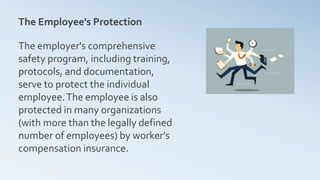
The Employee's Protection
The employer's comprehensive
safety program, including training,
protocols, and documentation,
serve to protect the individual
employee.The employee is also
protected in many organizations
(with more than the legally defined
number of employees) by worker's
compensation insurance.
A safe workplace benefits everyone.They enjoy
the possible backup protection of worker's
compensation insurance in the event of a
workplace accident or exposure.When all
employees and managers work to follow safety
protocols and complete appropriate
documentation, the entire organization maintains
a workplace culture of safety.
Workplace procedure

Workplace procedure

  • 1.
  • 2.
    • A fixed,step-by-step sequence of activities or course of action (with definite start and end points) that must be followed in the same order to correctly perform a task. Repetitive procedures are called routines.
  • 3.
  • 4.
    THE IMPORTANCE OFWORKPLACE SAFETY Workplacesafety is essential for providing a safe environment in which employees can work with minimal risk to their health. On-the-job accidents can cause injuries and death. Preventing these accidents requires the effort of all employees in the organization.
  • 5.
    The Employee's Responsibility Eachworker plays an important role in ensuring her own safety to prevent injury, illness or death from a workplace accident.To maintain a safe workplace, employees must complete mandatory safety training, perform inspections, complete safety checklists and follow safety protocols consistently at work.
  • 6.
    The Employee's Protection Theemployer's comprehensive safety program, including training, protocols, and documentation, serve to protect the individual employee.The employee is also protected in many organizations (with more than the legally defined number of employees) by worker's compensation insurance.
  • 7.
    A safe workplacebenefits everyone.They enjoy the possible backup protection of worker's compensation insurance in the event of a workplace accident or exposure.When all employees and managers work to follow safety protocols and complete appropriate documentation, the entire organization maintains a workplace culture of safety.