Working Together to Build Trust
in Public Health
MONDAY, NOVEMBER 18
12:30 – 2:00 pm ET / 9:30 – 11:00 am PT
This webinar is being recorded. The recording and slides will be available on
publichealthcollaborative.org this week.
All attendees are automatically muted upon entry.
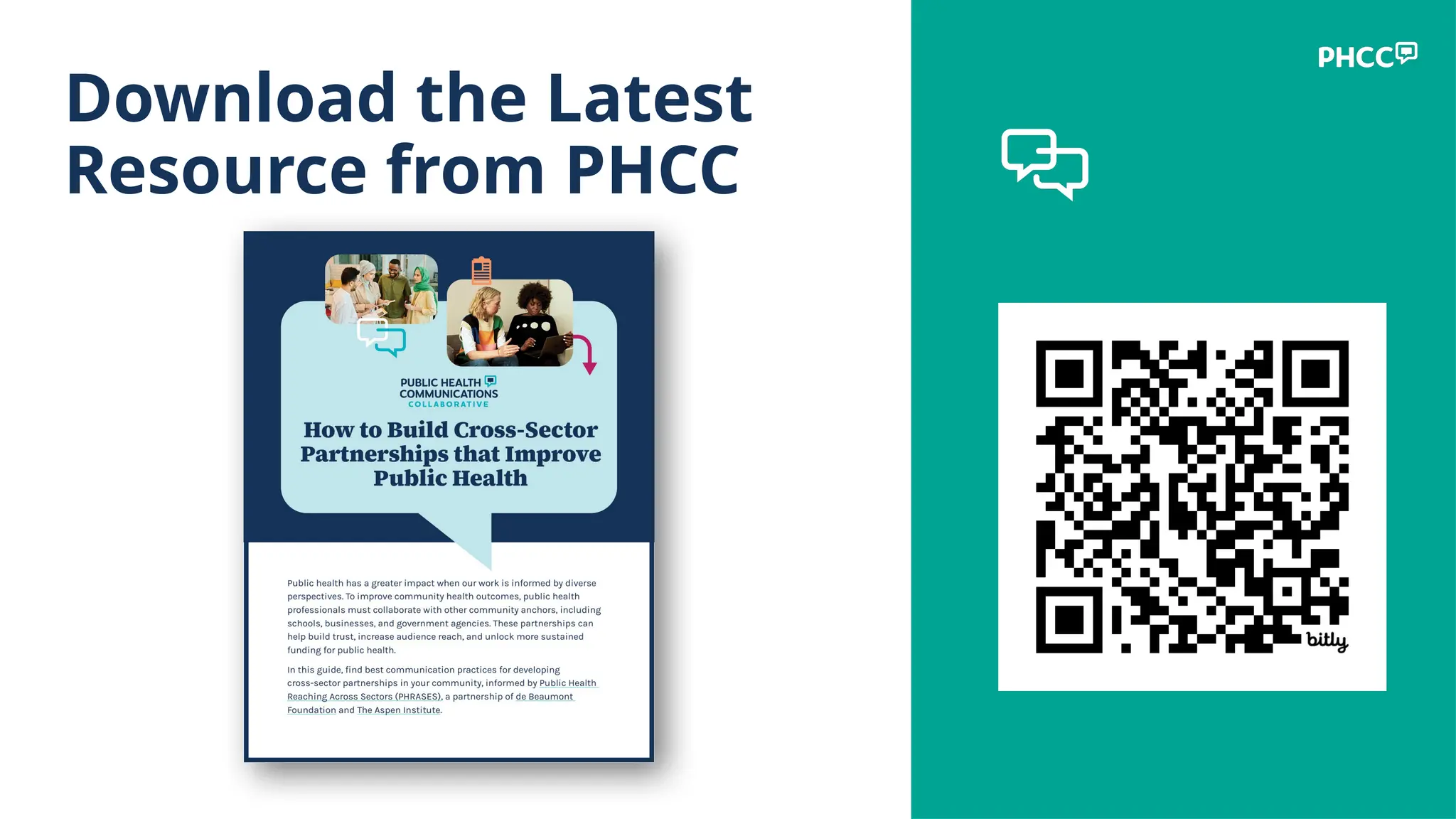
Download the Latest
Resource from PHCC
Closed Captioning
If you’d like to use closed captions: Hover over the “More” button or the
“Interpretation” button on the bottom of your Zoom screen.
● Live closed captioning is being provided by AI Media.
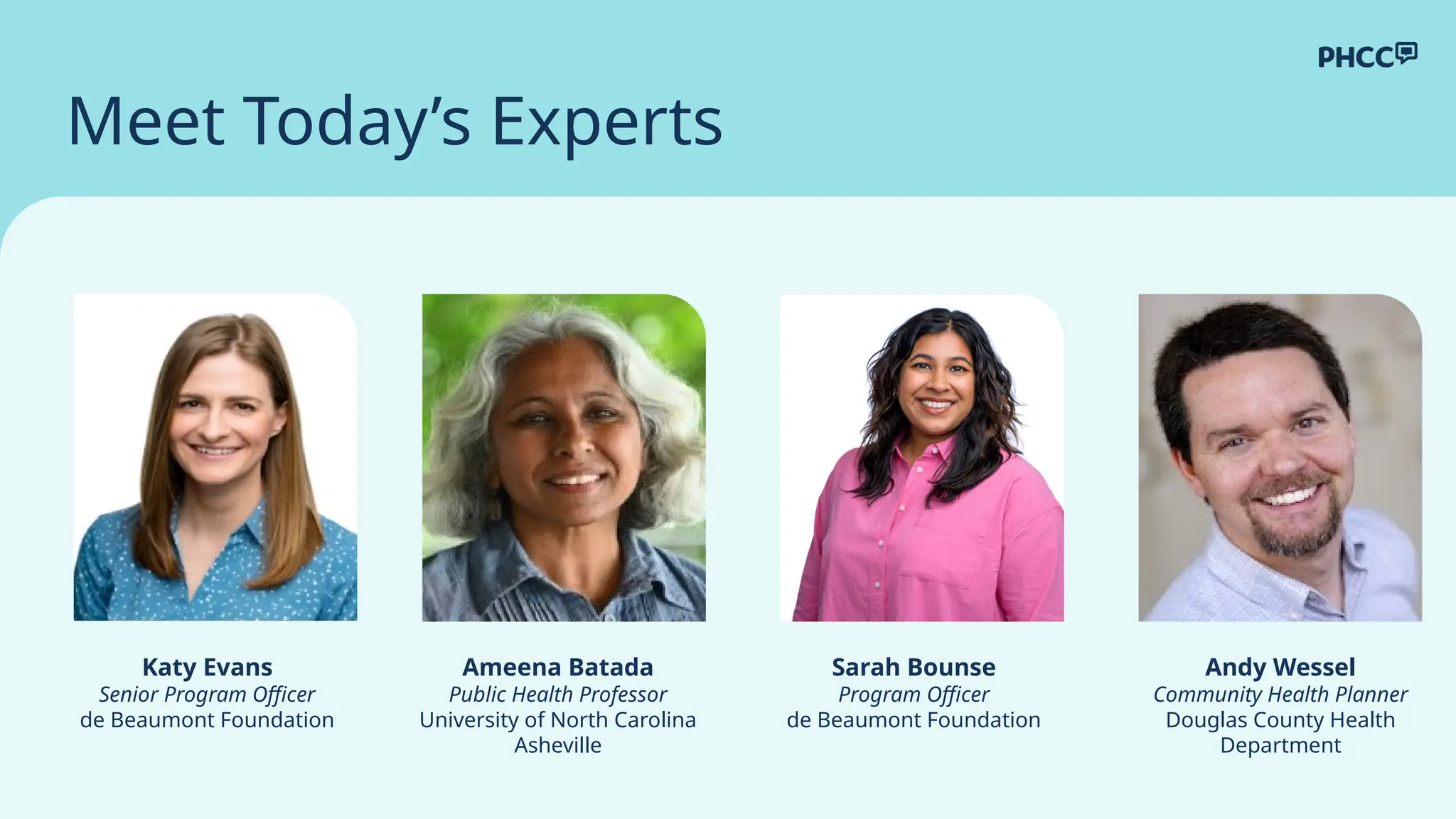
Meet Today’s Experts
Sarah Bounse
Program Officer
de Beaumont Foundation
Ameena Batada
Public Health Professor
University of North Carolina
Asheville
Katy Evans
Senior Program Officer
de Beaumont Foundation
Andy Wessel
Community Health Planner
Douglas County Health
Department
Community-Engaged
Public Health Communication
Ameena Batada
Working Together to Build Trust in Public Health
November 18, 2024
Family
Teachers, Colleagues,
Students
Partners
Sources (on slides)
Graphics (Canva,
thenounproject)
PHCC
Panel Team and Speakers
YOU!
Acknowledgments
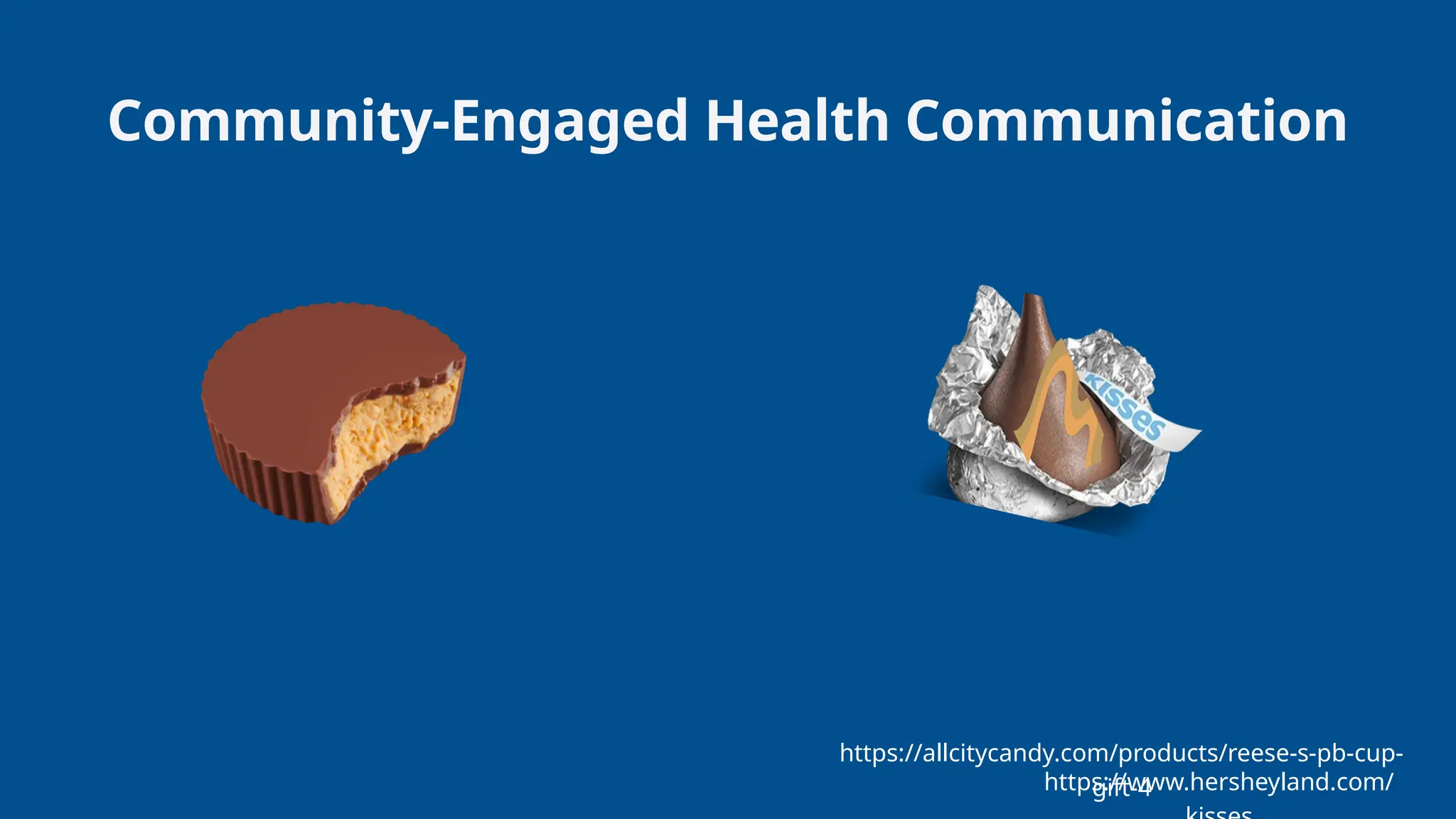
https://allcitycandy.com/products/reese-s-pb-cup-
gift-4
https://www.hersheyland.com/
Community-Engaged Health Communication
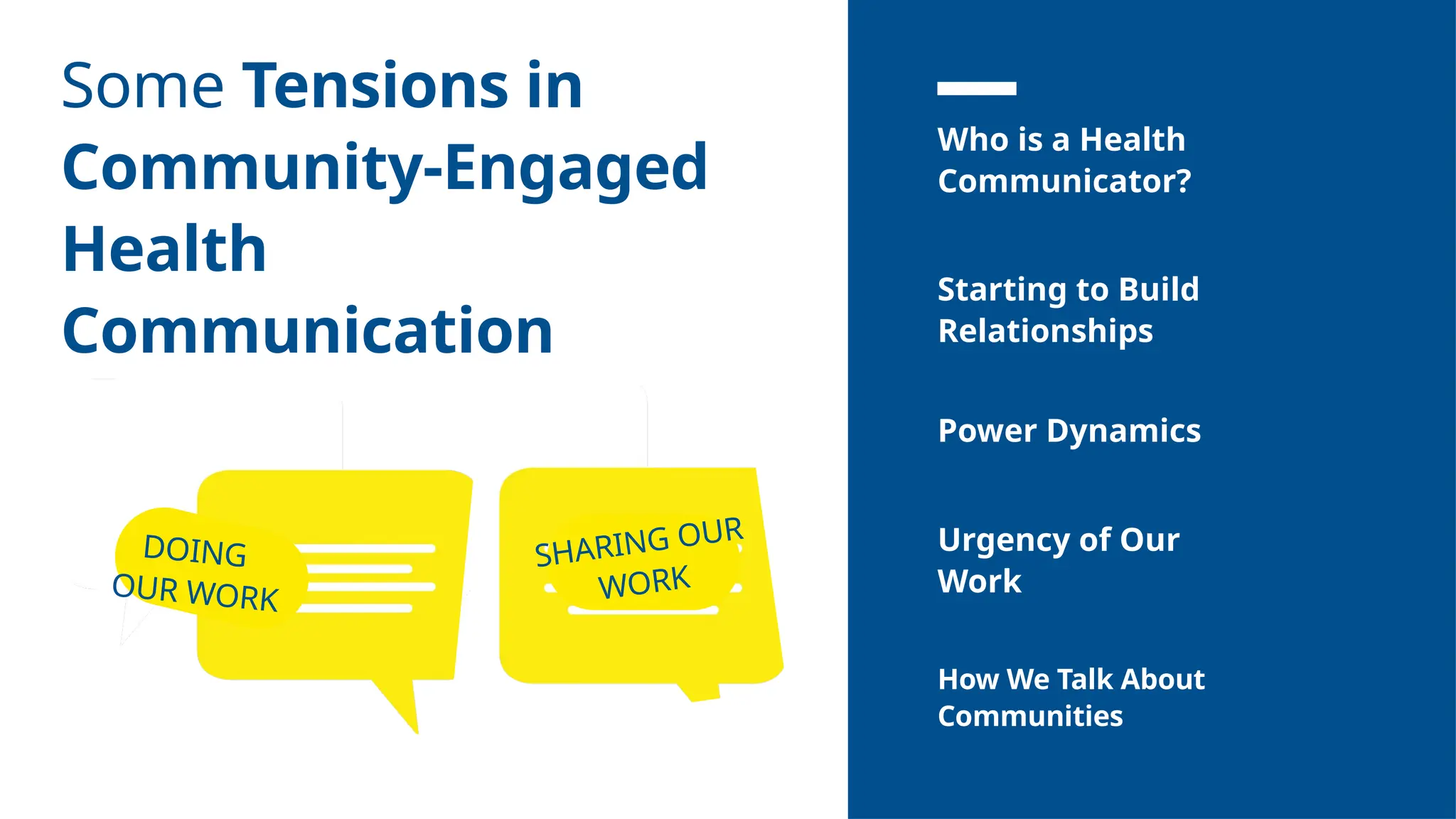
Some Tensions in
Community-Engaged
Health
Communication
Starting to Build
Relationships
Power Dynamics
Urgency of Our
Work
How We Talk About
Communities
Who is a Health
Communicator?
SHARING OUR
WORK
DOING
OUR WORK
Who is a Health
Communicator?
Who is a Health
Communicator?
Storytelling:
Health communication is a
Team Effort
Starting to
Build
Relationships
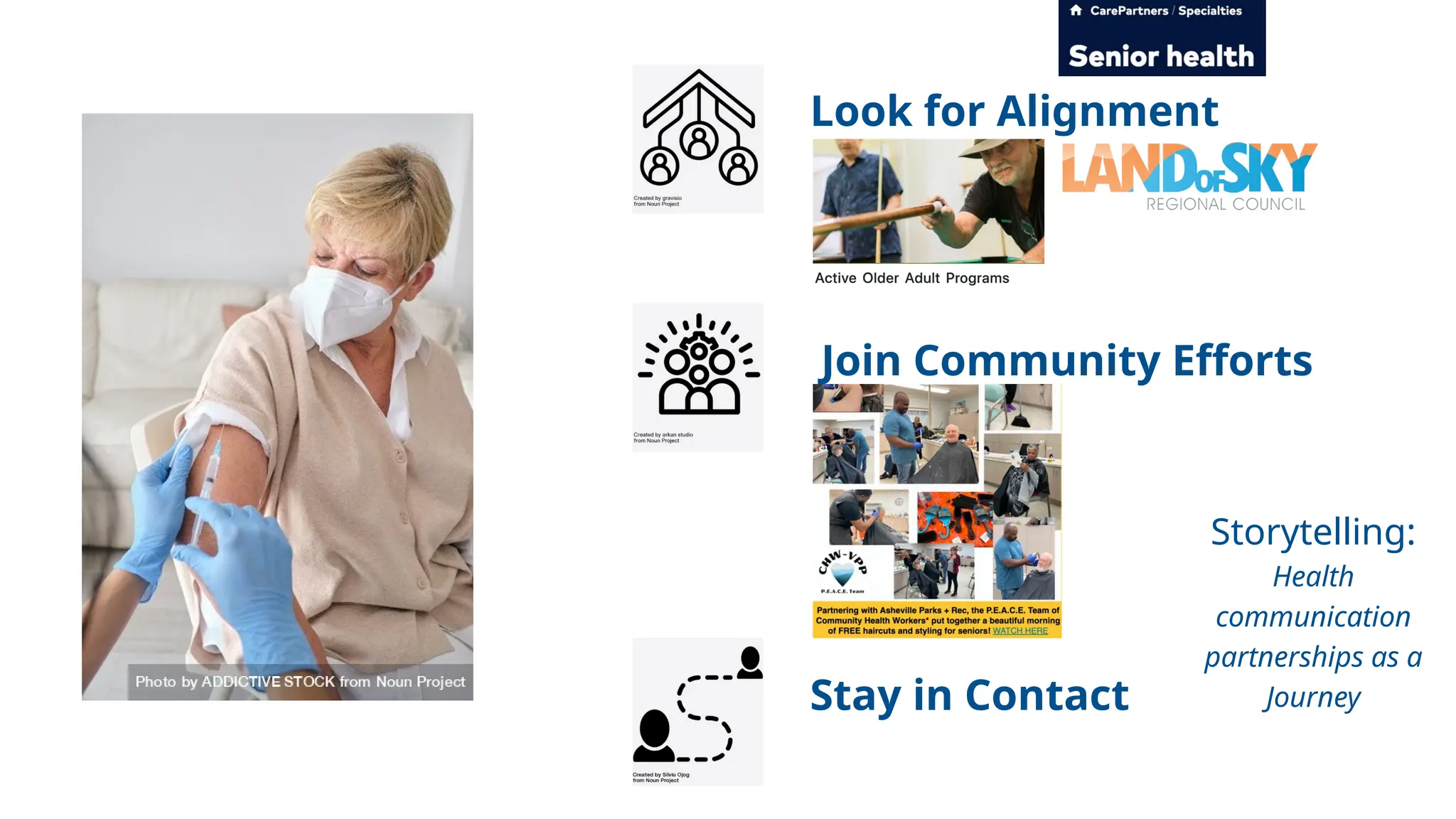
Look for Alignment
Join Community Efforts
Stay in Contact
Storytelling:
Health
communication
partnerships as a
Journey
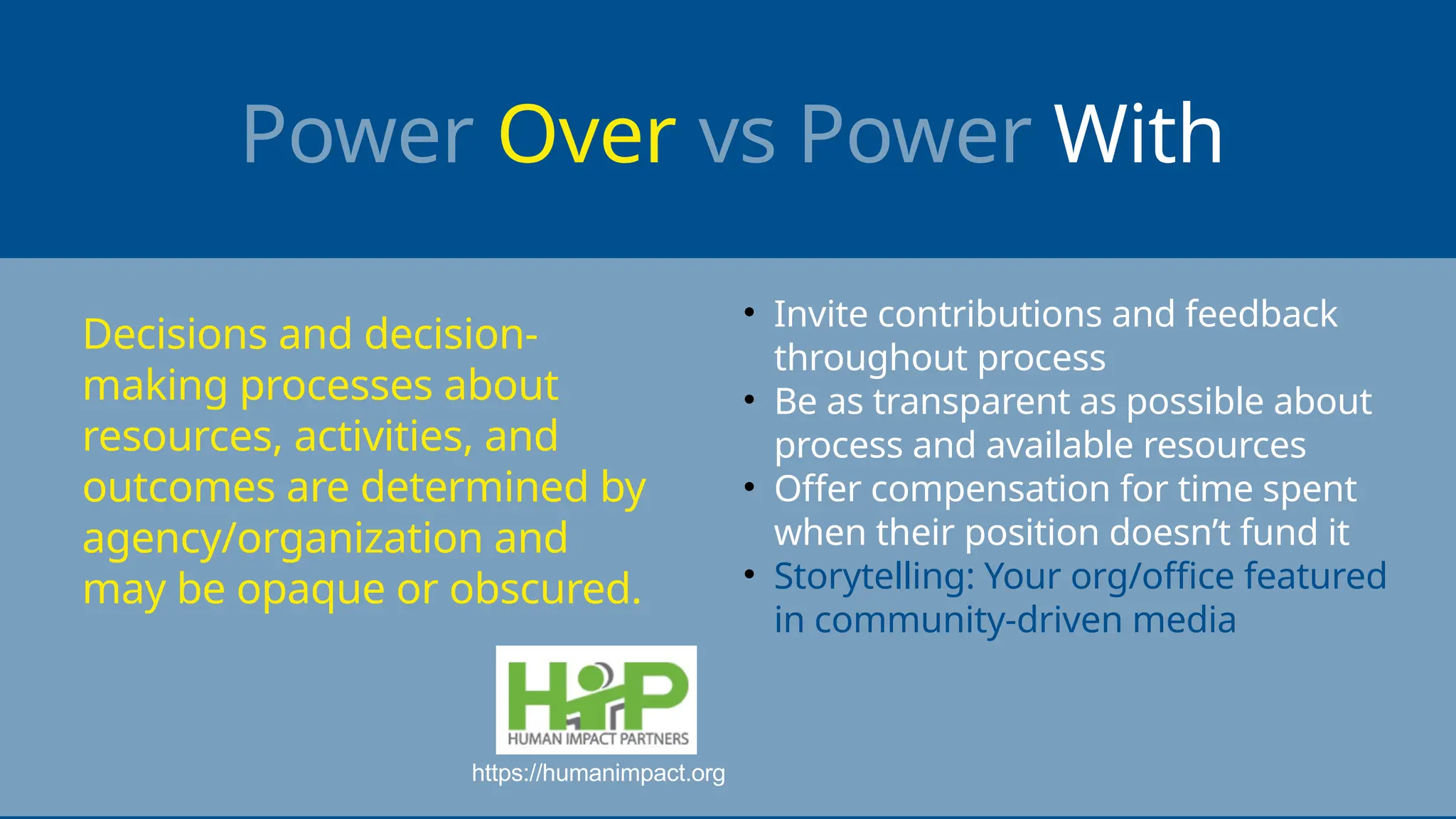
Power Over vs Power With
• Invite contributions and feedback
throughout process
• Be as transparent as possible about
process and available resources
• Offer compensation for time spent
when their position doesn’t fund it
• Storytelling: Your org/office featured
in community-driven media
https://humanimpact.org
Decisions and decision-
making processes about
resources, activities, and
outcomes are determined by
agency/organization and
may be opaque or obscured.
Urgency of
Our Work
• Learn Partners’ Priorities &
Timelines
• Prioritize responding to partners
• Stay in Contact - Share news and
opportunities throughout the
year
• Establish an advisory group
• Storytelling: Highlighting the
roles of community advocates
Outbreaks, Funding
Requirements and More
How We Talk
About
Communities
“The Community”
Lumps everyone together when we have distinct
characteristics and contributions.
Being specific is clearer and more intentional.
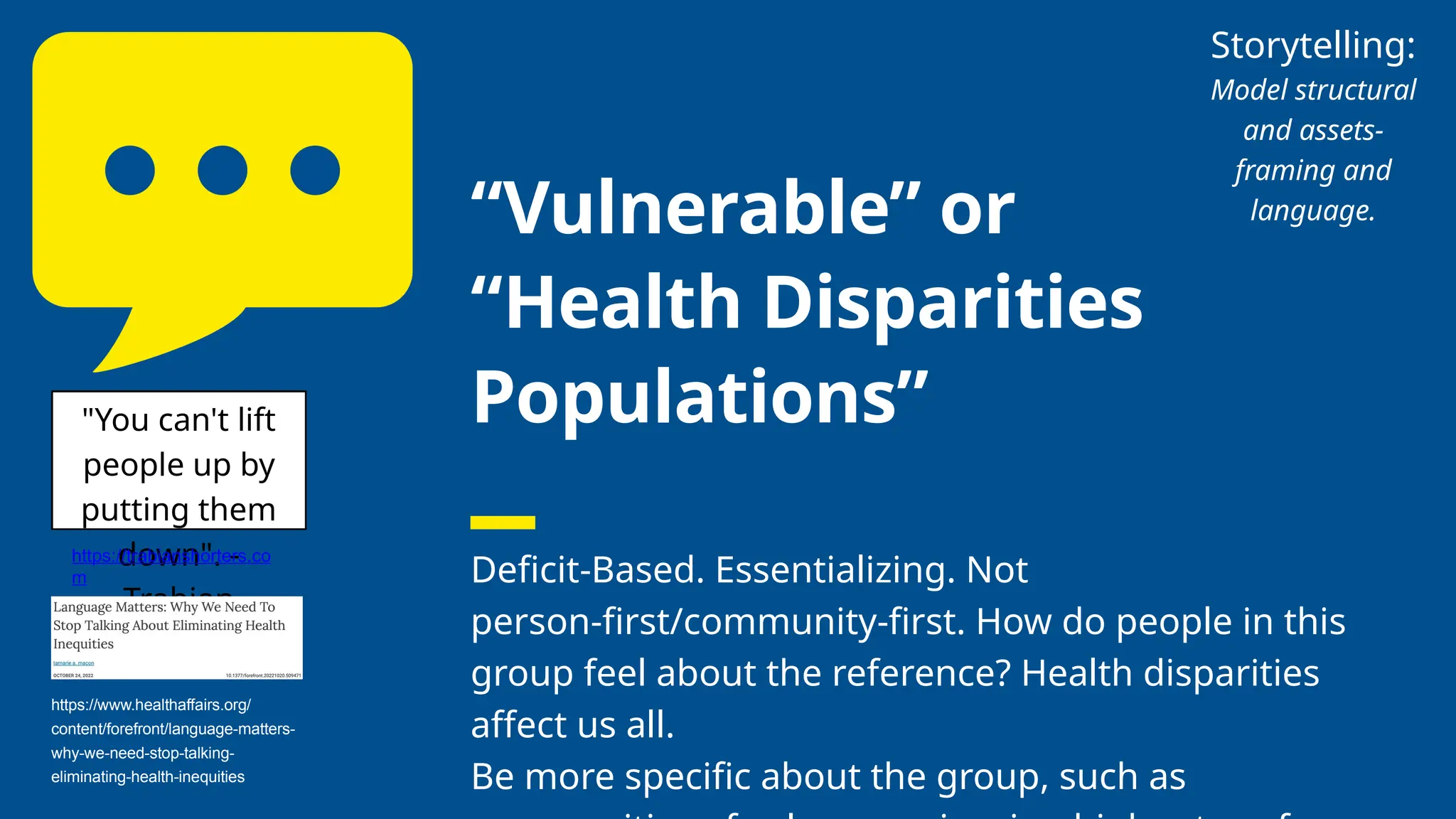
“Vulnerable” or
“Health Disparities
Populations”
Deficit-Based. Essentializing. Not
person-first/community-first. How do people in this
group feel about the reference? Health disparities
affect us all.
Be more specific about the group, such as
"You can't lift
people up by
putting them
down". -
Trabian
Shorters
https://trabianshorters.co
m
https://www.healthaffairs.org/
content/forefront/language-matters-
why-we-need-stop-talking-
eliminating-health-inequities
Storytelling:
Model structural
and assets-
framing and
language.
Thank You!
Ameena Batada
ameenabatada@gmail.com
Inciting action.
Driving change.
The de Beaumont Foundation creates and
invests in bold solutions that improve the
health of communities across the country.
Our vision is a nation where every person in
every community has the opportunity to
achieve their best possible health, regardless
of where they live.
About de Beaumont
Communicatin
g with Multi-
Sector Partners
What is it?
Evidence-based framing
tools and resources to help
public health professionals
communicate and collaborate
more effectively.
What is the goal?
To foster a better
understanding of public
health and greater
willingness of other sectors to
engage in cross-sector
partnerships.
Why is this important?
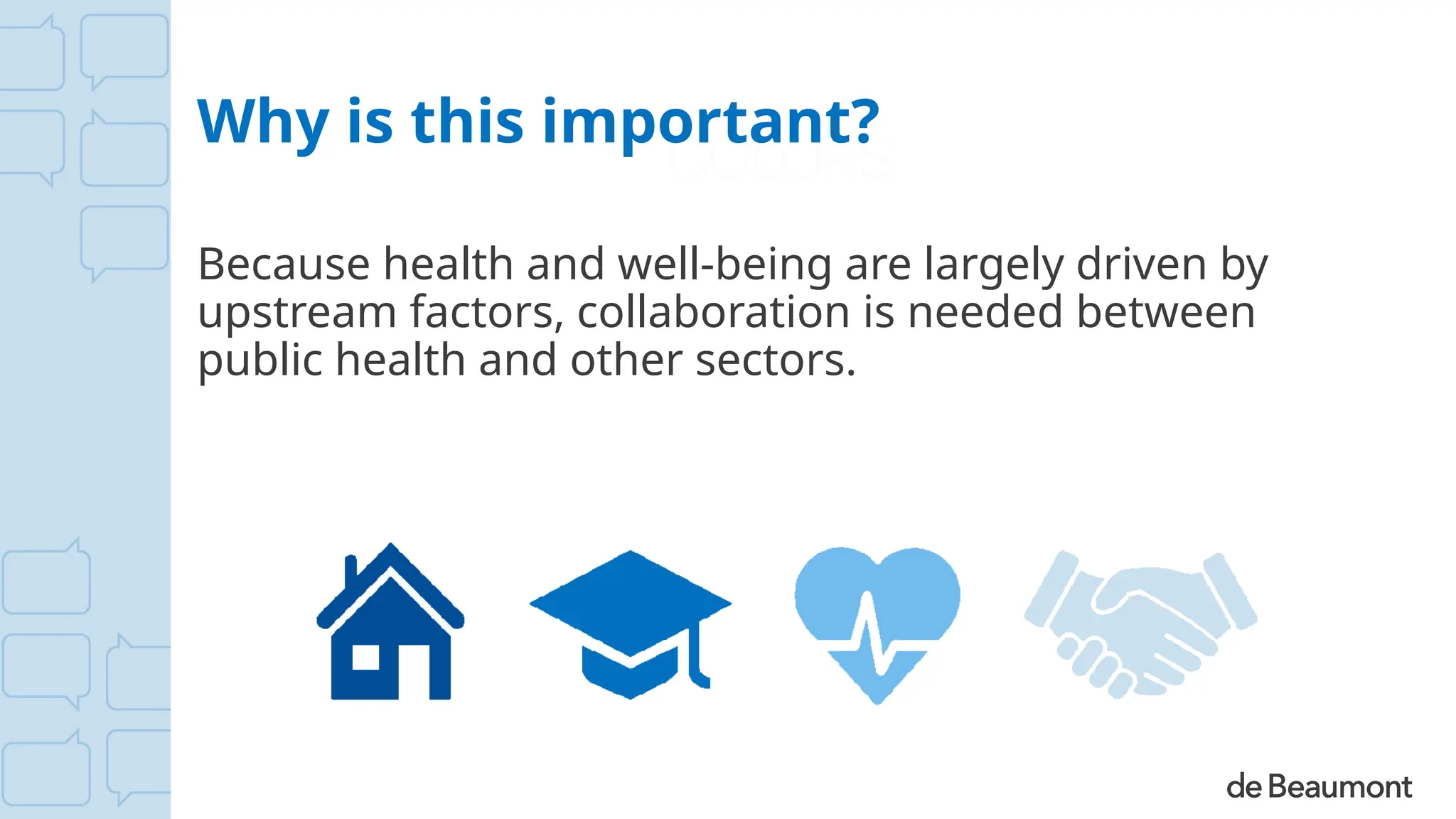
Because health and well-being are largely driven by
upstream factors, collaboration is needed between
public health and other sectors.
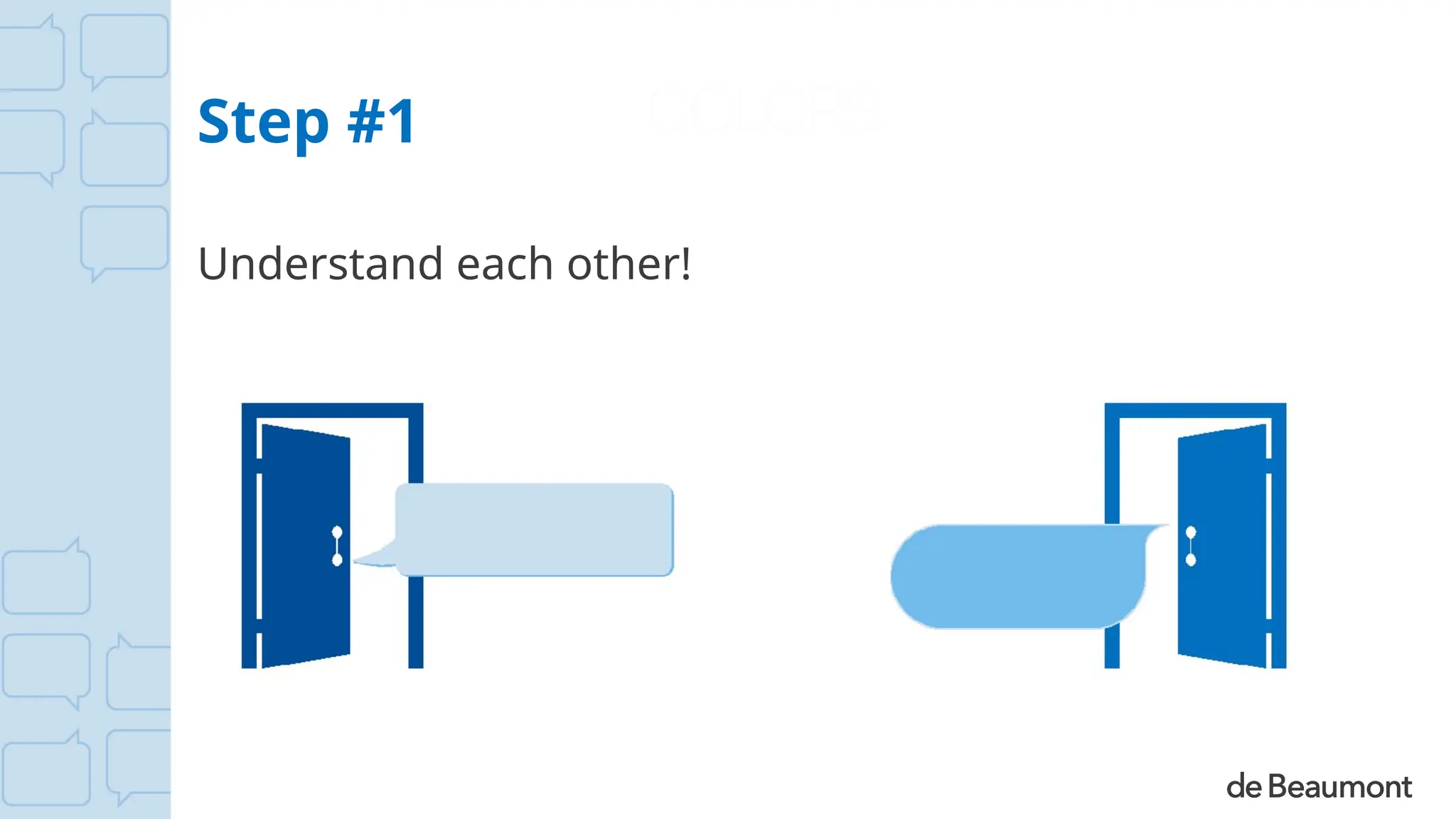
Step #1
Understand each other!
Map the gaps
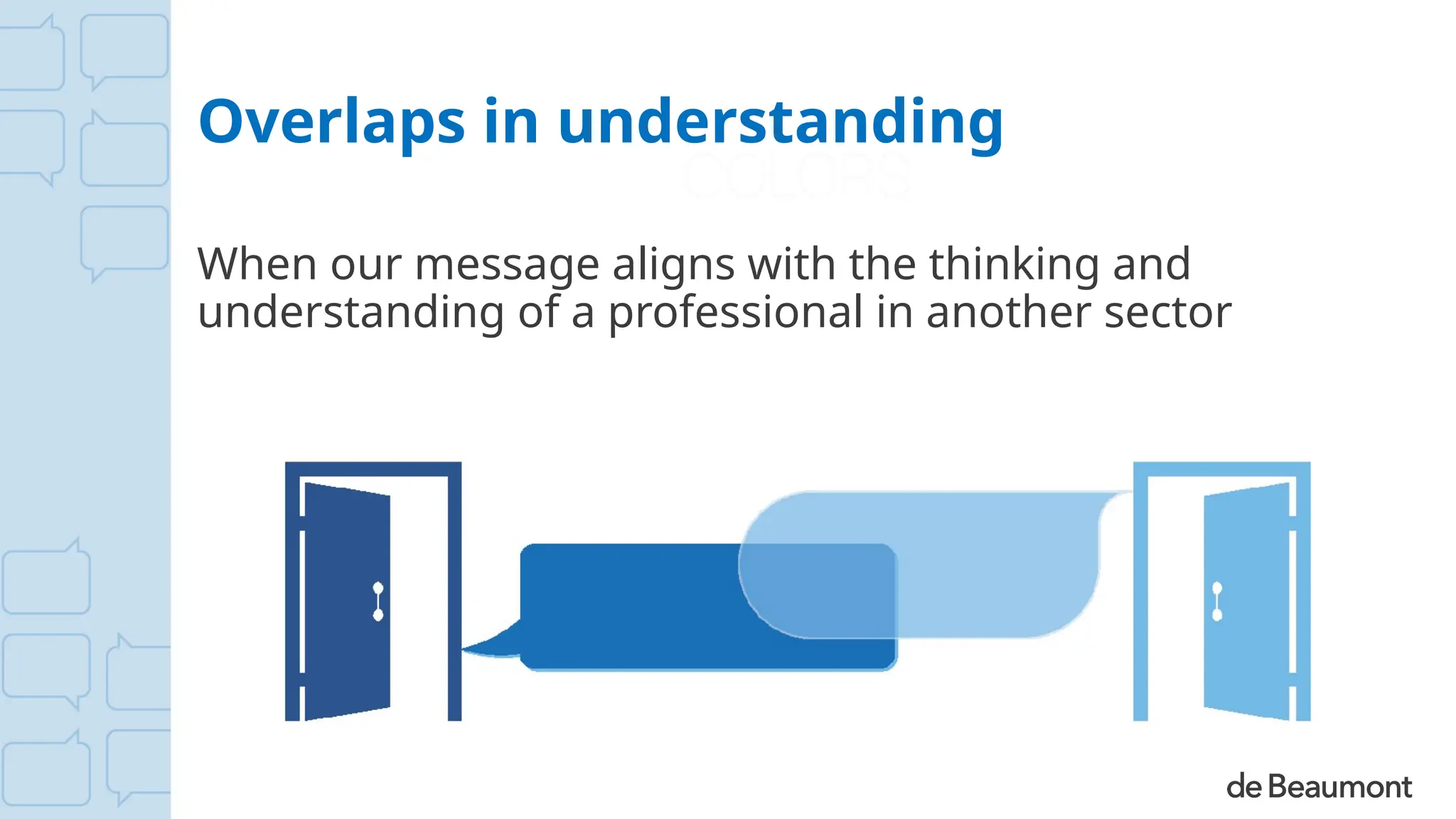
Overlaps in understanding
When our message aligns with the thinking and
understanding of a professional in another sector
Gaps in understanding
Key differences between how experts in
public health and leaders in other sectors
think about topics of health, public health
and cross-sector collaboration.
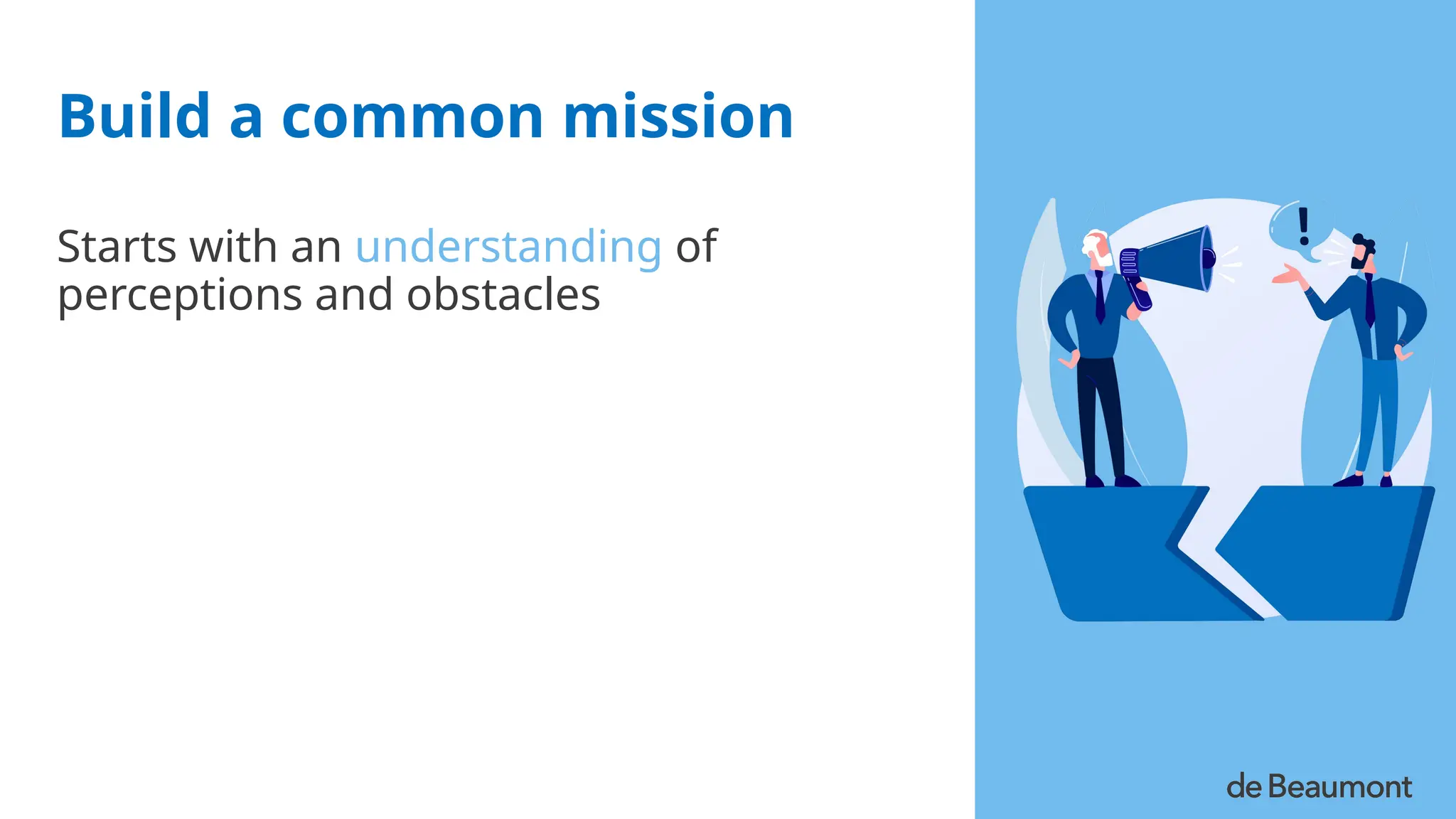
Build a common mission
Starts with an understanding of
perceptions and obstacles
Our definitions
differ across sectors
Gap in
understanding
Experts in
public health
Experts in non-
public health
sectors
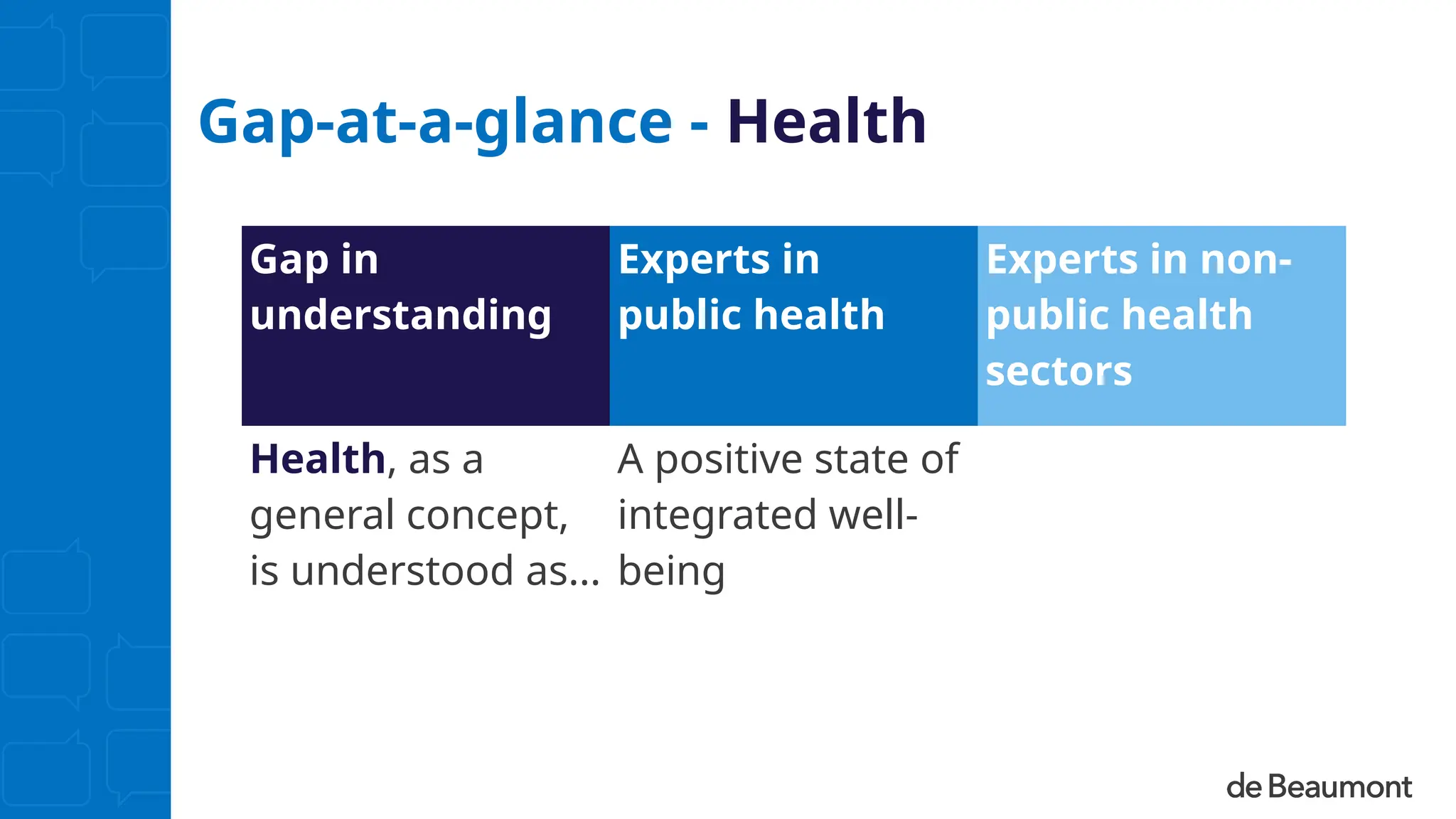
Health, as a
general concept,
is understood as...
A positive state of
integrated well-
being
Gap-at-a-glance - Health
Gap in
understanding
Experts in
public health
Experts in non-
public health
sectors
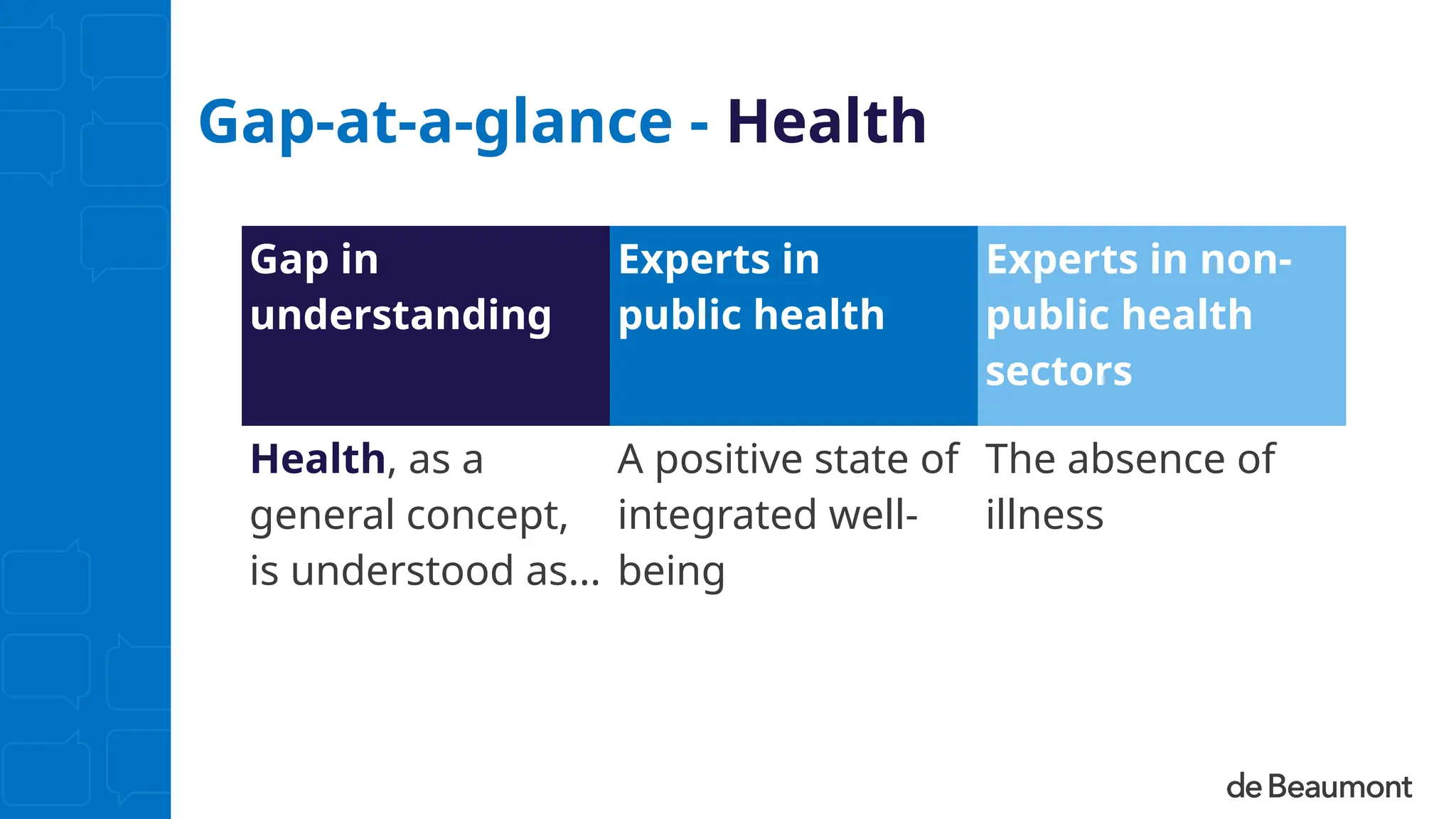
Health, as a
general concept,
is understood as...
A positive state of
integrated well-
being
The absence of
illness
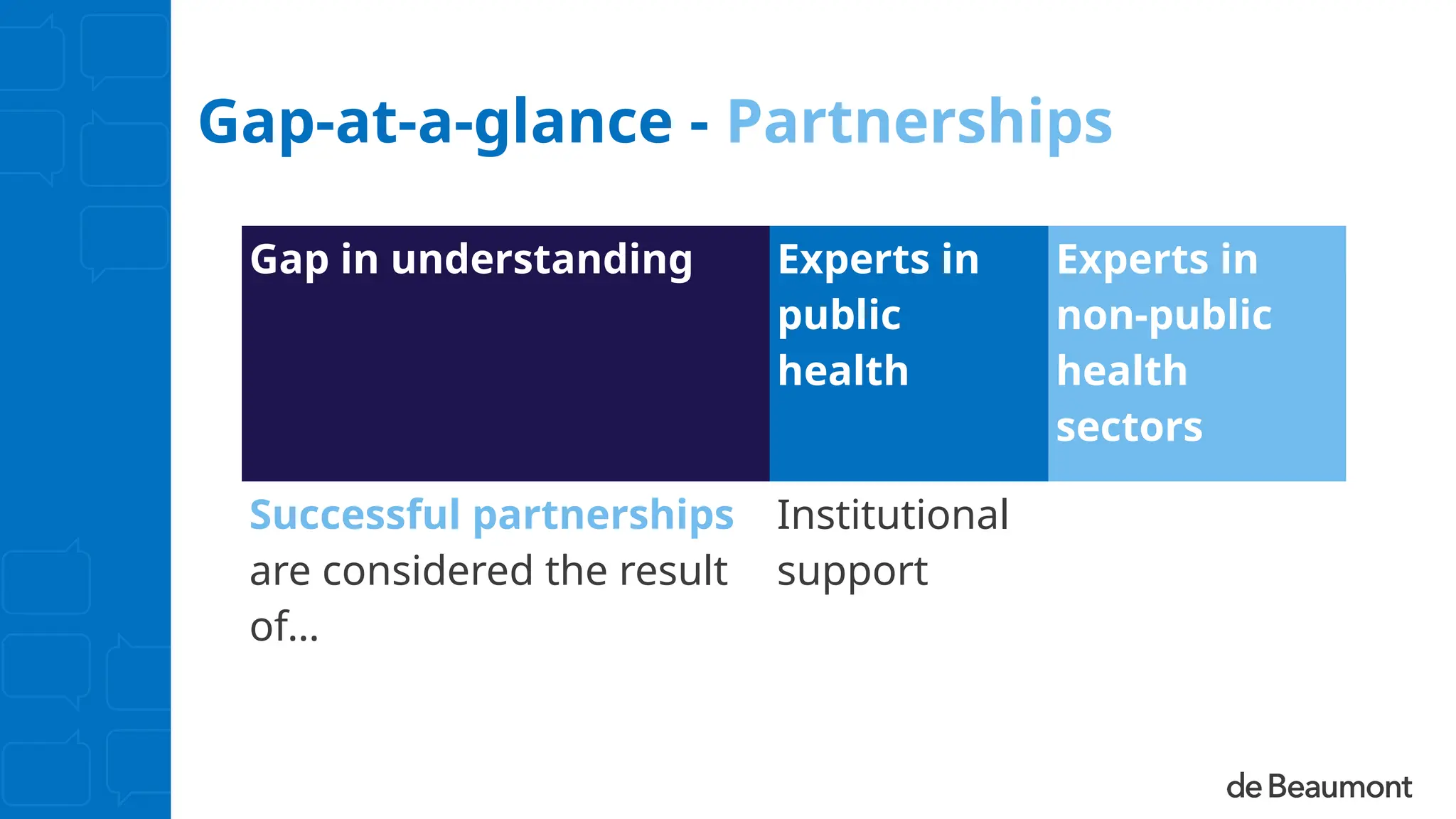
Gap-at-a-glance - Partnerships
Gap in understanding Experts in
public
health
Experts in
non-public
health
sectors
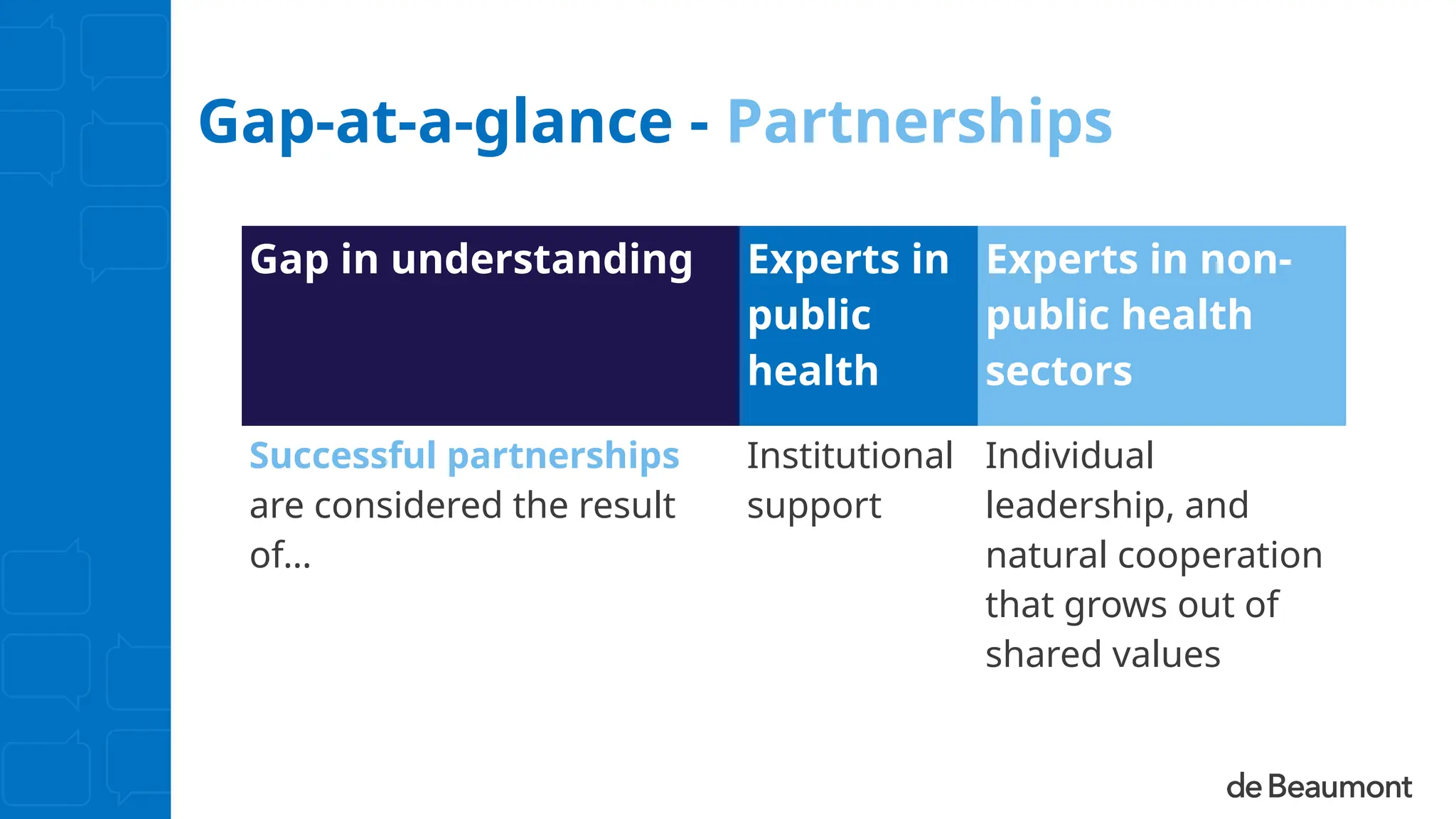
Successful partnerships
are considered the result
of…
Institutional
support
Gap-at-a-glance - Partnerships
Gap in understanding Experts in
public
health
Experts in non-
public health
sectors
Successful partnerships
are considered the result
of…
Institutional
support
Individual
leadership, and
natural cooperation
that grows out of
shared values
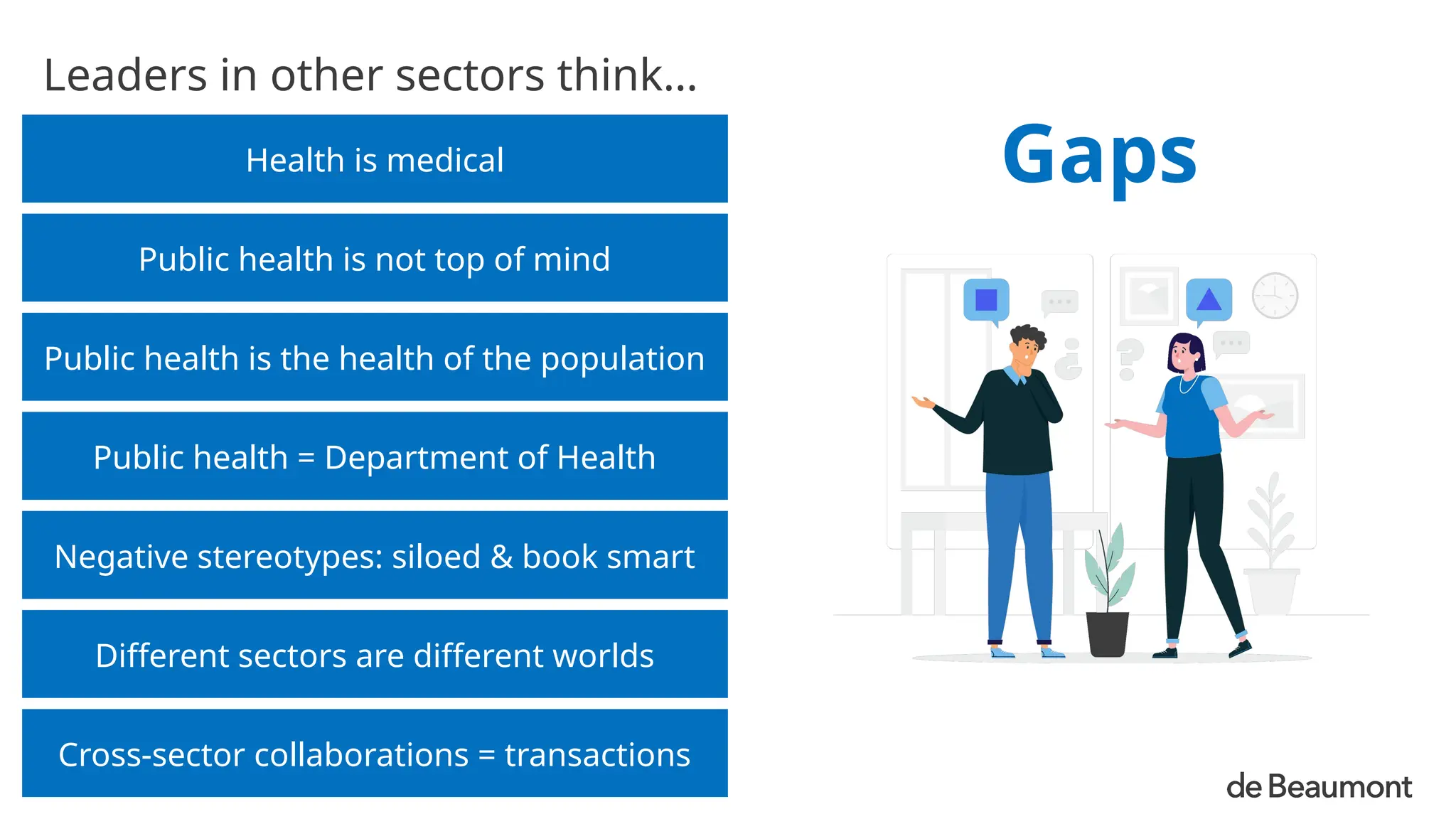
Leaders in other sectors think…
Health is medical
Public health is not top of mind
Public health is the health of the population
Public health = Department of Health
Negative stereotypes: siloed & book smart
Different sectors are different worlds
Cross-sector collaborations = transactions
Gaps
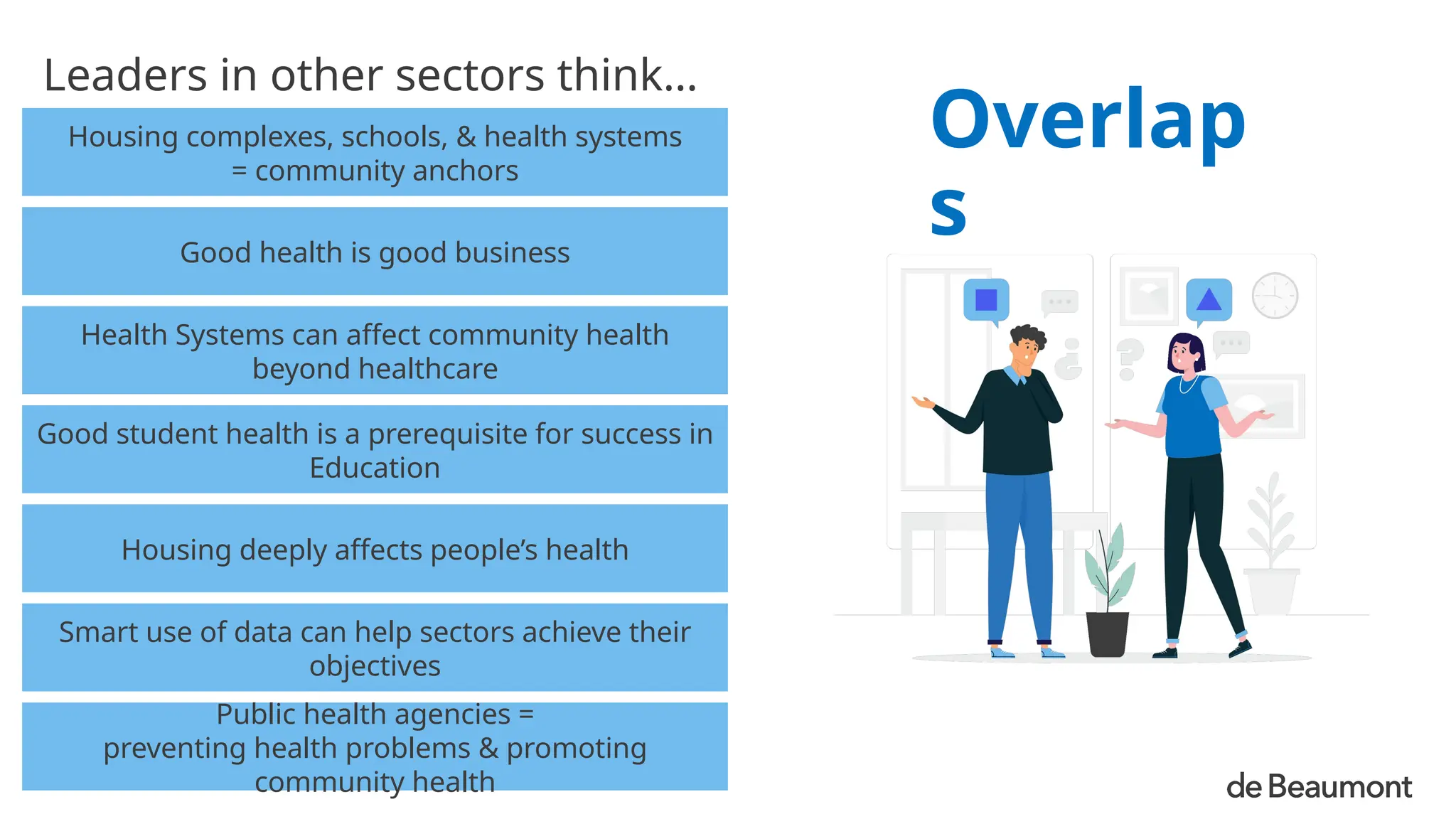
Leaders in other sectors think…
Housing complexes, schools, & health systems
= community anchors
Good health is good business
Health Systems can affect community health
beyond healthcare
Good student health is a prerequisite for success in
Education
Housing deeply affects people’s health
Smart use of data can help sectors achieve their
objectives
Public health agencies =
preventing health problems & promoting
community health
Overlap
s
Building a common mission
Leverage tools to shift thinking
and bridge gaps in
understanding
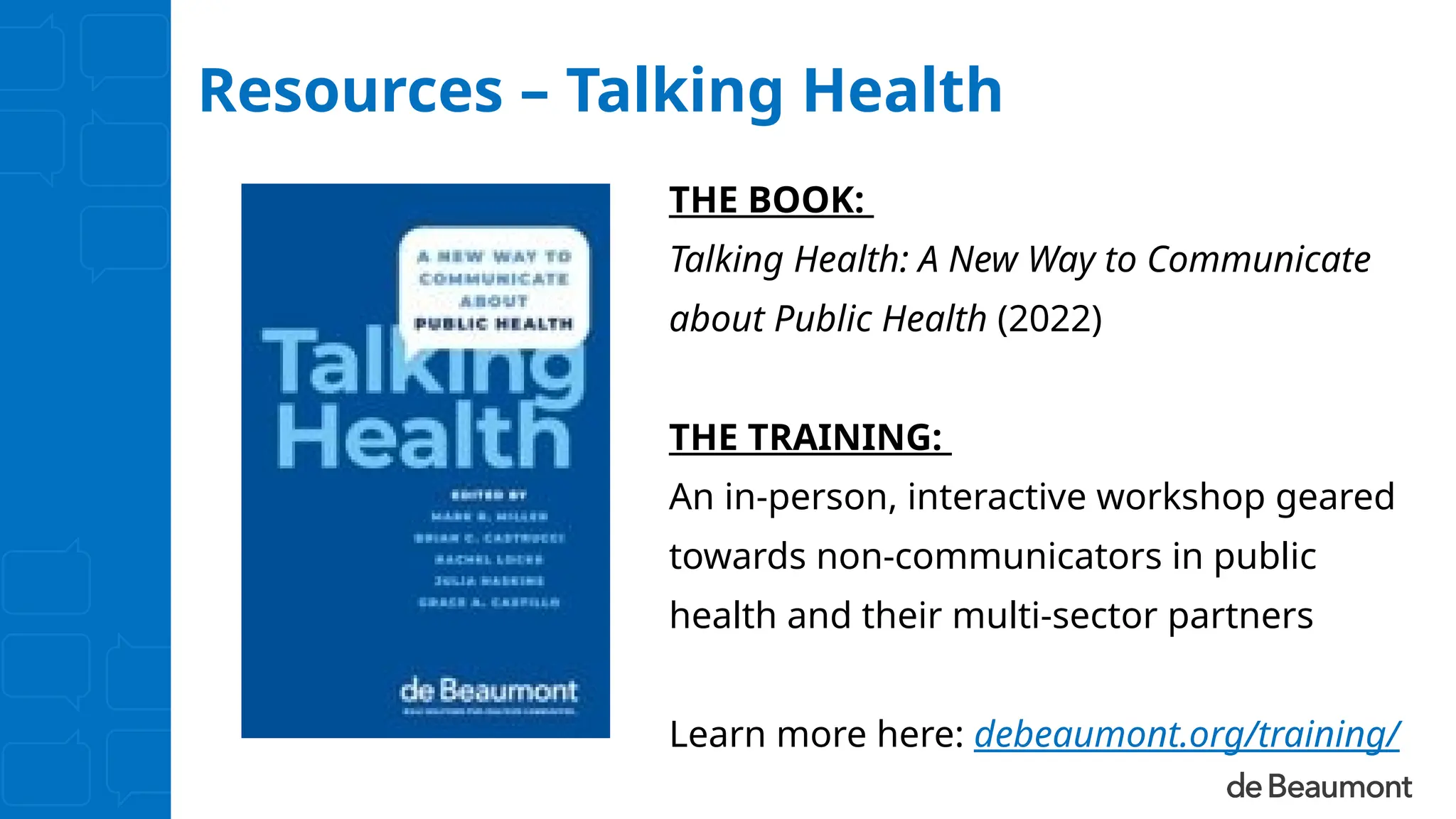
Resources – Talking Health
THE BOOK:
Talking Health: A New Way to Communicate
about Public Health (2022)
THE TRAINING:
An in-person, interactive workshop geared
towards non-communicators in public
health and their multi-sector partners
Learn more here: debeaumont.org/training/
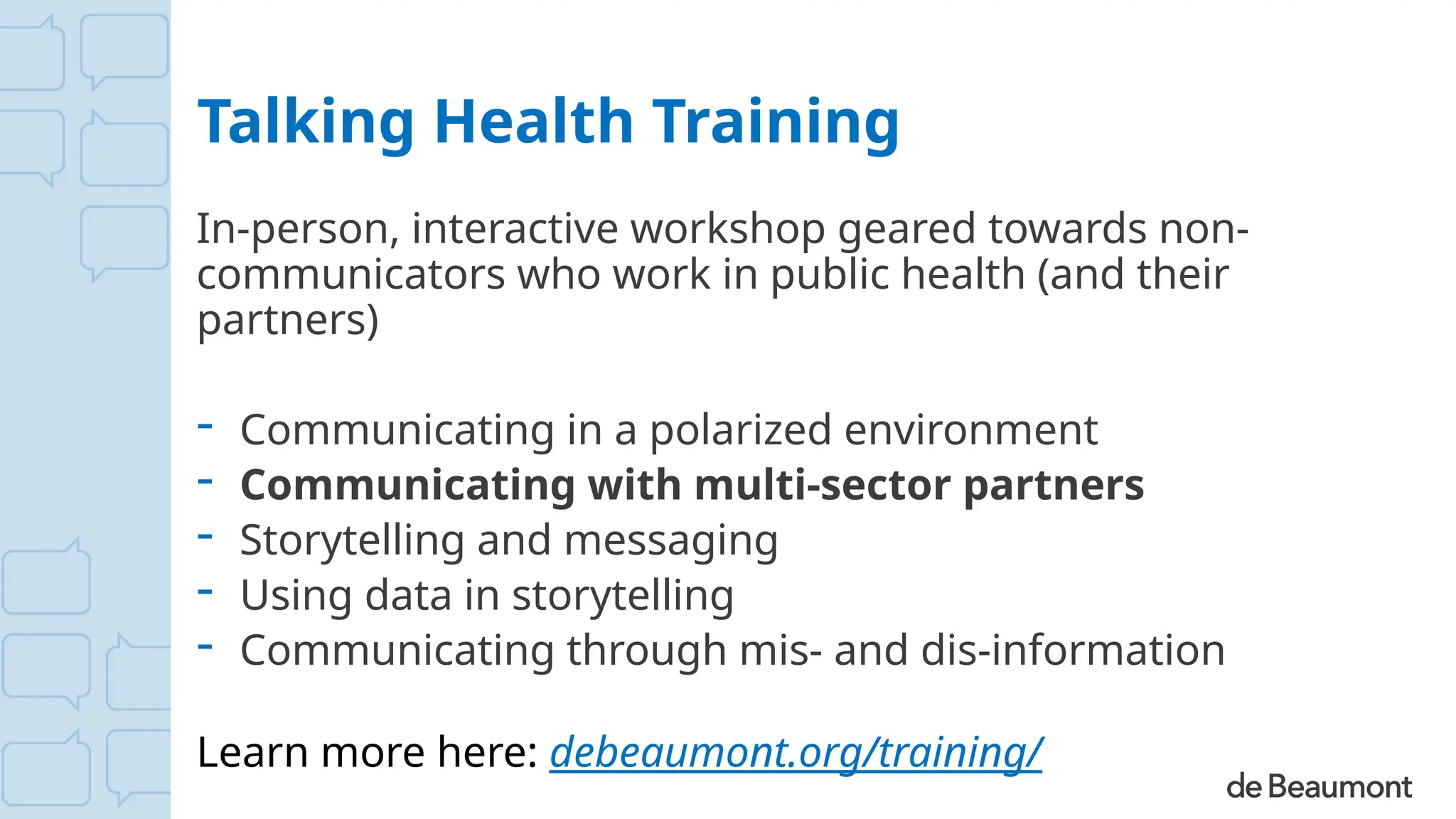
Talking Health Training
In-person, interactive workshop geared towards non-
communicators who work in public health (and their
partners)
- Communicating in a polarized environment
- Communicating with multi-sector partners
- Storytelling and messaging
- Using data in storytelling
- Communicating through mis- and dis-information
Learn more here: debeaumont.org/training/
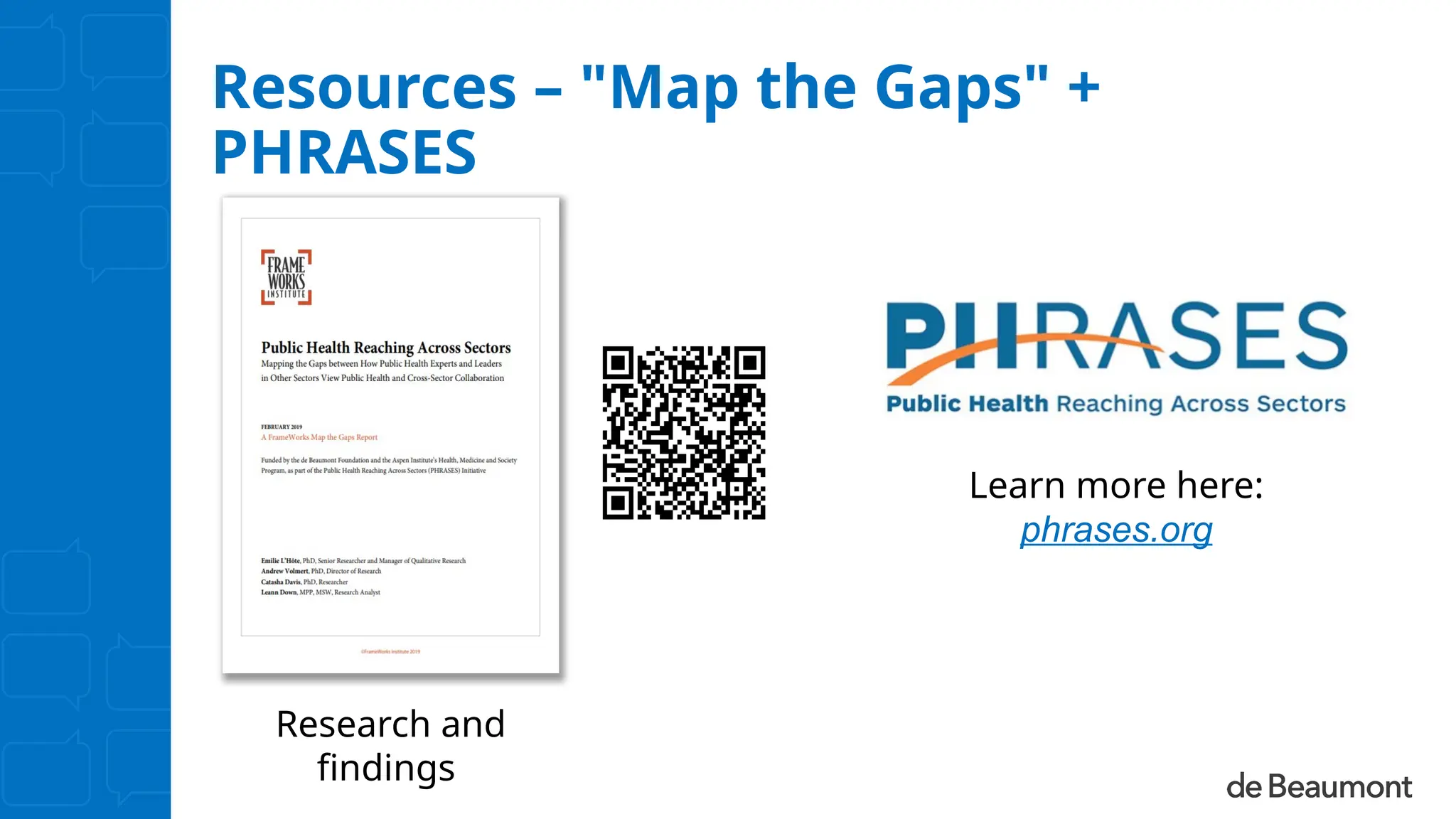
Resources – "Map the Gaps" +
PHRASES
Learn more here:
phrases.org
Research and
findings
debeaumont.org
Thank You!
Sarah Bounse, MPH
Program Officer
de Beaumont Foundation
bounse@debeaumont.org
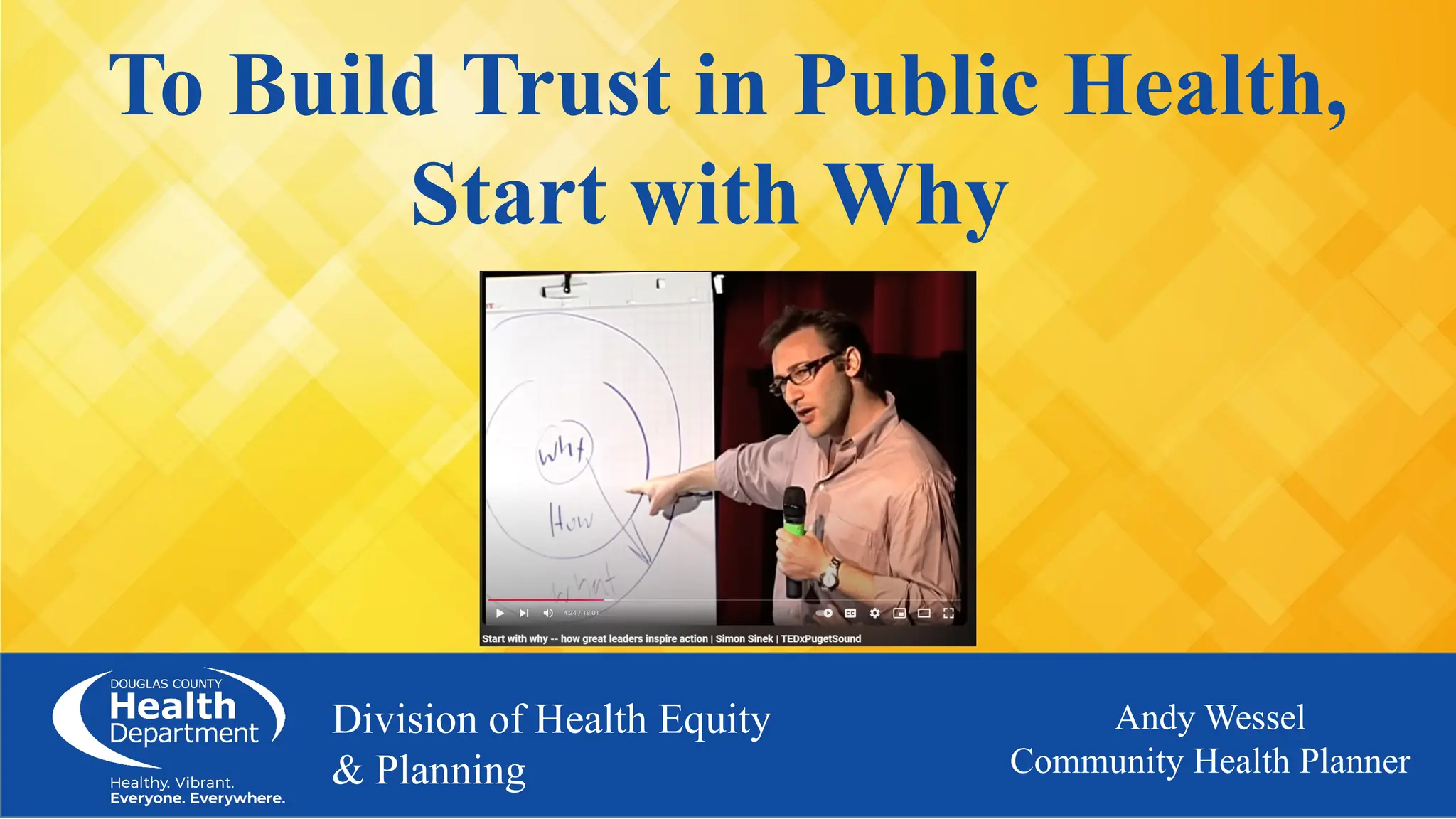
To Build Trust in Public Health,
Start with Why
Division of Health Equity
& Planning
Andy Wessel
Community Health Planner
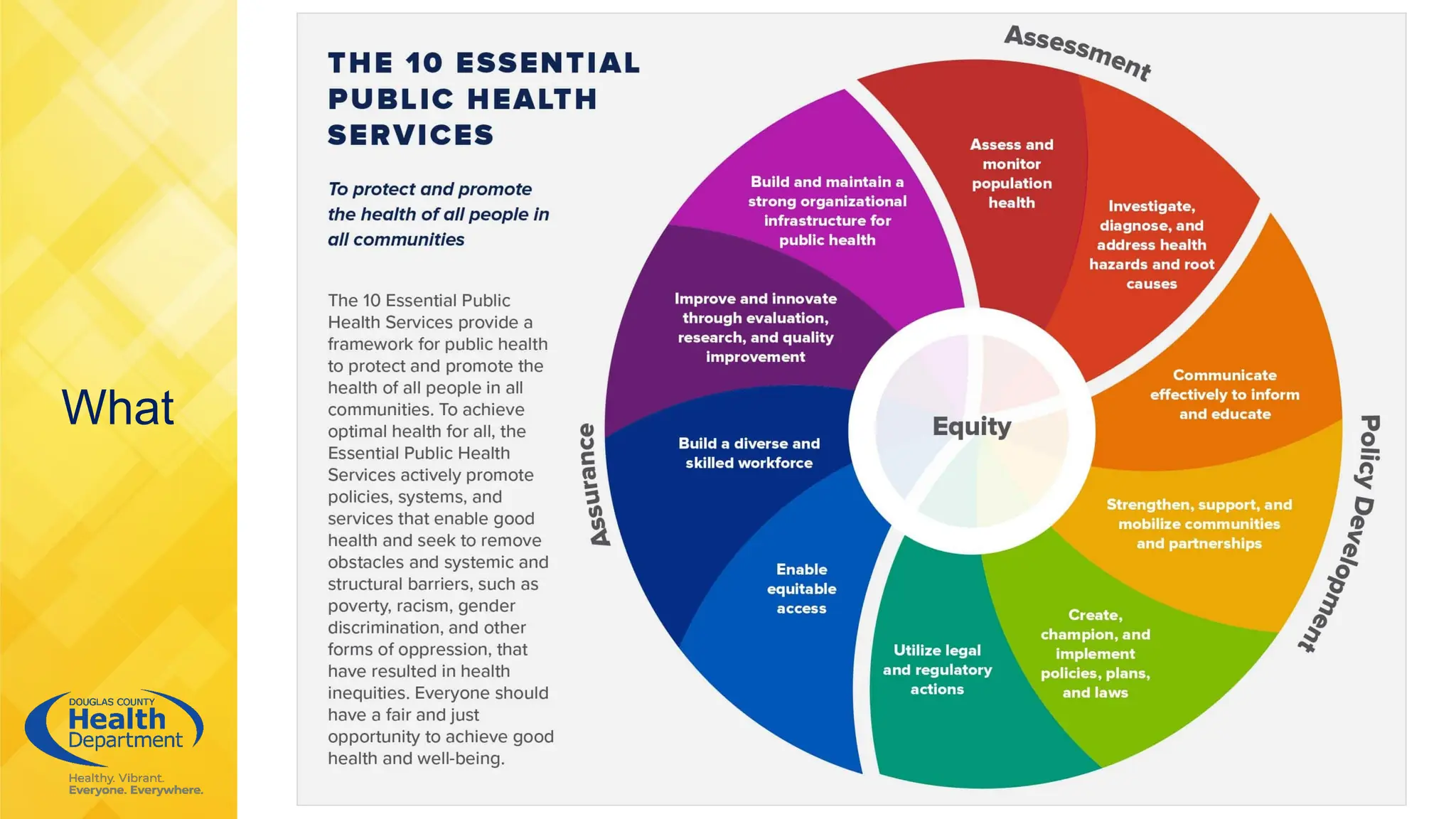
What
Why
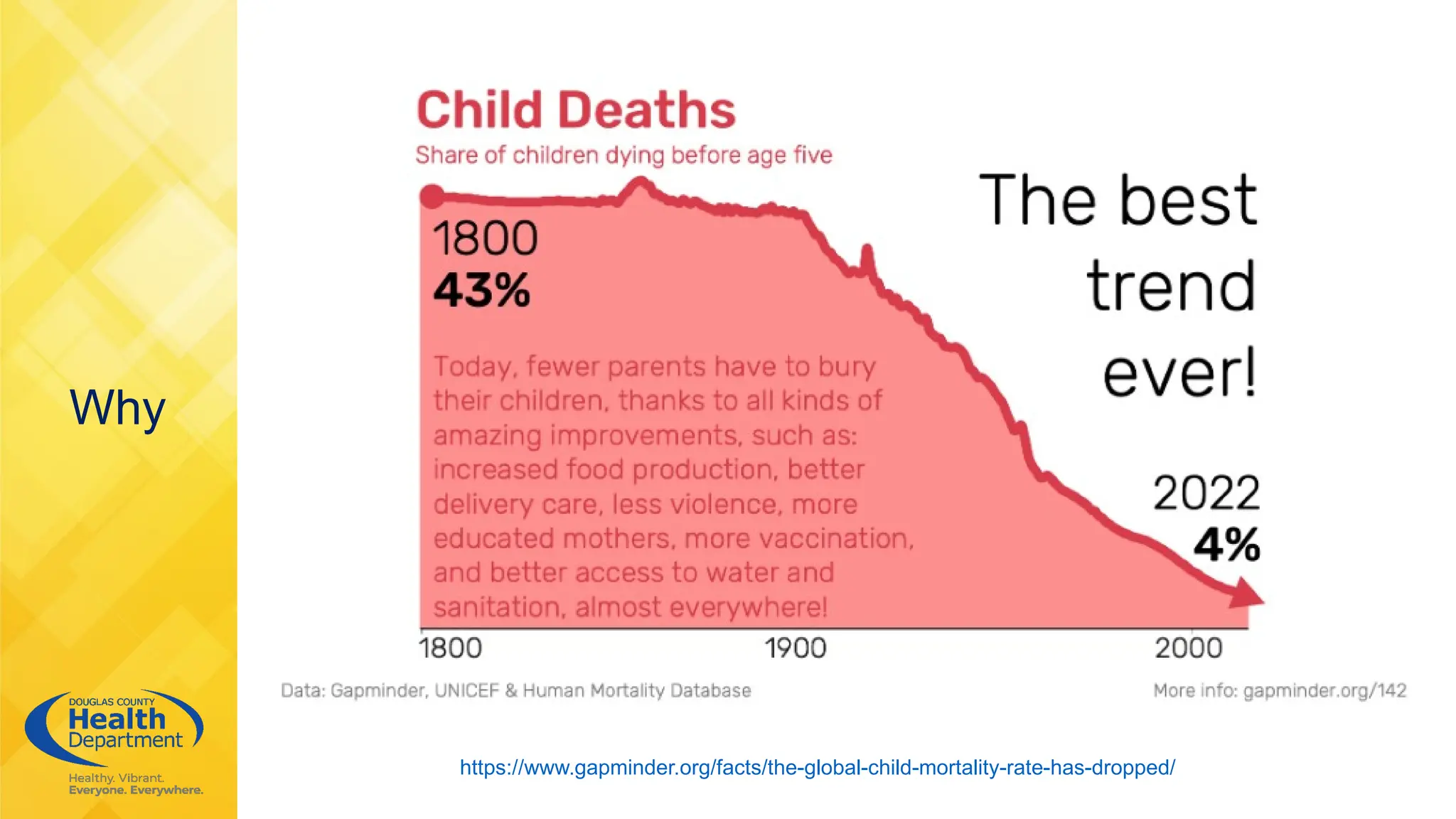
https://www.gapminder.org/facts/the-global-child-mortality-rate-has-dropped/
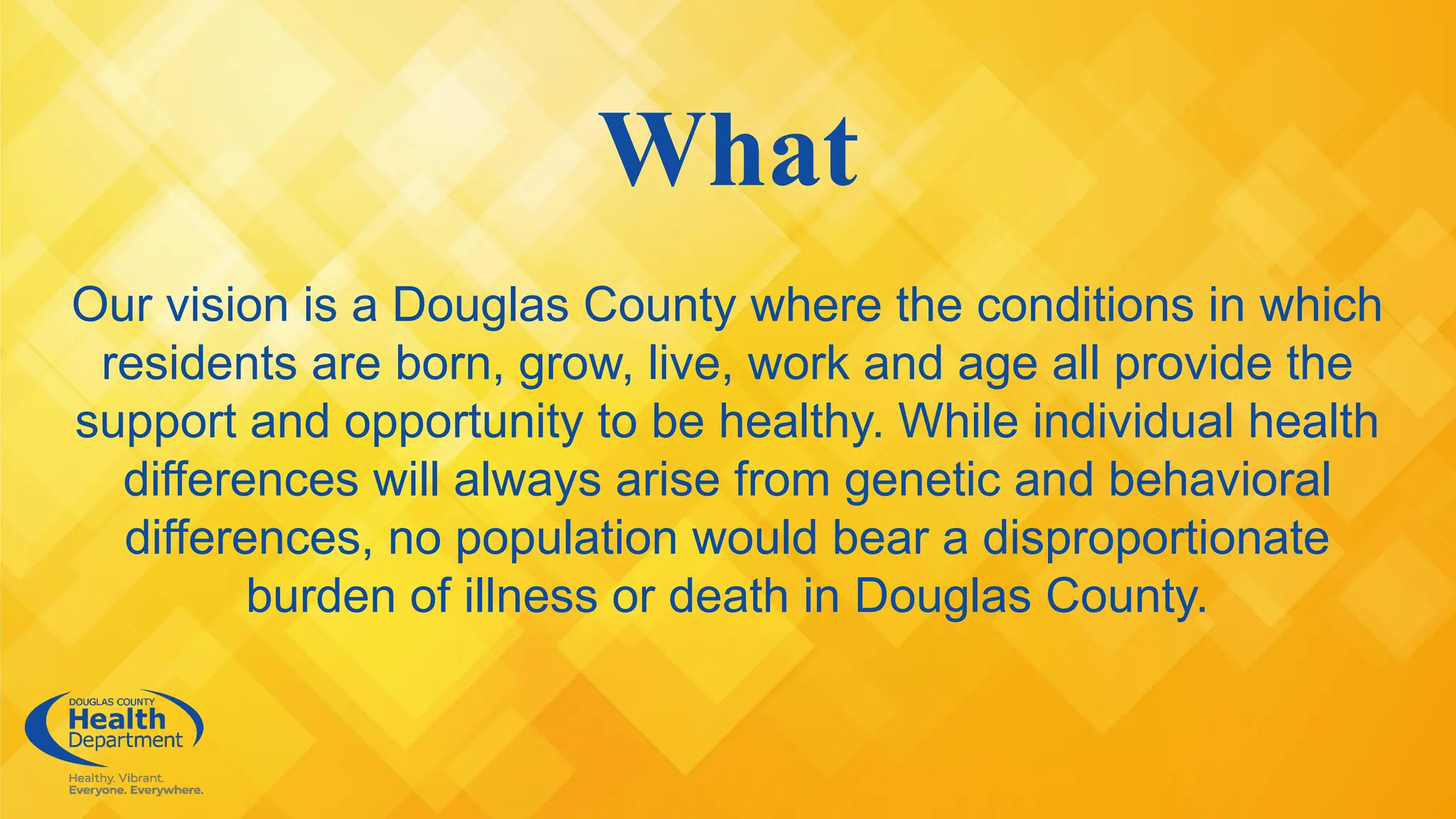
What
Our vision is a Douglas County where the conditions in which
residents are born, grow, live, work and age all provide the
support and opportunity to be healthy. While individual health
differences will always arise from genetic and behavioral
differences, no population would bear a disproportionate
burden of illness or death in Douglas County.
Why
Healthy. Vibrant.
Everyone. Everywhere.
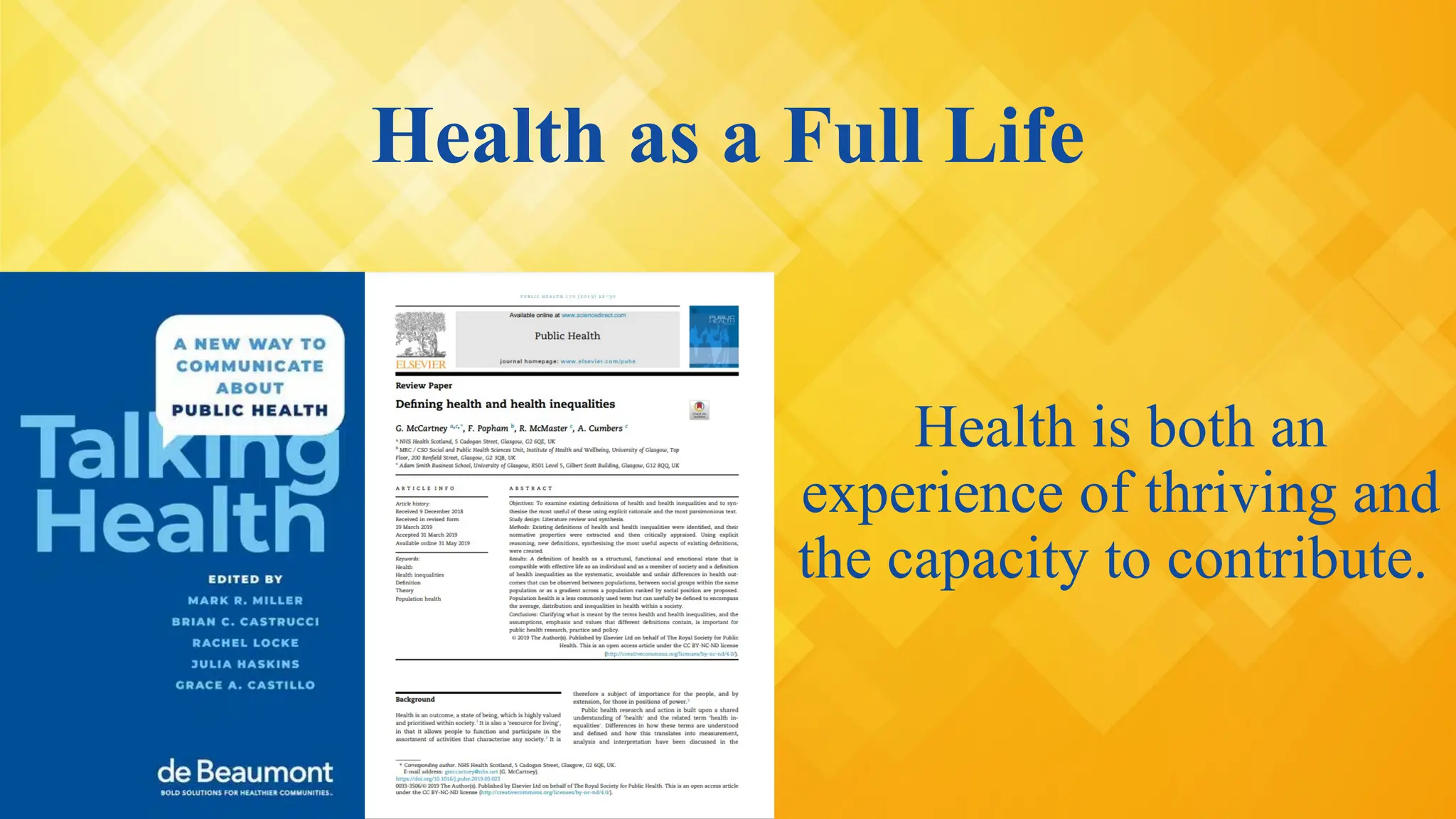
Health as a Full Life
Health is both an
experience of thriving and
the capacity to contribute.
1. Unapologetic
Advocate
2. Honest Broker
3. Community
Booster
Role of a Chief Strategist
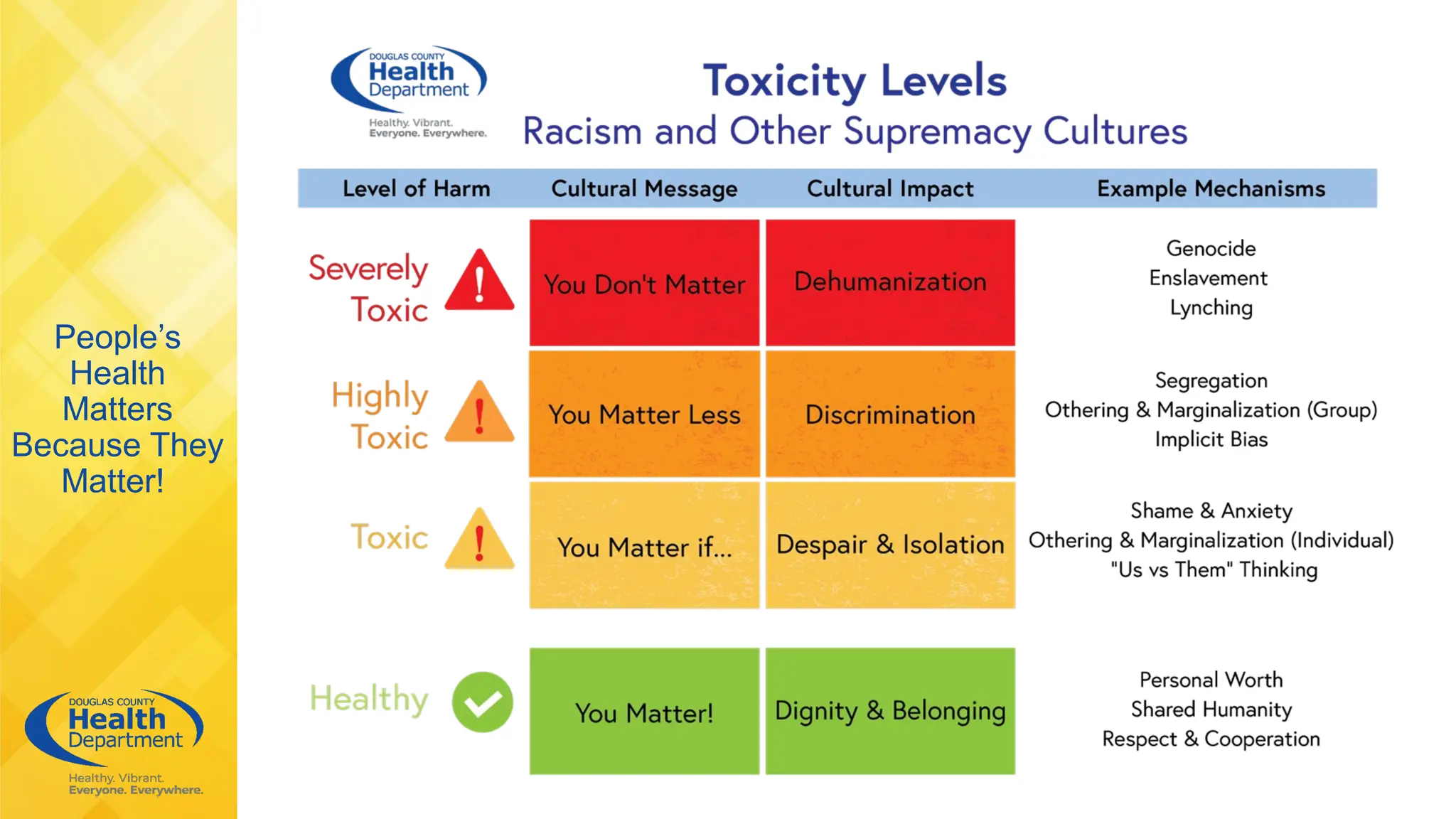
People’s
Health
Matters
Because They
Matter!
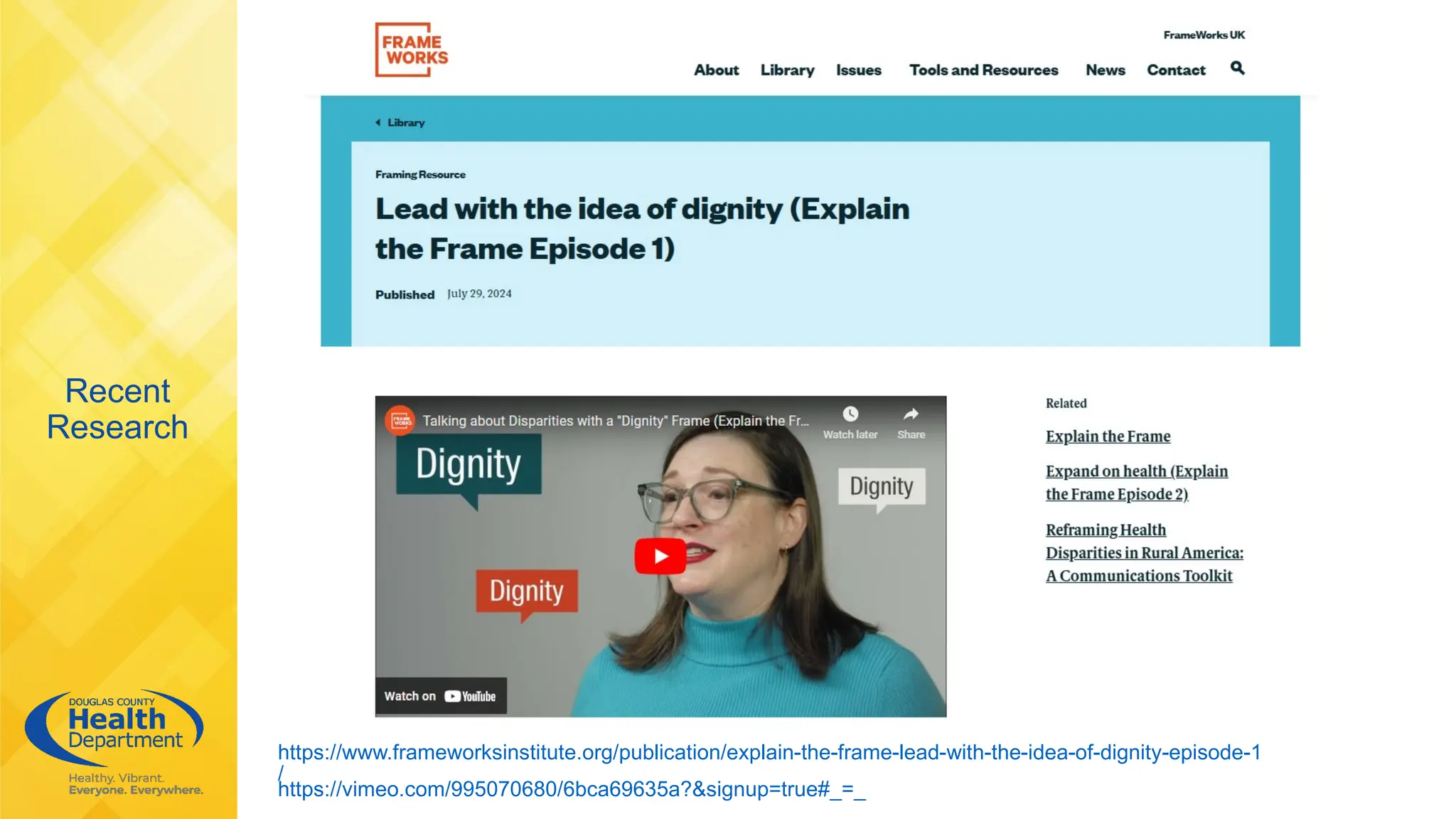
https://www.frameworksinstitute.org/publication/explain-the-frame-lead-with-the-idea-of-dignity-episode-1
/
https://vimeo.com/995070680/6bca69635a?&signup=true#_=_
Recent
Research
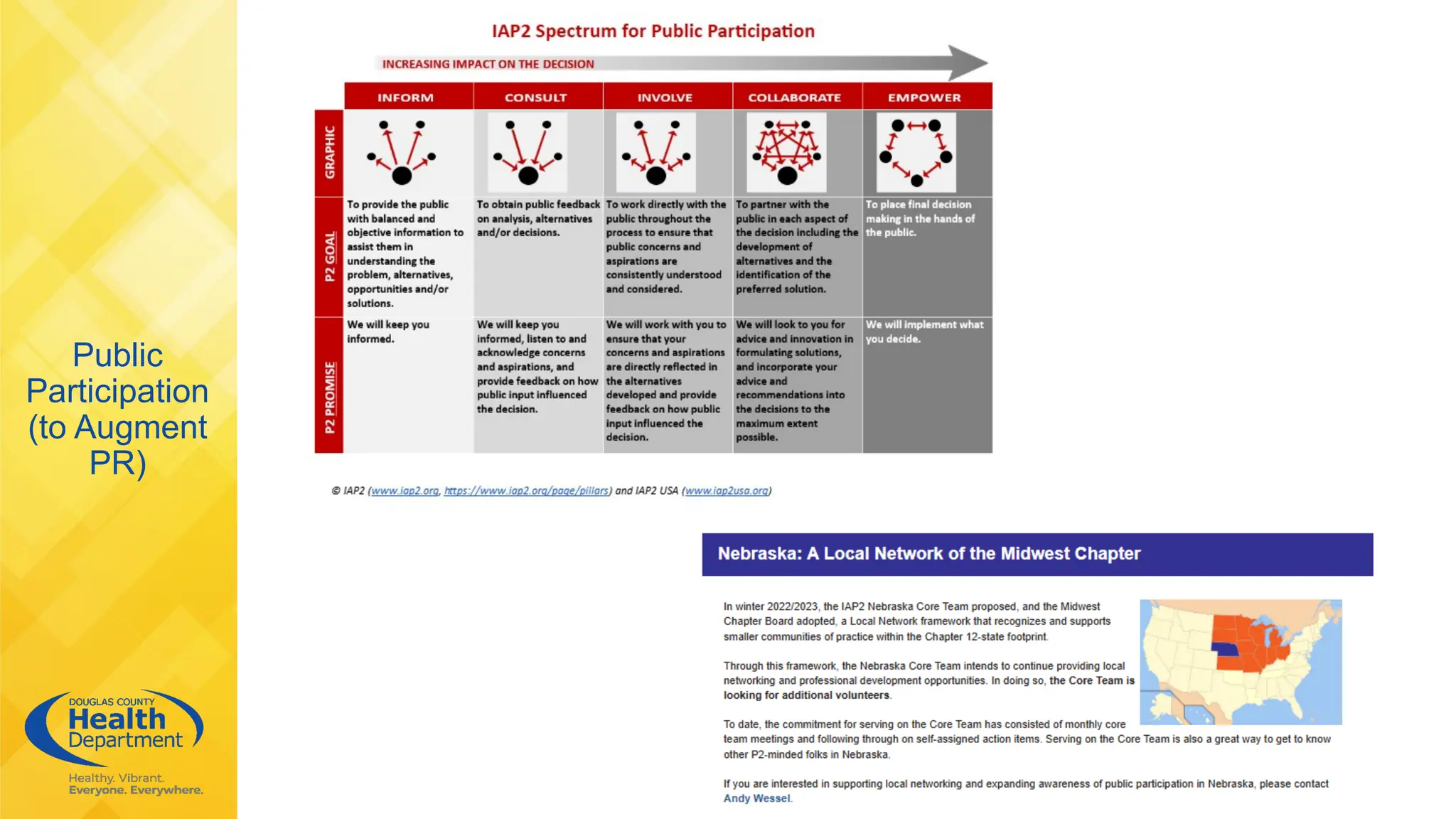
Public
Participation
(to Augment
PR)
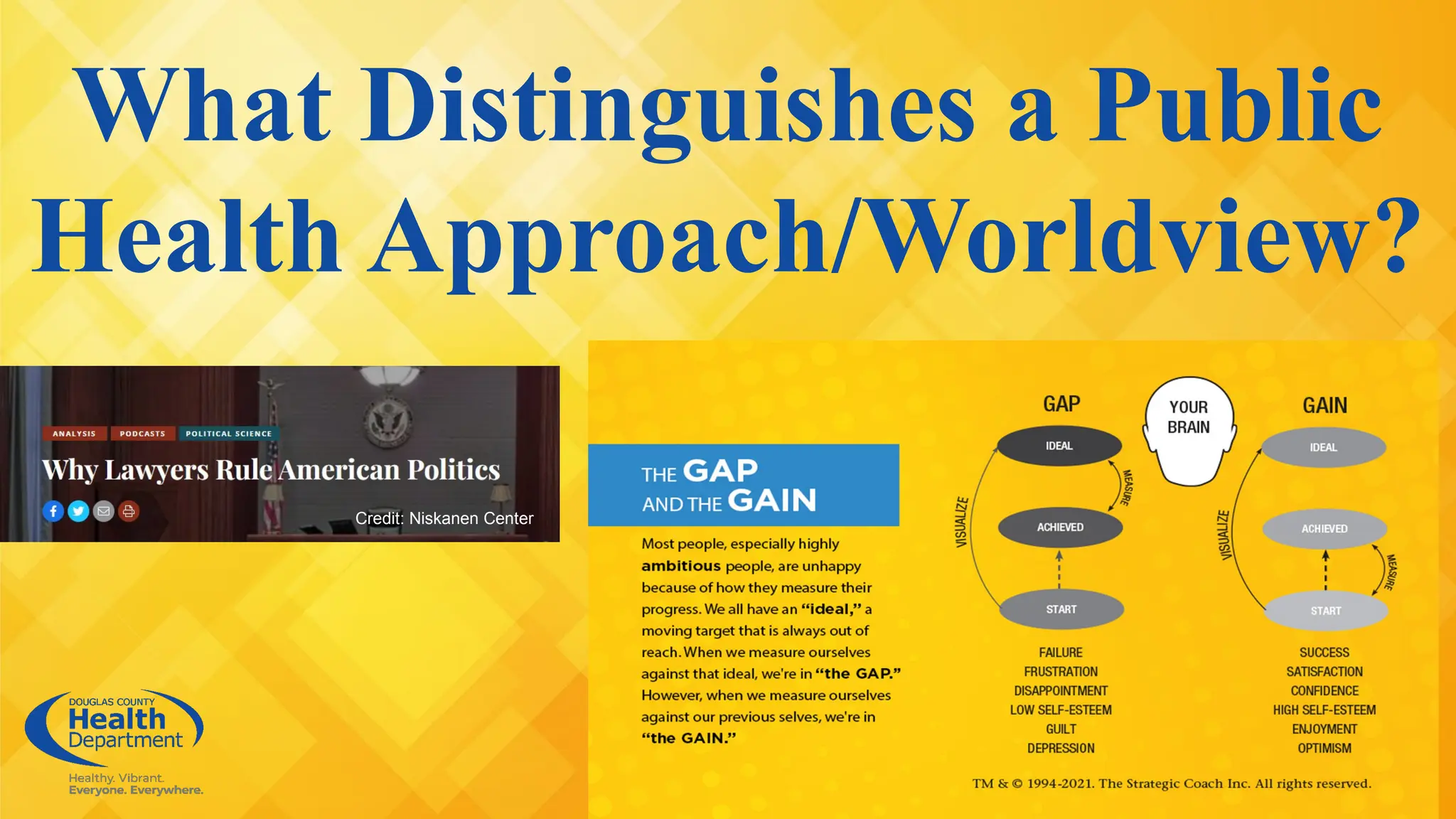
What Distinguishes a Public
Health Approach/Worldview?
Credit: Niskanen Center
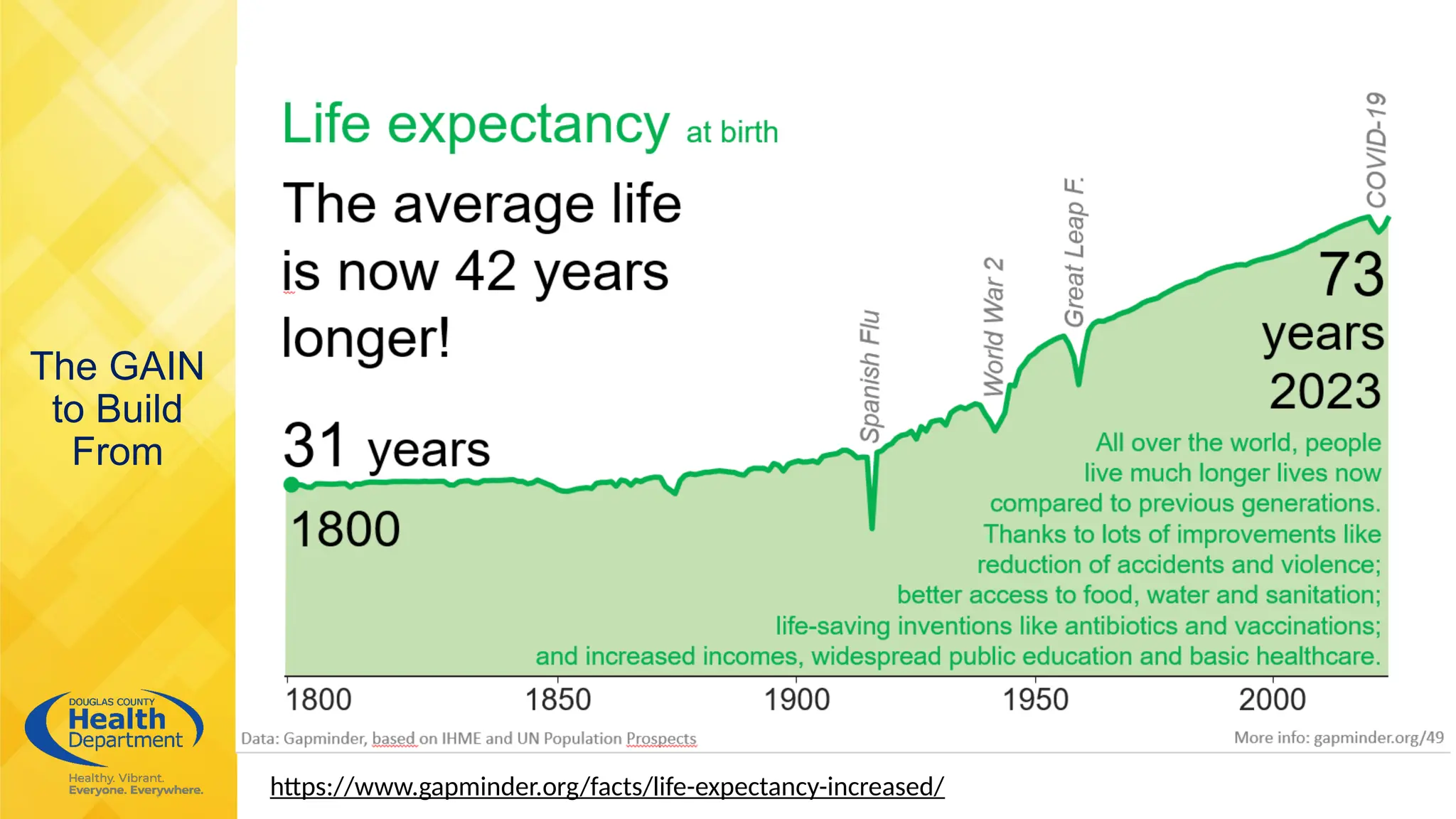
The GAIN
to Build
From
https://www.gapminder.org/facts/life-expectancy-increased/
Questions?
www.douglascountyhealth.com
Andy Wessel
he/him/his
Community Health Planner
Division of Health Equity & Planning
Douglas County Health Department
1111 S. 41st Street
Omaha, NE 68105
Phone 402-444-7225
andy.wessel@douglascounty-ne.gov
Q&A
Explore
publichealthcollaborative.org
● Sign up for the PHCC newsletter
● Download resources to share with
your community
● Review new messaging on
emergent public health issues
● Get the latest trending health alerts
● Take a PHCC Academy training
Thank You
More Resources
www.publichealthcollaborative.org
Contact
info@publichealthcollaborative.org
Follow PHCC
X: @PH_Comms
LinkedIn: Public Health Communications
Collaborative

Working Together to Build Trust in Public Health

Editor's Notes

  • #1 MEGAN
  • #3 MEGAN
  • #4 MEGAN
  • #5 MEGAN
  • #23 We are going to start today with CONTEXT by taking a dive into the PHRASES – Public Health Reaching Across Sectors – research. 
  • #24 Now we have a sense of why cross-sector relationships are important to those in this room. Let's dive into the research behind PHRASES and learn from other perspectives in the field.  What is the PHRASES research – evidence-based framing tools and resources to help PH professionals communicate and collaborate effectively.  What is the goal of this work – to foster a better understanding of PH and greater willingness of other sections to engage in cross-sector partnerships.  These diverse perspectives shape a set of framing and messaging tools for public health practitioners that challenge the common patterns of thinking and assumptions about public health, health, and cross-sector collaboration.  We did this work in partnership with the Aspen Institute, FrameWorks, and Hattaway
  • #25 Because health and well-being are largely driven by upstream factors, collaboration is needed between public health and other sectors, like those of you in this room. This research includes the perspectives of PH experts, leaders from the housing, education, health systems, and business sectors, and members of the general public.  Experts in the field recognize that building strategic partnerships across a community is required to address the foundations of community health, especially the social and environmental influences that positively shape health outcomes, such as quality education, safe and affordable housing, access to healthcare, and employment opportunities.  All of these sectors have roles to play in building healthier communities. 
  • #26 However, we are not all starting from the same place.  The first step is understanding one another, and that's what PHRASES is all about. The tools offered today will open the door to effective partnerships, by helping public health professionals understand what matters to other sectors and how to craft messages that resonate with them.
  • #27 Now that we understand the importance of cross-sector partnerships, let’s discuss some of the obstacles you might face as you build those relationships. 
  • #28 Sometimes we get it right and our message aligns with the thinking and understanding of a professional in another sector; we call these “overlaps in understanding.” 
  • #29 However, sometimes we get it wrong, and what’s important or relevant in the message to a public health leader is very different than what’s important or relevant to someone in a different sector; we call these “gaps in understanding.” Often there are key differences between how experts in PH and leaders in other sectors think about the topics of health, PH, and cross-sector collaboration
  • #30 Since this vital collaboration is a two-way street, gaps in understanding can impede the potential for strong community partnerships. Building a common mission must start with an understanding of current perceptions and obstacles.
  • #31 To illustrate one of those gaps in real time, let’s talk about how we, as public health professionals, define health as a general concept…  [Discuss Word Cloud activity on AhaSlides with question, “What words come to mind when you think of health as a general concept?”] [When finished, spend ~2 min. debriefing results with participants, noting any interesting.]
  • #32 In general, public health experts understand health as a positive state of integrated well-being.  [Compare this to results of the Word Cloud (hopefully it is similar to the findings in the “Map the Gaps” report)]
  • #33 Experts in non-public health sectors often defined health as merely the absence of illness. Let's discuss! What is the gap in understanding that is being demonstrated here? [Discuss: Compare that to how leaders in other sectors view health- the absence of illness.]
  • #34 In general, public health experts understand successful partnerships are considered the result of institutional support. [Compare this to results of the Word Cloud (hopefully it is similar to the findings in the “Map the Gaps” report)]
  • #35 [Discuss the gap in understanding: Compare that to how leaders in other sectors view successful partnerships as the result of individual leadership and the natural cooperation that grow out shared values.]
  • #36 [Click to animate in each key finding.] Leaders in other non-public health sectors often associate health with medical care. They understood health as a medical issue, which placed the health care system and health insurance at the forefront of their thinking. When asked to define the term “public health,” sector leaders were initially surprised and stumped. They had a hard time defining the concept and needed time to access what they knew about public health. Leaders in other sectors often explained that a public health issue is one that affects the health of the population, not simply of one individual. Many sector leaders associated public health with health departments and a traditional set of prevention and protection functions. They placed a strong emphasis on regulatory functions and on safety inspections Public health professionals are also widely assumed to be impractical researchers, not practical problem-solvers. Many sector leaders think about sectors as separate worlds, with different priorities and goals and with distinct characteristics that are not easily grasped by outsiders and have very little overlap. Leaders of other sectors assume that interactions with other sectors are inevitably and necessarily business transactions conducted at the level of their own firm.
  • #37 Despite these gaps in understanding, there are important points of overlap in how public health experts and leaders in other sectors understand public health and cross-sector collaborations. And while we might be tempted to think that the gaps in understanding are negative, it is all helpful information so we can form better and stronger partnerships. 
  • #38 There are important points of overlap in how public health experts and leaders from other sectors understand public health and cross-sector collaborations. These overlaps represent the common ground on which public health professionals can build to increase understanding of their field and what it brings to collaborations. Housing complexes, schools, and health systems are community anchors. They are places that people spend a lot of their time and the stronger the connections to those institutions, the stronger the sense of belonging and safety.  Good health is good business – meaning that when employees are healthy and showing up for work, businesses are more profitable and secure.  Health systems can impact community health beyond individualized health care.  Good student health is a prerequisite for success in education. When students show up to class, rested, safe, and confident, they are more likely to learn.  Housing deeply affects people's health. (take a note of additional information to add here) Smart use of data can help different sectors achieve their objectives and make the case for funding opportunities.  Lastly, governmental public health agencies have a role to play in preventing health problems and promoting community health. 
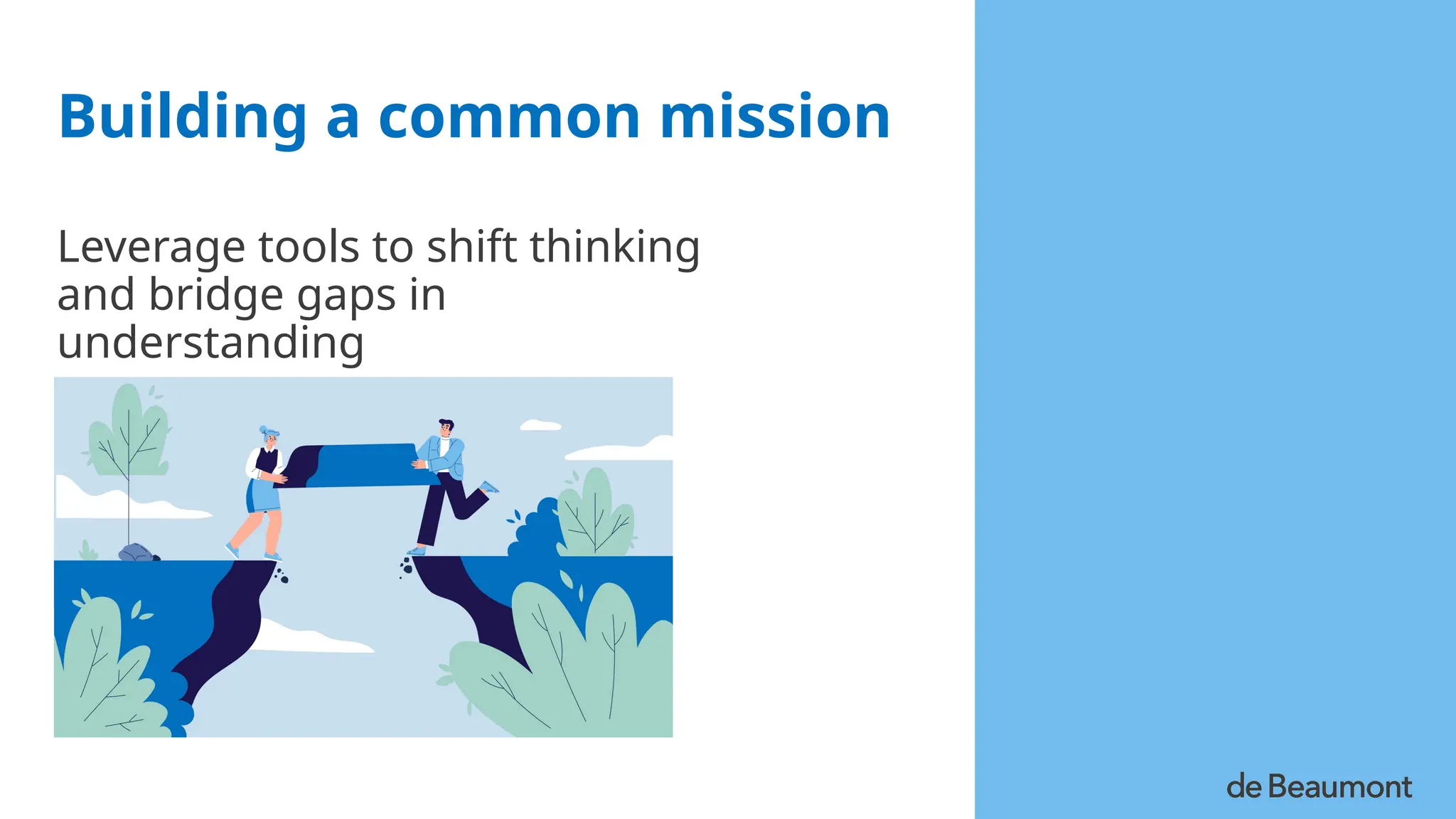
  • #39 So, while gaps in understanding might limit the recognition of the value of our field, there are constructive tools that can be leveraged to shift thinking and bridge these gaps. You will hear more about these tools as we progress through the training today.  Public health has historically been a misunderstood professional field and we lost a lot of trust in the communities throughout and after the pandemic. This research, although collected before 2020, demonstrated the misalignment in perceptions of our field. And as a reminder, our first step towards positive and productive partnership is to understand each other. If we understand what other sectors don't understand, we can better communicate and align on efforts to improve community outcomes. 
  • #42 To understand those obstacles, we conducted in-depth research and published our findings in the “Map the Gaps” report. These key gaps in understanding were identified based on interviews and peer learning sessions from leaders and professionals in housing, education, business and health systems.  Handout- infographic and brief explanation of the following PHRASES tools:  Sample messaging Framing metaphors Story Map Sample emails You Say…They Think chart Answers to tough questions
  • #45 Framework developed by DCHD to put a public health lens on racism/supremacy as form of cultural contamination
  • #46 Family gathering around birthday cakes instead of a burial plot
  • #47 https://www.healthaffairs.org/content/forefront/new-definition-health-equity-guide-future-efforts-and-measure-progress
  • #50 Andy Credit to Anne Branigan and Jamie Berglund Talk about being Solution Focused + Thought Leadership, Base of Support and Community Booster Tying Them Together
  • #51 Oxygen for Trust and Better Health Outcomes
  • #56 https://www.niskanencenter.org/why-lawyers-rule-american-politics/
  • #57 Details around the why and how of the increase
  • #59 MEGAN, AISHA, HAGERE
  • #60 MEGAN