Download to read offline
![Consequently, this task is unique in allowing us to precisely identify how different WM demands may
constrain imitation and emulation.
In Experiments 1 and 2, the Cognitive Imitation Task was used to assess two specific responses:
Order (copying the target serial order, e.g., A ? B ? C) and Multi-Tap (double-tapping one of the pic-
tures on the screen, e.g., A ? B ? B ? C). These two responses were executed on 2-picture lists (cor-
responding with low WM demands) as well as on 3-picture lists (corresponding with high WM
demands). Imitation was defined as copying both responses used by the experimenter to achieve a
goal, in effect, achieving the demonstrated goal (e.g., ‘‘Jumping Man’’) in the same manner demon-
strated. Emulation was operationalized as copying (or failing to copy) one of the two responses dem-
onstrated to achieve a goal, that is, achieving the demonstrated goal using idiosyncratic means (Wood,
1989). Using these measures, we evaluated whether different WM demands (low [2-picture] lists vs.
high [3-picture] lists) affected the amount as well as the type of information that children copied from
a model. Although it was expected that more children should imitate on 2-picture lists with low WM
demands than on 3-picture lists with high WM demands, it was not entirely clear how WM might con-
strain the performance of children who emulate. One possibility is that emulators will ignore the
response that is most likely to be causally meaningless (i.e., Multi-Tap) and will copy only the
response that is most likely to be causally necessary (i.e., Order). Alternatively, high WM demands
might lead children to copy the least complex response (i.e., Multi-Tap) because it imposes fewer
WM demands and to ignore the more difficult response (i.e., Order) because it imposes the most
WM demands.
Experiment 1
Method
Participants
A total of 69 children (31% racial/ethnic minority) completed training and testing: 36 3-year olds
(18 girls and 18 boys, Mage = 40.85 months, SD = 3.76) and 33 4-year olds (14 girls and 19 boys,
Mage = 54.09 months, SD = 3.32). An additional 10 3-year olds and 7 4-year olds were enrolled in the
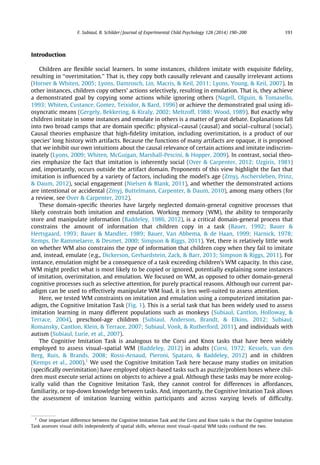
Fig. 1. Cognitive Imitation Task. The 2- and 3-item cognitive task is shown. Different picture items appear simultaneously in
different spatial positions on a touch-screen. Items’ positions change from trial to trial, but the order in which they must be
touched remains constant. The objective is to touch each item (regardless of spatial position) in a specific order to find ‘‘Jumping
Man,’’ a 5-s video of a man doing a backward summersault accompanied by music.
192 F. Subiaul, B. Schilder / Journal of Experimental Child Psychology 128 (2014) 190–200](https://image.slidesharecdn.com/subiaulschilder2014-150905002448-lva1-app6891/85/Working-Memory-Constraints-on-Imitation-and-Emulation-3-320.jpg)
![study but excluded due to experimenter error (n = 16) or lack of assent from a child (n = 1). All partic-
ipants were recruited and tested in the Smithsonian Institute’s National Zoological Park or the
National Museum of Natural History. Informed consent was collected from participants’ parent(s) or
legal guardian(s). Informed assent was obtained from participating children immediately prior to test-
ing. The institutional review boards of The George Washington University and the Smithsonian Insti-
tution approved all aspects of the study.
Materials
The Cognitive Imitation Task described above (cf. Fig. 1) was presented on a 54.6-cm screen from a
Macintosh desktop computer with a Magic-Touch detachable screen. List items used throughout test-
ing were composed of color photographs (3.81 Â 5.08 cm). New lists of pictures were used in each con-
dition. During testing, four unique 2- and 3-picture lists were used. The chance of responding correctly
on the first trial on a 2-picture sequence is .50, and .17 on a 3-picture sequence. These differences in
chance probabilities (corresponding with difficulty) and the amount of information (2 vs. 3 pictures
that needed to be held in WM) served as the basis for the distinction between low WM (2-picture)
and high WM (3-picture) demands.2
However, because pictures do not disappear after correct responses,
these probabilities do not take into consideration the fact that—although very rare (<1%)—children can
make ‘‘backward errors’’ such as A ? B ? A (Subiaul et al., 2007). Backward errors are impossible to make
in 2-picture lists because the trial ends once children touch all of the pictures on the screen.
Procedures
Training. All children were trained on a 3-picture list on the computer task prior to testing. Training
procedures have been described extensively in previous publications (Subiaul et al., 2012). Briefly,
these procedures mirror those described below for Baseline. The computer recorded all responses
automatically.
Testing. Once children satisfactorily completed Training, they were tested in two conditions: Baseline
(no demonstration) and Social (demonstration). Each condition consisted of a low WM 2-picture list
(n = 2) and a high WM 3-picture list (n = 2) per child. This resulted in a 2 (Age: 3- or 4-year olds) Â 2
(Condition: Baseline or Social) Â 2 (WM: low [2-pictures] or high [3-pictures]) design. Pictures used
for Testing were different from those used in Training.
Baseline (trial-and-error learning). This condition was used to establish a baseline rate for Order,
Multi-Tap, and Both responses, that is, the probability of generating any of these target responses ran-
domly by chance. In this condition, children were provided with a maximum of 20 trials. However,
testing ended 5 s after children touched all of the pictures on the screen in the target order. In this con-
dition, children were provided with no prompts, hints, or instructions besides being told that the game
was to find ‘‘Jumping Man,’’ a 5-s video of a man doing a backward summersault accompanied by
music. To do so, they needed to first ‘‘find picture number one.’’ Once children found picture number
one, they were asked, ‘‘What’s next?’’ Having found the second picture in the sequence, they were
asked, ‘‘What’s last?’’ When children made a mistake, the experimenter said, ‘‘Oops! That’s not right.
Let’s try again. Remember, start with picture number one.’’ The same procedure was repeated until
children responded to all pictures in the target order.
Social. The model demonstrated two target responses, Order and Multi-Tap, three consecutive times.
Specifically, the experimenter faced children and said, ‘‘It’s my turn first—watch me,’’ and then pro-
ceeded to touch each item on the screen in the correct sequence (i.e., Order). While responding to pic-
tures in sequence, the model touched one of the pictures twice (i.e., Multi-Tap). Every effort was made
to make this Multi-Tap response salient and intentional. To do so, the model touched the target pic-
ture, pulled back their hand, looked at the children, and touched the picture a second time before
touching the last picture. Having touched all items on the screen, Jumping Man played ($5 s) and
the experimenter clapped, looked at the children, smiled, and said, ‘‘Yay! I found Jumping Man!’’
2
Here, 3 pictures, as opposed to 4 pictures, were chosen because the addition of the Multi-Tap corresponded with a fourth
response that children needed to encode.
F. Subiaul, B. Schilder / Journal of Experimental Child Psychology 128 (2014) 190–200 193](https://image.slidesharecdn.com/subiaulschilder2014-150905002448-lva1-app6891/85/Working-Memory-Constraints-on-Imitation-and-Emulation-4-320.jpg)

This report investigates the impact of working memory (WM) constraints on the imitation and emulation behaviors of preschool-age children in a touch-screen task. Results showed that children were more accurate in copying actions in low WM load conditions (2 pictures) compared to high WM load conditions (3 pictures), suggesting that WM influences both the amount and type of information copied. The findings highlight the role of WM in determining whether children engage in imitation or emulation, suggesting that cognitive constraints can modulate social learning outcomes.


