Agenda
- Significance of cross-cultural teams
- Defining Culture
- Cross-cultural challenges
- Keys to being sensitive to culture
Why Discuss
Cross-Cultural Teams?
- 25% of missionaries quit and go home every 5 years
for preventable reasons. “Worth Keeping”, by the
World Evangelical Alliance, 2007
- About 5,000 missionaries go home for preventable
reasons every year. According to a 1996 study by the
World Evangelical Fellowship
- Countless others continue working but are under
tremendous stress, moving dangerously toward
burnout
- Difficulties in relationships within their team or
organization is one of the leading causes.
“How good and pleasant it is when believers live
together in unity.” Psalm 133:1
The people are united, and they all speak the
same language. After this, nothing they set out to
do will be impossible for them!” Gen 11:6
Jesus prays “…that they be completely one, so that
the world may know you sent me…” John 17:23
What is Culture?
Culture is defined as the shared set of:
• Values
• Beliefs
• Norms
• Attitudes
• Behaviors
• Social
Structures
Example:
Family
Children take care of parents
Elderly help raise grandkids
We don’t question elders
Send money home monthly
Live with extended families
Cultural Challenges
Examples of Multi-Cultural Team Challenges for
a Westerner working with an Asian:
• Passive, shy, won’t share thoughts
• Kreng Jai – not shaming self/others
• Non-expressive of thoughts/feelings
• Low confidence with elders/leaders
• Not admitting when don’t understand
• Not writing down notes/plans/tasks
• Lack of privacy ($, weight, space)
What challenges does an Asian face with a Westerner?
What could you do in these situations?
How to be Sensitive to Culture
• Know Yourself and Your Own Culture
• Learn Other’s Expectations
• Check Your Assumptions
• When in Rome . . . Ask Questions
• Listen
• Consider the Platinum Rule
• All Conflict is Multi-Cultural
Know Yourself & Your Culture
• Watch the video on the next slide (Europe vs Italy)
• Which cultural items are similar to you?
- Driving
- Parking
- Crossing the street
- Road signals
- Waiting for a bus
- Elections
- Politics
- Bureaucracy
- Waiting in lines
- Coffee
- Air landing
- Mobile phones
- Sports
- Smoking
Know Yourself & Your Culture
The best way to understand culture is to explore
your own!
• Complete the Activity in your handout. Pair up with
someone from a similar culture to your own. Pick 5 to 10
questions that most interest you and discuss your answers
with the other person.
What was most interesting or significant to you as you
reflected on your own culture?
Know Yourself & Your Culture
Pair up with someone from your culture. In
your participant guide, describe your culture in
the following ways:
• View of Authority
• Hierarchy
• Communication Styles
• Dealing with Conflict
• Religious Convictions
• Independence vs Value of the Group
• Focus more on Past, Present or Future
• Gender Equality
• Relationship vs Task Focus
Learn Other’s Expectations
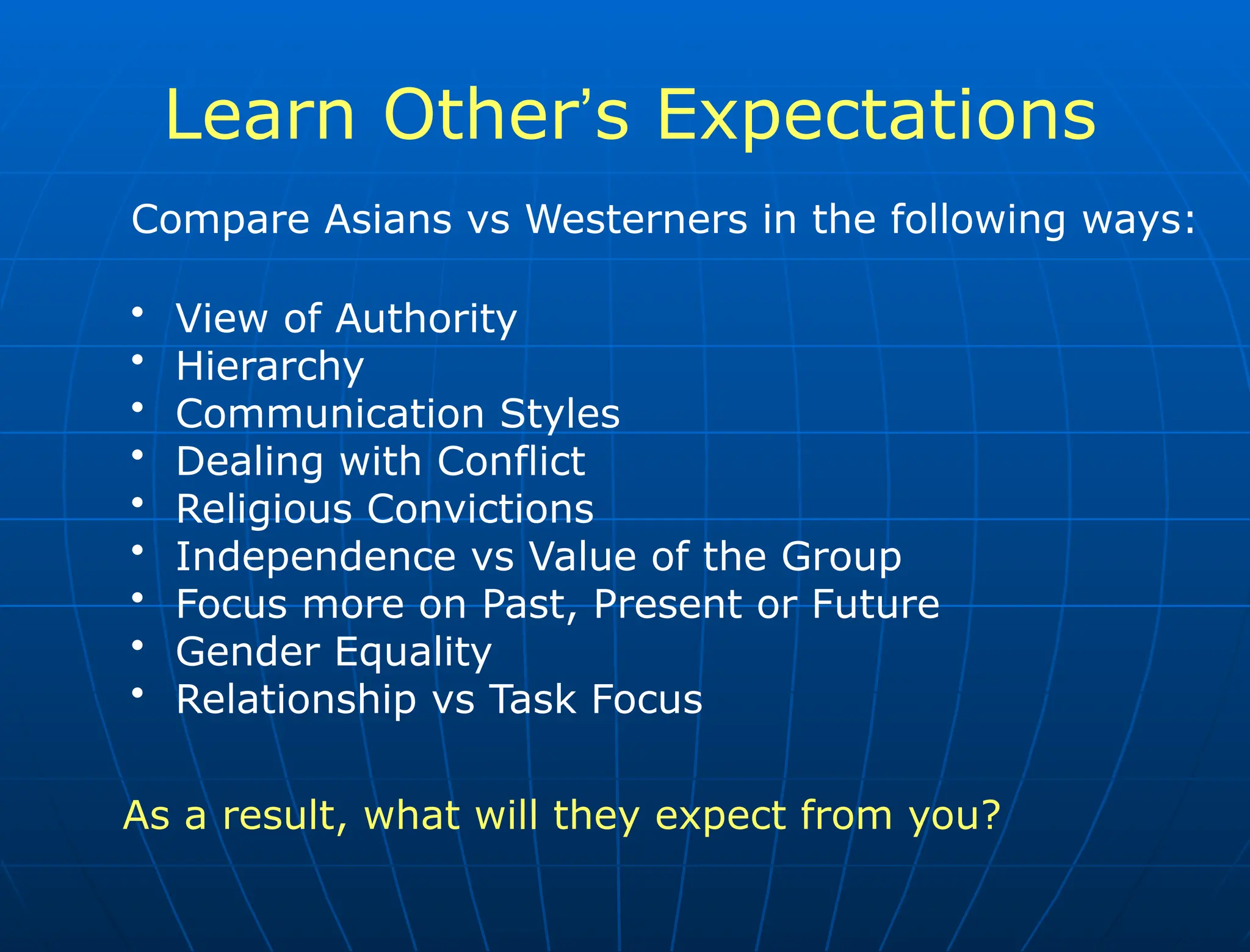
Compare Asians vs Westerners in the following ways:
• View of Authority
• Hierarchy
• Communication Styles
• Dealing with Conflict
• Religious Convictions
• Independence vs Value of the Group
• Focus more on Past, Present or Future
• Gender Equality
• Relationship vs Task Focus
As a result, what will they expect from you?
Check Your Assumptions
Watch the video on the next slide
Runner Stretching
Check Your Assumptions
We make assumptions about people according
to their:
- Body language
- Facial expressions
- Word choice
- Inflection
- Timing of when they did or said something
- Speed of action or response
What else?
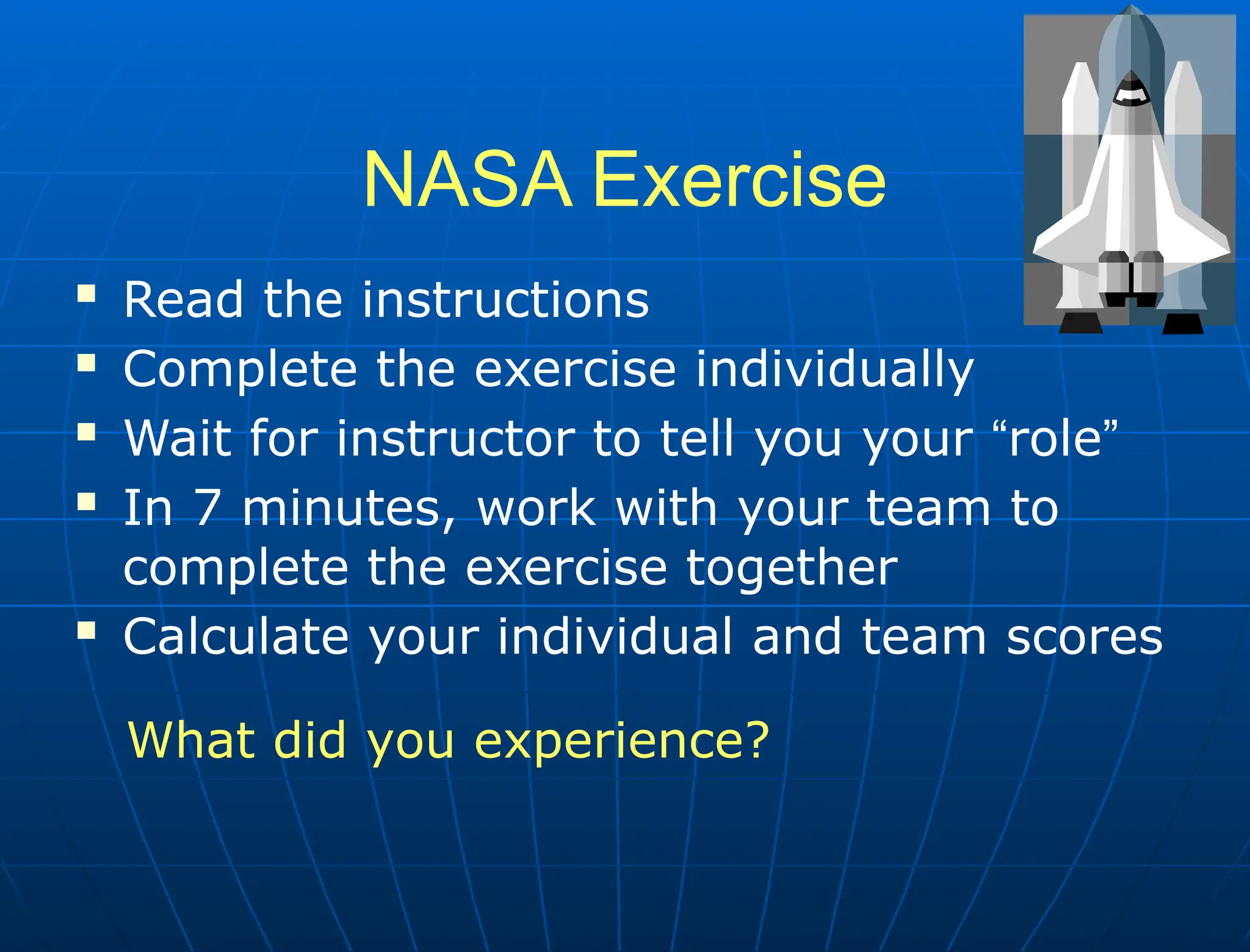
NASA Exercise
 Read the instructions
 Complete the exercise individually
 Wait for instructor to tell you your “role”
 In 7 minutes, work with your team to
complete the exercise together
 Calculate your individual and team scores
What did you experience?
When In Rome… Ask Questions
 Use Open-Ended Questions
• What did you mean by that?(entered, package, home)
• How do you interpret the meaning of that?
• In your culture, what significance does that have?
(a package, a mask, water, a gun)
• In your culture, why do people say/do that? With
what intent? (Why ask for a glass of water?)
• A man entered a field with a package and died. What happened?
• A man left home and took 3 left turns, only to return home to find
two masked men waiting for him. What was going on?
• A man walked into a bar and asked the bartender for a glass of
water. The bartender pointed a gun at him. The man said “Thank
You!” and left. What was going on?
Shopping While on Phone
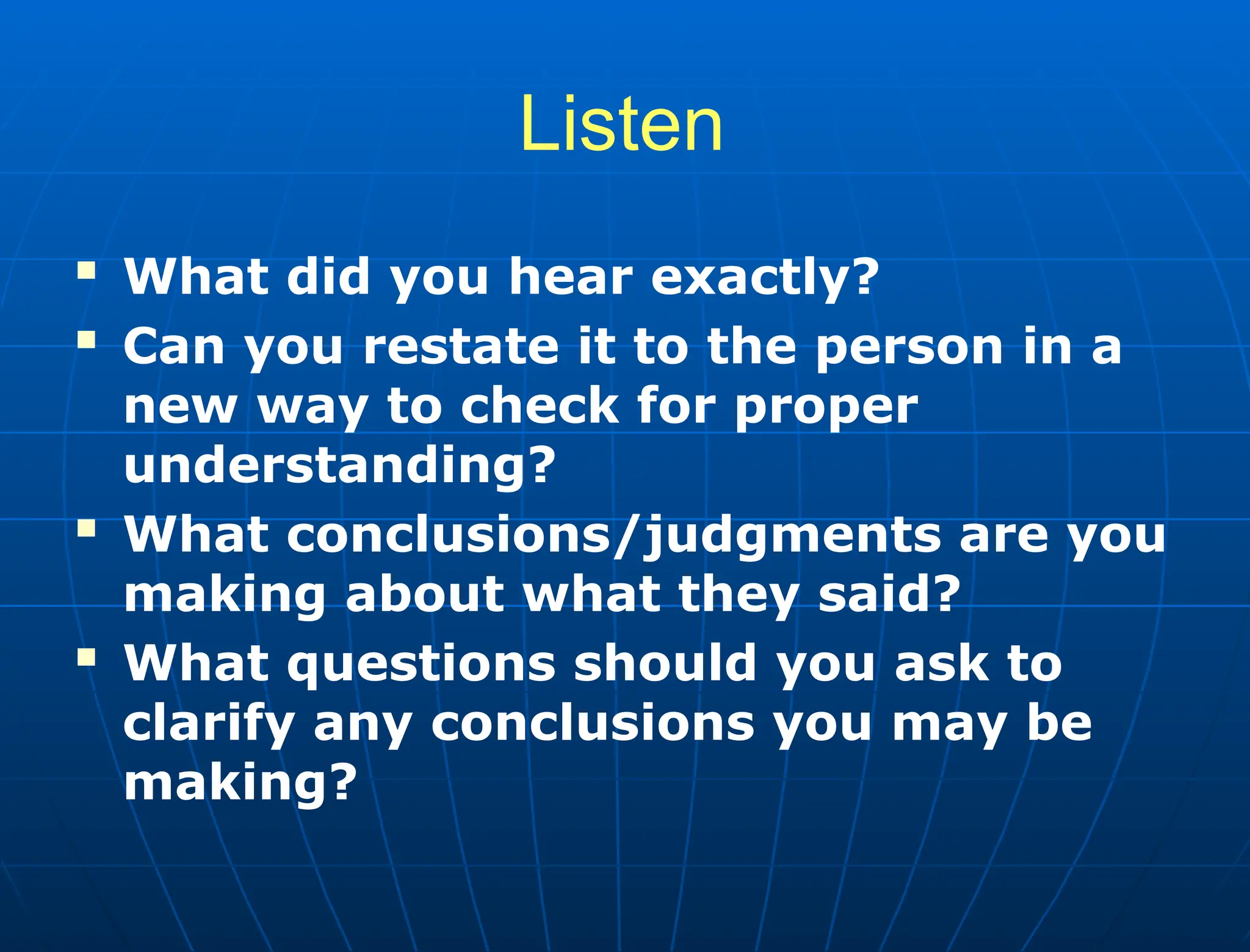
Listen
 What did you hear exactly?
 Can you restate it to the person in a
new way to check for proper
understanding?
 What conclusions/judgments are you
making about what they said?
 What questions should you ask to
clarify any conclusions you may be
making?
The Platinum Rule:
Do to others as THEY would want YOU to do to THEM!!
 How do they like to communicate?
 How do they like to make decisions?
 Do they like to work together or alone?
 Are they comfortable being open with those in
authority or who are older?
 Do they like you to be direct or indirect? Bring
things up in private or public?
The Golden Rule:
Do to others as you would have them do to you. Matt 7:12
The Platinum Rule
 To live by the Platinum Rule requires flexibility and a
willingness to adjust one’s own behavior with
others. It means adjusting how you speak, look,
move, and respond to others – in a way that others
prefer, not necessarily the way YOU prefer.
 Working cross-culturally not only requires
understanding your own culture and understanding
the culture of others, BUT it also requires us to be
flexible and make behavioral adjustments in
ourselves.
 Are you willing to do that? How will you start?
Conflict is Multi-Cultural
 All teams are essentially multi-
cultural.
 Conflict will arise from time to time.
 How your team chooses to respond
to conflict can often be the difference
between success and failure.
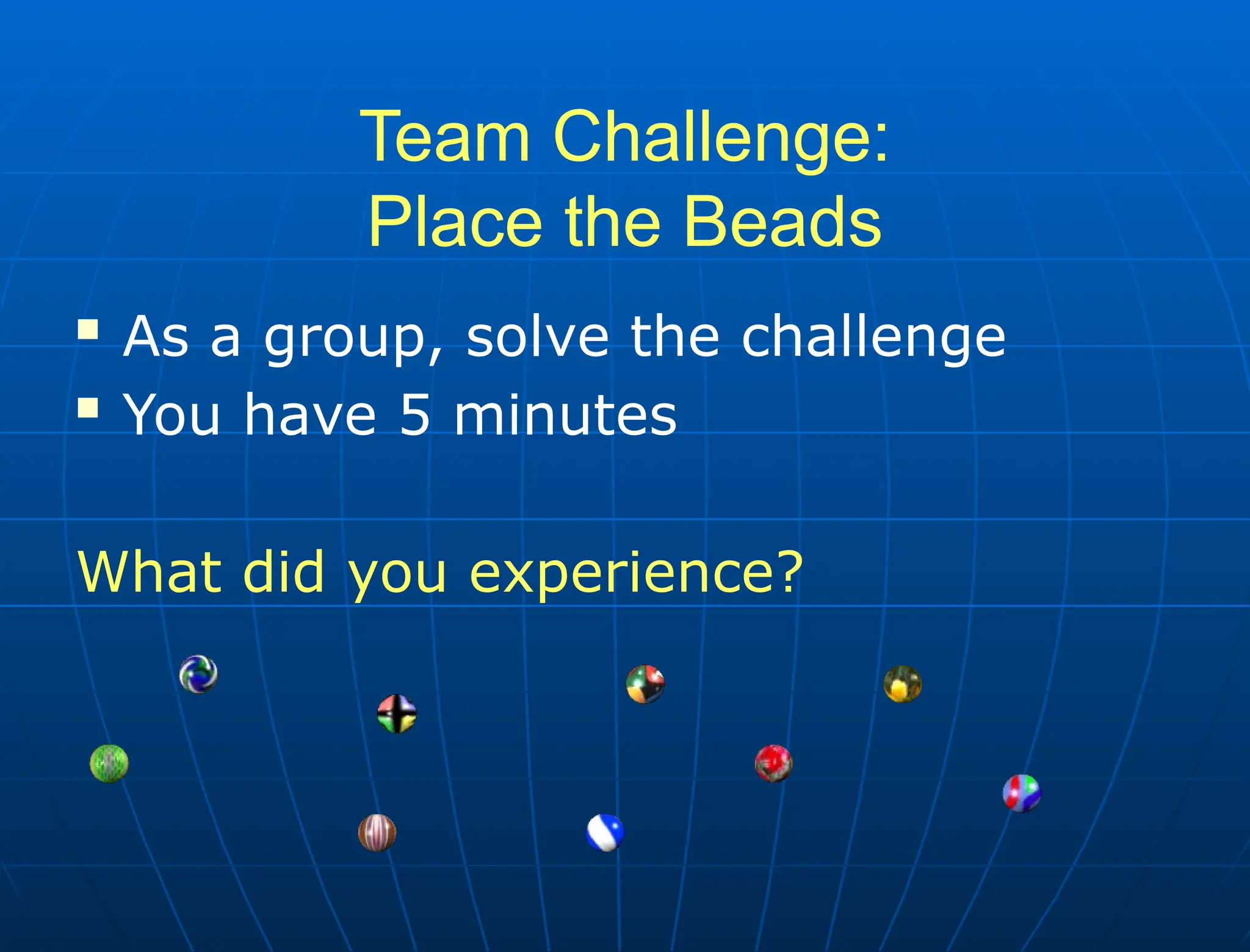
Team Challenge:
Place the Beads
 As a group, solve the challenge
 You have 5 minutes
What did you experience?

Work efficiently in a cross enterprise team culture.ppt

  • 1.
    Agenda - Significance ofcross-cultural teams - Defining Culture - Cross-cultural challenges - Keys to being sensitive to culture
  • 2.
    Why Discuss Cross-Cultural Teams? -25% of missionaries quit and go home every 5 years for preventable reasons. “Worth Keeping”, by the World Evangelical Alliance, 2007 - About 5,000 missionaries go home for preventable reasons every year. According to a 1996 study by the World Evangelical Fellowship - Countless others continue working but are under tremendous stress, moving dangerously toward burnout - Difficulties in relationships within their team or organization is one of the leading causes.
  • 3.
    “How good andpleasant it is when believers live together in unity.” Psalm 133:1 The people are united, and they all speak the same language. After this, nothing they set out to do will be impossible for them!” Gen 11:6 Jesus prays “…that they be completely one, so that the world may know you sent me…” John 17:23
  • 4.
    What is Culture? Cultureis defined as the shared set of: • Values • Beliefs • Norms • Attitudes • Behaviors • Social Structures Example: Family Children take care of parents Elderly help raise grandkids We don’t question elders Send money home monthly Live with extended families
  • 5.
    Cultural Challenges Examples ofMulti-Cultural Team Challenges for a Westerner working with an Asian: • Passive, shy, won’t share thoughts • Kreng Jai – not shaming self/others • Non-expressive of thoughts/feelings • Low confidence with elders/leaders • Not admitting when don’t understand • Not writing down notes/plans/tasks • Lack of privacy ($, weight, space) What challenges does an Asian face with a Westerner? What could you do in these situations?
  • 6.
    How to beSensitive to Culture • Know Yourself and Your Own Culture • Learn Other’s Expectations • Check Your Assumptions • When in Rome . . . Ask Questions • Listen • Consider the Platinum Rule • All Conflict is Multi-Cultural
  • 7.
    Know Yourself &Your Culture • Watch the video on the next slide (Europe vs Italy) • Which cultural items are similar to you? - Driving - Parking - Crossing the street - Road signals - Waiting for a bus - Elections - Politics - Bureaucracy - Waiting in lines - Coffee - Air landing - Mobile phones - Sports - Smoking
  • 8.
    Know Yourself &Your Culture The best way to understand culture is to explore your own! • Complete the Activity in your handout. Pair up with someone from a similar culture to your own. Pick 5 to 10 questions that most interest you and discuss your answers with the other person. What was most interesting or significant to you as you reflected on your own culture?
  • 9.
    Know Yourself &Your Culture Pair up with someone from your culture. In your participant guide, describe your culture in the following ways: • View of Authority • Hierarchy • Communication Styles • Dealing with Conflict • Religious Convictions • Independence vs Value of the Group • Focus more on Past, Present or Future • Gender Equality • Relationship vs Task Focus
  • 10.
    Learn Other’s Expectations CompareAsians vs Westerners in the following ways: • View of Authority • Hierarchy • Communication Styles • Dealing with Conflict • Religious Convictions • Independence vs Value of the Group • Focus more on Past, Present or Future • Gender Equality • Relationship vs Task Focus As a result, what will they expect from you?
  • 11.
    Check Your Assumptions Watchthe video on the next slide
  • 12.
  • 13.
    Check Your Assumptions Wemake assumptions about people according to their: - Body language - Facial expressions - Word choice - Inflection - Timing of when they did or said something - Speed of action or response What else?
  • 14.
    NASA Exercise  Readthe instructions  Complete the exercise individually  Wait for instructor to tell you your “role”  In 7 minutes, work with your team to complete the exercise together  Calculate your individual and team scores What did you experience?
  • 15.
    When In Rome…Ask Questions  Use Open-Ended Questions • What did you mean by that?(entered, package, home) • How do you interpret the meaning of that? • In your culture, what significance does that have? (a package, a mask, water, a gun) • In your culture, why do people say/do that? With what intent? (Why ask for a glass of water?) • A man entered a field with a package and died. What happened? • A man left home and took 3 left turns, only to return home to find two masked men waiting for him. What was going on? • A man walked into a bar and asked the bartender for a glass of water. The bartender pointed a gun at him. The man said “Thank You!” and left. What was going on?
  • 16.
  • 17.
    Listen  What didyou hear exactly?  Can you restate it to the person in a new way to check for proper understanding?  What conclusions/judgments are you making about what they said?  What questions should you ask to clarify any conclusions you may be making?
  • 18.
    The Platinum Rule: Doto others as THEY would want YOU to do to THEM!!  How do they like to communicate?  How do they like to make decisions?  Do they like to work together or alone?  Are they comfortable being open with those in authority or who are older?  Do they like you to be direct or indirect? Bring things up in private or public? The Golden Rule: Do to others as you would have them do to you. Matt 7:12
  • 19.
    The Platinum Rule To live by the Platinum Rule requires flexibility and a willingness to adjust one’s own behavior with others. It means adjusting how you speak, look, move, and respond to others – in a way that others prefer, not necessarily the way YOU prefer.  Working cross-culturally not only requires understanding your own culture and understanding the culture of others, BUT it also requires us to be flexible and make behavioral adjustments in ourselves.  Are you willing to do that? How will you start?
  • 20.
    Conflict is Multi-Cultural All teams are essentially multi- cultural.  Conflict will arise from time to time.  How your team chooses to respond to conflict can often be the difference between success and failure.
  • 21.
    Team Challenge: Place theBeads  As a group, solve the challenge  You have 5 minutes What did you experience?

Editor's Notes

  • #2 TFR: What difficulties have you experienced with cross-cultural teams? What was the impact on you, others, and/or the team/ministry? T: What does God say about the importance of the people of God working together?...
  • #3 T: Unity of believers is obviously very important and significant to God. So what makes us different from one another…
  • #4 TFU: Who can give me an example of each of these? Are some cultures “better” than others? Why or why not? Are there any perfect cultures on Earth? What does that imply about the culture from which we come from? What aspects of your culture have you ever had someone point out to you as new, strange or different than their culture? What aspects of culture are ultimately most important? (aspects that honor and reflect God) T: Let’s take a look at some examples of cultural challenges we may face…
  • #5 EX: Tamar Center older woman with little education, who was non-expressive, passive and ignored by her team and how the team discovered that she actually had some very good ideas to contribute to the team – after going through a teambuilding activity about NASA. TFR: What challenges have you faced when working with someone from a different culture? What could you do that would help you work better together? T: Let’s explore some ideas of how to work with people from other cultures…
  • #6 Working well with people of other cultures really comes down to 3 main ingredients: understanding your own culture, understanding the other person’s culture, and being able to modify your behavior and responses to adapt to the cultures around you. T: Let’s take a look at one of these elements at a time…
  • #8 TFU: What was most interesting or significant to you as you reflected on your own culture? T: Now let’s share a little bit about each of our cultures…
  • #9 ACTIVITY: First, use the participant handout to describe your culture regarding each of the aspects listed on this slide. Write your answers down in the worksheet. Next, interview someone from another culture and write down their answers. Then, go back and circle the most significant differences between your two cultures. TFR: What were some of the most significant differences you identified in your group of 2? How do you envision these differences potentially affecting your working relationship? T: Let’s look at some common differences between people from the West versus the East…
  • #10 TFU: What is most interesting to you about these differences? What kind of conflicts have you experienced these differences causing? How does learning one another’s cultural expectations help? Is the only thing we need to do to prevent conflict to understand each other’s expectations? NO! We must be flexible with our behaviors! T: Let’s take a look at what happens when we make assumptions about others based upon their behaviors…
  • #12 TFU: What happened here? Why did the Rastafarian man push the car off the cliff? What behavior did he see from the runner, and what assumption did he make about WHY the runner was doing that behavior? So what conclusion did the Rastafarian man make? Thus, what action did he take? TFR: When have you ever mis-interpreted someone’s behavior? Or had someone mis-interpret your behavior? T: Let’s look at some common reasons for making incorrect assumptions about people..
  • #13 EX: If someone is smiling at us, we might assume they ‘like’ us. If someone rarely smiles, we might assume they are an unfriendly person. If someone uses an in appropriate word in our culture (i.e. fag or crap or bloody), we might think they are rude. If someone’s tone of voice sounds sarcastic to us, we might assume they are mean or prideful. If someone takes a long time to say or do something, we might assume they didn’t really mean what they said or did. If someone responds slowly, we might assume they are dumb. If they respond quickly, we might assume they want attention or to be seen as smart. TFR: When have you made an incorrect assumption about someone? What could be done to avoid making incorrect assumptions? T: Let’s try an activity where you get to interact with others in a group exercise…
  • #14 Hand Out NASA exercise. Role #1: Leader who wants to make sure everyone gives input, is heard, and valued… All decisions are made together by consensus. Role #2: Asian team member who respects authority and age, and thus never questions authority or age, and will not give input once someone with authority or older age has spoken. Quiet, smiles a lot and agrees with anything people say in order to not shame self or others. Role #3: Western team member who wants to be 100% dedicated and thus is always the first to speak up and give input and ideas, and explains all his/her reasons/explanations about why his ideas make sense, and is very expressive and energetic when interacting. TFU: What did you notice about each team member? Were they helpful? Talkative? Insistent? Passive? A team player? Why do you think each team member acted the way they did? How did it help or hurt? Ask the participants to explain to each other the roles they were asked to play. What could you do to help the team to work better together? T: Let’s look at some ways to avoid cross-cultural conflict…
  • #15 Use Kindle book called “Lateral Thinking Puzzles” to play more games like these. TFR: How might using open-ended questions like this help you to avoid cross-cultural conflict? T: Let’s look at another video clip where someone mis-interprets the situation…
  • #16 TFU: What assumptions were made in this situation? What were the assumptions based on? T: Let’s look at how to truly listen well…
  • #17 Block Building Game One person gives directions to the other on how to put blocks together. Word Ball Stand in a circle. The object of this game is for participants to "throw" and "catch" words with the highest possible degree of accurate mirroring. The first player throws a word by looking intently at his/her intended recipient and simultaneously saying the word and making a throwing gesture. The intended recipient "catches" the word by making eye contact with the "thrower," repeating the word with the same intonation and emphasis with which it was "thrown," and mirroring the style of the throwing gesture. S/he then "throws" a new word to a new recipient. All of this is to be done as cleanly and quickly as possible, with maximum focus and minimum hilarity. It is interesting to note how much groups resist focusing; perhaps the tendency to hilarity is a reflex to cover up our discomfort with the basic act of paying close attention to each other. The learning from this game can be enriched by encouraging participants to pay exquisite attention to the role of "catcher" and to let go of the impulse to be a clever "thrower." Invite players to increase their commitment to making eye contact. Ask them to endow their catch of both word and gesture with the most accurate possible mirroring of the essence and energy of the thrower. At the same time, have the players pick up the pace of play, setting up a dynamic tension between being fully present and keeping the "ball" moving. Not only do these refinements inherently ramp up the listening component, they force each player into choosing "obvious" words and gestures for their own throws because they don't have the time or attention to do something "original." Team members inevitably discover that paying attention to their partners and then making obvious choices are powerful paths to creative collaboration. Listening Game: The most influential experience 1. Divide the group of people in two by counting off into twos. The group should have even-numbered people. If the group is odd-numbered, then ask the last person whose number is 'one' to be the observer. Take all the 'ones' outside the room. (This listening game will work well when you have a co-facilitator.) 2. The co-facilitator steps out of the room with the 'ones', while you stay in the room with the 'twos' 3. Instructions to the 'ones': "Take a few moments and reflect on an incident which had a dramatic influence in your life. It should fit into the category of 'life changing'. "After a while you'll go back to the room. There you'll find your colleagues sitting in different parts of the room with an empty chair in front of them. You can take the empty chair before anybody you choose. "Once you are seated begin to tell that person the 'one most influential event' in your life. After you have finished, your partner will summarize what you told her." 4. Room arrangement with the 'twos' during this listening game: Get the twos to spread out in the room (not huddle around one area of the room) and sit on a chair. Other than their own chair they should have an empty chair facing them. Have the 'twos' sit on one of the pair of chairs. 5. Instructions for the 'twos':” After a while the ones will come into the room and each one will occupy one of the empty chairs. So that means each one of you will have one colleague sitting in front of you. "They will begin to tell you about an experience that they have had in their lives. Your task is to ignore them as unobtrusively as possible. Your body language will involve sitting back, not meeting their eyes, twiddling with something in your hand like pen or a pencil and possibly doodling. "You'll continue this 'non-listening' behavior until the trainer gives you a signal like knocking on the table with a marker. (Set a signal with the 'twos' that is mutually agreeable to you and them. It should be something audible above the din as well as unobtrusive.) " As soon as you hear the sound transform your body language to one of listening. Lean forward, meet the speaker's eyes, stop twiddling and doodling. Once your partner has finished relating her piece, summarize to her what you heard." 1. First ask the listeners to respond to the following questions: How do you feel? What are you learning? 2. You'll hear about all the behavior and feelings that you noticed while the game was in progress. 3. While the speakers want to share too, try and contain them till it's their turn to respond to the debrief questions. 4. Once again you will hear about the observations that you made earlier. 5. You'll also sense amazement and hear sheepish laughter at the discoveries they have made about themselves. 6. They will express learnings like : 'I realize that I have done this with quite a few people and when it happened to me I did not like it at all. I have decided that I will never ignore people again.' 'I felt lousy not being able to listen to my partner especially when she was sharing something so important.' 7. Some of the other learnings that you need to gently bring home to them It is not every time people have something earthshattering to share. Yet whatever they do want to share is important to them and so worth listening to. It is also insensitive for speakers to go ahead and share whatever they want to even if the listener is not paying attention to them. It would be more fruitful if speakers listen to the body language of the listeners and deal with that first, sensitively of course. They need to take time to find out what's keeping the listener from listening. Not listening (either to the verbal message or the non-verbal message) is the malaise that has affected society. This malaise has resulted in competing relationships rather than in collaborative synergistic relationships. T: And now for my favorite general rule to help people get along…
  • #18 EX: If you love peanuts, but your friend is allergic to peanuts, should you give him peanuts as a gift? Should you consider what YOU like, or what HE likes? If you wear shoes in your house, but your friend does not, should you wear your shoes in his house? No!! If your co-worker likes to work in silence, but you like to work with music playing in the background, what should you do? If a staff member you lead likes detailed instructions and tasks assigned to him, but you like to wing it and be creative, what kind of direction should you give him? If your colleague prefers to be given time to think before responding to questions, but you prefer to speak off the top of your head, what should you ask/expect from your colleague when asking him a question? TFR: How well do you normally do to others as they want you to do to them? T: Let’s look at the key for using the Platinum Rule successfully…
  • #19 T: So what is at the root of most conflict…
  • #20 Examples of cultural differences within a country: EX: My wife and I dating – opening the car door to show care/value Me determining how to refer to my new in-laws with proper respect – Mr and Mrs Lusk or Mr Joel and Ms Dede TFU: When you’re sensing conflict with someone, how should you respond? What questions might you ask yourself? (What are my assumptions? Could there be another way to interpret this? Should I ask the person some questions? What questions should I ask?) What questions might you ask the other person? (What do you mean by….? What is common in your culture in situations like this? Could we talk about other ways that people might interpret this and how we could thus do/say it differently?) What will your goal of the conflict be? T: Time for one more activity…
  • #21 TFU: How well did you work together as a team? What went well? What could be improved? What did you notice about communication, expectations, problem solving, and resolving conflicts? What were the key factors for success and/or failure? Why? What were some of the principles from this workshop that you used during the activity? What additional challenges might you have faced in a more multi-cultural setting? How would you manage those challenges? T: Ok, let’s review…