Wonders Grade 4
Practice
Book
Grade 4
Blackline Masters
• Grammar
• Phonics
• Spelling
• Vocabulary
• Handwriting
Includes Diferentiated Spelling Practice
Wonders Grade 4
Practice
Book
Grade 4
mheducation.com/prek-12
Copyright © 2023 McGraw Hill
All rights reserved. The contents, or parts thereof, may be
reproduced in print form for non-profit educational use with
Wonders, provided such reproductions bear copyright notice,
but may not be reproduced in any form for any other purpose
without the prior written consent of McGraw Hill, including,
but not limited to, network storage or transmission, or broadcast
for distance learning.
Send all inquiries to:
McGraw Hill
1325 Avenue of the Americas
New York, NY 10121
ISBN: 978-1-26-580827-3
MHID: 1-26-580827-9
Printed in the United States of America.
6 7 8 9 LHS 27 26 25 24 23 22 C
Copyright
©
McGraw
Hill.
Permission
is
granted
to
reproduce
for
classroom
use.
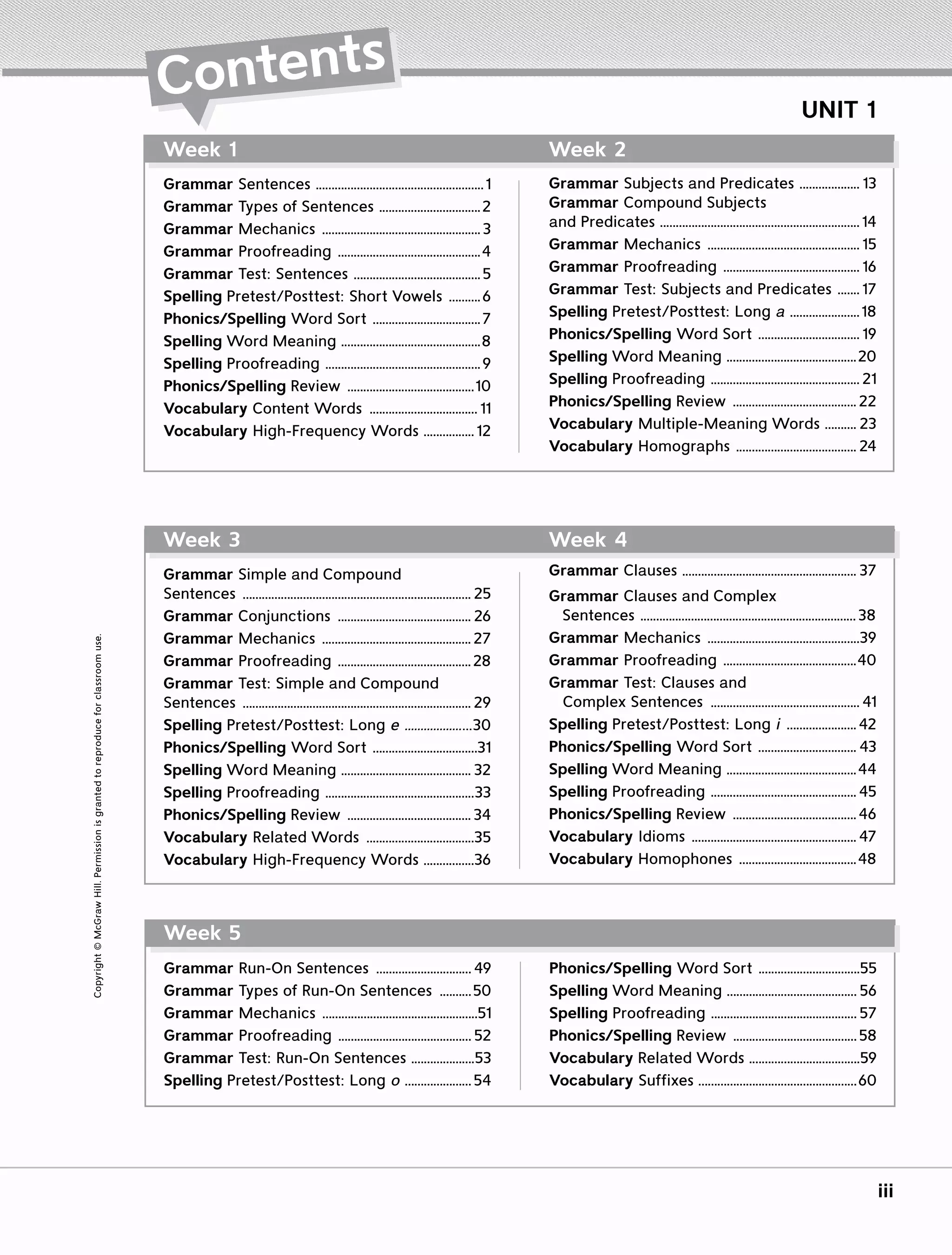
Contents
UNIT 1
Week 3
Grammar Simple and Compound
Sentences ������������������������������������������������������������������������ 25
Grammar Conjunctions ������������������������������������������ 26
Grammar Mechanics �����������������������������������������������27
Grammar Proofreading ������������������������������������������28
Grammar Test: Simple and Compound
Sentences ������������������������������������������������������������������������29
Spelling Pretest/Posttest: Long e ������������������…30
Phonics/Spelling Word Sort ���������������������������������31
Spelling Word Meaning ����������������������������������������� 32
Spelling Proofreading �����������������������������������������������33
Phonics/Spelling Review ��������������������������������������� 34
Vocabulary Related Words ����������������������������������35
Vocabulary High-Frequency Words ����������������36
Week 4
Grammar Clauses ������������������������������������������������������� 37
Grammar Clauses and Complex
Sentences
 ��������������������������������������������������������������������38
Grammar Mechanics ������������������������������������������������39
Grammar Proofreading ������������������������������������������40
Grammar Test: Clauses and
Complex Sentences ����������������������������������������������� 41
Spelling Pretest/Posttest: Long i ����������������������42
Phonics/Spelling Word Sort ������������������������������� 43
Spelling Word Meaning �����������������������������������������44
Spelling Proofreading ����������������������������������������������45
Phonics/Spelling Review ���������������������������������������46
Vocabulary Idioms ����������������������������������������������������47
Vocabulary Homophones �������������������������������������48
Week 5
Grammar Run-On Sentences ������������������������������ 49
Grammar Types of Run-On Sentences ����������50
Grammar Mechanics �������������������������������������������������51
Grammar Proofreading ������������������������������������������ 52
Grammar Test: Run-On Sentences ��������������������53
Spelling Pretest/Posttest: Long o ���������������������54
Phonics/Spelling Word Sort ��������������������������������55
Spelling Word Meaning ����������������������������������������� 56
Spelling Proofreading ���������������������������������������������� 57
Phonics/Spelling Review ���������������������������������������58
Vocabulary Related Words ����������������������������������59
Vocabulary Suffixes �������������������������������������������������60
Week 1
Grammar Sentences �����������������������������������������������������1
Grammar Types of Sentences ��������������������������������2
Grammar Mechanics ��������������������������������������������������3
Grammar Proofreading ���������������������������������������������4
Grammar Test: Sentences ����������������������������������������5
Spelling Pretest/Posttest: Short Vowels ����������6
Phonics/Spelling Word Sort ����������������������������������7
Spelling Word Meaning ��������������������������������������������8
Spelling Proofreading �������������������������������������������������9
Phonics/Spelling Review ����������������������������������������10
Vocabulary Content Words  11
Vocabulary High-Frequency Words ����������������12
Week 2
Grammar Subjects and Predicates ������������������� 13
Grammar Compound Subjects
and Predicates ���������������������������������������������������������������14
Grammar Mechanics ������������������������������������������������ 15
Grammar Proofreading ������������������������������������������� 16
Grammar Test: Subjects and Predicates �������17
Spelling Pretest/Posttest: Long a ����������������������18
Phonics/Spelling Word Sort �������������������������������� 19
Spelling Word Meaning �����������������������������������������20
Spelling Proofreading �����������������������������������������������21
Phonics/Spelling Review ���������������������������������������22
Vocabulary Multiple-Meaning Words ���������� 23
Vocabulary Homographs �������������������������������������� 24
iii
Copyright
©
McGraw
Hill.
Permission
is
granted
to
reproduce
for
classroom
use.
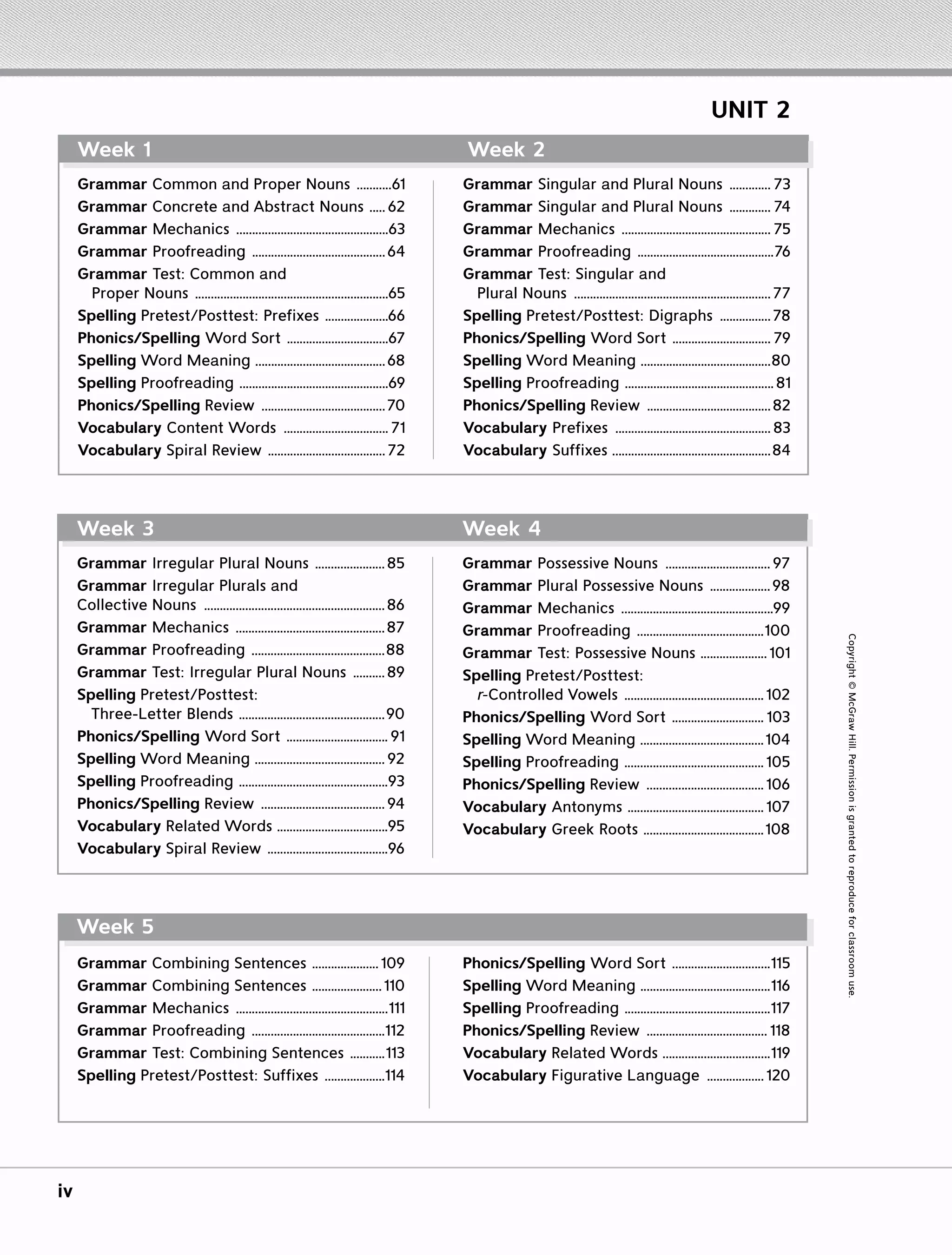
UNIT 2
Week 3
Grammar Irregular Plural Nouns ����������������������85
Grammar Irregular Plurals and
Collective Nouns ���������������������������������������������������������86
Grammar Mechanics �����������������������������������������������87
Grammar Proofreading ������������������������������������������88
Grammar Test: Irregular Plural Nouns ����������89
Spelling Pretest/Posttest:
Three-Letter Blends ����������������������������������������������90
Phonics/Spelling Word Sort �������������������������������� 91
Spelling Word Meaning ����������������������������������������� 92
Spelling Proofreading �����������������������������������������������93
Phonics/Spelling Review ��������������������������������������� 94
Vocabulary Related Words ����������������������������������95
Vocabulary Spiral Review ��������������������������������������96
Week 4
Grammar Possessive Nouns ��������������������������������� 97
Grammar Plural Possessive Nouns �������������������98
Grammar Mechanics ������������������������������������������������99
Grammar Proofreading ����������������������������������������100
Grammar Test: Possessive Nouns ���������������������101
Spelling Pretest/Posttest:
r-Controlled Vowels ��������������������������������������������102
Phonics/Spelling Word Sort ����������������������������� 103
Spelling Word Meaning ���������������������������������������104
Spelling Proofreading ��������������������������������������������105
Phonics/Spelling Review �������������������������������������106
Vocabulary Antonyms �������������������������������������������107
Vocabulary Greek Roots ��������������������������������������108
Week 5
Grammar Combining Sentences ���������������������109
Grammar Combining Sentences ����������������������110
Grammar Mechanics ������������������������������������������������111
Grammar Proofreading ������������������������������������������112
Grammar Test: Combining Sentences �����������113
Spelling Pretest/Posttest: Suffixes �������������������114
Phonics/Spelling Word Sort �������������������������������115
Spelling Word Meaning �����������������������������������������116
Spelling Proofreading ����������������������������������������������117
Phonics/Spelling Review �������������������������������������� 118
Vocabulary Related Words ���������������������������������119
Vocabulary Figurative Language ������������������120
Week 1
Grammar Common and Proper Nouns �����������61
Grammar Concrete and Abstract Nouns ����� 62
Grammar Mechanics ������������������������������������������������63
Grammar Proofreading ������������������������������������������64
Grammar Test: Common and
Proper Nouns �������������������������������������������������������������65
Spelling Pretest/Posttest: Prefixes ��������������������66
Phonics/Spelling Word Sort ��������������������������������67
Spelling Word Meaning �����������������������������������������68
Spelling Proofreading �����������������������������������������������69
Phonics/Spelling Review ���������������������������������������70
Vocabulary Content Words ���������������������������������71
Vocabulary Spiral Review �������������������������������������72
Week 2
Grammar Singular and Plural Nouns ������������� 73
Grammar Singular and Plural Nouns ������������� 74
Grammar Mechanics ����������������������������������������������� 75
Grammar Proofreading �������������������������������������������76
Grammar Test: Singular and
Plural Nouns ��������������������������������������������������������������77
Spelling Pretest/Posttest: Digraphs ����������������78
Phonics/Spelling Word Sort ������������������������������� 79
Spelling Word Meaning �����������������������������������������80
Spelling Proofreading �����������������������������������������������81
Phonics/Spelling Review ���������������������������������������82
Vocabulary Prefixes ������������������������������������������������� 83
Vocabulary Suffixes �������������������������������������������������84
iv
Copyright
©
McGraw
Hill.
Permission
is
granted
to
reproduce
for
classroom
use.
UNIT 3
Week 3
Grammar Main and Helping Verbs ����������������145
Grammar Helping Verbs and Tenses �������������146
Grammar Mechanics ����������������������������������������������147
Grammar Proofreading ����������������������������������������148
Grammar Test: Main and Helping Verbs ����149
Spelling Pretest/Posttest: Soft c and g �������150
Phonics/Spelling Word Sort ..............................151
Spelling Word Meaning ����������������������������������������152
Spelling Proofreading ���������������������������������������������153
Phonics/Spelling Review ������������������������������������� 154
Vocabulary Related Words ��������������������������������155
Vocabulary Spiral Review ������������������������������������156
Week 4
Grammar Linking Verbs ����������������������������������������157
Grammar Tense and Agreement
of Linking Verbs �������������������������������������������������������� 158
Grammar Mechanics ����������������������������������������������159
Grammar Proofreading ����������������������������������������160
Grammar Test: Linking Verbs .............................161
Spelling Pretest/Posttest: Plurals ���������������������162
Phonics/Spelling Word Sort ������������������������������163
Spelling Word Meaning ��������������������������������������� 164
Spelling Proofreading ���������������������������������������������165
Phonics/Spelling Review ��������������������������������������166
Vocabulary Synonyms and Antonyms ����������167
Vocabulary Dictionary ����������������������������������������� 168
Week 5
Grammar Irregular Verbs �������������������������������������169
Grammar Irregular Past Tenses ����������������������� 170
Grammar Mechanics .............................................. 171
Grammar Proofreading �����������������������������������������172
Grammar Test: Irregular Verbs �������������������������173
Spelling Pretest/Posttest:
Compound Words ������������������������������������������������174
Phonics/Spelling Word Sort ������������������������������175
Spelling Word Meaning ����������������������������������������176
Spelling Proofreading ���������������������������������������������177
Phonics/Spelling Review ������������������������������������� 178
Vocabulary Content Words ��������������������������������179
Vocabulary Greek Roots ��������������������������������������180
Week 1
Grammar Verbs .......................................................... 121
Grammar Action Verbs ����������������������������������������� 122
Grammar Mechanics ����������������������������������������������123
Grammar Proofreading �����������������������������������������124
Grammar Test: Verbs ����������������������������������������������125
Spelling Pretest/Posttest:
r-Controlled vowels ����������������������������������������������126
Phonics/Spelling Word Sort ������������������������������127
Spelling Word Meaning ��������������������������������������� 128
Spelling Proofreading ���������������������������������������������129
Phonics/Spelling Review �������������������������������������130
Vocabulary Related Words ................................131
Vocabulary Spiral Review ������������������������������������132
Week 2
Grammar Verb Tenses ��������������������������������������������133
Grammar More Verb Tenses ������������������������������134
Grammar Mechanics ����������������������������������������������135
Grammar Proofreading �����������������������������������������136
Grammar Test: Verb Tenses ��������������������������������137
Spelling Pretest/Posttest: Words with
Silent Letters ����������������������������������������������������������� 138
Phonics/Spelling Word Sort ������������������������������139
Spelling Word Meaning ���������������������������������������140
Spelling Proofreading .............................................141
Phonics/Spelling Review ��������������������������������������142
Vocabulary Context Clues �����������������������������������143
Vocabulary Suffixes �����������������������������������������������144
 v
Copyright
©
McGraw
Hill.
Permission
is
granted
to
reproduce
for
classroom
use.
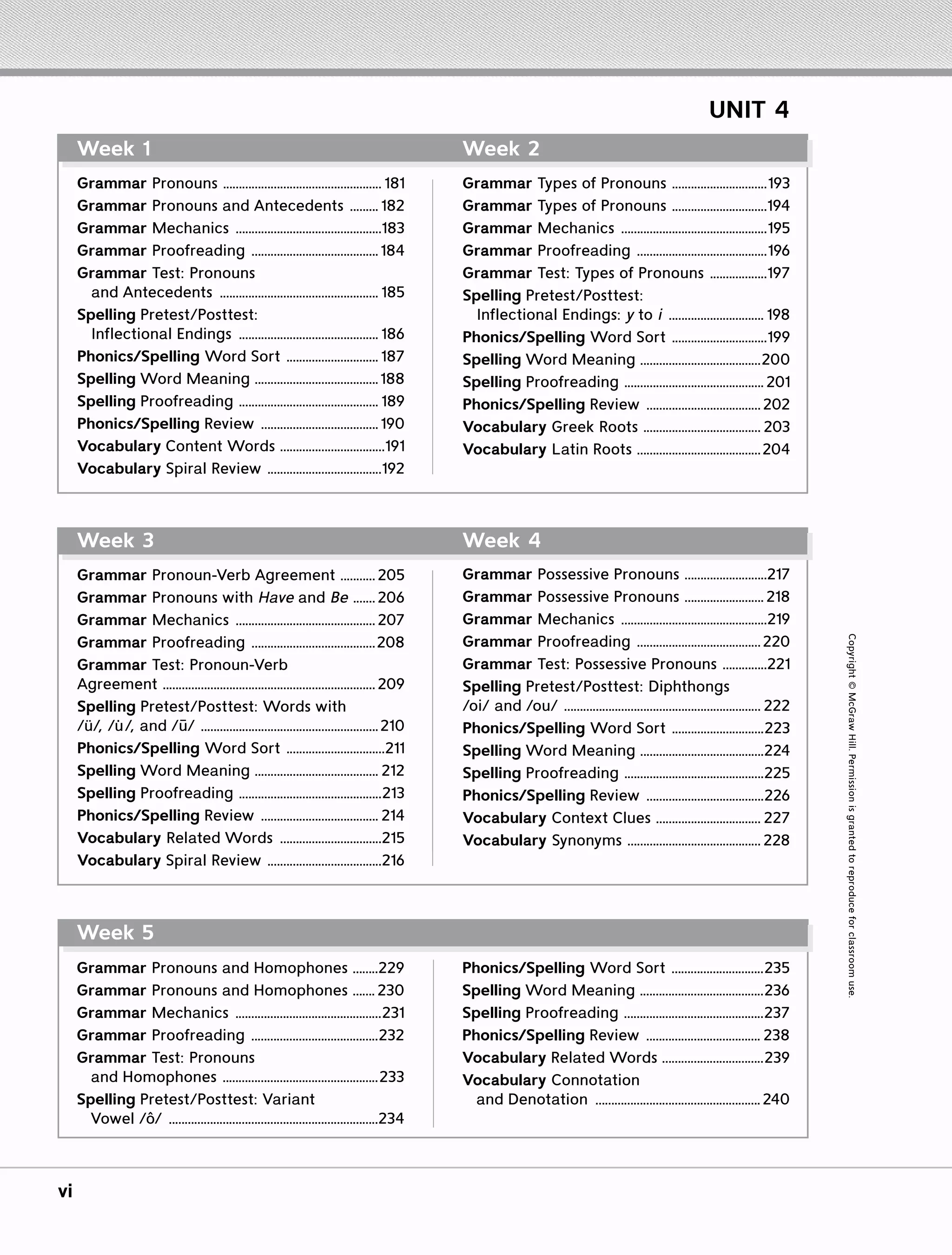
UNIT 4
Week 3
Grammar Pronoun-Verb Agreement �����������205
Grammar Pronouns with Have and Be �������206
Grammar Mechanics ��������������������������������������������207
Grammar Proofreading ���������������������������������������208
Grammar Test: Pronoun-Verb
Agreement �������������������������������������������������������������������209
Spelling Pretest/Posttest: Words with
/ü/, /u̇/, and /ū/ ��������������������������������������������������������210
Phonics/Spelling Word Sort �������������������������������211
Spelling Word Meaning ��������������������������������������� 212
Spelling Proofreading ���������������������������������������������213
Phonics/Spelling Review ������������������������������������� 214
Vocabulary Related Words ��������������������������������215
Vocabulary Spiral Review ������������������������������������216
Week 4
Grammar Possessive Pronouns ��������������������������217
Grammar Possessive Pronouns �������������������������218
Grammar Mechanics ����������������������������������������������219
Grammar Proofreading ���������������������������������������220
Grammar Test: Possessive Pronouns ��������������221
Spelling Pretest/Posttest: Diphthongs
/oi/ and /ou/ �������������������������������������������������������������� 222
Phonics/Spelling Word Sort �����������������������������223
Spelling Word Meaning ���������������������������������������224
Spelling Proofreading ��������������������������������������������225
Phonics/Spelling Review �������������������������������������226
Vocabulary Context Clues ��������������������������������� 227
Vocabulary Synonyms ������������������������������������������ 228
Week 5 
Grammar Pronouns and Homophones ��������229
Grammar Pronouns and Homophones �������230
Grammar Mechanics ����������������������������������������������231
Grammar Proofreading ����������������������������������������232
Grammar Test: Pronouns
and Homophones �������������������������������������������������233
Spelling Pretest/Posttest: Variant
Vowel /ô/ ������������������������������������������������������������������234
Phonics/Spelling Word Sort �����������������������������235
Spelling Word Meaning ���������������������������������������236
Spelling Proofreading ��������������������������������������������237
Phonics/Spelling Review ������������������������������������ 238
Vocabulary Related Words �������������������������������239
Vocabulary Connotation
and Denotation ����������������������������������������������������240
Week 1
Grammar Pronouns �������������������������������������������������� 181
Grammar Pronouns and Antecedents ��������� 182
Grammar Mechanics ����������������������������������������������183
Grammar Proofreading ����������������������������������������184
Grammar Test: Pronouns
and Antecedents �������������������������������������������������� 185
Spelling Pretest/Posttest:
Inflectional Endings �������������������������������������������� 186
Phonics/Spelling Word Sort ����������������������������� 187
Spelling Word Meaning ���������������������������������������188
Spelling Proofreading �������������������������������������������� 189
Phonics/Spelling Review �������������������������������������190
Vocabulary Content Words ���������������������������������191
Vocabulary Spiral Review ������������������������������������192
Week 2
Grammar Types of Pronouns ������������������������������193
Grammar Types of Pronouns ������������������������������194
Grammar Mechanics ����������������������������������������������195
Grammar Proofreading �����������������������������������������196
Grammar Test: Types of Pronouns ������������������197
Spelling Pretest/Posttest:
Inflectional Endings: y to i ������������������������������ 198
Phonics/Spelling Word Sort ������������������������������199
Spelling Word Meaning ��������������������������������������200
Spelling Proofreading ��������������������������������������������201
Phonics/Spelling Review ������������������������������������202
Vocabulary Greek Roots ������������������������������������� 203
Vocabulary Latin Roots ���������������������������������������204
vi
Copyright
©
McGraw
Hill.
Permission
is
granted
to
reproduce
for
classroom
use.
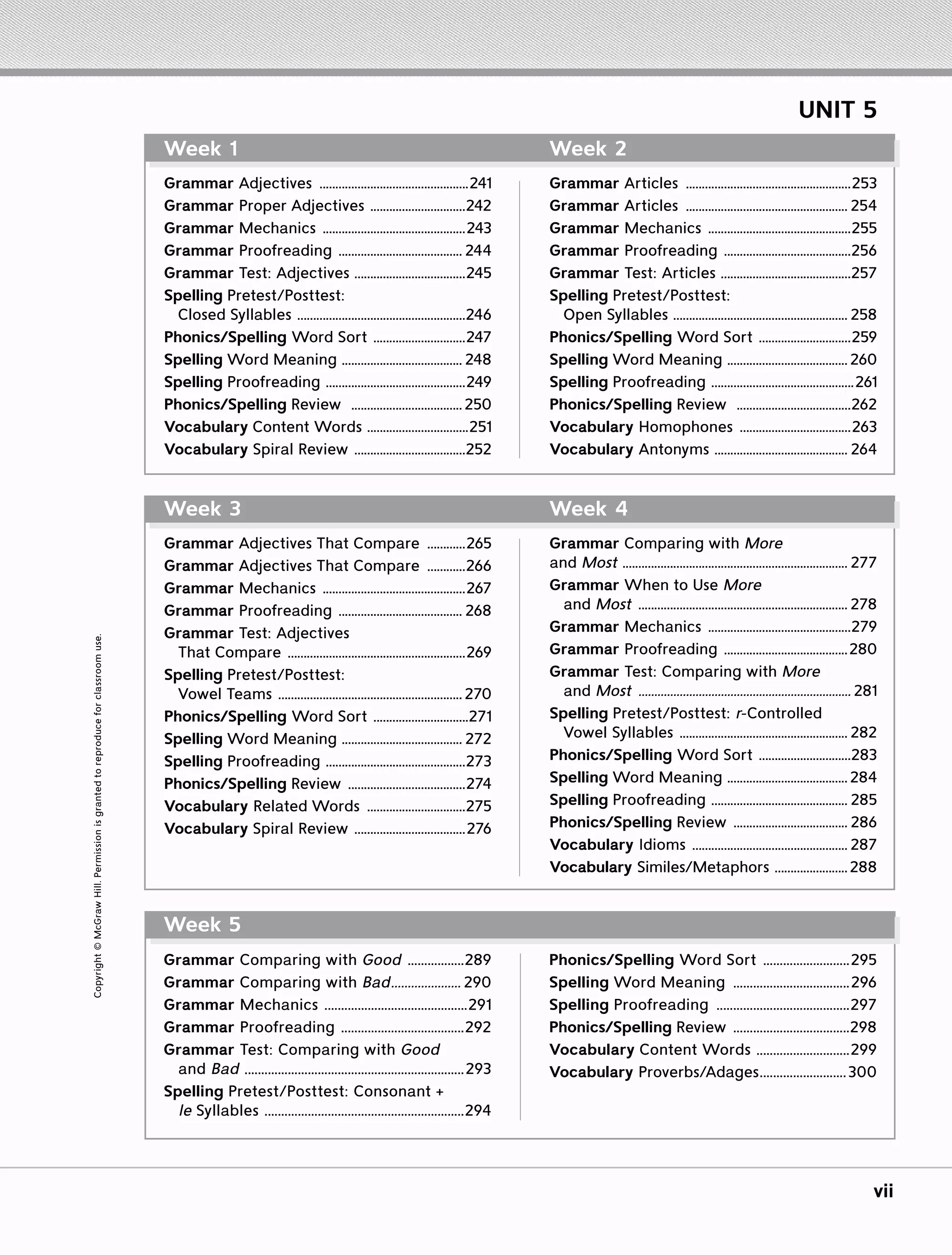
UNIT 5
Week 3
Grammar Adjectives That Compare ������������265
Grammar Adjectives That Compare ������������266
Grammar Mechanics ���������������������������������������������267
Grammar Proofreading ��������������������������������������� 268
Grammar Test: Adjectives
That Compare ��������������������������������������������������������269
Spelling Pretest/Posttest:
Vowel Teams ����������������������������������������������������������270
Phonics/Spelling Word Sort ������������������������������271
Spelling Word Meaning �������������������������������������� 272
Spelling Proofreading ��������������������������������������������273
Phonics/Spelling Review �������������������������������������274
Vocabulary Related Words �������������������������������275
Vocabulary Spiral Review �����������������������������������276
Week 4
Grammar Comparing with More
and Most ����������������������������������������������������������������������� 277
Grammar When to Use More
and Most ������������������������������������������������������������������ 278
Grammar Mechanics ���������������������������������������������279
Grammar Proofreading ���������������������������������������280
Grammar Test: Comparing with More
and Most ������������������������������������������������������������������� 281
Spelling Pretest/Posttest: r-Controlled
Vowel Syllables ����������������������������������������������������� 282
Phonics/Spelling Word Sort �����������������������������283
Spelling Word Meaning ��������������������������������������284
Spelling Proofreading ������������������������������������������� 285
Phonics/Spelling Review ������������������������������������ 286
Vocabulary Idioms ������������������������������������������������� 287
Vocabulary Similes/Metaphors �����������������������288
Week 5
Grammar Comparing with Good �����������������289
Grammar Comparing with Bad��������������������� 290
Grammar Mechanics �������������������������������������������291
Grammar Proofreading �������������������������������������292
Grammar Test: Comparing with Good
and Bad ������������������������������������������������������������������293
Spelling Pretest/Posttest: Consonant +
le Syllables ������������������������������������������������������������294
Phonics/Spelling Word Sort ��������������������������295
Spelling Word Meaning �����������������������������������296
Spelling Proofreading ����������������������������������������297
Phonics/Spelling Review �����������������������������������298
Vocabulary Content Words
Vocabulary Proverbs/Adages 300
����������������������������299
��������������������������
Week 1
Grammar Adjectives �����������������������������������������������241
Grammar Proper Adjectives ������������������������������242
Grammar Mechanics ���������������������������������������������243
Grammar Proofreading ��������������������������������������� 244
Grammar Test: Adjectives �����������������������������������245
Spelling Pretest/Posttest:
Closed Syllables �����������������������������������������������������246
Phonics/Spelling Word Sort �����������������������������247
Spelling Word Meaning �������������������������������������� 248
Spelling Proofreading ��������������������������������������������249
Phonics/Spelling Review �����������������������������������250
Vocabulary Content Words ��������������������������������251
Vocabulary Spiral Review �����������������������������������252
Week 2
Grammar Articles ����������������������������������������������������253
Grammar Articles ��������������������������������������������������� 254
Grammar Mechanics ���������������������������������������������255
Grammar Proofreading ����������������������������������������256
Grammar Test: Articles �����������������������������������������257
Spelling Pretest/Posttest:
Open Syllables ������������������������������������������������������� 258
Phonics/Spelling Word Sort �����������������������������259
Spelling Word Meaning ��������������������������������������260
Spelling Proofreading ���������������������������������������������261
Phonics/Spelling Review ������������������������������������262
Vocabulary Homophones �����������������������������������263
Vocabulary Antonyms ������������������������������������������ 264
 vii
Copyright
©
McGraw
Hill.
Permission
is
granted
to
reproduce
for
classroom
use.
UNIT 6
Week 3
Grammar Negatives �����������������������������������������������325
Grammar Negatives �����������������������������������������������326
Grammar Mechanics ���������������������������������������������327
Grammar Proofreading ����������������������������������������328
Grammar Test: Negatives �����������������������������������329
Spelling Pretest/Posttest: Prefixes �����������������330
Phonics/Spelling Word Sort ������������������������������331
Spelling Word Meaning ���������������������������������������332
Spelling Proofreading ��������������������������������������������333
Phonics/Spelling Review �������������������������������������334
Vocabulary Related Words �������������������������������335
Vocabulary Spiral Review �����������������������������������336
Week 4
Grammar Prepositions ������������������������������������������337
Grammar Prepositional Phrases ����������������������338
Grammar Mechanics ���������������������������������������������339
Grammar Proofreading ���������������������������������������340
Grammar Test: Prepositions �������������������������������341
Spelling Pretest/Posttest: Suffixes �����������������342
Phonics/Spelling Word Sort �����������������������������343
Spelling Word Meaning �������������������������������������� 344
Spelling Proofreading ��������������������������������������������345
Phonics/Spelling Review �������������������������������������346
Vocabulary Connotation and
Denotation ���������������������������������������������������������������347
Vocabulary Words from Mythology ����������� 348
Week 5
Grammar Using Prepositions �����������������������������349
Grammar Using Prepositions ���������������������������� 350
Grammar Mechanics ����������������������������������������������351
Grammar Proofreading ����������������������������������������352
Grammar Test: Using Prepositions �����������������353
Spelling Pretest/Posttest: Prefixes
and Suffixes �������������������������������������������������������������354
Phonics/Spelling Word Sort �����������������������������355
Spelling Word Meaning ���������������������������������������356
Spelling Proofreading ��������������������������������������������357
Phonics/Spelling Review �������������������������������������358
Vocabulary Related Words �������������������������������359
Vocabulary Figurative Language ����������������� 360
Week 1
Grammar Adverbs ��������������������������������������������������� 301
Grammar Adverbs �������������������������������������������������� 302
Grammar Mechanics ���������������������������������������������303
Grammar Proofreading ���������������������������������������304
Grammar Test: Adverbs �������������������������������������� 305
Spelling Pretest/Posttest: Words
with /ən/ ������������������������������������������������������������������ 306
Phonics/Spelling Word Sort ���������������������������� 307
Spelling Word Meaning ��������������������������������������308
Spelling Proofreading ������������������������������������������� 309
Phonics/Spelling Review �������������������������������������310
Vocabulary Content Words ������������������������������� 311
Vocabulary Spiral Review ������������������������������������312
Week 2
Grammar Comparing with Adverbs ���������������313
Grammar Comparing with Adverbs ���������������314
Grammar Mechanics ����������������������������������������������315
Grammar Proofreading �����������������������������������������316
Grammar Test: Comparing with Adverbs ���317
Spelling Pretest/Posttest: Homophones ����� 318
Phonics/Spelling Word Sort ������������������������������319
Spelling Word Meaning �������������������������������������� 320
Spelling Proofreading ���������������������������������������������321
Phonics/Spelling Review �������������������������������������322
Vocabulary Prefixes �����������������������������������������������323
Vocabulary Latin and Greek Prefixes ���������324
Handwriting �������������������������������������������������������������������������������������������������������������������������������������������������������������������������������������������������������361
viii
Grade 4 Unit 1 Week 1
Copyright
©
McGraw
Hill.
Permission
is
granted
to
reproduce
for
classroom
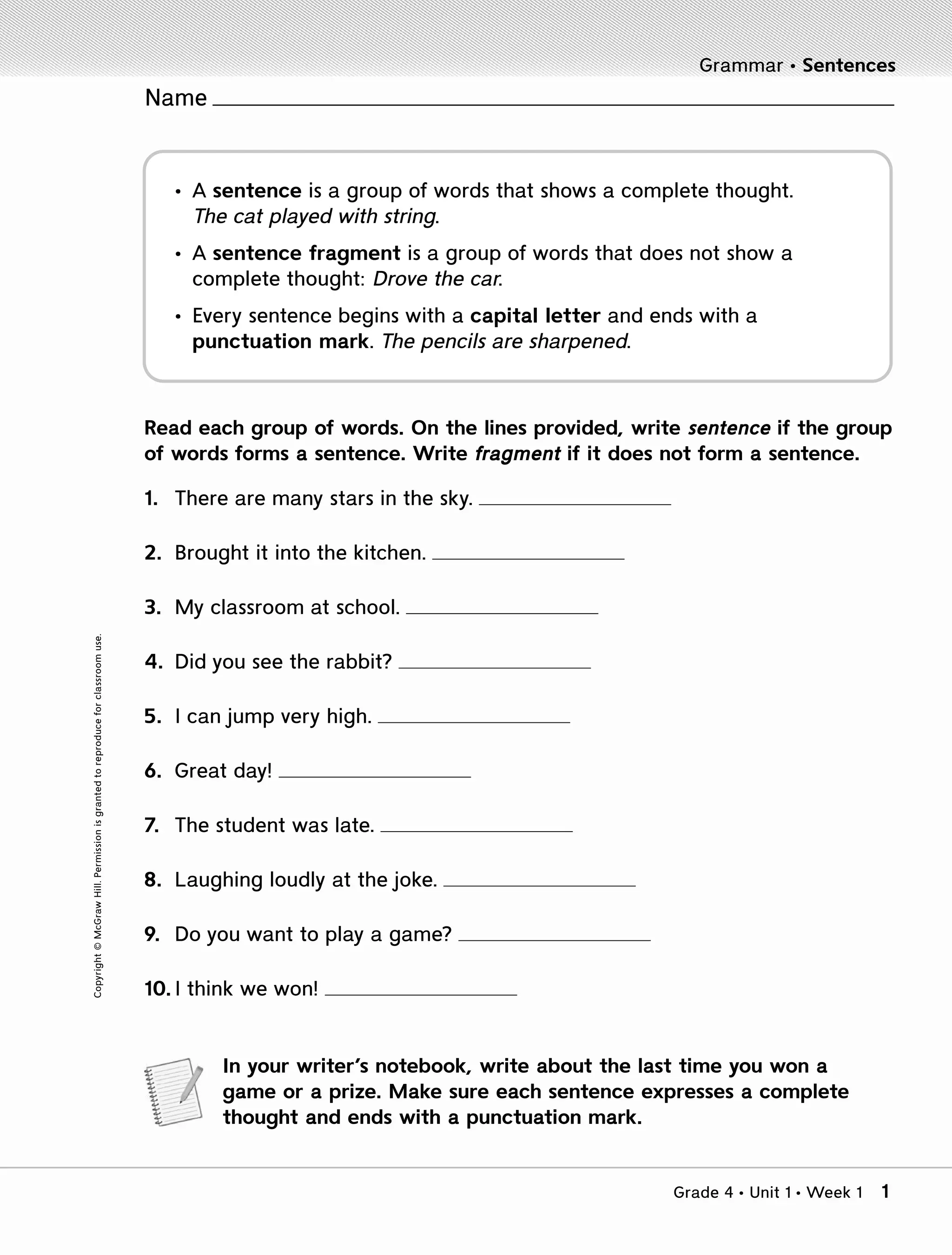
use. Name
In your writer’s notebook, write about the last time you won a
game or a prize. Make sure each sentence expresses a complete
thought and ends with a punctuation mark.
Read each group of words. On the lines provided, write sentence if the group
of words forms a sentence. Write fragment if it does not form a sentence.
1. There are many stars in the sky.
2. Brought it into the kitchen.
3. My classroom at school.
4. Did you see the rabbit?
5. I can jump very high.
6. Great day!
7. The student was late.
8. Laughing loudly at the joke.
9. Do you want to play a game?
10. I think we won!
• A sentence is a group of words that shows a complete thought.
The cat played with string.
• A sentence fragment is a group of words that does not show a
complete thought: Drove the car.
• Every sentence begins with a capital letter and ends with a
punctuation mark. The pencils are sharpened.
Grammar • Sentences
Grade 4 • Unit 1 • Week 1 1
Copyright
©
McGraw
Hill.
Permission
is
granted
to
reproduce
for
classroom
use.
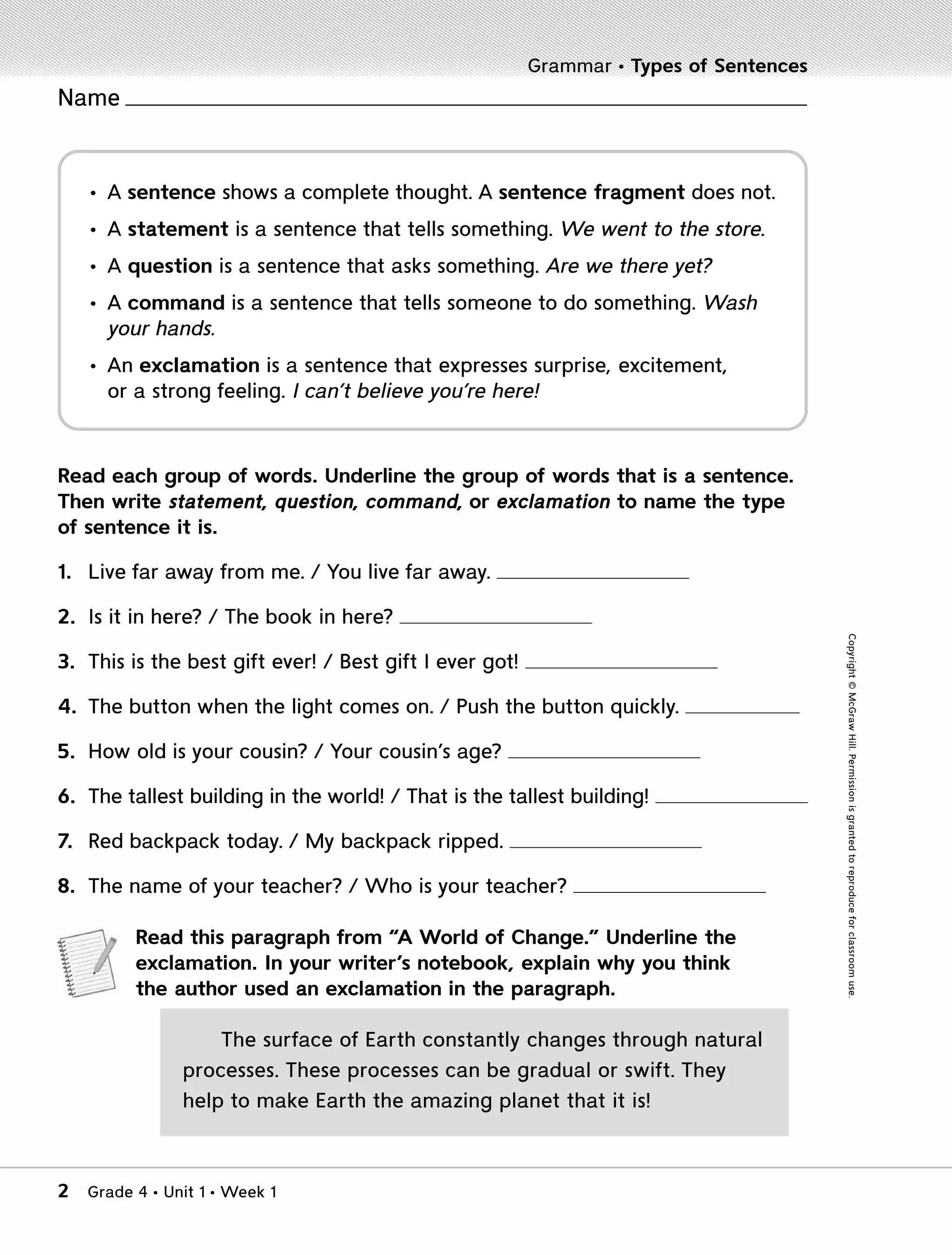
Name
• A sentence shows a complete thought. A sentence fragment does not.
• A statement is a sentence that tells something. We went to the store.
• A question is a sentence that asks something. Are we there yet?
• A command is a sentence that tells someone to do something. Wash
your hands.
• An exclamation is a sentence that expresses surprise, excitement,
or a strong feeling. I can’t believe you’re here!
Read each group of words. Underline the group of words that is a sentence.
Then write statement, question, command, or exclamation to name the type
of sentence it is.
1. Live far away from me. / You live far away.
2. Is it in here? / The book in here?
3. This is the best gift ever! / Best gift I ever got!
4. The button when the light comes on. / Push the button quickly.
5. How old is your cousin? / Your cousin’s age?
6. The tallest building in the world! / That is the tallest building!
7. Red backpack today. / My backpack ripped.
8. The name of your teacher? / Who is your teacher?
Read this paragraph from “A World of Change.” Underline the
exclamation. In your writer’s notebook, explain why you think
the author used an exclamation in the paragraph.
Grammar • Types of Sentences
The surface of Earth constantly changes through natural
processes. These processes can be gradual or swift. They
help to make Earth the amazing planet that it is!
2 Grade 4 • Unit 1 • Week 1
Copyright
©
McGraw
Hill.
Permission
is
granted
to
reproduce
for
classroom
use. Name
Write each sentence correctly using capital letters and end punctuation.
Label each sentence as a statement, question, command, or exclamation.
1. put the bottle in the bin outside
2. who is your favorite actor
3. the snow sticks to the tree branches
4. how many push-ups can you do in a row
• Every sentence begins with a capital letter.
• A statement ends with a period. (.)
• A question ends with a question mark. (?)
• A command ends with a period or an exclamation mark. (. or !)
• An exclamation ends with an exclamation mark. (!)
Think about a person you admire. Write two sentences
about that person. Include an exclamation sentence.
Remember that punctuation can be used for effect. It can
show the reader how you feel about something.
Writing Connection
Grammar • Mechanics: Sentence Punctuation
Grade 4 • Unit 1 • Week 1 3
Copyright
©
McGraw
Hill.
Permission
is
granted
to
reproduce
for
classroom
use.
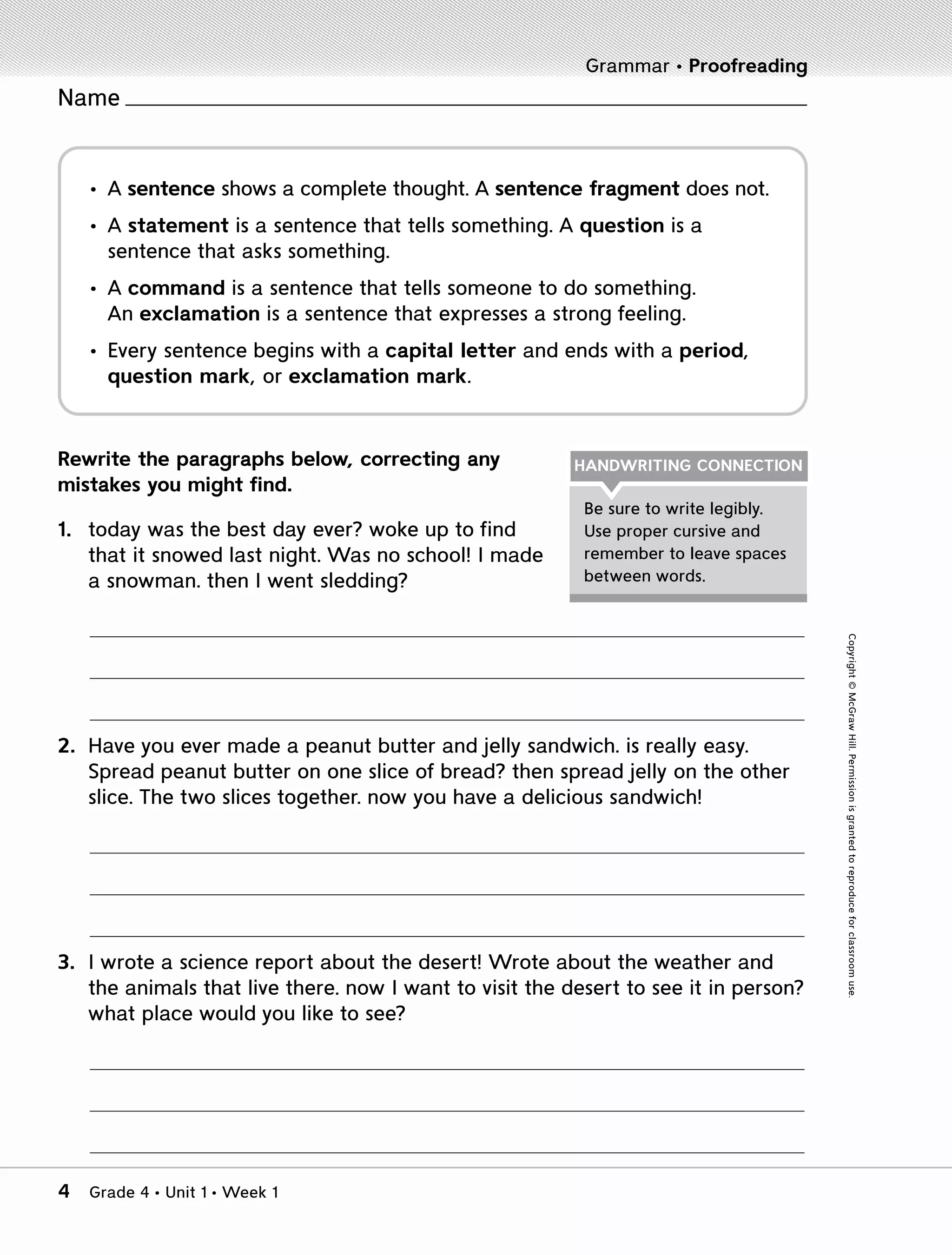
Name
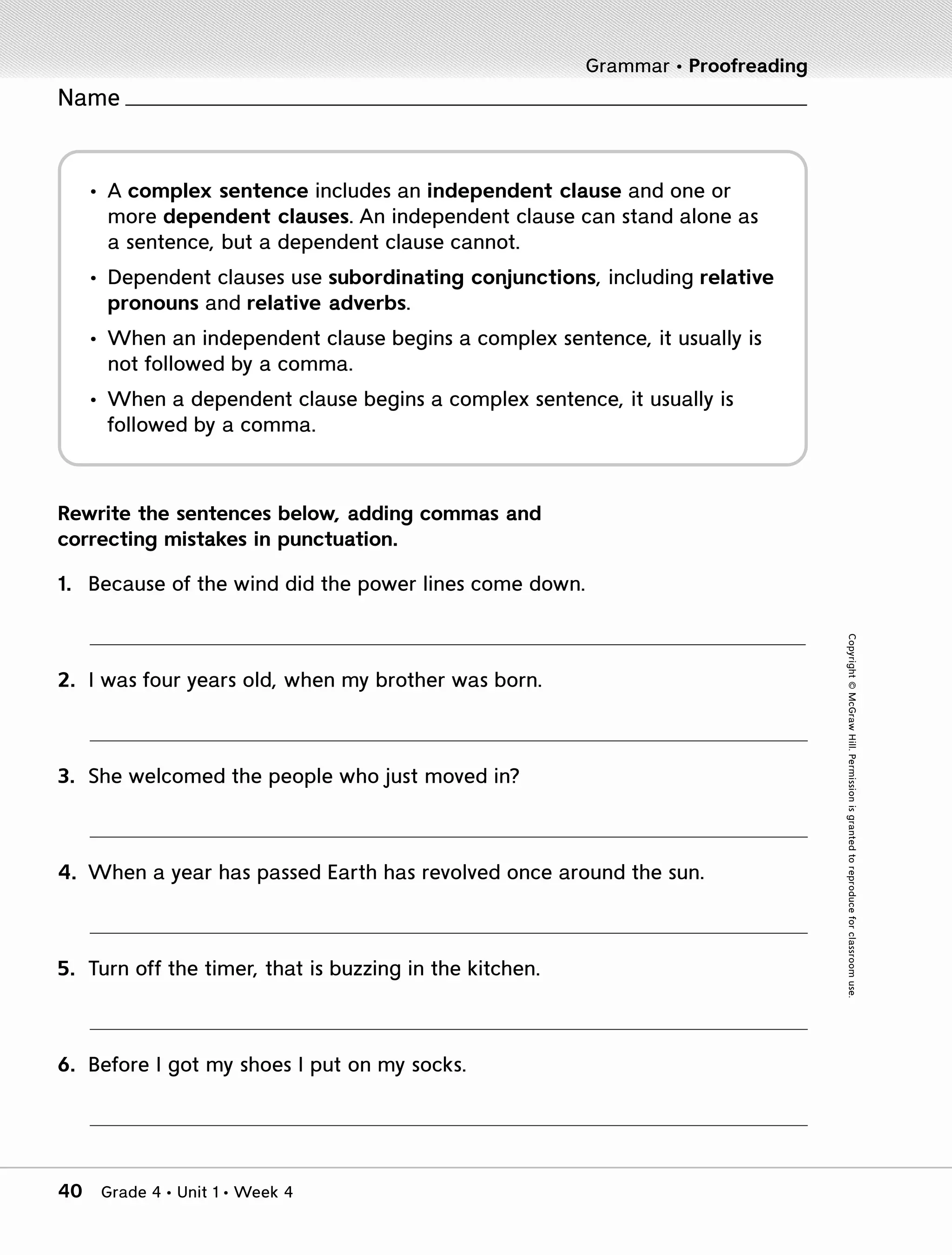
Rewrite the paragraphs below, correcting any
mistakes you might find.
1. today was the best day ever? woke up to find
that it snowed last night. Was no school! I made
a snowman. then I went sledding?
2. Have you ever made a peanut butter and jelly sandwich. is really easy.
Spread peanut butter on one slice of bread? then spread jelly on the other
slice. The two slices together. now you have a delicious sandwich!
3. I wrote a science report about the desert! Wrote about the weather and
the animals that live there. now I want to visit the desert to see it in person?
what place would you like to see?
• A sentence shows a complete thought. A sentence fragment does not.
• A statement is a sentence that tells something. A question is a
sentence that asks something.
• A command is a sentence that tells someone to do something.
An exclamation is a sentence that expresses a strong feeling.
• Every sentence begins with a capital letter and ends with a period,
question mark, or exclamation mark.
Be sure to write legibly.
Use proper cursive and
remember to leave spaces
between words.
HANDWRITING CONNECTION
Grammar • Proofreading
4 Grade 4 • Unit 1 • Week 1
Copyright
©
McGraw
Hill.
Permission
is
granted
to
reproduce
for
classroom
use. Name
Read the student draft that follows. Then answer the questions.
(1) Amy and Leta are at the library. (2) “What kind of book do you
want to read, Amy?” Leta asks.
(3) “I love mysteries!” Amy answers.
(4) “Me too,” Leta says.
(5) The girls look at the books on the shelves. (6) “Take a look at this,”
Leta says, and she reads out a title, Clues from the Cat’s Claws.
(7) Then Amy reads aloud text from the book. (8) “How does a cat claw
itself out of trouble? (9) Only Cleo the clever cat can do that! (10) Read on
to find out how Cleo the cat leaves clues to be rescued.”
(11) “This is purrfect! (12) We can read the mystery with our cats!”
says Leta.
1. 	
Which of the following is a
statement?
A Sentence 1
B Sentence 8
C Sentence 9
D Sentence 11
2. 	
Which of the following is a
question?
F Sentence 3
G Sentence 5
H Sentence 8
J Sentence 12
3. 	
Which of the following is a
command?
A Sentence 3
B Sentence 5
C Sentence 10
D Sentence 12
4. 	
Which of the following is an
exclamation?
F Sentence 7
G Sentence 8
H Sentence 10
J Sentence 11
Grammar • Test: Sentences
Grade 4 • Unit 1 • Week 1 5
Copyright
©
McGraw
Hill.
Permission
is
granted
to
reproduce
for
classroom
use.
Name
Fold back the
paper along the
dotted line. Use
the blanks to
write each word
as it is read aloud.
When you finish
the test, unfold
the paper. Use the
list at the right
to correct any
spelling mistakes.
1.
2.
3.
4.
5.
6.
7.
8.
9.
10.
11.
12.
13.
14.
15.
16.
17.
18.
19.
20.
21.
22.
23.
24.
25.
Review Words
Challenge Words
Spelling • Short Vowels
1. flat
2. cash
3. band
4. bell
5. left
6. shelf
7. wealth
8. grim
9. mill
10. hint
11. plot
12. dock
13. blot
14. odd
15. sum
16. plum
17. bluff
18. crunch
19. build
20. gym
21. snack
22. step
23. pond
24. heavy
25. shovel
6 Grade 4 • Unit 1 • Week 1
Copyright
©
McGraw
Hill.
Permission
is
granted
to
reproduce
for
classroom
use. Name
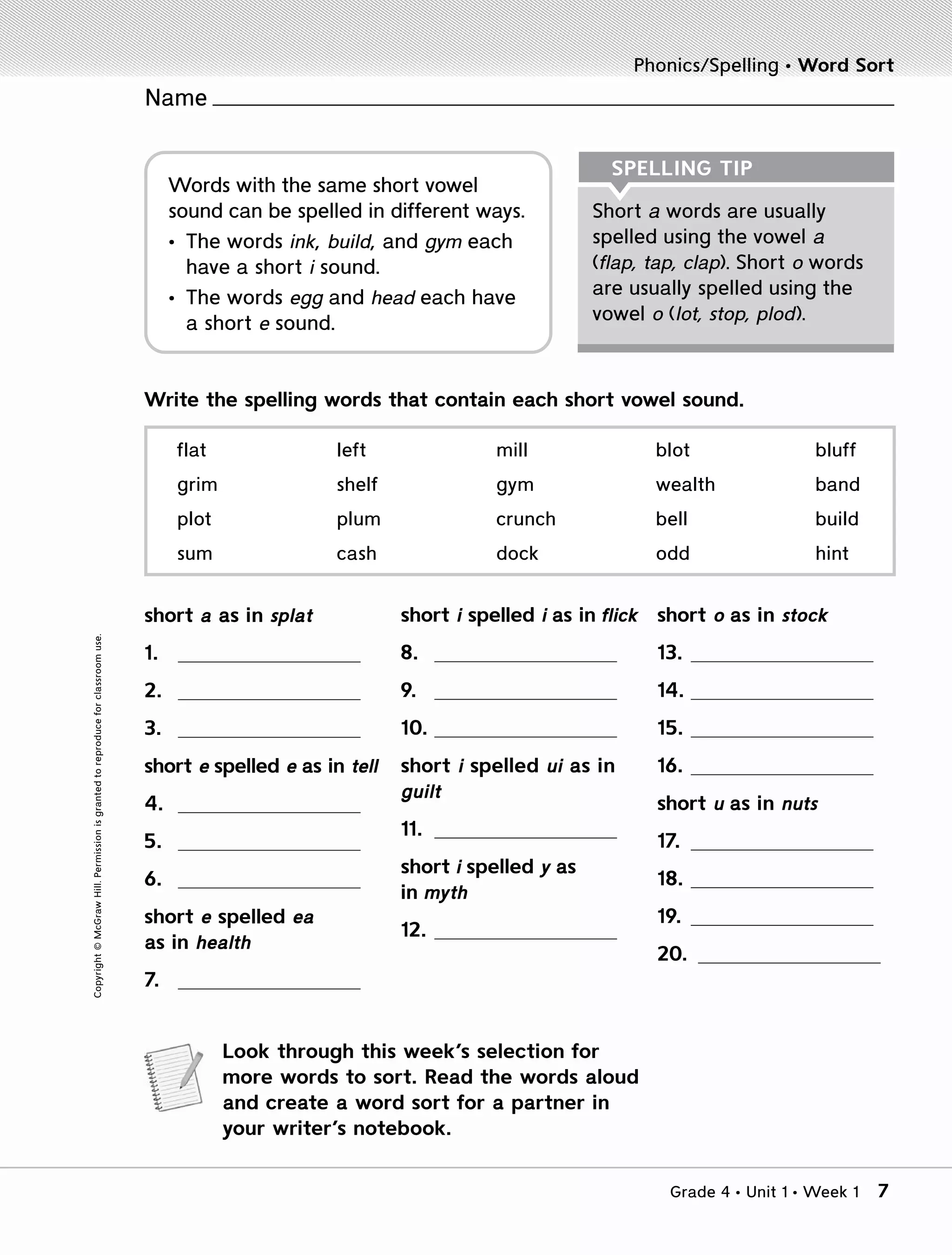
Write the spelling words that contain each short vowel sound.
Short a words are usually
spelled using the vowel a
(flap, tap, clap). Short o words
are usually spelled using the
vowel o (lot, stop, plod).
SPELLING TIP
Words with the same short vowel
sound can be spelled in different ways.
• The words ink, build, and gym each
have a short i sound.
• The words egg and head each have
a short e sound.
short a as in splat
1.
2.
3.
short e spelled e as in tell
4.
5.
6.
short e spelled ea
as in health
7.
short i spelled i as in flick
8.
9.
10.
short i spelled ui as in
guilt
11.
short i spelled y as
in myth
12.
short o as in stock
13.
14.
15.
16.
short u as in nuts
17.
18.
19.
20.
Look through this week’s selection for
more words to sort. Read the words aloud
and create a word sort for a partner in
your writer’s notebook.
flat left mill blot bluff
grim shelf gym wealth band
plot plum crunch bell build
sum cash dock odd hint
Phonics/Spelling • Word Sort
Grade 4 • Unit 1 • Week 1 7
Copyright
©
McGraw
Hill.
Permission
is
granted
to
reproduce
for
classroom
use.
Name
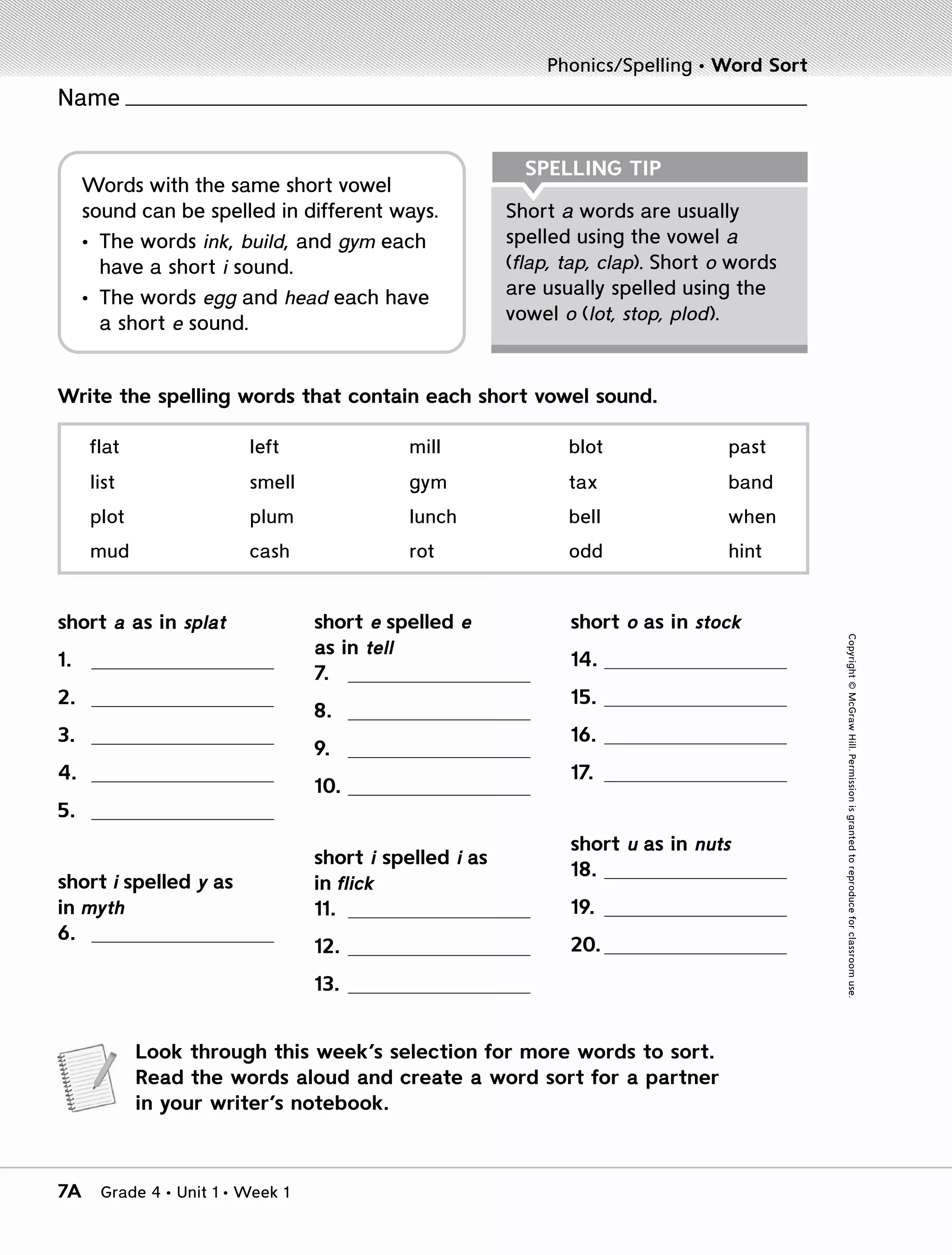
Write the spelling words that contain each short vowel sound.
Short a words are usually
spelled using the vowel a
(flap, tap, clap). Short o words
are usually spelled using the
vowel o (lot, stop, plod).
SPELLING TIP
Words with the same short vowel
sound can be spelled in different ways.
• The words ink, build, and gym each
have a short i sound.
• The words egg and head each have
a short e sound.
flat left mill blot past
list smell gym tax band
plot plum lunch bell when
mud cash rot odd hint
short a as in splat
1.
2.
3.
4.
5.
short i spelled y as
in myth
6.
short e spelled e
as in tell
7.
8.
9.
10.
short i spelled i as
in flick
11.
12.
13.
short o as in stock
14.
15.
16.
17.
short u as in nuts
18.
19.
20.
Look through this week’s selection for more words to sort.
Read the words aloud and create a word sort for a partner
in your writer’s notebook.
Phonics/Spelling • Word Sort
7A Grade 4 • Unit 1 • Week 1
Copyright
©
McGraw
Hill.
Permission
is
granted
to
reproduce
for
classroom
use. Name
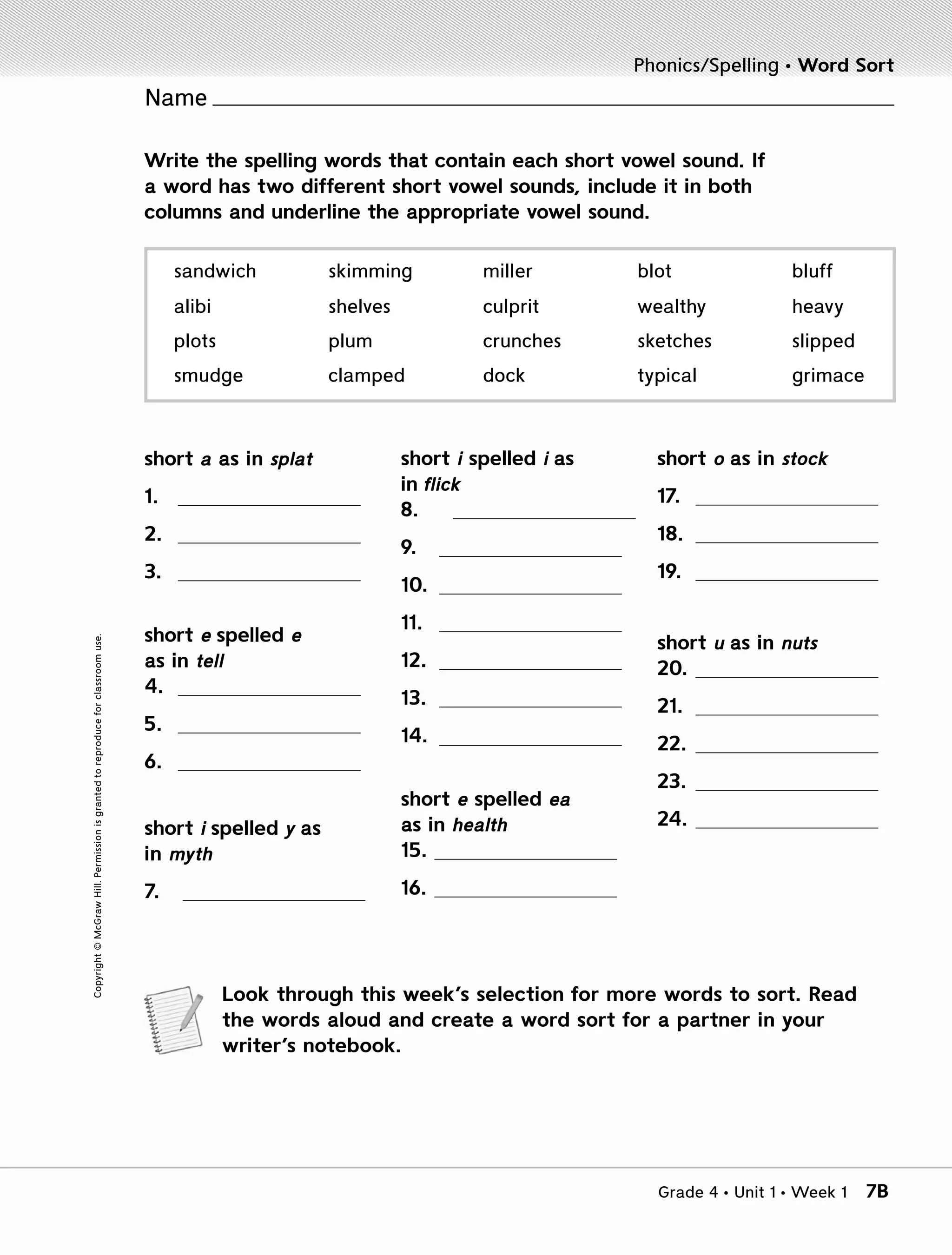
Write the spelling words that contain each short vowel sound. If
a word has two different short vowel sounds, include it in both
columns and underline the appropriate vowel sound.
sandwich skimming miller blot bluff
alibi shelves culprit wealthy heavy
plots plum crunches sketches slipped
smudge clamped dock typical grimace
short a as in splat
1.
2.
3.
short e spelled e
as in tell
4.
5.
6.
short i spelled y as
in myth
7.
short i spelled i as
in flick
8.
9.
10.
11.
12.
13.
14.
short e spelled ea
as in health
15.
16.
short o as in stock
17.
18.
19.
short u as in nuts
20.
21.
22.
23.
24.
Look through this week’s selection for more words to sort. Read
the words aloud and create a word sort for a partner in your
writer’s notebook.
Phonics/Spelling • Word Sort
Grade 4 • Unit 1 • Week 1 7B
Copyright
©
McGraw
Hill.
Permission
is
granted
to
reproduce
for
classroom
use.
Name
A. Write the spelling word that best completes each sentence.
1. She is the drum player in a .
2. Did you tell the truth or was that a ?
3. I did not have enough on me to pay for it.
4. He brought the ball to class.
5. The car tires will the can on the street.
6. I did not know that flour was made at this .
7. My favorite fruit is the .
8. This chimes at noon every day.
9. We got on the boat from the .
10. He his glasses at home today.
B. Write the spelling word that matches each definition below.
flat left mill blot bluff
cash shelf hint odd crunch
band wealth plot sum build
bell grim dock plum gym
11. soak up
12. gloomy
13. clue
14. make
15. story line
16. not even
17. ledge
18. a lot of money
19. not round
20. total
Spelling • Word Meaning
8 Grade 4 • Unit 1 • Week 1
Copyright
©
McGraw
Hill.
Permission
is
granted
to
reproduce
for
classroom
use. Name
Underline the six misspelled words in the paragraphs below. Write the
words correctly on the lines.
The classroom was quiet. Books sat closed and flatt on the desks.
The class hamster was missing! The class liked Biscuit. The students had
helped to bild the hamster’s cage. They liked to watch Biscuit krunch
food and run on the wheel.
Chad looked very grimm. He had taken Biscuit home last night. He
planned to bring the hamster back, but he had leeft it at home. Chad
raised his hand. No one needed another hent. The class knew who had
taken Biscuit.
1.
2.
3.
4.
5.
6.
	
Write about something that happened in your classroom.
Use at least four words from the spelling list. Review the
spelling rules for words with short vowels before you write.
Writing Connection
Spelling • Proofreading
Grade 4 • Unit 1 • Week 1 9
The word clock is in bold.
The word trim is in bold.
The word dash is in bold.
The word health is in bold.
The word stuff is in bold.
The word tell is in bold.
The word bat is in bold.
The word drum is in bold.
The word pill is in bold.
The word glint is in bold.
The word stand is in bold.
The word theft is in bold.
The word shot is in bold.
The word rod is in bold.
The word bunch is in bold.
Copyright
©
McGraw
Hill.
Permission
is
granted
to
reproduce
for
classroom
use.
Name
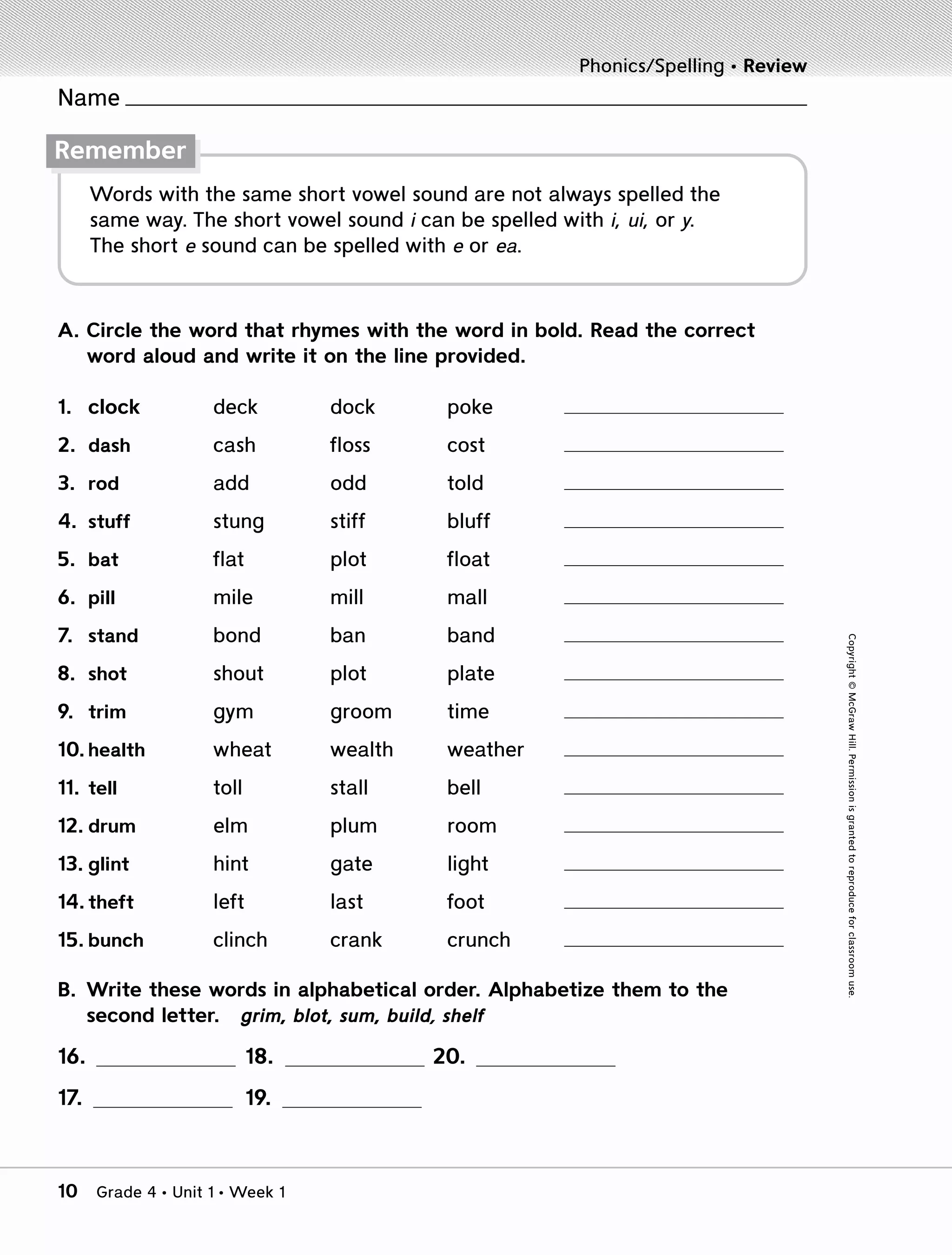
B. 
Write these words in alphabetical order. Alphabetize them to the
second letter. grim, blot, sum, build, shelf
16. 18. 20.
17. 19.
A. 
Circle the word that rhymes with the word in bold. Read the correct
word aloud and write it on the line provided.
1. clock deck dock poke
2. dash cash floss cost
3. rod add odd told
4. stuff stung stiff bluff
5. bat flat plot float
6. pill mile mill mall
7. stand bond ban band
8. shot shout plot plate
9. trim gym groom time
10. health wheat wealth weather
11. tell toll stall bell
12. drum elm plum room
13. glint hint gate light
14.theft left last foot
15. bunch clinch crank crunch
Words with the same short vowel sound are not always spelled the
same way. The short vowel sound i can be spelled with i, ui, or y.
The short e sound can be spelled with e or ea.
Remember
Phonics/Spelling • Review
10 Grade 4 • Unit 1 • Week 1
Copyright
©
McGraw
Hill.
Permission
is
granted
to
reproduce
for
classroom
use. Name
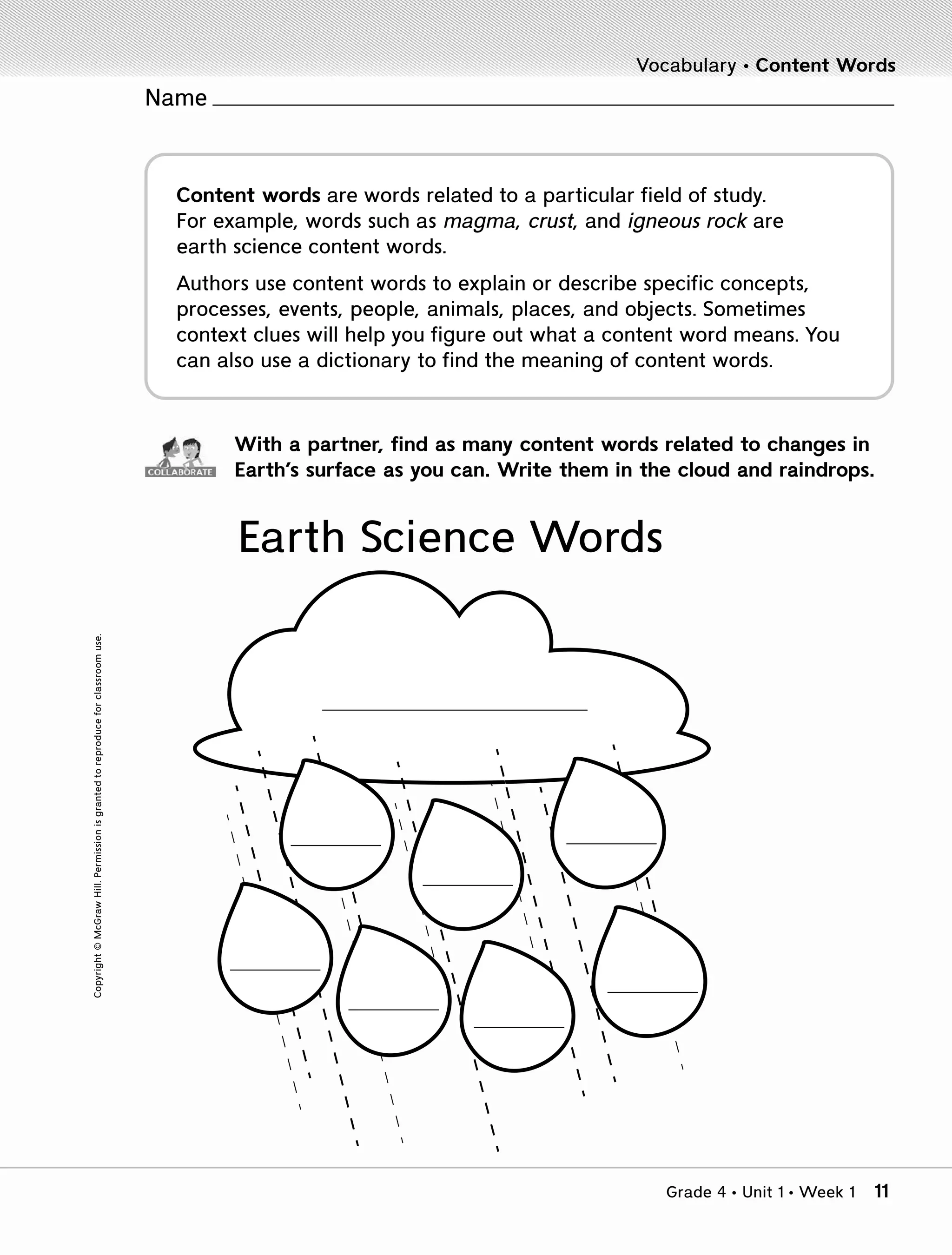
Content words are words related to a particular field of study.
For example, words such as magma, crust, and igneous rock are
earth science content words.
Authors use content words to explain or describe specific concepts,
processes, events, people, animals, places, and objects. Sometimes
context clues will help you figure out what a content word means. You
can also use a dictionary to find the meaning of content words.
With a partner, find as many content words related to changes in
Earth’s surface as you can. Write them in the cloud and raindrops.
Earth Science Words
Vocabulary • Content Words
Grade 4 • Unit 1 • Week 1 11
Copyright
©
McGraw
Hill.
Permission
is
granted
to
reproduce
for
classroom
use.
Name
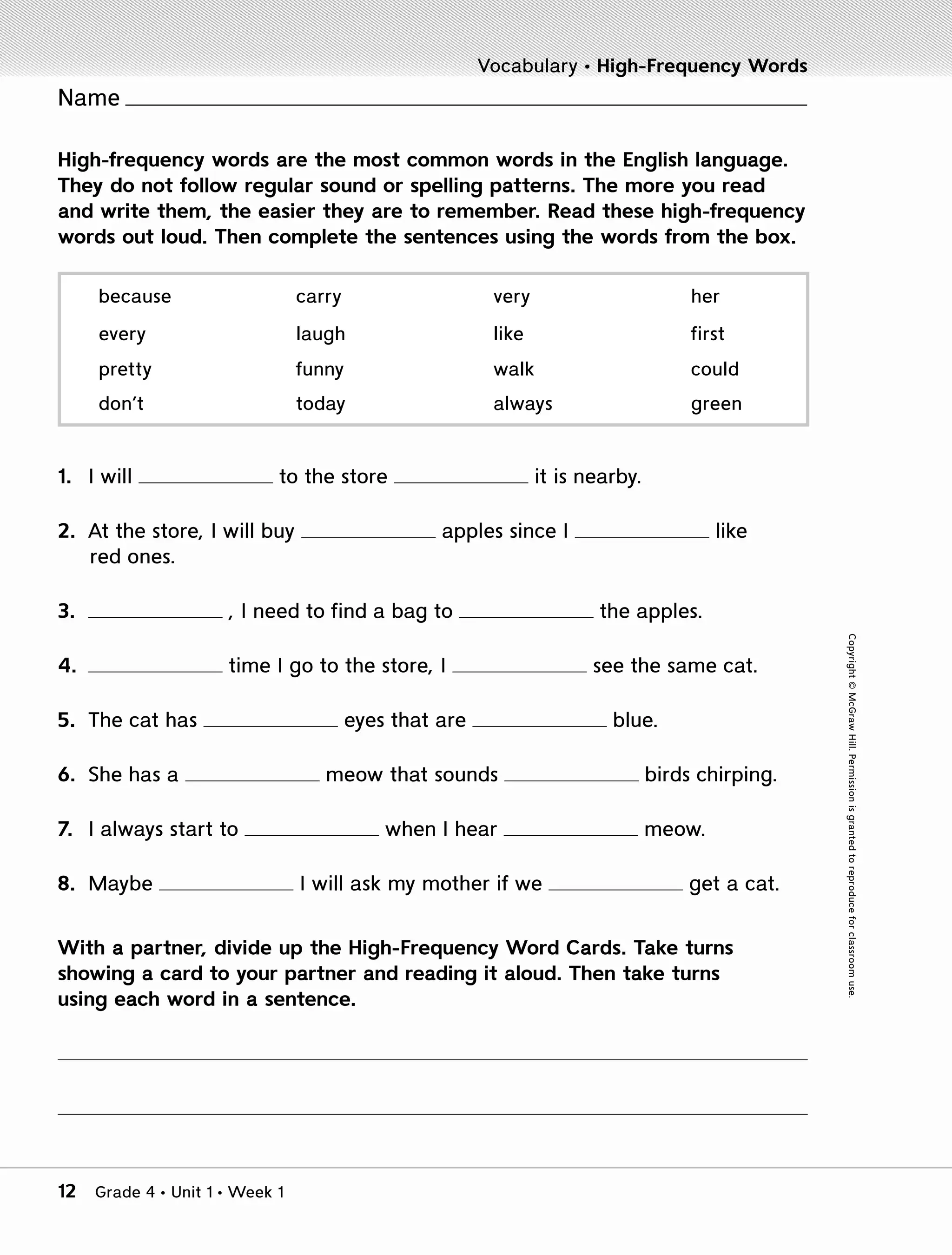
High-frequency words are the most common words in the English language.
They do not follow regular sound or spelling patterns. The more you read
and write them, the easier they are to remember. Read these high-frequency
words out loud. Then complete the sentences using the words from the box.
1. I will to the store it is nearby.
2. At the store, I will buy apples since I like
red ones.
3. , I need to find a bag to the apples.
4. time I go to the store, I see the same cat.
5. The cat has eyes that are blue.
6. 
She has a meow that sounds birds chirping.
7. I always start to when I hear meow.
8. Maybe I will ask my mother if we get a cat.
With a partner, divide up the High-Frequency Word Cards. Take turns
showing a card to your partner and reading it aloud. Then take turns
using each word in a sentence.
because carry very her
every laugh like first
pretty funny walk could
don’t today always green
Vocabulary • High-Frequency Words
12 Grade 4 • Unit 1 • Week 1
Grade 4 Unit 1 Week 2
A. Read each sentence and circle the complete subject.
Then write the simple subject on the line provided.
1. The young boy rode the bus to school.
2. Curious Mrs. Hill likes museums.
3. The two playful children made up a new game.
4. Sports-loving Ana plays soccer.
5. Jan’s friendly dog ran very fast.
B. Read each sentence and circle the complete predicate. Then write the
simple predicate on the line provided.
6. We walked to the park.
7. My brother Ken collects old stamps.
8. I cooked a delicious dinner.
9. Mom works hard all day.
10. The shy rabbit hopped away quickly.
• The subject names the person or thing the sentence is about. The
simple subject is the main noun or pronoun in the complete subject.
The blue bird flew out of the nest.
• The predicate tells what the subject is or does. The simple predicate
is the main verb or verb phrase in the complete predicate.
The man swam to the side of the pool.
In your writer’s notebook, write about your favorite holiday. Underline
two simple subjects and circle two complete predicates.
Name
Grammar • Subjects and Predicates
Copyright
©
McGraw
Hill.
Permission
is
granted
to
reproduce
for
classroom
use.
Grade 4 • Unit 1 • Week 2 13
Grammar • Compound Subjects and Predicates
Read each sentence. Underline the compound subject or compound
predicate. Then write compound subject or compound predicate on the
line provided.
1. The cat and dog get along very well.
2. Mom and Dad rented a car for the vacation.
3. We could drive or walk to school.
4. My little sisters whine, fuss, and cry at bedtime.
5. Aunt Eileen and Uncle Will live down the block.
Talk to a parent or trusted adult about a food from
a different culture you would like to try. Then write a
paragraph about the food and why you want to try it.
Use compound subjects and compound predicates in your
writing. Underline the compound subjects and predicates.
• The subject names the person or thing the sentence is about.
The predicate tells what the subject is or does.
• A compound subject is two or more subjects with the same predicate.
The subjects are usually joined by and or or. Jamie and Andrea run.
• A compound predicate is two or more predicates with the same
subject. The simple predicates in a compound predicate are usually
joined by and, but, or or. Mom and Dad wash and dry the car.
Connect to
Community
Name
Copyright
©
McGraw
Hill.
Permission
is
granted
to
reproduce
for
classroom
use.
14 Grade 4 • Unit 1 • Week 2
Read each sentence. Decide if the compound subject or compound predicate
needs commas. If it does, rewrite the sentence correctly on the line provided.
If it does not, write No change needed on the line.
1. My mother my cousin and I went to the store together.
2. We all sat ate and drank at the dinner table.
3. Miguel dove off the diving board and swam across the pool.
4. The gray horse brown horse or black horse will win the race.
5. She was hungry but found nothing in the refrigerator.
• If a compound subject has two subjects, the subjects are not separated
by a comma. If it has three or more subjects, they are separated by
commas. Mom, Dad, and I had so much fun at the park today!
• If a compound predicate has two predicates, the predicates are not
separated by a comma. If it has three or more predicates, they are
separated by commas. Today I planned, wrote, and turned in my essay.
Reread this excerpt from “Tornado.” Circle the compound subject.
In your writer’s notebook, write about the last time you saw a big
storm. Use one compound subject and one compound predicate in
your writing.
When warm and cold air masses collide, the result can be a fast-
moving, dangerous force of nature—a tornado. A tornado is a violent
windstorm over land. Wind makes a rotating, funnel-shaped cloud
that extends toward the ground. As it moves, it picks up debris and
objects in its path.
Name
Grammar • Mechanics: Punctuate Compound Subjects and Predicates
Copyright
©
McGraw
Hill.
Permission
is
granted
to
reproduce
for
classroom
use.
Grade 4 • Unit 1 • Week 2 15
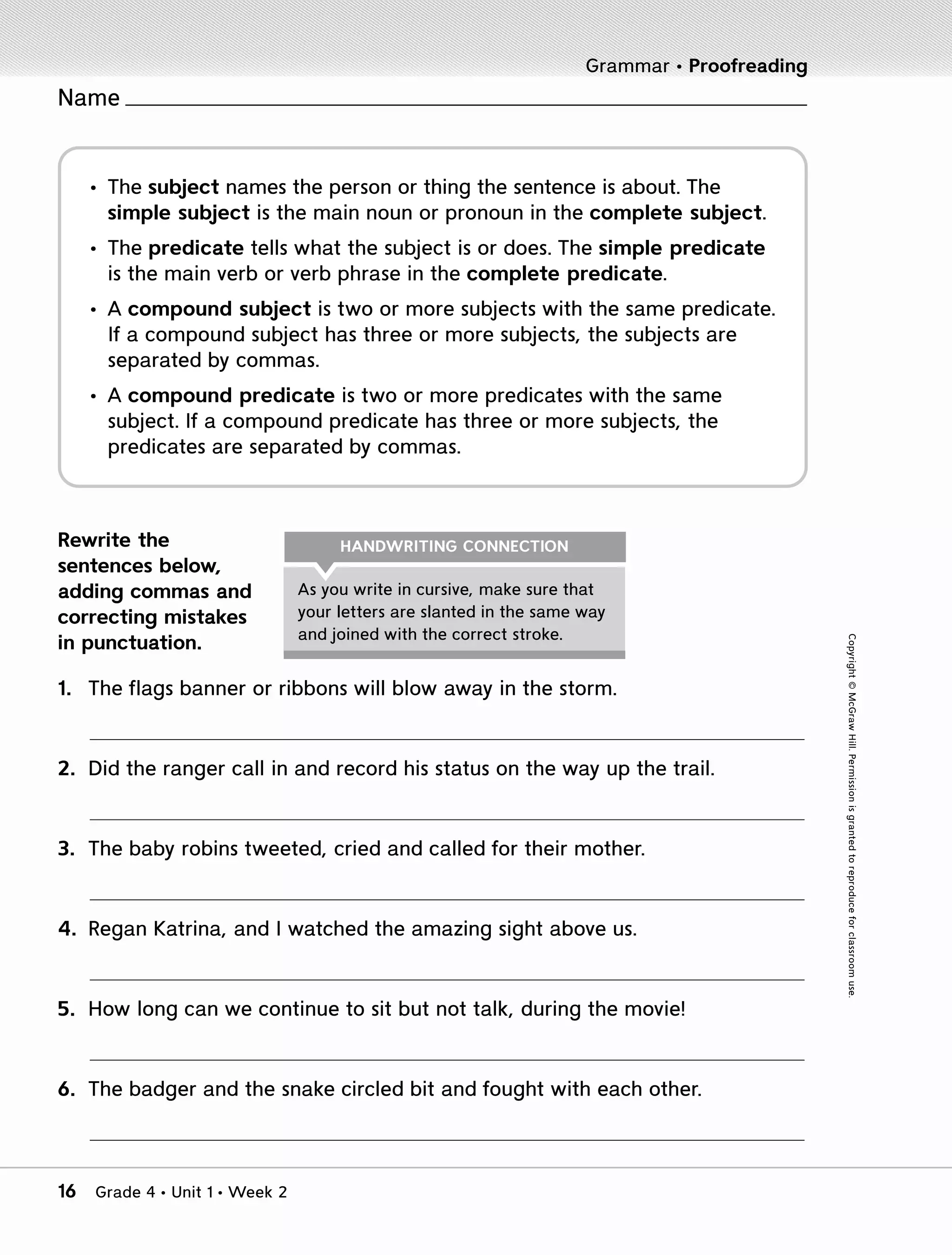
1. The flags banner or ribbons will blow away in the storm.
2. Did the ranger call in and record his status on the way up the trail.
3. The baby robins tweeted, cried and called for their mother.
4. Regan Katrina, and I watched the amazing sight above us.
5. How long can we continue to sit but not talk, during the movie!
6. The badger and the snake circled bit and fought with each other.
• The subject names the person or thing the sentence is about. The
simple subject is the main noun or pronoun in the complete subject.
• The predicate tells what the subject is or does. The simple predicate
is the main verb or verb phrase in the complete predicate.
• A compound subject is two or more subjects with the same predicate.
If a compound subject has three or more subjects, the subjects are
separated by commas.
• A compound predicate is two or more predicates with the same
subject. If a compound predicate has three or more subjects, the
predicates are separated by commas.
As you write in cursive, make sure that
your letters are slanted in the same way
and joined with the correct stroke.
HANDWRITING CONNECTION
Rewrite the
sentences below,
adding commas and
correcting mistakes
in punctuation.
Name
Grammar • Proofreading
Copyright
©
McGraw
Hill.
Permission
is
granted
to
reproduce
for
classroom
use.
16 Grade 4 • Unit 1 • Week 2
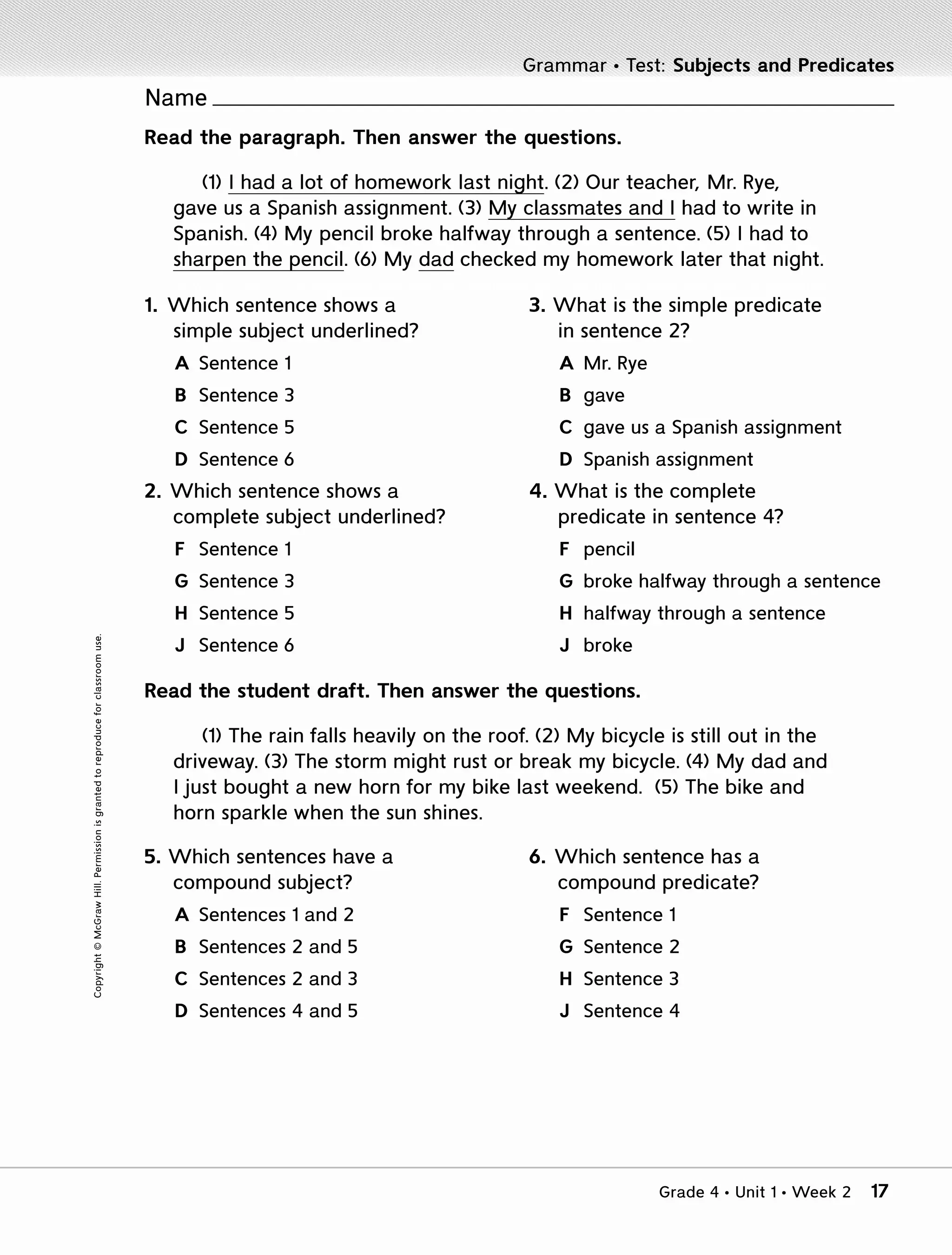
Read the paragraph. Then answer the questions.
(1) I had a lot of homework last night. (2) Our teacher, Mr. Rye,
gave us a Spanish assignment. (3) My classmates and I had to write in
Spanish. (4) My pencil broke halfway through a sentence. (5) I had to
sharpen the pencil. (6) My dad checked my homework later that night.
Read the student draft. Then answer the questions.
(1) The rain falls heavily on the roof. (2) My bicycle is still out in the
driveway. (3) The storm might rust or break my bicycle. (4) My dad and
I just bought a new horn for my bike last weekend. (5) The bike and
horn sparkle when the sun shines.
1. Which sentence shows a
simple subject underlined?
A Sentence 1
B Sentence 3
C Sentence 5
D Sentence 6
2. 	
Which sentence shows a
complete subject underlined?
F Sentence 1
G Sentence 3
H Sentence 5
J Sentence 6
3. 	
What is the simple predicate
in sentence 2?
A Mr. Rye
B gave
C gave us a Spanish assignment
D Spanish assignment
4. What is the complete
predicate in sentence 4?
F pencil
G broke halfway through a sentence
H halfway through a sentence
J broke
5. Which sentences have a
compound subject?
A Sentences 1 and 2
B Sentences 2 and 5
C Sentences 2 and 3
D Sentences 4 and 5
6. 	
Which sentence has a
compound predicate?
F Sentence 1
G Sentence 2
H Sentence 3
J Sentence 4
Name
Grammar • Test: Subjects and Predicates
Copyright
©
McGraw
Hill.
Permission
is
granted
to
reproduce
for
classroom
use.
Grade 4 • Unit 1 • Week 2 17
The words I had a lot of homework last night, My classmates and I, sharpen the pencil, and dad are underlined.
Name
Spelling • Long a
Fold back the
paper along the
dotted line. Use
the blanks to
write each word
as it is read aloud.
When you finish
the test, unfold
the paper. Use the
list at the right
to correct any
spelling mistakes.
1. 1. major
2. 2. clay
3. 3. stray
4. 4. today
5. 5. bail
6. 6. rail
7. 7. drain
8. 8. faint
9. 9. claim
10. 10. pale
11. 11. face
12. 12. graze
13. 13. cane
14. 14. slate
15. 15. ache
16. 16. steak
17. 17. break
18. 18. eight
19. 19. they
20. 20. obey
21. 21. grim
22. 22. plum
23. 23. cash
24. 24. neighbor
25. 25. railway
Review Words
Challenge Words
Copyright
©
McGraw
Hill.
Permission
is
granted
to
reproduce
for
classroom
use.
18 Grade 4 • Unit 1 • Week 2
Name
Write the spelling words that contain the matching spelling of the long a sound.
Some sounds have several
different spelling patterns.
See the box to the left for the
different ways to spell the long
a sound.
SPELLING TIP
Words with the /ā/ sound can be
spelled in different ways.
• a as in apron • ea as in great
• ay as in stay • ei as in reins
• ai as in train • eigh as in sleigh
• a_e as in cake • ey as in they
eight claim bail cane stray
pale graze clay slate obey
face ache steak drain major
today faint rail they break
long a spelled a as
in table
1.
long a spelled ay
as in gray
2.
3.
4.
long a spelled ei as
in weigh
5.
long a spelled ai as in aid
6.
7.
8.
9.
10.
long a spelled ea as
in great
11.
12.
long a spelled ey as
in prey
13.
14.
long a spelled a_e
as in bake
15.
16.
17.
18.
19.
20.
Use the spelling rules above to write a short rhyming poem. Include
four words from the spelling list. Read the words aloud and check
your work for errors.
Phonics/Spelling • Word Sort
Copyright
©
McGraw
Hill.
Permission
is
granted
to
reproduce
for
classroom
use.
Grade 4 • Unit 1 • Week 2 19
Name
Write the spelling words that contain the matching spelling of the long a sound.
Some sounds have several
different spelling patterns.
See the box to the left for the
different ways to spell the long
a sound.
SPELLING TIP
Words with the /ā/ sound can be
spelled in different ways.
• a as in apron • ea as in great
• ay as in stay • ei as in reins
• ai as in train • eigh as in sleigh
• a_e as in cake • ey as in they
rain mane clay crate aim
pale late save drain weigh
face faint rail they major
today paid cane tray break
long a spelled a as
in table
1.
long a spelled ay
as in gray
2.
3.
4.
long a spelled ei
as in eight
5.
long a spelled ea
as in great
6.
long a spelled ai
as in aid
7.
8.
9.
10.
11.
12.
long a spelled ey
as in prey
13.
long a spelled a_e
as in bake
14.
15.
16.
17.
18.
19.
20.
Use the spelling rules above to write a
short rhyming poem. Include four words
from the spelling list. Read the words
aloud and check your work for errors.
Phonics/Spelling • Word Sort
Copyright
©
McGraw
Hill.
Permission
is
granted
to
reproduce
for
classroom
use.
19A Grade 4 • Unit 1 • Week 2
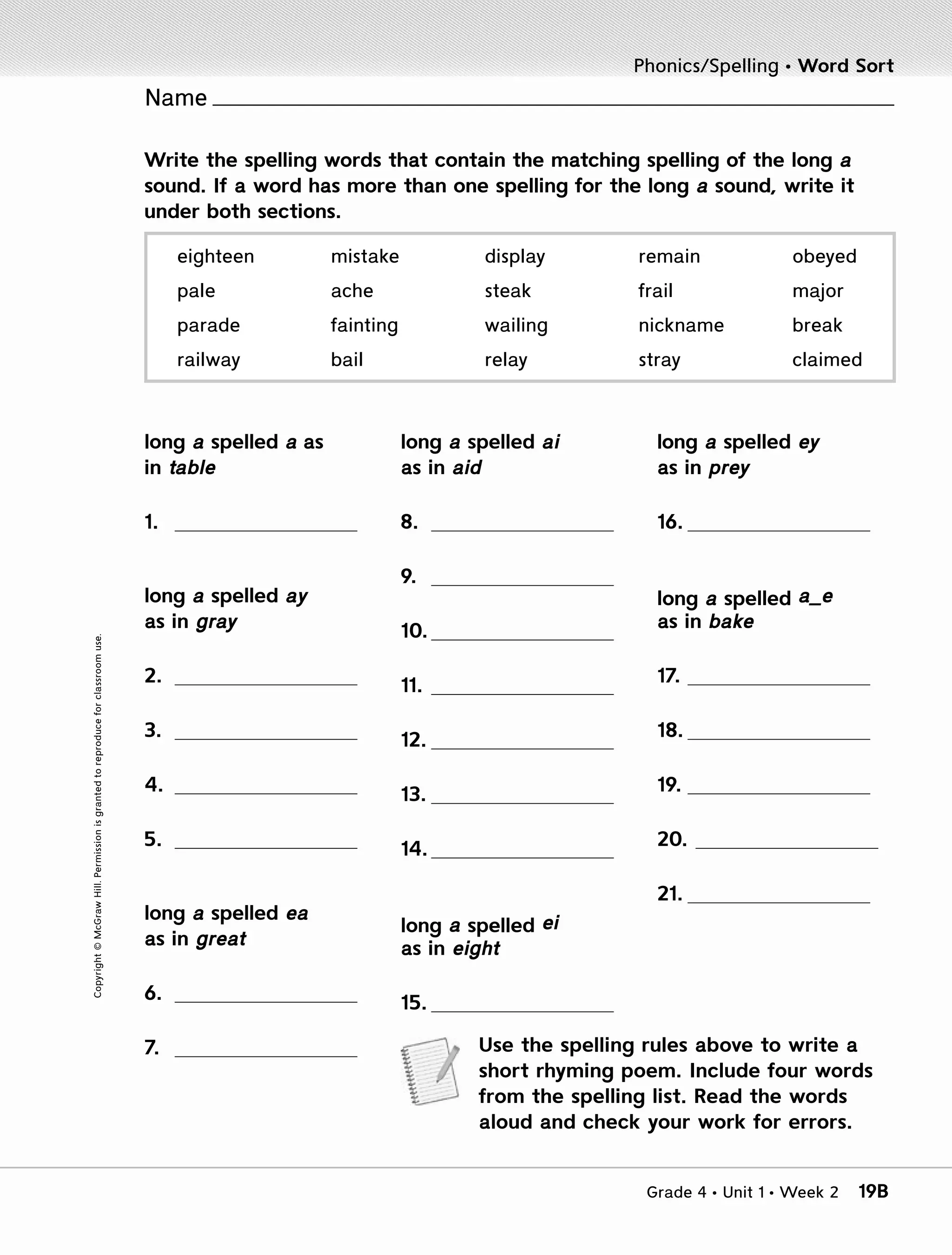
Name
Write the spelling words that contain the matching spelling of the long a
sound. If a word has more than one spelling for the long a sound, write it
under both sections.
eighteen mistake display remain obeyed
pale ache steak frail major
parade fainting wailing nickname break
railway bail relay stray claimed
long a spelled a as
in table
1.
long a spelled ay
as in gray
2.
3.
4.
5.
long a spelled ea
as in great
6.
7.
long a spelled ai
as in aid
8.
9.
10.
11.
12.
13.
14.
long a spelled ei
as in eight
15.
long a spelled ey
as in prey
16.
long a spelled a_e
as in bake
17.
18.
19.
20.
21.
Use the spelling rules above to write a
short rhyming poem. Include four words
from the spelling list. Read the words
aloud and check your work for errors.
Phonics/Spelling • Word Sort
Copyright
©
McGraw
Hill.
Permission
is
granted
to
reproduce
for
classroom
use.
Grade 4 • Unit 1 • Week 2 19B
Name
Name
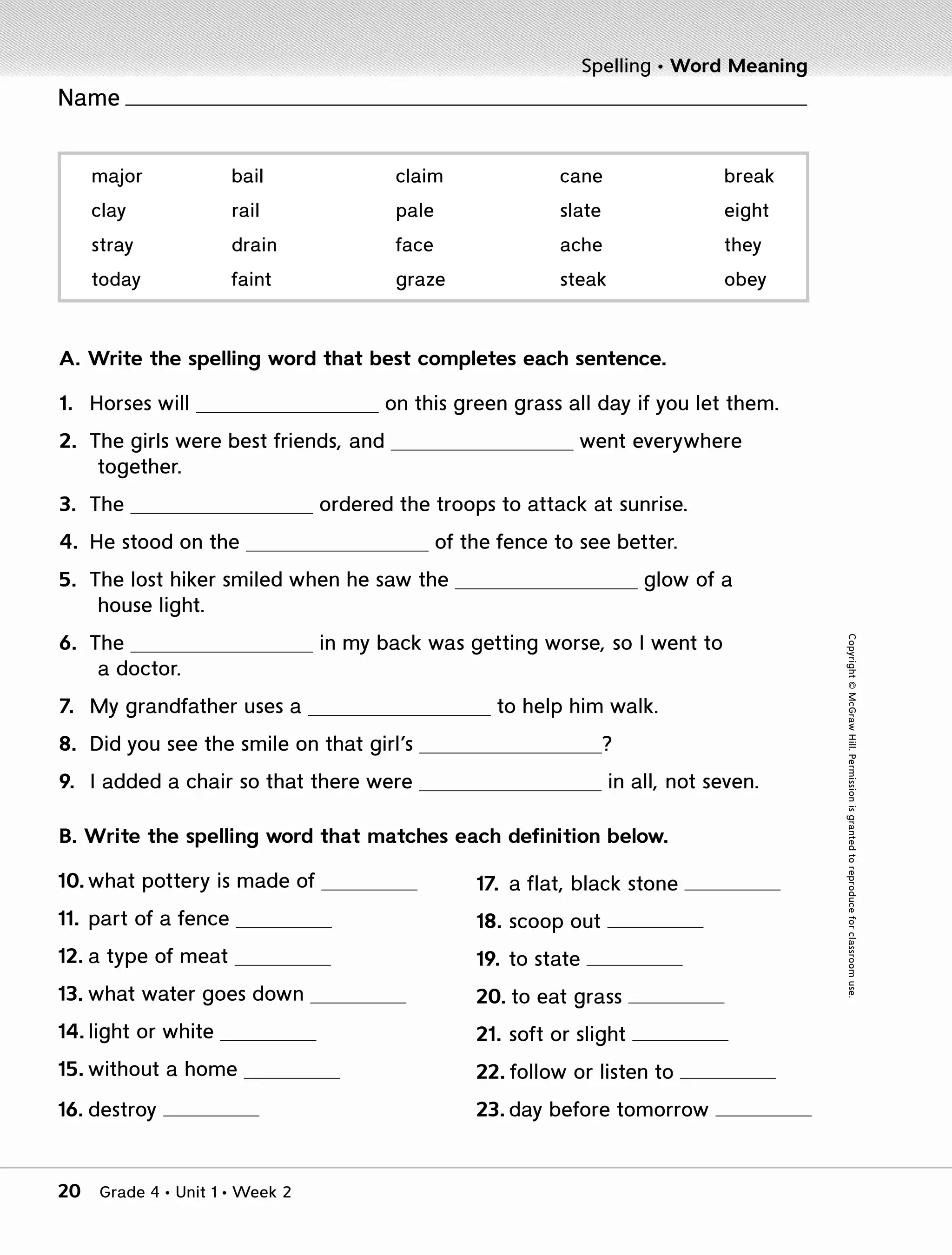
A. Write the spelling word that best completes each sentence.
1. Horses will on this green grass all day if you let them.
2. The girls were best friends, and went everywhere
together.
3. The ordered the troops to attack at sunrise.
4. He stood on the of the fence to see better.
5. The lost hiker smiled when he saw the glow of a
house light.
6. The in my back was getting worse, so I went to
a doctor.
7. My grandfather uses a to help him walk.
8. Did you see the smile on that girl’s ?
9. I added a chair so that there were in all, not seven.
B. Write the spelling word that matches each definition below.
major bail claim cane break
clay rail pale slate eight
stray drain face ache they
today faint graze steak obey
10. what pottery is made of
11. part of a fence
12. a type of meat
13. what water goes down
14.light or white
15. without a home
16. destroy
17. a flat, black stone
18. scoop out
19. to state
20. to eat grass
21. soft or slight
22. follow or listen to
23. day before tomorrow
Spelling • Word Meaning
Copyright
©
McGraw
Hill.
Permission
is
granted
to
reproduce
for
classroom
use.
20 Grade 4 • Unit 1 • Week 2
Name
Circle the six misspelled words in the paragraphs
below. Write the words correctly on the lines.
Keisha bought a cactus at the plant sale todaye.
The seller said that it likes sandy soil, not clai soil.
She will keep the plant on her desk at home. She put
a piece of slayte under it to protect the wood.
Jessie is Keisha’s brother. He adopted a strai cat that pretends it
is in the jungle. Keisha is afraid that the cat will breke her plant.
Jessie says she should not worry. His cat knows how to obay!
1. 4.
2. 5.
3. 6.
Write about a pet you know that gets into trouble. It could
be your pet or someone else’s pet. Use at least four words
from the spelling list. Then check over your work.
Writing Connection
Spelling • Proofreading
Copyright
©
McGraw
Hill.
Permission
is
granted
to
reproduce
for
classroom
use.
Grade 4 • Unit 1 • Week 2 21
The word gate is in bold type.
The word pail is in bold type.
The word shame is in bold type.
The word stay is in bold type.
The word take is in bold type.
The word hooray is in bold type.
The word maze is in bold type.
The word away is in bold type.
The word tail is in bold type.
The word snake is in bold type.
The word pain is in bold type.
The word delay is in bold type.
The word sail is in bold type.
The word train is in bold type.
The word wait is in bold type.
The word play is in bold type.
The word make is in bold type.
The word case is in bold type.
The word paint is in bold type.
The word pager is in bold type.
Name
Circle the word that rhymes with the word in bold type. Write the word.
1. gate strain slate that
2. pail play paid bail
3. shame claim harm slam
4. stay why my they
5. take tack ache act
6. hooray clay wait star
7. maze graze jazz daisy
8. away yawn today toy
9. tail fall spill pale
10. snake break seek neck
11. pain shine drain candle
12. delay later party obey
13. sail rail seal slant
14. train ran trace cane
15. wait part eight salt
16. play plan stray any
17. make steak maid tack
18. case past crack face
19. paint pain faint pant
20. pager major pay judge
Words with the same long vowel sound are not always spelled the same
way. These are some of the most common spelling patterns you will see
for the long a vowel. Read them out loud:
• a as in acorn • ai as in claim • ea as in steak • eigh as in neigh
• ay as in stray • a_e as in take • ei as in eight • ey as in obey
Remember
Phonics/Spelling • Review
Copyright
©
McGraw
Hill.
Permission
is
granted
to
reproduce
for
classroom
use.
22 Grade 4 • Unit 1 • Week 2
The word part is in bold.
The word flash is in bold.
The word banks is in bold.
The word wash is in bold.
Read each passage from “Rising Waters.” Underline the context clues
that help you figure out the meaning of each multiple-meaning word in
bold. Then write the word’s meaning on the line.
1. Have you ever been in an earthquake or a tornado? These terrible
events may never happen where you live. But flooding is something
that can happen in almost every part of the United States.
2. Not all floods are alike. Some floods happen over many days.
A flash flood can happen in minutes. Learning about floods can
help you stay safe.
3. The water in a river rises over the river’s banks. This might happen
because storms have caused too much rain to fall.
4. Floods also cause damage to buildings and bridges. They can even
wash away entire roads! This can make it hard for rescue workers to
help people who are trapped by the water.
Name
Vocabulary • Multiple-Meaning Words
Copyright
©
McGraw
Hill.
Permission
is
granted
to
reproduce
for
classroom
use.
Grade 4 • Unit 1 • Week 2 23
Complete each sentence with a homograph from the box. You will use
each word twice. Then write the letters from the boxes to solve the
riddle at the bottom of the page.
record well content hamper desert
Like homonyms, homographs are words that are spelled the same but
have different meanings and origins. Unlike homonyms, homographs
sometimes have different pronunciations as well. When you see a
homograph in a text, use context clues to figure out the meaning. Here
are some examples:
bow compact console entrance fair object present pupil
1. Alyssa is to sit and read a book.
2. We packed a full of food for the picnic.
3. Theo was afraid we would
	 him at the amusement park.
4. When the dried up, the family had no more water.
5.	Hassan will his favorite show and watch it later.
6. The receives only one inch of rain a year.
7. 	
Beans and whole grains are known for their high fiber .
8. Will bad weather work on the house?
9. You just broke the world for the 100-meter dash!
10.Mara has a sore throat and is not feeling .
What do you find at the end of a rainbow?
Name
Vocabulary • Homographs
Copyright
©
McGraw
Hill.
Permission
is
granted
to
reproduce
for
classroom
use.
24 Grade 4 • Unit 1 • Week 2
Grade 4 Unit 1 Week 3
Read each sentence. On the lines provided, write simple if it has one main,
or independent, clause. Write compound if it has two or more main, or
independent, clauses.
1. I wanted to go to the concert, but my parents wouldn’t let me.
2. Mrs. Gupta lives on a very busy road in the middle of the city.
3. He got a hot dog, she got a hamburger, and you got a salad.
4. Can we go to the movies later this evening?
5. There are too many stars in the sky to count all of them.
6. The little puppy was adopted quickly, for it was very sweet.
7. The balloon drifted up into the fluffy clouds above.
8. We left early, yet the traffic on the highway still made us late.
9. Do you want to read a book, or would you like to take a walk?
10. My cousin thinks he was lucky to get into his favorite college.
Use the sentences as a model. In your writer’s notebook, write a
short passage about a great dream you have had. Make sure to
include simple and compound sentences. Then edit your work.
• A clause is a group of words that has a subject and a verb.
• A main, or independent, clause can stand alone as a sentence. I love
playing video games.
• A simple sentence has one independent clause. Devon played with
the puppy.
• A compound sentence has two or more independent clauses.
I wanted to go to the mall, but I had to finish my chores.
Name
Grammar • Simple and Compound Sentences
Copyright
©
McGraw
Hill.
Permission
is
granted
to
reproduce
for
classroom
use.
Grade 4 • Unit 1 • Week 3 25
Writing Connection
Read each sentence. Circle the coordinating conjunction that best completes
the sentence and write it on the line provided.
1. We can go to Florida for vacation, (or / nor) we can visit California.
2. My sister asked me to go with her, (for / but) I did not want to.
3. I brought a stool into the kitchen, (or / for) I could not reach the cabinet.
4. The ostrich has feathers and wings, (yet / nor) this bird cannot fly.
5. Haley is good at math, (but / for) Raul is better at science.
Think about your favorite season. Write two compound
sentences and two simple sentences about why that time
of year is your favorite. Then check that you used the
best coordinating conjunctions in your sentences.
• A clause has a subject and a verb. A main, or independent, clause
can stand alone as a sentence.
• A simple sentence has one independent clause. A compound sentence
has two or more independent clauses.
• Independent clauses in a compound sentence are usually joined by a
coordinating conjunction, such as and, but, or, for, nor, or yet.
Conjunctions also join words and phrases in sentences.
Alex had to wash the dog, but there was no more soap.
Name
Grammar • Conjunctions
Copyright
©
McGraw
Hill.
Permission
is
granted
to
reproduce
for
classroom
use.
26 Grade 4 • Unit 1 • Week 3
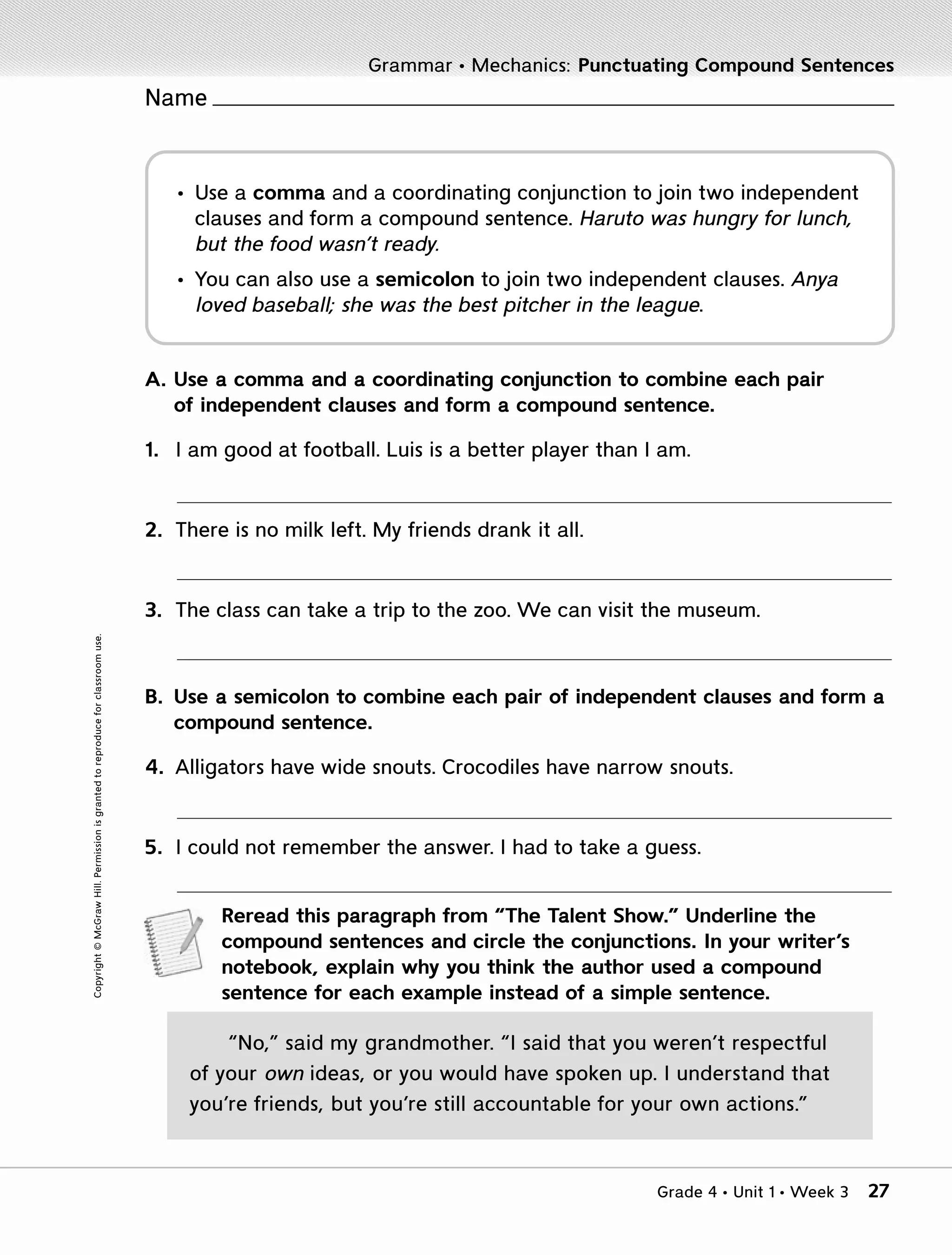
Reread this paragraph from “The Talent Show.” Underline the
compound sentences and circle the conjunctions. In your writer’s
notebook, explain why you think the author used a compound
sentence for each example instead of a simple sentence.
“No,” said my grandmother. “I said that you weren’t respectful
of your own ideas, or you would have spoken up. I understand that
you’re friends, but you’re still accountable for your own actions.”
A. Use a comma and a coordinating conjunction to combine each pair
of independent clauses and form a compound sentence.
1. I am good at football. Luis is a better player than I am.
2. There is no milk left. My friends drank it all.
3. The class can take a trip to the zoo. We can visit the museum.
B. Use a semicolon to combine each pair of independent clauses and form a
compound sentence.
4. Alligators have wide snouts. Crocodiles have narrow snouts.
5. I could not remember the answer. I had to take a guess.
• Use a comma and a coordinating conjunction to join two independent
clauses and form a compound sentence. Haruto was hungry for lunch,
but the food wasn’t ready.
• You can also use a semicolon to join two independent clauses. Anya
loved baseball; she was the best pitcher in the league.
Name
Grammar • Mechanics: Punctuating Compound Sentences
Copyright
©
McGraw
Hill.
Permission
is
granted
to
reproduce
for
classroom
use.
Grade 4 • Unit 1 • Week 3 27
Rewrite the paragraph below, correcting any mistakes you find in the
conjunctions and punctuation in compound sentences.
The mustang is America’s symbol of the Wild West. These horses once
roamed free; yet today there are few remaining. People are trying to save the
mustangs that are left. And we should do what we can to help.
• A clause has a subject and a verb. An independent clause can stand
alone as a sentence.
• A simple sentence has one independent clause. A compound sentence
has two or more independent clauses.
• Independent clauses in a compound sentence are usually joined by a
coordinating conjunction, such as and, but, or, for, nor, or yet.
• Use a comma with a coordinating conjunction or a semicolon to join
two independent clauses and form a compound sentence.
Connecting two sentences using a comma is
an error called a comma splice. Either add a
conjunction after the comma or replace the
comma with a semicolon.
COMMON ERRORS
	
Look back through your writer’s notebook and find compound
sentences you have written. Check that you used commas before
coordinating conjunctions.
Name
Grammar • Proofreading
Copyright
©
McGraw
Hill.
Permission
is
granted
to
reproduce
for
classroom
use.
28 Grade 4 • Unit 1 • Week 3
Read the selection that follows. Then answer the questions.
(1) Everyone in my class is good at different things. (2) Aaron is the
fastest runner in the entire school. (3) Shari, my best friend, can throw
a ball farther than anyone I know. (4) What about me? (5) I am good
at some things, and I am bad at others.
Read the student draft that follows. Then answer the questions.
(1) He does not play video games. (2) He does not watch television.
(3) He goes to bed early. (4) He is still tired the next day.
3. Which conjunction best
combines sentences 1 and 2?
A 	
He does not play video games,
for he does not watch television.
B 	
He does not play video games,
but he does not watch television.
C 	
He does not play video games,
and he does not watch television.
D 	
He does not play video games,
or he does not watch television.
4. Which conjunction best
combines sentences 3 and 4?
F He goes to bed early, but he is still
tired the next day.
G He goes to bed early, or he is still
tired the next day.
H He goes to bed early, for he is still
tired the next day.
J He goes to bed early, nor he is still
tired the next day.
1. Which sentence is a
compound sentence?
A Sentence 1
B Sentence 2
C Sentence 4
D Sentence 5
2. What word in sentence 5 is
a coordinating conjunction?
F am
G at
H and
J bad
Name
Grammar • Test: Simple and Compound Sentences
Copyright
©
McGraw
Hill.
Permission
is
granted
to
reproduce
for
classroom
use.
Grade 4 • Unit 1 • Week 3 29
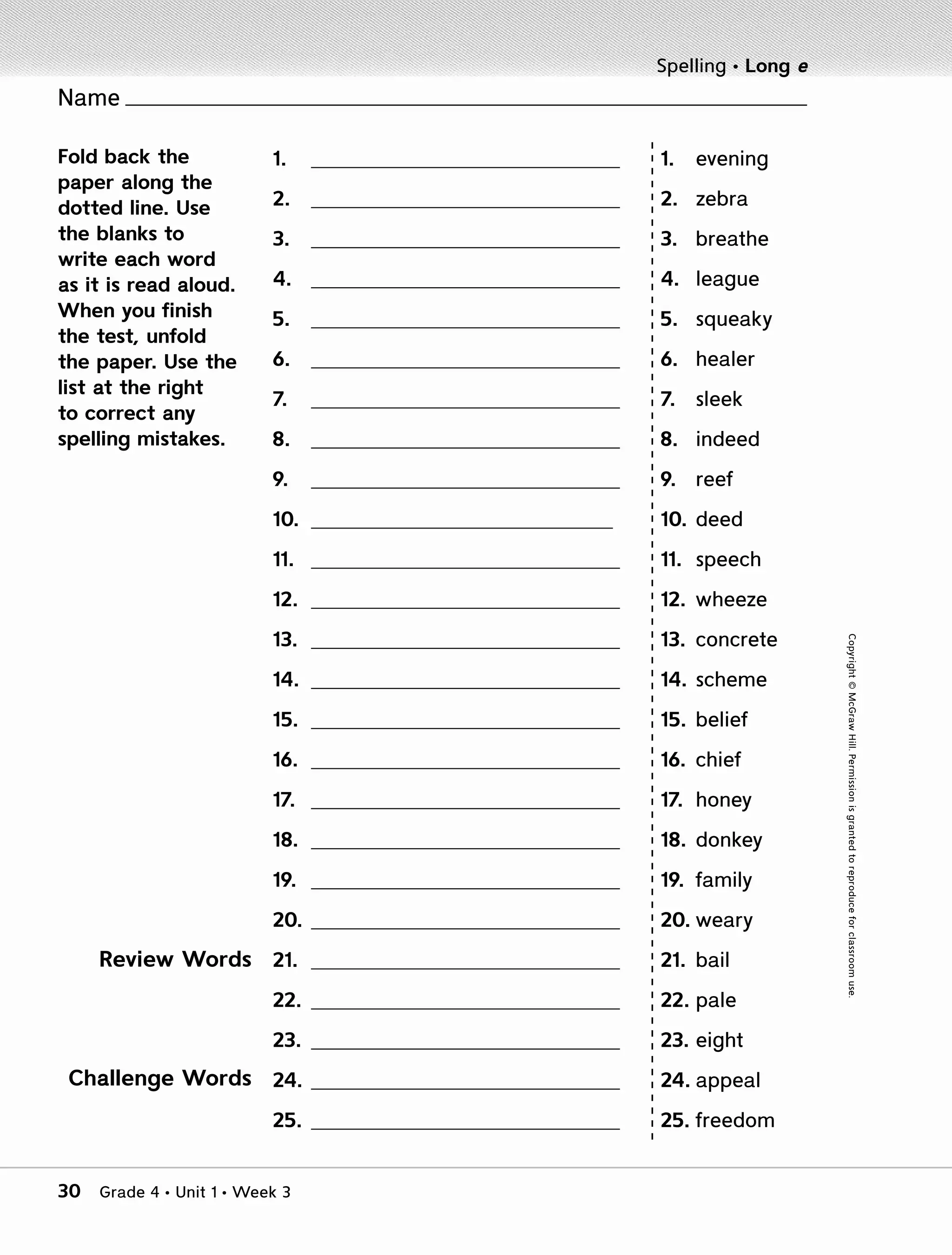
Fold back the
paper along the
dotted line. Use
the blanks to
write each word
as it is read aloud.
When you finish
the test, unfold
the paper. Use the
list at the right
to correct any
spelling mistakes.
1. 1. evening
2. 2. zebra
3. 3. breathe
4. 4. league
5. 5. squeaky
6. 6. healer
7. 7. sleek
8. 8. indeed
9. 9. reef
10. 10. deed
11. 11. speech
12. 12. wheeze
13. 13. concrete
14. 14. scheme
15. 15. belief
16. 16. chief
17. 17. honey
18. 18. donkey
19. 19. family
20. 20. weary
21. 21. bail
22. 22. pale
23. 23. eight
24. 24. appeal
25. 25. freedom
Review Words
Challenge Words
Name
Spelling • Long e
Copyright
©
McGraw
Hill.
Permission
is
granted
to
reproduce
for
classroom
use.
30 Grade 4 • Unit 1 • Week 3
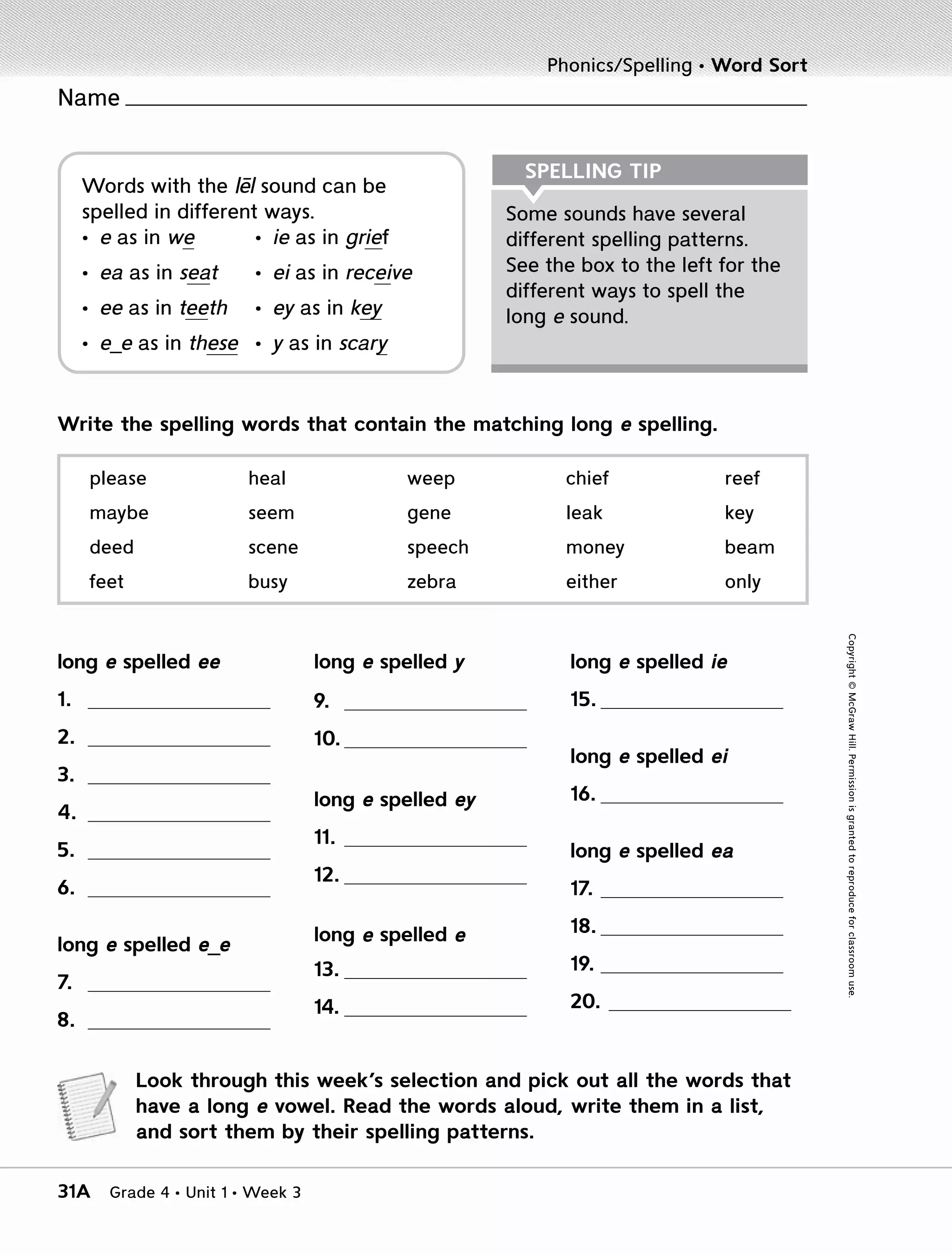
Words with the |ē| sound can be
spelled in different ways.
• e as in we • ie as in grief
• ea as in seat • ei as in receive
• ee as in teeth • ey as in key
• e_e as in these • y as in scary
Some sounds have several
different spelling patterns.
See the box to the left for the
different ways to spell the long
e sound.
SPELLING TIP
Look through this week’s selection and pick out all the words that
have a long e vowel. Read the words aloud, write them in a list,
and sort them by their spelling patterns.
long e spelled ee
1.
2.
3.
4.
5.
6.
long e spelled e_e
7.
8.
9.
long e spelled y
10.
11.
long e spelled ea
and y
12.
long e spelled ie
13.
14.
long e spelled ea
15.
16.
17.
long e spelled ey
18.
19.
long e spelled e
20.
evening indeed honey breathe reef
deed family zebra scheme donkey
concrete belief speech sleek healer
league squeaky wheeze chief weary
Write the spelling words that contain the matching long e spelling.
Name
Phonics/Spelling • Word Sort
Copyright
©
McGraw
Hill.
Permission
is
granted
to
reproduce
for
classroom
use.
Grade 4 • Unit 1 • Week 3 31
long e spelled ee
1.
2.
3.
4.
5.
6.
long e spelled e_e
7.
8.
long e spelled y
9.
10.
long e spelled ey
11.
12.
long e spelled e
13.
14.
long e spelled ie
15.
long e spelled ei
16.
long e spelled ea
17.
18.
19.
20.
Look through this week’s selection and pick out all the words that
have a long e vowel. Read the words aloud, write them in a list,
and sort them by their spelling patterns.
please heal weep chief reef
maybe seem gene leak key
deed scene speech money beam
feet busy zebra either only
Words with the |ē| sound can be
spelled in different ways.
• e as in we • ie as in grief
• ea as in seat • ei as in receive
• ee as in teeth • ey as in key
• e_e as in these • y as in scary
Some sounds have several
different spelling patterns.
See the box to the left for the
different ways to spell the
long e sound.
SPELLING TIP
Write the spelling words that contain the matching long e spelling.
Name
Phonics/Spelling • Word Sort
Copyright
©
McGraw
Hill.
Permission
is
granted
to
reproduce
for
classroom
use.
31A Grade 4 • Unit 1 • Week 3
long e spelled ee
1.
2.
3.
4.
5.
long e spelled e_e
6.
7.
8.
long e spelled y
9.
10.
long e spelled ie
11.
12.
13.
long e spelled ey
14.
15.
long e spelled ea
16.
17.
18.
19.
20.
21.
long e spelled e
22.
Look through this week’s selection and pick out all the words that
have a long e vowel. Read the words aloud, write them in a list,
and sort them by their spelling patterns.
evening tea honeybee breathe eerie
thirteen mystery feline scheme donkey
concrete belief succeed appealing creature
league increased wheeze chief weary
Write the spelling words that contain the matching long e spelling. If a
word has more than one spelling for the long e sound, write it under
both sections.
Name
Phonics/Spelling • Word Sort
Copyright
©
McGraw
Hill.
Permission
is
granted
to
reproduce
for
classroom
use.
Grade 4 • Unit 1 • Week 3 31B
A. An analogy is a statement that compares sets of words. Write the spelling
word that best completes each analogy below.
1. Happy is to glad as tired is to .
2. Colors is to rainbow as teams is to .
3. Song is to tune as plan is to .
4. Sun is to moon as morning is to .
5. Teacher is to instructor as leader is to .
6. Early is to late as low-pitched is to .
7. Promise is to vow as act is to .
8. Carpenter is to builder as doctor is to .
9. Dog is to wolf as horse is to .
10. Warm is to cool as dull is to .
B. Write the spelling word that matches each definition below.
11. breathe roughly
12. way of thinking
13. something spoken
14. brothers and sisters
15. underwater ridge
16. actually
17. take air into lungs
18. cement mixture
19. what bees make
20. striped horse-like animal
evening squeaky reef concrete honey
zebra healer deed scheme donkey
breathe sleek speech belief family
league indeed wheeze chief weary
Name
Spelling • Word Meaning
Copyright
©
McGraw
Hill.
Permission
is
granted
to
reproduce
for
classroom
use.
32 Grade 4 • Unit 1 • Week 3
Underline the six misspelled words in the paragraphs below.
Write the words correctly on the lines.
Being sick is not fun. A cold can give you a sore throat and a runny
nose. Sometimes you may cough or wheze. A cold can be worse in the
eavening, when you go to bed. It can even keep you up all night.
This makes you feel fuzzy and wearie in the morning.
People do different things to get rid of a cold. Some people drink
hot water or tea with hony. Others breethe steamy air to feel better.
They may even see a doctor or other heler. Most of the time, rest is the
best way to get rid of a cold.
1. 4.
2. 5.
3. 6.
Write about how you feel when you catch a cold.
Review the spelling rules for words with long e before
you write. Use at least four words from the spelling list.
Writing Connection
Name
Spelling • Proofreading
Copyright
©
McGraw
Hill.
Permission
is
granted
to
reproduce
for
classroom
use.
Grade 4 • Unit 1 • Week 3 33
The word reach is in bold type.
The word peeler is in bold type.
The word dream is in bold type.
The word teethe is in bold type.
The word mistreat is in bold type.
The word creaky is in bold type.
The word leaf is in bold type.
The word reread is in bold type.
The word weak is in bold type.
The word beef is in bold type.
The word money is in bold type.
The word thief is in bold type.
The word cheery is in bold type.
The word bead is in bold type.
The word please is in bold type.
Words with the same long vowel sound are not always spelled the same
way. These are some of the most common spelling patterns you will see
for the long e vowel. Read these words aloud:
• e as in feline • e_e as in eve • ey as in monkey
• ea as in creature • ie as in belief • y as in wary
• ee as in succeed • ei as in conceive
Remember
B. Write these spelling words in alphabetical order:
evening, donkey, league, zebra, family.
16. 18. 20.
17. 19.
A. Circle the word that rhymes with the word in bold type. Write the word.
1. reach rich speech patch
2. peeler parlor seller healer
3. dream rein scheme deep
4. teethe breathe reed with
5. mistreat concrete reset create
6. creaky shaky funny squeaky
7. leaf left chief stuff
8. reread indeed complete rounded
9. weak deck sleek sink
10. beef birth feed belief
11. money honey many penny
12. thief third cliff reef
13. cheery very weary chair
14.bead deed lend belt
15. please need this wheeze
Name
Phonics/Spelling • Review
Copyright
©
McGraw
Hill.
Permission
is
granted
to
reproduce
for
classroom
use.
34 Grade 4 • Unit 1 • Week 3
uncomfortably
Write as many words related to uncomfortably as you can think of.
Write them in the toes. Use a dictionary to help you.
Expand your vocabulary by adding or removing inflectional endings,
prefixes, or suffixes to a base word to create different forms of a word.
inspired
inspire
inspiration
inspirational
inspirations
inspirationally
Name
Vocabulary • Related Words
Copyright
©
McGraw
Hill.
Permission
is
granted
to
reproduce
for
classroom
use.
Grade 4 • Unit 1 • Week 3 35
High-frequency words are the most common words in the English language.
Many of them cannot be sounded out. They do not follow regular sound or
spelling patterns. Most cannot be illustrated. The more you read and write
them, the easier they are to remember. Read these high-frequency words
out loud.
Reread this excerpt from “The Talent Show.” Underline any high-
frequency words listed in the box. Underline each word only once.
we how best always with
all that don’t then could
but my see together was
think own about yellow up
would after this more myself
During math, I tried to think of how I would tell Tina that
I wanted to do my own act. After all, we are best friends; we
should be able to see eye to eye about this. The problem is
Tina always takes charge, I don’t speak up, and then I would
end up feeling resentful about the whole situation.
I desperately wanted to win, but it was more than that.
I wanted to win on my own—with an act that I did myself.
Think of a time you did something fun with a friend. Write
four sentences about this experience. Underline all the high-
frequency words from the box that appear in your writing.
Reading/Writing
Connection
Copyright
©
McGraw
Hill.
Permission
is
granted
to
reproduce
for
classroom
use.
36 Grade 4 • Unit 1 • Week 3
Name
Vocabulary • High-Frequency Words
Grade 4 Unit 1 Week 4
Read each clause. On the lines provided, write I if the clause is independent
and can stand alone as a sentence. Write D if it is dependent and cannot.
Underline the subordinating conjunction in each dependent clause.
1. She got a perfect score.
2. Because she was so smart.
3. When it was time to go.
4. The school bell rang.
5. Because of the heat outside.
6. I felt very sleepy.
7. The doctor helped.
8. Before I could ask.
• A clause is a group of words that has a subject and a verb. A main, or
independent, clause can stand alone as a sentence. My dad flew on
a plane to Texas.
• A subordinate, or dependent, clause usually begins with a
subordinating conjunction, such as before, when, or because.
A dependent clause cannot stand alone: before the sun rose.
Conjunctions also join words and phrases in sentences.
In your writer’s notebook, write about a great adventure that you
had. Include at least two sentences with dependent clauses. Circle
the subordinating conjunctions.
Name
Grammar • Clauses
Copyright
©
McGraw
Hill.
Permission
is
granted
to
reproduce
for
classroom
use.
Grade 4 • Unit 1 • Week 4 37
Read each sentence and circle the subordinating conjunction. Based on the
conjunction, write relative pronoun or relative adverb on the line provided.
1. Call me when you arrive.
2. This is Harry, whom I met yesterday.
3. I fixed the lock, which wasn’t easy!
4. This is the place where we had lunch.
5. I know the reason why we can’t go.
• An independent, or main, clause can stand alone as a sentence, but
a dependent, or subordinate, clause cannot. A dependent clause
usually begins with a subordinating conjunction.
• A complex sentence includes an independent clause and one or more
dependent clauses. I like to hang out with Sarah, who is my best friend.
• The subordinating conjunctions who, whose, whom, which, and that
are called relative pronouns.
• The subordinating conjunctions where, when, and why are called
relative adverbs.
Read this sentence from “Speaking Out to Stop Bullying.” Circle
the subordinating conjunction and identify it as a relative
pronoun or a relative adverb. Then rewrite the sentence so that
the subordinating conjunction appears earlier in the sentence.
Reading/Writing
Connection
Bullying occurs when a person uses aggressive
behavior to hurt others on purpose.
Name
Grammar • Clauses and Complex Sentences
Copyright
©
McGraw
Hill.
Permission
is
granted
to
reproduce
for
classroom
use.
38 Grade 4 • Unit 1 • Week 4
Read each sentence. Decide if a clause needs a comma. If it does, rewrite
the sentence correctly on the line provided. If it does not, write No change
needed on the line.
1. When I get up in the morning I am hungry.
2. Before the clock struck twelve Cinderella had to be home.
3. Camille closes her eyes before going underwater.
4. Ants are amazing because they work together to complete a task.
• When an independent, or main, clause begins a complex sentence,
it is usually not followed by a comma. I like to walk in the park when I
exercise.
• When a dependent, or subordinate, clause begins a complex
sentence, it is usually followed by a comma. When I exercise, I like to
walk in the park.
Write two complex sentences including relative adverbs
about your favorite outdoor activity. Then edit your work.
Writing Connection
Name
Grammar • Mechanics: Punctuate Complex Sentences
Copyright
©
McGraw
Hill.
Permission
is
granted
to
reproduce
for
classroom
use.
Grade 4 • Unit 1 • Week 4 39
Rewrite the sentences below, adding commas and
correcting mistakes in punctuation.
1. Because of the wind did the power lines come down.
2. I was four years old, when my brother was born.
3. She welcomed the people who just moved in?
4. When a year has passed Earth has revolved once around the sun.
5. Turn off the timer, that is buzzing in the kitchen.
6. Before I got my shoes I put on my socks.
• A complex sentence includes an independent clause and one or
more dependent clauses. An independent clause can stand alone as
a sentence, but a dependent clause cannot.
• Dependent clauses use subordinating conjunctions, including relative
pronouns and relative adverbs.
• When an independent clause begins a complex sentence, it usually is
not followed by a comma.
• When a dependent clause begins a complex sentence, it usually is
followed by a comma.
Name
Copyright
©
McGraw
Hill.
Permission
is
granted
to
reproduce
for
classroom
use.
40 Grade 4 • Unit 1 • Week 4
Grammar • Proofreading
Read the selection that follows. Then answer the questions.
(1) Because it was fall, the leaves were falling off the trees. (2) My
dad made soup for dinner because the nights were getting so cold.
(3) Dad invited someone over for dinner. (4) I didn’t know who it was.
(5) I hope they come before the soup gets cold!
Read the student draft that follows. Then answer the questions.
(1) You left the room when the bell rang for lunch. (2) I watched
where you went. (3) Did you see who was in the car? (4) Your dad
said you could come home with me because we need to work on the
project. (5) You should follow me because I go home.
5. What is the correct way to write sentence 5?
A You should follow me who I go home.
B You should follow me when I go home.
C You should follow me, when I go home.
D No change needs to be made.
1. Which part of sentence 1 is
an independent clause?
A Because it was fall
B Because it was fall, the leaves
C the leaves were falling off the trees
D falling off the trees
2. Which word is the subordinating
conjunction in sentence 4?
F didn’t
G know
H who
J was
3. Which part of sentence 5 is a
dependent clause?
A I hope they come
B they come before
C the soup gets cold
D before the soup gets cold
4. Which word is the subordinating
conjunction in sentence 1?
F Because
G was
H were
J off
Name
Grammar • Test: Clauses and Complex Sentences
Copyright
©
McGraw
Hill.
Permission
is
granted
to
reproduce
for
classroom
use.
Grade 4 • Unit 1 • Week 4 41
Spelling • Long i
Fold back the
paper along the
dotted line. Use
the blanks to
write each word
as it is read aloud.
When you finish
the test, unfold
the paper. Use the
list at the right
to correct any
spelling mistakes.
1. 1. climb
2. 2. minding
3. 3. pies
4. 4. die
5. 5. height
6. 6. sigh
7. 7. fright
8. 8. slight
9. 9. drive
10. 10. file
11. 11. kite
12. 12. prime
13. 13. pride
14. 14. slice
15. 15. twice
16. 16. wipe
17. 17. pry
18. 18. sly
19. 19. shy
20. 20. spy
21. 21. chief
22. 22. zebra
23. 23. sleek
24. 24. highway
25. 25. wildlife
Review Words
Challenge Words
Name
Copyright
©
McGraw
Hill.
Permission
is
granted
to
reproduce
for
classroom
use.
42 Grade 4 • Unit 1 • Week 4
Write the spelling words that contain the matching spelling of the
long i sound. Then read the words aloud.
Some sounds have several
different spelling patterns.
See the box to the left for
the different ways to spell
the long i sound.
SPELLING TIP
Words with the / ī / sound can be
spelled in different ways.
• i as in mind • i_e as in pride
• ie as in pie • y as in fly
• igh as in night
long i spelled i_e
1.
2.
3.
4.
5.
6.
7.
8.
long i spelled igh
9.
10.
11.
12.
long i spelled ie
13.
14.
long i spelled y
15.
16.
17.
18.
long i spelled i
19.
20.
Use the spelling rules above to write a
short rhyming poem. Include four words
from the spelling list. Check your work for
errors.
climb sly drive minding pry
pride kite pies slice die
shy twice sigh fright file
height slight prime wipe spy
Name
Phonics/Spelling • Word Sort
Copyright
©
McGraw
Hill.
Permission
is
granted
to
reproduce
for
classroom
use.
Grade 4 • Unit 1 • Week 4 43
climb sly mind minding cry
pride kite pies inside die
shy twice sigh flight file
alike time line wipe spy
Write the spelling words that contain the matching spelling of the
long i sound. Then read the words aloud.
Some sounds have several
different spelling patterns.
See the box to the left for
the different ways to spell
the long i sound.
SPELLING TIP
Words with the / ī / sound can be
spelled in different ways.
• i as in mind • i_e as in pride
• ie as in pie • y as in fly
• igh as in night
long i spelled i_e
1.
2.
3.
4.
5.
6.
7.
8.
9.
long i spelled igh
10.
11.
long i spelled y
12.
13.
14.
15.
long i spelled ie
16.
17.
long i spelled i
18.
19.
20.
Use the spelling rules above to write a
short rhyming poem. Include four words
from the spelling list. Check your work
for errors.
Name
Phonics/Spelling • Word Sort
Copyright
©
McGraw
Hill.
Permission
is
granted
to
reproduce
for
classroom
use.
43A Grade 4 • Unit 1 • Week 4
climb slyly lightning minding pry
pride reminded tightly likely die
shiny twice sigh frightened filed
height slightly prime wiping spy
Write the spelling words that contain the matching spelling of the
long i sound. Then read the words aloud.
long i spelled i_e
1.
2.
3.
4.
5.
long i spelled y
6.
7.
8.
long i spelled igh
9.
10.
11.
12.
13.
14.
long i spelled ie
15.
long i spelled i
16.
17.
18.
19.
20.
Use the spelling rules above to write a short rhyming poem. Include
four words from the spelling list. Check your work for errors.
Name
Phonics/Spelling • Word Sort
Copyright
©
McGraw
Hill.
Permission
is
granted
to
reproduce
for
classroom
use.
Grade 4 • Unit 1 • Week 4 43B
A. Write the spelling word that is the antonym, or opposite, of each
word below.
1. fearlessness
2. significant
3. secondary
4. live
5. bold
B. Write the spelling word that matches each definition below.
6. toy that flies
7. to force open
8. to go upward
9. two times
10. to watch secretly
11. self-respect
12. a release of breath
13. a folder of records
14.attending to
15. fruit and pastry desserts
16. how tall something is
17. clever or cunning
18. a piece that is
cut
19. to dry or clean
20. to control a car
climb height drive pride pry
minding sigh file slice sly
pies fright kite twice shy
die slight prime wipe spy
Name
Spelling • Word Meaning
Copyright
©
McGraw
Hill.
Permission
is
granted
to
reproduce
for
classroom
use.
44 Grade 4 • Unit 1 • Week 4
Circle the six misspelled words in the paragraphs below. Write the words
correctly on the lines.
How many stars can you spie at night? The prighm time to see stars
is when there is no moon in the sky. This is when it is very dark out.
Even a slyce of moon can change what you see in the sky at night.
People leave the city to see the stars. They may clime a hill to get
closer to the sky. Or they may driv to the top of a mountain. The hite
of the place does not really matter. The darker it is, the more stars you
will see.
1. 4.
2. 5.
3. 6.
Write about something else you can see at night.
Use at least four words from the spelling list.
Writing Connection
Name
Spelling • Proofreading
Copyright
©
McGraw
Hill.
Permission
is
granted
to
reproduce
for
classroom
use.
Grade 4 • Unit 1 • Week 4 45
The word time is in bold type.
The word bite is in bold type.
The word tie is in bold type.
The word while is in bold type.
The word nice is in bold type.
The word guys is in bold type.
The word chime is in bold type.
The word lie is in bold type.
The word advice is in bold type.
The word might is in bold type.
The word white is in bold type.
The word bye is in bold type.
The word right is in bold type.
The word high is in bold type.
Words with the same long vowel sound are not always spelled the same
way. These are some of the most common spelling patterns you will see
for the long i vowel. Read these words aloud:
• i as in mind • i_e as in pride
• ie as in pie • y as in fly
• igh as in night
A. Circle the word that rhymes with the word in bold type. Write the word.
1. time thin came prime
2. bite height late split
3. tie spy fine rim
4. while will file pail
5. guys pies toys breeze
6. nice race wise twice
7. chime find sign climb
8. lie glide sly lay
9. advice cries voice slice
10. might kite wait big
11. white hit fright what
12. bye kind bait die
13. right thigh slight grind
14. high shy filled night
15. my mine rein sigh
B. Write these spelling words in alphabetical order. Alphabetize them to the
third letter. pry, drive, pride, wipe, minding
16.
17.
18.
19.
20.
Remember
Name
Phonics/Spelling • Review
Copyright
©
McGraw
Hill.
Permission
is
granted
to
reproduce
for
classroom
use.
46 Grade 4 • Unit 1 • Week 4
The word my is in bold type.
A. Idioms are phrases that have a meaning different from the meaning
of each word in the phrase. Read the idioms in the box. Find and
underline an idiom in each sentence below. Then circle the context
clues that help you understand the idiom.
butterflies in my stomach between a rock and a hard place
right off the bat get off on the wrong foot
1. Every time I got on the school bus, I felt sick, and got butterflies in my
stomach. I had recently moved to a new school, and no one on the bus
talked to me. I was certain I would never make any new friends.
2. Right off the bat, the very first week of school, I was in deep trouble.
3. I felt like I was stuck between a rock and a hard place. I wanted
desperately to tell the truth, but that would mean getting Corey into
trouble.
4. I didn’t want to get off on the wrong foot or make a bad impression.
1. The test was a piece of cake because the questions were so easy.
2. He kept bothering me until I told him to cut it out.
B. Read the sentences below. Underline each idiom. For each idiom,
write a definition in your own words.
Vocabulary • Idioms
Name
Copyright
©
McGraw
Hill.
Permission
is
granted
to
reproduce
for
classroom
use.
Grade 4 • Unit 1 • Week 4 47
Homophones are words that sound the same but have different spellings
and meanings. They are often commonly used words. Look at the
examples below.
break/brake cent/scent flour/flower weather/whether
When you write, make sure you use the correct spellings for any homophones.
These newspaper headlines need help! The reporters used the wrong
homophones. Rewrite each headline so that it has all the correct words.
Use a dictionary to check your work.
1. Meteorologists Calling for Reign across the Dessert Southwest
2. Local Teenager Already Board with Dad’s Tail of Childhood
3. Prior to Budget Cuts, Lawn of State Capital Building Was Moan
Weakly
4. Firefighters Lose There Hoses in Bazaar Feet of Forgetfulness
5. Cowboy Goes Horse While Yelling to His Heard
Vocabulary • Homophones
Name
Copyright
©
McGraw
Hill.
Permission
is
granted
to
reproduce
for
classroom
use.
Photo
credit:
Nicemonkey/Alamy
Stock
Photo
48 Grade 4 • Unit 1 • Week 4
Grade 4 Unit 1 Week 5
Correct each run-on sentence and comma splice by separating it into two
sentences or combining the clauses correctly.
1. We have a new car it is bright red.
2. I must hurry up, the store will close shortly.
3. The dog ran to meet its owner it was happy to see him.
4. The baby looked up the sun was shining but clouds were rolling in.
5. Snowflakes come in different sizes but I like big snowflakes best.
6. She was nervous when she got on stage there were so many people!
• A run-on sentence combines two or more independent clauses
incorrectly. I walked in the snow it was cold.
• A comma splice happens when two independent clauses are joined
with a comma. He ran in the street, the car stopped.
• Fix a run-on sentence by writing separate sentences or combining
the sentences correctly. I walked in the snow. It was cold. I walked in
the snow; it was cold. I walked in the snow, and it was cold.
In your writer’s notebook, write about a day when things did not
go your way. Include simple and compound sentences in your work.
Check your work to make sure you avoided run-on sentences.
Grammar • Run-On Sentences
Name
Copyright
©
McGraw
Hill.
Permission
is
granted
to
reproduce
for
classroom
use.
Grade 4 • Unit 1 • Week 5 49
Name
A run-on sentence combines two or more independent clauses incorrectly.
1. It may be missing a coordinating conjunction and comma.
summer is coming I can’t wait for summer break.
2. It may include a comma splice, but it does not include a coordinating
conjunction or connecting word.
Summer is coming, I can’t wait for summer break.
3. It may include a comma and coordinating conjunction, but it has too
many independent clauses.
Summer is coming, and I can’t wait for summer break, and I am
excited to go swimming.
A sentence fragment may lack a subject or verb, or both; it can also be
a dependent clause.
4. Missing a verb:
A new blue car.
5. Missing a subject:
Waited for you a long time.
6.Missing a subject and a verb:
From ten o’clock on.
7. Dependent clause:
Before he had written.
Read each sentence. Write C if the sentence is written correctly. If it is a
run-on sentence or sentence fragment write the number from above that
correctly describes the sentence.
1. We tried to catch the mouse, it got away.
2. The student was shy and did not make friends quickly.
3. The joke was funny everyone laughed at it.
4. You should bring an umbrella because it is raining outside.
5. I have a game, and my family plays it with me, and it is fun.
6. Only three of the gray and black kittens.
7. Goes faster and faster all the time.
Grammar • Types of Run-On Sentences
Copyright
©
McGraw
Hill.
Permission
is
granted
to
reproduce
for
classroom
use.
50 Grade 4 • Unit 1 • Week 5
Name
Rewrite the sentence correctly on the line provided.
1. Likes to eat oatmeal and waffles for dinner sometimes.
2. Told her to call me later, but she didn’t.
3. They carried the bags, I held the door for them.
4. I practice hard but I’m still not the best player.

Write two simple sentences and two compound sentences
about an activity you wish your school had. Edit your
sentences to avoid run-ons, comma splices, and fragments.
• A sentence has a subject and a predicate. A fragment is a group of
words in a simple or compound sentence that is missing a subject, a
predicate, or both. To correct a fragment, finish the thought. Talk on
the phone. We talk on the phone.
• To correct a run-on sentence or comma splice, rewrite it as separate
sentences or combine the sentences correctly. We talked we had a
great conversation. We talked, and we had a great conversation. We
talked; we had a great conversation.
Writing Connection
Grammar • Mechanics: Correcting Fragments and Run-Ons
Copyright
©
McGraw
Hill.
Permission
is
granted
to
reproduce
for
classroom
use.
Grade 4 • Unit 1 • Week 5 51
Name
Rewrite the paragraphs below, correcting any
run-on sentences or fragments.
1. Venus is a planet in our solar system. It is
about the same size as Earth, it is much hotter
than Earth, is closer to the sun. Venus is too
hot for people to live on it. There are many
volcanoes there are also many mountains.
2. I live in Florida, but my Aunt Ana. I only see her a few times every year.
Sometimes she visits me sometimes I visit her. Like going to Puerto Rico. It
is warm, and it is sunny, and the markets have delicious foods. My favorite
thing to do with Aunt Ana.
• A run-on sentence combines two or more independent clauses
incorrectly. To correct a run-on sentence, rewrite it as separate
sentences or combine the sentences correctly.
• A fragment is a group of words in a simple or compound sentence
that is missing a subject, a predicate, or both. To correct a fragment,
complete the thought.
Grammar • Proofreading
Copyright
©
McGraw
Hill.
Permission
is
granted
to
reproduce
for
classroom
use.
52 Grade 4 • Unit 1 • Week 5
Name
Read the selection that follows. Then answer the questions.
(1) It was night and my mom and I were out on a group hike. (2) The
stars glittered in the sky; they were so far away. (3) The ground was
soft in one spot, so we did not step there. (4) The group leader brought
a map, she didn’t need it. (5) We will visit more national parks, nature
trails, and landmarks on vacation.
1. 	
Which sentence is a run-on
sentence?
A Sentence 2
B Sentence 3
C Sentence 4
D Sentence 5
2. 	
Which sentences are NOT
run-on sentences?
F Sentences 1 and 3
G Sentences 2 and 4
H Sentences 3 and 4
J Sentences 4 and 5
Read the student draft that follows. Then answer the questions.
(1) My brother likes to sleep late on Saturdays; he is very lazy.
(2) Supposed to go shopping, and I am ready to go, but Mom can’t find
her shoes! (3) The shop is filled with items I am careful not to break
anything. (4) I have enough money for the game; it’s on sale.
3. What is the correct way to write sentence 2?
A 	
We are supposed to go shopping. I am ready to go, but Mom can’t find
her shoes!
B We are supposed to go shopping, I am ready to go! But Mom can’t find!
C We are supposed to go shopping. I am ready to go! But can’t find her shoes!
D No change needs to be made.
4. What is the correct way to write sentence 3?
A The shop is filled with items, I am careful not to break anything.
B The shop is filled with items, but I am careful not to break anything.
C The shop is filled with items because I am careful not to break anything.
D No change needs to be made.
Grammar • Test: Run-On Sentences
Copyright
©
McGraw
Hill.
Permission
is
granted
to
reproduce
for
classroom
use.
Grade 4 • Unit 1 • Week 5 53
Name
Fold back the
paper along the
dotted line. Use
the blanks to
write each word
as it is read aloud.
When you finish
the test, unfold
the paper. Use the
list at the right
to correct any
spelling mistakes.
1.
2.
3.
4.
5.
6.
7.
8.
9.
10.
11.
12.
13.
14.
15.
16.
17.
18.
19.
20.
21.
22.
23.
24.
25.
Review Words
Challenge Words
Spelling • Long o
		 1. bolt
		 2. mold
		 3. toll
		 4. shadow
5. flow
6. mows
7. lower
8. blown
9. quote
10. mole
11. stone
12. stove
13. chose
14. sole
15. stole
16. goal
17. groan
18. load
19. roasting
20. woe
21. kite
22. fright
23. climb
24. coaster
25. motor
Copyright
©
McGraw
Hill.
Permission
is
granted
to
reproduce
for
classroom
use.
54 Grade 4 • Unit 1 • Week 5
Name
Write the spelling words that contain the matching spelling of the
long o sound. Then read the words aloud.
stone woe blown stove stole
quote roasting mold sole shadow
goal flow load lower toll
bolt chose groan mows mole
Some sounds have several
different spelling patterns.
See the box to the left for the
different ways to spell the long
o sound.
SPELLING TIP
Words with the /ō/ sound can be
spelled in different ways.
• o as in cold
• ow as in low
• o_e as in note
• oa as in boat
• oe as in toe
long o spelled o_e
1.
2.
3.
4.
5.
6.
7.
long o spelled oe
8.
long o spelled ow
9.
10.
11.
12.
13.
long o spelled o
14.
15.
16.
long o spelled oa
17.
18.
19.
20.
Look through this week’s selection and
pick out all the words that have a long o
sound. Write them in a list and sort them
by their spelling patterns.
Phonics/Spelling • Word Sort
Copyright
©
McGraw
Hill.
Permission
is
granted
to
reproduce
for
classroom
use.
Grade 4 • Unit 1 • Week 5 55
Name
Write the spelling words that contain the matching spelling of the long
o sound. Then read the words aloud.
bolt flow know tow groan
mows woke mole sole chose
stole lower mold most foam
own stone stove goal woe
Some sounds have several
different spelling patterns.
See the box to the left for the
different ways to spell the long
o sound.
SPELLING TIP
Words with the /ō/ sound can be
spelled in different ways.
• o as in cold
• ow as in low
• o_e as in note
• oa as in boat
• oe as in toe
long o spelled o_e
1.
2.
3.
4.
5.
6.
7.
long o spelled o
8.
9.
10.
long o spelled oa
11.
12.
13.
long o spelled ow
14.
15.
16.
17.
18.
19.
long o spelled oe
20.
Look through this week’s selection and pick out all the words that
have a long o sound. Write them in a list and sort them by their
spelling patterns.
Phonics/Spelling • Word Sort
Copyright
©
McGraw
Hill.
Permission
is
granted
to
reproduce
for
classroom
use.
55A Grade 4 • Unit 1 • Week 5
Name
Write the spelling words that contain the matching spelling of the long
o sound. Then read the words aloud.
mole floating motionless chosen whole
groaned quote lonely closer mold
toll lower slowly blown poled
soaked loading coaster goalie woefully
Look through this week’s selection and pick out all the words that
have a long o sound. Write them in a list and sort them by their
spelling patterns.
long o spelled oa
1.
2.
3.
4.
5.
6.
long o spelled oe
7.
long o spelled ow
8.
9.
10.
long o spelled o_e
11.
12.
13.
14.
15.
16.
17.
long o spelled o
18.
19.
20.
Phonics/Spelling • Word Sort
Copyright
©
McGraw
Hill.
Permission
is
granted
to
reproduce
for
classroom
use.
Grade 4 • Unit 1 • Week 5 55B
Name
bolt flow quote chose groan
mold mows mole sole load
toll lower stone stole roasting
shadow blown stove goal woe
A. Write the spelling word that best completes each sentence.
1. Be careful in the kitchen because the is hot.
2. The windy storm has away my umbrella!
3. I had a of energy and cleaned my room.
4. Did the system restart and up yet?
5. My follows me when the sun is out.
6. I will be filled with when summer is over.
7. The small boy could reach that shelf because it was .
8. The soccer player made a right before the buzzer.
9. The rubber of my sneaker keeps me from slipping.
10. There was on the bathroom ceiling from all the humid air.
B. Write the spelling word that matches each definition below.
11. cuts down
12. cooking in an oven
13. a rock
14.took without permission
15. a low sound of pain
16. a payment or fee
17. move along
18. picked or selected
19. something that was said
20. a small underground animal
Spelling • Word Meaning
Copyright
©
McGraw
Hill.
Permission
is
granted
to
reproduce
for
classroom
use.
56 Grade 4 • Unit 1 • Week 5
Name
Find the three misspelled words in each paragraph below. Circle the
misspelled words. Then write the words correctly on the lines.
There are many things to do in your home if your gole is to help.
You can clean your room and sweep the floors. You can even rake the
lawn. Rather than grone and act as if you are filled with wowe, why
not have some fun while you do it?
One fun activity you can help with is cooking—just make sure you
do it with an adult. You can start off small by preheating the stoav
or getting things from loer shelves in the pantry. Helping out in the
kitchen is a great way to get to know about food. One day you’ll be
rowsting dinner all by yourself!
Write about something else you can do to help
around your home. Use four words from the
spelling list.
1.
2.
3.
4.
5.
6.
Writing Connection
Spelling • Proofreading
Copyright
©
McGraw
Hill.
Permission
is
granted
to
reproduce
for
classroom
use.
Grade 4 • Unit 1 • Week 5 57
The word bowl is in bold type.
The word rolled is in bold type.
The word show is in bold type.
The word boat is in bold type.
The word sowed is in bold type.
The word moan is in bold type.
The word grove is in bold type.
The word so is in bold type.
The word goes is in bold type.
The word foal is in bold type.
The word bowl is in bold type.
The word own is in bold type.
The word loan is in bold type.
The word coal is in bold type.
The word hose is in bold type.
Name
Words with the same long vowel sound are not always spelled the same
way. These are some of the most common spelling patterns you will see
for the long o vowel. Read the words aloud:
• o as in bold
• ow as in slow
• o_e as in smoke
• oa as in oats
• oe as in foe
Remember
A. Circle the spelling word in each row that rhymes with the
word in bold type. Write the spelling word on the line.
1. bowl goal pond house
2. rolled doll found mold
3. show woe cow saw
4. boat late quote spot
5. sowed feed load few
6. moan train on blown
7. grove give save stove
8. so flow frog sod
9. goes gold chose chop
10. foal poke toll rail
11. bowl stole growl told
12. own foul groan paw
13. loan lead said stone
14.coal mole fall clock
15. hose mows shop mope
B. Write these spelling words in alphabetical order. Alphabetize them
to the second letter. bolt, shadow, roasting, sole, lower
16.
17.
18.
19.
20.
Phonics/Spelling • Review
Copyright
©
McGraw
Hill.
Permission
is
granted
to
reproduce
for
classroom
use.
58 Grade 4 • Unit 1 • Week 5
funds
Write as many related words as you can to the word
funds in the piggy bank. Use a dictionary to help you.
Expand your vocabulary by adding or removing inflectional endings,
prefixes, or suffixes to a base word to create different forms of a word.
compassionate
compassionately
passion
impassioned
compassion
compassionless
Name
Vocabulary • Related Words
Copyright
©
McGraw
Hill.
Permission
is
granted
to
reproduce
for
classroom
use.
Grade 4 • Unit 1 • Week 5 59
The word truly is in bold.
The word active is in bold.
The word easily is in bold.
The word responsibility is in bold.
Name
1. Helping can truly make a difference, and it’s something you’re able
to do every day.
2. We should all be active in promoting changes to better our community.
3. You can easily learn about other people who live near you and
make a difference just by talking to them.
4. It is everyone’s responsibility to help people who are in need.
Vocabulary • Suffixes
Copyright
©
McGraw
Hill.
Permission
is
granted
to
reproduce
for
classroom
use.
60 Grade 4 • Unit 1 • Week 5
Read each sentence from “A Helping Hand” below. Underline the suffix
of the word in bold and write the word’s definition on the line. Then
write your own sentence using the word in bold.
Grade 4 Unit 2 Week 1
Grammar • Common and Proper Nouns
Name
• A noun is a word that names a person, a place, or a thing.
• A common noun names any person, place, or thing: teacher,
market, kitten.
• A proper noun is the name or title of a specific person, place, or
organization: Jack, Murray Middle School, Department of Education.
• Proper nouns begin with capital letters. If a proper noun has more
than one word, each important word begins with a capital letter.
Read each sentence and circle the nouns. Write C over each noun that is a
common noun. Write P over each noun that is a proper noun.
1. The house is brown and white.
2. Mrs. LaRusso is my teacher.
3. My cousin is moving to New York City.
4. Does Ellie want to go to the carnival?
5. Uncle Pete is volunteering for the Peace Corps.
6. Dr. Grady was kind and helpful.
	
Read this paragraph from “Animal Adaptations.” Underline
the nouns. In your writer’s notebook, identify each noun as
common or proper.
In Florida’s vast Everglades ecosystem, the dry season is brutal for
many plants and animals. Alligators have found a way to survive these
dry conditions in the freshwater marshes. They use their feet and
snouts to clear dirt from the holes in the limestone bedrock. When
the ground dries up, the alligators can drink from their water holes.
Copyright
©
McGraw
Hill.
Permission
is
granted
to
reproduce
for
classroom
use.
Grade 4 • Unit 2 • Week 1 61
Read the list of nouns below. Decide whether each word is a concrete noun
or an abstract noun. Sort the words in the correct columns.
paper love honesty pride
trust loyalty animal music
student baseball pain perfume
• A noun is a word that names a person, a place, or a thing.
• A common noun names any person, place, or thing. A proper noun is
the name or title of a specific person, place, or organization.
• A concrete noun names a person, place, or thing that can be
identified with any of the five senses: sight, hearing, touch, smell, or
taste: house, laugh, gerbil, book, apple.
• An abstract noun names a person, place, or thing that cannot be
identified with any of the five senses. Abstract nouns usually name
ideas: justice, happiness, lie, cowardice.
CONCRETE ABSTRACT
1. 7.
2. 8.
3. 9.
4. 10.
5. 11.
6. 12.
In your writer’s notebook, write about a time you went somewhere
with a friend or family member. Underline and label at least five
common nouns and three proper nouns in your work. Then edit
your work to make sure the correct nouns are capitalized.
Name
Grammar • Concrete Nouns and Abstract Nouns
Copyright
©
McGraw
Hill.
Permission
is
granted
to
reproduce
for
classroom
use.
62 Grade 4 • Unit 2 • Week 1
Write each sentence correctly using capital letters for
proper nouns.
1. I will speak with mr. perry on friday about spanish class.
2. I read an essay called “the kindness of a stranger.”
3. We will visit the grand canyon right after memorial day!
4. I saw a painting of the signing of the declaration of independence.
• Capitalize each important word in a proper noun.
• Capitalize names of days of the week, months, and holidays; important
words in titles of books, stories, and essays; historical periods and
documents; names of languages, races, nationalities, and historical
events; and product and geographical names.
Write a paragraph about where you would like to go on
your dream vacation. Underline at least three proper nouns
in your paragraph. Then edit your work.
Writing Connection
Name
Grammar • Mechanics: Capitalizing Proper Nouns
Copyright
©
McGraw
Hill.
Permission
is
granted
to
reproduce
for
classroom
use.
Grade 4 • Unit 2 • Week 1 63
Rewrite the sentences below, correcting mistakes in capitalization of nouns.
1. eli’s favorite history topic is the renaissance.
2. Does your Aunt have an appointment with the
Dentist in January?
3. Next Week we will be learning about african american history.
4. Mom and dad have Faith that things will work out for the best.
5. World war I was also known as the great war.
• A noun names a person, place, or thing. Common nouns name any
person, place, or thing. Proper nouns name a specific person, place,
or organization.
• Concrete nouns can be identified with the five senses. Abstract nouns
cannot be identified with the senses; they are usually ideas, such as
bravery or freedom.
• Capitalize each important word in a proper noun, including days,
months, and holidays; titles; languages; races and nationalities; historical
events, periods, and documents; and product and geographical names.
How is your grip? Let
your pencil rest at the
base of your thumb. Then
steady near the tip with
your thumb, pointer, and
middle fingers.
HANDWRITING CONNECTION
Name
Grammar • Proofreading
Copyright
©
McGraw
Hill.
Permission
is
granted
to
reproduce
for
classroom
use.
64 Grade 4 • Unit 2 • Week 1
Read the student draft and look for any corrections that need to be made.
Then choose the best answer to each question.
(1) Mr. Barry talked to us in class today about different american
holidays. (2) I could not contain my excitement because I knew a lot
about this topic.
(3) I was born at noon on independence day. (4) This holiday
celebrates independence in the United States. (5) My dad usually lets
us go to my favorite Chinese restaurant for a birthday meal.
1. How should you write the
phrase “american holidays” in
sentence 1?
A American Holidays
B american Holidays
C American holidays
D american holidays
2. Which words are abstract
nouns in sentence 2?
F I and contain
G excitement and topic
H because and topic
J There are no abstract nouns.
3. How should you write the
phrase “independence day”
in sentence 3?
A Independence Day
B independence Day
C Independence day
D independence day
4. Which nouns are abstract in
sentence 4?
F holiday and independence
G celebrates and United
H this and holiday
J There are no abstract nouns.
Name
Grammar • Test: Common and Proper Nouns
Copyright
©
McGraw
Hill.
Permission
is
granted
to
reproduce
for
classroom
use.
Grade 4 • Unit 2 • Week 1 65
Fold back the
paper along the
dotted line. Use
the blanks to
write each word
as it is read aloud.
When you finish
the test, unfold
the paper. Use the
list at the right
to correct any
spelling mistakes.
1.
17. subway
1. unblock
2. 2. unborn
3. 3. unchain
4. 4. unload
5. 5. unlock
6. 6. recall
7. 7. relearn
8. 8. resell
9. 9. rewash
10. 10. rewind
11. 11. imperfect
12. 12. indirect
13. 13. incorrect
14. 14. illegal
15. 15. overact
16. 16. overheat
17.
18. 18. premix
19. 19. preplan
20. 20. supersize
21. 21. stone
22. 22. blown
23. 23. lower
24. 24. interact
25. 25. transmit
Review Words
Challenge Words
Name
Spelling • Prefixes
Copyright
©
McGraw
Hill.
Permission
is
granted
to
reproduce
for
classroom
use.
66 Grade 4 • Unit 2 • Week 1
over-
1.
2.
re-
3.
4.
5.
6.
7.
in-
8.
9.
pre-
10.
11.
sub-
12.
il-
13.
un-
14.
15.
16.
17.
18.
super-
19.
im-
20.
Look through this week’s selection for more words to sort and
read the words aloud. Create a word sort for a partner in your
writer’s notebook.
Use your knowledge of
prefixes to figure out the
meaning of premade.
The first syllable contains
the open syllable /prē/.
Blend the sounds and
read the word aloud:
/prē/ /mād/.
DECODING WORDS
Prefixes are added to the beginnings of
words to change a word’s meaning. Each
prefix has its own meaning.
• over- means “too
much”
• re- means “again”
• in- means “not”
• pre- means “before”
• un- means “not”
• super- means “over”
• im- means “not”
• sub- means “under”
• il- means “not”
Write the spelling words that contain each prefix. Read each word aloud.
overact premix rewash resell relearn
unlock unchain rewind illegal unborn
incorrect subway supersize unblock preplan
recall unload indirect overheat imperfect
Name
Phonics/Spelling • Word Sort
Copyright
©
McGraw
Hill.
Permission
is
granted
to
reproduce
for
classroom
use.
Grade 4 • Unit 2 • Week 1 67
Write the spelling words that contain each prefix.
overact premix rewash resell repay
unlock unchain rewind illegal unborn
incorrect subway supersize unblock preplan
recall unload indirect overheat retie
over-
1.
2.
re-
3.
4.
5.
6.
7.
8.
in-
9.
10.
pre-
11.
12.
sub-
13.
il-
14.
un-
15.
16.
17.
18.
19.
super-
20.
Prefixes are added to the beginnings of
words to change a word’s meaning. Each
prefix has its own meaning.
• over- means “too
much”
• re- means “again”
• in- means “not”
• pre- means “before”
• un- means “not”
• super- means “over”
• im- means “not”
• sub- means “under”
• il- means “not”
Look through this week’s selection for more words to sort.
Create a word sort for a partner in your writer’s notebook.
Use your knowledge of
prefixes to figure out the
meaning of premade.
The first syllable contains
the open syllable /prē/.
Blend the sounds and
read the word aloud:
/prē/ /mād/.
DECODING WORDS
Name
Phonics/Spelling • Word Sort
Copyright
©
McGraw
Hill.
Permission
is
granted
to
reproduce
for
classroom
use.
67A Grade 4 • Unit 2 • Week 1
overacting preseason rewashed reselling relearned
unlocked unchained rewind illegally unborn
incorrectly submarine superpower unblock preplan
recalled unloaded indirectly overheat imperfect
over-
1.
2.
re-
3.
4.
5.
6.
7.
in-
8.
9.
pre-
10.
11.
un-
12.
13.
14.
15.
16.
super-
17.
im-
18.
sub-
19.
il-
20.
Look through this week’s selection for more words to sort.
Create a word sort for a partner in your writer’s notebook.
Write the spelling words that contain each prefix.
Name
Phonics/Spelling • Word Sort
Copyright
©
McGraw
Hill.
Permission
is
granted
to
reproduce
for
classroom
use.
Grade 4 • Unit 2 • Week 1 67B
unblock unlock rewash incorrect subway
unborn recall rewind illegal premix
unchain relearn imperfect overact preplan
unload resell indirect overheat supersize
A. Write the spelling word that belongs with the other words in the group.
1. improper, impolite,
2. subtitle, submarine,
3. illogical, illegible,
4. indirect, inexact,
5. supermarket, superhighway,
6. overload, overeat,
B. Write the spelling word that matches each definition below.
7. not born
8. to wind again
9. to sell again
10. to heat too much
11. to learn again
12. opposite of lock
13. to think ahead of time
14. not direct
15. opposite of load
16. to stir before
17. to wash again
18. to take the chain off
19. to call again
20. opposite of block
Name
Spelling • Word Meaning
Copyright
©
McGraw
Hill.
Permission
is
granted
to
reproduce
for
classroom
use.
68 Grade 4 • Unit 2 • Week 1
Underline the six misspelled words in the paragraphs below. Write the words
correctly on the lines.
“It’s so hot that I think I’m going to ovurheat!” said Elena to her
friend Keisha. “Let’s take the subbway instead of walking. We just need
to make sure that we get on the right train so that we don’t end up
taking an undirect route.”
The girls watched as the train pulled up and the doors began to
inlock. Then they waited for the car to uneload. Once they were inside,
they felt the air conditioning in the car. “I cannot reecall a better idea,
Elena!” Keisha said with a huge smile.
Write about a time when you had a great idea.
Use at least four words from the spelling list.
1.
2.
3.
4.
5.
6.
Writing Connection
Name
Spelling • Proofreading
Copyright
©
McGraw
Hill.
Permission
is
granted
to
reproduce
for
classroom
use.
Grade 4 • Unit 2 • Week 1 69
A prefix is added to the beginning of a word to change the word’s
meaning. The prefixes in-, un-, im-, and il- mean “not.” The prefix super-
means “over,” and sub- means “under.” The prefix re- means “again,”
pre- means “before,” and over- means “too much.”
Prefixes usually form their own syllables. For example, the prefix sub-
forms the first syllable in submarine. To read a word with a prefix, first
sound out the prefix, then sound out the rest of the word: sub/ma/rine.
Remember
1. s i z e
2. b l o c k
3. l e a r n
4. h e a t
5. c o r r e c t
6. p e r f e c t
7. w a y
8. l e g a l
9. m i x
10. c h a i n
11. w i n d
12. a c t
13. l o c k
14. s e l l
15. p l a n
16. l o a d
17. d i r e c t
18. w a s h
19. b o r n
20. c a l l
Write a prefix to make a spelling word. Then write the spelling word on the
line and read the word aloud. Choose from the prefixes above.
Name
Phonics/Spelling • Review
Copyright
©
McGraw
Hill.
Permission
is
granted
to
reproduce
for
classroom
use.
70 Grade 4 • Unit 2 • Week 1
Ecology
words
Name
Writers use content words to explain concepts, events, or objects
related to a particular field of study. In this unit, you will find words such
as ecosystem, predator, and prey. These terms are often used in biology
and ecology texts.
As you read, you may discover content words that are unfamiliar to you.
Use context clues to figure out their meanings if possible. You can also
consult a dictionary to confirm meanings and pronunciations.
With a partner, search science texts for content words
related to ecology, or the stuzof how animals interact with
each other and their environments. Write the words below.
Circle two words that you were able to define by using context clues. Look
within and beyond the sentence to find the meaning. Write the words and
their meanings on the lines.
Vocabulary • Content Words
Copyright
©
McGraw
Hill.
Permission
is
granted
to
reproduce
for
classroom
use.
Grade 4 • Unit 2 • Week 1 71
Name
Use the words in the box and the clues below to help you solve the
crossword puzzle. Then look up the meanings in a print or digital dictionary.
Across
5. Done in a new way
7. A daily habit
10. Kind and sympathetic
11. A business
12. A series of actions
Down
1. A dangerous situation
2. Give one’s opinion
3. Change
4. A difficult thing you plan to do
6. Extraordinary
8. Fall down or cave in
9. Money ready for use
undertaking crisis compassionate routine
exceptional enterprise innovative funds
alter collapse process advise
7
9
11
10
12
8
6
5
1
4
2 3
Vocabulary • Spiral Review
Copyright
©
McGraw
Hill.
Permission
is
granted
to
reproduce
for
classroom
use.
72 Grade 4 • Unit 2 • Week 1
Grade 4 Unit 2 Week 2
Name
• A singular noun names one person, place, or thing: cow, house, toy.
• A plural noun names more than one person, place, or thing: zebras,
drinks, cars.
• Add -s to form the plural of most singular nouns.
Circle the nouns in each sentence. Write the plural noun on the
line provided.
1. The boy has two pencils in his backpack.
2. Which trains have already arrived at the station?
3. Kelsey plays fun games at recess.
4. There were computers at every desk in the room.
5. The tree dropped a few nuts from its branch.
Connect to
Community
Talk to a trusted adult about somewhere you want to visit.
Then write a paragraph about why you want to visit there.
After you finish, review your work and check that you have
used singular and plural nouns correctly.
Grammar • Singular and Plural Nouns
Copyright
©
McGraw
Hill.
Permission
is
granted
to
reproduce
for
classroom
use.
Grade 4 • Unit 2 • Week 2 73
Name
• A singular noun names one person, place, or thing. A plural noun
names more than one person, place, or thing.
• Add -s to form the plural of most singular nouns: phones, desks, pencils.
• Add -es to form the plural of singular nouns that end in s, sh, ch, x,
or z: buses, bushes, screeches, axes, buzzes.
• To form the plural of nouns ending in a consonant followed by the
letter y, change y to i and add -es: grizzly becomes grizzlies.
Read this excerpt from “Anansi and the Birds.” Circle the singular
nouns and underline the plural nouns. In your writer’s notebook,
write about an event. Use three singular nouns and three plural
nouns in your writing. Check that you have used the nouns correctly.
Anansi always welcomed a challenge. His attempts to fool merchants
out of their riches and lions from their jungle thrones made for exciting
adventures. Today he would show those haughty birds that he could fly
with the best of them.
He begged a feather from every bird he could find to create his
own pair of wings, and then he began to practice flying. Anansi’s wings
camouflaged him well, and he looked just like a bird.
On the line provided, write the correct plural form
of each noun in parentheses.
1. We saw baby (bear) coming
out of the den.
2. The (bush) needed to be trimmed.
3. After the rain, the (match) were useless.
4. How many (phone) are in the house?
5. Name two (country) that border the United States.
6. (Airplane) make travel a lot easier.
Grammar • Singular and Plural Nouns
Copyright
©
McGraw
Hill.
Permission
is
granted
to
reproduce
for
classroom
use.
74 Grade 4 • Unit 2 • Week 2
The word bear is in parentheses.
The word bush is in parentheses.
The word match is in parentheses.
The word phone is in parentheses.
The word country is in parentheses.
The word Airplane is in parentheses.
Name
• If three or more items are listed in a series, use commas to separate
them: carrots, peas, and celery.
• If only two items are listed in a sentence, do not use a comma to
separate them: apples and oranges.
Read each sentence. If commas are needed, rewrite the sentence correctly
on the line. If no commas are needed, write No change needed on the line.
1. The students with the highest scores were Ana Sarah and Jonathan.
2. I need to get milk and eggs at the supermarket this afternoon.
3. The girl wore a hat gloves and scarf when she went to play in the snow.
4. Cate plays tennis basketball and field hockey at her school.
5. The horse trotted and cantered happily around the paddock.
Use the sentences as a model. In your writer’s notebook, write
about what you want to be when you grow up. Talk about the
different activities you will do in your job. Include one list of
two things and one list of three things in your writing.
Grammar • Mechanics: Commas in a Series
Copyright
©
McGraw
Hill.
Permission
is
granted
to
reproduce
for
classroom
use.
Grade 4 • Unit 2 • Week 2 75
Name
Rewrite the paragraphs below, correcting mistakes in plural nouns and in
punctuating items in a series.
1. My brotheres play football, and basketball at
school. I’m not good at sports. Instead, I like to
draw paint, and sculpt. My parentes say I don’t
have to be like my siblings. I’m special just the
way I am.
2. Do you like to sing dance and laugh? Then Catch the Beat is the perfect
game for you. Groups of playeres take turns singing and dancing for each
other. The first one to make the other group laugh wins! Buy it today. You’ll
be sure to make girles boys, and even babys giggle with joy!
• A singular noun names one person, place, or thing. A plural noun
names more than one person, place, or thing.
• Nouns can be made plural by adding -s, by adding -es, or by changing
the final y to i and adding -es. The plural rules depend on the letters
at the end of the singular noun.
• Commas are used to separate three or more items in a series. If only
two items are listed, do not use a comma to separate them.
Be sure that your capital
letters are taller than your
lowercase letters.
HANDWRITING CONNECTION
Grammar • Proofreading
Copyright
©
McGraw
Hill.
Permission
is
granted
to
reproduce
for
classroom
use.
76 Grade 4 • Unit 2 • Week 2
Name
Read the paragraph and choose the best answer to each question.
(1) The hikers saw the fox trotting silently away. (2) One hiker put her
identification guide in her backpack. (3) Both hikers headed toward the
beach. (4) The beach was filled with seashells. (5) Should they collect
some seashells as souvenirs?
1. Which noun is plural in
sentence 1?
A hikers
B saw
C fox
D away
2. Which nouns are singular in
sentence 2?
F hiker and guide
G identification and backpack
H put and backpack
J hiker, guide, and backpack
3. Which nouns are plural in
sentence 5?
A should and collect
B collect and seashells
C seashells and souvenirs
D collect and souvenirs
4. Which noun is singular in
sentence 4?
F the
G beach
H filled
J seashells
Read the student draft and look for any corrections that need to be made.
Then choose the best answer to each question.
(1) How many seasones are in one year? (2) Winter is the time for
building snowmen and wearing thick coats. (3) In spring, daisys sway
in the breeze. (4) Summer is my favorite season because there is no
school. (5) The leaves change color in the fall.
5. What change, if any, should be
made to seasones in sentence 1?
A seasonies
B seasons
C season
D Make no change
6. What change, if any, should be
made to daisys in sentence 3?
F daisyes
G daisies
H daisis
J Make no change
Grammar • Test: Singular and Plural Nouns
Copyright
©
McGraw
Hill.
Permission
is
granted
to
reproduce
for
classroom
use.
Grade 4 • Unit 2 • Week 2 77
Name
Fold back the
paper along the
dotted line. Use
the blanks to
write each word
as it is read aloud.
When you finish
the test, unfold
the paper. Use the
list at the right
to correct any
spelling mistakes.
1.
19.
17.
1. thirty
2. 2. width
3. 3. northern
4. 4. fifth
5. 5. choose
6. 6. touch
7. 7. chef
8. 8. chance
9. 9. pitcher
10. 10. kitchen
11. 11. sketched
12. 12. ketchup
13. 13. snatch
14. 14. stretching
15. 15. rush
16. 16. whine
17. whirl
18. 18. bring
19. graph
20. 20. photo
21. 21. unload
22. 22. relearn
23. 23. subway
24. 24. expression
25. 25. theater
Review Words
Challenge Words
Spelling • Digraphs
Copyright
©
McGraw
Hill.
Permission
is
granted
to
reproduce
for
classroom
use.
78 Grade 4 • Unit 2 • Week 2
Name
Read aloud and write the spelling words that contain each digraph or trigraph.
whine photo bring width whirl
fifth rush kitchen stretching pitcher
northern chef chance touch graph
snatch sketched ketchup thirty choose
The first syllable of
charting contains
the digraph ch and
the r-controlled
vowel sound /är/.
The second syllable
contains the ending
-ing. Blend the
sounds and read the
word aloud.
DECODING WORDS
ch
1.
2.
3.
4.
ng
5.
tch
6.
7.
8.
9.
10.
11.
ph
12.
13.
th
14.
15.
16.
17.
wh
18.
19.
sh
20.
Use the spelling patterns above to write a short fable. Include four
words from the spelling list. Check your work for errors.
Sometimes single sounds are represented by
certain letter combinations. Digraphs are two-
letter combinations, and trigraphs are three-letter
combinations.
• /th/ can be spelled th • /f/ can be spelled ph
• /ch/ can be spelled ch
or tch
• /ng/ can be spelled
ng
• /hw/ can be spelled
wh
•
ch, s, ss, or sc
/sh/ can be spelled sh,
Phonics/Spelling • Word Sort
Copyright
©
McGraw
Hill.
Permission
is
granted
to
reproduce
for
classroom
use.
Grade 4 • Unit 2 • Week 2 79
Name
ch
1.
2.
3.
4.
5.
6.
7.
ng
8.
tch
9.
10.
11.
wh
12.
13.
th
14.
15.
16.
sh
17.
18.
ph
19.
20.
Read aloud and write the spelling words that contain each digraph or trigraph.
whine photo bring shed whirl
fifth rush kitchen march branch
north chef chance touch graph
patch couch ketchup thanks choose
Use the spelling patterns above to write a short fable. Include four
words from the spelling list. Check your work for errors.
Sometimes single sounds are represented by
certain letter combinations, called digraphs or
trigraphs.
• /th/ can be spelled th • /f/ can be spelled ph
• /ch/ can be spelled ch
or tch
• /ng/ can be spelled
ng
• /hw/ can be spelled
wh
• /sh/ can be spelled
sh, ch, s, ss, or sc
The first syllable of
charting contains
the digraph ch and
the r-controlled
vowel sound /är/.
The second syllable
contains the ending
-ing. Blend the
sounds and read the
word aloud.
DECODING WORDS
Phonics/Spelling • Word Sort
Copyright
©
McGraw
Hill.
Permission
is
granted
to
reproduce
for
classroom
use.
79A Grade 4 • Unit 2 • Week 2
Name
whine photograph bringing width whirl
cherish physical kitchen nowhere marshal
beach chef charade touchdown phase
finished sketched ketchup bathtub flinched
Use the spelling patterns above to write a short fable. Include four
words from the spelling list. Check your work for errors.
ch
1.
2.
3.
4.
5.
6.
ng
7.
tch
8.
9.
10.
th
11.
12.
wh
13.
14.
15.
sh
16.
17.
18.
ph
19.
20.
21.
Read aloud and write the spelling words that contain each digraph
or trigraph. If a word contains more than one digraph or trigraph,
write it under both headings.
Phonics/Spelling • Word Sort
Copyright
©
McGraw
Hill.
Permission
is
granted
to
reproduce
for
classroom
use.
Grade 4 • Unit 2 • Week 2 79B
Spelling • Word Meaning
Name
thirty choose pitcher snatch whirl
width touch kitchen stretching bring
northern chef sketched rush graph
fifth chance ketchup whine photo
A. Write the spelling word that means the same as the word below.
1. carry 4. pick
2. drew 5. cook
3. complain
B. Write the spelling word that best completes each sentence.
6. I took a and raised my hand to answer the question.
7. The runner is her leg muscles before the race.
8. He can bend and his toes without a problem.
9. There is a lot of ice in the parts of the planet.
10. The wind sent the dry leaves into a in the yard.
11. The softball threw a lot of strikes in yesterday’s game.
12. My mother is always cooking something new in the .
13. You are the person in line, not the fourth.
14.Do you like to put on your hot dog?
15. The teacher helped me draw the in math class.
16. I watch the gull the bread away from the duck.
17. My aunt will be years old next week.
18. Take your time and do not through the test.
19. This is my favorite of our family.
20. The of the room is shorter than its length.
Copyright
©
McGraw
Hill.
Permission
is
granted
to
reproduce
for
classroom
use.
80 Grade 4 • Unit 2 • Week 2
Name
Underline the six misspelled words in the paragraphs below. Write the words
correctly on the lines.
Dear Kara,
Thanks for your letter and the foto. I wish I had a
chhance to see the baseball game with you. It sounds like
your cousin Mario is quite a pither.
I went to my fifh baseball game last weekend with my family. It was loud
and crowded, but I was in no rushe to leave. My mom says that I was in a wirl
of excitement all day!
Your friend,
Jimmy
Write about whether you like baseball. Use at least
four words from the spelling list to explain your
opinion.
1.
2.
3.
4.
5.
6.
Writing Connection
Spelling • Proofreading
Copyright
©
McGraw
Hill.
Permission
is
granted
to
reproduce
for
classroom
use.
Grade 4 • Unit 2 • Week 2 81
Name
A. Underline the spelling word in each row that rhymes with the word in bold
type. Write the spelling word on the line and read the word aloud.
1. much match touch luck
2. sting bring brag stint
3. fetching resting guessing stretching
4. pants stand lamp chance
5. dirty thirty forty wiry
6. shine mind whine lane
7. news loose stew choose
8. catch clutch snatch snake
9. laugh graph rough roof
10. flush crash rush puts
11. clef chef step leaf
12. etched skipped punched sketched
13. hurl hurt whirl while
14. richer pitcher sister listener
B. Write these spelling words in alphabetical order. Alphabetize them to the
second letter. northern, fifth, photo, ketchup, width, kitchen
15.
16.
17.
18.
19.
20.
Sometimes single sounds are represented by certain letter combinations,
called digraphs or trigraphs. It is important to memorize these sound/
spelling combinations.
• /th/ can be spelled th • /f/ can be spelled ph or gh
• /sh/ can be spelled sh, ch, s, ss, or sc • /ng/ can be spelled ng
• /ch/ can be spelled ch or tch
• /hw/ can be spelled wh
Remember
Phonics/Spelling • Review
Copyright
©
McGraw
Hill.
Permission
is
granted
to
reproduce
for
classroom
use.
82 Grade 4 • Unit 2 • Week 2
The word sting is in bold type.
The word much is in bold type.
The word fetching is in bold type.
The word pants is in bold type.
The word dirty is in bold type.
The word shine is in bold type.
The word news is in bold type.
The word catch is in bold type.
The word laugh is in bold type.
The word flush is in bold type.
The word clef is in bold type.
The word etched is in bold type.
The word hurl is in bold type.
The word richer is in bold type.
The word misprint is in bold.
The word submarine is in bold
.
The word disadvantage is in bold.
The word reproduce is in bold.
Copyright
©
McGraw
Hill.
Permission
is
granted
to
reproduce
for
classroom
use. Name
Read each sentence below. Then answer each question about the word
in bold.
1. The prefix un- means “not.” What does uncommon mean in the following
sentence? “It is not uncommon to see birds with pretty feathers.”
The word uncommon is in bold.
2. The prefix mis- means “wrong.” What does misprint mean in the following
sentence? “The incorrect spelling of his name in the paper was a misprint.”
3. The prefix sub- means “below.” What does submarine mean in the
following sentence? “The submarine dove below the water.”
4. The prefix dis- means “opposite” or “lack of.” What does disadvantage
mean in the following sentence? “Without waterproof feathers, they would
be at a disadvantage.”
5. The prefix re- means “again.” What does reproduce mean in the following
sentence? “The artist will reproduce the sculpture in clay.”
Vocabulary • Prefixes
Grade 4 • Unit 2 • Week 2 83
Copyright
©
McGraw
Hill.
Permission
is
granted
to
reproduce
for
classroom
use.
Name
Remember that a suffix is a part added to the end of a base word
that changes its meaning, and often its part of speech. Knowing the
meanings of common suffixes can help you define unfamiliar words.
Take a look at these four suffixes. They all mean “state or quality of”
and change root words to nouns.
-ance -ity/-ty -ment -ship
Add the correct suffix from the box above to make each word defined
below. Check your answers in a print or digital dictionary. Then use your
responses to answer the animal trivia questions.
1. the state of being in awe: amaze
2. the quality of being especially mean: cruel
3. the state of being good acquaintances: friend
4. the state of being irritated: annoy
5. the state of being even: equal
6. the quality of being satisfied: content
7. the state of being an official resident of a country: citizen
8. the quality of being firm: solid
9. the state of being entertained: amuse
10. the quality of being devoted to someone: loyal
How many pairs of wings does a bee have? The answer is the number
of times you wrote –ship above.
How many stomachs does a cow have? The answer is the number of
times you wrote –ity and -ty above.
How many inches long is a newborn kangaroo? The answer is the
number of times you wrote –ance above.
How many eyelids does a camel have? The answer is the number of
times you wrote –ment above.
Vocabulary • Suffixes
84 Grade 4 • Unit 2 • Week 2
Grade 4 Unit 2 Week 3
Name
• Irregular plurals do not follow regular plural rules.
• Many nouns that end in -f or -fe are made plural by changing the
f to a v and adding -es, such as life/lives, loaf/loaves, calf/calves.
• Some nouns are made plural by changing their vowel sound and
spelling, such as foot/feet, mouse/mice, goose/geese.
• Some plurals are formed by adding a unique ending to a word that
can change the word’s pronunciation and number of syllables. For
example, children has a different vowel sound than child. Ox has one
syllable, but the plural form has two: ox/en.
• Sound out irregular plurals just as you would other words.
Read each sentence aloud. Circle the irregular plural and write it on the
line provided.
1. We watched the geese fly into the clouds.
2. The men picked up their suitcases and boarded the plane.
3. Two halves of the pie equal one whole.
4. The patients waited for the dentist to look at their teeth.
5. They asked their wives to join them on stage.
6. The teams of oxen pulled the plows across the field.
7. Are there enough knives for all of the dishes on the table?
8. All the women were asked to come onto the dance floor.
In your writer’s notebook, write a short passage about a
make-believe animal. Where does it live? What does it look
like? Include at least three irregular plurals in your writing.
Edit your work for correct spelling of irregular plurals.
Grammar • Irregular Plural Nouns
Copyright
©
McGraw
Hill.
Permission
is
granted
to
reproduce
for
classroom
use.
Grade 4 • Unit 2 • Week 3 85
The word Moose is underlined.
The word shrimp is underlined.
The word sheep is underlined.
The word mice is underlined.
The word buffalo is underlined.
Name
• Many irregular plurals follow their own spelling rules and patterns.
• Plural forms of nouns that end in -man are usually spelled -men:
woman/women, snowman/snowmen.
• Plural forms of words that end in f or fe usually change the f to a v
and add -es: wolf/wolves, leaf/leaves. Note that the vowel sound
stays the same. Read the following example out loud: book/shelf,
book/shelves.
• In addition, irregular plurals may involve making no change to a
word (such as deer/deer) or using a new word (person/people).
• Collective nouns are words that name groups of people, places, or
things, such as class or army.
Read each sentence aloud. Decide whether the underlined noun is singular or
plural. Write your answer on the line.
1. Moose are beautiful but shy creatures.
2. How many shrimp come in one bag?
3. I watched the sheep shake its head back and forth.
4. The mice ran quickly into the hole in the wall.
5. Slowly, the lonely buffalo moved across the grassy plains.
Think about the groups of animals you see at the zoo or on television.
What do you think they like to do in their habitats? Write at least
three sentences with irregular plural nouns. Then check your work
for correct spelling.
Grammar • Other Irregular Plurals and Collective Nouns
Copyright
©
McGraw
Hill.
Permission
is
granted
to
reproduce
for
classroom
use.
86 Grade 4 • Unit 2 • Week 3
Name
Read these sentences from “The Ant and the Grasshopper.”
Underline the irregular plural nouns. In your writer’s notebook,
explain why you think Termite introduced Ant and Grasshopper
as his buddies.
• Some irregular plurals are not based on rules and must be
memorized.
• There is a rule for forming plural nouns that end in -f or -fe, but not
all nouns follow this rule, such as roof/roofs.
• Some nouns have the same singular and plural forms, such as deer/deer.
• Some nouns use a different ending to form the plural, such as man/men.
• Some nouns change completely from singular to plural, such as
mouse/mice.
Read each sentence. Circle the word that is the correct plural form. Then
write the sentence on the line provided.
1. The (loafs, loaves) of bread smelled delicious!
2. I watched as the (fish, fishs) jumped in and out of the water.
3. How many (persons, people) can fit in this little car?
4. There were ten (childes, children) on the playground.
Maybe you have heard of them from other familiar
stories. Let’s see what my buddies are up to!
Grammar • Mechanics: Correct Plural Forms
Copyright
©
McGraw
Hill.
Permission
is
granted
to
reproduce
for
classroom
use.
Grade 4 • Unit 2 • Week 3 87
Name
• Some nouns have irregular plurals that do not follow regular plural
rules. They are either based on their own rules or do not follow a rule
at all and must be memorized.
• Irregular plurals may involve changing the f to a v and adding -es
in words that end in -f or -fe, changing a middle vowel sound and
spelling, or using different endings.
• In addition, irregular plurals may involve making no change to a word
(such as deer/deer) or using a completely new word (person/people).
• Collective nouns are words that name groups of people, places, or
things, such as class or army.
Rewrite the sentences below correcting mistakes in plurals.
1. The pack of wolfes included males, femals, and cubs.
2. My foots and calfs are sore from walking on the trails yesterday.
3. The womans entered the room even though they were afraid of the mouses.
4. How many chevs are needed for the feast this weekend?
5. The trouts are passing through these riveres at this time of year.
Grammar • Proofreading
Copyright
©
McGraw
Hill.
Permission
is
granted
to
reproduce
for
classroom
use.
88 Grade 4 • Unit 2 • Week 3
Name
A. Read the paragraph. Choose the best answer to correct each question.
(1) The person were determined to catch them. (2) The thief who
stole fifty-nine pairs of shoes were running away. (3) They had grabbed
the boxes off the shelf. (4) How many foot do these guys have, anyway?
1. How would you write the plural of
person in sentence 1?
A person
B persons
C people
D peoples
2. How would you write the plural of
thief in sentence 2?
F thieves
G thiefs
H thieve
J thief
3. How would you write the plural of
shelf in sentence 3?
A shelf
B shelves
C shelfs
D shelve
4. How would you write the plural of
foot in sentence 4?
F feet
G feets
H foot
J foots
B. Read the student draft and choose the best answer to each question.
(1) There are so many species at this zoo! (2) I see oxen grazing in a
field. (3) A bunch of childs are looking at some penguins swimming in
a large pond. (4) Some moose are yawning, and I can see their teeth!
(5) Next time, I am visiting the elk first.
5. What change, if any, should be
made to childs in sentence 3?
A childrens
B children
C child
D Make no change
6. What change, if any, should be
made to moose in sentence 4?
F mooses
G mises
H mouses
J Make no change
Grammar • Test: Irregular Plural Nouns
Copyright
©
McGraw
Hill.
Permission
is
granted
to
reproduce
for
classroom
use.
Grade 4 • Unit 2 • Week 3 89
Fold back the
paper along the
dotted line. Use
the blanks to write
each word as it is
read aloud. When
you finish the test,
unfold the paper.
Use the list at the
right to correct any
spelling mistakes.
1. 1. shred
2. 2. shriek
3. 3. shrimp
4. 4. shrink
5. 5. script
6. 6. screw
7. 7. screech
8. 8. straighten
9. 9. straps
10. 10. strand
11. 11. sprout
12. 12. sprawl
13. 13. sprang
14. 14. splashing
15. 15. splotch
16. 16. thrill
17. 17. throb
18. 18. throat
19. 19. thrift
20. 20. through
21. 21. choose
22. 22. photo
23. 23. whine
24. 24. threaten
25. 25. strictly
Review Words
Challenge Words
Name
Copyright
©
McGraw
Hill.
Permission
is
granted
to
reproduce
for
classroom
use.
Spelling • Three-Letter Blends
90 Grade 4 • Unit 2 • Week 3
Write the spelling words that contain each three-letter blend. Then read the
words aloud.
A three-letter blend is a combination of
three consonants found at the beginning
of a word. These blends include:
• scr as in scribe • spl as in splash
• str as in strangle • thr as in throw
• spr as in spritely
thr
1.
2.
3.
4.
5.
scr
6.
7.
8.
spl
9.
10.
shr
11.
12.
13.
14.
str
15.
16.
17.
spr
18.
19.
20.
thrill script straps sprang sprout
sprawl thrift shrink screech throat
shred splashing throb splotch screw
strand shrimp shriek straighten through
Look through this week’s selection for more words to sort.
Create a word sort for a partner in your writer’s notebook.
The first syllable of threading
contains the three-letter blend
thr and the vowel team ea. The
second syllable contains the
ending -ing. Blend the sounds and
read the word aloud.
DECODING WORDS
Name
Copyright
©
McGraw
Hill.
Permission
is
granted
to
reproduce
for
classroom
use.
Phonics/Spelling • Word Sort
Grade 4 • Unit 2 • Week 3 91
Write the spelling words that contain each three-letter blend. Then read the
words aloud.
A three-letter blend is a combination of
three consonants found at the beginning
of a word. These blends include:
• scr as in scribe • spl as in splash
• str as in strangle • thr as in throw
• spr as in spritely
thrill script spring sprang sprout
split thrift shrink screech throat
shred splash throb throne screw
strand shrimp shrunk straight through
Look through this week’s selection for more words to sort.
Create a word sort for a partner in your writer’s notebook.
thr
1.
2.
3.
4.
5.
6.
scr
7.
8.
9.
spl
10.
11.
shr
12.
13.
14.
15.
str
16.
17.
spr
18.
19.
20.
The first syllable of threading
contains the three-letter blend
thr and the vowel team ea. The
second syllable contains the
ending -ing. Blend the sounds and
read the word aloud.
DECODING WORDS
Name
Phonics/Spelling • Word Sort
Copyright
©
McGraw
Hill.
Permission
is
granted
to
reproduce
for
classroom
use.
91A
thrillingly script stringy sprang sprout
sprawl throttle shrink screech throat
shredding splashing throb splotch scrawny
strand shrugged shriek straighten throughout
thr
1.
2.
3.
4.
5.
scr
6.
7.
8.
spl
9.
10.
shr
11.
12.
13.
14.
str
15.
16.
17.
spr
18.
19.
20.
B. Compare the words strand and sprang. How are they alike? How are
they different?
Look through this week’s selection for more words to sort.
Create a word sort for a partner in your writer’s notebook.
A. Write the spelling words that contain each three-letter blend.
Name
Copyright
©
McGraw
Hill.
Permission
is
granted
to
reproduce
for
classroom
use.
Phonics/Spelling • Word Sort
Grade 4 • Unit 2 • Week 3 91B
A. Write the spelling word that best completes each sentence.
1. A of the old rope fell on the floor.
2. Shopping for sales is a sure sign of .
3. Please your room before your friend arrives.
4. She will with laughter at that funny joke.
5. We must go the tunnel to get into the city.
6. Is that a messy on your white sweater?
7. I do not want my favorite jeans to in the wash.
8. The kids are happily in the little tub.
9. We watched the cat lazily in the sun.
10. If you hit the brakes too hard, the tires will .
11. My was scratchy after singing at the concert.
12. The play was a big hit because the was so funny.
13. The leather hung down from the
saddle.
B. Write the spelling word that belongs with the other
words in the group.
14. jumped, leaped,
15. clam, lobster,
16. pleasure, excitement,
17. tear, rip,
18. push, grow,
19. pulse, beat,
20. nail, bolt,
shred script straps sprang throb
shriek screw strand splashing throat
shrimp screech sprout splotch thrift
shrink straighten sprawl thrill through
Name
Spelling • Word Meaning
Copyright
©
McGraw
Hill.
Permission
is
granted
to
reproduce
for
classroom
use.
92 Grade 4 • Unit 2 • Week 3
Underline the six misspelled words in the paragraphs below. Write the words
correctly on the lines.
Many people like to wear jewelry. You will often see a woman with
a necklace around her thuroat. Some jewelry pieces are worth a lot
of money because they are very old. This jewelry can be a real trill to
wear. A shrand of aged pearls can be worth more than a house!
Some people sell jewelry at yard sales. They sparwl necklaces and
bracelets out on tables. If you see a piece of jewelry that you like, do
not shiek or shout. Calmly ask how much it costs. You might be able to
show some thhrift by talking the person into selling it for less.
1. 4.
2. 5.
3. 6.
Write about something else that is worth a lot of
money. Use at least four words from the spelling list.
Writing Connection
Name
Spelling • Proofreading
Copyright
©
McGraw
Hill.
Permission
is
granted
to
reproduce
for
classroom
use.
Grade 4 • Unit 2 • Week 3 93
shred script straps sprang throb
shriek screw strand splashing throat
shrimp screech sprout splotch thrift
shrink straighten sprawl thrill through
A. Fill in the missing letters of each word to form a spelling word. Then read
the word aloud.
1. out
2. ob
3. iek
4. eech
5. ill
6. aps
7. ink
8. ashing
9. ough
10. ipt
11. oat
12. ew
13. ang
14. aighten
15. imp
16. otch
17. ift
18. and
19. ed
20. awl
B. Write these spelling words in alphabetical order. Alphabetize them to the
fourth letter. shrimp, throb, straighten, shred, thrift
21.
22.
23.
24.
25.
A three-letter blend is a combination of three consonants found at the beginning of
a word. These blends include:
• scr as in scribble • spl as in splat
• str as in strangely • thr as in threaten
• spr as in springy
Remember
Name
Phonics/Spelling • Review
Copyright
©
McGraw
Hill.
Permission
is
granted
to
reproduce
for
classroom
use.
94 Grade 4 • Unit 2 • Week 3
When you add different prefixes, suffixes, and inflectional endings to a
base word, you create a group of related words with similar meanings.
Recognizing and defining related words will help you expand your
vocabulary.
Read each base word below. Add prefixes, suffixes, and inflectional endings
(-ed, -ing, -s, -er, -est) to form related words and write them in the blanks.
Use a print or online dictionary to help.
Familiar
Balance
Copyright
©
McGraw
Hill.
Permission
is
granted
to
reproduce
for
classroom
use. Name
Grade 4 • Unit 2 • Week 3 95
Vocabulary • Related Words
Write each vocabulary word from the box next to its meaning. Then
write the letters from the boxes to answer the trivia question at the
bottom of the page.
fabric cranky annoyed familiar
selfish trudged attitude inquiry
specialty identity commotion frustrated
1. 
walked slowly and steadily
2. 
often seen or heard
3. caring only about oneself
4. 
way of thinking or feeling
5. 
a noisy disturbance
6. 
woven or knitted material
7. bothered or irritated
8. in a bad mood or grouchy
9. 
a search for information
10. something you do well
11. 
who a person is
12. feeling discouraged
What is the largest coral reef in the world?
The Reef.
Copyright
©
McGraw
Hill.
Permission
is
granted
to
reproduce
for
classroom
use.
Name
96 Grade 4 • Unit 2 • Week 3
Vocabulary • Spiral Review
Grade 4 Unit 2 Week 4
The word school is underlined.
The word kite is underlined.
The word Annie is underlined.
The word television is underlined.
The word Grandma is underlined.
The word snake is underlined.
The word America is underlined.
Name
• A possessive noun shows ownership.
• When a possessive noun is used before another noun, it shows to
what or whom that noun belongs: Anthony’s shoes.
• To form the possessive of a singular noun, add an apostrophe and an
-s to the end of the noun: bear/bear’s.
Read each sentence. Write the possessive form of the underlined
singular noun.
1. The family trip was cancelled because of the rain.
2. My mother went to the school fundraiser event.
3. The kite tail was missing, so we attached some ribbon.
4. Annie class is going on a field trip next week.
5. The television screen is old and not working well.
6. Grandma car needs to be taken to the auto repair shop.
7. The snake skin sheds from its body every few months.
8. I could not wait to watch America favorite pastime—baseball!
In your writer’s notebook, describe the different kinds of
hair your friends, family, and pets have. Be sure to add an
apostrophe and -s for all possessive nouns. Check your work to
make sure you have formed the possessives correctly.
Grammar • Possessive Nouns
Copyright
©
McGraw
Hill.
Permission
is
granted
to
reproduce
for
classroom
use.
 Grade 4 • Unit 2 • Week 4 97
The word family is underlined.
The word firefighters is underlined.
The word people is underlined.
The word women is underlined.
The word workers is underlined.
The word countries is underlined.
The word sheep is underlined.
Name
• When a possessive noun is used before another noun, it shows to
what or whom that noun belongs.
• To form the possessive of a singular noun, add an apostrophe and an
-s to the end of the noun: cat/cat’s.
• To form the possessive of a plural noun that ends in s, add only an
apostrophe to the end of the noun: cats/cats’.
• To form the possessive of a plural noun that does not end in s, add
an apostrophe and an -s to the end of the noun: children/children’s.
Reread this excerpt from “Pecos Bill and the Bear Lake
Monster.” Circle the possessive nouns. In your writer’s
notebook, write about what you would do if you were king or
queen of a country. Use three possessive nouns in your writing.
All of a sudden the water churned and foamed and ten-foot waves
started crashing over Bill’s head. A monster reared out of the water with
its mouth open and roared. Bill had seen caverns smaller than that snake’s
mouth, and its roar shook the surrounding mountains. Without missing
a beat, Pecos Bill jumped onto the monster’s neck and slipped a loop of
rope into its mouth. Then he held the ends like reins.
Reading/Writing
Connection
Read each sentence. Write the possessive form of the underlined plural noun.
1. The mayor honored the two firefighters heroic act.
2. The people opinion is that none of the candidates are good.
3. The women purses were all black and quite large.
4. The workers lunch was waiting for them in the cafeteria.
5. Several countries athletes ran in the race.
6. My sheep wool will keep them warm.
Grammar • Plural Possessive Nouns
Copyright
©
McGraw
Hill.
Permission
is
granted
to
reproduce
for
classroom
use.
98 Grade 4 • Unit 2 • Week 4
Name
• Use an apostrophe and an -s to form the possessive of a singular
noun: person’s.
• Use an apostrophe and an -s to form the possessive of a plural noun
that does not end in s: people’s.
• Use an apostrophe alone to form the possessive of a plural that ends
in s: fishes’.
Read each sentence. Rewrite the possessive nouns
with correct punctuation.
1. This movies title is so bad that it is funny!
2. Benjis hometown is miles away from where he lives now.
3. Turtles shells are all different in some ways and similar in other ways.
4. The gentlemens names were all noted at the front desk.
Write three sentences about a family member. Include two
possessive nouns.
Writing Connection
Grammar • Mechanics: Apostrophes
Copyright
©
McGraw
Hill.
Permission
is
granted
to
reproduce
for
classroom
use.
 Grade 4 • Unit 2 • Week 4 99
Name
Rewrite the paragraphs below, correcting mistakes in possessive nouns.
1. Madisons school was having a food drive. Her sisters school was having
a fundraiser. Both schools goals were to help victims of last months
hurricane. The childrens parents helped them collect food and money to
meet their goals.
2. Polar bears live difficult lives. A polar bears days are usually spent alone,
unless a mother has cubs. Polar bears coats are very thick to help keep
them warm when the areas temperature is below zero. It is not easy to be a
polar bear!
• A possessive noun shows ownership.
• To form the possessive of a singular noun, add an apostrophe and an
-s to the end of the noun.
• To form the possessive of a plural noun that ends in s, add only an
apostrophe to the end of the noun.
• To form the possessive of a plural noun that does not end in s, add
an apostrophe and an -s to the end of the noun.
Grammar • Proofreading
Copyright
©
McGraw
Hill.
Permission
is
granted
to
reproduce
for
classroom
use.
100 Grade 4 • Unit 2 • Week 4
Name
Read the paragraph and choose the best answer to each question.
(1) The ten judges decisions were final. (2) Cassandras floor routine
was the best anyone had ever seen. (3) The other countries judges
were in agreement. (4) The winner of the gold medal for the womens
gymnastics finals had been chosen.
(5) She saw her mothers tears all the way from the podium. (6) She
could see the looks of pride on her familys faces. (7) Just wait until they
saw the routine she was planning for next time!
1. How should you write the
word judges in sentence 1?
A judges’s
B judges’
C judge’s
D Make no change
2. How should you write the word
Cassandras in sentence 2?
F Cassandras’
G Cassandras’s
H Cassandra’s
J Make no change
3. 	
How should you write the
word countries in sentence 3?
A countries’
B countrie’s
C countries’s
D countrys
4. 	
How should you write the
word womens in sentence 4?
F women’s
G womens’
H womens’s
J woman’s
5. 	
How should you write the
word mothers in sentence 5?
A mothers’
B mother’s
C mothers’s
D Make no change
6. 	
How should you write the
word familys in sentence 6?
F familie’s
G familys’
H families’
J family’s
Grammar • Test: Possessive Nouns
Copyright
©
McGraw
Hill.
Permission
is
granted
to
reproduce
for
classroom
use.
 Grade 4 • Unit 2 • Week 4 101
Name
Fold back the
paper along the
dotted line. Use
the blanks to
write each word
as it is read aloud.
When you finish
the test, unfold
the paper. Use the
list at the right
to correct any
spelling mistakes.
1.
2.
3.
4.
5.
6.
7.
8.
9.
10.
11.
12.
13.
14.
15.
16.
17.
18.
19.
20.
21.
22.
23.
24.
25.
Review Words
Challenge Words
Spelling • r-Controlled Vowels /är/ and /ôr/
1. dart
2. guard
3. award
4. backyard
5. argue
6. spark
7. target
8. smart
9. charge
10. carpet
11. warp
12. door
13. fort
14. morning
15. stork
16. cord
17. worn
18. stormy
19. core
20. bore
21. screech
22. shrimp
23. throat
24. charcoal
25. forecast
Copyright
©
McGraw
Hill.
Permission
is
granted
to
reproduce
for
classroom
use.
102 Grade 4 • Unit 2 • Week 4
Name
Write the spelling words with the matching spelling patterns.
stork bore guard fort warp
charge spark carpet backyard smart
award cord worn dart core
morning door stormy target argue
The first syllable in forcing
contains the r-controlled vowel
sound /ôr/. The second syllable
has the ending -ing. Blend the
sounds and read the word
aloud: /fôrs/ /ing/.
DECODING WORDS
ore
1.
2.
or
3.
4.
5.
6.
7.
8.
oor
9.
ar
10.
11.
12.
13.
14.
15.
16.
17.
18.
19.
20.
An r-controlled vowel is a vowel
followed by the letter r. The sound
/är/ is usually spelled ar, as in card.
The sound /ôr/ is usually spelled or,
oor, oar, and ore, as in the words bore,
floor, boar, and store.
Use the spelling rules above to write a short fable. Include four
words from the spelling list. Check your work for errors.
Phonics/Spelling • Word Sort
Copyright
©
McGraw
Hill.
Permission
is
granted
to
reproduce
for
classroom
use.
 Grade 4 • Unit 2 • Week 4 103
Name
ore
1.
2.
or
3.
4.
5.
6.
7.
oor
8.
9.
ar
10.
11.
12.
13.
14.
15.
16.
17.
18.
19.
20.
Write the spelling words with the matching spelling patterns.
stork bore card fort warp
bark spark carpet backyard smart
yard cord worn dart core
floor door stormy far large
Use the spelling rules above to write a short fable. Include four words
from the spelling list. Check your work for errors.
An r-controlled vowel is a vowel
followed by the letter r. The sound
/är/ is usually spelled ar, as in card.
The sound /ôr/ is usually spelled or,
oor, oar, and ore, as in the words bore,
floor, boar, and store.
The first syllable in forcing
contains the r-controlled vowel
sound /ôr/. The second syllable
has the ending -ing. Blend the
sounds and read the word
aloud: /fôrs/ /ing/.
DECODING WORDS
Phonics/Spelling • Word Sort
Copyright
©
McGraw
Hill.
Permission
is
granted
to
reproduce
for
classroom
use.
103A
Phonics/Spelling • Word Sort
Name
predator forecast guard force forward
charge spark carpet barnyard guitar
charcoal afford uproar seminar Oregon
morning scorch aboard enlarge argue
ore
1.
2.
or
3.
4.
5.
6.
7.
8.
oar
9.
10.
ar
11.
12.
13.
14.
15.
16.
17.
18.
19.
20.
21.
Write the spelling words with the matching spelling patterns. If a word has
more than one spelling pattern, write it under both headings.
Compare the words award and warp. How are they alike? How are they
different?
Use the spelling rules above to write a short fable. Include four words
from the spelling list. Check your work for errors.
Copyright
©
McGraw
Hill.
Permission
is
granted
to
reproduce
for
classroom
use.
Grade 4 • Unit 2 • Week 4 103B
Spelling • Word Meaning
Name
dart argue charge fort worn
guard spark carpet morning stormy
award target warp stork core
backyard smart door cord bore
A. An analogy is a statement that compares sets of words. Write the spelling
word to complete each analogy below.
1. Dollar is to bill as prize is to .
2. Laugh is to cry as agree is to .
3. Eat is to dine as curve is to .
4. Begin is to end as excite is to .
5. Powerful is to strong as bright is to .
6. White is to black as new is to .
7. Jet is to plane as bull’s-eye is to .
B. Write the spelling word that matches each definition below.
8. rug
9. rope
10. area behind a house
11. place for soldiers
12. one who watches
13. rainy
14. dawn
15. tiny fire
16. in an entrance
17. thrown in a game
18. large bird
19. center
20. electricity
Copyright
©
McGraw
Hill.
Permission
is
granted
to
reproduce
for
classroom
use.
104
Name
Underline the six misspelled words in the paragraphs below. Write the
words correctly on the lines.
It was a stourmy night when Benjamin Franklin discovered
electricity. Lightning hit the torget of his experiment and traveled down
a kite string. Ben felt an incredible spairk when he touched the metal
key tied there. Electricity!
No one could arrgue that electricity is not now an important part of
our lives. Today, we use electricity to light our street, home, and even
the backyad. It is necessary for many of the things we do from marning
to night.
	
Write about how electricity has improved your life
in some way. Use at least four words from the
spelling list.
1. 4.
2. 5.
3. 6.
Writing Connection
Spelling • Proofreading
Copyright
©
McGraw
Hill.
Permission
is
granted
to
reproduce
for
classroom
use.
 Grade 4 • Unit 2 • Week 4 105
The word chore is in bold type.
The word scarred is in bold type.
The word large is in bold type.
The word horn is in bold type.
The word fork is in bold type.
The word start is in bold type.
The word aboard is in bold type.
The word four is in bold type.
The word short is in bold type.
The word cart is in bold type.
The word board is in bold type.
The word shark is in bold type.
The word pour is in bold type.
The word warning is in bold type.
Name
A. Circle the spelling word in each row that rhymes with the word in bold
type. Read the spelling word aloud and write it on the line.
1. chore door dare sort
2. scarred snared carted guard
3. large charge charm flag
4. horn word worn war
5. fork spook stork lark
6. start hard note dart
7. aboard award colored apart
8. four first pair bore
9. short pour fort fit
10. cart smart smelled port
11. board cord card crowed
12. shark stork clock spark
13. pour pair core cope
14.warning morning forty started
B. Write these spelling words in alphabetical order: carpet, argue, backyard,
warp, stormy, target.
15.
16.
17.
18.
19.
20.
An r-controlled vowel is a vowel followed by the letter r. The sound
/är/ is usually spelled ar, as in card. The sound /ôr/ is usually spelled
or, oor, oar, and ore, as in the words bore, floor, boar, and store.
Remember
Phonics/Spelling • Review
Copyright
©
McGraw
Hill.
Permission
is
granted
to
reproduce
for
classroom
use.
106
The word impossible is in bold.
The word harmless is in bold.
The word doubt is in bold.
Read each passage. Underline the antonyms that help you figure out
the meaning of each word in bold. Then write the word’s meaning on
the line.
1. 
Father: Stop wasting your time. Your dragon looks like the horrible mountain
dragon, who has swooped down on the village and eaten water buffalo,
pigs, and even people!
Liang: That dragon is dangerous, but some dragons are harmless.
2. Father: Good luck to anyone who tries! It’s impossible!
Liang: I think it’s possible. As a matter of fact, I think I can do it.
3. Mother: I believe in him. For once, please, believe in your son, too. . . .
Father: (patting Liang on the back) I will never doubt you again.
Name
Vocabulary • Antonyms
Copyright
©
McGraw
Hill.
Permission
is
granted
to
reproduce
for
classroom
use.
 Grade 4 • Unit 2 • Week 4 107
Name
Knowing Greek roots and their meanings can help you figure out the
meaning of unfamiliar words. Here are a few Greek roots and their
meanings:
auto – self graph – write meter – measure scop – see
How many words can you think of with the Greek roots auto, graph, meter,
and scop? Consult a print or digital dictionary to read the word aloud. Then
write the words under the correct Greek root.
meter:
scop:
graph:
Vocabulary • Greek Roots
auto:
Copyright
©
McGraw
Hill.
Permission
is
granted
to
reproduce
for
classroom
use.
108
Grade 4 Unit 2 Week 5
Name
• Sentences can be combined by using the word and to join two nouns
in the subject. Leave out any words that repeat and make sure that
subjects and verbs agree.

Jamal washes the dishes. Teri washes the dishes. Jamal and Teri
wash the dishes.
• A combined sentence has a complete subject and a complete
predicate.
Read each pair of sentences. Circle the subject in each sentence. Then combine
the sentences by using the word and to join the two nouns in the subject.
1. Kelsey goes to summer camp. Alvin goes to summer
camp.
2. The rabbit hides under a bush. The squirrel hides
under a bush.
3. My sister likes to watch football. I like to watch football.
4. The teacher knows the correct answer. The student knows the correct
answer.
5. Mom eats dinner with me at the table. Aunt Macy eats dinner with me at
the table.
Imagine you could take all of your friends on vacation. In your
writer’s notebook, write a short passage about whom you would
bring and what you would do. Use the sentences as a model. Then
check your work.
Grammar • Combining Sentences: Subject Nouns
Copyright
©
McGraw
Hill.
Permission
is
granted
to
reproduce
for
classroom
use.
109
Name
• Sentences can be combined by using the word and to join two nouns
in the subject.
• A predicate noun follows a linking verb and renames the subject.
Sentences can be combined by using the word and to join two nouns
in the predicate. Leave out any words that repeat and make sure
that subjects and verbs agree.
Tana is a student. Tana is a ballerina. Tana is a student and a
ballerina.
•

Read this sentence from “Fog.” Underline the nouns that have been
combined. In your writer’s notebook, rewrite the sentence into two
sentences with the nouns separated. Then explain why you think
the poet combined these nouns to make one sentence instead of
two.
It sits looking over harbor and city on silent
haunches and then moves on.
Read each pair of sentences. Circle the predicate noun in each sentence.
Then combine the sentences by using the word and to join the two predicate
nouns.
1. The woman is an actress. The woman is a waitress.
2. My dog seemed like a statue. He seemed like a rock.
3. I am a student. I am a volunteer.
4. My parents are citizens. My parents are community leaders.
Grammar • Combining Sentences: Predicate Nouns
Copyright
©
McGraw
Hill.
Permission
is
granted
to
reproduce
for
classroom
use.
110
The words a strong soccer player are underlined.
The words Once upon a time are underlined.
The word Ouch is underlined.
Name
• Use a comma after an introductory phrase at the beginning of a
sentence. In the beginning, singing so loudly was fun.
• An appositive is a noun that describes the noun that comes right
before it. Appositives are separated from the rest of the sentence
with a comma before and after them. Shawna, my cousin, is very tall.
• Interjections express emotion and are often followed by an
exclamation point. Oh, no! Our basement is flooding.
Read each sentence. On the line, write whether the underlined word or
words are a phrase, an appositive, or an interjection. Then rewrite the
sentence using correct punctuation.
1. Eli a strong soccer player scored the most goals.
2. Once upon a time there was a beautiful princess.
3. Ouch I stepped on something sharp.
				
Use the sentences as a model. Write a short story
about discovering a mouse in your kitchen. Include one
introductory phrase, one appositive, and one interjection.
Writing Connection
Grammar • Mechanics: Phrases and Interjections
Copyright
©
McGraw
Hill.
Permission
is
granted
to
reproduce
for
classroom
use.
111
Name
Rewrite the paragraphs below, correcting mistakes in punctuation.
1. Long ago there was a woodcutter with three sons.
The woodcutter a strong man would spend his day
chopping trees. Meanwhile, his sons would argue
the entire time he was gone. Then one day the
woodcutter used a batch of twigs to show they were stronger when they
were together as one. Ah the woodcutter’s sons never fought again.
2. Kids also called growing machines get taller and taller every year. This is
because their bones are still growing. Like most people you probably think
that we stop growing when we become adults. This is not true. Your nose
and ears never stop growing. Wow although this is odd, it does explain why
many older people have large noses and ears.
• Sentences can be combined by using the word and to join two nouns
in the subject or two nouns in the predicate. Leave out any words
that repeat and make sure that subjects and verbs agree.
• Introductory phrases and appositives are punctuated with commas.
• Interjections express emotion and are often followed by an exclamation
point.
Grammar • Proofreading
Copyright
©
McGraw
Hill.
Permission
is
granted
to
reproduce
for
classroom
use.
112
Name
Read the selection that follows. Then answer the questions.
(1) My mother is an excellent mathematician. (2) My mother is an
excellent woodworker. (3) My father is a great musician. (4) My sister is
a great musician.
1. 	
Which predicate nouns should be
joined in sentences 1 and 2?
A my and mother
B excellent and woodworker
C excellent and mathematician
D woodworker and mathematician
2. 	
Which subject nouns should be
joined in sentences 3 and 4?
F my and great
G father and sister
H great and musician
J father and musician
Read the student draft that follows. Then answer the questions.
(1) We will be good listeners at the art show. (2) We will be good
learners at the art show. (3) Jessica painted a picture. (4) Brandon
painted a picture.
3. 	
How would you best combine sentences 1 and 2?
A We will be good listeners and learners at the art show.
B We and we will be good listeners at the art show.
C We will be good and good listeners at the art show.
D 
We will be good listeners at the art show; we will be good learners at
the art show.
4. How would you best combine sentences 3 and 4?
F Jessica painted a picture. Brandon painted a picture.
G Jessica painted a picture, and Brandon painted a picture.
H Jessica and Brandon painted a picture.
J Jessica painted a picture, Brandon painted a picture.
Grammar • Test: Combining Sentences
Copyright
©
McGraw
Hill.
Permission
is
granted
to
reproduce
for
classroom
use.
113
Name
Fold back the
paper along the
dotted line. Use
the blanks to
write each word
as it is read aloud.
When you finish
the test, unfold
the paper. Use the
list at the right
to correct any
spelling mistakes.
1.
2.
3.
4.
5.
6.
7.
8.
9.
10.
11.
12.
13.
14.
15.
16.
17.
18.
19.
20.
21.
22.
23.
24.
25.
Review Words
Challenge Words
Spelling • Suffixes
1. sickly
2. hardly
3. quickly
4. slowly
5. carefully
6. wonderful
7. beautiful
8. graceful
9. spoonful
10. darkness
11. shapeless
12. ageless
13. illness
14. goodness
15. spotless
16. painless
17. weakness
18. darkest
19. clearest
20. thoughtful
21. door
22. smart
23. argue
24. brilliantly
25. straightest
Copyright
©
McGraw
Hill.
Permission
is
granted
to
reproduce
for
classroom
use.
114
Name
Write the spelling words that contain each suffix. Then read the
words aloud.
spotless carefully spoonful illness graceful
wonderful hardly darkness darkest goodness
shapeless ageless quickly slowly sickly
thoughtful beautiful weakness clearest painless
When a word ends in a
consonant and y, change
the y to an i before
adding -ful, -less, or -ly.
This usually changes the
vowel sound. When you
add -ful to pity, the long e
becomes a short i: pi/ti/ful.
DECODING WORDS
-ness
1.
2.
3.
4.
-ly
5.
6.
7.
8.
-est
9.
10.
-ful
11.
12.
13.
14.
15.
-less
16.
17.
18.
19.
-fully
20.
Look through this week’s selection for
more words to sort. Create a word sort
for a partner in your writer’s notebook.
A suffix is added to the end of a word to
change the word’s meaning.
• -ness means the
state of
• -ful means full of
• -ly means in a
certain way
• -fully means in a
certain way full of
• -est means most
Phonics/Spelling • Word Sort
Copyright
©
McGraw
Hill.
Permission
is
granted
to
reproduce
for
classroom
use.
115
Name
Write the spelling words that contain each suffix. Then read the words
aloud.
-ness
1.
2.
3.
4.
-ly
5.
6.
7.
8.
-est
9.
10.
11.
-ful
12.
13.
14.
15.
-less
16.
17.
18.
19.
-fully
20.
Look through this week’s selection for more words to sort. Create a
word sort for a partner in your writer’s notebook.
When adding a
suffix to a word
that ends in a
y, like beauty,
remember to
change the y to i.
Then add the suffix.
SPELLING TIP
Suffixes are added to the end of a word to
slightly change a word’s meaning. Here is a list
of some suffixes and their meanings:
• -ness means the state of • -ful means full of
• -ly means in a certain
way
• -fully means in a
certain way full of
• -est means most
spotless carefully spoonful illness graceful
wonderful hardly darkness darkest goodness
shapeless ageless quickly slowly sickly
oldest thankful weakness clearest painless
Phonics/Spelling • Word Sort
Copyright
©
McGraw
Hill.
Permission
is
granted
to
reproduce
for
classroom
use.
115A
Name
A. Write the spelling words that contain each suffix.
acrobatic carefully spoonful illness weakness
darkness shapeless gymnastic darkest clearest
fantastic allergic spotless wonderful thoughtful
ageless graceful beautifully painless goodness
-ness
1.
2.
3.
4.
-ic
5.
6.
7.
8.
-est
9.
10.
-ful
11.
12.
13.
14.
-less
15.
16.
17.
18.
-fully
19.
20.
Look through this week’s selection for more words to sort.
Create a word sort for a partner in your writer’s notebook.
B. Compare the words darkness and darkest. How are they alike? How are
they different?
Phonics/Spelling • Word Sort
Copyright
©
McGraw
Hill.
Permission
is
granted
to
reproduce
for
classroom
use.
Grade 4 • Unit 2 • Week 5 115B
Name
A. Write the spelling word that best completes each sentence.
sickly carefully spoonful illness weakness
hardly wonderful darkness goodness darkest
quickly beautiful shapeless spotless clearest
slowly graceful ageless painless thoughtful
1. The road was where there were no street lights.
2. The student checked her test answers.
3. I had a time at the lake and would
like to go back!
4. My grandmother looks so young that people say she is
.
5. I took a of medicine and felt better.
6. The car moved so that I thought we’d never get there.
7. The scrape on my knee was and healed quickly.
8. The model was known for her pretty face.
9. She gave me this for free out of the of her heart.
10. The sky had no clouds and was the I had ever seen it.
B. Write the spelling word that matches each definition below.
11. lack of light
12. perfectly clean
13. lack of strength
14.sickness
15. barely
16. not healthy
17. elegant in form
18. kind and considerate
19. without form
20. in a fast way
Spelling • Word Meaning
Copyright
©
McGraw
Hill.
Permission
is
granted
to
reproduce
for
classroom
use.
116
Name
Underline the three misspelled words in each paragraph below. Write
the words correctly on the lines.
Red’s grandmother had an illniss. Red didn’t like the darknes of
the woods around Grandmother’s house, but she wanted to help
Grandmother feel better. She quicklie ran through the woods to bring
Grandmother a basket of food.
She was almost there when she saw a dark, shapelass figure
ahead. She turned to run, but then she heard Grandmother calling her.
Grandmother told Red that her weaknis had gone away and she had
come to meet her. Then Grandmother thanked Red for the wonderfull
basket of food.
Tell your own tale about a favorite fairy tale character.
Use at least four words from the spelling list.
1.
2.
3.
4.
5.
6.
Writing Connection
Spelling • Proofreading
Copyright
©
McGraw
Hill.
Permission
is
granted
to
reproduce
for
classroom
use.
Grade 4 • Unit 2 • Week 5 117
Name
Suffixes are added to the end of a word to slightly change a word’s
meaning. Here is a list of some common suffixes and their meanings:
• -ness means “the state of” • -ful means “full of”
• -ly means “in a certain way” • -fully means “in a certain way full of”
• -est means “most”
Suffixes form the final syllable or syllables in a word. A suffix can change
the spelling and pronunciation of the base word to which it is added. For
example, when the suffix -fully is added to beauty, the long e spelled y
becomes a short i spelled i: beau/ti/ful/ly.
Remember
Write the missing letters of a suffix to make a spelling word. Read the words
aloud, then write the complete word in your writer’s notebook.
1. shape
2. sick
3. weak
4. spoon
5. clear
6. beauti
7. quick
8. age
9. thought
10. dark
11. care
12. pain
13. slow
14. ill
15. grace
16. dark
17. hard
18. spot
19. good
20. wonder
sickly carefully spoonful illness weakness
hardly wonderful darkness goodness darkest
quickly beautiful shapeless spotless clearest
slowly graceful ageless painless thoughtful
Phonics/Spelling • Review
Copyright
©
McGraw
Hill.
Permission
is
granted
to
reproduce
for
classroom
use.
118
Vocabulary • Related Words
Remember that related words have the same base word. The meaning
of the word is changed slightly with the addition of prefixes, suffixes,
and inflectional endings. Examine the following related words with the
base word act and think about their meanings.
react action reaction acted acting activate
These groups of related words need some help! Read the words aloud
and cross out the words that do not belong. When you are finished, the
remaining words should all have the same base.
rhyming
rind
rhymed
remind
rhymer
rehire
roaming
description
describing
decided
desolate
descriptive
decried
describes
metric
metered
medical
meters
pentameter
meeting
merchant
recreate
creation
creaked
creative
creaking
created
creamy
Name
Copyright
©
McGraw
Hill.
Permission
is
granted
to
reproduce
for
classroom
use.
Grade 4 • Unit 2 • Week 5 119
Name
Read each passage from “Deer.“ Underline the simile or metaphor in
the sentence. Then write the two things that are being compared on
the lines.
1. We see them sitting under trees at night, in my yard, like a photo of
a family.
2. Then they dart away, their tails held high, six white arrows point at
the sky.
3. Into the night they disappear, and though they move as quick as
spears a little later they’ll be back here.
Vocabulary • Figurative Language
Copyright
©
McGraw
Hill.
Permission
is
granted
to
reproduce
for
classroom
use.
120
Grade 4 Unit 3 Week 1
• A verb tells what the subject does: run, take, smelled.
• A verb can include more than one word. There may be a main verb
and a helping verb: can come, has baked, am walking.
Read each sentence and find the verb. Write it on the
line provided.
1. The white cat sleeps on the sofa.
2. She was counting the fluffy clouds.
3. The lights blinked on and off quickly.
4. He sang that song perfectly!
5. We will visit my grandparents next week.
	
Talk to a parent or another trusted adult about fire
departments. Who pays the firefighters? What kind of
training do they get? Then write a paragraph about
why you think fire departments are important. Edit
your paragraph to make sure each sentence has a
subject and a verb.
Connect to
Community
Name
Grammar • Verbs
Copyright
©
McGraw
Hill.
Permission
is
granted
to
reproduce
for
classroom
use.
Grade 4 • Unit 3 • Week 1 121
• A verb tells what the subject does.
• An action verb tells what the subject does, did, or will do.
• Action verbs can have different tenses. They can show action in the
past, present, or future. Tameka ran. Ali gives. Sarah will drink.
Read the paragraph below. Circle all the action verbs. What
tense are all the verbs in? In your writer's notebook, explain
how the article would be different if a different tense had
been used.
Over my steering wheel, I watched the heavy, dark gray clouds roll
in. The sky became a darker shade of gray, and raindrops soon scattered
across my windshield. A big storm was almost here. I glanced at the boxes
of clothes in the large back seat. I smiled to myself.
Reading/Writing
Connection
Read each sentence and circle the action verb. On the line, write past,
present, or future to name the tense of each circled verb.
1. The angry baby cries loudly for her bottle.
2. The weatherman will predict the weather after this commercial break.
3. She played the piano beautifully at the concert.
4. Scientists will search for the tomb inside the pyramid.
5. The audience laughed at the comedian’s jokes.
6. Birds protect their babies from predators.
7. My friend and I will walk home from school together.
8. The computer made a loud and unusual noise.
Name
Grammar • Action Verbs
Copyright
©
McGraw
Hill.
Permission
is
granted
to
reproduce
for
classroom
use.
122 Grade 4 • Unit 3 • Week 1
The words My Shadow are underlined.
• Underline or italicize titles of television shows, movies, books, and
albums of songs; and names of newspapers and magazines: The
Wizard of Oz and The Global Weekly.
• Use quotation marks around titles of stories, articles, essays, songs,
and poems: How the West Was Won.
• Capitalize every word in a title except articles, conjunctions, and
prepositions that are not at the beginning or end of the title: How to
Change the Car's Oil.
Write each sentence correctly using capital letters and correct punctuation
for titles.
1. Have you ever read the book Peter Pan by J. M. Barrie?
2. I like the article Real school Kids in the magazine School Times.
3. My sister went to see the new movie life on mars last Saturday.
4. I miss you is my favorite song on the album “Songs from the heart.”
5. I read aloud the poem My Shadow by Robert Louis Stevenson.
In your writer's notebook, write a list of your favorite books,
movies, or TV shows. Check that you have capitalized the
correct words in each title. Check for any spelling mistakes.
You can use a dictionary to help you.
Name
Grammar • Mechanics: Titles
Copyright
©
McGraw
Hill.
Permission
is
granted
to
reproduce
for
classroom
use.
Grade 4 • Unit 3 • Week 1 123
The words How to Choose a vacation spot are underlined.
The words My Summer Vacation are underlined.
Rewrite the paragraphs below, correcting
mistakes in verb tenses and titles.
1. Deven likes the action movie “the
cowboy.” It has great music and an
exciting plot. His sister Anya likes the
comedy “strawberry hill” because it is
so funny. It also will include her favorite
song, “don’t look back.”
2. I will read an article in the newspaper “The Sun Times” yesterday. It was
called How to Choose a vacation spot. It reminded me of a book I will read
called My Summer Vacation. I run to tell my mom about it.
• A verb tells what the subject does. An action verb can show action in
the past, present, or future.
• Most titles are either underlined or italicized. Quotation marks are
used for titles of stories, articles, essays, songs, and poems.
• Every word in a title should be capitalized except articles, conjunctions,
and prepositions that are not at the beginning or end of the title.
It is important to make sure
that your writing stays in a
single tense. The verbs do not
jump back and forth between
past, present, and future.
COMMON ERRORS
Name
Grammar • Proofreading
Copyright
©
McGraw
Hill.
Permission
is
granted
to
reproduce
for
classroom
use.
124 Grade 4 • Unit 3 • Week 1
A. Answer the questions below.
1. 	
Which sentence has a
present-tense action verb?
A People walked past the lake.
B The leaves flutter in the breeze.
C Sunshine warmed the ground.
D Summer will arrive soon.
2. 	
Which sentence has a
present-tense action verb?
F The horse ran the fastest.
G It will rain this evening.
H I hide quietly behind a tree.
J You will win the contest.
3. 	
What is the correct verb
tense for sentence 1?
A play
B played
C will play
D playing
4. 	
What is the correct verb
tense for sentence 2?
F tell
G told
H will tell
J telling
5. 	
What is the correct verb
tense for sentence 3?
A play
B played
C will play
D playing
6. 	
What is the correct verb
tense for sentence 4?
F want
G wanted
H will want
J wanting
B. 	
Read the student draft. Then choose the best answer to each question for
the underlined verb.
(1) Ella’s band play three songs and then left the stage. (2) “That
was awesome!” I tell her later in the green room. (3) “When do you
think you play again?” I asked. (4) “I definitely want to be there for
your next show!”
Name
Grammar • Test: Verbs
Copyright
©
McGraw
Hill.
Permission
is
granted
to
reproduce
for
classroom
use.
Grade 4 • Unit 3 • Week 1 125
The words play, tell, play, and want are underlined.
Fold back the
paper along the
dotted line. Use
the blanks to
write each word
as it is read aloud.
When you finish
the test, unfold
the paper. Use the
list at the right
to correct any
spelling mistakes.
1.
2.
3.
4.
5.
6.
7.
8.
9.
10.
11.
12.
13.
14.
15.
16.
17.
18.
19.
20.
21.
22.
23.
24.
25.
1. herb
2. person
3. sternly
4. serpent
5. worse
6. pearl
7. dirty
8. birth
9. shirt
10. twirl
11. swirl
12. purse
13. curl
14. curve
15. curb
16. hurl
17. turkey
18. turnip
19. purpose
20. blurred
21. slowly
22. quickly
23. beautiful
24. spurt
25. further
Review Words
Challenge Words
Name
Spelling • r-Controlled Vowels er, ir, ur
Copyright
©
McGraw
Hill.
Permission
is
granted
to
reproduce
for
classroom
use.
126 Grade 4 • Unit 3 • Week 1
Name
Write the spelling words with the matching r-controlled spellings.
hurl curl shirt worse turkey
person pearl turnip birth twirl
purse dirty swirl curb purpose
blurred curve sternly herb serpent
ur
1.
2.
3.
4.
5.
6.
7.
8.
9.
or
10.
er
11.
12.
13.
14.
ir
15.
16.
17.
18.
19.
ear
20.
Look through this week’s selection for more words to sort. Read the
words aloud and create a word sort for a partner in your writer’s
notebook.
When a vowel sound is followed by the
letter r, the r changes the vowel sound to
/ûr/. These vowels are called r-controlled
vowels. The /ûr/ sound is spelled
• er, as in herd • or, as in worse
• ir, as in bird • ear, as in heard
• ur, as in hurt
Though er, ir, ur, or, and
ear are spelled with two
or three letters, they blend
into one sound. Remember
to use the correct spelling
pattern when you hear the
/ûr/ sound.
SPELLING TIP
Phonics/Spelling • Word Sort
Copyright
©
McGraw
Hill.
Permission
is
granted
to
reproduce
for
classroom
use.
Grade 4 • Unit 3 • Week 1 127
Name
Write the spelling words with the matching r-controlled spellings.
hurl curl shirt worse turkey
person pearl turns birth twirl
purse dirty third purr learn
surf nurse perfect herb serve
ur
1.
2.
3.
4.
5.
6.
7.
8.
or
9.
er
10.
11.
12.
13.
ir
14.
15.
16.
17.
18.
ear
19.
20.
Look through this week’s selection for more words to sort. Read the
words aloud and create a word sort for a partner in your writer’s
notebook.
When a vowel sound is followed by the
letter r, the r changes the vowel sound to
/ûr/. These vowels are called r-controlled
vowels. The /ûr/ sound is spelled
• er, as in herd • or, as in worse
• ir, as in bird • ear, as in heard
• ur, as in hurt
Though er, ir, ur, or, and
ear are spelled with two
or three letters, they blend
into one sound. Remember
to use the correct spelling
pattern when you hear the
/ûr/ sound.
SPELLING TIP
Phonics/Spelling • Word Sort
Copyright
©
McGraw
Hill.
Permission
is
granted
to
reproduce
for
classroom
use.
127A Grade 4 • Unit 3 • Week 1
Name
Look through this week’s selection for more words to sort. Read the
words aloud and create a word sort for a partner in your writer’s
notebook.
Compare the words twirl and swirl. How are they alike? How are they
different?
Write the spelling words with the matching r-controlled spellings.
hurl further squirming emergency turkey
permit pearl turnip birthmark superbly
purse whirlwind swirl curbed purpose
blurred curved sternly herbs serpent
ur
1.
2.
3.
4.
5.
6.
7.
8.
9.
er
10.
11.
12.
13.
14.
15.
ir
16.
17.
18.
19.
ear
20.
Phonics/Spelling • Word Sort
Copyright
©
McGraw
Hill.
Permission
is
granted
to
reproduce
for
classroom
use.
Grade 4 • Unit 3 • Week 1 127B
Name
B. Write the spelling word that best completes each sentence.
11. Are you feeling better or than yesterday?
12. Her tight would not straighten.
13. The leaves around on a windy day.
14.A is a root vegetable, just as a carrot is.
15. My sight as I fought back tears.
16. Did you see the drum major her baton?
17. You might find a inside an oyster.
18. Do you eat for Thanksgiving dinner?
19. The tag inside my made my neck itch.
20. I wanted to the ball as far as I could throw it.
herb worse shirt curl turkey
person pearl twirl curve turnip
sternly dirty swirl curb purpose
serpent birth purse hurl blurred
A. Write the spelling word that belongs with the other words in the group.
1. life, death,
2. spice, seasoning,
3. child, woman,
4. reason, goal,
5. street, sidewalk,
6. monster, snake,
7. bag, pocketbook,
8. messy, muddy,
9. firmly, sharply,
10. bend, turn,
Spelling • Word Meaning
Copyright
©
McGraw
Hill.
Permission
is
granted
to
reproduce
for
classroom
use.
128 Grade 4 • Unit 3 • Week 1
Name
Underline the three misspelled words in each paragraph below.
Write the words correctly on the lines.
I woke up late yesterday. I grabbed some clothes, put them on, and
got to the cerb just as the bus came. Whew! When I got to school,
though, I saw that I had put on derty clothing. I was so embarrassed.
But now I have a plan. I will lay out clean pants and a clean shurt at
night. That way, if I oversleep, I’ll have clean clothes to grab!
My eyes blirred as I looked down at my desk. Could things get any
wurse? I just couldn’t see the board. I knew I needed glasses. What was
the perpose of pretending? I knew I needed to talk to my parents. After
I did, I felt so much better. They made a date with the eye doctor right
away!
	 Write about a person who has helped you solve a
problem. Use at least four words from the spelling list.
1.
2.
3.
4.
5.
6.
Writing Connection
Spelling • Proofreading
Copyright
©
McGraw
Hill.
Permission
is
granted
to
reproduce
for
classroom
use.
Grade 4 • Unit 3 • Week 1 129
The word whirl is in bold type.
The word spurt is in bold type.
The word verse is in bold type.
The word heard is in bold type.
The word verb is in bold type.
The word serve is in bold type.
The word worsen is in bold type.
The word nurse is in bold type.
The word blurb is in bold type.
The word perky is in bold type.
The word worth is in bold type.
The word girl is in bold type.
The word earl is in bold type.
Name
When a vowel sound is followed by the letter r, the r changes the vowel
sound to /ûr/. These vowels are called r-controlled vowels. The /ûr/
sound is spelled:
• er, as in her • or, as in worse
• ir, as in squirt • ear, as in heard
• ur, as in curd
Remember
A.	
Underline the spelling word in each row that rhymes with the word in bold
type. Read the word aloud and write the spelling word on the line.
1. whirl swirl wind fur
2. heard steer fed blurred
3. worsen lesson winded person
4. perky turkey corny funny
5. spurt spent shirt blur
6. verb curb nerve fern
7. nurse must bees worse
8. girl grunt hurl ball
9. worth wart birth teeth
10. verse purse belts serve
11. serve knee love curve
12. blurb bulb glad herb
13. earl twirl tell end
B. Write these spelling words in alphabetical order. Alphabetize them to the
second letter: pearl, serpent, turnip, curl, sternly, purpose, dirty.
14.
15.
16.
17.
18.
19.
20.
Phonics/Spelling • Review
Copyright
©
McGraw
Hill.
Permission
is
granted
to
reproduce
for
classroom
use.
130 Grade 4 • Unit 3 • Week 1
Name
Remember that related words have the same base word, or root, and
different prefixes, suffixes, and inflectional endings. Examine this group
of related words:
preassign reassign assigned assigning assignable assignment
How are their meanings similar? How are they different?
Add the suggested prefixes, suffixes, and inflectional endings to each
base below to create a group of related words.
reside
resid
resid
resid
resident
—s
—ing —ent
—ial
—ence
mature
mature
matur
matur
matur
-ly
-ed
im-
-ing
-ity
Vocabulary • Related Words
Copyright
©
McGraw
Hill.
Permission
is
granted
to
reproduce
for
classroom
use.
Grade 4 • Unit 3 • Week 1 131
Name
1. If it has like or as and compares two things swimmingly,
Your teacher will tell you to call it a .
2. A great horned owl is often hard to see.
With feathers like bark, it’s in a tree.
3. A thing easily broken is said to be ,
Whether tall, short, big, or little.
4. A train is rumbling into the station.
Pay attention—you can feel the .
5. A sort will make something new.
She’ll paint, or she’ll sculpt, or she’ll use lots of glue.
6. “The wave was a fist hitting the shore.”
Is just one example of a good .
7. In biology class, we learned today
That hawk is a predator; the mouse its .
8. Though poets may try it most of the time,
It is never a given that their poems will .
9. My bright little kitten is about to ,
But away, away, the ball will bounce.
10. I hope this doesn’t seem too far-fetched,
But I’m seven feet tall with my arms .
11. The pattern you hear, of words stressed and unstressed,
In poems is . Now, aren’t you impressed?
12. Writers of texts will prefer
To use specific adjectives, nouns, and verbs.
vibrations metaphor simile outstretched
creative descriptive pounce prey
brittle rhyme camouflaged meter
Be a poet! Write a vocabulary word from the box to complete each rhyming
couplet.
Vocabulary • Spiral Review
Copyright
©
McGraw
Hill.
Permission
is
granted
to
reproduce
for
classroom
use.
132 Grade 4 • Unit 3 • Week 1
Grade 4 Unit 3 Week 2
Name
Circle the present-tense verb in each sentence. Rewrite the sentence with
the progressive form of the verb.
1. She turns the light on.
2. We ride the bus to school.
3. He eats a turkey sandwich.
4. I paint a picture of my backyard.
5. Mom and Dad try to build the bookcase.
• The verb tense tells when in time an action is happening. A verb in the
present tense shows that the action is happening now or over and over.
My parents walk the dog every morning before work.
• A present-tense verb must agree with the subject of the sentence.
For singular subjects, add -s to most verbs. Teri takes piano lessons on
Wednesday.
• Use am, is, or are with the -ing form of a main verb to create the
progressive form of a present-tense verb: is walking, are talking.
Use the sentences as a model. In your writer’s notebook, write a
paragraph about a pet or a wild animal. Use the present tense and the
progressive form. Draw one line under each progressive verb that you
use. Use at least three progressive verbs.
Grammar • Verb Tenses
Copyright
©
McGraw
Hill.
Permission
is
granted
to
reproduce
for
classroom
use.
Grade 4 • Unit 3 • Week 2 133
The words join, work and raise are underlined.
Name
Read each sentence and underline the verb. On the line provided, identify
the verb as past, past progressive, future, or future progressive.
1. The telephone was ringing all day.
2. I watched the deer in the woods.
3. My grandmother will call soon.
4. Dr. Lewis will be teaching a course next year.
5. The television broke a long time ago.
• A verb in the present tense shows that the action is happening now or
over and over.
• A verb in the past tense shows that the action has already happened:
hurried. Use was or were with the -ing form of a main verb to create
the progressive form of a past-tense verb: was hurrying.
• A verb in the future tense shows action that will happen: will hurry.
Use will be with the -ing form of a main verb to create the progressive
form of a future-tense verb: will be hurrying.
Read this excerpt from “Partaking in Public Service.” Write
the future progressive verb form for each underlined verb.
Reading/Writing
Connection
Kids join local volunteer groups to help their communities. They
work together to improve their schools and neighborhoods. Community
projects may include planting gardens or collecting food and clothing.
Some raise money for local charities.
Grammar • More Verb Tenses
Copyright
©
McGraw
Hill.
Permission
is
granted
to
reproduce
for
classroom
use.
134 Grade 4 • Unit 3 • Week 2
Name
Read each sentence. On the line provided, write the correct present-tense
form of the verb in parentheses.
1. Miguel, who is our friend, the doorbell at his
neighbor’s house. (ring)
2. Shamese and Kim twice around the track. (run)
3. I a salad and an apple for lunch. (choose)
4. She at the silly costume. (chuckle)
5. We our lines for the play. (practice)
6. Renee her chores early on the weekend. (do)
• A singular subject must have a singular verb.
• With a singular third-person subject, add -s or -es to most present-
tense verbs. Amir starts a business.
• If the subject is I, you, a plural noun, or a plural pronoun, do not add
-s or -es to a present-tense verb. We start a business.
• If a clause or phrase intervenes, or comes between, a subject and
verb, the subject and verb must still agree. The marbles, including the
red one, belong to Fred.

sentences in your writer’s notebook about what you see there.
Include at least three verbs and underline them.
Grammar • Mechanics: Subject-Verb Agreement
Copyright
©
McGraw
Hill.
Permission
is
granted
to
reproduce
for
classroom
use.
Grade 4 • Unit 3 • Week 2 135
The word ring is in parentheses.
The word run is in parentheses.
The word choose is in parentheses.
The word chuckle is in parentheses.
The word practice is in parentheses.
The word do is in parentheses.
Name
• The tense of a verb tells if the action is happening in the past, present,
or future.
• To create progressive forms of verbs, include a form of to be before
the -ing form of the main verb.
• A singular subject must have a singular verb. With a singular third-
person subject, add -s or -es to a present-tense verb. If the subject is
I, you, a plural noun, or a plural pronoun, do not add -s or -es to a
present-tense verb.
Rewrite the sentences below based on the information in the parentheses.
Correct mistakes in verb tenses and in subject-verb agreement.
1. We was cheering for our team at the football game. (past progressive)
2. You is go to the science fair next weekend. (future)
3. Cammy is reach for the sugar on the top shelf. (present)
4. I was gets another balloon for her. (past progressive)
5. The train will be zoom past my stop! (future progressive)
Grammar • Proofreading
Copyright
©
McGraw
Hill.
Permission
is
granted
to
reproduce
for
classroom
use.
136 Grade 4 • Unit 3 • Week 2
The words past progressive are in parentheses.
The word present is in parentheses.
The word future is in parentheses.
The words past progressive are in parentheses.
The words future progressive are in parentheses.
Name
A. Answer the questions below.
1. Which sentence has the correct subject-verb agreement?
A	
You brings your flute, which your sisters also play, to school.
B	
He know all the questions and the answer.
C	
Ms. Katz, one of our teachers, give a test today.
D Trisha, who is an excellent student, asks for a pencil.
2. Which sentence has the correct subject-verb agreement?
F We eats breakfast early.
G They drives down the road.
H The neighbor water his lawn.
J I watched an hour of television.
B. 
Read the student draft. Then choose the best answer to each question.
(1) So many things happen on my street in the summer. (2) Uncle
Bill tells stories on the stoop. (3) We climb the jungle gym in the
neighbor’s backyard. (4) Jennifer skips on the sidewalk. (5) The ball
rolls down the street.
3. What is the past-tense form
of the verb in sentence 1?
A happened
B was happening
C will be happening
D Make no change
4. 	
What is the past progressive
form of the verb in sentence 2?
F told
G was telling
H were telling
J Make no change
5. 	
What is the future-tense form
of the verb in sentence 3?
A climbed
B will climb
C will be climbing
D Make no change
6. 	
What is the future progressive
form of the verb in sentence 5?
F will be rolling
G will roll
H was rolling
J Make no change
Grammar • Test: Verb Tenses
Copyright
©
McGraw
Hill.
Permission
is
granted
to
reproduce
for
classroom
use.
Grade 4 • Unit 3 • Week 2 137
Name
Fold back the
paper along the
dotted line. Use
the blanks to write
each word as it is
read aloud. When
you finish the test,
unfold the paper.
Use the list at the
right to correct any
spelling mistakes.
1.
2.
3.
4.
5.
6.
7.
8.
9.
10.
11.
12.
13.
14.
15.
16.
17.
18.
19.
20.
21.
22.
23.
24.
25.
1. wrinkle
2. wriggle
3. wrapper
4. wrench
5. answer
6. knead
7. knives
8. known
9. kneel
10. knew
11. plumber
12. combs
13. thumbs
14. lambs
15. condemn
16. resign
17. doubtful
18. hour
19. honest
20. honor
21. person
22. curl
23. shirt
24. knuckles
25. wrestle
Review Words
Challenge Words
Spelling • Silent Letters
Copyright
©
McGraw
Hill.
Permission
is
granted
to
reproduce
for
classroom
use.
138 Grade 4 • Unit 3 • Week 2
Phonics/Spelling • Word Sort
Name
Read aloud and write the spelling words that contain the silent letter.
The spellings for /m/, /n/, and /r/ often contain
silent letters.
• The letter b is often silent when an m comes
before it: dumb.
• The letters g and k are often silent when they
come before the letter n: gnome and known.
• The letter w is silent when it comes before the
letter r: written.
wrinkle answer wrapper wriggle known
thumbs honest knew lambs hour
kneel knives plumber condemn knead
resign doubtful combs wrench honor
Words like cake,
compete, and
invite have vowel-
consonant-e (VCe)
syllables. The vowel
before the consonant
is long, and the final
e is silent. Read the
words aloud.
Decoding Words
silent b
1.
2.
3.
4.
5.
silent h
6.
7.
8.
silent k
9.
10.
11.
12.
13.
silent n
14.
silent w
15.
16.
17.
18.
19.
silent g
20.
Look for multisyllabic words with VCe syllables. Read the words
aloud. Create a word sort for a partner in your writer’s notebook.
Copyright
©
McGraw
Hill.
Permission
is
granted
to
reproduce
for
classroom
use.
Grade 4 • Unit 3 • Week 2 139
Name
Write the spelling words that contain the silent letter.
The spellings for /m/, /n/, and /r/ often contain
silent letters.
• The letter b is often silent when an m comes
before it: dumb.
• The letters g and k are often silent when they
come before the letter n: gnome and known.
• The letter w is silent when it comes before the
letter r: written.
write knot wrap wrist known
thumbs honest knew lambs hour
crumb knives plumber climb knob
sign doubt combs knee honor
Words like cake,
compete, and
invite have vowel-
consonant-e (VCe)
syllables. The vowel
before the consonant
is long, and the final
e is silent. Read the
words aloud.
Decoding Words
silent b
1.
2.
3.
4.
5.
6.
7.
silent k
8.
9.
10.
11.
12.
13.
silent h
14.
15.
16.
silent w
17.
18.
19.
silent g
20.
Look for multisyllabic words with VCe
syllables to sort. Read the words aloud
and create a word sort for a partner in
your writer’s notebook.
Phonics/Spelling • Word Sort
Copyright
©
McGraw
Hill.
Permission
is
granted
to
reproduce
for
classroom
use.
139A Grade 4 • Unit 3 • Week 2
Phonics/Spelling • Word Sort
Name
wrinkle wreckage wrapper wriggle knowledge
thumbs honest assignment lambs knapsack
kneel knives plumber autumn knead
resign doubtless combs wrench honorable
silent b
1.
2.
3.
4.
5.
silent k
6.
7.
8.
9.
10.
silent n
11.
silent h
12.
13.
silent w
14.
15.
16.
17.
18.
silent g
19.
20.
Write the spelling words that contain the silent letter.
Look through this week’s selection for more words to sort. Read
the words aloud and create a word sort for a partner in your
writer’s notebook.
Copyright
©
McGraw
Hill.
Permission
is
granted
to
reproduce
for
classroom
use.
Grade 4 • Unit 3 • Week 2 139B
Name
A. Write the spelling word that best completes each sentence.
1. I have the to your question.
2. The soldier’s actions showed courage and .
3. Call the to fix the kitchen faucet.
4. The brushes and were lined up on the dresser.
5. I am able to bend my back to my wrist.
6. I need a to help me fix this.
7. Don’t your knees hurt when you for a long time?
8. I will iron the shirt until the last is gone!
9. He will have to go to bed in one .
10. It is a fact that Earth both rotates
and revolves.
B. Write the spelling word that means the same as
each word listed below.
11. realized
12. truthful
13. press
14.disapprove
15. unlikely
16. leave
17. jiggle
18. sheep
19. utensils
20. covering
wrinkle answer kneel thumbs doubtful
wriggle knead knew lambs hour
wrapper knives plumber condemn honest
wrench known combs resign honor
Spelling • Word Meaning
Copyright
©
McGraw
Hill.
Permission
is
granted
to
reproduce
for
classroom
use.
140 Grade 4 • Unit 3 • Week 2
Name
Underline the six misspelled words in the paragraphs below. Write the
words correctly on the lines.
My brother Sam could never make up his mind about what he
wanted to be when he grew up. He just new that he wanted to do
something interesting. At one time, he wanted to be a farmer. He
thought about raising sheep and lams. But he also liked tools. He would
make a great plumer, too. It was a tough choice!
Then one day he decided to be a judge. It was the perfect job for
him! He was always onest and good at finding the ansers to problems.
But then Sam changed his mind again, so I am doutful that he is ready
to make a choice. Whatever he decides, I know my brother will be
great at it!
1. 4.
2. 5.
3. 6.
Write about an interesting job of someone you know.
Use at least four words from the spelling list. Review
the spelling rules for silent letters before you write.
Writing Connection
Spelling • Proofreading
Copyright
©
McGraw
Hill.
Permission
is
granted
to
reproduce
for
classroom
use.
Grade 4 • Unit 3 • Week 2 141
Name
wrinkle answer kneel thumbs doubtful
wriggle knead knew lambs hour
wrapper knives plumber condemn honest
wrench known combs resign honor
B. Write these spelling words in alphabetical order. Alphabetize them to the
third letter: wrinkle, honor, wrench, hour, resign.
21.
22.
23.
24.
25.
A. Fill in the missing letter of each word to form a spelling word. Then read
the word aloud.
1. riggle
2. dou tful
3. nown
4. plum er
5. thum s
6. condem
7. nead
8. onor
9. rench
10. com s
11. neel
12. resi n
13. nives
14.lam s
15. onest
16. rinkle
17. ans er
18. new
19. our
20. rapper
The spellings for /m/, /n/, and /r/ often contain silent letters.
• The letter b is often silent when an m comes before it, as in plumbing.
• The letters g and k are often silent when they come before the letter n,
as in gnats and knowing.
• The letter w is silent when it comes before the letter r, as in writing.
Remember
Phonics/Spelling • Review
Copyright
©
McGraw
Hill.
Permission
is
granted
to
reproduce
for
classroom
use.
142 Grade 4 • Unit 3 • Week 2
The word questioning is in bold.
The word bulging is in bold.
The word perplexed is in bold.
The word elderly is in bold.
Name
Read the following sentences from “How Vera Helped.” Underline the
context clues that help you figure out the meaning of each word in
bold. Use the clues and your background knowledge to write a short
definition of the word on the line. Then use the word correctly in a
sentence.
Vocabulary • Context Clues
1. Vera had been collecting food since the beginning of the school year. . . . It
was November now, and Brad was questioning what happened to all those
juice boxes and food he gave away.
2. Her shopping bag was bulging, with boxes pushing out against the bag.
3. When Vera walked into her house, Brad said out loud, “Wow, maybe she
does eat it all. Maybe her family needs the food.” He felt unsure as he
said it, since her family had a lovely house with a tidy yard. But he was truly
perplexed. He didn’t know what to think.
4. She knocked on the front door. A moment later, an elderly man opened the
door. Brad couldn’t hear what the older man said to Vera, but they both
smiled.
Copyright
©
McGraw
Hill.
Permission
is
granted
to
reproduce
for
classroom
use.
Grade 4 • Unit 3 • Week 2 143
Name
batter sillier taped rarest
busiest patted sheer cities
carries letter species wetter
invest trader thinnest tamest
Often when you add certain inflectional endings (-es, -ed) or suffixes
(-er, -est, -ful, -ly, -ness) to a base word, you must change the spelling of
that base word.
When a base word ends with a consonant and y, change the y to i
before adding some endings: marry/marries; cry/cried; lazy/laziest;
happy/happiness.
When a base word ends with a short vowel and a consonant, double
the consonant before adding some endings: knit/knitted; slim/slimmer;
hot/hottest.
When a base word ends with a silent e, drop the e before adding an ending
that begins with a vowel: bake/baked; hike/hiker; close/closest.
Read each word in the box aloud. Decide which rule has been followed to
add the inflectional ending or suffix. Write the word under the correct rule.
Some of the words do not demonstrate any rule. Write them under No Rule.
Change y to i
Double Final Consonant
Drop Final e
No Rule
Vocabulary • Suffixes, Endings, and Spelling Changes
Copyright
©
McGraw
Hill.
Permission
is
granted
to
reproduce
for
classroom
use.
144 Grade 4 • Unit 3 • Week 2
Grade 4 Unit 3 Week 3
Name
Grammar • Main and Helping Verbs
Write a short paragraph about a time you were really
looking forward to something, but it didn’t turn out as you
had planned. Use helping verbs in your sentences.
Writing Connection
Read each sentence. Circle the main verb. Underline the helping verb.
1. We are going to the store for milk.
2. I will help you in the kitchen.
3. He has taken this test once before.
4. The shoe is missing from the closet.
5. My mother is waiting in the parking lot.
6. You will want dessert soon.
• The main verb in a sentence tells what the subject does or is.
She washes the dog.
• A helping verb helps the main verb tell about an action or make
a statement.
She is washing the dog.
Copyright
©
McGraw
Hill.
Permission
is
granted
to
reproduce
for
classroom
use.
Grade 4 • Unit 3 • Week 3 145
Grammar • Helping Verbs and Tenses
Name
Read each sentence. Circle the helping verb. On the line provided, write
whether the verb is in the past, present, or future tense. If there is no tense,
write none.
1. She had prepared well for the test.
2. I will rest before the big game.
3. We have completed the puzzle!
4. The alligator may choose a resting spot soon.
5. The river can rise very quickly.
6. Our friends might have a party.
7. Jules had forgotten the answer.
• A helping verb helps the main verb tell about an action or make
a statement.
• Helping verbs such as have, has, had, is, am, are, was, were, and will
are used to show present, past, and future tense.
• Some helping verbs, called modals, do not show tense. The principal
modals are can, could, may, might, must, ought, shall, should, will, and
would. They show possibility or obligation.
Write a story in your writer’s notebook about a real or
imaginary trip. Use at least three past tense helping verbs
in your writing. Then check your writing for correct use of
helping verbs.
Writing Connection
Copyright
©
McGraw
Hill.
Permission
is
granted
to
reproduce
for
classroom
use.
146 Grade 4 • Unit 3 • Week 3
The words should not are underlined.
The words have not are underlined.
The words They will are underlined.
The words she is are underlined.
Name
Write a short passage in your writer’s notebook about an
invention you would like to see in the future. Use contractions
for the following word pairs: will not, we will, I am. Underline
these contractions and any others that you include. Then edit
your work for correct use of contractions.
A. Read each sentence. Write the contraction for each set of
underlined words.
1. The dentist should not have to pull the patient’s tooth.
2. We have not gone swimming in the pool yet.
3. They will want to come along with us.
4. I think she is two years older than I am.
B. Add parentheses where they are needed in each sentence.
5. My dog’s collar which is old needs to be replaced.
6. The restaurant offered chocolate chip pancakes my favorite.
• A contraction is a word that combines two words and leaves out one
or more letters from one or both words: do not/don’t.
• Use an apostrophe in a contraction for the letters that have been left
out: cannot/can’t.
• Use parentheses around material that is added to a sentence but not
important to the meaning. Include an opening and closing parenthesis.
My cat (whose name is Cookie) sometimes digs in the garbage.
Grammar • Mechanics: Punctuation in Contractions
Copyright
©
McGraw
Hill.
Permission
is
granted
to
reproduce
for
classroom
use.
Grade 4 • Unit 3 • Week 3 147
Name
Some contractions form
homophones with other words,
such as they’re with their and
there. Try saying they are with
the sentence in your head
to make sure they’re is the
correct choice.
COMMON ERRORS
Rewrite the sentences below, correcting
mistakes in helping and main verbs,
contractions, and parentheses.
1. Mrs. Ryan my math teacher) have formed
a club after school.
2. We will hiked the trail if it does’nt rain.
3. I have get my permission slip signed already.
4. Dont you want to get some ice cream (your favorite dessert?
5. I is streaming this song because i’ts my favorite one of all time!
• A sentence’s main verb tells what the subject does or is. A helping
verb helps the main verb tell about an action or make a statement.
• Helping verbs can show present, past, and future tenses, or they may
not show any tense.
• A contraction is a word that combines two words and replaces one or
more letters from one or both words with an apostrophe.
• Use opening and closing parentheses around material that is not
important.
Grammar • Proofreading
Copyright
©
McGraw
Hill.
Permission
is
granted
to
reproduce
for
classroom
use.
148 Grade 4 • Unit 3 • Week 3
Name
A. Read the paragraphs. Then answer the questions.
(1) My mother prepared to cut the cake. (2) First, I wanted to open
some of my presents. (3) My friends had paid attention to all my hints!
(4) I opened many things that were on my wish list.
(5) My mom said it was time to cut the cake. (6) It was a chocolate
cake with chocolate frosting. (7) I breathed in the smell of candle
smoke as I held out my plate. (8) This had been the best birthday ever!
B. Read the sentences. Then answer the questions.
(1) The class finished the project. (2) We all
helping by handing out flyers for the event. (3) Sasha
drawing the cover for the programs. (4) We all getting
ready for the audience to arrive later that week.
3. 
Which verb should go in the
blank in sentence 1?
A will
B have
C has
D is
4. 
Which verb should go in the
blank in sentence 2?
F was
G are
H is
J were
5. 
Which verb should go in the
blank in sentence 3?
A am
B are
C was
D were
6. 
Which verb should go in the
blank in sentence 4?
F were
G am
H is
J was
1. Which word in sentence 3 is
a helping verb?
A My
B friends
C had
D to
2. Which other sentence
contains a helping verb?
F Sentence 2
G Sentence 5
H Sentence 7
J Sentence 8
Grammar • Test: Main and Helping Verbs
Copyright
©
McGraw
Hill.
Permission
is
granted
to
reproduce
for
classroom
use.
Grade 4 • Unit 3 • Week 3 149
1.
2.
3.
4.
5.
6.
7.
8.
9.
10.
11.
12.
13.
14.
15.
16.
17.
18.
19.
20.
21.
22.
23.
24.
25.
Fold back the paper
along the dotted line.
Use the blanks to write
each word as it is read
aloud. When you finish
the test, unfold the
paper. Use the list at
the right to correct any
spelling mistakes.
Review Words
Challenge Words
1. center
2. once
3. scene
4. spice
5. circus
6. cement
7. police
8. certain
9. ounce
10. glance
11. germs
12. bridge
13. badge
14. strange
15. orange
16. ginger
17. wedge
18. arrange
19. sponge
20. village
21. combs
22. kneel
23. wrench
24. general
25. ceremony
Name
Spelling • Soft c and g
Copyright
©
McGraw
Hill.
Permission
is
granted
to
reproduce
for
classroom
use.
150 Grade 4 • Unit 3 • Week 3
Phonics/Spelling • Word Sort
Name
The soft g
sound can also
be spelled dge
as in edge.
SPELLING TIP
orange circus ounce badge scene
once cement glance strange arrange
wedge bridge germs center sponge
ginger village police spice certain
The letters c and g can have a hard sound (/k/ and
/g/), as in car and go or a soft sound (/s/ and /j/), as in
center and geography.
When c comes before i or e, it usually has a /s/ sound.
When a g comes before i or e, it often has a /j/ sound.
Use the spelling rules above to write a short story. Include four
words from the spelling list. Check your work for errors.
soft c
1.
2.
3.
4.
5.
6.
7.
8.
9.
10.
soft g
11.
12.
13.
14.
15.
16.
17.
18.
19.
20.
Read the words aloud. Then write the spelling words that contain the
matching spelling pattern.
Copyright
©
McGraw
Hill.
Permission
is
granted
to
reproduce
for
classroom
use.
Grade 4 • Unit 3 • Week 3 151
Name
The soft g
sound can also
be spelled dge
as in edge.
SPELLING TIP
orange chance ounce change dance
once cement cage strange arrange
pages bridge germs center sponge
ginger village police nice urge
The letters c and g can have a hard sound (/k/ and
/g/), as in car and go. The letters c and g can also have
a soft sound (/s/ and /j/), as in center and geography.
When c comes before i or e, it usually has a /s/ sound.
When a g comes before i or e, it often has a /j/ sound.
Use the spelling rules above to write a short story. Include four
words from the spelling list. Check your work for errors.
soft c
1.
2.
3.
4.
5.
6.
7.
8.
soft g
9.
10.
11.
12.
13.
14.
15.
16.
17.
18.
19.
20.
Read the words aloud. Then write the spelling words that contain the
matching spelling pattern.
Phonics/Spelling • Word Sort
Copyright
©
McGraw
Hill.
Permission
is
granted
to
reproduce
for
classroom
use.
151A Grade 4 • Unit 3 • Week 3
Name
orange circus ounce badge scene
difference cement introduce exchange arranged
managers general passage officers languages
gingerly villagers audience decision certain
Use the spelling rules for soft c and soft g to write a short story.
Include four words from the spelling list. Check your work for errors.
A. Write the spelling words that contain the matching spelling pattern.
soft c
1.
2.
3.
4.
5.
6.
7.
8.
9.
10.
soft g
11.
12.
13.
14.
15.
16.
17.
18.
19.
20.
B. Compare the words spice and police. How are they alike? How are
they different?
Phonics/Spelling • Word Sort
Copyright
©
McGraw
Hill.
Permission
is
granted
to
reproduce
for
classroom
use.
Grade 4 • Unit 3 • Week 3 151B
Name
center circus ounce badge wedge
once cement glance strange arrange
scene police germs orange sponge
spice certain bridge ginger village
A. Write the spelling word that belongs with the other words in each group.
1. uniform, guard,
2. look, see,
3. carnival, fair,
4. cooking, flavoring,
5. play, act,
6. siren, crime,
7. virus, sickness,
8. odd, unusual,
B. Write the spelling word that best completes each sentence.
9. I need a damp to clean the kitchen counter.
10. The workers poured for the new sidewalk.
11. Do you want a banana or an for your snack?
12. Just one of mint flavoring goes a long way!
13. The spice is good for an upset stomach.
14.Are you that you do not need a hat today?
15. Help me the chairs for the meeting tonight.
16. The of a hurricane is calm and quiet.
17. Place the under the dresser to make it level.
18. You will have to pay a toll to cross the .
19. There were many children in the we visited.
20. Did you go to the market or twice this week?
Spelling • Word Meaning
Copyright
©
McGraw
Hill.
Permission
is
granted
to
reproduce
for
classroom
use.
152 Grade 4 • Unit 3 • Week 3
Name
Writing Connection
Underline the six misspelled words in the paragraphs below. Write the words
correctly on the lines.
Is your family thinking of getting a dog? Before you arranje to buy
one, be sure to visit an animal shelter. There are many dogs there for
you to fall in love with! In fact, I’m sertain that it will take just one
glanse to melt your heart.
Visiting a shelter might seem stranje at first. There may be a lot of
dogs barking. This sene might even seem scary. But the dogs are just
looking for a good home. So the next time you think about getting
a dog, think about adopting. Your new friend is sure to become the
senter of your life!
1. 4.
2. 5.
3. 6.
Write about another way that people can help animals.
Use at least four words from the spelling list. Remember to
use the spelling rules you learned as you edit your work.
Spelling • Proofreading
Copyright
©
McGraw
Hill.
Permission
is
granted
to
reproduce
for
classroom
use.
Grade 4 • Unit 3 • Week 3 153
The word ridge is in bold type.
The word bean is in bold type.
The word percent is in bold type.
The word pledge is in bold type.
The word renter is in bold type.
The word curtain is in bold type.
The word twice is in bold type.
The word bounce is in bold type.
The word injure is in bold type.
The word worms is in bold type.
The word plunge is in bold type.
The word range is in bold type.
The word chance is in bold type.
Name
The letters c and g can have a hard sound (/k/ and /g/), as in car and
go. The letters c and g can also have a soft sound (/s/ and /j/), as in
center and geography.
When c comes before i or e, it usually has a /s/ sound. When a g comes
before i or e, it often has a /j/ sound.
Remember
14. poli e
15. arran e
16. on e
17. oran e
18. ircus
19. villa e
20. bad e
1.
A. Circle the spelling word in each row that rhymes with the word in
bold type. Write the spelling word on the line and read the word aloud.
ridge ride bridge brought
2. bean scene bone need
3. percent printed correct cement
4. pledge trudge welt wedge
5. renter rater blender center
6. curtain captain certain crept
7. twice spice spruce stick
8. bounce pound inch ounce
9. injure ginger before jailer
10. worms charms forms germs
11. plunge plum sponge surge
12. range rage store strange
13. chance glance charge gates
B. Fill in the missing letter of each word to form a spelling word.
Phonics/Spelling • Review
Copyright
©
McGraw
Hill.
Permission
is
granted
to
reproduce
for
classroom
use.
154 Grade 4 • Unit 3 • Week 3
Vocabulary • Related Words
Name
Remember that related words have the same base word. The word
meaning changes slightly with the addition of prefixes, suffixes, and
inflectional endings. Examine the following related words with the base
word qualify and think about their meanings.
disqualify qualified qualifies unqualified qualifying qualification
Add the prefixes and suffixes in the box to the base word below to create
related words. You may add more than one affix to make one word. Read
the words aloud, then check your words and pronunciation in a dictionary.
Write a definition for two of the words you created above. Use a dictionary
if you need to.
dis- en- -ly -ous -ness
Courage
Copyright
©
McGraw
Hill.
Permission
is
granted
to
reproduce
for
classroom
use.
Grade 4 • Unit 3 • Week 3 155
Name
A hurricane has just hit! Write the vocabulary words from the box next to their
meanings in parentheses to complete the sign. Not all the words are used.
organizations mature assigned
generosity extraordinary residents
poisonous advise cautiously commotion severe unpredictable
ATTENTION, CORAL HILLS
(people who live in a place)
As you return to your homes, you will see that this
(very unusual) storm has caused extensive damage. DO NOT PANIC. Several
relief (groups joined for a purpose), including
the Red Cross, have been (given a task) to help
in this area. Keep an eye on the more (showing
adult qualities) members of our community—our seniors. Lend help
whenever necessary.
If you have questions, call or text the Coral Hills Community Association
hotline at 555-CHCA.
Now use the words in the box to write a sign that you might see at a zoo.
Use a print or digital dictionary to determine the meaning and correct
pronunciation of the words. Read your sign aloud when you are finished.
Vocabulary • Spiral Review
Copyright
©
McGraw
Hill.
Permission
is
granted
to
reproduce
for
classroom
use.
156 Grade 4 • Unit 3 • Week 3
Grade 4 Unit 3 Week 4
Name
• A linking verb does not show action. It links, or connects, the subject
to a noun or an adjective in the predicate. My dog is smelly.
• Linking verbs are usually forms of be (am, is, are, was, and were).
Other linking verbs include look, seem, appear, become, feel, grow,
smell, and taste.
Read each sentence and underline the linking verb. Write it on the
line provided.
1. The refrigerator was new.
2. The used car seems reliable.
3. I feel sick today for some reason.
4. They are my cousins from Atlanta.
5. You were my best friend in kindergarten.
6. She appears happy in her new home.

Pretend that you travel to a planet with an alien
civilization. Write three sentences about what you see
there. Use helping verbs from the list above for all three
of your sentences. Then edit your work.
Writing Connection
Grammar • Linking Verbs
Copyright
©
McGraw
Hill.
Permission
is
granted
to
reproduce
for
classroom
use.
Grade 4 • Unit 3 • Week 4 157
Name
• A linking verb connects the subject to a noun or an adjective in the
predicate.
• Linking verbs are usually forms of be, but can be other verbs.
• A linking verb must agree in number with the subject of the sentence.
As I held on to my father’s hand, we joined the line of people
chanting in front of Lawrence Hospital. The year was 1965, and the
hospital workers needed more money and better working conditions.

Read this paragraph from “Keeping Freedom in the Family.”
Circle the linking verb. Then write another sentence using
the same verb.
Reading/Writing
Connection
Circle the correct linking verb in parentheses to complete the sentence.
Then rewrite the sentence on the line.
1. This meat (is / are) not good anymore.
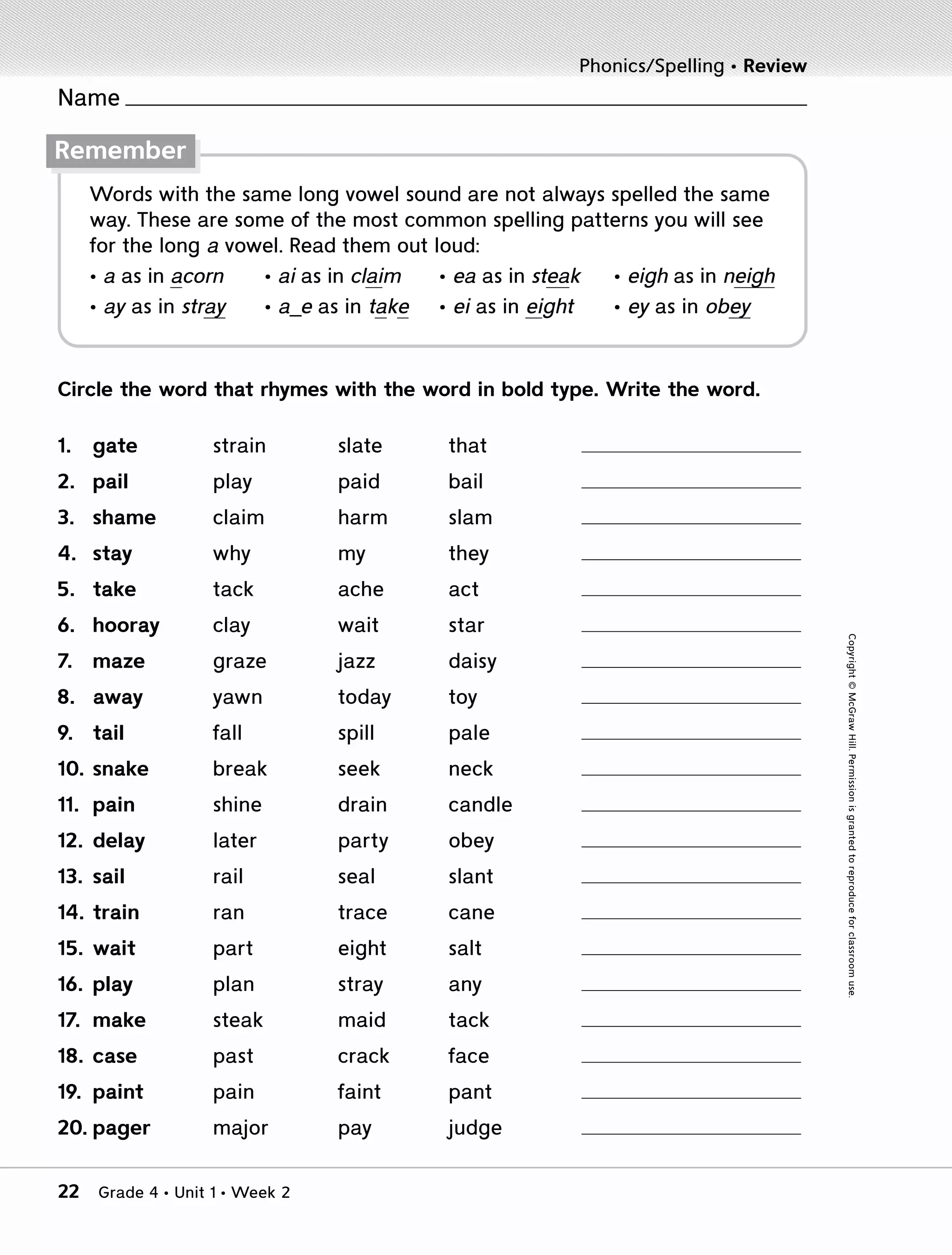
2. Some of my toys (was / were) in the yard sale.
3. The bed (feels / smells) nice and soft.
4. Your backpack (are / seems) newer than mine
Grammar • Tense and Agreement of Linking Verbs
Copyright
©
McGraw
Hill.
Permission
is
granted
to
reproduce
for
classroom
use.
158 Grade 4 • Unit 3 • Week 4
The words is and are are in parentheses.
The words was and were are in parentheses.
The words feels and smells are in parentheses.
The words are and seems are in parentheses.
Name
• The present-tense forms of be are am, is, and are. The past-tense
forms of be are was and were. The future-tense form of be is will be.
• Use am, was, or will be with I. Use is, was, or will be with all singular
subjects. Use are, were, or will be with all plural subjects.
In your writer’s notebook, describe the traits that you like
most about one of your friends or family members. Include
at least two present-tense linking verbs and two future-tense
verbs. Circle them and correct any spelling mistakes.
A. Write am, is, or are to complete each sentence.
1. I late for the birthday party.
2. The cat and dog good pals.
3. My lampshade old and ripped.
4. The jewelry very valuable.
5. Robbie and Katrina class leaders.
B. Write was, were, or will be to complete each sentence.
6. She tired soon.
7. They braver yesterday.
8. I angry at first about what she did.
9. David here later tonight.
10. June and I confused until you explained it.
Grammar • Mechanics: Subject-Verb Agreement
Copyright
©
McGraw
Hill.
Permission
is
granted
to
reproduce
for
classroom
use.
Grade 4 • Unit 3 • Week 4 159
Name
Rewrite the paragraphs below, correcting mistakes in linking verbs and
subject-verb agreement.
1. Owning a pet was a big responsibility. A pet will be a friend that will love
you. But pets were also a lot of work. Some pets seems easier to take care
of than they really are. For example, a puppy may look cute and cuddly, but
it requires a lot of time and energy to raise.
2. Have you ever said to yourself, “I is tired of junk food!”? Well, a healthy
snack was easy to make. The best part is that it tastes great, too! Carrots
and celery is great to munch on when you’re hungry. And a veggie
sandwich will be excellent for lunch. The choices for healthy snacks
were endless!
• A linking verb connects the subject of a sentence to a noun or
adjective in the predicate. Linking verbs are usually forms of be, but
can be other verbs.
• A linking verb must agree in number with the subject of the sentence.
• The present-tense forms of be are am, is, and are. The past-tense
forms of be are was and were. The future-tense form of be is will be.
• Use am, was, or will be with I. Use is, was, or will be with all singular
subjects. Use are, were, or will be with all plural subjects.
Grammar • Proofreading
Copyright
©
McGraw
Hill.
Permission
is
granted
to
reproduce
for
classroom
use.
160 Grade 4 • Unit 3 • Week 4
Name
A. Read the sentences. Then answer the questions.
(1) My slippers _____ inside the drawer. (2) My broken watch _____
sitting next to the slippers.
1.	 Which is the correct linking verb for
sentence 1?
A am
B are
C appear
D is
2. Which is the correct linking verb for
sentence 2?
F smells
G is
H were
J seems
B. Read the student draft and look for any corrections that need to be
made. Then choose the best answer to each question.
(1) My father were good at many things. (2) He is the best gardener
in the neighborhood. (3) His roses which won a prize smells the best!
(4) Sometimes he are in the garden for hours at a time! (5) I am looking
forward to spending time with him in the garden this weekend.
3. What is the correct way to write
sentence 1?
A 	
My father become good at many
things.
B My father is good at many things.
C	
My father grow good at many
things.
D The sentence is correct as written.
4. What is the correct way to write
sentence 2?
F	
He appears the best gardener in
the neighborhood.
G 	
He seems the best gardener in the
neighborhood.
H	
He are the best gardener in the
neighborhood.
J The sentence is correct as written.
5. What is the correct way to write
sentence 3?
A	His roses, which won a prize, smell
the best!
B His roses winned a prize and
smelled the best!
C His roses, which won a prize, is the
best!
D	
The sentence is correct as written.
6. What is the correct way to write
sentence 4?
F Sometimes he is in the garden for
hours at a time!
G 	
Sometimes he were in the garden
for hours at a time!
H Sometimes he am in the garden for
hours at a time!
J The sentence is correct as written.
Grammar • Test: Linking Verbs
Copyright
©
McGraw
Hill.
Permission
is
granted
to
reproduce
for
classroom
use.
Grade 4 • Unit 3 • Week 4 161
Grade 4 Unit 3 Week 4
Name
Fold back the
paper along the
dotted line. Use
the blanks to write
each word as it is
read aloud. When
you finish the test,
unfold the paper.
Use the list at the
right to correct any
spelling mistakes.
1.
2.
3.
4.
5.
6.
7.
8.
9.
10.
11.
12.
13.
14.
15.
16.
17.
18.
19.
20.
21.
22.
23.
24.
25.
1. clams
2. mints
3. props
4. arches
5. dresses
6. parents
7. caves
8. glasses
9. hobbies
10. engines
11. couches
12. arrows
13. enemies
14. babies
15. ranches
16. patches
17. mistakes
18. supplies
19. mosses
20. armies
21. circus
22. germs
23. spice
24. batteries
25. compasses
Review Words
Challenge Words
Spelling • Plurals
Copyright
©
McGraw
Hill.
Permission
is
granted
to
reproduce
for
classroom
use.
162 Grade 4 • Unit 3 • Week 4
Phonics/Spelling • Word Sort
Name
Read aloud and write the spelling words with the matching spelling patterns.
-s
1.
2.
3.
4.
5.
6.
7.
8.
-ies
9.
10.
11.
12.
13.
-es
14.
15.
16.
17.
18.
19.
20.
arches dresses hobbies enemies mistakes
mints armies engines props supplies
babies caves couches ranches mosses
clams glasses arrows patches parents
Note that adding
-es to form a plural
usually adds a
syllable to a word. For
example, the word
glass is one syllable,
but the plural form is
two: glass/es.
DECODING WORDS
Plural nouns name more than one person, place,
or thing. Most follow certain spelling rules and
patterns. Add -s to most singular nouns to form
a plural. Add -es to form the plural if the noun
ends in -s as in lens/lenses, -ss as in class/classes,
-sh as in bush/bushes, -ch as in lunch/lunches,
or -x as in box/boxes.
When a word ends in a vowel and consonant,
double the consonant before adding -es: quiz/
quizzes.
Look through this week’s selection for more words to sort.
Create a word sort in your writer’s notebook for a partner.
Copyright
©
McGraw
Hill.
Permission
is
granted
to
reproduce
for
classroom
use.
Grade 4 • Unit 3 • Week 4 163
Name
If a word ends
in a vowel and
y, add -s to
make it plural.
If a word ends
in a consonant
and y, change
y to i and add
-es to make it
plural.
SPELLING TIP
A plural noun names more than one person, place,
or thing. Add -s to most singular nouns to make them
plural. Add -es to singular nouns that end in
• -s, as in lens to lenses • -ch, as in lunch to lunches
• -ss, as in class to classes • -x, as in ax to axes
• -sh, as in bush to bushes
Whenawordendswithavowelfollowedbyaconsonant,
double the consonant before adding -es: quiz/quizzes.
Read aloud and write the spelling words with the matching spelling patterns.
-s
1.
2.
3.
4.
5.
6.
7.
8.
9.
10.
11.
-es
12.
13.
14.
15.
16.
-ies
17.
18.
19.
20.
friends dresses hobbies holidays mistakes
mints armies tigers props berries
babies caves couches ranches mosses
clams glasses arrows flowers parents
Look through this week’s selection for more words to sort.
Create a word sort in your writer’s notebook for a partner.
Phonics/Spelling • Word Sort
Copyright
©
McGraw
Hill.
Permission
is
granted
to
reproduce
for
classroom
use.
163A Grade 4 • Unit 3 • Week 4
Phonics/Spelling • Word Sort
Name
Read aloud and write the spelling words with the matching spelling patterns.
-s
1.
2.
3.
4.
5.
6.
-es
7.
8.
9.
10.
11.
12.
13.
-ies
14.
15.
16.
17.
18.
19.
20.
arches dresses hobbies enemies mistakes
mints armies engines belongings supplies
babies batteries couches ranches mosses
potatoes trophies arrows patches parents
Look through this week’s selection for more words to sort. Create a
word sort in your writer’s notebook for a partner.
Copyright
©
McGraw
Hill.
Permission
is
granted
to
reproduce
for
classroom
use.
Grade 4 • Unit 3 • Week 4 163B
Name
clams dresses hobbies enemies mistakes
mints parents engines babies supplies
props caves couches ranches mosses
arches glasses arrows patches armies
A. An analogy is a statement that compares sets of words. Write the spelling
word that best completes each analogy below.
1. Sons are to children as dads are to .
2. Lions are to tigers as oysters are to .
3. Chairs are to seats as sofas are to .
4. Birds are to nests as bats are to .
5. Shrubs are to bushes as farms are to .
6. Workers are to businesses as soldiers are to .
7. Men are to suits as women are to .
8. Work is to play as jobs are to .
B. Write the spelling word that matches each definition below.
9. they help you see
10. curved structures
11. they point the way
12. tiny plants
13. objects used in plays
14.small pieces of fabric
15.    candies
16.    newborns
17.    they make cars run
18.    
19.    necessary things
20. errors
Spelling • Word Meaning
Copyright
©
McGraw
Hill.
Permission
is
granted
to
reproduce
for
classroom
use.
164 Grade 4 • Unit 3 • Week 4
Name
Underline the six misspelled words in the paragraphs below. Write the words
correctly on the lines.
Some kids like to lie around on their couchs and watch television
after school. Other kids have hobbys that they like to do. They enjoy
collecting stamps or building models with real engins.
Some activities, such as cooking, may require help from parentes.
But kids can do many other things by themselves. With some art
supples from a craft store, countless projects are possible. And there
are no such things as mistakees! Think of a mistake as creative
inspiration. Take those ideas and run!
1. 4.
2. 5.
3. 6.
Write about something that you like to do after school.
Use at least four words from the spelling list. Check your
work to make sure you have spelled the plurals correctly.
Writing Connection
Spelling • Proofreading
Copyright
©
McGraw
Hill.
Permission
is
granted
to
reproduce
for
classroom
use.
Grade 4 • Unit 3 • Week 4 165
Name
Plural nouns name more than one person, place, or thing. There are
spelling rules and patterns to help you form plural words. Add -s to form
most plural nouns. Add -es to create plural forms of nouns that end in
-s, -ss, -sh, -ch, -x, and -z. If a singular noun ends in a consonant and y,
change the y to an i and add -es to form the plural.
Sound out plural nouns just as you would any other word. Remember
that adding -es usually adds a syllable. The word watch has one syllable,
while watches has two syllables.
Remember
Write the missing letter or letters. Then write the word and read it aloud.
1. ranch
2. cave
3. mistake
4. couch
5. prop
6. arrow
7. arm
8. engine
9. clam
10. dress
11. bab
12. hobb
13. glass
14. arch
15. suppl
16. parent
17. patch
18. mint
19. moss
20. enem
Phonics/Spelling • Review
Copyright
©
McGraw
Hill.
Permission
is
granted
to
reproduce
for
classroom
use.
166 Grade 4 • Unit 3 • Week 4
The word encouraged is in bold.
The word urban is in bold.
The word improve is in bold.
The word praised is in bold.
The word public is in bold.
Name
Read the sentences below. Underline the word in the second sentence that is
a synonym or an antonym of the word in bold. Then write the best definition
of the word you underlined on the line.
1. Barbara Jordan’s parents encouraged her to do well in school. She felt
motivated by their support.
2.	Jordan worked to improve urban areas. Many other state senators only
focused on rural parts of the state.
3. As a congresswoman, Jordan worked to improve the lives of poor people.
She wanted to help people better their wages and living situations.
4.	Barbara Jordan gave a speech that was widely praised. Many people
complimented her on it.
5.	Several years later, Barbara Jordan retired from public life. She returned to
private life and wrote an autobiography.
Vocabulary • Synonyms and Antonyms
Copyright
©
McGraw
Hill.
Permission
is
granted
to
reproduce
for
classroom
use.
Grade 4 • Unit 3 • Week 4 167
The word observed is in bold.
The word observers is in bold.
Name
A dictionary lists words in alphabetical order. You use a dictionary to look
up the meaning of an unfamiliar word. A glossary lists words and definitions
related to a specific text or subject. You can find glossaries in the back of
textbooks or other nonfiction books, or online.
• The guide words show the first and last words on the page. Words on the
page appear alphabetically between guide words.
• The entry words show the spelling and syllables.
• The pronunciation of each word is shown in parentheses. Syllabication
separates syllables by bullets and shows how many syllables a word has.
• The word’s origin, such as the language it comes from, is often shown.
Use the dictionary entry and context clues to figure out the meaning of each
word in bold. Write the meaning, part of speech, and word origin on the lines.
1. I observed the flower’s growth for a month to write my report.
2. The students were eager observers of the scientific presentation.
COLLABORATE
Read each dictionary entry aloud with a partner. Sound out each word
carefully. How many syllables are in each word? How do you know?
observe • octopus
ob-serve (əb-'zərv) verb 1. to watch
carefully. I observed the robin. 2. to
make a remark. That’s a new idea,
she observed. 3. To celebrate, as for
a holiday. We observed Veteran’s
Day with a parade. [Latin observare,
to watch]
ob-serv-er (əb-’zər-vər) noun 1. one
who observes. The observer will
watch the game, but not join in. 2.
an expert. The political observers
predicted the election results. [Latin
observare, to watch]
o-cean (ō-shən) noun 1. part of the
sea, especially the geographical
locations of the sea. The Pacific
Ocean.
2. The sea. [Greek, okeanos, the
stream of waters circling Earth]
oct-o-pus (‘äk-tə-pəs) noun 1. a
marine animal that has a soft
rounded body with eight long
flexible arms. We saw an octopus at
the aquarium.
[Greek, octopod, eight feet]
Pronunciation guide
Part of
Speech
Word origin
Vocabulary • Dictionary
Copyright
©
McGraw
Hill.
Permission
is
granted
to
reproduce
for
classroom
use.
168 Grade 4 • Unit 3 • Week 4
Grade 4 Unit 3 Week 5
Name
• Regular past-tense verbs end with -ed: walk/walked.
• Irregular past-tense verbs do not end with -ed: run/ran.
• The verbs be and have also have irregular spellings for the present and
past tenses.
Be Have
I was had
You/We/They were had
He/She/It was had
Read each sentence and underline the verb. On the line, write the correct
past-tense form of the verb.
1. We drive all night to my cousin’s house.
2. The child break the glass vase.
3. The bumblebee is on the flower.
4. Carlos go to school late today.
5. He has a book about sharks in the ocean.
6. The rain begin to fall outside.
Write four sentences about getting ready for school. Each
sentence should include an irregular verb. After you finish
check that you have used the past tense of the irregular
verbs correctly.
Writing Connection
Grammar • Irregular Verbs
Copyright
©
McGraw
Hill.
Permission
is
granted
to
reproduce
for
classroom
use.
Grade 4 • Unit 3 • Week 5 169
Name
Read each sentence. Circle the verb choice
in parentheses that correctly completes the
sentence. Then write R on the line if it is a regular
verb. Write I if it is an irregular verb.
1. The workers slowly (built / builded) the house.
2. She (fold / folded) the laundry before putting it away.
3. I (smelt / smelled) the pie baking from down the street.
4. My mother (set / setted) the table earlier.
5. Together we (drew / drawed) a picture of our family.
6. They had (knew / known) that this would happen.
• Regular past-tense verbs end with -ed. Irregular past-tense verbs
do not end with -ed.
• The past tense of some irregular verbs is formed with an internal
spelling change, such as run and ran.
• The past tense of some irregular verbs is spelled the same as the
present tense, such as read and read.
• The past form of an irregular verb that often ends with -n or -en, such
as known or eaten, can be used with a helping verb to tell about the
past (have known, have eaten).
Read this paragraph from “A New Kind of Corn.” Underline all the
verbs. Then write the past-tense form of each verb below.
Over time, pests can build a resistance to any pesticide. A 2011 study
shows that rootworm beetles are already developing a resistance to Bt
corn. If these rootworms can eat Bt corn and survive, why grow it?
Grammar • Irregular Past Tenses
Copyright
©
McGraw
Hill.
Permission
is
granted
to
reproduce
for
classroom
use.
170 Grade 4 • Unit 3 • Week 5
The words built and builded are in parentheses.
The words fold and folded are in parentheses.
The words smelt and smelled are in parentheses.
The words set and setted are in parentheses.
The words drew and drawed are in parentheses.
The words knew and known are in parentheses.
The words have spended are underlined.
The words were took are underlined.
The words had forgot are underlined.
The words has grew are underlined.
The words were shook are underlined.
Name
Rewrite each sentence with the correct past-tense form of the underlined
helping verb and main verb.
1. We have spended too much time here already.
2. The people were took to their seats.
3. I had forgot how to braid my hair correctly.
4. My baby sister has grew so much!
5. The leaves were shook from the branches.
• Many irregular verbs have the same form when they are used alone or
with a helping verb to tell about the past, such as kept, was kept, and
have kept.
• Some irregular verbs have a different form when they are used alone
than when they are used with a helping verb to tell about the past,
such as did and had done.
• A gerund is a verbal. It is a verb ending in -ing that acts as a noun in a
sentence. The singing started. I like swimming.
In your writer’s notebook, write about the milestones in your life
that you are most proud of. Make sure that each of your sentences
has a helping verb and is in the past tense. Include a sentence with
a gerund. Then edit your work.
Grammar • Mechanics: Correct Verb Usage
Copyright
©
McGraw
Hill.
Permission
is
granted
to
reproduce
for
classroom
use.
Grade 4 • Unit 3 • Week 5 171
Name
Rewrite the sentences below, correcting mistakes in irregular verbs.
1. The reporter bringed his pad and taked notes while the mayor speaked.
2. I cutted the paper and folded it in the shape of an animal.
3. You have fell down twice while skiing this morning.
4. The shirt was teared in the washing machine and ruined.
5. My mother letted me play outside while she maked dinner.
• The past tense of irregular verbs may be formed with a spelling
change or without a spelling change.
• Many irregular verbs have the same form when they are used alone or
with a helping verb to tell about the past.
• Some irregular verbs have a different form when they are used alone
than when they are used with a helping verb to tell about the past.
Often, the verb will end with -n or -en, such as shake and have shaken.
Grammar • Proofreading
Copyright
©
McGraw
Hill.
Permission
is
granted
to
reproduce
for
classroom
use.
172 Grade 4 • Unit 3 • Week 5
The words was froze, have heard, had tried, and have started are underlined.
Name
5. Which is the correct helping verb
and past-tense verb for sentence 1?
A was frozen
B were frozen
C was freezed
D Make no change.
6. Which is the correct helping verb
and past-tense verb for sentence 2?
F had heared
G has heared
H had heard
J Make no change.
7. Which is the correct helping verb
and past-tense verb for sentence 3?
A were tried
B had tryed
C have tryed
D Make no change.
8. Which is the correct helping verb
and past-tense verb for sentence 4?
F had start
G had started
H have starten
J Make no change.
B.	
Read the student draft and look for any corrections that need to be
made. Then choose the best answer to each question.
(1) Jared and I was froze after playing outside in the snow! (2) We
have heard the school bell, so we ran inside. (3) I had tried so hard to
warm up by rubbing my face. (4) I had to sit down and pay attention
though, because the lesson have started.
A. Read the paragraph. Then answer the questions.
(1) Today was a bad day. (2) Even though it was Saturday, I had to
do a bunch of chores. (3) First, I my room. (4) Then
I the grass. (5) I accidentally the hose
out in the yard. (6) Finally, I the trash out.
1. Which past-tense verb goes in the
blank in sentence 3?
A cleaned
B clean
C cleanen
D cleaning
2. Which past-tense verb goes
in the blank in sentence 4?
F cut
G cutted
H cutten
J cuttened
3.	
Which past-tense verb goes in the
blank in sentence 5?
A leave
B leaved
C leaven
D left
4. Which past-tense verb goes in the
blank in sentence 6?
F taken
G took
H taked
J take
Grammar • Test: Irregular Verbs
Copyright
©
McGraw
Hill.
Permission
is
granted
to
reproduce
for
classroom
use.
Grade 4 • Unit 3 • Week 5 173
Phonics/Spelling • Review
Fold back the
paper along the
dotted line. Use
the blanks to
write each word
as it is read aloud.
When you finish
the test, unfold
the paper. Use the
list at the right
to correct any
spelling mistakes.
1.
2.
3.
4.
5.
6.
7.
8.
9.
10.
11.
12.
13.
14.
15.
16.
17.
18.
19.
20.
21.
22.
23.
24.
25.
1. fishbowl
2. lookout
3. yardstick
4. desktop
5. campfire
6. overhead
7. waterproof
8. grandparent
9. railroad
10. snowstorm
11. loudspeaker
12. bookcase
13. bedroom
14. blindfold
15. newborn
16. bedspread
17. yourself
18. overdo
19. clothesline
20. undertake
21. dresses
22. arrows
23. babies
24. eyesight
25. paperweight
Review Words
Challenge Words
Name
Copyright
©
McGraw
Hill.
Permission
is
granted
to
reproduce
for
classroom
use.
174 Grade 4 • Unit 3 • Week 5
Name
Compound words are made up of smaller words.
There are three types of compound words:
• Words with two or more words joined together,
as in evergreen
• Words that are written with one or more hyphens,
as in left-handed
• Words that are written as separate words, such
as school day
When a word
ends in a silent
e, as in case, the
vowel before the
consonant has a
long sound. This
is called a vowel,
consonant, e
(VCe) pattern.
Decoding Words
fishbowl campfire railroad bedroom yourself
lookout overhead snowstorm blindfold overdo
yardstick waterproof loudspeaker newborn clothesline
desktop grandparent bookcase bedspread undertake
Write the compound spelling words that contain the correct number
of syllables. Then read the words aloud.
two syllables
1.
2.
3.
4.
5.
6.
7.
8.
9.
10.
11.
12.
13.
14.
three syllables
15.
16.
17.
18.
19.
20.
Look through this week’s selection for more words to sort. Read the
words aloud and create a word sort in your writer’s notebook for a
partner. Include words with the VCe pattern.
Phonics/Spelling • Word Sort
Copyright
©
McGraw
Hill.
Permission
is
granted
to
reproduce
for
classroom
use.
Grade 4 • Unit 3 • Week 5 175
Name
Write the compound spelling words that contain the correct number
of syllables. Then read the words aloud.
fishbowl campfire railroad bedroom yourself
lookout overhead snowstorm anyway overdo
yardstick waterproof classroom newborn driveway
desktop grandparent airport footstep undertake
two syllables
1.
2.
3.
4.
5.
6.
7.
8.
9.
10.
11.
12.
13.
14.
three syllables
15.
16.
17.
18.
19.
20.
Compound words are made up of smaller words.
There are three types of compound words:
• Words with two or more words joined together,
as in evergreen
• Words that are written with one or more
hyphens, as in left-handed
• Words that are written as separate words, such
as school day
When a word
ends in a silent
e, as in case, the
vowel before the
consonant has a
long sound. This
is called a vowel,
consonant, e
(VCe) pattern.
Decoding Words
Look through this week’s selection for more words to sort. Read the
words aloud and create a word sort in your writer’s notebook for a
partner. Include words with the VCe pattern.
Phonics/Spelling • Word Sort
Copyright
©
McGraw
Hill.
Permission
is
granted
to
reproduce
for
classroom
use.
175A Grade 4 • Unit 3 • Week 5
Name
fishbowl campfire teammate skateboard undergrowth
courtroom overhead snowstorm blindfold gentleman
yardstick waterproof loudspeaker eyesight clothesline
heartbroken grandparent bookcase bedspread undertake
Write the compound spelling words that contain the correct number
of syllables. Then read the words aloud.
two syllables
1.
2.
3.
4.
5.
6.
7.
8.
9.
10.
11.
12.
three syllables
13.
14.
15.
16.
17.
18.
19.
20.
Look through this week’s selection for more words to sort.
Make a word sort in your writer’s notebook for a partner.
Phonics/Spelling • Word Sort
Copyright
©
McGraw
Hill.
Permission
is
granted
to
reproduce
for
classroom
use.
Grade 4 • Unit 3 • Week 5 175B
Name
fishbowl campfire railroad bedroom yourself
lookout overhead snowstorm blindfold overdo
yardstick waterproof loudspeaker newborn clothesline
desktop grandparent bookcase bedspread undertake
A. Write the spelling word that best completes each sentence.
1. I pulled down the before getting into bed.
2. Please get a novel from the for me.
3. Her was piled high with papers and books.
4. Put on this and spin around three times.
5. It is fun to ride trains on the .
6. I heard my name announced on the .
7. I bought a large for my pet to swim in.
8. We took the dry sheets down from the .
9. The tower is my favorite part of the clubhouse.
10. Even though it rained, I stayed dry in my jacket.
B. Write the spelling word that matches each definition below.
11. to go beyond a limit
12. an outdoor flame
13. a ruler for measuring
14. a baby just born
15. hanging above
16. you
17. a place to sleep
18. your mother’s parent
19. blizzard
20. to attempt
Spelling • Word Meaning
Copyright
©
McGraw
Hill.
Permission
is
granted
to
reproduce
for
classroom
use.
176 Grade 4 • Unit 3 • Week 5
Name
Underline the three misspelled words in each paragraph below. Write the
words correctly on the lines.
Camping may seem like a good idea, but do your self
a favor and try it at home first! Camping under the stars
is a brave thing to under take. Use your backyard as a
test to see if you like it. You may not be able to build a
camp fire, but at least you’ll see what it is like to rough it
outdoors.
To sleep outside, you’ll need a water proof tent and a sleeping bag.
You might also want to grab a pillow from your bed room. It is best to try
it in the summer (and not in a snow storm in the middle of the winter!).
Before you march outside with your flashlight, be sure to ask your parents’
permission. If you’re lucky, they might even join you!
1.
2.
3.
4.
5.
6.
Write about whether you would like to go camping under
the stars. Use at least four words from the spelling list.
Writing Connection
Spelling • Proofreading
Copyright
©
McGraw
Hill.
Permission
is
granted
to
reproduce
for
classroom
use.
Grade 4 • Unit 3 • Week 5 177
Phonics/Spelling • Review
Name
1. over
2. look
3. book
4. born
5. fire
6. rail
7. parent
8. water
9. head
10. under
11. blind
12. desk
13. speaker
14.your
15. bowl
16. spread
17. clothes
Fill in the missing letters to form a compound spelling word. Read the
spelling word aloud, then write it on the line. Not all words will be used.
fishbowl campfire railroad bedroom yourself
lookout overhead snowstorm blindfold overdo
yardstick waterproof loudspeaker newborn clothesline
desktop grandparent bookcase bedspread undertake
Compound words are made up of smaller words. There are three types
of compound words:
• Words with two or more words joined together, as in evergreen
• Words that are written with one or more hyphens, as in left-handed
• Words that are written as separate words, such as school day
Copyright
©
McGraw
Hill.
Permission
is
granted
to
reproduce
for
classroom
use.
178 Grade 4 • Unit 3 • Week 5
Name
Remember that content words are words related to a particular field
of study. For example, pollen, crossbreeding, and genetically modified
are words used to describe the reproduction and growth of plants and
animals. They are content words in the fields of biology, botany, food
science, agriculture, and genetics.
Sometimes you can figure out what a content word means by using
context clues. You can also use a dictionary to help you.
With a partner, look in science texts for content words related
to biology, food science, and agriculture. Write the words below.
Circle two words that you were able to define by using context clues.
Write the words and their meanings on the lines.
Biology, Food Science, and Agriculture Words
Vocabulary • Content Words
Copyright
©
McGraw
Hill.
Permission
is
granted
to
reproduce
for
classroom
use.
Grade 4 • Unit 3 • Week 5 179
The word physicists is in bold.
The word hydroponic is in bold.
The word photosynthesis is in bold.
The word Astronauts is in bold.
Name
Greek Root Meanings
phys – nature or body
hydro - water
photo - light
astro - stars
Read each passage below. Use the Greek roots from the box above along
with context clues to find the meaning of each word in bold. Write the
meaning on the line.
1. For many years, physicists, biologists, botanists, and other scientists have
studied how we can use the awesome power of water to help humanity.
2. Many hydroponic systems grow plants in tanks or trays filled with
nutrient-rich water.
3. Plants produce food during a process called photosynthesis. They use
energy from the sun, carbon dioxide, and water to produce sugar, which
is their food.
4. Astronauts have even used hydroponics to grow plants in space!
Vocabulary • Greek Roots
Copyright
©
McGraw
Hill.
Permission
is
granted
to
reproduce
for
classroom
use.
180 Grade 4 • Unit 3 • Week 5
Grade 4 Unit 4 Week 1
Name
Read each sentence and underline the pronoun. Write the pronoun on the
line provided.
1. José was busy and could not get it for me.
2. My mom, who is a nurse, works long hours.
3. Did you see her climb the tree?
4. Has anyone seen a pink baseball cap?
5. The student in the red shirt is slightly taller than you.
• A pronoun is a word that takes the place of one or more nouns.
• A personal pronoun refers to a person or thing, such as I, he, she, it,
or you.
• An indefinite pronoun does not name a specific person or thing, such
as anyone, everything, or someone.
• A relative pronoun is used at the beginning of a clause, such as that,
which, who, whom, or whose.
	 Read this excerpt from “A World Without Rules.” Circle
six pronouns. Then write two sentences about an unusual
experience you’ve had. Include at least two pronouns.
You may sometimes wonder if rules were made to keep you from
having fun and to tell you what to do. But what if we had no rules at all?
Nobody would tell you what to do ever again!
Grammar • Pronouns
Reading/Writing
Connection
Copyright
©
McGraw
Hill.
Permission
is
granted
to
reproduce
for
classroom
use.
Grade 4 • Unit 4 • Week 1 181
Name
Circle the pronoun in parentheses that agrees with the antecedent and
correctly completes each sentence. Write the antecedent on the line.
1. If the people go outside, (he, they) will be very cold.
2. The dog wagged (its, their) tail playfully.
3. The mayor did (their, his) best to solve the traffic problem.
4. Both students did a great job. (Her, Their) teacher was very proud of
(they, them).
5. When the tired woman went to bed, (he, she) fell asleep immediately.
6. Each of the airplanes had begun (its, their) descent from the sky.
• A pronoun is a word that takes the place of one or more nouns.
• A pronoun must match its antecedent, or the noun it refers to, in
number, gender, and case. Case refers to the form a pronoun takes
depending on whether it is a subject or object in a sentence, or is
showing possession. The girl looked both ways before she crossed the
road. Jobim knows we like him.
• Antecedents usually appear in the same sentence as their pronouns,
but not always. Stephen loves all kinds of music. He listens to it
every day.
Look back through your writer’s notebook for a paragraph
you wrote. Edit the paragraph for pronoun-antecedent
agreement. Then check for any spelling mistakes.
Grammar • Pronoun-Antecedent Agreement
Copyright
©
McGraw
Hill.
Permission
is
granted
to
reproduce
for
classroom
use.
182 Grade 4 • Unit 4 • Week 1
The words he, they are in parentheses.
The words its, their are in parentheses.
The words their, his are in parentheses.
The words Her, Their and they, them are in parentheses.
The words he, she are in parentheses.
The words its, their are in parentheses.
Name
Write each sentence correctly so that it is clear and uses correct
capitalization.
1. Even though Hector and Henry play baseball, he is not as good at it.
2. My sister and i are both in the same elementary school.
3. Be careful with it when you put this dish in the glass case.
4. Spring has pretty flowers and green grass, which is nice.
5. When i go to self-defense class, i feel strong.
• The pronoun I is always capitalized.
• If it is not clear which noun a pronoun refers to, repeat the noun or
rewrite the sentence. The carrots and the cabbages were in the bag
together. The cabbages went bad.
Talk to a parent or trusted adult about the differences
between geographical regions of the United States. Then
write a paragraph about what you learned. Edit your
paragraph to make sure all pronouns and antecedents
agree.
Grammar • Mechanics: Pronoun Capitalization and Clarity
Connect to
Community
Copyright
©
McGraw
Hill.
Permission
is
granted
to
reproduce
for
classroom
use.
Grade 4 • Unit 4 • Week 1 183
Name
Rewrite the paragraphs below, correcting mistakes in pronouns and
antecedents.
1. My older sister Amy and i like to play word games. They have a lot of fun
with them. Sometimes the game is too hard, so i do not like to play it. She
always wins. Still, I have a lot of fun playing any game with my sister.
2. My family and i went to visit the local nature center today. There were two
guides, and she showed us around the center. I saw an owl with a broken
wing. Sam, my little brother, said that he had never seen it before.
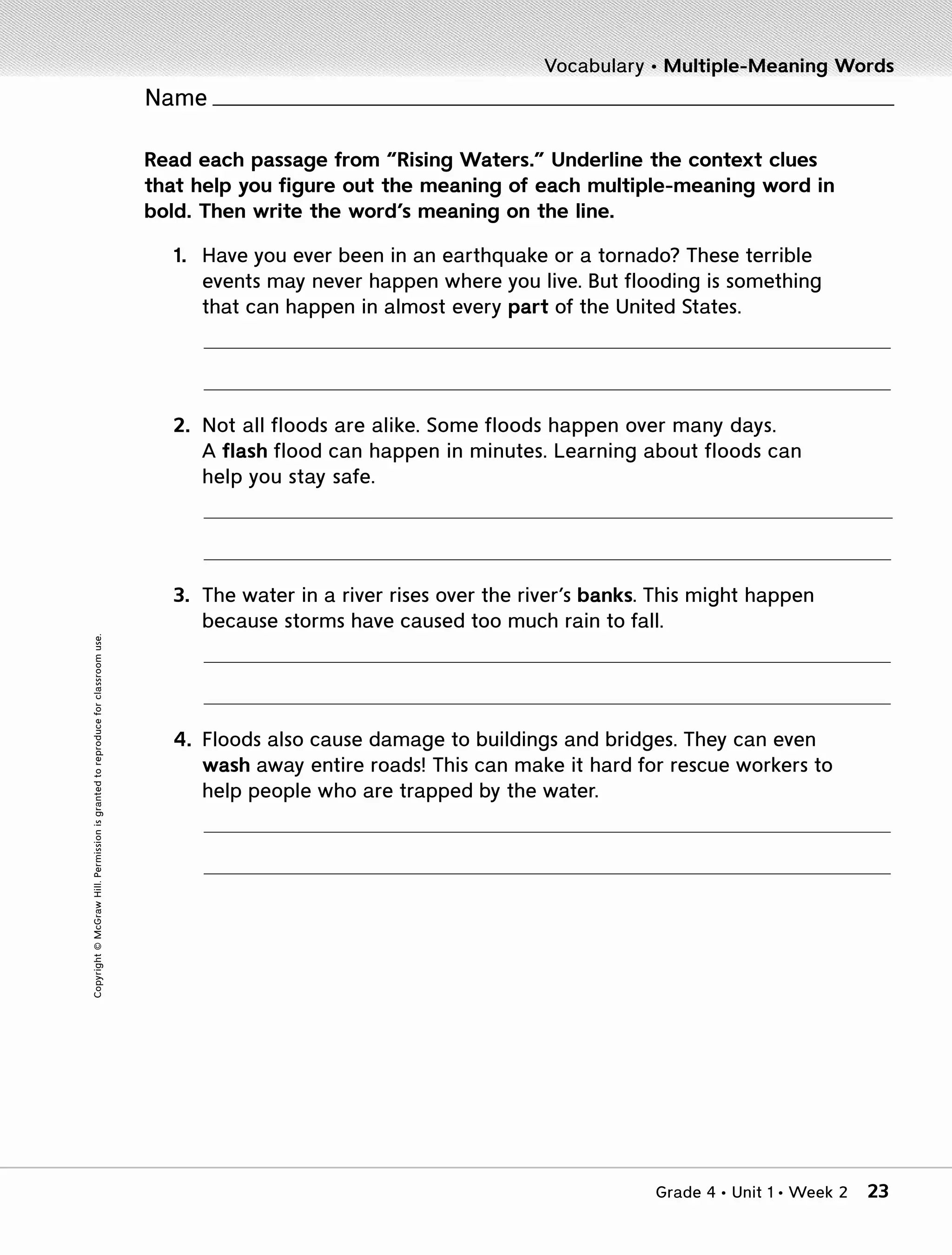
• A pronoun is a word that takes the place of one or more nouns. There
are personal, indefinite, and relative pronouns.
• An antecedent is the word that the pronoun refers to. A pronoun and
its antecedent must match in gender and in number.
• The pronoun I is always capitalized.
• When a pronoun reference is unclear, repeat the noun instead or
rewrite the sentence.
In formal writing, when a gender is unclear for a singular
noun, use his or her so that the pronoun and antecedent still
agree in number. A citizen should always do his or her duty.
COMMON ERRORS
Grammar • Proofreading
Copyright
©
McGraw
Hill.
Permission
is
granted
to
reproduce
for
classroom
use.
184 Grade 4 • Unit 4 • Week 1
Name
Read the student draft and look for any corrections that need to be
made. Then choose the best answer to each question.
(1) As she stepped out the door, Kyle wasn’t surprised at the truck
waiting at the curb. (2) It had been a long morning already, and Kyle
was tired. (3) The truck driver got out and approached someone.
(4) “Do you need me to carry the box for you?” he asked, pointing
at Kyle’s box. (5) “If not, I can get the rest of the boxes.” (6) Moving day
was always hard on Kyle, his box packers, and the truck driver.
1. What change needs to be
made in sentence 1?
A Change door to it
B Change she to he
C Change truck to it
D Change Kyle to him
2. What pronoun could best
replace Kyle in sentence 2?
F we
G everyone
H it
J he
3. What change needs to be made in
sentence 3?
A Change someone to she
B Change someone to them
C Change someone to him
D Change someone to he
4. What pronoun could replace Kyle’s
box in sentence 4?
F they
G them
H it
J everything
5. What pronoun could best replace
the boxes in sentence 5?
A they
B them
C it
D everyone
6. What pronoun could best
replace Kyle, his box packers, and
the truck driver in sentence 6?
F they
G it
H everything
J everyone
Grammar • Test: Pronouns and Antecedents
Copyright
©
McGraw
Hill.
Permission
is
granted
to
reproduce
for
classroom
use.
Grade 4 • Unit 4 • Week 1 185
1.
2.
3.
4.
5.
6.
7.
8.
9.
10.
11.
12.
13.
14.
15.
16.
17.
18.
19.
20.
21.
22.
23.
24.
25.
Fold back the paper
along the dotted
line. Use the blanks
to write each word
as it is read aloud.
When you finish
the test, unfold
the paper. Use the
list at the right to
correct any spelling
mistakes.
Review Words
Challenge Words
1. tasted
2. ripping
3. forced
4. flipping
5. tapped
6. flipped
7. scared
8. flagged
9. ripped
10. skipped
11. tapping
12. saved
13. skipping
14. scaring
15. flagging
16. discussed
17. saving
18. tasting
19. forcing
20. discussing
21. bedspread
22. desktop
23. snowstorm
24. outwitted
25. underscoring
Spelling • Inflectional Endings
Name
Copyright
©
McGraw
Hill.
Permission
is
granted
to
reproduce
for
classroom
use.
186 Grade 4 • Unit 4 • Week 1
Name
Double consonant
+ -ed words
1.
2.
3.
4.
5.
Add -ed words
6.
Add -ing words
7.
Drop the e and
add -ed words
8.
9.
10.
11.
Double consonant
+ -ing words
12.
13.
14.
15.
16.
Drop the e and
add -ing words
17.
18.
19.
20.
tasted scaring forcing skipping scared
ripping flipped skipped tapped tasting
forced saving tapping flagging ripped
flipping flagged saved discussed discussing
Inflectional endings -ed and -ing are added
to verbs to create new verbs and tenses.
The spelling for many base words does not
change when adding -ed or -ing, such as
when laugh becomes laughed or laughing.
For base words ending with a consonant and
e, drop the e before adding -ed or -ing. For
example, save changes to saved or saving.
Look through this
week’s selection
for more words
to sort. Read the
words aloud and
create a word sort
for a partner in your
writer’s notebook.
For base words that end
with a single vowel and
a consonant, double the
final consonant before
adding -ed or -ing. Drop
changes to dropped or
dropping.
SPELLING TIP
Write the spelling words that contain the matching spelling patterns.
Read the words aloud.
Phonics/Spelling • Word Sort
Copyright
©
McGraw
Hill.
Permission
is
granted
to
reproduce
for
classroom
use.
Grade 4 • Unit 4 • Week 1 187
Name
Double consonant
+ -ed words
1.
2.
3.
4.
5.
6.
Double consonant
+ -ing words
7.
8.
9.
10.
11.
12.
Drop the e and
add -ed words
13.
14.
15.
16.
Drop the e and
add -ing words
17.
18.
19.
20.
tasted caring liking skipping cared
ripping flipped skipped tapped tasting
liked saving tapping hopping ripped
flipping hopped saved trimmed trimming
Look through this week’s selection
for more words to sort. Read the
words aloud and create a word
sort for a partner in your writer’s
notebook.
Inflectional endings -ed and -ing are added
to verbs to create new verbs and tenses.
The spelling for many base words does not
change when adding -ed or -ing, such as
when laugh becomes laughed or laughing.
For base words ending with a consonant and
e, drop the e before adding -ed or -ing. For
example, save changes to saved or saving.
For base words that end
with a single vowel and
a consonant, double the
final consonant before
adding -ed or -ing. Drop
changes to dropped or
dropping.
SPELLING TIP
Write the spelling words that contain the matching spelling patterns.
Read the words aloud.
Phonics/Spelling • Word Sort
Copyright
©
McGraw
Hill.
Permission
is
granted
to
reproduce
for
classroom
use.
187A Grade 4 • Unit 4 • Week 1
Name
Double consonant
+ -ed words
1.
2.
3.
4.
5.
Drop the e and
add -ed words
6.
7.
8.
9.
Add -ed words
10.
Double consonant
+ -ing words
11.
12.
13.
14.
15.
Drop the e and
add -ing words
16.
17.
18.
19.
Add -ing words
20.
endured appreciating forcing skipping outwitted
strumming flipped realized admitted demonstrating
exploded demonstrated exploding flagging strummed
flipping flagged admitting discussed discussing
Look through this week’s selection for
more words to sort. Read the words
aloud and create a word sort for a
partner in your writer’s notebook.
Write the spelling words that contain the matching spelling patterns.
Read the words aloud.
Phonics/Spelling • Word Sort
Copyright
©
McGraw
Hill.
Permission
is
granted
to
reproduce
for
classroom
use.
Grade 4 • Unit 4 • Week 1 187B
Name
A. Write the spelling word that best completes each sentence.
1. Firefighters are good at people in danger.
2. After my shirt, I had to change clothes.
3. My parents the idea of a vacation.
4. We were down the police car to help us on the road.
5. The excited puppy’s tail the ground.
6. I thought the meat loaf good.
7. Is the spooky show you?
8. My sister all the way to school.
9. The clown onto his back when the pie hit him.
10. The rude man was his way to the front of the line.
B. Write the spelling word that matches each definition below.
11. running and jumping
12. collected money
13. tumbling
14. got attention
15. tore
16. talking about
17. hitting lightly
18. frightened
19. using the tongue
20. made to do something
tasted tapped ripped skipping saving
ripping flipped skipped scaring tasting
forced scared tapping flagging forcing
flipping flagged saved discussed discussing
Spelling • Word Meaning
Copyright
©
McGraw
Hill.
Permission
is
granted
to
reproduce
for
classroom
use.
188 Grade 4 • Unit 4 • Week 1
Name
Underline the six misspelled words in the paragraphs below. Write the words
correctly on the lines.
Do you hate tasteing new types of foods? Do you have to be forcd
to have a dinner that does not include chicken nuggets? If so, you can
stop now! There is nothing to be scareed of when trying new foods.
The world has a lot of wonderful foods to offer. If you discussd these
foods with your parents, you could get an idea of what you might like.
So instead of skiping that egg roll or rice ball, why not give it a whirl?
You might find that you’ll be flippin for it!
1. 4.
2. 5.
3. 6.
Write about a food that was better
than you thought it would be.
Use at least four words from the
spelling list. Then edit your work.
Writing Connection
Spelling • Proofreading
Copyright
©
McGraw
Hill.
Permission
is
granted
to
reproduce
for
classroom
use.
Grade 4 • Unit 4 • Week 1 189
Name
1. flagg
2. forc
3. sav
4. tapp
5. tast
6. ripp
7. sav
8. discuss
9. skipp
10. flipp
11. skipp
12. flagg
13. tapp
14. discuss
15. flipp
16. scar
17. ripp
18. tast
19. forc
20. scar
B. Write these spelling words in alphabetical order. Alphabetize them to the
third letter: tapping, skipping, tasted, scared, saved.
A. Fill in the missing letters of each word to form a spelling word.
Then read the word aloud.
21.
22.
23.
24.
25.
Inflectional endings -ed and -ing are added to verbs to create new verb
forms and tenses. The spelling for many base words does not change
when adding -ed or -ing, such as when laugh becomes laughed or
laughing.
For base words ending with a consonant and e, drop the final e before
adding -ed or -ing. For example, save changes to saved or saving.
Remember
Phonics/Spelling • Review
Copyright
©
McGraw
Hill.
Permission
is
granted
to
reproduce
for
classroom
use.
190 Grade 4 • Unit 4 • Week 1
Name
People use content words to speak or write about certain topics or
fields of study. In this unit, you will encounter content words related
to government, such as laws, agencies, legislation, and democracy.
Use context clues, dictionaries, or electronic resources to help you
understand the meanings and pronunciations of these words.
With a partner, search social studies texts for content words
related to the history, people, and functions of the U.S.
government. Write the words below.
Circle two words that you were able to define by using context clues.
Write the words and their meanings on the lines. Use a dictionary to
check your work.
“A World Without Rules” makes use of content words to explore what life would be like
without the laws and protections provided by our government. It explains how government
agencies and rules ensure that our public spaces are maintained, our environment stays
healthy, and our country is defended from invasion.
CONNECT TO CONTENT
Government Words
Vocabulary • Content Words
Copyright
©
McGraw
Hill.
Permission
is
granted
to
reproduce
for
classroom
use.
Grade 4 • Unit 4 • Week 1 191
Name
Use the words in the box and the clues below to help you solve the
crossword puzzle.
Across
1. Improvements
2. Widespread
5. Someone’s qualities
10. Unfairness
11. It compares two unlike things
Down
1. Farm science
3. Fighting against
4. Have a different opinion
6. Given as a task
7. Worries
8. Receive from parents
9. Like an adult
assigned characteristics agriculture advancements
inherit metaphor mature concerns
resistance injustice disagree prevalent
1
2
5 6 7 8
4
3
9
10
11
Vocabulary • Spiral Review
Copyright
©
McGraw
Hill.
Permission
is
granted
to
reproduce
for
classroom
use.
192 Grade 4 • Unit 4 • Week 1
Grade 4 Unit 4 Week 2
Name
Read each sentence and circle the pronoun. Write S on the line if it
is a subject pronoun. Write O if it is an object pronoun.
1. My mom does not like him.
2. I read a chapter every night.
3. Sometimes they go to the zoo together.
4. Will the captain say hello to us?
5. You can ride in the car with Jessie.
6. The girl did not invite them to the party.
• A subject pronoun takes the place of a noun in the subject of a
sentence. Subject pronouns include I, you, he, she, it, we, and they.
They were excited to go on vacation!
• An object pronoun takes the place of a noun that follows an action
verb or a preposition. Object pronouns include me, you, him, her, it,
us, and them. Mr. Gupta handed us each a copy of the test.
Read this excerpt from “The Birth of American
Democracy.” Circle each pronoun you find. Then write
whether each pronoun is a subject or object pronoun.
They knew that their signatures made them traitors to Great Britain. They
also knew that, if the colonies won the war, their names would go down
in history.
Grammar • Subject and Object Pronouns
Reading/Writing
Connection
Copyright
©
McGraw
Hill.
Permission
is
granted
to
reproduce
for
classroom
use.
Grade 4 • Unit 4 • Week 2 193
Name
Circle the correct reflexive pronoun in parentheses to complete
each sentence.
1. I almost hurt (myself / yourself) while walking down the stairs.
2. The cat licked (itself / themselves) after eating dinner.
3. My dad bought (herself / himself) a hot dog at the game.
4. Lila and Raul did all of the work (ourselves / themselves).
5. Did you both get (yourself / yourselves) some ice cream?
• A subject pronoun takes the place of a noun in the subject of a
sentence. An object pronoun takes the place of a noun that follows
an action verb or a preposition.
• A reflexive pronoun is an object pronoun that renames the subject
and ends in -self or -selves. Examples include myself, herself,
yourselves, and themselves.
• A reflexive pronoun is used when the subject and object of a sentence
refer to the same person or thing. Anna fixed the sentence herself.
Write two sentences about what kind of food you would
make for a picnic. Describe the event using reflexive
pronouns. Then check that you used the reflexive pronouns
correctly.
Grammar • Reflexive Pronouns
Writing Connection
Copyright
©
McGraw
Hill.
Permission
is
granted
to
reproduce
for
classroom
use.
194 Grade 4 • Unit 4 • Week 2
The words myself and yourself are in parentheses.
The words itself and themselves are in parentheses.
The words herself and himself are in parentheses.
The words ourselves and themselves are in parentheses.
The words yourself and yourselves are in parentheses.
Grammar • Subject and Object Pronouns
Name
Read each sentence. On the line, rewrite the sentence using correct subject
and object pronouns.
1. I didn’t realize it at first, but my cousin is him.
2. Myself am very excited to see the movie.
3. Do you want to travel with we in the car?
4. Them brought flowers in from outside.
5. It was her who scored the highest on the test.
• Use a subject pronoun when replacing the subject of a sentence
or a noun that follows a form of the verb to be. The president of the
linguistics club is she.
• Use an object pronoun after an action verb or a preposition. He ran up
to the ball and kicked it hard.
• Do not use a reflexive pronoun in place of a personal pronoun. Do not
add -self or -selves to a subject pronoun.
In your writer’s notebook, write a story about a bat. Include at
least two subject pronouns, two object pronouns, and two reflexive
pronouns. Then check that you used all the pronouns correctly.
Copyright
©
McGraw
Hill.
Permission
is
granted
to
reproduce
for
classroom
use.
Grade 4 • Unit 4 • Week 2 195
Name
Rewrite the paragraphs below, correcting
mistakes in subject and object pronouns.
1. My mom and me went to the mall
yesterday to buy my dad a birthday
gift. Ourselves had no idea what to get
him. Then I thought to myself that him
really loves airplanes. I bought a model
airplane at the hobby shop there and
smiled the whole way home!
2. It was sunny. My brother and me ran outside and sat in the grass while
ourselves waited for my dad. Suddenly, the car pulled into the driveway. It
was him! Now us could finally all go to the park.
• A subject pronoun takes the place of a sentence’s subject or a noun
that follows a form of the verb to be.
• An object pronoun takes the place of a noun that follows an action
verb or a preposition.
• A reflexive pronoun renames the subject and ends in -self or -selves.
It is used when the subject and object of a sentence refer to the same
person or thing.
• Do not use a reflexive pronoun in place of a personal pronoun. Do not
add -self or -selves to a subject pronoun.
Always check your writing to
make sure you did not use a
reflexive pronoun instead of an
object pronoun. The song will
be sung by the choir and me.
COMMON ERRORS
Grammar • Proofreading
Copyright
©
McGraw
Hill.
Permission
is
granted
to
reproduce
for
classroom
use.
196 Grade 4 • Unit 4 • Week 2
Name
Read the student draft and look for any corrections that need to be made.
Then choose the best answer to each question.
(1) Alice stepped off the train and waved at me. (2) She was thrilled
to see me. (3) We couldn’t stop ourselves from laughing. (4) I walked
up to her and gave she a great big hug.
(5) “It’s so good to see you!” I yelled into my ear over the noise. (6) “I
thought us could get some lunch while we catch up.”
(7) Alice and myself walked out of the train station. (8) We had not
seen each other in two years! (9) Carrie is going to visit they next month.
1. What change, if any, should
be made to sentence 1 or 2?
A Change Alice to She in sentence 1
B Change She to Alice in sentence 2
C Change me to myself in sentence 2
D Make no changes.
2. What is the correct way to
write sentence 4?
F I walked up to her and gave him a
great big hug.
G I walked up to her and gave us a
great big hug.
H I walked up to her and gave her a
great big hug.
J Make no change.
3. What change, if any, should
be made to sentence 5?
A Change you to ourselves
B Change I to we
C Change my to his
D Change my to her
4. What change needs to be made in
sentence 6?
F Change I to Me
G Change I to Myself
H Change us to we
J Change we to ourselves
5. What is the correct way to write
sentence 7?
A Alice and I walked out of the train
station.
B Alice and we walked out of the
train station.
C Alice and ourselves walked out of
the train station.
D Make no change.
6. What change, if any, should be
made to sentence 8 or 9?
F Change each other to ourselves in
sentence 8
G Change they to us in sentence 9
H Change We to Us in sentence 8
J Make no change.
Grammar • Test: Subject and Object Pronouns
Copyright
©
McGraw
Hill.
Permission
is
granted
to
reproduce
for
classroom
use.
Grade 4 • Unit 4 • Week 2 197
Spelling • Inflectional Endings: y to i
Name
1.
2.
3.
4.
5.
6.
7.
8.
9.
10.
11.
12.
13.
14.
15.
16.
17.
18.
19.
20.
21.
22.
23.
24.
25.
Fold back the paper
along the dotted line.
Use the blanks to write
each word as it is read
aloud. When you finish
the test, unfold the
paper. Use the list at
the right to correct any
spelling mistakes.
Review Words
Challenge Words
1. funnier
2. families
3. pennies
4. worried
5. replied
6. varied
7. marries
8. carries
9. easily
10. silliest
11. jumpier
12. emptier
13. merrier
14. applied
15. cozily
16. sorriest
17. prettily
18. lazier
19. happiest
20. dizziest
21. scaring
22. tasting
23. skipped
24. handily
25. factories
Copyright
©
McGraw
Hill.
Permission
is
granted
to
reproduce
for
classroom
use.
198 Grade 4 • Unit 4 • Week 2
Name
Write the spelling words that drop the y and add -ies.
1.
4.
2. 3.
Write the spelling words that drop the y and add -ily.
5. 6. 7.
Write the spelling words that drop the y and add -ier.
8.
11.
9.
12.
10.
Write the spelling words that drop the y and add -iest.
13.
16.
14. 15.
Write the spelling words that drop the y and add -ied.
17.
20.
18. 19.
For base words that end with a
consonant and a y, change the
y to i before adding -es, -ed,
-er, or -est. For example, carry
changes to carries or carried.
Lazy changes to lazier or laziest.
SPELLING TIP
Inflectional endings -es and -ed are
added to verbs to create new verb tenses,
such as changing touch to touches or
touched. The inflectional endings -er and
-est are added to an adjective to create
a comparative or superlative form, such
as changing tall to taller or tallest.
Use the spelling rules above to write a short tongue twister. Include
four words from the spelling list and read them aloud. Check your
work for errors.
easily silliest funnier merrier prettily
marries varied replied applied lazier
emptier families jumpier cozily happiest
worried carries pennies sorriest dizziest
Phonics/Spelling • Word Sort
Copyright
©
McGraw
Hill.
Permission
is
granted
to
reproduce
for
classroom
use.
Grade 4 • Unit 4 • Week 2 199
Name
Write the spelling words that drop the y and add -ies.
1.
4.
7.
2.
5.
3.
6.
Write the spelling words that drop the y and add -ily.
8. 9.
Write the spelling words that drop the y and add -ier.
10.
13.
11.
14.
12.
Write the spelling words that drop the y and add -iest.
15.
18.
16. 17.
Write the spelling words that drop the y and add -ied.
19.
20.
Inflectional endings -es and -ed are
added to verbs to create new verb tenses,
such as changing touch to touches or
touched. The inflectional endings -er and
-est are added to an adjective to create
a comparative or superlative form, such
as changing tall to taller or tallest.
Use the spelling rules above to write a
short tongue twister. Include four words
from the spelling list and read them aloud.
Check your work for errors.
easily silliest funnier copier prettily
marries babies replied cries lazier
berries families flier happier happiest
worried carries pennies sorriest dizziest
For base words that end with a
consonant and a y, change the
y to i before adding -es, -ed,
-er, or -est. For example, carry
changes to carries or carried.
Lazy changes to lazier or laziest.
SPELLING TIP
Phonics/Spelling • Word Sort
Copyright
©
McGraw
Hill.
Permission
is
granted
to
reproduce
for
classroom
use.
199A Grade 4 • Unit 4 • Week 2
Name
Write the spelling words that drop the y and add -ies.
1.
4.
2.
5.
3.
Write the spelling words that drop the y and add -ily.
6. 7. 8.
Write the spelling words that drop the y and add -ier.
9.
12.
10.
13.
11.
Write the spelling words that drop the y and add -iest.
14.
17.
15. 16.
Write the spelling words that drop the y and add -ied.
18.
19.
20.
Use the spelling rules you learned to write
a short tongue twister. Include four words
from the spelling list and read them aloud.
Check your work for errors.
easily silliest funnier merrier communities
abilities varied replied societies lazier
emptier handily jumpier cozily happiest
worried carries pennies sorriest dizziest
Phonics/Spelling • Word Sort
Copyright
©
McGraw
Hill.
Permission
is
granted
to
reproduce
for
classroom
use.
Grade 4 • Unit 4 • Week 2 199B
Name
A. Write the spelling word that belongs with the other words in the group.
1. meets, dates,
2. answered, said,
3. quickly, simply,
4. inactive, sluggish,
5. different, changing,
6. supports, bears,
B. Write the spelling word that matches each definition below.
7. likelier to make laugh
8. more nervous
9. cents
10. warmly and snugly
11. most without balance
12. nervous
13. in a lovely way
14. less full
15. most apologetic
16. jollier
17. groups of relatives
18. asked to be accepted
19. gladdest
20. most goofy
funnier replied easily merrier prettily
families varied silliest applied lazier
pennies marries jumpier cozily happiest
worried carries emptier sorriest dizziest
Spelling • Word Meaning
Copyright
©
McGraw
Hill.
Permission
is
granted
to
reproduce
for
classroom
use.
200 Grade 4 • Unit 4 • Week 2
Name
Underline the six misspelled words in the paragraphs below. Write the words
correctly on the lines.
Not only is Catherine my best friend, but she is also easly one of the
sillyest people I know. She is merrer than the merriest elves in the North
Pole!
When Catherine comes over, she thinks up the best games to play.
Once, we built a giant city made out of pennyes. It was so funny. It was
even funnieer when she pretended to be a giant monster and knocked
all the coins down. I am happyest when I’m with my best friend,
Catherine.
1.
2.
3.
4.
5.
6.
Write to describe your best
friend. Use at least four words
from the spelling list. Then
check your work for errors.
Writing Connection
Spelling • Proofreading
Copyright
©
McGraw
Hill.
Permission
is
granted
to
reproduce
for
classroom
use.
Grade 4 • Unit 4 • Week 2 201
Name
A. Fill in the missing letters to form a spelling word. Read each word aloud.
1. empt
2. prett
3. famil
4. merr
5. sill
6. var
7. carr
8. dizz
9. worr
10. coz
11. happ
12. funn
13. appl
14. marr
15. sorr
16. penn
17. jump
18. eas
19. repl
20. laz
B. Write these spelling words in alphabetical order. Alphabetize them to the
second letter: merrier, easiest, funnier, families, marries.
21.
22.
23.
24.
25.
Inflectional endings -es and -ed are added to verbs to create new verb
forms and tenses, such as changing touch to touches or touched. The
inflectional endings -er and -est can be added to an adjective to create a
comparative or superlative form, such as changing tall to taller or tallest.
Remember
funnier replied easily merrier prettily
families varied silliest applied lazier
pennies marries jumpier cozily happiest
worried carries emptier sorriest dizziest
Phonics/Spelling • Review
Copyright
©
McGraw
Hill.
Permission
is
granted
to
reproduce
for
classroom
use.
202 Grade 4 • Unit 4 • Week 2
Franklin D. Roosevelt Hall
Dr. Anika Kapoor, Chair
Dr. Kenneth Tinibu, Chair
Name
Knowing Greek roots can help you figure out the meanings of unfamiliar
words. Take a look at these Greek roots and their meanings:
astr – star bio – life cardi – heart hepta – seven
deca – ten derm – skin logy – study of
Identify the Greek roots in each sign below. Write the words and their
definitions on the lines. Check your answers in a dictionary.
North Hills University
Franklin D. Roosevelt Hall
Department of Astronomy
Dr. Anika Kapoor, Chair
Department of Biology
Dr. Kenneth Tinibu, Chair
Vocabulary • Greek Roots
Copyright
©
McGraw
Hill.
Permission
is
granted
to
reproduce
for
classroom
use.
Grade 4 • Unit 4 • Week 2 203
Cedar Grove Hospital
Medical Building A
272 S. Coral Street
Center for Dermatology
Department of Cardiology
Association of Northern Colleges
Regional Track and Field Meet
Saturday, June 5th – Events
• 9:00 – Men’s Decathlon
• 11:00– 100-Meter Dash
• 1:00 – Women’s Heptathlon
• 2:00 – 100-Meter Hurdles
• 3:00 – Long Jump
• 4:00 – Javelin Throw
Name
A. Look at each word below and identify the Latin root. Circle the roots and
write the meaning of each word. Use the information above to help you.
1. community
2. portable
3. spectacles
4. dental
5. memorizing
6. inspected
B. Using what you know about the roots spect and dent, write the meaning
of each word below. Use a dictionary to check your work.
7. spectator
8. dentist
Latin Roots
commun – common
mem – remember
dent – tooth
port – carry
spect – look
Vocabulary • Latin Roots
Copyright
©
McGraw
Hill.
Permission
is
granted
to
reproduce
for
classroom
use.
204 Grade 4 • Unit 4 • Week 2
Grade 4 Unit 4 Week 3
Grammar • Pronoun-Verb Agreement
Name
Complete each sentence by writing the correct form of the present-tense
verb in parentheses.
1. It (flash) on and off.
2. They (howl) at the moon.
3. At first, we don’t (remember) the story.
4. I think he (carry) too many bags.
5. You (listen) carefully for the sound of the car.
• A subject pronoun and a present-tense verb must agree in number.
• Add -s or -es to most verbs when using the subject pronouns he, she,
and it. Remember, when a verb ends in a y, you usually drop the y and
add -ies. He runs. It chases him. She watches. She worries.
• Do not add -s or -es to verbs when using the subject pronouns I, we,
you, and they. I run. You chase me. They watch.
Write about a problem and a solution. Choose the genre
that you will write in, and try freewriting to help you
get your ideas on paper. Then revise your draft. Use only
present-tense verbs in your piece. After you finish, check
your work.
Writing Connection
Copyright
©
McGraw
Hill.
Permission
is
granted
to
reproduce
for
classroom
use.
Grade 4 • Unit 4 • Week 3 205
The word flash is in parentheses.
The word howl is in parentheses.
The word remember is in parentheses.
The word carry is in parentheses.
The word listen is in parentheses.
Name
	
1.
A. Read each sentence. Complete the sentence with have or has, based
on the subject pronoun.
They gone to the supermarket.
2. I think it melted in the glass.
3. Do you know that we twenty marbles?
B. 	
Read each sentence. Complete the sentence with am, are, or is, based
on the subject pronoun.
4. I so lucky to know you!
5. The teacher said she giving a test.
6. I think they older than they look.
• A subject pronoun and a present-tense verb must agree in number.
• Use subject pronouns with the present-tense forms of have in the
following ways: I have, you have, he/she/it has, we have, and they have.
• Use subject pronouns with the present-tense forms of be in the
following ways: I am, you are, he/she/it is, we are, and they are.
Read this excerpt from “A Telephone Mix-Up.” Find the sentence
that uses the present form of have or be with a pronoun. Underline
the have or be form used, and circle the pronoun. Then write three
sentences about some things that are happening in school today in
your writer’s notebook. Use at least two instances of have and be
with a pronoun. Then edit your work.
...Her father was smiling broadly while tinkering with
the shiny brass bells on top. “Isn’t she a beauty?” he
asked. “Have you ever seen such magnificence?”
Grammar • Pronouns with Have and Be
Copyright
©
McGraw
Hill.
Permission
is
granted
to
reproduce
for
classroom
use.
206 Grade 4 • Unit 4 • Week 3
Name
Rewrite each sentence correctly by adding quotation marks and using
correct capitalization and punctuation.
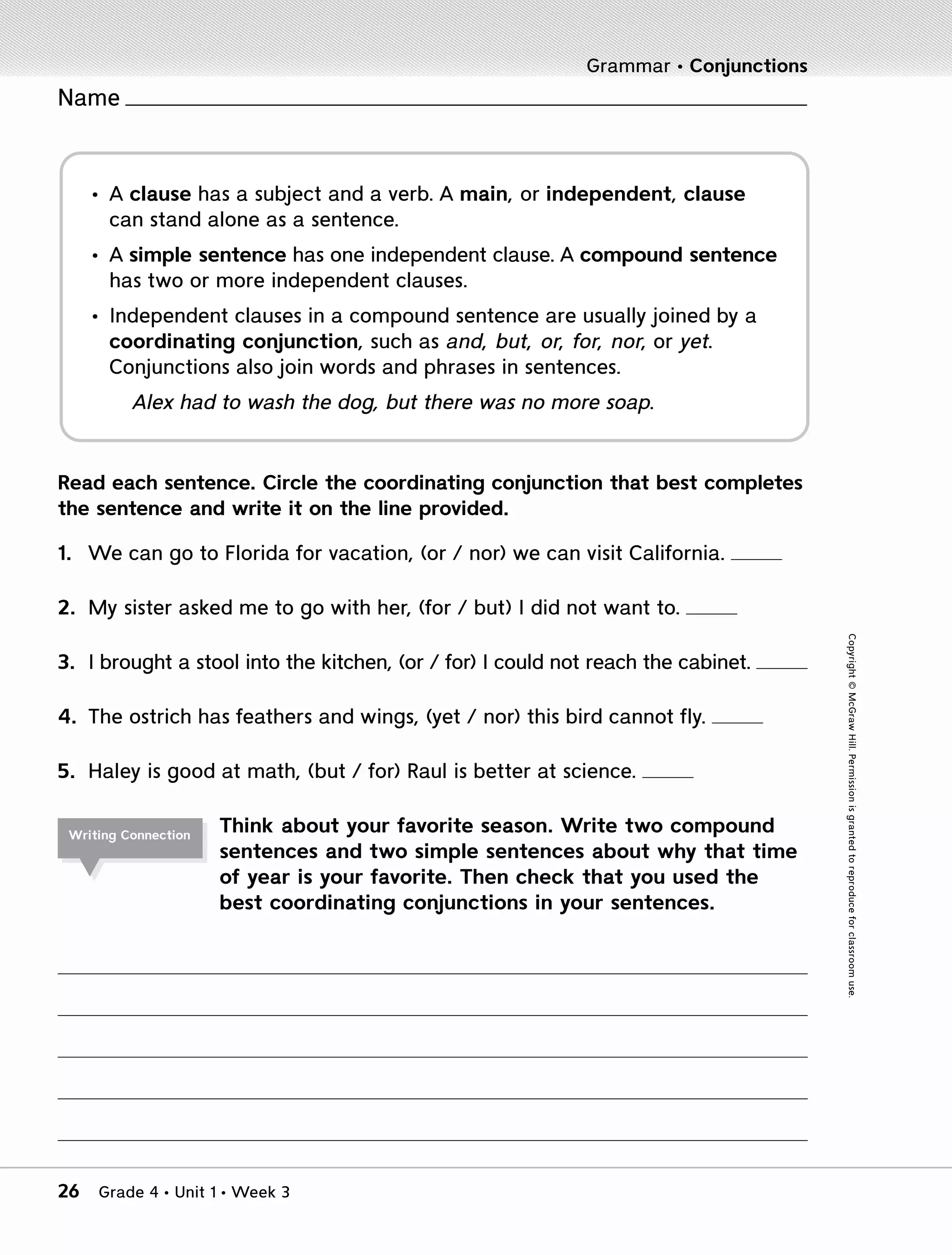
1. Jane said, I like to read about unusual animals.
2. My teacher asked, do you know who the president is?
3. Ms. Mendez exclaimed, close that window quickly!
4. I rushed inside and shouted, quick! Where is my camera?
5. My family at home includes my mother, father, sister, and me, I said.
• Use quotation marks at the beginning and end of a speaker’s exact
words. Begin a quotation with a capital letter. Tony said, “Come back.”
• Commas and periods always go inside quotation marks. “I can’t
believe,” she began, “that I got an A on that hard test.”
• A question mark or an exclamation mark goes inside quotation marks
when it is part of the quotation. He asked, “How much is this tomato?”
• A question mark or an exclamation mark goes outside quotation
marks when it is not part of the quotation. Did Toria say, “I am going
to the store”?
In your writer’s notebook, write a story about a conversation with
a friend. Include at least four quotations. Then pair up with a
classmate. Read the conversations out loud and check for correct
capitalization and punctuation, including quotation marks.
Grammar • Mechanics: Punctuation in Dialogue
Copyright
©
McGraw
Hill.
Permission
is
granted
to
reproduce
for
classroom
use.
Grade 4 • Unit 4 • Week 3 207
Name
Rewrite the sentences below,
correcting mistakes in present-
tense pronoun-verb agreement and
quotation marks.
1. I asks, “What is your favorite
season”?
2. Let’s eat before we finish the puzzle, I suggests.
3. You has more balloons than I do.
4. They is very happy to let us has the prize.
5. What am you doing? I asks worriedly.
6. It rock back and forth in a noisy way.
• A subject pronoun and a present-tense verb must agree in number.
• Follow specific rules for using subject pronouns with the present-tense
forms of have and be.
• Use quotation marks around someone’s exact words.
• Follow specific punctuation and capitalization rules for quotation
marks.
Use quotations only when directly
quoting what someone has said or
stating the title of something. Do not
use quotation marks unnecessarily.
COMMON ERRORS
Grammar • Proofreading
Copyright
©
McGraw
Hill.
Permission
is
granted
to
reproduce
for
classroom
use.
208 Grade 4 • Unit 4 • Week 3
Name
Read the selection. Then choose the best answer to each question.
(1) We sure that this is the correct place. (2) I
two parties to go to this weekend. (3) I most excited about this
party. (4) My friend a party after the school play tomorrow.
(5) My mom looks at me, and she honk loudly. (6) She reminds me that I
need to leave the party early tonight. (7) She are helping me with my book
report tonight! (8) I wave goodbye to her and walk through the front door.
1. What word goes in the blank
in sentence 1?
A have
B has
C is
D are
2. What word goes in the blank
in sentence 2?
F have
G is
H are
J am
3. What word goes in the blank
in sentence 3?
A have
B am
C are
D is
4. What word goes in the blank
in sentence 4?
F have
G has
H am
J is
5. What is the correct verb for
sentence 5?
A lookes
B look
C honk
D honks
6. What is the correct verb for
sentence 6?
F remind
G reminds
H needs
J needes
7. What is the correct verb for
sentence 7?
A am
B is
C are
D have
8. What is the correct verb for
sentence 8?
F wave
G waves
H walkes
J walks
Grammar • Test: Pronoun-Verb Agreement
Copyright
©
McGraw
Hill.
Permission
is
granted
to
reproduce
for
classroom
use.
Grade 4 • Unit 4 • Week 3 209
1.
2.
3.
4.
5.
6.
7.
8.
9.
10.
11.
12.
13.
14.
15.
16.
17.
18.
19.
20.
21.
22.
23.
24.
25.
Fold back the paper
along the dotted line.
Use the blanks to write
each word as it is read
aloud. When you finish
the test, unfold the
paper. Use the list at
the right to correct any
spelling mistakes.
Review Words
Challenge Words
1. mood
2. stoop
3. zoom
4. crew
5. stew
6. ruler
7. produce
8. issue
9. tutor
10. truth
11. bruised
12. juicy
13. suits
14. group
15. you’ll
16. huge
17. crook
18. wool
19. used
20. should
21. pennies
22. prettily
23. funnier
24. barbeque
25. crooked
Spelling • Words with /ü/, /u̇/, and /ˉ
u/
Name
Copyright
©
McGraw
Hill.
Permission
is
granted
to
reproduce
for
classroom
use.
210 Grade 4 • Unit 4 • Week 3
Retune begins with the
prefix re-. Prefixes often
form the first syllable in
a word. Final e vowel
spellings like u_e must stay
in the same syllable. Blend
the syllables: re-tune.
DECODING WORDS
The /ü/ sound, as in spoon, may be spelled
oo, ew, u_e, ue, u, ui, and ou (soon, blew,
rude, clue, July, fruity, and through).
The /ū/ sound in cube may be spelled u, u_e,
and ew (pupil, huge, and fewer).
The /u̇/ sound in book may be spelled oo and
ou (cooking and could).
suits stew crook bruised should
issue ruler crew group wool
zoom produce used you’ll mood
truth juicy stoop huge tutor
Read aloud and write the words with matching spelling patterns.
/ü/ spelled oo (as in
food)
1.
2.
3.
/ü/ spelled u/u_e/ue (as
in July/rude/clue)
4.
5.
6.
7.
8.
/ü/ spelled ui (as in fruit)
9.
10.
11.
/ü/ spelled ou (as in soup)
12.
13.
/ü/ spelled ew (as in blew)
14.
15.
/u/
˙ spelled oo (as
in book)
16.
17.
/u/
˙ spelled ou (as in
would)
18.
/u
–/ spelled u_e (as in
cube)
19.
20.
Look through this week’s selection for
more words to sort. Create a word sort in
your writer’s notebook for a partner.
Phonics/Spelling • Word Sort
Name
Copyright
©
McGraw
Hill.
Permission
is
granted
to
reproduce
for
classroom
use.
Grade 4 • Unit 4 • Week 3 211
Name
The /ü/ sound, as in spoon, may be spelled
oo, ew, u_e, ue, u, ui, and ou (soon, blew,
rude, clue, July, fruity, and through).
The /ū/ sound in cube may be spelled u,
u_e, and ew (pupil, huge, and fewer).
The /u̇/ sound in book may be spelled oo
and ou (cooking and could).
suit stew cookie fruit should
tunes used spool group wool
zoom new grew you'll tooth
due July food huge true
Read aloud and write the words with the matching spelling patterns.
/ü/ spelled oo (as in
mood)
1.
2.
3.
4.
/ü/ spelled u/u_e/ue (as
in tutor/rude/clue)
5.
6.
7.
8.
/ü/ spelled ui (as in
bruised)
9.
10.
/ü/ spelled ou (as in soup)
11.
12.
/ü/ spelled ew (as in blew)
13.
14.
15.
/u/
˙ spelled oo (as
in book)
16.
17.
/u/
˙ spelled ou (as in
would)
18.
/u
–/ spelled u_e (as in
cube)
19.
20.
Look through this week’s selection for
more words to sort. Create a word sort in
your writer’s notebook for a partner.
Retune begins with the
prefix re-. Prefixes often
form the first syllable in
a word. Final e vowel
spellings like u_e must stay
in the same syllable. Blend
the syllables: re-tune.
DECODING WORDS
Phonics/Spelling • Word Sort
Copyright
©
McGraw
Hill.
Permission
is
granted
to
reproduce
for
classroom
use.
211A Grade 4 • Unit 4 • Week 3
suits smooth crooked bruised should
tissue shrewd crew parachute communication
zoom produce mute you'll boost
truthful juicy doodle huge tutor
Read aloud and write the words with the matching spelling patterns.
/ü/ spelled oo (as in
food)
1.
2.
3.
4.
/ü/ spelled u/u_e/ue (as
in July/rude/clue)
5.
6.
7.
8.
9.
/ü/ spelled ui (as in
fruit)
10.
11.
12.
/ü/ spelled ou (as
in soup)
13.
/ü/ spelled ew (as
in blew)
14.
15.
/u/
˙ spelled oo (as
in book)
16.
/u/
˙ spelled ou (as in
would)
17.
–
/u/ spelled u/u_e (as in
pupil/cube)
18.
19.
20.
Look through this week’s selection for
more words to sort. Create a word sort in
your writer’s notebook for a partner.
Name
Phonics/Spelling • Word Sort
Copyright
©
McGraw
Hill.
Permission
is
granted
to
reproduce
for
classroom
use.
Grade 4 • Unit 4 • Week 3 211B
A. Write the spelling word that belongs with the other words in the group.
1. injured, hurt,
2. zip, fast,
3. moist, slushy,
4. he’ll, she’ll,
5. thief, robber,
6. would, could,
7. many, together,
8. market, groceries,
B. Write the spelling word that best completes each sentence.
9. Leaving the lights on is a waste of energy.
10. Mom cooked the slowly for many hours.
11. Did you see the latest of this magazine?
12. I am in a great today!
13. My grandfather has two good that he wears.
14. Use your to measure how tall the plant is.
15. I am an English for kids after school.
16. She the towel to dry her hands.
17. We put a welcome mat on our front .
18. That warm sweater is made of .
19. The of workers got the job done early.
20. I always tell the .
mood stew tutor suits crook
stoop ruler truth group wool
zoom produce bruised you’ll used
crew issue juicy huge should
Name
Spelling • Word Meaning
Copyright
©
McGraw
Hill.
Permission
is
granted
to
reproduce
for
classroom
use.
212 Grade 4 • Unit 4 • Week 3
Underline the six misspelled words in the paragraphs below. Write the words
correctly on the lines.
I decided to help my aunt make her famous stue. We made a list
and decided that we shood head over to the market. Once inside, we
went straight to the produice department.
After picking up some carrots and onions, we looked at a groop of
potatoes. All of them were brused! Aunt Wendy was not happy. She
spoke to a clerk who brought out a fresh bag for us. As we left, we
both knew that the meal would be a hewge success!
1. 4.
2. 5.
3. 6.
Write about a meal that you prepared with someone. Use
at least four words from the spelling list. Use a dictionary
or an online resource to check that you have spelled the
spelling words and high-frequency words correctly.
Writing Connection
Name
Spelling • Proofreading
Copyright
©
McGraw
Hill.
Permission
is
granted
to
reproduce
for
classroom
use.
Grade 4 • Unit 4 • Week 3 213
The word roots is in bold type.
The word hood is in bold type.
The word stool is in bold type.
The word full is in bold type.
The word new is in bold type.
The word book is in bold type.
The word scooter is in bold type.
The word luge is in bold type.
The word room is in bold type.
The word tissue is in bold type.
The word rude is in bold type.
The word goosey is in bold type.
The word blue is in bold type.
The word moose is in bold type.
The word soup is in bold type.
The word cooler is in bold type.
The word fused is in bold type.
The word loop is in bold type.
The word youth is in bold type.
The word oozed is in bold type.
Circle the spelling word in each row that rhymes with the word in bold type.
Write the spelling word on the line. Then read the word aloud.
1. roots rants sports suits
2. hood should had word
3. stool sold look you’ll
4. full fail wool while
5. new crew crow pull
6. book break crook fluke
7. scooter sweater tutor flutter
8. luge high look huge
9. room zoom took rule
10. tissue scissor issue amiss
11. rude mood made rug
12. goosey grassy furry juicy
13. blue groom hook stew
14. moose produce mister erase
15. soup stop stoop pup
16. cooler caller ruler stroller
17. fused used cried stood
18. loop good loom group
19. youth south troop truth
20. oozed bruised based dozed
The /ü/ sound, as in spoon, may be spelled oo, ew, u_e, ue, u, ui, and
ou (soon, blew, rude, clue, July, fruity, and through).
The /ū/ sound in cube may be spelled u, u_e, and ew (pupil, huge,
and fewer).
The /u̇ / sound in book may be spelled oo and ou (cooking and could).
Remember
Name
Phonics/Spelling • Review
Copyright
©
McGraw
Hill.
Permission
is
granted
to
reproduce
for
classroom
use.
214 Grade 4 • Unit 4 • Week 3
Vocabulary • Related Words
Name
Choose a base word from “A Telephone Mix-Up” and write it below
the telephone. Then add prefixes, suffixes, and inflectional endings to
make as many related words as you can. Use a dictionary to help you.
Expand your vocabulary by adding or removing inflectional endings,
prefixes, or suffixes to a base word to create different forms of a word.
misdirect
redirect
director
directed
direction
direct
directive
directional
directing
5
4 3 2
1
6
7
8
9 0
#
*
Copyright
©
McGraw
Hill.
Permission
is
granted
to
reproduce
for
classroom
use.
Grade 4 • Unit 4 • Week 3 215
Name
Each sentence below contains an underlined vocabulary word. Circle True if
the statement is true. Circle False if the statement is false.
1. When two people compromise, they meet in the middle.
True False
2. Amendments are orders you give to someone else.
True False
3. A boycott is a refusal to talk to all boys.
True False
4. A different version of a song might be played with different instruments.
True False
5. Brushing your teeth twice a day is a privilege.
True False
6. Green, leafy trees are prevalent in the world’s deserts.
True False
7. A democracy is a form of government in which one ruler has all the power.
True False
8. You must wait for something that will happen eventually.
True False
9. Legislation is carried out by senators and representatives in Congress.
True False
10. A dentist is qualified to examine teeth and fill cavities.
True False
11. Agriculture is something that annoys or bothers people.
True False
12. Promising to be someone’s friend is an example of a commitment.
True False
Vocabulary • Spiral Review
Copyright
©
McGraw
Hill.
Permission
is
granted
to
reproduce
for
classroom
use.
216 Grade 4 • Unit 4 • Week 3
The word compromise is underlined.
The word Amendments is underlined.
The word boycott is underlined.
The word version is underlined.
The word privilege is underlined.
The word prevalent is underlined.
The word democracy is underlined.
The word eventually is underlined.
The word Legislation is underlined.
The word qualified is underlined.
The word Agriculture is underlined.
The word commitment is underlined.
Grade 4 Unit 4 Week 4
The words the book that belongs to me are underlined.
Name
Read each sentence and rewrite the underlined word or words using a
possessive pronoun or a possessive pronoun and a noun.
1. I left the book that belongs to me at home.
2. Lisa’s telephone is broken.
3. The mechanic said that the car’s wheels are brand new.
4. The bedroom that belongs to you and me needs to be cleaned.
5. May I borrow the necklace that belongs to you?
6. Maya and Lucy’s parrot says “Hello.”
• A possessive pronoun takes the place of a possessive noun. It does
not have an apostrophe. Brian’s dog is brown. His dog is brown.
• A possessive pronoun must match the noun it replaces in number and
gender. Use my for first-person singular nouns, your for second-person
singular nouns, and his/her/its for third-person singular nouns. For
plural nouns, use our for first-person, your for second-person, and their
for third-person point of view.
Observatories have powerful technology that astronomers use to
do their research.
Read this paragraph from “Star Parties.” Find the sentence
that includes a possessive pronoun. Underline the possessive
pronoun and circle the subject that the possessive pronoun
is replacing.
Reading/Writing
Connection
	
Then, in your writer’s notebook, write a story about a group
that goes into space. What do they bring? Whom do they
meet? Use at least four possessive pronouns. Edit your work.
Grammar • Possessive Pronouns
Copyright
©
McGraw
Hill.
Permission
is
granted
to
reproduce
for
classroom
use.
Grade 4 • Unit 4 • Week 4 217
The word Lisa’s is underlined.
The words the car’s are underlined.
The words The bedroom that belongs to you and me are underlined.
The words the necklace that belongs to you are underlined.
The words Maya and Lucy’s are underlined.
Name
Circle the correct possessive pronoun in parentheses to complete
the sentence. Then rewrite the sentence on the line.
1. I think that this skateboard is (his / its).
2. This is (hers / her) and that is (your / yours).
3. I will watch your dog if you watch (my / mine).
• A stand-alone possessive pronoun is not used directly before a noun.
That leftover sandwich is mine.
• Add -s to most pronouns that are used after a noun to form a stand-
alone possessive pronoun, such as yours, hers, his, ours, and theirs.
• Mine is a stand-alone possessive pronoun. His and its are the same
when used before a noun or as a stand-alone possessive pronoun.
Write a paragraph about your favorite character from
a book, movie, TV show, or song. Include at least two
possessive pronouns and one stand-alone possessive pronoun.
Writing Connection
Grammar • Stand-Alone Possessive Pronouns
Copyright
©
McGraw
Hill.
Permission
is
granted
to
reproduce
for
classroom
use.
218 Grade 4 • Unit 4 • Week 4
The words his and its are in parentheses.
The words hers, her and your, yours are in parentheses.
The words my and mine are in parentheses.
Name
• Add an apostrophe and -s to a singular noun to make it possessive:
dog/dog’s.
• Add an apostrophe to make most plural nouns possessive: dogs/dogs’.
• Add an apostrophe and -s to form the possessive of plural nouns that
do not end in -s: women/women’s.
• Possessive pronouns do not have apostrophes. They should agree in
number and gender with the possessive nouns they replace.
Rewrite each sentence. Correct the punctuation of possessive nouns and
pronouns.
1. My little sisters favorite game is hide-and-seek.
2. The childrens dog ate it’s food too quickly.
3. Five truck’s horns made an overpowering noise.
4. Sometimes the ocean waves power can destroy the beach.
5. The subject of the report was our’s to choose.
	 In your writer’s notebook, describe the houses in your
neighborhood and who lives in them. Include at least five
possessive nouns. Circle them. Then edit your work to make
sure you used the apostrophes correctly.
Grammar • Mechanics: Possessive Nouns and Pronouns
Copyright
©
McGraw
Hill.
Permission
is
granted
to
reproduce
for
classroom
use.
Grade 4 • Unit 4 • Week 4 219
Name
• A possessive pronoun takes the place of a possessive noun and does
not include an apostrophe. It must match the noun it replaces in
number and gender.
• A stand-alone possessive pronoun is not used directly before a noun.
Add -s to most pronouns that are used before a noun to form a stand-
alone possessive pronoun.
• Mine is a stand-alone possessive pronoun. His and its are the same
when used before a noun or as a stand-alone possessive pronoun.
Rewrite the paragraphs below, correcting mistakes in possessive nouns
and pronouns.
1. Me name is Robert, and this is mine wife, Florence.
That’s her’ given name, but she prefers to be called
Flossy. Let us show you around our’s home. Down
the hall we have ours offices. The one on the left is
mines, and the one on the right is Flossys.
2. The rancher watched hi’s horses as they ran around theirs paddock. They
all looked happy except for one. It’s leg was lifted, and it was limping. The
rancher frowned and told his’ daughter to get hers lasso. He would have to
bring this horse in to give it time to rest.
Grammar • Proofreading
Copyright
©
McGraw
Hill.
Permission
is
granted
to
reproduce
for
classroom
use.
220 Grade 4 • Unit 4 • Week 4
Name
Read the selection. Then choose the best answer to each question.
(1) I love this town because family has lived here for years.
(2) Every morning, neighbors walk to the diner to have breakfast
and chat. (3) Mrs. Taggart’s dog always waits outside the diner wagging
tail. (4) When I try to steal my friend’s bacon to give to the dog,
she tells me that it’s !
(5) town has interesting events, too. (6) sister’s
favorite is the picnic basket auction in the summer. (7) My dad says the
sledding contest in winter is . (8) My brothers say that the toy boat
race in spring is .
1. Which word best completes
sentence 1?
A mine
B its
C ours
D our
2. Which word best completes
sentence 2?
F his
G their
H our
J they’re
3. Which word best completes
sentence 3?
A its
B her’s
C hers
D it’s
4. Which word best completes
sentence 4?
F hers
G her
H our
J its
5. Which word best completes
sentence 5?
A Their
B Mine
C His
D Our
6. Which word best completes
sentence 6?
A Hers
B Ours
C My
D Mine
7. Which word best completes
sentence 7?
F her
G his
H my
J theirs
8. Which word best completes
sentence 8?
A there’s
B theirs
C they’res
D theres
Grammar • Test: Possessive Pronouns
Copyright
©
McGraw
Hill.
Permission
is
granted
to
reproduce
for
classroom
use.
Grade 4 • Unit 4 • Week 4 221
Spelling • Diphthongs /oi/ and /ou/
Name
1.
2.
3.
4.
5.
6.
7.
8.
9.
10.
11.
12.
13.
14.
15.
16.
17.
18.
19.
20.
21.
22.
23.
24.
25.
Fold back the
paper along the
dotted line. Use
the blanks to
write each word
as it is read aloud.
When you finish
the test, unfold
the paper. Use the
list at the right
to correct any
spelling mistakes.
Review Words
Challenge Words
1. noises
2. voices
3. rejoice
4. annoy
5. destroy
6. voyage
7. mound
8. south
9. pound
10. hound
11. pouch
12. thousand
13. wound
14. grouch
15. cowboy
16. gown
17. frown
18. howling
19. flower
20. tower
21. crook
22. zoom
23. group
24. drought
25. downtown
Copyright
©
McGraw
Hill.
Permission
is
granted
to
reproduce
for
classroom
use.
222 Grade 4 • Unit 4 • Week 4
Phonics/Spelling • Word Sort
Name
A diphthong occurs when two vowels are
blended into a single syllable, making the
vowel sound change.
The diphthong /oi/ is spelled oy and oi,
as in boy and oil. The diphthong /ou/ is
spelled ou and ow, as in ground and now.
Some vowel teams, like oy
and ow, have a consonant
that acts as a vowel. These
vowel teams must stay
in the same syllable. For
example: boy-cott.
DECODING WORDS
ou
1.
2.
3.
4.
5.
6.
7.
8.
oy
9.
10.
11.
ow
12.
13.
14.
15.
16.
oi
17.
18.
19.
ow and oy
20.
Use the spelling patterns above to write a short tongue
twister. Include four words from the spelling list. Check your
work for errors.
Read aloud and write the spelling words with the matching spelling patterns.
pound cowboy noises wound rejoice
grouch voyage hound voices tower
frown annoy howling thousand flower
mound south destroy gown pouch
Copyright
©
McGraw
Hill.
Permission
is
granted
to
reproduce
for
classroom
use.
Grade 4 • Unit 4 • Week 4 223
Name
Read aloud and write the spelling words with the matching spelling patterns.
ou
1.
2.
3.
4.
5.
6.
7.
8.
9.
oy
10.
ow
11.
12.
13.
14.
15.
16.
oi
17.
18.
19.
ow and oy
20.
Use the spelling patterns above to write a short tongue
twister. Include four words from the spelling list. Check your
work for errors.
pound cowboy noise wound coin
grouch brown hound voices tower
frown loyal howl thousand flower
mound south cloud gown pouch
A diphthong occurs when two vowels are
blended into a single syllable, making the
vowel sound change.
The diphthong /oi/ is spelled oy and oi,
as in boy and oil. The diphthong /ou/ is
spelled ou and ow, as in ground and now.
Some vowel teams, like oy
and ow, have a consonant
that acts as a vowel. These
vowel teams must stay
in the same syllable. For
example: boy-cott.
DECODING WORDS
Phonics/Spelling • Word Sort
Copyright
©
McGraw
Hill.
Permission
is
granted
to
reproduce
for
classroom
use.
223A Grade 4 • Unit 4 • Week 4
Name
A. Read aloud and write the spelling words with the matching spelling
patterns.
B. Compare the words noises and voices. How are they alike? How are they
different?
Use the spelling patterns you’ve learned to write a short
tongue twister. Include four words from the spelling list.
Check your work for errors.
ou
1.
2.
3.
4.
5.
6.
7.
8.
oy
9.
10.
11.
oi
12.
13.
14.
ow
15.
16.
17.
18.
19.
ow and oy
20.
trouser cowboy void wound rejoice
grouch voyage encounter hardboiled empower
downtown annoyance howling thousand prowl
mound southpaw destroy nowadays announce
Phonics/Spelling • Word Sort
Copyright
©
McGraw
Hill.
Permission
is
granted
to
reproduce
for
classroom
use.
Grade 4 • Unit 4 • Week 4 223B
Name
A. Write the spelling word that matches each synonym below.
1. bag
2. grump
3. wrangler
4. 1,000
5. sounds
6. turned
7. blossom
8. 16 ounces
9. celebrate
10. tall building
11. scowl
B. Write the spelling word to complete each analogy below.
12. Jet is to airplane as trip is to .
13. Give is to take as please is to .
14. Hole is to hollow as hill is to .
15. Shirt is to blouse as dress is to .
16. Remember is to forget as create is to .
17. Giggling is to laughing as barking is to .
18. Up is to down as north is to .
19. Cat is to kitty as dog is to .
20. Band is to instruments as choir is to .
noises destroy pound wound frown
voices voyage hound grouch howling
rejoice mound pouch cowboy flower
annoy south thousand gown tower
Spelling • Word Meaning
Copyright
©
McGraw
Hill.
Permission
is
granted
to
reproduce
for
classroom
use.
224 Grade 4 • Unit 4 • Week 4
Name
Underline the six misspelled words in the paragraphs below. Write the words
correctly on the lines.
People take trips all over the world, but a voiage out West is like no
other. Taking a trip to the western United States may mean traveling for
a thowsand miles, but it is well worth it. There is beauty behind every
hill and mownd.
The West brings back the old days. If you travel there, you are sure
to see cowbois and horses on the open plains. You may even hear
wolves houling at the moon at night. Consider taking a trip to the West
and rejoyce in all the wonders it has to offer!
1. 4.
2. 5.
3. 6.
Write about a place that you would
like to see one day. Use at least
four words from the spelling list.
Then check your work to make sure
you have spelled the high-frequency
words correctly.
Writing Connection
Spelling • Proofreading
Copyright
©
McGraw
Hill.
Permission
is
granted
to
reproduce
for
classroom
use.
Grade 4 • Unit 4 • Week 4 225
The word shower is in bold type.
The word choices is in bold type.
The word couch is in bold type.
The word sound is in bold type.
The word town is in bold type.
The word enjoy is in bold type.
The word found is in bold type.
The word ouch is in bold type.
The word clown is in bold type.
The word mouth is in bold type.
The word sound is in bold type.
The word ground is in bold type.
The word employ is in bold type.
The word scowling is in bold type.
The word hour is in bold type.
Name
A. 	
Circle the word that rhymes with the word in bold type. Read aloud and
write the word.
shower shoulder tower toiled
2. choices cases voices vices
3. couch grouch rich cake
4. sound sour pound proud
5. town gown grow tow
6. enjoy away joyful destroy
7. found fried food mound
8. ouch pooch pouch lunch
9. clown clue own frown
10. mouth south youth mount
11. sound hound should hood
12. ground gold bind wound
13. employ annoy before empty
14. scowling bowling howling going
15. hour flower fire tour
B. 	
Write these spelling words in reverse alphabetical order:
thousand, noises, voyage, rejoice, cowboy.
A diphthong occurs when two vowels are blended into a single syllable.
If a vowel sound changes in a single syllable, it is a diphthong.
The diphthong /oi/ is spelled oy and oi, as in boy and oil. The
diphthong /ou/ is spelled ou and ow, as in ground and now.
Remember
16.
17.
18.
19.
20.
Phonics/Spelling • Review
Copyright
©
McGraw
Hill.
Permission
is
granted
to
reproduce
for
classroom
use.
226 Grade 4 • Unit 4 • Week 4
The word barometer is in bold.
The word prolific is in bold.
The word velocipede is in bold.
The word Cranes is in bold.
Vocabulary • Context Clues
Name
Context clues are other words in the text that help you figure out the
meaning of an unfamiliar or multiple-meaning word. Context clues can
be found in the same sentence as the unfamiliar word or in the same
paragraph.
There are different kinds of context clues to look for. The author may
include a definition of the word. You might find a synonym, restatement,
or antonym that reveals the word’s meaning.
1. 	
Scientists knew that pressure in the atmosphere was a reliable indicator of
weather changes. If they could measure that air pressure and its changes,
they could be better weather forecasters. Luckily, Evangelista Torricelli’s
barometer, invented in 1643, made this possible.
2.	
Many inventors only develop one or two ideas or devices in their lifetime.
Thomas Edison, however, was a prolific inventor who received patents for
over a thousand different inventions.
3. 	
In the 1800s, a number of contraptions were invented to help people get
to where they were going faster. One example is the velocipede, an early
form of the bicycle with one or more wheels propelled by pedals.
4. 	
Cranes have been around since the sixth century B.C. These
simple machines used for lifting and transporting heavy objects were
invented by the ancient Greeks to help construct tall buildings.
Read each passage. Underline the context clues that help you understand the
word in bold and write the word’s meaning on the line.
Copyright
©
McGraw
Hill.
Permission
is
granted
to
reproduce
for
classroom
use.
Grade 4 • Unit 4 • Week 4 227
The word pleaded is in bold.
The word toiled is in bold.
The word concentration is in bold.
The word scowled is in bold.
The word humble is in bold.
Name
1. 	
For months Leonardo had begged and pleaded with his father to get
him a suit of armor.

2. He began working on the new invention in the barn that day. It
wasn’t long before the barn was overflowing with notes, tools, and
equipment as he toiled away on the knight.

3. High atop a rickety ladder, Leonardo was deep in concentration.
All his focus was on fixing the mechanical knight’s arm, but it wasn’t
easy work.

4. No matter what he did, the knight’s arm refused to lift! Leonardo
frowned and scowled at it.

5. “It’s a simple system of pulleys and cables,” he said in a humble
voice. “Don’t be so modest. I’ve never seen anything like it before!”

Read each selection from “Leonardo’s Mechanical Knight.” Underline the
synonym that helps you figure out the meaning of each word in bold. Then
write the definition of the word in bold on the line.
Vocabulary • Synonyms
Copyright
©
McGraw
Hill.
Permission
is
granted
to
reproduce
for
classroom
use.
228 Grade 4 • Unit 4 • Week 4
Grade 4 Unit 4 Week 5
Name
Read each sentence. Circle the correct word in parentheses and write it on
the line to complete the sentence.
1. (their / there) The boys put on coats and ran outside.
2. (your / you’re) Did you drop letter in the mailbox?
3. (there / they’re) Did you go last Saturday?
4. (your / you’re) lucky to be in the school play.
5. (their / they’re) I think coming to my party.
6. (its / it’s) The log is slippery because wet.
• Homophones are words that sound alike but have different spellings
and meanings, such as see and sea.
• Some frequently confused homophones are the possessive pronoun
their and the contraction they’re.

Write a paragraph about your pet, real or imaginary.
Describe what it looks like and how it acts. Include at
least three pronouns. Then edit your work.
Writing Connection
Grammar • Pronouns and Homophones
Copyright
©
McGraw
Hill.
Permission
is
granted
to
reproduce
for
classroom
use.
Grade 4 • Unit 4 • Week 5 229
The words their and there are in parentheses.
The words your and you're are in parentheses.
The words there and they're are in parentheses.
The words your and you're are in parentheses.
The words their and they're are in parentheses.
The words its and it's are in parentheses.
Name
A. Read each sentence and circle the subject pronoun. On the line, write a
contraction for the subject pronoun and verb.
1. They are about to get on the bus.
2. You are early for the movie.
3. It is in the box on the floor.
B. Underline the homophone that correctly completes each sentence.
4. Do you think (their / they’re / there) at the park right now?
5. Is this (your / you’re) backpack?
6. The cat licked (its / it’s) paw over and over again.
• Homophones are words that sound alike but have different spellings
and meanings. Some pronouns are also homophones.
• Subject pronouns are often used in conjunction with verbs to form
contractions: they are/they’re.
• Contractions and possessive pronouns can be homophones, such as
the contraction it’s and the possessive pronoun its.
Read this excerpt from “Genius.” Circle the contraction. Then write your own
sentence using the possessive pronoun homophone of the contraction you
circled. Edit your work to make sure you used the correct homophone.
The spiral notebook in my hand provides her quick relief.
It tells her there’s no danger of a break-in by a thief.
“Okay,” she says, then, props herself up vertically in bed.
Grammar • Types of Pronouns and Homophones
Copyright
©
McGraw
Hill.
Permission
is
granted
to
reproduce
for
classroom
use.
230 Grade 4 • Unit 4 • Week 5
Name
Rewrite each sentence. Correct any incorrect contractions and possessive
pronouns.
1. I put my bag here and my parents stored their’s at their feet.
2. Youre going to love this new book that just came out.
3. Do you think theyre going to be late for the show?
4. I picked up the small suitcase by it’s handle.
5. Is that you’r aunt sitting with your mother in the audience?
6. I think its funny that you and I have the same first name.
• An apostrophe is used in a contraction to take the place of the missing
letter or letters: it is/it’s.
• An apostrophe should not be used with a possessive pronoun.
Go back through your writer’s notebook and search for any
possessive nouns or contractions you may have used. Check to make
sure you have used the correct form. Correct any mistakes you may
have made.
Grammar • Mechanics: Contractions and Possessives
Copyright
©
McGraw
Hill.
Permission
is
granted
to
reproduce
for
classroom
use.
Grade 4 • Unit 4 • Week 5 231
Name
Rewrite the paragraphs below, correcting
mistakes in contractions and pronouns.
1. If your afraid of heights, do not go to the top of
the Empire State Building in New York City. Its
one of the tallest buildings in the world. Millions
of people go there every year. They say theyre
not afraid, but once they see how high it is they
change there minds!
2. Ana is happy today. Shes going to meet her pen pal, Marco. He’s visiting
with his family from Brazil. There good friends and write all the time. Ana
thinks its exciting to finally meet Marco face to face! She can’t wait to talk
to him in person.
• Subject pronouns are often used with verbs to form contractions.
• Contractions and pronouns can be homophones.
• An apostrophe is used in a contraction to take the place of the missing
letter or letters.
• An apostrophe should not be used with a possessive pronoun.
Remember to write legibly,
with clear capital letters at
the beginning of sentences
and clear punctuation at
the ends.
HANDWRITING CONNECTION
Grammar • Proofreading
Copyright
©
McGraw
Hill.
Permission
is
granted
to
reproduce
for
classroom
use.
232 Grade 4 • Unit 4 • Week 5
Name
Read the selection. Then choose the best answer to each question.
(1) almost eight o’clock in the morning when my mom looks
in my bedroom. (2) “Aren’t you going to the park with friends
this morning? (3) You have to hurry because waiting in the car!”
(4) The park is beautiful with many lakes and trees. (5) We
watch an alligator from a distance as it moves tail back and
forth. (6) I thought we brought snacks to eat, but missing from
the cooler. (7) is a trail nearby, so we go on a long hike.
(8) ” going to be so sore tomorrow!” my friends all say.
1. Which word best completes
sentence 1?
A It’s
B Its
C They’re
D Their
2. Which word best completes
sentence 2?
F it’s
G its
H your
J you’re
3. Which word best completes
sentence 3?
A they’re
B its
C it’s
D there
4. Which word best completes
sentence 4?
F they’re
G it’s
H their
J its
5. Which word best completes
sentence 5?
A they’re
B it’s
C there
D its
6. Which word best completes
sentence 6?
A they’re
B its
C their
D it’s
7. Which word best completes
sentence 7?
F They’re
G There
H Their
J Theirs
8. Which word best completes
sentence 8?
A Your
B Theirs
C You’re
D Theres
Grammar • Test: Pronouns and Homophones
Copyright
©
McGraw
Hill.
Permission
is
granted
to
reproduce
for
classroom
use.
Grade 4 • Unit 4 • Week 5 233
Name
1.
2.
3.
4.
5.
6.
7.
8.
9.
10.
11.
12.
13.
14.
15.
16.
17.
18.
19.
20.
21.
22.
23.
24.
25.
Fold back the paper
along the dotted line.
Use the blanks to write
each word as it is read
aloud. When you finish
the test, unfold the
paper. Use the list at
the right to correct any
spelling mistakes.
Review Words
Challenge Words
1. caught
2. laws
3. drawn
4. strawberry
5. straw
6. awe
7. shawl
8. alter
9. halt
10. talking
11. walker
12. chalk
13. stalk
14. small
15. caller
16. squall
17. cough
18. fought
19. thought
20. false
21. south
22. pouch
23. annoy
24. wallpaper
25. awkward
Spelling • Variant Vowel /ô/
Copyright
©
McGraw
Hill.
Permission
is
granted
to
reproduce
for
classroom
use.
234 Grade 4 • Unit 4 • Week 5
Phonics/Spelling • Word Sort
Name
the aw sound spelled augh
1.
the aw sound spelled ough
2.
3.
4.
the aw sound spelled aw
5.
6.
7.
8.
9.
10.
the aw sound spelled al
11.
12.
13.
14.
15.
16.
17.
the aw sound spelled all
18.
19.
20.
The /ô/ vowel is pronounced aw, as
in awesome. It can be spelled in the
following ways: augh, as in daughter;
ough, as in sought; aw, as in claw; al, as
in salt; all, as in tall.
The variant vowel /ô/ is
most often spelled aw,
as in hawk, and au, as in
haul.
SPELLING TIP
caught straw halt stalk cough
laws awe talking small fought
drawn shawl walker caller thought
strawberry alter chalk squall false
Read aloud and write the spelling words that contain each spelling pattern.
Look through this week’s selection for more words to sort.
Create a word sort in your writer’s notebook for a partner.
Copyright
©
McGraw
Hill.
Permission
is
granted
to
reproduce
for
classroom
use.
Grade 4 • Unit 4 • Week 5 235
Name
the aw sound spelled ough
1.
the aw sound spelled au
2.
the aw sound spelled aw
3.
4.
5.
6.
7.
8.
9.
10.
the aw sound spelled al
11.
12.
13.
14.
15.
16.
the aw sound spelled all
17.
18.
19.
the aw sound spelled augh
20.
The /ô/ vowel is pronounced aw, as
in awesome. It can be spelled in the
following ways: augh, as in daughter;
ough, as in sought; aw, as in claw; al, as
in salt; all, as in tall.
The variant vowel /ô/ is
most often spelled aw,
as in hawk, and au, as in
haul.
SPELLING TIP
fault straw halt awful cough
laws awe talking small tall
draw thaw walk caller saw
taught alter chalk raw false
Read aloud and write the spelling words that contain each spelling pattern.
Look through this week’s selection for more words to sort.
Create a word sort in your writer’s notebook for a partner.
235A
Phonics/Spelling • Word Sort
Copyright
©
McGraw
Hill.
Permission
is
granted
to
reproduce
for
classroom
use.
Grade 4 • Unit 4 • Week 5
Phonics/Spelling • Word Sort
Name
the aw sound spelled
augh
1.
2.
the aw sound
spelled ough
3.
4.
5.
the aw sound
spelled aw
6.
7.
8.
the aw sound
spelled al
9.
10.
11.
12.
the aw sound
spelled all
13.
14.
the aw sound
spelled au
15.
16.
17.
18.
19.
20.
caught applauded halted stalk wallpaper
daughter clause because malt fought
dinosaur shawl vault alteration thoughtful
strawberry audiences sprawling squall sought
A. 	
Read aloud and write the spelling words that contain each spelling
pattern.
B. 	
Compare the words caught and cough. How are they alike? How are they
different?
Look through this week’s selection for more words to sort.
Create a word sort in your writer’s notebook for a partner.
Copyright
©
McGraw
Hill.
Permission
is
granted
to
reproduce
for
classroom
use.
Grade 4 • Unit 4 • Week 5 235B
Name
A. 	
Write the spelling word that is the antonym, or opposite, of each word
below.
1. large
2. listening
3. agreed
4. stillness
5. violations
6. disinterest
7. receiver
8. remain
B. Write the spelling word that best completes each sentence.
9. The fishermen a lot of fish today.
10. The teacher used to write on the board.
11. I have a even though my cold is gone.
12. The does not use a car to get places.
13. I disagree with that summary of what happened!
14. It is chilly outside, and I need a .
15. The old plant was brown and dry.
16. A tastes delicious with whipped cream.
17. The cars must at red stoplights.
18. The picture of me was to be funny-looking.
19. I this book was very entertaining.
20. There was on the floor in the barn.
caught straw halt stalk cough
laws awe talking small fought
drawn shawl walker caller thought
strawberry alter chalk squall false
Spelling • Word Meaning
Copyright
©
McGraw
Hill.
Permission
is
granted
to
reproduce
for
classroom
use.
236 Grade 4 • Unit 4 • Week 5
Name
Underline the six misspelled words in the paragraphs below. Write the words
correctly on the lines.
“Be the first coller to answer our question correctly, and you’ll win the
jackpot!” the radio announcer said. I called in, and the announcer asked who
was tawking. I gave him my name. He told me that to win I would have to
answer a true or folse question.
I thouht I knew the answer, but they cought me off guard with a trick
question. Even though I didn’t win the jackpot, I got a smawl gift for playing.
It was a gift certificate to my favorite movie theater. All in all, things turned
out all right!
1. 4.
2. 5.
3. 6.

Write about a goal or dream you would like to achieve.
Use at least four words from the spelling list. Then use a
dictionary to check your spelling of the high-frequency and
spelling words.
Writing Connection
Spelling • Proofreading
Copyright
©
McGraw
Hill.
Permission
is
granted
to
reproduce
for
classroom
use.
Grade 4 • Unit 4 • Week 5 237
The word saw is in bold type.
The word hawk is in bold type.
The word taller is in bold type.
The word call is in bold type.
The word bought is in bold type.
The word walk is in bold type.
The word crawl is in bold type.
The word thaw is in bold type.
The word gauze is in bold type.
The word taught is in bold type.
The word yawn is in bold type.
The word mall is in bold type.
The word brought is in bold type.
The word fault is in bold type.
The word off is in bold type.
Name
1. hawk rake chalk black
2. thaw straw that stew
3. bought thought moat cot
4. yawn span caw drawn
5. taller filler caller tanner
6. off muff tough cough
7. gauze buzz laws says
8. walk wick make stalk
9. mall shawl bill malt
10. call toll squall tail
11. taught tough fought boat
12. saw awe blew bar
13. brought beet crate caught
14. crawl paw small pal
15. fault halt hurt heart
B. 	
Write these spelling words in reverse alphabetical order:
talking, false, alter, walker, strawberry.
16. 18. 20.
17. 19.
A. 	
Circle the spelling word in each row that rhymes with the word in bold
type. Write the spelling word on the line. Then read the word aloud.
The /ô/ vowel is pronounced aw, as in awesome. It can be spelled in the
following ways: augh, as in daughter; ough, as in sought; aw, as in claw;
al, as in salt; all, as in tall.
The variant vowel /ô/ is most often spelled aw, as in hawk, and au, as
in haul.
Remember
Phonics/Spelling • Review
Copyright
©
McGraw
Hill.
Permission
is
granted
to
reproduce
for
classroom
use.
238 Grade 4 • Unit 4 • Week 5
Name
Remember that related words have the same base word. The meaning
of the word is changed slightly with the addition of prefixes, suffixes,
and inflectional endings. Examine the following related words with the
base word note and their meanings.
noted: noticed for a particular
reason
denoting: to be a name for; mean
notable: worthy of notice
notation: a quick note to assist
memory
How many words can you make with the base word attain? Use your knowledge
of prefixes, suffixes, and inflectional endings to help you. Read your words aloud
and try to guess what your words might mean. Then look up the meanings of your
words in a print or online dictionary.
attain
Vocabulary • Related Words
Copyright
©
McGraw
Hill.
Permission
is
granted
to
reproduce
for
classroom
use.
Grade 4 • Unit 4 • Week 5 239
The word trip is in bold.
The word sags is in bold.
The word march is in bold.
Name
Read each passage. Each word in bold has a different connotation in the
poem than its usual denotation. Explain the connotation on the lines.
1. Letters trip over each other as they race to leave my mouth.
2. One last kid sags with his head in his hands. He is mouthing each letter
as I say it.
3. My tongue lines them up in order as they march to the microphone:
Vocabulary • Connotation and Denotation
Copyright
©
McGraw
Hill.
Permission
is
granted
to
reproduce
for
classroom
use.
240 Grade 4 • Unit 4 • Week 5
Grade 4 Unit 5 Week 1
Name
• An adjective is a word that describes a noun or a pronoun. It modifies,
or limits or adds to, the meaning of the noun or pronoun: blue car.
• An adjective usually comes before the noun or pronoun it describes. It
also may follow a linking verb. Anna seems sleepy.
• Adjectives are usually placed in order of opinion, size, age, and then
color: a good, large, old, yellow dog.
Read each sentence and find the adjective or adjectives. Write all of the
adjectives in the sentence on the line provided.
1. The garden has red roses.
2. Our playful friends play many games.
3. The waves looked dangerous.
4. Have you seen my little dog?
5. The big red truck drove down the busy road.
	
Read these sentences from “Your World Up Close.” Circle
two adjectives and underline the nouns they describe. Using
the sentences as a model, write three sentences describing
your favorite object. Review your work to make sure you
have used adjectives correctly.
The light microscopes you use in school are weak and do not show much detail.
An electron microscope is a much more powerful tool, and it allows scientists to see
things we can’t see with our own eyes.
Reading/Writing
Connection
Grammar • Adjectives
Copyright
©
McGraw
Hill.
Permission
is
granted
to
reproduce
for
classroom
use.
Grade 4 • Unit 5 • Week 1 241
Name
• An adjective is a word that describes a noun or a pronoun. It can be
formed from a noun.
• A proper adjective is formed from a proper noun. It begins with a
capital letter: The Franklin Science Museum.
• Proper adjectives may describe languages, races, or nationalities:
Greek language, African American, Filipino.
• Brand names are often proper adjectives: Travel Right Luggage.
Circle the proper adjective that is incorrectly written in each sentence.
Write the proper adjective correctly on the line.
1. I ordered french fries with my hamburger.
2. She visited the jefferson Library yesterday.
3. There is nothing like the warm feel of florida sunshine.
4. It is an italian custom that has been in my family for years.
5. The chinese exchange student spoke English well.
6. Her mother and father are both hispanic.
7. My favorite brand of socks is red Hot Socks.
8. The four Peaks Water company made a huge profit last year.
In your writer’s notebook, write a short paragraph describing a
favorite place in your community. Include two proper adjectives.
Check your work to make sure that you have used all the adjectives
correctly.
Grammar • Proper Adjectives
Copyright
©
McGraw
Hill.
Permission
is
granted
to
reproduce
for
classroom
use.
242 Grade 4 • Unit 5 • Week 1
Name
• Use quotation marks at the beginning and end of a direct quotation.
My mother called out to me, “Come downstairs for dinner!”
• Use a comma before the opening quotation mark if a sentence begins
before the quote. Use a comma before the ending quotation mark if
a sentence continues after the quote. She said, “I made your favorite
dish,” as she stirred the pot.
• Use quotation marks before and after the titles of short works. I read
about it in an article called “Massaging Your Dog.”
Write each sentence correctly
by adding commas and
quotation marks where they belong.
1. My teacher just read us a short story called My Pet Gorilla.
2. My friend said, I can walk home with you after school.
3. “She is a good pet rabbit” my dad said about Lila.
4. My favorite short story is Under the Blue Sky.
5. He asked Can I go with you to the supermarket?
In your writer’s notebook, write a short story that includes a
conversation between two or more characters. Then edit your work
for correct use of quotation marks and commas.
Grammar • Mechanics: Punctuation
Copyright
©
McGraw
Hill.
Permission
is
granted
to
reproduce
for
classroom
use.
Grade 4 • Unit 5 • Week 1 243
Remember that only short
works need quotation marks.
Longer works, such as books
or newspapers, need to be
underlined or italicized.
COMMON ERRORS
Name
• An adjective is a word that describes a noun or a pronoun. It can be
formed from a noun.
• A proper adjective is formed from a proper noun. It begins with a
capital letter.
• Use quotation marks at the beginning and end of a direct quotation
and before and after the titles of short works.
Rewrite the paragraphs below, correcting
mistakes in adjectives and quotations.
1. Next week, I will go to my first spanish
class. It will be at the riverwood Center in
town. My mom said I’m so proud of you
for learning a new language. I am worried
though, since there are still many english
words that I don’t understand!
2. I love the japanese bookstore that just opened in the mall. It is Small, but
it has interesting books. I bought a book of short stories there. My favorite
story in the book is The Warrior. “That is my favorite one, too” said the
manager of the bookstore.
Copyright
©
McGraw
Hill.
Permission
is
granted
to
reproduce
for
classroom
use.
244 Grade 4 • Unit 5 • Week 1
Grammar • Proofreading
Name
Read the paragraph. Then choose the best answer to each question.
(1) Do you live near the coast? (2) My family and I visited
there once one summer. (3) We were all so to
be going on a trip! (4) The beaches were pink and white.
(5) The trees were ! (6) We heard so many languages being
spoken around us, like . (7) Dad insisted that we stop by a
restaurant for sausages.
(8) I think next summer, we are going to go to .
1.	
Which word fits best in
sentence 1?
A left
B Pacific
C Left
D pacific
2.	
Which word fits best in
sentence 2?
F National
G red
H hot
J July
3.	
Which word fits best in
sentence 3?
A vacation
B terrible
C excited
D long
4. 
Which word fits best in
sentence 4?
F sandy
G pink
H white
J summer
5.	
Which word fits best in
sentence 5?
A enormous
B Enormous
C eastern
D Eastern
6.	
Which word fits best in
sentence 6?
F spanish and mandarin
G Spanish and mandarin
H spanish and Mandarin
J Spanish and Mandarin
7.	Which word fits best in
sentence 7?
A chinese
B German
C french
D Open
8.	 Which word fits best in
sentence 8?
F new England
G new england
H New England
J New england
Copyright
©
McGraw
Hill.
Permission
is
granted
to
reproduce
for
classroom
use.
Grade 4 • Unit 5 • Week 1 245
Grammar • Test: Adjectives
Name
1.
2.
3.
4.
5.
6.
7.
8.
9.
10.
11.
12.
13.
14.
15.
16.
17.
18.
19.
20.
21.
22.
23.
24.
25.
Fold back the paper
along the dotted line.
Use the blanks to
write each word as it
is read aloud. When
you finish the test,
unfold the paper. Use
the list at the right to
correct any spelling
mistakes.
Review Words
Challenge Words
1. blanket
2. blossom
3. dipper
4. distant
5. foggy
6. fossil
7. member
8. nodded
9. planner
10. plastic
11. rumbles
12. slender
13. summer
14. swallow
15. tablet
16. thriller
17. traffic
18. welcome
19. willow
20.witness
21. talking
22.drawn
23. shawl
24.cupboard
25.friendly
Spelling • Closed Syllables
Copyright
©
McGraw
Hill.
Permission
is
granted
to
reproduce
for
classroom
use.
246 Grade 4 • Unit 5 • Week 1
Work with a partner to find
more words that contain closed
syllables. Record the words you
find in your writer’s notebook.
When a word has two
consonants in the middle,
divide the word between the
consonants to sound it out.
For example, bas-ket.
DECODING WORDS
Look at the word chin. Chin is one
syllable with one vowel sound. The
syllable ends in a consonant, the letter
n. Syllables ending in a consonant are
called closed syllables. Most closed
syllables have a short vowel sound.
blanket foggy planner summer traffic
blossom fossil plastic swallow welcome
dipper member rumbles tablet willow
distant nodded slender thriller witness
Read aloud and write each word under its spelling pattern.
words with double consonants
1.
2.
3.
4.
5.
6.
7.
8.
9.
10.
11.
words with different
consonants
12.
13.
14.
15.
16.
17.
18.
19.
20.
Phonics/Spelling • Word Sort
Name
Grade 4 • Unit 5 • Week 1 247
Copyright
©
McGraw
Hill.
Permission
is
granted
to
reproduce
for
classroom
use.
Phonics/Spelling • Word Sort
Name
When a word has two
consonants in the middle,
divide the word between the
consonants to sound it out.
For example, bas-ket.
DECODING WORDS
Look at the word chin. Chin is one
syllable with one vowel sound. The
syllable ends in a consonant, the letter
n. Syllables ending in a consonant are
called closed syllables. Most closed
syllables have a short vowel sound.
dinner foggy planner summer traffic
finger fossil plastic swallow welcome
dipper member kitten pillow willow
hello holly lesson thriller problem
Read aloud and write each word under its spelling pattern.
	 Work with a partner to find more words that contain closed
syllables. Record the words you find in your writer’s notebook.
words with double consonants
1.
2.
3.
4.
5.
6.
7.
8.
9.
10.
11.
12.
13.
14.
15.
words with different consonants
16.
17.
18.
19.
20.
Copyright
©
McGraw
Hill.
Permission
is
granted
to
reproduce
for
classroom
use.
247A Grade 4 • Unit 5 • Week 1
Phonics/Spelling • Word Sort
Name
Work with a partner to find more words that contain closed syllables.
Record the words you find in your writer’s notebook.
blanket foggy planner magnet traffic
blossom fossil plastic swallow windows
dipper canyon rumbles palmetto willow
distant comfort slender perhaps witness
A. Read aloud and write each word under its spelling pattern.
words with double consonants
1.
2.
3.
4.
5.
6.
7.
8.
9.
words with different
consonants
10.
11.
12.
13.
14.
15.
16.
17.
18.
19.
20.
B. Compare the words blossom and fossil. How are they alike and different?
Copyright
©
McGraw
Hill.
Permission
is
granted
to
reproduce
for
classroom
use.
Grade 4 • Unit 5 • Week 1 247B
Name
9. part of a group
10. something to write on
11. a warm or hot season
12. manmade material
13. to move throat muscles
14. one who sees something
15. thin
16. a suspenseful story
17. moved head up and down
18. many vehicles in one area
19. remains from the past
20. a cuplike scoop
blanket foggy planner summer traffic
blossom fossil plastic swallow welcome
dipper member rumbles tablet willow
distant nodded slender thriller witness
A.	An analogy is a statement that compares sets of words. Write the
spelling word to complete each analogy below.
1. Builder is to maker as organizer is to
2. Curvy is to straight as clear is to
3. Up is to down as goodbye is to
4. Jet is to roars as truck is to
5. Coat is to jacket as flower is to
6. Empty is to full as near is to
7. Dog is to poodle as tree is to
8. Sea is to ocean as quilt is to
B. Write the spelling word that matches each definition below.
Spelling • Word Meaning
Copyright
©
McGraw
Hill.
Permission
is
granted
to
reproduce
for
classroom
use.
248 Grade 4 • Unit 5 • Week 1
Name
Underline the six misspelled words in the paragraphs below.
Write the words correctly on the lines.
Lucy read the poster with great interest. It said, “Wellcome to the
Habitat Museum! We hope you will join us this sumer. We will meet
every Saturday under the wilow tree in front of the library.”
Lucy was excited to become a new memmber of the museum club.
The poster said that there would be a movie at the museum next
Saturday. It is about a hiker who is a wittnes to a robbery. The stolen
item is a dinosaur fosil. Lucy couldn’t wait to see it!
1.
2.
3.
4.
5.
6.
Writing Connection Write about a club that you have
joined or would like to join. Use at
least four words from the spelling list.
As you check your work, be sure that
you have spelled the high-frequency
words correctly.
Spelling • Proofreading
Copyright
©
McGraw
Hill.
Permission
is
granted
to
reproduce
for
classroom
use.
Grade 4 • Unit 5 • Week 1 249
Name
blanket foggy planner summer traffic
blossom fossil plastic swallow welcome
dipper member rumbles tablet willow
distant nodded slender thriller witness
Syllables that end in a consonant are called closed syllables. Most
closed syllables have a short vowel sound.
Remember
1. sle er
2. tra ic
3. fo il
4. bla et
5. wi ow
6.	pla er
7. 	swa ow
8.	di ant
9. we ome
10.	 pla ic
11.	fo y
12. thri er
13. no ed
14.	 su er
15. ru es
16. wi ess
17.	blo om
18. ta et
19. me er
20.di er
Fill in the missing letters to form a spelling word. Write the word on
the line. Then read the word aloud.
Phonics/Spelling • Review
Copyright
©
McGraw
Hill.
Permission
is
granted
to
reproduce
for
classroom
use.
250 Grade 4 • Unit 5 • Week 1
Vocabulary • Content Words
Name
Search classroom texts, newspapers, and magazines for content words
related to the tools scientists use. Write the words below.
Circle two words that you were able to define by using context clues.
Write the words and their meanings on the lines.
Content words are used to write about fields of study. In this unit, you will
find content words related to science and technology, such as electron
microscope, magnification, and photomicrograph. Use context clues,
dictionaries, electronic resources, and your knowledge of Greek and Latin
roots to help you understand the meanings of these words.
“Your World Up Close”
describes the technology
used to magnify objects,
such as snowflakes,
fingerprints, and skin cells,
to thousands of times their
actual size. It also explains
how scientists use these
magnified images. The
author uses content words
to tell about these topics.
CONNECT TO CONTENT
Science and Technology Words
Copyright
©
McGraw
Hill.
Permission
is
granted
to
reproduce
for
classroom
use.
Grade 4 • Unit 5 • Week 1 251
Name
attain commitment hovering connotation
gleaming democracy triumph denotation
dangling technology stanza repetition
Write the vocabulary word from the box that answers each riddle below.
1.
2. I’m felt by the winning team.
3. I’m a government for and by the people.
4. I’m a paragraph in a poem.
5. I’m done over and over again.
6. I describe a hummingbird in the air.
7. I’m a promise you make.
8. I describe how a word makes you feel.
9. I’m a new kind of phone.
10. I’m something you hope to do with a goal.
11. I describe polished silver or gold.
12. I’m what an acrobat does high above.
Vocabulary • Spiral Review
Copyright
©
McGraw
Hill.
Permission
is
granted
to
reproduce
for
classroom
use.
252 Grade 4 • Unit 5 • Week 1
You’ll find me in a dictionary.
Grade 4 Unit 5 Week 2
Name
Read each sentence and circle the article. On the line, write
S if the related noun is singular. Write P if the noun is plural.
1. We saw a film in science class today.
2. These are the people I was telling you about.
3. Did you go to see the movie that I suggested?
4. I ate an omelet this morning.
5. My sisters are the captains of their cheerleading squad.
	
Read this excerpt from “The Incredible Shrinking Potion.”
Underline the articles. Then write two sentences about a
science experiment you would like to do. Include at least
three articles. Then check your work.
• An article is a type of adjective. It comes before the noun it describes.
• The article the identifies a particular person, place, or thing. It refers
to both singular and plural nouns: the kitten, the kittens.
• The articles a and an refer to a general person, place, or thing. They
refer to singular nouns only. Use a before a noun that begins with a
consonant, such as a carrot. Use an before a noun that begins with a
vowel, such as an eagle.
Reading/Writing
Connection
It began as a simple science project. It was only
one week ago that Isabel, Mariela, and Hector were
working on a shrinking potion that would amaze
everyone at the science fair.
Grammar • Use of a, an, and the
Copyright
©
McGraw
Hill.
Permission
is
granted
to
reproduce
for
classroom
use.
Grade 4 • Unit 5 • Week 2 253
Name
• The words a, an, and the are special adjectives called articles. They
identify people, places, or things.
• This, that, these, and those are demonstrative adjectives. They show
whether the related noun is singular or plural. They also show if an
object is close to or far from the speaker or writer: this chair, that
desk, these pencils.
• This and that refer to singular nouns, such as this car and that truck. These
and those refer to plural nouns, such as these books and those rulers.
Circle the correct demonstrative adjective in parentheses to complete
each sentence. On the line, write S if the related noun is singular.
Write P if the noun is plural.
1. I took (this / these) napkin for myself.
2. Are (that / those) your mother’s earrings?
3. Put this crate here and put (that / those) crate there.
4. Get me placemats that look like (that / these) two.
5. What type of material is (that / those) scarf made from?
Talk to a parent or another trusted adult about a special
hobby they have. Then write a paragraph in your writer’s
notebook about the conversation. Include at least three
articles and two demonstrative adjectives. Then check your
work for adjective-noun agreement.
Connect to
Community
Grammar • This, That, These, and Those
Copyright
©
McGraw
Hill.
Permission
is
granted
to
reproduce
for
classroom
use.
254 Grade 4 • Unit 5 • Week 2
The words this and these are in parentheses.
The words that and those are in parentheses.
The words that and these are in parentheses.
The words that and those are in parentheses.
Name
• Use a before a word if the word begins with a consonant sound. Use
an before a word if the word begins with a vowel sound.
• Do not use a or an before a plural noun.
• This and that refer to singular nouns. These and those refer to plural
nouns.
Read each sentence. Circle the article or demonstrative adjective that is
incorrect. Explain why it is incorrect on the line.
1. Did you read a books I lent you for the weekend?
2. Remi did not pick those apple from the tree.
3. She is a eager student who wants to learn.
4. Give these cards to me and put that flowers over there.
5. I have an oboe and an flute in my bedroom.
	

In your writer’s notebook, write about a hobby you are interested
in learning more about. Include at least three articles and two
demonstrative adjectives. Underline the articles and circle the
demonstrative adjectives. After you have completed writing, pair
up with a partner. Write down these instructions in your writer’s
notebook. Take turns reading the instructions aloud. Then restate
them in your own words. Did you follow all the instructions?
Grammar • Mechanics: Articles and Demonstrative Adjectives
Copyright
©
McGraw
Hill.
Permission
is
granted
to
reproduce
for
classroom
use.
Grade 4 • Unit 5 • Week 2 255
Name
• The words a, an, and the are special adjectives called articles. They
identify people, places, or things. Use a and an for singular nouns. Use
the for singular or plural nouns.
• Use a before a word if the word begins with a consonant sound. Use
an before a word if the word begins with a vowel sound.
• This, that, these, and those are demonstrative adjectives. Use this
and that for singular nouns. Use these and those for plural nouns.
Rewrite the sentences below, correcting mistakes
in articles and demonstrative adjectives.
1. I will paint an picture of that clouds in the sky.
2. This grades show that he is an bright student.
3. I watched the bird fly over those hill.
4. The elephant is a largest land mammal.
5. Can I order this doughnuts for an party on Saturday?
6. I have to walk these dog after school when I get off a bus.
Be sure not to press down
too hard when writing
so that your strokes are
smooth and sure.
HANDWRITING CONNECTION
Grammar • Proofreading
Copyright
©
McGraw
Hill.
Permission
is
granted
to
reproduce
for
classroom
use.
256 Grade 4 • Unit 5 • Week 2
Name
Read the student draft. Then choose the best answer to each question.
(1) “Where are these items in the store?” she asked the clerk as
she pointed to a list in her hand. (2) Sabrina watched an wheels of the
clerk’s mind work quickly to plan a response.
(3) She was planning to buy an headphones today, along with a loaf
of bread. (4) Then the clerk led her to the umbrellas she needed.
(5) That gloves over there were her favorite color!
(6) As she loaded an bag into her car, she was glad she had found
everything she wanted.
1. How many articles are in
sentence 1?
A one
B two
C three
D four
2. 	
What is the best word to use
in place of the underlined
word in sentence 2?
F a
G those
H the
J Make no change.
3. 	
Which word is an error in
sentence 3?
A a
B an
C was
D with
4. 	
What is the best word to use
in place of the underlined
word in sentence 4?
F an
G these
H those
J Make no change.
5. 	
What is the best word to use
in place of the underlined
word in sentence 5?
A This
B These
C Those
D Make no change.
6. 	
What is the best way to write
the beginning of sentence 6?
F As she loaded a bag into . . .
G As she loaded this bag into . . .
H As she loaded that bag into . . .
J Make no change.
Grammar • Test: Articles
Copyright
©
McGraw
Hill.
Permission
is
granted
to
reproduce
for
classroom
use.
Grade 4 • Unit 5 • Week 2 257
The word an is underlined.
The words the and that is underlined.
Name
1.
2.
3.
4.
5.
6.
7.
8.
9.
10.
11.
12.
13.
14.
15.
16.
17.
18.
19.
20.
21.
22.
23.
24.
25.
Review Words
Challenge Words
Fold back the
paper along
the dotted line.
Use the blanks
to write each
word as it is read
aloud. When you
finish the test,
unfold the paper.
Use the list at the
right to correct
any spelling
mistakes.
Spelling • Open Syllables
1. famous
2. radar
3. razor
4. vacancy
5. beside
6. beyond
7. defend
8. delay
9. demand
10. prevent
11. secret
12. veto
13. bison
14. diver
15. cider
16. silence
17. clover
18. spoken
19. stolen
20. tulip
21. swallow
22. plastic
23. rumbles
24. request
25. sequence
Copyright
©
McGraw
Hill.
Permission
is
granted
to
reproduce
for
classroom
use.
258 Grade 4 • Unit 5 • Week 2
Name
long e sound
1.
2.
3.
4.
5.
6.
7.
8.
long a sound
9.
10.
11.
12.
long o sound
13.
14.
15.
long i sound
16.
17.
18.
19.
long u sound
20.
Phonics/Spelling • Word Sort
Copyright
©
McGraw
Hill.
Permission
is
granted
to
reproduce
for
classroom
use.
Grade 4 • Unit 5 • Week 2 259
Work with a partner to find more words that contain open
syllables. Record the words you find in your writer’s notebook.
Veto has two open syllables:
ve-to. An open syllable ends in
a vowel and has a long vowel
sound. So, blend /vē/ /tō/.
DECODING WORDS
Look at the syllable mo in the word
motor. Mo is one syllable with one
vowel sound. It ends with a vowel.
Syllables ending in a vowel are called
open syllables. Most open syllables
have a long vowel sound.
Write and read aloud spelling words that contain matching first-syllable sounds.
clover cider tulip vacancy secret
radar stolen prevent diver spoken
bison defend famous beside beyond
demand delay veto silence razor
Name
long e sound
1.
2.
3.
4.
5.
long a sound
6.
7.
8.
9.
10.
long o sound
11.
12.
long i sound
13.
14.
15.
16.
long u sound/ü sound
17.
18.
19.
20.
Phonics/Spelling • Word Sort
Copyright
©
McGraw
Hill.
Permission
is
granted
to
reproduce
for
classroom
use.
259A Grade 4 • Unit 5 • Week 2
Work with a partner to find more words that contain open
syllables. Record the words you find in your writer’s notebook.
Look at the syllable mo in the word
motor. Mo is one syllable with one
vowel sound. It ends with a vowel.
Syllables ending in a vowel are
called open syllables. Most open
syllables have a long vowel sound.
Veto has two open syllables: ve-to.
An open syllable ends in a vowel
and has a long vowel sound. So,
blend /vē/ /tō/.
DECODING WORDS
Write and read aloud spelling words that contain matching first-syllable sounds.
music ruby tulip major secret
radar stolen spicy tiny spoken
spider fever basic paper return
meter delay pilot truly razor
Name
long e sound
1.
2.
3.
4.
5.
6.
7.
8.
9.
long a sound
10.
11.
12.
13.
14.
long o sound
15.
long i sound
16.
17.
18.
19.
long u sound
20.
rehearse cider humid vacancy secretive
radar finance prevention decay spoken
bison defense famous weasel basic
demanding delayed vetoed silence razor
Phonics/Spelling • Word Sort
Copyright
©
McGraw
Hill.
Permission
is
granted
to
reproduce
for
classroom
use.
Work with a partner to find more words that contain open
syllables. Record the words you find in your writer’s notebook.
Grade 4 • Unit 5 • Week 2 259B
Write the spelling words that contain the matching sounds in the
first syllable. Then read the word aloud.
Name
famous beside demand bison clover
radar beyond prevent diver spoken
razor defend secret cider stolen
vacancy delay veto silence tulip
A. Write the spelling word that has the
same meaning as each word or phrase
below.
1. next to
2. juice
3. refuse
4. opening
5. to stop
6. unknown
7. to pause
8. outside the limits
9. to request firmly
10. a lack of noise
B. Write the spelling word that best completes each sentence.
11. 	
The detectives searched for the diamond that was .
12. Be careful that you do not cut yourself with that sharp .
13. We watched the swim under the surface of the water.
14. The is a sign of spring in many parts of the world.
15. The police officer used to find out who was speeding.
16. Huge herds of used to fill the plains of the Old West.
17. Those were the greatest words ever !
18. The guard dog’s purpose was to the property.
19. A four-leaf is a sign of good luck.
20. The singer wore a floppy hat as a disguise.
Spelling • Word Meaning
Copyright
©
McGraw
Hill.
Permission
is
granted
to
reproduce
for
classroom
use.
260 Grade 4 • Unit 5 • Week 2
Name
Underline the six misspelled words in the paragraphs below.
Write the words correctly on the lines.
Dear Ms. Fisher,
I know you are a faymous actress, but I hope you’ll read my letter.
I wanted to tell you that I love your movies. Your acting is beeyond
belief! I bet that everyone would love to know what your seecret is to
such great acting.
I just saw your last movie in which you were a deep sea divver. It
must have been hard to prepare for that role. Not only did you have
to swim, but you had to deefend yourself against the bad guys. I really
liked the undersea raddar that you used to catch them! Please continue
to make great movies!
Sincerely,
Tamika Green
1.
2.
3.
4.
5.
6.
Imagine that you are acting in a movie. Write to
describe the movie. Use at least four words from the
spelling list.
Spelling • Proofreading
Writing Connection
Copyright
©
McGraw
Hill.
Permission
is
granted
to
reproduce
for
classroom
use.
Grade 4 • Unit 5 • Week 2 261
Syllables that end in a vowel are called open syllables. Most open syllables
have a long vowel sound.
Remember
1. s ence
2. b ond
3. cl er
4. 	
r or
5. d er
6. t ip
7. v o
8. b ide
9. pr ent
10.	 st en
11.	 f ous
12.	 c er
13.	 d ay
14.	 r ar
15.	 s et
16.	 d end
17.	 sp en
18.	 v ancy
19.	 d and
20. b on
B. Write these spelling words in alphabetical order. Alphabetize them to the
third letter: clover, delay, cider, defend, demand.
21.
22.
23.
24.
25.
Name
famous beside demand bison clover
radar beyond prevent diver spoken
razor defend secret cider stolen
vacancy delay veto silence tulip
Copyright
©
McGraw
Hill.
Permission
is
granted
to
reproduce
for
classroom
use.
262 Grade 4 • Unit 5 • Week 2
Phonics/Spelling • Review
A. Fill in the missing letters of each word to form a spelling word.
Then read the word aloud.
Name
Vocabulary • Homophones
Copyright
©
McGraw
Hill.
Permission
is
granted
to
reproduce
for
classroom
use.
Grade 4 • Unit 5 • Week 2 263
This box of crackers contains ten homophones with the wrong spelling. Cross
out each word and write the correct homophone. Use a dictionary to check
your spelling.
Homophones are words that sound the same but have different
spellings and meanings. Pay attention to how a homophone is used to
help figure out its meaning. Below are some examples. What is the
meaning of each of these words?
bored/board   lesson/lessen   dough/doe   base/bass
The word entire is underlined.
The word detailed is underlined.
Name
A. Draw lines to match each word in Column 1 with an antonym
in Column 2.
B. Rewrite each sentence below using an antonym for the underlined
word.
1. We stayed to watch the entire movie.
2. My mother did not alter the soup recipe.
The words not alter are underlined.

3. The math lesson was so detailed that I had to take notes.
Column 1 Column 2
1. identical a. simple
2. reliable b. maintain
3. entire c. different
4. alter d. part
5. specific e. general
6. detailed f. unsteady
Vocabulary • Antonyms
Copyright
©
McGraw
Hill.
Permission
is
granted
to
reproduce
for
classroom
use.
264 Grade 4 • Unit 5 • Week 2
Grade 4 Unit 5 Week 3
Name
• Comparative adjectives compare two things. They usually end in -er
or include the word more or less: smarter, more famous.
• Superlative adjectives compare more than two things. They usually
end in -est or include the word most or least: tallest, most wonderful.
Complete each sentence by circling the correct comparative or superlative
adjective in parentheses.
1. My hair is (longer, longest) than yours.
2. This flower is the (prettier, prettiest) of all of them.
3. The turtle in the back is the (slower, slowest) in the group.
4. My father is (stronger, strongest) than I am.
5. This lake is the (more, most) peaceful place I have ever been.
6. I am (happier, happiest) to go here than my brother is.
7. It is (less, least) sunny today than yesterday.
8. The summer is (warmer, warmest) than the winter.
9. This is the (heavier, heaviest) piece of furniture in the house.
10. She is the (smarter, smartest) girl in our school.
	
Read this excerpt from “Sadie’s Game.” Then rewrite the
sentence so that it contains a superlative adjective.
Reading/Writing
Connection
She had never seen a crowd express such disappointment before.
Grammar • Adjectives That Compare
Copyright
©
McGraw
Hill.
Permission
is
granted
to
reproduce
for
classroom
use.
Grade 4 • Unit 5 • Week 3 265
The words longer, longest are in parentheses.
The words prettier, prettiest are in parentheses.
The words slower, slowest are in parentheses.
The words stronger, strongest are in parentheses.
The words more, most are in parentheses.
The words happier, happiest are in parentheses.
The words less, least are in parentheses.
The words warmer, warmest are in parentheses.
The words heavier, heaviest are in parentheses.
The words smarter, smartest are in parentheses.
Name
• Comparative and superlative adjectives compare things. They usually
end in -er or -est, or they include the words more/most or less/least.
• The comparative form of good is better: a better job. The superlative
form of good is best: the best restaurant.
• The comparative form of bad is worse: a worse headache than
yesterday. The superlative form of bad is worst: the worst day.
A. Complete each sentence with better or best, based on whether
a comparative or superlative form is needed.
1. This meal was than the last one we ate.
2. You are the friend I could ever have.
3. He had the score in the entire class.
4. Tomorrow’s weather will be than today’s.
B. Complete each sentence with worse or worst, based on whether a
comparative or superlative form is needed.
5. That is the smell in the world!
6. I did on the test than I thought.
7. Khalil is at English than math.
8. This photo is the of the three.
In your writer’s notebook, write about a genre of books that you
enjoy reading. Include at least five comparative or superlative
adjectives. Then review your work to make sure that you used the
correct forms of the adjectives.
Grammar • Irregular Adjectives for Comparison
Copyright
©
McGraw
Hill.
Permission
is
granted
to
reproduce
for
classroom
use.
266 Grade 4 • Unit 5 • Week 3
Name
• A greeting is a polite way to start a letter. Greetings are capitalized
and followed by a comma or a colon. Titles such as Mr. and Mrs. are
abbreviated : Dear Mr. Edwards.
• A closing is a word or phrase that ends a letter. It is usually followed
by a comma and the letter writer’s signature: Sincerely, Elsie.
Rewrite each letter greeting and closing using correct capitalization and
punctuation.
1. To Whom It May concern:
2. sincerely,
3. Dear Mister Edwards
4. to the Store Manager;
5. Love always
	
Write a letter to your best friend about any topic you
choose. Edit your work to make sure that your greeting is
capitalized and followed by a comma or a colon. Check to
see that you have included a closing phrase followed by a
comma and your signature.
Writing
Connection
Grammar • Mechanics: Punctuation in Letters
Copyright
©
McGraw
Hill.
Permission
is
granted
to
reproduce
for
classroom
use.
Grade 4 • Unit 5 • Week 3 267
Name
• Comparative and superlative adjectives compare things. They usually
end in -er or -est, or they include the words more/most or less/least.
• The comparative and superlative forms of good are better and best.
The comparative and superlative forms of bad are worse and worst.
• A greeting is a polite way to start a letter. It is capitalized and
followed by a comma or a colon. A closing is a word or phrase that
ends a letter. It is usually followed by a comma and the letter writer’s
signature.
Rewrite the letter below, correcting mistakes in
comparative and superlative adjectives as well
as in the letter’s greeting and closing.
Dear Mister woodhouse
I am writing to say that I love your garden. My
garden is much worst. Your tomatoes are redder
and your cucumbers are biggest. How do you do it? I’m sure you know the
goodest gardening secrets in the world! You are the nicer person I know. Could
you help me with my garden?
Your neighbor,
Jeremy
Grammar • Proofreading
Copyright
©
McGraw
Hill.
Permission
is
granted
to
reproduce
for
classroom
use.
268 Grade 4 • Unit 5 • Week 3
Be sure to write your
answer legibly in cursive.
Remember to leave
appropriate spaces
between words.
HANDWRITING CONNECTION
Name
1. What change, if any, needs
to be made in sentence 1?
A Change worse to badder
B Change worse to worst
C Change worse to worser
D Make no change.
2. What is the correct way to
write sentence 2?
F 	
They are flatter than my mother’s
pancakes.
G 	
They are flattest than my mother’s
pancakes.
H 	
They are flatterest than my
mother’s pancakes.
J 	
Make no change.
3. What change, if any, should
be made in sentence 3?
A Change fluffiest to fluffier
B Change fluffiest to fluffy
C Change fluffiest to best fluffy
D Make no change.
4. What is the correct way to
write sentence 4?
F 	
I think that breakfast time is the
bestest time of all three meals.
G 	
I think that breakfast time is the
better time of all three meals.
H 	
I think that breakfast time is the
goodest time of all three meals.
J 	
I think that breakfast time is the
best time of all three meals.
5. What change, if any, needs
to be made to sentence 5?
A Change worst to worse
B Change worst to baddest
C Change worst to worser
D Make no change.
6. What change, if any, should
be made in sentence 6?
F Change more betterer to best
G Change more betterer to better
H Change more betterer to more
good
J Make no change.
Read the student draft and look for any corrections that need to be
made. Then choose the best answer to each question.
(1) These are the worse pancakes I have ever eaten. (2) They are flat
than my mother’s pancakes. (3) My mom’s pancakes are the fluffiest I
have ever seen!
(4) I think that breakfast time is the better time of all three meals.
(5) But with these terrible pancakes, it’s looking like the worst! (6)
Maybe tomorrow I will make more betterer pancakes.
Grammar • Test: Adjectives That Compare
Copyright
©
McGraw
Hill.
Permission
is
granted
to
reproduce
for
classroom
use.
Grade 4 • Unit 5 • Week 3 269
Name
Fold back the paper
along the dotted
line. Use the blanks
to write each word
as it is read aloud.
When you finish
the test, unfold
the paper. Use the
list at the right to
correct any spelling
mistakes.
1. 1. brain
2. 2. staircase
3. 3. domain
4. 4. praise
5. 5. trainer
6. 6. oatmeal
7. 7. beneath
8. 8. repeat
9. 9. reveal
10. 10. increase
11. 11. sneak
12. 12. boast
13. 13. afloat
14. 14. croak
15. 15. compound
16. 16. discount
17. 17. speed
18. 18. sleeve
19. 19. sheep
20. 20. baboon
21. 21. secret
22. 22. diver
23. 23. spoken
24. 24. employee
25. 25. reindeer
Review Words
Challenge Words
Spelling • Vowel Teams
Copyright
©
McGraw
Hill.
Permission
is
granted
to
reproduce
for
classroom
use.
270 Grade 4 • Unit 5 • Week 3
Name
Read aloud and write the spelling words that contain the matching vowel team.
ea
1.
2.
3.
4.
5.
oo
6.
ai
7.
8.
9.
10.
11.
oa
12.
13.
14.
ee
15.
16.
17.
ou
18.
19.
oa and ea
20.
Phonics/Spelling • Word Sort
croak oatmeal beneath domain repeat
brain speed praise reveal sneak
baboon staircase sheep compound afloat
sleeve discount boast increase trainer
Eighteen has two vowel
team spellings--eigh and ee.
Vowel team spellings, like
the digraph ee, must stay in
the same syllable. Blend the
syllables together: eigh-teen,
/ā/ /tēn/.
DECODING WORDS
When two vowels appear together in
a word such as lean, they often form
one vowel sound. In the word lean, the
vowels e and a make a team to form
the long e sound. These are called vowel
teams. A syllable that includes a vowel
team is a vowel-team syllable.
Work with a partner to find multisyllabic words that contain
vowel teams. Record the words you find in your writer’s notebook.
Separate vowel-team syllable words from multisyllabic VV syllables.
Copyright
©
McGraw
Hill.
Permission
is
granted
to
reproduce
for
classroom
use.
Grade 4 • Unit 5 • Week 3 271
Name
ea
1.
2.
3.
4.
5.
6.
oo
7.
ai
8.
9.
10.
11.
12.
13.
oa
14.
ee
15.
16.
17.
ou
18.
19.
oa and ea
20.
Phonics/Spelling • Word Sort
Read aloud and write the spelling words that contain the matching vowel team.
discount balloon repeat oatmeal remain
tree bait speed between sneak
beneath compound trainer reveal brain
domain staircase boat steam defeat
Eighteen has two vowel
team spellings--eigh and ee.
Vowel team spellings, like
the digraph ee, must stay in
the same syllable. Blend the
syllables together: eigh-teen,
/ā/ /tēn/.
DECODING WORDS
When two vowels appear together in
a word such as lean, they often form
one vowel sound. In the word lean, the
vowels e and a make a team to form
the long e sound. These are called vowel
teams. A syllable that includes a vowel
team is a vowel-team syllable.
Work with a partner to find multisyllabic words that contain
vowel teams. Record the words you find in your writer’s notebook.
Separate vowel-team syllable words from multisyllabic VV syllables.
Copyright
©
McGraw
Hill.
Permission
is
granted
to
reproduce
for
classroom
use.
271A Grade 4 • Unit 5 • Week 3
Name
ea
1.
2.
3.
4.
5.
oo
6.
ai
7.
8.
9.
10.
11.
oa
12.
13.
14.
ee
15.
16.
oe
17.
ou
18.
19.
oa and ea
20.
Phonics/Spelling • Word Sort
Read aloud and write the spelling words that contain the matching vowel team.
afraid trainer revealing afloat speeding
maintain oatmeal defeat croaking accountable
quail beneath sneaker woeful sheepish
sprain repeated boast discounted baboon
Work with a partner to find multisyllabic words that contain
vowel teams. Record the words you find in your writer’s notebook.
Separate vowel-team syllable words from multisyllabic VV syllables.
Copyright
©
McGraw
Hill.
Permission
is
granted
to
reproduce
for
classroom
use.
Grade 4 • Unit 5 • Week 3 271B
Name
brain trainer reveal afloat speed
staircase oatmeal increase croak sleeve
domain beneath sneak compound sheep
praise repeat boast discount baboon
A. Write the spelling word that best completes each sentence.
1. What is the limit on this highway?
2. My parents’ made me feel
good about myself.
3. This includes some strange
chemicals.
4. He did not when he won the game.
5. Would you please the question?
6. Use your to think and solve problems.
7. My shirt was torn in the clothes dryer.
8. The raft stayed because it was filled with air.
9. Please the oven temperature.
10. The wool in those pants came from .
B. Write the spelling word that belongs with each group below.
11. steps, handrail,
12. under, below,
13. coach, teacher,
14. monkey, ape,
15. cry, utter,
16. show, uncover,
17. yogurt, cereal
18. land, area,
19. crawl, creep,
20. coupon, sale,
Spelling • Word Meaning
Copyright
©
McGraw
Hill.
Permission
is
granted
to
reproduce
for
classroom
use.
272 Grade 4 • Unit 5 • Week 3
Name
Spelling • Proofreading
Underline the six misspelled words in the text below. Write the words
correctly on the lines.
Nature clubs often have camping weekends that they repeet every
year. Some even have a discownt that they offer to their members. You
can increise your chances of enjoying yourself if you follow these tips:
• Take plenty of food and water.
•  
Remember that you are in the animals’ domane. Leave it just like
you found it.
•  
Stay with the group leader. Do not try to sneek away from the
group.
• Wear warm clothes and dress in layers.
If you follow these rules, you will be able to bowst about a
wonderful camping experience!
1. 4.
2. 5.
3. 6.
Write about a trip that you have taken to a park or
other natural area. Use at least four words from the
spelling list.
Writing Connection
Copyright
©
McGraw
Hill.
Permission
is
granted
to
reproduce
for
classroom
use.
Grade 4 • Unit 5 • Week 3 273
Name
brain trainer reveal afloat speed
staircase oatmeal increase croak sleeve
domain beneath sneak compound sheep
praise repeat boast discount baboon
Phonics/Spelling • Review
When two vowels appear together in a word, they often work as a team
to form one vowel sound. In the word lean, the vowels e and a make a
team to form the long e sound. These are called vowel teams. A syllable
that includes a vowel team is a vowel-team syllable.
Remember
1. br n
2. cr k
3. ben th
4. sp d
5. tr ner
6. sn k
7. bab n
8. pr se
9. disc nt
10. rev l
11. sl ve
12. st rcase
13. comp nd
14. b st
15. rep t
16. sh p
17. oatm l
18. afl t
19. dom n
20. incr se
Fill in the missing letters to form a spelling word. Write the word on the line.
Copyright
©
McGraw
Hill.
Permission
is
granted
to
reproduce
for
classroom
use.
274 Grade 4 • Unit 5 • Week 3
emote
Name
The base word emote can be found in “Sadie’s Game.” Add prefixes,
suffixes, and inflectional endings to write as many related words for
emote as you can. Use a dictionary to help you.
Expand your vocabulary by adding or removing inflectional endings,
prefixes, or suffixes to a base word to create different forms of a word.
expressing
expressible
expressive
inexpressive
expression
overexpress
express
expressionless
expressed
Vocabulary • Related Words
Copyright
©
McGraw
Hill.
Permission
is
granted
to
reproduce
for
classroom
use.
Grade 4 • Unit 5 • Week 3 275
Name
Write each vocabulary word next to its meaning. Then write the
letters from the boxes to answer the trivia question.
humid squirmed microscope dissolves typical tinkering
cling gritty decade boycott mingle magnify
1. having usual qualities
2. mix together
3. a period of ten years
4. stick closely
5. full of water vapor
6. planned refusal to buy something
7. make something look bigger
8. disappears in liquid
9. working on aimlessly
10. twisted the body
11. containing small bits of sand
12. device for looking at tiny things
James Naismith invented the game of basketball in 1891. What did
he use to make the hoops?
Vocabulary • Spiral Review
Copyright
©
McGraw
Hill.
Permission
is
granted
to
reproduce
for
classroom
use.
276 Grade 4 • Unit 5 • Week 3
Grade 4 Unit 5 Week 4
Name
Write more or most to correctly complete each sentence.
1. This book is exciting than the last one I read.
2. I am nervous about the race than you are.
3. Which city is the crowded of all?
4. I am talented in art than in music.
5. That is the ridiculous thing I have ever seen.
• For most adjectives with two or more syllables, add more to compare
two nouns. The cat is more silent than the dog.
• Add most to compare more than two nouns. Of carrots, peas, and
kale, carrots are the most popular in the cafeteria.
Write about three of your favorite foods using the words more or
most. Check your work. Then share your sentences with a partner.
Identify where your partner used the words more and most. Then
identify the nouns they have compared.
Grammar • Comparing with More and Most
Copyright
©
McGraw
Hill.
Permission
is
granted
to
reproduce
for
classroom
use.
Grade 4 • Unit 5 • Week 4 277
Name
	 This sentence from “What If It Happened to You?”
is changed so it has an error. Circle the error. Then
write the corrected sentence below.
• For most adjectives with two or more syllables, add more to compare
two nouns. Add most to compare more than two nouns.
• Use -er or -est with many two-syllable adjectives, but not all. If you are
unsure whether to use -er/-est or more/most, look in a dictionary.
• When you add more or most, do not use the -er or -est form of the
adjective.
Rewrite each sentence. Use the correct form of the adjective.
1. The roller coaster is the most thrillingest ride in the entire theme park!
2. I think this pattern is more ugly than the last one we saw.
3. She was the carefullest volunteer at the shelter.
4. This is the most hungry I’ve been all day.
Reading/Writing
Connection
”Well, I’ve sort of been saving for a more new
bracelet,” she answered, looking away.
Grammar • When to Use More and Most
Copyright
©
McGraw
Hill.
Permission
is
granted
to
reproduce
for
classroom
use.
278 Grade 4 • Unit 5 • Week 4
Name
Combine each pair of sentences. Write the new sentence on the line.
• Use a comma before the coordinating conjunction when you combine
two simple sentences to form a compound sentence. Jacob ran around
the block, but he stretched his muscles first.
• Appositives and appositive phrases rename nouns or give more
information about them. They can be used to combine two sentences
that explain or refer to the same thing.
• Commas are used to set off many appositives from the rest of the
sentence. My mother, a tall woman, runs very fast.
• Adjectives, adverbs, and correlative conjunctions may also be used
to combine sentences.
1. I want to go to the movies. I don’t want to go ice skating.
2. The dog ran around the backyard. It was a playful pup.
3. I am late for school. I am almost ready to leave.
4. He finished his homework. He was quick.
	
In your writer’s notebook, write about a time that you had to be
brave. What did you do? Then go back through your work and try to
combine two of the sentences you wrote. Edit your work for spelling,
punctuation, and subject-verb agreement.
Grammar • Mechanics: Combining Sentences
Copyright
©
McGraw
Hill.
Permission
is
granted
to
reproduce
for
classroom
use.
Grade 4 • Unit 5 • Week 4 279
Name
• For most long adjectives, use more or most to compare people,
places, or things.
• If you are unsure whether to use -er/-est or more/most, look in a
dictionary.
• Use a comma before the coordinating conjunction when you combine
two simple sentences to form a compound sentence.
• Appositives, adjectives, adverbs, and correlative conjunctions may
be used to combine sentences.
Rewrite the sentences below, correcting
mistakes in adjectives and combining
sentences.
1. I think you are more thirstier than I am.
2. The cat is black. The dog is white.
3. She is the creativest person I know.
4. My coat is very warm. It is red.
5. He is a talenteder singer than I am.
6. She was the interestingest person at the party.
Remember that two independent
clauses combined with a comma is a
run-on sentence. Don’t forget to add
the coordinating conjunction!
COMMON ERRORS
Grammar • Proofreading
Copyright
©
McGraw
Hill.
Permission
is
granted
to
reproduce
for
classroom
use.
280 Grade 4 • Unit 5 • Week 4
Name
Read the paragraphs. Then choose the best answer to each question.
(1) I have the friends and family! (2) Of my friends,
Maria is the ; she’s always telling the best jokes. (3) Luiz is
the of all of us. (4) He gets the grades.
(5) As far as my family goes, my sister is than I am at
fixing things around the house. (6) Maybe it’s because her arms are
than mine, so she can reach more things!
1. What word fits best in the
blank in sentence 1?
A cooler
B coolest
C most cool
D more cool
2. What word fits best in the
blank in sentence 2?
F hilariouser
G more hilarious
H most hilarious
J most hilariousest
3. What word fits best in the
blank in sentence 3?
A most smart
B smarter
C more smart
D smartest
4. What word fits best in the
blank in sentence 4?
A highest
B most high
C higher
D more high
5. What word fits best in the
blank in sentence 5?
F talenteder
G talentedest
H most talented
J more talented
6. 	
What word fits best in the
blank in sentence 6?
A more longer
B most long
C longer
D longest
Grammar • Test: Comparing with More and Most
Copyright
©
McGraw
Hill.
Permission
is
granted
to
reproduce
for
classroom
use.
Grade 4 • Unit 5 • Week 4 281
Name
Fold back the
paper along the
dotted line. Use
the blanks to
write each word
as it is read aloud.
When you finish
the test, unfold
the paper. Use
the list at the
right to correct
any spelling
mistakes.
1. 1. grocer
2. 2. pepper
3. 3. barber
4. 4. grader
5. 5. polar
6. 6. tanker
7. 7. singer
8. 8. enter
9. 9. odor
10. 10. collar
11. 11. zipper
12. 12. powder
13. 13. danger
14. 14. cheddar
15. 15. popular
16. 16. harbor
17. 17. anchor
18. 18. elevator
19. 19. daughter
20. 20. victor
21. 21. increase
22. 22. oatmeal
23. 23. sleeve
24. 24. conductor
25. 25. waiter
Review Words
Challenge Words
Spelling • r-Controlled Vowel Syllables
Copyright
©
McGraw
Hill.
Permission
is
granted
to
reproduce
for
classroom
use.
282 Grade 4 • Unit 5 • Week 4
Phonics/Spelling • Word Sort
Name
Write and read aloud words with matching r-controlled vowel syllables.
-or
1.
2.
3.
4.
5.
-ar
6.
7.
8.
9.
-er
10.
11.
12.
13.
14.
15.
16.
17.
18.
19.
20.
zipper odor victor tanker popular
anchor grocer cheddar elevator collar
daughter polar powder singer enter
barber pepper grader harbor danger
	 Use the spelling patterns above to write
a short story. Include four words from
the spelling list. Read the story aloud
and check your work for errors.
When a vowel is followed
by r, the team must stay
together in the same syllable
when decoding. For example:
bar-ber, har-bor.
DECODING WORDS
Look at the syllable mar. It has one
vowel sound and ends in r. When a
vowel is followed by the letter r, the
two letters act as a team to form a
special vowel sound. A syllable having
this kind of letter team is called an
r-controlled vowel syllable.
Copyright
©
McGraw
Hill.
Permission
is
granted
to
reproduce
for
classroom
use.
Grade 4 • Unit 5 • Week 4 283
Phonics/Spelling • Word Sort
Name
Write and read aloud words with matching r-controlled vowel syllables.
actor danger enter skater cleaner
barber zipper powder odor victor
pepper collar singer trainer grader
dollar tanker polar solar motor
-or
1.
2.
3.
4.
-ar
5.
6.
7.
8.
-er
9.
10.
11.
12.
13.
14.
15.
16.
17.
18.
19.
20.
	
Use the spelling patterns above to write
a short story. Include four words from
the spelling list. Read the story aloud
and check your work for errors.
When a vowel is followed
by r, the team must stay
together in the same syllable
when decoding. For example:
bar-ber, har-bor.
DECODING WORDS
Look at the syllable mar. It has one
vowel sound and ends in r. When a
vowel is followed by the letter r, the
two letters act as a team to form a
special vowel sound. A syllable having
this kind of letter team is called an
r-controlled vowel syllable.
Copyright
©
McGraw
Hill.
Permission
is
granted
to
reproduce
for
classroom
use.
283A Grade 4 • Unit 5 • Week 4
Phonics/Spelling • Word Sort
Name
B. 	
Compare the words enter and victor. How are they alike? How are
they different?
-or
1.
2.
3.
4.
5.
6.
7.
-ar
8.
9.
10.
11.
12.
-er
13.
14.
15.
16.
17.
18.
19.
20.
A. 	
Write the spelling words with r-controlled vowel syllables that
contain the matching spelling pattern. Then read the word aloud.
grocery polar odor danger anchor
professor tractor collar cheddar elevator
barbershop composer waiter popular daughter
grammar ranger powder harbor victor
	
Use the spelling patterns you learned to write a short story.
Include four words from the spelling list. Read the story aloud
and check your work for errors.
Copyright
©
McGraw
Hill.
Permission
is
granted
to
reproduce
for
classroom
use.
Grade 4 • Unit 5 • Week 4 283B
Name
grocer polar odor danger anchor
pepper tanker collar cheddar elevator
barber singer zipper popular daughter
grader enter powder harbor victor
A. Write the spelling word that belongs with each group of words.
1. dog, leash,
2. swiss, cream,
3. haircut, shop,
4. actor, dancer
5. child, girl,
6. 
hull, oars,
7. come, arrive,
8. tomato, cucumber,
9. oil, ship,
10. harm, risk,
B. Write the spelling word that best completes each sentence.
11. I like to watch the ships come into the .
12. That fifth- won the science prize at school.
13. The on my winter jacket is stuck.
14. We will ride the to the top of the building.
15. Many flowers have a pleasant .
16. The boy was voted “friendliest” at school.
17. The mother put on the baby after his bath.
18. I am the because I won the game!
19. The areas of the world are very cold.
20. The kind helped me find the canned corn.
Spelling • Word Meaning
Copyright
©
McGraw
Hill.
Permission
is
granted
to
reproduce
for
classroom
use.
284 Grade 4 • Unit 5 • Week 4
Name
Underline the six misspelled words in the paragraphs below.
Write the words correctly on the lines.
An oil tankor is a ship that carries oil from one place to another.
It often travels through poler regions that have a lot of ice. This can
be a dangor to the hull, or bottom, of the ship. If the hull were to be
damaged, oil could leak into the ocean and harm sea life.
There have been reports of ships that have leaked oil. But many
ships travel every day. Most are able to entor safely into a harbar and
drop the ancher. People are looking for other types of clean fuel to
use, but for now we count on these ships to help us live our lives.
	
Write about something that we count on to live our lives
every day. Use at least four words from the spelling list.
Check your work with a dictionary and be sure that you
have spelled any high-frequency words correctly.
1.
2.
3.
4.
5.
6.
Writing Connection
Spelling • Proofreading
Copyright
©
McGraw
Hill.
Permission
is
granted
to
reproduce
for
classroom
use.
Grade 4 • Unit 5 • Week 4 285
Name
A. Fill in the missing letters of each word to form a spelling word.
B. 
Write these spelling words in alphabetical order. Alphabetize them to the
third letter: grocer, pepper, powder, popular, grader.
grocer polar odor danger anchor
pepper tanker collar cheddar elevator
barber singer zipper popular daughter
grader enter powder harbor victor
21. 
22. 
23. 
24. 
25. 
1. har
2. tank
3. ched
4. en
	
5. vic
6. gro
7. 	
col
8. an
9. 
bar
10. 	pow
11. eleva
12. 	grad
13. zip
14. popu
15. pep
16. 	
o
17. 	
daugh
18. sing
19. po
20.dan
When a vowel is followed by the letter r, the two letters act as a team to
form a special vowel sound. A syllable that contains this kind of letter team
is called an r-controlled vowel syllable.
Remember
Phonics/Spelling • Review
Copyright
©
McGraw
Hill.
Permission
is
granted
to
reproduce
for
classroom
use.
286 Grade 4 • Unit 5 • Week 4
The words like a fish out of water. are underlined.
The words got cold feet are underlined.
The words icing on the cake. are underlined.
The words in the same boat. are underlined.
The words I’m all ears, are underlined.
Name
Read each passage and examine the underlined idiom. Then circle the
correct meaning.
1. Zander had never been on a skateboard before. He felt like a fish out of water.
A Zander would rather be fishing than skateboarding.
B Zander felt very unfamiliar and out of place.
C Zander was a good swimmer but not a good skateboarder.
2. Kacey was going to make her first jump off the high diving board. But then she
got cold feet and decided not to risk it.
A 
Kacey was suddenly too scared to jump off the diving board.
B The pool made Kacey’s feet so cold that she had to leave.
C Kacey’s injured feet prevented her from jumping off the diving board.
3. 	
Pedro was already happy to have passed his math test. The B+ he received was
simply icing on the cake.
A Pedro was going to celebrate his passing grade with a cake.
B Pedro thought that doing math problems is like icing a cake.
C 
Pedro’s B+ was an extra good thing in addition to passing his test.
4. 	
Regan laughed at her friend, who had stepped in mud. Her glee faded,
however, when she saw her own shoes and realized she was in the same boat.
A Regan and her friend were both riding in the same boat.
B Regan and her friend had both stepped in mud.
C Regan realized that her shoes were as big as a boat.
5. Yoshi asked his father to listen to his speech. “I’m all ears,” said Mr. Hamada.
A Yoshi was giving a speech about the ear.
B Mr. Hamada was ready to listen to Yoshi’s speech.
C Mr. Hamada has very big ears.
Remember that idioms are well-known phrases that have a specific
figurative meaning in a certain language. You should not consider the literal
meanings of the words when defining an idiom. Read this example: Alicia
and her sister are opposites who never see eye to eye. The sentence is not
literally about the sisters’ eyes. It means that they never agree on anything.
Vocabulary • Idioms
Copyright
©
McGraw
Hill.
Permission
is
granted
to
reproduce
for
classroom
use.
Grade 4 • Unit 5 • Week 4 287
Name
Read each passage from “The Stray Dog.” Find and underline the simile
or metaphor. Then identify what is being compared and if it is a simile
or a metaphor.
1. Joon bent down for a closer look, but he certainly didn’t recognize the
animal from any of the families in the neighborhood. The dog was a big
fluffy ball of dirt and had no tags, so there could be little doubt that the
animal was a stray.
Simile or metaphor? 

What is being compared?


2. Uncle Bae was Joon’s least favorite relative, mainly because he was always
grumpy. He was about as warm as a block of ice.
Simile or metaphor? 

What is being compared?


3. He plopped the loafers right in Uncle Bae’s lap. Uncle Bae’s face lit up like
the sun. It was the first time in a long time that Joon had seen his
uncle smile.
Simile or metaphor? 

What is being compared? 


Vocabulary • Similes and Metaphors
Copyright
©
McGraw
Hill.
Permission
is
granted
to
reproduce
for
classroom
use.
288 Grade 4 • Unit 5 • Week 4
Grade 4 Unit 5 Week 5
Name
Write better or best to correctly complete each sentence.
1. This is a meal than the one we had last night.
2. This painting has the frame in the art gallery.
3. Michael is the singer of everyone in the chorus.
4. Tigers are swimmers than lions.
5. That is the movie I’ve seen in a long time.
• The adjective good becomes better or best when it is used to
compare. This soup is good, but that soup is better.
• Use better to compare two people, places, or things. An A is a better
grade than a B.
• Use best to compare more than two. Of all my friends, I am the best at
gymnastics.
Write a paragraph comparing your favorite things to
do on the weekend. Include and underline at least
three instances of better or best. Then edit your work
for correct grammar and spelling.
Writing Connection
Grammar • Comparing with Good
Copyright
©
McGraw
Hill.
Permission
is
granted
to
reproduce
for
classroom
use.
Grade 4 • Unit 5 • Week 5 289
Name
Write worse or worst to correctly complete each sentence.
1. The rainy weather created conditions than before.
2. Monday is always the day of the week for me.
3. I am a cook than my mother.
4. The plant has a fungus than I thought.
5. Finally, the part of the test was over.
6. These are the seats in the theater.
7. This is traffic than it was this morning.
8. Our house has the damage from the storm.
9. Yours is a excuse than mine!
10. Her fear was that she would be late.
• The adjective bad becomes worse or worst when it is used to compare.
This TV show is bad, but that TV show is worse.
• Use worse to compare two people, places, or things. Missing an exam
is worse than forgetting your homework.
• Use worst to compare more than two. I think purple is the worst of all
the colors.
Read this sentence from “The Founding of Jamestown.” Then write a
sentence using the words better or best about another attitude the
colonists could have instead.
Smith knew that an attitude of every man for
himself would endanger the colony.
Grammar • Comparing with Bad
Copyright
©
McGraw
Hill.
Permission
is
granted
to
reproduce
for
classroom
use.
290 Grade 4 • Unit 5 • Week 5
Name
Adjectives, participial phrases, appositives, adverbs, and prepositional
phrases can be used to combine two sentences into one longer sentence.
•	
My friend is creative. She enjoys cooking. She cooks new foods. / My
creative friend enjoys cooking new foods.
•	 That poodle belongs to my neighbor. The poodle is chewing on a stick. /
That poodle, the one chewing on a stick, belongs to my neighbor.
Combine each pair of sentences. Write the new sentence on the lines.
1. This school has students who like to build things. They are creative.
2. The girl was the winner of the spelling bee. She spelled a difficult word.
3. My brother is a clumsy kid. He always bumps into things.
4. The geese flew upward toward the clouds. They flew quickly.
	
In your writer’s notebook, write a simple description about a pet
you know. Then look back through your sentences to see if any
can be combined. Write the combined sentences below your first
description.
Grammar • Mechanics: Combining Sentences
Copyright
©
McGraw
Hill.
Permission
is
granted
to
reproduce
for
classroom
use.
Grade 4 • Unit 5 • Week 5 291
Name
• The adjective good becomes better or best when it is used to
compare.
• The adjective bad becomes worse or worst when it is used to
compare.
• Adjectives, participial phrases, appositives, adverbs, and
prepositional phrases can all be used to combine two sentences
into one longer sentence.
Rewrite the sentences below, correcting mistakes in adjectives and
combining sentences.
1. This is a good song than the last one, but the first song is the better.
2. I am the worse gardener in my entire family.
3. The sun set below the horizon. The sun moved slowly
4. The student got a gold star in class. He got the better score on the test.
5. The bad day I ever had was when I was in the third grade.
6. Ramon is a worst soccer player than Andrew, but Kyle is bad of all.
Grammar • Proofreading
Copyright
©
McGraw
Hill.
Permission
is
granted
to
reproduce
for
classroom
use.
292 Grade 4 • Unit 5 • Week 5
Name
Read the student draft and look for any corrections that need to be
made. Then choose the best answer to each question.
(1) This is the dinner I have ever had! (2) Of the mashed
potatoes and macaroni, I like the mashed potatoes . (3) But
the Brussels sprouts are the part of the meal!
(4) “You guys are the cooks ever,” I say to Mom and
Dad.
(5) It was the complete opposite of the meal I had last week, which
was the meal ever. (6) The only thing than
the green beans was the ham, which was dry and hard.
1. 
What word fits best in the
blank in sentence 1?
A best
B better
C bestest
D bester
2. 
What word fits best in the
blank in sentence 2?
F worst
G best
H worstest
J better
3. 
What word fits best in the
blank in sentence 3?
A bestest
B worser
C worse
D best
4. 
What word fits best in the
blank in sentence 4?
F worse
G worst
H better
J best
5. What word fits best in the
blank in sentence 5?
A better
B best
C worst
D worse
6. 
What word fits best in the
blank in sentence 6?
F better
G best
H worse
J worst
Grammar • Test: Comparing with Good and Bad
Copyright
©
McGraw
Hill.
Permission
is
granted
to
reproduce
for
classroom
use.
Grade 4 • Unit 5 • Week 5 293
Name
Fold back the
paper along the
dotted line. Use
the blanks to
write each word
as it is read aloud.
When you finish
the test, unfold
the paper. Use the
list at the right
to correct any
spelling mistakes.
1. 1. pebble
2. 2. humble
3. 3. double
4. 4. gamble
5. 5. trouble
6. 6. uncle
7. 7. needle
8. 8. fiddle
9. 9. cuddle
10. 10. cradle
11. 11. jungle
12. 12. single
13. 13. marble
14. 14. ramble
15. 15. tackle
16. 16. ankle
17. 17. freckle
18. 18. buckle
19. 19. hustle
20. 20. tangle
21. 21. barber
22. 22. anchor
23. 23. cheddar
24. 24. staple
25. 25. stifle
Review Words
Challenge Words
Spelling • Consonant + le Syllables
Copyright
©
McGraw
Hill.
Permission
is
granted
to
reproduce
for
classroom
use.
294 Grade 4 • Unit 5 • Week 5
Name
	
Work with a partner to find multisyllabic words that contain
consonant + le syllables. Read aloud and record the words you
find in your writer’s notebook.
pebble uncle tackle marble freckle
needle trouble cuddle single double
buckle humble jungle cradle hustle
gamble fiddle ramble ankle tangle
The syllable ple has one vowel
sound. Notice that the syllable ends
in -le. When a word ends in -le, the
consonant before it plus the letters
-le form the last syllable. This is
called a consonant + le syllable. (or
final stable syllable).
-dle
1.
2.
3.
4.
-gle
5.
6.
7.
-tle
8.
-cle
9.
-kle
10.
11.
12.
13.
-ble
14.
15.
16.
17.
18.
19.
20.
Read aloud and write the spelling words with consonant + le syllables
that contain the following spelling patterns.
The word apple ends with the
consonant + le syllable, -ple.
Blend the sounds of the word
apple and read the word
aloud: ap-ple.
DECODING WORDS
Phonics/Spelling • Word Sort
Copyright
©
McGraw
Hill.
Permission
is
granted
to
reproduce
for
classroom
use.
Grade 4 • Unit 5 • Week 5 295
Name
	
Work with a partner to find multisyllabic words that contain
consonant + le syllables. Read aloud and record the words you
find in your writer’s notebook.
pebble uncle tackle couple turtle
candle bundle cuddle juggle double
battle able waffle cradle hustle
table fiddle maple ankle bottle
Look at the syllable ple. Ple is one
syllable and has one vowel sound.
Notice that the syllable ends in
-le. When a word ends in -le, the
consonant before it plus the letters
-le form the last syllable. This is
called a consonant + le syllable.
-dle
1.
2.
3.
4.
5.
-kle
6.
7.
-tle
8.
9.
10.
11.
-cle
12.
-fle
13.
-ble
14.
15.
16.
17.
-gle
18.
-ple
19.
20.
Read aloud and write the spelling words with consonant + le syllables
that contain the following spelling patterns.
The word apple ends with the
consonant + le syllable, -ple.
Blend the sounds of the word
apple and read the word
aloud: ap-ple.
DECODING WORDS
Phonics/Spelling • Word Sort
Copyright
©
McGraw
Hill.
Permission
is
granted
to
reproduce
for
classroom
use.
295A Grade 4 • Unit 5 • Week 5
Name
	
Work with a partner to find multisyllabic words that contain
consonant + le syllables. Read aloud and record the words you
find in your writer’s notebook.
pebble bicycle wrinkle marble freckle
needle trouble struggle single scribble
buckle humble jungle cradle hustle
gamble ruffle scramble ankle stifle
-dle
1.
2.
-fle
3.
4.
-kle
5.
6.
7.
8.
-tle
9.
-cle
10.
-ble
11.
12.
13.
14.
15.
16.
17.
-gle
18.
19.
20.
Read aloud and write the spelling words with consonant + le syllables
that contain the following spelling patterns.
Phonics/Spelling • Word Sort
Copyright
©
McGraw
Hill.
Permission
is
granted
to
reproduce
for
classroom
use.
Grade 4 • Unit 5 • Week 5 295B
Name
pebble trouble cuddle marble freckle
humble uncle cradle ramble buckle
double needle jungle tackle hustle
gamble fiddle single ankle tangle
A. Write the spelling word that matches each definition below.
problem
2. move quickly
3. your father’s brother
4. wander
5. handle or solve
		
6. snuggle
7. a little stone
8. only one
9. violin
10. modest or not proud
B. Write the spelling word that best completes each sentence.
11. The monkeys swung on the vines through the .
12. The helped to keep the backpack closed.
13. It was a to go because it might not be fun.
14. The baby-sitter placed the baby in his .
15. My foot is connected to my .
16. The house had a beautiful floor.
17. This has a very sharp point!
18. I want to the amount of money
I have.
19. You have a on your nose.
20. Your hair will if you do not brush it often.
Spelling • Word Meaning
Copyright
©
McGraw
Hill.
Permission
is
granted
to
reproduce
for
classroom
use.
296 Grade 4 • Unit 5 • Week 5
Underline the three misspelled words in each paragraph below. Write
the words correctly on the lines.
Many people think doctors are great, but I say that nurses should
be praised. They tacle many problems every day. Most nurses do not
rest until every singel task is done. This can be doublle the work of a
normal person!
Nurses do many different tasks. They may use a needil to help
someone feel better. They may also use their arms as a cradele for a
baby. Most nurses are humbal about their work and say they are just
doing their job. I say, “Thank you!” because they do it so well!
		Write about another
important job. Use four words
from the spelling list. Use a
dictionary to be sure you have
spelled the high-frequency
words correctly.
Writing Connection
1.
2.
3.
4.
5.
6.
Name
Spelling • Proofreading
Copyright
©
McGraw
Hill.
Permission
is
granted
to
reproduce
for
classroom
use.
 Grade 4 • Unit 5 • Week 5 297
Name
pebble trouble cuddle marble freckle
humble uncle cradle ramble buckle
double needle jungle tackle hustle
gamble fiddle single ankle tangle
B. 
Use the lines below to write the spelling words in alphabetical order.
Alphabetize them to the third letter. Then read the words aloud.
1.
2.
3.
4.
5.
6.
7.
8.
9.
10.
11.
12.
13.
14.
15.
16.
17.
18.
19.
20.
A. Fill in the missing letters of each word to form a spelling word.
1. hus
2. un
3. mar
4. gam
5. sin
6. frec
7. peb
8. an
9. fid
10. jun
11. dou
12. tan
13. nee
14.trou
15. ram
16. tac
17. cud
18. hum
19. cra
20. buc
Look at the syllable ple. Ple is one syllable and has one vowel sound.
Notice that the syllable ends in -le. When a word ends in -le, the
consonant before it plus the letters -le form the last syllable. This is called
a consonant + le syllable.
Remember
Phonics/Spelling • Review
Copyright
©
McGraw
Hill.
Permission
is
granted
to
reproduce
for
classroom
use.
298 Grade 4 • Unit 5 • Week 5
Vocabulary • Content Words
Name
With a partner, look in social studies texts for content words
related to people, places, and events in early American history.
Write the words below.
Circle two words that you were able to define by using context clues. Write
the words and their meanings on the lines.
When you read informational texts about sciences, government, sports,
or other specific topics, pay attention to the content words used by
the author. For example, an article about an event in American history
might contain the words colony, fort, expedition, or settlement. To fully
understand the text, use context clues, word analysis, dictionaries, or
electronic resources to clarify the meanings of these content words.
“The Founding of
Jamestown” uses content
words to describe
the establishment of
Jamestown in 1607, the
relationship of the English
and the tribe of Powhatan,
and the roles of John
Smith and Pocahontas in
this early settlement. The
selection also addresses
the work archaeologists
have done to unearth
artifacts from this period.
CONNECT TO CONTENT
American History Words
Copyright
©
McGraw
Hill.
Permission
is
granted
to
reproduce
for
classroom
use.
 Grade 4 • Unit 5 • Week 5 299
The words every man for himself are in bold.
The words all good things must come to an end are in bold.
The words hard work pays off are in bold.
The words seeing is believing are in bold.
The words Practice makes perfect are in bold.
Name
Read each group of sentences below. Underline the context clues that
help you understand the meaning of the proverb or adage in bold. Then
write the meaning of the proverb or adage in bold.
1. In the search for gold, it was every man for himself. The people looking for
gold increased. Gold became harder to find.
2. At first, it was easy to find gold. But all good things must come to an end.
People had to turn to other methods of making money in order to make a
living.
3. I stayed up late every night for a week to study for the exam. But I showed
that hard work pays off. I got the highest grade in the class.
4. At first I didn’t believe my dad when he said that an alligator had gotten
into the swimming pool. But seeing is believing. My eyes were wide as I
watched from the window as animal control took the alligator away.
5. Tanya played the piano for many years. Practice makes perfect, and she
had become an expert.
Vocabulary • Proverbs and Adages
Copyright
©
McGraw
Hill.
Permission
is
granted
to
reproduce
for
classroom
use.
300 Grade 4 • Unit 5 • Week 5
Grade 4 Unit 6 Week 1
Name
Read each sentence and underline the adverb. Write it on the line provided.
1. She slept late on Tuesday morning.
2. We leaned carefully over the fence.
3. My dad and I tried hard to fix the car.
4. The baby loudly cried for her mother.
5. He always wanted to see the national park.
• An adverb modifies, or tells more about, a verb, such as how, when,
or where. Most end in -ly and usually tell how. Some adverbs describe
how often or how intensely something happens, such as annually or
enough.
• Adverbs can be written before or after the verbs they describe. We
nicely asked if we could stay. We asked nicely if we could stay.
Read this sentence from “The Great Energy Debate.” Underline the adverb.
Using the sentences above as a model, write three sentences about a time
you got into an argument with someone. Then check your work to make sure
that you have used the adverbs correctly.
Because fossil fuels are non-renewable resources, if
we keep using them, eventually there will be none left.
Grammar • Adverbs
Copyright
©
McGraw
Hill.
Permission
is
granted
to
reproduce
for
classroom
use.
Grade 4 • Unit 6 • Week 1 301
Name
Circle the adverb in each sentence. On the line, write if the adverb tells
where, when, or how the action takes place.
1. The little bird flew away.
2. The student clearly wrote her name.
3. That man entered the room last
4. We joyfully sang our favorite song.
5. Remember to not look down!
6. I never see my cousins in Europe.
7. She spoke angrily to the naughty children.
8. I will get ready for bed now.
• An adverb is a word that tells more about a verb. It can be written
before or after the verb it describes. Some adverbs tell where an
action takes place. There are birds everywhere.
• Some adverbs tell when an action takes place. These adverbs may
describe how often an action takes place. I’m going to school now.
• Some adverbs tell how an action takes place. These adverbs may
describe how frequently or how completely an action is performed.
The man walked his dog daily. / The man briskly walked his dog.
• Relative adverbs (where, when, how) begin adjective clauses that
modify nouns.
In your writer’s notebook, write a paragraph about the last
time someone surprised you. Include at least five adverbs that
tell how often and how completely and then check that you
have used them correctly.
Grammar • Adverbs that Tell Where, When, and How
Copyright
©
McGraw
Hill.
Permission
is
granted
to
reproduce
for
classroom
use.
302 Grade 4 • Unit 6 • Week 1
Name
Complete each sentence by writing good or well on the line.
1. You completed that task very .
2. Do you know him ?
3. This is a example of what I mean.
4. You have written a very book review.
5. The girl spoke even though she was tired.
6. You have received a score.
• Good is an adjective and is used only to modify a noun. She is a good
dog.
• Well is an adverb when it is used to modify a verb. It tells how about
a verb. The woman has always done her job well.
• Do not confuse the adjective good with the adverb well.
Write two sentences about something good. Then write two
sentences about something you do well. Include the words
good and well in your sentences. Then check your work.
Writing Connection
Grammar • Mechanics: Good vs. Well
Copyright
©
McGraw
Hill.
Permission
is
granted
to
reproduce
for
classroom
use.
Grade 4 • Unit 6 • Week 1 303
Name
Rewrite the sentences below, correcting mistakes in adverbs and adjectives.
1. We mistaken thought that there would be enough chairs for everyone.
2. Did you search good enough for the missing shoe?
3. I shut the door very quiet so that I would not wake the baby.
4. The horse jumped overly the hay bale in the pasture.
5. She did good on the difficult test.
6. She said her name soft, and I did not hear it.
• An adverb is a word that tells more
about a verb.
• Adverbs tell where, when, or how an
action takes place.
• Good is an adjective used to modify a
noun.
• Well is an adverb when it is used to
modify a verb. It tells how about a verb.
Not all words that
end in -ly are adverbs.
Some words ending
in -ly are adjectives.
Determine whether
the word is describing
a noun or a verb to
identify it correctly.
COMMON ERRORS
Grammar • Proofreading
Copyright
©
McGraw
Hill.
Permission
is
granted
to
reproduce
for
classroom
use.
304 Grade 4 • Unit 6 • Week 1
Grammar • Test: Adverbs
Name
Read the paragraphs. Then choose the best answer to each question.
(1) I went to a baseball game. (2) The batter walked out of
the dugout, stretching lazy. (3) He stopped there on the plate, swinging
his bat and waiting for the pitcher to throw the ball. (4) The batter
hit the ball, and it sailed over the fence. (5) I looked up to the
sky and watched the arc of the ball.
(6) Next, my family and I went out to a café for lunch. (7) We
walked and sat down at a booth. (8) We excited talked about
the game as we waited for our food.
1. What word goes in the blank in
sentence 1?
A Today
B Wisely
C Here
D Terribly
2. What change, if any, should be
made in sentence 2?
F Change out to outly.
G Change lazy to terribly.
H Change lazy to lazily.
J Make no change.
3. Which word is an adverb in
sentence 3?
A stopped
B there
C swinging
D throw
4. What word fits best in the blank in
sentence 4?
F endlessly
G now
H delicately
J easily
5. Which word is an adverb in
sentence 5?
A looked
B up
C watched
D arc
6. How does the adverb describe the
verb in sentence 6?
F It tells where.
G It tells when.
H It tells how.
J There are no adverbs in sentence 6.
7. What word fits best in the
blank in sentence 7?
A outside
B really
C inside
D last
8. What change, if any, should be
made in sentence 8?
F Change excited to excitedly.
G Change talked to talkingly.
H Change waited to waitly.
J Make no change.
Copyright
©
McGraw
Hill.
Permission
is
granted
to
reproduce
for
classroom
use.
Grade 4 • Unit 6 • Week 1 305
Name
Spelling • Words with /ən/
1.
2.
3.
4.
5.
6.
7.
8.
9.
10.
11.
12.
13.
14.
15.
16.
17.
18.
19.
20.
21.
22.
23.
24.
25.
Fold back the paper
along the dotted line.
Use the blanks to write
each word as it is read
aloud. When you finish
the test, unfold the
paper. Use the list at
the right to correct any
spelling mistakes.
1. shaken
2. sunken
3. eleven
4. woven
5. widen
6. ridden
7. proven
8. often
9. robin
10. cousin
11. raisin
12. muffin
13. penguin
14. button
15. reason
16. cotton
17. wagon
18. dragon
19. common
20. skeleton
21. uncle
22. double
23. paddle
24. toughen
25. vitamin
Challenge Words
Review Words
Copyright
©
McGraw
Hill.
Permission
is
granted
to
reproduce
for
classroom
use.
306 Grade 4 • Unit 6 • Week 1
Phonics/Spelling • Word Sort
Name
Some words end with a vowel + n. The final
syllable in these words is not accented. These
word endings sound like on in person. The
spelling of the word ending may differ, but the
/ən/ pronunciation does not change.
Possible spellings for
vowel + n endings
include -in, -an, -en,
and -on.
SPELLING TIP
shaken widen often penguin ridden
robin wagon cousin raisin muffin
skeleton proven reason button common
woven sunken dragon cotton eleven
Read aloud and write the spelling words with the following spelling patterns.
-in
1.
2.
3.
4.
5.
-on
6.
7.
8.
9.
10.
11.
12.
-en
13.
14.
15.
16.
17.
18.
19.
20.
Use words with the spelling patterns above to write a short rhyming
poem. Include four words from the spelling list. Check your work
for errors.
Copyright
©
McGraw
Hill.
Permission
is
granted
to
reproduce
for
classroom
use.
Grade 4 • Unit 6 • Week 1 307
Name
Read aloud and write the spelling words with the following spelling patterns.
shaken widen eleven season wagon
dragon cotton person open woman
robin button garden reason common
ripen cousin muffin kitten lemon
Phonics/Spelling • Word Sort
Copyright
©
McGraw
Hill.
Permission
is
granted
to
reproduce
for
classroom
use.
Some words end with a vowel + n. The final
syllable in these words is not accented. These
word endings sound like on in person. The
spelling of the word ending may differ, but the
Possible spellings for
vowel + n endings
include -in, -an, -en,
and -on.
SPELLING TIP
-in
1.
2.
3.
-on
4.
5.
6.
7.
8.
9.
10.
11.
12.
-en
13.
14.
15.
16.
17.
18.
19.
-an
20.
Use words with the spelling patterns above to write a short
rhyming poem. Include four words from the spelling list. Check
your work for errors.
307A Grade 4 • Unit 6 • Week 1
/ən/ pronunciation does not change.
Phonics/Spelling • Word Sort
Name
fasten straighten certain penguin raisin
cousin muffin sunken woven mountain
eleven common oxygen salmon proven
pardon often kitchen mistaken skeleton
A. Read aloud and write the spelling words with the following spelling
patterns.
Copyright
©
McGraw
Hill.
Permission
is
granted
to
reproduce
for
classroom
use.
-in
1.
2.
3.
4.
-on
5.
6.
7.
8.
-en
9.
10.
11.
12.
13.
14.
15.
16.
17.
18.
-ain
19.
20.
B. Compare the words robin and cotton. How are they alike? How are they
different?
Use words with the spelling patterns above to write a short
rhyming poem. Include four words from the spelling list. Check
your work for errors.
Grade 4 • Unit 6 • Week 1 307B
Name
A. Write the spelling word that belongs with the other words in the group.
1. prune, date,
2. zipper, buckle,
3. whale, seal,
4. knight, fire,
5. lowered, buried,
6. rarely, sometimes,
7. stirred, blended,
8. cupcake, pastry,
B. Write the spelling word that best completes each sentence.
9. The they went shopping was to buy milk.
10. She had never on a train before today.
11. Is this shirt made out of ?
12. It was that the man was innocent.
13. My older brother is years old.
14.We put the puppies in a and pulled it.
15. The basket was made of straw.
16. It is to see a lot of cars on the highway.
17. The made a nest in the oak tree.
18. They need to the opening for the truck to fit.
19. My is my aunt’s son.
20. The human has many bones.
shaken widen robin penguin wagon
sunken ridden cousin button dragon
eleven proven raisin reason common
woven often muffin cotton skeleton
Copyright
©
McGraw
Hill.
Permission
is
granted
to
reproduce
for
classroom
use.
Spelling • Word Meaning
308 Grade 4 • Unit 6 • Week 1
Name
Copyright
©
McGraw
Hill.
Permission
is
granted
to
reproduce
for
classroom
use.
Spelling • Proofreading
Underline the six misspelled words in the paragraphs below. Write the
words correctly on the lines.
It was elevin o’clock when the package arrived at the doorstep. It looked
commen enough, except for the big red bow on top. I ran to get it because
it wasn’t ofton that I received a gift. Today was special, though. It was my
birthday!
When I looked at the return address, I saw that the package was from
my cousen, Ally. I ripped off the paper and opened the box. Inside was the
most beautiful sweater I ever saw! It was wovon with my favorite colors and
made with the softest cottin. I was so excited that I ran inside to call Ally
right away.
1.
2.
3.
4.
5.
6.
Write about a wonderful gift that you or someone you
know received. Use four words from the spelling list.
Use a dictionary or electronic resource to make sure
you have spelled the high-frequency words correctly.
Writing Connection
Grade 4 • Unit 6 • Week 1 309
Name
Phonics/Spelling • Review
shaken widen robin penguin wagon
sunken ridden cousin button dragon
eleven proven raisin reason common
woven often muffin cotton skeleton
Fill in the missing letters of each word to form a spelling word. Write the
word on the line. Then read the word aloud.
1. shak
2. reas
3. muff
4. comm
5. wov
6. rob
7. prov
8. wag
9. pengu
10. skelet
Some words end with a vowel + n. The final syllable in these words is not
accented. These word endings sound like on in person. The spelling of the
word ending may differ, but the /Ǝn/ pronunciation does not change.
Remember
11. rais
12. wid
13. sunk
14. cott
15. oft
16. drag
17. ridd
18. elev
19. cous
20. butt
Copyright
©
McGraw
Hill.
Permission
is
granted
to
reproduce
for
classroom
use.
310 Grade 4 • Unit 6 • Week 1
Name
Use context clues, word analysis, dictionaries, and online sources to
help you understand the meanings, pronunciation, and syllabification of
content words you encounter while reading. This unit features content
words related to the study of energy resources and our environment,
including renewable, nonrenewable, fossil fuels, and wind turbines.
Search science texts for content words related to energy use and how
humans affect the environment. Write the words below.
Energy and Environment Words
Circle two words that you were able to define by using context clues. Write
the words and their meanings on the lines.
Vocabulary • Content Words
Copyright
©
McGraw
Hill.
Permission
is
granted
to
reproduce
for
classroom
use.
Grade 4 • Unit 6 • Week 1 311
Secrets of the Jungle
Name
The movie poster below is missing some words. Write the correct
vocabulary word from the box in each blank to complete the text.
permanent triumph document expedition
typical express era uncover
tremendous evidence archaeology emotion
Now in
Theaters!
Now in Theaters!
Secrets of the Jungle
Now in Theaters!
He’s an professor searching the rainforests
of Guatemala for a breakthrough in his career:
of an undiscovered Mayan city . . .
She’s a foreign spy trying to an ancient
that will solve a 2,000-year mystery . . .
When they meet on an down the San Pedro River,
will they become friends or bitter rivals?
This film is a ! Words cannot how
much I love it! Four Stars! –Robert Eagan, The West Bay Times
Secrets of the Rainforest deserves a and lasting place
among the best films of our . – Isabel Fuertes, The
Chronicle
Not a movie. I experienced every ,
from joy to despair. –David Rashad, Fort Russell Daily News
Vocabulary • Spiral Review
312 Grade 4 • Unit 6 • Week 1
Copyright
©
McGraw
Hill.
Permission
is
granted
to
reproduce
for
classroom
use.
McGraw-Hill
Education
Secrets of the Jungle
Grade 4 Unit 6 Week 2
Name
Complete each sentence by circling the correct adverb in parentheses.
1. I swim the (faster, fastest) in my team.
2. She stroked the kitten (more, most) gently than her sister did.
3. The patient arrived (sooner, soonest) than expected.
4. My mother acted (more, most) elegantly than my father.
5. She stumbled over the log the (more, most) awkwardly of everyone.
6. The baseball player threw the ball (farther, farthest) than I could.
7. This plane flew the (closer, closest) to the tower of all the planes.
8. Out of everyone, she behaved (more, most) lovingly toward me.
Read this excerpt from “Of Fire and Water.” Underline the
adverb. Then write a sentence using the same adverb to
compare. Then check your sentence.
Reading/Writing
Connection
He tricked Zeus into choosing a cleverly disguised
sacrificial dish rather than a richer dish for his offering.
• Adverbs can be used to compare two or more actions.
• Add -er or -est to most short adverbs to compare actions. I was the
fastest runner in my class.
• Use more or most with long adverbs and a few short adverbs to
compare actions. I jumped up and down more excitedly than my
brother.
Grammar • Comparing with Adverbs
Copyright
©
McGraw
Hill.
Permission
is
granted
to
reproduce
for
classroom
use.
Copyright
©
McGraw
Hill.
Permission
is
granted
to
reproduce
for
classroom
use.
Grade 4 • Unit 6 • Week 2 313
The words faster, fastest are in parentheses.
The words more, most are in parentheses.
The words sooner, soonest are in parentheses.
The words more, most are in parentheses.
The words farther, farthest are in parentheses.
The words closer, closest are in parentheses.
The words more, most are in parentheses.
Grammar • Comparing with Irregular Adverbs
Name
A. Complete each sentence with better or best to compare.
1. She did the of all the students in the class.
2. A dog can hear than a human being.
3. I performed in the race than my brother.
B. Complete each sentence with worse or worst to compare.
4. I scored on the test than my friend.
5. Harry plays the piano when he does not practice.
6. He sounds the of all when his voice is hoarse.
• Add -er/-est or more/most to most adverbs to compare actions.
• Use better and best to make comparisons using the adverb well. Sara
did the best job on the project.
• Use worse and worst to make comparisons using the adverb badly.
Devon was worse than Teri at baseball.
Write a paragraph about what superhero powers you wish
you could have. Include comparisons using better, best,
worse, and worst.
Writing Connection Copyright
©
McGraw
Hill.
Permission
is
granted
to
reproduce
for
classroom
use.
Copyright
©
McGraw
Hill.
Permission
is
granted
to
reproduce
for
classroom
use.
314 Grade 4 • Unit 6 • Week 2
Name
Write each sentence correctly by fixing capitalization and punctuation
errors.
1. My father had a german shepherd when he was a boy.
2. Dad can we go to the movies on Saturday?
3. I shouted at my friends, “I’m over here”!
4. There were big medium and small sizes available.
5. “Get me some sugar from the pantry” my mother requested.
• Use a comma before coordinating conjunctions, after a beginning
dependent clause, and to separate three or more items in a series.
• Capitalize sentence beginnings, proper adjectives, proper nouns, and
the first word in a quotation that is a full sentence.
• A comma or period always goes inside closing quotation marks.
A question mark or exclamation mark goes inside when it is part of
the quotation.
• Use a comma in direct address after the name of a person being
spoken to: Janelle, I like your poem!
In your writer’s notebook, write a short story
about any topic you wish. Choose a genre, take
notes, and plan out your story. As you write,
include a direct quote, a dependent clause, and
three items in a series. Then edit your work.
Grammar • Mechanics: Punctuation and Capitalization
Copyright
©
McGraw
Hill.
Permission
is
granted
to
reproduce
for
classroom
use.
Copyright
©
McGraw
Hill.
Permission
is
granted
to
reproduce
for
classroom
use.
Grade 4 • Unit 6 • Week 2 315
Name
• Add -er/-est or more/most to adverbs to compare actions.
• Make comparisons using better/best for the adverb well and worse/
worst for the adverb badly.
• Follow correct punctuation rules for commas and quotation marks.
• Follow correct capitalization rules.
Rewrite the sentences below, correcting mistakes
in adverbs, capitalization, and punctuation.
1. When I was, rehearsing I acted weller then I did
on stage.
2. “She laughed happilyer when she saw the clown” my aunt explained.
3. Does the canada goose fly most fast of all geese?
4. She drew worst than she thought she would.
5. The man stood most close to the fire hydrant.
6. Trying not to wake anyone he tiptoed the quietliest of everyone.
Use the lines to keep
your writing straight,
relax your grip, and
take your time!
HANDWRITING CONNECTION
Copyright
©
McGraw
Hill.
Permission
is
granted
to
reproduce
for
classroom
use.
Copyright
©
McGraw
Hill.
Permission
is
granted
to
reproduce
for
classroom
use.
316 Grade 4 • Unit 6 • Week 2
Grammar • Proofreading
Name
1. What is the correct way to write the
adverb in sentence 1?
A correctly
B correct
C most correctly
D more correctly
2. What is the correct way to write
sentence 2?
F 	
However, I got low the score on the
fourth, fifth, and sixth questions.
G 	
However, I got the lowest score on
the fourth, fifth, and sixth questions.
H 	
However, I got the most low score on
the fourth, fifth, and sixth questions.
J 	
However, I got the lower score on
the fourth, fifth, and sixth questions.
3. What is the correct way to write
the adverb in sentence 3?
A most complete
B more completer
C more completely
D most completely
4. What is the correct way to write
sentence 4?
F 	
Ana got 100 percent, the more
good grade in the class!
G 	
Ana got 100 percent, the better
grade in the class!
H 	
Ana got 100 percent, the worse
grade in the class!
J 	
Ana got 100 percent, the best
grade in the class!
5. What is the correct way to write
the adverb in sentence 5?
A worse
B badder
C better
D more bad
6. What is the correct way to write
the adverb in sentence 6?
F better
G best
H worse
J worst
Read the student draft. Then choose the best answer to each question.
(1) Of all the students in the class, I wrote the answers to the first,
second, and third questions correctly. (2) However, I got the low score
on the fourth, fifth, and sixth questions. (3) I did manage to write the
essay completely than the person next to me, at least!
(4) Ana got 100 percent, the good grade in the class! (5) I did good
than Ana with 92 percent. (6) Daryl did good than me with a grade of
94 percent.
Copyright
©
McGraw
Hill.
Permission
is
granted
to
reproduce
for
classroom
use.
Copyright
©
McGraw
Hill.
Permission
is
granted
to
reproduce
for
classroom
use.
Grade 4 • Unit 6 • Week 2 317
Grammar • Test: Comparing with Adverbs
Grade 4 Unit 6 Week 2
Name
Fold back the
paper along the
dotted line. Use
the blanks to
write each word
as it is read aloud.
When you finish
the test, unfold
the paper. Use the
list at the right
to correct any
spelling mistakes.
1.
2.
3.
4.
5.
6.
7.
8.
9.
10.
11.
12.
13.
14.
15.
16.
17.
18.
19.
20.
21.
22.
23.
24.
25.
Review Words
Challenge Words
Spelling • Homophones
1. root
2. route
3. tail
4. tale
5. wade
6. weighed
7. prince
8. prints
9. doe
10. dough
11. moose
12. mousse
13. we’ve
14. weave
15. who’s
16. whose
17. bolder
18. boulder
19. patience
20. patients
21. cotton
22. muffin
23. eleven
24. straight
25. strait
Copyright
©
McGraw
Hill.
Permission
is
granted
to
reproduce
for
classroom
use.
Copyright
©
McGraw
Hill.
Permission
is
granted
to
reproduce
for
classroom
use.
318 Grade 4 • Unit 6 • Week 2
Name
1.
2.
3.
4.
5.
6.
7.
8.
9.
10.
Homophones are words that sound
alike, but they have different spellings
and meanings, such as heir and air.
While reading, use context clues in the
piece to determine the meaning of a
homophone.
There is no spelling
pattern to follow when
determining the meaning
of a homophone. Use a
dictionary to help you.
SPELLING TIP
doe dough prints route weave
tale wade weighed who’s patients
prince tail whose bolder root
moose we’ve mousse patience boulder
Work with a partner to find more word pairs that are homophones.
Record the words you find in your writer’s notebook.
Read aloud and write the ten pairs of spelling words that are homophones.
Phonics/Spelling • Word Sort
Copyright
©
McGraw
Hill.
Permission
is
granted
to
reproduce
for
classroom
use.
Copyright
©
McGraw
Hill.
Permission
is
granted
to
reproduce
for
classroom
use.
Grade 4 • Unit 6 • Week 2 319
Name
1.
2.
3.
4.
5.
6.
7.
8.
9.
10.
Homophones are words that sound
alike, but they have different spellings
and meanings, such as heir and air.
While reading, use context clues in the
piece to determine the meaning of a
homophone.
There is no spelling
pattern to follow when
determining the meaning
of a homophone. Use a
dictionary to help you.
SPELLING TIP
root prince oar route dough
doe who’s blue peak need
peek whose heard herd tale
tail prints knead ore blew
Work with a partner to find more word pairs that are homophones.
Record the words you find in your writer’s notebook.
Read aloud and write the ten pairs of spelling words that are homophones.
Phonics/Spelling • Word Sort
Copyright
©
McGraw
Hill.
Permission
is
granted
to
reproduce
for
classroom
use.
Copyright
©
McGraw
Hill.
Permission
is
granted
to
reproduce
for
classroom
use.
319A Grade 4 • Unit 6 • Week 2
Name
mousse principle weather taut principal
presence bolder strait boulder patients
straight doe taught dough moose
patience whose who’s whether presents
Work with a partner to find more word pairs that are homophones.
Record the words you find in your writer’s notebook.
1.
2.
3.
4.
5.
6.
7.
8.
9.
10.
B. Compare the words whose and who’s. How are they alike? How are they
different?
A. Write the ten pairs of spelling words that are homophones.
Phonics/Spelling • Word Sort
Copyright
©
McGraw
Hill.
Permission
is
granted
to
reproduce
for
classroom
use.
Copyright
©
McGraw
Hill.
Permission
is
granted
to
reproduce
for
classroom
use.
Grade 4 • Unit 6 • Week 2 319B
Name
1. we have
2. more courage
3. a king’s son
4. course
5. measured
6. writes
7. plant part
8. dessert
9. who is
10. blend
B. Write the spelling word that best completes each sentence.
11. The man had to into the river to get the fish.
12. Roll the before shaping it and putting it in the oven.
13. That large can fall and roll down the mountain.
14.The doctor has a lot of to see today.
15. That has huge antlers and a big snout.
16. sweatshirt is this?
17. The protects her baby fawn.
18. That is quite a you just told.
19. You must have and wait for your turn.
20. The dog’s wagged happily when he saw me.
A. Write the spelling word that has the same meaning as each
word or phrase below.
root prince we’ve route patience
tale dough weave boulder patients
wade moose whose bolder doe
tail prints who’s weighed mousse
Spelling • Word Meaning
Copyright
©
McGraw
Hill.
Permission
is
granted
to
reproduce
for
classroom
use.
Copyright
©
McGraw
Hill.
Permission
is
granted
to
reproduce
for
classroom
use.
320 Grade 4 • Unit 6 • Week 2
Name
Underline the six misspelled words in the paragraphs below. Write the words
correctly on the lines.
Once upon a time, there was a dou named Cinnamon. She lived in
a great forest with all of her animal friends, including Printse Butternut.
Cinnamon was very upset because her forest was in danger. Every year,
humans would build another road or roote deeper into her home.
Then one day, Cinnamon shook her taile. She had an idea! She got
all the other animals in the forest to help her build a wall. Bowlder
upon rock, they built a barrier to protect themselves. It took pashence,
but they finally finished it and made the forest safe again.
1.
2.
3.
4.
5.
6.
Write a short story that takes place in a forest. Use four
words from the spelling list.
Writing Connection
Spelling • Proofreading
Copyright
©
McGraw
Hill.
Permission
is
granted
to
reproduce
for
classroom
use.
Copyright
©
McGraw
Hill.
Permission
is
granted
to
reproduce
for
classroom
use.
Grade 4 • Unit 6 • Week 2 321
The word lose is in bold type.
The word show is in bold type.
The word paid is in bold type.
The word male is in bold type.
The word shoot is in bold type.
The word juice is in bold type.
The word leave is in bold type.
The word stayed is in bold type.
The word shoulder is in bold type.
The word clues is in bold type.
The word flute is in bold type.
The word row is in bold type.
The word goose is in bold type.
The word sleeve is in bold type.
The word colder is in bold type.
The word fail is in bold type.
Name
A. Circle the spelling word in each row that rhymes with the word in bold
type. Write the spelling word on the line.
1. lose hose whose toes
2. show doe new shoe
3. paid weighed mad claim
4. male said fame tail
5. shoot route shop pout
6. juice flew goes moose
7. leave reef we’ve pave
8. stayed steed wade play
9. shoulder butter pusher bolder
10. clues who’s fuss clips
11. flute mutt flume root
12. row cow dough comb
13. goose mousse room nose
14. sleeve weave sleep give
15. colder cuter boulder milder
16. fail tale tall game
B. Write these words in alphabetical order: patience, prince, patients, prints.
17.
19.
18.
20.
Homophones are words that sound alike, but they have different
spellings and meanings, such as heir and air. While reading, use context
clues in the piece to determine the meaning of a homophone.
Remember
Phonics/Spelling • Review
Copyright
©
McGraw
Hill.
Permission
is
granted
to
reproduce
for
classroom
use.
Copyright
©
McGraw
Hill.
Permission
is
granted
to
reproduce
for
classroom
use.
322 Grade 4 • Unit 6 • Week 2
Name
Read the base words below. Add a prefix from above to each word and
read the word aloud. Then write a definition for the word you have created.
Consult a dictionary to make sure your words are correct.
1. pilot
2. spell
3. zero
4. patient
5. standard
6. clude
7. exist
8. angle
9. inform
10. sect
11. hale
12. mature
Remember that prefixes are word parts added to the beginning of a
base word to change its meaning. Knowing the meanings of common
prefixes will help you define unfamiliar words. Take a look at these
examples:
sub- : under mis- : wrongly ex- : out
im- : not tri- : three co- : together
Remember
Vocabulary • Prefixes
Copyright
©
McGraw
Hill.
Permission
is
granted
to
reproduce
for
classroom
use.
Grade 4 • Unit 6 • Week 2 323
The word preview is in bold.
The word megawatt is in bold.
The word hydropower is in bold.
The word disbelief is in bold.
The word geothermal is in bold.
The word nonsense is in bold.
Name
Latin Prefix Meaning Greek Prefix Meaning
non- not hydro- water
pre- before mega- large
dis- opposite geo- earth
Read each sentence. Write the meaning of each word in bold on the line
provided. Use the information about prefixes in the box above to help you.
1. The chapter preview in our book told us we would be studying marine life
next week.
2. A megawatt is a greater unit of power than a watt.
3. Some ancient civilizations used rivers to create hydropower.
4. My friends looked at me in disbelief when I told them I met a movie star.
5. The geothermal temperature is hotter near Earth’s core.
6. Some people used to think it was nonsense to say Earth was round!
Vocabulary • Latin and Greek Prefixes
Copyright
©
McGraw
Hill.
Permission
is
granted
to
reproduce
for
classroom
use.
324 Grade 4 • Unit 6 • Week 2
Grade 4 Unit 6 Week 3
Name
Rewrite each sentence by changing it to a negative form.
1. He does have dark hair.
2. I will go to bed early tonight.
3. I was glad that the day was over.
4. She does want to see the new action movie.
5. I have grown a lot in the past year.
Read this sentence from “The Game of Silence.” Underline the
negative. Then rewrite the sentence that doesn’t contain a negative
so that it contains a negative.
• A negative is a statement that means “no,” or the opposite of its
regular meaning. Most statements can be changed to a negative form.
• If a sentence has a form of be or have as a main or helping verb, add
not to make it negative. Naomi is not coming to the party tonight.
It filled her mind with the sound of falling rain, which
was easy. Outside, it was not just raining but pouring
down a drenching, cold, miserable, early summer shower.
Grammar • Negatives
Copyright
©
McGraw
Hill.
Permission
is
granted
to
reproduce
for
classroom
use.
Grade 4 • Unit 6 • Week 3 325
Name
A. Read each sentence. Underline the verb with not. Write the contraction
for the words on the line.
1. I do not want to go to the carnival.
2. He will not see his friend all summer.
3. They tried, but they could not open the door.
4. The bear would not leave her cubs.
5. We have not gone on vacation in years.
B. Circle the negative word that correctly completes each sentence.
6. (Nothing/No one) is home right now.
7. The girls did (no/not) walk to school.
8. I wanted an apple, but there were (never/none) left.
9. She had (not/nothing) to do while she waited.
10. I have (no/never) been to Africa.
• A negative is a statement that means “no,” or the opposite of its
regular meaning.
• Many verbs with not can be made into contractions: do not/don’t.
• There are other negative words that can be used in sentences, such as
never, no one, and nothing.
In your writer’s notebook, write a short paragraph about all the things
you wish you could do in life. Underline each negative you include.
Grammar • Negatives with Helping Verbs
Copyright
©
McGraw
Hill.
Permission
is
granted
to
reproduce
for
classroom
use.
326 Grade 4 • Unit 6 • Week 3
Name
Rewrite each sentence by dropping a negative or changing one negative to a
positive word.
1. I do not know nothing about this book.
2. We didn’t have no reason to complain.
3. She hasn’t never tried to solve the puzzle.
4. There isn’t no one here to help us.
5. We couldn’t find the rare bird nowhere.
• Do not use two negatives in the same sentence.
• You can correct a sentence with two negatives by removing one negative.
• You can correct a sentence with two negatives by changing one negative
to a positive word.
In your writer’s notebook, write a short passage describing some things
you don’t like to do. Include at least three sentences containing negatives.
Make sure to edit your passage for punctuation and capitalization.
Grammar • Mechanics: Correcting Double Negatives
Copyright
©
McGraw
Hill.
Permission
is
granted
to
reproduce
for
classroom
use.
Grade 4 • Unit 6 • Week 3 327
Name
Rewrite the paragraphs below, correcting
mistakes in negatives and contractions.
1. There is no way that no one could have
had a worse day. First, I did’nt have no
money for lunch because I had left it at
home. Then, I couldnt get to the bus on time after school, and it left
without me. I probably won’t never have a day like this again!
2. The wild horses couldn’t find no water. They didn’t not want to leave their
grassy field, but they were thirsty. The stallion led the herd and wouldn’t
let the horses just go no where. He crossed the hill and found a stream
where they wouldnt not be disappointed.
• A negative is a statement that means “no,” or the opposite of its
regular meaning.
• Many verbs with not can be made into contractions.
• Do not use two negatives in the same sentence. You can correct a
sentence with two negatives by removing one negative or changing
one negative to a positive word.
Be sure to write legibly. Use
proper cursive and leave
appropriate spaces between
words.
HANDWRITING CONNECTION
Grammar • Proofreading
Copyright
©
McGraw
Hill.
Permission
is
granted
to
reproduce
for
classroom
use.
328 Grade 4 • Unit 6 • Week 3
Name
Read the paragraph. Then choose the best answer to each question.
(1) My family and I did want to leave a single piece of trash
on the beach. (2) When we were finished, of the trash was left
on the shore. (3) We will forget how we felt when we saw the
difference! (4) can beat the feeling of seeing a clean beach!
(5) I wanted to go for a bike ride afterward, but my brother did
not want to. (6) I could not believe he was tired already! (7) Since he
was not in the mood for biking, I asked my friends instead. (8) I cannot
remember having such an active day!
1. Which negative word fits best in
sentence 1?
A never
B no
C none
D not
2. Which negative word fits best in
sentence 2?
A none
B no
C not
D never
3. Which negative word fits best in
sentence 3?
F no
G none
H never
J nothing
4. Which negative word fits best in
sentence 4?
A Never
B Nothing
C Not
D No
5. Which two words in sentence 5 can
make a contraction?
F to go
G for a
H did not
J not want
6. What is the correct contraction for
the underlined words in sentence 6?
A could’t
B could’not
C couldn’t
D coun’t
7. What is the correct contraction for
the underlined words in sentence 7?
F wan’t
G was’t
H was’not
J wasn’t
8. 	
Which word in sentence 8 can
make a contraction?
A cannot
B remember
C having
D an
Grammar • Test: Negatives
Copyright
©
McGraw
Hill.
Permission
is
granted
to
reproduce
for
classroom
use.
Grade 4 • Unit 6 • Week 3 329
The words could not are underlined.
The words was not are underlined.
Name
Fold back the
paper along the
dotted line. Use
the blanks to
write each word
as it is read aloud.
When you finish
the test, unfold
the paper. Use the
list at the right
to correct any
spelling mistakes.
1.
2.
3.
4.
5.
6.
7.
8.
9.
10.
11.
12.
13.
14.
15.
16.
17.
18.
19.
20.
21.
22.
23.
24.
25.
Review Words
Challenge Words
Spelling • Prefixes
1. discourage
2. disappoint
3. disbelief
4. distrust
5. disloyal
6. misplace
7. mislabel
8. mislead
9. misstep
10. misnumber
11. nonfat
12. nonfiction
13. nonsense
14. nonstop
15. unable
16. unplug
17. uncertain
18. uncomfortable
19. uncover
20.unclean
21. prince
22. weighed
23. bolder
24.mishap
25. unravel
Copyright
©
McGraw
Hill.
Permission
is
granted
to
reproduce
for
classroom
use.
330 Grade 4 • Unit 6 • Week 3
Phonics/Spelling • Word Sort
Name
Work with a partner to find more words that contain prefixes.
Read each word aloud. Record the words you find in your writer’s
notebook. Include words with the VCe pattern.
unplug disloyal misstep mislead distrust
disappoint misplace nonfiction disbelief uncomfortable
nonstop uncover nonfat unable mislabel
uncertain nonsense misnumber discourage unclean
un-
1.
2.
3.
4.
5.
6.
mis-
7.
8.
9.
10.
11.
dis-
12.
13.
14.
15.
16.
non-
17.
18.
19.
20.
Read aloud and write the spelling words that contain the following prefixes.
A prefix is a group of letters
added to the beginning of a word
that changes the word’s meaning.
Knowing the meanings of the most
common prefixes can help you to
understand new words.
In words that end in silent e, as
in misplace, the e and the vowel
before it must stay in the same
syllable to decode it. Say the
word aloud.
DECODING WORDS
Copyright
©
McGraw
Hill.
Permission
is
granted
to
reproduce
for
classroom
use.
Grade 4 • Unit 6 • Week 3 331
Name
unable disloyal misstep nonsense unkind
displease misplace distaste uncover nonfat
misnumber unplug unfair disorder nonstop
distrust mislead nonfiction mislabel unclean
Read aloud and write the spelling words that contain the following prefixes.
A prefix is a group of letters
added to the beginning of a word
that changes the word’s meaning.
Knowing the meanings of the most
common prefixes can help you to
understand new words.
In words that end in silent e, as
in misplace, the e and the vowel
before it must stay in the same
syllable to decode it. Say the
word aloud.
DECODING WORDS
un-
1.
2.
3.
4.
5.
6.
mis-
7.
8.
9.
10.
11.
dis-
12.
13.
14.
15.
16.
non-
17.
18.
19.
20.
Work with a partner to find more words that contain prefixes.
Read each word aloud. Record the words you find in your writer’s
notebook.
Phonics/Spelling • Word Sort
Copyright
©
McGraw
Hill.
Permission
is
granted
to
reproduce
for
classroom
use.
331A Grade 4 • Unit 6 • Week 3
Name
Read aloud and write the spelling words that contain the following prefixes.
un-
1.
2.
3.
4.
5.
6.
mis-
7.
8.
9.
10.
11.
dis-
12.
13.
14.
15.
16.
non-
17.
18.
19.
20.
Work with a partner to find more words that contain prefixes.
Read each word aloud. Record the words you find in your writer’s
notebook.
unpredictable disloyal disappear misstep nonsense
disappointment unable misnumber nonspecific uncomfortable
mismanage disbelief unofficial misfortune discourage
uncertain misheard nonfiction unnecessary nonessential
Phonics/Spelling • Word Sort
Copyright
©
McGraw
Hill.
Permission
is
granted
to
reproduce
for
classroom
use.
Grade 4 • Unit 6 • Week 3 331B
Name
1. unsure
2. blunder
3. open
4. untrue
5. foolishness
6. lean
7. sadden
8. informational
B. Write the spelling word that best completes each sentence.
9. Do not the pot while cooking.
10. There is no reason to that what I say is true.
11. Did you your hat the other day?
12. The directions are confusing and will you.
13. He listened to music for hours.
14.The seat is and makes me ache.
15. Do not the answers on the test.
16. The room was filled with dirt and dust.
17. I tried but I could not her from going.
18. I do not want to this as mine if it is yours.
19. She was to finish her homework before dinner.
20. I watched the amazing circus act with .
discourage disloyal misstep nonsense uncertain
disappoint misplace misnumber nonstop uncomfortable
disbelief mislabel nonfat unable uncover
distrust mislead nonfiction unplug unclean
A. Write the spelling word that matches each synonym below.
Spelling • Word Meaning
Copyright
©
McGraw
Hill.
Permission
is
granted
to
reproduce
for
classroom
use.
332 Grade 4 • Unit 6 • Week 3
Name
Underline the six misspelled words in the paragraphs below. There are three
errors in each paragraph. Write the words correctly on the lines.
The ocean is a wonderful and interesting place. In fact, there are
many things about sea life that we are still incertain about. Studying
the sea will not desappoint you, for there are many surprises in the
water. There is nonnstop activity beneath the surface.
If you are unnable to see the ocean for yourself, you can look at
pictures of it in books. They will not misslead you. You will stare in
dusbelief when you see the number of amazing creatures in the sea. You
might even find one or two animals that you want to learn more about.
1. 4.
2. 5.
3. 6.
Write about whether or not you like the ocean, and why.
Use four words from the spelling list.
Writing Connection
Spelling • Proofreading
Copyright
©
McGraw
Hill.
Permission
is
granted
to
reproduce
for
classroom
use.
Grade 4 • Unit 6 • Week 3 333
Name
A prefix is a group of letters added to the beginning of a word that
changes the word’s meaning. Knowing the meanings of the most
common prefixes can help you to understand new words.
Remember
A. 	
Fill in the missing letters of each word to form a spelling word. Then
read the word aloud.
11. step
12. belief
13. clean
14 fiction
15. plug
16. loyal
17. label
18. comfortable
19. courage
20. stop
discourage disloyal misstep nonsense uncertain
disappoint misplace misnumber nonstop uncomfortable
disbelief mislabel nonfat unable uncover
distrust mislead nonfiction unplug unclean
B. 	
Write these spelling words in alphabetical order. Alphabetize them to
the fourth letter: nonstop, misstep, misplace, nonfiction, mislead.
21.
22.
23.
24.
25.
Phonics/Spelling • Review
Copyright
©
McGraw
Hill.
Permission
is
granted
to
reproduce
for
classroom
use.
1. able
2. place
3. fat
4 appoint
5. sense
6. lead
7. cover
8. number
9. certain
10. trust
334 Grade 4 • Unit 6 • Week 3
Name
Choose a base word from “A Surprise Reunion.” Write it above the
illustration. Add prefixes, suffixes, and inflectional endings to write as many
related words as you can. Use a dictionary to help you read the words aloud.
Remember that you can expand your vocabulary by adding inflectional
endings, prefixes, and suffixes to a base word to create related words
with similar meanings. Take a look at this example.
Grade 4 • Unit 6 • Week 3 335
dishonor
honoring
honorable
honor
honorary
honoree
honors
honorably
honored
Copyright
©
McGraw
Hill.
Permission
is
granted
to
reproduce
for
classroom
use.
Vocabulary • Related Words
The word installed is underlined.
The word renewable is underlined.
The word incredible is underlined.
The word dissolves is underlined.
The word coincidence is underlined.
The word efficient is underlined.
The word magnify is underlined.
The word consequences is underlined.
The word bouquet is underlined.
The word converted is underlined.
The word portraits is underlined.
The word consume is underlined.
Name
Complete each sentence below. Make sure your sentence shows the meaning
of the underlined vocabulary word.
1. In our bathroom, Mom has just installed
2. One example of renewable energy is
3. The most incredible thing I have ever seen is
4. Something that dissolves in water is
5. It was merely a coincidence that Ty and Hassan
6. A more efficient way to write my report would be to
7. Dr. Carreras will magnify the cells with a
8. One of the consequences of staying up too late is
9. In her garden, Anna gathered a bouquet of
10. We converted the old barn into
11. Over the fireplace, there are portraits of
12. Most cars and trucks consume
336 Grade 4 • Unit 6 • Week 3
Vocabulary • Spiral Review
Copyright
©
McGraw
Hill.
Permission
is
granted
to
reproduce
for
classroom
use.
Grade 4 Unit 6 Week 4
Grammar • Prepositions
Name
A. Read each sentence. Underline the preposition and circle the object of
the preposition. Write the preposition on the line.
1. The waitress placed the glasses on the table.
2. We decided to come home after the game.
3. Did you find your slippers under the bed?
4. The worker ran errands during his lunch break.
5. Put the dirty laundry in the washing machine.
B. Circle the gerund or participial phrase.
6. The waiting is the worst part!
7. The cow, mooing loudly, left the field.
• A preposition is a word that shows the relationship between a noun
or a pronoun and another word in a sentence, such as in, on, under,
to, for, with, by, of, after, and during.
• The noun or pronoun that follows a preposition is the object of the
preposition: into the forest.
• An infinitive is formed with the word to and the base form of a verb,
such as to make.
• Sometimes a verb can act as a noun in a sentence. This is called a
gerund. The talking grew louder.
• A participial phrase looks like a verb but actually acts as an adjective.
It modifies a noun or pronoun. It consists of the past or present
participle plus other words. The man, smiling at us, gave us the puppy.
Copyright
©
McGraw
Hill.
Permission
is
granted
to
reproduce
for
classroom
use.
Grade 4 • Unit 6 • Week 4 337
Name
Underline the prepositional phrase in each sentence.
1. Do you think you will go on the Ferris wheel?
2. We carried the bag home from the market.
3. Let’s meet this afternoon at the public library.
4. Did you drop a penny down the wishing well?
5. We came in from the cold and made some hot chocolate.
6. He put the quarters into his piggy bank.
• A preposition is a word that shows the relationship between a noun
or a pronoun and another word in a sentence. The noun or pronoun
that follows a preposition is the object of the preposition.
• A prepositional phrase is a group of words that includes a
preposition, the object of the preposition, and any words in between:
on the table.
• Prepositions and prepositional phrases tell about location, time, or
direction, or they provide details.
• When a pronoun is the object of a preposition, it should be an object
pronoun, such as me, you, him, her, it, us, and them: after him.
Read this sentence from “Native Americans: Yesterday and Today.” Circle the
prepositions and underline the prepositional phrases. Then write a sentence
about a trip you took. Check your work to make sure you used prepositions
and prepositional phrases correctly.
The lands of the Ojibwe, also called Chippewa, spread across
what are now the states of Michigan, Wisconsin, Minnesota, and
North Dakota.
Grammar • Prepositional Phrases
Copyright
©
McGraw
Hill.
Permission
is
granted
to
reproduce
for
classroom
use.
338 Grade 4 • Unit 6 • Week 4
Name
Rewrite each sentence by punctuating and capitalizing quotations correctly.
1. I do not want to leave yet whined the young child.
2. The student asked, “when are the reports due?”
3. The Big Blue Sea is one of my favorite short stories.
4. I said softly I do not understand.”
5. Come here, Jessie, and I will show you how to do it, he said.
6. Have you heard of the fable The Tortoise and the Hare”?
• Use quotation marks at the beginning and end of a person’s exact
words. Capitalize the first word of each sentence within the quotation.
• If a sentence begins before a quote, use a comma before the opening
quotation mark. If a sentence continues after a quote, use a comma
before the ending quotation mark.
• Use quotation marks for the titles of short works.
In your writer’s notebook, finish the following conversation:
“I never expected you to be here.” Check to make sure you
used quotation marks and prepositional phrases correctly.
Grammar • Mechanics: Review Using Quotations
Copyright
©
McGraw
Hill.
Permission
is
granted
to
reproduce
for
classroom
use.
Grade 4 • Unit 6 • Week 4 339
Name
Rewrite the sentences below, correcting mistakes in prepositions and
quotations.
1. We walked slowly over the woods.
2. The runner zoomed beside the finish line first.
3. “how are you? my mother asked my teacher.
4. She leaned down the wall to keep herself from falling.
5. I just read a short tale called Winter Rain.
6. The dog jumped into the low backyard fence.
• A preposition is a word that shows the relationship between a noun
or a pronoun and another word in a sentence.
• A prepositional phrase is a group of words that includes a
preposition, the object of the preposition, and any words in between.
• Use quotation marks at the beginning and end of a person’s exact
words and for the titles of short works. Use correct capitalization and
punctuation in quotations.
Grammar • Proofreading
Copyright
©
McGraw
Hill.
Permission
is
granted
to
reproduce
for
classroom
use.
340 Grade 4 • Unit 6 • Week 4
Name
Read the paragraph. Then choose the best answer to each question.
(1) The woman stepped a puddle. (2) She looked into the
beautiful forest scene that was spread out in front of her. (3) The bright
green leaves on the tall trees shivered in the gentle breeze. (4) Squirrels
scurried up the thick brown tree trunks. (5) Two raccoons chased each
other in circles the base of a large bush. (6) As she stepped onto
the path, she watched a little rabbit hop in front of sight.
1. 	
What word best fits in the blank in
sentence 1?
A inside
B at
C under
D over
2. 	
What change, if any, should be
made in sentence 2?
F Change into to at
G Change out to against
H Change in front of to above
J Make no change.
3. 	
What change, if any, should be
made in sentence 3?
A Change on to onto
B Change on to inside
C Change in to into
D Make no change.
4. What is the complete prepositional
phrase in sentence 4?
F Squirrels scurried up
G scurried up the thick
H up the thick brown tree
J up the thick brown tree trunks
5. 	
What word best fits in the
blank in sentence 5?
A between
B out
C around
D over
6. 	
What is the correct way to
write sentence 6?
F 	
As she stepped onto the path, she
watched a little rabbit hop out of
sight.
G 	
As she stepped outside the path,
she watched a little rabbit hop in
front of sight.
H 	
As she stepped under the path, she
watched a little rabbit hop out of
sight.
J 	
As she stepped over the path, she
watched a little rabbit hop above
sight.
Grammar • Test: Prepositions
Copyright
©
McGraw
Hill.
Permission
is
granted
to
reproduce
for
classroom
use.
Grade 4 • Unit 6 • Week 4 341
Name
1.
2.
3.
4.
5.
6.
7.
8.
9.
10.
11.
12.
13.
14.
15.
16.
17.
18.
19.
20.
21.
22.
23.
24.
25.
Fold back the paper
along the dotted line.
Use the blanks to write
each word as it is read
aloud. When you finish
the test, unfold the
paper. Use the list at
the right to correct any
spelling mistakes.
1. wireless
2. sunny
3. furry
4. really
5. hairy
6. barely
7. tasteless
8. handful
9. lifeless
10. fitness
11. hopefully
12. happiness
13. fullness
14. sorrowful
15. gently
16. sickness
17. joyfully
18. aimless
19. breathless
20. certainly
21. disappoint
22. nonfat
23. misnumber
24. superbly
25. successfully
Spelling • Suffixes
Challenge Words
Review Words
Copyright
©
McGraw
Hill.
Permission
is
granted
to
reproduce
for
classroom
use.
342 Grade 4 • Unit 6 • Week 4
Name
Read aloud and write the spelling words that contain the following suffixes.
wireless hairy lifeless fullness joyfully
sunny barely fitness sorrowful aimless
furry tasteless hopefully gently breathless
really handful happiness sickness certainly
A suffix often forms the last
syllable in a word, as in the word
life-less. Use the suffix to divide
the word into syllables to decode
it and figure out its meaning.
DECODING WORDS
A suffix is a group of letters
added to the end of a word that
changes the word’s meaning.
Knowing the meanings of the most
common suffixes can help you to
understand new words.
-y
1.
2.
3.
-less
4.
5.
6.
7.
8.
-ful
9.
10.
-ly
11.
12.
13.
14.
-ness
15.
16.
17.
18.
-fully
19.
20.
Use the suffixes above to write a short rhyming poem. Include
four words from the spelling list. Check your work for errors.
Phonics/Spelling • Word Sort
Copyright
©
McGraw
Hill.
Permission
is
granted
to
reproduce
for
classroom
use.
Grade 4 • Unit 6 • Week 4 343
Name
Read aloud and write the spelling words that contain the following suffixes.
wireless hairy lifeless fullness joyful
sunny barely fitness foggy hopeless
furry tasteless hopeful purely cordless
really handful shortness sickness hardly
A suffix often forms the last
syllable in a word, as in the word
life-less. Use the suffix to divide
the word into syllables to decode
it and figure out its meaning.
DECODING WORDS
A suffix is a group of letters
added to the end of a word that
changes the word’s meaning.
Knowing the meanings of the
most common suffixes can help
you to understand new words.
-y
1.
2.
3.
4.
-ness
5.
6.
7.
8.
-ful
9.
10.
11.
-ly
12.
13.
14.
15.
-less
16.
17.
18.
19.
20.
Use the suffixes above to write a short rhyming poem. Include
four words from the spelling list. Check your work for errors.
Phonics/Spelling • Word Sort
Copyright
©
McGraw
Hill.
Permission
is
granted
to
reproduce
for
classroom
use.
343A Grade 4 • Unit 6 • Week 4
Name
Read aloud and write the spelling words that contain the following suffixes.
If a word has more than one suffix, place it under all the correct headings.
-y
1.
-less
2.
3.
4.
5.
6.
-fully
7.
-ly
8.
9.
10.
11.
12.
13.
14.
15.
-ness
16.
17.
18.
19.
-ful
20.
21.
22.
Use the suffixes above to write a short rhyming poem. Include
four words from the spelling list. Check your work for errors.
wireless hurriedly lifeless truthfulness annually
casually barely fitness sorrowful aimless
furry tasteless hopefully assuredly breathlessly
constantly wonderful happiness foolishness certainly
Phonics/Spelling • Word Sort
Copyright
©
McGraw
Hill.
Permission
is
granted
to
reproduce
for
classroom
use.
Grade 4 • Unit 6 • Week 4 343B
Name
A. Write the spelling word that matches each antonym below.
1. health
2. tasty
3. sadly
4. mostly
5. wired
6. purposeful
7. hairless
8. lively
9. emptiness
10. doubtfully
B. Write the spelling word that best completes each sentence.
11. I picked up a of sand at the beach.
12. The computer was a great invention.
13. Is it or cloudy outside today?
14.I was filled with when I found my lost cat.
15. My team will win today.
16. It was a moment when we said goodbye.
17. I was after running and could not speak.
18. and proper diet are important for your health.
19. She held the newborn baby.
20. The dog was soft and cuddly.
wireless hairy lifeless fullness joyfully
sunny barely fitness sorrowful aimless
furry tasteless hopefully gently breathless
really handful happiness sickness certainly
Spelling • Word Meaning
Copyright
©
McGraw
Hill.
Permission
is
granted
to
reproduce
for
classroom
use.
344 Grade 4 • Unit 6 • Week 4
Name
Underline the six misspelled words in the paragraphs below. Each paragraph
has three errors. Write the words correctly on the lines.
To many, winter seems like a sorrowfull time of year. There are
certainley no flowers or birds singing in the trees. This lifeliss season
may seem very dreary and depressing to some people.
In contrast, spring is usually suny and happy. All the furrey animals
are out of their dens and searching for food. Birds are joyfuly flying
above, and flowers are blooming. For these reasons, spring is often a
popular season while winter is usually not.
1. 4.
2. 5.
3. 6.
Spelling • Proofreading
Write about your favorite season and why you like it. Use
four words from the spelling list.

Writing Connection
Copyright
©
McGraw
Hill.
Permission
is
granted
to
reproduce
for
classroom
use.
Grade 4 • Unit 6 • Week 4 345
Name
A suffix is a group of letters added to the end of a word that
changes the word’s meaning. Knowing the meanings of the most
common suffixes can help you to understand new words.
Remember
wireless hairy lifeless fullness joyfully
sunny barely fitness sorrowful aimless
furry tasteless hopefully gently breathless
really handful happiness sickness certainly
Fill in the missing letters of each word to form a spelling word. Then write
the spelling word on the line and read it aloud.
1. gent
2. hand
3. fur
4. life
5. certain
6. happi
7. wire
8. joy
9. breath
10. bare
11. full
12. sorrow
13. real
14. hair
15. sick
16. hope
17. taste
18. fit
19. sun
20. aim
Phonics/Spelling • Review
Copyright
©
McGraw
Hill.
Permission
is
granted
to
reproduce
for
classroom
use.
346 Grade 4 • Unit 6 • Week 4
The word sleek is in bold.
The word dignified is in bold.
The word elaborate is in bold.
The word scant is in bold.
Name
Read each sentence from “The Generation Belt” below. For each word in
bold, write the denotation on the line. Then write its connotation.
1. She could see her father’s sleek canoe far off in the distance.
2. Kanti’s grandmother looked dignified sitting cross-legged in the center of
their wigwam.
3. She held out an elaborate belt for Kanti to see.
4. She looked at the loom with a scant five rows completed.
Vocabulary • Connotation and Denotation
Copyright
©
McGraw
Hill.
Permission
is
granted
to
reproduce
for
classroom
use.
Grade 4 • Unit 6 • Week 4 347
The words herculean is underlined.
The words jovial is underlined.
The words fury is underlined.
The words odyssey is underlined.
The words echoed is underlined.
The words titanic is underlined.
Name
Many English words have roots from the ancient languages Greek and
Latin. A few of these words are derived from the names of people
and places in Greek and Roman mythology. If you know about these
characters and stories, you can figure out the meanings of the words.
The following mythical figures have inspired words we use today:
• Odysseus was a hero who went on a very long journey.
• The Titans were giant gods who ruled Earth.
• Jove lent his name to the planet Jupiter. People born under the
influence of Jupiter were said to be joyful.
• Echo was cursed to only repeat words spoken by others.
• Hercules was a hero known for his great strength.
• The Furies were goddesses who cursed and tortured others.
1. Moving the heavy sofa seemed like a herculean task.
2. Everyone at the party was in a jovial mood.
3. The hurricane hit the town with a fury that had never been seen before.
4. Our trip home turned out to be a twelve-hour odyssey.
5. The explorers’ voices echoed off the walls of the cave.
6. The skyscraper was a titanic structure that towered over us.
Each sentence below contains a word derived from the names above. Use
the explanations provided, your background knowledge, and context clues
to write a definition for the underlined word.
Vocabulary • Words from Mythology
Copyright
©
McGraw
Hill.
Permission
is
granted
to
reproduce
for
classroom
use.
348 Grade 4 • Unit 6 • Week 4
Grade 4 Unit 6 Week 5
Name
• Prepositional phrases show location, time, and direction. They provide
more details.
• Two or more simple sentences that have prepositional phrases can
sometimes be combined into one sentence. The parrot was in the tree.
The tree was at the park. The parrot was in the tree at the park.
Combine the sentences with prepositional phrases.
1. We saw zebras at the zoo. The zoo was in the city.
2. Wally walked around the building. The building was on the hill.
3. The rabbit ran across the field. It ran to a low bush.
4. The car pulled into the driveway. It arrived before nightfall.
Write a paragraph about all the activities that go on in the
park. Include and underline at least three prepositions. Then
check your work. Combine any sentences if you can.
Writing Connection
Grammar • Sentences Using Prepositions
Copyright
©
McGraw
Hill.
Permission
is
granted
to
reproduce
for
classroom
use.
Grade 4 • Unit 6 • Week 5 349
Name
• Two or more simple sentences that have prepositional phrases can
sometimes be combined.
• Prepositional phrases show location, time, and direction. They provide
more details.
• A prepositional phrase may be at the beginning, middle, or end of a
sentence.
• If the prepositional phrase begins the sentence, a comma is often
inserted at the end of the phrase. After school, I went home.
A. Read each sentence and the prepositional phrase in parentheses. Add the
prepositional phrase to the beginning of the sentence and rewrite the
sentence on the line.
1. We all went back to the classroom. (after lunch)
2. You can see the little town. (past the mountain)
B. Read each sentence and the prepositional phrase in parentheses. Add the
prepositional phrase to the end of the sentence and rewrite the sentence
on the line.
3. I leaned tiredly. (against the gym wall)
4. Will you go to the supermarket? (with me)
In your writer’s notebook, write a paragraph about everything you
have to do today. Include at least five prepositional phrases. Circle
the preposition and underline the prepositional phrase.
Grammar • Rules for Using Prepositional Phrases
Copyright
©
McGraw
Hill.
Permission
is
granted
to
reproduce
for
classroom
use.
350 Grade 4 • Unit 6 • Week 5
The words after lunch are in parentheses.
The words past the mountain are in parentheses.
The words against the gym wall are in parentheses.
The words with me are in parentheses.
Name
Rewrite each sentence correctly by adding commas.
1. The tall thin man walked quickly across the room.
2. My pet lizard a sneaky creature escaped when I wasn’t looking.
3. In the morning I like to have breakfast before getting dressed.
4. My grandfather a great man lives near the railroad tracks in town.
• A prepositional phrase that begins a sentence is often followed by a
comma.
• Appositives and appositive phrases giving extra information about
a noun or pronoun are usually set off by commas. The cat, a British
shorthair, walked across the table.
• When two adjectives modify a noun in the same way, there should be
a comma between them: the small, brown dog.
In your writer’s notebook, write a short passage describing your
favorite after-school activity. Underline each prepositional phrase
and circle each appositive that you include.
Grammar • Mechanics: Using Commas with Phrases
Copyright
©
McGraw
Hill.
Permission
is
granted
to
reproduce
for
classroom
use.
Grade 4 • Unit 6 • Week 5 351
Name
• Two or more simple sentences can be combined by adding a
prepositional phrase.
• Prepositional phrases at the beginning of a sentence (and sometimes
in the middle) have commas.
• Appositives and appositive phrases are usually set off by commas.
• When two adjectives modify a noun in the same way, there should be
a comma between them.
Rewrite the paragraphs below, correcting mistakes
in prepositional phrases and punctuation.
1. Hannah my best friend, really went out of her
way to help me today. On the bus this morning
she helped me study for my math test. At
lunch, she gave me half of her dessert. It was
a sweet crunchy cookie. She also lent me a pencil when I lost mine.
I couldn’t ask for a better friend!
2. Growing a garden is harder than you might think. When you plant, the seeds
they should be spaced evenly. Small shallow, holes are usually best. Then you
must water the seeds and be patient. Waiting can be the hardest part.
Be sure to write legibly.
Use proper cursive and
leave appropriate spaces
between words.
HANDWRITING CONNECTION
Grammar • Proofreading
Copyright
©
McGraw
Hill.
Permission
is
granted
to
reproduce
for
classroom
use.
352 Grade 4 • Unit 6 • Week 5
Name
Read the sentences. Then choose the best answer to each question.
(1) The people watched the ship sail. (2) It was sailing to the open
sea. (3) The audience cheered. (4) They cheered for the ship. (5) I yelled
out. (6) It was in an excited way.
(7) Then we walked to the park. (8) The park was down the block.
(9) We pulled out our fishing rods. (10) We pulled them out of our bags.
(11) I caught a fish from the lake. (12) It was a big bass.
1. 	
What is the best way to combine
sentences 1 and 2?
A 	
The people watched the sailing
ship the open sea.
B 	
The people watched the ship sail
to the open sea.
C 	
The people watched the open ship
sailing to the sea.
D 	
The people to the open sea
watched the ship sail.
2. What is the best way to
combine sentences 3 and 4?
F The audience cheered the ship for.
G 	
For the audience, the ship
cheered.
H The audience cheered for the ship.
J The ship for the audience cheered.
3. 	
What is the best way to
combine sentences 5 and 6?
A I yelled out in a way.
B In an excited yell, I yelled out.
C In a way, I excited yelled out.
D In an excited way, I yelled out.
4. 	
What is the best way to
combine sentences 7 and 8?
F 
Then we walked to the park down
the block.
G 
Then we walked down the block.
H 	
Then we walked to the park was
down the block.
J 
Down the block then we walked to
the park.
5. 	
What is the best way to combine
sentences 9 and 10?
A 	
We pulled our fishing rods out of
our bags.
B 	
We pulled our fishing rods and our
bags out.
C 	
We out of our bags pulled our
fishing rods out.
D 	
Out of our bags we pulled them out.
6. 	
What is the best way to combine
sentences 11 and 12?
F 	
From the lake a big bass I caught.
G 	
I caught a big bass from the lake.
H 	
A big bass was pulled from the
lake where I caught a fish.
J 	
I caught a fish from the lake, it was
a big bass.
Grammar • Test: Sentences Using Prepositions
Copyright
©
McGraw
Hill.
Permission
is
granted
to
reproduce
for
classroom
use.
Grade 4 • Unit 6 • Week 5 353
Name
Fold back the
paper along the
dotted line. Use
the blanks to
write each word
as it is read aloud.
When you finish
the test, unfold
the paper. Use the
list at the right
to correct any
spelling mistakes.
1.
2.
3.
4.
5.
6.
7.
8.
9.
10.
11.
12.
13.
14.
15.
16.
17.
18.
19.
20.
21.
22.
23.
24.
25.
Review Words
Challenge Words
1. unchanged
2. unnamed
3. restate
4. reverse
5. infrequent
6. invisible
7. prepaid
8. displease
9. action
10. establishment
11. oversized
12. prejudge
13. interstate
14. intersect
15. deflate
16. semiweekly
17. happily
18. kindness
19. finally
20. fearful
21. really
22. handful
23. happiness
24. transplant
25. superhuman
Spelling • Prefixes and Suffixes
Copyright
©
McGraw
Hill.
Permission
is
granted
to
reproduce
for
classroom
use.
354 Grade 4 • Unit 6 • Week 5
Name
A prefix is a group of letters added to the
beginning of a word that changes the word’s
meaning. A suffix is a group of letters added
to the end of a word that changes the
word’s meaning. Knowing the meanings of
the most common prefixes and suffixes can
help you to understand new words.
Work with a partner to find more words that contain the prefixes
and suffixes listed above. Record the words you find in your writer’s
notebook.
More than one prefix and
suffix can be added to a
word at once, such as
im•person•al•ly. Each prefix
and suffix changes the
word’s meaning slightly.
SPELLING TIP
deflate infrequent fearful interstate reverse
unnamed intersect establishment invisible kindness
restate prepaid oversized unchanged finally
happily displease prejudge semiweekly action
in-
1.
2.
over-
3.
un-
4.
5.
pre-
6.
7.
inter-
8.
9.
de-
10.
semi-
11.
re-
12.
13.
dis-
14.
-ness
15.
-ful
16.
-ion
17.
-ment
18.
-ly
19.
20.
21.
Read aloud and write the spelling words that contain the following prefixes
or suffixes. If a word has more than one suffix or prefix, place it under all
the correct headings.
Phonics/Spelling • Word Sort
Copyright
©
McGraw
Hill.
Permission
is
granted
to
reproduce
for
classroom
use.
Grade 4 • Unit 6 • Week 5 355
Name
Work with a partner to find more words that contain the prefixes
and suffixes listed above. Record the words you find in your writer’s
notebook.
A prefix is a group of letters added to the
beginning of a word that changes the word’s
meaning. A suffix is a group of letters added
to the end of a word that changes the
word’s meaning. Knowing the meanings of
the most common prefixes and suffixes can
help you to understand new words.
More than one prefix and
suffix can be added to a
word at once, such as
im•person•al•ly. Each prefix
and suffix changes the
word’s meaning slightly.
SPELLING TIP
deplane underdog fearful interstate reverse
unnamed intersect establishment invisible kindness
restate prepaid oversized unchanged finally
happily displease prepack semiweekly action
Read aloud and write the spelling words that contain the following prefixes
or suffixes. If a word has more than one suffix or prefix, place it under all
the correct headings.
under-
1.
in-
2.
over-
3.
un-
4.
5.
pre-
6.
7.
inter-
8.
9.
de-
10.
semi-
11.
re-
12.
13.
dis-
14.
-ness
15.
-ful
16.
-ion
17.
-ment
18.
-ly
19.
20.
21.
Phonics/Spelling • Word Sort
Copyright
©
McGraw
Hill.
Permission
is
granted
to
reproduce
for
classroom
use.
355A Grade 4 • Unit 6 • Week 5
Name
deflate infrequently fearful interstate reversible
unnamed intersection establishment invisible kindness
restated prepaid oversized unchanged finally
happily displeased prejudged semiweekly inaction
Read aloud and write the spelling words that contain the following prefixes
or suffixes. If a word has more than one suffix or prefix, place it under all
the correct headings.
in-
1.
2.
3.
over-
4.
un-
5.
6.
pre-
7.
8.
inter-
9.
10.
de-
11.
semi-
12.
re-
13.
14.
dis-
15.
-ness
16.
-ful
17.
-ion
18.
19.
-ment
20.
-ly
21.
22.
23.
24.

Work with a partner to find more words that contain the prefixes and
suffixes listed above. Record the words you find in your writer’s notebook.
Phonics/Spelling • Word Sort
Copyright
©
McGraw
Hill.
Permission
is
granted
to
reproduce
for
classroom
use.
Grade 4 • Unit 6 • Week 5 355B
Name
A. Write the spelling word that matches each definition below.
1. at last
2. the same
3. something created
4. something done
5. not often
6. highway
7. frightened
8. backward
9. remove air
10. cross over
B. Write the spelling word that best completes each sentence.
11. We and excitedly got ready for the party.
12. Obey the rules so you will not the teacher.
13. Air is , and you cannot see it.
14.Do not me before you get to know me.
15. My mother goes to the gym .
16. The sofa had lots of room for everyone.
17. An person paid the patient’s hospital bill.
18. Please your name because I did not hear you.
19. and generosity are good traits to have.
20. She owed no money for the dress.
unchanged infrequent action interstate happily
unnamed invisible establishment intersect kindness
restate prepaid oversized deflate finally
reverse displease prejudge semiweekly fearful
Spelling • Word Meaning
Copyright
©
McGraw
Hill.
Permission
is
granted
to
reproduce
for
classroom
use.
356 Grade 4 • Unit 6 • Week 5
Name
Underline the three misspelled words in each paragraph below. Write the
words correctly on the lines.
Ali’s mother drove the car down the inturstate. She saw Ali’s face in
the car mirror. It had remained unnchanged since she got home from
school. It seemed as if an envisible weight was on Ali’s shoulders, but
she would not tell her mother what was wrong.
Finaly, Ali’s mother turned into the overrsized driveway of the barn
where Ali rode horses. Her mother checked the mirror and saw a
smile on Ali’s face. Her mother smiled back happilly. She knew that an
afternoon with the horses would cheer Ali up.
1. 4.
2. 5.
3. 6.
Write about something that makes you happy. Use four
words from the spelling list.
Writing Connection
Spelling • Proofreading
Copyright
©
McGraw
Hill.
Permission
is
granted
to
reproduce
for
classroom
use.
Grade 4 • Unit 6 • Week 5 357
Name
A prefix is a group of letters added to the beginning of a word that
changes the word’s meaning. A suffix is a group of letters added to
the end of a word that changes the word’s meaning. Knowing the
meanings of the most common prefixes and suffixes can help you
figure out the meaning of unfamiliar words.
Remember
Fill in the missing prefix or suffix to form a spelling word. Then read aloud
and write the spelling word on the line.
unchanged infrequent action interstate happily
unnamed invisible establishment intersect kindness
restate prepaid oversized deflate finally
reverse displease prejudge semiweekly fearful
11. visible
12. kind
13. weekly
14. state
15. final
16. paid
17. sized
18. sect
19. named
20. frequent
Phonics/Spelling • Review
Copyright
©
McGraw
Hill.
Permission
is
granted
to
reproduce
for
classroom
use.
358 Grade 4 • Unit 6 • Week 5
1. state
2. flate
3. fear
4. please
5. act
6. establish
7. changed
8. happi
9. verse
10. judge
Name
When you add prefixes, suffixes, and inflectional endings to the same
base word, you create a group of related words. Examine the following
related words with the base individual and think about their meanings.
individualize individuality individualism individualist individualistic
Add the prefixes and suffixes in the box to write as many related words for
the base word as you can. Read the words aloud. Use a dictionary to check
words and spellings.
im- -ed -ine
re- -ing -ary
un- -able -ation
Vocabulary • Related Words
image
Copyright
©
McGraw
Hill.
Permission
is
granted
to
reproduce
for
classroom
use.
Grade 4 • Unit 6 • Week 5 359
Name
Read each passage. Underline the metaphor in the passage. Then write the
two things that are being compared on the lines.
1. On the days I feel best, I am the Rocky Mountains . . .
2. On my worst day, I am Florida, the ocean tempting me away from the
mainland . . .
3. I rise into the air, my hair a mist against the blue of the sky.
4. I try to use them wisely to build myself into a tower of rock, strong and
impossibly tall.
Vocabulary • Figurative Language
Copyright
©
McGraw
Hill.
Permission
is
granted
to
reproduce
for
classroom
use.
360 Grade 4 • Unit 6 • Week 5
HANDWRITING
Table of Contents
Cursive Writing Position: Left- and Right-Handed Writers �������������������������������������362
The Cursive Alphabet ��������������������������������������������������������������������������������������������������������������������� 363
Size and Shape ����������������������������������������������������������������������������������������������������������������������������������364
Letters i t ����������������������������������������������������������������������������������������������������������������������������������������������� 365
Letters e l ���������������������������������������������������������������������������������������������������������������������������������������������� 366
Letters o a ��������������������������������������������������������������������������������������������������������������������������������������������367
Letters c d ���������������������������������������������������������������������������������������������������������������������������������������������368
Letters n m ������������������������������������������������������������������������������������������������������������������������������������������� 369
Connectives ������������������������������������������������������������������������������������������������������������������������������������������370
Letters u w ������������������������������������������������������������������������������������������������������������������������������������������� 371
Letters b f ���������������������������������������������������������������������������������������������������������������������������������������������372
Letters h k ���������������������������������������������������������������������������������������������������������������������������������������������373
Letters g q ��������������������������������������������������������������������������������������������������������������������������������������������374
Letters j p ����������������������������������������������������������������������������������������������������������������������������������������������375
Letters r s ����������������������������������������������������������������������������������������������������������������������������������������������376
Letters y z ���������������������������������������������������������������������������������������������������������������������������������������������377
Letters v x ���������������������������������������������������������������������������������������������������������������������������������������������378
Size and Shape ����������������������������������������������������������������������������������������������������������������������������������379
Letters A O �������������������������������������������������������������������������������������������������������������������������������������������380
Letters C E �������������������������������������������������������������������������������������������������������������������������������������������� 381
Letters L D ��������������������������������������������������������������������������������������������������������������������������������������������382
Letters B R ��������������������������������������������������������������������������������������������������������������������������������������������383
Letters T F ���������������������������������������������������������������������������������������������������������������������������������������������384
Letters S G ��������������������������������������������������������������������������������������������������������������������������������������������385
Letters I J ����������������������������������������������������������������������������������������������������������������������������������������������386
Spacing Letters and Words ��������������������������������������������������������������������������������������������������������387
Letters N M ������������������������������������������������������������������������������������������������������������������������������������������388
Letters H K ��������������������������������������������������������������������������������������������������������������������������������������������389
Letters P Q ��������������������������������������������������������������������������������������������������������������������������������������������390
Letters V U ������������������������������������������������������������������������������������������������������������������������������������������� 391
Letters W X �����������������������������������������������������������������������������������������������������������������������������������������392
Letters Y Z �������������������������������������������������������������������������������������������������������������������������������������������� 393
Transition to Two Lines �����������������������������������������������������������������������������������������������������������������394
Practice with Small Letters ��������������������������������������������������������������������������������������������������������� 395
Practice with Tall Letters ������������������������������������������������������������������������������������������������������������� 396
Copyright
©
McGraw
Hill.
Permission
is
granted
to
reproduce
for
classroom
use.
361
Copyright
©
McGraw
Hill.
Permission
is
granted
to
reproduce
for
classroom
use.
Cursive Writing Position
Left-Handed Writers
Sit tall. Place both arms on the table.
Keep your feet flat on the floor.
Slant your paper.
Hold your pencil with your first two
fingers and your thumb.
Right-Handed Writers
Sit tall. Place both arms on the table.
Keep your feet flat on the floor.
Slant your paper.
Hold your pencil with your first two
fingers and your thumb.
362 Handwriting
Date
Name
Copyright
©
McGraw
Hill.
Permission
is
granted
to
reproduce
for
classroom
use.
The Cursive Alphabet
Handwriting 363
Date
Name
Copyright
©
McGraw
Hill.
Permission
is
granted
to
reproduce
for
classroom
use.
Size and Shape
Tall letters touch the top line. Make your writing easy to read.
h d l t
Short letters touch the middle line.
o a n m c u w
These letters go below the bottom line.
g f z j p y
Circle the letters that are the right size and shape and sit on the bottom line.
p e b
g
f
o m
a w x
x
364 Handwriting
Date
Name
Copyright
©
McGraw
Hill.
Permission
is
granted
to
reproduce
for
classroom
use.
i t
Trace and write the letters. Then trace and write the word.
i i i i i i
t t t t t t
it it it it it
Handwriting 365
Date
Name
Copyright
©
McGraw
Hill.
Permission
is
granted
to
reproduce
for
classroom
use.
e l
Trace and write the letters. Then write the words.
e e e e e e
l l l l l l
ill lit tie tile
366 Handwriting
Date
Name
Copyright
©
McGraw
Hill.
Permission
is
granted
to
reproduce
for
classroom
use.
o a
Trace and write the letters. Then write the words.
o o o o o o
a a a a a a
toe toll tail ate
tote oil oat lot
Handwriting 367
Date
Name
Copyright
©
McGraw
Hill.
Permission
is
granted
to
reproduce
for
classroom
use.
c d
Trace and write the letters. Then write the words and the phrases.
c c c c c c
d d d d d d
coat deed code
dime dance time
368 Handwriting
Date
Name
Copyright
©
McGraw
Hill.
Permission
is
granted
to
reproduce
for
classroom
use.
n m
Trace and write the letters. Then write the words.
n n n n n
m m m m m
name note moat
mitten tame nine
Handwriting 369
Date
Name
Copyright
©
McGraw
Hill.
Permission
is
granted
to
reproduce
for
classroom
use.
Connectives
Trace the connectives.
air tie her like
an and end sand
glad just yell
zebra you yarn
five pick jam
gap lazy game
feel     plan    quite
370 Handwriting
Date
Name
Copyright
©
McGraw
Hill.
Permission
is
granted
to
reproduce
for
classroom
use.
u w
Trace and write the letters. Then write the words.
u u u u u
w w w w w
wait wit would
undo uncle lute
Handwriting 371
Date
Name
Copyright
©
McGraw
Hill.
Permission
is
granted
to
reproduce
for
classroom
use.
b f
Trace and write the letters. Then write the words and the phrases.
b b b b b b
f f f f f f
boat fall bubble
fine food bat ball
372 Handwriting
Date
Name
Copyright
©
McGraw
Hill.
Permission
is
granted
to
reproduce
for
classroom
use.
h k
Trace and write the letters. Then write the words.
h h h h h
k k k k k
chick hatch hook
kilt luck kite
Handwriting 373
Date
Name
Copyright
©
McGraw
Hill.
Permission
is
granted
to
reproduce
for
classroom
use.
g q
Trace and write the letters. Then write the phrases.
g g g g g g
q q q q q q
quacked good game
quite a fog
374 Handwriting
Name Date
Copyright
©
McGraw
Hill.
Permission
is
granted
to
reproduce
for
classroom
use.
j p
Trace and write the letters. Then write the phrases.
j j j j j j
p p p p p p
jump for joy
picture perfect
Handwriting 375
Date
Name
Copyright
©
McGraw
Hill.
Permission
is
granted
to
reproduce
for
classroom
use.
r s
Trace and write the letters. Then write the phrases.
r r r r r r
s s s s s s
rose blossom
stars and stripes
376 Handwriting
Date
Name
Copyright
©
McGraw
Hill.
Permission
is
granted
to
reproduce
for
classroom
use.
y z
Trace and write the letters. Then write the phrases.
y y y y y y
z z z z z z
zip code zoom in
pretty azaleas
Handwriting 377
Date
Name
Copyright
©
McGraw
Hill.
Permission
is
granted
to
reproduce
for
classroom
use.
v x
Trace and write the letters. Then write the phrases.
v v v v v v
x x x x x x
x marks the spot
vim and vigor
378 Handwriting
Date
Name
Copyright
©
McGraw
Hill.
Permission
is
granted
to
reproduce
for
classroom
use.
Size and Shape
All uppercase letters are tall letters.
Tall letters should touch the top line.
A B H D E F I
Letters with descenders go below the bottom line.
J Z YYou can make your writing easy to read.
Look at the letters below. Circle the letters that are the correct size and shape.
Handwriting 379
Date
Name
S
Copyright
©
McGraw
Hill.
Permission
is
granted
to
reproduce
for
classroom
use.
A O
Trace and write the letters. Then write the sentences.
A A A A A
O O O O O
Ari is in Alaska.
Otis is in Oregon.
380 Handwriting
Date
Name
Copyright
©
McGraw
Hill.
Permission
is
granted
to
reproduce
for
classroom
use.
C E
Trace and write the letters. Then write the sentences.
C C C C C
E E E E E
Cece visits China.
Ed is in England.
Handwriting 381
Date
Name
Copyright
©
McGraw
Hill.
Permission
is
granted
to
reproduce
for
classroom
use.
L D
Trace and write the letters. Then write the sentences.
L L L L L
D D D D D
Dad did a dance.
Leo dined at De l s.
’
382 Handwriting
Date
Name
Copyright
©
McGraw
Hill.
Permission
is
granted
to
reproduce
for
classroom
use.
B R
Trace and write the letters. Then write the sentences.
B B B B B
R R R R R
Bill is in Brazil.
Rose is in Russia.
Handwriting 383
Date
Name
Copyright
©
McGraw
Hill.
Permission
is
granted
to
reproduce
for
classroom
use.
T F
Trace and write the letters. Then write the sentences.
T T T T T
F F F F F
Theodore Roosevelt
won. Friends cheer.
384 Handwriting
Date
Name
Copyright
©
McGraw
Hill.
Permission
is
granted
to
reproduce
for
classroom
use.
S G
Trace and write the letters. Then write the sentences.
S S S S S S
G G G G G G
Sal Sr. met Gail.
Greg is our guest.
Handwriting 385
Date
Name
Copyright
©
McGraw
Hill.
Permission
is
granted
to
reproduce
for
classroom
use.
I J
Trace and write the letters. Then write the sentences.
I I I I I I
J J J J J J
Ida is in India.
Jack is in Japan.
386 Handwriting
Date
Name
Copyright
©
McGraw
Hill.
Permission
is
granted
to
reproduce
for
classroom
use.
Spacing Letters and Words
You can make your writing easy to read. Letters should not be too close
or too far apart.
These letters are
Smell the flowers!
spaced just right.
Draw a slanted line between these words to check that the spacing is as
wide as a small o. Then copy the sentences.
The flowers are
in bloom.
Handwriting 387
Date
Name
Copyright
©
McGraw
Hill.
Permission
is
granted
to
reproduce
for
classroom
use.
N M
Trace and write the letters. Then write the sentences.
N N N N N
M M M M M
Minnesota Maine
Nebraska Nevada
388 Handwriting
Date
Name
Copyright
©
McGraw
Hill.
Permission
is
granted
to
reproduce
for
classroom
use.
H K
Trace and write the letters. Then write the sentences.
H H H H H H
K K K K K K
Hank likes Haiti.
Kai likes Kansas.
Handwriting 389
Date
Name
Copyright
©
McGraw
Hill.
Permission
is
granted
to
reproduce
for
classroom
use.
P Q
Trace and write the letters. Then write the sentences.
P P P P P P
Q Q Q Q Q Q
Quebec Quin Quito
Pittsburgh Plano
390 Handwriting
Date
Name
Copyright
©
McGraw
Hill.
Permission
is
granted
to
reproduce
for
classroom
use.
V U
Trace and write the letters. Then write the sentences.
V V V V V
U U U U U
Viv is in Vermont.
Ute lives in Utah.
Handwriting 391
Date
Name
Copyright
©
McGraw
Hill.
Permission
is
granted
to
reproduce
for
classroom
use.
W X
Trace and write the letters. Then write the words.
W W W W W
X X X X X
Will Waco Wales
Xavier Xia X-axis
392 Handwriting
Date
Name
Copyright
©
McGraw
Hill.
Permission
is
granted
to
reproduce
for
classroom
use.
Y Z
Trace and write the letters. Then write the words.
Y Y Y Y Y
Z Z Z Z Z
Yolanda Yukon
Zena Zen Zachary
Handwriting 393
Date
Name
Copyright
©
McGraw
Hill.
Permission
is
granted
to
reproduce
for
classroom
use.
Transition to Two Lines
Write the sentences. In the last two rows, write the sentences without
the guidelines.
A robin has wings.
Ostriches run fast.
Parrots can talk.
Ducks lay eggs.
394 Handwriting
Date
Name
Copyright
©
McGraw
Hill.
Permission
is
granted
to
reproduce
for
classroom
use.
Practice with Small Letters
This is your first complete lesson without a dotted control line. Write your
letters and words the same way you have been writing them all year.
Handwriting 395
Date
Name
e u s r a
see vain mane
Sam was sure
i w m n o
he saw a fox.
Copyright
©
McGraw
Hill.
Permission
is
granted
to
reproduce
for
classroom
use.
Practice with Tall Letters
Practice writing tall letters and words with tall letters. All tall letters should reach the top line.
396 Handwriting
Date
Name
t d l k h b f
Tiff is the best.
Jill likes ducks.
fit tall doll kit
Step
1
Look for word parts (prefixes) at the beginning of
the word.
Step
2
Look for word parts (suffixes) at the end of the word.
Step
3
In the base word, look for familiar spelling patterns.
Think about the six syllable-spelling patterns you have
learned.
Step
4
Sound out and blend together the word parts.
Step
5
Say the word parts fast. Adjust your pronunciation
as needed. Ask yourself: “Is this a word I have heard
before?” Then read the word in the sentence and ask:
“Does it make sense in this sentence?”
Decoding Strategy Chart
Follow these steps when decoding a multisyllabic word.
Copyright
©
McGraw
Hill.
Permission
is
granted
to
reproduce
for
classroom
use.
Wonders
Practice
Book
Blackline Masters
mheducation.com/prek-12

Wonders_Practice_Book.pdf

  • 1.
    Wonders Grade 4 Practice Book Grade4 Blackline Masters • Grammar • Phonics • Spelling • Vocabulary • Handwriting Includes Diferentiated Spelling Practice
  • 2.
  • 3.
    mheducation.com/prek-12 Copyright © 2023McGraw Hill All rights reserved. The contents, or parts thereof, may be reproduced in print form for non-profit educational use with Wonders, provided such reproductions bear copyright notice, but may not be reproduced in any form for any other purpose without the prior written consent of McGraw Hill, including, but not limited to, network storage or transmission, or broadcast for distance learning. Send all inquiries to: McGraw Hill 1325 Avenue of the Americas New York, NY 10121 ISBN: 978-1-26-580827-3 MHID: 1-26-580827-9 Printed in the United States of America. 6 7 8 9 LHS 27 26 25 24 23 22 C
  • 4.
    Copyright © McGraw Hill. Permission is granted to reproduce for classroom use. Contents UNIT 1 Week 3 GrammarSimple and Compound Sentences ������������������������������������������������������������������������ 25 Grammar Conjunctions ������������������������������������������ 26 Grammar Mechanics �����������������������������������������������27 Grammar Proofreading ������������������������������������������28 Grammar Test: Simple and Compound Sentences ������������������������������������������������������������������������29 Spelling Pretest/Posttest: Long e ������������������…30 Phonics/Spelling Word Sort ���������������������������������31 Spelling Word Meaning ����������������������������������������� 32 Spelling Proofreading �����������������������������������������������33 Phonics/Spelling Review ��������������������������������������� 34 Vocabulary Related Words ����������������������������������35 Vocabulary High-Frequency Words ����������������36 Week 4 Grammar Clauses ������������������������������������������������������� 37 Grammar Clauses and Complex Sentences ��������������������������������������������������������������������38 Grammar Mechanics ������������������������������������������������39 Grammar Proofreading ������������������������������������������40 Grammar Test: Clauses and Complex Sentences ����������������������������������������������� 41 Spelling Pretest/Posttest: Long i ����������������������42 Phonics/Spelling Word Sort ������������������������������� 43 Spelling Word Meaning �����������������������������������������44 Spelling Proofreading ����������������������������������������������45 Phonics/Spelling Review ���������������������������������������46 Vocabulary Idioms ����������������������������������������������������47 Vocabulary Homophones �������������������������������������48 Week 5 Grammar Run-On Sentences ������������������������������ 49 Grammar Types of Run-On Sentences ����������50 Grammar Mechanics �������������������������������������������������51 Grammar Proofreading ������������������������������������������ 52 Grammar Test: Run-On Sentences ��������������������53 Spelling Pretest/Posttest: Long o ���������������������54 Phonics/Spelling Word Sort ��������������������������������55 Spelling Word Meaning ����������������������������������������� 56 Spelling Proofreading ���������������������������������������������� 57 Phonics/Spelling Review ���������������������������������������58 Vocabulary Related Words ����������������������������������59 Vocabulary Suffixes �������������������������������������������������60 Week 1 Grammar Sentences �����������������������������������������������������1 Grammar Types of Sentences ��������������������������������2 Grammar Mechanics ��������������������������������������������������3 Grammar Proofreading ���������������������������������������������4 Grammar Test: Sentences ����������������������������������������5 Spelling Pretest/Posttest: Short Vowels ����������6 Phonics/Spelling Word Sort ����������������������������������7 Spelling Word Meaning ��������������������������������������������8 Spelling Proofreading �������������������������������������������������9 Phonics/Spelling Review ����������������������������������������10 Vocabulary Content Words 11 Vocabulary High-Frequency Words ����������������12 Week 2 Grammar Subjects and Predicates ������������������� 13 Grammar Compound Subjects and Predicates ���������������������������������������������������������������14 Grammar Mechanics ������������������������������������������������ 15 Grammar Proofreading ������������������������������������������� 16 Grammar Test: Subjects and Predicates �������17 Spelling Pretest/Posttest: Long a ����������������������18 Phonics/Spelling Word Sort �������������������������������� 19 Spelling Word Meaning �����������������������������������������20 Spelling Proofreading �����������������������������������������������21 Phonics/Spelling Review ���������������������������������������22 Vocabulary Multiple-Meaning Words ���������� 23 Vocabulary Homographs �������������������������������������� 24 iii
  • 5.
    Copyright © McGraw Hill. Permission is granted to reproduce for classroom use. UNIT 2 Week 3 GrammarIrregular Plural Nouns ����������������������85 Grammar Irregular Plurals and Collective Nouns ���������������������������������������������������������86 Grammar Mechanics �����������������������������������������������87 Grammar Proofreading ������������������������������������������88 Grammar Test: Irregular Plural Nouns ����������89 Spelling Pretest/Posttest: Three-Letter Blends ����������������������������������������������90 Phonics/Spelling Word Sort �������������������������������� 91 Spelling Word Meaning ����������������������������������������� 92 Spelling Proofreading �����������������������������������������������93 Phonics/Spelling Review ��������������������������������������� 94 Vocabulary Related Words ����������������������������������95 Vocabulary Spiral Review ��������������������������������������96 Week 4 Grammar Possessive Nouns ��������������������������������� 97 Grammar Plural Possessive Nouns �������������������98 Grammar Mechanics ������������������������������������������������99 Grammar Proofreading ����������������������������������������100 Grammar Test: Possessive Nouns ���������������������101 Spelling Pretest/Posttest: r-Controlled Vowels ��������������������������������������������102 Phonics/Spelling Word Sort ����������������������������� 103 Spelling Word Meaning ���������������������������������������104 Spelling Proofreading ��������������������������������������������105 Phonics/Spelling Review �������������������������������������106 Vocabulary Antonyms �������������������������������������������107 Vocabulary Greek Roots ��������������������������������������108 Week 5 Grammar Combining Sentences ���������������������109 Grammar Combining Sentences ����������������������110 Grammar Mechanics ������������������������������������������������111 Grammar Proofreading ������������������������������������������112 Grammar Test: Combining Sentences �����������113 Spelling Pretest/Posttest: Suffixes �������������������114 Phonics/Spelling Word Sort �������������������������������115 Spelling Word Meaning �����������������������������������������116 Spelling Proofreading ����������������������������������������������117 Phonics/Spelling Review �������������������������������������� 118 Vocabulary Related Words ���������������������������������119 Vocabulary Figurative Language ������������������120 Week 1 Grammar Common and Proper Nouns �����������61 Grammar Concrete and Abstract Nouns ����� 62 Grammar Mechanics ������������������������������������������������63 Grammar Proofreading ������������������������������������������64 Grammar Test: Common and Proper Nouns �������������������������������������������������������������65 Spelling Pretest/Posttest: Prefixes ��������������������66 Phonics/Spelling Word Sort ��������������������������������67 Spelling Word Meaning �����������������������������������������68 Spelling Proofreading �����������������������������������������������69 Phonics/Spelling Review ���������������������������������������70 Vocabulary Content Words ���������������������������������71 Vocabulary Spiral Review �������������������������������������72 Week 2 Grammar Singular and Plural Nouns ������������� 73 Grammar Singular and Plural Nouns ������������� 74 Grammar Mechanics ����������������������������������������������� 75 Grammar Proofreading �������������������������������������������76 Grammar Test: Singular and Plural Nouns ��������������������������������������������������������������77 Spelling Pretest/Posttest: Digraphs ����������������78 Phonics/Spelling Word Sort ������������������������������� 79 Spelling Word Meaning �����������������������������������������80 Spelling Proofreading �����������������������������������������������81 Phonics/Spelling Review ���������������������������������������82 Vocabulary Prefixes ������������������������������������������������� 83 Vocabulary Suffixes �������������������������������������������������84 iv
  • 6.
    Copyright © McGraw Hill. Permission is granted to reproduce for classroom use. UNIT 3 Week 3 GrammarMain and Helping Verbs ����������������145 Grammar Helping Verbs and Tenses �������������146 Grammar Mechanics ����������������������������������������������147 Grammar Proofreading ����������������������������������������148 Grammar Test: Main and Helping Verbs ����149 Spelling Pretest/Posttest: Soft c and g �������150 Phonics/Spelling Word Sort ..............................151 Spelling Word Meaning ����������������������������������������152 Spelling Proofreading ���������������������������������������������153 Phonics/Spelling Review ������������������������������������� 154 Vocabulary Related Words ��������������������������������155 Vocabulary Spiral Review ������������������������������������156 Week 4 Grammar Linking Verbs ����������������������������������������157 Grammar Tense and Agreement of Linking Verbs �������������������������������������������������������� 158 Grammar Mechanics ����������������������������������������������159 Grammar Proofreading ����������������������������������������160 Grammar Test: Linking Verbs .............................161 Spelling Pretest/Posttest: Plurals ���������������������162 Phonics/Spelling Word Sort ������������������������������163 Spelling Word Meaning ��������������������������������������� 164 Spelling Proofreading ���������������������������������������������165 Phonics/Spelling Review ��������������������������������������166 Vocabulary Synonyms and Antonyms ����������167 Vocabulary Dictionary ����������������������������������������� 168 Week 5 Grammar Irregular Verbs �������������������������������������169 Grammar Irregular Past Tenses ����������������������� 170 Grammar Mechanics .............................................. 171 Grammar Proofreading �����������������������������������������172 Grammar Test: Irregular Verbs �������������������������173 Spelling Pretest/Posttest: Compound Words ������������������������������������������������174 Phonics/Spelling Word Sort ������������������������������175 Spelling Word Meaning ����������������������������������������176 Spelling Proofreading ���������������������������������������������177 Phonics/Spelling Review ������������������������������������� 178 Vocabulary Content Words ��������������������������������179 Vocabulary Greek Roots ��������������������������������������180 Week 1 Grammar Verbs .......................................................... 121 Grammar Action Verbs ����������������������������������������� 122 Grammar Mechanics ����������������������������������������������123 Grammar Proofreading �����������������������������������������124 Grammar Test: Verbs ����������������������������������������������125 Spelling Pretest/Posttest: r-Controlled vowels ����������������������������������������������126 Phonics/Spelling Word Sort ������������������������������127 Spelling Word Meaning ��������������������������������������� 128 Spelling Proofreading ���������������������������������������������129 Phonics/Spelling Review �������������������������������������130 Vocabulary Related Words ................................131 Vocabulary Spiral Review ������������������������������������132 Week 2 Grammar Verb Tenses ��������������������������������������������133 Grammar More Verb Tenses ������������������������������134 Grammar Mechanics ����������������������������������������������135 Grammar Proofreading �����������������������������������������136 Grammar Test: Verb Tenses ��������������������������������137 Spelling Pretest/Posttest: Words with Silent Letters ����������������������������������������������������������� 138 Phonics/Spelling Word Sort ������������������������������139 Spelling Word Meaning ���������������������������������������140 Spelling Proofreading .............................................141 Phonics/Spelling Review ��������������������������������������142 Vocabulary Context Clues �����������������������������������143 Vocabulary Suffixes �����������������������������������������������144 v
  • 7.
    Copyright © McGraw Hill. Permission is granted to reproduce for classroom use. UNIT 4 Week 3 GrammarPronoun-Verb Agreement �����������205 Grammar Pronouns with Have and Be �������206 Grammar Mechanics ��������������������������������������������207 Grammar Proofreading ���������������������������������������208 Grammar Test: Pronoun-Verb Agreement �������������������������������������������������������������������209 Spelling Pretest/Posttest: Words with /ü/, /u̇/, and /ū/ ��������������������������������������������������������210 Phonics/Spelling Word Sort �������������������������������211 Spelling Word Meaning ��������������������������������������� 212 Spelling Proofreading ���������������������������������������������213 Phonics/Spelling Review ������������������������������������� 214 Vocabulary Related Words ��������������������������������215 Vocabulary Spiral Review ������������������������������������216 Week 4 Grammar Possessive Pronouns ��������������������������217 Grammar Possessive Pronouns �������������������������218 Grammar Mechanics ����������������������������������������������219 Grammar Proofreading ���������������������������������������220 Grammar Test: Possessive Pronouns ��������������221 Spelling Pretest/Posttest: Diphthongs /oi/ and /ou/ �������������������������������������������������������������� 222 Phonics/Spelling Word Sort �����������������������������223 Spelling Word Meaning ���������������������������������������224 Spelling Proofreading ��������������������������������������������225 Phonics/Spelling Review �������������������������������������226 Vocabulary Context Clues ��������������������������������� 227 Vocabulary Synonyms ������������������������������������������ 228 Week 5 Grammar Pronouns and Homophones ��������229 Grammar Pronouns and Homophones �������230 Grammar Mechanics ����������������������������������������������231 Grammar Proofreading ����������������������������������������232 Grammar Test: Pronouns and Homophones �������������������������������������������������233 Spelling Pretest/Posttest: Variant Vowel /ô/ ������������������������������������������������������������������234 Phonics/Spelling Word Sort �����������������������������235 Spelling Word Meaning ���������������������������������������236 Spelling Proofreading ��������������������������������������������237 Phonics/Spelling Review ������������������������������������ 238 Vocabulary Related Words �������������������������������239 Vocabulary Connotation and Denotation ����������������������������������������������������240 Week 1 Grammar Pronouns �������������������������������������������������� 181 Grammar Pronouns and Antecedents ��������� 182 Grammar Mechanics ����������������������������������������������183 Grammar Proofreading ����������������������������������������184 Grammar Test: Pronouns and Antecedents �������������������������������������������������� 185 Spelling Pretest/Posttest: Inflectional Endings �������������������������������������������� 186 Phonics/Spelling Word Sort ����������������������������� 187 Spelling Word Meaning ���������������������������������������188 Spelling Proofreading �������������������������������������������� 189 Phonics/Spelling Review �������������������������������������190 Vocabulary Content Words ���������������������������������191 Vocabulary Spiral Review ������������������������������������192 Week 2 Grammar Types of Pronouns ������������������������������193 Grammar Types of Pronouns ������������������������������194 Grammar Mechanics ����������������������������������������������195 Grammar Proofreading �����������������������������������������196 Grammar Test: Types of Pronouns ������������������197 Spelling Pretest/Posttest: Inflectional Endings: y to i ������������������������������ 198 Phonics/Spelling Word Sort ������������������������������199 Spelling Word Meaning ��������������������������������������200 Spelling Proofreading ��������������������������������������������201 Phonics/Spelling Review ������������������������������������202 Vocabulary Greek Roots ������������������������������������� 203 Vocabulary Latin Roots ���������������������������������������204 vi
  • 8.
    Copyright © McGraw Hill. Permission is granted to reproduce for classroom use. UNIT 5 Week 3 GrammarAdjectives That Compare ������������265 Grammar Adjectives That Compare ������������266 Grammar Mechanics ���������������������������������������������267 Grammar Proofreading ��������������������������������������� 268 Grammar Test: Adjectives That Compare ��������������������������������������������������������269 Spelling Pretest/Posttest: Vowel Teams ����������������������������������������������������������270 Phonics/Spelling Word Sort ������������������������������271 Spelling Word Meaning �������������������������������������� 272 Spelling Proofreading ��������������������������������������������273 Phonics/Spelling Review �������������������������������������274 Vocabulary Related Words �������������������������������275 Vocabulary Spiral Review �����������������������������������276 Week 4 Grammar Comparing with More and Most ����������������������������������������������������������������������� 277 Grammar When to Use More and Most ������������������������������������������������������������������ 278 Grammar Mechanics ���������������������������������������������279 Grammar Proofreading ���������������������������������������280 Grammar Test: Comparing with More and Most ������������������������������������������������������������������� 281 Spelling Pretest/Posttest: r-Controlled Vowel Syllables ����������������������������������������������������� 282 Phonics/Spelling Word Sort �����������������������������283 Spelling Word Meaning ��������������������������������������284 Spelling Proofreading ������������������������������������������� 285 Phonics/Spelling Review ������������������������������������ 286 Vocabulary Idioms ������������������������������������������������� 287 Vocabulary Similes/Metaphors �����������������������288 Week 5 Grammar Comparing with Good �����������������289 Grammar Comparing with Bad��������������������� 290 Grammar Mechanics �������������������������������������������291 Grammar Proofreading �������������������������������������292 Grammar Test: Comparing with Good and Bad ������������������������������������������������������������������293 Spelling Pretest/Posttest: Consonant + le Syllables ������������������������������������������������������������294 Phonics/Spelling Word Sort ��������������������������295 Spelling Word Meaning �����������������������������������296 Spelling Proofreading ����������������������������������������297 Phonics/Spelling Review �����������������������������������298 Vocabulary Content Words Vocabulary Proverbs/Adages 300 ����������������������������299 �������������������������� Week 1 Grammar Adjectives �����������������������������������������������241 Grammar Proper Adjectives ������������������������������242 Grammar Mechanics ���������������������������������������������243 Grammar Proofreading ��������������������������������������� 244 Grammar Test: Adjectives �����������������������������������245 Spelling Pretest/Posttest: Closed Syllables �����������������������������������������������������246 Phonics/Spelling Word Sort �����������������������������247 Spelling Word Meaning �������������������������������������� 248 Spelling Proofreading ��������������������������������������������249 Phonics/Spelling Review �����������������������������������250 Vocabulary Content Words ��������������������������������251 Vocabulary Spiral Review �����������������������������������252 Week 2 Grammar Articles ����������������������������������������������������253 Grammar Articles ��������������������������������������������������� 254 Grammar Mechanics ���������������������������������������������255 Grammar Proofreading ����������������������������������������256 Grammar Test: Articles �����������������������������������������257 Spelling Pretest/Posttest: Open Syllables ������������������������������������������������������� 258 Phonics/Spelling Word Sort �����������������������������259 Spelling Word Meaning ��������������������������������������260 Spelling Proofreading ���������������������������������������������261 Phonics/Spelling Review ������������������������������������262 Vocabulary Homophones �����������������������������������263 Vocabulary Antonyms ������������������������������������������ 264 vii
  • 9.
    Copyright © McGraw Hill. Permission is granted to reproduce for classroom use. UNIT 6 Week 3 GrammarNegatives �����������������������������������������������325 Grammar Negatives �����������������������������������������������326 Grammar Mechanics ���������������������������������������������327 Grammar Proofreading ����������������������������������������328 Grammar Test: Negatives �����������������������������������329 Spelling Pretest/Posttest: Prefixes �����������������330 Phonics/Spelling Word Sort ������������������������������331 Spelling Word Meaning ���������������������������������������332 Spelling Proofreading ��������������������������������������������333 Phonics/Spelling Review �������������������������������������334 Vocabulary Related Words �������������������������������335 Vocabulary Spiral Review �����������������������������������336 Week 4 Grammar Prepositions ������������������������������������������337 Grammar Prepositional Phrases ����������������������338 Grammar Mechanics ���������������������������������������������339 Grammar Proofreading ���������������������������������������340 Grammar Test: Prepositions �������������������������������341 Spelling Pretest/Posttest: Suffixes �����������������342 Phonics/Spelling Word Sort �����������������������������343 Spelling Word Meaning �������������������������������������� 344 Spelling Proofreading ��������������������������������������������345 Phonics/Spelling Review �������������������������������������346 Vocabulary Connotation and Denotation ���������������������������������������������������������������347 Vocabulary Words from Mythology ����������� 348 Week 5 Grammar Using Prepositions �����������������������������349 Grammar Using Prepositions ���������������������������� 350 Grammar Mechanics ����������������������������������������������351 Grammar Proofreading ����������������������������������������352 Grammar Test: Using Prepositions �����������������353 Spelling Pretest/Posttest: Prefixes and Suffixes �������������������������������������������������������������354 Phonics/Spelling Word Sort �����������������������������355 Spelling Word Meaning ���������������������������������������356 Spelling Proofreading ��������������������������������������������357 Phonics/Spelling Review �������������������������������������358 Vocabulary Related Words �������������������������������359 Vocabulary Figurative Language ����������������� 360 Week 1 Grammar Adverbs ��������������������������������������������������� 301 Grammar Adverbs �������������������������������������������������� 302 Grammar Mechanics ���������������������������������������������303 Grammar Proofreading ���������������������������������������304 Grammar Test: Adverbs �������������������������������������� 305 Spelling Pretest/Posttest: Words with /ən/ ������������������������������������������������������������������ 306 Phonics/Spelling Word Sort ���������������������������� 307 Spelling Word Meaning ��������������������������������������308 Spelling Proofreading ������������������������������������������� 309 Phonics/Spelling Review �������������������������������������310 Vocabulary Content Words ������������������������������� 311 Vocabulary Spiral Review ������������������������������������312 Week 2 Grammar Comparing with Adverbs ���������������313 Grammar Comparing with Adverbs ���������������314 Grammar Mechanics ����������������������������������������������315 Grammar Proofreading �����������������������������������������316 Grammar Test: Comparing with Adverbs ���317 Spelling Pretest/Posttest: Homophones ����� 318 Phonics/Spelling Word Sort ������������������������������319 Spelling Word Meaning �������������������������������������� 320 Spelling Proofreading ���������������������������������������������321 Phonics/Spelling Review �������������������������������������322 Vocabulary Prefixes �����������������������������������������������323 Vocabulary Latin and Greek Prefixes ���������324 Handwriting �������������������������������������������������������������������������������������������������������������������������������������������������������������������������������������������������������361 viii
  • 10.
    Grade 4 Unit1 Week 1 Copyright © McGraw Hill. Permission is granted to reproduce for classroom use. Name In your writer’s notebook, write about the last time you won a game or a prize. Make sure each sentence expresses a complete thought and ends with a punctuation mark. Read each group of words. On the lines provided, write sentence if the group of words forms a sentence. Write fragment if it does not form a sentence. 1. There are many stars in the sky. 2. Brought it into the kitchen. 3. My classroom at school. 4. Did you see the rabbit? 5. I can jump very high. 6. Great day! 7. The student was late. 8. Laughing loudly at the joke. 9. Do you want to play a game? 10. I think we won! • A sentence is a group of words that shows a complete thought. The cat played with string. • A sentence fragment is a group of words that does not show a complete thought: Drove the car. • Every sentence begins with a capital letter and ends with a punctuation mark. The pencils are sharpened. Grammar • Sentences Grade 4 • Unit 1 • Week 1 1
  • 11.
    Copyright © McGraw Hill. Permission is granted to reproduce for classroom use. Name • A sentenceshows a complete thought. A sentence fragment does not. • A statement is a sentence that tells something. We went to the store. • A question is a sentence that asks something. Are we there yet? • A command is a sentence that tells someone to do something. Wash your hands. • An exclamation is a sentence that expresses surprise, excitement, or a strong feeling. I can’t believe you’re here! Read each group of words. Underline the group of words that is a sentence. Then write statement, question, command, or exclamation to name the type of sentence it is. 1. Live far away from me. / You live far away. 2. Is it in here? / The book in here? 3. This is the best gift ever! / Best gift I ever got! 4. The button when the light comes on. / Push the button quickly. 5. How old is your cousin? / Your cousin’s age? 6. The tallest building in the world! / That is the tallest building! 7. Red backpack today. / My backpack ripped. 8. The name of your teacher? / Who is your teacher? Read this paragraph from “A World of Change.” Underline the exclamation. In your writer’s notebook, explain why you think the author used an exclamation in the paragraph. Grammar • Types of Sentences The surface of Earth constantly changes through natural processes. These processes can be gradual or swift. They help to make Earth the amazing planet that it is! 2 Grade 4 • Unit 1 • Week 1
  • 12.
    Copyright © McGraw Hill. Permission is granted to reproduce for classroom use. Name Write eachsentence correctly using capital letters and end punctuation. Label each sentence as a statement, question, command, or exclamation. 1. put the bottle in the bin outside 2. who is your favorite actor 3. the snow sticks to the tree branches 4. how many push-ups can you do in a row • Every sentence begins with a capital letter. • A statement ends with a period. (.) • A question ends with a question mark. (?) • A command ends with a period or an exclamation mark. (. or !) • An exclamation ends with an exclamation mark. (!) Think about a person you admire. Write two sentences about that person. Include an exclamation sentence. Remember that punctuation can be used for effect. It can show the reader how you feel about something. Writing Connection Grammar • Mechanics: Sentence Punctuation Grade 4 • Unit 1 • Week 1 3
  • 13.
    Copyright © McGraw Hill. Permission is granted to reproduce for classroom use. Name Rewrite the paragraphsbelow, correcting any mistakes you might find. 1. today was the best day ever? woke up to find that it snowed last night. Was no school! I made a snowman. then I went sledding? 2. Have you ever made a peanut butter and jelly sandwich. is really easy. Spread peanut butter on one slice of bread? then spread jelly on the other slice. The two slices together. now you have a delicious sandwich! 3. I wrote a science report about the desert! Wrote about the weather and the animals that live there. now I want to visit the desert to see it in person? what place would you like to see? • A sentence shows a complete thought. A sentence fragment does not. • A statement is a sentence that tells something. A question is a sentence that asks something. • A command is a sentence that tells someone to do something. An exclamation is a sentence that expresses a strong feeling. • Every sentence begins with a capital letter and ends with a period, question mark, or exclamation mark. Be sure to write legibly. Use proper cursive and remember to leave spaces between words. HANDWRITING CONNECTION Grammar • Proofreading 4 Grade 4 • Unit 1 • Week 1
  • 14.
    Copyright © McGraw Hill. Permission is granted to reproduce for classroom use. Name Read thestudent draft that follows. Then answer the questions. (1) Amy and Leta are at the library. (2) “What kind of book do you want to read, Amy?” Leta asks. (3) “I love mysteries!” Amy answers. (4) “Me too,” Leta says. (5) The girls look at the books on the shelves. (6) “Take a look at this,” Leta says, and she reads out a title, Clues from the Cat’s Claws. (7) Then Amy reads aloud text from the book. (8) “How does a cat claw itself out of trouble? (9) Only Cleo the clever cat can do that! (10) Read on to find out how Cleo the cat leaves clues to be rescued.” (11) “This is purrfect! (12) We can read the mystery with our cats!” says Leta. 1. Which of the following is a statement? A Sentence 1 B Sentence 8 C Sentence 9 D Sentence 11 2. Which of the following is a question? F Sentence 3 G Sentence 5 H Sentence 8 J Sentence 12 3. Which of the following is a command? A Sentence 3 B Sentence 5 C Sentence 10 D Sentence 12 4. Which of the following is an exclamation? F Sentence 7 G Sentence 8 H Sentence 10 J Sentence 11 Grammar • Test: Sentences Grade 4 • Unit 1 • Week 1 5
  • 15.
    Copyright © McGraw Hill. Permission is granted to reproduce for classroom use. Name Fold back the paperalong the dotted line. Use the blanks to write each word as it is read aloud. When you finish the test, unfold the paper. Use the list at the right to correct any spelling mistakes. 1. 2. 3. 4. 5. 6. 7. 8. 9. 10. 11. 12. 13. 14. 15. 16. 17. 18. 19. 20. 21. 22. 23. 24. 25. Review Words Challenge Words Spelling • Short Vowels 1. flat 2. cash 3. band 4. bell 5. left 6. shelf 7. wealth 8. grim 9. mill 10. hint 11. plot 12. dock 13. blot 14. odd 15. sum 16. plum 17. bluff 18. crunch 19. build 20. gym 21. snack 22. step 23. pond 24. heavy 25. shovel 6 Grade 4 • Unit 1 • Week 1
  • 16.
    Copyright © McGraw Hill. Permission is granted to reproduce for classroom use. Name Write thespelling words that contain each short vowel sound. Short a words are usually spelled using the vowel a (flap, tap, clap). Short o words are usually spelled using the vowel o (lot, stop, plod). SPELLING TIP Words with the same short vowel sound can be spelled in different ways. • The words ink, build, and gym each have a short i sound. • The words egg and head each have a short e sound. short a as in splat 1. 2. 3. short e spelled e as in tell 4. 5. 6. short e spelled ea as in health 7. short i spelled i as in flick 8. 9. 10. short i spelled ui as in guilt 11. short i spelled y as in myth 12. short o as in stock 13. 14. 15. 16. short u as in nuts 17. 18. 19. 20. Look through this week’s selection for more words to sort. Read the words aloud and create a word sort for a partner in your writer’s notebook. flat left mill blot bluff grim shelf gym wealth band plot plum crunch bell build sum cash dock odd hint Phonics/Spelling • Word Sort Grade 4 • Unit 1 • Week 1 7
  • 17.
    Copyright © McGraw Hill. Permission is granted to reproduce for classroom use. Name Write the spellingwords that contain each short vowel sound. Short a words are usually spelled using the vowel a (flap, tap, clap). Short o words are usually spelled using the vowel o (lot, stop, plod). SPELLING TIP Words with the same short vowel sound can be spelled in different ways. • The words ink, build, and gym each have a short i sound. • The words egg and head each have a short e sound. flat left mill blot past list smell gym tax band plot plum lunch bell when mud cash rot odd hint short a as in splat 1. 2. 3. 4. 5. short i spelled y as in myth 6. short e spelled e as in tell 7. 8. 9. 10. short i spelled i as in flick 11. 12. 13. short o as in stock 14. 15. 16. 17. short u as in nuts 18. 19. 20. Look through this week’s selection for more words to sort. Read the words aloud and create a word sort for a partner in your writer’s notebook. Phonics/Spelling • Word Sort 7A Grade 4 • Unit 1 • Week 1
  • 18.
    Copyright © McGraw Hill. Permission is granted to reproduce for classroom use. Name Write thespelling words that contain each short vowel sound. If a word has two different short vowel sounds, include it in both columns and underline the appropriate vowel sound. sandwich skimming miller blot bluff alibi shelves culprit wealthy heavy plots plum crunches sketches slipped smudge clamped dock typical grimace short a as in splat 1. 2. 3. short e spelled e as in tell 4. 5. 6. short i spelled y as in myth 7. short i spelled i as in flick 8. 9. 10. 11. 12. 13. 14. short e spelled ea as in health 15. 16. short o as in stock 17. 18. 19. short u as in nuts 20. 21. 22. 23. 24. Look through this week’s selection for more words to sort. Read the words aloud and create a word sort for a partner in your writer’s notebook. Phonics/Spelling • Word Sort Grade 4 • Unit 1 • Week 1 7B
  • 19.
    Copyright © McGraw Hill. Permission is granted to reproduce for classroom use. Name A. Write thespelling word that best completes each sentence. 1. She is the drum player in a . 2. Did you tell the truth or was that a ? 3. I did not have enough on me to pay for it. 4. He brought the ball to class. 5. The car tires will the can on the street. 6. I did not know that flour was made at this . 7. My favorite fruit is the . 8. This chimes at noon every day. 9. We got on the boat from the . 10. He his glasses at home today. B. Write the spelling word that matches each definition below. flat left mill blot bluff cash shelf hint odd crunch band wealth plot sum build bell grim dock plum gym 11. soak up 12. gloomy 13. clue 14. make 15. story line 16. not even 17. ledge 18. a lot of money 19. not round 20. total Spelling • Word Meaning 8 Grade 4 • Unit 1 • Week 1
  • 20.
    Copyright © McGraw Hill. Permission is granted to reproduce for classroom use. Name Underline thesix misspelled words in the paragraphs below. Write the words correctly on the lines. The classroom was quiet. Books sat closed and flatt on the desks. The class hamster was missing! The class liked Biscuit. The students had helped to bild the hamster’s cage. They liked to watch Biscuit krunch food and run on the wheel. Chad looked very grimm. He had taken Biscuit home last night. He planned to bring the hamster back, but he had leeft it at home. Chad raised his hand. No one needed another hent. The class knew who had taken Biscuit. 1. 2. 3. 4. 5. 6. Write about something that happened in your classroom. Use at least four words from the spelling list. Review the spelling rules for words with short vowels before you write. Writing Connection Spelling • Proofreading Grade 4 • Unit 1 • Week 1 9
  • 21.
    The word clockis in bold. The word trim is in bold. The word dash is in bold. The word health is in bold. The word stuff is in bold. The word tell is in bold. The word bat is in bold. The word drum is in bold. The word pill is in bold. The word glint is in bold. The word stand is in bold. The word theft is in bold. The word shot is in bold. The word rod is in bold. The word bunch is in bold. Copyright © McGraw Hill. Permission is granted to reproduce for classroom use. Name B. Write these words in alphabetical order. Alphabetize them to the second letter. grim, blot, sum, build, shelf 16. 18. 20. 17. 19. A. Circle the word that rhymes with the word in bold. Read the correct word aloud and write it on the line provided. 1. clock deck dock poke 2. dash cash floss cost 3. rod add odd told 4. stuff stung stiff bluff 5. bat flat plot float 6. pill mile mill mall 7. stand bond ban band 8. shot shout plot plate 9. trim gym groom time 10. health wheat wealth weather 11. tell toll stall bell 12. drum elm plum room 13. glint hint gate light 14.theft left last foot 15. bunch clinch crank crunch Words with the same short vowel sound are not always spelled the same way. The short vowel sound i can be spelled with i, ui, or y. The short e sound can be spelled with e or ea. Remember Phonics/Spelling • Review 10 Grade 4 • Unit 1 • Week 1
  • 22.
    Copyright © McGraw Hill. Permission is granted to reproduce for classroom use. Name Content wordsare words related to a particular field of study. For example, words such as magma, crust, and igneous rock are earth science content words. Authors use content words to explain or describe specific concepts, processes, events, people, animals, places, and objects. Sometimes context clues will help you figure out what a content word means. You can also use a dictionary to find the meaning of content words. With a partner, find as many content words related to changes in Earth’s surface as you can. Write them in the cloud and raindrops. Earth Science Words Vocabulary • Content Words Grade 4 • Unit 1 • Week 1 11
  • 23.
    Copyright © McGraw Hill. Permission is granted to reproduce for classroom use. Name High-frequency words arethe most common words in the English language. They do not follow regular sound or spelling patterns. The more you read and write them, the easier they are to remember. Read these high-frequency words out loud. Then complete the sentences using the words from the box. 1. I will to the store it is nearby. 2. At the store, I will buy apples since I like red ones. 3. , I need to find a bag to the apples. 4. time I go to the store, I see the same cat. 5. The cat has eyes that are blue. 6. She has a meow that sounds birds chirping. 7. I always start to when I hear meow. 8. Maybe I will ask my mother if we get a cat. With a partner, divide up the High-Frequency Word Cards. Take turns showing a card to your partner and reading it aloud. Then take turns using each word in a sentence. because carry very her every laugh like first pretty funny walk could don’t today always green Vocabulary • High-Frequency Words 12 Grade 4 • Unit 1 • Week 1
  • 24.
    Grade 4 Unit1 Week 2 A. Read each sentence and circle the complete subject. Then write the simple subject on the line provided. 1. The young boy rode the bus to school. 2. Curious Mrs. Hill likes museums. 3. The two playful children made up a new game. 4. Sports-loving Ana plays soccer. 5. Jan’s friendly dog ran very fast. B. Read each sentence and circle the complete predicate. Then write the simple predicate on the line provided. 6. We walked to the park. 7. My brother Ken collects old stamps. 8. I cooked a delicious dinner. 9. Mom works hard all day. 10. The shy rabbit hopped away quickly. • The subject names the person or thing the sentence is about. The simple subject is the main noun or pronoun in the complete subject. The blue bird flew out of the nest. • The predicate tells what the subject is or does. The simple predicate is the main verb or verb phrase in the complete predicate. The man swam to the side of the pool. In your writer’s notebook, write about your favorite holiday. Underline two simple subjects and circle two complete predicates. Name Grammar • Subjects and Predicates Copyright © McGraw Hill. Permission is granted to reproduce for classroom use. Grade 4 • Unit 1 • Week 2 13
  • 25.
    Grammar • CompoundSubjects and Predicates Read each sentence. Underline the compound subject or compound predicate. Then write compound subject or compound predicate on the line provided. 1. The cat and dog get along very well. 2. Mom and Dad rented a car for the vacation. 3. We could drive or walk to school. 4. My little sisters whine, fuss, and cry at bedtime. 5. Aunt Eileen and Uncle Will live down the block. Talk to a parent or trusted adult about a food from a different culture you would like to try. Then write a paragraph about the food and why you want to try it. Use compound subjects and compound predicates in your writing. Underline the compound subjects and predicates. • The subject names the person or thing the sentence is about. The predicate tells what the subject is or does. • A compound subject is two or more subjects with the same predicate. The subjects are usually joined by and or or. Jamie and Andrea run. • A compound predicate is two or more predicates with the same subject. The simple predicates in a compound predicate are usually joined by and, but, or or. Mom and Dad wash and dry the car. Connect to Community Name Copyright © McGraw Hill. Permission is granted to reproduce for classroom use. 14 Grade 4 • Unit 1 • Week 2
  • 26.
    Read each sentence.Decide if the compound subject or compound predicate needs commas. If it does, rewrite the sentence correctly on the line provided. If it does not, write No change needed on the line. 1. My mother my cousin and I went to the store together. 2. We all sat ate and drank at the dinner table. 3. Miguel dove off the diving board and swam across the pool. 4. The gray horse brown horse or black horse will win the race. 5. She was hungry but found nothing in the refrigerator. • If a compound subject has two subjects, the subjects are not separated by a comma. If it has three or more subjects, they are separated by commas. Mom, Dad, and I had so much fun at the park today! • If a compound predicate has two predicates, the predicates are not separated by a comma. If it has three or more predicates, they are separated by commas. Today I planned, wrote, and turned in my essay. Reread this excerpt from “Tornado.” Circle the compound subject. In your writer’s notebook, write about the last time you saw a big storm. Use one compound subject and one compound predicate in your writing. When warm and cold air masses collide, the result can be a fast- moving, dangerous force of nature—a tornado. A tornado is a violent windstorm over land. Wind makes a rotating, funnel-shaped cloud that extends toward the ground. As it moves, it picks up debris and objects in its path. Name Grammar • Mechanics: Punctuate Compound Subjects and Predicates Copyright © McGraw Hill. Permission is granted to reproduce for classroom use. Grade 4 • Unit 1 • Week 2 15
  • 27.
    1. The flagsbanner or ribbons will blow away in the storm. 2. Did the ranger call in and record his status on the way up the trail. 3. The baby robins tweeted, cried and called for their mother. 4. Regan Katrina, and I watched the amazing sight above us. 5. How long can we continue to sit but not talk, during the movie! 6. The badger and the snake circled bit and fought with each other. • The subject names the person or thing the sentence is about. The simple subject is the main noun or pronoun in the complete subject. • The predicate tells what the subject is or does. The simple predicate is the main verb or verb phrase in the complete predicate. • A compound subject is two or more subjects with the same predicate. If a compound subject has three or more subjects, the subjects are separated by commas. • A compound predicate is two or more predicates with the same subject. If a compound predicate has three or more subjects, the predicates are separated by commas. As you write in cursive, make sure that your letters are slanted in the same way and joined with the correct stroke. HANDWRITING CONNECTION Rewrite the sentences below, adding commas and correcting mistakes in punctuation. Name Grammar • Proofreading Copyright © McGraw Hill. Permission is granted to reproduce for classroom use. 16 Grade 4 • Unit 1 • Week 2
  • 28.
    Read the paragraph.Then answer the questions. (1) I had a lot of homework last night. (2) Our teacher, Mr. Rye, gave us a Spanish assignment. (3) My classmates and I had to write in Spanish. (4) My pencil broke halfway through a sentence. (5) I had to sharpen the pencil. (6) My dad checked my homework later that night. Read the student draft. Then answer the questions. (1) The rain falls heavily on the roof. (2) My bicycle is still out in the driveway. (3) The storm might rust or break my bicycle. (4) My dad and I just bought a new horn for my bike last weekend. (5) The bike and horn sparkle when the sun shines. 1. Which sentence shows a simple subject underlined? A Sentence 1 B Sentence 3 C Sentence 5 D Sentence 6 2. Which sentence shows a complete subject underlined? F Sentence 1 G Sentence 3 H Sentence 5 J Sentence 6 3. What is the simple predicate in sentence 2? A Mr. Rye B gave C gave us a Spanish assignment D Spanish assignment 4. What is the complete predicate in sentence 4? F pencil G broke halfway through a sentence H halfway through a sentence J broke 5. Which sentences have a compound subject? A Sentences 1 and 2 B Sentences 2 and 5 C Sentences 2 and 3 D Sentences 4 and 5 6. Which sentence has a compound predicate? F Sentence 1 G Sentence 2 H Sentence 3 J Sentence 4 Name Grammar • Test: Subjects and Predicates Copyright © McGraw Hill. Permission is granted to reproduce for classroom use. Grade 4 • Unit 1 • Week 2 17 The words I had a lot of homework last night, My classmates and I, sharpen the pencil, and dad are underlined.
  • 29.
    Name Spelling • Longa Fold back the paper along the dotted line. Use the blanks to write each word as it is read aloud. When you finish the test, unfold the paper. Use the list at the right to correct any spelling mistakes. 1. 1. major 2. 2. clay 3. 3. stray 4. 4. today 5. 5. bail 6. 6. rail 7. 7. drain 8. 8. faint 9. 9. claim 10. 10. pale 11. 11. face 12. 12. graze 13. 13. cane 14. 14. slate 15. 15. ache 16. 16. steak 17. 17. break 18. 18. eight 19. 19. they 20. 20. obey 21. 21. grim 22. 22. plum 23. 23. cash 24. 24. neighbor 25. 25. railway Review Words Challenge Words Copyright © McGraw Hill. Permission is granted to reproduce for classroom use. 18 Grade 4 • Unit 1 • Week 2
  • 30.
    Name Write the spellingwords that contain the matching spelling of the long a sound. Some sounds have several different spelling patterns. See the box to the left for the different ways to spell the long a sound. SPELLING TIP Words with the /ā/ sound can be spelled in different ways. • a as in apron • ea as in great • ay as in stay • ei as in reins • ai as in train • eigh as in sleigh • a_e as in cake • ey as in they eight claim bail cane stray pale graze clay slate obey face ache steak drain major today faint rail they break long a spelled a as in table 1. long a spelled ay as in gray 2. 3. 4. long a spelled ei as in weigh 5. long a spelled ai as in aid 6. 7. 8. 9. 10. long a spelled ea as in great 11. 12. long a spelled ey as in prey 13. 14. long a spelled a_e as in bake 15. 16. 17. 18. 19. 20. Use the spelling rules above to write a short rhyming poem. Include four words from the spelling list. Read the words aloud and check your work for errors. Phonics/Spelling • Word Sort Copyright © McGraw Hill. Permission is granted to reproduce for classroom use. Grade 4 • Unit 1 • Week 2 19
  • 31.
    Name Write the spellingwords that contain the matching spelling of the long a sound. Some sounds have several different spelling patterns. See the box to the left for the different ways to spell the long a sound. SPELLING TIP Words with the /ā/ sound can be spelled in different ways. • a as in apron • ea as in great • ay as in stay • ei as in reins • ai as in train • eigh as in sleigh • a_e as in cake • ey as in they rain mane clay crate aim pale late save drain weigh face faint rail they major today paid cane tray break long a spelled a as in table 1. long a spelled ay as in gray 2. 3. 4. long a spelled ei as in eight 5. long a spelled ea as in great 6. long a spelled ai as in aid 7. 8. 9. 10. 11. 12. long a spelled ey as in prey 13. long a spelled a_e as in bake 14. 15. 16. 17. 18. 19. 20. Use the spelling rules above to write a short rhyming poem. Include four words from the spelling list. Read the words aloud and check your work for errors. Phonics/Spelling • Word Sort Copyright © McGraw Hill. Permission is granted to reproduce for classroom use. 19A Grade 4 • Unit 1 • Week 2
  • 32.
    Name Write the spellingwords that contain the matching spelling of the long a sound. If a word has more than one spelling for the long a sound, write it under both sections. eighteen mistake display remain obeyed pale ache steak frail major parade fainting wailing nickname break railway bail relay stray claimed long a spelled a as in table 1. long a spelled ay as in gray 2. 3. 4. 5. long a spelled ea as in great 6. 7. long a spelled ai as in aid 8. 9. 10. 11. 12. 13. 14. long a spelled ei as in eight 15. long a spelled ey as in prey 16. long a spelled a_e as in bake 17. 18. 19. 20. 21. Use the spelling rules above to write a short rhyming poem. Include four words from the spelling list. Read the words aloud and check your work for errors. Phonics/Spelling • Word Sort Copyright © McGraw Hill. Permission is granted to reproduce for classroom use. Grade 4 • Unit 1 • Week 2 19B
  • 33.
    Name Name A. Write thespelling word that best completes each sentence. 1. Horses will on this green grass all day if you let them. 2. The girls were best friends, and went everywhere together. 3. The ordered the troops to attack at sunrise. 4. He stood on the of the fence to see better. 5. The lost hiker smiled when he saw the glow of a house light. 6. The in my back was getting worse, so I went to a doctor. 7. My grandfather uses a to help him walk. 8. Did you see the smile on that girl’s ? 9. I added a chair so that there were in all, not seven. B. Write the spelling word that matches each definition below. major bail claim cane break clay rail pale slate eight stray drain face ache they today faint graze steak obey 10. what pottery is made of 11. part of a fence 12. a type of meat 13. what water goes down 14.light or white 15. without a home 16. destroy 17. a flat, black stone 18. scoop out 19. to state 20. to eat grass 21. soft or slight 22. follow or listen to 23. day before tomorrow Spelling • Word Meaning Copyright © McGraw Hill. Permission is granted to reproduce for classroom use. 20 Grade 4 • Unit 1 • Week 2
  • 34.
    Name Circle the sixmisspelled words in the paragraphs below. Write the words correctly on the lines. Keisha bought a cactus at the plant sale todaye. The seller said that it likes sandy soil, not clai soil. She will keep the plant on her desk at home. She put a piece of slayte under it to protect the wood. Jessie is Keisha’s brother. He adopted a strai cat that pretends it is in the jungle. Keisha is afraid that the cat will breke her plant. Jessie says she should not worry. His cat knows how to obay! 1. 4. 2. 5. 3. 6. Write about a pet you know that gets into trouble. It could be your pet or someone else’s pet. Use at least four words from the spelling list. Then check over your work. Writing Connection Spelling • Proofreading Copyright © McGraw Hill. Permission is granted to reproduce for classroom use. Grade 4 • Unit 1 • Week 2 21
  • 35.
    The word gateis in bold type. The word pail is in bold type. The word shame is in bold type. The word stay is in bold type. The word take is in bold type. The word hooray is in bold type. The word maze is in bold type. The word away is in bold type. The word tail is in bold type. The word snake is in bold type. The word pain is in bold type. The word delay is in bold type. The word sail is in bold type. The word train is in bold type. The word wait is in bold type. The word play is in bold type. The word make is in bold type. The word case is in bold type. The word paint is in bold type. The word pager is in bold type. Name Circle the word that rhymes with the word in bold type. Write the word. 1. gate strain slate that 2. pail play paid bail 3. shame claim harm slam 4. stay why my they 5. take tack ache act 6. hooray clay wait star 7. maze graze jazz daisy 8. away yawn today toy 9. tail fall spill pale 10. snake break seek neck 11. pain shine drain candle 12. delay later party obey 13. sail rail seal slant 14. train ran trace cane 15. wait part eight salt 16. play plan stray any 17. make steak maid tack 18. case past crack face 19. paint pain faint pant 20. pager major pay judge Words with the same long vowel sound are not always spelled the same way. These are some of the most common spelling patterns you will see for the long a vowel. Read them out loud: • a as in acorn • ai as in claim • ea as in steak • eigh as in neigh • ay as in stray • a_e as in take • ei as in eight • ey as in obey Remember Phonics/Spelling • Review Copyright © McGraw Hill. Permission is granted to reproduce for classroom use. 22 Grade 4 • Unit 1 • Week 2
  • 36.
    The word partis in bold. The word flash is in bold. The word banks is in bold. The word wash is in bold. Read each passage from “Rising Waters.” Underline the context clues that help you figure out the meaning of each multiple-meaning word in bold. Then write the word’s meaning on the line. 1. Have you ever been in an earthquake or a tornado? These terrible events may never happen where you live. But flooding is something that can happen in almost every part of the United States. 2. Not all floods are alike. Some floods happen over many days. A flash flood can happen in minutes. Learning about floods can help you stay safe. 3. The water in a river rises over the river’s banks. This might happen because storms have caused too much rain to fall. 4. Floods also cause damage to buildings and bridges. They can even wash away entire roads! This can make it hard for rescue workers to help people who are trapped by the water. Name Vocabulary • Multiple-Meaning Words Copyright © McGraw Hill. Permission is granted to reproduce for classroom use. Grade 4 • Unit 1 • Week 2 23
  • 37.
    Complete each sentencewith a homograph from the box. You will use each word twice. Then write the letters from the boxes to solve the riddle at the bottom of the page. record well content hamper desert Like homonyms, homographs are words that are spelled the same but have different meanings and origins. Unlike homonyms, homographs sometimes have different pronunciations as well. When you see a homograph in a text, use context clues to figure out the meaning. Here are some examples: bow compact console entrance fair object present pupil 1. Alyssa is to sit and read a book. 2. We packed a full of food for the picnic. 3. Theo was afraid we would him at the amusement park. 4. When the dried up, the family had no more water. 5. Hassan will his favorite show and watch it later. 6. The receives only one inch of rain a year. 7. Beans and whole grains are known for their high fiber . 8. Will bad weather work on the house? 9. You just broke the world for the 100-meter dash! 10.Mara has a sore throat and is not feeling . What do you find at the end of a rainbow? Name Vocabulary • Homographs Copyright © McGraw Hill. Permission is granted to reproduce for classroom use. 24 Grade 4 • Unit 1 • Week 2
  • 38.
    Grade 4 Unit1 Week 3 Read each sentence. On the lines provided, write simple if it has one main, or independent, clause. Write compound if it has two or more main, or independent, clauses. 1. I wanted to go to the concert, but my parents wouldn’t let me. 2. Mrs. Gupta lives on a very busy road in the middle of the city. 3. He got a hot dog, she got a hamburger, and you got a salad. 4. Can we go to the movies later this evening? 5. There are too many stars in the sky to count all of them. 6. The little puppy was adopted quickly, for it was very sweet. 7. The balloon drifted up into the fluffy clouds above. 8. We left early, yet the traffic on the highway still made us late. 9. Do you want to read a book, or would you like to take a walk? 10. My cousin thinks he was lucky to get into his favorite college. Use the sentences as a model. In your writer’s notebook, write a short passage about a great dream you have had. Make sure to include simple and compound sentences. Then edit your work. • A clause is a group of words that has a subject and a verb. • A main, or independent, clause can stand alone as a sentence. I love playing video games. • A simple sentence has one independent clause. Devon played with the puppy. • A compound sentence has two or more independent clauses. I wanted to go to the mall, but I had to finish my chores. Name Grammar • Simple and Compound Sentences Copyright © McGraw Hill. Permission is granted to reproduce for classroom use. Grade 4 • Unit 1 • Week 3 25
  • 39.
    Writing Connection Read eachsentence. Circle the coordinating conjunction that best completes the sentence and write it on the line provided. 1. We can go to Florida for vacation, (or / nor) we can visit California. 2. My sister asked me to go with her, (for / but) I did not want to. 3. I brought a stool into the kitchen, (or / for) I could not reach the cabinet. 4. The ostrich has feathers and wings, (yet / nor) this bird cannot fly. 5. Haley is good at math, (but / for) Raul is better at science. Think about your favorite season. Write two compound sentences and two simple sentences about why that time of year is your favorite. Then check that you used the best coordinating conjunctions in your sentences. • A clause has a subject and a verb. A main, or independent, clause can stand alone as a sentence. • A simple sentence has one independent clause. A compound sentence has two or more independent clauses. • Independent clauses in a compound sentence are usually joined by a coordinating conjunction, such as and, but, or, for, nor, or yet. Conjunctions also join words and phrases in sentences. Alex had to wash the dog, but there was no more soap. Name Grammar • Conjunctions Copyright © McGraw Hill. Permission is granted to reproduce for classroom use. 26 Grade 4 • Unit 1 • Week 3
  • 40.
    Reread this paragraphfrom “The Talent Show.” Underline the compound sentences and circle the conjunctions. In your writer’s notebook, explain why you think the author used a compound sentence for each example instead of a simple sentence. “No,” said my grandmother. “I said that you weren’t respectful of your own ideas, or you would have spoken up. I understand that you’re friends, but you’re still accountable for your own actions.” A. Use a comma and a coordinating conjunction to combine each pair of independent clauses and form a compound sentence. 1. I am good at football. Luis is a better player than I am. 2. There is no milk left. My friends drank it all. 3. The class can take a trip to the zoo. We can visit the museum. B. Use a semicolon to combine each pair of independent clauses and form a compound sentence. 4. Alligators have wide snouts. Crocodiles have narrow snouts. 5. I could not remember the answer. I had to take a guess. • Use a comma and a coordinating conjunction to join two independent clauses and form a compound sentence. Haruto was hungry for lunch, but the food wasn’t ready. • You can also use a semicolon to join two independent clauses. Anya loved baseball; she was the best pitcher in the league. Name Grammar • Mechanics: Punctuating Compound Sentences Copyright © McGraw Hill. Permission is granted to reproduce for classroom use. Grade 4 • Unit 1 • Week 3 27
  • 41.
    Rewrite the paragraphbelow, correcting any mistakes you find in the conjunctions and punctuation in compound sentences. The mustang is America’s symbol of the Wild West. These horses once roamed free; yet today there are few remaining. People are trying to save the mustangs that are left. And we should do what we can to help. • A clause has a subject and a verb. An independent clause can stand alone as a sentence. • A simple sentence has one independent clause. A compound sentence has two or more independent clauses. • Independent clauses in a compound sentence are usually joined by a coordinating conjunction, such as and, but, or, for, nor, or yet. • Use a comma with a coordinating conjunction or a semicolon to join two independent clauses and form a compound sentence. Connecting two sentences using a comma is an error called a comma splice. Either add a conjunction after the comma or replace the comma with a semicolon. COMMON ERRORS Look back through your writer’s notebook and find compound sentences you have written. Check that you used commas before coordinating conjunctions. Name Grammar • Proofreading Copyright © McGraw Hill. Permission is granted to reproduce for classroom use. 28 Grade 4 • Unit 1 • Week 3
  • 42.
    Read the selectionthat follows. Then answer the questions. (1) Everyone in my class is good at different things. (2) Aaron is the fastest runner in the entire school. (3) Shari, my best friend, can throw a ball farther than anyone I know. (4) What about me? (5) I am good at some things, and I am bad at others. Read the student draft that follows. Then answer the questions. (1) He does not play video games. (2) He does not watch television. (3) He goes to bed early. (4) He is still tired the next day. 3. Which conjunction best combines sentences 1 and 2? A He does not play video games, for he does not watch television. B He does not play video games, but he does not watch television. C He does not play video games, and he does not watch television. D He does not play video games, or he does not watch television. 4. Which conjunction best combines sentences 3 and 4? F He goes to bed early, but he is still tired the next day. G He goes to bed early, or he is still tired the next day. H He goes to bed early, for he is still tired the next day. J He goes to bed early, nor he is still tired the next day. 1. Which sentence is a compound sentence? A Sentence 1 B Sentence 2 C Sentence 4 D Sentence 5 2. What word in sentence 5 is a coordinating conjunction? F am G at H and J bad Name Grammar • Test: Simple and Compound Sentences Copyright © McGraw Hill. Permission is granted to reproduce for classroom use. Grade 4 • Unit 1 • Week 3 29
  • 43.
    Fold back the paperalong the dotted line. Use the blanks to write each word as it is read aloud. When you finish the test, unfold the paper. Use the list at the right to correct any spelling mistakes. 1. 1. evening 2. 2. zebra 3. 3. breathe 4. 4. league 5. 5. squeaky 6. 6. healer 7. 7. sleek 8. 8. indeed 9. 9. reef 10. 10. deed 11. 11. speech 12. 12. wheeze 13. 13. concrete 14. 14. scheme 15. 15. belief 16. 16. chief 17. 17. honey 18. 18. donkey 19. 19. family 20. 20. weary 21. 21. bail 22. 22. pale 23. 23. eight 24. 24. appeal 25. 25. freedom Review Words Challenge Words Name Spelling • Long e Copyright © McGraw Hill. Permission is granted to reproduce for classroom use. 30 Grade 4 • Unit 1 • Week 3
  • 44.
    Words with the|ē| sound can be spelled in different ways. • e as in we • ie as in grief • ea as in seat • ei as in receive • ee as in teeth • ey as in key • e_e as in these • y as in scary Some sounds have several different spelling patterns. See the box to the left for the different ways to spell the long e sound. SPELLING TIP Look through this week’s selection and pick out all the words that have a long e vowel. Read the words aloud, write them in a list, and sort them by their spelling patterns. long e spelled ee 1. 2. 3. 4. 5. 6. long e spelled e_e 7. 8. 9. long e spelled y 10. 11. long e spelled ea and y 12. long e spelled ie 13. 14. long e spelled ea 15. 16. 17. long e spelled ey 18. 19. long e spelled e 20. evening indeed honey breathe reef deed family zebra scheme donkey concrete belief speech sleek healer league squeaky wheeze chief weary Write the spelling words that contain the matching long e spelling. Name Phonics/Spelling • Word Sort Copyright © McGraw Hill. Permission is granted to reproduce for classroom use. Grade 4 • Unit 1 • Week 3 31
  • 45.
    long e spelledee 1. 2. 3. 4. 5. 6. long e spelled e_e 7. 8. long e spelled y 9. 10. long e spelled ey 11. 12. long e spelled e 13. 14. long e spelled ie 15. long e spelled ei 16. long e spelled ea 17. 18. 19. 20. Look through this week’s selection and pick out all the words that have a long e vowel. Read the words aloud, write them in a list, and sort them by their spelling patterns. please heal weep chief reef maybe seem gene leak key deed scene speech money beam feet busy zebra either only Words with the |ē| sound can be spelled in different ways. • e as in we • ie as in grief • ea as in seat • ei as in receive • ee as in teeth • ey as in key • e_e as in these • y as in scary Some sounds have several different spelling patterns. See the box to the left for the different ways to spell the long e sound. SPELLING TIP Write the spelling words that contain the matching long e spelling. Name Phonics/Spelling • Word Sort Copyright © McGraw Hill. Permission is granted to reproduce for classroom use. 31A Grade 4 • Unit 1 • Week 3
  • 46.
    long e spelledee 1. 2. 3. 4. 5. long e spelled e_e 6. 7. 8. long e spelled y 9. 10. long e spelled ie 11. 12. 13. long e spelled ey 14. 15. long e spelled ea 16. 17. 18. 19. 20. 21. long e spelled e 22. Look through this week’s selection and pick out all the words that have a long e vowel. Read the words aloud, write them in a list, and sort them by their spelling patterns. evening tea honeybee breathe eerie thirteen mystery feline scheme donkey concrete belief succeed appealing creature league increased wheeze chief weary Write the spelling words that contain the matching long e spelling. If a word has more than one spelling for the long e sound, write it under both sections. Name Phonics/Spelling • Word Sort Copyright © McGraw Hill. Permission is granted to reproduce for classroom use. Grade 4 • Unit 1 • Week 3 31B
  • 47.
    A. An analogyis a statement that compares sets of words. Write the spelling word that best completes each analogy below. 1. Happy is to glad as tired is to . 2. Colors is to rainbow as teams is to . 3. Song is to tune as plan is to . 4. Sun is to moon as morning is to . 5. Teacher is to instructor as leader is to . 6. Early is to late as low-pitched is to . 7. Promise is to vow as act is to . 8. Carpenter is to builder as doctor is to . 9. Dog is to wolf as horse is to . 10. Warm is to cool as dull is to . B. Write the spelling word that matches each definition below. 11. breathe roughly 12. way of thinking 13. something spoken 14. brothers and sisters 15. underwater ridge 16. actually 17. take air into lungs 18. cement mixture 19. what bees make 20. striped horse-like animal evening squeaky reef concrete honey zebra healer deed scheme donkey breathe sleek speech belief family league indeed wheeze chief weary Name Spelling • Word Meaning Copyright © McGraw Hill. Permission is granted to reproduce for classroom use. 32 Grade 4 • Unit 1 • Week 3
  • 48.
    Underline the sixmisspelled words in the paragraphs below. Write the words correctly on the lines. Being sick is not fun. A cold can give you a sore throat and a runny nose. Sometimes you may cough or wheze. A cold can be worse in the eavening, when you go to bed. It can even keep you up all night. This makes you feel fuzzy and wearie in the morning. People do different things to get rid of a cold. Some people drink hot water or tea with hony. Others breethe steamy air to feel better. They may even see a doctor or other heler. Most of the time, rest is the best way to get rid of a cold. 1. 4. 2. 5. 3. 6. Write about how you feel when you catch a cold. Review the spelling rules for words with long e before you write. Use at least four words from the spelling list. Writing Connection Name Spelling • Proofreading Copyright © McGraw Hill. Permission is granted to reproduce for classroom use. Grade 4 • Unit 1 • Week 3 33
  • 49.
    The word reachis in bold type. The word peeler is in bold type. The word dream is in bold type. The word teethe is in bold type. The word mistreat is in bold type. The word creaky is in bold type. The word leaf is in bold type. The word reread is in bold type. The word weak is in bold type. The word beef is in bold type. The word money is in bold type. The word thief is in bold type. The word cheery is in bold type. The word bead is in bold type. The word please is in bold type. Words with the same long vowel sound are not always spelled the same way. These are some of the most common spelling patterns you will see for the long e vowel. Read these words aloud: • e as in feline • e_e as in eve • ey as in monkey • ea as in creature • ie as in belief • y as in wary • ee as in succeed • ei as in conceive Remember B. Write these spelling words in alphabetical order: evening, donkey, league, zebra, family. 16. 18. 20. 17. 19. A. Circle the word that rhymes with the word in bold type. Write the word. 1. reach rich speech patch 2. peeler parlor seller healer 3. dream rein scheme deep 4. teethe breathe reed with 5. mistreat concrete reset create 6. creaky shaky funny squeaky 7. leaf left chief stuff 8. reread indeed complete rounded 9. weak deck sleek sink 10. beef birth feed belief 11. money honey many penny 12. thief third cliff reef 13. cheery very weary chair 14.bead deed lend belt 15. please need this wheeze Name Phonics/Spelling • Review Copyright © McGraw Hill. Permission is granted to reproduce for classroom use. 34 Grade 4 • Unit 1 • Week 3
  • 50.
    uncomfortably Write as manywords related to uncomfortably as you can think of. Write them in the toes. Use a dictionary to help you. Expand your vocabulary by adding or removing inflectional endings, prefixes, or suffixes to a base word to create different forms of a word. inspired inspire inspiration inspirational inspirations inspirationally Name Vocabulary • Related Words Copyright © McGraw Hill. Permission is granted to reproduce for classroom use. Grade 4 • Unit 1 • Week 3 35
  • 51.
    High-frequency words arethe most common words in the English language. Many of them cannot be sounded out. They do not follow regular sound or spelling patterns. Most cannot be illustrated. The more you read and write them, the easier they are to remember. Read these high-frequency words out loud. Reread this excerpt from “The Talent Show.” Underline any high- frequency words listed in the box. Underline each word only once. we how best always with all that don’t then could but my see together was think own about yellow up would after this more myself During math, I tried to think of how I would tell Tina that I wanted to do my own act. After all, we are best friends; we should be able to see eye to eye about this. The problem is Tina always takes charge, I don’t speak up, and then I would end up feeling resentful about the whole situation. I desperately wanted to win, but it was more than that. I wanted to win on my own—with an act that I did myself. Think of a time you did something fun with a friend. Write four sentences about this experience. Underline all the high- frequency words from the box that appear in your writing. Reading/Writing Connection Copyright © McGraw Hill. Permission is granted to reproduce for classroom use. 36 Grade 4 • Unit 1 • Week 3 Name Vocabulary • High-Frequency Words
  • 52.
    Grade 4 Unit1 Week 4 Read each clause. On the lines provided, write I if the clause is independent and can stand alone as a sentence. Write D if it is dependent and cannot. Underline the subordinating conjunction in each dependent clause. 1. She got a perfect score. 2. Because she was so smart. 3. When it was time to go. 4. The school bell rang. 5. Because of the heat outside. 6. I felt very sleepy. 7. The doctor helped. 8. Before I could ask. • A clause is a group of words that has a subject and a verb. A main, or independent, clause can stand alone as a sentence. My dad flew on a plane to Texas. • A subordinate, or dependent, clause usually begins with a subordinating conjunction, such as before, when, or because. A dependent clause cannot stand alone: before the sun rose. Conjunctions also join words and phrases in sentences. In your writer’s notebook, write about a great adventure that you had. Include at least two sentences with dependent clauses. Circle the subordinating conjunctions. Name Grammar • Clauses Copyright © McGraw Hill. Permission is granted to reproduce for classroom use. Grade 4 • Unit 1 • Week 4 37
  • 53.
    Read each sentenceand circle the subordinating conjunction. Based on the conjunction, write relative pronoun or relative adverb on the line provided. 1. Call me when you arrive. 2. This is Harry, whom I met yesterday. 3. I fixed the lock, which wasn’t easy! 4. This is the place where we had lunch. 5. I know the reason why we can’t go. • An independent, or main, clause can stand alone as a sentence, but a dependent, or subordinate, clause cannot. A dependent clause usually begins with a subordinating conjunction. • A complex sentence includes an independent clause and one or more dependent clauses. I like to hang out with Sarah, who is my best friend. • The subordinating conjunctions who, whose, whom, which, and that are called relative pronouns. • The subordinating conjunctions where, when, and why are called relative adverbs. Read this sentence from “Speaking Out to Stop Bullying.” Circle the subordinating conjunction and identify it as a relative pronoun or a relative adverb. Then rewrite the sentence so that the subordinating conjunction appears earlier in the sentence. Reading/Writing Connection Bullying occurs when a person uses aggressive behavior to hurt others on purpose. Name Grammar • Clauses and Complex Sentences Copyright © McGraw Hill. Permission is granted to reproduce for classroom use. 38 Grade 4 • Unit 1 • Week 4
  • 54.
    Read each sentence.Decide if a clause needs a comma. If it does, rewrite the sentence correctly on the line provided. If it does not, write No change needed on the line. 1. When I get up in the morning I am hungry. 2. Before the clock struck twelve Cinderella had to be home. 3. Camille closes her eyes before going underwater. 4. Ants are amazing because they work together to complete a task. • When an independent, or main, clause begins a complex sentence, it is usually not followed by a comma. I like to walk in the park when I exercise. • When a dependent, or subordinate, clause begins a complex sentence, it is usually followed by a comma. When I exercise, I like to walk in the park. Write two complex sentences including relative adverbs about your favorite outdoor activity. Then edit your work. Writing Connection Name Grammar • Mechanics: Punctuate Complex Sentences Copyright © McGraw Hill. Permission is granted to reproduce for classroom use. Grade 4 • Unit 1 • Week 4 39
  • 55.
    Rewrite the sentencesbelow, adding commas and correcting mistakes in punctuation. 1. Because of the wind did the power lines come down. 2. I was four years old, when my brother was born. 3. She welcomed the people who just moved in? 4. When a year has passed Earth has revolved once around the sun. 5. Turn off the timer, that is buzzing in the kitchen. 6. Before I got my shoes I put on my socks. • A complex sentence includes an independent clause and one or more dependent clauses. An independent clause can stand alone as a sentence, but a dependent clause cannot. • Dependent clauses use subordinating conjunctions, including relative pronouns and relative adverbs. • When an independent clause begins a complex sentence, it usually is not followed by a comma. • When a dependent clause begins a complex sentence, it usually is followed by a comma. Name Copyright © McGraw Hill. Permission is granted to reproduce for classroom use. 40 Grade 4 • Unit 1 • Week 4 Grammar • Proofreading
  • 56.
    Read the selectionthat follows. Then answer the questions. (1) Because it was fall, the leaves were falling off the trees. (2) My dad made soup for dinner because the nights were getting so cold. (3) Dad invited someone over for dinner. (4) I didn’t know who it was. (5) I hope they come before the soup gets cold! Read the student draft that follows. Then answer the questions. (1) You left the room when the bell rang for lunch. (2) I watched where you went. (3) Did you see who was in the car? (4) Your dad said you could come home with me because we need to work on the project. (5) You should follow me because I go home. 5. What is the correct way to write sentence 5? A You should follow me who I go home. B You should follow me when I go home. C You should follow me, when I go home. D No change needs to be made. 1. Which part of sentence 1 is an independent clause? A Because it was fall B Because it was fall, the leaves C the leaves were falling off the trees D falling off the trees 2. Which word is the subordinating conjunction in sentence 4? F didn’t G know H who J was 3. Which part of sentence 5 is a dependent clause? A I hope they come B they come before C the soup gets cold D before the soup gets cold 4. Which word is the subordinating conjunction in sentence 1? F Because G was H were J off Name Grammar • Test: Clauses and Complex Sentences Copyright © McGraw Hill. Permission is granted to reproduce for classroom use. Grade 4 • Unit 1 • Week 4 41
  • 57.
    Spelling • Longi Fold back the paper along the dotted line. Use the blanks to write each word as it is read aloud. When you finish the test, unfold the paper. Use the list at the right to correct any spelling mistakes. 1. 1. climb 2. 2. minding 3. 3. pies 4. 4. die 5. 5. height 6. 6. sigh 7. 7. fright 8. 8. slight 9. 9. drive 10. 10. file 11. 11. kite 12. 12. prime 13. 13. pride 14. 14. slice 15. 15. twice 16. 16. wipe 17. 17. pry 18. 18. sly 19. 19. shy 20. 20. spy 21. 21. chief 22. 22. zebra 23. 23. sleek 24. 24. highway 25. 25. wildlife Review Words Challenge Words Name Copyright © McGraw Hill. Permission is granted to reproduce for classroom use. 42 Grade 4 • Unit 1 • Week 4
  • 58.
    Write the spellingwords that contain the matching spelling of the long i sound. Then read the words aloud. Some sounds have several different spelling patterns. See the box to the left for the different ways to spell the long i sound. SPELLING TIP Words with the / ī / sound can be spelled in different ways. • i as in mind • i_e as in pride • ie as in pie • y as in fly • igh as in night long i spelled i_e 1. 2. 3. 4. 5. 6. 7. 8. long i spelled igh 9. 10. 11. 12. long i spelled ie 13. 14. long i spelled y 15. 16. 17. 18. long i spelled i 19. 20. Use the spelling rules above to write a short rhyming poem. Include four words from the spelling list. Check your work for errors. climb sly drive minding pry pride kite pies slice die shy twice sigh fright file height slight prime wipe spy Name Phonics/Spelling • Word Sort Copyright © McGraw Hill. Permission is granted to reproduce for classroom use. Grade 4 • Unit 1 • Week 4 43
  • 59.
    climb sly mindminding cry pride kite pies inside die shy twice sigh flight file alike time line wipe spy Write the spelling words that contain the matching spelling of the long i sound. Then read the words aloud. Some sounds have several different spelling patterns. See the box to the left for the different ways to spell the long i sound. SPELLING TIP Words with the / ī / sound can be spelled in different ways. • i as in mind • i_e as in pride • ie as in pie • y as in fly • igh as in night long i spelled i_e 1. 2. 3. 4. 5. 6. 7. 8. 9. long i spelled igh 10. 11. long i spelled y 12. 13. 14. 15. long i spelled ie 16. 17. long i spelled i 18. 19. 20. Use the spelling rules above to write a short rhyming poem. Include four words from the spelling list. Check your work for errors. Name Phonics/Spelling • Word Sort Copyright © McGraw Hill. Permission is granted to reproduce for classroom use. 43A Grade 4 • Unit 1 • Week 4
  • 60.
    climb slyly lightningminding pry pride reminded tightly likely die shiny twice sigh frightened filed height slightly prime wiping spy Write the spelling words that contain the matching spelling of the long i sound. Then read the words aloud. long i spelled i_e 1. 2. 3. 4. 5. long i spelled y 6. 7. 8. long i spelled igh 9. 10. 11. 12. 13. 14. long i spelled ie 15. long i spelled i 16. 17. 18. 19. 20. Use the spelling rules above to write a short rhyming poem. Include four words from the spelling list. Check your work for errors. Name Phonics/Spelling • Word Sort Copyright © McGraw Hill. Permission is granted to reproduce for classroom use. Grade 4 • Unit 1 • Week 4 43B
  • 61.
    A. Write thespelling word that is the antonym, or opposite, of each word below. 1. fearlessness 2. significant 3. secondary 4. live 5. bold B. Write the spelling word that matches each definition below. 6. toy that flies 7. to force open 8. to go upward 9. two times 10. to watch secretly 11. self-respect 12. a release of breath 13. a folder of records 14.attending to 15. fruit and pastry desserts 16. how tall something is 17. clever or cunning 18. a piece that is cut 19. to dry or clean 20. to control a car climb height drive pride pry minding sigh file slice sly pies fright kite twice shy die slight prime wipe spy Name Spelling • Word Meaning Copyright © McGraw Hill. Permission is granted to reproduce for classroom use. 44 Grade 4 • Unit 1 • Week 4
  • 62.
    Circle the sixmisspelled words in the paragraphs below. Write the words correctly on the lines. How many stars can you spie at night? The prighm time to see stars is when there is no moon in the sky. This is when it is very dark out. Even a slyce of moon can change what you see in the sky at night. People leave the city to see the stars. They may clime a hill to get closer to the sky. Or they may driv to the top of a mountain. The hite of the place does not really matter. The darker it is, the more stars you will see. 1. 4. 2. 5. 3. 6. Write about something else you can see at night. Use at least four words from the spelling list. Writing Connection Name Spelling • Proofreading Copyright © McGraw Hill. Permission is granted to reproduce for classroom use. Grade 4 • Unit 1 • Week 4 45
  • 63.
    The word timeis in bold type. The word bite is in bold type. The word tie is in bold type. The word while is in bold type. The word nice is in bold type. The word guys is in bold type. The word chime is in bold type. The word lie is in bold type. The word advice is in bold type. The word might is in bold type. The word white is in bold type. The word bye is in bold type. The word right is in bold type. The word high is in bold type. Words with the same long vowel sound are not always spelled the same way. These are some of the most common spelling patterns you will see for the long i vowel. Read these words aloud: • i as in mind • i_e as in pride • ie as in pie • y as in fly • igh as in night A. Circle the word that rhymes with the word in bold type. Write the word. 1. time thin came prime 2. bite height late split 3. tie spy fine rim 4. while will file pail 5. guys pies toys breeze 6. nice race wise twice 7. chime find sign climb 8. lie glide sly lay 9. advice cries voice slice 10. might kite wait big 11. white hit fright what 12. bye kind bait die 13. right thigh slight grind 14. high shy filled night 15. my mine rein sigh B. Write these spelling words in alphabetical order. Alphabetize them to the third letter. pry, drive, pride, wipe, minding 16. 17. 18. 19. 20. Remember Name Phonics/Spelling • Review Copyright © McGraw Hill. Permission is granted to reproduce for classroom use. 46 Grade 4 • Unit 1 • Week 4 The word my is in bold type.
  • 64.
    A. Idioms arephrases that have a meaning different from the meaning of each word in the phrase. Read the idioms in the box. Find and underline an idiom in each sentence below. Then circle the context clues that help you understand the idiom. butterflies in my stomach between a rock and a hard place right off the bat get off on the wrong foot 1. Every time I got on the school bus, I felt sick, and got butterflies in my stomach. I had recently moved to a new school, and no one on the bus talked to me. I was certain I would never make any new friends. 2. Right off the bat, the very first week of school, I was in deep trouble. 3. I felt like I was stuck between a rock and a hard place. I wanted desperately to tell the truth, but that would mean getting Corey into trouble. 4. I didn’t want to get off on the wrong foot or make a bad impression. 1. The test was a piece of cake because the questions were so easy. 2. He kept bothering me until I told him to cut it out. B. Read the sentences below. Underline each idiom. For each idiom, write a definition in your own words. Vocabulary • Idioms Name Copyright © McGraw Hill. Permission is granted to reproduce for classroom use. Grade 4 • Unit 1 • Week 4 47
  • 65.
    Homophones are wordsthat sound the same but have different spellings and meanings. They are often commonly used words. Look at the examples below. break/brake cent/scent flour/flower weather/whether When you write, make sure you use the correct spellings for any homophones. These newspaper headlines need help! The reporters used the wrong homophones. Rewrite each headline so that it has all the correct words. Use a dictionary to check your work. 1. Meteorologists Calling for Reign across the Dessert Southwest 2. Local Teenager Already Board with Dad’s Tail of Childhood 3. Prior to Budget Cuts, Lawn of State Capital Building Was Moan Weakly 4. Firefighters Lose There Hoses in Bazaar Feet of Forgetfulness 5. Cowboy Goes Horse While Yelling to His Heard Vocabulary • Homophones Name Copyright © McGraw Hill. Permission is granted to reproduce for classroom use. Photo credit: Nicemonkey/Alamy Stock Photo 48 Grade 4 • Unit 1 • Week 4
  • 66.
    Grade 4 Unit1 Week 5 Correct each run-on sentence and comma splice by separating it into two sentences or combining the clauses correctly. 1. We have a new car it is bright red. 2. I must hurry up, the store will close shortly. 3. The dog ran to meet its owner it was happy to see him. 4. The baby looked up the sun was shining but clouds were rolling in. 5. Snowflakes come in different sizes but I like big snowflakes best. 6. She was nervous when she got on stage there were so many people! • A run-on sentence combines two or more independent clauses incorrectly. I walked in the snow it was cold. • A comma splice happens when two independent clauses are joined with a comma. He ran in the street, the car stopped. • Fix a run-on sentence by writing separate sentences or combining the sentences correctly. I walked in the snow. It was cold. I walked in the snow; it was cold. I walked in the snow, and it was cold. In your writer’s notebook, write about a day when things did not go your way. Include simple and compound sentences in your work. Check your work to make sure you avoided run-on sentences. Grammar • Run-On Sentences Name Copyright © McGraw Hill. Permission is granted to reproduce for classroom use. Grade 4 • Unit 1 • Week 5 49
  • 67.
    Name A run-on sentencecombines two or more independent clauses incorrectly. 1. It may be missing a coordinating conjunction and comma. summer is coming I can’t wait for summer break. 2. It may include a comma splice, but it does not include a coordinating conjunction or connecting word. Summer is coming, I can’t wait for summer break. 3. It may include a comma and coordinating conjunction, but it has too many independent clauses. Summer is coming, and I can’t wait for summer break, and I am excited to go swimming. A sentence fragment may lack a subject or verb, or both; it can also be a dependent clause. 4. Missing a verb: A new blue car. 5. Missing a subject: Waited for you a long time. 6.Missing a subject and a verb: From ten o’clock on. 7. Dependent clause: Before he had written. Read each sentence. Write C if the sentence is written correctly. If it is a run-on sentence or sentence fragment write the number from above that correctly describes the sentence. 1. We tried to catch the mouse, it got away. 2. The student was shy and did not make friends quickly. 3. The joke was funny everyone laughed at it. 4. You should bring an umbrella because it is raining outside. 5. I have a game, and my family plays it with me, and it is fun. 6. Only three of the gray and black kittens. 7. Goes faster and faster all the time. Grammar • Types of Run-On Sentences Copyright © McGraw Hill. Permission is granted to reproduce for classroom use. 50 Grade 4 • Unit 1 • Week 5
  • 68.
    Name Rewrite the sentencecorrectly on the line provided. 1. Likes to eat oatmeal and waffles for dinner sometimes. 2. Told her to call me later, but she didn’t. 3. They carried the bags, I held the door for them. 4. I practice hard but I’m still not the best player. Write two simple sentences and two compound sentences about an activity you wish your school had. Edit your sentences to avoid run-ons, comma splices, and fragments. • A sentence has a subject and a predicate. A fragment is a group of words in a simple or compound sentence that is missing a subject, a predicate, or both. To correct a fragment, finish the thought. Talk on the phone. We talk on the phone. • To correct a run-on sentence or comma splice, rewrite it as separate sentences or combine the sentences correctly. We talked we had a great conversation. We talked, and we had a great conversation. We talked; we had a great conversation. Writing Connection Grammar • Mechanics: Correcting Fragments and Run-Ons Copyright © McGraw Hill. Permission is granted to reproduce for classroom use. Grade 4 • Unit 1 • Week 5 51
  • 69.
    Name Rewrite the paragraphsbelow, correcting any run-on sentences or fragments. 1. Venus is a planet in our solar system. It is about the same size as Earth, it is much hotter than Earth, is closer to the sun. Venus is too hot for people to live on it. There are many volcanoes there are also many mountains. 2. I live in Florida, but my Aunt Ana. I only see her a few times every year. Sometimes she visits me sometimes I visit her. Like going to Puerto Rico. It is warm, and it is sunny, and the markets have delicious foods. My favorite thing to do with Aunt Ana. • A run-on sentence combines two or more independent clauses incorrectly. To correct a run-on sentence, rewrite it as separate sentences or combine the sentences correctly. • A fragment is a group of words in a simple or compound sentence that is missing a subject, a predicate, or both. To correct a fragment, complete the thought. Grammar • Proofreading Copyright © McGraw Hill. Permission is granted to reproduce for classroom use. 52 Grade 4 • Unit 1 • Week 5
  • 70.
    Name Read the selectionthat follows. Then answer the questions. (1) It was night and my mom and I were out on a group hike. (2) The stars glittered in the sky; they were so far away. (3) The ground was soft in one spot, so we did not step there. (4) The group leader brought a map, she didn’t need it. (5) We will visit more national parks, nature trails, and landmarks on vacation. 1. Which sentence is a run-on sentence? A Sentence 2 B Sentence 3 C Sentence 4 D Sentence 5 2. Which sentences are NOT run-on sentences? F Sentences 1 and 3 G Sentences 2 and 4 H Sentences 3 and 4 J Sentences 4 and 5 Read the student draft that follows. Then answer the questions. (1) My brother likes to sleep late on Saturdays; he is very lazy. (2) Supposed to go shopping, and I am ready to go, but Mom can’t find her shoes! (3) The shop is filled with items I am careful not to break anything. (4) I have enough money for the game; it’s on sale. 3. What is the correct way to write sentence 2? A We are supposed to go shopping. I am ready to go, but Mom can’t find her shoes! B We are supposed to go shopping, I am ready to go! But Mom can’t find! C We are supposed to go shopping. I am ready to go! But can’t find her shoes! D No change needs to be made. 4. What is the correct way to write sentence 3? A The shop is filled with items, I am careful not to break anything. B The shop is filled with items, but I am careful not to break anything. C The shop is filled with items because I am careful not to break anything. D No change needs to be made. Grammar • Test: Run-On Sentences Copyright © McGraw Hill. Permission is granted to reproduce for classroom use. Grade 4 • Unit 1 • Week 5 53
  • 71.
    Name Fold back the paperalong the dotted line. Use the blanks to write each word as it is read aloud. When you finish the test, unfold the paper. Use the list at the right to correct any spelling mistakes. 1. 2. 3. 4. 5. 6. 7. 8. 9. 10. 11. 12. 13. 14. 15. 16. 17. 18. 19. 20. 21. 22. 23. 24. 25. Review Words Challenge Words Spelling • Long o 1. bolt 2. mold 3. toll 4. shadow 5. flow 6. mows 7. lower 8. blown 9. quote 10. mole 11. stone 12. stove 13. chose 14. sole 15. stole 16. goal 17. groan 18. load 19. roasting 20. woe 21. kite 22. fright 23. climb 24. coaster 25. motor Copyright © McGraw Hill. Permission is granted to reproduce for classroom use. 54 Grade 4 • Unit 1 • Week 5
  • 72.
    Name Write the spellingwords that contain the matching spelling of the long o sound. Then read the words aloud. stone woe blown stove stole quote roasting mold sole shadow goal flow load lower toll bolt chose groan mows mole Some sounds have several different spelling patterns. See the box to the left for the different ways to spell the long o sound. SPELLING TIP Words with the /ō/ sound can be spelled in different ways. • o as in cold • ow as in low • o_e as in note • oa as in boat • oe as in toe long o spelled o_e 1. 2. 3. 4. 5. 6. 7. long o spelled oe 8. long o spelled ow 9. 10. 11. 12. 13. long o spelled o 14. 15. 16. long o spelled oa 17. 18. 19. 20. Look through this week’s selection and pick out all the words that have a long o sound. Write them in a list and sort them by their spelling patterns. Phonics/Spelling • Word Sort Copyright © McGraw Hill. Permission is granted to reproduce for classroom use. Grade 4 • Unit 1 • Week 5 55
  • 73.
    Name Write the spellingwords that contain the matching spelling of the long o sound. Then read the words aloud. bolt flow know tow groan mows woke mole sole chose stole lower mold most foam own stone stove goal woe Some sounds have several different spelling patterns. See the box to the left for the different ways to spell the long o sound. SPELLING TIP Words with the /ō/ sound can be spelled in different ways. • o as in cold • ow as in low • o_e as in note • oa as in boat • oe as in toe long o spelled o_e 1. 2. 3. 4. 5. 6. 7. long o spelled o 8. 9. 10. long o spelled oa 11. 12. 13. long o spelled ow 14. 15. 16. 17. 18. 19. long o spelled oe 20. Look through this week’s selection and pick out all the words that have a long o sound. Write them in a list and sort them by their spelling patterns. Phonics/Spelling • Word Sort Copyright © McGraw Hill. Permission is granted to reproduce for classroom use. 55A Grade 4 • Unit 1 • Week 5
  • 74.
    Name Write the spellingwords that contain the matching spelling of the long o sound. Then read the words aloud. mole floating motionless chosen whole groaned quote lonely closer mold toll lower slowly blown poled soaked loading coaster goalie woefully Look through this week’s selection and pick out all the words that have a long o sound. Write them in a list and sort them by their spelling patterns. long o spelled oa 1. 2. 3. 4. 5. 6. long o spelled oe 7. long o spelled ow 8. 9. 10. long o spelled o_e 11. 12. 13. 14. 15. 16. 17. long o spelled o 18. 19. 20. Phonics/Spelling • Word Sort Copyright © McGraw Hill. Permission is granted to reproduce for classroom use. Grade 4 • Unit 1 • Week 5 55B
  • 75.
    Name bolt flow quotechose groan mold mows mole sole load toll lower stone stole roasting shadow blown stove goal woe A. Write the spelling word that best completes each sentence. 1. Be careful in the kitchen because the is hot. 2. The windy storm has away my umbrella! 3. I had a of energy and cleaned my room. 4. Did the system restart and up yet? 5. My follows me when the sun is out. 6. I will be filled with when summer is over. 7. The small boy could reach that shelf because it was . 8. The soccer player made a right before the buzzer. 9. The rubber of my sneaker keeps me from slipping. 10. There was on the bathroom ceiling from all the humid air. B. Write the spelling word that matches each definition below. 11. cuts down 12. cooking in an oven 13. a rock 14.took without permission 15. a low sound of pain 16. a payment or fee 17. move along 18. picked or selected 19. something that was said 20. a small underground animal Spelling • Word Meaning Copyright © McGraw Hill. Permission is granted to reproduce for classroom use. 56 Grade 4 • Unit 1 • Week 5
  • 76.
    Name Find the threemisspelled words in each paragraph below. Circle the misspelled words. Then write the words correctly on the lines. There are many things to do in your home if your gole is to help. You can clean your room and sweep the floors. You can even rake the lawn. Rather than grone and act as if you are filled with wowe, why not have some fun while you do it? One fun activity you can help with is cooking—just make sure you do it with an adult. You can start off small by preheating the stoav or getting things from loer shelves in the pantry. Helping out in the kitchen is a great way to get to know about food. One day you’ll be rowsting dinner all by yourself! Write about something else you can do to help around your home. Use four words from the spelling list. 1. 2. 3. 4. 5. 6. Writing Connection Spelling • Proofreading Copyright © McGraw Hill. Permission is granted to reproduce for classroom use. Grade 4 • Unit 1 • Week 5 57
  • 77.
    The word bowlis in bold type. The word rolled is in bold type. The word show is in bold type. The word boat is in bold type. The word sowed is in bold type. The word moan is in bold type. The word grove is in bold type. The word so is in bold type. The word goes is in bold type. The word foal is in bold type. The word bowl is in bold type. The word own is in bold type. The word loan is in bold type. The word coal is in bold type. The word hose is in bold type. Name Words with the same long vowel sound are not always spelled the same way. These are some of the most common spelling patterns you will see for the long o vowel. Read the words aloud: • o as in bold • ow as in slow • o_e as in smoke • oa as in oats • oe as in foe Remember A. Circle the spelling word in each row that rhymes with the word in bold type. Write the spelling word on the line. 1. bowl goal pond house 2. rolled doll found mold 3. show woe cow saw 4. boat late quote spot 5. sowed feed load few 6. moan train on blown 7. grove give save stove 8. so flow frog sod 9. goes gold chose chop 10. foal poke toll rail 11. bowl stole growl told 12. own foul groan paw 13. loan lead said stone 14.coal mole fall clock 15. hose mows shop mope B. Write these spelling words in alphabetical order. Alphabetize them to the second letter. bolt, shadow, roasting, sole, lower 16. 17. 18. 19. 20. Phonics/Spelling • Review Copyright © McGraw Hill. Permission is granted to reproduce for classroom use. 58 Grade 4 • Unit 1 • Week 5
  • 78.
    funds Write as manyrelated words as you can to the word funds in the piggy bank. Use a dictionary to help you. Expand your vocabulary by adding or removing inflectional endings, prefixes, or suffixes to a base word to create different forms of a word. compassionate compassionately passion impassioned compassion compassionless Name Vocabulary • Related Words Copyright © McGraw Hill. Permission is granted to reproduce for classroom use. Grade 4 • Unit 1 • Week 5 59
  • 79.
    The word trulyis in bold. The word active is in bold. The word easily is in bold. The word responsibility is in bold. Name 1. Helping can truly make a difference, and it’s something you’re able to do every day. 2. We should all be active in promoting changes to better our community. 3. You can easily learn about other people who live near you and make a difference just by talking to them. 4. It is everyone’s responsibility to help people who are in need. Vocabulary • Suffixes Copyright © McGraw Hill. Permission is granted to reproduce for classroom use. 60 Grade 4 • Unit 1 • Week 5 Read each sentence from “A Helping Hand” below. Underline the suffix of the word in bold and write the word’s definition on the line. Then write your own sentence using the word in bold.
  • 80.
    Grade 4 Unit2 Week 1 Grammar • Common and Proper Nouns Name • A noun is a word that names a person, a place, or a thing. • A common noun names any person, place, or thing: teacher, market, kitten. • A proper noun is the name or title of a specific person, place, or organization: Jack, Murray Middle School, Department of Education. • Proper nouns begin with capital letters. If a proper noun has more than one word, each important word begins with a capital letter. Read each sentence and circle the nouns. Write C over each noun that is a common noun. Write P over each noun that is a proper noun. 1. The house is brown and white. 2. Mrs. LaRusso is my teacher. 3. My cousin is moving to New York City. 4. Does Ellie want to go to the carnival? 5. Uncle Pete is volunteering for the Peace Corps. 6. Dr. Grady was kind and helpful. Read this paragraph from “Animal Adaptations.” Underline the nouns. In your writer’s notebook, identify each noun as common or proper. In Florida’s vast Everglades ecosystem, the dry season is brutal for many plants and animals. Alligators have found a way to survive these dry conditions in the freshwater marshes. They use their feet and snouts to clear dirt from the holes in the limestone bedrock. When the ground dries up, the alligators can drink from their water holes. Copyright © McGraw Hill. Permission is granted to reproduce for classroom use. Grade 4 • Unit 2 • Week 1 61
  • 81.
    Read the listof nouns below. Decide whether each word is a concrete noun or an abstract noun. Sort the words in the correct columns. paper love honesty pride trust loyalty animal music student baseball pain perfume • A noun is a word that names a person, a place, or a thing. • A common noun names any person, place, or thing. A proper noun is the name or title of a specific person, place, or organization. • A concrete noun names a person, place, or thing that can be identified with any of the five senses: sight, hearing, touch, smell, or taste: house, laugh, gerbil, book, apple. • An abstract noun names a person, place, or thing that cannot be identified with any of the five senses. Abstract nouns usually name ideas: justice, happiness, lie, cowardice. CONCRETE ABSTRACT 1. 7. 2. 8. 3. 9. 4. 10. 5. 11. 6. 12. In your writer’s notebook, write about a time you went somewhere with a friend or family member. Underline and label at least five common nouns and three proper nouns in your work. Then edit your work to make sure the correct nouns are capitalized. Name Grammar • Concrete Nouns and Abstract Nouns Copyright © McGraw Hill. Permission is granted to reproduce for classroom use. 62 Grade 4 • Unit 2 • Week 1
  • 82.
    Write each sentencecorrectly using capital letters for proper nouns. 1. I will speak with mr. perry on friday about spanish class. 2. I read an essay called “the kindness of a stranger.” 3. We will visit the grand canyon right after memorial day! 4. I saw a painting of the signing of the declaration of independence. • Capitalize each important word in a proper noun. • Capitalize names of days of the week, months, and holidays; important words in titles of books, stories, and essays; historical periods and documents; names of languages, races, nationalities, and historical events; and product and geographical names. Write a paragraph about where you would like to go on your dream vacation. Underline at least three proper nouns in your paragraph. Then edit your work. Writing Connection Name Grammar • Mechanics: Capitalizing Proper Nouns Copyright © McGraw Hill. Permission is granted to reproduce for classroom use. Grade 4 • Unit 2 • Week 1 63
  • 83.
    Rewrite the sentencesbelow, correcting mistakes in capitalization of nouns. 1. eli’s favorite history topic is the renaissance. 2. Does your Aunt have an appointment with the Dentist in January? 3. Next Week we will be learning about african american history. 4. Mom and dad have Faith that things will work out for the best. 5. World war I was also known as the great war. • A noun names a person, place, or thing. Common nouns name any person, place, or thing. Proper nouns name a specific person, place, or organization. • Concrete nouns can be identified with the five senses. Abstract nouns cannot be identified with the senses; they are usually ideas, such as bravery or freedom. • Capitalize each important word in a proper noun, including days, months, and holidays; titles; languages; races and nationalities; historical events, periods, and documents; and product and geographical names. How is your grip? Let your pencil rest at the base of your thumb. Then steady near the tip with your thumb, pointer, and middle fingers. HANDWRITING CONNECTION Name Grammar • Proofreading Copyright © McGraw Hill. Permission is granted to reproduce for classroom use. 64 Grade 4 • Unit 2 • Week 1
  • 84.
    Read the studentdraft and look for any corrections that need to be made. Then choose the best answer to each question. (1) Mr. Barry talked to us in class today about different american holidays. (2) I could not contain my excitement because I knew a lot about this topic. (3) I was born at noon on independence day. (4) This holiday celebrates independence in the United States. (5) My dad usually lets us go to my favorite Chinese restaurant for a birthday meal. 1. How should you write the phrase “american holidays” in sentence 1? A American Holidays B american Holidays C American holidays D american holidays 2. Which words are abstract nouns in sentence 2? F I and contain G excitement and topic H because and topic J There are no abstract nouns. 3. How should you write the phrase “independence day” in sentence 3? A Independence Day B independence Day C Independence day D independence day 4. Which nouns are abstract in sentence 4? F holiday and independence G celebrates and United H this and holiday J There are no abstract nouns. Name Grammar • Test: Common and Proper Nouns Copyright © McGraw Hill. Permission is granted to reproduce for classroom use. Grade 4 • Unit 2 • Week 1 65
  • 85.
    Fold back the paperalong the dotted line. Use the blanks to write each word as it is read aloud. When you finish the test, unfold the paper. Use the list at the right to correct any spelling mistakes. 1. 17. subway 1. unblock 2. 2. unborn 3. 3. unchain 4. 4. unload 5. 5. unlock 6. 6. recall 7. 7. relearn 8. 8. resell 9. 9. rewash 10. 10. rewind 11. 11. imperfect 12. 12. indirect 13. 13. incorrect 14. 14. illegal 15. 15. overact 16. 16. overheat 17. 18. 18. premix 19. 19. preplan 20. 20. supersize 21. 21. stone 22. 22. blown 23. 23. lower 24. 24. interact 25. 25. transmit Review Words Challenge Words Name Spelling • Prefixes Copyright © McGraw Hill. Permission is granted to reproduce for classroom use. 66 Grade 4 • Unit 2 • Week 1
  • 86.
    over- 1. 2. re- 3. 4. 5. 6. 7. in- 8. 9. pre- 10. 11. sub- 12. il- 13. un- 14. 15. 16. 17. 18. super- 19. im- 20. Look through thisweek’s selection for more words to sort and read the words aloud. Create a word sort for a partner in your writer’s notebook. Use your knowledge of prefixes to figure out the meaning of premade. The first syllable contains the open syllable /prē/. Blend the sounds and read the word aloud: /prē/ /mād/. DECODING WORDS Prefixes are added to the beginnings of words to change a word’s meaning. Each prefix has its own meaning. • over- means “too much” • re- means “again” • in- means “not” • pre- means “before” • un- means “not” • super- means “over” • im- means “not” • sub- means “under” • il- means “not” Write the spelling words that contain each prefix. Read each word aloud. overact premix rewash resell relearn unlock unchain rewind illegal unborn incorrect subway supersize unblock preplan recall unload indirect overheat imperfect Name Phonics/Spelling • Word Sort Copyright © McGraw Hill. Permission is granted to reproduce for classroom use. Grade 4 • Unit 2 • Week 1 67
  • 87.
    Write the spellingwords that contain each prefix. overact premix rewash resell repay unlock unchain rewind illegal unborn incorrect subway supersize unblock preplan recall unload indirect overheat retie over- 1. 2. re- 3. 4. 5. 6. 7. 8. in- 9. 10. pre- 11. 12. sub- 13. il- 14. un- 15. 16. 17. 18. 19. super- 20. Prefixes are added to the beginnings of words to change a word’s meaning. Each prefix has its own meaning. • over- means “too much” • re- means “again” • in- means “not” • pre- means “before” • un- means “not” • super- means “over” • im- means “not” • sub- means “under” • il- means “not” Look through this week’s selection for more words to sort. Create a word sort for a partner in your writer’s notebook. Use your knowledge of prefixes to figure out the meaning of premade. The first syllable contains the open syllable /prē/. Blend the sounds and read the word aloud: /prē/ /mād/. DECODING WORDS Name Phonics/Spelling • Word Sort Copyright © McGraw Hill. Permission is granted to reproduce for classroom use. 67A Grade 4 • Unit 2 • Week 1
  • 88.
    overacting preseason rewashedreselling relearned unlocked unchained rewind illegally unborn incorrectly submarine superpower unblock preplan recalled unloaded indirectly overheat imperfect over- 1. 2. re- 3. 4. 5. 6. 7. in- 8. 9. pre- 10. 11. un- 12. 13. 14. 15. 16. super- 17. im- 18. sub- 19. il- 20. Look through this week’s selection for more words to sort. Create a word sort for a partner in your writer’s notebook. Write the spelling words that contain each prefix. Name Phonics/Spelling • Word Sort Copyright © McGraw Hill. Permission is granted to reproduce for classroom use. Grade 4 • Unit 2 • Week 1 67B
  • 89.
    unblock unlock rewashincorrect subway unborn recall rewind illegal premix unchain relearn imperfect overact preplan unload resell indirect overheat supersize A. Write the spelling word that belongs with the other words in the group. 1. improper, impolite, 2. subtitle, submarine, 3. illogical, illegible, 4. indirect, inexact, 5. supermarket, superhighway, 6. overload, overeat, B. Write the spelling word that matches each definition below. 7. not born 8. to wind again 9. to sell again 10. to heat too much 11. to learn again 12. opposite of lock 13. to think ahead of time 14. not direct 15. opposite of load 16. to stir before 17. to wash again 18. to take the chain off 19. to call again 20. opposite of block Name Spelling • Word Meaning Copyright © McGraw Hill. Permission is granted to reproduce for classroom use. 68 Grade 4 • Unit 2 • Week 1
  • 90.
    Underline the sixmisspelled words in the paragraphs below. Write the words correctly on the lines. “It’s so hot that I think I’m going to ovurheat!” said Elena to her friend Keisha. “Let’s take the subbway instead of walking. We just need to make sure that we get on the right train so that we don’t end up taking an undirect route.” The girls watched as the train pulled up and the doors began to inlock. Then they waited for the car to uneload. Once they were inside, they felt the air conditioning in the car. “I cannot reecall a better idea, Elena!” Keisha said with a huge smile. Write about a time when you had a great idea. Use at least four words from the spelling list. 1. 2. 3. 4. 5. 6. Writing Connection Name Spelling • Proofreading Copyright © McGraw Hill. Permission is granted to reproduce for classroom use. Grade 4 • Unit 2 • Week 1 69
  • 91.
    A prefix isadded to the beginning of a word to change the word’s meaning. The prefixes in-, un-, im-, and il- mean “not.” The prefix super- means “over,” and sub- means “under.” The prefix re- means “again,” pre- means “before,” and over- means “too much.” Prefixes usually form their own syllables. For example, the prefix sub- forms the first syllable in submarine. To read a word with a prefix, first sound out the prefix, then sound out the rest of the word: sub/ma/rine. Remember 1. s i z e 2. b l o c k 3. l e a r n 4. h e a t 5. c o r r e c t 6. p e r f e c t 7. w a y 8. l e g a l 9. m i x 10. c h a i n 11. w i n d 12. a c t 13. l o c k 14. s e l l 15. p l a n 16. l o a d 17. d i r e c t 18. w a s h 19. b o r n 20. c a l l Write a prefix to make a spelling word. Then write the spelling word on the line and read the word aloud. Choose from the prefixes above. Name Phonics/Spelling • Review Copyright © McGraw Hill. Permission is granted to reproduce for classroom use. 70 Grade 4 • Unit 2 • Week 1
  • 92.
    Ecology words Name Writers use contentwords to explain concepts, events, or objects related to a particular field of study. In this unit, you will find words such as ecosystem, predator, and prey. These terms are often used in biology and ecology texts. As you read, you may discover content words that are unfamiliar to you. Use context clues to figure out their meanings if possible. You can also consult a dictionary to confirm meanings and pronunciations. With a partner, search science texts for content words related to ecology, or the stuzof how animals interact with each other and their environments. Write the words below. Circle two words that you were able to define by using context clues. Look within and beyond the sentence to find the meaning. Write the words and their meanings on the lines. Vocabulary • Content Words Copyright © McGraw Hill. Permission is granted to reproduce for classroom use. Grade 4 • Unit 2 • Week 1 71
  • 93.
    Name Use the wordsin the box and the clues below to help you solve the crossword puzzle. Then look up the meanings in a print or digital dictionary. Across 5. Done in a new way 7. A daily habit 10. Kind and sympathetic 11. A business 12. A series of actions Down 1. A dangerous situation 2. Give one’s opinion 3. Change 4. A difficult thing you plan to do 6. Extraordinary 8. Fall down or cave in 9. Money ready for use undertaking crisis compassionate routine exceptional enterprise innovative funds alter collapse process advise 7 9 11 10 12 8 6 5 1 4 2 3 Vocabulary • Spiral Review Copyright © McGraw Hill. Permission is granted to reproduce for classroom use. 72 Grade 4 • Unit 2 • Week 1
  • 94.
    Grade 4 Unit2 Week 2 Name • A singular noun names one person, place, or thing: cow, house, toy. • A plural noun names more than one person, place, or thing: zebras, drinks, cars. • Add -s to form the plural of most singular nouns. Circle the nouns in each sentence. Write the plural noun on the line provided. 1. The boy has two pencils in his backpack. 2. Which trains have already arrived at the station? 3. Kelsey plays fun games at recess. 4. There were computers at every desk in the room. 5. The tree dropped a few nuts from its branch. Connect to Community Talk to a trusted adult about somewhere you want to visit. Then write a paragraph about why you want to visit there. After you finish, review your work and check that you have used singular and plural nouns correctly. Grammar • Singular and Plural Nouns Copyright © McGraw Hill. Permission is granted to reproduce for classroom use. Grade 4 • Unit 2 • Week 2 73
  • 95.
    Name • A singularnoun names one person, place, or thing. A plural noun names more than one person, place, or thing. • Add -s to form the plural of most singular nouns: phones, desks, pencils. • Add -es to form the plural of singular nouns that end in s, sh, ch, x, or z: buses, bushes, screeches, axes, buzzes. • To form the plural of nouns ending in a consonant followed by the letter y, change y to i and add -es: grizzly becomes grizzlies. Read this excerpt from “Anansi and the Birds.” Circle the singular nouns and underline the plural nouns. In your writer’s notebook, write about an event. Use three singular nouns and three plural nouns in your writing. Check that you have used the nouns correctly. Anansi always welcomed a challenge. His attempts to fool merchants out of their riches and lions from their jungle thrones made for exciting adventures. Today he would show those haughty birds that he could fly with the best of them. He begged a feather from every bird he could find to create his own pair of wings, and then he began to practice flying. Anansi’s wings camouflaged him well, and he looked just like a bird. On the line provided, write the correct plural form of each noun in parentheses. 1. We saw baby (bear) coming out of the den. 2. The (bush) needed to be trimmed. 3. After the rain, the (match) were useless. 4. How many (phone) are in the house? 5. Name two (country) that border the United States. 6. (Airplane) make travel a lot easier. Grammar • Singular and Plural Nouns Copyright © McGraw Hill. Permission is granted to reproduce for classroom use. 74 Grade 4 • Unit 2 • Week 2 The word bear is in parentheses. The word bush is in parentheses. The word match is in parentheses. The word phone is in parentheses. The word country is in parentheses. The word Airplane is in parentheses.
  • 96.
    Name • If threeor more items are listed in a series, use commas to separate them: carrots, peas, and celery. • If only two items are listed in a sentence, do not use a comma to separate them: apples and oranges. Read each sentence. If commas are needed, rewrite the sentence correctly on the line. If no commas are needed, write No change needed on the line. 1. The students with the highest scores were Ana Sarah and Jonathan. 2. I need to get milk and eggs at the supermarket this afternoon. 3. The girl wore a hat gloves and scarf when she went to play in the snow. 4. Cate plays tennis basketball and field hockey at her school. 5. The horse trotted and cantered happily around the paddock. Use the sentences as a model. In your writer’s notebook, write about what you want to be when you grow up. Talk about the different activities you will do in your job. Include one list of two things and one list of three things in your writing. Grammar • Mechanics: Commas in a Series Copyright © McGraw Hill. Permission is granted to reproduce for classroom use. Grade 4 • Unit 2 • Week 2 75
  • 97.
    Name Rewrite the paragraphsbelow, correcting mistakes in plural nouns and in punctuating items in a series. 1. My brotheres play football, and basketball at school. I’m not good at sports. Instead, I like to draw paint, and sculpt. My parentes say I don’t have to be like my siblings. I’m special just the way I am. 2. Do you like to sing dance and laugh? Then Catch the Beat is the perfect game for you. Groups of playeres take turns singing and dancing for each other. The first one to make the other group laugh wins! Buy it today. You’ll be sure to make girles boys, and even babys giggle with joy! • A singular noun names one person, place, or thing. A plural noun names more than one person, place, or thing. • Nouns can be made plural by adding -s, by adding -es, or by changing the final y to i and adding -es. The plural rules depend on the letters at the end of the singular noun. • Commas are used to separate three or more items in a series. If only two items are listed, do not use a comma to separate them. Be sure that your capital letters are taller than your lowercase letters. HANDWRITING CONNECTION Grammar • Proofreading Copyright © McGraw Hill. Permission is granted to reproduce for classroom use. 76 Grade 4 • Unit 2 • Week 2
  • 98.
    Name Read the paragraphand choose the best answer to each question. (1) The hikers saw the fox trotting silently away. (2) One hiker put her identification guide in her backpack. (3) Both hikers headed toward the beach. (4) The beach was filled with seashells. (5) Should they collect some seashells as souvenirs? 1. Which noun is plural in sentence 1? A hikers B saw C fox D away 2. Which nouns are singular in sentence 2? F hiker and guide G identification and backpack H put and backpack J hiker, guide, and backpack 3. Which nouns are plural in sentence 5? A should and collect B collect and seashells C seashells and souvenirs D collect and souvenirs 4. Which noun is singular in sentence 4? F the G beach H filled J seashells Read the student draft and look for any corrections that need to be made. Then choose the best answer to each question. (1) How many seasones are in one year? (2) Winter is the time for building snowmen and wearing thick coats. (3) In spring, daisys sway in the breeze. (4) Summer is my favorite season because there is no school. (5) The leaves change color in the fall. 5. What change, if any, should be made to seasones in sentence 1? A seasonies B seasons C season D Make no change 6. What change, if any, should be made to daisys in sentence 3? F daisyes G daisies H daisis J Make no change Grammar • Test: Singular and Plural Nouns Copyright © McGraw Hill. Permission is granted to reproduce for classroom use. Grade 4 • Unit 2 • Week 2 77
  • 99.
    Name Fold back the paperalong the dotted line. Use the blanks to write each word as it is read aloud. When you finish the test, unfold the paper. Use the list at the right to correct any spelling mistakes. 1. 19. 17. 1. thirty 2. 2. width 3. 3. northern 4. 4. fifth 5. 5. choose 6. 6. touch 7. 7. chef 8. 8. chance 9. 9. pitcher 10. 10. kitchen 11. 11. sketched 12. 12. ketchup 13. 13. snatch 14. 14. stretching 15. 15. rush 16. 16. whine 17. whirl 18. 18. bring 19. graph 20. 20. photo 21. 21. unload 22. 22. relearn 23. 23. subway 24. 24. expression 25. 25. theater Review Words Challenge Words Spelling • Digraphs Copyright © McGraw Hill. Permission is granted to reproduce for classroom use. 78 Grade 4 • Unit 2 • Week 2
  • 100.
    Name Read aloud andwrite the spelling words that contain each digraph or trigraph. whine photo bring width whirl fifth rush kitchen stretching pitcher northern chef chance touch graph snatch sketched ketchup thirty choose The first syllable of charting contains the digraph ch and the r-controlled vowel sound /är/. The second syllable contains the ending -ing. Blend the sounds and read the word aloud. DECODING WORDS ch 1. 2. 3. 4. ng 5. tch 6. 7. 8. 9. 10. 11. ph 12. 13. th 14. 15. 16. 17. wh 18. 19. sh 20. Use the spelling patterns above to write a short fable. Include four words from the spelling list. Check your work for errors. Sometimes single sounds are represented by certain letter combinations. Digraphs are two- letter combinations, and trigraphs are three-letter combinations. • /th/ can be spelled th • /f/ can be spelled ph • /ch/ can be spelled ch or tch • /ng/ can be spelled ng • /hw/ can be spelled wh • ch, s, ss, or sc /sh/ can be spelled sh, Phonics/Spelling • Word Sort Copyright © McGraw Hill. Permission is granted to reproduce for classroom use. Grade 4 • Unit 2 • Week 2 79
  • 101.
    Name ch 1. 2. 3. 4. 5. 6. 7. ng 8. tch 9. 10. 11. wh 12. 13. th 14. 15. 16. sh 17. 18. ph 19. 20. Read aloud andwrite the spelling words that contain each digraph or trigraph. whine photo bring shed whirl fifth rush kitchen march branch north chef chance touch graph patch couch ketchup thanks choose Use the spelling patterns above to write a short fable. Include four words from the spelling list. Check your work for errors. Sometimes single sounds are represented by certain letter combinations, called digraphs or trigraphs. • /th/ can be spelled th • /f/ can be spelled ph • /ch/ can be spelled ch or tch • /ng/ can be spelled ng • /hw/ can be spelled wh • /sh/ can be spelled sh, ch, s, ss, or sc The first syllable of charting contains the digraph ch and the r-controlled vowel sound /är/. The second syllable contains the ending -ing. Blend the sounds and read the word aloud. DECODING WORDS Phonics/Spelling • Word Sort Copyright © McGraw Hill. Permission is granted to reproduce for classroom use. 79A Grade 4 • Unit 2 • Week 2
  • 102.
    Name whine photograph bringingwidth whirl cherish physical kitchen nowhere marshal beach chef charade touchdown phase finished sketched ketchup bathtub flinched Use the spelling patterns above to write a short fable. Include four words from the spelling list. Check your work for errors. ch 1. 2. 3. 4. 5. 6. ng 7. tch 8. 9. 10. th 11. 12. wh 13. 14. 15. sh 16. 17. 18. ph 19. 20. 21. Read aloud and write the spelling words that contain each digraph or trigraph. If a word contains more than one digraph or trigraph, write it under both headings. Phonics/Spelling • Word Sort Copyright © McGraw Hill. Permission is granted to reproduce for classroom use. Grade 4 • Unit 2 • Week 2 79B
  • 103.
    Spelling • WordMeaning Name thirty choose pitcher snatch whirl width touch kitchen stretching bring northern chef sketched rush graph fifth chance ketchup whine photo A. Write the spelling word that means the same as the word below. 1. carry 4. pick 2. drew 5. cook 3. complain B. Write the spelling word that best completes each sentence. 6. I took a and raised my hand to answer the question. 7. The runner is her leg muscles before the race. 8. He can bend and his toes without a problem. 9. There is a lot of ice in the parts of the planet. 10. The wind sent the dry leaves into a in the yard. 11. The softball threw a lot of strikes in yesterday’s game. 12. My mother is always cooking something new in the . 13. You are the person in line, not the fourth. 14.Do you like to put on your hot dog? 15. The teacher helped me draw the in math class. 16. I watch the gull the bread away from the duck. 17. My aunt will be years old next week. 18. Take your time and do not through the test. 19. This is my favorite of our family. 20. The of the room is shorter than its length. Copyright © McGraw Hill. Permission is granted to reproduce for classroom use. 80 Grade 4 • Unit 2 • Week 2
  • 104.
    Name Underline the sixmisspelled words in the paragraphs below. Write the words correctly on the lines. Dear Kara, Thanks for your letter and the foto. I wish I had a chhance to see the baseball game with you. It sounds like your cousin Mario is quite a pither. I went to my fifh baseball game last weekend with my family. It was loud and crowded, but I was in no rushe to leave. My mom says that I was in a wirl of excitement all day! Your friend, Jimmy Write about whether you like baseball. Use at least four words from the spelling list to explain your opinion. 1. 2. 3. 4. 5. 6. Writing Connection Spelling • Proofreading Copyright © McGraw Hill. Permission is granted to reproduce for classroom use. Grade 4 • Unit 2 • Week 2 81
  • 105.
    Name A. Underline thespelling word in each row that rhymes with the word in bold type. Write the spelling word on the line and read the word aloud. 1. much match touch luck 2. sting bring brag stint 3. fetching resting guessing stretching 4. pants stand lamp chance 5. dirty thirty forty wiry 6. shine mind whine lane 7. news loose stew choose 8. catch clutch snatch snake 9. laugh graph rough roof 10. flush crash rush puts 11. clef chef step leaf 12. etched skipped punched sketched 13. hurl hurt whirl while 14. richer pitcher sister listener B. Write these spelling words in alphabetical order. Alphabetize them to the second letter. northern, fifth, photo, ketchup, width, kitchen 15. 16. 17. 18. 19. 20. Sometimes single sounds are represented by certain letter combinations, called digraphs or trigraphs. It is important to memorize these sound/ spelling combinations. • /th/ can be spelled th • /f/ can be spelled ph or gh • /sh/ can be spelled sh, ch, s, ss, or sc • /ng/ can be spelled ng • /ch/ can be spelled ch or tch • /hw/ can be spelled wh Remember Phonics/Spelling • Review Copyright © McGraw Hill. Permission is granted to reproduce for classroom use. 82 Grade 4 • Unit 2 • Week 2 The word sting is in bold type. The word much is in bold type. The word fetching is in bold type. The word pants is in bold type. The word dirty is in bold type. The word shine is in bold type. The word news is in bold type. The word catch is in bold type. The word laugh is in bold type. The word flush is in bold type. The word clef is in bold type. The word etched is in bold type. The word hurl is in bold type. The word richer is in bold type.
  • 106.
    The word misprintis in bold. The word submarine is in bold . The word disadvantage is in bold. The word reproduce is in bold. Copyright © McGraw Hill. Permission is granted to reproduce for classroom use. Name Read each sentence below. Then answer each question about the word in bold. 1. The prefix un- means “not.” What does uncommon mean in the following sentence? “It is not uncommon to see birds with pretty feathers.” The word uncommon is in bold. 2. The prefix mis- means “wrong.” What does misprint mean in the following sentence? “The incorrect spelling of his name in the paper was a misprint.” 3. The prefix sub- means “below.” What does submarine mean in the following sentence? “The submarine dove below the water.” 4. The prefix dis- means “opposite” or “lack of.” What does disadvantage mean in the following sentence? “Without waterproof feathers, they would be at a disadvantage.” 5. The prefix re- means “again.” What does reproduce mean in the following sentence? “The artist will reproduce the sculpture in clay.” Vocabulary • Prefixes Grade 4 • Unit 2 • Week 2 83
  • 107.
    Copyright © McGraw Hill. Permission is granted to reproduce for classroom use. Name Remember that asuffix is a part added to the end of a base word that changes its meaning, and often its part of speech. Knowing the meanings of common suffixes can help you define unfamiliar words. Take a look at these four suffixes. They all mean “state or quality of” and change root words to nouns. -ance -ity/-ty -ment -ship Add the correct suffix from the box above to make each word defined below. Check your answers in a print or digital dictionary. Then use your responses to answer the animal trivia questions. 1. the state of being in awe: amaze 2. the quality of being especially mean: cruel 3. the state of being good acquaintances: friend 4. the state of being irritated: annoy 5. the state of being even: equal 6. the quality of being satisfied: content 7. the state of being an official resident of a country: citizen 8. the quality of being firm: solid 9. the state of being entertained: amuse 10. the quality of being devoted to someone: loyal How many pairs of wings does a bee have? The answer is the number of times you wrote –ship above. How many stomachs does a cow have? The answer is the number of times you wrote –ity and -ty above. How many inches long is a newborn kangaroo? The answer is the number of times you wrote –ance above. How many eyelids does a camel have? The answer is the number of times you wrote –ment above. Vocabulary • Suffixes 84 Grade 4 • Unit 2 • Week 2
  • 108.
    Grade 4 Unit2 Week 3 Name • Irregular plurals do not follow regular plural rules. • Many nouns that end in -f or -fe are made plural by changing the f to a v and adding -es, such as life/lives, loaf/loaves, calf/calves. • Some nouns are made plural by changing their vowel sound and spelling, such as foot/feet, mouse/mice, goose/geese. • Some plurals are formed by adding a unique ending to a word that can change the word’s pronunciation and number of syllables. For example, children has a different vowel sound than child. Ox has one syllable, but the plural form has two: ox/en. • Sound out irregular plurals just as you would other words. Read each sentence aloud. Circle the irregular plural and write it on the line provided. 1. We watched the geese fly into the clouds. 2. The men picked up their suitcases and boarded the plane. 3. Two halves of the pie equal one whole. 4. The patients waited for the dentist to look at their teeth. 5. They asked their wives to join them on stage. 6. The teams of oxen pulled the plows across the field. 7. Are there enough knives for all of the dishes on the table? 8. All the women were asked to come onto the dance floor. In your writer’s notebook, write a short passage about a make-believe animal. Where does it live? What does it look like? Include at least three irregular plurals in your writing. Edit your work for correct spelling of irregular plurals. Grammar • Irregular Plural Nouns Copyright © McGraw Hill. Permission is granted to reproduce for classroom use. Grade 4 • Unit 2 • Week 3 85
  • 109.
    The word Mooseis underlined. The word shrimp is underlined. The word sheep is underlined. The word mice is underlined. The word buffalo is underlined. Name • Many irregular plurals follow their own spelling rules and patterns. • Plural forms of nouns that end in -man are usually spelled -men: woman/women, snowman/snowmen. • Plural forms of words that end in f or fe usually change the f to a v and add -es: wolf/wolves, leaf/leaves. Note that the vowel sound stays the same. Read the following example out loud: book/shelf, book/shelves. • In addition, irregular plurals may involve making no change to a word (such as deer/deer) or using a new word (person/people). • Collective nouns are words that name groups of people, places, or things, such as class or army. Read each sentence aloud. Decide whether the underlined noun is singular or plural. Write your answer on the line. 1. Moose are beautiful but shy creatures. 2. How many shrimp come in one bag? 3. I watched the sheep shake its head back and forth. 4. The mice ran quickly into the hole in the wall. 5. Slowly, the lonely buffalo moved across the grassy plains. Think about the groups of animals you see at the zoo or on television. What do you think they like to do in their habitats? Write at least three sentences with irregular plural nouns. Then check your work for correct spelling. Grammar • Other Irregular Plurals and Collective Nouns Copyright © McGraw Hill. Permission is granted to reproduce for classroom use. 86 Grade 4 • Unit 2 • Week 3
  • 110.
    Name Read these sentencesfrom “The Ant and the Grasshopper.” Underline the irregular plural nouns. In your writer’s notebook, explain why you think Termite introduced Ant and Grasshopper as his buddies. • Some irregular plurals are not based on rules and must be memorized. • There is a rule for forming plural nouns that end in -f or -fe, but not all nouns follow this rule, such as roof/roofs. • Some nouns have the same singular and plural forms, such as deer/deer. • Some nouns use a different ending to form the plural, such as man/men. • Some nouns change completely from singular to plural, such as mouse/mice. Read each sentence. Circle the word that is the correct plural form. Then write the sentence on the line provided. 1. The (loafs, loaves) of bread smelled delicious! 2. I watched as the (fish, fishs) jumped in and out of the water. 3. How many (persons, people) can fit in this little car? 4. There were ten (childes, children) on the playground. Maybe you have heard of them from other familiar stories. Let’s see what my buddies are up to! Grammar • Mechanics: Correct Plural Forms Copyright © McGraw Hill. Permission is granted to reproduce for classroom use. Grade 4 • Unit 2 • Week 3 87
  • 111.
    Name • Some nounshave irregular plurals that do not follow regular plural rules. They are either based on their own rules or do not follow a rule at all and must be memorized. • Irregular plurals may involve changing the f to a v and adding -es in words that end in -f or -fe, changing a middle vowel sound and spelling, or using different endings. • In addition, irregular plurals may involve making no change to a word (such as deer/deer) or using a completely new word (person/people). • Collective nouns are words that name groups of people, places, or things, such as class or army. Rewrite the sentences below correcting mistakes in plurals. 1. The pack of wolfes included males, femals, and cubs. 2. My foots and calfs are sore from walking on the trails yesterday. 3. The womans entered the room even though they were afraid of the mouses. 4. How many chevs are needed for the feast this weekend? 5. The trouts are passing through these riveres at this time of year. Grammar • Proofreading Copyright © McGraw Hill. Permission is granted to reproduce for classroom use. 88 Grade 4 • Unit 2 • Week 3
  • 112.
    Name A. Read theparagraph. Choose the best answer to correct each question. (1) The person were determined to catch them. (2) The thief who stole fifty-nine pairs of shoes were running away. (3) They had grabbed the boxes off the shelf. (4) How many foot do these guys have, anyway? 1. How would you write the plural of person in sentence 1? A person B persons C people D peoples 2. How would you write the plural of thief in sentence 2? F thieves G thiefs H thieve J thief 3. How would you write the plural of shelf in sentence 3? A shelf B shelves C shelfs D shelve 4. How would you write the plural of foot in sentence 4? F feet G feets H foot J foots B. Read the student draft and choose the best answer to each question. (1) There are so many species at this zoo! (2) I see oxen grazing in a field. (3) A bunch of childs are looking at some penguins swimming in a large pond. (4) Some moose are yawning, and I can see their teeth! (5) Next time, I am visiting the elk first. 5. What change, if any, should be made to childs in sentence 3? A childrens B children C child D Make no change 6. What change, if any, should be made to moose in sentence 4? F mooses G mises H mouses J Make no change Grammar • Test: Irregular Plural Nouns Copyright © McGraw Hill. Permission is granted to reproduce for classroom use. Grade 4 • Unit 2 • Week 3 89
  • 113.
    Fold back the paperalong the dotted line. Use the blanks to write each word as it is read aloud. When you finish the test, unfold the paper. Use the list at the right to correct any spelling mistakes. 1. 1. shred 2. 2. shriek 3. 3. shrimp 4. 4. shrink 5. 5. script 6. 6. screw 7. 7. screech 8. 8. straighten 9. 9. straps 10. 10. strand 11. 11. sprout 12. 12. sprawl 13. 13. sprang 14. 14. splashing 15. 15. splotch 16. 16. thrill 17. 17. throb 18. 18. throat 19. 19. thrift 20. 20. through 21. 21. choose 22. 22. photo 23. 23. whine 24. 24. threaten 25. 25. strictly Review Words Challenge Words Name Copyright © McGraw Hill. Permission is granted to reproduce for classroom use. Spelling • Three-Letter Blends 90 Grade 4 • Unit 2 • Week 3
  • 114.
    Write the spellingwords that contain each three-letter blend. Then read the words aloud. A three-letter blend is a combination of three consonants found at the beginning of a word. These blends include: • scr as in scribe • spl as in splash • str as in strangle • thr as in throw • spr as in spritely thr 1. 2. 3. 4. 5. scr 6. 7. 8. spl 9. 10. shr 11. 12. 13. 14. str 15. 16. 17. spr 18. 19. 20. thrill script straps sprang sprout sprawl thrift shrink screech throat shred splashing throb splotch screw strand shrimp shriek straighten through Look through this week’s selection for more words to sort. Create a word sort for a partner in your writer’s notebook. The first syllable of threading contains the three-letter blend thr and the vowel team ea. The second syllable contains the ending -ing. Blend the sounds and read the word aloud. DECODING WORDS Name Copyright © McGraw Hill. Permission is granted to reproduce for classroom use. Phonics/Spelling • Word Sort Grade 4 • Unit 2 • Week 3 91
  • 115.
    Write the spellingwords that contain each three-letter blend. Then read the words aloud. A three-letter blend is a combination of three consonants found at the beginning of a word. These blends include: • scr as in scribe • spl as in splash • str as in strangle • thr as in throw • spr as in spritely thrill script spring sprang sprout split thrift shrink screech throat shred splash throb throne screw strand shrimp shrunk straight through Look through this week’s selection for more words to sort. Create a word sort for a partner in your writer’s notebook. thr 1. 2. 3. 4. 5. 6. scr 7. 8. 9. spl 10. 11. shr 12. 13. 14. 15. str 16. 17. spr 18. 19. 20. The first syllable of threading contains the three-letter blend thr and the vowel team ea. The second syllable contains the ending -ing. Blend the sounds and read the word aloud. DECODING WORDS Name Phonics/Spelling • Word Sort Copyright © McGraw Hill. Permission is granted to reproduce for classroom use. 91A
  • 116.
    thrillingly script stringysprang sprout sprawl throttle shrink screech throat shredding splashing throb splotch scrawny strand shrugged shriek straighten throughout thr 1. 2. 3. 4. 5. scr 6. 7. 8. spl 9. 10. shr 11. 12. 13. 14. str 15. 16. 17. spr 18. 19. 20. B. Compare the words strand and sprang. How are they alike? How are they different? Look through this week’s selection for more words to sort. Create a word sort for a partner in your writer’s notebook. A. Write the spelling words that contain each three-letter blend. Name Copyright © McGraw Hill. Permission is granted to reproduce for classroom use. Phonics/Spelling • Word Sort Grade 4 • Unit 2 • Week 3 91B
  • 117.
    A. Write thespelling word that best completes each sentence. 1. A of the old rope fell on the floor. 2. Shopping for sales is a sure sign of . 3. Please your room before your friend arrives. 4. She will with laughter at that funny joke. 5. We must go the tunnel to get into the city. 6. Is that a messy on your white sweater? 7. I do not want my favorite jeans to in the wash. 8. The kids are happily in the little tub. 9. We watched the cat lazily in the sun. 10. If you hit the brakes too hard, the tires will . 11. My was scratchy after singing at the concert. 12. The play was a big hit because the was so funny. 13. The leather hung down from the saddle. B. Write the spelling word that belongs with the other words in the group. 14. jumped, leaped, 15. clam, lobster, 16. pleasure, excitement, 17. tear, rip, 18. push, grow, 19. pulse, beat, 20. nail, bolt, shred script straps sprang throb shriek screw strand splashing throat shrimp screech sprout splotch thrift shrink straighten sprawl thrill through Name Spelling • Word Meaning Copyright © McGraw Hill. Permission is granted to reproduce for classroom use. 92 Grade 4 • Unit 2 • Week 3
  • 118.
    Underline the sixmisspelled words in the paragraphs below. Write the words correctly on the lines. Many people like to wear jewelry. You will often see a woman with a necklace around her thuroat. Some jewelry pieces are worth a lot of money because they are very old. This jewelry can be a real trill to wear. A shrand of aged pearls can be worth more than a house! Some people sell jewelry at yard sales. They sparwl necklaces and bracelets out on tables. If you see a piece of jewelry that you like, do not shiek or shout. Calmly ask how much it costs. You might be able to show some thhrift by talking the person into selling it for less. 1. 4. 2. 5. 3. 6. Write about something else that is worth a lot of money. Use at least four words from the spelling list. Writing Connection Name Spelling • Proofreading Copyright © McGraw Hill. Permission is granted to reproduce for classroom use. Grade 4 • Unit 2 • Week 3 93
  • 119.
    shred script strapssprang throb shriek screw strand splashing throat shrimp screech sprout splotch thrift shrink straighten sprawl thrill through A. Fill in the missing letters of each word to form a spelling word. Then read the word aloud. 1. out 2. ob 3. iek 4. eech 5. ill 6. aps 7. ink 8. ashing 9. ough 10. ipt 11. oat 12. ew 13. ang 14. aighten 15. imp 16. otch 17. ift 18. and 19. ed 20. awl B. Write these spelling words in alphabetical order. Alphabetize them to the fourth letter. shrimp, throb, straighten, shred, thrift 21. 22. 23. 24. 25. A three-letter blend is a combination of three consonants found at the beginning of a word. These blends include: • scr as in scribble • spl as in splat • str as in strangely • thr as in threaten • spr as in springy Remember Name Phonics/Spelling • Review Copyright © McGraw Hill. Permission is granted to reproduce for classroom use. 94 Grade 4 • Unit 2 • Week 3
  • 120.
    When you adddifferent prefixes, suffixes, and inflectional endings to a base word, you create a group of related words with similar meanings. Recognizing and defining related words will help you expand your vocabulary. Read each base word below. Add prefixes, suffixes, and inflectional endings (-ed, -ing, -s, -er, -est) to form related words and write them in the blanks. Use a print or online dictionary to help. Familiar Balance Copyright © McGraw Hill. Permission is granted to reproduce for classroom use. Name Grade 4 • Unit 2 • Week 3 95 Vocabulary • Related Words
  • 121.
    Write each vocabularyword from the box next to its meaning. Then write the letters from the boxes to answer the trivia question at the bottom of the page. fabric cranky annoyed familiar selfish trudged attitude inquiry specialty identity commotion frustrated 1. walked slowly and steadily 2. often seen or heard 3. caring only about oneself 4. way of thinking or feeling 5. a noisy disturbance 6. woven or knitted material 7. bothered or irritated 8. in a bad mood or grouchy 9. a search for information 10. something you do well 11. who a person is 12. feeling discouraged What is the largest coral reef in the world? The Reef. Copyright © McGraw Hill. Permission is granted to reproduce for classroom use. Name 96 Grade 4 • Unit 2 • Week 3 Vocabulary • Spiral Review
  • 122.
    Grade 4 Unit2 Week 4 The word school is underlined. The word kite is underlined. The word Annie is underlined. The word television is underlined. The word Grandma is underlined. The word snake is underlined. The word America is underlined. Name • A possessive noun shows ownership. • When a possessive noun is used before another noun, it shows to what or whom that noun belongs: Anthony’s shoes. • To form the possessive of a singular noun, add an apostrophe and an -s to the end of the noun: bear/bear’s. Read each sentence. Write the possessive form of the underlined singular noun. 1. The family trip was cancelled because of the rain. 2. My mother went to the school fundraiser event. 3. The kite tail was missing, so we attached some ribbon. 4. Annie class is going on a field trip next week. 5. The television screen is old and not working well. 6. Grandma car needs to be taken to the auto repair shop. 7. The snake skin sheds from its body every few months. 8. I could not wait to watch America favorite pastime—baseball! In your writer’s notebook, describe the different kinds of hair your friends, family, and pets have. Be sure to add an apostrophe and -s for all possessive nouns. Check your work to make sure you have formed the possessives correctly. Grammar • Possessive Nouns Copyright © McGraw Hill. Permission is granted to reproduce for classroom use. Grade 4 • Unit 2 • Week 4 97 The word family is underlined.
  • 123.
    The word firefightersis underlined. The word people is underlined. The word women is underlined. The word workers is underlined. The word countries is underlined. The word sheep is underlined. Name • When a possessive noun is used before another noun, it shows to what or whom that noun belongs. • To form the possessive of a singular noun, add an apostrophe and an -s to the end of the noun: cat/cat’s. • To form the possessive of a plural noun that ends in s, add only an apostrophe to the end of the noun: cats/cats’. • To form the possessive of a plural noun that does not end in s, add an apostrophe and an -s to the end of the noun: children/children’s. Reread this excerpt from “Pecos Bill and the Bear Lake Monster.” Circle the possessive nouns. In your writer’s notebook, write about what you would do if you were king or queen of a country. Use three possessive nouns in your writing. All of a sudden the water churned and foamed and ten-foot waves started crashing over Bill’s head. A monster reared out of the water with its mouth open and roared. Bill had seen caverns smaller than that snake’s mouth, and its roar shook the surrounding mountains. Without missing a beat, Pecos Bill jumped onto the monster’s neck and slipped a loop of rope into its mouth. Then he held the ends like reins. Reading/Writing Connection Read each sentence. Write the possessive form of the underlined plural noun. 1. The mayor honored the two firefighters heroic act. 2. The people opinion is that none of the candidates are good. 3. The women purses were all black and quite large. 4. The workers lunch was waiting for them in the cafeteria. 5. Several countries athletes ran in the race. 6. My sheep wool will keep them warm. Grammar • Plural Possessive Nouns Copyright © McGraw Hill. Permission is granted to reproduce for classroom use. 98 Grade 4 • Unit 2 • Week 4
  • 124.
    Name • Use anapostrophe and an -s to form the possessive of a singular noun: person’s. • Use an apostrophe and an -s to form the possessive of a plural noun that does not end in s: people’s. • Use an apostrophe alone to form the possessive of a plural that ends in s: fishes’. Read each sentence. Rewrite the possessive nouns with correct punctuation. 1. This movies title is so bad that it is funny! 2. Benjis hometown is miles away from where he lives now. 3. Turtles shells are all different in some ways and similar in other ways. 4. The gentlemens names were all noted at the front desk. Write three sentences about a family member. Include two possessive nouns. Writing Connection Grammar • Mechanics: Apostrophes Copyright © McGraw Hill. Permission is granted to reproduce for classroom use. Grade 4 • Unit 2 • Week 4 99
  • 125.
    Name Rewrite the paragraphsbelow, correcting mistakes in possessive nouns. 1. Madisons school was having a food drive. Her sisters school was having a fundraiser. Both schools goals were to help victims of last months hurricane. The childrens parents helped them collect food and money to meet their goals. 2. Polar bears live difficult lives. A polar bears days are usually spent alone, unless a mother has cubs. Polar bears coats are very thick to help keep them warm when the areas temperature is below zero. It is not easy to be a polar bear! • A possessive noun shows ownership. • To form the possessive of a singular noun, add an apostrophe and an -s to the end of the noun. • To form the possessive of a plural noun that ends in s, add only an apostrophe to the end of the noun. • To form the possessive of a plural noun that does not end in s, add an apostrophe and an -s to the end of the noun. Grammar • Proofreading Copyright © McGraw Hill. Permission is granted to reproduce for classroom use. 100 Grade 4 • Unit 2 • Week 4
  • 126.
    Name Read the paragraphand choose the best answer to each question. (1) The ten judges decisions were final. (2) Cassandras floor routine was the best anyone had ever seen. (3) The other countries judges were in agreement. (4) The winner of the gold medal for the womens gymnastics finals had been chosen. (5) She saw her mothers tears all the way from the podium. (6) She could see the looks of pride on her familys faces. (7) Just wait until they saw the routine she was planning for next time! 1. How should you write the word judges in sentence 1? A judges’s B judges’ C judge’s D Make no change 2. How should you write the word Cassandras in sentence 2? F Cassandras’ G Cassandras’s H Cassandra’s J Make no change 3. How should you write the word countries in sentence 3? A countries’ B countrie’s C countries’s D countrys 4. How should you write the word womens in sentence 4? F women’s G womens’ H womens’s J woman’s 5. How should you write the word mothers in sentence 5? A mothers’ B mother’s C mothers’s D Make no change 6. How should you write the word familys in sentence 6? F familie’s G familys’ H families’ J family’s Grammar • Test: Possessive Nouns Copyright © McGraw Hill. Permission is granted to reproduce for classroom use. Grade 4 • Unit 2 • Week 4 101
  • 127.
    Name Fold back the paperalong the dotted line. Use the blanks to write each word as it is read aloud. When you finish the test, unfold the paper. Use the list at the right to correct any spelling mistakes. 1. 2. 3. 4. 5. 6. 7. 8. 9. 10. 11. 12. 13. 14. 15. 16. 17. 18. 19. 20. 21. 22. 23. 24. 25. Review Words Challenge Words Spelling • r-Controlled Vowels /är/ and /ôr/ 1. dart 2. guard 3. award 4. backyard 5. argue 6. spark 7. target 8. smart 9. charge 10. carpet 11. warp 12. door 13. fort 14. morning 15. stork 16. cord 17. worn 18. stormy 19. core 20. bore 21. screech 22. shrimp 23. throat 24. charcoal 25. forecast Copyright © McGraw Hill. Permission is granted to reproduce for classroom use. 102 Grade 4 • Unit 2 • Week 4
  • 128.
    Name Write the spellingwords with the matching spelling patterns. stork bore guard fort warp charge spark carpet backyard smart award cord worn dart core morning door stormy target argue The first syllable in forcing contains the r-controlled vowel sound /ôr/. The second syllable has the ending -ing. Blend the sounds and read the word aloud: /fôrs/ /ing/. DECODING WORDS ore 1. 2. or 3. 4. 5. 6. 7. 8. oor 9. ar 10. 11. 12. 13. 14. 15. 16. 17. 18. 19. 20. An r-controlled vowel is a vowel followed by the letter r. The sound /är/ is usually spelled ar, as in card. The sound /ôr/ is usually spelled or, oor, oar, and ore, as in the words bore, floor, boar, and store. Use the spelling rules above to write a short fable. Include four words from the spelling list. Check your work for errors. Phonics/Spelling • Word Sort Copyright © McGraw Hill. Permission is granted to reproduce for classroom use. Grade 4 • Unit 2 • Week 4 103
  • 129.
    Name ore 1. 2. or 3. 4. 5. 6. 7. oor 8. 9. ar 10. 11. 12. 13. 14. 15. 16. 17. 18. 19. 20. Write the spellingwords with the matching spelling patterns. stork bore card fort warp bark spark carpet backyard smart yard cord worn dart core floor door stormy far large Use the spelling rules above to write a short fable. Include four words from the spelling list. Check your work for errors. An r-controlled vowel is a vowel followed by the letter r. The sound /är/ is usually spelled ar, as in card. The sound /ôr/ is usually spelled or, oor, oar, and ore, as in the words bore, floor, boar, and store. The first syllable in forcing contains the r-controlled vowel sound /ôr/. The second syllable has the ending -ing. Blend the sounds and read the word aloud: /fôrs/ /ing/. DECODING WORDS Phonics/Spelling • Word Sort Copyright © McGraw Hill. Permission is granted to reproduce for classroom use. 103A
  • 130.
    Phonics/Spelling • WordSort Name predator forecast guard force forward charge spark carpet barnyard guitar charcoal afford uproar seminar Oregon morning scorch aboard enlarge argue ore 1. 2. or 3. 4. 5. 6. 7. 8. oar 9. 10. ar 11. 12. 13. 14. 15. 16. 17. 18. 19. 20. 21. Write the spelling words with the matching spelling patterns. If a word has more than one spelling pattern, write it under both headings. Compare the words award and warp. How are they alike? How are they different? Use the spelling rules above to write a short fable. Include four words from the spelling list. Check your work for errors. Copyright © McGraw Hill. Permission is granted to reproduce for classroom use. Grade 4 • Unit 2 • Week 4 103B
  • 131.
    Spelling • WordMeaning Name dart argue charge fort worn guard spark carpet morning stormy award target warp stork core backyard smart door cord bore A. An analogy is a statement that compares sets of words. Write the spelling word to complete each analogy below. 1. Dollar is to bill as prize is to . 2. Laugh is to cry as agree is to . 3. Eat is to dine as curve is to . 4. Begin is to end as excite is to . 5. Powerful is to strong as bright is to . 6. White is to black as new is to . 7. Jet is to plane as bull’s-eye is to . B. Write the spelling word that matches each definition below. 8. rug 9. rope 10. area behind a house 11. place for soldiers 12. one who watches 13. rainy 14. dawn 15. tiny fire 16. in an entrance 17. thrown in a game 18. large bird 19. center 20. electricity Copyright © McGraw Hill. Permission is granted to reproduce for classroom use. 104
  • 132.
    Name Underline the sixmisspelled words in the paragraphs below. Write the words correctly on the lines. It was a stourmy night when Benjamin Franklin discovered electricity. Lightning hit the torget of his experiment and traveled down a kite string. Ben felt an incredible spairk when he touched the metal key tied there. Electricity! No one could arrgue that electricity is not now an important part of our lives. Today, we use electricity to light our street, home, and even the backyad. It is necessary for many of the things we do from marning to night. Write about how electricity has improved your life in some way. Use at least four words from the spelling list. 1. 4. 2. 5. 3. 6. Writing Connection Spelling • Proofreading Copyright © McGraw Hill. Permission is granted to reproduce for classroom use. Grade 4 • Unit 2 • Week 4 105
  • 133.
    The word choreis in bold type. The word scarred is in bold type. The word large is in bold type. The word horn is in bold type. The word fork is in bold type. The word start is in bold type. The word aboard is in bold type. The word four is in bold type. The word short is in bold type. The word cart is in bold type. The word board is in bold type. The word shark is in bold type. The word pour is in bold type. The word warning is in bold type. Name A. Circle the spelling word in each row that rhymes with the word in bold type. Read the spelling word aloud and write it on the line. 1. chore door dare sort 2. scarred snared carted guard 3. large charge charm flag 4. horn word worn war 5. fork spook stork lark 6. start hard note dart 7. aboard award colored apart 8. four first pair bore 9. short pour fort fit 10. cart smart smelled port 11. board cord card crowed 12. shark stork clock spark 13. pour pair core cope 14.warning morning forty started B. Write these spelling words in alphabetical order: carpet, argue, backyard, warp, stormy, target. 15. 16. 17. 18. 19. 20. An r-controlled vowel is a vowel followed by the letter r. The sound /är/ is usually spelled ar, as in card. The sound /ôr/ is usually spelled or, oor, oar, and ore, as in the words bore, floor, boar, and store. Remember Phonics/Spelling • Review Copyright © McGraw Hill. Permission is granted to reproduce for classroom use. 106
  • 134.
    The word impossibleis in bold. The word harmless is in bold. The word doubt is in bold. Read each passage. Underline the antonyms that help you figure out the meaning of each word in bold. Then write the word’s meaning on the line. 1. Father: Stop wasting your time. Your dragon looks like the horrible mountain dragon, who has swooped down on the village and eaten water buffalo, pigs, and even people! Liang: That dragon is dangerous, but some dragons are harmless. 2. Father: Good luck to anyone who tries! It’s impossible! Liang: I think it’s possible. As a matter of fact, I think I can do it. 3. Mother: I believe in him. For once, please, believe in your son, too. . . . Father: (patting Liang on the back) I will never doubt you again. Name Vocabulary • Antonyms Copyright © McGraw Hill. Permission is granted to reproduce for classroom use. Grade 4 • Unit 2 • Week 4 107
  • 135.
    Name Knowing Greek rootsand their meanings can help you figure out the meaning of unfamiliar words. Here are a few Greek roots and their meanings: auto – self graph – write meter – measure scop – see How many words can you think of with the Greek roots auto, graph, meter, and scop? Consult a print or digital dictionary to read the word aloud. Then write the words under the correct Greek root. meter: scop: graph: Vocabulary • Greek Roots auto: Copyright © McGraw Hill. Permission is granted to reproduce for classroom use. 108
  • 136.
    Grade 4 Unit2 Week 5 Name • Sentences can be combined by using the word and to join two nouns in the subject. Leave out any words that repeat and make sure that subjects and verbs agree. Jamal washes the dishes. Teri washes the dishes. Jamal and Teri wash the dishes. • A combined sentence has a complete subject and a complete predicate. Read each pair of sentences. Circle the subject in each sentence. Then combine the sentences by using the word and to join the two nouns in the subject. 1. Kelsey goes to summer camp. Alvin goes to summer camp. 2. The rabbit hides under a bush. The squirrel hides under a bush. 3. My sister likes to watch football. I like to watch football. 4. The teacher knows the correct answer. The student knows the correct answer. 5. Mom eats dinner with me at the table. Aunt Macy eats dinner with me at the table. Imagine you could take all of your friends on vacation. In your writer’s notebook, write a short passage about whom you would bring and what you would do. Use the sentences as a model. Then check your work. Grammar • Combining Sentences: Subject Nouns Copyright © McGraw Hill. Permission is granted to reproduce for classroom use. 109
  • 137.
    Name • Sentences canbe combined by using the word and to join two nouns in the subject. • A predicate noun follows a linking verb and renames the subject. Sentences can be combined by using the word and to join two nouns in the predicate. Leave out any words that repeat and make sure that subjects and verbs agree. Tana is a student. Tana is a ballerina. Tana is a student and a ballerina. • Read this sentence from “Fog.” Underline the nouns that have been combined. In your writer’s notebook, rewrite the sentence into two sentences with the nouns separated. Then explain why you think the poet combined these nouns to make one sentence instead of two. It sits looking over harbor and city on silent haunches and then moves on. Read each pair of sentences. Circle the predicate noun in each sentence. Then combine the sentences by using the word and to join the two predicate nouns. 1. The woman is an actress. The woman is a waitress. 2. My dog seemed like a statue. He seemed like a rock. 3. I am a student. I am a volunteer. 4. My parents are citizens. My parents are community leaders. Grammar • Combining Sentences: Predicate Nouns Copyright © McGraw Hill. Permission is granted to reproduce for classroom use. 110
  • 138.
    The words astrong soccer player are underlined. The words Once upon a time are underlined. The word Ouch is underlined. Name • Use a comma after an introductory phrase at the beginning of a sentence. In the beginning, singing so loudly was fun. • An appositive is a noun that describes the noun that comes right before it. Appositives are separated from the rest of the sentence with a comma before and after them. Shawna, my cousin, is very tall. • Interjections express emotion and are often followed by an exclamation point. Oh, no! Our basement is flooding. Read each sentence. On the line, write whether the underlined word or words are a phrase, an appositive, or an interjection. Then rewrite the sentence using correct punctuation. 1. Eli a strong soccer player scored the most goals. 2. Once upon a time there was a beautiful princess. 3. Ouch I stepped on something sharp. Use the sentences as a model. Write a short story about discovering a mouse in your kitchen. Include one introductory phrase, one appositive, and one interjection. Writing Connection Grammar • Mechanics: Phrases and Interjections Copyright © McGraw Hill. Permission is granted to reproduce for classroom use. 111
  • 139.
    Name Rewrite the paragraphsbelow, correcting mistakes in punctuation. 1. Long ago there was a woodcutter with three sons. The woodcutter a strong man would spend his day chopping trees. Meanwhile, his sons would argue the entire time he was gone. Then one day the woodcutter used a batch of twigs to show they were stronger when they were together as one. Ah the woodcutter’s sons never fought again. 2. Kids also called growing machines get taller and taller every year. This is because their bones are still growing. Like most people you probably think that we stop growing when we become adults. This is not true. Your nose and ears never stop growing. Wow although this is odd, it does explain why many older people have large noses and ears. • Sentences can be combined by using the word and to join two nouns in the subject or two nouns in the predicate. Leave out any words that repeat and make sure that subjects and verbs agree. • Introductory phrases and appositives are punctuated with commas. • Interjections express emotion and are often followed by an exclamation point. Grammar • Proofreading Copyright © McGraw Hill. Permission is granted to reproduce for classroom use. 112
  • 140.
    Name Read the selectionthat follows. Then answer the questions. (1) My mother is an excellent mathematician. (2) My mother is an excellent woodworker. (3) My father is a great musician. (4) My sister is a great musician. 1. Which predicate nouns should be joined in sentences 1 and 2? A my and mother B excellent and woodworker C excellent and mathematician D woodworker and mathematician 2. Which subject nouns should be joined in sentences 3 and 4? F my and great G father and sister H great and musician J father and musician Read the student draft that follows. Then answer the questions. (1) We will be good listeners at the art show. (2) We will be good learners at the art show. (3) Jessica painted a picture. (4) Brandon painted a picture. 3. How would you best combine sentences 1 and 2? A We will be good listeners and learners at the art show. B We and we will be good listeners at the art show. C We will be good and good listeners at the art show. D We will be good listeners at the art show; we will be good learners at the art show. 4. How would you best combine sentences 3 and 4? F Jessica painted a picture. Brandon painted a picture. G Jessica painted a picture, and Brandon painted a picture. H Jessica and Brandon painted a picture. J Jessica painted a picture, Brandon painted a picture. Grammar • Test: Combining Sentences Copyright © McGraw Hill. Permission is granted to reproduce for classroom use. 113
  • 141.
    Name Fold back the paperalong the dotted line. Use the blanks to write each word as it is read aloud. When you finish the test, unfold the paper. Use the list at the right to correct any spelling mistakes. 1. 2. 3. 4. 5. 6. 7. 8. 9. 10. 11. 12. 13. 14. 15. 16. 17. 18. 19. 20. 21. 22. 23. 24. 25. Review Words Challenge Words Spelling • Suffixes 1. sickly 2. hardly 3. quickly 4. slowly 5. carefully 6. wonderful 7. beautiful 8. graceful 9. spoonful 10. darkness 11. shapeless 12. ageless 13. illness 14. goodness 15. spotless 16. painless 17. weakness 18. darkest 19. clearest 20. thoughtful 21. door 22. smart 23. argue 24. brilliantly 25. straightest Copyright © McGraw Hill. Permission is granted to reproduce for classroom use. 114
  • 142.
    Name Write the spellingwords that contain each suffix. Then read the words aloud. spotless carefully spoonful illness graceful wonderful hardly darkness darkest goodness shapeless ageless quickly slowly sickly thoughtful beautiful weakness clearest painless When a word ends in a consonant and y, change the y to an i before adding -ful, -less, or -ly. This usually changes the vowel sound. When you add -ful to pity, the long e becomes a short i: pi/ti/ful. DECODING WORDS -ness 1. 2. 3. 4. -ly 5. 6. 7. 8. -est 9. 10. -ful 11. 12. 13. 14. 15. -less 16. 17. 18. 19. -fully 20. Look through this week’s selection for more words to sort. Create a word sort for a partner in your writer’s notebook. A suffix is added to the end of a word to change the word’s meaning. • -ness means the state of • -ful means full of • -ly means in a certain way • -fully means in a certain way full of • -est means most Phonics/Spelling • Word Sort Copyright © McGraw Hill. Permission is granted to reproduce for classroom use. 115
  • 143.
    Name Write the spellingwords that contain each suffix. Then read the words aloud. -ness 1. 2. 3. 4. -ly 5. 6. 7. 8. -est 9. 10. 11. -ful 12. 13. 14. 15. -less 16. 17. 18. 19. -fully 20. Look through this week’s selection for more words to sort. Create a word sort for a partner in your writer’s notebook. When adding a suffix to a word that ends in a y, like beauty, remember to change the y to i. Then add the suffix. SPELLING TIP Suffixes are added to the end of a word to slightly change a word’s meaning. Here is a list of some suffixes and their meanings: • -ness means the state of • -ful means full of • -ly means in a certain way • -fully means in a certain way full of • -est means most spotless carefully spoonful illness graceful wonderful hardly darkness darkest goodness shapeless ageless quickly slowly sickly oldest thankful weakness clearest painless Phonics/Spelling • Word Sort Copyright © McGraw Hill. Permission is granted to reproduce for classroom use. 115A
  • 144.
    Name A. Write thespelling words that contain each suffix. acrobatic carefully spoonful illness weakness darkness shapeless gymnastic darkest clearest fantastic allergic spotless wonderful thoughtful ageless graceful beautifully painless goodness -ness 1. 2. 3. 4. -ic 5. 6. 7. 8. -est 9. 10. -ful 11. 12. 13. 14. -less 15. 16. 17. 18. -fully 19. 20. Look through this week’s selection for more words to sort. Create a word sort for a partner in your writer’s notebook. B. Compare the words darkness and darkest. How are they alike? How are they different? Phonics/Spelling • Word Sort Copyright © McGraw Hill. Permission is granted to reproduce for classroom use. Grade 4 • Unit 2 • Week 5 115B
  • 145.
    Name A. Write thespelling word that best completes each sentence. sickly carefully spoonful illness weakness hardly wonderful darkness goodness darkest quickly beautiful shapeless spotless clearest slowly graceful ageless painless thoughtful 1. The road was where there were no street lights. 2. The student checked her test answers. 3. I had a time at the lake and would like to go back! 4. My grandmother looks so young that people say she is . 5. I took a of medicine and felt better. 6. The car moved so that I thought we’d never get there. 7. The scrape on my knee was and healed quickly. 8. The model was known for her pretty face. 9. She gave me this for free out of the of her heart. 10. The sky had no clouds and was the I had ever seen it. B. Write the spelling word that matches each definition below. 11. lack of light 12. perfectly clean 13. lack of strength 14.sickness 15. barely 16. not healthy 17. elegant in form 18. kind and considerate 19. without form 20. in a fast way Spelling • Word Meaning Copyright © McGraw Hill. Permission is granted to reproduce for classroom use. 116
  • 146.
    Name Underline the threemisspelled words in each paragraph below. Write the words correctly on the lines. Red’s grandmother had an illniss. Red didn’t like the darknes of the woods around Grandmother’s house, but she wanted to help Grandmother feel better. She quicklie ran through the woods to bring Grandmother a basket of food. She was almost there when she saw a dark, shapelass figure ahead. She turned to run, but then she heard Grandmother calling her. Grandmother told Red that her weaknis had gone away and she had come to meet her. Then Grandmother thanked Red for the wonderfull basket of food. Tell your own tale about a favorite fairy tale character. Use at least four words from the spelling list. 1. 2. 3. 4. 5. 6. Writing Connection Spelling • Proofreading Copyright © McGraw Hill. Permission is granted to reproduce for classroom use. Grade 4 • Unit 2 • Week 5 117
  • 147.
    Name Suffixes are addedto the end of a word to slightly change a word’s meaning. Here is a list of some common suffixes and their meanings: • -ness means “the state of” • -ful means “full of” • -ly means “in a certain way” • -fully means “in a certain way full of” • -est means “most” Suffixes form the final syllable or syllables in a word. A suffix can change the spelling and pronunciation of the base word to which it is added. For example, when the suffix -fully is added to beauty, the long e spelled y becomes a short i spelled i: beau/ti/ful/ly. Remember Write the missing letters of a suffix to make a spelling word. Read the words aloud, then write the complete word in your writer’s notebook. 1. shape 2. sick 3. weak 4. spoon 5. clear 6. beauti 7. quick 8. age 9. thought 10. dark 11. care 12. pain 13. slow 14. ill 15. grace 16. dark 17. hard 18. spot 19. good 20. wonder sickly carefully spoonful illness weakness hardly wonderful darkness goodness darkest quickly beautiful shapeless spotless clearest slowly graceful ageless painless thoughtful Phonics/Spelling • Review Copyright © McGraw Hill. Permission is granted to reproduce for classroom use. 118
  • 148.
    Vocabulary • RelatedWords Remember that related words have the same base word. The meaning of the word is changed slightly with the addition of prefixes, suffixes, and inflectional endings. Examine the following related words with the base word act and think about their meanings. react action reaction acted acting activate These groups of related words need some help! Read the words aloud and cross out the words that do not belong. When you are finished, the remaining words should all have the same base. rhyming rind rhymed remind rhymer rehire roaming description describing decided desolate descriptive decried describes metric metered medical meters pentameter meeting merchant recreate creation creaked creative creaking created creamy Name Copyright © McGraw Hill. Permission is granted to reproduce for classroom use. Grade 4 • Unit 2 • Week 5 119
  • 149.
    Name Read each passagefrom “Deer.“ Underline the simile or metaphor in the sentence. Then write the two things that are being compared on the lines. 1. We see them sitting under trees at night, in my yard, like a photo of a family. 2. Then they dart away, their tails held high, six white arrows point at the sky. 3. Into the night they disappear, and though they move as quick as spears a little later they’ll be back here. Vocabulary • Figurative Language Copyright © McGraw Hill. Permission is granted to reproduce for classroom use. 120
  • 150.
    Grade 4 Unit3 Week 1 • A verb tells what the subject does: run, take, smelled. • A verb can include more than one word. There may be a main verb and a helping verb: can come, has baked, am walking. Read each sentence and find the verb. Write it on the line provided. 1. The white cat sleeps on the sofa. 2. She was counting the fluffy clouds. 3. The lights blinked on and off quickly. 4. He sang that song perfectly! 5. We will visit my grandparents next week. Talk to a parent or another trusted adult about fire departments. Who pays the firefighters? What kind of training do they get? Then write a paragraph about why you think fire departments are important. Edit your paragraph to make sure each sentence has a subject and a verb. Connect to Community Name Grammar • Verbs Copyright © McGraw Hill. Permission is granted to reproduce for classroom use. Grade 4 • Unit 3 • Week 1 121
  • 151.
    • A verbtells what the subject does. • An action verb tells what the subject does, did, or will do. • Action verbs can have different tenses. They can show action in the past, present, or future. Tameka ran. Ali gives. Sarah will drink. Read the paragraph below. Circle all the action verbs. What tense are all the verbs in? In your writer's notebook, explain how the article would be different if a different tense had been used. Over my steering wheel, I watched the heavy, dark gray clouds roll in. The sky became a darker shade of gray, and raindrops soon scattered across my windshield. A big storm was almost here. I glanced at the boxes of clothes in the large back seat. I smiled to myself. Reading/Writing Connection Read each sentence and circle the action verb. On the line, write past, present, or future to name the tense of each circled verb. 1. The angry baby cries loudly for her bottle. 2. The weatherman will predict the weather after this commercial break. 3. She played the piano beautifully at the concert. 4. Scientists will search for the tomb inside the pyramid. 5. The audience laughed at the comedian’s jokes. 6. Birds protect their babies from predators. 7. My friend and I will walk home from school together. 8. The computer made a loud and unusual noise. Name Grammar • Action Verbs Copyright © McGraw Hill. Permission is granted to reproduce for classroom use. 122 Grade 4 • Unit 3 • Week 1
  • 152.
    The words MyShadow are underlined. • Underline or italicize titles of television shows, movies, books, and albums of songs; and names of newspapers and magazines: The Wizard of Oz and The Global Weekly. • Use quotation marks around titles of stories, articles, essays, songs, and poems: How the West Was Won. • Capitalize every word in a title except articles, conjunctions, and prepositions that are not at the beginning or end of the title: How to Change the Car's Oil. Write each sentence correctly using capital letters and correct punctuation for titles. 1. Have you ever read the book Peter Pan by J. M. Barrie? 2. I like the article Real school Kids in the magazine School Times. 3. My sister went to see the new movie life on mars last Saturday. 4. I miss you is my favorite song on the album “Songs from the heart.” 5. I read aloud the poem My Shadow by Robert Louis Stevenson. In your writer's notebook, write a list of your favorite books, movies, or TV shows. Check that you have capitalized the correct words in each title. Check for any spelling mistakes. You can use a dictionary to help you. Name Grammar • Mechanics: Titles Copyright © McGraw Hill. Permission is granted to reproduce for classroom use. Grade 4 • Unit 3 • Week 1 123
  • 153.
    The words Howto Choose a vacation spot are underlined. The words My Summer Vacation are underlined. Rewrite the paragraphs below, correcting mistakes in verb tenses and titles. 1. Deven likes the action movie “the cowboy.” It has great music and an exciting plot. His sister Anya likes the comedy “strawberry hill” because it is so funny. It also will include her favorite song, “don’t look back.” 2. I will read an article in the newspaper “The Sun Times” yesterday. It was called How to Choose a vacation spot. It reminded me of a book I will read called My Summer Vacation. I run to tell my mom about it. • A verb tells what the subject does. An action verb can show action in the past, present, or future. • Most titles are either underlined or italicized. Quotation marks are used for titles of stories, articles, essays, songs, and poems. • Every word in a title should be capitalized except articles, conjunctions, and prepositions that are not at the beginning or end of the title. It is important to make sure that your writing stays in a single tense. The verbs do not jump back and forth between past, present, and future. COMMON ERRORS Name Grammar • Proofreading Copyright © McGraw Hill. Permission is granted to reproduce for classroom use. 124 Grade 4 • Unit 3 • Week 1
  • 154.
    A. Answer thequestions below. 1. Which sentence has a present-tense action verb? A People walked past the lake. B The leaves flutter in the breeze. C Sunshine warmed the ground. D Summer will arrive soon. 2. Which sentence has a present-tense action verb? F The horse ran the fastest. G It will rain this evening. H I hide quietly behind a tree. J You will win the contest. 3. What is the correct verb tense for sentence 1? A play B played C will play D playing 4. What is the correct verb tense for sentence 2? F tell G told H will tell J telling 5. What is the correct verb tense for sentence 3? A play B played C will play D playing 6. What is the correct verb tense for sentence 4? F want G wanted H will want J wanting B. Read the student draft. Then choose the best answer to each question for the underlined verb. (1) Ella’s band play three songs and then left the stage. (2) “That was awesome!” I tell her later in the green room. (3) “When do you think you play again?” I asked. (4) “I definitely want to be there for your next show!” Name Grammar • Test: Verbs Copyright © McGraw Hill. Permission is granted to reproduce for classroom use. Grade 4 • Unit 3 • Week 1 125 The words play, tell, play, and want are underlined.
  • 155.
    Fold back the paperalong the dotted line. Use the blanks to write each word as it is read aloud. When you finish the test, unfold the paper. Use the list at the right to correct any spelling mistakes. 1. 2. 3. 4. 5. 6. 7. 8. 9. 10. 11. 12. 13. 14. 15. 16. 17. 18. 19. 20. 21. 22. 23. 24. 25. 1. herb 2. person 3. sternly 4. serpent 5. worse 6. pearl 7. dirty 8. birth 9. shirt 10. twirl 11. swirl 12. purse 13. curl 14. curve 15. curb 16. hurl 17. turkey 18. turnip 19. purpose 20. blurred 21. slowly 22. quickly 23. beautiful 24. spurt 25. further Review Words Challenge Words Name Spelling • r-Controlled Vowels er, ir, ur Copyright © McGraw Hill. Permission is granted to reproduce for classroom use. 126 Grade 4 • Unit 3 • Week 1
  • 156.
    Name Write the spellingwords with the matching r-controlled spellings. hurl curl shirt worse turkey person pearl turnip birth twirl purse dirty swirl curb purpose blurred curve sternly herb serpent ur 1. 2. 3. 4. 5. 6. 7. 8. 9. or 10. er 11. 12. 13. 14. ir 15. 16. 17. 18. 19. ear 20. Look through this week’s selection for more words to sort. Read the words aloud and create a word sort for a partner in your writer’s notebook. When a vowel sound is followed by the letter r, the r changes the vowel sound to /ûr/. These vowels are called r-controlled vowels. The /ûr/ sound is spelled • er, as in herd • or, as in worse • ir, as in bird • ear, as in heard • ur, as in hurt Though er, ir, ur, or, and ear are spelled with two or three letters, they blend into one sound. Remember to use the correct spelling pattern when you hear the /ûr/ sound. SPELLING TIP Phonics/Spelling • Word Sort Copyright © McGraw Hill. Permission is granted to reproduce for classroom use. Grade 4 • Unit 3 • Week 1 127
  • 157.
    Name Write the spellingwords with the matching r-controlled spellings. hurl curl shirt worse turkey person pearl turns birth twirl purse dirty third purr learn surf nurse perfect herb serve ur 1. 2. 3. 4. 5. 6. 7. 8. or 9. er 10. 11. 12. 13. ir 14. 15. 16. 17. 18. ear 19. 20. Look through this week’s selection for more words to sort. Read the words aloud and create a word sort for a partner in your writer’s notebook. When a vowel sound is followed by the letter r, the r changes the vowel sound to /ûr/. These vowels are called r-controlled vowels. The /ûr/ sound is spelled • er, as in herd • or, as in worse • ir, as in bird • ear, as in heard • ur, as in hurt Though er, ir, ur, or, and ear are spelled with two or three letters, they blend into one sound. Remember to use the correct spelling pattern when you hear the /ûr/ sound. SPELLING TIP Phonics/Spelling • Word Sort Copyright © McGraw Hill. Permission is granted to reproduce for classroom use. 127A Grade 4 • Unit 3 • Week 1
  • 158.
    Name Look through thisweek’s selection for more words to sort. Read the words aloud and create a word sort for a partner in your writer’s notebook. Compare the words twirl and swirl. How are they alike? How are they different? Write the spelling words with the matching r-controlled spellings. hurl further squirming emergency turkey permit pearl turnip birthmark superbly purse whirlwind swirl curbed purpose blurred curved sternly herbs serpent ur 1. 2. 3. 4. 5. 6. 7. 8. 9. er 10. 11. 12. 13. 14. 15. ir 16. 17. 18. 19. ear 20. Phonics/Spelling • Word Sort Copyright © McGraw Hill. Permission is granted to reproduce for classroom use. Grade 4 • Unit 3 • Week 1 127B
  • 159.
    Name B. Write thespelling word that best completes each sentence. 11. Are you feeling better or than yesterday? 12. Her tight would not straighten. 13. The leaves around on a windy day. 14.A is a root vegetable, just as a carrot is. 15. My sight as I fought back tears. 16. Did you see the drum major her baton? 17. You might find a inside an oyster. 18. Do you eat for Thanksgiving dinner? 19. The tag inside my made my neck itch. 20. I wanted to the ball as far as I could throw it. herb worse shirt curl turkey person pearl twirl curve turnip sternly dirty swirl curb purpose serpent birth purse hurl blurred A. Write the spelling word that belongs with the other words in the group. 1. life, death, 2. spice, seasoning, 3. child, woman, 4. reason, goal, 5. street, sidewalk, 6. monster, snake, 7. bag, pocketbook, 8. messy, muddy, 9. firmly, sharply, 10. bend, turn, Spelling • Word Meaning Copyright © McGraw Hill. Permission is granted to reproduce for classroom use. 128 Grade 4 • Unit 3 • Week 1
  • 160.
    Name Underline the threemisspelled words in each paragraph below. Write the words correctly on the lines. I woke up late yesterday. I grabbed some clothes, put them on, and got to the cerb just as the bus came. Whew! When I got to school, though, I saw that I had put on derty clothing. I was so embarrassed. But now I have a plan. I will lay out clean pants and a clean shurt at night. That way, if I oversleep, I’ll have clean clothes to grab! My eyes blirred as I looked down at my desk. Could things get any wurse? I just couldn’t see the board. I knew I needed glasses. What was the perpose of pretending? I knew I needed to talk to my parents. After I did, I felt so much better. They made a date with the eye doctor right away! Write about a person who has helped you solve a problem. Use at least four words from the spelling list. 1. 2. 3. 4. 5. 6. Writing Connection Spelling • Proofreading Copyright © McGraw Hill. Permission is granted to reproduce for classroom use. Grade 4 • Unit 3 • Week 1 129
  • 161.
    The word whirlis in bold type. The word spurt is in bold type. The word verse is in bold type. The word heard is in bold type. The word verb is in bold type. The word serve is in bold type. The word worsen is in bold type. The word nurse is in bold type. The word blurb is in bold type. The word perky is in bold type. The word worth is in bold type. The word girl is in bold type. The word earl is in bold type. Name When a vowel sound is followed by the letter r, the r changes the vowel sound to /ûr/. These vowels are called r-controlled vowels. The /ûr/ sound is spelled: • er, as in her • or, as in worse • ir, as in squirt • ear, as in heard • ur, as in curd Remember A. Underline the spelling word in each row that rhymes with the word in bold type. Read the word aloud and write the spelling word on the line. 1. whirl swirl wind fur 2. heard steer fed blurred 3. worsen lesson winded person 4. perky turkey corny funny 5. spurt spent shirt blur 6. verb curb nerve fern 7. nurse must bees worse 8. girl grunt hurl ball 9. worth wart birth teeth 10. verse purse belts serve 11. serve knee love curve 12. blurb bulb glad herb 13. earl twirl tell end B. Write these spelling words in alphabetical order. Alphabetize them to the second letter: pearl, serpent, turnip, curl, sternly, purpose, dirty. 14. 15. 16. 17. 18. 19. 20. Phonics/Spelling • Review Copyright © McGraw Hill. Permission is granted to reproduce for classroom use. 130 Grade 4 • Unit 3 • Week 1
  • 162.
    Name Remember that relatedwords have the same base word, or root, and different prefixes, suffixes, and inflectional endings. Examine this group of related words: preassign reassign assigned assigning assignable assignment How are their meanings similar? How are they different? Add the suggested prefixes, suffixes, and inflectional endings to each base below to create a group of related words. reside resid resid resid resident —s —ing —ent —ial —ence mature mature matur matur matur -ly -ed im- -ing -ity Vocabulary • Related Words Copyright © McGraw Hill. Permission is granted to reproduce for classroom use. Grade 4 • Unit 3 • Week 1 131
  • 163.
    Name 1. If ithas like or as and compares two things swimmingly, Your teacher will tell you to call it a . 2. A great horned owl is often hard to see. With feathers like bark, it’s in a tree. 3. A thing easily broken is said to be , Whether tall, short, big, or little. 4. A train is rumbling into the station. Pay attention—you can feel the . 5. A sort will make something new. She’ll paint, or she’ll sculpt, or she’ll use lots of glue. 6. “The wave was a fist hitting the shore.” Is just one example of a good . 7. In biology class, we learned today That hawk is a predator; the mouse its . 8. Though poets may try it most of the time, It is never a given that their poems will . 9. My bright little kitten is about to , But away, away, the ball will bounce. 10. I hope this doesn’t seem too far-fetched, But I’m seven feet tall with my arms . 11. The pattern you hear, of words stressed and unstressed, In poems is . Now, aren’t you impressed? 12. Writers of texts will prefer To use specific adjectives, nouns, and verbs. vibrations metaphor simile outstretched creative descriptive pounce prey brittle rhyme camouflaged meter Be a poet! Write a vocabulary word from the box to complete each rhyming couplet. Vocabulary • Spiral Review Copyright © McGraw Hill. Permission is granted to reproduce for classroom use. 132 Grade 4 • Unit 3 • Week 1
  • 164.
    Grade 4 Unit3 Week 2 Name Circle the present-tense verb in each sentence. Rewrite the sentence with the progressive form of the verb. 1. She turns the light on. 2. We ride the bus to school. 3. He eats a turkey sandwich. 4. I paint a picture of my backyard. 5. Mom and Dad try to build the bookcase. • The verb tense tells when in time an action is happening. A verb in the present tense shows that the action is happening now or over and over. My parents walk the dog every morning before work. • A present-tense verb must agree with the subject of the sentence. For singular subjects, add -s to most verbs. Teri takes piano lessons on Wednesday. • Use am, is, or are with the -ing form of a main verb to create the progressive form of a present-tense verb: is walking, are talking. Use the sentences as a model. In your writer’s notebook, write a paragraph about a pet or a wild animal. Use the present tense and the progressive form. Draw one line under each progressive verb that you use. Use at least three progressive verbs. Grammar • Verb Tenses Copyright © McGraw Hill. Permission is granted to reproduce for classroom use. Grade 4 • Unit 3 • Week 2 133
  • 165.
    The words join,work and raise are underlined. Name Read each sentence and underline the verb. On the line provided, identify the verb as past, past progressive, future, or future progressive. 1. The telephone was ringing all day. 2. I watched the deer in the woods. 3. My grandmother will call soon. 4. Dr. Lewis will be teaching a course next year. 5. The television broke a long time ago. • A verb in the present tense shows that the action is happening now or over and over. • A verb in the past tense shows that the action has already happened: hurried. Use was or were with the -ing form of a main verb to create the progressive form of a past-tense verb: was hurrying. • A verb in the future tense shows action that will happen: will hurry. Use will be with the -ing form of a main verb to create the progressive form of a future-tense verb: will be hurrying. Read this excerpt from “Partaking in Public Service.” Write the future progressive verb form for each underlined verb. Reading/Writing Connection Kids join local volunteer groups to help their communities. They work together to improve their schools and neighborhoods. Community projects may include planting gardens or collecting food and clothing. Some raise money for local charities. Grammar • More Verb Tenses Copyright © McGraw Hill. Permission is granted to reproduce for classroom use. 134 Grade 4 • Unit 3 • Week 2
  • 166.
    Name Read each sentence.On the line provided, write the correct present-tense form of the verb in parentheses. 1. Miguel, who is our friend, the doorbell at his neighbor’s house. (ring) 2. Shamese and Kim twice around the track. (run) 3. I a salad and an apple for lunch. (choose) 4. She at the silly costume. (chuckle) 5. We our lines for the play. (practice) 6. Renee her chores early on the weekend. (do) • A singular subject must have a singular verb. • With a singular third-person subject, add -s or -es to most present- tense verbs. Amir starts a business. • If the subject is I, you, a plural noun, or a plural pronoun, do not add -s or -es to a present-tense verb. We start a business. • If a clause or phrase intervenes, or comes between, a subject and verb, the subject and verb must still agree. The marbles, including the red one, belong to Fred. sentences in your writer’s notebook about what you see there. Include at least three verbs and underline them. Grammar • Mechanics: Subject-Verb Agreement Copyright © McGraw Hill. Permission is granted to reproduce for classroom use. Grade 4 • Unit 3 • Week 2 135 The word ring is in parentheses. The word run is in parentheses. The word choose is in parentheses. The word chuckle is in parentheses. The word practice is in parentheses. The word do is in parentheses.
  • 167.
    Name • The tenseof a verb tells if the action is happening in the past, present, or future. • To create progressive forms of verbs, include a form of to be before the -ing form of the main verb. • A singular subject must have a singular verb. With a singular third- person subject, add -s or -es to a present-tense verb. If the subject is I, you, a plural noun, or a plural pronoun, do not add -s or -es to a present-tense verb. Rewrite the sentences below based on the information in the parentheses. Correct mistakes in verb tenses and in subject-verb agreement. 1. We was cheering for our team at the football game. (past progressive) 2. You is go to the science fair next weekend. (future) 3. Cammy is reach for the sugar on the top shelf. (present) 4. I was gets another balloon for her. (past progressive) 5. The train will be zoom past my stop! (future progressive) Grammar • Proofreading Copyright © McGraw Hill. Permission is granted to reproduce for classroom use. 136 Grade 4 • Unit 3 • Week 2 The words past progressive are in parentheses. The word present is in parentheses. The word future is in parentheses. The words past progressive are in parentheses. The words future progressive are in parentheses.
  • 168.
    Name A. Answer thequestions below. 1. Which sentence has the correct subject-verb agreement? A You brings your flute, which your sisters also play, to school. B He know all the questions and the answer. C Ms. Katz, one of our teachers, give a test today. D Trisha, who is an excellent student, asks for a pencil. 2. Which sentence has the correct subject-verb agreement? F We eats breakfast early. G They drives down the road. H The neighbor water his lawn. J I watched an hour of television. B. Read the student draft. Then choose the best answer to each question. (1) So many things happen on my street in the summer. (2) Uncle Bill tells stories on the stoop. (3) We climb the jungle gym in the neighbor’s backyard. (4) Jennifer skips on the sidewalk. (5) The ball rolls down the street. 3. What is the past-tense form of the verb in sentence 1? A happened B was happening C will be happening D Make no change 4. What is the past progressive form of the verb in sentence 2? F told G was telling H were telling J Make no change 5. What is the future-tense form of the verb in sentence 3? A climbed B will climb C will be climbing D Make no change 6. What is the future progressive form of the verb in sentence 5? F will be rolling G will roll H was rolling J Make no change Grammar • Test: Verb Tenses Copyright © McGraw Hill. Permission is granted to reproduce for classroom use. Grade 4 • Unit 3 • Week 2 137
  • 169.
    Name Fold back the paperalong the dotted line. Use the blanks to write each word as it is read aloud. When you finish the test, unfold the paper. Use the list at the right to correct any spelling mistakes. 1. 2. 3. 4. 5. 6. 7. 8. 9. 10. 11. 12. 13. 14. 15. 16. 17. 18. 19. 20. 21. 22. 23. 24. 25. 1. wrinkle 2. wriggle 3. wrapper 4. wrench 5. answer 6. knead 7. knives 8. known 9. kneel 10. knew 11. plumber 12. combs 13. thumbs 14. lambs 15. condemn 16. resign 17. doubtful 18. hour 19. honest 20. honor 21. person 22. curl 23. shirt 24. knuckles 25. wrestle Review Words Challenge Words Spelling • Silent Letters Copyright © McGraw Hill. Permission is granted to reproduce for classroom use. 138 Grade 4 • Unit 3 • Week 2
  • 170.
    Phonics/Spelling • WordSort Name Read aloud and write the spelling words that contain the silent letter. The spellings for /m/, /n/, and /r/ often contain silent letters. • The letter b is often silent when an m comes before it: dumb. • The letters g and k are often silent when they come before the letter n: gnome and known. • The letter w is silent when it comes before the letter r: written. wrinkle answer wrapper wriggle known thumbs honest knew lambs hour kneel knives plumber condemn knead resign doubtful combs wrench honor Words like cake, compete, and invite have vowel- consonant-e (VCe) syllables. The vowel before the consonant is long, and the final e is silent. Read the words aloud. Decoding Words silent b 1. 2. 3. 4. 5. silent h 6. 7. 8. silent k 9. 10. 11. 12. 13. silent n 14. silent w 15. 16. 17. 18. 19. silent g 20. Look for multisyllabic words with VCe syllables. Read the words aloud. Create a word sort for a partner in your writer’s notebook. Copyright © McGraw Hill. Permission is granted to reproduce for classroom use. Grade 4 • Unit 3 • Week 2 139
  • 171.
    Name Write the spellingwords that contain the silent letter. The spellings for /m/, /n/, and /r/ often contain silent letters. • The letter b is often silent when an m comes before it: dumb. • The letters g and k are often silent when they come before the letter n: gnome and known. • The letter w is silent when it comes before the letter r: written. write knot wrap wrist known thumbs honest knew lambs hour crumb knives plumber climb knob sign doubt combs knee honor Words like cake, compete, and invite have vowel- consonant-e (VCe) syllables. The vowel before the consonant is long, and the final e is silent. Read the words aloud. Decoding Words silent b 1. 2. 3. 4. 5. 6. 7. silent k 8. 9. 10. 11. 12. 13. silent h 14. 15. 16. silent w 17. 18. 19. silent g 20. Look for multisyllabic words with VCe syllables to sort. Read the words aloud and create a word sort for a partner in your writer’s notebook. Phonics/Spelling • Word Sort Copyright © McGraw Hill. Permission is granted to reproduce for classroom use. 139A Grade 4 • Unit 3 • Week 2
  • 172.
    Phonics/Spelling • WordSort Name wrinkle wreckage wrapper wriggle knowledge thumbs honest assignment lambs knapsack kneel knives plumber autumn knead resign doubtless combs wrench honorable silent b 1. 2. 3. 4. 5. silent k 6. 7. 8. 9. 10. silent n 11. silent h 12. 13. silent w 14. 15. 16. 17. 18. silent g 19. 20. Write the spelling words that contain the silent letter. Look through this week’s selection for more words to sort. Read the words aloud and create a word sort for a partner in your writer’s notebook. Copyright © McGraw Hill. Permission is granted to reproduce for classroom use. Grade 4 • Unit 3 • Week 2 139B
  • 173.
    Name A. Write thespelling word that best completes each sentence. 1. I have the to your question. 2. The soldier’s actions showed courage and . 3. Call the to fix the kitchen faucet. 4. The brushes and were lined up on the dresser. 5. I am able to bend my back to my wrist. 6. I need a to help me fix this. 7. Don’t your knees hurt when you for a long time? 8. I will iron the shirt until the last is gone! 9. He will have to go to bed in one . 10. It is a fact that Earth both rotates and revolves. B. Write the spelling word that means the same as each word listed below. 11. realized 12. truthful 13. press 14.disapprove 15. unlikely 16. leave 17. jiggle 18. sheep 19. utensils 20. covering wrinkle answer kneel thumbs doubtful wriggle knead knew lambs hour wrapper knives plumber condemn honest wrench known combs resign honor Spelling • Word Meaning Copyright © McGraw Hill. Permission is granted to reproduce for classroom use. 140 Grade 4 • Unit 3 • Week 2
  • 174.
    Name Underline the sixmisspelled words in the paragraphs below. Write the words correctly on the lines. My brother Sam could never make up his mind about what he wanted to be when he grew up. He just new that he wanted to do something interesting. At one time, he wanted to be a farmer. He thought about raising sheep and lams. But he also liked tools. He would make a great plumer, too. It was a tough choice! Then one day he decided to be a judge. It was the perfect job for him! He was always onest and good at finding the ansers to problems. But then Sam changed his mind again, so I am doutful that he is ready to make a choice. Whatever he decides, I know my brother will be great at it! 1. 4. 2. 5. 3. 6. Write about an interesting job of someone you know. Use at least four words from the spelling list. Review the spelling rules for silent letters before you write. Writing Connection Spelling • Proofreading Copyright © McGraw Hill. Permission is granted to reproduce for classroom use. Grade 4 • Unit 3 • Week 2 141
  • 175.
    Name wrinkle answer kneelthumbs doubtful wriggle knead knew lambs hour wrapper knives plumber condemn honest wrench known combs resign honor B. Write these spelling words in alphabetical order. Alphabetize them to the third letter: wrinkle, honor, wrench, hour, resign. 21. 22. 23. 24. 25. A. Fill in the missing letter of each word to form a spelling word. Then read the word aloud. 1. riggle 2. dou tful 3. nown 4. plum er 5. thum s 6. condem 7. nead 8. onor 9. rench 10. com s 11. neel 12. resi n 13. nives 14.lam s 15. onest 16. rinkle 17. ans er 18. new 19. our 20. rapper The spellings for /m/, /n/, and /r/ often contain silent letters. • The letter b is often silent when an m comes before it, as in plumbing. • The letters g and k are often silent when they come before the letter n, as in gnats and knowing. • The letter w is silent when it comes before the letter r, as in writing. Remember Phonics/Spelling • Review Copyright © McGraw Hill. Permission is granted to reproduce for classroom use. 142 Grade 4 • Unit 3 • Week 2
  • 176.
    The word questioningis in bold. The word bulging is in bold. The word perplexed is in bold. The word elderly is in bold. Name Read the following sentences from “How Vera Helped.” Underline the context clues that help you figure out the meaning of each word in bold. Use the clues and your background knowledge to write a short definition of the word on the line. Then use the word correctly in a sentence. Vocabulary • Context Clues 1. Vera had been collecting food since the beginning of the school year. . . . It was November now, and Brad was questioning what happened to all those juice boxes and food he gave away. 2. Her shopping bag was bulging, with boxes pushing out against the bag. 3. When Vera walked into her house, Brad said out loud, “Wow, maybe she does eat it all. Maybe her family needs the food.” He felt unsure as he said it, since her family had a lovely house with a tidy yard. But he was truly perplexed. He didn’t know what to think. 4. She knocked on the front door. A moment later, an elderly man opened the door. Brad couldn’t hear what the older man said to Vera, but they both smiled. Copyright © McGraw Hill. Permission is granted to reproduce for classroom use. Grade 4 • Unit 3 • Week 2 143
  • 177.
    Name batter sillier tapedrarest busiest patted sheer cities carries letter species wetter invest trader thinnest tamest Often when you add certain inflectional endings (-es, -ed) or suffixes (-er, -est, -ful, -ly, -ness) to a base word, you must change the spelling of that base word. When a base word ends with a consonant and y, change the y to i before adding some endings: marry/marries; cry/cried; lazy/laziest; happy/happiness. When a base word ends with a short vowel and a consonant, double the consonant before adding some endings: knit/knitted; slim/slimmer; hot/hottest. When a base word ends with a silent e, drop the e before adding an ending that begins with a vowel: bake/baked; hike/hiker; close/closest. Read each word in the box aloud. Decide which rule has been followed to add the inflectional ending or suffix. Write the word under the correct rule. Some of the words do not demonstrate any rule. Write them under No Rule. Change y to i Double Final Consonant Drop Final e No Rule Vocabulary • Suffixes, Endings, and Spelling Changes Copyright © McGraw Hill. Permission is granted to reproduce for classroom use. 144 Grade 4 • Unit 3 • Week 2
  • 178.
    Grade 4 Unit3 Week 3 Name Grammar • Main and Helping Verbs Write a short paragraph about a time you were really looking forward to something, but it didn’t turn out as you had planned. Use helping verbs in your sentences. Writing Connection Read each sentence. Circle the main verb. Underline the helping verb. 1. We are going to the store for milk. 2. I will help you in the kitchen. 3. He has taken this test once before. 4. The shoe is missing from the closet. 5. My mother is waiting in the parking lot. 6. You will want dessert soon. • The main verb in a sentence tells what the subject does or is. She washes the dog. • A helping verb helps the main verb tell about an action or make a statement. She is washing the dog. Copyright © McGraw Hill. Permission is granted to reproduce for classroom use. Grade 4 • Unit 3 • Week 3 145
  • 179.
    Grammar • HelpingVerbs and Tenses Name Read each sentence. Circle the helping verb. On the line provided, write whether the verb is in the past, present, or future tense. If there is no tense, write none. 1. She had prepared well for the test. 2. I will rest before the big game. 3. We have completed the puzzle! 4. The alligator may choose a resting spot soon. 5. The river can rise very quickly. 6. Our friends might have a party. 7. Jules had forgotten the answer. • A helping verb helps the main verb tell about an action or make a statement. • Helping verbs such as have, has, had, is, am, are, was, were, and will are used to show present, past, and future tense. • Some helping verbs, called modals, do not show tense. The principal modals are can, could, may, might, must, ought, shall, should, will, and would. They show possibility or obligation. Write a story in your writer’s notebook about a real or imaginary trip. Use at least three past tense helping verbs in your writing. Then check your writing for correct use of helping verbs. Writing Connection Copyright © McGraw Hill. Permission is granted to reproduce for classroom use. 146 Grade 4 • Unit 3 • Week 3
  • 180.
    The words shouldnot are underlined. The words have not are underlined. The words They will are underlined. The words she is are underlined. Name Write a short passage in your writer’s notebook about an invention you would like to see in the future. Use contractions for the following word pairs: will not, we will, I am. Underline these contractions and any others that you include. Then edit your work for correct use of contractions. A. Read each sentence. Write the contraction for each set of underlined words. 1. The dentist should not have to pull the patient’s tooth. 2. We have not gone swimming in the pool yet. 3. They will want to come along with us. 4. I think she is two years older than I am. B. Add parentheses where they are needed in each sentence. 5. My dog’s collar which is old needs to be replaced. 6. The restaurant offered chocolate chip pancakes my favorite. • A contraction is a word that combines two words and leaves out one or more letters from one or both words: do not/don’t. • Use an apostrophe in a contraction for the letters that have been left out: cannot/can’t. • Use parentheses around material that is added to a sentence but not important to the meaning. Include an opening and closing parenthesis. My cat (whose name is Cookie) sometimes digs in the garbage. Grammar • Mechanics: Punctuation in Contractions Copyright © McGraw Hill. Permission is granted to reproduce for classroom use. Grade 4 • Unit 3 • Week 3 147
  • 181.
    Name Some contractions form homophoneswith other words, such as they’re with their and there. Try saying they are with the sentence in your head to make sure they’re is the correct choice. COMMON ERRORS Rewrite the sentences below, correcting mistakes in helping and main verbs, contractions, and parentheses. 1. Mrs. Ryan my math teacher) have formed a club after school. 2. We will hiked the trail if it does’nt rain. 3. I have get my permission slip signed already. 4. Dont you want to get some ice cream (your favorite dessert? 5. I is streaming this song because i’ts my favorite one of all time! • A sentence’s main verb tells what the subject does or is. A helping verb helps the main verb tell about an action or make a statement. • Helping verbs can show present, past, and future tenses, or they may not show any tense. • A contraction is a word that combines two words and replaces one or more letters from one or both words with an apostrophe. • Use opening and closing parentheses around material that is not important. Grammar • Proofreading Copyright © McGraw Hill. Permission is granted to reproduce for classroom use. 148 Grade 4 • Unit 3 • Week 3
  • 182.
    Name A. Read theparagraphs. Then answer the questions. (1) My mother prepared to cut the cake. (2) First, I wanted to open some of my presents. (3) My friends had paid attention to all my hints! (4) I opened many things that were on my wish list. (5) My mom said it was time to cut the cake. (6) It was a chocolate cake with chocolate frosting. (7) I breathed in the smell of candle smoke as I held out my plate. (8) This had been the best birthday ever! B. Read the sentences. Then answer the questions. (1) The class finished the project. (2) We all helping by handing out flyers for the event. (3) Sasha drawing the cover for the programs. (4) We all getting ready for the audience to arrive later that week. 3. Which verb should go in the blank in sentence 1? A will B have C has D is 4. Which verb should go in the blank in sentence 2? F was G are H is J were 5. Which verb should go in the blank in sentence 3? A am B are C was D were 6. Which verb should go in the blank in sentence 4? F were G am H is J was 1. Which word in sentence 3 is a helping verb? A My B friends C had D to 2. Which other sentence contains a helping verb? F Sentence 2 G Sentence 5 H Sentence 7 J Sentence 8 Grammar • Test: Main and Helping Verbs Copyright © McGraw Hill. Permission is granted to reproduce for classroom use. Grade 4 • Unit 3 • Week 3 149
  • 183.
    1. 2. 3. 4. 5. 6. 7. 8. 9. 10. 11. 12. 13. 14. 15. 16. 17. 18. 19. 20. 21. 22. 23. 24. 25. Fold back thepaper along the dotted line. Use the blanks to write each word as it is read aloud. When you finish the test, unfold the paper. Use the list at the right to correct any spelling mistakes. Review Words Challenge Words 1. center 2. once 3. scene 4. spice 5. circus 6. cement 7. police 8. certain 9. ounce 10. glance 11. germs 12. bridge 13. badge 14. strange 15. orange 16. ginger 17. wedge 18. arrange 19. sponge 20. village 21. combs 22. kneel 23. wrench 24. general 25. ceremony Name Spelling • Soft c and g Copyright © McGraw Hill. Permission is granted to reproduce for classroom use. 150 Grade 4 • Unit 3 • Week 3
  • 184.
    Phonics/Spelling • WordSort Name The soft g sound can also be spelled dge as in edge. SPELLING TIP orange circus ounce badge scene once cement glance strange arrange wedge bridge germs center sponge ginger village police spice certain The letters c and g can have a hard sound (/k/ and /g/), as in car and go or a soft sound (/s/ and /j/), as in center and geography. When c comes before i or e, it usually has a /s/ sound. When a g comes before i or e, it often has a /j/ sound. Use the spelling rules above to write a short story. Include four words from the spelling list. Check your work for errors. soft c 1. 2. 3. 4. 5. 6. 7. 8. 9. 10. soft g 11. 12. 13. 14. 15. 16. 17. 18. 19. 20. Read the words aloud. Then write the spelling words that contain the matching spelling pattern. Copyright © McGraw Hill. Permission is granted to reproduce for classroom use. Grade 4 • Unit 3 • Week 3 151
  • 185.
    Name The soft g soundcan also be spelled dge as in edge. SPELLING TIP orange chance ounce change dance once cement cage strange arrange pages bridge germs center sponge ginger village police nice urge The letters c and g can have a hard sound (/k/ and /g/), as in car and go. The letters c and g can also have a soft sound (/s/ and /j/), as in center and geography. When c comes before i or e, it usually has a /s/ sound. When a g comes before i or e, it often has a /j/ sound. Use the spelling rules above to write a short story. Include four words from the spelling list. Check your work for errors. soft c 1. 2. 3. 4. 5. 6. 7. 8. soft g 9. 10. 11. 12. 13. 14. 15. 16. 17. 18. 19. 20. Read the words aloud. Then write the spelling words that contain the matching spelling pattern. Phonics/Spelling • Word Sort Copyright © McGraw Hill. Permission is granted to reproduce for classroom use. 151A Grade 4 • Unit 3 • Week 3
  • 186.
    Name orange circus ouncebadge scene difference cement introduce exchange arranged managers general passage officers languages gingerly villagers audience decision certain Use the spelling rules for soft c and soft g to write a short story. Include four words from the spelling list. Check your work for errors. A. Write the spelling words that contain the matching spelling pattern. soft c 1. 2. 3. 4. 5. 6. 7. 8. 9. 10. soft g 11. 12. 13. 14. 15. 16. 17. 18. 19. 20. B. Compare the words spice and police. How are they alike? How are they different? Phonics/Spelling • Word Sort Copyright © McGraw Hill. Permission is granted to reproduce for classroom use. Grade 4 • Unit 3 • Week 3 151B
  • 187.
    Name center circus ouncebadge wedge once cement glance strange arrange scene police germs orange sponge spice certain bridge ginger village A. Write the spelling word that belongs with the other words in each group. 1. uniform, guard, 2. look, see, 3. carnival, fair, 4. cooking, flavoring, 5. play, act, 6. siren, crime, 7. virus, sickness, 8. odd, unusual, B. Write the spelling word that best completes each sentence. 9. I need a damp to clean the kitchen counter. 10. The workers poured for the new sidewalk. 11. Do you want a banana or an for your snack? 12. Just one of mint flavoring goes a long way! 13. The spice is good for an upset stomach. 14.Are you that you do not need a hat today? 15. Help me the chairs for the meeting tonight. 16. The of a hurricane is calm and quiet. 17. Place the under the dresser to make it level. 18. You will have to pay a toll to cross the . 19. There were many children in the we visited. 20. Did you go to the market or twice this week? Spelling • Word Meaning Copyright © McGraw Hill. Permission is granted to reproduce for classroom use. 152 Grade 4 • Unit 3 • Week 3
  • 188.
    Name Writing Connection Underline thesix misspelled words in the paragraphs below. Write the words correctly on the lines. Is your family thinking of getting a dog? Before you arranje to buy one, be sure to visit an animal shelter. There are many dogs there for you to fall in love with! In fact, I’m sertain that it will take just one glanse to melt your heart. Visiting a shelter might seem stranje at first. There may be a lot of dogs barking. This sene might even seem scary. But the dogs are just looking for a good home. So the next time you think about getting a dog, think about adopting. Your new friend is sure to become the senter of your life! 1. 4. 2. 5. 3. 6. Write about another way that people can help animals. Use at least four words from the spelling list. Remember to use the spelling rules you learned as you edit your work. Spelling • Proofreading Copyright © McGraw Hill. Permission is granted to reproduce for classroom use. Grade 4 • Unit 3 • Week 3 153
  • 189.
    The word ridgeis in bold type. The word bean is in bold type. The word percent is in bold type. The word pledge is in bold type. The word renter is in bold type. The word curtain is in bold type. The word twice is in bold type. The word bounce is in bold type. The word injure is in bold type. The word worms is in bold type. The word plunge is in bold type. The word range is in bold type. The word chance is in bold type. Name The letters c and g can have a hard sound (/k/ and /g/), as in car and go. The letters c and g can also have a soft sound (/s/ and /j/), as in center and geography. When c comes before i or e, it usually has a /s/ sound. When a g comes before i or e, it often has a /j/ sound. Remember 14. poli e 15. arran e 16. on e 17. oran e 18. ircus 19. villa e 20. bad e 1. A. Circle the spelling word in each row that rhymes with the word in bold type. Write the spelling word on the line and read the word aloud. ridge ride bridge brought 2. bean scene bone need 3. percent printed correct cement 4. pledge trudge welt wedge 5. renter rater blender center 6. curtain captain certain crept 7. twice spice spruce stick 8. bounce pound inch ounce 9. injure ginger before jailer 10. worms charms forms germs 11. plunge plum sponge surge 12. range rage store strange 13. chance glance charge gates B. Fill in the missing letter of each word to form a spelling word. Phonics/Spelling • Review Copyright © McGraw Hill. Permission is granted to reproduce for classroom use. 154 Grade 4 • Unit 3 • Week 3
  • 190.
    Vocabulary • RelatedWords Name Remember that related words have the same base word. The word meaning changes slightly with the addition of prefixes, suffixes, and inflectional endings. Examine the following related words with the base word qualify and think about their meanings. disqualify qualified qualifies unqualified qualifying qualification Add the prefixes and suffixes in the box to the base word below to create related words. You may add more than one affix to make one word. Read the words aloud, then check your words and pronunciation in a dictionary. Write a definition for two of the words you created above. Use a dictionary if you need to. dis- en- -ly -ous -ness Courage Copyright © McGraw Hill. Permission is granted to reproduce for classroom use. Grade 4 • Unit 3 • Week 3 155
  • 191.
    Name A hurricane hasjust hit! Write the vocabulary words from the box next to their meanings in parentheses to complete the sign. Not all the words are used. organizations mature assigned generosity extraordinary residents poisonous advise cautiously commotion severe unpredictable ATTENTION, CORAL HILLS (people who live in a place) As you return to your homes, you will see that this (very unusual) storm has caused extensive damage. DO NOT PANIC. Several relief (groups joined for a purpose), including the Red Cross, have been (given a task) to help in this area. Keep an eye on the more (showing adult qualities) members of our community—our seniors. Lend help whenever necessary. If you have questions, call or text the Coral Hills Community Association hotline at 555-CHCA. Now use the words in the box to write a sign that you might see at a zoo. Use a print or digital dictionary to determine the meaning and correct pronunciation of the words. Read your sign aloud when you are finished. Vocabulary • Spiral Review Copyright © McGraw Hill. Permission is granted to reproduce for classroom use. 156 Grade 4 • Unit 3 • Week 3
  • 192.
    Grade 4 Unit3 Week 4 Name • A linking verb does not show action. It links, or connects, the subject to a noun or an adjective in the predicate. My dog is smelly. • Linking verbs are usually forms of be (am, is, are, was, and were). Other linking verbs include look, seem, appear, become, feel, grow, smell, and taste. Read each sentence and underline the linking verb. Write it on the line provided. 1. The refrigerator was new. 2. The used car seems reliable. 3. I feel sick today for some reason. 4. They are my cousins from Atlanta. 5. You were my best friend in kindergarten. 6. She appears happy in her new home. Pretend that you travel to a planet with an alien civilization. Write three sentences about what you see there. Use helping verbs from the list above for all three of your sentences. Then edit your work. Writing Connection Grammar • Linking Verbs Copyright © McGraw Hill. Permission is granted to reproduce for classroom use. Grade 4 • Unit 3 • Week 4 157
  • 193.
    Name • A linkingverb connects the subject to a noun or an adjective in the predicate. • Linking verbs are usually forms of be, but can be other verbs. • A linking verb must agree in number with the subject of the sentence. As I held on to my father’s hand, we joined the line of people chanting in front of Lawrence Hospital. The year was 1965, and the hospital workers needed more money and better working conditions. Read this paragraph from “Keeping Freedom in the Family.” Circle the linking verb. Then write another sentence using the same verb. Reading/Writing Connection Circle the correct linking verb in parentheses to complete the sentence. Then rewrite the sentence on the line. 1. This meat (is / are) not good anymore. 2. Some of my toys (was / were) in the yard sale. 3. The bed (feels / smells) nice and soft. 4. Your backpack (are / seems) newer than mine Grammar • Tense and Agreement of Linking Verbs Copyright © McGraw Hill. Permission is granted to reproduce for classroom use. 158 Grade 4 • Unit 3 • Week 4 The words is and are are in parentheses. The words was and were are in parentheses. The words feels and smells are in parentheses. The words are and seems are in parentheses.
  • 194.
    Name • The present-tenseforms of be are am, is, and are. The past-tense forms of be are was and were. The future-tense form of be is will be. • Use am, was, or will be with I. Use is, was, or will be with all singular subjects. Use are, were, or will be with all plural subjects. In your writer’s notebook, describe the traits that you like most about one of your friends or family members. Include at least two present-tense linking verbs and two future-tense verbs. Circle them and correct any spelling mistakes. A. Write am, is, or are to complete each sentence. 1. I late for the birthday party. 2. The cat and dog good pals. 3. My lampshade old and ripped. 4. The jewelry very valuable. 5. Robbie and Katrina class leaders. B. Write was, were, or will be to complete each sentence. 6. She tired soon. 7. They braver yesterday. 8. I angry at first about what she did. 9. David here later tonight. 10. June and I confused until you explained it. Grammar • Mechanics: Subject-Verb Agreement Copyright © McGraw Hill. Permission is granted to reproduce for classroom use. Grade 4 • Unit 3 • Week 4 159
  • 195.
    Name Rewrite the paragraphsbelow, correcting mistakes in linking verbs and subject-verb agreement. 1. Owning a pet was a big responsibility. A pet will be a friend that will love you. But pets were also a lot of work. Some pets seems easier to take care of than they really are. For example, a puppy may look cute and cuddly, but it requires a lot of time and energy to raise. 2. Have you ever said to yourself, “I is tired of junk food!”? Well, a healthy snack was easy to make. The best part is that it tastes great, too! Carrots and celery is great to munch on when you’re hungry. And a veggie sandwich will be excellent for lunch. The choices for healthy snacks were endless! • A linking verb connects the subject of a sentence to a noun or adjective in the predicate. Linking verbs are usually forms of be, but can be other verbs. • A linking verb must agree in number with the subject of the sentence. • The present-tense forms of be are am, is, and are. The past-tense forms of be are was and were. The future-tense form of be is will be. • Use am, was, or will be with I. Use is, was, or will be with all singular subjects. Use are, were, or will be with all plural subjects. Grammar • Proofreading Copyright © McGraw Hill. Permission is granted to reproduce for classroom use. 160 Grade 4 • Unit 3 • Week 4
  • 196.
    Name A. Read thesentences. Then answer the questions. (1) My slippers _____ inside the drawer. (2) My broken watch _____ sitting next to the slippers. 1. Which is the correct linking verb for sentence 1? A am B are C appear D is 2. Which is the correct linking verb for sentence 2? F smells G is H were J seems B. Read the student draft and look for any corrections that need to be made. Then choose the best answer to each question. (1) My father were good at many things. (2) He is the best gardener in the neighborhood. (3) His roses which won a prize smells the best! (4) Sometimes he are in the garden for hours at a time! (5) I am looking forward to spending time with him in the garden this weekend. 3. What is the correct way to write sentence 1? A My father become good at many things. B My father is good at many things. C My father grow good at many things. D The sentence is correct as written. 4. What is the correct way to write sentence 2? F He appears the best gardener in the neighborhood. G He seems the best gardener in the neighborhood. H He are the best gardener in the neighborhood. J The sentence is correct as written. 5. What is the correct way to write sentence 3? A His roses, which won a prize, smell the best! B His roses winned a prize and smelled the best! C His roses, which won a prize, is the best! D The sentence is correct as written. 6. What is the correct way to write sentence 4? F Sometimes he is in the garden for hours at a time! G Sometimes he were in the garden for hours at a time! H Sometimes he am in the garden for hours at a time! J The sentence is correct as written. Grammar • Test: Linking Verbs Copyright © McGraw Hill. Permission is granted to reproduce for classroom use. Grade 4 • Unit 3 • Week 4 161
  • 197.
    Grade 4 Unit3 Week 4 Name Fold back the paper along the dotted line. Use the blanks to write each word as it is read aloud. When you finish the test, unfold the paper. Use the list at the right to correct any spelling mistakes. 1. 2. 3. 4. 5. 6. 7. 8. 9. 10. 11. 12. 13. 14. 15. 16. 17. 18. 19. 20. 21. 22. 23. 24. 25. 1. clams 2. mints 3. props 4. arches 5. dresses 6. parents 7. caves 8. glasses 9. hobbies 10. engines 11. couches 12. arrows 13. enemies 14. babies 15. ranches 16. patches 17. mistakes 18. supplies 19. mosses 20. armies 21. circus 22. germs 23. spice 24. batteries 25. compasses Review Words Challenge Words Spelling • Plurals Copyright © McGraw Hill. Permission is granted to reproduce for classroom use. 162 Grade 4 • Unit 3 • Week 4
  • 198.
    Phonics/Spelling • WordSort Name Read aloud and write the spelling words with the matching spelling patterns. -s 1. 2. 3. 4. 5. 6. 7. 8. -ies 9. 10. 11. 12. 13. -es 14. 15. 16. 17. 18. 19. 20. arches dresses hobbies enemies mistakes mints armies engines props supplies babies caves couches ranches mosses clams glasses arrows patches parents Note that adding -es to form a plural usually adds a syllable to a word. For example, the word glass is one syllable, but the plural form is two: glass/es. DECODING WORDS Plural nouns name more than one person, place, or thing. Most follow certain spelling rules and patterns. Add -s to most singular nouns to form a plural. Add -es to form the plural if the noun ends in -s as in lens/lenses, -ss as in class/classes, -sh as in bush/bushes, -ch as in lunch/lunches, or -x as in box/boxes. When a word ends in a vowel and consonant, double the consonant before adding -es: quiz/ quizzes. Look through this week’s selection for more words to sort. Create a word sort in your writer’s notebook for a partner. Copyright © McGraw Hill. Permission is granted to reproduce for classroom use. Grade 4 • Unit 3 • Week 4 163
  • 199.
    Name If a wordends in a vowel and y, add -s to make it plural. If a word ends in a consonant and y, change y to i and add -es to make it plural. SPELLING TIP A plural noun names more than one person, place, or thing. Add -s to most singular nouns to make them plural. Add -es to singular nouns that end in • -s, as in lens to lenses • -ch, as in lunch to lunches • -ss, as in class to classes • -x, as in ax to axes • -sh, as in bush to bushes Whenawordendswithavowelfollowedbyaconsonant, double the consonant before adding -es: quiz/quizzes. Read aloud and write the spelling words with the matching spelling patterns. -s 1. 2. 3. 4. 5. 6. 7. 8. 9. 10. 11. -es 12. 13. 14. 15. 16. -ies 17. 18. 19. 20. friends dresses hobbies holidays mistakes mints armies tigers props berries babies caves couches ranches mosses clams glasses arrows flowers parents Look through this week’s selection for more words to sort. Create a word sort in your writer’s notebook for a partner. Phonics/Spelling • Word Sort Copyright © McGraw Hill. Permission is granted to reproduce for classroom use. 163A Grade 4 • Unit 3 • Week 4
  • 200.
    Phonics/Spelling • WordSort Name Read aloud and write the spelling words with the matching spelling patterns. -s 1. 2. 3. 4. 5. 6. -es 7. 8. 9. 10. 11. 12. 13. -ies 14. 15. 16. 17. 18. 19. 20. arches dresses hobbies enemies mistakes mints armies engines belongings supplies babies batteries couches ranches mosses potatoes trophies arrows patches parents Look through this week’s selection for more words to sort. Create a word sort in your writer’s notebook for a partner. Copyright © McGraw Hill. Permission is granted to reproduce for classroom use. Grade 4 • Unit 3 • Week 4 163B
  • 201.
    Name clams dresses hobbiesenemies mistakes mints parents engines babies supplies props caves couches ranches mosses arches glasses arrows patches armies A. An analogy is a statement that compares sets of words. Write the spelling word that best completes each analogy below. 1. Sons are to children as dads are to . 2. Lions are to tigers as oysters are to . 3. Chairs are to seats as sofas are to . 4. Birds are to nests as bats are to . 5. Shrubs are to bushes as farms are to . 6. Workers are to businesses as soldiers are to . 7. Men are to suits as women are to . 8. Work is to play as jobs are to . B. Write the spelling word that matches each definition below. 9. they help you see 10. curved structures 11. they point the way 12. tiny plants 13. objects used in plays 14.small pieces of fabric 15.    candies 16.    newborns 17.    they make cars run 18.     19.    necessary things 20. errors Spelling • Word Meaning Copyright © McGraw Hill. Permission is granted to reproduce for classroom use. 164 Grade 4 • Unit 3 • Week 4
  • 202.
    Name Underline the sixmisspelled words in the paragraphs below. Write the words correctly on the lines. Some kids like to lie around on their couchs and watch television after school. Other kids have hobbys that they like to do. They enjoy collecting stamps or building models with real engins. Some activities, such as cooking, may require help from parentes. But kids can do many other things by themselves. With some art supples from a craft store, countless projects are possible. And there are no such things as mistakees! Think of a mistake as creative inspiration. Take those ideas and run! 1. 4. 2. 5. 3. 6. Write about something that you like to do after school. Use at least four words from the spelling list. Check your work to make sure you have spelled the plurals correctly. Writing Connection Spelling • Proofreading Copyright © McGraw Hill. Permission is granted to reproduce for classroom use. Grade 4 • Unit 3 • Week 4 165
  • 203.
    Name Plural nouns namemore than one person, place, or thing. There are spelling rules and patterns to help you form plural words. Add -s to form most plural nouns. Add -es to create plural forms of nouns that end in -s, -ss, -sh, -ch, -x, and -z. If a singular noun ends in a consonant and y, change the y to an i and add -es to form the plural. Sound out plural nouns just as you would any other word. Remember that adding -es usually adds a syllable. The word watch has one syllable, while watches has two syllables. Remember Write the missing letter or letters. Then write the word and read it aloud. 1. ranch 2. cave 3. mistake 4. couch 5. prop 6. arrow 7. arm 8. engine 9. clam 10. dress 11. bab 12. hobb 13. glass 14. arch 15. suppl 16. parent 17. patch 18. mint 19. moss 20. enem Phonics/Spelling • Review Copyright © McGraw Hill. Permission is granted to reproduce for classroom use. 166 Grade 4 • Unit 3 • Week 4
  • 204.
    The word encouragedis in bold. The word urban is in bold. The word improve is in bold. The word praised is in bold. The word public is in bold. Name Read the sentences below. Underline the word in the second sentence that is a synonym or an antonym of the word in bold. Then write the best definition of the word you underlined on the line. 1. Barbara Jordan’s parents encouraged her to do well in school. She felt motivated by their support. 2. Jordan worked to improve urban areas. Many other state senators only focused on rural parts of the state. 3. As a congresswoman, Jordan worked to improve the lives of poor people. She wanted to help people better their wages and living situations. 4. Barbara Jordan gave a speech that was widely praised. Many people complimented her on it. 5. Several years later, Barbara Jordan retired from public life. She returned to private life and wrote an autobiography. Vocabulary • Synonyms and Antonyms Copyright © McGraw Hill. Permission is granted to reproduce for classroom use. Grade 4 • Unit 3 • Week 4 167
  • 205.
    The word observedis in bold. The word observers is in bold. Name A dictionary lists words in alphabetical order. You use a dictionary to look up the meaning of an unfamiliar word. A glossary lists words and definitions related to a specific text or subject. You can find glossaries in the back of textbooks or other nonfiction books, or online. • The guide words show the first and last words on the page. Words on the page appear alphabetically between guide words. • The entry words show the spelling and syllables. • The pronunciation of each word is shown in parentheses. Syllabication separates syllables by bullets and shows how many syllables a word has. • The word’s origin, such as the language it comes from, is often shown. Use the dictionary entry and context clues to figure out the meaning of each word in bold. Write the meaning, part of speech, and word origin on the lines. 1. I observed the flower’s growth for a month to write my report. 2. The students were eager observers of the scientific presentation. COLLABORATE Read each dictionary entry aloud with a partner. Sound out each word carefully. How many syllables are in each word? How do you know? observe • octopus ob-serve (əb-'zərv) verb 1. to watch carefully. I observed the robin. 2. to make a remark. That’s a new idea, she observed. 3. To celebrate, as for a holiday. We observed Veteran’s Day with a parade. [Latin observare, to watch] ob-serv-er (əb-’zər-vər) noun 1. one who observes. The observer will watch the game, but not join in. 2. an expert. The political observers predicted the election results. [Latin observare, to watch] o-cean (ō-shən) noun 1. part of the sea, especially the geographical locations of the sea. The Pacific Ocean. 2. The sea. [Greek, okeanos, the stream of waters circling Earth] oct-o-pus (‘äk-tə-pəs) noun 1. a marine animal that has a soft rounded body with eight long flexible arms. We saw an octopus at the aquarium. [Greek, octopod, eight feet] Pronunciation guide Part of Speech Word origin Vocabulary • Dictionary Copyright © McGraw Hill. Permission is granted to reproduce for classroom use. 168 Grade 4 • Unit 3 • Week 4
  • 206.
    Grade 4 Unit3 Week 5 Name • Regular past-tense verbs end with -ed: walk/walked. • Irregular past-tense verbs do not end with -ed: run/ran. • The verbs be and have also have irregular spellings for the present and past tenses. Be Have I was had You/We/They were had He/She/It was had Read each sentence and underline the verb. On the line, write the correct past-tense form of the verb. 1. We drive all night to my cousin’s house. 2. The child break the glass vase. 3. The bumblebee is on the flower. 4. Carlos go to school late today. 5. He has a book about sharks in the ocean. 6. The rain begin to fall outside. Write four sentences about getting ready for school. Each sentence should include an irregular verb. After you finish check that you have used the past tense of the irregular verbs correctly. Writing Connection Grammar • Irregular Verbs Copyright © McGraw Hill. Permission is granted to reproduce for classroom use. Grade 4 • Unit 3 • Week 5 169
  • 207.
    Name Read each sentence.Circle the verb choice in parentheses that correctly completes the sentence. Then write R on the line if it is a regular verb. Write I if it is an irregular verb. 1. The workers slowly (built / builded) the house. 2. She (fold / folded) the laundry before putting it away. 3. I (smelt / smelled) the pie baking from down the street. 4. My mother (set / setted) the table earlier. 5. Together we (drew / drawed) a picture of our family. 6. They had (knew / known) that this would happen. • Regular past-tense verbs end with -ed. Irregular past-tense verbs do not end with -ed. • The past tense of some irregular verbs is formed with an internal spelling change, such as run and ran. • The past tense of some irregular verbs is spelled the same as the present tense, such as read and read. • The past form of an irregular verb that often ends with -n or -en, such as known or eaten, can be used with a helping verb to tell about the past (have known, have eaten). Read this paragraph from “A New Kind of Corn.” Underline all the verbs. Then write the past-tense form of each verb below. Over time, pests can build a resistance to any pesticide. A 2011 study shows that rootworm beetles are already developing a resistance to Bt corn. If these rootworms can eat Bt corn and survive, why grow it? Grammar • Irregular Past Tenses Copyright © McGraw Hill. Permission is granted to reproduce for classroom use. 170 Grade 4 • Unit 3 • Week 5 The words built and builded are in parentheses. The words fold and folded are in parentheses. The words smelt and smelled are in parentheses. The words set and setted are in parentheses. The words drew and drawed are in parentheses. The words knew and known are in parentheses.
  • 208.
    The words havespended are underlined. The words were took are underlined. The words had forgot are underlined. The words has grew are underlined. The words were shook are underlined. Name Rewrite each sentence with the correct past-tense form of the underlined helping verb and main verb. 1. We have spended too much time here already. 2. The people were took to their seats. 3. I had forgot how to braid my hair correctly. 4. My baby sister has grew so much! 5. The leaves were shook from the branches. • Many irregular verbs have the same form when they are used alone or with a helping verb to tell about the past, such as kept, was kept, and have kept. • Some irregular verbs have a different form when they are used alone than when they are used with a helping verb to tell about the past, such as did and had done. • A gerund is a verbal. It is a verb ending in -ing that acts as a noun in a sentence. The singing started. I like swimming. In your writer’s notebook, write about the milestones in your life that you are most proud of. Make sure that each of your sentences has a helping verb and is in the past tense. Include a sentence with a gerund. Then edit your work. Grammar • Mechanics: Correct Verb Usage Copyright © McGraw Hill. Permission is granted to reproduce for classroom use. Grade 4 • Unit 3 • Week 5 171
  • 209.
    Name Rewrite the sentencesbelow, correcting mistakes in irregular verbs. 1. The reporter bringed his pad and taked notes while the mayor speaked. 2. I cutted the paper and folded it in the shape of an animal. 3. You have fell down twice while skiing this morning. 4. The shirt was teared in the washing machine and ruined. 5. My mother letted me play outside while she maked dinner. • The past tense of irregular verbs may be formed with a spelling change or without a spelling change. • Many irregular verbs have the same form when they are used alone or with a helping verb to tell about the past. • Some irregular verbs have a different form when they are used alone than when they are used with a helping verb to tell about the past. Often, the verb will end with -n or -en, such as shake and have shaken. Grammar • Proofreading Copyright © McGraw Hill. Permission is granted to reproduce for classroom use. 172 Grade 4 • Unit 3 • Week 5
  • 210.
    The words wasfroze, have heard, had tried, and have started are underlined. Name 5. Which is the correct helping verb and past-tense verb for sentence 1? A was frozen B were frozen C was freezed D Make no change. 6. Which is the correct helping verb and past-tense verb for sentence 2? F had heared G has heared H had heard J Make no change. 7. Which is the correct helping verb and past-tense verb for sentence 3? A were tried B had tryed C have tryed D Make no change. 8. Which is the correct helping verb and past-tense verb for sentence 4? F had start G had started H have starten J Make no change. B. Read the student draft and look for any corrections that need to be made. Then choose the best answer to each question. (1) Jared and I was froze after playing outside in the snow! (2) We have heard the school bell, so we ran inside. (3) I had tried so hard to warm up by rubbing my face. (4) I had to sit down and pay attention though, because the lesson have started. A. Read the paragraph. Then answer the questions. (1) Today was a bad day. (2) Even though it was Saturday, I had to do a bunch of chores. (3) First, I my room. (4) Then I the grass. (5) I accidentally the hose out in the yard. (6) Finally, I the trash out. 1. Which past-tense verb goes in the blank in sentence 3? A cleaned B clean C cleanen D cleaning 2. Which past-tense verb goes in the blank in sentence 4? F cut G cutted H cutten J cuttened 3. Which past-tense verb goes in the blank in sentence 5? A leave B leaved C leaven D left 4. Which past-tense verb goes in the blank in sentence 6? F taken G took H taked J take Grammar • Test: Irregular Verbs Copyright © McGraw Hill. Permission is granted to reproduce for classroom use. Grade 4 • Unit 3 • Week 5 173
  • 211.
    Phonics/Spelling • Review Foldback the paper along the dotted line. Use the blanks to write each word as it is read aloud. When you finish the test, unfold the paper. Use the list at the right to correct any spelling mistakes. 1. 2. 3. 4. 5. 6. 7. 8. 9. 10. 11. 12. 13. 14. 15. 16. 17. 18. 19. 20. 21. 22. 23. 24. 25. 1. fishbowl 2. lookout 3. yardstick 4. desktop 5. campfire 6. overhead 7. waterproof 8. grandparent 9. railroad 10. snowstorm 11. loudspeaker 12. bookcase 13. bedroom 14. blindfold 15. newborn 16. bedspread 17. yourself 18. overdo 19. clothesline 20. undertake 21. dresses 22. arrows 23. babies 24. eyesight 25. paperweight Review Words Challenge Words Name Copyright © McGraw Hill. Permission is granted to reproduce for classroom use. 174 Grade 4 • Unit 3 • Week 5
  • 212.
    Name Compound words aremade up of smaller words. There are three types of compound words: • Words with two or more words joined together, as in evergreen • Words that are written with one or more hyphens, as in left-handed • Words that are written as separate words, such as school day When a word ends in a silent e, as in case, the vowel before the consonant has a long sound. This is called a vowel, consonant, e (VCe) pattern. Decoding Words fishbowl campfire railroad bedroom yourself lookout overhead snowstorm blindfold overdo yardstick waterproof loudspeaker newborn clothesline desktop grandparent bookcase bedspread undertake Write the compound spelling words that contain the correct number of syllables. Then read the words aloud. two syllables 1. 2. 3. 4. 5. 6. 7. 8. 9. 10. 11. 12. 13. 14. three syllables 15. 16. 17. 18. 19. 20. Look through this week’s selection for more words to sort. Read the words aloud and create a word sort in your writer’s notebook for a partner. Include words with the VCe pattern. Phonics/Spelling • Word Sort Copyright © McGraw Hill. Permission is granted to reproduce for classroom use. Grade 4 • Unit 3 • Week 5 175
  • 213.
    Name Write the compoundspelling words that contain the correct number of syllables. Then read the words aloud. fishbowl campfire railroad bedroom yourself lookout overhead snowstorm anyway overdo yardstick waterproof classroom newborn driveway desktop grandparent airport footstep undertake two syllables 1. 2. 3. 4. 5. 6. 7. 8. 9. 10. 11. 12. 13. 14. three syllables 15. 16. 17. 18. 19. 20. Compound words are made up of smaller words. There are three types of compound words: • Words with two or more words joined together, as in evergreen • Words that are written with one or more hyphens, as in left-handed • Words that are written as separate words, such as school day When a word ends in a silent e, as in case, the vowel before the consonant has a long sound. This is called a vowel, consonant, e (VCe) pattern. Decoding Words Look through this week’s selection for more words to sort. Read the words aloud and create a word sort in your writer’s notebook for a partner. Include words with the VCe pattern. Phonics/Spelling • Word Sort Copyright © McGraw Hill. Permission is granted to reproduce for classroom use. 175A Grade 4 • Unit 3 • Week 5
  • 214.
    Name fishbowl campfire teammateskateboard undergrowth courtroom overhead snowstorm blindfold gentleman yardstick waterproof loudspeaker eyesight clothesline heartbroken grandparent bookcase bedspread undertake Write the compound spelling words that contain the correct number of syllables. Then read the words aloud. two syllables 1. 2. 3. 4. 5. 6. 7. 8. 9. 10. 11. 12. three syllables 13. 14. 15. 16. 17. 18. 19. 20. Look through this week’s selection for more words to sort. Make a word sort in your writer’s notebook for a partner. Phonics/Spelling • Word Sort Copyright © McGraw Hill. Permission is granted to reproduce for classroom use. Grade 4 • Unit 3 • Week 5 175B
  • 215.
    Name fishbowl campfire railroadbedroom yourself lookout overhead snowstorm blindfold overdo yardstick waterproof loudspeaker newborn clothesline desktop grandparent bookcase bedspread undertake A. Write the spelling word that best completes each sentence. 1. I pulled down the before getting into bed. 2. Please get a novel from the for me. 3. Her was piled high with papers and books. 4. Put on this and spin around three times. 5. It is fun to ride trains on the . 6. I heard my name announced on the . 7. I bought a large for my pet to swim in. 8. We took the dry sheets down from the . 9. The tower is my favorite part of the clubhouse. 10. Even though it rained, I stayed dry in my jacket. B. Write the spelling word that matches each definition below. 11. to go beyond a limit 12. an outdoor flame 13. a ruler for measuring 14. a baby just born 15. hanging above 16. you 17. a place to sleep 18. your mother’s parent 19. blizzard 20. to attempt Spelling • Word Meaning Copyright © McGraw Hill. Permission is granted to reproduce for classroom use. 176 Grade 4 • Unit 3 • Week 5
  • 216.
    Name Underline the threemisspelled words in each paragraph below. Write the words correctly on the lines. Camping may seem like a good idea, but do your self a favor and try it at home first! Camping under the stars is a brave thing to under take. Use your backyard as a test to see if you like it. You may not be able to build a camp fire, but at least you’ll see what it is like to rough it outdoors. To sleep outside, you’ll need a water proof tent and a sleeping bag. You might also want to grab a pillow from your bed room. It is best to try it in the summer (and not in a snow storm in the middle of the winter!). Before you march outside with your flashlight, be sure to ask your parents’ permission. If you’re lucky, they might even join you! 1. 2. 3. 4. 5. 6. Write about whether you would like to go camping under the stars. Use at least four words from the spelling list. Writing Connection Spelling • Proofreading Copyright © McGraw Hill. Permission is granted to reproduce for classroom use. Grade 4 • Unit 3 • Week 5 177
  • 217.
    Phonics/Spelling • Review Name 1.over 2. look 3. book 4. born 5. fire 6. rail 7. parent 8. water 9. head 10. under 11. blind 12. desk 13. speaker 14.your 15. bowl 16. spread 17. clothes Fill in the missing letters to form a compound spelling word. Read the spelling word aloud, then write it on the line. Not all words will be used. fishbowl campfire railroad bedroom yourself lookout overhead snowstorm blindfold overdo yardstick waterproof loudspeaker newborn clothesline desktop grandparent bookcase bedspread undertake Compound words are made up of smaller words. There are three types of compound words: • Words with two or more words joined together, as in evergreen • Words that are written with one or more hyphens, as in left-handed • Words that are written as separate words, such as school day Copyright © McGraw Hill. Permission is granted to reproduce for classroom use. 178 Grade 4 • Unit 3 • Week 5
  • 218.
    Name Remember that contentwords are words related to a particular field of study. For example, pollen, crossbreeding, and genetically modified are words used to describe the reproduction and growth of plants and animals. They are content words in the fields of biology, botany, food science, agriculture, and genetics. Sometimes you can figure out what a content word means by using context clues. You can also use a dictionary to help you. With a partner, look in science texts for content words related to biology, food science, and agriculture. Write the words below. Circle two words that you were able to define by using context clues. Write the words and their meanings on the lines. Biology, Food Science, and Agriculture Words Vocabulary • Content Words Copyright © McGraw Hill. Permission is granted to reproduce for classroom use. Grade 4 • Unit 3 • Week 5 179
  • 219.
    The word physicistsis in bold. The word hydroponic is in bold. The word photosynthesis is in bold. The word Astronauts is in bold. Name Greek Root Meanings phys – nature or body hydro - water photo - light astro - stars Read each passage below. Use the Greek roots from the box above along with context clues to find the meaning of each word in bold. Write the meaning on the line. 1. For many years, physicists, biologists, botanists, and other scientists have studied how we can use the awesome power of water to help humanity. 2. Many hydroponic systems grow plants in tanks or trays filled with nutrient-rich water. 3. Plants produce food during a process called photosynthesis. They use energy from the sun, carbon dioxide, and water to produce sugar, which is their food. 4. Astronauts have even used hydroponics to grow plants in space! Vocabulary • Greek Roots Copyright © McGraw Hill. Permission is granted to reproduce for classroom use. 180 Grade 4 • Unit 3 • Week 5
  • 220.
    Grade 4 Unit4 Week 1 Name Read each sentence and underline the pronoun. Write the pronoun on the line provided. 1. José was busy and could not get it for me. 2. My mom, who is a nurse, works long hours. 3. Did you see her climb the tree? 4. Has anyone seen a pink baseball cap? 5. The student in the red shirt is slightly taller than you. • A pronoun is a word that takes the place of one or more nouns. • A personal pronoun refers to a person or thing, such as I, he, she, it, or you. • An indefinite pronoun does not name a specific person or thing, such as anyone, everything, or someone. • A relative pronoun is used at the beginning of a clause, such as that, which, who, whom, or whose. Read this excerpt from “A World Without Rules.” Circle six pronouns. Then write two sentences about an unusual experience you’ve had. Include at least two pronouns. You may sometimes wonder if rules were made to keep you from having fun and to tell you what to do. But what if we had no rules at all? Nobody would tell you what to do ever again! Grammar • Pronouns Reading/Writing Connection Copyright © McGraw Hill. Permission is granted to reproduce for classroom use. Grade 4 • Unit 4 • Week 1 181
  • 221.
    Name Circle the pronounin parentheses that agrees with the antecedent and correctly completes each sentence. Write the antecedent on the line. 1. If the people go outside, (he, they) will be very cold. 2. The dog wagged (its, their) tail playfully. 3. The mayor did (their, his) best to solve the traffic problem. 4. Both students did a great job. (Her, Their) teacher was very proud of (they, them). 5. When the tired woman went to bed, (he, she) fell asleep immediately. 6. Each of the airplanes had begun (its, their) descent from the sky. • A pronoun is a word that takes the place of one or more nouns. • A pronoun must match its antecedent, or the noun it refers to, in number, gender, and case. Case refers to the form a pronoun takes depending on whether it is a subject or object in a sentence, or is showing possession. The girl looked both ways before she crossed the road. Jobim knows we like him. • Antecedents usually appear in the same sentence as their pronouns, but not always. Stephen loves all kinds of music. He listens to it every day. Look back through your writer’s notebook for a paragraph you wrote. Edit the paragraph for pronoun-antecedent agreement. Then check for any spelling mistakes. Grammar • Pronoun-Antecedent Agreement Copyright © McGraw Hill. Permission is granted to reproduce for classroom use. 182 Grade 4 • Unit 4 • Week 1 The words he, they are in parentheses. The words its, their are in parentheses. The words their, his are in parentheses. The words Her, Their and they, them are in parentheses. The words he, she are in parentheses. The words its, their are in parentheses.
  • 222.
    Name Write each sentencecorrectly so that it is clear and uses correct capitalization. 1. Even though Hector and Henry play baseball, he is not as good at it. 2. My sister and i are both in the same elementary school. 3. Be careful with it when you put this dish in the glass case. 4. Spring has pretty flowers and green grass, which is nice. 5. When i go to self-defense class, i feel strong. • The pronoun I is always capitalized. • If it is not clear which noun a pronoun refers to, repeat the noun or rewrite the sentence. The carrots and the cabbages were in the bag together. The cabbages went bad. Talk to a parent or trusted adult about the differences between geographical regions of the United States. Then write a paragraph about what you learned. Edit your paragraph to make sure all pronouns and antecedents agree. Grammar • Mechanics: Pronoun Capitalization and Clarity Connect to Community Copyright © McGraw Hill. Permission is granted to reproduce for classroom use. Grade 4 • Unit 4 • Week 1 183
  • 223.
    Name Rewrite the paragraphsbelow, correcting mistakes in pronouns and antecedents. 1. My older sister Amy and i like to play word games. They have a lot of fun with them. Sometimes the game is too hard, so i do not like to play it. She always wins. Still, I have a lot of fun playing any game with my sister. 2. My family and i went to visit the local nature center today. There were two guides, and she showed us around the center. I saw an owl with a broken wing. Sam, my little brother, said that he had never seen it before. • A pronoun is a word that takes the place of one or more nouns. There are personal, indefinite, and relative pronouns. • An antecedent is the word that the pronoun refers to. A pronoun and its antecedent must match in gender and in number. • The pronoun I is always capitalized. • When a pronoun reference is unclear, repeat the noun instead or rewrite the sentence. In formal writing, when a gender is unclear for a singular noun, use his or her so that the pronoun and antecedent still agree in number. A citizen should always do his or her duty. COMMON ERRORS Grammar • Proofreading Copyright © McGraw Hill. Permission is granted to reproduce for classroom use. 184 Grade 4 • Unit 4 • Week 1
  • 224.
    Name Read the studentdraft and look for any corrections that need to be made. Then choose the best answer to each question. (1) As she stepped out the door, Kyle wasn’t surprised at the truck waiting at the curb. (2) It had been a long morning already, and Kyle was tired. (3) The truck driver got out and approached someone. (4) “Do you need me to carry the box for you?” he asked, pointing at Kyle’s box. (5) “If not, I can get the rest of the boxes.” (6) Moving day was always hard on Kyle, his box packers, and the truck driver. 1. What change needs to be made in sentence 1? A Change door to it B Change she to he C Change truck to it D Change Kyle to him 2. What pronoun could best replace Kyle in sentence 2? F we G everyone H it J he 3. What change needs to be made in sentence 3? A Change someone to she B Change someone to them C Change someone to him D Change someone to he 4. What pronoun could replace Kyle’s box in sentence 4? F they G them H it J everything 5. What pronoun could best replace the boxes in sentence 5? A they B them C it D everyone 6. What pronoun could best replace Kyle, his box packers, and the truck driver in sentence 6? F they G it H everything J everyone Grammar • Test: Pronouns and Antecedents Copyright © McGraw Hill. Permission is granted to reproduce for classroom use. Grade 4 • Unit 4 • Week 1 185
  • 225.
    1. 2. 3. 4. 5. 6. 7. 8. 9. 10. 11. 12. 13. 14. 15. 16. 17. 18. 19. 20. 21. 22. 23. 24. 25. Fold back thepaper along the dotted line. Use the blanks to write each word as it is read aloud. When you finish the test, unfold the paper. Use the list at the right to correct any spelling mistakes. Review Words Challenge Words 1. tasted 2. ripping 3. forced 4. flipping 5. tapped 6. flipped 7. scared 8. flagged 9. ripped 10. skipped 11. tapping 12. saved 13. skipping 14. scaring 15. flagging 16. discussed 17. saving 18. tasting 19. forcing 20. discussing 21. bedspread 22. desktop 23. snowstorm 24. outwitted 25. underscoring Spelling • Inflectional Endings Name Copyright © McGraw Hill. Permission is granted to reproduce for classroom use. 186 Grade 4 • Unit 4 • Week 1
  • 226.
    Name Double consonant + -edwords 1. 2. 3. 4. 5. Add -ed words 6. Add -ing words 7. Drop the e and add -ed words 8. 9. 10. 11. Double consonant + -ing words 12. 13. 14. 15. 16. Drop the e and add -ing words 17. 18. 19. 20. tasted scaring forcing skipping scared ripping flipped skipped tapped tasting forced saving tapping flagging ripped flipping flagged saved discussed discussing Inflectional endings -ed and -ing are added to verbs to create new verbs and tenses. The spelling for many base words does not change when adding -ed or -ing, such as when laugh becomes laughed or laughing. For base words ending with a consonant and e, drop the e before adding -ed or -ing. For example, save changes to saved or saving. Look through this week’s selection for more words to sort. Read the words aloud and create a word sort for a partner in your writer’s notebook. For base words that end with a single vowel and a consonant, double the final consonant before adding -ed or -ing. Drop changes to dropped or dropping. SPELLING TIP Write the spelling words that contain the matching spelling patterns. Read the words aloud. Phonics/Spelling • Word Sort Copyright © McGraw Hill. Permission is granted to reproduce for classroom use. Grade 4 • Unit 4 • Week 1 187
  • 227.
    Name Double consonant + -edwords 1. 2. 3. 4. 5. 6. Double consonant + -ing words 7. 8. 9. 10. 11. 12. Drop the e and add -ed words 13. 14. 15. 16. Drop the e and add -ing words 17. 18. 19. 20. tasted caring liking skipping cared ripping flipped skipped tapped tasting liked saving tapping hopping ripped flipping hopped saved trimmed trimming Look through this week’s selection for more words to sort. Read the words aloud and create a word sort for a partner in your writer’s notebook. Inflectional endings -ed and -ing are added to verbs to create new verbs and tenses. The spelling for many base words does not change when adding -ed or -ing, such as when laugh becomes laughed or laughing. For base words ending with a consonant and e, drop the e before adding -ed or -ing. For example, save changes to saved or saving. For base words that end with a single vowel and a consonant, double the final consonant before adding -ed or -ing. Drop changes to dropped or dropping. SPELLING TIP Write the spelling words that contain the matching spelling patterns. Read the words aloud. Phonics/Spelling • Word Sort Copyright © McGraw Hill. Permission is granted to reproduce for classroom use. 187A Grade 4 • Unit 4 • Week 1
  • 228.
    Name Double consonant + -edwords 1. 2. 3. 4. 5. Drop the e and add -ed words 6. 7. 8. 9. Add -ed words 10. Double consonant + -ing words 11. 12. 13. 14. 15. Drop the e and add -ing words 16. 17. 18. 19. Add -ing words 20. endured appreciating forcing skipping outwitted strumming flipped realized admitted demonstrating exploded demonstrated exploding flagging strummed flipping flagged admitting discussed discussing Look through this week’s selection for more words to sort. Read the words aloud and create a word sort for a partner in your writer’s notebook. Write the spelling words that contain the matching spelling patterns. Read the words aloud. Phonics/Spelling • Word Sort Copyright © McGraw Hill. Permission is granted to reproduce for classroom use. Grade 4 • Unit 4 • Week 1 187B
  • 229.
    Name A. Write thespelling word that best completes each sentence. 1. Firefighters are good at people in danger. 2. After my shirt, I had to change clothes. 3. My parents the idea of a vacation. 4. We were down the police car to help us on the road. 5. The excited puppy’s tail the ground. 6. I thought the meat loaf good. 7. Is the spooky show you? 8. My sister all the way to school. 9. The clown onto his back when the pie hit him. 10. The rude man was his way to the front of the line. B. Write the spelling word that matches each definition below. 11. running and jumping 12. collected money 13. tumbling 14. got attention 15. tore 16. talking about 17. hitting lightly 18. frightened 19. using the tongue 20. made to do something tasted tapped ripped skipping saving ripping flipped skipped scaring tasting forced scared tapping flagging forcing flipping flagged saved discussed discussing Spelling • Word Meaning Copyright © McGraw Hill. Permission is granted to reproduce for classroom use. 188 Grade 4 • Unit 4 • Week 1
  • 230.
    Name Underline the sixmisspelled words in the paragraphs below. Write the words correctly on the lines. Do you hate tasteing new types of foods? Do you have to be forcd to have a dinner that does not include chicken nuggets? If so, you can stop now! There is nothing to be scareed of when trying new foods. The world has a lot of wonderful foods to offer. If you discussd these foods with your parents, you could get an idea of what you might like. So instead of skiping that egg roll or rice ball, why not give it a whirl? You might find that you’ll be flippin for it! 1. 4. 2. 5. 3. 6. Write about a food that was better than you thought it would be. Use at least four words from the spelling list. Then edit your work. Writing Connection Spelling • Proofreading Copyright © McGraw Hill. Permission is granted to reproduce for classroom use. Grade 4 • Unit 4 • Week 1 189
  • 231.
    Name 1. flagg 2. forc 3.sav 4. tapp 5. tast 6. ripp 7. sav 8. discuss 9. skipp 10. flipp 11. skipp 12. flagg 13. tapp 14. discuss 15. flipp 16. scar 17. ripp 18. tast 19. forc 20. scar B. Write these spelling words in alphabetical order. Alphabetize them to the third letter: tapping, skipping, tasted, scared, saved. A. Fill in the missing letters of each word to form a spelling word. Then read the word aloud. 21. 22. 23. 24. 25. Inflectional endings -ed and -ing are added to verbs to create new verb forms and tenses. The spelling for many base words does not change when adding -ed or -ing, such as when laugh becomes laughed or laughing. For base words ending with a consonant and e, drop the final e before adding -ed or -ing. For example, save changes to saved or saving. Remember Phonics/Spelling • Review Copyright © McGraw Hill. Permission is granted to reproduce for classroom use. 190 Grade 4 • Unit 4 • Week 1
  • 232.
    Name People use contentwords to speak or write about certain topics or fields of study. In this unit, you will encounter content words related to government, such as laws, agencies, legislation, and democracy. Use context clues, dictionaries, or electronic resources to help you understand the meanings and pronunciations of these words. With a partner, search social studies texts for content words related to the history, people, and functions of the U.S. government. Write the words below. Circle two words that you were able to define by using context clues. Write the words and their meanings on the lines. Use a dictionary to check your work. “A World Without Rules” makes use of content words to explore what life would be like without the laws and protections provided by our government. It explains how government agencies and rules ensure that our public spaces are maintained, our environment stays healthy, and our country is defended from invasion. CONNECT TO CONTENT Government Words Vocabulary • Content Words Copyright © McGraw Hill. Permission is granted to reproduce for classroom use. Grade 4 • Unit 4 • Week 1 191
  • 233.
    Name Use the wordsin the box and the clues below to help you solve the crossword puzzle. Across 1. Improvements 2. Widespread 5. Someone’s qualities 10. Unfairness 11. It compares two unlike things Down 1. Farm science 3. Fighting against 4. Have a different opinion 6. Given as a task 7. Worries 8. Receive from parents 9. Like an adult assigned characteristics agriculture advancements inherit metaphor mature concerns resistance injustice disagree prevalent 1 2 5 6 7 8 4 3 9 10 11 Vocabulary • Spiral Review Copyright © McGraw Hill. Permission is granted to reproduce for classroom use. 192 Grade 4 • Unit 4 • Week 1
  • 234.
    Grade 4 Unit4 Week 2 Name Read each sentence and circle the pronoun. Write S on the line if it is a subject pronoun. Write O if it is an object pronoun. 1. My mom does not like him. 2. I read a chapter every night. 3. Sometimes they go to the zoo together. 4. Will the captain say hello to us? 5. You can ride in the car with Jessie. 6. The girl did not invite them to the party. • A subject pronoun takes the place of a noun in the subject of a sentence. Subject pronouns include I, you, he, she, it, we, and they. They were excited to go on vacation! • An object pronoun takes the place of a noun that follows an action verb or a preposition. Object pronouns include me, you, him, her, it, us, and them. Mr. Gupta handed us each a copy of the test. Read this excerpt from “The Birth of American Democracy.” Circle each pronoun you find. Then write whether each pronoun is a subject or object pronoun. They knew that their signatures made them traitors to Great Britain. They also knew that, if the colonies won the war, their names would go down in history. Grammar • Subject and Object Pronouns Reading/Writing Connection Copyright © McGraw Hill. Permission is granted to reproduce for classroom use. Grade 4 • Unit 4 • Week 2 193
  • 235.
    Name Circle the correctreflexive pronoun in parentheses to complete each sentence. 1. I almost hurt (myself / yourself) while walking down the stairs. 2. The cat licked (itself / themselves) after eating dinner. 3. My dad bought (herself / himself) a hot dog at the game. 4. Lila and Raul did all of the work (ourselves / themselves). 5. Did you both get (yourself / yourselves) some ice cream? • A subject pronoun takes the place of a noun in the subject of a sentence. An object pronoun takes the place of a noun that follows an action verb or a preposition. • A reflexive pronoun is an object pronoun that renames the subject and ends in -self or -selves. Examples include myself, herself, yourselves, and themselves. • A reflexive pronoun is used when the subject and object of a sentence refer to the same person or thing. Anna fixed the sentence herself. Write two sentences about what kind of food you would make for a picnic. Describe the event using reflexive pronouns. Then check that you used the reflexive pronouns correctly. Grammar • Reflexive Pronouns Writing Connection Copyright © McGraw Hill. Permission is granted to reproduce for classroom use. 194 Grade 4 • Unit 4 • Week 2 The words myself and yourself are in parentheses. The words itself and themselves are in parentheses. The words herself and himself are in parentheses. The words ourselves and themselves are in parentheses. The words yourself and yourselves are in parentheses.
  • 236.
    Grammar • Subjectand Object Pronouns Name Read each sentence. On the line, rewrite the sentence using correct subject and object pronouns. 1. I didn’t realize it at first, but my cousin is him. 2. Myself am very excited to see the movie. 3. Do you want to travel with we in the car? 4. Them brought flowers in from outside. 5. It was her who scored the highest on the test. • Use a subject pronoun when replacing the subject of a sentence or a noun that follows a form of the verb to be. The president of the linguistics club is she. • Use an object pronoun after an action verb or a preposition. He ran up to the ball and kicked it hard. • Do not use a reflexive pronoun in place of a personal pronoun. Do not add -self or -selves to a subject pronoun. In your writer’s notebook, write a story about a bat. Include at least two subject pronouns, two object pronouns, and two reflexive pronouns. Then check that you used all the pronouns correctly. Copyright © McGraw Hill. Permission is granted to reproduce for classroom use. Grade 4 • Unit 4 • Week 2 195
  • 237.
    Name Rewrite the paragraphsbelow, correcting mistakes in subject and object pronouns. 1. My mom and me went to the mall yesterday to buy my dad a birthday gift. Ourselves had no idea what to get him. Then I thought to myself that him really loves airplanes. I bought a model airplane at the hobby shop there and smiled the whole way home! 2. It was sunny. My brother and me ran outside and sat in the grass while ourselves waited for my dad. Suddenly, the car pulled into the driveway. It was him! Now us could finally all go to the park. • A subject pronoun takes the place of a sentence’s subject or a noun that follows a form of the verb to be. • An object pronoun takes the place of a noun that follows an action verb or a preposition. • A reflexive pronoun renames the subject and ends in -self or -selves. It is used when the subject and object of a sentence refer to the same person or thing. • Do not use a reflexive pronoun in place of a personal pronoun. Do not add -self or -selves to a subject pronoun. Always check your writing to make sure you did not use a reflexive pronoun instead of an object pronoun. The song will be sung by the choir and me. COMMON ERRORS Grammar • Proofreading Copyright © McGraw Hill. Permission is granted to reproduce for classroom use. 196 Grade 4 • Unit 4 • Week 2
  • 238.
    Name Read the studentdraft and look for any corrections that need to be made. Then choose the best answer to each question. (1) Alice stepped off the train and waved at me. (2) She was thrilled to see me. (3) We couldn’t stop ourselves from laughing. (4) I walked up to her and gave she a great big hug. (5) “It’s so good to see you!” I yelled into my ear over the noise. (6) “I thought us could get some lunch while we catch up.” (7) Alice and myself walked out of the train station. (8) We had not seen each other in two years! (9) Carrie is going to visit they next month. 1. What change, if any, should be made to sentence 1 or 2? A Change Alice to She in sentence 1 B Change She to Alice in sentence 2 C Change me to myself in sentence 2 D Make no changes. 2. What is the correct way to write sentence 4? F I walked up to her and gave him a great big hug. G I walked up to her and gave us a great big hug. H I walked up to her and gave her a great big hug. J Make no change. 3. What change, if any, should be made to sentence 5? A Change you to ourselves B Change I to we C Change my to his D Change my to her 4. What change needs to be made in sentence 6? F Change I to Me G Change I to Myself H Change us to we J Change we to ourselves 5. What is the correct way to write sentence 7? A Alice and I walked out of the train station. B Alice and we walked out of the train station. C Alice and ourselves walked out of the train station. D Make no change. 6. What change, if any, should be made to sentence 8 or 9? F Change each other to ourselves in sentence 8 G Change they to us in sentence 9 H Change We to Us in sentence 8 J Make no change. Grammar • Test: Subject and Object Pronouns Copyright © McGraw Hill. Permission is granted to reproduce for classroom use. Grade 4 • Unit 4 • Week 2 197
  • 239.
    Spelling • InflectionalEndings: y to i Name 1. 2. 3. 4. 5. 6. 7. 8. 9. 10. 11. 12. 13. 14. 15. 16. 17. 18. 19. 20. 21. 22. 23. 24. 25. Fold back the paper along the dotted line. Use the blanks to write each word as it is read aloud. When you finish the test, unfold the paper. Use the list at the right to correct any spelling mistakes. Review Words Challenge Words 1. funnier 2. families 3. pennies 4. worried 5. replied 6. varied 7. marries 8. carries 9. easily 10. silliest 11. jumpier 12. emptier 13. merrier 14. applied 15. cozily 16. sorriest 17. prettily 18. lazier 19. happiest 20. dizziest 21. scaring 22. tasting 23. skipped 24. handily 25. factories Copyright © McGraw Hill. Permission is granted to reproduce for classroom use. 198 Grade 4 • Unit 4 • Week 2
  • 240.
    Name Write the spellingwords that drop the y and add -ies. 1. 4. 2. 3. Write the spelling words that drop the y and add -ily. 5. 6. 7. Write the spelling words that drop the y and add -ier. 8. 11. 9. 12. 10. Write the spelling words that drop the y and add -iest. 13. 16. 14. 15. Write the spelling words that drop the y and add -ied. 17. 20. 18. 19. For base words that end with a consonant and a y, change the y to i before adding -es, -ed, -er, or -est. For example, carry changes to carries or carried. Lazy changes to lazier or laziest. SPELLING TIP Inflectional endings -es and -ed are added to verbs to create new verb tenses, such as changing touch to touches or touched. The inflectional endings -er and -est are added to an adjective to create a comparative or superlative form, such as changing tall to taller or tallest. Use the spelling rules above to write a short tongue twister. Include four words from the spelling list and read them aloud. Check your work for errors. easily silliest funnier merrier prettily marries varied replied applied lazier emptier families jumpier cozily happiest worried carries pennies sorriest dizziest Phonics/Spelling • Word Sort Copyright © McGraw Hill. Permission is granted to reproduce for classroom use. Grade 4 • Unit 4 • Week 2 199
  • 241.
    Name Write the spellingwords that drop the y and add -ies. 1. 4. 7. 2. 5. 3. 6. Write the spelling words that drop the y and add -ily. 8. 9. Write the spelling words that drop the y and add -ier. 10. 13. 11. 14. 12. Write the spelling words that drop the y and add -iest. 15. 18. 16. 17. Write the spelling words that drop the y and add -ied. 19. 20. Inflectional endings -es and -ed are added to verbs to create new verb tenses, such as changing touch to touches or touched. The inflectional endings -er and -est are added to an adjective to create a comparative or superlative form, such as changing tall to taller or tallest. Use the spelling rules above to write a short tongue twister. Include four words from the spelling list and read them aloud. Check your work for errors. easily silliest funnier copier prettily marries babies replied cries lazier berries families flier happier happiest worried carries pennies sorriest dizziest For base words that end with a consonant and a y, change the y to i before adding -es, -ed, -er, or -est. For example, carry changes to carries or carried. Lazy changes to lazier or laziest. SPELLING TIP Phonics/Spelling • Word Sort Copyright © McGraw Hill. Permission is granted to reproduce for classroom use. 199A Grade 4 • Unit 4 • Week 2
  • 242.
    Name Write the spellingwords that drop the y and add -ies. 1. 4. 2. 5. 3. Write the spelling words that drop the y and add -ily. 6. 7. 8. Write the spelling words that drop the y and add -ier. 9. 12. 10. 13. 11. Write the spelling words that drop the y and add -iest. 14. 17. 15. 16. Write the spelling words that drop the y and add -ied. 18. 19. 20. Use the spelling rules you learned to write a short tongue twister. Include four words from the spelling list and read them aloud. Check your work for errors. easily silliest funnier merrier communities abilities varied replied societies lazier emptier handily jumpier cozily happiest worried carries pennies sorriest dizziest Phonics/Spelling • Word Sort Copyright © McGraw Hill. Permission is granted to reproduce for classroom use. Grade 4 • Unit 4 • Week 2 199B
  • 243.
    Name A. Write thespelling word that belongs with the other words in the group. 1. meets, dates, 2. answered, said, 3. quickly, simply, 4. inactive, sluggish, 5. different, changing, 6. supports, bears, B. Write the spelling word that matches each definition below. 7. likelier to make laugh 8. more nervous 9. cents 10. warmly and snugly 11. most without balance 12. nervous 13. in a lovely way 14. less full 15. most apologetic 16. jollier 17. groups of relatives 18. asked to be accepted 19. gladdest 20. most goofy funnier replied easily merrier prettily families varied silliest applied lazier pennies marries jumpier cozily happiest worried carries emptier sorriest dizziest Spelling • Word Meaning Copyright © McGraw Hill. Permission is granted to reproduce for classroom use. 200 Grade 4 • Unit 4 • Week 2
  • 244.
    Name Underline the sixmisspelled words in the paragraphs below. Write the words correctly on the lines. Not only is Catherine my best friend, but she is also easly one of the sillyest people I know. She is merrer than the merriest elves in the North Pole! When Catherine comes over, she thinks up the best games to play. Once, we built a giant city made out of pennyes. It was so funny. It was even funnieer when she pretended to be a giant monster and knocked all the coins down. I am happyest when I’m with my best friend, Catherine. 1. 2. 3. 4. 5. 6. Write to describe your best friend. Use at least four words from the spelling list. Then check your work for errors. Writing Connection Spelling • Proofreading Copyright © McGraw Hill. Permission is granted to reproduce for classroom use. Grade 4 • Unit 4 • Week 2 201
  • 245.
    Name A. Fill inthe missing letters to form a spelling word. Read each word aloud. 1. empt 2. prett 3. famil 4. merr 5. sill 6. var 7. carr 8. dizz 9. worr 10. coz 11. happ 12. funn 13. appl 14. marr 15. sorr 16. penn 17. jump 18. eas 19. repl 20. laz B. Write these spelling words in alphabetical order. Alphabetize them to the second letter: merrier, easiest, funnier, families, marries. 21. 22. 23. 24. 25. Inflectional endings -es and -ed are added to verbs to create new verb forms and tenses, such as changing touch to touches or touched. The inflectional endings -er and -est can be added to an adjective to create a comparative or superlative form, such as changing tall to taller or tallest. Remember funnier replied easily merrier prettily families varied silliest applied lazier pennies marries jumpier cozily happiest worried carries emptier sorriest dizziest Phonics/Spelling • Review Copyright © McGraw Hill. Permission is granted to reproduce for classroom use. 202 Grade 4 • Unit 4 • Week 2
  • 246.
    Franklin D. RooseveltHall Dr. Anika Kapoor, Chair Dr. Kenneth Tinibu, Chair Name Knowing Greek roots can help you figure out the meanings of unfamiliar words. Take a look at these Greek roots and their meanings: astr – star bio – life cardi – heart hepta – seven deca – ten derm – skin logy – study of Identify the Greek roots in each sign below. Write the words and their definitions on the lines. Check your answers in a dictionary. North Hills University Franklin D. Roosevelt Hall Department of Astronomy Dr. Anika Kapoor, Chair Department of Biology Dr. Kenneth Tinibu, Chair Vocabulary • Greek Roots Copyright © McGraw Hill. Permission is granted to reproduce for classroom use. Grade 4 • Unit 4 • Week 2 203 Cedar Grove Hospital Medical Building A 272 S. Coral Street Center for Dermatology Department of Cardiology Association of Northern Colleges Regional Track and Field Meet Saturday, June 5th – Events • 9:00 – Men’s Decathlon • 11:00– 100-Meter Dash • 1:00 – Women’s Heptathlon • 2:00 – 100-Meter Hurdles • 3:00 – Long Jump • 4:00 – Javelin Throw
  • 247.
    Name A. Look ateach word below and identify the Latin root. Circle the roots and write the meaning of each word. Use the information above to help you. 1. community 2. portable 3. spectacles 4. dental 5. memorizing 6. inspected B. Using what you know about the roots spect and dent, write the meaning of each word below. Use a dictionary to check your work. 7. spectator 8. dentist Latin Roots commun – common mem – remember dent – tooth port – carry spect – look Vocabulary • Latin Roots Copyright © McGraw Hill. Permission is granted to reproduce for classroom use. 204 Grade 4 • Unit 4 • Week 2
  • 248.
    Grade 4 Unit4 Week 3 Grammar • Pronoun-Verb Agreement Name Complete each sentence by writing the correct form of the present-tense verb in parentheses. 1. It (flash) on and off. 2. They (howl) at the moon. 3. At first, we don’t (remember) the story. 4. I think he (carry) too many bags. 5. You (listen) carefully for the sound of the car. • A subject pronoun and a present-tense verb must agree in number. • Add -s or -es to most verbs when using the subject pronouns he, she, and it. Remember, when a verb ends in a y, you usually drop the y and add -ies. He runs. It chases him. She watches. She worries. • Do not add -s or -es to verbs when using the subject pronouns I, we, you, and they. I run. You chase me. They watch. Write about a problem and a solution. Choose the genre that you will write in, and try freewriting to help you get your ideas on paper. Then revise your draft. Use only present-tense verbs in your piece. After you finish, check your work. Writing Connection Copyright © McGraw Hill. Permission is granted to reproduce for classroom use. Grade 4 • Unit 4 • Week 3 205 The word flash is in parentheses. The word howl is in parentheses. The word remember is in parentheses. The word carry is in parentheses. The word listen is in parentheses.
  • 249.
    Name 1. A. Read eachsentence. Complete the sentence with have or has, based on the subject pronoun. They gone to the supermarket. 2. I think it melted in the glass. 3. Do you know that we twenty marbles? B. Read each sentence. Complete the sentence with am, are, or is, based on the subject pronoun. 4. I so lucky to know you! 5. The teacher said she giving a test. 6. I think they older than they look. • A subject pronoun and a present-tense verb must agree in number. • Use subject pronouns with the present-tense forms of have in the following ways: I have, you have, he/she/it has, we have, and they have. • Use subject pronouns with the present-tense forms of be in the following ways: I am, you are, he/she/it is, we are, and they are. Read this excerpt from “A Telephone Mix-Up.” Find the sentence that uses the present form of have or be with a pronoun. Underline the have or be form used, and circle the pronoun. Then write three sentences about some things that are happening in school today in your writer’s notebook. Use at least two instances of have and be with a pronoun. Then edit your work. ...Her father was smiling broadly while tinkering with the shiny brass bells on top. “Isn’t she a beauty?” he asked. “Have you ever seen such magnificence?” Grammar • Pronouns with Have and Be Copyright © McGraw Hill. Permission is granted to reproduce for classroom use. 206 Grade 4 • Unit 4 • Week 3
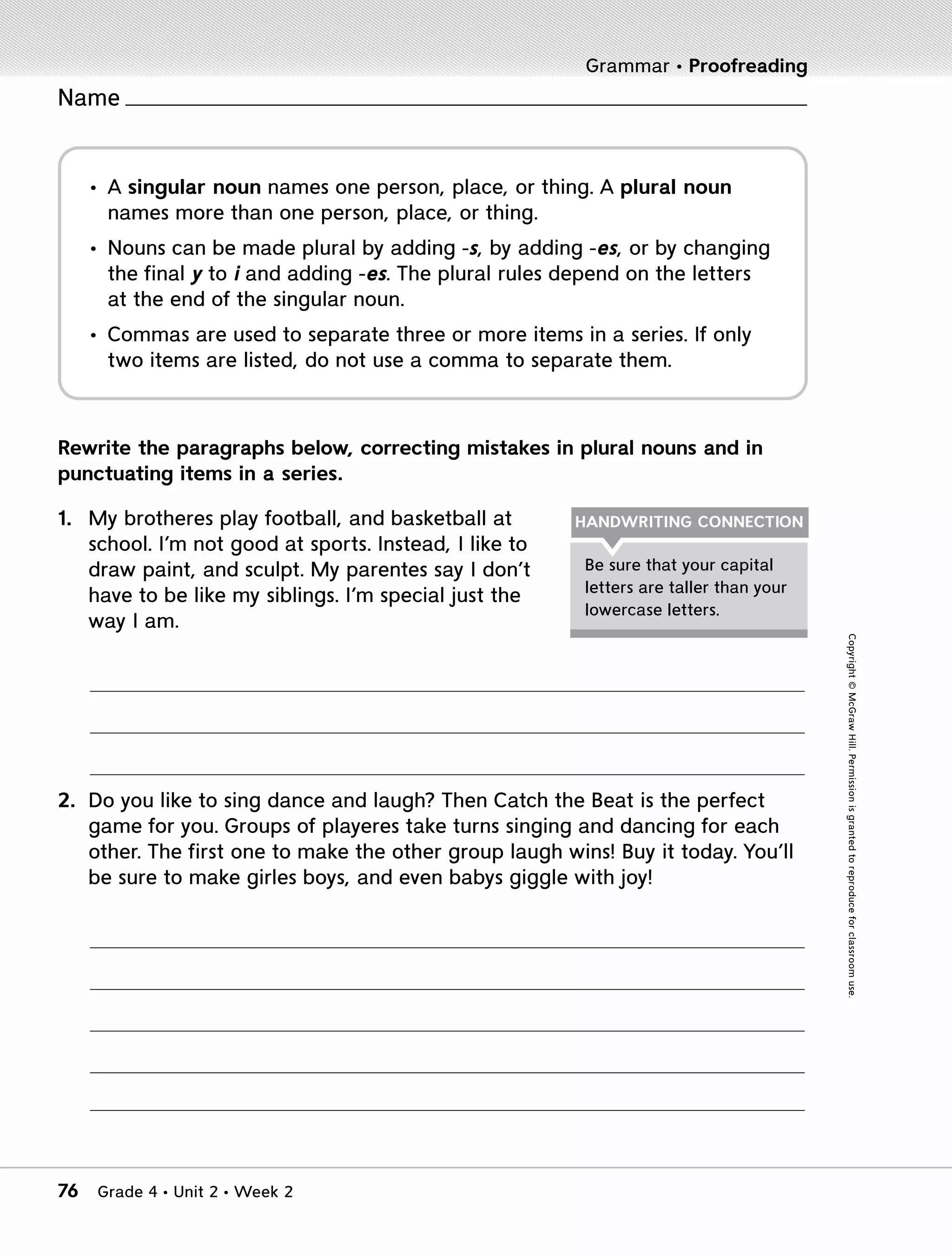
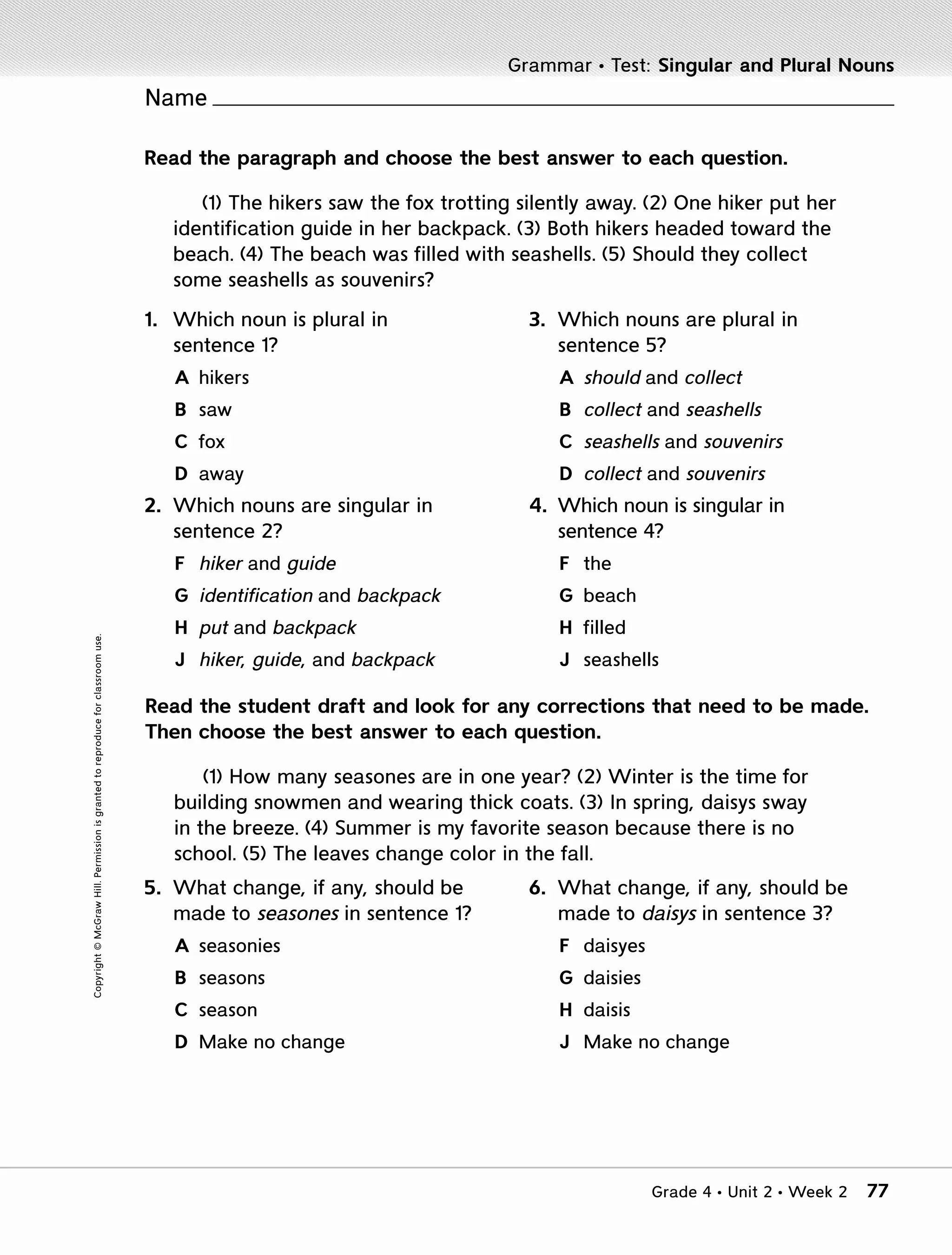
  • 250.
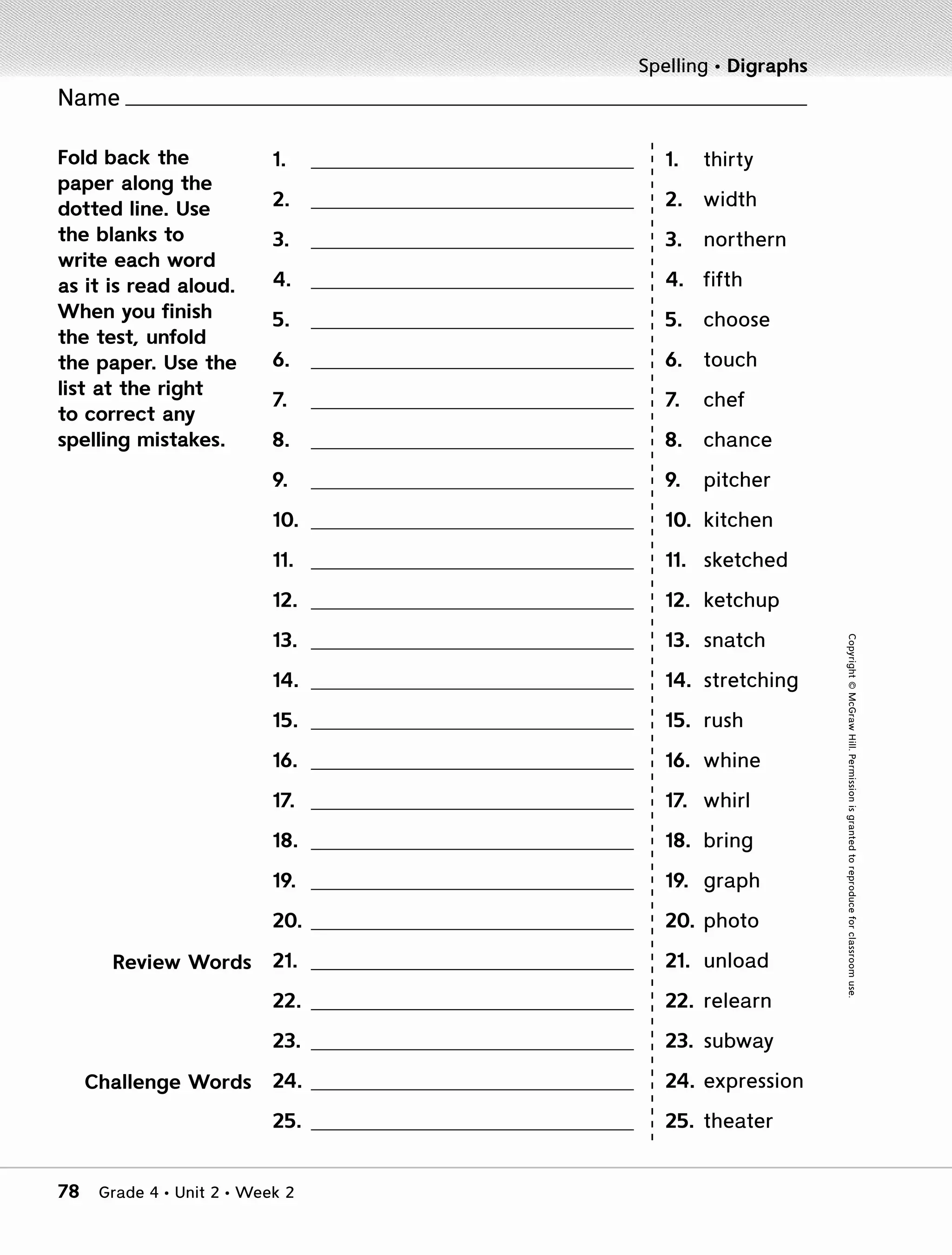
    Name Rewrite each sentencecorrectly by adding quotation marks and using correct capitalization and punctuation. 1. Jane said, I like to read about unusual animals. 2. My teacher asked, do you know who the president is? 3. Ms. Mendez exclaimed, close that window quickly! 4. I rushed inside and shouted, quick! Where is my camera? 5. My family at home includes my mother, father, sister, and me, I said. • Use quotation marks at the beginning and end of a speaker’s exact words. Begin a quotation with a capital letter. Tony said, “Come back.” • Commas and periods always go inside quotation marks. “I can’t believe,” she began, “that I got an A on that hard test.” • A question mark or an exclamation mark goes inside quotation marks when it is part of the quotation. He asked, “How much is this tomato?” • A question mark or an exclamation mark goes outside quotation marks when it is not part of the quotation. Did Toria say, “I am going to the store”? In your writer’s notebook, write a story about a conversation with a friend. Include at least four quotations. Then pair up with a classmate. Read the conversations out loud and check for correct capitalization and punctuation, including quotation marks. Grammar • Mechanics: Punctuation in Dialogue Copyright © McGraw Hill. Permission is granted to reproduce for classroom use. Grade 4 • Unit 4 • Week 3 207
  • 251.
    Name Rewrite the sentencesbelow, correcting mistakes in present- tense pronoun-verb agreement and quotation marks. 1. I asks, “What is your favorite season”? 2. Let’s eat before we finish the puzzle, I suggests. 3. You has more balloons than I do. 4. They is very happy to let us has the prize. 5. What am you doing? I asks worriedly. 6. It rock back and forth in a noisy way. • A subject pronoun and a present-tense verb must agree in number. • Follow specific rules for using subject pronouns with the present-tense forms of have and be. • Use quotation marks around someone’s exact words. • Follow specific punctuation and capitalization rules for quotation marks. Use quotations only when directly quoting what someone has said or stating the title of something. Do not use quotation marks unnecessarily. COMMON ERRORS Grammar • Proofreading Copyright © McGraw Hill. Permission is granted to reproduce for classroom use. 208 Grade 4 • Unit 4 • Week 3
  • 252.
    Name Read the selection.Then choose the best answer to each question. (1) We sure that this is the correct place. (2) I two parties to go to this weekend. (3) I most excited about this party. (4) My friend a party after the school play tomorrow. (5) My mom looks at me, and she honk loudly. (6) She reminds me that I need to leave the party early tonight. (7) She are helping me with my book report tonight! (8) I wave goodbye to her and walk through the front door. 1. What word goes in the blank in sentence 1? A have B has C is D are 2. What word goes in the blank in sentence 2? F have G is H are J am 3. What word goes in the blank in sentence 3? A have B am C are D is 4. What word goes in the blank in sentence 4? F have G has H am J is 5. What is the correct verb for sentence 5? A lookes B look C honk D honks 6. What is the correct verb for sentence 6? F remind G reminds H needs J needes 7. What is the correct verb for sentence 7? A am B is C are D have 8. What is the correct verb for sentence 8? F wave G waves H walkes J walks Grammar • Test: Pronoun-Verb Agreement Copyright © McGraw Hill. Permission is granted to reproduce for classroom use. Grade 4 • Unit 4 • Week 3 209
  • 253.
    1. 2. 3. 4. 5. 6. 7. 8. 9. 10. 11. 12. 13. 14. 15. 16. 17. 18. 19. 20. 21. 22. 23. 24. 25. Fold back thepaper along the dotted line. Use the blanks to write each word as it is read aloud. When you finish the test, unfold the paper. Use the list at the right to correct any spelling mistakes. Review Words Challenge Words 1. mood 2. stoop 3. zoom 4. crew 5. stew 6. ruler 7. produce 8. issue 9. tutor 10. truth 11. bruised 12. juicy 13. suits 14. group 15. you’ll 16. huge 17. crook 18. wool 19. used 20. should 21. pennies 22. prettily 23. funnier 24. barbeque 25. crooked Spelling • Words with /ü/, /u̇/, and /ˉ u/ Name Copyright © McGraw Hill. Permission is granted to reproduce for classroom use. 210 Grade 4 • Unit 4 • Week 3
  • 254.
    Retune begins withthe prefix re-. Prefixes often form the first syllable in a word. Final e vowel spellings like u_e must stay in the same syllable. Blend the syllables: re-tune. DECODING WORDS The /ü/ sound, as in spoon, may be spelled oo, ew, u_e, ue, u, ui, and ou (soon, blew, rude, clue, July, fruity, and through). The /ū/ sound in cube may be spelled u, u_e, and ew (pupil, huge, and fewer). The /u̇/ sound in book may be spelled oo and ou (cooking and could). suits stew crook bruised should issue ruler crew group wool zoom produce used you’ll mood truth juicy stoop huge tutor Read aloud and write the words with matching spelling patterns. /ü/ spelled oo (as in food) 1. 2. 3. /ü/ spelled u/u_e/ue (as in July/rude/clue) 4. 5. 6. 7. 8. /ü/ spelled ui (as in fruit) 9. 10. 11. /ü/ spelled ou (as in soup) 12. 13. /ü/ spelled ew (as in blew) 14. 15. /u/ ˙ spelled oo (as in book) 16. 17. /u/ ˙ spelled ou (as in would) 18. /u –/ spelled u_e (as in cube) 19. 20. Look through this week’s selection for more words to sort. Create a word sort in your writer’s notebook for a partner. Phonics/Spelling • Word Sort Name Copyright © McGraw Hill. Permission is granted to reproduce for classroom use. Grade 4 • Unit 4 • Week 3 211
  • 255.
    Name The /ü/ sound,as in spoon, may be spelled oo, ew, u_e, ue, u, ui, and ou (soon, blew, rude, clue, July, fruity, and through). The /ū/ sound in cube may be spelled u, u_e, and ew (pupil, huge, and fewer). The /u̇/ sound in book may be spelled oo and ou (cooking and could). suit stew cookie fruit should tunes used spool group wool zoom new grew you'll tooth due July food huge true Read aloud and write the words with the matching spelling patterns. /ü/ spelled oo (as in mood) 1. 2. 3. 4. /ü/ spelled u/u_e/ue (as in tutor/rude/clue) 5. 6. 7. 8. /ü/ spelled ui (as in bruised) 9. 10. /ü/ spelled ou (as in soup) 11. 12. /ü/ spelled ew (as in blew) 13. 14. 15. /u/ ˙ spelled oo (as in book) 16. 17. /u/ ˙ spelled ou (as in would) 18. /u –/ spelled u_e (as in cube) 19. 20. Look through this week’s selection for more words to sort. Create a word sort in your writer’s notebook for a partner. Retune begins with the prefix re-. Prefixes often form the first syllable in a word. Final e vowel spellings like u_e must stay in the same syllable. Blend the syllables: re-tune. DECODING WORDS Phonics/Spelling • Word Sort Copyright © McGraw Hill. Permission is granted to reproduce for classroom use. 211A Grade 4 • Unit 4 • Week 3
  • 256.
    suits smooth crookedbruised should tissue shrewd crew parachute communication zoom produce mute you'll boost truthful juicy doodle huge tutor Read aloud and write the words with the matching spelling patterns. /ü/ spelled oo (as in food) 1. 2. 3. 4. /ü/ spelled u/u_e/ue (as in July/rude/clue) 5. 6. 7. 8. 9. /ü/ spelled ui (as in fruit) 10. 11. 12. /ü/ spelled ou (as in soup) 13. /ü/ spelled ew (as in blew) 14. 15. /u/ ˙ spelled oo (as in book) 16. /u/ ˙ spelled ou (as in would) 17. – /u/ spelled u/u_e (as in pupil/cube) 18. 19. 20. Look through this week’s selection for more words to sort. Create a word sort in your writer’s notebook for a partner. Name Phonics/Spelling • Word Sort Copyright © McGraw Hill. Permission is granted to reproduce for classroom use. Grade 4 • Unit 4 • Week 3 211B
  • 257.
    A. Write thespelling word that belongs with the other words in the group. 1. injured, hurt, 2. zip, fast, 3. moist, slushy, 4. he’ll, she’ll, 5. thief, robber, 6. would, could, 7. many, together, 8. market, groceries, B. Write the spelling word that best completes each sentence. 9. Leaving the lights on is a waste of energy. 10. Mom cooked the slowly for many hours. 11. Did you see the latest of this magazine? 12. I am in a great today! 13. My grandfather has two good that he wears. 14. Use your to measure how tall the plant is. 15. I am an English for kids after school. 16. She the towel to dry her hands. 17. We put a welcome mat on our front . 18. That warm sweater is made of . 19. The of workers got the job done early. 20. I always tell the . mood stew tutor suits crook stoop ruler truth group wool zoom produce bruised you’ll used crew issue juicy huge should Name Spelling • Word Meaning Copyright © McGraw Hill. Permission is granted to reproduce for classroom use. 212 Grade 4 • Unit 4 • Week 3
  • 258.
    Underline the sixmisspelled words in the paragraphs below. Write the words correctly on the lines. I decided to help my aunt make her famous stue. We made a list and decided that we shood head over to the market. Once inside, we went straight to the produice department. After picking up some carrots and onions, we looked at a groop of potatoes. All of them were brused! Aunt Wendy was not happy. She spoke to a clerk who brought out a fresh bag for us. As we left, we both knew that the meal would be a hewge success! 1. 4. 2. 5. 3. 6. Write about a meal that you prepared with someone. Use at least four words from the spelling list. Use a dictionary or an online resource to check that you have spelled the spelling words and high-frequency words correctly. Writing Connection Name Spelling • Proofreading Copyright © McGraw Hill. Permission is granted to reproduce for classroom use. Grade 4 • Unit 4 • Week 3 213
  • 259.
    The word rootsis in bold type. The word hood is in bold type. The word stool is in bold type. The word full is in bold type. The word new is in bold type. The word book is in bold type. The word scooter is in bold type. The word luge is in bold type. The word room is in bold type. The word tissue is in bold type. The word rude is in bold type. The word goosey is in bold type. The word blue is in bold type. The word moose is in bold type. The word soup is in bold type. The word cooler is in bold type. The word fused is in bold type. The word loop is in bold type. The word youth is in bold type. The word oozed is in bold type. Circle the spelling word in each row that rhymes with the word in bold type. Write the spelling word on the line. Then read the word aloud. 1. roots rants sports suits 2. hood should had word 3. stool sold look you’ll 4. full fail wool while 5. new crew crow pull 6. book break crook fluke 7. scooter sweater tutor flutter 8. luge high look huge 9. room zoom took rule 10. tissue scissor issue amiss 11. rude mood made rug 12. goosey grassy furry juicy 13. blue groom hook stew 14. moose produce mister erase 15. soup stop stoop pup 16. cooler caller ruler stroller 17. fused used cried stood 18. loop good loom group 19. youth south troop truth 20. oozed bruised based dozed The /ü/ sound, as in spoon, may be spelled oo, ew, u_e, ue, u, ui, and ou (soon, blew, rude, clue, July, fruity, and through). The /ū/ sound in cube may be spelled u, u_e, and ew (pupil, huge, and fewer). The /u̇ / sound in book may be spelled oo and ou (cooking and could). Remember Name Phonics/Spelling • Review Copyright © McGraw Hill. Permission is granted to reproduce for classroom use. 214 Grade 4 • Unit 4 • Week 3
  • 260.
    Vocabulary • RelatedWords Name Choose a base word from “A Telephone Mix-Up” and write it below the telephone. Then add prefixes, suffixes, and inflectional endings to make as many related words as you can. Use a dictionary to help you. Expand your vocabulary by adding or removing inflectional endings, prefixes, or suffixes to a base word to create different forms of a word. misdirect redirect director directed direction direct directive directional directing 5 4 3 2 1 6 7 8 9 0 # * Copyright © McGraw Hill. Permission is granted to reproduce for classroom use. Grade 4 • Unit 4 • Week 3 215
  • 261.
    Name Each sentence belowcontains an underlined vocabulary word. Circle True if the statement is true. Circle False if the statement is false. 1. When two people compromise, they meet in the middle. True False 2. Amendments are orders you give to someone else. True False 3. A boycott is a refusal to talk to all boys. True False 4. A different version of a song might be played with different instruments. True False 5. Brushing your teeth twice a day is a privilege. True False 6. Green, leafy trees are prevalent in the world’s deserts. True False 7. A democracy is a form of government in which one ruler has all the power. True False 8. You must wait for something that will happen eventually. True False 9. Legislation is carried out by senators and representatives in Congress. True False 10. A dentist is qualified to examine teeth and fill cavities. True False 11. Agriculture is something that annoys or bothers people. True False 12. Promising to be someone’s friend is an example of a commitment. True False Vocabulary • Spiral Review Copyright © McGraw Hill. Permission is granted to reproduce for classroom use. 216 Grade 4 • Unit 4 • Week 3 The word compromise is underlined. The word Amendments is underlined. The word boycott is underlined. The word version is underlined. The word privilege is underlined. The word prevalent is underlined. The word democracy is underlined. The word eventually is underlined. The word Legislation is underlined. The word qualified is underlined. The word Agriculture is underlined. The word commitment is underlined.
  • 262.
    Grade 4 Unit4 Week 4 The words the book that belongs to me are underlined. Name Read each sentence and rewrite the underlined word or words using a possessive pronoun or a possessive pronoun and a noun. 1. I left the book that belongs to me at home. 2. Lisa’s telephone is broken. 3. The mechanic said that the car’s wheels are brand new. 4. The bedroom that belongs to you and me needs to be cleaned. 5. May I borrow the necklace that belongs to you? 6. Maya and Lucy’s parrot says “Hello.” • A possessive pronoun takes the place of a possessive noun. It does not have an apostrophe. Brian’s dog is brown. His dog is brown. • A possessive pronoun must match the noun it replaces in number and gender. Use my for first-person singular nouns, your for second-person singular nouns, and his/her/its for third-person singular nouns. For plural nouns, use our for first-person, your for second-person, and their for third-person point of view. Observatories have powerful technology that astronomers use to do their research. Read this paragraph from “Star Parties.” Find the sentence that includes a possessive pronoun. Underline the possessive pronoun and circle the subject that the possessive pronoun is replacing. Reading/Writing Connection Then, in your writer’s notebook, write a story about a group that goes into space. What do they bring? Whom do they meet? Use at least four possessive pronouns. Edit your work. Grammar • Possessive Pronouns Copyright © McGraw Hill. Permission is granted to reproduce for classroom use. Grade 4 • Unit 4 • Week 4 217 The word Lisa’s is underlined. The words the car’s are underlined. The words The bedroom that belongs to you and me are underlined. The words the necklace that belongs to you are underlined. The words Maya and Lucy’s are underlined.
  • 263.
    Name Circle the correctpossessive pronoun in parentheses to complete the sentence. Then rewrite the sentence on the line. 1. I think that this skateboard is (his / its). 2. This is (hers / her) and that is (your / yours). 3. I will watch your dog if you watch (my / mine). • A stand-alone possessive pronoun is not used directly before a noun. That leftover sandwich is mine. • Add -s to most pronouns that are used after a noun to form a stand- alone possessive pronoun, such as yours, hers, his, ours, and theirs. • Mine is a stand-alone possessive pronoun. His and its are the same when used before a noun or as a stand-alone possessive pronoun. Write a paragraph about your favorite character from a book, movie, TV show, or song. Include at least two possessive pronouns and one stand-alone possessive pronoun. Writing Connection Grammar • Stand-Alone Possessive Pronouns Copyright © McGraw Hill. Permission is granted to reproduce for classroom use. 218 Grade 4 • Unit 4 • Week 4 The words his and its are in parentheses. The words hers, her and your, yours are in parentheses. The words my and mine are in parentheses.
  • 264.
    Name • Add anapostrophe and -s to a singular noun to make it possessive: dog/dog’s. • Add an apostrophe to make most plural nouns possessive: dogs/dogs’. • Add an apostrophe and -s to form the possessive of plural nouns that do not end in -s: women/women’s. • Possessive pronouns do not have apostrophes. They should agree in number and gender with the possessive nouns they replace. Rewrite each sentence. Correct the punctuation of possessive nouns and pronouns. 1. My little sisters favorite game is hide-and-seek. 2. The childrens dog ate it’s food too quickly. 3. Five truck’s horns made an overpowering noise. 4. Sometimes the ocean waves power can destroy the beach. 5. The subject of the report was our’s to choose. In your writer’s notebook, describe the houses in your neighborhood and who lives in them. Include at least five possessive nouns. Circle them. Then edit your work to make sure you used the apostrophes correctly. Grammar • Mechanics: Possessive Nouns and Pronouns Copyright © McGraw Hill. Permission is granted to reproduce for classroom use. Grade 4 • Unit 4 • Week 4 219
  • 265.
    Name • A possessivepronoun takes the place of a possessive noun and does not include an apostrophe. It must match the noun it replaces in number and gender. • A stand-alone possessive pronoun is not used directly before a noun. Add -s to most pronouns that are used before a noun to form a stand- alone possessive pronoun. • Mine is a stand-alone possessive pronoun. His and its are the same when used before a noun or as a stand-alone possessive pronoun. Rewrite the paragraphs below, correcting mistakes in possessive nouns and pronouns. 1. Me name is Robert, and this is mine wife, Florence. That’s her’ given name, but she prefers to be called Flossy. Let us show you around our’s home. Down the hall we have ours offices. The one on the left is mines, and the one on the right is Flossys. 2. The rancher watched hi’s horses as they ran around theirs paddock. They all looked happy except for one. It’s leg was lifted, and it was limping. The rancher frowned and told his’ daughter to get hers lasso. He would have to bring this horse in to give it time to rest. Grammar • Proofreading Copyright © McGraw Hill. Permission is granted to reproduce for classroom use. 220 Grade 4 • Unit 4 • Week 4
  • 266.
    Name Read the selection.Then choose the best answer to each question. (1) I love this town because family has lived here for years. (2) Every morning, neighbors walk to the diner to have breakfast and chat. (3) Mrs. Taggart’s dog always waits outside the diner wagging tail. (4) When I try to steal my friend’s bacon to give to the dog, she tells me that it’s ! (5) town has interesting events, too. (6) sister’s favorite is the picnic basket auction in the summer. (7) My dad says the sledding contest in winter is . (8) My brothers say that the toy boat race in spring is . 1. Which word best completes sentence 1? A mine B its C ours D our 2. Which word best completes sentence 2? F his G their H our J they’re 3. Which word best completes sentence 3? A its B her’s C hers D it’s 4. Which word best completes sentence 4? F hers G her H our J its 5. Which word best completes sentence 5? A Their B Mine C His D Our 6. Which word best completes sentence 6? A Hers B Ours C My D Mine 7. Which word best completes sentence 7? F her G his H my J theirs 8. Which word best completes sentence 8? A there’s B theirs C they’res D theres Grammar • Test: Possessive Pronouns Copyright © McGraw Hill. Permission is granted to reproduce for classroom use. Grade 4 • Unit 4 • Week 4 221
  • 267.
    Spelling • Diphthongs/oi/ and /ou/ Name 1. 2. 3. 4. 5. 6. 7. 8. 9. 10. 11. 12. 13. 14. 15. 16. 17. 18. 19. 20. 21. 22. 23. 24. 25. Fold back the paper along the dotted line. Use the blanks to write each word as it is read aloud. When you finish the test, unfold the paper. Use the list at the right to correct any spelling mistakes. Review Words Challenge Words 1. noises 2. voices 3. rejoice 4. annoy 5. destroy 6. voyage 7. mound 8. south 9. pound 10. hound 11. pouch 12. thousand 13. wound 14. grouch 15. cowboy 16. gown 17. frown 18. howling 19. flower 20. tower 21. crook 22. zoom 23. group 24. drought 25. downtown Copyright © McGraw Hill. Permission is granted to reproduce for classroom use. 222 Grade 4 • Unit 4 • Week 4
  • 268.
    Phonics/Spelling • WordSort Name A diphthong occurs when two vowels are blended into a single syllable, making the vowel sound change. The diphthong /oi/ is spelled oy and oi, as in boy and oil. The diphthong /ou/ is spelled ou and ow, as in ground and now. Some vowel teams, like oy and ow, have a consonant that acts as a vowel. These vowel teams must stay in the same syllable. For example: boy-cott. DECODING WORDS ou 1. 2. 3. 4. 5. 6. 7. 8. oy 9. 10. 11. ow 12. 13. 14. 15. 16. oi 17. 18. 19. ow and oy 20. Use the spelling patterns above to write a short tongue twister. Include four words from the spelling list. Check your work for errors. Read aloud and write the spelling words with the matching spelling patterns. pound cowboy noises wound rejoice grouch voyage hound voices tower frown annoy howling thousand flower mound south destroy gown pouch Copyright © McGraw Hill. Permission is granted to reproduce for classroom use. Grade 4 • Unit 4 • Week 4 223
  • 269.
    Name Read aloud andwrite the spelling words with the matching spelling patterns. ou 1. 2. 3. 4. 5. 6. 7. 8. 9. oy 10. ow 11. 12. 13. 14. 15. 16. oi 17. 18. 19. ow and oy 20. Use the spelling patterns above to write a short tongue twister. Include four words from the spelling list. Check your work for errors. pound cowboy noise wound coin grouch brown hound voices tower frown loyal howl thousand flower mound south cloud gown pouch A diphthong occurs when two vowels are blended into a single syllable, making the vowel sound change. The diphthong /oi/ is spelled oy and oi, as in boy and oil. The diphthong /ou/ is spelled ou and ow, as in ground and now. Some vowel teams, like oy and ow, have a consonant that acts as a vowel. These vowel teams must stay in the same syllable. For example: boy-cott. DECODING WORDS Phonics/Spelling • Word Sort Copyright © McGraw Hill. Permission is granted to reproduce for classroom use. 223A Grade 4 • Unit 4 • Week 4
  • 270.
    Name A. Read aloudand write the spelling words with the matching spelling patterns. B. Compare the words noises and voices. How are they alike? How are they different? Use the spelling patterns you’ve learned to write a short tongue twister. Include four words from the spelling list. Check your work for errors. ou 1. 2. 3. 4. 5. 6. 7. 8. oy 9. 10. 11. oi 12. 13. 14. ow 15. 16. 17. 18. 19. ow and oy 20. trouser cowboy void wound rejoice grouch voyage encounter hardboiled empower downtown annoyance howling thousand prowl mound southpaw destroy nowadays announce Phonics/Spelling • Word Sort Copyright © McGraw Hill. Permission is granted to reproduce for classroom use. Grade 4 • Unit 4 • Week 4 223B
  • 271.
    Name A. Write thespelling word that matches each synonym below. 1. bag 2. grump 3. wrangler 4. 1,000 5. sounds 6. turned 7. blossom 8. 16 ounces 9. celebrate 10. tall building 11. scowl B. Write the spelling word to complete each analogy below. 12. Jet is to airplane as trip is to . 13. Give is to take as please is to . 14. Hole is to hollow as hill is to . 15. Shirt is to blouse as dress is to . 16. Remember is to forget as create is to . 17. Giggling is to laughing as barking is to . 18. Up is to down as north is to . 19. Cat is to kitty as dog is to . 20. Band is to instruments as choir is to . noises destroy pound wound frown voices voyage hound grouch howling rejoice mound pouch cowboy flower annoy south thousand gown tower Spelling • Word Meaning Copyright © McGraw Hill. Permission is granted to reproduce for classroom use. 224 Grade 4 • Unit 4 • Week 4
  • 272.
    Name Underline the sixmisspelled words in the paragraphs below. Write the words correctly on the lines. People take trips all over the world, but a voiage out West is like no other. Taking a trip to the western United States may mean traveling for a thowsand miles, but it is well worth it. There is beauty behind every hill and mownd. The West brings back the old days. If you travel there, you are sure to see cowbois and horses on the open plains. You may even hear wolves houling at the moon at night. Consider taking a trip to the West and rejoyce in all the wonders it has to offer! 1. 4. 2. 5. 3. 6. Write about a place that you would like to see one day. Use at least four words from the spelling list. Then check your work to make sure you have spelled the high-frequency words correctly. Writing Connection Spelling • Proofreading Copyright © McGraw Hill. Permission is granted to reproduce for classroom use. Grade 4 • Unit 4 • Week 4 225
  • 273.
    The word showeris in bold type. The word choices is in bold type. The word couch is in bold type. The word sound is in bold type. The word town is in bold type. The word enjoy is in bold type. The word found is in bold type. The word ouch is in bold type. The word clown is in bold type. The word mouth is in bold type. The word sound is in bold type. The word ground is in bold type. The word employ is in bold type. The word scowling is in bold type. The word hour is in bold type. Name A. Circle the word that rhymes with the word in bold type. Read aloud and write the word. shower shoulder tower toiled 2. choices cases voices vices 3. couch grouch rich cake 4. sound sour pound proud 5. town gown grow tow 6. enjoy away joyful destroy 7. found fried food mound 8. ouch pooch pouch lunch 9. clown clue own frown 10. mouth south youth mount 11. sound hound should hood 12. ground gold bind wound 13. employ annoy before empty 14. scowling bowling howling going 15. hour flower fire tour B. Write these spelling words in reverse alphabetical order: thousand, noises, voyage, rejoice, cowboy. A diphthong occurs when two vowels are blended into a single syllable. If a vowel sound changes in a single syllable, it is a diphthong. The diphthong /oi/ is spelled oy and oi, as in boy and oil. The diphthong /ou/ is spelled ou and ow, as in ground and now. Remember 16. 17. 18. 19. 20. Phonics/Spelling • Review Copyright © McGraw Hill. Permission is granted to reproduce for classroom use. 226 Grade 4 • Unit 4 • Week 4
  • 274.
    The word barometeris in bold. The word prolific is in bold. The word velocipede is in bold. The word Cranes is in bold. Vocabulary • Context Clues Name Context clues are other words in the text that help you figure out the meaning of an unfamiliar or multiple-meaning word. Context clues can be found in the same sentence as the unfamiliar word or in the same paragraph. There are different kinds of context clues to look for. The author may include a definition of the word. You might find a synonym, restatement, or antonym that reveals the word’s meaning. 1. Scientists knew that pressure in the atmosphere was a reliable indicator of weather changes. If they could measure that air pressure and its changes, they could be better weather forecasters. Luckily, Evangelista Torricelli’s barometer, invented in 1643, made this possible. 2. Many inventors only develop one or two ideas or devices in their lifetime. Thomas Edison, however, was a prolific inventor who received patents for over a thousand different inventions. 3. In the 1800s, a number of contraptions were invented to help people get to where they were going faster. One example is the velocipede, an early form of the bicycle with one or more wheels propelled by pedals. 4. Cranes have been around since the sixth century B.C. These simple machines used for lifting and transporting heavy objects were invented by the ancient Greeks to help construct tall buildings. Read each passage. Underline the context clues that help you understand the word in bold and write the word’s meaning on the line. Copyright © McGraw Hill. Permission is granted to reproduce for classroom use. Grade 4 • Unit 4 • Week 4 227
  • 275.
    The word pleadedis in bold. The word toiled is in bold. The word concentration is in bold. The word scowled is in bold. The word humble is in bold. Name 1. For months Leonardo had begged and pleaded with his father to get him a suit of armor. 2. He began working on the new invention in the barn that day. It wasn’t long before the barn was overflowing with notes, tools, and equipment as he toiled away on the knight. 3. High atop a rickety ladder, Leonardo was deep in concentration. All his focus was on fixing the mechanical knight’s arm, but it wasn’t easy work. 4. No matter what he did, the knight’s arm refused to lift! Leonardo frowned and scowled at it. 5. “It’s a simple system of pulleys and cables,” he said in a humble voice. “Don’t be so modest. I’ve never seen anything like it before!” Read each selection from “Leonardo’s Mechanical Knight.” Underline the synonym that helps you figure out the meaning of each word in bold. Then write the definition of the word in bold on the line. Vocabulary • Synonyms Copyright © McGraw Hill. Permission is granted to reproduce for classroom use. 228 Grade 4 • Unit 4 • Week 4
  • 276.
    Grade 4 Unit4 Week 5 Name Read each sentence. Circle the correct word in parentheses and write it on the line to complete the sentence. 1. (their / there) The boys put on coats and ran outside. 2. (your / you’re) Did you drop letter in the mailbox? 3. (there / they’re) Did you go last Saturday? 4. (your / you’re) lucky to be in the school play. 5. (their / they’re) I think coming to my party. 6. (its / it’s) The log is slippery because wet. • Homophones are words that sound alike but have different spellings and meanings, such as see and sea. • Some frequently confused homophones are the possessive pronoun their and the contraction they’re. Write a paragraph about your pet, real or imaginary. Describe what it looks like and how it acts. Include at least three pronouns. Then edit your work. Writing Connection Grammar • Pronouns and Homophones Copyright © McGraw Hill. Permission is granted to reproduce for classroom use. Grade 4 • Unit 4 • Week 5 229 The words their and there are in parentheses. The words your and you're are in parentheses. The words there and they're are in parentheses. The words your and you're are in parentheses. The words their and they're are in parentheses. The words its and it's are in parentheses.
  • 277.
    Name A. Read eachsentence and circle the subject pronoun. On the line, write a contraction for the subject pronoun and verb. 1. They are about to get on the bus. 2. You are early for the movie. 3. It is in the box on the floor. B. Underline the homophone that correctly completes each sentence. 4. Do you think (their / they’re / there) at the park right now? 5. Is this (your / you’re) backpack? 6. The cat licked (its / it’s) paw over and over again. • Homophones are words that sound alike but have different spellings and meanings. Some pronouns are also homophones. • Subject pronouns are often used in conjunction with verbs to form contractions: they are/they’re. • Contractions and possessive pronouns can be homophones, such as the contraction it’s and the possessive pronoun its. Read this excerpt from “Genius.” Circle the contraction. Then write your own sentence using the possessive pronoun homophone of the contraction you circled. Edit your work to make sure you used the correct homophone. The spiral notebook in my hand provides her quick relief. It tells her there’s no danger of a break-in by a thief. “Okay,” she says, then, props herself up vertically in bed. Grammar • Types of Pronouns and Homophones Copyright © McGraw Hill. Permission is granted to reproduce for classroom use. 230 Grade 4 • Unit 4 • Week 5
  • 278.
    Name Rewrite each sentence.Correct any incorrect contractions and possessive pronouns. 1. I put my bag here and my parents stored their’s at their feet. 2. Youre going to love this new book that just came out. 3. Do you think theyre going to be late for the show? 4. I picked up the small suitcase by it’s handle. 5. Is that you’r aunt sitting with your mother in the audience? 6. I think its funny that you and I have the same first name. • An apostrophe is used in a contraction to take the place of the missing letter or letters: it is/it’s. • An apostrophe should not be used with a possessive pronoun. Go back through your writer’s notebook and search for any possessive nouns or contractions you may have used. Check to make sure you have used the correct form. Correct any mistakes you may have made. Grammar • Mechanics: Contractions and Possessives Copyright © McGraw Hill. Permission is granted to reproduce for classroom use. Grade 4 • Unit 4 • Week 5 231
  • 279.
    Name Rewrite the paragraphsbelow, correcting mistakes in contractions and pronouns. 1. If your afraid of heights, do not go to the top of the Empire State Building in New York City. Its one of the tallest buildings in the world. Millions of people go there every year. They say theyre not afraid, but once they see how high it is they change there minds! 2. Ana is happy today. Shes going to meet her pen pal, Marco. He’s visiting with his family from Brazil. There good friends and write all the time. Ana thinks its exciting to finally meet Marco face to face! She can’t wait to talk to him in person. • Subject pronouns are often used with verbs to form contractions. • Contractions and pronouns can be homophones. • An apostrophe is used in a contraction to take the place of the missing letter or letters. • An apostrophe should not be used with a possessive pronoun. Remember to write legibly, with clear capital letters at the beginning of sentences and clear punctuation at the ends. HANDWRITING CONNECTION Grammar • Proofreading Copyright © McGraw Hill. Permission is granted to reproduce for classroom use. 232 Grade 4 • Unit 4 • Week 5
  • 280.
    Name Read the selection.Then choose the best answer to each question. (1) almost eight o’clock in the morning when my mom looks in my bedroom. (2) “Aren’t you going to the park with friends this morning? (3) You have to hurry because waiting in the car!” (4) The park is beautiful with many lakes and trees. (5) We watch an alligator from a distance as it moves tail back and forth. (6) I thought we brought snacks to eat, but missing from the cooler. (7) is a trail nearby, so we go on a long hike. (8) ” going to be so sore tomorrow!” my friends all say. 1. Which word best completes sentence 1? A It’s B Its C They’re D Their 2. Which word best completes sentence 2? F it’s G its H your J you’re 3. Which word best completes sentence 3? A they’re B its C it’s D there 4. Which word best completes sentence 4? F they’re G it’s H their J its 5. Which word best completes sentence 5? A they’re B it’s C there D its 6. Which word best completes sentence 6? A they’re B its C their D it’s 7. Which word best completes sentence 7? F They’re G There H Their J Theirs 8. Which word best completes sentence 8? A Your B Theirs C You’re D Theres Grammar • Test: Pronouns and Homophones Copyright © McGraw Hill. Permission is granted to reproduce for classroom use. Grade 4 • Unit 4 • Week 5 233
  • 281.
    Name 1. 2. 3. 4. 5. 6. 7. 8. 9. 10. 11. 12. 13. 14. 15. 16. 17. 18. 19. 20. 21. 22. 23. 24. 25. Fold back thepaper along the dotted line. Use the blanks to write each word as it is read aloud. When you finish the test, unfold the paper. Use the list at the right to correct any spelling mistakes. Review Words Challenge Words 1. caught 2. laws 3. drawn 4. strawberry 5. straw 6. awe 7. shawl 8. alter 9. halt 10. talking 11. walker 12. chalk 13. stalk 14. small 15. caller 16. squall 17. cough 18. fought 19. thought 20. false 21. south 22. pouch 23. annoy 24. wallpaper 25. awkward Spelling • Variant Vowel /ô/ Copyright © McGraw Hill. Permission is granted to reproduce for classroom use. 234 Grade 4 • Unit 4 • Week 5
  • 282.
    Phonics/Spelling • WordSort Name the aw sound spelled augh 1. the aw sound spelled ough 2. 3. 4. the aw sound spelled aw 5. 6. 7. 8. 9. 10. the aw sound spelled al 11. 12. 13. 14. 15. 16. 17. the aw sound spelled all 18. 19. 20. The /ô/ vowel is pronounced aw, as in awesome. It can be spelled in the following ways: augh, as in daughter; ough, as in sought; aw, as in claw; al, as in salt; all, as in tall. The variant vowel /ô/ is most often spelled aw, as in hawk, and au, as in haul. SPELLING TIP caught straw halt stalk cough laws awe talking small fought drawn shawl walker caller thought strawberry alter chalk squall false Read aloud and write the spelling words that contain each spelling pattern. Look through this week’s selection for more words to sort. Create a word sort in your writer’s notebook for a partner. Copyright © McGraw Hill. Permission is granted to reproduce for classroom use. Grade 4 • Unit 4 • Week 5 235
  • 283.
    Name the aw soundspelled ough 1. the aw sound spelled au 2. the aw sound spelled aw 3. 4. 5. 6. 7. 8. 9. 10. the aw sound spelled al 11. 12. 13. 14. 15. 16. the aw sound spelled all 17. 18. 19. the aw sound spelled augh 20. The /ô/ vowel is pronounced aw, as in awesome. It can be spelled in the following ways: augh, as in daughter; ough, as in sought; aw, as in claw; al, as in salt; all, as in tall. The variant vowel /ô/ is most often spelled aw, as in hawk, and au, as in haul. SPELLING TIP fault straw halt awful cough laws awe talking small tall draw thaw walk caller saw taught alter chalk raw false Read aloud and write the spelling words that contain each spelling pattern. Look through this week’s selection for more words to sort. Create a word sort in your writer’s notebook for a partner. 235A Phonics/Spelling • Word Sort Copyright © McGraw Hill. Permission is granted to reproduce for classroom use. Grade 4 • Unit 4 • Week 5
  • 284.
    Phonics/Spelling • WordSort Name the aw sound spelled augh 1. 2. the aw sound spelled ough 3. 4. 5. the aw sound spelled aw 6. 7. 8. the aw sound spelled al 9. 10. 11. 12. the aw sound spelled all 13. 14. the aw sound spelled au 15. 16. 17. 18. 19. 20. caught applauded halted stalk wallpaper daughter clause because malt fought dinosaur shawl vault alteration thoughtful strawberry audiences sprawling squall sought A. Read aloud and write the spelling words that contain each spelling pattern. B. Compare the words caught and cough. How are they alike? How are they different? Look through this week’s selection for more words to sort. Create a word sort in your writer’s notebook for a partner. Copyright © McGraw Hill. Permission is granted to reproduce for classroom use. Grade 4 • Unit 4 • Week 5 235B
  • 285.
    Name A. Write thespelling word that is the antonym, or opposite, of each word below. 1. large 2. listening 3. agreed 4. stillness 5. violations 6. disinterest 7. receiver 8. remain B. Write the spelling word that best completes each sentence. 9. The fishermen a lot of fish today. 10. The teacher used to write on the board. 11. I have a even though my cold is gone. 12. The does not use a car to get places. 13. I disagree with that summary of what happened! 14. It is chilly outside, and I need a . 15. The old plant was brown and dry. 16. A tastes delicious with whipped cream. 17. The cars must at red stoplights. 18. The picture of me was to be funny-looking. 19. I this book was very entertaining. 20. There was on the floor in the barn. caught straw halt stalk cough laws awe talking small fought drawn shawl walker caller thought strawberry alter chalk squall false Spelling • Word Meaning Copyright © McGraw Hill. Permission is granted to reproduce for classroom use. 236 Grade 4 • Unit 4 • Week 5
  • 286.
    Name Underline the sixmisspelled words in the paragraphs below. Write the words correctly on the lines. “Be the first coller to answer our question correctly, and you’ll win the jackpot!” the radio announcer said. I called in, and the announcer asked who was tawking. I gave him my name. He told me that to win I would have to answer a true or folse question. I thouht I knew the answer, but they cought me off guard with a trick question. Even though I didn’t win the jackpot, I got a smawl gift for playing. It was a gift certificate to my favorite movie theater. All in all, things turned out all right! 1. 4. 2. 5. 3. 6. Write about a goal or dream you would like to achieve. Use at least four words from the spelling list. Then use a dictionary to check your spelling of the high-frequency and spelling words. Writing Connection Spelling • Proofreading Copyright © McGraw Hill. Permission is granted to reproduce for classroom use. Grade 4 • Unit 4 • Week 5 237
  • 287.
    The word sawis in bold type. The word hawk is in bold type. The word taller is in bold type. The word call is in bold type. The word bought is in bold type. The word walk is in bold type. The word crawl is in bold type. The word thaw is in bold type. The word gauze is in bold type. The word taught is in bold type. The word yawn is in bold type. The word mall is in bold type. The word brought is in bold type. The word fault is in bold type. The word off is in bold type. Name 1. hawk rake chalk black 2. thaw straw that stew 3. bought thought moat cot 4. yawn span caw drawn 5. taller filler caller tanner 6. off muff tough cough 7. gauze buzz laws says 8. walk wick make stalk 9. mall shawl bill malt 10. call toll squall tail 11. taught tough fought boat 12. saw awe blew bar 13. brought beet crate caught 14. crawl paw small pal 15. fault halt hurt heart B. Write these spelling words in reverse alphabetical order: talking, false, alter, walker, strawberry. 16. 18. 20. 17. 19. A. Circle the spelling word in each row that rhymes with the word in bold type. Write the spelling word on the line. Then read the word aloud. The /ô/ vowel is pronounced aw, as in awesome. It can be spelled in the following ways: augh, as in daughter; ough, as in sought; aw, as in claw; al, as in salt; all, as in tall. The variant vowel /ô/ is most often spelled aw, as in hawk, and au, as in haul. Remember Phonics/Spelling • Review Copyright © McGraw Hill. Permission is granted to reproduce for classroom use. 238 Grade 4 • Unit 4 • Week 5
  • 288.
    Name Remember that relatedwords have the same base word. The meaning of the word is changed slightly with the addition of prefixes, suffixes, and inflectional endings. Examine the following related words with the base word note and their meanings. noted: noticed for a particular reason denoting: to be a name for; mean notable: worthy of notice notation: a quick note to assist memory How many words can you make with the base word attain? Use your knowledge of prefixes, suffixes, and inflectional endings to help you. Read your words aloud and try to guess what your words might mean. Then look up the meanings of your words in a print or online dictionary. attain Vocabulary • Related Words Copyright © McGraw Hill. Permission is granted to reproduce for classroom use. Grade 4 • Unit 4 • Week 5 239
  • 289.
    The word tripis in bold. The word sags is in bold. The word march is in bold. Name Read each passage. Each word in bold has a different connotation in the poem than its usual denotation. Explain the connotation on the lines. 1. Letters trip over each other as they race to leave my mouth. 2. One last kid sags with his head in his hands. He is mouthing each letter as I say it. 3. My tongue lines them up in order as they march to the microphone: Vocabulary • Connotation and Denotation Copyright © McGraw Hill. Permission is granted to reproduce for classroom use. 240 Grade 4 • Unit 4 • Week 5
  • 290.
    Grade 4 Unit5 Week 1 Name • An adjective is a word that describes a noun or a pronoun. It modifies, or limits or adds to, the meaning of the noun or pronoun: blue car. • An adjective usually comes before the noun or pronoun it describes. It also may follow a linking verb. Anna seems sleepy. • Adjectives are usually placed in order of opinion, size, age, and then color: a good, large, old, yellow dog. Read each sentence and find the adjective or adjectives. Write all of the adjectives in the sentence on the line provided. 1. The garden has red roses. 2. Our playful friends play many games. 3. The waves looked dangerous. 4. Have you seen my little dog? 5. The big red truck drove down the busy road. Read these sentences from “Your World Up Close.” Circle two adjectives and underline the nouns they describe. Using the sentences as a model, write three sentences describing your favorite object. Review your work to make sure you have used adjectives correctly. The light microscopes you use in school are weak and do not show much detail. An electron microscope is a much more powerful tool, and it allows scientists to see things we can’t see with our own eyes. Reading/Writing Connection Grammar • Adjectives Copyright © McGraw Hill. Permission is granted to reproduce for classroom use. Grade 4 • Unit 5 • Week 1 241
  • 291.
    Name • An adjectiveis a word that describes a noun or a pronoun. It can be formed from a noun. • A proper adjective is formed from a proper noun. It begins with a capital letter: The Franklin Science Museum. • Proper adjectives may describe languages, races, or nationalities: Greek language, African American, Filipino. • Brand names are often proper adjectives: Travel Right Luggage. Circle the proper adjective that is incorrectly written in each sentence. Write the proper adjective correctly on the line. 1. I ordered french fries with my hamburger. 2. She visited the jefferson Library yesterday. 3. There is nothing like the warm feel of florida sunshine. 4. It is an italian custom that has been in my family for years. 5. The chinese exchange student spoke English well. 6. Her mother and father are both hispanic. 7. My favorite brand of socks is red Hot Socks. 8. The four Peaks Water company made a huge profit last year. In your writer’s notebook, write a short paragraph describing a favorite place in your community. Include two proper adjectives. Check your work to make sure that you have used all the adjectives correctly. Grammar • Proper Adjectives Copyright © McGraw Hill. Permission is granted to reproduce for classroom use. 242 Grade 4 • Unit 5 • Week 1
  • 292.
    Name • Use quotationmarks at the beginning and end of a direct quotation. My mother called out to me, “Come downstairs for dinner!” • Use a comma before the opening quotation mark if a sentence begins before the quote. Use a comma before the ending quotation mark if a sentence continues after the quote. She said, “I made your favorite dish,” as she stirred the pot. • Use quotation marks before and after the titles of short works. I read about it in an article called “Massaging Your Dog.” Write each sentence correctly by adding commas and quotation marks where they belong. 1. My teacher just read us a short story called My Pet Gorilla. 2. My friend said, I can walk home with you after school. 3. “She is a good pet rabbit” my dad said about Lila. 4. My favorite short story is Under the Blue Sky. 5. He asked Can I go with you to the supermarket? In your writer’s notebook, write a short story that includes a conversation between two or more characters. Then edit your work for correct use of quotation marks and commas. Grammar • Mechanics: Punctuation Copyright © McGraw Hill. Permission is granted to reproduce for classroom use. Grade 4 • Unit 5 • Week 1 243
  • 293.
    Remember that onlyshort works need quotation marks. Longer works, such as books or newspapers, need to be underlined or italicized. COMMON ERRORS Name • An adjective is a word that describes a noun or a pronoun. It can be formed from a noun. • A proper adjective is formed from a proper noun. It begins with a capital letter. • Use quotation marks at the beginning and end of a direct quotation and before and after the titles of short works. Rewrite the paragraphs below, correcting mistakes in adjectives and quotations. 1. Next week, I will go to my first spanish class. It will be at the riverwood Center in town. My mom said I’m so proud of you for learning a new language. I am worried though, since there are still many english words that I don’t understand! 2. I love the japanese bookstore that just opened in the mall. It is Small, but it has interesting books. I bought a book of short stories there. My favorite story in the book is The Warrior. “That is my favorite one, too” said the manager of the bookstore. Copyright © McGraw Hill. Permission is granted to reproduce for classroom use. 244 Grade 4 • Unit 5 • Week 1 Grammar • Proofreading
  • 294.
    Name Read the paragraph.Then choose the best answer to each question. (1) Do you live near the coast? (2) My family and I visited there once one summer. (3) We were all so to be going on a trip! (4) The beaches were pink and white. (5) The trees were ! (6) We heard so many languages being spoken around us, like . (7) Dad insisted that we stop by a restaurant for sausages. (8) I think next summer, we are going to go to . 1. Which word fits best in sentence 1? A left B Pacific C Left D pacific 2. Which word fits best in sentence 2? F National G red H hot J July 3. Which word fits best in sentence 3? A vacation B terrible C excited D long 4. Which word fits best in sentence 4? F sandy G pink H white J summer 5. Which word fits best in sentence 5? A enormous B Enormous C eastern D Eastern 6. Which word fits best in sentence 6? F spanish and mandarin G Spanish and mandarin H spanish and Mandarin J Spanish and Mandarin 7. Which word fits best in sentence 7? A chinese B German C french D Open 8. Which word fits best in sentence 8? F new England G new england H New England J New england Copyright © McGraw Hill. Permission is granted to reproduce for classroom use. Grade 4 • Unit 5 • Week 1 245 Grammar • Test: Adjectives
  • 295.
    Name 1. 2. 3. 4. 5. 6. 7. 8. 9. 10. 11. 12. 13. 14. 15. 16. 17. 18. 19. 20. 21. 22. 23. 24. 25. Fold back thepaper along the dotted line. Use the blanks to write each word as it is read aloud. When you finish the test, unfold the paper. Use the list at the right to correct any spelling mistakes. Review Words Challenge Words 1. blanket 2. blossom 3. dipper 4. distant 5. foggy 6. fossil 7. member 8. nodded 9. planner 10. plastic 11. rumbles 12. slender 13. summer 14. swallow 15. tablet 16. thriller 17. traffic 18. welcome 19. willow 20.witness 21. talking 22.drawn 23. shawl 24.cupboard 25.friendly Spelling • Closed Syllables Copyright © McGraw Hill. Permission is granted to reproduce for classroom use. 246 Grade 4 • Unit 5 • Week 1
  • 296.
    Work with apartner to find more words that contain closed syllables. Record the words you find in your writer’s notebook. When a word has two consonants in the middle, divide the word between the consonants to sound it out. For example, bas-ket. DECODING WORDS Look at the word chin. Chin is one syllable with one vowel sound. The syllable ends in a consonant, the letter n. Syllables ending in a consonant are called closed syllables. Most closed syllables have a short vowel sound. blanket foggy planner summer traffic blossom fossil plastic swallow welcome dipper member rumbles tablet willow distant nodded slender thriller witness Read aloud and write each word under its spelling pattern. words with double consonants 1. 2. 3. 4. 5. 6. 7. 8. 9. 10. 11. words with different consonants 12. 13. 14. 15. 16. 17. 18. 19. 20. Phonics/Spelling • Word Sort Name Grade 4 • Unit 5 • Week 1 247 Copyright © McGraw Hill. Permission is granted to reproduce for classroom use.
  • 297.
    Phonics/Spelling • WordSort Name When a word has two consonants in the middle, divide the word between the consonants to sound it out. For example, bas-ket. DECODING WORDS Look at the word chin. Chin is one syllable with one vowel sound. The syllable ends in a consonant, the letter n. Syllables ending in a consonant are called closed syllables. Most closed syllables have a short vowel sound. dinner foggy planner summer traffic finger fossil plastic swallow welcome dipper member kitten pillow willow hello holly lesson thriller problem Read aloud and write each word under its spelling pattern. Work with a partner to find more words that contain closed syllables. Record the words you find in your writer’s notebook. words with double consonants 1. 2. 3. 4. 5. 6. 7. 8. 9. 10. 11. 12. 13. 14. 15. words with different consonants 16. 17. 18. 19. 20. Copyright © McGraw Hill. Permission is granted to reproduce for classroom use. 247A Grade 4 • Unit 5 • Week 1
  • 298.
    Phonics/Spelling • WordSort Name Work with a partner to find more words that contain closed syllables. Record the words you find in your writer’s notebook. blanket foggy planner magnet traffic blossom fossil plastic swallow windows dipper canyon rumbles palmetto willow distant comfort slender perhaps witness A. Read aloud and write each word under its spelling pattern. words with double consonants 1. 2. 3. 4. 5. 6. 7. 8. 9. words with different consonants 10. 11. 12. 13. 14. 15. 16. 17. 18. 19. 20. B. Compare the words blossom and fossil. How are they alike and different? Copyright © McGraw Hill. Permission is granted to reproduce for classroom use. Grade 4 • Unit 5 • Week 1 247B
  • 299.
    Name 9. part ofa group 10. something to write on 11. a warm or hot season 12. manmade material 13. to move throat muscles 14. one who sees something 15. thin 16. a suspenseful story 17. moved head up and down 18. many vehicles in one area 19. remains from the past 20. a cuplike scoop blanket foggy planner summer traffic blossom fossil plastic swallow welcome dipper member rumbles tablet willow distant nodded slender thriller witness A. An analogy is a statement that compares sets of words. Write the spelling word to complete each analogy below. 1. Builder is to maker as organizer is to 2. Curvy is to straight as clear is to 3. Up is to down as goodbye is to 4. Jet is to roars as truck is to 5. Coat is to jacket as flower is to 6. Empty is to full as near is to 7. Dog is to poodle as tree is to 8. Sea is to ocean as quilt is to B. Write the spelling word that matches each definition below. Spelling • Word Meaning Copyright © McGraw Hill. Permission is granted to reproduce for classroom use. 248 Grade 4 • Unit 5 • Week 1
  • 300.
    Name Underline the sixmisspelled words in the paragraphs below. Write the words correctly on the lines. Lucy read the poster with great interest. It said, “Wellcome to the Habitat Museum! We hope you will join us this sumer. We will meet every Saturday under the wilow tree in front of the library.” Lucy was excited to become a new memmber of the museum club. The poster said that there would be a movie at the museum next Saturday. It is about a hiker who is a wittnes to a robbery. The stolen item is a dinosaur fosil. Lucy couldn’t wait to see it! 1. 2. 3. 4. 5. 6. Writing Connection Write about a club that you have joined or would like to join. Use at least four words from the spelling list. As you check your work, be sure that you have spelled the high-frequency words correctly. Spelling • Proofreading Copyright © McGraw Hill. Permission is granted to reproduce for classroom use. Grade 4 • Unit 5 • Week 1 249
  • 301.
    Name blanket foggy plannersummer traffic blossom fossil plastic swallow welcome dipper member rumbles tablet willow distant nodded slender thriller witness Syllables that end in a consonant are called closed syllables. Most closed syllables have a short vowel sound. Remember 1. sle er 2. tra ic 3. fo il 4. bla et 5. wi ow 6. pla er 7. swa ow 8. di ant 9. we ome 10. pla ic 11. fo y 12. thri er 13. no ed 14. su er 15. ru es 16. wi ess 17. blo om 18. ta et 19. me er 20.di er Fill in the missing letters to form a spelling word. Write the word on the line. Then read the word aloud. Phonics/Spelling • Review Copyright © McGraw Hill. Permission is granted to reproduce for classroom use. 250 Grade 4 • Unit 5 • Week 1
  • 302.
    Vocabulary • ContentWords Name Search classroom texts, newspapers, and magazines for content words related to the tools scientists use. Write the words below. Circle two words that you were able to define by using context clues. Write the words and their meanings on the lines. Content words are used to write about fields of study. In this unit, you will find content words related to science and technology, such as electron microscope, magnification, and photomicrograph. Use context clues, dictionaries, electronic resources, and your knowledge of Greek and Latin roots to help you understand the meanings of these words. “Your World Up Close” describes the technology used to magnify objects, such as snowflakes, fingerprints, and skin cells, to thousands of times their actual size. It also explains how scientists use these magnified images. The author uses content words to tell about these topics. CONNECT TO CONTENT Science and Technology Words Copyright © McGraw Hill. Permission is granted to reproduce for classroom use. Grade 4 • Unit 5 • Week 1 251
  • 303.
    Name attain commitment hoveringconnotation gleaming democracy triumph denotation dangling technology stanza repetition Write the vocabulary word from the box that answers each riddle below. 1. 2. I’m felt by the winning team. 3. I’m a government for and by the people. 4. I’m a paragraph in a poem. 5. I’m done over and over again. 6. I describe a hummingbird in the air. 7. I’m a promise you make. 8. I describe how a word makes you feel. 9. I’m a new kind of phone. 10. I’m something you hope to do with a goal. 11. I describe polished silver or gold. 12. I’m what an acrobat does high above. Vocabulary • Spiral Review Copyright © McGraw Hill. Permission is granted to reproduce for classroom use. 252 Grade 4 • Unit 5 • Week 1 You’ll find me in a dictionary.
  • 304.
    Grade 4 Unit5 Week 2 Name Read each sentence and circle the article. On the line, write S if the related noun is singular. Write P if the noun is plural. 1. We saw a film in science class today. 2. These are the people I was telling you about. 3. Did you go to see the movie that I suggested? 4. I ate an omelet this morning. 5. My sisters are the captains of their cheerleading squad. Read this excerpt from “The Incredible Shrinking Potion.” Underline the articles. Then write two sentences about a science experiment you would like to do. Include at least three articles. Then check your work. • An article is a type of adjective. It comes before the noun it describes. • The article the identifies a particular person, place, or thing. It refers to both singular and plural nouns: the kitten, the kittens. • The articles a and an refer to a general person, place, or thing. They refer to singular nouns only. Use a before a noun that begins with a consonant, such as a carrot. Use an before a noun that begins with a vowel, such as an eagle. Reading/Writing Connection It began as a simple science project. It was only one week ago that Isabel, Mariela, and Hector were working on a shrinking potion that would amaze everyone at the science fair. Grammar • Use of a, an, and the Copyright © McGraw Hill. Permission is granted to reproduce for classroom use. Grade 4 • Unit 5 • Week 2 253
  • 305.
    Name • The wordsa, an, and the are special adjectives called articles. They identify people, places, or things. • This, that, these, and those are demonstrative adjectives. They show whether the related noun is singular or plural. They also show if an object is close to or far from the speaker or writer: this chair, that desk, these pencils. • This and that refer to singular nouns, such as this car and that truck. These and those refer to plural nouns, such as these books and those rulers. Circle the correct demonstrative adjective in parentheses to complete each sentence. On the line, write S if the related noun is singular. Write P if the noun is plural. 1. I took (this / these) napkin for myself. 2. Are (that / those) your mother’s earrings? 3. Put this crate here and put (that / those) crate there. 4. Get me placemats that look like (that / these) two. 5. What type of material is (that / those) scarf made from? Talk to a parent or another trusted adult about a special hobby they have. Then write a paragraph in your writer’s notebook about the conversation. Include at least three articles and two demonstrative adjectives. Then check your work for adjective-noun agreement. Connect to Community Grammar • This, That, These, and Those Copyright © McGraw Hill. Permission is granted to reproduce for classroom use. 254 Grade 4 • Unit 5 • Week 2 The words this and these are in parentheses. The words that and those are in parentheses. The words that and those are in parentheses. The words that and these are in parentheses. The words that and those are in parentheses.
  • 306.
    Name • Use abefore a word if the word begins with a consonant sound. Use an before a word if the word begins with a vowel sound. • Do not use a or an before a plural noun. • This and that refer to singular nouns. These and those refer to plural nouns. Read each sentence. Circle the article or demonstrative adjective that is incorrect. Explain why it is incorrect on the line. 1. Did you read a books I lent you for the weekend? 2. Remi did not pick those apple from the tree. 3. She is a eager student who wants to learn. 4. Give these cards to me and put that flowers over there. 5. I have an oboe and an flute in my bedroom. In your writer’s notebook, write about a hobby you are interested in learning more about. Include at least three articles and two demonstrative adjectives. Underline the articles and circle the demonstrative adjectives. After you have completed writing, pair up with a partner. Write down these instructions in your writer’s notebook. Take turns reading the instructions aloud. Then restate them in your own words. Did you follow all the instructions? Grammar • Mechanics: Articles and Demonstrative Adjectives Copyright © McGraw Hill. Permission is granted to reproduce for classroom use. Grade 4 • Unit 5 • Week 2 255
  • 307.
    Name • The wordsa, an, and the are special adjectives called articles. They identify people, places, or things. Use a and an for singular nouns. Use the for singular or plural nouns. • Use a before a word if the word begins with a consonant sound. Use an before a word if the word begins with a vowel sound. • This, that, these, and those are demonstrative adjectives. Use this and that for singular nouns. Use these and those for plural nouns. Rewrite the sentences below, correcting mistakes in articles and demonstrative adjectives. 1. I will paint an picture of that clouds in the sky. 2. This grades show that he is an bright student. 3. I watched the bird fly over those hill. 4. The elephant is a largest land mammal. 5. Can I order this doughnuts for an party on Saturday? 6. I have to walk these dog after school when I get off a bus. Be sure not to press down too hard when writing so that your strokes are smooth and sure. HANDWRITING CONNECTION Grammar • Proofreading Copyright © McGraw Hill. Permission is granted to reproduce for classroom use. 256 Grade 4 • Unit 5 • Week 2
  • 308.
    Name Read the studentdraft. Then choose the best answer to each question. (1) “Where are these items in the store?” she asked the clerk as she pointed to a list in her hand. (2) Sabrina watched an wheels of the clerk’s mind work quickly to plan a response. (3) She was planning to buy an headphones today, along with a loaf of bread. (4) Then the clerk led her to the umbrellas she needed. (5) That gloves over there were her favorite color! (6) As she loaded an bag into her car, she was glad she had found everything she wanted. 1. How many articles are in sentence 1? A one B two C three D four 2. What is the best word to use in place of the underlined word in sentence 2? F a G those H the J Make no change. 3. Which word is an error in sentence 3? A a B an C was D with 4. What is the best word to use in place of the underlined word in sentence 4? F an G these H those J Make no change. 5. What is the best word to use in place of the underlined word in sentence 5? A This B These C Those D Make no change. 6. What is the best way to write the beginning of sentence 6? F As she loaded a bag into . . . G As she loaded this bag into . . . H As she loaded that bag into . . . J Make no change. Grammar • Test: Articles Copyright © McGraw Hill. Permission is granted to reproduce for classroom use. Grade 4 • Unit 5 • Week 2 257 The word an is underlined. The words the and that is underlined.
  • 309.
    Name 1. 2. 3. 4. 5. 6. 7. 8. 9. 10. 11. 12. 13. 14. 15. 16. 17. 18. 19. 20. 21. 22. 23. 24. 25. Review Words Challenge Words Foldback the paper along the dotted line. Use the blanks to write each word as it is read aloud. When you finish the test, unfold the paper. Use the list at the right to correct any spelling mistakes. Spelling • Open Syllables 1. famous 2. radar 3. razor 4. vacancy 5. beside 6. beyond 7. defend 8. delay 9. demand 10. prevent 11. secret 12. veto 13. bison 14. diver 15. cider 16. silence 17. clover 18. spoken 19. stolen 20. tulip 21. swallow 22. plastic 23. rumbles 24. request 25. sequence Copyright © McGraw Hill. Permission is granted to reproduce for classroom use. 258 Grade 4 • Unit 5 • Week 2
  • 310.
    Name long e sound 1. 2. 3. 4. 5. 6. 7. 8. longa sound 9. 10. 11. 12. long o sound 13. 14. 15. long i sound 16. 17. 18. 19. long u sound 20. Phonics/Spelling • Word Sort Copyright © McGraw Hill. Permission is granted to reproduce for classroom use. Grade 4 • Unit 5 • Week 2 259 Work with a partner to find more words that contain open syllables. Record the words you find in your writer’s notebook. Veto has two open syllables: ve-to. An open syllable ends in a vowel and has a long vowel sound. So, blend /vē/ /tō/. DECODING WORDS Look at the syllable mo in the word motor. Mo is one syllable with one vowel sound. It ends with a vowel. Syllables ending in a vowel are called open syllables. Most open syllables have a long vowel sound. Write and read aloud spelling words that contain matching first-syllable sounds. clover cider tulip vacancy secret radar stolen prevent diver spoken bison defend famous beside beyond demand delay veto silence razor
  • 311.
    Name long e sound 1. 2. 3. 4. 5. longa sound 6. 7. 8. 9. 10. long o sound 11. 12. long i sound 13. 14. 15. 16. long u sound/ü sound 17. 18. 19. 20. Phonics/Spelling • Word Sort Copyright © McGraw Hill. Permission is granted to reproduce for classroom use. 259A Grade 4 • Unit 5 • Week 2 Work with a partner to find more words that contain open syllables. Record the words you find in your writer’s notebook. Look at the syllable mo in the word motor. Mo is one syllable with one vowel sound. It ends with a vowel. Syllables ending in a vowel are called open syllables. Most open syllables have a long vowel sound. Veto has two open syllables: ve-to. An open syllable ends in a vowel and has a long vowel sound. So, blend /vē/ /tō/. DECODING WORDS Write and read aloud spelling words that contain matching first-syllable sounds. music ruby tulip major secret radar stolen spicy tiny spoken spider fever basic paper return meter delay pilot truly razor
  • 312.
    Name long e sound 1. 2. 3. 4. 5. 6. 7. 8. 9. longa sound 10. 11. 12. 13. 14. long o sound 15. long i sound 16. 17. 18. 19. long u sound 20. rehearse cider humid vacancy secretive radar finance prevention decay spoken bison defense famous weasel basic demanding delayed vetoed silence razor Phonics/Spelling • Word Sort Copyright © McGraw Hill. Permission is granted to reproduce for classroom use. Work with a partner to find more words that contain open syllables. Record the words you find in your writer’s notebook. Grade 4 • Unit 5 • Week 2 259B Write the spelling words that contain the matching sounds in the first syllable. Then read the word aloud.
  • 313.
    Name famous beside demandbison clover radar beyond prevent diver spoken razor defend secret cider stolen vacancy delay veto silence tulip A. Write the spelling word that has the same meaning as each word or phrase below. 1. next to 2. juice 3. refuse 4. opening 5. to stop 6. unknown 7. to pause 8. outside the limits 9. to request firmly 10. a lack of noise B. Write the spelling word that best completes each sentence. 11. The detectives searched for the diamond that was . 12. Be careful that you do not cut yourself with that sharp . 13. We watched the swim under the surface of the water. 14. The is a sign of spring in many parts of the world. 15. The police officer used to find out who was speeding. 16. Huge herds of used to fill the plains of the Old West. 17. Those were the greatest words ever ! 18. The guard dog’s purpose was to the property. 19. A four-leaf is a sign of good luck. 20. The singer wore a floppy hat as a disguise. Spelling • Word Meaning Copyright © McGraw Hill. Permission is granted to reproduce for classroom use. 260 Grade 4 • Unit 5 • Week 2
  • 314.
    Name Underline the sixmisspelled words in the paragraphs below. Write the words correctly on the lines. Dear Ms. Fisher, I know you are a faymous actress, but I hope you’ll read my letter. I wanted to tell you that I love your movies. Your acting is beeyond belief! I bet that everyone would love to know what your seecret is to such great acting. I just saw your last movie in which you were a deep sea divver. It must have been hard to prepare for that role. Not only did you have to swim, but you had to deefend yourself against the bad guys. I really liked the undersea raddar that you used to catch them! Please continue to make great movies! Sincerely, Tamika Green 1. 2. 3. 4. 5. 6. Imagine that you are acting in a movie. Write to describe the movie. Use at least four words from the spelling list. Spelling • Proofreading Writing Connection Copyright © McGraw Hill. Permission is granted to reproduce for classroom use. Grade 4 • Unit 5 • Week 2 261
  • 315.
    Syllables that endin a vowel are called open syllables. Most open syllables have a long vowel sound. Remember 1. s ence 2. b ond 3. cl er 4. r or 5. d er 6. t ip 7. v o 8. b ide 9. pr ent 10. st en 11. f ous 12. c er 13. d ay 14. r ar 15. s et 16. d end 17. sp en 18. v ancy 19. d and 20. b on B. Write these spelling words in alphabetical order. Alphabetize them to the third letter: clover, delay, cider, defend, demand. 21. 22. 23. 24. 25. Name famous beside demand bison clover radar beyond prevent diver spoken razor defend secret cider stolen vacancy delay veto silence tulip Copyright © McGraw Hill. Permission is granted to reproduce for classroom use. 262 Grade 4 • Unit 5 • Week 2 Phonics/Spelling • Review A. Fill in the missing letters of each word to form a spelling word. Then read the word aloud.
  • 316.
    Name Vocabulary • Homophones Copyright © McGraw Hill. Permission is granted to reproduce for classroom use. Grade4 • Unit 5 • Week 2 263 This box of crackers contains ten homophones with the wrong spelling. Cross out each word and write the correct homophone. Use a dictionary to check your spelling. Homophones are words that sound the same but have different spellings and meanings. Pay attention to how a homophone is used to help figure out its meaning. Below are some examples. What is the meaning of each of these words? bored/board   lesson/lessen   dough/doe   base/bass
  • 317.
    The word entireis underlined. The word detailed is underlined. Name A. Draw lines to match each word in Column 1 with an antonym in Column 2. B. Rewrite each sentence below using an antonym for the underlined word. 1. We stayed to watch the entire movie. 2. My mother did not alter the soup recipe. The words not alter are underlined. 3. The math lesson was so detailed that I had to take notes. Column 1 Column 2 1. identical a. simple 2. reliable b. maintain 3. entire c. different 4. alter d. part 5. specific e. general 6. detailed f. unsteady Vocabulary • Antonyms Copyright © McGraw Hill. Permission is granted to reproduce for classroom use. 264 Grade 4 • Unit 5 • Week 2
  • 318.
    Grade 4 Unit5 Week 3 Name • Comparative adjectives compare two things. They usually end in -er or include the word more or less: smarter, more famous. • Superlative adjectives compare more than two things. They usually end in -est or include the word most or least: tallest, most wonderful. Complete each sentence by circling the correct comparative or superlative adjective in parentheses. 1. My hair is (longer, longest) than yours. 2. This flower is the (prettier, prettiest) of all of them. 3. The turtle in the back is the (slower, slowest) in the group. 4. My father is (stronger, strongest) than I am. 5. This lake is the (more, most) peaceful place I have ever been. 6. I am (happier, happiest) to go here than my brother is. 7. It is (less, least) sunny today than yesterday. 8. The summer is (warmer, warmest) than the winter. 9. This is the (heavier, heaviest) piece of furniture in the house. 10. She is the (smarter, smartest) girl in our school. Read this excerpt from “Sadie’s Game.” Then rewrite the sentence so that it contains a superlative adjective. Reading/Writing Connection She had never seen a crowd express such disappointment before. Grammar • Adjectives That Compare Copyright © McGraw Hill. Permission is granted to reproduce for classroom use. Grade 4 • Unit 5 • Week 3 265 The words longer, longest are in parentheses. The words prettier, prettiest are in parentheses. The words slower, slowest are in parentheses. The words stronger, strongest are in parentheses. The words more, most are in parentheses. The words happier, happiest are in parentheses. The words less, least are in parentheses. The words warmer, warmest are in parentheses. The words heavier, heaviest are in parentheses. The words smarter, smartest are in parentheses.
  • 319.
    Name • Comparative andsuperlative adjectives compare things. They usually end in -er or -est, or they include the words more/most or less/least. • The comparative form of good is better: a better job. The superlative form of good is best: the best restaurant. • The comparative form of bad is worse: a worse headache than yesterday. The superlative form of bad is worst: the worst day. A. Complete each sentence with better or best, based on whether a comparative or superlative form is needed. 1. This meal was than the last one we ate. 2. You are the friend I could ever have. 3. He had the score in the entire class. 4. Tomorrow’s weather will be than today’s. B. Complete each sentence with worse or worst, based on whether a comparative or superlative form is needed. 5. That is the smell in the world! 6. I did on the test than I thought. 7. Khalil is at English than math. 8. This photo is the of the three. In your writer’s notebook, write about a genre of books that you enjoy reading. Include at least five comparative or superlative adjectives. Then review your work to make sure that you used the correct forms of the adjectives. Grammar • Irregular Adjectives for Comparison Copyright © McGraw Hill. Permission is granted to reproduce for classroom use. 266 Grade 4 • Unit 5 • Week 3
  • 320.
    Name • A greetingis a polite way to start a letter. Greetings are capitalized and followed by a comma or a colon. Titles such as Mr. and Mrs. are abbreviated : Dear Mr. Edwards. • A closing is a word or phrase that ends a letter. It is usually followed by a comma and the letter writer’s signature: Sincerely, Elsie. Rewrite each letter greeting and closing using correct capitalization and punctuation. 1. To Whom It May concern: 2. sincerely, 3. Dear Mister Edwards 4. to the Store Manager; 5. Love always Write a letter to your best friend about any topic you choose. Edit your work to make sure that your greeting is capitalized and followed by a comma or a colon. Check to see that you have included a closing phrase followed by a comma and your signature. Writing Connection Grammar • Mechanics: Punctuation in Letters Copyright © McGraw Hill. Permission is granted to reproduce for classroom use. Grade 4 • Unit 5 • Week 3 267
  • 321.
    Name • Comparative andsuperlative adjectives compare things. They usually end in -er or -est, or they include the words more/most or less/least. • The comparative and superlative forms of good are better and best. The comparative and superlative forms of bad are worse and worst. • A greeting is a polite way to start a letter. It is capitalized and followed by a comma or a colon. A closing is a word or phrase that ends a letter. It is usually followed by a comma and the letter writer’s signature. Rewrite the letter below, correcting mistakes in comparative and superlative adjectives as well as in the letter’s greeting and closing. Dear Mister woodhouse I am writing to say that I love your garden. My garden is much worst. Your tomatoes are redder and your cucumbers are biggest. How do you do it? I’m sure you know the goodest gardening secrets in the world! You are the nicer person I know. Could you help me with my garden? Your neighbor, Jeremy Grammar • Proofreading Copyright © McGraw Hill. Permission is granted to reproduce for classroom use. 268 Grade 4 • Unit 5 • Week 3 Be sure to write your answer legibly in cursive. Remember to leave appropriate spaces between words. HANDWRITING CONNECTION
  • 322.
    Name 1. What change,if any, needs to be made in sentence 1? A Change worse to badder B Change worse to worst C Change worse to worser D Make no change. 2. What is the correct way to write sentence 2? F They are flatter than my mother’s pancakes. G They are flattest than my mother’s pancakes. H They are flatterest than my mother’s pancakes. J Make no change. 3. What change, if any, should be made in sentence 3? A Change fluffiest to fluffier B Change fluffiest to fluffy C Change fluffiest to best fluffy D Make no change. 4. What is the correct way to write sentence 4? F I think that breakfast time is the bestest time of all three meals. G I think that breakfast time is the better time of all three meals. H I think that breakfast time is the goodest time of all three meals. J I think that breakfast time is the best time of all three meals. 5. What change, if any, needs to be made to sentence 5? A Change worst to worse B Change worst to baddest C Change worst to worser D Make no change. 6. What change, if any, should be made in sentence 6? F Change more betterer to best G Change more betterer to better H Change more betterer to more good J Make no change. Read the student draft and look for any corrections that need to be made. Then choose the best answer to each question. (1) These are the worse pancakes I have ever eaten. (2) They are flat than my mother’s pancakes. (3) My mom’s pancakes are the fluffiest I have ever seen! (4) I think that breakfast time is the better time of all three meals. (5) But with these terrible pancakes, it’s looking like the worst! (6) Maybe tomorrow I will make more betterer pancakes. Grammar • Test: Adjectives That Compare Copyright © McGraw Hill. Permission is granted to reproduce for classroom use. Grade 4 • Unit 5 • Week 3 269
  • 323.
    Name Fold back thepaper along the dotted line. Use the blanks to write each word as it is read aloud. When you finish the test, unfold the paper. Use the list at the right to correct any spelling mistakes. 1. 1. brain 2. 2. staircase 3. 3. domain 4. 4. praise 5. 5. trainer 6. 6. oatmeal 7. 7. beneath 8. 8. repeat 9. 9. reveal 10. 10. increase 11. 11. sneak 12. 12. boast 13. 13. afloat 14. 14. croak 15. 15. compound 16. 16. discount 17. 17. speed 18. 18. sleeve 19. 19. sheep 20. 20. baboon 21. 21. secret 22. 22. diver 23. 23. spoken 24. 24. employee 25. 25. reindeer Review Words Challenge Words Spelling • Vowel Teams Copyright © McGraw Hill. Permission is granted to reproduce for classroom use. 270 Grade 4 • Unit 5 • Week 3
  • 324.
    Name Read aloud andwrite the spelling words that contain the matching vowel team. ea 1. 2. 3. 4. 5. oo 6. ai 7. 8. 9. 10. 11. oa 12. 13. 14. ee 15. 16. 17. ou 18. 19. oa and ea 20. Phonics/Spelling • Word Sort croak oatmeal beneath domain repeat brain speed praise reveal sneak baboon staircase sheep compound afloat sleeve discount boast increase trainer Eighteen has two vowel team spellings--eigh and ee. Vowel team spellings, like the digraph ee, must stay in the same syllable. Blend the syllables together: eigh-teen, /ā/ /tēn/. DECODING WORDS When two vowels appear together in a word such as lean, they often form one vowel sound. In the word lean, the vowels e and a make a team to form the long e sound. These are called vowel teams. A syllable that includes a vowel team is a vowel-team syllable. Work with a partner to find multisyllabic words that contain vowel teams. Record the words you find in your writer’s notebook. Separate vowel-team syllable words from multisyllabic VV syllables. Copyright © McGraw Hill. Permission is granted to reproduce for classroom use. Grade 4 • Unit 5 • Week 3 271
  • 325.
    Name ea 1. 2. 3. 4. 5. 6. oo 7. ai 8. 9. 10. 11. 12. 13. oa 14. ee 15. 16. 17. ou 18. 19. oa and ea 20. Phonics/Spelling• Word Sort Read aloud and write the spelling words that contain the matching vowel team. discount balloon repeat oatmeal remain tree bait speed between sneak beneath compound trainer reveal brain domain staircase boat steam defeat Eighteen has two vowel team spellings--eigh and ee. Vowel team spellings, like the digraph ee, must stay in the same syllable. Blend the syllables together: eigh-teen, /ā/ /tēn/. DECODING WORDS When two vowels appear together in a word such as lean, they often form one vowel sound. In the word lean, the vowels e and a make a team to form the long e sound. These are called vowel teams. A syllable that includes a vowel team is a vowel-team syllable. Work with a partner to find multisyllabic words that contain vowel teams. Record the words you find in your writer’s notebook. Separate vowel-team syllable words from multisyllabic VV syllables. Copyright © McGraw Hill. Permission is granted to reproduce for classroom use. 271A Grade 4 • Unit 5 • Week 3
  • 326.
    Name ea 1. 2. 3. 4. 5. oo 6. ai 7. 8. 9. 10. 11. oa 12. 13. 14. ee 15. 16. oe 17. ou 18. 19. oa and ea 20. Phonics/Spelling• Word Sort Read aloud and write the spelling words that contain the matching vowel team. afraid trainer revealing afloat speeding maintain oatmeal defeat croaking accountable quail beneath sneaker woeful sheepish sprain repeated boast discounted baboon Work with a partner to find multisyllabic words that contain vowel teams. Record the words you find in your writer’s notebook. Separate vowel-team syllable words from multisyllabic VV syllables. Copyright © McGraw Hill. Permission is granted to reproduce for classroom use. Grade 4 • Unit 5 • Week 3 271B
  • 327.
    Name brain trainer revealafloat speed staircase oatmeal increase croak sleeve domain beneath sneak compound sheep praise repeat boast discount baboon A. Write the spelling word that best completes each sentence. 1. What is the limit on this highway? 2. My parents’ made me feel good about myself. 3. This includes some strange chemicals. 4. He did not when he won the game. 5. Would you please the question? 6. Use your to think and solve problems. 7. My shirt was torn in the clothes dryer. 8. The raft stayed because it was filled with air. 9. Please the oven temperature. 10. The wool in those pants came from . B. Write the spelling word that belongs with each group below. 11. steps, handrail, 12. under, below, 13. coach, teacher, 14. monkey, ape, 15. cry, utter, 16. show, uncover, 17. yogurt, cereal 18. land, area, 19. crawl, creep, 20. coupon, sale, Spelling • Word Meaning Copyright © McGraw Hill. Permission is granted to reproduce for classroom use. 272 Grade 4 • Unit 5 • Week 3
  • 328.
    Name Spelling • Proofreading Underlinethe six misspelled words in the text below. Write the words correctly on the lines. Nature clubs often have camping weekends that they repeet every year. Some even have a discownt that they offer to their members. You can increise your chances of enjoying yourself if you follow these tips: • Take plenty of food and water. •   Remember that you are in the animals’ domane. Leave it just like you found it. •   Stay with the group leader. Do not try to sneek away from the group. • Wear warm clothes and dress in layers. If you follow these rules, you will be able to bowst about a wonderful camping experience! 1. 4. 2. 5. 3. 6. Write about a trip that you have taken to a park or other natural area. Use at least four words from the spelling list. Writing Connection Copyright © McGraw Hill. Permission is granted to reproduce for classroom use. Grade 4 • Unit 5 • Week 3 273
  • 329.
    Name brain trainer revealafloat speed staircase oatmeal increase croak sleeve domain beneath sneak compound sheep praise repeat boast discount baboon Phonics/Spelling • Review When two vowels appear together in a word, they often work as a team to form one vowel sound. In the word lean, the vowels e and a make a team to form the long e sound. These are called vowel teams. A syllable that includes a vowel team is a vowel-team syllable. Remember 1. br n 2. cr k 3. ben th 4. sp d 5. tr ner 6. sn k 7. bab n 8. pr se 9. disc nt 10. rev l 11. sl ve 12. st rcase 13. comp nd 14. b st 15. rep t 16. sh p 17. oatm l 18. afl t 19. dom n 20. incr se Fill in the missing letters to form a spelling word. Write the word on the line. Copyright © McGraw Hill. Permission is granted to reproduce for classroom use. 274 Grade 4 • Unit 5 • Week 3
  • 330.
    emote Name The base wordemote can be found in “Sadie’s Game.” Add prefixes, suffixes, and inflectional endings to write as many related words for emote as you can. Use a dictionary to help you. Expand your vocabulary by adding or removing inflectional endings, prefixes, or suffixes to a base word to create different forms of a word. expressing expressible expressive inexpressive expression overexpress express expressionless expressed Vocabulary • Related Words Copyright © McGraw Hill. Permission is granted to reproduce for classroom use. Grade 4 • Unit 5 • Week 3 275
  • 331.
    Name Write each vocabularyword next to its meaning. Then write the letters from the boxes to answer the trivia question. humid squirmed microscope dissolves typical tinkering cling gritty decade boycott mingle magnify 1. having usual qualities 2. mix together 3. a period of ten years 4. stick closely 5. full of water vapor 6. planned refusal to buy something 7. make something look bigger 8. disappears in liquid 9. working on aimlessly 10. twisted the body 11. containing small bits of sand 12. device for looking at tiny things James Naismith invented the game of basketball in 1891. What did he use to make the hoops? Vocabulary • Spiral Review Copyright © McGraw Hill. Permission is granted to reproduce for classroom use. 276 Grade 4 • Unit 5 • Week 3
  • 332.
    Grade 4 Unit5 Week 4 Name Write more or most to correctly complete each sentence. 1. This book is exciting than the last one I read. 2. I am nervous about the race than you are. 3. Which city is the crowded of all? 4. I am talented in art than in music. 5. That is the ridiculous thing I have ever seen. • For most adjectives with two or more syllables, add more to compare two nouns. The cat is more silent than the dog. • Add most to compare more than two nouns. Of carrots, peas, and kale, carrots are the most popular in the cafeteria. Write about three of your favorite foods using the words more or most. Check your work. Then share your sentences with a partner. Identify where your partner used the words more and most. Then identify the nouns they have compared. Grammar • Comparing with More and Most Copyright © McGraw Hill. Permission is granted to reproduce for classroom use. Grade 4 • Unit 5 • Week 4 277
  • 333.
    Name This sentencefrom “What If It Happened to You?” is changed so it has an error. Circle the error. Then write the corrected sentence below. • For most adjectives with two or more syllables, add more to compare two nouns. Add most to compare more than two nouns. • Use -er or -est with many two-syllable adjectives, but not all. If you are unsure whether to use -er/-est or more/most, look in a dictionary. • When you add more or most, do not use the -er or -est form of the adjective. Rewrite each sentence. Use the correct form of the adjective. 1. The roller coaster is the most thrillingest ride in the entire theme park! 2. I think this pattern is more ugly than the last one we saw. 3. She was the carefullest volunteer at the shelter. 4. This is the most hungry I’ve been all day. Reading/Writing Connection ”Well, I’ve sort of been saving for a more new bracelet,” she answered, looking away. Grammar • When to Use More and Most Copyright © McGraw Hill. Permission is granted to reproduce for classroom use. 278 Grade 4 • Unit 5 • Week 4
  • 334.
    Name Combine each pairof sentences. Write the new sentence on the line. • Use a comma before the coordinating conjunction when you combine two simple sentences to form a compound sentence. Jacob ran around the block, but he stretched his muscles first. • Appositives and appositive phrases rename nouns or give more information about them. They can be used to combine two sentences that explain or refer to the same thing. • Commas are used to set off many appositives from the rest of the sentence. My mother, a tall woman, runs very fast. • Adjectives, adverbs, and correlative conjunctions may also be used to combine sentences. 1. I want to go to the movies. I don’t want to go ice skating. 2. The dog ran around the backyard. It was a playful pup. 3. I am late for school. I am almost ready to leave. 4. He finished his homework. He was quick. In your writer’s notebook, write about a time that you had to be brave. What did you do? Then go back through your work and try to combine two of the sentences you wrote. Edit your work for spelling, punctuation, and subject-verb agreement. Grammar • Mechanics: Combining Sentences Copyright © McGraw Hill. Permission is granted to reproduce for classroom use. Grade 4 • Unit 5 • Week 4 279
  • 335.
    Name • For mostlong adjectives, use more or most to compare people, places, or things. • If you are unsure whether to use -er/-est or more/most, look in a dictionary. • Use a comma before the coordinating conjunction when you combine two simple sentences to form a compound sentence. • Appositives, adjectives, adverbs, and correlative conjunctions may be used to combine sentences. Rewrite the sentences below, correcting mistakes in adjectives and combining sentences. 1. I think you are more thirstier than I am. 2. The cat is black. The dog is white. 3. She is the creativest person I know. 4. My coat is very warm. It is red. 5. He is a talenteder singer than I am. 6. She was the interestingest person at the party. Remember that two independent clauses combined with a comma is a run-on sentence. Don’t forget to add the coordinating conjunction! COMMON ERRORS Grammar • Proofreading Copyright © McGraw Hill. Permission is granted to reproduce for classroom use. 280 Grade 4 • Unit 5 • Week 4
  • 336.
    Name Read the paragraphs.Then choose the best answer to each question. (1) I have the friends and family! (2) Of my friends, Maria is the ; she’s always telling the best jokes. (3) Luiz is the of all of us. (4) He gets the grades. (5) As far as my family goes, my sister is than I am at fixing things around the house. (6) Maybe it’s because her arms are than mine, so she can reach more things! 1. What word fits best in the blank in sentence 1? A cooler B coolest C most cool D more cool 2. What word fits best in the blank in sentence 2? F hilariouser G more hilarious H most hilarious J most hilariousest 3. What word fits best in the blank in sentence 3? A most smart B smarter C more smart D smartest 4. What word fits best in the blank in sentence 4? A highest B most high C higher D more high 5. What word fits best in the blank in sentence 5? F talenteder G talentedest H most talented J more talented 6. What word fits best in the blank in sentence 6? A more longer B most long C longer D longest Grammar • Test: Comparing with More and Most Copyright © McGraw Hill. Permission is granted to reproduce for classroom use. Grade 4 • Unit 5 • Week 4 281
  • 337.
    Name Fold back the paperalong the dotted line. Use the blanks to write each word as it is read aloud. When you finish the test, unfold the paper. Use the list at the right to correct any spelling mistakes. 1. 1. grocer 2. 2. pepper 3. 3. barber 4. 4. grader 5. 5. polar 6. 6. tanker 7. 7. singer 8. 8. enter 9. 9. odor 10. 10. collar 11. 11. zipper 12. 12. powder 13. 13. danger 14. 14. cheddar 15. 15. popular 16. 16. harbor 17. 17. anchor 18. 18. elevator 19. 19. daughter 20. 20. victor 21. 21. increase 22. 22. oatmeal 23. 23. sleeve 24. 24. conductor 25. 25. waiter Review Words Challenge Words Spelling • r-Controlled Vowel Syllables Copyright © McGraw Hill. Permission is granted to reproduce for classroom use. 282 Grade 4 • Unit 5 • Week 4
  • 338.
    Phonics/Spelling • WordSort Name Write and read aloud words with matching r-controlled vowel syllables. -or 1. 2. 3. 4. 5. -ar 6. 7. 8. 9. -er 10. 11. 12. 13. 14. 15. 16. 17. 18. 19. 20. zipper odor victor tanker popular anchor grocer cheddar elevator collar daughter polar powder singer enter barber pepper grader harbor danger Use the spelling patterns above to write a short story. Include four words from the spelling list. Read the story aloud and check your work for errors. When a vowel is followed by r, the team must stay together in the same syllable when decoding. For example: bar-ber, har-bor. DECODING WORDS Look at the syllable mar. It has one vowel sound and ends in r. When a vowel is followed by the letter r, the two letters act as a team to form a special vowel sound. A syllable having this kind of letter team is called an r-controlled vowel syllable. Copyright © McGraw Hill. Permission is granted to reproduce for classroom use. Grade 4 • Unit 5 • Week 4 283
  • 339.
    Phonics/Spelling • WordSort Name Write and read aloud words with matching r-controlled vowel syllables. actor danger enter skater cleaner barber zipper powder odor victor pepper collar singer trainer grader dollar tanker polar solar motor -or 1. 2. 3. 4. -ar 5. 6. 7. 8. -er 9. 10. 11. 12. 13. 14. 15. 16. 17. 18. 19. 20. Use the spelling patterns above to write a short story. Include four words from the spelling list. Read the story aloud and check your work for errors. When a vowel is followed by r, the team must stay together in the same syllable when decoding. For example: bar-ber, har-bor. DECODING WORDS Look at the syllable mar. It has one vowel sound and ends in r. When a vowel is followed by the letter r, the two letters act as a team to form a special vowel sound. A syllable having this kind of letter team is called an r-controlled vowel syllable. Copyright © McGraw Hill. Permission is granted to reproduce for classroom use. 283A Grade 4 • Unit 5 • Week 4
  • 340.
    Phonics/Spelling • WordSort Name B. Compare the words enter and victor. How are they alike? How are they different? -or 1. 2. 3. 4. 5. 6. 7. -ar 8. 9. 10. 11. 12. -er 13. 14. 15. 16. 17. 18. 19. 20. A. Write the spelling words with r-controlled vowel syllables that contain the matching spelling pattern. Then read the word aloud. grocery polar odor danger anchor professor tractor collar cheddar elevator barbershop composer waiter popular daughter grammar ranger powder harbor victor Use the spelling patterns you learned to write a short story. Include four words from the spelling list. Read the story aloud and check your work for errors. Copyright © McGraw Hill. Permission is granted to reproduce for classroom use. Grade 4 • Unit 5 • Week 4 283B
  • 341.
    Name grocer polar odordanger anchor pepper tanker collar cheddar elevator barber singer zipper popular daughter grader enter powder harbor victor A. Write the spelling word that belongs with each group of words. 1. dog, leash, 2. swiss, cream, 3. haircut, shop, 4. actor, dancer 5. child, girl, 6. hull, oars, 7. come, arrive, 8. tomato, cucumber, 9. oil, ship, 10. harm, risk, B. Write the spelling word that best completes each sentence. 11. I like to watch the ships come into the . 12. That fifth- won the science prize at school. 13. The on my winter jacket is stuck. 14. We will ride the to the top of the building. 15. Many flowers have a pleasant . 16. The boy was voted “friendliest” at school. 17. The mother put on the baby after his bath. 18. I am the because I won the game! 19. The areas of the world are very cold. 20. The kind helped me find the canned corn. Spelling • Word Meaning Copyright © McGraw Hill. Permission is granted to reproduce for classroom use. 284 Grade 4 • Unit 5 • Week 4
  • 342.
    Name Underline the sixmisspelled words in the paragraphs below. Write the words correctly on the lines. An oil tankor is a ship that carries oil from one place to another. It often travels through poler regions that have a lot of ice. This can be a dangor to the hull, or bottom, of the ship. If the hull were to be damaged, oil could leak into the ocean and harm sea life. There have been reports of ships that have leaked oil. But many ships travel every day. Most are able to entor safely into a harbar and drop the ancher. People are looking for other types of clean fuel to use, but for now we count on these ships to help us live our lives. Write about something that we count on to live our lives every day. Use at least four words from the spelling list. Check your work with a dictionary and be sure that you have spelled any high-frequency words correctly. 1. 2. 3. 4. 5. 6. Writing Connection Spelling • Proofreading Copyright © McGraw Hill. Permission is granted to reproduce for classroom use. Grade 4 • Unit 5 • Week 4 285
  • 343.
    Name A. Fill inthe missing letters of each word to form a spelling word. B. Write these spelling words in alphabetical order. Alphabetize them to the third letter: grocer, pepper, powder, popular, grader. grocer polar odor danger anchor pepper tanker collar cheddar elevator barber singer zipper popular daughter grader enter powder harbor victor 21. 22. 23. 24. 25. 1. har 2. tank 3. ched 4. en 5. vic 6. gro 7. col 8. an 9. bar 10. pow 11. eleva 12. grad 13. zip 14. popu 15. pep 16. o 17. daugh 18. sing 19. po 20.dan When a vowel is followed by the letter r, the two letters act as a team to form a special vowel sound. A syllable that contains this kind of letter team is called an r-controlled vowel syllable. Remember Phonics/Spelling • Review Copyright © McGraw Hill. Permission is granted to reproduce for classroom use. 286 Grade 4 • Unit 5 • Week 4
  • 344.
    The words likea fish out of water. are underlined. The words got cold feet are underlined. The words icing on the cake. are underlined. The words in the same boat. are underlined. The words I’m all ears, are underlined. Name Read each passage and examine the underlined idiom. Then circle the correct meaning. 1. Zander had never been on a skateboard before. He felt like a fish out of water. A Zander would rather be fishing than skateboarding. B Zander felt very unfamiliar and out of place. C Zander was a good swimmer but not a good skateboarder. 2. Kacey was going to make her first jump off the high diving board. But then she got cold feet and decided not to risk it. A Kacey was suddenly too scared to jump off the diving board. B The pool made Kacey’s feet so cold that she had to leave. C Kacey’s injured feet prevented her from jumping off the diving board. 3. Pedro was already happy to have passed his math test. The B+ he received was simply icing on the cake. A Pedro was going to celebrate his passing grade with a cake. B Pedro thought that doing math problems is like icing a cake. C Pedro’s B+ was an extra good thing in addition to passing his test. 4. Regan laughed at her friend, who had stepped in mud. Her glee faded, however, when she saw her own shoes and realized she was in the same boat. A Regan and her friend were both riding in the same boat. B Regan and her friend had both stepped in mud. C Regan realized that her shoes were as big as a boat. 5. Yoshi asked his father to listen to his speech. “I’m all ears,” said Mr. Hamada. A Yoshi was giving a speech about the ear. B Mr. Hamada was ready to listen to Yoshi’s speech. C Mr. Hamada has very big ears. Remember that idioms are well-known phrases that have a specific figurative meaning in a certain language. You should not consider the literal meanings of the words when defining an idiom. Read this example: Alicia and her sister are opposites who never see eye to eye. The sentence is not literally about the sisters’ eyes. It means that they never agree on anything. Vocabulary • Idioms Copyright © McGraw Hill. Permission is granted to reproduce for classroom use. Grade 4 • Unit 5 • Week 4 287
  • 345.
    Name Read each passagefrom “The Stray Dog.” Find and underline the simile or metaphor. Then identify what is being compared and if it is a simile or a metaphor. 1. Joon bent down for a closer look, but he certainly didn’t recognize the animal from any of the families in the neighborhood. The dog was a big fluffy ball of dirt and had no tags, so there could be little doubt that the animal was a stray. Simile or metaphor? What is being compared? 2. Uncle Bae was Joon’s least favorite relative, mainly because he was always grumpy. He was about as warm as a block of ice. Simile or metaphor? What is being compared? 3. He plopped the loafers right in Uncle Bae’s lap. Uncle Bae’s face lit up like the sun. It was the first time in a long time that Joon had seen his uncle smile. Simile or metaphor? What is being compared? Vocabulary • Similes and Metaphors Copyright © McGraw Hill. Permission is granted to reproduce for classroom use. 288 Grade 4 • Unit 5 • Week 4
  • 346.
    Grade 4 Unit5 Week 5 Name Write better or best to correctly complete each sentence. 1. This is a meal than the one we had last night. 2. This painting has the frame in the art gallery. 3. Michael is the singer of everyone in the chorus. 4. Tigers are swimmers than lions. 5. That is the movie I’ve seen in a long time. • The adjective good becomes better or best when it is used to compare. This soup is good, but that soup is better. • Use better to compare two people, places, or things. An A is a better grade than a B. • Use best to compare more than two. Of all my friends, I am the best at gymnastics. Write a paragraph comparing your favorite things to do on the weekend. Include and underline at least three instances of better or best. Then edit your work for correct grammar and spelling. Writing Connection Grammar • Comparing with Good Copyright © McGraw Hill. Permission is granted to reproduce for classroom use. Grade 4 • Unit 5 • Week 5 289
  • 347.
    Name Write worse orworst to correctly complete each sentence. 1. The rainy weather created conditions than before. 2. Monday is always the day of the week for me. 3. I am a cook than my mother. 4. The plant has a fungus than I thought. 5. Finally, the part of the test was over. 6. These are the seats in the theater. 7. This is traffic than it was this morning. 8. Our house has the damage from the storm. 9. Yours is a excuse than mine! 10. Her fear was that she would be late. • The adjective bad becomes worse or worst when it is used to compare. This TV show is bad, but that TV show is worse. • Use worse to compare two people, places, or things. Missing an exam is worse than forgetting your homework. • Use worst to compare more than two. I think purple is the worst of all the colors. Read this sentence from “The Founding of Jamestown.” Then write a sentence using the words better or best about another attitude the colonists could have instead. Smith knew that an attitude of every man for himself would endanger the colony. Grammar • Comparing with Bad Copyright © McGraw Hill. Permission is granted to reproduce for classroom use. 290 Grade 4 • Unit 5 • Week 5
  • 348.
    Name Adjectives, participial phrases,appositives, adverbs, and prepositional phrases can be used to combine two sentences into one longer sentence. • My friend is creative. She enjoys cooking. She cooks new foods. / My creative friend enjoys cooking new foods. • That poodle belongs to my neighbor. The poodle is chewing on a stick. / That poodle, the one chewing on a stick, belongs to my neighbor. Combine each pair of sentences. Write the new sentence on the lines. 1. This school has students who like to build things. They are creative. 2. The girl was the winner of the spelling bee. She spelled a difficult word. 3. My brother is a clumsy kid. He always bumps into things. 4. The geese flew upward toward the clouds. They flew quickly. In your writer’s notebook, write a simple description about a pet you know. Then look back through your sentences to see if any can be combined. Write the combined sentences below your first description. Grammar • Mechanics: Combining Sentences Copyright © McGraw Hill. Permission is granted to reproduce for classroom use. Grade 4 • Unit 5 • Week 5 291
  • 349.
    Name • The adjectivegood becomes better or best when it is used to compare. • The adjective bad becomes worse or worst when it is used to compare. • Adjectives, participial phrases, appositives, adverbs, and prepositional phrases can all be used to combine two sentences into one longer sentence. Rewrite the sentences below, correcting mistakes in adjectives and combining sentences. 1. This is a good song than the last one, but the first song is the better. 2. I am the worse gardener in my entire family. 3. The sun set below the horizon. The sun moved slowly 4. The student got a gold star in class. He got the better score on the test. 5. The bad day I ever had was when I was in the third grade. 6. Ramon is a worst soccer player than Andrew, but Kyle is bad of all. Grammar • Proofreading Copyright © McGraw Hill. Permission is granted to reproduce for classroom use. 292 Grade 4 • Unit 5 • Week 5
  • 350.
    Name Read the studentdraft and look for any corrections that need to be made. Then choose the best answer to each question. (1) This is the dinner I have ever had! (2) Of the mashed potatoes and macaroni, I like the mashed potatoes . (3) But the Brussels sprouts are the part of the meal! (4) “You guys are the cooks ever,” I say to Mom and Dad. (5) It was the complete opposite of the meal I had last week, which was the meal ever. (6) The only thing than the green beans was the ham, which was dry and hard. 1. What word fits best in the blank in sentence 1? A best B better C bestest D bester 2. What word fits best in the blank in sentence 2? F worst G best H worstest J better 3. What word fits best in the blank in sentence 3? A bestest B worser C worse D best 4. What word fits best in the blank in sentence 4? F worse G worst H better J best 5. What word fits best in the blank in sentence 5? A better B best C worst D worse 6. What word fits best in the blank in sentence 6? F better G best H worse J worst Grammar • Test: Comparing with Good and Bad Copyright © McGraw Hill. Permission is granted to reproduce for classroom use. Grade 4 • Unit 5 • Week 5 293
  • 351.
    Name Fold back the paperalong the dotted line. Use the blanks to write each word as it is read aloud. When you finish the test, unfold the paper. Use the list at the right to correct any spelling mistakes. 1. 1. pebble 2. 2. humble 3. 3. double 4. 4. gamble 5. 5. trouble 6. 6. uncle 7. 7. needle 8. 8. fiddle 9. 9. cuddle 10. 10. cradle 11. 11. jungle 12. 12. single 13. 13. marble 14. 14. ramble 15. 15. tackle 16. 16. ankle 17. 17. freckle 18. 18. buckle 19. 19. hustle 20. 20. tangle 21. 21. barber 22. 22. anchor 23. 23. cheddar 24. 24. staple 25. 25. stifle Review Words Challenge Words Spelling • Consonant + le Syllables Copyright © McGraw Hill. Permission is granted to reproduce for classroom use. 294 Grade 4 • Unit 5 • Week 5
  • 352.
    Name Work with apartner to find multisyllabic words that contain consonant + le syllables. Read aloud and record the words you find in your writer’s notebook. pebble uncle tackle marble freckle needle trouble cuddle single double buckle humble jungle cradle hustle gamble fiddle ramble ankle tangle The syllable ple has one vowel sound. Notice that the syllable ends in -le. When a word ends in -le, the consonant before it plus the letters -le form the last syllable. This is called a consonant + le syllable. (or final stable syllable). -dle 1. 2. 3. 4. -gle 5. 6. 7. -tle 8. -cle 9. -kle 10. 11. 12. 13. -ble 14. 15. 16. 17. 18. 19. 20. Read aloud and write the spelling words with consonant + le syllables that contain the following spelling patterns. The word apple ends with the consonant + le syllable, -ple. Blend the sounds of the word apple and read the word aloud: ap-ple. DECODING WORDS Phonics/Spelling • Word Sort Copyright © McGraw Hill. Permission is granted to reproduce for classroom use. Grade 4 • Unit 5 • Week 5 295
  • 353.
    Name Work with apartner to find multisyllabic words that contain consonant + le syllables. Read aloud and record the words you find in your writer’s notebook. pebble uncle tackle couple turtle candle bundle cuddle juggle double battle able waffle cradle hustle table fiddle maple ankle bottle Look at the syllable ple. Ple is one syllable and has one vowel sound. Notice that the syllable ends in -le. When a word ends in -le, the consonant before it plus the letters -le form the last syllable. This is called a consonant + le syllable. -dle 1. 2. 3. 4. 5. -kle 6. 7. -tle 8. 9. 10. 11. -cle 12. -fle 13. -ble 14. 15. 16. 17. -gle 18. -ple 19. 20. Read aloud and write the spelling words with consonant + le syllables that contain the following spelling patterns. The word apple ends with the consonant + le syllable, -ple. Blend the sounds of the word apple and read the word aloud: ap-ple. DECODING WORDS Phonics/Spelling • Word Sort Copyright © McGraw Hill. Permission is granted to reproduce for classroom use. 295A Grade 4 • Unit 5 • Week 5
  • 354.
    Name Work with apartner to find multisyllabic words that contain consonant + le syllables. Read aloud and record the words you find in your writer’s notebook. pebble bicycle wrinkle marble freckle needle trouble struggle single scribble buckle humble jungle cradle hustle gamble ruffle scramble ankle stifle -dle 1. 2. -fle 3. 4. -kle 5. 6. 7. 8. -tle 9. -cle 10. -ble 11. 12. 13. 14. 15. 16. 17. -gle 18. 19. 20. Read aloud and write the spelling words with consonant + le syllables that contain the following spelling patterns. Phonics/Spelling • Word Sort Copyright © McGraw Hill. Permission is granted to reproduce for classroom use. Grade 4 • Unit 5 • Week 5 295B
  • 355.
    Name pebble trouble cuddlemarble freckle humble uncle cradle ramble buckle double needle jungle tackle hustle gamble fiddle single ankle tangle A. Write the spelling word that matches each definition below. problem 2. move quickly 3. your father’s brother 4. wander 5. handle or solve 6. snuggle 7. a little stone 8. only one 9. violin 10. modest or not proud B. Write the spelling word that best completes each sentence. 11. The monkeys swung on the vines through the . 12. The helped to keep the backpack closed. 13. It was a to go because it might not be fun. 14. The baby-sitter placed the baby in his . 15. My foot is connected to my . 16. The house had a beautiful floor. 17. This has a very sharp point! 18. I want to the amount of money I have. 19. You have a on your nose. 20. Your hair will if you do not brush it often. Spelling • Word Meaning Copyright © McGraw Hill. Permission is granted to reproduce for classroom use. 296 Grade 4 • Unit 5 • Week 5
  • 356.
    Underline the threemisspelled words in each paragraph below. Write the words correctly on the lines. Many people think doctors are great, but I say that nurses should be praised. They tacle many problems every day. Most nurses do not rest until every singel task is done. This can be doublle the work of a normal person! Nurses do many different tasks. They may use a needil to help someone feel better. They may also use their arms as a cradele for a baby. Most nurses are humbal about their work and say they are just doing their job. I say, “Thank you!” because they do it so well! Write about another important job. Use four words from the spelling list. Use a dictionary to be sure you have spelled the high-frequency words correctly. Writing Connection 1. 2. 3. 4. 5. 6. Name Spelling • Proofreading Copyright © McGraw Hill. Permission is granted to reproduce for classroom use. Grade 4 • Unit 5 • Week 5 297
  • 357.
    Name pebble trouble cuddlemarble freckle humble uncle cradle ramble buckle double needle jungle tackle hustle gamble fiddle single ankle tangle B. Use the lines below to write the spelling words in alphabetical order. Alphabetize them to the third letter. Then read the words aloud. 1. 2. 3. 4. 5. 6. 7. 8. 9. 10. 11. 12. 13. 14. 15. 16. 17. 18. 19. 20. A. Fill in the missing letters of each word to form a spelling word. 1. hus 2. un 3. mar 4. gam 5. sin 6. frec 7. peb 8. an 9. fid 10. jun 11. dou 12. tan 13. nee 14.trou 15. ram 16. tac 17. cud 18. hum 19. cra 20. buc Look at the syllable ple. Ple is one syllable and has one vowel sound. Notice that the syllable ends in -le. When a word ends in -le, the consonant before it plus the letters -le form the last syllable. This is called a consonant + le syllable. Remember Phonics/Spelling • Review Copyright © McGraw Hill. Permission is granted to reproduce for classroom use. 298 Grade 4 • Unit 5 • Week 5
  • 358.
    Vocabulary • ContentWords Name With a partner, look in social studies texts for content words related to people, places, and events in early American history. Write the words below. Circle two words that you were able to define by using context clues. Write the words and their meanings on the lines. When you read informational texts about sciences, government, sports, or other specific topics, pay attention to the content words used by the author. For example, an article about an event in American history might contain the words colony, fort, expedition, or settlement. To fully understand the text, use context clues, word analysis, dictionaries, or electronic resources to clarify the meanings of these content words. “The Founding of Jamestown” uses content words to describe the establishment of Jamestown in 1607, the relationship of the English and the tribe of Powhatan, and the roles of John Smith and Pocahontas in this early settlement. The selection also addresses the work archaeologists have done to unearth artifacts from this period. CONNECT TO CONTENT American History Words Copyright © McGraw Hill. Permission is granted to reproduce for classroom use. Grade 4 • Unit 5 • Week 5 299
  • 359.
    The words everyman for himself are in bold. The words all good things must come to an end are in bold. The words hard work pays off are in bold. The words seeing is believing are in bold. The words Practice makes perfect are in bold. Name Read each group of sentences below. Underline the context clues that help you understand the meaning of the proverb or adage in bold. Then write the meaning of the proverb or adage in bold. 1. In the search for gold, it was every man for himself. The people looking for gold increased. Gold became harder to find. 2. At first, it was easy to find gold. But all good things must come to an end. People had to turn to other methods of making money in order to make a living. 3. I stayed up late every night for a week to study for the exam. But I showed that hard work pays off. I got the highest grade in the class. 4. At first I didn’t believe my dad when he said that an alligator had gotten into the swimming pool. But seeing is believing. My eyes were wide as I watched from the window as animal control took the alligator away. 5. Tanya played the piano for many years. Practice makes perfect, and she had become an expert. Vocabulary • Proverbs and Adages Copyright © McGraw Hill. Permission is granted to reproduce for classroom use. 300 Grade 4 • Unit 5 • Week 5
  • 360.
    Grade 4 Unit6 Week 1 Name Read each sentence and underline the adverb. Write it on the line provided. 1. She slept late on Tuesday morning. 2. We leaned carefully over the fence. 3. My dad and I tried hard to fix the car. 4. The baby loudly cried for her mother. 5. He always wanted to see the national park. • An adverb modifies, or tells more about, a verb, such as how, when, or where. Most end in -ly and usually tell how. Some adverbs describe how often or how intensely something happens, such as annually or enough. • Adverbs can be written before or after the verbs they describe. We nicely asked if we could stay. We asked nicely if we could stay. Read this sentence from “The Great Energy Debate.” Underline the adverb. Using the sentences above as a model, write three sentences about a time you got into an argument with someone. Then check your work to make sure that you have used the adverbs correctly. Because fossil fuels are non-renewable resources, if we keep using them, eventually there will be none left. Grammar • Adverbs Copyright © McGraw Hill. Permission is granted to reproduce for classroom use. Grade 4 • Unit 6 • Week 1 301
  • 361.
    Name Circle the adverbin each sentence. On the line, write if the adverb tells where, when, or how the action takes place. 1. The little bird flew away. 2. The student clearly wrote her name. 3. That man entered the room last 4. We joyfully sang our favorite song. 5. Remember to not look down! 6. I never see my cousins in Europe. 7. She spoke angrily to the naughty children. 8. I will get ready for bed now. • An adverb is a word that tells more about a verb. It can be written before or after the verb it describes. Some adverbs tell where an action takes place. There are birds everywhere. • Some adverbs tell when an action takes place. These adverbs may describe how often an action takes place. I’m going to school now. • Some adverbs tell how an action takes place. These adverbs may describe how frequently or how completely an action is performed. The man walked his dog daily. / The man briskly walked his dog. • Relative adverbs (where, when, how) begin adjective clauses that modify nouns. In your writer’s notebook, write a paragraph about the last time someone surprised you. Include at least five adverbs that tell how often and how completely and then check that you have used them correctly. Grammar • Adverbs that Tell Where, When, and How Copyright © McGraw Hill. Permission is granted to reproduce for classroom use. 302 Grade 4 • Unit 6 • Week 1
  • 362.
    Name Complete each sentenceby writing good or well on the line. 1. You completed that task very . 2. Do you know him ? 3. This is a example of what I mean. 4. You have written a very book review. 5. The girl spoke even though she was tired. 6. You have received a score. • Good is an adjective and is used only to modify a noun. She is a good dog. • Well is an adverb when it is used to modify a verb. It tells how about a verb. The woman has always done her job well. • Do not confuse the adjective good with the adverb well. Write two sentences about something good. Then write two sentences about something you do well. Include the words good and well in your sentences. Then check your work. Writing Connection Grammar • Mechanics: Good vs. Well Copyright © McGraw Hill. Permission is granted to reproduce for classroom use. Grade 4 • Unit 6 • Week 1 303
  • 363.
    Name Rewrite the sentencesbelow, correcting mistakes in adverbs and adjectives. 1. We mistaken thought that there would be enough chairs for everyone. 2. Did you search good enough for the missing shoe? 3. I shut the door very quiet so that I would not wake the baby. 4. The horse jumped overly the hay bale in the pasture. 5. She did good on the difficult test. 6. She said her name soft, and I did not hear it. • An adverb is a word that tells more about a verb. • Adverbs tell where, when, or how an action takes place. • Good is an adjective used to modify a noun. • Well is an adverb when it is used to modify a verb. It tells how about a verb. Not all words that end in -ly are adverbs. Some words ending in -ly are adjectives. Determine whether the word is describing a noun or a verb to identify it correctly. COMMON ERRORS Grammar • Proofreading Copyright © McGraw Hill. Permission is granted to reproduce for classroom use. 304 Grade 4 • Unit 6 • Week 1
  • 364.
    Grammar • Test:Adverbs Name Read the paragraphs. Then choose the best answer to each question. (1) I went to a baseball game. (2) The batter walked out of the dugout, stretching lazy. (3) He stopped there on the plate, swinging his bat and waiting for the pitcher to throw the ball. (4) The batter hit the ball, and it sailed over the fence. (5) I looked up to the sky and watched the arc of the ball. (6) Next, my family and I went out to a café for lunch. (7) We walked and sat down at a booth. (8) We excited talked about the game as we waited for our food. 1. What word goes in the blank in sentence 1? A Today B Wisely C Here D Terribly 2. What change, if any, should be made in sentence 2? F Change out to outly. G Change lazy to terribly. H Change lazy to lazily. J Make no change. 3. Which word is an adverb in sentence 3? A stopped B there C swinging D throw 4. What word fits best in the blank in sentence 4? F endlessly G now H delicately J easily 5. Which word is an adverb in sentence 5? A looked B up C watched D arc 6. How does the adverb describe the verb in sentence 6? F It tells where. G It tells when. H It tells how. J There are no adverbs in sentence 6. 7. What word fits best in the blank in sentence 7? A outside B really C inside D last 8. What change, if any, should be made in sentence 8? F Change excited to excitedly. G Change talked to talkingly. H Change waited to waitly. J Make no change. Copyright © McGraw Hill. Permission is granted to reproduce for classroom use. Grade 4 • Unit 6 • Week 1 305
  • 365.
    Name Spelling • Wordswith /ən/ 1. 2. 3. 4. 5. 6. 7. 8. 9. 10. 11. 12. 13. 14. 15. 16. 17. 18. 19. 20. 21. 22. 23. 24. 25. Fold back the paper along the dotted line. Use the blanks to write each word as it is read aloud. When you finish the test, unfold the paper. Use the list at the right to correct any spelling mistakes. 1. shaken 2. sunken 3. eleven 4. woven 5. widen 6. ridden 7. proven 8. often 9. robin 10. cousin 11. raisin 12. muffin 13. penguin 14. button 15. reason 16. cotton 17. wagon 18. dragon 19. common 20. skeleton 21. uncle 22. double 23. paddle 24. toughen 25. vitamin Challenge Words Review Words Copyright © McGraw Hill. Permission is granted to reproduce for classroom use. 306 Grade 4 • Unit 6 • Week 1
  • 366.
    Phonics/Spelling • WordSort Name Some words end with a vowel + n. The final syllable in these words is not accented. These word endings sound like on in person. The spelling of the word ending may differ, but the /ən/ pronunciation does not change. Possible spellings for vowel + n endings include -in, -an, -en, and -on. SPELLING TIP shaken widen often penguin ridden robin wagon cousin raisin muffin skeleton proven reason button common woven sunken dragon cotton eleven Read aloud and write the spelling words with the following spelling patterns. -in 1. 2. 3. 4. 5. -on 6. 7. 8. 9. 10. 11. 12. -en 13. 14. 15. 16. 17. 18. 19. 20. Use words with the spelling patterns above to write a short rhyming poem. Include four words from the spelling list. Check your work for errors. Copyright © McGraw Hill. Permission is granted to reproduce for classroom use. Grade 4 • Unit 6 • Week 1 307
  • 367.
    Name Read aloud andwrite the spelling words with the following spelling patterns. shaken widen eleven season wagon dragon cotton person open woman robin button garden reason common ripen cousin muffin kitten lemon Phonics/Spelling • Word Sort Copyright © McGraw Hill. Permission is granted to reproduce for classroom use. Some words end with a vowel + n. The final syllable in these words is not accented. These word endings sound like on in person. The spelling of the word ending may differ, but the Possible spellings for vowel + n endings include -in, -an, -en, and -on. SPELLING TIP -in 1. 2. 3. -on 4. 5. 6. 7. 8. 9. 10. 11. 12. -en 13. 14. 15. 16. 17. 18. 19. -an 20. Use words with the spelling patterns above to write a short rhyming poem. Include four words from the spelling list. Check your work for errors. 307A Grade 4 • Unit 6 • Week 1 /ən/ pronunciation does not change.
  • 368.
    Phonics/Spelling • WordSort Name fasten straighten certain penguin raisin cousin muffin sunken woven mountain eleven common oxygen salmon proven pardon often kitchen mistaken skeleton A. Read aloud and write the spelling words with the following spelling patterns. Copyright © McGraw Hill. Permission is granted to reproduce for classroom use. -in 1. 2. 3. 4. -on 5. 6. 7. 8. -en 9. 10. 11. 12. 13. 14. 15. 16. 17. 18. -ain 19. 20. B. Compare the words robin and cotton. How are they alike? How are they different? Use words with the spelling patterns above to write a short rhyming poem. Include four words from the spelling list. Check your work for errors. Grade 4 • Unit 6 • Week 1 307B
  • 369.
    Name A. Write thespelling word that belongs with the other words in the group. 1. prune, date, 2. zipper, buckle, 3. whale, seal, 4. knight, fire, 5. lowered, buried, 6. rarely, sometimes, 7. stirred, blended, 8. cupcake, pastry, B. Write the spelling word that best completes each sentence. 9. The they went shopping was to buy milk. 10. She had never on a train before today. 11. Is this shirt made out of ? 12. It was that the man was innocent. 13. My older brother is years old. 14.We put the puppies in a and pulled it. 15. The basket was made of straw. 16. It is to see a lot of cars on the highway. 17. The made a nest in the oak tree. 18. They need to the opening for the truck to fit. 19. My is my aunt’s son. 20. The human has many bones. shaken widen robin penguin wagon sunken ridden cousin button dragon eleven proven raisin reason common woven often muffin cotton skeleton Copyright © McGraw Hill. Permission is granted to reproduce for classroom use. Spelling • Word Meaning 308 Grade 4 • Unit 6 • Week 1
  • 370.
    Name Copyright © McGraw Hill. Permission is granted to reproduce for classroom use. Spelling • Proofreading Underlinethe six misspelled words in the paragraphs below. Write the words correctly on the lines. It was elevin o’clock when the package arrived at the doorstep. It looked commen enough, except for the big red bow on top. I ran to get it because it wasn’t ofton that I received a gift. Today was special, though. It was my birthday! When I looked at the return address, I saw that the package was from my cousen, Ally. I ripped off the paper and opened the box. Inside was the most beautiful sweater I ever saw! It was wovon with my favorite colors and made with the softest cottin. I was so excited that I ran inside to call Ally right away. 1. 2. 3. 4. 5. 6. Write about a wonderful gift that you or someone you know received. Use four words from the spelling list. Use a dictionary or electronic resource to make sure you have spelled the high-frequency words correctly. Writing Connection Grade 4 • Unit 6 • Week 1 309
  • 371.
    Name Phonics/Spelling • Review shakenwiden robin penguin wagon sunken ridden cousin button dragon eleven proven raisin reason common woven often muffin cotton skeleton Fill in the missing letters of each word to form a spelling word. Write the word on the line. Then read the word aloud. 1. shak 2. reas 3. muff 4. comm 5. wov 6. rob 7. prov 8. wag 9. pengu 10. skelet Some words end with a vowel + n. The final syllable in these words is not accented. These word endings sound like on in person. The spelling of the word ending may differ, but the /Ǝn/ pronunciation does not change. Remember 11. rais 12. wid 13. sunk 14. cott 15. oft 16. drag 17. ridd 18. elev 19. cous 20. butt Copyright © McGraw Hill. Permission is granted to reproduce for classroom use. 310 Grade 4 • Unit 6 • Week 1
  • 372.
    Name Use context clues,word analysis, dictionaries, and online sources to help you understand the meanings, pronunciation, and syllabification of content words you encounter while reading. This unit features content words related to the study of energy resources and our environment, including renewable, nonrenewable, fossil fuels, and wind turbines. Search science texts for content words related to energy use and how humans affect the environment. Write the words below. Energy and Environment Words Circle two words that you were able to define by using context clues. Write the words and their meanings on the lines. Vocabulary • Content Words Copyright © McGraw Hill. Permission is granted to reproduce for classroom use. Grade 4 • Unit 6 • Week 1 311
  • 373.
    Secrets of theJungle Name The movie poster below is missing some words. Write the correct vocabulary word from the box in each blank to complete the text. permanent triumph document expedition typical express era uncover tremendous evidence archaeology emotion Now in Theaters! Now in Theaters! Secrets of the Jungle Now in Theaters! He’s an professor searching the rainforests of Guatemala for a breakthrough in his career: of an undiscovered Mayan city . . . She’s a foreign spy trying to an ancient that will solve a 2,000-year mystery . . . When they meet on an down the San Pedro River, will they become friends or bitter rivals? This film is a ! Words cannot how much I love it! Four Stars! –Robert Eagan, The West Bay Times Secrets of the Rainforest deserves a and lasting place among the best films of our . – Isabel Fuertes, The Chronicle Not a movie. I experienced every , from joy to despair. –David Rashad, Fort Russell Daily News Vocabulary • Spiral Review 312 Grade 4 • Unit 6 • Week 1 Copyright © McGraw Hill. Permission is granted to reproduce for classroom use. McGraw-Hill Education Secrets of the Jungle
  • 374.
    Grade 4 Unit6 Week 2 Name Complete each sentence by circling the correct adverb in parentheses. 1. I swim the (faster, fastest) in my team. 2. She stroked the kitten (more, most) gently than her sister did. 3. The patient arrived (sooner, soonest) than expected. 4. My mother acted (more, most) elegantly than my father. 5. She stumbled over the log the (more, most) awkwardly of everyone. 6. The baseball player threw the ball (farther, farthest) than I could. 7. This plane flew the (closer, closest) to the tower of all the planes. 8. Out of everyone, she behaved (more, most) lovingly toward me. Read this excerpt from “Of Fire and Water.” Underline the adverb. Then write a sentence using the same adverb to compare. Then check your sentence. Reading/Writing Connection He tricked Zeus into choosing a cleverly disguised sacrificial dish rather than a richer dish for his offering. • Adverbs can be used to compare two or more actions. • Add -er or -est to most short adverbs to compare actions. I was the fastest runner in my class. • Use more or most with long adverbs and a few short adverbs to compare actions. I jumped up and down more excitedly than my brother. Grammar • Comparing with Adverbs Copyright © McGraw Hill. Permission is granted to reproduce for classroom use. Copyright © McGraw Hill. Permission is granted to reproduce for classroom use. Grade 4 • Unit 6 • Week 2 313 The words faster, fastest are in parentheses. The words more, most are in parentheses. The words sooner, soonest are in parentheses. The words more, most are in parentheses. The words more, most are in parentheses. The words farther, farthest are in parentheses. The words closer, closest are in parentheses. The words more, most are in parentheses.
  • 375.
    Grammar • Comparingwith Irregular Adverbs Name A. Complete each sentence with better or best to compare. 1. She did the of all the students in the class. 2. A dog can hear than a human being. 3. I performed in the race than my brother. B. Complete each sentence with worse or worst to compare. 4. I scored on the test than my friend. 5. Harry plays the piano when he does not practice. 6. He sounds the of all when his voice is hoarse. • Add -er/-est or more/most to most adverbs to compare actions. • Use better and best to make comparisons using the adverb well. Sara did the best job on the project. • Use worse and worst to make comparisons using the adverb badly. Devon was worse than Teri at baseball. Write a paragraph about what superhero powers you wish you could have. Include comparisons using better, best, worse, and worst. Writing Connection Copyright © McGraw Hill. Permission is granted to reproduce for classroom use. Copyright © McGraw Hill. Permission is granted to reproduce for classroom use. 314 Grade 4 • Unit 6 • Week 2
  • 376.
    Name Write each sentencecorrectly by fixing capitalization and punctuation errors. 1. My father had a german shepherd when he was a boy. 2. Dad can we go to the movies on Saturday? 3. I shouted at my friends, “I’m over here”! 4. There were big medium and small sizes available. 5. “Get me some sugar from the pantry” my mother requested. • Use a comma before coordinating conjunctions, after a beginning dependent clause, and to separate three or more items in a series. • Capitalize sentence beginnings, proper adjectives, proper nouns, and the first word in a quotation that is a full sentence. • A comma or period always goes inside closing quotation marks. A question mark or exclamation mark goes inside when it is part of the quotation. • Use a comma in direct address after the name of a person being spoken to: Janelle, I like your poem! In your writer’s notebook, write a short story about any topic you wish. Choose a genre, take notes, and plan out your story. As you write, include a direct quote, a dependent clause, and three items in a series. Then edit your work. Grammar • Mechanics: Punctuation and Capitalization Copyright © McGraw Hill. Permission is granted to reproduce for classroom use. Copyright © McGraw Hill. Permission is granted to reproduce for classroom use. Grade 4 • Unit 6 • Week 2 315
  • 377.
    Name • Add -er/-estor more/most to adverbs to compare actions. • Make comparisons using better/best for the adverb well and worse/ worst for the adverb badly. • Follow correct punctuation rules for commas and quotation marks. • Follow correct capitalization rules. Rewrite the sentences below, correcting mistakes in adverbs, capitalization, and punctuation. 1. When I was, rehearsing I acted weller then I did on stage. 2. “She laughed happilyer when she saw the clown” my aunt explained. 3. Does the canada goose fly most fast of all geese? 4. She drew worst than she thought she would. 5. The man stood most close to the fire hydrant. 6. Trying not to wake anyone he tiptoed the quietliest of everyone. Use the lines to keep your writing straight, relax your grip, and take your time! HANDWRITING CONNECTION Copyright © McGraw Hill. Permission is granted to reproduce for classroom use. Copyright © McGraw Hill. Permission is granted to reproduce for classroom use. 316 Grade 4 • Unit 6 • Week 2 Grammar • Proofreading
  • 378.
    Name 1. What isthe correct way to write the adverb in sentence 1? A correctly B correct C most correctly D more correctly 2. What is the correct way to write sentence 2? F However, I got low the score on the fourth, fifth, and sixth questions. G However, I got the lowest score on the fourth, fifth, and sixth questions. H However, I got the most low score on the fourth, fifth, and sixth questions. J However, I got the lower score on the fourth, fifth, and sixth questions. 3. What is the correct way to write the adverb in sentence 3? A most complete B more completer C more completely D most completely 4. What is the correct way to write sentence 4? F Ana got 100 percent, the more good grade in the class! G Ana got 100 percent, the better grade in the class! H Ana got 100 percent, the worse grade in the class! J Ana got 100 percent, the best grade in the class! 5. What is the correct way to write the adverb in sentence 5? A worse B badder C better D more bad 6. What is the correct way to write the adverb in sentence 6? F better G best H worse J worst Read the student draft. Then choose the best answer to each question. (1) Of all the students in the class, I wrote the answers to the first, second, and third questions correctly. (2) However, I got the low score on the fourth, fifth, and sixth questions. (3) I did manage to write the essay completely than the person next to me, at least! (4) Ana got 100 percent, the good grade in the class! (5) I did good than Ana with 92 percent. (6) Daryl did good than me with a grade of 94 percent. Copyright © McGraw Hill. Permission is granted to reproduce for classroom use. Copyright © McGraw Hill. Permission is granted to reproduce for classroom use. Grade 4 • Unit 6 • Week 2 317 Grammar • Test: Comparing with Adverbs
  • 379.
    Grade 4 Unit6 Week 2 Name Fold back the paper along the dotted line. Use the blanks to write each word as it is read aloud. When you finish the test, unfold the paper. Use the list at the right to correct any spelling mistakes. 1. 2. 3. 4. 5. 6. 7. 8. 9. 10. 11. 12. 13. 14. 15. 16. 17. 18. 19. 20. 21. 22. 23. 24. 25. Review Words Challenge Words Spelling • Homophones 1. root 2. route 3. tail 4. tale 5. wade 6. weighed 7. prince 8. prints 9. doe 10. dough 11. moose 12. mousse 13. we’ve 14. weave 15. who’s 16. whose 17. bolder 18. boulder 19. patience 20. patients 21. cotton 22. muffin 23. eleven 24. straight 25. strait Copyright © McGraw Hill. Permission is granted to reproduce for classroom use. Copyright © McGraw Hill. Permission is granted to reproduce for classroom use. 318 Grade 4 • Unit 6 • Week 2
  • 380.
    Name 1. 2. 3. 4. 5. 6. 7. 8. 9. 10. Homophones are wordsthat sound alike, but they have different spellings and meanings, such as heir and air. While reading, use context clues in the piece to determine the meaning of a homophone. There is no spelling pattern to follow when determining the meaning of a homophone. Use a dictionary to help you. SPELLING TIP doe dough prints route weave tale wade weighed who’s patients prince tail whose bolder root moose we’ve mousse patience boulder Work with a partner to find more word pairs that are homophones. Record the words you find in your writer’s notebook. Read aloud and write the ten pairs of spelling words that are homophones. Phonics/Spelling • Word Sort Copyright © McGraw Hill. Permission is granted to reproduce for classroom use. Copyright © McGraw Hill. Permission is granted to reproduce for classroom use. Grade 4 • Unit 6 • Week 2 319
  • 381.
    Name 1. 2. 3. 4. 5. 6. 7. 8. 9. 10. Homophones are wordsthat sound alike, but they have different spellings and meanings, such as heir and air. While reading, use context clues in the piece to determine the meaning of a homophone. There is no spelling pattern to follow when determining the meaning of a homophone. Use a dictionary to help you. SPELLING TIP root prince oar route dough doe who’s blue peak need peek whose heard herd tale tail prints knead ore blew Work with a partner to find more word pairs that are homophones. Record the words you find in your writer’s notebook. Read aloud and write the ten pairs of spelling words that are homophones. Phonics/Spelling • Word Sort Copyright © McGraw Hill. Permission is granted to reproduce for classroom use. Copyright © McGraw Hill. Permission is granted to reproduce for classroom use. 319A Grade 4 • Unit 6 • Week 2
  • 382.
    Name mousse principle weathertaut principal presence bolder strait boulder patients straight doe taught dough moose patience whose who’s whether presents Work with a partner to find more word pairs that are homophones. Record the words you find in your writer’s notebook. 1. 2. 3. 4. 5. 6. 7. 8. 9. 10. B. Compare the words whose and who’s. How are they alike? How are they different? A. Write the ten pairs of spelling words that are homophones. Phonics/Spelling • Word Sort Copyright © McGraw Hill. Permission is granted to reproduce for classroom use. Copyright © McGraw Hill. Permission is granted to reproduce for classroom use. Grade 4 • Unit 6 • Week 2 319B
  • 383.
    Name 1. we have 2.more courage 3. a king’s son 4. course 5. measured 6. writes 7. plant part 8. dessert 9. who is 10. blend B. Write the spelling word that best completes each sentence. 11. The man had to into the river to get the fish. 12. Roll the before shaping it and putting it in the oven. 13. That large can fall and roll down the mountain. 14.The doctor has a lot of to see today. 15. That has huge antlers and a big snout. 16. sweatshirt is this? 17. The protects her baby fawn. 18. That is quite a you just told. 19. You must have and wait for your turn. 20. The dog’s wagged happily when he saw me. A. Write the spelling word that has the same meaning as each word or phrase below. root prince we’ve route patience tale dough weave boulder patients wade moose whose bolder doe tail prints who’s weighed mousse Spelling • Word Meaning Copyright © McGraw Hill. Permission is granted to reproduce for classroom use. Copyright © McGraw Hill. Permission is granted to reproduce for classroom use. 320 Grade 4 • Unit 6 • Week 2
  • 384.
    Name Underline the sixmisspelled words in the paragraphs below. Write the words correctly on the lines. Once upon a time, there was a dou named Cinnamon. She lived in a great forest with all of her animal friends, including Printse Butternut. Cinnamon was very upset because her forest was in danger. Every year, humans would build another road or roote deeper into her home. Then one day, Cinnamon shook her taile. She had an idea! She got all the other animals in the forest to help her build a wall. Bowlder upon rock, they built a barrier to protect themselves. It took pashence, but they finally finished it and made the forest safe again. 1. 2. 3. 4. 5. 6. Write a short story that takes place in a forest. Use four words from the spelling list. Writing Connection Spelling • Proofreading Copyright © McGraw Hill. Permission is granted to reproduce for classroom use. Copyright © McGraw Hill. Permission is granted to reproduce for classroom use. Grade 4 • Unit 6 • Week 2 321
  • 385.
    The word loseis in bold type. The word show is in bold type. The word paid is in bold type. The word male is in bold type. The word shoot is in bold type. The word juice is in bold type. The word leave is in bold type. The word stayed is in bold type. The word shoulder is in bold type. The word clues is in bold type. The word flute is in bold type. The word row is in bold type. The word goose is in bold type. The word sleeve is in bold type. The word colder is in bold type. The word fail is in bold type. Name A. Circle the spelling word in each row that rhymes with the word in bold type. Write the spelling word on the line. 1. lose hose whose toes 2. show doe new shoe 3. paid weighed mad claim 4. male said fame tail 5. shoot route shop pout 6. juice flew goes moose 7. leave reef we’ve pave 8. stayed steed wade play 9. shoulder butter pusher bolder 10. clues who’s fuss clips 11. flute mutt flume root 12. row cow dough comb 13. goose mousse room nose 14. sleeve weave sleep give 15. colder cuter boulder milder 16. fail tale tall game B. Write these words in alphabetical order: patience, prince, patients, prints. 17. 19. 18. 20. Homophones are words that sound alike, but they have different spellings and meanings, such as heir and air. While reading, use context clues in the piece to determine the meaning of a homophone. Remember Phonics/Spelling • Review Copyright © McGraw Hill. Permission is granted to reproduce for classroom use. Copyright © McGraw Hill. Permission is granted to reproduce for classroom use. 322 Grade 4 • Unit 6 • Week 2
  • 386.
    Name Read the basewords below. Add a prefix from above to each word and read the word aloud. Then write a definition for the word you have created. Consult a dictionary to make sure your words are correct. 1. pilot 2. spell 3. zero 4. patient 5. standard 6. clude 7. exist 8. angle 9. inform 10. sect 11. hale 12. mature Remember that prefixes are word parts added to the beginning of a base word to change its meaning. Knowing the meanings of common prefixes will help you define unfamiliar words. Take a look at these examples: sub- : under mis- : wrongly ex- : out im- : not tri- : three co- : together Remember Vocabulary • Prefixes Copyright © McGraw Hill. Permission is granted to reproduce for classroom use. Grade 4 • Unit 6 • Week 2 323
  • 387.
    The word previewis in bold. The word megawatt is in bold. The word hydropower is in bold. The word disbelief is in bold. The word geothermal is in bold. The word nonsense is in bold. Name Latin Prefix Meaning Greek Prefix Meaning non- not hydro- water pre- before mega- large dis- opposite geo- earth Read each sentence. Write the meaning of each word in bold on the line provided. Use the information about prefixes in the box above to help you. 1. The chapter preview in our book told us we would be studying marine life next week. 2. A megawatt is a greater unit of power than a watt. 3. Some ancient civilizations used rivers to create hydropower. 4. My friends looked at me in disbelief when I told them I met a movie star. 5. The geothermal temperature is hotter near Earth’s core. 6. Some people used to think it was nonsense to say Earth was round! Vocabulary • Latin and Greek Prefixes Copyright © McGraw Hill. Permission is granted to reproduce for classroom use. 324 Grade 4 • Unit 6 • Week 2
  • 388.
    Grade 4 Unit6 Week 3 Name Rewrite each sentence by changing it to a negative form. 1. He does have dark hair. 2. I will go to bed early tonight. 3. I was glad that the day was over. 4. She does want to see the new action movie. 5. I have grown a lot in the past year. Read this sentence from “The Game of Silence.” Underline the negative. Then rewrite the sentence that doesn’t contain a negative so that it contains a negative. • A negative is a statement that means “no,” or the opposite of its regular meaning. Most statements can be changed to a negative form. • If a sentence has a form of be or have as a main or helping verb, add not to make it negative. Naomi is not coming to the party tonight. It filled her mind with the sound of falling rain, which was easy. Outside, it was not just raining but pouring down a drenching, cold, miserable, early summer shower. Grammar • Negatives Copyright © McGraw Hill. Permission is granted to reproduce for classroom use. Grade 4 • Unit 6 • Week 3 325
  • 389.
    Name A. Read eachsentence. Underline the verb with not. Write the contraction for the words on the line. 1. I do not want to go to the carnival. 2. He will not see his friend all summer. 3. They tried, but they could not open the door. 4. The bear would not leave her cubs. 5. We have not gone on vacation in years. B. Circle the negative word that correctly completes each sentence. 6. (Nothing/No one) is home right now. 7. The girls did (no/not) walk to school. 8. I wanted an apple, but there were (never/none) left. 9. She had (not/nothing) to do while she waited. 10. I have (no/never) been to Africa. • A negative is a statement that means “no,” or the opposite of its regular meaning. • Many verbs with not can be made into contractions: do not/don’t. • There are other negative words that can be used in sentences, such as never, no one, and nothing. In your writer’s notebook, write a short paragraph about all the things you wish you could do in life. Underline each negative you include. Grammar • Negatives with Helping Verbs Copyright © McGraw Hill. Permission is granted to reproduce for classroom use. 326 Grade 4 • Unit 6 • Week 3
  • 390.
    Name Rewrite each sentenceby dropping a negative or changing one negative to a positive word. 1. I do not know nothing about this book. 2. We didn’t have no reason to complain. 3. She hasn’t never tried to solve the puzzle. 4. There isn’t no one here to help us. 5. We couldn’t find the rare bird nowhere. • Do not use two negatives in the same sentence. • You can correct a sentence with two negatives by removing one negative. • You can correct a sentence with two negatives by changing one negative to a positive word. In your writer’s notebook, write a short passage describing some things you don’t like to do. Include at least three sentences containing negatives. Make sure to edit your passage for punctuation and capitalization. Grammar • Mechanics: Correcting Double Negatives Copyright © McGraw Hill. Permission is granted to reproduce for classroom use. Grade 4 • Unit 6 • Week 3 327
  • 391.
    Name Rewrite the paragraphsbelow, correcting mistakes in negatives and contractions. 1. There is no way that no one could have had a worse day. First, I did’nt have no money for lunch because I had left it at home. Then, I couldnt get to the bus on time after school, and it left without me. I probably won’t never have a day like this again! 2. The wild horses couldn’t find no water. They didn’t not want to leave their grassy field, but they were thirsty. The stallion led the herd and wouldn’t let the horses just go no where. He crossed the hill and found a stream where they wouldnt not be disappointed. • A negative is a statement that means “no,” or the opposite of its regular meaning. • Many verbs with not can be made into contractions. • Do not use two negatives in the same sentence. You can correct a sentence with two negatives by removing one negative or changing one negative to a positive word. Be sure to write legibly. Use proper cursive and leave appropriate spaces between words. HANDWRITING CONNECTION Grammar • Proofreading Copyright © McGraw Hill. Permission is granted to reproduce for classroom use. 328 Grade 4 • Unit 6 • Week 3
  • 392.
    Name Read the paragraph.Then choose the best answer to each question. (1) My family and I did want to leave a single piece of trash on the beach. (2) When we were finished, of the trash was left on the shore. (3) We will forget how we felt when we saw the difference! (4) can beat the feeling of seeing a clean beach! (5) I wanted to go for a bike ride afterward, but my brother did not want to. (6) I could not believe he was tired already! (7) Since he was not in the mood for biking, I asked my friends instead. (8) I cannot remember having such an active day! 1. Which negative word fits best in sentence 1? A never B no C none D not 2. Which negative word fits best in sentence 2? A none B no C not D never 3. Which negative word fits best in sentence 3? F no G none H never J nothing 4. Which negative word fits best in sentence 4? A Never B Nothing C Not D No 5. Which two words in sentence 5 can make a contraction? F to go G for a H did not J not want 6. What is the correct contraction for the underlined words in sentence 6? A could’t B could’not C couldn’t D coun’t 7. What is the correct contraction for the underlined words in sentence 7? F wan’t G was’t H was’not J wasn’t 8. Which word in sentence 8 can make a contraction? A cannot B remember C having D an Grammar • Test: Negatives Copyright © McGraw Hill. Permission is granted to reproduce for classroom use. Grade 4 • Unit 6 • Week 3 329 The words could not are underlined. The words was not are underlined.
  • 393.
    Name Fold back the paperalong the dotted line. Use the blanks to write each word as it is read aloud. When you finish the test, unfold the paper. Use the list at the right to correct any spelling mistakes. 1. 2. 3. 4. 5. 6. 7. 8. 9. 10. 11. 12. 13. 14. 15. 16. 17. 18. 19. 20. 21. 22. 23. 24. 25. Review Words Challenge Words Spelling • Prefixes 1. discourage 2. disappoint 3. disbelief 4. distrust 5. disloyal 6. misplace 7. mislabel 8. mislead 9. misstep 10. misnumber 11. nonfat 12. nonfiction 13. nonsense 14. nonstop 15. unable 16. unplug 17. uncertain 18. uncomfortable 19. uncover 20.unclean 21. prince 22. weighed 23. bolder 24.mishap 25. unravel Copyright © McGraw Hill. Permission is granted to reproduce for classroom use. 330 Grade 4 • Unit 6 • Week 3
  • 394.
    Phonics/Spelling • WordSort Name Work with a partner to find more words that contain prefixes. Read each word aloud. Record the words you find in your writer’s notebook. Include words with the VCe pattern. unplug disloyal misstep mislead distrust disappoint misplace nonfiction disbelief uncomfortable nonstop uncover nonfat unable mislabel uncertain nonsense misnumber discourage unclean un- 1. 2. 3. 4. 5. 6. mis- 7. 8. 9. 10. 11. dis- 12. 13. 14. 15. 16. non- 17. 18. 19. 20. Read aloud and write the spelling words that contain the following prefixes. A prefix is a group of letters added to the beginning of a word that changes the word’s meaning. Knowing the meanings of the most common prefixes can help you to understand new words. In words that end in silent e, as in misplace, the e and the vowel before it must stay in the same syllable to decode it. Say the word aloud. DECODING WORDS Copyright © McGraw Hill. Permission is granted to reproduce for classroom use. Grade 4 • Unit 6 • Week 3 331
  • 395.
    Name unable disloyal misstepnonsense unkind displease misplace distaste uncover nonfat misnumber unplug unfair disorder nonstop distrust mislead nonfiction mislabel unclean Read aloud and write the spelling words that contain the following prefixes. A prefix is a group of letters added to the beginning of a word that changes the word’s meaning. Knowing the meanings of the most common prefixes can help you to understand new words. In words that end in silent e, as in misplace, the e and the vowel before it must stay in the same syllable to decode it. Say the word aloud. DECODING WORDS un- 1. 2. 3. 4. 5. 6. mis- 7. 8. 9. 10. 11. dis- 12. 13. 14. 15. 16. non- 17. 18. 19. 20. Work with a partner to find more words that contain prefixes. Read each word aloud. Record the words you find in your writer’s notebook. Phonics/Spelling • Word Sort Copyright © McGraw Hill. Permission is granted to reproduce for classroom use. 331A Grade 4 • Unit 6 • Week 3
  • 396.
    Name Read aloud andwrite the spelling words that contain the following prefixes. un- 1. 2. 3. 4. 5. 6. mis- 7. 8. 9. 10. 11. dis- 12. 13. 14. 15. 16. non- 17. 18. 19. 20. Work with a partner to find more words that contain prefixes. Read each word aloud. Record the words you find in your writer’s notebook. unpredictable disloyal disappear misstep nonsense disappointment unable misnumber nonspecific uncomfortable mismanage disbelief unofficial misfortune discourage uncertain misheard nonfiction unnecessary nonessential Phonics/Spelling • Word Sort Copyright © McGraw Hill. Permission is granted to reproduce for classroom use. Grade 4 • Unit 6 • Week 3 331B
  • 397.
    Name 1. unsure 2. blunder 3.open 4. untrue 5. foolishness 6. lean 7. sadden 8. informational B. Write the spelling word that best completes each sentence. 9. Do not the pot while cooking. 10. There is no reason to that what I say is true. 11. Did you your hat the other day? 12. The directions are confusing and will you. 13. He listened to music for hours. 14.The seat is and makes me ache. 15. Do not the answers on the test. 16. The room was filled with dirt and dust. 17. I tried but I could not her from going. 18. I do not want to this as mine if it is yours. 19. She was to finish her homework before dinner. 20. I watched the amazing circus act with . discourage disloyal misstep nonsense uncertain disappoint misplace misnumber nonstop uncomfortable disbelief mislabel nonfat unable uncover distrust mislead nonfiction unplug unclean A. Write the spelling word that matches each synonym below. Spelling • Word Meaning Copyright © McGraw Hill. Permission is granted to reproduce for classroom use. 332 Grade 4 • Unit 6 • Week 3
  • 398.
    Name Underline the sixmisspelled words in the paragraphs below. There are three errors in each paragraph. Write the words correctly on the lines. The ocean is a wonderful and interesting place. In fact, there are many things about sea life that we are still incertain about. Studying the sea will not desappoint you, for there are many surprises in the water. There is nonnstop activity beneath the surface. If you are unnable to see the ocean for yourself, you can look at pictures of it in books. They will not misslead you. You will stare in dusbelief when you see the number of amazing creatures in the sea. You might even find one or two animals that you want to learn more about. 1. 4. 2. 5. 3. 6. Write about whether or not you like the ocean, and why. Use four words from the spelling list. Writing Connection Spelling • Proofreading Copyright © McGraw Hill. Permission is granted to reproduce for classroom use. Grade 4 • Unit 6 • Week 3 333
  • 399.
    Name A prefix isa group of letters added to the beginning of a word that changes the word’s meaning. Knowing the meanings of the most common prefixes can help you to understand new words. Remember A. Fill in the missing letters of each word to form a spelling word. Then read the word aloud. 11. step 12. belief 13. clean 14 fiction 15. plug 16. loyal 17. label 18. comfortable 19. courage 20. stop discourage disloyal misstep nonsense uncertain disappoint misplace misnumber nonstop uncomfortable disbelief mislabel nonfat unable uncover distrust mislead nonfiction unplug unclean B. Write these spelling words in alphabetical order. Alphabetize them to the fourth letter: nonstop, misstep, misplace, nonfiction, mislead. 21. 22. 23. 24. 25. Phonics/Spelling • Review Copyright © McGraw Hill. Permission is granted to reproduce for classroom use. 1. able 2. place 3. fat 4 appoint 5. sense 6. lead 7. cover 8. number 9. certain 10. trust 334 Grade 4 • Unit 6 • Week 3
  • 400.
    Name Choose a baseword from “A Surprise Reunion.” Write it above the illustration. Add prefixes, suffixes, and inflectional endings to write as many related words as you can. Use a dictionary to help you read the words aloud. Remember that you can expand your vocabulary by adding inflectional endings, prefixes, and suffixes to a base word to create related words with similar meanings. Take a look at this example. Grade 4 • Unit 6 • Week 3 335 dishonor honoring honorable honor honorary honoree honors honorably honored Copyright © McGraw Hill. Permission is granted to reproduce for classroom use. Vocabulary • Related Words
  • 401.
    The word installedis underlined. The word renewable is underlined. The word incredible is underlined. The word dissolves is underlined. The word coincidence is underlined. The word efficient is underlined. The word magnify is underlined. The word consequences is underlined. The word bouquet is underlined. The word converted is underlined. The word portraits is underlined. The word consume is underlined. Name Complete each sentence below. Make sure your sentence shows the meaning of the underlined vocabulary word. 1. In our bathroom, Mom has just installed 2. One example of renewable energy is 3. The most incredible thing I have ever seen is 4. Something that dissolves in water is 5. It was merely a coincidence that Ty and Hassan 6. A more efficient way to write my report would be to 7. Dr. Carreras will magnify the cells with a 8. One of the consequences of staying up too late is 9. In her garden, Anna gathered a bouquet of 10. We converted the old barn into 11. Over the fireplace, there are portraits of 12. Most cars and trucks consume 336 Grade 4 • Unit 6 • Week 3 Vocabulary • Spiral Review Copyright © McGraw Hill. Permission is granted to reproduce for classroom use.
  • 402.
    Grade 4 Unit6 Week 4 Grammar • Prepositions Name A. Read each sentence. Underline the preposition and circle the object of the preposition. Write the preposition on the line. 1. The waitress placed the glasses on the table. 2. We decided to come home after the game. 3. Did you find your slippers under the bed? 4. The worker ran errands during his lunch break. 5. Put the dirty laundry in the washing machine. B. Circle the gerund or participial phrase. 6. The waiting is the worst part! 7. The cow, mooing loudly, left the field. • A preposition is a word that shows the relationship between a noun or a pronoun and another word in a sentence, such as in, on, under, to, for, with, by, of, after, and during. • The noun or pronoun that follows a preposition is the object of the preposition: into the forest. • An infinitive is formed with the word to and the base form of a verb, such as to make. • Sometimes a verb can act as a noun in a sentence. This is called a gerund. The talking grew louder. • A participial phrase looks like a verb but actually acts as an adjective. It modifies a noun or pronoun. It consists of the past or present participle plus other words. The man, smiling at us, gave us the puppy. Copyright © McGraw Hill. Permission is granted to reproduce for classroom use. Grade 4 • Unit 6 • Week 4 337
  • 403.
    Name Underline the prepositionalphrase in each sentence. 1. Do you think you will go on the Ferris wheel? 2. We carried the bag home from the market. 3. Let’s meet this afternoon at the public library. 4. Did you drop a penny down the wishing well? 5. We came in from the cold and made some hot chocolate. 6. He put the quarters into his piggy bank. • A preposition is a word that shows the relationship between a noun or a pronoun and another word in a sentence. The noun or pronoun that follows a preposition is the object of the preposition. • A prepositional phrase is a group of words that includes a preposition, the object of the preposition, and any words in between: on the table. • Prepositions and prepositional phrases tell about location, time, or direction, or they provide details. • When a pronoun is the object of a preposition, it should be an object pronoun, such as me, you, him, her, it, us, and them: after him. Read this sentence from “Native Americans: Yesterday and Today.” Circle the prepositions and underline the prepositional phrases. Then write a sentence about a trip you took. Check your work to make sure you used prepositions and prepositional phrases correctly. The lands of the Ojibwe, also called Chippewa, spread across what are now the states of Michigan, Wisconsin, Minnesota, and North Dakota. Grammar • Prepositional Phrases Copyright © McGraw Hill. Permission is granted to reproduce for classroom use. 338 Grade 4 • Unit 6 • Week 4
  • 404.
    Name Rewrite each sentenceby punctuating and capitalizing quotations correctly. 1. I do not want to leave yet whined the young child. 2. The student asked, “when are the reports due?” 3. The Big Blue Sea is one of my favorite short stories. 4. I said softly I do not understand.” 5. Come here, Jessie, and I will show you how to do it, he said. 6. Have you heard of the fable The Tortoise and the Hare”? • Use quotation marks at the beginning and end of a person’s exact words. Capitalize the first word of each sentence within the quotation. • If a sentence begins before a quote, use a comma before the opening quotation mark. If a sentence continues after a quote, use a comma before the ending quotation mark. • Use quotation marks for the titles of short works. In your writer’s notebook, finish the following conversation: “I never expected you to be here.” Check to make sure you used quotation marks and prepositional phrases correctly. Grammar • Mechanics: Review Using Quotations Copyright © McGraw Hill. Permission is granted to reproduce for classroom use. Grade 4 • Unit 6 • Week 4 339
  • 405.
    Name Rewrite the sentencesbelow, correcting mistakes in prepositions and quotations. 1. We walked slowly over the woods. 2. The runner zoomed beside the finish line first. 3. “how are you? my mother asked my teacher. 4. She leaned down the wall to keep herself from falling. 5. I just read a short tale called Winter Rain. 6. The dog jumped into the low backyard fence. • A preposition is a word that shows the relationship between a noun or a pronoun and another word in a sentence. • A prepositional phrase is a group of words that includes a preposition, the object of the preposition, and any words in between. • Use quotation marks at the beginning and end of a person’s exact words and for the titles of short works. Use correct capitalization and punctuation in quotations. Grammar • Proofreading Copyright © McGraw Hill. Permission is granted to reproduce for classroom use. 340 Grade 4 • Unit 6 • Week 4
  • 406.
    Name Read the paragraph.Then choose the best answer to each question. (1) The woman stepped a puddle. (2) She looked into the beautiful forest scene that was spread out in front of her. (3) The bright green leaves on the tall trees shivered in the gentle breeze. (4) Squirrels scurried up the thick brown tree trunks. (5) Two raccoons chased each other in circles the base of a large bush. (6) As she stepped onto the path, she watched a little rabbit hop in front of sight. 1. What word best fits in the blank in sentence 1? A inside B at C under D over 2. What change, if any, should be made in sentence 2? F Change into to at G Change out to against H Change in front of to above J Make no change. 3. What change, if any, should be made in sentence 3? A Change on to onto B Change on to inside C Change in to into D Make no change. 4. What is the complete prepositional phrase in sentence 4? F Squirrels scurried up G scurried up the thick H up the thick brown tree J up the thick brown tree trunks 5. What word best fits in the blank in sentence 5? A between B out C around D over 6. What is the correct way to write sentence 6? F As she stepped onto the path, she watched a little rabbit hop out of sight. G As she stepped outside the path, she watched a little rabbit hop in front of sight. H As she stepped under the path, she watched a little rabbit hop out of sight. J As she stepped over the path, she watched a little rabbit hop above sight. Grammar • Test: Prepositions Copyright © McGraw Hill. Permission is granted to reproduce for classroom use. Grade 4 • Unit 6 • Week 4 341
  • 407.
    Name 1. 2. 3. 4. 5. 6. 7. 8. 9. 10. 11. 12. 13. 14. 15. 16. 17. 18. 19. 20. 21. 22. 23. 24. 25. Fold back thepaper along the dotted line. Use the blanks to write each word as it is read aloud. When you finish the test, unfold the paper. Use the list at the right to correct any spelling mistakes. 1. wireless 2. sunny 3. furry 4. really 5. hairy 6. barely 7. tasteless 8. handful 9. lifeless 10. fitness 11. hopefully 12. happiness 13. fullness 14. sorrowful 15. gently 16. sickness 17. joyfully 18. aimless 19. breathless 20. certainly 21. disappoint 22. nonfat 23. misnumber 24. superbly 25. successfully Spelling • Suffixes Challenge Words Review Words Copyright © McGraw Hill. Permission is granted to reproduce for classroom use. 342 Grade 4 • Unit 6 • Week 4
  • 408.
    Name Read aloud andwrite the spelling words that contain the following suffixes. wireless hairy lifeless fullness joyfully sunny barely fitness sorrowful aimless furry tasteless hopefully gently breathless really handful happiness sickness certainly A suffix often forms the last syllable in a word, as in the word life-less. Use the suffix to divide the word into syllables to decode it and figure out its meaning. DECODING WORDS A suffix is a group of letters added to the end of a word that changes the word’s meaning. Knowing the meanings of the most common suffixes can help you to understand new words. -y 1. 2. 3. -less 4. 5. 6. 7. 8. -ful 9. 10. -ly 11. 12. 13. 14. -ness 15. 16. 17. 18. -fully 19. 20. Use the suffixes above to write a short rhyming poem. Include four words from the spelling list. Check your work for errors. Phonics/Spelling • Word Sort Copyright © McGraw Hill. Permission is granted to reproduce for classroom use. Grade 4 • Unit 6 • Week 4 343
  • 409.
    Name Read aloud andwrite the spelling words that contain the following suffixes. wireless hairy lifeless fullness joyful sunny barely fitness foggy hopeless furry tasteless hopeful purely cordless really handful shortness sickness hardly A suffix often forms the last syllable in a word, as in the word life-less. Use the suffix to divide the word into syllables to decode it and figure out its meaning. DECODING WORDS A suffix is a group of letters added to the end of a word that changes the word’s meaning. Knowing the meanings of the most common suffixes can help you to understand new words. -y 1. 2. 3. 4. -ness 5. 6. 7. 8. -ful 9. 10. 11. -ly 12. 13. 14. 15. -less 16. 17. 18. 19. 20. Use the suffixes above to write a short rhyming poem. Include four words from the spelling list. Check your work for errors. Phonics/Spelling • Word Sort Copyright © McGraw Hill. Permission is granted to reproduce for classroom use. 343A Grade 4 • Unit 6 • Week 4
  • 410.
    Name Read aloud andwrite the spelling words that contain the following suffixes. If a word has more than one suffix, place it under all the correct headings. -y 1. -less 2. 3. 4. 5. 6. -fully 7. -ly 8. 9. 10. 11. 12. 13. 14. 15. -ness 16. 17. 18. 19. -ful 20. 21. 22. Use the suffixes above to write a short rhyming poem. Include four words from the spelling list. Check your work for errors. wireless hurriedly lifeless truthfulness annually casually barely fitness sorrowful aimless furry tasteless hopefully assuredly breathlessly constantly wonderful happiness foolishness certainly Phonics/Spelling • Word Sort Copyright © McGraw Hill. Permission is granted to reproduce for classroom use. Grade 4 • Unit 6 • Week 4 343B
  • 411.
    Name A. Write thespelling word that matches each antonym below. 1. health 2. tasty 3. sadly 4. mostly 5. wired 6. purposeful 7. hairless 8. lively 9. emptiness 10. doubtfully B. Write the spelling word that best completes each sentence. 11. I picked up a of sand at the beach. 12. The computer was a great invention. 13. Is it or cloudy outside today? 14.I was filled with when I found my lost cat. 15. My team will win today. 16. It was a moment when we said goodbye. 17. I was after running and could not speak. 18. and proper diet are important for your health. 19. She held the newborn baby. 20. The dog was soft and cuddly. wireless hairy lifeless fullness joyfully sunny barely fitness sorrowful aimless furry tasteless hopefully gently breathless really handful happiness sickness certainly Spelling • Word Meaning Copyright © McGraw Hill. Permission is granted to reproduce for classroom use. 344 Grade 4 • Unit 6 • Week 4
  • 412.
    Name Underline the sixmisspelled words in the paragraphs below. Each paragraph has three errors. Write the words correctly on the lines. To many, winter seems like a sorrowfull time of year. There are certainley no flowers or birds singing in the trees. This lifeliss season may seem very dreary and depressing to some people. In contrast, spring is usually suny and happy. All the furrey animals are out of their dens and searching for food. Birds are joyfuly flying above, and flowers are blooming. For these reasons, spring is often a popular season while winter is usually not. 1. 4. 2. 5. 3. 6. Spelling • Proofreading Write about your favorite season and why you like it. Use four words from the spelling list. Writing Connection Copyright © McGraw Hill. Permission is granted to reproduce for classroom use. Grade 4 • Unit 6 • Week 4 345
  • 413.
    Name A suffix isa group of letters added to the end of a word that changes the word’s meaning. Knowing the meanings of the most common suffixes can help you to understand new words. Remember wireless hairy lifeless fullness joyfully sunny barely fitness sorrowful aimless furry tasteless hopefully gently breathless really handful happiness sickness certainly Fill in the missing letters of each word to form a spelling word. Then write the spelling word on the line and read it aloud. 1. gent 2. hand 3. fur 4. life 5. certain 6. happi 7. wire 8. joy 9. breath 10. bare 11. full 12. sorrow 13. real 14. hair 15. sick 16. hope 17. taste 18. fit 19. sun 20. aim Phonics/Spelling • Review Copyright © McGraw Hill. Permission is granted to reproduce for classroom use. 346 Grade 4 • Unit 6 • Week 4
  • 414.
    The word sleekis in bold. The word dignified is in bold. The word elaborate is in bold. The word scant is in bold. Name Read each sentence from “The Generation Belt” below. For each word in bold, write the denotation on the line. Then write its connotation. 1. She could see her father’s sleek canoe far off in the distance. 2. Kanti’s grandmother looked dignified sitting cross-legged in the center of their wigwam. 3. She held out an elaborate belt for Kanti to see. 4. She looked at the loom with a scant five rows completed. Vocabulary • Connotation and Denotation Copyright © McGraw Hill. Permission is granted to reproduce for classroom use. Grade 4 • Unit 6 • Week 4 347
  • 415.
    The words herculeanis underlined. The words jovial is underlined. The words fury is underlined. The words odyssey is underlined. The words echoed is underlined. The words titanic is underlined. Name Many English words have roots from the ancient languages Greek and Latin. A few of these words are derived from the names of people and places in Greek and Roman mythology. If you know about these characters and stories, you can figure out the meanings of the words. The following mythical figures have inspired words we use today: • Odysseus was a hero who went on a very long journey. • The Titans were giant gods who ruled Earth. • Jove lent his name to the planet Jupiter. People born under the influence of Jupiter were said to be joyful. • Echo was cursed to only repeat words spoken by others. • Hercules was a hero known for his great strength. • The Furies were goddesses who cursed and tortured others. 1. Moving the heavy sofa seemed like a herculean task. 2. Everyone at the party was in a jovial mood. 3. The hurricane hit the town with a fury that had never been seen before. 4. Our trip home turned out to be a twelve-hour odyssey. 5. The explorers’ voices echoed off the walls of the cave. 6. The skyscraper was a titanic structure that towered over us. Each sentence below contains a word derived from the names above. Use the explanations provided, your background knowledge, and context clues to write a definition for the underlined word. Vocabulary • Words from Mythology Copyright © McGraw Hill. Permission is granted to reproduce for classroom use. 348 Grade 4 • Unit 6 • Week 4
  • 416.
    Grade 4 Unit6 Week 5 Name • Prepositional phrases show location, time, and direction. They provide more details. • Two or more simple sentences that have prepositional phrases can sometimes be combined into one sentence. The parrot was in the tree. The tree was at the park. The parrot was in the tree at the park. Combine the sentences with prepositional phrases. 1. We saw zebras at the zoo. The zoo was in the city. 2. Wally walked around the building. The building was on the hill. 3. The rabbit ran across the field. It ran to a low bush. 4. The car pulled into the driveway. It arrived before nightfall. Write a paragraph about all the activities that go on in the park. Include and underline at least three prepositions. Then check your work. Combine any sentences if you can. Writing Connection Grammar • Sentences Using Prepositions Copyright © McGraw Hill. Permission is granted to reproduce for classroom use. Grade 4 • Unit 6 • Week 5 349
  • 417.
    Name • Two ormore simple sentences that have prepositional phrases can sometimes be combined. • Prepositional phrases show location, time, and direction. They provide more details. • A prepositional phrase may be at the beginning, middle, or end of a sentence. • If the prepositional phrase begins the sentence, a comma is often inserted at the end of the phrase. After school, I went home. A. Read each sentence and the prepositional phrase in parentheses. Add the prepositional phrase to the beginning of the sentence and rewrite the sentence on the line. 1. We all went back to the classroom. (after lunch) 2. You can see the little town. (past the mountain) B. Read each sentence and the prepositional phrase in parentheses. Add the prepositional phrase to the end of the sentence and rewrite the sentence on the line. 3. I leaned tiredly. (against the gym wall) 4. Will you go to the supermarket? (with me) In your writer’s notebook, write a paragraph about everything you have to do today. Include at least five prepositional phrases. Circle the preposition and underline the prepositional phrase. Grammar • Rules for Using Prepositional Phrases Copyright © McGraw Hill. Permission is granted to reproduce for classroom use. 350 Grade 4 • Unit 6 • Week 5 The words after lunch are in parentheses. The words past the mountain are in parentheses. The words against the gym wall are in parentheses. The words with me are in parentheses.
  • 418.
    Name Rewrite each sentencecorrectly by adding commas. 1. The tall thin man walked quickly across the room. 2. My pet lizard a sneaky creature escaped when I wasn’t looking. 3. In the morning I like to have breakfast before getting dressed. 4. My grandfather a great man lives near the railroad tracks in town. • A prepositional phrase that begins a sentence is often followed by a comma. • Appositives and appositive phrases giving extra information about a noun or pronoun are usually set off by commas. The cat, a British shorthair, walked across the table. • When two adjectives modify a noun in the same way, there should be a comma between them: the small, brown dog. In your writer’s notebook, write a short passage describing your favorite after-school activity. Underline each prepositional phrase and circle each appositive that you include. Grammar • Mechanics: Using Commas with Phrases Copyright © McGraw Hill. Permission is granted to reproduce for classroom use. Grade 4 • Unit 6 • Week 5 351
  • 419.
    Name • Two ormore simple sentences can be combined by adding a prepositional phrase. • Prepositional phrases at the beginning of a sentence (and sometimes in the middle) have commas. • Appositives and appositive phrases are usually set off by commas. • When two adjectives modify a noun in the same way, there should be a comma between them. Rewrite the paragraphs below, correcting mistakes in prepositional phrases and punctuation. 1. Hannah my best friend, really went out of her way to help me today. On the bus this morning she helped me study for my math test. At lunch, she gave me half of her dessert. It was a sweet crunchy cookie. She also lent me a pencil when I lost mine. I couldn’t ask for a better friend! 2. Growing a garden is harder than you might think. When you plant, the seeds they should be spaced evenly. Small shallow, holes are usually best. Then you must water the seeds and be patient. Waiting can be the hardest part. Be sure to write legibly. Use proper cursive and leave appropriate spaces between words. HANDWRITING CONNECTION Grammar • Proofreading Copyright © McGraw Hill. Permission is granted to reproduce for classroom use. 352 Grade 4 • Unit 6 • Week 5
  • 420.
    Name Read the sentences.Then choose the best answer to each question. (1) The people watched the ship sail. (2) It was sailing to the open sea. (3) The audience cheered. (4) They cheered for the ship. (5) I yelled out. (6) It was in an excited way. (7) Then we walked to the park. (8) The park was down the block. (9) We pulled out our fishing rods. (10) We pulled them out of our bags. (11) I caught a fish from the lake. (12) It was a big bass. 1. What is the best way to combine sentences 1 and 2? A The people watched the sailing ship the open sea. B The people watched the ship sail to the open sea. C The people watched the open ship sailing to the sea. D The people to the open sea watched the ship sail. 2. What is the best way to combine sentences 3 and 4? F The audience cheered the ship for. G For the audience, the ship cheered. H The audience cheered for the ship. J The ship for the audience cheered. 3. What is the best way to combine sentences 5 and 6? A I yelled out in a way. B In an excited yell, I yelled out. C In a way, I excited yelled out. D In an excited way, I yelled out. 4. What is the best way to combine sentences 7 and 8? F Then we walked to the park down the block. G Then we walked down the block. H Then we walked to the park was down the block. J Down the block then we walked to the park. 5. What is the best way to combine sentences 9 and 10? A We pulled our fishing rods out of our bags. B We pulled our fishing rods and our bags out. C We out of our bags pulled our fishing rods out. D Out of our bags we pulled them out. 6. What is the best way to combine sentences 11 and 12? F From the lake a big bass I caught. G I caught a big bass from the lake. H A big bass was pulled from the lake where I caught a fish. J I caught a fish from the lake, it was a big bass. Grammar • Test: Sentences Using Prepositions Copyright © McGraw Hill. Permission is granted to reproduce for classroom use. Grade 4 • Unit 6 • Week 5 353
  • 421.
    Name Fold back the paperalong the dotted line. Use the blanks to write each word as it is read aloud. When you finish the test, unfold the paper. Use the list at the right to correct any spelling mistakes. 1. 2. 3. 4. 5. 6. 7. 8. 9. 10. 11. 12. 13. 14. 15. 16. 17. 18. 19. 20. 21. 22. 23. 24. 25. Review Words Challenge Words 1. unchanged 2. unnamed 3. restate 4. reverse 5. infrequent 6. invisible 7. prepaid 8. displease 9. action 10. establishment 11. oversized 12. prejudge 13. interstate 14. intersect 15. deflate 16. semiweekly 17. happily 18. kindness 19. finally 20. fearful 21. really 22. handful 23. happiness 24. transplant 25. superhuman Spelling • Prefixes and Suffixes Copyright © McGraw Hill. Permission is granted to reproduce for classroom use. 354 Grade 4 • Unit 6 • Week 5
  • 422.
    Name A prefix isa group of letters added to the beginning of a word that changes the word’s meaning. A suffix is a group of letters added to the end of a word that changes the word’s meaning. Knowing the meanings of the most common prefixes and suffixes can help you to understand new words. Work with a partner to find more words that contain the prefixes and suffixes listed above. Record the words you find in your writer’s notebook. More than one prefix and suffix can be added to a word at once, such as im•person•al•ly. Each prefix and suffix changes the word’s meaning slightly. SPELLING TIP deflate infrequent fearful interstate reverse unnamed intersect establishment invisible kindness restate prepaid oversized unchanged finally happily displease prejudge semiweekly action in- 1. 2. over- 3. un- 4. 5. pre- 6. 7. inter- 8. 9. de- 10. semi- 11. re- 12. 13. dis- 14. -ness 15. -ful 16. -ion 17. -ment 18. -ly 19. 20. 21. Read aloud and write the spelling words that contain the following prefixes or suffixes. If a word has more than one suffix or prefix, place it under all the correct headings. Phonics/Spelling • Word Sort Copyright © McGraw Hill. Permission is granted to reproduce for classroom use. Grade 4 • Unit 6 • Week 5 355
  • 423.
    Name Work with apartner to find more words that contain the prefixes and suffixes listed above. Record the words you find in your writer’s notebook. A prefix is a group of letters added to the beginning of a word that changes the word’s meaning. A suffix is a group of letters added to the end of a word that changes the word’s meaning. Knowing the meanings of the most common prefixes and suffixes can help you to understand new words. More than one prefix and suffix can be added to a word at once, such as im•person•al•ly. Each prefix and suffix changes the word’s meaning slightly. SPELLING TIP deplane underdog fearful interstate reverse unnamed intersect establishment invisible kindness restate prepaid oversized unchanged finally happily displease prepack semiweekly action Read aloud and write the spelling words that contain the following prefixes or suffixes. If a word has more than one suffix or prefix, place it under all the correct headings. under- 1. in- 2. over- 3. un- 4. 5. pre- 6. 7. inter- 8. 9. de- 10. semi- 11. re- 12. 13. dis- 14. -ness 15. -ful 16. -ion 17. -ment 18. -ly 19. 20. 21. Phonics/Spelling • Word Sort Copyright © McGraw Hill. Permission is granted to reproduce for classroom use. 355A Grade 4 • Unit 6 • Week 5
  • 424.
    Name deflate infrequently fearfulinterstate reversible unnamed intersection establishment invisible kindness restated prepaid oversized unchanged finally happily displeased prejudged semiweekly inaction Read aloud and write the spelling words that contain the following prefixes or suffixes. If a word has more than one suffix or prefix, place it under all the correct headings. in- 1. 2. 3. over- 4. un- 5. 6. pre- 7. 8. inter- 9. 10. de- 11. semi- 12. re- 13. 14. dis- 15. -ness 16. -ful 17. -ion 18. 19. -ment 20. -ly 21. 22. 23. 24. Work with a partner to find more words that contain the prefixes and suffixes listed above. Record the words you find in your writer’s notebook. Phonics/Spelling • Word Sort Copyright © McGraw Hill. Permission is granted to reproduce for classroom use. Grade 4 • Unit 6 • Week 5 355B
  • 425.
    Name A. Write thespelling word that matches each definition below. 1. at last 2. the same 3. something created 4. something done 5. not often 6. highway 7. frightened 8. backward 9. remove air 10. cross over B. Write the spelling word that best completes each sentence. 11. We and excitedly got ready for the party. 12. Obey the rules so you will not the teacher. 13. Air is , and you cannot see it. 14.Do not me before you get to know me. 15. My mother goes to the gym . 16. The sofa had lots of room for everyone. 17. An person paid the patient’s hospital bill. 18. Please your name because I did not hear you. 19. and generosity are good traits to have. 20. She owed no money for the dress. unchanged infrequent action interstate happily unnamed invisible establishment intersect kindness restate prepaid oversized deflate finally reverse displease prejudge semiweekly fearful Spelling • Word Meaning Copyright © McGraw Hill. Permission is granted to reproduce for classroom use. 356 Grade 4 • Unit 6 • Week 5
  • 426.
    Name Underline the threemisspelled words in each paragraph below. Write the words correctly on the lines. Ali’s mother drove the car down the inturstate. She saw Ali’s face in the car mirror. It had remained unnchanged since she got home from school. It seemed as if an envisible weight was on Ali’s shoulders, but she would not tell her mother what was wrong. Finaly, Ali’s mother turned into the overrsized driveway of the barn where Ali rode horses. Her mother checked the mirror and saw a smile on Ali’s face. Her mother smiled back happilly. She knew that an afternoon with the horses would cheer Ali up. 1. 4. 2. 5. 3. 6. Write about something that makes you happy. Use four words from the spelling list. Writing Connection Spelling • Proofreading Copyright © McGraw Hill. Permission is granted to reproduce for classroom use. Grade 4 • Unit 6 • Week 5 357
  • 427.
    Name A prefix isa group of letters added to the beginning of a word that changes the word’s meaning. A suffix is a group of letters added to the end of a word that changes the word’s meaning. Knowing the meanings of the most common prefixes and suffixes can help you figure out the meaning of unfamiliar words. Remember Fill in the missing prefix or suffix to form a spelling word. Then read aloud and write the spelling word on the line. unchanged infrequent action interstate happily unnamed invisible establishment intersect kindness restate prepaid oversized deflate finally reverse displease prejudge semiweekly fearful 11. visible 12. kind 13. weekly 14. state 15. final 16. paid 17. sized 18. sect 19. named 20. frequent Phonics/Spelling • Review Copyright © McGraw Hill. Permission is granted to reproduce for classroom use. 358 Grade 4 • Unit 6 • Week 5 1. state 2. flate 3. fear 4. please 5. act 6. establish 7. changed 8. happi 9. verse 10. judge
  • 428.
    Name When you addprefixes, suffixes, and inflectional endings to the same base word, you create a group of related words. Examine the following related words with the base individual and think about their meanings. individualize individuality individualism individualist individualistic Add the prefixes and suffixes in the box to write as many related words for the base word as you can. Read the words aloud. Use a dictionary to check words and spellings. im- -ed -ine re- -ing -ary un- -able -ation Vocabulary • Related Words image Copyright © McGraw Hill. Permission is granted to reproduce for classroom use. Grade 4 • Unit 6 • Week 5 359
  • 429.
    Name Read each passage.Underline the metaphor in the passage. Then write the two things that are being compared on the lines. 1. On the days I feel best, I am the Rocky Mountains . . . 2. On my worst day, I am Florida, the ocean tempting me away from the mainland . . . 3. I rise into the air, my hair a mist against the blue of the sky. 4. I try to use them wisely to build myself into a tower of rock, strong and impossibly tall. Vocabulary • Figurative Language Copyright © McGraw Hill. Permission is granted to reproduce for classroom use. 360 Grade 4 • Unit 6 • Week 5
  • 430.
    HANDWRITING Table of Contents CursiveWriting Position: Left- and Right-Handed Writers �������������������������������������362 The Cursive Alphabet ��������������������������������������������������������������������������������������������������������������������� 363 Size and Shape ����������������������������������������������������������������������������������������������������������������������������������364 Letters i t ����������������������������������������������������������������������������������������������������������������������������������������������� 365 Letters e l ���������������������������������������������������������������������������������������������������������������������������������������������� 366 Letters o a ��������������������������������������������������������������������������������������������������������������������������������������������367 Letters c d ���������������������������������������������������������������������������������������������������������������������������������������������368 Letters n m ������������������������������������������������������������������������������������������������������������������������������������������� 369 Connectives ������������������������������������������������������������������������������������������������������������������������������������������370 Letters u w ������������������������������������������������������������������������������������������������������������������������������������������� 371 Letters b f ���������������������������������������������������������������������������������������������������������������������������������������������372 Letters h k ���������������������������������������������������������������������������������������������������������������������������������������������373 Letters g q ��������������������������������������������������������������������������������������������������������������������������������������������374 Letters j p ����������������������������������������������������������������������������������������������������������������������������������������������375 Letters r s ����������������������������������������������������������������������������������������������������������������������������������������������376 Letters y z ���������������������������������������������������������������������������������������������������������������������������������������������377 Letters v x ���������������������������������������������������������������������������������������������������������������������������������������������378 Size and Shape ����������������������������������������������������������������������������������������������������������������������������������379 Letters A O �������������������������������������������������������������������������������������������������������������������������������������������380 Letters C E �������������������������������������������������������������������������������������������������������������������������������������������� 381 Letters L D ��������������������������������������������������������������������������������������������������������������������������������������������382 Letters B R ��������������������������������������������������������������������������������������������������������������������������������������������383 Letters T F ���������������������������������������������������������������������������������������������������������������������������������������������384 Letters S G ��������������������������������������������������������������������������������������������������������������������������������������������385 Letters I J ����������������������������������������������������������������������������������������������������������������������������������������������386 Spacing Letters and Words ��������������������������������������������������������������������������������������������������������387 Letters N M ������������������������������������������������������������������������������������������������������������������������������������������388 Letters H K ��������������������������������������������������������������������������������������������������������������������������������������������389 Letters P Q ��������������������������������������������������������������������������������������������������������������������������������������������390 Letters V U ������������������������������������������������������������������������������������������������������������������������������������������� 391 Letters W X �����������������������������������������������������������������������������������������������������������������������������������������392 Letters Y Z �������������������������������������������������������������������������������������������������������������������������������������������� 393 Transition to Two Lines �����������������������������������������������������������������������������������������������������������������394 Practice with Small Letters ��������������������������������������������������������������������������������������������������������� 395 Practice with Tall Letters ������������������������������������������������������������������������������������������������������������� 396 Copyright © McGraw Hill. Permission is granted to reproduce for classroom use. 361
  • 431.
    Copyright © McGraw Hill. Permission is granted to reproduce for classroom use. Cursive Writing Position Left-HandedWriters Sit tall. Place both arms on the table. Keep your feet flat on the floor. Slant your paper. Hold your pencil with your first two fingers and your thumb. Right-Handed Writers Sit tall. Place both arms on the table. Keep your feet flat on the floor. Slant your paper. Hold your pencil with your first two fingers and your thumb. 362 Handwriting Date Name
  • 432.
  • 433.
    Copyright © McGraw Hill. Permission is granted to reproduce for classroom use. Size and Shape Tallletters touch the top line. Make your writing easy to read. h d l t Short letters touch the middle line. o a n m c u w These letters go below the bottom line. g f z j p y Circle the letters that are the right size and shape and sit on the bottom line. p e b g f o m a w x x 364 Handwriting Date Name
  • 434.
    Copyright © McGraw Hill. Permission is granted to reproduce for classroom use. i t Trace andwrite the letters. Then trace and write the word. i i i i i i t t t t t t it it it it it Handwriting 365 Date Name
  • 435.
    Copyright © McGraw Hill. Permission is granted to reproduce for classroom use. e l Trace andwrite the letters. Then write the words. e e e e e e l l l l l l ill lit tie tile 366 Handwriting Date Name
  • 436.
    Copyright © McGraw Hill. Permission is granted to reproduce for classroom use. o a Trace andwrite the letters. Then write the words. o o o o o o a a a a a a toe toll tail ate tote oil oat lot Handwriting 367 Date Name
  • 437.
    Copyright © McGraw Hill. Permission is granted to reproduce for classroom use. c d Trace andwrite the letters. Then write the words and the phrases. c c c c c c d d d d d d coat deed code dime dance time 368 Handwriting Date Name
  • 438.
    Copyright © McGraw Hill. Permission is granted to reproduce for classroom use. n m Trace andwrite the letters. Then write the words. n n n n n m m m m m name note moat mitten tame nine Handwriting 369 Date Name
  • 439.
    Copyright © McGraw Hill. Permission is granted to reproduce for classroom use. Connectives Trace the connectives. airtie her like an and end sand glad just yell zebra you yarn five pick jam gap lazy game feel     plan    quite 370 Handwriting Date Name
  • 440.
    Copyright © McGraw Hill. Permission is granted to reproduce for classroom use. u w Trace andwrite the letters. Then write the words. u u u u u w w w w w wait wit would undo uncle lute Handwriting 371 Date Name
  • 441.
    Copyright © McGraw Hill. Permission is granted to reproduce for classroom use. b f Trace andwrite the letters. Then write the words and the phrases. b b b b b b f f f f f f boat fall bubble fine food bat ball 372 Handwriting Date Name
  • 442.
    Copyright © McGraw Hill. Permission is granted to reproduce for classroom use. h k Trace andwrite the letters. Then write the words. h h h h h k k k k k chick hatch hook kilt luck kite Handwriting 373 Date Name
  • 443.
    Copyright © McGraw Hill. Permission is granted to reproduce for classroom use. g q Trace andwrite the letters. Then write the phrases. g g g g g g q q q q q q quacked good game quite a fog 374 Handwriting Name Date
  • 444.
    Copyright © McGraw Hill. Permission is granted to reproduce for classroom use. j p Trace andwrite the letters. Then write the phrases. j j j j j j p p p p p p jump for joy picture perfect Handwriting 375 Date Name
  • 445.
    Copyright © McGraw Hill. Permission is granted to reproduce for classroom use. r s Trace andwrite the letters. Then write the phrases. r r r r r r s s s s s s rose blossom stars and stripes 376 Handwriting Date Name
  • 446.
    Copyright © McGraw Hill. Permission is granted to reproduce for classroom use. y z Trace andwrite the letters. Then write the phrases. y y y y y y z z z z z z zip code zoom in pretty azaleas Handwriting 377 Date Name
  • 447.
    Copyright © McGraw Hill. Permission is granted to reproduce for classroom use. v x Trace andwrite the letters. Then write the phrases. v v v v v v x x x x x x x marks the spot vim and vigor 378 Handwriting Date Name
  • 448.
    Copyright © McGraw Hill. Permission is granted to reproduce for classroom use. Size and Shape Alluppercase letters are tall letters. Tall letters should touch the top line. A B H D E F I Letters with descenders go below the bottom line. J Z YYou can make your writing easy to read. Look at the letters below. Circle the letters that are the correct size and shape. Handwriting 379 Date Name S
  • 449.
    Copyright © McGraw Hill. Permission is granted to reproduce for classroom use. A O Trace andwrite the letters. Then write the sentences. A A A A A O O O O O Ari is in Alaska. Otis is in Oregon. 380 Handwriting Date Name
  • 450.
    Copyright © McGraw Hill. Permission is granted to reproduce for classroom use. C E Trace andwrite the letters. Then write the sentences. C C C C C E E E E E Cece visits China. Ed is in England. Handwriting 381 Date Name
  • 451.
    Copyright © McGraw Hill. Permission is granted to reproduce for classroom use. L D Trace andwrite the letters. Then write the sentences. L L L L L D D D D D Dad did a dance. Leo dined at De l s. ’ 382 Handwriting Date Name
  • 452.
    Copyright © McGraw Hill. Permission is granted to reproduce for classroom use. B R Trace andwrite the letters. Then write the sentences. B B B B B R R R R R Bill is in Brazil. Rose is in Russia. Handwriting 383 Date Name
  • 453.
    Copyright © McGraw Hill. Permission is granted to reproduce for classroom use. T F Trace andwrite the letters. Then write the sentences. T T T T T F F F F F Theodore Roosevelt won. Friends cheer. 384 Handwriting Date Name
  • 454.
    Copyright © McGraw Hill. Permission is granted to reproduce for classroom use. S G Trace andwrite the letters. Then write the sentences. S S S S S S G G G G G G Sal Sr. met Gail. Greg is our guest. Handwriting 385 Date Name
  • 455.
    Copyright © McGraw Hill. Permission is granted to reproduce for classroom use. I J Trace andwrite the letters. Then write the sentences. I I I I I I J J J J J J Ida is in India. Jack is in Japan. 386 Handwriting Date Name
  • 456.
    Copyright © McGraw Hill. Permission is granted to reproduce for classroom use. Spacing Letters andWords You can make your writing easy to read. Letters should not be too close or too far apart. These letters are Smell the flowers! spaced just right. Draw a slanted line between these words to check that the spacing is as wide as a small o. Then copy the sentences. The flowers are in bloom. Handwriting 387 Date Name
  • 457.
    Copyright © McGraw Hill. Permission is granted to reproduce for classroom use. N M Trace andwrite the letters. Then write the sentences. N N N N N M M M M M Minnesota Maine Nebraska Nevada 388 Handwriting Date Name
  • 458.
    Copyright © McGraw Hill. Permission is granted to reproduce for classroom use. H K Trace andwrite the letters. Then write the sentences. H H H H H H K K K K K K Hank likes Haiti. Kai likes Kansas. Handwriting 389 Date Name
  • 459.
    Copyright © McGraw Hill. Permission is granted to reproduce for classroom use. P Q Trace andwrite the letters. Then write the sentences. P P P P P P Q Q Q Q Q Q Quebec Quin Quito Pittsburgh Plano 390 Handwriting Date Name
  • 460.
    Copyright © McGraw Hill. Permission is granted to reproduce for classroom use. V U Trace andwrite the letters. Then write the sentences. V V V V V U U U U U Viv is in Vermont. Ute lives in Utah. Handwriting 391 Date Name
  • 461.
    Copyright © McGraw Hill. Permission is granted to reproduce for classroom use. W X Trace andwrite the letters. Then write the words. W W W W W X X X X X Will Waco Wales Xavier Xia X-axis 392 Handwriting Date Name
  • 462.
    Copyright © McGraw Hill. Permission is granted to reproduce for classroom use. Y Z Trace andwrite the letters. Then write the words. Y Y Y Y Y Z Z Z Z Z Yolanda Yukon Zena Zen Zachary Handwriting 393 Date Name
  • 463.
    Copyright © McGraw Hill. Permission is granted to reproduce for classroom use. Transition to TwoLines Write the sentences. In the last two rows, write the sentences without the guidelines. A robin has wings. Ostriches run fast. Parrots can talk. Ducks lay eggs. 394 Handwriting Date Name
  • 464.
    Copyright © McGraw Hill. Permission is granted to reproduce for classroom use. Practice with SmallLetters This is your first complete lesson without a dotted control line. Write your letters and words the same way you have been writing them all year. Handwriting 395 Date Name e u s r a see vain mane Sam was sure i w m n o he saw a fox.
  • 465.
    Copyright © McGraw Hill. Permission is granted to reproduce for classroom use. Practice with TallLetters Practice writing tall letters and words with tall letters. All tall letters should reach the top line. 396 Handwriting Date Name t d l k h b f Tiff is the best. Jill likes ducks. fit tall doll kit
  • 466.
    Step 1 Look for wordparts (prefixes) at the beginning of the word. Step 2 Look for word parts (suffixes) at the end of the word. Step 3 In the base word, look for familiar spelling patterns. Think about the six syllable-spelling patterns you have learned. Step 4 Sound out and blend together the word parts. Step 5 Say the word parts fast. Adjust your pronunciation as needed. Ask yourself: “Is this a word I have heard before?” Then read the word in the sentence and ask: “Does it make sense in this sentence?” Decoding Strategy Chart Follow these steps when decoding a multisyllabic word. Copyright © McGraw Hill. Permission is granted to reproduce for classroom use.
  • 467.