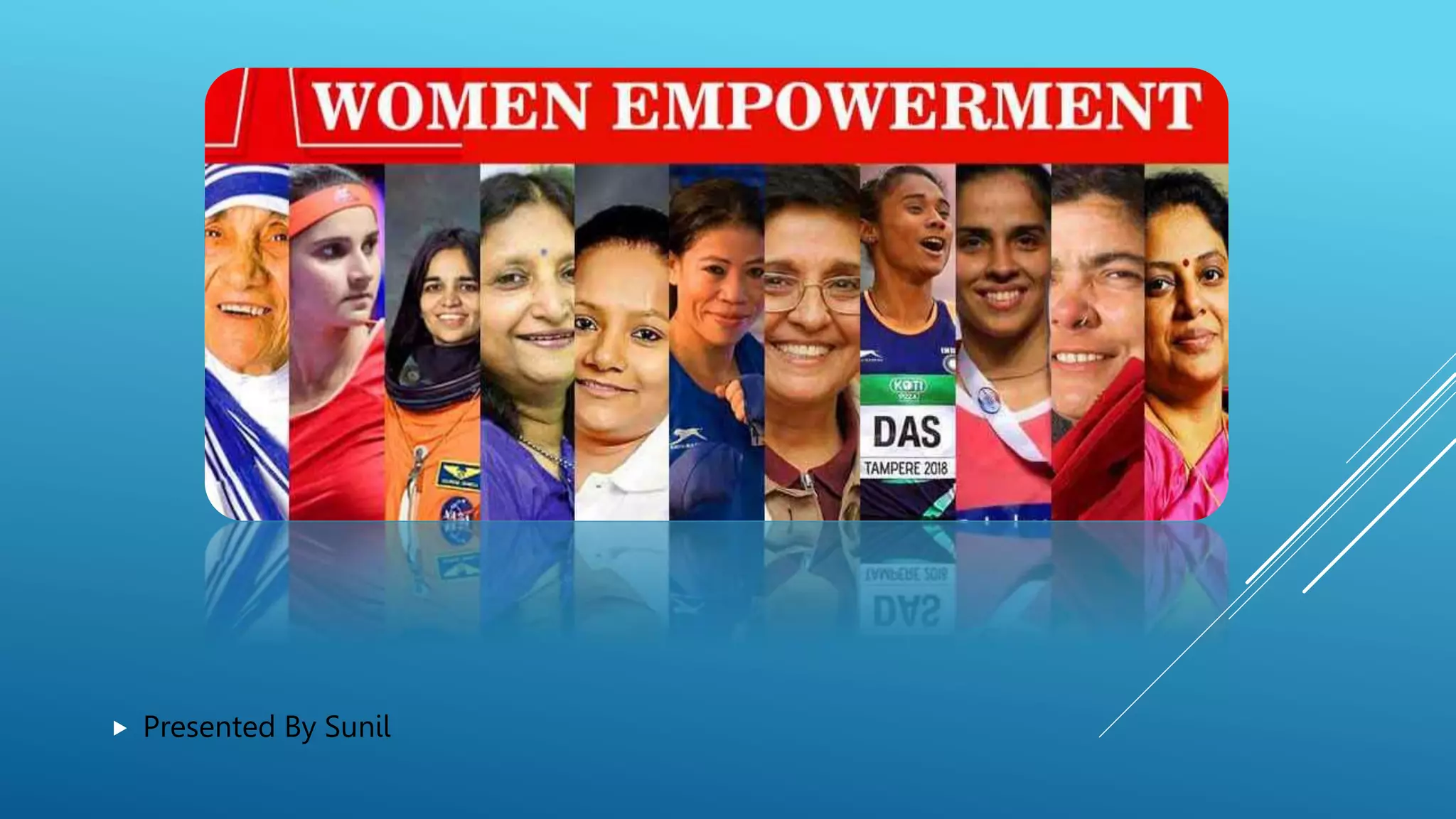
 Presented By Sunil​
AGENDA
Introduction
Problems faced by women
Need for Women Empowerment
SIX 'S’ For Women Empowerment
Schemes and Legal Awareness
Conclusion
INTRODUCTION
 Empowerment refers to the increasing the
spiritual, political, social or economic
strength of individuals and communities.
 As a general definition, Empowerment is a
multidimensional process that helps people
gain control over their own lives.
 Women Empowerment is the process and
the outcome of the process by which
women challenge gender based
discrimination in every institution and
structures of the society.
PROBLEM FACED
BY WOMEN
Women in India have to face a lot of issues. They have to
go through gender discrimination, harassment, sexual
abuse, lack of education, dowry-related harassment, gender
pay gap and much more.
Women who become widows and divorcees feel low in
society and are deprived of job opportunities with
unmarried women. Besides, these women are exploited and
abused for auspices; and are not allowed to participate or
enjoy functions and holidays.
NEED OF WOMEN
EMPOWERMENT
"Women are worshiped as goddess in India,
but not given her true position.”
Women are deprived of:
 Decision making Power
 Freedom of Movement
 Access to Education
 Access to Employment
 Exposure to Media
 Domestic Violence
SIX 'S' FOR WOMEN EMPOWERMENT
 Shiksha Education
 Swasthya= Health
 Swavlamban= Self Reliance
 Samajik Nyay= Justice
 Samvedan= Sensitivity
 Samta= Equality
PROGRAMMES/SCHEMES
FOR WOMEN
EMPOWERMENT
 Beti Bachao Beti Padhao Scheme (22 Jan,
2015)
 One Stop Centre Scheme (1 April, 2015)
 Women Helpline Scheme (1 April, 2015)
 UJJAWALA (Dec, 2007)
 Working Women Hostel (Introduced in 1972-
73 and after amendment re-launched on 6
April 2017)
 Rajiv Gandhi National Crèche scheme for the
children of Working Mothers (2010-11)
 SWADHAR Scheme (A scheme for women in
difficult circumstances), (2001-02)
 Support to Training & Employment
Programme for women (STEP), (Launched in
2003-04 and revised in Dec 2014)
CONCLUSION
 Women represent half of the world's population and gender inequality exists in
every nation on the planet.
 Until women are given the same opportunities that men are, entire societies will
be destined to perform below their true potentials.
 The greatest need of the hour is change of social attitude to women.
• The dream of women empowerment shall not be fulfill unless they are
empowered to play equal decisive and appropriate role in the family, which is the
basic unit of empowerment.

WOMEN EMPOWERMENT1 (2).pptx

  • 1.
  • 2.
    AGENDA Introduction Problems faced bywomen Need for Women Empowerment SIX 'S’ For Women Empowerment Schemes and Legal Awareness Conclusion
  • 3.
    INTRODUCTION  Empowerment refersto the increasing the spiritual, political, social or economic strength of individuals and communities.  As a general definition, Empowerment is a multidimensional process that helps people gain control over their own lives.  Women Empowerment is the process and the outcome of the process by which women challenge gender based discrimination in every institution and structures of the society.
  • 4.
    PROBLEM FACED BY WOMEN Womenin India have to face a lot of issues. They have to go through gender discrimination, harassment, sexual abuse, lack of education, dowry-related harassment, gender pay gap and much more. Women who become widows and divorcees feel low in society and are deprived of job opportunities with unmarried women. Besides, these women are exploited and abused for auspices; and are not allowed to participate or enjoy functions and holidays.
  • 5.
    NEED OF WOMEN EMPOWERMENT "Womenare worshiped as goddess in India, but not given her true position.” Women are deprived of:  Decision making Power  Freedom of Movement  Access to Education  Access to Employment  Exposure to Media  Domestic Violence
  • 6.
    SIX 'S' FORWOMEN EMPOWERMENT  Shiksha Education  Swasthya= Health  Swavlamban= Self Reliance  Samajik Nyay= Justice  Samvedan= Sensitivity  Samta= Equality
  • 7.
    PROGRAMMES/SCHEMES FOR WOMEN EMPOWERMENT  BetiBachao Beti Padhao Scheme (22 Jan, 2015)  One Stop Centre Scheme (1 April, 2015)  Women Helpline Scheme (1 April, 2015)  UJJAWALA (Dec, 2007)  Working Women Hostel (Introduced in 1972- 73 and after amendment re-launched on 6 April 2017)  Rajiv Gandhi National Crèche scheme for the children of Working Mothers (2010-11)  SWADHAR Scheme (A scheme for women in difficult circumstances), (2001-02)  Support to Training & Employment Programme for women (STEP), (Launched in 2003-04 and revised in Dec 2014)
  • 8.
    CONCLUSION  Women representhalf of the world's population and gender inequality exists in every nation on the planet.  Until women are given the same opportunities that men are, entire societies will be destined to perform below their true potentials.  The greatest need of the hour is change of social attitude to women. • The dream of women empowerment shall not be fulfill unless they are empowered to play equal decisive and appropriate role in the family, which is the basic unit of empowerment.