Wodel: A Domain-Specific
Language for Model Mutation
Universidad Autónoma de Madrid (Spain)
P. Gómez-Abajo , E. Guerra, J. de Lara
{Pablo.GomezA, Esther.Guerra, Juan.deLara}@uam.es
http://www.miso.es
modelling & software engineering
research group
SAC’2016, Pisa (Italy)
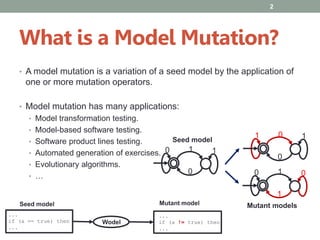
• A model mutation is a variation of a seed model by the application of
one or more mutation operators.
• Model mutation has many applications:
• Model transformation testing.
• Model-based software testing.
• Software product lines testing.
• Automated generation of exercises.
• Evolutionary algorithms.
• …
2
0
101
0
110
1
010
Seed model
Mutant models
Wodel
Seed model
...
if (a == true) then
...
...
if (a != true) then
...
Mutant model
What is a Model Mutation?
Motivation
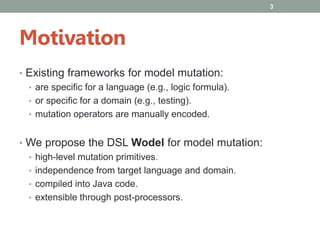
• Existing frameworks for model mutation:
• are specific for a language (e.g., logic formula).
• or specific for a domain (e.g., testing).
• mutation operators are manually encoded.
• We propose the DSL Wodel for model mutation:
• high-level mutation primitives.
• independence from target language and domain.
• compiled into Java code.
• extensible through post-processors.
3
4
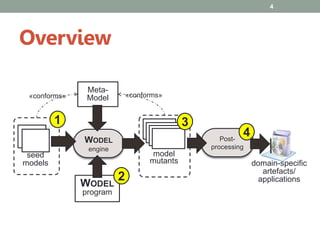
seed
models
Meta-
Model«conforms»
WODEL
program
domain-specific
artefacts/
applications
1
2
WODEL
engine
model
mutants
Post-
processing
4
«conforms»
3
Overview
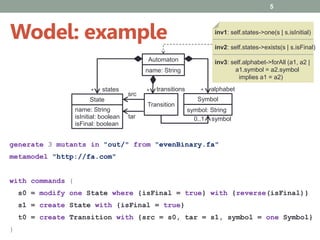
Wodel: example
5
Automaton
name: String
State
Transition
*
name: String
isInitial: boolean
isFinal: boolean
src
tar symbol0..1
states* * transitions
inv1: self.states->one(s | s.isInitial)
inv2: self.states->exists(s | s.isFinal)
inv3: self.alphabet->forAll (a1, a2 |
a1.symbol = a2.symbol
implies a1 = a2)
alphabet
Symbol
symbol: String
generate 3 mutants in "out/" from "evenBinary.fa"
metamodel "http://fa.com"
with commands {
s0 = modify one State where {isFinal = true} with {reverse(isFinal)}
s1 = create State with {isFinal = true}
t0 = create Transition with {src = s0, tar = s1, symbol = one Symbol}
}
Wodel: mutation operators
6
// object/ref creation
create State
create reference tar in
one Transition
// objet/ref modification
modify one State
with {isFinal = true}
modify source src from
one Transition
modify target tar from
one Transition
// object/ref deletion
remove one State
remove reference tar in
one Transition
// composite mutation
[
s0 = create State
modify s0 with {name = 's0'}
]
Mutation
min: int=1
max: int=1
CreateObject
ObjectEmitter EClass
type
0..1
name: String[0..1]
ObjectSelection
Strategy
container 0..1
EReference
0..1refType
AttributeSet EAttribute
attributes
*
Attribute
Init
Attribute
Swap
{ordered}
Attribute
Copy
object 0..1
Modify
Information
object
0..1
attributes*attributes *
Attribute
Type
value
Composite
Mutation
*
ModifySource
Reference
…
ObjectSelection
Strategy
source
newSource
EReference
refType 0..1
7
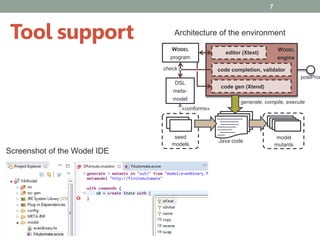
Screenshot of the Wodel IDE
seed
models
DSL
meta-
model
postProc
WODEL
engine
editor (Xtext)
code gen (Xtend)
Java code
model
mutants
code completion, validator
WODEL
program
«conforms»
check
generate, compile, execute
Architecture of the environmentTool support
8
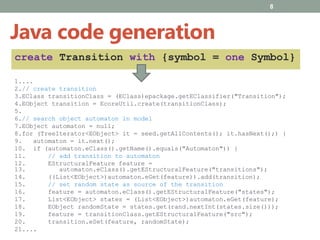
1....
2.// create transition
3.EClass transitionClass = (EClass)epackage.getEClassifier("Transition");
4.EObject transition = EcoreUtil.create(transitionClass);
5.
6.// search object automaton in model
7.EObject automaton = null;
8.for (TreeIterator<EObject> it = seed.getAllContents(); it.hasNext();) {
9. automaton = it.next();
10. if (automaton.eClass().getName().equals("Automaton")) {
11. // add transition to automaton
12. EStructuralFeature feature =
13. automaton.eClass().getEStructuralFeature("transitions");
14. ((List<EObject>)automaton.eGet(feature)).add(transition);
15. // set random state as source of the transition
16. feature = automaton.eClass().getEStructuralFeature("states");
17. List<EObject> states = (List<EObject>)automaton.eGet(feature);
18. EObject randomState = states.get(rand.nextInt(states.size()));
19. feature = transitionClass.getEStructuralFeature("src");
20. transition.eSet(feature, randomState);
21....
Java code generation
create Transition with {symbol = one Symbol}
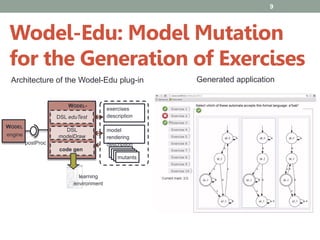
Wodel-Edu: Model Mutation
for the Generation of Exercises
9
postProc
WODEL
engine
WODEL-
EDU
DSL eduTest
DSL
modelDraw
mutants
model
rendering
description
code gen
learning
environment
exercises
description
Architecture of the Wodel-Edu plug-in Generated application
• Wodel is a DSL for model mutation:
• high-level mutation primitives.
• domain-independent.
• support for composite mutations.
• non-repeated mutants, conformance checking.
• compiled into Java.
• extensible for different applications.
• Wodel-Edu: automated generation of exercises
via model mutation
10
Conclusions
• Extend Wodel with new mutation primitives and a
rule policy language
• Develop new plugins for Wodel (e.g., for model-
based testing, evolutionary computation…)
• Extend Wodel-Edu to support the generation of
more complex learning environments
11
Future Work
12
You can get the source code of this project on
GitHub:
http://gomezabajo.github.io/Wodel/
Short video demo:
https://youtu.be/GBfXH0Rf-fI
Thank you!!
Pablo.GomezA@uam.es

Wodel: A Domain-Specific Language for Model Mutation

  • 1.
    Wodel: A Domain-Specific Languagefor Model Mutation Universidad Autónoma de Madrid (Spain) P. Gómez-Abajo , E. Guerra, J. de Lara {Pablo.GomezA, Esther.Guerra, Juan.deLara}@uam.es http://www.miso.es modelling & software engineering research group SAC’2016, Pisa (Italy)
  • 2.
    • A modelmutation is a variation of a seed model by the application of one or more mutation operators. • Model mutation has many applications: • Model transformation testing. • Model-based software testing. • Software product lines testing. • Automated generation of exercises. • Evolutionary algorithms. • … 2 0 101 0 110 1 010 Seed model Mutant models Wodel Seed model ... if (a == true) then ... ... if (a != true) then ... Mutant model What is a Model Mutation?
  • 3.
    Motivation • Existing frameworksfor model mutation: • are specific for a language (e.g., logic formula). • or specific for a domain (e.g., testing). • mutation operators are manually encoded. • We propose the DSL Wodel for model mutation: • high-level mutation primitives. • independence from target language and domain. • compiled into Java code. • extensible through post-processors. 3
  • 4.
  • 5.
    Wodel: example 5 Automaton name: String State Transition * name:String isInitial: boolean isFinal: boolean src tar symbol0..1 states* * transitions inv1: self.states->one(s | s.isInitial) inv2: self.states->exists(s | s.isFinal) inv3: self.alphabet->forAll (a1, a2 | a1.symbol = a2.symbol implies a1 = a2) alphabet Symbol symbol: String generate 3 mutants in "out/" from "evenBinary.fa" metamodel "http://fa.com" with commands { s0 = modify one State where {isFinal = true} with {reverse(isFinal)} s1 = create State with {isFinal = true} t0 = create Transition with {src = s0, tar = s1, symbol = one Symbol} }
  • 6.
    Wodel: mutation operators 6 //object/ref creation create State create reference tar in one Transition // objet/ref modification modify one State with {isFinal = true} modify source src from one Transition modify target tar from one Transition // object/ref deletion remove one State remove reference tar in one Transition // composite mutation [ s0 = create State modify s0 with {name = 's0'} ] Mutation min: int=1 max: int=1 CreateObject ObjectEmitter EClass type 0..1 name: String[0..1] ObjectSelection Strategy container 0..1 EReference 0..1refType AttributeSet EAttribute attributes * Attribute Init Attribute Swap {ordered} Attribute Copy object 0..1 Modify Information object 0..1 attributes*attributes * Attribute Type value Composite Mutation * ModifySource Reference … ObjectSelection Strategy source newSource EReference refType 0..1
  • 7.
    7 Screenshot of theWodel IDE seed models DSL meta- model postProc WODEL engine editor (Xtext) code gen (Xtend) Java code model mutants code completion, validator WODEL program «conforms» check generate, compile, execute Architecture of the environmentTool support
  • 8.
    8 1.... 2.// create transition 3.EClasstransitionClass = (EClass)epackage.getEClassifier("Transition"); 4.EObject transition = EcoreUtil.create(transitionClass); 5. 6.// search object automaton in model 7.EObject automaton = null; 8.for (TreeIterator<EObject> it = seed.getAllContents(); it.hasNext();) { 9. automaton = it.next(); 10. if (automaton.eClass().getName().equals("Automaton")) { 11. // add transition to automaton 12. EStructuralFeature feature = 13. automaton.eClass().getEStructuralFeature("transitions"); 14. ((List<EObject>)automaton.eGet(feature)).add(transition); 15. // set random state as source of the transition 16. feature = automaton.eClass().getEStructuralFeature("states"); 17. List<EObject> states = (List<EObject>)automaton.eGet(feature); 18. EObject randomState = states.get(rand.nextInt(states.size())); 19. feature = transitionClass.getEStructuralFeature("src"); 20. transition.eSet(feature, randomState); 21.... Java code generation create Transition with {symbol = one Symbol}
  • 9.
    Wodel-Edu: Model Mutation forthe Generation of Exercises 9 postProc WODEL engine WODEL- EDU DSL eduTest DSL modelDraw mutants model rendering description code gen learning environment exercises description Architecture of the Wodel-Edu plug-in Generated application
  • 10.
    • Wodel isa DSL for model mutation: • high-level mutation primitives. • domain-independent. • support for composite mutations. • non-repeated mutants, conformance checking. • compiled into Java. • extensible for different applications. • Wodel-Edu: automated generation of exercises via model mutation 10 Conclusions
  • 11.
    • Extend Wodelwith new mutation primitives and a rule policy language • Develop new plugins for Wodel (e.g., for model- based testing, evolutionary computation…) • Extend Wodel-Edu to support the generation of more complex learning environments 11 Future Work
  • 12.
    12 You can getthe source code of this project on GitHub: http://gomezabajo.github.io/Wodel/ Short video demo: https://youtu.be/GBfXH0Rf-fI Thank you!! Pablo.GomezA@uam.es