이름 : 장훈
나이: 30세(1988-06-16)
이메일 : lunawyrd@gmail.com
블로그 : http://devhoon.tistory.com
Github : https://github.com/jang-hoon
[주요경력]
2016.08 ~ 현재 (주)EXEM, WAS 및 Web Server 모니터링 프로그램(APM) 개발
2015.09 ~ 2016.03 (주)두꺼비세상, 두꺼비세상 Android 앱 개발 및 Spring
Boot를 이용한 REST, Batch, Gateway 서버 개발
2015.04 ~ 2015.08 (주)옐로쇼핑미디어, 쿠차 Android 앱 개발
2009.12 ~ 2013.02 (주)아이콘랩, Android 및 BlackBerry 앱 개발,
산업기능요원 대체복무
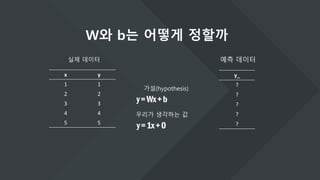
Hypothesis설정
import tensorflow astf
# 학습 데이터
x_data = [1, 2, 3]
y_data = [1, 2, 3]
W = tf.Variable(tf.random_uniform([1], -1.0, 1.0))
b = tf.Variable(tf.random_uniform([1], -1.0, 1.0))
X = tf.placeholder(tf.float32)
Y = tf.placeholder(tf.float32)
# 가설 Y_ = WX + b
hypothesis = W * X + b
14.
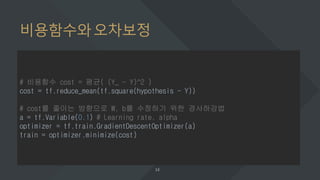
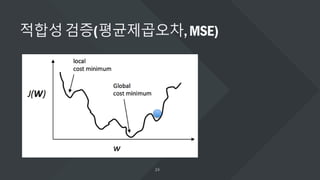
비용함수와오차보정
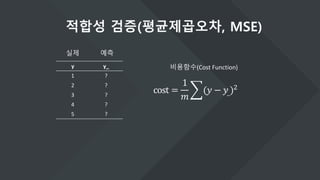
# 비용함수 cost= 평균( (Y_ - Y)^2 )
cost = tf.reduce_mean(tf.square(hypothesis - Y))
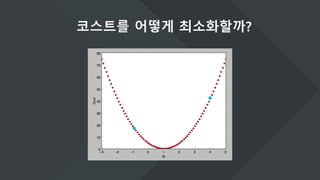
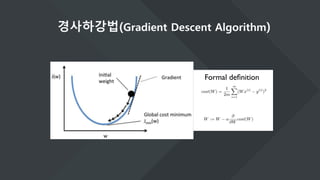
# cost를 줄이는 방향으로 W, b를 수정하기 위한 경사하강법
a = tf.Variable(0.1) # Learning rate, alpha
optimizer = tf.train.GradientDescentOptimizer(a)
train = optimizer.minimize(cost)
15.
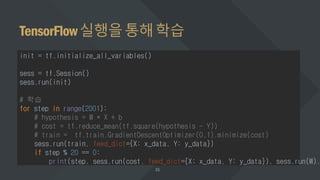
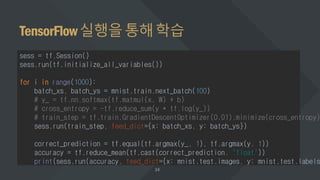
TensorFlow실행을통해학습
init = tf.initialize_all_variables()
sess= tf.Session()
sess.run(init)
# 학습
for step in range(2001):
# hypothesis = W * X + b
# cost = tf.reduce_mean(tf.square(hypothesis - Y))
# train = tf.train.GradientDescentOptimizer(0.1).minimize(cost)
sess.run(train, feed_dict={X: x_data, Y: y_data})
if step % 20 == 0:
print(step, sess.run(cost, feed_dict={X: x_data, Y: y_data}), sess.run(W),
16.
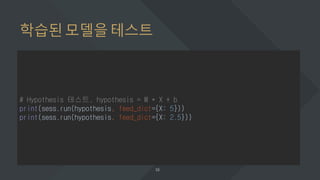
학습된모델을테스트
# Hypothesis 테스트,hypothesis = W * X + b
print(sess.run(hypothesis, feed_dict={X: 5}))
print(sess.run(hypothesis, feed_dict={X: 2.5}))
Sampleload및초기화
from tensorflow.examples.tutorials.mnist importinput_data
import tensorflow as tf
import numpy as np
#학습 데이터 로드
mnist = input_data.read_data_sets("MNIST__data/", one_hot=True)
x = tf.placeholder("float", [None, 784]) # [?] x [784]
y = tf.placeholder("float", [None, 10]) # [?] x [10]
W = tf.Variable(tf.zeros([784, 10])) # [784] x [10]
b = tf.Variable(tf.zeros([10])) # [10]
33.
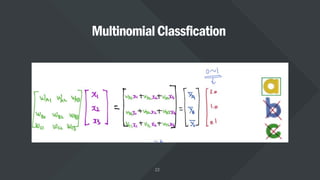
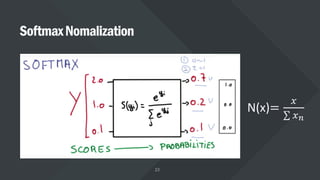
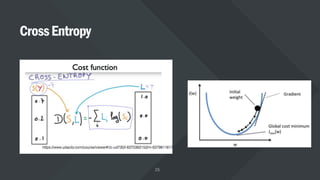
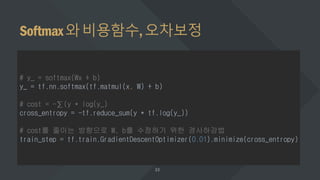
Softmax와비용함수,오차보정
# y_ =softmax(Wx + b)
y_ = tf.nn.softmax(tf.matmul(x, W) + b)
# cost = -∑(y * log(y_)
cross_entropy = -tf.reduce_sum(y * tf.log(y_))
# cost를 줄이는 방향으로 W, b를 수정하기 위한 경사하강법
train_step = tf.train.GradientDescentOptimizer(0.01).minimize(cross_entropy)


![이름 : 장훈
나이 : 30세(1988-06-16)
이메일 : lunawyrd@gmail.com
블로그 : http://devhoon.tistory.com
Github : https://github.com/jang-hoon
[주요경력]
2016.08 ~ 현재 (주)EXEM, WAS 및 Web Server 모니터링 프로그램(APM) 개발
2015.09 ~ 2016.03 (주)두꺼비세상, 두꺼비세상 Android 앱 개발 및 Spring
Boot를 이용한 REST, Batch, Gateway 서버 개발
2015.04 ~ 2015.08 (주)옐로쇼핑미디어, 쿠차 Android 앱 개발
2009.12 ~ 2013.02 (주)아이콘랩, Android 및 BlackBerry 앱 개발,
산업기능요원 대체복무](https://image.slidesharecdn.com/withtensorflow-170416234502/85/with-TensorFlow-2-320.jpg)


![Hypothesis설정
import tensorflow as tf
# 학습 데이터
x_data = [1, 2, 3]
y_data = [1, 2, 3]
W = tf.Variable(tf.random_uniform([1], -1.0, 1.0))
b = tf.Variable(tf.random_uniform([1], -1.0, 1.0))
X = tf.placeholder(tf.float32)
Y = tf.placeholder(tf.float32)
# 가설 Y_ = WX + b
hypothesis = W * X + b](https://image.slidesharecdn.com/withtensorflow-170416234502/85/with-TensorFlow-13-320.jpg)



![Sampleload및초기화
from tensorflow.examples.tutorials.mnist import input_data
import tensorflow as tf
import numpy as np
#학습 데이터 로드
mnist = input_data.read_data_sets("MNIST__data/", one_hot=True)
x = tf.placeholder("float", [None, 784]) # [?] x [784]
y = tf.placeholder("float", [None, 10]) # [?] x [10]
W = tf.Variable(tf.zeros([784, 10])) # [784] x [10]
b = tf.Variable(tf.zeros([10])) # [10]](https://image.slidesharecdn.com/withtensorflow-170416234502/85/with-TensorFlow-32-320.jpg)
![학습된모델을이용해분석
def analysis(request):
message = "Test"
if request.method == "POST":
body_unicode = request.body.decode('utf-8')
body = json.loads(body_unicode)
test_array = np.array(body)
test_array = test_array.reshape((1, 784))
# y_ = tf.nn.softmax(tf.matmul(x, W) + b)
test_result = sess.run(tf.argmax(y_, 1), feed_dict={x: test_array});
print(test_result[0])
message = test_result[0]
return HttpResponse(message)](https://image.slidesharecdn.com/withtensorflow-170416234502/85/with-TensorFlow-35-320.jpg)




![[신경망기초] 퍼셉트론구현](https://cdn.slidesharecdn.com/ss_thumbnails/1-180604135609-thumbnail.jpg?width=640&height=640&fit=bounds)


![제 23회 보아즈(BOAZ) 빅데이터 컨퍼런스 - [OnLog]: Real-time Edge-to-Cloud Data Pipeline fo...](https://cdn.slidesharecdn.com/ss_thumbnails/3-4boaz23rdconferenceonlog-260204093729-11983ba7-thumbnail.jpg?width=640&height=640&fit=bounds)
![제 23회 보아즈(BOAZ) 빅데이터 컨퍼런스 - [북적북적] : 데이터 기반 독립출판사,서점 경영지원 대시보드](https://cdn.slidesharecdn.com/ss_thumbnails/1-1boaz23rdconference-260203093712-78abc1a0-thumbnail.jpg?width=640&height=640&fit=bounds)
![제 23회 보아즈(BOAZ) 빅데이터 컨퍼런스 - [어벤정스] : ToonP](https://cdn.slidesharecdn.com/ss_thumbnails/2-2boaz23rdconference-260203102006-3a01358e-thumbnail.jpg?width=640&height=640&fit=bounds)
![제 23회 보아즈(BOAZ) 빅데이터 컨퍼런스 - [F4] : 시켜줘, 금잔디 명예 플로리스트](https://cdn.slidesharecdn.com/ss_thumbnails/3-3boaz23rdconferencef4-260204011323-1cb48ec9-thumbnail.jpg?width=640&height=640&fit=bounds)
![제 23회 보아즈(BOAZ) 빅데이터 컨퍼런스 - [백 투 더 엔지] : 분산환경 주문 이벤트 처리 플랫폼](https://cdn.slidesharecdn.com/ss_thumbnails/1-2boaz23rdconference-260203100241-73ce0aa8-thumbnail.jpg?width=640&height=640&fit=bounds)
![제 23회 보아즈(BOAZ) 빅데이터 컨퍼런스 - [픽미] : 디저트 큐레이팅 플랫폼, 딸기로픽을 위한 데이터 기반 의사결정 프로세스 구축](https://cdn.slidesharecdn.com/ss_thumbnails/3-2boaz23rdconference-260203102931-15458767-thumbnail.jpg?width=640&height=640&fit=bounds)
![제 23회 보아즈(BOAZ) 빅데이터 컨퍼런스 - [셋이어때] : 헬퍼잇](https://cdn.slidesharecdn.com/ss_thumbnails/2-3boaz23rdconference-260203102432-6c8c7ed6-thumbnail.jpg?width=640&height=640&fit=bounds)
![제 23회 보아즈(BOAZ) 빅데이터 컨퍼런스 - [JJAI] : Re:Buy - 고객 행동 패턴 기반 재구매 시점 예측 개인화 CRM 시스템](https://cdn.slidesharecdn.com/ss_thumbnails/1-3boaz23rdconferencejjai-260203100705-ab1ce027-thumbnail.jpg?width=640&height=640&fit=bounds)
![제 23회 보아즈(BOAZ) 빅데이터 컨퍼런스 - [SimAI] : Omni_모든 콘텐츠 운영을 하나로](https://cdn.slidesharecdn.com/ss_thumbnails/1-4boaz23rdconferencesimai-260203101225-d673a594-thumbnail.jpg?width=640&height=640&fit=bounds)
![제 23회 보아즈(BOAZ) 빅데이터 컨퍼런스 - [If Lab] : 실시간 투표 커뮤니티 서비스 기반 데이터 파이프라인 구축 및 성능 검증](https://cdn.slidesharecdn.com/ss_thumbnails/2-1boaz23rdconferenceiflab-260203101556-e51663dd-thumbnail.jpg?width=640&height=640&fit=bounds)