WIRELESS ENERGY METER WITH AUTOMATIC TARIFF CALCULATION
Department of EEE, ACEM Page 1
1. Introduction
Remote Energy Meter (WEM) is the innovation of naturally gathering
information from vitality meter and exchanging that information to a focal database for
charging and/or investigating. This spares worker treks, and implies that charging can be
founded on real utilization as opposed to on an appraisal in light of past utilization, giving
clients better control of their utilization of electric vitality. Vitality Monitor is an
individual from a group of sensors, controllers and foundation that is utilized to Transmit
particular vitality related data from different areas into a main issue or accumulation
focus in the office in this very case an utility recipient. With the quick advancements in
the Wireless correspondence innovation with the utilization of the microcontrollers, there
are numerous changes in mechanizing different mechanical perspectives for diminishing
manual endeavors.
The conventional manual Meter-Reading was not reasonable any more as it
spends much human and material asset and achieves extra issues. In gathering the
readings and charging physically. Presently a-days the quantity of Electricity buyers is
expanding in an awesome number. It got to be trying in both creating and keeping up the
force according to the developing necessities. Keeping up the force is likewise a vital
assignment as creating the force right away; the human administrator goes to the
customer's home and delivers the bill according to the meter perusing. In the event that
the shopper is not accessible, the charging procedure will be pending and human
administrator again needs to return to the pending houses. Setting off to every single
buyer's home and creating the bill is a difficult errand and requires part of time.
It turns out to be exceptionally troublesome particularly in blustery season. In the
event that any purchaser did not pay the bill, the administrator needs to go to their homes
to detach the force supply. These procedures are redundant and take so much time. In
addition, Human administrator can't discover the Un-approved associations or acts of
neglect did by the purchaser to diminish or stop the meter perusing/power supply. WEM
(remote vitality meter) puts more control under the control of both utilities and shoppers
by giving them more nitty gritty data about force utilization. This permits utilities to
WIRELESS ENERGY METER WITH AUTOMATIC TARIFF CALCULATION
Department of EEE, ACEM Page 2
better control supply. WEM can tackle above troubles. Along these lines, remote WEM
and administration through sorts of system advances has turned into a pattern now.
2. Motivation
Thorough exploration has been done on the Numerous frameworks have been
produced utilizing Wireless Sensor Networks which comprises of a few sensor hubs in
closeness and having information transmission and gathering capacity amongst hubs and
focal base station for extensive variety of utilizations. Despite the fact that underlying
organization expense might be high, the operational expense of information
correspondence inside the framework is immaterial. With the quick advancements in the
Wireless correspondence innovation by the utilization of microcontrollers, there are
numerous enhancements in mechanizing different modern perspectives for lessening
manual endeavors. The customary manual Meter Reading was not reasonable for more
working purposes as it spends much human and material asset. It gets extra issues
estimation of readings and charging physically.
Presently a-days the quantity of Electricity purchasers is expanding in incredible
degree. It turned into a hard errand in taking care of and keeping up the force according
to the developing necessities. Without further ado upkeep of the force is likewise an
imperative errand as the human administrator goes to the buyer's home and delivers the
bill according to the meter perusing. On the off chance that the purchaser is not
accessible, the charging procedure will be pending and human administrator again needs
to return to. Heading off to every single customer's home and producing the bill is an
arduous assignment and requires parcel of time. It turns out to be exceptionally
troublesome particularly in blustery season. On the off chance that any purchaser did not
pay the bill, the administrator needs to go to their homes to detach the force supply.
These procedures are tedious and hard to handle.
In addition, the manual administrator can't discover the Un- approved associations
or acts of neglect completed by the purchaser to diminish or stop the meter
perusing/power supply The human blunder can open an open door for debasement done
by the human meter per user. So the issue which emerges in the charging framework can
WIRELESS ENERGY METER WITH AUTOMATIC TARIFF CALCULATION
Department of EEE, ACEM Page 3
get to be incorrect and wasteful. The accessibility of remote correspondence media has
made the trading of data quick, secured and precise. The computerized execution brought
on the quick use of gadgets, for example, PCs and telecom gadgets. Correspondence
media like the web, GSM systems, and so forth exists all over the place. Remote meter
perusing puts more control under the control of both utilities and shoppers by giving them
more nitty gritty data about force utilization. This permits utilities to better direct supply.
In this way, remote meter perusing framework and administration sorts of system
innovations has turned into a pattern now.
A system has been created to peruse power meter readings from a remote server
naturally utilizing the current GSM systems for PDAs. This procedure can be connected
for gas or water meters also. The meters send the meter readings like kilo-watt-hour
(kWh), voltage, current, bill, and so on by SMS to a focal server. The focal server then
stores the data in database for examination and sends the bill to the client cellular
telephone.
The SMS based information gathering should be possible rapidly and effectively.
Information can be gathered after any fancied time interim, for example, hourly, every
day, week by week, or month to month premise. As there is no human mediation in the
whole procedure, there is no possibility of human mistake and defilement. In the greatly
awful climate conditions like overwhelming snow, downpour, storm, and so on the
framework won't hamper on gathering information the length of GSM systems are steady.
The advancement expense of the SMS based remote meter will be higher than
traditional meter however the electric supplier income will increment in the progressive
months since it will kill the likelihood of defilement done by the client or starting a per
user. Remote meter can be utilized as a part of private flats and particularly in mechanical
buyers where mass vitality is expended.
3. History of Meters:
With the development of country’s economy and the improvement of National
power, the power requirement is still ever increasing due to use of improper power
management systems and the conventional energy metering system. Over the past years,
WIRELESS ENERGY METER WITH AUTOMATIC TARIFF CALCULATION
Department of EEE, ACEM Page 4
metering devices have gone through much improvement, and are expected to become
even more sophisticated, offering more and more services.
Meters in the past, and today in a few countries, were electromechanical devices
with poor accuracy and lack of configurability. Theft detection was also a challenge.
Such meters are limited to providing the amount of energy consumption on site.
Generally, there are two types of Energy Meters:
I. Analog Energy Meter
II. Digital Energy Meter
Analog Energy Meter : Analog energy meter is the first intentional meter starting from
the Thomas Alva Edison .Up to 2005 the analog energy meter is used. That energy meter
is having many disadvantages are as follows:
I. Ageing of magnet.
II. Low accuracy.
III. Low efficiency.
IV. No sensing & indication of low meter.
V. Analog energy meter can be made.
VI. We can slow down the resourcing speed of the energy meter.
Digital Energy Meter: Digital energy meter is the second generation of analog energy
meter or modified meter. Instead of Analog meter LED indicator is used this meter has
the current sensing element are used. That energy meter is having many disadvantages
are as follows:
I. Highly Person dependant.
II. Human errors cannot be avoided.
III. Accessibility of meters in rural/ Agricultural zones.
IV. Energy Audits performed based on bill collection which is highly
inaccurate.
V. Billing done mainly on estimated/ monthly average basis
VI. Inability to monitor and control discrete loads
WIRELESS ENERGY METER WITH AUTOMATIC TARIFF CALCULATION
Department of EEE, ACEM Page 5
4. WEM Mechanism:
The purpose of this is to remote monitoring and control of Domestic Energy
Meter. This system enables Electricity Department to read meter readings regularly
without the person visiting each house. This can be achieved by use of the
Microcontroller unit that continuously monitors and records the Energy Meter reading in
its permanent (non-volatile) memory location. This system also makes use of RF
transmitter remote monitoring and controlling of Energy Meter Recent developments in
this direction seem to provide opportunities in implementing energy efficient metering.
Technologies that are more precise and accurate, error free, etc.
4.1. Vital Features Of WEM:
The implementation of WAMRS provides with many vital features as compared
with the analog utility meter reading with man power. Some of these features are listed
below:
1. Higher speed.
2. Improved load profile.
3. Automatic billing invoice.
4. Real time energy cost.
5. Load management.
6. Alarm warning.
7. Remote power switches on/off.
8. Tamper detection.
9. Bundling with water and gas.
WIRELESS ENERGY METER WITH AUTOMATIC TARIFF CALCULATION
Department of EEE, ACEM Page 6
5. MethodologiesUsed:
5.1. Medias for Wireless Communication:
There are many ways are available for communication such as:-
1. RF Communication
2. Wi-Fi Communications
3. Bluetooth Communications
4. Zigbee Communications
Out of which every communication is having its own advantages and
disadvantages. The Bluetooth and Wi-Fi are widely used for wireless communication.
This can be done using RF and Zigbee also but is deals with the Zigbee Wireless
communication system. But we use a zigbee technology for doing this because the RF
technology is having some disadvantages.
6. Block DiagramofWEM:
Fig: 6.1.Wireless Energy Meter Monitoring System With Automatic Tariff
Calculation
WIRELESS ENERGY METER WITH AUTOMATIC TARIFF CALCULATION
Department of EEE, ACEM Page 7
The microcontroller based system continuously records the readings and the live
meter reading can be sent to the Electricity Department on request. The receiver end
comprises of RF receiver which receives the data from the transmitter. The data received
at the receiver end is fed to the microcontroller which is present at the receiving end. The
microcontroller at the receiving end is provided with a LCD interfacing and also few
control switches for tariff selection (domestic agricultural, industrial) can be done
dynamically by the operator. The microcontroller automatically takes the responsibility
of calculating the bill with the data received from the RF transmitter which is present
with the energy meter and the tariff provided by the operator and displays the same on
LCD. The major advantage of this system is making use of RF module which helps for a
wireless transmission and the use of tariff buttons makes the device eligible to operate for
both domestic billing and industrial billing and therefore there is no requirement to
employ a separate device for industrial billing. It is mainly divided into two parts.
1. Transmission Panel.
2. Receiver Panel.
1. Transmission Panel:
Transmission section is fitted in customer’s house. In this section the Energy
Meter is interfaced with microcontroller. Now microcontroller performs the action of
recording and storing energy meter reading in its memory location. Digital Energy Meter
generates a pulse whenever a unit is consumed or energy is recorded in pulsating signal.
This pulse is given to microcontroller. Then this analog data which is in form of electrical
pulses is converted to digital output through ADC operation performed by controller
itself. The generated digital output is then transmitted by using RF technique. To perform
such operation controller needs required supply which is suitably provided through power
supply unit. LED is used as indicator to check whether trans-receiver transfer is proper.
Microcontroller is also connected to display unit which continuously shows energy
reading.
WIRELESS ENERGY METER WITH AUTOMATIC TARIFF CALCULATION
Department of EEE, ACEM Page 8
2. Receiver Panel:
Receiver section is mobile i.e. it can be taken wherever required. It’s main
purpose is to collect Energy Meter readings from all customers hence it is for electricity
distribution utility. Basic architecture of receiver panel is similar to that of transmission
panel. Receiver generates all ranges of frequencies to collect data from customer panels.
After receiving readings, this digital data is again converted back to analog form by
microcontroller application through DAC. Charge per unit of consumption is already
programmed in receiver panel microcontroller. So energy bill is generated by same
microcontroller by performing simple arithmetic operations.
7. Disadvantages ofRF:
1. Power Needs:
Like most other forms of electronic communication, radio requires the presence of
electricity, both at the point of the transmission and the point of reception. While battery-
powered radios are common, these power needs are more cumbersome than those of land
line telephones, which can operate using electricity already in the lines to make calls even
during periods of emergency or power outages. A powerful radio transmitter, such as a
regional broadcast station, requires large amounts of electricity at all times to send out its
signal.
2. Bandwidth:
Finally, radio communication relies on a very limited spectrum of bandwidth
frequencies. This is why commercial radio stations sometimes seem to overlap or blend
together, and why the Federal Communications Commission strictly regulates the use of
all publicly-owned airwaves. Radios require a relatively large amount of bandwidth
relative to the amount of date they transmit, leading to more and more air space being
allocated for cell phone networks and wireless Internet networks.
Due to above disadvantages of RF communication this is done by using a Zigbee
also the Zigbee will have the advantages over RF communication.
WIRELESS ENERGY METER WITH AUTOMATIC TARIFF CALCULATION
Department of EEE, ACEM Page 9
8. ZigBee Technology:
A comprehensive description of the ZigBee protocol can be found in the literatures.
We have presented only a partial description of the ZigBee protocol. The ZigBee
technology was introduced by the ZigBee Alliance. The ZigBee technology has evolved
based on a standardized set of solutions called ‘layers'. These optimally designed layers
have provided the ZigBee with unique features including low cost, easy implementation,
reliable, low power, and high security. The ZigBee was built on top of IEEE 802.15.4
standard. The IEEE 802.15.4 standard defines the characteristics of the physical and
Medium Access Control (MAC) layers for Wireless Personal Area Network (WPAN).
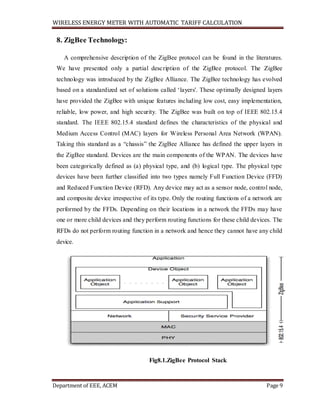
Taking this standard as a “chassis” the ZigBee Alliance has defined the upper layers in
the ZigBee standard. Devices are the main components of the WPAN. The devices have
been categorically defined as (a) physical type, and (b) logical type. The physical type
devices have been further classified into two types namely Full Function Device (FFD)
and Reduced Function Device (RFD). Any device may act as a sensor node, control node,
and composite device irrespective of its type. Only the routing functions of a network are
performed by the FFDs. Depending on their locations in a network the FFDs may have
one or more child devices and they perform routing functions for these child devices. The
RFDs do not perform routing function in a network and hence they cannot have any child
device.
Fig8.1.ZigBee Protocol Stack
WIRELESS ENERGY METER WITH AUTOMATIC TARIFF CALCULATION
Department of EEE, ACEM Page 10
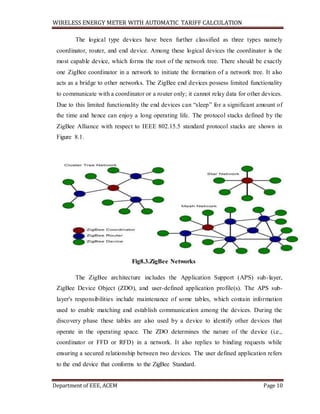
The logical type devices have been further classified as three types namely
coordinator, router, and end device. Among these logical devices the coordinator is the
most capable device, which forms the root of the network tree. There should be exactly
one ZigBee coordinator in a network to initiate the formation of a network tree. It also
acts as a bridge to other networks. The ZigBee end devices possess limited functionality
to communicate with a coordinator or a router only; it cannot relay data for other devices.
Due to this limited functionality the end devices can “sleep” for a significant amount of
the time and hence can enjoy a long operating life. The protocol stacks defined by the
ZigBee Alliance with respect to IEEE 802.15.5 standard protocol stacks are shown in
Figure 8.1.
Fig8.3.ZigBee Networks
The ZigBee architecture includes the Application Support (APS) sub-layer,
ZigBee Device Object (ZDO), and user-defined application profile(s). The APS sub-
layer's responsibilities include maintenance of some tables, which contain information
used to enable matching and establish communication among the devices. During the
discovery phase these tables are also used by a device to identify other devices that
operate in the operating space. The ZDO determines the nature of the device (i.e.,
coordinator or FFD or RFD) in a network. It also replies to binding requests while
ensuring a secured relationship between two devices. The user defined application refers
to the end device that conforms to the ZigBee Standard.
WIRELESS ENERGY METER WITH AUTOMATIC TARIFF CALCULATION
Department of EEE, ACEM Page 11
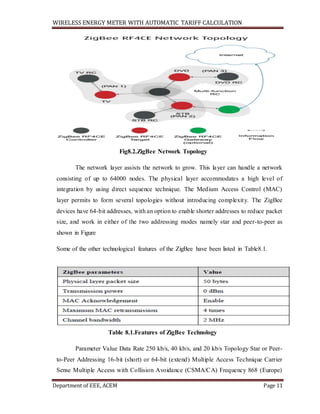
Fig8.2.ZigBee Network Topology
The network layer assists the network to grow. This layer can handle a network
consisting of up to 64000 nodes. The physical layer accommodates a high level of
integration by using direct sequence technique. The Medium Access Control (MAC)
layer permits to form several topologies without introducing complexity. The ZigBee
devices have 64-bit addresses, with an option to enable shorter addresses to reduce packet
size, and work in either of the two addressing modes namely star and peer-to-peer as
shown in Figure
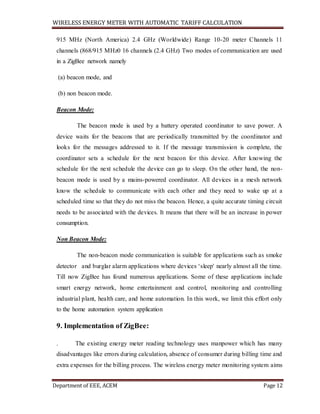
Some of the other technological features of the ZigBee have been listed in Table8.1.
Table 8.1.Features of ZigBee Technology
Parameter Value Data Rate 250 kb/s, 40 kb/s, and 20 kb/s Topology Star or Peer-
to-Peer Addressing 16-bit (short) or 64-bit (extend) Multiple Access Technique Carrier
Sense Multiple Access with Collision Avoidance (CSMA/CA) Frequency 868 (Europe)
WIRELESS ENERGY METER WITH AUTOMATIC TARIFF CALCULATION
Department of EEE, ACEM Page 12
915 MHz (North America) 2.4 GHz (Worldwide) Range 10-20 meter Channels 11
channels (868/915 MHz0 16 channels (2.4 GHz) Two modes of communication are used
in a ZigBee network namely
(a) beacon mode, and
(b) non beacon mode.
Beacon Mode:
The beacon mode is used by a battery operated coordinator to save power. A
device waits for the beacons that are periodically transmitted by the coordinator and
looks for the messages addressed to it. If the message transmission is complete, the
coordinator sets a schedule for the next beacon for this device. After knowing the
schedule for the next schedule the device can go to sleep. On the other hand, the non-
beacon mode is used by a mains-powered coordinator. All devices in a mesh network
know the schedule to communicate with each other and they need to wake up at a
scheduled time so that they do not miss the beacon. Hence, a quite accurate timing circuit
needs to be associated with the devices. It means that there will be an increase in power
consumption.
Non Beacon Mode:
The non-beacon mode communication is suitable for applications such as smoke
detector and burglar alarm applications where devices ‘sleep' nearly almost all the time.
Till now ZigBee has found numerous applications. Some of these applications include
smart energy network, home entertainment and control, monitoring and controlling
industrial plant, health care, and home automation. In this work, we limit this effort only
to the home automation system application
9. Implementation of ZigBee:
. The existing energy meter reading technology uses manpower which has many
disadvantages like errors during calculation, absence of consumer during billing time and
extra expenses for the billing process. The wireless energy meter monitoring system aims
WIRELESS ENERGY METER WITH AUTOMATIC TARIFF CALCULATION
Department of EEE, ACEM Page 13
to minimize these difficulties by providing automatic energy monitoring through wireless
medium. The wireless technology is implemented by using a ZigBee transceiver
interfaced with both the EB (Electricity Board) section server as well as in the consumer
side. The IR sensor is fixed in the energy meter which senses the number of units
consumed and displays the units in the LCD (Liquid Crystal Display). These units are
transmitted through ZigBee to the GUI (Graphical User Interface) in EB (Electricity
Board) section. The cost is calculated and displayed in the GUI (Graphical User
Interface) and also it is transmitted back to the consumer’s home using ZigBee which is
displayed in the LCD (Liquid Crystal Display) present in consumer’s home. After a fixed
amount of time, the tariff for the consumed units during that fixed amount of time is
displayed in both LCD (Liquid Crystal Display) and GUI (Graphical User Interface). If
the consumer does not pay the bill within the allotted period of time the power is cut
down using a relay, else the power supply is given without any interruption. Energy
meter the energy meter is an electrical measuring device, which is used to record
electrical energy consumed in terms of units.
1. IR sensor:
Infra Red (IR) sensor is an electronic sensor that measures Infra Red (IR)
radiating from objects in its field of view. It is connected inside the energy meter to sense
the rotations in the disk and count the number of units consumed.
2. Differential amplifier:
LM358 is the differential amplifier used in this project. The output of the sensor
is low. So in order to amplify the output, LM358 is used.
3. Micro controller:
PIC16F877A is the micro controller used in this project for monitoring the
energy meter readings.
WIRELESS ENERGY METER WITH AUTOMATIC TARIFF CALCULATION
Department of EEE, ACEM Page 14
4. Communication interface:
MAX232 is used as communication interface to send and receive signals given
by the micro controller. It converts the data into serial manner and sends to the ZigBee
transceiver.
5. ZigBee:
ZigBee is a wireless network for home and building automations. In this project
ZigBee is attached with both consumer side and EB (Electricity Board) side. The sensed
units in home side module are sent to the EB side through this ZigBee and at EB side the
tariff calculation is done and the amount to be paid is sent to the home side through this
ZigBee transceiver which is displayed in the LCD.
6. LCD:
Liquid Crystal Displays (LCD) are used to display numeric and alpha numeric
data. In this project a 16*2 LCD is used to display the number of units consumed in the
home side, their corresponding cost and also the amount to be paid.
7. Rela
A relay is an electrical switch that opens and closes under the control of another
electrical circuit. In this project a relay is used to trip the power supply in case the bill is
not paid in given time.
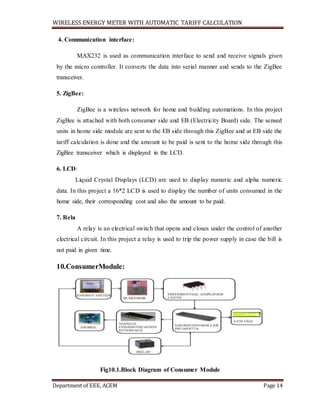
10.ConsumerModule:
Fig10.1.Block Diagram of Consumer Module
WIRELESS ENERGY METER WITH AUTOMATIC TARIFF CALCULATION
Department of EEE, ACEM Page 15
The consumer side is equipped with an energy meter, micro controller, LCD
display; indication unit (can be an indication lamp). The microcontroller continuously
monitors the energy meter reading and calculates the amount till last usage. These details
can be viewed in the LCD display and also it will be sent to the EB server during each
month through the Zigbee transmitter. The indication unit is provided for the attention of
the consumer in case of exceeding normal usage, delaying the payment and in case of any
tariff variation by the EB.
11. Electricity BoardModule:
Fig11.1.Block Diagram of EB Module
The block diagram of the EB side module used in the system is represented in the
above figure. The detailed explanation of each of the block along with the components
used is explained in the following chapters. The P89V51RD2 is the basic component in
both the modules designed for the system of the automatic energy meter reading using
Zigbee wireless communication for the electricity board.
The Zigbee is attached with both the modules. The data from the Zigbee
transceiver in home module passes to the EB Office module through Zigbee network. In
the office side a similar module receives the data.
The consumer side module consists of a ZigBee transceiver interfaced with a
personal computer having Graphical User Interface (GUI). The ZigBee transceiver
receives the sensed units from consumer’s home and displays them on GUI. Tariff
WIRELESS ENERGY METER WITH AUTOMATIC TARIFF CALCULATION
Department of EEE, ACEM Page 16
calculation is done here and the amount to be paid for the consumed units is transmitted
to the consumer’s home through ZigBee transceiver.
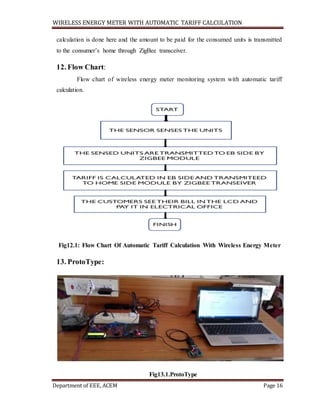
12. Flow Chart:
Flow chart of wireless energy meter monitoring system with automatic tariff
calculation.
Fig12.1: Flow Chart Of Automatic Tariff Calculation With Wireless Energy Meter
13. ProtoType:
Fig13.1.ProtoType
WIRELESS ENERGY METER WITH AUTOMATIC TARIFF CALCULATION
Department of EEE, ACEM Page 17
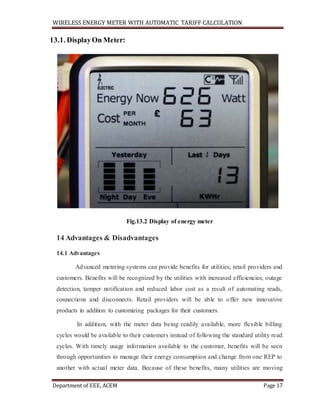
13.1. DisplayOn Meter:
Fig.13.2 Display of energy meter
14 Advantages & Disadvantages
14.1 Advantages
Advanced metering systems can provide benefits for utilities, retail providers and
customers. Benefits will be recognized by the utilities with increased efficiencies, outage
detection, tamper notification and reduced labor cost as a result of automating reads,
connections and disconnects. Retail providers will be able to offer new innovative
products in addition to customizing packages for their customers.
In addition, with the meter data being readily available, more flexible billing
cycles would be available to their customers instead of following the standard utility read
cycles. With timely usage information available to the customer, benefits will be seen
through opportunities to manage their energy consumption and change from one REP to
another with actual meter data. Because of these benefits, many utilities are moving
WIRELESS ENERGY METER WITH AUTOMATIC TARIFF CALCULATION
Department of EEE, ACEM Page 18
towards implementing some types of AMR solutions. In many cases, Smart Metering is
required by law, with Pennsylvania's Act 129 (2008) an example.
The benefits of smart metering for the utility
 Accurate meter reading, no more estimates Improved billing
 Accurate profile classes and measurement classes, true costs applied
 Improved security and tamper detection for equipment
 Energy management through profile data graphs
 Less financial burden correcting mistakes
 Less accrued expenditure
 Transparency of “cost to read” metering
 Improved procurement power though more accurate data - “de-risking” price
 In cases of shortages, utility will be able to manage/allocate supply.
 The benefits of smart metering for the customer.
 Improved billing and tracking of usage.
14.2Disadvantages
 Utility can control amount allocated to users.
 Utility can remotely shut off users.
 Loss of privacy - details of use reveal information about user activities
 Greater potential for monitoring by other/unauthorized third parties
 Reduced reliability (more complicated meters, more potential for interference by third
parties)
 Increased security risks from network or remote access
WIRELESS ENERGY METER WITH AUTOMATIC TARIFF CALCULATION
Department of EEE, ACEM Page 19
CONCLUSION
Current human advancement would be pushed to the brink of collapse, if an
emergency of power shortage ever lingers. The cusp of society would crumple.
Accordingly, the unquestionable requirement for uninterruptible power is the prelude to
improvement of any country on the planet today. Step by step, the power buyer gathering
is extending as more individuals are accessing power. In lieu to this rising interest, there
additionally emerges the dire requirement for an exceedingly effective observing
framework that can consider the changing utilizations of the buyer people. This
anticipates has hence given a basic, exact and valuable arrangement as the remote
advanced vitality meter.
The venture might be further stretched out by including an extra component of
installment of the power bill from home itself utilizing some prepaid keeping money
cards or such systems. By expanding the scope of ZigBee Tran recipients we can build
the quantity of zones under one control room. With wide range accomplishment of this
anticipate soon, we may change from ZigBee to Internet administration for remote
correspondence since it is costlier than Zigbee.
WIRELESS ENERGY METER WITH AUTOMATIC TARIFF CALCULATION
Department of EEE, ACEM Page 20
Bibliography:
[1] Li Xiaoguang Hu, “Design of an ARM-Based Power Meter Having WIFI Wireless
Communication Module” IEEE 2009.
[2] Petri Oksa, Mikael Soini, “Considerations of Using Power Line Communication in
the AMR System”, 2006 IEEE International Symposium on 26-29, pp.208-211, Mar.
2006
[3] S. Battermann and H. Garbe, “Influence of PLC transmission on the sensitivity of a
short-wave receiving station,” IEEE Power Line Communications and Its Applications,
pp.224-227, Apr. 2005.
[4] Chih-Hung Wu, etc, “Design of a Wireless ARM Based Automatic Meter Reading
and Control System”, Power Engineering Society General Meeting, 2004. IEEE 6-10,
Vol.1, pp.957-962, June 2004
[5] Yu Qin, “The Research and Application of ARM and GPRS Technology in Remote
Meter Reading Terminal Equipment”, A Thesis Submitted in Partial Fulfilment of the
Requirements for the Degree of Master of Engineering, 2007
[6] Liting Cao, JingwenTian and Dahang Zhang, “Networked Remote Meter-Reading
System Based on Wireless Communication Technology” in International Conference on
Information Acquisition, 2006 IEEE.
[7] Liting Cao, Wei Jiang, Zhaoli Zhang “Automatic Meter Reading System Based on
Wireless Mesh Networks and SOPC Technology” in International Conference on
Intelligent Networks and Intelligent Systems, 2009 IEEE.
[8]Xiujie Dong, Yan Yang, You Zhou “The Design of Wireless Automatic Meter
Reading System Based on SOPC” in WASE.
[ 9 ] https: WWW.GOOGLE.Co.in
[ 10 ] Wikipedia.

wireless energy meter

  • 1.
    WIRELESS ENERGY METERWITH AUTOMATIC TARIFF CALCULATION Department of EEE, ACEM Page 1 1. Introduction Remote Energy Meter (WEM) is the innovation of naturally gathering information from vitality meter and exchanging that information to a focal database for charging and/or investigating. This spares worker treks, and implies that charging can be founded on real utilization as opposed to on an appraisal in light of past utilization, giving clients better control of their utilization of electric vitality. Vitality Monitor is an individual from a group of sensors, controllers and foundation that is utilized to Transmit particular vitality related data from different areas into a main issue or accumulation focus in the office in this very case an utility recipient. With the quick advancements in the Wireless correspondence innovation with the utilization of the microcontrollers, there are numerous changes in mechanizing different mechanical perspectives for diminishing manual endeavors. The conventional manual Meter-Reading was not reasonable any more as it spends much human and material asset and achieves extra issues. In gathering the readings and charging physically. Presently a-days the quantity of Electricity buyers is expanding in an awesome number. It got to be trying in both creating and keeping up the force according to the developing necessities. Keeping up the force is likewise a vital assignment as creating the force right away; the human administrator goes to the customer's home and delivers the bill according to the meter perusing. In the event that the shopper is not accessible, the charging procedure will be pending and human administrator again needs to return to the pending houses. Setting off to every single buyer's home and creating the bill is a difficult errand and requires part of time. It turns out to be exceptionally troublesome particularly in blustery season. In the event that any purchaser did not pay the bill, the administrator needs to go to their homes to detach the force supply. These procedures are redundant and take so much time. In addition, Human administrator can't discover the Un-approved associations or acts of neglect did by the purchaser to diminish or stop the meter perusing/power supply. WEM (remote vitality meter) puts more control under the control of both utilities and shoppers by giving them more nitty gritty data about force utilization. This permits utilities to
  • 2.
    WIRELESS ENERGY METERWITH AUTOMATIC TARIFF CALCULATION Department of EEE, ACEM Page 2 better control supply. WEM can tackle above troubles. Along these lines, remote WEM and administration through sorts of system advances has turned into a pattern now. 2. Motivation Thorough exploration has been done on the Numerous frameworks have been produced utilizing Wireless Sensor Networks which comprises of a few sensor hubs in closeness and having information transmission and gathering capacity amongst hubs and focal base station for extensive variety of utilizations. Despite the fact that underlying organization expense might be high, the operational expense of information correspondence inside the framework is immaterial. With the quick advancements in the Wireless correspondence innovation by the utilization of microcontrollers, there are numerous enhancements in mechanizing different modern perspectives for lessening manual endeavors. The customary manual Meter Reading was not reasonable for more working purposes as it spends much human and material asset. It gets extra issues estimation of readings and charging physically. Presently a-days the quantity of Electricity purchasers is expanding in incredible degree. It turned into a hard errand in taking care of and keeping up the force according to the developing necessities. Without further ado upkeep of the force is likewise an imperative errand as the human administrator goes to the buyer's home and delivers the bill according to the meter perusing. On the off chance that the purchaser is not accessible, the charging procedure will be pending and human administrator again needs to return to. Heading off to every single customer's home and producing the bill is an arduous assignment and requires parcel of time. It turns out to be exceptionally troublesome particularly in blustery season. On the off chance that any purchaser did not pay the bill, the administrator needs to go to their homes to detach the force supply. These procedures are tedious and hard to handle. In addition, the manual administrator can't discover the Un- approved associations or acts of neglect completed by the purchaser to diminish or stop the meter perusing/power supply The human blunder can open an open door for debasement done by the human meter per user. So the issue which emerges in the charging framework can
  • 3.
    WIRELESS ENERGY METERWITH AUTOMATIC TARIFF CALCULATION Department of EEE, ACEM Page 3 get to be incorrect and wasteful. The accessibility of remote correspondence media has made the trading of data quick, secured and precise. The computerized execution brought on the quick use of gadgets, for example, PCs and telecom gadgets. Correspondence media like the web, GSM systems, and so forth exists all over the place. Remote meter perusing puts more control under the control of both utilities and shoppers by giving them more nitty gritty data about force utilization. This permits utilities to better direct supply. In this way, remote meter perusing framework and administration sorts of system innovations has turned into a pattern now. A system has been created to peruse power meter readings from a remote server naturally utilizing the current GSM systems for PDAs. This procedure can be connected for gas or water meters also. The meters send the meter readings like kilo-watt-hour (kWh), voltage, current, bill, and so on by SMS to a focal server. The focal server then stores the data in database for examination and sends the bill to the client cellular telephone. The SMS based information gathering should be possible rapidly and effectively. Information can be gathered after any fancied time interim, for example, hourly, every day, week by week, or month to month premise. As there is no human mediation in the whole procedure, there is no possibility of human mistake and defilement. In the greatly awful climate conditions like overwhelming snow, downpour, storm, and so on the framework won't hamper on gathering information the length of GSM systems are steady. The advancement expense of the SMS based remote meter will be higher than traditional meter however the electric supplier income will increment in the progressive months since it will kill the likelihood of defilement done by the client or starting a per user. Remote meter can be utilized as a part of private flats and particularly in mechanical buyers where mass vitality is expended. 3. History of Meters: With the development of country’s economy and the improvement of National power, the power requirement is still ever increasing due to use of improper power management systems and the conventional energy metering system. Over the past years,
  • 4.
    WIRELESS ENERGY METERWITH AUTOMATIC TARIFF CALCULATION Department of EEE, ACEM Page 4 metering devices have gone through much improvement, and are expected to become even more sophisticated, offering more and more services. Meters in the past, and today in a few countries, were electromechanical devices with poor accuracy and lack of configurability. Theft detection was also a challenge. Such meters are limited to providing the amount of energy consumption on site. Generally, there are two types of Energy Meters: I. Analog Energy Meter II. Digital Energy Meter Analog Energy Meter : Analog energy meter is the first intentional meter starting from the Thomas Alva Edison .Up to 2005 the analog energy meter is used. That energy meter is having many disadvantages are as follows: I. Ageing of magnet. II. Low accuracy. III. Low efficiency. IV. No sensing & indication of low meter. V. Analog energy meter can be made. VI. We can slow down the resourcing speed of the energy meter. Digital Energy Meter: Digital energy meter is the second generation of analog energy meter or modified meter. Instead of Analog meter LED indicator is used this meter has the current sensing element are used. That energy meter is having many disadvantages are as follows: I. Highly Person dependant. II. Human errors cannot be avoided. III. Accessibility of meters in rural/ Agricultural zones. IV. Energy Audits performed based on bill collection which is highly inaccurate. V. Billing done mainly on estimated/ monthly average basis VI. Inability to monitor and control discrete loads
  • 5.
    WIRELESS ENERGY METERWITH AUTOMATIC TARIFF CALCULATION Department of EEE, ACEM Page 5 4. WEM Mechanism: The purpose of this is to remote monitoring and control of Domestic Energy Meter. This system enables Electricity Department to read meter readings regularly without the person visiting each house. This can be achieved by use of the Microcontroller unit that continuously monitors and records the Energy Meter reading in its permanent (non-volatile) memory location. This system also makes use of RF transmitter remote monitoring and controlling of Energy Meter Recent developments in this direction seem to provide opportunities in implementing energy efficient metering. Technologies that are more precise and accurate, error free, etc. 4.1. Vital Features Of WEM: The implementation of WAMRS provides with many vital features as compared with the analog utility meter reading with man power. Some of these features are listed below: 1. Higher speed. 2. Improved load profile. 3. Automatic billing invoice. 4. Real time energy cost. 5. Load management. 6. Alarm warning. 7. Remote power switches on/off. 8. Tamper detection. 9. Bundling with water and gas.
  • 6.
    WIRELESS ENERGY METERWITH AUTOMATIC TARIFF CALCULATION Department of EEE, ACEM Page 6 5. MethodologiesUsed: 5.1. Medias for Wireless Communication: There are many ways are available for communication such as:- 1. RF Communication 2. Wi-Fi Communications 3. Bluetooth Communications 4. Zigbee Communications Out of which every communication is having its own advantages and disadvantages. The Bluetooth and Wi-Fi are widely used for wireless communication. This can be done using RF and Zigbee also but is deals with the Zigbee Wireless communication system. But we use a zigbee technology for doing this because the RF technology is having some disadvantages. 6. Block DiagramofWEM: Fig: 6.1.Wireless Energy Meter Monitoring System With Automatic Tariff Calculation
  • 7.
    WIRELESS ENERGY METERWITH AUTOMATIC TARIFF CALCULATION Department of EEE, ACEM Page 7 The microcontroller based system continuously records the readings and the live meter reading can be sent to the Electricity Department on request. The receiver end comprises of RF receiver which receives the data from the transmitter. The data received at the receiver end is fed to the microcontroller which is present at the receiving end. The microcontroller at the receiving end is provided with a LCD interfacing and also few control switches for tariff selection (domestic agricultural, industrial) can be done dynamically by the operator. The microcontroller automatically takes the responsibility of calculating the bill with the data received from the RF transmitter which is present with the energy meter and the tariff provided by the operator and displays the same on LCD. The major advantage of this system is making use of RF module which helps for a wireless transmission and the use of tariff buttons makes the device eligible to operate for both domestic billing and industrial billing and therefore there is no requirement to employ a separate device for industrial billing. It is mainly divided into two parts. 1. Transmission Panel. 2. Receiver Panel. 1. Transmission Panel: Transmission section is fitted in customer’s house. In this section the Energy Meter is interfaced with microcontroller. Now microcontroller performs the action of recording and storing energy meter reading in its memory location. Digital Energy Meter generates a pulse whenever a unit is consumed or energy is recorded in pulsating signal. This pulse is given to microcontroller. Then this analog data which is in form of electrical pulses is converted to digital output through ADC operation performed by controller itself. The generated digital output is then transmitted by using RF technique. To perform such operation controller needs required supply which is suitably provided through power supply unit. LED is used as indicator to check whether trans-receiver transfer is proper. Microcontroller is also connected to display unit which continuously shows energy reading.
  • 8.
    WIRELESS ENERGY METERWITH AUTOMATIC TARIFF CALCULATION Department of EEE, ACEM Page 8 2. Receiver Panel: Receiver section is mobile i.e. it can be taken wherever required. It’s main purpose is to collect Energy Meter readings from all customers hence it is for electricity distribution utility. Basic architecture of receiver panel is similar to that of transmission panel. Receiver generates all ranges of frequencies to collect data from customer panels. After receiving readings, this digital data is again converted back to analog form by microcontroller application through DAC. Charge per unit of consumption is already programmed in receiver panel microcontroller. So energy bill is generated by same microcontroller by performing simple arithmetic operations. 7. Disadvantages ofRF: 1. Power Needs: Like most other forms of electronic communication, radio requires the presence of electricity, both at the point of the transmission and the point of reception. While battery- powered radios are common, these power needs are more cumbersome than those of land line telephones, which can operate using electricity already in the lines to make calls even during periods of emergency or power outages. A powerful radio transmitter, such as a regional broadcast station, requires large amounts of electricity at all times to send out its signal. 2. Bandwidth: Finally, radio communication relies on a very limited spectrum of bandwidth frequencies. This is why commercial radio stations sometimes seem to overlap or blend together, and why the Federal Communications Commission strictly regulates the use of all publicly-owned airwaves. Radios require a relatively large amount of bandwidth relative to the amount of date they transmit, leading to more and more air space being allocated for cell phone networks and wireless Internet networks. Due to above disadvantages of RF communication this is done by using a Zigbee also the Zigbee will have the advantages over RF communication.
  • 9.
    WIRELESS ENERGY METERWITH AUTOMATIC TARIFF CALCULATION Department of EEE, ACEM Page 9 8. ZigBee Technology: A comprehensive description of the ZigBee protocol can be found in the literatures. We have presented only a partial description of the ZigBee protocol. The ZigBee technology was introduced by the ZigBee Alliance. The ZigBee technology has evolved based on a standardized set of solutions called ‘layers'. These optimally designed layers have provided the ZigBee with unique features including low cost, easy implementation, reliable, low power, and high security. The ZigBee was built on top of IEEE 802.15.4 standard. The IEEE 802.15.4 standard defines the characteristics of the physical and Medium Access Control (MAC) layers for Wireless Personal Area Network (WPAN). Taking this standard as a “chassis” the ZigBee Alliance has defined the upper layers in the ZigBee standard. Devices are the main components of the WPAN. The devices have been categorically defined as (a) physical type, and (b) logical type. The physical type devices have been further classified into two types namely Full Function Device (FFD) and Reduced Function Device (RFD). Any device may act as a sensor node, control node, and composite device irrespective of its type. Only the routing functions of a network are performed by the FFDs. Depending on their locations in a network the FFDs may have one or more child devices and they perform routing functions for these child devices. The RFDs do not perform routing function in a network and hence they cannot have any child device. Fig8.1.ZigBee Protocol Stack
  • 10.
    WIRELESS ENERGY METERWITH AUTOMATIC TARIFF CALCULATION Department of EEE, ACEM Page 10 The logical type devices have been further classified as three types namely coordinator, router, and end device. Among these logical devices the coordinator is the most capable device, which forms the root of the network tree. There should be exactly one ZigBee coordinator in a network to initiate the formation of a network tree. It also acts as a bridge to other networks. The ZigBee end devices possess limited functionality to communicate with a coordinator or a router only; it cannot relay data for other devices. Due to this limited functionality the end devices can “sleep” for a significant amount of the time and hence can enjoy a long operating life. The protocol stacks defined by the ZigBee Alliance with respect to IEEE 802.15.5 standard protocol stacks are shown in Figure 8.1. Fig8.3.ZigBee Networks The ZigBee architecture includes the Application Support (APS) sub-layer, ZigBee Device Object (ZDO), and user-defined application profile(s). The APS sub- layer's responsibilities include maintenance of some tables, which contain information used to enable matching and establish communication among the devices. During the discovery phase these tables are also used by a device to identify other devices that operate in the operating space. The ZDO determines the nature of the device (i.e., coordinator or FFD or RFD) in a network. It also replies to binding requests while ensuring a secured relationship between two devices. The user defined application refers to the end device that conforms to the ZigBee Standard.
  • 11.
    WIRELESS ENERGY METERWITH AUTOMATIC TARIFF CALCULATION Department of EEE, ACEM Page 11 Fig8.2.ZigBee Network Topology The network layer assists the network to grow. This layer can handle a network consisting of up to 64000 nodes. The physical layer accommodates a high level of integration by using direct sequence technique. The Medium Access Control (MAC) layer permits to form several topologies without introducing complexity. The ZigBee devices have 64-bit addresses, with an option to enable shorter addresses to reduce packet size, and work in either of the two addressing modes namely star and peer-to-peer as shown in Figure Some of the other technological features of the ZigBee have been listed in Table8.1. Table 8.1.Features of ZigBee Technology Parameter Value Data Rate 250 kb/s, 40 kb/s, and 20 kb/s Topology Star or Peer- to-Peer Addressing 16-bit (short) or 64-bit (extend) Multiple Access Technique Carrier Sense Multiple Access with Collision Avoidance (CSMA/CA) Frequency 868 (Europe)
  • 12.
    WIRELESS ENERGY METERWITH AUTOMATIC TARIFF CALCULATION Department of EEE, ACEM Page 12 915 MHz (North America) 2.4 GHz (Worldwide) Range 10-20 meter Channels 11 channels (868/915 MHz0 16 channels (2.4 GHz) Two modes of communication are used in a ZigBee network namely (a) beacon mode, and (b) non beacon mode. Beacon Mode: The beacon mode is used by a battery operated coordinator to save power. A device waits for the beacons that are periodically transmitted by the coordinator and looks for the messages addressed to it. If the message transmission is complete, the coordinator sets a schedule for the next beacon for this device. After knowing the schedule for the next schedule the device can go to sleep. On the other hand, the non- beacon mode is used by a mains-powered coordinator. All devices in a mesh network know the schedule to communicate with each other and they need to wake up at a scheduled time so that they do not miss the beacon. Hence, a quite accurate timing circuit needs to be associated with the devices. It means that there will be an increase in power consumption. Non Beacon Mode: The non-beacon mode communication is suitable for applications such as smoke detector and burglar alarm applications where devices ‘sleep' nearly almost all the time. Till now ZigBee has found numerous applications. Some of these applications include smart energy network, home entertainment and control, monitoring and controlling industrial plant, health care, and home automation. In this work, we limit this effort only to the home automation system application 9. Implementation of ZigBee: . The existing energy meter reading technology uses manpower which has many disadvantages like errors during calculation, absence of consumer during billing time and extra expenses for the billing process. The wireless energy meter monitoring system aims
  • 13.
    WIRELESS ENERGY METERWITH AUTOMATIC TARIFF CALCULATION Department of EEE, ACEM Page 13 to minimize these difficulties by providing automatic energy monitoring through wireless medium. The wireless technology is implemented by using a ZigBee transceiver interfaced with both the EB (Electricity Board) section server as well as in the consumer side. The IR sensor is fixed in the energy meter which senses the number of units consumed and displays the units in the LCD (Liquid Crystal Display). These units are transmitted through ZigBee to the GUI (Graphical User Interface) in EB (Electricity Board) section. The cost is calculated and displayed in the GUI (Graphical User Interface) and also it is transmitted back to the consumer’s home using ZigBee which is displayed in the LCD (Liquid Crystal Display) present in consumer’s home. After a fixed amount of time, the tariff for the consumed units during that fixed amount of time is displayed in both LCD (Liquid Crystal Display) and GUI (Graphical User Interface). If the consumer does not pay the bill within the allotted period of time the power is cut down using a relay, else the power supply is given without any interruption. Energy meter the energy meter is an electrical measuring device, which is used to record electrical energy consumed in terms of units. 1. IR sensor: Infra Red (IR) sensor is an electronic sensor that measures Infra Red (IR) radiating from objects in its field of view. It is connected inside the energy meter to sense the rotations in the disk and count the number of units consumed. 2. Differential amplifier: LM358 is the differential amplifier used in this project. The output of the sensor is low. So in order to amplify the output, LM358 is used. 3. Micro controller: PIC16F877A is the micro controller used in this project for monitoring the energy meter readings.
  • 14.
    WIRELESS ENERGY METERWITH AUTOMATIC TARIFF CALCULATION Department of EEE, ACEM Page 14 4. Communication interface: MAX232 is used as communication interface to send and receive signals given by the micro controller. It converts the data into serial manner and sends to the ZigBee transceiver. 5. ZigBee: ZigBee is a wireless network for home and building automations. In this project ZigBee is attached with both consumer side and EB (Electricity Board) side. The sensed units in home side module are sent to the EB side through this ZigBee and at EB side the tariff calculation is done and the amount to be paid is sent to the home side through this ZigBee transceiver which is displayed in the LCD. 6. LCD: Liquid Crystal Displays (LCD) are used to display numeric and alpha numeric data. In this project a 16*2 LCD is used to display the number of units consumed in the home side, their corresponding cost and also the amount to be paid. 7. Rela A relay is an electrical switch that opens and closes under the control of another electrical circuit. In this project a relay is used to trip the power supply in case the bill is not paid in given time. 10.ConsumerModule: Fig10.1.Block Diagram of Consumer Module
  • 15.
    WIRELESS ENERGY METERWITH AUTOMATIC TARIFF CALCULATION Department of EEE, ACEM Page 15 The consumer side is equipped with an energy meter, micro controller, LCD display; indication unit (can be an indication lamp). The microcontroller continuously monitors the energy meter reading and calculates the amount till last usage. These details can be viewed in the LCD display and also it will be sent to the EB server during each month through the Zigbee transmitter. The indication unit is provided for the attention of the consumer in case of exceeding normal usage, delaying the payment and in case of any tariff variation by the EB. 11. Electricity BoardModule: Fig11.1.Block Diagram of EB Module The block diagram of the EB side module used in the system is represented in the above figure. The detailed explanation of each of the block along with the components used is explained in the following chapters. The P89V51RD2 is the basic component in both the modules designed for the system of the automatic energy meter reading using Zigbee wireless communication for the electricity board. The Zigbee is attached with both the modules. The data from the Zigbee transceiver in home module passes to the EB Office module through Zigbee network. In the office side a similar module receives the data. The consumer side module consists of a ZigBee transceiver interfaced with a personal computer having Graphical User Interface (GUI). The ZigBee transceiver receives the sensed units from consumer’s home and displays them on GUI. Tariff
  • 16.
    WIRELESS ENERGY METERWITH AUTOMATIC TARIFF CALCULATION Department of EEE, ACEM Page 16 calculation is done here and the amount to be paid for the consumed units is transmitted to the consumer’s home through ZigBee transceiver. 12. Flow Chart: Flow chart of wireless energy meter monitoring system with automatic tariff calculation. Fig12.1: Flow Chart Of Automatic Tariff Calculation With Wireless Energy Meter 13. ProtoType: Fig13.1.ProtoType
  • 17.
    WIRELESS ENERGY METERWITH AUTOMATIC TARIFF CALCULATION Department of EEE, ACEM Page 17 13.1. DisplayOn Meter: Fig.13.2 Display of energy meter 14 Advantages & Disadvantages 14.1 Advantages Advanced metering systems can provide benefits for utilities, retail providers and customers. Benefits will be recognized by the utilities with increased efficiencies, outage detection, tamper notification and reduced labor cost as a result of automating reads, connections and disconnects. Retail providers will be able to offer new innovative products in addition to customizing packages for their customers. In addition, with the meter data being readily available, more flexible billing cycles would be available to their customers instead of following the standard utility read cycles. With timely usage information available to the customer, benefits will be seen through opportunities to manage their energy consumption and change from one REP to another with actual meter data. Because of these benefits, many utilities are moving
  • 18.
    WIRELESS ENERGY METERWITH AUTOMATIC TARIFF CALCULATION Department of EEE, ACEM Page 18 towards implementing some types of AMR solutions. In many cases, Smart Metering is required by law, with Pennsylvania's Act 129 (2008) an example. The benefits of smart metering for the utility  Accurate meter reading, no more estimates Improved billing  Accurate profile classes and measurement classes, true costs applied  Improved security and tamper detection for equipment  Energy management through profile data graphs  Less financial burden correcting mistakes  Less accrued expenditure  Transparency of “cost to read” metering  Improved procurement power though more accurate data - “de-risking” price  In cases of shortages, utility will be able to manage/allocate supply.  The benefits of smart metering for the customer.  Improved billing and tracking of usage. 14.2Disadvantages  Utility can control amount allocated to users.  Utility can remotely shut off users.  Loss of privacy - details of use reveal information about user activities  Greater potential for monitoring by other/unauthorized third parties  Reduced reliability (more complicated meters, more potential for interference by third parties)  Increased security risks from network or remote access
  • 19.
    WIRELESS ENERGY METERWITH AUTOMATIC TARIFF CALCULATION Department of EEE, ACEM Page 19 CONCLUSION Current human advancement would be pushed to the brink of collapse, if an emergency of power shortage ever lingers. The cusp of society would crumple. Accordingly, the unquestionable requirement for uninterruptible power is the prelude to improvement of any country on the planet today. Step by step, the power buyer gathering is extending as more individuals are accessing power. In lieu to this rising interest, there additionally emerges the dire requirement for an exceedingly effective observing framework that can consider the changing utilizations of the buyer people. This anticipates has hence given a basic, exact and valuable arrangement as the remote advanced vitality meter. The venture might be further stretched out by including an extra component of installment of the power bill from home itself utilizing some prepaid keeping money cards or such systems. By expanding the scope of ZigBee Tran recipients we can build the quantity of zones under one control room. With wide range accomplishment of this anticipate soon, we may change from ZigBee to Internet administration for remote correspondence since it is costlier than Zigbee.
  • 20.
    WIRELESS ENERGY METERWITH AUTOMATIC TARIFF CALCULATION Department of EEE, ACEM Page 20 Bibliography: [1] Li Xiaoguang Hu, “Design of an ARM-Based Power Meter Having WIFI Wireless Communication Module” IEEE 2009. [2] Petri Oksa, Mikael Soini, “Considerations of Using Power Line Communication in the AMR System”, 2006 IEEE International Symposium on 26-29, pp.208-211, Mar. 2006 [3] S. Battermann and H. Garbe, “Influence of PLC transmission on the sensitivity of a short-wave receiving station,” IEEE Power Line Communications and Its Applications, pp.224-227, Apr. 2005. [4] Chih-Hung Wu, etc, “Design of a Wireless ARM Based Automatic Meter Reading and Control System”, Power Engineering Society General Meeting, 2004. IEEE 6-10, Vol.1, pp.957-962, June 2004 [5] Yu Qin, “The Research and Application of ARM and GPRS Technology in Remote Meter Reading Terminal Equipment”, A Thesis Submitted in Partial Fulfilment of the Requirements for the Degree of Master of Engineering, 2007 [6] Liting Cao, JingwenTian and Dahang Zhang, “Networked Remote Meter-Reading System Based on Wireless Communication Technology” in International Conference on Information Acquisition, 2006 IEEE. [7] Liting Cao, Wei Jiang, Zhaoli Zhang “Automatic Meter Reading System Based on Wireless Mesh Networks and SOPC Technology” in International Conference on Intelligent Networks and Intelligent Systems, 2009 IEEE. [8]Xiujie Dong, Yan Yang, You Zhou “The Design of Wireless Automatic Meter Reading System Based on SOPC” in WASE. [ 9 ] https: WWW.GOOGLE.Co.in [ 10 ] Wikipedia.