They served their country70th anniversary
of end of WWII
in Forest Hills in September 1946. He also continued
his studies and went back to Queen’s College for two
semesters but later transferred to Baruch College of
Business Administration.
During his summer break, DiPaola worked at E.F.
Hutton, a Wall Street firm, where he began his career
as a financial consultant. He graduated from Baruch
College and obtained a bachelor’s of business admin-
istration.
DiPaola married Genevieve Hageman in 1950,
and had two children Richard and Patricia. He met
his wife through a friend and said, “It was love at first
sight.”
She died in Aug. 2011 after 61 years of marriage.
DiPaola continued to work at E.F Hutton, which
later became Smith Barney Company, and was elect-
edpostcommander,ContinentalPost,AmericanLe-
gion, Forest Hills in 1955.
In the American Legion, he also received many
awards,twoofwhichincludedtheLifetimeMember-
ship Award (1978) and the Queens County Legion-
naire of the Year Award (2007).
DiPaola moved to Amityville in 1980 and later re-
tiredfromSmithBarneyCompanywhereheworked
for 46 years. He retired as the vice president and as a
financial consultant.
HeoftenthinksabouthistimeintheNavy,hesaid,
and has a photo album filled with memories.
Emil DiPaola Jr.,
U.S. Navy
(Continued from Page 5)
by Eileen Interiano
As the war began, William T. Lauder decided
he wanted to enlist in the Navy. But due to an eye
condition he was denied the opportunity. However,
Lauder patiently awaited the drafting letter, which
he knew was “going to happen.”
“I was drafted into the army infantry during col-
lege and was sent down to Alabama where I did ba-
sic training,” said Lauder. “After that I was shipped
out to Missouri where I was in the Eighth division,
28 regiment First Battalion Company A.”
Lauder then continued his desert training in Ar-
izona but was sent to the East Coast “during the
winter in his summer uniform.” In 1943, he was
sent for further training to Northern Ireland in a
village, which had been an area of training during
World War I.
“After training we were sent to France on July 4th
1944,” said Lauder. “There we were being told the
German aircraft had been decimated and eliminat-
ed so we climbed down into landing craft and pre-
ceded to land on the beach in three feet of water.”
The news at the time said that the beachhead was
secure but half way to the beach, a plane headed to-
wards him and his fellows. I raised questions about
it and they said that it was one of ours. But it began
shooting at us and we were strafed.”
When they finally landed, Lauder recalls hav-
ing to walk a 25-mile hike while carrying all the
equipment they owned, which meant, in addition
to their weapons and ammunition, wearing all of
their three uniforms.
“It wasn’t a pleasant walk,” said Lauder. “We
walked along the beach and after walking 20 miles
we turned to high ground and up ahead was the
front line. On July 7 we were in an orchard wait-
ing to go on line and I
thought to myself, How
did I get myself into this
position? I thought I was
so brilliant.”
In the orchard, Lauder
heard someone call out
asking if anyone spoke
French. “I volunteered,”
he said.
He was transferred to
the Battalion headquar-
ters. The next day he
discovered that many
of the company he had
been with had been
killed and scattered and
that the Germans had
captured his former
squad.
“It was an act of God
as to how I survived,” said Lauder. “If I had
been there, I would have been dead with my friend,
the first sergeant.”
Lauder was later called back to Co.A and pro-
moted from private to supply sergeant. As the war
continued, Lauder received four battle stars and the
Bronze Star with Cluster for Heroic Achievement.
He was awarded the Bronze Star, for carrying am-
munition in a wheelbarrow in the face of heavy en-
emy machine gun fire.
Once the army moved
eastward, things became
better because “we had the
gasoline and the Germans
didn’t,” he said. However,
Lauder recalls warning the
Army about the Germans
bringing up tanks every
night and that it could pos-
sibly lead to trouble. Many
didn’t believe him, but this
was the start of the Battle of
the Bulge.
Eventually news was re-
ceived that the war was over.
“Word came out from head-
quarters and we sensed that
it was over,” said Lauder.
Lauder was discharged
from the Army in October
1945 and returned to Amityville. He was married
a month later to Rose E. Abbe, and the couple had
two daughters, Jane and Victoria. They also have
three grandchildren.
William T. Lauder,
U.S. Army
(Continued on Page 7 )
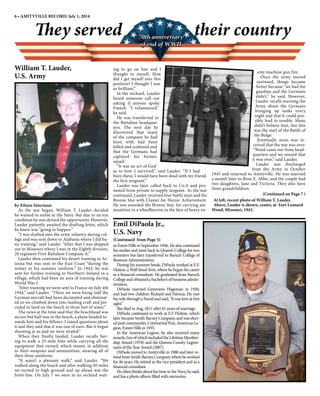
At left, recent photo of William T. Lauder.
Above, Lauder is shown, center, at Fort Leonard
Wood, Missouri, 1943.
6 • AMITYVILLE RECORD, July 1, 2014
They served their country70th anniversary
of end of WWII
He reentered Columbia College and then trans-
ferred from the College to the School of Business
Administration and graduated. He later pursued
a law degree and graduated from Brooklyn Law
School.
After graduating, Lauder was admitted to the
New York State Bar and shortly after to the Bars of
the Eastern and Southern Federal District Courts.
He served a brief clerkship in the Village of Baby-
lon and opened his own office in Amityville for the
general practice of law.
Lauder became very involved in local politics
and held many positions including Town supervi-
sor. He became one of the founders, incorporators
and second president of the Amityville Historical
Society. Under his leadership the organization ac-
quired the Franklin Bank Building, which is now
the Lauder Museum.
In addition, Lauder has received many awards
and plaques including a Lifetime Achievement
award from Amityville Rotary this year. In 1999,
he was recognized by the Town as one of the Most
Influential People in the Town of Babylon in the
20th Century. In 2010, he was awarded a Key to the
Town of Babylon, by then Town Supervisor Steve
Bellone.
Looking back on his life and his service, Lauder
offers this: “Life is a road with a series of forks,” he
said. “Recognize an opportunity when you see it
and give it thought and don’t be casual. If you save
money, you’ll be able to take advantage when the
opportunity presents itself. Take advantage of your
education and make the most of it.”
William T. Lauder,
U.S. Army
(Continued from Page 6)
June 1, 2015, AMITYVILLE RECORD • 7
by Michael Scro
World War II veteran and lifelong Amityville resi-
dent Pat Cammaroto served as a corporal in the Unit-
ed States Marines from December 1942 to November
1945, and in reflecting on his service, he said he con-
siders himself “one of the fortunate ones.”
With campaigns in Guam, July to August 1944,
and Okinawa, April to June 1945, Cammaroto was
awarded an American Defense Ribbon, American
Campaign Ribbon, Asiatic-Pacific Campaign Ribbon,
Combat Action Ribbon and Good Conduct Medal.
“World War II was in its second year when I en-
listed in the Marine Corps,” he said. “I felt that it was
not only my patriotic duty, but a great honor to serve
my country.”
Cammaroto served in the 155th Howitzer Battal-
ion, Company B, and saw action on Guam and Oki-
nawa.
The Battle of Guam, the largest of the Marians Is-
lands, was fought July and August 1944. The Japanese
had garrisoned many troops there and Guam need-
ed to be recovered so Allied forces could use it as a
base.
Rainy conditions and thick jungles helped the Japa-
nese. But in early August the Japanese line collapsed.
The Japanese refused to surrender and almost all
were killed. A small number took refuge in the jungle
and on Dec. 8, they ambushed and killed three U.S.
Marines. Japanese casualties totaled approximately
18,000. The American forces lost 3,000 and 7,122
American servicemen were wounded. After Guam
was secured, it was made a base for Allied operations.
Seabees constructed five airfields and B-29 bombers
took off from there to Japan.
The Battle of Okinawa was the largest amphibious
assault in the Pacific War during World War II. The
82-day-long battle lasted from early April until mid-
June 1945. The Allies suffered 14,009 deaths. Follow-
ing that battle, America dropped the atomic bomb on
Hiroshima and Nagasaki, resulting in the Japanese
surrender.
Cammaroto spent four months in combat, and re-
turned home with no serious injuries, and, as he said,
was one of the fortunate ones.
“When we received news that the war had ended,
we were in New Zealand,” he said. “I cannot put into
words how excited we were knowing that in a very
short time, we would be trading our “C” Rations for
mom’s home cooking.”
Cammaroto graduated Amityville High School,
where he played basketball and football. Among the
many photographs decorating his home is a high
school basketball team photo, where he is standing
next to Thomas Greene, a fellow World War II veter-
an and Amityville resident who is also being honored
July 4th.
Following his service in the Marines, Cammaroto
Pat Cammaroto,
U.S. Marines
returned home and joined the Amityville
Police Department in 1953, retiring in
1984 as a detective sergeant.
Cammaroto was married to his wife
Jean who died in 2000. He has four chil-
dren, two who reside in Amityville.
It has been 70 years since the end of the
war, and “looking back, I would not hesi-
tate to make the same decision to enlist
again,” he said.
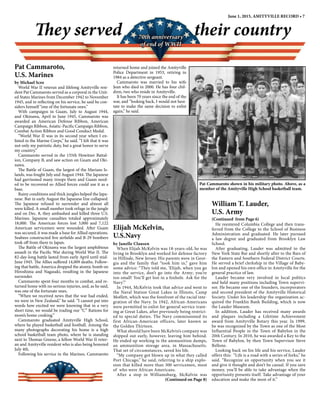
Pat Cammaroto shown in his military photo. Above, as a
member of the Amityville High School basketball team.
by Janelle Clausen
When Elijah McKelvin was 18-years-old, he was
living in Brooklyn and worked for defense factory
in Hillisde, New Jersey. His parents were in Geor-
gia and the family that “took him in,” gave him
some advice: “They told me, ‘Elijah, when you go
into the service, don’t go into the Army; you’re
too small! You’ll get lost in a foxhole. Ask for the
Navy’.”
In 1944, McKelvin took that advice and went to
the Naval Station Great Lakes in Illinois, Camp
Moffett, which was the forefront of the racial inte-
gration of the Navy. In 1942, African-Americans
were permitted to enlist for general service train-
ing at Great Lakes, after previously being restrict-
ed to special duties. The Navy commissioned its
first African-American officers, later known as
the Golden Thirteen.
What should have been McKelvin’s company was
shipped out early, however, leaving him behind.
He ended up working in the ammunition dumps,
an ammunition storage area, in Massachusetts.
That set of circumstances, saved his life.
“My company got blown up in what they called
Port Chicago,” he said, referring to a ship explo-
sion that killed more than 300 servicemen, most
of who were African Americans.
After a stop in Williamsburg, McKelvin was
Elijah McKelvin,
U.S.Navy
(Continued on Page 8)

William T. Lauder, Veteran

  • 1.
    They served theircountry70th anniversary of end of WWII in Forest Hills in September 1946. He also continued his studies and went back to Queen’s College for two semesters but later transferred to Baruch College of Business Administration. During his summer break, DiPaola worked at E.F. Hutton, a Wall Street firm, where he began his career as a financial consultant. He graduated from Baruch College and obtained a bachelor’s of business admin- istration. DiPaola married Genevieve Hageman in 1950, and had two children Richard and Patricia. He met his wife through a friend and said, “It was love at first sight.” She died in Aug. 2011 after 61 years of marriage. DiPaola continued to work at E.F Hutton, which later became Smith Barney Company, and was elect- edpostcommander,ContinentalPost,AmericanLe- gion, Forest Hills in 1955. In the American Legion, he also received many awards,twoofwhichincludedtheLifetimeMember- ship Award (1978) and the Queens County Legion- naire of the Year Award (2007). DiPaola moved to Amityville in 1980 and later re- tiredfromSmithBarneyCompanywhereheworked for 46 years. He retired as the vice president and as a financial consultant. HeoftenthinksabouthistimeintheNavy,hesaid, and has a photo album filled with memories. Emil DiPaola Jr., U.S. Navy (Continued from Page 5) by Eileen Interiano As the war began, William T. Lauder decided he wanted to enlist in the Navy. But due to an eye condition he was denied the opportunity. However, Lauder patiently awaited the drafting letter, which he knew was “going to happen.” “I was drafted into the army infantry during col- lege and was sent down to Alabama where I did ba- sic training,” said Lauder. “After that I was shipped out to Missouri where I was in the Eighth division, 28 regiment First Battalion Company A.” Lauder then continued his desert training in Ar- izona but was sent to the East Coast “during the winter in his summer uniform.” In 1943, he was sent for further training to Northern Ireland in a village, which had been an area of training during World War I. “After training we were sent to France on July 4th 1944,” said Lauder. “There we were being told the German aircraft had been decimated and eliminat- ed so we climbed down into landing craft and pre- ceded to land on the beach in three feet of water.” The news at the time said that the beachhead was secure but half way to the beach, a plane headed to- wards him and his fellows. I raised questions about it and they said that it was one of ours. But it began shooting at us and we were strafed.” When they finally landed, Lauder recalls hav- ing to walk a 25-mile hike while carrying all the equipment they owned, which meant, in addition to their weapons and ammunition, wearing all of their three uniforms. “It wasn’t a pleasant walk,” said Lauder. “We walked along the beach and after walking 20 miles we turned to high ground and up ahead was the front line. On July 7 we were in an orchard wait- ing to go on line and I thought to myself, How did I get myself into this position? I thought I was so brilliant.” In the orchard, Lauder heard someone call out asking if anyone spoke French. “I volunteered,” he said. He was transferred to the Battalion headquar- ters. The next day he discovered that many of the company he had been with had been killed and scattered and that the Germans had captured his former squad. “It was an act of God as to how I survived,” said Lauder. “If I had been there, I would have been dead with my friend, the first sergeant.” Lauder was later called back to Co.A and pro- moted from private to supply sergeant. As the war continued, Lauder received four battle stars and the Bronze Star with Cluster for Heroic Achievement. He was awarded the Bronze Star, for carrying am- munition in a wheelbarrow in the face of heavy en- emy machine gun fire. Once the army moved eastward, things became better because “we had the gasoline and the Germans didn’t,” he said. However, Lauder recalls warning the Army about the Germans bringing up tanks every night and that it could pos- sibly lead to trouble. Many didn’t believe him, but this was the start of the Battle of the Bulge. Eventually news was re- ceived that the war was over. “Word came out from head- quarters and we sensed that it was over,” said Lauder. Lauder was discharged from the Army in October 1945 and returned to Amityville. He was married a month later to Rose E. Abbe, and the couple had two daughters, Jane and Victoria. They also have three grandchildren. William T. Lauder, U.S. Army (Continued on Page 7 ) At left, recent photo of William T. Lauder. Above, Lauder is shown, center, at Fort Leonard Wood, Missouri, 1943. 6 • AMITYVILLE RECORD, July 1, 2014
  • 2.
    They served theircountry70th anniversary of end of WWII He reentered Columbia College and then trans- ferred from the College to the School of Business Administration and graduated. He later pursued a law degree and graduated from Brooklyn Law School. After graduating, Lauder was admitted to the New York State Bar and shortly after to the Bars of the Eastern and Southern Federal District Courts. He served a brief clerkship in the Village of Baby- lon and opened his own office in Amityville for the general practice of law. Lauder became very involved in local politics and held many positions including Town supervi- sor. He became one of the founders, incorporators and second president of the Amityville Historical Society. Under his leadership the organization ac- quired the Franklin Bank Building, which is now the Lauder Museum. In addition, Lauder has received many awards and plaques including a Lifetime Achievement award from Amityville Rotary this year. In 1999, he was recognized by the Town as one of the Most Influential People in the Town of Babylon in the 20th Century. In 2010, he was awarded a Key to the Town of Babylon, by then Town Supervisor Steve Bellone. Looking back on his life and his service, Lauder offers this: “Life is a road with a series of forks,” he said. “Recognize an opportunity when you see it and give it thought and don’t be casual. If you save money, you’ll be able to take advantage when the opportunity presents itself. Take advantage of your education and make the most of it.” William T. Lauder, U.S. Army (Continued from Page 6) June 1, 2015, AMITYVILLE RECORD • 7 by Michael Scro World War II veteran and lifelong Amityville resi- dent Pat Cammaroto served as a corporal in the Unit- ed States Marines from December 1942 to November 1945, and in reflecting on his service, he said he con- siders himself “one of the fortunate ones.” With campaigns in Guam, July to August 1944, and Okinawa, April to June 1945, Cammaroto was awarded an American Defense Ribbon, American Campaign Ribbon, Asiatic-Pacific Campaign Ribbon, Combat Action Ribbon and Good Conduct Medal. “World War II was in its second year when I en- listed in the Marine Corps,” he said. “I felt that it was not only my patriotic duty, but a great honor to serve my country.” Cammaroto served in the 155th Howitzer Battal- ion, Company B, and saw action on Guam and Oki- nawa. The Battle of Guam, the largest of the Marians Is- lands, was fought July and August 1944. The Japanese had garrisoned many troops there and Guam need- ed to be recovered so Allied forces could use it as a base. Rainy conditions and thick jungles helped the Japa- nese. But in early August the Japanese line collapsed. The Japanese refused to surrender and almost all were killed. A small number took refuge in the jungle and on Dec. 8, they ambushed and killed three U.S. Marines. Japanese casualties totaled approximately 18,000. The American forces lost 3,000 and 7,122 American servicemen were wounded. After Guam was secured, it was made a base for Allied operations. Seabees constructed five airfields and B-29 bombers took off from there to Japan. The Battle of Okinawa was the largest amphibious assault in the Pacific War during World War II. The 82-day-long battle lasted from early April until mid- June 1945. The Allies suffered 14,009 deaths. Follow- ing that battle, America dropped the atomic bomb on Hiroshima and Nagasaki, resulting in the Japanese surrender. Cammaroto spent four months in combat, and re- turned home with no serious injuries, and, as he said, was one of the fortunate ones. “When we received news that the war had ended, we were in New Zealand,” he said. “I cannot put into words how excited we were knowing that in a very short time, we would be trading our “C” Rations for mom’s home cooking.” Cammaroto graduated Amityville High School, where he played basketball and football. Among the many photographs decorating his home is a high school basketball team photo, where he is standing next to Thomas Greene, a fellow World War II veter- an and Amityville resident who is also being honored July 4th. Following his service in the Marines, Cammaroto Pat Cammaroto, U.S. Marines returned home and joined the Amityville Police Department in 1953, retiring in 1984 as a detective sergeant. Cammaroto was married to his wife Jean who died in 2000. He has four chil- dren, two who reside in Amityville. It has been 70 years since the end of the war, and “looking back, I would not hesi- tate to make the same decision to enlist again,” he said. Pat Cammaroto shown in his military photo. Above, as a member of the Amityville High School basketball team. by Janelle Clausen When Elijah McKelvin was 18-years-old, he was living in Brooklyn and worked for defense factory in Hillisde, New Jersey. His parents were in Geor- gia and the family that “took him in,” gave him some advice: “They told me, ‘Elijah, when you go into the service, don’t go into the Army; you’re too small! You’ll get lost in a foxhole. Ask for the Navy’.” In 1944, McKelvin took that advice and went to the Naval Station Great Lakes in Illinois, Camp Moffett, which was the forefront of the racial inte- gration of the Navy. In 1942, African-Americans were permitted to enlist for general service train- ing at Great Lakes, after previously being restrict- ed to special duties. The Navy commissioned its first African-American officers, later known as the Golden Thirteen. What should have been McKelvin’s company was shipped out early, however, leaving him behind. He ended up working in the ammunition dumps, an ammunition storage area, in Massachusetts. That set of circumstances, saved his life. “My company got blown up in what they called Port Chicago,” he said, referring to a ship explo- sion that killed more than 300 servicemen, most of who were African Americans. After a stop in Williamsburg, McKelvin was Elijah McKelvin, U.S.Navy (Continued on Page 8)