CULTURAL HARMONY: WORKING IN A MULTI-CULTURAL COMPANY 1
©2017 ITAP International, Inc. All Rights Reserved.
1
1
Why was the Time
Orientation Added to
Hofstede’s Framework?
©2017 ITAP International, Inc. All Rights Reserved.
Source: Hofstede’s webinar to ITAP International
CULTURAL HARMONY: WORKING IN A MULTI-CULTURAL COMPANY 2
©2017 ITAP International, Inc. All Rights Reserved.
2
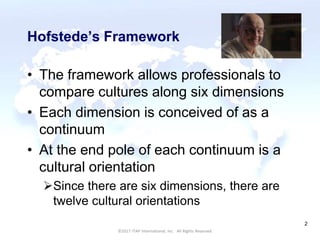
Hofstede’s Framework
• The framework allows professionals to
compare cultures along six dimensions
• Each dimension is conceived of as a
continuum
• At the end pole of each continuum is a
cultural orientation
Since there are six dimensions, there are
twelve cultural orientations
CULTURAL HARMONY: WORKING IN A MULTI-CULTURAL COMPANY 3
©2017 ITAP International, Inc. All Rights Reserved.
3
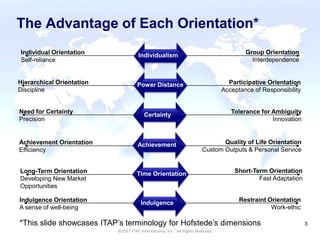
The Advantage of Each Orientation*
Individual Orientation
Self-reliance
Group Orientation
Interdependence
Hierarchical Orientation
Discipline
Participative Orientation
Acceptance of Responsibility
Need for Certainty
Precision
Tolerance for Ambiguity
Innovation
Achievement Orientation
Efficiency
Quality of Life Orientation
Custom Outputs & Personal Service
Long-Term Orientation
Developing New Market
Opportunities
Short-Term Orientation
Fast Adaptation
Individualism
Power Distance
Certainty
Achievement
Time Orientation
Indulgence Orientation
A sense of well-being
Restraint Orientation
Work-ethic
Indulgence
*This slide showcases ITAP’s terminology for Hofstede’s dimensions
CULTURAL HARMONY: WORKING IN A MULTI-CULTURAL COMPANY 4
©2017 ITAP International, Inc. All Rights Reserved.
4
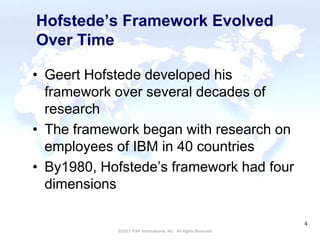
Hofstede’s Framework Evolved
Over Time
• Geert Hofstede developed his
framework over several decades of
research
• The framework began with research on
employees of IBM in 40 countries
• By1980, Hofstede’s framework had four
dimensions
CULTURAL HARMONY: WORKING IN A MULTI-CULTURAL COMPANY 5
©2017 ITAP International, Inc. All Rights Reserved.
5
Hofstede’s Framework in 1980: Four
Dimensions
1. Inequality: more or less?
Power Distance large vs. small
2. The unfamiliar: fight or tolerate?
Uncertainty Avoidance strong vs. weak
Certainty*
3. Relation with in-group: loose or tight?
Individualism vs. Collectivism
Individualism*
1. Emotional gender roles: different or same?
Masculinity vs. Femininity
Achievement*
* The star indicates places where the current ITAP terminology is different from
Hofstede’s terminology
CULTURAL HARMONY: WORKING IN A MULTI-CULTURAL COMPANY 6
©2017 ITAP International, Inc. All Rights Reserved.
6
The Framework is Based on
Measurements
• The framework compares the culture of
different countries along six dimensions
• The dimension-specific country scores
are normed on a scale of 1 to 100
CULTURAL HARMONY: WORKING IN A MULTI-CULTURAL COMPANY 7
©2017 ITAP International, Inc. All Rights Reserved.
7
Collaboration with Michael Harris Bond
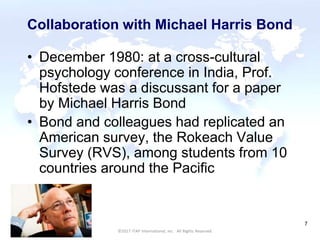
• December 1980: at a cross-cultural
psychology conference in India, Prof.
Hofstede was a discussant for a paper
by Michael Harris Bond
• Bond and colleagues had replicated an
American survey, the Rokeach Value
Survey (RVS), among students from 10
countries around the Pacific
CULTURAL HARMONY: WORKING IN A MULTI-CULTURAL COMPANY 8
©2017 ITAP International, Inc. All Rights Reserved.
8
Collaboration with Michael Harris Bond
• Hofstede’s comment was that Bond et
al. took average values of countries to
compare individuals: this was a “reverse
ecological fallacy”
• Bond accepted Hofstede’s critique and
reanalyzed his RVS data at the country
(“ecological”) level
• He found 4 country-level dimensions,
with correlations to the dimensions in
Hofstede’s framework
CULTURAL HARMONY: WORKING IN A MULTI-CULTURAL COMPANY 9
©2017 ITAP International, Inc. All Rights Reserved.
9
The Chinese Perspective
• Both the IBM and the RVS survey
questions had been selected and
formulated by Western minds
• Bond and Hofstede wondered to what
extent their similar results could be
caused by their shared Western
culture rather than reflect the cultures
of the respondents
• Bond decided to test this by having a
questionnaire designed by his Chinese
colleagues
CULTURAL HARMONY: WORKING IN A MULTI-CULTURAL COMPANY 10
©2017 ITAP International, Inc. All Rights Reserved.
10
The Chinese Value Survey (CVS)
• The Chinese Value Survey (CVS) was
administered to students in 23 countries
worldwide
• The CVS results were published by
“The Chinese Culture Connection,”
Bond & 23 co-authors, in 1987
CULTURAL HARMONY: WORKING IN A MULTI-CULTURAL COMPANY 11
©2017 ITAP International, Inc. All Rights Reserved.
11
The Chinese Value Survey (CVS)
• Analysis of the CVS results produced 4
country-level dimensions. Three of these
correlated with Power Distance,
Individualism and Achievement*
• No CVS dimension correlated with the
Certainty* Dimension. Questions related
to Certainty have not been included by
the Chinese designers of the CVS
* ITAP’s terminology
CULTURAL HARMONY: WORKING IN A MULTI-CULTURAL COMPANY 12
©2017 ITAP International, Inc. All Rights Reserved.
12
The Chinese Value Survey (CVS)
• The CVS produced a new dimension
mainly composed of Chinese values
which the Western designers of the IBM
surveys had overlooked
CULTURAL HARMONY: WORKING IN A MULTI-CULTURAL COMPANY 13
©2017 ITAP International, Inc. All Rights Reserved.
13
The Chinese Value Survey (CVS)
Yielded the Time Dimension
• Bond initially called this new dimension
“Confucian Work Dynamism”
– Hofstede called it “Long vs. Short Term
Orientation” (LTO/STO)
– ITAP’s terminology: “Time Orientation”
• In 1988 Bond and Hofstede published
their 2nd joint article and Hofstede
added LTO/STO to his model as a 5th
dimension
CULTURAL HARMONY: WORKING IN A MULTI-CULTURAL COMPANY 14
©2017 ITAP International, Inc. All Rights Reserved.
14
Researchers’ Minds and Respondents’
Minds
• A common misunderstanding is that
because the CVS did not identify Certainty
as a dimension, this dimension is not
relevant in Asia
• But Certainty is very relevant in Asia: for
example, it is the key culture factor
distinguishing Japan from China
• The reason Certainty was not included
because the Chinese designers of the
CVS did not perceive it as relevant
CULTURAL HARMONY: WORKING IN A MULTI-CULTURAL COMPANY 15
©2017 ITAP International, Inc. All Rights Reserved.
15
Researchers’ Minds and Respondents’
Minds
• Time Orientation is not only relevant in
Asia but very important worldwide
• The reason Time Orientation did not
emerge earlier lies with the Western
designers of the IBM and RVS surveys:
They were not aware of the importance
of Time Orientation
CULTURAL HARMONY: WORKING IN A MULTI-CULTURAL COMPANY 16
©2017 ITAP International, Inc. All Rights Reserved.
16
The Framework Over Time
• Today the framework has six
dimensions:
- Time Orientation was the fifth
dimension that he added
- Most recently he added a sixth
dimension: Indulgence
• Hofstede’s framework has dimension-
specific scores for 76 countries
CULTURAL HARMONY: WORKING IN A MULTI-CULTURAL COMPANY 17
©2017 ITAP International, Inc. All Rights Reserved.
17
The Framework Captures a
• So far, there are six major replications
of the framework (with elites, working
professionals, airline pilots, consumers,
civil servants)
• The country scores are normed relative
to each other
• As cultures slowly shift, they shift
together, and the scores remain stable
relative to each other
CULTURAL HARMONY: WORKING IN A MULTI-CULTURAL COMPANY 18
©2017 ITAP International, Inc. All Rights Reserved.
18
Culture in the Workplace
QuestionnaireTM (CWQ)
• For more insight about working effectively across
cultures, contact ITAP
• ITAP is one of only 2 companies worldwide endorsed
by Dr. Hofstede and approved to represent his
research
"This [approval] is due to their
professionalism and deep understanding
of my work.”
• An Ivy League university partners with ITAP to certify
its coaches in the CWQ
©2017 ITAP International, Inc. All Rights Reserved.
CULTURAL HARMONY: WORKING IN A MULTI-CULTURAL COMPANY 19
©2017 ITAP International, Inc. All Rights Reserved.
19
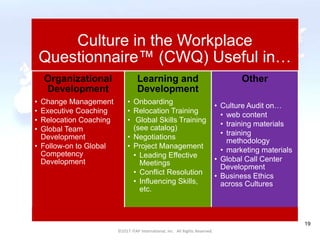
Culture in the Workplace
Questionnaire™ (CWQ) Useful in…
Organizational
Development
• Change Management
• Executive Coaching
• Relocation Coaching
• Global Team
Development
• Follow-on to Global
Competency
Development
Learning and
Development
• Onboarding
• Relocation Training
• Global Skills Training
(see catalog)
• Negotiations
• Project Management
• Leading Effective
Meetings
• Conflict Resolution
• Influencing Skills,
etc.
Other
• Culture Audit on…
• web content
• training materials
• training
methodology
• marketing materials
• Global Call Center
Development
• Business Ethics
across Cultures
©2017 ITAP International, Inc. All Rights Reserved.
CULTURAL HARMONY: WORKING IN A MULTI-CULTURAL COMPANY 20
©2017 ITAP International, Inc. All Rights Reserved.
20
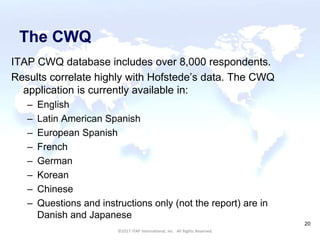
The CWQ
ITAP CWQ database includes over 8,000 respondents.
Results correlate highly with Hofstede’s data. The CWQ
application is currently available in:
– English
– Latin American Spanish
– European Spanish
– French
– German
– Korean
– Chinese
– Questions and instructions only (not the report) are in
Danish and Japanese
©2017 ITAP International, Inc. All Rights Reserved.
CULTURAL HARMONY: WORKING IN A MULTI-CULTURAL COMPANY 21
©2017 ITAP International, Inc. All Rights Reserved.
21
Your results
compared to
country
averages
Explanation of
your results
Individual
orientation Group
orientation
Individual Report
©2017 ITAP International, Inc. All Rights Reserved.
INDIVIDUALISM - the degree to which action is taken for the benefit of the individual,
or benefit of the group
This dimension represents the relationship between the individual and the group in a given society.
 An individualistic society is a culture of the "self” where individuals are expected to take care of themselves
and ties between individuals are loose. In business in individualistic cultures, employees are expected to
take responsibility for their work and their career development. A group (or collectivist) society gives
preference to belonging to the "we," where individuals are loyal and contribute to the wealth of their
family, clan, or organization in exchange for reciprocal group support. In group cultures, the organization,
supervisor and colleagues are more likely to provide support and foster interdependence.
Individualism:
The higher your
score, the higher
your preference
for Individual
Orientation. A
score of 50 or
lower means
more of a
preference for
Group
Orientation.
Interpreting your results
[NOTE: THIS IS A SAMPLE EXPERT PARAGRAPH BASED ON THIS PERSON'S ANSWERS.]
Your score is in the middle to high range of the Individualism dimension and indicates a moderate preference for
individual orientation. Employees with a preference for individual orientation will pursue their employer's interests
to the extent that these coincide with their self-interest. Freedom to adopt your own approach and having
challenging work are important in a job. Individuals expect direct feedback, as well as rewards and recognition
based on their individual performance. Speaking one's mind, honesty and openness are valued. Decisions can
often be made quickly by an individual who has the authority to speak on behalf of a larger group.
Both your score and the score for USA indicate a preference for an individual-oriented environment that supports
and encourages individual expression. In countries with a more pronounced individual orientation such as USA,
you may find the need to appeal more to self-interest than to the group interest, to a degree beyond your normal
style. You can also expect that you may need to take even more individual responsibility for your job performance
than you may be used to.
Your score shows the least difference with the score for India. Your approach is therefore likely to be consistent
with the approach in India.
respondent
CULTURAL HARMONY: WORKING IN A MULTI-CULTURAL COMPANY 22
©2017 ITAP International, Inc. All Rights Reserved.
22
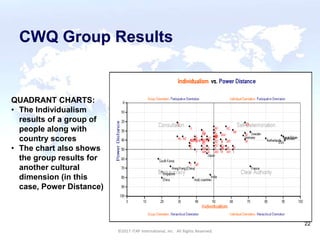
CWQ Group Results
QUADRANT CHARTS:
• The Individualism
results of a group of
people along with
country scores
• The chart also shows
the group results for
another cultural
dimension (in this
case, Power Distance)
©2017 ITAP International, Inc. All Rights Reserved.
CULTURAL HARMONY: WORKING IN A MULTI-CULTURAL COMPANY 23
©2017 ITAP International, Inc. All Rights Reserved.
23
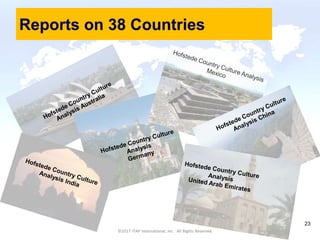
Reports on 38 Countries
©2017 ITAP International, Inc. All Rights Reserved.
CULTURAL HARMONY: WORKING IN A MULTI-CULTURAL COMPANY 24
©2017 ITAP International, Inc. All Rights Reserved.
24
ITAP is prepared to
provide
demonstrations of its
Intellectual Property
to qualified licensors
©2017 ITAP International, Inc. All Rights Reserved.
Who licenses the CWQ?
• Human Resource professional in large organizations
• Consulting firms seeking the capability to assess
cultural values at the individual, group and
organizational levels
CULTURAL HARMONY: WORKING IN A MULTI-CULTURAL COMPANY 25
©2017 ITAP International, Inc. All Rights Reserved.
25
Improving Competitive Advantage
• Our services focus on:
1.Global talent retention and development
2.Effectiveness of the senior team and
mission critical global teams
3.Global leader and global workforce
development
4.Cross-border transformation and change
• Ensure that culture is an asset, not a
barrier in your global business.
©2017 ITAP International, Inc. All Rights Reserved.
CULTURAL HARMONY: WORKING IN A MULTI-CULTURAL COMPANY 26
©2017 ITAP International, Inc. All Rights Reserved.
26
Catherine Mercer Bing
CEO, ITAP International, Inc.
Managing Director, ITAP Americas, Inc.
353 Nassau Street, First Floor
Princeton, NJ 08540 USA
(W) +1.215.860.5640
(M) +1.609.937.1557
www.Itapintl.com
cbing@itapintl.com
SKYPE: CatherineBing
©2017 ITAP International, Inc. All Rights Reserved.

Why Was the Time Orientation Added to Hofstede's Framework?

  • 1.
    CULTURAL HARMONY: WORKINGIN A MULTI-CULTURAL COMPANY 1 ©2017 ITAP International, Inc. All Rights Reserved. 1 1 Why was the Time Orientation Added to Hofstede’s Framework? ©2017 ITAP International, Inc. All Rights Reserved. Source: Hofstede’s webinar to ITAP International
  • 2.
    CULTURAL HARMONY: WORKINGIN A MULTI-CULTURAL COMPANY 2 ©2017 ITAP International, Inc. All Rights Reserved. 2 Hofstede’s Framework • The framework allows professionals to compare cultures along six dimensions • Each dimension is conceived of as a continuum • At the end pole of each continuum is a cultural orientation Since there are six dimensions, there are twelve cultural orientations
  • 3.
    CULTURAL HARMONY: WORKINGIN A MULTI-CULTURAL COMPANY 3 ©2017 ITAP International, Inc. All Rights Reserved. 3 The Advantage of Each Orientation* Individual Orientation Self-reliance Group Orientation Interdependence Hierarchical Orientation Discipline Participative Orientation Acceptance of Responsibility Need for Certainty Precision Tolerance for Ambiguity Innovation Achievement Orientation Efficiency Quality of Life Orientation Custom Outputs & Personal Service Long-Term Orientation Developing New Market Opportunities Short-Term Orientation Fast Adaptation Individualism Power Distance Certainty Achievement Time Orientation Indulgence Orientation A sense of well-being Restraint Orientation Work-ethic Indulgence *This slide showcases ITAP’s terminology for Hofstede’s dimensions
  • 4.
    CULTURAL HARMONY: WORKINGIN A MULTI-CULTURAL COMPANY 4 ©2017 ITAP International, Inc. All Rights Reserved. 4 Hofstede’s Framework Evolved Over Time • Geert Hofstede developed his framework over several decades of research • The framework began with research on employees of IBM in 40 countries • By1980, Hofstede’s framework had four dimensions
  • 5.
    CULTURAL HARMONY: WORKINGIN A MULTI-CULTURAL COMPANY 5 ©2017 ITAP International, Inc. All Rights Reserved. 5 Hofstede’s Framework in 1980: Four Dimensions 1. Inequality: more or less? Power Distance large vs. small 2. The unfamiliar: fight or tolerate? Uncertainty Avoidance strong vs. weak Certainty* 3. Relation with in-group: loose or tight? Individualism vs. Collectivism Individualism* 1. Emotional gender roles: different or same? Masculinity vs. Femininity Achievement* * The star indicates places where the current ITAP terminology is different from Hofstede’s terminology
  • 6.
    CULTURAL HARMONY: WORKINGIN A MULTI-CULTURAL COMPANY 6 ©2017 ITAP International, Inc. All Rights Reserved. 6 The Framework is Based on Measurements • The framework compares the culture of different countries along six dimensions • The dimension-specific country scores are normed on a scale of 1 to 100
  • 7.
    CULTURAL HARMONY: WORKINGIN A MULTI-CULTURAL COMPANY 7 ©2017 ITAP International, Inc. All Rights Reserved. 7 Collaboration with Michael Harris Bond • December 1980: at a cross-cultural psychology conference in India, Prof. Hofstede was a discussant for a paper by Michael Harris Bond • Bond and colleagues had replicated an American survey, the Rokeach Value Survey (RVS), among students from 10 countries around the Pacific
  • 8.
    CULTURAL HARMONY: WORKINGIN A MULTI-CULTURAL COMPANY 8 ©2017 ITAP International, Inc. All Rights Reserved. 8 Collaboration with Michael Harris Bond • Hofstede’s comment was that Bond et al. took average values of countries to compare individuals: this was a “reverse ecological fallacy” • Bond accepted Hofstede’s critique and reanalyzed his RVS data at the country (“ecological”) level • He found 4 country-level dimensions, with correlations to the dimensions in Hofstede’s framework
  • 9.
    CULTURAL HARMONY: WORKINGIN A MULTI-CULTURAL COMPANY 9 ©2017 ITAP International, Inc. All Rights Reserved. 9 The Chinese Perspective • Both the IBM and the RVS survey questions had been selected and formulated by Western minds • Bond and Hofstede wondered to what extent their similar results could be caused by their shared Western culture rather than reflect the cultures of the respondents • Bond decided to test this by having a questionnaire designed by his Chinese colleagues
  • 10.
    CULTURAL HARMONY: WORKINGIN A MULTI-CULTURAL COMPANY 10 ©2017 ITAP International, Inc. All Rights Reserved. 10 The Chinese Value Survey (CVS) • The Chinese Value Survey (CVS) was administered to students in 23 countries worldwide • The CVS results were published by “The Chinese Culture Connection,” Bond & 23 co-authors, in 1987
  • 11.
    CULTURAL HARMONY: WORKINGIN A MULTI-CULTURAL COMPANY 11 ©2017 ITAP International, Inc. All Rights Reserved. 11 The Chinese Value Survey (CVS) • Analysis of the CVS results produced 4 country-level dimensions. Three of these correlated with Power Distance, Individualism and Achievement* • No CVS dimension correlated with the Certainty* Dimension. Questions related to Certainty have not been included by the Chinese designers of the CVS * ITAP’s terminology
  • 12.
    CULTURAL HARMONY: WORKINGIN A MULTI-CULTURAL COMPANY 12 ©2017 ITAP International, Inc. All Rights Reserved. 12 The Chinese Value Survey (CVS) • The CVS produced a new dimension mainly composed of Chinese values which the Western designers of the IBM surveys had overlooked
  • 13.
    CULTURAL HARMONY: WORKINGIN A MULTI-CULTURAL COMPANY 13 ©2017 ITAP International, Inc. All Rights Reserved. 13 The Chinese Value Survey (CVS) Yielded the Time Dimension • Bond initially called this new dimension “Confucian Work Dynamism” – Hofstede called it “Long vs. Short Term Orientation” (LTO/STO) – ITAP’s terminology: “Time Orientation” • In 1988 Bond and Hofstede published their 2nd joint article and Hofstede added LTO/STO to his model as a 5th dimension
  • 14.
    CULTURAL HARMONY: WORKINGIN A MULTI-CULTURAL COMPANY 14 ©2017 ITAP International, Inc. All Rights Reserved. 14 Researchers’ Minds and Respondents’ Minds • A common misunderstanding is that because the CVS did not identify Certainty as a dimension, this dimension is not relevant in Asia • But Certainty is very relevant in Asia: for example, it is the key culture factor distinguishing Japan from China • The reason Certainty was not included because the Chinese designers of the CVS did not perceive it as relevant
  • 15.
    CULTURAL HARMONY: WORKINGIN A MULTI-CULTURAL COMPANY 15 ©2017 ITAP International, Inc. All Rights Reserved. 15 Researchers’ Minds and Respondents’ Minds • Time Orientation is not only relevant in Asia but very important worldwide • The reason Time Orientation did not emerge earlier lies with the Western designers of the IBM and RVS surveys: They were not aware of the importance of Time Orientation
  • 16.
    CULTURAL HARMONY: WORKINGIN A MULTI-CULTURAL COMPANY 16 ©2017 ITAP International, Inc. All Rights Reserved. 16 The Framework Over Time • Today the framework has six dimensions: - Time Orientation was the fifth dimension that he added - Most recently he added a sixth dimension: Indulgence • Hofstede’s framework has dimension- specific scores for 76 countries
  • 17.
    CULTURAL HARMONY: WORKINGIN A MULTI-CULTURAL COMPANY 17 ©2017 ITAP International, Inc. All Rights Reserved. 17 The Framework Captures a • So far, there are six major replications of the framework (with elites, working professionals, airline pilots, consumers, civil servants) • The country scores are normed relative to each other • As cultures slowly shift, they shift together, and the scores remain stable relative to each other
  • 18.
    CULTURAL HARMONY: WORKINGIN A MULTI-CULTURAL COMPANY 18 ©2017 ITAP International, Inc. All Rights Reserved. 18 Culture in the Workplace QuestionnaireTM (CWQ) • For more insight about working effectively across cultures, contact ITAP • ITAP is one of only 2 companies worldwide endorsed by Dr. Hofstede and approved to represent his research "This [approval] is due to their professionalism and deep understanding of my work.” • An Ivy League university partners with ITAP to certify its coaches in the CWQ ©2017 ITAP International, Inc. All Rights Reserved.
  • 19.
    CULTURAL HARMONY: WORKINGIN A MULTI-CULTURAL COMPANY 19 ©2017 ITAP International, Inc. All Rights Reserved. 19 Culture in the Workplace Questionnaire™ (CWQ) Useful in… Organizational Development • Change Management • Executive Coaching • Relocation Coaching • Global Team Development • Follow-on to Global Competency Development Learning and Development • Onboarding • Relocation Training • Global Skills Training (see catalog) • Negotiations • Project Management • Leading Effective Meetings • Conflict Resolution • Influencing Skills, etc. Other • Culture Audit on… • web content • training materials • training methodology • marketing materials • Global Call Center Development • Business Ethics across Cultures ©2017 ITAP International, Inc. All Rights Reserved.
  • 20.
    CULTURAL HARMONY: WORKINGIN A MULTI-CULTURAL COMPANY 20 ©2017 ITAP International, Inc. All Rights Reserved. 20 The CWQ ITAP CWQ database includes over 8,000 respondents. Results correlate highly with Hofstede’s data. The CWQ application is currently available in: – English – Latin American Spanish – European Spanish – French – German – Korean – Chinese – Questions and instructions only (not the report) are in Danish and Japanese ©2017 ITAP International, Inc. All Rights Reserved.
  • 21.
    CULTURAL HARMONY: WORKINGIN A MULTI-CULTURAL COMPANY 21 ©2017 ITAP International, Inc. All Rights Reserved. 21 Your results compared to country averages Explanation of your results Individual orientation Group orientation Individual Report ©2017 ITAP International, Inc. All Rights Reserved. INDIVIDUALISM - the degree to which action is taken for the benefit of the individual, or benefit of the group This dimension represents the relationship between the individual and the group in a given society.  An individualistic society is a culture of the "self” where individuals are expected to take care of themselves and ties between individuals are loose. In business in individualistic cultures, employees are expected to take responsibility for their work and their career development. A group (or collectivist) society gives preference to belonging to the "we," where individuals are loyal and contribute to the wealth of their family, clan, or organization in exchange for reciprocal group support. In group cultures, the organization, supervisor and colleagues are more likely to provide support and foster interdependence. Individualism: The higher your score, the higher your preference for Individual Orientation. A score of 50 or lower means more of a preference for Group Orientation. Interpreting your results [NOTE: THIS IS A SAMPLE EXPERT PARAGRAPH BASED ON THIS PERSON'S ANSWERS.] Your score is in the middle to high range of the Individualism dimension and indicates a moderate preference for individual orientation. Employees with a preference for individual orientation will pursue their employer's interests to the extent that these coincide with their self-interest. Freedom to adopt your own approach and having challenging work are important in a job. Individuals expect direct feedback, as well as rewards and recognition based on their individual performance. Speaking one's mind, honesty and openness are valued. Decisions can often be made quickly by an individual who has the authority to speak on behalf of a larger group. Both your score and the score for USA indicate a preference for an individual-oriented environment that supports and encourages individual expression. In countries with a more pronounced individual orientation such as USA, you may find the need to appeal more to self-interest than to the group interest, to a degree beyond your normal style. You can also expect that you may need to take even more individual responsibility for your job performance than you may be used to. Your score shows the least difference with the score for India. Your approach is therefore likely to be consistent with the approach in India. respondent
  • 22.
    CULTURAL HARMONY: WORKINGIN A MULTI-CULTURAL COMPANY 22 ©2017 ITAP International, Inc. All Rights Reserved. 22 CWQ Group Results QUADRANT CHARTS: • The Individualism results of a group of people along with country scores • The chart also shows the group results for another cultural dimension (in this case, Power Distance) ©2017 ITAP International, Inc. All Rights Reserved.
  • 23.
    CULTURAL HARMONY: WORKINGIN A MULTI-CULTURAL COMPANY 23 ©2017 ITAP International, Inc. All Rights Reserved. 23 Reports on 38 Countries ©2017 ITAP International, Inc. All Rights Reserved.
  • 24.
    CULTURAL HARMONY: WORKINGIN A MULTI-CULTURAL COMPANY 24 ©2017 ITAP International, Inc. All Rights Reserved. 24 ITAP is prepared to provide demonstrations of its Intellectual Property to qualified licensors ©2017 ITAP International, Inc. All Rights Reserved. Who licenses the CWQ? • Human Resource professional in large organizations • Consulting firms seeking the capability to assess cultural values at the individual, group and organizational levels
  • 25.
    CULTURAL HARMONY: WORKINGIN A MULTI-CULTURAL COMPANY 25 ©2017 ITAP International, Inc. All Rights Reserved. 25 Improving Competitive Advantage • Our services focus on: 1.Global talent retention and development 2.Effectiveness of the senior team and mission critical global teams 3.Global leader and global workforce development 4.Cross-border transformation and change • Ensure that culture is an asset, not a barrier in your global business. ©2017 ITAP International, Inc. All Rights Reserved.
  • 26.
    CULTURAL HARMONY: WORKINGIN A MULTI-CULTURAL COMPANY 26 ©2017 ITAP International, Inc. All Rights Reserved. 26 Catherine Mercer Bing CEO, ITAP International, Inc. Managing Director, ITAP Americas, Inc. 353 Nassau Street, First Floor Princeton, NJ 08540 USA (W) +1.215.860.5640 (M) +1.609.937.1557 www.Itapintl.com cbing@itapintl.com SKYPE: CatherineBing ©2017 ITAP International, Inc. All Rights Reserved.