Value investors in the Eurozone have done well
over the last two years, but quite poorly in the US.
This is rather exceptional, as style returns
generally move in similar directions across these
two regions. Indeed, their economic dynamics
are often alike. This time, the improving health of
the European economy contrasted with a
disappointing US economy. (By means of
example, the last two years the US Citi economic
surprise index has been negative on average,
while it has been comfortably positive for the
Eurozone).
For the US this meant that investors flocked into
quality growth stocks -think FANG- to position
themselves for a decelerating US economy, while
in the Eurozone they preferred value stocks. This
made that valuation dispersion diverged. In the
US, it rose to well above the historical average,
while in the Eurozone it fell to a bit below the
average.
The behavior of the economy compared to
expectations will again be important. Since the
case for the US value is more contrarian than the
EU because its underperformance has been so
significant. In fact, the six months rolling excess
return has rarely been as negative as today.
The buzz around the US tax reform proposals
have reignited the reflation trade a bit, but all in
all, it remained quite modest. Inflation
expectations have increased, but are still well
below the level of the beginning of the year and
value stocks outperformed during the month of
September, but not a lot compared to where we
are coming from. From that perspective, we
expect a further rebound for the following
reasons:
• Valuation dispersion (the spread in valuation
between the cheapest and most
expensive stocks of each sector, see graph)
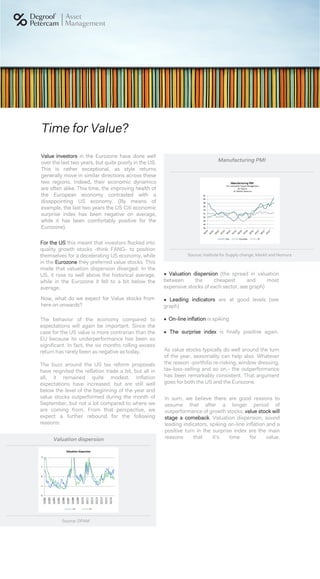
• Leading indicators are at good levels (see
graph)
• On-line inflation is spiking
• The surprise index is finally positive again.
As value stocks typically do well around the turn
of the year, seasonality can help also. Whatever
the reason -portfolio re-risking, window dressing,
tax-loss-selling and so on,- the outperformance
has been remarkably consistent. That argument
goes for both the US and the Eurozone.
In sum, we believe there are good reasons to
assume that after a longer period of
outperformance of growth stocks, value stock will
stage a comeback. Valuation dispersion, sound
leading indicators, spiking on-line inflation and a
positive turn in the surprise index are the main
reasons that it’s time for value.
Source: DPAM
Valuation dispersion
Source: Institute for Supply change, Markit and Nomura
Manufacturing PMI
Now, what do we expect for Value stocks from
here on onwards?
Time for Value?

Why value is poised to outperform

  • 1.
    Value investors inthe Eurozone have done well over the last two years, but quite poorly in the US. This is rather exceptional, as style returns generally move in similar directions across these two regions. Indeed, their economic dynamics are often alike. This time, the improving health of the European economy contrasted with a disappointing US economy. (By means of example, the last two years the US Citi economic surprise index has been negative on average, while it has been comfortably positive for the Eurozone). For the US this meant that investors flocked into quality growth stocks -think FANG- to position themselves for a decelerating US economy, while in the Eurozone they preferred value stocks. This made that valuation dispersion diverged. In the US, it rose to well above the historical average, while in the Eurozone it fell to a bit below the average. The behavior of the economy compared to expectations will again be important. Since the case for the US value is more contrarian than the EU because its underperformance has been so significant. In fact, the six months rolling excess return has rarely been as negative as today. The buzz around the US tax reform proposals have reignited the reflation trade a bit, but all in all, it remained quite modest. Inflation expectations have increased, but are still well below the level of the beginning of the year and value stocks outperformed during the month of September, but not a lot compared to where we are coming from. From that perspective, we expect a further rebound for the following reasons: • Valuation dispersion (the spread in valuation between the cheapest and most expensive stocks of each sector, see graph) • Leading indicators are at good levels (see graph) • On-line inflation is spiking • The surprise index is finally positive again. As value stocks typically do well around the turn of the year, seasonality can help also. Whatever the reason -portfolio re-risking, window dressing, tax-loss-selling and so on,- the outperformance has been remarkably consistent. That argument goes for both the US and the Eurozone. In sum, we believe there are good reasons to assume that after a longer period of outperformance of growth stocks, value stock will stage a comeback. Valuation dispersion, sound leading indicators, spiking on-line inflation and a positive turn in the surprise index are the main reasons that it’s time for value. Source: DPAM Valuation dispersion Source: Institute for Supply change, Markit and Nomura Manufacturing PMI Now, what do we expect for Value stocks from here on onwards? Time for Value?