HOUSING AND LAND
RIGHTS NETWORK
HOUSING AND LAND
RIGHTS NETWORK
Researched and written by:
Shalini Mishra, Shivani Chaudhry and Miloon Kothari
Housing and Land Rights Network
South Asia Regional Programme
Habitat International Coalition
May 2010
New Delhi, India
1
The 2010 Commonwealth Games (CWG) will be held
in New Delhi, India, from 3-14 October 2010.
Given the many unanswered questions that have marked
the CWG process, the Housing and Land Rights Network
– South Asia Regional Programme (HLRN) decided to
undertake a study on various dimensions of the CWG.
The HLRN study is based on an extensive review of
reports of civil society, government bodies, academic
institutions, and the media, as well as interviews with
experts and information obtained from a Right to
Information (RTI) application filed specifically for the
study. The resulting report is presented in the form
of four thematic fact sheets detailing the social and
economic aspects of the CWG. The report also makes
recommendations aimed at bringing transparency into
the process and mitigating the negative impacts of the
Games.
The HLRN report concludes that the entire process
related to the CWG has been essentially underscored
by secrecy, unavailability of information, and
unconstitutional activities, with evidence of long-term
economic, social and environmental costs for the nation,
and specifically for the city of Delhi. The CWG process,
from the time of the bid to the continuous colossal
escalation in the total budget, has been characterised
by a lack of public participation, transparency, and
government accountability. Preparations for the Games,
in all their different manifestations, have already
resulted in an irreversible alteration in the social, spatial,
economic, and environmental dimensions of the city of
Delhi. Much of this has taken place in contravention of
democraticgovernanceandplanningprocesses,including
the Master Plan for Delhi 2021. The sheer magnitude
of funds involved and the unconditional sanctioning of
state and central government resources to meet the rapid
acceleration of costs, raises critical questions of financial
accountability, Constitutional obligations, and national
responsibility.
The goal of portraying Delhi as a “world class” city
and an international sports destination, has led the
Indian government — both at the state and central
level — to lose sight of its priorities and legal and moral
commitments to its people.
It is hoped that this report will help planners, government
officials, residents of India, civil society, national and
state human rights organizations, judicial institutions
as well as the international community to gauge the
reality of the 2010 Commonwealth Games. All actors
need to question not only the justification of holding
the Games in light of India’s dismal socio-economic
reality and its national and international human rights
and environmental legal commitments, but also the
actions of those responsible for the decisions related to
the Games.
Presented below are the main findings from the report,
arranged according to the themes of the four fact sheets,
and a summary of key recommendations.
Main Findings
1.	India’s Bid for the 2010 Games:
Bidding for Glory? Bidding for
Shame?
n	 India’s decision to bid for the Commonwealth Games
2010 was neither transparent nor democratic. It was
not discussed in Parliament; neither was there any
public debate, consultation or opinion poll among
the residents of Delhi.
n	 The Comptroller and Auditor General of India in a
2009 report observed that India’s decision to bid was
approved by the Cabinet ex-post facto in September
2003.
n	 Indian officials made a last-minute offer of US $7.2
million (Rs. 32.4 crore) during the bidding process,
which allegedly clinched the deal in India’s favour.
This was an offer to train athletes of all member
countries of the Commonwealth (US $100,000
to each of the 72 members). The Commonwealth
Games Federation (CGF) reportedly agreed to review
its rules following this monetary buy out.
n	 India’sbidalsoincludedanofferofatravelgrantof US
$10.5 million (Rs. 48 crore) for an estimated number
of 5,200 athletes and 1,800 officials. According to
the Evaluation Commission of the Commonwealth
Games, this was more than the minimum CGF
requirement for travel.
n	 Other gratis offers made by India include: luxury
Executive Summary
The 2010 Commonwealth Games: Whose Wealth? Whose Commons? Executive Summary
Executive Summary
2
accommodation for the “CGF family” in Delhi;
chauffeur driven luxury cars for the duration of the
Games; and a free trip to the Taj Mahal.
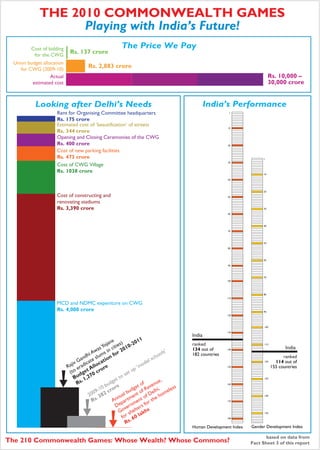
n	 The entire bidding process cost India around Rs. 89
crore. With the travel grant, the total amounts to
Rs. 137 crore. This does not include the cost of free
sightseeing trips, luxury transport, and other offers.
n	 The Games Village, being built by Emaar MGF, is
expected to cost US $230.7 million (Rs. 1,038 crore).
The Delhi Development Authority (DDA) offered a
Rs. 700 crore bailout in May 2009 to the company
to meet the costs of construction. This is probably
the first ever government bailout for a private realty
company in India.
n	 A decision to underwrite costs and budget shortfall
of the Games was taken, despite the fact that the
Ministry of Finance, Department of Expenditure,
Government of India, cautioned against it in 2003.
2. The Promise of the 2010 Games:
True Claims? False Hopes?
n	 The organisers of the 2010 Commonwealth Games
have claimed several benefits for Delhi, all of which
are questionable.
n	 The entire proposed expenditure for sports
infrastructure, as initially submitted by the Indian
Olympic Association in its Bid Document, was Rs.
150 crore. Already, an expenditure of at least Rs.
3,390 crore has been incurred on stadiums, most of
which are likely to remain unused after the Games, as
experience from the 1982 Asian Games has shown.
The increase in expenditure on stadiums is already
2,160% of the initial projected budget.
n	 The total expenditure on infrastructure for the
CWG is still unknown. In March 2006, Delhi
Finance Minister declared that the amount spent on
infrastructure development by different agencies in
the run-up to the CWG, was Rs. 26,808 crore. In
March 2010, Chief Secretary, Government of Delhi,
stated that the total amount spent on infrastructure
in Delhi in the last three years was Rs. 13,350 crore.
n	 The much publicised infrastructure development in
Delhi has, however, been hurried, expensive, poorly
planned, environmentally unsound, exploitative
of workers, slum dwellers and “beggars,” and in
violation of norms and planning processes, including
the Master Plan for Delhi 2021.
n	 While the total budget for “beautification” projects in
Delhi is undisclosed, the amount already spent by the
government is hundreds of crores. The streetscaping
of just one street, Lodi Road, is estimated to cost Rs.
18.55 crore.
n	 Authoritative international research studies have
proven that hosting mega sports events is not an
effective way of achieving a sustained increase in
participation in sports, as claimed by the government.
If India is truly committed to building an improved
sports culture, it should follow the recommendations
of the report on “Promotion of Sports in India,”
presented by the Parliamentary Standing Committee
on Human Resource Development to the Rajya
Sabha in November 2006.
n	 The claim that the CWG will help create a “clean,
beautiful, vibrant, world class” Delhi has already
been proven wrong with grave human costs in the
form of slum demolitions, arrests of homeless citizens
and beggars, destruction of livelihoods of the urban
poor, and environmental degradation.
3. The Economics of the Games:
Necessary Expenditure? Wasteful
Extravagance?
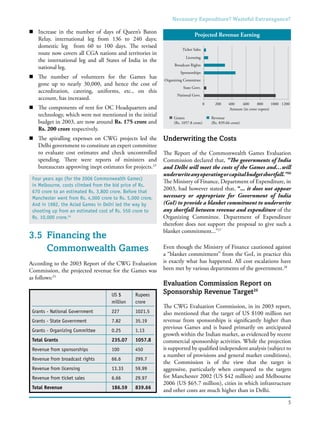
n	 The budget for the CWG has undergone several
revisions since India won the bid for the Games in
2003. From an initial projection of Rs. 1,899 crore,
estimates of the total cost of the Games now range
from an official figure of Rs. 10,000 crore to estimates,
by independent experts, of at least Rs. 30,000 crore.
n	 The budgetary commitment to the Games was
apparently made without any detailed cost-benefit
analysis and social and environmental impact
assessment.
n	 The allocation for the Commonwealth Games in the
Union Budget (Ministry of Youth Affairs and Sports)
grew from Rs. 45.5 crore in 2005-06 to Rs. 2,883
crore in 2009-10, a whopping 6,235% increase. For
the same period, the Union Budget for education rose
by just 60% while the increase in health expenditure
was 160%.
n	 The allocation for CWG projects in 2010-11 is Rs.
2,069.52 crore in the Union Budget and Rs. 2,105
crore in the Delhi Budget, of which, Rs. 1,000 crore
is from the Centre as additional assistance.
n	 India’s targeted goal for net revenue from the Games
3
is Rs. 1,780 crore, which is ambitious, as affirmed by
the Comptroller and Auditor General of India in July
2009.
n	 India’s expenses for the CWG are likely to create a
negative financial legacy for the nation, the effects of
which are already visible in the form of higher cost of
living and taxes for Delhi residents. In March 2010,
the Government of Delhi declared it has no funds for
new projects for the next fiscal year.
n	 InordertomeetthebudgetaryshortfallfortheGames,
funds marked for essential social sector spending
have also been used. For instance, funds from the
Scheduled Caste Sub Plan (Special Component
Plan) have been reallocated to cover CWG related
expenditures in Delhi in 2009-10. This reflects not
just a violation of the government’s commitments
but also the existence of unethical decision making
processes.
4. The Social Legacy of the Games:
Who Gains? Who Loses?
n	 Delhi has witnessed evictions and demolitions of
informal settlements and slums in the run-up to the
CWG. Most evictions are generally carried out to
construct roads, bridges, stadiums, and parking lots,
or under the guise of city “beautification,” ostensibly
to create a “world class” city.
n	 Authorities are clearing street vendors, rickshaw
pullers, and other informal sector workers off the
roads, and destroying livelihoods of the urban poor.
n	 “Beggars” and homeless citizens are being rounded up,
arrested and arbitrarily detained under the Bombay
Prevention of Beggary Act 1959. The Department of
Social Welfare has announced “no-tolerance zones”
in Delhi and a harsh crackdown against “beggars,”
including plans to send them back to their states of
origin.
n	 There is rampant exploitation of workers at CWG
construction sites. This includes low pay, unsafe
working conditions, lack of housing, use of child
labour, non-registration of workers, and denial
of social security benefits. More than a hundred
deaths have been reported from the CWG sites. No
compensation has been offered to family members of
the workers who lost their lives.
n	 Civil liberties in Delhi are being curtailed, and as the
Games draw near, the city is likely to witness increased
surveillance and restrictions against residents.
Recommendations
While detailed recommendations related to the CWG
process in India have been made in a separate section, a
summary of the key general recommendations include:
n	 A full and detailed inquiry should be conducted into
the decision-making and bidding process that led
to India hosting the Games as well as on the total
expenditure of the CWG.
n	 There must be full public disclosure of all finances
related to the CWG.
n	 Immediate measures need to be taken to prevent
further violations of human rights in the run-up
to the Games. The government must comply with
India’s national and international human rights and
legal commitments.
n	 The Indian government should have a legacy plan for
the Games based on principles of human rights and
environmental sustainability.
n	 The Delhi government should ensure that:
l	 Forced evictions and slum demolitions are halted.
l	 “Beggars” and homeless citizens are not
discriminated against, relocated, or arbitrarily
arrested and detained.
l	 Workers’ rights are upheld and protected.
l	 Livelihoods of the urban poor are not destroyed.
n	 The National Human Rights Commission should
conduct an investigation into the human rights
violations related to the CWG.
n	 The Government of India should commission an
independent study on the social, environmental and
economic impacts of the Games on the country.
n	 The Comptroller and Auditor General of India
(CAG) should conduct a post-games audit to assess
the legacy of the CWG.
n	 Officials who have consistently overstated benefits
from the Games, withheld critical information, and
misappropriated funds should be investigated, and if
proven guilty, prosecuted.
n A comprehensive environmental and social impact
assessment with a detailed cost-benefit analysis must
be conducted prior to the decision to host any mega
event.
n	 Given India’s stark socio-economic reality and the
negative social and economic costs already evident
in the lead up to the CWG, India should under no
circumstances, bid for the Olympic Games or any
other mega events.
Executive Summary
4
Conclusion
It is essential to question the government on its rationale
for spending thousands of crores of rupees on a one-time
sporting event, which instead of delivering any benefits
to the masses is resulting in multiple violations of human
rights, especially of the most marginalised sections of
society.
The range and extent of human rights violations by the
government and private players involved in the Games
are alarming and strongly contradict the purported
mission of the Games. They also violate the three core
values of humanity, equality and destiny, adopted by the
Games movement in 2001, as well as the stated values
of the Organizing Committee of the CWG, which are:
sportsmanship, integrity, excellence, solidarity, diversity,
competence, transparency, and discipline.
Given the escalating costs and unrealistic possibility of
meeting revenue targets, it is unlikely that the Games
will generate a profit for India, especially if the enormous
costs of providing security are also factored in. This is
substantiated by numerous authoritative international
studies, which have established that most mega sporting
events result in losses for the host nation. With such
incredibly high stakes involved, the key question is, why
did India decide to host the CWG and who is really
benefiting from them?
Housing and Land Rights Network
The scale of the CWG and the excessive costs involved
are hard to justify in a country that has glaringly high
levels of poverty, hunger, inequality, homelessness, and
malnutrition.
When one in three Indians lives below the poverty line
and 40% of the world’s hungry live in India, when
46% of India’s children and 55% of its women are
malnourished, does spending thousands of crores of
rupees on a 12-day sports event build “national pride” or
is it a matter of “national shame”?
Does India, as a nation, seek national and global
credibility based on the values of social justice, dignity
and equality, as enshrined in its Constitution, or is it
more important to aspire for a false national honour and
fleeting international prestige based on an extravagant
sporting event that the country can ill afford?
If India is really looking for genuine and long-
lasting national prestige, would this not come if it
spent available resources on providing food, housing,
education, sanitation, water, and healthcare for its
population instead of on a mega sports event? In light of
the country’s harsh social reality, is the exercise of hosting
the 2010 Commonwealth Games a justified necessity or
an unwarranted extravagance?
Bidding for Glory? Bidding for Shame?
1
Contents
| 1.1 India’s Decision to Bid | 1.2 Offers in India’s Bid Document | 1.3 Why Did India Want to Host the Games?
| 1.4 India’s Monetary Offer: Buying the Games? |
Introduction
The process of bidding for the Commonwealth Games
(CWG) is neither well known nor publicised. Yet, the story
of how India won the bid is one that needs to be told.
After losing two bids (1990 and 1994) to host the CWG,
India presented its bid offer at Marlborough House,
London, in May 2003. The General Assembly1
voted on
the matter in November 2003. India won the bid, defeating
Hamilton (Canada), by 46 votes to 22, and was declared
the host city for the 2010 Commonwealth Games.
The 2010 Commonwealth Games: Whose Wealth? Whose Commons? Fact Sheet 1
India's Bid for the 2010 Games:
Bidding for Glory? Bidding for Shame?
Fact Sheet
1MeharJyrwa
MeharJyrwa
India’s Bid for the 2010 Commonwealth Games
2
The Bidding Procedure
•	 Candidate cities first notify the Commonwealth Games
Federation (CGF) of their intention to bid through
their respective Commonwealth Games Associations
(CGAs).
•	 The Candidature File (the bid document lodged by
a candidate city in accordance with the Candidate
City Manual in support of its application to host a
Commonwealth Games) is then formally lodged six
months before the General Assembly is scheduled to
meet.
•	 The Commonwealth Games Evaluation Commission (the
Commission established by the Executive Board) then
visits the candidate city and produces a report (The
Evaluation Report) which is made available to all CGAs.
•	 The CGAs thereafter get the opportunity to visit each
candidate city to conduct an assessment.
•	 Delegations of each candidate city (not exceeding
six members) get thirty minutes to present their
case before the General Assembly. This is followed by
a question-answer session. Each CGA is entitled to
one vote. The General Assembly then votes. The Host
City and the Host CGA are chosen 8 years before the
Games are to be held.
Indian Olympic Association
n	 For the 2010 Delhi Commonwealth Games,
the Indian Olympic Association (IOA) is the
Affiliate Commonwealth Games Association
(CGA) in India. Affiliated CGAs are those sports
bodies of Commonwealth countries (including
Commonwealth Games Associations, National
Olympic Committees or other multi-sports bodies
formed by a Commonwealth country), which are
affiliated to the Commonwealth Games Federation
(CGF) in accordance with Article 10 of the CGF
Constitution.
n	 The IOA is the apex sports body of India, registered
under the Societies Registration Act XXI of 1860.
It is also the National Olympic Committee (NOC)
in India. The stated mission of NOCs is to develop,
promote and protect the Olympic Movement in
their respective countries.
n	 One of the objectives of the IOA is to enforce all
rules and regulations of the International Olympic
Committee (IOC) and not to indulge in or associate
with any activity, which contradicts the Olympic
Charter.2
n	 India’s bid to host the 2010 Commonwealth
Games (CWG) was prepared by the IOA with the
support of the Government of India (GoI) and
the Government of the National Capital Territory
of Delhi (GNCTD). After India won the bid, the
CGF General Assembly entrusted the organising
and hosting of the CWG to the IOA, and a Host
City Contract was signed among CGF, IOA, and
Organizing Committee, GoI and GNCTD. Under
thiscontract,theIndianpartiesarejointlyresponsible
for all commitments, including financial liabilities
without limitation, relating to the organization and
staging of the Games.
1.1 India’s Decision to Bid
The Requirement
One of the questions which a candidate city is expected
to answer in its bid document is the level of support
provided towards the bid and hosting of the CWG
through various levels of government – national,
regional and local.3
The Candidate City Manual4
which was designed after
India’s 2003 bid and has undergone various revisions
since, has a series of questions (which the candidate
city is expected to answer) on the level of support
in the country for hosting the Games. These require
Bidding for Glory? Bidding for Shame?
3
consultation with various levels of government, a public
debate or opinion poll.5
The Reality
India’s Bid Document6
prepared by the Indian Olympic
Association (IOA) vouched that the country was “fully
committed” to the cause of the Commonwealth Games
spirit. These general statements (for instance, “the entire
nation supports the cause of the Games”) were not the
result of any democratic procedures.
The Hamilton Bid Document specified that eighty-
seven per cent of the Hamilton community supported
hosting the 2010 Games.7
No such opinion poll was
conducted among the people of India; neither was there
any mention of the exact level of public support for the
Games in the Bid Document. There was also no public
dissemination of information related to India’s intention
to bid for the Games or on details related to the bidding
process and what the social and economic implications
would be for the country.
All that the Bid Document provided as evidence of
support of the government was guarantees, in the
form of letters, from the Minister of Youth Affairs
and Sports, leader of the Opposition, IOA President,
Lieutenant Governor of Delhi, President of the All
India Council of Sports, Chief Minister of Delhi, and
the Mayor of Delhi. The Government of India did
not engage in any participatory or democratic process
before making the bid or providing the guarantees;
neither was there apparently any discussion on the issue
in Parliament.8
Replying to a question raised in the Lok
Sabha on May 7, 2003, the Minister of Youth Affairs
and Sports, Vikram Verma said that the government
had issued its “no objection” to the IOA request to bid
for the Commonwealth Games.9
A 2009 report by the
Comptroller and Auditor General observed that India’s
decision to bid was approved by the Prime Minister
in May 2003 and by the Cabinet ex-post facto in
September 2003.10
The non-transparent and non-participatory bidding
process followed by India raises critical questions
regarding the functioning of a democracy.
1.2	 Offers in India’s Bid
Document
India’s Bid Document for the 2010 Commonwealth
Games promised the following:
1.	 Air travel grant for accredited athletes and
accompanying officials
l	 India’s Bid Document has offered as travel
grant, “the average figure on the basis of
participation in the Manchester and Melbourne
Commonwealth Games.”11
l	 The travel grant that India offered — US $10.5
million (Rs. 48 crore; based on an estimated
number of 5,200 athletes and 1,800 officials at
US$1,500each)—“exceedstherequirements”of
Protocol Nine,12
which means that India offered
more than the basic minimum requirement
specified by the CGF.
l	 Reportedly, then Prime Minister Atal Bihari
Vajpayee, had given a blank cheque to the
IOA when it went to London for the bidding
process,13
saying no matter what the cost, India
should win the bid for the Commonwealth
Games. This, apparently, turned out to be
“decisive.”14
2.	 Free accommodation for accredited athletes and
accompanying officials
l	 The Indian Olympic Association has also offered
free boarding and lodging facilities, as per the
Commonwealth Games Foundation (CGF)
norms. Apart from the Games Village, all senior
members of the CGF family will be “housed in
deluxe five star hotels in Delhi and provided
India’s Bid for the 2010 Commonwealth Games
4
chaffeur driven luxury cars individually, along
with escort translators, liaison officers and
ushers/escorts.”15
l	 The Games Village, being built by Emaar MGF
is expected to cost US $230.7 million (Rs.
1,038 crore).16
In May 2009, the government
announced a Rs. 700 crore bailout package
for construction of the Village.17
Despite the
fact that, during its bid, India had proposed that
after the Commonwealth Games, the Village
would be used to provide hostel facilities to
Delhi University to meet the current shortage,
Congress Members of the Legislative Assembly
(MLAs) have demanded that they be allotted
these luxury flats on a priority basis; that too at
a special price.18
l	 India seems to have offered “fairly luxurious
accommodation” considering that officials
of the CGF have often in the past stayed in
university hostels.19
3.	 A free trip to Taj Mahal for participants and
officials
Information on the amount of money that would be
allocated for such sightseeing trips is not available;
neither is it known from which budget these funds will
be drawn. The offer of such free trips is unheard of in the
history of the Games.
4.	 Luxury cars for participants and organizers
The Organizing Committee has pledged the following
vehicles for officials and participants during the Games.
5.	 Special health facilities and services for all
participants and officials
These include a polyclinic at the Games Village, specially
appointed environmental health officers to cover the
Games Village and sporting venues round the clock,
emergency services at All India Institute of Medical
Sciences (AIIMS) and Indraprastha Apollo Hospital to
cater to the health needs of the heads of state and Games
family, first aid services to encompass all foreseeable
situations, a comprehensive sports medicine cover, and
other health benefits.20
The Report of the Commonwealth Games Evaluation
Commission reveals that US $3.3 million (Rs. 14.85
crore) has been allocated for “additional medical
facilities.” The allocation for Delhi’s entire health sector is
only Rs. 1,243 crore for the year 2010-2011.21
Important
priorities like the Health Minister Kiran Walia’s plan to
facilitate best-deal health insurance schemes through
private agencies and upgradation of existing Centralised
Accident and Trauma Services (CATS) ambulance fleet
have been abandoned in Delhi’s 2010-11 Budget.
Vehicle Type	 	   Number
Luxury Cars	 Through Sponsorship	 200
Ford AC Cars	 	 100
Esteem Maruti AC	 	 150
Bolero AC	 Pick-up Vans	 75
Qualis AC	 	 100
[Source: Report of the Commonwealth Games Evaluation Commission for the 2010
Commonwealth Games]
Sumo	 	 100
Scorpio Luxury Cars	 	 200
Corsa Luxury Cars	 For Chef de Mission 	 150
	 and General Manager 	
	 of CGA teams	
Sonata Luxury Cars	 	 150
Accent Luxury Cars	 	 100
Luxury AC mini	 Through sponsorship to 	 300	
buses	 provide Commonwealth 	
	 Games family bus 	
	 services	
Luxury AC buses	 	 200
RTVs	 	 400
Total Fleet	 	 2225
Bidding for Glory? Bidding for Shame?
5
6.	 Reservation of special traffic lanes for participants
and visitors
“To save participants from inconvenience, the Delhi
Government has decided to reserve a lane for them
on all major roads…”22
According to the Evaluation
Commission, the provision of dedicated lanes and
escorts will be necessary to achieve the projected travel
times from the Games Village to the competition
venues. This is quite different from the London 2012
Summer Olympic Games where international Olympic
officials are likely to use public transportation — buses
and underground trains — for all ‘non-essential trips.’23
7.	 Underwriting costs and budget shortfall
The Report of the Commonwealth Games Evaluation
Commission declares that, “The governments of India
and Delhi will meet the costs of the Games and…will
underwrite any operating or capital budget shortfall.”24
The Ministry of Finance, Department of Expenditure
was of the view that the Draft Host City Contract,
“should be vetted by Ministry of Law and Justice before
it is signed. All the financial obligations implicit in the
draft agreement, particularly in Part VII (Financial and
Commercial Obligations), should be specified upfront
so that there is no ambiguity regarding financial
commitments.” The Ministry, in 2003, also said that
“... it does not appear necessary or appropriate for
GoI to provide a blanket commitment to underwrite
any shortfall between revenue and expenditure of the
Organizing Committee. Department of Expenditure
therefore does not support the proposal to give such a
blanket commitment...”25
The free ride and hospitality that Delhi is offering
should, however, turn out to be a tempting bait since it
is unheard of.
[Commonwealth Games Bid: Delhi Woos with Freebies, The
Hindu, October 21, 2003]
What is the justification in pledging taxpayers’ money
on freebies, including free trips, sightseeing excursions,
and free luxury transport and accommodation? Is
there any logic or justification in offering more than
what was required as a travel grant?
1.3	 Why did India Want to
Host the Games?
The Candidate City Manual requires the bidding nation
to explain its principal motivation in seeking to host the
Commonwealth Games as well as its impact and legacy
on the city/country.
India’s answer to the twin questions was vague and full of
platitudes, including statements such as:
n	 “India is today not only the world’s second largest
and a stable democracy. It is also the second-most
populous nation in the world, home to nearly 16%
of the world’s population.
n	 In the region, right from its independence, India has
been at the forefront of sports and also education,
science, technology and human rights for all,
especially its youth.
n	 Nearly 50% of India’s massive population is in the
age group of 14 to 35 years, which will form a major
portion of the country’s citizens tomorrow. To build
up a strong nation, their mental and physical fitness
is of paramount importance. Sports and Games
propagated at the highest levels have a miraculous
capacity to percolate even to the grassroots and also
achieve the widest coverage.”26
n	 The Games will strengthen bonds of friendship and
herald the coming together of diverse cultures.
The above statements do not provide satisfactory answers
as to why India considered itself eligible and wanted to
host the Games.
India’s Bid for the 2010 Commonwealth Games
6
taken to address persisting problems in the sports field
in India, including: 32
n	 lack of sports culture and consciousness in the
country;
n	 non-integration of sports with education;
n	 multiplicity of agencies involved in sports promotion
with no coordination and accountability, and a lack
of proper cooperation amongst the Centre, States,
Federations/Associations and various private and
public sector undertakings;
n	 lack of infrastructure in the rural areas and
concentration of sporting facilities in urban areas;
n	 under-utilisation of available infrastructure and its
poor maintenance and upkeep;
n	 lack of good quality and affordable sports equipment;
n	 absence of adequate incentives for the youth to take
up sports as a career;
n	 absence of effective schemes for identification of
talent;
n	 unfair selection procedure and last minute
finalisation of teams;
n	 lack of adequate exposure and specialised training/
coaching that meets international standards;
n	 non-availability of nutritious diet for sportspersons;
n	 inadequate participation of women in sports;
n	 lack of committed administrators with love and
knowledge about sports;
n	 modern facilities for sports medicines, psychology;
and,
n	 inadequate budgetary allocation for sports.
If India is really serious about developing sporting
culture would it not have been better to instead allocate
the huge sums spent on one event to address the range
of problems outlined above by the Parliamentary
Standing Committee?
Apart from such statements, there are several claims in
the Bid Document, which are not substantiated.
Bid Claim One:
Hosting the Commonwealth Games will inculcate a
sports culture in the Indian youth. “… the
Commonwealth Games would definitely transform the
sports scenario not only in India, but in fact in the
entire region.”27
Reality:
India’s past experience does not support the conclusion
that such Games events have the “miraculous capacity to
percolate to the grassroots and achieve widest coverage,”
as claimed in the Bid Document.28
Building a few new
stadiums in Delhi in the past, for instance for the 1982
Asian Games, did not directly promote or help develop
a sports culture among the Indian youth. Neither did it
result in any dramatic improvement in the performance
of Indian sportspersons. Upgradation of existing
stadiums in India for the CWG, unless completed at
least a year in advance, poses a problem for the training
of Indian sportspersons, and is therefore likely to affect
their performance.29
Studies have pointed out that
hosting events is not an effective way of achieving
a sustained increase in participation in sports.30
The
extent to which sport events can promote and increase
participation in sports is debatable and the correlation, if
any, is not based on sound empirical evidence.31
According to a report prepared by the Parliamentary
Standing Committee on Human Resource Development,
to build a sporting culture in the country and promote
sports amongst the youth, measures need to first be
“The CWG will provide us with world-class sports facilities.
It helps build India as a brand, but I’m not sure if it
can change the face of Indian sports,” Abhinav Bindra
(Outlook,  April 2010)
Bidding for Glory? Bidding for Shame?
7
Bid Claim Two:
The 1982 Asian Games were ‘‘the crowning jewel’’
in Delhi’s history. “The skyline of the city underwent
a major metamorphosis”33
with the creation of
gargantuan structures and improved tourism
facilities. The 1982 Asian Games “triggered a spate of
growth and development that benefited the common
man on the street.”34
Reality:
Projecting the 1982 Asian Games as “the crowning
jewel” in Delhi’s history ignores a considerable body
of research which paints a rather grim picture of what
happened during the preparations for the 1982 Asian
Games and thereafter. Lakhs of workers who were
brought into Delhi for Games-related construction
activities were not paid minimum wages, not provided
with adequate housing facilities, and subjected to
exploitation.35
In the absence of housing options,
slums reportedly increased across the city and the slum
dwellers have since been living under the constant threat
of eviction. The Bombay Prevention of Begging Act (1959)
was used to harass the poor and round up the homeless
population of the city before the Games.36
The human
cost of the 1982 “metamorphosis” of Delhi’s skyline is a
matter India’s Bid Document chooses to be completely
silent about.
Hypocrisy and cynicism are even more evident than
usual in New Delhi. The crores being spent on the Asian
Games of 1982, stand out in sharp relief against the real
requirements of the people... The twisted values involved
in advertising the luxuries and choice of expensive dishes
available in five star hotels when millions are in search of
food... descriptions of spacious air-conditioned suites each
fitted with colour television sets... and other luxuries,
appear side by side in the newspapers with grim reports of
near famine conditions in large parts of the country.
[Indian Express, 30 October, 1982]
The claim that the Asian Games triggered a spate of
growth and development which “benefited the common
man on the streets” is a fallacy. The construction frenzy
that gripped the capital was in direct violation of the
Master Plan of 1962.37
Bid Claim Three:
The Indian Delegation to Montego Bay, Jamaica,
argued that wealthy countries host the Games too
often and “developing countries” deserve a chance
to host them if the Games are meant to be all-
encompassing.38
Reality:
Research has shown that the impact of such events is
more adverse if the host is a “developing country.”
n	 “Developing countries” incur far higher costs
on infrastructure development required to host
mega events, as they generally have to construct
new stadiums and facilities (USA during the 1994
Football World Cup and France in 1998, mostly
just refurbished their existing stadiums, added a few
more, and thus managed to keep their expenses to a
minimum);
n	 The opportunity cost of capital is particularly high
for “developing countries,” especially since there are
pressing problems facing these nations which need
financial resources (while Nigeria’s expenditure of US
$330 million on a new national soccer stadium was
widely condemned, Japan’s US $6 billion spending
spree for the 2002 Football World Cup hardly raised
an eyebrow);
“When we planned for the Asian Games, we did not think
of the rest of the people living in the city,” Union Minister
Kapil Sibal, quoted in Indian Express, January 20, 2007.
India’s Bid for the 2010 Commonwealth Games
8
n	 Facilities created for mega sports events remain
underutilised after the event (stadiums in South
Korea have remained underutilised; the same is true
for stadiums built in India for the Asian Games of
1982);
n	 “Developing countries” are also apparently unable to
attract large numbers of sports fans to mega events.39
n	 South Africa will be hosting the 2010 Football
World Cup in June-July 2010. World Cup related
capital expenditure is impacting fiscal reserves and
putting pressure on the economy in a context where
the masses need jobs and service delivery. Public
funds earmarked for basic services for the poorest
South Africans are siphoned off into mega projects.
This is a classic example of public funds being used
for private profit.40
Given India’s poor performance on socio-economic
indicators, the fact that thousands of crores are being
spent on the Games instead of on social welfare and
protection of human rights, is an issue of serious
concern.
1.4	 India’s Monetary Offer:
Buying the Games?
When Michael Fennell, President CGF, announced in
November 2003, in Montego Bay, Jamaica, that India
had won 46 votes while Hamilton got only 22 and that
New Delhi would host the 2010 Commonwealth Games,
India’s euphoria over winning the bid was tempered by
allegations that it had bought votes.
Indian officials allegedly made a last-minute offer of US
$7.2 million (US $100,000 to each Commonwealth
Games Association of the 72 Commonwealth
members). This monetary offer, which allegedly clinched
the deal in India’s favour, has set new precedents for
the future bidding processes and has generated a lot of
skepticism.41
All that the Indian Olympic Association President,
Suresh Kalmadi, apparently said to deny the allegation
is, “No way. They (Canada) already offered $5 million
(Canadian). We have only bettered the $5 million.”42
While Hamilton’s bid group said it had offered the
amount as a scholarship training fund for athletes and
coaches in needy countries, the Indian bid group said
the money it was offering would be allocated for athlete
training and it would be evenly distributed between all
member countries of the Commonwealth.43
Clearly it was not just the fact that India is a nation
of one billion people or that it has the capability as
demonstrated in the fact that it organised the first Afro-
Asian Games in 2001, or that it is a leading member of
the Commonwealth, or that the Games ought to move
and break the Australia-England-Canada axis, that won
the bid for Delhi.
Is what India did justified merely because it followed
in Hamilton’s footsteps? Does the Constitution of the
Commonwealth Games Federation permit monetary
offers? Can last minute additions be made to the
In Perspective:
India’s Socio-economic Reality (2009-2010)
Human Development Index	 Rank 134 out of 182
countries
Gender Development Index	 Rank 114 out of 155
countries
Poverty Ratio	 37.2 %	
(Tendulkar Committee Report)
Infant Mortality Rate 	 57 deaths per 1000
(UNICEF, 2009 )	 live births
Child Malnutrition Rate	 46%
Bidding for Glory? Bidding for Shame?
9
bid? The CGF reportedly agreed to review its rules on
bidding after the event.44
Conclusion
1.	 As evidenced above, India’s decision to bid for the
Commonwealth Games was neither transparent
nor democratic. It was not discussed in the
Parliament; neither was there any public debate or
opinion poll among the residents of Delhi.
2.	 Free accommodation, travel, free trips and other
additional economic benefits to participants
and organizers are a huge burden on the Indian
taxpayer.
3.	 The stated objectives (to host the games) and the
legacy/impact as explained in the Bid Document are
not based on factual evidence.
4.	 There is neither any precedent nor justification in
the last minute monetary offer of US $7.2 million.
India, as a developing country with serious
economic problems should not be spending
this kind of money on training athletes of other
countries of the Commonwealth, especially when
several members of the Commonwealth are highly
industrialised and wealthy nations. This is all the
more ironic since the training facilities that India
offers to its own sportspersons is woefully inadequate
Bidding for the Games: An Expensive Deal
License fee payable to the CGF 	 US $ 12 million 	
	 (Rs. 55 crore)45
Amount pledged for athlete 	 US $ 7.2 million	
training to each CGA 	 (Rs. 32.4 crore)46
  
Estimated budget of bidding	 Rs. 1,61,53,600 	
submitted by IOA	 (Rs.1.61 crore)
(This included costs incurred on the eight-member team to London
to present the Bid Document; preparation of the Bid Document and
other publicity material; hospitality; campaign between April and May
2003; and costs incurred on the twelve-member delegation that went to
Jamaica for a presentation in November 2003.)47
The non-transparent and non-participatory bidding
process followed by India raises critical questions
regarding the functioning of a democracy. It also
undermines India’s constitutional obligations. How
could the Indian Olympic Association (IOA) unilaterally
commit to host the Commonwealth Games, especially
when such a large amount of public and taxpayers’
money (at least Rs. 10,000 crore to 30,000 crore),
is involved? Was the IOA really bidding on behalf of
India? Why was there no discussion in Parliament prior
to the decision? On what basis did the Government
of India give its approval for the bid? Why was there
no detailed study of the costs and benefits involved
in hosting the Games, and an environmental and
social impact assessment done before India decided
to bid? In a democratic state, it is imperative that
participatory processes are followed, public opinion
is respected, and transparency and government
accountability are ensured. The people of India require
more than just a “no objection” statement from the
government when such a huge amount of money and
public inconvenience is involved.
The fact that India made a monetary offer to win
the bid raises serious questions about the process
of bidding and ethics of the Commonwealth Games
Federation but also about the Government of India’s
credibility and ethical position as well as its priorities
and commitments to its people.
The most important question that the government
needs to answer and prove to the people of India is:
does India need such an event? Why was India so
desperate to win the bid? How can a country like India
with a poverty rate of 37.2%, with 1 in 3 Indians
living below the poverty line, justify pledging this
kind of money (US $7.2 million or Rs. 32.4 crore),
which is largely taxpayers’ money, just to win the bid?
Which budget did this money come from?  How was
it sanctioned and by who? Given the acute level of
poverty in the country, couldn’t the money have been
put to better use?
and the funds set aside for this are insufficient.
5.	 The bidding process while being very expensive has
not been transparent and is clearly unethical.
India’s Bid for the 2010 Commonwealth Games
10
Notes:
1	
General Assembly refers to the General Assembly of the
Commonwealth Games Federation (CGF), constituted in
accordance with Article 12 of the CGF Constitution.
2	
See section on Recommendations of this report for more
information on the Olympic Charter.
3	
Delhi 2010 Commonwealth Games, Bid Document,
Indian Olympic Association, 2003, page 36.
4
	 Candidate City Manual is the manual prepared by the
Executive Board (of the CGF), which sets out the bid
procedures applying to the Affiliated Commonwealth
Games Associations (CGAs) seeking to become a Host
CGA for a Commonwealth Games. It is a manual
developed by the CGF to guide candidate cities in the
development of their candidate city file.
5
	 Theme 2, Candidate City Manual, 2009, page 36.
6
	 Delhi 2010 Commonwealth Games, Bid Document,
Indian Olympic Association, 2003, Official website of the
Commonwealth Games Federation: http://www.thecgf.
com/games/future/delhi2010.asp?yr=2010.
7
	 Hamilton Bid Document, available online at: http://www.
thecgf.com/games/future/delhi2010.asp?yr=2010.
8
	 An RTI has been filed to find out if any discussion was
held in Parliament on the decision to bid for the Games.
9
	 Lok Sabha website, Government of India:
http://164.100.47.132/LssNew/psearch/QResult13.
aspx?qref=59027.
10
	A Report on Preparedness for the XIX Commonwealth
Games 2010, Comptroller and Auditor General of India,
New Delhi, July 2009, page 3.
11
	Delhi 2010 Commonwealth Games, Bid Document,
Indian Olympic Association, 2003, page 6.
12
	The Report of the Commonwealth Games Evaluation
Commission for the 2010 Commonwealth Games,
2003, page 8; Common Wealth Bid: It’s India vs. Canada,
The Hindu, October 20, 2003, available online at:
http://www.hinduonnet.com/thehindu/2003/10/20/
stories/2003102001601900.htm;
	 Why Delhi Got to Host Commonwealth Games in 2010,
The Commonwealth Games website, May 9, 2009,
http://www.thecommonwealthgames.org/delhi-2010/
cwg-delhi-2010/about-delhi-2010/why-delhi-got-to-host-
commonwealth-games-in-2010.
13
	Randhir to Spearhead Olympic Bid Panel, The Tribune,
November 19, 2003, available online: http://www.
tribuneindia.com/2003/20031120/sports.htm; Suresh
Kalmadi in an interview with Rediff, January 27, 2004,
available online at: http://imsports.rediff.com/sports/2004/
jan/27inter.htm.
14
	Ibid.
15
	Delhi 2010 Commonwealth Games, Bid Document,
Indian Olympic Association, 2003, page 7.
16
	Official website of the Commonwealth Games
2010: http://www.cwgdelhi2010.org/contentpage.
aspx?pageid=P:1009.
17
	Emaar-MGF Gets Rs. 700 crore Games Bailout, Business
Standard, May 12, 2009, available online at: http://www.
business-standard.com/india/news/emaar-mgf-gets-rs-700-
cr-games-bailout/357815/.
18
	Cong MLAs Demand Luxury Flats in Commonwealth Games
Village, The Times of India, April 2, 2010, available online
at: http://timesofindia.indiatimes.com/city/delhi/Cong-
MLAs-demand-luxury-flats-in-Commonwealth-Games-
Village/articleshow/5753027.cms.
19
	Commonwealth Shame, India Today, October 15, 2009,
available online at: http://indiatoday.intoday.in/site/
Story/66478/Commonwealth+shame.html?page=1.
20
	Delhi 2010 Commonwealth Games, Bid Document,
Indian Olympic Association, 2003, pages 143-145.
21
	Delhi Budget: No New Projects in Health Sector, The
Economic Times, March 23, 2010, available online at:
http://economictimes.indiatimes.com/news/politics/
nation/Delhi-Budget-No-new-projects-in-health-sector-/
articleshow/5714930.cms.
22
	Delhi 2010 Commonwealth Games, Bid Document,
Indian Olympic Association, 2003, page 7.
23
	IOC Officials May Use Public Transit at London 2012,
available online at: http://www.gamesbids.com/eng/other_
news/1216134946.html.
24
	The Report of the Commonwealth Games Evaluation
Commission for the 2010 Commonwealth Games, 2003,
page 9.
25
	Response to an RTI filed on March 25, 2010 by Ms.
Shalini Mishra; letter dated April 15, 2010, from Ministry
of Youth Affairs and Sports, Government of India.
26
	Delhi 2010 Commonwealth Games, Bid Document,
Bidding for Glory? Bidding for Shame?
11
Indian Olympic Association, 2003, page 22.
27
	Ibid, page 33.
28
	Ibid, page 22.
29
	“Promotion of Sports in India,” Report presented to the
Rajya Sabha, November 30, 2006, Parliamentary Standing
Committee on Human Resource Development, page 28.
30
	Everywhere They Go, the Olympic Games Become an
Excuse for Eviction and Displacement, George Monbiot,
Z Communications, July 02, 2007, available online at:
http://www.zcommunications.org/everywhere-they-go-
the-olympic-games-become-an-excuse-for-eviction-and-
displacement-by-george-monbiot.
31
	ASEF/Alliance Workshop Report, Kathy Van den Bergh,
University of Edinburgh, March 2005.
32
	“Promotion of Sports in India,” Report presented to the
Rajya Sabha, November 30, 2006, Parliamentary Standing
Committee on Human Resource Development, page 6.
33
	Delhi 2010 Commonwealth Games, Bid Document,
Indian Olympic Association, 2003, page 30.
34
	Ibid, page 31.
35
	2010 Commonwealth Games Delhi: How Much Does
National Prestige Cost? Hazards Centre, New Delhi,
September 2007, page 34.
36
	2010 Commonwealth Games Delhi: How Much Does
National Prestige Cost? Hazards Centre, New Delhi,
September 2007, page 34; The Impact of the Commonwealth
Games 2010 on Urban Development of Delhi: An Analysis
with a Historical Perspective from Worldwide Experiences and
the 1982 Asian Games, Vinayak Uppal and Dr. Debjani
Ghosh, National Institute of Urban Affairs, New Delhi,
December 2006, page 10.
37
	2010 Commonwealth Games Delhi: How Much Does
National Prestige Cost? Hazards Centre, New Delhi,
September 2007, page 34.
38
	New Delhi Tops Hamilton for 2010 Commonwealth
Games, CBC Sports, November 14, 2003, available
online at: http://www.cbc.ca/sports/story/2003/11/13/
commonwealthgames031113.html#ixzz0dwQMg4X6.
39
	Mega-Sporting Events in Developing Nations: Playing the
Way to Prosperity? V.A. Matheson and R. A. Baade, South
African Journal of Economics 72, No. 5 (Dec. 2004):
1084-1095.
40
	World Cup 2010: Africa’s Turn or the Turn on Africa?
Ashwin Desai and Goolam Vahed, Soccer & Society, 11:1,
2010, page 157.
41
	India to Host 2010 Commonwealth Games, The Hindu,
November 15, 2003, available online at: http://www.hindu.
com/2003/11/15/stories/2003111507551800.htm;
	 New Delhi To Host 2010 Commonwealth Games, The
Financial Express, November 15, 2003, http://www.
financialexpress.com/news/new-delhi-to-host-2010-
commonwealth-games/95519/.
42
	New Delhi Tops Hamilton for 2010 Commonwealth
Games, CBC Sports, November 14, 2003, available
online at: http://www.cbc.ca/sports/story/2003/11/13/
commonwealthgames031113.html#ixzz0dwQMg4X6.
43
	Ibid.
44
	Games: No Foul, but Bid Process to be Reviewed, Indian
Express, November 16, 2003, available online at: http://
www.indianexpress.com/oldStory/35432/.
45
	The Report of the Commonwealth Games Evaluation
Commission for the 2010 Commonwealth Games, 2003,
page 84.
46
	India to Host 2010 Commonwealth Games, The Hindu,
November 15, 2003, available online at: http://www.hindu.
com/2003/11/15/stories/2003111507551800.htm.
47
	Response to RTI filed on March 25, 2010 by Ms. Shalini
Mishra, letter dated April 15, 2010, from Ministry of
Youth Affairs and Sports, Government of India (No. F.70-
19/2002-SP-II).
India’s Bid for the 2010 Commonwealth Games
12
Housing and Land Rights Network
South Asia Regional Programme
Habitat International Coalition
www.hic-sarp.org
HOUSING AND LAND
RIGHTS NETWORK
Printed on recycled paper
True Claims? False Hopes?
1
Contents
| 2.1 The Promise of Improved Infrastructure for the City | 2.2 The Promise of Jobs
| 2.3 The Promise of Tourism Development | 2.4 The Promise of Beautifying Delhi |
Introduction
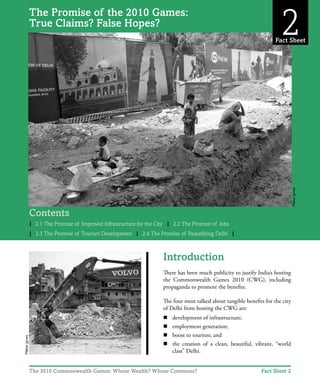
There has been much publicity to justify India’s hosting
the Commonwealth Games 2010 (CWG), including
propaganda to promote the benefits.
The four most talked about tangible benefits for the city
of Delhi from hosting the CWG are:
n	 development of infrastructure;
n	 employment generation;
n	 boost to tourism; and
n	 the creation of a clean, beautiful, vibrant, “world
class” Delhi.
The Promise of the 2010 Games:
True Claims? False Hopes?
Fact Sheet 2
Fact Sheet
2
The 2010 Commonwealth Games: Whose Wealth? Whose Commons?
MeharJyrwa
MeharJyrwa
The Promise of the 2010 Games
2
2.1	 The Promise of
Improved Infrastructure
for the City
Sports Infrastructure
Stadiums and Training Centres
n	 New venues, according to the Bid Document, include
two indoor and one outdoor stadiums. Land for these
was to be provided by the state government free of
cost.1
n	 India’s Bid Document budgeted an additional US$
16.7 million (Rs. 75.2 crore) for purchase of technical
equipment.
n	 The entire proposed expenditure for sports
infrastructure (including upgradation of existing
infrastructure and construction of new stadiums) as
submitted by the Indian Olympic Association was Rs.
150 crore.2
n	 26 new training venues are being constructed and 16
training venues are being upgraded.3
Budget Item	 US $	 Rupees
	 million
Construction of new stadiums	 20.94	 94.23 crore
Upgradation of existing stadiums	 8.69	 39.1 crore
Major repairs and maintenance	 23.23	 105 crore
TOTAL ESTIMATE	 52.86	 238 crore
[source: India’s Bid Document for the Commonwealth Games]
Ludlow Castle Wrestling Training Centre 	 Rs.13 crore8
Jawaharlal Nehru Stadium (Opening
and Closing Ceremonies, athletics,
lawn Bowls and weightlifting)	 Rs. 961 crore9
Karni Singh Shooting Range 	 Rs. 149 crore10
Dr. Shyama Prasad Mukherjee
Swimming Pool Complex (aquatics) 	 Rs. 377 crore11
Indira Gandhi Stadium (gymnastics,
cycling and wrestling) 	 Rs. 669 crore12
Indira Gandhi Indoor Stadium	 Rs. 240 crore13
Major Dhyanchand National Stadium	 Rs. 262 crore14
Training Venue at Jamia Milia Islamia
University (rugby and table tennis)	 Rs. 43 crore15
Delhi University (rugby, netball and
training for boxing)	 Rs. 50 crore16
Siri Fort Sports Complex (badminton
and squash)	 -
Saket Sports Complex	 -
R. K. Khanna Tennis Complex (tennis)	 Rs. 65.35 crore17
Yamuna Sports Complex (table tennis
and archery preliminaries)	 -
Delhi Public School, R.K. Puram
(training venue for lawn bowls)	 1.73 crore18
Kadarpur Shooting Range, Gurgaon	 28.26 crore19
Total	 Rs. 3389.44 crore
Stadium Costs
Stadiums/ Training Centres	 Actual Cost
Thyagaraj Sports Complex
(athletics, netball)	 Rs. 300 crore4
Talkatora Stadium (boxing)	 Rs. 150 crore5
Archery Venue at the Yamuna Sports
Complex	 Rs. 25 crore6
Chhatrasal Stadium 	 Rs. 55.1 crore7
n	 The total expenditure on stadiums and training centres
so far is estimated at Rs. 3,389.4 crore along with Rs.
42 crore consultancy fees that had not been budgeted
for earlier,20
bringing the total estimate to Rs. 3,431.4
crore. This is more than a 2,160% increase from the
original estimate. With costs rapidly escalating in the
final stages of construction, this figure is likely to be
an underestimation.
n	 The cost of construction and renovation of five
stadiums (Jawaharlal Nehru Stadium, Indira Gandhi
Stadium, Dr. Shyama Prasad Mukherjee Swimming
Pool Complex, Major Dhyanchand National
Stadium, and Dr. Karni Singh Shooting Range) is
True Claims? False Hopes?
3
reported to have shot up by almost 250 per cent of
the original estimate.21
Non-competition Venues for the Games
n	 HeadquartersofCWG-2010OrganizingCommittee
(OC) spread over nine floors with a capacity to
accommodate a workforce of over 1200; multi-
level parking space; and a 24-hour power backup.
The OC pays a rent of Rs. 5.6 crore every month to
the New Delhi Municipal Council (NDMC).22
The
budget for rent for the OC Headquarters, which was
not accounted for initially, is reported to be Rs. 175
crore.23
n	 Main Media Centre and an International
Broadcasting Centre.24
Information from the Press
Information Bureau revealed that expenditure
incurred on the Main Press Centre and Venue
Media Centres is Rs. 9.8 crore.25
Latest press reports
indicate that the media facilities at Pragati Maidan
will cost Rs. 32 crore.
n	 Games Family Hotel (Hotel Ashok).
n	 A Commonwealth Games Village spread over 63.5
hectares is being constructed by Emaar MGF at
an expected cost of US $230.7 million (Rs. 1038
crore).26
In May 2009, the Delhi Development
Authority (DDA) announced a Rs. 700 crore bailout
package for Emaar MGF, the first such government
bailout for a realty company.27
The Legacy of Sports Infrastructure
n	 India’s experience with the Asian Games in 1982 has
shown that the infrastructure created remained
unutilised/underutilised for a very long time.29
Stadiums built for the Asian Games were never used
to their optimum capacity.30
These are more often
used for Bollywood events or political rallies than
sporting events.31
n	 India’s Bid Document states, “These existing facilities
(ten world class stadiums, thirteen new venues and
others created during the 1982 Asian Games) have
since then been maintained very well and upgraded
on a continuous basis.”33
Evidence, however, shows
that maintenance has been far from satisfactory.34
n	 According to K.T. Ravindran, Chairperson, Delhi
Urban Arts Commission “… many of the new
stadiums will be junked just as the (Indira Gandhi)
indoor stadium was junked for 20 years after the
1982 Asian Games.”35
The handball and archery
venues that were set up in Delhi University during
the 1982 Asian Games were demolished after the
event.36
n	 Three crucial issues concern sports infrastructure in
India: (i) need for new and modern infrastructure;
(ii) maintenance/upkeep of existing infrastructure
and facilities; and (iii) optimum utilisation
of the infrastructure.37
Despite claims that the
CWG would induce the development of sporting
infrastructure in the country, only the first of these
three issues is likely to be addressed by Games related
developments. The mere creation of new physical
infrastructure, however, cannot be portrayed as
a solution for the multiple problems with sports
infrastructure in India.
Delhi Government to the Rescue of the Private Sector
The Commonwealth Games Village project, with 1,168
apartments, was to be built on a public-private-
partnership model between DDA and Emaar MGF, which
won the right to develop the 118-acre residential project
in competitive bidding from DDA at Rs. 321 crore against
a reserve price of Rs. 300 crore.
As per the arrangement, DDA got ownership over one-
third of the apartments over and above the Rs. 321 crore
from the developer. Emaar MGF was to retain ownership
of the remaining 790 apartments which it expected
to sell in the open market and raise money. The 2009
financial crisis and realty slump meant the company
couldn't find buyers and raise money. It asked DDA for a
bail out which it got.28
"Optimum utilisation of our existing sports infrastructure
has also been one of the areas of concern before the
Committee. We have erected huge stadia and other sports
infrastructure in the metros and cities, which are used
only when national or international tournaments take
place. For the rest of the period, stadia remain unutilised
or are rented out for cultural programmes and other non-
sporting events".32
The Promise of the 2010 Games
4
n	 While it is true that sporting infrastructure
of international standards is not available to
sportspersons in India, any effort to fill the gap has
to be nationwide in its outreach and not confined
merely to Delhi. The lack of sports infrastructure
in rural areas is a matter of serious concern. The
absence of a sports culture and sports consciousness
in the country cannot be remedied by hosting a
Commonwealth Games in Delhi.38
The kind of money being spent on building/upgrading
sports infrastructure in Delhi for the Commonwealth
Games:
l	 Is several times more than what was budgeted
for;
l	 Involves a huge opportunity cost;
l	 Would have been better spent on developing
sports facilities, for instance, ensuring that each
school in rural and urban India has a playground
with games facilities, at least. Only half of the
primary schools in India have playing fields.40
l	 Is an excessive burden on the taxpayer;
l	 Is questionable considering the low levels of
utilisation of stadiums, as experience with the
1982 Asian Games has shown.
Until November 2009, India did not have a legacy
plan for the Commonwealth Games.42
A Parliamentary
StandingCommitteeReportpreparedinNovember2006
emphasised the need for preparing a prospective plan
to ensure optimum utilisation of sports infrastructure
after the 2010 Games, and also to avoid a repetition of
the post-1982 Asian Games situation.43
According to
a Report by the Comptroller and Auditor General of
India (CAG), “the OC [Organizing Committee] has not
developed a comprehensive legacy plan for the overall
legacy and long-term impact of the Games. By contrast,
the legacy plan for CWG-2014 at Glasgow is already
ready, and the plan for CWG-2006 at Melbourne was
finalised three years before the games, in 2003. Further,
SAI [Sports Authority of India] had not taken effective
steps for legacy planning for utilisation, operation and
maintenance of its five stadiums (to be renovated at a
cost of Rs. 2,475 crore)."44
An important question to ask is how many young
aspiring athletes of the country will have access to these
stadiums, and at what cost? Did the Commonwealth
Games secretariat need to be housed in such luxurious
premises with such lavish facilities? Did the athlete’s
village need to consist of such high-income apartments?
Couldn’t these apartments, or at least some of them,
have been constructed for lower income groups? That
would have ensured at least some “social legacy” of the
Games.
Examples of Post-event Use of Games Venues for Local
Housing:
a)	 In Moscow, the 1980 Olympic Games marked the
culmination of a policy of construction of social
housing with the transformation of the Olympic
Village into 18 apartment blocks of 16 floors;
b)	 In Athens, the Olympic Village constructed for the
2004 Olympic Games resulted in 3,000 new units of
subsidized housing that benefited 10,000 residents;
c)	 In London, half of the 2,800 units in the Olympic
Village are to become affordable housing after the
Games, while current plans for the Olympic Park site
are for around 10,000 new homes, around 35% to be
affordable housing.46
“Infrastructure is being raised in only one city while people
in other cities barely have such facilities; so how can you
revive sports culture by ignoring the real India?” Balbir
Singh Bhatia, former secretary, Indian Weightlifting
Federation39
“If we don’t come up with a proper legacy programme, we
might have to give the infrastructure out for weddings.”
(Shailendra Singh, Joint Managing Director of sports
marketing firm – Percept)45
Stadium Legacy of the 2004 Athens Olympics
The city of Athens built several new sports facilities
for the 2004 Olympic Games but has done little to find
alternative uses for Olympic infrastructure after the
Games. Those facilities are now costing the state €55
million per year in maintenance bills, and many of
them are going unused. Stadiums in Patras and Volos,
for example, are too expensive for local, second-league
soccer clubs to afford. Should such unused venues not
be torn down, the government says, they will merely fall
apart on their own.41
True Claims? False Hopes?
5
parking lots are being built. The parking facility
for 800 vehicles being developed near the
Jawaharlal Nehru Stadium (which involved
covering of the Sunheri Nullah and Kushak
Nullah), is being built at a cost of Rs. 304
crore.54
Three multi-level parking lots are
being constructed in the New Delhi Municipal
Council area on a public-private partnership
basis at K.B.S. Marg, K.G. Marg, and Sarojini
Nagar.55
2.	 Medical Infrastructure
l	 Twenty new hospitals will be functional by
2010 to enhance Delhi’s healthcare and medical
infrastructure. Special trauma ambulances
will be on call during the Games to provide
immediate relief in cases of emergencies.57
l	 A state-of-the-art sports specialty hospital is
being built near the Games Village.
l	 Additional equipment to deal with sports and
related injuries is being provided in existing
hospitals.
l	 Motorcycle-borne paramedics will be deputed
across the Games venues to shift injured
sportspersons and patients to hospitals.58
3.	 Water and Sewage Treatment
l	 The Delhi Jal Board’s (DJB) budget for
upgrading water supply and sewerage facilities
at the Games Village was Rs. 40 crore.60
l	 Two new initiatives have been undertaken by
Civic Infrastructure
The following section summarises transport and
infrastructure development in Delhi in the run up to the
CWG.
1.	 Transport Infrastructure
l	 The Indira Gandhi International Airport is
being modernised.
l	 A “green helipad,” the country’s first ever, is to
be built at the Commonwealth Games Village
at a cost of Rs. 1.92 crore.47
l The Metro Rail will have a dedicated corridor
from the airport to the Games Village for easy
transfer of athletes and officials.48
Delhi Metro
will expand its operations from 75 kilometres
to 200 kilometres for the Games. Six new lines
are expected to open by October 2010 as part
of Phase II of the Delhi Metro services.49
The
Delhi Metro will provide connectivity to 10
out of 11 venues of the Commonwealth Games
2010.50
l	 The renovation of Old Delhi Railway Station
has cost Rs. 7 crore.51
l	 Several flyovers, bridges and under bridges have
been built.
	 In response to a Right to Information (RTI)
application, the Office of the Executive Engineer,
Flyover Project Division F-121, Public Works
Department (PWD) revealed (on April 6, 2010)
that the consolidated expenditure incurred on
transportinfrastructurefromApril2007–March
2010 for just four projects (Flyover Project Circle
F-12) is Rs. 57,892 lakh. Another response to
the RTI from the PWD, Office of the Project
Manager, mentioned that the estimated cost of
the Ring Road bypass from Salimgarh Fort to
Velodrome Road is Rs. 456 crore while the Park
and Ride facilities near Rajghat are expected to
cost Rs. 18.68 crore.52
l	 A fleet of 1,100 new low-floor, high-capacity
air-conditioned buses is to be introduced in
Delhi.53
l	 New improved bus shelters and multi-level
The Delhi Budget 2010-11 allocated Rs. 4,224 crore (38%
of the total budget) to transport while social welfare
received only Rs. 87 crore (7%).56
The Tenth Perfect Health Parade to “promote a clean,
green and hygienic city for Commonwealth Games” was
held in Delhi on April 8, 2010. The parade concentrated
on sensitizing doctors about traveler-related sicknesses
and their prevention and cure. “At least one lakh people
will come for Commonwealth Games and their health must
be looked after so I am very happy that doctors have
taken the lead,” Chairman of the Commonwealth Games
Organizing Committee, Suresh Kalmadi said.59
The Promise of the 2010 Games
6
Capital Region (NCR) before the Games.70
The
tax holiday was subsequently extended.71
l	 Incentives for hotel projects to meet the
projected requirement for the Games were part
of the Union Budget 2007-2008. To facilitate
additional capacity in existing hotels, Delhi
Development Authority (DDA) increased the
floor-area ratio (FAR) for hotels from 2.25 to
2.50.72
l	 Furnishing of the 2,709 DDA flats at Vasant
Kunj has cost ITDC approximately Rs. 100
crore.73
l	 TheMunicipalCorporationofDelhi(MCD)has
proposed to give temporary licences to illegal
hotels, restaurants and guest houses in the
national capital in the run up to the CWG. At
anMCDstandingcommitteemeeting,members
said temporary licences should be granted to the
hotels operating illegally so that foreign visitors
during the Commonwealth Games don’t stay in
unlicensed accommodations.74
the Delhi Jal Board to boost water supply from
the current 670 million gallons per day (MGD)
to 941 MGD.61
l	 WABAG India has been commissioned to
build a 5.3 million euros (Rs. 33 crore) water
treatment plant for the Games Village in
Delhi.62
l	 Plans are also underway to streamline Delhi’s
solid waste management system.63
4.	 Power
l	 Delhi plans to be “power surplus” by the time
the Games are held. To ensure additional
power to Delhi, the government is undertaking
a large power production initiative to increase
production to over 5,880 Mega Watts (MW)
from the current 4,500 MW. The power
distribution system will be streamlined, more
power will be directed to Delhi, and new power
plants constructed.65
l	 The first "green" power grid at the Games
Village has been built at a cost of Rs. 40 crore.66
5.	 Hospitality
l	 India Tourism Development Corporation
Limited’s (ITDC) plan to renovate three state-
run hotels (Ashoka, Janpath and Samrat) is
expected to cost Rs. 100 crore.67
Private hotels
are also being upgraded.
l	 The Ministry of Tourism estimated that there
will be a requirement of 30,000 additional
hotel rooms in Delhi during the Games.68
l	 An additional 25,000 rooms are being built
to meet the requirements of the Games; this
will be supplemented by the Bed and Breakfast
Scheme launched by the Delhi government.69
l	 The government announced a five year tax
holiday for hotels coming up in the National
The New Delhi Municipal Council (NDMC) has earmarked a
budget of Rs. 40 crore for creating signage of international
standards in terms of size and design. According to an
NDMC official, “the idea is to help tourists during the
Commonwealth Games in locating a particular building in
the NDMC area.”75
Delhi may not have drinking water, but come October,
athletes coming to the Commonwealth Games will
be getting water of “first world” standards at the
Commonwealth Games Village.64
GyanKothari
True Claims? False Hopes?
7
The Infrastructural Overhaul
of Delhi
The Claim
The government, on several occasions, has made the
following claims regarding Commonwealth Games induced
infrastructure development:
n	 According to Suresh Kalmadi, President Indian
Olympic Association (IOA), “As far as infrastructure
and development is concerned, Delhi will move
ahead by five years because of the Commonwealth
Games... It will be a lasting legacy.” 77
n	 He also stressed that, “The Games will be on for 15
days but it will help the city for the next 15 years. It
will take Delhi years ahead.”78
The Reality
n	 Expensive
	 The infrastructural makeover of Delhi is a multi-
thousand crore rupees project. Critics have argued
that the kind of money spent on the Commonwealth
Gamescouldhavebeenusedtodevelopinfrastructure
throughout the country.
n	 Hurried or Delayed
	 Some of the basic planning documents of the
Commonwealth Games were finalised for approval
much later than scheduled. The Master Plan for the
Games was delayed by 54 months and the General
Organization Plan was delayed by 39 months. As per
the Host City Contract, the Organizing Committee
was to be constituted by May 2004, but this was
formed only in February 2005.79
	 Delays in the planning phase result in reduction of
the time available for execution of projects.
The government [in South Africa] has pledged Rand (R)
400 billion (US $ 53.6 billion) between 2006 and 2010 for
infrastructure development, including upgrading road, air
and rail transport. This will not necessarily have long-term
economic benefits because much of this infrastructure is
geared specifically for the Football World Cup, and may
differ from infrastructure needs related to historic patterns
of development and industrialization.76
GNCTD:	 Government of National Capital Territory of Delhi
SAI:	 Sports Authority of India
OC:	 Organizing Committee
MYAS:	 Ministry of Youth and Sports Affairs
DDA:	 Delhi Development Authority
Min. of I & B:	 Ministry of Information and Broadcasting
MHA:	 Ministry of Home Affairs
[Source: A Report on Preparedness for the XIX Commonwealth Games 2010, Comptroller and Auditor General of India, New Delhi, July 2009]
1628 (13%)
Operational
Expenses of OC
5214 (40%)
Venue
Development
284 (2%)
Security
463 (4%)
Broadcasting
749 (6%)
Others
4550 (35%)
City Infrastructure
Development
1153 (9%)
DDA
4720 (37%)
GNCTD
682 (5%) Others
483 (3%) Min. of I & B 284 (2%) MHA
1503 (12%)
MYAS
1628 (13%)
OC
2475 (19%)
SAI
Estimated Infrastructure Costs
Agency-wise estimated costs (in rupees crore) Activity-wise breakup of estimated costs (in rupees crore)
The Promise of the 2010 Games
8
	 According to K.T. Ravindran, Chairperson of
the Delhi Urban Arts Commission (DUAC), the
rush to meet deadlines may increase the cost
of infrastructure projects.80
The hurry often
also results in compromised quality of projects,
bypassing of clearances, and exploitation of
workers at construction sites. For instance, the
Bhishma Pitamah Flyover, repaired at a cost of Rs.
2.48 crore has started developing potholes within
two months.81
	 India’s 1982 Asian Games experience was similar.
The entire infrastructure for the Asian Games was
hurriedly built in the last two years. The result was
shoddy and poor quality stadiums.82
n	 Poor Planning
	 Severalinfrastructureprojectshaveevidentlybeenbadly
planned. Sudhir Vohra, an architect and government
adviser says that plans like the 24 new flyovers being
built are “more like band-aids, than a remedy for
Delhi’s problems.”83
The plan for renovation of Indira
Gandhi Stadium was poorly designed in terms of
landscape and drainage.84
Five elevated metro stations
in South Delhi, which were to be completed before the
Commonwealth Games, were denied clearance by the
DUAC on grounds of poor planning and designing.
n	 Environmentally Unsound
	 The Delhi Development Authority felled 800 trees
in Siri Fort to make way for two Commonwealth
Games stadiums.86
Rain water drains have been
covered for various Games projects.87
The site of the
Games Village (on the flood plains of river Yamuna)
has enraged activists, as it violates environmental
norms, including the Delhi High Court order against
all encroachments on the Yamuna Flood Plain,88
and
is apparently an “invitation to disaster.”89
Apart from
causing a reduction in the ground water table in
Delhi, the river bed is also a seismically active area.90
There has also been a significant increase in Delhi of
asthma and allergy cases directly as a result of the dust
from the construction for the Games. According to
the World Health Organization (WHO) the hectic
construction activity was affecting the general health
of the capital. “Infrastructure building means dust in
the air, which is not healthy,” a senior official of the
WHO said.91
Environmental impact assessment norms have been
violated. Trees have been cut, rain water drains have
been covered, the Games Village has been built on
an ecologically sensitive river bed, the construction
work for the Games has increased the dust levels in
Delhi, and yet government officials have launched
an “ecological code” and claim that the CWG will be
“Green Games.”
n	 Clearances Bypassed
	 Several projects related to the Commonwealth
Games, such as the eight subways at Connaught
Place did not obtain permission/ clearance from the
DUAC. Other such projects include the bypass at
Ferozeshah Kotla, the parking lot off Lodhi Road,
and the landscaping around Rashtrapati Bhavan.92
“In the name of the Games, a lot of projects have
pushed for quick clearances and sometimes even
bypassed clearances,” according to K.T. Ravindran,
Chairperson, DUAC.93
In February 2008, the
entire DUAC team resigned in protest against the
government’s pressure to clear Commonwealth
related projects.94
The Commission, headed by
renowned architect Charles Correa, had apparently
become a “nightmare” for the Delhi government
for standing up against the “harebrained” projects
supposedly associated with the Games.95
	 The Archaeological Survey of India (ASI) issued a
notice to the Delhi Integrated Multi-modal Transit
The capital’s last defence against unplanned development
collapsed with all members of the DUAC resigning over
alleged differences with the government on plans for the
2010 Commonwealth Games.96
‘‘The problem with most of these infrastructure projects
is planning. Suddenly government bodies like PWD seem
to have woken up to a Commonwealth Games deadline
and there is time pressure. So, they want DUAC clearance
at the earliest. These projects should have been planned
many years in advance. There is simply no planning
strategy...” K.T. Ravindran, Chairperson, Delhi Urban Arts
Commission.85
True Claims? False Hopes?
9
Service (DIMTS), a special body created by the Delhi
government to implement its transport schemes
for the Games, to stop work on the hanging foot
overbridge coming up on Mathura Road-Bhairon
Road near Purana Qila for the Games, as the site falls
within the regulated area of Purana Qila, a Centrally
protected monument. ASI officials maintained that
a notice was sent earlier to the DIMTS to stop
construction but the body refused. The ASI then
pasted a copy of the notice at the site. Construction,
however, did not stop.97
n	 Violation of Delhi Master Plan 2021
	 The Candidate City Manual of the Commonwealth
Games Federation has a clear question asking for
an explanation of how the city’s/region’s vision for
the Games fits into its long-term planning strategy.
While this Manual only came into existence after
India won its bid, the issue is one that the Indian
government still needs to answer.
	 Union Minister, Kapil Sibal, while addressing
a seminar on “Delhi Master Plan: Critique and
Alternatives,” raised the point that, “The Master
Plan should not be prepared only keeping in
view the Commonwealth Games 2010. It should
be prepared keeping in view the development of
the city for the years to come.” He further added
that there was no Master Plan in 1982 because of
the Asian Games, leading to a 40-year gap in city
planning since the 1962 plan was finalised.98
n	 Exploitation of Workers
	 In the rush to meet the Games deadline, and in the
absence of labour standards and a code of ethics
for workers, many workers have been subjected to
exploitation.99
n	 Unnecessary Projects
	 The relevance of several Commonwealth Games
related projects has been questioned. According to
K.T. Ravindran, Chairperson of the Delhi Urban
Arts Commission (DUAC), “There will be many
of these pachyderms roaming Delhi after the
Commonwealth Games.” He cites one Rs. 800
crore flyover running “from nowhere to nowhere”
along Barapullah Nullah. “That route could have
just been managed with proper planning, by re-
profiling the streets.”100
Ashish Chowdhary, a Delhi
based urban designer, questions the premise of this
exclusive infrastructure, “What will its use be, post
the Games, to both city and citizen? The expressway
connects areas of minimal density and then remains
aloof to the networks of the city below. How can we
justify such costs and ad-hoc design?”101
The Escalating Budget for Infrastructure
Exact figures on actual infrastructure costs for the
Commonwealth Games are hard to find. Different sources
reveal different data. Even a Right to Information (RTI)
application on the total infrastructure cost incurred, has
notreceivedadefinitiveanswer.Thefollowinginformation
relates to infrastructural estimates, and demonstrates how
the costs continue to accelerate in the run up to the Games.
n	 In a plan given by the Government of the National
Capital Territory of Delhi (GNCTD) to the
Planning Commission, a total budget of Rs. 770
crore was originally earmarked for the development
of infrastructure.
n	 Government of Delhi (GNCTD), however, allocated
a sum of Rs. 1,189 crore to enhance, expand and
upgrade city infrastructure.103
n	 Amount spent on infrastructure development in
Peoples Union for Democratic Rights (PUDR) filed a public
interest litigation (PIL) on the condition of the 415,000
contract daily wage workers at Commonwealth Games
projects. A four member committee was appointed by the
Delhi High Court on February 3, 2010, to ensure that the
workers’ rights are not violated. The Committee reported
that PUDR charges were “well founded” and recommended
"exemplary fine" on errant authorities.
White Elephants?
Darren McHugh, a Queen’s University scholar, conducted
a cost-benefit analysis of the 2010 Winter Olympics to
be held in Vancouver, Canada. He observed that the
infrastructure projects related to the 2010 Vancouver
Winter Olympics with the heftiest costs were those “that
would not have been built without the Olympic bid
attempt, and were not otherwise worth building — white
elephants, to use the popular euphemism.”102
The Promise of the 2010 Games
10
Delhi by different agencies in the run-up to the
CWG, as disclosed by Delhi Finance and Public
Works Department Minister, A.K. Walia on August
3, 2006, was Rs. 26,808 crore.104
n	 A 2009 report of the Comptroller and Auditor
General (CAG) estimated the cost of creating venues
and city infrastructure as well as the operational
expenses for hosting the Games at Rs. 12,888
crore. This, however, excludes investments on
infrastructure and other activities by several other
agencies like Delhi Metro Rail Corporation and
Airports Authority of India.105
n	 On March 10, 2010, the total amount spent on
infrastructure in Delhi over the last three years was
stated to be Rs. 13,350 crore by Rakesh Mehta,
Chief Secretary, Government of Delhi.106
What are the Real Costs?
n	 The cost of the infrastructural overhaul of Delhi
will be borne by the common person who gains
very little from flyovers, streetscaping, stadiums and
other superfluous amenities.
n	 The Finance Minister of Delhi while announcing the
2010 Budget for Delhi declared that there will be no
new health projects for Delhi this financial year109
and no new projects for the next fiscal year. He also
stated that the fiscal deficit of Delhi is expected to
increase from Rs. 2,824 crore in 2008-09 to Rs.
3,561 crore during 2009-10 (Revised Estimate
compared to Budget Estimate of Rs. 2,890 crore).110
	 The increase is related to excessive Games related
expenditure. This has already resulted in higher taxes
for city residents,111
and has made Delhi a more
expensive city to live in.
n	 Funds earmarked for essential projects have also
been diverted to the CWG. For instance, funds
from the Delhi Scheduled Caste Sub Plan (2009-
10) have been diverted to meet CWG related
expenditures.112
n	 The government has no money left for Phase III of
Delhi Metro.113
2.2	 The Promise of Jobs
The Claim
Suresh Kalmadi, President of the Indian Olympic
Association, is reported to have said about the
Commonwealth Games, “It’s a big business opportunity,
many jobs for many young people.”115
During the
Commonwealth Heads of Government Meeting
(CHOGM) in Port of Spain in November 2009, he said
that the Commonwealth Games in Delhi would create
2.5 million jobs in its wake.116
The Reality
Research has shown that the promise of jobs and
predictions of a growth in the job market as a result
of sports mega events is mostly exaggerated by the
organizers.
The Barcelona Olympics of 1992 (jobs created both
in the construction as well as in the hotel and catering
sectors were much less than anticipated) and the Salt
Lake City Olympics of 2002 (the average job growth for
the Olympic impact period was 37% less than the pre-
Olympic period), are two well known examples.117
A study by Samy Ahmar, an Edinburgh economist
Reeling under financial difficulties due to increased
spending on projects related to the Commonwealth
Games, Delhi government had sought a special
assistance of Rs. 2,000 crore from the Centre for the
sporting event in the Union Budget. Finance minister
Pranab Mukherjee increased the normal assistance to
Delhi from Rs. 208.85 crore in 2009-10 to Rs. 229.72
crore in 2010-11.
A separate allocation of Rs. 176.90 crore was made to
National Capital Region (NCR) for projects related to the
Commonwealth Games.
Central assistance to the city government of Delhi,
however, fell from a plan outlay of Rs. 1,228 crore in the
Union budget as against last year's Rs. 2,435 crore. 114
The money required for infrastructure development for
the Commonwealth Games is more than three times the
amount India had stated in its bid document.107
True Claims? False Hopes?
11
specialising in sporting projects, has warned that the
Glasgow Commonwealth Games 2014 will not provide
any lasting boost to the job market and the employment
benefits will be very “transitory” in nature.118
Ahmar’s
finding that both the Commonwealth and Olympic
Games rarely leave a legacy of long-term, sustainable
employment is based on a study of employment rates
in host cities of nine previous Commonwealth and
Olympic Games. The Glasgow Chamber of Commerce
has also raised similar concerns about the claim that the
Commonwealth Games will boost the job market in
Glasgow. A paper published by the London Assembly
found that, “long-term unemployed and workless
communities were largely unaffected [by better job
prospects] by the staging of the Olympic Games in each
of the four previous host cities.”119
It has been argued that the number of jobs created by
such events is “ridiculously low” when compared to
the amount that is invested. Volunteers are brought in
for most of the tasks. Moreover, livelihoods have been
lost due to evictions and displacement related to the
Games and the banning of certain occupations. Vendors
and other informal sector workers, including rickshaw
pullers and petty shop owners in Delhi have lost their
jobs due to the Commonwealth Games and around
20,000 eateries (dhabas) are to be shut down. Municipal
Corporation of Delhi’s (MCD) press and information
director, Deep Mathur affirmed that, “illegal dhabas are
liable to be removed without serving any notice to them
as they are considered encroachments. MCD can only
issue licences to eating houses which have a covered roof.
We have been told to remove all encroachments before
the Commonwealth Games.”121
Most jobs created for the Games are temporary, and the
majority of them are in the unorganised sector, especially
in the construction business, where there is blatant
exploitation of workers.122
How many jobs have actually been created by the
Commonwealth Games? How many people have lost
theirlivelihoodsinDelhiasaresultoftheGames?What
happens to the workers after the Games? Are there any
plans to provide them alternative employment options
and housing?
2.3	 The Promise of Tourism
Development
The Claim
The claim that the Commonwealth Games will boost
tourism in the country by attracting large numbers of
foreign visitors and tourists has been made repeatedly,
right from the time India won the bid.
The Ministry of Tourism has estimated that 100,000
tourists are expected to visit Delhi for the CWG.124
This figure was reiterated by Suresh Kalmadi in
November 2009.125
“Commonwealth Games have
given an opportunity for showcasing India as a unique
and hospitable tourism destination. It is expected that
a large number of tourists would visit the country
bringing back the buoyancy in the sector,” Tourism
Minister Kumari Selja said while addressing a summit
on “Tourism: Tackling the Global Crisis” in London
in November 2009.126
In March 2010, the number
of foreign tourists expected in Delhi was stated to be
between 50,000 to 60,000.127
Director General of the
Commonwealth Games 2010, V. K. Verma, speaking
at the Indian International Sports Summit (IISS)
in March 2010, said that over 100,000 tourists are
expected to come to Delhi for the Games.128
In February 2010, however, the government for the first
time came close to admitting that the Games would not
witness many spectators. Special Secretary to the Chief
Minister, P. K. Tripathi, speaking at an interaction, “Face
to Face with Government” with the Federation of Indian
44 foreign consultants have been reportedly employed to
help organise the Delhi Commonwealth Games; they would
cost the Indian taxpayer about Rs. 100 crore.123
Eddie Cottle, coordinator of the Campaign for Decent
Work and Beyond 2010, made light of claims that the
infrastructure development [for the 2010 FIFA World Cup
in South Africa] would create around 100,000 sustainable
jobs. On the contrary he stressed that the state would
spend the same amount in preparation for the World Cup
as it would have spent on the more pressing need of
housing over a ten-year period (2000–10).120
The Promise of the 2010 Games
12
Chambers of Commerce and Industry (FICCI) Ladies’
Organization, drew a parallel with the Beijing Olympics
and said, “International tourists do not generally come
in huge numbers during October, as it is not the holiday
season for them.”129
The Reality: Impact of Mega Events on
Tourism
The growing body of literature on the impact of mega
events suggests that the tourism development potential of
sports events as an area of research has serious definitional
problems and methodological pitfalls.130
The assumption
that the Commonwealth Games in Delhi will generate
enormous revenue through tourism is therefore overly
simplistic. The boom in tourism, if any, is only in the
short term.131
The trend all over the world has been of
a surge before the Games, a sort of plateau during the
Games and a sharp decline thereafter.132
The “crowding
out” effect133
has also to be considered in any economic
analysis of mega sports event induced tourism.
There are lessons to be learnt from several well known
cases where the projected boom in the tourism sector
did not occur. The forecast of large numbers of tourists
for the 1982 Asian Games in Delhi proved to be
completely wrong.134
Contrary to the big rush forecasted
by organisers of the Asian Games, only 200 foreigners
arrived.135
The prediction of enormous gains in tourism
again proved wrong in the case of the Lillehammer
Winter Olympics, Norway, in 1994.136
A study of the
Lillehammer Winter Olympics showed that 40% of the
hotels went bankrupt. In the case of the Beijing Olympics
too, the number of visitors fell short of speculation and
hotel occupancy was only 25% of projections. The Seoul
Olympics of 1988, Barcelona Olympics of 1992, and
many other sports mega events had significantly fewer
tourists than expected.137
Concern has been expressed by people in the tourism
sector over the fact that unlike Beijing, India started
marketing the Games rather late and has thus already
lost the chance to maximise gains.138
A report by a
Parliamentary Standing Committee said that there had
been no proposals for development of infrastructure and
capacity-building, including creation and renovation of
hospitality facilities, and modernisation of tourism sites
by the Ministry of Tourism till November 2008.139
Most
importantly, academics have debated whether tourism
development can be the rationale for staging hallmark
events.
This trend of first inflating the number of foreign
tourist arrivals and exaggerating the impact of the
event on the tourism sector and then admitting that
fewer tourists (compared to the initial forecast) are
expected, is part of a strategy by organisers and the
host government to “sell” the Games.
2.4	 The Promise of
“Beautifying” Delhi
The Ambition
The historic city of Delhi will, supposedly, look its best
for visitors during the XIX Commonwealth Games.
One of the stated legacies of the event is that it will leave
behind a city much more beautiful and charming than
it currently is.140
Delhi Chief Minister, Sheila Dixit, is reported to have
said that, “Delhi will become a world-class city,
a beautiful, vibrant, and organized place, which
makes all of its citizens—poor and rich—happy
and comfortable living here, and which caters to all
their basic requirements of health, education, water,
power, and good roads.”141
She also assured that, “The
government would ensure world-class streetscaping
and beautification around various stadiums during the
Commonwealth Games.”142
The Plan
The plans for beautification include streetscaping; new
attractive, weather resistant, uniform signage; one million
potted plants around venues (Forest Research Institute,
Dehradun, is apparently developing new species of over
300,000 flowering plants for the Games); re-surfacing
of bituminous roads by using plastic waste; beautifying
footpaths alongside venues as per global standards; and
construction of bicycle tracks, among other measures.
True Claims? False Hopes?
13
The Human Cost of “Beautification”153
Attempts at cosmetic surgery of the city do not
necessarily result in long-term benefits or improved
aesthetic appeal. Delhi’s recent ostensible beautification
drive, has furthermore, been characterised by an element
of inhumanness, with the costs being paid by the city’s
most marginalised and deprived populations. Some of
these measures in the guise of beautification include:
n	 Slum demolitions without rehabilitation;
n	 Destruction of a temporary night shelter for the
homeless;
n	 Eviction of homeless residents, several of who
are construction workers for the Commonwealth
Games.
n	 Arbitrary arrests and detention of “beggars” and
homeless people;
n	 Destruction of livelihoods of hawkers, vendors and
others who work on the streets;
n	 Inconvenience to the public and accidents because
of digging up of streets and redoing pavements;
n	 Plan to “hide” slums behind bamboo screens so as
to save visitors and athletes the “not-so-pretty” sight.
Delhi Chief Secretary, Rakesh Mehta, said, “We have
spoken to the agriculture department of Mizoram to
help us in planting bamboo trees, which can be used
to screen the shanties and slums on the roadside of
all those routes through which the Commonwealth
convoy is expected to go. We want to present a good
face of Delhi during the Games next year, but it
is not possible to remove all the slums. Therefore,
we have decided to use bamboo screens instead to
simply conceal the sights.”154
The Cost
n	 India’s Bid Document for the Games budgeted US
$ 1.66 million (Rs. 7.5 crore) for city beautification
expenses.143
n	 In August 2009, the New Delhi Municipal Council
(NDMC) announced plans to plant 10 lakh plants at
a cost of Rs. 23.2 crore to add “colour” to the Games
venue.144
n	 InDecember2008,VijenderGupta,Chairmanofthe
Municipal Corporation of Delhi’s (MCD) Standing
Committee, stated that, “MCD will upgrade and
strengthen Commonwealth Games related roads in
the vicinity of the Games venues and improve their
streetscape at a cost of Rs. 100 crore.”145
n	 In July 2009, the Expenditure Finance Committee
(EFC) of the Delhi Government headed by Chief
Minister Sheila Dikshit, cleared 15 proposals
worth Rs. 398 crore, including Rs. 272 crore for
beautification work related to the 2010 Games.146
n	 In February 2010, the EFC cleared a Rs. 21.95
crore proposal for beautification of roads around the
Games venues.147
n	 In March 2010, it was reported that MCD was
carrying out streetscaping/ road improvement on 14
roads at a total cost of Rs. 74 crore; NDMC was
streetscaping major roads at a cost of Rs. 60 crore;
and the Public Works Department (PWD) was
carrying out major road projects at a cost of Rs. 250
crore.148
n	 Streetscaping on Jagannath Marg alone is estimated
to cost Rs. 3.40 crore whereas the budget for
beautifying Lodhi Road is Rs. 18.55 crore.149
n	 The cost of re-surfacing roads for the Games is
estimated to be around Rs. 17 lakh per kilometre.150
n	 An amount of Rs. 344 crore is being spent by
the Delhi Government to improve and beautify
roads and footpaths in and around venues of the
Commonwealth Games.151
Municipal Corporation of Delhi’s Standing Committee
Chairman, Ram Kishan Singhal, has raised concerns that
streetscaping, especially the concretization of footpaths
may lead to huge waterlogging problems during the
monsoons. According to Romi Roy, senior consultant,
Unified Traffic and Transportation Infrastructure Planning
and Engineering Centre (UTTIPEC), “only half the guidelines
laid down by us are followed in some cases. Storm water
management is an integral part of the pedestrian design
guidelines but in some instances, due to wrong design,
waterlogging is being seen even at this stage.”152
The Promise of the 2010 Games
14
Games and banning of certain occupations.
5.	 The figure of over 100,000 expected tourists in
Delhi, is likely to be an overestimation.
6.	 The claim that the CWG will help create a clean,
beautiful, vibrant, “world class” Delhi has already
been proven wrong with the grave human costs in
the form of slum demolitions, arrests of homeless
citizens and “beggars”, criminalisation of poverty,
and destruction of livelihoods of the urban poor.
7.	 The infrastructure development and city
“beautification” process violates the stated mission
of the CWG, which is to promote humanity and
equality.
Destroying homes and livelihoods of the city’s working
poor, and taking punitive measures against “beggars”
and homeless citizens in the name of “beautification,”
is a sheer mockery of the Commonwealth Games
mission of “hosting the games to spread prosperity and
peace, using the games as a medium of love and peace.”
Conclusion
1.	 The organisers of CWG-2010 have publicised the
realisation of several benefits for Delhi, all of which
are questionable, and so far, contrary to the claims.
2.	 The much proclaimed infrastructure development
has been hurried, expensive, poorly planned,
environmentally unsound, in violation of norms and
planning processes, including the Delhi Master Plan
2021, and exploitative of workers.
3.	 The money required for infrastructure development
for the CWG is more than three times the amount
India had stated in its Bid Document. A total of at
least Rs. 3,389.4 crore has already been spent just on
stadiums, most of which are likely to remain unused
after the Games, as experience from the 1982 Asian
Games has shown.
4.	 The claim that the Games will create 2.5 million
jobs is exaggerated. Research has shown that the
number of jobs created by such mega sports event
is “ridiculously low” when compared to the amount
that is invested. Moreover, livelihoods are being lost
due to evictions and displacement related to the
Why did Delhi need the CWG to improve its
infrastructure? Couldn’t the large amounts of money
have been invested on facilities that the city’s residents
really need like low-cost housing, shelters for the
homeless, public hospitals, water, schools, and other
essential services?
Why should a major metropolis like Delhi have had
to compromise its Master Plan for the Commonwealth
Games? Shouldn’t the Games have only taken place if
they did not violate the current Master Plan?
How can a city—in an attempt to appear “world class”
for foreign tourists—discriminate against its poor,
hard-working citizens in the name of “beautification”?
With no clear and demonstrated benefits to the city of
Delhi or the country, and with grave violations of the
human rights of city residents, especially the poor, the
foremost question to the Organizing Committee is who
really benefits from the Games and how?
“You are doing it in the name of the Commonwealth
Games. Is it beautification? You have made them sleep
under the open sky in winter. You can’t run away from your
responsibility towards the public at large,” a Division Bench
of the Delhi High Court comprising Justice A. P. Shah
and Justice Rajiv Sahai Endlaw reprimanded the MCD, for
destroying a night shelter at Pusa Road on December 22,
2009.155
“We do not expect a modern civilised society to allow its
people to die, whether it is the Commonwealth Games or
any other reason. This trend cannot be allowed,” observed
the same bench of the Delhi High Court.156
MeharJyrwa
True Claims? False Hopes?
15
Notes:
1	
Delhi 2010 Commonwealth Games, Bid Document,
Indian Olympic Association, 2003, page 172.
2
	 Response to RTI filed on March 25, 2010 by Ms. Shalini
Mishra, letter dated April 15, 2010, from Ministry of
Youth Affairs and Sports (No. F.70-19/2002-SP-II).
3
	 Official website of the Commonwealth Games 2010:
http://www.cwgdelhi2010.org/.
4
	 Thyagaraj Sports Complex for 2010 Games Inaugurated,
Prokerala, April 2, 2010, available online at: http://www.
prokerala.com/news/articles/a125692.html.
5
	 Talkatora: CWG's Boxing Venue Ready, The Times of
India, February 25, 2010, available online at:
	 http://timesofindia.indiatimes.com/city/delhi/Talkatora-
CWGs-boxing-venue-ready/articleshow/5613714.cms.
6
	 CWG'10 Archery Range Inaugurated, Press Trust of India,
March 5, 2010, available online at: http://www.ptinews.
com/news/550196_CWG-10-archery-range-inaugurated.
7
	 Response to RTI filed on March 25, 2010 by Ms. Shalini
Mishra; letter dated April 22, 2010, Office of the Project
Manager, Rehabilitation and Retrofitting Circle, CW-13,
New Delhi.
8
	 Wrestling Training Venue for Commonwealth Games
Inaugurated, Thaindian News, January 29, 2010, available
online at: http://www.thaindian.com/newsportal/sports/
wrestling-training-venue-for-commonwealth-games-
inaugurated_100311661.html.
9
	 100% Rise in CWG Project Cost, RTI Reply Says
Expenditure Up from Rs. 1000 crore to Rs. 2460 crore, The
Times of India, April 8, 2010.
10
	 Ibid.
11
	 Ibid.
12
	 Ibid.
13
	 Delhi CM Inaugurates India's Largest Indoor Stadium,
Press Trust of India, April 10, 2010, available online
at: http://www.ptinews.com/news/603840_Delhi-CM-
inaugurates-India-s-largest-indoor-stadium.
14
	 100% Rise in CWG Project Cost, RTI Reply Says
Expenditure Up from Rs. 1000 crore to Rs. 2460 crore, The
Times of India, April 8, 2010.
15
	 Response to RTI filed on March 25, 2010 by Ms. Shalini
Mishra.
16
	 Grounds for Change, Mint, April 14, 2010, available
online at: http://www.livemint.com/2010/04/14233457/
Grounds-for-change.html.
17
	 Response to RTI filed on March 25, 2010 by Ms. Shalini
Mishra, from Ministry of Youth Affairs and Sports,
Government of India, letter dated 15 April 2010.
18
	 Ibid.
19
	 Ibid.
20
	 100% Rise in CWG Project Cost, RTI Reply Says
Expenditure Up from Rs. 1000 crore to Rs. 2460 crore, The
Times of India, April 8, 2010.
21
	 Budget of Five Games Stadiums Up by 250%, The Indian
Express, April 8, 2010, available online at: http://www.
indianexpress.com/news/budget-of-5-games-stadiums-
up-by-250/601624/0.
22
	 Nerve Centre for 2010 Commonwealth Games Abuzz,
Hindustan Times, September 7, 2009, available online
at: http://www.hindustantimes.com/News/newdelhi/
Nerve-centre-for-2010-Commonwealth-Games-abuzz/
Article1-451043.aspx.
23
	 Cabinet Approves Revised Budget of the Organising
Committee, Commonwealth Games 2010 for Conduct of
the XIX Commonwealth Games at Delhi during 3 – 14
October, 2010, available online at: http://www.pib.nic.in/
release/rel_print_page1.asp?relid=53856.
24
	 Hi-tech Media Centre to Beam the Games New, The
Hindu, June 1, 2009, available online at: http://www.
thehindu.com/2009/06/01/stories/2009060152650400.
htm.
25
	 Response to an RTI filed on March 25, 2010 by Ms.
Shalini Mishra, letter dated 16 April 2010, Press
Information Bureau, Government of India (No.
F.46/01/2010-CWG).
26
	 Official website of the Commonwealth Games
2010: http://www.cwgdelhi2010.org/contentpage.
aspx?pageid=P:1009.
27
	 Emaar-MGF Gets Rs. 700 crore Games Bailout, Business
Standard, May 12, 2009, available online at: http://
www.business-standard.com/india/news/emaar-mgf-gets-
rs-700-cr-games-bailout/357815/.
28
	 Gearing Up for the Games: Commonwealth Games Village
Apartments Ready, Developer Starts Handing Them to
DDA, Hindustan Times, April 9, 2010.
29
	 “Promotion of Sports in India,” Report presented to
the Rajya Sabha, November 30, 2006, Parliamentary
Standing Committee on Human Resource Development,
page 28.
30
	 The Impact of the Commonwealth Games 2010 on Urban
Development of Delhi: An Analysis with a Historical
Perspective from Worldwide Experiences and the 1982 Asian
Games, Vinayak Uppal and Dr. Debjani Ghosh, National
Institute of Urban Affairs, New Delhi, December 2006,
The Promise of the 2010 Games
16
pages 11 and 12; Commonwealth Games 2010 and Use
of the Facilities After the Games: A Business of Hope,
Submitted to Centre for Civil Society by Maina Sharma;
Working Paper No. 214, Summer Research Internship
2009; page 26.
31
	 Commonwealth Games 2010 and Use of the Facilities After
the Games: A Business of Hope, Submitted to Centre for
Civil Society by Maina Sharma; Working Paper No. 214,
Summer Research Internship 2009; page 26.
32
	 “Promotion of Sports in India,” Report presented to
the Rajya Sabha, November 30, 2006, Parliamentary
Standing Committee on Human Resource Development.
33
	 Delhi 2010 Commonwealth Games, Bid Document,
Indian Olympic Association, 2003, page 6.
34
	 The Impact of the Commonwealth Games 2010 on Urban
Development of Delhi: An Analysis with a Historical
Perspective from Worldwide Experiences and the 1982 Asian
Games, Vinayak Uppal and Dr. Debjani Ghosh, National
Institute of Urban Affairs, New Delhi, December 2006,
page 8.
35
	 The Economics of the Games, Mint, October 26,
2009, available online at: http://www.livemint.
com/2009/10/26205604/The-economics-of-the-Games.
html.
36
	 Grounds for Change, Mint, April 14, 2010, available
online at: http://www.livemint.com/2010/04/14233457/
Grounds-for-change.html.
37
	 “Promotion of Sports in India,” Report presented to
the Rajya Sabha, November 30, 2006, Parliamentary
Standing Committee on Human Resource Development.
38
	 See Fact Sheet 1 of this series (India’s Bid for the 2010
Games: Bidding for Glory? Bidding for Shame?) for more
information on the problems related to sports in India.
39
	 Once Again, Zero Sum Game, Akash Bisht, Hard News,
March 2010.
40
	 State of Sports Infrastructure in India, The Views Paper,
August 2, 2009, available online at: http://theviewspaper.
net/state-of-sports-infrastructure-in-india/.
41
	 Greek Olympics Two Years Later, Spiegel International,
September 25, 2006, available online at: http://www.
spiegel.de/international/0,1518,439086,00.html.
42
	 India Needs a Legacy Plan for the Games, Mint, November
9, 2009, available online at: http://www.livemint.
com/2009/11/09153756/India-needs-a-legacy-plan-
for.html; Better Late Than Never, SAI Starts on Legacy
Plan, Mint, December 3, 2009, http://www.livemint.
com/2009/12/03215359/Better-late-than-never-SAI-st.
html; Commonwealth Games 2010 and Use of the Facilities
After the Games: A Business of Hope, Submitted to Centre
for Civil Society by Maina Sharma; Working Paper
No. 214, Summer Research Internship 2009; page 26.
43
	 “Promotion of Sports in India,” Report presented to
the Rajya Sabha, November 30, 2006, Parliamentary
Standing Committee on Human Resource Development,
page 28.
44
	 A Report on Preparedness for the XIX Commonwealth
Games 2010, Comptroller and Auditor General of India,
New Delhi, July 2009, page 59.
45
	 India Needs a Legacy Plan for the Games, Mint, November
9, 2009.
46
	 Report of the United Nations Special Rapporteur on
adequate housing, Raquel Rolnik, A/HRC/13/20, 18
December 2009.
47
	 Green Helipad for CWG, Hindustan Times, available
online at: http://epaper.hindustantimes.com/ArticleText.
aspx?article=28_03_2010_004_011&mode=1.
48
	 Official website of the Commonwealth Games 2010:
http://www.cwgdelhi2010.org/
49
	 Commonwealth Games Boost to NCR Realty, magicbricks.
com, February 1, 2010, http://content.magicbricks.com/
cwealth-games-boost-to-ncr-realty.
50
	 Delhi Metro’s Nehru Stadium Station to Have Special
Facilities for Games, Net Indian, March 7, 2010, http://
netindian.in/news/2010/03/07/0005667/delhi-metros-
nehru-stadium-station-have-special-facilities-games.
51
	 Commonwealth Games: Railways Kickstart Sprucing Up of
Old Delhi Station, DNA, February 10, 2010, available
online at: http://www.dnaindia.com/india/report_
commonwealth-games-railways-kickstart-sprucing-up-of-
old-delhi-station_1346092.
52
	 RTI filed by Ms. Shalini Mishra on March 25, 2010.
53
	 Official website of the Commonwealth Games 2010:
http://www.cwgdelhi2010.org/.
54
	 Parking Lots Near Nehru Stadium to be Ready by
April, The Hindu, December 19, 2009, available
online at: http://www.hindu.com/2009/12/19/
stories/2009121955020400.htm.
55
	 Budget Session: BJP Protests Price Rise, The Hindu, March
15, 2010, http://beta.thehindu.com/news/cities/Delhi/
article245823.ece.
56
	 Delhi Budget Decoded, Indian Express, March 29, 2010.
57
	 Official website of the Commonwealth Games 2010:
http://www.cwgdelhi2010.org/.
58
	 Now, Bike Ambulances for Games, The Times of India,
March 22, 2010, available online at: http://timesofindia.
indiatimes.com/city/delhi/Now-bike-ambulances-for-
True Claims? False Hopes?
17
Games-/articleshow/5709672.cms.
59
	 Health Awareness Programme for Commonwealth Games
Begins, ANI, April 8, 2010.
60
	 2010 Commonwealth Games Delhi: How Much Does
National Prestige Cost? Hazards Centre, New Delhi,
September 2007, page 12.
61
	 Official website of the Commonwealth Games 2010:
http://www.cwgdelhi2010.org/.
62
	 WABAG India supplying the 19th Commonwealth Games
with Drinking Water, WorkingwithWater.net, February
8, 2010, http://www.workingwithwater.net/view/7100/
wabag-india-supplying-the-19th-commonwealth-games-
with-drinking-water/.
63
	 Official website of the Commonwealth Games 2010:
http://www.cwgdelhi2010.org/.
64
	 'First World' Water for CWG Athletes, The Times of India,
March 18, 2010.
65
	 Official website of the Commonwealth Games 2010:
http://www.cwgdelhi2010.org/.
66
	 The First Green Power Grid Inaugurated on Saturday to
Facilitate Commonwealth Games, Top News.in, available
online at: http://www.topnews.in/first-green-power-
grid-inaugurated-saturday-facilitate-commonwealth-
games-2258064.
67
	 Commonwealth Games a Big Opportunity: Selja,
newKerala.com, http://www.newkerala.com/news/
fullnews-44703.html.
68
	 Press Information Bureau, Government of India,
November 4, 2009, available online at: http://www.pib.
nic.in/release/release.asp?relid=53827.
69
	 Official website of the Commonwealth Games 2010:
http://www.cwgdelhi2010.org/.
70
	 Tax Holiday for New Star Hotels, The Hindu, March
1, 2007, available online at: http://www.hindu.
com/2007/03/01/stories/2007030105331400.htm.
71
	 Extension of Time Limit for Five Year Tax Holiday to
Commonwealth Games Hotel Projects in Delhi and NCR,
Press Information Bureau, March 11, 2010, http://www.
pib.nic.in/release/release.asp?relid=59406.
72
	 Commonwealth Games Boost to NCR Realty, magicbricks.
com, February 1, 2010, http://content.magicbricks.com/
cwealth-games-boost-to-ncr-realty.
73
	 Commonwealth Sample Flats Ready, Have 3-star Appeal,
IBN Live, August 3, 2009, available online at: http://
ibnlive.in.com/news/commonwealth-sample-flats-ready-
have-3star-appeal/98464-3.html.
74
	 MCD May Issue Temporary Licence to Hotels Ahead
of CWG, IANS/Thaindian News, April 15, 2010,
available online at: http://www.thaindian.com/
newsportal/business/mcd-may-issue-temporary-
licence-to-hotels-ahead-of-cwg_100348638.html?utm_
source=inlinesearch&utm_medium=ajax&utm_
campaign=inlinesearch&utm_ term=347000.
75
	 Buildings in NDMC Area to Have Name Tags, The Times
of India, April 14, 2010.
76
	 World Cup 2010: Africa's Turn or the Turn on Africa?
Ashwin Desai and Goolam Vahed, Soccer & Society, 11:1,
2010, Page 156.
77
	 Kalmadi Refuses to Rule Out New Delhi Bid for 2020
Olympics, Inside the Games, January 6, 2010, http://
insidethegames.biz/index.php?option=com_content&v
iew=article&id=8683:kalmadi-refuses-to-rule-out-new-
delhi-bid-for-2020-olympics&catid=122:2020-summer-
olympics&Itemid=285.
78
	 15 Days of Games to Help Us for 15 years: Suresh Kalmadi,
The Economic Times, March 28, 2010, available online
at: http://economictimes.indiatimes.com/Interviews/15-
days-of-Games-to-help-us-for-15-yrs-Suresh-Kalmadi/
articleshow/5734393.cms.
79
	 A Report on Preparedness for the XIX Commonwealth
Games 2010, Comptroller and Auditor General of India,
New Delhi, July 2009, page 9 and Annexure III.
80
	 Personal interview, March 29, 2010.
81
	 Potholes Back in Two Months, The Times of India, April
14, 2010.
82
	 The Impact of the Commonwealth Games 2010 on Urban
Development of Delhi: An Analysis with a Historical
Perspective from Worldwide Experiences and the 1982 Asian
Games, Vinayak Uppal and Dr. Debjani Ghosh, National
Institute of Urban Affairs, New Delhi, December 2006,
page 11.
83
	 Delhi’s Master Plan at Risk, Mint, June 22, 2009, available
online at: http://www.livemint com/2009/ 06/21183515/
Delhi8217s-masterplan-at-ri.html.
84
	 Stadium Renovation Awaits DUAC Approval, Indian
Express, December 19, 2009, available online at: http://
www.indianexpress.com/news/stadium-renovation-
awaits-duac-approval/556341/.
85
	 Games-bound Government Finds DUAC in Slow Lane,
Delhi Capital, February 1, 2009.
86
	 SC Panel Turns Down Plea to Axe Trees, Cover Drain
for Games Project, Indian Express, March 31, 2010,
available online at: http://www.indianexpress.com/news/
scpanelturnsdownpleatoaxetrees-coverdrainforgamesproje
ct/597896/0.
87
	 Ibid.
The Promise of the 2010 Games
18
88
	 2010 Games Village: Prime Real Estate for Government?,
IBN Live, December 16, 2007, available online at: http://
ibnlive.in.com/news/2010-games-village-prime-real-
estate-for-govt/54323-3.html?from=search-relatedstories.
89
	 Commonwealth Games 2010: Delhi's Death Trap, IBN
Live, October 18, 2007, available online at: http://
ibnlive.in.com/news/commonwealth-games-2010-delhis-
death-trap/50715-3.html.
90
	 The Delhi Government’s Contribution to Ecological
Imbalance, Tehelka, August 17, 2006, available
online at: http://tehelka.com/story_main18.
asp?filename=Cr081906Killing_Delhi.asp.
91
	 Hectic Construction Activity for Commonwealth Games
Affecting Delhi’s Health, Press Trust of India, available
online at: http://www.ptinews.com/news/597500_
Hectic-construction-for-CWG-affecting-Delhi-s-health.
92
	 Delhi Civic Nonsense, Indian Express, March 7, 2010,
Indian Express, available online at: http://www.
indianexpress.com/news/delhi-civic-nonsense/587822/0.
93
	 The Economics of the Games, Mint, October 26,
2009, available online at: http://www.livemint.
com/2009/10/26205604/The-economics-of-the-Games.
html.
94
	 Delhi Urban Art Commission Members Resign, IBN Live,
February 22, 2008, available online at: http://ibnlive.
in.com/news/delhi-urban-art-commission-members-
resign/59541-3.html;
	 Delhi Urban Art Panel Refuses Truce with Government,
Thaindian News, February 21, 2008, available
online at: http://www.thaindian.com/newsportal/
politics/delhi-urban-art-panel-refuses-truce-with-
government_10019889.html.
95
	 Exodus from Delhi Urban Watchdog, The Telegraph,
February 20, 2008, available online at: http://www.
telegraphindia.com/1080221/jsp/nation/story_8929538.
jsp.
96
	 Ibid.
97
	 ASI Opposes Walkway Within Regulated Area of Old Fort,
Indian Express, April 22, 2010, available online at:
http://www.expressindia.com/latest-news/asi-opposes-
walkway-within-regulated-area-of-old-fort/609603/.
98
	 Plan for Delhi, Not for Commonwealth Games,
Indian Express, January 20, 2007, available online
at: http://www.expressindia.com/news/fullstory.
php?newsid=79984.
99
	 See Fact Sheet 4 of this series (The Social Legacy of the
Games: Who Gains? Who Loses?) for more information on
exploitation of workers.
100
	 The Economics of the Games, Mint, October 26,
2009, available online at: http://www.livemint.
com/2009/10/26205604/The-economics-of-the-Games.
html.
101
	 Not a Level Playing Field, Business Standard, February 20,
2010, available online at: http://www.business-standard.
com/india/news/notlevel-playing-field/386218/.
102
	 The Economics of the Games, Mint, October 26, 2009.
103
	 Official website of the Commonwealth Games 2010:
http://www.cwgdelhi2010.org.
104
	 Rs. 26,808 Crore to be Spent in the Run-up to C'Wealth
Games, The Hindu, August 3, 2006, available
online at: http://www.hindu.com/2006/08/03/
stories/2006080314740400.htm.
105
	 A Report on Preparedness for the XIX Commonwealth
Games 2010, Comptroller and Auditor General of India,
New Delhi, July 2009, page 5.
106
	 We are Indians, We Will Do It, Business Standard, March
10, 2010, available online at: http://www.business-
standard.com/india/news/%5Cweindians-we-will-do-
it%5C/388095/.
107
	 The Impact of the Commonwealth Games 2010 on Urban
Development of Delhi;
	
An Analysis with a Historical Perspective from Worldwide
Experiences and the 1982 Asian Games, Vinayak Uppal
and Dr. Debjani Ghosh, National Institute of Urban
Affairs, New Delhi, December 2006, page 22.
108
	 See Fact Sheet 3 of this series (The Economics of the
Games: Necessary Expenditure? Wasteful Extravagance?) for
more details.
109
	 Delhi Budget: No New Projects in Health Sector, The
Economic Times, March 23, 2010, available online at:
http://economictimes.indiatimes.com/Politics/Nation/
Delhi-Budget-No-new-projects-in-health-sector-/
articleshow/5714930.cms.
110
	 Speech of the Finance Minister of Delhi, available online
at: http://www.taxguru.in/budget-2010/budget-speech-
delhi-budget-for-2010-11.html#ixzz0krKNRFyN.
111
	 See Fact Sheet 3 of this series (The Economics of the
Games: Necessary Expenditure? Wasteful Extravagance?) for
more details.
112
	 See Fact Sheet 3 (Economics of the Games: Necessary
Expenditure? Wasteful Extravagance?) for more
information.
113
	 Metro Phase III: ‘Broke’ Delhi turns to DDA, Gets No
Answer, Hindustan Times, April 13, 2010, http://
www.hindustantimes.com/rssfeed/newdelhi/Metro-
Phase-III-Broke-Delhi-turns-to-DDA-gets-no-answer/
Article1-530914.aspx;
	
Cash-starved Government Looks at DDA to Fund Delhi
True Claims? False Hopes?
19
Metro’s Phase-II, The Indian Express, April 13, 2010,
available online at: http://www.indianexpress.com/news/
cashstarved-govt-looks-at-dda-to-fund-delhi-metros-
phaseiii/606037/0.
114
	 Delhi's Budget Outlay Slashed by over Rs. 1,200 Crore,
DNA, February 26, 2010.
115
	 India to Host 2010 Commonwealth Games, The Hindu,
November 15, 2003.
116
	 India Expects $4.5 bn Impact from CWG 2010:
Kalmadi, Sportz Power, available online at: http://www.
sportzpower.com/?q=content/india-expects-45bn-impact-
cwg-2010-kalmadi.
117
	 2010 Commonwealth Games Delhi: How Much Does
National Prestige Cost? Hazards Centre, New Delhi,
September 2007, page 38.
118
	 Games Won't Boost Glasgow Jobs Market in Long-
term, Says Expert, June 2009, available online
at: http://scotlandonsunday.scotsman.com/
glasgowcommonwealthgames2014/Games--won39t-
boost-Glasgow.5386171.jp.
119
	 Everywhere They Go, the Olympic Games Become an
Excuse for Eviction and Displacement, George Monbiot,
Z Communications, July 2, 2007, available online at:
http://www.zcommunications.org/everywhere-they-go-
the-olympic-games-become-an-excuse-for-eviction-and-
displacement-by-george-monbiot.
120
	 “World Cup 2010: Africa's Turn or the Turn on Africa?”
Ashwin Desai and Goolam Vahed, Soccer & Society, 11:1,
2010, Page 157.
121
	 Streetside Dhabas Lose to Games, The Times of India,
March 10, 2010, available online at: http://timesofindia.
indiatimes.com/city/delhi/Streetside-dhabas-lose-to-
Games/articleshow/5665154.cms.
122
	 2010 Commonwealth Games Delhi: How Much Does
National Prestige Cost? Hazards Centre, New Delhi,
September 2007.
123
	 Commonwealth Shame, India Today, October 15, 2009.
124
	 Press Information Bureau, Government of India,
November 4, 2009, available online at: http://www.pib.
nic.in/release/release.asp?relid=53827.
125
	 India Expects $4.5bn Impact from CWG 2010: Kalmadi,
Sportz Power, November 2009, available online at:
http://www.sportzpower.com/?q=content/india-expects-
45bn-impact-cwg-2010-kalmadi.
126
	 Commonwealth Games to Showcase India: Selja, IANS,
November 12, 2009.
127
	 We are Indians, We Will Do It, Business Standard, March
10, 2010, available online at: http://www.business-
standard.com/india/news/%5Cweindians-we-will-do-
it%5C/388095.
128
	 Commonwealth Games Organising Committee Targets Rs.
3 bn from TV Rights, Indiantelevision.com, March 24,
2010, available online at: http://www.indiantelevision.
com/headlines/y2k10/mar/mar179.php.
129
	 Not Many Foreign Visitors for Games, Indian Express,
February 28, 2010, available online at: http://www.
indianexpress.com/news/not-many-foreign-visitors-for-
games/585395/0.
130
	 Critical Reflections on the Economic Impact Assessment of a
Mega-event: The Case of 2002 FIFA World Cup, Choong-
Ki Lee and Tracy Taylor, Tourism Management, Volume
26, Issue 4, August 2005.
	 Commentary - Sport as an Avenue of Tourism Development:
An Analysis of the Positive and Negative Impacts of Sport
Tourism, James Higham, “Current Issues in Tourism,”
Volume 2, Issue 1 March 1999.
	 Sport Tourism or Event Tourism: Are They One and the
Same? by Deery, M., Jago, L., Fredline, L., Journal of
Sport Tourism, Volume 9, Issue 3, August 2004.
131
	 “Economic Impact Analysis of Sports Facilities and
Events: Eleven Sources of Misapplication,” J. L.
Crompton, Journal of Sport Management, 9(1), 1995.
132
	 P. R. Srinivas in The Economics of the Games, Mint,
October 26 2009, http://www.livemint.com/2009/
10/26205604/The-economics-of-the-Games.html.
133
	 Mega-Sporting Events in Developing Nations: Playing the
Way to Prosperity? V.A. Matheson and R. A. Baade, 2003.
134
	 Around the World; Turnout for Games Lags, New
Delhi Paper Says, The New York Times, November
26, 1982, available online at: http://www.nytimes.
com/1982/11/26/world/around-the-world-turnout-for-
games-lags-new-delhi-paper-says.html.
135
	 Ibid.
136
	 Mega-events and Impacts on Tourism: The Predictions
and Realities of the Lillehammer Olympics, Jon Teigland,
Impact Assessment and Project Appraisal, Volume 17,
Number 4, December 1999.
137
	 2010 Commonwealth Games Delhi: How Much Does
National Prestige Cost? Hazards Centre, New Delhi,
September 2007.
138
	 India to Receive up to 5.5 mn Tourists in 2010, Business
Standard, February 23, 2010, available online at: http://
www.business-standard.com/india/news/india-to-
receiveto-55-mn-tourists-in-2010/386554/.
139
	 Delhi Not Ready for 2010 Commonwealth Games,
Outlook, February 24, 2009, available online at:
http://news.outlookindia.com/item.aspx?654639;
The Promise of the 2010 Games
20
Commonwealth Games: Pride at Stake for Delhi,
Merinews, February 25, 2009, available online at: http://
www.merinews.com/article/commonwealth-games-pride-
at-stake-for-delhi/15712119.shtml.
140
	 Official website of the Commonwealth Games 2010:
http://www.cwgdelhi2010.org/.
141
	 The Development Game, The Yale Globalist, October 29,
2008, available online at: http://tyglobalist.org/index.
php/20081030145/Focus/The-Development-Game/
Page-2.html.
142
	 For Games, Delhi Clears Rs.4 bn Beautification Projects,
Thaindian News, July 24, 2009, available online at:
http://www.thaindian.com/newsportal/enviornment/
for-games-delhi-clears-rs4-bn-beautification-
projects_100222552.html.
143
	 Delhi 2010 Commonwealth Games, Bid Document,
Indian Olympic Association, 2003, page 176.
144
	 Games 2010, 10 Lakh Plants to Beautify City, The
Tribune, August 16, 2009, available online at: http://
www.tribuneindia.com/2009/20090817/delhi.htm#10.
145
	 Roads Around Commonwealth Games Venues to be
Revamped, Thaindian News, December 18, 2008,
available online at: http://www.thaindian.com/
newsportal/sports/roads-around-commonwealth-games-
venues-to-be-revamped_100132553.html.
146
	 For Games, Delhi Clears Rs. 4 Billion Beautification
Projects, Thaindian News, July 24, 2009, available online
at: http://www.thaindian.com/newsportal/enviornment/
for-games-delhi-clears-rs4-bn-beautification-
projects_100222552.html.
147
	 Games 2010, Rs. 21.95 crore to Beautify Roads, The
Tribune, February 2, 2010, available online at: http://
www.tribuneindia.com/2010/20100202/delhi.htm#7.
148
	 Dug Up City: Clear the Mess by June, Civic Bodies Told,
Hindustan Times, March 4, 2010.
149
	 MCD Given Rs. 22 crore for Streetscaping, The Times
of India, February 2, 2010, available online at: http://
timesofindia.indiatimes.com/city/delhi/MCD-given-Rs-
22cr-for-streetscaping/articleshow/5525617.cms.
150
	 2010 Games Projects Get a Rs. 400-crore Boost, The
Times of India, July 25, 2009, available online at:
http://timesofindia.indiatimes.com/NEWS/City/
Delhi/2010-Games-projects-get-a-Rs-400-cr-boost/
articleshow/4817429.cms; More Money Being Pumped
in for 2010 Commonwealth Games, Articlesbase, July 27,
2009, available online at: http://www.articlesbase.com/
causes-and-organizations-articles/more-money-being-
pumped-in-for-2010-commonwealth-games-1071554.
html.
151
	 Rs. 344 crore Being Spent to Improve Roads around
CWG venues, The Economic Times, April 20, 2010,
available online at: http://economictimes.indiatimes.
com/news/economy/infrastructure/Rs-344-cr-being-
spent-to-improve-roads-around-CWG-venues/
articleshow/5837450.cms.
152
	 Streetscaping May Cause Waterlogging, The Times of
India, April 16, 2010.
153
	 This aspect has been covered in greater detail in Fact
Sheet 4 of this series (The Social Legacy of the Games: Who
Gains? Who Loses?).
154
	 Bamboo Screens to Hide Delhi Slums, iGovernment,
August 17, 2009, http://igovernment.in/site/Bamboo-
screens-to-hide-Delhi-slums; Bamboo screens to hide
Delhi slums during Commonwealth, Zee News, August
16, 2009, available online at: http://www.zeenews.com/
news555783.html.
155
	 MCD Admonished by Court; Told to Restore Night Shelter,
The Hindu, January 8, 2010.
156
	 Right to Shelter Above All Events, HC tells Civic Body,
Indian Express, January 14, 2010.
Housing and Land Rights Network
South Asia Regional Programme
Habitat International Coalition
www.hic-sarp.org
HOUSING AND LAND
RIGHTS NETWORK
Printed on recycled paper
1
Necessary Expenditure? Wasteful Extravagance?
Contents
| 3.1 Original Budget for the Games | 3.2 Increase in Budgetary Cost | 3.3 Budgetary Allocation for the Games |
3.4 Reasons for Cost Escalation | 3.5 Financing the Games | 3.6 Will the Games Make a Profit, Loss, or be Revenue
Neutral? | 3.7 The World’s Experience with Mega Sports Events | 3.8 Financial Legacy of the 2010 Games |
3.9 Can India Afford Such an Extravaganza? |
Introduction
The budget for the Commonwealth Games 2010 (CWG)
has undergone several revisions since India won the bid
for the Games in 2003. The exact amount of money
that will be spent on the CWG is still unknown. The
estimate of the total cost of the Games now ranges from
Rs. 10,000 (officially) to Rs. 30,000 crore.1
While this
figure will probably only be confirmed after the Games,
questions can be raised on the sources of funding to
meet the rapidly escalating costs of hosting the Games
in India.
The Economics of the Games:
Necessary Expenditure? Wasteful Extravagance?
Fact Sheet 3
Fact Sheet
3
The 2010 Commonwealth Games: Whose Wealth? Whose Commons?
MeharJyrwa
GyanKothari
2
The Economics of the Games
budget estimate for the CWG was Rs. 9,599 crore,
of which an amount of Rs. 5,645 crore had already
been approved. In addition, Rs. 3,289 crore from
other sources – Rs. 2,950 crore from Government
of National Capital Territory of Delhi (GNCTD),
Rs. 221 crore from New Delhi Municipal Council
(NDMC), and Rs. 118 crore from DDA had also
been allocated for projects related to the CWG.
The budgetary commitment to the Games was
apparently made without a detailed analysis. In response
to a question raised in the Lok Sabha on 7 May 2003,
the Minister of Youth Affairs and Sports, Vikram
Verma said, “The details of requirement of funds and
its sources can only be worked out once the Games are
allotted to India.”
Differing Budget Estimates:
n	 In December 2003, replying to a question raised
in the Lok Sabha, Minister of Youth Affairs and
Sports, Vikram Verma, stated that as per estimates
of the Indian Olympic Association (IOA), the likely
expenditure on the conduct of the Commonwealth
Games was Rs. 399.05 crore as against an expected
revenue generation of Rs. 490 crore. The projected
expenditure according to the Minister did not
include the cost of construction of a Games Village
(estimated at Rs. 186 crore)6
and an estimated
expenditure of Rs. 32.5 crore for the construction of
an outdoor and indoor stadium at the Yamuna Sports
Complex and upgradation of existing infrastructure
under the Delhi Development Authority (DDA).7
n	 In May-June 2006, it was reported that the cost
of the Games had escalated to Rs. 5,000 crore.8
Suresh Kalmadi, President, IOA, commented that,
“The Organizing Committee needs Rs. 900 crore
for organization and Rs. 300 crore for training
of sportspersons. Rest is to be spent by the Delhi
Government, the Sports Authority of India, and
DDA to build infrastructure for the Games.”9
n	 In July 2006, Union Minister for Youth Affairs and
3.1	 Original Budget for the
Games
India’s Bid Document for the CWG estimated the cost
of hosting the Games in Delhi at US $422 million
(Rs. 1,899 crore).
The Evaluation Commission2
of the Commonwealth
Games Federation (CGF) declared in 2003 that, “The
US $422 million Delhi expenditure budget lacks detail
in many key areas, however, the overriding undertaking
is that the Governments of India and Delhi will meet
the costs of the Games to be conducted in accordance
with the requirements of the CGF, and will underwrite
any operating or capital budget shortfall. Total revenue
of US $422 million comprises US $235 million in
public sector funding and Games revenues of US $186
million, which the Evaluation Commission considers are
potentially overstated.”3
3.2	 Increase in Budgetary
Cost
According to a 2009 report by the Comptroller and
Auditor General of India (CAG),4
the budget for
the Commonwealth Games 2010 underwent several
revisions.
n	 Originally in May 2003, when the Government
of India allowed the Indian Olympic Association
(IOA) to bid for the CWG, an expenditure of Rs.
296 crore was indicated towards upgradation of
sports infrastructure and conduct of the Games, with
expenditure on security and the Games Village to be
incurred by the government and Delhi Development
Authority (DDA).
n	 The updated Bid Document of December 2003,
however, estimated:
	 l	 Operating expenditure alone at Rs. 635 crore.
	 l	 Total expenditure (other than Games operating
expenses) at Rs. 1,200 crore.
	 l	 Government grants at Rs. 518 crore.
n	 The first budget for the Games approved by the
CabinetinApril2007estimatedthetotalexpenditure
of the Games at Rs. 3,566 crore ± Rs. 300 crore.
n	 The Ministry of Youth Affairs and Sports (MYAS)
The Comptroller and Auditor General of India in a
July 2009 report stated that: “While we recognise the
challenge in accurately estimating the cost of hosting
the Games, the substantial jump, even during the past
two years, in the estimates indicates that the scope
and spread of the Games was not fully grasped while
framing the estimates.”5
3
Necessary Expenditure? Wasteful Extravagance?
Sports, Mani Shankar Aiyar, estimated the total cost
of the Games to be Rs. 7,000 crore though he also
stated that not more than Rs. 2,000 crore should be
spent on the Games.10
n	 CWG Director General, V. K. Verma, said on March
24, 2010, that the entire estimated cost of the Games
was Rs. 10,000 crore.11
3.3	 Budgetary Allocation for
the Games
Resources for the Commonwealth Games 2010 have
been pledged from both the Union Government and the
Government of National Capital Territory of Delhi.
Funds from the Central Government
From the above table, it is evident that from Rs. 45.5
crore in 2005-06 to Rs. 2,883 crore in 2009-10 (RE),
allocations for the Commonwealth Games in the Union
Budget, Ministry of Youth Affairs and Sports, have
witnessed an astounding 6,235% increase. Social sector
spending in India has never witnessed such a rise, even
when the need for increased budgetary allocations for
essential services has been critical. For the same period,
the Union Budget for education rose by just 60% while
the increase in health expenditure was 160%.
From 2006-07 to 2010-11, the budgetary allocation
from the Ministry of Home Affairs, Govt. of India, to
Delhi for the CWG, is Rs. 3,150 crore. The increase
from 2006-07 to 2009-10 in this budget was 471 %.
While most Central Sector Schemes or Centrally
Sponsored Schemes face significant implementation
constraints, i.e., resources do not get spent resulting
in Revised Estimates (RE) being lower than Budget
Estimates (BE) and actuals being lower than the REs,
budgetary allocations for Commonwealth Games show
a reverse trend. In the first two years, 2005-06 and 2006-
07, RE was equal to BE but from 2007-08 onwards, REs
are higher than BEs and in some years more than twice
as high as the BE.
In the 2010-11 Union Budget, the Commonwealth
Games have been allocated Rs. 2,069.52 crore.
Other budgetary allocations from the Centre for Games-
related expenditures include:
n	 Rs. 378 crore for preparing the teams.
n	 Rs. 176.9 crore for the Union Urban Development
Ministry.
n	 Rs. 50 crore for the Delhi government.
n	 Rs. 1 lakh for Delhi Police for paying bandwidth
charges for integrated security solutions for the
sporting event.13
n	 Rs. 82 crore for “high definition coverage” of the
Games.
n	 Rs. 11.50 crore for the National Dope Test
Laboratory, Rs. 3 crore for the National Anti-
Doping Agency, and Rs. 50 lakh for the World
Anti-Doping Agency.
n	 Rs. 15 crore for the National Sports Development
Fund.14
In November 2004, the Planning Commission assured
the Delhi government of financial assistance for
building “world class” infrastructure required to host the
Commonwealth Games in 2010. “We will try to extend
as much help as possible,” the Commission’s deputy
chairman, Montek Singh Ahluwalia, told reporters.15
In November 2009, the Union Cabinet approved a
proposal from the Ministry of Youth Affairs and Sports
(MYAS) for a budget of Rs. 1,620 crore for the CWG,
which was more than double the earlier allocation of Rs.
767 crore. This was given as a loan to the Organizing
Committee.16
Union Budget Allocation for the 2010 Commonwealth
Games
Year	 Budget Estimate (BE)	 Revised Estimate (RE)
	 (in crore rupees)	 (in crore rupees)
2005-06	 45.50	 45.50
2006-07	 150	 150
2007-08	 150	 307.72
2008-09	 356.74	 967.74
2009-10	 2264.42	 2883
2010-11	 2069.52	
[Source: Allocations made by Ministry of Youth Affairs and Sports, Union Govern-
ment, Expenditure Budget Volume II, various years]
“Even if one were to add up all the expenses that have
been made public so far by the different departments
on the various projects recounted earlier, the total
amount comes in the neighbourhood of almost Rs.
23,000 crore. This figure does not account for several
items for which details have not yet been made
available.”12
4
The Economics of the Games
In March 2010, the Union Cabinet approved another
proposal from MYAS for providing a budget of
Rs. 687.06 crore for overlays (furnishings) for the
Games.17
Within five months of the budget being more
than doubled from Rs. 767 crore to Rs. 1,620 crore,
anotherRs.687.06croreweregrantedjustforfurnishings.
According to data on the website of MYAS, the Indian
Olympic Association (IOA) received Rs. 28.53 lakh as
a grant in 2005-06, Rs. 538.10 lakh in 2006-07, Rs.
244.28 lakh in 2007-08 and Rs. 238.96 lakh in 2008-
09.18
Funds from the Delhi Government
In October 2009, the Delhi government sought
additional funds from the Centre to expedite work
related to the Commonwealth Games. “We are hopeful
of getting additional funds as we were told that there
will be no shortage of money for any project related to
the event,” said Delhi Chief Minister Sheila Dikshit.19
The allocation for CWG projects in Delhi’s 2010-11
Budget got a steep hike of Rs. 1,016 crore to reach Rs.
2,105 crore. Of this, Rs. 1,000 crore will come from
the Centre as additional assistance.
The highest allocation in Delhi’s 2010-11 budget was for
the transport sector, which was given Rs. 4,244 crore
(38% of the total budget) while social welfare received
just Rs. 87 crore (a mere 7%).
Delhi Finance Minister, A.K. Walia, announced that
the money would be spent for targeted implementation
of all projects related to the 2010 Commonwealth
Games. These projects include construction of
Thyagaraja Sports Complex, renovation and expansion
of Chhatrasal, Talkatora and Shivaji Stadiums, and
construction of a Training Indoor Stadium at Ludlow
Castle. The government will also construct eight flyovers
and 23 road over-bridges or road under-bridges before
the Commonwealth Games. New parking sites will be
constructed while street lighting will “get a makeover,”
he said.
Highlights of Delhi’s 2010-11 Budget:
n	 Rs. 2,019 crore to be spent to add 3,775 low-floor
buses to Delhi Transport Corporation fleet.
n	 New parking facilities to be constructed at a cost of
Rs. 473 crore.20
In order to overcome financial difficulties due to increased
spending on projects related to the Commonwealth
Games, the Delhi government sought a special
assistance of Rs. 2,000 crore from the Centre for the
sporting event in the Union Budget. Finance minister
Pranab Mukherjee increased the normal assistance to
Delhi from Rs. 208.85 crore in 2009-10 to Rs. 229.72
crore in 2010-11, while a separate allocation of Rs. 176.9
crore was made to the National Capital Region (NCR)
for projects related to the Commonwealth Games.21
3.4	 Reasons for Cost
Escalation
Some of the official reasons attributed to rising costs
of organising the Commonwealth Games in Delhi,
include:22
n	 Inclusion of new items that are essential for the
successful delivery of the Games but were not
provided in the initial budget of the Organizing
Committee, namely Accreditation; City Operations;
Sponsorship and Television Rights; Security;
Sustainability and Environment; and Ticketing.
n	 Change in the scope of the work and cost escalation
in respect of Accommodation; Catering; Opening
and Closing Ceremonies; Protocol and CGF
Relations; Queen’s Baton Relay; Rent for OC
Office; Communications, Image and Look;
Technology; Risk Management-Insurance; and
Technical Conduct of Sports.
4500
4000
3500
3000
2500
2000
1500
1000
500
Transport
BUDGET(RupeesCrore)
SECTORS
Health Education Social
Welfare
Housing &
Urban Devt.
0
2010-11 (Total budget: Rs. 11,200 crore)
2009-10 (Total budget: Rs. 10,000 crore)
2008-09 (Total budget: Rs. 9,000 crore)
The Delhi Budget 2010-2011
5
Necessary Expenditure? Wasteful Extravagance?
Underwriting the Costs
The Report of the Commonwealth Games Evaluation
Commission declared that, “The governments of India
and Delhi will meet the costs of the Games and…will
underwriteanyoperatingorcapitalbudgetshortfall.”26
The Ministry of Finance, Department of Expenditure, in
2003, had however stated that, “... it does not appear
necessary or appropriate for Government of India
(GoI) to provide a blanket commitment to underwrite
any shortfall between revenue and expenditure of the
Organizing Committee. Department of Expenditure
therefore does not support the proposal to give such a
blanket commitment...”27
Even though the Ministry of Finance cautioned against
a “blanket commitment” from the GoI, in practice this
is exactly what has happened. All cost escalations have
been met by various departments of the government.28
Evaluation Commission Report on
Sponsorship Revenue Target29
The CWG Evaluation Commission, in its 2003 report,
also mentioned that the target of US $100 million net
revenue from sponsorships is significantly higher than
previous Games and is based primarily on anticipated
growth within the Indian market, as evidenced by recent
commercial sponsorship activities. While the projection
is supported by qualified independent analysis (subject to
a number of provisions and general market conditions),
the Commission is of the view that the target is
aggressive, particularly when compared to the targets
for Manchester 2002 (US $42 million) and Melbourne
2006 (US $65.7 million), cities in which infrastructure
and other costs are much higher than in Delhi.
n	 Increase in the number of days of Queen’s Baton
Relay, international leg from 136 to 240 days;
domestic leg from 60 to 100 days. The revised
route now covers all CGA nations and territories in
the international leg and all States of India in the
national leg.
n	 The number of volunteers for the Games has
gone up to nearly 30,000, and hence the cost of
accreditation, catering, uniforms, etc., on this
account, has increased.
n	 The components of rent for OC Headquarters and
technology, which were not mentioned in the initial
budget in 2003, are now around Rs. 175 crore and
Rs. 200 crore respectively.
n	 The spiralling expenses on CWG projects led the
Delhi government to constitute an expert committee
to evaluate cost estimates and check uncontrolled
spending. There were reports of ministers and
bureaucrats approving inept estimates for projects.23
3.5	 Financing the
Commonwealth Games
According to the 2003 Report of the CWG Evaluation
Commission, the projected revenue for the Games was
as follows:25
Four years ago (for the 2006 Commonwealth Games)
in Melbourne, costs climbed from the bid price of Rs.
670 crore to an estimated Rs. 3,800 crore. Before that
Manchester went from Rs. 4,000 crore to Rs. 5,000 crore.
And in 1982, the Asiad Games in Delhi led the way by
shooting up from an estimated cost of Rs. 550 crore to
Rs. 10,000 crore.24
	 US $	 Rupees
	 million	 crore
Grants - National Government	 227	 1021.5
Grants - State Government	 7.82	 35.19
Grants - Organizing Committee	 0.25	 1.13
Total Grants	 235.07	 1057.8
Revenue from sponsorships	 100	 450
Revenue from broadcast rights	 66.6	 299.7
Revenue from licensing 	 13.33	 59.99
Revenue from ticket sales	 6.66	 29.97
Total Revenue	 186.59	 839.66
Ticket Sales
Broadcast Rights
Licensing
Sponsorships
Organizing Committee
State Govt.
National Govt.
0
Grants
(Rs. 1057.8 crore)
Revenue
(Rs. 839.66 crore)
200 400 600 800 1000 1200
Amount (in crore rupees)
Projected Revenue Earning
6
The Economics of the Games
raise revenue to the tune of around Rs. 500 crore to
fund the Games.35
Though lotteries are banned in some
Indian states, the CWG Panel has written to these states
requesting them to make a one-time exception.36
3.6	 Will the Games Make
a Profit, Loss or be
Revenue Neutral?
Given the escalating expenditure and unrealistic
possibility of meeting revenue targets, there is much
uncertainty on whether the CWG will generate a surplus
for India.
2003: According to India’s Bid Document, “It is expected
that on completion, the Games are going to generate
surplus.”37
The Indian Olympic Association (IOA),
vide its letter No. IOA/CWG/-2010/Bid, dated March
17, 2003, stated that it expects a revenue generation
of Rs. 490 crore against the projected expenditure of
Rs. 295.5 crore on staging of the Games and another
Rs. 1.61 crore on the bidding process.38
July 2009: A report prepared by the Comptroller
and Auditor General (CAG) noted that, “The Games
project is envisaged as a revenue neutral project.
The Governmental funding for the OC [Organizing
Committee] is in the form of loans, to be repaid
through suitable revenue generation. The OC is
confident of the Games being revenue neutral. However,
given the state of documentation supporting revenue
generation estimates and the fact that a majority of the
sponsorship revenue is expected in the form of “value-
in-kind” there is no assurance that the Games would be
revenue neutral.”
The CAG Report also observed that, “As per the latest
estimates, the estimated revenue generation of Rs. 1,780
crore would fully defray the total operational expenditure
of like amount. The estimated revenue generation,
which was pegged at Rs. 900 crore in August 2007, has
nearly doubled in the space of about a year. The available
documentation, however, could not satisfy us of the
soundness of the increased estimate of revenue.”39
November 2009: Information and Broadcasting
Minister, Ambika Soni, stated that it was expected that
the Games would generate a revenue of Rs. 1708 crore.40
Analysis of the Comptroller and
Auditor General of India (CAG) on
Sponsorships
The increase in projection of sponsorship fees from Rs.
450 crore to Rs. 960 crore was stated to be based on
estimated numbers and gross target prices for different
categories of sponsors. Calculations based on these
numbers, however, give figures of targeted revenue
ranging from Rs. 1,330 to Rs. 1,366 crore. During
discussions at the exit conference, the Organizing
Committee (OC) of the Games indicated that a majority
of the sponsorship revenue would be in the form of
“value in kind,” which would be used to offset expenses.
A.K. Mattoo, treasurer of the OC, and Vineet Dixit,
the OC’s deputy director general of communications,
insisted that the CAG Report was unreliable and based
on outdated information.30
Mattoo saw, “no deterrent
to reaching that figure (of Rs. 1,780 crore). This isn’t a
mathematical model, where we can get so much in the
first year, so much in the second year, and so on.” But he
acknowledged, “As far as the realisation (of Rs. 1,780
crore) is concerned, that is anybody’s guess. This is an
estimate for our revenues, and hopefully we’ll come to
that figure. That is what one hopes for.” 31
Broadcasting Rights
The sales of international broadcast rights for the CWG
began in 2006. Maximising net broadcast rights revenue
is claimed to be critical to the event’s success.32
The government sanctioned Rs. 415 crore to Prasar
Bharati for covering the 2010 Commonwealth Games.
According to Union Finance Minister, P. Chidambaram,
“Fifty percent of this will be a grant and the remaining
will be a loan. The broadcast rights will be auctioned
and there will be a revenue stream, but we can’t say with
certainty whether it will be possible to recover the loan.
We’ll see how to deal with that as we go along.”33
The CWG Evaluation Commission stated that television
revenues (US $67 million) appeared to be “overstated”
compared with past achievements.34
Proposed Lottery to Raise Revenue for
the Games
There have been reports of an online lottery series to
7
Necessary Expenditure? Wasteful Extravagance?
Suresh Kalmadi, speaking at the sports breakfast during
the Commonwealth heads of government meeting
(CHOGM) in Port of Spain, said the economic impact
would be approximately US $4.5 billion (Rs. 20.25
crore) for India over a period from 2008 to 2012.41
March 2010: Kalmadi said in an interview, “We had
estimated to get US $30 million but will be making US
$50 million from the Games. Additionally, we will raise
around Rs. 900 crore through sponsors, merchandising
and ticketing.”42
Independent Analyses of the Economic
Impact of Mega Sport Events:
n	 Many independent researchers have found that ex-
ante predictions of economic impact made by event
organisers far exceed the ex-post estimates.43
Claims
that sports mega events provide a substantial boost
to the economy of the host city, region, and country
have been strongly challenged by some scholars.44
n	 “Developing” nations are more adversely impacted
by such events.45
n	 “Cities and countries would be well advised to
more thoroughly evaluate booster promises of a
financial windfall from hosting a sports mega-
event such as the World Cup and Olympics before
committing substantial public resources to such an
event. Indeed, hosting these premier events may be
more of a burden than an honour.”46
No modern Games have made money when all costs,
including public money and land transfers, infrastructure
costs, and security are factored in. Far from making
profits, the host countries incur severe debts.47
3.7	 The World’s Experience
with Mega Sports
Events
n	 Munich 1972 Olympic Games: The city lost more
than US $1 billion on hosting the Games.
n	 Montreal 1976 Olympic Games: The city incurred
a US $1 billion deficit.48
The debt was finally paid
off in November 2006, i.e. 30 years later. Much
of the debt was serviced through a special tax on
tobacco.49
The financial woes of the Montreal
Games left many nations wary of hosting the
Olympics – so much so that Los Angeles’ bid for
the 1984 Summer Olympics went uncontested. In
fact throughout the 1980s, Montreal’s experience
discouraged other cities from bidding for the
Olympics.50
n	 Salt Lake City 2000 Winter Olympic Games:
American taxpayers subsidised the Salt Lake Winter
Olympics with billions of dollars, but it left them
with a US $155 million deficit. The total cost came
to US $3 billion. After the Games, the tax revenues of
Utah State fell so far short of predictions that the state
faced a US $155 million shortfall, slashed spending,
and had to dip into emergency funding.51
The
2002 Salt Lake City Winter Games cost Americans
at least US $342 million.52
The bidding process
for the Games was also mired in a scandal, with
as many as 20 of the International Olympic
Committee’s 110 members accepting bribes and
gifts in a campaign to sway votes in awarding the
2002 Winter Games.53
n	 Manchester 2002 Commonwealth Games: Twelve
months before the Commonwealth Games in
Manchester, the government needed to provide an
emergency cash injection of £105 million, which
included a £25 million contingency fund. The cash
injection came amid reports that the organisers had
massively underestimated the cost of running the
Games.54
The actual cost, however, came to £786
million. The plan for raising revenues through
advertising and tickets was not met.55
In the years
since 2002, Manchester dug into reserve savings,
sold land to raise money, and diverted profits from
its investments in the Manchester Airport.
n	 Melbourne 2006 Commonwealth Games: The
initial bid for the Games was placed in 1998 at US
$195 million but by the end of 1999, it had escalated
to almost US $400 million. In April 2003, the state
government admitted that the Games budget had
exploded to over US $1.1 billion. The cost of staging
the event had more than doubled. More than US
$200 million of taxpayers’ money was spent on
upgrading a variety of sport facilities.56
No Real Profits Even for the Claimed
“Winners”
Even those mega sports events that claim to have made
profits, incurred different types of financial problems,
questioning the “win-win” assertion of such games.
8
The Economics of the Games
n	 Los Angeles Olympic Games, 1984: The costs
of the Games were covered by federal taxes to the
tune of US $75 million; more than 30 companies
contributed US $126 million. The city did not
build much new infrastructure, and corporate
sponsors covered necessary construction. A U.S.
Government Accountability Office report estimated
that Americans paid US $75 million to support the
1984 Los Angeles Games.57
n	 Barcelona Olympic Games, 1992: Though the
Games are recorded as a success, they did not fulfil the
expectations they claimed. The Olympic investments
(including some roads, coastal area renewal, cultural
outlets, etc.), reached nearly 6 million euros; 53% of
that budget came from public funds.58
n	 Atlanta Olympic Games, 1996: Officially, Atlanta
made US $10 million on the Olympics, but that
excludes the US $1 billion in hidden costs that
Atlanta taxpayers have spent on infrastructure.59
3.8	 Financial Legacy of the
2010 Games
The long-term financial effects of the CWG on the
city of Delhi and the country are difficult to predict.
The financial legacy of the Games will depend on the
extent of losses or debt that the government incurs. The
excessive expenditure on the CWG, however, has already
begun to impact the economy with implications on
resource allocation, especially for the city of Delhi.
n	 The bidding process for the CWG has cost India
more than Rs. 89 crore.62
With travel costs, this
amounts to Rs. 137 crore.
n	 In 2009, the Union government declared an increase
in public expenditure by Rs. 25,727 crore, a part
of which was attributed to additional funds for the
Commonwealth Games.63
n	 In January 2010, Delhi Finance Minister, A.K.
Walia, admitted, “The government has no extra
funds to spend next fiscal.” The local administration
has sought around Rs. 5,000 crore from the federal
government to finish various Games-related work
taken up by public bodies. A.K. Walia also stated that,
“of the total money required, the state has sought
Rs. 500 crore this year for the Games and about Rs.
2,000 crore each for the next two fiscals.”64
n	 On March 5, 2010, Minister Walia declared that,
“All other projects and plans will have to wait. We
will try to accommodate whatever is a must in the
budget. Projects that are not directly related to the
Commonwealth Games will have to wait. We will
only consider need-based projects. And whatever is
required, we will try to accommodate.” 65
n	 The Delhi Government is already facing a financial
crunch due to the CWG projects, and has no money
to pay for the third phase of the Delhi Metro. “We
are broke,” said Delhi Finance Minister, A. K.
Walia in April 2010. The Government has written
to the Delhi Development Authority (DDA) to
shoulder the burden of Delhi Metro. “We already
have to pay Delhi Metro Rs. 758.87 crore, which
is due on account of the construction of Phase II.
The government cannot spend anything this year on
Metro after this.”66
n	 According to a senior government official, “the
Organizing Committee is asking for waivers in a
piece-meal approach. If this continues, we will go
into serious debt.”67
n	 Citing financial crunch due to heavy spending
on Commonwealth Games projects, the Delhi
government, in the last six months, has hiked bus
fares and water tariff, withdrawn subsidy on LPG
cylinders, and increased VAT on a number of items.68
Withdrawing Bids for the Commonwealth Games
Despite hosting the Commonwealth Games three times
already, the New Zealand government has withdrawn
its support for Auckland’s bid to host the 2018
Commonwealth Games, saying a projected 600 million New
Zealand dollars loss (US $420 million) on the event was
too great. Prime Minister John Key said that economic
analysis had shown the loss to taxpayers on the Games,
even after tourism revenues had been counted. “The issue
is what it costs to run the event. It’s very, very expensive
and we can't see the economic payback,” Key was quoted
as saying. “The economic loss was so great that we
couldn't justify it.”60
Trinidad and Tobago Olympic Committee (T&T OC) and
the Government of Trinidad and Tobago conducted a
full review as well as an open, constructive, and candid
discussion and concluded that progressing a 2018 bid
for the Commonwealth Games was not a prudent or
responsible course of action.61
Money allocated for the welfare of Scheduled Castes in
the Scheduled Caste Sub Plan (Special Component Plan)
for Delhi, in the amount of Rs. 265 crore, has apparently
been diverted to the CWG for the year 2009-2010.
9
Necessary Expenditure? Wasteful Extravagance?
officials have considered bidding for the 2020 Olympic
Games. Hours after India was declared winner in the
Commonwealth Games bid in Kingston (Jamaica), then
Union Minister of State for Sports, Vijay Goel, said that
it would help India position itself to stage the Olympic
Gamesinfuture.76
Twenty-oneyearsafterIndiawithdrew
from the race to host the 1992 Olympic Games, the
Indian Olympic Association (IOA), announced it will
bid for the 2020 Olympics. “We will officially launch
New Delhi’s bid for 2020 Olympics in 2011, soon after
the conduct of the 2010 Commonwealth Games,” said
Suresh Kalmadi.77
India’s hope of hosting an Olympics in the near future was
dealt a blow by the Sports Minister Manohar Singh Gill,
who said the country was far too poor to even consider
the idea. “I am not sure if India should be thinking of
the Olympics. Look at the poverty here,” Gill told the
Parliament. “Some of our colleagues (in Parliament) and
people outside casually say we should be bidding for the
Olympics... I don’t think so.”78
n	 For the lower and middle classes, the most
immediate and problematic legacy of the Games is
the increase in the cost of living. The Delhi Budget
2010-11 increased several direct and indirect taxes in
Delhi; this has allegedly been attributed due to the
government shortfall in meeting escalating costs of
the Games. Delhi has become a more expensive city
due to the Commonwealth Games.69
n	 Land prices have escalated in the Trans-Yamuna area
of Delhi, particularly in Mayur Vihar, Patparganj
and Noida because of the CWG and the Metro
project.70
Real estate prices in Beijing had soared before the 2008
Olympic Games.71
In Barcelona, the cost of housing
increased 139% (sales) and 145% (rentals) between
1986 and 1993.72
In the case of the Barcelona Games,
“the market price of old and new housing rose between
1986 and 1992 by 240 percent and 287 percent
respectively.” A further 59,000 residents left Barcelona
to live elsewhere between the years of 1984 and 1992.73
In Sydney, house prices doubled between 1996 and
2003.74
Research by the Centre on Housing Rights and
Evictions (COHRE) has shown that the cost of housing
escalates due to mega events and the host city’s stock of
social and low cost housing diminishes.75
India Bidding for the Olympics?
Despite the colossal costs of hosting the CWG, the
inability of the government to meet targets and raise
revenue, and the growing uncertainty of whether the
Games will generate an economic surplus for India,
Reallocation of Funds from Scheduled Caste Sub Plan
(Special Component Plan) to Commonwealth Games:
2009-10
Sector 	 Amount in	 Page No.
	 Rupees crore
Transport – PWD	 210.294	 4
NDMC	 1.194	 4
MCD	 22.14	 4
Sports	 29.611	 11
NDMC	 1.713	 13
Total	 264.95
[Source: Scheduled Caste Sub Plan, Draft Annual Plan 2009-10, Prepared by Nodal
Authority, Department for the Welfare of SC/ST/OBC/Minorities, Government of
Delhi]
MeharJyrwa
10
The Economics of the Games
Expenditure on CWG	 Union Budget Allocation/	 Socio-economic Indicators	 How India Ranks
	 Expenditure on Social Sector
n	Cost of bidding for the
CWG: Rs. 137 crore
n	Union budget allocation
for CWG (2010-11):
Rs. 2,069.52 crore
n	Amount spent by MCD and
NDMC on CWG: Rs. 4,000
crore
n	Estimated cost of closing
and opening ceremonies
of the CWG: Rs. 400 crore
n	Cost of constructing and
renovating stadiums:
around Rs. 3,390 crore
n	Rent for OC headquarters:
Rs. 175 crore
n	Cost of new parking
facilities: Rs. 473 crore
n	Estimated cost of
“beautification” for
streets/ footpaths:
Rs. 344 crore
n	Public health expenditure
(2009-10): Rs. 89,314
crore (4.8% of total
budget)
n	Education expenditure
(2009-10): Rs. 1,98,842
crore (10.6% of total
budget)iii
n	Integrated Child
Development Services
(ICDS) (2010-11):
Rs. 8,700 crorevi
n	Indira Awas Yojna (2010-
11): Rs. 10,000 crore.vii
n	Annual budget of
Department of Revenue,
Government of Delhi, for
shelters for the homeless:
Rs. 60 lakhs
n	Amount needed to set up
“6000 model schools”:
Rs. 3,385 crore per annum;
budgeted amount in 2009-
10: Rs. 382 crore.xi
n	Amount needed to meet
India’s housing shortage:
Rs. 3.61 lakh crore.xiv
n	Expenditure on all social
services in 2009-10:
	 13.35% of total
expenditure.xvi
n	Percentage of total aid
allocated to social sectors
(gross disbursements)
(2007): 46.6xviii
n	National poverty rate:
37.2%i
(around 450
million people live below
the poverty line)
	 Rural poverty rate: 41.8%ii
n	Combined gross enrolment
ratio: 61iv
	 Adult literacy rate: 66v
n	More than 5,000 children
die every day from
malnourishment
n	1.5 million children die
every year from diarrhoea
n	46% of children under
three years of age are
underweightviii
n	More than 320 million
people in India are unable
to manage three square
meals a dayx
n	About 77 percent (850
million) people have to
subsist on Rs. 20 per dayxii
n	76% families (840
million) people do not
get their daily required
caloriesxv
n	5.6 crore children either
don’t go to school or drop
out due to povertyxvii
n	55% women in the
country are malnourished
n	Human Development
Index (2007): 134 of
182 countries
n	Gender Development
Index (2007): 114 of
155 countries
n	Child malnourishment
rate: 46%; highest in
the world; this rate is
double that of Sub-
Saharan Africa
n	Infant mortality rate:
highest in the world
- 57 deaths per 1000
live births
n	India has the highest
number of stunted
and underweight
children in the world.ix
n	Hunger: 40 percent of
the world’s starvation-
affected people live in
India
n	Maternal mortality
rate: among the
highest in the world –
450 per 100,000 live
births.xiii
n	Percentage employed
in informal sector:
93%
In Comparison: India’s Socio-economic Reality and Expenditure on the Games
Current total estimate
cost of CWG: Rs. 10,000 –
30,000 crore
11
Necessary Expenditure? Wasteful Extravagance?
n	Cost of CWG Village:
Rs. 1038 crore
n	Cost of “high definition
coverage” of CWG: Rs. 82
crore
n	Total official amount
spent on infrastructure in
Delhi in the last 3 years:
Rs. 13,350 crore
n	Population having no
facility of toilet: Rural -
74%, Urban - 16.8%xix
n	Physician to population
ratio: 50-60 to 100,000
n	Number of farmer
suicides between 1997-
2009: almost 2 lakh
n	India stands second
among the worst
places in the world for
sanitation after China
n	India has largest
number of people in
the world who defecate
in the open – 665
millionxx
3.9	 Can India Afford Such
an Extravaganza?
Given the excessive costs involved in hosting the Games
and the persisting socio-economic problems that India is
plagued with, how does the Government of India justify
such expenditure?
Given India’s poor performance on socio-economic
indicators and the glaring inequalities in the country, the
money being spent on the CWG needs to be viewed in
perspective.
The above table highlights the glaring socio-economic
inequalities in India, amongst the worst in the world.
Faced with this dismal social reality, there is no
justification for hosting events that incur such colossal
costs and deplete limited public funds.
“Let us not have extravagance,” former Union Minister for
Sports, Mani Shanker Aiyar, said, as far back in 2006.79
i	
Suresh Tendulkar Committee Report, 2009.
ii
	 Ibid.
iii
	 Economic Survey 2009-2010, Government of India, Ministry of Finance.
iv
	 Human Development Report 2009.
v
	 Human Development Report 2009.
vi
	 Expenditure Budget Vol. II, Budget Estimates for 2010-11.
vii
	 Expenditure Budget Vol. II, Budget Estimates for 2010-11.
viii
	 National Family Health Survey, III, 2005-06.
ix
	 UNICEF estimate quoted in ‘Stunted India,’ Frontline Vol. 27, Issue 8,
April 2010.
x
	 India's Shameful Paradox of Plenty, Deccan Herald, April 22, 2010.
xi
	 Centre for Budget and Governance Accountability (CBGA), People’s
Charter of Demands, 2009.
Wasteful Expenditure: What’s the Justification?
•	 Streetscaping of one street, Lodhi Road: Rs. 18.55
crore.
•	 “Snacks and other items” on 57 meetings of the OC:
Rs. 29.29 lakh.
•	 Snacks and refreshments on a one-day meeting of the
Executive Board: Rs 1.75 lakh.
•	 A “green helipad” at the Commonwealth Games
Village: Rs. 1.92 crore.
•	 Creating signage of international standards in Delhi’s
NDMC area: Rs. 40 crore.
•	 10 lakh plants to add “colour” to the Games venue:
Rs. 23.2 crore.
•	 Overlays (furnishings):  Rs. 687.06 crore.
•	 Bollywood show at the Melbourne Closing Ceremony:
Rs. 29 crore.
•	 Cost of the Commonwealth Games tableau at the
January 2010 Republic Day parade: Rs. 1 crore.
Expenditure on CWG	 Union Budget Allocation/	 Socio-economic Indicators	 How India Ranks
	 Expenditure on Social Sector
xii
	 Arjun Sengupta Committee Report on Unorganised Sector Workers
(May 2006).
xiii
	 State of the World’s Children Report, UNICEF, 2009.
xiv
	 Country Needs Rs 3.61 lakh Crore Investment for Housing Sector:
Government, The Economic Times, February 10, 2010.
xv
	 According to economist Prof. Utsa Patnaik; cited in NFSA: Entitlement of
Hunger? by Sachin Kumar Jain, April 2010.
xvi
	 Economic Survey 2009-2010, Government of India, Ministry of Finance.
xvii
	 Amod Kanth, Chairperson of National Commission for the Protection of
Child Rights.
xviii
	Human Development Report 2009.
xix
	 National Family Health Survey III, 2005-06.
xx
	 “Diarrhoea: Why Children Are Still Dying and What Can Be Done,”
World Health Organization and UNICEF, 2009.
12
The Economics of the Games
Conclusion
1.	 The budget for the CWG has undergone several
revisions since India won the bid for the Games in
2003. From an initial projection of Rs. 1,899 crore,
estimates of the total cost of the Games now range
from Rs. 10,000 to Rs. 30,000 crore. The budgetary
commitment to the Games was apparently made
without a detailed analysis.
2.	 From Rs. 45.5 crore in 2005-06 to Rs. 2,883 crore in
2009-10 (RE), allocations for the Commonwealth
Games have witnessed an astounding 6,235%
increase in the Union Budget. In the 2010-11 Union
Budget, the Commonwealth Games have been
allocated Rs. 2,069.52.
3.	 The allocation for CWG projects in Delhi’s 2010-11
Budget is Rs. 2,105 crore.
4.	 The budget has seen a manifold increase due
to escalating costs on several items including,
infrastructure; accommodation; catering; opening
and closing ceremonies; Queen’s Baton Relay;
rent for the office of the Organizing Committee;
communications; technology; risk management-
insurance; volunteers; and technical conduct of
sports.
5.	 The targeted goal for net revenue (Rs. 1,780
crore according to the Organizing Committee)
is ambitious, as affirmed by the Comptroller and
Auditor General. Given the escalating costs and
unrealistic possibility of meeting revenue targets, it
is uncertain whether the CWG will generate a profit
for India. The country is likely to incur a debt.
6.	 Claims that sports mega events provide a substantial
boost to the economy of the host city, region, and
country have been criticised by scholars. Historically,
almost all large games have lost money. Where gains
are claimed, they often do not account for security
costs and other long lasting negative economic
impacts, most of which have to be paid by city
residents.
7.	 India’s expenses for the CWG are likely to result
in a severe financial legacy, the effects of which are
already visible in the form of higher cost of living
and taxes for residents in Delhi.
8.	 Most serious is the diversion of funds for essential
social sector spending to the Games, for instance
diversion of money from the Scheduled Caste Sub
Plan (Special Component Plan) in 2009-10.
9.	 The critical question that the governments of Delhi
and India need to answer is whether India can really
afford such a wasteful extravaganza.
Those in power who took the decision to host the CWG in Delhi and those who advocate hosting such extravagant
events, need to answer some fundamental questions relating to the amount of money being spent.
The colossal expenditure on the Games brings to light the priorities of the Indian government. Is it ethically
justifiable for a nation like India, with 450 million people living below the poverty line and some of the worst
social indicators in the world, to host such an expensive event?
How can a government justify spending more on a 12-day sports event than on basic services for an entire year
for infants belonging to low income families (ICDS), and on housing for the rural poor (Indira Awas Yojana)?
It is criminal that money reserved for the most marginalised sectors of society under the Scheduled Caste Sub Plan
2009-10 (Special Component Plan), which is already an exceedingly low percentage of the budget, is diverted for
Commonwealth Games related expenditures. This information is neither made public, nor are the decision-making
processes that sanction such misuse of public money. Who authorises such reallocation of funds? Is it legal,
constitutional, and ethical?
Global evidence, of there being years (in some cases decades) of financial debt and restructuring after mega-
events, has been ignored in going ahead with the Commonwealth Games in India. And when there is such a high
incidence of poverty in the country, how could India even contemplate a bid for the Olympics Games?
Modest investment, it has been argued, could ensure decent housing to all residents of Delhi.80
The nation could
have been better served by investing the Rs. 10,000 – 30,000 crore in pro-poor social welfare policies instead of
on the CWG. In light of such a harsh social reality, isn’t the entire exercise of the Games a wasteful extravagance?
13
Necessary Expenditure? Wasteful Extravagance?
Notes:
1	
The government estimate is Rs. 10,000 crore. The figure
of Rs. 30,000 crore has been estimated in the article:
Nothing Common About this Wealth, Dunu Roy, Hard
News, March 2010.
2
	 CGF Evaluation Commission is the Commission
established by the Executive Board (CGF) pursuant
to Regulation 2 of the Constitution, Commonwealth
Games Federation, http://www.thecgf.com/about/
constitution.pdf.
3
	 The Report of the Commonwealth Games Evaluation
Commission for the 2010 Commonwealth Games, 2003,
page 9, available online at: http://www.thecgf.com/
games/future/delhi2010.asp?yr=2010.
4
	 A Report on Preparedness for the XIX Commonwealth
Games 2010, Comptroller and Auditor General of
India, New Delhi, July 2009, page 5, available online at:
http://www.cag.gov.in/html/commonwealth.pdf.
5
	 Ibid.
6
	 The cost for constructing the Village was later revised to
Rs. 1,038 crore. See Fact Sheet 1 (India’s Bid for the 2010
Games: Bidding for Glory? Bidding for Shame?) of this
report for more details.
7
	 Lok Sabha website, loksabha.nic.in;
http://164.100.47.132/LssNew/psearch/QResult13.
aspx?qref=67285.
8
	 Commonwealth Games Bill Shocks Aiyar, IBN Live,
May 28, 2006, available online at: http://ibnlive.
in.com/news/commonwealth-games-bill-shocks-
sports-minister/11623-5.html; CGF Meeting: Delhi's
Preparation Under Fire, The Hindu, June 8, 2006,
available online at: http://www.hindu.com/2006/06/08/
stories/2006060806282000.htm.
9
	 CGF Meeting: Delhi's Preparation Under Fire, The
Hindu, June 8, 2006.
10
	 Commonwealth Games 2010 to Cost Rs. 7000 crore, The
Tribune, July 19, 2006, available online at: http://www.
tribuneindia.com/2006/20060719/sports.htm#2.
11
	 Commonwealth Games 2010 Expense is Rs 10K Crore,
Press Trust of India (PTI), March 24, 2010, available
online at: http://www.ptinews.com/news/580094_-
C-wealth-Games-2010-expense-is-Rs-10-000-crore-;
Commonwealth Games 2010 Expense is Rs 10,000
Crore: Verma, The Times of India, March 24, 2010,
available online at: http://timesofindia.indiatimes.com/
sports/events-tournaments/commonwealth-games/
Commonwealth-Games-2010-expense-is-Rs-10000-
crore-Verma/articleshow/5720086.cms.
12
	 2010 Commonwealth Games Delhi: How Much Does
National Prestige Cost? Hazards Centre, New Delhi,
September 2007, page 13.
13
	 C'wealth Games Gets Rs. 2,300 Crore, Business
Standard, February 26, 2010, http://www.business-
standard.com/india/news/cwealth-games-gets-rs-2300-
crore/01/40/87014/on.
14
	 Union Budget 2010: Commonwealth Games Get Lion's
Share in Sports Budget, The Economic Times, February
26, 2010, available online at: http://economictimes.
indiatimes.com/News-Analysis/CWG-get-lions-share-in-
sports-budget/articleshow/5620898.cms.
15
	 Plan Panel Assures Help to Delhi Government for
Commonwealth Games, The Financial Express,
November 21, 2004, available online at: http://www.
financialexpress.com/printer/news/119469/.
16
	 Cabinet Approves Revised Budget of the Organizing
Committee, Commonwealth Games 2010 for Conduct of
the XIX Commonwealth Games at Delhi during 3 – 14
October, 2010, Press Information Bureau, November 5,
2009, available online at available online at: http://www.
pib.nic.in/release/rel_print_page1.asp?relid=53856.
17
	 Centre Allots Rs. 687.06 crore for Commonwealth
Games Venue Overlays, Thaindian News, March 19,
2010, available online at: http://www.thaindian.com/
newsportal/india-news/centre-allots-rs-68706-crore-
for-commonwealth-games-venue-overlays_100336631.
html#ixzz0kizgjfG7.
18
	 IOA Wants No More Financial Assistance From
Government, The Times of India, April 5, 2010, available
online at: http://timesofindia.indiatimes.com/sports/
more-sports/others/IOA-wants-no-more-financial-
assistance-from-government/articleshow/5764491.cms.
19
	 Delhi Govt. Seeks More Central Funds for C'wealth
Games, Business Standard, October 12, 2009, available
online at: http://www.business-standard.com/india/
news/delhi-govt-seeks-more-central-funds-for-cwealth-
games/22/51/75783/on.
20
	 Delhi Budget Decoded, The Indian Express, March 29,
2010, available online at: http://www.indianexpress.com/
news/delhibudgetdecoded/596848/.
21
	 Delhi's Budget Outlay Slashed by over Rs. 1,200 Crore,
DNA, February 26, 2010, available online at: http://
www.dnaindia.com/india/report_delhi-s-budget-outlay-
slashed-by-over-rs1200-crore_1352992.
22
	 Cabinet Approves Revised Budget of the Organizing
Committee, Commonwealth Games 2010 for Conduct of
the XIX Commonwealth Games at Delhi during 3 – 14
October, 2010, Press Information Bureau, Government of
India, available online at: http://www.pib.nic.in/release/
rel_print_page1.asp?relid=53856; Cabinet Grills Gill
on Higher Fund Demand for Games, Business Standard,
November 6, 2009, http://www.business-standard.com/
india/news/cabinet-grills-gillhigher-fund-demand-for-
games/375507/.
23
	 Sheila to Rein in CWG Cost Overruns, India Today,
October 13, 2009, available online at: http://indiatoday.
intoday.in/site/specials/cwg/Story/66074/Headlines%20
Today%20Top%20Stories/Sheila+seeks+to+rein+in+Ga
mes+cost+overruns.html.
24
	 Nothing Common about this Wealth, Dunu Roy, Hard
14
The Economics of the Games
News, March 2010.
25
	 The Report of the Commonwealth Games Evaluation
Commission for the 2010 Commonwealth Games, 2003,
page 84, available online at: http://www.thecgf.com/
games/future/delhi2010.asp?yr=2010.
26
	 Ibid.
27
	 Response to an RTI filed on March 25, 2010 by Ms.
Shalini Mishra; letter dated April 15, 2010 from Ministry
of Youth Affairs and Sports, Government of India.
28
	 This is evident from data in the preceding sections (3.2
and 3.3) of this Fact Sheet.
29
	 Information obtained from a response to an RTI filed on
March 25, 2010 by Ms. Shalini Mishra; letter dated April
15, 2010 from Ministry of Youth Affairs and Sports,
Government of India.
30
	 Games Revenue Target Too Optimistic: CAG, Mint,
October 28, 2009, available online at: http://www.
livemint.com/2009/10/27111419/Games-revenue-target-
too-optim.html.
31
	 Ibid.
32
	 National and International Broadcast Rights Sales
Consultancy Services for XIX Commonwealth Games
2010 Delhi, Request for Tender, http://www.qbtpl.net/
cwg/tenders/broadcast_background.pdf.
33
	 Prasar Bharati Gets Rs.4.15 Billion for Commonwealth
Games Coverage, Thaindian News, October 3, 2008,
available online at: http://www.thaindian.com/
newsportal/sports/prasar-bharati-gets-rs415-bn-
for-commonwealth-games-coverage_100103154.
html#ixzz0fukJ9F6P.	
34
	 The Report of the Commonwealth Games Evaluation
Commission for the 2010 Commonwealth Games, 2003,
page 87.
35
	 The Economic Times said the raffle series, which is
available in 12 Indian states, will continue for 23
months. Aside from gold coins, players could also
win luxury cars, including a Mercedes, the newspaper
noted. The lottery is intended to raise around 5 billion
rupees (£68.7 million) towards funding the games,
which take place from October 3rd to October 14th.
Gold Coins to Boost Commonwealth Games Fund, World
Gold Council, February 9, 2010, http://www.gold.org/
news/2010/02/09/story/14054/gold_coins_to_boost_
commonwealth_games_fund/.
36
	 Commonwealth Games May Leave You With a Jackpot,
The Economic Times, February 9, 2010, http://
economictimes.indiatimes.com/news/news-by-industry/
et-cetera/Commonwealth-Games-may-leave-you-with-a-
jackpot/articleshow/5550177.cms.
37
	 Delhi 2010 Commonwealth Games, Bid Document,
Indian Olympic Association, 2003, Page 173.
38
	 Information obtained from a response to an RTI
application filed by Ms. Shalini Mishra on March 25,
2010; letter dated April 15, 2010 from Ministry of Youth
Affairs and Sports, No.F.70-19/2002-SP-II.
39
	 A Report on Preparedness for the XIX Commonwealth
Games 2010, Comptroller and Auditor General of India,
New Delhi, July 2009.
40
	 India Doubles Budget for 2010 Commonwealth Games,
Deccan Herald, November 5, 2009, available online
at: http://www.deccanherald.com/content/34376/
india-doubles-budget-2010-cwealth.html; Cabinet
Approves Revised Budget of the Organizing Committee,
Commonwealth Games 2010 for Conduct of the XIX
Commonwealth Games at Delhi during 3 – 14 October,
2010, Press Information Bureau, November 5, 2009,
available online at: http://www.pib.nic.in/release/rel_
print_page1.asp?relid=53856.
41
	 India Expects $4.5bn Impact from CWG 2010:
Kalmadi, Sportz Power, November, 2009, http://www.
sportzpower.com/?q=content/india-expects-45bn-impact-
cwg-2010-kalmadi.
42
	 15 Days of Games to Help Us for 15 Years: Suresh Kalmadi,
The Economic Times, March 28, 2010, available online
at: http://economictimes.indiatimes.com/Interviews/15-
days-of-Games-to-help-us-for-15-yrs-Suresh-Kalmadi/
articleshow/5734393.cms.
43
	 The Impact of the Commonwealth Games 2010 on Urban
Development of Delhi, Vinayak Uppal, Centre for Civil
Society, New Delhi, 2009, page 11.
44
	 Mega-Sporting Events in Developing Nations: Playing the
Way to Prosperity? V.A. Matheson and R. A. Baade,
South African Journal of Economics 72, No. 5 (Dec.
2004): 1084-1095.
45
	 Ibid. Also see Fact Sheet 1 of this series (India’s Bid
for the 2010 Games: Bidding for Glory? Bidding for
Shame?) for more information on impacts on developing
countries, and Fact Sheet 4 (The Social Legacy of the
Games: Who Gains? Who Loses?).
46
	 Mega-Sporting Events in Developing Nations: Playing the
Way to Prosperity? V.A. Matheson and R. A. Baade, South
African Journal of Economics 72, No. 5 (Dec. 2004):
1084-1095.
47
	 2010 Commonwealth Games Delhi: How Much Does
National Prestige Cost? Hazards Centre, New Delhi,
September 2007, page 26.
48
	 Antonio Samaranch Dies at 89, The Washington
Post, April 22, 2010, available online at: http://
www.washingtonpost.com/wp-dyn/content/
article/2010/04/21/AR2010042105030.html.
49
	 Quebec's Big Owe Stadium Debt Over, CBC News,
December 19, 2006, available online at: http://
www.cbc.ca/canada/montreal/story/2006/12/19/qc-
olympicstadium.html.
50
	 2010 Commonwealth Games Delhi: How Much Does
National Prestige Cost? Hazards Centre, New Delhi,
September 2007, page 19.
51
	 Ibid, page 22.
52
	 Myths of Olympic Proportions, John Hoberman, Article
published in Foreign Policy No. 167 (July/August 2008),
15
Necessary Expenditure? Wasteful Extravagance?
www.foreignpolicy.com, Carnegie Endowment for
International Peace, 2008.
53
	 Olympics Leader Juan Antonio Samaranch Dies at 89,
Washington Post, April 22, 2010, available online at:
http://www.washingtonpost.com/wp-dyn/content/
article/2010/04/21/AR2010042105030_2.html.
54
	 Manchester Set to Prove Commonwealth Cynics
Wrong, Buzzle.com, http://www.buzzle.com/
editorials/1-4-2002-8983.asp.
55
	 2010 Commonwealth Games Delhi: How Much Does
National Prestige Cost? Hazards Centre, New Delhi,
September 2007, page 25.
56
	 2010 Commonwealth Games Delhi: How Much Does
National Prestige Cost? Hazards Centre, New Delhi,
September 2007, page 25.
57
	 Myths of Olympic Proportions, John Hoberman, Article
published in Foreign Policy No. 167 (July/August 2008),
www.foreignpolicy.com, Carnegie Endowment for
International Peace, 2008.
58
	 The 'Success' of Barcelona, Games Monitor, available
online at: http://www.gamesmonitor.org.uk/node/224.
59
	 Olympics: Fantasies and Facts, Do the Olympics Generate
Money for the Economy? 2010 Watch, http://2010watch.
com/articles/fantasy.html.
60
	 Government Drops Auckland Commonwealth Games
Bid, Business Week, March 16, 2010, available online
at: http://www.businessweek.com/ap/financialnews/
D9EFRE2O0.htm; .
61
	 Trinidad Withdraws Bid for Commonwealth Games,
Jamaica Observer, March 29, 2010, available online at:
http://www.jamaicaobserver.com/sports/trinidad-bids-
for-commonwealth_7511907; No Commonwealth Games
Bid for T&T, Trinidad Express Newspapers, March 28,
2010, available online at: http://www.trinidadexpress.
com/index.pl/Comments?id=161616496.
62
	 See Fact Sheet 1 of this report (India’s Bid for the 2010
Games: Bidding for Glory? Bidding for Shame?) for more
information on the bidding process and costs.
63
	 Public Expenditure to Go Up by Rs. 25,727 crore, Mint,
April 4, 2009, available online at: http://www.livemint.
com/2009/12/08144003/Public-expenditure-to-go-up-
by.html.
64
	 Games-New Delhi seeks Commonwealth Games Lifeline,
Reuters, January 22, 2010, http://www.reuters.com/
article/idUSDEL42315220090122.
65
	 New Projects Will Have to Wait, Hindustan Times,
March 5, 2010.
66
	 Metro Phase III: ‘Broke’ Delhi Turns to DDA, Gets No
Answer, Hindustan Times, April 13, 2010, available
online at: http://www.hindustantimes.com/rssfeed/
newdelhi/Metro-Phase-III-Broke-; Delhi-turns-to-DDA-
gets-no-answer/Article1-530914.aspx; Cash-starved Govt.
Looks at DDA to Fund Delhi Metro’s Phase-II, The Indian
Express, April 13, 2010, available online at: http://www.
indianexpress.com/news/cashstarved-govt-looks-at-dda-
to-fund-delhi-metros-phaseiii/606037/0.
67
	 Kalmadi’s Latest Missive: Buses, Luxury Tax Waiver for
Games, Indian Express, March 5, 2010, available online
at: http://www.indianexpress.com/news/kalmadis-latest-
missive-buses-luxury-tax-waiver-for-games/587104/0.
68
	 Stage Set for Increase in Power Tariff? Hindustan Times,
May 4, 2010.
69
	 Delhi Budget: Pay More for Diesel, Cooking Gas, CNG,
Mobiles, The Economic Times, March 23, 2010, available
online at: http://economictimes.indiatimes.com/Politics/
Nation/Delhi-Budget-Pay-more-for-diesel-cooking-gas-
CNG-Mobiles/articleshow/5714733.cms.
70
	 Property Prices Shoot Up in Noida, The Tribune, January
3, 2005, available online at: http://www.tribuneindia.
com/2005/20050103/delhi.htm#1.
71
	 In Beijing, No Answer to The Bulldozer, The
Washington Post, April 26, 2008, available online
at: http://www.washingtonpost.com/wp-dyn/
content/article/2008/04/25/AR2008042503503_2.
html?sid=ST2008042600220.
72
	 Hallmark Events and Impacts on Housing, Kris Olds and
Claire Mahon, 2007, Paper presented at Simon Fraser
University, Vancouver, 21 January 2007.
73
	 The Role of Mega Events in Urban Competitiveness
and its Consequences on People, Carolina del Olmo,
Universidad Complutense, September 2004, http://www.
gamesmonitor.org.uk/node/224.
74
	 Everywhere They Go, the Olympic Games Become an
Excuse for Eviction and Displacement, George Monbiot,
Z Communications, July 2, 2007, http://www.
zcommunications.org/everywhere-they-go-the-olympic-
games-become-an-excuse-for-eviction-and-displacement-
by-george-monbiot.
75
	 Fair Play for Housing Rights: Mega Events, Olympic Games
and Housing Rights, Centre on Housing Rights and
Evictions (COHRE), 2007.
76
	 The Hindu, November 15, 2003.
77
	 India to Bid for 2020 Olympics, The Hindu, April
29, 2007, available online at: http://www.thehindu.
com/2007/04/29/stories/2007042906111800.htm. See
also the claim by Suresh Kalmadi that India is “moving
towards the Olympics” in Hosting Commonwealth Games,
A Stepping Stone to Host Olympics: Kalmadi, Andhra
News, March 30, 2010, available online at: http://
www.andhranews.net/Sports/2010/March/30-Hosting-
Commonwealth-Games-stepping-9298.asp.
78
	 India Too Poor to Bid for Olympics: Sports Minister, Mint,
November 26, 2009.
79
	 Commonwealth Games Bill Shocks Aiyar, IBN Live, May
28, 2006.
80
	 Cold, Unfeeling City, Harsh Mander, Hindustan
Times, January 27, 2010 available online at: http://
www.hindustantimes.com/Cold-unfeeling-city/H1-
Article1-502026.aspx.
16
The Economics of the Games
Housing and Land Rights Network
South Asia Regional Programme
Habitat International Coalition
www.hic-sarp.org
HOUSING AND LAND
RIGHTS NETWORK
Printed on recycled paper
Who Gains? Who Loses?
1
The Social Legacy of the Games:
Who Gains? Who Loses?
Contents
| 4.1 Evictions, Displacement, Housing and Homelessness | 4.2 Exploitation of Workers
| 4.3 “Beggars” | 4.4 Loss of Livelihoods | 4.5 Curtailment of Civil Liberties
| 4.6 Disruption of City Life | 4.7 CWG-2010: ‘Win-Win’ Situation for Whom? |
Introduction
From the bidding process for the Commonwealth
Games (CWG) to the manifold increase in expenditure,
and from the non-transparent manner of functioning of
the Organizing Committee to the proclaimed “benefits”
for the country, the CWG story for India has not been a
positive one. Delhi’s attempt to gain international fame
and national prestige by hosting the Games is instead
likely to result in a long-lasting negative social legacy; the
many dimensions of which are outlined below.
Fact Sheet 4
Fact Sheet
4
The 2010 Commonwealth Games: Whose Wealth? Whose Commons?
MeharJyrwa
MeharJyrwa
The Social Legacy of the Games
2
4.1	 Evictions, Displacement,
Housing and
Homelessness
“Popular international mega events act as powerful
symbols for cities vying for the global tag. Via the
media, they focus the attention of hundreds of millions
around the world on lavish displays of infrastructure
that epitomize the dynamism and prosperity of the
host city, but are generally built at the cost of homes
and livelihoods of the urban poor. Since most of these
amenities require extensive stretches of land in prime
locations, they cause significant displacement of local,
generally low-income communities, especially those
living in informal settlements.”1
Increase in Evictions in the Run-Up to
the Commonwealth Games in Delhi
While some of Delhi’s evictions and slum demolitions
are directly related to Commonwealth Games projects,
others are more difficult to attribute to the Games. Over
the last five years, however, the scale and frequency of
evictions in Delhi have gained momentum in the run-
up to the Games. Most evictions are generally carried
out under the guise of city “beautification” and urban
renewal measures, ostensibly to create a “world class”
city.
A Snapshot of Evictions in Delhi:
n	 According to Delhi Shramik Sangathan, in the five
years from 2003 to 2008, close to 350 slum clusters
housing nearly 3 lakh people were demolished in
Delhi and only about one-third of these families
have been resettled.2
n	 In his statement on World Habitat Day 2004, the
UN Special Rapporteur on Adequate Housing
warned that: “Forced evictions have recently
assumed alarming proportions. In Delhi, India,
for example, 350,000 – 400,000 of the urban poor
have been evicted from their homes in the last three
years.”3
n	 According to data compiled by Hazards Centre, a
Delhi-based organization, between the years 2000
and 2006, over 100,000 families were forcibly
evicted from their homes in Delhi, the majority
without any resettlement provisions.
n	 Between 1990 and 2003, 51,461 houses were
demolished in Delhi under “slum clearance”
schemes. Between 2004 and 2007 alone, however,
at least 45,000 homes were demolished, and since
the beginning of 2007, eviction notices have been
served on at least three other large settlements.4
As outlined above, evictions are a routine phenomenon
in Delhi and could result from a range of factors. The
following slum demolitions, however, have directly been
attributed to CWG-related projects.
n	 In 2004, Delhi authorities evicted more than
35,000 families living along the banks of the river
Yamuna to make way for the development of a city
beautification and tourism project on land that is
adjacent to the Commonwealth Games Village.5
n	 The settlements at Banuwal Nagar, Vikaspuri were
allegedly demolished for the Commonwealth Games
in 2006.6
n	 Without any prior notice, Municipal Corporation
of Delhi (MCD) officials demolished Gadia Lohar
Basti consisting of around 15 jhuggies and part of
a larger settlement of 1000 jhuggies on January 12,
2009, in order to construct a road under bridge
connecting Jawaharlal Nehru Stadium to Thyagraj
Stadium. This displaced more than 200 people. A
writ petition was filed in 2009 seeking the court’s
intervention to rehabilitate the petitioners. The
MCD insisted that the demolition was carried out
after receiving prior “no-objection certificate” from
the Slum Department. The settlement was neither
notified nor covered under any rehabilitation
programme of the Delhi Government.7
n	 In June 2009, MCD demolished a slum cluster
alongside a drain behind Jawaharlal Nehru Stadium,
which included over 50 people suffering from a
high degree of disability. People had been living
in the slum since 1998-99. According to MCD
spokesperson, Deep Mathur, the drain will be
covered and the area beautified to make way for a
parking lot in view of the Commonwealth Games in
the Capital in 2010.8
n	 The Municipal Corporation of Delhi (MCD)
demolished 348 slum houses in Kirti Nagar on
November 25, 2009 without serving proper notices,
or providing alternative allotment.9
n	 In 2009, MCD demolished a settlement of 1,000
residents in J. Prabhu Market and Prabhu Market
Extension near Lodi Colony for a parking lot that
is to come up along Kushak Nullah near the Seva
Nagar Railway Crossing for the opening and closing
ceremony of the Commonwealth Games.10
n	 With complete disregard for the dignity and rights of
the people, MCD officials demolished a night shelter
for the homeless at Pusa Poad Roundabout (Rachna
Golchakkar) on December 24, 2009, which left
Who Gains? Who Loses?
3
over 250 homeless people without any shelter in the
bitter cold.­11
Officials also confiscated their blankets.
The stated reason for the demolition of the shelter
was to grow grass as part of the “beautification” drive
in the run-up to the Commonwealth Games. Two
homeless persons died due to exposure of the cold at
the roundabout.12
n	 A slum cluster of 368 families of Dalit Tamils at
Jangpura’s Barapullah Nullah was bulldozed on April
15, 2010, in order to construct a parking lot for the
Games. The Tamils had been living there for the past
35 years. They have not received any compensation
or rehabilitation and currently sleep under the open
sky. The heat is taking a toll on the homeless. One
person reportedly fainted and had to be admitted to
hospital.13
n	 400 jhuggies located near Barapullah Nullah are
likely to be demolished for construction of an
elevated road over Barapullah Nullah. The road
will connect the Commonwealth Games Village
to Jawaharlal Nehru Stadium. Construction work
is likely to be completed by June 2010. Despite
the fact that authorities plan to demolish this
settlement, the modalities of rehabilitation have still
not been worked out. An MCD survey revealed that
most families living in these jhuggies are eligible for
rehabilitation.14
n	 The Delhi government has prepared a list of 44 JJ
(jhuggi jhonpdi) clusters which would be relocated
prior to the Commonwealth Games 2010 under
its ambitious Rajiv Ratan Awas Yojna.15
The Delhi
Shramik Sangathan puts the figure to be displaced
at 30,000-40,000 families.
Failure of Resettlement in Delhi
The historical failure of resettlement in Delhi is well
documented. The conditions in all resettlement sites,
including Bawana, Holambi Kalan, Sawda Ghevra, are
extremely inadequate. Most of these sites are on the
outskirts of the city, residents do not have access to basic
services, and many have lost education opportunities
and livelihoods due to relocation. Women and children
face the worst brunt of evictions, displacement and failed
resettlement.17
The majority of those evicted for the “cleanup/
beautification” drive for the CWG in Delhi have
not been rehabilitated while the few who have been
resettled are living in deplorable conditions. At least
3,000 families, out of the 16,500 families living in the
Bawana Resettlement Colony have not received land
as promised, and are being forced to live under plastic
sheet-covered houses in inhuman conditions. The 1,000
evicted residents of J. Prabhu Market and Prabhu Market
Extension near Lodi Colony have been waiting for a site
for almost a year.18
Commonwealth Games likely to lead to
more slums and homelessness in Delhi
The Commonwealth Games will increase the number of
slumsandillegalcoloniesinDelhi,accordingtotheWorld
Health Organization (WHO). The WHO, warned that,
“Construction related to the Commonwealth Games
is bringing in migrants from outside Delhi and adding
good amount of slums in the city.” Tens of thousands
of migrant labourers working at the Commonwealth
Games construction sites are staying in illegal colonies, in
places adjacent to construction sites and on pavements.
“New slums are coming up,” stated A.K. Sengupta from
the WHO.21
The number of slums in Delhi had similarly
increased after the Asian Games in 1982.22
While the government is demolishing homes of the urban
poor in the name of beautification, the Union Minister
for Housing and Urban Poverty Alleviation, andTourism,
Kumari Selja claimed that, “The Commonwealth Games
will act as a boon for poor people. Both the Delhi
government and the ministry will do whatever we can
in planning and providing funds to ensure that they
have better houses.” When asked whether slum dwellers
would be hidden during the Games like China did
during the Olympics, Selja told reporters, “We are with
them (slum dwellers).” 23
Five months before the Games, however, there is not
much evidence that the government has constructed
According to Ameque Jamei, leader of the All India Youth
Federation, “the government is ashamed of the slums.
Therefore, it has displaced hundreds of people and not even
given them an alternate place to live. The Dalit Tamils’ slum
cluster was visible from the flyover which will connect the
Jawaharlal Nehru stadium to Lodi Road.”16
SITUATION OF HOMELESSNESS IN DELHI: 2010
Homeless people in Delhi	 150,000
Permanent shelters for the homeless	 19
Temporary night shelters 	 8
(community centres)
– before judicial intervention	
Temporary night shelters		 45
(community centres) – after orders
of the Supreme Court and High Court	
Homeless cover (estimated) 	 6000-8,000
		 (4 - 5%)
Percentage of homeless people 	 95%
not covered
The Social Legacy of the Games
4
housing or acted in the positive interests of slum dwellers.
On the contrary, as documented above, the government
has intensified demolitions, which in the failure of
adequate resettlement are likely to increase homelessness
in the city. The Delhi Chief Minister, Sheila Dixit,
has acknowledged that, “We will have about 30 lakh
homeless in the city after the Games. This is a serious
concern. Housing for them will be a priority after the
Games.”24
Forced Evictions: Violation of Human
Rights
The manner in which evictions have been carried out
in direct violation of the law, with no prior notice,
no consultation with communities, use of force and
intimation, and without any compensation and adequate
rehabilitation, amounts to a gross violation of a range of
human rights, including the right to adequate housing,
security of the person and home, work/livelihood, and
right to life. These acts of the State authorities amount to
violations of Constitutional provisions and international
human rights law, especially the International Covenant
on Economic, Social and Cultural Rights, and the
International Covenant on Civil and Political Rights.
They also violate specific international guidelines,
such as the UN Basic Principles and Guidelines on
Development-based Evictions and Displacement,25
which stress that evictions can only take place in
“exceptional circumstances” and must follow due
process, including public consultations and the carrying
out of eviction-impact assessments, in accordance with
international human rights standards.
Response from the United Nations
The UN Special Rapporteur on Adequate Housing,
Raquel Rolnik, noted that preparations for the 2010
Commonwealth Games seem to be “one of the factors
behind the closing down of a number of shelters” in
Delhi. Ms. Rolnik welcomed the Delhi High Court’s
ruling (on prohibition of evictions and rehabilitation
of evicted homeless families) and urged authorities to
“halt the demolition of homeless shelters, to provide
immediate assistance and adequate shelter to the affected
persons, and not to evict homeless persons in the winter,
on humanitarian grounds.”26
The World’s Experience with Housing
and Mega Sports Events
Mass evictions, often involving violence, demolition
of slums and informal settlements, gentrification of
localities, and relocation of the urban poor take place all
over the world, as cities ready themselves to host mega
sporting events.
n	 720,000 people lost housing in Seoul for the 1988
Olympic Games. During the five years preceding
the Olympic Games, authorities destroyed
48,000 buildings housing 720,000 people for
redevelopment. Ninety percent of the evictees
did not receive replacement housing within the
redevelopment site. Seoul’s city beautification
campaign, specifically carried out to prepare for
hosting the 1988 Olympics, was condemned
internationally for being one of the world’s most
physically violent and brutal housing relocation
policies.29
n	 For the 1992 Olympic Games, over 600 families
in Barcelona were evicted from areas designated
as Olympic sites or because of associated Olympic
redevelopment.30
n	 30,000poorresidentsweredisplacedbygentrification
and 2,000 public housing units were demolished in
Atlanta for the 1996 Olympic Games.31
n	 In 1995, the state government of Selangor in
Malaysia, forcibly acquired 38 acres of land from
23 families belonging to the indigenous Temuan
tribe for the construction of the Nilai-Banting
highway linking the Kuala Lumpur International
Airport. The eviction was done in haste so as to
complete the highway project in time for the 1998
Commonwealth Games held in Kuala Lumpur.32
n	 2,700 Roma were affected by evictions and
Recent Statements from the High Court of Delhi Related to Housing and the Games
January 6, 2010: Bench headed by Chief Justice A. P. Shah: “How can you demolish the night shelter without having
regard for people living there? Under the law (MCD Act), it is your obligation to provide night shelters to homeless people
in the capital. Have you thought of the sufferings of people due to the demolition? Winter is severe in the city… You give
an explanation for the demolition on grounds of beautification and the Commonwealth Games. Show us the order under which
it was demolished… You can’t shun your responsibility. It’s your responsibility to protect these people.”27
January 27, 2010: Division Bench of Chief Justice A. P. Shah and Justice Rajiv Sahai Endlaw, “What do you (MCD) want
to do? We think you want to show the foreigners coming for the Commonwealth Games that there are no poor people in
India… You cannot just take bulldozers anywhere and demolish anyone’s house in the name of the Commonwealth Games.
You will have to explain your actions.”28
Who Gains? Who Loses?
5
the case of Delhi’s experience with the Commonwealth
Games, examples from other countries could have been
emulated by the city government.
n	 In Moscow, the 1980 Olympic Games marked the
culmination of a policy of construction of social
housing with the transformation of the Olympic
Village into 18 apartment blocks of 16 floors.42
n	 In Athens, the Olympic Village constructed for the
2004 Olympic Games resulted in 3,000 new units of
subsidised housing that benefited 10,000 residents
as a housing project for the Workers’ Housing
Organization.43
n	 In Sydney, civil society pressured the government
into instituting a protocol to ensure that homeless
people would not be targeted for removal during the
2000 Olympic Games.44
n	 London made commitments (in its bids for both the
2008 and 2012 Olympic Games) regarding the use
of Olympics accommodation facilities for social and
low cost housing after the Olympic Games. While
current practices underway in the city question the
social legacy of the Games, plans are still on for half
of the 2,800 units in the Olympic Village to become
affordable housing after the Games, while current
plans for the Olympic Park site are for around
10,000 new homes, around 35% to be affordable
housing.45
This could result in some positive social
outcomes.
While India mentioned that the Commonwealth Games
Village built for athletes would be used as a hostel after the
Games, it is instead being marketed as luxury apartments
for the elite of Delhi with Members of the Legislative
Assembly (MLAs) demanding flats at concessional
rates.46
The Lt. Governor of Delhi also admitted that the
1982 Asian Games Village was a “mistake” and said that
the 2010 Village should be used as a hostel.47
How does the Government of Delhi justify demolishing
homes and rendering thousands of people homeless
just to host the CWG? Are parking lots, roads and
bridges for visitors to the Games more important
than the lives and livelihoods of the city’s residents? Is
housing for the elite more important than housing for
the working poor who are being evicted and displaced
for the CWG?
4.2	 Exploitation of Workers
A study by Building and Woodworkers International
estimated that 300,000 workers will be needed in Delhi
for the Commonwealth Games related level of activity,
over three years, for 300 days a year. Among them will be
displacement, and cancellation of planned relocation
programmes in Athens for the 2004 Olympic
Games.33
n	 1.5 million people were displaced in Beijing for the
2008 Olympic Games. The Beijing Municipality and
the Beijing Organising Committee for the Olympic
Games (BOCOG) were responsible for destroying
affordable rental housing stock, and authorities used
tactics of harassment, repression, imprisonment,
and even violence against residents and activists.34
n	 So-called clean-up programmes associated with
the Football World Cup led to the displacement of
homeless people in Osaka in 2002.35
n	 1,400 units of low-income housing were lost in the
Vancouver downtown eastside after the 2003 bid
for the 2010 Winter Olympic Games by the city of
Vancouver.36
n	 Vancouver’s original commitments in the field of
housing went beyond any previously made by a city
hosting a mega-event. These commitments have,
however,beenjeopardisedbyproposalstocutfunding
for the affordable housing programme. According
to Linda Mix, Chair, Impact on Communities
Coalition (IOCC), “An affordable housing legacy
was a key part of Vancouver’s successful bid for the
2010 Winter Olympics.” Originally, the Athletes
Village was intended to have one-third low,
moderate, and high income households. The City
Council, however, later rejected this proposal.37
The city now believes it can still meet the target of
providing half the units for the neediest of people
and half as market-rate rentals. Housing activists,
however, said the plan is a betrayal of a promise to
the International Olympic Committee that all of the
units would be used for non-market housing.38
n	 Intense land speculation associated with the
upcoming 2012 Olympics is uprooting low-income
working class and migrant communities in north
London.39
n	 Thebuild-uptotheFootballWorldCup2010inSouth
Africa has led to direct or indirect evictions, including
through the use of state-sponsored mercenaries
called the “Red Ants,”40
increased land and property
speculation, and reduction in the number of low-cost
housing built as a result of diversion of funds and
shortage of cement for other building needs.41
Positive Legacy of Housing
The experience of mega events does not necessarily
have to leave a city worse off than before. Equitable and
inclusive planning processes could result in the creation
of a positive housing legacy. While this is unlikely in
The Social Legacy of the Games
6
100,000 unskilled construction workers, at least 10,000
of whom will be women, and their 20,000 migrant
children.48
According to another source, the Games
would require 415,000 contract daily wage workers.49
Studies by Peoples’ Union for Democratic Rights
(PUDR) and Commonwealth Games-Citizens for
Women, Workers and Children (CWG-CWC) have
documented the widespread violation of rights of
workers at CWG sites.50
n	 Low Wages
	 At the CWG Village none of the workers employed
by the contractors are paid the legally stipulated
minimum wages or overtime. Unskilled workers are
paid Rs. 85 to 100 per day as against the stipulated
minimum wages of Rs. 142 for eight hours of work.
They are paid Rs. 134 to Rs. 150 for 12 hours of
work (8 hours plus 4 hours of overtime) for which
they should be paid Rs. 284. Skilled workers are
being paid Rs. 120 to Rs. 130 per day for 8 hours of
work even though the stipulated wage is Rs. 158 per
day.51
n	 No Travel Allowance
	 Workers are not given any travel allowance.
n	 Long Hours of Work
	 According to Subhash Bhatanagar, who heads
Nirman Mazdoor Panchayat Sangam (NMPS),
“Workers on CWG projects are being made to work
12 hours at a stretch to meet the deadlines, which is
a complete violation of the Construction Workers’
Act of 1996, which recommends a 48-hour working
cycle per week. Workers work all seven days a week
on normal wages and are not given any leave.”52
n	 Discrimination in Payment
	 Women workers are paid less than their male
counterparts. More than five percent of the workers
are women.53
n	 Exploitative Mode of Payment
	 The mode of payment is exploitative. There are
no pay slips and the wages remain deposited with
contractors instead of being handed over to the
workers.54
n	 Late Payment of Wages
	 More than a third of the workers are not paid their
wages on time. Contractors mostly give the excuse
that they are not given payment on time by the
principal employers and often do not release the
wages even when the workers have to go home after
a period of work.
n	 Housing and Living Conditions
	 Adequate housing has not been provided for the
workers, especially migrant workers who have been
brought to Delhi to work for the Commonwealth
Games. Many are living in makeshift tents at
the construction sites. For those who have been
provided temporary housing, it is extremely
inadequate. Six to eight labourers share 10 feet by
10 feet brick huts. The huts have roofs of tin and
asbestos. There is no electricity, ventilation or space
to cook. In one of these camps, around 100 workers
sleep on bunk beds in a dormitory and the workers
call it “murga khana.” There are no toilets; an open
tank with partition for men and women serves as
the bathroom.55
The number of toilets, especially at
large sites, is highly inadequate. At the Indira Gandhi
Stadium, for instance, there is only one toilet for 107
workers.56
The committee appointed by the High
Court of Delhi to investigate workers’ conditions,
found on average, one toilet for every 50 workers.57
n	 No Safety Equipment
	 Workers are not given basic safety equipment -
shoes, helmets, safety belts etc. Even when helmets
and shoes are given, money is deducted from their
wages, which is illegal.58
n	 Interstate Migrant Workers Act Violated
	 The workers who come from Bihar, Jharkhand,
Orissa, Madhya Pradesh, Uttar Pradesh, West
Bengal and Punjab are not given the benefits of the
Interstate Migrant Workers Act and are totally at
the mercy of the contractors.59
n	 Child Labour at Games Sites
	 Approximately 2,000 boys, aged 14-16 years are
estimated to be working at several Games sites.60
There have been reports of children working on
the drainage project outside Jawaharlal Nehru
Stadium.61
n	 Unregistered Workers
	 Although nearly Rs. 300 crore has been collected
undertheBuildingandOtherConstructionWorkers
Act of 1996, the number of workers registered so
far with the Delhi Construction Workers Welfare
Board (DCWWB) is under 20,000, and hardly any
workers have received cash benefits from the Fund.
The number of registered workers is only 2,600.62
n	 Death at Construction Sites
	 Several deaths have been reported at CWG
construction sites. A public interest litigation (PIL)
filed by PUDR states that 49 workers have died at
various Games sites. A 23 year old worker is reported
Who Gains? Who Loses?
7
to have died on January 28, 2010, at the DDA mega
housing project in Vasant Kunj. He fell from the
seventh floor while picking up bags from a trolley.
He did not have a safety belt, nor were there lights
at the construction site when the accident happened
at around 8 PM.
	 In March 2008, more than 100 construction
workers at the CWG Village died of meningitis due
to unhygienic living conditions.63
According to
another estimate, over 70 deaths have taken place
during construction work and due to diseases caused
by the unhealthy conditions prevailing at the living
quarters of the labourers.64
The figures, disturbing
as they are, do not convey the full magnitude of the
loss, as a large number of deaths go unreported.
n	 No Compensation for Death
	 No death compensation has been received by the
family of any construction worker, as none of the
workers are registered with the Delhi Construction
Workers Welfare Board. The claim of Ahluwalia
Contracts that 3,300 workers are registered with the
Board, is doubtful, since none of the workers have
passbooks or any proof of being registered.65
	 In response to a public interest litigation filed by
PUDR,66
the Delhi High Court on February 3, 2010
appointed a four-member committee to ensure that
workers’ rights at the Games sites are not violated.
	 During the Asian Games too, PUDR had sent a
report on the conditions of workers to the Supreme
Court. The Court treated this as a PIL68
and gave a
historic judgement, which stated:
l	 Payment of wages less than the minimum wage
is equivalent to “traffic in human beings and
begar” as described in Article 23 of the Indian
Constitution.
l	 Violation of the Equal Remuneration Act and
Contract Labour (Abolition and Regulation)
Act amounts to the violation of Article 14 (right
to equality) and Article 21 (right to life and
liberty) of the Indian Constitution, respectively.
l	 The Central Government, Delhi administration
and DDA are to be held responsible for these
violations because, as principal employers, they
are responsible for ensuring that these rights are
not violated.
This judgement is also applicable to the CWG. It
makes it clear that workers are being exploited at the
Commonwealth Games sites and their fundamental
rights (Articles 14 and 21 of the Indian Constitution)
are being violated.69
When Rs. 10,000 – 30,000 crore are being spent on the
Games, how can the government explain the fact that
no money has been spent on labour welfare and the
protection of the human rights of workers?71
How can
the government justify the use of child labour at CWG
sites, in violation of national law?
4.3	 “Beggars”
There are an estimated 60,000 “beggars” on Delhi’s
streets – many estimates put the figure much higher –
and a third among them are children.72
4,913 “beggars”
have been apprehended between 2007 and 2009.73
According to one source, around 50,000 adult “beggars”
and 60,000 child “beggars” will be removed from Delhi
for the duration of the Commonwealth Games. They
will be housed in camps on the outskirts of the city.74
n	 New Delhi’s Social Welfare Minister Mangat Ram
Singhal, is reported to have said, “We Indians are
used to beggars but Westerners are not and so we
need to clean up. We’ll catch them all.”75
“Before the
2010 Commonwealth Games, we want to finish the
problem of beggary from Delhi.”76
n	 Beggary was first made a crime in Mumbai in 1959
through the Bombay Prevention of Begging Act. The
Act was subsequently adopted by several other states
of India including Delhi. Anyone “having no visible
means of subsistence” can be convicted.
Expressing concern over the plight of workers at
Commonwealth Games’ construction sites, the Delhi
High Court ordered the government to ensure payment
of minimum wages and supply of safety gear to them.
A division bench of acting Chief Justice Madan B. Lokur
and Justice Mukta Gupta said the workers should be
registered under the labour law and more attention should
be given to their security and to avoiding accidents. The
Delhi government agreed to register all the workers at
construction sites and issue them identity cards. With this,
the workers will start getting basic facilities like a minimum
wage and medical care at the construction sites.67
What Would it Cost to Not be “Another Asiad 1982”?
The answer is one-third of one percent (0.35%) of
construction costs. Let’s take the Commonwealth Games
Village as an example. The Village will require the
services of approximately 5,000 workers, of whom only
approximately 10% stay on site. The annual cost of
adequate shelter, clean water, sanitation, and a crèche
for children on site amounts to Rs. 35 lakhs – 0.035% of
the annual construction cost. If the same facilities are
extended to all workers, including those living in off-site
settlements, the cost will be 0.35%, or one-third of a
percent – of the annual construction cost.70
The Social Legacy of the Games
8
n	 “Beggars” are being summarily tried by mobile
courts and locked up, some possibly for 10 years.77
The trial procedure is a quick affair.78
n	 There have been reports of poor labourers, elderly
persons and the sick, being hounded by the police
and arrested on charges of beggary. Ratnabai Kale,
her daughter and her sister were taken to Nirmal
Chhaya, where she attempted to commit suicide.80
n	 A special mobile court confined three women
“beggars” to a “certified institution” and offered
them no legal assistance. Additional Sessions Judge
Santosh Snehi Mann ordered their release, saying
the women have families and there was nothing to
suggest that they were likely to beg again.81
n	 An affidavit filed by the Delhi Government before a
Supreme Court bench of Justice Dalveer Bhandari
and Justice K.S. Radhakrishnan stated that 7,450
“beggars” have been rounded up in the three years
since 2007, and steps had been taken to intensify the
rounding up of “beggars.” There are 13 anti-begging
squads in Delhi.82
n	 A study conducted in 2006 by lawyers providing
legal aid to people arrested for beggary in Delhi
says that a majority of the people arrested were
predominantly working as labourers and hawkers.83
n	 An official with the Department of Social Welfare
claimed that 95 percent of people found begging in
Delhi are “outsiders.”84
n	 “Beggars” and homeless citizens in Delhi witnessed
similar treatment during the 1982 Asian Games.86
n	 Recently the Delhi government wrote letters to ten
states “to cooperate and coordinate in repatriation
and rehabilitation of beggars to their native states.”87
n	 In a communication of April 23, 2010, the
Department of Social Welfare of the Delhi
government asked the authorities of temples and
gurudwaras in central and south Delhi not to
allow beggary, especially during the Games. The
Department has also identified 12 locations and
streets as “zero tolerance” zones and plans to increase
the number of mobile squads to catch and prosecute
“beggars.”88
“Since the end of last year, we’ve been told to increase
the numbers we arrest,” said Anand Pandey, a civil servant
known as a ‘raid officer.’ Generally we observe them from a
distance and then try to catch them red-handed.”85
n	 The arrest of “beggars” amounts to a criminalisation
of poverty and the poor, without addressing its
root causes, the moral dimensions of the issue,
or the failure of our welfare system. The official
contention of a ‘begging mafia’ does not really hold
for Delhi as most “beggars” in Delhi seem to be poor
migrant labourers. A 2006 study on “beggars” by
the Department of Social Work, Delhi University
pointed out that many of the “beggars” would quit
begging if they got jobs.89
The rounding up of “beggars” from the streets of
Delhi in the guise of “cleaning” the city for the Games
is a blatant violation of their human rights. The
campaign of the Delhi government against “beggars”
has also seen the most unabashed and insensitive
pronouncements by those in authority. Why should
“beggars” be removed for the Games? Should not the
causes of beggary be addressed instead? Should not
urgent steps be taken to uphold their human rights?
4.4	 Loss of Livelihoods
n	 Street vendors have had to bear the brunt of
clearance and “beautification” drives in the name
of the Commonwealth Games. They have been
evicted and not paid any compensation or provided
alternative space. The “refuge employment sector”
(which includes street vendors) has paid a huge price
for the Commonwealth Games.90
n	 There are an estimated three lakh street vendors
in Delhi and their sales turnover is approximately
Rs. 3,500 crore.91
n	 The New Delhi Municipal Council (NDMC)
ordered the eviction of “encroachers” in and
around its market areas keeping in mind the 2010
Commonwealth Games.92
n	 On January 19, 2010, from a total of more than 1
Delhi Social Welfare Minister Mangat Ram Singhal
apparently declared that Delhiites who spot beggars can
reach the mobile courts through a control room. The courts
would reach the spot and take away the beggars.79
They are persons who are driven to beg for alms and food
as they are starving or their families are in hunger. They
beg to survive; to remain alive. For any civilized society to
have persons belonging to this category is a disgrace and
a failure of the State. To subject them to further ignominy
and deprivation by ordering their detention in a Certified
Institution is nothing short of dehumanising them. It is
here that courts must step in and recognise the defence
of necessity.... Prevention of begging is the object of the
said Act. But, one must realise that embedded in this
object are the twin goals - nobody should beg and nobody
should have to beg.
Judgement by Justice Badar Durrez Ahmed, High Court of
Delhi, Crl Revp No. 784/2006, December 15, 2006.
Who Gains? Who Loses?
9
lakh applications received for licenses, the MCD
Licensing Committee decided to issue licenses to
only 14,000 street vendors.93
n	 The right to livelihood of street vendors has been
violated despite the fact that various Supreme
Court judgements have declared street vending as a
legitimate occupation.
n	 There are an estimated 20,000 dhabas in the city, of
which 70-80% — around 14,000 to 16,000 — are
deemed illegal.94
n	 According to Deep Mathur, press and information
director, Municipal Corporation of Delhi (MCD),
“The illegal dhabas are liable to be removed without
serving any notice to them as they are considered
encroachments. MCD can only issue licenses to
eating houses which have a covered roof. We have
been told to remove all encroachments before the
Commonwealth Games.” 95
n	 Rickshaw pullers, small petty shopkeepers, and other
informal sector workers have also lost livelihoods
through new planning norms and zoning laws.
Despite Constitutional guarantees, Supreme Court
judgements, and the Delhi Master Plan 2021, and
despite the contribution of street vendors and hawkers
to the city’s economy, they have been harassed, targeted
and deprived of their human right to work and
livelihood in the run-up to the Commonwealth Games.
4.5 	Civil Liberties Curtailed
Jantar Mantar, one of the only spaces in Delhi where
democratic protests are legally permitted, has also come
under the CWG hammer. On March 18, 2010, NDMC
and the police dismantled shacks of several protesters,
confiscated their property and chased them away,
without serving them any notice.96
The police claimed
that no one would be allowed to stay overnight. “No
temporary structures will be allowed to come up in the
vicinity till the Commonwealth Games get over” a senior
Delhi police officer reportedly said. NDMC clearly stated
that Jantar Mantar needs to be a clear sidewalk for the
people and for tourists. Suddenly NDMC’s ideal viewer
of the city is the figure of the tourist who should have
an uninterrupted passage through the city’s streets and
sidewalks, malls and monuments.97
This trend is likely
to increase as the Games approach. Security measures
are also likely to get more stringent in Delhi, with a
burgeoning budget for security.
According to the Ministry of Youth Affairs and Sports,
the following measures have already been taken towards
increasing security in Delhi for the Games:
n	 8,213 new posts of police personnel sanctioned.
n	 Rs. 172 crore sanctioned to strengthen security
arrangements.
n	 Two new police districts have been created in Delhi.
n	 Training arranged for police personnel, taxi, bus and
auto drivers.
n	 Extensive plan to install integrated CCTV systems,
access control etc. at all competition and non-
competition venues.
The total expenditure that will be incurred on security
for the Games, is unknown.
Increased police surveillance, restrictions in the name
of security, and restraint on civil liberties, generally
accompany such large sports events.
For the 2010 Winter Olympics in Vancouver, for
example, the security operation cost more than $1
billion and Vancouver was turned into a quasi-police
state for the duration of the Games. According to Am
Johal, Chair of the Impact on Communities Coalition,
a watchdog group around the Vancouver Olympics
founded in 2001, “Social activists who have been
critical of the Olympic Games have been visited at
their homes by the Integrated Security Unit, which is
the unit responsible for security around the Games....98
”
The provincial government of British Columbia and the
Vancouver City Council also passed a series of bylaws
that sought to stifle dissent and free speech. For example,
under the Assistance to Shelter Act, police are empowered
to use “reasonable force” to compel homeless people into
shelters if the provincial Minister of Housing and Social
Development or designated community representatives
declare an “extreme weather alert.” Under the Clean
Venue Agreement, swat teams were authorised to seize
offensive literature on public property. Only Olympic
sponsors were allowed to display advertisements during
the Games, and private security guards were to prevent
people from holding signs or wearing clothes with
political messages in Olympic venues.99
4.6	 Disruption of City Life
Apart from the intensified spate of construction across
the city and the high levels of dust, traffic jams, and rise
in the cost of living, the residents of Delhi are likely to
face several inconveniences during the CWG. Delhi
schools have had to shorten their summer vacation, as
they have been ordered to remain closed during the two
weeks (October 3 – 14) of the CWG. Markets have
also been ordered to close on the Opening and Closing
Days of the Games (3 and 14 October). The Delhi
The Social Legacy of the Games
10
government has declared the allocation of special lanes
on the roads for CWG participants. The Delhi police
had even approached the High Court of Delhi and the
Supreme Court with a proposal to bring forward their
vacation for the CWG. The Courts, however, rejected
this idea.
4.7	 CWG-2010: “Win-Win”
Situation for Whom?
Suresh Kalmadi, President, Indian Olympic Association,
and Chairperson of the Organizing Committee for the
CWG declared that, “We will make double the money
that we will spend. It is a win-win situation for the
host country.”101
Who really benefits from the Games is, however, a
question that common Indian citizens, especially the
residents of Delhi, are asking.
While the claims of benefits from tourism and
infrastructure are still doubtful, the possible sectoral
beneficiaries of the Games could include:
n	 Tourism sector: At a media event hosted at
London’s Bombay Brasserie on March 1, 2010,
three of India’s leading tourism organisations - the
Indian tourism board, Incredible India, India’s
premier airline, Jet Airways, and luxury Indian hotel
operator, Leela Palaces, Hotels and Resorts, provided
insights into how they were set to capitalise on the
Commonwealth Games.102
n	 Hospitality sector.
n	 Transport sector.
n	 Construction companies and contractors involved
in construction work, including cement companies.
n	 Sports infrastructure companies.
n	 Marketing and advertising firms: Substantial
revenue will be generated through sponsorship and
advertising. According to Douglas Turco, associate
professor in Drexel University’s sports management
programme, and part of a team studying the
Commonwealth Games, “The Commonwealth
The sponsorship and licensing contract for the Games has
been given to SMAM, an Australian company with strong
links to the Australian Olympic Committee. The primary
work of the company is to generate Rs. 1,000 crore from
advertisements. For this the company will be paid a
commission of 20 percent.109
Mani Shankar Aiyar, former Union sports minister, had
stated that: “Whether you organise the Commonwealth
Games in Delhi or in Melbourne, the state of people living in
the colonies right opposite the Games site [on the banks of
Yamuna in Delhi] will remain the same.”100
The truth, however is much more disturbing, as large
sections of the population across Delhi have been rendered
much worse off due to the Games, including those
who were evicted from the Yamuna bank opposite the
Commonwealth Games Village.
MeharJyrwa
Games, though smaller than the Olympics, provides
an attractive platform for sponsors eager to emerge
from the global recession.”103
Big brands such as
LG, Adidas, Coca-Cola, Hyundai, Hero Honda,
Airtel, Vodafone and Castrol are reportedly readying
themselves for a “sports marketing spending
spree.”104
n	 Real estate players: This group is claimed to be
“the biggest winners.”105
The trend was noticed in
Salt Lake City before the Winter Olympic Games.106
A similar forecast was made for Vancouver.107
n	 Commonwealth Games Federation: According to
Douglas Turco, “most of the immediate revenue will
accrue to the Commonwealth Games Federation;
the host economy benefits primarily from visitor
spend.”108
n	 Media: Through broadcasting rights and advertising
revenues during the event, the media stands to gain
significantly from the Games.
Who Gains? Who Loses?
11
Conclusion
Clearly, it is not a “win-win” situation for the majority,
who are far removed from the Games and any of its
proclaimed benefits. It is not surprising that the official
discourse has systematically overstated the gains, most
of which are speculative in nature, and has maintained
a silence over the losses and the costs which come in the
wake of the Commonwealth Games. It is not surprising
because this has been the trend all over the world. Apart
from this trend of “over-estimated benefits and under-
estimated costs of hosting,”110
another fact that is often
ignored is that most studies of sport as a generator of
development have been “conducted in advance of the
events on behalf of interested parties without adequate
measurement of final and intermediate outputs as well
as inputs.”111
The socio-economic profile and the physical fabric
of the city are undergoing a drastic and irreversible
transformation due to India’s decision to host the CWG.
The urban poor, especially women, children, persons with
disabilities, dalits, older persons, and other marginalised
groups, bear the worst brunt of this rampant Games-
led infrastructure development with thousands of crores
of rupees being squandered on inessential and wasteful
projects.
1.	 Slum dwellers have been evicted, their homes
demolished, and most have not received any
compensation.
2.	 Street vendors and other informal sector workers
have been cleared off the roads, and their livelihoods
are being destroyed.
3.	 Delhi officials demolished a temporary night shelter
for the homeless at Pusa Roundabout during the
peak of Delhi’s winter for the sake of growing grass
for city “beautification.” Two homeless persons lost
their lives as a result.
4.	 “Beggars” and homeless citizens are being rounded
up, arrested and arbitrarily detained under the
Bombay Prevention of Beggary Act 1959. Some
have been sent to beggars’ homes and talks are on
with States to ensure they go back to where they
originate.
5.	 There is rampant exploitation of workers at CWG
construction sites. This includes low pay, unsafe
working conditions, lack of housing, use of child
labour, non-registration of workers, and denial
of social security benefits. Deaths have also been
reported at some of the CWG sites.
6.	 Civil liberties in Delhi are being curtailed, and as
the Games draw near, the city is likely to witness
increased surveillance and restrictions in the guise of
security measures.
7.	 Article 7 of the CWG Constitution mentions that:
“For the Commonwealth Games and generally in
respect of all activities of the Federation and events
under its control, there shall be no discrimination
against any country or person on any grounds
whatsoever, including race, colour, gender, religion
or politics. The clampdown against the urban poor
and homeless in Delhi is a glaring violation of this
article.
The Social Legacy of the Games
12
Why is the government so desperate to present a false “world class” face to foreign visitors? Why is the government
removing the poor and homeless? Is it because they do not fit in with the planners’ conception of a “world class
city” of flyovers, broad roads, and sanitised streets? Why such desperation to emulate the urban landscape of
the industrialised world? Why such unethical practices that create a divisive and “apartheid” city? How does
the government derive the mandate to destroy livelihoods and homes of the working poor for the sake of city
“beautification” and the Games?
Does such action contribute to national prestige or national shame?
A city administration that stigmatises, criminalises, and hides its poor citizens in an attempt to appear “world
class” needs to be severely challenged, rebuked and held accountable.
Who really benefits from the Games and how much money is actually involved? With the rights of the majority being
sacrificed for the benefit of a few, how does the ‘win-win’ situation that Kalmadi forecasted translate into reality?
The corrupt, unethical, and discriminatory practices in the wake of the CWG in Delhi violate not just the stated
mission of the Games but also constitutional and international law that India is bound by.
Whose wealth is paying for the Commonwealth Games? And on whose “commons” is the apparently wasteful
infrastructure being built?
What is the real legacy of the Games for Delhi, and for India? Who is going to provide the answers to Indian citizens
whose taxes are paying for this colossal waste in the name of the Commonwealth Games?
MeharJyrwa
Who Gains? Who Loses?
13
Notes:
1	
“Unequal Cities Mean Unequal Lives,” Miloon Kothari
and Shivani Chaudhry, Urban World, Volume 1, Issue 5,
December 2009-January 2010.
2
	 Games Governments Play, Tehelka, Vol. 5, Issue 28,
July 19, 2008, available online at: http://www.tehelka.
com/story_main39.asp?filename=cr190708games_
governments.asp.
3
	 Statement of the UN Special Rapporteur on Adequate
Housing, Miloon Kothari, on World Habitat Day,
October 4, 2004, available online at: http://www.
unhchr.ch/huricane/huricane.nsf/view01/47DFD530FD
E80F3DC1256F2300293352?opendocument.
4
	 “This is No Longer the City I Once Knew: Evictions,
the Urban Poor and The Right to the City in Millennial
Delhi,” Gautam Bhan, Environment and Urbanization,
2009; 21; 127.
5
	 Swept Off the Map: Surviving Eviction and Resettlement
in Delhi, Kalyani Menon Sen and Gautam Bhan, Yoda
Press, 2008.
6
	 Demolishing Delhi: World Class City in the Making,
Mute, September 5, 2006, at: http://www.metamute.
org/en/Demolishing-Delhi.
7
	 High Court of Delhi, WP(C) Nos. 8904/2009,
7735/2007, 7317/2009 and 9246/2009, Judgement
pronounced on: February 11, 2010, available online at:
http://delhicourts.nic.in/Feb10/Sudama%20Singh%20
Vs.%20Govt.%20of%20Delhi.pdf.
8	
Slums Demolished to Pave Way for Parking Lot, The
Hindu,
January 19, 2009, available online at:
http://www.thehindu.com/2009/01/19/
stories/2009011954200400.htm.
9
	 HC Slams MCD for Razing Slums in Games Run-up,
Indian Express, January 28, 2010, available online at:
http://www.indianexpress.com/news/hc-slams-mcd-
for-razing-slums-in-games-runup/572302/0. The High
Court was hearing a Public Interest Litigation filed
by Ram Gopal. The petition annexed affidavits by
151 others whose hutments too were razed. The final
judgement on the case is available at: http://delhicourts.
nic.in/Feb10/Sudama%20Singh%20Vs.%20Govt.%20
of%20Delhi.pdf.
10
	 Waiting for Relocation, Hindustan Times, April 5, 2010.
11	
Press Release by Shahri Adhikar Manch: Begharon Ke
Liye (Urban Rights Forum for the Homeless): Coalition
of the Homeless Condemns Demolition of Homeless Shelter
in Delhi, New Delhi, December 24, 2009.
12
	 Rickshaw-puller Dies on Coldest Day, The Times of India,
January 9, 2010; Shelter Gone, One Dies on New Year’s
Eve, The Times of India, January 2, 2010.
13
	 No Compensation Yet for Displaced Tamils, Mail Today,
New Delhi, April 25, 2010.
14
	 400 Shanties Near Barapullah Nullah to be Demolished,
The Times of India, April 12, 2010.
15
	 44 JJ Clusters to Be Relocated Under Rajiv Ratan Awas
Yojana, Pioneer, March 10, 2010, available online at:
http://dailypioneer.com/241027/44-JJ-clusters-to-be-
relocated-under-Rajiv-Ratan-Awas-Yojana.html.
16
	 No Compensation Yet for Displaced Tamils, Mail Today,
New Delhi, April 25, 2010.
17
	 For more information on the failure of resettlement in
Delhi, see: Swept Off the Map: Surviving Eviction and
Resettlement in Delhi, Kalyani Menon Sen and Gautam
Bhan, Yoda Press, 2008; and Restructuring New Delhi's
Urban Habitat: Building an Apartheid City? Housing and
Land Rights Network, Delhi, 2002. Also see series Out
of Sight on Savda Ghewra. The Times of India, April 27,
2010.
­18
	 No Plots Yet for Many Displaced by Games, Metro,
India News Magazine, February 5, 2010, http://
indianewsmagazine.com/no-plots-yet-for-many-
displaced-by-games-metro/.
19
	 Ibid.
20
	 Waiting for Relocation, Hindustan Times, April 5, 2010.
21
	 Commonwealth Games Adding Slums to Delhi, Warns
WHO, Vamban News, April 11, 2010, available online
at: http://www.vamban.com/commonwealth-games-
adding-slums-to-delhi-warns-who/; Games Will Lead to
More Slums, The Times of India, April 7, 2010.
22
	 2010 Commonwealth Games Delhi: How Much Does
National Prestige Cost? Hazards Centre, New Delhi,
September 2007, page 34.
23
	 Commonwealth Games a Boon for Slum Dwellers: Selja,
ThaiIndian News, September 12, 2009, available online
at: http://www.thaindian.com/newsportal/business/
commonwealth-games-a-boon-for-slumdwellers-
selja_100246494.html#ixzz0g2tV9hbF.
24
	 Wish The Dross Away, Outlook, April 12, 2010, available
online at: http://www.outlookindia.com/article.
aspx?264896.
25
	 Presented in the report of the UN Special Rapporteur
on Adequate Housing, Miloon Kothari, A/HRC/4/18,
February 2007.
26
	 Warning on Dire Situation of New Delhi’s Homeless
Persons - UN Expert on Adequate Housing, available
online at: http://www.ohchr.org/EN/NewsEvents/Pages/
DisplayNews.aspx?NewsID=9749&LangID=E.
27
	 HC Pulls up MCD for Demolishing Night Shelter,
Hindustan Times, January 6, 2010, available online
at: http://www.hindustantimes.com/rssfeed/newdelhi/
HC-pulls-up-MCD-for-demolishing-night-shelter/
Article1-494600.aspx.
28
	 HC Slams MCD for Razing Slums in Games Run-up,
Indian Express, January 28, 2010, available online at:
http://www.indianexpress.com/news/hc-slams-mcd-for-
razing-slums-in-games-runup/572302/.
29	
Fair Play for Housing Rights: Mega Events, Olympic Games
The Social Legacy of the Games
14
and Housing Rights, Centre on Housing Rights and
Evictions (COHRE), 2007, page 79.
30
	 Ibid.
31
	 Ibid.
32
	 Orang Asli’s Rights: Malaysia’s Federal Court Faces Acid
Test, Indigenous Issues, The occasional briefing papers
of the Asian Indigenous and Tribal Peoples’ Network
(AITPN), June 26, 2006, available online at: http://
www.aitpn.org/Issues/II-03-06-Orang.pdf.
33
	 Fair Play for Housing Rights: Mega Events, Olympic Games
and Housing Rights, Centre on Housing Rights and
Evictions (COHRE), 2007, page 79.
34
	 One World, Whose Dream? Housing Rights Violations and
the Beijing Olympic Games, Centre on Housing Rights
and Evictions (COHRE), July 2008.
35
	 “Unequal Cities Mean Unequal Lives,” Miloon Kothari
and Shivani Chaudhry, Urban World, Volume 1, Issue 5,
December 2009-January 2010.
36
	 See the mission report on Canada of the UN Special
Rapporteur on Adequate Housing, Miloon Kothari, A/
HRC/10/7/Add.3; February 17, 2009, available online
at: http://www2.ohchr.org/english/issues/housing/visits.
htm.
37
	 IOCC Unites Community to Fight for Olympic Housing
Legacy, 20/20 Foresight, Newsletter of Impact on
Communities Coalition (IOCC), February 2006, Issue
No. 1, http://iocc.ca/documents/2020Foresight_
Feb2006.pdf.
38
	 Half of Vancouver Olympic Village Social Housing May
Go to Market-rate Rentals, The Vancouver Sun, April
20, 2010, available online at: http://www.vancouversun.
com/business/Half+Vancouver+Olympic+Village+social+
housing+market+rate+rentals/2929904/story.html.
39
	 Ibid.
40	
Slum Clearance, South Africa Style, The Sunday Times,
April 25, 2010, available online at: http://www.
timesonline.co.uk/tol/news/world/africa/article7107170.
ece.
41
	 See mission report on South Africa of the UN Special
Rapporteur on Adequate Housing, Miloon Kothari, A/
HRC/7/16/Add.3; February 29, 2008, available online
at http://www2.ohchr.org/english/issues/housing/visits.
htm.
42	
Report of the United Nations Special Rapporteur on
Adequate Housing, Raquel Rolnik, A/HRC/13/20,
December 18, 2009.
43
	 Ibid.
44
	 Fair Play for Housing Rights: Mega Events, Olympic Games
and Housing Rights, Centre on Housing Rights and
Evictions (COHRE), 2007, page 12.
45
	 Report of the United Nations Special Rapporteur on
Adequate Housing, Raquel Rolnik, A/HRC/13/20, 18
December 2009.
46
	 See Fact Sheet 1 of this series (India’s Bid for the
Commonwealth Games: Bidding for Glory? Bidding for
Shame?) for more information.
47
	 Information received in response to an RTI filed on
March 25, 2010 by Ms. Shalini Mishra, letter dated
April 15, 2010, from Ministry of Youth affairs and
Sports. The letter from the Lt. Governor of Delhi to
the Secretary, Department of Youth Affairs and Sports,
Government of India, was dated August 22, 2003.
48
	 CWG-CWC Fact Sheet, available online at: http://www.
cwg2010cwc.org/factSheet.php.
49
	 Notice to Government over Labour Law Violation at Games
Sites, Thaindian News, January 27, 2010, available online
at: http://www.thaindian.com/newsportal/uncategorized/
notice-to-government-over-labour-law-violation-at-
games-sites_100310702.html#ixzz0fd722ZUD.
50
	 CWG-CWC Fact Sheet, http://www.cwg2010cwc.org/
factSheet.php.
51	
PUDR Press Release, April 24, 2009, available online at:
http://www.pudr.org/index.php?option=com_content&t
ask=view&id=172&Itemid=60.
52
	 In the Name of National Pride: Blatant Violation
of Workers’ Rights at the Commonwealth Games
Construction Site, PUDR, April 24, 2009, available
online at: http://www.pudr.org/index.php?option=com_
docman&task=cat_view&gid=52&dir=DESC&order=na
me&limit=5&limitstart=5.
53
	 Ibid.
54
	 Ibid.
55	
Ibid.
56
	 Safety and Social Security of Workers Engaged in Major
Projects in Delhi, CWG-CWC, October 2009.
57
	 Workers as Slaves, Frontline, April 9, 2010.
58
	 In the Name of National Pride: Blatant Violation
of Workers’ Rights at the Commonwealth Games
Construction Site, PUDR, April 24, 2009, available
online at: http://www.pudr.org/index.php?option=com_
docman&task=cat_view&gid=52&dir=DESC&order=na
me&limit=5&limitstart=5.
59
	 Notice to Government over Labour Law Violation at Games
Sites, Thaindian News, January 27, 2010, available online
at: http://www.thaindian.com/newsportal/uncategorized/
notice-to-government-over-labour-law-violation-at-
games-sites_100310702.html#ixzz0fd722ZUD.
60
	 Wish The Dross Away, Outlook, April 12, 2010, available
online at: http://www.outlookindia.com/article.
aspx?264896.
61
	 Slaving for the Commonwealth Games: The Child
Labourers Put to Work Building a Stadium in India's
Capital, Mail Online, February 1, 2010, available
online at: http://www.dailymail.co.uk/news/worldnews/
article-1247685/Slaving-Commonwealth-The-
child-labourers-work-building-new-stadium-India.
html#ixzz0fAj4HuaU.
62
	 Safety and Social Security of Workers Engaged in Major
Projects in Delhi, CWG-CWC, October 2009.
63
	 Meningitis Strikes Commonwealth Games Village,
Who Gains? Who Loses?
15
Thaindian News, March 4, 2008, available
online at: http://www.thaindian.com/newsportal/
sports/meningitis-strikes-commonwealth-games-
village_10023888.html.
64
	 Wish The Dross Away, Outlook, April 12, 2010, available
online at: http://www.outlookindia.com/article.
aspx?264896.
65
	 PUDR Press Release on Report, In the Name of
National Pride: Blatant Violation of Workers’ Rights at
the Commonwealth Games Construction Site, April 24,
2009, available online at: http://www.pudr.org/index.
php?option=com_content&task=view&id=172&Item
id=60.
66
	 Peoples’ Union for Democratic Rights v Union of India,
W.P. (C) 524/2010.
67
	 Government Told to Pay Minimum Wages to Games
Workers, Thaindian News, April 15, 2010, available
online at: http://www.thaindian.com/newsportal/
uncategorized/government-told-to-pay-minimum-wages-
to-games-workers_100348622.html.
68
	 Peoples’ Union for Democratic Rights v Union of India
1982 3 SCC 235.
69
	 In the Name of National Pride: Blatant Violation of
Workers’ Rights at the Commonwealth Games Construction
Site, PUDR, April 24, 2009.
70
	 See CWG-CWC Fact Sheet, available online at: http://
www.cwg2010cwc.org/factSheet.php.
71
	 Not a Rupee Spent by Delhi Government on Labour
Welfare, June 18, 2009, Thaindian News, available
online at: http://www.thaindian.com/newsportal/
business/not-a-rupee-spent-by-delhi-government-on-
labour-welfarelead_100206433.html.
72
	 Delhi Sweeps Streets of Beggars as India Prepares for
Commonwealth Games, Guardian, November 8,
2009, available online at: http://www.guardian.co.uk/
world/2009/nov/08/delhi-commonwealth-games-
beggars-police.
73
	 No Place for Beggars, Hindustan Times, April 16, 2010.
74
	 Wish The Dross Away, Outlook, April 12, 2010, available
online at: http://www.outlookindia.com/article.
aspx?264896.
75
	 India to Target Beggars in 2010 C. Games Clean-up, AFP,
August 9, 2009.
76
	 Delhi Sweeps Streets of Beggars as India Prepares for
Commonwealth Games, Guardian, November 8, 2009,
available online at: http://www.guardian.co.uk/
world/2009/nov/08/delhi-commonwealth-games-
beggars-police.
77
	 New Delhi to Clear Beggars from Streets Before
Commonwealth Games, The Australian, August 10,
2009, available online at: http://www.theaustralian.
com.au/news/world/new-delhi-to-clear-beggars-
from-streets-before-commonwealth-games/story-
e6frg6so-1225759586210.
78
	 New Delhi’s Brand of Roving Justice, Mint, September
30, 2010, available online at: http://www.livemint.
com/2009/09/30200302/New-Delhi8217s-brand-of-rov.
html.
79
	 Beg to Differ on Sports, DAWN, November 5, 2009,
available online at: http://www.dawn.com/wps/wcm/
connect/dawn-content-library/dawn/the-newspaper/
columnists/07-jawed-naqvi-beg-to-differ-on-sports-
ha-01.
80
	 Delhi Sweeps Streets of Beggars as India Prepares for
Commonwealth Games, Guardian, November 8,
2009, available online at: http://www.guardian.co.uk/
world/2009/nov/08/delhi-commonwealth-games-
beggars-police.
81
	 Mobile Court Slammed for Confining Women Beggars, The
Times of India, April 14, 2010.
82
	 Take Back Your Beggars, Delhi Writes to States, The
Hindu, April 16, 2010.
83
	 Delhi Is Hiding Its Beggars Ahead Of Commonwealth
Games, Business, October 16, 2009, available online
at: http://business.in.com/article/on-assignment/
delhi-is-hiding-its-beggars-ahead-of-commonwealth-
games/5822/1.
84
	 Ibid.
85
	 New Delhi Cleanup Sends in the Beggar Raid Teams,
Christian Science Monitor, March 4, 2008, available
online at: http://www.csmonitor.com/World/Asia-
South-Central/2008/0304/p01s03-wosc.html.
86
	 2010 Commonwealth Games Delhi: How Much Does
National Prestige Cost? Hazards Centre, New Delhi,
September 2007, page 34.
87
	 Take Back Your Beggars, Delhi Writes to States, The
Hindu, April 16, 2010.
88
	 Delhi Government Intensifies Drive Against Beggary, Press
Trust of India, April 23, 2010.
89
	 Govt to Ask for NGO Help in Rehabilitating City’s Beggars,
The Times of India, March 13, 2010, available online
at: http://timesofindia.indiatimes.com/city/delhi/Govt-
to-ask-for-NGO-help-in-rehabilitating-citys-beggars/
articleshow/5677900.cms.
90
	 India: The Extra-legal Treatment of Street Vending,
Deccan Chronicle, November 17, 2009.
91
	 SEWA Delhi.
92
	 No Space for Street Hawkers, Business Standard, New
Delhi August 23, 2005.
93
	 14,000 Vendors to Get Licenses, The Indian Express,
January 20, 2010, available online at: http://www.
indianexpress.com/news/14-000-vendors-to-get-
licence/569403/.
94
	 Streetside Dhabas Lose to Games, The Times of India,
March 10, 2010, available online at: http://timesofindia.
indiatimes.com/city/delhi/Streetside-dhabas-lose-to-
Games/articleshow/5665154.cms.
95
	 Ibid.
96
	 Evicted from Protest Street, Plans for Fresh Protest, Indian
The Social Legacy of the Games
16
Express, March 18, 2010, available online at: http://
www.indianexpress.com/news/evictedfromproteststreet-
plansforfreshprotest/592807/.
97
	 Leveling the Playing Field before the Commonwealth
Games, Kafila, http://kafila.org/2010/03/21/levelling-
the-playing-field-before-the-commonwealth-games/.
98
	 Interview on Democracy Now, February 2010, available
online at: http://www.democracynow.org/2010/2/15/
vancouver_community_activist_am_johal_condemns.
99
	 For a full list of these by-laws, see the website of the
British Columbia Civil Liberties Association: http://
www.bccla.org/temp/get%20educated.html.
100
	 Beg to Differ on Sports, DAWN, November 5, 2009,
available online at:http://www.dawn.com/wps/wcm/
connect/dawn-content-library/dawn/the-newspaper/
columnists/07-jawed-naqvi-beg-to-differ-on-sports-
ha-01.
101
	 The Rediff Interview, IOA President Suresh Kalmadi,
January 27, 2004, www.rediff.com/sports/people.htm.
102
	 India Expects - How India’s Key Industry Players are Set to
Capitalise on the Forthcoming Commonwealth Games and
Beyond, cisionwire, March 2, 2010, available online at:
http://www.cisionwire.com/keene/india-expects---how-
india-s-key-industry-players-are-set-to-capitalise-on-the-
forthcoming-commonwealth-games-and-beyond;http://
www.global travels.net/forums/showthread.php?t=340.
103
	 The Economics of the Games, Mint, available online at:
http://www.livemint.com/2009/10/26205604/The-
economics-of-the-Games.html?pg=2.
104
	 Advertisers Line Up Rs. 2,200 Crore for 5 Big Sporting
Events, Economic Times, available online at: http://
economictimes.indiatimes.com/news/news-by-industry/
services/advertising/World-Cup-Hockey-Advertisers-
draw-mega-game-plan/articleshow/5613428.cms
105
	 2010 Commonwealth Games Delhi: How Much Does
National Prestige Cost? Hazards Centre, 2007, page 51.
106
	 Will Games Put Those Living On the Edge Out on
the Street? The Salt Lake Tribune, January 29,
2002, available online at: http://iocc.ca/documents/
OutOnStreet.PDF.
107
	 Message to Coleman: Protect Renters’ Rights, The
Vancouver Courier, October 9, 2005, available
online at: http://iocc.ca/documents/2005-10-09_
VancouverCourier.pdf.
108
	 The Economics of the Games, Mint, available online at:
http://www.livemint.com/2009/10/26205604/The-
economics-of-the-Games.html?pg=2
109
	 Conquerors of the Golden City, Akash Bisht and Sadiq
Naqvi, Hard News, March 2010.
110
	 Paper presented by Harada Munehiko at the ASEF/
Alliance Workshop, March 2005, University of
Edinburgh.
111
	 Hosting Major International Sports Events: Comparing
Asia and Europe, ASEF/Alliance Workshop, March 2005,
University of Edinburgh.
Housing and Land Rights Network
South Asia Regional Programme
Habitat International Coalition
www.hic-sarp.org
HOUSING AND LAND
RIGHTS NETWORK
Printed on recycled paper
1
Conclusions and Recommendations
The 2010 Commonwealth Games (CWG), while being
portrayed as a global event that would contribute to
India’s “national prestige” and international repute, have
on the contrary already resulted in negative consequences
that serve to challenge this presumption.
According to the Government of India, “the logo of
the Delhi Commonwealth Games symbolizes freedom,
unity and power and is inspired by the Chakra.
Spiralling upwards, this rainbow Chakra in the shape
of a human figure portrays the coming together of the
diverse people of India to fuel the growth of a proud and
vibrant nation.”1
The mission statement says that, “India
is hosting the games to spread prosperity and peace using
the games as a medium of love and peace.”2
The declared mission of the 2010 Commonwealth Games
is to, “deliver the 'Best Commonwealth Games Ever;'
build state-of-the-art sporting and city infrastructure
for the facilitation of the Games; create a suitable
environment and opportunities for the involvement of
the citizens in the Games; to showcase the culture and
heritage of India; to project Delhi as a global destination;
to project India as an economic power; to leave behind a
lasting legacy.”3
Experience from the CWG process, however, does not
support the stated mission. The lead up to the Games
has, instead, brought about several adverse impacts in
the form of slum demolitions and evictions, loss of
livelihoods, and exploitation of workers. This report
highlights the questionable government practices, non-
transparency and lack of accountability, undemocratic
operating procedures, depletion of public funds, and
abrogation of national and international law, including
violation of human rights and environmental norms.
While it is too late to prevent the Games from taking
place in Delhi in October 2010, this report makes a
series of recommendations for the Government of India,
Government of National Capital Territory of Delhi,
non-state actors involved in the Games, national human
rights and judicial institutions as well as civil society.
These recommendations aim to bring about transparency
and disclosure in the process and also seek to mitigate the
negative social, economic and environmental impacts of
the 2010 Games.
The recommendations from this study have been
divided into two categories: general recommendations,
and immediate measures that need to be taken for the
protection of human rights.
The 2010 Commonwealth Games: Whose Wealth? Whose Commons? Conclusions and Recommendations
General Recommendations:
1.	 A full and detailed inquiry should be conducted
into the finances and expenditure of the CWG,
including the sources of funding and revenue, the
operating costs of the Organizing Committee,
salaries of all officials, and use of public money.
There must be full public disclosure of all
finances related to the Games. A detailed
breakdown of all expenditures for the Games
needs to be made available. This should include
information on all direct and indirect costs related
to the CWG, including infrastructure, security,
transport, accommodation, sightseeing, food,
hospitality, entertainment, ceremonies, training
of foreign athletes, and other related expenses on
Commonwealth Games officials, participants and
organisers.
2.	 As mandated by the Candidate City Manual of the
Commonwealth Games Federation, and reiterated
by the November 2006 Parliamentary Standing
Committee Report, and the July 2009 Report of
the Comptroller and Auditor General of India,
the Government of India must have a detailed
legacy plan for the Games. This legacy plan
should be based on principles of human rights and
environmental sustainability, and should include
a long-term detailed course of action that ensures
protection of the human rights to adequate housing,
work and livelihood, food, water, health, and
security. The plan should pay particular attention to
vulnerable and marginalised groups, and incorporate
the principles of non-discrimination and gender
equality. The legacy plan should also include details
of equitable use of infrastructure after the Games,
including buildings, stadiums, and housing. A
special independent body should be entrusted
with the task of monitoring compliance with the
legacy plan.
3.	 An independent probe should be conducted to
review all transactions involved in the Games,
including the sale of tenders, the processes for
awarding contracts, allocation of finances, and
sanctioning of funds. All contracts should be made
public information. Any charges of corruption
need to be independently investigated. An
investigation also needs to be conducted on India’s
bidding process and the monetary offer made by the
government to win the bid.
4.	 The National Human Rights Commission should
conduct an immediate and comprehensive
Conclusions and Recommendations
2
investigation into human rights violations related
to the CWG.
5.	 An independent Parliamentary probe should
be conducted into the secrecy that has been
the hallmark of decision making related to the
CWG, including bypassing of the Parliament and
democratic procedures.
6.	 An immediate independent inquiry needs to be
conducted into the use of funds from social sector
budgets for the CWG. This includes funds diverted
from the 2009-10 Scheduled Caste Sub Plan
(Special Component Plan) of the Department for
the Welfare of Scheduled Castes/ Scheduled Tribes/
Other Backward Classes/Minorities, Government of
Delhi.
7.	 The Comptroller and Auditor General of India
should conduct a post-Games audit and report on
the total revenue and expenditure of the Games. The
study should analyse funds spent on the Games from
the public exchequer, and should also investigate the
financial dealings of the Organizing Committee.
8.	 Officials, including members of the CWG
Organizing Committee (OC), who have consistently
overstated benefits of the Games, withheld critical
information from the Parliament and the public,
and misappropriated funds should be investigated,
and if found guilty, prosecuted. Salaries of senior
officials of the OC and members of the Indian
Olympic Association should be made public. Where
there are allegations of corruption, investigations
should be carried out, as in the case of the Indian
Premium League (IPL).
9.	 The Government of India should commission an
independent study after the Games to assess their
social, environmental and economic impacts on
the country. The differential impacts on vulnerable
and marginalised individuals and groups should be
documented, including women, children, Dalits,
persons with disabilities, homeless citizens, and
other urban poor groups.
10.	Any decision to host a mega event of such a great
magnitude, and which involves such large amounts
of public funding must be discussed in Parliament,
and must follow a participatory and consultative
democratic process.
11.	A comprehensive environmental and social impact
assessment, along with a detailed cost-benefit
analysis, must be conducted before any approval
for such a large event is obtained. A detailed and
thorough investigation should be undertaken into
the Environmental Impact Assessment process for
the Commonwealth Games, including for the CWG
Village as well as for all other Games projects, and
the manner in which the clearances were obtained.
12.	Ministers, Members of Parliament and anyone
holding a political office should not be permitted
to hold positions in sports bodies. A regulatory
authority should be created to look into the
functioning of sports bodies.
13.	There should be a stipulated limit on the number
of terms that officials of sports bodies can hold.
The Constitution of the International Olympic
Committee should mandate a limit of two terms
for all officials. The current President of the IOA
and Chairperson of the Commonwealth Games
Organizing Committee, Suresh Kalmadi is a
Member of Parliament from the Congress (Lok
Sabha) since 2004 and has been President of the
IOA since 1996 (14 consecutive years).
14.	Given India’s stark socio-economic reality and the
negative social and economic costs already evident
in the lead up to the CWG, India should under no
circumstances, bid for the Olympic Games or any
other mega sporting event. Any decision related
to bidding for the Olympics must be discussed in
Parliament and must win the approval of the Indian
people.
Immediate Measures for
Protection of Human Rights:
1.	 Steps need to urgently be taken to prevent any
further violations of human rights in the run-
up to the Games, and to bring the perpetrators to
justice. The Constitution of India as well as national
laws, especially those relating to labour, health,
housing, disability, women, children, marginalised
sections, and the environment, must be upheld.
Relevant judgements of the Supreme Court of India
and the High Court of Delhi should be complied
with. The state and central governments must ensure
compliance with India’s international human rights
and environmental legal commitments.
2.	 The government must not carry out slum
demolitions or evictions for city beautification,
urban renewal, or for any other Games related
projects. Prior to, during and after the Games,
international human rights standards as emphasised
in General Comment 7 (on forced evictions) of
the Committee on Economic, Social and Cultural
Rights and the UN Basic Principles and Guidelines
on Development-based Evictions and Displacement4
should be complied with.
3.	 Adequate compensation must be paid to all
those who have lost homes and livelihoods, and
3
to those who have been arbitrarily arrested and
detained. Evicted and displaced families must
be adequately resettled with provision of basic
services, infrastructure, livelihood, healthcare, and
adequate housing.
4. The Indian government should abide by the 		
resolution on adequate housing and mega-events,5
adopted by the UN Human Rights Council, which
in paragraph 3 calls upon States:
(a)	 To integrate housing concerns into the bidding
and planning process at an early stage and,
in this regard, to assess the impact on the
affected population throughout the process, as
appropriate;
(b)	 To ensure full transparency of the planning and
implementation process and the meaningful
participation of the affected local communities
therein;
(c)	 To pay particular attention to persons
belonging to vulnerable and marginalized
groups, including by respecting the principles of
non-discrimination and gender equality;
(d)	 To plan and develop the event venues with the
post-event period in view, while taking into
account the needs of socially disadvantaged
persons for affordable housing.
	 These recommendations should also be incorporated
into India’s legacy plan for the Games.
5.	 The Government of India should consider seriously
the recommendations made by the UN Special
Rapporteur on Adequate Housing in her 2009
annual report (on the impact of mega-sporting
events on the realisation of the right to adequate
housing).6
6.	 Labour laws must be followed and human rights
of workers must be upheld and promoted. The
Commonwealth Games Federation should develop a
code of ethics for workers and abide by international
labour laws and standards. Working conditions in
all CWG sites must be immediately improved.
7.	 The Government of Delhi must immediately stop
discriminatingagainstandcriminalisingthepoor.
The Bombay Prevention of Begging Act, 1959, should
be repealed and must not be used to arbitrarily arrest
and detain homeless citizens and those working
on the streets or begging. All those arrested must
be given access to legal remedy and fair trial. The
undemocratic system of “mobile beggars’ courts” in
Delhi should immediately be suspended.
8.	 Street vendors, rickshaw pullers, petty shop owners
and other workers in the informal sector must
not be discriminated against. The state must
ensure that their livelihoods are protected and not
destroyed in the run-up to the Games or after. The
contribution of the informal sector to the economy
must be recognised and workers should be provided
with social security benefits.
9.	 The Indian Olympic Association is bound by the
International Olympic Charter and principles of
the Olympic Movement, and must uphold them.7
The Organizing Committee of the CWG must
abide by the Commonwealth Games Federation
Constitution.
10.	All concerned actors should adopt the practice
of the International Olympic Committee, which
acccording to the UN Special Rapporteur on
Adequate Housing, “in its 2016 Candidature
Procedure and Questionnaire requests information
from cities on the requirements for land acquisition
and displacements and their conformity with
international standards. Similarly, the Basic
Excerpts from a Delhi High Court Judgement
This Court would like to emphasise that in the context of
the MPD [Master Plan for Delhi], jhuggi dwellers are not to
be treated as “secondary” citizens. They are entitled to no
less an access to basic survival needs as any other citizen.
It is the State’s constitutional and statutory obligation
to ensure that if the jhuggi dweller is forcibly evicted
and relocated, such jhuggi dweller is not worse off. The
relocation has to be a meaningful exercise consistent with
the rights to life, livelihood and dignity of such jhuggi
dweller.
It is not uncommon that in the garb of evicting slums
and “beautifying” the city, the State agencies in fact
end up creating more slums...
[Judgement by Justice A.P. Shah and Justice S. Murlidhar,
High Court of Delhi, in the Case Sudama Singh and Others
v. Government of Delhi, 11 February 2010]
UN Basic Principles and Guidelines on
Development-Based Evictions and Displacement
The Guidelines aim to minimise displacement and call for
alternatives, where possible. In particular, they:
•	 Lay down stringent criteria under which eviction can
occur, only in “exceptional circumstances,” with “full
justification” and procedural guarantees;
•	 Enumerate steps to be taken by states to protect
human rights prior to, during, and after evictions;
•	 Call for comprehensive “eviction-impact assessments”
to be carried out prior to eviction;
•	 Call for provision of compensation, restitution and
adequate rehabilitation consistent with human rights
standards; and,
•	 Call on states to guarantee security of tenure.
Conclusions and Recommendations
4
Principles and Guidelines on Development-based
Evictions and Displacement will be made available
to future host cities.”8
As clearly evidenced in this report, the range and extent
of human rights violations by the government and
private players involved in the Games are alarming
and strongly contradict the purported mission of
the Games. They also violate the three core values of
humanity, equality and destiny, adopted by the Games
movement in 2001, as well as the stated values of
the Organizing Committee of the CWG, which are:
sportsmanship, integrity; excellence, solidarity, diversity,
competence, transparency, and discipline.9
Integrity
and transparency, in particular, seem to have been
compromised in the CWG process.
While it is impossible to justify the hosting of such an
extravagant event in a country with such high poverty
or to condone the irresponsible actions of concerned
officials, it is hoped that the above recommendations
will help the government and other involved actors to
redress grievances and mitigate the adverse impacts of
the Games. It is also hoped that the negative experience
of the 2010 Commonwealth Games for India will serve
to act as a lesson for the Indian government and prevent
such undemocratic decisions and unethical actions from
being repeated.
Principles from the Olympic Charter and the Olympic Movement’s Agenda 21
(Sport for Sustainable Development)
1.	 To condemn and combat the violations of human rights of which young people are particularly likely to be victims.
2.	 Olympism is a philosophy of life, exalting and combining in a balanced whole the qualities of body, will and mind.
Blending sport with culture and education, Olympism seeks to create a way of life based on the joy of effort, the
educational value of good example and respect for universal fundamental ethical principles.
3.	 To place sport everywhere at the service of the harmonious development of man, with a view to encouraging the
establishment of a peaceful society concerned with the preservation of human dignity.
4.	 To encourage and support the promotion of ethics in sport as well as education of youth through sport and to dedicate its
efforts to ensuring that, in sport, the spirit of fair play prevails and violence is banned.
5.	 Any form of discrimination with regard to a country or a person on grounds of race, religion, politics, gender or otherwise
is incompatible with belonging to the Olympic Movement.
6.	 To promote a positive legacy from the Olympic Games to the host cities and host countries.
7.	 Action plans should take account of the fight against poverty and encourages the integration of disadvantaged social
groups.
8.	 At these events, the creation of living accommodation for athletes and other members of the sports movement must be
designed to provide a boost to local housing strategies, not forgetting the poorest members of society. The infrastructure
created must be safe in terms of the quality and durability of materials and resistance to attack or natural disaster. The
accommodation must be suitable for healthy living and allow economical use of natural resources.
Notes:
1	
2010 Commonwealth Games, Government of India:
http://india.gov.in/spotlight/spotlight_archive.php?id=51.
2
	http://www.commonwealthgamesnewdelhi.net/mission-
statement.htm.
3
	Official website of the 2010 Commonwealth Games: http://
www.cwgdelhi2010.org/dcwg/index.php?q=node/695.
4
	Presented in the report of the UN Special Rapporteur
on Adequate Housing, Miloon Kothari, A/HRC/4/18,
February 2007 at: http://www2.ohchr.org/english/issues/
housing/annual.htm.
5
	“Adequate housing as a component of the right to an
adequate standard of living, in the context of mega-events,”
Resolution A/HRC/RES/13/10, Human Rights Council,
April 13, 2010. India voted in favour of this resolution.
6
See in particular, the recommendations in paragraphs
69 to 81 of the Report of the UN Special Rapporteur
on Adequate Housing, Raquel Rolnik, A/HRC/13/20,
December 18, 2009 at: http://www2.ohchr.org/english/
issues/housing/annual.htm.
7
	 Olympic Movement’s Agenda 21, Sport for Sustainable
Development, International Olympic Committee, Sport
and Environment Commission; and Olympic Charter, in
force from February 11, 2010, International Olympic
Committee.
8
	 See Report of the UN Special Rapporteur on Adequate
Housing, Raquel Rolnik, A/HRC/13/20, December 18,
2009.
9
	Official website of the 2010 Commonwealth Games:
http://www.cwgdelhi2010.org/dcwg/index.
php?q=node/695.
Housing and Land Rights Network
THE 2010 COMMONWEALTH GAMES
Playing with India’s Future!
India’s Performance
Human Development Index
10
20
30
40
50
60
70
80
90
100
110
120
130
140
150
160
170
180
1
ranked
134 out of
182 countries
India
Gender Development Index
10
20
30
40
50
60
70
80
90
100
110
120
130
140
150
1
ranked
114 out of
155 countries
India
Public health expenditure (2009-10)
Rs. 89,314 crore (4.8% of total budget)
Physician to population ratio: 50-60 to 100,000
1.5 million children die every year from diarrhoea
46% of children under three years of age are underweight
Infant mortality rate: 57 deaths per 1000 live births
(highest in the world)
Maternal mortality rate: 450 per 100,000 live births
(among the highest in the world)
HEALTH
India has the largest number of people who
defecate in the open
% of population having no toilet facility
Rural - 74% Urban - 16.8 %
India stands second among the worst places
in the world for sanitation after China
SANITATION
40 % of the world’s starvation-affected people live in India
76% families (840 million) people do not get their daily required calories
55 % of India’s women are malnourished
46% of India’s children are malnourished
(highest in the world; this rate is double that of Sub-Saharan Africa)
More than 320 million people in India are unable to manage three square meals a day
More than 5,000 children die every day from malnourishment
Estimated cost of CWG
Rs. 30,000 crore
Amount needed to provide food security
for every woman, man, and child in India
Rs. 100,000 crore
HUNGER
Education expenditure (2009-10)
Rs. 1,98,842 crore (10.6% of total budget)
Amount spent on constructing
and renovating stadiums
Rs. 3,390 crore
Amount needed
for scheme to set up
6000 ‘model schools’
Rs. 3,385 crore
5.6 crore children either
don’t go to school or
drop out due to poverty
Adult literacy rate: 665
Combined gross enrolment ratio: 614
EDUCATION
0 1000 2000 3000 4000
Rupees in crore
HOUSING
Indira Awas Yojna
(2010-11)
Rs. 10,000 crore
Estimated cost of
CWG
Rs. 30,000 crore
0 10,000 20,000 30,000
Rupees in crore
Around 2 lakh houses for low income groups could be
constructed with the amount (Rs. 1038 crore)
being spent on the Games Village.
Amount needed to meet India’s housing shortage:
Rs. 3.61 lakh crore
Delhi’s housing shortage: 1.13 million dwelling units
Urban India’s housing shortage for Economically Weaker
Sections and Low Income Groups:
24.45 million dwelling units
Cost of bidding
for the CWG
Union budget allocation
for CWG (2009-10)
Actual
estimated cost
Rs. 137 crore
Rs. 2,883 crore
Rs. 10,000 –
30,000 crore
The Price We Pay
Looking after Delhi’s Needs
MCD and NDMC expeniture on CWG
Rs. 4,000 crore
Annual budget of
Department of Revenue,
Government of Delhi,
for shelters for the homeless
Rs. 60 lakhs
Rajiv Gandhi AwasYojana
(to eradicate slums in cities)
Budget Allocation for 2010-2011
Rs. 1,270 crore
2009-10 budget to set up ’model schools’
Rs. 382 crore
Rent for Organising Committee headquarters
Rs. 175 crore
Cost of constructing and
renovating stadiums
Rs. 3,390 crore
Cost of new parking facilities
Rs. 473 crore
Opening and Closing Ceremonies of the CWG
Rs. 400 crore
Estimated cost of ‘beautification’ of streets
Rs. 344 crore
Cost of CWG Village
Rs. 1038 crore
The 210 Commonwealth Games: Whose Wealth? Whose Commons?
based on data from
Fact Sheet 3 of this report based on data from Fact Sheet 3 of this report
National poverty rate: 37.2% (around 450 million people live below the poverty line)
Rural poverty rate: 41.8%
Percentage employed in informal sector: 93%
About 77 % (850 million) people have to subsist on Rs. 20 per day
LIVELIHOODS AND EMPLOYMENT
Housing and Land Rights Network
SouthAsia Regional Programme
Habitat International Coalition
www.hic-sarp.org
HOUSING AND LAND
design Bindia Thapar
Integrated Child
Development
Services
(2010-11)
Rs. 8,700 crore
Expenditure on
all social services
(2009-10)
13.35% of
total budget
THE 2010 COMMONWEALTH GAMES
Playing with India’s Future!
India’s Performance
Human Development Index
10
20
30
40
50
60
70
80
90
100
110
120
130
140
150
160
170
180
1
ranked
134 out of
182 countries
India
Gender Development Index
10
20
30
40
50
60
70
80
90
100
110
120
130
140
150
1
ranked
114 out of
155 countries
India
Public health expenditure (2009-10)
Rs. 89,314 crore (4.8% of total budget)
Physician to population ratio: 50-60 to 100,000
1.5 million children die every year from diarrhoea
46% of children under three years of age are underweight
Infant mortality rate: 57 deaths per 1000 live births
(highest in the world)
Maternal mortality rate: 450 per 100,000 live births
(among the highest in the world)
HEALTH
India has the largest number of people who
defecate in the open
% of population having no toilet facility
Rural - 74% Urban - 16.8 %
India stands second among the worst places
in the world for sanitation after China
SANITATION
40 % of the world’s starvation-affected people live in India
76% families (840 million) people do not get their daily required calories
55 % of India’s women are malnourished
46% of India’s children are malnourished
(highest in the world; this rate is double that of Sub-Saharan Africa)
More than 320 million people in India are unable to manage three square meals a day
More than 5,000 children die every day from malnourishment
Estimated cost of CWG
Rs. 30,000 crore
Amount needed to provide food security
for every woman, man, and child in India
Rs. 100,000 crore
HUNGER
Education expenditure (2009-10)
Rs. 1,98,842 crore (10.6% of total budget)
Amount spent on constructing
and renovating stadiums
Rs. 3,390 crore
Amount needed
for scheme to set up
6000 ‘model schools’
Rs. 3,385 crore
5.6 crore children either
don’t go to school or
drop out due to poverty
Adult literacy rate: 665
Combined gross enrolment ratio: 614
EDUCATION
0 1000 2000 3000 4000
Rupees in crore
HOUSING
Indira Awas Yojna
(2010-11)
Rs. 10,000 crore
Estimated cost of
CWG
Rs. 30,000 crore
0 10,000 20,000 30,000
Rupees in crore
Around 2 lakh houses for low income groups could be
constructed with the amount (Rs. 1038 crore)
being spent on the Games Village.
Amount needed to meet India’s housing shortage:
Rs. 3.61 lakh crore
Delhi’s housing shortage: 1.13 million dwelling units
Urban India’s housing shortage for Economically Weaker
Sections and Low Income Groups:
24.45 million dwelling units
Cost of bidding
for the CWG
Union budget allocation
for CWG (2009-10)
Actual
estimated cost
Rs. 137 crore
Rs. 2,883 crore
Rs. 10,000 –
30,000 crore
The Price We Pay
Looking after Delhi’s Needs
MCD and NDMC expeniture on CWG
Rs. 4,000 crore
Annual budget of
Department of Revenue,
Government of Delhi,
for shelters for the homeless
Rs. 60 lakhs
Rajiv Gandhi AwasYojana
(to eradicate slums in cities)
Budget Allocation for 2010-2011
Rs. 1,270 crore
2009-10 budget to set up ’model schools’
Rs. 382 crore
Rent for Organising Committee headquarters
Rs. 175 crore
Cost of constructing and
renovating stadiums
Rs. 3,390 crore
Cost of new parking facilities
Rs. 473 crore
Opening and Closing Ceremonies of the CWG
Rs. 400 crore
Estimated cost of ‘beautification’ of streets
Rs. 344 crore
Cost of CWG Village
Rs. 1038 crore
The 210 Commonwealth Games: Whose Wealth? Whose Commons?
based on data from
Fact Sheet 3 of this report based on data from Fact Sheet 3 of this report
National poverty rate: 37.2% (around 450 million people live below the poverty line)
Rural poverty rate: 41.8%
Percentage employed in informal sector: 93%
About 77 % (850 million) people have to subsist on Rs. 20 per day
LIVELIHOODS AND EMPLOYMENT
Housing and Land Rights Network
SouthAsia Regional Programme
Habitat International Coalition
www.hic-sarp.org
HOUSING AND LAND
design Bindia Thapar
Integrated Child
Development
Services
(2010-11)
Rs. 8,700 crore
Expenditure on
all social services
(2009-10)
13.35% of
total budget
Whose Wealth Whose Commons

Whose Wealth Whose Commons

  • 1.
    HOUSING AND LAND RIGHTSNETWORK HOUSING AND LAND RIGHTS NETWORK
  • 2.
    Researched and writtenby: Shalini Mishra, Shivani Chaudhry and Miloon Kothari Housing and Land Rights Network South Asia Regional Programme Habitat International Coalition May 2010 New Delhi, India
  • 3.
    1 The 2010 CommonwealthGames (CWG) will be held in New Delhi, India, from 3-14 October 2010. Given the many unanswered questions that have marked the CWG process, the Housing and Land Rights Network – South Asia Regional Programme (HLRN) decided to undertake a study on various dimensions of the CWG. The HLRN study is based on an extensive review of reports of civil society, government bodies, academic institutions, and the media, as well as interviews with experts and information obtained from a Right to Information (RTI) application filed specifically for the study. The resulting report is presented in the form of four thematic fact sheets detailing the social and economic aspects of the CWG. The report also makes recommendations aimed at bringing transparency into the process and mitigating the negative impacts of the Games. The HLRN report concludes that the entire process related to the CWG has been essentially underscored by secrecy, unavailability of information, and unconstitutional activities, with evidence of long-term economic, social and environmental costs for the nation, and specifically for the city of Delhi. The CWG process, from the time of the bid to the continuous colossal escalation in the total budget, has been characterised by a lack of public participation, transparency, and government accountability. Preparations for the Games, in all their different manifestations, have already resulted in an irreversible alteration in the social, spatial, economic, and environmental dimensions of the city of Delhi. Much of this has taken place in contravention of democraticgovernanceandplanningprocesses,including the Master Plan for Delhi 2021. The sheer magnitude of funds involved and the unconditional sanctioning of state and central government resources to meet the rapid acceleration of costs, raises critical questions of financial accountability, Constitutional obligations, and national responsibility. The goal of portraying Delhi as a “world class” city and an international sports destination, has led the Indian government — both at the state and central level — to lose sight of its priorities and legal and moral commitments to its people. It is hoped that this report will help planners, government officials, residents of India, civil society, national and state human rights organizations, judicial institutions as well as the international community to gauge the reality of the 2010 Commonwealth Games. All actors need to question not only the justification of holding the Games in light of India’s dismal socio-economic reality and its national and international human rights and environmental legal commitments, but also the actions of those responsible for the decisions related to the Games. Presented below are the main findings from the report, arranged according to the themes of the four fact sheets, and a summary of key recommendations. Main Findings 1. India’s Bid for the 2010 Games: Bidding for Glory? Bidding for Shame? n India’s decision to bid for the Commonwealth Games 2010 was neither transparent nor democratic. It was not discussed in Parliament; neither was there any public debate, consultation or opinion poll among the residents of Delhi. n The Comptroller and Auditor General of India in a 2009 report observed that India’s decision to bid was approved by the Cabinet ex-post facto in September 2003. n Indian officials made a last-minute offer of US $7.2 million (Rs. 32.4 crore) during the bidding process, which allegedly clinched the deal in India’s favour. This was an offer to train athletes of all member countries of the Commonwealth (US $100,000 to each of the 72 members). The Commonwealth Games Federation (CGF) reportedly agreed to review its rules following this monetary buy out. n India’sbidalsoincludedanofferofatravelgrantof US $10.5 million (Rs. 48 crore) for an estimated number of 5,200 athletes and 1,800 officials. According to the Evaluation Commission of the Commonwealth Games, this was more than the minimum CGF requirement for travel. n Other gratis offers made by India include: luxury Executive Summary The 2010 Commonwealth Games: Whose Wealth? Whose Commons? Executive Summary
  • 4.
    Executive Summary 2 accommodation forthe “CGF family” in Delhi; chauffeur driven luxury cars for the duration of the Games; and a free trip to the Taj Mahal. n The entire bidding process cost India around Rs. 89 crore. With the travel grant, the total amounts to Rs. 137 crore. This does not include the cost of free sightseeing trips, luxury transport, and other offers. n The Games Village, being built by Emaar MGF, is expected to cost US $230.7 million (Rs. 1,038 crore). The Delhi Development Authority (DDA) offered a Rs. 700 crore bailout in May 2009 to the company to meet the costs of construction. This is probably the first ever government bailout for a private realty company in India. n A decision to underwrite costs and budget shortfall of the Games was taken, despite the fact that the Ministry of Finance, Department of Expenditure, Government of India, cautioned against it in 2003. 2. The Promise of the 2010 Games: True Claims? False Hopes? n The organisers of the 2010 Commonwealth Games have claimed several benefits for Delhi, all of which are questionable. n The entire proposed expenditure for sports infrastructure, as initially submitted by the Indian Olympic Association in its Bid Document, was Rs. 150 crore. Already, an expenditure of at least Rs. 3,390 crore has been incurred on stadiums, most of which are likely to remain unused after the Games, as experience from the 1982 Asian Games has shown. The increase in expenditure on stadiums is already 2,160% of the initial projected budget. n The total expenditure on infrastructure for the CWG is still unknown. In March 2006, Delhi Finance Minister declared that the amount spent on infrastructure development by different agencies in the run-up to the CWG, was Rs. 26,808 crore. In March 2010, Chief Secretary, Government of Delhi, stated that the total amount spent on infrastructure in Delhi in the last three years was Rs. 13,350 crore. n The much publicised infrastructure development in Delhi has, however, been hurried, expensive, poorly planned, environmentally unsound, exploitative of workers, slum dwellers and “beggars,” and in violation of norms and planning processes, including the Master Plan for Delhi 2021. n While the total budget for “beautification” projects in Delhi is undisclosed, the amount already spent by the government is hundreds of crores. The streetscaping of just one street, Lodi Road, is estimated to cost Rs. 18.55 crore. n Authoritative international research studies have proven that hosting mega sports events is not an effective way of achieving a sustained increase in participation in sports, as claimed by the government. If India is truly committed to building an improved sports culture, it should follow the recommendations of the report on “Promotion of Sports in India,” presented by the Parliamentary Standing Committee on Human Resource Development to the Rajya Sabha in November 2006. n The claim that the CWG will help create a “clean, beautiful, vibrant, world class” Delhi has already been proven wrong with grave human costs in the form of slum demolitions, arrests of homeless citizens and beggars, destruction of livelihoods of the urban poor, and environmental degradation. 3. The Economics of the Games: Necessary Expenditure? Wasteful Extravagance? n The budget for the CWG has undergone several revisions since India won the bid for the Games in 2003. From an initial projection of Rs. 1,899 crore, estimates of the total cost of the Games now range from an official figure of Rs. 10,000 crore to estimates, by independent experts, of at least Rs. 30,000 crore. n The budgetary commitment to the Games was apparently made without any detailed cost-benefit analysis and social and environmental impact assessment. n The allocation for the Commonwealth Games in the Union Budget (Ministry of Youth Affairs and Sports) grew from Rs. 45.5 crore in 2005-06 to Rs. 2,883 crore in 2009-10, a whopping 6,235% increase. For the same period, the Union Budget for education rose by just 60% while the increase in health expenditure was 160%. n The allocation for CWG projects in 2010-11 is Rs. 2,069.52 crore in the Union Budget and Rs. 2,105 crore in the Delhi Budget, of which, Rs. 1,000 crore is from the Centre as additional assistance. n India’s targeted goal for net revenue from the Games
  • 5.
    3 is Rs. 1,780crore, which is ambitious, as affirmed by the Comptroller and Auditor General of India in July 2009. n India’s expenses for the CWG are likely to create a negative financial legacy for the nation, the effects of which are already visible in the form of higher cost of living and taxes for Delhi residents. In March 2010, the Government of Delhi declared it has no funds for new projects for the next fiscal year. n InordertomeetthebudgetaryshortfallfortheGames, funds marked for essential social sector spending have also been used. For instance, funds from the Scheduled Caste Sub Plan (Special Component Plan) have been reallocated to cover CWG related expenditures in Delhi in 2009-10. This reflects not just a violation of the government’s commitments but also the existence of unethical decision making processes. 4. The Social Legacy of the Games: Who Gains? Who Loses? n Delhi has witnessed evictions and demolitions of informal settlements and slums in the run-up to the CWG. Most evictions are generally carried out to construct roads, bridges, stadiums, and parking lots, or under the guise of city “beautification,” ostensibly to create a “world class” city. n Authorities are clearing street vendors, rickshaw pullers, and other informal sector workers off the roads, and destroying livelihoods of the urban poor. n “Beggars” and homeless citizens are being rounded up, arrested and arbitrarily detained under the Bombay Prevention of Beggary Act 1959. The Department of Social Welfare has announced “no-tolerance zones” in Delhi and a harsh crackdown against “beggars,” including plans to send them back to their states of origin. n There is rampant exploitation of workers at CWG construction sites. This includes low pay, unsafe working conditions, lack of housing, use of child labour, non-registration of workers, and denial of social security benefits. More than a hundred deaths have been reported from the CWG sites. No compensation has been offered to family members of the workers who lost their lives. n Civil liberties in Delhi are being curtailed, and as the Games draw near, the city is likely to witness increased surveillance and restrictions against residents. Recommendations While detailed recommendations related to the CWG process in India have been made in a separate section, a summary of the key general recommendations include: n A full and detailed inquiry should be conducted into the decision-making and bidding process that led to India hosting the Games as well as on the total expenditure of the CWG. n There must be full public disclosure of all finances related to the CWG. n Immediate measures need to be taken to prevent further violations of human rights in the run-up to the Games. The government must comply with India’s national and international human rights and legal commitments. n The Indian government should have a legacy plan for the Games based on principles of human rights and environmental sustainability. n The Delhi government should ensure that: l Forced evictions and slum demolitions are halted. l “Beggars” and homeless citizens are not discriminated against, relocated, or arbitrarily arrested and detained. l Workers’ rights are upheld and protected. l Livelihoods of the urban poor are not destroyed. n The National Human Rights Commission should conduct an investigation into the human rights violations related to the CWG. n The Government of India should commission an independent study on the social, environmental and economic impacts of the Games on the country. n The Comptroller and Auditor General of India (CAG) should conduct a post-games audit to assess the legacy of the CWG. n Officials who have consistently overstated benefits from the Games, withheld critical information, and misappropriated funds should be investigated, and if proven guilty, prosecuted. n A comprehensive environmental and social impact assessment with a detailed cost-benefit analysis must be conducted prior to the decision to host any mega event. n Given India’s stark socio-economic reality and the negative social and economic costs already evident in the lead up to the CWG, India should under no circumstances, bid for the Olympic Games or any other mega events.
  • 6.
    Executive Summary 4 Conclusion It isessential to question the government on its rationale for spending thousands of crores of rupees on a one-time sporting event, which instead of delivering any benefits to the masses is resulting in multiple violations of human rights, especially of the most marginalised sections of society. The range and extent of human rights violations by the government and private players involved in the Games are alarming and strongly contradict the purported mission of the Games. They also violate the three core values of humanity, equality and destiny, adopted by the Games movement in 2001, as well as the stated values of the Organizing Committee of the CWG, which are: sportsmanship, integrity, excellence, solidarity, diversity, competence, transparency, and discipline. Given the escalating costs and unrealistic possibility of meeting revenue targets, it is unlikely that the Games will generate a profit for India, especially if the enormous costs of providing security are also factored in. This is substantiated by numerous authoritative international studies, which have established that most mega sporting events result in losses for the host nation. With such incredibly high stakes involved, the key question is, why did India decide to host the CWG and who is really benefiting from them? Housing and Land Rights Network The scale of the CWG and the excessive costs involved are hard to justify in a country that has glaringly high levels of poverty, hunger, inequality, homelessness, and malnutrition. When one in three Indians lives below the poverty line and 40% of the world’s hungry live in India, when 46% of India’s children and 55% of its women are malnourished, does spending thousands of crores of rupees on a 12-day sports event build “national pride” or is it a matter of “national shame”? Does India, as a nation, seek national and global credibility based on the values of social justice, dignity and equality, as enshrined in its Constitution, or is it more important to aspire for a false national honour and fleeting international prestige based on an extravagant sporting event that the country can ill afford? If India is really looking for genuine and long- lasting national prestige, would this not come if it spent available resources on providing food, housing, education, sanitation, water, and healthcare for its population instead of on a mega sports event? In light of the country’s harsh social reality, is the exercise of hosting the 2010 Commonwealth Games a justified necessity or an unwarranted extravagance?
  • 7.
    Bidding for Glory?Bidding for Shame? 1 Contents | 1.1 India’s Decision to Bid | 1.2 Offers in India’s Bid Document | 1.3 Why Did India Want to Host the Games? | 1.4 India’s Monetary Offer: Buying the Games? | Introduction The process of bidding for the Commonwealth Games (CWG) is neither well known nor publicised. Yet, the story of how India won the bid is one that needs to be told. After losing two bids (1990 and 1994) to host the CWG, India presented its bid offer at Marlborough House, London, in May 2003. The General Assembly1 voted on the matter in November 2003. India won the bid, defeating Hamilton (Canada), by 46 votes to 22, and was declared the host city for the 2010 Commonwealth Games. The 2010 Commonwealth Games: Whose Wealth? Whose Commons? Fact Sheet 1 India's Bid for the 2010 Games: Bidding for Glory? Bidding for Shame? Fact Sheet 1MeharJyrwa MeharJyrwa
  • 8.
    India’s Bid forthe 2010 Commonwealth Games 2 The Bidding Procedure • Candidate cities first notify the Commonwealth Games Federation (CGF) of their intention to bid through their respective Commonwealth Games Associations (CGAs). • The Candidature File (the bid document lodged by a candidate city in accordance with the Candidate City Manual in support of its application to host a Commonwealth Games) is then formally lodged six months before the General Assembly is scheduled to meet. • The Commonwealth Games Evaluation Commission (the Commission established by the Executive Board) then visits the candidate city and produces a report (The Evaluation Report) which is made available to all CGAs. • The CGAs thereafter get the opportunity to visit each candidate city to conduct an assessment. • Delegations of each candidate city (not exceeding six members) get thirty minutes to present their case before the General Assembly. This is followed by a question-answer session. Each CGA is entitled to one vote. The General Assembly then votes. The Host City and the Host CGA are chosen 8 years before the Games are to be held. Indian Olympic Association n For the 2010 Delhi Commonwealth Games, the Indian Olympic Association (IOA) is the Affiliate Commonwealth Games Association (CGA) in India. Affiliated CGAs are those sports bodies of Commonwealth countries (including Commonwealth Games Associations, National Olympic Committees or other multi-sports bodies formed by a Commonwealth country), which are affiliated to the Commonwealth Games Federation (CGF) in accordance with Article 10 of the CGF Constitution. n The IOA is the apex sports body of India, registered under the Societies Registration Act XXI of 1860. It is also the National Olympic Committee (NOC) in India. The stated mission of NOCs is to develop, promote and protect the Olympic Movement in their respective countries. n One of the objectives of the IOA is to enforce all rules and regulations of the International Olympic Committee (IOC) and not to indulge in or associate with any activity, which contradicts the Olympic Charter.2 n India’s bid to host the 2010 Commonwealth Games (CWG) was prepared by the IOA with the support of the Government of India (GoI) and the Government of the National Capital Territory of Delhi (GNCTD). After India won the bid, the CGF General Assembly entrusted the organising and hosting of the CWG to the IOA, and a Host City Contract was signed among CGF, IOA, and Organizing Committee, GoI and GNCTD. Under thiscontract,theIndianpartiesarejointlyresponsible for all commitments, including financial liabilities without limitation, relating to the organization and staging of the Games. 1.1 India’s Decision to Bid The Requirement One of the questions which a candidate city is expected to answer in its bid document is the level of support provided towards the bid and hosting of the CWG through various levels of government – national, regional and local.3 The Candidate City Manual4 which was designed after India’s 2003 bid and has undergone various revisions since, has a series of questions (which the candidate city is expected to answer) on the level of support in the country for hosting the Games. These require
  • 9.
    Bidding for Glory?Bidding for Shame? 3 consultation with various levels of government, a public debate or opinion poll.5 The Reality India’s Bid Document6 prepared by the Indian Olympic Association (IOA) vouched that the country was “fully committed” to the cause of the Commonwealth Games spirit. These general statements (for instance, “the entire nation supports the cause of the Games”) were not the result of any democratic procedures. The Hamilton Bid Document specified that eighty- seven per cent of the Hamilton community supported hosting the 2010 Games.7 No such opinion poll was conducted among the people of India; neither was there any mention of the exact level of public support for the Games in the Bid Document. There was also no public dissemination of information related to India’s intention to bid for the Games or on details related to the bidding process and what the social and economic implications would be for the country. All that the Bid Document provided as evidence of support of the government was guarantees, in the form of letters, from the Minister of Youth Affairs and Sports, leader of the Opposition, IOA President, Lieutenant Governor of Delhi, President of the All India Council of Sports, Chief Minister of Delhi, and the Mayor of Delhi. The Government of India did not engage in any participatory or democratic process before making the bid or providing the guarantees; neither was there apparently any discussion on the issue in Parliament.8 Replying to a question raised in the Lok Sabha on May 7, 2003, the Minister of Youth Affairs and Sports, Vikram Verma said that the government had issued its “no objection” to the IOA request to bid for the Commonwealth Games.9 A 2009 report by the Comptroller and Auditor General observed that India’s decision to bid was approved by the Prime Minister in May 2003 and by the Cabinet ex-post facto in September 2003.10 The non-transparent and non-participatory bidding process followed by India raises critical questions regarding the functioning of a democracy. 1.2 Offers in India’s Bid Document India’s Bid Document for the 2010 Commonwealth Games promised the following: 1. Air travel grant for accredited athletes and accompanying officials l India’s Bid Document has offered as travel grant, “the average figure on the basis of participation in the Manchester and Melbourne Commonwealth Games.”11 l The travel grant that India offered — US $10.5 million (Rs. 48 crore; based on an estimated number of 5,200 athletes and 1,800 officials at US$1,500each)—“exceedstherequirements”of Protocol Nine,12 which means that India offered more than the basic minimum requirement specified by the CGF. l Reportedly, then Prime Minister Atal Bihari Vajpayee, had given a blank cheque to the IOA when it went to London for the bidding process,13 saying no matter what the cost, India should win the bid for the Commonwealth Games. This, apparently, turned out to be “decisive.”14 2. Free accommodation for accredited athletes and accompanying officials l The Indian Olympic Association has also offered free boarding and lodging facilities, as per the Commonwealth Games Foundation (CGF) norms. Apart from the Games Village, all senior members of the CGF family will be “housed in deluxe five star hotels in Delhi and provided
  • 10.
    India’s Bid forthe 2010 Commonwealth Games 4 chaffeur driven luxury cars individually, along with escort translators, liaison officers and ushers/escorts.”15 l The Games Village, being built by Emaar MGF is expected to cost US $230.7 million (Rs. 1,038 crore).16 In May 2009, the government announced a Rs. 700 crore bailout package for construction of the Village.17 Despite the fact that, during its bid, India had proposed that after the Commonwealth Games, the Village would be used to provide hostel facilities to Delhi University to meet the current shortage, Congress Members of the Legislative Assembly (MLAs) have demanded that they be allotted these luxury flats on a priority basis; that too at a special price.18 l India seems to have offered “fairly luxurious accommodation” considering that officials of the CGF have often in the past stayed in university hostels.19 3. A free trip to Taj Mahal for participants and officials Information on the amount of money that would be allocated for such sightseeing trips is not available; neither is it known from which budget these funds will be drawn. The offer of such free trips is unheard of in the history of the Games. 4. Luxury cars for participants and organizers The Organizing Committee has pledged the following vehicles for officials and participants during the Games. 5. Special health facilities and services for all participants and officials These include a polyclinic at the Games Village, specially appointed environmental health officers to cover the Games Village and sporting venues round the clock, emergency services at All India Institute of Medical Sciences (AIIMS) and Indraprastha Apollo Hospital to cater to the health needs of the heads of state and Games family, first aid services to encompass all foreseeable situations, a comprehensive sports medicine cover, and other health benefits.20 The Report of the Commonwealth Games Evaluation Commission reveals that US $3.3 million (Rs. 14.85 crore) has been allocated for “additional medical facilities.” The allocation for Delhi’s entire health sector is only Rs. 1,243 crore for the year 2010-2011.21 Important priorities like the Health Minister Kiran Walia’s plan to facilitate best-deal health insurance schemes through private agencies and upgradation of existing Centralised Accident and Trauma Services (CATS) ambulance fleet have been abandoned in Delhi’s 2010-11 Budget. Vehicle Type Number Luxury Cars Through Sponsorship 200 Ford AC Cars 100 Esteem Maruti AC 150 Bolero AC Pick-up Vans 75 Qualis AC 100 [Source: Report of the Commonwealth Games Evaluation Commission for the 2010 Commonwealth Games] Sumo 100 Scorpio Luxury Cars 200 Corsa Luxury Cars For Chef de Mission 150 and General Manager of CGA teams Sonata Luxury Cars 150 Accent Luxury Cars 100 Luxury AC mini Through sponsorship to 300 buses provide Commonwealth Games family bus services Luxury AC buses 200 RTVs 400 Total Fleet 2225
  • 11.
    Bidding for Glory?Bidding for Shame? 5 6. Reservation of special traffic lanes for participants and visitors “To save participants from inconvenience, the Delhi Government has decided to reserve a lane for them on all major roads…”22 According to the Evaluation Commission, the provision of dedicated lanes and escorts will be necessary to achieve the projected travel times from the Games Village to the competition venues. This is quite different from the London 2012 Summer Olympic Games where international Olympic officials are likely to use public transportation — buses and underground trains — for all ‘non-essential trips.’23 7. Underwriting costs and budget shortfall The Report of the Commonwealth Games Evaluation Commission declares that, “The governments of India and Delhi will meet the costs of the Games and…will underwrite any operating or capital budget shortfall.”24 The Ministry of Finance, Department of Expenditure was of the view that the Draft Host City Contract, “should be vetted by Ministry of Law and Justice before it is signed. All the financial obligations implicit in the draft agreement, particularly in Part VII (Financial and Commercial Obligations), should be specified upfront so that there is no ambiguity regarding financial commitments.” The Ministry, in 2003, also said that “... it does not appear necessary or appropriate for GoI to provide a blanket commitment to underwrite any shortfall between revenue and expenditure of the Organizing Committee. Department of Expenditure therefore does not support the proposal to give such a blanket commitment...”25 The free ride and hospitality that Delhi is offering should, however, turn out to be a tempting bait since it is unheard of. [Commonwealth Games Bid: Delhi Woos with Freebies, The Hindu, October 21, 2003] What is the justification in pledging taxpayers’ money on freebies, including free trips, sightseeing excursions, and free luxury transport and accommodation? Is there any logic or justification in offering more than what was required as a travel grant? 1.3 Why did India Want to Host the Games? The Candidate City Manual requires the bidding nation to explain its principal motivation in seeking to host the Commonwealth Games as well as its impact and legacy on the city/country. India’s answer to the twin questions was vague and full of platitudes, including statements such as: n “India is today not only the world’s second largest and a stable democracy. It is also the second-most populous nation in the world, home to nearly 16% of the world’s population. n In the region, right from its independence, India has been at the forefront of sports and also education, science, technology and human rights for all, especially its youth. n Nearly 50% of India’s massive population is in the age group of 14 to 35 years, which will form a major portion of the country’s citizens tomorrow. To build up a strong nation, their mental and physical fitness is of paramount importance. Sports and Games propagated at the highest levels have a miraculous capacity to percolate even to the grassroots and also achieve the widest coverage.”26 n The Games will strengthen bonds of friendship and herald the coming together of diverse cultures. The above statements do not provide satisfactory answers as to why India considered itself eligible and wanted to host the Games.
  • 12.
    India’s Bid forthe 2010 Commonwealth Games 6 taken to address persisting problems in the sports field in India, including: 32 n lack of sports culture and consciousness in the country; n non-integration of sports with education; n multiplicity of agencies involved in sports promotion with no coordination and accountability, and a lack of proper cooperation amongst the Centre, States, Federations/Associations and various private and public sector undertakings; n lack of infrastructure in the rural areas and concentration of sporting facilities in urban areas; n under-utilisation of available infrastructure and its poor maintenance and upkeep; n lack of good quality and affordable sports equipment; n absence of adequate incentives for the youth to take up sports as a career; n absence of effective schemes for identification of talent; n unfair selection procedure and last minute finalisation of teams; n lack of adequate exposure and specialised training/ coaching that meets international standards; n non-availability of nutritious diet for sportspersons; n inadequate participation of women in sports; n lack of committed administrators with love and knowledge about sports; n modern facilities for sports medicines, psychology; and, n inadequate budgetary allocation for sports. If India is really serious about developing sporting culture would it not have been better to instead allocate the huge sums spent on one event to address the range of problems outlined above by the Parliamentary Standing Committee? Apart from such statements, there are several claims in the Bid Document, which are not substantiated. Bid Claim One: Hosting the Commonwealth Games will inculcate a sports culture in the Indian youth. “… the Commonwealth Games would definitely transform the sports scenario not only in India, but in fact in the entire region.”27 Reality: India’s past experience does not support the conclusion that such Games events have the “miraculous capacity to percolate to the grassroots and achieve widest coverage,” as claimed in the Bid Document.28 Building a few new stadiums in Delhi in the past, for instance for the 1982 Asian Games, did not directly promote or help develop a sports culture among the Indian youth. Neither did it result in any dramatic improvement in the performance of Indian sportspersons. Upgradation of existing stadiums in India for the CWG, unless completed at least a year in advance, poses a problem for the training of Indian sportspersons, and is therefore likely to affect their performance.29 Studies have pointed out that hosting events is not an effective way of achieving a sustained increase in participation in sports.30 The extent to which sport events can promote and increase participation in sports is debatable and the correlation, if any, is not based on sound empirical evidence.31 According to a report prepared by the Parliamentary Standing Committee on Human Resource Development, to build a sporting culture in the country and promote sports amongst the youth, measures need to first be “The CWG will provide us with world-class sports facilities. It helps build India as a brand, but I’m not sure if it can change the face of Indian sports,” Abhinav Bindra (Outlook, April 2010)
  • 13.
    Bidding for Glory?Bidding for Shame? 7 Bid Claim Two: The 1982 Asian Games were ‘‘the crowning jewel’’ in Delhi’s history. “The skyline of the city underwent a major metamorphosis”33 with the creation of gargantuan structures and improved tourism facilities. The 1982 Asian Games “triggered a spate of growth and development that benefited the common man on the street.”34 Reality: Projecting the 1982 Asian Games as “the crowning jewel” in Delhi’s history ignores a considerable body of research which paints a rather grim picture of what happened during the preparations for the 1982 Asian Games and thereafter. Lakhs of workers who were brought into Delhi for Games-related construction activities were not paid minimum wages, not provided with adequate housing facilities, and subjected to exploitation.35 In the absence of housing options, slums reportedly increased across the city and the slum dwellers have since been living under the constant threat of eviction. The Bombay Prevention of Begging Act (1959) was used to harass the poor and round up the homeless population of the city before the Games.36 The human cost of the 1982 “metamorphosis” of Delhi’s skyline is a matter India’s Bid Document chooses to be completely silent about. Hypocrisy and cynicism are even more evident than usual in New Delhi. The crores being spent on the Asian Games of 1982, stand out in sharp relief against the real requirements of the people... The twisted values involved in advertising the luxuries and choice of expensive dishes available in five star hotels when millions are in search of food... descriptions of spacious air-conditioned suites each fitted with colour television sets... and other luxuries, appear side by side in the newspapers with grim reports of near famine conditions in large parts of the country. [Indian Express, 30 October, 1982] The claim that the Asian Games triggered a spate of growth and development which “benefited the common man on the streets” is a fallacy. The construction frenzy that gripped the capital was in direct violation of the Master Plan of 1962.37 Bid Claim Three: The Indian Delegation to Montego Bay, Jamaica, argued that wealthy countries host the Games too often and “developing countries” deserve a chance to host them if the Games are meant to be all- encompassing.38 Reality: Research has shown that the impact of such events is more adverse if the host is a “developing country.” n “Developing countries” incur far higher costs on infrastructure development required to host mega events, as they generally have to construct new stadiums and facilities (USA during the 1994 Football World Cup and France in 1998, mostly just refurbished their existing stadiums, added a few more, and thus managed to keep their expenses to a minimum); n The opportunity cost of capital is particularly high for “developing countries,” especially since there are pressing problems facing these nations which need financial resources (while Nigeria’s expenditure of US $330 million on a new national soccer stadium was widely condemned, Japan’s US $6 billion spending spree for the 2002 Football World Cup hardly raised an eyebrow); “When we planned for the Asian Games, we did not think of the rest of the people living in the city,” Union Minister Kapil Sibal, quoted in Indian Express, January 20, 2007.
  • 14.
    India’s Bid forthe 2010 Commonwealth Games 8 n Facilities created for mega sports events remain underutilised after the event (stadiums in South Korea have remained underutilised; the same is true for stadiums built in India for the Asian Games of 1982); n “Developing countries” are also apparently unable to attract large numbers of sports fans to mega events.39 n South Africa will be hosting the 2010 Football World Cup in June-July 2010. World Cup related capital expenditure is impacting fiscal reserves and putting pressure on the economy in a context where the masses need jobs and service delivery. Public funds earmarked for basic services for the poorest South Africans are siphoned off into mega projects. This is a classic example of public funds being used for private profit.40 Given India’s poor performance on socio-economic indicators, the fact that thousands of crores are being spent on the Games instead of on social welfare and protection of human rights, is an issue of serious concern. 1.4 India’s Monetary Offer: Buying the Games? When Michael Fennell, President CGF, announced in November 2003, in Montego Bay, Jamaica, that India had won 46 votes while Hamilton got only 22 and that New Delhi would host the 2010 Commonwealth Games, India’s euphoria over winning the bid was tempered by allegations that it had bought votes. Indian officials allegedly made a last-minute offer of US $7.2 million (US $100,000 to each Commonwealth Games Association of the 72 Commonwealth members). This monetary offer, which allegedly clinched the deal in India’s favour, has set new precedents for the future bidding processes and has generated a lot of skepticism.41 All that the Indian Olympic Association President, Suresh Kalmadi, apparently said to deny the allegation is, “No way. They (Canada) already offered $5 million (Canadian). We have only bettered the $5 million.”42 While Hamilton’s bid group said it had offered the amount as a scholarship training fund for athletes and coaches in needy countries, the Indian bid group said the money it was offering would be allocated for athlete training and it would be evenly distributed between all member countries of the Commonwealth.43 Clearly it was not just the fact that India is a nation of one billion people or that it has the capability as demonstrated in the fact that it organised the first Afro- Asian Games in 2001, or that it is a leading member of the Commonwealth, or that the Games ought to move and break the Australia-England-Canada axis, that won the bid for Delhi. Is what India did justified merely because it followed in Hamilton’s footsteps? Does the Constitution of the Commonwealth Games Federation permit monetary offers? Can last minute additions be made to the In Perspective: India’s Socio-economic Reality (2009-2010) Human Development Index Rank 134 out of 182 countries Gender Development Index Rank 114 out of 155 countries Poverty Ratio 37.2 % (Tendulkar Committee Report) Infant Mortality Rate 57 deaths per 1000 (UNICEF, 2009 ) live births Child Malnutrition Rate 46%
  • 15.
    Bidding for Glory?Bidding for Shame? 9 bid? The CGF reportedly agreed to review its rules on bidding after the event.44 Conclusion 1. As evidenced above, India’s decision to bid for the Commonwealth Games was neither transparent nor democratic. It was not discussed in the Parliament; neither was there any public debate or opinion poll among the residents of Delhi. 2. Free accommodation, travel, free trips and other additional economic benefits to participants and organizers are a huge burden on the Indian taxpayer. 3. The stated objectives (to host the games) and the legacy/impact as explained in the Bid Document are not based on factual evidence. 4. There is neither any precedent nor justification in the last minute monetary offer of US $7.2 million. India, as a developing country with serious economic problems should not be spending this kind of money on training athletes of other countries of the Commonwealth, especially when several members of the Commonwealth are highly industrialised and wealthy nations. This is all the more ironic since the training facilities that India offers to its own sportspersons is woefully inadequate Bidding for the Games: An Expensive Deal License fee payable to the CGF US $ 12 million (Rs. 55 crore)45 Amount pledged for athlete US $ 7.2 million training to each CGA (Rs. 32.4 crore)46 Estimated budget of bidding Rs. 1,61,53,600 submitted by IOA (Rs.1.61 crore) (This included costs incurred on the eight-member team to London to present the Bid Document; preparation of the Bid Document and other publicity material; hospitality; campaign between April and May 2003; and costs incurred on the twelve-member delegation that went to Jamaica for a presentation in November 2003.)47 The non-transparent and non-participatory bidding process followed by India raises critical questions regarding the functioning of a democracy. It also undermines India’s constitutional obligations. How could the Indian Olympic Association (IOA) unilaterally commit to host the Commonwealth Games, especially when such a large amount of public and taxpayers’ money (at least Rs. 10,000 crore to 30,000 crore), is involved? Was the IOA really bidding on behalf of India? Why was there no discussion in Parliament prior to the decision? On what basis did the Government of India give its approval for the bid? Why was there no detailed study of the costs and benefits involved in hosting the Games, and an environmental and social impact assessment done before India decided to bid? In a democratic state, it is imperative that participatory processes are followed, public opinion is respected, and transparency and government accountability are ensured. The people of India require more than just a “no objection” statement from the government when such a huge amount of money and public inconvenience is involved. The fact that India made a monetary offer to win the bid raises serious questions about the process of bidding and ethics of the Commonwealth Games Federation but also about the Government of India’s credibility and ethical position as well as its priorities and commitments to its people. The most important question that the government needs to answer and prove to the people of India is: does India need such an event? Why was India so desperate to win the bid? How can a country like India with a poverty rate of 37.2%, with 1 in 3 Indians living below the poverty line, justify pledging this kind of money (US $7.2 million or Rs. 32.4 crore), which is largely taxpayers’ money, just to win the bid? Which budget did this money come from? How was it sanctioned and by who? Given the acute level of poverty in the country, couldn’t the money have been put to better use? and the funds set aside for this are insufficient. 5. The bidding process while being very expensive has not been transparent and is clearly unethical.
  • 16.
    India’s Bid forthe 2010 Commonwealth Games 10 Notes: 1 General Assembly refers to the General Assembly of the Commonwealth Games Federation (CGF), constituted in accordance with Article 12 of the CGF Constitution. 2 See section on Recommendations of this report for more information on the Olympic Charter. 3 Delhi 2010 Commonwealth Games, Bid Document, Indian Olympic Association, 2003, page 36. 4 Candidate City Manual is the manual prepared by the Executive Board (of the CGF), which sets out the bid procedures applying to the Affiliated Commonwealth Games Associations (CGAs) seeking to become a Host CGA for a Commonwealth Games. It is a manual developed by the CGF to guide candidate cities in the development of their candidate city file. 5 Theme 2, Candidate City Manual, 2009, page 36. 6 Delhi 2010 Commonwealth Games, Bid Document, Indian Olympic Association, 2003, Official website of the Commonwealth Games Federation: http://www.thecgf. com/games/future/delhi2010.asp?yr=2010. 7 Hamilton Bid Document, available online at: http://www. thecgf.com/games/future/delhi2010.asp?yr=2010. 8 An RTI has been filed to find out if any discussion was held in Parliament on the decision to bid for the Games. 9 Lok Sabha website, Government of India: http://164.100.47.132/LssNew/psearch/QResult13. aspx?qref=59027. 10 A Report on Preparedness for the XIX Commonwealth Games 2010, Comptroller and Auditor General of India, New Delhi, July 2009, page 3. 11 Delhi 2010 Commonwealth Games, Bid Document, Indian Olympic Association, 2003, page 6. 12 The Report of the Commonwealth Games Evaluation Commission for the 2010 Commonwealth Games, 2003, page 8; Common Wealth Bid: It’s India vs. Canada, The Hindu, October 20, 2003, available online at: http://www.hinduonnet.com/thehindu/2003/10/20/ stories/2003102001601900.htm; Why Delhi Got to Host Commonwealth Games in 2010, The Commonwealth Games website, May 9, 2009, http://www.thecommonwealthgames.org/delhi-2010/ cwg-delhi-2010/about-delhi-2010/why-delhi-got-to-host- commonwealth-games-in-2010. 13 Randhir to Spearhead Olympic Bid Panel, The Tribune, November 19, 2003, available online: http://www. tribuneindia.com/2003/20031120/sports.htm; Suresh Kalmadi in an interview with Rediff, January 27, 2004, available online at: http://imsports.rediff.com/sports/2004/ jan/27inter.htm. 14 Ibid. 15 Delhi 2010 Commonwealth Games, Bid Document, Indian Olympic Association, 2003, page 7. 16 Official website of the Commonwealth Games 2010: http://www.cwgdelhi2010.org/contentpage. aspx?pageid=P:1009. 17 Emaar-MGF Gets Rs. 700 crore Games Bailout, Business Standard, May 12, 2009, available online at: http://www. business-standard.com/india/news/emaar-mgf-gets-rs-700- cr-games-bailout/357815/. 18 Cong MLAs Demand Luxury Flats in Commonwealth Games Village, The Times of India, April 2, 2010, available online at: http://timesofindia.indiatimes.com/city/delhi/Cong- MLAs-demand-luxury-flats-in-Commonwealth-Games- Village/articleshow/5753027.cms. 19 Commonwealth Shame, India Today, October 15, 2009, available online at: http://indiatoday.intoday.in/site/ Story/66478/Commonwealth+shame.html?page=1. 20 Delhi 2010 Commonwealth Games, Bid Document, Indian Olympic Association, 2003, pages 143-145. 21 Delhi Budget: No New Projects in Health Sector, The Economic Times, March 23, 2010, available online at: http://economictimes.indiatimes.com/news/politics/ nation/Delhi-Budget-No-new-projects-in-health-sector-/ articleshow/5714930.cms. 22 Delhi 2010 Commonwealth Games, Bid Document, Indian Olympic Association, 2003, page 7. 23 IOC Officials May Use Public Transit at London 2012, available online at: http://www.gamesbids.com/eng/other_ news/1216134946.html. 24 The Report of the Commonwealth Games Evaluation Commission for the 2010 Commonwealth Games, 2003, page 9. 25 Response to an RTI filed on March 25, 2010 by Ms. Shalini Mishra; letter dated April 15, 2010, from Ministry of Youth Affairs and Sports, Government of India. 26 Delhi 2010 Commonwealth Games, Bid Document,
  • 17.
    Bidding for Glory?Bidding for Shame? 11 Indian Olympic Association, 2003, page 22. 27 Ibid, page 33. 28 Ibid, page 22. 29 “Promotion of Sports in India,” Report presented to the Rajya Sabha, November 30, 2006, Parliamentary Standing Committee on Human Resource Development, page 28. 30 Everywhere They Go, the Olympic Games Become an Excuse for Eviction and Displacement, George Monbiot, Z Communications, July 02, 2007, available online at: http://www.zcommunications.org/everywhere-they-go- the-olympic-games-become-an-excuse-for-eviction-and- displacement-by-george-monbiot. 31 ASEF/Alliance Workshop Report, Kathy Van den Bergh, University of Edinburgh, March 2005. 32 “Promotion of Sports in India,” Report presented to the Rajya Sabha, November 30, 2006, Parliamentary Standing Committee on Human Resource Development, page 6. 33 Delhi 2010 Commonwealth Games, Bid Document, Indian Olympic Association, 2003, page 30. 34 Ibid, page 31. 35 2010 Commonwealth Games Delhi: How Much Does National Prestige Cost? Hazards Centre, New Delhi, September 2007, page 34. 36 2010 Commonwealth Games Delhi: How Much Does National Prestige Cost? Hazards Centre, New Delhi, September 2007, page 34; The Impact of the Commonwealth Games 2010 on Urban Development of Delhi: An Analysis with a Historical Perspective from Worldwide Experiences and the 1982 Asian Games, Vinayak Uppal and Dr. Debjani Ghosh, National Institute of Urban Affairs, New Delhi, December 2006, page 10. 37 2010 Commonwealth Games Delhi: How Much Does National Prestige Cost? Hazards Centre, New Delhi, September 2007, page 34. 38 New Delhi Tops Hamilton for 2010 Commonwealth Games, CBC Sports, November 14, 2003, available online at: http://www.cbc.ca/sports/story/2003/11/13/ commonwealthgames031113.html#ixzz0dwQMg4X6. 39 Mega-Sporting Events in Developing Nations: Playing the Way to Prosperity? V.A. Matheson and R. A. Baade, South African Journal of Economics 72, No. 5 (Dec. 2004): 1084-1095. 40 World Cup 2010: Africa’s Turn or the Turn on Africa? Ashwin Desai and Goolam Vahed, Soccer & Society, 11:1, 2010, page 157. 41 India to Host 2010 Commonwealth Games, The Hindu, November 15, 2003, available online at: http://www.hindu. com/2003/11/15/stories/2003111507551800.htm; New Delhi To Host 2010 Commonwealth Games, The Financial Express, November 15, 2003, http://www. financialexpress.com/news/new-delhi-to-host-2010- commonwealth-games/95519/. 42 New Delhi Tops Hamilton for 2010 Commonwealth Games, CBC Sports, November 14, 2003, available online at: http://www.cbc.ca/sports/story/2003/11/13/ commonwealthgames031113.html#ixzz0dwQMg4X6. 43 Ibid. 44 Games: No Foul, but Bid Process to be Reviewed, Indian Express, November 16, 2003, available online at: http:// www.indianexpress.com/oldStory/35432/. 45 The Report of the Commonwealth Games Evaluation Commission for the 2010 Commonwealth Games, 2003, page 84. 46 India to Host 2010 Commonwealth Games, The Hindu, November 15, 2003, available online at: http://www.hindu. com/2003/11/15/stories/2003111507551800.htm. 47 Response to RTI filed on March 25, 2010 by Ms. Shalini Mishra, letter dated April 15, 2010, from Ministry of Youth Affairs and Sports, Government of India (No. F.70- 19/2002-SP-II).
  • 18.
    India’s Bid forthe 2010 Commonwealth Games 12 Housing and Land Rights Network South Asia Regional Programme Habitat International Coalition www.hic-sarp.org HOUSING AND LAND RIGHTS NETWORK Printed on recycled paper
  • 19.
    True Claims? FalseHopes? 1 Contents | 2.1 The Promise of Improved Infrastructure for the City | 2.2 The Promise of Jobs | 2.3 The Promise of Tourism Development | 2.4 The Promise of Beautifying Delhi | Introduction There has been much publicity to justify India’s hosting the Commonwealth Games 2010 (CWG), including propaganda to promote the benefits. The four most talked about tangible benefits for the city of Delhi from hosting the CWG are: n development of infrastructure; n employment generation; n boost to tourism; and n the creation of a clean, beautiful, vibrant, “world class” Delhi. The Promise of the 2010 Games: True Claims? False Hopes? Fact Sheet 2 Fact Sheet 2 The 2010 Commonwealth Games: Whose Wealth? Whose Commons? MeharJyrwa MeharJyrwa
  • 20.
    The Promise ofthe 2010 Games 2 2.1 The Promise of Improved Infrastructure for the City Sports Infrastructure Stadiums and Training Centres n New venues, according to the Bid Document, include two indoor and one outdoor stadiums. Land for these was to be provided by the state government free of cost.1 n India’s Bid Document budgeted an additional US$ 16.7 million (Rs. 75.2 crore) for purchase of technical equipment. n The entire proposed expenditure for sports infrastructure (including upgradation of existing infrastructure and construction of new stadiums) as submitted by the Indian Olympic Association was Rs. 150 crore.2 n 26 new training venues are being constructed and 16 training venues are being upgraded.3 Budget Item US $ Rupees million Construction of new stadiums 20.94 94.23 crore Upgradation of existing stadiums 8.69 39.1 crore Major repairs and maintenance 23.23 105 crore TOTAL ESTIMATE 52.86 238 crore [source: India’s Bid Document for the Commonwealth Games] Ludlow Castle Wrestling Training Centre Rs.13 crore8 Jawaharlal Nehru Stadium (Opening and Closing Ceremonies, athletics, lawn Bowls and weightlifting) Rs. 961 crore9 Karni Singh Shooting Range Rs. 149 crore10 Dr. Shyama Prasad Mukherjee Swimming Pool Complex (aquatics) Rs. 377 crore11 Indira Gandhi Stadium (gymnastics, cycling and wrestling) Rs. 669 crore12 Indira Gandhi Indoor Stadium Rs. 240 crore13 Major Dhyanchand National Stadium Rs. 262 crore14 Training Venue at Jamia Milia Islamia University (rugby and table tennis) Rs. 43 crore15 Delhi University (rugby, netball and training for boxing) Rs. 50 crore16 Siri Fort Sports Complex (badminton and squash) - Saket Sports Complex - R. K. Khanna Tennis Complex (tennis) Rs. 65.35 crore17 Yamuna Sports Complex (table tennis and archery preliminaries) - Delhi Public School, R.K. Puram (training venue for lawn bowls) 1.73 crore18 Kadarpur Shooting Range, Gurgaon 28.26 crore19 Total Rs. 3389.44 crore Stadium Costs Stadiums/ Training Centres Actual Cost Thyagaraj Sports Complex (athletics, netball) Rs. 300 crore4 Talkatora Stadium (boxing) Rs. 150 crore5 Archery Venue at the Yamuna Sports Complex Rs. 25 crore6 Chhatrasal Stadium Rs. 55.1 crore7 n The total expenditure on stadiums and training centres so far is estimated at Rs. 3,389.4 crore along with Rs. 42 crore consultancy fees that had not been budgeted for earlier,20 bringing the total estimate to Rs. 3,431.4 crore. This is more than a 2,160% increase from the original estimate. With costs rapidly escalating in the final stages of construction, this figure is likely to be an underestimation. n The cost of construction and renovation of five stadiums (Jawaharlal Nehru Stadium, Indira Gandhi Stadium, Dr. Shyama Prasad Mukherjee Swimming Pool Complex, Major Dhyanchand National Stadium, and Dr. Karni Singh Shooting Range) is
  • 21.
    True Claims? FalseHopes? 3 reported to have shot up by almost 250 per cent of the original estimate.21 Non-competition Venues for the Games n HeadquartersofCWG-2010OrganizingCommittee (OC) spread over nine floors with a capacity to accommodate a workforce of over 1200; multi- level parking space; and a 24-hour power backup. The OC pays a rent of Rs. 5.6 crore every month to the New Delhi Municipal Council (NDMC).22 The budget for rent for the OC Headquarters, which was not accounted for initially, is reported to be Rs. 175 crore.23 n Main Media Centre and an International Broadcasting Centre.24 Information from the Press Information Bureau revealed that expenditure incurred on the Main Press Centre and Venue Media Centres is Rs. 9.8 crore.25 Latest press reports indicate that the media facilities at Pragati Maidan will cost Rs. 32 crore. n Games Family Hotel (Hotel Ashok). n A Commonwealth Games Village spread over 63.5 hectares is being constructed by Emaar MGF at an expected cost of US $230.7 million (Rs. 1038 crore).26 In May 2009, the Delhi Development Authority (DDA) announced a Rs. 700 crore bailout package for Emaar MGF, the first such government bailout for a realty company.27 The Legacy of Sports Infrastructure n India’s experience with the Asian Games in 1982 has shown that the infrastructure created remained unutilised/underutilised for a very long time.29 Stadiums built for the Asian Games were never used to their optimum capacity.30 These are more often used for Bollywood events or political rallies than sporting events.31 n India’s Bid Document states, “These existing facilities (ten world class stadiums, thirteen new venues and others created during the 1982 Asian Games) have since then been maintained very well and upgraded on a continuous basis.”33 Evidence, however, shows that maintenance has been far from satisfactory.34 n According to K.T. Ravindran, Chairperson, Delhi Urban Arts Commission “… many of the new stadiums will be junked just as the (Indira Gandhi) indoor stadium was junked for 20 years after the 1982 Asian Games.”35 The handball and archery venues that were set up in Delhi University during the 1982 Asian Games were demolished after the event.36 n Three crucial issues concern sports infrastructure in India: (i) need for new and modern infrastructure; (ii) maintenance/upkeep of existing infrastructure and facilities; and (iii) optimum utilisation of the infrastructure.37 Despite claims that the CWG would induce the development of sporting infrastructure in the country, only the first of these three issues is likely to be addressed by Games related developments. The mere creation of new physical infrastructure, however, cannot be portrayed as a solution for the multiple problems with sports infrastructure in India. Delhi Government to the Rescue of the Private Sector The Commonwealth Games Village project, with 1,168 apartments, was to be built on a public-private- partnership model between DDA and Emaar MGF, which won the right to develop the 118-acre residential project in competitive bidding from DDA at Rs. 321 crore against a reserve price of Rs. 300 crore. As per the arrangement, DDA got ownership over one- third of the apartments over and above the Rs. 321 crore from the developer. Emaar MGF was to retain ownership of the remaining 790 apartments which it expected to sell in the open market and raise money. The 2009 financial crisis and realty slump meant the company couldn't find buyers and raise money. It asked DDA for a bail out which it got.28 "Optimum utilisation of our existing sports infrastructure has also been one of the areas of concern before the Committee. We have erected huge stadia and other sports infrastructure in the metros and cities, which are used only when national or international tournaments take place. For the rest of the period, stadia remain unutilised or are rented out for cultural programmes and other non- sporting events".32
  • 22.
    The Promise ofthe 2010 Games 4 n While it is true that sporting infrastructure of international standards is not available to sportspersons in India, any effort to fill the gap has to be nationwide in its outreach and not confined merely to Delhi. The lack of sports infrastructure in rural areas is a matter of serious concern. The absence of a sports culture and sports consciousness in the country cannot be remedied by hosting a Commonwealth Games in Delhi.38 The kind of money being spent on building/upgrading sports infrastructure in Delhi for the Commonwealth Games: l Is several times more than what was budgeted for; l Involves a huge opportunity cost; l Would have been better spent on developing sports facilities, for instance, ensuring that each school in rural and urban India has a playground with games facilities, at least. Only half of the primary schools in India have playing fields.40 l Is an excessive burden on the taxpayer; l Is questionable considering the low levels of utilisation of stadiums, as experience with the 1982 Asian Games has shown. Until November 2009, India did not have a legacy plan for the Commonwealth Games.42 A Parliamentary StandingCommitteeReportpreparedinNovember2006 emphasised the need for preparing a prospective plan to ensure optimum utilisation of sports infrastructure after the 2010 Games, and also to avoid a repetition of the post-1982 Asian Games situation.43 According to a Report by the Comptroller and Auditor General of India (CAG), “the OC [Organizing Committee] has not developed a comprehensive legacy plan for the overall legacy and long-term impact of the Games. By contrast, the legacy plan for CWG-2014 at Glasgow is already ready, and the plan for CWG-2006 at Melbourne was finalised three years before the games, in 2003. Further, SAI [Sports Authority of India] had not taken effective steps for legacy planning for utilisation, operation and maintenance of its five stadiums (to be renovated at a cost of Rs. 2,475 crore)."44 An important question to ask is how many young aspiring athletes of the country will have access to these stadiums, and at what cost? Did the Commonwealth Games secretariat need to be housed in such luxurious premises with such lavish facilities? Did the athlete’s village need to consist of such high-income apartments? Couldn’t these apartments, or at least some of them, have been constructed for lower income groups? That would have ensured at least some “social legacy” of the Games. Examples of Post-event Use of Games Venues for Local Housing: a) In Moscow, the 1980 Olympic Games marked the culmination of a policy of construction of social housing with the transformation of the Olympic Village into 18 apartment blocks of 16 floors; b) In Athens, the Olympic Village constructed for the 2004 Olympic Games resulted in 3,000 new units of subsidized housing that benefited 10,000 residents; c) In London, half of the 2,800 units in the Olympic Village are to become affordable housing after the Games, while current plans for the Olympic Park site are for around 10,000 new homes, around 35% to be affordable housing.46 “Infrastructure is being raised in only one city while people in other cities barely have such facilities; so how can you revive sports culture by ignoring the real India?” Balbir Singh Bhatia, former secretary, Indian Weightlifting Federation39 “If we don’t come up with a proper legacy programme, we might have to give the infrastructure out for weddings.” (Shailendra Singh, Joint Managing Director of sports marketing firm – Percept)45 Stadium Legacy of the 2004 Athens Olympics The city of Athens built several new sports facilities for the 2004 Olympic Games but has done little to find alternative uses for Olympic infrastructure after the Games. Those facilities are now costing the state €55 million per year in maintenance bills, and many of them are going unused. Stadiums in Patras and Volos, for example, are too expensive for local, second-league soccer clubs to afford. Should such unused venues not be torn down, the government says, they will merely fall apart on their own.41
  • 23.
    True Claims? FalseHopes? 5 parking lots are being built. The parking facility for 800 vehicles being developed near the Jawaharlal Nehru Stadium (which involved covering of the Sunheri Nullah and Kushak Nullah), is being built at a cost of Rs. 304 crore.54 Three multi-level parking lots are being constructed in the New Delhi Municipal Council area on a public-private partnership basis at K.B.S. Marg, K.G. Marg, and Sarojini Nagar.55 2. Medical Infrastructure l Twenty new hospitals will be functional by 2010 to enhance Delhi’s healthcare and medical infrastructure. Special trauma ambulances will be on call during the Games to provide immediate relief in cases of emergencies.57 l A state-of-the-art sports specialty hospital is being built near the Games Village. l Additional equipment to deal with sports and related injuries is being provided in existing hospitals. l Motorcycle-borne paramedics will be deputed across the Games venues to shift injured sportspersons and patients to hospitals.58 3. Water and Sewage Treatment l The Delhi Jal Board’s (DJB) budget for upgrading water supply and sewerage facilities at the Games Village was Rs. 40 crore.60 l Two new initiatives have been undertaken by Civic Infrastructure The following section summarises transport and infrastructure development in Delhi in the run up to the CWG. 1. Transport Infrastructure l The Indira Gandhi International Airport is being modernised. l A “green helipad,” the country’s first ever, is to be built at the Commonwealth Games Village at a cost of Rs. 1.92 crore.47 l The Metro Rail will have a dedicated corridor from the airport to the Games Village for easy transfer of athletes and officials.48 Delhi Metro will expand its operations from 75 kilometres to 200 kilometres for the Games. Six new lines are expected to open by October 2010 as part of Phase II of the Delhi Metro services.49 The Delhi Metro will provide connectivity to 10 out of 11 venues of the Commonwealth Games 2010.50 l The renovation of Old Delhi Railway Station has cost Rs. 7 crore.51 l Several flyovers, bridges and under bridges have been built. In response to a Right to Information (RTI) application, the Office of the Executive Engineer, Flyover Project Division F-121, Public Works Department (PWD) revealed (on April 6, 2010) that the consolidated expenditure incurred on transportinfrastructurefromApril2007–March 2010 for just four projects (Flyover Project Circle F-12) is Rs. 57,892 lakh. Another response to the RTI from the PWD, Office of the Project Manager, mentioned that the estimated cost of the Ring Road bypass from Salimgarh Fort to Velodrome Road is Rs. 456 crore while the Park and Ride facilities near Rajghat are expected to cost Rs. 18.68 crore.52 l A fleet of 1,100 new low-floor, high-capacity air-conditioned buses is to be introduced in Delhi.53 l New improved bus shelters and multi-level The Delhi Budget 2010-11 allocated Rs. 4,224 crore (38% of the total budget) to transport while social welfare received only Rs. 87 crore (7%).56 The Tenth Perfect Health Parade to “promote a clean, green and hygienic city for Commonwealth Games” was held in Delhi on April 8, 2010. The parade concentrated on sensitizing doctors about traveler-related sicknesses and their prevention and cure. “At least one lakh people will come for Commonwealth Games and their health must be looked after so I am very happy that doctors have taken the lead,” Chairman of the Commonwealth Games Organizing Committee, Suresh Kalmadi said.59
  • 24.
    The Promise ofthe 2010 Games 6 Capital Region (NCR) before the Games.70 The tax holiday was subsequently extended.71 l Incentives for hotel projects to meet the projected requirement for the Games were part of the Union Budget 2007-2008. To facilitate additional capacity in existing hotels, Delhi Development Authority (DDA) increased the floor-area ratio (FAR) for hotels from 2.25 to 2.50.72 l Furnishing of the 2,709 DDA flats at Vasant Kunj has cost ITDC approximately Rs. 100 crore.73 l TheMunicipalCorporationofDelhi(MCD)has proposed to give temporary licences to illegal hotels, restaurants and guest houses in the national capital in the run up to the CWG. At anMCDstandingcommitteemeeting,members said temporary licences should be granted to the hotels operating illegally so that foreign visitors during the Commonwealth Games don’t stay in unlicensed accommodations.74 the Delhi Jal Board to boost water supply from the current 670 million gallons per day (MGD) to 941 MGD.61 l WABAG India has been commissioned to build a 5.3 million euros (Rs. 33 crore) water treatment plant for the Games Village in Delhi.62 l Plans are also underway to streamline Delhi’s solid waste management system.63 4. Power l Delhi plans to be “power surplus” by the time the Games are held. To ensure additional power to Delhi, the government is undertaking a large power production initiative to increase production to over 5,880 Mega Watts (MW) from the current 4,500 MW. The power distribution system will be streamlined, more power will be directed to Delhi, and new power plants constructed.65 l The first "green" power grid at the Games Village has been built at a cost of Rs. 40 crore.66 5. Hospitality l India Tourism Development Corporation Limited’s (ITDC) plan to renovate three state- run hotels (Ashoka, Janpath and Samrat) is expected to cost Rs. 100 crore.67 Private hotels are also being upgraded. l The Ministry of Tourism estimated that there will be a requirement of 30,000 additional hotel rooms in Delhi during the Games.68 l An additional 25,000 rooms are being built to meet the requirements of the Games; this will be supplemented by the Bed and Breakfast Scheme launched by the Delhi government.69 l The government announced a five year tax holiday for hotels coming up in the National The New Delhi Municipal Council (NDMC) has earmarked a budget of Rs. 40 crore for creating signage of international standards in terms of size and design. According to an NDMC official, “the idea is to help tourists during the Commonwealth Games in locating a particular building in the NDMC area.”75 Delhi may not have drinking water, but come October, athletes coming to the Commonwealth Games will be getting water of “first world” standards at the Commonwealth Games Village.64 GyanKothari
  • 25.
    True Claims? FalseHopes? 7 The Infrastructural Overhaul of Delhi The Claim The government, on several occasions, has made the following claims regarding Commonwealth Games induced infrastructure development: n According to Suresh Kalmadi, President Indian Olympic Association (IOA), “As far as infrastructure and development is concerned, Delhi will move ahead by five years because of the Commonwealth Games... It will be a lasting legacy.” 77 n He also stressed that, “The Games will be on for 15 days but it will help the city for the next 15 years. It will take Delhi years ahead.”78 The Reality n Expensive The infrastructural makeover of Delhi is a multi- thousand crore rupees project. Critics have argued that the kind of money spent on the Commonwealth Gamescouldhavebeenusedtodevelopinfrastructure throughout the country. n Hurried or Delayed Some of the basic planning documents of the Commonwealth Games were finalised for approval much later than scheduled. The Master Plan for the Games was delayed by 54 months and the General Organization Plan was delayed by 39 months. As per the Host City Contract, the Organizing Committee was to be constituted by May 2004, but this was formed only in February 2005.79 Delays in the planning phase result in reduction of the time available for execution of projects. The government [in South Africa] has pledged Rand (R) 400 billion (US $ 53.6 billion) between 2006 and 2010 for infrastructure development, including upgrading road, air and rail transport. This will not necessarily have long-term economic benefits because much of this infrastructure is geared specifically for the Football World Cup, and may differ from infrastructure needs related to historic patterns of development and industrialization.76 GNCTD: Government of National Capital Territory of Delhi SAI: Sports Authority of India OC: Organizing Committee MYAS: Ministry of Youth and Sports Affairs DDA: Delhi Development Authority Min. of I & B: Ministry of Information and Broadcasting MHA: Ministry of Home Affairs [Source: A Report on Preparedness for the XIX Commonwealth Games 2010, Comptroller and Auditor General of India, New Delhi, July 2009] 1628 (13%) Operational Expenses of OC 5214 (40%) Venue Development 284 (2%) Security 463 (4%) Broadcasting 749 (6%) Others 4550 (35%) City Infrastructure Development 1153 (9%) DDA 4720 (37%) GNCTD 682 (5%) Others 483 (3%) Min. of I & B 284 (2%) MHA 1503 (12%) MYAS 1628 (13%) OC 2475 (19%) SAI Estimated Infrastructure Costs Agency-wise estimated costs (in rupees crore) Activity-wise breakup of estimated costs (in rupees crore)
  • 26.
    The Promise ofthe 2010 Games 8 According to K.T. Ravindran, Chairperson of the Delhi Urban Arts Commission (DUAC), the rush to meet deadlines may increase the cost of infrastructure projects.80 The hurry often also results in compromised quality of projects, bypassing of clearances, and exploitation of workers at construction sites. For instance, the Bhishma Pitamah Flyover, repaired at a cost of Rs. 2.48 crore has started developing potholes within two months.81 India’s 1982 Asian Games experience was similar. The entire infrastructure for the Asian Games was hurriedly built in the last two years. The result was shoddy and poor quality stadiums.82 n Poor Planning Severalinfrastructureprojectshaveevidentlybeenbadly planned. Sudhir Vohra, an architect and government adviser says that plans like the 24 new flyovers being built are “more like band-aids, than a remedy for Delhi’s problems.”83 The plan for renovation of Indira Gandhi Stadium was poorly designed in terms of landscape and drainage.84 Five elevated metro stations in South Delhi, which were to be completed before the Commonwealth Games, were denied clearance by the DUAC on grounds of poor planning and designing. n Environmentally Unsound The Delhi Development Authority felled 800 trees in Siri Fort to make way for two Commonwealth Games stadiums.86 Rain water drains have been covered for various Games projects.87 The site of the Games Village (on the flood plains of river Yamuna) has enraged activists, as it violates environmental norms, including the Delhi High Court order against all encroachments on the Yamuna Flood Plain,88 and is apparently an “invitation to disaster.”89 Apart from causing a reduction in the ground water table in Delhi, the river bed is also a seismically active area.90 There has also been a significant increase in Delhi of asthma and allergy cases directly as a result of the dust from the construction for the Games. According to the World Health Organization (WHO) the hectic construction activity was affecting the general health of the capital. “Infrastructure building means dust in the air, which is not healthy,” a senior official of the WHO said.91 Environmental impact assessment norms have been violated. Trees have been cut, rain water drains have been covered, the Games Village has been built on an ecologically sensitive river bed, the construction work for the Games has increased the dust levels in Delhi, and yet government officials have launched an “ecological code” and claim that the CWG will be “Green Games.” n Clearances Bypassed Several projects related to the Commonwealth Games, such as the eight subways at Connaught Place did not obtain permission/ clearance from the DUAC. Other such projects include the bypass at Ferozeshah Kotla, the parking lot off Lodhi Road, and the landscaping around Rashtrapati Bhavan.92 “In the name of the Games, a lot of projects have pushed for quick clearances and sometimes even bypassed clearances,” according to K.T. Ravindran, Chairperson, DUAC.93 In February 2008, the entire DUAC team resigned in protest against the government’s pressure to clear Commonwealth related projects.94 The Commission, headed by renowned architect Charles Correa, had apparently become a “nightmare” for the Delhi government for standing up against the “harebrained” projects supposedly associated with the Games.95 The Archaeological Survey of India (ASI) issued a notice to the Delhi Integrated Multi-modal Transit The capital’s last defence against unplanned development collapsed with all members of the DUAC resigning over alleged differences with the government on plans for the 2010 Commonwealth Games.96 ‘‘The problem with most of these infrastructure projects is planning. Suddenly government bodies like PWD seem to have woken up to a Commonwealth Games deadline and there is time pressure. So, they want DUAC clearance at the earliest. These projects should have been planned many years in advance. There is simply no planning strategy...” K.T. Ravindran, Chairperson, Delhi Urban Arts Commission.85
  • 27.
    True Claims? FalseHopes? 9 Service (DIMTS), a special body created by the Delhi government to implement its transport schemes for the Games, to stop work on the hanging foot overbridge coming up on Mathura Road-Bhairon Road near Purana Qila for the Games, as the site falls within the regulated area of Purana Qila, a Centrally protected monument. ASI officials maintained that a notice was sent earlier to the DIMTS to stop construction but the body refused. The ASI then pasted a copy of the notice at the site. Construction, however, did not stop.97 n Violation of Delhi Master Plan 2021 The Candidate City Manual of the Commonwealth Games Federation has a clear question asking for an explanation of how the city’s/region’s vision for the Games fits into its long-term planning strategy. While this Manual only came into existence after India won its bid, the issue is one that the Indian government still needs to answer. Union Minister, Kapil Sibal, while addressing a seminar on “Delhi Master Plan: Critique and Alternatives,” raised the point that, “The Master Plan should not be prepared only keeping in view the Commonwealth Games 2010. It should be prepared keeping in view the development of the city for the years to come.” He further added that there was no Master Plan in 1982 because of the Asian Games, leading to a 40-year gap in city planning since the 1962 plan was finalised.98 n Exploitation of Workers In the rush to meet the Games deadline, and in the absence of labour standards and a code of ethics for workers, many workers have been subjected to exploitation.99 n Unnecessary Projects The relevance of several Commonwealth Games related projects has been questioned. According to K.T. Ravindran, Chairperson of the Delhi Urban Arts Commission (DUAC), “There will be many of these pachyderms roaming Delhi after the Commonwealth Games.” He cites one Rs. 800 crore flyover running “from nowhere to nowhere” along Barapullah Nullah. “That route could have just been managed with proper planning, by re- profiling the streets.”100 Ashish Chowdhary, a Delhi based urban designer, questions the premise of this exclusive infrastructure, “What will its use be, post the Games, to both city and citizen? The expressway connects areas of minimal density and then remains aloof to the networks of the city below. How can we justify such costs and ad-hoc design?”101 The Escalating Budget for Infrastructure Exact figures on actual infrastructure costs for the Commonwealth Games are hard to find. Different sources reveal different data. Even a Right to Information (RTI) application on the total infrastructure cost incurred, has notreceivedadefinitiveanswer.Thefollowinginformation relates to infrastructural estimates, and demonstrates how the costs continue to accelerate in the run up to the Games. n In a plan given by the Government of the National Capital Territory of Delhi (GNCTD) to the Planning Commission, a total budget of Rs. 770 crore was originally earmarked for the development of infrastructure. n Government of Delhi (GNCTD), however, allocated a sum of Rs. 1,189 crore to enhance, expand and upgrade city infrastructure.103 n Amount spent on infrastructure development in Peoples Union for Democratic Rights (PUDR) filed a public interest litigation (PIL) on the condition of the 415,000 contract daily wage workers at Commonwealth Games projects. A four member committee was appointed by the Delhi High Court on February 3, 2010, to ensure that the workers’ rights are not violated. The Committee reported that PUDR charges were “well founded” and recommended "exemplary fine" on errant authorities. White Elephants? Darren McHugh, a Queen’s University scholar, conducted a cost-benefit analysis of the 2010 Winter Olympics to be held in Vancouver, Canada. He observed that the infrastructure projects related to the 2010 Vancouver Winter Olympics with the heftiest costs were those “that would not have been built without the Olympic bid attempt, and were not otherwise worth building — white elephants, to use the popular euphemism.”102
  • 28.
    The Promise ofthe 2010 Games 10 Delhi by different agencies in the run-up to the CWG, as disclosed by Delhi Finance and Public Works Department Minister, A.K. Walia on August 3, 2006, was Rs. 26,808 crore.104 n A 2009 report of the Comptroller and Auditor General (CAG) estimated the cost of creating venues and city infrastructure as well as the operational expenses for hosting the Games at Rs. 12,888 crore. This, however, excludes investments on infrastructure and other activities by several other agencies like Delhi Metro Rail Corporation and Airports Authority of India.105 n On March 10, 2010, the total amount spent on infrastructure in Delhi over the last three years was stated to be Rs. 13,350 crore by Rakesh Mehta, Chief Secretary, Government of Delhi.106 What are the Real Costs? n The cost of the infrastructural overhaul of Delhi will be borne by the common person who gains very little from flyovers, streetscaping, stadiums and other superfluous amenities. n The Finance Minister of Delhi while announcing the 2010 Budget for Delhi declared that there will be no new health projects for Delhi this financial year109 and no new projects for the next fiscal year. He also stated that the fiscal deficit of Delhi is expected to increase from Rs. 2,824 crore in 2008-09 to Rs. 3,561 crore during 2009-10 (Revised Estimate compared to Budget Estimate of Rs. 2,890 crore).110 The increase is related to excessive Games related expenditure. This has already resulted in higher taxes for city residents,111 and has made Delhi a more expensive city to live in. n Funds earmarked for essential projects have also been diverted to the CWG. For instance, funds from the Delhi Scheduled Caste Sub Plan (2009- 10) have been diverted to meet CWG related expenditures.112 n The government has no money left for Phase III of Delhi Metro.113 2.2 The Promise of Jobs The Claim Suresh Kalmadi, President of the Indian Olympic Association, is reported to have said about the Commonwealth Games, “It’s a big business opportunity, many jobs for many young people.”115 During the Commonwealth Heads of Government Meeting (CHOGM) in Port of Spain in November 2009, he said that the Commonwealth Games in Delhi would create 2.5 million jobs in its wake.116 The Reality Research has shown that the promise of jobs and predictions of a growth in the job market as a result of sports mega events is mostly exaggerated by the organizers. The Barcelona Olympics of 1992 (jobs created both in the construction as well as in the hotel and catering sectors were much less than anticipated) and the Salt Lake City Olympics of 2002 (the average job growth for the Olympic impact period was 37% less than the pre- Olympic period), are two well known examples.117 A study by Samy Ahmar, an Edinburgh economist Reeling under financial difficulties due to increased spending on projects related to the Commonwealth Games, Delhi government had sought a special assistance of Rs. 2,000 crore from the Centre for the sporting event in the Union Budget. Finance minister Pranab Mukherjee increased the normal assistance to Delhi from Rs. 208.85 crore in 2009-10 to Rs. 229.72 crore in 2010-11. A separate allocation of Rs. 176.90 crore was made to National Capital Region (NCR) for projects related to the Commonwealth Games. Central assistance to the city government of Delhi, however, fell from a plan outlay of Rs. 1,228 crore in the Union budget as against last year's Rs. 2,435 crore. 114 The money required for infrastructure development for the Commonwealth Games is more than three times the amount India had stated in its bid document.107
  • 29.
    True Claims? FalseHopes? 11 specialising in sporting projects, has warned that the Glasgow Commonwealth Games 2014 will not provide any lasting boost to the job market and the employment benefits will be very “transitory” in nature.118 Ahmar’s finding that both the Commonwealth and Olympic Games rarely leave a legacy of long-term, sustainable employment is based on a study of employment rates in host cities of nine previous Commonwealth and Olympic Games. The Glasgow Chamber of Commerce has also raised similar concerns about the claim that the Commonwealth Games will boost the job market in Glasgow. A paper published by the London Assembly found that, “long-term unemployed and workless communities were largely unaffected [by better job prospects] by the staging of the Olympic Games in each of the four previous host cities.”119 It has been argued that the number of jobs created by such events is “ridiculously low” when compared to the amount that is invested. Volunteers are brought in for most of the tasks. Moreover, livelihoods have been lost due to evictions and displacement related to the Games and the banning of certain occupations. Vendors and other informal sector workers, including rickshaw pullers and petty shop owners in Delhi have lost their jobs due to the Commonwealth Games and around 20,000 eateries (dhabas) are to be shut down. Municipal Corporation of Delhi’s (MCD) press and information director, Deep Mathur affirmed that, “illegal dhabas are liable to be removed without serving any notice to them as they are considered encroachments. MCD can only issue licences to eating houses which have a covered roof. We have been told to remove all encroachments before the Commonwealth Games.”121 Most jobs created for the Games are temporary, and the majority of them are in the unorganised sector, especially in the construction business, where there is blatant exploitation of workers.122 How many jobs have actually been created by the Commonwealth Games? How many people have lost theirlivelihoodsinDelhiasaresultoftheGames?What happens to the workers after the Games? Are there any plans to provide them alternative employment options and housing? 2.3 The Promise of Tourism Development The Claim The claim that the Commonwealth Games will boost tourism in the country by attracting large numbers of foreign visitors and tourists has been made repeatedly, right from the time India won the bid. The Ministry of Tourism has estimated that 100,000 tourists are expected to visit Delhi for the CWG.124 This figure was reiterated by Suresh Kalmadi in November 2009.125 “Commonwealth Games have given an opportunity for showcasing India as a unique and hospitable tourism destination. It is expected that a large number of tourists would visit the country bringing back the buoyancy in the sector,” Tourism Minister Kumari Selja said while addressing a summit on “Tourism: Tackling the Global Crisis” in London in November 2009.126 In March 2010, the number of foreign tourists expected in Delhi was stated to be between 50,000 to 60,000.127 Director General of the Commonwealth Games 2010, V. K. Verma, speaking at the Indian International Sports Summit (IISS) in March 2010, said that over 100,000 tourists are expected to come to Delhi for the Games.128 In February 2010, however, the government for the first time came close to admitting that the Games would not witness many spectators. Special Secretary to the Chief Minister, P. K. Tripathi, speaking at an interaction, “Face to Face with Government” with the Federation of Indian 44 foreign consultants have been reportedly employed to help organise the Delhi Commonwealth Games; they would cost the Indian taxpayer about Rs. 100 crore.123 Eddie Cottle, coordinator of the Campaign for Decent Work and Beyond 2010, made light of claims that the infrastructure development [for the 2010 FIFA World Cup in South Africa] would create around 100,000 sustainable jobs. On the contrary he stressed that the state would spend the same amount in preparation for the World Cup as it would have spent on the more pressing need of housing over a ten-year period (2000–10).120
  • 30.
    The Promise ofthe 2010 Games 12 Chambers of Commerce and Industry (FICCI) Ladies’ Organization, drew a parallel with the Beijing Olympics and said, “International tourists do not generally come in huge numbers during October, as it is not the holiday season for them.”129 The Reality: Impact of Mega Events on Tourism The growing body of literature on the impact of mega events suggests that the tourism development potential of sports events as an area of research has serious definitional problems and methodological pitfalls.130 The assumption that the Commonwealth Games in Delhi will generate enormous revenue through tourism is therefore overly simplistic. The boom in tourism, if any, is only in the short term.131 The trend all over the world has been of a surge before the Games, a sort of plateau during the Games and a sharp decline thereafter.132 The “crowding out” effect133 has also to be considered in any economic analysis of mega sports event induced tourism. There are lessons to be learnt from several well known cases where the projected boom in the tourism sector did not occur. The forecast of large numbers of tourists for the 1982 Asian Games in Delhi proved to be completely wrong.134 Contrary to the big rush forecasted by organisers of the Asian Games, only 200 foreigners arrived.135 The prediction of enormous gains in tourism again proved wrong in the case of the Lillehammer Winter Olympics, Norway, in 1994.136 A study of the Lillehammer Winter Olympics showed that 40% of the hotels went bankrupt. In the case of the Beijing Olympics too, the number of visitors fell short of speculation and hotel occupancy was only 25% of projections. The Seoul Olympics of 1988, Barcelona Olympics of 1992, and many other sports mega events had significantly fewer tourists than expected.137 Concern has been expressed by people in the tourism sector over the fact that unlike Beijing, India started marketing the Games rather late and has thus already lost the chance to maximise gains.138 A report by a Parliamentary Standing Committee said that there had been no proposals for development of infrastructure and capacity-building, including creation and renovation of hospitality facilities, and modernisation of tourism sites by the Ministry of Tourism till November 2008.139 Most importantly, academics have debated whether tourism development can be the rationale for staging hallmark events. This trend of first inflating the number of foreign tourist arrivals and exaggerating the impact of the event on the tourism sector and then admitting that fewer tourists (compared to the initial forecast) are expected, is part of a strategy by organisers and the host government to “sell” the Games. 2.4 The Promise of “Beautifying” Delhi The Ambition The historic city of Delhi will, supposedly, look its best for visitors during the XIX Commonwealth Games. One of the stated legacies of the event is that it will leave behind a city much more beautiful and charming than it currently is.140 Delhi Chief Minister, Sheila Dixit, is reported to have said that, “Delhi will become a world-class city, a beautiful, vibrant, and organized place, which makes all of its citizens—poor and rich—happy and comfortable living here, and which caters to all their basic requirements of health, education, water, power, and good roads.”141 She also assured that, “The government would ensure world-class streetscaping and beautification around various stadiums during the Commonwealth Games.”142 The Plan The plans for beautification include streetscaping; new attractive, weather resistant, uniform signage; one million potted plants around venues (Forest Research Institute, Dehradun, is apparently developing new species of over 300,000 flowering plants for the Games); re-surfacing of bituminous roads by using plastic waste; beautifying footpaths alongside venues as per global standards; and construction of bicycle tracks, among other measures.
  • 31.
    True Claims? FalseHopes? 13 The Human Cost of “Beautification”153 Attempts at cosmetic surgery of the city do not necessarily result in long-term benefits or improved aesthetic appeal. Delhi’s recent ostensible beautification drive, has furthermore, been characterised by an element of inhumanness, with the costs being paid by the city’s most marginalised and deprived populations. Some of these measures in the guise of beautification include: n Slum demolitions without rehabilitation; n Destruction of a temporary night shelter for the homeless; n Eviction of homeless residents, several of who are construction workers for the Commonwealth Games. n Arbitrary arrests and detention of “beggars” and homeless people; n Destruction of livelihoods of hawkers, vendors and others who work on the streets; n Inconvenience to the public and accidents because of digging up of streets and redoing pavements; n Plan to “hide” slums behind bamboo screens so as to save visitors and athletes the “not-so-pretty” sight. Delhi Chief Secretary, Rakesh Mehta, said, “We have spoken to the agriculture department of Mizoram to help us in planting bamboo trees, which can be used to screen the shanties and slums on the roadside of all those routes through which the Commonwealth convoy is expected to go. We want to present a good face of Delhi during the Games next year, but it is not possible to remove all the slums. Therefore, we have decided to use bamboo screens instead to simply conceal the sights.”154 The Cost n India’s Bid Document for the Games budgeted US $ 1.66 million (Rs. 7.5 crore) for city beautification expenses.143 n In August 2009, the New Delhi Municipal Council (NDMC) announced plans to plant 10 lakh plants at a cost of Rs. 23.2 crore to add “colour” to the Games venue.144 n InDecember2008,VijenderGupta,Chairmanofthe Municipal Corporation of Delhi’s (MCD) Standing Committee, stated that, “MCD will upgrade and strengthen Commonwealth Games related roads in the vicinity of the Games venues and improve their streetscape at a cost of Rs. 100 crore.”145 n In July 2009, the Expenditure Finance Committee (EFC) of the Delhi Government headed by Chief Minister Sheila Dikshit, cleared 15 proposals worth Rs. 398 crore, including Rs. 272 crore for beautification work related to the 2010 Games.146 n In February 2010, the EFC cleared a Rs. 21.95 crore proposal for beautification of roads around the Games venues.147 n In March 2010, it was reported that MCD was carrying out streetscaping/ road improvement on 14 roads at a total cost of Rs. 74 crore; NDMC was streetscaping major roads at a cost of Rs. 60 crore; and the Public Works Department (PWD) was carrying out major road projects at a cost of Rs. 250 crore.148 n Streetscaping on Jagannath Marg alone is estimated to cost Rs. 3.40 crore whereas the budget for beautifying Lodhi Road is Rs. 18.55 crore.149 n The cost of re-surfacing roads for the Games is estimated to be around Rs. 17 lakh per kilometre.150 n An amount of Rs. 344 crore is being spent by the Delhi Government to improve and beautify roads and footpaths in and around venues of the Commonwealth Games.151 Municipal Corporation of Delhi’s Standing Committee Chairman, Ram Kishan Singhal, has raised concerns that streetscaping, especially the concretization of footpaths may lead to huge waterlogging problems during the monsoons. According to Romi Roy, senior consultant, Unified Traffic and Transportation Infrastructure Planning and Engineering Centre (UTTIPEC), “only half the guidelines laid down by us are followed in some cases. Storm water management is an integral part of the pedestrian design guidelines but in some instances, due to wrong design, waterlogging is being seen even at this stage.”152
  • 32.
    The Promise ofthe 2010 Games 14 Games and banning of certain occupations. 5. The figure of over 100,000 expected tourists in Delhi, is likely to be an overestimation. 6. The claim that the CWG will help create a clean, beautiful, vibrant, “world class” Delhi has already been proven wrong with the grave human costs in the form of slum demolitions, arrests of homeless citizens and “beggars”, criminalisation of poverty, and destruction of livelihoods of the urban poor. 7. The infrastructure development and city “beautification” process violates the stated mission of the CWG, which is to promote humanity and equality. Destroying homes and livelihoods of the city’s working poor, and taking punitive measures against “beggars” and homeless citizens in the name of “beautification,” is a sheer mockery of the Commonwealth Games mission of “hosting the games to spread prosperity and peace, using the games as a medium of love and peace.” Conclusion 1. The organisers of CWG-2010 have publicised the realisation of several benefits for Delhi, all of which are questionable, and so far, contrary to the claims. 2. The much proclaimed infrastructure development has been hurried, expensive, poorly planned, environmentally unsound, in violation of norms and planning processes, including the Delhi Master Plan 2021, and exploitative of workers. 3. The money required for infrastructure development for the CWG is more than three times the amount India had stated in its Bid Document. A total of at least Rs. 3,389.4 crore has already been spent just on stadiums, most of which are likely to remain unused after the Games, as experience from the 1982 Asian Games has shown. 4. The claim that the Games will create 2.5 million jobs is exaggerated. Research has shown that the number of jobs created by such mega sports event is “ridiculously low” when compared to the amount that is invested. Moreover, livelihoods are being lost due to evictions and displacement related to the Why did Delhi need the CWG to improve its infrastructure? Couldn’t the large amounts of money have been invested on facilities that the city’s residents really need like low-cost housing, shelters for the homeless, public hospitals, water, schools, and other essential services? Why should a major metropolis like Delhi have had to compromise its Master Plan for the Commonwealth Games? Shouldn’t the Games have only taken place if they did not violate the current Master Plan? How can a city—in an attempt to appear “world class” for foreign tourists—discriminate against its poor, hard-working citizens in the name of “beautification”? With no clear and demonstrated benefits to the city of Delhi or the country, and with grave violations of the human rights of city residents, especially the poor, the foremost question to the Organizing Committee is who really benefits from the Games and how? “You are doing it in the name of the Commonwealth Games. Is it beautification? You have made them sleep under the open sky in winter. You can’t run away from your responsibility towards the public at large,” a Division Bench of the Delhi High Court comprising Justice A. P. Shah and Justice Rajiv Sahai Endlaw reprimanded the MCD, for destroying a night shelter at Pusa Road on December 22, 2009.155 “We do not expect a modern civilised society to allow its people to die, whether it is the Commonwealth Games or any other reason. This trend cannot be allowed,” observed the same bench of the Delhi High Court.156 MeharJyrwa
  • 33.
    True Claims? FalseHopes? 15 Notes: 1 Delhi 2010 Commonwealth Games, Bid Document, Indian Olympic Association, 2003, page 172. 2 Response to RTI filed on March 25, 2010 by Ms. Shalini Mishra, letter dated April 15, 2010, from Ministry of Youth Affairs and Sports (No. F.70-19/2002-SP-II). 3 Official website of the Commonwealth Games 2010: http://www.cwgdelhi2010.org/. 4 Thyagaraj Sports Complex for 2010 Games Inaugurated, Prokerala, April 2, 2010, available online at: http://www. prokerala.com/news/articles/a125692.html. 5 Talkatora: CWG's Boxing Venue Ready, The Times of India, February 25, 2010, available online at: http://timesofindia.indiatimes.com/city/delhi/Talkatora- CWGs-boxing-venue-ready/articleshow/5613714.cms. 6 CWG'10 Archery Range Inaugurated, Press Trust of India, March 5, 2010, available online at: http://www.ptinews. com/news/550196_CWG-10-archery-range-inaugurated. 7 Response to RTI filed on March 25, 2010 by Ms. Shalini Mishra; letter dated April 22, 2010, Office of the Project Manager, Rehabilitation and Retrofitting Circle, CW-13, New Delhi. 8 Wrestling Training Venue for Commonwealth Games Inaugurated, Thaindian News, January 29, 2010, available online at: http://www.thaindian.com/newsportal/sports/ wrestling-training-venue-for-commonwealth-games- inaugurated_100311661.html. 9 100% Rise in CWG Project Cost, RTI Reply Says Expenditure Up from Rs. 1000 crore to Rs. 2460 crore, The Times of India, April 8, 2010. 10 Ibid. 11 Ibid. 12 Ibid. 13 Delhi CM Inaugurates India's Largest Indoor Stadium, Press Trust of India, April 10, 2010, available online at: http://www.ptinews.com/news/603840_Delhi-CM- inaugurates-India-s-largest-indoor-stadium. 14 100% Rise in CWG Project Cost, RTI Reply Says Expenditure Up from Rs. 1000 crore to Rs. 2460 crore, The Times of India, April 8, 2010. 15 Response to RTI filed on March 25, 2010 by Ms. Shalini Mishra. 16 Grounds for Change, Mint, April 14, 2010, available online at: http://www.livemint.com/2010/04/14233457/ Grounds-for-change.html. 17 Response to RTI filed on March 25, 2010 by Ms. Shalini Mishra, from Ministry of Youth Affairs and Sports, Government of India, letter dated 15 April 2010. 18 Ibid. 19 Ibid. 20 100% Rise in CWG Project Cost, RTI Reply Says Expenditure Up from Rs. 1000 crore to Rs. 2460 crore, The Times of India, April 8, 2010. 21 Budget of Five Games Stadiums Up by 250%, The Indian Express, April 8, 2010, available online at: http://www. indianexpress.com/news/budget-of-5-games-stadiums- up-by-250/601624/0. 22 Nerve Centre for 2010 Commonwealth Games Abuzz, Hindustan Times, September 7, 2009, available online at: http://www.hindustantimes.com/News/newdelhi/ Nerve-centre-for-2010-Commonwealth-Games-abuzz/ Article1-451043.aspx. 23 Cabinet Approves Revised Budget of the Organising Committee, Commonwealth Games 2010 for Conduct of the XIX Commonwealth Games at Delhi during 3 – 14 October, 2010, available online at: http://www.pib.nic.in/ release/rel_print_page1.asp?relid=53856. 24 Hi-tech Media Centre to Beam the Games New, The Hindu, June 1, 2009, available online at: http://www. thehindu.com/2009/06/01/stories/2009060152650400. htm. 25 Response to an RTI filed on March 25, 2010 by Ms. Shalini Mishra, letter dated 16 April 2010, Press Information Bureau, Government of India (No. F.46/01/2010-CWG). 26 Official website of the Commonwealth Games 2010: http://www.cwgdelhi2010.org/contentpage. aspx?pageid=P:1009. 27 Emaar-MGF Gets Rs. 700 crore Games Bailout, Business Standard, May 12, 2009, available online at: http:// www.business-standard.com/india/news/emaar-mgf-gets- rs-700-cr-games-bailout/357815/. 28 Gearing Up for the Games: Commonwealth Games Village Apartments Ready, Developer Starts Handing Them to DDA, Hindustan Times, April 9, 2010. 29 “Promotion of Sports in India,” Report presented to the Rajya Sabha, November 30, 2006, Parliamentary Standing Committee on Human Resource Development, page 28. 30 The Impact of the Commonwealth Games 2010 on Urban Development of Delhi: An Analysis with a Historical Perspective from Worldwide Experiences and the 1982 Asian Games, Vinayak Uppal and Dr. Debjani Ghosh, National Institute of Urban Affairs, New Delhi, December 2006,
  • 34.
    The Promise ofthe 2010 Games 16 pages 11 and 12; Commonwealth Games 2010 and Use of the Facilities After the Games: A Business of Hope, Submitted to Centre for Civil Society by Maina Sharma; Working Paper No. 214, Summer Research Internship 2009; page 26. 31 Commonwealth Games 2010 and Use of the Facilities After the Games: A Business of Hope, Submitted to Centre for Civil Society by Maina Sharma; Working Paper No. 214, Summer Research Internship 2009; page 26. 32 “Promotion of Sports in India,” Report presented to the Rajya Sabha, November 30, 2006, Parliamentary Standing Committee on Human Resource Development. 33 Delhi 2010 Commonwealth Games, Bid Document, Indian Olympic Association, 2003, page 6. 34 The Impact of the Commonwealth Games 2010 on Urban Development of Delhi: An Analysis with a Historical Perspective from Worldwide Experiences and the 1982 Asian Games, Vinayak Uppal and Dr. Debjani Ghosh, National Institute of Urban Affairs, New Delhi, December 2006, page 8. 35 The Economics of the Games, Mint, October 26, 2009, available online at: http://www.livemint. com/2009/10/26205604/The-economics-of-the-Games. html. 36 Grounds for Change, Mint, April 14, 2010, available online at: http://www.livemint.com/2010/04/14233457/ Grounds-for-change.html. 37 “Promotion of Sports in India,” Report presented to the Rajya Sabha, November 30, 2006, Parliamentary Standing Committee on Human Resource Development. 38 See Fact Sheet 1 of this series (India’s Bid for the 2010 Games: Bidding for Glory? Bidding for Shame?) for more information on the problems related to sports in India. 39 Once Again, Zero Sum Game, Akash Bisht, Hard News, March 2010. 40 State of Sports Infrastructure in India, The Views Paper, August 2, 2009, available online at: http://theviewspaper. net/state-of-sports-infrastructure-in-india/. 41 Greek Olympics Two Years Later, Spiegel International, September 25, 2006, available online at: http://www. spiegel.de/international/0,1518,439086,00.html. 42 India Needs a Legacy Plan for the Games, Mint, November 9, 2009, available online at: http://www.livemint. com/2009/11/09153756/India-needs-a-legacy-plan- for.html; Better Late Than Never, SAI Starts on Legacy Plan, Mint, December 3, 2009, http://www.livemint. com/2009/12/03215359/Better-late-than-never-SAI-st. html; Commonwealth Games 2010 and Use of the Facilities After the Games: A Business of Hope, Submitted to Centre for Civil Society by Maina Sharma; Working Paper No. 214, Summer Research Internship 2009; page 26. 43 “Promotion of Sports in India,” Report presented to the Rajya Sabha, November 30, 2006, Parliamentary Standing Committee on Human Resource Development, page 28. 44 A Report on Preparedness for the XIX Commonwealth Games 2010, Comptroller and Auditor General of India, New Delhi, July 2009, page 59. 45 India Needs a Legacy Plan for the Games, Mint, November 9, 2009. 46 Report of the United Nations Special Rapporteur on adequate housing, Raquel Rolnik, A/HRC/13/20, 18 December 2009. 47 Green Helipad for CWG, Hindustan Times, available online at: http://epaper.hindustantimes.com/ArticleText. aspx?article=28_03_2010_004_011&mode=1. 48 Official website of the Commonwealth Games 2010: http://www.cwgdelhi2010.org/ 49 Commonwealth Games Boost to NCR Realty, magicbricks. com, February 1, 2010, http://content.magicbricks.com/ cwealth-games-boost-to-ncr-realty. 50 Delhi Metro’s Nehru Stadium Station to Have Special Facilities for Games, Net Indian, March 7, 2010, http:// netindian.in/news/2010/03/07/0005667/delhi-metros- nehru-stadium-station-have-special-facilities-games. 51 Commonwealth Games: Railways Kickstart Sprucing Up of Old Delhi Station, DNA, February 10, 2010, available online at: http://www.dnaindia.com/india/report_ commonwealth-games-railways-kickstart-sprucing-up-of- old-delhi-station_1346092. 52 RTI filed by Ms. Shalini Mishra on March 25, 2010. 53 Official website of the Commonwealth Games 2010: http://www.cwgdelhi2010.org/. 54 Parking Lots Near Nehru Stadium to be Ready by April, The Hindu, December 19, 2009, available online at: http://www.hindu.com/2009/12/19/ stories/2009121955020400.htm. 55 Budget Session: BJP Protests Price Rise, The Hindu, March 15, 2010, http://beta.thehindu.com/news/cities/Delhi/ article245823.ece. 56 Delhi Budget Decoded, Indian Express, March 29, 2010. 57 Official website of the Commonwealth Games 2010: http://www.cwgdelhi2010.org/. 58 Now, Bike Ambulances for Games, The Times of India, March 22, 2010, available online at: http://timesofindia. indiatimes.com/city/delhi/Now-bike-ambulances-for-
  • 35.
    True Claims? FalseHopes? 17 Games-/articleshow/5709672.cms. 59 Health Awareness Programme for Commonwealth Games Begins, ANI, April 8, 2010. 60 2010 Commonwealth Games Delhi: How Much Does National Prestige Cost? Hazards Centre, New Delhi, September 2007, page 12. 61 Official website of the Commonwealth Games 2010: http://www.cwgdelhi2010.org/. 62 WABAG India supplying the 19th Commonwealth Games with Drinking Water, WorkingwithWater.net, February 8, 2010, http://www.workingwithwater.net/view/7100/ wabag-india-supplying-the-19th-commonwealth-games- with-drinking-water/. 63 Official website of the Commonwealth Games 2010: http://www.cwgdelhi2010.org/. 64 'First World' Water for CWG Athletes, The Times of India, March 18, 2010. 65 Official website of the Commonwealth Games 2010: http://www.cwgdelhi2010.org/. 66 The First Green Power Grid Inaugurated on Saturday to Facilitate Commonwealth Games, Top News.in, available online at: http://www.topnews.in/first-green-power- grid-inaugurated-saturday-facilitate-commonwealth- games-2258064. 67 Commonwealth Games a Big Opportunity: Selja, newKerala.com, http://www.newkerala.com/news/ fullnews-44703.html. 68 Press Information Bureau, Government of India, November 4, 2009, available online at: http://www.pib. nic.in/release/release.asp?relid=53827. 69 Official website of the Commonwealth Games 2010: http://www.cwgdelhi2010.org/. 70 Tax Holiday for New Star Hotels, The Hindu, March 1, 2007, available online at: http://www.hindu. com/2007/03/01/stories/2007030105331400.htm. 71 Extension of Time Limit for Five Year Tax Holiday to Commonwealth Games Hotel Projects in Delhi and NCR, Press Information Bureau, March 11, 2010, http://www. pib.nic.in/release/release.asp?relid=59406. 72 Commonwealth Games Boost to NCR Realty, magicbricks. com, February 1, 2010, http://content.magicbricks.com/ cwealth-games-boost-to-ncr-realty. 73 Commonwealth Sample Flats Ready, Have 3-star Appeal, IBN Live, August 3, 2009, available online at: http:// ibnlive.in.com/news/commonwealth-sample-flats-ready- have-3star-appeal/98464-3.html. 74 MCD May Issue Temporary Licence to Hotels Ahead of CWG, IANS/Thaindian News, April 15, 2010, available online at: http://www.thaindian.com/ newsportal/business/mcd-may-issue-temporary- licence-to-hotels-ahead-of-cwg_100348638.html?utm_ source=inlinesearch&utm_medium=ajax&utm_ campaign=inlinesearch&utm_ term=347000. 75 Buildings in NDMC Area to Have Name Tags, The Times of India, April 14, 2010. 76 World Cup 2010: Africa's Turn or the Turn on Africa? Ashwin Desai and Goolam Vahed, Soccer & Society, 11:1, 2010, Page 156. 77 Kalmadi Refuses to Rule Out New Delhi Bid for 2020 Olympics, Inside the Games, January 6, 2010, http:// insidethegames.biz/index.php?option=com_content&v iew=article&id=8683:kalmadi-refuses-to-rule-out-new- delhi-bid-for-2020-olympics&catid=122:2020-summer- olympics&Itemid=285. 78 15 Days of Games to Help Us for 15 years: Suresh Kalmadi, The Economic Times, March 28, 2010, available online at: http://economictimes.indiatimes.com/Interviews/15- days-of-Games-to-help-us-for-15-yrs-Suresh-Kalmadi/ articleshow/5734393.cms. 79 A Report on Preparedness for the XIX Commonwealth Games 2010, Comptroller and Auditor General of India, New Delhi, July 2009, page 9 and Annexure III. 80 Personal interview, March 29, 2010. 81 Potholes Back in Two Months, The Times of India, April 14, 2010. 82 The Impact of the Commonwealth Games 2010 on Urban Development of Delhi: An Analysis with a Historical Perspective from Worldwide Experiences and the 1982 Asian Games, Vinayak Uppal and Dr. Debjani Ghosh, National Institute of Urban Affairs, New Delhi, December 2006, page 11. 83 Delhi’s Master Plan at Risk, Mint, June 22, 2009, available online at: http://www.livemint com/2009/ 06/21183515/ Delhi8217s-masterplan-at-ri.html. 84 Stadium Renovation Awaits DUAC Approval, Indian Express, December 19, 2009, available online at: http:// www.indianexpress.com/news/stadium-renovation- awaits-duac-approval/556341/. 85 Games-bound Government Finds DUAC in Slow Lane, Delhi Capital, February 1, 2009. 86 SC Panel Turns Down Plea to Axe Trees, Cover Drain for Games Project, Indian Express, March 31, 2010, available online at: http://www.indianexpress.com/news/ scpanelturnsdownpleatoaxetrees-coverdrainforgamesproje ct/597896/0. 87 Ibid.
  • 36.
    The Promise ofthe 2010 Games 18 88 2010 Games Village: Prime Real Estate for Government?, IBN Live, December 16, 2007, available online at: http:// ibnlive.in.com/news/2010-games-village-prime-real- estate-for-govt/54323-3.html?from=search-relatedstories. 89 Commonwealth Games 2010: Delhi's Death Trap, IBN Live, October 18, 2007, available online at: http:// ibnlive.in.com/news/commonwealth-games-2010-delhis- death-trap/50715-3.html. 90 The Delhi Government’s Contribution to Ecological Imbalance, Tehelka, August 17, 2006, available online at: http://tehelka.com/story_main18. asp?filename=Cr081906Killing_Delhi.asp. 91 Hectic Construction Activity for Commonwealth Games Affecting Delhi’s Health, Press Trust of India, available online at: http://www.ptinews.com/news/597500_ Hectic-construction-for-CWG-affecting-Delhi-s-health. 92 Delhi Civic Nonsense, Indian Express, March 7, 2010, Indian Express, available online at: http://www. indianexpress.com/news/delhi-civic-nonsense/587822/0. 93 The Economics of the Games, Mint, October 26, 2009, available online at: http://www.livemint. com/2009/10/26205604/The-economics-of-the-Games. html. 94 Delhi Urban Art Commission Members Resign, IBN Live, February 22, 2008, available online at: http://ibnlive. in.com/news/delhi-urban-art-commission-members- resign/59541-3.html; Delhi Urban Art Panel Refuses Truce with Government, Thaindian News, February 21, 2008, available online at: http://www.thaindian.com/newsportal/ politics/delhi-urban-art-panel-refuses-truce-with- government_10019889.html. 95 Exodus from Delhi Urban Watchdog, The Telegraph, February 20, 2008, available online at: http://www. telegraphindia.com/1080221/jsp/nation/story_8929538. jsp. 96 Ibid. 97 ASI Opposes Walkway Within Regulated Area of Old Fort, Indian Express, April 22, 2010, available online at: http://www.expressindia.com/latest-news/asi-opposes- walkway-within-regulated-area-of-old-fort/609603/. 98 Plan for Delhi, Not for Commonwealth Games, Indian Express, January 20, 2007, available online at: http://www.expressindia.com/news/fullstory. php?newsid=79984. 99 See Fact Sheet 4 of this series (The Social Legacy of the Games: Who Gains? Who Loses?) for more information on exploitation of workers. 100 The Economics of the Games, Mint, October 26, 2009, available online at: http://www.livemint. com/2009/10/26205604/The-economics-of-the-Games. html. 101 Not a Level Playing Field, Business Standard, February 20, 2010, available online at: http://www.business-standard. com/india/news/notlevel-playing-field/386218/. 102 The Economics of the Games, Mint, October 26, 2009. 103 Official website of the Commonwealth Games 2010: http://www.cwgdelhi2010.org. 104 Rs. 26,808 Crore to be Spent in the Run-up to C'Wealth Games, The Hindu, August 3, 2006, available online at: http://www.hindu.com/2006/08/03/ stories/2006080314740400.htm. 105 A Report on Preparedness for the XIX Commonwealth Games 2010, Comptroller and Auditor General of India, New Delhi, July 2009, page 5. 106 We are Indians, We Will Do It, Business Standard, March 10, 2010, available online at: http://www.business- standard.com/india/news/%5Cweindians-we-will-do- it%5C/388095/. 107 The Impact of the Commonwealth Games 2010 on Urban Development of Delhi; An Analysis with a Historical Perspective from Worldwide Experiences and the 1982 Asian Games, Vinayak Uppal and Dr. Debjani Ghosh, National Institute of Urban Affairs, New Delhi, December 2006, page 22. 108 See Fact Sheet 3 of this series (The Economics of the Games: Necessary Expenditure? Wasteful Extravagance?) for more details. 109 Delhi Budget: No New Projects in Health Sector, The Economic Times, March 23, 2010, available online at: http://economictimes.indiatimes.com/Politics/Nation/ Delhi-Budget-No-new-projects-in-health-sector-/ articleshow/5714930.cms. 110 Speech of the Finance Minister of Delhi, available online at: http://www.taxguru.in/budget-2010/budget-speech- delhi-budget-for-2010-11.html#ixzz0krKNRFyN. 111 See Fact Sheet 3 of this series (The Economics of the Games: Necessary Expenditure? Wasteful Extravagance?) for more details. 112 See Fact Sheet 3 (Economics of the Games: Necessary Expenditure? Wasteful Extravagance?) for more information. 113 Metro Phase III: ‘Broke’ Delhi turns to DDA, Gets No Answer, Hindustan Times, April 13, 2010, http:// www.hindustantimes.com/rssfeed/newdelhi/Metro- Phase-III-Broke-Delhi-turns-to-DDA-gets-no-answer/ Article1-530914.aspx; Cash-starved Government Looks at DDA to Fund Delhi
  • 37.
    True Claims? FalseHopes? 19 Metro’s Phase-II, The Indian Express, April 13, 2010, available online at: http://www.indianexpress.com/news/ cashstarved-govt-looks-at-dda-to-fund-delhi-metros- phaseiii/606037/0. 114 Delhi's Budget Outlay Slashed by over Rs. 1,200 Crore, DNA, February 26, 2010. 115 India to Host 2010 Commonwealth Games, The Hindu, November 15, 2003. 116 India Expects $4.5 bn Impact from CWG 2010: Kalmadi, Sportz Power, available online at: http://www. sportzpower.com/?q=content/india-expects-45bn-impact- cwg-2010-kalmadi. 117 2010 Commonwealth Games Delhi: How Much Does National Prestige Cost? Hazards Centre, New Delhi, September 2007, page 38. 118 Games Won't Boost Glasgow Jobs Market in Long- term, Says Expert, June 2009, available online at: http://scotlandonsunday.scotsman.com/ glasgowcommonwealthgames2014/Games--won39t- boost-Glasgow.5386171.jp. 119 Everywhere They Go, the Olympic Games Become an Excuse for Eviction and Displacement, George Monbiot, Z Communications, July 2, 2007, available online at: http://www.zcommunications.org/everywhere-they-go- the-olympic-games-become-an-excuse-for-eviction-and- displacement-by-george-monbiot. 120 “World Cup 2010: Africa's Turn or the Turn on Africa?” Ashwin Desai and Goolam Vahed, Soccer & Society, 11:1, 2010, Page 157. 121 Streetside Dhabas Lose to Games, The Times of India, March 10, 2010, available online at: http://timesofindia. indiatimes.com/city/delhi/Streetside-dhabas-lose-to- Games/articleshow/5665154.cms. 122 2010 Commonwealth Games Delhi: How Much Does National Prestige Cost? Hazards Centre, New Delhi, September 2007. 123 Commonwealth Shame, India Today, October 15, 2009. 124 Press Information Bureau, Government of India, November 4, 2009, available online at: http://www.pib. nic.in/release/release.asp?relid=53827. 125 India Expects $4.5bn Impact from CWG 2010: Kalmadi, Sportz Power, November 2009, available online at: http://www.sportzpower.com/?q=content/india-expects- 45bn-impact-cwg-2010-kalmadi. 126 Commonwealth Games to Showcase India: Selja, IANS, November 12, 2009. 127 We are Indians, We Will Do It, Business Standard, March 10, 2010, available online at: http://www.business- standard.com/india/news/%5Cweindians-we-will-do- it%5C/388095. 128 Commonwealth Games Organising Committee Targets Rs. 3 bn from TV Rights, Indiantelevision.com, March 24, 2010, available online at: http://www.indiantelevision. com/headlines/y2k10/mar/mar179.php. 129 Not Many Foreign Visitors for Games, Indian Express, February 28, 2010, available online at: http://www. indianexpress.com/news/not-many-foreign-visitors-for- games/585395/0. 130 Critical Reflections on the Economic Impact Assessment of a Mega-event: The Case of 2002 FIFA World Cup, Choong- Ki Lee and Tracy Taylor, Tourism Management, Volume 26, Issue 4, August 2005. Commentary - Sport as an Avenue of Tourism Development: An Analysis of the Positive and Negative Impacts of Sport Tourism, James Higham, “Current Issues in Tourism,” Volume 2, Issue 1 March 1999. Sport Tourism or Event Tourism: Are They One and the Same? by Deery, M., Jago, L., Fredline, L., Journal of Sport Tourism, Volume 9, Issue 3, August 2004. 131 “Economic Impact Analysis of Sports Facilities and Events: Eleven Sources of Misapplication,” J. L. Crompton, Journal of Sport Management, 9(1), 1995. 132 P. R. Srinivas in The Economics of the Games, Mint, October 26 2009, http://www.livemint.com/2009/ 10/26205604/The-economics-of-the-Games.html. 133 Mega-Sporting Events in Developing Nations: Playing the Way to Prosperity? V.A. Matheson and R. A. Baade, 2003. 134 Around the World; Turnout for Games Lags, New Delhi Paper Says, The New York Times, November 26, 1982, available online at: http://www.nytimes. com/1982/11/26/world/around-the-world-turnout-for- games-lags-new-delhi-paper-says.html. 135 Ibid. 136 Mega-events and Impacts on Tourism: The Predictions and Realities of the Lillehammer Olympics, Jon Teigland, Impact Assessment and Project Appraisal, Volume 17, Number 4, December 1999. 137 2010 Commonwealth Games Delhi: How Much Does National Prestige Cost? Hazards Centre, New Delhi, September 2007. 138 India to Receive up to 5.5 mn Tourists in 2010, Business Standard, February 23, 2010, available online at: http:// www.business-standard.com/india/news/india-to- receiveto-55-mn-tourists-in-2010/386554/. 139 Delhi Not Ready for 2010 Commonwealth Games, Outlook, February 24, 2009, available online at: http://news.outlookindia.com/item.aspx?654639;
  • 38.
    The Promise ofthe 2010 Games 20 Commonwealth Games: Pride at Stake for Delhi, Merinews, February 25, 2009, available online at: http:// www.merinews.com/article/commonwealth-games-pride- at-stake-for-delhi/15712119.shtml. 140 Official website of the Commonwealth Games 2010: http://www.cwgdelhi2010.org/. 141 The Development Game, The Yale Globalist, October 29, 2008, available online at: http://tyglobalist.org/index. php/20081030145/Focus/The-Development-Game/ Page-2.html. 142 For Games, Delhi Clears Rs.4 bn Beautification Projects, Thaindian News, July 24, 2009, available online at: http://www.thaindian.com/newsportal/enviornment/ for-games-delhi-clears-rs4-bn-beautification- projects_100222552.html. 143 Delhi 2010 Commonwealth Games, Bid Document, Indian Olympic Association, 2003, page 176. 144 Games 2010, 10 Lakh Plants to Beautify City, The Tribune, August 16, 2009, available online at: http:// www.tribuneindia.com/2009/20090817/delhi.htm#10. 145 Roads Around Commonwealth Games Venues to be Revamped, Thaindian News, December 18, 2008, available online at: http://www.thaindian.com/ newsportal/sports/roads-around-commonwealth-games- venues-to-be-revamped_100132553.html. 146 For Games, Delhi Clears Rs. 4 Billion Beautification Projects, Thaindian News, July 24, 2009, available online at: http://www.thaindian.com/newsportal/enviornment/ for-games-delhi-clears-rs4-bn-beautification- projects_100222552.html. 147 Games 2010, Rs. 21.95 crore to Beautify Roads, The Tribune, February 2, 2010, available online at: http:// www.tribuneindia.com/2010/20100202/delhi.htm#7. 148 Dug Up City: Clear the Mess by June, Civic Bodies Told, Hindustan Times, March 4, 2010. 149 MCD Given Rs. 22 crore for Streetscaping, The Times of India, February 2, 2010, available online at: http:// timesofindia.indiatimes.com/city/delhi/MCD-given-Rs- 22cr-for-streetscaping/articleshow/5525617.cms. 150 2010 Games Projects Get a Rs. 400-crore Boost, The Times of India, July 25, 2009, available online at: http://timesofindia.indiatimes.com/NEWS/City/ Delhi/2010-Games-projects-get-a-Rs-400-cr-boost/ articleshow/4817429.cms; More Money Being Pumped in for 2010 Commonwealth Games, Articlesbase, July 27, 2009, available online at: http://www.articlesbase.com/ causes-and-organizations-articles/more-money-being- pumped-in-for-2010-commonwealth-games-1071554. html. 151 Rs. 344 crore Being Spent to Improve Roads around CWG venues, The Economic Times, April 20, 2010, available online at: http://economictimes.indiatimes. com/news/economy/infrastructure/Rs-344-cr-being- spent-to-improve-roads-around-CWG-venues/ articleshow/5837450.cms. 152 Streetscaping May Cause Waterlogging, The Times of India, April 16, 2010. 153 This aspect has been covered in greater detail in Fact Sheet 4 of this series (The Social Legacy of the Games: Who Gains? Who Loses?). 154 Bamboo Screens to Hide Delhi Slums, iGovernment, August 17, 2009, http://igovernment.in/site/Bamboo- screens-to-hide-Delhi-slums; Bamboo screens to hide Delhi slums during Commonwealth, Zee News, August 16, 2009, available online at: http://www.zeenews.com/ news555783.html. 155 MCD Admonished by Court; Told to Restore Night Shelter, The Hindu, January 8, 2010. 156 Right to Shelter Above All Events, HC tells Civic Body, Indian Express, January 14, 2010. Housing and Land Rights Network South Asia Regional Programme Habitat International Coalition www.hic-sarp.org HOUSING AND LAND RIGHTS NETWORK Printed on recycled paper
  • 39.
    1 Necessary Expenditure? WastefulExtravagance? Contents | 3.1 Original Budget for the Games | 3.2 Increase in Budgetary Cost | 3.3 Budgetary Allocation for the Games | 3.4 Reasons for Cost Escalation | 3.5 Financing the Games | 3.6 Will the Games Make a Profit, Loss, or be Revenue Neutral? | 3.7 The World’s Experience with Mega Sports Events | 3.8 Financial Legacy of the 2010 Games | 3.9 Can India Afford Such an Extravaganza? | Introduction The budget for the Commonwealth Games 2010 (CWG) has undergone several revisions since India won the bid for the Games in 2003. The exact amount of money that will be spent on the CWG is still unknown. The estimate of the total cost of the Games now ranges from Rs. 10,000 (officially) to Rs. 30,000 crore.1 While this figure will probably only be confirmed after the Games, questions can be raised on the sources of funding to meet the rapidly escalating costs of hosting the Games in India. The Economics of the Games: Necessary Expenditure? Wasteful Extravagance? Fact Sheet 3 Fact Sheet 3 The 2010 Commonwealth Games: Whose Wealth? Whose Commons? MeharJyrwa GyanKothari
  • 40.
    2 The Economics ofthe Games budget estimate for the CWG was Rs. 9,599 crore, of which an amount of Rs. 5,645 crore had already been approved. In addition, Rs. 3,289 crore from other sources – Rs. 2,950 crore from Government of National Capital Territory of Delhi (GNCTD), Rs. 221 crore from New Delhi Municipal Council (NDMC), and Rs. 118 crore from DDA had also been allocated for projects related to the CWG. The budgetary commitment to the Games was apparently made without a detailed analysis. In response to a question raised in the Lok Sabha on 7 May 2003, the Minister of Youth Affairs and Sports, Vikram Verma said, “The details of requirement of funds and its sources can only be worked out once the Games are allotted to India.” Differing Budget Estimates: n In December 2003, replying to a question raised in the Lok Sabha, Minister of Youth Affairs and Sports, Vikram Verma, stated that as per estimates of the Indian Olympic Association (IOA), the likely expenditure on the conduct of the Commonwealth Games was Rs. 399.05 crore as against an expected revenue generation of Rs. 490 crore. The projected expenditure according to the Minister did not include the cost of construction of a Games Village (estimated at Rs. 186 crore)6 and an estimated expenditure of Rs. 32.5 crore for the construction of an outdoor and indoor stadium at the Yamuna Sports Complex and upgradation of existing infrastructure under the Delhi Development Authority (DDA).7 n In May-June 2006, it was reported that the cost of the Games had escalated to Rs. 5,000 crore.8 Suresh Kalmadi, President, IOA, commented that, “The Organizing Committee needs Rs. 900 crore for organization and Rs. 300 crore for training of sportspersons. Rest is to be spent by the Delhi Government, the Sports Authority of India, and DDA to build infrastructure for the Games.”9 n In July 2006, Union Minister for Youth Affairs and 3.1 Original Budget for the Games India’s Bid Document for the CWG estimated the cost of hosting the Games in Delhi at US $422 million (Rs. 1,899 crore). The Evaluation Commission2 of the Commonwealth Games Federation (CGF) declared in 2003 that, “The US $422 million Delhi expenditure budget lacks detail in many key areas, however, the overriding undertaking is that the Governments of India and Delhi will meet the costs of the Games to be conducted in accordance with the requirements of the CGF, and will underwrite any operating or capital budget shortfall. Total revenue of US $422 million comprises US $235 million in public sector funding and Games revenues of US $186 million, which the Evaluation Commission considers are potentially overstated.”3 3.2 Increase in Budgetary Cost According to a 2009 report by the Comptroller and Auditor General of India (CAG),4 the budget for the Commonwealth Games 2010 underwent several revisions. n Originally in May 2003, when the Government of India allowed the Indian Olympic Association (IOA) to bid for the CWG, an expenditure of Rs. 296 crore was indicated towards upgradation of sports infrastructure and conduct of the Games, with expenditure on security and the Games Village to be incurred by the government and Delhi Development Authority (DDA). n The updated Bid Document of December 2003, however, estimated: l Operating expenditure alone at Rs. 635 crore. l Total expenditure (other than Games operating expenses) at Rs. 1,200 crore. l Government grants at Rs. 518 crore. n The first budget for the Games approved by the CabinetinApril2007estimatedthetotalexpenditure of the Games at Rs. 3,566 crore ± Rs. 300 crore. n The Ministry of Youth Affairs and Sports (MYAS) The Comptroller and Auditor General of India in a July 2009 report stated that: “While we recognise the challenge in accurately estimating the cost of hosting the Games, the substantial jump, even during the past two years, in the estimates indicates that the scope and spread of the Games was not fully grasped while framing the estimates.”5
  • 41.
    3 Necessary Expenditure? WastefulExtravagance? Sports, Mani Shankar Aiyar, estimated the total cost of the Games to be Rs. 7,000 crore though he also stated that not more than Rs. 2,000 crore should be spent on the Games.10 n CWG Director General, V. K. Verma, said on March 24, 2010, that the entire estimated cost of the Games was Rs. 10,000 crore.11 3.3 Budgetary Allocation for the Games Resources for the Commonwealth Games 2010 have been pledged from both the Union Government and the Government of National Capital Territory of Delhi. Funds from the Central Government From the above table, it is evident that from Rs. 45.5 crore in 2005-06 to Rs. 2,883 crore in 2009-10 (RE), allocations for the Commonwealth Games in the Union Budget, Ministry of Youth Affairs and Sports, have witnessed an astounding 6,235% increase. Social sector spending in India has never witnessed such a rise, even when the need for increased budgetary allocations for essential services has been critical. For the same period, the Union Budget for education rose by just 60% while the increase in health expenditure was 160%. From 2006-07 to 2010-11, the budgetary allocation from the Ministry of Home Affairs, Govt. of India, to Delhi for the CWG, is Rs. 3,150 crore. The increase from 2006-07 to 2009-10 in this budget was 471 %. While most Central Sector Schemes or Centrally Sponsored Schemes face significant implementation constraints, i.e., resources do not get spent resulting in Revised Estimates (RE) being lower than Budget Estimates (BE) and actuals being lower than the REs, budgetary allocations for Commonwealth Games show a reverse trend. In the first two years, 2005-06 and 2006- 07, RE was equal to BE but from 2007-08 onwards, REs are higher than BEs and in some years more than twice as high as the BE. In the 2010-11 Union Budget, the Commonwealth Games have been allocated Rs. 2,069.52 crore. Other budgetary allocations from the Centre for Games- related expenditures include: n Rs. 378 crore for preparing the teams. n Rs. 176.9 crore for the Union Urban Development Ministry. n Rs. 50 crore for the Delhi government. n Rs. 1 lakh for Delhi Police for paying bandwidth charges for integrated security solutions for the sporting event.13 n Rs. 82 crore for “high definition coverage” of the Games. n Rs. 11.50 crore for the National Dope Test Laboratory, Rs. 3 crore for the National Anti- Doping Agency, and Rs. 50 lakh for the World Anti-Doping Agency. n Rs. 15 crore for the National Sports Development Fund.14 In November 2004, the Planning Commission assured the Delhi government of financial assistance for building “world class” infrastructure required to host the Commonwealth Games in 2010. “We will try to extend as much help as possible,” the Commission’s deputy chairman, Montek Singh Ahluwalia, told reporters.15 In November 2009, the Union Cabinet approved a proposal from the Ministry of Youth Affairs and Sports (MYAS) for a budget of Rs. 1,620 crore for the CWG, which was more than double the earlier allocation of Rs. 767 crore. This was given as a loan to the Organizing Committee.16 Union Budget Allocation for the 2010 Commonwealth Games Year Budget Estimate (BE) Revised Estimate (RE) (in crore rupees) (in crore rupees) 2005-06 45.50 45.50 2006-07 150 150 2007-08 150 307.72 2008-09 356.74 967.74 2009-10 2264.42 2883 2010-11 2069.52 [Source: Allocations made by Ministry of Youth Affairs and Sports, Union Govern- ment, Expenditure Budget Volume II, various years] “Even if one were to add up all the expenses that have been made public so far by the different departments on the various projects recounted earlier, the total amount comes in the neighbourhood of almost Rs. 23,000 crore. This figure does not account for several items for which details have not yet been made available.”12
  • 42.
    4 The Economics ofthe Games In March 2010, the Union Cabinet approved another proposal from MYAS for providing a budget of Rs. 687.06 crore for overlays (furnishings) for the Games.17 Within five months of the budget being more than doubled from Rs. 767 crore to Rs. 1,620 crore, anotherRs.687.06croreweregrantedjustforfurnishings. According to data on the website of MYAS, the Indian Olympic Association (IOA) received Rs. 28.53 lakh as a grant in 2005-06, Rs. 538.10 lakh in 2006-07, Rs. 244.28 lakh in 2007-08 and Rs. 238.96 lakh in 2008- 09.18 Funds from the Delhi Government In October 2009, the Delhi government sought additional funds from the Centre to expedite work related to the Commonwealth Games. “We are hopeful of getting additional funds as we were told that there will be no shortage of money for any project related to the event,” said Delhi Chief Minister Sheila Dikshit.19 The allocation for CWG projects in Delhi’s 2010-11 Budget got a steep hike of Rs. 1,016 crore to reach Rs. 2,105 crore. Of this, Rs. 1,000 crore will come from the Centre as additional assistance. The highest allocation in Delhi’s 2010-11 budget was for the transport sector, which was given Rs. 4,244 crore (38% of the total budget) while social welfare received just Rs. 87 crore (a mere 7%). Delhi Finance Minister, A.K. Walia, announced that the money would be spent for targeted implementation of all projects related to the 2010 Commonwealth Games. These projects include construction of Thyagaraja Sports Complex, renovation and expansion of Chhatrasal, Talkatora and Shivaji Stadiums, and construction of a Training Indoor Stadium at Ludlow Castle. The government will also construct eight flyovers and 23 road over-bridges or road under-bridges before the Commonwealth Games. New parking sites will be constructed while street lighting will “get a makeover,” he said. Highlights of Delhi’s 2010-11 Budget: n Rs. 2,019 crore to be spent to add 3,775 low-floor buses to Delhi Transport Corporation fleet. n New parking facilities to be constructed at a cost of Rs. 473 crore.20 In order to overcome financial difficulties due to increased spending on projects related to the Commonwealth Games, the Delhi government sought a special assistance of Rs. 2,000 crore from the Centre for the sporting event in the Union Budget. Finance minister Pranab Mukherjee increased the normal assistance to Delhi from Rs. 208.85 crore in 2009-10 to Rs. 229.72 crore in 2010-11, while a separate allocation of Rs. 176.9 crore was made to the National Capital Region (NCR) for projects related to the Commonwealth Games.21 3.4 Reasons for Cost Escalation Some of the official reasons attributed to rising costs of organising the Commonwealth Games in Delhi, include:22 n Inclusion of new items that are essential for the successful delivery of the Games but were not provided in the initial budget of the Organizing Committee, namely Accreditation; City Operations; Sponsorship and Television Rights; Security; Sustainability and Environment; and Ticketing. n Change in the scope of the work and cost escalation in respect of Accommodation; Catering; Opening and Closing Ceremonies; Protocol and CGF Relations; Queen’s Baton Relay; Rent for OC Office; Communications, Image and Look; Technology; Risk Management-Insurance; and Technical Conduct of Sports. 4500 4000 3500 3000 2500 2000 1500 1000 500 Transport BUDGET(RupeesCrore) SECTORS Health Education Social Welfare Housing & Urban Devt. 0 2010-11 (Total budget: Rs. 11,200 crore) 2009-10 (Total budget: Rs. 10,000 crore) 2008-09 (Total budget: Rs. 9,000 crore) The Delhi Budget 2010-2011
  • 43.
    5 Necessary Expenditure? WastefulExtravagance? Underwriting the Costs The Report of the Commonwealth Games Evaluation Commission declared that, “The governments of India and Delhi will meet the costs of the Games and…will underwriteanyoperatingorcapitalbudgetshortfall.”26 The Ministry of Finance, Department of Expenditure, in 2003, had however stated that, “... it does not appear necessary or appropriate for Government of India (GoI) to provide a blanket commitment to underwrite any shortfall between revenue and expenditure of the Organizing Committee. Department of Expenditure therefore does not support the proposal to give such a blanket commitment...”27 Even though the Ministry of Finance cautioned against a “blanket commitment” from the GoI, in practice this is exactly what has happened. All cost escalations have been met by various departments of the government.28 Evaluation Commission Report on Sponsorship Revenue Target29 The CWG Evaluation Commission, in its 2003 report, also mentioned that the target of US $100 million net revenue from sponsorships is significantly higher than previous Games and is based primarily on anticipated growth within the Indian market, as evidenced by recent commercial sponsorship activities. While the projection is supported by qualified independent analysis (subject to a number of provisions and general market conditions), the Commission is of the view that the target is aggressive, particularly when compared to the targets for Manchester 2002 (US $42 million) and Melbourne 2006 (US $65.7 million), cities in which infrastructure and other costs are much higher than in Delhi. n Increase in the number of days of Queen’s Baton Relay, international leg from 136 to 240 days; domestic leg from 60 to 100 days. The revised route now covers all CGA nations and territories in the international leg and all States of India in the national leg. n The number of volunteers for the Games has gone up to nearly 30,000, and hence the cost of accreditation, catering, uniforms, etc., on this account, has increased. n The components of rent for OC Headquarters and technology, which were not mentioned in the initial budget in 2003, are now around Rs. 175 crore and Rs. 200 crore respectively. n The spiralling expenses on CWG projects led the Delhi government to constitute an expert committee to evaluate cost estimates and check uncontrolled spending. There were reports of ministers and bureaucrats approving inept estimates for projects.23 3.5 Financing the Commonwealth Games According to the 2003 Report of the CWG Evaluation Commission, the projected revenue for the Games was as follows:25 Four years ago (for the 2006 Commonwealth Games) in Melbourne, costs climbed from the bid price of Rs. 670 crore to an estimated Rs. 3,800 crore. Before that Manchester went from Rs. 4,000 crore to Rs. 5,000 crore. And in 1982, the Asiad Games in Delhi led the way by shooting up from an estimated cost of Rs. 550 crore to Rs. 10,000 crore.24 US $ Rupees million crore Grants - National Government 227 1021.5 Grants - State Government 7.82 35.19 Grants - Organizing Committee 0.25 1.13 Total Grants 235.07 1057.8 Revenue from sponsorships 100 450 Revenue from broadcast rights 66.6 299.7 Revenue from licensing 13.33 59.99 Revenue from ticket sales 6.66 29.97 Total Revenue 186.59 839.66 Ticket Sales Broadcast Rights Licensing Sponsorships Organizing Committee State Govt. National Govt. 0 Grants (Rs. 1057.8 crore) Revenue (Rs. 839.66 crore) 200 400 600 800 1000 1200 Amount (in crore rupees) Projected Revenue Earning
  • 44.
    6 The Economics ofthe Games raise revenue to the tune of around Rs. 500 crore to fund the Games.35 Though lotteries are banned in some Indian states, the CWG Panel has written to these states requesting them to make a one-time exception.36 3.6 Will the Games Make a Profit, Loss or be Revenue Neutral? Given the escalating expenditure and unrealistic possibility of meeting revenue targets, there is much uncertainty on whether the CWG will generate a surplus for India. 2003: According to India’s Bid Document, “It is expected that on completion, the Games are going to generate surplus.”37 The Indian Olympic Association (IOA), vide its letter No. IOA/CWG/-2010/Bid, dated March 17, 2003, stated that it expects a revenue generation of Rs. 490 crore against the projected expenditure of Rs. 295.5 crore on staging of the Games and another Rs. 1.61 crore on the bidding process.38 July 2009: A report prepared by the Comptroller and Auditor General (CAG) noted that, “The Games project is envisaged as a revenue neutral project. The Governmental funding for the OC [Organizing Committee] is in the form of loans, to be repaid through suitable revenue generation. The OC is confident of the Games being revenue neutral. However, given the state of documentation supporting revenue generation estimates and the fact that a majority of the sponsorship revenue is expected in the form of “value- in-kind” there is no assurance that the Games would be revenue neutral.” The CAG Report also observed that, “As per the latest estimates, the estimated revenue generation of Rs. 1,780 crore would fully defray the total operational expenditure of like amount. The estimated revenue generation, which was pegged at Rs. 900 crore in August 2007, has nearly doubled in the space of about a year. The available documentation, however, could not satisfy us of the soundness of the increased estimate of revenue.”39 November 2009: Information and Broadcasting Minister, Ambika Soni, stated that it was expected that the Games would generate a revenue of Rs. 1708 crore.40 Analysis of the Comptroller and Auditor General of India (CAG) on Sponsorships The increase in projection of sponsorship fees from Rs. 450 crore to Rs. 960 crore was stated to be based on estimated numbers and gross target prices for different categories of sponsors. Calculations based on these numbers, however, give figures of targeted revenue ranging from Rs. 1,330 to Rs. 1,366 crore. During discussions at the exit conference, the Organizing Committee (OC) of the Games indicated that a majority of the sponsorship revenue would be in the form of “value in kind,” which would be used to offset expenses. A.K. Mattoo, treasurer of the OC, and Vineet Dixit, the OC’s deputy director general of communications, insisted that the CAG Report was unreliable and based on outdated information.30 Mattoo saw, “no deterrent to reaching that figure (of Rs. 1,780 crore). This isn’t a mathematical model, where we can get so much in the first year, so much in the second year, and so on.” But he acknowledged, “As far as the realisation (of Rs. 1,780 crore) is concerned, that is anybody’s guess. This is an estimate for our revenues, and hopefully we’ll come to that figure. That is what one hopes for.” 31 Broadcasting Rights The sales of international broadcast rights for the CWG began in 2006. Maximising net broadcast rights revenue is claimed to be critical to the event’s success.32 The government sanctioned Rs. 415 crore to Prasar Bharati for covering the 2010 Commonwealth Games. According to Union Finance Minister, P. Chidambaram, “Fifty percent of this will be a grant and the remaining will be a loan. The broadcast rights will be auctioned and there will be a revenue stream, but we can’t say with certainty whether it will be possible to recover the loan. We’ll see how to deal with that as we go along.”33 The CWG Evaluation Commission stated that television revenues (US $67 million) appeared to be “overstated” compared with past achievements.34 Proposed Lottery to Raise Revenue for the Games There have been reports of an online lottery series to
  • 45.
    7 Necessary Expenditure? WastefulExtravagance? Suresh Kalmadi, speaking at the sports breakfast during the Commonwealth heads of government meeting (CHOGM) in Port of Spain, said the economic impact would be approximately US $4.5 billion (Rs. 20.25 crore) for India over a period from 2008 to 2012.41 March 2010: Kalmadi said in an interview, “We had estimated to get US $30 million but will be making US $50 million from the Games. Additionally, we will raise around Rs. 900 crore through sponsors, merchandising and ticketing.”42 Independent Analyses of the Economic Impact of Mega Sport Events: n Many independent researchers have found that ex- ante predictions of economic impact made by event organisers far exceed the ex-post estimates.43 Claims that sports mega events provide a substantial boost to the economy of the host city, region, and country have been strongly challenged by some scholars.44 n “Developing” nations are more adversely impacted by such events.45 n “Cities and countries would be well advised to more thoroughly evaluate booster promises of a financial windfall from hosting a sports mega- event such as the World Cup and Olympics before committing substantial public resources to such an event. Indeed, hosting these premier events may be more of a burden than an honour.”46 No modern Games have made money when all costs, including public money and land transfers, infrastructure costs, and security are factored in. Far from making profits, the host countries incur severe debts.47 3.7 The World’s Experience with Mega Sports Events n Munich 1972 Olympic Games: The city lost more than US $1 billion on hosting the Games. n Montreal 1976 Olympic Games: The city incurred a US $1 billion deficit.48 The debt was finally paid off in November 2006, i.e. 30 years later. Much of the debt was serviced through a special tax on tobacco.49 The financial woes of the Montreal Games left many nations wary of hosting the Olympics – so much so that Los Angeles’ bid for the 1984 Summer Olympics went uncontested. In fact throughout the 1980s, Montreal’s experience discouraged other cities from bidding for the Olympics.50 n Salt Lake City 2000 Winter Olympic Games: American taxpayers subsidised the Salt Lake Winter Olympics with billions of dollars, but it left them with a US $155 million deficit. The total cost came to US $3 billion. After the Games, the tax revenues of Utah State fell so far short of predictions that the state faced a US $155 million shortfall, slashed spending, and had to dip into emergency funding.51 The 2002 Salt Lake City Winter Games cost Americans at least US $342 million.52 The bidding process for the Games was also mired in a scandal, with as many as 20 of the International Olympic Committee’s 110 members accepting bribes and gifts in a campaign to sway votes in awarding the 2002 Winter Games.53 n Manchester 2002 Commonwealth Games: Twelve months before the Commonwealth Games in Manchester, the government needed to provide an emergency cash injection of £105 million, which included a £25 million contingency fund. The cash injection came amid reports that the organisers had massively underestimated the cost of running the Games.54 The actual cost, however, came to £786 million. The plan for raising revenues through advertising and tickets was not met.55 In the years since 2002, Manchester dug into reserve savings, sold land to raise money, and diverted profits from its investments in the Manchester Airport. n Melbourne 2006 Commonwealth Games: The initial bid for the Games was placed in 1998 at US $195 million but by the end of 1999, it had escalated to almost US $400 million. In April 2003, the state government admitted that the Games budget had exploded to over US $1.1 billion. The cost of staging the event had more than doubled. More than US $200 million of taxpayers’ money was spent on upgrading a variety of sport facilities.56 No Real Profits Even for the Claimed “Winners” Even those mega sports events that claim to have made profits, incurred different types of financial problems, questioning the “win-win” assertion of such games.
  • 46.
    8 The Economics ofthe Games n Los Angeles Olympic Games, 1984: The costs of the Games were covered by federal taxes to the tune of US $75 million; more than 30 companies contributed US $126 million. The city did not build much new infrastructure, and corporate sponsors covered necessary construction. A U.S. Government Accountability Office report estimated that Americans paid US $75 million to support the 1984 Los Angeles Games.57 n Barcelona Olympic Games, 1992: Though the Games are recorded as a success, they did not fulfil the expectations they claimed. The Olympic investments (including some roads, coastal area renewal, cultural outlets, etc.), reached nearly 6 million euros; 53% of that budget came from public funds.58 n Atlanta Olympic Games, 1996: Officially, Atlanta made US $10 million on the Olympics, but that excludes the US $1 billion in hidden costs that Atlanta taxpayers have spent on infrastructure.59 3.8 Financial Legacy of the 2010 Games The long-term financial effects of the CWG on the city of Delhi and the country are difficult to predict. The financial legacy of the Games will depend on the extent of losses or debt that the government incurs. The excessive expenditure on the CWG, however, has already begun to impact the economy with implications on resource allocation, especially for the city of Delhi. n The bidding process for the CWG has cost India more than Rs. 89 crore.62 With travel costs, this amounts to Rs. 137 crore. n In 2009, the Union government declared an increase in public expenditure by Rs. 25,727 crore, a part of which was attributed to additional funds for the Commonwealth Games.63 n In January 2010, Delhi Finance Minister, A.K. Walia, admitted, “The government has no extra funds to spend next fiscal.” The local administration has sought around Rs. 5,000 crore from the federal government to finish various Games-related work taken up by public bodies. A.K. Walia also stated that, “of the total money required, the state has sought Rs. 500 crore this year for the Games and about Rs. 2,000 crore each for the next two fiscals.”64 n On March 5, 2010, Minister Walia declared that, “All other projects and plans will have to wait. We will try to accommodate whatever is a must in the budget. Projects that are not directly related to the Commonwealth Games will have to wait. We will only consider need-based projects. And whatever is required, we will try to accommodate.” 65 n The Delhi Government is already facing a financial crunch due to the CWG projects, and has no money to pay for the third phase of the Delhi Metro. “We are broke,” said Delhi Finance Minister, A. K. Walia in April 2010. The Government has written to the Delhi Development Authority (DDA) to shoulder the burden of Delhi Metro. “We already have to pay Delhi Metro Rs. 758.87 crore, which is due on account of the construction of Phase II. The government cannot spend anything this year on Metro after this.”66 n According to a senior government official, “the Organizing Committee is asking for waivers in a piece-meal approach. If this continues, we will go into serious debt.”67 n Citing financial crunch due to heavy spending on Commonwealth Games projects, the Delhi government, in the last six months, has hiked bus fares and water tariff, withdrawn subsidy on LPG cylinders, and increased VAT on a number of items.68 Withdrawing Bids for the Commonwealth Games Despite hosting the Commonwealth Games three times already, the New Zealand government has withdrawn its support for Auckland’s bid to host the 2018 Commonwealth Games, saying a projected 600 million New Zealand dollars loss (US $420 million) on the event was too great. Prime Minister John Key said that economic analysis had shown the loss to taxpayers on the Games, even after tourism revenues had been counted. “The issue is what it costs to run the event. It’s very, very expensive and we can't see the economic payback,” Key was quoted as saying. “The economic loss was so great that we couldn't justify it.”60 Trinidad and Tobago Olympic Committee (T&T OC) and the Government of Trinidad and Tobago conducted a full review as well as an open, constructive, and candid discussion and concluded that progressing a 2018 bid for the Commonwealth Games was not a prudent or responsible course of action.61 Money allocated for the welfare of Scheduled Castes in the Scheduled Caste Sub Plan (Special Component Plan) for Delhi, in the amount of Rs. 265 crore, has apparently been diverted to the CWG for the year 2009-2010.
  • 47.
    9 Necessary Expenditure? WastefulExtravagance? officials have considered bidding for the 2020 Olympic Games. Hours after India was declared winner in the Commonwealth Games bid in Kingston (Jamaica), then Union Minister of State for Sports, Vijay Goel, said that it would help India position itself to stage the Olympic Gamesinfuture.76 Twenty-oneyearsafterIndiawithdrew from the race to host the 1992 Olympic Games, the Indian Olympic Association (IOA), announced it will bid for the 2020 Olympics. “We will officially launch New Delhi’s bid for 2020 Olympics in 2011, soon after the conduct of the 2010 Commonwealth Games,” said Suresh Kalmadi.77 India’s hope of hosting an Olympics in the near future was dealt a blow by the Sports Minister Manohar Singh Gill, who said the country was far too poor to even consider the idea. “I am not sure if India should be thinking of the Olympics. Look at the poverty here,” Gill told the Parliament. “Some of our colleagues (in Parliament) and people outside casually say we should be bidding for the Olympics... I don’t think so.”78 n For the lower and middle classes, the most immediate and problematic legacy of the Games is the increase in the cost of living. The Delhi Budget 2010-11 increased several direct and indirect taxes in Delhi; this has allegedly been attributed due to the government shortfall in meeting escalating costs of the Games. Delhi has become a more expensive city due to the Commonwealth Games.69 n Land prices have escalated in the Trans-Yamuna area of Delhi, particularly in Mayur Vihar, Patparganj and Noida because of the CWG and the Metro project.70 Real estate prices in Beijing had soared before the 2008 Olympic Games.71 In Barcelona, the cost of housing increased 139% (sales) and 145% (rentals) between 1986 and 1993.72 In the case of the Barcelona Games, “the market price of old and new housing rose between 1986 and 1992 by 240 percent and 287 percent respectively.” A further 59,000 residents left Barcelona to live elsewhere between the years of 1984 and 1992.73 In Sydney, house prices doubled between 1996 and 2003.74 Research by the Centre on Housing Rights and Evictions (COHRE) has shown that the cost of housing escalates due to mega events and the host city’s stock of social and low cost housing diminishes.75 India Bidding for the Olympics? Despite the colossal costs of hosting the CWG, the inability of the government to meet targets and raise revenue, and the growing uncertainty of whether the Games will generate an economic surplus for India, Reallocation of Funds from Scheduled Caste Sub Plan (Special Component Plan) to Commonwealth Games: 2009-10 Sector Amount in Page No. Rupees crore Transport – PWD 210.294 4 NDMC 1.194 4 MCD 22.14 4 Sports 29.611 11 NDMC 1.713 13 Total 264.95 [Source: Scheduled Caste Sub Plan, Draft Annual Plan 2009-10, Prepared by Nodal Authority, Department for the Welfare of SC/ST/OBC/Minorities, Government of Delhi] MeharJyrwa
  • 48.
    10 The Economics ofthe Games Expenditure on CWG Union Budget Allocation/ Socio-economic Indicators How India Ranks Expenditure on Social Sector n Cost of bidding for the CWG: Rs. 137 crore n Union budget allocation for CWG (2010-11): Rs. 2,069.52 crore n Amount spent by MCD and NDMC on CWG: Rs. 4,000 crore n Estimated cost of closing and opening ceremonies of the CWG: Rs. 400 crore n Cost of constructing and renovating stadiums: around Rs. 3,390 crore n Rent for OC headquarters: Rs. 175 crore n Cost of new parking facilities: Rs. 473 crore n Estimated cost of “beautification” for streets/ footpaths: Rs. 344 crore n Public health expenditure (2009-10): Rs. 89,314 crore (4.8% of total budget) n Education expenditure (2009-10): Rs. 1,98,842 crore (10.6% of total budget)iii n Integrated Child Development Services (ICDS) (2010-11): Rs. 8,700 crorevi n Indira Awas Yojna (2010- 11): Rs. 10,000 crore.vii n Annual budget of Department of Revenue, Government of Delhi, for shelters for the homeless: Rs. 60 lakhs n Amount needed to set up “6000 model schools”: Rs. 3,385 crore per annum; budgeted amount in 2009- 10: Rs. 382 crore.xi n Amount needed to meet India’s housing shortage: Rs. 3.61 lakh crore.xiv n Expenditure on all social services in 2009-10: 13.35% of total expenditure.xvi n Percentage of total aid allocated to social sectors (gross disbursements) (2007): 46.6xviii n National poverty rate: 37.2%i (around 450 million people live below the poverty line) Rural poverty rate: 41.8%ii n Combined gross enrolment ratio: 61iv Adult literacy rate: 66v n More than 5,000 children die every day from malnourishment n 1.5 million children die every year from diarrhoea n 46% of children under three years of age are underweightviii n More than 320 million people in India are unable to manage three square meals a dayx n About 77 percent (850 million) people have to subsist on Rs. 20 per dayxii n 76% families (840 million) people do not get their daily required caloriesxv n 5.6 crore children either don’t go to school or drop out due to povertyxvii n 55% women in the country are malnourished n Human Development Index (2007): 134 of 182 countries n Gender Development Index (2007): 114 of 155 countries n Child malnourishment rate: 46%; highest in the world; this rate is double that of Sub- Saharan Africa n Infant mortality rate: highest in the world - 57 deaths per 1000 live births n India has the highest number of stunted and underweight children in the world.ix n Hunger: 40 percent of the world’s starvation- affected people live in India n Maternal mortality rate: among the highest in the world – 450 per 100,000 live births.xiii n Percentage employed in informal sector: 93% In Comparison: India’s Socio-economic Reality and Expenditure on the Games Current total estimate cost of CWG: Rs. 10,000 – 30,000 crore
  • 49.
    11 Necessary Expenditure? WastefulExtravagance? n Cost of CWG Village: Rs. 1038 crore n Cost of “high definition coverage” of CWG: Rs. 82 crore n Total official amount spent on infrastructure in Delhi in the last 3 years: Rs. 13,350 crore n Population having no facility of toilet: Rural - 74%, Urban - 16.8%xix n Physician to population ratio: 50-60 to 100,000 n Number of farmer suicides between 1997- 2009: almost 2 lakh n India stands second among the worst places in the world for sanitation after China n India has largest number of people in the world who defecate in the open – 665 millionxx 3.9 Can India Afford Such an Extravaganza? Given the excessive costs involved in hosting the Games and the persisting socio-economic problems that India is plagued with, how does the Government of India justify such expenditure? Given India’s poor performance on socio-economic indicators and the glaring inequalities in the country, the money being spent on the CWG needs to be viewed in perspective. The above table highlights the glaring socio-economic inequalities in India, amongst the worst in the world. Faced with this dismal social reality, there is no justification for hosting events that incur such colossal costs and deplete limited public funds. “Let us not have extravagance,” former Union Minister for Sports, Mani Shanker Aiyar, said, as far back in 2006.79 i Suresh Tendulkar Committee Report, 2009. ii Ibid. iii Economic Survey 2009-2010, Government of India, Ministry of Finance. iv Human Development Report 2009. v Human Development Report 2009. vi Expenditure Budget Vol. II, Budget Estimates for 2010-11. vii Expenditure Budget Vol. II, Budget Estimates for 2010-11. viii National Family Health Survey, III, 2005-06. ix UNICEF estimate quoted in ‘Stunted India,’ Frontline Vol. 27, Issue 8, April 2010. x India's Shameful Paradox of Plenty, Deccan Herald, April 22, 2010. xi Centre for Budget and Governance Accountability (CBGA), People’s Charter of Demands, 2009. Wasteful Expenditure: What’s the Justification? • Streetscaping of one street, Lodhi Road: Rs. 18.55 crore. • “Snacks and other items” on 57 meetings of the OC: Rs. 29.29 lakh. • Snacks and refreshments on a one-day meeting of the Executive Board: Rs 1.75 lakh. • A “green helipad” at the Commonwealth Games Village: Rs. 1.92 crore. • Creating signage of international standards in Delhi’s NDMC area: Rs. 40 crore. • 10 lakh plants to add “colour” to the Games venue: Rs. 23.2 crore. • Overlays (furnishings): Rs. 687.06 crore. • Bollywood show at the Melbourne Closing Ceremony: Rs. 29 crore. • Cost of the Commonwealth Games tableau at the January 2010 Republic Day parade: Rs. 1 crore. Expenditure on CWG Union Budget Allocation/ Socio-economic Indicators How India Ranks Expenditure on Social Sector xii Arjun Sengupta Committee Report on Unorganised Sector Workers (May 2006). xiii State of the World’s Children Report, UNICEF, 2009. xiv Country Needs Rs 3.61 lakh Crore Investment for Housing Sector: Government, The Economic Times, February 10, 2010. xv According to economist Prof. Utsa Patnaik; cited in NFSA: Entitlement of Hunger? by Sachin Kumar Jain, April 2010. xvi Economic Survey 2009-2010, Government of India, Ministry of Finance. xvii Amod Kanth, Chairperson of National Commission for the Protection of Child Rights. xviii Human Development Report 2009. xix National Family Health Survey III, 2005-06. xx “Diarrhoea: Why Children Are Still Dying and What Can Be Done,” World Health Organization and UNICEF, 2009.
  • 50.
    12 The Economics ofthe Games Conclusion 1. The budget for the CWG has undergone several revisions since India won the bid for the Games in 2003. From an initial projection of Rs. 1,899 crore, estimates of the total cost of the Games now range from Rs. 10,000 to Rs. 30,000 crore. The budgetary commitment to the Games was apparently made without a detailed analysis. 2. From Rs. 45.5 crore in 2005-06 to Rs. 2,883 crore in 2009-10 (RE), allocations for the Commonwealth Games have witnessed an astounding 6,235% increase in the Union Budget. In the 2010-11 Union Budget, the Commonwealth Games have been allocated Rs. 2,069.52. 3. The allocation for CWG projects in Delhi’s 2010-11 Budget is Rs. 2,105 crore. 4. The budget has seen a manifold increase due to escalating costs on several items including, infrastructure; accommodation; catering; opening and closing ceremonies; Queen’s Baton Relay; rent for the office of the Organizing Committee; communications; technology; risk management- insurance; volunteers; and technical conduct of sports. 5. The targeted goal for net revenue (Rs. 1,780 crore according to the Organizing Committee) is ambitious, as affirmed by the Comptroller and Auditor General. Given the escalating costs and unrealistic possibility of meeting revenue targets, it is uncertain whether the CWG will generate a profit for India. The country is likely to incur a debt. 6. Claims that sports mega events provide a substantial boost to the economy of the host city, region, and country have been criticised by scholars. Historically, almost all large games have lost money. Where gains are claimed, they often do not account for security costs and other long lasting negative economic impacts, most of which have to be paid by city residents. 7. India’s expenses for the CWG are likely to result in a severe financial legacy, the effects of which are already visible in the form of higher cost of living and taxes for residents in Delhi. 8. Most serious is the diversion of funds for essential social sector spending to the Games, for instance diversion of money from the Scheduled Caste Sub Plan (Special Component Plan) in 2009-10. 9. The critical question that the governments of Delhi and India need to answer is whether India can really afford such a wasteful extravaganza. Those in power who took the decision to host the CWG in Delhi and those who advocate hosting such extravagant events, need to answer some fundamental questions relating to the amount of money being spent. The colossal expenditure on the Games brings to light the priorities of the Indian government. Is it ethically justifiable for a nation like India, with 450 million people living below the poverty line and some of the worst social indicators in the world, to host such an expensive event? How can a government justify spending more on a 12-day sports event than on basic services for an entire year for infants belonging to low income families (ICDS), and on housing for the rural poor (Indira Awas Yojana)? It is criminal that money reserved for the most marginalised sectors of society under the Scheduled Caste Sub Plan 2009-10 (Special Component Plan), which is already an exceedingly low percentage of the budget, is diverted for Commonwealth Games related expenditures. This information is neither made public, nor are the decision-making processes that sanction such misuse of public money. Who authorises such reallocation of funds? Is it legal, constitutional, and ethical? Global evidence, of there being years (in some cases decades) of financial debt and restructuring after mega- events, has been ignored in going ahead with the Commonwealth Games in India. And when there is such a high incidence of poverty in the country, how could India even contemplate a bid for the Olympics Games? Modest investment, it has been argued, could ensure decent housing to all residents of Delhi.80 The nation could have been better served by investing the Rs. 10,000 – 30,000 crore in pro-poor social welfare policies instead of on the CWG. In light of such a harsh social reality, isn’t the entire exercise of the Games a wasteful extravagance?
  • 51.
    13 Necessary Expenditure? WastefulExtravagance? Notes: 1 The government estimate is Rs. 10,000 crore. The figure of Rs. 30,000 crore has been estimated in the article: Nothing Common About this Wealth, Dunu Roy, Hard News, March 2010. 2 CGF Evaluation Commission is the Commission established by the Executive Board (CGF) pursuant to Regulation 2 of the Constitution, Commonwealth Games Federation, http://www.thecgf.com/about/ constitution.pdf. 3 The Report of the Commonwealth Games Evaluation Commission for the 2010 Commonwealth Games, 2003, page 9, available online at: http://www.thecgf.com/ games/future/delhi2010.asp?yr=2010. 4 A Report on Preparedness for the XIX Commonwealth Games 2010, Comptroller and Auditor General of India, New Delhi, July 2009, page 5, available online at: http://www.cag.gov.in/html/commonwealth.pdf. 5 Ibid. 6 The cost for constructing the Village was later revised to Rs. 1,038 crore. See Fact Sheet 1 (India’s Bid for the 2010 Games: Bidding for Glory? Bidding for Shame?) of this report for more details. 7 Lok Sabha website, loksabha.nic.in; http://164.100.47.132/LssNew/psearch/QResult13. aspx?qref=67285. 8 Commonwealth Games Bill Shocks Aiyar, IBN Live, May 28, 2006, available online at: http://ibnlive. in.com/news/commonwealth-games-bill-shocks- sports-minister/11623-5.html; CGF Meeting: Delhi's Preparation Under Fire, The Hindu, June 8, 2006, available online at: http://www.hindu.com/2006/06/08/ stories/2006060806282000.htm. 9 CGF Meeting: Delhi's Preparation Under Fire, The Hindu, June 8, 2006. 10 Commonwealth Games 2010 to Cost Rs. 7000 crore, The Tribune, July 19, 2006, available online at: http://www. tribuneindia.com/2006/20060719/sports.htm#2. 11 Commonwealth Games 2010 Expense is Rs 10K Crore, Press Trust of India (PTI), March 24, 2010, available online at: http://www.ptinews.com/news/580094_- C-wealth-Games-2010-expense-is-Rs-10-000-crore-; Commonwealth Games 2010 Expense is Rs 10,000 Crore: Verma, The Times of India, March 24, 2010, available online at: http://timesofindia.indiatimes.com/ sports/events-tournaments/commonwealth-games/ Commonwealth-Games-2010-expense-is-Rs-10000- crore-Verma/articleshow/5720086.cms. 12 2010 Commonwealth Games Delhi: How Much Does National Prestige Cost? Hazards Centre, New Delhi, September 2007, page 13. 13 C'wealth Games Gets Rs. 2,300 Crore, Business Standard, February 26, 2010, http://www.business- standard.com/india/news/cwealth-games-gets-rs-2300- crore/01/40/87014/on. 14 Union Budget 2010: Commonwealth Games Get Lion's Share in Sports Budget, The Economic Times, February 26, 2010, available online at: http://economictimes. indiatimes.com/News-Analysis/CWG-get-lions-share-in- sports-budget/articleshow/5620898.cms. 15 Plan Panel Assures Help to Delhi Government for Commonwealth Games, The Financial Express, November 21, 2004, available online at: http://www. financialexpress.com/printer/news/119469/. 16 Cabinet Approves Revised Budget of the Organizing Committee, Commonwealth Games 2010 for Conduct of the XIX Commonwealth Games at Delhi during 3 – 14 October, 2010, Press Information Bureau, November 5, 2009, available online at available online at: http://www. pib.nic.in/release/rel_print_page1.asp?relid=53856. 17 Centre Allots Rs. 687.06 crore for Commonwealth Games Venue Overlays, Thaindian News, March 19, 2010, available online at: http://www.thaindian.com/ newsportal/india-news/centre-allots-rs-68706-crore- for-commonwealth-games-venue-overlays_100336631. html#ixzz0kizgjfG7. 18 IOA Wants No More Financial Assistance From Government, The Times of India, April 5, 2010, available online at: http://timesofindia.indiatimes.com/sports/ more-sports/others/IOA-wants-no-more-financial- assistance-from-government/articleshow/5764491.cms. 19 Delhi Govt. Seeks More Central Funds for C'wealth Games, Business Standard, October 12, 2009, available online at: http://www.business-standard.com/india/ news/delhi-govt-seeks-more-central-funds-for-cwealth- games/22/51/75783/on. 20 Delhi Budget Decoded, The Indian Express, March 29, 2010, available online at: http://www.indianexpress.com/ news/delhibudgetdecoded/596848/. 21 Delhi's Budget Outlay Slashed by over Rs. 1,200 Crore, DNA, February 26, 2010, available online at: http:// www.dnaindia.com/india/report_delhi-s-budget-outlay- slashed-by-over-rs1200-crore_1352992. 22 Cabinet Approves Revised Budget of the Organizing Committee, Commonwealth Games 2010 for Conduct of the XIX Commonwealth Games at Delhi during 3 – 14 October, 2010, Press Information Bureau, Government of India, available online at: http://www.pib.nic.in/release/ rel_print_page1.asp?relid=53856; Cabinet Grills Gill on Higher Fund Demand for Games, Business Standard, November 6, 2009, http://www.business-standard.com/ india/news/cabinet-grills-gillhigher-fund-demand-for- games/375507/. 23 Sheila to Rein in CWG Cost Overruns, India Today, October 13, 2009, available online at: http://indiatoday. intoday.in/site/specials/cwg/Story/66074/Headlines%20 Today%20Top%20Stories/Sheila+seeks+to+rein+in+Ga mes+cost+overruns.html. 24 Nothing Common about this Wealth, Dunu Roy, Hard
  • 52.
    14 The Economics ofthe Games News, March 2010. 25 The Report of the Commonwealth Games Evaluation Commission for the 2010 Commonwealth Games, 2003, page 84, available online at: http://www.thecgf.com/ games/future/delhi2010.asp?yr=2010. 26 Ibid. 27 Response to an RTI filed on March 25, 2010 by Ms. Shalini Mishra; letter dated April 15, 2010 from Ministry of Youth Affairs and Sports, Government of India. 28 This is evident from data in the preceding sections (3.2 and 3.3) of this Fact Sheet. 29 Information obtained from a response to an RTI filed on March 25, 2010 by Ms. Shalini Mishra; letter dated April 15, 2010 from Ministry of Youth Affairs and Sports, Government of India. 30 Games Revenue Target Too Optimistic: CAG, Mint, October 28, 2009, available online at: http://www. livemint.com/2009/10/27111419/Games-revenue-target- too-optim.html. 31 Ibid. 32 National and International Broadcast Rights Sales Consultancy Services for XIX Commonwealth Games 2010 Delhi, Request for Tender, http://www.qbtpl.net/ cwg/tenders/broadcast_background.pdf. 33 Prasar Bharati Gets Rs.4.15 Billion for Commonwealth Games Coverage, Thaindian News, October 3, 2008, available online at: http://www.thaindian.com/ newsportal/sports/prasar-bharati-gets-rs415-bn- for-commonwealth-games-coverage_100103154. html#ixzz0fukJ9F6P. 34 The Report of the Commonwealth Games Evaluation Commission for the 2010 Commonwealth Games, 2003, page 87. 35 The Economic Times said the raffle series, which is available in 12 Indian states, will continue for 23 months. Aside from gold coins, players could also win luxury cars, including a Mercedes, the newspaper noted. The lottery is intended to raise around 5 billion rupees (£68.7 million) towards funding the games, which take place from October 3rd to October 14th. Gold Coins to Boost Commonwealth Games Fund, World Gold Council, February 9, 2010, http://www.gold.org/ news/2010/02/09/story/14054/gold_coins_to_boost_ commonwealth_games_fund/. 36 Commonwealth Games May Leave You With a Jackpot, The Economic Times, February 9, 2010, http:// economictimes.indiatimes.com/news/news-by-industry/ et-cetera/Commonwealth-Games-may-leave-you-with-a- jackpot/articleshow/5550177.cms. 37 Delhi 2010 Commonwealth Games, Bid Document, Indian Olympic Association, 2003, Page 173. 38 Information obtained from a response to an RTI application filed by Ms. Shalini Mishra on March 25, 2010; letter dated April 15, 2010 from Ministry of Youth Affairs and Sports, No.F.70-19/2002-SP-II. 39 A Report on Preparedness for the XIX Commonwealth Games 2010, Comptroller and Auditor General of India, New Delhi, July 2009. 40 India Doubles Budget for 2010 Commonwealth Games, Deccan Herald, November 5, 2009, available online at: http://www.deccanherald.com/content/34376/ india-doubles-budget-2010-cwealth.html; Cabinet Approves Revised Budget of the Organizing Committee, Commonwealth Games 2010 for Conduct of the XIX Commonwealth Games at Delhi during 3 – 14 October, 2010, Press Information Bureau, November 5, 2009, available online at: http://www.pib.nic.in/release/rel_ print_page1.asp?relid=53856. 41 India Expects $4.5bn Impact from CWG 2010: Kalmadi, Sportz Power, November, 2009, http://www. sportzpower.com/?q=content/india-expects-45bn-impact- cwg-2010-kalmadi. 42 15 Days of Games to Help Us for 15 Years: Suresh Kalmadi, The Economic Times, March 28, 2010, available online at: http://economictimes.indiatimes.com/Interviews/15- days-of-Games-to-help-us-for-15-yrs-Suresh-Kalmadi/ articleshow/5734393.cms. 43 The Impact of the Commonwealth Games 2010 on Urban Development of Delhi, Vinayak Uppal, Centre for Civil Society, New Delhi, 2009, page 11. 44 Mega-Sporting Events in Developing Nations: Playing the Way to Prosperity? V.A. Matheson and R. A. Baade, South African Journal of Economics 72, No. 5 (Dec. 2004): 1084-1095. 45 Ibid. Also see Fact Sheet 1 of this series (India’s Bid for the 2010 Games: Bidding for Glory? Bidding for Shame?) for more information on impacts on developing countries, and Fact Sheet 4 (The Social Legacy of the Games: Who Gains? Who Loses?). 46 Mega-Sporting Events in Developing Nations: Playing the Way to Prosperity? V.A. Matheson and R. A. Baade, South African Journal of Economics 72, No. 5 (Dec. 2004): 1084-1095. 47 2010 Commonwealth Games Delhi: How Much Does National Prestige Cost? Hazards Centre, New Delhi, September 2007, page 26. 48 Antonio Samaranch Dies at 89, The Washington Post, April 22, 2010, available online at: http:// www.washingtonpost.com/wp-dyn/content/ article/2010/04/21/AR2010042105030.html. 49 Quebec's Big Owe Stadium Debt Over, CBC News, December 19, 2006, available online at: http:// www.cbc.ca/canada/montreal/story/2006/12/19/qc- olympicstadium.html. 50 2010 Commonwealth Games Delhi: How Much Does National Prestige Cost? Hazards Centre, New Delhi, September 2007, page 19. 51 Ibid, page 22. 52 Myths of Olympic Proportions, John Hoberman, Article published in Foreign Policy No. 167 (July/August 2008),
  • 53.
    15 Necessary Expenditure? WastefulExtravagance? www.foreignpolicy.com, Carnegie Endowment for International Peace, 2008. 53 Olympics Leader Juan Antonio Samaranch Dies at 89, Washington Post, April 22, 2010, available online at: http://www.washingtonpost.com/wp-dyn/content/ article/2010/04/21/AR2010042105030_2.html. 54 Manchester Set to Prove Commonwealth Cynics Wrong, Buzzle.com, http://www.buzzle.com/ editorials/1-4-2002-8983.asp. 55 2010 Commonwealth Games Delhi: How Much Does National Prestige Cost? Hazards Centre, New Delhi, September 2007, page 25. 56 2010 Commonwealth Games Delhi: How Much Does National Prestige Cost? Hazards Centre, New Delhi, September 2007, page 25. 57 Myths of Olympic Proportions, John Hoberman, Article published in Foreign Policy No. 167 (July/August 2008), www.foreignpolicy.com, Carnegie Endowment for International Peace, 2008. 58 The 'Success' of Barcelona, Games Monitor, available online at: http://www.gamesmonitor.org.uk/node/224. 59 Olympics: Fantasies and Facts, Do the Olympics Generate Money for the Economy? 2010 Watch, http://2010watch. com/articles/fantasy.html. 60 Government Drops Auckland Commonwealth Games Bid, Business Week, March 16, 2010, available online at: http://www.businessweek.com/ap/financialnews/ D9EFRE2O0.htm; . 61 Trinidad Withdraws Bid for Commonwealth Games, Jamaica Observer, March 29, 2010, available online at: http://www.jamaicaobserver.com/sports/trinidad-bids- for-commonwealth_7511907; No Commonwealth Games Bid for T&T, Trinidad Express Newspapers, March 28, 2010, available online at: http://www.trinidadexpress. com/index.pl/Comments?id=161616496. 62 See Fact Sheet 1 of this report (India’s Bid for the 2010 Games: Bidding for Glory? Bidding for Shame?) for more information on the bidding process and costs. 63 Public Expenditure to Go Up by Rs. 25,727 crore, Mint, April 4, 2009, available online at: http://www.livemint. com/2009/12/08144003/Public-expenditure-to-go-up- by.html. 64 Games-New Delhi seeks Commonwealth Games Lifeline, Reuters, January 22, 2010, http://www.reuters.com/ article/idUSDEL42315220090122. 65 New Projects Will Have to Wait, Hindustan Times, March 5, 2010. 66 Metro Phase III: ‘Broke’ Delhi Turns to DDA, Gets No Answer, Hindustan Times, April 13, 2010, available online at: http://www.hindustantimes.com/rssfeed/ newdelhi/Metro-Phase-III-Broke-; Delhi-turns-to-DDA- gets-no-answer/Article1-530914.aspx; Cash-starved Govt. Looks at DDA to Fund Delhi Metro’s Phase-II, The Indian Express, April 13, 2010, available online at: http://www. indianexpress.com/news/cashstarved-govt-looks-at-dda- to-fund-delhi-metros-phaseiii/606037/0. 67 Kalmadi’s Latest Missive: Buses, Luxury Tax Waiver for Games, Indian Express, March 5, 2010, available online at: http://www.indianexpress.com/news/kalmadis-latest- missive-buses-luxury-tax-waiver-for-games/587104/0. 68 Stage Set for Increase in Power Tariff? Hindustan Times, May 4, 2010. 69 Delhi Budget: Pay More for Diesel, Cooking Gas, CNG, Mobiles, The Economic Times, March 23, 2010, available online at: http://economictimes.indiatimes.com/Politics/ Nation/Delhi-Budget-Pay-more-for-diesel-cooking-gas- CNG-Mobiles/articleshow/5714733.cms. 70 Property Prices Shoot Up in Noida, The Tribune, January 3, 2005, available online at: http://www.tribuneindia. com/2005/20050103/delhi.htm#1. 71 In Beijing, No Answer to The Bulldozer, The Washington Post, April 26, 2008, available online at: http://www.washingtonpost.com/wp-dyn/ content/article/2008/04/25/AR2008042503503_2. html?sid=ST2008042600220. 72 Hallmark Events and Impacts on Housing, Kris Olds and Claire Mahon, 2007, Paper presented at Simon Fraser University, Vancouver, 21 January 2007. 73 The Role of Mega Events in Urban Competitiveness and its Consequences on People, Carolina del Olmo, Universidad Complutense, September 2004, http://www. gamesmonitor.org.uk/node/224. 74 Everywhere They Go, the Olympic Games Become an Excuse for Eviction and Displacement, George Monbiot, Z Communications, July 2, 2007, http://www. zcommunications.org/everywhere-they-go-the-olympic- games-become-an-excuse-for-eviction-and-displacement- by-george-monbiot. 75 Fair Play for Housing Rights: Mega Events, Olympic Games and Housing Rights, Centre on Housing Rights and Evictions (COHRE), 2007. 76 The Hindu, November 15, 2003. 77 India to Bid for 2020 Olympics, The Hindu, April 29, 2007, available online at: http://www.thehindu. com/2007/04/29/stories/2007042906111800.htm. See also the claim by Suresh Kalmadi that India is “moving towards the Olympics” in Hosting Commonwealth Games, A Stepping Stone to Host Olympics: Kalmadi, Andhra News, March 30, 2010, available online at: http:// www.andhranews.net/Sports/2010/March/30-Hosting- Commonwealth-Games-stepping-9298.asp. 78 India Too Poor to Bid for Olympics: Sports Minister, Mint, November 26, 2009. 79 Commonwealth Games Bill Shocks Aiyar, IBN Live, May 28, 2006. 80 Cold, Unfeeling City, Harsh Mander, Hindustan Times, January 27, 2010 available online at: http:// www.hindustantimes.com/Cold-unfeeling-city/H1- Article1-502026.aspx.
  • 54.
    16 The Economics ofthe Games Housing and Land Rights Network South Asia Regional Programme Habitat International Coalition www.hic-sarp.org HOUSING AND LAND RIGHTS NETWORK Printed on recycled paper
  • 55.
    Who Gains? WhoLoses? 1 The Social Legacy of the Games: Who Gains? Who Loses? Contents | 4.1 Evictions, Displacement, Housing and Homelessness | 4.2 Exploitation of Workers | 4.3 “Beggars” | 4.4 Loss of Livelihoods | 4.5 Curtailment of Civil Liberties | 4.6 Disruption of City Life | 4.7 CWG-2010: ‘Win-Win’ Situation for Whom? | Introduction From the bidding process for the Commonwealth Games (CWG) to the manifold increase in expenditure, and from the non-transparent manner of functioning of the Organizing Committee to the proclaimed “benefits” for the country, the CWG story for India has not been a positive one. Delhi’s attempt to gain international fame and national prestige by hosting the Games is instead likely to result in a long-lasting negative social legacy; the many dimensions of which are outlined below. Fact Sheet 4 Fact Sheet 4 The 2010 Commonwealth Games: Whose Wealth? Whose Commons? MeharJyrwa MeharJyrwa
  • 56.
    The Social Legacyof the Games 2 4.1 Evictions, Displacement, Housing and Homelessness “Popular international mega events act as powerful symbols for cities vying for the global tag. Via the media, they focus the attention of hundreds of millions around the world on lavish displays of infrastructure that epitomize the dynamism and prosperity of the host city, but are generally built at the cost of homes and livelihoods of the urban poor. Since most of these amenities require extensive stretches of land in prime locations, they cause significant displacement of local, generally low-income communities, especially those living in informal settlements.”1 Increase in Evictions in the Run-Up to the Commonwealth Games in Delhi While some of Delhi’s evictions and slum demolitions are directly related to Commonwealth Games projects, others are more difficult to attribute to the Games. Over the last five years, however, the scale and frequency of evictions in Delhi have gained momentum in the run- up to the Games. Most evictions are generally carried out under the guise of city “beautification” and urban renewal measures, ostensibly to create a “world class” city. A Snapshot of Evictions in Delhi: n According to Delhi Shramik Sangathan, in the five years from 2003 to 2008, close to 350 slum clusters housing nearly 3 lakh people were demolished in Delhi and only about one-third of these families have been resettled.2 n In his statement on World Habitat Day 2004, the UN Special Rapporteur on Adequate Housing warned that: “Forced evictions have recently assumed alarming proportions. In Delhi, India, for example, 350,000 – 400,000 of the urban poor have been evicted from their homes in the last three years.”3 n According to data compiled by Hazards Centre, a Delhi-based organization, between the years 2000 and 2006, over 100,000 families were forcibly evicted from their homes in Delhi, the majority without any resettlement provisions. n Between 1990 and 2003, 51,461 houses were demolished in Delhi under “slum clearance” schemes. Between 2004 and 2007 alone, however, at least 45,000 homes were demolished, and since the beginning of 2007, eviction notices have been served on at least three other large settlements.4 As outlined above, evictions are a routine phenomenon in Delhi and could result from a range of factors. The following slum demolitions, however, have directly been attributed to CWG-related projects. n In 2004, Delhi authorities evicted more than 35,000 families living along the banks of the river Yamuna to make way for the development of a city beautification and tourism project on land that is adjacent to the Commonwealth Games Village.5 n The settlements at Banuwal Nagar, Vikaspuri were allegedly demolished for the Commonwealth Games in 2006.6 n Without any prior notice, Municipal Corporation of Delhi (MCD) officials demolished Gadia Lohar Basti consisting of around 15 jhuggies and part of a larger settlement of 1000 jhuggies on January 12, 2009, in order to construct a road under bridge connecting Jawaharlal Nehru Stadium to Thyagraj Stadium. This displaced more than 200 people. A writ petition was filed in 2009 seeking the court’s intervention to rehabilitate the petitioners. The MCD insisted that the demolition was carried out after receiving prior “no-objection certificate” from the Slum Department. The settlement was neither notified nor covered under any rehabilitation programme of the Delhi Government.7 n In June 2009, MCD demolished a slum cluster alongside a drain behind Jawaharlal Nehru Stadium, which included over 50 people suffering from a high degree of disability. People had been living in the slum since 1998-99. According to MCD spokesperson, Deep Mathur, the drain will be covered and the area beautified to make way for a parking lot in view of the Commonwealth Games in the Capital in 2010.8 n The Municipal Corporation of Delhi (MCD) demolished 348 slum houses in Kirti Nagar on November 25, 2009 without serving proper notices, or providing alternative allotment.9 n In 2009, MCD demolished a settlement of 1,000 residents in J. Prabhu Market and Prabhu Market Extension near Lodi Colony for a parking lot that is to come up along Kushak Nullah near the Seva Nagar Railway Crossing for the opening and closing ceremony of the Commonwealth Games.10 n With complete disregard for the dignity and rights of the people, MCD officials demolished a night shelter for the homeless at Pusa Poad Roundabout (Rachna Golchakkar) on December 24, 2009, which left
  • 57.
    Who Gains? WhoLoses? 3 over 250 homeless people without any shelter in the bitter cold.­11 Officials also confiscated their blankets. The stated reason for the demolition of the shelter was to grow grass as part of the “beautification” drive in the run-up to the Commonwealth Games. Two homeless persons died due to exposure of the cold at the roundabout.12 n A slum cluster of 368 families of Dalit Tamils at Jangpura’s Barapullah Nullah was bulldozed on April 15, 2010, in order to construct a parking lot for the Games. The Tamils had been living there for the past 35 years. They have not received any compensation or rehabilitation and currently sleep under the open sky. The heat is taking a toll on the homeless. One person reportedly fainted and had to be admitted to hospital.13 n 400 jhuggies located near Barapullah Nullah are likely to be demolished for construction of an elevated road over Barapullah Nullah. The road will connect the Commonwealth Games Village to Jawaharlal Nehru Stadium. Construction work is likely to be completed by June 2010. Despite the fact that authorities plan to demolish this settlement, the modalities of rehabilitation have still not been worked out. An MCD survey revealed that most families living in these jhuggies are eligible for rehabilitation.14 n The Delhi government has prepared a list of 44 JJ (jhuggi jhonpdi) clusters which would be relocated prior to the Commonwealth Games 2010 under its ambitious Rajiv Ratan Awas Yojna.15 The Delhi Shramik Sangathan puts the figure to be displaced at 30,000-40,000 families. Failure of Resettlement in Delhi The historical failure of resettlement in Delhi is well documented. The conditions in all resettlement sites, including Bawana, Holambi Kalan, Sawda Ghevra, are extremely inadequate. Most of these sites are on the outskirts of the city, residents do not have access to basic services, and many have lost education opportunities and livelihoods due to relocation. Women and children face the worst brunt of evictions, displacement and failed resettlement.17 The majority of those evicted for the “cleanup/ beautification” drive for the CWG in Delhi have not been rehabilitated while the few who have been resettled are living in deplorable conditions. At least 3,000 families, out of the 16,500 families living in the Bawana Resettlement Colony have not received land as promised, and are being forced to live under plastic sheet-covered houses in inhuman conditions. The 1,000 evicted residents of J. Prabhu Market and Prabhu Market Extension near Lodi Colony have been waiting for a site for almost a year.18 Commonwealth Games likely to lead to more slums and homelessness in Delhi The Commonwealth Games will increase the number of slumsandillegalcoloniesinDelhi,accordingtotheWorld Health Organization (WHO). The WHO, warned that, “Construction related to the Commonwealth Games is bringing in migrants from outside Delhi and adding good amount of slums in the city.” Tens of thousands of migrant labourers working at the Commonwealth Games construction sites are staying in illegal colonies, in places adjacent to construction sites and on pavements. “New slums are coming up,” stated A.K. Sengupta from the WHO.21 The number of slums in Delhi had similarly increased after the Asian Games in 1982.22 While the government is demolishing homes of the urban poor in the name of beautification, the Union Minister for Housing and Urban Poverty Alleviation, andTourism, Kumari Selja claimed that, “The Commonwealth Games will act as a boon for poor people. Both the Delhi government and the ministry will do whatever we can in planning and providing funds to ensure that they have better houses.” When asked whether slum dwellers would be hidden during the Games like China did during the Olympics, Selja told reporters, “We are with them (slum dwellers).” 23 Five months before the Games, however, there is not much evidence that the government has constructed According to Ameque Jamei, leader of the All India Youth Federation, “the government is ashamed of the slums. Therefore, it has displaced hundreds of people and not even given them an alternate place to live. The Dalit Tamils’ slum cluster was visible from the flyover which will connect the Jawaharlal Nehru stadium to Lodi Road.”16 SITUATION OF HOMELESSNESS IN DELHI: 2010 Homeless people in Delhi 150,000 Permanent shelters for the homeless 19 Temporary night shelters 8 (community centres) – before judicial intervention Temporary night shelters 45 (community centres) – after orders of the Supreme Court and High Court Homeless cover (estimated) 6000-8,000 (4 - 5%) Percentage of homeless people 95% not covered
  • 58.
    The Social Legacyof the Games 4 housing or acted in the positive interests of slum dwellers. On the contrary, as documented above, the government has intensified demolitions, which in the failure of adequate resettlement are likely to increase homelessness in the city. The Delhi Chief Minister, Sheila Dixit, has acknowledged that, “We will have about 30 lakh homeless in the city after the Games. This is a serious concern. Housing for them will be a priority after the Games.”24 Forced Evictions: Violation of Human Rights The manner in which evictions have been carried out in direct violation of the law, with no prior notice, no consultation with communities, use of force and intimation, and without any compensation and adequate rehabilitation, amounts to a gross violation of a range of human rights, including the right to adequate housing, security of the person and home, work/livelihood, and right to life. These acts of the State authorities amount to violations of Constitutional provisions and international human rights law, especially the International Covenant on Economic, Social and Cultural Rights, and the International Covenant on Civil and Political Rights. They also violate specific international guidelines, such as the UN Basic Principles and Guidelines on Development-based Evictions and Displacement,25 which stress that evictions can only take place in “exceptional circumstances” and must follow due process, including public consultations and the carrying out of eviction-impact assessments, in accordance with international human rights standards. Response from the United Nations The UN Special Rapporteur on Adequate Housing, Raquel Rolnik, noted that preparations for the 2010 Commonwealth Games seem to be “one of the factors behind the closing down of a number of shelters” in Delhi. Ms. Rolnik welcomed the Delhi High Court’s ruling (on prohibition of evictions and rehabilitation of evicted homeless families) and urged authorities to “halt the demolition of homeless shelters, to provide immediate assistance and adequate shelter to the affected persons, and not to evict homeless persons in the winter, on humanitarian grounds.”26 The World’s Experience with Housing and Mega Sports Events Mass evictions, often involving violence, demolition of slums and informal settlements, gentrification of localities, and relocation of the urban poor take place all over the world, as cities ready themselves to host mega sporting events. n 720,000 people lost housing in Seoul for the 1988 Olympic Games. During the five years preceding the Olympic Games, authorities destroyed 48,000 buildings housing 720,000 people for redevelopment. Ninety percent of the evictees did not receive replacement housing within the redevelopment site. Seoul’s city beautification campaign, specifically carried out to prepare for hosting the 1988 Olympics, was condemned internationally for being one of the world’s most physically violent and brutal housing relocation policies.29 n For the 1992 Olympic Games, over 600 families in Barcelona were evicted from areas designated as Olympic sites or because of associated Olympic redevelopment.30 n 30,000poorresidentsweredisplacedbygentrification and 2,000 public housing units were demolished in Atlanta for the 1996 Olympic Games.31 n In 1995, the state government of Selangor in Malaysia, forcibly acquired 38 acres of land from 23 families belonging to the indigenous Temuan tribe for the construction of the Nilai-Banting highway linking the Kuala Lumpur International Airport. The eviction was done in haste so as to complete the highway project in time for the 1998 Commonwealth Games held in Kuala Lumpur.32 n 2,700 Roma were affected by evictions and Recent Statements from the High Court of Delhi Related to Housing and the Games January 6, 2010: Bench headed by Chief Justice A. P. Shah: “How can you demolish the night shelter without having regard for people living there? Under the law (MCD Act), it is your obligation to provide night shelters to homeless people in the capital. Have you thought of the sufferings of people due to the demolition? Winter is severe in the city… You give an explanation for the demolition on grounds of beautification and the Commonwealth Games. Show us the order under which it was demolished… You can’t shun your responsibility. It’s your responsibility to protect these people.”27 January 27, 2010: Division Bench of Chief Justice A. P. Shah and Justice Rajiv Sahai Endlaw, “What do you (MCD) want to do? We think you want to show the foreigners coming for the Commonwealth Games that there are no poor people in India… You cannot just take bulldozers anywhere and demolish anyone’s house in the name of the Commonwealth Games. You will have to explain your actions.”28
  • 59.
    Who Gains? WhoLoses? 5 the case of Delhi’s experience with the Commonwealth Games, examples from other countries could have been emulated by the city government. n In Moscow, the 1980 Olympic Games marked the culmination of a policy of construction of social housing with the transformation of the Olympic Village into 18 apartment blocks of 16 floors.42 n In Athens, the Olympic Village constructed for the 2004 Olympic Games resulted in 3,000 new units of subsidised housing that benefited 10,000 residents as a housing project for the Workers’ Housing Organization.43 n In Sydney, civil society pressured the government into instituting a protocol to ensure that homeless people would not be targeted for removal during the 2000 Olympic Games.44 n London made commitments (in its bids for both the 2008 and 2012 Olympic Games) regarding the use of Olympics accommodation facilities for social and low cost housing after the Olympic Games. While current practices underway in the city question the social legacy of the Games, plans are still on for half of the 2,800 units in the Olympic Village to become affordable housing after the Games, while current plans for the Olympic Park site are for around 10,000 new homes, around 35% to be affordable housing.45 This could result in some positive social outcomes. While India mentioned that the Commonwealth Games Village built for athletes would be used as a hostel after the Games, it is instead being marketed as luxury apartments for the elite of Delhi with Members of the Legislative Assembly (MLAs) demanding flats at concessional rates.46 The Lt. Governor of Delhi also admitted that the 1982 Asian Games Village was a “mistake” and said that the 2010 Village should be used as a hostel.47 How does the Government of Delhi justify demolishing homes and rendering thousands of people homeless just to host the CWG? Are parking lots, roads and bridges for visitors to the Games more important than the lives and livelihoods of the city’s residents? Is housing for the elite more important than housing for the working poor who are being evicted and displaced for the CWG? 4.2 Exploitation of Workers A study by Building and Woodworkers International estimated that 300,000 workers will be needed in Delhi for the Commonwealth Games related level of activity, over three years, for 300 days a year. Among them will be displacement, and cancellation of planned relocation programmes in Athens for the 2004 Olympic Games.33 n 1.5 million people were displaced in Beijing for the 2008 Olympic Games. The Beijing Municipality and the Beijing Organising Committee for the Olympic Games (BOCOG) were responsible for destroying affordable rental housing stock, and authorities used tactics of harassment, repression, imprisonment, and even violence against residents and activists.34 n So-called clean-up programmes associated with the Football World Cup led to the displacement of homeless people in Osaka in 2002.35 n 1,400 units of low-income housing were lost in the Vancouver downtown eastside after the 2003 bid for the 2010 Winter Olympic Games by the city of Vancouver.36 n Vancouver’s original commitments in the field of housing went beyond any previously made by a city hosting a mega-event. These commitments have, however,beenjeopardisedbyproposalstocutfunding for the affordable housing programme. According to Linda Mix, Chair, Impact on Communities Coalition (IOCC), “An affordable housing legacy was a key part of Vancouver’s successful bid for the 2010 Winter Olympics.” Originally, the Athletes Village was intended to have one-third low, moderate, and high income households. The City Council, however, later rejected this proposal.37 The city now believes it can still meet the target of providing half the units for the neediest of people and half as market-rate rentals. Housing activists, however, said the plan is a betrayal of a promise to the International Olympic Committee that all of the units would be used for non-market housing.38 n Intense land speculation associated with the upcoming 2012 Olympics is uprooting low-income working class and migrant communities in north London.39 n Thebuild-uptotheFootballWorldCup2010inSouth Africa has led to direct or indirect evictions, including through the use of state-sponsored mercenaries called the “Red Ants,”40 increased land and property speculation, and reduction in the number of low-cost housing built as a result of diversion of funds and shortage of cement for other building needs.41 Positive Legacy of Housing The experience of mega events does not necessarily have to leave a city worse off than before. Equitable and inclusive planning processes could result in the creation of a positive housing legacy. While this is unlikely in
  • 60.
    The Social Legacyof the Games 6 100,000 unskilled construction workers, at least 10,000 of whom will be women, and their 20,000 migrant children.48 According to another source, the Games would require 415,000 contract daily wage workers.49 Studies by Peoples’ Union for Democratic Rights (PUDR) and Commonwealth Games-Citizens for Women, Workers and Children (CWG-CWC) have documented the widespread violation of rights of workers at CWG sites.50 n Low Wages At the CWG Village none of the workers employed by the contractors are paid the legally stipulated minimum wages or overtime. Unskilled workers are paid Rs. 85 to 100 per day as against the stipulated minimum wages of Rs. 142 for eight hours of work. They are paid Rs. 134 to Rs. 150 for 12 hours of work (8 hours plus 4 hours of overtime) for which they should be paid Rs. 284. Skilled workers are being paid Rs. 120 to Rs. 130 per day for 8 hours of work even though the stipulated wage is Rs. 158 per day.51 n No Travel Allowance Workers are not given any travel allowance. n Long Hours of Work According to Subhash Bhatanagar, who heads Nirman Mazdoor Panchayat Sangam (NMPS), “Workers on CWG projects are being made to work 12 hours at a stretch to meet the deadlines, which is a complete violation of the Construction Workers’ Act of 1996, which recommends a 48-hour working cycle per week. Workers work all seven days a week on normal wages and are not given any leave.”52 n Discrimination in Payment Women workers are paid less than their male counterparts. More than five percent of the workers are women.53 n Exploitative Mode of Payment The mode of payment is exploitative. There are no pay slips and the wages remain deposited with contractors instead of being handed over to the workers.54 n Late Payment of Wages More than a third of the workers are not paid their wages on time. Contractors mostly give the excuse that they are not given payment on time by the principal employers and often do not release the wages even when the workers have to go home after a period of work. n Housing and Living Conditions Adequate housing has not been provided for the workers, especially migrant workers who have been brought to Delhi to work for the Commonwealth Games. Many are living in makeshift tents at the construction sites. For those who have been provided temporary housing, it is extremely inadequate. Six to eight labourers share 10 feet by 10 feet brick huts. The huts have roofs of tin and asbestos. There is no electricity, ventilation or space to cook. In one of these camps, around 100 workers sleep on bunk beds in a dormitory and the workers call it “murga khana.” There are no toilets; an open tank with partition for men and women serves as the bathroom.55 The number of toilets, especially at large sites, is highly inadequate. At the Indira Gandhi Stadium, for instance, there is only one toilet for 107 workers.56 The committee appointed by the High Court of Delhi to investigate workers’ conditions, found on average, one toilet for every 50 workers.57 n No Safety Equipment Workers are not given basic safety equipment - shoes, helmets, safety belts etc. Even when helmets and shoes are given, money is deducted from their wages, which is illegal.58 n Interstate Migrant Workers Act Violated The workers who come from Bihar, Jharkhand, Orissa, Madhya Pradesh, Uttar Pradesh, West Bengal and Punjab are not given the benefits of the Interstate Migrant Workers Act and are totally at the mercy of the contractors.59 n Child Labour at Games Sites Approximately 2,000 boys, aged 14-16 years are estimated to be working at several Games sites.60 There have been reports of children working on the drainage project outside Jawaharlal Nehru Stadium.61 n Unregistered Workers Although nearly Rs. 300 crore has been collected undertheBuildingandOtherConstructionWorkers Act of 1996, the number of workers registered so far with the Delhi Construction Workers Welfare Board (DCWWB) is under 20,000, and hardly any workers have received cash benefits from the Fund. The number of registered workers is only 2,600.62 n Death at Construction Sites Several deaths have been reported at CWG construction sites. A public interest litigation (PIL) filed by PUDR states that 49 workers have died at various Games sites. A 23 year old worker is reported
  • 61.
    Who Gains? WhoLoses? 7 to have died on January 28, 2010, at the DDA mega housing project in Vasant Kunj. He fell from the seventh floor while picking up bags from a trolley. He did not have a safety belt, nor were there lights at the construction site when the accident happened at around 8 PM. In March 2008, more than 100 construction workers at the CWG Village died of meningitis due to unhygienic living conditions.63 According to another estimate, over 70 deaths have taken place during construction work and due to diseases caused by the unhealthy conditions prevailing at the living quarters of the labourers.64 The figures, disturbing as they are, do not convey the full magnitude of the loss, as a large number of deaths go unreported. n No Compensation for Death No death compensation has been received by the family of any construction worker, as none of the workers are registered with the Delhi Construction Workers Welfare Board. The claim of Ahluwalia Contracts that 3,300 workers are registered with the Board, is doubtful, since none of the workers have passbooks or any proof of being registered.65 In response to a public interest litigation filed by PUDR,66 the Delhi High Court on February 3, 2010 appointed a four-member committee to ensure that workers’ rights at the Games sites are not violated. During the Asian Games too, PUDR had sent a report on the conditions of workers to the Supreme Court. The Court treated this as a PIL68 and gave a historic judgement, which stated: l Payment of wages less than the minimum wage is equivalent to “traffic in human beings and begar” as described in Article 23 of the Indian Constitution. l Violation of the Equal Remuneration Act and Contract Labour (Abolition and Regulation) Act amounts to the violation of Article 14 (right to equality) and Article 21 (right to life and liberty) of the Indian Constitution, respectively. l The Central Government, Delhi administration and DDA are to be held responsible for these violations because, as principal employers, they are responsible for ensuring that these rights are not violated. This judgement is also applicable to the CWG. It makes it clear that workers are being exploited at the Commonwealth Games sites and their fundamental rights (Articles 14 and 21 of the Indian Constitution) are being violated.69 When Rs. 10,000 – 30,000 crore are being spent on the Games, how can the government explain the fact that no money has been spent on labour welfare and the protection of the human rights of workers?71 How can the government justify the use of child labour at CWG sites, in violation of national law? 4.3 “Beggars” There are an estimated 60,000 “beggars” on Delhi’s streets – many estimates put the figure much higher – and a third among them are children.72 4,913 “beggars” have been apprehended between 2007 and 2009.73 According to one source, around 50,000 adult “beggars” and 60,000 child “beggars” will be removed from Delhi for the duration of the Commonwealth Games. They will be housed in camps on the outskirts of the city.74 n New Delhi’s Social Welfare Minister Mangat Ram Singhal, is reported to have said, “We Indians are used to beggars but Westerners are not and so we need to clean up. We’ll catch them all.”75 “Before the 2010 Commonwealth Games, we want to finish the problem of beggary from Delhi.”76 n Beggary was first made a crime in Mumbai in 1959 through the Bombay Prevention of Begging Act. The Act was subsequently adopted by several other states of India including Delhi. Anyone “having no visible means of subsistence” can be convicted. Expressing concern over the plight of workers at Commonwealth Games’ construction sites, the Delhi High Court ordered the government to ensure payment of minimum wages and supply of safety gear to them. A division bench of acting Chief Justice Madan B. Lokur and Justice Mukta Gupta said the workers should be registered under the labour law and more attention should be given to their security and to avoiding accidents. The Delhi government agreed to register all the workers at construction sites and issue them identity cards. With this, the workers will start getting basic facilities like a minimum wage and medical care at the construction sites.67 What Would it Cost to Not be “Another Asiad 1982”? The answer is one-third of one percent (0.35%) of construction costs. Let’s take the Commonwealth Games Village as an example. The Village will require the services of approximately 5,000 workers, of whom only approximately 10% stay on site. The annual cost of adequate shelter, clean water, sanitation, and a crèche for children on site amounts to Rs. 35 lakhs – 0.035% of the annual construction cost. If the same facilities are extended to all workers, including those living in off-site settlements, the cost will be 0.35%, or one-third of a percent – of the annual construction cost.70
  • 62.
    The Social Legacyof the Games 8 n “Beggars” are being summarily tried by mobile courts and locked up, some possibly for 10 years.77 The trial procedure is a quick affair.78 n There have been reports of poor labourers, elderly persons and the sick, being hounded by the police and arrested on charges of beggary. Ratnabai Kale, her daughter and her sister were taken to Nirmal Chhaya, where she attempted to commit suicide.80 n A special mobile court confined three women “beggars” to a “certified institution” and offered them no legal assistance. Additional Sessions Judge Santosh Snehi Mann ordered their release, saying the women have families and there was nothing to suggest that they were likely to beg again.81 n An affidavit filed by the Delhi Government before a Supreme Court bench of Justice Dalveer Bhandari and Justice K.S. Radhakrishnan stated that 7,450 “beggars” have been rounded up in the three years since 2007, and steps had been taken to intensify the rounding up of “beggars.” There are 13 anti-begging squads in Delhi.82 n A study conducted in 2006 by lawyers providing legal aid to people arrested for beggary in Delhi says that a majority of the people arrested were predominantly working as labourers and hawkers.83 n An official with the Department of Social Welfare claimed that 95 percent of people found begging in Delhi are “outsiders.”84 n “Beggars” and homeless citizens in Delhi witnessed similar treatment during the 1982 Asian Games.86 n Recently the Delhi government wrote letters to ten states “to cooperate and coordinate in repatriation and rehabilitation of beggars to their native states.”87 n In a communication of April 23, 2010, the Department of Social Welfare of the Delhi government asked the authorities of temples and gurudwaras in central and south Delhi not to allow beggary, especially during the Games. The Department has also identified 12 locations and streets as “zero tolerance” zones and plans to increase the number of mobile squads to catch and prosecute “beggars.”88 “Since the end of last year, we’ve been told to increase the numbers we arrest,” said Anand Pandey, a civil servant known as a ‘raid officer.’ Generally we observe them from a distance and then try to catch them red-handed.”85 n The arrest of “beggars” amounts to a criminalisation of poverty and the poor, without addressing its root causes, the moral dimensions of the issue, or the failure of our welfare system. The official contention of a ‘begging mafia’ does not really hold for Delhi as most “beggars” in Delhi seem to be poor migrant labourers. A 2006 study on “beggars” by the Department of Social Work, Delhi University pointed out that many of the “beggars” would quit begging if they got jobs.89 The rounding up of “beggars” from the streets of Delhi in the guise of “cleaning” the city for the Games is a blatant violation of their human rights. The campaign of the Delhi government against “beggars” has also seen the most unabashed and insensitive pronouncements by those in authority. Why should “beggars” be removed for the Games? Should not the causes of beggary be addressed instead? Should not urgent steps be taken to uphold their human rights? 4.4 Loss of Livelihoods n Street vendors have had to bear the brunt of clearance and “beautification” drives in the name of the Commonwealth Games. They have been evicted and not paid any compensation or provided alternative space. The “refuge employment sector” (which includes street vendors) has paid a huge price for the Commonwealth Games.90 n There are an estimated three lakh street vendors in Delhi and their sales turnover is approximately Rs. 3,500 crore.91 n The New Delhi Municipal Council (NDMC) ordered the eviction of “encroachers” in and around its market areas keeping in mind the 2010 Commonwealth Games.92 n On January 19, 2010, from a total of more than 1 Delhi Social Welfare Minister Mangat Ram Singhal apparently declared that Delhiites who spot beggars can reach the mobile courts through a control room. The courts would reach the spot and take away the beggars.79 They are persons who are driven to beg for alms and food as they are starving or their families are in hunger. They beg to survive; to remain alive. For any civilized society to have persons belonging to this category is a disgrace and a failure of the State. To subject them to further ignominy and deprivation by ordering their detention in a Certified Institution is nothing short of dehumanising them. It is here that courts must step in and recognise the defence of necessity.... Prevention of begging is the object of the said Act. But, one must realise that embedded in this object are the twin goals - nobody should beg and nobody should have to beg. Judgement by Justice Badar Durrez Ahmed, High Court of Delhi, Crl Revp No. 784/2006, December 15, 2006.
  • 63.
    Who Gains? WhoLoses? 9 lakh applications received for licenses, the MCD Licensing Committee decided to issue licenses to only 14,000 street vendors.93 n The right to livelihood of street vendors has been violated despite the fact that various Supreme Court judgements have declared street vending as a legitimate occupation. n There are an estimated 20,000 dhabas in the city, of which 70-80% — around 14,000 to 16,000 — are deemed illegal.94 n According to Deep Mathur, press and information director, Municipal Corporation of Delhi (MCD), “The illegal dhabas are liable to be removed without serving any notice to them as they are considered encroachments. MCD can only issue licenses to eating houses which have a covered roof. We have been told to remove all encroachments before the Commonwealth Games.” 95 n Rickshaw pullers, small petty shopkeepers, and other informal sector workers have also lost livelihoods through new planning norms and zoning laws. Despite Constitutional guarantees, Supreme Court judgements, and the Delhi Master Plan 2021, and despite the contribution of street vendors and hawkers to the city’s economy, they have been harassed, targeted and deprived of their human right to work and livelihood in the run-up to the Commonwealth Games. 4.5 Civil Liberties Curtailed Jantar Mantar, one of the only spaces in Delhi where democratic protests are legally permitted, has also come under the CWG hammer. On March 18, 2010, NDMC and the police dismantled shacks of several protesters, confiscated their property and chased them away, without serving them any notice.96 The police claimed that no one would be allowed to stay overnight. “No temporary structures will be allowed to come up in the vicinity till the Commonwealth Games get over” a senior Delhi police officer reportedly said. NDMC clearly stated that Jantar Mantar needs to be a clear sidewalk for the people and for tourists. Suddenly NDMC’s ideal viewer of the city is the figure of the tourist who should have an uninterrupted passage through the city’s streets and sidewalks, malls and monuments.97 This trend is likely to increase as the Games approach. Security measures are also likely to get more stringent in Delhi, with a burgeoning budget for security. According to the Ministry of Youth Affairs and Sports, the following measures have already been taken towards increasing security in Delhi for the Games: n 8,213 new posts of police personnel sanctioned. n Rs. 172 crore sanctioned to strengthen security arrangements. n Two new police districts have been created in Delhi. n Training arranged for police personnel, taxi, bus and auto drivers. n Extensive plan to install integrated CCTV systems, access control etc. at all competition and non- competition venues. The total expenditure that will be incurred on security for the Games, is unknown. Increased police surveillance, restrictions in the name of security, and restraint on civil liberties, generally accompany such large sports events. For the 2010 Winter Olympics in Vancouver, for example, the security operation cost more than $1 billion and Vancouver was turned into a quasi-police state for the duration of the Games. According to Am Johal, Chair of the Impact on Communities Coalition, a watchdog group around the Vancouver Olympics founded in 2001, “Social activists who have been critical of the Olympic Games have been visited at their homes by the Integrated Security Unit, which is the unit responsible for security around the Games....98 ” The provincial government of British Columbia and the Vancouver City Council also passed a series of bylaws that sought to stifle dissent and free speech. For example, under the Assistance to Shelter Act, police are empowered to use “reasonable force” to compel homeless people into shelters if the provincial Minister of Housing and Social Development or designated community representatives declare an “extreme weather alert.” Under the Clean Venue Agreement, swat teams were authorised to seize offensive literature on public property. Only Olympic sponsors were allowed to display advertisements during the Games, and private security guards were to prevent people from holding signs or wearing clothes with political messages in Olympic venues.99 4.6 Disruption of City Life Apart from the intensified spate of construction across the city and the high levels of dust, traffic jams, and rise in the cost of living, the residents of Delhi are likely to face several inconveniences during the CWG. Delhi schools have had to shorten their summer vacation, as they have been ordered to remain closed during the two weeks (October 3 – 14) of the CWG. Markets have also been ordered to close on the Opening and Closing Days of the Games (3 and 14 October). The Delhi
  • 64.
    The Social Legacyof the Games 10 government has declared the allocation of special lanes on the roads for CWG participants. The Delhi police had even approached the High Court of Delhi and the Supreme Court with a proposal to bring forward their vacation for the CWG. The Courts, however, rejected this idea. 4.7 CWG-2010: “Win-Win” Situation for Whom? Suresh Kalmadi, President, Indian Olympic Association, and Chairperson of the Organizing Committee for the CWG declared that, “We will make double the money that we will spend. It is a win-win situation for the host country.”101 Who really benefits from the Games is, however, a question that common Indian citizens, especially the residents of Delhi, are asking. While the claims of benefits from tourism and infrastructure are still doubtful, the possible sectoral beneficiaries of the Games could include: n Tourism sector: At a media event hosted at London’s Bombay Brasserie on March 1, 2010, three of India’s leading tourism organisations - the Indian tourism board, Incredible India, India’s premier airline, Jet Airways, and luxury Indian hotel operator, Leela Palaces, Hotels and Resorts, provided insights into how they were set to capitalise on the Commonwealth Games.102 n Hospitality sector. n Transport sector. n Construction companies and contractors involved in construction work, including cement companies. n Sports infrastructure companies. n Marketing and advertising firms: Substantial revenue will be generated through sponsorship and advertising. According to Douglas Turco, associate professor in Drexel University’s sports management programme, and part of a team studying the Commonwealth Games, “The Commonwealth The sponsorship and licensing contract for the Games has been given to SMAM, an Australian company with strong links to the Australian Olympic Committee. The primary work of the company is to generate Rs. 1,000 crore from advertisements. For this the company will be paid a commission of 20 percent.109 Mani Shankar Aiyar, former Union sports minister, had stated that: “Whether you organise the Commonwealth Games in Delhi or in Melbourne, the state of people living in the colonies right opposite the Games site [on the banks of Yamuna in Delhi] will remain the same.”100 The truth, however is much more disturbing, as large sections of the population across Delhi have been rendered much worse off due to the Games, including those who were evicted from the Yamuna bank opposite the Commonwealth Games Village. MeharJyrwa Games, though smaller than the Olympics, provides an attractive platform for sponsors eager to emerge from the global recession.”103 Big brands such as LG, Adidas, Coca-Cola, Hyundai, Hero Honda, Airtel, Vodafone and Castrol are reportedly readying themselves for a “sports marketing spending spree.”104 n Real estate players: This group is claimed to be “the biggest winners.”105 The trend was noticed in Salt Lake City before the Winter Olympic Games.106 A similar forecast was made for Vancouver.107 n Commonwealth Games Federation: According to Douglas Turco, “most of the immediate revenue will accrue to the Commonwealth Games Federation; the host economy benefits primarily from visitor spend.”108 n Media: Through broadcasting rights and advertising revenues during the event, the media stands to gain significantly from the Games.
  • 65.
    Who Gains? WhoLoses? 11 Conclusion Clearly, it is not a “win-win” situation for the majority, who are far removed from the Games and any of its proclaimed benefits. It is not surprising that the official discourse has systematically overstated the gains, most of which are speculative in nature, and has maintained a silence over the losses and the costs which come in the wake of the Commonwealth Games. It is not surprising because this has been the trend all over the world. Apart from this trend of “over-estimated benefits and under- estimated costs of hosting,”110 another fact that is often ignored is that most studies of sport as a generator of development have been “conducted in advance of the events on behalf of interested parties without adequate measurement of final and intermediate outputs as well as inputs.”111 The socio-economic profile and the physical fabric of the city are undergoing a drastic and irreversible transformation due to India’s decision to host the CWG. The urban poor, especially women, children, persons with disabilities, dalits, older persons, and other marginalised groups, bear the worst brunt of this rampant Games- led infrastructure development with thousands of crores of rupees being squandered on inessential and wasteful projects. 1. Slum dwellers have been evicted, their homes demolished, and most have not received any compensation. 2. Street vendors and other informal sector workers have been cleared off the roads, and their livelihoods are being destroyed. 3. Delhi officials demolished a temporary night shelter for the homeless at Pusa Roundabout during the peak of Delhi’s winter for the sake of growing grass for city “beautification.” Two homeless persons lost their lives as a result. 4. “Beggars” and homeless citizens are being rounded up, arrested and arbitrarily detained under the Bombay Prevention of Beggary Act 1959. Some have been sent to beggars’ homes and talks are on with States to ensure they go back to where they originate. 5. There is rampant exploitation of workers at CWG construction sites. This includes low pay, unsafe working conditions, lack of housing, use of child labour, non-registration of workers, and denial of social security benefits. Deaths have also been reported at some of the CWG sites. 6. Civil liberties in Delhi are being curtailed, and as the Games draw near, the city is likely to witness increased surveillance and restrictions in the guise of security measures. 7. Article 7 of the CWG Constitution mentions that: “For the Commonwealth Games and generally in respect of all activities of the Federation and events under its control, there shall be no discrimination against any country or person on any grounds whatsoever, including race, colour, gender, religion or politics. The clampdown against the urban poor and homeless in Delhi is a glaring violation of this article.
  • 66.
    The Social Legacyof the Games 12 Why is the government so desperate to present a false “world class” face to foreign visitors? Why is the government removing the poor and homeless? Is it because they do not fit in with the planners’ conception of a “world class city” of flyovers, broad roads, and sanitised streets? Why such desperation to emulate the urban landscape of the industrialised world? Why such unethical practices that create a divisive and “apartheid” city? How does the government derive the mandate to destroy livelihoods and homes of the working poor for the sake of city “beautification” and the Games? Does such action contribute to national prestige or national shame? A city administration that stigmatises, criminalises, and hides its poor citizens in an attempt to appear “world class” needs to be severely challenged, rebuked and held accountable. Who really benefits from the Games and how much money is actually involved? With the rights of the majority being sacrificed for the benefit of a few, how does the ‘win-win’ situation that Kalmadi forecasted translate into reality? The corrupt, unethical, and discriminatory practices in the wake of the CWG in Delhi violate not just the stated mission of the Games but also constitutional and international law that India is bound by. Whose wealth is paying for the Commonwealth Games? And on whose “commons” is the apparently wasteful infrastructure being built? What is the real legacy of the Games for Delhi, and for India? Who is going to provide the answers to Indian citizens whose taxes are paying for this colossal waste in the name of the Commonwealth Games? MeharJyrwa
  • 67.
    Who Gains? WhoLoses? 13 Notes: 1 “Unequal Cities Mean Unequal Lives,” Miloon Kothari and Shivani Chaudhry, Urban World, Volume 1, Issue 5, December 2009-January 2010. 2 Games Governments Play, Tehelka, Vol. 5, Issue 28, July 19, 2008, available online at: http://www.tehelka. com/story_main39.asp?filename=cr190708games_ governments.asp. 3 Statement of the UN Special Rapporteur on Adequate Housing, Miloon Kothari, on World Habitat Day, October 4, 2004, available online at: http://www. unhchr.ch/huricane/huricane.nsf/view01/47DFD530FD E80F3DC1256F2300293352?opendocument. 4 “This is No Longer the City I Once Knew: Evictions, the Urban Poor and The Right to the City in Millennial Delhi,” Gautam Bhan, Environment and Urbanization, 2009; 21; 127. 5 Swept Off the Map: Surviving Eviction and Resettlement in Delhi, Kalyani Menon Sen and Gautam Bhan, Yoda Press, 2008. 6 Demolishing Delhi: World Class City in the Making, Mute, September 5, 2006, at: http://www.metamute. org/en/Demolishing-Delhi. 7 High Court of Delhi, WP(C) Nos. 8904/2009, 7735/2007, 7317/2009 and 9246/2009, Judgement pronounced on: February 11, 2010, available online at: http://delhicourts.nic.in/Feb10/Sudama%20Singh%20 Vs.%20Govt.%20of%20Delhi.pdf. 8 Slums Demolished to Pave Way for Parking Lot, The Hindu, January 19, 2009, available online at: http://www.thehindu.com/2009/01/19/ stories/2009011954200400.htm. 9 HC Slams MCD for Razing Slums in Games Run-up, Indian Express, January 28, 2010, available online at: http://www.indianexpress.com/news/hc-slams-mcd- for-razing-slums-in-games-runup/572302/0. The High Court was hearing a Public Interest Litigation filed by Ram Gopal. The petition annexed affidavits by 151 others whose hutments too were razed. The final judgement on the case is available at: http://delhicourts. nic.in/Feb10/Sudama%20Singh%20Vs.%20Govt.%20 of%20Delhi.pdf. 10 Waiting for Relocation, Hindustan Times, April 5, 2010. 11 Press Release by Shahri Adhikar Manch: Begharon Ke Liye (Urban Rights Forum for the Homeless): Coalition of the Homeless Condemns Demolition of Homeless Shelter in Delhi, New Delhi, December 24, 2009. 12 Rickshaw-puller Dies on Coldest Day, The Times of India, January 9, 2010; Shelter Gone, One Dies on New Year’s Eve, The Times of India, January 2, 2010. 13 No Compensation Yet for Displaced Tamils, Mail Today, New Delhi, April 25, 2010. 14 400 Shanties Near Barapullah Nullah to be Demolished, The Times of India, April 12, 2010. 15 44 JJ Clusters to Be Relocated Under Rajiv Ratan Awas Yojana, Pioneer, March 10, 2010, available online at: http://dailypioneer.com/241027/44-JJ-clusters-to-be- relocated-under-Rajiv-Ratan-Awas-Yojana.html. 16 No Compensation Yet for Displaced Tamils, Mail Today, New Delhi, April 25, 2010. 17 For more information on the failure of resettlement in Delhi, see: Swept Off the Map: Surviving Eviction and Resettlement in Delhi, Kalyani Menon Sen and Gautam Bhan, Yoda Press, 2008; and Restructuring New Delhi's Urban Habitat: Building an Apartheid City? Housing and Land Rights Network, Delhi, 2002. Also see series Out of Sight on Savda Ghewra. The Times of India, April 27, 2010. ­18 No Plots Yet for Many Displaced by Games, Metro, India News Magazine, February 5, 2010, http:// indianewsmagazine.com/no-plots-yet-for-many- displaced-by-games-metro/. 19 Ibid. 20 Waiting for Relocation, Hindustan Times, April 5, 2010. 21 Commonwealth Games Adding Slums to Delhi, Warns WHO, Vamban News, April 11, 2010, available online at: http://www.vamban.com/commonwealth-games- adding-slums-to-delhi-warns-who/; Games Will Lead to More Slums, The Times of India, April 7, 2010. 22 2010 Commonwealth Games Delhi: How Much Does National Prestige Cost? Hazards Centre, New Delhi, September 2007, page 34. 23 Commonwealth Games a Boon for Slum Dwellers: Selja, ThaiIndian News, September 12, 2009, available online at: http://www.thaindian.com/newsportal/business/ commonwealth-games-a-boon-for-slumdwellers- selja_100246494.html#ixzz0g2tV9hbF. 24 Wish The Dross Away, Outlook, April 12, 2010, available online at: http://www.outlookindia.com/article. aspx?264896. 25 Presented in the report of the UN Special Rapporteur on Adequate Housing, Miloon Kothari, A/HRC/4/18, February 2007. 26 Warning on Dire Situation of New Delhi’s Homeless Persons - UN Expert on Adequate Housing, available online at: http://www.ohchr.org/EN/NewsEvents/Pages/ DisplayNews.aspx?NewsID=9749&LangID=E. 27 HC Pulls up MCD for Demolishing Night Shelter, Hindustan Times, January 6, 2010, available online at: http://www.hindustantimes.com/rssfeed/newdelhi/ HC-pulls-up-MCD-for-demolishing-night-shelter/ Article1-494600.aspx. 28 HC Slams MCD for Razing Slums in Games Run-up, Indian Express, January 28, 2010, available online at: http://www.indianexpress.com/news/hc-slams-mcd-for- razing-slums-in-games-runup/572302/. 29 Fair Play for Housing Rights: Mega Events, Olympic Games
  • 68.
    The Social Legacyof the Games 14 and Housing Rights, Centre on Housing Rights and Evictions (COHRE), 2007, page 79. 30 Ibid. 31 Ibid. 32 Orang Asli’s Rights: Malaysia’s Federal Court Faces Acid Test, Indigenous Issues, The occasional briefing papers of the Asian Indigenous and Tribal Peoples’ Network (AITPN), June 26, 2006, available online at: http:// www.aitpn.org/Issues/II-03-06-Orang.pdf. 33 Fair Play for Housing Rights: Mega Events, Olympic Games and Housing Rights, Centre on Housing Rights and Evictions (COHRE), 2007, page 79. 34 One World, Whose Dream? Housing Rights Violations and the Beijing Olympic Games, Centre on Housing Rights and Evictions (COHRE), July 2008. 35 “Unequal Cities Mean Unequal Lives,” Miloon Kothari and Shivani Chaudhry, Urban World, Volume 1, Issue 5, December 2009-January 2010. 36 See the mission report on Canada of the UN Special Rapporteur on Adequate Housing, Miloon Kothari, A/ HRC/10/7/Add.3; February 17, 2009, available online at: http://www2.ohchr.org/english/issues/housing/visits. htm. 37 IOCC Unites Community to Fight for Olympic Housing Legacy, 20/20 Foresight, Newsletter of Impact on Communities Coalition (IOCC), February 2006, Issue No. 1, http://iocc.ca/documents/2020Foresight_ Feb2006.pdf. 38 Half of Vancouver Olympic Village Social Housing May Go to Market-rate Rentals, The Vancouver Sun, April 20, 2010, available online at: http://www.vancouversun. com/business/Half+Vancouver+Olympic+Village+social+ housing+market+rate+rentals/2929904/story.html. 39 Ibid. 40 Slum Clearance, South Africa Style, The Sunday Times, April 25, 2010, available online at: http://www. timesonline.co.uk/tol/news/world/africa/article7107170. ece. 41 See mission report on South Africa of the UN Special Rapporteur on Adequate Housing, Miloon Kothari, A/ HRC/7/16/Add.3; February 29, 2008, available online at http://www2.ohchr.org/english/issues/housing/visits. htm. 42 Report of the United Nations Special Rapporteur on Adequate Housing, Raquel Rolnik, A/HRC/13/20, December 18, 2009. 43 Ibid. 44 Fair Play for Housing Rights: Mega Events, Olympic Games and Housing Rights, Centre on Housing Rights and Evictions (COHRE), 2007, page 12. 45 Report of the United Nations Special Rapporteur on Adequate Housing, Raquel Rolnik, A/HRC/13/20, 18 December 2009. 46 See Fact Sheet 1 of this series (India’s Bid for the Commonwealth Games: Bidding for Glory? Bidding for Shame?) for more information. 47 Information received in response to an RTI filed on March 25, 2010 by Ms. Shalini Mishra, letter dated April 15, 2010, from Ministry of Youth affairs and Sports. The letter from the Lt. Governor of Delhi to the Secretary, Department of Youth Affairs and Sports, Government of India, was dated August 22, 2003. 48 CWG-CWC Fact Sheet, available online at: http://www. cwg2010cwc.org/factSheet.php. 49 Notice to Government over Labour Law Violation at Games Sites, Thaindian News, January 27, 2010, available online at: http://www.thaindian.com/newsportal/uncategorized/ notice-to-government-over-labour-law-violation-at- games-sites_100310702.html#ixzz0fd722ZUD. 50 CWG-CWC Fact Sheet, http://www.cwg2010cwc.org/ factSheet.php. 51 PUDR Press Release, April 24, 2009, available online at: http://www.pudr.org/index.php?option=com_content&t ask=view&id=172&Itemid=60. 52 In the Name of National Pride: Blatant Violation of Workers’ Rights at the Commonwealth Games Construction Site, PUDR, April 24, 2009, available online at: http://www.pudr.org/index.php?option=com_ docman&task=cat_view&gid=52&dir=DESC&order=na me&limit=5&limitstart=5. 53 Ibid. 54 Ibid. 55 Ibid. 56 Safety and Social Security of Workers Engaged in Major Projects in Delhi, CWG-CWC, October 2009. 57 Workers as Slaves, Frontline, April 9, 2010. 58 In the Name of National Pride: Blatant Violation of Workers’ Rights at the Commonwealth Games Construction Site, PUDR, April 24, 2009, available online at: http://www.pudr.org/index.php?option=com_ docman&task=cat_view&gid=52&dir=DESC&order=na me&limit=5&limitstart=5. 59 Notice to Government over Labour Law Violation at Games Sites, Thaindian News, January 27, 2010, available online at: http://www.thaindian.com/newsportal/uncategorized/ notice-to-government-over-labour-law-violation-at- games-sites_100310702.html#ixzz0fd722ZUD. 60 Wish The Dross Away, Outlook, April 12, 2010, available online at: http://www.outlookindia.com/article. aspx?264896. 61 Slaving for the Commonwealth Games: The Child Labourers Put to Work Building a Stadium in India's Capital, Mail Online, February 1, 2010, available online at: http://www.dailymail.co.uk/news/worldnews/ article-1247685/Slaving-Commonwealth-The- child-labourers-work-building-new-stadium-India. html#ixzz0fAj4HuaU. 62 Safety and Social Security of Workers Engaged in Major Projects in Delhi, CWG-CWC, October 2009. 63 Meningitis Strikes Commonwealth Games Village,
  • 69.
    Who Gains? WhoLoses? 15 Thaindian News, March 4, 2008, available online at: http://www.thaindian.com/newsportal/ sports/meningitis-strikes-commonwealth-games- village_10023888.html. 64 Wish The Dross Away, Outlook, April 12, 2010, available online at: http://www.outlookindia.com/article. aspx?264896. 65 PUDR Press Release on Report, In the Name of National Pride: Blatant Violation of Workers’ Rights at the Commonwealth Games Construction Site, April 24, 2009, available online at: http://www.pudr.org/index. php?option=com_content&task=view&id=172&Item id=60. 66 Peoples’ Union for Democratic Rights v Union of India, W.P. (C) 524/2010. 67 Government Told to Pay Minimum Wages to Games Workers, Thaindian News, April 15, 2010, available online at: http://www.thaindian.com/newsportal/ uncategorized/government-told-to-pay-minimum-wages- to-games-workers_100348622.html. 68 Peoples’ Union for Democratic Rights v Union of India 1982 3 SCC 235. 69 In the Name of National Pride: Blatant Violation of Workers’ Rights at the Commonwealth Games Construction Site, PUDR, April 24, 2009. 70 See CWG-CWC Fact Sheet, available online at: http:// www.cwg2010cwc.org/factSheet.php. 71 Not a Rupee Spent by Delhi Government on Labour Welfare, June 18, 2009, Thaindian News, available online at: http://www.thaindian.com/newsportal/ business/not-a-rupee-spent-by-delhi-government-on- labour-welfarelead_100206433.html. 72 Delhi Sweeps Streets of Beggars as India Prepares for Commonwealth Games, Guardian, November 8, 2009, available online at: http://www.guardian.co.uk/ world/2009/nov/08/delhi-commonwealth-games- beggars-police. 73 No Place for Beggars, Hindustan Times, April 16, 2010. 74 Wish The Dross Away, Outlook, April 12, 2010, available online at: http://www.outlookindia.com/article. aspx?264896. 75 India to Target Beggars in 2010 C. Games Clean-up, AFP, August 9, 2009. 76 Delhi Sweeps Streets of Beggars as India Prepares for Commonwealth Games, Guardian, November 8, 2009, available online at: http://www.guardian.co.uk/ world/2009/nov/08/delhi-commonwealth-games- beggars-police. 77 New Delhi to Clear Beggars from Streets Before Commonwealth Games, The Australian, August 10, 2009, available online at: http://www.theaustralian. com.au/news/world/new-delhi-to-clear-beggars- from-streets-before-commonwealth-games/story- e6frg6so-1225759586210. 78 New Delhi’s Brand of Roving Justice, Mint, September 30, 2010, available online at: http://www.livemint. com/2009/09/30200302/New-Delhi8217s-brand-of-rov. html. 79 Beg to Differ on Sports, DAWN, November 5, 2009, available online at: http://www.dawn.com/wps/wcm/ connect/dawn-content-library/dawn/the-newspaper/ columnists/07-jawed-naqvi-beg-to-differ-on-sports- ha-01. 80 Delhi Sweeps Streets of Beggars as India Prepares for Commonwealth Games, Guardian, November 8, 2009, available online at: http://www.guardian.co.uk/ world/2009/nov/08/delhi-commonwealth-games- beggars-police. 81 Mobile Court Slammed for Confining Women Beggars, The Times of India, April 14, 2010. 82 Take Back Your Beggars, Delhi Writes to States, The Hindu, April 16, 2010. 83 Delhi Is Hiding Its Beggars Ahead Of Commonwealth Games, Business, October 16, 2009, available online at: http://business.in.com/article/on-assignment/ delhi-is-hiding-its-beggars-ahead-of-commonwealth- games/5822/1. 84 Ibid. 85 New Delhi Cleanup Sends in the Beggar Raid Teams, Christian Science Monitor, March 4, 2008, available online at: http://www.csmonitor.com/World/Asia- South-Central/2008/0304/p01s03-wosc.html. 86 2010 Commonwealth Games Delhi: How Much Does National Prestige Cost? Hazards Centre, New Delhi, September 2007, page 34. 87 Take Back Your Beggars, Delhi Writes to States, The Hindu, April 16, 2010. 88 Delhi Government Intensifies Drive Against Beggary, Press Trust of India, April 23, 2010. 89 Govt to Ask for NGO Help in Rehabilitating City’s Beggars, The Times of India, March 13, 2010, available online at: http://timesofindia.indiatimes.com/city/delhi/Govt- to-ask-for-NGO-help-in-rehabilitating-citys-beggars/ articleshow/5677900.cms. 90 India: The Extra-legal Treatment of Street Vending, Deccan Chronicle, November 17, 2009. 91 SEWA Delhi. 92 No Space for Street Hawkers, Business Standard, New Delhi August 23, 2005. 93 14,000 Vendors to Get Licenses, The Indian Express, January 20, 2010, available online at: http://www. indianexpress.com/news/14-000-vendors-to-get- licence/569403/. 94 Streetside Dhabas Lose to Games, The Times of India, March 10, 2010, available online at: http://timesofindia. indiatimes.com/city/delhi/Streetside-dhabas-lose-to- Games/articleshow/5665154.cms. 95 Ibid. 96 Evicted from Protest Street, Plans for Fresh Protest, Indian
  • 70.
    The Social Legacyof the Games 16 Express, March 18, 2010, available online at: http:// www.indianexpress.com/news/evictedfromproteststreet- plansforfreshprotest/592807/. 97 Leveling the Playing Field before the Commonwealth Games, Kafila, http://kafila.org/2010/03/21/levelling- the-playing-field-before-the-commonwealth-games/. 98 Interview on Democracy Now, February 2010, available online at: http://www.democracynow.org/2010/2/15/ vancouver_community_activist_am_johal_condemns. 99 For a full list of these by-laws, see the website of the British Columbia Civil Liberties Association: http:// www.bccla.org/temp/get%20educated.html. 100 Beg to Differ on Sports, DAWN, November 5, 2009, available online at:http://www.dawn.com/wps/wcm/ connect/dawn-content-library/dawn/the-newspaper/ columnists/07-jawed-naqvi-beg-to-differ-on-sports- ha-01. 101 The Rediff Interview, IOA President Suresh Kalmadi, January 27, 2004, www.rediff.com/sports/people.htm. 102 India Expects - How India’s Key Industry Players are Set to Capitalise on the Forthcoming Commonwealth Games and Beyond, cisionwire, March 2, 2010, available online at: http://www.cisionwire.com/keene/india-expects---how- india-s-key-industry-players-are-set-to-capitalise-on-the- forthcoming-commonwealth-games-and-beyond;http:// www.global travels.net/forums/showthread.php?t=340. 103 The Economics of the Games, Mint, available online at: http://www.livemint.com/2009/10/26205604/The- economics-of-the-Games.html?pg=2. 104 Advertisers Line Up Rs. 2,200 Crore for 5 Big Sporting Events, Economic Times, available online at: http:// economictimes.indiatimes.com/news/news-by-industry/ services/advertising/World-Cup-Hockey-Advertisers- draw-mega-game-plan/articleshow/5613428.cms 105 2010 Commonwealth Games Delhi: How Much Does National Prestige Cost? Hazards Centre, 2007, page 51. 106 Will Games Put Those Living On the Edge Out on the Street? The Salt Lake Tribune, January 29, 2002, available online at: http://iocc.ca/documents/ OutOnStreet.PDF. 107 Message to Coleman: Protect Renters’ Rights, The Vancouver Courier, October 9, 2005, available online at: http://iocc.ca/documents/2005-10-09_ VancouverCourier.pdf. 108 The Economics of the Games, Mint, available online at: http://www.livemint.com/2009/10/26205604/The- economics-of-the-Games.html?pg=2 109 Conquerors of the Golden City, Akash Bisht and Sadiq Naqvi, Hard News, March 2010. 110 Paper presented by Harada Munehiko at the ASEF/ Alliance Workshop, March 2005, University of Edinburgh. 111 Hosting Major International Sports Events: Comparing Asia and Europe, ASEF/Alliance Workshop, March 2005, University of Edinburgh. Housing and Land Rights Network South Asia Regional Programme Habitat International Coalition www.hic-sarp.org HOUSING AND LAND RIGHTS NETWORK Printed on recycled paper
  • 71.
    1 Conclusions and Recommendations The2010 Commonwealth Games (CWG), while being portrayed as a global event that would contribute to India’s “national prestige” and international repute, have on the contrary already resulted in negative consequences that serve to challenge this presumption. According to the Government of India, “the logo of the Delhi Commonwealth Games symbolizes freedom, unity and power and is inspired by the Chakra. Spiralling upwards, this rainbow Chakra in the shape of a human figure portrays the coming together of the diverse people of India to fuel the growth of a proud and vibrant nation.”1 The mission statement says that, “India is hosting the games to spread prosperity and peace using the games as a medium of love and peace.”2 The declared mission of the 2010 Commonwealth Games is to, “deliver the 'Best Commonwealth Games Ever;' build state-of-the-art sporting and city infrastructure for the facilitation of the Games; create a suitable environment and opportunities for the involvement of the citizens in the Games; to showcase the culture and heritage of India; to project Delhi as a global destination; to project India as an economic power; to leave behind a lasting legacy.”3 Experience from the CWG process, however, does not support the stated mission. The lead up to the Games has, instead, brought about several adverse impacts in the form of slum demolitions and evictions, loss of livelihoods, and exploitation of workers. This report highlights the questionable government practices, non- transparency and lack of accountability, undemocratic operating procedures, depletion of public funds, and abrogation of national and international law, including violation of human rights and environmental norms. While it is too late to prevent the Games from taking place in Delhi in October 2010, this report makes a series of recommendations for the Government of India, Government of National Capital Territory of Delhi, non-state actors involved in the Games, national human rights and judicial institutions as well as civil society. These recommendations aim to bring about transparency and disclosure in the process and also seek to mitigate the negative social, economic and environmental impacts of the 2010 Games. The recommendations from this study have been divided into two categories: general recommendations, and immediate measures that need to be taken for the protection of human rights. The 2010 Commonwealth Games: Whose Wealth? Whose Commons? Conclusions and Recommendations General Recommendations: 1. A full and detailed inquiry should be conducted into the finances and expenditure of the CWG, including the sources of funding and revenue, the operating costs of the Organizing Committee, salaries of all officials, and use of public money. There must be full public disclosure of all finances related to the Games. A detailed breakdown of all expenditures for the Games needs to be made available. This should include information on all direct and indirect costs related to the CWG, including infrastructure, security, transport, accommodation, sightseeing, food, hospitality, entertainment, ceremonies, training of foreign athletes, and other related expenses on Commonwealth Games officials, participants and organisers. 2. As mandated by the Candidate City Manual of the Commonwealth Games Federation, and reiterated by the November 2006 Parliamentary Standing Committee Report, and the July 2009 Report of the Comptroller and Auditor General of India, the Government of India must have a detailed legacy plan for the Games. This legacy plan should be based on principles of human rights and environmental sustainability, and should include a long-term detailed course of action that ensures protection of the human rights to adequate housing, work and livelihood, food, water, health, and security. The plan should pay particular attention to vulnerable and marginalised groups, and incorporate the principles of non-discrimination and gender equality. The legacy plan should also include details of equitable use of infrastructure after the Games, including buildings, stadiums, and housing. A special independent body should be entrusted with the task of monitoring compliance with the legacy plan. 3. An independent probe should be conducted to review all transactions involved in the Games, including the sale of tenders, the processes for awarding contracts, allocation of finances, and sanctioning of funds. All contracts should be made public information. Any charges of corruption need to be independently investigated. An investigation also needs to be conducted on India’s bidding process and the monetary offer made by the government to win the bid. 4. The National Human Rights Commission should conduct an immediate and comprehensive
  • 72.
    Conclusions and Recommendations 2 investigationinto human rights violations related to the CWG. 5. An independent Parliamentary probe should be conducted into the secrecy that has been the hallmark of decision making related to the CWG, including bypassing of the Parliament and democratic procedures. 6. An immediate independent inquiry needs to be conducted into the use of funds from social sector budgets for the CWG. This includes funds diverted from the 2009-10 Scheduled Caste Sub Plan (Special Component Plan) of the Department for the Welfare of Scheduled Castes/ Scheduled Tribes/ Other Backward Classes/Minorities, Government of Delhi. 7. The Comptroller and Auditor General of India should conduct a post-Games audit and report on the total revenue and expenditure of the Games. The study should analyse funds spent on the Games from the public exchequer, and should also investigate the financial dealings of the Organizing Committee. 8. Officials, including members of the CWG Organizing Committee (OC), who have consistently overstated benefits of the Games, withheld critical information from the Parliament and the public, and misappropriated funds should be investigated, and if found guilty, prosecuted. Salaries of senior officials of the OC and members of the Indian Olympic Association should be made public. Where there are allegations of corruption, investigations should be carried out, as in the case of the Indian Premium League (IPL). 9. The Government of India should commission an independent study after the Games to assess their social, environmental and economic impacts on the country. The differential impacts on vulnerable and marginalised individuals and groups should be documented, including women, children, Dalits, persons with disabilities, homeless citizens, and other urban poor groups. 10. Any decision to host a mega event of such a great magnitude, and which involves such large amounts of public funding must be discussed in Parliament, and must follow a participatory and consultative democratic process. 11. A comprehensive environmental and social impact assessment, along with a detailed cost-benefit analysis, must be conducted before any approval for such a large event is obtained. A detailed and thorough investigation should be undertaken into the Environmental Impact Assessment process for the Commonwealth Games, including for the CWG Village as well as for all other Games projects, and the manner in which the clearances were obtained. 12. Ministers, Members of Parliament and anyone holding a political office should not be permitted to hold positions in sports bodies. A regulatory authority should be created to look into the functioning of sports bodies. 13. There should be a stipulated limit on the number of terms that officials of sports bodies can hold. The Constitution of the International Olympic Committee should mandate a limit of two terms for all officials. The current President of the IOA and Chairperson of the Commonwealth Games Organizing Committee, Suresh Kalmadi is a Member of Parliament from the Congress (Lok Sabha) since 2004 and has been President of the IOA since 1996 (14 consecutive years). 14. Given India’s stark socio-economic reality and the negative social and economic costs already evident in the lead up to the CWG, India should under no circumstances, bid for the Olympic Games or any other mega sporting event. Any decision related to bidding for the Olympics must be discussed in Parliament and must win the approval of the Indian people. Immediate Measures for Protection of Human Rights: 1. Steps need to urgently be taken to prevent any further violations of human rights in the run- up to the Games, and to bring the perpetrators to justice. The Constitution of India as well as national laws, especially those relating to labour, health, housing, disability, women, children, marginalised sections, and the environment, must be upheld. Relevant judgements of the Supreme Court of India and the High Court of Delhi should be complied with. The state and central governments must ensure compliance with India’s international human rights and environmental legal commitments. 2. The government must not carry out slum demolitions or evictions for city beautification, urban renewal, or for any other Games related projects. Prior to, during and after the Games, international human rights standards as emphasised in General Comment 7 (on forced evictions) of the Committee on Economic, Social and Cultural Rights and the UN Basic Principles and Guidelines on Development-based Evictions and Displacement4 should be complied with. 3. Adequate compensation must be paid to all those who have lost homes and livelihoods, and
  • 73.
    3 to those whohave been arbitrarily arrested and detained. Evicted and displaced families must be adequately resettled with provision of basic services, infrastructure, livelihood, healthcare, and adequate housing. 4. The Indian government should abide by the resolution on adequate housing and mega-events,5 adopted by the UN Human Rights Council, which in paragraph 3 calls upon States: (a) To integrate housing concerns into the bidding and planning process at an early stage and, in this regard, to assess the impact on the affected population throughout the process, as appropriate; (b) To ensure full transparency of the planning and implementation process and the meaningful participation of the affected local communities therein; (c) To pay particular attention to persons belonging to vulnerable and marginalized groups, including by respecting the principles of non-discrimination and gender equality; (d) To plan and develop the event venues with the post-event period in view, while taking into account the needs of socially disadvantaged persons for affordable housing. These recommendations should also be incorporated into India’s legacy plan for the Games. 5. The Government of India should consider seriously the recommendations made by the UN Special Rapporteur on Adequate Housing in her 2009 annual report (on the impact of mega-sporting events on the realisation of the right to adequate housing).6 6. Labour laws must be followed and human rights of workers must be upheld and promoted. The Commonwealth Games Federation should develop a code of ethics for workers and abide by international labour laws and standards. Working conditions in all CWG sites must be immediately improved. 7. The Government of Delhi must immediately stop discriminatingagainstandcriminalisingthepoor. The Bombay Prevention of Begging Act, 1959, should be repealed and must not be used to arbitrarily arrest and detain homeless citizens and those working on the streets or begging. All those arrested must be given access to legal remedy and fair trial. The undemocratic system of “mobile beggars’ courts” in Delhi should immediately be suspended. 8. Street vendors, rickshaw pullers, petty shop owners and other workers in the informal sector must not be discriminated against. The state must ensure that their livelihoods are protected and not destroyed in the run-up to the Games or after. The contribution of the informal sector to the economy must be recognised and workers should be provided with social security benefits. 9. The Indian Olympic Association is bound by the International Olympic Charter and principles of the Olympic Movement, and must uphold them.7 The Organizing Committee of the CWG must abide by the Commonwealth Games Federation Constitution. 10. All concerned actors should adopt the practice of the International Olympic Committee, which acccording to the UN Special Rapporteur on Adequate Housing, “in its 2016 Candidature Procedure and Questionnaire requests information from cities on the requirements for land acquisition and displacements and their conformity with international standards. Similarly, the Basic Excerpts from a Delhi High Court Judgement This Court would like to emphasise that in the context of the MPD [Master Plan for Delhi], jhuggi dwellers are not to be treated as “secondary” citizens. They are entitled to no less an access to basic survival needs as any other citizen. It is the State’s constitutional and statutory obligation to ensure that if the jhuggi dweller is forcibly evicted and relocated, such jhuggi dweller is not worse off. The relocation has to be a meaningful exercise consistent with the rights to life, livelihood and dignity of such jhuggi dweller. It is not uncommon that in the garb of evicting slums and “beautifying” the city, the State agencies in fact end up creating more slums... [Judgement by Justice A.P. Shah and Justice S. Murlidhar, High Court of Delhi, in the Case Sudama Singh and Others v. Government of Delhi, 11 February 2010] UN Basic Principles and Guidelines on Development-Based Evictions and Displacement The Guidelines aim to minimise displacement and call for alternatives, where possible. In particular, they: • Lay down stringent criteria under which eviction can occur, only in “exceptional circumstances,” with “full justification” and procedural guarantees; • Enumerate steps to be taken by states to protect human rights prior to, during, and after evictions; • Call for comprehensive “eviction-impact assessments” to be carried out prior to eviction; • Call for provision of compensation, restitution and adequate rehabilitation consistent with human rights standards; and, • Call on states to guarantee security of tenure.
  • 74.
    Conclusions and Recommendations 4 Principlesand Guidelines on Development-based Evictions and Displacement will be made available to future host cities.”8 As clearly evidenced in this report, the range and extent of human rights violations by the government and private players involved in the Games are alarming and strongly contradict the purported mission of the Games. They also violate the three core values of humanity, equality and destiny, adopted by the Games movement in 2001, as well as the stated values of the Organizing Committee of the CWG, which are: sportsmanship, integrity; excellence, solidarity, diversity, competence, transparency, and discipline.9 Integrity and transparency, in particular, seem to have been compromised in the CWG process. While it is impossible to justify the hosting of such an extravagant event in a country with such high poverty or to condone the irresponsible actions of concerned officials, it is hoped that the above recommendations will help the government and other involved actors to redress grievances and mitigate the adverse impacts of the Games. It is also hoped that the negative experience of the 2010 Commonwealth Games for India will serve to act as a lesson for the Indian government and prevent such undemocratic decisions and unethical actions from being repeated. Principles from the Olympic Charter and the Olympic Movement’s Agenda 21 (Sport for Sustainable Development) 1. To condemn and combat the violations of human rights of which young people are particularly likely to be victims. 2. Olympism is a philosophy of life, exalting and combining in a balanced whole the qualities of body, will and mind. Blending sport with culture and education, Olympism seeks to create a way of life based on the joy of effort, the educational value of good example and respect for universal fundamental ethical principles. 3. To place sport everywhere at the service of the harmonious development of man, with a view to encouraging the establishment of a peaceful society concerned with the preservation of human dignity. 4. To encourage and support the promotion of ethics in sport as well as education of youth through sport and to dedicate its efforts to ensuring that, in sport, the spirit of fair play prevails and violence is banned. 5. Any form of discrimination with regard to a country or a person on grounds of race, religion, politics, gender or otherwise is incompatible with belonging to the Olympic Movement. 6. To promote a positive legacy from the Olympic Games to the host cities and host countries. 7. Action plans should take account of the fight against poverty and encourages the integration of disadvantaged social groups. 8. At these events, the creation of living accommodation for athletes and other members of the sports movement must be designed to provide a boost to local housing strategies, not forgetting the poorest members of society. The infrastructure created must be safe in terms of the quality and durability of materials and resistance to attack or natural disaster. The accommodation must be suitable for healthy living and allow economical use of natural resources. Notes: 1 2010 Commonwealth Games, Government of India: http://india.gov.in/spotlight/spotlight_archive.php?id=51. 2 http://www.commonwealthgamesnewdelhi.net/mission- statement.htm. 3 Official website of the 2010 Commonwealth Games: http:// www.cwgdelhi2010.org/dcwg/index.php?q=node/695. 4 Presented in the report of the UN Special Rapporteur on Adequate Housing, Miloon Kothari, A/HRC/4/18, February 2007 at: http://www2.ohchr.org/english/issues/ housing/annual.htm. 5 “Adequate housing as a component of the right to an adequate standard of living, in the context of mega-events,” Resolution A/HRC/RES/13/10, Human Rights Council, April 13, 2010. India voted in favour of this resolution. 6 See in particular, the recommendations in paragraphs 69 to 81 of the Report of the UN Special Rapporteur on Adequate Housing, Raquel Rolnik, A/HRC/13/20, December 18, 2009 at: http://www2.ohchr.org/english/ issues/housing/annual.htm. 7 Olympic Movement’s Agenda 21, Sport for Sustainable Development, International Olympic Committee, Sport and Environment Commission; and Olympic Charter, in force from February 11, 2010, International Olympic Committee. 8 See Report of the UN Special Rapporteur on Adequate Housing, Raquel Rolnik, A/HRC/13/20, December 18, 2009. 9 Official website of the 2010 Commonwealth Games: http://www.cwgdelhi2010.org/dcwg/index. php?q=node/695. Housing and Land Rights Network
  • 75.
    THE 2010 COMMONWEALTHGAMES Playing with India’s Future! India’s Performance Human Development Index 10 20 30 40 50 60 70 80 90 100 110 120 130 140 150 160 170 180 1 ranked 134 out of 182 countries India Gender Development Index 10 20 30 40 50 60 70 80 90 100 110 120 130 140 150 1 ranked 114 out of 155 countries India Public health expenditure (2009-10) Rs. 89,314 crore (4.8% of total budget) Physician to population ratio: 50-60 to 100,000 1.5 million children die every year from diarrhoea 46% of children under three years of age are underweight Infant mortality rate: 57 deaths per 1000 live births (highest in the world) Maternal mortality rate: 450 per 100,000 live births (among the highest in the world) HEALTH India has the largest number of people who defecate in the open % of population having no toilet facility Rural - 74% Urban - 16.8 % India stands second among the worst places in the world for sanitation after China SANITATION 40 % of the world’s starvation-affected people live in India 76% families (840 million) people do not get their daily required calories 55 % of India’s women are malnourished 46% of India’s children are malnourished (highest in the world; this rate is double that of Sub-Saharan Africa) More than 320 million people in India are unable to manage three square meals a day More than 5,000 children die every day from malnourishment Estimated cost of CWG Rs. 30,000 crore Amount needed to provide food security for every woman, man, and child in India Rs. 100,000 crore HUNGER Education expenditure (2009-10) Rs. 1,98,842 crore (10.6% of total budget) Amount spent on constructing and renovating stadiums Rs. 3,390 crore Amount needed for scheme to set up 6000 ‘model schools’ Rs. 3,385 crore 5.6 crore children either don’t go to school or drop out due to poverty Adult literacy rate: 665 Combined gross enrolment ratio: 614 EDUCATION 0 1000 2000 3000 4000 Rupees in crore HOUSING Indira Awas Yojna (2010-11) Rs. 10,000 crore Estimated cost of CWG Rs. 30,000 crore 0 10,000 20,000 30,000 Rupees in crore Around 2 lakh houses for low income groups could be constructed with the amount (Rs. 1038 crore) being spent on the Games Village. Amount needed to meet India’s housing shortage: Rs. 3.61 lakh crore Delhi’s housing shortage: 1.13 million dwelling units Urban India’s housing shortage for Economically Weaker Sections and Low Income Groups: 24.45 million dwelling units Cost of bidding for the CWG Union budget allocation for CWG (2009-10) Actual estimated cost Rs. 137 crore Rs. 2,883 crore Rs. 10,000 – 30,000 crore The Price We Pay Looking after Delhi’s Needs MCD and NDMC expeniture on CWG Rs. 4,000 crore Annual budget of Department of Revenue, Government of Delhi, for shelters for the homeless Rs. 60 lakhs Rajiv Gandhi AwasYojana (to eradicate slums in cities) Budget Allocation for 2010-2011 Rs. 1,270 crore 2009-10 budget to set up ’model schools’ Rs. 382 crore Rent for Organising Committee headquarters Rs. 175 crore Cost of constructing and renovating stadiums Rs. 3,390 crore Cost of new parking facilities Rs. 473 crore Opening and Closing Ceremonies of the CWG Rs. 400 crore Estimated cost of ‘beautification’ of streets Rs. 344 crore Cost of CWG Village Rs. 1038 crore The 210 Commonwealth Games: Whose Wealth? Whose Commons? based on data from Fact Sheet 3 of this report based on data from Fact Sheet 3 of this report National poverty rate: 37.2% (around 450 million people live below the poverty line) Rural poverty rate: 41.8% Percentage employed in informal sector: 93% About 77 % (850 million) people have to subsist on Rs. 20 per day LIVELIHOODS AND EMPLOYMENT Housing and Land Rights Network SouthAsia Regional Programme Habitat International Coalition www.hic-sarp.org HOUSING AND LAND design Bindia Thapar Integrated Child Development Services (2010-11) Rs. 8,700 crore Expenditure on all social services (2009-10) 13.35% of total budget
  • 76.
    THE 2010 COMMONWEALTHGAMES Playing with India’s Future! India’s Performance Human Development Index 10 20 30 40 50 60 70 80 90 100 110 120 130 140 150 160 170 180 1 ranked 134 out of 182 countries India Gender Development Index 10 20 30 40 50 60 70 80 90 100 110 120 130 140 150 1 ranked 114 out of 155 countries India Public health expenditure (2009-10) Rs. 89,314 crore (4.8% of total budget) Physician to population ratio: 50-60 to 100,000 1.5 million children die every year from diarrhoea 46% of children under three years of age are underweight Infant mortality rate: 57 deaths per 1000 live births (highest in the world) Maternal mortality rate: 450 per 100,000 live births (among the highest in the world) HEALTH India has the largest number of people who defecate in the open % of population having no toilet facility Rural - 74% Urban - 16.8 % India stands second among the worst places in the world for sanitation after China SANITATION 40 % of the world’s starvation-affected people live in India 76% families (840 million) people do not get their daily required calories 55 % of India’s women are malnourished 46% of India’s children are malnourished (highest in the world; this rate is double that of Sub-Saharan Africa) More than 320 million people in India are unable to manage three square meals a day More than 5,000 children die every day from malnourishment Estimated cost of CWG Rs. 30,000 crore Amount needed to provide food security for every woman, man, and child in India Rs. 100,000 crore HUNGER Education expenditure (2009-10) Rs. 1,98,842 crore (10.6% of total budget) Amount spent on constructing and renovating stadiums Rs. 3,390 crore Amount needed for scheme to set up 6000 ‘model schools’ Rs. 3,385 crore 5.6 crore children either don’t go to school or drop out due to poverty Adult literacy rate: 665 Combined gross enrolment ratio: 614 EDUCATION 0 1000 2000 3000 4000 Rupees in crore HOUSING Indira Awas Yojna (2010-11) Rs. 10,000 crore Estimated cost of CWG Rs. 30,000 crore 0 10,000 20,000 30,000 Rupees in crore Around 2 lakh houses for low income groups could be constructed with the amount (Rs. 1038 crore) being spent on the Games Village. Amount needed to meet India’s housing shortage: Rs. 3.61 lakh crore Delhi’s housing shortage: 1.13 million dwelling units Urban India’s housing shortage for Economically Weaker Sections and Low Income Groups: 24.45 million dwelling units Cost of bidding for the CWG Union budget allocation for CWG (2009-10) Actual estimated cost Rs. 137 crore Rs. 2,883 crore Rs. 10,000 – 30,000 crore The Price We Pay Looking after Delhi’s Needs MCD and NDMC expeniture on CWG Rs. 4,000 crore Annual budget of Department of Revenue, Government of Delhi, for shelters for the homeless Rs. 60 lakhs Rajiv Gandhi AwasYojana (to eradicate slums in cities) Budget Allocation for 2010-2011 Rs. 1,270 crore 2009-10 budget to set up ’model schools’ Rs. 382 crore Rent for Organising Committee headquarters Rs. 175 crore Cost of constructing and renovating stadiums Rs. 3,390 crore Cost of new parking facilities Rs. 473 crore Opening and Closing Ceremonies of the CWG Rs. 400 crore Estimated cost of ‘beautification’ of streets Rs. 344 crore Cost of CWG Village Rs. 1038 crore The 210 Commonwealth Games: Whose Wealth? Whose Commons? based on data from Fact Sheet 3 of this report based on data from Fact Sheet 3 of this report National poverty rate: 37.2% (around 450 million people live below the poverty line) Rural poverty rate: 41.8% Percentage employed in informal sector: 93% About 77 % (850 million) people have to subsist on Rs. 20 per day LIVELIHOODS AND EMPLOYMENT Housing and Land Rights Network SouthAsia Regional Programme Habitat International Coalition www.hic-sarp.org HOUSING AND LAND design Bindia Thapar Integrated Child Development Services (2010-11) Rs. 8,700 crore Expenditure on all social services (2009-10) 13.35% of total budget