WEBINAR
DRAFT GLOBAL ACTION PLAN ON PHYSICAL ACTIVITY
AUGUST 15 2017
COMMENCING: 11AM GENEVA TIME (60 MINS)
All participants are automatically on mute to avoid excessive background noise.
Please use chat box for comments and questions. Any problems email GAPPA@who.int
A New Global Physical Activity Action Plan
Global
Action Plan
on Physical
Activity
2018-2030
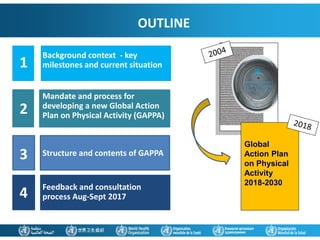
OUTLINE
1
2
3
4
Background context - key
milestones and current situation
Feedback and consultation
process Aug-Sept 2017
Mandate and process for
developing a new Global Action
Plan on Physical Activity (GAPPA)
Structure and contents of GAPPA
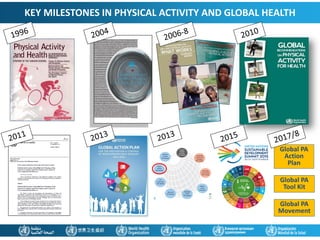
Global PA
Action
Plan
Global PA
Tool Kit
Global PA
Movement
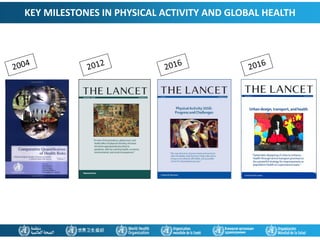
KEY MILESTONES IN PHYSICAL ACTIVITY AND GLOBAL HEALTH
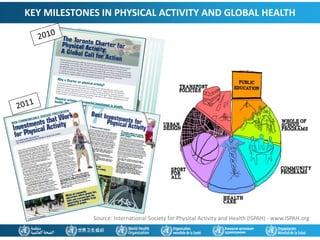
Source: International Society for Physical Activity and Health (ISPAH) - www.ISPAH.org
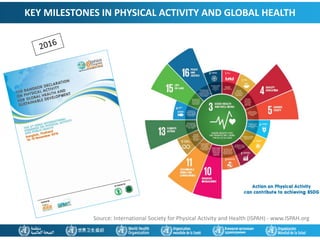
KEY MILESTONES IN PHYSICAL ACTIVITY AND GLOBAL HEALTH
Source: International Society for Physical Activity and Health (ISPAH) - www.ISPAH.org
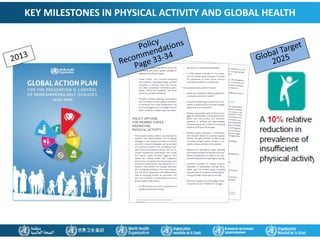
KEY MILESTONES IN PHYSICAL ACTIVITY AND GLOBAL HEALTH
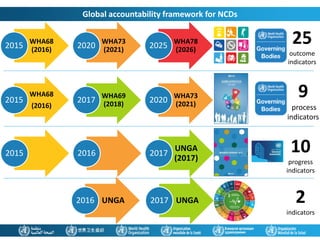
WHA68
(2016)2015
WHA73
(2021)2020
WHA78
(2026)2025
WHA68
(2016)
2015
WHA69
(2018)2017
WHA73
(2021)2020
2015 2016
UNGA
(2017)
2017
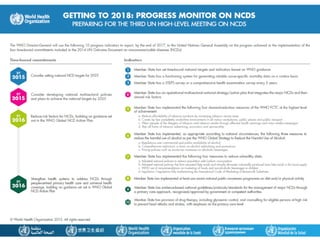
Global accountability framework for NCDs
2018
UNGA2016 UNGA2017
25
outcome
indicators
9
process
indicators
10
progress
indicators
2
indicators
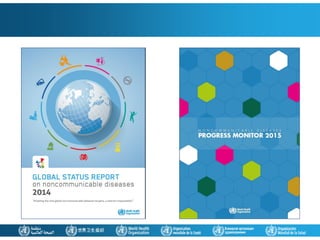
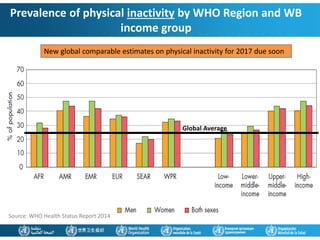
Source: WHO Health Status Report 2014
Prevalence of physical inactivity by WHO Region and WB
income group
New global comparable estimates on physical inactivity for 2017 due soon
Global Average
0
10
20
30
40
50
60
70
80
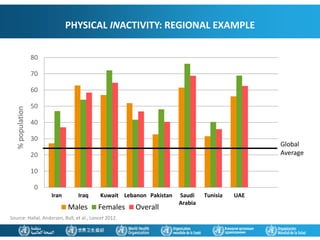
Iran Iraq Kuwait Lebanon Pakistan Saudi
Arabia
Tunisia UAE
Males Females Overall
Source: Hallal, Andersen, Bull, et al., Lancet 2012.
Global
Average
PHYSICAL INACTIVITY: REGIONAL EXAMPLE
%population
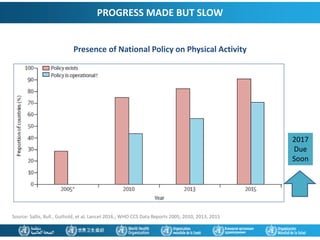
Source: Sallis, Bull , Guthold, et al, Lancet 2016.; WHO CCS Data Reports 2005, 2010, 2013, 2015
PROGRESS MADE BUT SLOW
Presence of National Policy on Physical Activity
2017
Due
Soon
A New Global Physical Activity Action Plan
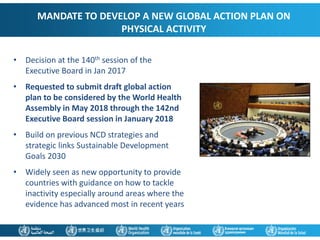
• Decision at the 140th session of the
Executive Board in Jan 2017
• Requested to submit draft global action
plan to be considered by the World Health
Assembly in May 2018 through the 142nd
Executive Board session in January 2018
• Build on previous NCD strategies and
strategic links Sustainable Development
Goals 2030
• Widely seen as new opportunity to provide
countries with guidance on how to tackle
inactivity especially around areas where the
evidence has advanced most in recent years
MANDATE TO DEVELOP A NEW GLOBAL ACTION PLAN ON
PHYSICAL ACTIVITY
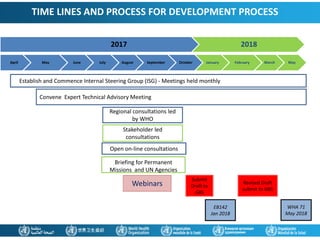
April May June July August September October January February March May
2017 2018
Establish and Commence Internal Steering Group (ISG) - Meetings held monthly
Convene Expert Technical Advisory Meeting
Submit
Draft to
GBS
Open on-line consultations
EB142
Jan 2018
Briefing for Permanent
Missions and UN Agencies
Revised Draft
submit to GBS
WHA 71
May 2018
Stakeholder led
consultations
Regional consultations led
by WHO
Webinars
TIME LINES AND PROCESS FOR DEVELOPMENT PROCESS
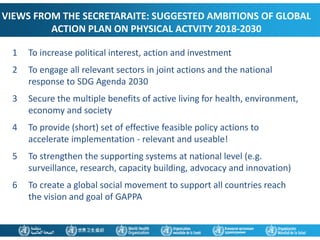
1 To increase political interest, action and investment
2 To engage all relevant sectors in joint actions and the national
response to SDG Agenda 2030
3 Secure the multiple benefits of active living for health, environment,
economy and society
4 To provide (short) set of effective feasible policy actions to
accelerate implementation - relevant and useable!
5 To strengthen the supporting systems at national level (e.g.
surveillance, research, capacity building, advocacy and innovation)
6 To create a global social movement to support all countries reach
the vision and goal of GAPPA
VIEWS FROM THE SECRETARAITE: SUGGESTED AMBITIONS OF GLOBAL
ACTION PLAN ON PHYSICAL ACTVITY 2018-2030
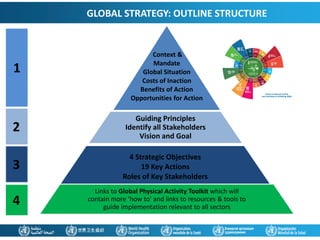
Context &
Mandate
Global Situation
Costs of Inaction
Benefits of Action
Opportunities for Action
Guiding Principles
Identify all Stakeholders
Vision and Goal
4 Strategic Objectives
19 Key Actions
Roles of Key Stakeholders
Links to Global Physical Activity Toolkit which will
contain more ‘how to’ and links to resources & tools to
guide implementation relevant to all sectors
1
2
3
4
GLOBAL STRATEGY: OUTLINE STRUCTURE
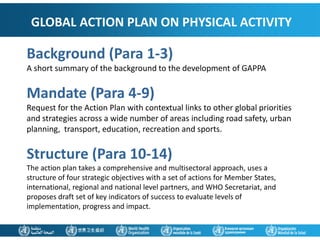
GLOBAL ACTION PLAN ON PHYSICAL ACTIVITY
Background (Para 1-3)
A short summary of the background to the development of GAPPA
Mandate (Para 4-9)
Request for the Action Plan with contextual links to other global priorities
and strategies across a wide number of areas including road safety, urban
planning, transport, education, recreation and sports.
Structure (Para 10-14)
The action plan takes a comprehensive and multisectoral approach, uses a
structure of four strategic objectives with a set of actions for Member States,
international, regional and national level partners, and WHO Secretariat, and
proposes draft set of key indicators of success to evaluate levels of
implementation, progress and impact.
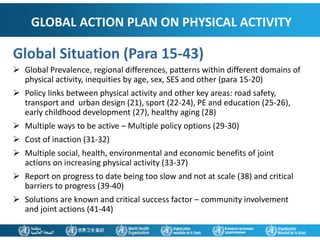
GLOBAL ACTION PLAN ON PHYSICAL ACTIVITY
Global Situation (Para 15-43)
 Global Prevalence, regional differences, patterns within different domains of
physical activity, inequities by age, sex, SES and other (para 15-20)
 Policy links between physical activity and other key areas: road safety,
transport and urban design (21), sport (22-24), PE and education (25-26),
early childhood development (27), healthy aging (28)
 Multiple ways to be active – Multiple policy options (29-30)
 Cost of inaction (31-32)
 Multiple social, health, environmental and economic benefits of joint
actions on increasing physical activity (33-37)
 Report on progress to date being too slow and not at scale (38) and critical
barriers to progress (39-40)
 Solutions are known and critical success factor – community involvement
and joint actions (41-44)
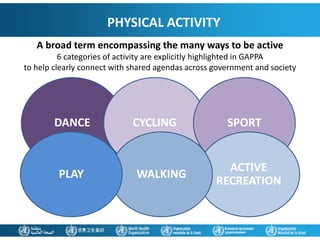
PHYSICAL ACTIVITY
DANCE CYCLING SPORT
ACTIVE
RECREATION
WALKINGPLAY
A broad term encompassing the many ways to be active
6 categories of activity are explicitly highlighted in GAPPA
to help clearly connect with shared agendas across government and society
GLOBAL ACTION PLAN ON PHYSICAL ACTIVITY
Vision (para 45)
A world where all countries provide the enabling environments and
opportunities for all citizens to be physically active and through this
enhance the social, cultural, economic development and wellbeing of
nations
Goal (para 46)
One hundred million people more active by 2030
GLOBAL ACTION PLAN ON PHYSICAL ACTIVITY
Guiding Principles (Para 47)
1. Life course approach
2. Equity
3. Empowerment of peoples, families and communities
4. Human Rights-based approach
5. Evidence based practice
6. Cross-sectoral Engagement and Partnership for Joint Action
7. Policy coherence
8. Universal health coverage
GLOBAL ACTION PLAN ON PHYSICAL ACTIVITY
Partners (Para 48-49)
Effective implementation will require actions by Member States, the WHO Secretariat as
well as international, regional and national partners including but are not limited to:
 Development agencies including international financial institutions (WB and regional
development banks, sub-regional intergovernmental agencies and bilateral
development aid agencies;
 Intergovernmental organizations including UN agencies and global health initiatives
 Academic and research institutions including the network of WHO collaborating
centres and other related networks;
 Non-governmental organizations including civil society, community-based
organizations, human rights-based organizations, faith-based organizations and
associations of health care professionals and service providers.
 Philanthropic foundations that are committed to promoting public health
 Selected private sector entities that commit to the objectives of the action plan
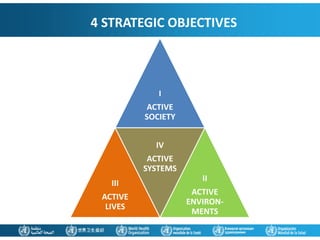
I
ACTIVE
SOCIETY
III
ACTIVE
LIVES
IV
ACTIVE
SYSTEMS
II
ACTIVE
ENVIRON-
MENTS
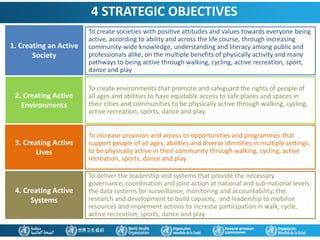
4 STRATEGIC OBJECTIVES
1. Creating an Active
Society
2. Creating Active
Environments
3. Creating Active
Lives
4. Creating Active
Systems
To create societies with positive attitudes and values towards everyone being
active, according to ability and across the life course, through increasing
community-wide knowledge, understanding and literacy among public and
professionals alike, on the multiple benefits of physically activity and many
pathways to being active through walking, cycling, active recreation, sport,
dance and play
To create environments that promote and safeguard the rights of people of
all ages and abilities to have equitable access to safe places and spaces in
their cities and communities to be physically active through walking, cycling,
active recreation, sports, dance and play.
To deliver the leadership and systems that provide the necessary
governance, coordination and joint action at national and sub-national levels;
the data systems for surveillance, monitoring and accountability; the
research and development to build capacity, and leadership to mobilise
resources and implement actions to increase participation in walk, cycle,
active recreation, sports, dance and play
To increase provision and access to opportunities and programmes that
support people of all ages, abilities and diverse identities in multiple settings,
to be physically active in their community through walking, cycling, active
recreation, sports, dance and play.
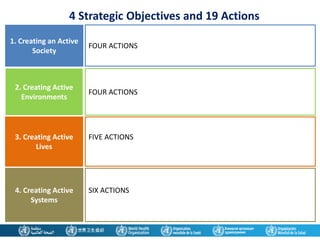
4 Strategic Objectives and 19 Actions
1. Creating an Active
Society
2. Creating Active
Environments
3. Creating Active
Lives
4. Creating Active
Systems
FOUR ACTIONS
FOUR ACTIONS
FIVE ACTIONS
SIX ACTIONS
1. Creating an Active
Society
2. Creating Active
Environments
3. Creating Active
Lives
4. Creating Active
Systems
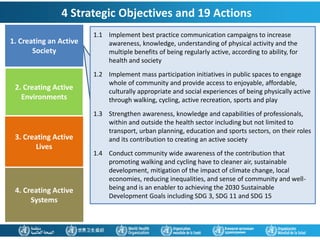
1.1 Implement best practice communication campaigns to increase
awareness, knowledge, understanding of physical activity and the
multiple benefits of being regularly active, according to ability, for
health and society
1.2 Implement mass participation initiatives in public spaces to engage
whole of community and provide access to enjoyable, affordable,
culturally appropriate and social experiences of being physically active
through walking, cycling, active recreation, sports and play
1.3 Strengthen awareness, knowledge and capabilities of professionals,
within and outside the health sector including but not limited to
transport, urban planning, education and sports sectors, on their roles
and its contribution to creating an active society
1.4 Conduct community wide awareness of the contribution that
promoting walking and cycling have to cleaner air, sustainable
development, mitigation of the impact of climate change, local
economies, reducing inequalities, and sense of community and well-
being and is an enabler to achieving the 2030 Sustainable
Development Goals including SDG 3, SDG 11 and SDG 15
4 Strategic Objectives and 19 Actions
1. Creating an Active
Society
2. Creating Active
Environments
3. Creating Active
Lives
4. Creating Active
Systems
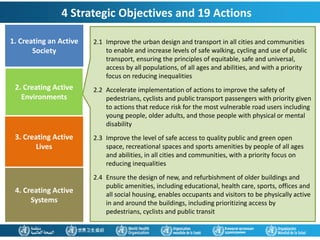
2.1 Improve the urban design and transport in all cities and communities
to enable and increase levels of safe walking, cycling and use of public
transport, ensuring the principles of equitable, safe and universal,
access by all populations, of all ages and abilities, and with a priority
focus on reducing inequalities
2.2 Accelerate implementation of actions to improve the safety of
pedestrians, cyclists and public transport passengers with priority given
to actions that reduce risk for the most vulnerable road users including
young people, older adults, and those people with physical or mental
disability
2.3 Improve the level of safe access to quality public and green open
space, recreational spaces and sports amenities by people of all ages
and abilities, in all cities and communities, with a priority focus on
reducing inequalities
2.4 Ensure the design of new, and refurbishment of older buildings and
public amenities, including educational, health care, sports, offices and
all social housing, enables occupants and visitors to be physically active
in and around the buildings, including prioritizing access by
pedestrians, cyclists and public transit
4 Strategic Objectives and 19 Actions
1. Creating an Active
Society
2. Creating Active
Environments
3. Creating Active
Lives
4. Creating Active
Systems
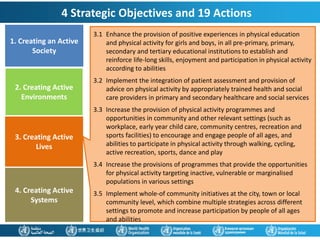
3.1 Enhance the provision of positive experiences in physical education
and physical activity for girls and boys, in all pre-primary, primary,
secondary and tertiary educational institutions to establish and
reinforce life-long skills, enjoyment and participation in physical activity
according to abilities
3.2 Implement the integration of patient assessment and provision of
advice on physical activity by appropriately trained health and social
care providers in primary and secondary healthcare and social services
3.3 Increase the provision of physical activity programmes and
opportunities in community and other relevant settings (such as
workplace, early year child care, community centres, recreation and
sports facilities) to encourage and engage people of all ages, and
abilities to participate in physical activity through walking, cycling,
active recreation, sports, dance and play
3.4 Increase the provisions of programmes that provide the opportunities
for physical activity targeting inactive, vulnerable or marginalised
populations in various settings
3.5 Implement whole-of community initiatives at the city, town or local
community level, which combine multiple strategies across different
settings to promote and increase participation by people of all ages
and abilities
4 Strategic Objectives and 19 Actions
1. Creating an Active
Society
2. Creating Active
Environments
3. Creating Active
Lives
4. Creating Active
Systems
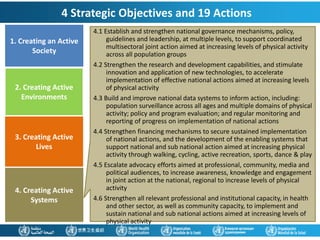
4.1 Establish and strengthen national governance mechanisms, policy,
guidelines and leadership, at multiple levels, to support coordinated
multisectoral joint action aimed at increasing levels of physical activity
across all population groups
4.2 Strengthen the research and development capabilities, and stimulate
innovation and application of new technologies, to accelerate
implementation of effective national actions aimed at increasing levels
of physical activity
4.3 Build and improve national data systems to inform action, including:
population surveillance across all ages and multiple domains of physical
activity; policy and program evaluation; and regular monitoring and
reporting of progress on implementation of national actions
4.4 Strengthen financing mechanisms to secure sustained implementation
of national actions, and the development of the enabling systems that
support national and sub national action aimed at increasing physical
activity through walking, cycling, active recreation, sports, dance & play
4.5 Escalate advocacy efforts aimed at professional, community, media and
political audiences, to increase awareness, knowledge and engagement
in joint action at the national, regional to increase levels of physical
activity
4.6 Strengthen all relevant professional and institutional capacity, in health
and other sector, as well as community capacity, to implement and
sustain national and sub national actions aimed at increasing levels of
physical activity
4 Strategic Objectives and 19 Actions
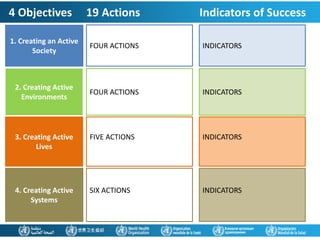
4 Objectives 19 Actions Indicators of Success
1. Creating an Active
Society
2. Creating Active
Environments
3. Creating Active
Lives
4. Creating Active
Systems
FOUR ACTIONS
FOUR ACTIONS
FIVE ACTIONS
SIX ACTIONS
INDICATORS
INDICATORS
INDICATORS
INDICATORS
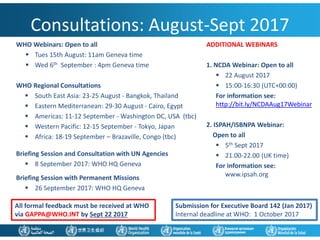
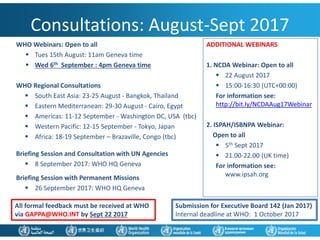
WHO Webinars: Open to all
 Tues 15th August: 11am Geneva time
 Wed 6th September : 4pm Geneva time
WHO Regional Consultations
 South East Asia: 23-25 August - Bangkok, Thailand
 Eastern Mediterranean: 29-30 August - Cairo, Egypt
 Americas: 11-12 September - Washington DC, USA (tbc)
 Western Pacific: 12-15 September - Tokyo, Japan
 Africa: 18-19 September – Brazaville, Congo (tbc)
Briefing Session and Consultation with UN Agencies
 8 September 2017: WHO HQ Geneva
Briefing Session with Permanent Missions
 26 September 2017: WHO HQ Geneva
Consultations: August-Sept 2017
ADDITIONAL WEBINARS
1. NCDA Webinar: Open to all
 22 August 2017
 15:00-16:30 (UTC+00:00)
For information see:
http://bit.ly/NCDAAug17Webinar
2. ISPAH/ISBNPA Webinar:
Open to all
 5th Sept 2017
 21.00-22.00 (UK time)
For information see:
www.ipsah.org
Submission for Executive Board 142 (Jan 2017)
Internal deadline at WHO: 1 October 2017
All formal feedback must be received at WHO
via GAPPA@WHO.INT by Sept 22 2017
FEEDBACK
1. What is missing in argument, in examples, in policy actions, in
roles?
2. Links to the SDG agenda and other sectors?
3. Structure of document:
– Use of four objectives?
– Listed policy actions - sufficient, comprehensive and feasible ?
– Focus on walk, cycle, active recreations, sport, dance and play ?
4. Overall clarity and usefulness for end users to achieve intended
impact
Comments on any other issues are welcome
THANK YOU
OPEN FOR QUESTIONS
PLEASE USE CHAT BOX TO ASK QUESTIONS
All participants are automatically on mute to avoid excessive background noise.
Please use chat box for comments and questions. Any problems email GAPPA@who.int
WHO Webinars: Open to all
 Tues 15th August: 11am Geneva time
 Wed 6th September : 4pm Geneva time
WHO Regional Consultations
 South East Asia: 23-25 August - Bangkok, Thailand
 Eastern Mediterranean: 29-30 August - Cairo, Egypt
 Americas: 11-12 September - Washington DC, USA (tbc)
 Western Pacific: 12-15 September - Tokyo, Japan
 Africa: 18-19 September – Brazaville, Congo (tbc)
Briefing Session and Consultation with UN Agencies
 8 September 2017: WHO HQ Geneva
Briefing Session with Permanent Missions
 26 September 2017: WHO HQ Geneva
Consultations: August-Sept 2017
ADDITIONAL WEBINARS
1. NCDA Webinar: Open to all
 22 August 2017
 15:00-16:30 (UTC+00:00)
For information see:
http://bit.ly/NCDAAug17Webinar
2. ISPAH/ISBNPA Webinar:
Open to all
 5th Sept 2017
 21.00-22.00 (UK time)
For information see:
www.ipsah.org
Submission for Executive Board 142 (Jan 2017)
Internal deadline at WHO: 1 October 2017
All formal feedback must be received at WHO
via GAPPA@WHO.INT by Sept 22 2017

Who webinar-gappa-15 august2017

  • 1.
    WEBINAR DRAFT GLOBAL ACTIONPLAN ON PHYSICAL ACTIVITY AUGUST 15 2017 COMMENCING: 11AM GENEVA TIME (60 MINS) All participants are automatically on mute to avoid excessive background noise. Please use chat box for comments and questions. Any problems email GAPPA@who.int
  • 2.
    A New GlobalPhysical Activity Action Plan Global Action Plan on Physical Activity 2018-2030 OUTLINE 1 2 3 4 Background context - key milestones and current situation Feedback and consultation process Aug-Sept 2017 Mandate and process for developing a new Global Action Plan on Physical Activity (GAPPA) Structure and contents of GAPPA
  • 3.
    Global PA Action Plan Global PA ToolKit Global PA Movement KEY MILESTONES IN PHYSICAL ACTIVITY AND GLOBAL HEALTH
  • 4.
    Source: International Societyfor Physical Activity and Health (ISPAH) - www.ISPAH.org KEY MILESTONES IN PHYSICAL ACTIVITY AND GLOBAL HEALTH
  • 5.
    KEY MILESTONES INPHYSICAL ACTIVITY AND GLOBAL HEALTH
  • 6.
    Source: International Societyfor Physical Activity and Health (ISPAH) - www.ISPAH.org KEY MILESTONES IN PHYSICAL ACTIVITY AND GLOBAL HEALTH
  • 7.
    KEY MILESTONES INPHYSICAL ACTIVITY AND GLOBAL HEALTH
  • 8.
    WHA68 (2016)2015 WHA73 (2021)2020 WHA78 (2026)2025 WHA68 (2016) 2015 WHA69 (2018)2017 WHA73 (2021)2020 2015 2016 UNGA (2017) 2017 Global accountabilityframework for NCDs 2018 UNGA2016 UNGA2017 25 outcome indicators 9 process indicators 10 progress indicators 2 indicators
  • 11.
    Source: WHO HealthStatus Report 2014 Prevalence of physical inactivity by WHO Region and WB income group New global comparable estimates on physical inactivity for 2017 due soon Global Average
  • 12.
    0 10 20 30 40 50 60 70 80 Iran Iraq KuwaitLebanon Pakistan Saudi Arabia Tunisia UAE Males Females Overall Source: Hallal, Andersen, Bull, et al., Lancet 2012. Global Average PHYSICAL INACTIVITY: REGIONAL EXAMPLE %population
  • 13.
    Source: Sallis, Bull, Guthold, et al, Lancet 2016.; WHO CCS Data Reports 2005, 2010, 2013, 2015 PROGRESS MADE BUT SLOW Presence of National Policy on Physical Activity 2017 Due Soon
  • 14.
    A New GlobalPhysical Activity Action Plan • Decision at the 140th session of the Executive Board in Jan 2017 • Requested to submit draft global action plan to be considered by the World Health Assembly in May 2018 through the 142nd Executive Board session in January 2018 • Build on previous NCD strategies and strategic links Sustainable Development Goals 2030 • Widely seen as new opportunity to provide countries with guidance on how to tackle inactivity especially around areas where the evidence has advanced most in recent years MANDATE TO DEVELOP A NEW GLOBAL ACTION PLAN ON PHYSICAL ACTIVITY
  • 15.
    April May JuneJuly August September October January February March May 2017 2018 Establish and Commence Internal Steering Group (ISG) - Meetings held monthly Convene Expert Technical Advisory Meeting Submit Draft to GBS Open on-line consultations EB142 Jan 2018 Briefing for Permanent Missions and UN Agencies Revised Draft submit to GBS WHA 71 May 2018 Stakeholder led consultations Regional consultations led by WHO Webinars TIME LINES AND PROCESS FOR DEVELOPMENT PROCESS
  • 16.
    1 To increasepolitical interest, action and investment 2 To engage all relevant sectors in joint actions and the national response to SDG Agenda 2030 3 Secure the multiple benefits of active living for health, environment, economy and society 4 To provide (short) set of effective feasible policy actions to accelerate implementation - relevant and useable! 5 To strengthen the supporting systems at national level (e.g. surveillance, research, capacity building, advocacy and innovation) 6 To create a global social movement to support all countries reach the vision and goal of GAPPA VIEWS FROM THE SECRETARAITE: SUGGESTED AMBITIONS OF GLOBAL ACTION PLAN ON PHYSICAL ACTVITY 2018-2030
  • 17.
    Context & Mandate Global Situation Costsof Inaction Benefits of Action Opportunities for Action Guiding Principles Identify all Stakeholders Vision and Goal 4 Strategic Objectives 19 Key Actions Roles of Key Stakeholders Links to Global Physical Activity Toolkit which will contain more ‘how to’ and links to resources & tools to guide implementation relevant to all sectors 1 2 3 4 GLOBAL STRATEGY: OUTLINE STRUCTURE
  • 18.
    GLOBAL ACTION PLANON PHYSICAL ACTIVITY Background (Para 1-3) A short summary of the background to the development of GAPPA Mandate (Para 4-9) Request for the Action Plan with contextual links to other global priorities and strategies across a wide number of areas including road safety, urban planning, transport, education, recreation and sports. Structure (Para 10-14) The action plan takes a comprehensive and multisectoral approach, uses a structure of four strategic objectives with a set of actions for Member States, international, regional and national level partners, and WHO Secretariat, and proposes draft set of key indicators of success to evaluate levels of implementation, progress and impact.
  • 19.
    GLOBAL ACTION PLANON PHYSICAL ACTIVITY Global Situation (Para 15-43)  Global Prevalence, regional differences, patterns within different domains of physical activity, inequities by age, sex, SES and other (para 15-20)  Policy links between physical activity and other key areas: road safety, transport and urban design (21), sport (22-24), PE and education (25-26), early childhood development (27), healthy aging (28)  Multiple ways to be active – Multiple policy options (29-30)  Cost of inaction (31-32)  Multiple social, health, environmental and economic benefits of joint actions on increasing physical activity (33-37)  Report on progress to date being too slow and not at scale (38) and critical barriers to progress (39-40)  Solutions are known and critical success factor – community involvement and joint actions (41-44)
  • 20.
    PHYSICAL ACTIVITY DANCE CYCLINGSPORT ACTIVE RECREATION WALKINGPLAY A broad term encompassing the many ways to be active 6 categories of activity are explicitly highlighted in GAPPA to help clearly connect with shared agendas across government and society
  • 21.
    GLOBAL ACTION PLANON PHYSICAL ACTIVITY Vision (para 45) A world where all countries provide the enabling environments and opportunities for all citizens to be physically active and through this enhance the social, cultural, economic development and wellbeing of nations Goal (para 46) One hundred million people more active by 2030
  • 22.
    GLOBAL ACTION PLANON PHYSICAL ACTIVITY Guiding Principles (Para 47) 1. Life course approach 2. Equity 3. Empowerment of peoples, families and communities 4. Human Rights-based approach 5. Evidence based practice 6. Cross-sectoral Engagement and Partnership for Joint Action 7. Policy coherence 8. Universal health coverage
  • 23.
    GLOBAL ACTION PLANON PHYSICAL ACTIVITY Partners (Para 48-49) Effective implementation will require actions by Member States, the WHO Secretariat as well as international, regional and national partners including but are not limited to:  Development agencies including international financial institutions (WB and regional development banks, sub-regional intergovernmental agencies and bilateral development aid agencies;  Intergovernmental organizations including UN agencies and global health initiatives  Academic and research institutions including the network of WHO collaborating centres and other related networks;  Non-governmental organizations including civil society, community-based organizations, human rights-based organizations, faith-based organizations and associations of health care professionals and service providers.  Philanthropic foundations that are committed to promoting public health  Selected private sector entities that commit to the objectives of the action plan
  • 24.
  • 25.
    4 STRATEGIC OBJECTIVES 1.Creating an Active Society 2. Creating Active Environments 3. Creating Active Lives 4. Creating Active Systems To create societies with positive attitudes and values towards everyone being active, according to ability and across the life course, through increasing community-wide knowledge, understanding and literacy among public and professionals alike, on the multiple benefits of physically activity and many pathways to being active through walking, cycling, active recreation, sport, dance and play To create environments that promote and safeguard the rights of people of all ages and abilities to have equitable access to safe places and spaces in their cities and communities to be physically active through walking, cycling, active recreation, sports, dance and play. To deliver the leadership and systems that provide the necessary governance, coordination and joint action at national and sub-national levels; the data systems for surveillance, monitoring and accountability; the research and development to build capacity, and leadership to mobilise resources and implement actions to increase participation in walk, cycle, active recreation, sports, dance and play To increase provision and access to opportunities and programmes that support people of all ages, abilities and diverse identities in multiple settings, to be physically active in their community through walking, cycling, active recreation, sports, dance and play.
  • 26.
    4 Strategic Objectivesand 19 Actions 1. Creating an Active Society 2. Creating Active Environments 3. Creating Active Lives 4. Creating Active Systems FOUR ACTIONS FOUR ACTIONS FIVE ACTIONS SIX ACTIONS
  • 27.
    1. Creating anActive Society 2. Creating Active Environments 3. Creating Active Lives 4. Creating Active Systems 1.1 Implement best practice communication campaigns to increase awareness, knowledge, understanding of physical activity and the multiple benefits of being regularly active, according to ability, for health and society 1.2 Implement mass participation initiatives in public spaces to engage whole of community and provide access to enjoyable, affordable, culturally appropriate and social experiences of being physically active through walking, cycling, active recreation, sports and play 1.3 Strengthen awareness, knowledge and capabilities of professionals, within and outside the health sector including but not limited to transport, urban planning, education and sports sectors, on their roles and its contribution to creating an active society 1.4 Conduct community wide awareness of the contribution that promoting walking and cycling have to cleaner air, sustainable development, mitigation of the impact of climate change, local economies, reducing inequalities, and sense of community and well- being and is an enabler to achieving the 2030 Sustainable Development Goals including SDG 3, SDG 11 and SDG 15 4 Strategic Objectives and 19 Actions
  • 28.
    1. Creating anActive Society 2. Creating Active Environments 3. Creating Active Lives 4. Creating Active Systems 2.1 Improve the urban design and transport in all cities and communities to enable and increase levels of safe walking, cycling and use of public transport, ensuring the principles of equitable, safe and universal, access by all populations, of all ages and abilities, and with a priority focus on reducing inequalities 2.2 Accelerate implementation of actions to improve the safety of pedestrians, cyclists and public transport passengers with priority given to actions that reduce risk for the most vulnerable road users including young people, older adults, and those people with physical or mental disability 2.3 Improve the level of safe access to quality public and green open space, recreational spaces and sports amenities by people of all ages and abilities, in all cities and communities, with a priority focus on reducing inequalities 2.4 Ensure the design of new, and refurbishment of older buildings and public amenities, including educational, health care, sports, offices and all social housing, enables occupants and visitors to be physically active in and around the buildings, including prioritizing access by pedestrians, cyclists and public transit 4 Strategic Objectives and 19 Actions
  • 29.
    1. Creating anActive Society 2. Creating Active Environments 3. Creating Active Lives 4. Creating Active Systems 3.1 Enhance the provision of positive experiences in physical education and physical activity for girls and boys, in all pre-primary, primary, secondary and tertiary educational institutions to establish and reinforce life-long skills, enjoyment and participation in physical activity according to abilities 3.2 Implement the integration of patient assessment and provision of advice on physical activity by appropriately trained health and social care providers in primary and secondary healthcare and social services 3.3 Increase the provision of physical activity programmes and opportunities in community and other relevant settings (such as workplace, early year child care, community centres, recreation and sports facilities) to encourage and engage people of all ages, and abilities to participate in physical activity through walking, cycling, active recreation, sports, dance and play 3.4 Increase the provisions of programmes that provide the opportunities for physical activity targeting inactive, vulnerable or marginalised populations in various settings 3.5 Implement whole-of community initiatives at the city, town or local community level, which combine multiple strategies across different settings to promote and increase participation by people of all ages and abilities 4 Strategic Objectives and 19 Actions
  • 30.
    1. Creating anActive Society 2. Creating Active Environments 3. Creating Active Lives 4. Creating Active Systems 4.1 Establish and strengthen national governance mechanisms, policy, guidelines and leadership, at multiple levels, to support coordinated multisectoral joint action aimed at increasing levels of physical activity across all population groups 4.2 Strengthen the research and development capabilities, and stimulate innovation and application of new technologies, to accelerate implementation of effective national actions aimed at increasing levels of physical activity 4.3 Build and improve national data systems to inform action, including: population surveillance across all ages and multiple domains of physical activity; policy and program evaluation; and regular monitoring and reporting of progress on implementation of national actions 4.4 Strengthen financing mechanisms to secure sustained implementation of national actions, and the development of the enabling systems that support national and sub national action aimed at increasing physical activity through walking, cycling, active recreation, sports, dance & play 4.5 Escalate advocacy efforts aimed at professional, community, media and political audiences, to increase awareness, knowledge and engagement in joint action at the national, regional to increase levels of physical activity 4.6 Strengthen all relevant professional and institutional capacity, in health and other sector, as well as community capacity, to implement and sustain national and sub national actions aimed at increasing levels of physical activity 4 Strategic Objectives and 19 Actions
  • 31.
    4 Objectives 19Actions Indicators of Success 1. Creating an Active Society 2. Creating Active Environments 3. Creating Active Lives 4. Creating Active Systems FOUR ACTIONS FOUR ACTIONS FIVE ACTIONS SIX ACTIONS INDICATORS INDICATORS INDICATORS INDICATORS
  • 32.
    WHO Webinars: Opento all  Tues 15th August: 11am Geneva time  Wed 6th September : 4pm Geneva time WHO Regional Consultations  South East Asia: 23-25 August - Bangkok, Thailand  Eastern Mediterranean: 29-30 August - Cairo, Egypt  Americas: 11-12 September - Washington DC, USA (tbc)  Western Pacific: 12-15 September - Tokyo, Japan  Africa: 18-19 September – Brazaville, Congo (tbc) Briefing Session and Consultation with UN Agencies  8 September 2017: WHO HQ Geneva Briefing Session with Permanent Missions  26 September 2017: WHO HQ Geneva Consultations: August-Sept 2017 ADDITIONAL WEBINARS 1. NCDA Webinar: Open to all  22 August 2017  15:00-16:30 (UTC+00:00) For information see: http://bit.ly/NCDAAug17Webinar 2. ISPAH/ISBNPA Webinar: Open to all  5th Sept 2017  21.00-22.00 (UK time) For information see: www.ipsah.org Submission for Executive Board 142 (Jan 2017) Internal deadline at WHO: 1 October 2017 All formal feedback must be received at WHO via GAPPA@WHO.INT by Sept 22 2017
  • 33.
    FEEDBACK 1. What ismissing in argument, in examples, in policy actions, in roles? 2. Links to the SDG agenda and other sectors? 3. Structure of document: – Use of four objectives? – Listed policy actions - sufficient, comprehensive and feasible ? – Focus on walk, cycle, active recreations, sport, dance and play ? 4. Overall clarity and usefulness for end users to achieve intended impact Comments on any other issues are welcome
  • 34.
    THANK YOU OPEN FORQUESTIONS PLEASE USE CHAT BOX TO ASK QUESTIONS All participants are automatically on mute to avoid excessive background noise. Please use chat box for comments and questions. Any problems email GAPPA@who.int
  • 35.
    WHO Webinars: Opento all  Tues 15th August: 11am Geneva time  Wed 6th September : 4pm Geneva time WHO Regional Consultations  South East Asia: 23-25 August - Bangkok, Thailand  Eastern Mediterranean: 29-30 August - Cairo, Egypt  Americas: 11-12 September - Washington DC, USA (tbc)  Western Pacific: 12-15 September - Tokyo, Japan  Africa: 18-19 September – Brazaville, Congo (tbc) Briefing Session and Consultation with UN Agencies  8 September 2017: WHO HQ Geneva Briefing Session with Permanent Missions  26 September 2017: WHO HQ Geneva Consultations: August-Sept 2017 ADDITIONAL WEBINARS 1. NCDA Webinar: Open to all  22 August 2017  15:00-16:30 (UTC+00:00) For information see: http://bit.ly/NCDAAug17Webinar 2. ISPAH/ISBNPA Webinar: Open to all  5th Sept 2017  21.00-22.00 (UK time) For information see: www.ipsah.org Submission for Executive Board 142 (Jan 2017) Internal deadline at WHO: 1 October 2017 All formal feedback must be received at WHO via GAPPA@WHO.INT by Sept 22 2017