What we talk about when
we talk about concepts
Applying distributional semantics
on Dutch historical newspapers to
trace conceptual change
Pim Huijnen - Utrecht University
AIUCD Rome, 26 January 2017
Tracing Concepts over time in Dutch
Newspaper Discourse (1950-1990) using
Word Embeddings
Tom Kenter (University of Amsterdam)
Melvin Wevers (Utrecht University)
Carlos Martinez-Ortiz (NL eScience Center)
Joris van Eijnatten (Utrecht University)
Jaap Verheul (Utrecht University)
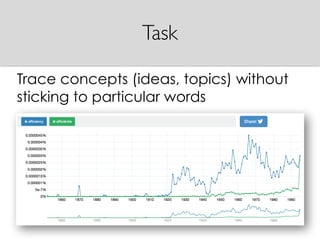
Task
Trace concepts (ideas, topics) without
sticking to particular words
Approach
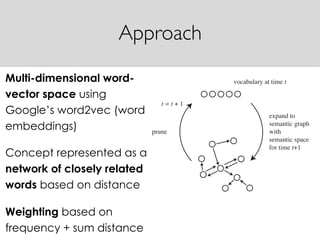
Multi-dimensional word-
vector space using
Google’s word2vec (word
embeddings)
Concept represented as a
network of closely related
words based on distance
Weighting based on
frequency + sum distance
expand to
semantic graph
with
semantic space
for time t+1
vocabulary at time t
prune
t = t + 1
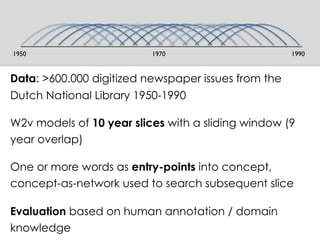
1950 1970 1990
Data: >600.000 digitized newspaper issues from the
Dutch National Library 1950-1990
W2v models of 10 year slices with a sliding window (9
year overlap)
One or more words as entry-points into concept,
concept-as-network used to search subsequent slice
Evaluation based on human annotation / domain
knowledge
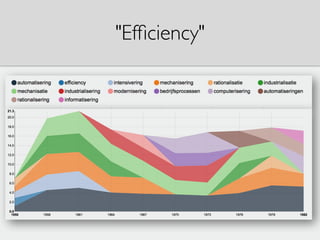
"Efficiency"
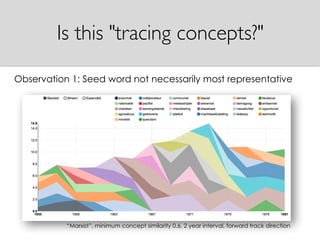
Observation 1: Seed word not necessarily most representative
“Marxist”, minimum concept similarity 0.6, 2 year interval, forward track direction
Is this "tracing concepts?"
Observation 2: No optimal settings to avoid “concept drift"
>>> tc.trackClouds3(dModels, ['gastarbeider', 'gastarbeiders', 'immigranten'], fMinDist=.65,
bSumOfDistances=True, bBackwards=True)
1981_1990: immigranten (1.34), gastarbeiders (1.34), gastarbeider (1.00), vluchtelingen (0.33), emigranten (0.29)
1980_1989: immigranten (1.89), vluchtelingen (1.32), gastarbeiders (1.30), emigranten (1.27), gastarbeider (1.00), afghanen (0.35),
vietnamezen (0.34), tamils (0.33), asielzoekers (0.27)
1979_1988: vluchtelingen (1.93), vietnamezen (1.64), immigranten (1.63), gastarbeiders (1.32), asielzoekers (1.32), emigranten
(1.30), afghanen (1.30), tamils (1.27), gastarbeider (1.00), cambodjanen (0.89)
1978_1987: vluchtelingen (2.30), cambodjanen (1.88), vietnamezen (1.86), asielzoekers (1.65), tamils (1.61), immigranten (1.59),
afghanen (1.58), gastarbeiders (1.33), emigranten (1.26), gastarbeider (1.00)
1977_1986: asielzoekers (1.68), afghanen (1.65), cambodjanen (1.61), vietnamezen (1.59), tamils (1.35), vluchtelingen (1.33),
gastarbeiders (1.33), immigranten (1.33), emigranten (1.00), gastarbeider (1.00)
[…]
1957_1966: vietkong (2.39), regeringstroepen (2.38), vietcong (2.30), guerrillastrijders (2.18), rebellen (2.13), viëtcong (1.52),
zuidvietnamezen (1.32), vietnamezen (1.32), opstandelingen (1.22), guerillastrijders (1.12)
1956_1965: opstandelingen (2.85), rebellen (2.85), vietcong (2.62), regeringstroepen (2.59), guerrillastrijders (2.19), vietkong (2.18),
guerillastrijders (2.09), viëtcong (1.49), vietminh (1.31), vrijheidsstrijders (1.27)
1955_1964: guerillastrijders (2.83), guerrillastrijders (2.56), vietkong (2.33), opstandelingen (2.31), rebellen (2.28), regeringstroepen
(2.07), vietcong (1.35), vrijheidsstrijders (1.34), vietminh (1.32), viëtcong (1.00)
1954_1963: guerillastrijders (1.90), regeringstroepen (1.79), vietcong (1.67), rebellen (1.67), guerrillastrijders (1.60), vietkong (1.35),
opstandelingen (1.31), vrijheidsstrijders (1.00), vietminh (1.00), viëtcong (1.00)
Is this "tracing concepts?"
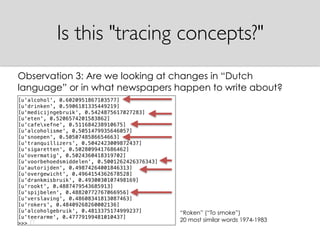
Observation 3: Are we looking at changes in “Dutch
language” or in what newspapers happen to write about?
Is this "tracing concepts?"
“Roken” (“To smoke”)
20 most similar words 1974-1983
Very interesting but also highly exploratory:
no singular theory of concepts /
conceptual change for every kind of data
So no absolute guarantee of avoiding
concept drift based on word embeddings
alone
Conclusion
Know your data
Build flexibility (and transparency) into
technical setup
Iterate between close and distant
Follow-up: testing of different kinds of
data, conceptual theories on the basis of
historical use cases
Conclusion
Do it yourself
Find our code / how-to-manual /data
models on:
https://github.com/NLeSC/ShiCo
Thank you!
www.pimhuijnen.com
p.huijnen@uu.nl

What we talk about when we talk about concepts

  • 1.
    What we talkabout when we talk about concepts Applying distributional semantics on Dutch historical newspapers to trace conceptual change Pim Huijnen - Utrecht University AIUCD Rome, 26 January 2017
  • 2.
    Tracing Concepts overtime in Dutch Newspaper Discourse (1950-1990) using Word Embeddings Tom Kenter (University of Amsterdam) Melvin Wevers (Utrecht University) Carlos Martinez-Ortiz (NL eScience Center) Joris van Eijnatten (Utrecht University) Jaap Verheul (Utrecht University)
  • 3.
    Task Trace concepts (ideas,topics) without sticking to particular words
  • 4.
    Approach Multi-dimensional word- vector spaceusing Google’s word2vec (word embeddings) Concept represented as a network of closely related words based on distance Weighting based on frequency + sum distance expand to semantic graph with semantic space for time t+1 vocabulary at time t prune t = t + 1
  • 5.
    1950 1970 1990 Data:>600.000 digitized newspaper issues from the Dutch National Library 1950-1990 W2v models of 10 year slices with a sliding window (9 year overlap) One or more words as entry-points into concept, concept-as-network used to search subsequent slice Evaluation based on human annotation / domain knowledge
  • 6.
  • 7.
    Observation 1: Seedword not necessarily most representative “Marxist”, minimum concept similarity 0.6, 2 year interval, forward track direction Is this "tracing concepts?"
  • 8.
    Observation 2: Nooptimal settings to avoid “concept drift" >>> tc.trackClouds3(dModels, ['gastarbeider', 'gastarbeiders', 'immigranten'], fMinDist=.65, bSumOfDistances=True, bBackwards=True) 1981_1990: immigranten (1.34), gastarbeiders (1.34), gastarbeider (1.00), vluchtelingen (0.33), emigranten (0.29) 1980_1989: immigranten (1.89), vluchtelingen (1.32), gastarbeiders (1.30), emigranten (1.27), gastarbeider (1.00), afghanen (0.35), vietnamezen (0.34), tamils (0.33), asielzoekers (0.27) 1979_1988: vluchtelingen (1.93), vietnamezen (1.64), immigranten (1.63), gastarbeiders (1.32), asielzoekers (1.32), emigranten (1.30), afghanen (1.30), tamils (1.27), gastarbeider (1.00), cambodjanen (0.89) 1978_1987: vluchtelingen (2.30), cambodjanen (1.88), vietnamezen (1.86), asielzoekers (1.65), tamils (1.61), immigranten (1.59), afghanen (1.58), gastarbeiders (1.33), emigranten (1.26), gastarbeider (1.00) 1977_1986: asielzoekers (1.68), afghanen (1.65), cambodjanen (1.61), vietnamezen (1.59), tamils (1.35), vluchtelingen (1.33), gastarbeiders (1.33), immigranten (1.33), emigranten (1.00), gastarbeider (1.00) […] 1957_1966: vietkong (2.39), regeringstroepen (2.38), vietcong (2.30), guerrillastrijders (2.18), rebellen (2.13), viëtcong (1.52), zuidvietnamezen (1.32), vietnamezen (1.32), opstandelingen (1.22), guerillastrijders (1.12) 1956_1965: opstandelingen (2.85), rebellen (2.85), vietcong (2.62), regeringstroepen (2.59), guerrillastrijders (2.19), vietkong (2.18), guerillastrijders (2.09), viëtcong (1.49), vietminh (1.31), vrijheidsstrijders (1.27) 1955_1964: guerillastrijders (2.83), guerrillastrijders (2.56), vietkong (2.33), opstandelingen (2.31), rebellen (2.28), regeringstroepen (2.07), vietcong (1.35), vrijheidsstrijders (1.34), vietminh (1.32), viëtcong (1.00) 1954_1963: guerillastrijders (1.90), regeringstroepen (1.79), vietcong (1.67), rebellen (1.67), guerrillastrijders (1.60), vietkong (1.35), opstandelingen (1.31), vrijheidsstrijders (1.00), vietminh (1.00), viëtcong (1.00) Is this "tracing concepts?"
  • 9.
    Observation 3: Arewe looking at changes in “Dutch language” or in what newspapers happen to write about? Is this "tracing concepts?" “Roken” (“To smoke”) 20 most similar words 1974-1983
  • 10.
    Very interesting butalso highly exploratory: no singular theory of concepts / conceptual change for every kind of data So no absolute guarantee of avoiding concept drift based on word embeddings alone Conclusion
  • 11.
    Know your data Buildflexibility (and transparency) into technical setup Iterate between close and distant Follow-up: testing of different kinds of data, conceptual theories on the basis of historical use cases Conclusion
  • 12.
    Do it yourself Findour code / how-to-manual /data models on: https://github.com/NLeSC/ShiCo
  • 13.