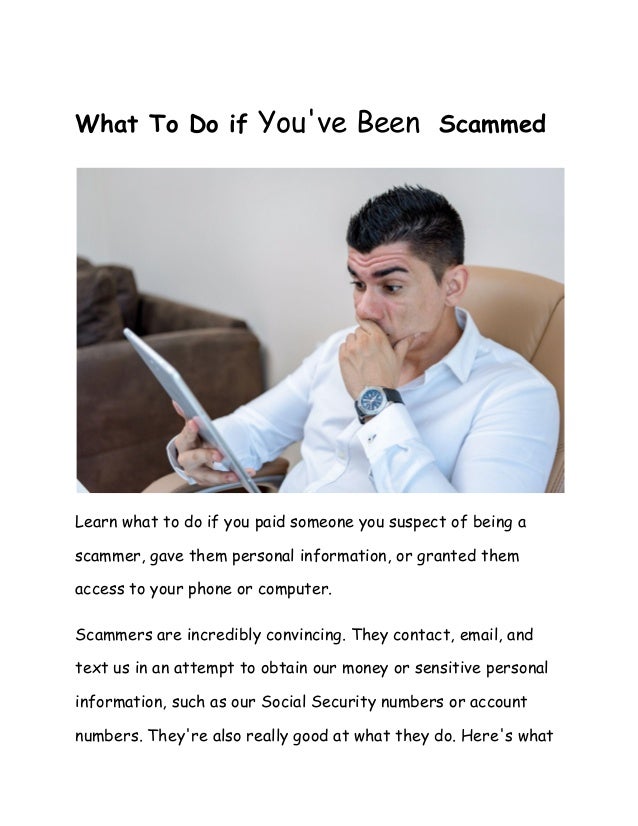
What To Do if You've Been Scammed
Learn what to do if you paid someone you suspect of being a
scammer, gave them personal information, or granted them
access to your phone or computer.
Scammers are incredibly convincing. They contact, email, and
text us in an attempt to obtain our money or sensitive personal
information, such as our Social Security numbers or account
numbers. They're also really good at what they do. Here's what
to do if you paid or offered your personal information to
someone you suspect is a fraudster.
Who Gets Scammed: Why Some People
Are More Vulnerable
5 characteristics that could make you an easy target
The "illusion of invulnerability," as in "I'm too smart to ever
fall for a deception," is the most harmful attitude a customer
can have, according to social scientists. No, you're not, and all
the evidence suggests that everybody, regardless of age,
education, race, or gender, has the capacity to be conned,
given the correct circumstances and a con artist who is skilled
at putting his victim "under the ether," in other words,
unaware of risk.
Defend Your Privacy with the Best VPN
Protect your devices and data while maintaining your privacy
for only $3.66 per month.
â—Ź iOS, macOS, Android, Windows, Fire TV & more
30-day money-back guarantee: https://bit.ly/3MbAcwN
Furthermore, typical victimhood thinking is sometimes
incorrect: when it comes to falling for scams, millennials, not
elders, are the most vulnerable. According to 2017 Federal
Trade Commission data, persons in their 20s accounted for
40% of those who reported losing money to fraud, with those
70 and older accounting for only 18%.
However, the FTC discovered that older persons who fell
victim to scammers lost far more money than younger adults.
According to experts, financial fraud losses among the elderly
are due not just to age-related cognitive impairment, but also
to the fact that the 65-plus demographic controls trillions of
dollars—and thieves follow the money.
Researchers have been able to discover specific features that
distinguish those who are taken in from those who are not,
regardless of age. According to Doug Shadel, author of
"Outsmarting the Scam Artists" (Wiley, 2012), victims exhibit
the following characteristics at substantially higher rates
than nonvictims.
Being a Bargain Hunter
Do you know someone who is continually looking for investment
"opportunities" and bargains, who sends away for promotional
materials and enters contests and drawings, and who reads all
of their mail (electronic and postal), including sales brochures
and generic charity solicitations? A person who is exposed to
what is commonly referred to as "the marketplace" on a
frequent basis is susceptible for becoming a scam victim.
Defend Your Privacy with the Best VPN
Protect your devices and data while maintaining your privacy
for only $3.66 per month.
â—Ź iOS, macOS, Android, Windows, Fire TV & more
30-day money-back guarantee: https://bit.ly/3MbAcwN
Persuasion Susceptibility
Doug Shadel and his colleagues discovered in several research
that fraud victims are more interested than the general public
in particular claims used by con artists to catch their prey:
"This offer is only valid for the next 24 hours," says the
seller. "My clients are making 30% a year on this investment,"
or—a favorite among veterans, who have become a new
favorite target for con artists—"From one ex-Marine to
another..."
Lack of a Defensive Plan
Scam victims are more likely to take fewer precautions to
avoid or mitigate fraud. They don't allow themselves enough
time to ponder after hearing a sales pitch, they don't
undertake rigorous professional reference checks, and
they're less likely to sign up for registries that limit unwanted
phone calls.
Defend Your Privacy with the Best VPN
Protect your devices and data while maintaining your privacy
for only $3.66 per month.
â—Ź iOS, macOS, Android, Windows, Fire TV & more
30-day money-back guarantee: https://bit.ly/3MbAcwN
Possibility of Taking Risks
Researchers believe there is a substantial link between this
attribute and victimization, in part because high-risk but
legitimate investments share many characteristics with
fraudulent offers, such as the potential for higher profits and
the need to make a quick choice. As a result, people with
similar personality types are drawn to both.
Faced with a Difficult Situation
Watch out if you've lost a loved one, gone through a divorce,
been laid off from a job, or otherwise suffered a major crisis
in the last two years. According to a 2013 Federal Trade
Commission research, your chances of getting scammed more
than double—most likely because dealing with challenging living
conditions consumes cognitive ability that could be utilized to
detect scams.
How to Avoid Scams on the Internet
Do you know how to safeguard yourself against internet
dangers?
Click The Link Below To Make Sure that Never
Hapen Again
Defend Your Privacy with the Best VPN
Protect your devices and data while maintaining your privacy
for only $3.66 per month.
â—Ź iOS, macOS, Android, Windows, Fire TV & more
30-day money-back guarantee: https://bit.ly/3MbAcwN

What To Do if You Were Scammed

  • 1.
    What To Doif You've Been Scammed Learn what to do if you paid someone you suspect of being a scammer, gave them personal information, or granted them access to your phone or computer. Scammers are incredibly convincing. They contact, email, and text us in an attempt to obtain our money or sensitive personal information, such as our Social Security numbers or account numbers. They're also really good at what they do. Here's what
  • 2.
    to do ifyou paid or offered your personal information to someone you suspect is a fraudster. Who Gets Scammed: Why Some People Are More Vulnerable 5 characteristics that could make you an easy target The "illusion of invulnerability," as in "I'm too smart to ever fall for a deception," is the most harmful attitude a customer can have, according to social scientists. No, you're not, and all the evidence suggests that everybody, regardless of age, education, race, or gender, has the capacity to be conned, given the correct circumstances and a con artist who is skilled at putting his victim "under the ether," in other words, unaware of risk. Defend Your Privacy with the Best VPN Protect your devices and data while maintaining your privacy for only $3.66 per month.
  • 3.
    ● iOS, macOS,Android, Windows, Fire TV & more 30-day money-back guarantee: https://bit.ly/3MbAcwN Furthermore, typical victimhood thinking is sometimes incorrect: when it comes to falling for scams, millennials, not elders, are the most vulnerable. According to 2017 Federal Trade Commission data, persons in their 20s accounted for 40% of those who reported losing money to fraud, with those 70 and older accounting for only 18%. However, the FTC discovered that older persons who fell victim to scammers lost far more money than younger adults. According to experts, financial fraud losses among the elderly are due not just to age-related cognitive impairment, but also to the fact that the 65-plus demographic controls trillions of dollars—and thieves follow the money. Researchers have been able to discover specific features that distinguish those who are taken in from those who are not,
  • 4.
    regardless of age.According to Doug Shadel, author of "Outsmarting the Scam Artists" (Wiley, 2012), victims exhibit the following characteristics at substantially higher rates than nonvictims. Being a Bargain Hunter Do you know someone who is continually looking for investment "opportunities" and bargains, who sends away for promotional materials and enters contests and drawings, and who reads all of their mail (electronic and postal), including sales brochures and generic charity solicitations? A person who is exposed to what is commonly referred to as "the marketplace" on a frequent basis is susceptible for becoming a scam victim. Defend Your Privacy with the Best VPN Protect your devices and data while maintaining your privacy for only $3.66 per month. â—Ź iOS, macOS, Android, Windows, Fire TV & more
  • 5.
    30-day money-back guarantee:https://bit.ly/3MbAcwN Persuasion Susceptibility Doug Shadel and his colleagues discovered in several research that fraud victims are more interested than the general public in particular claims used by con artists to catch their prey: "This offer is only valid for the next 24 hours," says the seller. "My clients are making 30% a year on this investment," or—a favorite among veterans, who have become a new favorite target for con artists—"From one ex-Marine to another..." Lack of a Defensive Plan Scam victims are more likely to take fewer precautions to avoid or mitigate fraud. They don't allow themselves enough time to ponder after hearing a sales pitch, they don't undertake rigorous professional reference checks, and
  • 6.
    they're less likelyto sign up for registries that limit unwanted phone calls. Defend Your Privacy with the Best VPN Protect your devices and data while maintaining your privacy for only $3.66 per month. â—Ź iOS, macOS, Android, Windows, Fire TV & more 30-day money-back guarantee: https://bit.ly/3MbAcwN Possibility of Taking Risks Researchers believe there is a substantial link between this attribute and victimization, in part because high-risk but legitimate investments share many characteristics with fraudulent offers, such as the potential for higher profits and the need to make a quick choice. As a result, people with similar personality types are drawn to both.
  • 7.
    Faced with aDifficult Situation Watch out if you've lost a loved one, gone through a divorce, been laid off from a job, or otherwise suffered a major crisis in the last two years. According to a 2013 Federal Trade Commission research, your chances of getting scammed more than double—most likely because dealing with challenging living conditions consumes cognitive ability that could be utilized to detect scams. How to Avoid Scams on the Internet Do you know how to safeguard yourself against internet dangers? Click The Link Below To Make Sure that Never Hapen Again Defend Your Privacy with the Best VPN Protect your devices and data while maintaining your privacy for only $3.66 per month.
  • 8.
    â—Ź iOS, macOS,Android, Windows, Fire TV & more 30-day money-back guarantee: https://bit.ly/3MbAcwN