Equipping Our Children
with Confidence

Liz Falco, ASP Volunteer
Consultant in Education
November 25, 2013
Why Tyndale?
•  Circle Map
•  Personal Story
Why Confidence??
•  Confidence + Competence = “Glow”
•  Confidence for all: students, parents and teachers
•  Partnership: Tyndale St. Georges Community Centre
+ National Urban Alliance for Effective Education
(Veronica McDermott)
•  Adopted by the Department of Children, Youth &
Families
What is the Pedagogy of Confidence?
•  A neuroscience-based approach taken by the
National Urban Alliance (NUA)
•  Fearless expectation and support for all
students to demonstrate high intellectual
performance.
•  The NUA provides Professional Development,
Advocacy and Guidance to urban and suburban
public schools throughout the US
•  Three Shared Beliefs
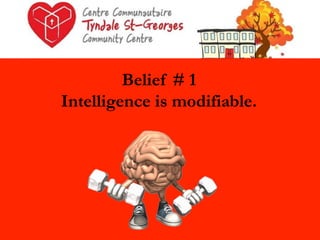
Belief # 1
Intelligence is modifiable.	
  
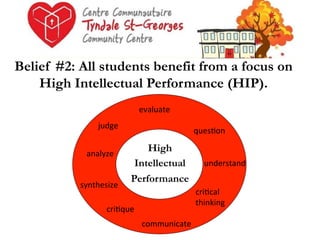
Belief #2: All students benefit from a focus on
High Intellectual Performance (HIP).
	
  
evaluate	
  

judge	
  
analyze	
  
synthesize	
  

ques*on	
  

High
Intellectual
Performance

understand	
  
cri*cal	
  
thinking	
  

cri*que	
  
communicate	
  
Gi$ing	
  all	
  of	
  our	
  children…	
  
Culture

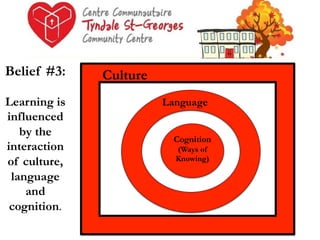
Belief #3:
Learning is
influenced
by the
interaction
of culture,
language
and
cognition.	
  

Culture
Language
Cognition
(Ways of
C	
  
Knowing)	
  
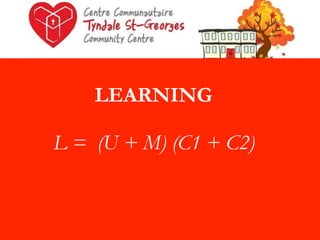
LEARNING


   L


= (U + M) (C1 + C2)
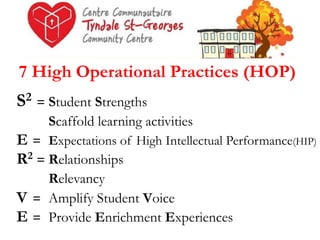
7 High Operational Practices (HOP)

S2 = Student Strengths
Scaffold learning activities

E = Expectations of High Intellectual Performance(HIP)
R2 = Relationships
Relevancy
V = Amplify Student Voice
E = Provide Enrichment Experiences


A	
  Teen	
  Who	
  Sees	
  with	
  Sounds	
  
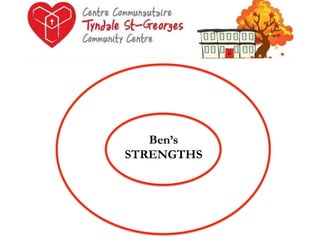
Ben’s
STRENGTHS
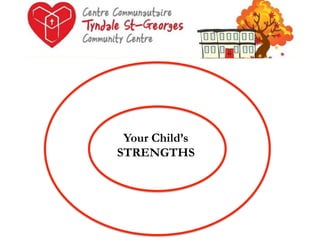
Your Child’s
STRENGTHS
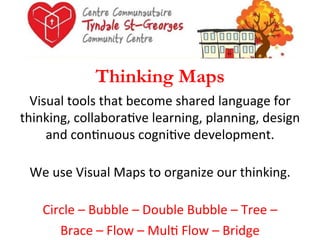
Thinking Maps
Visual	
  tools	
  that	
  become	
  shared	
  language	
  for	
  
thinking,	
  collabora*ve	
  learning,	
  planning,	
  design	
  
and	
  con*nuous	
  cogni*ve	
  development.	


We	
  use	
  Visual	
  Maps	
  to	
  organize	
  our	
  thinking.	


Circle	
  –	
  Bubble	
  –	
  Double	
  Bubble	
  –	
  Tree	
  –	
  	
  
Brace	
  –	
  Flow	
  –	
  Mul*	
  Flow	
  –	
  Bridge	
  
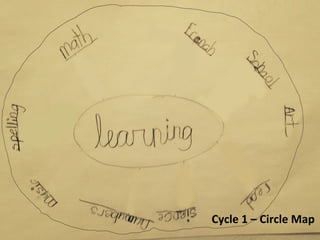
Cycle	
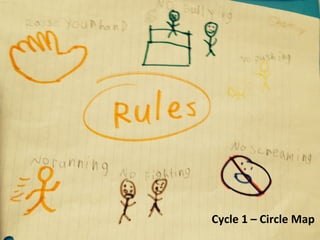
  1	
  –	
  Circle	
  Map	
  
Cycle	
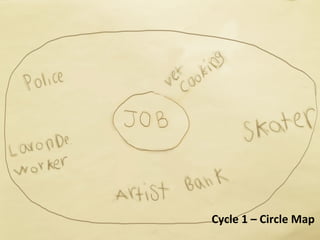
  1	
  –	
  Circle	
  Map	
  
Cycle	
  1	
  –	
  Circle	
  Map	
  
Cycle	
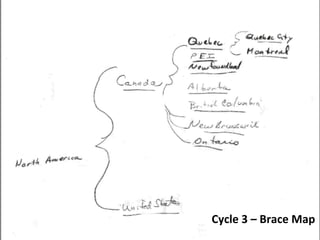
  3	
  –	
  Brace	
  Map	
  
Cycle	
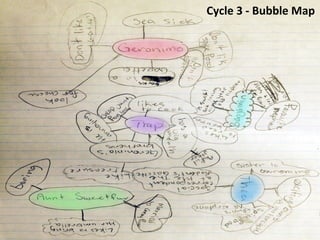
  3	
  -­‐	
  Bubble	
  Map	
  
Cycle	
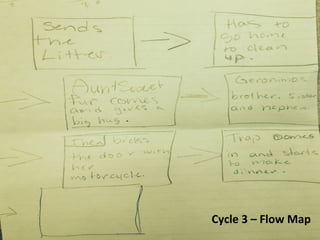
  3	
  –	
  Flow	
  Map	
  
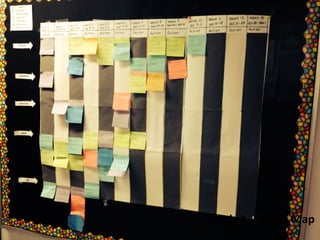
Cycle	
  1	
  –	
  Circle	
  Map	
  
Equipping Our Children
with Confidence

Liz Falco, ASP Volunteer
Consultant in Education
November 25, 2013

Equipping our Children with Confidence

  • 1.
    Equipping Our Children withConfidence Liz Falco, ASP Volunteer Consultant in Education November 25, 2013
  • 2.
    Why Tyndale? •  CircleMap •  Personal Story
  • 3.
    Why Confidence?? •  Confidence+ Competence = “Glow” •  Confidence for all: students, parents and teachers •  Partnership: Tyndale St. Georges Community Centre + National Urban Alliance for Effective Education (Veronica McDermott) •  Adopted by the Department of Children, Youth & Families
  • 4.
    What is thePedagogy of Confidence? •  A neuroscience-based approach taken by the National Urban Alliance (NUA) •  Fearless expectation and support for all students to demonstrate high intellectual performance. •  The NUA provides Professional Development, Advocacy and Guidance to urban and suburban public schools throughout the US •  Three Shared Beliefs
  • 5.
    Belief # 1 Intelligenceis modifiable.  
  • 6.
    Belief #2: Allstudents benefit from a focus on High Intellectual Performance (HIP).   evaluate   judge   analyze   synthesize   ques*on   High Intellectual Performance understand   cri*cal   thinking   cri*que   communicate  
  • 7.
    Gi$ing  all  of  our  children…  
  • 8.
    Culture Belief #3: Learning is influenced bythe interaction of culture, language and cognition.   Culture Language Cognition (Ways of C   Knowing)  
  • 9.
    LEARNING                       L         = (U + M) (C1 + C2)
  • 10.
    7 High OperationalPractices (HOP) S2 = Student Strengths Scaffold learning activities E = Expectations of High Intellectual Performance(HIP) R2 = Relationships Relevancy V = Amplify Student Voice E = Provide Enrichment Experiences
  • 11.
          A  Teen  Who  Sees  with  Sounds  
  • 12.
  • 13.
  • 14.
    Thinking Maps Visual  tools  that  become  shared  language  for   thinking,  collabora*ve  learning,  planning,  design   and  con*nuous  cogni*ve  development.     We  use  Visual  Maps  to  organize  our  thinking.       Circle  –  Bubble  –  Double  Bubble  –  Tree  –     Brace  –  Flow  –  Mul*  Flow  –  Bridge  
  • 15.
    Cycle  1  –  Circle  Map  
  • 16.
    Cycle  1  –  Circle  Map  
  • 17.
    Cycle  1  –  Circle  Map  
  • 18.
    Cycle  3  –  Brace  Map  
  • 19.
    Cycle  3  -­‐  Bubble  Map  
  • 20.
    Cycle  3  –  Flow  Map  
  • 21.
    Cycle  1  –  Circle  Map  
  • 22.
    Equipping Our Children withConfidence Liz Falco, ASP Volunteer Consultant in Education November 25, 2013