Andrea & Lisamarie
LUCY SPRAGUE MITCHELL
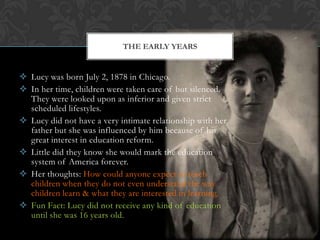
 Lucy was born July 2, 1878 in Chicago.
 In her time, children were taken care of but silenced.
They were looked upon as inferior and given strict
scheduled lifestyles.
 Lucy did not have a very intimate relationship with her
father but she was influenced by him because of his
great interest in education reform.
 Little did they know she would mark the education
system of America forever.
 Her thoughts: How could anyone expect to teach
children when they do not even understand the way
children learn & what they are interested in learning.
 Fun Fact: Lucy did not receive any kind of education
until she was 16 years old.
THE EARLY YEARS
 She pursued a college education in University of
California at Berkley. Even though during this time it
was rare for women to obtain this level of education.
 Fun Fact: She graduated & became the first woman
to become a Dean at the university.
 1913: She moved to New York and married to
Wesley Clair Mitchell.
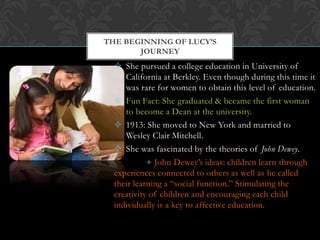
 She was fascinated by the theories of John Dewey.
+ John Dewey’s ideas: children learn through
experiences connected to others as well as he called
their learning a “social function.” Stimulating the
creativity of children and encouraging each child
individually is a key to affective education.
THE BEGINNING OF LUCY’S
JOURNEY
 She started the Bureau of Educational Experiments in New York.
 How education was conducted at the Bureau incorporated by Sprague
Mitchell: The interdisciplinary approach to classroom management, the
study of student behavior, psychological profiles recorded and
updated, family background and environment checks.
 Her revelations about language: +during observations of children she
found that language development is more important than they thought of
before.
BUREAU OF EDUCATIONAL
EXPERIMENTS
 Her school programs were seen as “loony” and “radical” in the
1910’s, but in the 1950’s those schools were considered “developmentally
appropriate” and became traditional nursery schools.
 She promoted in what it was to raise “whole child.”
+ This meant they were children that were developmentally healthy
and emotionally secure. She believed that if people raised “whole children”
that society would progressively improve.
+ This centered on the focus on the children and fulfilling all their
needs. Not just their basic physical needs but more in depth
emotional, social, and mental needs.
 In 1930’s, she extended her teaching to train teachers to become “whole
teachers” to be able to teach and guide children to become “whole
children.”
HER THEORIES
ACCOMPLISHMENTS

Lucy sprague mitchell

  • 1.
    Andrea & Lisamarie LUCYSPRAGUE MITCHELL
  • 2.
     Lucy wasborn July 2, 1878 in Chicago.  In her time, children were taken care of but silenced. They were looked upon as inferior and given strict scheduled lifestyles.  Lucy did not have a very intimate relationship with her father but she was influenced by him because of his great interest in education reform.  Little did they know she would mark the education system of America forever.  Her thoughts: How could anyone expect to teach children when they do not even understand the way children learn & what they are interested in learning.  Fun Fact: Lucy did not receive any kind of education until she was 16 years old. THE EARLY YEARS
  • 3.
     She pursueda college education in University of California at Berkley. Even though during this time it was rare for women to obtain this level of education.  Fun Fact: She graduated & became the first woman to become a Dean at the university.  1913: She moved to New York and married to Wesley Clair Mitchell.  She was fascinated by the theories of John Dewey. + John Dewey’s ideas: children learn through experiences connected to others as well as he called their learning a “social function.” Stimulating the creativity of children and encouraging each child individually is a key to affective education. THE BEGINNING OF LUCY’S JOURNEY
  • 4.
     She startedthe Bureau of Educational Experiments in New York.  How education was conducted at the Bureau incorporated by Sprague Mitchell: The interdisciplinary approach to classroom management, the study of student behavior, psychological profiles recorded and updated, family background and environment checks.  Her revelations about language: +during observations of children she found that language development is more important than they thought of before. BUREAU OF EDUCATIONAL EXPERIMENTS
  • 5.
     Her schoolprograms were seen as “loony” and “radical” in the 1910’s, but in the 1950’s those schools were considered “developmentally appropriate” and became traditional nursery schools.  She promoted in what it was to raise “whole child.” + This meant they were children that were developmentally healthy and emotionally secure. She believed that if people raised “whole children” that society would progressively improve. + This centered on the focus on the children and fulfilling all their needs. Not just their basic physical needs but more in depth emotional, social, and mental needs.  In 1930’s, she extended her teaching to train teachers to become “whole teachers” to be able to teach and guide children to become “whole children.” HER THEORIES
  • 6.