What is Python?
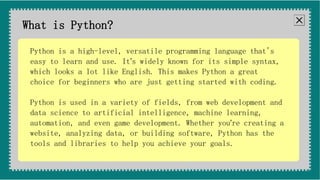
Python is a high-level, versatile programming language that's
easy to learn and use. It’s widely known for its simple syntax,
which looks a lot like English. This makes Python a great
choice for beginners who are just getting started with coding.
Python is used in a variety of fields, from web development and
data science to artificial intelligence, machine learning,
automation, and even game development. Whether you’re creating a
website, analyzing data, or building software, Python has the
tools and libraries to help you achieve your goals.
The History of Python
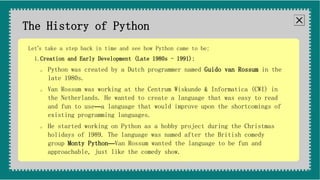
Let’s take a step back in time and see how Python came to be:
1.Creation and Early Development (Late 1980s - 1991):
o Python was created by a Dutch programmer named Guido van Rossum in the
late 1980s.
o Van Rossum was working at the Centrum Wiskunde & Informatica (CWI) in
the Netherlands. He wanted to create a language that was easy to read
and fun to use—a language that would improve upon the shortcomings of
existing programming languages.
o He started working on Python as a hobby project during the Christmas
holidays of 1989. The language was named after the British comedy
group Monty Python—Van Rossum wanted the language to be fun and
approachable, just like the comedy show.
The History of Python
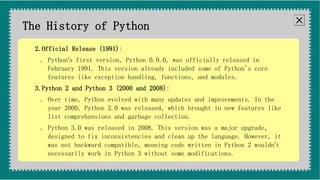
2.Official Release (1991):
o Python’s first version, Python 0.9.0, was officially released in
February 1991. This version already included some of Python's core
features like exception handling, functions, and modules.
3.Python 2 and Python 3 (2000 and 2008):
o Over time, Python evolved with many updates and improvements. In the
year 2000, Python 2.0 was released, which brought in new features like
list comprehensions and garbage collection.
o Python 3.0 was released in 2008. This version was a major upgrade,
designed to fix inconsistencies and clean up the language. However, it
was not backward compatible, meaning code written in Python 2 wouldn’t
necessarily work in Python 3 without some modifications.
The History of Python
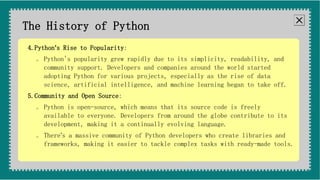
4.Python’s Rise to Popularity:
o Python's popularity grew rapidly due to its simplicity, readability, and
community support. Developers and companies around the world started
adopting Python for various projects, especially as the rise of data
science, artificial intelligence, and machine learning began to take off.
5.Community and Open Source:
o Python is open-source, which means that its source code is freely
available to everyone. Developers from around the globe contribute to its
development, making it a continually evolving language.
o There’s a massive community of Python developers who create libraries and
frameworks, making it easier to tackle complex tasks with ready-made tools.
The History of Python
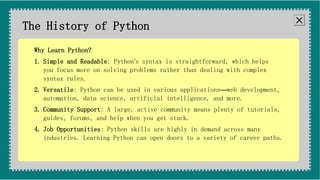
Why Learn Python?
1. Simple and Readable: Python’s syntax is straightforward, which helps
you focus more on solving problems rather than dealing with complex
syntax rules.
2. Versatile: Python can be used in various applications—web development,
automation, data science, artificial intelligence, and more.
3. Community Support: A large, active community means plenty of tutorials,
guides, forums, and help when you get stuck.
4. Job Opportunities: Python skills are highly in demand across many
industries. Learning Python can open doors to a variety of career paths.
Features of Python
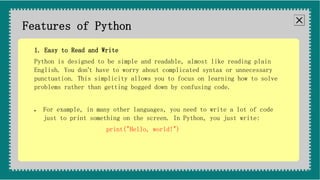
1. Easy to Read and Write
Python is designed to be simple and readable, almost like reading plain
English. You don’t have to worry about complicated syntax or unnecessary
punctuation. This simplicity allows you to focus on learning how to solve
problems rather than getting bogged down by confusing code.
 For example, in many other languages, you need to write a lot of code
just to print something on the screen. In Python, you just write:
print("Hello, world!")
Features of Python
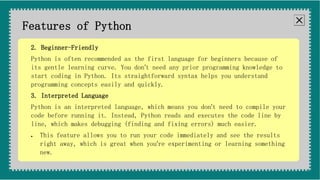
2. Beginner-Friendly
Python is often recommended as the first language for beginners because of
its gentle learning curve. You don’t need any prior programming knowledge to
start coding in Python. Its straightforward syntax helps you understand
programming concepts easily and quickly.
3. Interpreted Language
Python is an interpreted language, which means you don’t need to compile your
code before running it. Instead, Python reads and executes the code line by
line, which makes debugging (finding and fixing errors) much easier.
 This feature allows you to run your code immediately and see the results
right away, which is great when you’re experimenting or learning something
new.
Features of Python
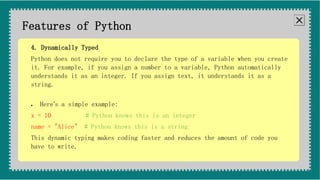
4. Dynamically Typed
Python does not require you to declare the type of a variable when you create
it. For example, if you assign a number to a variable, Python automatically
understands it as an integer. If you assign text, it understands it as a
string.
 Here’s a simple example:
x = 10 # Python knows this is an integer
name = "Alice" # Python knows this is a string
This dynamic typing makes coding faster and reduces the amount of code you
have to write.
Features of Python
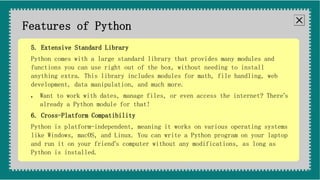
5. Extensive Standard Library
Python comes with a large standard library that provides many modules and
functions you can use right out of the box, without needing to install
anything extra. This library includes modules for math, file handling, web
development, data manipulation, and much more.
 Want to work with dates, manage files, or even access the internet? There’s
already a Python module for that!
6. Cross-Platform Compatibility
Python is platform-independent, meaning it works on various operating systems
like Windows, macOS, and Linux. You can write a Python program on your laptop
and run it on your friend’s computer without any modifications, as long as
Python is installed.
Features of Python
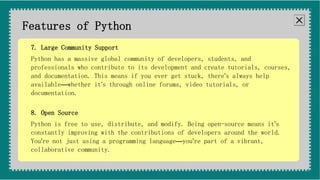
7. Large Community Support
Python has a massive global community of developers, students, and
professionals who contribute to its development and create tutorials, courses,
and documentation. This means if you ever get stuck, there’s always help
available—whether it’s through online forums, video tutorials, or
documentation.
8. Open Source
Python is free to use, distribute, and modify. Being open-source means it’s
constantly improving with the contributions of developers around the world.
You’re not just using a programming language—you’re part of a vibrant,
collaborative community.
Features of Python
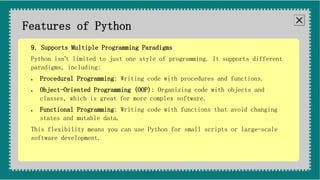
9. Supports Multiple Programming Paradigms
Python isn’t limited to just one style of programming. It supports different
paradigms, including:
 Procedural Programming: Writing code with procedures and functions.
 Object-Oriented Programming (OOP): Organizing code with objects and
classes, which is great for more complex software.
 Functional Programming: Writing code with functions that avoid changing
states and mutable data.
This flexibility means you can use Python for small scripts or large-scale
software development.

COMPUTER 8 Grade 8 - Intro to Python.pdf

  • 3.
    What is Python? Pythonis a high-level, versatile programming language that's easy to learn and use. It’s widely known for its simple syntax, which looks a lot like English. This makes Python a great choice for beginners who are just getting started with coding. Python is used in a variety of fields, from web development and data science to artificial intelligence, machine learning, automation, and even game development. Whether you’re creating a website, analyzing data, or building software, Python has the tools and libraries to help you achieve your goals.
  • 4.
    The History ofPython Let’s take a step back in time and see how Python came to be: 1.Creation and Early Development (Late 1980s - 1991): o Python was created by a Dutch programmer named Guido van Rossum in the late 1980s. o Van Rossum was working at the Centrum Wiskunde & Informatica (CWI) in the Netherlands. He wanted to create a language that was easy to read and fun to use—a language that would improve upon the shortcomings of existing programming languages. o He started working on Python as a hobby project during the Christmas holidays of 1989. The language was named after the British comedy group Monty Python—Van Rossum wanted the language to be fun and approachable, just like the comedy show.
  • 5.
    The History ofPython 2.Official Release (1991): o Python’s first version, Python 0.9.0, was officially released in February 1991. This version already included some of Python's core features like exception handling, functions, and modules. 3.Python 2 and Python 3 (2000 and 2008): o Over time, Python evolved with many updates and improvements. In the year 2000, Python 2.0 was released, which brought in new features like list comprehensions and garbage collection. o Python 3.0 was released in 2008. This version was a major upgrade, designed to fix inconsistencies and clean up the language. However, it was not backward compatible, meaning code written in Python 2 wouldn’t necessarily work in Python 3 without some modifications.
  • 6.
    The History ofPython 4.Python’s Rise to Popularity: o Python's popularity grew rapidly due to its simplicity, readability, and community support. Developers and companies around the world started adopting Python for various projects, especially as the rise of data science, artificial intelligence, and machine learning began to take off. 5.Community and Open Source: o Python is open-source, which means that its source code is freely available to everyone. Developers from around the globe contribute to its development, making it a continually evolving language. o There’s a massive community of Python developers who create libraries and frameworks, making it easier to tackle complex tasks with ready-made tools.
  • 7.
    The History ofPython Why Learn Python? 1. Simple and Readable: Python’s syntax is straightforward, which helps you focus more on solving problems rather than dealing with complex syntax rules. 2. Versatile: Python can be used in various applications—web development, automation, data science, artificial intelligence, and more. 3. Community Support: A large, active community means plenty of tutorials, guides, forums, and help when you get stuck. 4. Job Opportunities: Python skills are highly in demand across many industries. Learning Python can open doors to a variety of career paths.
  • 8.
    Features of Python 1.Easy to Read and Write Python is designed to be simple and readable, almost like reading plain English. You don’t have to worry about complicated syntax or unnecessary punctuation. This simplicity allows you to focus on learning how to solve problems rather than getting bogged down by confusing code.  For example, in many other languages, you need to write a lot of code just to print something on the screen. In Python, you just write: print("Hello, world!")
  • 9.
    Features of Python 2.Beginner-Friendly Python is often recommended as the first language for beginners because of its gentle learning curve. You don’t need any prior programming knowledge to start coding in Python. Its straightforward syntax helps you understand programming concepts easily and quickly. 3. Interpreted Language Python is an interpreted language, which means you don’t need to compile your code before running it. Instead, Python reads and executes the code line by line, which makes debugging (finding and fixing errors) much easier.  This feature allows you to run your code immediately and see the results right away, which is great when you’re experimenting or learning something new.
  • 10.
    Features of Python 4.Dynamically Typed Python does not require you to declare the type of a variable when you create it. For example, if you assign a number to a variable, Python automatically understands it as an integer. If you assign text, it understands it as a string.  Here’s a simple example: x = 10 # Python knows this is an integer name = "Alice" # Python knows this is a string This dynamic typing makes coding faster and reduces the amount of code you have to write.
  • 11.
    Features of Python 5.Extensive Standard Library Python comes with a large standard library that provides many modules and functions you can use right out of the box, without needing to install anything extra. This library includes modules for math, file handling, web development, data manipulation, and much more.  Want to work with dates, manage files, or even access the internet? There’s already a Python module for that! 6. Cross-Platform Compatibility Python is platform-independent, meaning it works on various operating systems like Windows, macOS, and Linux. You can write a Python program on your laptop and run it on your friend’s computer without any modifications, as long as Python is installed.
  • 12.
    Features of Python 7.Large Community Support Python has a massive global community of developers, students, and professionals who contribute to its development and create tutorials, courses, and documentation. This means if you ever get stuck, there’s always help available—whether it’s through online forums, video tutorials, or documentation. 8. Open Source Python is free to use, distribute, and modify. Being open-source means it’s constantly improving with the contributions of developers around the world. You’re not just using a programming language—you’re part of a vibrant, collaborative community.
  • 13.
    Features of Python 9.Supports Multiple Programming Paradigms Python isn’t limited to just one style of programming. It supports different paradigms, including:  Procedural Programming: Writing code with procedures and functions.  Object-Oriented Programming (OOP): Organizing code with objects and classes, which is great for more complex software.  Functional Programming: Writing code with functions that avoid changing states and mutable data. This flexibility means you can use Python for small scripts or large-scale software development.