2018/08/11 1/23
What is necessary for
the next input method framework
Fuminobu TAKEYAMA
(ftake)
openSUSE.Asia Summit 2018, Taipei
2018/08/11 2/23
About me
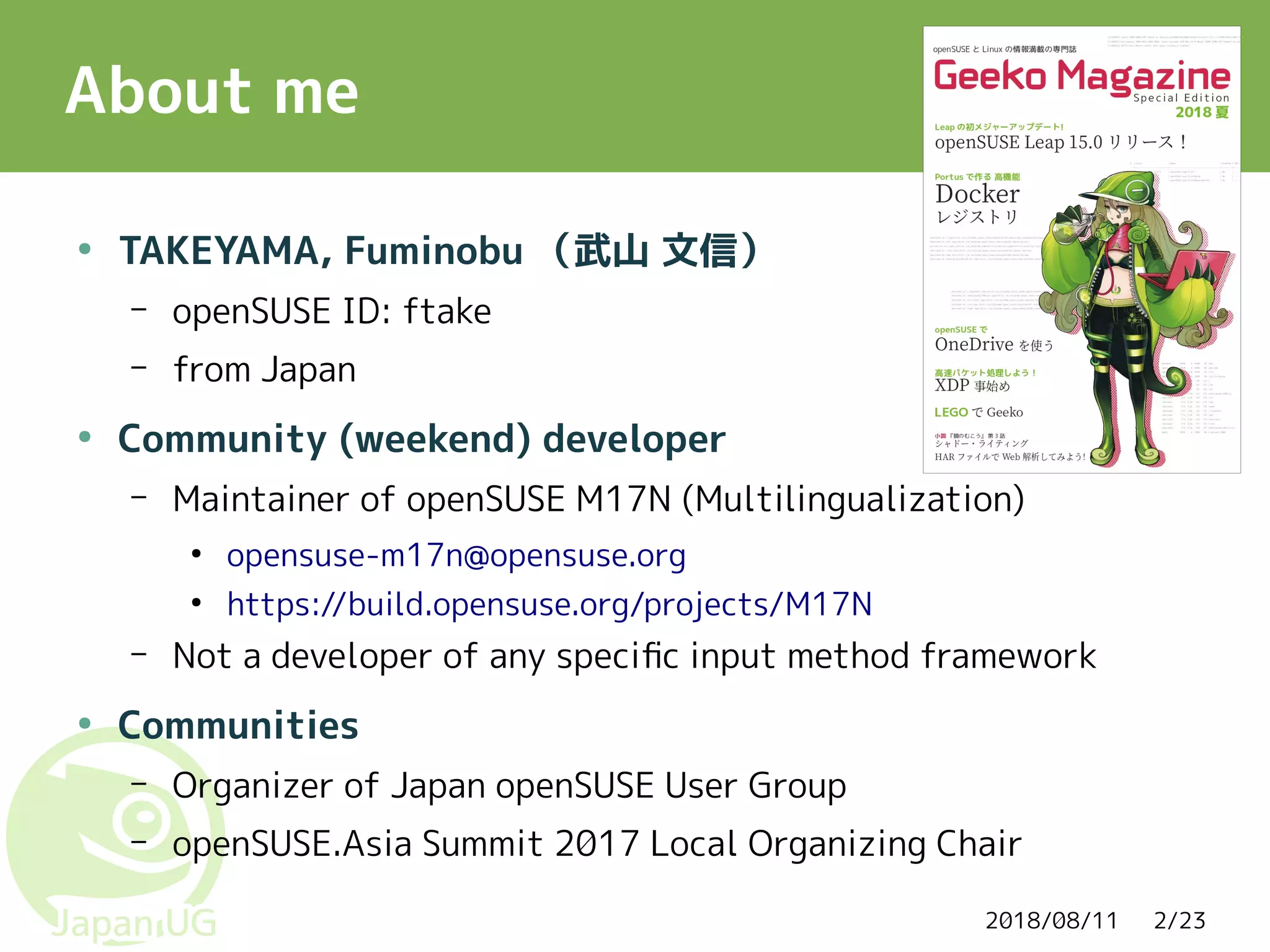
●
TAKEYAMA, Fuminobu (武山 文信)
– openSUSE ID: ftake
– from Japan
●
Community (weekend) developer
– Maintainer of openSUSE M17N (Multilingualization)
●
opensuse-m17n@opensuse.org
●
https://build.opensuse.org/projects/M17N
– Not a developer of any specific input method framework
●
Communities
– Organizer of Japan openSUSE User Group
– openSUSE.Asia Summit 2017 Local Organizing Chair
2018/08/11 3/23
What is an input method?
●
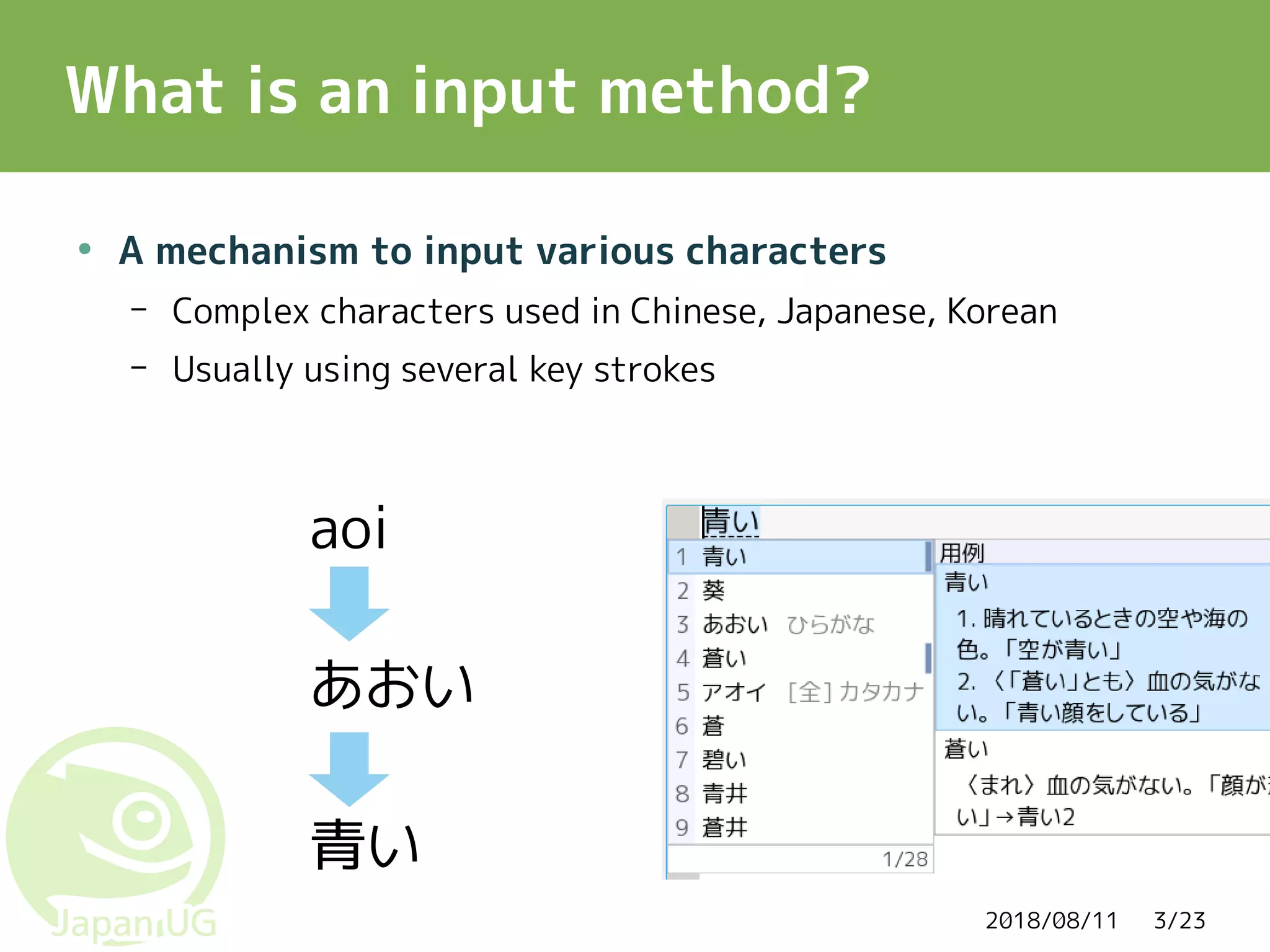
A mechanism to input various characters
– Complex characters used in Chinese, Japanese, Korean
– Usually using several key strokes
aoi
あおい
青い
2018/08/11 4/23
What is an input method framework
(IMF) ?
●
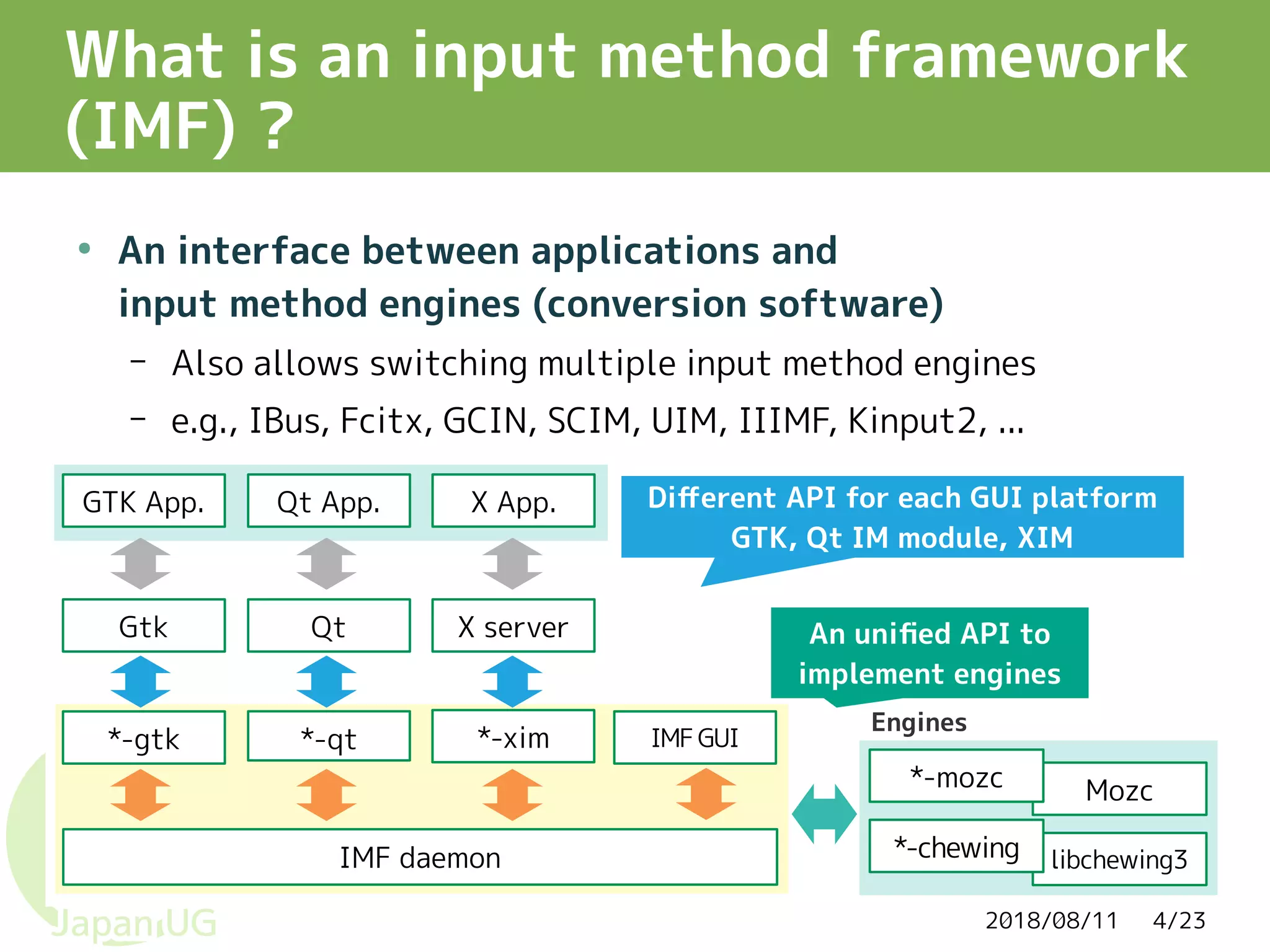
An interface between applications and
input method engines (conversion software)
– Also allows switching multiple input method engines
– e.g., IBus, Fcitx, GCIN, SCIM, UIM, IIIMF, Kinput2, ...
GTK App. Qt App. X App.
IMF daemon
*-qt *-xim*-gtk IMFGUI
QtGtk X server
Mozc
libchewing3
*-mozc
*-chewing
Engines
Different API for each GUI platform
GTK, Qt IM module, XIM
An unified API to
implement engines
2018/08/11 5/23
Input method frameworks on
openSUSE
●
openSUSE supports multiple IMFs
●
Different IMF is used depending on the session locale by
default
– GCIN for zh_TW, zh_HK
– Fcitx for zh_ CN, etc.
– IBus for ja_JP
2018/08/11 6/23
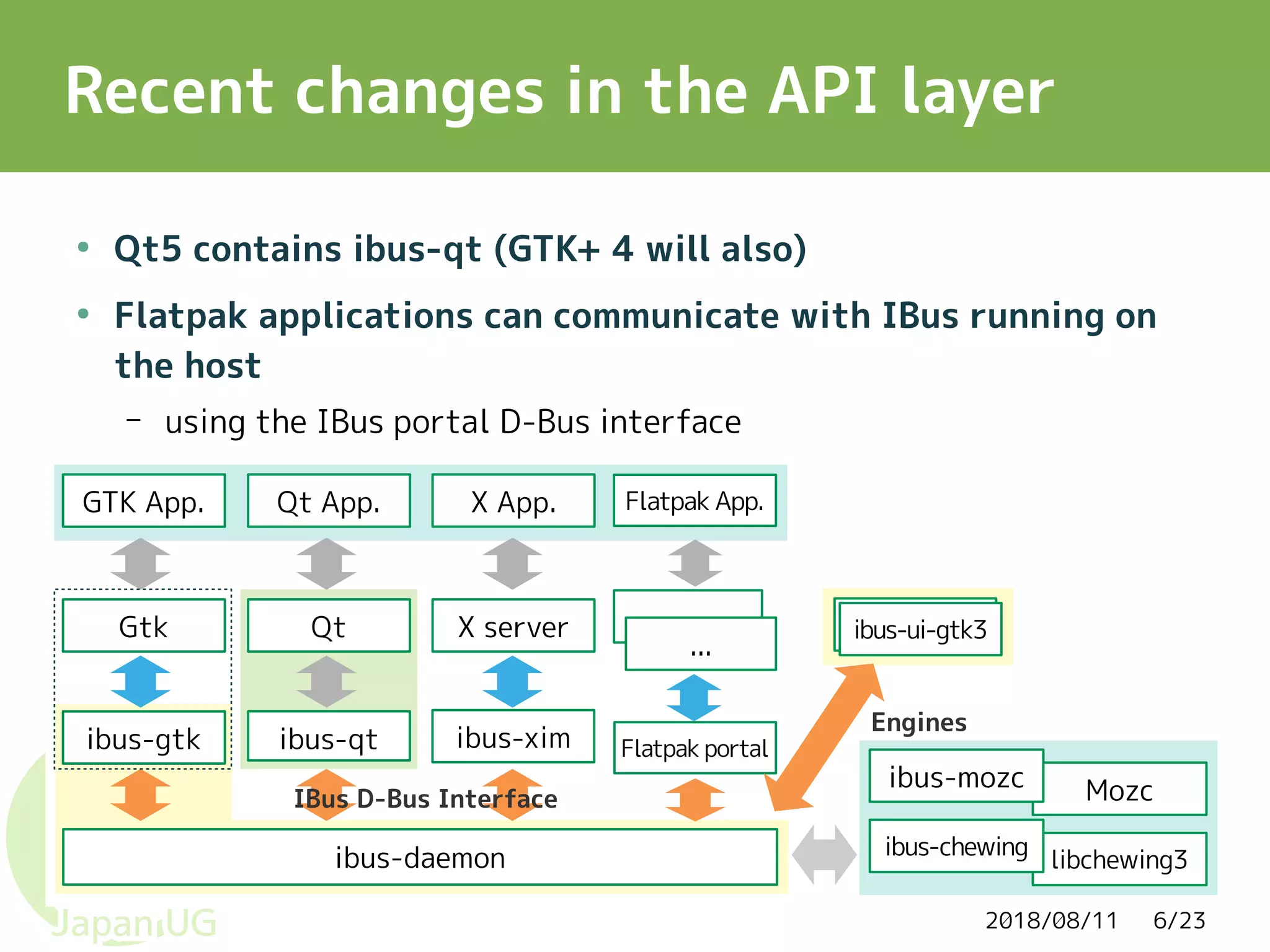
Recent changes in the API layer
●
Qt5 contains ibus-qt (GTK+ 4 will also)
●
Flatpak applications can communicate with IBus running on
the host
– using the IBus portal D-Bus interface
GTK App. Qt App. X App.
ibus-daemon
ibus-qt ibus-ximibus-gtk
QtGtk X server
Mozc
libchewing3
ibus-mozc
ibus-chewing
IBus D-Bus Interface
Flatpak App.
Flatpak portal
Engines
...
...
ibus-ui-gtk3ibus-ui-gtk3
2018/08/11 7/23
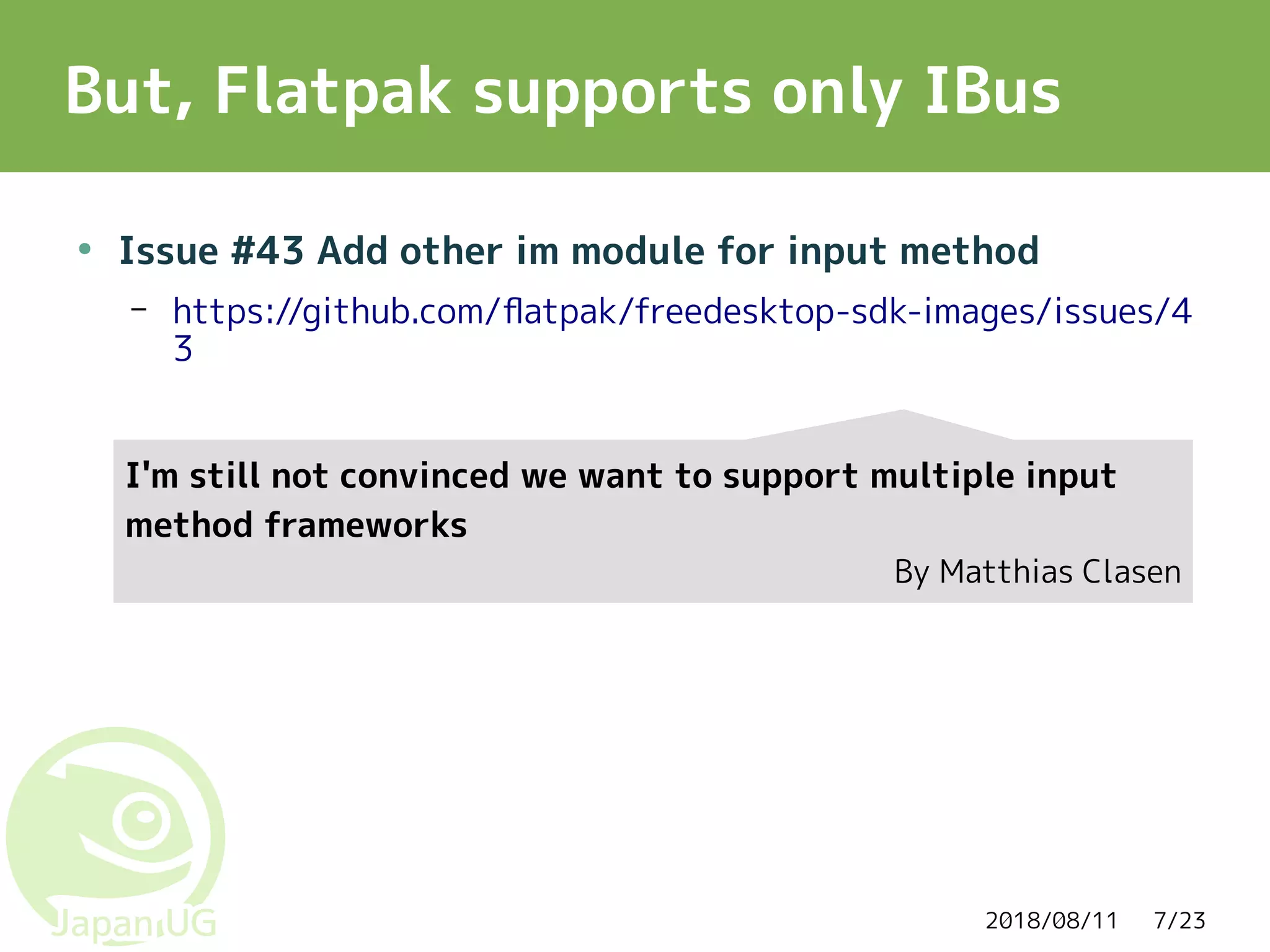
But, Flatpak supports only IBus
●
Issue #43 Add other im module for input method
– https://github.com/flatpak/freedesktop-sdk-images/issues/4
3
I'm still not convinced we want to support multiple input
method frameworks
By Matthias Clasen
2018/08/11 8/23
Some people might think
IBus is now the standard IMF?
●
No
– Quite many people prefer Fcitx or Gcin and hate IBus
– By Googling “ibus”, several blog posts saying “how ibus is
bad” are found
– Due to the several design issues (mentioned later)
●
Why so many IMFs have been developed?
– Formerly, for more stability
●
Let’s remind conversion engines were running on an application
process
– Now, usability, customizability, ...
2018/08/11 9/23
Do we still need various IMFs?
●
I think no if we have a thin and simple IMF
– No major difference in the core part of today’s IMFs
– “An interface between applications and engines” does not
provide much user experience
– GUI should be separated into engines and replaceable
●
No more multiple IMF support cost
●
It’s time to end the war of input method framework
2018/08/11 10/23
So let’s discuss
what is necessary for the next IMF?
●
From the viewpoint of architecture/design
●
By reviewing the problems of IBus (and Fcitx)
2018/08/11 11/23
1. Separation of GUI from core IMF
service 1/2
●
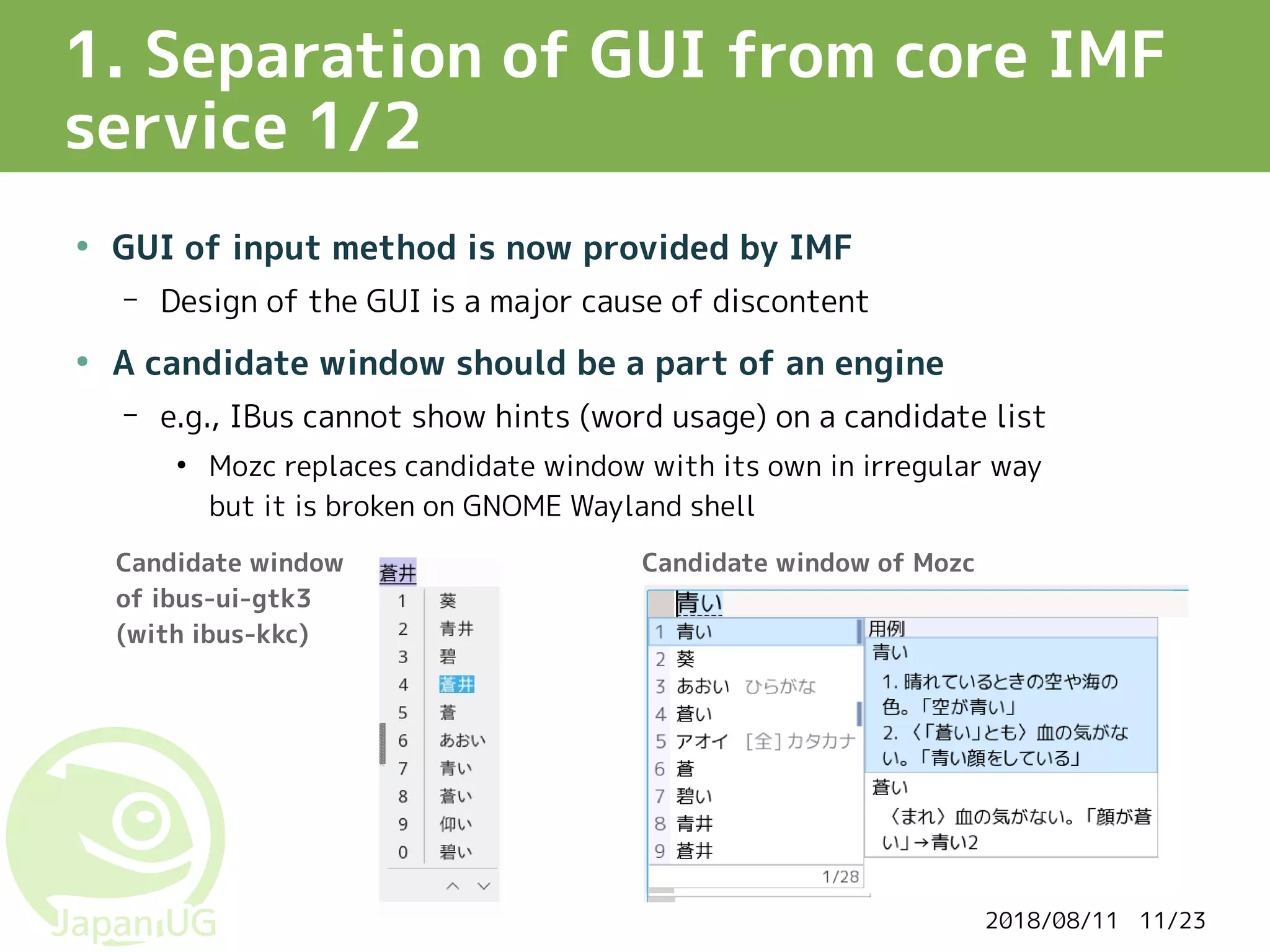
GUI of input method is now provided by IMF
– Design of the GUI is a major cause of discontent
●
A candidate window should be a part of an engine
– e.g., IBus cannot show hints (word usage) on a candidate list
●
Mozc replaces candidate window with its own in irregular way
but it is broken on GNOME Wayland shell
Candidate window
of ibus-ui-gtk3
(with ibus-kkc)
Candidate window of Mozc
2018/08/11 12/23
1. Separation of GUI from core IMF
service 2/2
●
For IBus, some major logic of IMF is implemented in
GUI layer (status panel applications)
– Switching keyboard layout, loading plugins, etc.
●
What is worse, there are three GUI layer variations
– ibus-ui-gtk3
– GNOME keyboard plugin
– KDE Input method panel
2018/08/11 13/23
2. Running without specific GUI
libraries
●
IBus depends on GTK+
– KDE input method panel still requires ibus-ui-gtk3
– Fcitx have less dependency
●
Will be necessary for embedded
– e.g., Automotive Grade Linux
2018/08/11 14/23
3. Wayland support
●
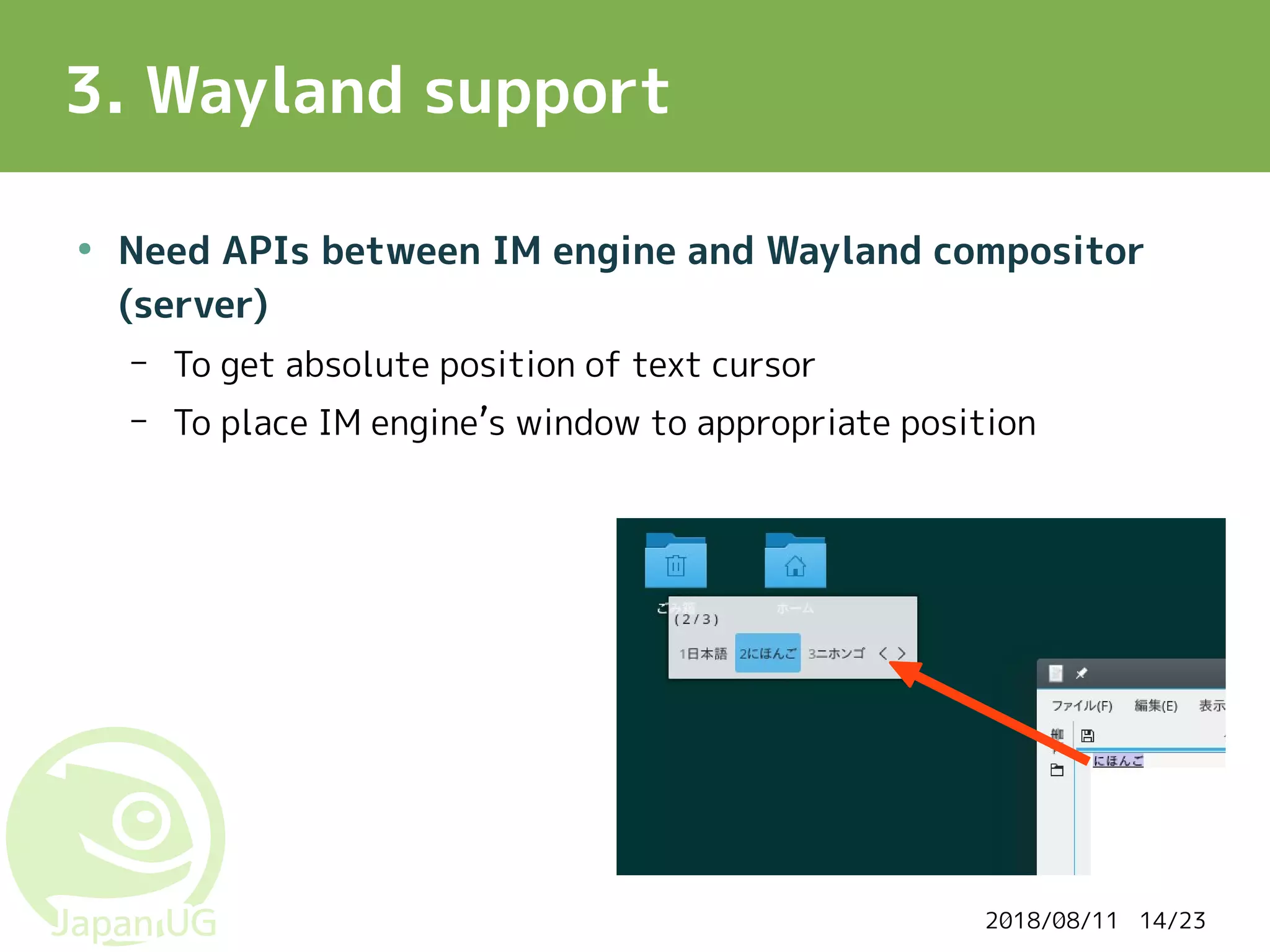
Need APIs between IM engine and Wayland compositor
(server)
– To get absolute position of text cursor
– To place IM engine’s window to appropriate position
2018/08/11 15/23
4. Redesigned keyboard layout
switch 1/4
●
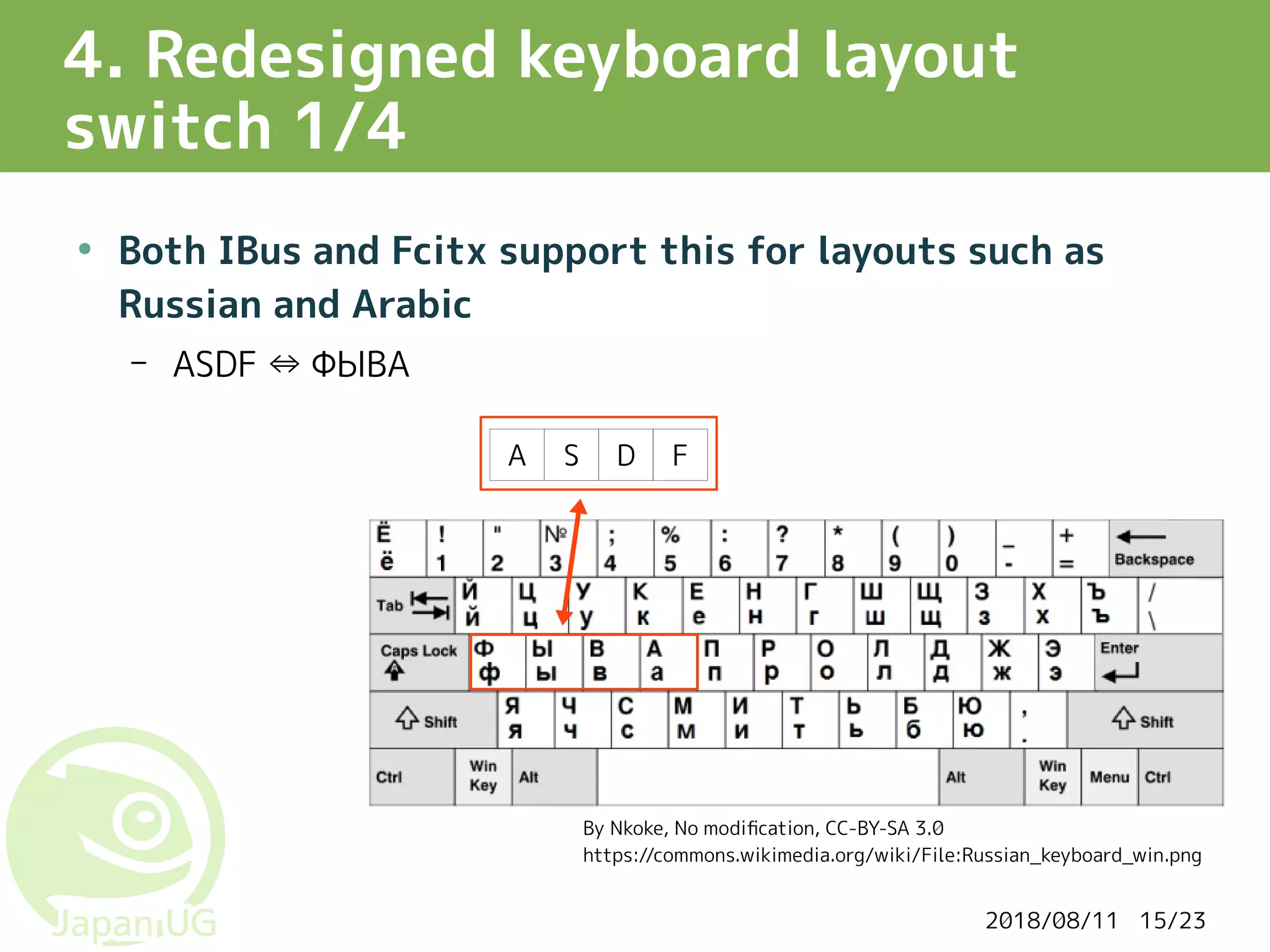
Both IBus and Fcitx support this for layouts such as
Russian and Arabic
– ASDF ⇔ ФЫВА
By Nkoke, No modification, CC-BY-SA 3.0
https://commons.wikimedia.org/wiki/File:Russian_keyboard_win.png
A S D F
2018/08/11 16/23
4. Redesigned keyboard layout
switch 2/4
●
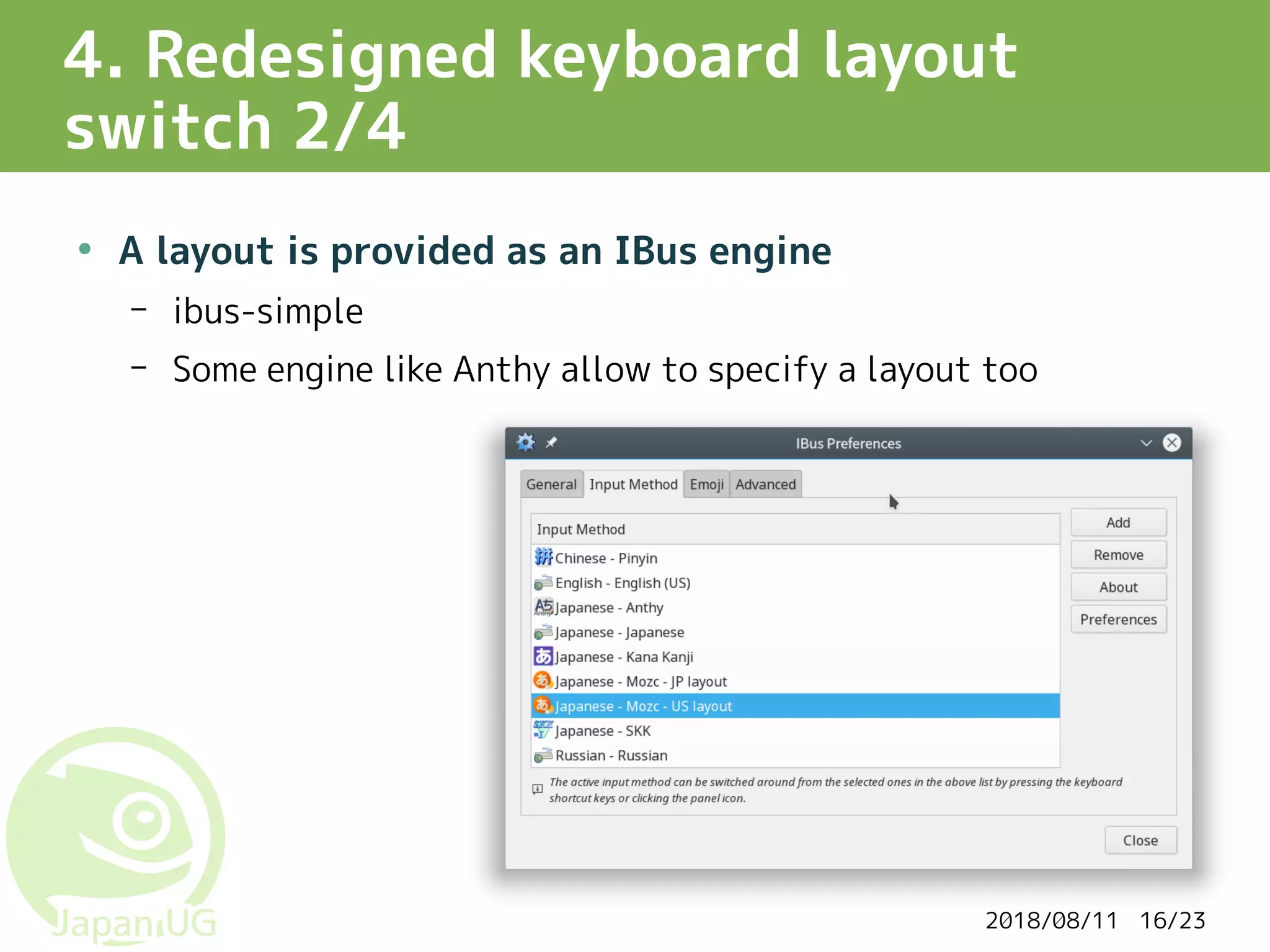
A layout is provided as an IBus engine
– ibus-simple
– Some engine like Anthy allow to specify a layout too
2018/08/11 17/23
4. Redesigned keyboard layout
switch 3/4
●
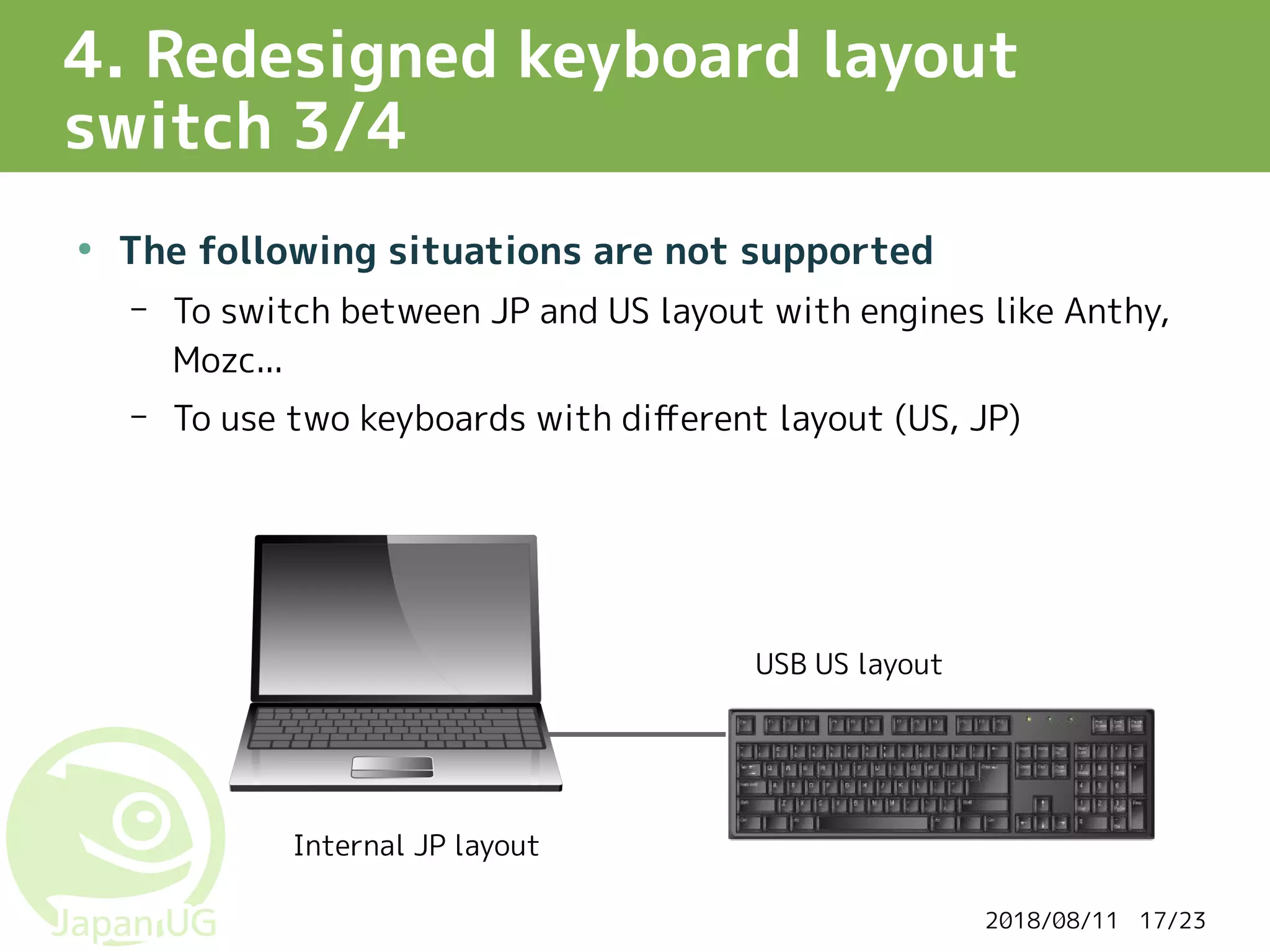
The following situations are not supported
– To switch between JP and US layout with engines like Anthy,
Mozc...
– To use two keyboards with different layout (US, JP)
Internal JP layout
USB US layout
2018/08/11 18/23
4. Redesigned keyboard layout
switch 4/4
●
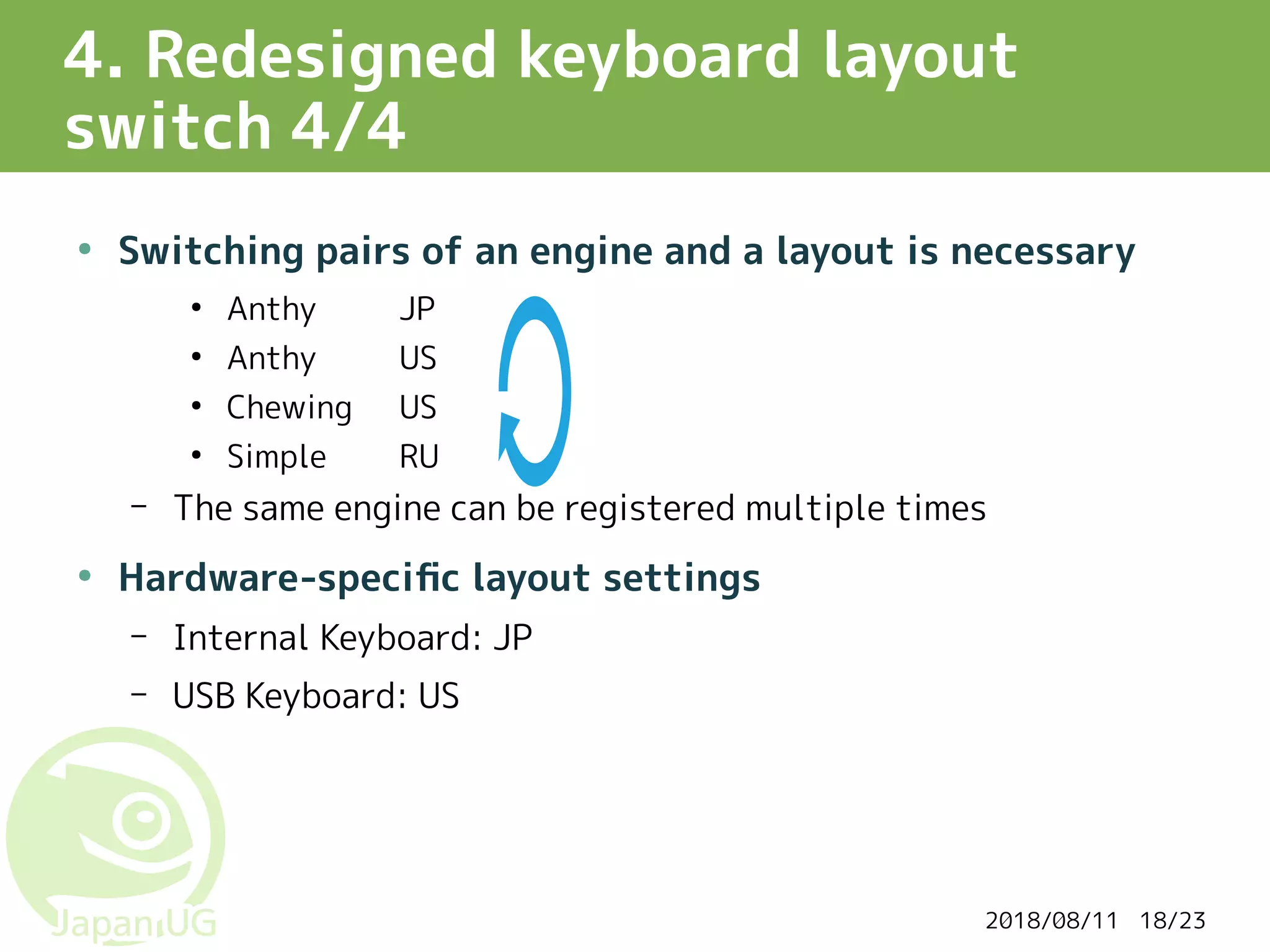
Switching pairs of an engine and a layout is necessary
●
Anthy JP
●
Anthy US
●
Chewing US
●
Simple RU
– The same engine can be registered multiple times
●
Hardware-specific layout settings
– Internal Keyboard: JP
– USB Keyboard: US
2018/08/11 19/23
5. Support of text input without
physical keyboard
●
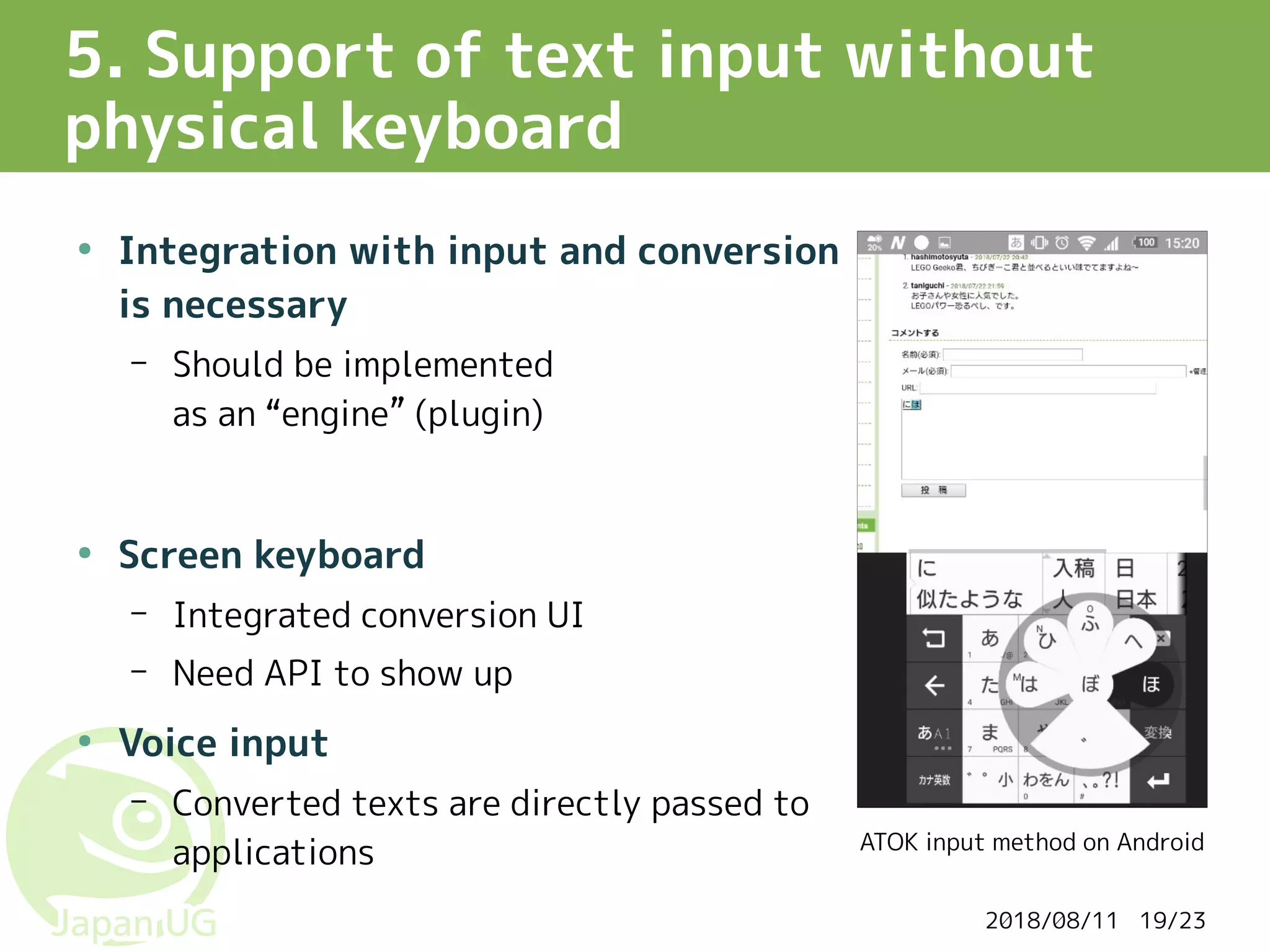
Integration with input and conversion
is necessary
– Should be implemented
as an “engine” (plugin)
●
Screen keyboard
– Integrated conversion UI
– Need API to show up
●
Voice input
– Converted texts are directly passed to
applications ATOK input method on Android
2018/08/11 20/23
6. Input mode v.s. input engine 1/2
●
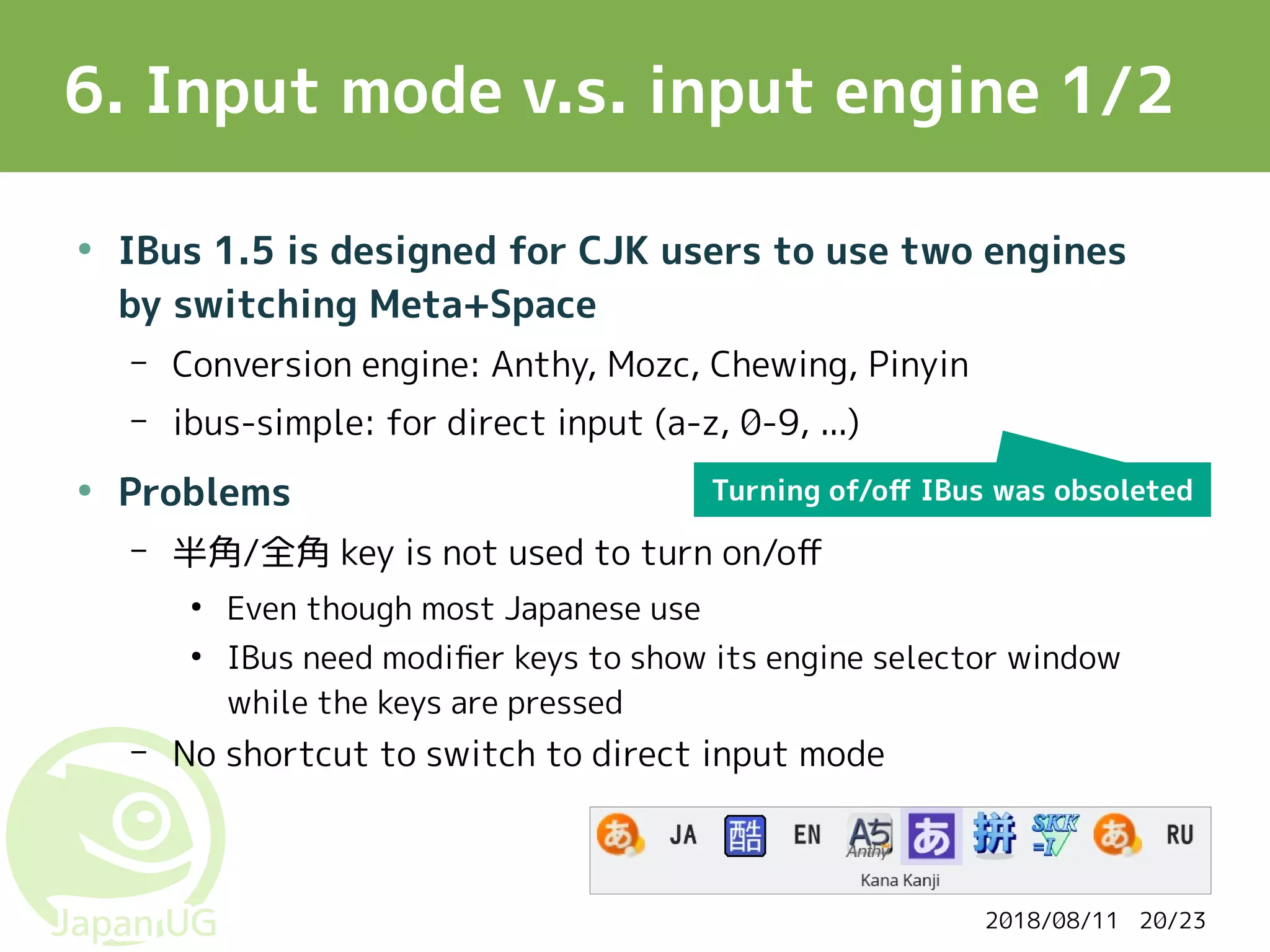
IBus 1.5 is designed for CJK users to use two engines
by switching Meta+Space
– Conversion engine: Anthy, Mozc, Chewing, Pinyin
– ibus-simple: for direct input (a-z, 0-9, ...)
●
Problems
– 半角/全角 key is not used to turn on/off
●
Even though most Japanese use
●
IBus need modifier keys to show its engine selector window
while the keys are pressed
– No shortcut to switch to direct input mode
Turning of/off IBus was obsoleted
2018/08/11 21/23
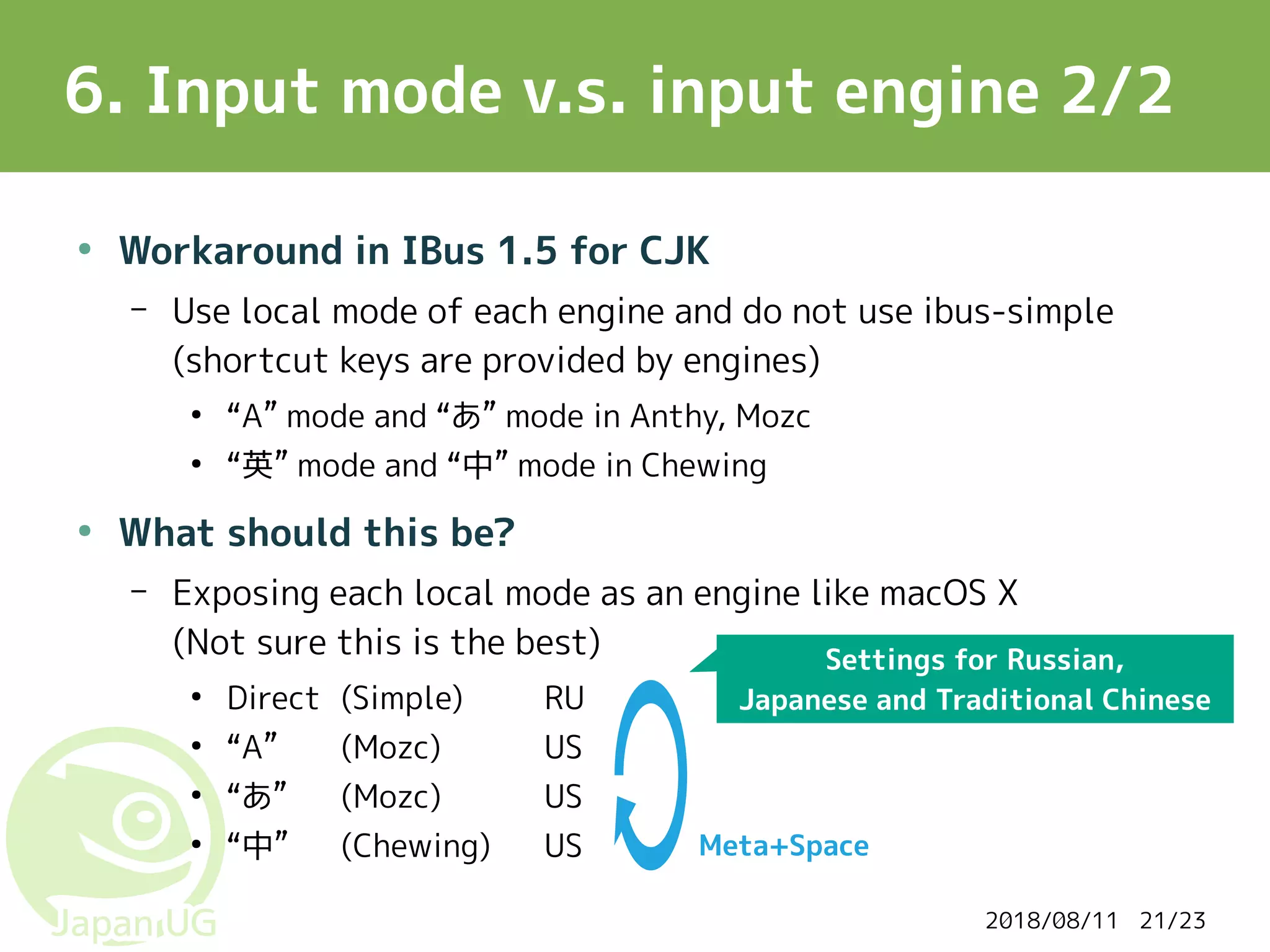
6. Input mode v.s. input engine 2/2
●
Workaround in IBus 1.5 for CJK
– Use local mode of each engine and do not use ibus-simple
(shortcut keys are provided by engines)
●
“A” mode and “あ” mode in Anthy, Mozc
●
“英” mode and “中” mode in Chewing
●
What should this be?
– Exposing each local mode as an engine like macOS X
(Not sure this is the best)
●
Direct (Simple) RU
●
“A” (Mozc) US
●
“あ” (Mozc) US
●
“中” (Chewing) US Meta+Space
Settings for Russian,
Japanese and Traditional Chinese
2018/08/11 22/23
7. Open community
●
It is getting difficult to make a good solution without
open discussion
– An input method framework is involved with many parts of
applications and platform
●
Not only GNOME
– If the design changes in IBus 1.5 was discussed openly, we
could have resolved some problems before the release
2018/08/11 23/23
Conclusion
●
I think it is possible to make a standard IMF
– By separating into thin core service and various engine plugins
●
Let’s use our effort not for multiple IMF support but for
– New input mechanism such as screen keyboard and voice input
– Wayland integration
– Resolving application specific issues
●
Cursor position problem
●
Electron applications bug in Flatpak

What is necessary for the next input method framework?

  • 1.
    2018/08/11 1/23 What isnecessary for the next input method framework Fuminobu TAKEYAMA (ftake) openSUSE.Asia Summit 2018, Taipei
  • 2.
    2018/08/11 2/23 About me ● TAKEYAMA,Fuminobu (武山 文信) – openSUSE ID: ftake – from Japan ● Community (weekend) developer – Maintainer of openSUSE M17N (Multilingualization) ● opensuse-m17n@opensuse.org ● https://build.opensuse.org/projects/M17N – Not a developer of any specific input method framework ● Communities – Organizer of Japan openSUSE User Group – openSUSE.Asia Summit 2017 Local Organizing Chair
  • 3.
    2018/08/11 3/23 What isan input method? ● A mechanism to input various characters – Complex characters used in Chinese, Japanese, Korean – Usually using several key strokes aoi あおい 青い
  • 4.
    2018/08/11 4/23 What isan input method framework (IMF) ? ● An interface between applications and input method engines (conversion software) – Also allows switching multiple input method engines – e.g., IBus, Fcitx, GCIN, SCIM, UIM, IIIMF, Kinput2, ... GTK App. Qt App. X App. IMF daemon *-qt *-xim*-gtk IMFGUI QtGtk X server Mozc libchewing3 *-mozc *-chewing Engines Different API for each GUI platform GTK, Qt IM module, XIM An unified API to implement engines
  • 5.
    2018/08/11 5/23 Input methodframeworks on openSUSE ● openSUSE supports multiple IMFs ● Different IMF is used depending on the session locale by default – GCIN for zh_TW, zh_HK – Fcitx for zh_ CN, etc. – IBus for ja_JP
  • 6.
    2018/08/11 6/23 Recent changesin the API layer ● Qt5 contains ibus-qt (GTK+ 4 will also) ● Flatpak applications can communicate with IBus running on the host – using the IBus portal D-Bus interface GTK App. Qt App. X App. ibus-daemon ibus-qt ibus-ximibus-gtk QtGtk X server Mozc libchewing3 ibus-mozc ibus-chewing IBus D-Bus Interface Flatpak App. Flatpak portal Engines ... ... ibus-ui-gtk3ibus-ui-gtk3
  • 7.
    2018/08/11 7/23 But, Flatpaksupports only IBus ● Issue #43 Add other im module for input method – https://github.com/flatpak/freedesktop-sdk-images/issues/4 3 I'm still not convinced we want to support multiple input method frameworks By Matthias Clasen
  • 8.
    2018/08/11 8/23 Some peoplemight think IBus is now the standard IMF? ● No – Quite many people prefer Fcitx or Gcin and hate IBus – By Googling “ibus”, several blog posts saying “how ibus is bad” are found – Due to the several design issues (mentioned later) ● Why so many IMFs have been developed? – Formerly, for more stability ● Let’s remind conversion engines were running on an application process – Now, usability, customizability, ...
  • 9.
    2018/08/11 9/23 Do westill need various IMFs? ● I think no if we have a thin and simple IMF – No major difference in the core part of today’s IMFs – “An interface between applications and engines” does not provide much user experience – GUI should be separated into engines and replaceable ● No more multiple IMF support cost ● It’s time to end the war of input method framework
  • 10.
    2018/08/11 10/23 So let’sdiscuss what is necessary for the next IMF? ● From the viewpoint of architecture/design ● By reviewing the problems of IBus (and Fcitx)
  • 11.
    2018/08/11 11/23 1. Separationof GUI from core IMF service 1/2 ● GUI of input method is now provided by IMF – Design of the GUI is a major cause of discontent ● A candidate window should be a part of an engine – e.g., IBus cannot show hints (word usage) on a candidate list ● Mozc replaces candidate window with its own in irregular way but it is broken on GNOME Wayland shell Candidate window of ibus-ui-gtk3 (with ibus-kkc) Candidate window of Mozc
  • 12.
    2018/08/11 12/23 1. Separationof GUI from core IMF service 2/2 ● For IBus, some major logic of IMF is implemented in GUI layer (status panel applications) – Switching keyboard layout, loading plugins, etc. ● What is worse, there are three GUI layer variations – ibus-ui-gtk3 – GNOME keyboard plugin – KDE Input method panel
  • 13.
    2018/08/11 13/23 2. Runningwithout specific GUI libraries ● IBus depends on GTK+ – KDE input method panel still requires ibus-ui-gtk3 – Fcitx have less dependency ● Will be necessary for embedded – e.g., Automotive Grade Linux
  • 14.
    2018/08/11 14/23 3. Waylandsupport ● Need APIs between IM engine and Wayland compositor (server) – To get absolute position of text cursor – To place IM engine’s window to appropriate position
  • 15.
    2018/08/11 15/23 4. Redesignedkeyboard layout switch 1/4 ● Both IBus and Fcitx support this for layouts such as Russian and Arabic – ASDF ⇔ ФЫВА By Nkoke, No modification, CC-BY-SA 3.0 https://commons.wikimedia.org/wiki/File:Russian_keyboard_win.png A S D F
  • 16.
    2018/08/11 16/23 4. Redesignedkeyboard layout switch 2/4 ● A layout is provided as an IBus engine – ibus-simple – Some engine like Anthy allow to specify a layout too
  • 17.
    2018/08/11 17/23 4. Redesignedkeyboard layout switch 3/4 ● The following situations are not supported – To switch between JP and US layout with engines like Anthy, Mozc... – To use two keyboards with different layout (US, JP) Internal JP layout USB US layout
  • 18.
    2018/08/11 18/23 4. Redesignedkeyboard layout switch 4/4 ● Switching pairs of an engine and a layout is necessary ● Anthy JP ● Anthy US ● Chewing US ● Simple RU – The same engine can be registered multiple times ● Hardware-specific layout settings – Internal Keyboard: JP – USB Keyboard: US
  • 19.
    2018/08/11 19/23 5. Supportof text input without physical keyboard ● Integration with input and conversion is necessary – Should be implemented as an “engine” (plugin) ● Screen keyboard – Integrated conversion UI – Need API to show up ● Voice input – Converted texts are directly passed to applications ATOK input method on Android
  • 20.
    2018/08/11 20/23 6. Inputmode v.s. input engine 1/2 ● IBus 1.5 is designed for CJK users to use two engines by switching Meta+Space – Conversion engine: Anthy, Mozc, Chewing, Pinyin – ibus-simple: for direct input (a-z, 0-9, ...) ● Problems – 半角/全角 key is not used to turn on/off ● Even though most Japanese use ● IBus need modifier keys to show its engine selector window while the keys are pressed – No shortcut to switch to direct input mode Turning of/off IBus was obsoleted
  • 21.
    2018/08/11 21/23 6. Inputmode v.s. input engine 2/2 ● Workaround in IBus 1.5 for CJK – Use local mode of each engine and do not use ibus-simple (shortcut keys are provided by engines) ● “A” mode and “あ” mode in Anthy, Mozc ● “英” mode and “中” mode in Chewing ● What should this be? – Exposing each local mode as an engine like macOS X (Not sure this is the best) ● Direct (Simple) RU ● “A” (Mozc) US ● “あ” (Mozc) US ● “中” (Chewing) US Meta+Space Settings for Russian, Japanese and Traditional Chinese
  • 22.
    2018/08/11 22/23 7. Opencommunity ● It is getting difficult to make a good solution without open discussion – An input method framework is involved with many parts of applications and platform ● Not only GNOME – If the design changes in IBus 1.5 was discussed openly, we could have resolved some problems before the release
  • 23.
    2018/08/11 23/23 Conclusion ● I thinkit is possible to make a standard IMF – By separating into thin core service and various engine plugins ● Let’s use our effort not for multiple IMF support but for – New input mechanism such as screen keyboard and voice input – Wayland integration – Resolving application specific issues ● Cursor position problem ● Electron applications bug in Flatpak