What Is Content Atomization and How Do You Go About It?
In a world where content is king, the challenge isn’t just creating
content—it’s making it work for you. This is where content atomization
comes into play, a strategy that not only streamlines your efforts, but
also amplifies your voice.
Imagine taking a single piece of content and expanding its reach
exponentially, transforming it into multiple, targeted pieces that
resonate across different platforms and audiences. That’s the power of
content atomization.
It’s not just about creating more content; it’s about creating smarter
content. Let’s explore how this approach can revolutionize your content
strategy and maximize your marketing efforts.
Quick Takeaways
 Atomizing content into various formats like blog posts, social
media updates, and videos extends its reach and caters to different
audience preferences.
 Content atomization significantly increases content reach and
engagement, leading to higher engagement and conversion rates.
 Atomization maximizes the value of content, saving time and
resources, and enhances SEO by covering a topic from multiple angles.
 Effective atomization involves a strategic process of breaking
down content and measuring its impact through engagement metrics,
traffic analysis, and audience feedback.
Understanding Content Atomization
The real content creation challenge lies in making your content stand
out and work effectively. This is where content atomization steps in as a
crucial strategy.
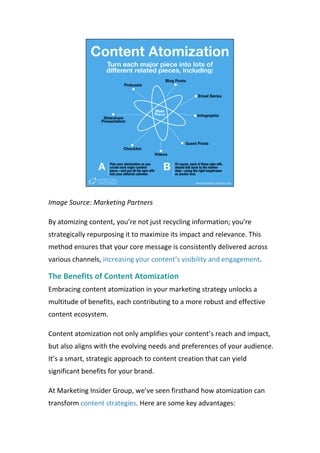
Content atomization is the art of taking a single piece of content and
breaking it down into several smaller, distinct pieces, each tailored for
different platforms and audience segments. Think of it as extracting the
essence of your main content and repurposing it into various formats
like:
 Blog posts
 Social media updates
 Infographics
 Videos
This approach not only extends the reach of your content, but also
caters to the diverse preferences of your audience.
Image Source: Marketing Partners
By atomizing content, you’re not just recycling information; you’re
strategically repurposing it to maximize its impact and relevance. This
method ensures that your core message is consistently delivered across
various channels, increasing your content’s visibility and engagement.
The Benefits of Content Atomization
Embracing content atomization in your marketing strategy unlocks a
multitude of benefits, each contributing to a more robust and effective
content ecosystem.
Content atomization not only amplifies your content’s reach and impact,
but also aligns with the evolving needs and preferences of your audience.
It’s a smart, strategic approach to content creation that can yield
significant benefits for your brand.
At Marketing Insider Group, we’ve seen firsthand how atomization can
transform content strategies. Here are some key advantages:
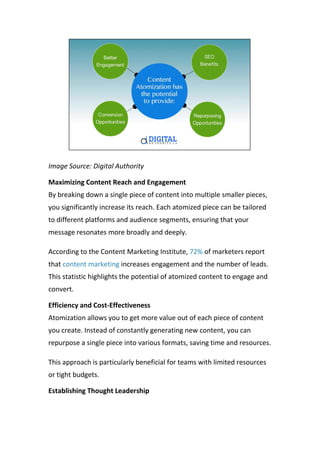
Image Source: Digital Authority
Maximizing Content Reach and Engagement
By breaking down a single piece of content into multiple smaller pieces,
you significantly increase its reach. Each atomized piece can be tailored
to different platforms and audience segments, ensuring that your
message resonates more broadly and deeply.
According to the Content Marketing Institute, 72% of marketers report
that content marketing increases engagement and the number of leads.
This statistic highlights the potential of atomized content to engage and
convert.
Efficiency and Cost-Effectiveness
Atomization allows you to get more value out of each piece of content
you create. Instead of constantly generating new content, you can
repurpose a single piece into various formats, saving time and resources.
This approach is particularly beneficial for teams with limited resources
or tight budgets.
Establishing Thought Leadership
By covering a topic from multiple angles and in various formats,
you position yourself as an authority in your field. This comprehensive
approach to a subject matter not only builds trust with your audience,
but also establishes your brand as a go-to source for information and
insights.
SEO Benefits
Atomized content can also enhance your SEO efforts. By creating
multiple pieces of content around a single topic, you naturally
incorporate a variety of keywords and topics, which can improve your
search engine visibility and drive organic traffic.
Meeting Audience Preferences
Different audience segments prefer different types of content. Some
may gravitate towards in-depth articles, while others prefer quick, visual
content like infographics or videos.
Content atomization allows you to cater to these varied preferences,
ensuring that your message reaches your audience in the format they
most enjoy.
The Process of Atomizing Content
Atomizing content is a strategic approach that requires thoughtful
planning and execution.
In episode 6 of ‘Stop Talking. Start Doing,’ Jeff Herrmann, CEO of the
Youngstown Publishing Company, shares insightful strategies on how
The Business Journal successfully applies content atomization. Herrmann
emphasizes the importance of using, reusing, and repackaging existing
content to maximize ROI.
Video Source: The Business Journal – Youngstown Publishing Co.
At Marketing Insider Group, we’ve honed this process to ensure that
each piece of content we produce can be effectively atomized for
maximum impact.
By following these steps, you can transform a single piece of content
into a multitude of engaging, platform-specific pieces, each designed to
capture the attention of different segments of your audience.
1. Start with a Comprehensive Main Piece
Your journey begins with a robust, comprehensive piece of content. This
could be a detailed blog post, a comprehensive report, or an in-depth
video. The key is to ensure that this main piece is rich in information and
broad enough to be broken down into smaller segments.
2. Identify Key Segments for Atomization
Once you have your main content piece, the next step is to identify
potential segments that can stand alone as smaller content pieces. Look
for subtopics, individual points, or specific themes that can be expanded
upon.
3. Create Smaller, Focused Pieces
Now, turn these segments into individual content pieces. This could
mean writing shorter blog posts, creating infographics, or producing
short videos. Each piece should provide value on its own while still being
linked to the main content.
4. Tailor for Different Platforms
Adapt each piece for the platform where it will be published. For
instance, a detailed blog post can be turned into a series of tweets, a
LinkedIn article, or even a script for a YouTube video.
5. Maintain Consistency in Messaging
Throughout the atomization process, it’s crucial to maintain a consistent
message and tone across all content pieces. This ensures a cohesive
content strategy and reinforces your brand’s message.
6. Analyze and Refine
Finally, monitor the performance of your atomized content. Use
analytics to understand what works and refine your approach based on
these insights.
Measuring the Impact of Content Atomization
The effectiveness of content atomization isn’t just in its execution; it’s
also in how you measure its impact. Understanding the performance of
your atomized content is crucial for refining your strategy and ensuring
that your efforts are aligning with your marketing goals.
Here’s how you can measure the impact effectively:
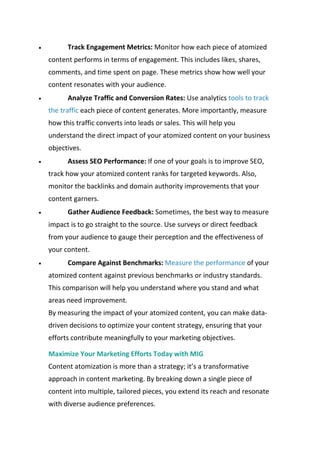
 Set Clear Objectives: Before starting content atomization, set
SMART goals—specific, measurable, achievable, relevant, and time-
bound objectives—to guide engagement, traffic, lead generation,
and SEO ranking efforts. Having well-defined objectives will streamline
your measurement and analysis efforts.
Image Source: Medium
 Track Engagement Metrics: Monitor how each piece of atomized
content performs in terms of engagement. This includes likes, shares,
comments, and time spent on page. These metrics show how well your
content resonates with your audience.
 Analyze Traffic and Conversion Rates: Use analytics tools to track
the traffic each piece of content generates. More importantly, measure
how this traffic converts into leads or sales. This will help you
understand the direct impact of your atomized content on your business
objectives.
 Assess SEO Performance: If one of your goals is to improve SEO,
track how your atomized content ranks for targeted keywords. Also,
monitor the backlinks and domain authority improvements that your
content garners.
 Gather Audience Feedback: Sometimes, the best way to measure
impact is to go straight to the source. Use surveys or direct feedback
from your audience to gauge their perception and the effectiveness of
your content.
 Compare Against Benchmarks: Measure the performance of your
atomized content against previous benchmarks or industry standards.
This comparison will help you understand where you stand and what
areas need improvement.
By measuring the impact of your atomized content, you can make data-
driven decisions to optimize your content strategy, ensuring that your
efforts contribute meaningfully to your marketing objectives.
Maximize Your Marketing Efforts Today with MIG
Content atomization is more than a strategy; it’s a transformative
approach in content marketing. By breaking down a single piece of
content into multiple, tailored pieces, you extend its reach and resonate
with diverse audience preferences.
At Marketing Insider Group, we’ve witnessed how atomization
maximizes engagement, enhances efficiency, and establishes thought
leadership. Implementing this approach and measuring its impact can
revolutionize your content strategy, turning every piece into a more
effective tool for engagement and conversion.
Ready to maximize your marketing efforts with content atomization?
Check out our SEO Blog Writing Service or schedule a quick
consultation to learn more about how Marketing Insider Group can help
you earn more leads for your business.

What Is Content Atomization and How Do You Go About It.pdf

  • 1.
    What Is ContentAtomization and How Do You Go About It? In a world where content is king, the challenge isn’t just creating content—it’s making it work for you. This is where content atomization comes into play, a strategy that not only streamlines your efforts, but also amplifies your voice. Imagine taking a single piece of content and expanding its reach exponentially, transforming it into multiple, targeted pieces that resonate across different platforms and audiences. That’s the power of content atomization. It’s not just about creating more content; it’s about creating smarter content. Let’s explore how this approach can revolutionize your content strategy and maximize your marketing efforts. Quick Takeaways  Atomizing content into various formats like blog posts, social media updates, and videos extends its reach and caters to different audience preferences.
  • 2.
     Content atomizationsignificantly increases content reach and engagement, leading to higher engagement and conversion rates.  Atomization maximizes the value of content, saving time and resources, and enhances SEO by covering a topic from multiple angles.  Effective atomization involves a strategic process of breaking down content and measuring its impact through engagement metrics, traffic analysis, and audience feedback. Understanding Content Atomization The real content creation challenge lies in making your content stand out and work effectively. This is where content atomization steps in as a crucial strategy. Content atomization is the art of taking a single piece of content and breaking it down into several smaller, distinct pieces, each tailored for different platforms and audience segments. Think of it as extracting the essence of your main content and repurposing it into various formats like:  Blog posts  Social media updates  Infographics  Videos This approach not only extends the reach of your content, but also caters to the diverse preferences of your audience.
  • 3.
    Image Source: MarketingPartners By atomizing content, you’re not just recycling information; you’re strategically repurposing it to maximize its impact and relevance. This method ensures that your core message is consistently delivered across various channels, increasing your content’s visibility and engagement. The Benefits of Content Atomization Embracing content atomization in your marketing strategy unlocks a multitude of benefits, each contributing to a more robust and effective content ecosystem. Content atomization not only amplifies your content’s reach and impact, but also aligns with the evolving needs and preferences of your audience. It’s a smart, strategic approach to content creation that can yield significant benefits for your brand. At Marketing Insider Group, we’ve seen firsthand how atomization can transform content strategies. Here are some key advantages:
  • 4.
    Image Source: DigitalAuthority Maximizing Content Reach and Engagement By breaking down a single piece of content into multiple smaller pieces, you significantly increase its reach. Each atomized piece can be tailored to different platforms and audience segments, ensuring that your message resonates more broadly and deeply. According to the Content Marketing Institute, 72% of marketers report that content marketing increases engagement and the number of leads. This statistic highlights the potential of atomized content to engage and convert. Efficiency and Cost-Effectiveness Atomization allows you to get more value out of each piece of content you create. Instead of constantly generating new content, you can repurpose a single piece into various formats, saving time and resources. This approach is particularly beneficial for teams with limited resources or tight budgets. Establishing Thought Leadership
  • 5.
    By covering atopic from multiple angles and in various formats, you position yourself as an authority in your field. This comprehensive approach to a subject matter not only builds trust with your audience, but also establishes your brand as a go-to source for information and insights. SEO Benefits Atomized content can also enhance your SEO efforts. By creating multiple pieces of content around a single topic, you naturally incorporate a variety of keywords and topics, which can improve your search engine visibility and drive organic traffic. Meeting Audience Preferences Different audience segments prefer different types of content. Some may gravitate towards in-depth articles, while others prefer quick, visual content like infographics or videos. Content atomization allows you to cater to these varied preferences, ensuring that your message reaches your audience in the format they most enjoy. The Process of Atomizing Content Atomizing content is a strategic approach that requires thoughtful planning and execution. In episode 6 of ‘Stop Talking. Start Doing,’ Jeff Herrmann, CEO of the Youngstown Publishing Company, shares insightful strategies on how The Business Journal successfully applies content atomization. Herrmann emphasizes the importance of using, reusing, and repackaging existing content to maximize ROI. Video Source: The Business Journal – Youngstown Publishing Co.
  • 6.
    At Marketing InsiderGroup, we’ve honed this process to ensure that each piece of content we produce can be effectively atomized for maximum impact. By following these steps, you can transform a single piece of content into a multitude of engaging, platform-specific pieces, each designed to capture the attention of different segments of your audience. 1. Start with a Comprehensive Main Piece Your journey begins with a robust, comprehensive piece of content. This could be a detailed blog post, a comprehensive report, or an in-depth video. The key is to ensure that this main piece is rich in information and broad enough to be broken down into smaller segments. 2. Identify Key Segments for Atomization Once you have your main content piece, the next step is to identify potential segments that can stand alone as smaller content pieces. Look for subtopics, individual points, or specific themes that can be expanded upon. 3. Create Smaller, Focused Pieces Now, turn these segments into individual content pieces. This could mean writing shorter blog posts, creating infographics, or producing short videos. Each piece should provide value on its own while still being linked to the main content. 4. Tailor for Different Platforms Adapt each piece for the platform where it will be published. For instance, a detailed blog post can be turned into a series of tweets, a LinkedIn article, or even a script for a YouTube video. 5. Maintain Consistency in Messaging
  • 7.
    Throughout the atomizationprocess, it’s crucial to maintain a consistent message and tone across all content pieces. This ensures a cohesive content strategy and reinforces your brand’s message. 6. Analyze and Refine Finally, monitor the performance of your atomized content. Use analytics to understand what works and refine your approach based on these insights. Measuring the Impact of Content Atomization The effectiveness of content atomization isn’t just in its execution; it’s also in how you measure its impact. Understanding the performance of your atomized content is crucial for refining your strategy and ensuring that your efforts are aligning with your marketing goals. Here’s how you can measure the impact effectively:  Set Clear Objectives: Before starting content atomization, set SMART goals—specific, measurable, achievable, relevant, and time- bound objectives—to guide engagement, traffic, lead generation, and SEO ranking efforts. Having well-defined objectives will streamline your measurement and analysis efforts. Image Source: Medium
  • 8.
     Track EngagementMetrics: Monitor how each piece of atomized content performs in terms of engagement. This includes likes, shares, comments, and time spent on page. These metrics show how well your content resonates with your audience.  Analyze Traffic and Conversion Rates: Use analytics tools to track the traffic each piece of content generates. More importantly, measure how this traffic converts into leads or sales. This will help you understand the direct impact of your atomized content on your business objectives.  Assess SEO Performance: If one of your goals is to improve SEO, track how your atomized content ranks for targeted keywords. Also, monitor the backlinks and domain authority improvements that your content garners.  Gather Audience Feedback: Sometimes, the best way to measure impact is to go straight to the source. Use surveys or direct feedback from your audience to gauge their perception and the effectiveness of your content.  Compare Against Benchmarks: Measure the performance of your atomized content against previous benchmarks or industry standards. This comparison will help you understand where you stand and what areas need improvement. By measuring the impact of your atomized content, you can make data- driven decisions to optimize your content strategy, ensuring that your efforts contribute meaningfully to your marketing objectives. Maximize Your Marketing Efforts Today with MIG Content atomization is more than a strategy; it’s a transformative approach in content marketing. By breaking down a single piece of content into multiple, tailored pieces, you extend its reach and resonate with diverse audience preferences.
  • 9.
    At Marketing InsiderGroup, we’ve witnessed how atomization maximizes engagement, enhances efficiency, and establishes thought leadership. Implementing this approach and measuring its impact can revolutionize your content strategy, turning every piece into a more effective tool for engagement and conversion. Ready to maximize your marketing efforts with content atomization? Check out our SEO Blog Writing Service or schedule a quick consultation to learn more about how Marketing Insider Group can help you earn more leads for your business.