What is AWS Lambda?
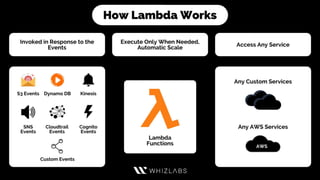
AWS Lambda is a computing service that allows you to run the prepared codes
without the necessity of managing or provisioning servers.
Lambda is destined to run your code only when it is highly needed and further
scales and automatically and it bills you for the compute time consumed by you
and does not charge you anything while your code is stationary.
AWS Lambda allows you to run the codes virtually for almost all types of
applications and back-end services. The infrastructure of AWS Lambda upon
which it runs your code is destined to give an optimal response.
Features of AWS Lambda
1. Building Customized Back-End Services
AWS Lambda is highly preferred for creating services for the dedicated applications that are
usually triggered on specific demands and triggered with the use of Lambda API endpoints in
built upon the API gateway of Amazon. With the use of this feature offered by Amazon Lambda
in adapting easier updates, reducing battery drain, and avoiding client platform variations.
2. Automated Administration
The infrastructure upon which AWS Lambda runs your code is fault-tolerant and highly
available. Due to this feature implementation, you can free up your efforts to put it for building
back-end services. The automated administration feature of AWS Lambda allows you to take
off the hassle of updating the OS patch manually as AWS Lambda handles it.
Cont…….
3. Fault-Tolerance
It is yet another best feature of AWS Lambda that protects your code under the instances of
data center or machine failures. AWS Lambda does this by maintaining the computing capacity
at optimal levels across different availability zones of diverse regions. Amazon Lambda
consists of no scheduled downtime or maintenance closures.
4. Automated Scaling Potential
AWS Lambda runs your code only when it is needed and called by you. And with that, it also
automatically scales itself to support the incoming request rate. You do not need to tweak or
modify the configurations for it, as Lambda would implement its necessary functions
accordingly and no specified number limits upon AWS Lambda.
Additional Features of AWS Lambda
1. It packages and deploys the functions as the container images help make it
convenient for the customers to build applications upon AWS Lambda.
2. AWS Lambda is embedded with Provisioned Concurrency for enabling you to
possess control over how the serverless application performs. It keeps the
functions in an initialized state(ready state).
3. AWS Lambda comes with an integrated model of security that makes the code
accessible to other services offered by AWS securely.
4. AWS Lambda bills you only for the compute time used for running the code and for
the requests that are successfully served.
Limitations Within AWS Lambda
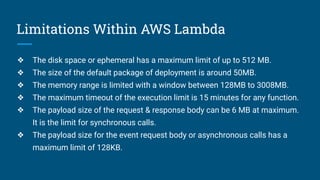
❖ The disk space or ephemeral has a maximum limit of up to 512 MB.
❖ The size of the default package of deployment is around 50MB.
❖ The memory range is limited with a window between 128MB to 3008MB.
❖ The maximum timeout of the execution limit is 15 minutes for any function.
❖ The payload size of the request & response body can be 6 MB at maximum.
It is the limit for synchronous calls.
❖ The payload size for the event request body or asynchronous calls has a
maximum limit of 128KB.
Use Cases of AWS Lambda
➢ It helps with the operation of serverless websites
➢ It supports rapid document conversion.
➢ AWS Lambda is adapted for its feasibility of working with external services.
➢ The backups and the administrative tasks are completely automated with
the use of AWS Lambda.
➢ It is used for back-end cleaning.
➢ It can be implemented for real-time data processing.
Types of Applications Built upon AWS Lambda
1.File Processing- If you are building a photo-sharing app, then it should possess features as
uploading photos, following which the photos are stored in the Amazon S3 bucket. Lambda
function is embedded onto the app for automating the creation of thumbnails.
2.Websites- If you are building a website or a web application, you should avail the functionality
of holding the back-end logic on Lambda,the function needs to be over HTTP using the API
Gateway by Amazon as an HTTP endpoint. The web client is now permitted to invoke that API,
after which the request will be passed onto Lambda.
3.Mobile Apps- If you are building a custom mobile application for producing the events, the
lambda function can be helpful on ahead and create a dedicated Lambda function for
processing the published events by your application.
Conclusion
With all of these detailed attributes highlighted above, you would
have got the clarity upon how AWS Lambda is of utmost
importance to help the users execute their codes, build
applications, add specific functionalities and implement other
such functions.
THANKS!

What is AWS lambda?

  • 3.
    What is AWSLambda? AWS Lambda is a computing service that allows you to run the prepared codes without the necessity of managing or provisioning servers. Lambda is destined to run your code only when it is highly needed and further scales and automatically and it bills you for the compute time consumed by you and does not charge you anything while your code is stationary. AWS Lambda allows you to run the codes virtually for almost all types of applications and back-end services. The infrastructure of AWS Lambda upon which it runs your code is destined to give an optimal response.
  • 4.
    Features of AWSLambda 1. Building Customized Back-End Services AWS Lambda is highly preferred for creating services for the dedicated applications that are usually triggered on specific demands and triggered with the use of Lambda API endpoints in built upon the API gateway of Amazon. With the use of this feature offered by Amazon Lambda in adapting easier updates, reducing battery drain, and avoiding client platform variations. 2. Automated Administration The infrastructure upon which AWS Lambda runs your code is fault-tolerant and highly available. Due to this feature implementation, you can free up your efforts to put it for building back-end services. The automated administration feature of AWS Lambda allows you to take off the hassle of updating the OS patch manually as AWS Lambda handles it.
  • 5.
    Cont……. 3. Fault-Tolerance It isyet another best feature of AWS Lambda that protects your code under the instances of data center or machine failures. AWS Lambda does this by maintaining the computing capacity at optimal levels across different availability zones of diverse regions. Amazon Lambda consists of no scheduled downtime or maintenance closures. 4. Automated Scaling Potential AWS Lambda runs your code only when it is needed and called by you. And with that, it also automatically scales itself to support the incoming request rate. You do not need to tweak or modify the configurations for it, as Lambda would implement its necessary functions accordingly and no specified number limits upon AWS Lambda.
  • 6.
    Additional Features ofAWS Lambda 1. It packages and deploys the functions as the container images help make it convenient for the customers to build applications upon AWS Lambda. 2. AWS Lambda is embedded with Provisioned Concurrency for enabling you to possess control over how the serverless application performs. It keeps the functions in an initialized state(ready state). 3. AWS Lambda comes with an integrated model of security that makes the code accessible to other services offered by AWS securely. 4. AWS Lambda bills you only for the compute time used for running the code and for the requests that are successfully served.
  • 8.
    Limitations Within AWSLambda ❖ The disk space or ephemeral has a maximum limit of up to 512 MB. ❖ The size of the default package of deployment is around 50MB. ❖ The memory range is limited with a window between 128MB to 3008MB. ❖ The maximum timeout of the execution limit is 15 minutes for any function. ❖ The payload size of the request & response body can be 6 MB at maximum. It is the limit for synchronous calls. ❖ The payload size for the event request body or asynchronous calls has a maximum limit of 128KB.
  • 9.
    Use Cases ofAWS Lambda ➢ It helps with the operation of serverless websites ➢ It supports rapid document conversion. ➢ AWS Lambda is adapted for its feasibility of working with external services. ➢ The backups and the administrative tasks are completely automated with the use of AWS Lambda. ➢ It is used for back-end cleaning. ➢ It can be implemented for real-time data processing.
  • 10.
    Types of ApplicationsBuilt upon AWS Lambda 1.File Processing- If you are building a photo-sharing app, then it should possess features as uploading photos, following which the photos are stored in the Amazon S3 bucket. Lambda function is embedded onto the app for automating the creation of thumbnails. 2.Websites- If you are building a website or a web application, you should avail the functionality of holding the back-end logic on Lambda,the function needs to be over HTTP using the API Gateway by Amazon as an HTTP endpoint. The web client is now permitted to invoke that API, after which the request will be passed onto Lambda. 3.Mobile Apps- If you are building a custom mobile application for producing the events, the lambda function can be helpful on ahead and create a dedicated Lambda function for processing the published events by your application.
  • 11.
    Conclusion With all ofthese detailed attributes highlighted above, you would have got the clarity upon how AWS Lambda is of utmost importance to help the users execute their codes, build applications, add specific functionalities and implement other such functions.
  • 12.