What is Audio Visual Technology?
Audio visual technology refers to any technology that is used for
communicating a message through both sound and images. It involves
electronic delivery and manipulation of audio signals, visual components like
video, and their combination. In this blog post, we will explore what audio
visual technology entails, some common types of audio visual systems, and
how this technology is used in different applications.
Discover the ultimate AV solution at Xtenav with audio visual com. Our
cutting-edge software gives you access to an extensive catalog of 1.5 million
products spanning 5200 renowned brands, ensuring you have the tools and
options you need for every project. Whether you're a seasoned AV
professional or a novice enthusiast, AV com simplifies the daunting task of
finding the right equipment. Our platform provides in-depth product
descriptions, technical specifications, and compatibility information. You can
also benefit from user reviews and expert insights to make well-informed
decisions. Xtenav commitment to quality means that we only feature products
from the most trusted brands in the industry. From leading-edge displays and
high-fidelity audio systems to advanced control systems and cabling solutions,
AV com is your one-stop destination for all things AV. Take your audiovisual
projects to new heights with Xtenav and AV com."
What Does Audio Visual Technology Involve?
Audio visual technology combines two fundamental modes of communication -
audio and visual. It allows information to be presented to a viewer or audience
through both sound and synchronized pictures or moving images. Some key
components that make up audio visual technology include:
Audio Equipment: This includes speakers, microphones, audio mixers,
amplifiers and other devices used to capture, process and playback sound.
Visual Display Devices: These are screens like LCD, LED and projection displays
that are used to show visual content like videos, images and presentations.
Video Equipment: This incorporates video cameras, video players, video
switchers and other gear used to capture and display moving pictures with
sound.
Computing Hardware: Audio visual systems rely on computers, servers and
other digital devices to store, process and transmit audio visual content and
signals.
Peripheral Devices: Additional elements like document cameras, media
players, lighting equipment and accessories are used to enhance audio visual
experiences.
Cables, Connectors and Interface: A variety of cables, jacks and ports allow the
effective transfer of audio and video signals between different components of
an audio visual system.
Control Equipment: This includes remotes, controllers and touch panels to
manage and operate different parts of an audio visual setup.
Types of Audio Visual Systems
There are various types of audio visual setups depending on the scale, location
and purpose. Some common system configurations include:
Conference Room Systems
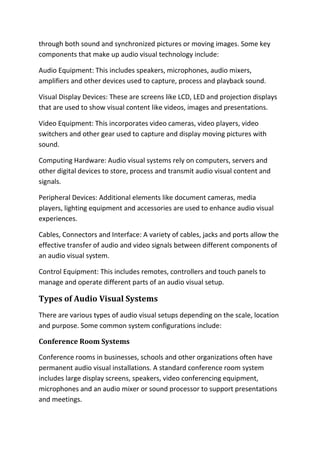
Conference rooms in businesses, schools and other organizations often have
permanent audio visual installations. A standard conference room system
includes large display screens, speakers, video conferencing equipment,
microphones and an audio mixer or sound processor to support presentations
and meetings.
Home Theater Systems
A home theater setup is designed for high quality movie and media viewing in
homes. It usually consists of projectors or large TVs, surround sound speakers,
subwoofers, AV receivers and Blu-ray/streaming media players to deliver an
immersive cinematic experience.
Installation Systems
Permanently installed audio visual equipment in venues like auditoriums,
houses of worship, museums and corporate boardrooms form installation
systems. These are more advanced with multiple large screens, powerful
amplifiers and precise signal routing for diverse events.
Portable Presentation Systems
More portable and compact presentation systems utilize lightweight
projectors, laptop compatibility and rechargeable batteries for flexibility. They
are ideal for classroom teaching, small conferences and mobile workshops with
minimal setup requirements.
Live Performance Systems
Robust audio visual gear designed for durability and mobility allows live
performances to be captured and broadcasted to audiences. PA systems, stage
lighting, video mixing and recording equipment play a key role in managing live
events and broadcasts.
Applications of Audio Visual Technology
With continuous advances, audio visual technology now enhances experiences
across many industries and areas. Some major applications include:
Education - Students greatly benefit from audio visual aids in online/offline
classroom teaching. Projectors, interactive displays and lecture capturing tools
maximize learning.
Corporate Training - Well-produced training sessions combining visuals, demos
and multimedia engage employees better. Sound conference systems also
boost collaboration.
Worship - Modern houses of worship leverage AV to broadcast inspiring
sermons and concerts to larger congregations/online viewers globally.
Entertainment - Cinemas, live shows, concerts, stadium sports, theme parks
and more rely heavily on synchronized sound and visual effects for immersive
entertainment.
Healthcare - Through medical AV systems, doctors can conduct meetings,
surgeries, remote diagnostics and share patient information effectively with
colleagues.
Advertising & Marketing - Commercials, digital signage, kiosks and more
employ audio visual creatives to grab attention and convey brand messages
impactfully.
Gaming - Advanced home gaming consoles and PC setups bring immersive
audio visual experiences to multiplayer and e-sports through 4K displays,
surround audio and low-latency systems.
Surveillance - Security cameras paired with audio help round-the-clock
monitoring of locations through centralized control rooms and remote mobile
devices.
Emerging Trends in Audio Visual Technology
The audio visual industry continues to rapidly evolve with newer
developments. Here are some prominent ongoing and upcoming trends:
4K and Beyond Video Resolutions
High resolution 4K, 8K and higher displays are becoming more mainstream
allowing sharper, detailed audio visual content on larger screens.
VR & AR Integration
Virtual reality and augmented reality offer immersive audio visual experiences
through headsets and are being adopted in various industries like healthcare,
education, marketing and entertainment.
Miniaturization of Components
With technologies like integrated AV receivers and all-in-one PC/laptops, audio
visual gear is decreasing in size without compromising quality for more
portable usage.
IP Streaming & Distribution
Networked audio visual distribution over Ethernet/Internet using protocols like
H.264, WebRTC and HTML5 enable collaboration and remote access to AV
systems conveniently.
Artificial Intelligence Integration
AI assistants, auto-calibration, speech recognition, object/facial tracking and
analytics are enhancing user experience of audio visual systems through
automation and personalization.
Visual Collaboration Tools
Platforms combining video conferencing, messaging, screen sharing and digital
whiteboarding allow efficient audio visual collaboration between distributed
teams.
High Dynamic Range
HDR technology improves details in both bright highlights and dark shadows of
an image on video for more natural, realistic visuals.
8K Projection Mapping
Next-gen entertainment experiences like projection mapping on large unusual
surfaces are now feasible with high resolution 8K capable projectors and
advanced software rendering.
360-degree and Multi-View Video
Specialized cameras and displays enable capturing and viewing video content
from every angle for applications in sports, surveillance, marketing and more.
Growth of the Pro AV Industry
As audio visual solutions penetrate deeper into all walks of life, more
opportunities are opening up for professionals and businesses in the Xlivevent
audio visual com industry to deliver innovative customized integration services
and support nationwide. While consumer AV markets may slow, continued
investments in commercial and experiential AV will drive the pro AV industry's
robust growth globally over the coming years.
Conclusion
In summary, audio visual technology seamlessly combines sound and images to
convey information through electronics in an engaging manner. It enhances
experiences across different domains through various types of specialized
systems. With constant innovations, audio visual solutions continue to evolve
and play an increasingly integral role in businesses, entertainment, education,
healthcare and beyond. As the technology progresses further, we can expect
even more immersive and impactful audio visual experiences in the future.

What is Audio Visual Technology.pdf

  • 1.
    What is AudioVisual Technology? Audio visual technology refers to any technology that is used for communicating a message through both sound and images. It involves electronic delivery and manipulation of audio signals, visual components like video, and their combination. In this blog post, we will explore what audio visual technology entails, some common types of audio visual systems, and how this technology is used in different applications. Discover the ultimate AV solution at Xtenav with audio visual com. Our cutting-edge software gives you access to an extensive catalog of 1.5 million products spanning 5200 renowned brands, ensuring you have the tools and options you need for every project. Whether you're a seasoned AV professional or a novice enthusiast, AV com simplifies the daunting task of finding the right equipment. Our platform provides in-depth product descriptions, technical specifications, and compatibility information. You can also benefit from user reviews and expert insights to make well-informed decisions. Xtenav commitment to quality means that we only feature products from the most trusted brands in the industry. From leading-edge displays and high-fidelity audio systems to advanced control systems and cabling solutions, AV com is your one-stop destination for all things AV. Take your audiovisual projects to new heights with Xtenav and AV com." What Does Audio Visual Technology Involve? Audio visual technology combines two fundamental modes of communication - audio and visual. It allows information to be presented to a viewer or audience
  • 2.
    through both soundand synchronized pictures or moving images. Some key components that make up audio visual technology include: Audio Equipment: This includes speakers, microphones, audio mixers, amplifiers and other devices used to capture, process and playback sound. Visual Display Devices: These are screens like LCD, LED and projection displays that are used to show visual content like videos, images and presentations. Video Equipment: This incorporates video cameras, video players, video switchers and other gear used to capture and display moving pictures with sound. Computing Hardware: Audio visual systems rely on computers, servers and other digital devices to store, process and transmit audio visual content and signals. Peripheral Devices: Additional elements like document cameras, media players, lighting equipment and accessories are used to enhance audio visual experiences. Cables, Connectors and Interface: A variety of cables, jacks and ports allow the effective transfer of audio and video signals between different components of an audio visual system. Control Equipment: This includes remotes, controllers and touch panels to manage and operate different parts of an audio visual setup. Types of Audio Visual Systems There are various types of audio visual setups depending on the scale, location and purpose. Some common system configurations include: Conference Room Systems Conference rooms in businesses, schools and other organizations often have permanent audio visual installations. A standard conference room system includes large display screens, speakers, video conferencing equipment, microphones and an audio mixer or sound processor to support presentations and meetings.
  • 3.
    Home Theater Systems Ahome theater setup is designed for high quality movie and media viewing in homes. It usually consists of projectors or large TVs, surround sound speakers, subwoofers, AV receivers and Blu-ray/streaming media players to deliver an immersive cinematic experience. Installation Systems Permanently installed audio visual equipment in venues like auditoriums, houses of worship, museums and corporate boardrooms form installation systems. These are more advanced with multiple large screens, powerful amplifiers and precise signal routing for diverse events. Portable Presentation Systems More portable and compact presentation systems utilize lightweight projectors, laptop compatibility and rechargeable batteries for flexibility. They are ideal for classroom teaching, small conferences and mobile workshops with minimal setup requirements. Live Performance Systems Robust audio visual gear designed for durability and mobility allows live performances to be captured and broadcasted to audiences. PA systems, stage lighting, video mixing and recording equipment play a key role in managing live events and broadcasts. Applications of Audio Visual Technology With continuous advances, audio visual technology now enhances experiences across many industries and areas. Some major applications include: Education - Students greatly benefit from audio visual aids in online/offline classroom teaching. Projectors, interactive displays and lecture capturing tools maximize learning. Corporate Training - Well-produced training sessions combining visuals, demos and multimedia engage employees better. Sound conference systems also boost collaboration.
  • 4.
    Worship - Modernhouses of worship leverage AV to broadcast inspiring sermons and concerts to larger congregations/online viewers globally. Entertainment - Cinemas, live shows, concerts, stadium sports, theme parks and more rely heavily on synchronized sound and visual effects for immersive entertainment. Healthcare - Through medical AV systems, doctors can conduct meetings, surgeries, remote diagnostics and share patient information effectively with colleagues. Advertising & Marketing - Commercials, digital signage, kiosks and more employ audio visual creatives to grab attention and convey brand messages impactfully. Gaming - Advanced home gaming consoles and PC setups bring immersive audio visual experiences to multiplayer and e-sports through 4K displays, surround audio and low-latency systems. Surveillance - Security cameras paired with audio help round-the-clock monitoring of locations through centralized control rooms and remote mobile devices. Emerging Trends in Audio Visual Technology The audio visual industry continues to rapidly evolve with newer developments. Here are some prominent ongoing and upcoming trends: 4K and Beyond Video Resolutions High resolution 4K, 8K and higher displays are becoming more mainstream allowing sharper, detailed audio visual content on larger screens. VR & AR Integration Virtual reality and augmented reality offer immersive audio visual experiences through headsets and are being adopted in various industries like healthcare, education, marketing and entertainment. Miniaturization of Components
  • 5.
    With technologies likeintegrated AV receivers and all-in-one PC/laptops, audio visual gear is decreasing in size without compromising quality for more portable usage. IP Streaming & Distribution Networked audio visual distribution over Ethernet/Internet using protocols like H.264, WebRTC and HTML5 enable collaboration and remote access to AV systems conveniently. Artificial Intelligence Integration AI assistants, auto-calibration, speech recognition, object/facial tracking and analytics are enhancing user experience of audio visual systems through automation and personalization. Visual Collaboration Tools Platforms combining video conferencing, messaging, screen sharing and digital whiteboarding allow efficient audio visual collaboration between distributed teams. High Dynamic Range HDR technology improves details in both bright highlights and dark shadows of an image on video for more natural, realistic visuals. 8K Projection Mapping Next-gen entertainment experiences like projection mapping on large unusual surfaces are now feasible with high resolution 8K capable projectors and advanced software rendering. 360-degree and Multi-View Video Specialized cameras and displays enable capturing and viewing video content from every angle for applications in sports, surveillance, marketing and more. Growth of the Pro AV Industry As audio visual solutions penetrate deeper into all walks of life, more opportunities are opening up for professionals and businesses in the Xlivevent
  • 6.
    audio visual comindustry to deliver innovative customized integration services and support nationwide. While consumer AV markets may slow, continued investments in commercial and experiential AV will drive the pro AV industry's robust growth globally over the coming years. Conclusion In summary, audio visual technology seamlessly combines sound and images to convey information through electronics in an engaging manner. It enhances experiences across different domains through various types of specialized systems. With constant innovations, audio visual solutions continue to evolve and play an increasingly integral role in businesses, entertainment, education, healthcare and beyond. As the technology progresses further, we can expect even more immersive and impactful audio visual experiences in the future.