What is Apologetics?
Instructor
Pastor Christopher W. Brooks
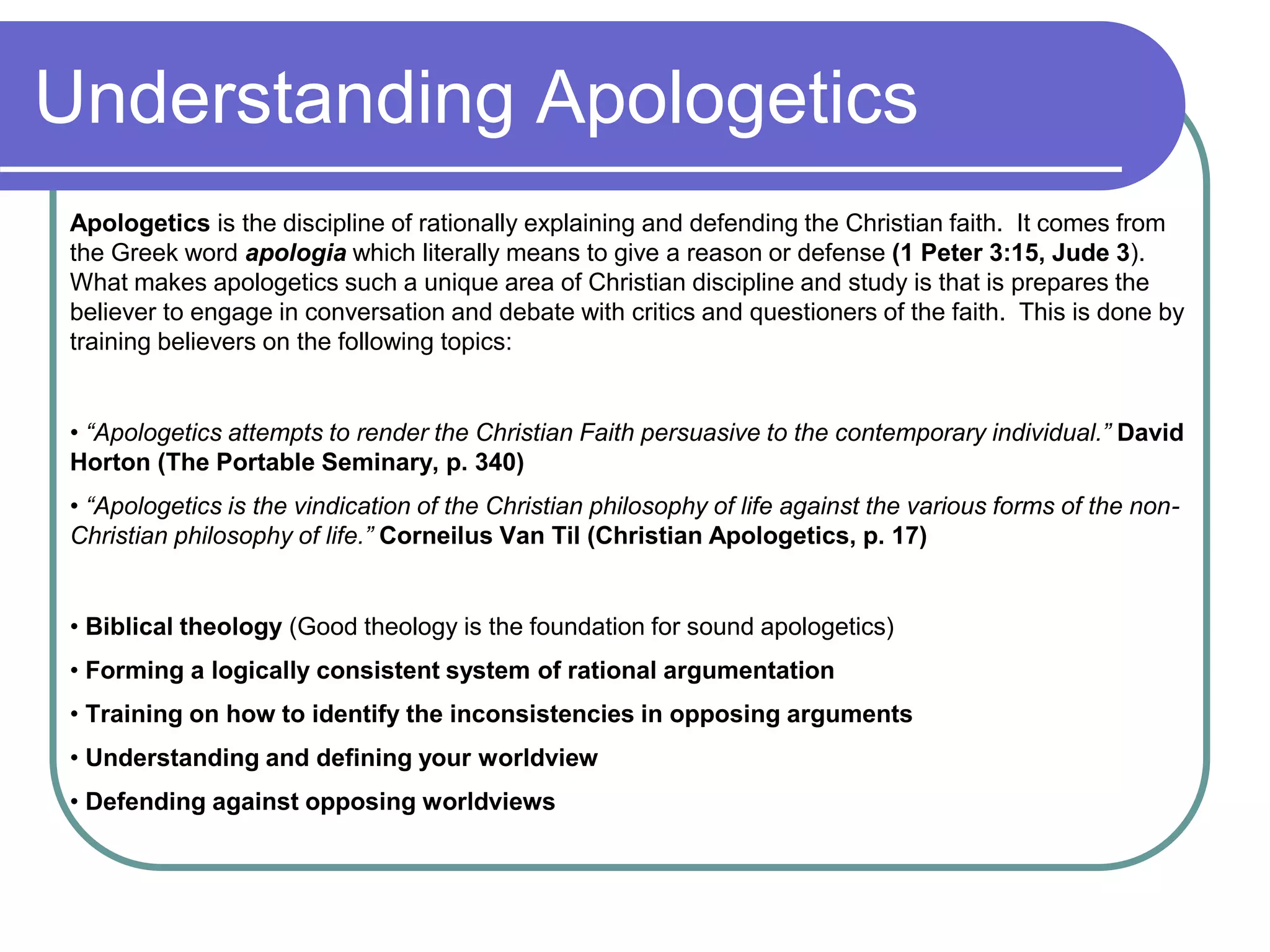
Understanding Apologetics
Apologetics is the discipline of rationally explaining and defending the Christian faith. It comes from
the Greek word apologia which literally means to give a reason or defense (1 Peter 3:15, Jude 3).
What makes apologetics such a unique area of Christian discipline and study is that is prepares the
believer to engage in conversation and debate with critics and questioners of the faith. This is done by
training believers on the following topics:
• “Apologetics attempts to render the Christian Faith persuasive to the contemporary individual.” David
Horton (The Portable Seminary, p. 340)
• “Apologetics is the vindication of the Christian philosophy of life against the various forms of the non-
Christian philosophy of life.” Corneilus Van Til (Christian Apologetics, p. 17)
• Biblical theology (Good theology is the foundation for sound apologetics)
• Forming a logically consistent system of rational argumentation
• Training on how to identify the inconsistencies in opposing arguments
• Understanding and defining your worldview
• Defending against opposing worldviews
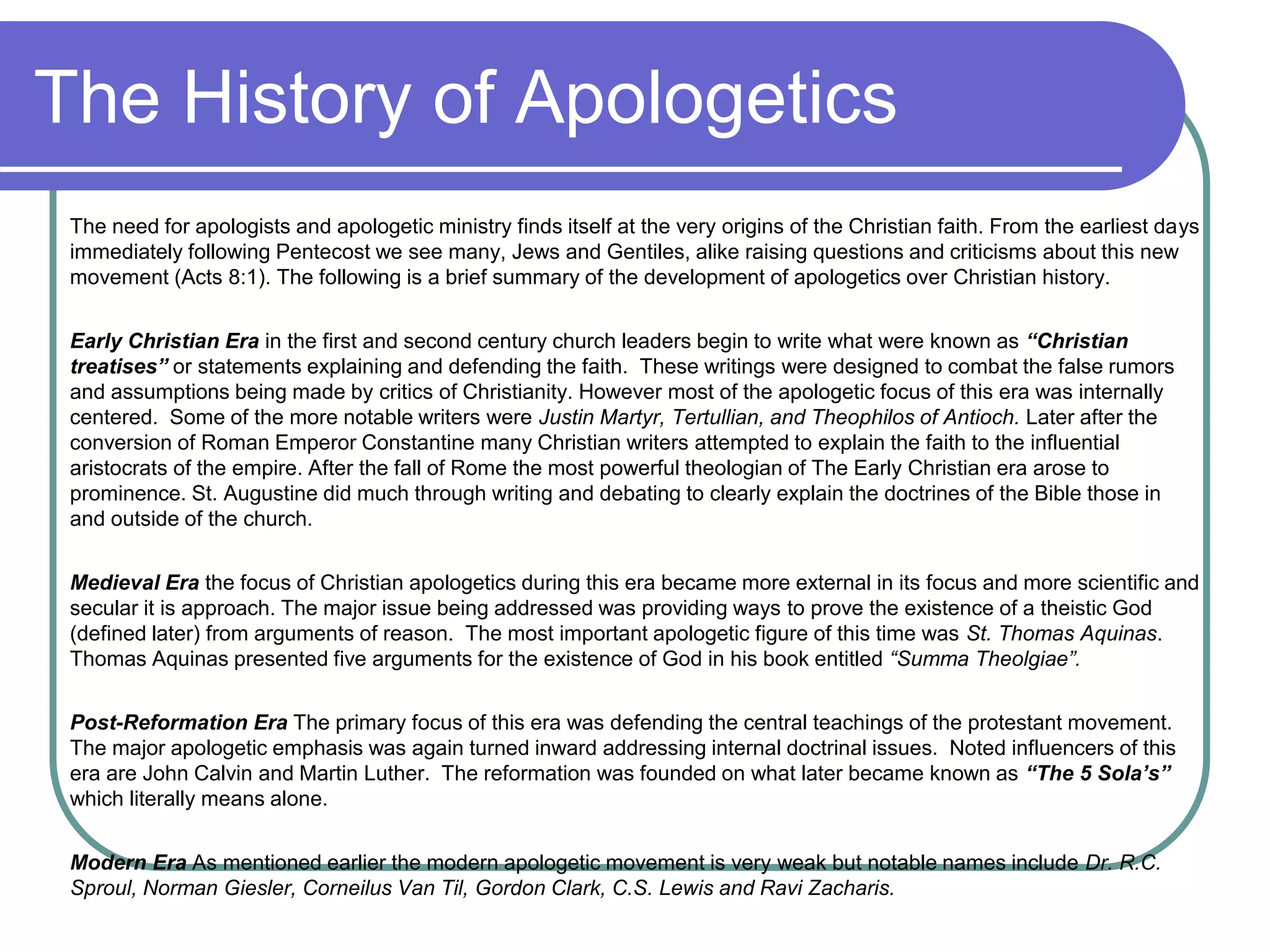
The History of Apologetics
The need for apologists and apologetic ministry finds itself at the very origins of the Christian faith. From the earliest days
immediately following Pentecost we see many, Jews and Gentiles, alike raising questions and criticisms about this new
movement (Acts 8:1). The following is a brief summary of the development of apologetics over Christian history.
Early Christian Era in the first and second century church leaders begin to write what were known as “Christian
treatises” or statements explaining and defending the faith. These writings were designed to combat the false rumors
and assumptions being made by critics of Christianity. However most of the apologetic focus of this era was internally
centered. Some of the more notable writers were Justin Martyr, Tertullian, and Theophilos of Antioch. Later after the
conversion of Roman Emperor Constantine many Christian writers attempted to explain the faith to the influential
aristocrats of the empire. After the fall of Rome the most powerful theologian of The Early Christian era arose to
prominence. St. Augustine did much through writing and debating to clearly explain the doctrines of the Bible those in
and outside of the church.
Medieval Era the focus of Christian apologetics during this era became more external in its focus and more scientific and
secular it is approach. The major issue being addressed was providing ways to prove the existence of a theistic God
(defined later) from arguments of reason. The most important apologetic figure of this time was St. Thomas Aquinas.
Thomas Aquinas presented five arguments for the existence of God in his book entitled “Summa Theolgiae”.
Post-Reformation Era The primary focus of this era was defending the central teachings of the protestant movement.
The major apologetic emphasis was again turned inward addressing internal doctrinal issues. Noted influencers of this
era are John Calvin and Martin Luther. The reformation was founded on what later became known as “The 5 Sola’s”
which literally means alone.
Modern Era As mentioned earlier the modern apologetic movement is very weak but notable names include Dr. R.C.
Sproul, Norman Giesler, Corneilus Van Til, Gordon Clark, C.S. Lewis and Ravi Zacharis.
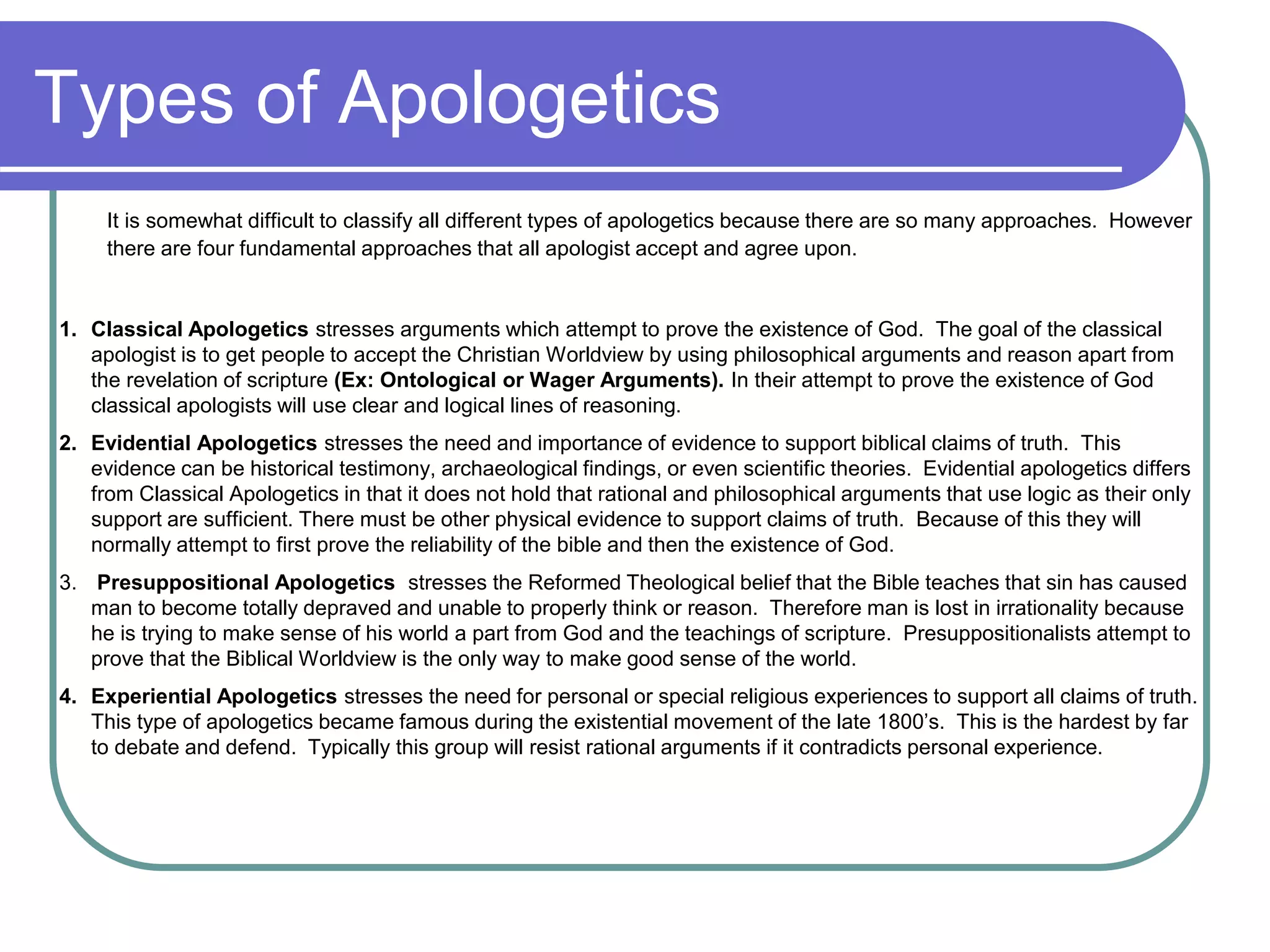
Types of Apologetics
It is somewhat difficult to classify all different types of apologetics because there are so many approaches. However
there are four fundamental approaches that all apologist accept and agree upon.
1. Classical Apologetics stresses arguments which attempt to prove the existence of God. The goal of the classical
apologist is to get people to accept the Christian Worldview by using philosophical arguments and reason apart from
the revelation of scripture (Ex: Ontological or Wager Arguments). In their attempt to prove the existence of God
classical apologists will use clear and logical lines of reasoning.
2. Evidential Apologetics stresses the need and importance of evidence to support biblical claims of truth. This
evidence can be historical testimony, archaeological findings, or even scientific theories. Evidential apologetics differs
from Classical Apologetics in that it does not hold that rational and philosophical arguments that use logic as their only
support are sufficient. There must be other physical evidence to support claims of truth. Because of this they will
normally attempt to first prove the reliability of the bible and then the existence of God.
3. Presuppositional Apologetics stresses the Reformed Theological belief that the Bible teaches that sin has caused
man to become totally depraved and unable to properly think or reason. Therefore man is lost in irrationality because
he is trying to make sense of his world a part from God and the teachings of scripture. Presuppositionalists attempt to
prove that the Biblical Worldview is the only way to make good sense of the world.
4. Experiential Apologetics stresses the need for personal or special religious experiences to support all claims of truth.
This type of apologetics became famous during the existential movement of the late 1800’s. This is the hardest by far
to debate and defend. Typically this group will resist rational arguments if it contradicts personal experience.
The Core Beliefs of the Christian Faith
The role of the Apologist is to explain and defend the core teachings and beliefs of the historic Christian faith. In
order to perform his duties properly an apologist must understand the basic tenants or truth statements his faith
has as its foundation. The following act as a comprehensive and connect series of 12 core beliefs through which
the Christian faith is tightly held together. These truths must be defended by each generation of believers:
1. Truth can be known.
2. Truth is not relative (opposites can not both be true).
3. The Theistic God exist (A God who is supreme, transcendent, and immanent).
4. Miracles are possible.
5. Miracles performed in connection with a truth claim are acts of God to confirm the truth of God through the
messenger of God.
6. The New Testament documents are reliable.
7. As witnessed in the New Testament, Jesus claimed to be God.
8. Jesus’ claim to divinity was proven by His unique nature and volume of his miracles.
9. Therefore, Jesus was God in human flesh.
10.Whatever Jesus affirmed as true, is true.
11.Jesus affirmed the Bible as the Word of God.
12.Therefore, it is true that the Bible is the Word of God and whatever is opposed to any biblical truth is false.
Classical Issues In Apologetics
Historically the church has found that there are several issues that every
believer should be able to explain and defend. These classical issues act as
the foundation upon which other areas of Christian belief are established. The
following is a brief listing of the central apologetic topics a mature Christian
should be able to defend:
• The existence of God
• The reliability of the Bible
• The uniqueness of Christ
• The Biblical Creation account
• The existence of Miracles
The Need For Apologetics
One of the saddest indictments against this current generation of believers is that we have by and large
abandoned the ministry of apologetics. We have traded in the practice of soundly defending the faith for
social popularity and Christian entertainment and revenues. This has left an entire generation of Christians
practically defenseless against the threats and attacks to the truths we purport to believe. It is clear that the
need for apologetics is as great today as it has ever been. There are three reasons why every Christian
should strive to be an effective apologist:
God Demands It 1 Peter 3:15 commands us to always be ready to give an answer to everyone who ask you
the reason for the hope that lies in you. This is a general command given to all believers that we must stand
ready to answer both friends and critics alike. It is unacceptable for us not to be able to explain the truth of our
faith to others.
Reason Demands It God created human beings to be rational creatures and to use reason to make sense of
their world (Isaiah 1:18). We can not operate in a world where there is no logic. All teachings must make
sense for the human mind to comprehend and utilize the information given. Apologists help human beings to
make logical sense of the teachings of scripture and the life of Christ.
The World Needs It Because of the sinfulness of humanity, people reject and resist truth upon any grounds.
Therefore if truth is presented to them in an unreasonable or illogical manner they consider themselves
justified in their opposition. We must present truth in such a clearly comprehendible way that the sinner will be
without excuse before God (Romans 1:18-20 and Titus 2:8).

What is Apologetics

  • 1.
  • 2.
    Understanding Apologetics Apologetics isthe discipline of rationally explaining and defending the Christian faith. It comes from the Greek word apologia which literally means to give a reason or defense (1 Peter 3:15, Jude 3). What makes apologetics such a unique area of Christian discipline and study is that is prepares the believer to engage in conversation and debate with critics and questioners of the faith. This is done by training believers on the following topics: • “Apologetics attempts to render the Christian Faith persuasive to the contemporary individual.” David Horton (The Portable Seminary, p. 340) • “Apologetics is the vindication of the Christian philosophy of life against the various forms of the non- Christian philosophy of life.” Corneilus Van Til (Christian Apologetics, p. 17) • Biblical theology (Good theology is the foundation for sound apologetics) • Forming a logically consistent system of rational argumentation • Training on how to identify the inconsistencies in opposing arguments • Understanding and defining your worldview • Defending against opposing worldviews
  • 3.
    The History ofApologetics The need for apologists and apologetic ministry finds itself at the very origins of the Christian faith. From the earliest days immediately following Pentecost we see many, Jews and Gentiles, alike raising questions and criticisms about this new movement (Acts 8:1). The following is a brief summary of the development of apologetics over Christian history. Early Christian Era in the first and second century church leaders begin to write what were known as “Christian treatises” or statements explaining and defending the faith. These writings were designed to combat the false rumors and assumptions being made by critics of Christianity. However most of the apologetic focus of this era was internally centered. Some of the more notable writers were Justin Martyr, Tertullian, and Theophilos of Antioch. Later after the conversion of Roman Emperor Constantine many Christian writers attempted to explain the faith to the influential aristocrats of the empire. After the fall of Rome the most powerful theologian of The Early Christian era arose to prominence. St. Augustine did much through writing and debating to clearly explain the doctrines of the Bible those in and outside of the church. Medieval Era the focus of Christian apologetics during this era became more external in its focus and more scientific and secular it is approach. The major issue being addressed was providing ways to prove the existence of a theistic God (defined later) from arguments of reason. The most important apologetic figure of this time was St. Thomas Aquinas. Thomas Aquinas presented five arguments for the existence of God in his book entitled “Summa Theolgiae”. Post-Reformation Era The primary focus of this era was defending the central teachings of the protestant movement. The major apologetic emphasis was again turned inward addressing internal doctrinal issues. Noted influencers of this era are John Calvin and Martin Luther. The reformation was founded on what later became known as “The 5 Sola’s” which literally means alone. Modern Era As mentioned earlier the modern apologetic movement is very weak but notable names include Dr. R.C. Sproul, Norman Giesler, Corneilus Van Til, Gordon Clark, C.S. Lewis and Ravi Zacharis.
  • 4.
    Types of Apologetics Itis somewhat difficult to classify all different types of apologetics because there are so many approaches. However there are four fundamental approaches that all apologist accept and agree upon. 1. Classical Apologetics stresses arguments which attempt to prove the existence of God. The goal of the classical apologist is to get people to accept the Christian Worldview by using philosophical arguments and reason apart from the revelation of scripture (Ex: Ontological or Wager Arguments). In their attempt to prove the existence of God classical apologists will use clear and logical lines of reasoning. 2. Evidential Apologetics stresses the need and importance of evidence to support biblical claims of truth. This evidence can be historical testimony, archaeological findings, or even scientific theories. Evidential apologetics differs from Classical Apologetics in that it does not hold that rational and philosophical arguments that use logic as their only support are sufficient. There must be other physical evidence to support claims of truth. Because of this they will normally attempt to first prove the reliability of the bible and then the existence of God. 3. Presuppositional Apologetics stresses the Reformed Theological belief that the Bible teaches that sin has caused man to become totally depraved and unable to properly think or reason. Therefore man is lost in irrationality because he is trying to make sense of his world a part from God and the teachings of scripture. Presuppositionalists attempt to prove that the Biblical Worldview is the only way to make good sense of the world. 4. Experiential Apologetics stresses the need for personal or special religious experiences to support all claims of truth. This type of apologetics became famous during the existential movement of the late 1800’s. This is the hardest by far to debate and defend. Typically this group will resist rational arguments if it contradicts personal experience.
  • 5.
    The Core Beliefsof the Christian Faith The role of the Apologist is to explain and defend the core teachings and beliefs of the historic Christian faith. In order to perform his duties properly an apologist must understand the basic tenants or truth statements his faith has as its foundation. The following act as a comprehensive and connect series of 12 core beliefs through which the Christian faith is tightly held together. These truths must be defended by each generation of believers: 1. Truth can be known. 2. Truth is not relative (opposites can not both be true). 3. The Theistic God exist (A God who is supreme, transcendent, and immanent). 4. Miracles are possible. 5. Miracles performed in connection with a truth claim are acts of God to confirm the truth of God through the messenger of God. 6. The New Testament documents are reliable. 7. As witnessed in the New Testament, Jesus claimed to be God. 8. Jesus’ claim to divinity was proven by His unique nature and volume of his miracles. 9. Therefore, Jesus was God in human flesh. 10.Whatever Jesus affirmed as true, is true. 11.Jesus affirmed the Bible as the Word of God. 12.Therefore, it is true that the Bible is the Word of God and whatever is opposed to any biblical truth is false.
  • 6.
    Classical Issues InApologetics Historically the church has found that there are several issues that every believer should be able to explain and defend. These classical issues act as the foundation upon which other areas of Christian belief are established. The following is a brief listing of the central apologetic topics a mature Christian should be able to defend: • The existence of God • The reliability of the Bible • The uniqueness of Christ • The Biblical Creation account • The existence of Miracles
  • 7.
    The Need ForApologetics One of the saddest indictments against this current generation of believers is that we have by and large abandoned the ministry of apologetics. We have traded in the practice of soundly defending the faith for social popularity and Christian entertainment and revenues. This has left an entire generation of Christians practically defenseless against the threats and attacks to the truths we purport to believe. It is clear that the need for apologetics is as great today as it has ever been. There are three reasons why every Christian should strive to be an effective apologist: God Demands It 1 Peter 3:15 commands us to always be ready to give an answer to everyone who ask you the reason for the hope that lies in you. This is a general command given to all believers that we must stand ready to answer both friends and critics alike. It is unacceptable for us not to be able to explain the truth of our faith to others. Reason Demands It God created human beings to be rational creatures and to use reason to make sense of their world (Isaiah 1:18). We can not operate in a world where there is no logic. All teachings must make sense for the human mind to comprehend and utilize the information given. Apologists help human beings to make logical sense of the teachings of scripture and the life of Christ. The World Needs It Because of the sinfulness of humanity, people reject and resist truth upon any grounds. Therefore if truth is presented to them in an unreasonable or illogical manner they consider themselves justified in their opposition. We must present truth in such a clearly comprehendible way that the sinner will be without excuse before God (Romans 1:18-20 and Titus 2:8).