ENHANCING ACCURACY,
EFFICIENCY & PATIENT OUTCOMES
AI IN
RADIOLOGY
https://drvrishitsaraswat.com/
What is AI in
Radiology
It’s a way for doctors to fix medical
problems inside the body using
imaging and small tools, without
major surgery.
Book Now
https://drvrishitsaraswat.com/
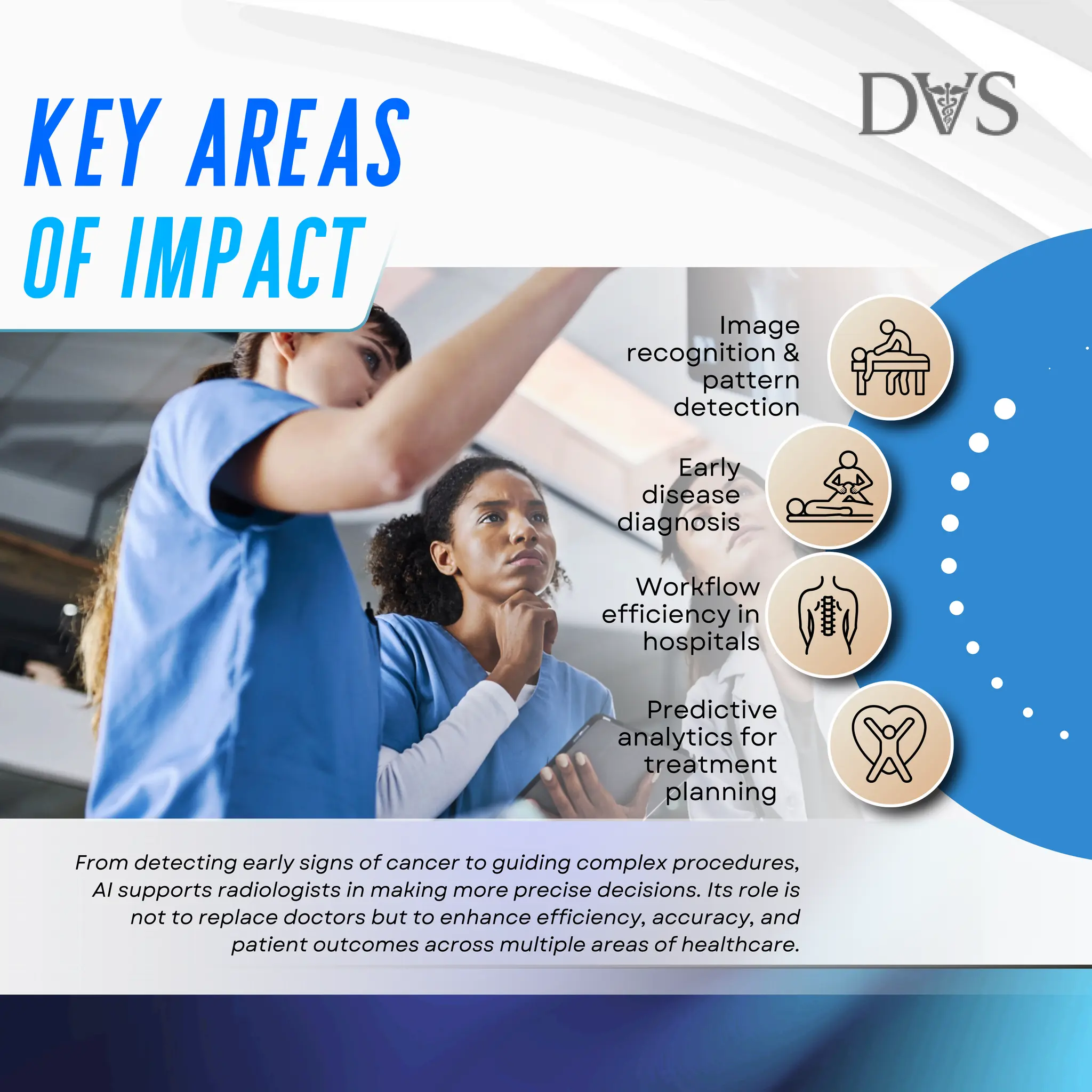
Key Areas
of Impact
From detecting early signs of cancer to guiding complex procedures,
AI supports radiologists in making more precise decisions. Its role is
not to replace doctors but to enhance efficiency, accuracy, and
patient outcomes across multiple areas of healthcare.
Image
recognition &
pattern
detection
Early
disease
diagnosis
Workflow
efficiency in
hospitals
Predictive
analytics for
treatment
planning
Challenges &
Limitations
While AI in radiology offers tremendous potential, it also faces hurdles.
Data privacy and security remain major concerns, as medical images
are highly sensitive. AI systems depend on large, high-quality datasets,
which are not always available. There is also the risk of over-reliance on
machines—radiologists must remain actively involved to ensure
accuracy. Finally, integrating AI into existing hospital systems requires
training, investment, and careful validation before widespread use.
Data privacy &
security issues
Need for human
oversight
Integration
challenges in
hospitals
Over-reliance
on machines
Personalized medicine
Integration with robotics & smart
imaging
Continuous learning AI models
FUTURE OF AI IN
RADIOLOGY
The future of radiology lies in the seamless
integration of AI with advanced imaging technologies.
Artificial Intelligence will enable earlier disease
detection, personalized treatment planning, and real-
time decision support for radiologists. As AI models
continue to evolve, radiology will shift from being
mainly diagnostic to becoming a more predictive and
preventive field—improving patient care while
reducing costs and delays.
When adopting AI in
Radiology, keep in mind
Data quality
Clinical validation
Training for radiologists
Ethical guidelines
Don't forget to be grateful
Before adopting AI in radiology, healthcare providers should
ensure a strong foundation. High-quality data and clinical
validation are essential for accuracy. Radiologists and staff must
receive proper training to use AI tools effectively. Hospitals
should also establish clear ethical guidelines and safeguard
patient privacy.
Where Technology
Meets Compassion in
Patient Care‌
radiology with AI-powered
healthcare
EMBRACE THE FUTURE OF
https://drvrishitsaraswat.com/

What is Advanced Interventional Radiology

  • 1.
    ENHANCING ACCURACY, EFFICIENCY &PATIENT OUTCOMES AI IN RADIOLOGY https://drvrishitsaraswat.com/
  • 2.
    What is AIin Radiology It’s a way for doctors to fix medical problems inside the body using imaging and small tools, without major surgery. Book Now https://drvrishitsaraswat.com/
  • 3.
    Key Areas of Impact Fromdetecting early signs of cancer to guiding complex procedures, AI supports radiologists in making more precise decisions. Its role is not to replace doctors but to enhance efficiency, accuracy, and patient outcomes across multiple areas of healthcare. Image recognition & pattern detection Early disease diagnosis Workflow efficiency in hospitals Predictive analytics for treatment planning
  • 4.
    Challenges & Limitations While AIin radiology offers tremendous potential, it also faces hurdles. Data privacy and security remain major concerns, as medical images are highly sensitive. AI systems depend on large, high-quality datasets, which are not always available. There is also the risk of over-reliance on machines—radiologists must remain actively involved to ensure accuracy. Finally, integrating AI into existing hospital systems requires training, investment, and careful validation before widespread use. Data privacy & security issues Need for human oversight Integration challenges in hospitals Over-reliance on machines
  • 5.
    Personalized medicine Integration withrobotics & smart imaging Continuous learning AI models FUTURE OF AI IN RADIOLOGY The future of radiology lies in the seamless integration of AI with advanced imaging technologies. Artificial Intelligence will enable earlier disease detection, personalized treatment planning, and real- time decision support for radiologists. As AI models continue to evolve, radiology will shift from being mainly diagnostic to becoming a more predictive and preventive field—improving patient care while reducing costs and delays.
  • 6.
    When adopting AIin Radiology, keep in mind Data quality Clinical validation Training for radiologists Ethical guidelines Don't forget to be grateful Before adopting AI in radiology, healthcare providers should ensure a strong foundation. High-quality data and clinical validation are essential for accuracy. Radiologists and staff must receive proper training to use AI tools effectively. Hospitals should also establish clear ethical guidelines and safeguard patient privacy.
  • 7.
    Where Technology Meets Compassionin Patient Care‌ radiology with AI-powered healthcare EMBRACE THE FUTURE OF https://drvrishitsaraswat.com/