Business cases
for Value Chain Mapping
Introduction
“To make better products tomorrow, we
must know where they come from today.”
• This is our thesis
• What does it mean?
• To what extent is it accurate?
Definitions…
“To make better products tomorrow, we
must know where they come from today.”
• What do we mean by ‘make’
• Apple’s iPhone is not “made in China” (although it used to say
it was up until v4)
Definitions…
“To make better products tomorrow, we
must know where they come from today.”
• What constitutes “better”?
• In what terms, and how are they to be measured?
• “The best way to reduce the carbon footprint of your textiles is
to turn off the effluent treatment plant in your dyehouse”
(Anon )
Definitions…
“To make better products tomorrow, we
must know where they come from today.”
• Is it about any physical product?
• How is an A4 pad of paper different to a piece of jewellery or
a cotton shirt?
Definitions…
“To make better products tomorrow, we
must know where they come from today.”
• How soon is tomorrow?
• What timescales are realistic?
Definitions…
“To make better products tomorrow, we
must know where they come from today.”
• Who is “we” ? (clue – it’s not HF!)
• Is it the makers of the product or the buyers…or both?
Definitions…
“To make better products tomorrow, we
must know where they come from today.”
• Must we? Really?
• What happens if we don’t? And who cares?
• And anyway, what do we mean by “know”?
Definitions…
“To make better products tomorrow, we
must know where they come from today.”
• Is that a region, continent, country, town or factory?
• Can it be any of those?
• Does it make any difference, and if so, to whom and how?
Definitions…
“To make better products tomorrow, we
must know where they come from today.”
• What are they?
• How specific do we need to be?
– Is the wheat in today’s loaf of bread from the same farms / fields as
yesterdays loaf? Milk from same cows in bottle one and two?
– Cotton from same farms in season one and two?
– Trees from same forest in writing pads
– etc.
Definitions…
“To make better products tomorrow, we
must know where they come from today.”
• Which bits?
• Is it the diamond in the necklace, or the gold in the chain?
What about the other metals that were added to make it
‘14k’?
• What about the cyanide that was used in the refining, but is
not in the gold? Where it came from, or where it went?
Definitions…
“To make better products tomorrow, we
must know where they come from today.”
• Today is simply, always, before tomorrow
• We’d better get cracking then…
Why…?
• ‘Climate change’ – accelerating
• ‘Water stress’ – accelerating
• Biodiversity loss - accelerating
• Global wealth distribution gap – widening
• etc.
• Overall, in terms of ‘people, planet and profit’ –
everything is moving in the wrong direction
• “Up to 80% of these impacts are caused by products”
– Are they? Really? Which ones? What should we do?
The morning…
• What do we mean by a value chain?
• What are the problems and opportunities that
arise from knowing more about them?
• Can those problems and opportunities be
categorised at all? If so, how?
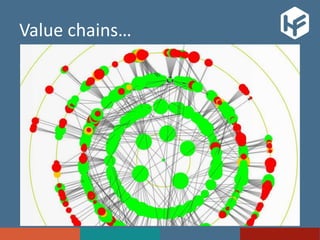
Value chains…
• Value…
– “the amount buyers are willing to pay for what a
firm provides” [Porter, 1985]
– flows from the customer to the supplier
– is subjective and context specific
– is time sensitive
– is complex 
Value chains…
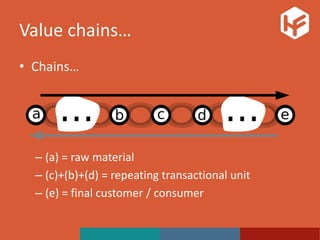
• Chains…
– (a) = raw material
– (c)+(b)+(d) = repeating transactional unit
– (e) = final customer / consumer
Value chains…
• Or networks…?
– “chain” – implies linear, simplistic
– “network” – implies non-linear, complex
– “networks” as “collections of overlapping chains”
• allows value and product flow between chains
The task…
• To collaboratively identify as many sources of
“value chain impact” – both positive and
negative – as possible
– To shout / scream / reflect / whisper / write /
doodle
• Whether those “impacts” are:
– good / bad / direct / indirect / people / planet
– significant / tiny / likely / abstract
– measurable / shared / specific
What are the problems and
opportunities that arise from trying
to know/knowing more about
value chains?
Business cases…
• The outcome must be expressed as money
– otherwise it’s not a business case
• …doesn’t mean it’s not important!
• Must show a clear ‘pathway to profit’
– “If I commit resources I currently have, I can clearly see
how I will get those resources back at a defined point in
future, plus something more”
• Must demonstrate an acceptable ROI
– “defined point in the future”
– “something more”
combined
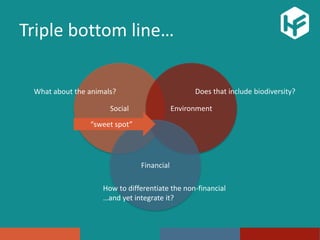
Triple bottom line…
Social Environment
Financial
What about the animals? Does that include biodiversity?
How to differentiate the non-financial
…and yet integrate it?
“sweet spot”
The futureIncome
Costs
Retained income
Next monthIncome
Costs
Retained income
TomorrowIncome
Costs
Retained income
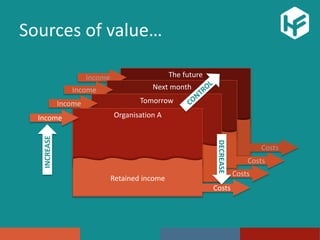
Sources of value…
Organisation AIncome
Costs
Retained income
INCREASE
DECREASE
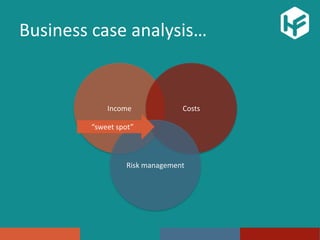
Income Costs
Risk management
Business case analysis…
“sweet spot”
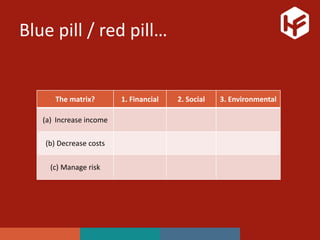
Blue pill / red pill…
The matrix? 1. Financial 2. Social 3. Environmental
(a) Increase income
(b) Decrease costs
(c) Manage risk
Increase income
• Sell more products
– Grow market
• Product innovation (find new product attributes to add)
– Expand share
• Availability / seasonality (get product on shelf more quickly)
• Increase price
– Provenance premium
• Trust / assurance + issue connection (tell customer stories)
– Extrinsic quality claim
• 3rd party endorsement / label (capture non-financial values)
Decrease costs
• Reduce input costs
– Widen sources (find / add new suppliers)
– Consolidate volumes (reduce suppliers)
– Deal direct (remove middlemen)
• Manage operating costs
– Improve efficiency (get information right / faster)
– Reduce taxation (optimise tariffs)
• Drive administrative efficiency
– Streamline compliance
• Regulatory (EUTR / Dodd-Frank)
• Customer (IWAY / Plan A etc.)
Control risks
• Reputation
– Brand resonance / relevance (ref: Jonah Peretti)
• Compliance
– Fines / sanctions (EUTR / REACH etc.)
• Trading
– Supply disruption
• Thailand - hard drives (disaster recovery)
• Egyptian cotton (forecast mitigation)
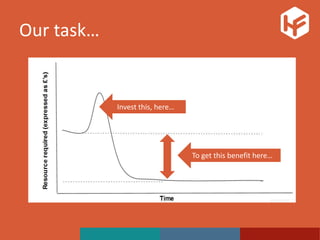
Our task…
• Identify the business cases
• Specify the change in outcome and the
activation energy required
– Ref activation energy diagram and explain
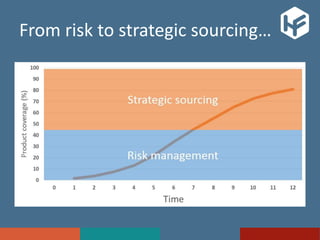
• Identify how we might get started and sustain
momentum…
– Introduce the coverage concept / chart…
Our task…
Invest this, here…
To get this benefit here…
From risk to strategic sourcing…
String 3…
Thank you!

What are the business cases for value chain mapping?

  • 1.
  • 2.
    Introduction “To make betterproducts tomorrow, we must know where they come from today.” • This is our thesis • What does it mean? • To what extent is it accurate?
  • 3.
    Definitions… “To make betterproducts tomorrow, we must know where they come from today.” • What do we mean by ‘make’ • Apple’s iPhone is not “made in China” (although it used to say it was up until v4)
  • 4.
    Definitions… “To make betterproducts tomorrow, we must know where they come from today.” • What constitutes “better”? • In what terms, and how are they to be measured? • “The best way to reduce the carbon footprint of your textiles is to turn off the effluent treatment plant in your dyehouse” (Anon )
  • 5.
    Definitions… “To make betterproducts tomorrow, we must know where they come from today.” • Is it about any physical product? • How is an A4 pad of paper different to a piece of jewellery or a cotton shirt?
  • 6.
    Definitions… “To make betterproducts tomorrow, we must know where they come from today.” • How soon is tomorrow? • What timescales are realistic?
  • 7.
    Definitions… “To make betterproducts tomorrow, we must know where they come from today.” • Who is “we” ? (clue – it’s not HF!) • Is it the makers of the product or the buyers…or both?
  • 8.
    Definitions… “To make betterproducts tomorrow, we must know where they come from today.” • Must we? Really? • What happens if we don’t? And who cares? • And anyway, what do we mean by “know”?
  • 9.
    Definitions… “To make betterproducts tomorrow, we must know where they come from today.” • Is that a region, continent, country, town or factory? • Can it be any of those? • Does it make any difference, and if so, to whom and how?
  • 10.
    Definitions… “To make betterproducts tomorrow, we must know where they come from today.” • What are they? • How specific do we need to be? – Is the wheat in today’s loaf of bread from the same farms / fields as yesterdays loaf? Milk from same cows in bottle one and two? – Cotton from same farms in season one and two? – Trees from same forest in writing pads – etc.
  • 11.
    Definitions… “To make betterproducts tomorrow, we must know where they come from today.” • Which bits? • Is it the diamond in the necklace, or the gold in the chain? What about the other metals that were added to make it ‘14k’? • What about the cyanide that was used in the refining, but is not in the gold? Where it came from, or where it went?
  • 12.
    Definitions… “To make betterproducts tomorrow, we must know where they come from today.” • Today is simply, always, before tomorrow • We’d better get cracking then…
  • 13.
    Why…? • ‘Climate change’– accelerating • ‘Water stress’ – accelerating • Biodiversity loss - accelerating • Global wealth distribution gap – widening • etc. • Overall, in terms of ‘people, planet and profit’ – everything is moving in the wrong direction • “Up to 80% of these impacts are caused by products” – Are they? Really? Which ones? What should we do?
  • 14.
    The morning… • Whatdo we mean by a value chain? • What are the problems and opportunities that arise from knowing more about them? • Can those problems and opportunities be categorised at all? If so, how?
  • 15.
    Value chains… • Value… –“the amount buyers are willing to pay for what a firm provides” [Porter, 1985] – flows from the customer to the supplier – is subjective and context specific – is time sensitive – is complex 
  • 16.
    Value chains… • Chains… –(a) = raw material – (c)+(b)+(d) = repeating transactional unit – (e) = final customer / consumer
  • 17.
    Value chains… • Ornetworks…? – “chain” – implies linear, simplistic – “network” – implies non-linear, complex – “networks” as “collections of overlapping chains” • allows value and product flow between chains
  • 18.
    The task… • Tocollaboratively identify as many sources of “value chain impact” – both positive and negative – as possible – To shout / scream / reflect / whisper / write / doodle • Whether those “impacts” are: – good / bad / direct / indirect / people / planet – significant / tiny / likely / abstract – measurable / shared / specific
  • 19.
    What are theproblems and opportunities that arise from trying to know/knowing more about value chains?
  • 20.
    Business cases… • Theoutcome must be expressed as money – otherwise it’s not a business case • …doesn’t mean it’s not important! • Must show a clear ‘pathway to profit’ – “If I commit resources I currently have, I can clearly see how I will get those resources back at a defined point in future, plus something more” • Must demonstrate an acceptable ROI – “defined point in the future” – “something more” combined
  • 21.
    Triple bottom line… SocialEnvironment Financial What about the animals? Does that include biodiversity? How to differentiate the non-financial …and yet integrate it? “sweet spot”
  • 22.
    The futureIncome Costs Retained income NextmonthIncome Costs Retained income TomorrowIncome Costs Retained income Sources of value… Organisation AIncome Costs Retained income INCREASE DECREASE
  • 23.
    Income Costs Risk management Businesscase analysis… “sweet spot”
  • 24.
    Blue pill /red pill… The matrix? 1. Financial 2. Social 3. Environmental (a) Increase income (b) Decrease costs (c) Manage risk
  • 25.
    Increase income • Sellmore products – Grow market • Product innovation (find new product attributes to add) – Expand share • Availability / seasonality (get product on shelf more quickly) • Increase price – Provenance premium • Trust / assurance + issue connection (tell customer stories) – Extrinsic quality claim • 3rd party endorsement / label (capture non-financial values)
  • 26.
    Decrease costs • Reduceinput costs – Widen sources (find / add new suppliers) – Consolidate volumes (reduce suppliers) – Deal direct (remove middlemen) • Manage operating costs – Improve efficiency (get information right / faster) – Reduce taxation (optimise tariffs) • Drive administrative efficiency – Streamline compliance • Regulatory (EUTR / Dodd-Frank) • Customer (IWAY / Plan A etc.)
  • 27.
    Control risks • Reputation –Brand resonance / relevance (ref: Jonah Peretti) • Compliance – Fines / sanctions (EUTR / REACH etc.) • Trading – Supply disruption • Thailand - hard drives (disaster recovery) • Egyptian cotton (forecast mitigation)
  • 28.
    Our task… • Identifythe business cases • Specify the change in outcome and the activation energy required – Ref activation energy diagram and explain • Identify how we might get started and sustain momentum… – Introduce the coverage concept / chart…
  • 29.
    Our task… Invest this,here… To get this benefit here…
  • 30.
    From risk tostrategic sourcing…
  • 31.
  • 32.

Editor's Notes

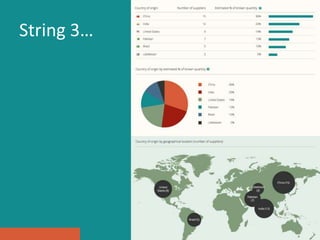
  • #32 Wrap up… Thanks for your energy / participation This will all contribute to our development program for S3 Here’s an example screenshot from that program…
  • #33 s