CredCo MisinfosecWG:
6-month report
SJ TERP, CHRISTOPHER WALKER, JOHN GRAY
Sept 26 2019
1
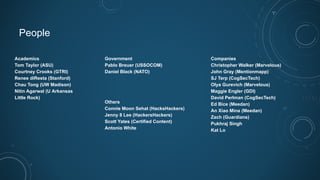
People
Academics
Tom Taylor (ASU)
Courtney Crooks (GTRI)
Renee diResta (Stanford)
Chau Tong (UW Madison)
Nitin Agarwal (U Arkansas
Little Rock)
Companies
Christopher Walker (Marvelous)
John Gray (Mentionmapp)
SJ Terp (CogSecTech)
Olya Gurevich (Marvelous)
Maggie Engler (GDI)
David Perlman (CogSecTech)
Ed Bice (Meedan)
An Xiao Mina (Meedan)
Zach (Guardians)
Pukhraj Singh
Kat Lo
Government
Pablo Breuer (USSOCOM)
Daniel Black (NATO)
Others
Connie Moon Sehat (HacksHackers)
Jenny 8 Lee (HackersHackers)
Scott Yates (Certified Content)
Antonio White
Mission
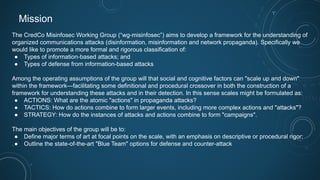
The CredCo Misinfosec Working Group (“wg-misinfosec”) aims to develop a framework for the understanding of
organized communications attacks (disinformation, misinformation and network propaganda). Specifically we
would like to promote a more formal and rigorous classification of:
● Types of information-based attacks; and
● Types of defense from information-based attacks
Among the operating assumptions of the group will that social and cognitive factors can "scale up and down"
within the framework—facilitating some definitional and procedural crossover in both the construction of a
framework for understanding these attacks and in their detection. In this sense scales might be formulated as:
● ACTIONS: What are the atomic "actions" in propaganda attacks?
● TACTICS: How do actions combine to form larger events, including more complex actions and "attacks"?
● STRATEGY: How do the instances of attacks and actions combine to form "campaigns".
The main objectives of the group will be to:
● Define major terms of art at focal points on the scale, with an emphasis on descriptive or procedural rigor;
● Outline the state-of-the-art "Blue Team" options for defense and counter-attack
WG Timeline
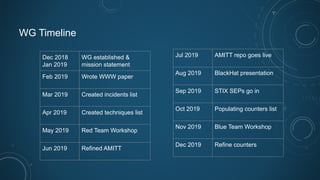
Dec 2018
Jan 2019
WG established &
mission statement
Feb 2019 Wrote WWW paper
Mar 2019 Created incidents list
Apr 2019 Created techniques list
May 2019 Red Team Workshop
Jun 2019 Refined AMITT
Jul 2019 AMITT repo goes live
Aug 2019 BlackHat presentation
Sep 2019 STIX SEPs go in
Oct 2019 Populating counters list
Nov 2019 Blue Team Workshop
Dec 2019 Refine counters
How’d we do?
First 6 months:
● Collected and analyzed over 63 incidents
● Developed a STIX-inspired format for incident reporting
● Convened in Atlanta to organize TTPs and red team incident planning
● Published our framework proposal; presented to Webconf 2019
● Presented to numerous state, treaty and NGO institutions
● Generated several blog posts and public interest publications
● Created AMITT, a stage-based framework for misinformation reporting and response
● Published AMITT as an open source project on Github
Current 3 months:
● Collect and analyze misinformation counters
● Convene in DC to organise counters and do blue team incident planning
● Get STIX formats adopted worldwide
● Get AMITT used by reporting and responding organizations
● Find AMITT a regular ‘home’
Moving forward
● Focus on Blue Team research and exercises which thorough explore the space of
potential inoculations and counter-attacks.
●
● Propose AMITT as the basis of new misinformation response centers, including
ISAOs (Information Sharing and Analysis Organizations) and ISACs (Information
Sharing and Analysis Centers)
● Test AMITT against new incidents - both historical incidents that we haven’t included
in it, and new incidents as they emerge.
Part of this work is to find existing response populations who could use the framework
and determine the training and adaptations they need to be able to use it themselves.
This will make the framework more useful both to them and to future potential users
Presentations...
● Sofwerx, (December 2018)
● Cyber Defense and Network Security (CDANS)
London, (December 2018)
● SOCOM, (February 2019)
● NYU, (February 2019)
● CUNY, (February 2019)
● CanSecWest, (March 2019)
● People Centered Internet, (March 2019)
● Georgetown University, (March 2019)
● Oktane, (April 2019)
● Asilomar Microcomputer Workshop, (April 2019)
● WWW, (May 2019)
● AI World Government, (May 2019)
● WebIT, Sofia, (May 2019)
● CogX19, (June 2019)
● NATO (June 2019)
● Bournemouth University (June 2019)
● UK Information Commissioners Office (June 2019)
● BRIMs (July 2019)
● BlackHat, (August 2019)
● Security BSides Las Vegas, (August 2019)
● Narwhal, (August 2019)
● 3rd Annual International Information Sharing Conference
(August 2019)
● Harvard Disinformation Workshop (October 2019)
● Trust & Truth Conference (October 2019)
● Mitre ATT&CKcon 2.0 (October 2019)
THE NEED
The only defense against the world is a
thorough knowledge of it.
- John Locke
8
COMPONENTWISE UNDERSTANDING AND RESPONSE
• Lingua Franca across communities
• Defend/countermove against reused techniques, identify gaps in attacks
• Assess defence tools & techniques
• Plan for large-scale adaptive threats (hello, Machine Learning!)
9
COMBINING DIFFERENT VIEWS OF MISINFORMATION
• Information security (Gordon, Grugq, Rogers)
• Information operations / influence operations (Lin)
• A form of conflict (Singer, Gerasimov)
• [A social problem]
• [News source pollution]
10
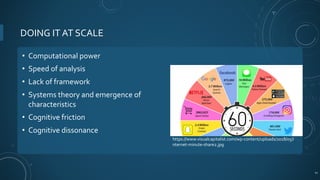
DOING IT AT SCALE
• Computational power
• Speed of analysis
• Lack of framework
• Systems theory and emergence of
characteristics
• Cognitive friction
• Cognitive dissonance
https://www.visualcapitalist.com/wp-content/uploads/2018/05/i
nternet-minute-share2.jpg
11
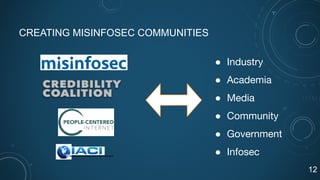
CREATING MISINFOSEC COMMUNITIES
● Industry
● Academia
● Media
● Community
● Government
● Infosec
12
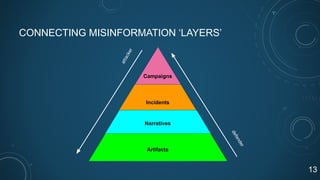
CONNECTING MISINFORMATION ‘LAYERS’
13
Campaigns
Incidents
Narratives
Artifacts
a
t
t
a
c
k
e
r
d
e
f
e
n
d
e
r
WHATWE BUILT
All warfare is based on deception.
- SunTzu
All cyberspace operations are based on
influence.
- Pablo Breuer
14
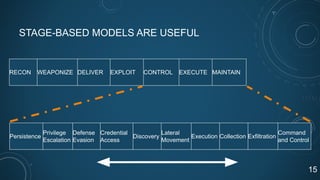
STAGE-BASED MODELS ARE USEFUL
RECON WEAPONIZE DELIVER EXPLOIT CONTROL EXECUTE MAINTAIN
Persistence
Privilege
Escalation
Defense
Evasion
Credential
Access
Discovery
Lateral
Movement
Execution Collection Exfiltration
Command
and Control
15
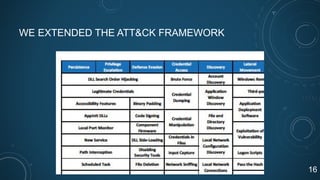
WE EXTENDED THE ATT&CK FRAMEWORK
16
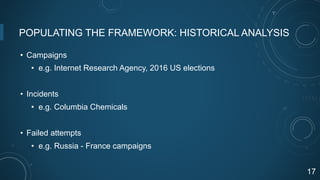
POPULATING THE FRAMEWORK: HISTORICAL ANALYSIS
• Campaigns
• e.g. Internet Research Agency, 2016 US elections
• Incidents
• e.g. Columbia Chemicals
• Failed attempts
• e.g. Russia - France campaigns
17
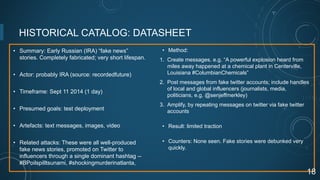
HISTORICAL CATALOG: DATASHEET
• Summary: Early Russian (IRA) “fake news”
stories. Completely fabricated; very short lifespan.
• Actor: probably IRA (source: recordedfuture)
• Timeframe: Sept 11 2014 (1 day)
• Presumed goals: test deployment
• Artefacts: text messages, images, video
• Related attacks: These were all well-produced
fake news stories, promoted on Twitter to
influencers through a single dominant hashtag --
#BPoilspilltsunami, #shockingmurderinatlanta,
• Method:
1. Create messages. e.g. “A powerful explosion heard from
miles away happened at a chemical plant in Centerville,
Louisiana #ColumbianChemicals”
2. Post messages from fake twitter accounts; include handles
of local and global influencers (journalists, media,
politicians, e.g. @senjeffmerkley)
3. Amplify, by repeating messages on twitter via fake twitter
accounts
• Result: limited traction
• Counters: None seen. Fake stories were debunked very
quickly.
18
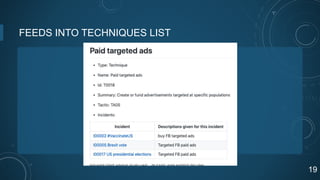
FEEDS INTO TECHNIQUES LIST
19
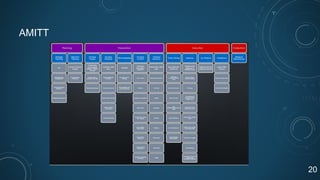
AMITT
20
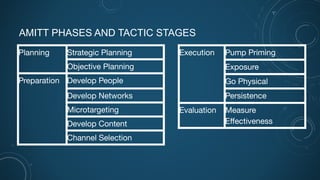
AMITT PHASES AND TACTIC STAGES
Planning Strategic Planning
Objective Planning
Preparation Develop People
Develop Networks
Microtargeting
Develop Content
Channel Selection
Execution Pump Priming
Exposure
Go Physical
Persistence
Evaluation Measure
Effectiveness
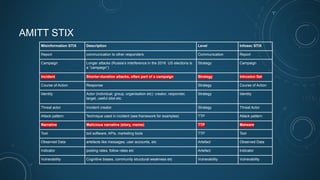
AMITT STIX
Misinformation STIX Description Level Infosec STIX
Report communication to other responders Communication Report
Campaign Longer attacks (Russia’s interference in the 2016 US elections is
a “campaign”)
Strategy Campaign
Incident Shorter-duration attacks, often part of a campaign Strategy Intrusion Set
Course of Action Response Strategy Course of Action
Identity Actor (individual, group, organisation etc): creator, responder,
target, useful idiot etc.
Strategy Identity
Threat actor Incident creator Strategy Threat Actor
Attack pattern Technique used in incident (see framework for examples) TTP Attack pattern
Narrative Malicious narrative (story, meme) TTP Malware
Tool bot software, APIs, marketing tools TTP Tool
Observed Data artefacts like messages, user accounts, etc Artefact Observed Data
Indicator posting rates, follow rates etc Artefact Indicator
Vulnerability Cognitive biases, community structural weakness etc Vulnerability Vulnerability
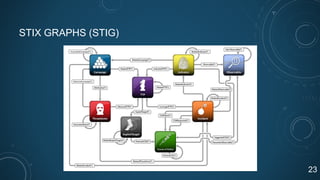
STIX GRAPHS (STIG)
23
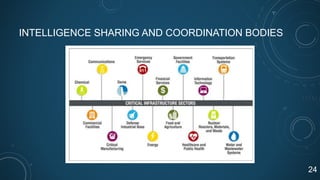
INTELLIGENCE SHARING AND COORDINATION BODIES
24
AMITT UPDATES AT http://misinfosec.org
Misinfosec: The Way Ahead
• Continue to grow the coalition of the willing
• Support the Cognitive Security ISAO
• Contribute at misinfosec.org
• Continue to build an alert structure (ISAC, US-CERT, Interpol, Industry, etc.)
• Continue to refine TTPs and framework
• STIX data science layer - connect to framework
26

WG-misinfosec report out to CredCo.pdf

  • 1.
    CredCo MisinfosecWG: 6-month report SJTERP, CHRISTOPHER WALKER, JOHN GRAY Sept 26 2019 1
  • 2.
    People Academics Tom Taylor (ASU) CourtneyCrooks (GTRI) Renee diResta (Stanford) Chau Tong (UW Madison) Nitin Agarwal (U Arkansas Little Rock) Companies Christopher Walker (Marvelous) John Gray (Mentionmapp) SJ Terp (CogSecTech) Olya Gurevich (Marvelous) Maggie Engler (GDI) David Perlman (CogSecTech) Ed Bice (Meedan) An Xiao Mina (Meedan) Zach (Guardians) Pukhraj Singh Kat Lo Government Pablo Breuer (USSOCOM) Daniel Black (NATO) Others Connie Moon Sehat (HacksHackers) Jenny 8 Lee (HackersHackers) Scott Yates (Certified Content) Antonio White
  • 3.
    Mission The CredCo MisinfosecWorking Group (“wg-misinfosec”) aims to develop a framework for the understanding of organized communications attacks (disinformation, misinformation and network propaganda). Specifically we would like to promote a more formal and rigorous classification of: ● Types of information-based attacks; and ● Types of defense from information-based attacks Among the operating assumptions of the group will that social and cognitive factors can "scale up and down" within the framework—facilitating some definitional and procedural crossover in both the construction of a framework for understanding these attacks and in their detection. In this sense scales might be formulated as: ● ACTIONS: What are the atomic "actions" in propaganda attacks? ● TACTICS: How do actions combine to form larger events, including more complex actions and "attacks"? ● STRATEGY: How do the instances of attacks and actions combine to form "campaigns". The main objectives of the group will be to: ● Define major terms of art at focal points on the scale, with an emphasis on descriptive or procedural rigor; ● Outline the state-of-the-art "Blue Team" options for defense and counter-attack
  • 4.
    WG Timeline Dec 2018 Jan2019 WG established & mission statement Feb 2019 Wrote WWW paper Mar 2019 Created incidents list Apr 2019 Created techniques list May 2019 Red Team Workshop Jun 2019 Refined AMITT Jul 2019 AMITT repo goes live Aug 2019 BlackHat presentation Sep 2019 STIX SEPs go in Oct 2019 Populating counters list Nov 2019 Blue Team Workshop Dec 2019 Refine counters
  • 5.
    How’d we do? First6 months: ● Collected and analyzed over 63 incidents ● Developed a STIX-inspired format for incident reporting ● Convened in Atlanta to organize TTPs and red team incident planning ● Published our framework proposal; presented to Webconf 2019 ● Presented to numerous state, treaty and NGO institutions ● Generated several blog posts and public interest publications ● Created AMITT, a stage-based framework for misinformation reporting and response ● Published AMITT as an open source project on Github Current 3 months: ● Collect and analyze misinformation counters ● Convene in DC to organise counters and do blue team incident planning ● Get STIX formats adopted worldwide ● Get AMITT used by reporting and responding organizations ● Find AMITT a regular ‘home’
  • 6.
    Moving forward ● Focuson Blue Team research and exercises which thorough explore the space of potential inoculations and counter-attacks. ● ● Propose AMITT as the basis of new misinformation response centers, including ISAOs (Information Sharing and Analysis Organizations) and ISACs (Information Sharing and Analysis Centers) ● Test AMITT against new incidents - both historical incidents that we haven’t included in it, and new incidents as they emerge. Part of this work is to find existing response populations who could use the framework and determine the training and adaptations they need to be able to use it themselves. This will make the framework more useful both to them and to future potential users
  • 7.
    Presentations... ● Sofwerx, (December2018) ● Cyber Defense and Network Security (CDANS) London, (December 2018) ● SOCOM, (February 2019) ● NYU, (February 2019) ● CUNY, (February 2019) ● CanSecWest, (March 2019) ● People Centered Internet, (March 2019) ● Georgetown University, (March 2019) ● Oktane, (April 2019) ● Asilomar Microcomputer Workshop, (April 2019) ● WWW, (May 2019) ● AI World Government, (May 2019) ● WebIT, Sofia, (May 2019) ● CogX19, (June 2019) ● NATO (June 2019) ● Bournemouth University (June 2019) ● UK Information Commissioners Office (June 2019) ● BRIMs (July 2019) ● BlackHat, (August 2019) ● Security BSides Las Vegas, (August 2019) ● Narwhal, (August 2019) ● 3rd Annual International Information Sharing Conference (August 2019) ● Harvard Disinformation Workshop (October 2019) ● Trust & Truth Conference (October 2019) ● Mitre ATT&CKcon 2.0 (October 2019)
  • 8.
    THE NEED The onlydefense against the world is a thorough knowledge of it. - John Locke 8
  • 9.
    COMPONENTWISE UNDERSTANDING ANDRESPONSE • Lingua Franca across communities • Defend/countermove against reused techniques, identify gaps in attacks • Assess defence tools & techniques • Plan for large-scale adaptive threats (hello, Machine Learning!) 9
  • 10.
    COMBINING DIFFERENT VIEWSOF MISINFORMATION • Information security (Gordon, Grugq, Rogers) • Information operations / influence operations (Lin) • A form of conflict (Singer, Gerasimov) • [A social problem] • [News source pollution] 10
  • 11.
    DOING IT ATSCALE • Computational power • Speed of analysis • Lack of framework • Systems theory and emergence of characteristics • Cognitive friction • Cognitive dissonance https://www.visualcapitalist.com/wp-content/uploads/2018/05/i nternet-minute-share2.jpg 11
  • 12.
    CREATING MISINFOSEC COMMUNITIES ●Industry ● Academia ● Media ● Community ● Government ● Infosec 12
  • 13.
  • 14.
    WHATWE BUILT All warfareis based on deception. - SunTzu All cyberspace operations are based on influence. - Pablo Breuer 14
  • 15.
    STAGE-BASED MODELS AREUSEFUL RECON WEAPONIZE DELIVER EXPLOIT CONTROL EXECUTE MAINTAIN Persistence Privilege Escalation Defense Evasion Credential Access Discovery Lateral Movement Execution Collection Exfiltration Command and Control 15
  • 16.
    WE EXTENDED THEATT&CK FRAMEWORK 16
  • 17.
    POPULATING THE FRAMEWORK:HISTORICAL ANALYSIS • Campaigns • e.g. Internet Research Agency, 2016 US elections • Incidents • e.g. Columbia Chemicals • Failed attempts • e.g. Russia - France campaigns 17
  • 18.
    HISTORICAL CATALOG: DATASHEET •Summary: Early Russian (IRA) “fake news” stories. Completely fabricated; very short lifespan. • Actor: probably IRA (source: recordedfuture) • Timeframe: Sept 11 2014 (1 day) • Presumed goals: test deployment • Artefacts: text messages, images, video • Related attacks: These were all well-produced fake news stories, promoted on Twitter to influencers through a single dominant hashtag -- #BPoilspilltsunami, #shockingmurderinatlanta, • Method: 1. Create messages. e.g. “A powerful explosion heard from miles away happened at a chemical plant in Centerville, Louisiana #ColumbianChemicals” 2. Post messages from fake twitter accounts; include handles of local and global influencers (journalists, media, politicians, e.g. @senjeffmerkley) 3. Amplify, by repeating messages on twitter via fake twitter accounts • Result: limited traction • Counters: None seen. Fake stories were debunked very quickly. 18
  • 19.
  • 20.
  • 21.
    AMITT PHASES ANDTACTIC STAGES Planning Strategic Planning Objective Planning Preparation Develop People Develop Networks Microtargeting Develop Content Channel Selection Execution Pump Priming Exposure Go Physical Persistence Evaluation Measure Effectiveness
  • 22.
    AMITT STIX Misinformation STIXDescription Level Infosec STIX Report communication to other responders Communication Report Campaign Longer attacks (Russia’s interference in the 2016 US elections is a “campaign”) Strategy Campaign Incident Shorter-duration attacks, often part of a campaign Strategy Intrusion Set Course of Action Response Strategy Course of Action Identity Actor (individual, group, organisation etc): creator, responder, target, useful idiot etc. Strategy Identity Threat actor Incident creator Strategy Threat Actor Attack pattern Technique used in incident (see framework for examples) TTP Attack pattern Narrative Malicious narrative (story, meme) TTP Malware Tool bot software, APIs, marketing tools TTP Tool Observed Data artefacts like messages, user accounts, etc Artefact Observed Data Indicator posting rates, follow rates etc Artefact Indicator Vulnerability Cognitive biases, community structural weakness etc Vulnerability Vulnerability
  • 23.
  • 24.
    INTELLIGENCE SHARING ANDCOORDINATION BODIES 24
  • 25.
    AMITT UPDATES AThttp://misinfosec.org
  • 26.
    Misinfosec: The WayAhead • Continue to grow the coalition of the willing • Support the Cognitive Security ISAO • Contribute at misinfosec.org • Continue to build an alert structure (ISAC, US-CERT, Interpol, Industry, etc.) • Continue to refine TTPs and framework • STIX data science layer - connect to framework 26