11/5/2022
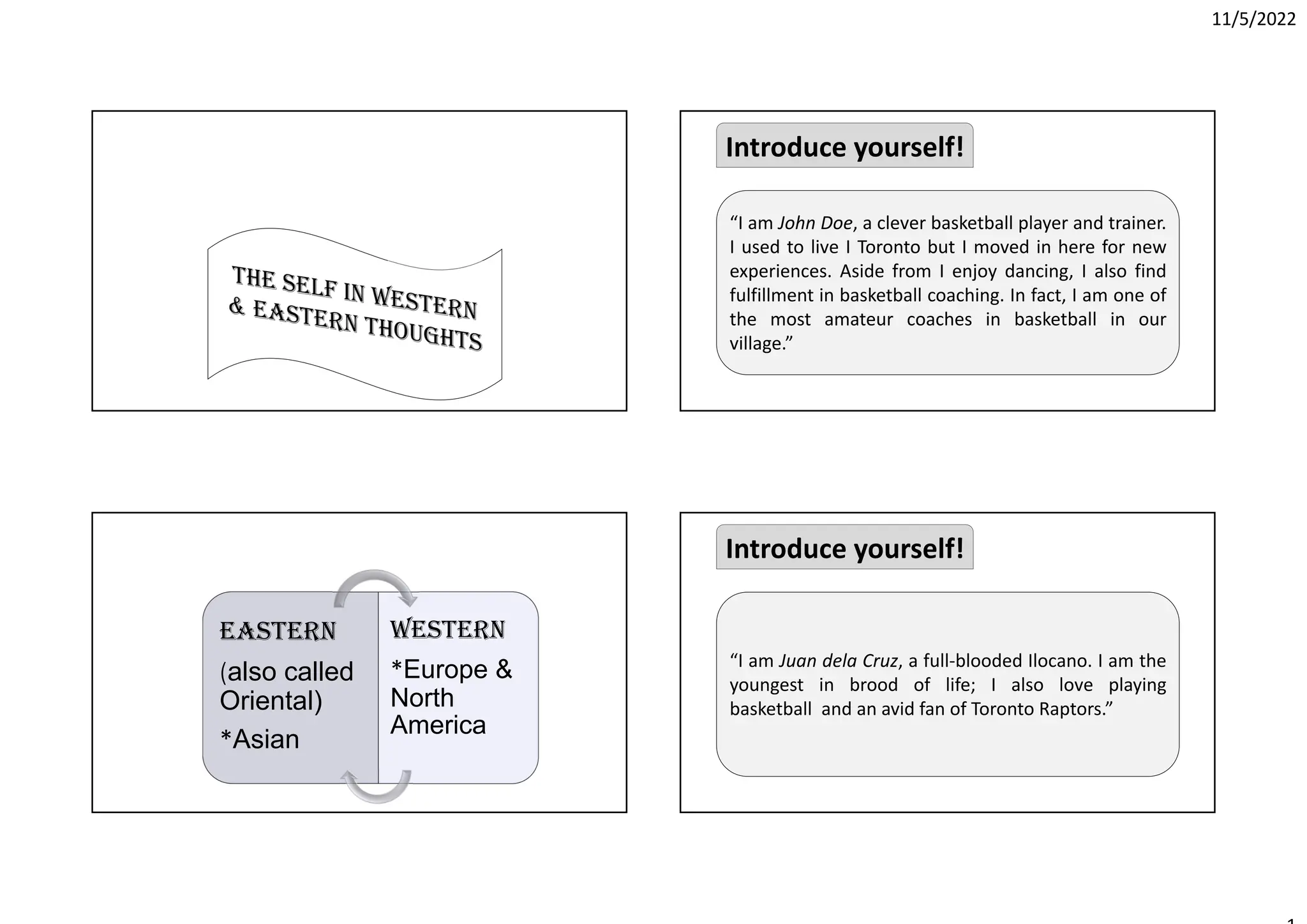
EASTERN
(also called
Oriental)
*Asian
WESTERN
*Europe &
North
America
“I am John Doe, a clever basketball player and trainer.
I used to live I Toronto but I moved in here for new
experiences. Aside from I enjoy dancing, I also find
fulfillment in basketball coaching. In fact, I am one of
the most amateur coaches in basketball in our
village.”
Introduce yourself!
“I am Juan dela Cruz, a full‐blooded Ilocano. I am the
youngest in brood of life; I also love playing
basketball and an avid fan of Toronto Raptors.”
Introduce yourself!
11/5/2022
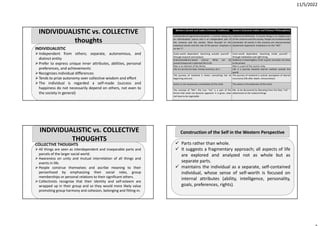
INDIVIDUALISTIC
Independent from others; separate, autonomous, and
distinct entity
Prefer to express unique inner attributes, abilities, personal
preferences, and achievements
Recognizes individual differences
Tends to prize autonomy over collective wisdom and effort
The individual is regarded a self‐made (success and
happiness do not necessarily depend on others, not even to
the society in general)
INDIVIDUALISTIC vs. COLLECTIVE
thoughts
COLLECTIVE THOUGHTS
 All things are seen as interdependent and inseparable parts and
parcels of the larger social world.
 Awareness on unity and mutual interrelation of all things and
events in life.
 People construe themselves and ascribe meaning to their
personhood by emphasizing their social roles, group
memberships or personal relations to their significant others.
 Collectivists recognize that their identity and self‐esteem are
wrapped up in their group and so they would more likely value
promoting group harmony and cohesion, belonging and fitting‐in.
INDIVIDUALISTIC vs. COLLECTIVE
THOUGHTS
Western (Greek and Judeo‐Christian Traditions) Eastern (Classical Indian and Chinese Philosophies)
Individualism/Fragmentary/Dualistic: A human being has
an individualistic nature and is an independent part of
the universe and the society. More focused on the
individual events and the role of the person. Emphasis is
on the “I”.
Collectivism/Wholistic: A human being is an integral part
of the universe and the society. People are fundamentally
connected. all events in the universe are interconnected
(Systematic Approach). Emphasis is on the “WE”.
Outer‐world dependent: Searching outside yourself –
through research and analysis
Inner‐world dependent: Searching inside yourself –
through meditation and right living
Science/evidence‐based culture: What can be
proven/measured is deemed the truth
Evidence is meaningless; truth is given and does not have
to be proven
Man is an element of the Divine Man is a part of the cosmic unity
Life is a service (to God, money, business, etc.) Life is a journey towards eternal realities outside the
world
The journey of mankind is linear; everything has its
beginning and end.
The journey of mankind is cyclical: perception of eternal
recurrence (life after death, reincarnation)
Action is not necessarily a translation of the mind. The action is the extension of the mind.
The concept of “Me”: the true “me” is a part of the
Divine that need not become apparent: it is given, does
not have to be cognizable
Me‐ to be discovered by liberating from the false “me” –
attachment to the material things
 Parts rather than whole.
 It suggests a fragmentary approach; all aspects of life
are explored and analyzed not as whole but as
separate parts.
 maintains the individual as a separate, self‐contained
individual, whose sense of self‐worth is focused on
internal attributes (ability, intelligence, personality,
goals, preferences, rights).
Construction of the Self in the Western Perspective
11/5/2022
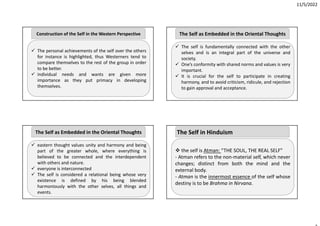
 The personal achievements of the self over the others
for instance is highlighted, thus Westerners tend to
compare themselves to the rest of the group in order
to be better.
 individual needs and wants are given more
importance as they put primacy in developing
themselves.
Construction of the Self in the Western Perspective
 eastern thought values unity and harmony and being
part of the greater whole, where everything is
believed to be connected and the interdependent
with others and nature.
 everyone is interconnected
 The self is considered a relational being whose very
existence is defined by his being blended
harmoniously with the other selves, all things and
events.
The Self as Embedded in the Oriental Thoughts
 The self is fundamentally connected with the other
selves and is an integral part of the universe and
society.
 One’s conformity with shared norms and values is very
important.
 It is crucial for the self to participate in creating
harmony, and to avoid criticism, ridicule, and rejection
to gain approval and acceptance.
The Self as Embedded in the Oriental Thoughts
 the self is Atman: “THE SOUL, THE REAL SELF”
‐ Atman refers to the non‐material self, which never
changes; distinct from both the mind and the
external body.
‐ Atman is the innermost essence of the self whose
destiny is to be Brahma in Nirvana.
The Self in Hinduism
11/5/2022
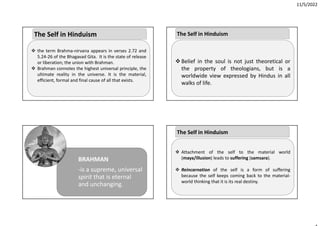
 the term Brahma‐nirvana appears in verses 2.72 and
5.24‐26 of the Bhagavad Gita. It is the state of release
or liberation; the union with Brahman.
 Brahman connotes the highest universal principle, the
ultimate reality in the universe. It is the material,
efficient, formal and final cause of all that exists.
The Self in Hinduism
BRAHMAN
‐is a supreme, universal
spirit that is eternal
and unchanging.
Belief in the soul is not just theoretical or
the property of theologians, but is a
worldwide view expressed by Hindus in all
walks of life.
The Self in Hinduism
 Attachment of the self to the material world
(maya/illusion) leads to suffering (samsara).
 Reincarnation of the self is a form of suffering
because the self keeps coming back to the material‐
world thinking that it is its real destiny.
The Self in Hinduism
11/5/2022
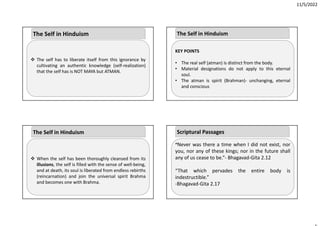
 The self has to liberate itself from this ignorance by
cultivating an authentic knowledge (self‐realization)
that the self has is NOT MAYA but ATMAN.
The Self in Hinduism
 When the self has been thoroughly cleansed from its
illusions, the self is filled with the sense of well‐being,
and at death, its soul is liberated from endless rebirths
(reincarnation) and join the universal spirit Brahma
and becomes one with Brahma.
The Self in Hinduism
KEY POINTS
• The real self (atman) is distinct from the body.
• Material designations do not apply to this eternal
soul.
• The atman is spirit (Brahman)‐ unchanging, eternal
and conscious
The Self in Hinduism
“Never was there a time when I did not exist, nor
you, nor any of these kings; nor in the future shall
any of us cease to be.”‐ Bhagavad‐Gita 2.12
“That which pervades the entire body is
indestructible.”
‐Bhagavad‐Gita 2.17
Scriptural Passages
11/5/2022
The doctrine of non‐self or annata dictates
that the self is subject to the law of changes.
Everything, including the self, is always in
constant change: born, grows, and dies.
The Self in Buddhism
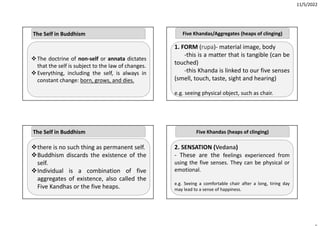
there is no such thing as permanent self.
Buddhism discards the existence of the
self.
Individual is a combination of five
aggregates of existence, also called the
Five Kandhas or the five heaps.
The Self in Buddhism
1. FORM (rupa)‐ material image, body
‐this is a matter that is tangible (can be
touched)
‐this Khanda is linked to our five senses
(smell, touch, taste, sight and hearing)
e.g. seeing physical object, such as chair.
Five Khandas/Aggregates (heaps of clinging)
2. SENSATION (Vedana)
‐ These are the feelings experienced from
using the five senses. They can be physical or
emotional.
e.g. Seeing a comfortable chair after a long, tiring day
may lead to a sense of happiness.
Five Khandas (heaps of clinging)
11/5/2022
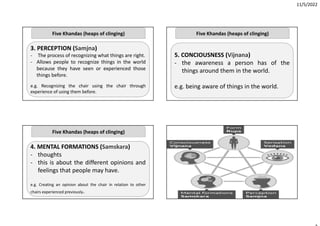
3. PERCEPTION (Samjna)
‐ The process of recognizing what things are right.
‐ Allows people to recognize things in the world
because they have seen or experienced those
things before.
e.g. Recognizing the chair using the chair through
experience of using them before.
Five Khandas (heaps of clinging)
4. MENTAL FORMATIONS (Samskara)
‐ thoughts
‐ this is about the different opinions and
feelings that people may have.
e.g. Creating an opinion about the chair in relation to other
chairs experienced previously.
Five Khandas (heaps of clinging)
5. CONCIOUSNESS (Vijnana)
‐ the awareness a person has of the
things around them in the world.
e.g. being aware of things in the world.
Five Khandas (heaps of clinging)
11/5/2022
 the idea of the self is illusory; this false belief
yields harmful thoughts of selfish desire, “me‐
and‐mine” mentality, craving, attachment, ill‐
will, hatred, conceit, pride, egoism, and any
other defilements and social problems. It is the
source of all troubles in societies.
The Self in Buddhism
To eliminate ignorance and attain enlightenment, the self
should:
1. Know the four noble truths that there is suffering in
this world; the cause of suffering is craving for self‐
identity as if it is permanence; there is way out of this
bondage of suffering.
2. The way to get out of suffering is by practicing the
eightfold path.
The Self in Buddhism
The Four Noble Truths:
1. Human life is full of suffering and sorrow.
2. Suffering and sorrow are caused by people’s greedy
desire for power, pleasure, and possessions.
3. Suffering and sorrow will end when people overcome
their greed = Nirvana = enlightenment.
4. People can overcome their greed and uncontrolled
desires by adopting the Middle Way or Eightfold
Path.
The Self in Buddhism
11/5/2022
1. RIGHT SPEECH
‐ means abstention from telling lies; talk that
may bring about hatred; from harsh, rude,
impolite, and abusive language; and from
useless and foolish gossip.
*Speak only that which is true, kind, joyful, and helpful.
The Eightfold Path
2. RIGHT ACTION
‐promotes moral, honorable, and peaceful conduct.
‐we should abstain from destroying life, from stealing,
from illegitimate sexual intercourse, and that we should
also help others to lead a peaceful and honorable life in
the right way.
*Always be aware of how our actions affects others.*
The Eightfold Path
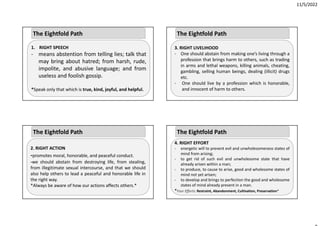
3. RIGHT LIVELIHOOD
‐ One should abstain from making one’s living through a
profession that brings harm to others, such as trading
in arms and lethal weapons, killing animals, cheating,
gambling, selling human beings, dealing (illicit) drugs
etc.
‐ One should live by a profession which is honorable,
and innocent of harm to others.
The Eightfold Path
4. RIGHT EFFORT
‐ energetic will to prevent evil and unwholesomeness states of
mind from arising;
‐ to get rid of such evil and unwholesome state that have
already arisen within a man;
‐ to produce, to cause to arise, good and wholesome states of
mind not yet arisen;
‐ to develop and brings to perfection the good and wholesome
states of mind already present in a man.
*Four Efforts: Restraint, Abandonment, Cultivation, Preservation*
The Eightfold Path
11/5/2022
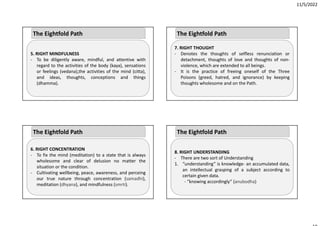
5. RIGHT MINDFULNESS
‐ To be diligently aware, mindful, and attentive with
regard to the activities of the body (kaya), sensations
or feelings (vedana),the activities of the mind (citta),
and ideas, thoughts, conceptions and things
(dhamma).
The Eightfold Path
6. RIGHT CONCENTRATION
‐ To fix the mind (meditation) to a state that is always
wholesome and clear of delusion no matter the
situation or the condition.
‐ Cultivating wellbeing, peace, awareness, and perceing
our true nature through concentration (samadhi),
meditation (dhyana), and mindfulness (smrti).
The Eightfold Path
7. RIGHT THOUGHT
‐ Denotes the thoughts of selfless renunciation or
detachment, thoughts of love and thoughts of non‐
violence, which are extended to all beings.
‐ It is the practice of freeing oneself of the Three
Poisons (greed, hatred, and ignorance) by keeping
thoughts wholesome and on the Path.
The Eightfold Path
8. RIGHT UNDERSTANDING
‐ There are two sort of Understanding
1. “understanding” is knowledge‐ an accumulated data,
an intellectual grasping of a subject according to
certain given data.
‐ “knowing accordingly” (anubodha)
The Eightfold Path
11/5/2022
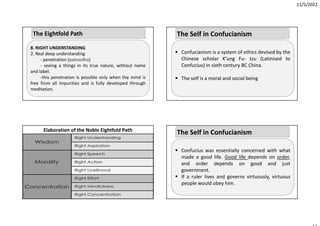
8. RIGHT UNDERSTANDING
2. Real deep understanding
‐ penetration (pativedha)
‐ seeing a things in its true nature, without name
and label.
‐this penetration is possible only when the mind is
free from all impurities and is fully developed through
meditation.
The Eightfold Path
Elaboration of the Noble Eightfold Path
 Confucianism is a system of ethics devised by the
Chinese scholar K’ung Fu‐ tzu (Latinised to
Confucius) in sixth century BC China.
 The self is a moral and social being
The Self in Confucianism
 Confucius was essentially concerned with what
made a good life. Good life depends on order,
and order depends on good and just
government.
 If a ruler lives and governs virtuously, virtuous
people would obey him.
The Self in Confucianism
11/5/2022
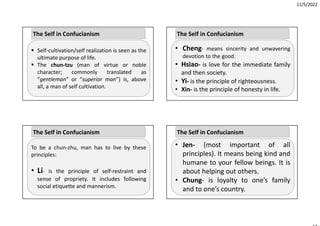
 Self‐cultivation/self realization is seen as the
ultimate purpose of life.
 The chun‐tzu (man of virtue or noble
character; commonly translated as
“gentleman” or “superior man”) is, above
all, a man of self cultivation.
The Self in Confucianism
To be a chun‐zhu, man has to live by these
principles:
• Li‐ is the principle of self‐restraint and
sense of propriety. It includes following
social etiquette and mannerism.
The Self in Confucianism
• Cheng‐ means sincerity and unwavering
devotion to the good.
• Hsiao‐ is love for the immediate family
and then society.
• Yi‐ is the principle of righteousness.
• Xin‐ is the principle of honesty in life.
The Self in Confucianism
• Jen‐ (most important of all
principles). It means being kind and
humane to your fellow beings. It is
about helping out others.
• Chung‐ is loyalty to one’s family
and to one’s country.
The Self in Confucianism
11/5/2022
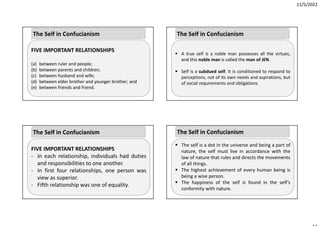
FIVE IMPORTANT RELATIONSHIPS
(a) between ruler and people;
(b) between parents and children;
(c) between husband and wife;
(d) between elder brother and younger brother; and
(e) between friends and friend.
The Self in Confucianism
FIVE IMPORTANT RELATIONSHIPS
‐ In each relationship, individuals had duties
and responsibilities to one another.
‐ In first four relationships, one person was
view as superior.
‐ Fifth relationship was one of equality.
The Self in Confucianism
 A true self is a noble man possesses all the virtues,
and this noble man is called the man of JEN.
 Self is a subdued self. It is conditioned to respond to
perceptions, not of its own needs and aspirations, but
of social requirements and obligations.
The Self in Confucianism
 The self is a dot in the universe and being a part of
nature, the self must live in accordance with the
law of nature that rules and directs the movements
of all things.
 The highest achievement of every human being is
being a wise person.
 The happiness of the self is found in the self’s
conformity with nature.
The Self in Confucianism
11/5/2022
 Confucius advocated the active role of man
in relation to creating oneness with nature.
Since the self is the master of nature, his
duty is to actively harmonize himself with
nature by translating the innate law of
nature into action.
The Self in Confucianism
o Taoism derived its name from its central idea, Tao or the
Way of nature.
o Tao (dao)‐ can also be interpreted as road, channel, path,
doctrine, or line.
o The Tao is not a God and is not worshipped.
o Taoism does include many deities, but although these are
worshipped in Taoist temples, they are part of the universe
and depend, like everything, on the Tao.
The Self in Taoism
o Taoism advocates what is natural and spontaneous, simple,
and necessary.
o Taoism, just like Confucianism aimed at humanity’s oneness
with nature. But Taoism contradicted Confucianism as
regards to how oneness shall be achieved.
o Taoism does not have a God in the way that the Abrahamic
religions do. There is no omnipotent being beyond the
cosmos, who created and controls the universe.
The Self in Taoism
o The ideal self is selflessness but this is not
forgetting about the self, it is living a balanced
life with society and nature, being open and
accepting to change, forgetting about prejudices
and egocentric ideas and thinking about equality
as well as other beings. ‐(Ho 1995)
The Self in Taoism
11/5/2022
o Taoism considers the self as merely one of the
many elements of the natural world.
o Tao is an indescribable force that govern natures.
o The self must bring himself in harmony with Tao
by practicing the three great virtues: humility,
frugality (moderation) and contentment.
The Self in Taoism
o The self should not strive for learning, riches, and
power; the self should find last thing happiness by
being, quiet, thoughtful, and humble.
o to be able to harmonize, the self must practice the
WU‐WEI (nonaction)‐ the practice of taking no action
that is not in accord with the natural course of the
universe.
The Self in Taoism
o Example of Wu Wei‐ one should not allow a river to
flow towards the sea unimpeded; do not erect a dam
which would interfere with its natural flow.
o Too much involvement of the self in nature can lead to
destruction.
*TAOISM emphasizes on doing what is natural and going
with the flow.*
The Self in Taoism
YING-YANG
• Most important Taoist symbols, as it
represents the movements of heaven
or the Tao.
• The small opposing dots in each area
to represent the fact that in all evil
there exist some good, while in all the
good there exists some evil. Also, it
represents dark and bright, night and
day, dry and moist, aggressive and
passive; sun and rain.
11/5/2022
 some neighboring countries often consider the
Filipino as the most westernized person because of
the captive or colonial consciousness that has long
been imbued in us.
 A Filipino is also multilayered because of foreign
influences, such as those of India, Indonesia, Malay,
Chinese, Spanish, and American which are embedded
in our culture.
Filipino Concept of the Self
 self must be based on the concepts of PAGKATAO and
LOOB
‐Pagkatao or humanities indicates the fact that a
Filipino is a human being just like anyone else.
‐The concept of loob is exemplified by Filipino
holistic worldview and interiority (human heartedness)
(Mercado, 1974).
Filipino Concept of the Self
 the self is seen as a body‐soul embodiment.
 Life is not seen as compartmentalized, the present is
the continuation of the past, and this continuity
moves in a cyclic manner that has no beginning and
no end (Gulong ng Palad).
 A Filipino does not distinguish the subject from the
object, the person from feelings.
Filipino Concept of the Self
 Harmonious relationship is of prime importance; this
is maintained by the value of sensitivity. Interiority
pertains to love, mercy, charity and leniency.
 This human heartedness is mirrored in the Filipino
concepts of kagandahang‐loob, kabutihang loob,
kalooban, which somehow depict our
interdependency with others.
Filipino Concept of the Self
11/5/2022
 They slow the social dimension of the self, sharing
of the self with others in values of pakikisama,
camaraderie, hospitality, utang‐na‐loob, bayanihan
spirit, family‐centeredness, meal‐centeredness, etc.
 The self, therefore, is a relational being, who
thinks, acts, behaves, and decides always in
accordance with his being with others.
Filipino Concept of the Self

Western-and-Eastern-Thoughts-1234567.pdf

  • 1.
    11/5/2022 EASTERN (also called Oriental) *Asian WESTERN *Europe & North America “Iam John Doe, a clever basketball player and trainer. I used to live I Toronto but I moved in here for new experiences. Aside from I enjoy dancing, I also find fulfillment in basketball coaching. In fact, I am one of the most amateur coaches in basketball in our village.” Introduce yourself! “I am Juan dela Cruz, a full‐blooded Ilocano. I am the youngest in brood of life; I also love playing basketball and an avid fan of Toronto Raptors.” Introduce yourself!
  • 2.
    11/5/2022 INDIVIDUALISTIC Independent from others;separate, autonomous, and distinct entity Prefer to express unique inner attributes, abilities, personal preferences, and achievements Recognizes individual differences Tends to prize autonomy over collective wisdom and effort The individual is regarded a self‐made (success and happiness do not necessarily depend on others, not even to the society in general) INDIVIDUALISTIC vs. COLLECTIVE thoughts COLLECTIVE THOUGHTS  All things are seen as interdependent and inseparable parts and parcels of the larger social world.  Awareness on unity and mutual interrelation of all things and events in life.  People construe themselves and ascribe meaning to their personhood by emphasizing their social roles, group memberships or personal relations to their significant others.  Collectivists recognize that their identity and self‐esteem are wrapped up in their group and so they would more likely value promoting group harmony and cohesion, belonging and fitting‐in. INDIVIDUALISTIC vs. COLLECTIVE THOUGHTS Western (Greek and Judeo‐Christian Traditions) Eastern (Classical Indian and Chinese Philosophies) Individualism/Fragmentary/Dualistic: A human being has an individualistic nature and is an independent part of the universe and the society. More focused on the individual events and the role of the person. Emphasis is on the “I”. Collectivism/Wholistic: A human being is an integral part of the universe and the society. People are fundamentally connected. all events in the universe are interconnected (Systematic Approach). Emphasis is on the “WE”. Outer‐world dependent: Searching outside yourself – through research and analysis Inner‐world dependent: Searching inside yourself – through meditation and right living Science/evidence‐based culture: What can be proven/measured is deemed the truth Evidence is meaningless; truth is given and does not have to be proven Man is an element of the Divine Man is a part of the cosmic unity Life is a service (to God, money, business, etc.) Life is a journey towards eternal realities outside the world The journey of mankind is linear; everything has its beginning and end. The journey of mankind is cyclical: perception of eternal recurrence (life after death, reincarnation) Action is not necessarily a translation of the mind. The action is the extension of the mind. The concept of “Me”: the true “me” is a part of the Divine that need not become apparent: it is given, does not have to be cognizable Me‐ to be discovered by liberating from the false “me” – attachment to the material things  Parts rather than whole.  It suggests a fragmentary approach; all aspects of life are explored and analyzed not as whole but as separate parts.  maintains the individual as a separate, self‐contained individual, whose sense of self‐worth is focused on internal attributes (ability, intelligence, personality, goals, preferences, rights). Construction of the Self in the Western Perspective
  • 3.
    11/5/2022  The personalachievements of the self over the others for instance is highlighted, thus Westerners tend to compare themselves to the rest of the group in order to be better.  individual needs and wants are given more importance as they put primacy in developing themselves. Construction of the Self in the Western Perspective  eastern thought values unity and harmony and being part of the greater whole, where everything is believed to be connected and the interdependent with others and nature.  everyone is interconnected  The self is considered a relational being whose very existence is defined by his being blended harmoniously with the other selves, all things and events. The Self as Embedded in the Oriental Thoughts  The self is fundamentally connected with the other selves and is an integral part of the universe and society.  One’s conformity with shared norms and values is very important.  It is crucial for the self to participate in creating harmony, and to avoid criticism, ridicule, and rejection to gain approval and acceptance. The Self as Embedded in the Oriental Thoughts  the self is Atman: “THE SOUL, THE REAL SELF” ‐ Atman refers to the non‐material self, which never changes; distinct from both the mind and the external body. ‐ Atman is the innermost essence of the self whose destiny is to be Brahma in Nirvana. The Self in Hinduism
  • 4.
    11/5/2022  the termBrahma‐nirvana appears in verses 2.72 and 5.24‐26 of the Bhagavad Gita. It is the state of release or liberation; the union with Brahman.  Brahman connotes the highest universal principle, the ultimate reality in the universe. It is the material, efficient, formal and final cause of all that exists. The Self in Hinduism BRAHMAN ‐is a supreme, universal spirit that is eternal and unchanging. Belief in the soul is not just theoretical or the property of theologians, but is a worldwide view expressed by Hindus in all walks of life. The Self in Hinduism  Attachment of the self to the material world (maya/illusion) leads to suffering (samsara).  Reincarnation of the self is a form of suffering because the self keeps coming back to the material‐ world thinking that it is its real destiny. The Self in Hinduism
  • 5.
    11/5/2022  The selfhas to liberate itself from this ignorance by cultivating an authentic knowledge (self‐realization) that the self has is NOT MAYA but ATMAN. The Self in Hinduism  When the self has been thoroughly cleansed from its illusions, the self is filled with the sense of well‐being, and at death, its soul is liberated from endless rebirths (reincarnation) and join the universal spirit Brahma and becomes one with Brahma. The Self in Hinduism KEY POINTS • The real self (atman) is distinct from the body. • Material designations do not apply to this eternal soul. • The atman is spirit (Brahman)‐ unchanging, eternal and conscious The Self in Hinduism “Never was there a time when I did not exist, nor you, nor any of these kings; nor in the future shall any of us cease to be.”‐ Bhagavad‐Gita 2.12 “That which pervades the entire body is indestructible.” ‐Bhagavad‐Gita 2.17 Scriptural Passages
  • 6.
    11/5/2022 The doctrine ofnon‐self or annata dictates that the self is subject to the law of changes. Everything, including the self, is always in constant change: born, grows, and dies. The Self in Buddhism there is no such thing as permanent self. Buddhism discards the existence of the self. Individual is a combination of five aggregates of existence, also called the Five Kandhas or the five heaps. The Self in Buddhism 1. FORM (rupa)‐ material image, body ‐this is a matter that is tangible (can be touched) ‐this Khanda is linked to our five senses (smell, touch, taste, sight and hearing) e.g. seeing physical object, such as chair. Five Khandas/Aggregates (heaps of clinging) 2. SENSATION (Vedana) ‐ These are the feelings experienced from using the five senses. They can be physical or emotional. e.g. Seeing a comfortable chair after a long, tiring day may lead to a sense of happiness. Five Khandas (heaps of clinging)
  • 7.
    11/5/2022 3. PERCEPTION (Samjna) ‐The process of recognizing what things are right. ‐ Allows people to recognize things in the world because they have seen or experienced those things before. e.g. Recognizing the chair using the chair through experience of using them before. Five Khandas (heaps of clinging) 4. MENTAL FORMATIONS (Samskara) ‐ thoughts ‐ this is about the different opinions and feelings that people may have. e.g. Creating an opinion about the chair in relation to other chairs experienced previously. Five Khandas (heaps of clinging) 5. CONCIOUSNESS (Vijnana) ‐ the awareness a person has of the things around them in the world. e.g. being aware of things in the world. Five Khandas (heaps of clinging)
  • 8.
    11/5/2022  the ideaof the self is illusory; this false belief yields harmful thoughts of selfish desire, “me‐ and‐mine” mentality, craving, attachment, ill‐ will, hatred, conceit, pride, egoism, and any other defilements and social problems. It is the source of all troubles in societies. The Self in Buddhism To eliminate ignorance and attain enlightenment, the self should: 1. Know the four noble truths that there is suffering in this world; the cause of suffering is craving for self‐ identity as if it is permanence; there is way out of this bondage of suffering. 2. The way to get out of suffering is by practicing the eightfold path. The Self in Buddhism The Four Noble Truths: 1. Human life is full of suffering and sorrow. 2. Suffering and sorrow are caused by people’s greedy desire for power, pleasure, and possessions. 3. Suffering and sorrow will end when people overcome their greed = Nirvana = enlightenment. 4. People can overcome their greed and uncontrolled desires by adopting the Middle Way or Eightfold Path. The Self in Buddhism
  • 9.
    11/5/2022 1. RIGHT SPEECH ‐means abstention from telling lies; talk that may bring about hatred; from harsh, rude, impolite, and abusive language; and from useless and foolish gossip. *Speak only that which is true, kind, joyful, and helpful. The Eightfold Path 2. RIGHT ACTION ‐promotes moral, honorable, and peaceful conduct. ‐we should abstain from destroying life, from stealing, from illegitimate sexual intercourse, and that we should also help others to lead a peaceful and honorable life in the right way. *Always be aware of how our actions affects others.* The Eightfold Path 3. RIGHT LIVELIHOOD ‐ One should abstain from making one’s living through a profession that brings harm to others, such as trading in arms and lethal weapons, killing animals, cheating, gambling, selling human beings, dealing (illicit) drugs etc. ‐ One should live by a profession which is honorable, and innocent of harm to others. The Eightfold Path 4. RIGHT EFFORT ‐ energetic will to prevent evil and unwholesomeness states of mind from arising; ‐ to get rid of such evil and unwholesome state that have already arisen within a man; ‐ to produce, to cause to arise, good and wholesome states of mind not yet arisen; ‐ to develop and brings to perfection the good and wholesome states of mind already present in a man. *Four Efforts: Restraint, Abandonment, Cultivation, Preservation* The Eightfold Path
  • 10.
    11/5/2022 5. RIGHT MINDFULNESS ‐To be diligently aware, mindful, and attentive with regard to the activities of the body (kaya), sensations or feelings (vedana),the activities of the mind (citta), and ideas, thoughts, conceptions and things (dhamma). The Eightfold Path 6. RIGHT CONCENTRATION ‐ To fix the mind (meditation) to a state that is always wholesome and clear of delusion no matter the situation or the condition. ‐ Cultivating wellbeing, peace, awareness, and perceing our true nature through concentration (samadhi), meditation (dhyana), and mindfulness (smrti). The Eightfold Path 7. RIGHT THOUGHT ‐ Denotes the thoughts of selfless renunciation or detachment, thoughts of love and thoughts of non‐ violence, which are extended to all beings. ‐ It is the practice of freeing oneself of the Three Poisons (greed, hatred, and ignorance) by keeping thoughts wholesome and on the Path. The Eightfold Path 8. RIGHT UNDERSTANDING ‐ There are two sort of Understanding 1. “understanding” is knowledge‐ an accumulated data, an intellectual grasping of a subject according to certain given data. ‐ “knowing accordingly” (anubodha) The Eightfold Path
  • 11.
    11/5/2022 8. RIGHT UNDERSTANDING 2.Real deep understanding ‐ penetration (pativedha) ‐ seeing a things in its true nature, without name and label. ‐this penetration is possible only when the mind is free from all impurities and is fully developed through meditation. The Eightfold Path Elaboration of the Noble Eightfold Path  Confucianism is a system of ethics devised by the Chinese scholar K’ung Fu‐ tzu (Latinised to Confucius) in sixth century BC China.  The self is a moral and social being The Self in Confucianism  Confucius was essentially concerned with what made a good life. Good life depends on order, and order depends on good and just government.  If a ruler lives and governs virtuously, virtuous people would obey him. The Self in Confucianism
  • 12.
    11/5/2022  Self‐cultivation/self realizationis seen as the ultimate purpose of life.  The chun‐tzu (man of virtue or noble character; commonly translated as “gentleman” or “superior man”) is, above all, a man of self cultivation. The Self in Confucianism To be a chun‐zhu, man has to live by these principles: • Li‐ is the principle of self‐restraint and sense of propriety. It includes following social etiquette and mannerism. The Self in Confucianism • Cheng‐ means sincerity and unwavering devotion to the good. • Hsiao‐ is love for the immediate family and then society. • Yi‐ is the principle of righteousness. • Xin‐ is the principle of honesty in life. The Self in Confucianism • Jen‐ (most important of all principles). It means being kind and humane to your fellow beings. It is about helping out others. • Chung‐ is loyalty to one’s family and to one’s country. The Self in Confucianism
  • 13.
    11/5/2022 FIVE IMPORTANT RELATIONSHIPS (a)between ruler and people; (b) between parents and children; (c) between husband and wife; (d) between elder brother and younger brother; and (e) between friends and friend. The Self in Confucianism FIVE IMPORTANT RELATIONSHIPS ‐ In each relationship, individuals had duties and responsibilities to one another. ‐ In first four relationships, one person was view as superior. ‐ Fifth relationship was one of equality. The Self in Confucianism  A true self is a noble man possesses all the virtues, and this noble man is called the man of JEN.  Self is a subdued self. It is conditioned to respond to perceptions, not of its own needs and aspirations, but of social requirements and obligations. The Self in Confucianism  The self is a dot in the universe and being a part of nature, the self must live in accordance with the law of nature that rules and directs the movements of all things.  The highest achievement of every human being is being a wise person.  The happiness of the self is found in the self’s conformity with nature. The Self in Confucianism
  • 14.
    11/5/2022  Confucius advocatedthe active role of man in relation to creating oneness with nature. Since the self is the master of nature, his duty is to actively harmonize himself with nature by translating the innate law of nature into action. The Self in Confucianism o Taoism derived its name from its central idea, Tao or the Way of nature. o Tao (dao)‐ can also be interpreted as road, channel, path, doctrine, or line. o The Tao is not a God and is not worshipped. o Taoism does include many deities, but although these are worshipped in Taoist temples, they are part of the universe and depend, like everything, on the Tao. The Self in Taoism o Taoism advocates what is natural and spontaneous, simple, and necessary. o Taoism, just like Confucianism aimed at humanity’s oneness with nature. But Taoism contradicted Confucianism as regards to how oneness shall be achieved. o Taoism does not have a God in the way that the Abrahamic religions do. There is no omnipotent being beyond the cosmos, who created and controls the universe. The Self in Taoism o The ideal self is selflessness but this is not forgetting about the self, it is living a balanced life with society and nature, being open and accepting to change, forgetting about prejudices and egocentric ideas and thinking about equality as well as other beings. ‐(Ho 1995) The Self in Taoism
  • 15.
    11/5/2022 o Taoism considersthe self as merely one of the many elements of the natural world. o Tao is an indescribable force that govern natures. o The self must bring himself in harmony with Tao by practicing the three great virtues: humility, frugality (moderation) and contentment. The Self in Taoism o The self should not strive for learning, riches, and power; the self should find last thing happiness by being, quiet, thoughtful, and humble. o to be able to harmonize, the self must practice the WU‐WEI (nonaction)‐ the practice of taking no action that is not in accord with the natural course of the universe. The Self in Taoism o Example of Wu Wei‐ one should not allow a river to flow towards the sea unimpeded; do not erect a dam which would interfere with its natural flow. o Too much involvement of the self in nature can lead to destruction. *TAOISM emphasizes on doing what is natural and going with the flow.* The Self in Taoism YING-YANG • Most important Taoist symbols, as it represents the movements of heaven or the Tao. • The small opposing dots in each area to represent the fact that in all evil there exist some good, while in all the good there exists some evil. Also, it represents dark and bright, night and day, dry and moist, aggressive and passive; sun and rain.
  • 16.
    11/5/2022  some neighboringcountries often consider the Filipino as the most westernized person because of the captive or colonial consciousness that has long been imbued in us.  A Filipino is also multilayered because of foreign influences, such as those of India, Indonesia, Malay, Chinese, Spanish, and American which are embedded in our culture. Filipino Concept of the Self  self must be based on the concepts of PAGKATAO and LOOB ‐Pagkatao or humanities indicates the fact that a Filipino is a human being just like anyone else. ‐The concept of loob is exemplified by Filipino holistic worldview and interiority (human heartedness) (Mercado, 1974). Filipino Concept of the Self  the self is seen as a body‐soul embodiment.  Life is not seen as compartmentalized, the present is the continuation of the past, and this continuity moves in a cyclic manner that has no beginning and no end (Gulong ng Palad).  A Filipino does not distinguish the subject from the object, the person from feelings. Filipino Concept of the Self  Harmonious relationship is of prime importance; this is maintained by the value of sensitivity. Interiority pertains to love, mercy, charity and leniency.  This human heartedness is mirrored in the Filipino concepts of kagandahang‐loob, kabutihang loob, kalooban, which somehow depict our interdependency with others. Filipino Concept of the Self
  • 17.
    11/5/2022  They slowthe social dimension of the self, sharing of the self with others in values of pakikisama, camaraderie, hospitality, utang‐na‐loob, bayanihan spirit, family‐centeredness, meal‐centeredness, etc.  The self, therefore, is a relational being, who thinks, acts, behaves, and decides always in accordance with his being with others. Filipino Concept of the Self