 The Bible is used in both the Christian, and
Jewish religions.
 It has been studied for centuries by many
archeologists, scholars and historians alike.
 Spans across thousands of years, possibly from
2900 B.C – 110 A.D
 It’s large time frame has made it difficult to
prove or disprove that the Bible has historicity.
o 2900 B.C – Believed to be the estimated year that the Tigris-Euphrates Rivers
flooded heavily in Sumer, possibly causing the story of Noah’s Ark to be recorded.
o 2100 B.C – 1450 B.C – Known as the “Patriarchal Period” of the Bible
o 2100 B.C – Religiously accepted as the estimated date of the Creation Story.
o 1730 B.C – Biblical estimate of when the Israelites were enslaved in Egypt
o 1479 – 1425 B.C - Reign of Tuthmosis III in Egypt. He is theorized to possibly have
been ruler of Egypt when the ten plagues were recorded.
o 1279-1213 B.C – Reign of Rameses II in Egypt. He is also theorized to possibly have
been ruling Egypt when the ten plagues were recorded.
o 1450 – 970 B.C – Known as the “Tabernacle Period” of the Bible.
o 37 B.C – 4 B.C – Herod the Great rules Judea
o 7 – 8 B.C – Historically theorized as time when John the Baptist was born, though
in Josephus, John the Baptist appears to have been born after Jesus
o 4 B.C – Historically accepted as the year Jesus was born
o 33 A.D – Widely accepted as the approximate year that Jesus was crucified by the
Romans
o 1909 A.D – Ipuwer Papyrus translated
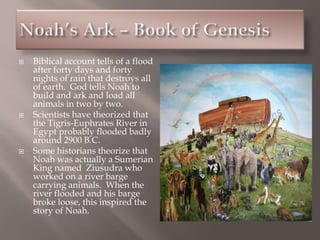
 Biblical account tells of a flood
after forty days and forty
nights of rain that destroys all
of earth. God tells Noah to
build and ark and load all
animals in two by two.
 Scientists have theorized that
the Tigris-Euphrates River in
Egypt probably flooded badly
around 2900 B.C.
 Some historians theorize that
Noah was actually a Sumerian
King named Ziusudra who
worked on a river barge
carrying animals. When the
river flooded and his barge
broke loose, this inspired the
story of Noah.
Some Scientists theorize this is the place where the
story of Noah’s Ark was inspired. It has not been
proven concretely however and no pieces of this so
called ark have ever been verified.
LIST OF 10 PLAGUES: The book of Exodus
tells of ten plagues
falling upon Egyptians
as a punishment for
enslaving the Isralites.
 Many historians
theorized that these
events occurred
sporadically, but were
recorded together.
 Another school of
thought suggests the
events were a chain
reaction effect from an
algae infestation in the
river.
1. The river Nile turning to
blood
2. Infestation of Frogs
3. Infestation of lice/gnats
4. Infestation of flies/wild
animals
5. Plague of pestilence
6. Boils/disease
7. Hail
8. Infestation of locusts
9. Darkness
10. Death of first born Egyptian
sons
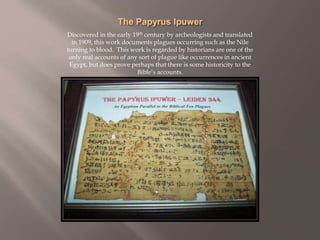
Discovered in the early 19th century by archeologists and translated
in 1909, this work documents plagues occurring such as the Nile
turning to blood. This work is regarded by historians are one of the
only real accounts of any sort of plague like occurrences in ancient
Egypt, but does prove perhaps that there is some historicity to the
Bible’s accounts.
 King Herod the Great who
ruled Judea from 37 B.C – 4 B.C
was a ruthless ruler, said to
have killed several of his wives
and even his sons.
 Book of Matthew tells of Herod
ordering all baby boys under
two years of age killed, in hopes
he would kill Jesus, who he
fears will take his place as King
of the Jews.
 The historian Josephus who
recorded history during Herod’s
reign does not record this actual
incident, but historians say that
it would not be out of character.
King Herod the Great
 Hebrew scholar Josephus
recorded history in the early
1st century. He does record
that Jesus and John the
Baptist did indeed exist.
 John the Baptist is said in the
Bible to be older than Jesus,
however Josephus records
him to be younger than Jesus
 Historians say that perhaps
since many calendars were
used, his calculations were
off, or perhaps the Bible is
not chronologically accurate
– it is not known for sure.
In the New Testament, John the
Baptist is told to have baptized Jesus
in the river of Jordan.
 Since the Bible spans such a vast time period,
proving exact dates is nearly impossible.
 The Bible is still studied today, and
archeologists continue to look for clues as to
whether it can be used as a historical book or
not.
 It may be impossible to prove or disprove all of
the stories in the Bible, and is a matter of
opinion.
Best, Robert M. Noah's Ark and the Ziusudra Epic: Sumerian Origins of the
Flood Myth. Fort Myers, FL: Enlil, 1999. Print.
Bratcher, Dennis. "Palestine Under the Herods New Testament Era."
Cresourcei.org. 2013. Web. 14 Apr. 2013.
<http://www.cresourcei.org/herodrule.html>.
Goldberg, G.J. "John the Baptist and Josephus." John The Baptist In the
New Testament and Josephus. Josephus.org, 2010. Web. 14 Apr. 2013.
<http://www.josephus.org/JohnTBaptist.htm>.
Lendering, Jona. "Flavius Josephus." Livius.org. Web. 14 Apr. 2013.
<http://www.livius.org/jo-jz/josephus/josephus.htm>.
New American Revised Bible School & Church Edition, Red/Burgundy
Marbled. Wichita: Fireside Bible Pub, 2004. Print.
Platt, Steve. "The Ten Plagues of Egypt." Steveplatt.net. 1998. Web. 14
Apr. 2013.
<http://www.publications.steveplatt.net/tenplagues.htm>.
Zecher, Henry. "One Man Showed the Old Testament Might Be
Accurate History After All." Henryzecher.com. 2006. Web. 14 Apr.
2013. <http://www.henryzecher.com/plagues.htm>.

The Bible: A Story or History?

  • 2.
     The Bibleis used in both the Christian, and Jewish religions.  It has been studied for centuries by many archeologists, scholars and historians alike.  Spans across thousands of years, possibly from 2900 B.C – 110 A.D  It’s large time frame has made it difficult to prove or disprove that the Bible has historicity.
  • 3.
    o 2900 B.C– Believed to be the estimated year that the Tigris-Euphrates Rivers flooded heavily in Sumer, possibly causing the story of Noah’s Ark to be recorded. o 2100 B.C – 1450 B.C – Known as the “Patriarchal Period” of the Bible o 2100 B.C – Religiously accepted as the estimated date of the Creation Story. o 1730 B.C – Biblical estimate of when the Israelites were enslaved in Egypt o 1479 – 1425 B.C - Reign of Tuthmosis III in Egypt. He is theorized to possibly have been ruler of Egypt when the ten plagues were recorded. o 1279-1213 B.C – Reign of Rameses II in Egypt. He is also theorized to possibly have been ruling Egypt when the ten plagues were recorded. o 1450 – 970 B.C – Known as the “Tabernacle Period” of the Bible. o 37 B.C – 4 B.C – Herod the Great rules Judea o 7 – 8 B.C – Historically theorized as time when John the Baptist was born, though in Josephus, John the Baptist appears to have been born after Jesus o 4 B.C – Historically accepted as the year Jesus was born o 33 A.D – Widely accepted as the approximate year that Jesus was crucified by the Romans o 1909 A.D – Ipuwer Papyrus translated
  • 4.
     Biblical accounttells of a flood after forty days and forty nights of rain that destroys all of earth. God tells Noah to build and ark and load all animals in two by two.  Scientists have theorized that the Tigris-Euphrates River in Egypt probably flooded badly around 2900 B.C.  Some historians theorize that Noah was actually a Sumerian King named Ziusudra who worked on a river barge carrying animals. When the river flooded and his barge broke loose, this inspired the story of Noah.
  • 5.
    Some Scientists theorizethis is the place where the story of Noah’s Ark was inspired. It has not been proven concretely however and no pieces of this so called ark have ever been verified.
  • 6.
    LIST OF 10PLAGUES: The book of Exodus tells of ten plagues falling upon Egyptians as a punishment for enslaving the Isralites.  Many historians theorized that these events occurred sporadically, but were recorded together.  Another school of thought suggests the events were a chain reaction effect from an algae infestation in the river. 1. The river Nile turning to blood 2. Infestation of Frogs 3. Infestation of lice/gnats 4. Infestation of flies/wild animals 5. Plague of pestilence 6. Boils/disease 7. Hail 8. Infestation of locusts 9. Darkness 10. Death of first born Egyptian sons
  • 7.
    Discovered in theearly 19th century by archeologists and translated in 1909, this work documents plagues occurring such as the Nile turning to blood. This work is regarded by historians are one of the only real accounts of any sort of plague like occurrences in ancient Egypt, but does prove perhaps that there is some historicity to the Bible’s accounts.
  • 8.
     King Herodthe Great who ruled Judea from 37 B.C – 4 B.C was a ruthless ruler, said to have killed several of his wives and even his sons.  Book of Matthew tells of Herod ordering all baby boys under two years of age killed, in hopes he would kill Jesus, who he fears will take his place as King of the Jews.  The historian Josephus who recorded history during Herod’s reign does not record this actual incident, but historians say that it would not be out of character. King Herod the Great
  • 9.
     Hebrew scholarJosephus recorded history in the early 1st century. He does record that Jesus and John the Baptist did indeed exist.  John the Baptist is said in the Bible to be older than Jesus, however Josephus records him to be younger than Jesus  Historians say that perhaps since many calendars were used, his calculations were off, or perhaps the Bible is not chronologically accurate – it is not known for sure. In the New Testament, John the Baptist is told to have baptized Jesus in the river of Jordan.
  • 10.
     Since theBible spans such a vast time period, proving exact dates is nearly impossible.  The Bible is still studied today, and archeologists continue to look for clues as to whether it can be used as a historical book or not.  It may be impossible to prove or disprove all of the stories in the Bible, and is a matter of opinion.
  • 11.
    Best, Robert M.Noah's Ark and the Ziusudra Epic: Sumerian Origins of the Flood Myth. Fort Myers, FL: Enlil, 1999. Print. Bratcher, Dennis. "Palestine Under the Herods New Testament Era." Cresourcei.org. 2013. Web. 14 Apr. 2013. <http://www.cresourcei.org/herodrule.html>. Goldberg, G.J. "John the Baptist and Josephus." John The Baptist In the New Testament and Josephus. Josephus.org, 2010. Web. 14 Apr. 2013. <http://www.josephus.org/JohnTBaptist.htm>. Lendering, Jona. "Flavius Josephus." Livius.org. Web. 14 Apr. 2013. <http://www.livius.org/jo-jz/josephus/josephus.htm>. New American Revised Bible School & Church Edition, Red/Burgundy Marbled. Wichita: Fireside Bible Pub, 2004. Print. Platt, Steve. "The Ten Plagues of Egypt." Steveplatt.net. 1998. Web. 14 Apr. 2013. <http://www.publications.steveplatt.net/tenplagues.htm>. Zecher, Henry. "One Man Showed the Old Testament Might Be Accurate History After All." Henryzecher.com. 2006. Web. 14 Apr. 2013. <http://www.henryzecher.com/plagues.htm>.