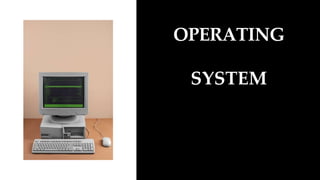
OPERATING
SYSTEM
CONTENT
* Introduction
* What is operating system ?
* Function of operating system
*Operating System Components
*Memory management
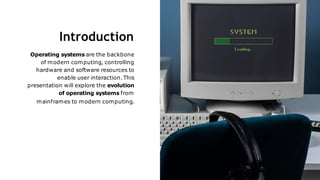
Introduction
Operating systems are the backbone
of modern computing, controlling
hardware and software resources to
enable user interaction.This
presentation will explore the evolution
of operating systems from
mainframes to modern computing.
What is operating
system?
An operating system (OS) is a software
that manages computer hardware
and software resources,providing a
platform for running applications.
Operating systems play a crucial role
in modern computing by facilitating
efficient resource management,
providing a user-friendly interface,
and ensuring the security and
protection of data.
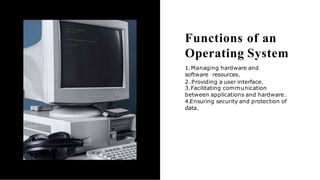
Functions of an
Operating System
1.Managing hardware and
software resources.
2.Providing a user interface.
3.Facilitating communication
between applications and hardware.
4.Ensuring security and protection of
data.
Operating System Components
1. Kernel:
- The core of the operating system that interacts directly with hardware, manages
resources, and provides essential services to other system components.
2. File System:
- Manages the organization, storage, and retrieval of files on secondary storage devices
such as hard drives or SSDs.
3. Device Drivers:
- Software components that enable communication between the operating system and
hardware devices, allowing the OS to control and utilize hardware resources eIectively.
4. User Interface:
- Provides a means for users to interact with the operating system, either through a
command-line interface (CLI) or a graphical user interface (GUI).
5. Application
Programming Interface (API):
- A set of software tools and protocols that allow developers to create applications that
run on top of the operating system, accessing its services and functionalities.
Memory Management
The operating system plays a crucial role in managing
computer memory efficiently for optimal performance and
resource allocation.
- Memory allocation and deallocation:
- The OS assigns memory space to processes and manages
their allocation and deallocation as per their requirements.
- Virtual memory and paging techniques:
- Operating systems use virtual memory to allow processes to
use more memory than physically available, utilizing disk
space as an extension of main memory.
- Memory protection and addressing:
- The OS ensures memory protection by enforcing access
controls, preventing unauthorized access to memory regions.
It also manages memory addressing to enable efficient
memory access.
Conclusion
- Operating systems are fundamental to modern computing,
enabling efficient resource management, providing user-
friendly interfaces,and ensuring data security.
- Understanding operating systems is crucial for both end-
users and developers,allowing them to make informed
decisions and develop software that utilizes the OS effectively.
Name -
Akshita Sharma
Class - VIII B
Roll no - 0 4

wepik-the-evolution-of-operating-systems-from-mainframes-to-modern-computing-202.pptx

  • 1.
  • 2.
    CONTENT * Introduction * Whatis operating system ? * Function of operating system *Operating System Components *Memory management
  • 3.
    Introduction Operating systems arethe backbone of modern computing, controlling hardware and software resources to enable user interaction.This presentation will explore the evolution of operating systems from mainframes to modern computing.
  • 4.
    What is operating system? Anoperating system (OS) is a software that manages computer hardware and software resources,providing a platform for running applications. Operating systems play a crucial role in modern computing by facilitating efficient resource management, providing a user-friendly interface, and ensuring the security and protection of data.
  • 5.
    Functions of an OperatingSystem 1.Managing hardware and software resources. 2.Providing a user interface. 3.Facilitating communication between applications and hardware. 4.Ensuring security and protection of data.
  • 6.
    Operating System Components 1.Kernel: - The core of the operating system that interacts directly with hardware, manages resources, and provides essential services to other system components. 2. File System: - Manages the organization, storage, and retrieval of files on secondary storage devices such as hard drives or SSDs. 3. Device Drivers: - Software components that enable communication between the operating system and hardware devices, allowing the OS to control and utilize hardware resources eIectively. 4. User Interface: - Provides a means for users to interact with the operating system, either through a command-line interface (CLI) or a graphical user interface (GUI). 5. Application Programming Interface (API): - A set of software tools and protocols that allow developers to create applications that run on top of the operating system, accessing its services and functionalities.
  • 7.
    Memory Management The operatingsystem plays a crucial role in managing computer memory efficiently for optimal performance and resource allocation. - Memory allocation and deallocation: - The OS assigns memory space to processes and manages their allocation and deallocation as per their requirements. - Virtual memory and paging techniques: - Operating systems use virtual memory to allow processes to use more memory than physically available, utilizing disk space as an extension of main memory. - Memory protection and addressing: - The OS ensures memory protection by enforcing access controls, preventing unauthorized access to memory regions. It also manages memory addressing to enable efficient memory access.
  • 8.
    Conclusion - Operating systemsare fundamental to modern computing, enabling efficient resource management, providing user- friendly interfaces,and ensuring data security. - Understanding operating systems is crucial for both end- users and developers,allowing them to make informed decisions and develop software that utilizes the OS effectively. Name - Akshita Sharma Class - VIII B Roll no - 0 4