Theme:
Summarizing essay
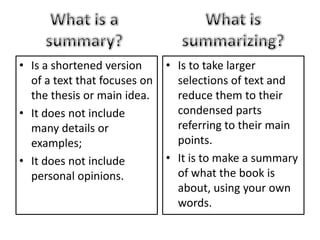
• Is a shortened version
of a text that focuses on
the thesis or main idea.
• It does not include
many details or
examples;
• It does not include
personal opinions.
• Is to take larger
selections of text and
reduce them to their
condensed parts
referring to their main
points.
• It is to make a summary
of what the book is
about, using your own
words.
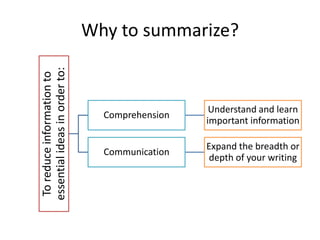
Why to summarize?
Toreduceinformationto
essentialideasinorderto:
Comprehension
Understand and learn
important information
Communication
Expand the breadth or
depth of your writing
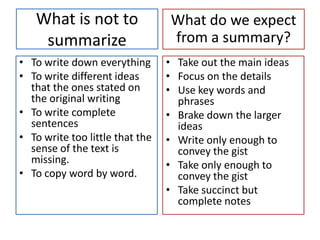
What is not to
summarize
• To write down everything
• To write different ideas
that the ones stated on
the original writing
• To write complete
sentences
• To write too little that the
sense of the text is
missing.
• To copy word by word.
• Take out the main ideas
• Focus on the details
• Use key words and
phrases
• Brake down the larger
ideas
• Write only enough to
convey the gist
• Take only enough to
convey the gist
• Take succinct but
complete notes
What do we expect
from a summary?
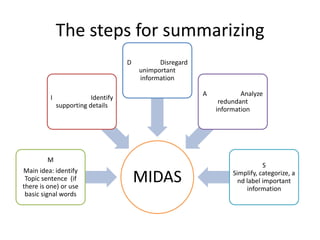
The steps for summarizing
MIDAS
M
Main idea: identify
Topic sentence (if
there is one) or use
basic signal words
I Identify
supporting details
D Disregard
unimportant
information
A Analyze
redundant
information
S
Simplify, categorize, a
nd label important
information
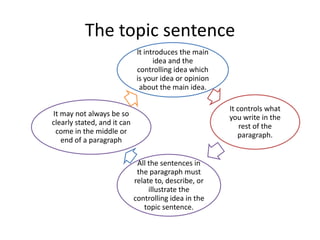
The topic sentence
It introduces the main
idea and the
controlling idea which
is your idea or opinion
about the main idea.
It controls what
you write in the
rest of the
paragraph.
All the sentences in
the paragraph must
relate to, describe, or
illustrate the
controlling idea in the
topic sentence.
It may not always be so
clearly stated, and it can
come in the middle or
end of a paragraph
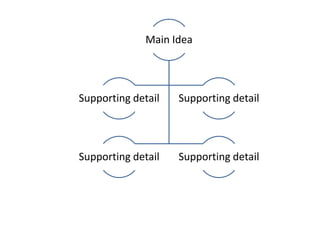
Main Idea
Supporting detail Supporting detail
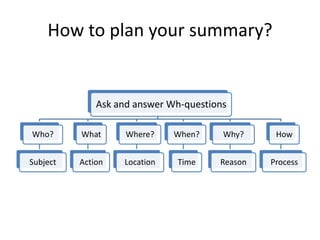
How to plan your summary?
Ask and answer Wh-questions
Who?
Subject
What
Action
Where?
Location
When?
Time
Why?
Reason
How
Process
Summarizing
Let’s practice
One paragraph at a time…
Summarizing_ppoint.ppt
Example paragraphs…
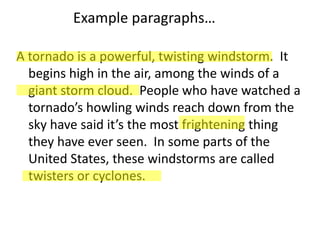
A tornado is a powerful, twisting windstorm. It
begins high in the air, among the winds of a
giant storm cloud. People who have watched a
tornado’s howling winds reach down from the
sky have said it’s the most frightening thing
they have ever seen. In some parts of the
United States, these windstorms are called
twisters or cyclones.
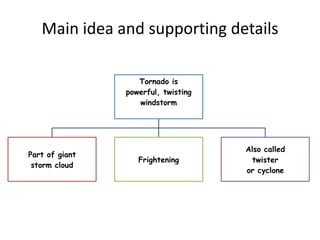
Main idea and supporting details
Tornado is
powerful, twisting
windstorm
Part of giant
storm cloud
Frightening
Also called
twister
or cyclone
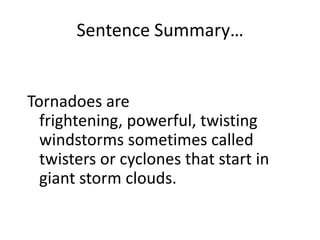
Sentence Summary…
Tornadoes are
frightening, powerful, twisting
windstorms sometimes called
twisters or cyclones that start in
giant storm clouds.
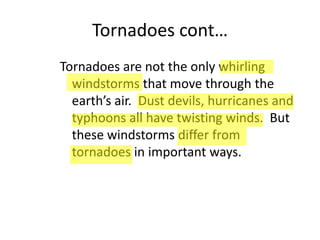
Tornadoes cont…
Tornadoes are not the only whirling
windstorms that move through the
earth’s air. Dust devils, hurricanes and
typhoons all have twisting winds. But
these windstorms differ from
tornadoes in important ways.
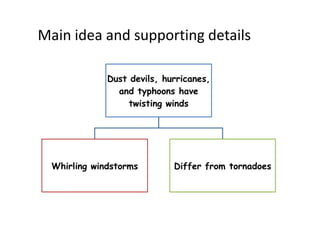
Main idea and supporting details
Dust devils, hurricanes,
and typhoons have
twisting winds
Whirling windstorms Differ from tornadoes
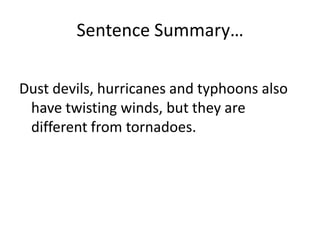
Sentence Summary…
Dust devils, hurricanes and typhoons also
have twisting winds, but they are
different from tornadoes.
Thanks for attending the class!
Have a nice day!

Weite a zummarizing essay

  • 1.
  • 2.
    • Is ashortened version of a text that focuses on the thesis or main idea. • It does not include many details or examples; • It does not include personal opinions. • Is to take larger selections of text and reduce them to their condensed parts referring to their main points. • It is to make a summary of what the book is about, using your own words.
  • 3.
    Why to summarize? Toreduceinformationto essentialideasinorderto: Comprehension Understandand learn important information Communication Expand the breadth or depth of your writing
  • 4.
    What is notto summarize • To write down everything • To write different ideas that the ones stated on the original writing • To write complete sentences • To write too little that the sense of the text is missing. • To copy word by word. • Take out the main ideas • Focus on the details • Use key words and phrases • Brake down the larger ideas • Write only enough to convey the gist • Take only enough to convey the gist • Take succinct but complete notes What do we expect from a summary?
  • 5.
    The steps forsummarizing MIDAS M Main idea: identify Topic sentence (if there is one) or use basic signal words I Identify supporting details D Disregard unimportant information A Analyze redundant information S Simplify, categorize, a nd label important information
  • 6.
    The topic sentence Itintroduces the main idea and the controlling idea which is your idea or opinion about the main idea. It controls what you write in the rest of the paragraph. All the sentences in the paragraph must relate to, describe, or illustrate the controlling idea in the topic sentence. It may not always be so clearly stated, and it can come in the middle or end of a paragraph
  • 7.
    Main Idea Supporting detailSupporting detail Supporting detail Supporting detail
  • 8.
    How to planyour summary? Ask and answer Wh-questions Who? Subject What Action Where? Location When? Time Why? Reason How Process
  • 9.
    Summarizing Let’s practice One paragraphat a time… Summarizing_ppoint.ppt
  • 10.
    Example paragraphs… A tornadois a powerful, twisting windstorm. It begins high in the air, among the winds of a giant storm cloud. People who have watched a tornado’s howling winds reach down from the sky have said it’s the most frightening thing they have ever seen. In some parts of the United States, these windstorms are called twisters or cyclones.
  • 11.
    Main idea andsupporting details Tornado is powerful, twisting windstorm Part of giant storm cloud Frightening Also called twister or cyclone
  • 12.
    Sentence Summary… Tornadoes are frightening,powerful, twisting windstorms sometimes called twisters or cyclones that start in giant storm clouds.
  • 13.
    Tornadoes cont… Tornadoes arenot the only whirling windstorms that move through the earth’s air. Dust devils, hurricanes and typhoons all have twisting winds. But these windstorms differ from tornadoes in important ways.
  • 14.
    Main idea andsupporting details Dust devils, hurricanes, and typhoons have twisting winds Whirling windstorms Differ from tornadoes
  • 15.
    Sentence Summary… Dust devils,hurricanes and typhoons also have twisting winds, but they are different from tornadoes.
  • 16.
    Thanks for attendingthe class! Have a nice day!