New English for Us first Edition
Grade 5Quarter 1
TRANSFER GOALS
The pupils listen critically to different text types; express ideas logically in oral and written forms; and demonstrate interest in reading to meet various needs.
The pupils listen critically to news reports and other radio broadcasts and express ideas accurately in oral and in written forms;
demonstrate confidence in the use of the language to meet every day needs; and read independently and get relevant information from various text types.
CONTENT STANDARD
The pupils demonstrate understanding of context clues; express ideas through subject-verb agreement; use coordinating conjunctions in composing compound sentences; use
subordinating conjunctions in com-posing complex sentences; and show cause-and-effect relationships effectively
PERFORMANCE STANDARD
The pupils actively participate in the writing of an essay that highlights cause-and-effect relationship based on the following criteria: message (content), cause-and-effect
relationship, use of complex sentences, and writing mechanics.
GRADE LEVEL STANDARDS
LESSON 1: Using Context Clues Number of Days: 5
MELC-based
Learning
Objective
Classroom-based Activities Formative/Feedback TWE
Page
Referenc
e
Summative TWE
Page
Reference
Discipline/Values Integration
Infer the meaning
of unfamiliar words
using context clues
Time allotment: 2 days
1. Participate in the
Time allotment: 1 day
Interpret the lesson by 4
Time allotment: 2 days
Writing exercises in the 5 , 6
 Understanding and
appreciating the ways of
the environment
Weekly Learning Plan
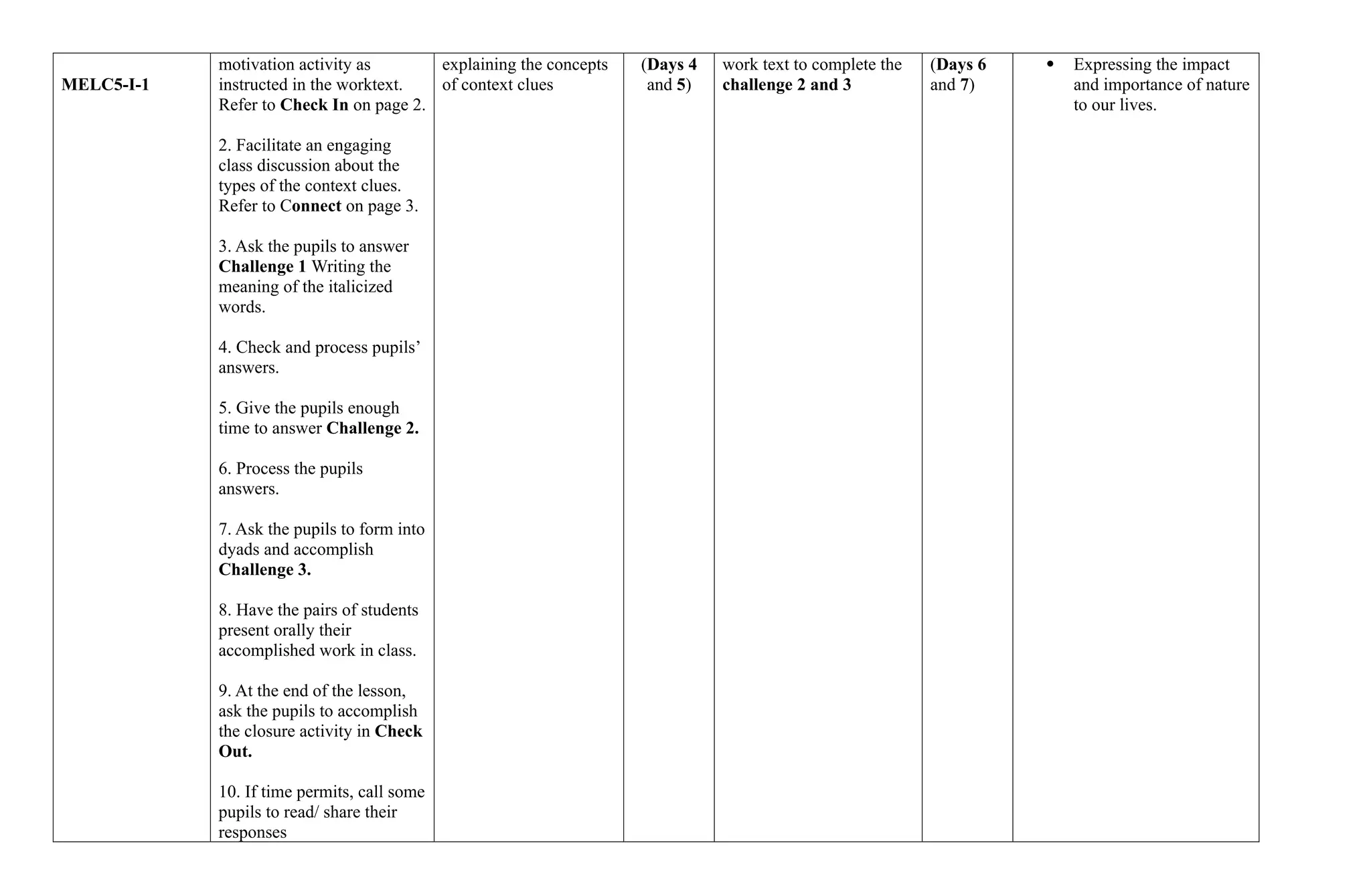
MELC5-I-1
motivation activity as
instructed in the worktext.
Refer to Check In on page 2.
2. Facilitate an engaging
class discussion about the
types of the context clues.
Refer to Connect on page 3.
3. Ask the pupils to answer
Challenge 1 Writing the
meaning of the italicized
words.
4. Check and process pupils’
answers.
5. Give the pupils enough
time to answer Challenge 2.
6. Process the pupils
answers.
7. Ask the pupils to form into
dyads and accomplish
Challenge 3.
8. Have the pairs of students
present orally their
accomplished work in class.
9. At the end of the lesson,
ask the pupils to accomplish
the closure activity in Check
Out.
10. If time permits, call some
pupils to read/ share their
responses
explaining the concepts
of context clues
(Days 4
and 5)
work text to complete the
challenge 2 and 3
(Days 6
and 7)
 Expressing the impact
and importance of nature
to our lives.
LESSON 2: Expressing ideas using subject-verb agreement Number of Days: 5
MELC-based
Learning
Objective
Classroom-based Activities Formative/Feedback TWE
Page
Referenc
e
Summative TWE
Page
Reference
Discipline/Values Integration
Compose clear and
coherent sentences
using appropriate
grammatical
structures: subject-
verb agreement
EN5G-IIa-3.9
Fill out forms
accurately
EN5WC-IIj-3.7
Time allotment: 2 days
1. As you start the lesson,
ask pupils to answer the
motivation questions: What
kind of exercises/physical
activities do you do?
2. Ask the pupils to read and
study the sample sentences.
3. Discuss thoroughly the
basic rules in observing
subject-verb agreement.
Refer to Connect.
4. Ask the pupils to compose
their own sentences
following each rule in
subject-verb agreement.
5. Ask the pupils to answer a
series of grammar drills.
Refer to the activities in
Challenge 1.
6. Check and process the
answers.
Time allotment: 2 days
Deepen your
understanding of the
lesson by composing
clear and coherent
sentences using
appropriate grammatical
structures: subject-verb
agreement
12, 14
(Day 12)
Time allotment: 1 day
Writing exercises in the
work text to complete the
challenge 3
15, 16
(Day 12)
 Expressing the
importance of health and
fitness through exercise
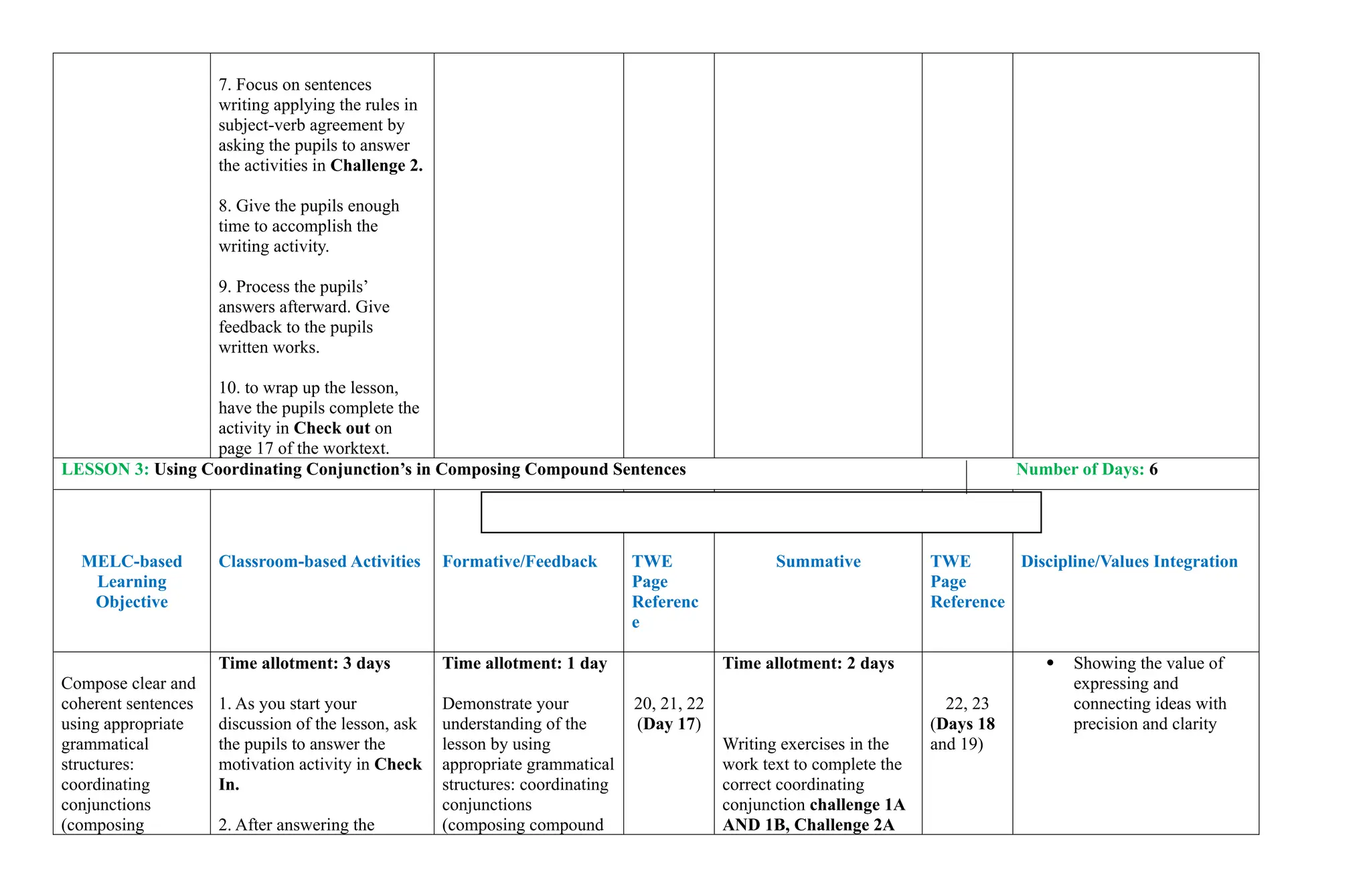
7. Focus on sentences
writing applying the rules in
subject-verb agreement by
asking the pupils to answer
the activities in Challenge 2.
8. Give the pupils enough
time to accomplish the
writing activity.
9. Process the pupils’
answers afterward. Give
feedback to the pupils
written works.
10. to wrap up the lesson,
have the pupils complete the
activity in Check out on
page 17 of the worktext.
LESSON 3: Using Coordinating Conjunction’s in Composing Compound Sentences Number of Days: 6
MELC-based
Learning
Objective
Classroom-based Activities Formative/Feedback TWE
Page
Referenc
e
Summative TWE
Page
Reference
Discipline/Values Integration
Compose clear and
coherent sentences
using appropriate
grammatical
structures:
coordinating
conjunctions
(composing
Time allotment: 3 days
1. As you start your
discussion of the lesson, ask
the pupils to answer the
motivation activity in Check
In.
2. After answering the
Time allotment: 1 day
Demonstrate your
understanding of the
lesson by using
appropriate grammatical
structures: coordinating
conjunctions
(composing compound
20, 21, 22
(Day 17)
Time allotment: 2 days
Writing exercises in the
work text to complete the
correct coordinating
conjunction challenge 1A
AND 1B, Challenge 2A
22, 23
(Days 18
and 19)
 Showing the value of
expressing and
connecting ideas with
precision and clarity
compound
sentences)
EN5G-Ie-8.3/8.4/
EN5G-IIh-8.3
Apply compound
sentences to show
problem-solution
relationship of
ideas
EN5G-IVc-1.8.2
activity, call some pupils to
use the pairs of words in
meaningful sentences.
3. Facilitate and engaging
class discussion about
coordinating conjunctions
and how to use them in
composing compound
sentences.
4. for the explanations of the
grammar points/ rules, refer
to Connect on page 19 and
20.
5. Ask the pupils to answer
the Challenge 1A and
Challenge 1B on the pages
20 and 21 of the worktext.
6. Check and process the
pupils’ answers.
7. Ask the pupils to answer
the Challenge 2A and
Challenge 2B on the pages
21 and 22 of the worktext.
8. Check and process the
pupils’ answers.
9. Give the pupils enough
time to accomplish the
journal writing task.
 Ask them to write a
draft of their work
first.
sentences) and 2B
Create an acrostic for
FANBOYS to summarize
what they have learned
about grammar and
discussed.
 Check the drafts
submitted by the
pupils and provided
the necessary
feedback.
 Give the pupils times
to polish their written
work before
submitting.
10. Ask the pupils to create
an acrostic for FANBOYS to
summarize what they have
learned about grammar
lesson discussed. Refer to
Check Out on page 23.
LESSON 4: Using Subordinating Conjunctions in Complex Sentences Number of Days: 6
MELC-based
Learning
Objective
Classroom-based Activities Formative/Feedback TWE
Page
Referenc
e
Summative TWE
Page
Reference
Discipline/Values Integration
compose clear and
coherent sentences
using appropriate
grammatical
structures:
subordinating
conjunctions
(composing
complex sentences)
EN5G-Ie-8.3/8.4/
EN4RC-IIf-2.8
Time allotment: 2 days
1. Ask the pupils to do
introductory activity in
Check In. then the learner
work with pairs and share
their researched information
in class.
2. use the sentences written
by the pupils in the
motivation activity as
springboard in teaching
Time allotment: 2 days
Demonstrate
appropriate grammatical
structures:
subordinating
conjunctions
(composing complex
sentences).
Writing exercises in the
26 , 27
(Days 25
and 26)
Time allotment: 2 days
Compose correct complex
sentences using
appropriate subordinating
conjunctions.
28
(Days 25
and 26)
 Showing the value of
expressing and
connecting ideas with
precision and clarity
 Having awareness about
common environmental
issues and taking
possible actions to save
earth from destruction.
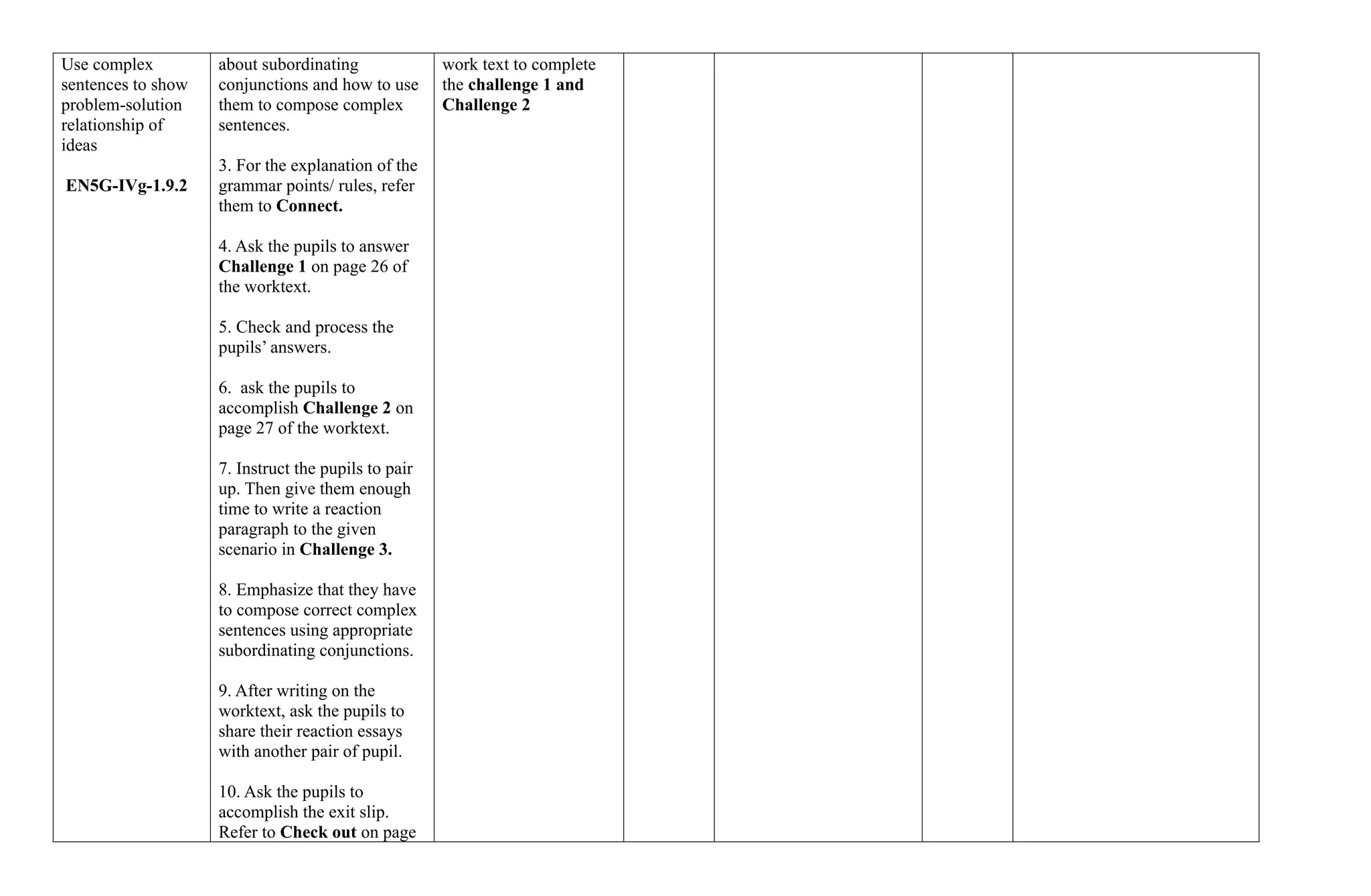
Use complex
sentences to show
problem-solution
relationship of
ideas
EN5G-IVg-1.9.2
about subordinating
conjunctions and how to use
them to compose complex
sentences.
3. For the explanation of the
grammar points/ rules, refer
them to Connect.
4. Ask the pupils to answer
Challenge 1 on page 26 of
the worktext.
5. Check and process the
pupils’ answers.
6. ask the pupils to
accomplish Challenge 2 on
page 27 of the worktext.
7. Instruct the pupils to pair
up. Then give them enough
time to write a reaction
paragraph to the given
scenario in Challenge 3.
8. Emphasize that they have
to compose correct complex
sentences using appropriate
subordinating conjunctions.
9. After writing on the
worktext, ask the pupils to
share their reaction essays
with another pair of pupil.
10. Ask the pupils to
accomplish the exit slip.
Refer to Check out on page
work text to complete
the challenge 1 and
Challenge 2
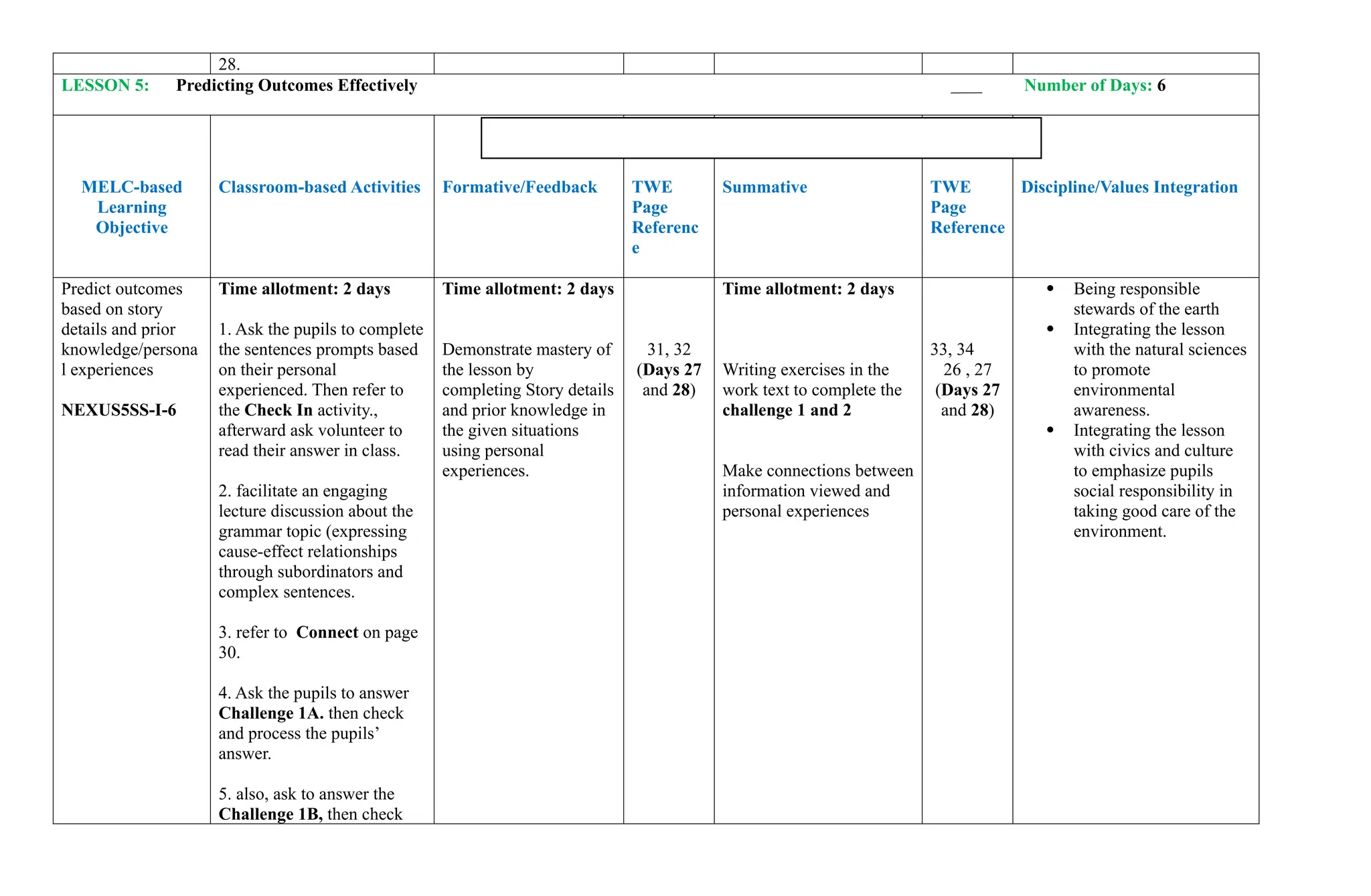
28.
LESSON 5: Predicting Outcomes Effectively Number of Days: 6
MELC-based
Learning
Objective
Classroom-based Activities Formative/Feedback TWE
Page
Referenc
e
Summative TWE
Page
Reference
Discipline/Values Integration
Predict outcomes
based on story
details and prior
knowledge/persona
l experiences
NEXUS5SS-I-6
Time allotment: 2 days
1. Ask the pupils to complete
the sentences prompts based
on their personal
experienced. Then refer to
the Check In activity.,
afterward ask volunteer to
read their answer in class.
2. facilitate an engaging
lecture discussion about the
grammar topic (expressing
cause-effect relationships
through subordinators and
complex sentences.
3. refer to Connect on page
30.
4. Ask the pupils to answer
Challenge 1A. then check
and process the pupils’
answer.
5. also, ask to answer the
Challenge 1B, then check
Time allotment: 2 days
Demonstrate mastery of
the lesson by
completing Story details
and prior knowledge in
the given situations
using personal
experiences.
31, 32
(Days 27
and 28)
Time allotment: 2 days
Writing exercises in the
work text to complete the
challenge 1 and 2
Make connections between
information viewed and
personal experiences
33, 34
26 , 27
(Days 27
and 28)
 Being responsible
stewards of the earth
 Integrating the lesson
with the natural sciences
to promote
environmental
awareness.
 Integrating the lesson
with civics and culture
to emphasize pupils
social responsibility in
taking good care of the
environment.
and process the pupils’
answer.
6. Elicit as many sample
sentences from the students
as possible. Make sure that
they are able to use
subordinating conjunctions
properly.
7. Prepare the pupils fot
writing of cause-effect
paragraph. Have the pupils
go through a process writing
by asking them first to
accomplish the cause-effect
organizer in Challenge 2.
8. Guide the pupils as they
fill out the chart.
9. Direct the pupils to
writing the main idea (topic
sentences) for their cause-
effect writing compositions.
10. Refer to Challenge 3A,
then guide them further as
they also accomplish
Challenge B by listing down
supporting details about the
topic sentences or main idea.
11. After they have
completed these pre-writing
stage, they are now ready to
write their cause-effect essay
in Create on page 35.
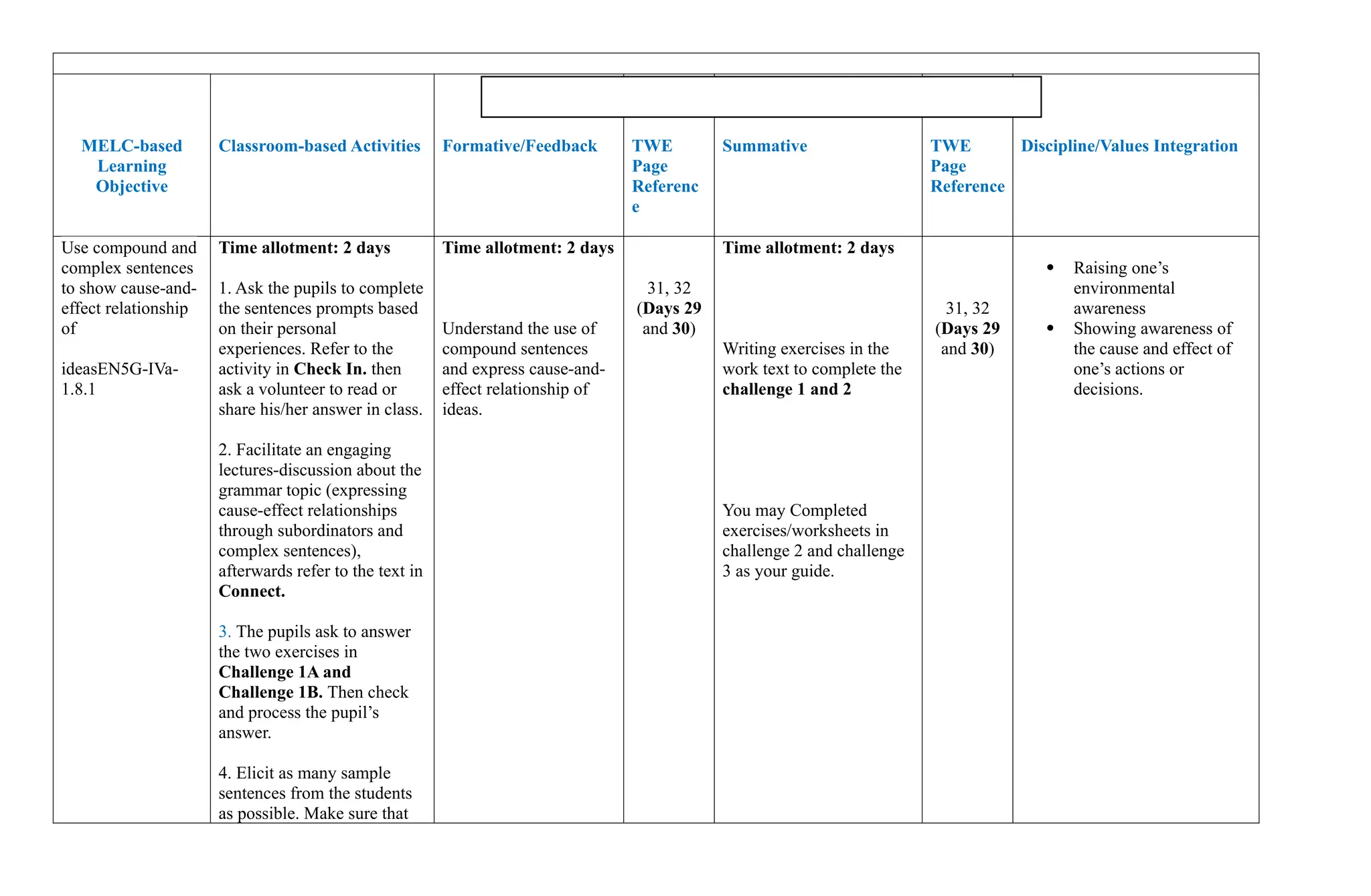
LESSON 6: Expressing Cause and Effect Relationship of Ideas Number of Days: 6
MELC-based
Learning
Objective
Classroom-based Activities Formative/Feedback TWE
Page
Referenc
e
Summative TWE
Page
Reference
Discipline/Values Integration
Use compound and
complex sentences
to show cause-and-
effect relationship
of
ideasEN5G-IVa-
1.8.1
Time allotment: 2 days
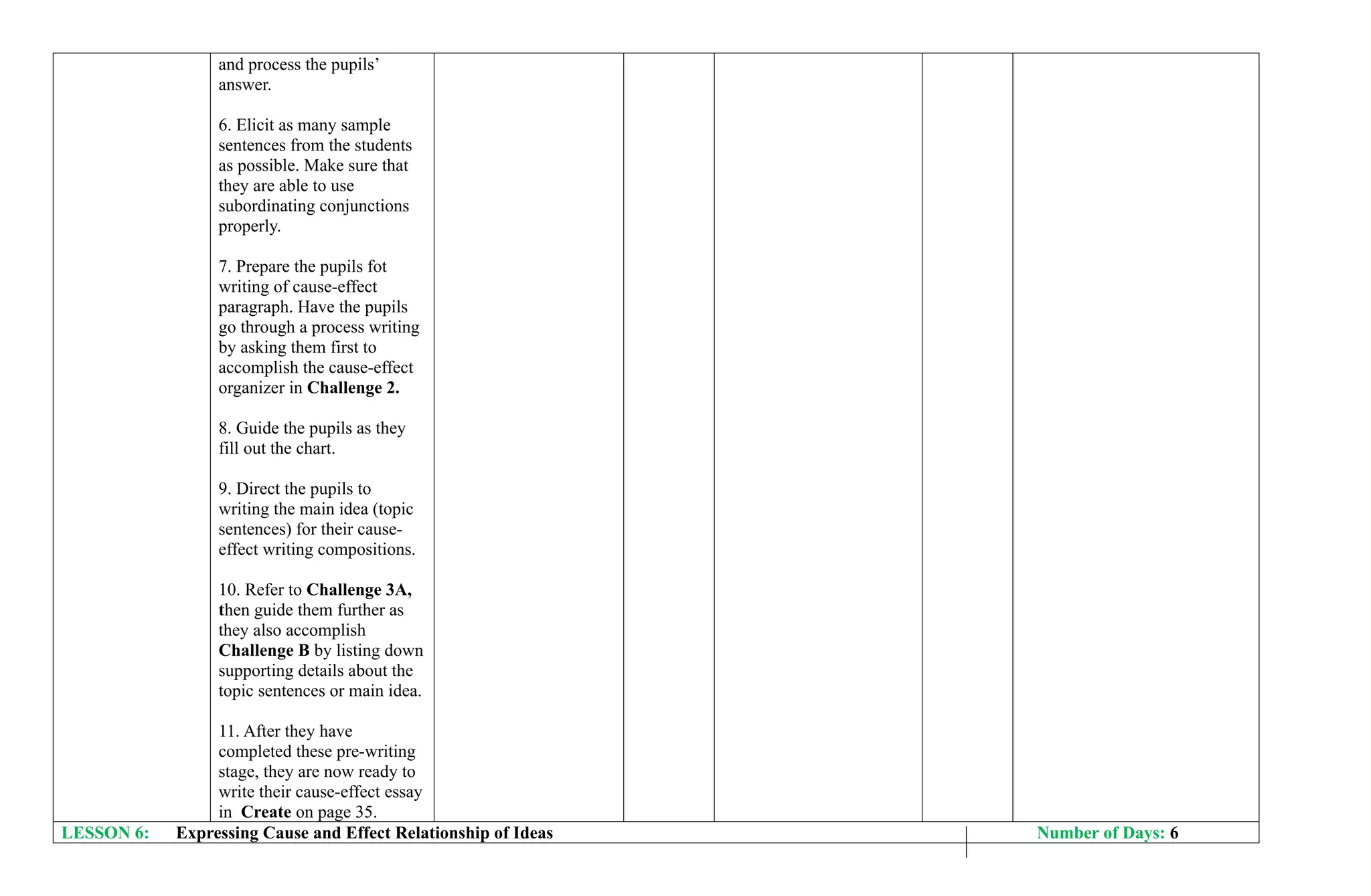
1. Ask the pupils to complete
the sentences prompts based
on their personal
experiences. Refer to the
activity in Check In. then
ask a volunteer to read or
share his/her answer in class.
2. Facilitate an engaging
lectures-discussion about the
grammar topic (expressing
cause-effect relationships
through subordinators and
complex sentences),
afterwards refer to the text in
Connect.
3. The pupils ask to answer
the two exercises in
Challenge 1A and
Challenge 1B. Then check
and process the pupil’s
answer.
4. Elicit as many sample
sentences from the students
as possible. Make sure that
Time allotment: 2 days
Understand the use of
compound sentences
and express cause-and-
effect relationship of
ideas.
31, 32
(Days 29
and 30)
Time allotment: 2 days
Writing exercises in the
work text to complete the
challenge 1 and 2
You may Completed
exercises/worksheets in
challenge 2 and challenge
3 as your guide.
31, 32
(Days 29
and 30)
 Raising one’s
environmental
awareness
 Showing awareness of
the cause and effect of
one’s actions or
decisions.
they are able to use
subordinating conjunctions
properly.
5. Prepare the pupils fot
writing of cause-effect
paragraph. Have the pupils
go through a process writing
by asking them first to
accomplish the cause-effect
organizer in Challenge 2.
6. Guide the pupils as they
fill out the chart.
7. Direct the pupils to
writing the main idea (topic
sentence) for their cause-
effect writing compositions.
Refer to Challenge 3A, then
guide them further as they
accomplish Challenge 3B.
8. . After they have
completed these pre-writing
stage, they are now ready to
write their cause-effect essay
in Create after this unit
lesson.
Transfer Activity
Coming up with environmental awareness among the people in your school and
community in Celebrating World Environment Day. You may Completed
exercises/worksheets in challenge 2 and challenge 3 as your guide.
TWE Page Reference
NEXUS 5 PAGE 41
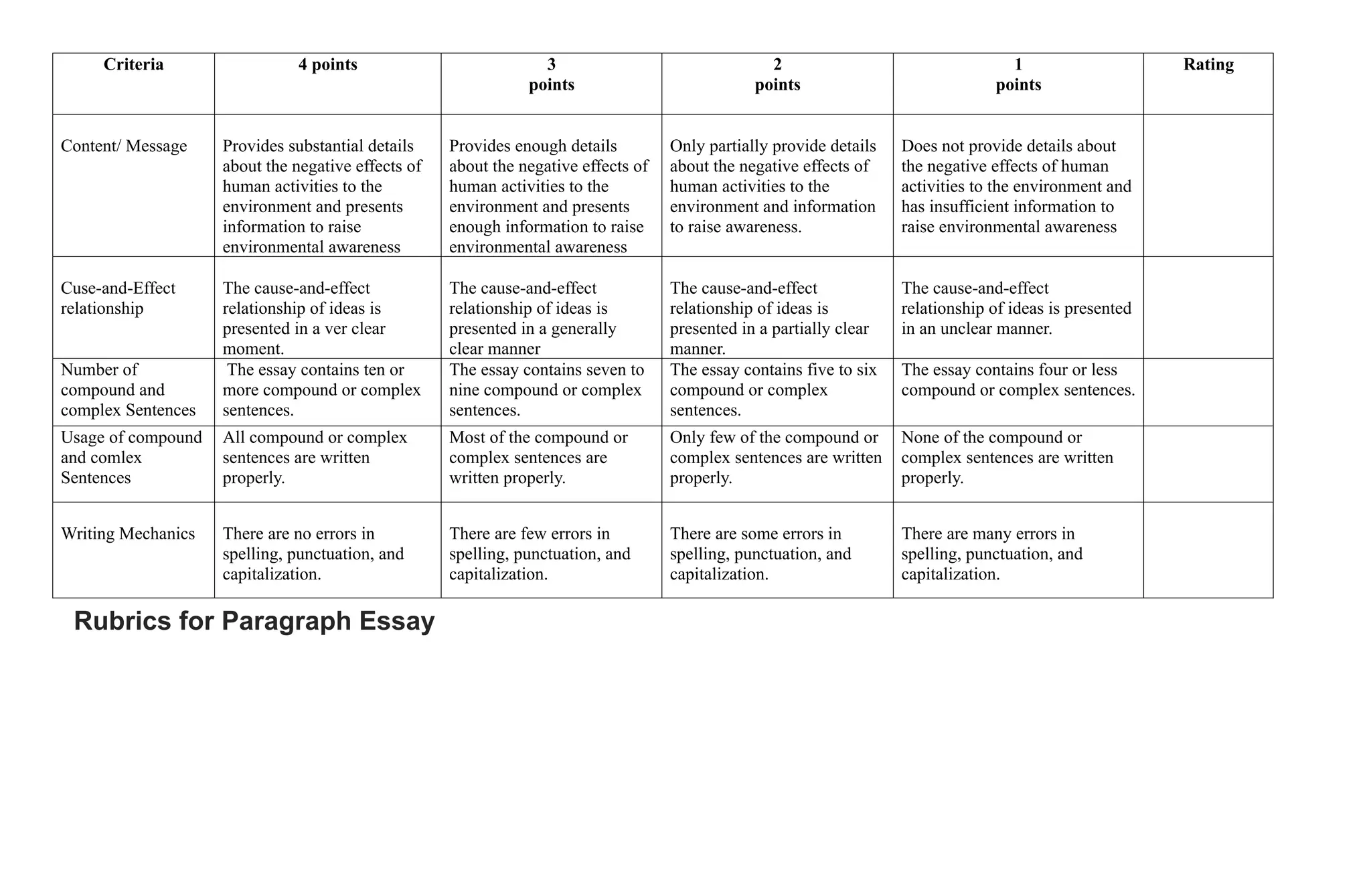
Rubrics for Paragraph Essay
Criteria 4 points 3
points
2
points
1
points
Rating
Content/ Message Provides substantial details
about the negative effects of
human activities to the
environment and presents
information to raise
environmental awareness
Provides enough details
about the negative effects of
human activities to the
environment and presents
enough information to raise
environmental awareness
Only partially provide details
about the negative effects of
human activities to the
environment and information
to raise awareness.
Does not provide details about
the negative effects of human
activities to the environment and
has insufficient information to
raise environmental awareness
Cuse-and-Effect
relationship
The cause-and-effect
relationship of ideas is
presented in a ver clear
moment.
The cause-and-effect
relationship of ideas is
presented in a generally
clear manner
The cause-and-effect
relationship of ideas is
presented in a partially clear
manner.
The cause-and-effect
relationship of ideas is presented
in an unclear manner.
Number of
compound and
complex Sentences
The essay contains ten or
more compound or complex
sentences.
The essay contains seven to
nine compound or complex
sentences.
The essay contains five to six
compound or complex
sentences.
The essay contains four or less
compound or complex sentences.
Usage of compound
and comlex
Sentences
All compound or complex
sentences are written
properly.
Most of the compound or
complex sentences are
written properly.
Only few of the compound or
complex sentences are written
properly.
None of the compound or
complex sentences are written
properly.
Writing Mechanics There are no errors in
spelling, punctuation, and
capitalization.
There are few errors in
spelling, punctuation, and
capitalization.
There are some errors in
spelling, punctuation, and
capitalization.
There are many errors in
spelling, punctuation, and
capitalization.
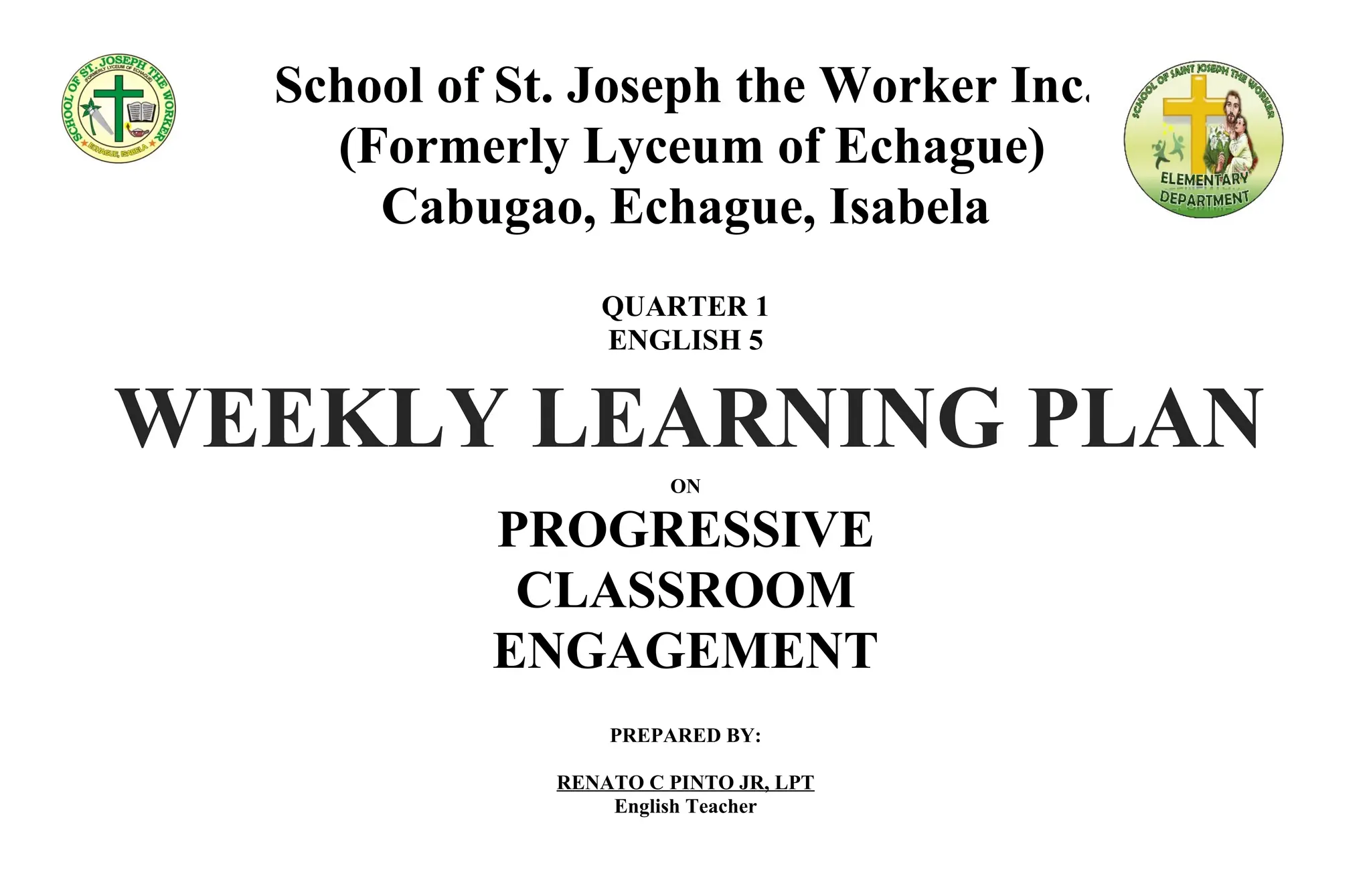
School of St. Joseph the Worker Inc.
(Formerly Lyceum of Echague)
Cabugao, Echague, Isabela
QUARTER 1
ENGLISH 5
ON
PROGRESSIVE
CLASSROOM
ENGAGEMENT
PREPARED BY:
RENATO C PINTO JR, LPT
English Teacher
WEEKLY LEARNING PLAN

WEEKLY-PLAN-GRADE5 english example of cur map

  • 1.
    New English forUs first Edition Grade 5Quarter 1 TRANSFER GOALS The pupils listen critically to different text types; express ideas logically in oral and written forms; and demonstrate interest in reading to meet various needs. The pupils listen critically to news reports and other radio broadcasts and express ideas accurately in oral and in written forms; demonstrate confidence in the use of the language to meet every day needs; and read independently and get relevant information from various text types. CONTENT STANDARD The pupils demonstrate understanding of context clues; express ideas through subject-verb agreement; use coordinating conjunctions in composing compound sentences; use subordinating conjunctions in com-posing complex sentences; and show cause-and-effect relationships effectively PERFORMANCE STANDARD The pupils actively participate in the writing of an essay that highlights cause-and-effect relationship based on the following criteria: message (content), cause-and-effect relationship, use of complex sentences, and writing mechanics. GRADE LEVEL STANDARDS LESSON 1: Using Context Clues Number of Days: 5 MELC-based Learning Objective Classroom-based Activities Formative/Feedback TWE Page Referenc e Summative TWE Page Reference Discipline/Values Integration Infer the meaning of unfamiliar words using context clues Time allotment: 2 days 1. Participate in the Time allotment: 1 day Interpret the lesson by 4 Time allotment: 2 days Writing exercises in the 5 , 6  Understanding and appreciating the ways of the environment Weekly Learning Plan
  • 2.
    MELC5-I-1 motivation activity as instructedin the worktext. Refer to Check In on page 2. 2. Facilitate an engaging class discussion about the types of the context clues. Refer to Connect on page 3. 3. Ask the pupils to answer Challenge 1 Writing the meaning of the italicized words. 4. Check and process pupils’ answers. 5. Give the pupils enough time to answer Challenge 2. 6. Process the pupils answers. 7. Ask the pupils to form into dyads and accomplish Challenge 3. 8. Have the pairs of students present orally their accomplished work in class. 9. At the end of the lesson, ask the pupils to accomplish the closure activity in Check Out. 10. If time permits, call some pupils to read/ share their responses explaining the concepts of context clues (Days 4 and 5) work text to complete the challenge 2 and 3 (Days 6 and 7)  Expressing the impact and importance of nature to our lives.
  • 3.
    LESSON 2: Expressingideas using subject-verb agreement Number of Days: 5 MELC-based Learning Objective Classroom-based Activities Formative/Feedback TWE Page Referenc e Summative TWE Page Reference Discipline/Values Integration Compose clear and coherent sentences using appropriate grammatical structures: subject- verb agreement EN5G-IIa-3.9 Fill out forms accurately EN5WC-IIj-3.7 Time allotment: 2 days 1. As you start the lesson, ask pupils to answer the motivation questions: What kind of exercises/physical activities do you do? 2. Ask the pupils to read and study the sample sentences. 3. Discuss thoroughly the basic rules in observing subject-verb agreement. Refer to Connect. 4. Ask the pupils to compose their own sentences following each rule in subject-verb agreement. 5. Ask the pupils to answer a series of grammar drills. Refer to the activities in Challenge 1. 6. Check and process the answers. Time allotment: 2 days Deepen your understanding of the lesson by composing clear and coherent sentences using appropriate grammatical structures: subject-verb agreement 12, 14 (Day 12) Time allotment: 1 day Writing exercises in the work text to complete the challenge 3 15, 16 (Day 12)  Expressing the importance of health and fitness through exercise
  • 4.
    7. Focus onsentences writing applying the rules in subject-verb agreement by asking the pupils to answer the activities in Challenge 2. 8. Give the pupils enough time to accomplish the writing activity. 9. Process the pupils’ answers afterward. Give feedback to the pupils written works. 10. to wrap up the lesson, have the pupils complete the activity in Check out on page 17 of the worktext. LESSON 3: Using Coordinating Conjunction’s in Composing Compound Sentences Number of Days: 6 MELC-based Learning Objective Classroom-based Activities Formative/Feedback TWE Page Referenc e Summative TWE Page Reference Discipline/Values Integration Compose clear and coherent sentences using appropriate grammatical structures: coordinating conjunctions (composing Time allotment: 3 days 1. As you start your discussion of the lesson, ask the pupils to answer the motivation activity in Check In. 2. After answering the Time allotment: 1 day Demonstrate your understanding of the lesson by using appropriate grammatical structures: coordinating conjunctions (composing compound 20, 21, 22 (Day 17) Time allotment: 2 days Writing exercises in the work text to complete the correct coordinating conjunction challenge 1A AND 1B, Challenge 2A 22, 23 (Days 18 and 19)  Showing the value of expressing and connecting ideas with precision and clarity
  • 5.
    compound sentences) EN5G-Ie-8.3/8.4/ EN5G-IIh-8.3 Apply compound sentences toshow problem-solution relationship of ideas EN5G-IVc-1.8.2 activity, call some pupils to use the pairs of words in meaningful sentences. 3. Facilitate and engaging class discussion about coordinating conjunctions and how to use them in composing compound sentences. 4. for the explanations of the grammar points/ rules, refer to Connect on page 19 and 20. 5. Ask the pupils to answer the Challenge 1A and Challenge 1B on the pages 20 and 21 of the worktext. 6. Check and process the pupils’ answers. 7. Ask the pupils to answer the Challenge 2A and Challenge 2B on the pages 21 and 22 of the worktext. 8. Check and process the pupils’ answers. 9. Give the pupils enough time to accomplish the journal writing task.  Ask them to write a draft of their work first. sentences) and 2B Create an acrostic for FANBOYS to summarize what they have learned about grammar and discussed.
  • 6.
     Check thedrafts submitted by the pupils and provided the necessary feedback.  Give the pupils times to polish their written work before submitting. 10. Ask the pupils to create an acrostic for FANBOYS to summarize what they have learned about grammar lesson discussed. Refer to Check Out on page 23. LESSON 4: Using Subordinating Conjunctions in Complex Sentences Number of Days: 6 MELC-based Learning Objective Classroom-based Activities Formative/Feedback TWE Page Referenc e Summative TWE Page Reference Discipline/Values Integration compose clear and coherent sentences using appropriate grammatical structures: subordinating conjunctions (composing complex sentences) EN5G-Ie-8.3/8.4/ EN4RC-IIf-2.8 Time allotment: 2 days 1. Ask the pupils to do introductory activity in Check In. then the learner work with pairs and share their researched information in class. 2. use the sentences written by the pupils in the motivation activity as springboard in teaching Time allotment: 2 days Demonstrate appropriate grammatical structures: subordinating conjunctions (composing complex sentences). Writing exercises in the 26 , 27 (Days 25 and 26) Time allotment: 2 days Compose correct complex sentences using appropriate subordinating conjunctions. 28 (Days 25 and 26)  Showing the value of expressing and connecting ideas with precision and clarity  Having awareness about common environmental issues and taking possible actions to save earth from destruction.
  • 7.
    Use complex sentences toshow problem-solution relationship of ideas EN5G-IVg-1.9.2 about subordinating conjunctions and how to use them to compose complex sentences. 3. For the explanation of the grammar points/ rules, refer them to Connect. 4. Ask the pupils to answer Challenge 1 on page 26 of the worktext. 5. Check and process the pupils’ answers. 6. ask the pupils to accomplish Challenge 2 on page 27 of the worktext. 7. Instruct the pupils to pair up. Then give them enough time to write a reaction paragraph to the given scenario in Challenge 3. 8. Emphasize that they have to compose correct complex sentences using appropriate subordinating conjunctions. 9. After writing on the worktext, ask the pupils to share their reaction essays with another pair of pupil. 10. Ask the pupils to accomplish the exit slip. Refer to Check out on page work text to complete the challenge 1 and Challenge 2
  • 8.
    28. LESSON 5: PredictingOutcomes Effectively Number of Days: 6 MELC-based Learning Objective Classroom-based Activities Formative/Feedback TWE Page Referenc e Summative TWE Page Reference Discipline/Values Integration Predict outcomes based on story details and prior knowledge/persona l experiences NEXUS5SS-I-6 Time allotment: 2 days 1. Ask the pupils to complete the sentences prompts based on their personal experienced. Then refer to the Check In activity., afterward ask volunteer to read their answer in class. 2. facilitate an engaging lecture discussion about the grammar topic (expressing cause-effect relationships through subordinators and complex sentences. 3. refer to Connect on page 30. 4. Ask the pupils to answer Challenge 1A. then check and process the pupils’ answer. 5. also, ask to answer the Challenge 1B, then check Time allotment: 2 days Demonstrate mastery of the lesson by completing Story details and prior knowledge in the given situations using personal experiences. 31, 32 (Days 27 and 28) Time allotment: 2 days Writing exercises in the work text to complete the challenge 1 and 2 Make connections between information viewed and personal experiences 33, 34 26 , 27 (Days 27 and 28)  Being responsible stewards of the earth  Integrating the lesson with the natural sciences to promote environmental awareness.  Integrating the lesson with civics and culture to emphasize pupils social responsibility in taking good care of the environment.
  • 9.
    and process thepupils’ answer. 6. Elicit as many sample sentences from the students as possible. Make sure that they are able to use subordinating conjunctions properly. 7. Prepare the pupils fot writing of cause-effect paragraph. Have the pupils go through a process writing by asking them first to accomplish the cause-effect organizer in Challenge 2. 8. Guide the pupils as they fill out the chart. 9. Direct the pupils to writing the main idea (topic sentences) for their cause- effect writing compositions. 10. Refer to Challenge 3A, then guide them further as they also accomplish Challenge B by listing down supporting details about the topic sentences or main idea. 11. After they have completed these pre-writing stage, they are now ready to write their cause-effect essay in Create on page 35. LESSON 6: Expressing Cause and Effect Relationship of Ideas Number of Days: 6
  • 10.
    MELC-based Learning Objective Classroom-based Activities Formative/FeedbackTWE Page Referenc e Summative TWE Page Reference Discipline/Values Integration Use compound and complex sentences to show cause-and- effect relationship of ideasEN5G-IVa- 1.8.1 Time allotment: 2 days 1. Ask the pupils to complete the sentences prompts based on their personal experiences. Refer to the activity in Check In. then ask a volunteer to read or share his/her answer in class. 2. Facilitate an engaging lectures-discussion about the grammar topic (expressing cause-effect relationships through subordinators and complex sentences), afterwards refer to the text in Connect. 3. The pupils ask to answer the two exercises in Challenge 1A and Challenge 1B. Then check and process the pupil’s answer. 4. Elicit as many sample sentences from the students as possible. Make sure that Time allotment: 2 days Understand the use of compound sentences and express cause-and- effect relationship of ideas. 31, 32 (Days 29 and 30) Time allotment: 2 days Writing exercises in the work text to complete the challenge 1 and 2 You may Completed exercises/worksheets in challenge 2 and challenge 3 as your guide. 31, 32 (Days 29 and 30)  Raising one’s environmental awareness  Showing awareness of the cause and effect of one’s actions or decisions.
  • 11.
    they are ableto use subordinating conjunctions properly. 5. Prepare the pupils fot writing of cause-effect paragraph. Have the pupils go through a process writing by asking them first to accomplish the cause-effect organizer in Challenge 2. 6. Guide the pupils as they fill out the chart. 7. Direct the pupils to writing the main idea (topic sentence) for their cause- effect writing compositions. Refer to Challenge 3A, then guide them further as they accomplish Challenge 3B. 8. . After they have completed these pre-writing stage, they are now ready to write their cause-effect essay in Create after this unit lesson. Transfer Activity Coming up with environmental awareness among the people in your school and community in Celebrating World Environment Day. You may Completed exercises/worksheets in challenge 2 and challenge 3 as your guide. TWE Page Reference NEXUS 5 PAGE 41
  • 12.
    Rubrics for ParagraphEssay Criteria 4 points 3 points 2 points 1 points Rating Content/ Message Provides substantial details about the negative effects of human activities to the environment and presents information to raise environmental awareness Provides enough details about the negative effects of human activities to the environment and presents enough information to raise environmental awareness Only partially provide details about the negative effects of human activities to the environment and information to raise awareness. Does not provide details about the negative effects of human activities to the environment and has insufficient information to raise environmental awareness Cuse-and-Effect relationship The cause-and-effect relationship of ideas is presented in a ver clear moment. The cause-and-effect relationship of ideas is presented in a generally clear manner The cause-and-effect relationship of ideas is presented in a partially clear manner. The cause-and-effect relationship of ideas is presented in an unclear manner. Number of compound and complex Sentences The essay contains ten or more compound or complex sentences. The essay contains seven to nine compound or complex sentences. The essay contains five to six compound or complex sentences. The essay contains four or less compound or complex sentences. Usage of compound and comlex Sentences All compound or complex sentences are written properly. Most of the compound or complex sentences are written properly. Only few of the compound or complex sentences are written properly. None of the compound or complex sentences are written properly. Writing Mechanics There are no errors in spelling, punctuation, and capitalization. There are few errors in spelling, punctuation, and capitalization. There are some errors in spelling, punctuation, and capitalization. There are many errors in spelling, punctuation, and capitalization.
  • 13.
    School of St.Joseph the Worker Inc. (Formerly Lyceum of Echague) Cabugao, Echague, Isabela QUARTER 1 ENGLISH 5 ON PROGRESSIVE CLASSROOM ENGAGEMENT PREPARED BY: RENATO C PINTO JR, LPT English Teacher WEEKLY LEARNING PLAN