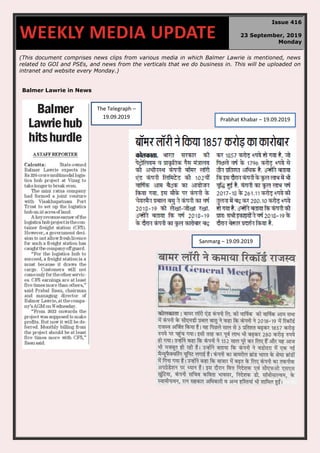
(This document comprises news clips from various media in which Balmer Lawrie is mentioned, news
related to GOI and PSEs, and news from the verticals that we do business in. This will be uploaded on
intranet and website every Monday.)
Balmer Lawrie in News
WEEKLY MEDIA UPDATE
Issue 416
23 September, 2019
Monday
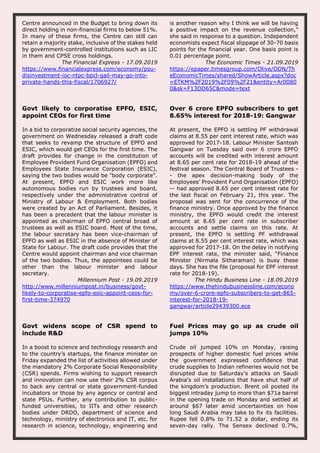
The Telegraph –
19.09.2019 Prabhat Khabar – 19.09.2019
Sanmarg – 19.09.2019
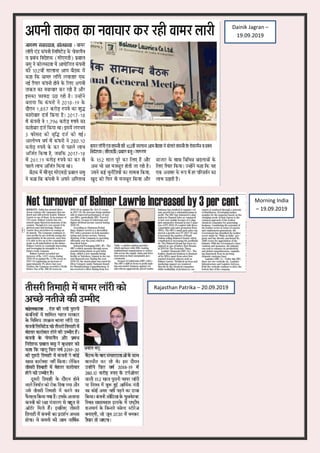
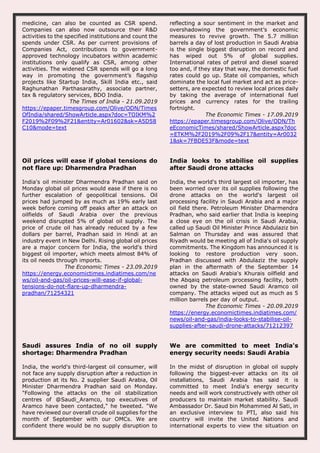
Dainik Jagran –
19.09.2019
Morning India
– 19.09.2019
Rajasthan Patrika – 20.09.2019
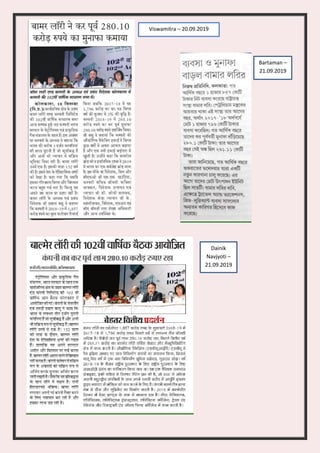
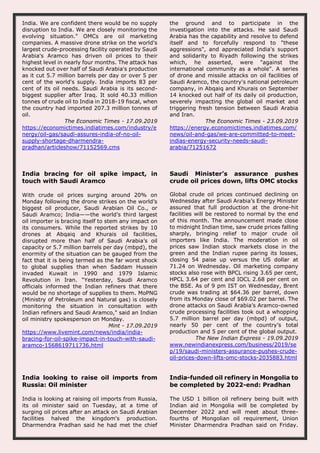
Viswamitra – 20.09.2019
Bartaman –
21.09.2019
Dainik
Navjyoti –
21.09.2019
• http://www.uniindia.com/balmer-lawrie-and-company-records-net-turnover-of-rs-1-857crore/business-
economy/news/1733179.html
• https://psuwatch.com/balmer-lawrie-holds-102nd-annual-general-meeting/
• https://psukhabar.com/2019/09/19/the-102-annual-general-meeting-of-balmer-lawrie-co-ltd-
held/
OECD slashes India's economic growth
forecast from 7.2% to 5.9%
The Organisation for Economic Co-operation and
Development (OECD) appears to be the most
pessimistic on India's economy among think
tanks, as it cut the GDP growth forecast by 1.3
percentage points to 5.9 per cent for 2019-20. For
the next year, the OECD has projected the Indian
economy to grow 6.3 per cent, bringing down its
earlier forecast by 1.1 percentage points. The
Paris-based policy forum said the trade war
between the US and China has sent global growth
momentum tumbling toward lows last seen during
the financial crisis. The OECD predicted that the
global economy will see its weakest growth since
the 2008-2009 financial crisis, slowing from 3.6
per cent last year to 2.9 per cent this year; it
predicted 3 per cent growth for the next year.
"Developments in many emerging-market
economies were softer than projected, including in
India, Mexico and other commodity-exporting
countries," the OECD said in its latest economic
outlook, analysis, and forecasts, released on
Thursday.
Business Standard - 20.09.2019
https://www.business-
standard.com/article/economy-policy/oecd-
slashes-india-s-economic-growth-forecast-from-
7-2-to-5-9-119092000025_1.html
Government to shut Metals & Minerals
Trading Corporation, State Trading
Corporation, Project and Equipment
Corporation
The government plans closure of the three
state-owned trading firms — Metals & Minerals
Trading Corporation of India (MMTC), State
Trading Corporation (STC) and Project and
Equipment Corporation Ltd. The department of
commerce may soon approach the cabinet with
the proposal. “After a review of these PSUs, it
was decided to shut them down. The decision
was taken last month but we are yet to finalise
a cabinet note,” said an official in the know of
the development. In May, ET had reported that
investments by central public sector enterprises
(CPSEs) in publicly listed state-level entities
have come under the government’s radar. It
had begun a review of these investments as
part of a restructuring exercise to ensure that
these CPSEs are not saddled with unrelated
ventures or loss-making firms. While the
government wholly owns PEC, it has about 90%
stake in MMTC and STC.
The Economic Times - 17.09.2019
https://economictimes.indiatimes.com/news/e
conomy/policy/commerce-ministry-to-close-
stc-pec/articleshow/71155306.cms
PSU Disinvestment: IOC, NTPC, BPCL,
GAIL may go into private hands this
fiscal
With its tepid revenue growth resulting in higher
reliance on non-tax revenue, the Centre has
drawn up a plan to bring down its stakes in a clutch
of large central public sector undertakings (CPSEs)
to below 51% in FY20. Stake sales in the
Maharatna firms — namely IOC, NTPC, BPCL and
GAIL — could happen either through the OFS or
ETF route; strategic sale of at least one of them is
also on the radar. In all these CPSEs, the Centre’s
stake is now below 55%. Other CPSEs in which the
government might reduce stakes as per the policy
laid out in the Budget FY20 are Engineers India,
Container Corporation (ConCor) and Nalco. The
Centre’s disinvestment target for the current fiscal
is Rs 1.05 lakh crore. So far, it has raised only Rs
12,357 crore or 12% of the annual target. Faced
with a lack of headroom to garner non-tax
revenues from stake sales in listed CPSEs, the
Fiscal deficit could rise to 4% of GDP in
FY20
India’s fiscal deficit could go up 70 basis points
to 4% of the gross domestic product (GDP) in
the ongoing fiscal year after the government
decided to cut the corporate tax rates, which
may result in rising interest rates as it will need
to borrow more to meet the shortfall. Bond
yields rose 0.15 percentage points following the
decision, which the government said would cost
Rs 1.45 lakh crore in foregone revenue. The
government has budgeted for a fiscal deficit of
3.3% of the GDP in the current financial year.
Finance minister Nirmala Sitharaman said the
government was conscious of the impact the tax
cut would have on fiscal deficit, but added there
could be tax buoyancy. “The idea is that
economic buoyancy will itself generate enough
reasons for better income, revenue generation.
The moment the taxes are brought down you
are also expected to widen the basket. So, that
Centre announced in the Budget to bring down its
direct holding in non-financial firms to below 51%.
In many of these firms, the Centre can still can
retain a majority stake, inclusive of the stakes held
by government-controlled institutions such as LIC
in them and CPSE cross holdings.
The Financial Express - 17.09.2019
https://www.financialexpress.com/economy/psu-
disinvestment-ioc-ntpc-bpcl-gail-may-go-into-
private-hands-this-fiscal/1706927/
is another reason why I think we will be having
a positive impact on the revenue collection,”
she said in response to a question. Independent
economists expect fiscal slippage of 30-70 basis
points for the financial year. One basis point is
0.01 percentage point.
The Economic Times - 21.09.2019
https://epaper.timesgroup.com/Olive/ODN/Th
eEconomicTimes/shared/ShowArticle.aspx?doc
=ETKM%2F2019%2F09%2F21&entity=Ar0080
0&sk=F13DD65C&mode=text
Govt likely to corporatise EPFO, ESIC,
appoint CEOs for first time
In a bid to corporatize social security agencies, the
government on Wednesday released a draft code
that seeks to revamp the structure of EPFO and
ESIC, which would get CEOs for the first time. The
draft provides for change in the constitution of
Employee Provident Fund Organisation (EPFO) and
Employees State Insurance Corporation (ESIC),
saying the two bodies would be "body corporate".
At present, EPFO and ESIC work more like
autonomous bodies run by trustees and board,
respectively under the administrative control of
Ministry of Labour & Employment. Both bodies
were created by an Act of Parliament. Besides, it
has been a precedent that the labour minister is
appointed as chairman of EPFO central broad of
trustees as well as ESIC board. Most of the time,
the labour secretary has been vice-chairman of
EPFO as well as ESIC in the absence of Minister of
State for Labour. The draft code provides that the
Centre would appoint chairman and vice chairman
of the two bodies. Thus, the appointees could be
other than the labour minister and labour
secretary.
Millennium Post - 19.09.2019
http://www.millenniumpost.in/business/govt-
likely-to-corporatise-epfo-esic-appoint-ceos-for-
first-time-374970
Over 6 crore EPFO subscribers to get
8.65% interest for 2018-19: Gangwar
At present, the EPFO is settling PF withdrawal
claims at 8.55 per cent interest rate, which was
approved for 2017-18. Labour Minister Santosh
Gangwar on Tuesday said over 6 crore EPFO
accounts will be credited with interest amount
at 8.65 per cent rate for 2018-19 ahead of the
festival season. The Central Board of Trustees -
- the apex decision-making body of the
Employees’ Provident Fund Organisation (EPFO)
-- had approved 8.65 per cent interest rate for
the last fiscal on February 21, this year. The
proposal was sent for the concurrence of the
finance ministry. Once approved by the finance
ministry, the EPFO would credit the interest
amount at 8.65 per cent rate in subscriber
accounts and settle claims on this rate. At
present, the EPFO is settling PF withdrawal
claims at 8.55 per cent interest rate, which was
approved for 2017-18. On the delay in notifying
EPF interest rate, the minister said, “Finance
Minister (Nirmala Sitharaman) is busy these
days. She has the file (proposal for EPF interest
rate for 2018-19).
The Hindu Business Line - 18.09.2019
https://www.thehindubusinessline.com/econo
my/over-6-crore-epfo-subscribers-to-get-865-
interest-for-2018-19-
gangwar/article29439300.ece
Govt widens scope of CSR spend to
include R&D
In a boost to science and technology research and
to the country’s startups, the finance minister on
Friday expanded the list of activities allowed under
the mandatory 2% Corporate Social Responsibility
(CSR) spends. Firms wishing to support research
and innovation can now use their 2% CSR corpus
to back any central or state government-funded
incubators or those by any agency or central and
state PSUs. Further, any contribution to public-
funded universities, to IITs and other research
bodies under DRDO, department of science and
technology, ministry of electronics and IT, etc. for
research in science, technology, engineering and
Fuel Prices may go up as crude oil
jumps 10%
Crude oil jumped 10% on Monday, raising
prospects of higher domestic fuel prices while
the government expressed confidence that
crude supplies to Indian refineries would not be
disrupted due to Saturday’s attacks on Saudi
Arabia’s oil installations that have shut half of
the kingdom’s production. Brent oil posted its
biggest intraday jump to more than $71a barrel
in the opening trade on Monday and settled at
around $67 later amid uncertainties on how
long Saudi Arabia may take to fix its facilities.
Rupee fell 0.8% to 71.52 a dollar, ending its
seven-day rally. The Sensex declined 0.7%,
medicine, can also be counted as CSR spend.
Companies can also now outsource their R&D
activities to the specified institutions and count the
spends under CSR. As per current provisions of
Companies Act, contributions to government-
approved technology incubators within academic
institutions only qualify as CSR, among other
activities. The widened CSR spends will go a long
way in promoting the government’s flagship
projects like Startup India, Skill India etc., said
Raghunathan Parthasarathy, associate partner,
tax & regulatory services, BDO India.
The Times of India - 21.09.2019
https://epaper.timesgroup.com/Olive/ODN/Times
OfIndia/shared/ShowArticle.aspx?doc=TOIKM%2
F2019%2F09%2F21&entity=Ar01602&sk=A5D58
C10&mode=text
reflecting a sour sentiment in the market and
overshadowing the government’s economic
measures to revive growth. The 5.7 million
barrels a day of lost production in Saudi Arabia
is the single biggest disruption on record and
has wiped out 5% of global supplies.
International rates of petrol and diesel soared
too and, if they stay that way, the domestic fuel
rates could go up. State oil companies, which
dominate the local fuel market and act as price-
setters, are expected to review local prices daily
by taking the average of international fuel
prices and currency rates for the trailing
fortnight.
The Economic Times - 17.09.2019
https://epaper.timesgroup.com/Olive/ODN/Th
eEconomicTimes/shared/ShowArticle.aspx?doc
=ETKM%2F2019%2F09%2F17&entity=Ar0032
1&sk=7FBDE53F&mode=text
Oil prices will ease if global tensions do
not flare up: Dharmendra Pradhan
India's oil minister Dharmendra Pradhan said on
Monday global oil prices would ease if there is no
further escalation of geopolitical tensions. Oil
prices had jumped by as much as 19% early last
week before coming off peaks after an attack on
oilfields of Saudi Arabia over the previous
weekend disrupted 5% of global oil supply. The
price of crude oil has already reduced by a few
dollars per barrel, Pradhan said in Hindi at an
industry event in New Delhi. Rising global oil prices
are a major concern for India, the world's third
biggest oil importer, which meets almost 84% of
its oil needs through imports.
The Economic Times - 23.09.2019
https://energy.economictimes.indiatimes.com/ne
ws/oil-and-gas/oil-prices-will-ease-if-global-
tensions-do-not-flare-up-dharmendra-
pradhan/71254321
India looks to stabilise oil supplies
after Saudi drone attacks
India, the world's third largest oil importer, has
been worried over its oil supplies following the
drone attacks on the world's largest oil
processing facility in Saudi Arabia and a major
oil field there. Petroleum Minister Dharmendra
Pradhan, who said earlier that India is keeping
a close eye on the oil crisis in Saudi Arabia,
called up Saudi Oil Minister Prince Abdulaziz bin
Salman on Thursday and was assured that
Riyadh would be meeting all of India's oil supply
commitments. The Kingdom has announced it is
looking to restore production very soon.
Pradhan discussed with Abdulaziz the supply
plan in the aftermath of the September 14
attacks on Saudi Arabia's Khurais oilfield and
the Abqaiq petroleum processing facility, both
owned by the state-owned Saudi Aramco oil
company. The attacks wiped out as much as 5
million barrels per day of output.
The Economic Times - 20.09.2019
https://energy.economictimes.indiatimes.com/
news/oil-and-gas/india-looks-to-stabilise-oil-
supplies-after-saudi-drone-attacks/71212397
Saudi assures India of no oil supply
shortage: Dharmendra Pradhan
India, the world's third-largest oil consumer, will
not face any supply disruption after a reduction in
production at its No. 2 supplier Saudi Arabia, Oil
Minister Dharmendra Pradhan said on Monday.
"Following the attacks on the oil stabilization
centres of @Saudi_Aramco, top executives of
Aramco have been contacted," he tweeted. "We
have reviewed our overall crude oil supplies for the
month of September with our OMCs. We are
confident there would be no supply disruption to
We are committed to meet India's
energy security needs: Saudi Arabia
In the midst of disruption in global oil supply
following the biggest-ever attacks on its oil
installations, Saudi Arabia has said it is
committed to meet India's energy security
needs and will work constructively with other oil
producers to maintain market stability. Saudi
Ambassador Dr. Saud bin Mohammed Al Sati, in
an exclusive interview to PTI, also said his
country will invite the United Nations and
international experts to view the situation on
India. We are confident there would be no supply
disruption to India. We are closely monitoring the
evolving situation." OMCs are oil marketing
companies. A massive drone strike on the world's
largest crude-processing facility operated by Saudi
Arabia's Aramco has driven oil prices to their
highest level in nearly four months. The attack has
knocked out over half of Saudi Arabia's production
as it cut 5.7 million barrels per day or over 5 per
cent of the world's supply. India imports 83 per
cent of its oil needs. Saudi Arabia is its second-
biggest supplier after Iraq. It sold 40.33 million
tonnes of crude oil to India in 2018-19 fiscal, when
the country had imported 207.3 million tonnes of
oil.
The Economic Times - 17.09.2019
https://economictimes.indiatimes.com/industry/e
nergy/oil-gas/saudi-assures-india-of-no-oil-
supply-shortage-dharmendra-
pradhan/articleshow/71152569.cms
the ground and to participate in the
investigation into the attacks. He said Saudi
Arabia has the capability and resolve to defend
itself and to forcefully respond to "these
aggressions", and appreciated India's support
and solidarity to Riyadh following the strikes
which, he asserted, were "against the
international community as a whole". A series
of drone and missile attacks on oil facilities of
Saudi Aramco, the country's national petroleum
company, in Abqaiq and Khurais on September
14 knocked out half of its daily oil production,
severely impacting the global oil market and
triggering fresh tension between Saudi Arabia
and Iran.
The Economic Times - 23.09.2019
https://energy.economictimes.indiatimes.com/
news/oil-and-gas/we-are-committed-to-meet-
indias-energy-security-needs-saudi-
arabia/71251672
India bracing for oil spike impact, in
touch with Saudi Aramco
With crude oil prices surging around 20% on
Monday following the drone strikes on the world’s
biggest oil producer, Saudi Arabian Oil Co., or
Saudi Aramco; India——the world’s third largest
oil importer is bracing itself to stem any impact on
its consumers. While the reported strikes by 10
drones at Abqaiq and Khurais oil facilities,
disrupted more than half of Saudi Arabia’s oil
capacity or 5.7 million barrels per day (mbpd), the
enormity of the situation can be gauged from the
fact that it is being termed as the far worst shock
to global supplies than when Saddam Hussein
invaded Kuwait in 1990 and 1979 Islamic
Revolution in Iran. “Yesterday, Saudi Aramco
officials informed the Indian refiners that there
would be no shortage of supplies to them. MoPNG
(Ministry of Petroleum and Natural gas) is closely
monitoring the situation in consultation with
Indian refiners and Saudi Aramco," said an Indian
oil ministry spokesperson on Monday.
Mint - 17.09.2019
https://www.livemint.com/news/india/india-
bracing-for-oil-spike-impact-in-touch-with-saudi-
aramco-1568619711736.html
Saudi Minister’s assurance pushes
crude oil prices down, lifts OMC stocks
Global crude oil prices continued declining on
Wednesday after Saudi Arabia’s Energy Minister
assured that full production at the drone-hit
facilities will be restored to normal by the end
of this month. The announcement made close
to midnight Indian time, saw crude prices falling
sharply, bringing relief to major crude oil
importers like India. The moderation in oil
prices saw Indian stock markets close in the
green and the Indian rupee paring its losses,
closing 54 paise up versus the US dollar at
71.24 on Wednesday. Oil marketing company
stocks also rose with BPCL rising 3.65 per cent,
HPCL 3.64 per cent and IOCL 2.68 per cent on
the BSE. As of 9 pm IST on Wednesday, Brent
crude was trading at $64.36 per barrel, down
from its Monday close of $69.02 per barrel. The
drone attacks on Saudi Arabia’s Aramco-owned
crude processing facilities took out a whopping
5.7 million barrel per day (mbpd) of output,
nearly 50 per cent of the country’s total
production and 5 per cent of the global output.
The New Indian Express - 19.09.2019
www.newindianexpress.com/business/2019/se
p/19/saudi-ministers-assurance-pushes-crude-
oil-prices-down-lifts-omc-stocks-2035883.html
India looking to raise oil imports from
Russia: Oil minister
India is looking at raising oil imports from Russia,
its oil minister said on Tuesday, at a time of
surging oil prices after an attack on Saudi Arabian
facilities halved the kingdom's production.
Dharmendra Pradhan said he had met the chief
India-funded oil refinery in Mongolia to
be completed by 2022-end: Pradhan
The USD 1 billion oil refinery being built with
Indian aid in Mongolia will be completed by
December 2022 and will meet about three-
fourths of Mongolian oil requirement, Union
Minister Dharmendra Pradhan said on Friday.
executive of Russian oil major Rosneft, Igor
Sechin, and that four Indian companies planned to
increase their investment in Russia's oilfields. The
oil minister also attempted to calm nerves on
supplies, saying he was confident that India, the
world's third-largest oil consumer, had a diverse
crude basket. Saudi Arabia is the world's biggest
oil exporter, and the second-largest supplier of
crude to India after Iraq. India reduced the Middle
East's share in its total oil imports to about 56%
in July from around 60% a year ago, while
increasing its share of imports from Africa and the
United States. "Today I met excellency Igor
Sechin, CEO of Rosneft. We elaborately discussed
the possibility of oil imports," Pradhan told
reporters. When asked if India planned to export
petroleum products to Saudi Arabia, Pradhan said
such a situation had not arisen, adding that India
was continuing to lift crude from the region.
The Economic Times - 17.09.2019
https://energy.economictimes.indiatimes.com/ne
ws/oil-and-gas/india-looking-to-raise-oil-imports-
from-russia-oil-minister/71168025
The minister for petroleum and natural gas was
speaking at a meeting attended by a Mongolian
business delegation led by the country's
President Khaltmaagiin Battulga, who is on a
five-day visit to India. "India and Mongolia,
enjoy cordial relations and a warm friendship.
The historic visit of Prime Minster Narendra Modi
to Mongolia in 2015 led to a paradigm shift in
India-Mongolia relations. The construction of
USD 1 billion oil refinery with 1.5 million metric
tonne capacity with Indian assistance is a
shining example of our friendship," the minister
said. State-run Engineers India Ltd (EIL) is
providing engineering consultancy services for
this prestigious refinery project in Mongolia
which will be completed by December 2022, and
will meet about three-fourths of Mongolian
requirement of oil, Pradhan said. A project of
this magnitude will help develop ancillary
industries related to refinery and pipeline
operations.
The Economic Times - 22.09.2019
https://energy.economictimes.indiatimes.com/
news/oil-and-gas/india-funded-oil-refinery-in-
mongolia-to-be-completed-by-2022-end-
pradhan/71240961
IOC eyes more US oil as India diversifies
energy routes
India’s largest oil refiner and fuel retailer Indian
Oil Corporation is looking at pumping up US crude
import volumes next year, expanding India’s
fledgling energy bridge with Houston — the heart
of American oil and gas industry where prime
minister Narendra Modi is scheduled to address a
congregation of Indian diaspora on Sunday.
“There are some bottlenecks in US oil export
infrastructure, which prevents berthing and
loading of VLCCs (very large crude carriers) at the
terminals. Smaller vessels are not often
economical. They are working on de-bottlenecking
and hope to complete it by January. If that
happens, then why not (buy more US oil),”
company chairman Sanjiv Singh told TOI.
Company’s former director finance A K Sharma
said oil is transported from the terminals in smaller
vessels to VLCCs parked at high sea. “In the
present system, they load their VLCCs and then
offer in the market. As buyers, this ties us down
to their vessels which sometimes may not work to
our advantage. But things can improve with
debottlenecking,” Sharma said.
The Economic Times - 22.09.2019
https://energy.economictimes.indiatimes.com/ne
ws/oil-and-gas/ioc-eyes-more-us-oil-as-india-
diversifies-energy-routes/71228508
Petrol, diesel price see steepest hike
since Budget, govt says concerned
after Saudi attack
Petrol and diesel prices on Tuesday saw the
biggest hike since July 5 Budget as India voiced
concern over spike in global oil prices following
attacks on Saudi Arabian crude oil facilities.
Petrol price was increased by 14 paisa per litre
to Rs 72.17 and diesel by 15 paisa to Rs 65.58
per litre in the national capital, according to
price information available from state-owned oil
firms. This increase is the biggest single-day
hike since the July 5 maiden Budget of Finance
Minister Nirmala Sitharaman that raised rates
by almost Rs 2.50 a litre due to an increase in
excise duty on fuel. The increase in retail prices
on Tuesday followed nearly 20 per cent surge in
international oil prices in intraday trading -- the
biggest jump in almost 30 years -- in response
to attacks halving Saudi Arabia's output, before
closing nearly 15 per cent higher at four-month
highs. On Tuesday, international oil prices slid,
although the market remains on tenterhooks
over the threat of a military response to the
attacks. Brent crude was down 36 cents, or 0.50
per cent, at USD 68.66 a barrel.
The Economic Times - 17.09.2019
https://energy.economictimes.indiatimes.com/
news/oil-and-gas/petrol-diesel-price-see-
steepest-hike-since-budget-govt-says-
concerned-after-saudi-attack/71169735
Global steel industry facing surplus
production: Dharmendra Pradhan
Indian steel industry is facing some challenges
amid the ongoing trade war between the US and
China, according to Union Steel Minister
Dharmendra Pradhan. The minister also noted that
the global steel industry is facing the challenge of
surplus production. Pradhan was interacting with
reporters on the sidelines of two-day International
Galvanising Conference event here. When asked if
the local industry could face challenges amid the
ongoing US-China trade war, the minister replied
in affirmative. "It's facing," he said, without
speaking further. According to official data, share
of imports of finished steel from FTA countries
such as Korea, Japan and Indonesia aggregated
around 70 per cent of total imports to India in
August 2019. Earlier, speaking at the conference,
the minister also said that India will become top
energy consumer in the world in the next two
decades. Speaking about the areas of energy
consumption, Pradhan said, "It will be consumed
in transportation, household electrification, but
primary consumption will come from industry.
Industries related to manufacturing, industries
related to services, related housing, capital good
product etc".
The Economic Times - 20.09.2019
https://economictimes.indiatimes.com/industry/i
ndl-goods/svs/steel/global-steel-industry-facing-
surplus-production-dharmendra-
pradhan/articleshow/71208267.cms?from=mdr
You may have to Pay more for Air
Travel this Festive Season
Airfares for the upcoming festival season
starting October have inched up from their lows
in September and are also higher than the same
time last year, said airline and travel company
executives. But a creeping slowdown in demand
for travel will keep the fares reined in compared
with the high levels of April-June when the
grounding of Jet Airways led to a capacity
shortage that set ticket prices soaring, they
said. “Year on year, the current bookings for
this year’s travel during the festive season
(Diwali + Dusshera) is about 6% higher than
last year,” said Balu Ramachandran, head of air
travel business at travel portal Cleartrip.
spokesperson at MakeMyTrip said the portal’s
data shows a 5% increase in travel bookings as
well as fares for the Diwali season. But airline
executives sounded less optimistic. “I am
seeing a direct correlation between fares and
loads/bookings,” said a senior airline executive.
“For those who have raised fares, bookings
have dropped. For those that have kept fares
low, bookings may be higher but still not higher
in revenue terms. I see an overall weakening of
revenue environment compared with the April-
June period,” he said.
The Economic Times - 19.09.2019
https://epaper.timesgroup.com/Olive/ODN/Th
eEconomicTimes/shared/ShowArticle.aspx?doc
=ETKM%2F2019%2F09%2F19&entity=Ar0031
6&sk=CFFA5DC0&mode=text
Tourism to contribute Rs 32 trillion to
GDP by 2028
Tourism in the country is seems to be growing
despite a slowdown in all the other sectors of the
economy. The travel and tourism sector will
contribute a whopping Rs 32.05 trillion to the
gross domestic product by 2028, government data
shows. This is almost double that recorded in
2017, when the contribution was Rs 15.24 trillion.
In addition to this, the government has set a
target of 20 million foreign tourist arrivals (FTA)
and twice the foreign exchange reserves by year
2020. Daniel D'Souza, president and country
head, SOTC travel agency, said, "The employment
in the sector has also been growing in small towns
and cities nowadays. It doesn't only include soft
skills, sales and operations. But we also need
people who will work as guides at various
destinations or people who can talk to tourists."
In 2018, tourism was the third largest sector to
bring foreign exchange reserves to India. The
state governments are also excited about the
sector along with the centre. Uttar Pradesh
dispensation has allocated a massive sum of Rs
Global, local tourism cos make a
beeline for the Indian travellers
Amid talk of a slowdown in the economy, here
is some heartening news. The travel and
tourism sector, still on the uptick, is not only
making a beeline for Indian tourists, but also
offering hard-to-run- down delays and
packages spanning both domestic and
international destinations. International tourism
boards are looking at India with renewed
interest. Singapore Tourism Board, for instance,
with a presence in India for 25 years, says the
Indian market cannot be ignored. “Indians are
taking more holidays, sometimes up to three a
year. Apart from tourists from tier I markets,
we also saw a healthy 12% increase in Indian
tourists from secondary cities. India is a market
no one can ignore,” said G B Srithar, Singapore
Tourism Board’s India, Middle East and South
Asia regional director. Azerbaijan Tourism
Board, a relatively new entrant into the Indian
market, held a three-city roadshow earlier this
month to attract Indian tourists, and claims its
holiday offerings are better value for money
than many other destinations
720 crore from its budget this fiscal to strengthen
tourism infrastructure.
DNA - 19.09.2019
https://www.dnaindia.com/india/report-tourism-
to-contribute-rs-32-trillion-to-gdp-by-2028-
2790851
The Times of India - 18.09.2019
https://timesofindia.indiatimes.com/india/touri
sm-companies-make-a-beeline-to-woo-
indians-amid-
slowdown/articleshow/71176282.cms
Government sets up mechanism to
monitor air fares
The government today said that they have set up
a mechanism to monitor airfares on a daily basis,
Civil Aviation Minister Hardeep Singh Puri told
reporters on Friday. “It is only to monitor on
ongoing basis how airlines pricing is working and
if we can get some learning from that and then
discuss with airlines. We will use the data to hold
regular discussions with airlines," Puri told
reporters during a briefing. When you are in
dynamic sector then obviously your interest is to
survive today and tomorrow but you also have to
think about day after tomorrow, the minister
added. However, he clarified that the government
does not intend to interfere in the pricing
mechanism of the airlines. "It is only to monitor
on ongoing basis how airlines pricing is working
and if we can get some learning from that and then
discuss with airlines. It is not a regulatory
mechanism but just a monitoring mechanism,"
Puri added. The aviation ministry, in a recent
meeting, had also raised concern over the pricing
war between airlines that analysts believe is the
primary reason for losses of the airline industry.
The Economic Times - 20.09.2019
https://economictimes.indiatimes.com/industry/t
ransportation/airlines-/-aviation/government-
sets-up-mechanism-to-monitor-air-
fares/articleshow/71222869.cms
APAC: outpacing global tourism
growth
International tourist arrivals in Asia and the
Pacific grew six per cent in 2017 to reach 323
million, according to a report by UNWTO/GTERC
Asia Tourism Trends. The report further states
that Asia and the Pacific has played a defining
role in the recent expansion of tourism,
accounting for 37 per cent of the world’s
international tourism expenditure and nearly
one-fourth of global arrivals. Between 2000 and
2017, the region has seen an average seven per
cent increase per year in international arrivals,
the fastest growth amongst all world regions.
Almost half of all international tourist arrivals
in Asia and the Pacific were recorded in
North-East Asian destinations in 2017 (160
million arrivals), while 37 per cent were
recorded in South-East Asia (120 million), eight
per cent in South Asia (27 million) and five per
cent in Oceania (17 million). A rapid economic
growth coupled with rising air connectivity,
travel facilitation and large infrastructure
projects have boosted international travel in the
region.
Travel Trends Today - 17.09.2019
https://www.traveltrendstoday.in/news/intern
ational/item/7609-apac-outpacing-global-
tourism-growth
National Logistics Policy to soon be
released, says Piyush Goyal
India will soon come out with a national logistics
policy to bring down the cost of logistics to at least
below 10 per cent, Commerce and Industry and
Railways Minister Piyush Goyal has said.
Addressing the Asia Pacific Trade Facilitation
Forum 2019 in the capital, Goyal also said that the
Government was on a national effort engaging
with Railways, ports, shipping industry, airline
industry and roads transport ministry to
collectively work on a programme to bringing
down the logistics cost. This Forum, which is in its
ninth edition, was held for the first time in India
and jointly organised by the Commerce Ministry,
ADB, CII and UN-ESCAP. The main focus of the
Forum is on how digital and sustainable trade
facilitation measures and practices can bring
prosperity in the Asia Pacific region. On the
occasion, Goyal launched ADB-ESCAP joint
Major ports post muted growth as coal
volumes slide 4% in Apr-Aug period
The shadow of economic slowdown loomed over
coal cargo movement through major ports.
Between April and August, the cargo throughput
growth at major ports was muted at 1.9 per
cent as coal volumes slid four per cent year-on-
year. In the corresponding period of FY19, coal
cargo had risen by 11 per cent. Apart from
decline in coal shipments compared with last
year, some fall was also observed in fertiliser
and liquid cargo. K Ravichandran, senior vice
president and Group Head - Corporate Ratings,
ICRA said, “The decline in imports is despite the
fact that Coal India Ltd’s dispatches have also
fallen by three per cent during this period to 247
million tonnes (mt) from 241 mt. Thus, the
slowdown in coal imports is most likely
attributable to the economic slowdown in recent
months which has brought down the overall
publication 'Asia Pacific Trade Facilitation Report
2019' with a theme chapter of 'Bridging Trade
Finance Gaps through Technology'. Goyal said in
his address that the implementation of GST in
India has shown significant results particularly in
terms of bringing down travel time to long
distances through road transport with entry points
becoming seamless (very few check posts).
The Hindu Business Line - 17.09.2019
https://www.thehindubusinessline.com/economy/
logistics/national-logistics-policy-to-soon-be-
released-says-piyush-goyal/article29438859.ece
demand and is likely to impact the domestic
port sector.” “Also, thermal power generation
has increased during the first five months by 4-
5 per cent indicating that the decline in thermal
coal demand is driven by other consuming
industries.
Business Standard - 22.09.2019
https://www.business-
standard.com/article/economy-policy/major-
ports-post-muted-growth-as-coal-volumes-
slide-4-in-apr-aug-period-
119092100843_1.html

Weekly media update 23 09_2019

  • 1.
    (This document comprisesnews clips from various media in which Balmer Lawrie is mentioned, news related to GOI and PSEs, and news from the verticals that we do business in. This will be uploaded on intranet and website every Monday.) Balmer Lawrie in News WEEKLY MEDIA UPDATE Issue 416 23 September, 2019 Monday The Telegraph – 19.09.2019 Prabhat Khabar – 19.09.2019 Sanmarg – 19.09.2019
  • 2.
    Dainik Jagran – 19.09.2019 MorningIndia – 19.09.2019 Rajasthan Patrika – 20.09.2019
  • 3.
    Viswamitra – 20.09.2019 Bartaman– 21.09.2019 Dainik Navjyoti – 21.09.2019
  • 4.
    • http://www.uniindia.com/balmer-lawrie-and-company-records-net-turnover-of-rs-1-857crore/business- economy/news/1733179.html • https://psuwatch.com/balmer-lawrie-holds-102nd-annual-general-meeting/ •https://psukhabar.com/2019/09/19/the-102-annual-general-meeting-of-balmer-lawrie-co-ltd- held/ OECD slashes India's economic growth forecast from 7.2% to 5.9% The Organisation for Economic Co-operation and Development (OECD) appears to be the most pessimistic on India's economy among think tanks, as it cut the GDP growth forecast by 1.3 percentage points to 5.9 per cent for 2019-20. For the next year, the OECD has projected the Indian economy to grow 6.3 per cent, bringing down its earlier forecast by 1.1 percentage points. The Paris-based policy forum said the trade war between the US and China has sent global growth momentum tumbling toward lows last seen during the financial crisis. The OECD predicted that the global economy will see its weakest growth since the 2008-2009 financial crisis, slowing from 3.6 per cent last year to 2.9 per cent this year; it predicted 3 per cent growth for the next year. "Developments in many emerging-market economies were softer than projected, including in India, Mexico and other commodity-exporting countries," the OECD said in its latest economic outlook, analysis, and forecasts, released on Thursday. Business Standard - 20.09.2019 https://www.business- standard.com/article/economy-policy/oecd- slashes-india-s-economic-growth-forecast-from- 7-2-to-5-9-119092000025_1.html Government to shut Metals & Minerals Trading Corporation, State Trading Corporation, Project and Equipment Corporation The government plans closure of the three state-owned trading firms — Metals & Minerals Trading Corporation of India (MMTC), State Trading Corporation (STC) and Project and Equipment Corporation Ltd. The department of commerce may soon approach the cabinet with the proposal. “After a review of these PSUs, it was decided to shut them down. The decision was taken last month but we are yet to finalise a cabinet note,” said an official in the know of the development. In May, ET had reported that investments by central public sector enterprises (CPSEs) in publicly listed state-level entities have come under the government’s radar. It had begun a review of these investments as part of a restructuring exercise to ensure that these CPSEs are not saddled with unrelated ventures or loss-making firms. While the government wholly owns PEC, it has about 90% stake in MMTC and STC. The Economic Times - 17.09.2019 https://economictimes.indiatimes.com/news/e conomy/policy/commerce-ministry-to-close- stc-pec/articleshow/71155306.cms PSU Disinvestment: IOC, NTPC, BPCL, GAIL may go into private hands this fiscal With its tepid revenue growth resulting in higher reliance on non-tax revenue, the Centre has drawn up a plan to bring down its stakes in a clutch of large central public sector undertakings (CPSEs) to below 51% in FY20. Stake sales in the Maharatna firms — namely IOC, NTPC, BPCL and GAIL — could happen either through the OFS or ETF route; strategic sale of at least one of them is also on the radar. In all these CPSEs, the Centre’s stake is now below 55%. Other CPSEs in which the government might reduce stakes as per the policy laid out in the Budget FY20 are Engineers India, Container Corporation (ConCor) and Nalco. The Centre’s disinvestment target for the current fiscal is Rs 1.05 lakh crore. So far, it has raised only Rs 12,357 crore or 12% of the annual target. Faced with a lack of headroom to garner non-tax revenues from stake sales in listed CPSEs, the Fiscal deficit could rise to 4% of GDP in FY20 India’s fiscal deficit could go up 70 basis points to 4% of the gross domestic product (GDP) in the ongoing fiscal year after the government decided to cut the corporate tax rates, which may result in rising interest rates as it will need to borrow more to meet the shortfall. Bond yields rose 0.15 percentage points following the decision, which the government said would cost Rs 1.45 lakh crore in foregone revenue. The government has budgeted for a fiscal deficit of 3.3% of the GDP in the current financial year. Finance minister Nirmala Sitharaman said the government was conscious of the impact the tax cut would have on fiscal deficit, but added there could be tax buoyancy. “The idea is that economic buoyancy will itself generate enough reasons for better income, revenue generation. The moment the taxes are brought down you are also expected to widen the basket. So, that
  • 5.
    Centre announced inthe Budget to bring down its direct holding in non-financial firms to below 51%. In many of these firms, the Centre can still can retain a majority stake, inclusive of the stakes held by government-controlled institutions such as LIC in them and CPSE cross holdings. The Financial Express - 17.09.2019 https://www.financialexpress.com/economy/psu- disinvestment-ioc-ntpc-bpcl-gail-may-go-into- private-hands-this-fiscal/1706927/ is another reason why I think we will be having a positive impact on the revenue collection,” she said in response to a question. Independent economists expect fiscal slippage of 30-70 basis points for the financial year. One basis point is 0.01 percentage point. The Economic Times - 21.09.2019 https://epaper.timesgroup.com/Olive/ODN/Th eEconomicTimes/shared/ShowArticle.aspx?doc =ETKM%2F2019%2F09%2F21&entity=Ar0080 0&sk=F13DD65C&mode=text Govt likely to corporatise EPFO, ESIC, appoint CEOs for first time In a bid to corporatize social security agencies, the government on Wednesday released a draft code that seeks to revamp the structure of EPFO and ESIC, which would get CEOs for the first time. The draft provides for change in the constitution of Employee Provident Fund Organisation (EPFO) and Employees State Insurance Corporation (ESIC), saying the two bodies would be "body corporate". At present, EPFO and ESIC work more like autonomous bodies run by trustees and board, respectively under the administrative control of Ministry of Labour & Employment. Both bodies were created by an Act of Parliament. Besides, it has been a precedent that the labour minister is appointed as chairman of EPFO central broad of trustees as well as ESIC board. Most of the time, the labour secretary has been vice-chairman of EPFO as well as ESIC in the absence of Minister of State for Labour. The draft code provides that the Centre would appoint chairman and vice chairman of the two bodies. Thus, the appointees could be other than the labour minister and labour secretary. Millennium Post - 19.09.2019 http://www.millenniumpost.in/business/govt- likely-to-corporatise-epfo-esic-appoint-ceos-for- first-time-374970 Over 6 crore EPFO subscribers to get 8.65% interest for 2018-19: Gangwar At present, the EPFO is settling PF withdrawal claims at 8.55 per cent interest rate, which was approved for 2017-18. Labour Minister Santosh Gangwar on Tuesday said over 6 crore EPFO accounts will be credited with interest amount at 8.65 per cent rate for 2018-19 ahead of the festival season. The Central Board of Trustees - - the apex decision-making body of the Employees’ Provident Fund Organisation (EPFO) -- had approved 8.65 per cent interest rate for the last fiscal on February 21, this year. The proposal was sent for the concurrence of the finance ministry. Once approved by the finance ministry, the EPFO would credit the interest amount at 8.65 per cent rate in subscriber accounts and settle claims on this rate. At present, the EPFO is settling PF withdrawal claims at 8.55 per cent interest rate, which was approved for 2017-18. On the delay in notifying EPF interest rate, the minister said, “Finance Minister (Nirmala Sitharaman) is busy these days. She has the file (proposal for EPF interest rate for 2018-19). The Hindu Business Line - 18.09.2019 https://www.thehindubusinessline.com/econo my/over-6-crore-epfo-subscribers-to-get-865- interest-for-2018-19- gangwar/article29439300.ece Govt widens scope of CSR spend to include R&D In a boost to science and technology research and to the country’s startups, the finance minister on Friday expanded the list of activities allowed under the mandatory 2% Corporate Social Responsibility (CSR) spends. Firms wishing to support research and innovation can now use their 2% CSR corpus to back any central or state government-funded incubators or those by any agency or central and state PSUs. Further, any contribution to public- funded universities, to IITs and other research bodies under DRDO, department of science and technology, ministry of electronics and IT, etc. for research in science, technology, engineering and Fuel Prices may go up as crude oil jumps 10% Crude oil jumped 10% on Monday, raising prospects of higher domestic fuel prices while the government expressed confidence that crude supplies to Indian refineries would not be disrupted due to Saturday’s attacks on Saudi Arabia’s oil installations that have shut half of the kingdom’s production. Brent oil posted its biggest intraday jump to more than $71a barrel in the opening trade on Monday and settled at around $67 later amid uncertainties on how long Saudi Arabia may take to fix its facilities. Rupee fell 0.8% to 71.52 a dollar, ending its seven-day rally. The Sensex declined 0.7%,
  • 6.
    medicine, can alsobe counted as CSR spend. Companies can also now outsource their R&D activities to the specified institutions and count the spends under CSR. As per current provisions of Companies Act, contributions to government- approved technology incubators within academic institutions only qualify as CSR, among other activities. The widened CSR spends will go a long way in promoting the government’s flagship projects like Startup India, Skill India etc., said Raghunathan Parthasarathy, associate partner, tax & regulatory services, BDO India. The Times of India - 21.09.2019 https://epaper.timesgroup.com/Olive/ODN/Times OfIndia/shared/ShowArticle.aspx?doc=TOIKM%2 F2019%2F09%2F21&entity=Ar01602&sk=A5D58 C10&mode=text reflecting a sour sentiment in the market and overshadowing the government’s economic measures to revive growth. The 5.7 million barrels a day of lost production in Saudi Arabia is the single biggest disruption on record and has wiped out 5% of global supplies. International rates of petrol and diesel soared too and, if they stay that way, the domestic fuel rates could go up. State oil companies, which dominate the local fuel market and act as price- setters, are expected to review local prices daily by taking the average of international fuel prices and currency rates for the trailing fortnight. The Economic Times - 17.09.2019 https://epaper.timesgroup.com/Olive/ODN/Th eEconomicTimes/shared/ShowArticle.aspx?doc =ETKM%2F2019%2F09%2F17&entity=Ar0032 1&sk=7FBDE53F&mode=text Oil prices will ease if global tensions do not flare up: Dharmendra Pradhan India's oil minister Dharmendra Pradhan said on Monday global oil prices would ease if there is no further escalation of geopolitical tensions. Oil prices had jumped by as much as 19% early last week before coming off peaks after an attack on oilfields of Saudi Arabia over the previous weekend disrupted 5% of global oil supply. The price of crude oil has already reduced by a few dollars per barrel, Pradhan said in Hindi at an industry event in New Delhi. Rising global oil prices are a major concern for India, the world's third biggest oil importer, which meets almost 84% of its oil needs through imports. The Economic Times - 23.09.2019 https://energy.economictimes.indiatimes.com/ne ws/oil-and-gas/oil-prices-will-ease-if-global- tensions-do-not-flare-up-dharmendra- pradhan/71254321 India looks to stabilise oil supplies after Saudi drone attacks India, the world's third largest oil importer, has been worried over its oil supplies following the drone attacks on the world's largest oil processing facility in Saudi Arabia and a major oil field there. Petroleum Minister Dharmendra Pradhan, who said earlier that India is keeping a close eye on the oil crisis in Saudi Arabia, called up Saudi Oil Minister Prince Abdulaziz bin Salman on Thursday and was assured that Riyadh would be meeting all of India's oil supply commitments. The Kingdom has announced it is looking to restore production very soon. Pradhan discussed with Abdulaziz the supply plan in the aftermath of the September 14 attacks on Saudi Arabia's Khurais oilfield and the Abqaiq petroleum processing facility, both owned by the state-owned Saudi Aramco oil company. The attacks wiped out as much as 5 million barrels per day of output. The Economic Times - 20.09.2019 https://energy.economictimes.indiatimes.com/ news/oil-and-gas/india-looks-to-stabilise-oil- supplies-after-saudi-drone-attacks/71212397 Saudi assures India of no oil supply shortage: Dharmendra Pradhan India, the world's third-largest oil consumer, will not face any supply disruption after a reduction in production at its No. 2 supplier Saudi Arabia, Oil Minister Dharmendra Pradhan said on Monday. "Following the attacks on the oil stabilization centres of @Saudi_Aramco, top executives of Aramco have been contacted," he tweeted. "We have reviewed our overall crude oil supplies for the month of September with our OMCs. We are confident there would be no supply disruption to We are committed to meet India's energy security needs: Saudi Arabia In the midst of disruption in global oil supply following the biggest-ever attacks on its oil installations, Saudi Arabia has said it is committed to meet India's energy security needs and will work constructively with other oil producers to maintain market stability. Saudi Ambassador Dr. Saud bin Mohammed Al Sati, in an exclusive interview to PTI, also said his country will invite the United Nations and international experts to view the situation on
  • 7.
    India. We areconfident there would be no supply disruption to India. We are closely monitoring the evolving situation." OMCs are oil marketing companies. A massive drone strike on the world's largest crude-processing facility operated by Saudi Arabia's Aramco has driven oil prices to their highest level in nearly four months. The attack has knocked out over half of Saudi Arabia's production as it cut 5.7 million barrels per day or over 5 per cent of the world's supply. India imports 83 per cent of its oil needs. Saudi Arabia is its second- biggest supplier after Iraq. It sold 40.33 million tonnes of crude oil to India in 2018-19 fiscal, when the country had imported 207.3 million tonnes of oil. The Economic Times - 17.09.2019 https://economictimes.indiatimes.com/industry/e nergy/oil-gas/saudi-assures-india-of-no-oil- supply-shortage-dharmendra- pradhan/articleshow/71152569.cms the ground and to participate in the investigation into the attacks. He said Saudi Arabia has the capability and resolve to defend itself and to forcefully respond to "these aggressions", and appreciated India's support and solidarity to Riyadh following the strikes which, he asserted, were "against the international community as a whole". A series of drone and missile attacks on oil facilities of Saudi Aramco, the country's national petroleum company, in Abqaiq and Khurais on September 14 knocked out half of its daily oil production, severely impacting the global oil market and triggering fresh tension between Saudi Arabia and Iran. The Economic Times - 23.09.2019 https://energy.economictimes.indiatimes.com/ news/oil-and-gas/we-are-committed-to-meet- indias-energy-security-needs-saudi- arabia/71251672 India bracing for oil spike impact, in touch with Saudi Aramco With crude oil prices surging around 20% on Monday following the drone strikes on the world’s biggest oil producer, Saudi Arabian Oil Co., or Saudi Aramco; India——the world’s third largest oil importer is bracing itself to stem any impact on its consumers. While the reported strikes by 10 drones at Abqaiq and Khurais oil facilities, disrupted more than half of Saudi Arabia’s oil capacity or 5.7 million barrels per day (mbpd), the enormity of the situation can be gauged from the fact that it is being termed as the far worst shock to global supplies than when Saddam Hussein invaded Kuwait in 1990 and 1979 Islamic Revolution in Iran. “Yesterday, Saudi Aramco officials informed the Indian refiners that there would be no shortage of supplies to them. MoPNG (Ministry of Petroleum and Natural gas) is closely monitoring the situation in consultation with Indian refiners and Saudi Aramco," said an Indian oil ministry spokesperson on Monday. Mint - 17.09.2019 https://www.livemint.com/news/india/india- bracing-for-oil-spike-impact-in-touch-with-saudi- aramco-1568619711736.html Saudi Minister’s assurance pushes crude oil prices down, lifts OMC stocks Global crude oil prices continued declining on Wednesday after Saudi Arabia’s Energy Minister assured that full production at the drone-hit facilities will be restored to normal by the end of this month. The announcement made close to midnight Indian time, saw crude prices falling sharply, bringing relief to major crude oil importers like India. The moderation in oil prices saw Indian stock markets close in the green and the Indian rupee paring its losses, closing 54 paise up versus the US dollar at 71.24 on Wednesday. Oil marketing company stocks also rose with BPCL rising 3.65 per cent, HPCL 3.64 per cent and IOCL 2.68 per cent on the BSE. As of 9 pm IST on Wednesday, Brent crude was trading at $64.36 per barrel, down from its Monday close of $69.02 per barrel. The drone attacks on Saudi Arabia’s Aramco-owned crude processing facilities took out a whopping 5.7 million barrel per day (mbpd) of output, nearly 50 per cent of the country’s total production and 5 per cent of the global output. The New Indian Express - 19.09.2019 www.newindianexpress.com/business/2019/se p/19/saudi-ministers-assurance-pushes-crude- oil-prices-down-lifts-omc-stocks-2035883.html India looking to raise oil imports from Russia: Oil minister India is looking at raising oil imports from Russia, its oil minister said on Tuesday, at a time of surging oil prices after an attack on Saudi Arabian facilities halved the kingdom's production. Dharmendra Pradhan said he had met the chief India-funded oil refinery in Mongolia to be completed by 2022-end: Pradhan The USD 1 billion oil refinery being built with Indian aid in Mongolia will be completed by December 2022 and will meet about three- fourths of Mongolian oil requirement, Union Minister Dharmendra Pradhan said on Friday.
  • 8.
    executive of Russianoil major Rosneft, Igor Sechin, and that four Indian companies planned to increase their investment in Russia's oilfields. The oil minister also attempted to calm nerves on supplies, saying he was confident that India, the world's third-largest oil consumer, had a diverse crude basket. Saudi Arabia is the world's biggest oil exporter, and the second-largest supplier of crude to India after Iraq. India reduced the Middle East's share in its total oil imports to about 56% in July from around 60% a year ago, while increasing its share of imports from Africa and the United States. "Today I met excellency Igor Sechin, CEO of Rosneft. We elaborately discussed the possibility of oil imports," Pradhan told reporters. When asked if India planned to export petroleum products to Saudi Arabia, Pradhan said such a situation had not arisen, adding that India was continuing to lift crude from the region. The Economic Times - 17.09.2019 https://energy.economictimes.indiatimes.com/ne ws/oil-and-gas/india-looking-to-raise-oil-imports- from-russia-oil-minister/71168025 The minister for petroleum and natural gas was speaking at a meeting attended by a Mongolian business delegation led by the country's President Khaltmaagiin Battulga, who is on a five-day visit to India. "India and Mongolia, enjoy cordial relations and a warm friendship. The historic visit of Prime Minster Narendra Modi to Mongolia in 2015 led to a paradigm shift in India-Mongolia relations. The construction of USD 1 billion oil refinery with 1.5 million metric tonne capacity with Indian assistance is a shining example of our friendship," the minister said. State-run Engineers India Ltd (EIL) is providing engineering consultancy services for this prestigious refinery project in Mongolia which will be completed by December 2022, and will meet about three-fourths of Mongolian requirement of oil, Pradhan said. A project of this magnitude will help develop ancillary industries related to refinery and pipeline operations. The Economic Times - 22.09.2019 https://energy.economictimes.indiatimes.com/ news/oil-and-gas/india-funded-oil-refinery-in- mongolia-to-be-completed-by-2022-end- pradhan/71240961 IOC eyes more US oil as India diversifies energy routes India’s largest oil refiner and fuel retailer Indian Oil Corporation is looking at pumping up US crude import volumes next year, expanding India’s fledgling energy bridge with Houston — the heart of American oil and gas industry where prime minister Narendra Modi is scheduled to address a congregation of Indian diaspora on Sunday. “There are some bottlenecks in US oil export infrastructure, which prevents berthing and loading of VLCCs (very large crude carriers) at the terminals. Smaller vessels are not often economical. They are working on de-bottlenecking and hope to complete it by January. If that happens, then why not (buy more US oil),” company chairman Sanjiv Singh told TOI. Company’s former director finance A K Sharma said oil is transported from the terminals in smaller vessels to VLCCs parked at high sea. “In the present system, they load their VLCCs and then offer in the market. As buyers, this ties us down to their vessels which sometimes may not work to our advantage. But things can improve with debottlenecking,” Sharma said. The Economic Times - 22.09.2019 https://energy.economictimes.indiatimes.com/ne ws/oil-and-gas/ioc-eyes-more-us-oil-as-india- diversifies-energy-routes/71228508 Petrol, diesel price see steepest hike since Budget, govt says concerned after Saudi attack Petrol and diesel prices on Tuesday saw the biggest hike since July 5 Budget as India voiced concern over spike in global oil prices following attacks on Saudi Arabian crude oil facilities. Petrol price was increased by 14 paisa per litre to Rs 72.17 and diesel by 15 paisa to Rs 65.58 per litre in the national capital, according to price information available from state-owned oil firms. This increase is the biggest single-day hike since the July 5 maiden Budget of Finance Minister Nirmala Sitharaman that raised rates by almost Rs 2.50 a litre due to an increase in excise duty on fuel. The increase in retail prices on Tuesday followed nearly 20 per cent surge in international oil prices in intraday trading -- the biggest jump in almost 30 years -- in response to attacks halving Saudi Arabia's output, before closing nearly 15 per cent higher at four-month highs. On Tuesday, international oil prices slid, although the market remains on tenterhooks over the threat of a military response to the attacks. Brent crude was down 36 cents, or 0.50 per cent, at USD 68.66 a barrel. The Economic Times - 17.09.2019 https://energy.economictimes.indiatimes.com/ news/oil-and-gas/petrol-diesel-price-see- steepest-hike-since-budget-govt-says- concerned-after-saudi-attack/71169735
  • 9.
    Global steel industryfacing surplus production: Dharmendra Pradhan Indian steel industry is facing some challenges amid the ongoing trade war between the US and China, according to Union Steel Minister Dharmendra Pradhan. The minister also noted that the global steel industry is facing the challenge of surplus production. Pradhan was interacting with reporters on the sidelines of two-day International Galvanising Conference event here. When asked if the local industry could face challenges amid the ongoing US-China trade war, the minister replied in affirmative. "It's facing," he said, without speaking further. According to official data, share of imports of finished steel from FTA countries such as Korea, Japan and Indonesia aggregated around 70 per cent of total imports to India in August 2019. Earlier, speaking at the conference, the minister also said that India will become top energy consumer in the world in the next two decades. Speaking about the areas of energy consumption, Pradhan said, "It will be consumed in transportation, household electrification, but primary consumption will come from industry. Industries related to manufacturing, industries related to services, related housing, capital good product etc". The Economic Times - 20.09.2019 https://economictimes.indiatimes.com/industry/i ndl-goods/svs/steel/global-steel-industry-facing- surplus-production-dharmendra- pradhan/articleshow/71208267.cms?from=mdr You may have to Pay more for Air Travel this Festive Season Airfares for the upcoming festival season starting October have inched up from their lows in September and are also higher than the same time last year, said airline and travel company executives. But a creeping slowdown in demand for travel will keep the fares reined in compared with the high levels of April-June when the grounding of Jet Airways led to a capacity shortage that set ticket prices soaring, they said. “Year on year, the current bookings for this year’s travel during the festive season (Diwali + Dusshera) is about 6% higher than last year,” said Balu Ramachandran, head of air travel business at travel portal Cleartrip. spokesperson at MakeMyTrip said the portal’s data shows a 5% increase in travel bookings as well as fares for the Diwali season. But airline executives sounded less optimistic. “I am seeing a direct correlation between fares and loads/bookings,” said a senior airline executive. “For those who have raised fares, bookings have dropped. For those that have kept fares low, bookings may be higher but still not higher in revenue terms. I see an overall weakening of revenue environment compared with the April- June period,” he said. The Economic Times - 19.09.2019 https://epaper.timesgroup.com/Olive/ODN/Th eEconomicTimes/shared/ShowArticle.aspx?doc =ETKM%2F2019%2F09%2F19&entity=Ar0031 6&sk=CFFA5DC0&mode=text Tourism to contribute Rs 32 trillion to GDP by 2028 Tourism in the country is seems to be growing despite a slowdown in all the other sectors of the economy. The travel and tourism sector will contribute a whopping Rs 32.05 trillion to the gross domestic product by 2028, government data shows. This is almost double that recorded in 2017, when the contribution was Rs 15.24 trillion. In addition to this, the government has set a target of 20 million foreign tourist arrivals (FTA) and twice the foreign exchange reserves by year 2020. Daniel D'Souza, president and country head, SOTC travel agency, said, "The employment in the sector has also been growing in small towns and cities nowadays. It doesn't only include soft skills, sales and operations. But we also need people who will work as guides at various destinations or people who can talk to tourists." In 2018, tourism was the third largest sector to bring foreign exchange reserves to India. The state governments are also excited about the sector along with the centre. Uttar Pradesh dispensation has allocated a massive sum of Rs Global, local tourism cos make a beeline for the Indian travellers Amid talk of a slowdown in the economy, here is some heartening news. The travel and tourism sector, still on the uptick, is not only making a beeline for Indian tourists, but also offering hard-to-run- down delays and packages spanning both domestic and international destinations. International tourism boards are looking at India with renewed interest. Singapore Tourism Board, for instance, with a presence in India for 25 years, says the Indian market cannot be ignored. “Indians are taking more holidays, sometimes up to three a year. Apart from tourists from tier I markets, we also saw a healthy 12% increase in Indian tourists from secondary cities. India is a market no one can ignore,” said G B Srithar, Singapore Tourism Board’s India, Middle East and South Asia regional director. Azerbaijan Tourism Board, a relatively new entrant into the Indian market, held a three-city roadshow earlier this month to attract Indian tourists, and claims its holiday offerings are better value for money than many other destinations
  • 10.
    720 crore fromits budget this fiscal to strengthen tourism infrastructure. DNA - 19.09.2019 https://www.dnaindia.com/india/report-tourism- to-contribute-rs-32-trillion-to-gdp-by-2028- 2790851 The Times of India - 18.09.2019 https://timesofindia.indiatimes.com/india/touri sm-companies-make-a-beeline-to-woo- indians-amid- slowdown/articleshow/71176282.cms Government sets up mechanism to monitor air fares The government today said that they have set up a mechanism to monitor airfares on a daily basis, Civil Aviation Minister Hardeep Singh Puri told reporters on Friday. “It is only to monitor on ongoing basis how airlines pricing is working and if we can get some learning from that and then discuss with airlines. We will use the data to hold regular discussions with airlines," Puri told reporters during a briefing. When you are in dynamic sector then obviously your interest is to survive today and tomorrow but you also have to think about day after tomorrow, the minister added. However, he clarified that the government does not intend to interfere in the pricing mechanism of the airlines. "It is only to monitor on ongoing basis how airlines pricing is working and if we can get some learning from that and then discuss with airlines. It is not a regulatory mechanism but just a monitoring mechanism," Puri added. The aviation ministry, in a recent meeting, had also raised concern over the pricing war between airlines that analysts believe is the primary reason for losses of the airline industry. The Economic Times - 20.09.2019 https://economictimes.indiatimes.com/industry/t ransportation/airlines-/-aviation/government- sets-up-mechanism-to-monitor-air- fares/articleshow/71222869.cms APAC: outpacing global tourism growth International tourist arrivals in Asia and the Pacific grew six per cent in 2017 to reach 323 million, according to a report by UNWTO/GTERC Asia Tourism Trends. The report further states that Asia and the Pacific has played a defining role in the recent expansion of tourism, accounting for 37 per cent of the world’s international tourism expenditure and nearly one-fourth of global arrivals. Between 2000 and 2017, the region has seen an average seven per cent increase per year in international arrivals, the fastest growth amongst all world regions. Almost half of all international tourist arrivals in Asia and the Pacific were recorded in North-East Asian destinations in 2017 (160 million arrivals), while 37 per cent were recorded in South-East Asia (120 million), eight per cent in South Asia (27 million) and five per cent in Oceania (17 million). A rapid economic growth coupled with rising air connectivity, travel facilitation and large infrastructure projects have boosted international travel in the region. Travel Trends Today - 17.09.2019 https://www.traveltrendstoday.in/news/intern ational/item/7609-apac-outpacing-global- tourism-growth National Logistics Policy to soon be released, says Piyush Goyal India will soon come out with a national logistics policy to bring down the cost of logistics to at least below 10 per cent, Commerce and Industry and Railways Minister Piyush Goyal has said. Addressing the Asia Pacific Trade Facilitation Forum 2019 in the capital, Goyal also said that the Government was on a national effort engaging with Railways, ports, shipping industry, airline industry and roads transport ministry to collectively work on a programme to bringing down the logistics cost. This Forum, which is in its ninth edition, was held for the first time in India and jointly organised by the Commerce Ministry, ADB, CII and UN-ESCAP. The main focus of the Forum is on how digital and sustainable trade facilitation measures and practices can bring prosperity in the Asia Pacific region. On the occasion, Goyal launched ADB-ESCAP joint Major ports post muted growth as coal volumes slide 4% in Apr-Aug period The shadow of economic slowdown loomed over coal cargo movement through major ports. Between April and August, the cargo throughput growth at major ports was muted at 1.9 per cent as coal volumes slid four per cent year-on- year. In the corresponding period of FY19, coal cargo had risen by 11 per cent. Apart from decline in coal shipments compared with last year, some fall was also observed in fertiliser and liquid cargo. K Ravichandran, senior vice president and Group Head - Corporate Ratings, ICRA said, “The decline in imports is despite the fact that Coal India Ltd’s dispatches have also fallen by three per cent during this period to 247 million tonnes (mt) from 241 mt. Thus, the slowdown in coal imports is most likely attributable to the economic slowdown in recent months which has brought down the overall
  • 11.
    publication 'Asia PacificTrade Facilitation Report 2019' with a theme chapter of 'Bridging Trade Finance Gaps through Technology'. Goyal said in his address that the implementation of GST in India has shown significant results particularly in terms of bringing down travel time to long distances through road transport with entry points becoming seamless (very few check posts). The Hindu Business Line - 17.09.2019 https://www.thehindubusinessline.com/economy/ logistics/national-logistics-policy-to-soon-be- released-says-piyush-goyal/article29438859.ece demand and is likely to impact the domestic port sector.” “Also, thermal power generation has increased during the first five months by 4- 5 per cent indicating that the decline in thermal coal demand is driven by other consuming industries. Business Standard - 22.09.2019 https://www.business- standard.com/article/economy-policy/major- ports-post-muted-growth-as-coal-volumes- slide-4-in-apr-aug-period- 119092100843_1.html