Week 1
basic Python programs,
defining functions
Special thanks to Scott Shawcroft, Ryan Tucker, and Paul Beck for their work on these slides.
Except where otherwise noted, this work is licensed under:
http://creativecommons.org/licenses/by-nc-sa/3.0
2
About Us
• Stefanie Hatcher
– Informatics
– Grandmistress Leet Queen
– hatchs@cs.washington.edu
• Will Beebe
– Informatics
– IPL Hobo
– nedrager@cs.washington.edu
• Steve Geluso
– Computer Science
– Self-proclaimed Moon Mayor
– geluso@cs.washington.edu
3
Words you will learn today
python
print()
#
def
4
Python!
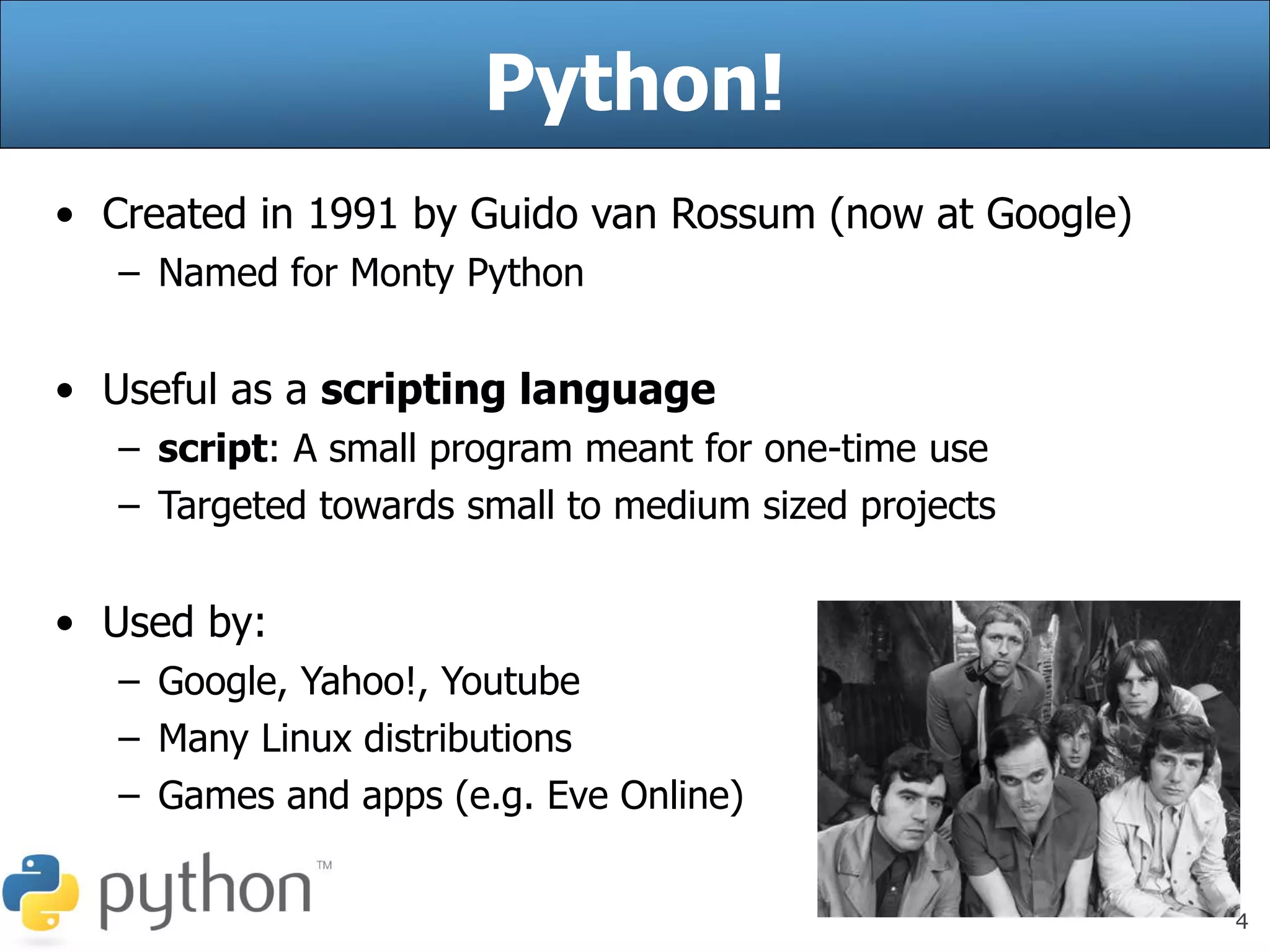
• Created in 1991 by Guido van Rossum (now at Google)
– Named for Monty Python
• Useful as a scripting language
– script: A small program meant for one-time use
– Targeted towards small to medium sized projects
• Used by:
– Google, Yahoo!, Youtube
– Many Linux distributions
– Games and apps (e.g. Eve Online)
5
Python is used everywhere!
6
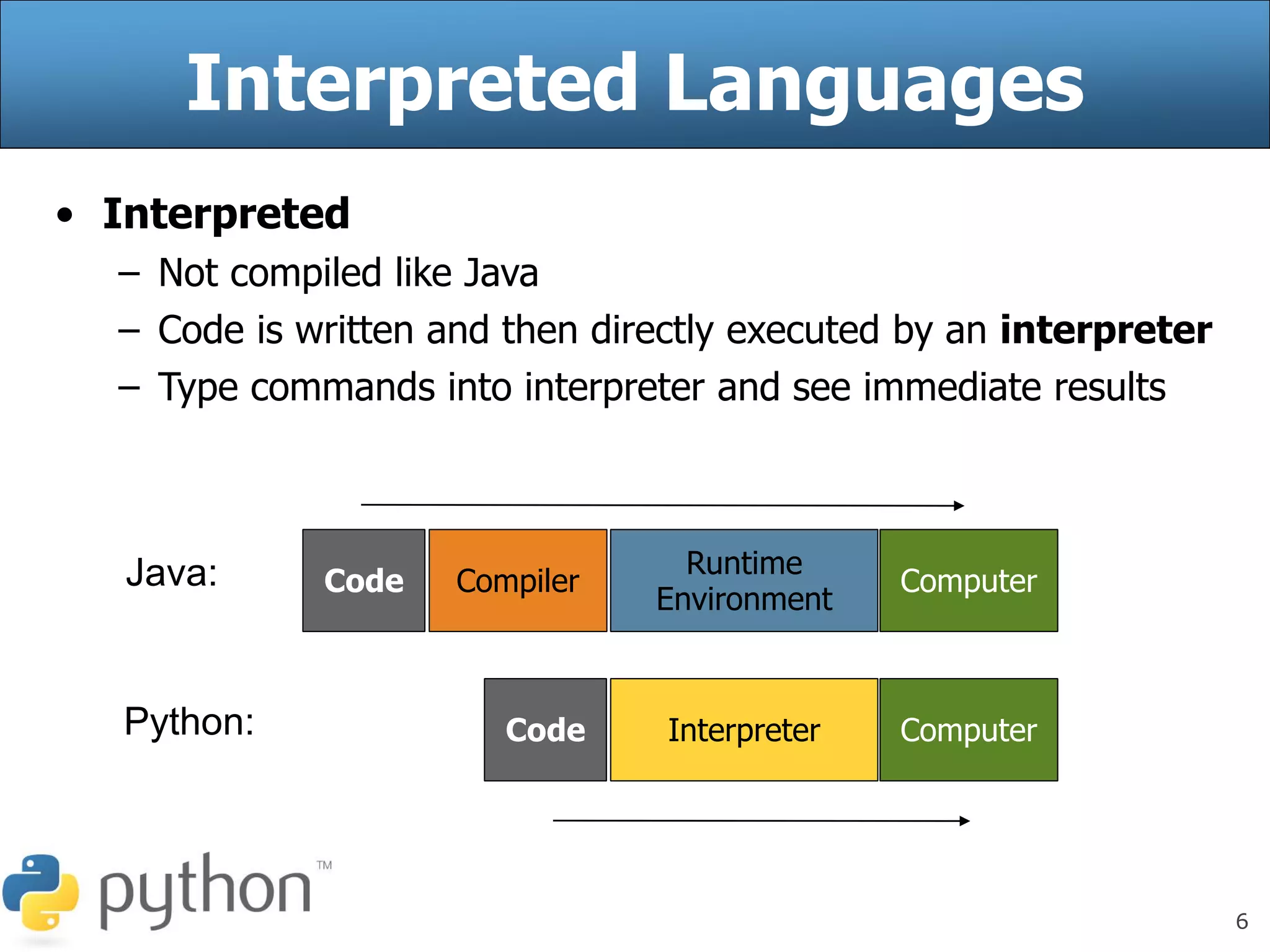
Interpreted Languages
• Interpreted
– Not compiled like Java
– Code is written and then directly executed by an interpreter
– Type commands into interpreter and see immediate results
Computer
Runtime
Environment
Compiler
Code
Java:
Computer
Interpreter
Code
Python:
7
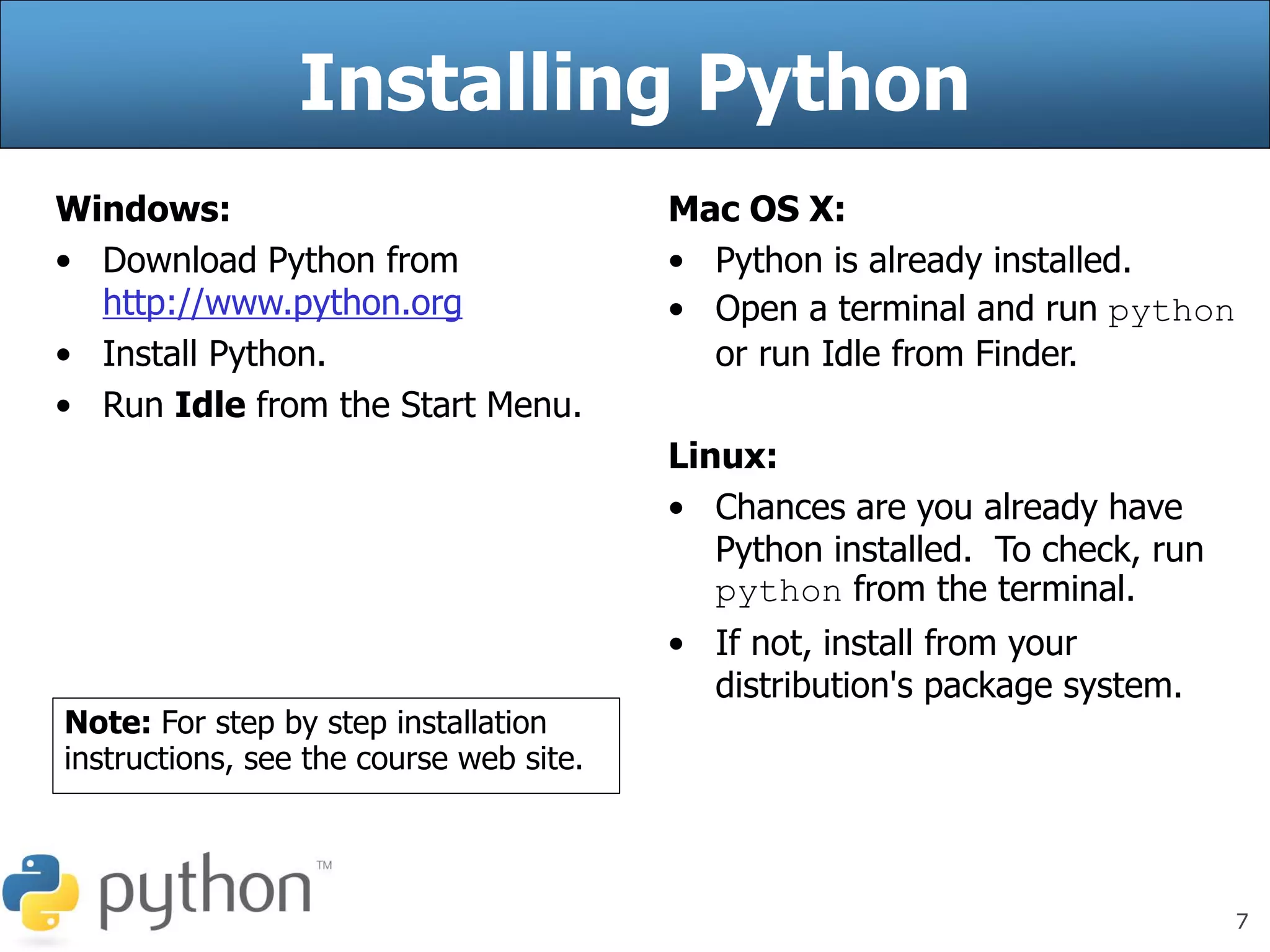
Installing Python
Windows:
• Download Python from
http://www.python.org
• Install Python.
• Run Idle from the Start Menu.
Mac OS X:
• Python is already installed.
• Open a terminal and run python
or run Idle from Finder.
Linux:
• Chances are you already have
Python installed. To check, run
python from the terminal.
• If not, install from your
distribution's package system.
Note: For step by step installation
instructions, see the course web site.
8
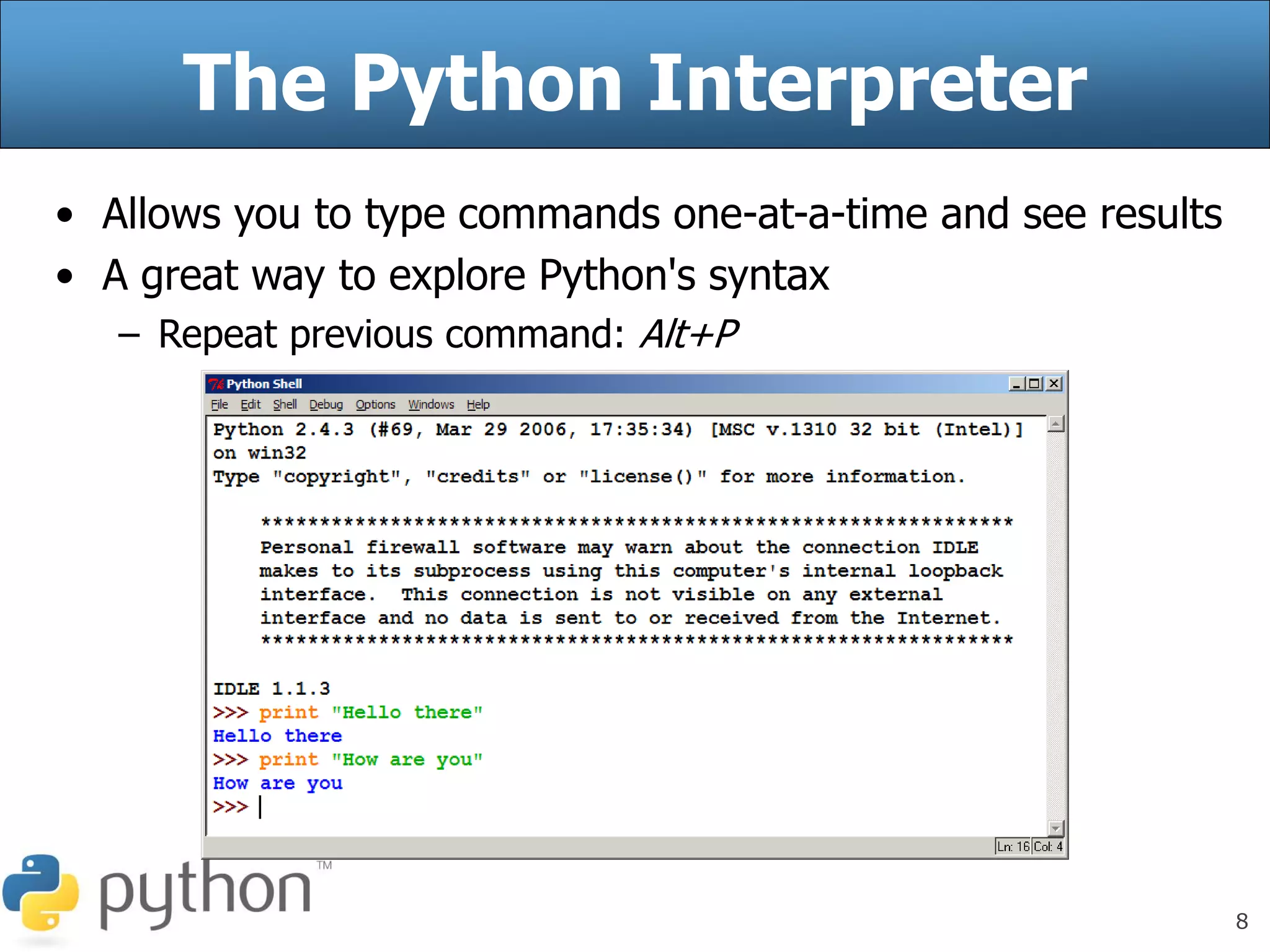
The Python Interpreter
• Allows you to type commands one-at-a-time and see results
• A great way to explore Python's syntax
– Repeat previous command: Alt+P
9
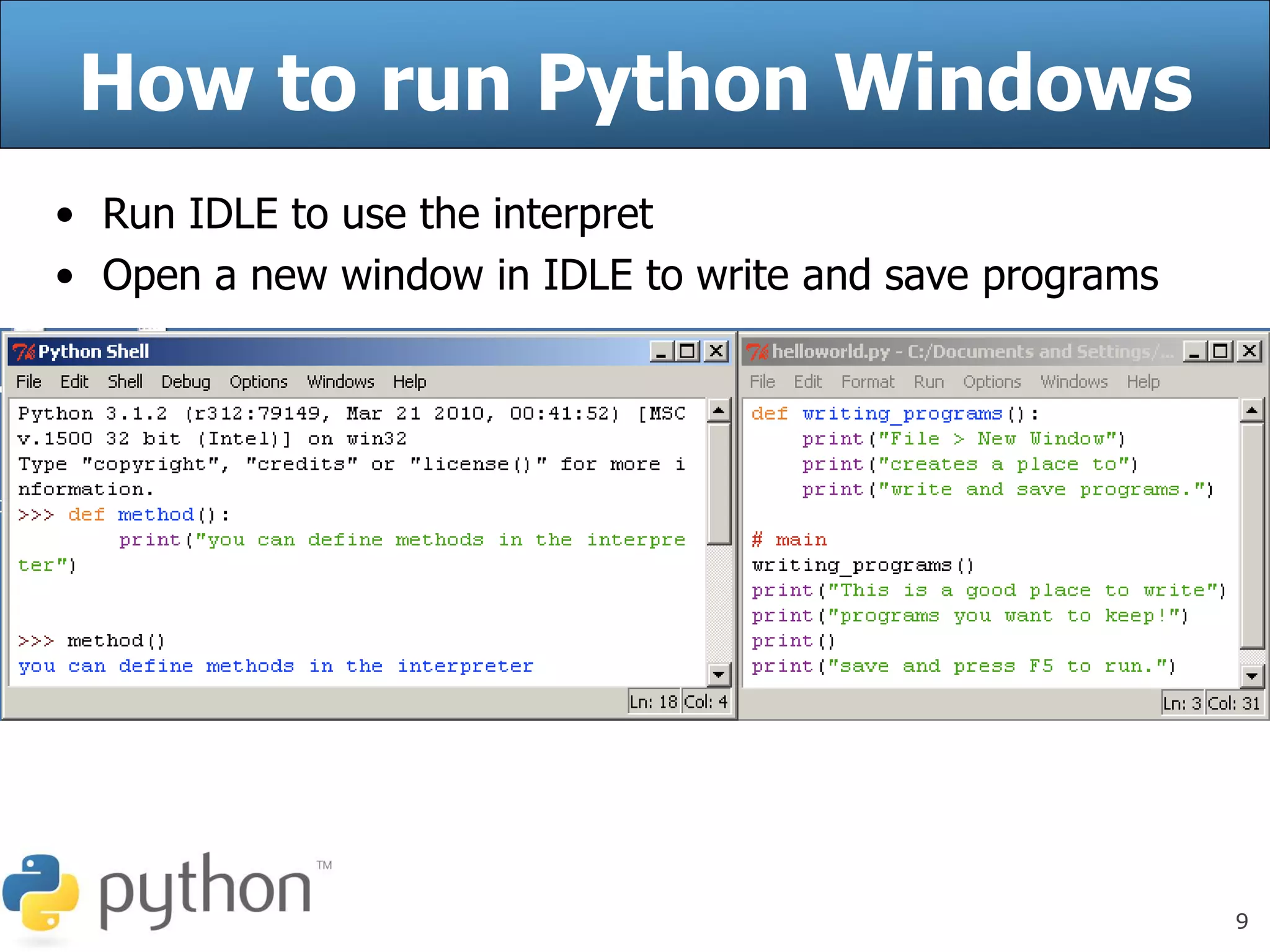
How to run Python Windows
• Run IDLE to use the interpret
• Open a new window in IDLE to write and save programs
10
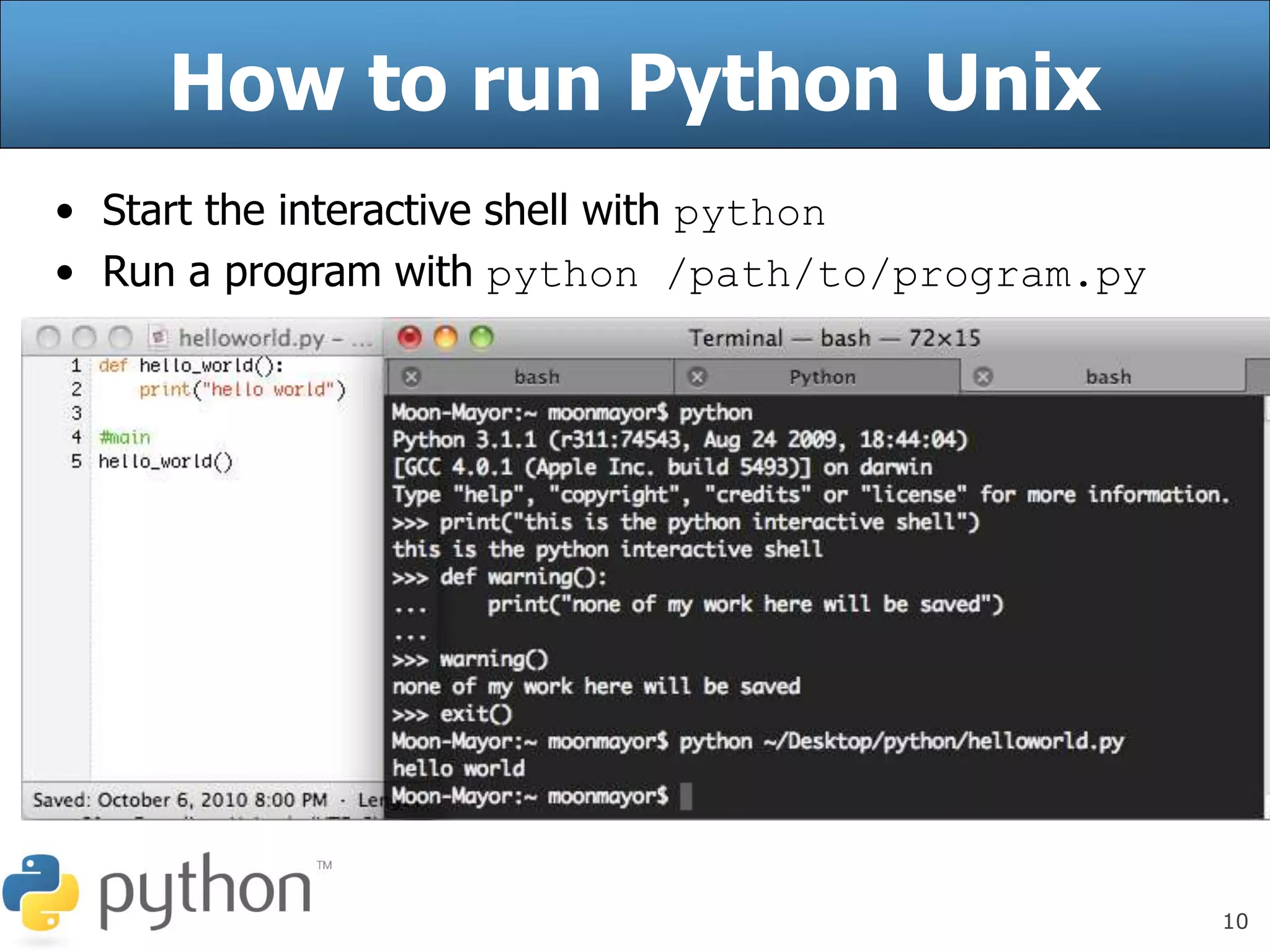
How to run Python Unix
• Start the interactive shell with python
• Run a program with python /path/to/program.py
11
Chapter 1 Review
• Console output: System.out.println();
• Methods: public static void name() { ... }
Hello2.java
1
2
3
4
5
6
7
8
9
public class Hello2 {
public static void main(String[] args) {
hello();
}
public static void hello() {
System.out.println("Hello, world!");
}
}
12
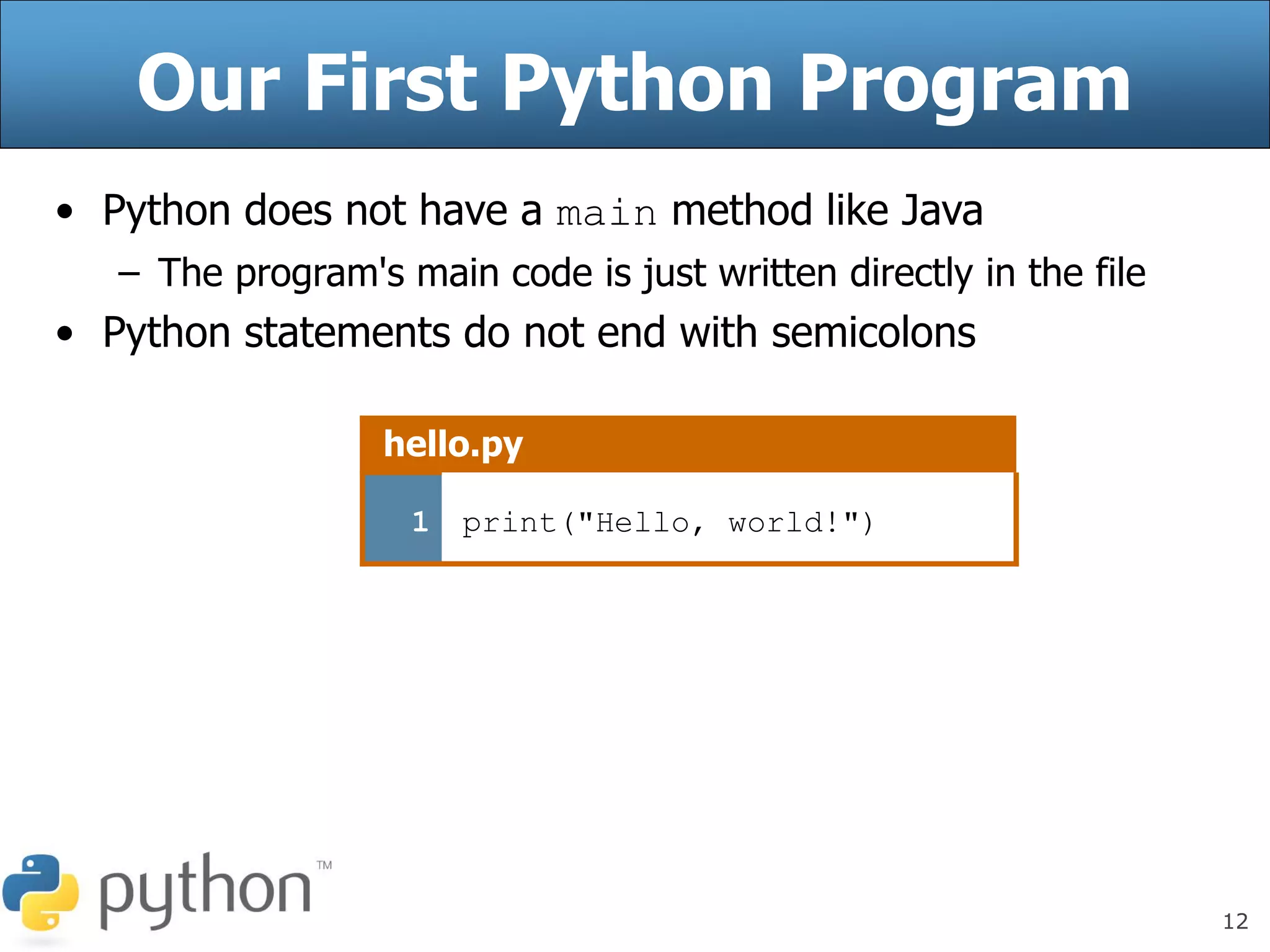
Our First Python Program
• Python does not have a main method like Java
– The program's main code is just written directly in the file
• Python statements do not end with semicolons
hello.py
1 print("Hello, world!")
13
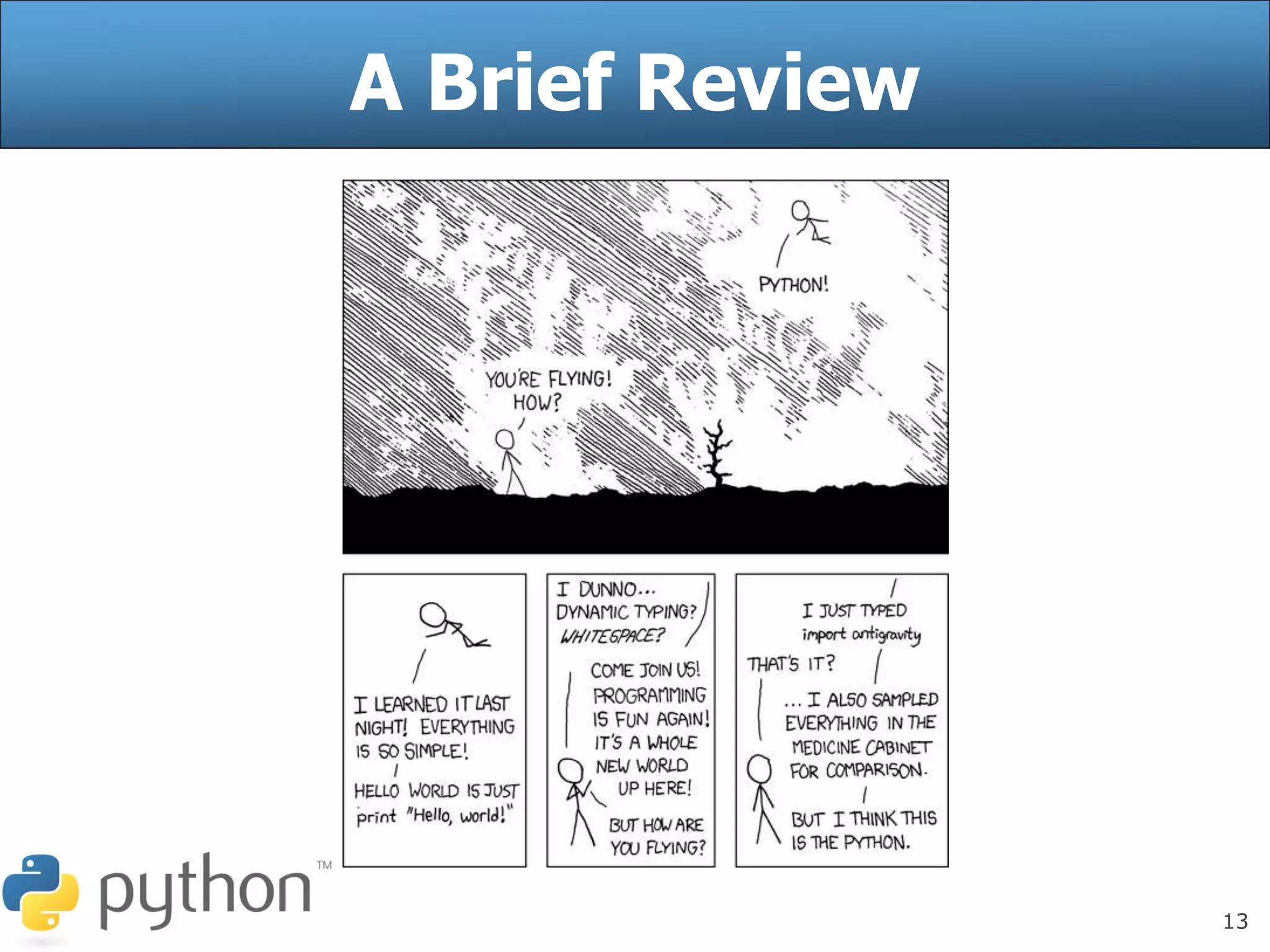
A Brief Review
14
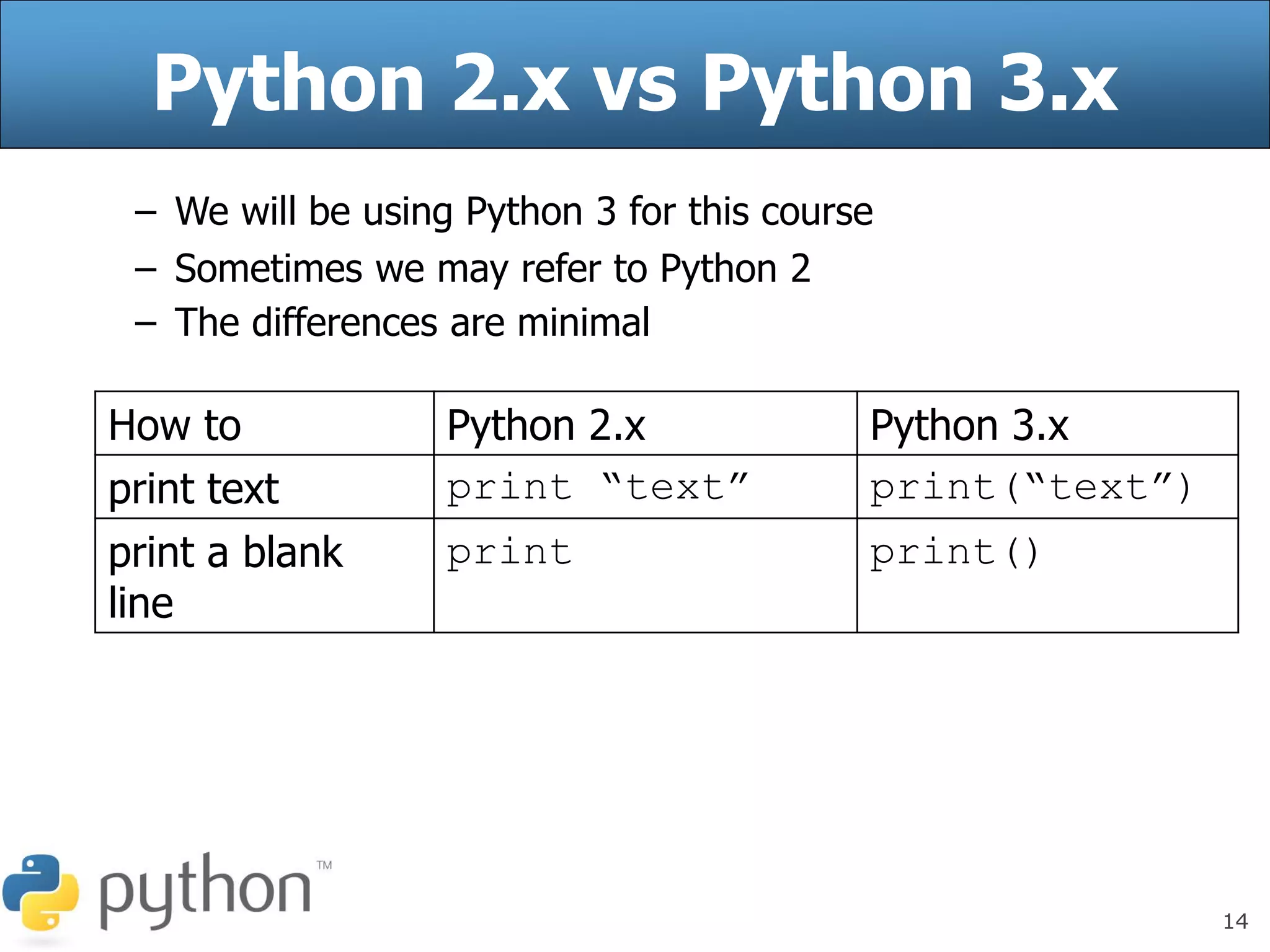
Python 2.x vs Python 3.x
– We will be using Python 3 for this course
– Sometimes we may refer to Python 2
– The differences are minimal
How to Python 2.x Python 3.x
print text print “text” print(“text”)
print a blank
line
print print()
15
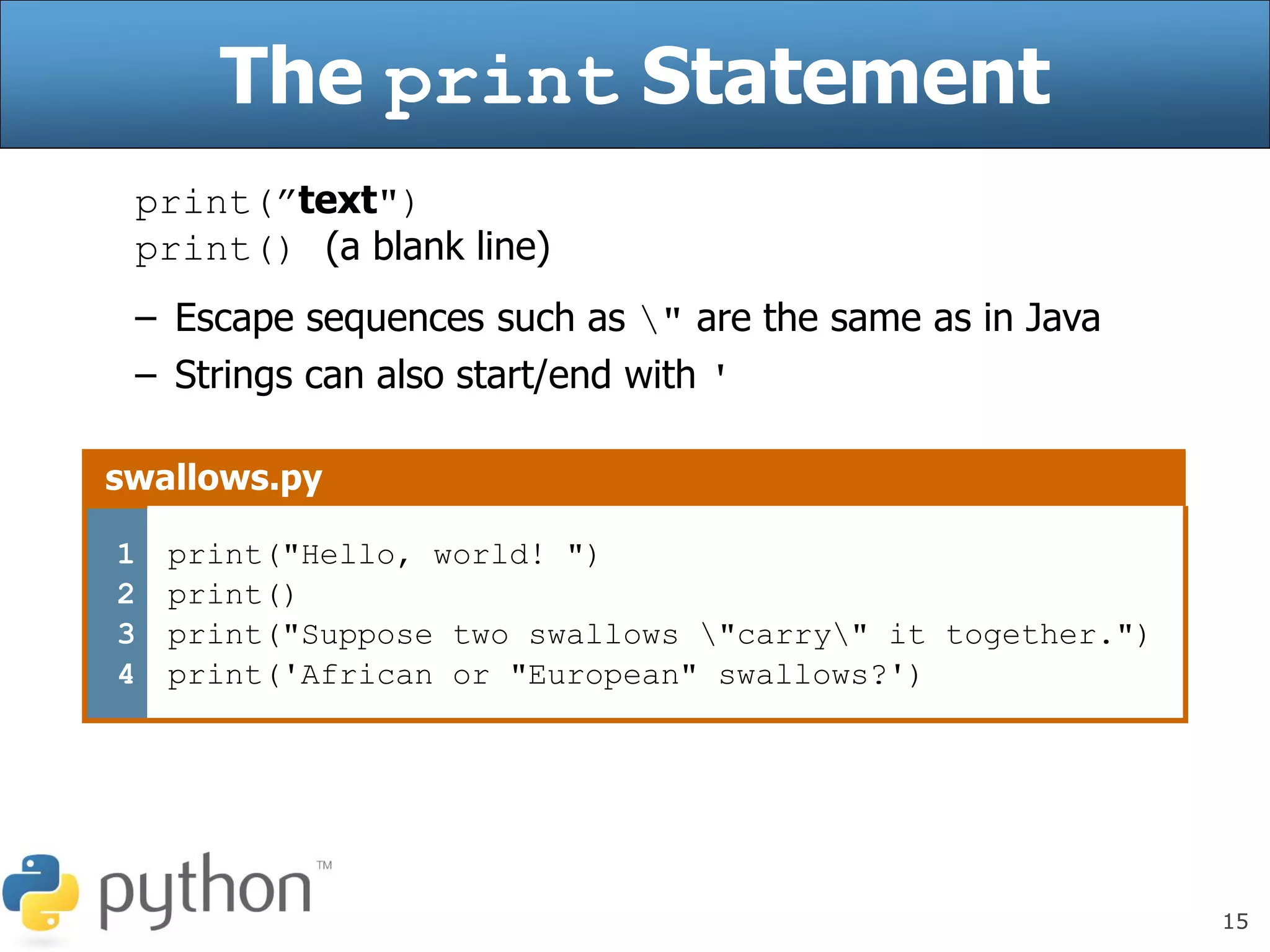
The print Statement
print(”text")
print() (a blank line)
– Escape sequences such as " are the same as in Java
– Strings can also start/end with '
swallows.py
1
2
3
4
print("Hello, world! ")
print()
print("Suppose two swallows "carry" it together.")
print('African or "European" swallows?')
16
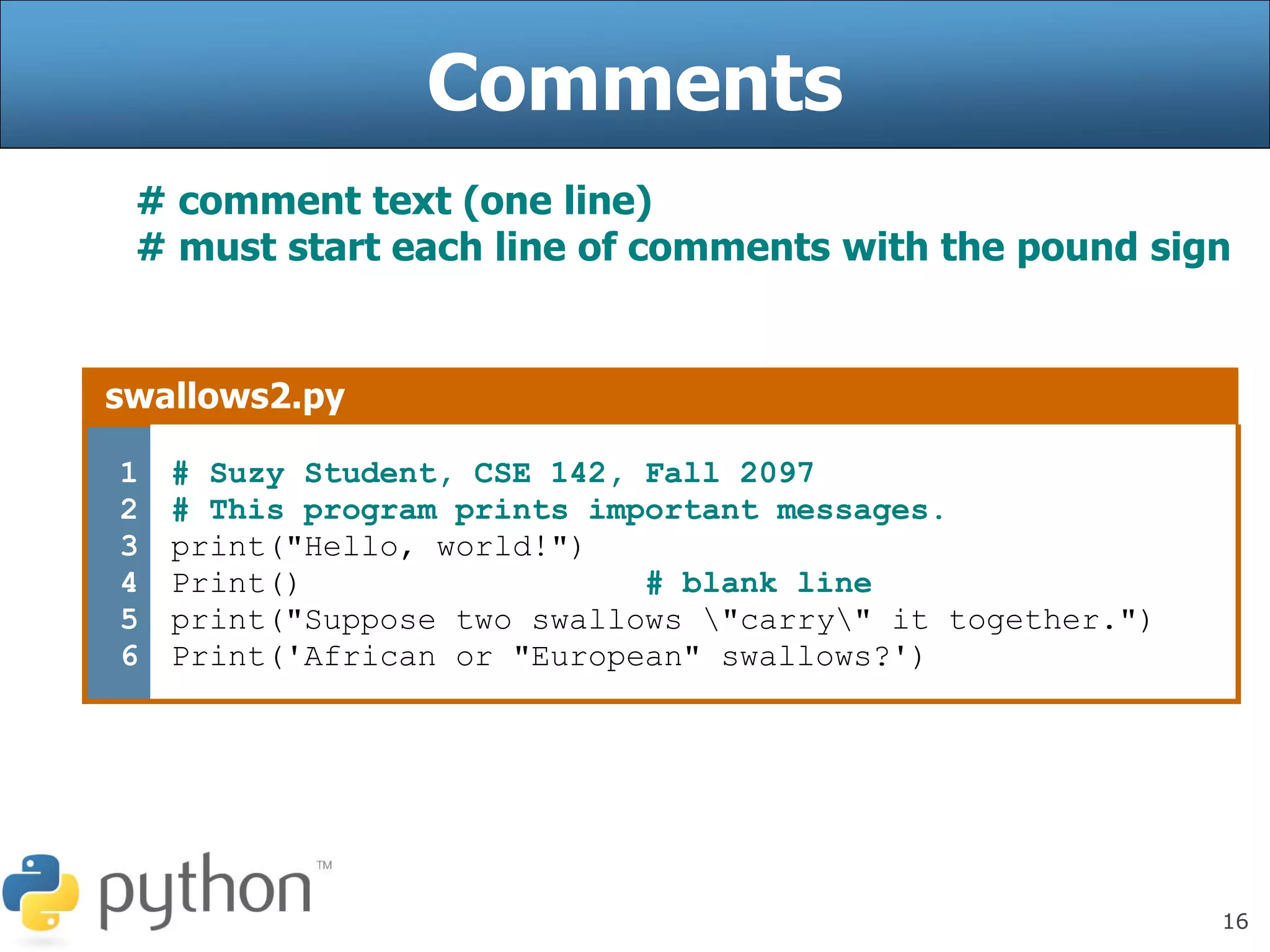
Comments
# comment text (one line)
# must start each line of comments with the pound sign
swallows2.py
1
2
3
4
5
6
# Suzy Student, CSE 142, Fall 2097
# This program prints important messages.
print("Hello, world!")
Print() # blank line
print("Suppose two swallows "carry" it together.")
Print('African or "European" swallows?')
17
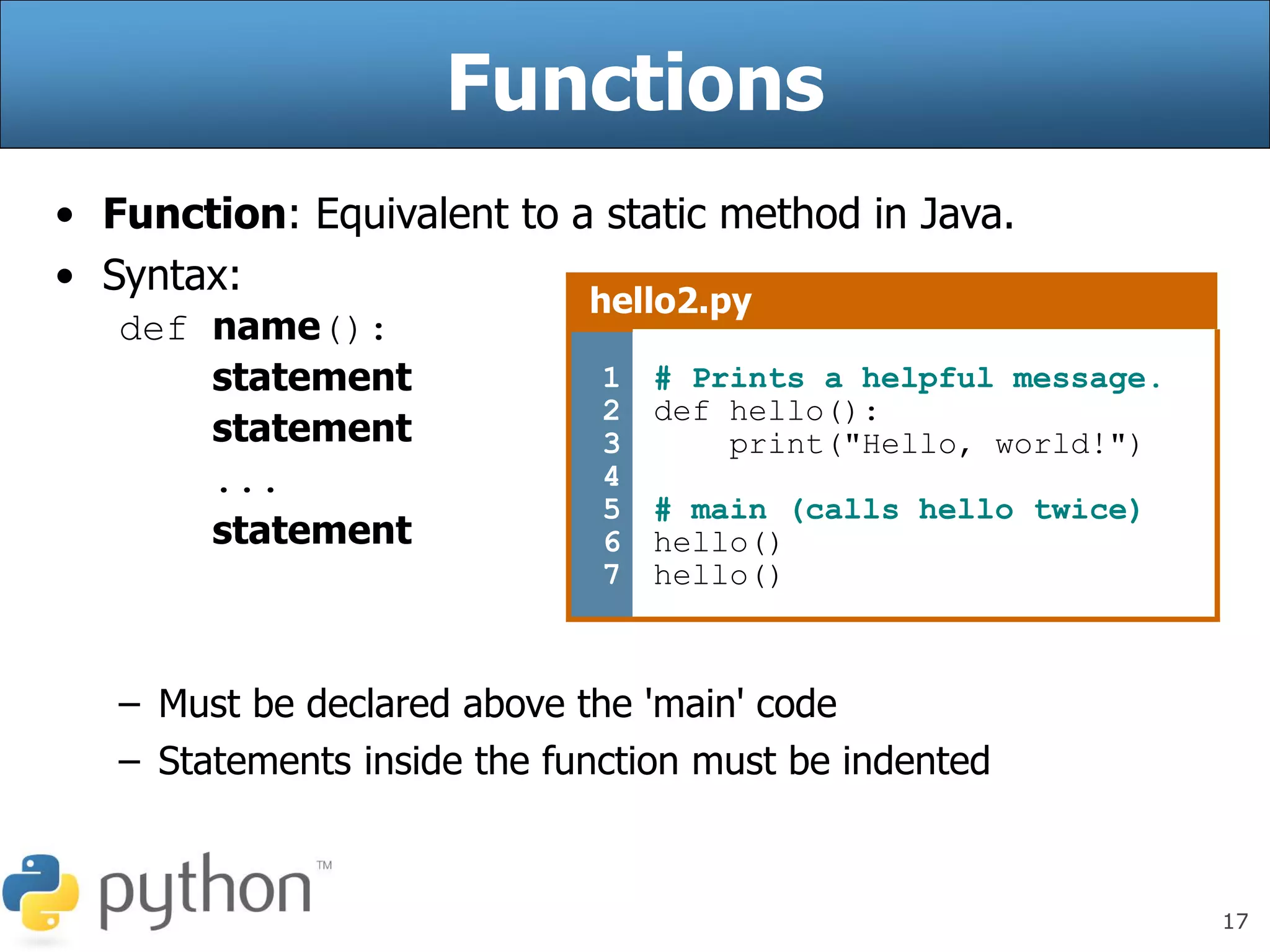
Functions
• Function: Equivalent to a static method in Java.
• Syntax:
def name():
statement
statement
...
statement
– Must be declared above the 'main' code
– Statements inside the function must be indented
hello2.py
1
2
3
4
5
6
7
# Prints a helpful message.
def hello():
print("Hello, world!")
# main (calls hello twice)
hello()
hello()
18
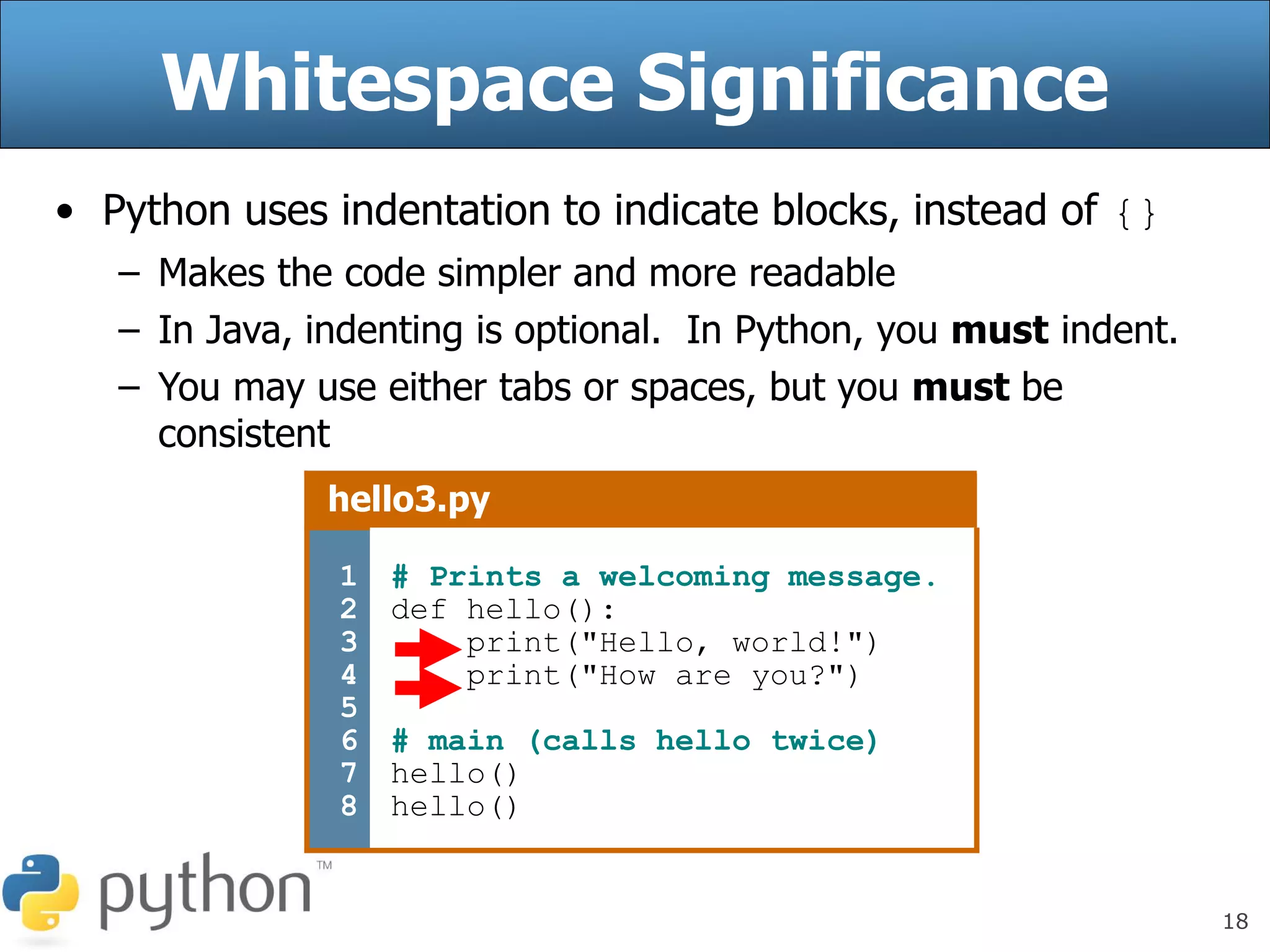
Whitespace Significance
• Python uses indentation to indicate blocks, instead of {}
– Makes the code simpler and more readable
– In Java, indenting is optional. In Python, you must indent.
– You may use either tabs or spaces, but you must be
consistent
hello3.py
1
2
3
4
5
6
7
8
# Prints a welcoming message.
def hello():
print("Hello, world!")
print("How are you?")
# main (calls hello twice)
hello()
hello()
19
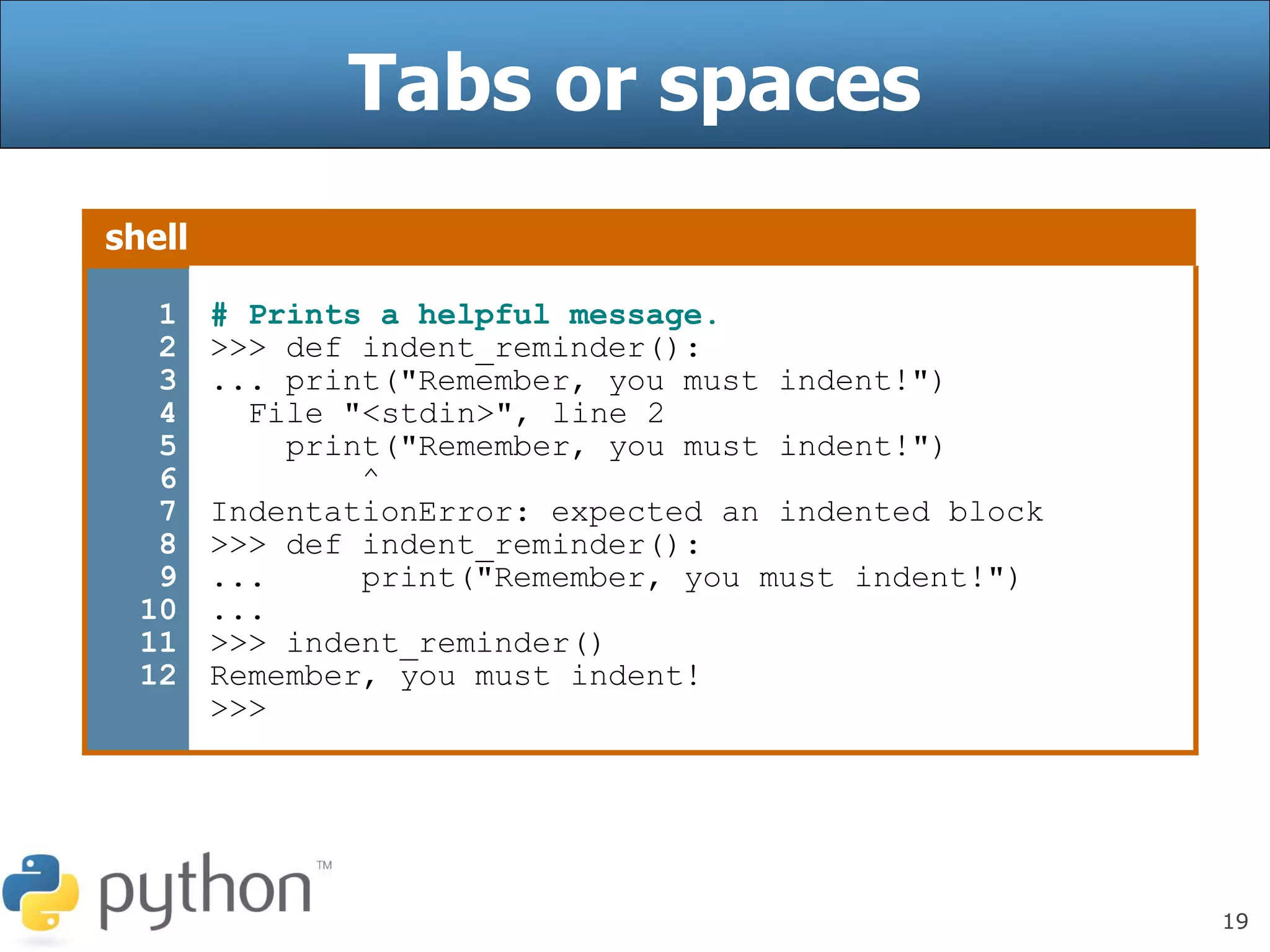
Tabs or spaces
shell
1
2
3
4
5
6
7
8
9
10
11
12
# Prints a helpful message.
>>> def indent_reminder():
... print("Remember, you must indent!")
File "<stdin>", line 2
print("Remember, you must indent!")
^
IndentationError: expected an indented block
>>> def indent_reminder():
... print("Remember, you must indent!")
...
>>> indent_reminder()
Remember, you must indent!
>>>
20
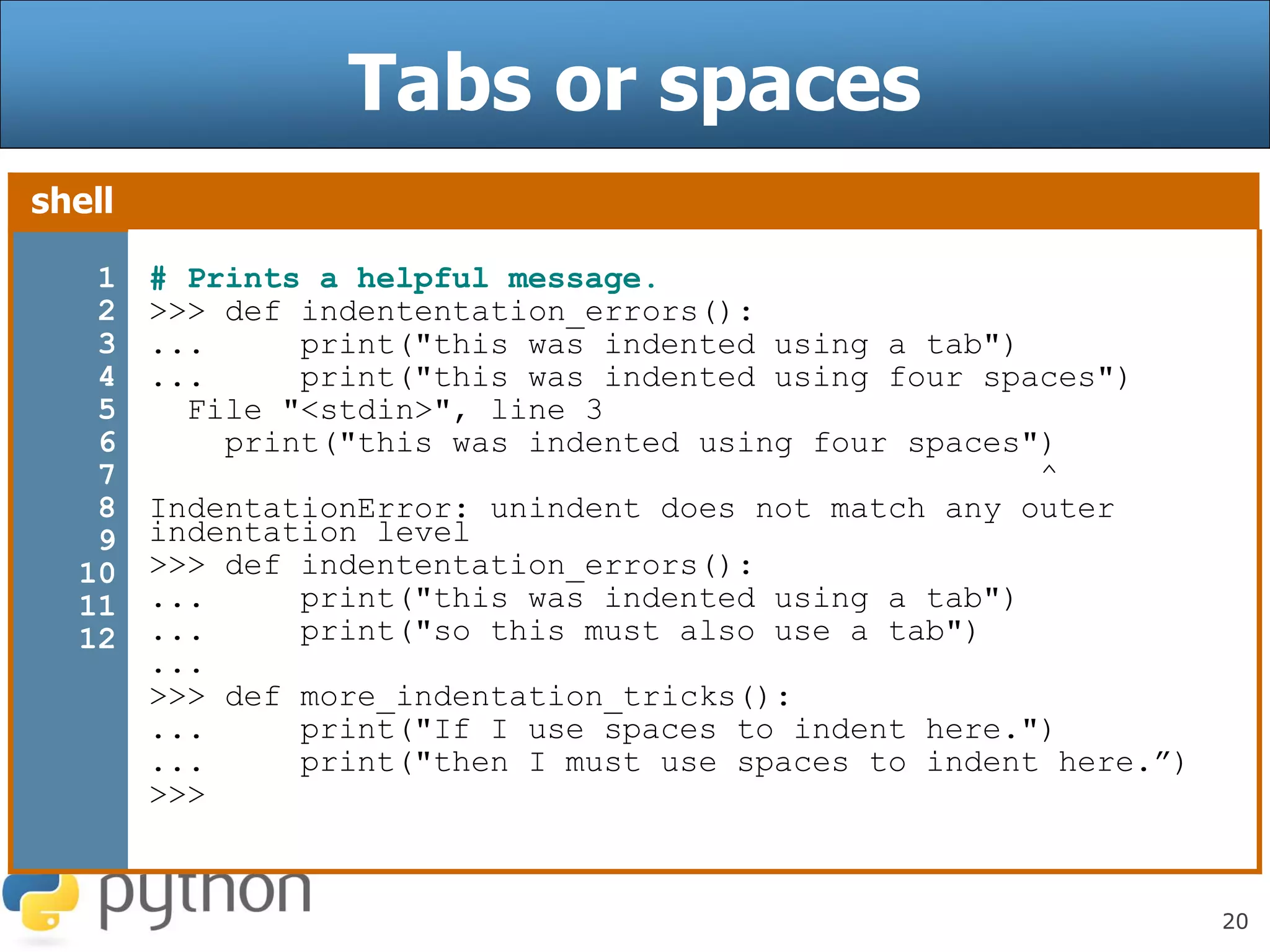
Tabs or spaces
shell
1
2
3
4
5
6
7
8
9
10
11
12
# Prints a helpful message.
>>> def indententation_errors():
... print("this was indented using a tab")
... print("this was indented using four spaces")
File "<stdin>", line 3
print("this was indented using four spaces")
^
IndentationError: unindent does not match any outer
indentation level
>>> def indententation_errors():
... print("this was indented using a tab")
... print("so this must also use a tab")
...
>>> def more_indentation_tricks():
... print("If I use spaces to indent here.")
... print("then I must use spaces to indent here.”)
>>>
21
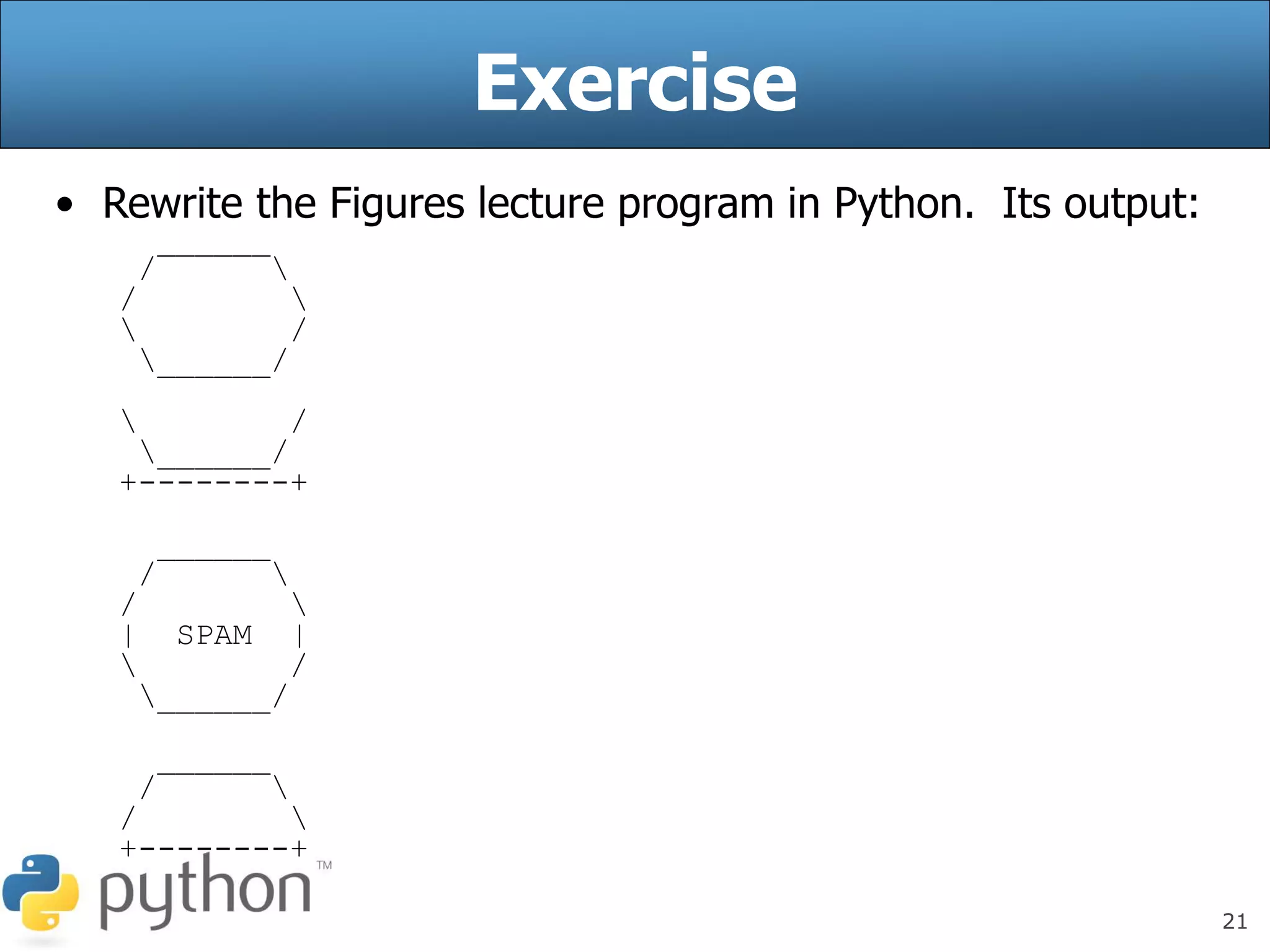
Exercise
• Rewrite the Figures lecture program in Python. Its output:
______
/ 
/ 
 /
______/
 /
______/
+--------+
______
/ 
/ 
| SPAM |
 /
______/
______
/ 
/ 
+--------+
22
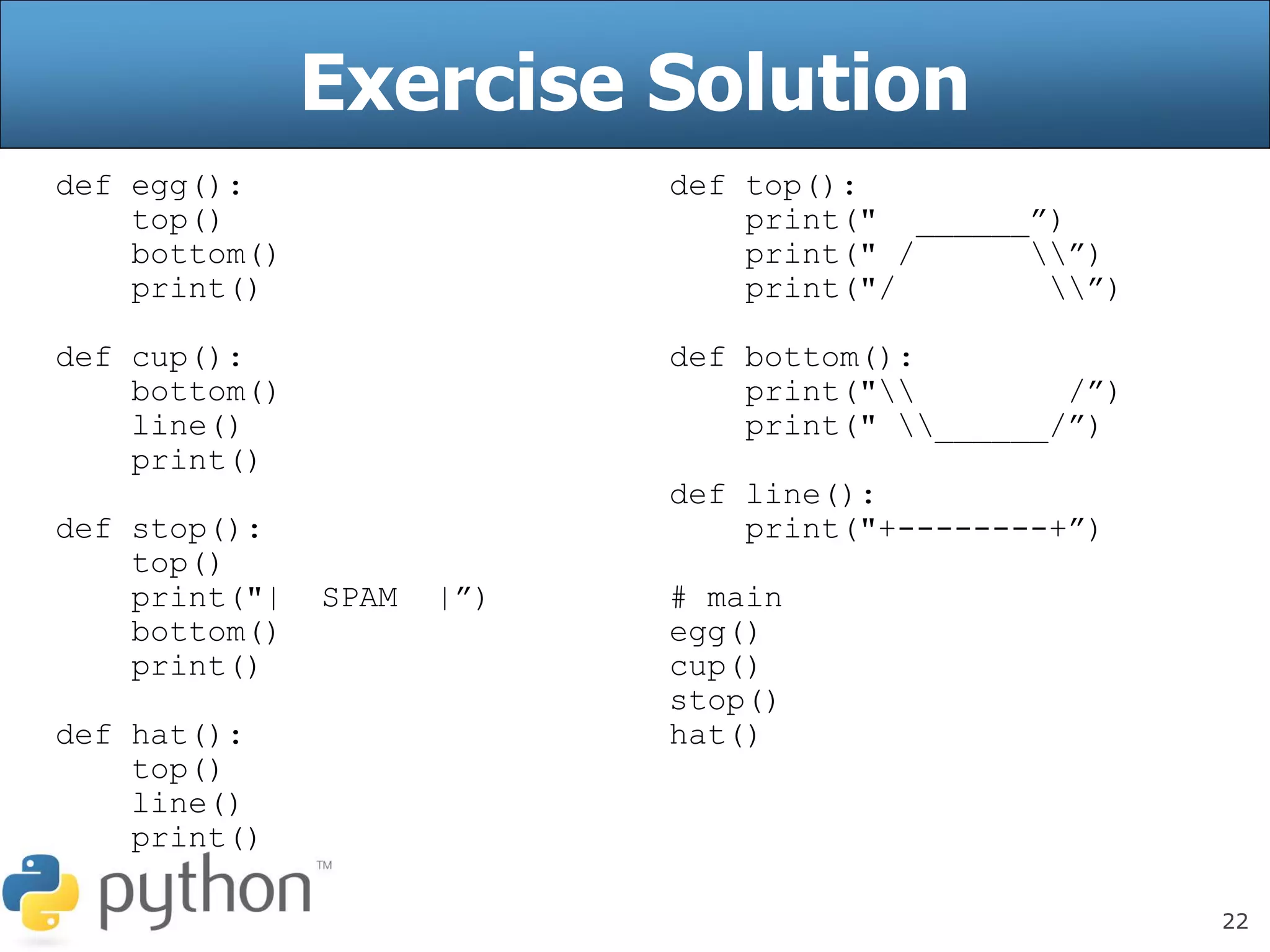
Exercise Solution
def egg():
top()
bottom()
print()
def cup():
bottom()
line()
print()
def stop():
top()
print("| SPAM |”)
bottom()
print()
def hat():
top()
line()
print()
def top():
print(" ______”)
print(" / ”)
print("/ ”)
def bottom():
print(" /”)
print(" ______/”)
def line():
print("+--------+”)
# main
egg()
cup()
stop()
hat()

week1.ppt

  • 1.
    Week 1 basic Pythonprograms, defining functions Special thanks to Scott Shawcroft, Ryan Tucker, and Paul Beck for their work on these slides. Except where otherwise noted, this work is licensed under: http://creativecommons.org/licenses/by-nc-sa/3.0
  • 2.
    2 About Us • StefanieHatcher – Informatics – Grandmistress Leet Queen – hatchs@cs.washington.edu • Will Beebe – Informatics – IPL Hobo – nedrager@cs.washington.edu • Steve Geluso – Computer Science – Self-proclaimed Moon Mayor – geluso@cs.washington.edu
  • 3.
    3 Words you willlearn today python print() # def
  • 4.
    4 Python! • Created in1991 by Guido van Rossum (now at Google) – Named for Monty Python • Useful as a scripting language – script: A small program meant for one-time use – Targeted towards small to medium sized projects • Used by: – Google, Yahoo!, Youtube – Many Linux distributions – Games and apps (e.g. Eve Online)
  • 5.
    5 Python is usedeverywhere!
  • 6.
    6 Interpreted Languages • Interpreted –Not compiled like Java – Code is written and then directly executed by an interpreter – Type commands into interpreter and see immediate results Computer Runtime Environment Compiler Code Java: Computer Interpreter Code Python:
  • 7.
    7 Installing Python Windows: • DownloadPython from http://www.python.org • Install Python. • Run Idle from the Start Menu. Mac OS X: • Python is already installed. • Open a terminal and run python or run Idle from Finder. Linux: • Chances are you already have Python installed. To check, run python from the terminal. • If not, install from your distribution's package system. Note: For step by step installation instructions, see the course web site.
  • 8.
    8 The Python Interpreter •Allows you to type commands one-at-a-time and see results • A great way to explore Python's syntax – Repeat previous command: Alt+P
  • 9.
    9 How to runPython Windows • Run IDLE to use the interpret • Open a new window in IDLE to write and save programs
  • 10.
    10 How to runPython Unix • Start the interactive shell with python • Run a program with python /path/to/program.py
  • 11.
    11 Chapter 1 Review •Console output: System.out.println(); • Methods: public static void name() { ... } Hello2.java 1 2 3 4 5 6 7 8 9 public class Hello2 { public static void main(String[] args) { hello(); } public static void hello() { System.out.println("Hello, world!"); } }
  • 12.
    12 Our First PythonProgram • Python does not have a main method like Java – The program's main code is just written directly in the file • Python statements do not end with semicolons hello.py 1 print("Hello, world!")
  • 13.
  • 14.
    14 Python 2.x vsPython 3.x – We will be using Python 3 for this course – Sometimes we may refer to Python 2 – The differences are minimal How to Python 2.x Python 3.x print text print “text” print(“text”) print a blank line print print()
  • 15.
    15 The print Statement print(”text") print()(a blank line) – Escape sequences such as " are the same as in Java – Strings can also start/end with ' swallows.py 1 2 3 4 print("Hello, world! ") print() print("Suppose two swallows "carry" it together.") print('African or "European" swallows?')
  • 16.
    16 Comments # comment text(one line) # must start each line of comments with the pound sign swallows2.py 1 2 3 4 5 6 # Suzy Student, CSE 142, Fall 2097 # This program prints important messages. print("Hello, world!") Print() # blank line print("Suppose two swallows "carry" it together.") Print('African or "European" swallows?')
  • 17.
    17 Functions • Function: Equivalentto a static method in Java. • Syntax: def name(): statement statement ... statement – Must be declared above the 'main' code – Statements inside the function must be indented hello2.py 1 2 3 4 5 6 7 # Prints a helpful message. def hello(): print("Hello, world!") # main (calls hello twice) hello() hello()
  • 18.
    18 Whitespace Significance • Pythonuses indentation to indicate blocks, instead of {} – Makes the code simpler and more readable – In Java, indenting is optional. In Python, you must indent. – You may use either tabs or spaces, but you must be consistent hello3.py 1 2 3 4 5 6 7 8 # Prints a welcoming message. def hello(): print("Hello, world!") print("How are you?") # main (calls hello twice) hello() hello()
  • 19.
    19 Tabs or spaces shell 1 2 3 4 5 6 7 8 9 10 11 12 #Prints a helpful message. >>> def indent_reminder(): ... print("Remember, you must indent!") File "<stdin>", line 2 print("Remember, you must indent!") ^ IndentationError: expected an indented block >>> def indent_reminder(): ... print("Remember, you must indent!") ... >>> indent_reminder() Remember, you must indent! >>>
  • 20.
    20 Tabs or spaces shell 1 2 3 4 5 6 7 8 9 10 11 12 #Prints a helpful message. >>> def indententation_errors(): ... print("this was indented using a tab") ... print("this was indented using four spaces") File "<stdin>", line 3 print("this was indented using four spaces") ^ IndentationError: unindent does not match any outer indentation level >>> def indententation_errors(): ... print("this was indented using a tab") ... print("so this must also use a tab") ... >>> def more_indentation_tricks(): ... print("If I use spaces to indent here.") ... print("then I must use spaces to indent here.”) >>>
  • 21.
    21 Exercise • Rewrite theFigures lecture program in Python. Its output: ______ / / / ______/ / ______/ +--------+ ______ / / | SPAM | / ______/ ______ / / +--------+
  • 22.
    22 Exercise Solution def egg(): top() bottom() print() defcup(): bottom() line() print() def stop(): top() print("| SPAM |”) bottom() print() def hat(): top() line() print() def top(): print(" ______”) print(" / ”) print("/ ”) def bottom(): print(" /”) print(" ______/”) def line(): print("+--------+”) # main egg() cup() stop() hat()