What are greenhouse gases?
Any gases that cause the “greenhouse
effect!”
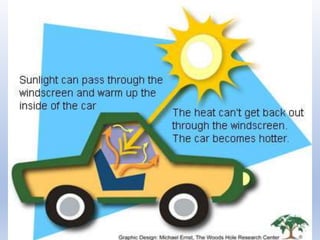
Imagine… a car on a cool but sunny day…
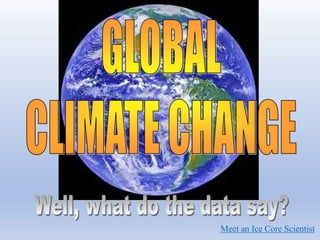
Global Climate Change
• Identifiable change in the climate of
Earth as a whole that lasts for an
extended period of time (decades or
longer)
• When due to natural processes, it is usually
referred to as global climate variability
• Usually refers to changes forced by human
activities that change the atmosphere
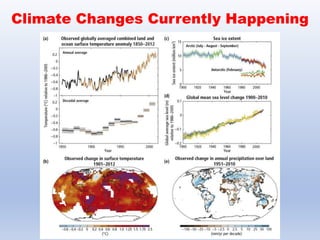
Climate Changes Currently Happening
What causes Earth’s climate to change?
•Changes in the atmosphere
•Natural processes
• Volcanoes
• Tectonic plate movement
• Changes in the sun
• Shifts in Earth’s orbit
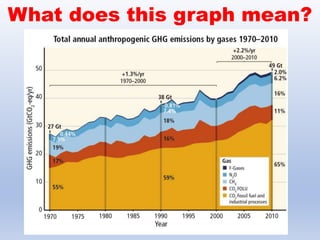
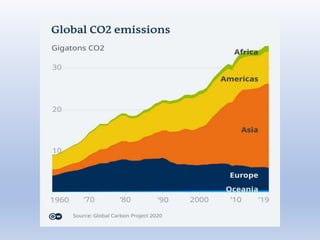
•Human activities – any activity that releases “greenhouse
gases” into the atmosphere
Meet an Ice Core Scientist
What does this graph mean?
What about those natural
processes that can cause
climate change?
Click to explore these natural
processes at the EPA website!
“Their effects [those of human-caused
greenhouse gases], together with those of
other anthropogenic drivers, have been
detected throughout the climate system and
are extremely likely to have been the
dominant cause of the observed warming
since the mid-20th century.”
IPCC Conclusion:
•Warming and sea level rise will continue and
will probably occur more quickly than what
we’ve already seen
•Even if greenhouse gases are stabilized, this
will probably continue to occur for centuries
•Some effects may be permanent
• Effects on Ecosystems
– Coral systems and other unique ecosystems
cannot handle higher temperatures well
– Wildfires will increase
– Up to 30% of species will be at increased risk for
extinction due to the rapid changes in their
ecosystems
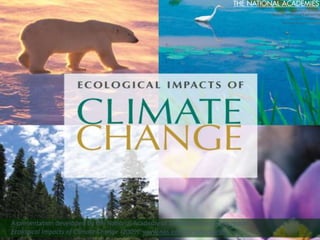
A presentation developed by the National Academy of Sciences based on its report
Ecological Impacts of Climate Change (2009): www.nas.edu/climatechange.
National Academy of Sciences
National Academy of Engineering
Institute of Medicine
National Research Council
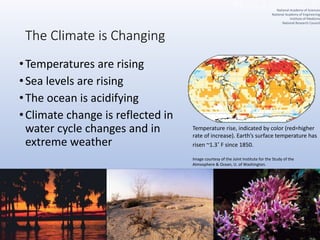
The Climate is Changing
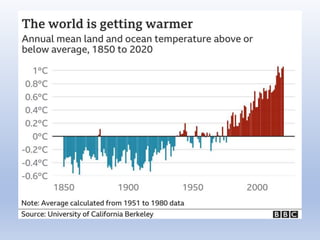
•Temperatures are rising
•Sea levels are rising
•The ocean is acidifying
•Climate change is reflected in
water cycle changes and in
extreme weather
Temperature rise, indicated by color (red=higher
rate of increase). Earth’s surface temperature has
risen ~1.3˚ F since 1850.
Image courtesy of the Joint Institute for the Study of the
Atmosphere & Ocean, U. of Washington.
National Academy of Sciences
National Academy of Engineering
Institute of Medicine
National Research Council
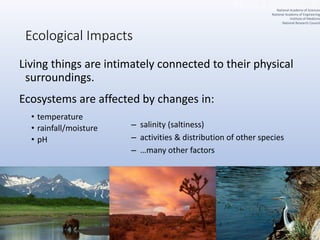
Ecological Impacts
Living things are intimately connected to their physical
surroundings.
Ecosystems are affected by changes in:
• temperature
• rainfall/moisture
• pH
– salinity (saltiness)
– activities & distribution of other species
– …many other factors
National Academy of Sciences
National Academy of Engineering
Institute of Medicine
National Research Council
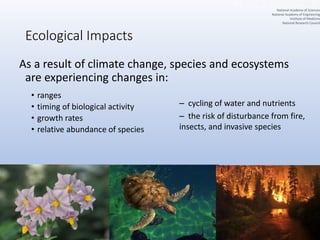
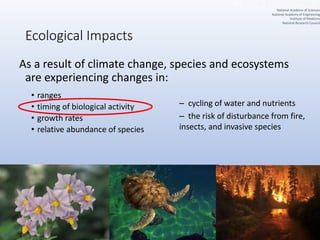
Ecological Impacts
As a result of climate change, species and ecosystems
are experiencing changes in:
• ranges
• timing of biological activity
• growth rates
• relative abundance of species
– cycling of water and nutrients
– the risk of disturbance from fire,
insects, and invasive species
National Academy of Sciences
National Academy of Engineering
Institute of Medicine
National Research Council
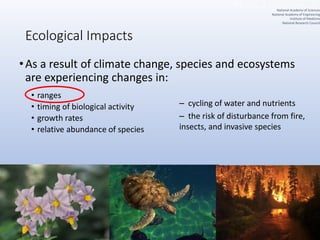
Ecological Impacts
•As a result of climate change, species and ecosystems
are experiencing changes in:
• ranges
• timing of biological activity
• growth rates
• relative abundance of species
– cycling of water and nutrients
– the risk of disturbance from fire,
insects, and invasive species
National Academy of Sciences
National Academy of Engineering
Institute of Medicine
National Research Council
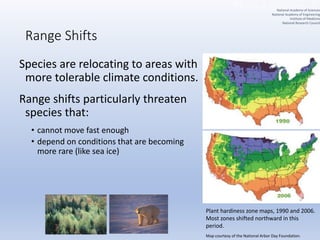
Range Shifts
Species are relocating to areas with
more tolerable climate conditions.
Range shifts particularly threaten
species that:
• cannot move fast enough
• depend on conditions that are becoming
more rare (like sea ice)
Plant hardiness zone maps, 1990 and 2006.
Most zones shifted northward in this
period.
Map courtesy of the National Arbor Day Foundation.
National Academy of Sciences
National Academy of Engineering
Institute of Medicine
National Research Council
Ecological Impacts
As a result of climate change, species and ecosystems
are experiencing changes in:
• ranges
• timing of biological activity
• growth rates
• relative abundance of species
– cycling of water and nutrients
– the risk of disturbance from fire,
insects, and invasive species
National Academy of Sciences
National Academy of Engineering
Institute of Medicine
National Research Council
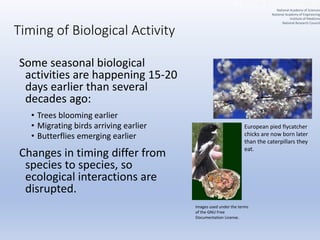
Timing of Biological Activity
Some seasonal biological
activities are happening 15-20
days earlier than several
decades ago:
• Trees blooming earlier
• Migrating birds arriving earlier
• Butterflies emerging earlier
Changes in timing differ from
species to species, so
ecological interactions are
disrupted.
European pied flycatcher
chicks are now born later
than the caterpillars they
eat.
Images used under the terms
of the GNU Free
Documentation License.
National Academy of Sciences
National Academy of Engineering
Institute of Medicine
National Research Council
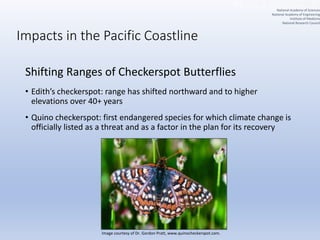
Impacts in the Pacific Coastline
Shifting Ranges of Checkerspot Butterflies
• Edith’s checkerspot: range has shifted northward and to higher
elevations over 40+ years
• Quino checkerspot: first endangered species for which climate change is
officially listed as a threat and as a factor in the plan for its recovery
Image courtesy of Dr. Gordon Pratt, www.quinocheckerspot.com.
National Academy of Sciences
National Academy of Engineering
Institute of Medicine
National Research Council
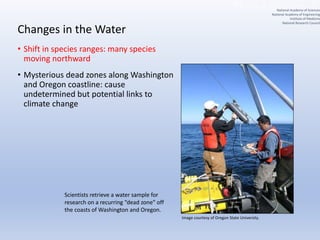
Changes in the Water
• Shift in species ranges: many species
moving northward
• Mysterious dead zones along Washington
and Oregon coastline: cause
undetermined but potential links to
climate change
Scientists retrieve a water sample for
research on a recurring “dead zone” off
the coasts of Washington and Oregon.
Image courtesy of Oregon State University.
National Academy of Sciences
National Academy of Engineering
Institute of Medicine
National Research Council
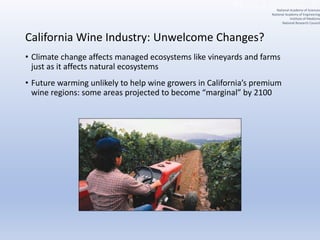
California Wine Industry: Unwelcome Changes?
• Climate change affects managed ecosystems like vineyards and farms
just as it affects natural ecosystems
• Future warming unlikely to help wine growers in California’s premium
wine regions: some areas projected to become “marginal” by 2100
National Academy of Sciences
National Academy of Engineering
Institute of Medicine
National Research Council
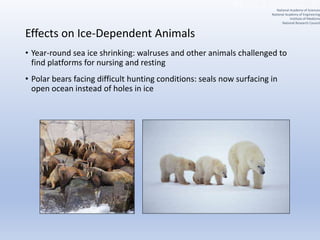
Effects on Ice-Dependent Animals
• Year-round sea ice shrinking: walruses and other animals challenged to
find platforms for nursing and resting
• Polar bears facing difficult hunting conditions: seals now surfacing in
open ocean instead of holes in ice
National Academy of Sciences
National Academy of Engineering
Institute of Medicine
National Research Council
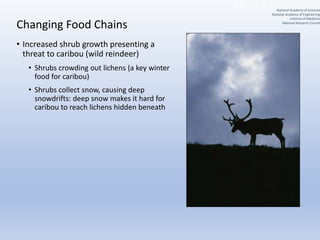
Changing Food Chains
• Increased shrub growth presenting a
threat to caribou (wild reindeer)
• Shrubs crowding out lichens (a key winter
food for caribou)
• Shrubs collect snow, causing deep
snowdrifts: deep snow makes it hard for
caribou to reach lichens hidden beneath
National Academy of Sciences
National Academy of Engineering
Institute of Medicine
National Research Council
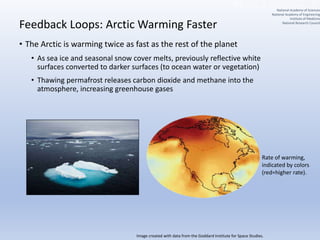
Feedback Loops: Arctic Warming Faster
• The Arctic is warming twice as fast as the rest of the planet
• As sea ice and seasonal snow cover melts, previously reflective white
surfaces converted to darker surfaces (to ocean water or vegetation)
• Thawing permafrost releases carbon dioxide and methane into the
atmosphere, increasing greenhouse gases
Rate of warming,
indicated by colors
(red=higher rate).
Image created with data from the Goddard Institute for Space Studies.
National Academy of Sciences
National Academy of Engineering
Institute of Medicine
National Research Council
Wildfire, Drought, and Insects: Complex Interactions
Climate change increases the risk of fire in areas where decades of total fire
suppression have resulted in buildup of dead fuels.
Wildfire increasing in frequency, size, season length:
• Longer, more intense summer droughts stressing trees
• Stressed trees are more susceptible to attacking beetles, which leave standing dead
fuels in their wake
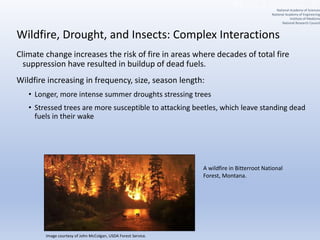
A wildfire in Bitterroot National
Forest, Montana.
Image courtesy of John McColgan, USDA Forest Service.
National Academy of Sciences
National Academy of Engineering
Institute of Medicine
National Research Council
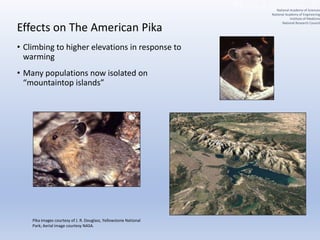
Effects on The American Pika
• Climbing to higher elevations in response to
warming
• Many populations now isolated on
“mountaintop islands”
Pika images courtesy of J. R. Douglass, Yellowstone National
Park; Aerial image courtesy NASA.
National Academy of Sciences
National Academy of Engineering
Institute of Medicine
National Research Council
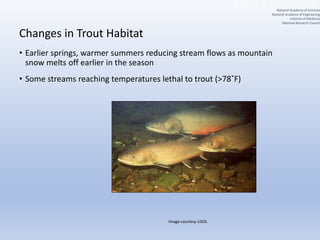
Changes in Trout Habitat
• Earlier springs, warmer summers reducing stream flows as mountain
snow melts off earlier in the season
• Some streams reaching temperatures lethal to trout (>78˚F)
Image courtesy USGS.
National Academy of Sciences
National Academy of Engineering
Institute of Medicine
National Research Council
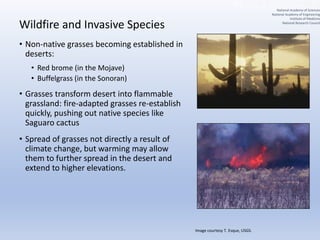
Wildfire and Invasive Species
• Non-native grasses becoming established in
deserts:
• Red brome (in the Mojave)
• Buffelgrass (in the Sonoran)
• Grasses transform desert into flammable
grassland: fire-adapted grasses re-establish
quickly, pushing out native species like
Saguaro cactus
• Spread of grasses not directly a result of
climate change, but warming may allow
them to further spread in the desert and
extend to higher elevations.
Image courtesy T. Esque, USGS.
National Academy of Sciences
National Academy of Engineering
Institute of Medicine
National Research Council
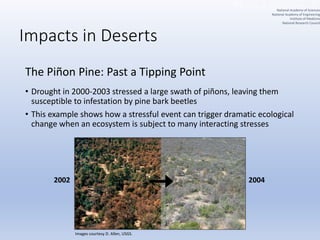
Impacts in Deserts
The Piñon Pine: Past a Tipping Point
• Drought in 2000-2003 stressed a large swath of piñons, leaving them
susceptible to infestation by pine bark beetles
• This example shows how a stressful event can trigger dramatic ecological
change when an ecosystem is subject to many interacting stresses
2002 2004
Images courtesy D. Allen, USGS.
National Academy of Sciences
National Academy of Engineering
Institute of Medicine
National Research Council
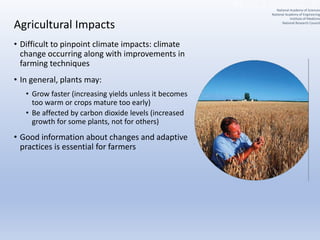
Agricultural Impacts
• Difficult to pinpoint climate impacts: climate
change occurring along with improvements in
farming techniques
• In general, plants may:
• Grow faster (increasing yields unless it becomes
too warm or crops mature too early)
• Be affected by carbon dioxide levels (increased
growth for some plants, not for others)
• Good information about changes and adaptive
practices is essential for farmers
National Academy of Sciences
National Academy of Engineering
Institute of Medicine
National Research Council
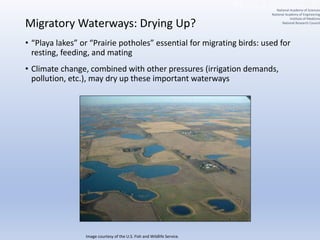
Migratory Waterways: Drying Up?
• “Playa lakes” or “Prairie potholes” essential for migrating birds: used for
resting, feeding, and mating
• Climate change, combined with other pressures (irrigation demands,
pollution, etc.), may dry up these important waterways
Image courtesy of the U.S. Fish and Wildlife Service.
National Academy of Sciences
National Academy of Engineering
Institute of Medicine
National Research Council
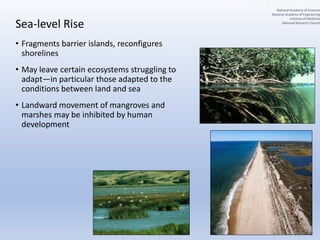
Sea-level Rise
• Fragments barrier islands, reconfigures
shorelines
• May leave certain ecosystems struggling to
adapt—in particular those adapted to the
conditions between land and sea
• Landward movement of mangroves and
marshes may be inhibited by human
development
National Academy of Sciences
National Academy of Engineering
Institute of Medicine
National Research Council
Coral Reefs: Multiple Changes
• Climate change is compounding other factors
affecting reefs (coastal development, pollution,
overfishing)
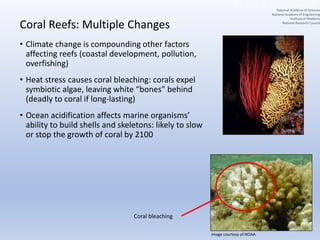
• Heat stress causes coral bleaching: corals expel
symbiotic algae, leaving white “bones” behind
(deadly to coral if long-lasting)
• Ocean acidification affects marine organisms’
ability to build shells and skeletons: likely to slow
or stop the growth of coral by 2100
Image courtesy of NOAA.
Coral bleaching
National Academy of Sciences
National Academy of Engineering
Institute of Medicine
National Research Council
Northward Movement of Tropical Species
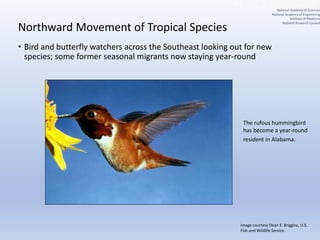
• Bird and butterfly watchers across the Southeast looking out for new
species; some former seasonal migrants now staying year-round
The rufous hummingbird
has become a year-round
resident in Alabama.
Image courtesy Dean E. Briggins, U.S.
Fish and Wildlife Service.
National Academy of Sciences
National Academy of Engineering
Institute of Medicine
National Research Council
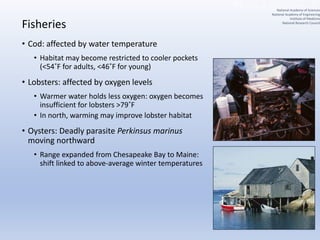
Fisheries
• Cod: affected by water temperature
• Habitat may become restricted to cooler pockets
(<54˚F for adults, <46˚F for young)
• Lobsters: affected by oxygen levels
• Warmer water holds less oxygen: oxygen becomes
insufficient for lobsters >79˚F
• In north, warming may improve lobster habitat
• Oysters: Deadly parasite Perkinsus marinus
moving northward
• Range expanded from Chesapeake Bay to Maine:
shift linked to above-average winter temperatures
National Academy of Sciences
National Academy of Engineering
Institute of Medicine
National Research Council
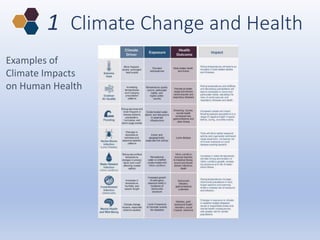
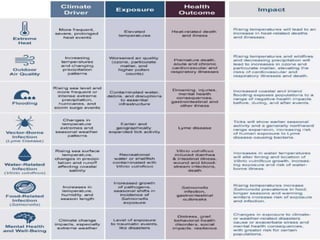
Examples of
Climate Impacts
on Human Health
1 Climate Change and Health
The Role of Human Beings
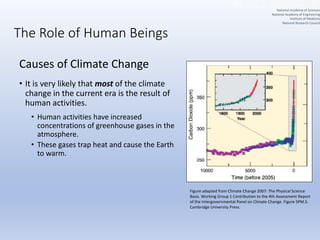
Causes of Climate Change
• It is very likely that most of the climate
change in the current era is the result of
human activities.
• Human activities have increased
concentrations of greenhouse gases in the
atmosphere.
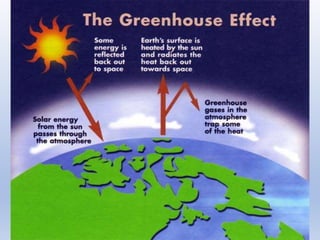
• These gases trap heat and cause the Earth
to warm.
Figure adapted from Climate Change 2007: The Physical Science
Basis. Working Group 1 Contribution to the 4th Assessment Report
of the Intergovernmental Panel on Climate Change. Figure SPM.5.
Cambridge University Press.
National Academy of Sciences
National Academy of Engineering
Institute of Medicine
National Research Council
The Role of Human Beings
Rate of Climate Change
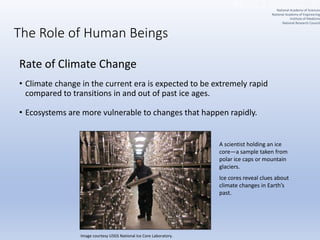
• Climate change in the current era is expected to be extremely rapid
compared to transitions in and out of past ice ages.
• Ecosystems are more vulnerable to changes that happen rapidly.
A scientist holding an ice
core—a sample taken from
polar ice caps or mountain
glaciers.
Ice cores reveal clues about
climate changes in Earth’s
past.
Image courtesy USGS National Ice Core Laboratory.
National Academy of Sciences
National Academy of Engineering
Institute of Medicine
National Research Council
The Role of Human Beings
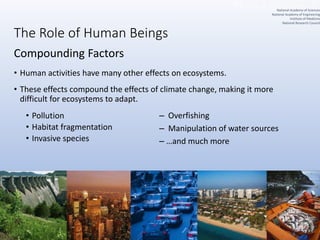
Compounding Factors
• Human activities have many other effects on ecosystems.
• These effects compound the effects of climate change, making it more
difficult for ecosystems to adapt.
• Pollution
• Habitat fragmentation
• Invasive species
– Overfishing
– Manipulation of water sources
– …and much more
National Academy of Sciences
National Academy of Engineering
Institute of Medicine
National Research Council
The Role of Human Beings
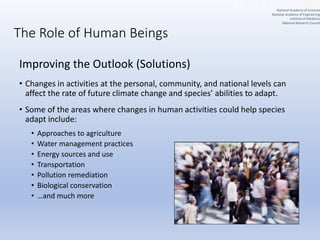
Improving the Outlook (Solutions)
• Changes in activities at the personal, community, and national levels can
affect the rate of future climate change and species’ abilities to adapt.
• Some of the areas where changes in human activities could help species
adapt include:
• Approaches to agriculture
• Water management practices
• Energy sources and use
• Transportation
• Pollution remediation
• Biological conservation
• …and much more
National Academy of Sciences
National Academy of Engineering
Institute of Medicine
National Research Council
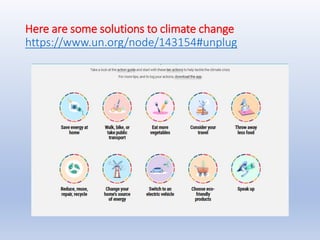
Here are some solutions to climate change
https://www.un.org/node/143154#unplug
The climate challenge is large and complex.
But it is very likely that many people, working from many angles,
can help address climate change and its ecological consequences.
National Academy of Sciences
National Academy of Engineering
Institute of Medicine
National Research Council
Acknowledgments
This presentation was developed by the National Academy of
Sciences based on its report, Ecological Impacts of Climate
Change (2009). The report, its companion booklet, and this
presentation were produced with support from the United
States Geological Survey. Ecological Impacts of Climate
Change was authored by the following National Research
Council committee:
National Research Council Staff
ANN REID, Study Director
FRANCES E. SHARPLES, Director, Board on Life Sciences
ANNE FRANCES JOHNSON, Communications Officer
AMANDA CLINE, Senior Program Assistant
CHRISTOPHER B. FIELD, Chair, Carnegie Institution for Science
DONALD F. BOESCH, U. of Maryland Center for Environmental Science
F. STUART (TERRY) CHAPIN III, University of Alaska
PETER H. GLEICK, Pacific Institute
ANTHONY C. JANETOS, University of Maryland
JANE LUBCHENCO, Oregon State University
JONATHAN T. OVERPECK, University of Arizona
CAMILLE PARMESAN, University of Texas
TERRY L. ROOT, Stanford University
STEVEN W. RUNNING, University of Montana
STEPHEN H. SCHNEIDER, Stanford University
Unless otherwise noted, all images in this presentation are © JupiterImages, 2009. These images were purchased for
use in this presentation and may not be reproduced without permission from the owner.
For more information, visit www.nas.edu/climatechange
National Academy of Sciences
National Academy of Engineering
Institute of Medicine
National Research Council

Week 3 Lecture 3.1.pptx

  • 2.
    What are greenhousegases? Any gases that cause the “greenhouse effect!” Imagine… a car on a cool but sunny day…
  • 6.
    Global Climate Change •Identifiable change in the climate of Earth as a whole that lasts for an extended period of time (decades or longer) • When due to natural processes, it is usually referred to as global climate variability • Usually refers to changes forced by human activities that change the atmosphere
  • 7.
  • 8.
    What causes Earth’sclimate to change? •Changes in the atmosphere •Natural processes • Volcanoes • Tectonic plate movement • Changes in the sun • Shifts in Earth’s orbit •Human activities – any activity that releases “greenhouse gases” into the atmosphere
  • 9.
    Meet an IceCore Scientist
  • 11.
    What does thisgraph mean?
  • 13.
    What about thosenatural processes that can cause climate change? Click to explore these natural processes at the EPA website!
  • 14.
    “Their effects [thoseof human-caused greenhouse gases], together with those of other anthropogenic drivers, have been detected throughout the climate system and are extremely likely to have been the dominant cause of the observed warming since the mid-20th century.” IPCC Conclusion:
  • 15.
    •Warming and sealevel rise will continue and will probably occur more quickly than what we’ve already seen •Even if greenhouse gases are stabilized, this will probably continue to occur for centuries •Some effects may be permanent
  • 16.
    • Effects onEcosystems – Coral systems and other unique ecosystems cannot handle higher temperatures well – Wildfires will increase – Up to 30% of species will be at increased risk for extinction due to the rapid changes in their ecosystems
  • 17.
    A presentation developedby the National Academy of Sciences based on its report Ecological Impacts of Climate Change (2009): www.nas.edu/climatechange. National Academy of Sciences National Academy of Engineering Institute of Medicine National Research Council
  • 18.
    The Climate isChanging •Temperatures are rising •Sea levels are rising •The ocean is acidifying •Climate change is reflected in water cycle changes and in extreme weather Temperature rise, indicated by color (red=higher rate of increase). Earth’s surface temperature has risen ~1.3˚ F since 1850. Image courtesy of the Joint Institute for the Study of the Atmosphere & Ocean, U. of Washington. National Academy of Sciences National Academy of Engineering Institute of Medicine National Research Council
  • 19.
    Ecological Impacts Living thingsare intimately connected to their physical surroundings. Ecosystems are affected by changes in: • temperature • rainfall/moisture • pH – salinity (saltiness) – activities & distribution of other species – …many other factors National Academy of Sciences National Academy of Engineering Institute of Medicine National Research Council
  • 20.
    Ecological Impacts As aresult of climate change, species and ecosystems are experiencing changes in: • ranges • timing of biological activity • growth rates • relative abundance of species – cycling of water and nutrients – the risk of disturbance from fire, insects, and invasive species National Academy of Sciences National Academy of Engineering Institute of Medicine National Research Council
  • 21.
    Ecological Impacts •As aresult of climate change, species and ecosystems are experiencing changes in: • ranges • timing of biological activity • growth rates • relative abundance of species – cycling of water and nutrients – the risk of disturbance from fire, insects, and invasive species National Academy of Sciences National Academy of Engineering Institute of Medicine National Research Council
  • 22.
    Range Shifts Species arerelocating to areas with more tolerable climate conditions. Range shifts particularly threaten species that: • cannot move fast enough • depend on conditions that are becoming more rare (like sea ice) Plant hardiness zone maps, 1990 and 2006. Most zones shifted northward in this period. Map courtesy of the National Arbor Day Foundation. National Academy of Sciences National Academy of Engineering Institute of Medicine National Research Council
  • 23.
    Ecological Impacts As aresult of climate change, species and ecosystems are experiencing changes in: • ranges • timing of biological activity • growth rates • relative abundance of species – cycling of water and nutrients – the risk of disturbance from fire, insects, and invasive species National Academy of Sciences National Academy of Engineering Institute of Medicine National Research Council
  • 24.
    Timing of BiologicalActivity Some seasonal biological activities are happening 15-20 days earlier than several decades ago: • Trees blooming earlier • Migrating birds arriving earlier • Butterflies emerging earlier Changes in timing differ from species to species, so ecological interactions are disrupted. European pied flycatcher chicks are now born later than the caterpillars they eat. Images used under the terms of the GNU Free Documentation License. National Academy of Sciences National Academy of Engineering Institute of Medicine National Research Council
  • 25.
    Impacts in thePacific Coastline Shifting Ranges of Checkerspot Butterflies • Edith’s checkerspot: range has shifted northward and to higher elevations over 40+ years • Quino checkerspot: first endangered species for which climate change is officially listed as a threat and as a factor in the plan for its recovery Image courtesy of Dr. Gordon Pratt, www.quinocheckerspot.com. National Academy of Sciences National Academy of Engineering Institute of Medicine National Research Council
  • 26.
    Changes in theWater • Shift in species ranges: many species moving northward • Mysterious dead zones along Washington and Oregon coastline: cause undetermined but potential links to climate change Scientists retrieve a water sample for research on a recurring “dead zone” off the coasts of Washington and Oregon. Image courtesy of Oregon State University. National Academy of Sciences National Academy of Engineering Institute of Medicine National Research Council
  • 27.
    California Wine Industry:Unwelcome Changes? • Climate change affects managed ecosystems like vineyards and farms just as it affects natural ecosystems • Future warming unlikely to help wine growers in California’s premium wine regions: some areas projected to become “marginal” by 2100 National Academy of Sciences National Academy of Engineering Institute of Medicine National Research Council
  • 28.
    Effects on Ice-DependentAnimals • Year-round sea ice shrinking: walruses and other animals challenged to find platforms for nursing and resting • Polar bears facing difficult hunting conditions: seals now surfacing in open ocean instead of holes in ice National Academy of Sciences National Academy of Engineering Institute of Medicine National Research Council
  • 29.
    Changing Food Chains •Increased shrub growth presenting a threat to caribou (wild reindeer) • Shrubs crowding out lichens (a key winter food for caribou) • Shrubs collect snow, causing deep snowdrifts: deep snow makes it hard for caribou to reach lichens hidden beneath National Academy of Sciences National Academy of Engineering Institute of Medicine National Research Council
  • 30.
    Feedback Loops: ArcticWarming Faster • The Arctic is warming twice as fast as the rest of the planet • As sea ice and seasonal snow cover melts, previously reflective white surfaces converted to darker surfaces (to ocean water or vegetation) • Thawing permafrost releases carbon dioxide and methane into the atmosphere, increasing greenhouse gases Rate of warming, indicated by colors (red=higher rate). Image created with data from the Goddard Institute for Space Studies. National Academy of Sciences National Academy of Engineering Institute of Medicine National Research Council
  • 31.
    Wildfire, Drought, andInsects: Complex Interactions Climate change increases the risk of fire in areas where decades of total fire suppression have resulted in buildup of dead fuels. Wildfire increasing in frequency, size, season length: • Longer, more intense summer droughts stressing trees • Stressed trees are more susceptible to attacking beetles, which leave standing dead fuels in their wake A wildfire in Bitterroot National Forest, Montana. Image courtesy of John McColgan, USDA Forest Service. National Academy of Sciences National Academy of Engineering Institute of Medicine National Research Council
  • 32.
    Effects on TheAmerican Pika • Climbing to higher elevations in response to warming • Many populations now isolated on “mountaintop islands” Pika images courtesy of J. R. Douglass, Yellowstone National Park; Aerial image courtesy NASA. National Academy of Sciences National Academy of Engineering Institute of Medicine National Research Council
  • 33.
    Changes in TroutHabitat • Earlier springs, warmer summers reducing stream flows as mountain snow melts off earlier in the season • Some streams reaching temperatures lethal to trout (>78˚F) Image courtesy USGS. National Academy of Sciences National Academy of Engineering Institute of Medicine National Research Council
  • 34.
    Wildfire and InvasiveSpecies • Non-native grasses becoming established in deserts: • Red brome (in the Mojave) • Buffelgrass (in the Sonoran) • Grasses transform desert into flammable grassland: fire-adapted grasses re-establish quickly, pushing out native species like Saguaro cactus • Spread of grasses not directly a result of climate change, but warming may allow them to further spread in the desert and extend to higher elevations. Image courtesy T. Esque, USGS. National Academy of Sciences National Academy of Engineering Institute of Medicine National Research Council
  • 35.
    Impacts in Deserts ThePiñon Pine: Past a Tipping Point • Drought in 2000-2003 stressed a large swath of piñons, leaving them susceptible to infestation by pine bark beetles • This example shows how a stressful event can trigger dramatic ecological change when an ecosystem is subject to many interacting stresses 2002 2004 Images courtesy D. Allen, USGS. National Academy of Sciences National Academy of Engineering Institute of Medicine National Research Council
  • 36.
    Agricultural Impacts • Difficultto pinpoint climate impacts: climate change occurring along with improvements in farming techniques • In general, plants may: • Grow faster (increasing yields unless it becomes too warm or crops mature too early) • Be affected by carbon dioxide levels (increased growth for some plants, not for others) • Good information about changes and adaptive practices is essential for farmers National Academy of Sciences National Academy of Engineering Institute of Medicine National Research Council
  • 37.
    Migratory Waterways: DryingUp? • “Playa lakes” or “Prairie potholes” essential for migrating birds: used for resting, feeding, and mating • Climate change, combined with other pressures (irrigation demands, pollution, etc.), may dry up these important waterways Image courtesy of the U.S. Fish and Wildlife Service. National Academy of Sciences National Academy of Engineering Institute of Medicine National Research Council
  • 38.
    Sea-level Rise • Fragmentsbarrier islands, reconfigures shorelines • May leave certain ecosystems struggling to adapt—in particular those adapted to the conditions between land and sea • Landward movement of mangroves and marshes may be inhibited by human development National Academy of Sciences National Academy of Engineering Institute of Medicine National Research Council
  • 39.
    Coral Reefs: MultipleChanges • Climate change is compounding other factors affecting reefs (coastal development, pollution, overfishing) • Heat stress causes coral bleaching: corals expel symbiotic algae, leaving white “bones” behind (deadly to coral if long-lasting) • Ocean acidification affects marine organisms’ ability to build shells and skeletons: likely to slow or stop the growth of coral by 2100 Image courtesy of NOAA. Coral bleaching National Academy of Sciences National Academy of Engineering Institute of Medicine National Research Council
  • 40.
    Northward Movement ofTropical Species • Bird and butterfly watchers across the Southeast looking out for new species; some former seasonal migrants now staying year-round The rufous hummingbird has become a year-round resident in Alabama. Image courtesy Dean E. Briggins, U.S. Fish and Wildlife Service. National Academy of Sciences National Academy of Engineering Institute of Medicine National Research Council
  • 41.
    Fisheries • Cod: affectedby water temperature • Habitat may become restricted to cooler pockets (<54˚F for adults, <46˚F for young) • Lobsters: affected by oxygen levels • Warmer water holds less oxygen: oxygen becomes insufficient for lobsters >79˚F • In north, warming may improve lobster habitat • Oysters: Deadly parasite Perkinsus marinus moving northward • Range expanded from Chesapeake Bay to Maine: shift linked to above-average winter temperatures National Academy of Sciences National Academy of Engineering Institute of Medicine National Research Council
  • 42.
    Examples of Climate Impacts onHuman Health 1 Climate Change and Health
  • 44.
    The Role ofHuman Beings Causes of Climate Change • It is very likely that most of the climate change in the current era is the result of human activities. • Human activities have increased concentrations of greenhouse gases in the atmosphere. • These gases trap heat and cause the Earth to warm. Figure adapted from Climate Change 2007: The Physical Science Basis. Working Group 1 Contribution to the 4th Assessment Report of the Intergovernmental Panel on Climate Change. Figure SPM.5. Cambridge University Press. National Academy of Sciences National Academy of Engineering Institute of Medicine National Research Council
  • 45.
    The Role ofHuman Beings Rate of Climate Change • Climate change in the current era is expected to be extremely rapid compared to transitions in and out of past ice ages. • Ecosystems are more vulnerable to changes that happen rapidly. A scientist holding an ice core—a sample taken from polar ice caps or mountain glaciers. Ice cores reveal clues about climate changes in Earth’s past. Image courtesy USGS National Ice Core Laboratory. National Academy of Sciences National Academy of Engineering Institute of Medicine National Research Council
  • 46.
    The Role ofHuman Beings Compounding Factors • Human activities have many other effects on ecosystems. • These effects compound the effects of climate change, making it more difficult for ecosystems to adapt. • Pollution • Habitat fragmentation • Invasive species – Overfishing – Manipulation of water sources – …and much more National Academy of Sciences National Academy of Engineering Institute of Medicine National Research Council
  • 47.
    The Role ofHuman Beings Improving the Outlook (Solutions) • Changes in activities at the personal, community, and national levels can affect the rate of future climate change and species’ abilities to adapt. • Some of the areas where changes in human activities could help species adapt include: • Approaches to agriculture • Water management practices • Energy sources and use • Transportation • Pollution remediation • Biological conservation • …and much more National Academy of Sciences National Academy of Engineering Institute of Medicine National Research Council
  • 48.
    Here are somesolutions to climate change https://www.un.org/node/143154#unplug
  • 49.
    The climate challengeis large and complex. But it is very likely that many people, working from many angles, can help address climate change and its ecological consequences. National Academy of Sciences National Academy of Engineering Institute of Medicine National Research Council
  • 50.
    Acknowledgments This presentation wasdeveloped by the National Academy of Sciences based on its report, Ecological Impacts of Climate Change (2009). The report, its companion booklet, and this presentation were produced with support from the United States Geological Survey. Ecological Impacts of Climate Change was authored by the following National Research Council committee: National Research Council Staff ANN REID, Study Director FRANCES E. SHARPLES, Director, Board on Life Sciences ANNE FRANCES JOHNSON, Communications Officer AMANDA CLINE, Senior Program Assistant CHRISTOPHER B. FIELD, Chair, Carnegie Institution for Science DONALD F. BOESCH, U. of Maryland Center for Environmental Science F. STUART (TERRY) CHAPIN III, University of Alaska PETER H. GLEICK, Pacific Institute ANTHONY C. JANETOS, University of Maryland JANE LUBCHENCO, Oregon State University JONATHAN T. OVERPECK, University of Arizona CAMILLE PARMESAN, University of Texas TERRY L. ROOT, Stanford University STEVEN W. RUNNING, University of Montana STEPHEN H. SCHNEIDER, Stanford University Unless otherwise noted, all images in this presentation are © JupiterImages, 2009. These images were purchased for use in this presentation and may not be reproduced without permission from the owner. For more information, visit www.nas.edu/climatechange National Academy of Sciences National Academy of Engineering Institute of Medicine National Research Council